Cambridge IGCSE Mathematics (9-1) 0980 — 2019 Oct/Nov Paper 2 · Variant 1
0980/21/O/N/19 · 26 questions · 70 marks · ≈79 min
The question paper and its mark scheme, free to read here and free to download. This is Cambridge’s own paper, exactly as it was sat.
Question paper12 pages
Mark scheme6 pages
Answers below. Sit the paper first if you are practising.
Questions as text
Q1 · Work out 5% of $25
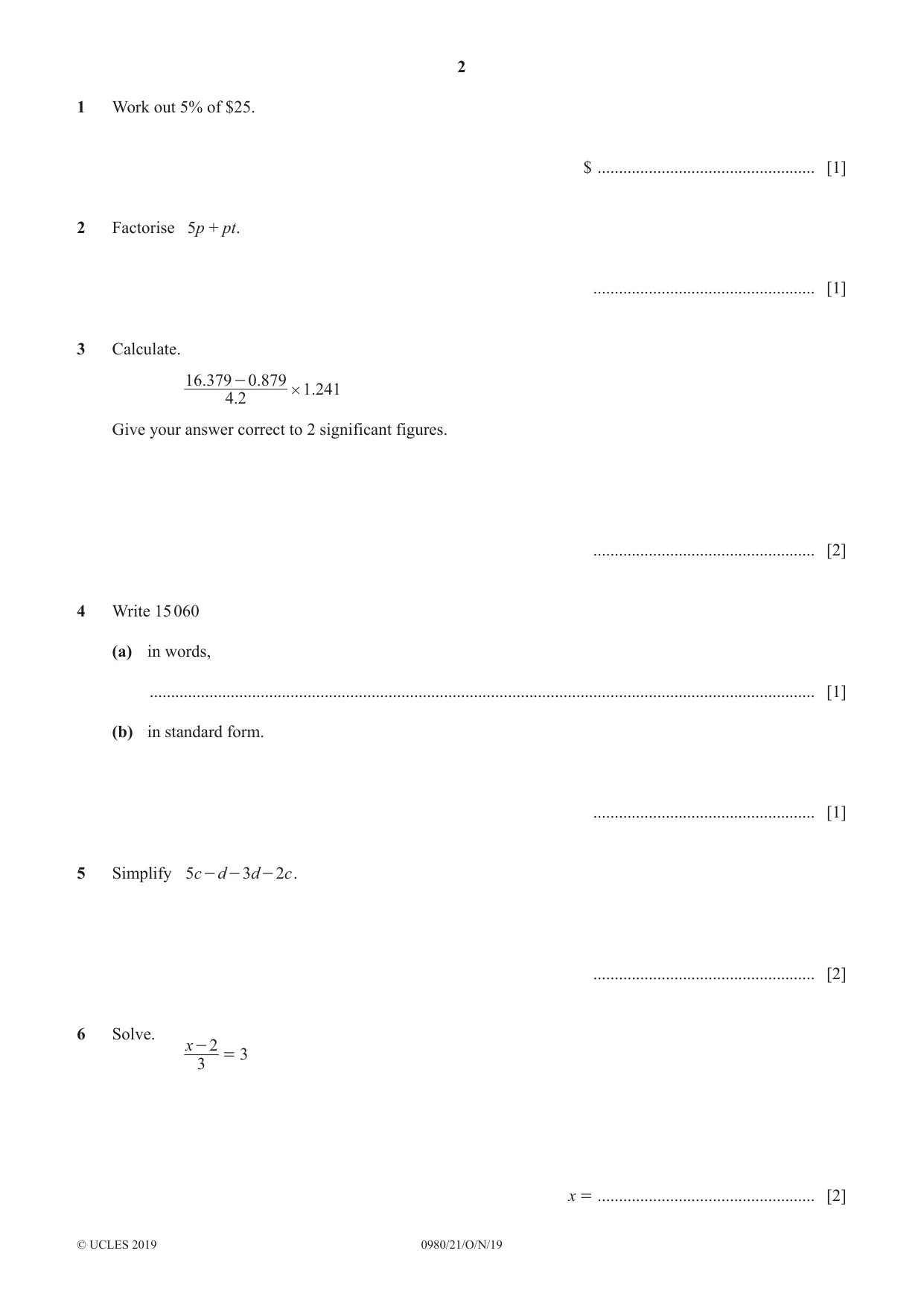
1 Work out 5% of $25. $ ................................................... [1]
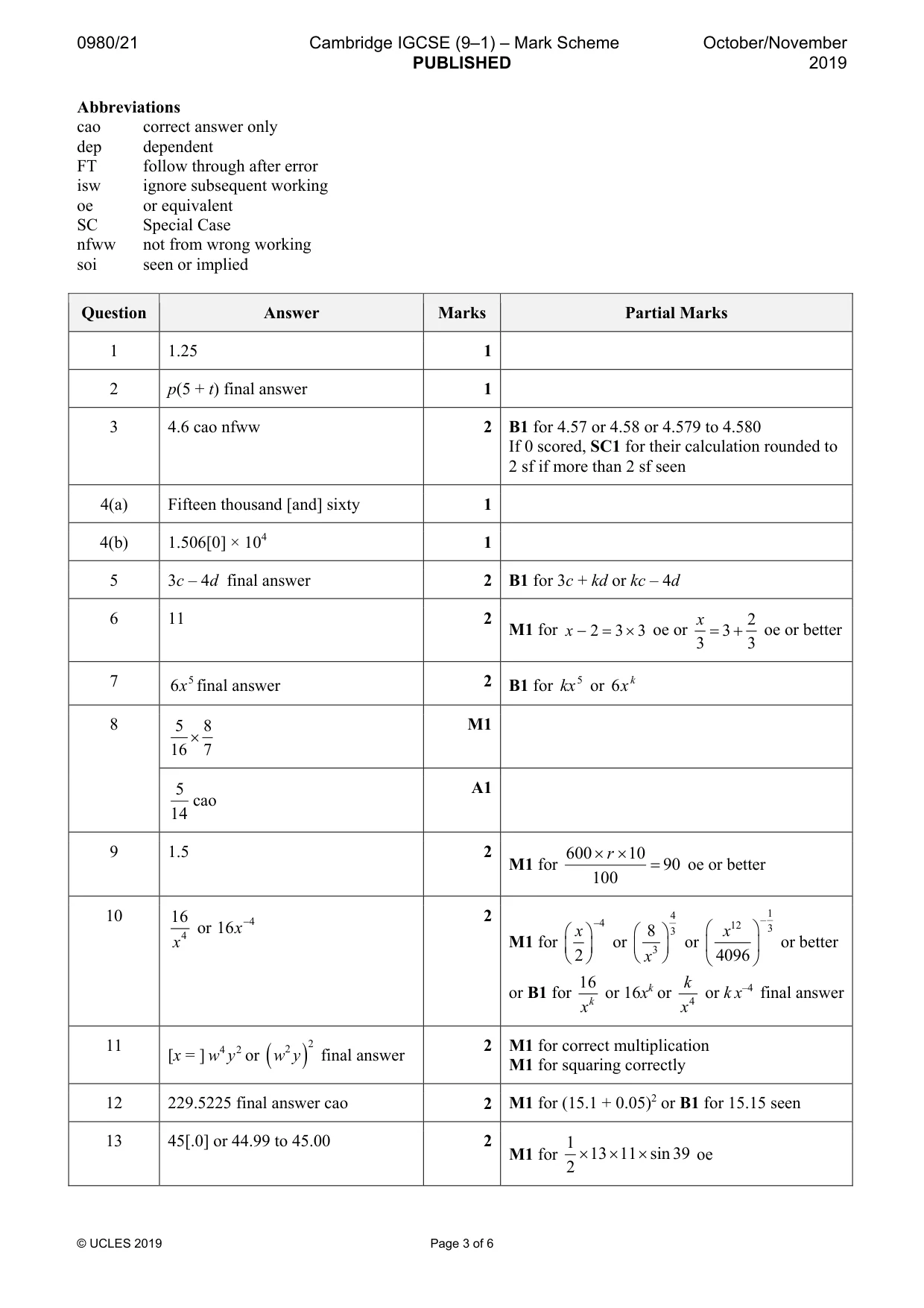
Mark scheme: Question Answer Marks Partial Marks 1 1.25 1
Q2 · Factorise 5p + pt
2 Factorise 5p + pt. .................................................... [1]
Mark scheme: 2 p(5 + t) final answer 1
Question 3
3 Calculate. 16.379 - 0.879 # 1. 241 4.2 Give your answer correct to 2 significant figures. .................................................... [2]
Mark scheme: 3 4.6 cao nfww 2 B1 for 4.57 or 4.58 or 4.579 to 4.580 If 0 scored, SC1 for their calculation rounded to 2 sf if more than 2 sf seen
Q4 · Write 15 060 (a) in words…
4 Write 15 060 (a) in words, ............................................................................................................................................................ [1] (b) in standard form. .................................................... [1]
Mark scheme: 4(a) Fifteen thousand [and] sixty 1 4(b) 1.506[0] × 104 1
Q5 · Simplify 5c - d - 3d - 2 c
5 Simplify 5c - d - 3d - 2 c . .................................................... [2]
Mark scheme: 5 3c – 4d final answer 2 B1 for 3c + kd or kc – 4d
Question 6
6 Solve. x - 2 = 3 3 x = ................................................... [2]
Mark scheme: 6 11 2 x 2 M1 for x − 2 = 3 × 3 oe or = 3 + oe or better 3 3
Q7 · Simplify 2x 3 # 3x 2
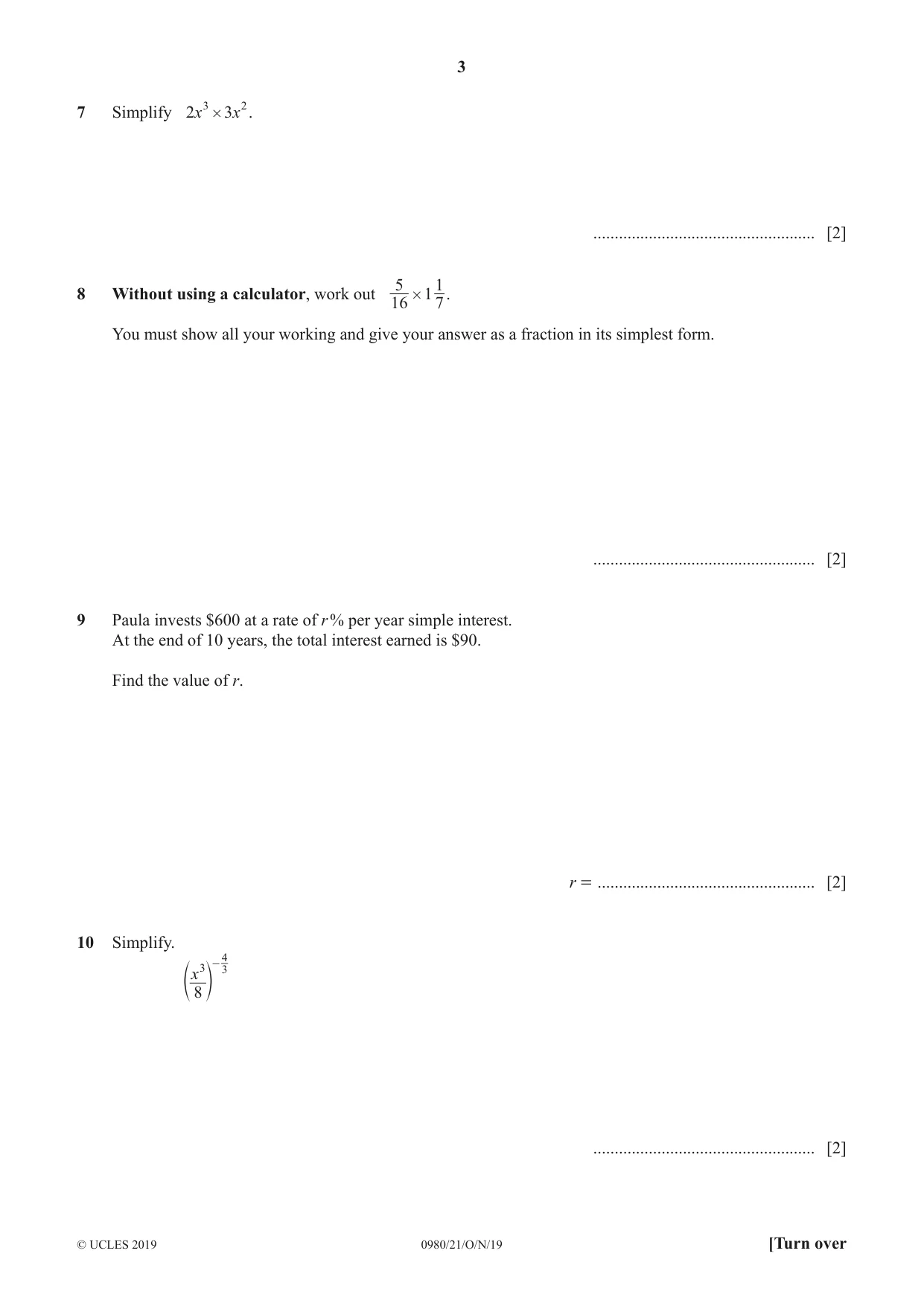
7 Simplify 2x 3 # 3x 2 . .................................................... [2]
Mark scheme: 7 6x 5 final answer 2 B1 for kx 5 or 6 x k
Q8 · Without using a calculator, work out # 1
8 Without using a calculator, work out # 1 . 16 7 You must show all your working and give your answer as a fraction in its simplest form. .................................................... [2]
Mark scheme: 8 5 8 M1 × 16 7 5 A1 cao 14
Q9 · Paula invests $600 at a rate of r % per year simple interest
9 Paula invests $600 at a rate of r % per year simple interest. At the end of 10 years, the total interest earned is $90. Find the value of r. r = ................................................... [2]
Mark scheme: 9 1.5 2 600 × r × 10 M1 for = 90 oe or better 100
Question 10
10 Simplify. 4 e x83 o- 3 .................................................... [2]
Mark scheme: 1 4 210 16 −4 3 or 16x−4 3 x12 – 8 x 4 x M1 for or 3 or or better 2 x 4096 16 k or B1 for or 16xk or or k x–4 final answer kx x 4
Q11 · Y = w2 Rearrange the formula to write x in terms of w and y
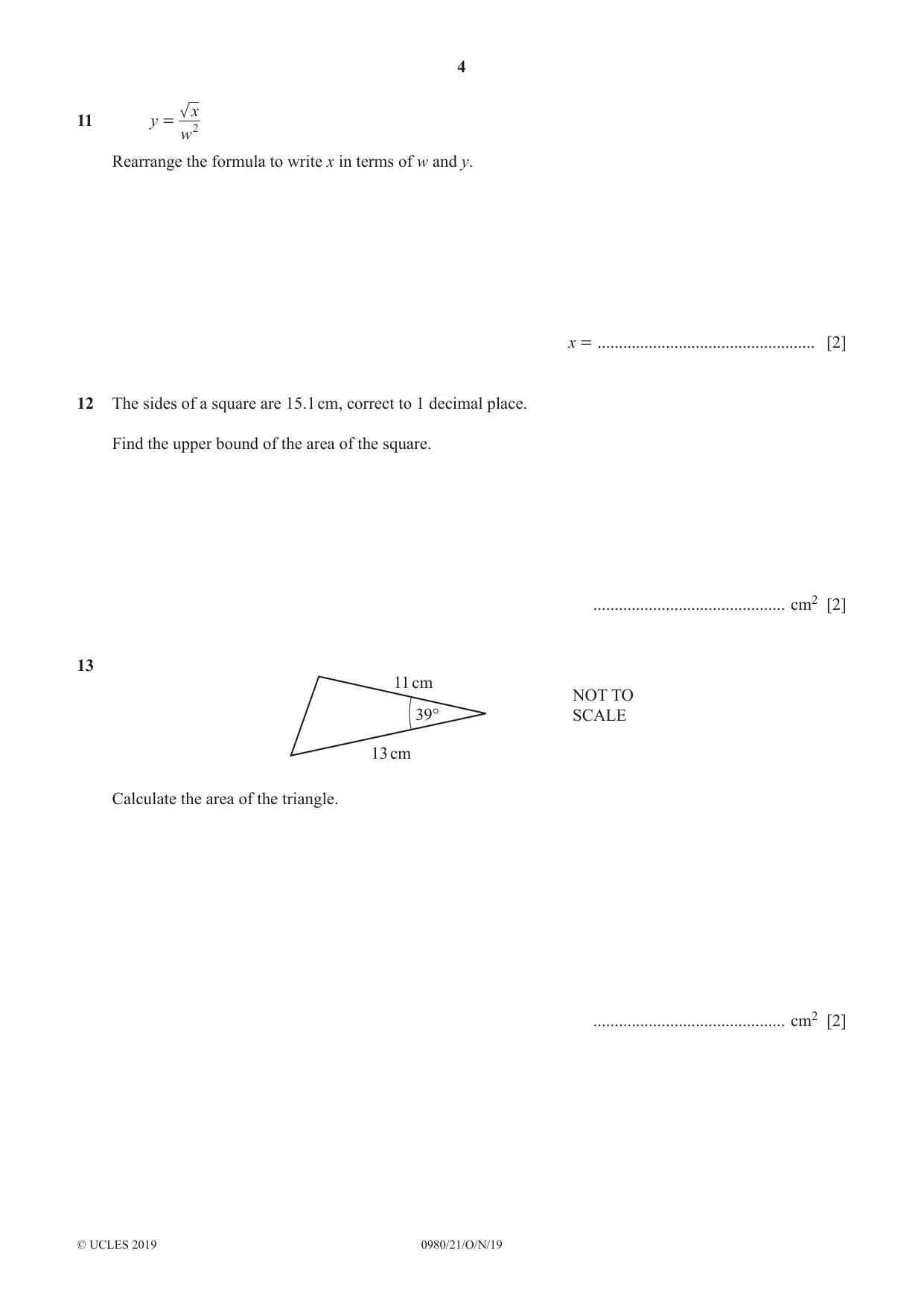
11 y = w2 Rearrange the formula to write x in terms of w and y. x = ................................................... [2]
Mark scheme: 11 4 2 2 2 2 M1 for correct multiplication [x = ] w y or w y final answer ( ) M1 for squaring correctly
Q12 · The sides of a square are 15.1 cm, correct to 1 decimal place
12 The sides of a square are 15.1 cm, correct to 1 decimal place. Find the upper bound of the area of the square. ............................................. cm2 [2]
Mark scheme: 12 229.5225 final answer cao 2 M1 for (15.1 + 0.05)2 or B1 for 15.15 seen
Q13 · 11 cm NOT TO 39° SCALE 13 cm Calculate the area of the triangle
13 11 cm NOT TO 39° SCALE 13 cm Calculate the area of the triangle. ............................................. cm2 [2]
Mark scheme: 13 45[.0] or 44.99 to 45.00 2 1 M1 for × 13 × 11 × sin 39 oe 2
Q14 · The scale of a map is 1 : 10 000 000
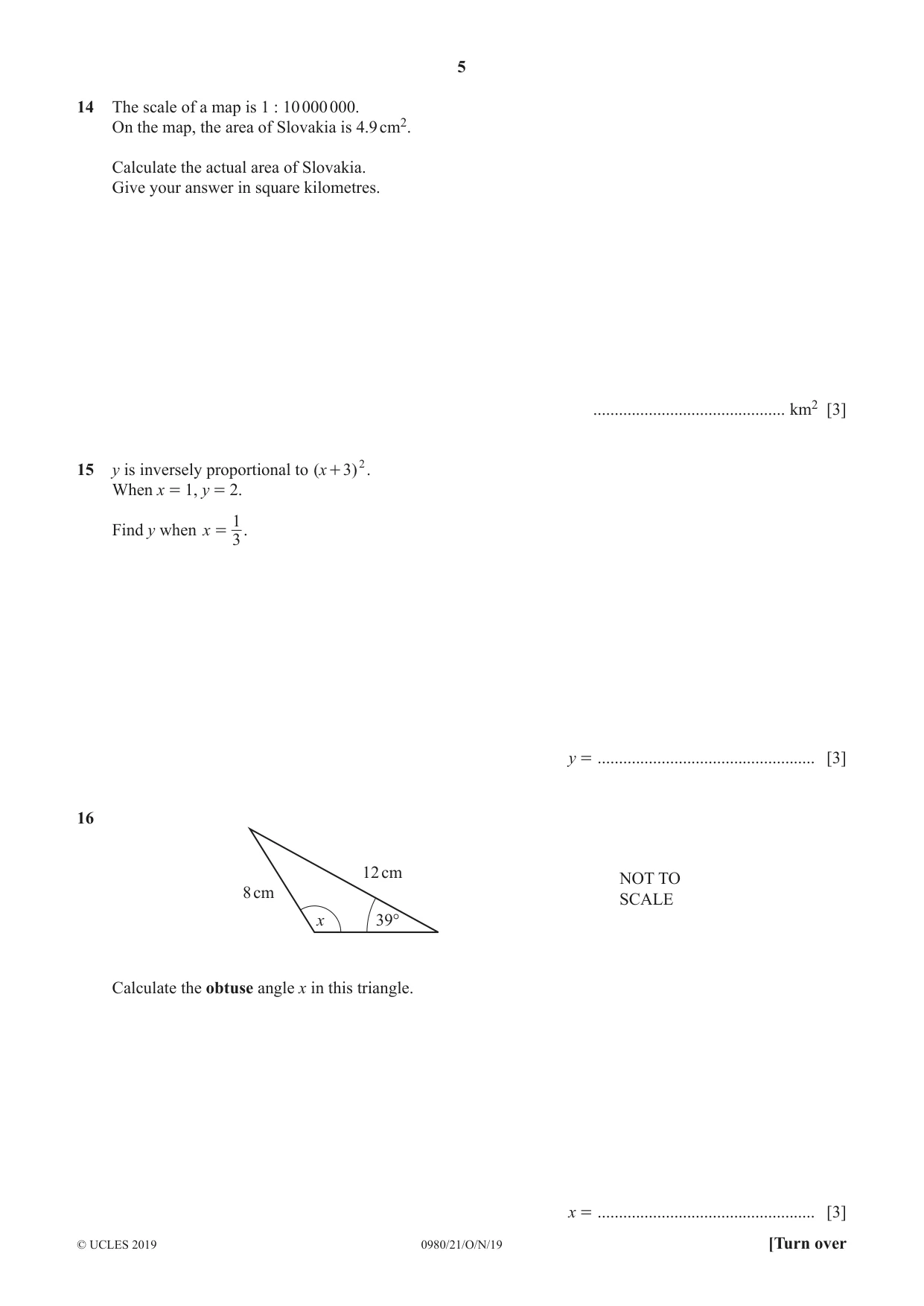
14 The scale of a map is 1 : 10 000 000. On the map, the area of Slovakia is 4.9 cm2. Calculate the actual area of Slovakia. Give your answer in square kilometres. ............................................. km2 [3]
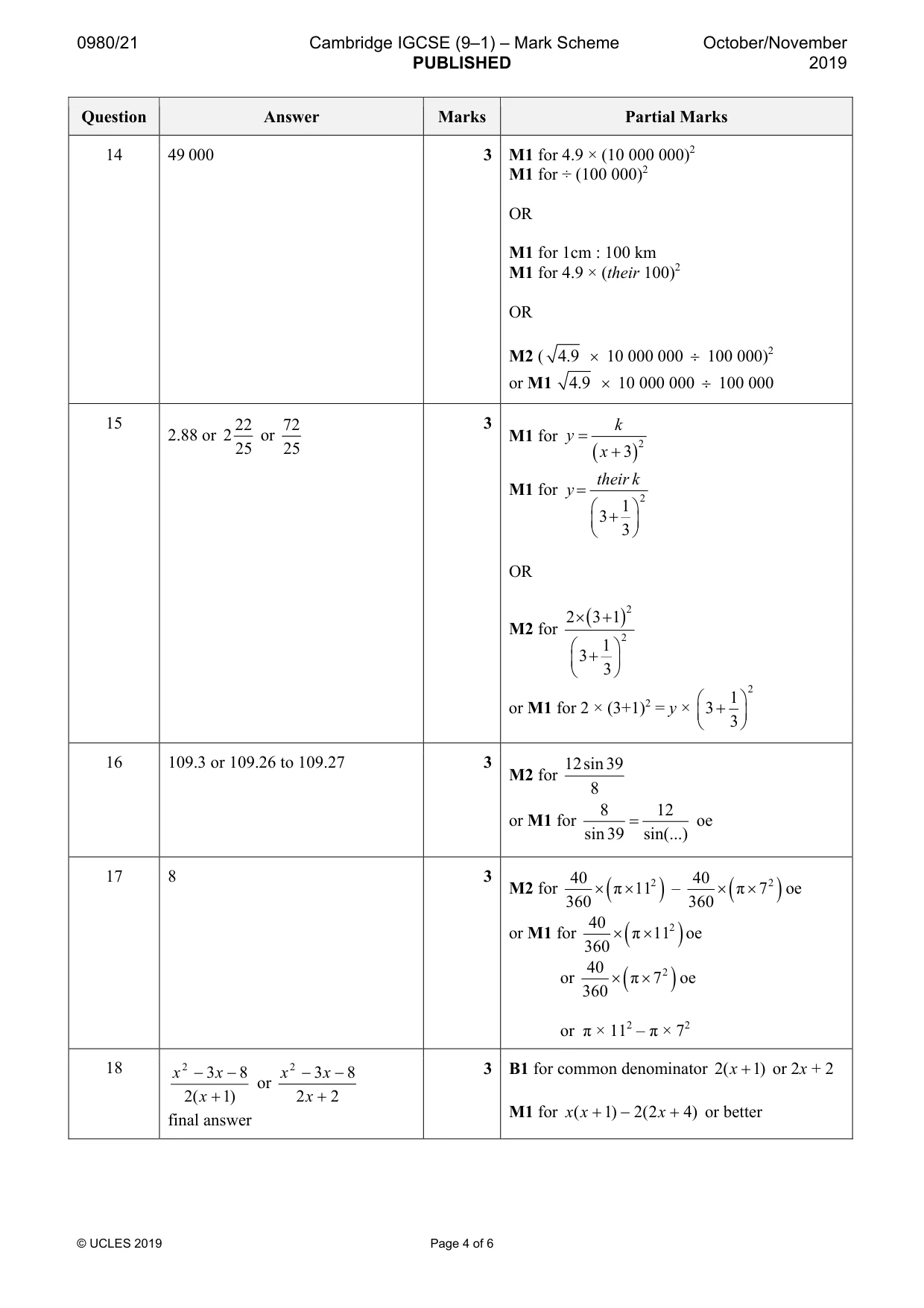
Mark scheme: 14 49 000 3 M1 for 4.9 × (10 000 000)2 M1 for ÷ (100 000)2 OR M1 for 1cm : 100 km M1 for 4.9 × (their 100)2 OR M2 ( 4.9 × 10 000 000 ÷ 100 000)2 or M1 4.9 × 10 000 000 ÷ 100 000
Q15 · Y is inversely proportional to (x + 3) 2
15 y is inversely proportional to (x + 3) 2 . When x = 1, y = 2. 1 Find y when x = . 3 y = ................................................... [3]
Mark scheme: 15 22 72 3 k 2.88 or 2 or M1 for y = 25 25 ( x + 3 ) 2 their k M1 for y = 1 2 3 + 3 OR 2 × ( 3 + 1) 2 M2 for 1 2 3 + 3 1 2 or M1 for 2 × (3+1)2 = y × 3 + 3
Q16 · 12 cm NOT TO 8 cm SCALE x 39° Calculate the obtuse angle x in this triangle
16 12 cm NOT TO 8 cm SCALE x 39° Calculate the obtuse angle x in this triangle. x = ................................................... [3]
Mark scheme: 16 109.3 or 109.26 to 109.27 3 12 sin 39 M2 for 8 8 12 or M1 for = oe sin 39 sin(...)
Q17 · 11 cm NOT TO SCALE 40° 7 cm The diagram shows two sectors of circles with the same centre
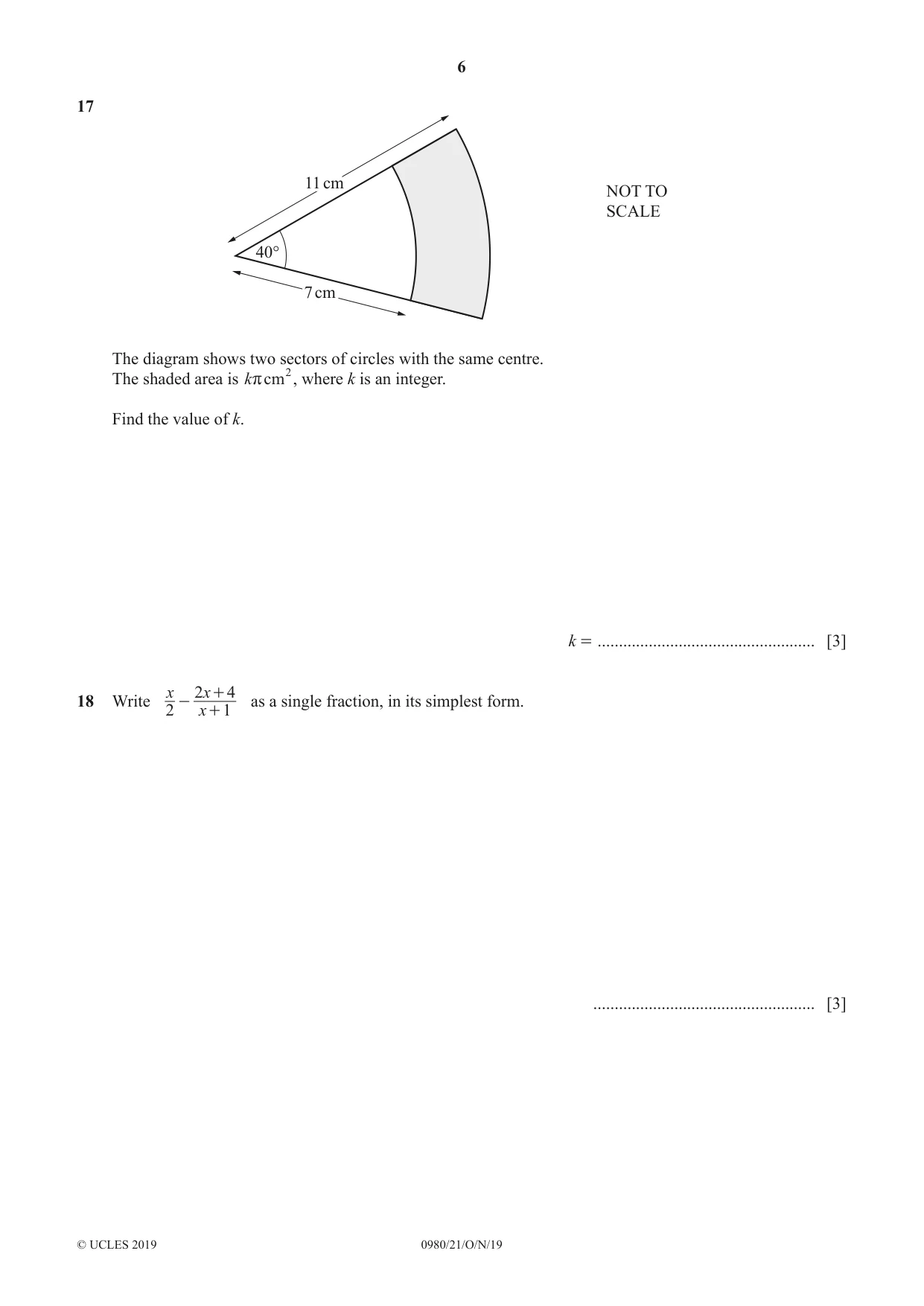
17 11 cm NOT TO SCALE 40° 7 cm The diagram shows two sectors of circles with the same centre. The shaded area is kr cm2 , where k is an integer. Find the value of k. k = ................................................... [3]
Mark scheme: 17 8 3 40 2 40 2 M2 for × π × 11 – × π × 7 oe ( ) ( ) 360 360 40 2 or M1 for × π × 11 oe ( ) 360 40 2 or × π × 7 oe ( ) 360 or π × 112 – π × 72
Q18 · Write - as a single fraction, in its simplest form
18 Write - as a single fraction, in its simplest form. 2 x + 1 .................................................... [3]
Mark scheme: 18 x 2 − 3 x − 8 x 2 − 3 x − 8 3 B1 for common denominator 2( x + )1 or 2x + 2 or 2 ( x + )1 2 x + 2 M1 for x ( x + )1 − 2 ( 2 x + 4 ) or better final answer
Q19 · M = 1 2 P = 7 8 (a) Find MP
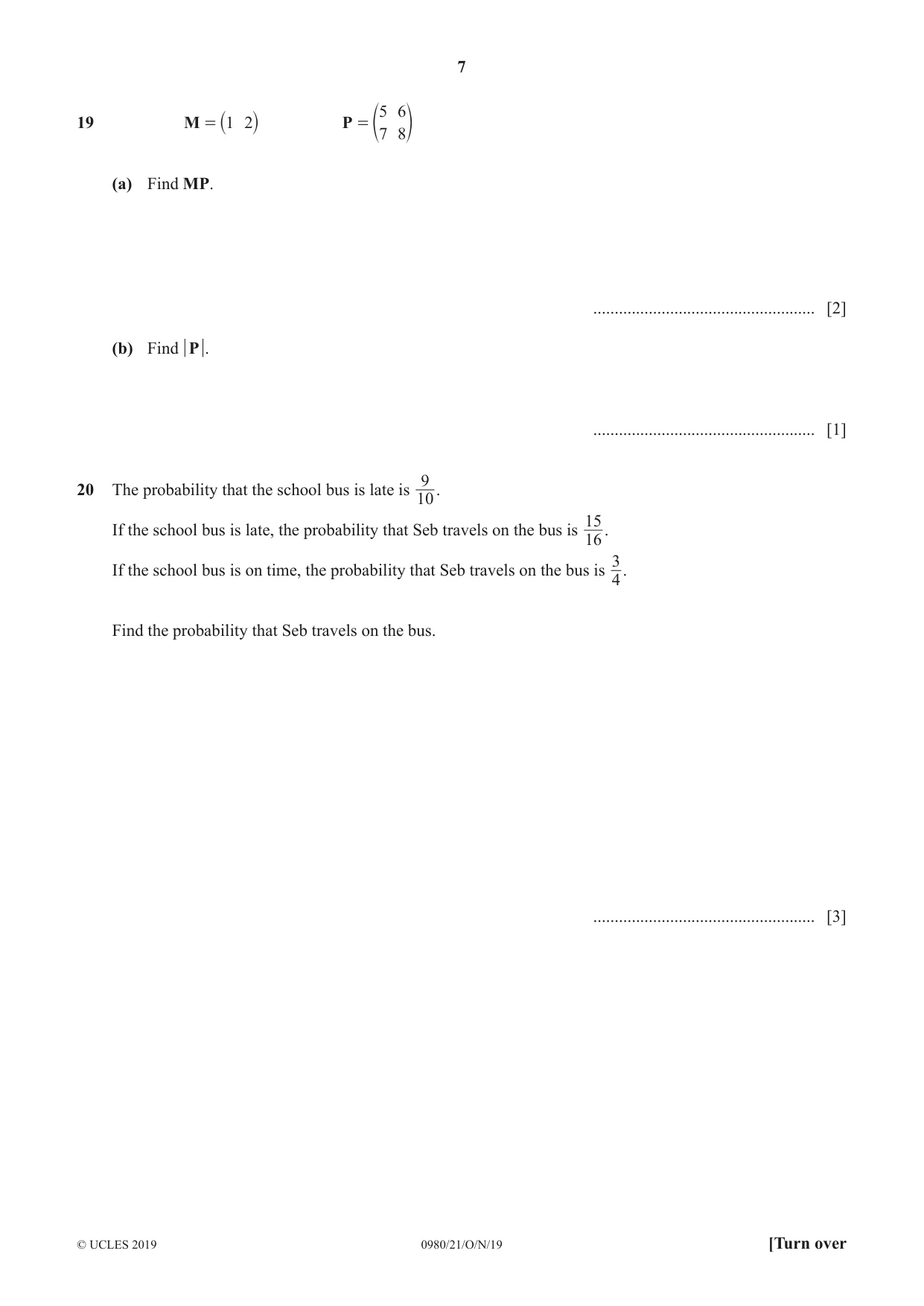
19 M = 1 2 P = 7 8 (a) Find MP. .................................................... [2] (b) Find P . .................................................... [1]
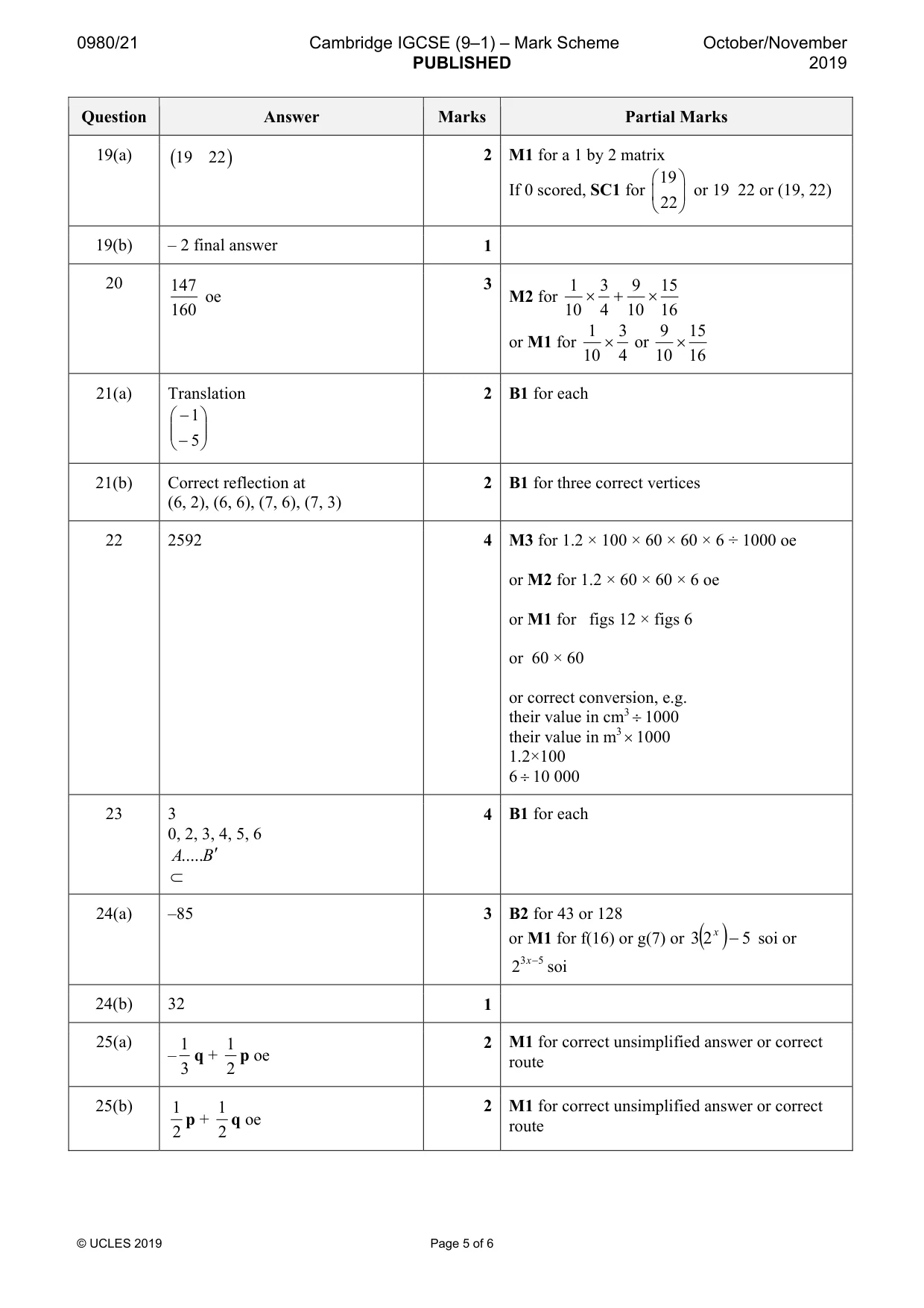
Mark scheme: 19(a) (19 22 ) 2 M1 for a 1 by 2 matrix 19 If 0 scored, SC1 for or 19 22 or (19, 22) 22 19(b) – 2 final answer 1
Q20 · The probability that the school bus is late is
20 The probability that the school bus is late is . 10 15 If the school bus is late, the probability that Seb travels on the bus is . 16 3 If the school bus is on time, the probability that Seb travels on the bus is . 4 Find the probability that Seb travels on the bus. .................................................... [3]
Mark scheme: 20 147 3 1 3 9 15 oe M2 for × + × 160 10 4 10 16 1 3 9 15 or M1 for × or × 10 4 10 16
Q21 · Y 8 7 T 6 5 4 3 2 A 1 0 x 1 2 3 4 5 6 7 8 (a) Describe fully the single transformation…
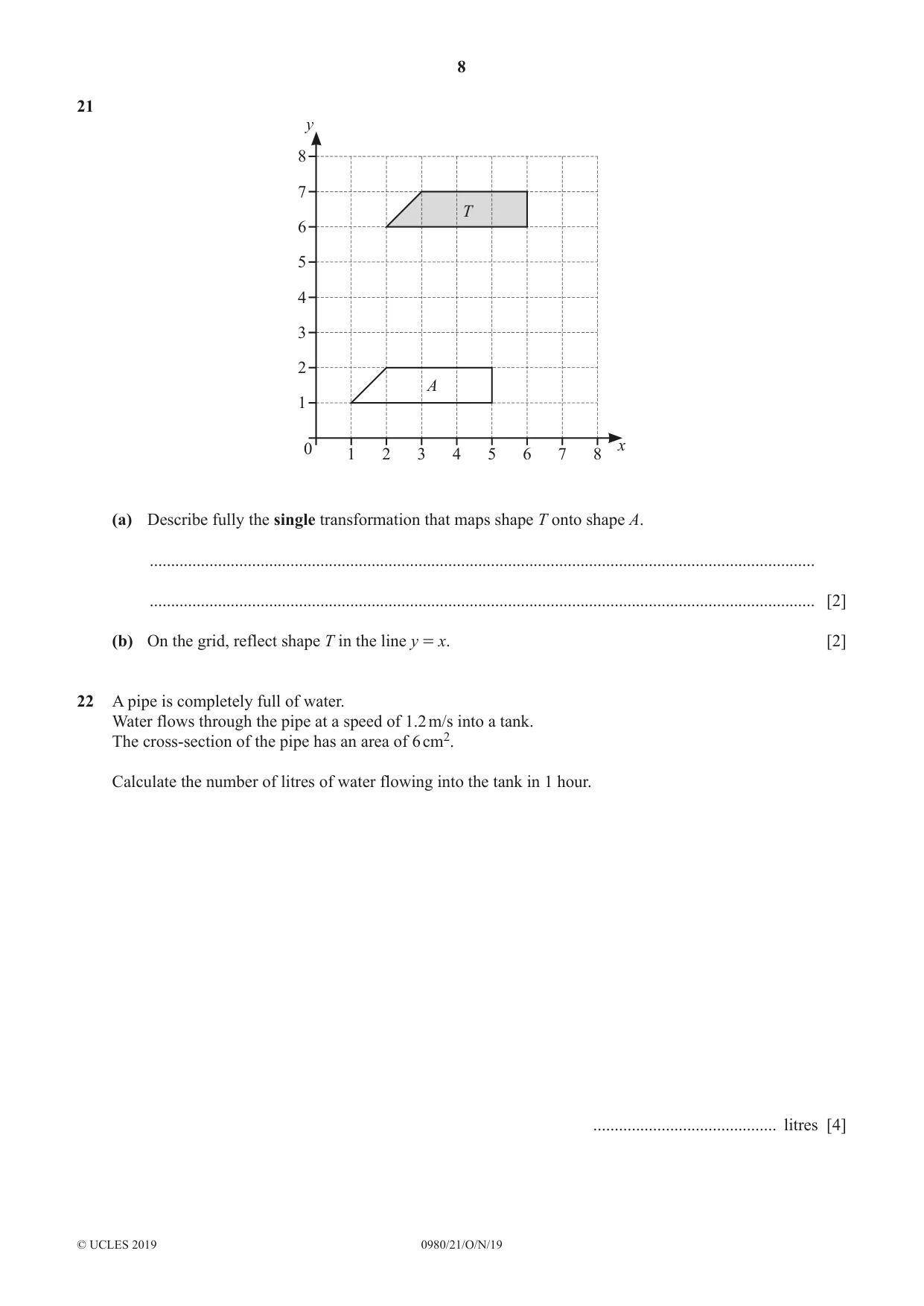
21 y 8 7 T 6 5 4 3 2 A 1 0 x 1 2 3 4 5 6 7 8 (a) Describe fully the single transformation that maps shape T onto shape A. ............................................................................................................................................................ ............................................................................................................................................................ [2] (b) On the grid, reflect shape T in the line y = x. [2]
Mark scheme: 21(a) Translation 2 B1 for each − 1 − 5 21(b) Correct reflection at 2 B1 for three correct vertices (6, 2), (6, 6), (7, 6), (7, 3)
Q22 · A pipe is completely full of water
22 A pipe is completely full of water. Water flows through the pipe at a speed of 1.2 m/s into a tank. The cross-section of the pipe has an area of 6 cm2. Calculate the number of litres of water flowing into the tank in 1 hour. ........................................... litres [4]
Mark scheme: 22 2592 4 M3 for 1.2 × 100 × 60 × 60 × 6 ÷ 1000 oe or M2 for 1.2 × 60 × 60 × 6 oe or M1 for figs 12 × figs 6 or 60 × 60 or correct conversion, e.g. their value in cm3 ÷ 1000 their value in m3× 1000 1.2×100 6 ÷ 10 000
Q23 · = {0, 1, 2, 3, 4, 5, 6} A = {0, 2, 4, 5, 6} B = {1, 2, 5} Complete each of the…
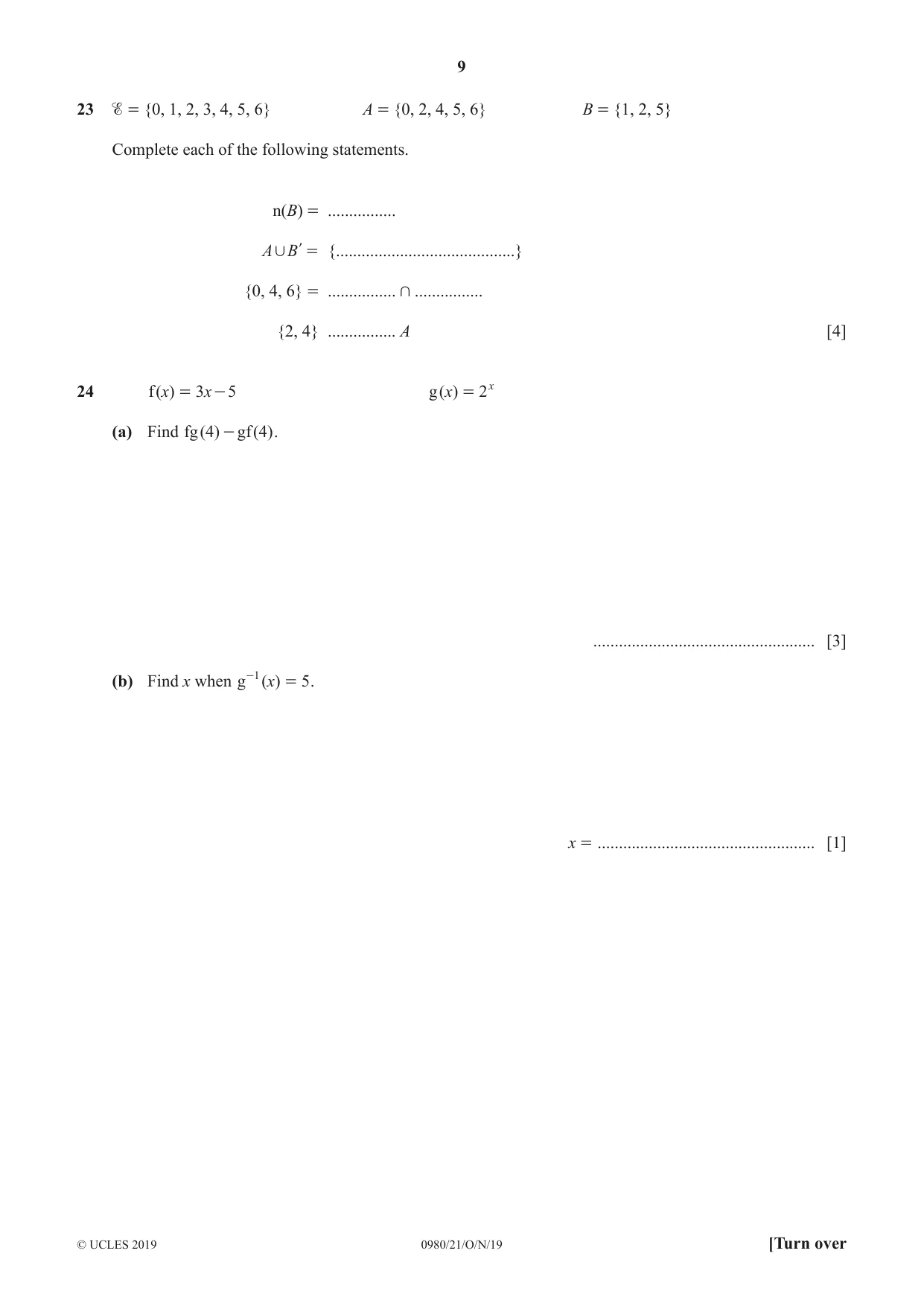
23 = {0, 1, 2, 3, 4, 5, 6} A = {0, 2, 4, 5, 6} B = {1, 2, 5} Complete each of the following statements. n(B) = ................ A , B l = {..........................................} {0, 4, 6} = ................ + ................ {2, 4} ................ A [4]
Mark scheme: 23 3 4 B1 for each 0, 2, 3, 4, 5, 6 A.....B ′ ⊂
Q24 · F (x) = 3x - 5 g (x) = 2x (a) Find fg (4 ) - gf (4)
24 f (x) = 3x - 5 g (x) = 2x (a) Find fg (4 ) - gf (4) . .................................................... [3] (b) Find x when g -1 ()x = 5 . x = ................................................... [1]
Mark scheme: 24(a) –85 3 B2 for 43 or 128 x or M1 for f(16) or g(7) or 3(2 ) − 5 soi or 2 3 x−soi5 24(b) 32 1
Q25 · Q NOT TO M SCALE B P O A O is the origin, OP = 2 OA , OQ = 3 OB and PM = MQ
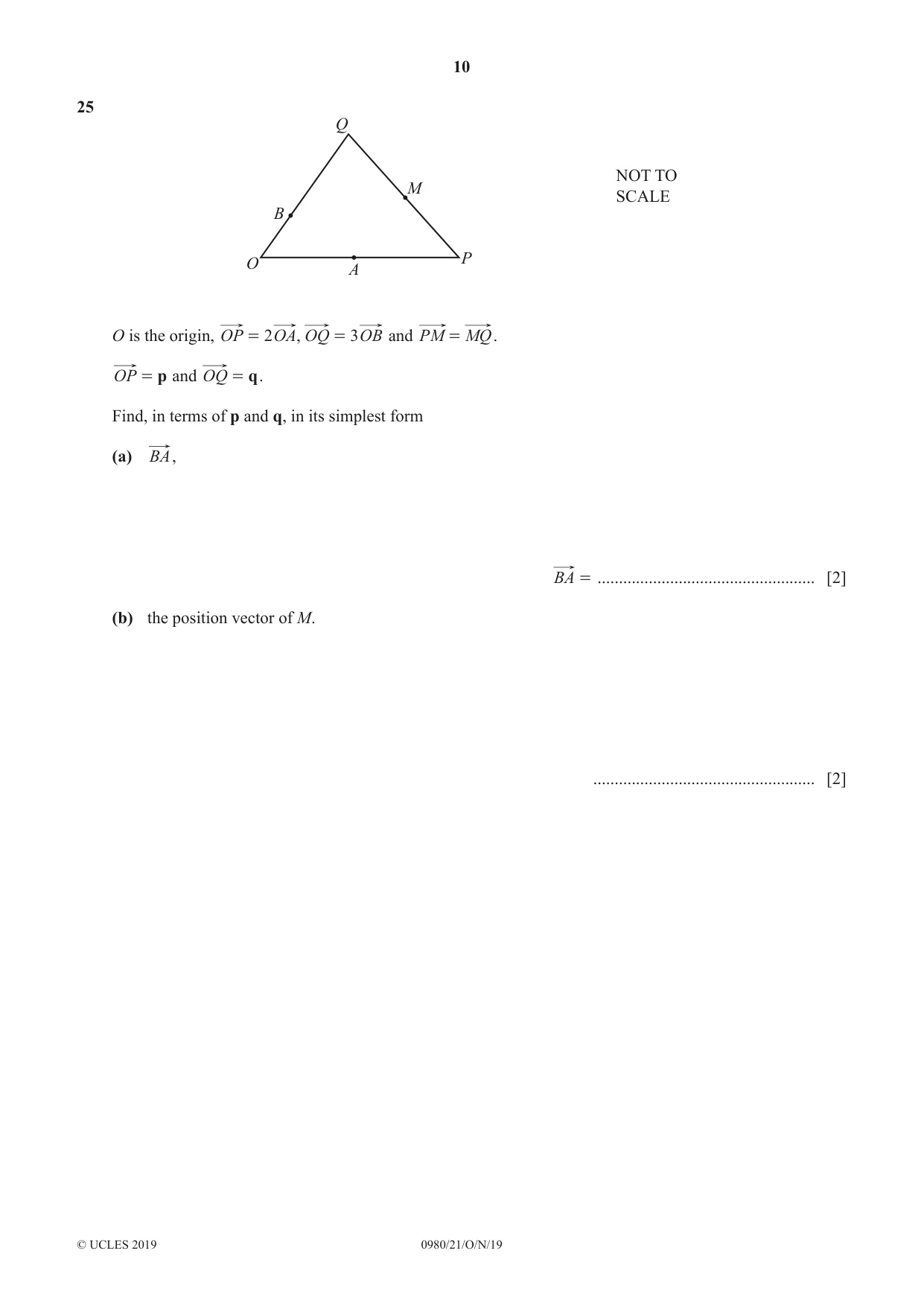
25 Q NOT TO M SCALE B P O A O is the origin, OP = 2 OA , OQ = 3 OB and PM = MQ . OP = p and OQ = q . Find, in terms of p and q, in its simplest form (a) BA, BA = ................................................... [2] (b) the position vector of M. .................................................... [2]
Mark scheme: 25(a) 1 1 2 M1 for correct unsimplified answer or correct – q + p oe route 3 2 25(b) 1 1 2 M1 for correct unsimplified answer or correct p + q oe route 2 2
Q26 · 20 Speed NOT TO (m/s) SCALE 0 0 15 Time (seconds) A car travels at 20 m/s for 15 seconds…
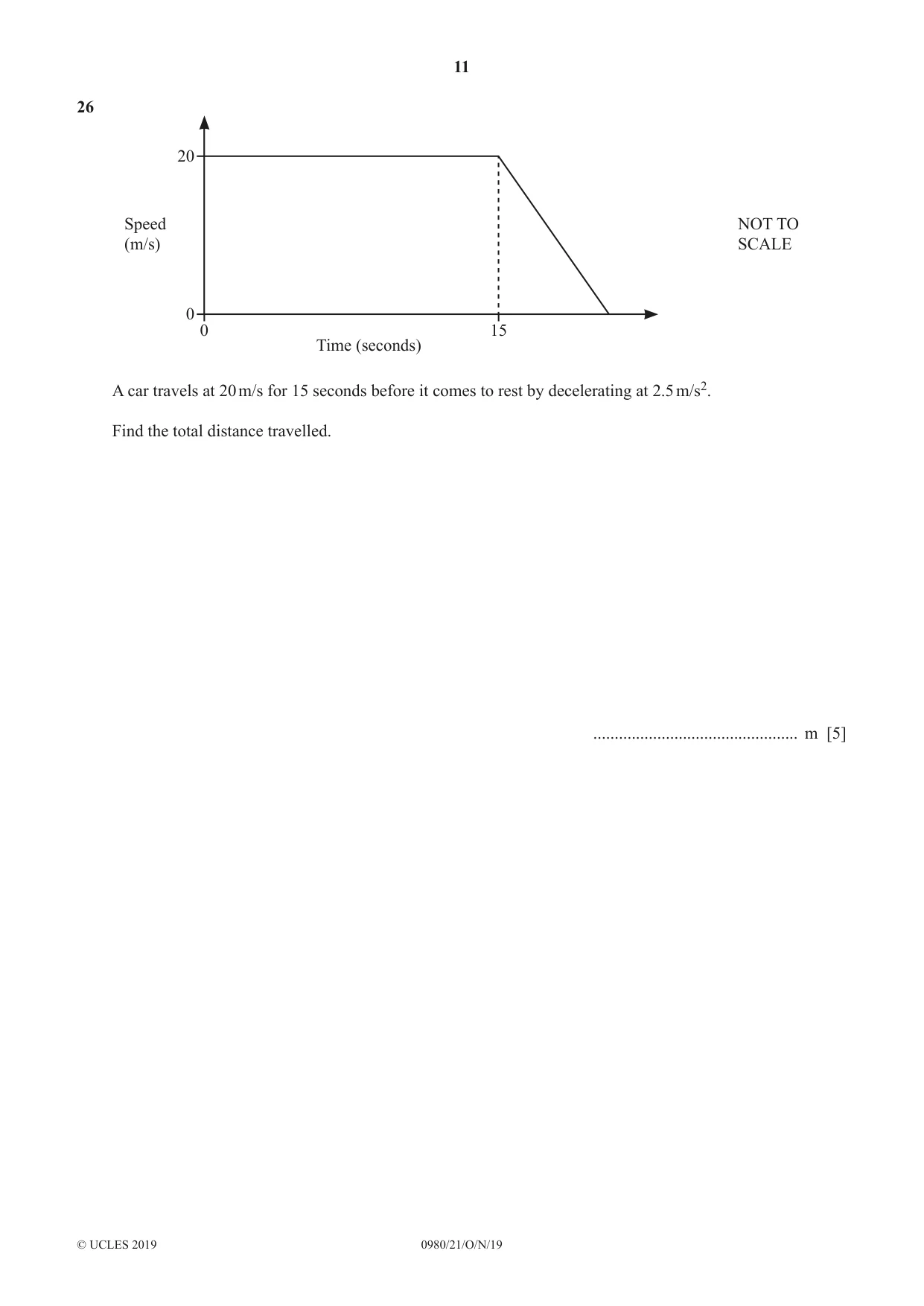
26 20 Speed NOT TO (m/s) SCALE 0 0 15 Time (seconds) A car travels at 20 m/s for 15 seconds before it comes to rest by decelerating at 2.5 m/s2. Find the total distance travelled. ................................................ m [5]
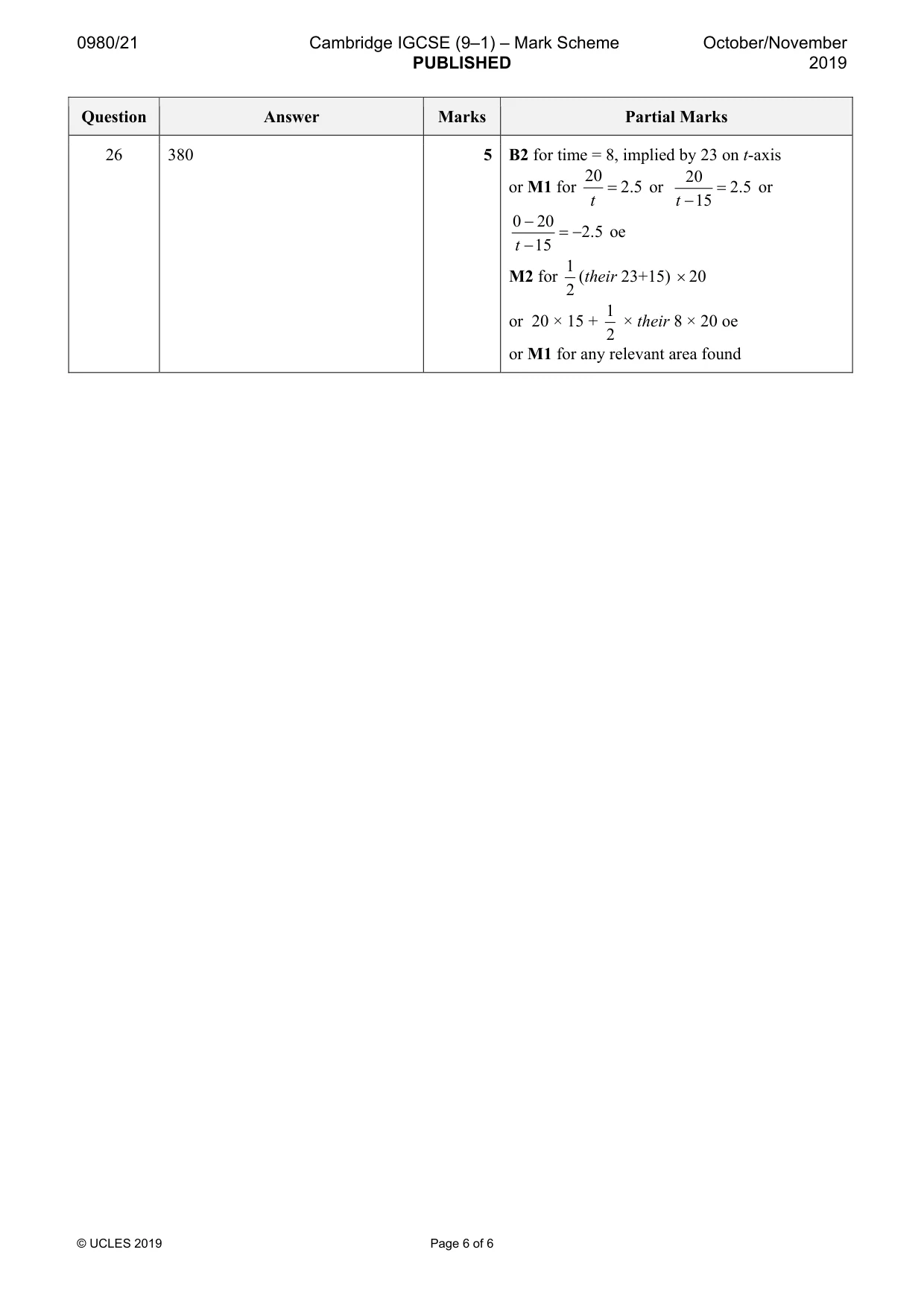
Mark scheme: 26 380 5 B2 for time = 8, implied by 23 on t-axis 20 20 or M1 for = 5.2 or = 2.5 or t t − 15 0 − 20 = − 2.5 oe t − 15 1 M2 for (their 23+15) × 20 2 1 or 20 × 15 + × their 8 × 20 oe 2 or M1 for any relevant area found
What was in this paper
The subtopics covered by these 26 questions, and how many questions each got. Open one in a new tab to see every Cambridge question on it.
2Algebraic fractions1Algebraic manipulation1Circles, arcs and sectors1Equations1Functions1Graphs in practical situations1Indices I1Indices II1Limits of accuracy1Money1Non-right-angled triangles1Percentages1Probability of combined events1Proportion1Rates1Scale drawings1Sets1The four operations1Transformations1Trigonometric functions1Types of number1Using a calculator1Vector geometry1Vectors in two dimensions1What you needed in this session
Cambridge’s own grade thresholds for 2019 Oct/Nov, Paper 2 · Variant 1. A higher threshold means an easier paper — the bar moves with how the cohort did.