Cambridge IGCSE Mathematics (9-1) 0980 — 2019 Oct/Nov Paper 3 · Variant 1
0980/31/O/N/19 · 9 questions · 104 marks · ≈117 min
The question paper and its mark scheme, free to read here and free to download. This is Cambridge’s own paper, exactly as it was sat.
Question paper16 pages
Mark scheme6 pages
Answers below. Sit the paper first if you are practising.
Questions as text
Q1 · José manages a football team
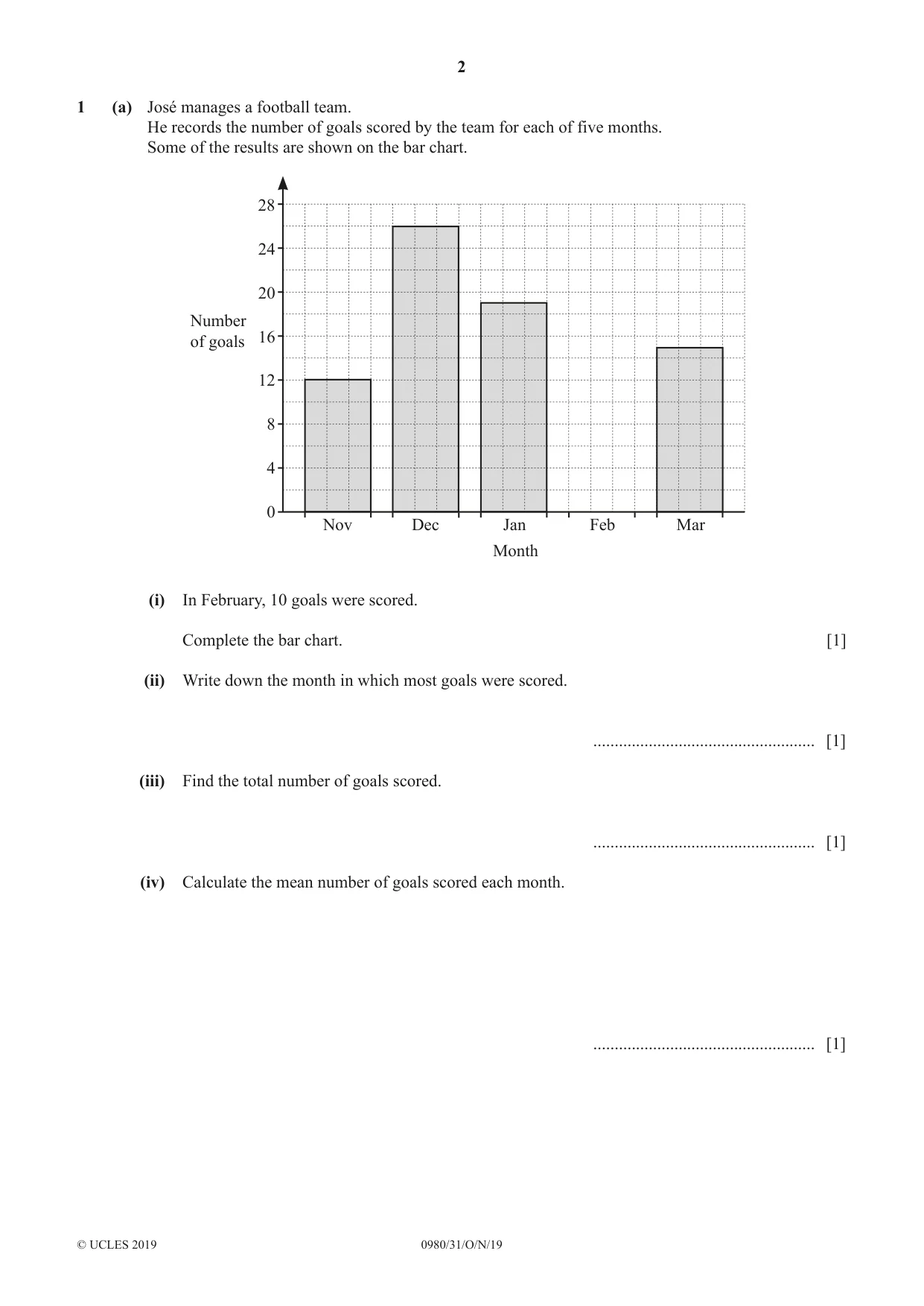
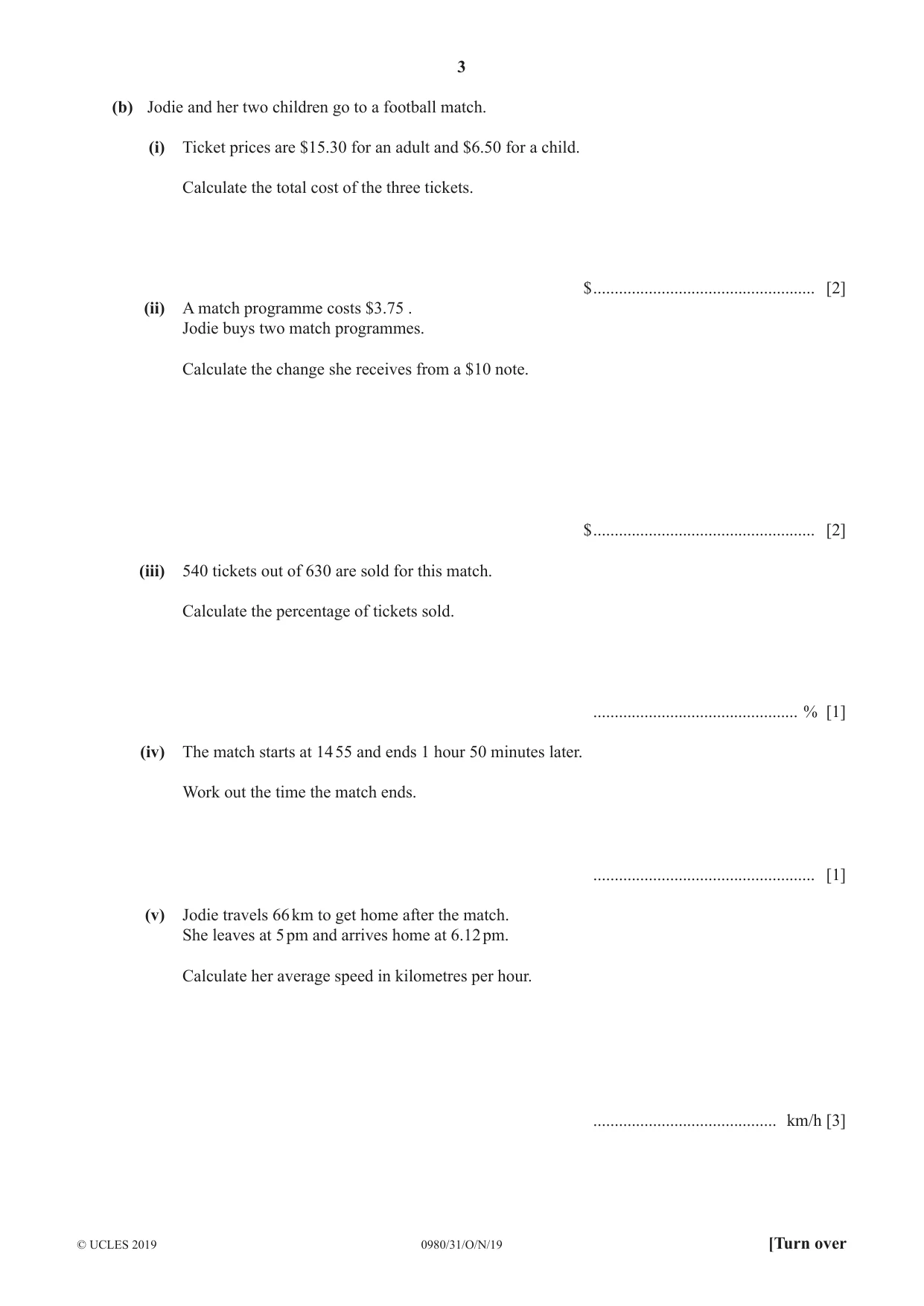
1 (a) José manages a football team. He records the number of goals scored by the team for each of five months. Some of the results are shown on the bar chart. 28 24 20 Number of goals 16 12 8 4 0 Nov Dec Jan Feb Mar Month (i) In February, 10 goals were scored. Complete the bar chart. [1] (ii) Write down the month in which most goals were scored. .................................................... [1] (iii) Find the total number of goals scored. .................................................... [1] (iv) Calculate the mean number of goals scored each month. .................................................... [1] (b) Jodie and her two children go to a football match. (i) Ticket prices are $15.30 for an adult and $6.50 for a child. Calculate the total cost of the three tickets. $ .................................................... [2] (ii) A match programme costs $3.75 . Jodie buys two match programmes. Calculate the change she receives from a $10 note. $ .................................................... [2] (iii) 540 tickets out of 630 are sold for this match. Calculate the percentage of tickets sold. ................................................ % [1] (iv) The match starts at 14 55 and ends 1 hour 50 minutes later. Work out the time the match ends. .................................................... [1] (v) Jodie travels 66 km to get home after the match. She leaves at 5 pm and arrives home at 6.12 pm. Calculate her average speed in kilometres per hour. ........................................... km/h [3]
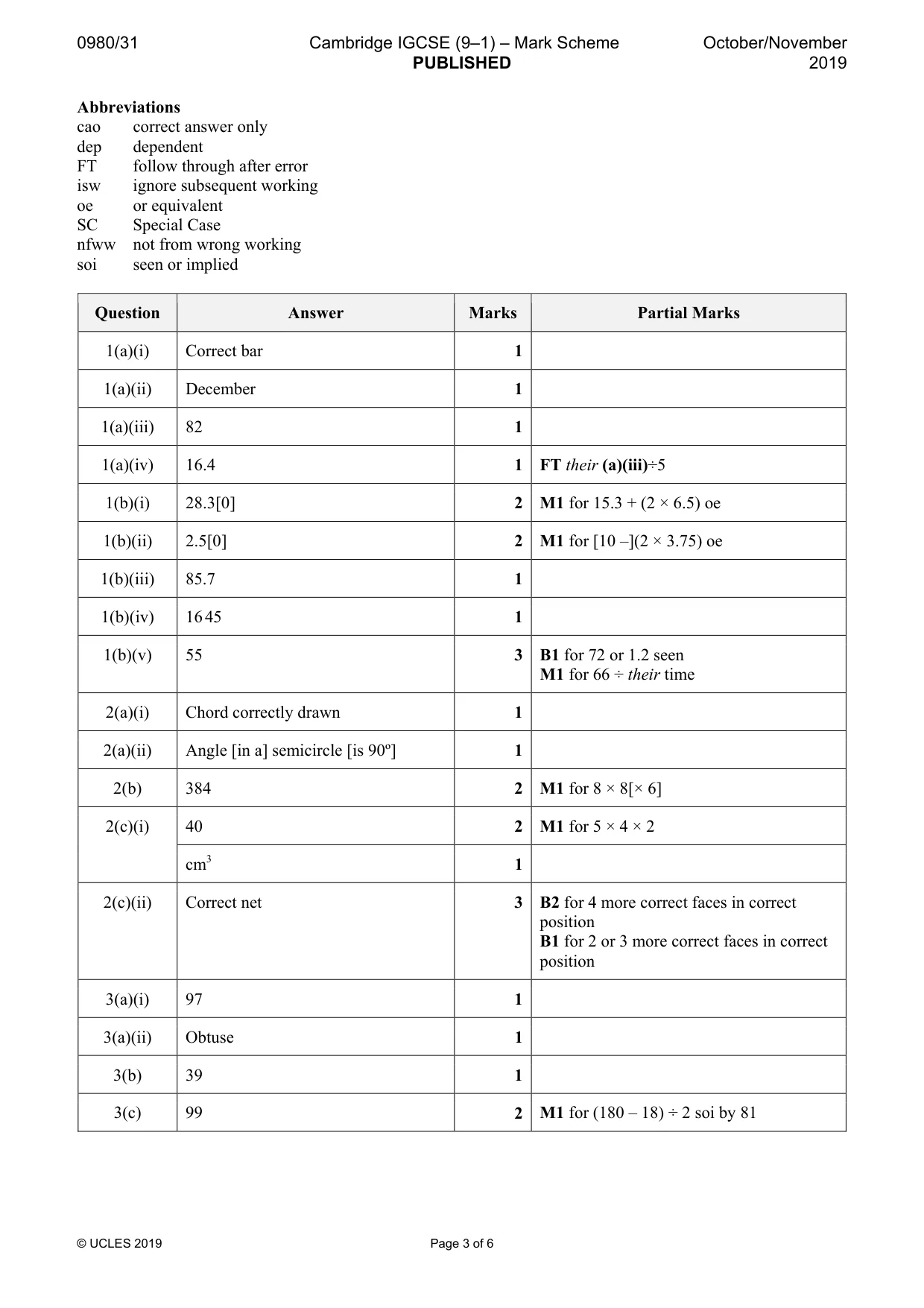
Mark scheme: Question Answer Marks Partial Marks 1(a)(i) Correct bar 1 1(a)(ii) December 1 1(a)(iii) 82 1 1(a)(iv) 16.4 1 FT their (a)(iii)÷5 1(b)(i) 28.3[0] 2 M1 for 15.3 + (2 × 6.5) oe 1(b)(ii) 2.5[0] 2 M1 for [10 –](2 × 3.75) oe 1(b)(iii) 85.7 1 1(b)(iv) 16 45 1 1(b)(v) 55 3 B1 for 72 or 1.2 seen M1 for 66 ÷ their time
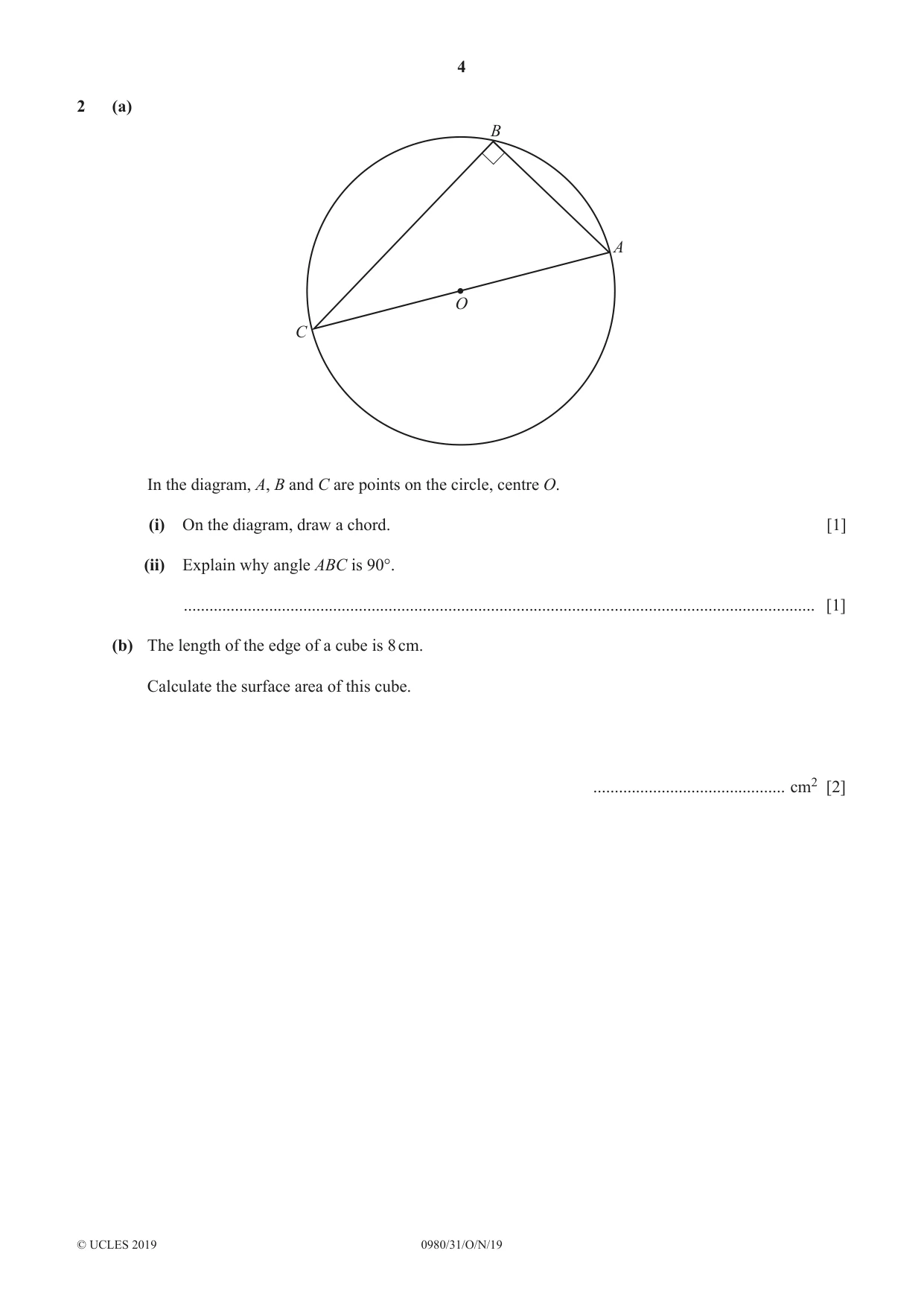
Q2 · B A O C In the diagram, A, B and C are points on the circle, centre O
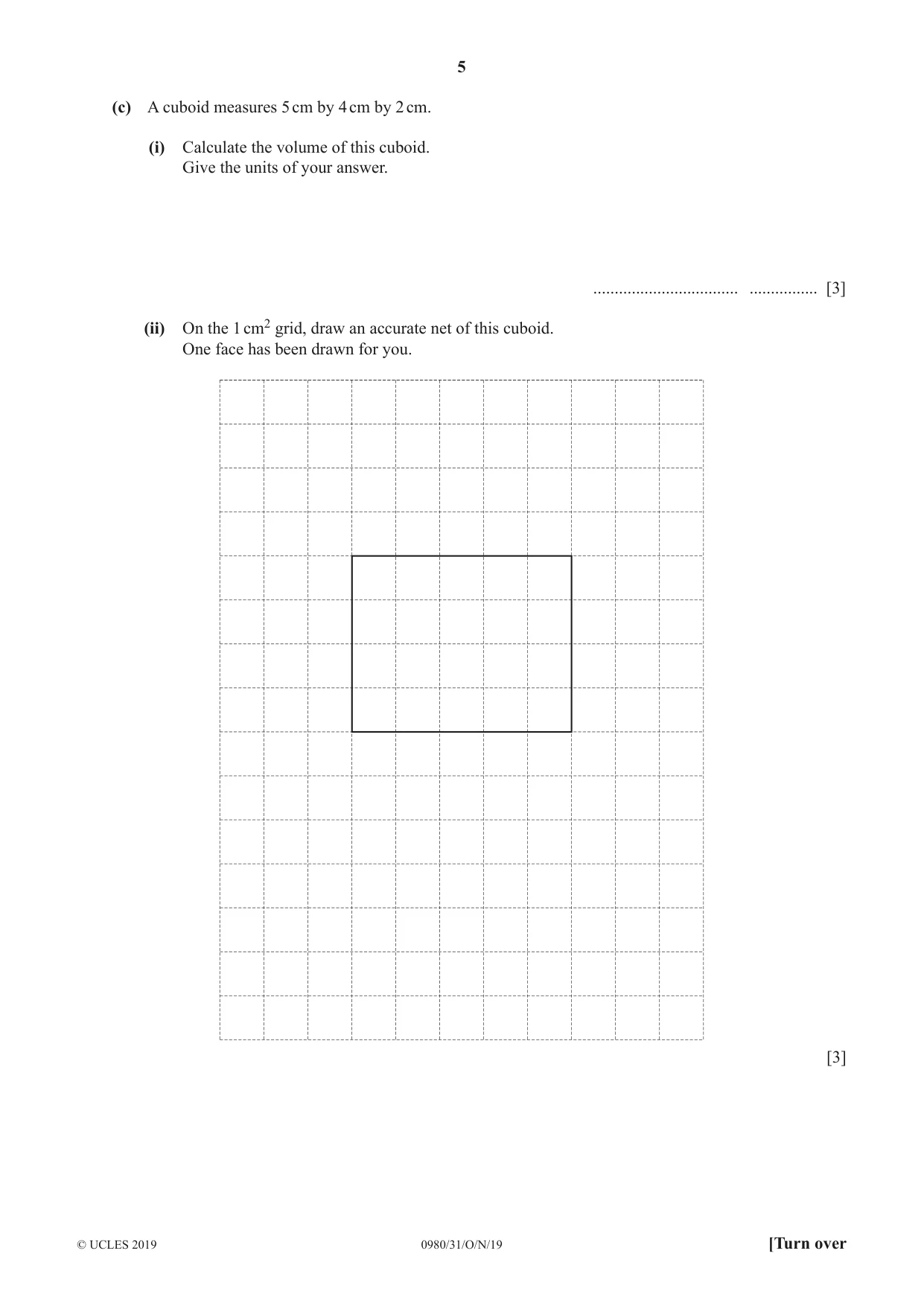
2 (a) B A O C In the diagram, A, B and C are points on the circle, centre O. (i) On the diagram, draw a chord. [1] (ii) Explain why angle ABC is 90°. .................................................................................................................................................... [1] (b) The length of the edge of a cube is 8 cm. Calculate the surface area of this cube. ............................................. cm2 [2] (c) A cuboid measures 5 cm by 4 cm by 2 cm. (i) Calculate the volume of this cuboid. Give the units of your answer. .................................. ................ [3] (ii) On the 1 cm2 grid, draw an accurate net of this cuboid. One face has been drawn for you. [3]
Mark scheme: 2(a)(i) Chord correctly drawn 1 2(a)(ii) Angle [in a] semicircle [is 90º] 1 2(b) 384 2 M1 for 8 × 8[× 6] 2(c)(i) 40 2 M1 for 5 × 4 × 2 cm3 1 2(c)(ii) Correct net 3 B2 for 4 more correct faces in correct position B1 for 2 or 3 more correct faces in correct position
Q3 · X (i) Measure the size of angle x
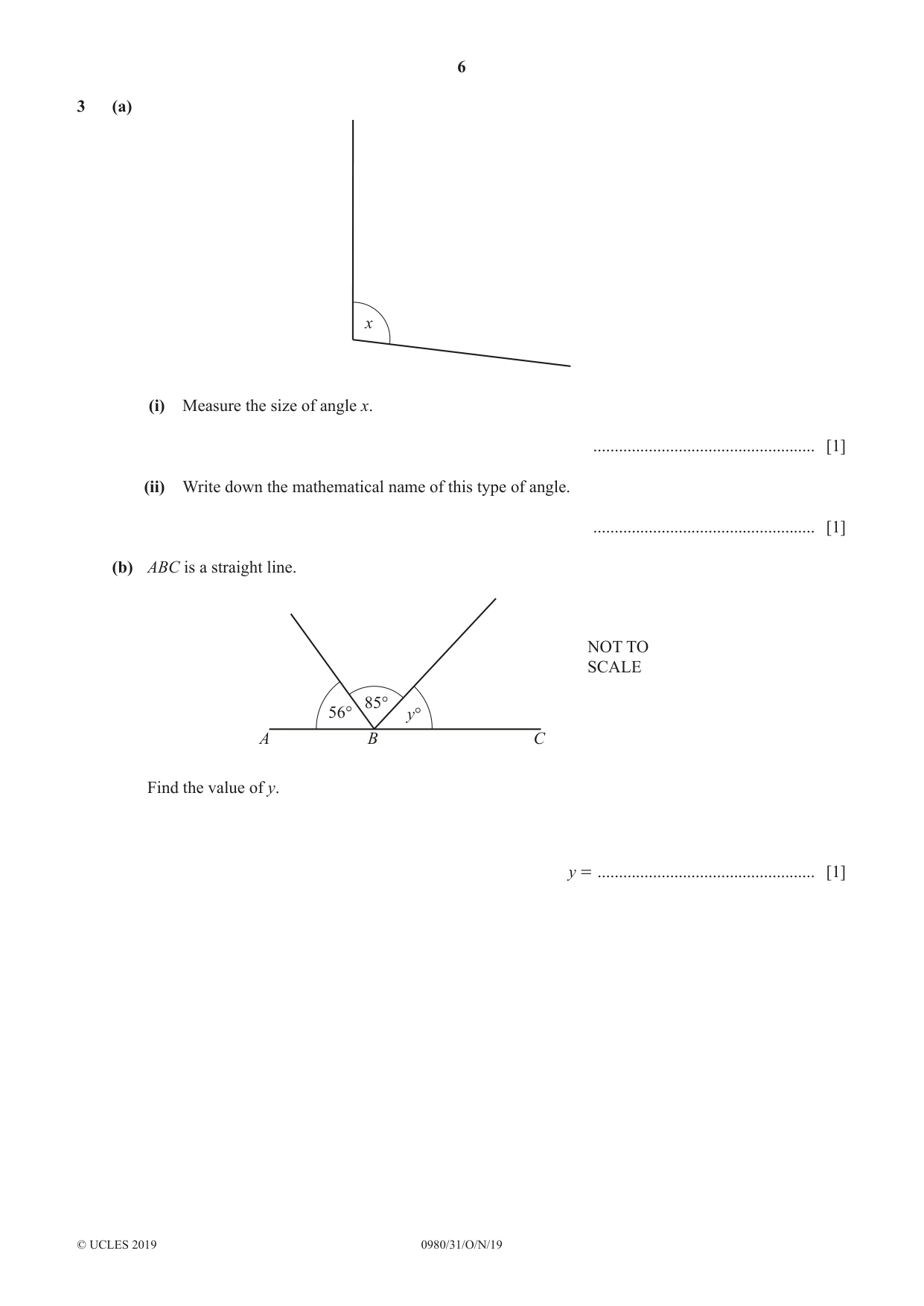
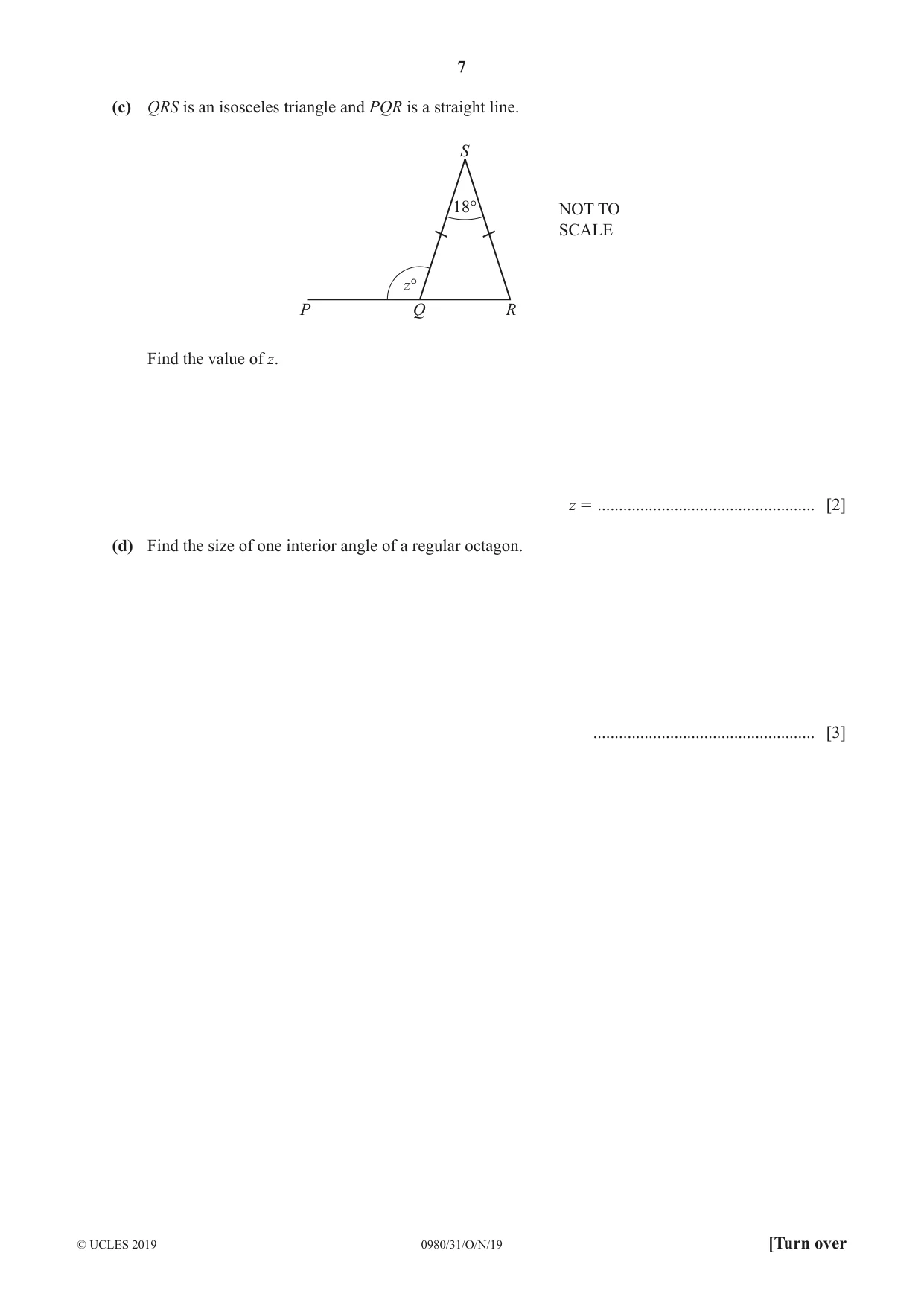
3 (a) x (i) Measure the size of angle x. .................................................... [1] (ii) Write down the mathematical name of this type of angle. .................................................... [1] (b) ABC is a straight line. NOT TO SCALE 85° 56° y° A B C Find the value of y. y = ................................................... [1] (c) QRS is an isosceles triangle and PQR is a straight line. S 18° NOT TO SCALE z° P Q R Find the value of z. z = ................................................... [2] (d) Find the size of one interior angle of a regular octagon. .................................................... [3]
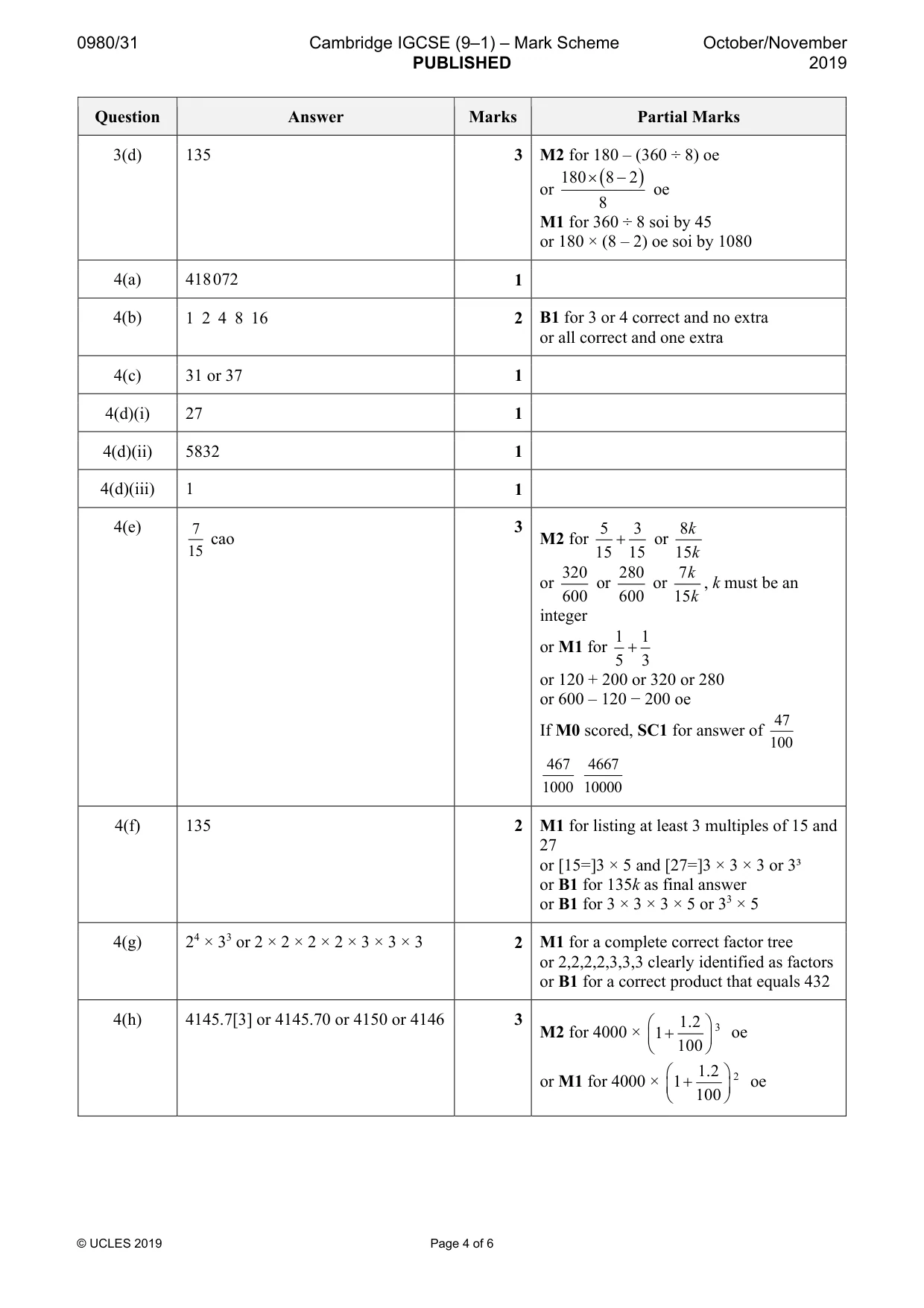
Mark scheme: 3(a)(i) 97 1 3(a)(ii) Obtuse 1 3(b) 39 1 3(c) 99 2 M1 for (180 – 18) ÷ 2 soi by 81 3(d) 135 3 M2 for 180 – (360 ÷ 8) oe 180 × ( 8 − 2 ) or oe 8 M1 for 360 ÷ 8 soi by 45 or 180 × (8 – 2) oe soi by 1080
Q4 · Write the number four hundred and eighteen thousand and seventy two in figures
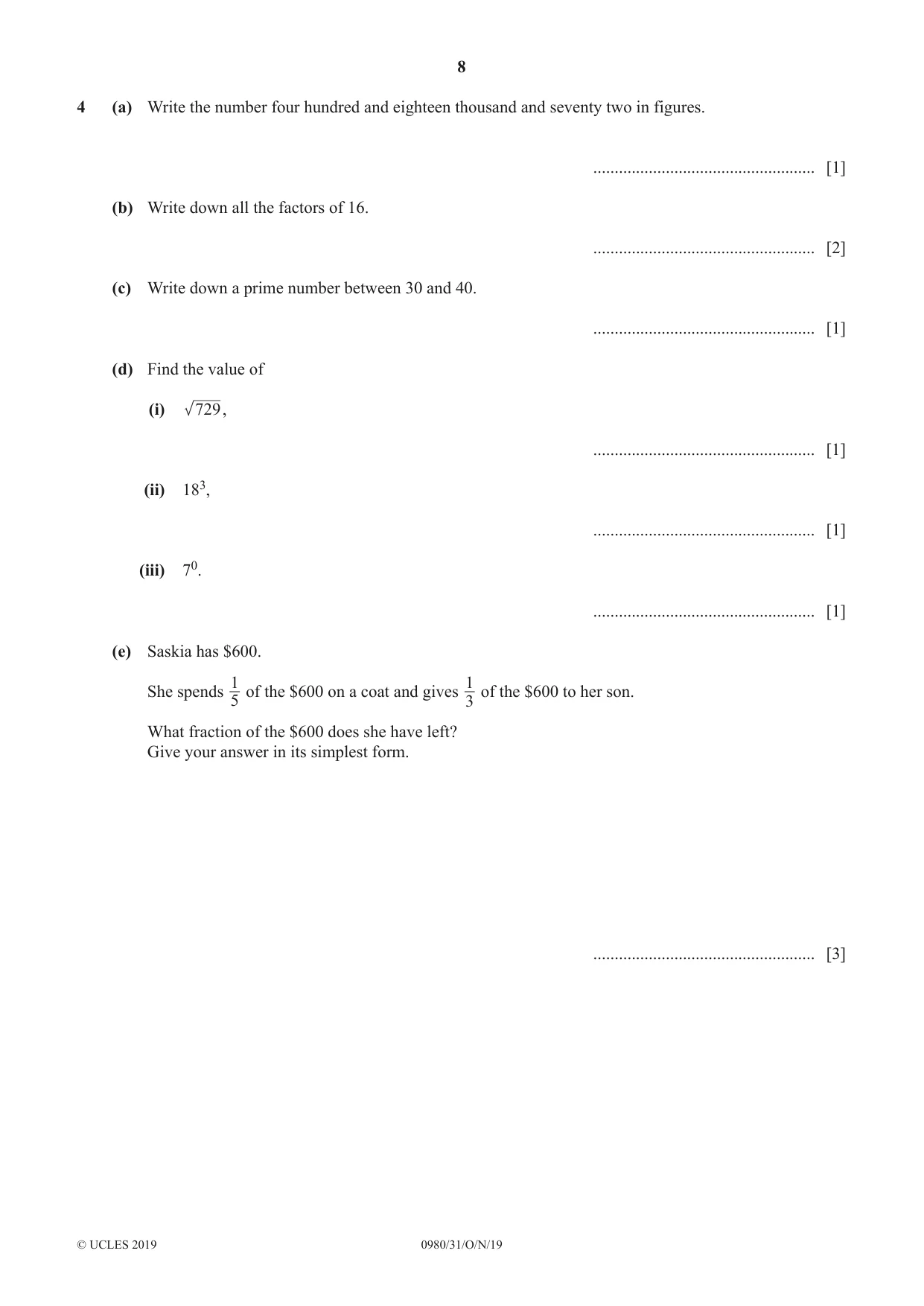
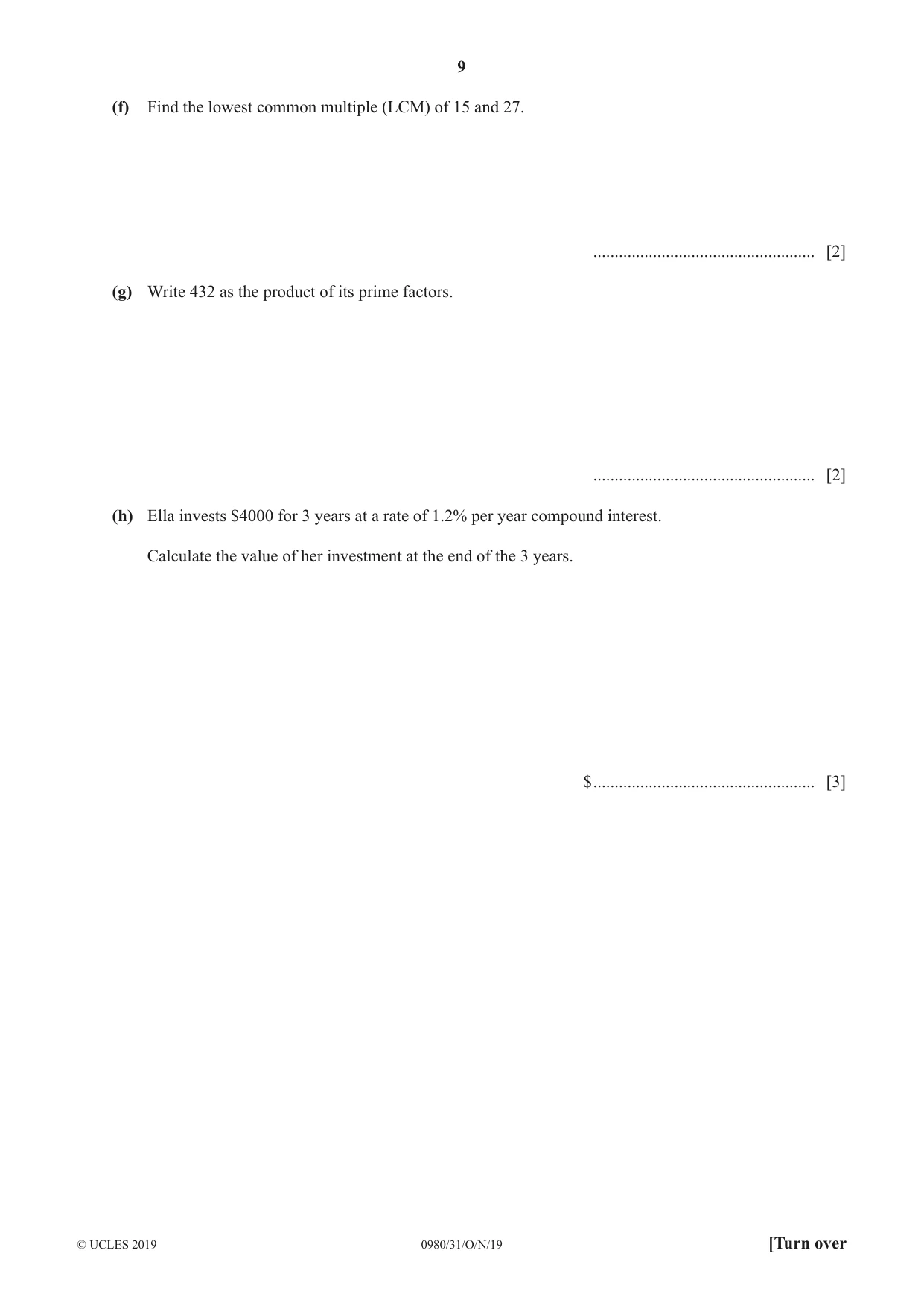
4 (a) Write the number four hundred and eighteen thousand and seventy two in figures. .................................................... [1] (b) Write down all the factors of 16. .................................................... [2] (c) Write down a prime number between 30 and 40. .................................................... [1] (d) Find the value of (i) 729, .................................................... [1] (ii) 183, .................................................... [1] (iii) 70. .................................................... [1] (e) Saskia has $600. 1 1 She spends of the $600 on a coat and gives of the $600 to her son. 5 3 What fraction of the $600 does she have left? Give your answer in its simplest form. .................................................... [3] (f) Find the lowest common multiple (LCM) of 15 and 27. .................................................... [2] (g) Write 432 as the product of its prime factors. .................................................... [2] (h) Ella invests $4000 for 3 years at a rate of 1.2% per year compound interest. Calculate the value of her investment at the end of the 3 years. $ .................................................... [3]
Mark scheme: 4(a) 418 072 1 4(b) 1 2 4 8 16 2 B1 for 3 or 4 correct and no extra or all correct and one extra 4(c) 31 or 37 1 4(d)(i) 27 1 4(d)(ii) 5832 1 4(d)(iii) 1 1 4(e) 7 3 5 3 8 k cao M2 for + or 15 15 15 15 k 320 280 7 k or or or , k must be an 600 600 15 k integer 1 1 or M1 for + 5 3 or 120 + 200 or 320 or 280 or 600 – 120 − 200 oe 47 If M0 scored, SC1 for answer of 100 467 4667 1000 10000 4(f) 135 2 M1 for listing at least 3 multiples of 15 and 27 or [15=]3 × 5 and [27=]3 × 3 × 3 or 3³ or B1 for 135k as final answer or B1 for 3 × 3 × 3 × 5 or 33 × 5 4(g) 24 × 33 or 2 × 2 × 2 × 2 × 3 × 3 × 3 2 M1 for a complete correct factor tree or 2,2,2,2,3,3,3 clearly identified as factors or B1 for a correct product that equals 432 4(h) 4145.7[3] or 4145.70 or 4150 or 4146 3 1.2 3 M2 for 4000 × 1 + oe 100 1.2 2 or M1 for 4000 × 1 + oe 100
Q5 · Triangles A, B and C are shown on the grid
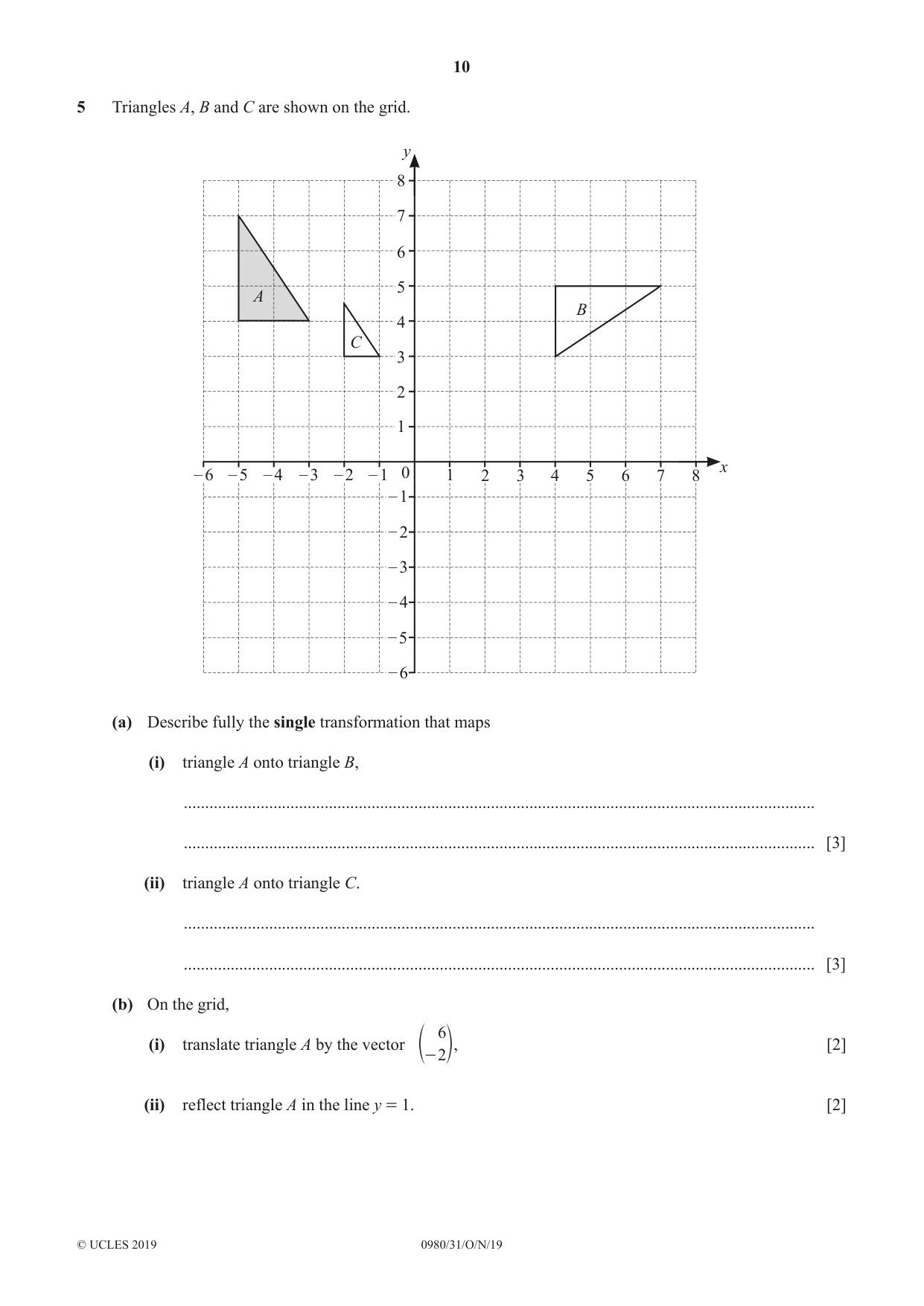
5 Triangles A, B and C are shown on the grid. y 8 7 6 5 A B 4 C 3 2 1 x – 6 – 5 – 4 – 3 – 2 – 1 0 1 2 3 4 5 6 7 8 – 1 – 2 – 3 – 4 – 5 – 6 (a) Describe fully the single transformation that maps (i) triangle A onto triangle B, .................................................................................................................................................... .................................................................................................................................................... [3] (ii) triangle A onto triangle C. .................................................................................................................................................... .................................................................................................................................................... [3] (b) On the grid, 6 (i) translate triangle A by the vector [2] e- 2o, (ii) reflect triangle A in the line y = 1. [2]
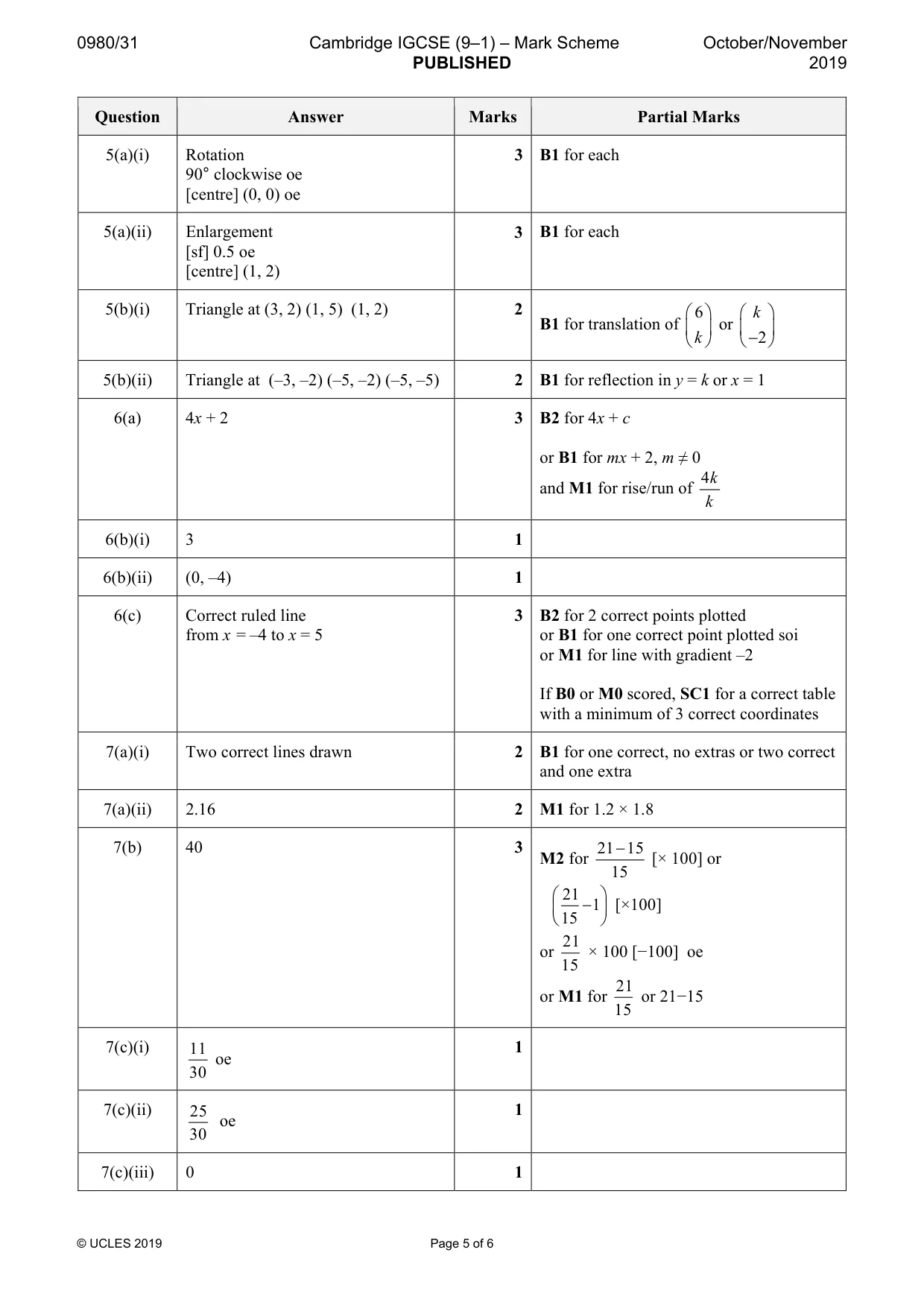
Mark scheme: 5(a)(i) Rotation 3 B1 for each 90° clockwise oe [centre] (0, 0) oe 5(a)(ii) Enlargement 3 B1 for each [sf] 0.5 oe [centre] (1, 2) 5(b)(i) Triangle at (3, 2) (1, 5) (1, 2) 2 6 k B1 for translation of or k − 2 5(b)(ii) Triangle at (–3, –2) (–5, –2) (–5, –5) 2 B1 for reflection in y = k or x = 1
Q6 · The line L is shown on the grid
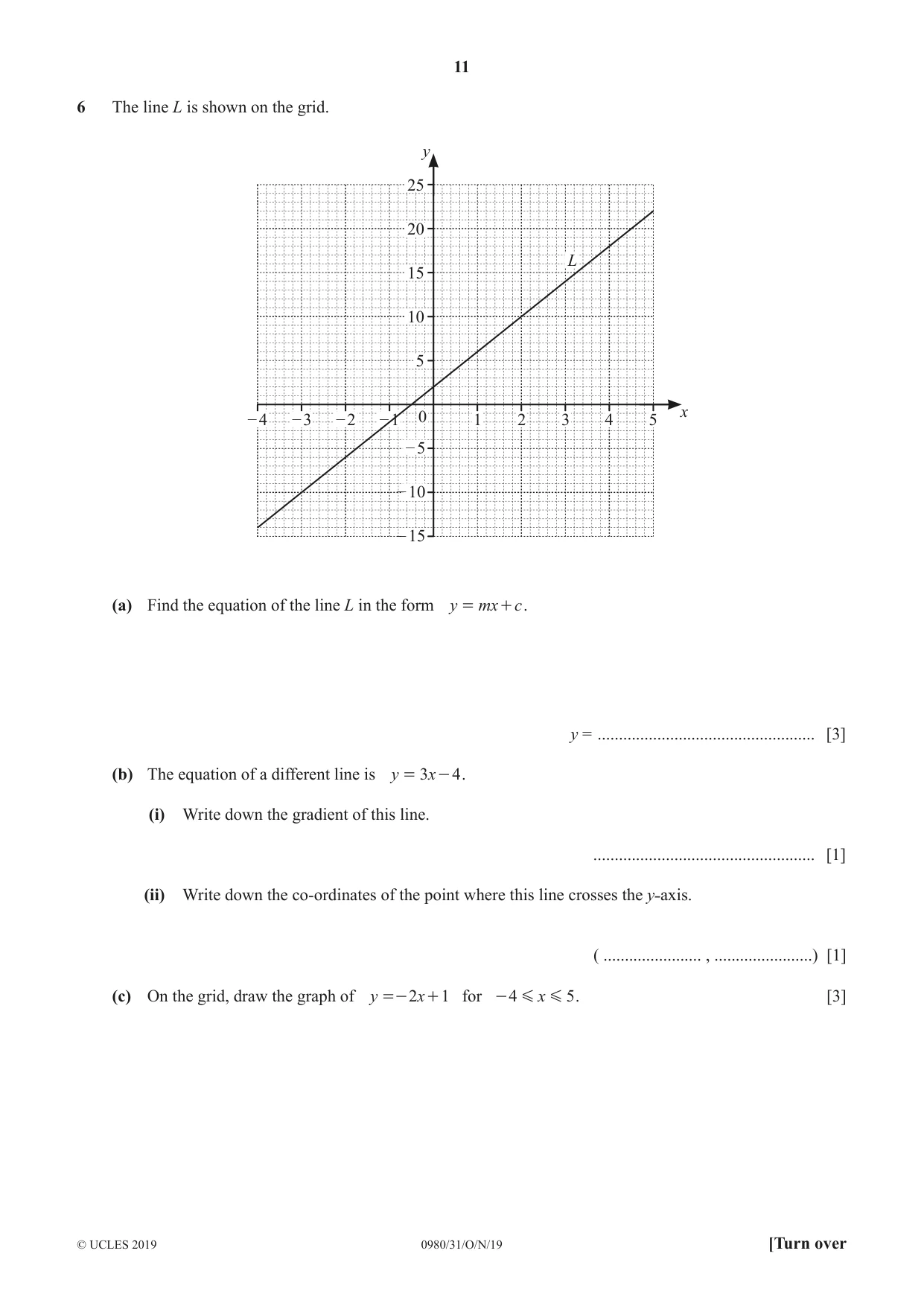
6 The line L is shown on the grid. y 25 20 L 15 10 5 x – 4 – 3 – 2 – 1 0 1 2 3 4 5 – 5 – 10 – 15 (a) Find the equation of the line L in the form y = mx + c . y = ................................................... [3] (b) The equation of a different line is y = 3x - 4 . (i) Write down the gradient of this line. .................................................... [1] (ii) Write down the co-ordinates of the point where this line crosses the y˗axis. ( ....................... , .......................) [1] (c) On the grid, draw the graph of y =- 2x + 1 for - 4 G x G 5 . [3]
Mark scheme: 6(a) 4x + 2 3 B2 for 4x + c or B1 for mx + 2, m ≠ 0 4k and M1 for rise/run of k 6(b)(i) 3 1 6(b)(ii) (0, –4) 1 6(c) Correct ruled line 3 B2 for 2 correct points plotted from x = –4 to x = 5 or B1 for one correct point plotted soi or M1 for line with gradient –2 If B0 or M0 scored, SC1 for a correct table with a minimum of 3 correct coordinates
Q7 · Soraya makes rectangular flags
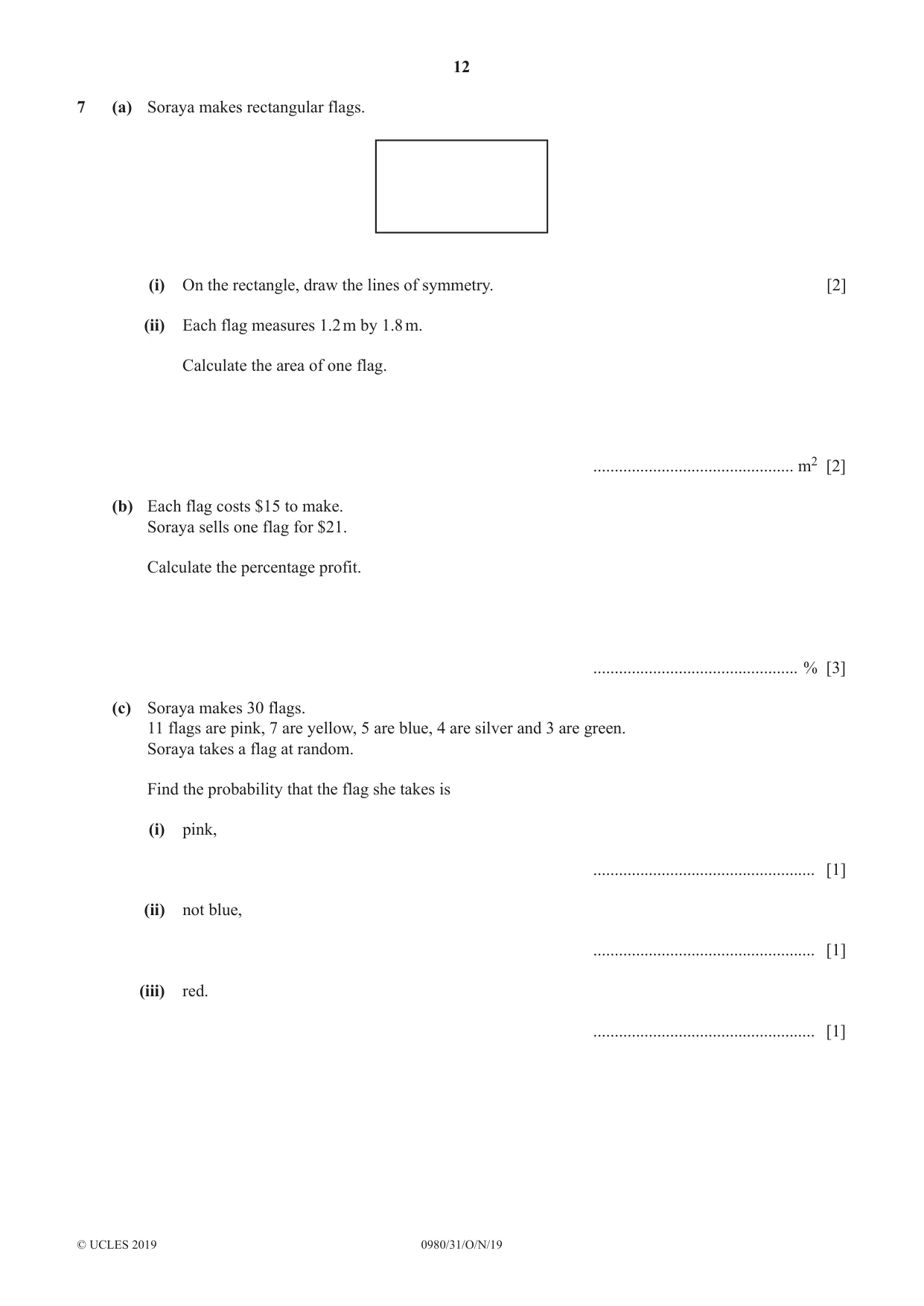
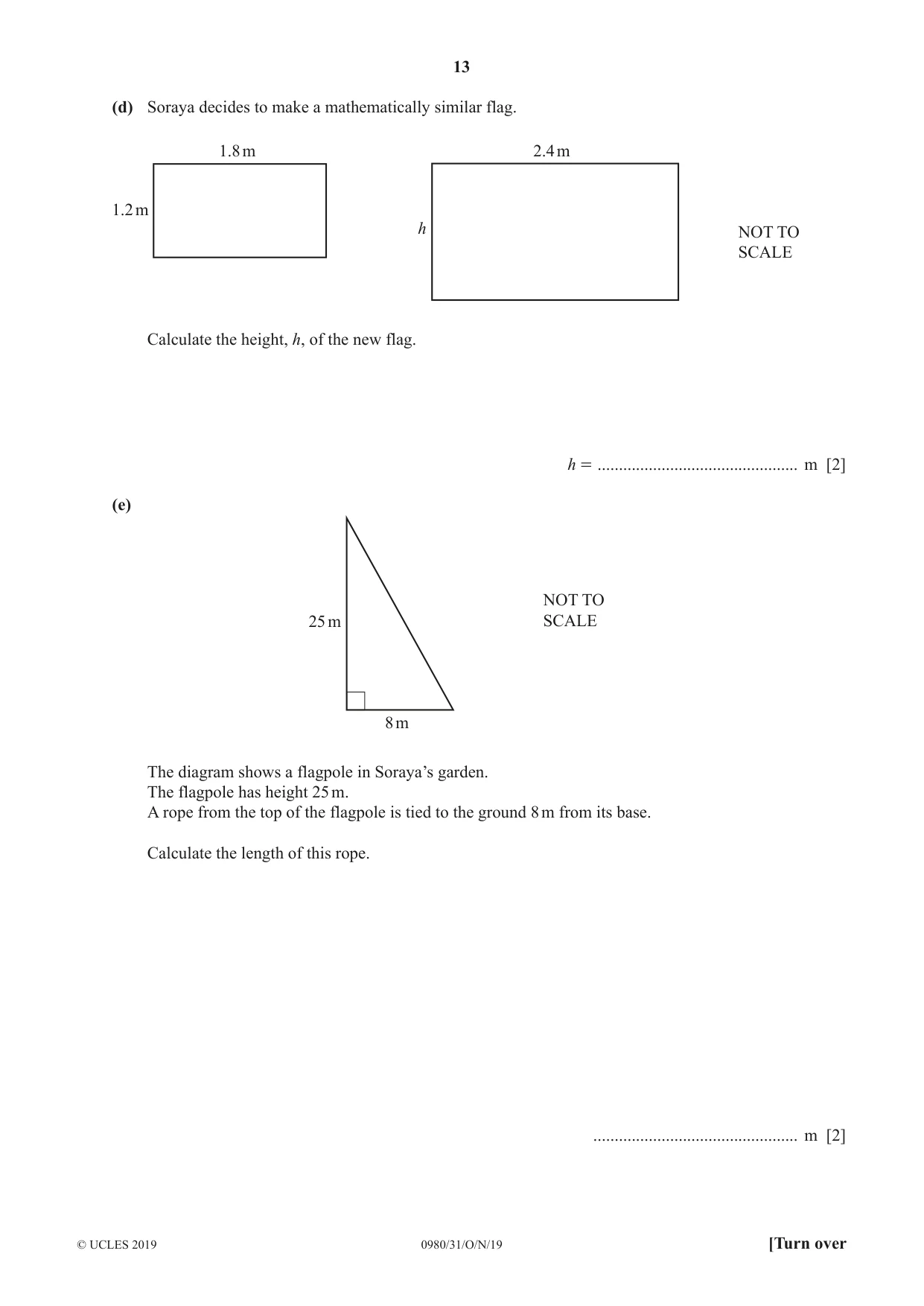
7 (a) Soraya makes rectangular flags. (i) On the rectangle, draw the lines of symmetry. [2] (ii) Each flag measures 1.2 m by 1.8 m. Calculate the area of one flag. ............................................... m2 [2] (b) Each flag costs $15 to make. Soraya sells one flag for $21. Calculate the percentage profit. ................................................ % [3] (c) Soraya makes 30 flags. 11 flags are pink, 7 are yellow, 5 are blue, 4 are silver and 3 are green. Soraya takes a flag at random. Find the probability that the flag she takes is (i) pink, .................................................... [1] (ii) not blue, .................................................... [1] (iii) red. .................................................... [1] (d) Soraya decides to make a mathematically similar flag. 1.8 m 2.4 m 1.2 m h NOT TO SCALE Calculate the height, h, of the new flag. h = ............................................... m [2] (e) NOT TO 25 m SCALE 8 m The diagram shows a flagpole in Soraya’s garden. The flagpole has height 25 m. A rope from the top of the flagpole is tied to the ground 8 m from its base. Calculate the length of this rope. ................................................ m [2]
Mark scheme: 7(a)(i) Two correct lines drawn 2 B1 for one correct, no extras or two correct and one extra 7(a)(ii) 2.16 2 M1 for 1.2 × 1.8 7(b) 40 3 21 − 15 M2 for [× 100] or 15 21 − 1 [×100] 15 21 or × 100 [−100] oe 15 21 or M1 for or 21−15 15 7(c)(i) 11 1 oe 30 7(c)(ii) 25 1 oe 30 7(c)(iii) 0 1 7(d) 1.6 2 2.4 1.8 1.8 1.2 M1 for or or or soi 1.8 2.4 1.2 1.8 7(e) 26.2 or 26.24 to 26.25 2 M1 for 252 + 82 or better
Q8 · The scale drawing shows the positions of two buoys, A and B, in the sea
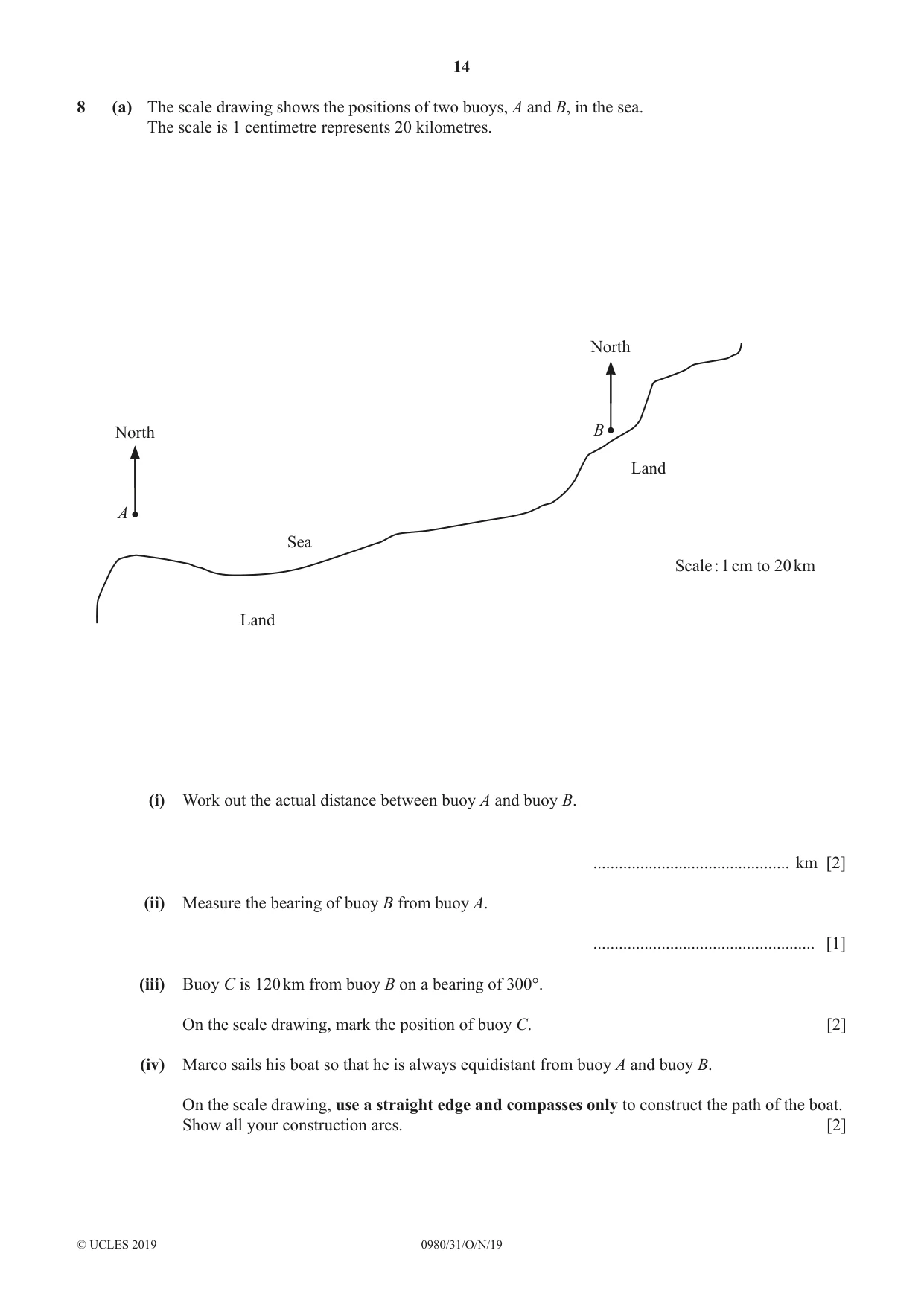
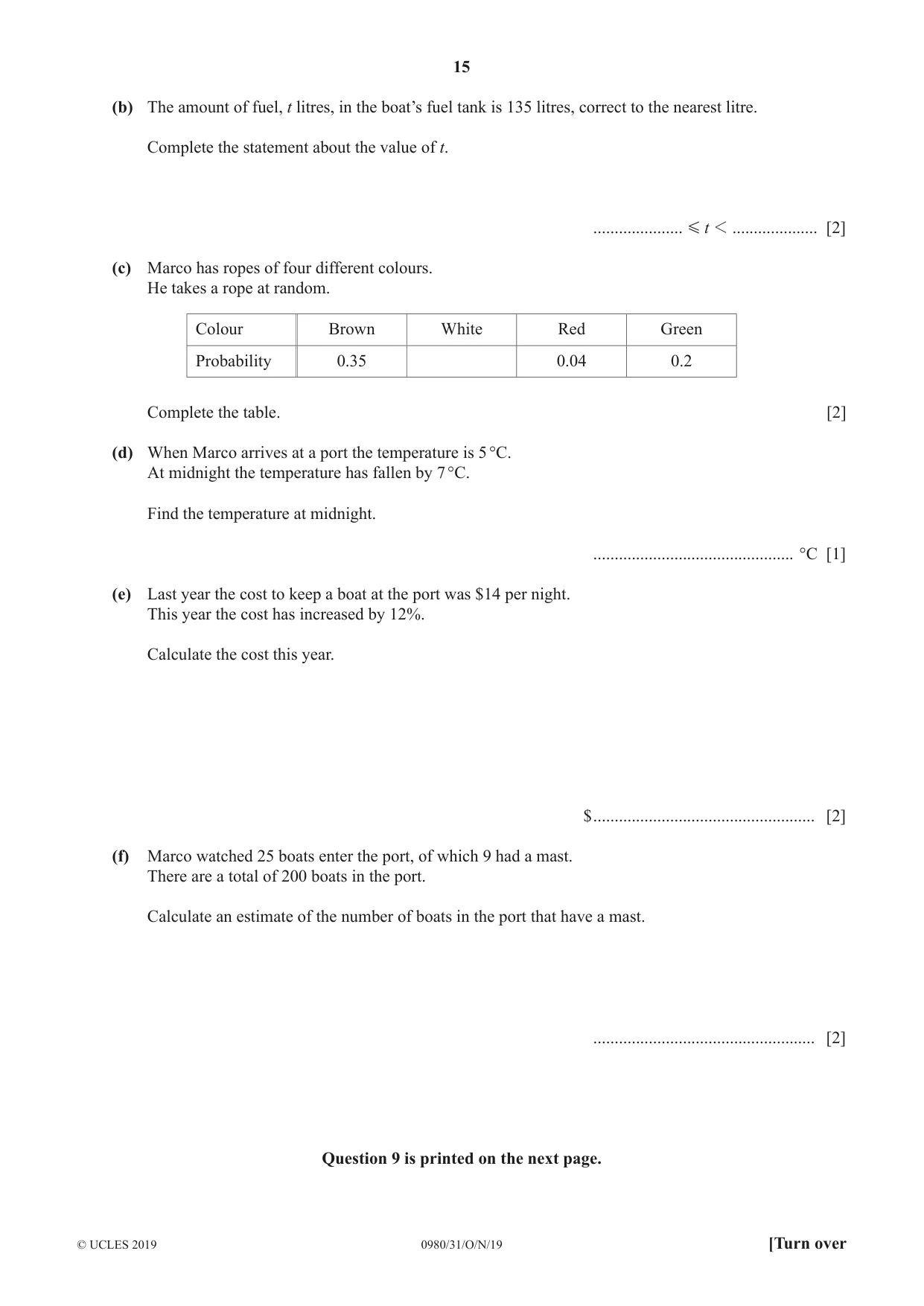
8 (a) The scale drawing shows the positions of two buoys, A and B, in the sea. The scale is 1 centimetre represents 20 kilometres. North North B Land A Sea Scale : 1 cm to 20 km Land (i) Work out the actual distance between buoy A and buoy B. .............................................. km [2] (ii) Measure the bearing of buoy B from buoy A. .................................................... [1] (iii) Buoy C is 120 km from buoy B on a bearing of 300°. On the scale drawing, mark the position of buoy C. [2] (iv) Marco sails his boat so that he is always equidistant from buoy A and buoy B. On the scale drawing, use a straight edge and compasses only to construct the path of the boat. Show all your construction arcs. [2] (b) The amount of fuel, t litres, in the boat’s fuel tank is 135 litres, correct to the nearest litre. Complete the statement about the value of t. ..................... G t 1 .................... [2] (c) Marco has ropes of four different colours. He takes a rope at random. Colour Brown White Red Green Probability 0.35 0.04 0.2 Complete the table. [2] (d) When Marco arrives at a port the temperature is 5 °C. At midnight the temperature has fallen by 7 °C. Find the temperature at midnight. ............................................... °C [1] (e) Last year the cost to keep a boat at the port was $14 per night. This year the cost has increased by 12%. Calculate the cost this year. $ .................................................... [2] (f) Marco watched 25 boats enter the port, of which 9 had a mast. There are a total of 200 boats in the port. Calculate an estimate of the number of boats in the port that have a mast. .................................................... [2] Question 9 is printed on the next page.
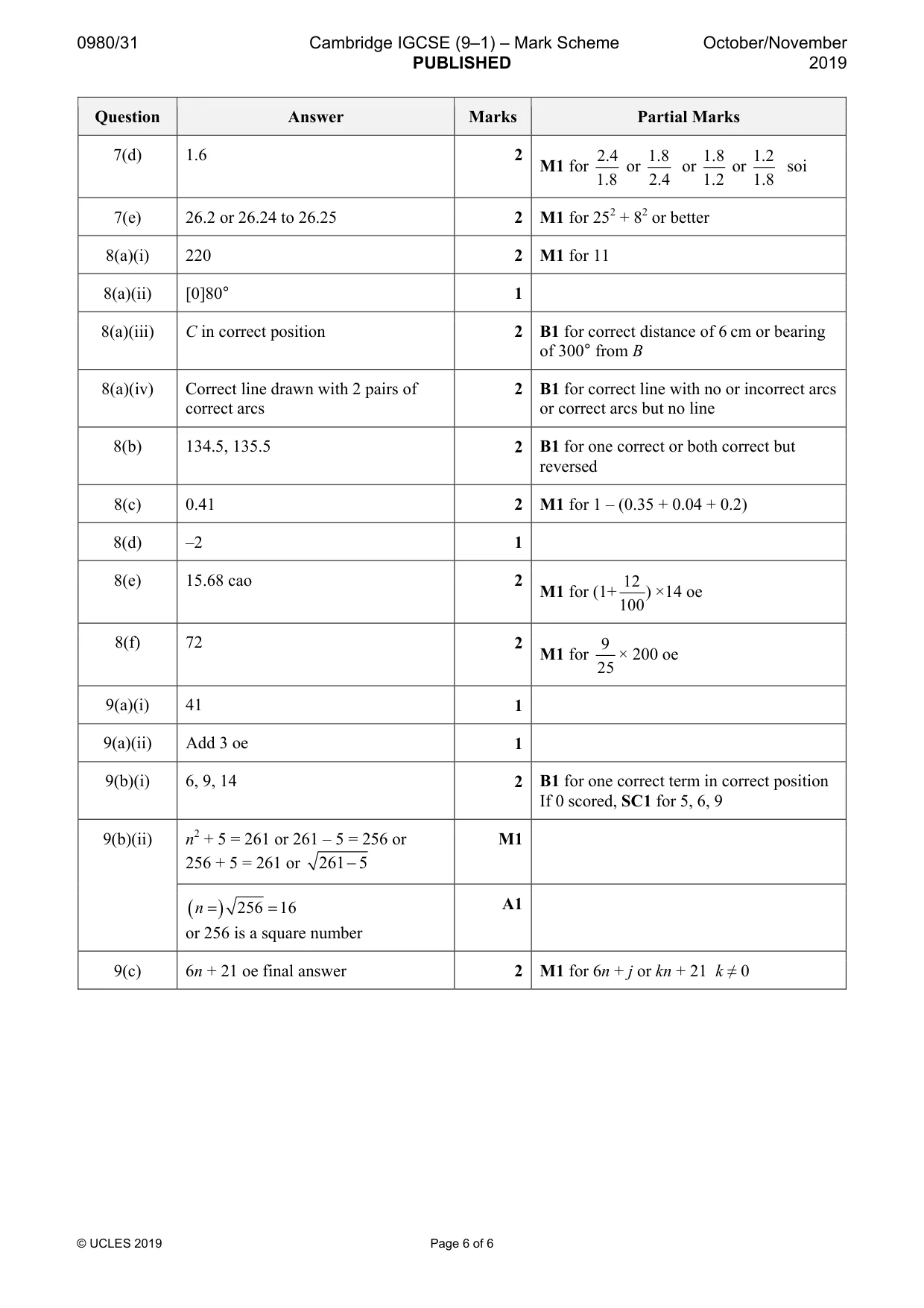
Mark scheme: 8(a)(i) 220 2 M1 for 11 8(a)(ii) [0]80° 1 8(a)(iii) C in correct position 2 B1 for correct distance of 6 cm or bearing of 300° from B 8(a)(iv) Correct line drawn with 2 pairs of 2 B1 for correct line with no or incorrect arcs correct arcs or correct arcs but no line 8(b) 134.5, 135.5 2 B1 for one correct or both correct but reversed 8(c) 0.41 2 M1 for 1 – (0.35 + 0.04 + 0.2) 8(d) –2 1 8(e) 15.68 cao 2 12 M1 for (1+ ) ×14 oe 100 8(f) 72 2 9 M1 for × 200 oe 25
Q9 · These are the first four terms of a sequence
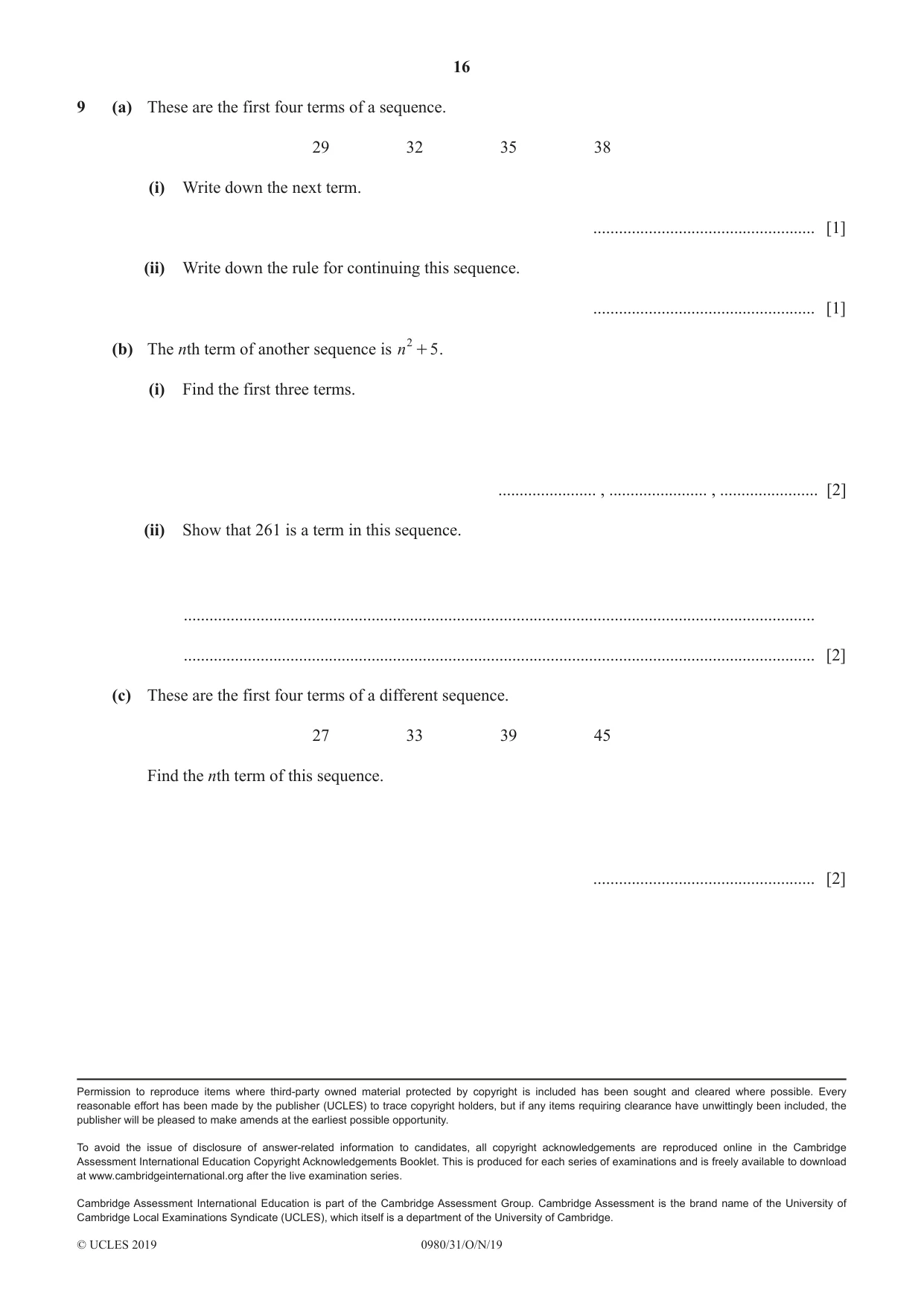
9 (a) These are the first four terms of a sequence. 29 32 35 38 (i) Write down the next term. .................................................... [1] (ii) Write down the rule for continuing this sequence. .................................................... [1] (b) The nth term of another sequence is n 2 + 5 . (i) Find the first three terms. ....................... , ....................... , ....................... [2] (ii) Show that 261 is a term in this sequence. .................................................................................................................................................... .................................................................................................................................................... [2] (c) These are the first four terms of a different sequence. 27 33 39 45 Find the nth term of this sequence. .................................................... [2]
Mark scheme: 9(a)(i) 41 1 9(a)(ii) Add 3 oe 1 9(b)(i) 6, 9, 14 2 B1 for one correct term in correct position If 0 scored, SC1 for 5, 6, 9 9(b)(ii) n2 + 5 = 261 or 261 – 5 = 256 or M1 256 + 5 = 261 or 261 − 5 ( n = ) 256 = 16 A1 or 256 is a square number 9(c) 6n + 21 oe final answer 2 M1 for 6n + j or kn + 21 k ≠ 0
What was in this paper
The subtopics covered by these 9 questions, and how many questions each got. Open one in a new tab to see every Cambridge question on it.
What you needed in this session
Cambridge’s own grade thresholds for 2019 Oct/Nov, Paper 3 · Variant 1. A higher threshold means an easier paper — the bar moves with how the cohort did.