Cambridge IGCSE Mathematics 0580 — 2022 Oct/Nov Paper 1 · Variant 2
0580/12/O/N/22 · 21 questions · 56 marks · ≈63 min
The question paper and its mark scheme, free to read here and free to download. This is Cambridge’s own paper, exactly as it was sat.
Question paper12 pages
Mark scheme6 pages
Answers below. Sit the paper first if you are practising.
Questions as text
Q1 · Write the number eighty thousand and eighty in figures
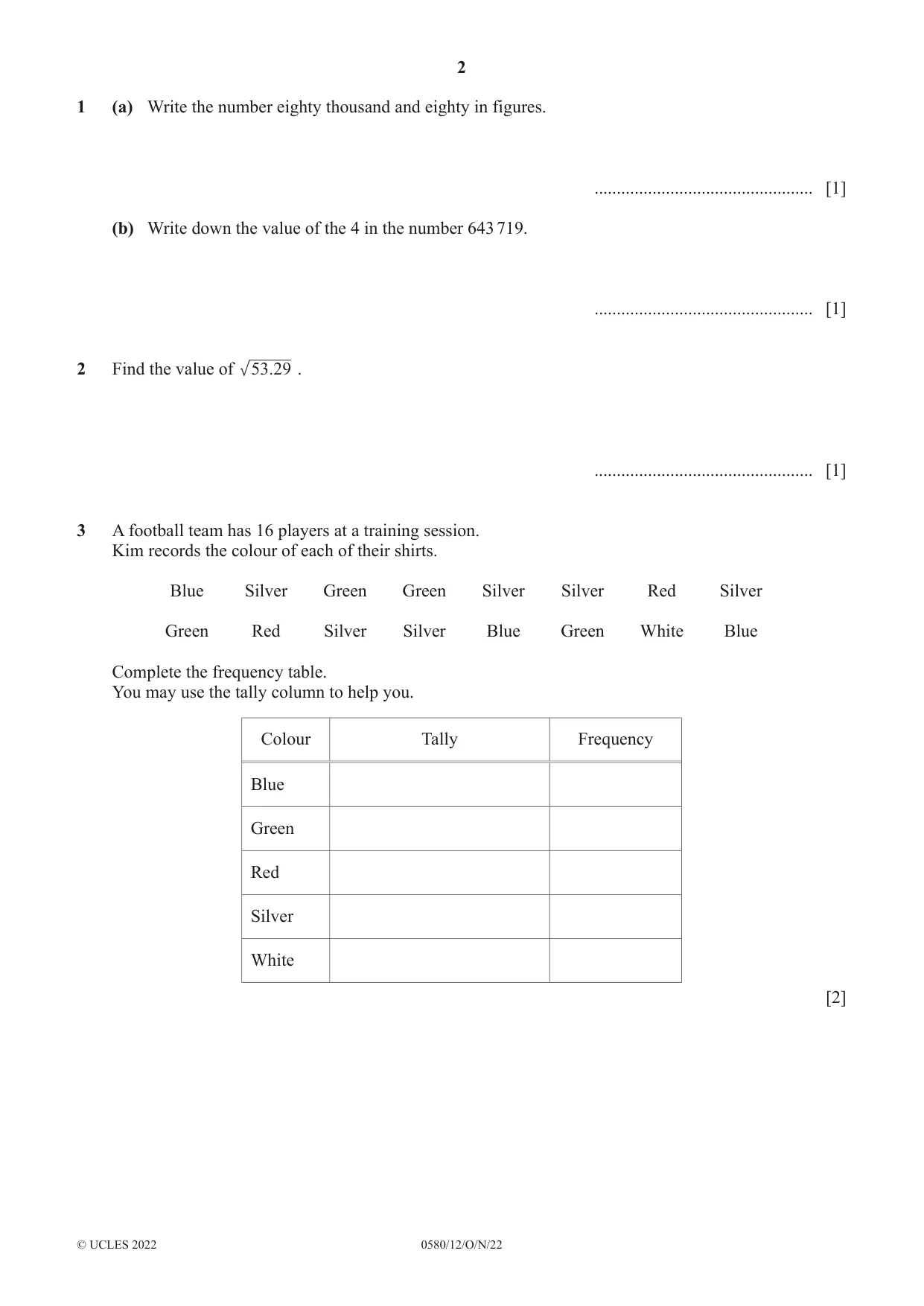
1 (a) Write the number eighty thousand and eighty in figures. ................................................. [1] (b) Write down the value of the 4 in the number 643 719. ................................................. [1]
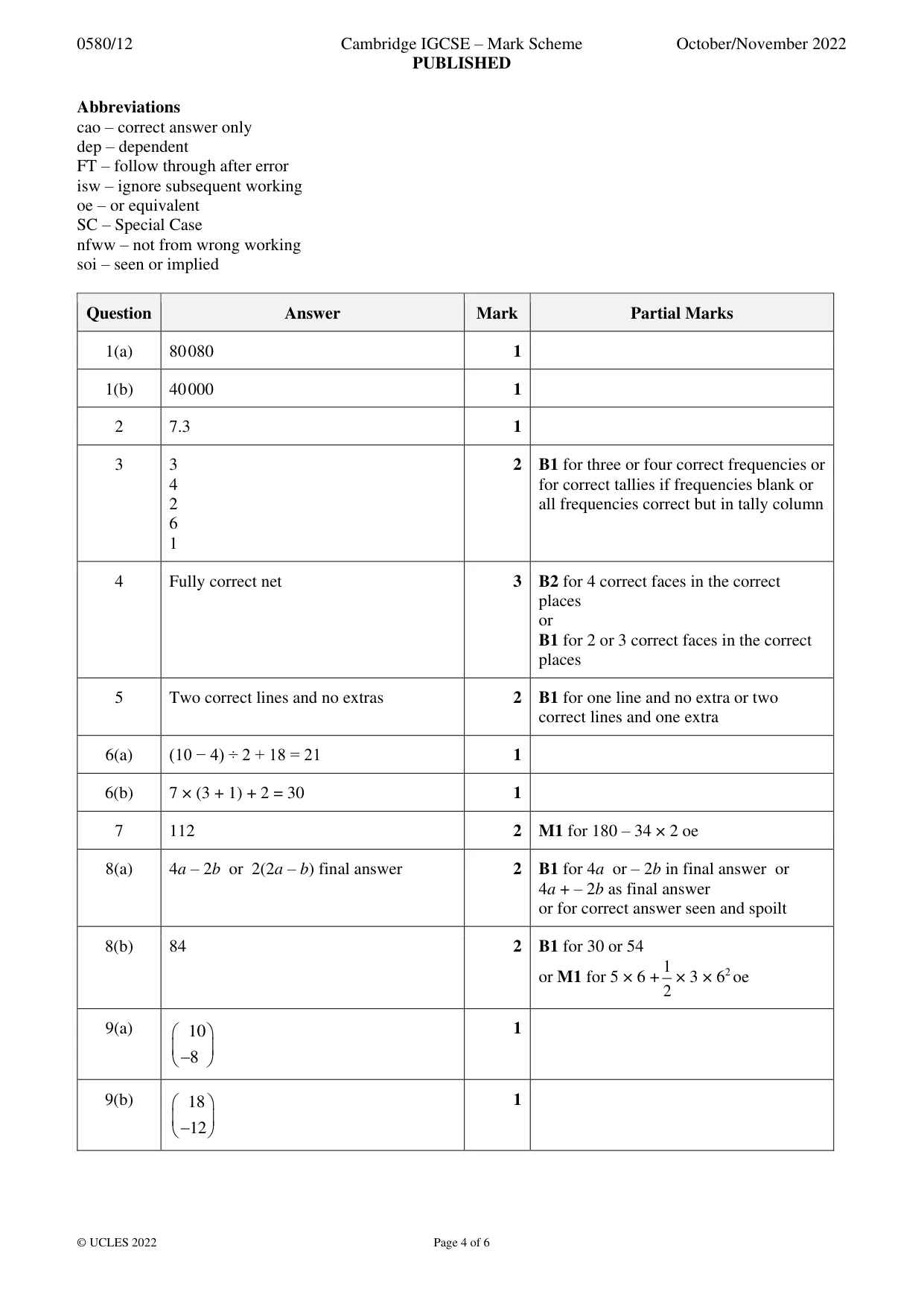
Mark scheme: Question Answer Mark Partial Marks 1(a) 80 080 1 1(b) 40 000 1
Q2 · Find the value of 53.29
2 Find the value of 53.29 . ................................................. [1]
Mark scheme: 2 7.3 1
Q3 · A football team has 16 players at a training session
3 A football team has 16 players at a training session. Kim records the colour of each of their shirts. Blue Silver Green Green Silver Silver Red Silver Green Red Silver Silver Blue Green White Blue Complete the frequency table. You may use the tally column to help you. Colour Tally Frequency Blue Green Red Silver White [2]
Mark scheme: 3 3 2 B1 for three or four correct frequencies or 4 for correct tallies if frequencies blank or 2 all frequencies correct but in tally column 6 1
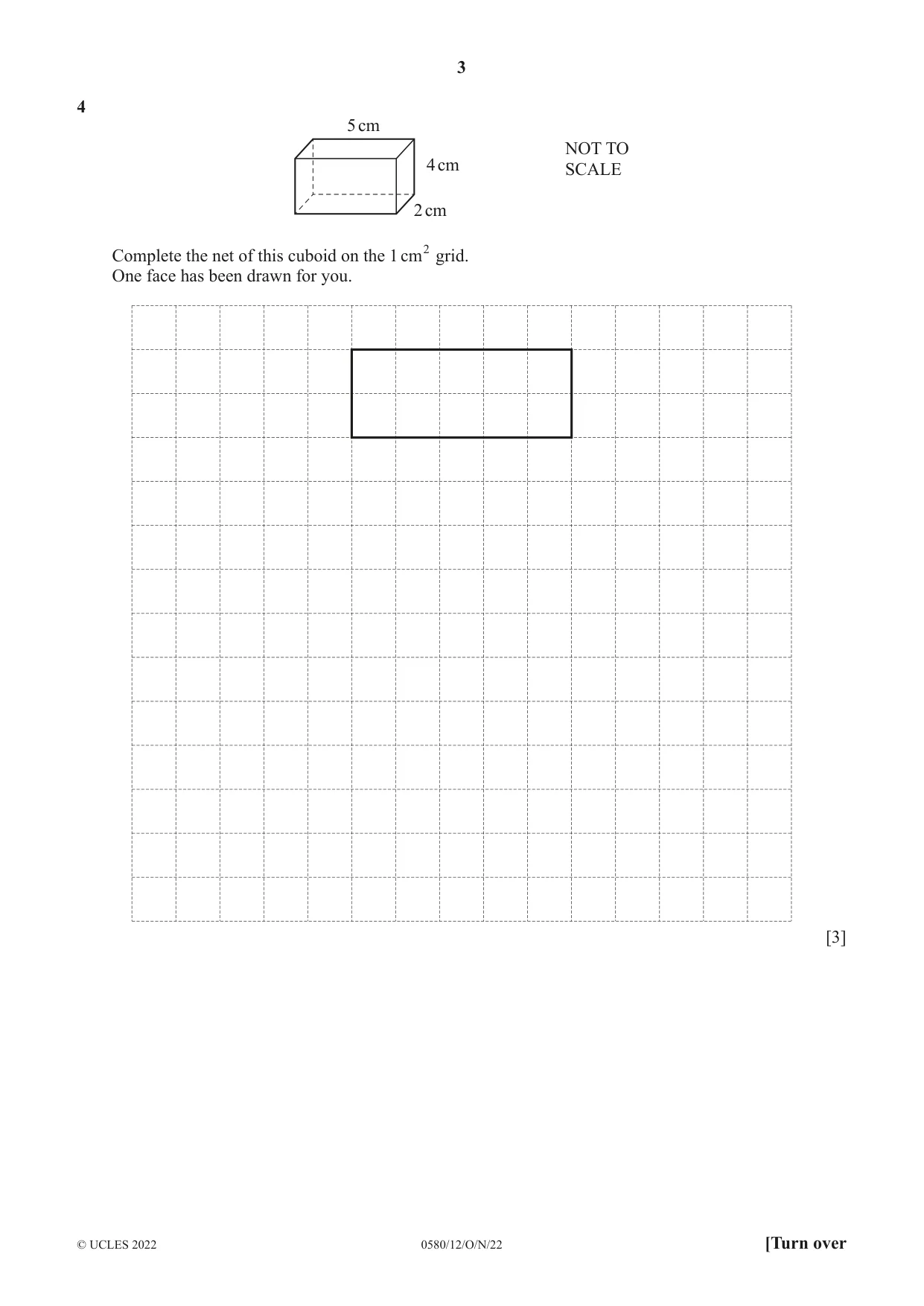
Q4 · 5 cm NOT TO 4 cm SCALE 2 cm Complete the net of this cuboid on the 1 cm 2 grid
4 5 cm NOT TO 4 cm SCALE 2 cm Complete the net of this cuboid on the 1 cm 2 grid. One face has been drawn for you. [3]
Mark scheme: 4 Fully correct net 3 B2 for 4 correct faces in the correct places or B1 for 2 or 3 correct faces in the correct places
Q5 · Draw all the lines of symmetry on this shape
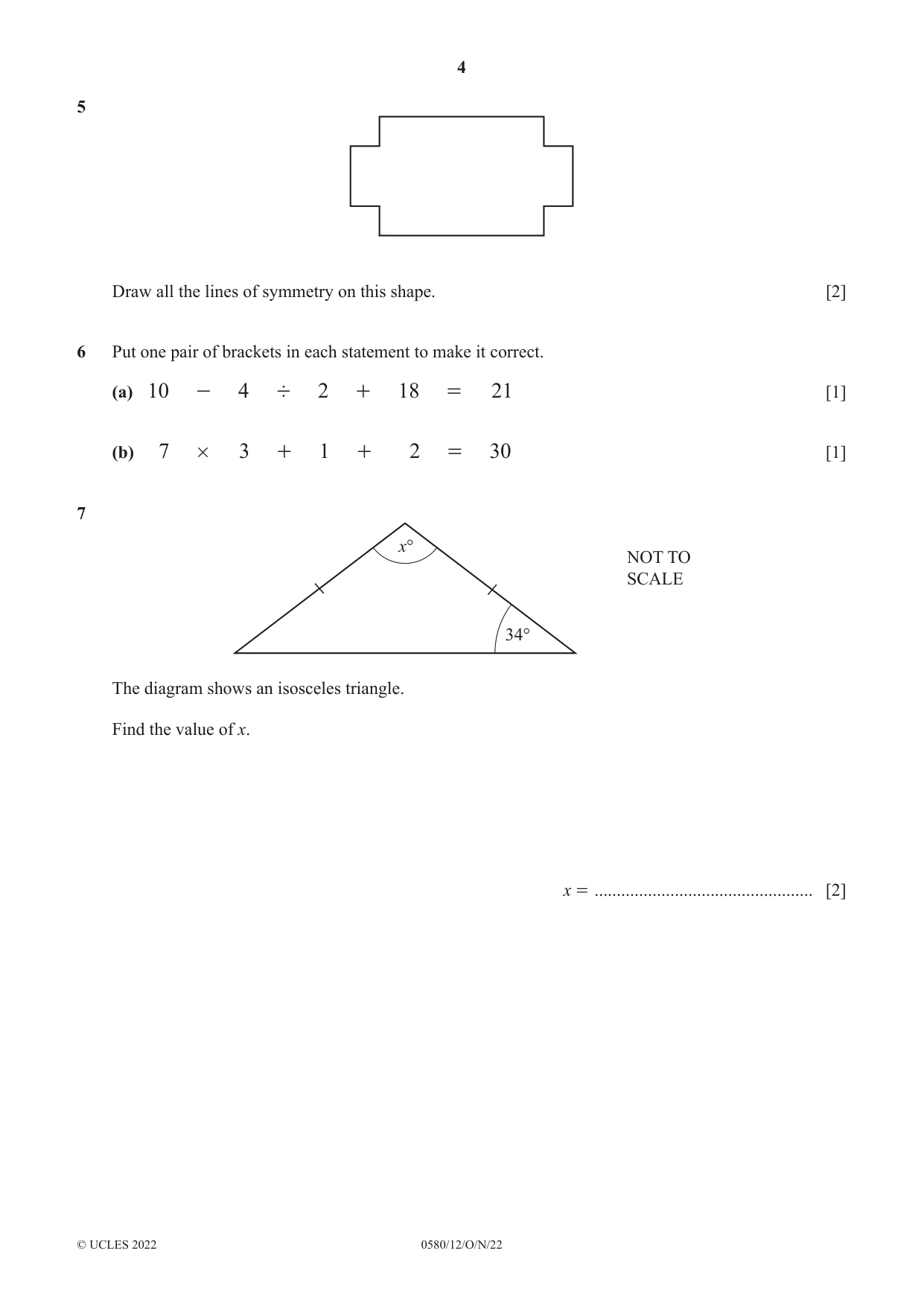
5 Draw all the lines of symmetry on this shape. [2]
Mark scheme: 5 Two correct lines and no extras 2 B1 for one line and no extra or two correct lines and one extra
Q6 · Put one pair of brackets in each statement to make it correct
6 Put one pair of brackets in each statement to make it correct. (a) 10 - 4 ' 2 + 18 = 21 [1] (b) 7 # 3 + 1 + 2 = 30 [1]
Mark scheme: 6(a) (10 − 4) ÷ 2 + 18 = 21 1 6(b) 7 × (3 + 1) + 2 = 30 1
Q7 · X° NOT TO SCALE 34° The diagram shows an isosceles triangle
7 x° NOT TO SCALE 34° The diagram shows an isosceles triangle. Find the value of x. x = ................................................. [2]
Mark scheme: 7 112 2 M1 for 180 – 34 × 2 oe
Question 8
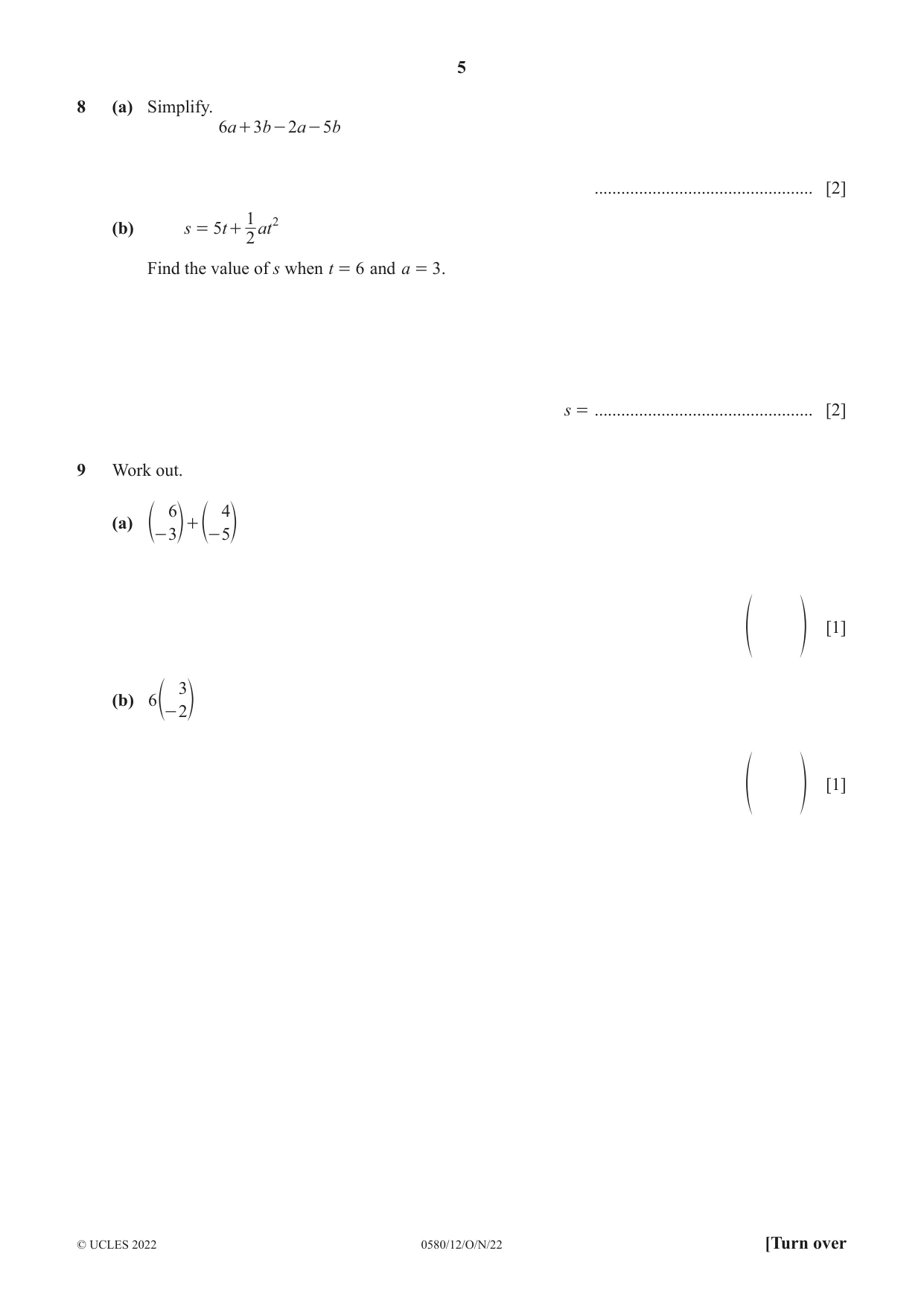
8 (a) Simplify. 6a + 3b - 2a - 5b ................................................. [2] 1 2 (b) s = 5t + at 2 Find the value of s when t = 6 and a = 3 . s = ................................................. [2]
Mark scheme: 8(a) 4a – 2b or 2(2a – b) final answer 2 B1 for 4a or – 2b in final answer or 4a + – 2b as final answer or for correct answer seen and spoilt 8(b) 84 2 B1 for 30 or 54 1 or M1 for 5 × 6 + × 3 × 62 oe 2
Question 9
9 Work out. 6 4 (a) + e- 3o e- 5o [1] f p 3 (b) 6 e- 2o [1] f p
Mark scheme: 9(a) 10 1 −8 9(b) 18 1 −12
Q10 · 110 Without using a calculator, work out -
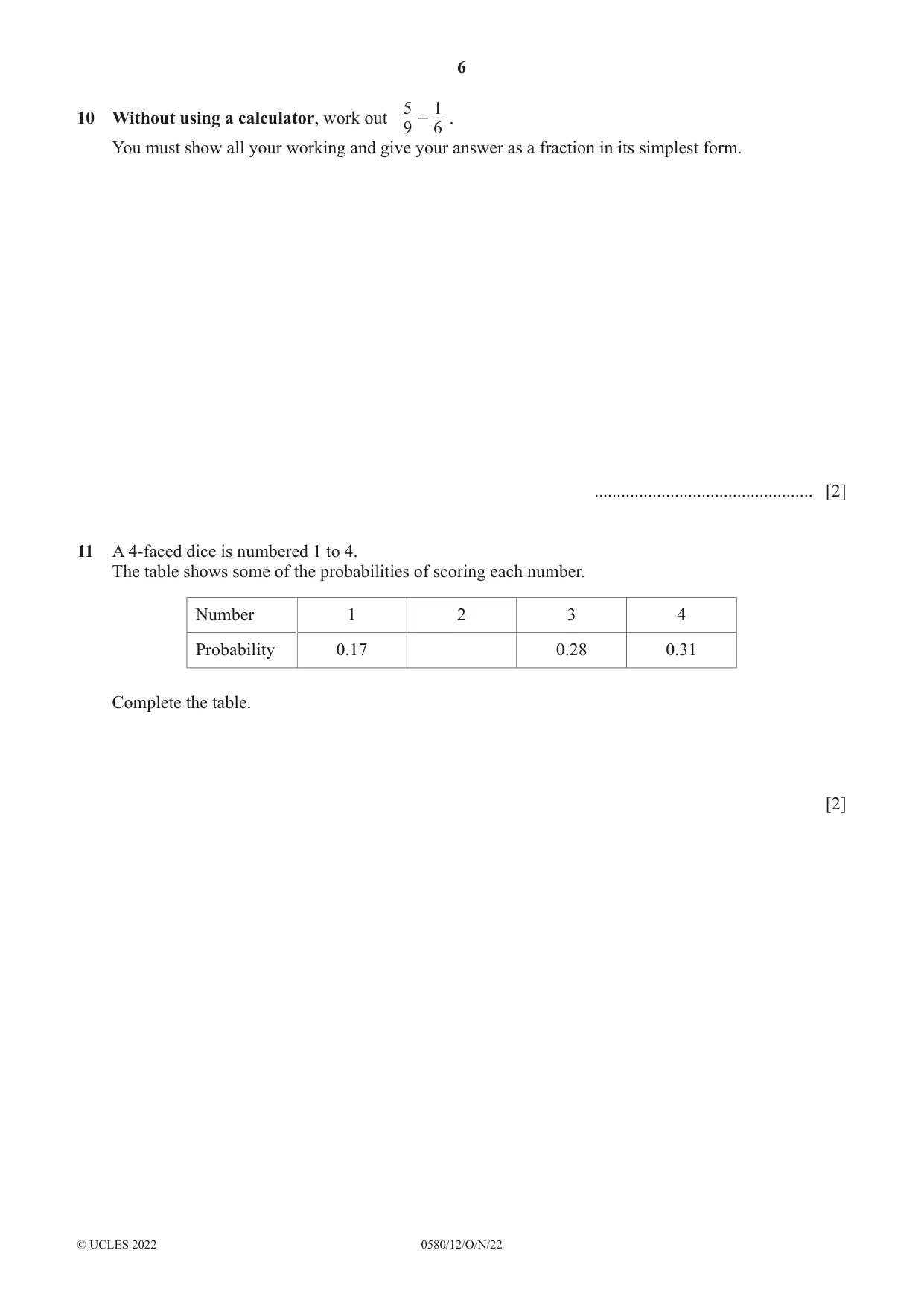
5 110 Without using a calculator, work out - . 9 6 You must show all your working and give your answer as a fraction in its simplest form. ................................................. [2]
Mark scheme: 10 10 3 M1 Allow any correct common denominator and 18k 18 18 7 A1 cao 18
Q11 · A 4-faced dice is numbered 1 to 4
11 A 4-faced dice is numbered 1 to 4. The table shows some of the probabilities of scoring each number. Number 1 2 3 4 Probability 0.17 0.28 0.31 Complete the table. [2]
Mark scheme: 11 [0].24 2 M1 for 1 – 0.17 – 0.28 – 0.31oe
Q12 · These are the first five terms of a sequence
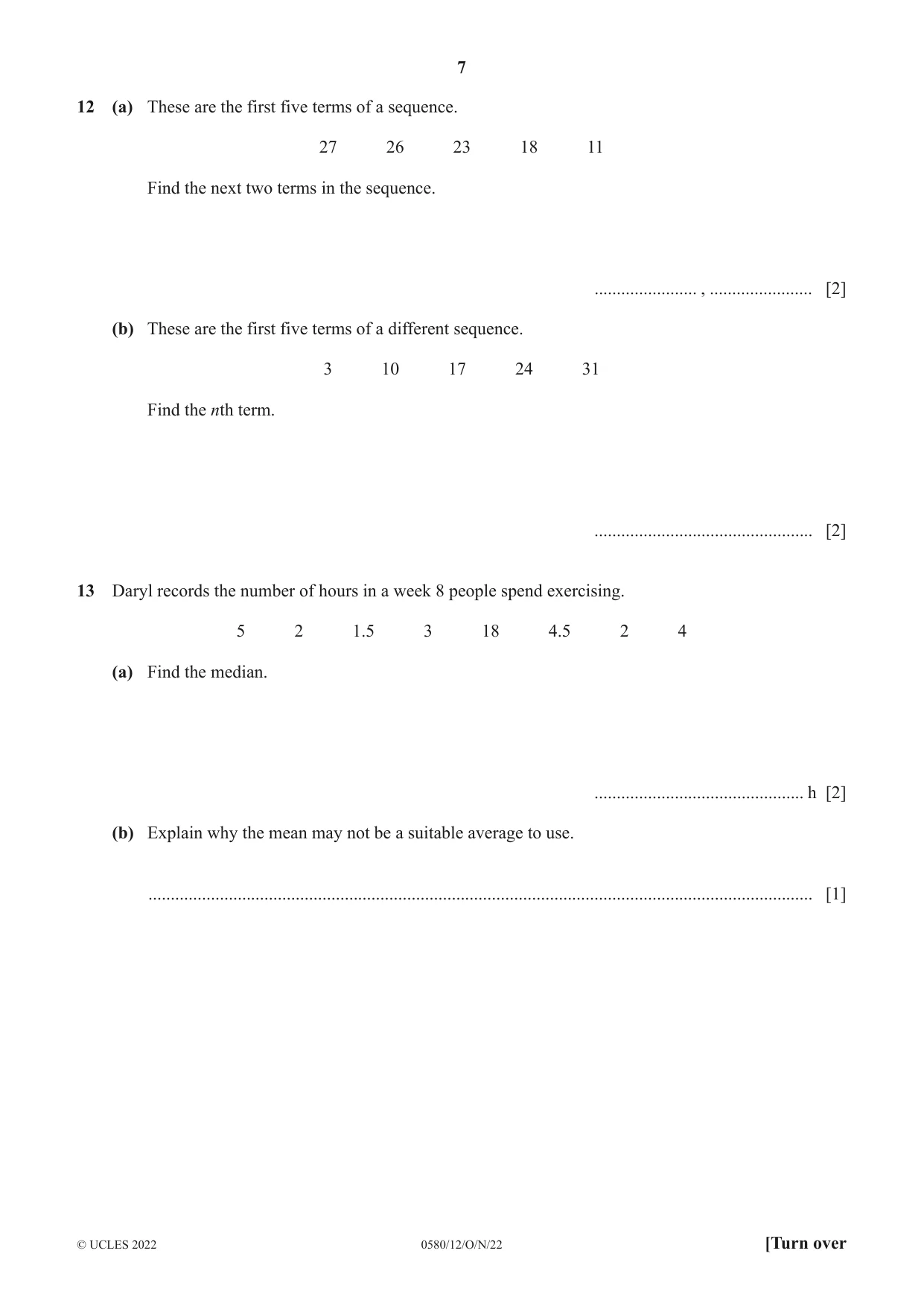
12 (a) These are the first five terms of a sequence. 27 26 23 18 11 Find the next two terms in the sequence. ....................... , ....................... [2] (b) These are the first five terms of a different sequence. 3 10 17 24 31 Find the nth term. ................................................. [2]
Mark scheme: 12(a) 2 –9 2 B1 for one correct 12(b) 7n – 4 oe final answer 2 B1 for 7n + c or kn – 4 (k ≠ 0 ) as final answer or correct answer spoilt
Q13 · Daryl records the number of hours in a week 8 people spend exercising
13 Daryl records the number of hours in a week 8 people spend exercising. 5 2 1.5 3 18 4.5 2 4 (a) Find the median. ............................................... h [2] (b) Explain why the mean may not be a suitable average to use. ..................................................................................................................................................... [1]
Mark scheme: 13(a) 3.5 2 M1 for values in correct order 1.5 2 2 3 4 4.5 5 18 or 3 and 4 identified as middle numbers 13(b) One extreme value oe 1
Question 14
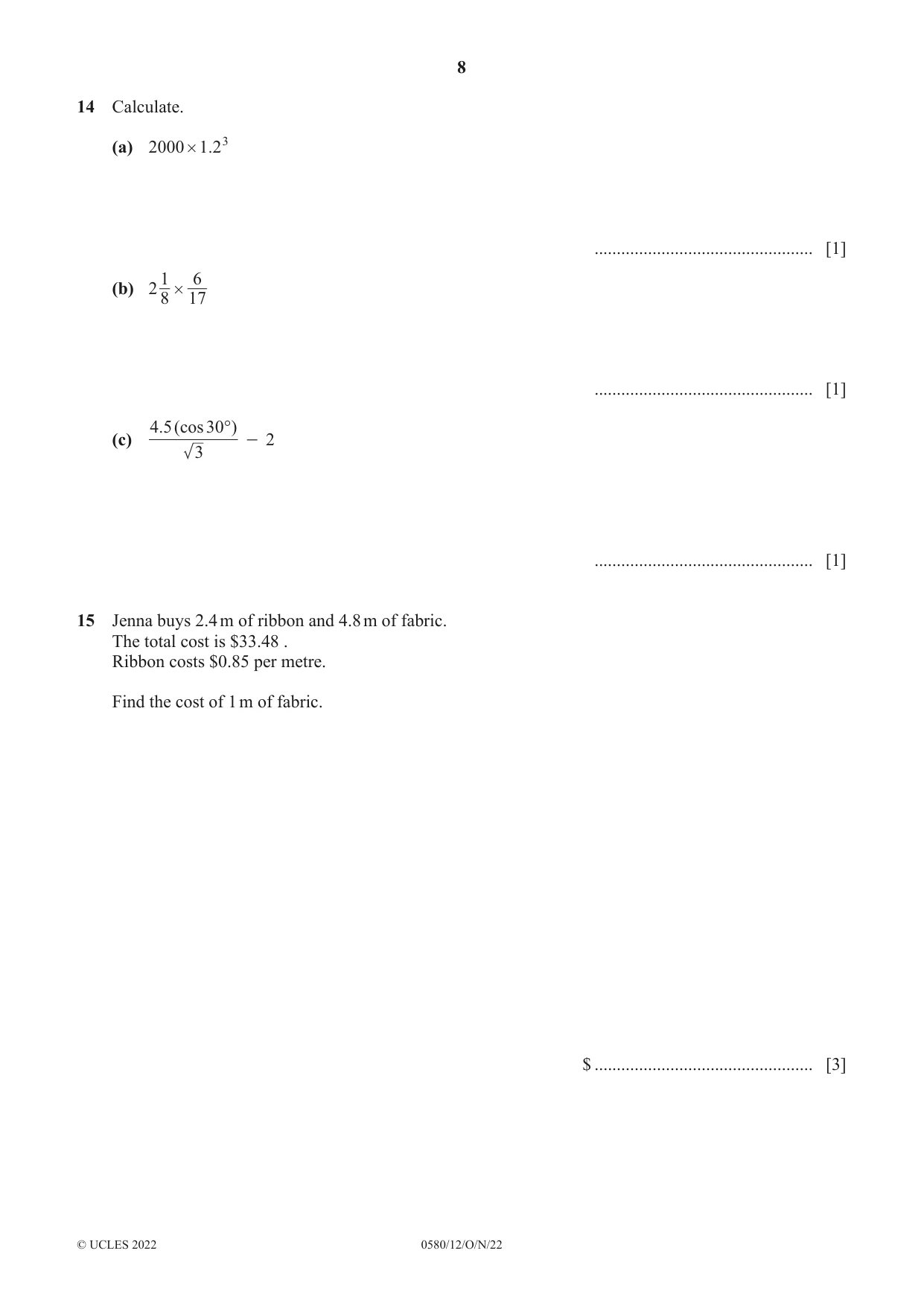
14 Calculate. (a) 2000 # 1.23 ................................................. [1] 1 6 (b) 2 # 8 17 ................................................. [1] 4.5 ( cos 30°) (c) - 2 3 ................................................. [1]
Mark scheme: 14(a) 3456 1 14(b) 3 1 0.75 or 4 14(c) 1 1 0.25 or 4
Q15 · Jenna buys 2.4 m of ribbon and 4.8 m of fabric
15 Jenna buys 2.4 m of ribbon and 4.8 m of fabric. The total cost is $33.48 . Ribbon costs $0.85 per metre. Find the cost of 1 m of fabric. $ ................................................. [3]
Mark scheme: 15 6.55 3 M2 for (33.48 – 2.4 × 0.85) oe or M1 for 2.4 × 0.85
Question 16
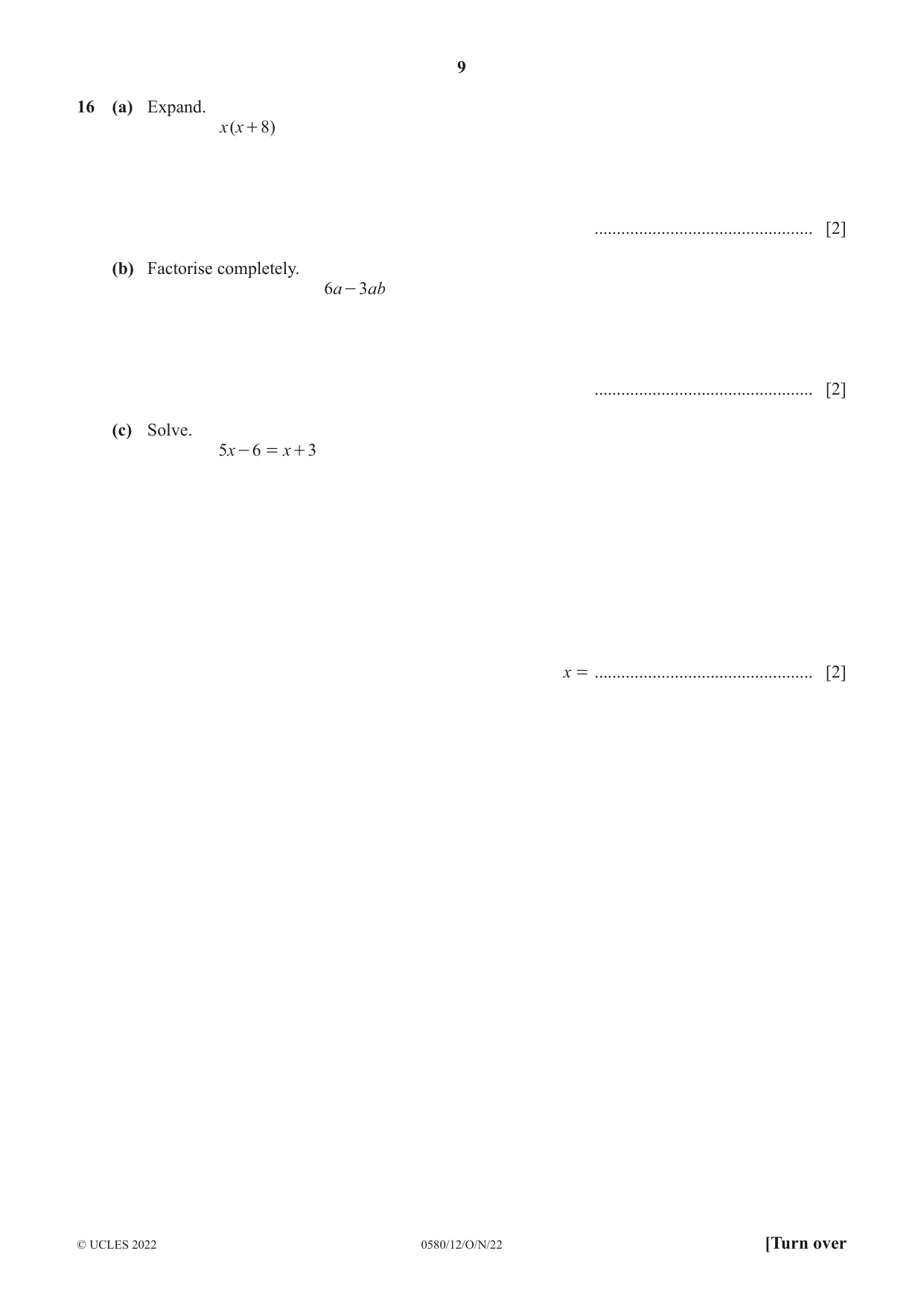
16 (a) Expand. x ( x + 8) ................................................. [2] (b) Factorise completely. 6a - 3ab ................................................. [2] (c) Solve. 5x - 6 = x + 3 x = ................................................. [2]
Mark scheme: 16(a) x2 + 8x final answer 2 B1 for x2 or +8x in final answer or correct answer spoilt 16(b) 3a(2 − b) final answer 2 B1 for 3(2a −ab) or a(6 − 3b) final answer or correct answer spoilt 16(c) 1 2 M1 for 5x – x = 3 + 6 or better 2.25 or 2 4
Q17 · = { people in a group} B = { people who own a bicycle} C = { people who own a car}…
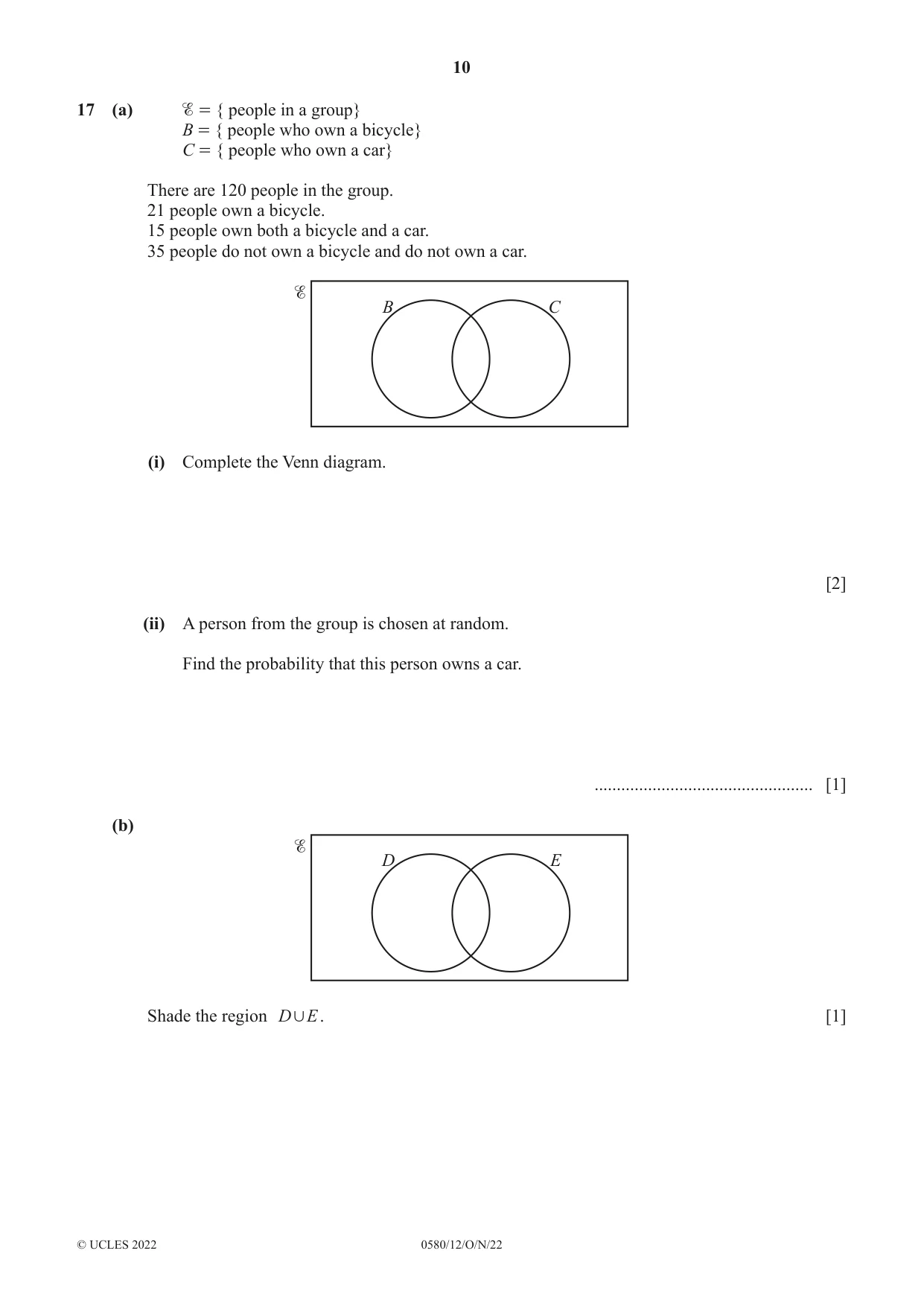
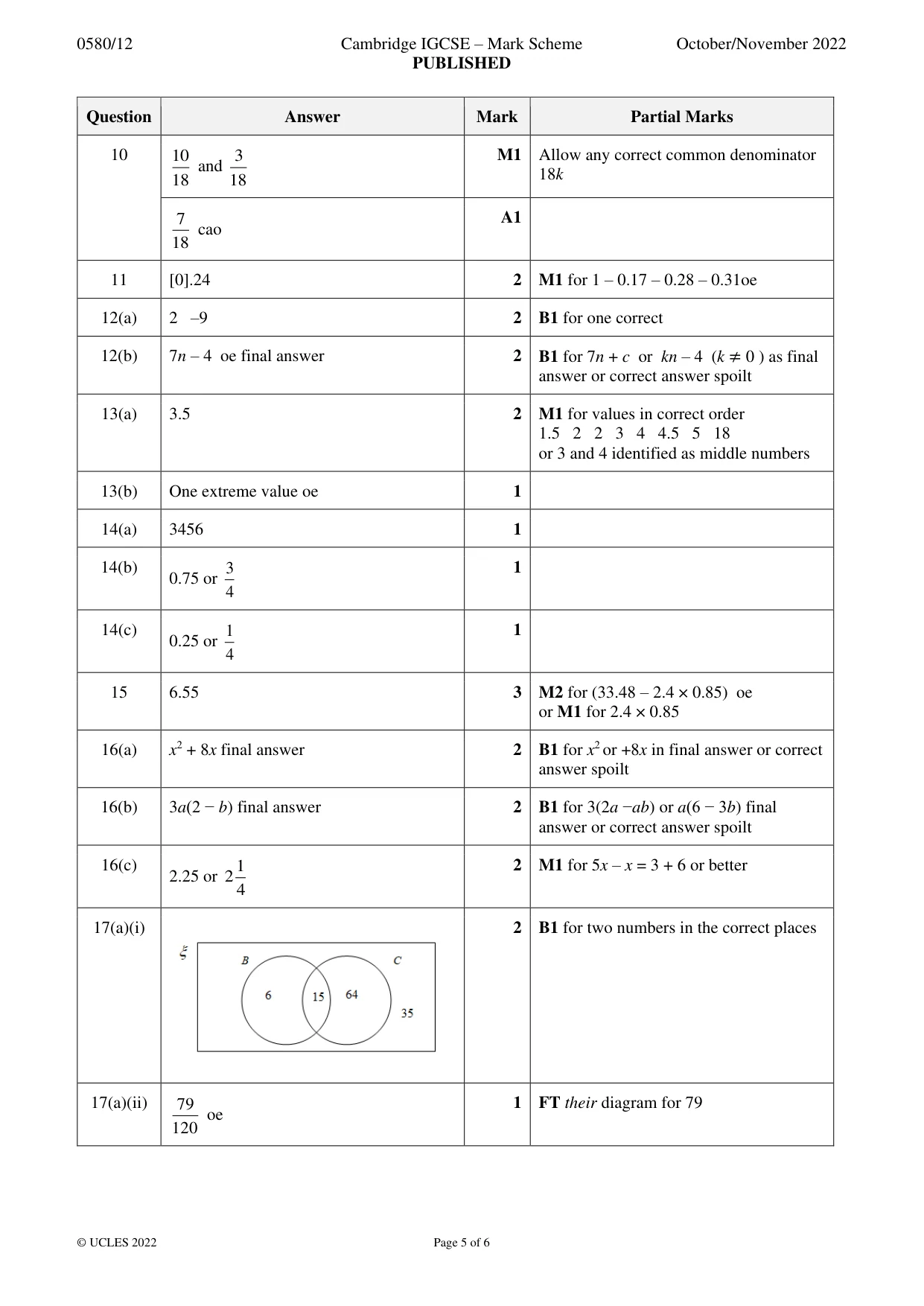
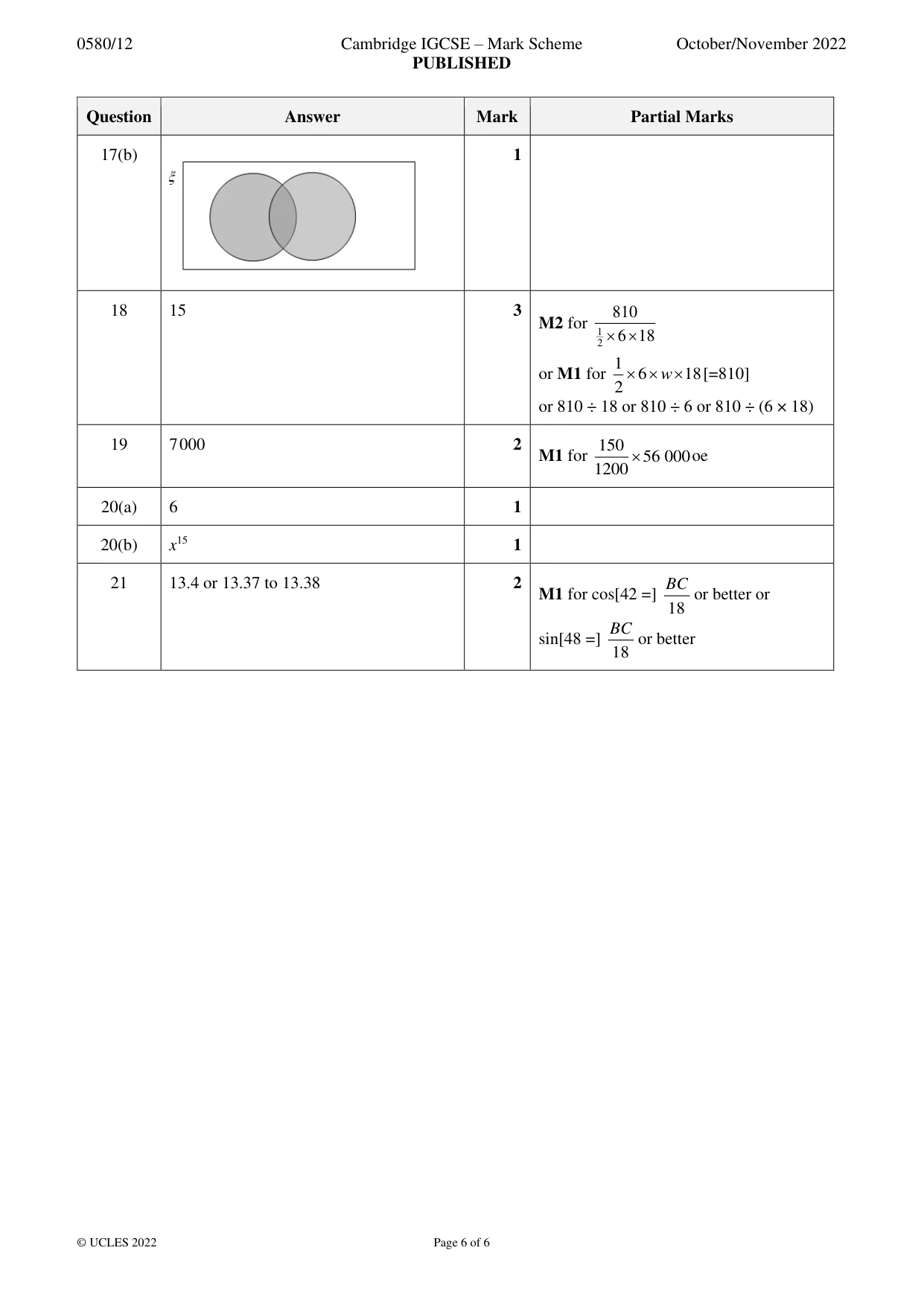
17 (a) = { people in a group} B = { people who own a bicycle} C = { people who own a car} There are 120 people in the group. 21 people own a bicycle. 15 people own both a bicycle and a car. 35 people do not own a bicycle and do not own a car. B C (i) Complete the Venn diagram. [2] (ii) A person from the group is chosen at random. Find the probability that this person owns a car. ................................................. [1] (b) D E Shade the region D , E . [1]
Mark scheme: 17(a)(i) 2 B1 for two numbers in the correct places 17(a)(ii) 79 1 FT their diagram for 79 oe 120 17(b) 1
Q18 · NOT TO SCALE 6 cm 18 cm w cm The right-angled triangular prism has height 6 cm, width w…
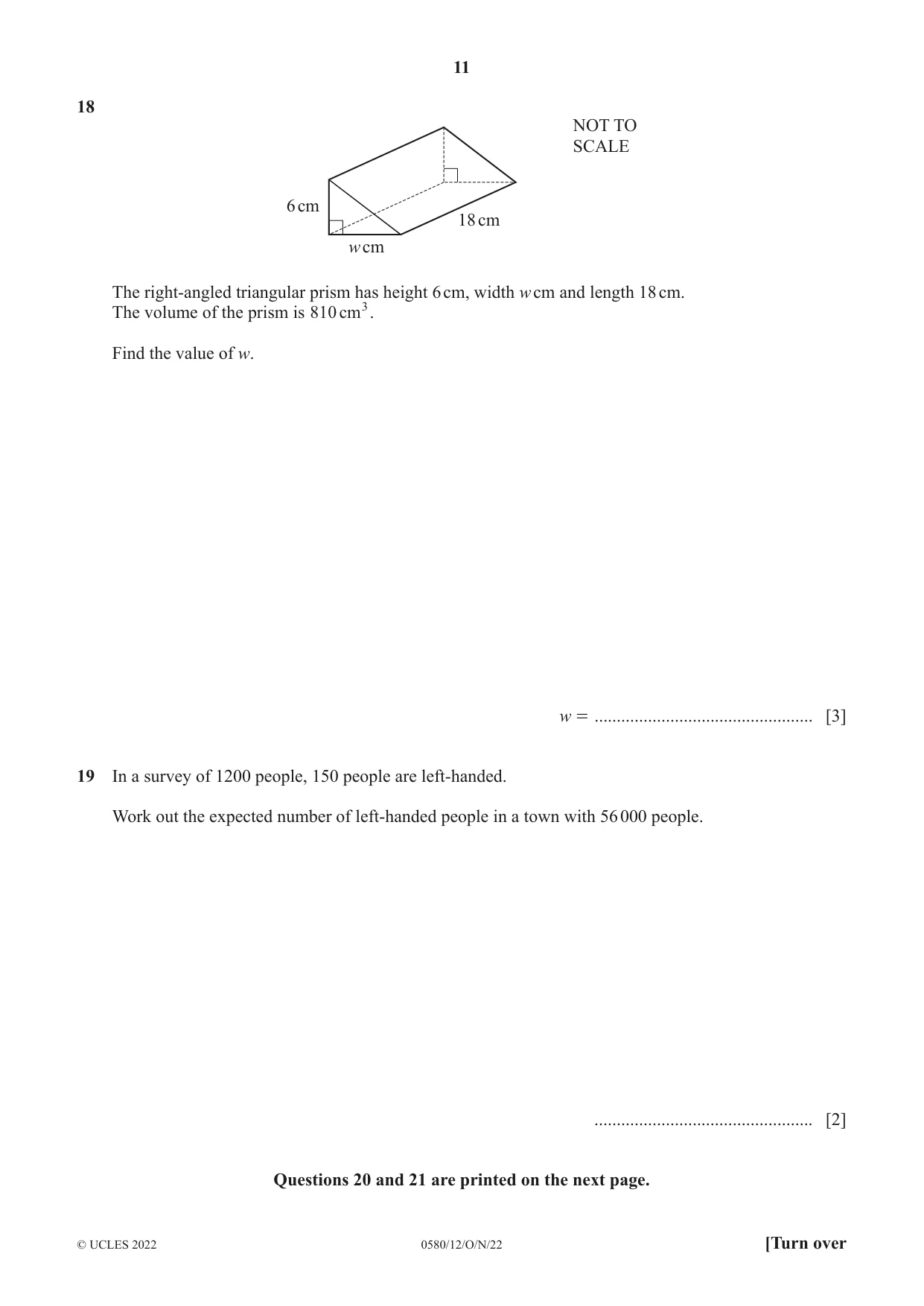
18 NOT TO SCALE 6 cm 18 cm w cm The right-angled triangular prism has height 6 cm, width w cm and length 18 cm. The volume of the prism is 810 cm 3. Find the value of w. w = ................................................. [3]
Mark scheme: 18 15 3 810 M2 for 1 2 6 18 1 or M1 for 6 w 18 [=810] 2 or 810 ÷ 18 or 810 ÷ 6 or 810 ÷ (6 × 18)
Q19 · In a survey of 1200 people, 150 people are left-handed
19 In a survey of 1200 people, 150 people are left-handed. Work out the expected number of left-handed people in a town with 56 000 people. ................................................. [2] Questions 20 and 21 are printed on the next page.
Mark scheme: 19 7 000 2 150 M1 for 56 000 oe 1200
Q20 · 5 8 ' 5 x = 5 2 Find the value of x
20 (a) 5 8 ' 5 x = 5 2 Find the value of x. x = ................................................. [1] 3 (b) Simplify ( x5 ) . ................................................. [1]
Mark scheme: 20(a) 6 1 20(b) x15 1
Q21 · A NOT TO 18 cm SCALE 42° B C ABC is a right-angled triangle
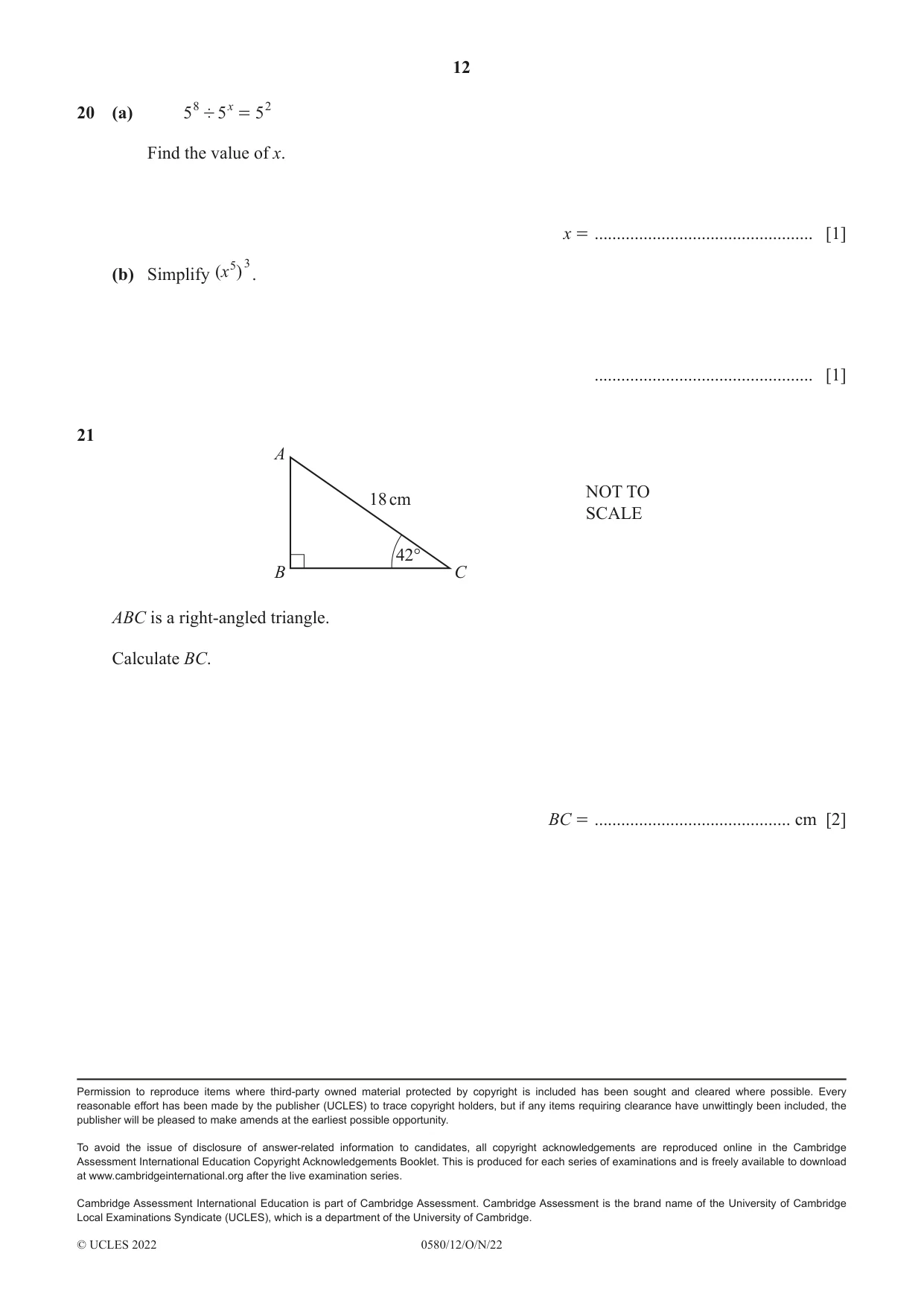
21 A NOT TO 18 cm SCALE 42° B C ABC is a right-angled triangle. Calculate BC. BC = ............................................ cm [2]
Mark scheme: 21 13.4 or 13.37 to 13.38 2 BC M1 for cos[42 =] or better or 18 BC sin[48 =] or better 18
What was in this paper
The subtopics covered by these 21 questions, and how many questions each got. Open one in a new tab to see every Cambridge question on it.
2Introduction to probability2Angles1Averages and range1Classifying statistical data1Compound shapes and parts of shapes1Fractions, decimals and percentages1Indices I1Introduction to algebra1Powers and roots1Rates1Ratio and proportion1Right-angled triangles1Sequences1Surface area and volume1Symmetry1The four operations1Types of number1Using a calculator1What you needed in this session
Cambridge’s own grade thresholds for 2022 Oct/Nov, Paper 1 · Variant 2. A higher threshold means an easier paper — the bar moves with how the cohort did.