Cambridge IGCSE Mathematics 0580 — 2022 May/June Paper 1 · Variant 2
0580/12/M/J/22 · 24 questions · 56 marks · ≈63 min
The question paper and its mark scheme, free to read here and free to download. This is Cambridge’s own paper, exactly as it was sat.
Question paper12 pages
Mark scheme6 pages
Answers below. Sit the paper first if you are practising.
Questions as text
Q1 · Write the number six hundred and seven thousand five hundred and thirty-two in figures
1 Write the number six hundred and seven thousand five hundred and thirty-two in figures. ................................................. [1]
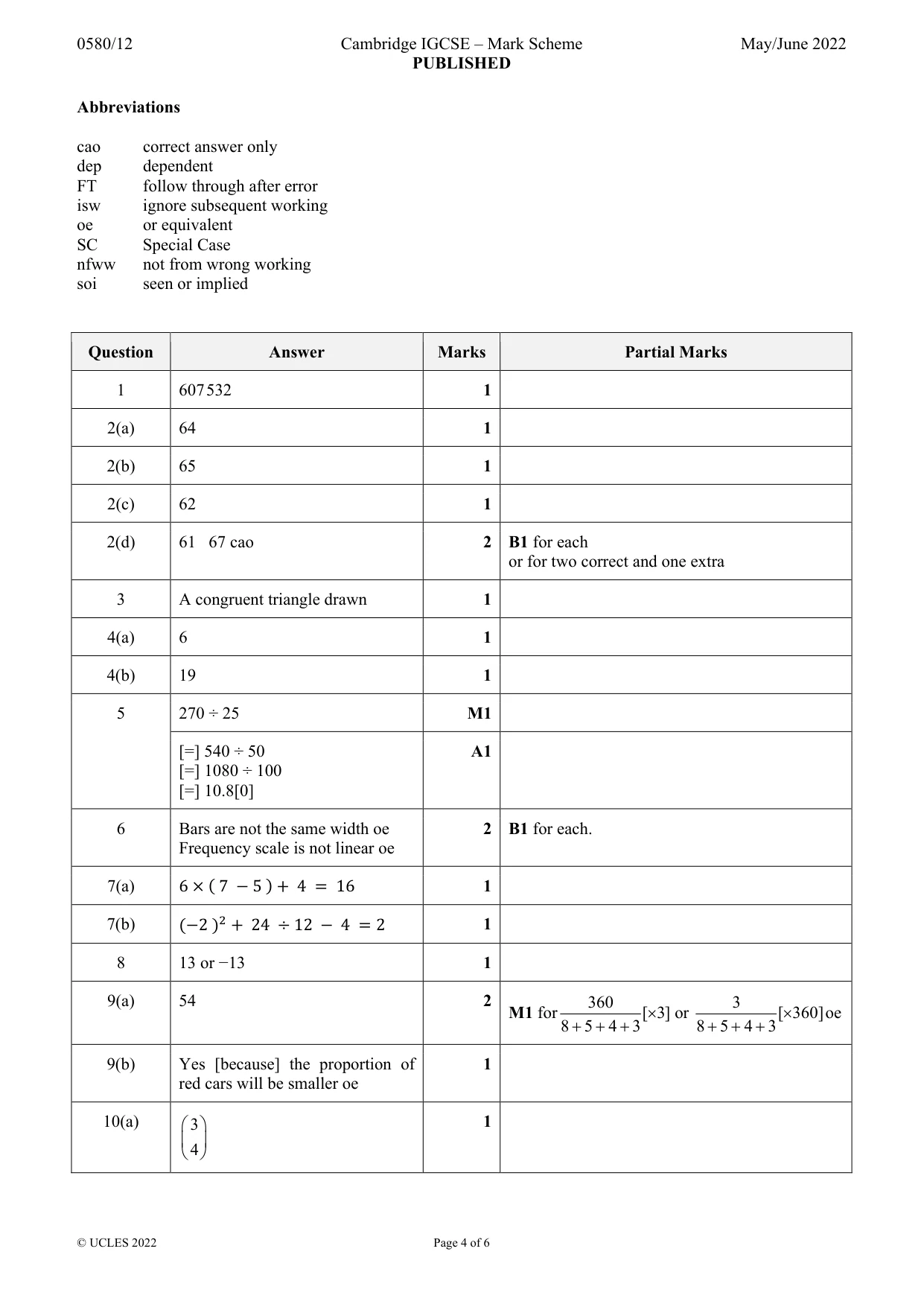
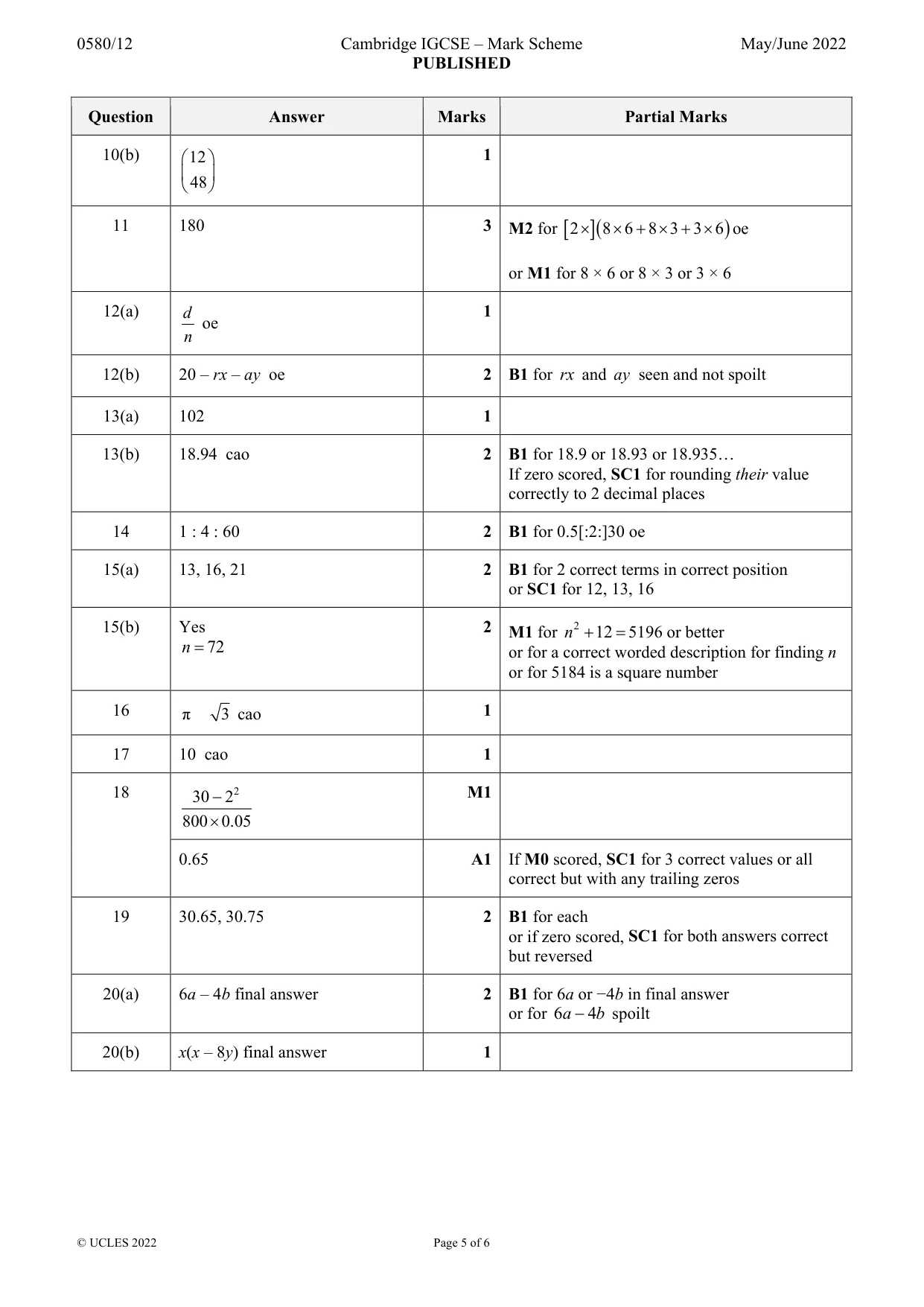
Mark scheme: Question Answer Marks Partial Marks 1 607 532 1
Q2 · 61 62 63 64 65 66 67 68 69 From the list of numbers, write down (a) a square number…
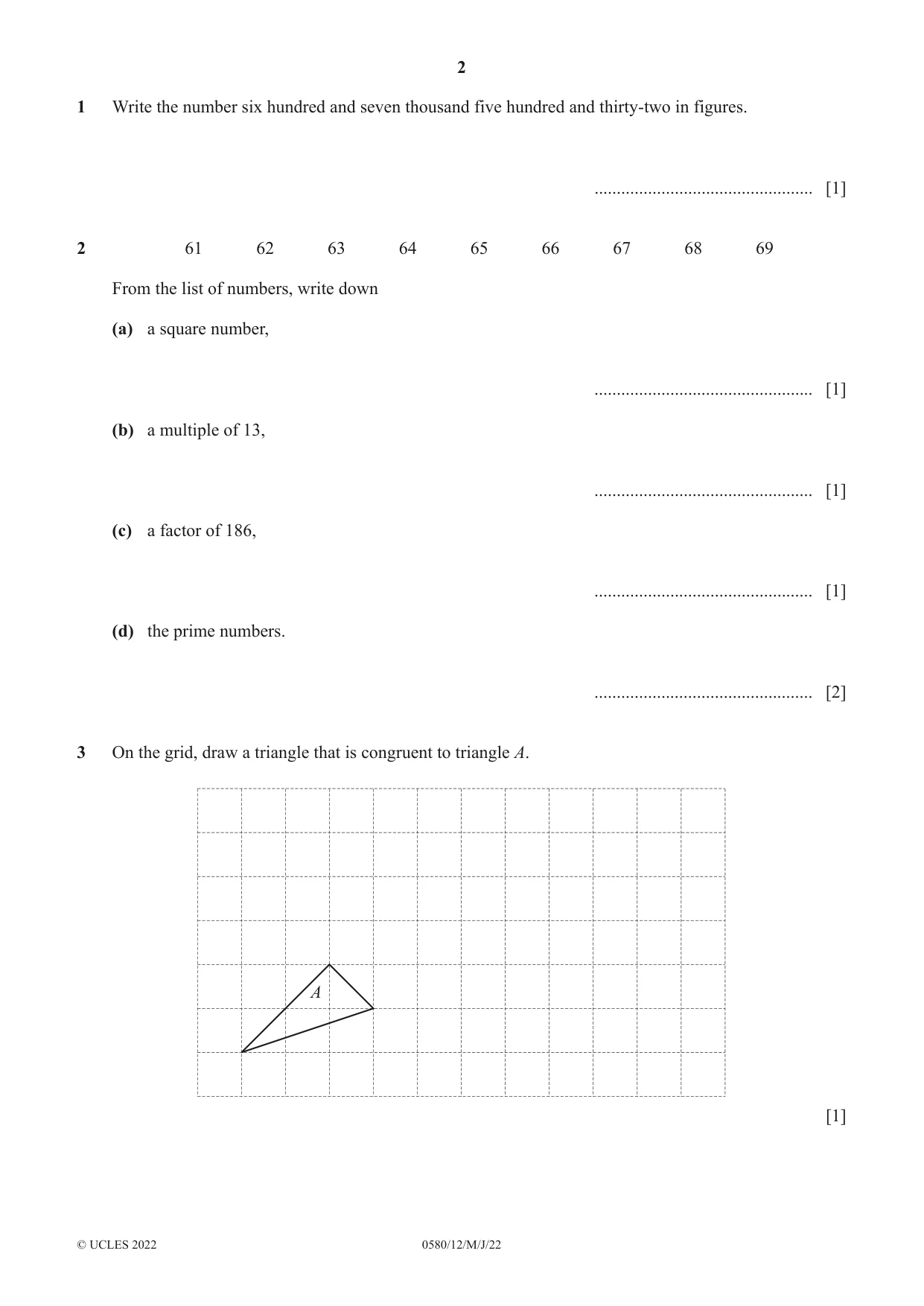
2 61 62 63 64 65 66 67 68 69 From the list of numbers, write down (a) a square number, ................................................. [1] (b) a multiple of 13, ................................................. [1] (c) a factor of 186, ................................................. [1] (d) the prime numbers. ................................................. [2]
Mark scheme: 2(a) 64 1 2(b) 65 1 2(c) 62 1 2(d) 61 67 cao 2 B1 for each or for two correct and one extra
Q3 · On the grid, draw a triangle that is congruent to triangle A
3 On the grid, draw a triangle that is congruent to triangle A. A [1]
Mark scheme: 3 A congruent triangle drawn 1
Q4 · The stem-and-leaf diagram shows the journey time to school of some students
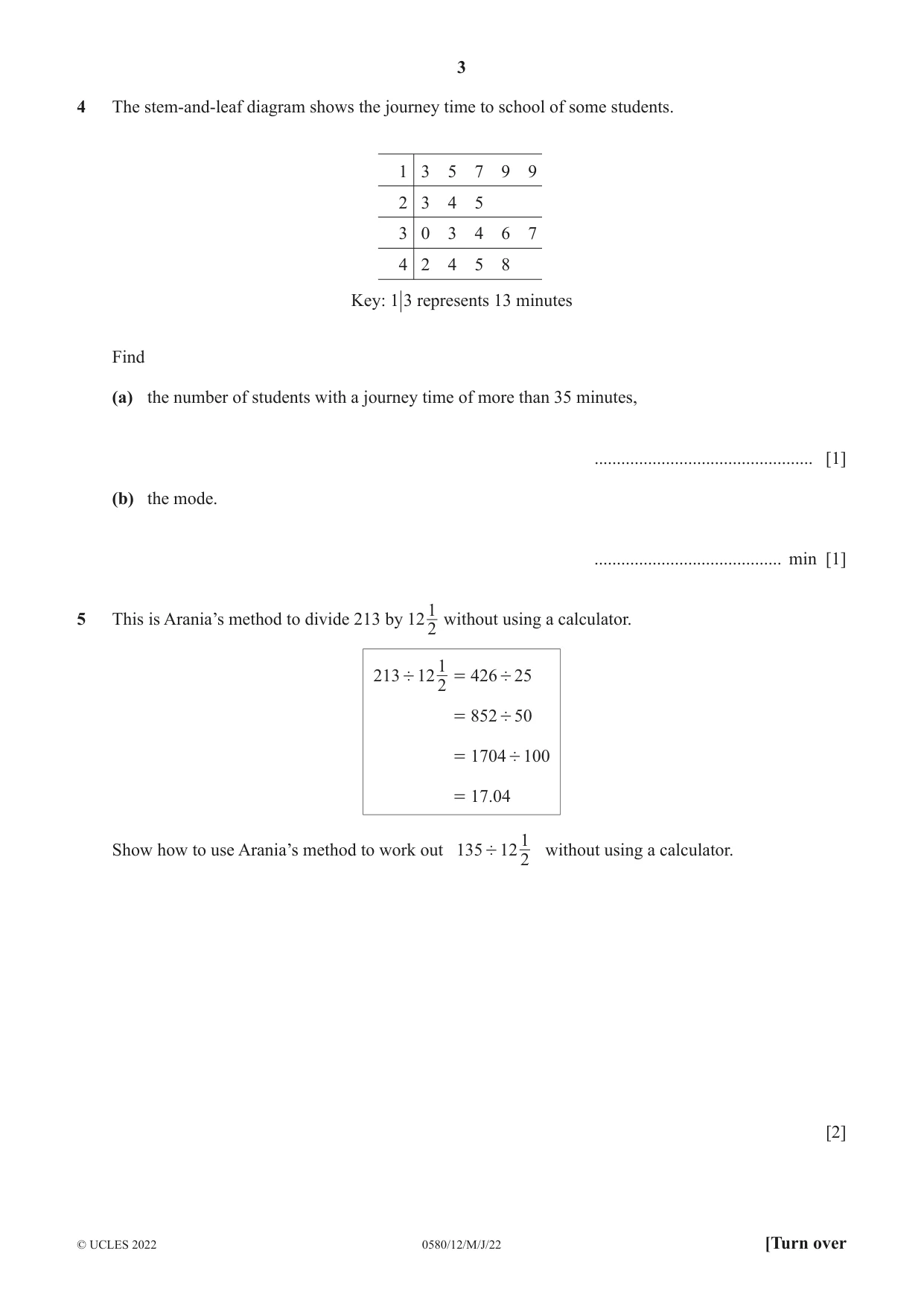
4 The stem-and-leaf diagram shows the journey time to school of some students. 1 3 5 7 9 9 2 3 4 5 3 0 3 4 6 7 4 2 4 5 8 Key: 1 3 represents 13 minutes Find (a) the number of students with a journey time of more than 35 minutes, ................................................. [1] (b) the mode. .......................................... min [1]
Mark scheme: 4(a) 6 1 4(b) 19 1
Q5 · This is Arania’s method to divide 213 by 12 without using a calculator
15 This is Arania’s method to divide 213 by 12 without using a calculator. 2 1 213 ' 12 = 426 ' 25 2 = 852 ' 50 = 1704 ' 100 = 17.04 1 Show how to use Arania’s method to work out 135 ' 12 without using a calculator. 2 [2]
Mark scheme: 5 270 ÷ 25 M1 [=] 540 ÷ 50 A1 [=] 1080 ÷ 100 [=] 10.8[0]
Q6 · Sammy records the favourite hot drink of some students
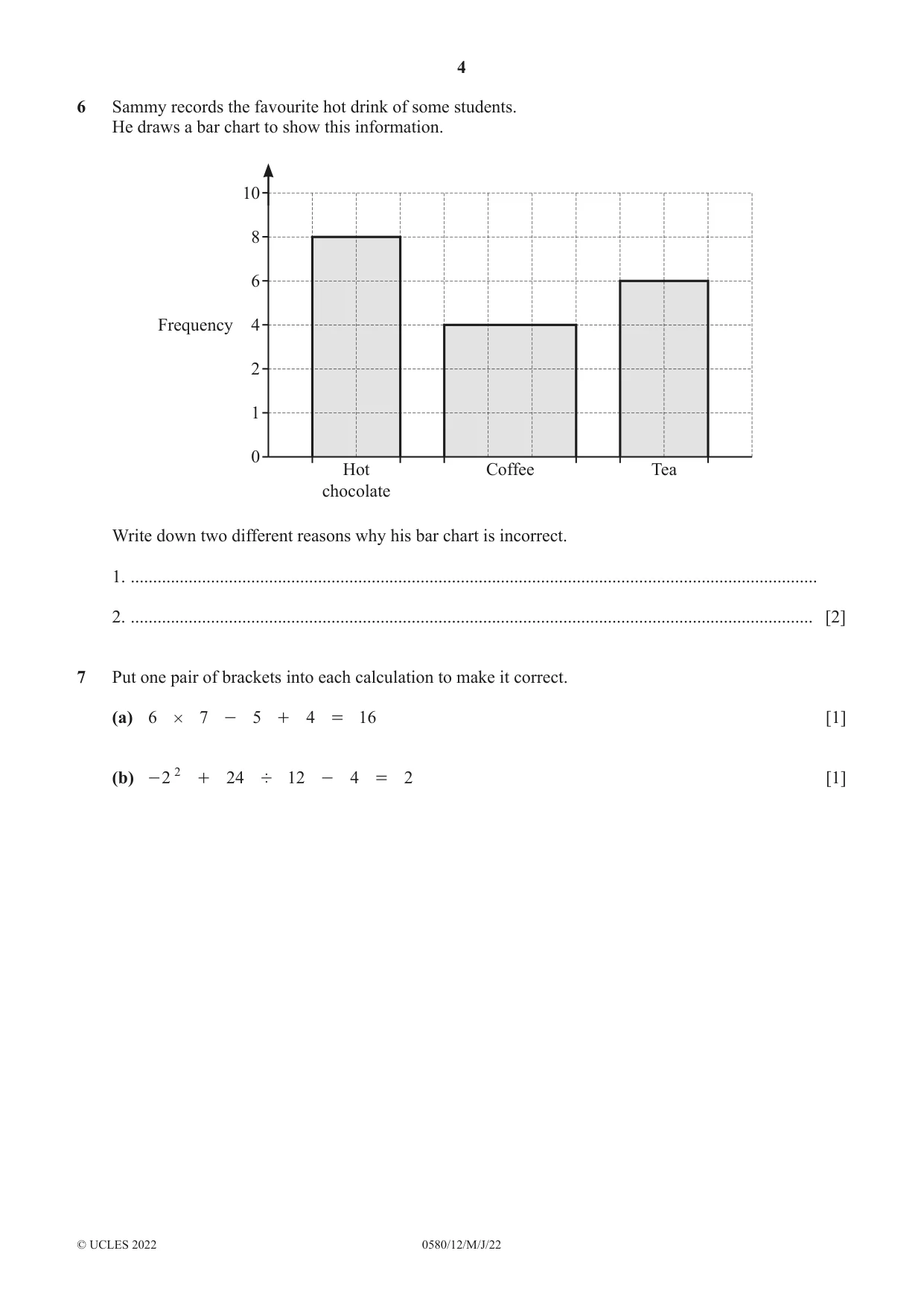
6 Sammy records the favourite hot drink of some students. He draws a bar chart to show this information. 10 8 6 Frequency 4 2 1 0 Hot Coffee Tea chocolate Write down two different reasons why his bar chart is incorrect. 1. .......................................................................................................................................................... 2. ......................................................................................................................................................... [2]
Mark scheme: 6 Bars are not the same width oe 2 B1 for each. Frequency scale is not linear oe
Q7 · Put one pair of brackets into each calculation to make it correct
7 Put one pair of brackets into each calculation to make it correct. (a) 6 # 7 - 5 + 4 = 16 [1] (b) - 2 2 + 24 ' 12 - 4 = 2 [1]
Mark scheme: 7(a) 6 × ሺ 7 −5 ሻ+ 4 = 16 1 7(b) (−2 )ଶ+ 24 ÷ 12 − 4 = 2 1
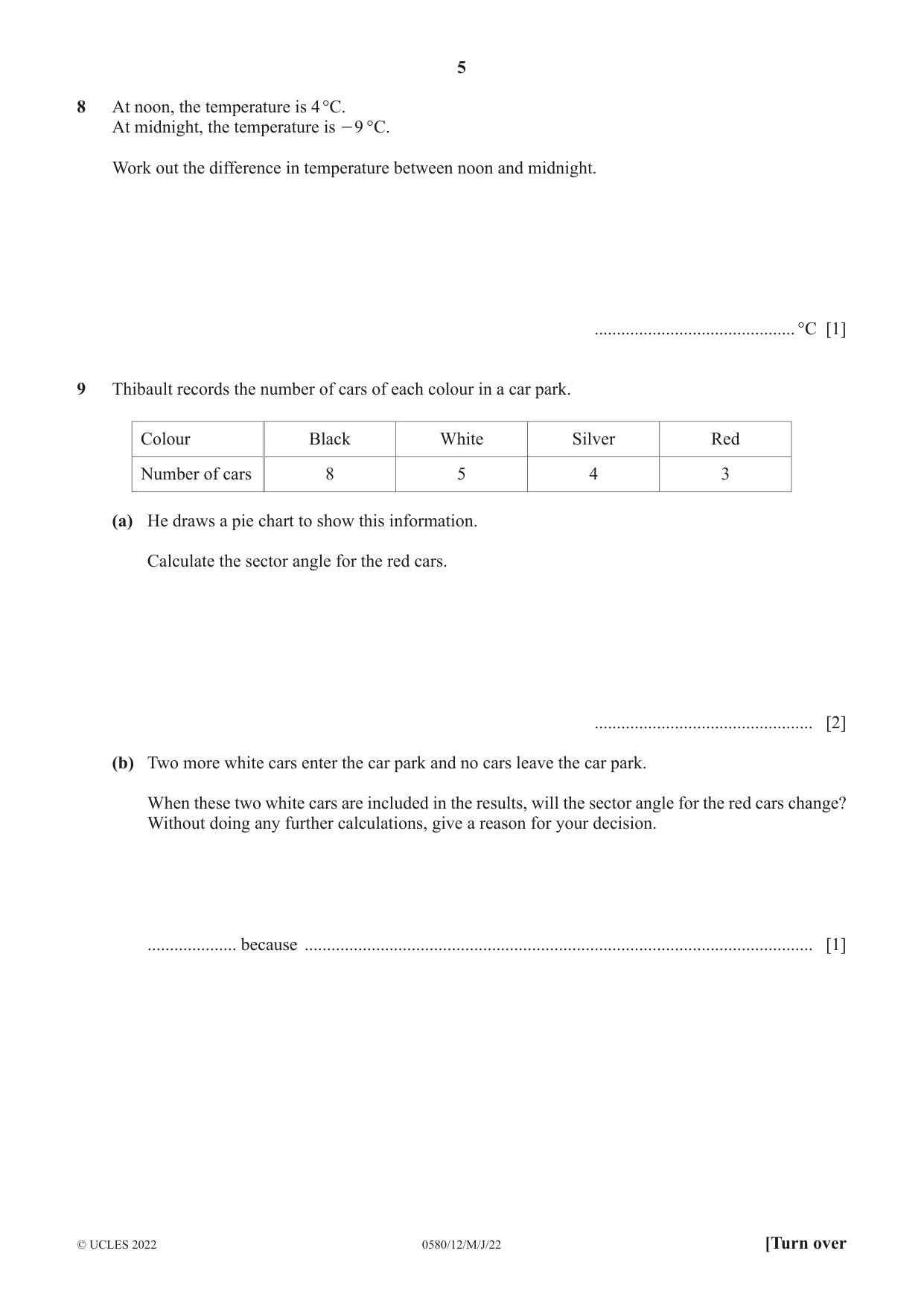
Q8 · At noon, the temperature is 4 °C
8 At noon, the temperature is 4 °C. At midnight, the temperature is - 9 °C. Work out the difference in temperature between noon and midnight. ............................................. °C [1]
Mark scheme: 8 13 or −13 1
Q9 · Thibault records the number of cars of each colour in a car park
9 Thibault records the number of cars of each colour in a car park. Colour Black White Silver Red Number of cars 8 5 4 3 (a) He draws a pie chart to show this information. Calculate the sector angle for the red cars. ................................................. [2] (b) Two more white cars enter the car park and no cars leave the car park. When these two white cars are included in the results, will the sector angle for the red cars change? Without doing any further calculations, give a reason for your decision. .................... because .................................................................................................................. [1]
Mark scheme: 9(a) 54 2 360 3 M1 for [ 3] or [ 360] oe 8 5 4 3 8 5 4 3 9(b) Yes [because] the proportion of 1 red cars will be smaller oe
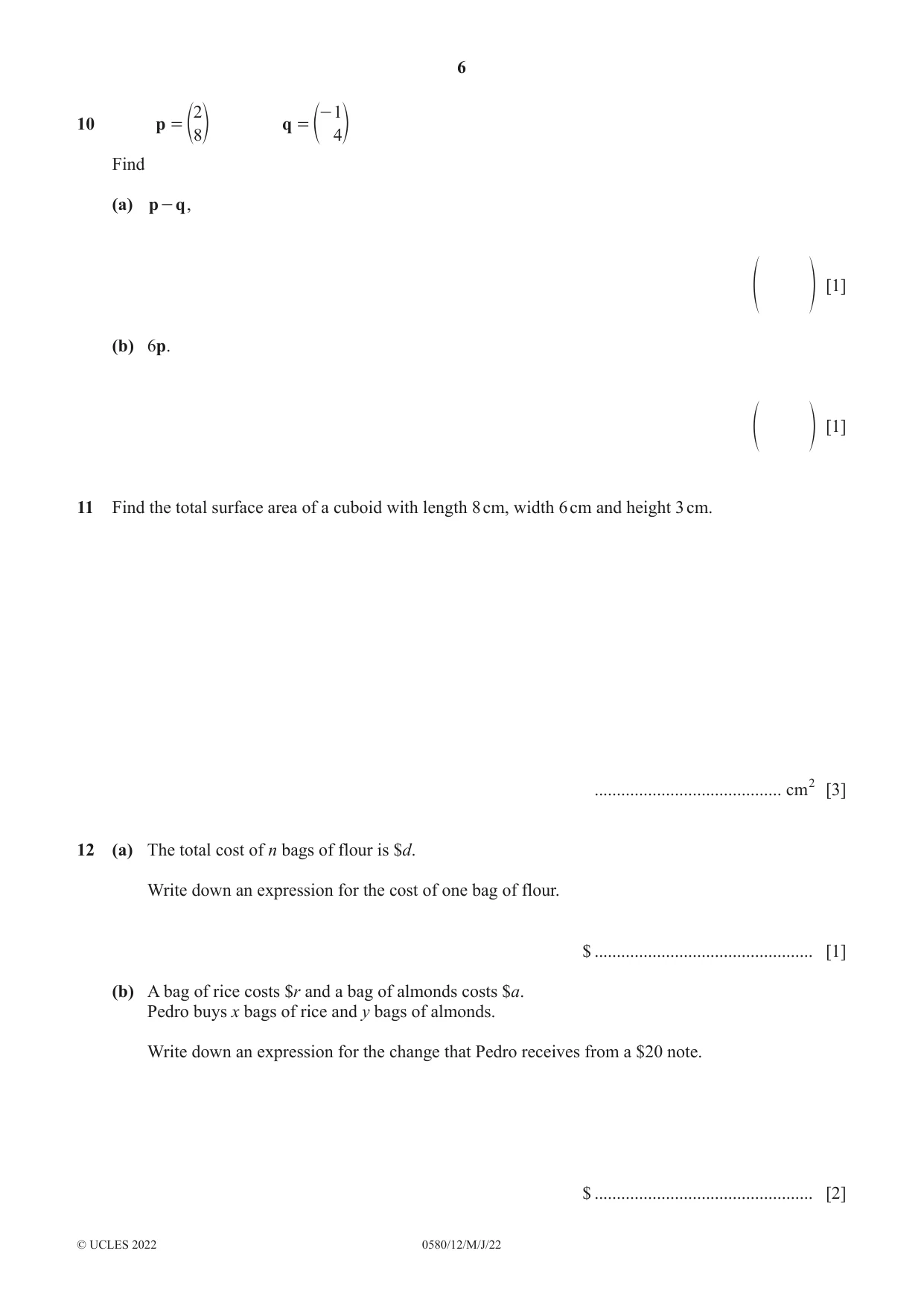
Q10 · - 1 10 p = q = e8o e 4o Find (a) p - q , [1] f p (b) 6p
2 - 1 10 p = q = e8o e 4o Find (a) p - q , [1] f p (b) 6p. [1] f p
Mark scheme: 10(a) 3 1 4 10(b) 12 1 48
Q11 · Find the total surface area of a cuboid with length 8 cm, width 6 cm and height 3 cm
11 Find the total surface area of a cuboid with length 8 cm, width 6 cm and height 3 cm. .......................................... cm2 [3]
Mark scheme: 11 180 3 M2 for 2 8 6 8 3 3 6 oe or M1 for 8 × 6 or 8 × 3 or 3 × 6
Q12 · The total cost of n bags of flour is $d
12 (a) The total cost of n bags of flour is $d. Write down an expression for the cost of one bag of flour. $ ................................................. [1] (b) A bag of rice costs $r and a bag of almonds costs $a. Pedro buys x bags of rice and y bags of almonds. Write down an expression for the change that Pedro receives from a $20 note. $ ................................................. [2]
Mark scheme: 12(a) d 1 oe n 12(b) 20 – rx – ay oe 2 B1 for rx and ay seen and not spoilt
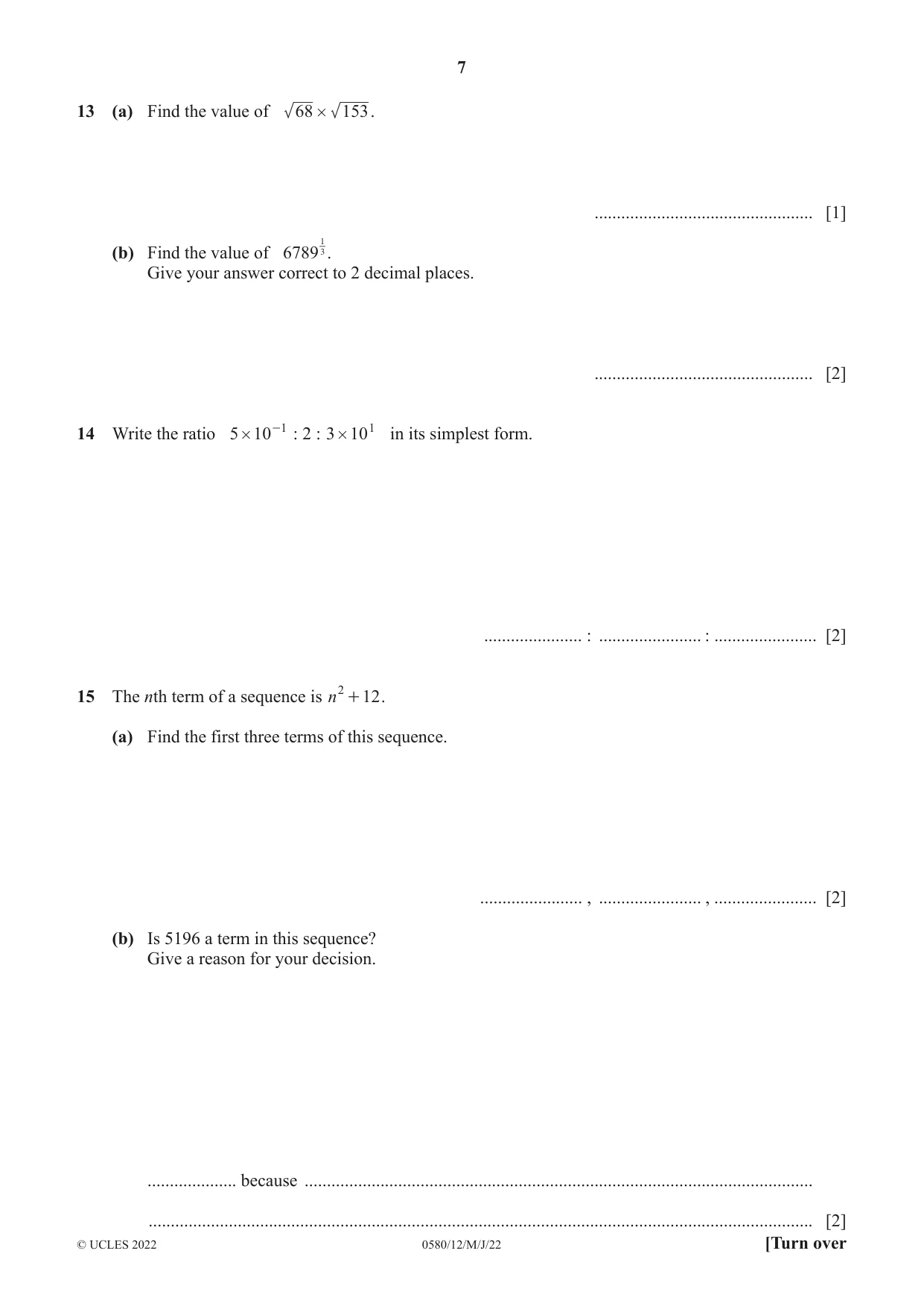
Q13 · Find the value of 68 # 153
13 (a) Find the value of 68 # 153 . ................................................. [1] 3 (b) Find the value of 6789 1. Give your answer correct to 2 decimal places. ................................................. [2]
Mark scheme: 13(a) 102 1 13(b) 18.94 cao 2 B1 for 18.9 or 18.93 or 18.935… If zero scored, SC1 for rounding their value correctly to 2 decimal places
Q14 · Write the ratio 5 # 10 -1 : 2 : 3 # 101 in its simplest form
14 Write the ratio 5 # 10 -1 : 2 : 3 # 101 in its simplest form. ...................... : ....................... : ....................... [2]
Mark scheme: 14 1 : 4 : 60 2 B1 for 0.5[:2:]30 oe
Q15 · The nth term of a sequence is n 2 + 12
15 The nth term of a sequence is n 2 + 12 . (a) Find the first three terms of this sequence. ....................... , ....................... , ....................... [2] (b) Is 5196 a term in this sequence? Give a reason for your decision. .................... because .................................................................................................................. ..................................................................................................................................................... [2]
Mark scheme: 15(a) 13, 16, 21 2 B1 for 2 correct terms in correct position or SC1 for 12, 13, 16 15(b) Yes 2 2 M1 for n 12 5196 or better n 72 or for a correct worded description for finding n or for 5184 is a square number
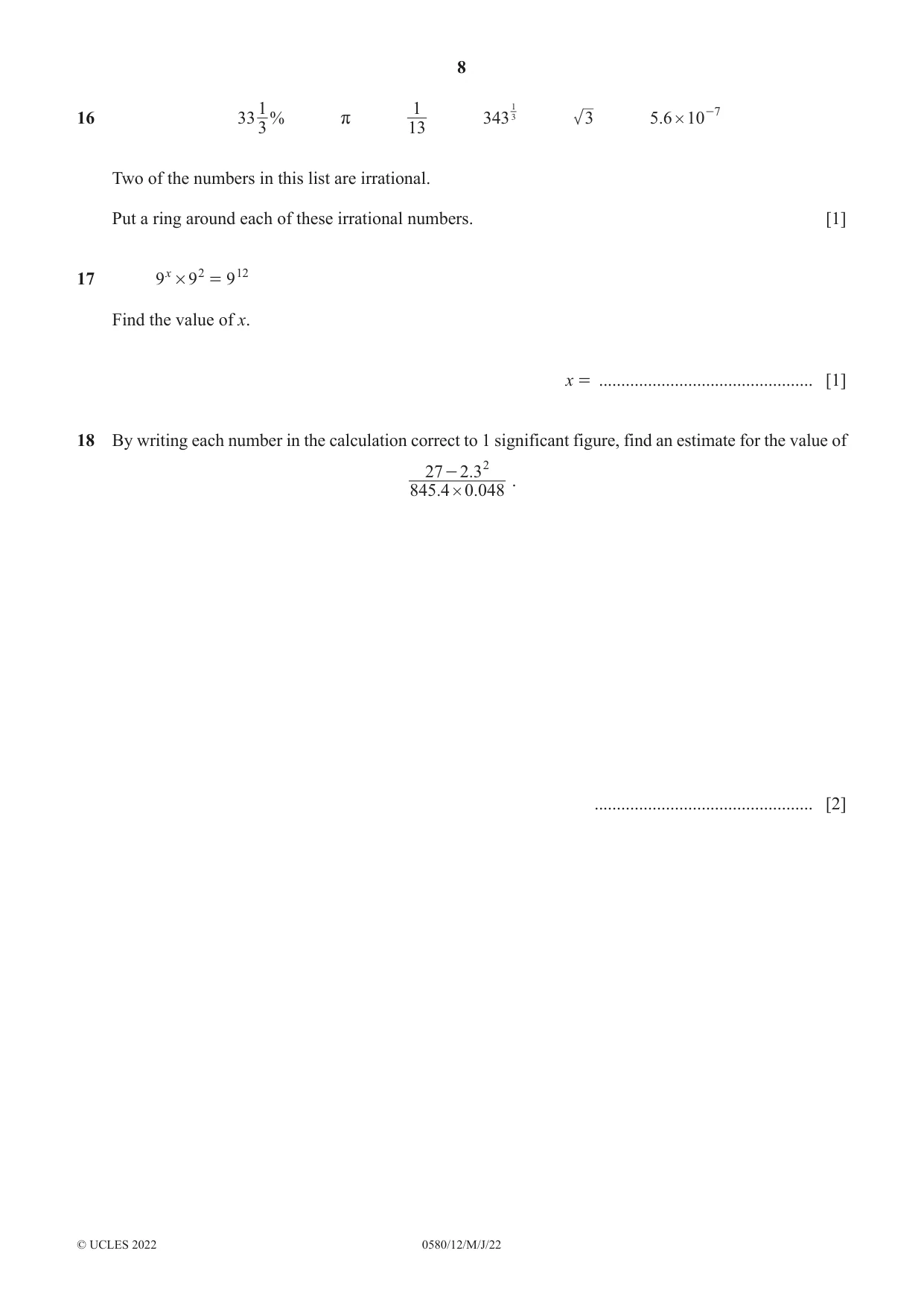
Q16 · 1 316 33 % r 343 1 3 .56 # 10 -7 3 13 Two of the numbers in this list are irrational
1 1 316 33 % r 343 1 3 .56 # 10 -7 3 13 Two of the numbers in this list are irrational. Put a ring around each of these irrational numbers. [1]
Mark scheme: 16 π 3 cao 1
Q17 · 9 x # 9 2 = 9 12 Find the value of x
17 9 x # 9 2 = 9 12 Find the value of x. x = ................................................ [1]
Mark scheme: 17 10 cao 1
Q18 · By writing each number in the calculation correct to 1 significant figure, find an…
18 By writing each number in the calculation correct to 1 significant figure, find an estimate for the value of 27 - 2 .32 . 845.4 # 0.048 ................................................. [2]
Mark scheme: 18 30 2 2 M1 800 0.05 0.65 A1 If M0 scored, SC1 for 3 correct values or all correct but with any trailing zeros
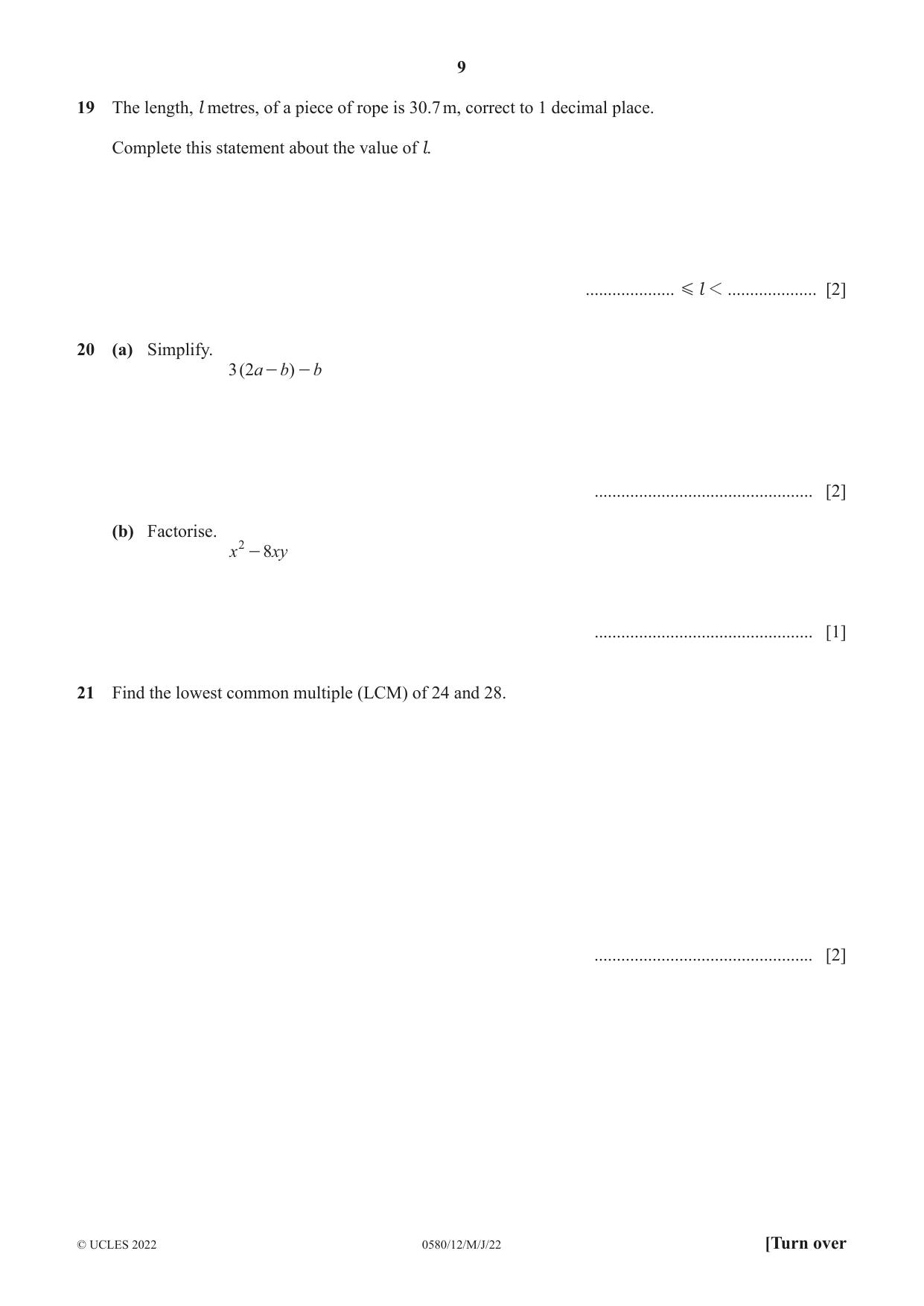
Q19 · The length, l metres, of a piece of rope is 30.7 m, correct to 1 decimal place
19 The length, l metres, of a piece of rope is 30.7 m, correct to 1 decimal place. Complete this statement about the value of l. .................... G l 1 .................... [2]
Mark scheme: 19 30.65, 30.75 2 B1 for each or if zero scored, SC1 for both answers correct but reversed
Question 20
20 (a) Simplify. 3 ( 2a - b) - b ................................................. [2] (b) Factorise. x 2 - 8xy ................................................. [1]
Mark scheme: 20(a) 6a – 4b final answer 2 B1 for 6a or −4b in final answer or for 6 a 4b spoilt 20(b) x(x – 8y) final answer 1
Q21 · Find the lowest common multiple (LCM) of 24 and 28
21 Find the lowest common multiple (LCM) of 24 and 28. ................................................. [2]
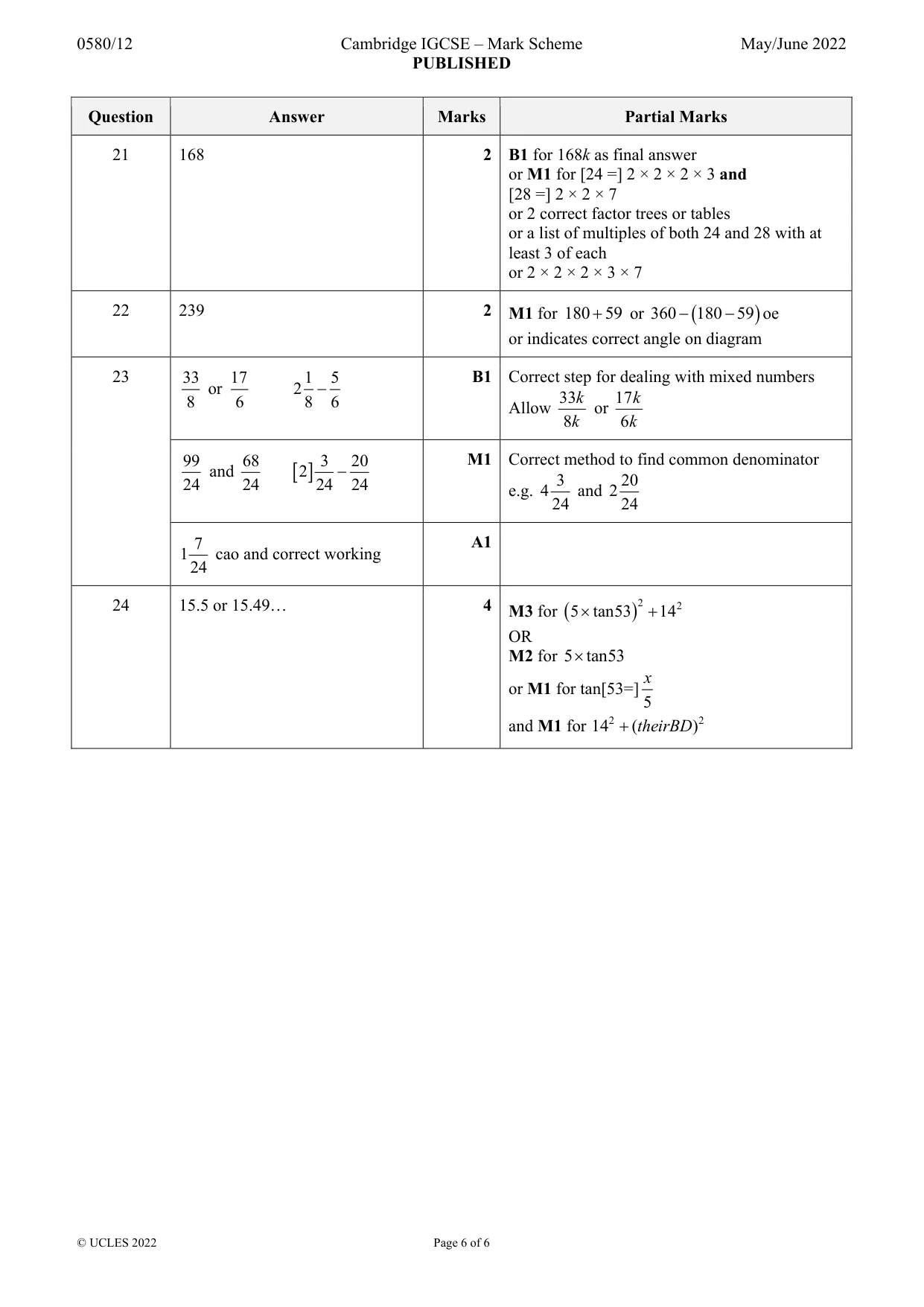
Mark scheme: 21 168 2 B1 for 168k as final answer or M1 for [24 =] 2 × 2 × 2 × 3 and [28 =] 2 × 2 × 7 or 2 correct factor trees or tables or a list of multiples of both 24 and 28 with at least 3 of each or 2 × 2 × 2 × 3 × 7
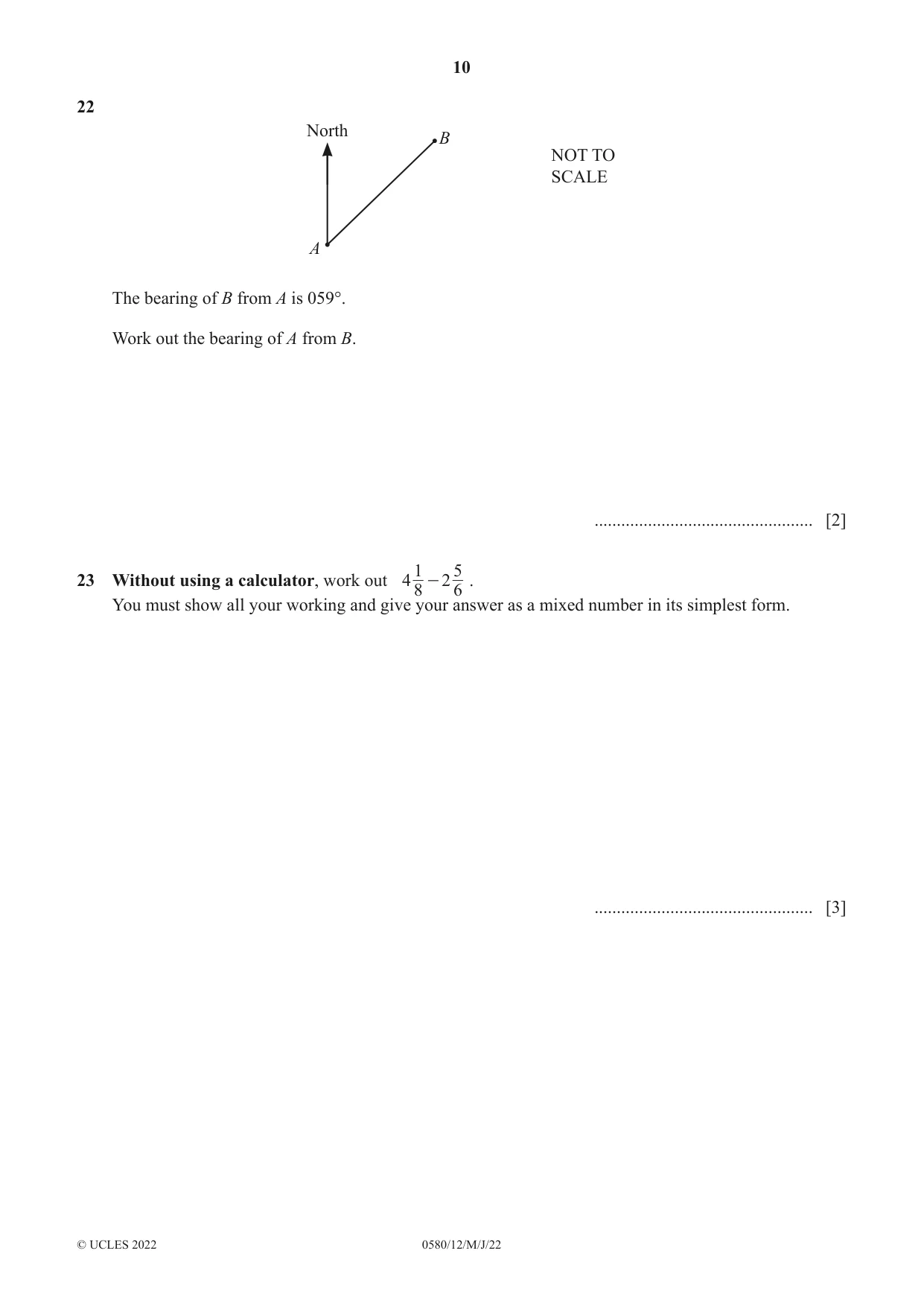
Q22 · North B NOT TO SCALE A The bearing of B from A is 059°
22 North B NOT TO SCALE A The bearing of B from A is 059°. Work out the bearing of A from B. ................................................. [2]
Mark scheme: 22 239 2 M1 for 180 59 or 360 180 59 oe or indicates correct angle on diagram
Q23 · 523 Without using a calculator, work out 4 - 2
1 523 Without using a calculator, work out 4 - 2 . 8 6 You must show all your working and give your answer as a mixed number in its simplest form. ................................................. [3]
Mark scheme: 23 33 17 1 5 B1 Correct step for dealing with mixed numbers or 8 6 28 6 33k 17 k Allow or 8 k 6 k 99 68 20 M1 Correct method to find common denominator and 32 24 24 24 24 3 20 e.g. 4 and 2 24 24 7 A1 124 cao and correct working
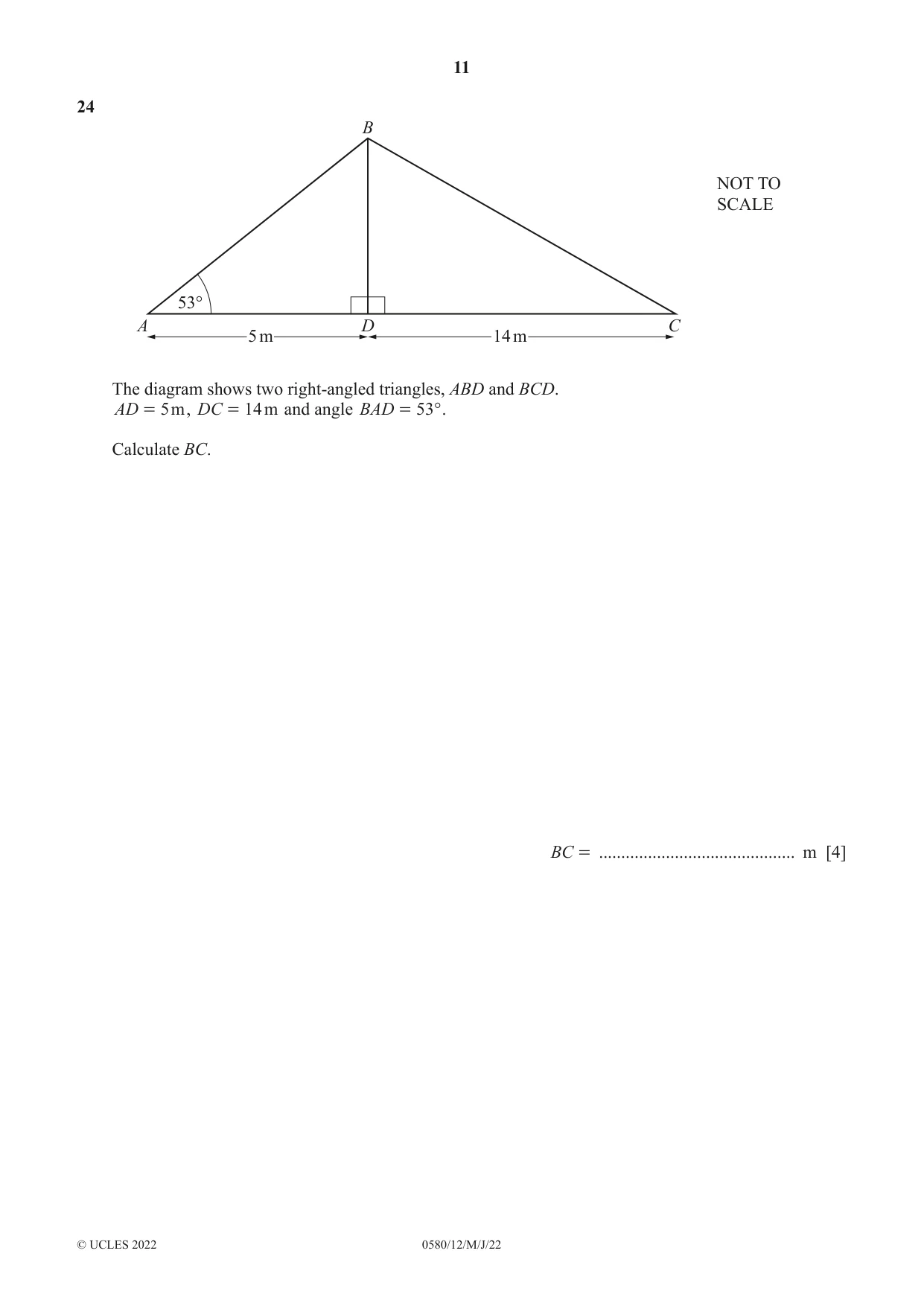
Q24 · B NOT TO SCALE 53° A D C 5 m 14 m The diagram shows two right-angled triangles, ABD and…
24 B NOT TO SCALE 53° A D C 5 m 14 m The diagram shows two right-angled triangles, ABD and BCD. AD = 5m , DC = 14m and angle BAD = 53° . Calculate BC. BC = ............................................ m [4]
Mark scheme: 24 15.5 or 15.49… 4 2 2 M3 for 5 tan53 14 OR M2 for 5 tan53 x or M1 for tan[53=] 5 and M1 for 14 2 theirBD( ) 2
What was in this paper
The subtopics covered by these 24 questions, and how many questions each got. Open one in a new tab to see every Cambridge question on it.
4Fractions, decimals and percentages2The four operations2Algebraic manipulation1Area and perimeter1Circles, arcs and sectors1Estimation1Indices I1Interpreting statistical data1Limits of accuracy1Money1Powers and roots1Rates1Ratio and proportion1Right-angled triangles1Sequences1Similarity1Statistical charts and diagrams1Vectors in two dimensions1What you needed in this session
Cambridge’s own grade thresholds for 2022 May/June, Paper 1 · Variant 2. A higher threshold means an easier paper — the bar moves with how the cohort did.