Cambridge IGCSE Mathematics 0580 — 2020 Oct/Nov Paper 3 · Variant 3
0580/33/O/N/20 · 9 questions · 104 marks · ≈117 min
The question paper and its mark scheme, free to read here and free to download. This is Cambridge’s own paper, exactly as it was sat.
Question paper16 pages
Mark scheme8 pages
Answers below. Sit the paper first if you are practising.
Questions as text
Q1 · A cruise ship travels 2067 km
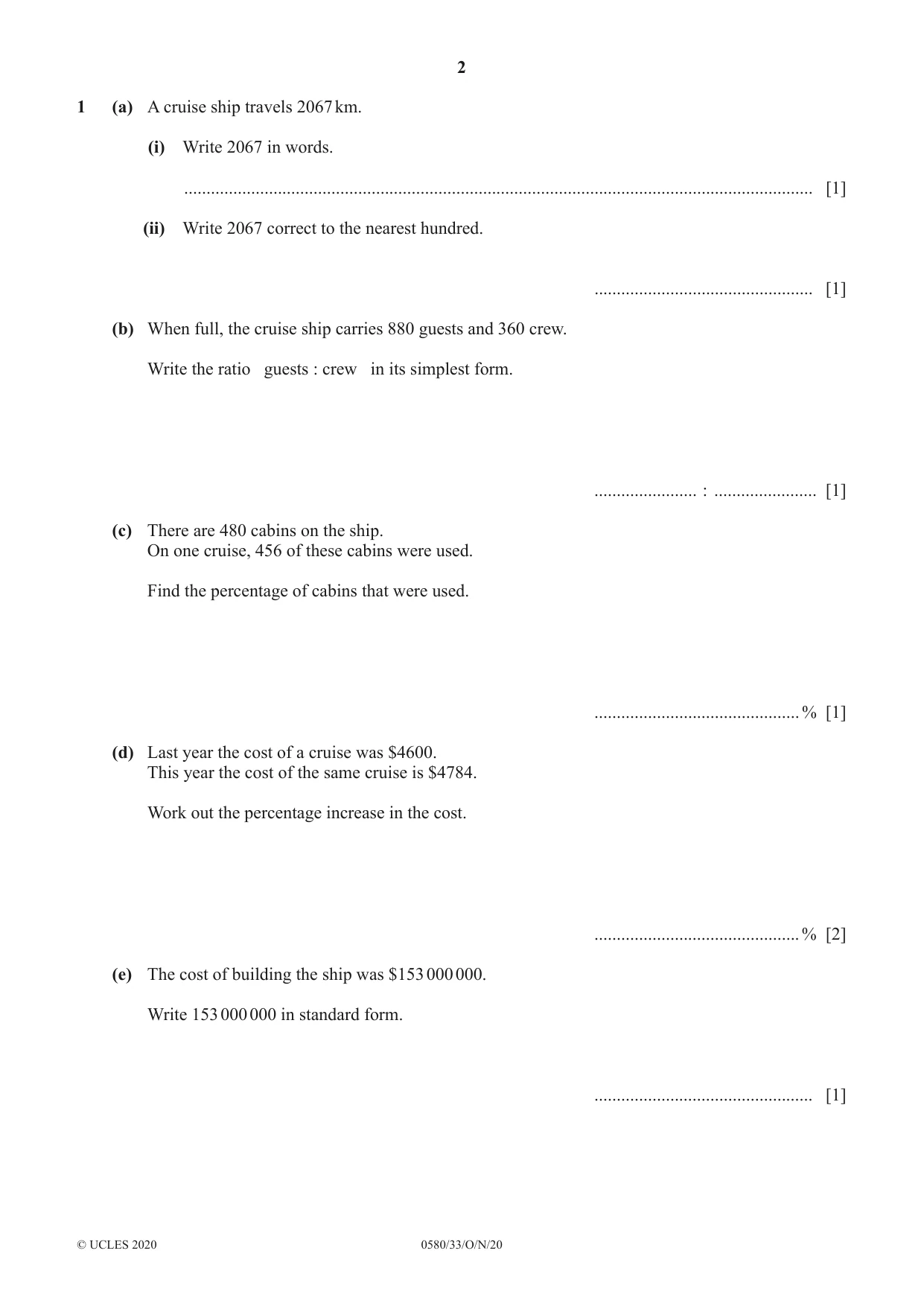
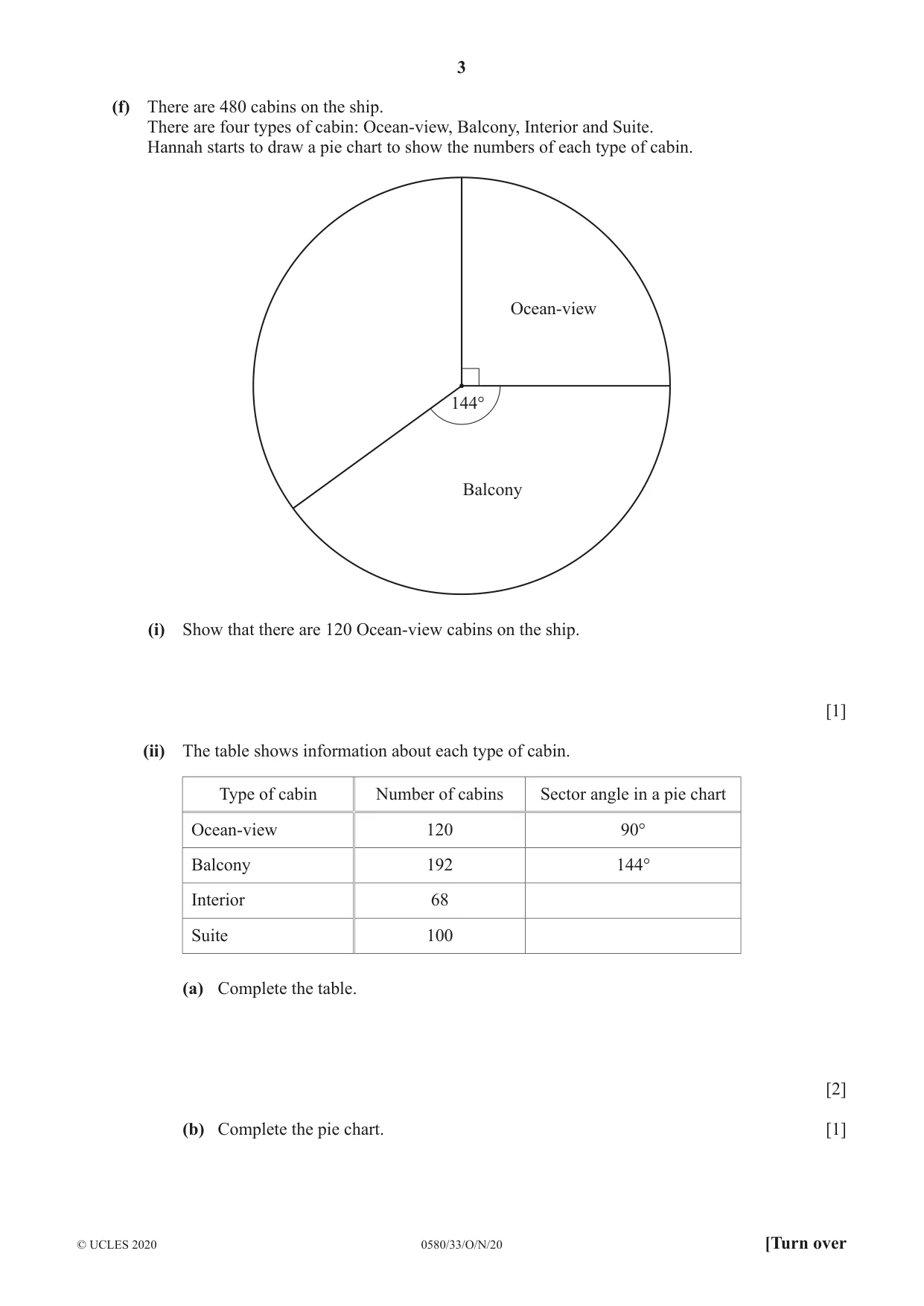
1 (a) A cruise ship travels 2067 km. (i) Write 2067 in words. ............................................................................................................................................. [1] (ii) Write 2067 correct to the nearest hundred. ................................................. [1] (b) When full, the cruise ship carries 880 guests and 360 crew. Write the ratio guests : crew in its simplest form. ....................... : ....................... [1] (c) There are 480 cabins on the ship. On one cruise, 456 of these cabins were used. Find the percentage of cabins that were used. ..............................................% [1] (d) Last year the cost of a cruise was $4600. This year the cost of the same cruise is $4784. Work out the percentage increase in the cost. ..............................................% [2] (e) The cost of building the ship was $153 000 000. Write 153 000 000 in standard form. ................................................. [1] (f) There are 480 cabins on the ship. There are four types of cabin: Ocean-view, Balcony, Interior and Suite. Hannah starts to draw a pie chart to show the numbers of each type of cabin. Ocean-view 144° Balcony (i) Show that there are 120 Ocean-view cabins on the ship. [1] (ii) The table shows information about each type of cabin. Type of cabin Number of cabins Sector angle in a pie chart Ocean-view 120 90° Balcony 192 144° Interior 68 Suite 100 (a) Complete the table. [2] (b) Complete the pie chart. [1]
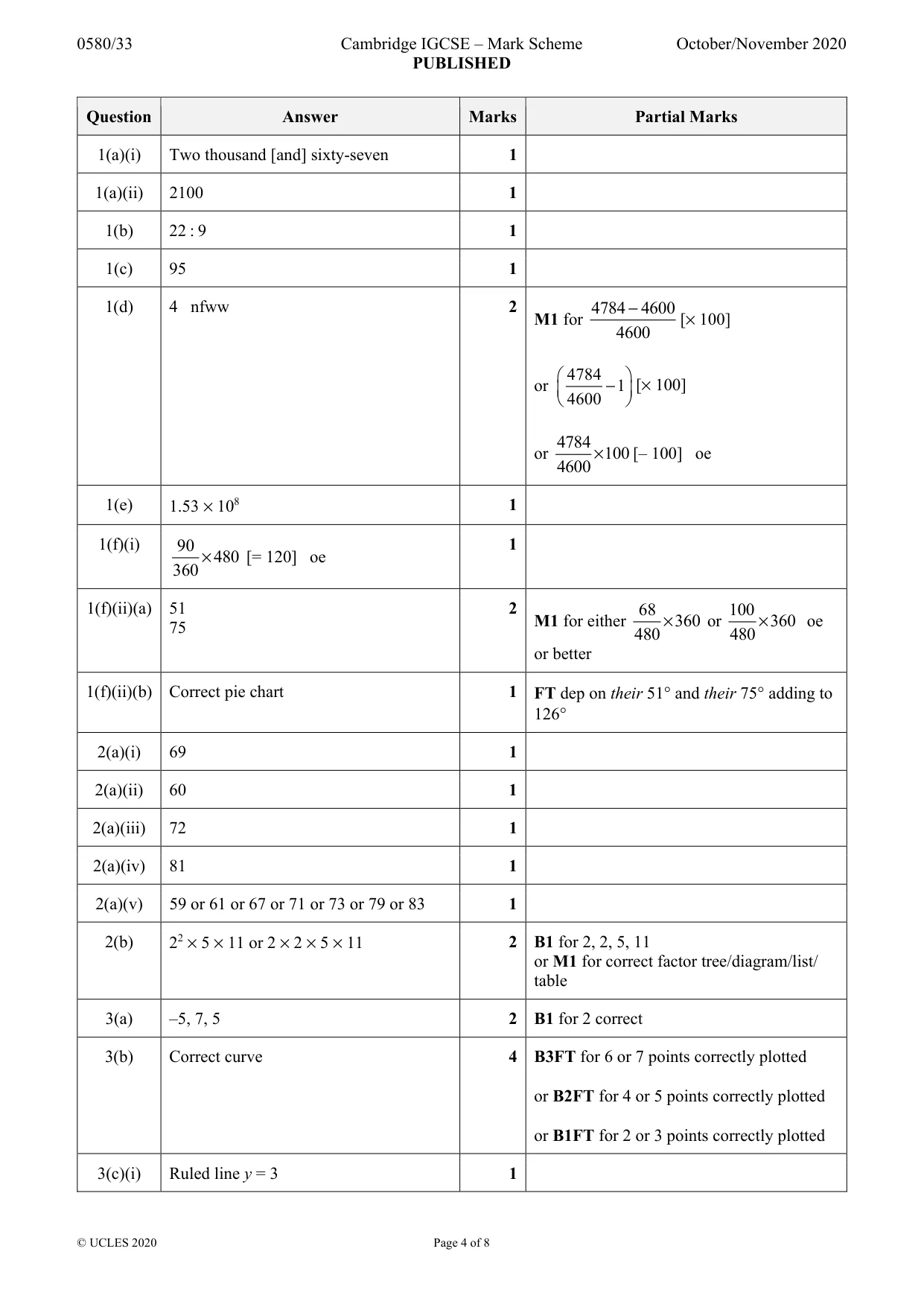
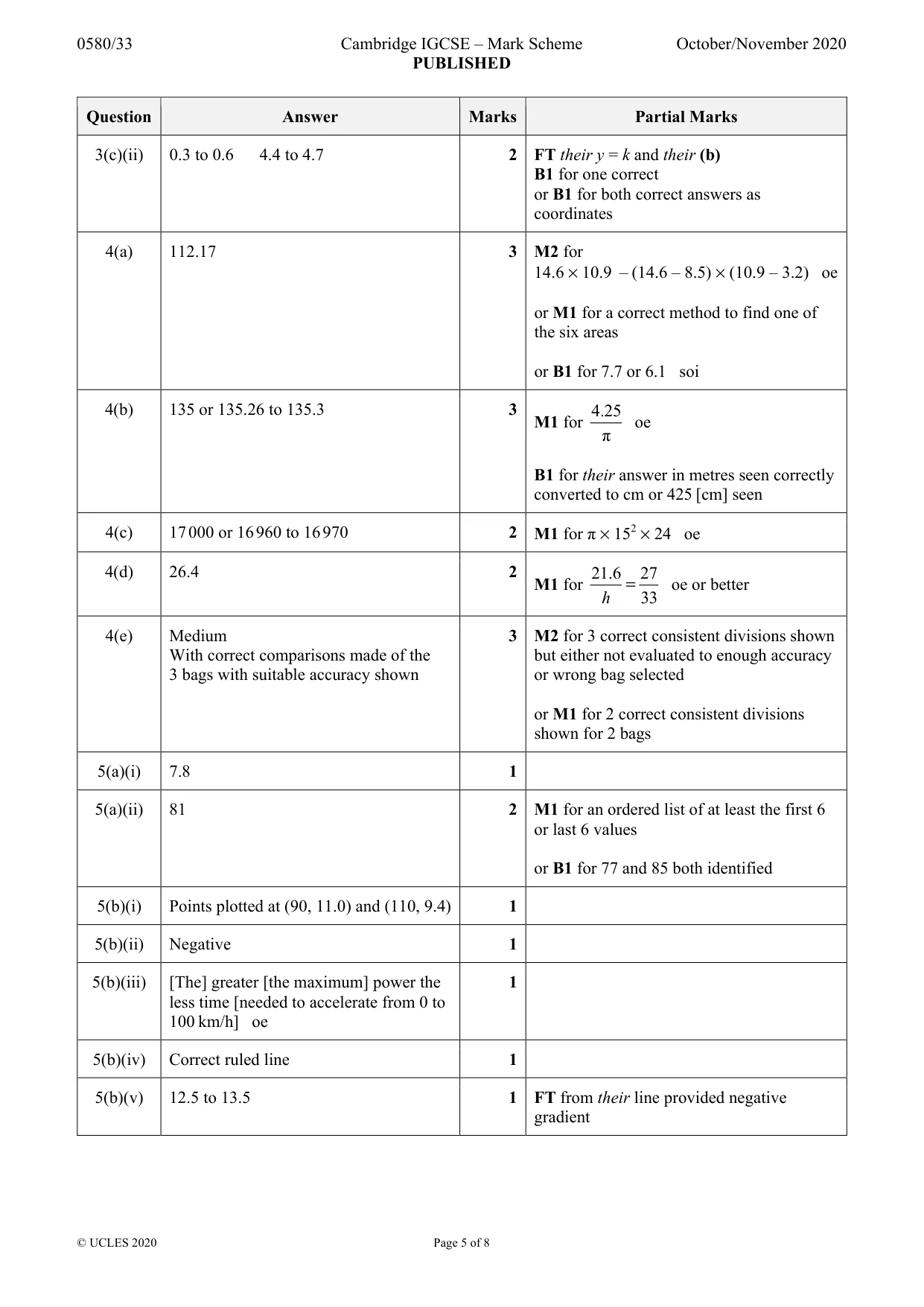
Mark scheme: Question Answer Marks Partial Marks 1(a)(i) Two thousand [and] sixty-seven 1 1(a)(ii) 2100 1 1(b) 22 : 9 1 1(c) 95 1 1(d) 4 nfww 2 4784 − 4600 M1 for [× 100] 4600 4784 or − 1 [× 100] 4600 4784 or × 100 [– 100] oe 4600 1(e) 1.53 × 10⁸ 1 1(f)(i) 90 1 × 480 [= 120] oe 360 1(f)(ii)(a) 51 2 68 100 M1 for either × 360 or × 360 oe 75 480 480 or better 1(f)(ii)(b) Correct pie chart 1 FT dep on their 51° and their 75° adding to 126°
Q2 · Using numbers from 55 to 85, write down (i) a multiple of 23…
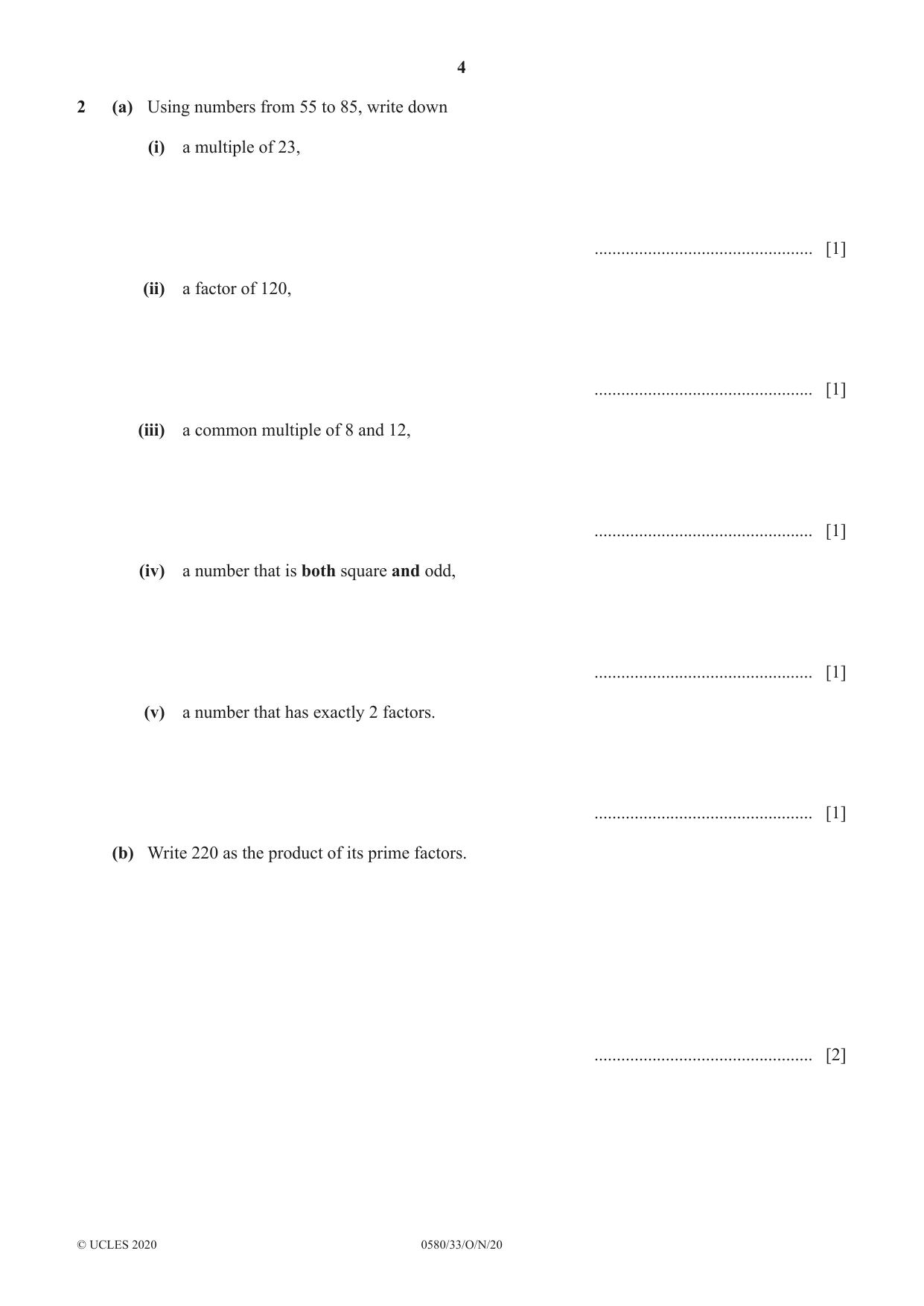
2 (a) Using numbers from 55 to 85, write down (i) a multiple of 23, ................................................. [1] (ii) a factor of 120, ................................................. [1] (iii) a common multiple of 8 and 12, ................................................. [1] (iv) a number that is both square and odd, ................................................. [1] (v) a number that has exactly 2 factors. ................................................. [1] (b) Write 220 as the product of its prime factors. ................................................. [2]
Mark scheme: 2(a)(i) 69 1 2(a)(ii) 60 1 2(a)(iii) 72 1 2(a)(iv) 81 1 2(a)(v) 59 or 61 or 67 or 71 or 73 or 79 or 83 1 2(b) 22 × 5 × 11 or 2 × 2 × 5 × 11 2 B1 for 2, 2, 5, 11 or M1 for correct factor tree/diagram/list/ table
Q3 · Complete the table of values for y = 1 + 5 x - x 2
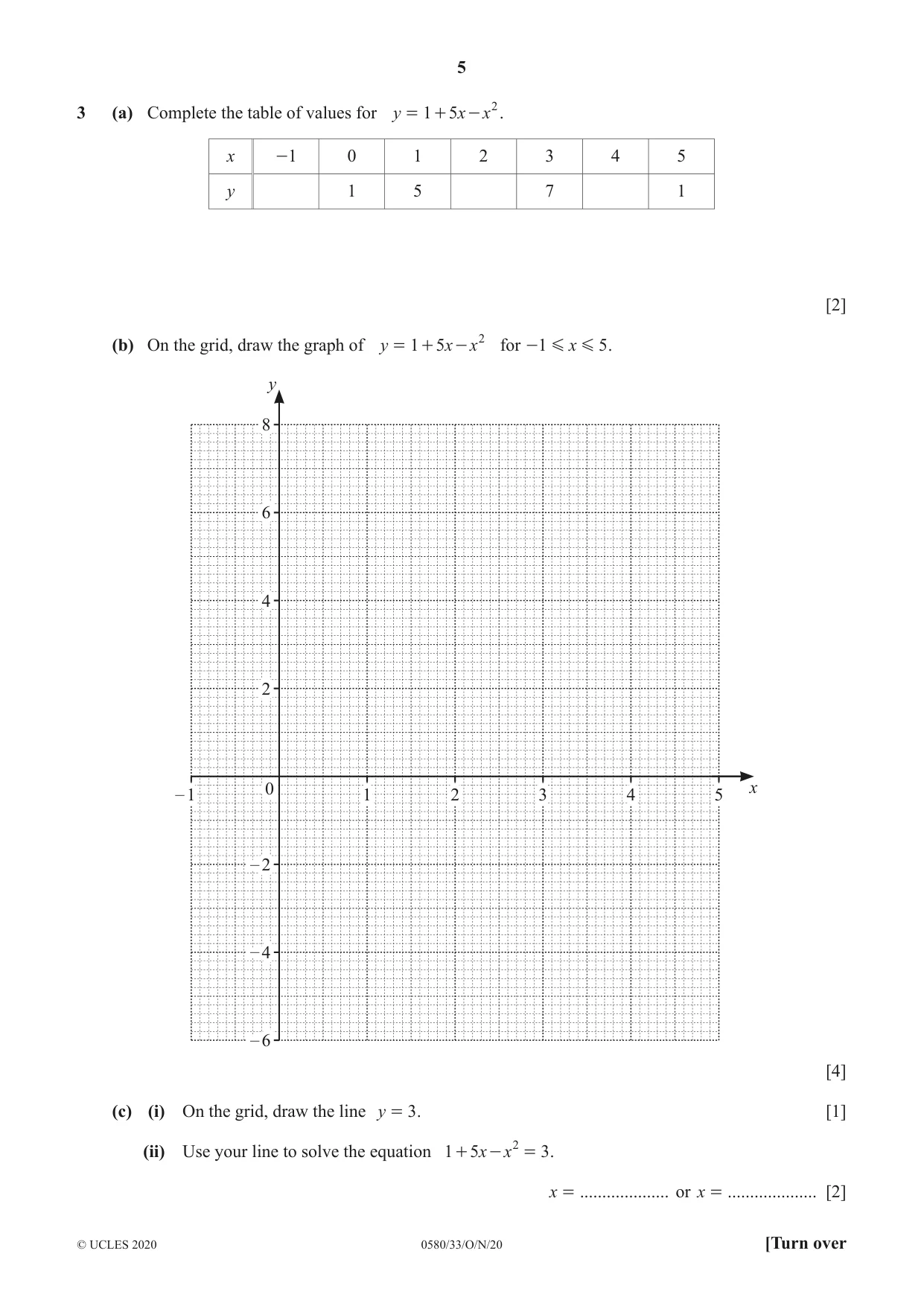
3 (a) Complete the table of values for y = 1 + 5 x - x 2 . x - 1 0 1 2 3 4 5 y 1 5 7 1 [2] (b) On the grid, draw the graph of y = 1 + 5x - x 2 for - 1 G x G 5 . y 8 6 4 2 0 x – 1 1 2 3 4 5 – 2 – 4 – 6 [4] (c) (i) On the grid, draw the line y = 3 . [1] (ii) Use your line to solve the equation 1 + 5x - x 2 = 3 . x = .................... or x = .................... [2]
Mark scheme: 3(a) –5, 7, 5 2 B1 for 2 correct 3(b) Correct curve 4 B3FT for 6 or 7 points correctly plotted or B2FT for 4 or 5 points correctly plotted or B1FT for 2 or 3 points correctly plotted 3(c)(i) Ruled line y = 3 1 3(c)(ii) 0.3 to 0.6 4.4 to 4.7 2 FT their y = k and their (b) B1 for one correct or B1 for both correct answers as coordinates
Q4 · The diagram shows the plan of part of Rachel’s garden
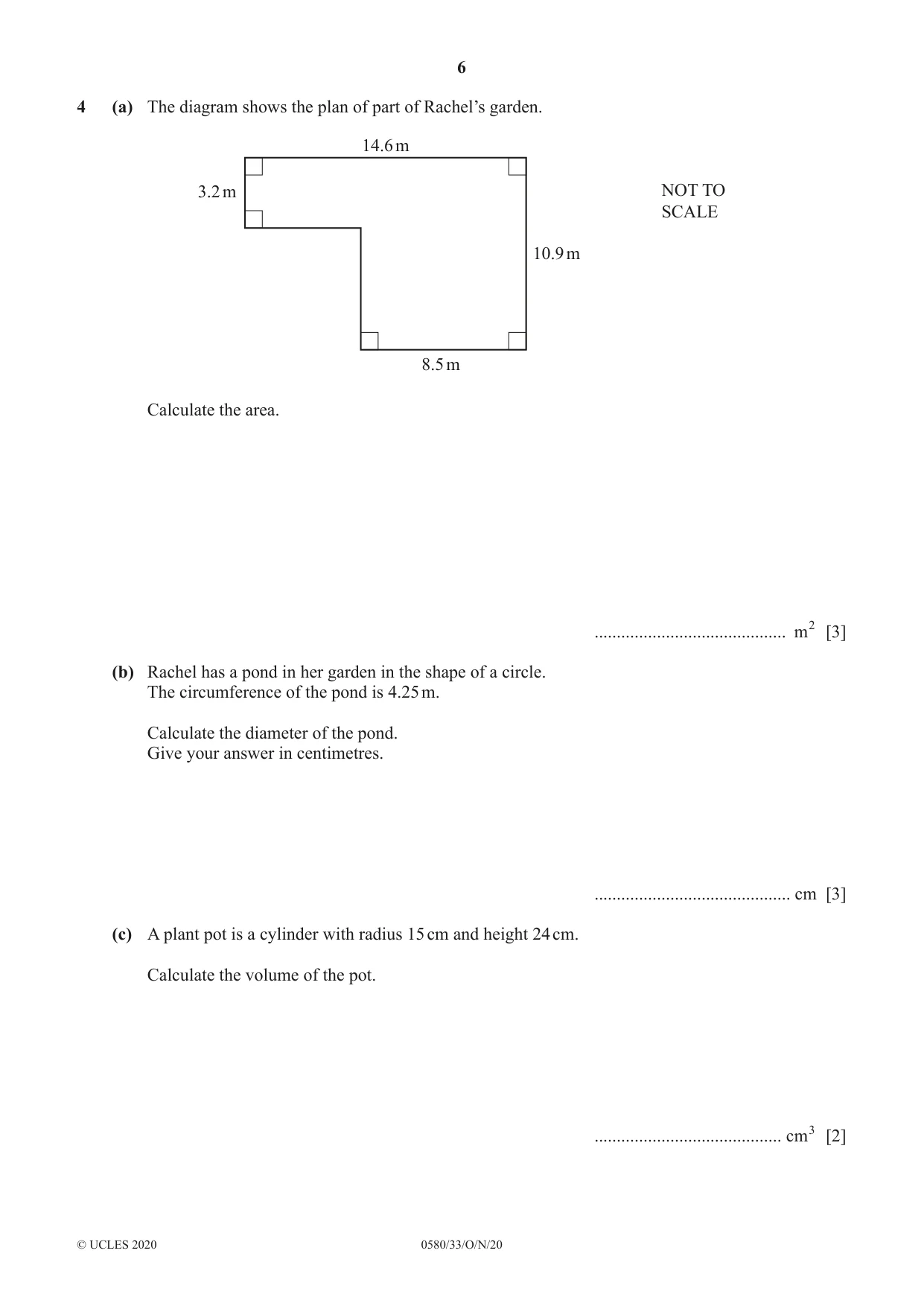
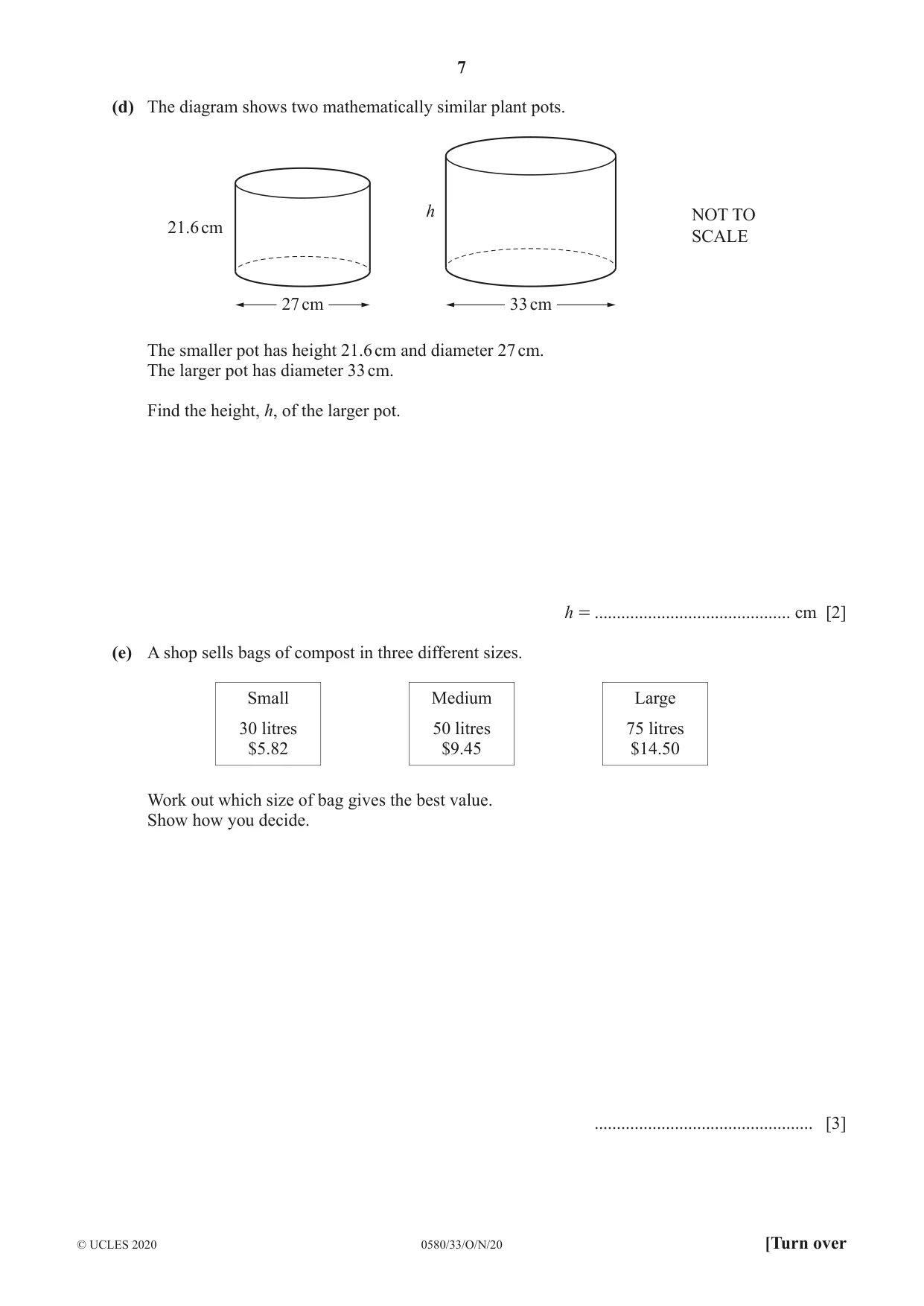
4 (a) The diagram shows the plan of part of Rachel’s garden. 14.6 m 3.2 m NOT TO SCALE 10.9 m 8.5 m Calculate the area. ........................................... m2 [3] (b) Rachel has a pond in her garden in the shape of a circle. The circumference of the pond is 4.25 m. Calculate the diameter of the pond. Give your answer in centimetres. ............................................ cm [3] (c) A plant pot is a cylinder with radius 15 cm and height 24 cm. Calculate the volume of the pot. .......................................... cm3 [2] (d) The diagram shows two mathematically similar plant pots. h NOT TO 21.6 cm SCALE 27 cm 33 cm The smaller pot has height 21.6 cm and diameter 27 cm. The larger pot has diameter 33 cm. Find the height, h, of the larger pot. h = ............................................ cm [2] (e) A shop sells bags of compost in three different sizes. Small Medium Large 30 litres 50 litres 75 litres $5.82 $9.45 $14.50 Work out which size of bag gives the best value. Show how you decide. ................................................. [3]
Mark scheme: 4(a) 112.17 3 M2 for 14.6 × 10.9 – (14.6 – 8.5) × (10.9 – 3.2) oe or M1 for a correct method to find one of the six areas or B1 for 7.7 or 6.1 soi 4(b) 135 or 135.26 to 135.3 3 4.25 M1 for oe π B1 for their answer in metres seen correctly converted to cm or 425 [cm] seen 4(c) 17 000 or 16 960 to 16 970 2 M1 for π × 152 × 24 oe 4(d) 26.4 2 21.6 27 M1 for = oe or better h 33 4(e) Medium 3 M2 for 3 correct consistent divisions shown With correct comparisons made of the but either not evaluated to enough accuracy 3 bags with suitable accuracy shown or wrong bag selected or M1 for 2 correct consistent divisions shown for 2 bags
Q5 · The table shows the maximum power, kW, and the time taken, in seconds, to accelerate from…
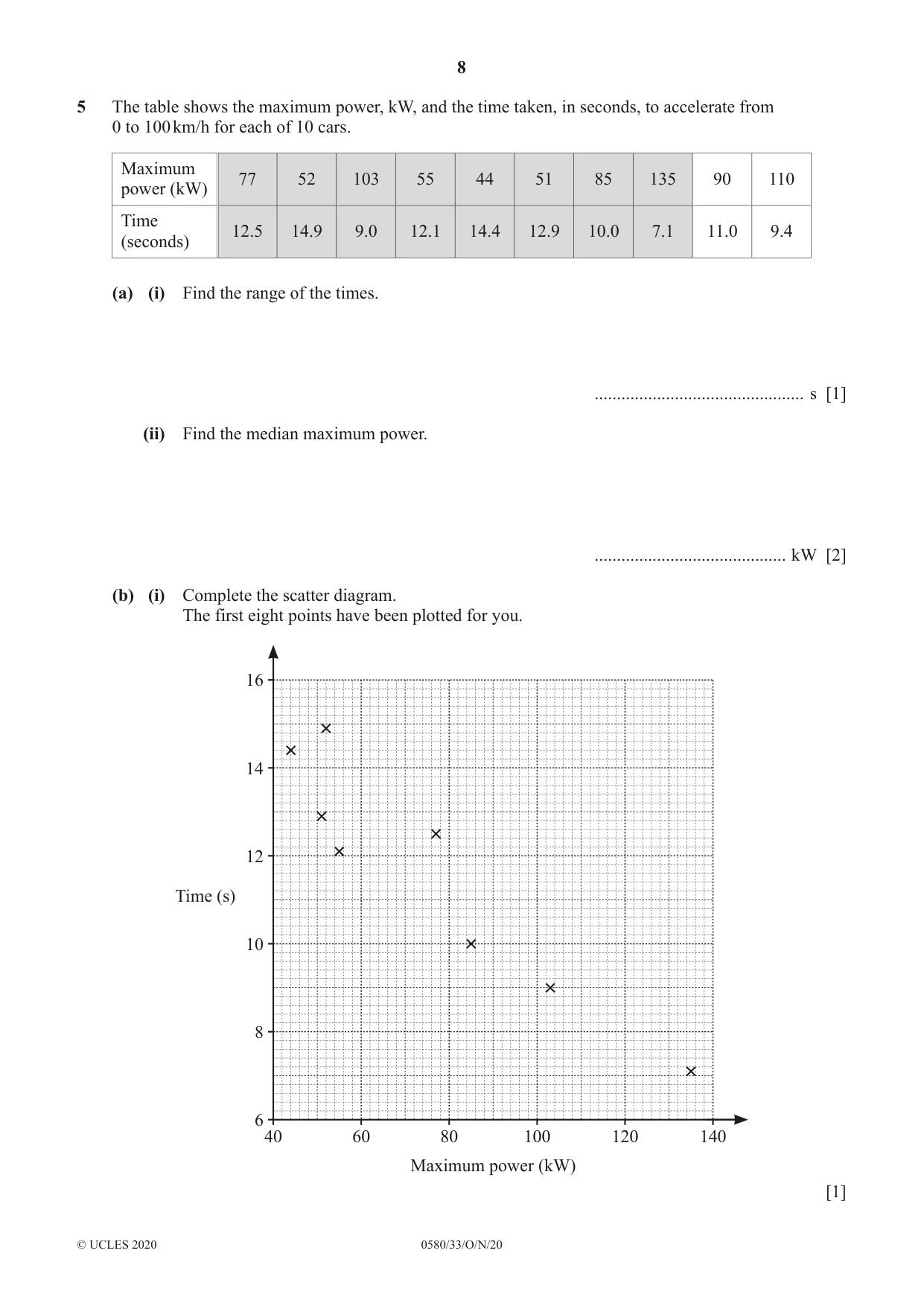
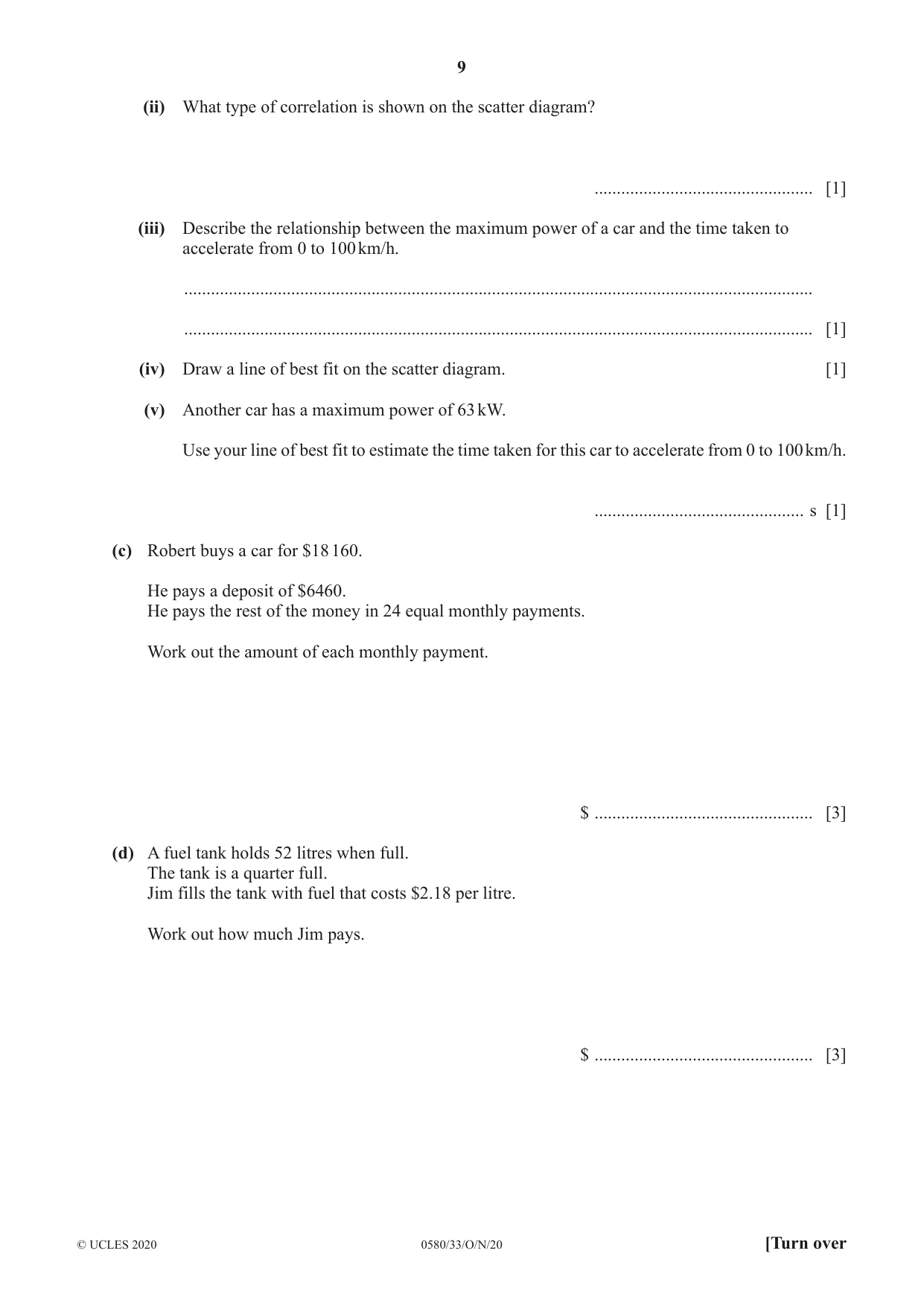
5 The table shows the maximum power, kW, and the time taken, in seconds, to accelerate from 0 to 100 km/h for each of 10 cars. Maximum 77 52 103 55 44 51 85 135 90 110 power (kW) Time 12.5 14.9 9.0 12.1 14.4 12.9 10.0 7.1 11.0 9.4 (seconds) (a) (i) Find the range of the times. ............................................... s [1] (ii) Find the median maximum power. ........................................... kW [2] (b) (i) Complete the scatter diagram. The first eight points have been plotted for you. 16 14 12 Time (s) 10 8 6 40 60 80 100 120 140 Maximum power (kW) [1] (ii) What type of correlation is shown on the scatter diagram? ................................................. [1] (iii) Describe the relationship between the maximum power of a car and the time taken to accelerate from 0 to 100 km/h. ............................................................................................................................................. ............................................................................................................................................. [1] (iv) Draw a line of best fit on the scatter diagram. [1] (v) Another car has a maximum power of 63 kW. Use your line of best fit to estimate the time taken for this car to accelerate from 0 to 100 km/h. ............................................... s [1] (c) Robert buys a car for $18 160. He pays a deposit of $6460. He pays the rest of the money in 24 equal monthly payments. Work out the amount of each monthly payment. $ ................................................. [3] (d) A fuel tank holds 52 litres when full. The tank is a quarter full. Jim fills the tank with fuel that costs $2.18 per litre. Work out how much Jim pays. $ ................................................. [3]
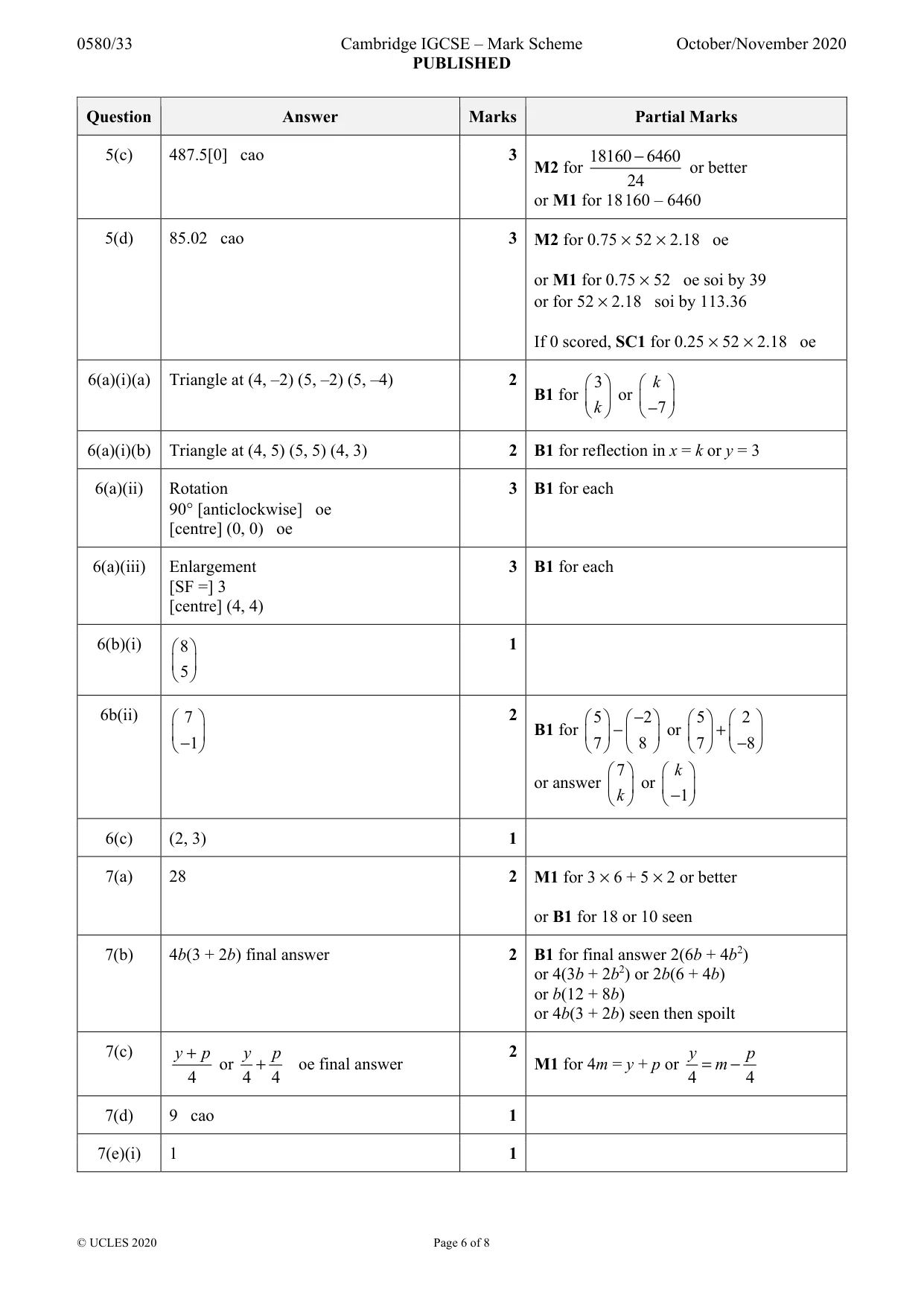
Mark scheme: 5(a)(i) 7.8 1 5(a)(ii) 81 2 M1 for an ordered list of at least the first 6 or last 6 values or B1 for 77 and 85 both identified 5(b)(i) Points plotted at (90, 11.0) and (110, 9.4) 1 5(b)(ii) Negative 1 5(b)(iii) [The] greater [the maximum] power the 1 less time [needed to accelerate from 0 to 100 km/h] oe 5(b)(iv) Correct ruled line 1 5(b)(v) 12.5 to 13.5 1 FT from their line provided negative gradient 5(c) 487.5[0] cao 3 18160 − 6460 M2 for or better 24 or M1 for 18 160 – 6460 5(d) 85.02 cao 3 M2 for 0.75 × 52 × 2.18 oe or M1 for 0.75 × 52 oe soi by 39 or for 52 × 2.18 soi by 113.36 If 0 scored, SC1 for 0.25 × 52 × 2.18 oe
Q6 · Y 8 7 6 C 5 A 4 3 2 B 1 – 7 – 6 – 5 – 4 – 3 – 2 – 1 0 1 2 3 4 5 6 x – 1 – 2 – 3 – 4 – 5…
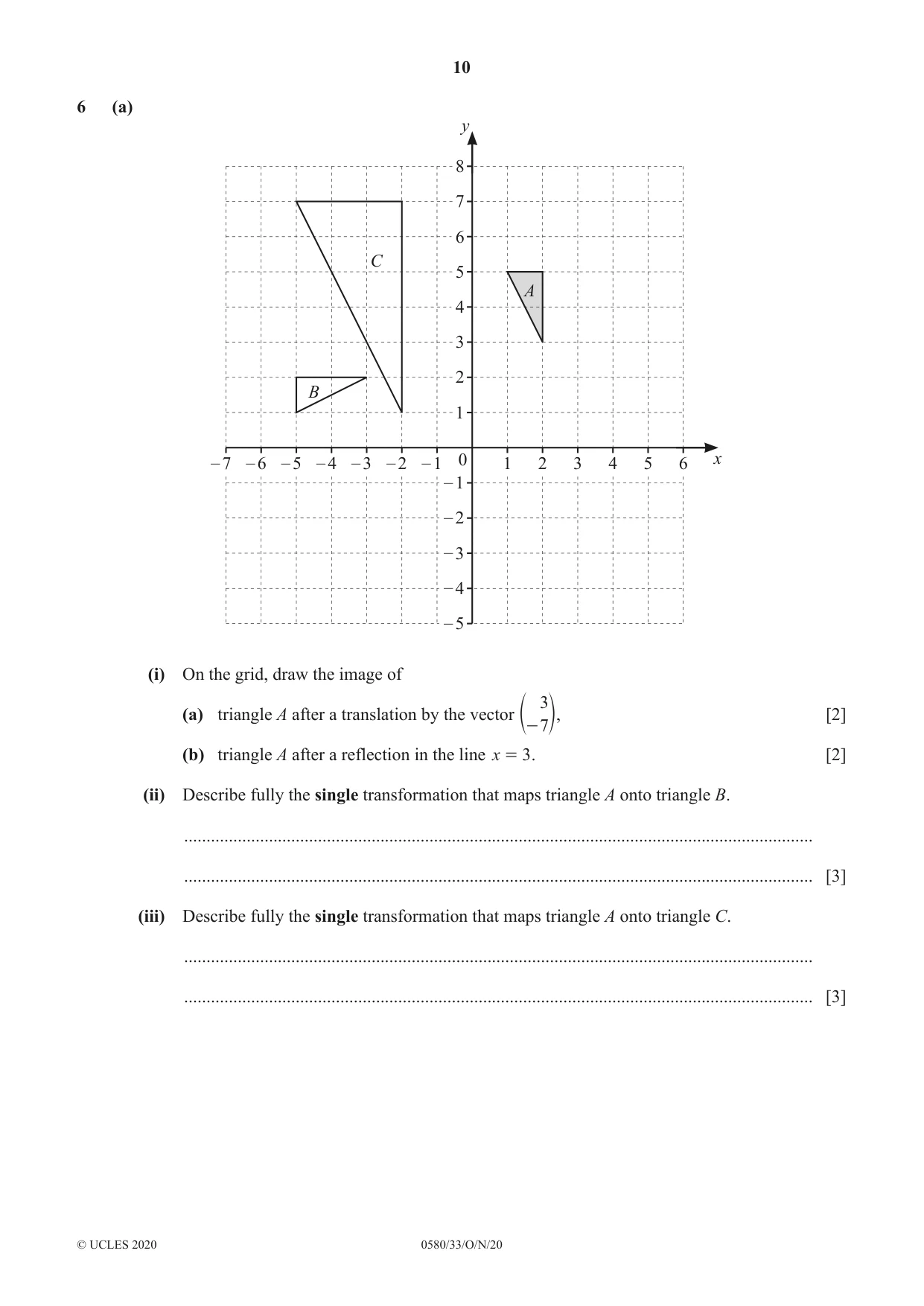
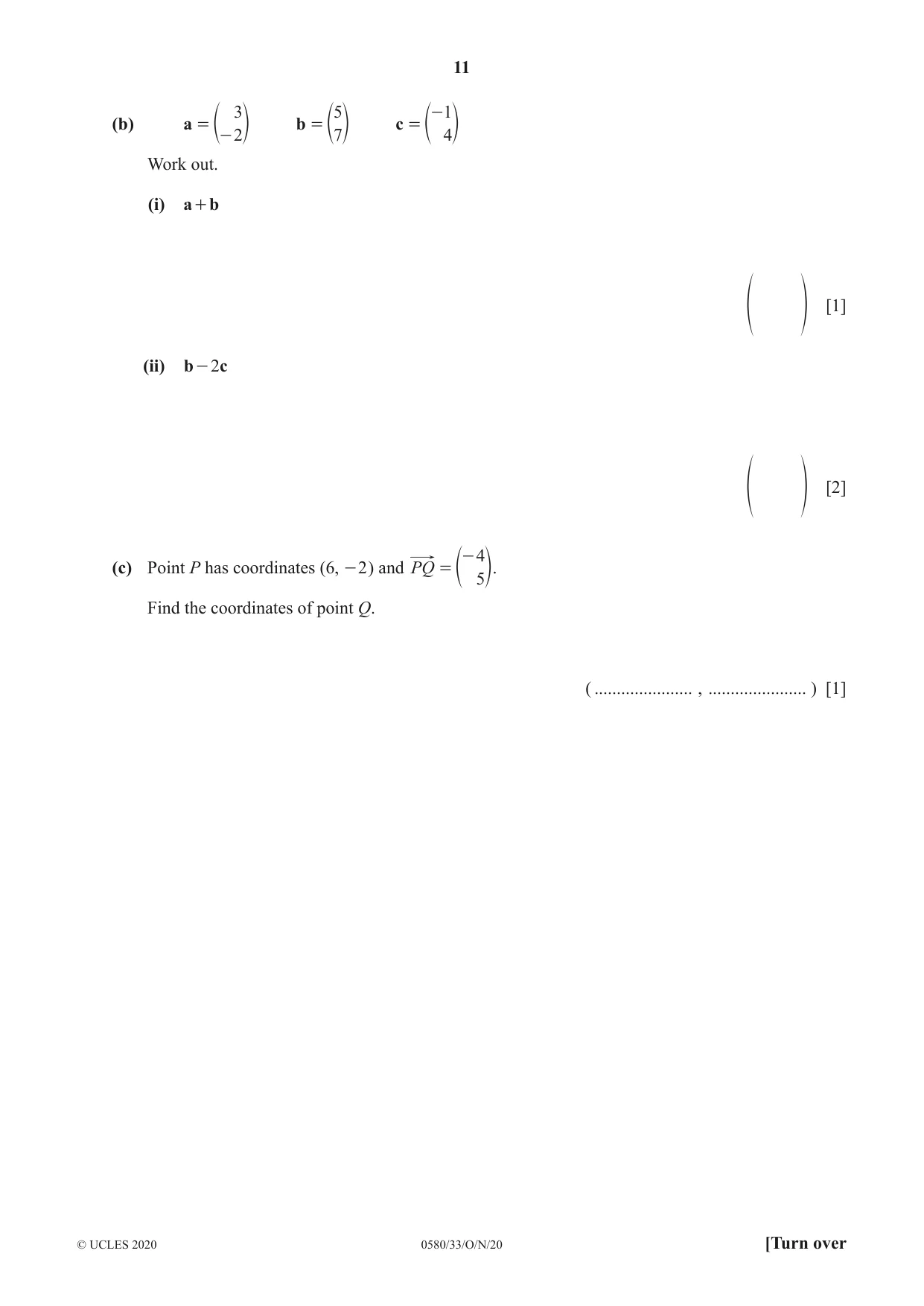
6 (a) y 8 7 6 C 5 A 4 3 2 B 1 – 7 – 6 – 5 – 4 – 3 – 2 – 1 0 1 2 3 4 5 6 x – 1 – 2 – 3 – 4 – 5 (i) On the grid, draw the image of 3 (a) triangle A after a translation by the vector [2] e- 7o, (b) triangle A after a reflection in the line x = 3 . [2] (ii) Describe fully the single transformation that maps triangle A onto triangle B. ............................................................................................................................................. ............................................................................................................................................. [3] (iii) Describe fully the single transformation that maps triangle A onto triangle C. ............................................................................................................................................. ............................................................................................................................................. [3] 3 5 - 1 (b) a = b = c = e- 2o e7o e 4o Work out. (i) a + b [1] f p (ii) b - 2c [2] f p - 4 (c) Point P has coordinates (6, - 2 ) and PQ = e 5o. Find the coordinates of point Q. ( ...................... , ...................... ) [1]
Mark scheme: 6(a)(i)(a) Triangle at (4, –2) (5, –2) (5, –4) 2 3 k B1 for or k − 7 6(a)(i)(b) Triangle at (4, 5) (5, 5) (4, 3) 2 B1 for reflection in x = k or y = 3 6(a)(ii) Rotation 3 B1 for each 90° [anticlockwise] oe [centre] (0, 0) oe 6(a)(iii) Enlargement 3 B1 for each [SF =] 3 [centre] (4, 4) 6(b)(i) 8 1 5 6b(ii) 7 2 5 −2 5 2 B1 for − or + − 1 7 8 7 −8 7 k or answer or k −1 6(c) (2, 3) 1
Q7 · W = 3a + 5c Find the value of W when a = 6 and c = 2
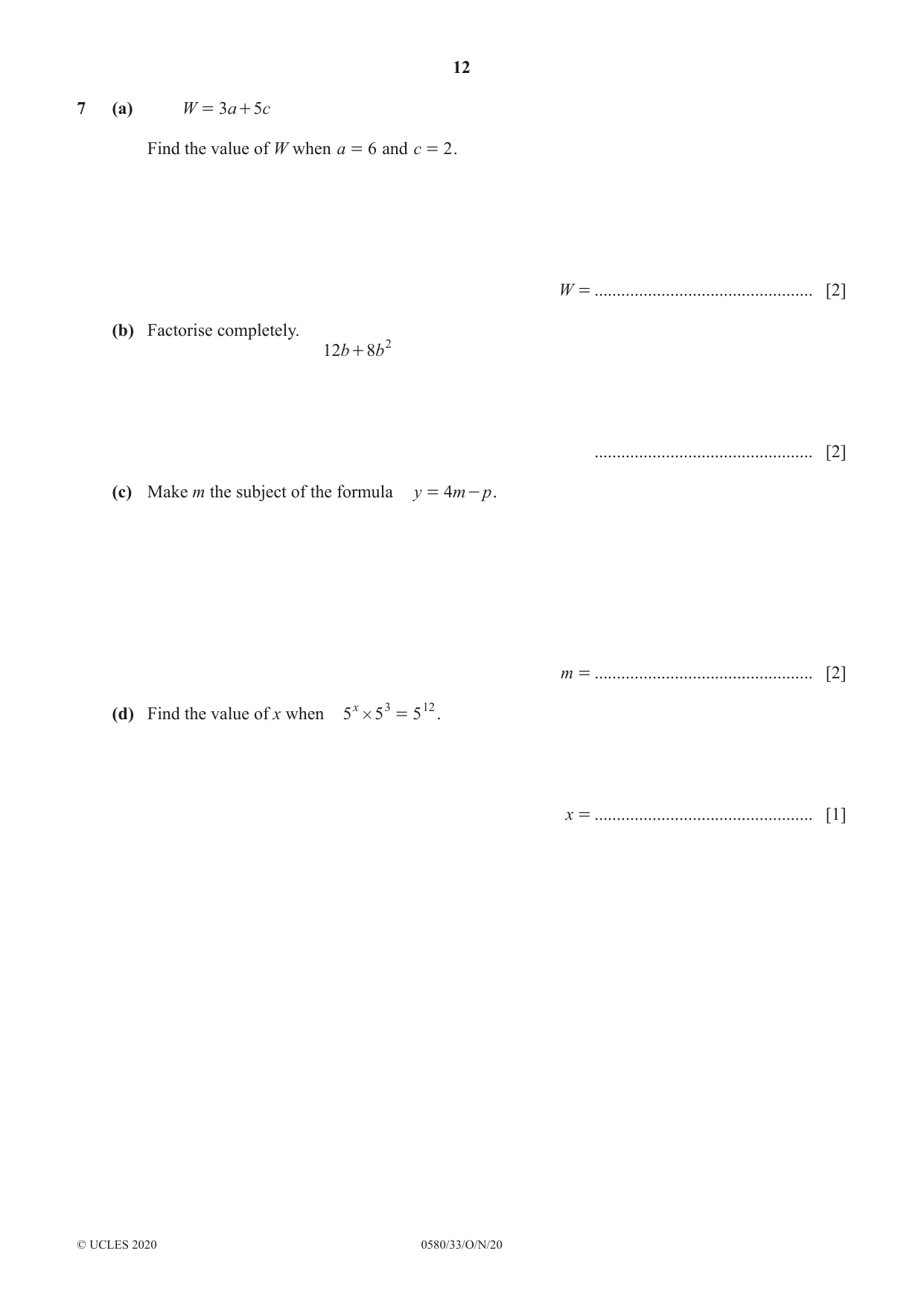
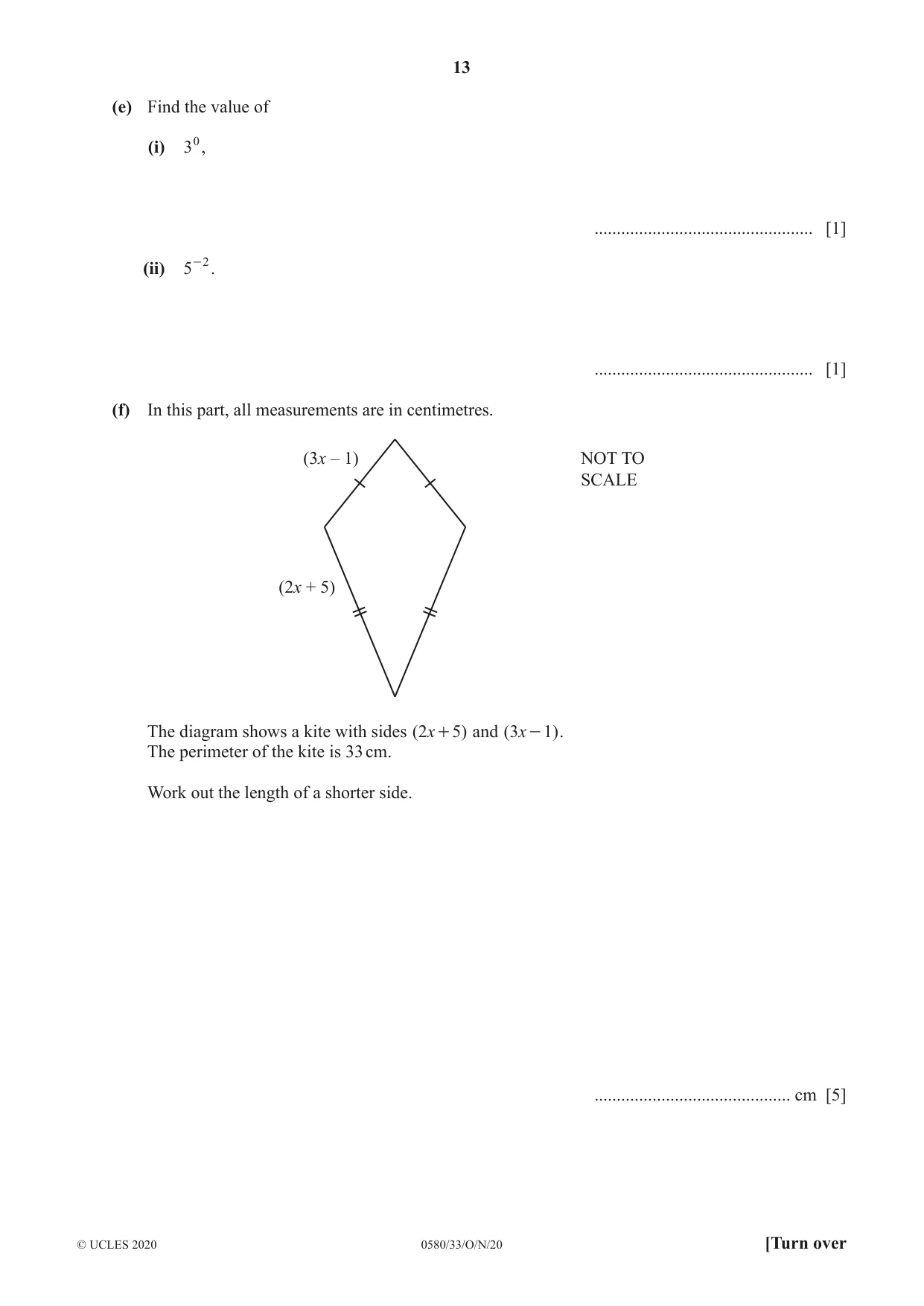
7 (a) W = 3a + 5c Find the value of W when a = 6 and c = 2 . W = ................................................. [2] (b) Factorise completely. 12b + 8b 2 ................................................. [2] (c) Make m the subject of the formula y = 4m - p . m = ................................................. [2] (d) Find the value of x when 5 x # 5 3 = 5 12 . x = ................................................. [1] (e) Find the value of (i) 30, ................................................. [1] (ii) 5 - 2 . ................................................. [1] (f) In this part, all measurements are in centimetres. (3x – 1) NOT TO SCALE (2x + 5) The diagram shows a kite with sides ( 2x + 5) and ( 3x - 1) . The perimeter of the kite is 33 cm. Work out the length of a shorter side. ............................................ cm [5]
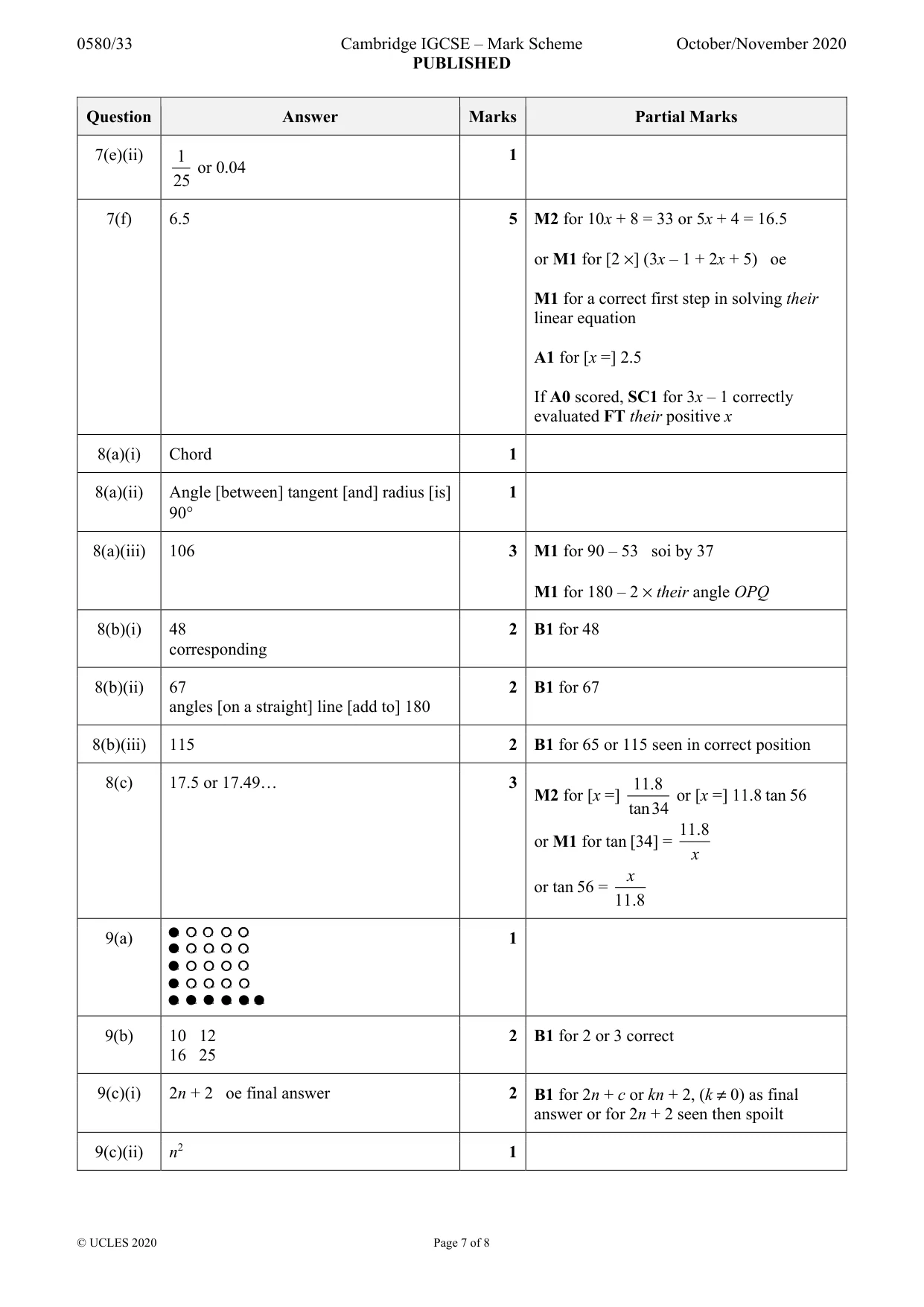
Mark scheme: 7(a) 28 2 M1 for 3 × 6 + 5 × 2 or better or B1 for 18 or 10 seen 7(b) 4b(3 + 2b) final answer 2 B1 for final answer 2(6b + 4b2) or 4(3b + 2b2) or 2b(6 + 4b) or b(12 + 8b) or 4b(3 + 2b) seen then spoilt 7(c) y + p y p 2 y p or + oe final answer M1 for 4m = y + p or = m − 4 4 4 4 4 7(d) 9 cao 1 7(e)(i) 1 1 7(e)(ii) 1 1 or 0.04 25 7(f) 6.5 5 M2 for 10x + 8 = 33 or 5x + 4 = 16.5 or M1 for [2 ×] (3x – 1 + 2x + 5) oe M1 for a correct first step in solving their linear equation A1 for [x =] 2.5 If A0 scored, SC1 for 3x – 1 correctly evaluated FT their positive x
Q8 · A P NOT TO SCALE 53° O x° B Q P and Q are points on the circle, centre O
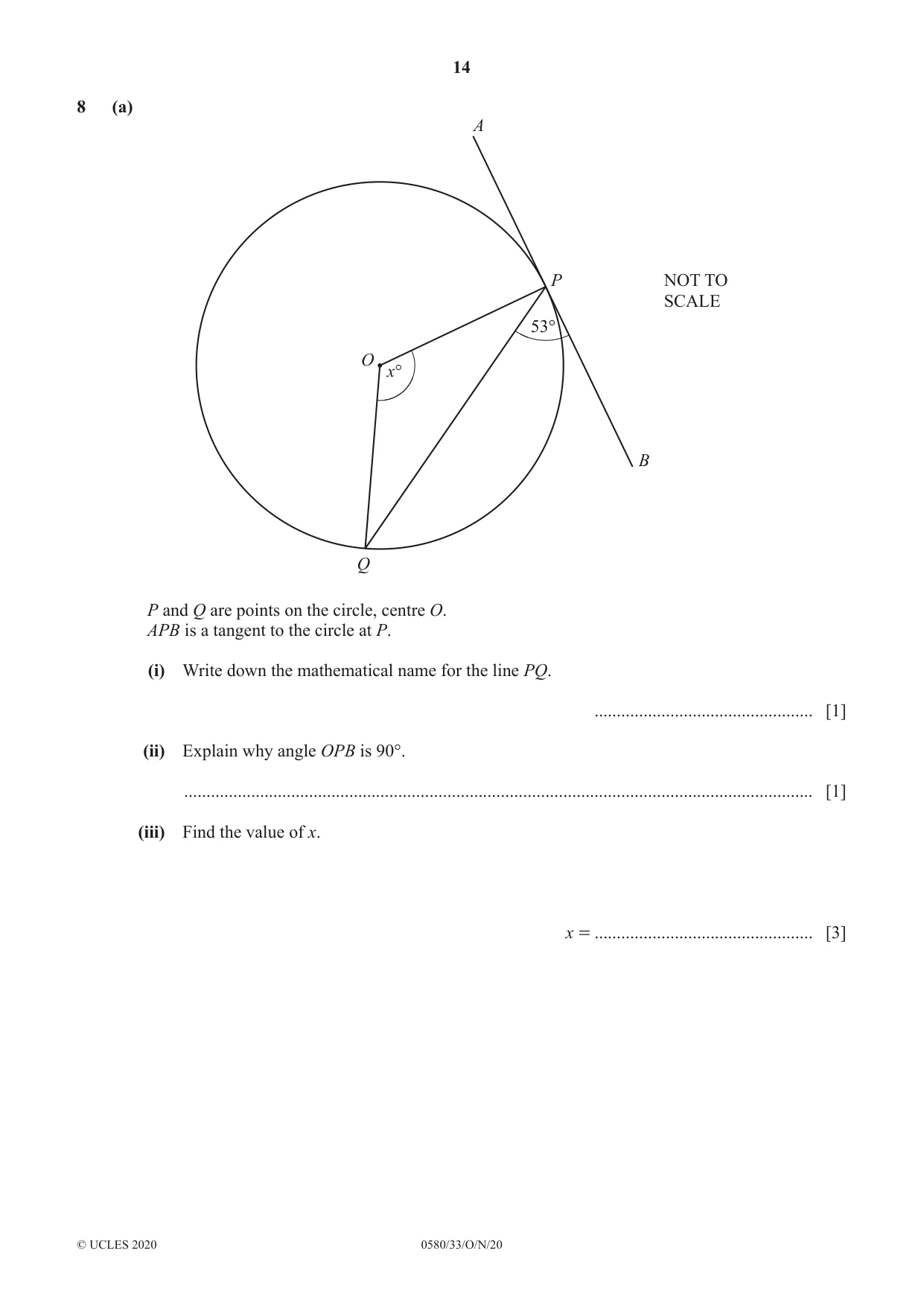
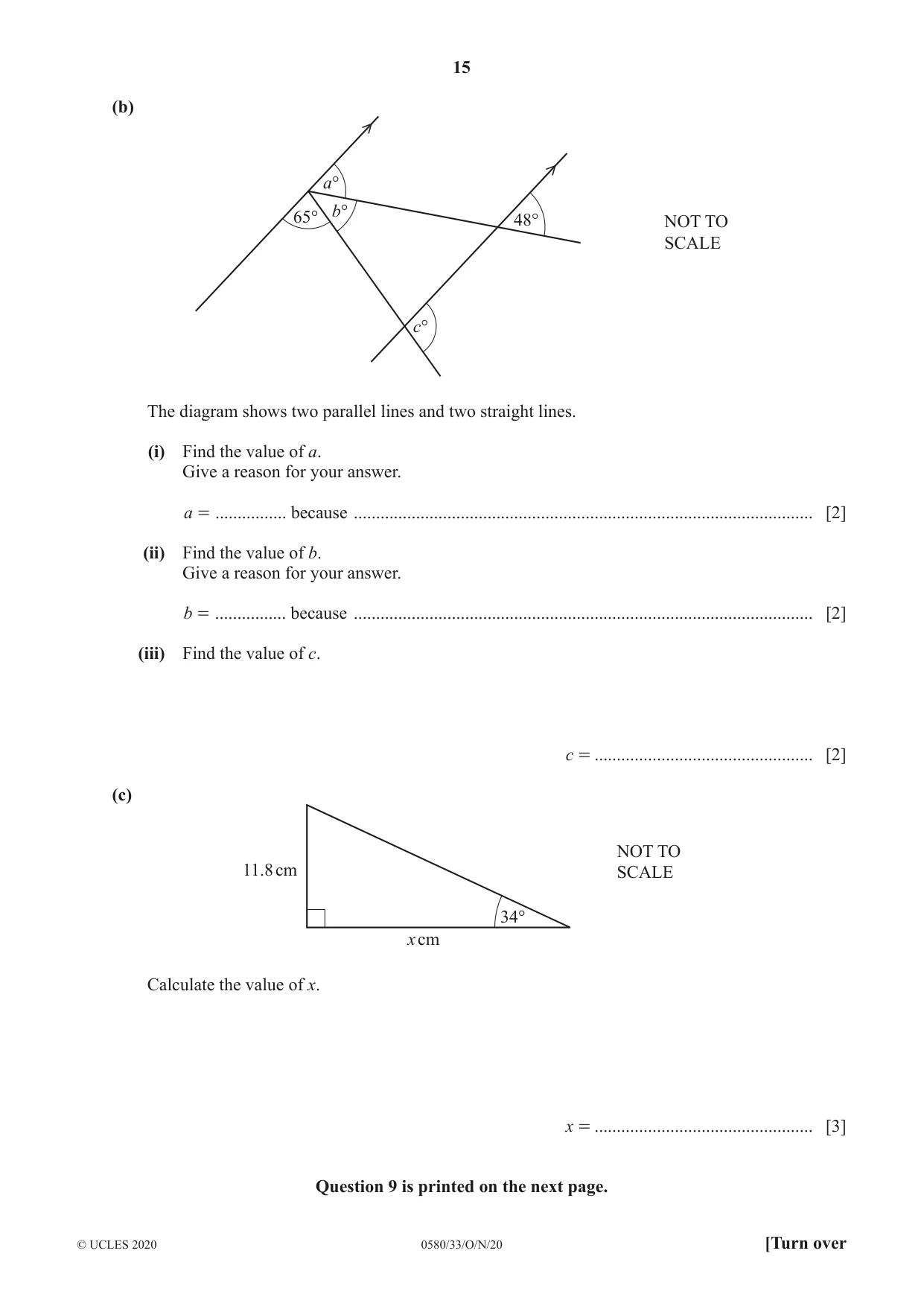
8 (a) A P NOT TO SCALE 53° O x° B Q P and Q are points on the circle, centre O. APB is a tangent to the circle at P. (i) Write down the mathematical name for the line PQ. ................................................. [1] (ii) Explain why angle OPB is 90°. ............................................................................................................................................. [1] (iii) Find the value of x. x = ................................................. [3] (b) a° b° 65° 48° NOT TO SCALE c° The diagram shows two parallel lines and two straight lines. (i) Find the value of a. Give a reason for your answer. a = ................ because ....................................................................................................... [2] (ii) Find the value of b. Give a reason for your answer. b = ................ because ....................................................................................................... [2] (iii) Find the value of c. c = ................................................. [2] (c) NOT TO 11.8 cm SCALE 34° x cm Calculate the value of x. x = ................................................. [3] Question 9 is printed on the next page.
Mark scheme: 8(a)(i) Chord 1 8(a)(ii) Angle [between] tangent [and] radius [is] 1 90° 8(a)(iii) 106 3 M1 for 90 – 53 soi by 37 M1 for 180 – 2 × their angle OPQ 8(b)(i) 48 2 B1 for 48 corresponding 8(b)(ii) 67 2 B1 for 67 angles [on a straight] line [add to] 180 8(b)(iii) 115 2 B1 for 65 or 115 seen in correct position 8(c) 17.5 or 17.49… 3 11.8 M2 for [x =] or [x =] 11.8 tan 56 tan34 11.8 or M1 for tan [34] = x x or tan 56 = 11.8
Q9 · A sequence of patterns is made using black counters and white counters
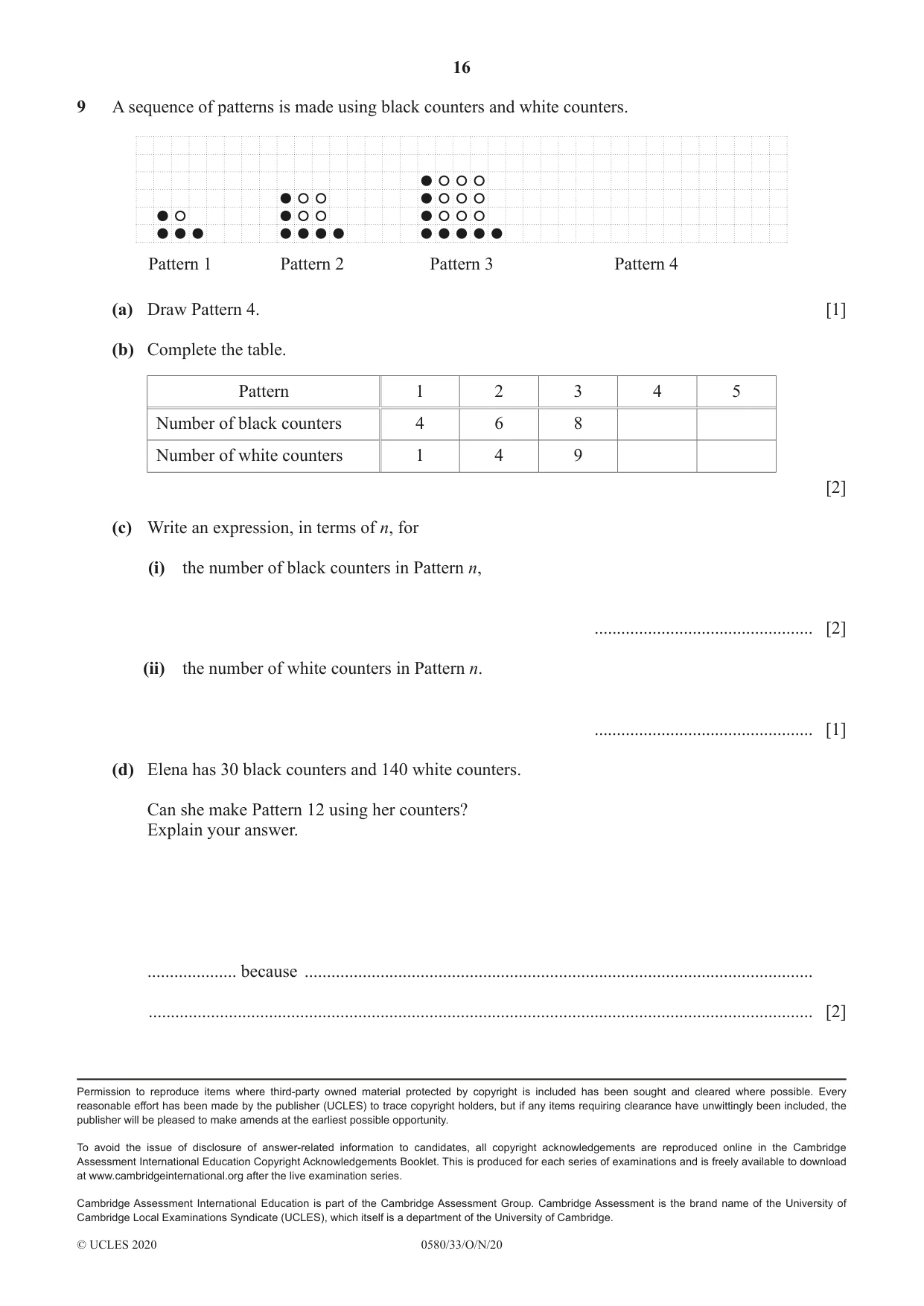
9 A sequence of patterns is made using black counters and white counters. Pattern 1 Pattern 2 Pattern 3 Pattern 4 (a) Draw Pattern 4. [1] (b) Complete the table. Pattern 1 2 3 4 5 Number of black counters 4 6 8 Number of white counters 1 4 9 [2] (c) Write an expression, in terms of n, for (i) the number of black counters in Pattern n, ................................................. [2] (ii) the number of white counters in Pattern n. ................................................. [1] (d) Elena has 30 black counters and 140 white counters. Can she make Pattern 12 using her counters? Explain your answer. .................... because .................................................................................................................. ..................................................................................................................................................... [2]
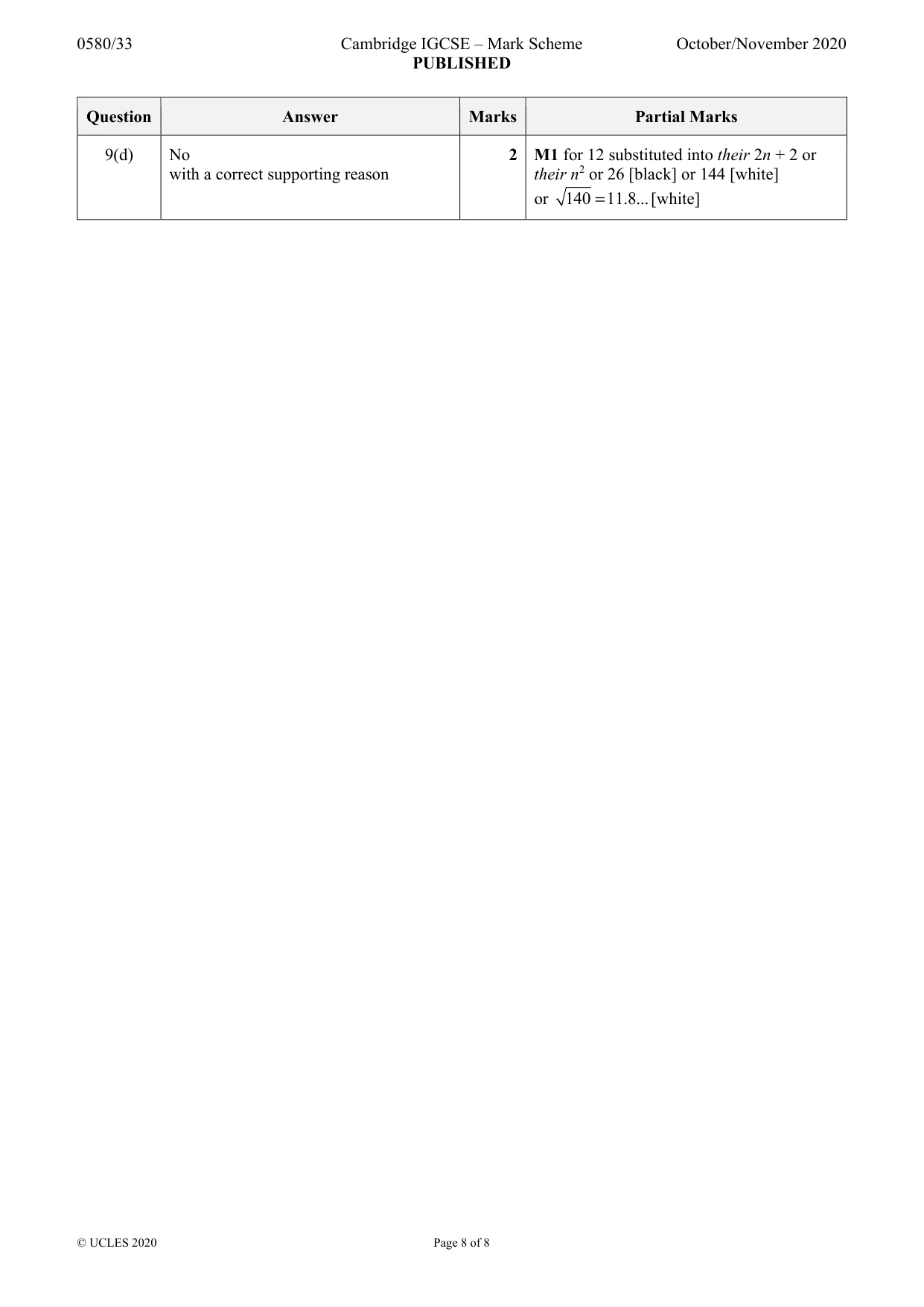
Mark scheme: 9(a) 1 9(b) 10 12 2 B1 for 2 or 3 correct 16 25 9(c)(i) 2n + 2 oe final answer 2 B1 for 2n + c or kn + 2, (k ≠ 0) as final answer or for 2n + 2 seen then spoilt 9(c)(ii) n2 1 9(d) No 2 M1 for 12 substituted into their 2n + 2 or with a correct supporting reason their n2 or 26 [black] or 144 [white] or 140 = 11.8... [white]
What was in this paper
The subtopics covered by these 9 questions, and how many questions each got. Open one in a new tab to see every Cambridge question on it.
What you needed in this session
Cambridge’s own grade thresholds for 2020 Oct/Nov, Paper 3 · Variant 3. A higher threshold means an easier paper — the bar moves with how the cohort did.