Cambridge IGCSE Mathematics 0580 — 2010 Oct/Nov Paper 1 · Variant 2
0580/12/O/N/10 · 18 questions · 56 marks · ≈63 min
The question paper and its mark scheme, free to read here and free to download. This is Cambridge’s own paper, exactly as it was sat.
Question paper12 pages
Mark scheme4 pages
Answers below. Sit the paper first if you are practising.
Questions as text
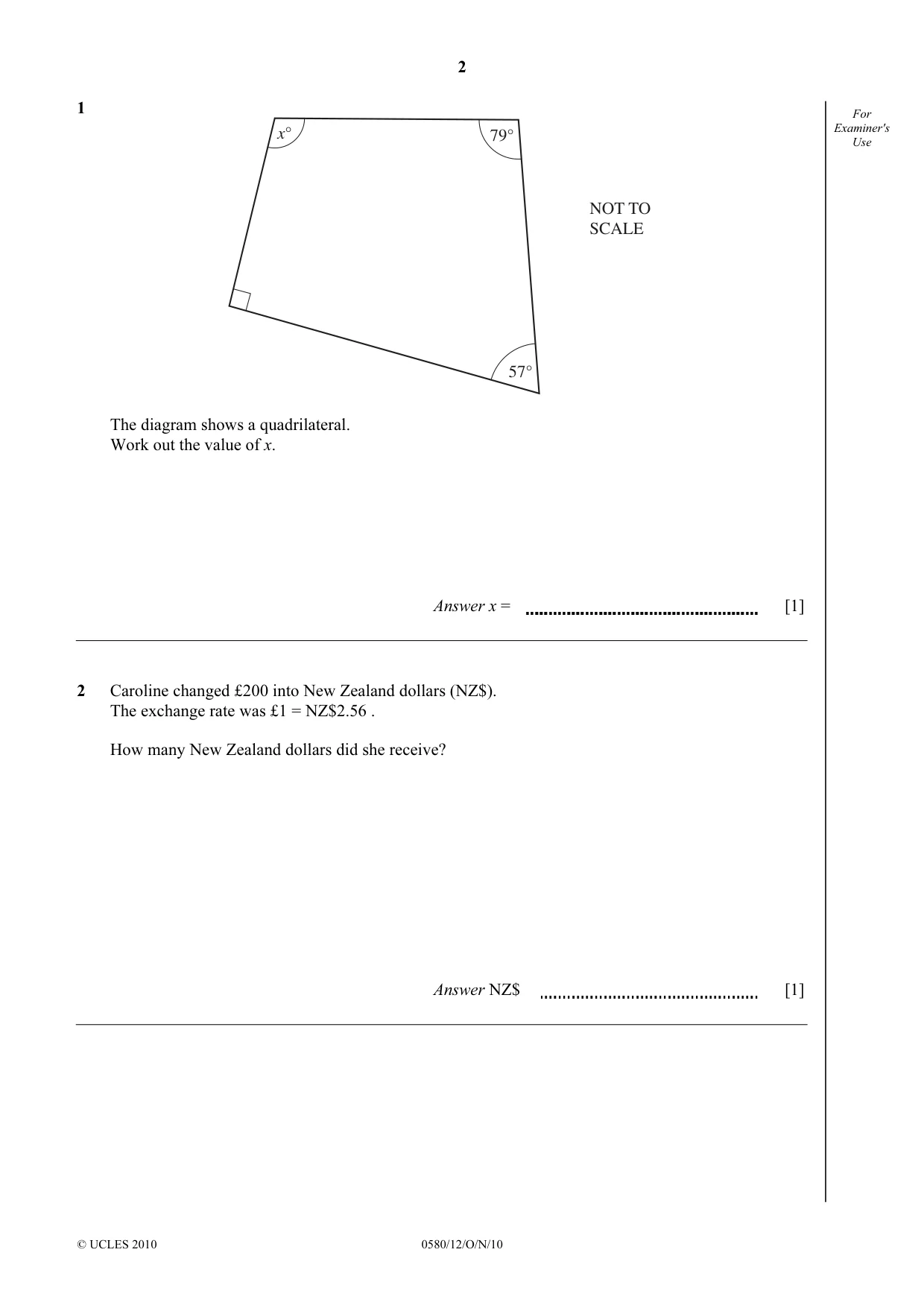
Q1 · For x° 79° Examiner'sUse NOT TO SCALE 57° The diagram shows a quadrilateral
1 For x° 79° Examiner'sUse NOT TO SCALE 57° The diagram shows a quadrilateral. Work out the value of x. Answer x = [1]
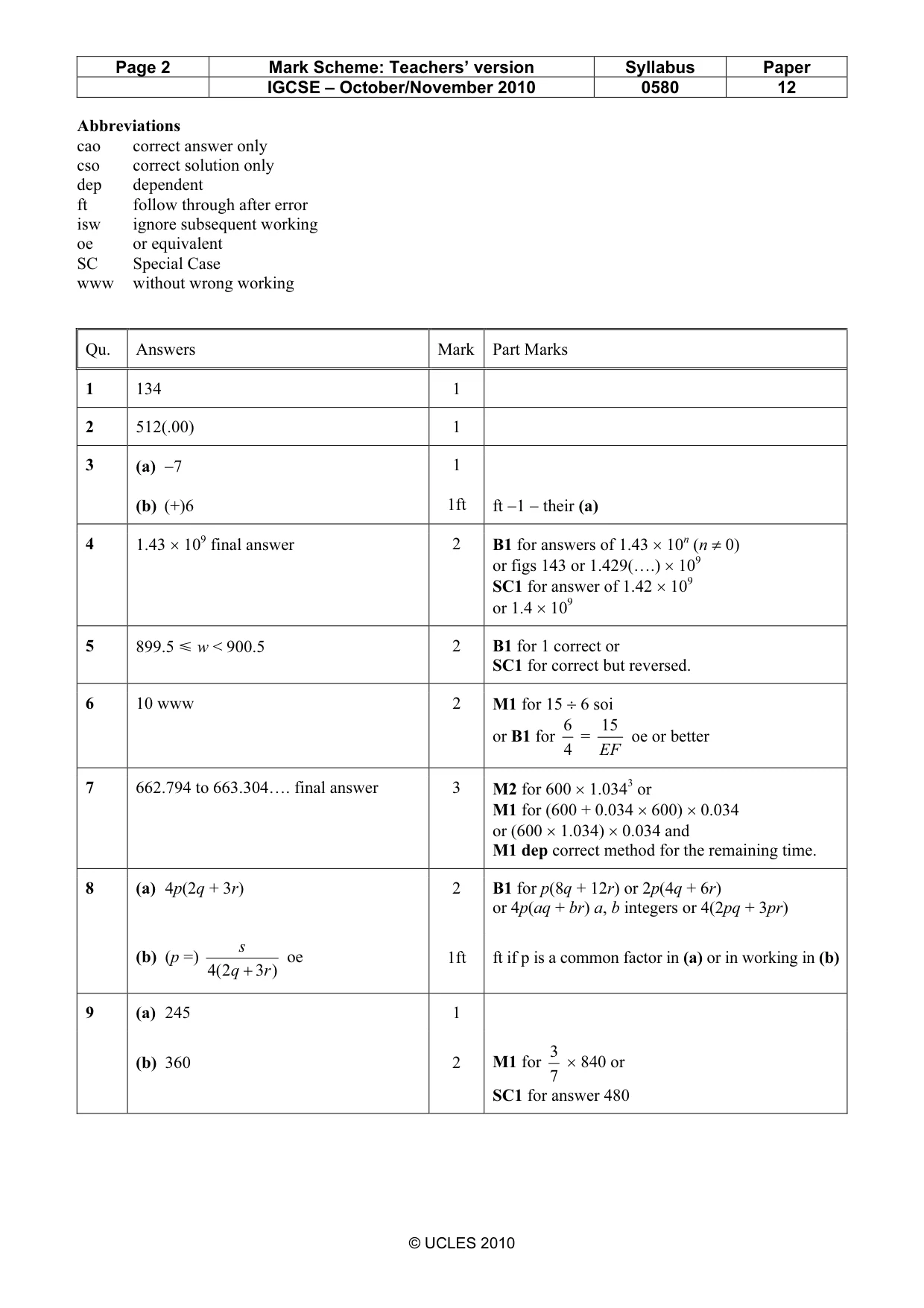
Mark scheme: Qu. Answers Mark Part Marks 1 134 1
Q2 · Caroline changed £200 into New Zealand dollars (NZ$)
2 Caroline changed £200 into New Zealand dollars (NZ$). The exchange rate was £1 = NZ$2.56 . How many New Zealand dollars did she receive? Answer NZ$ [1]
Mark scheme: 2 512(.00) 1
Q3 · Francis recorded a temperature of −4°C on Sunday
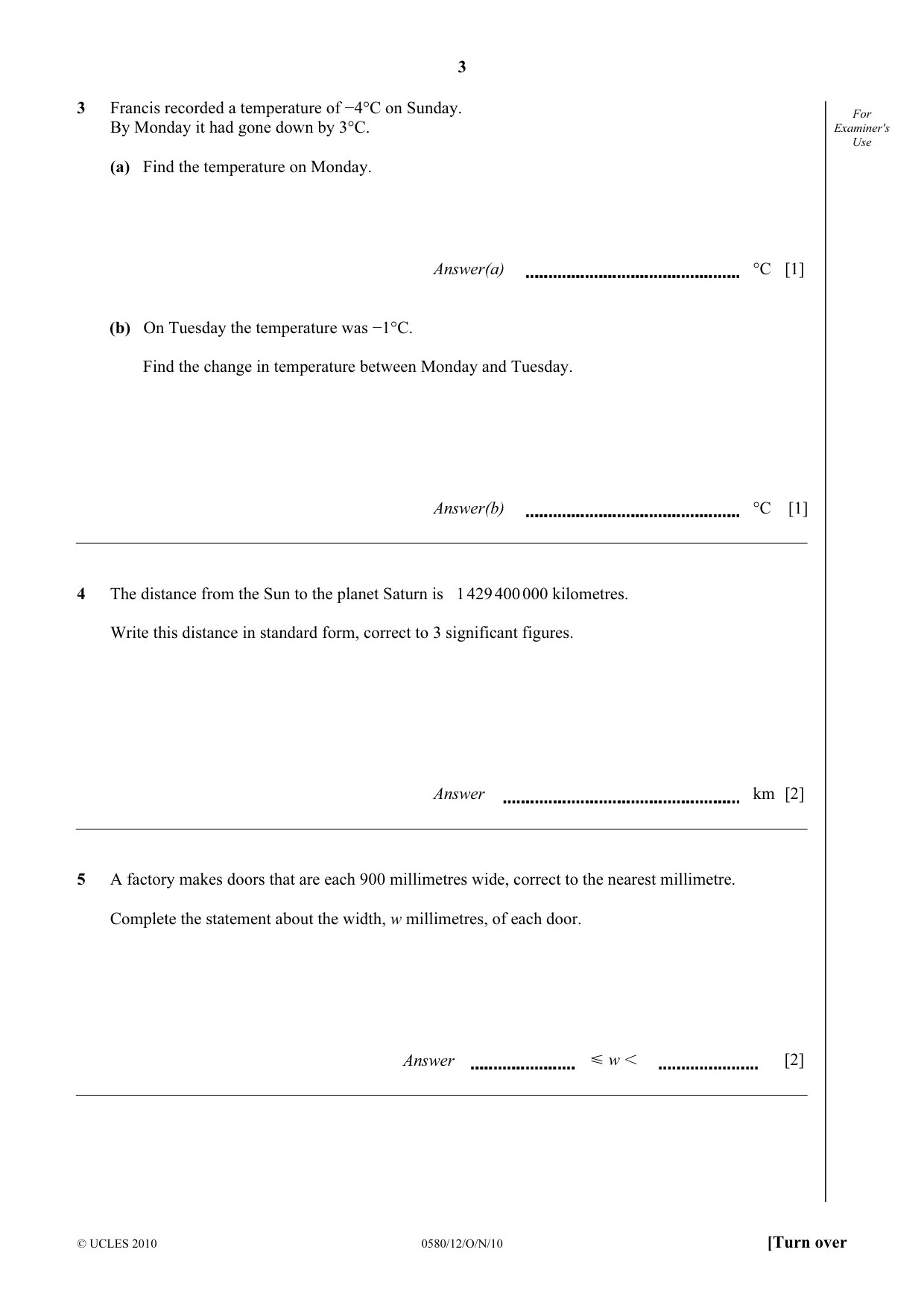
3 Francis recorded a temperature of −4°C on Sunday. For By Monday it had gone down by 3°C. Examiner's Use (a) Find the temperature on Monday. Answer(a) °C [1] (b) On Tuesday the temperature was −1°C. Find the change in temperature between Monday and Tuesday. Answer(b) °C [1]
Mark scheme: 3 (a) −7 1 (b) (+)6 1ft ft −1 − their (a)
Q4 · The distance from the Sun to the planet Saturn is 1 429 400 000 kilometres
4 The distance from the Sun to the planet Saturn is 1 429 400 000 kilometres. Write this distance in standard form, correct to 3 significant figures. Answer km [2]
Mark scheme: 4 1.43 × 10⁹ final answer 2 B1 for answers of 1.43 × 10n (n ≠ 0) or figs 143 or 1.429(….) × 109 SC1 for answer of 1.42 × 10⁹ or 1.4 × 10⁹
Q5 · A factory makes doors that are each 900 millimetres wide, correct to the nearest…
5 A factory makes doors that are each 900 millimetres wide, correct to the nearest millimetre. Complete the statement about the width, w millimetres, of each door. Answer Y w I [2]
Mark scheme: 5 899.5 Y w < 900.5 2 B1 for 1 correct or SC1 for correct but reversed.
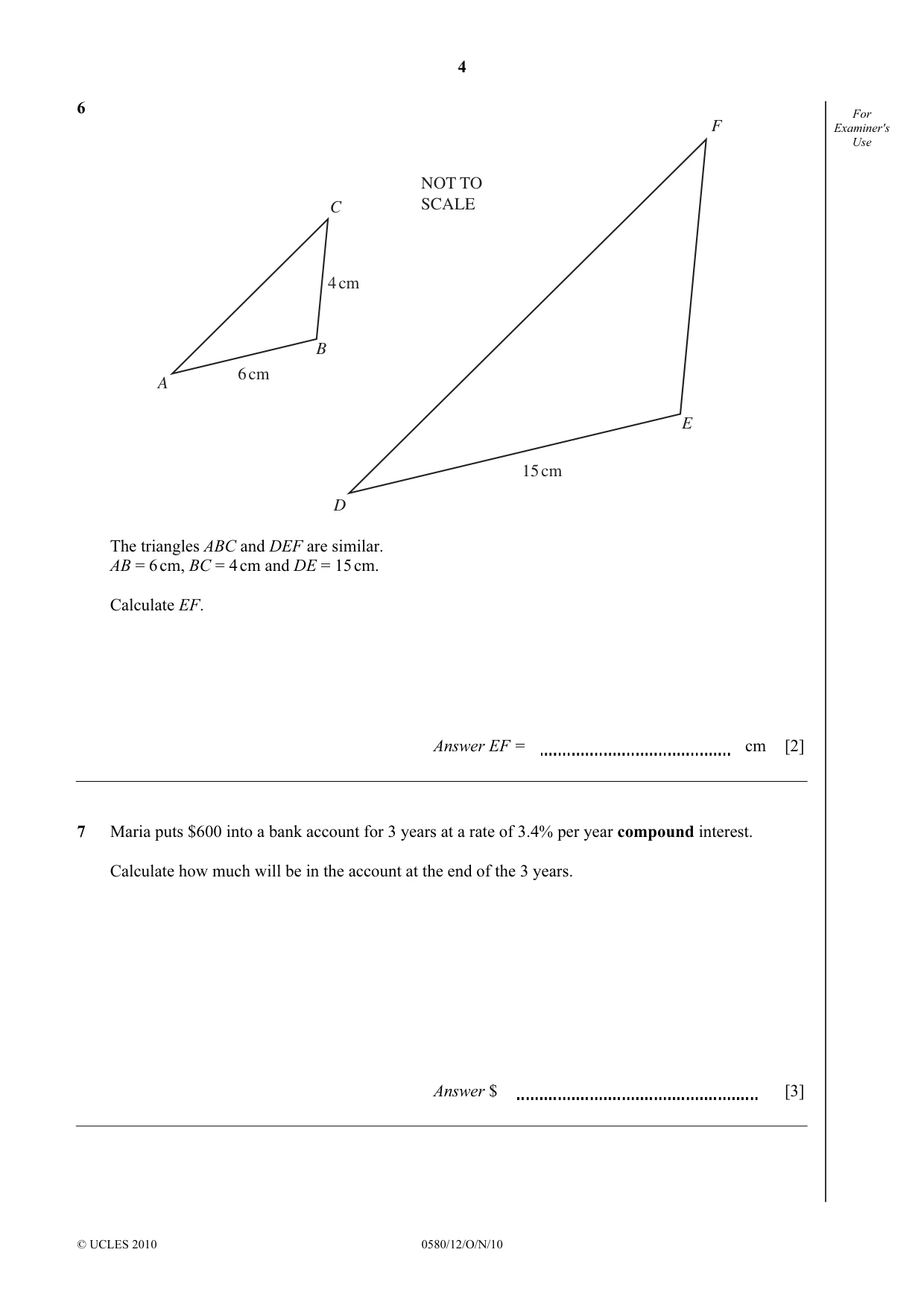
Q6 · For F Examiner's Use NOT TO C SCALE 4 cm B 6 cm A E 15 cm D The triangles ABC and DEF are…
6 For F Examiner's Use NOT TO C SCALE 4 cm B 6 cm A E 15 cm D The triangles ABC and DEF are similar. AB = 6 cm, BC = 4 cm and DE = 15 cm. Calculate EF. Answer EF = cm [2]
Mark scheme: 6 10 www 2 M1 for 15 ÷ 6 soi 6 15 or B1 for = oe or better 4 EF
Q7 · Maria puts $600 into a bank account for 3 years at a rate of 3.4% per year compound…
7 Maria puts $600 into a bank account for 3 years at a rate of 3.4% per year compound interest. Calculate how much will be in the account at the end of the 3 years. Answer $ [3]
Mark scheme: 7 662.794 to 663.304…. final answer 3 M2 for 600 × 1.0343 or M1 for (600 + 0.034 × 600) × 0.034 or (600 × 1.034) × 0.034 and M1 dep correct method for the remaining time.
Question 8
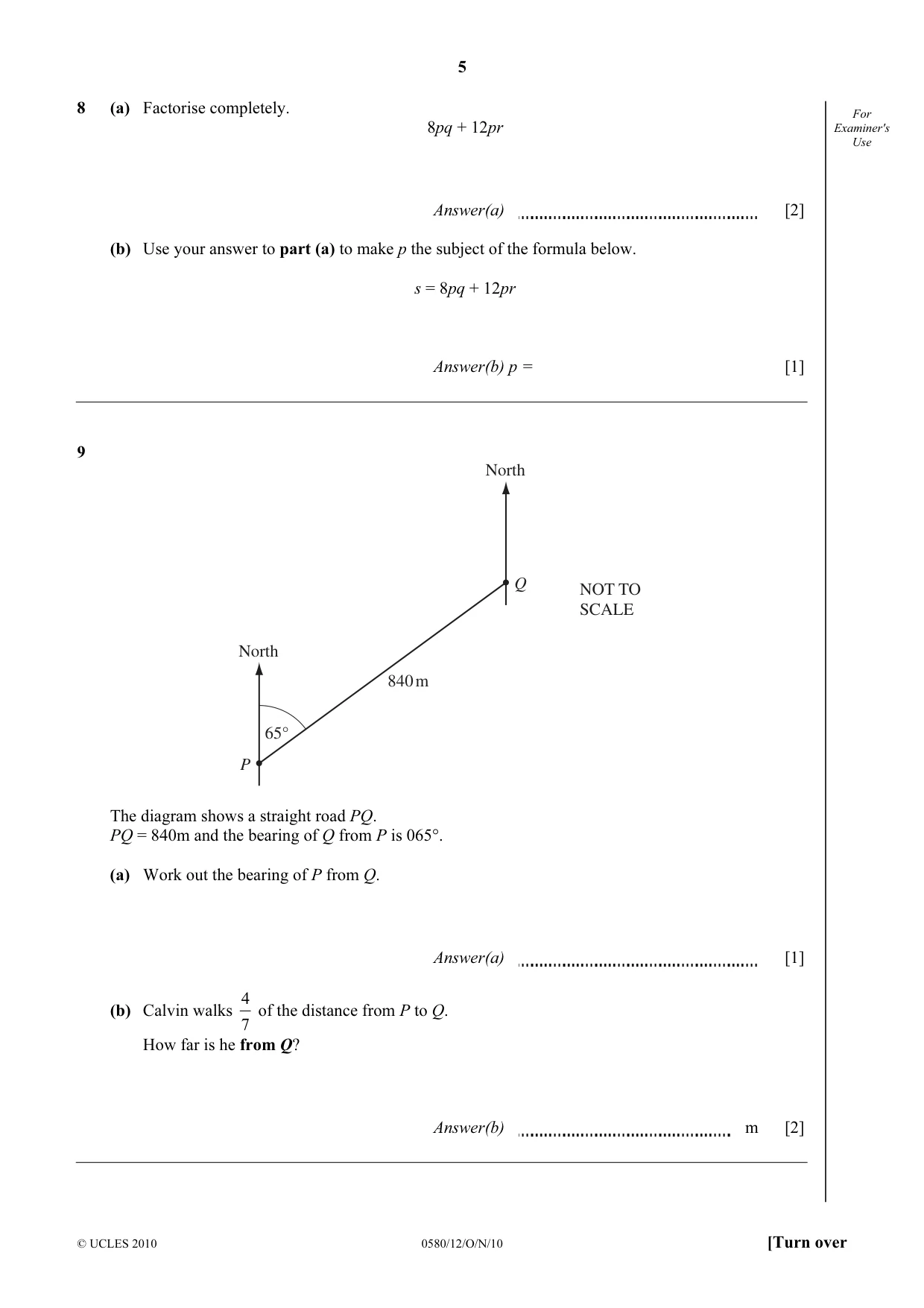
8 (a) Factorise completely. For 8pq + 12pr Examiner's Use Answer(a) [2] (b) Use your answer to part (a) to make p the subject of the formula below. s = 8pq + 12pr Answer(b) p = [1]
Mark scheme: 8 (a) 4p(2q + 3r) 2 B1 for p(8q + 12r) or 2p(4q + 6r) or 4p(aq + br) a, b integers or 4(2pq + 3pr) s (b) (p =) oe 1ft ft if p is a common factor in (a) or in working in (b) 4( 2 q + 3r )
Q9 · North Q NOT TO SCALE North 840 m 65° P The diagram shows a straight road PQ
9 North Q NOT TO SCALE North 840 m 65° P The diagram shows a straight road PQ. PQ = 840m and the bearing of Q from P is 065°. (a) Work out the bearing of P from Q. Answer(a) [1] 4 (b) Calvin walks of the distance from P to Q. 7 How far is he from Q? Answer(b) m [2]
Mark scheme: 9 (a) 245 1 3 (b) 360 2 M1 for × 840 or 7 SC1 for answer 480 IGCSE – October/November 2010 0580 12 15
Q10 · The heights of 43 children are measured to the nearest centimetre
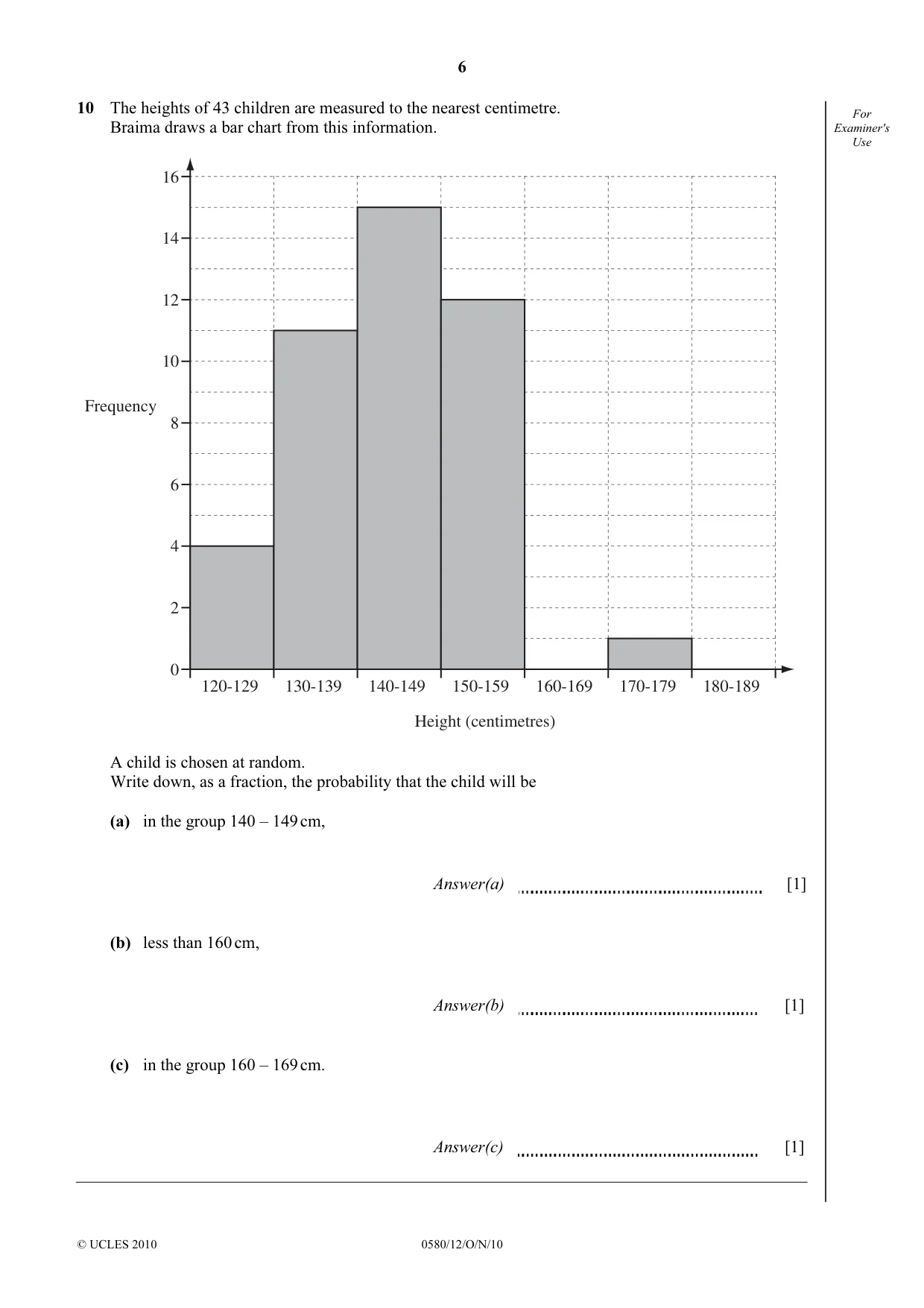
10 The heights of 43 children are measured to the nearest centimetre. For Braima draws a bar chart from this information. Examiner's Use 16 14 12 10 Frequency 8 6 4 2 0 120-129 130-139 140-149 150-159 160-169 170-179 180-189 Height (centimetres) A child is chosen at random. Write down, as a fraction, the probability that the child will be (a) in the group 140 – 149 cm, Answer(a) [1] (b) less than 160 cm, Answer(b) [1] (c) in the group 160 – 169 cm. Answer(c) [1]
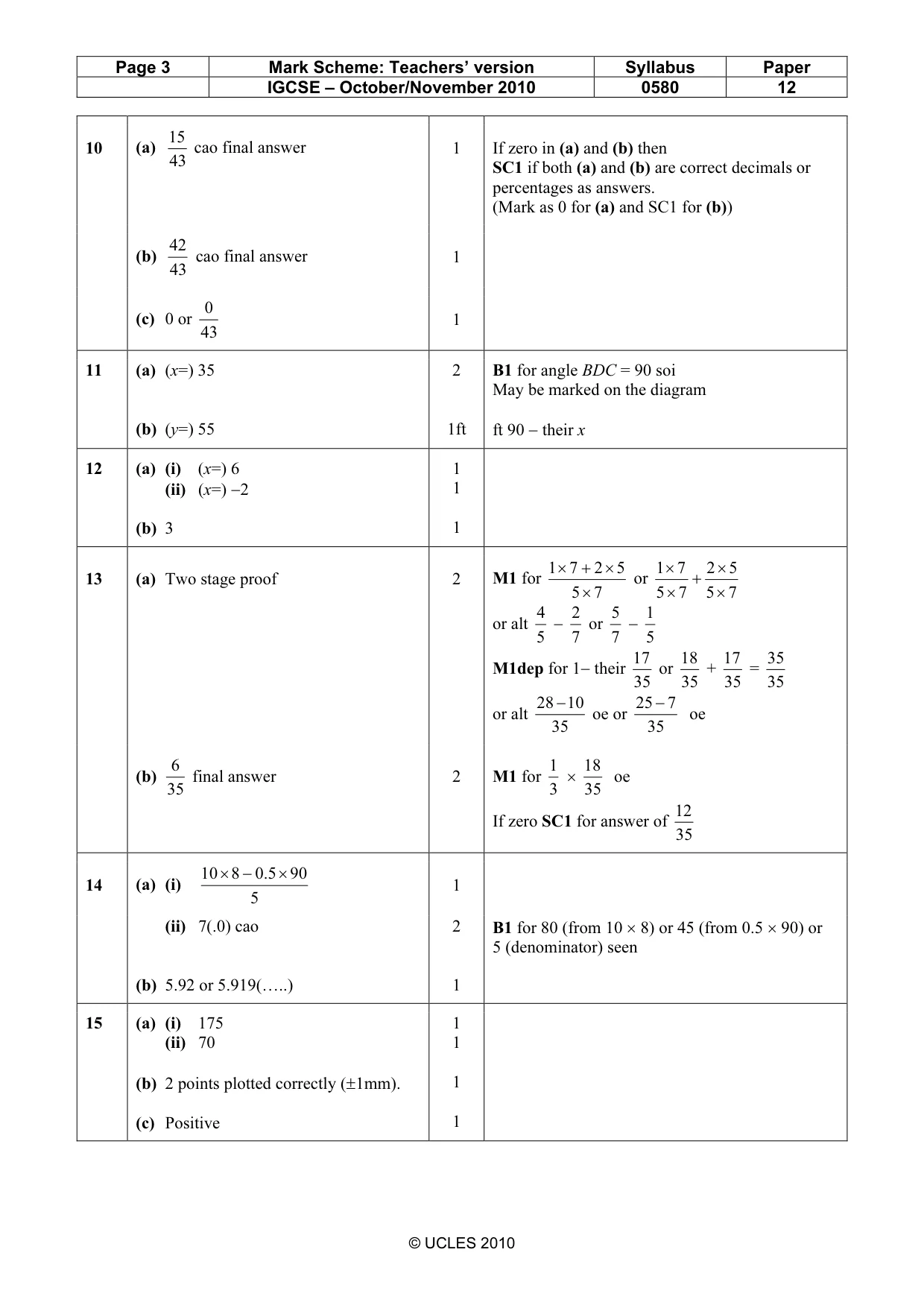
Mark scheme: 15 10 (a) cao final answer 1 If zero in (a) and (b) then 43 SC1 if both (a) and (b) are correct decimals or percentages as answers. (Mark as 0 for (a) and SC1 for (b)) 42 (b) cao final answer 1 43 0 (c) 0 or 1 43
Q11 · For C Examiner's NOT TO Use D SCALE 55° O A x° y° B The diagram shows a circle, centre O…
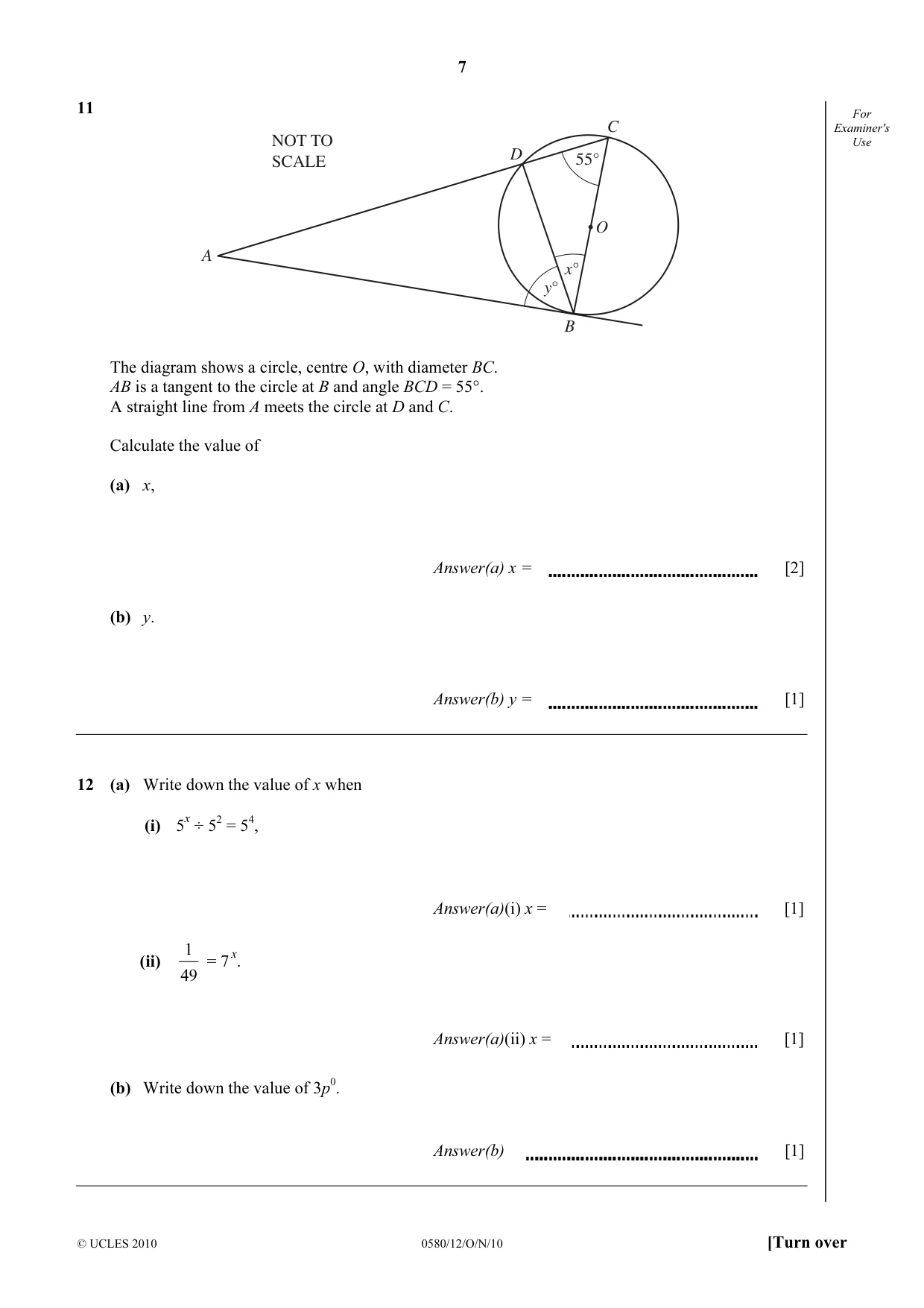
11 For C Examiner's NOT TO Use D SCALE 55° O A x° y° B The diagram shows a circle, centre O, with diameter BC. AB is a tangent to the circle at B and angle BCD = 55°. A straight line from A meets the circle at D and C. Calculate the value of (a) x, Answer(a) x = [2] (b) y. Answer(b) y = [1]
Mark scheme: 11 (a) (x=) 35 2 B1 for angle BDC = 90 soi May be marked on the diagram (b) (y=) 55 1ft ft 90 − their x
Q12 · Write down the value of x when (i) 5x ÷ 52 = 54, Answer(a)(i) x = [1] 1 (ii) = 7 x
12 (a) Write down the value of x when (i) 5x ÷ 52 = 54, Answer(a)(i) x = [1] 1 (ii) = 7 x. 49 Answer(a)(ii) x = [1] (b) Write down the value of 3p0. Answer(b) [1]
Mark scheme: 12 (a) (i) (x=) 6 1 (ii) (x=) −2 1 (b) 3 1 1 × 7 + 2 × 5 1 × 7 2 × 5
Q13 · Dominic, Esther, Flora and Galena shared a pizza
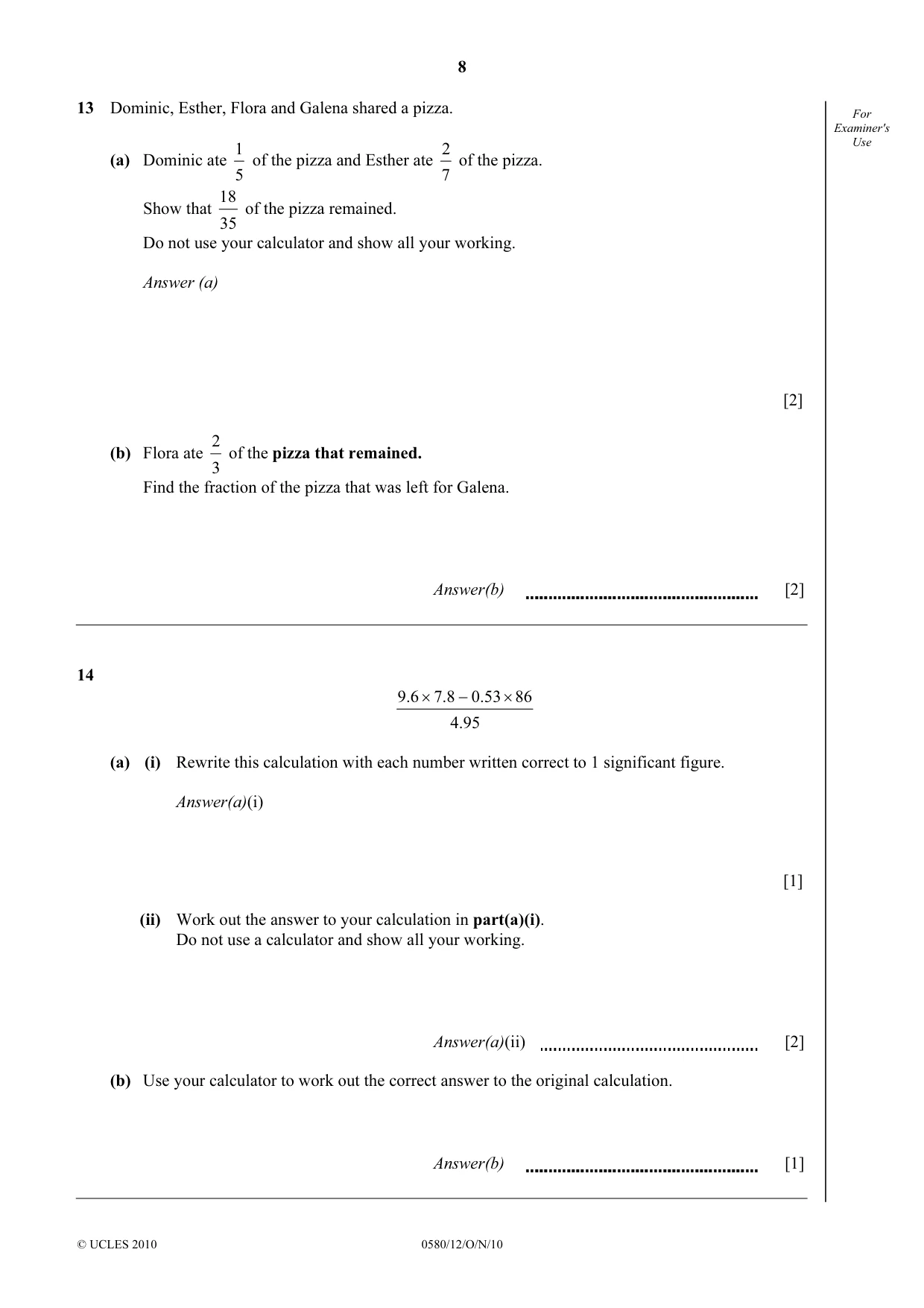
13 Dominic, Esther, Flora and Galena shared a pizza. For Examiner's 1 2 Use (a) Dominic ate of the pizza and Esther ate of the pizza. 5 7 18 Show that of the pizza remained. 35 Do not use your calculator and show all your working. Answer (a) [2] 2 (b) Flora ate of the pizza that remained. 3 Find the fraction of the pizza that was left for Galena. Answer(b) [2]
Mark scheme: 1 × 7 + 2 × 5 1 × 7 2 × 5 13 (a) Two stage proof 2 M1 for or + 5 × 7 5 × 7 5 × 7 4 2 5 1 or alt − or − 5 7 7 5 17 18 17 35 M1dep for 1− their or + = 35 35 35 35 28− 10 25− 7 or alt oe or oe 35 35 6 1 18 (b) final answer 2 M1 for × oe 35 3 35 12 If zero SC1 for answer of 35 10 × 8 0 5 × 90
Q14 · 9.6 × 7.8 − 0.53 × 86 4.95 (a) (i) Rewrite this calculation with each number written…
14 9.6 × 7.8 − 0.53 × 86 4.95 (a) (i) Rewrite this calculation with each number written correct to 1 significant figure. Answer(a)(i) [1] (ii) Work out the answer to your calculation in part(a)(i). Do not use a calculator and show all your working. Answer(a)(ii) [2] (b) Use your calculator to work out the correct answer to the original calculation. Answer(b) [1]
Mark scheme: 10 × 8 − 5.0 × 90 14 (a) (i) 1 5 (ii) 7(.0) cao 2 B1 for 80 (from 10 × 8) or 45 (from 0.5 × 90) or 5 (denominator) seen (b) 5.92 or 5.919(…..) 1
Q15 · Some children took part in a sponsored swim to raise money for charity
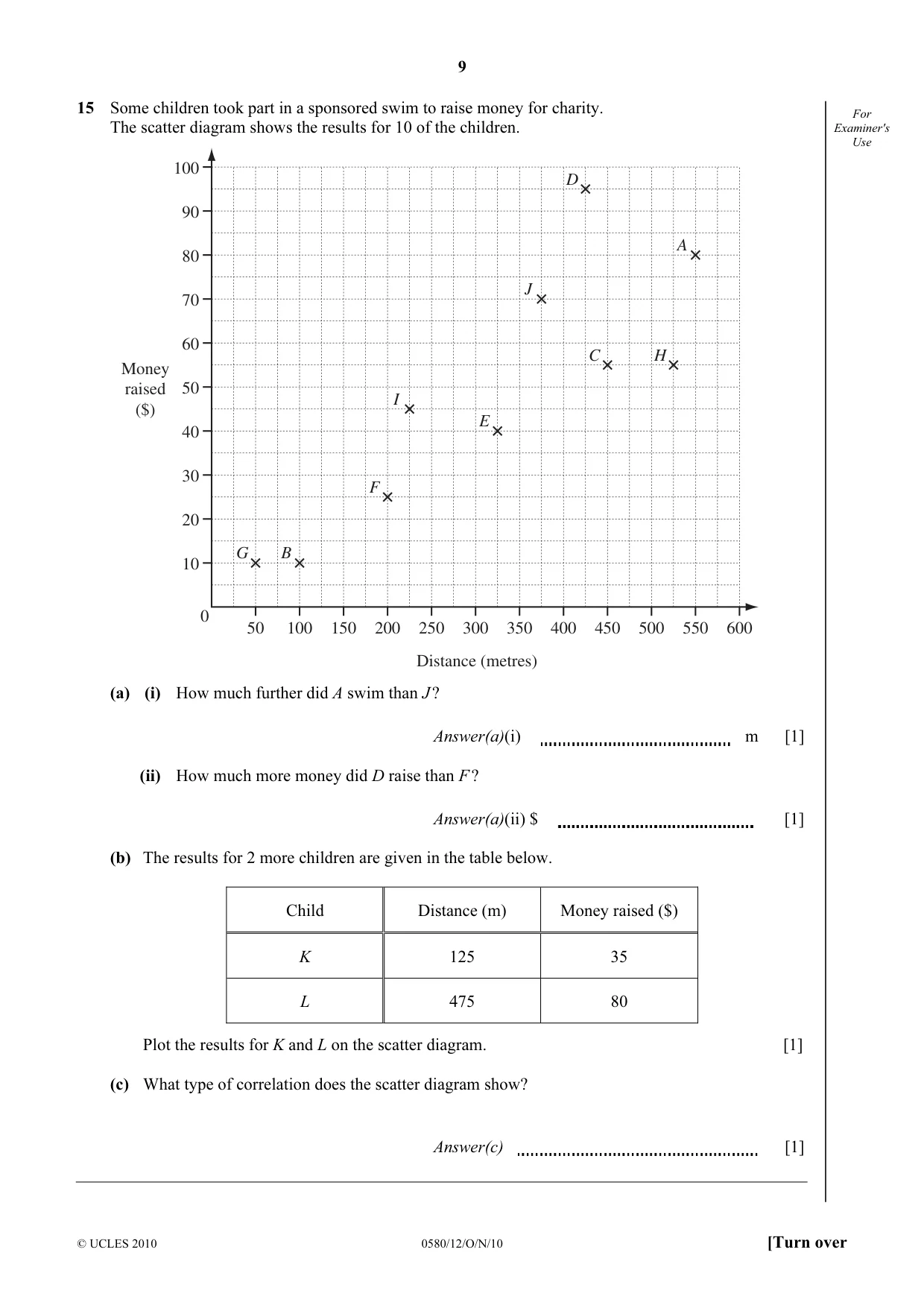
15 Some children took part in a sponsored swim to raise money for charity. For The scatter diagram shows the results for 10 of the children. Examiner's Use 100 D 90 A 80 J 70 60 C H Money raised 50 I ($) E 40 30 F 20 G B 10 0 50 100 150 200 250 300 350 400 450 500 550 600 Distance (metres) (a) (i) How much further did A swim than J ? Answer(a)(i) m [1] (ii) How much more money did D raise than F ? Answer(a)(ii) $ [1] (b) The results for 2 more children are given in the table below. Child Distance (m) Money raised ($) K 125 35 L 475 80 Plot the results for K and L on the scatter diagram. [1] (c) What type of correlation does the scatter diagram show? Answer(c) [1]
Mark scheme: 15 (a) (i) 175 1 (ii) 70 1 (b) 2 points plotted correctly (±1mm). 1 (c) Positive 1 IGCSE – October/November 2010 0580 12
Q16 · Flags A and B are shown on the grid
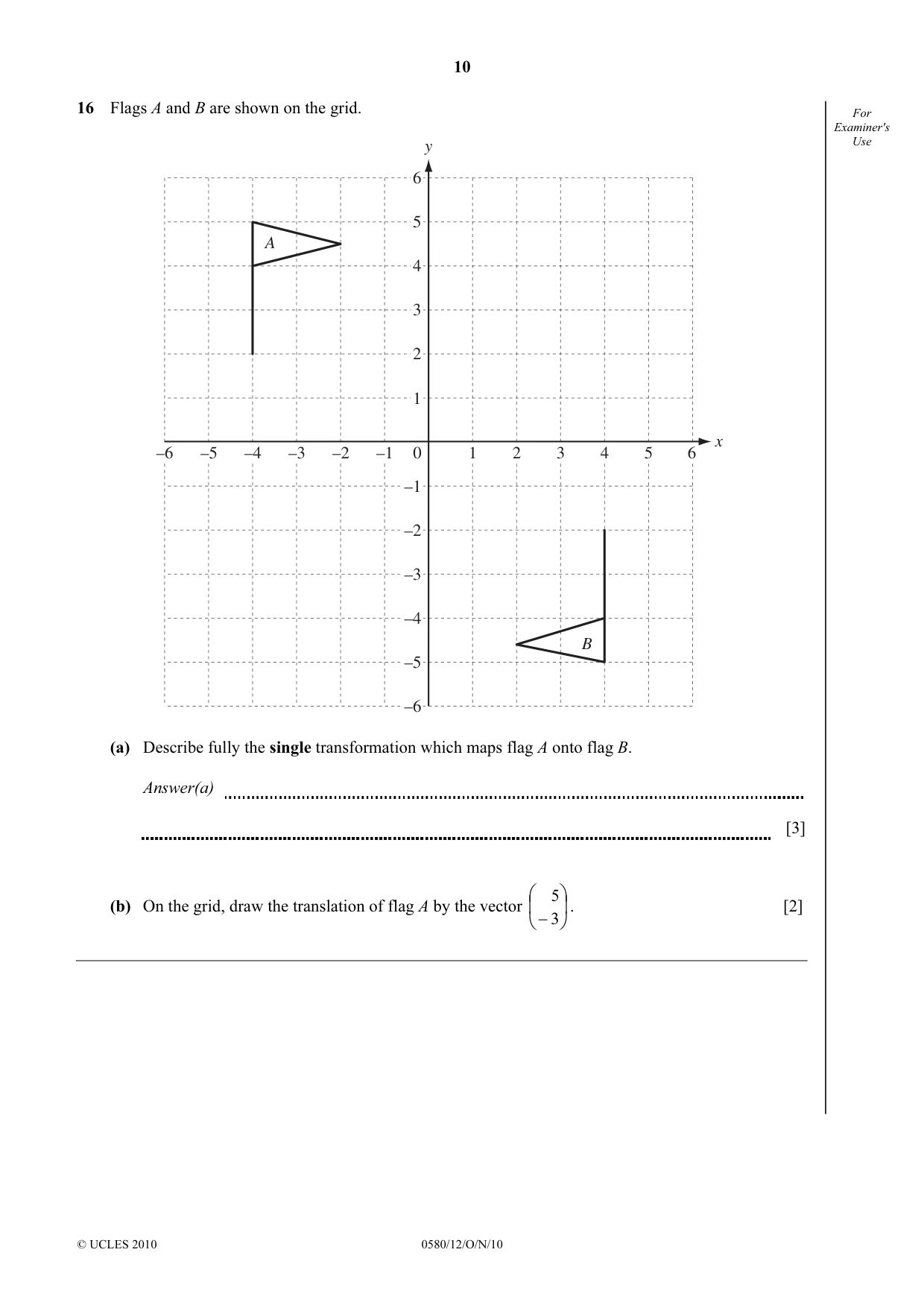
16 Flags A and B are shown on the grid. For Examiner's y Use 6 5 A 4 3 2 1 x –6 –5 –4 –3 –2 –1 0 1 2 3 4 5 6 –1 –2 –3 –4 B –5 –6 (a) Describe fully the single transformation which maps flag A onto flag B. Answer(a) [3] 5 (b) On the grid, draw the translation of flag A by the vector . [2] −3
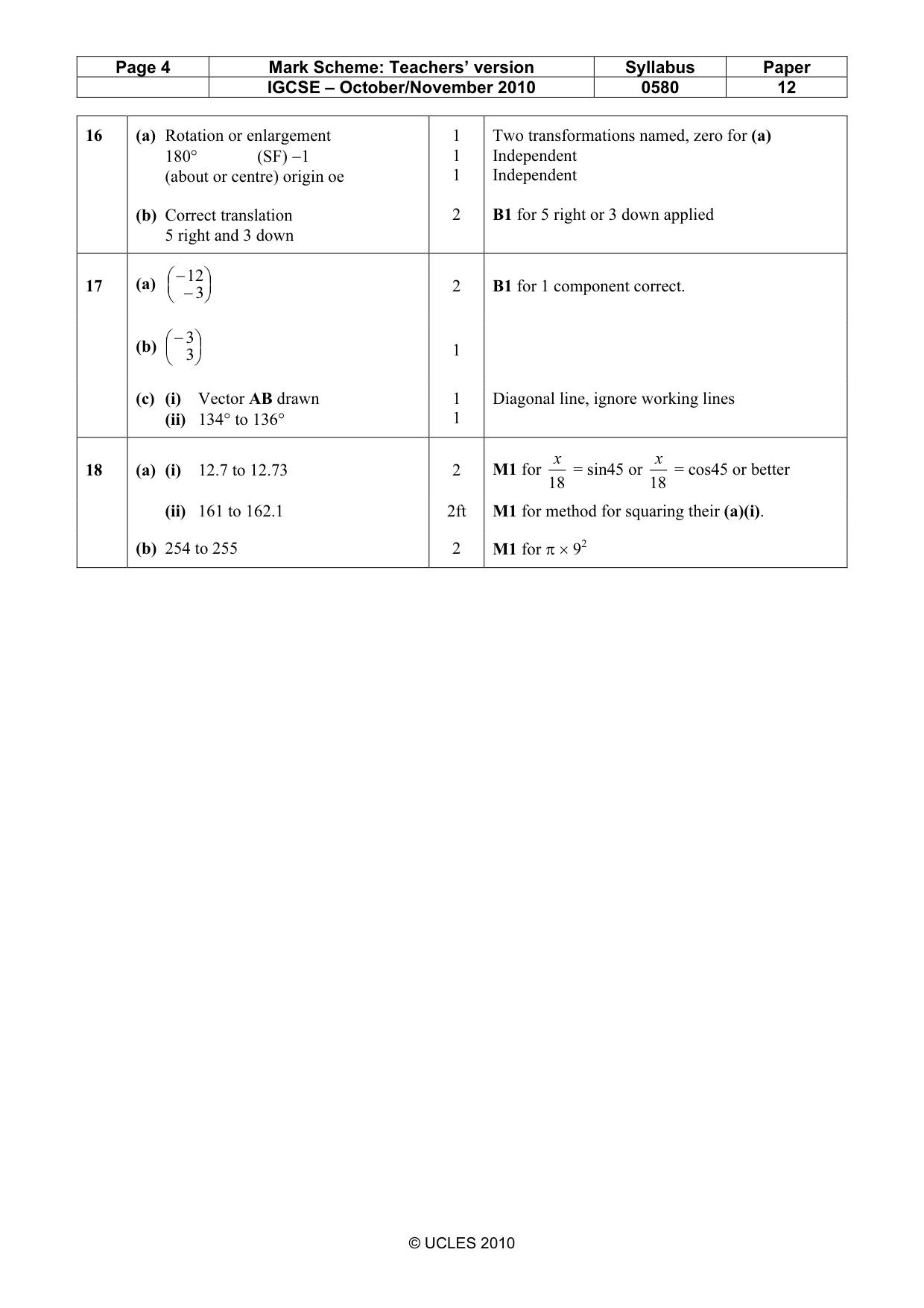
Mark scheme: 16 (a) Rotation or enlargement 1 Two transformations named, zero for (a) 180° (SF) −1 1 Independent (about or centre) origin oe 1 Independent (b) Correct translation 2 B1 for 5 right or 3 down applied 5 right and 3 down 12
Q17 · For 3 − 5 Examiner's AB = AC = Use −3 0 (a) Calculate AB + 3AC
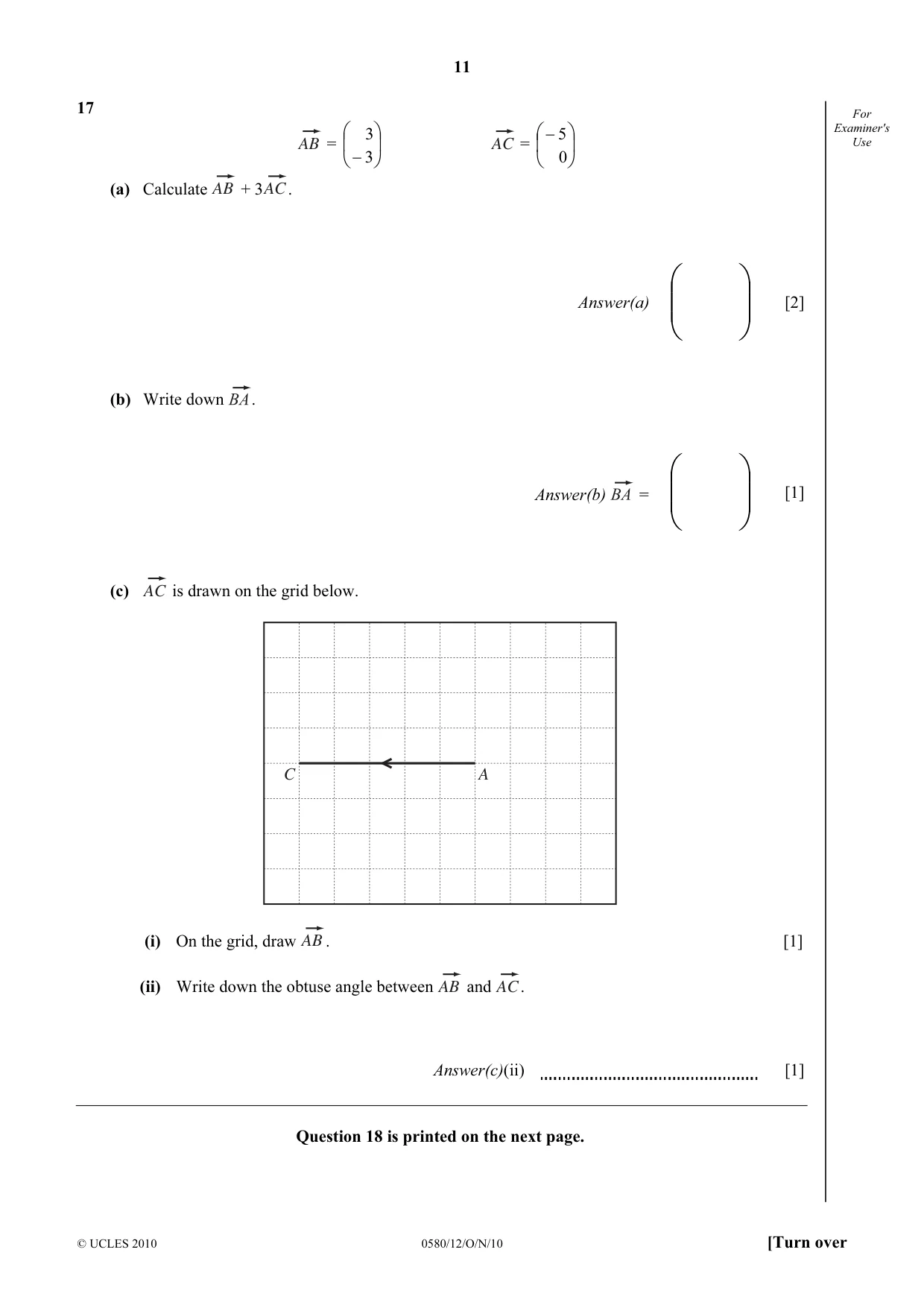
17 For 3 − 5 Examiner's AB = AC = Use −3 0 (a) Calculate AB + 3AC. Answer(a) [2] (b) Write down . Answer(b) = [1] (c) AC is drawn on the grid below. C A (i) On the grid, draw AB . [1] (ii) Write down the obtuse angle between AB and AC. Answer(c)(ii) [1] Question 18 is printed on the next page.
Mark scheme: 17 (a) − 12 2 B1 for 1 component correct. − 3 (b) − 3 3 1 (c) (i) Vector AB drawn 1 Diagonal line, ignore working lines (ii) 134° to 136° 1 x x
Q18 · For Examiner's D C Use NOT TO SCALE 18 cm A B The diagram shows a square ABCD
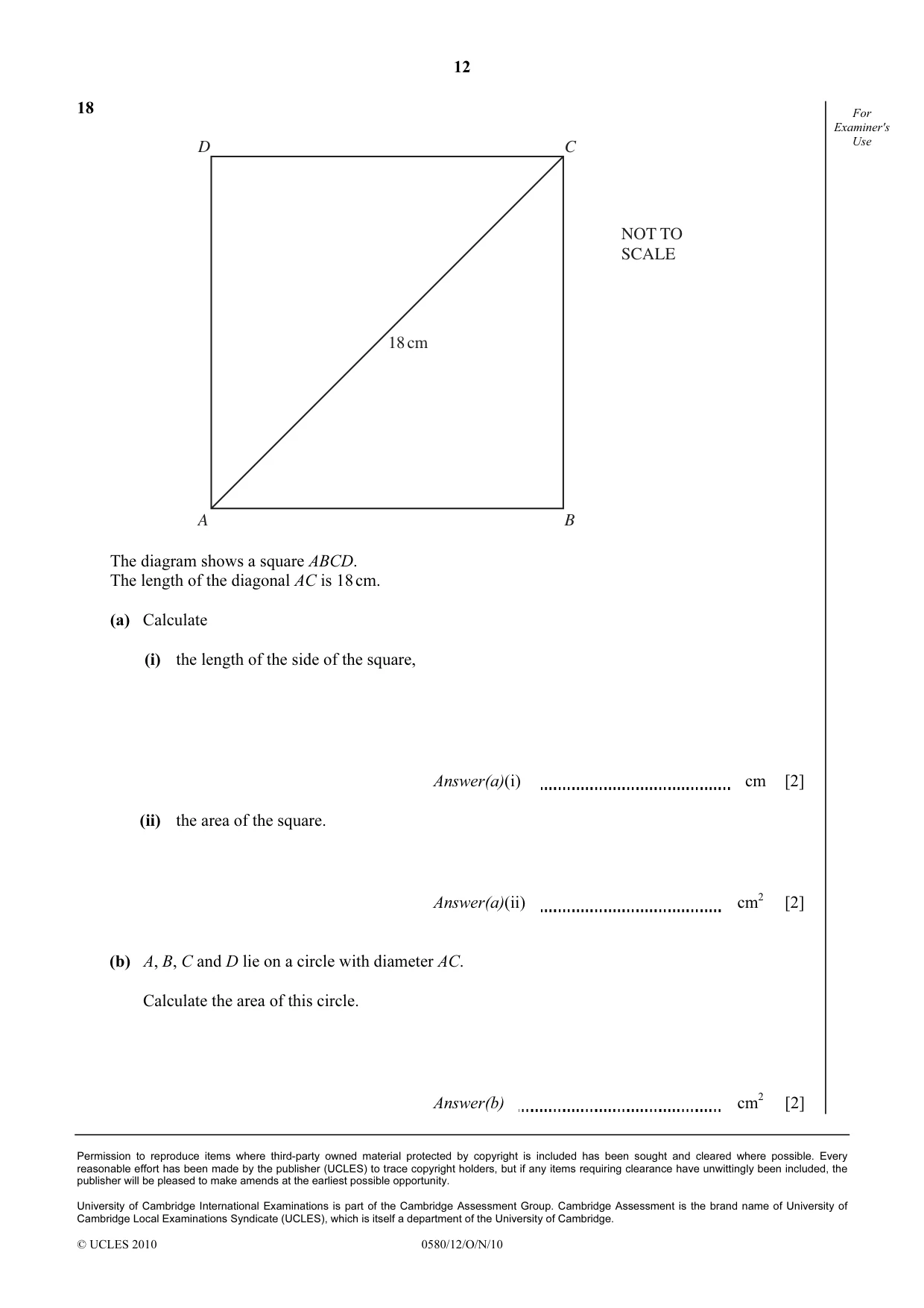
18 For Examiner's D C Use NOT TO SCALE 18 cm A B The diagram shows a square ABCD. The length of the diagonal AC is 18 cm. (a) Calculate (i) the length of the side of the square, Answer(a)(i) cm [2] (ii) the area of the square. Answer(a)(ii) cm2 [2] (b) A, B, C and D lie on a circle with diameter AC. Calculate the area of this circle. Answer(b) cm2 [2]
Mark scheme: x x 18 (a) (i) 12.7 to 12.73 2 M1 for = sin45 or = cos45 or better 18 18 (ii) 161 to 162.1 2ft M1 for method for squaring their (a)(i). (b) 254 to 255 2 M1 for π × 92
What was in this paper
The subtopics covered by these 18 questions, and how many questions each got. Open one in a new tab to see every Cambridge question on it.
What you needed in this session
Cambridge’s own grade thresholds for 2010 Oct/Nov, Paper 1 · Variant 2. A higher threshold means an easier paper — the bar moves with how the cohort did.