Cambridge IGCSE Mathematics 0580 — 2008 May/June Paper 1 · Variant 1
0580/11/M/J/08
The question paper and its mark scheme, free to read here and free to download. This is Cambridge’s own paper, exactly as it was sat.
Question paper25 pages
Mark scheme
No mark scheme is in the library for this paper.
Paper as text
Question paper, page 1
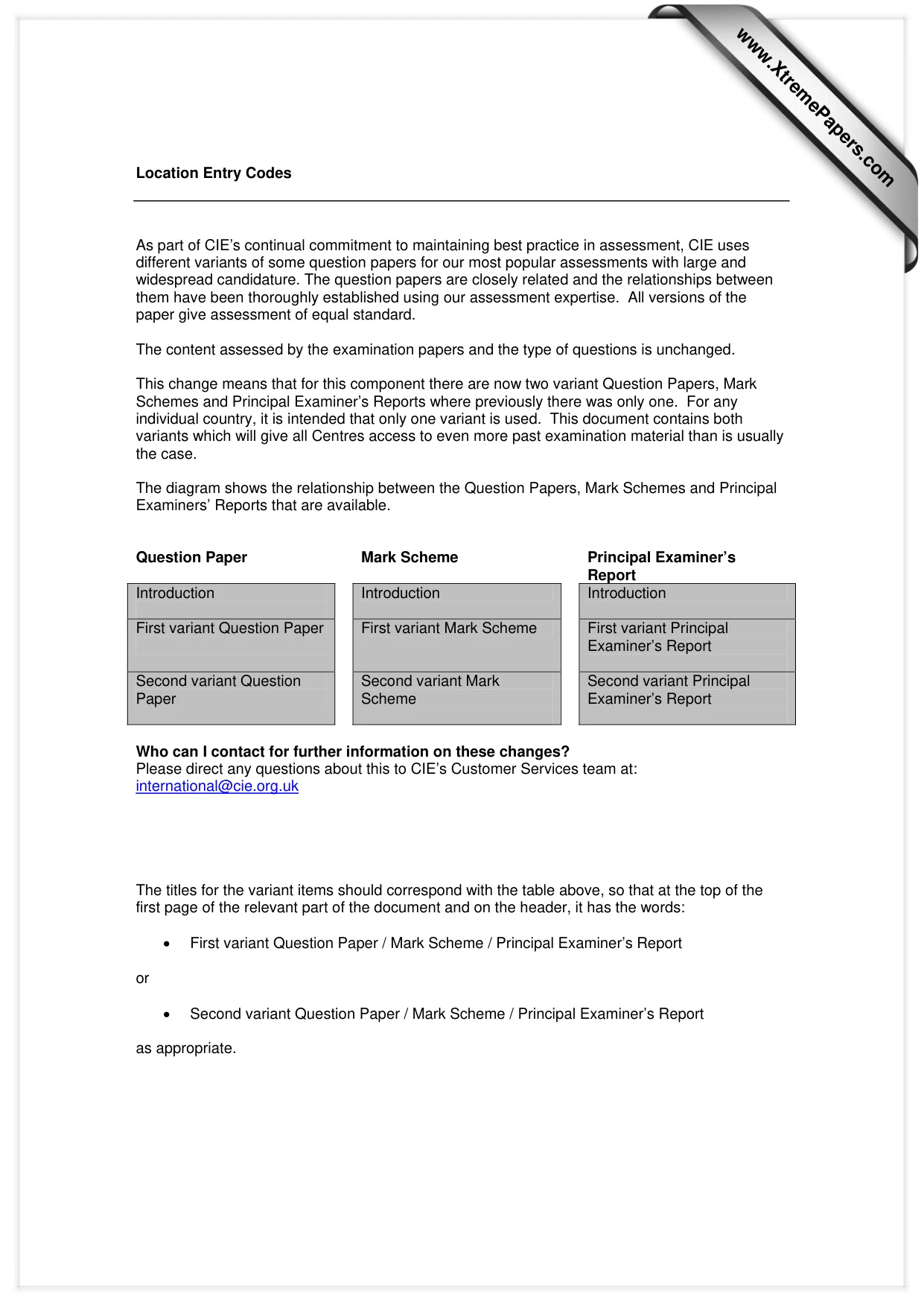
Location Entry Codes As part of CIE’s continual commitment to maintaining best practice in assessment, CIE uses different variants of some question papers for our most popular assessments with large and widespread candidature. The question papers are closely related and the relationships between them have been thoroughly established using our assessment expertise. All versions of the paper give assessment of equal standard. The content assessed by the examination papers and the type of questions is unchanged. This change means that for this component there are now two variant Question Papers, Mark Schemes and Principal Examiner’s Reports where previously there was only one. For any individual country, it is intended that only one variant is used. This document contains both variants which will give all Centres access to even more past examination material than is usually the case. The diagram shows the relationship between the Question Papers, Mark Schemes and Principal Examiners’ Reports that are available. Question Paper Mark Scheme Principal Examiner’s Report Introduction Introduction Introduction First variant Question Paper First variant Mark Scheme First variant Principal Examiner’s Report Second variant Question Paper Second variant Mark Scheme Second variant Principal Examiner’s Report Who can I contact for further information on these changes? Please direct any questions about this to CIE’s Customer Services team at: international@cie.org.uk The titles for the variant items should correspond with the table above, so that at the top of the first page of the relevant part of the document and on the header, it has the words: • First variant Question Paper / Mark Scheme / Principal Examiner’s Report or • Second variant Question Paper / Mark Scheme / Principal Examiner’s Report as appropriate. www.XtremePapers.com
Question paper, page 2
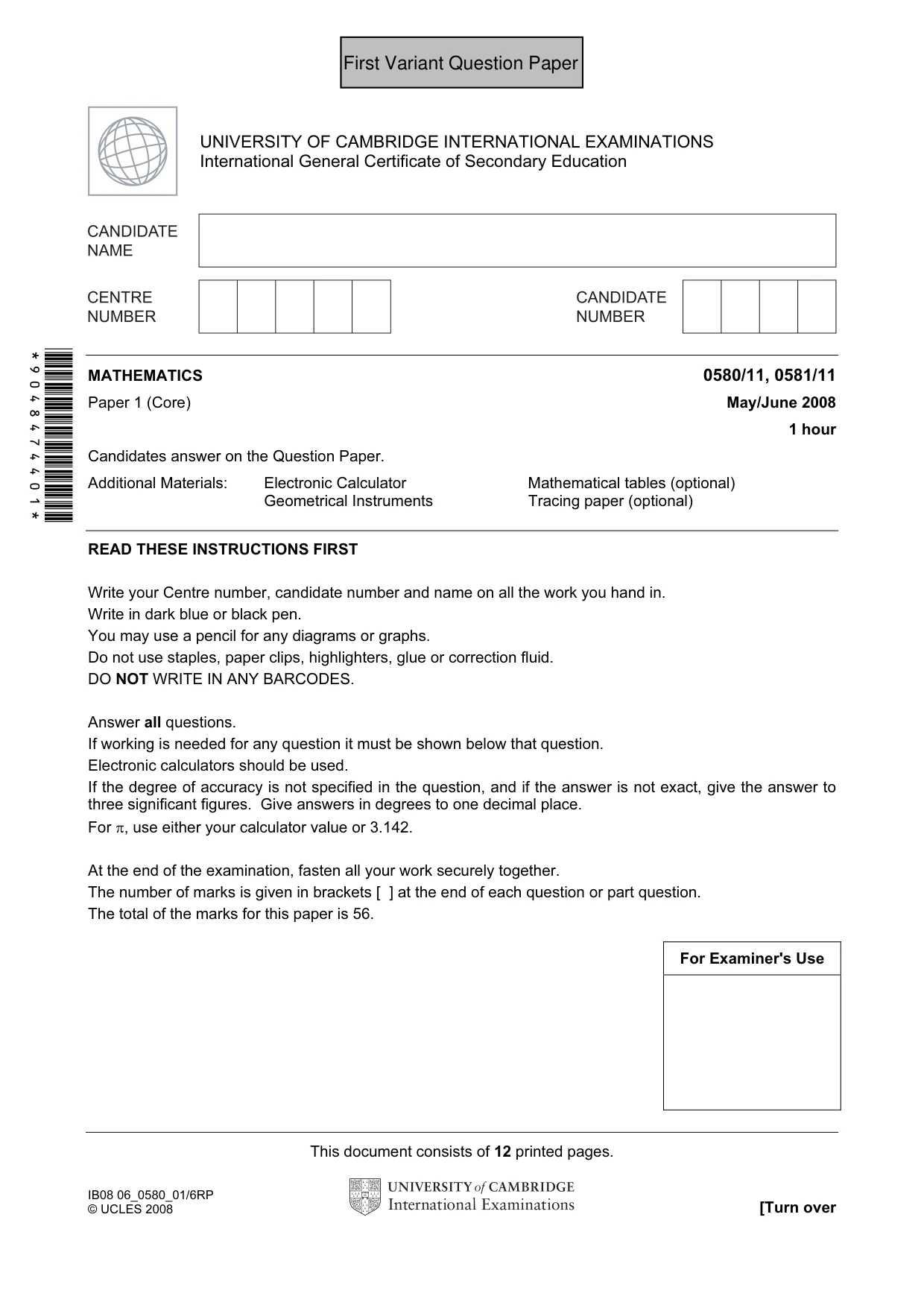
This document consists of 12 printed pages. IB08 06_0580_01/6RP © UCLES 2008 [Turn over *9048474401* For Examiner's Use UNIVERSITY OF CAMBRIDGE INTERNATIONAL EXAMINATIONS International General Certificate of Secondary Education MATHEMATICS 0580/11, 0581/11 Paper 1 (Core) May/June 2008 1 hour Candidates answer on the Question Paper. Additional Materials: Electronic Calculator Mathematical tables (optional) Geometrical Instruments Tracing paper (optional) READ THESE INSTRUCTIONS FIRST Write your Centre number, candidate number and name on all the work you hand in. Write in dark blue or black pen. You may use a pencil for any diagrams or graphs. Do not use staples, paper clips, highlighters, glue or correction fluid. DO NOT WRITE IN ANY BARCODES. Answer all questions. If working is needed for any question it must be shown below that question. Electronic calculators should be used. If the degree of accuracy is not specified in the question, and if the answer is not exact, give the answer to three significant figures. Give answers in degrees to one decimal place. For π, use either your calculator value or 3.142. At the end of the examination, fasten all your work securely together. The number of marks is given in brackets [ ] at the end of each question or part question. The total of the marks for this paper is 56. First Variant Question Paper
Question paper, page 3
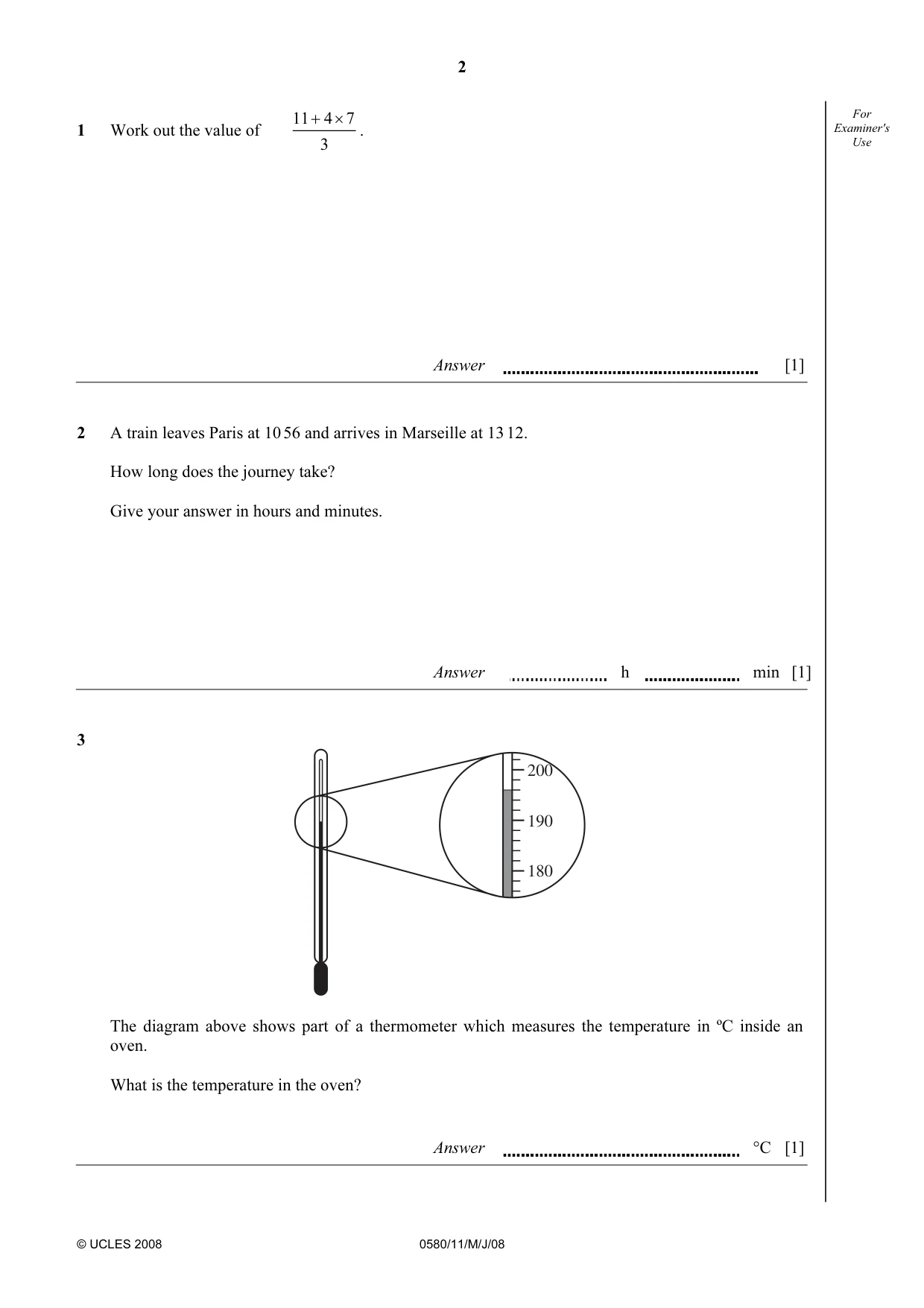
2 © UCLES 2008 0580/11/M/J/08 For Examiner's Use 1 Work out the value of 11 4 7 3 + × . Answer [1] 2 A train leaves Paris at 10 56 and arrives in Marseille at 13 12. How long does the journey take? Give your answer in hours and minutes. Answer h min [1] 3 200 190 180 The diagram above shows part of a thermometer which measures the temperature in ºC inside an oven. What is the temperature in the oven? Answer °C [1]
Question paper, page 4
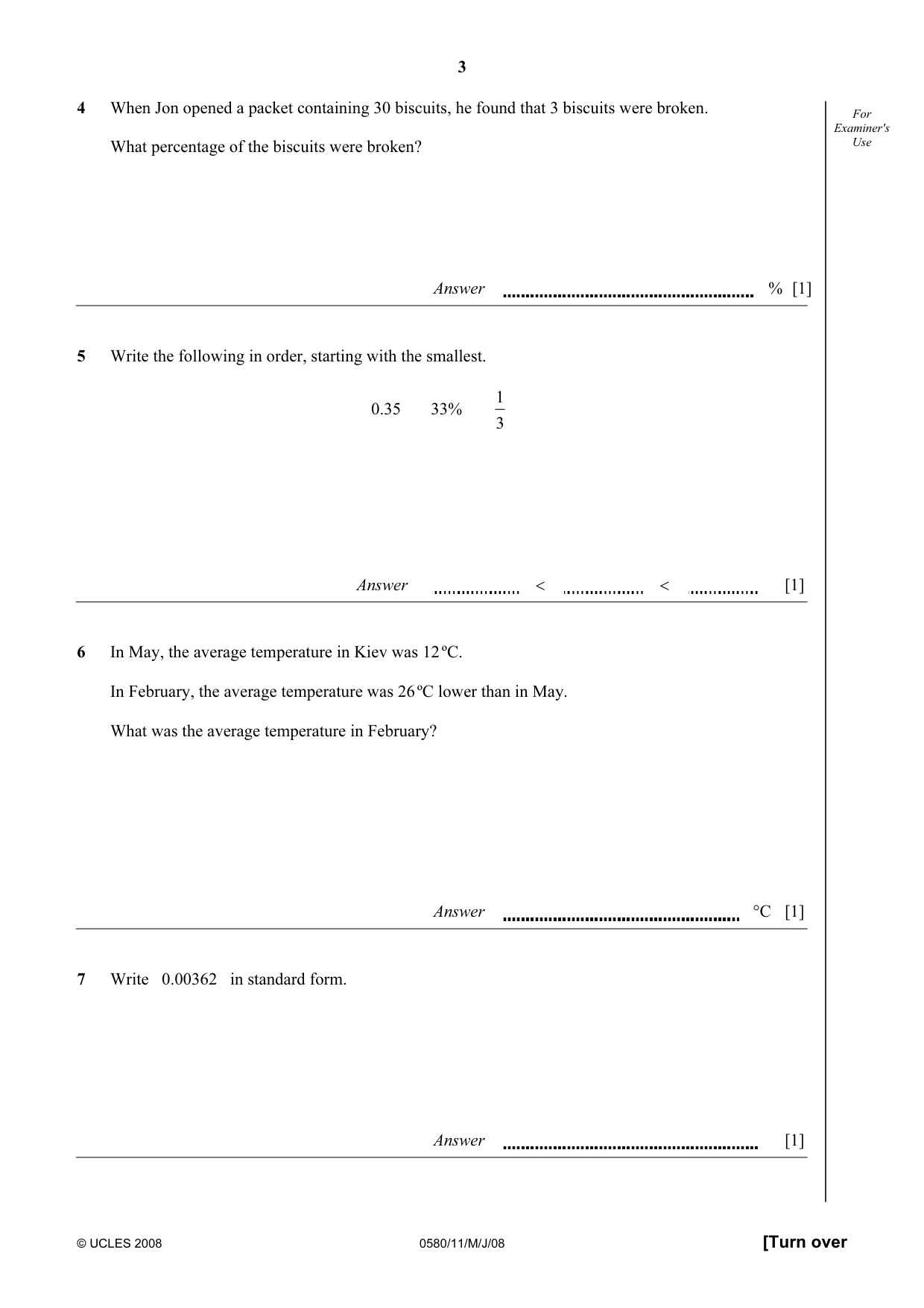
3 © UCLES 2008 0580/11/M/J/08 [Turn over For Examiner's Use 4 When Jon opened a packet containing 30 biscuits, he found that 3 biscuits were broken. What percentage of the biscuits were broken? Answer % [1] 5 Write the following in order, starting with the smallest. 0.35 33% 3 1 Answer < < [1] 6 In May, the average temperature in Kiev was 12 ºC. In February, the average temperature was 26 ºC lower than in May. What was the average temperature in February? Answer °C [1] 7 Write 0.00362 in standard form. Answer [1]
Question paper, page 5
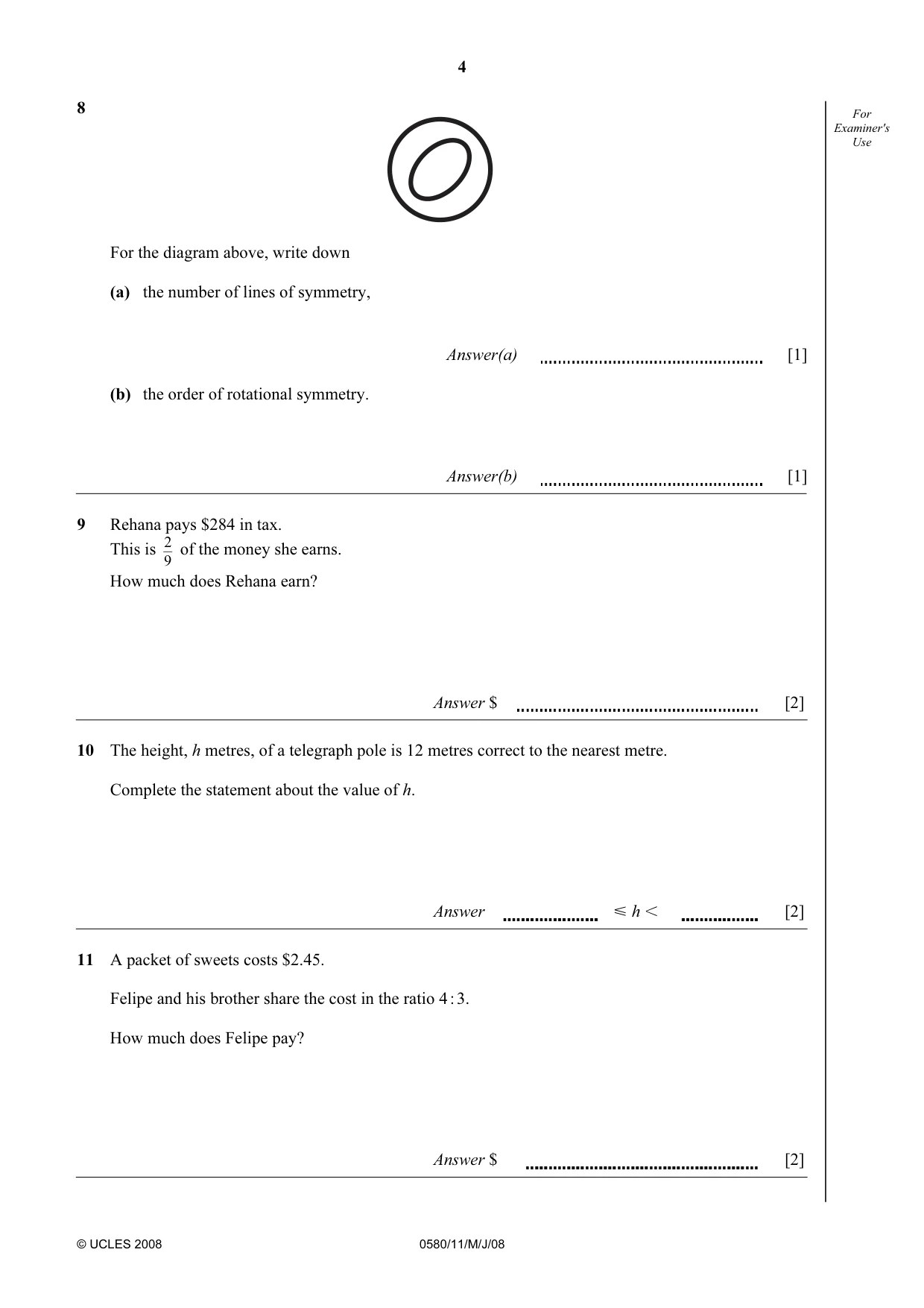
4 © UCLES 2008 0580/11/M/J/08 For Examiner's Use 8 For the diagram above, write down (a) the number of lines of symmetry, Answer(a) [1] (b) the order of rotational symmetry. Answer(b) [1] 9 Rehana pays $284 in tax. This is 2 9 of the money she earns. How much does Rehana earn? Answer $ [2] 10 The height, h metres, of a telegraph pole is 12 metres correct to the nearest metre. Complete the statement about the value of h. Answer Y h I [2] 11 A packet of sweets costs $2.45. Felipe and his brother share the cost in the ratio 4 : 3. How much does Felipe pay? Answer $ [2]
Question paper, page 6
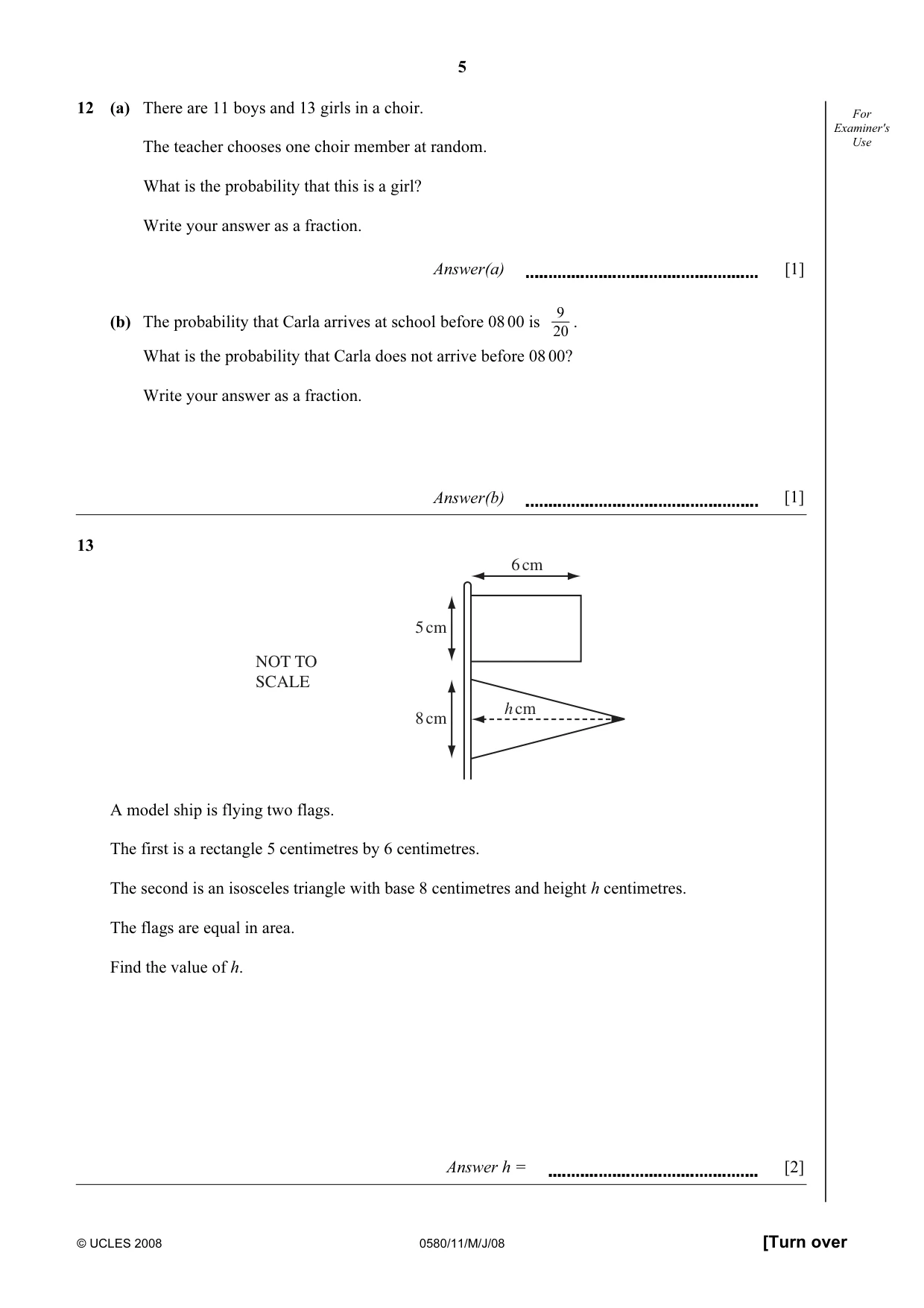
5 © UCLES 2008 0580/11/M/J/08 [Turn over For Examiner's Use 12 (a) There are 11 boys and 13 girls in a choir. The teacher chooses one choir member at random. What is the probability that this is a girl? Write your answer as a fraction. Answer(a) [1] (b) The probability that Carla arrives at school before 08 00 is 20 9 . What is the probability that Carla does not arrive before 08 00? Write your answer as a fraction. Answer(b) [1] 13 6 cm h cm 5 cm 8 cm NOT TO SCALE A model ship is flying two flags. The first is a rectangle 5 centimetres by 6 centimetres. The second is an isosceles triangle with base 8 centimetres and height h centimetres. The flags are equal in area. Find the value of h. Answer h = [2]
Question paper, page 7
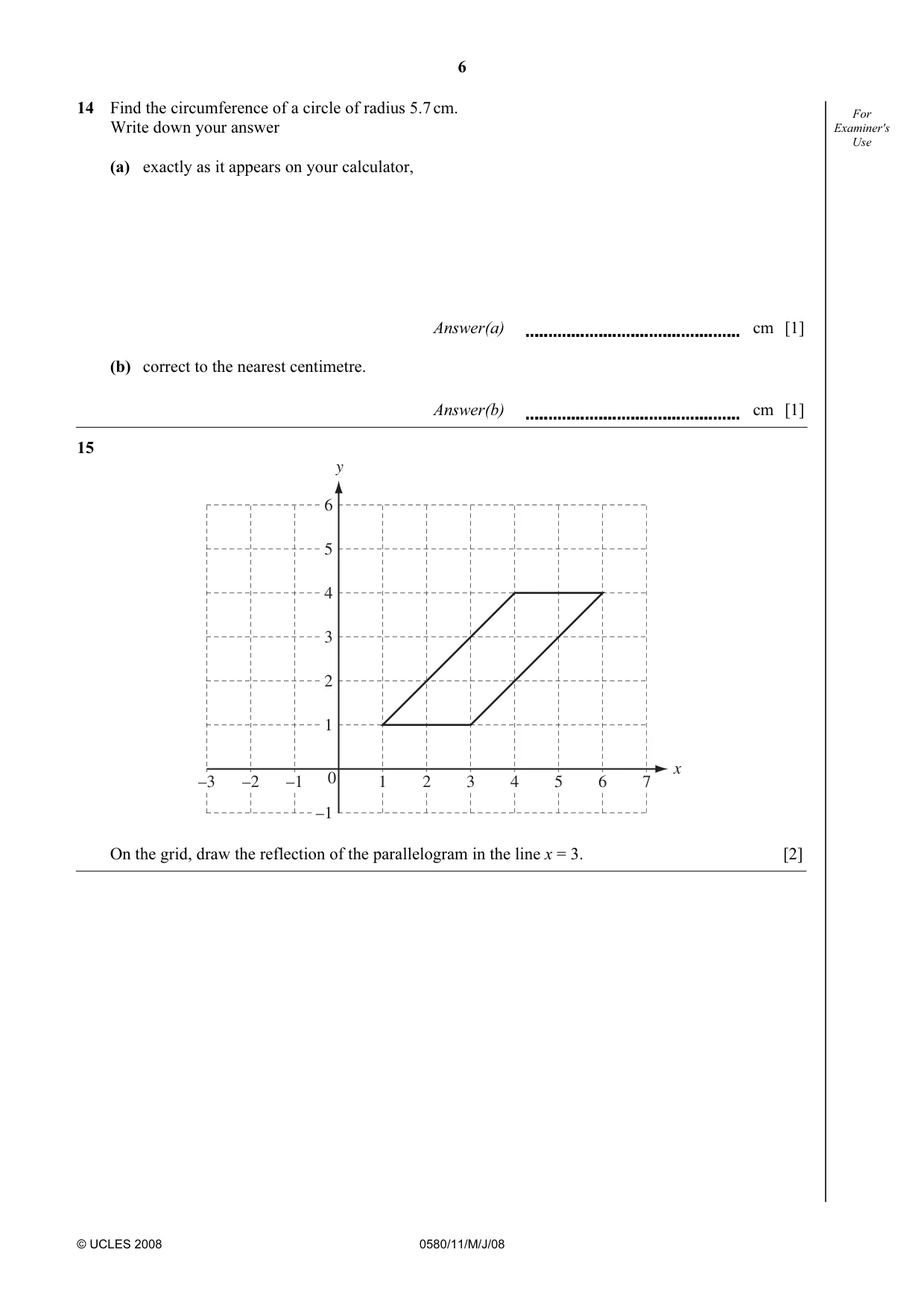
6 © UCLES 2008 0580/11/M/J/08 For Examiner's Use 14 Find the circumference of a circle of radius 5.7 cm. Write down your answer (a) exactly as it appears on your calculator, Answer(a) cm [1] (b) correct to the nearest centimetre. Answer(b) cm [1] 15 7 6 5 4 3 2 1 –1 –2 –3 6 5 4 3 2 1 –1 0 y x On the grid, draw the reflection of the parallelogram in the line x = 3. [2]
Question paper, page 8
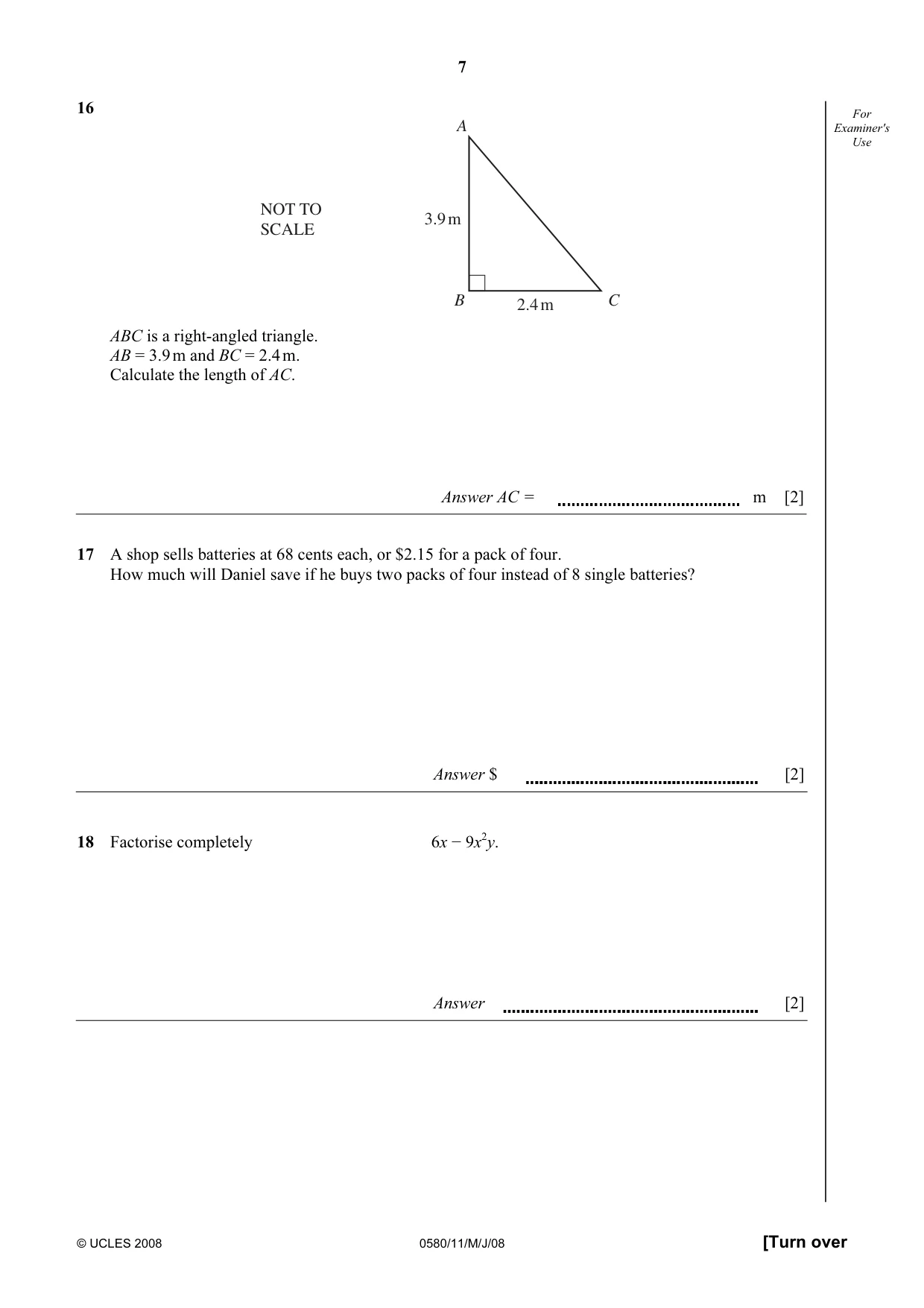
7 © UCLES 2008 0580/11/M/J/08 [Turn over For Examiner's Use 16 NOT TO SCALE 2.4 m 3.9 m A B C ABC is a right-angled triangle. AB = 3.9 m and BC = 2.4 m. Calculate the length of AC. Answer AC = m [2] 17 A shop sells batteries at 68 cents each, or $2.15 for a pack of four. How much will Daniel save if he buys two packs of four instead of 8 single batteries? Answer $ [2] 18 Factorise completely 6x − 9x2y. Answer [2]
Question paper, page 9
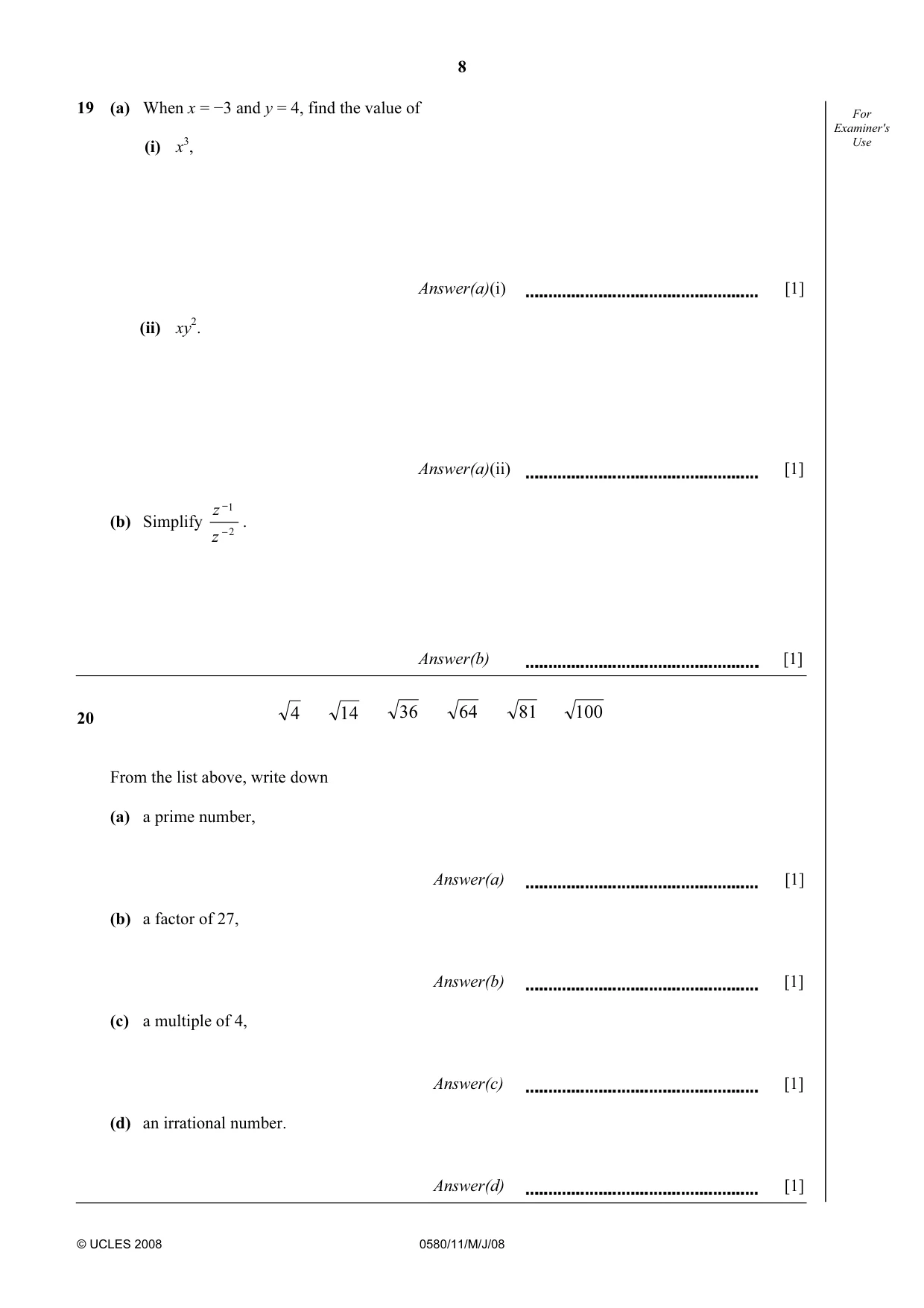
8 © UCLES 2008 0580/11/M/J/08 For Examiner's Use 19 (a) When x = −3 and y = 4, find the value of (i) x3, Answer(a)(i) [1] (ii) xy2. Answer(a)(ii) [1] (b) Simplify 1 2 z z − − . Answer(b) [1] 20 4 14 36 64 81 100 From the list above, write down (a) a prime number, Answer(a) [1] (b) a factor of 27, Answer(b) [1] (c) a multiple of 4, Answer(c) [1] (d) an irrational number. Answer(d) [1]
Question paper, page 10
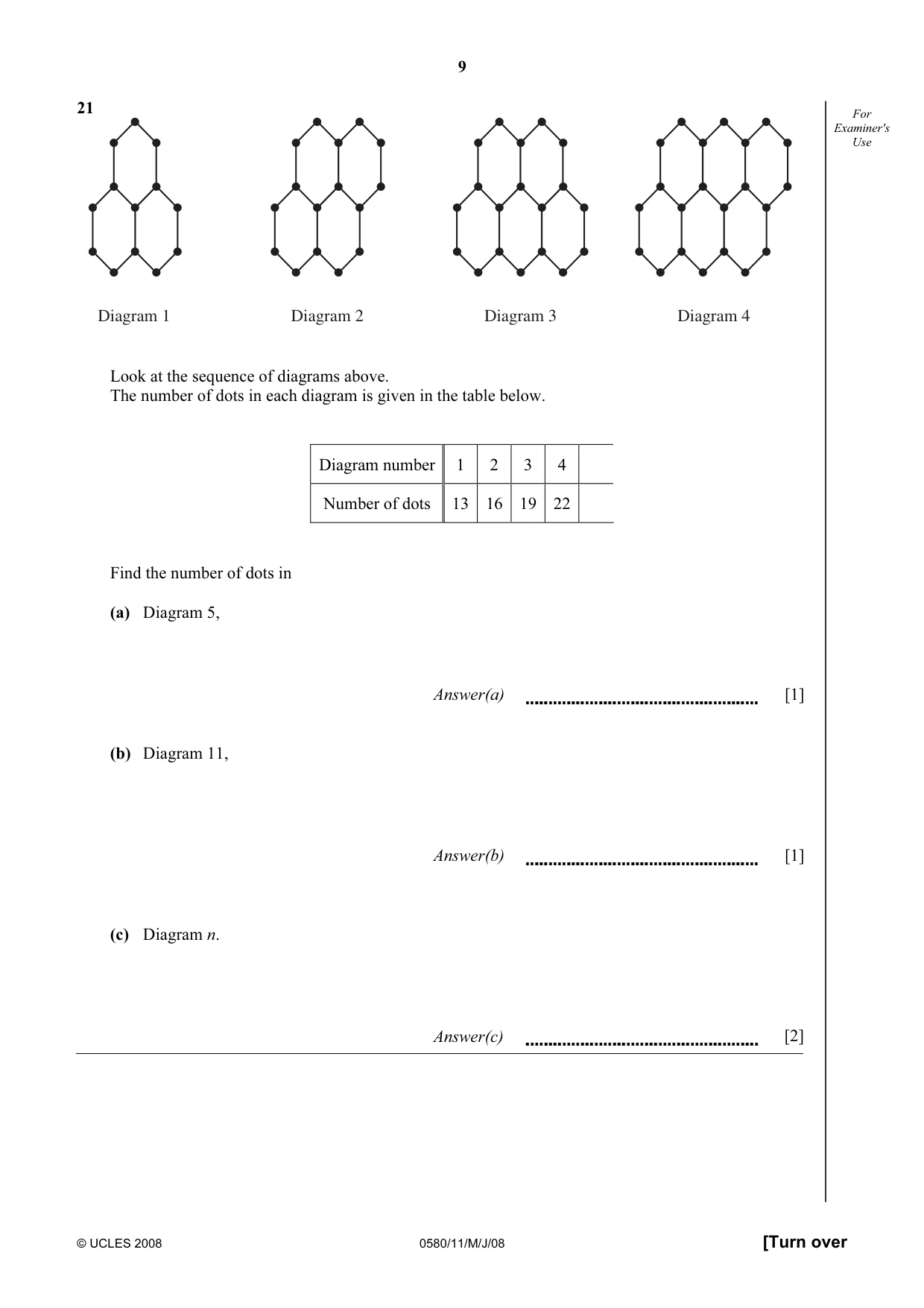
9 © UCLES 2008 0580/11/M/J/08 [Turn over For Examiner's Use 21 Diagram 1 Diagram 2 Diagram 3 Diagram 4 Look at the sequence of diagrams above. The number of dots in each diagram is given in the table below. Diagram number 1 2 3 4 Number of dots 13 16 19 22 Find the number of dots in (a) Diagram 5, Answer(a) [1] (b) Diagram 11, Answer(b) [1] (c) Diagram n. Answer(c) [2]
Question paper, page 11
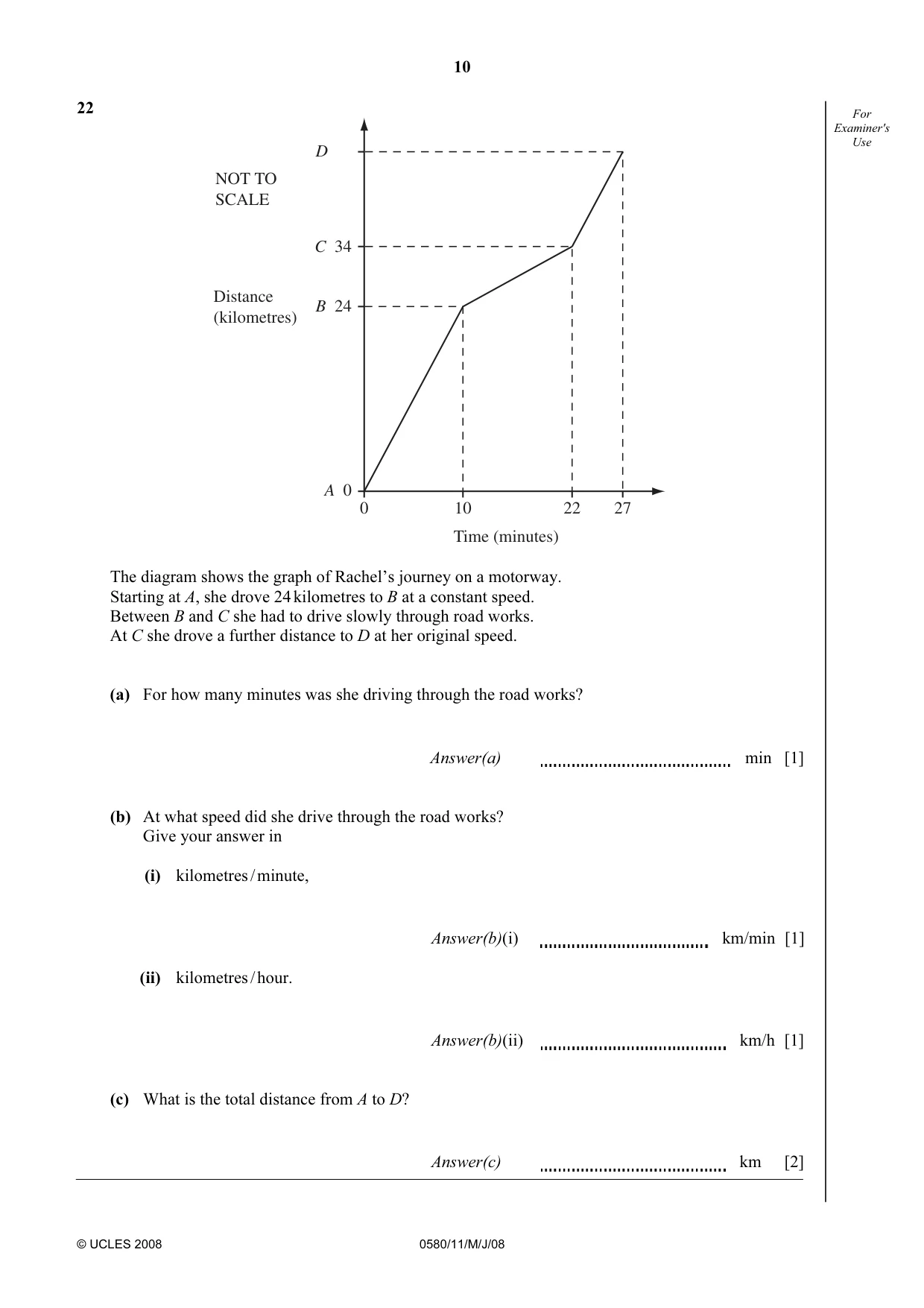
10 © UCLES 2008 0580/11/M/J/08 For Examiner's Use 22 D C 34 B 24 A 0 10 22 27 0 Time (minutes) Distance (kilometres) NOT TO SCALE The diagram shows the graph of Rachel’s journey on a motorway. Starting at A, she drove 24 kilometres to B at a constant speed. Between B and C she had to drive slowly through road works. At C she drove a further distance to D at her original speed. (a) For how many minutes was she driving through the road works? Answer(a) min [1] (b) At what speed did she drive through the road works? Give your answer in (i) kilometres / minute, Answer(b)(i) km/min [1] (ii) kilometres / hour. Answer(b)(ii) km/h [1] (c) What is the total distance from A to D? Answer(c) km [2]
Question paper, page 12
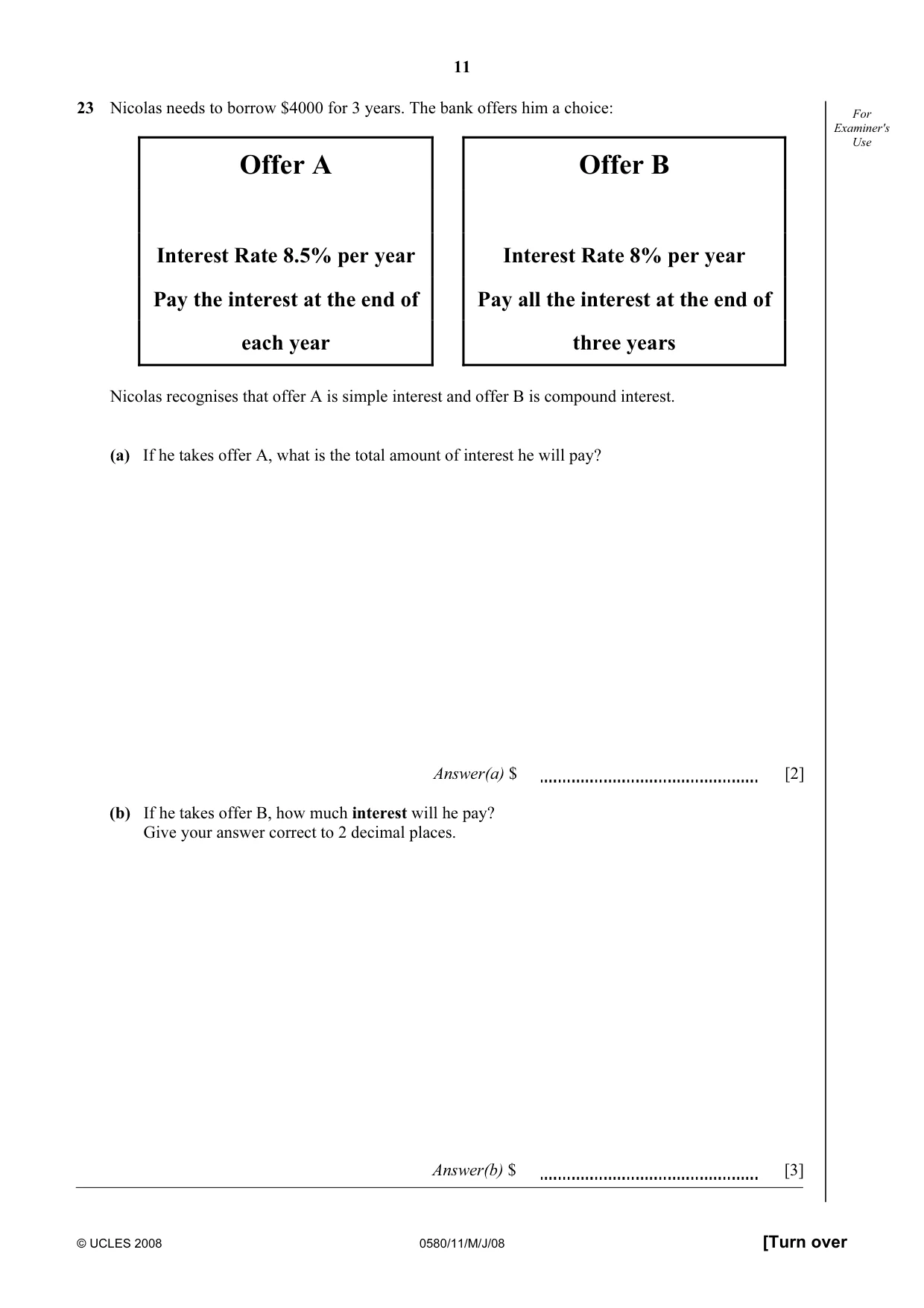
11 © UCLES 2008 0580/11/M/J/08 [Turn over For Examiner's Use 23 Nicolas needs to borrow $4000 for 3 years. The bank offers him a choice: Offer A Offer B Interest Rate 8.5% per year Interest Rate 8% per year Pay the interest at the end of Pay all the interest at the end of each year three years Nicolas recognises that offer A is simple interest and offer B is compound interest. (a) If he takes offer A, what is the total amount of interest he will pay? Answer(a) $ [2] (b) If he takes offer B, how much interest will he pay? Give your answer correct to 2 decimal places. Answer(b) $ [3]
Question paper, page 13
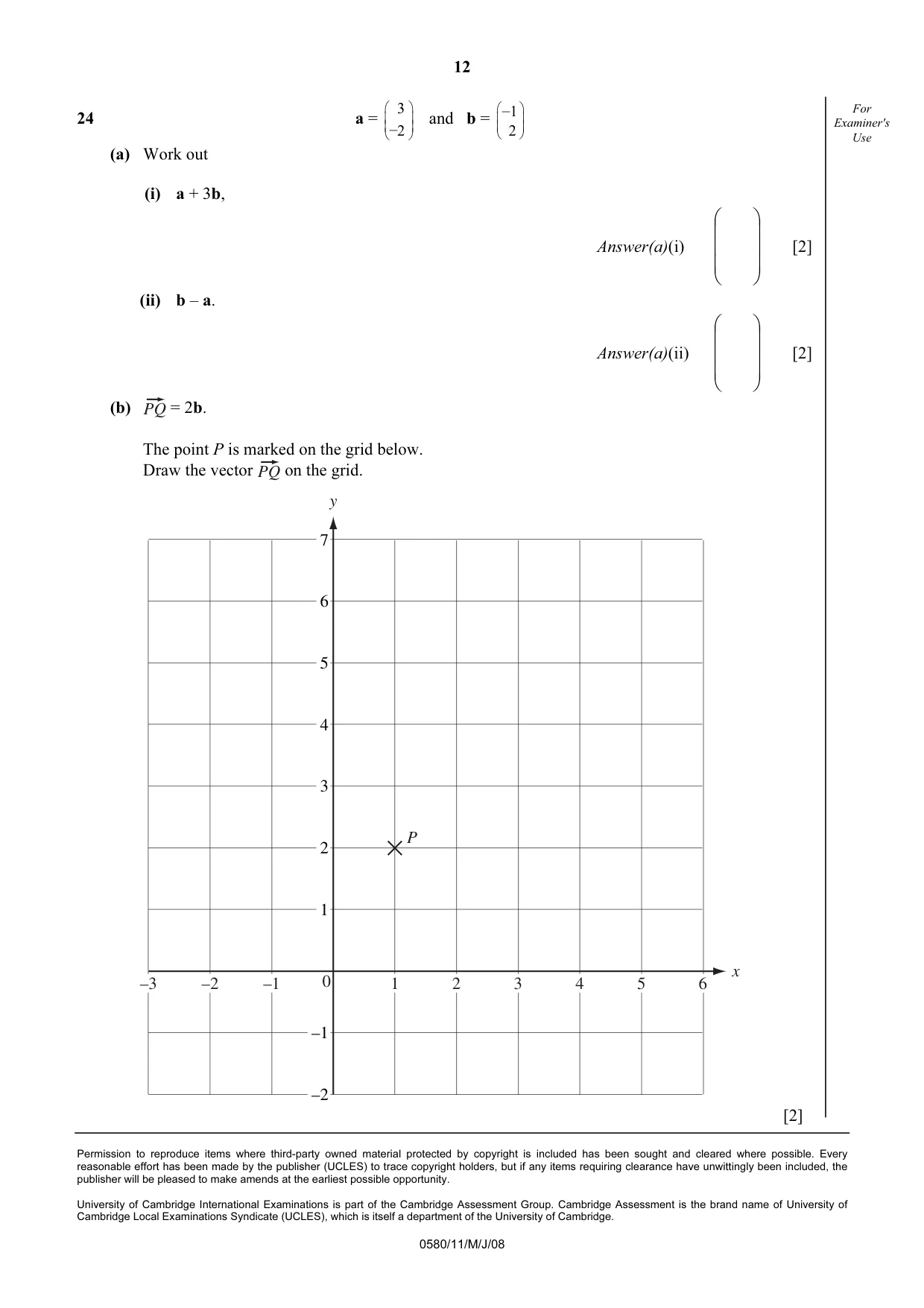
12 Permission to reproduce items where third-party owned material protected by copyright is included has been sought and cleared where possible. Every reasonable effort has been made by the publisher (UCLES) to trace copyright holders, but if any items requiring clearance have unwittingly been included, the publisher will be pleased to make amends at the earliest possible opportunity. University of Cambridge International Examinations is part of the Cambridge Assessment Group. Cambridge Assessment is the brand name of University of Cambridge Local Examinations Syndicate (UCLES), which is itself a department of the University of Cambridge. 0580/11/M/J/08 For Examiner's Use 24 a = 3 _2 and b = _1 2 (a) Work out (i) a + 3b, Answer(a)(i) [2] (ii) b – a. Answer(a)(ii) [2] (b) PQ = 2b. The point P is marked on the grid below. Draw the vector PQ on the grid. –3 –2 –1 1 2 3 4 5 6 0 7 6 5 4 3 2 1 –1 –2 P y x [2]
Question paper, page 14
This document consists of 12 printed pages. IB08 06_0580_12/RP © UCLES 2008 [Turn over *9394071992* UNIVERSITY OF CAMBRIDGE INTERNATIONAL EXAMINATIONS International General Certificate of Secondary Education MATHEMATICS 0580/12, 0581/12 Paper 1 (Core) May/June 2008 1 hour Candidates answer on the Question Paper. Additional Materials: Electronic Calculator Mathematical tables (optional) Geometrical Instruments Tracing paper (optional) READ THESE INSTRUCTIONS FIRST Write your Centre number, candidate number and name on all the work you hand in. Write in dark blue or black pen. You may use a pencil for any diagrams or graphs. Do not use staples, paper clips, highlighters, glue or correction fluid. DO NOT WRITE IN ANY BARCODES. Answer all questions. If working is needed for any question it must be shown below that question. Electronic calculators should be used. If the degree of accuracy is not specified in the question, and if the answer is not exact, give the answer to three significant figures. Give answers in degrees to one decimal place. For π, use either your calculator value or 3.142. At the end of the examination, fasten all your work securely together. The number of marks is given in brackets [ ] at the end of each question or part question. The total of the marks for this paper is 56. Second Variant Question Paper
Question paper, page 15
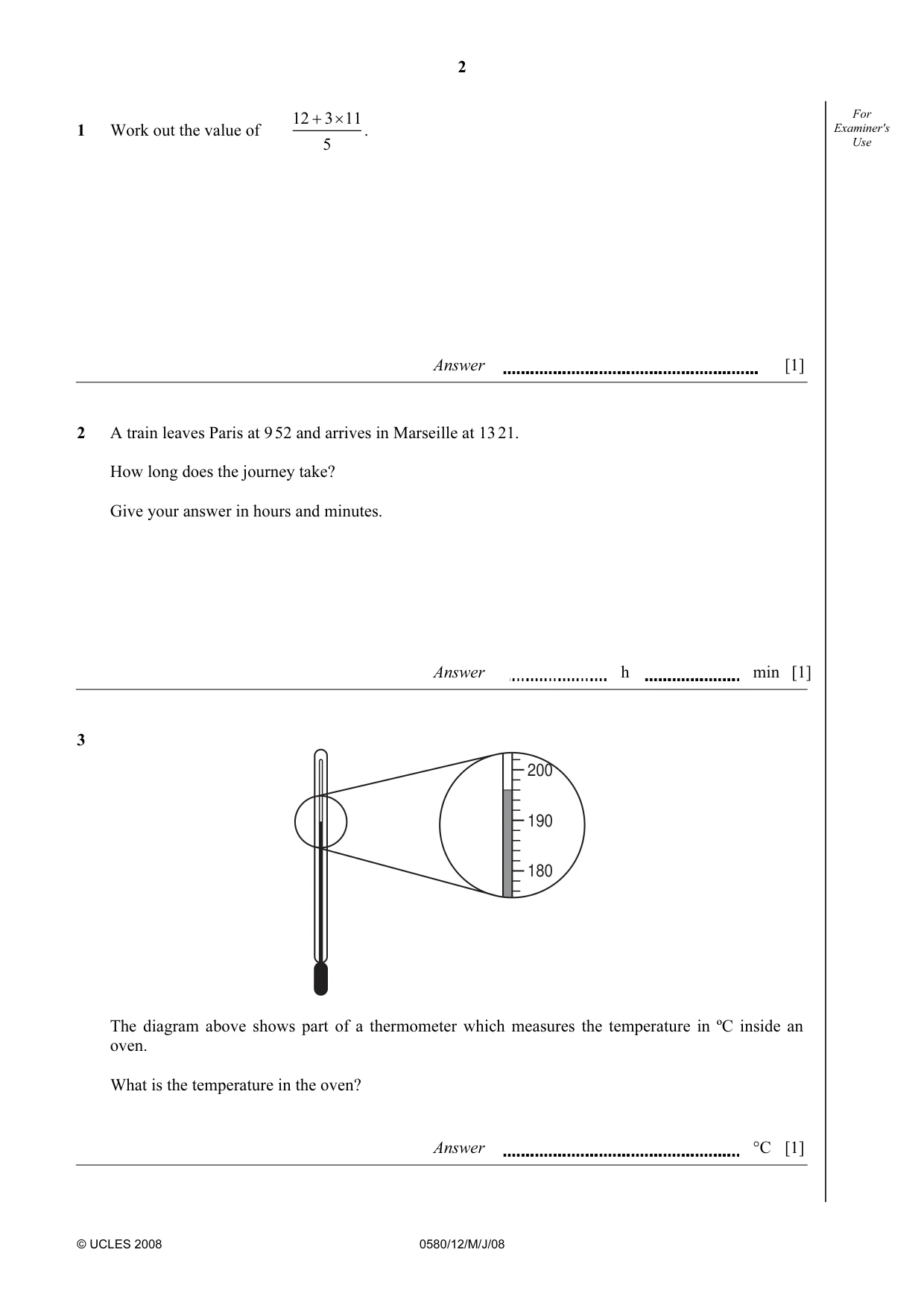
2 © UCLES 2008 0580/12/M/J/08 For Examiner's Use 1 Work out the value of 12 3 11 5 + × . Answer [1] 2 A train leaves Paris at 9 52 and arrives in Marseille at 13 21. How long does the journey take? Give your answer in hours and minutes. Answer h min [1] 3 200 190 180 The diagram above shows part of a thermometer which measures the temperature in ºC inside an oven. What is the temperature in the oven? Answer °C [1]
Question paper, page 16
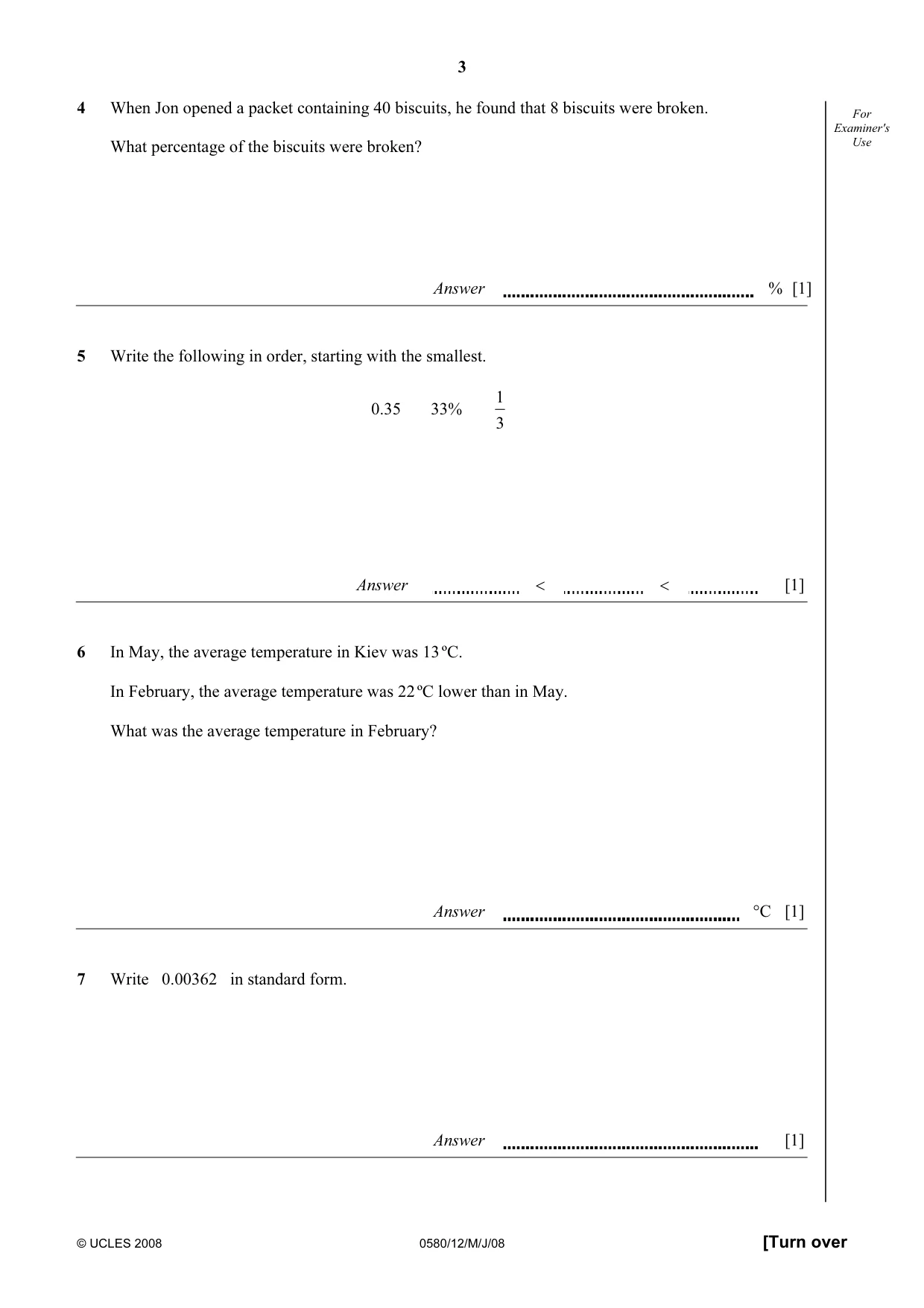
3 © UCLES 2008 0580/12/M/J/08 [Turn over For Examiner's Use 4 When Jon opened a packet containing 40 biscuits, he found that 8 biscuits were broken. What percentage of the biscuits were broken? Answer % [1] 5 Write the following in order, starting with the smallest. 0.35 33% 3 1 Answer < < [1] 6 In May, the average temperature in Kiev was 13 ºC. In February, the average temperature was 22 ºC lower than in May. What was the average temperature in February? Answer °C [1] 7 Write 0.00362 in standard form. Answer [1]
Question paper, page 17
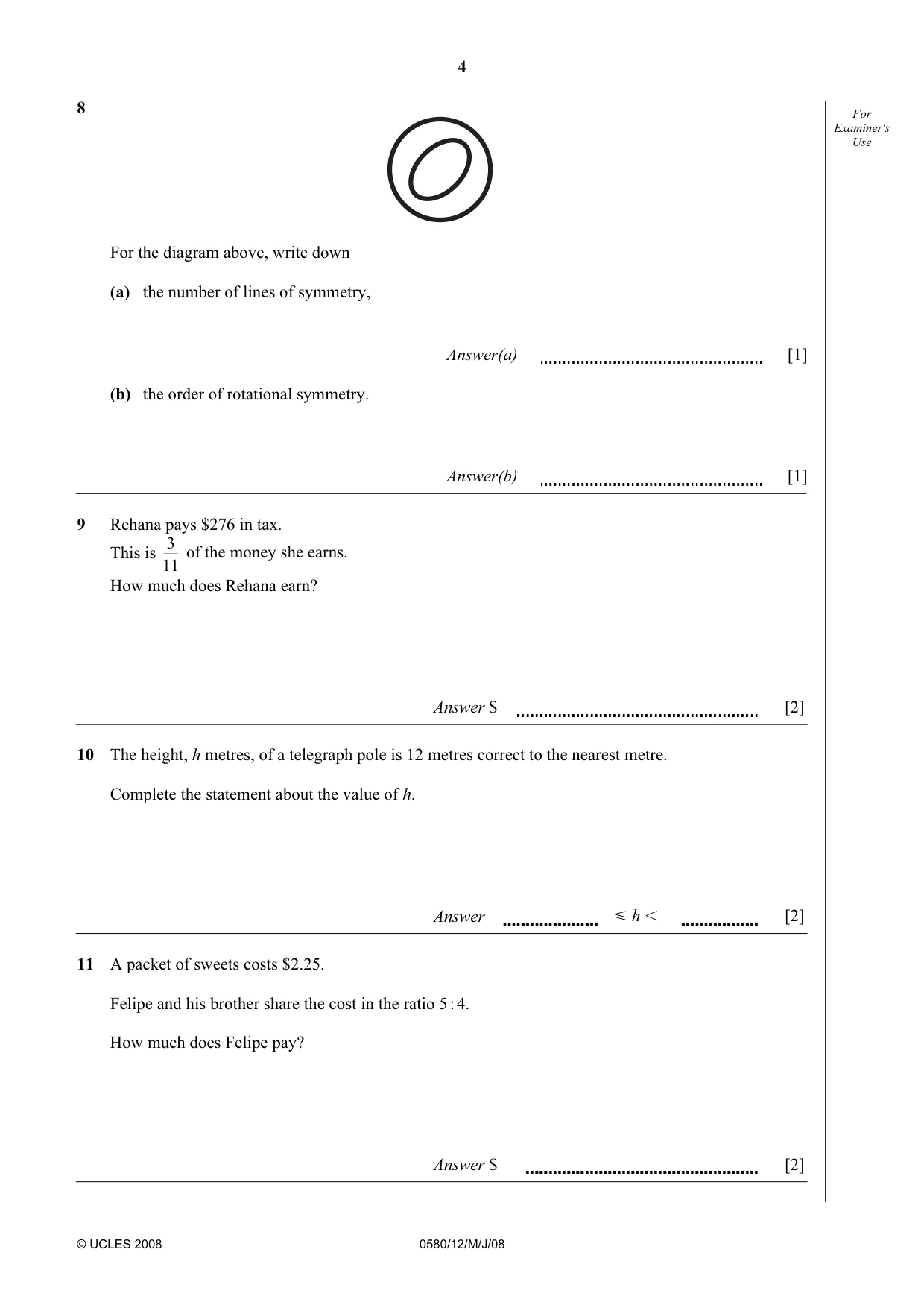
4 © UCLES 2008 0580/12/M/J/08 For Examiner's Use 8 For the diagram above, write down (a) the number of lines of symmetry, Answer(a) [1] (b) the order of rotational symmetry. Answer(b) [1] 9 Rehana pays $276 in tax. This is 3 11 of the money she earns. How much does Rehana earn? Answer $ [2] 10 The height, h metres, of a telegraph pole is 12 metres correct to the nearest metre. Complete the statement about the value of h. Answer Y h I [2] 11 A packet of sweets costs $2.25. Felipe and his brother share the cost in the ratio 5 : 4. How much does Felipe pay? Answer $ [2]
Question paper, page 18
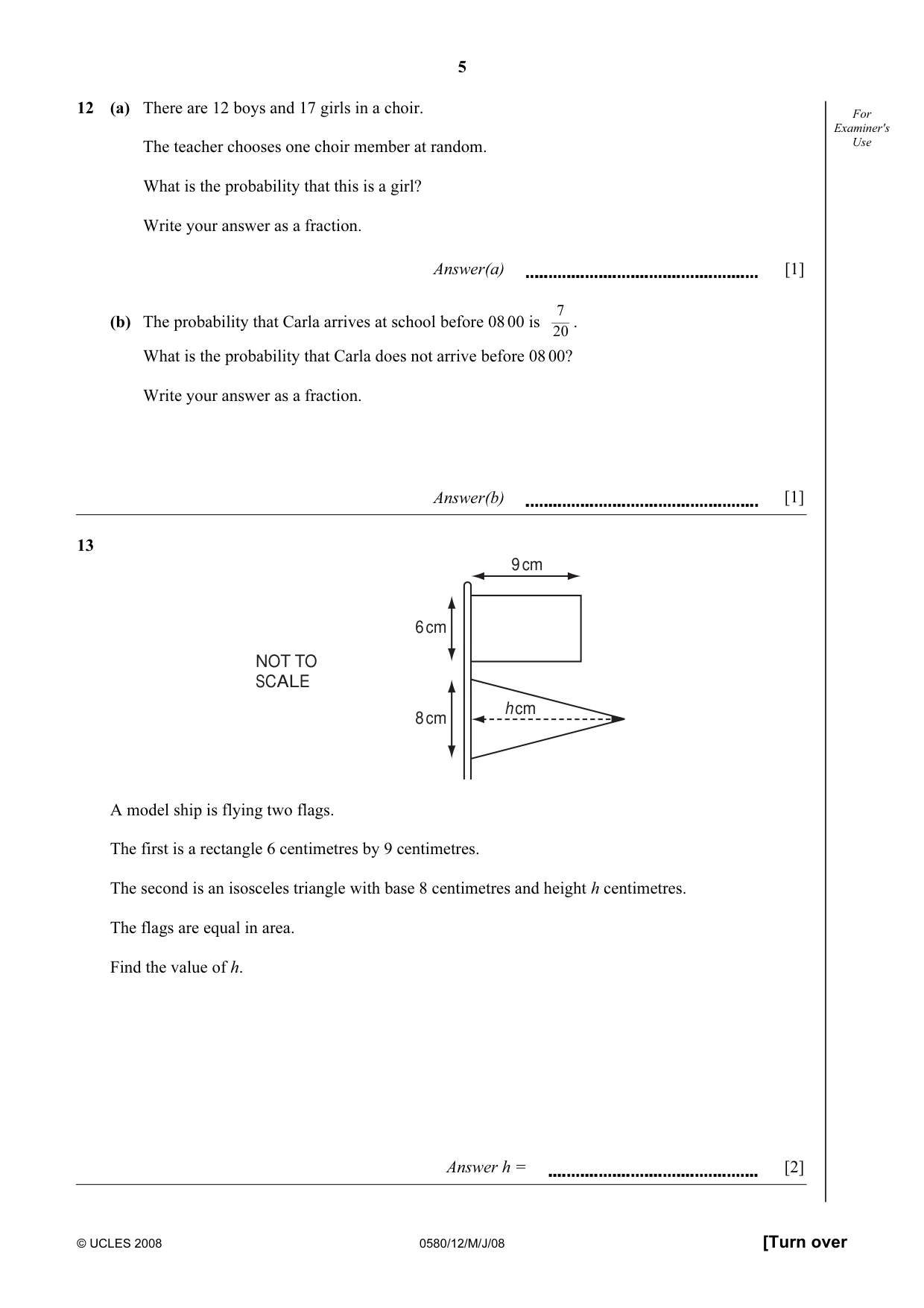
5 © UCLES 2008 0580/12/M/J/08 [Turn over For Examiner's Use 12 (a) There are 12 boys and 17 girls in a choir. The teacher chooses one choir member at random. What is the probability that this is a girl? Write your answer as a fraction. Answer(a) [1] (b) The probability that Carla arrives at school before 08 00 is 7 20 . What is the probability that Carla does not arrive before 08 00? Write your answer as a fraction. Answer(b) [1] 13 9 cm h cm 6 cm 8 cm NOT TO SCALE A model ship is flying two flags. The first is a rectangle 6 centimetres by 9 centimetres. The second is an isosceles triangle with base 8 centimetres and height h centimetres. The flags are equal in area. Find the value of h. Answer h = [2]
Question paper, page 19
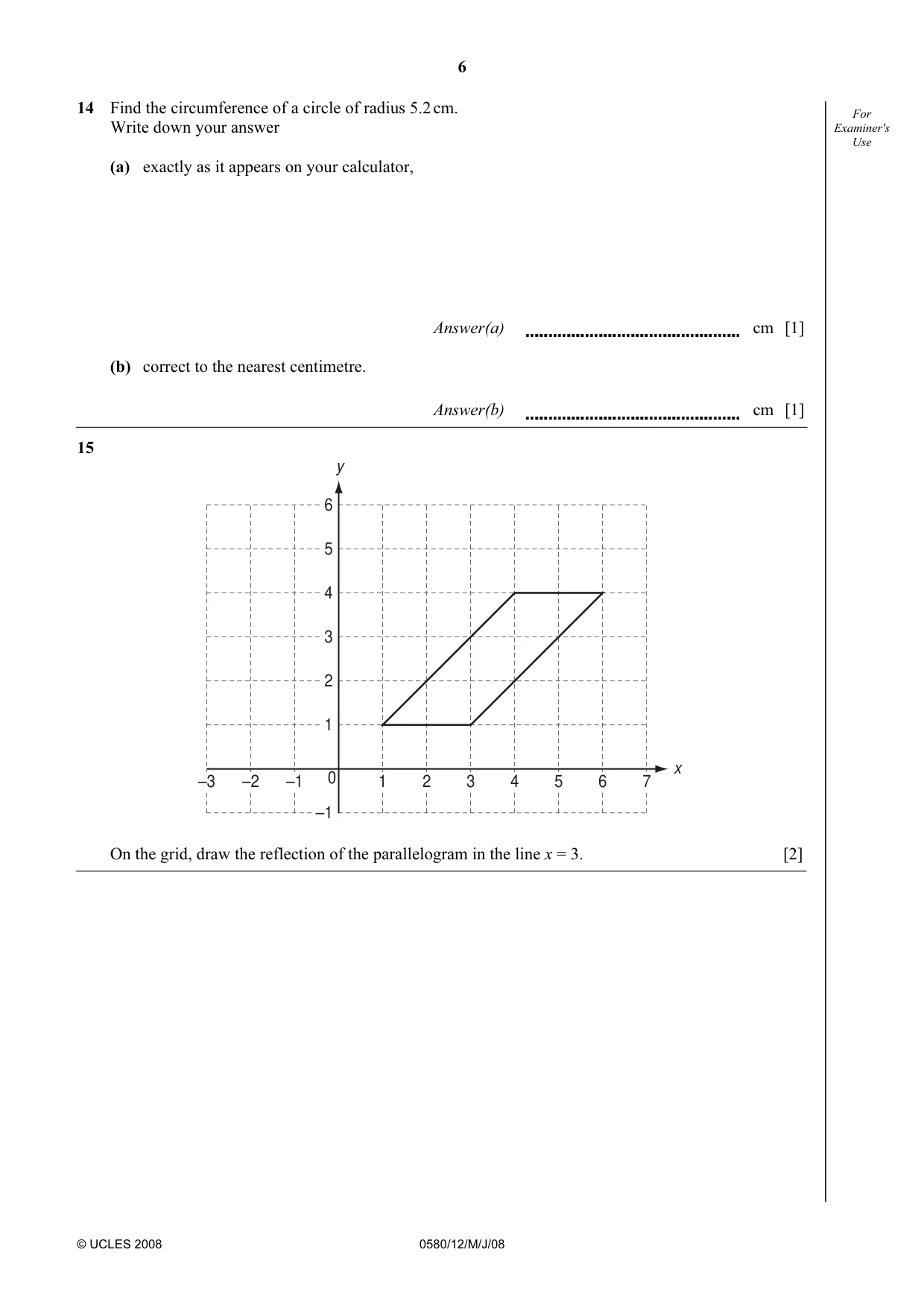
6 © UCLES 2008 0580/12/M/J/08 For Examiner's Use 14 Find the circumference of a circle of radius 5.2 cm. Write down your answer (a) exactly as it appears on your calculator, Answer(a) cm [1] (b) correct to the nearest centimetre. Answer(b) cm [1] 15 7 6 5 4 3 2 1 –1 –2 –3 6 5 4 3 2 1 –1 0 y x On the grid, draw the reflection of the parallelogram in the line x = 3. [2]
Question paper, page 20
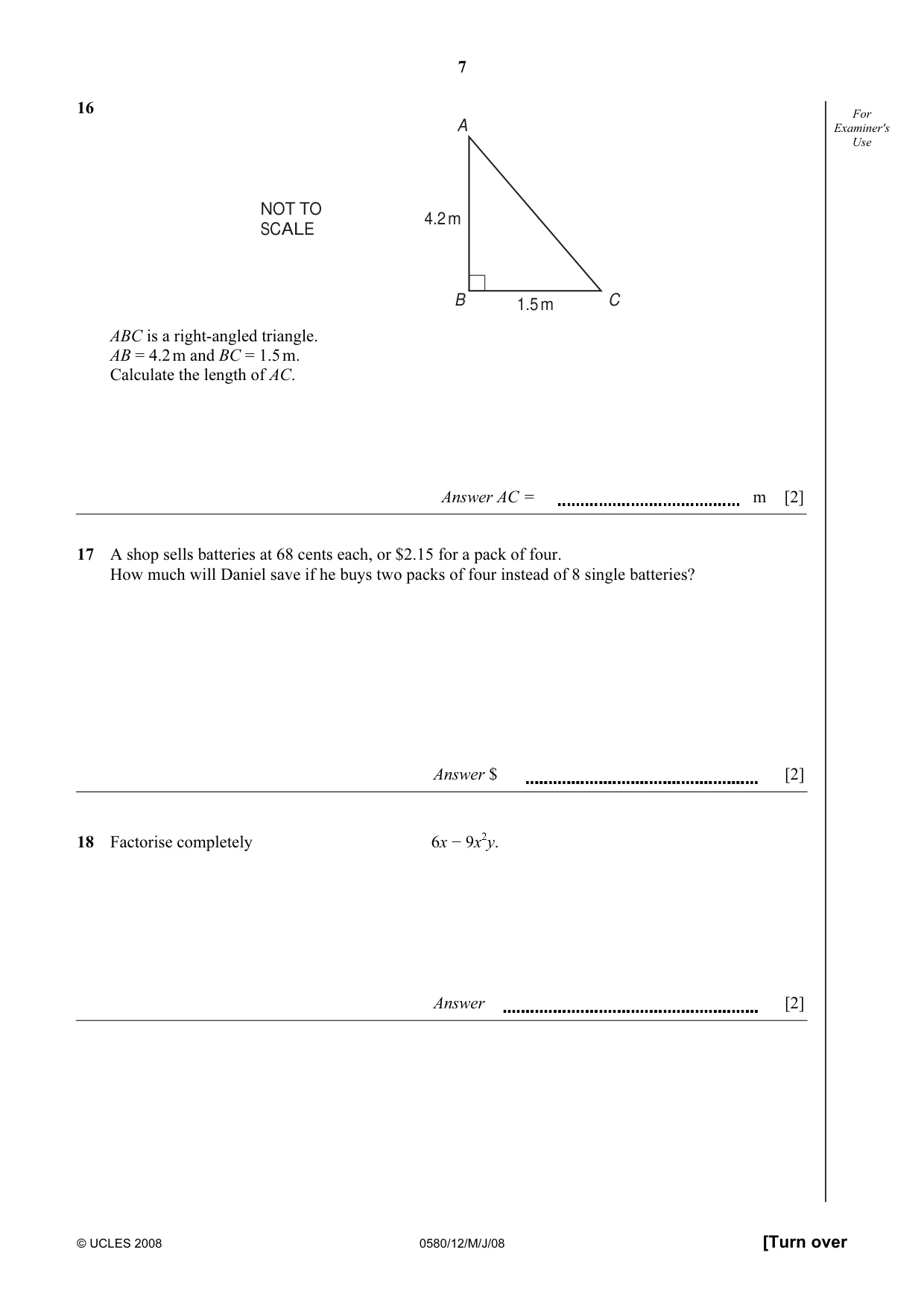
7 © UCLES 2008 0580/12/M/J/08 [Turn over For Examiner's Use 16 NOT TO SCALE 1.5 m 4.2 m A B C ABC is a right-angled triangle. AB = 4.2 m and BC = 1.5 m. Calculate the length of AC. Answer AC = m [2] 17 A shop sells batteries at 68 cents each, or $2.15 for a pack of four. How much will Daniel save if he buys two packs of four instead of 8 single batteries? Answer $ [2] 18 Factorise completely 6x − 9x2y. Answer [2]
Question paper, page 21
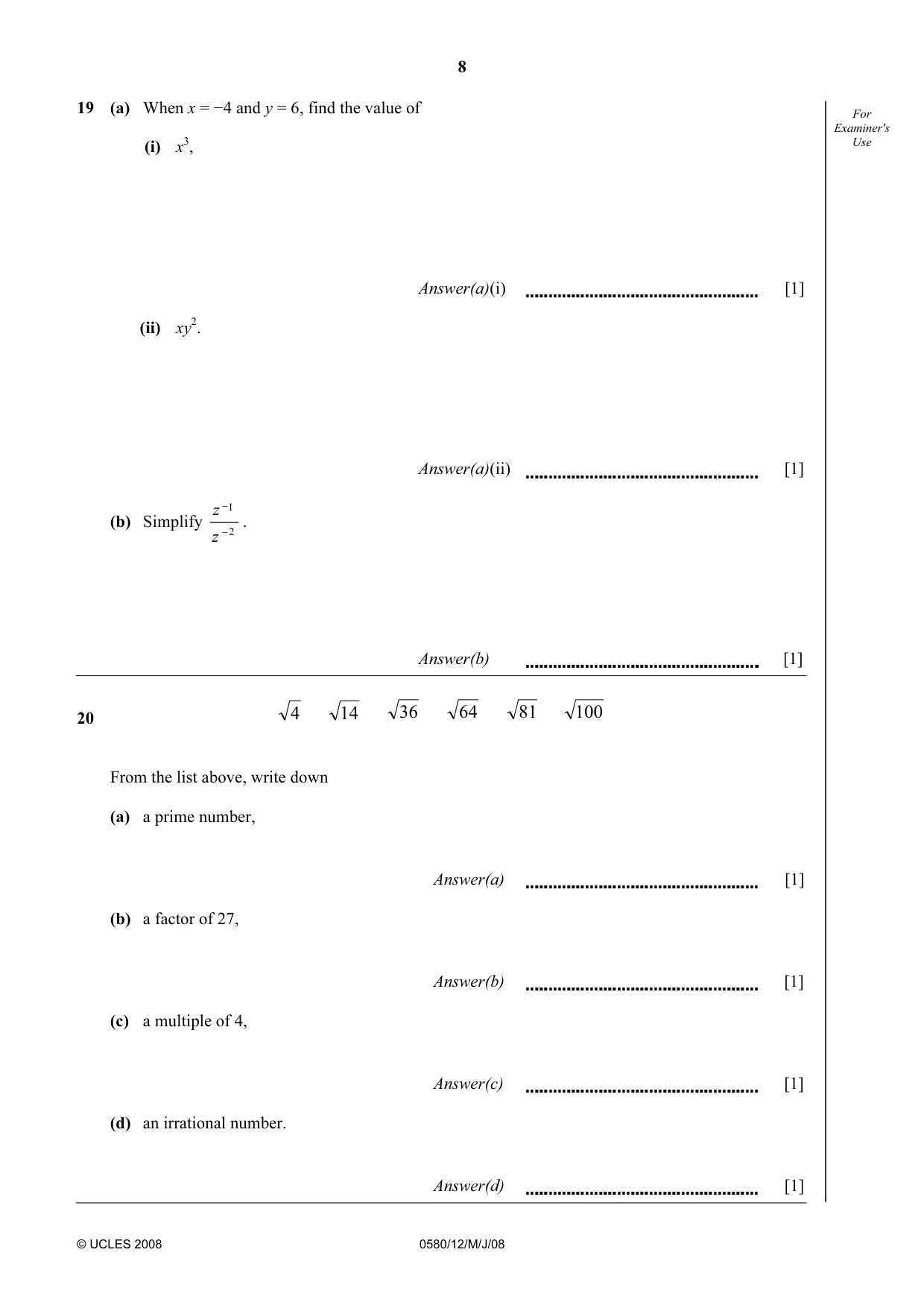
8 © UCLES 2008 0580/12/M/J/08 For Examiner's Use 19 (a) When x = −4 and y = 6, find the value of (i) x3, Answer(a)(i) [1] (ii) xy2. Answer(a)(ii) [1] (b) Simplify 1 2 z z − − . Answer(b) [1] 20 4 14 36 64 81 100 From the list above, write down (a) a prime number, Answer(a) [1] (b) a factor of 27, Answer(b) [1] (c) a multiple of 4, Answer(c) [1] (d) an irrational number. Answer(d) [1]
Question paper, page 22
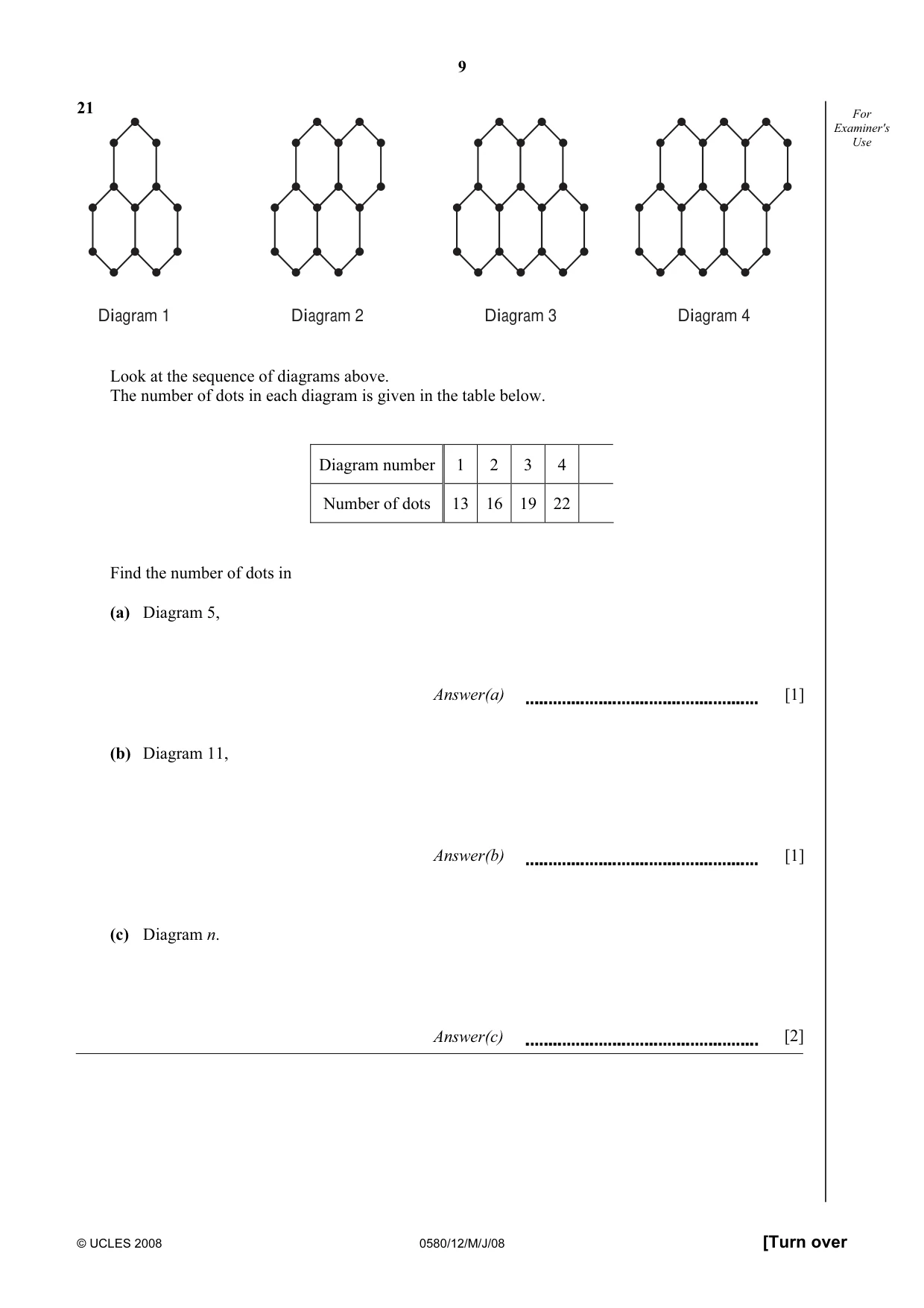
9 © UCLES 2008 0580/12/M/J/08 [Turn over For Examiner's Use 21 Diagram 1 Diagram 2 Diagram 3 Diagram 4 Look at the sequence of diagrams above. The number of dots in each diagram is given in the table below. Diagram number 1 2 3 4 Number of dots 13 16 19 22 Find the number of dots in (a) Diagram 5, Answer(a) [1] (b) Diagram 11, Answer(b) [1] (c) Diagram n. Answer(c) [2]
Question paper, page 23
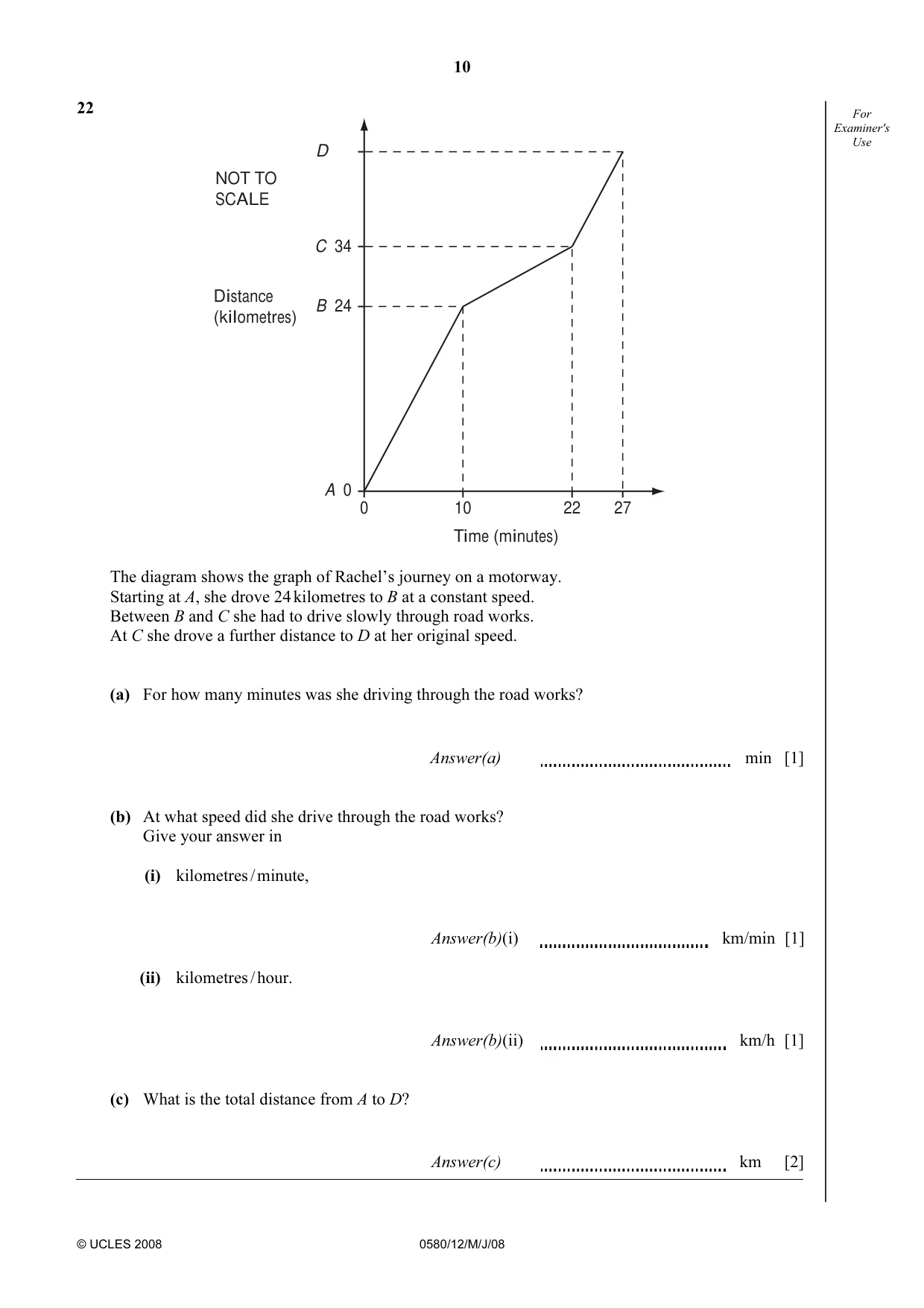
10 © UCLES 2008 0580/12/M/J/08 For Examiner's Use 22 D C 34 B 24 A 0 10 22 27 0 Time (minutes) Distance (kilometres) NOT TO SCALE The diagram shows the graph of Rachel’s journey on a motorway. Starting at A, she drove 24 kilometres to B at a constant speed. Between B and C she had to drive slowly through road works. At C she drove a further distance to D at her original speed. (a) For how many minutes was she driving through the road works? Answer(a) min [1] (b) At what speed did she drive through the road works? Give your answer in (i) kilometres / minute, Answer(b)(i) km/min [1] (ii) kilometres / hour. Answer(b)(ii) km/h [1] (c) What is the total distance from A to D? Answer(c) km [2]
Question paper, page 24
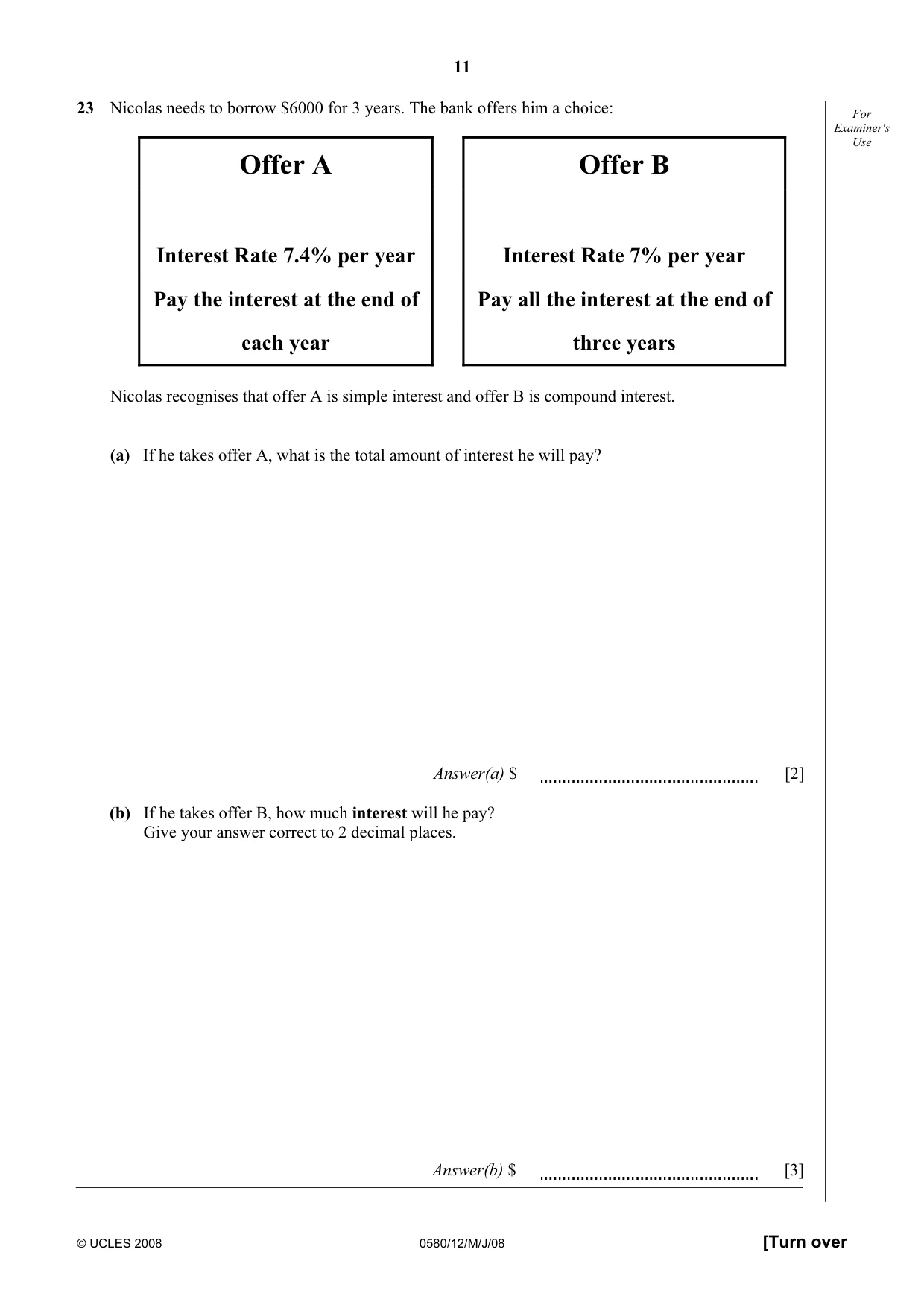
11 © UCLES 2008 0580/12/M/J/08 [Turn over For Examiner's Use 23 Nicolas needs to borrow $6000 for 3 years. The bank offers him a choice: Offer A Offer B Interest Rate 7.4% per year Interest Rate 7% per year Pay the interest at the end of Pay all the interest at the end of each year three years Nicolas recognises that offer A is simple interest and offer B is compound interest. (a) If he takes offer A, what is the total amount of interest he will pay? Answer(a) $ [2] (b) If he takes offer B, how much interest will he pay? Give your answer correct to 2 decimal places. Answer(b) $ [3]
Question paper, page 25
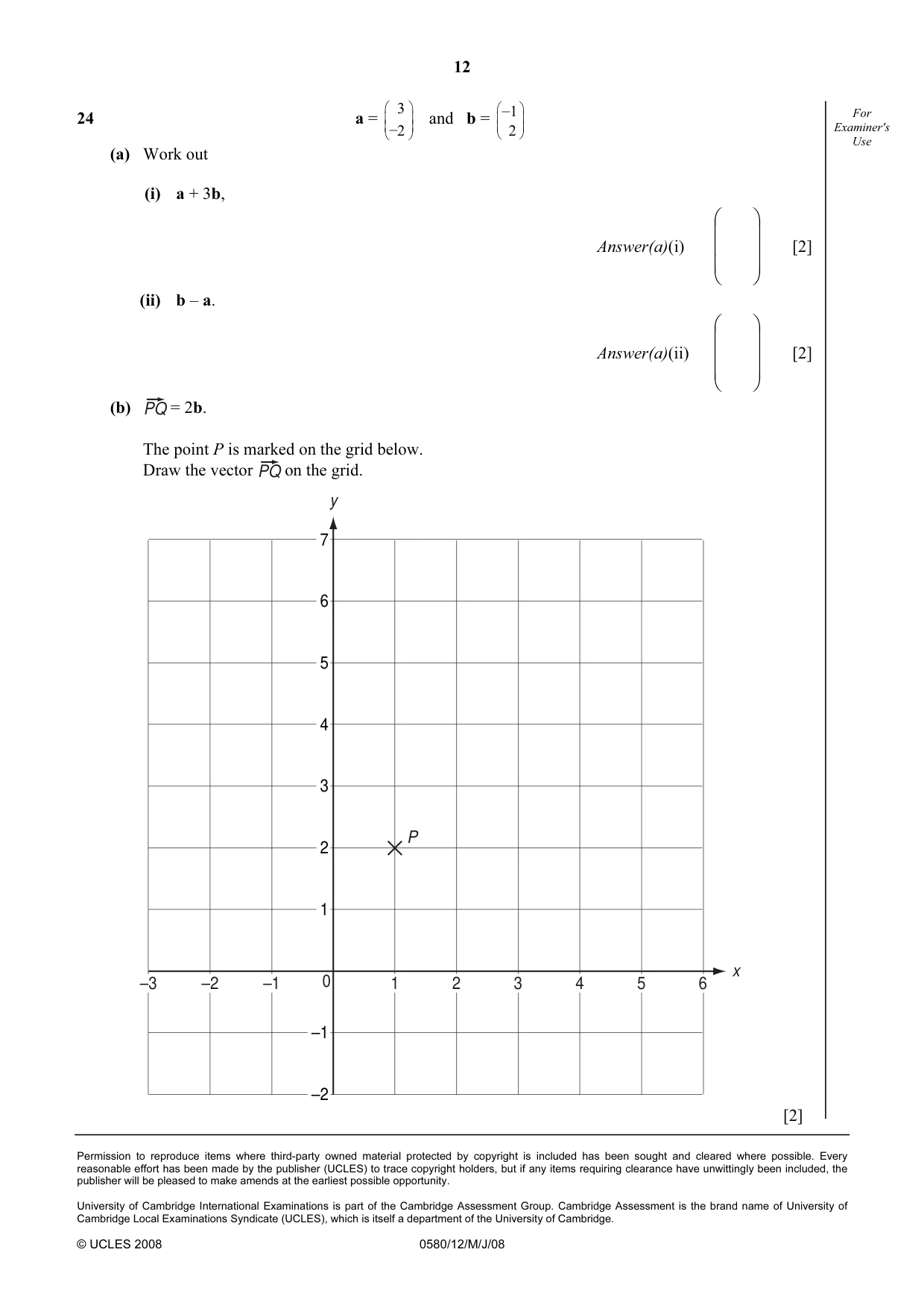
12 Permission to reproduce items where third-party owned material protected by copyright is included has been sought and cleared where possible. Every reasonable effort has been made by the publisher (UCLES) to trace copyright holders, but if any items requiring clearance have unwittingly been included, the publisher will be pleased to make amends at the earliest possible opportunity. University of Cambridge International Examinations is part of the Cambridge Assessment Group. Cambridge Assessment is the brand name of University of Cambridge Local Examinations Syndicate (UCLES), which is itself a department of the University of Cambridge. © UCLES 2008 0580/12/M/J/08 For Examiner's Use 24 a = 3 _2 and b = _1 2 (a) Work out (i) a + 3b, Answer(a)(i) [2] (ii) b – a. Answer(a)(ii) [2] (b) PQ = 2b. The point P is marked on the grid below. Draw the vector PQ on the grid. –3 –2 –1 1 2 3 4 5 6 0 7 6 5 4 3 2 1 –1 –2 P y x [2]