Cambridge IGCSE Marine Science (Maldives only) 0697 — 2024 May/June Paper 1 · Variant 2
0697/12/M/J/24 · 80 marks · 105 min
The question paper and its mark scheme, free to read here and free to download. This is Cambridge’s own paper, exactly as it was sat.
Question paper16 pages


Mark scheme17 pages
Answers below. Sit the paper first if you are practising.
Paper as text
Question paper, page 1
This document has 16 pages. Any blank pages are indicated. [Turn over Cambridge IGCSE™ DC (CE/SW) 332099/5 © UCLES 2024 MARINE SCIENCE 0697/12 Paper 1 Theory and Data Handling May/June 2024 1 hour 45 minutes You must answer on the question paper. No additional materials are needed. INSTRUCTIONS ● Answer all questions. ● Use a black or dark blue pen. You may use an HB pencil for any diagrams or graphs. ● Write your name, centre number and candidate number in the boxes at the top of the page. ● Write your answer to each question in the space provided. ● Do not use an erasable pen or correction fluid. ● Do not write on any bar codes. ● You may use a calculator. ● You should show all your working and use appropriate units. INFORMATION ● The total mark for this paper is 80. ● The number of marks for each question or part question is shown in brackets [ ]. * 8 9 4 7 6 3 8 5 7 2 *
Question paper, page 2
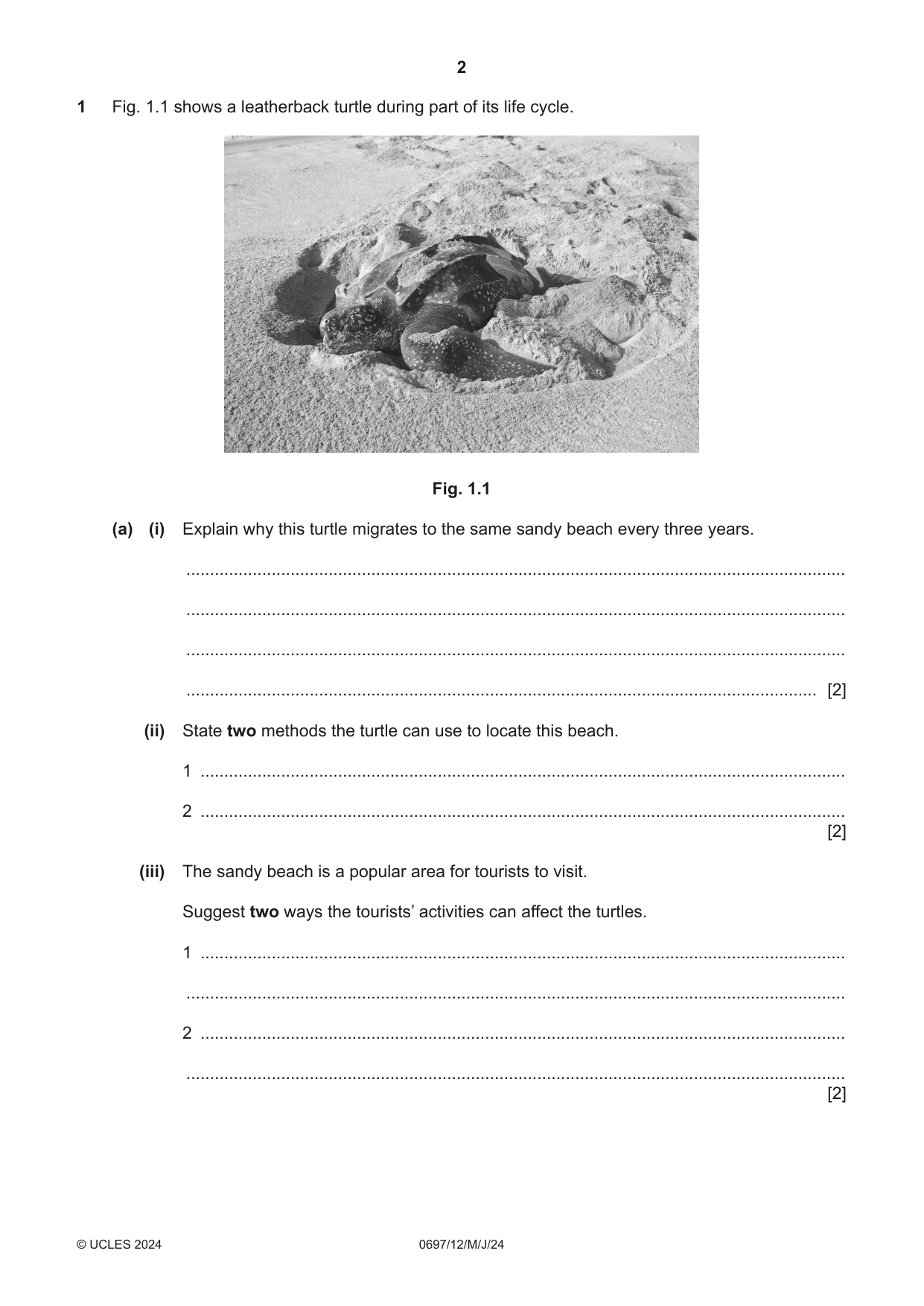
2 0697/12/M/J/24 © UCLES 2024 1 Fig. 1.1 shows a leatherback turtle during part of its life cycle. Fig. 1.1 (a) (i) Explain why this turtle migrates to the same sandy beach every three years. … … … … [2] (ii) State two methods the turtle can use to locate this beach. 1 … 2 … [2] (iii) The sandy beach is a popular area for tourists to visit. Suggest two ways the tourists’ activities can affect the turtles. 1 … … 2 … … [2]
Question paper, page 3
3 0697/12/M/J/24 © UCLES 2024 [Turn over (iv) The leatherback turtle is an endangered species. Some countries have Marine Protected Areas (MPAs) to help conservation of leatherback turtles. Explain what is meant by the term Marine Protected Area. … … [1] (b) Lugworms are also found on sandy shores. State two biotic factors, other than human impact, that will affect the population growth of lugworms found on sandy shores. 1 … 2 … [2] [Total: 9]
Question paper, page 4
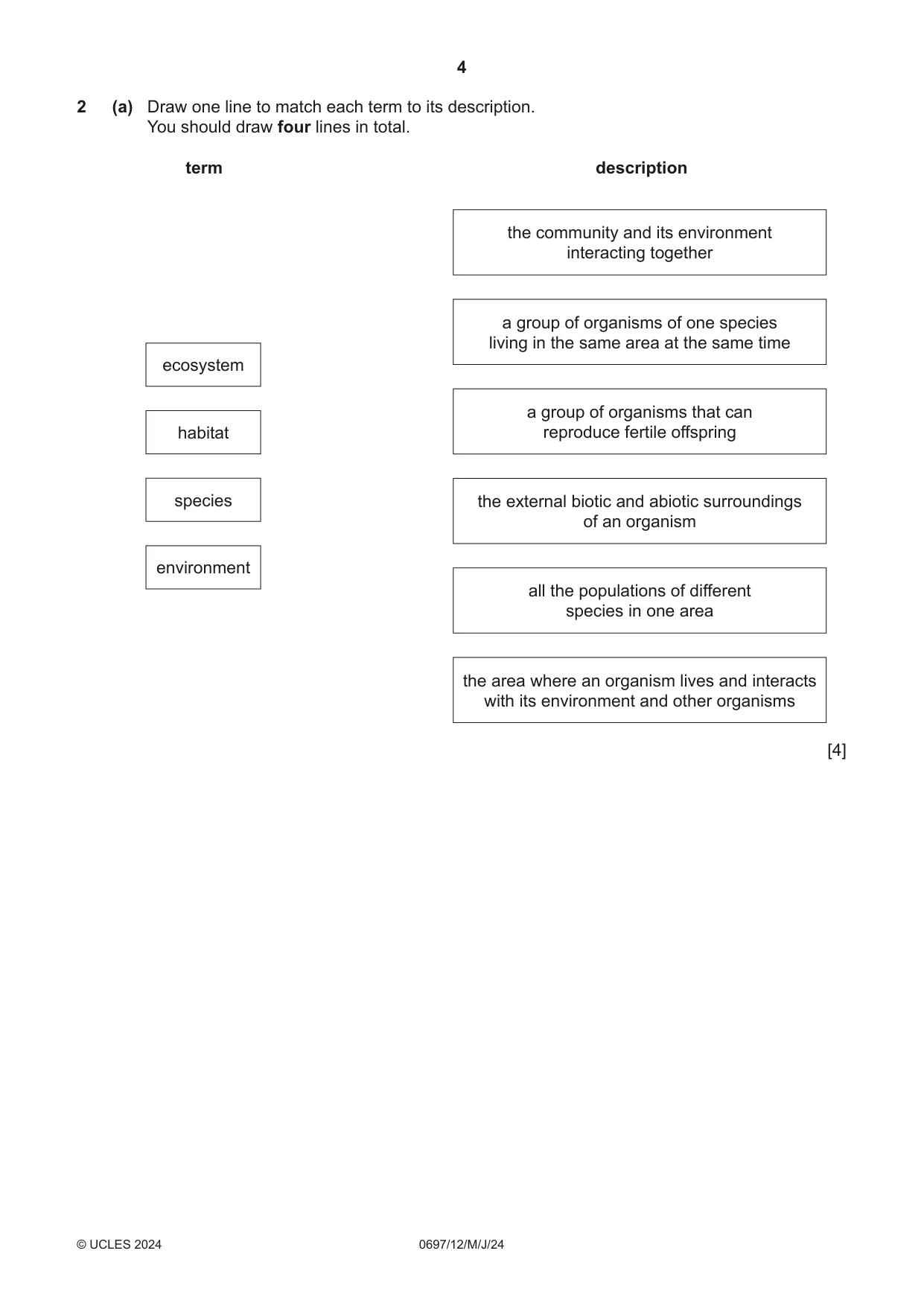
4 0697/12/M/J/24 © UCLES 2024 2 (a) Draw one line to match each term to its description. You should draw four lines in total. term description the community and its environment interacting together a group of organisms of one species living in the same area at the same time a group of organisms that can reproduce fertile offspring the external biotic and abiotic surroundings of an organism all the populations of different species in one area the area where an organism lives and interacts with its environment and other organisms [4] ecosystem habitat species environment
Question paper, page 5
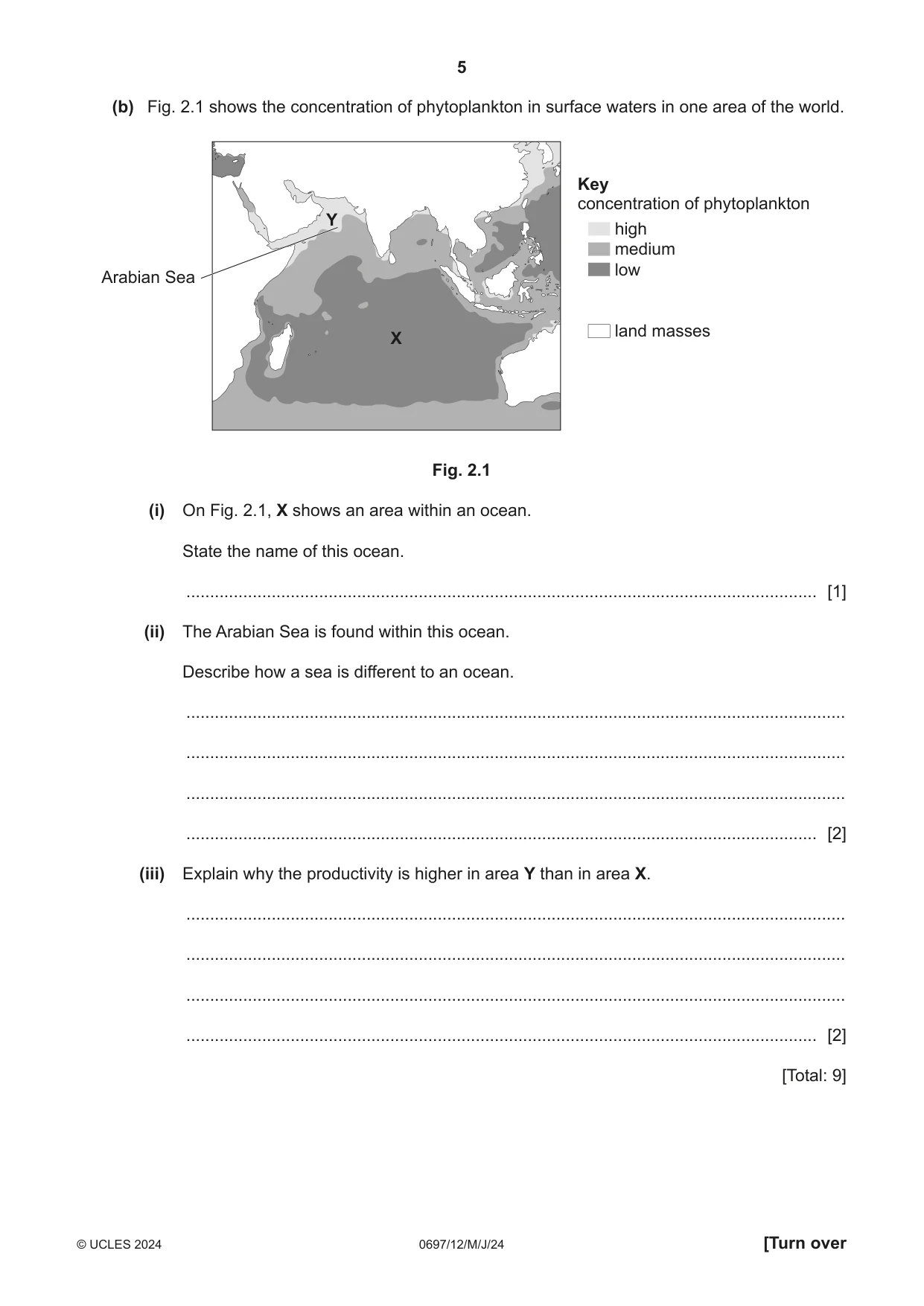
5 0697/12/M/J/24 © UCLES 2024 [Turn over (b) Fig. 2.1 shows the concentration of phytoplankton in surface waters in one area of the world. high medium low land masses concentration of phytoplankton Key Arabian Sea Y X Fig. 2.1 (i) On Fig. 2.1, X shows an area within an ocean. State the name of this ocean. … [1] (ii) The Arabian Sea is found within this ocean. Describe how a sea is different to an ocean. … … … … [2] (iii) Explain why the productivity is higher in area Y than in area X. … … … … [2] [Total: 9]
Question paper, page 6
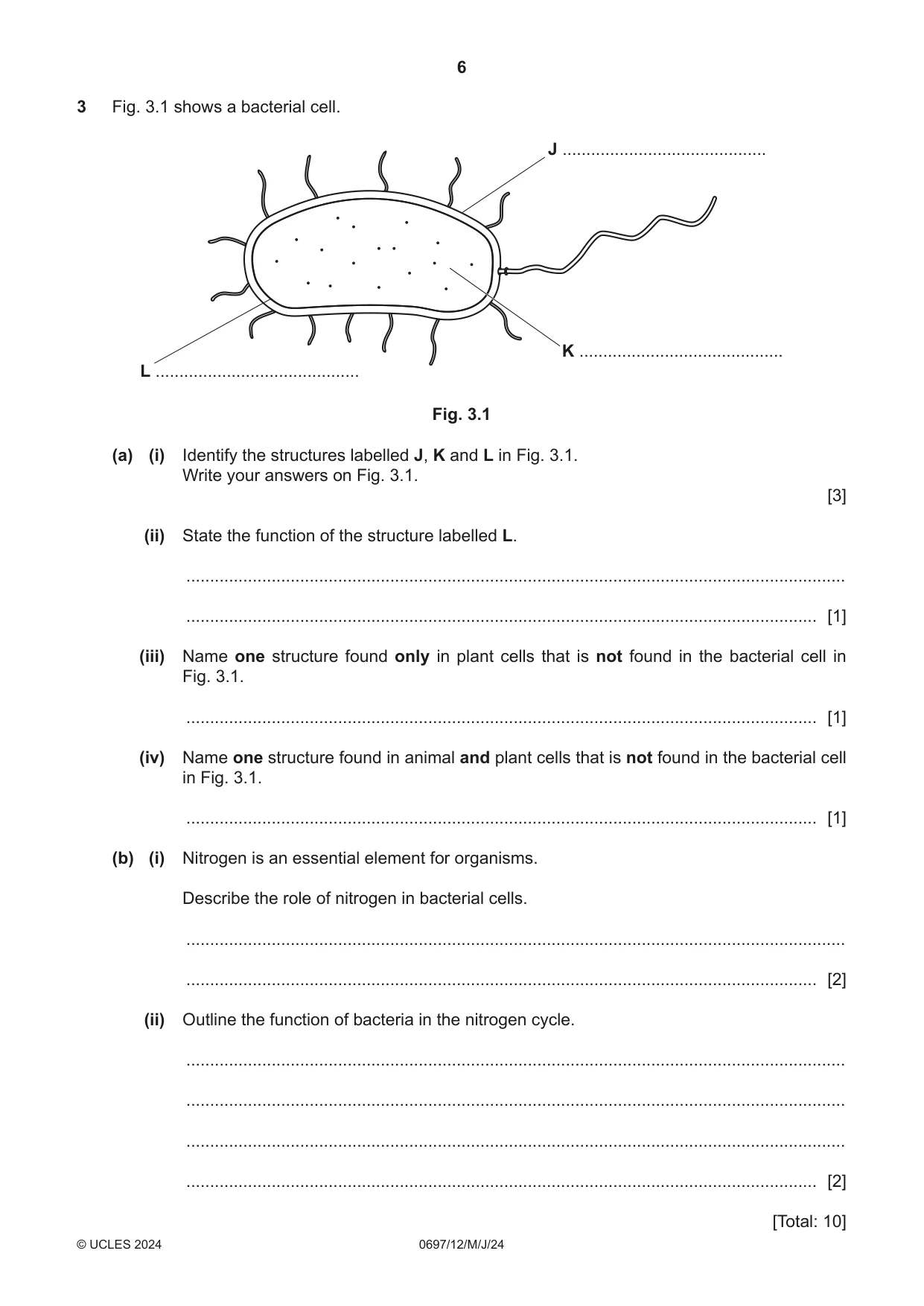
6 0697/12/M/J/24 © UCLES 2024 3 Fig. 3.1 shows a bacterial cell. J … K … L … Fig. 3.1 (a) (i) Identify the structures labelled J, K and L in Fig. 3.1. Write your answers on Fig. 3.1. [3] (ii) State the function of the structure labelled L. … … [1] (iii) Name one structure found only in plant cells that is not found in the bacterial cell in Fig. 3.1. … [1] (iv) Name one structure found in animal and plant cells that is not found in the bacterial cell in Fig. 3.1. … [1] (b) (i) Nitrogen is an essential element for organisms. Describe the role of nitrogen in bacterial cells. … … [2] (ii) Outline the function of bacteria in the nitrogen cycle. … … … … [2] [Total: 10]
Question paper, page 7
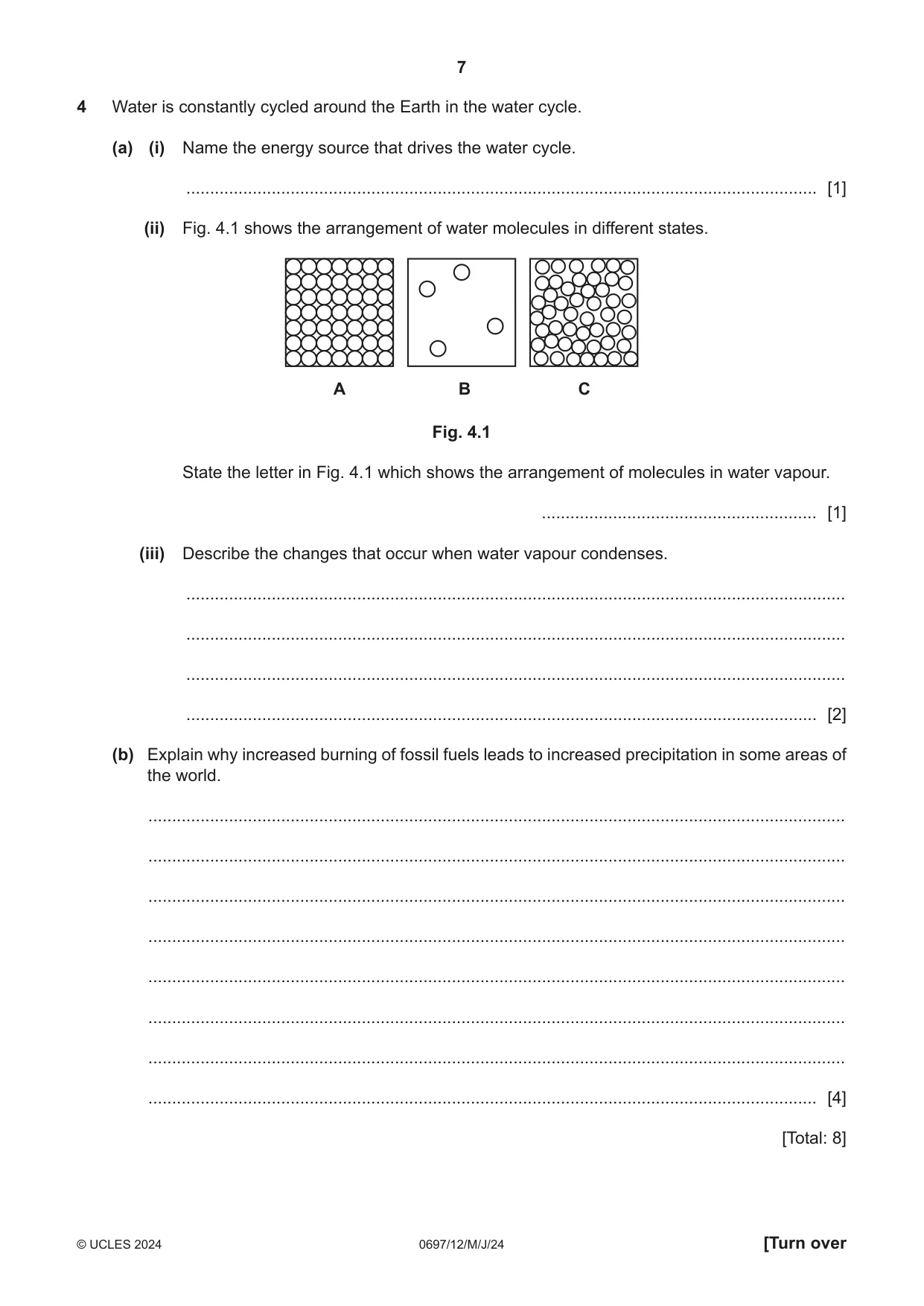
7 0697/12/M/J/24 © UCLES 2024 [Turn over 4 Water is constantly cycled around the Earth in the water cycle. (a) (i) Name the energy source that drives the water cycle. … [1] (ii) Fig. 4.1 shows the arrangement of water molecules in different states. A B C Fig. 4.1 State the letter in Fig. 4.1 which shows the arrangement of molecules in water vapour. … [1] (iii) Describe the changes that occur when water vapour condenses. … … … … [2] (b) Explain why increased burning of fossil fuels leads to increased precipitation in some areas of the world. … … … … … … … … [4] [Total: 8]
Question paper, page 8
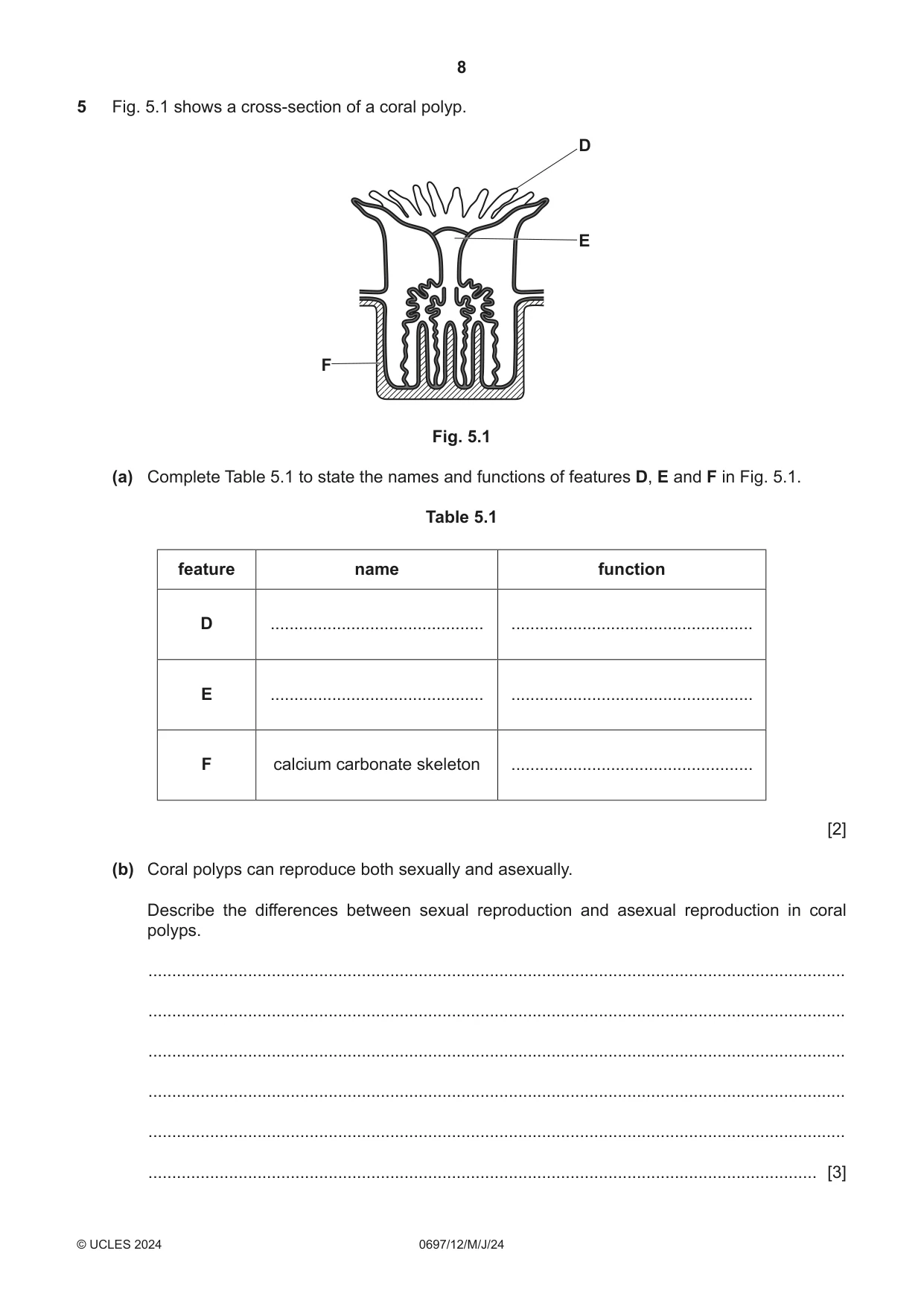
8 0697/12/M/J/24 © UCLES 2024 5 Fig. 5.1 shows a cross-section of a coral polyp. D E F Fig. 5.1 (a) Complete Table 5.1 to state the names and functions of features D, E and F in Fig. 5.1. Table 5.1 feature name function D … … E … … F calcium carbonate skeleton … [2] (b) Coral polyps can reproduce both sexually and asexually. Describe the differences between sexual reproduction and asexual reproduction in coral polyps. … … … … … … [3]
Question paper, page 9
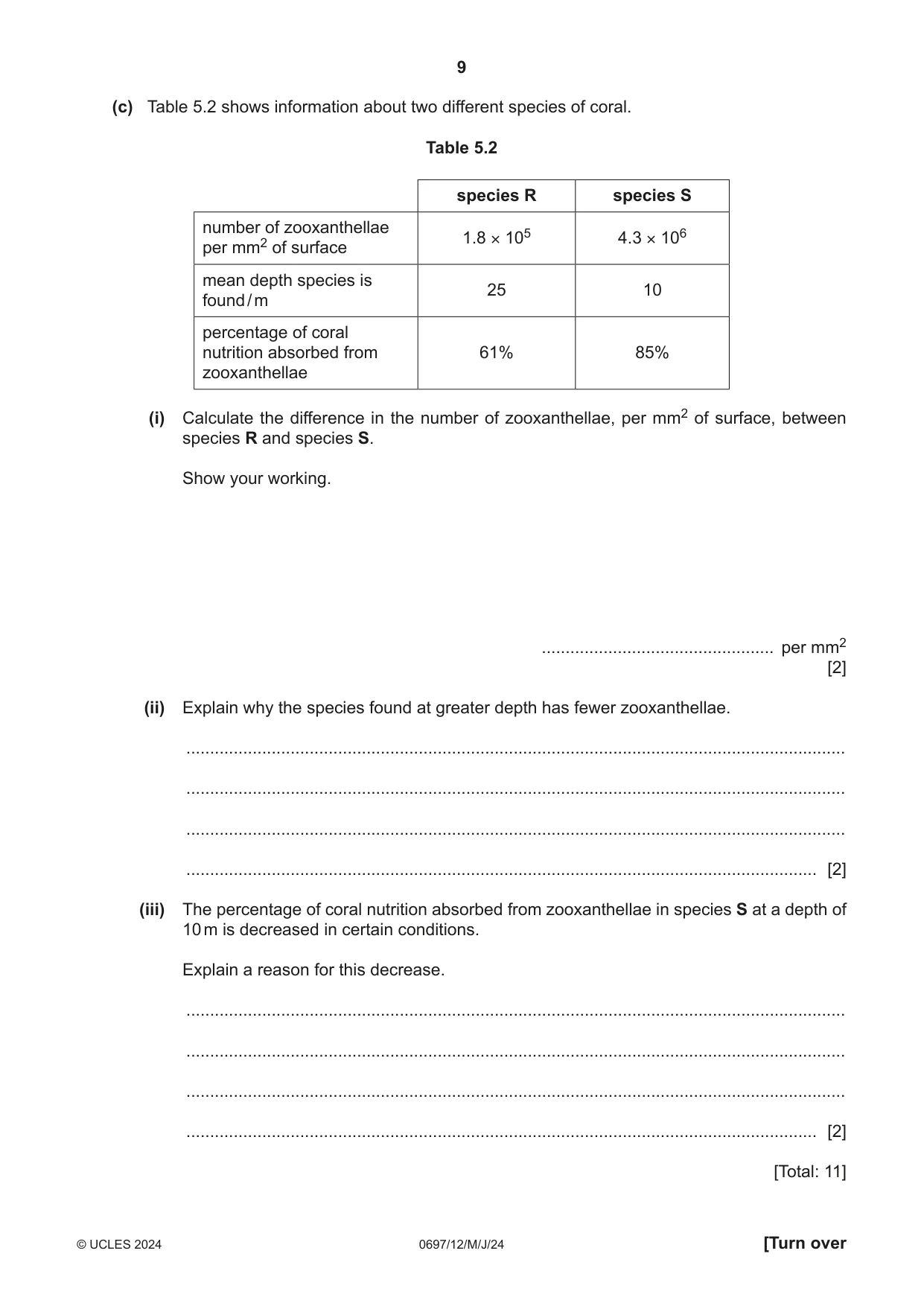
9 0697/12/M/J/24 © UCLES 2024 [Turn over (c) Table 5.2 shows information about two different species of coral. Table 5.2 species R species S number of zooxanthellae per mm2 of surface 1.8 × 10⁵ 4.3 × 10⁶ mean depth species is found / m 25 10 percentage of coral nutrition absorbed from zooxanthellae 61% 85% (i) Calculate the difference in the number of zooxanthellae, per mm2 of surface, between species R and species S. Show your working. … per mm2 [2] (ii) Explain why the species found at greater depth has fewer zooxanthellae. … … … … [2] (iii) The percentage of coral nutrition absorbed from zooxanthellae in species S at a depth of 10 m is decreased in certain conditions. Explain a reason for this decrease. … … … … [2] [Total: 11]
Question paper, page 10
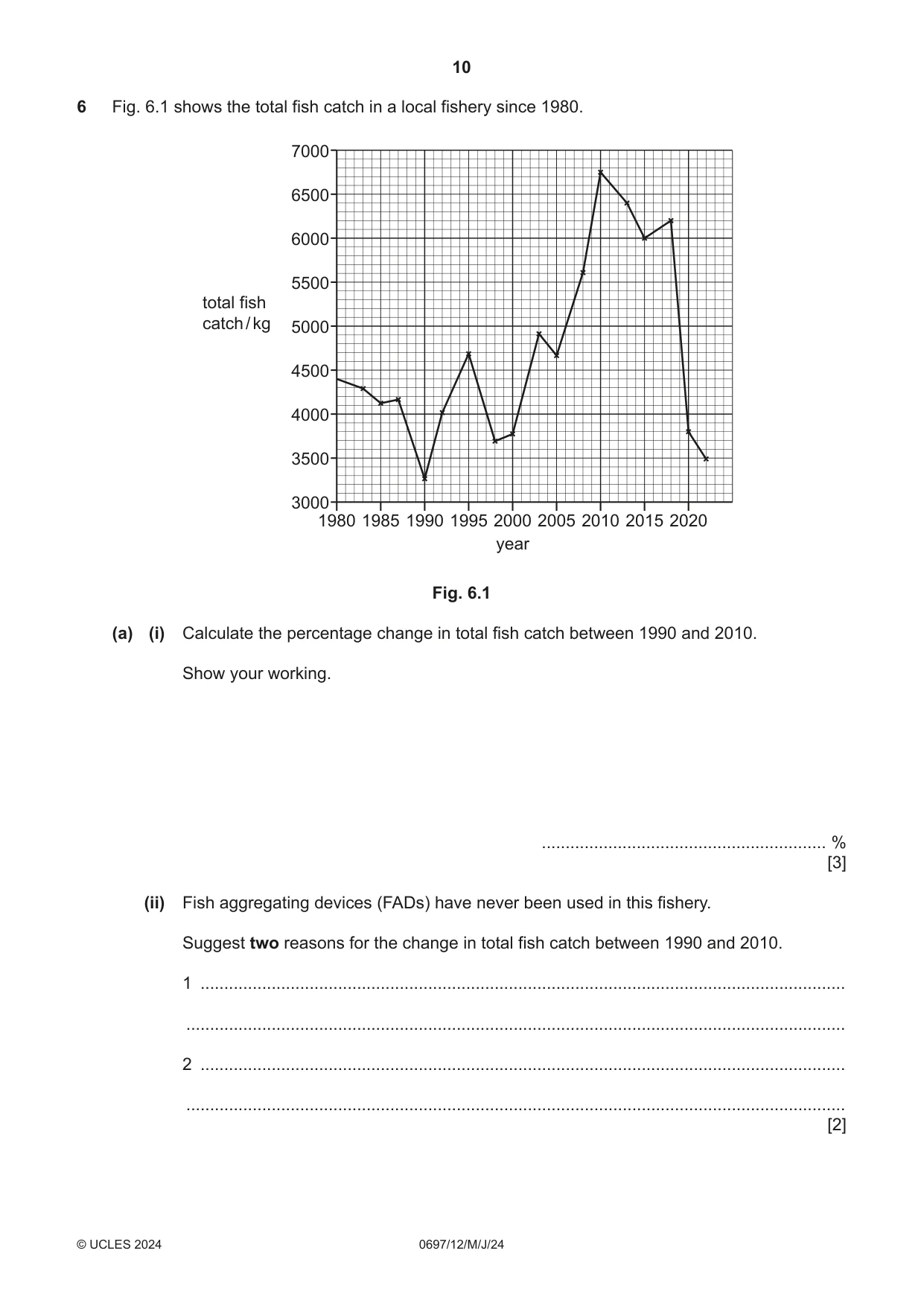
10 0697/12/M/J/24 © UCLES 2024 6 Fig. 6.1 shows the total fish catch in a local fishery since 1980. 3000 1980 1985 1990 1995 2000 year total fish catch / kg 2005 2010 2015 2020 3500 4000 4500 5000 5500 6000 6500 7000 Fig. 6.1 (a) (i) Calculate the percentage change in total fish catch between 1990 and 2010. Show your working. … % [3] (ii) Fish aggregating devices (FADs) have never been used in this fishery. Suggest two reasons for the change in total fish catch between 1990 and 2010. 1 … … 2 … … [2]
Question paper, page 11
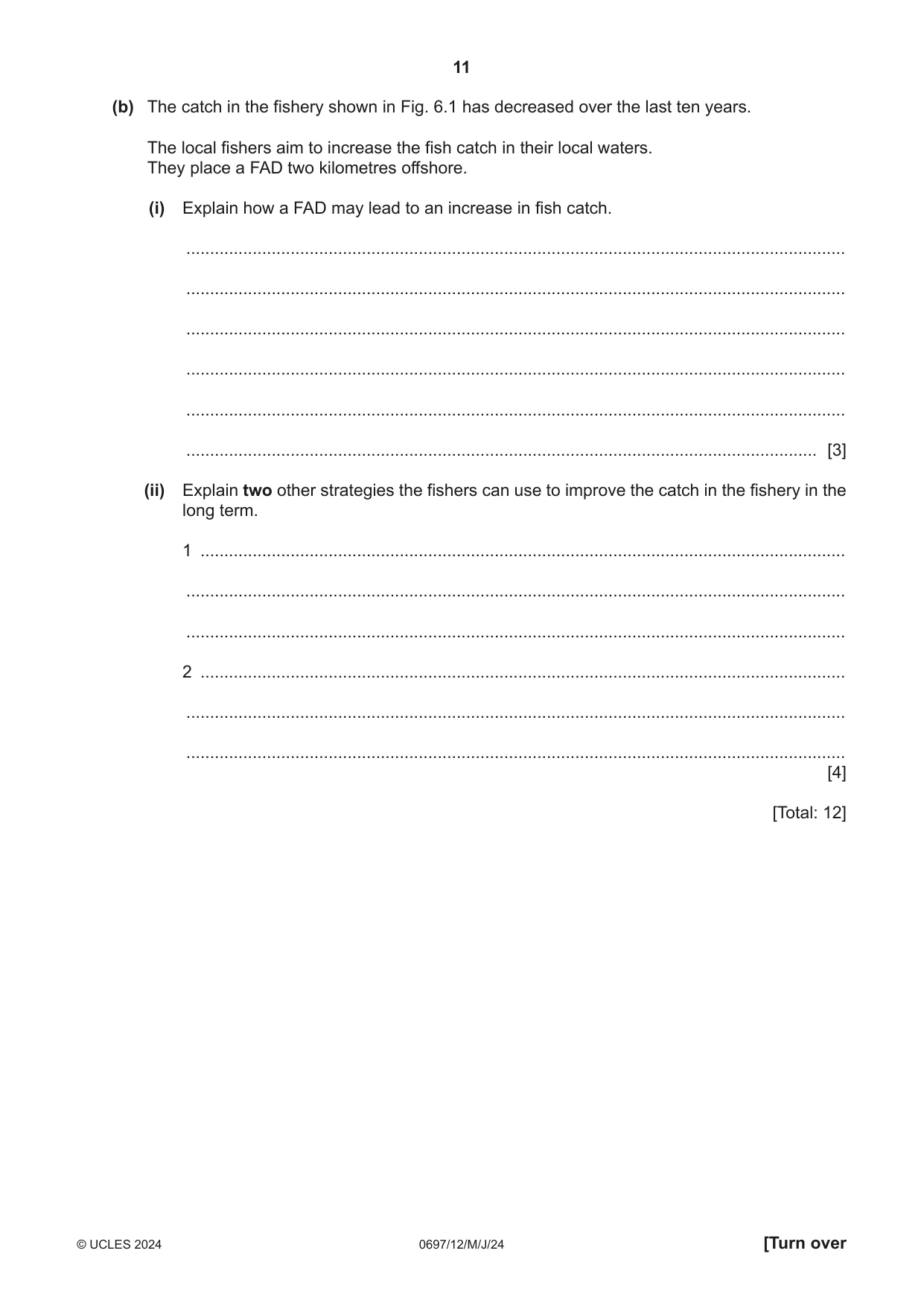
11 0697/12/M/J/24 © UCLES 2024 [Turn over (b) The catch in the fishery shown in Fig. 6.1 has decreased over the last ten years. The local fishers aim to increase the fish catch in their local waters. They place a FAD two kilometres offshore. (i) Explain how a FAD may lead to an increase in fish catch. … … … … … … [3] (ii) Explain two other strategies the fishers can use to improve the catch in the fishery in the long term. 1 … … … 2 … … … [4] [Total: 12]
Question paper, page 12
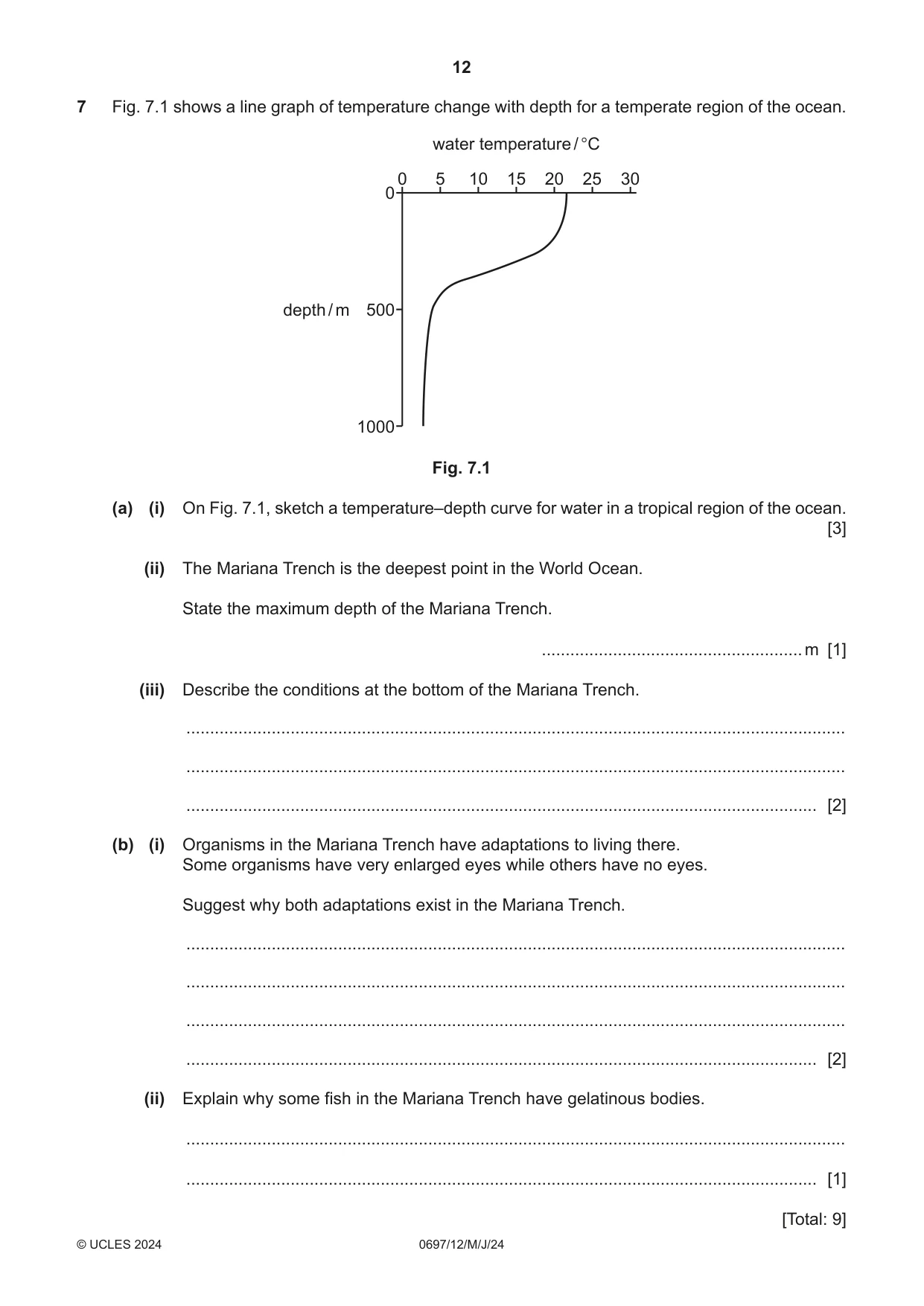
12 0697/12/M/J/24 © UCLES 2024 7 Fig. 7.1 shows a line graph of temperature change with depth for a temperate region of the ocean. 0 0 500 1000 depth / m 5 10 15 water temperature / °C 20 25 30 Fig. 7.1 (a) (i) On Fig. 7.1, sketch a temperature–depth curve for water in a tropical region of the ocean. [3] (ii) The Mariana Trench is the deepest point in the World Ocean. State the maximum depth of the Mariana Trench. …m [1] (iii) Describe the conditions at the bottom of the Mariana Trench. … … … [2] (b) (i) Organisms in the Mariana Trench have adaptations to living there. Some organisms have very enlarged eyes while others have no eyes. Suggest why both adaptations exist in the Mariana Trench. … … … … [2] (ii) Explain why some fish in the Mariana Trench have gelatinous bodies. … … [1] [Total: 9]
Question paper, page 13
13 0697/12/M/J/24 © UCLES 2024 [Turn over Question 8 starts on the next page.
Question paper, page 14
14 0697/12/M/J/24 © UCLES 2024 8 The world’s oceans provide sustainable resources which are of benefit to the human population. (a) Describe how a resource is used sustainably. … … … … … … [3] (b) Fig. 8.1 shows a fish aquaculture system. Fig. 8.1
Question paper, page 15
15 0697/12/M/J/24 © UCLES 2024 (i) Outline the method of producing fish, such as grouper, by aquaculture. … … … … … … … … … … … … [6] (ii) Some aquaculture systems cause eutrophication in the water. Explain why this is harmful to the fish in the aquaculture system. … … … … … … [3] [Total: 12]
Question paper, page 16
16 0697/12/M/J/24 © UCLES 2024 The boundaries and names shown, the designations used and the presentation of material on any maps contained in this question paper/insert do not imply official endorsement or acceptance by Cambridge Assessment International Education concerning the legal status of any country, territory, or area or any of its authorities, or of the delimitation of its frontiers or boundaries. Permission to reproduce items where third-party owned material protected by copyright is included has been sought and cleared where possible. Every reasonable effort has been made by the publisher (UCLES) to trace copyright holders, but if any items requiring clearance have unwittingly been included, the publisher will be pleased to make amends at the earliest possible opportunity. To avoid the issue of disclosure of answer-related information to candidates, all copyright acknowledgements are reproduced online in the Cambridge Assessment International Education Copyright Acknowledgements Booklet. This is produced for each series of examinations and is freely available to download at www.cambridgeinternational.org after the live examination series. Cambridge Assessment International Education is part of Cambridge Assessment. Cambridge Assessment is the brand name of the University of Cambridge Local Examinations Syndicate (UCLES), which is a department of the University of Cambridge. BLANK PAGE
Mark scheme, page 1
This document consists of 17 printed pages. © Cambridge University Press & Assessment 2024 [Turn over Cambridge IGCSE™ MARINE SCIENCE 0697/12 Paper 1 Theory and Data Handling May/June 2024 MARK SCHEME Maximum Mark: 80 Published This mark scheme is published as an aid to teachers and candidates, to indicate the requirements of the examination. It shows the basis on which Examiners were instructed to award marks. It does not indicate the details of the discussions that took place at an Examiners’ meeting before marking began, which would have considered the acceptability of alternative answers. Mark schemes should be read in conjunction with the question paper and the Principal Examiner Report for Teachers. Cambridge International will not enter into discussions about these mark schemes. Cambridge International is publishing the mark schemes for the May/June 2024 series for most Cambridge IGCSE, Cambridge International A and AS Level and Cambridge Pre-U components, and some Cambridge O Level components.
Mark scheme, page 2
0697/12 Cambridge IGCSE – Mark Scheme PUBLISHED May/June 2024 © Cambridge University Press & Assessment 2024 Page 2 of 17 Generic Marking Principles These general marking principles must be applied by all examiners when marking candidate answers. They should be applied alongside the specific content of the mark scheme or generic level descriptions for a question. Each question paper and mark scheme will also comply with these marking principles. GENERIC MARKING PRINCIPLE 1: Marks must be awarded in line with: the specific content of the mark scheme or the generic level descriptors for the question the specific skills defined in the mark scheme or in the generic level descriptors for the question the standard of response required by a candidate as exemplified by the standardisation scripts. GENERIC MARKING PRINCIPLE 2: Marks awarded are always whole marks (not half marks, or other fractions). GENERIC MARKING PRINCIPLE 3: Marks must be awarded positively: marks are awarded for correct/valid answers, as defined in the mark scheme. However, credit is given for valid answers which go beyond the scope of the syllabus and mark scheme, referring to your Team Leader as appropriate marks are awarded when candidates clearly demonstrate what they know and can do marks are not deducted for errors marks are not deducted for omissions answers should only be judged on the quality of spelling, punctuation and grammar when these features are specifically assessed by the question as indicated by the mark scheme. The meaning, however, should be unambiguous. GENERIC MARKING PRINCIPLE 4: Rules must be applied consistently, e.g. in situations where candidates have not followed instructions or in the application of generic level descriptors.
Mark scheme, page 3
0697/12 Cambridge IGCSE – Mark Scheme PUBLISHED May/June 2024 © Cambridge University Press & Assessment 2024 Page 3 of 17 GENERIC MARKING PRINCIPLE 5: Marks should be awarded using the full range of marks defined in the mark scheme for the question (however; the use of the full mark range may be limited according to the quality of the candidate responses seen). GENERIC MARKING PRINCIPLE 6: Marks awarded are based solely on the requirements as defined in the mark scheme. Marks should not be awarded with grade thresholds or grade descriptors in mind.
Mark scheme, page 4
0697/12 Cambridge IGCSE – Mark Scheme PUBLISHED May/June 2024 © Cambridge University Press & Assessment 2024 Page 4 of 17 Science-Specific Marking Principles 1 Examiners should consider the context and scientific use of any keywords when awarding marks. Although keywords may be present, marks should not be awarded if the keywords are used incorrectly. 2 The examiner should not choose between contradictory statements given in the same question part, and credit should not be awarded for any correct statement that is contradicted within the same question part. Wrong science that is irrelevant to the question should be ignored. 3 Although spellings do not have to be correct, spellings of syllabus terms must allow for clear and unambiguous separation from other syllabus terms with which they may be confused (e.g. ethane / ethene, glucagon / glycogen, refraction / reflection). 4 The error carried forward (ecf) principle should be applied, where appropriate. If an incorrect answer is subsequently used in a scientifically correct way, the candidate should be awarded these subsequent marking points. Further guidance will be included in the mark scheme where necessary and any exceptions to this general principle will be noted. 5 ‘List rule’ guidance For questions that require n responses (e.g. State two reasons …): The response should be read as continuous prose, even when numbered answer spaces are provided. Any response marked ignore in the mark scheme should not count towards n. Incorrect responses should not be awarded credit but will still count towards n. Read the entire response to check for any responses that contradict those that would otherwise be credited. Credit should not be awarded for any responses that are contradicted within the rest of the response. Where two responses contradict one another, this should be treated as a single incorrect response. Non-contradictory responses after the first n responses may be ignored even if they include incorrect science.
Mark scheme, page 5
0697/12 Cambridge IGCSE – Mark Scheme PUBLISHED May/June 2024 © Cambridge University Press & Assessment 2024 Page 5 of 17 6 Calculation specific guidance Correct answers to calculations should be given full credit even if there is no working or incorrect working, unless the question states ‘show your working’. For questions in which the number of significant figures required is not stated, credit should be awarded for correct answers when rounded by the examiner to the number of significant figures given in the mark scheme. This may not apply to measured values. For answers given in standard form (e.g. a 10n) in which the convention of restricting the value of the coefficient (a) to a value between 1 and 10 is not followed, credit may still be awarded if the answer can be converted to the answer given in the mark scheme. Unless a separate mark is given for a unit, a missing or incorrect unit will normally mean that the final calculation mark is not awarded. Exceptions to this general principle will be noted in the mark scheme. 7 Guidance for chemical equations Multiples / fractions of coefficients used in chemical equations are acceptable unless stated otherwise in the mark scheme. State symbols given in an equation should be ignored unless asked for in the question or stated otherwise in the mark scheme.
Mark scheme, page 6
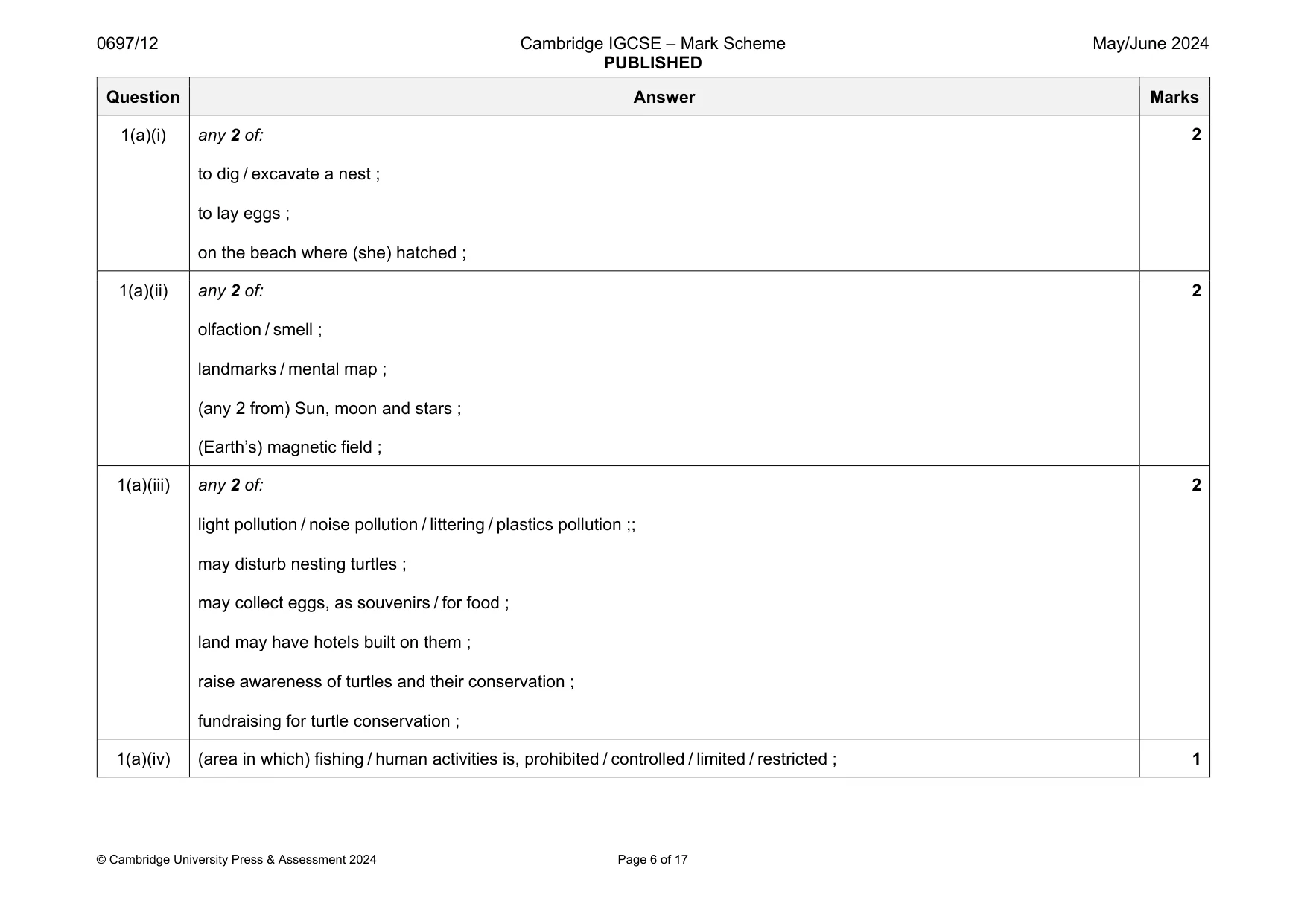
0697/12 Cambridge IGCSE – Mark Scheme PUBLISHED May/June 2024 © Cambridge University Press & Assessment 2024 Page 6 of 17 Question Answer Marks 1(a)(i) any 2 of: to dig / excavate a nest ; to lay eggs ; on the beach where (she) hatched ; 2 1(a)(ii) any 2 of: olfaction / smell ; landmarks / mental map ; (any 2 from) Sun, moon and stars ; (Earth’s) magnetic field ; 2 1(a)(iii) any 2 of: light pollution / noise pollution / littering / plastics pollution ;; may disturb nesting turtles ; may collect eggs, as souvenirs / for food ; land may have hotels built on them ; raise awareness of turtles and their conservation ; fundraising for turtle conservation ; 2 1(a)(iv) (area in which) fishing / human activities is, prohibited / controlled / limited / restricted ; 1
Mark scheme, page 7
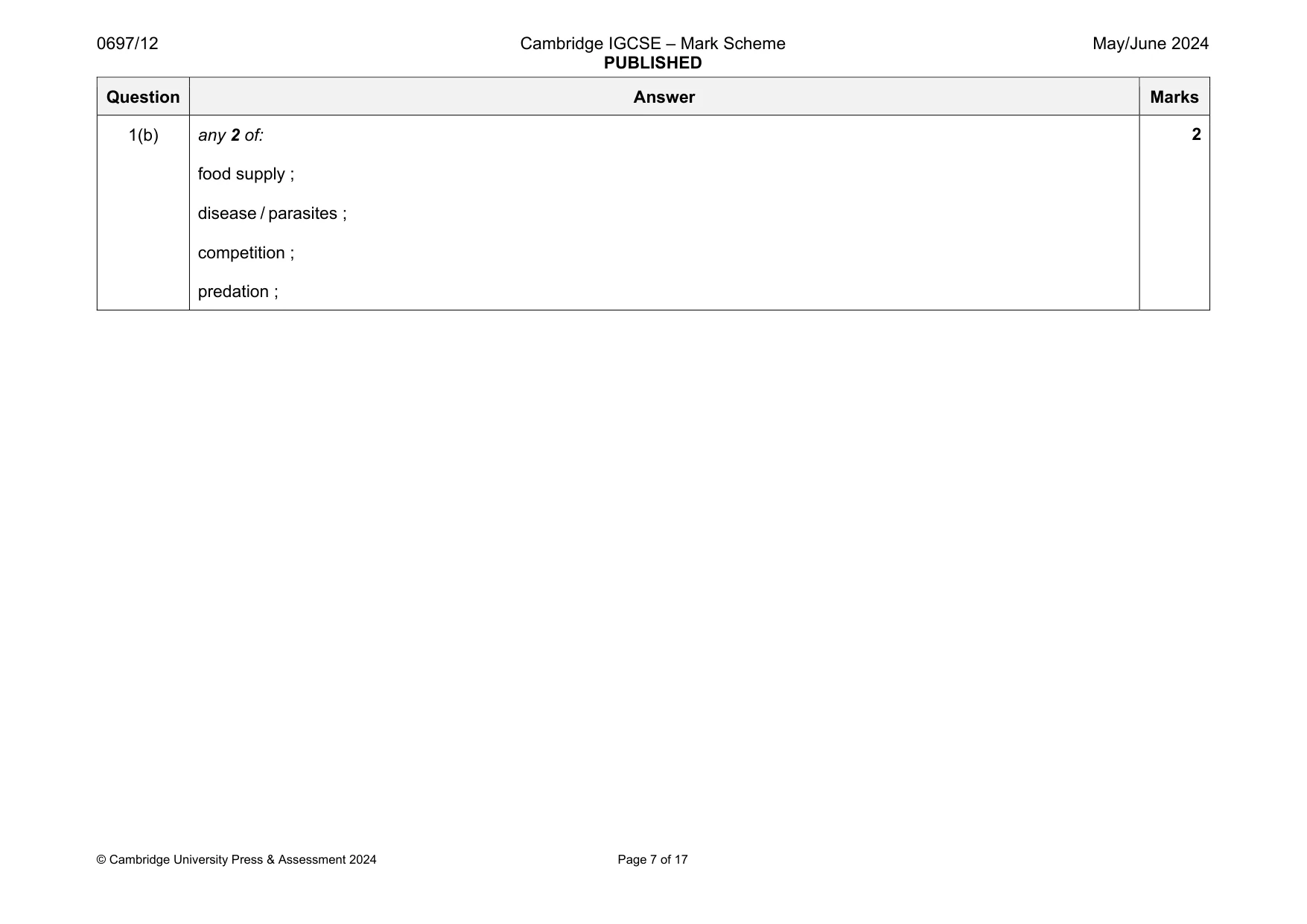
0697/12 Cambridge IGCSE – Mark Scheme PUBLISHED May/June 2024 © Cambridge University Press & Assessment 2024 Page 7 of 17 Question Answer Marks 1(b) any 2 of: food supply ; disease / parasites ; competition ; predation ; 2
Mark scheme, page 8
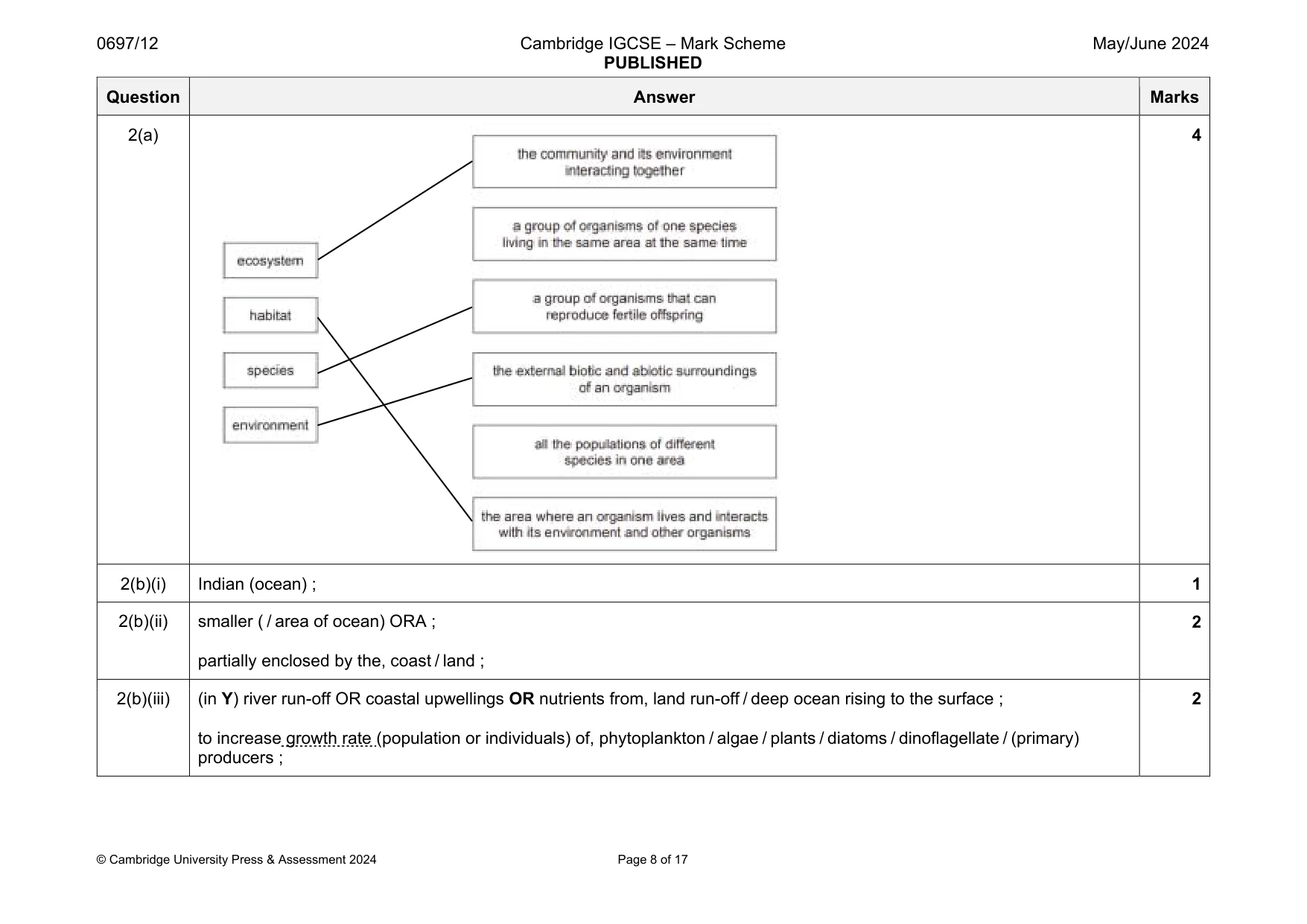
0697/12 Cambridge IGCSE – Mark Scheme PUBLISHED May/June 2024 © Cambridge University Press & Assessment 2024 Page 8 of 17 Question Answer Marks 2(a) 4 2(b)(i) Indian (ocean) ; 1 2(b)(ii) smaller ( / area of ocean) ORA ; partially enclosed by the, coast / land ; 2 2(b)(iii) (in Y) river run-off OR coastal upwellings OR nutrients from, land run-off / deep ocean rising to the surface ; to increase growth rate (population or individuals) of, phytoplankton / algae / plants / diatoms / dinoflagellate / (primary) producers ; 2
Mark scheme, page 9
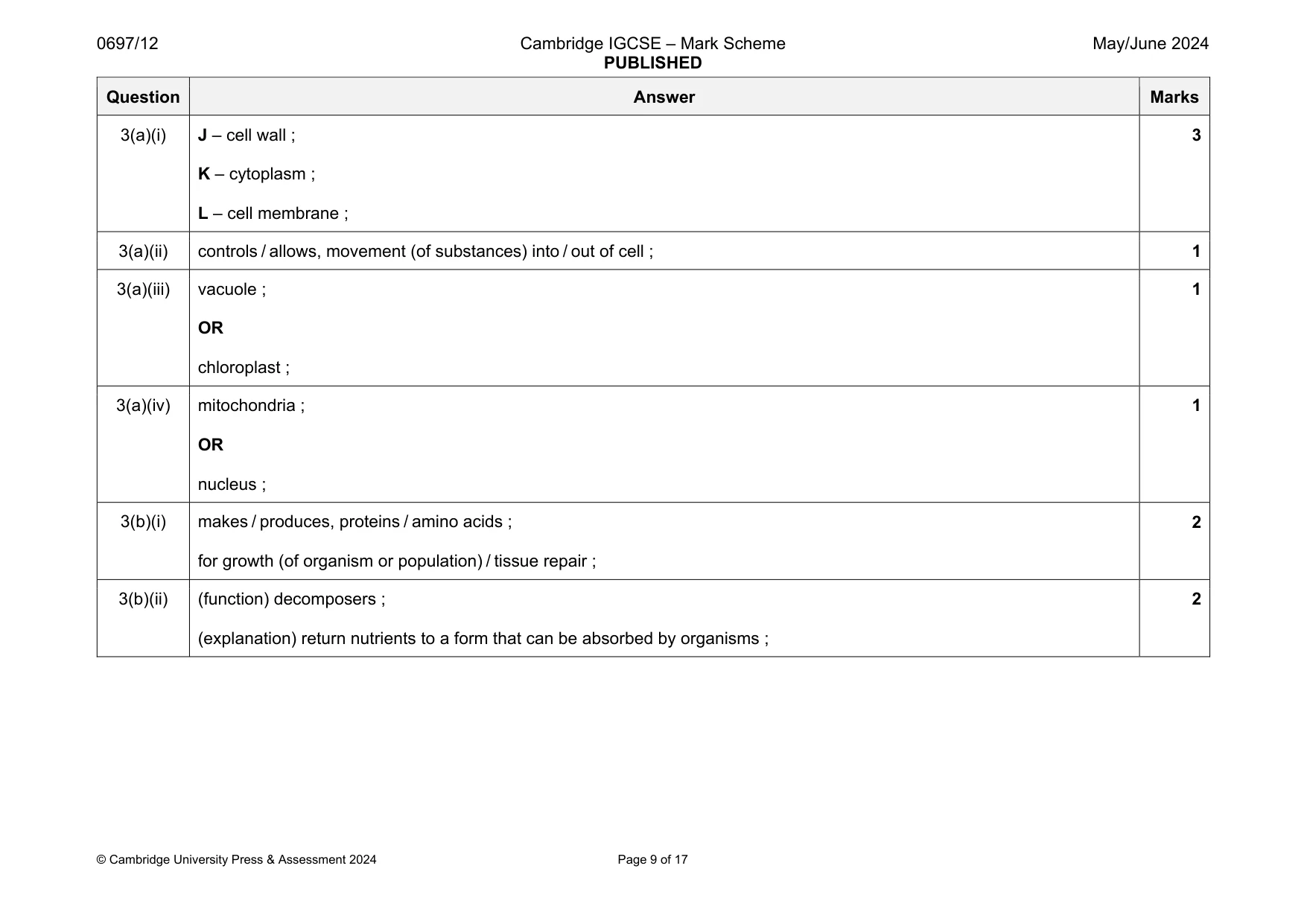
0697/12 Cambridge IGCSE – Mark Scheme PUBLISHED May/June 2024 © Cambridge University Press & Assessment 2024 Page 9 of 17 Question Answer Marks 3(a)(i) J – cell wall ; K – cytoplasm ; L – cell membrane ; 3 3(a)(ii) controls / allows, movement (of substances) into / out of cell ; 1 3(a)(iii) vacuole ; OR chloroplast ; 1 3(a)(iv) mitochondria ; OR nucleus ; 1 3(b)(i) makes / produces, proteins / amino acids ; for growth (of organism or population) / tissue repair ; 2 3(b)(ii) (function) decomposers ; (explanation) return nutrients to a form that can be absorbed by organisms ; 2
Mark scheme, page 10
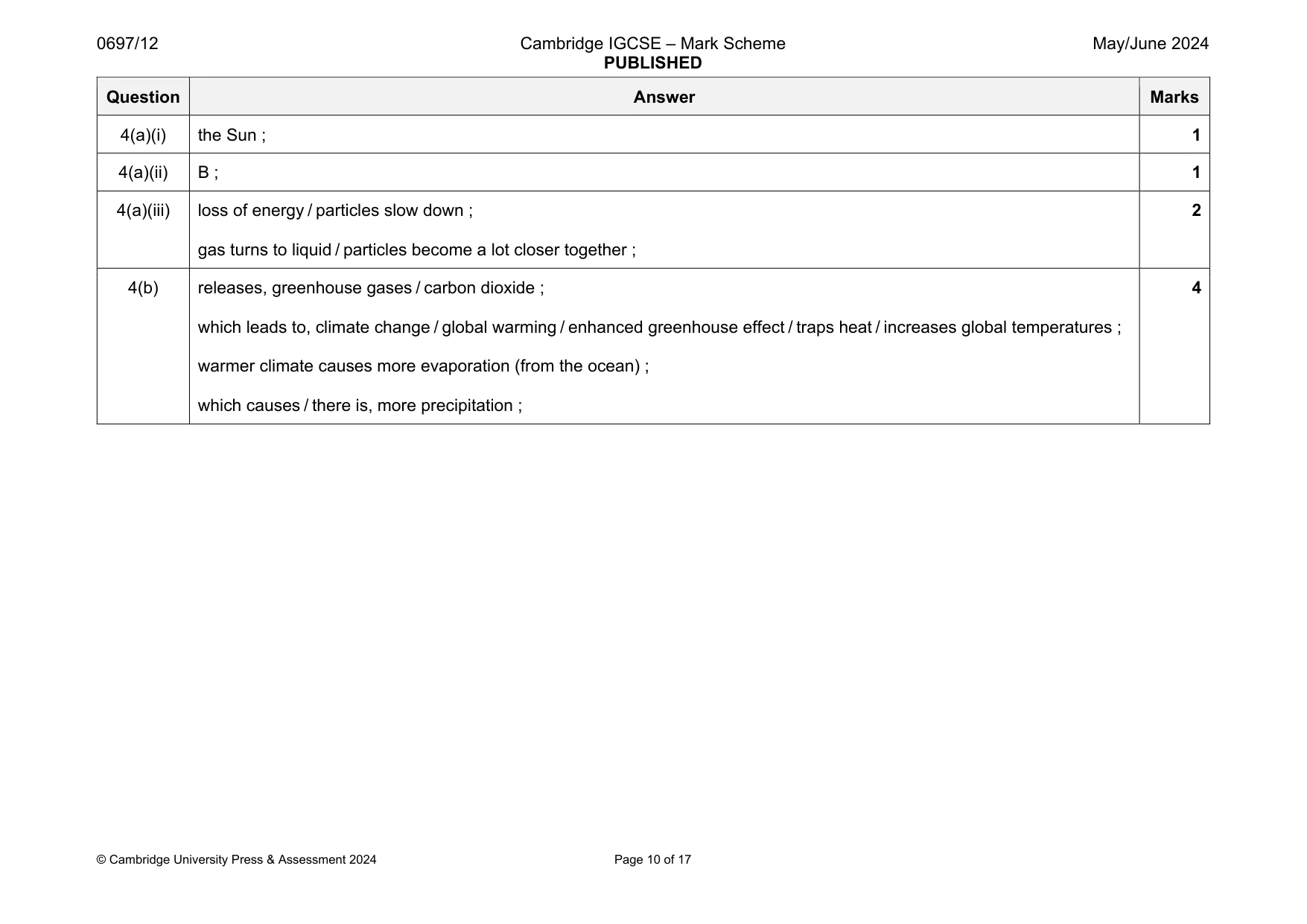
0697/12 Cambridge IGCSE – Mark Scheme PUBLISHED May/June 2024 © Cambridge University Press & Assessment 2024 Page 10 of 17 Question Answer Marks 4(a)(i) the Sun ; 1 4(a)(ii) B ; 1 4(a)(iii) loss of energy / particles slow down ; gas turns to liquid / particles become a lot closer together ; 2 4(b) releases, greenhouse gases / carbon dioxide ; which leads to, climate change / global warming / enhanced greenhouse effect / traps heat / increases global temperatures ; warmer climate causes more evaporation (from the ocean) ; which causes / there is, more precipitation ; 4
Mark scheme, page 11
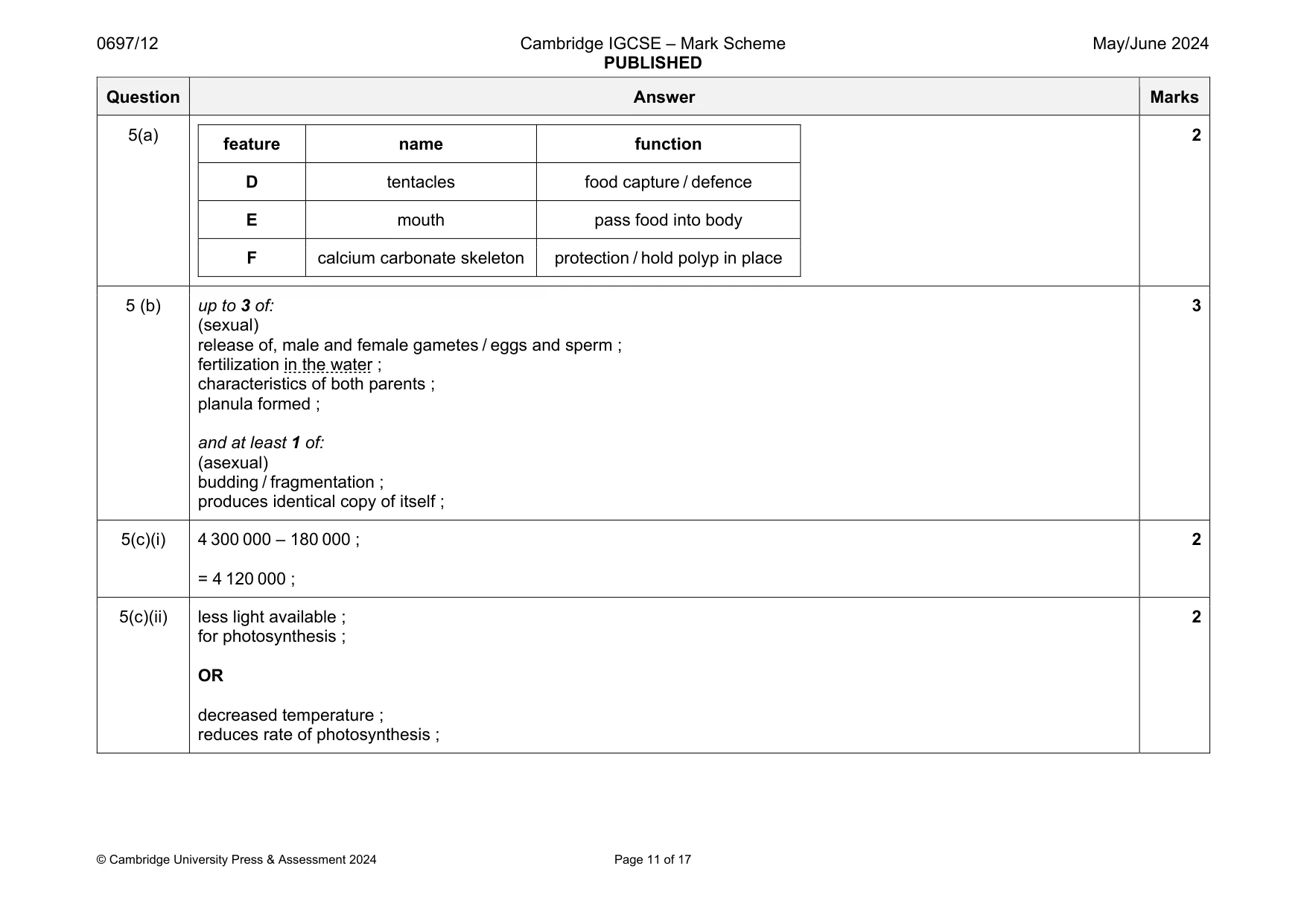
0697/12 Cambridge IGCSE – Mark Scheme PUBLISHED May/June 2024 © Cambridge University Press & Assessment 2024 Page 11 of 17 Question Answer Marks 5(a) feature name function D tentacles food capture / defence E mouth pass food into body F calcium carbonate skeleton protection / hold polyp in place 2 5 (b) up to 3 of: (sexual) release of, male and female gametes / eggs and sperm ; fertilization in the water ; characteristics of both parents ; planula formed ; and at least 1 of: (asexual) budding / fragmentation ; produces identical copy of itself ; 3 5(c)(i) 4 300 000 – 180 000 ; = 4 120 000 ; 2 5(c)(ii) less light available ; for photosynthesis ; OR decreased temperature ; reduces rate of photosynthesis ; 2
Mark scheme, page 12
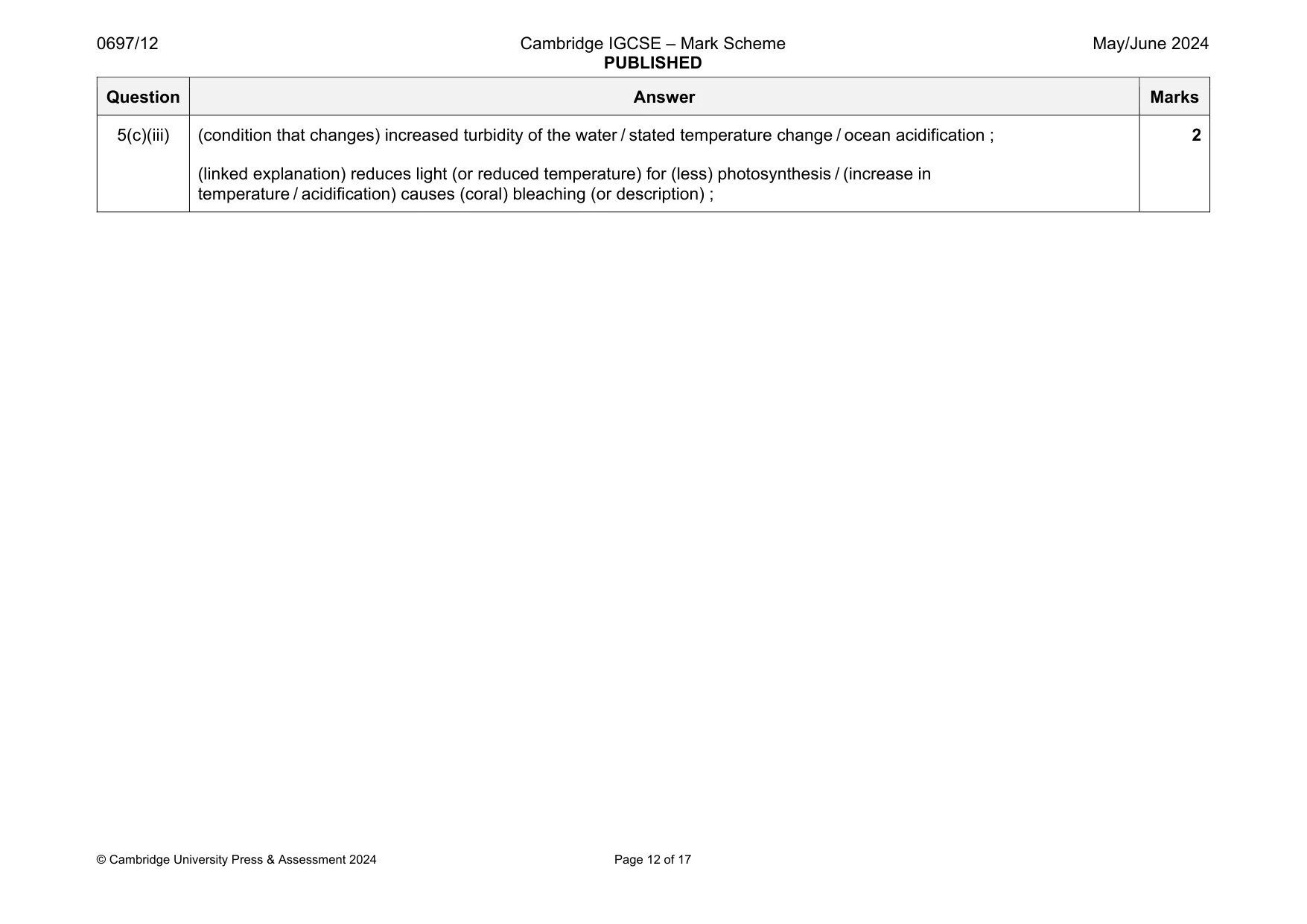
0697/12 Cambridge IGCSE – Mark Scheme PUBLISHED May/June 2024 © Cambridge University Press & Assessment 2024 Page 12 of 17 Question Answer Marks 5(c)(iii) (condition that changes) increased turbidity of the water / stated temperature change / ocean acidification ; (linked explanation) reduces light (or reduced temperature) for (less) photosynthesis / (increase in temperature / acidification) causes (coral) bleaching (or description) ; 2
Mark scheme, page 13
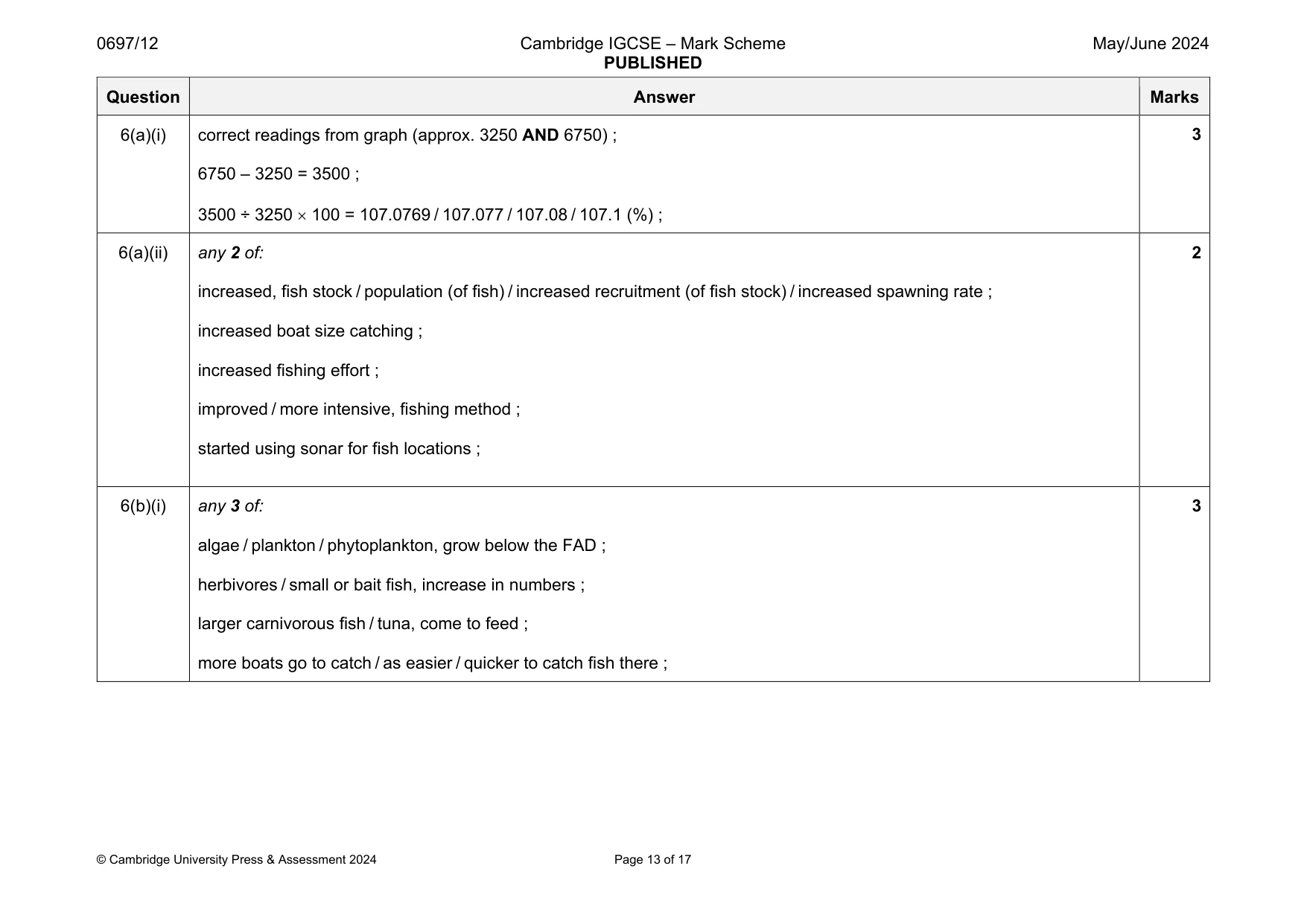
0697/12 Cambridge IGCSE – Mark Scheme PUBLISHED May/June 2024 © Cambridge University Press & Assessment 2024 Page 13 of 17 Question Answer Marks 6(a)(i) correct readings from graph (approx. 3250 AND 6750) ; 6750 – 3250 = 3500 ; 3500 ÷ 3250 100 = 107.0769 / 107.077 / 107.08 / 107.1 (%) ; 3 6(a)(ii) any 2 of: increased, fish stock / population (of fish) / increased recruitment (of fish stock) / increased spawning rate ; increased boat size catching ; increased fishing effort ; improved / more intensive, fishing method ; started using sonar for fish locations ; 2 6(b)(i) any 3 of: algae / plankton / phytoplankton, grow below the FAD ; herbivores / small or bait fish, increase in numbers ; larger carnivorous fish / tuna, come to feed ; more boats go to catch / as easier / quicker to catch fish there ; 3
Mark scheme, page 14
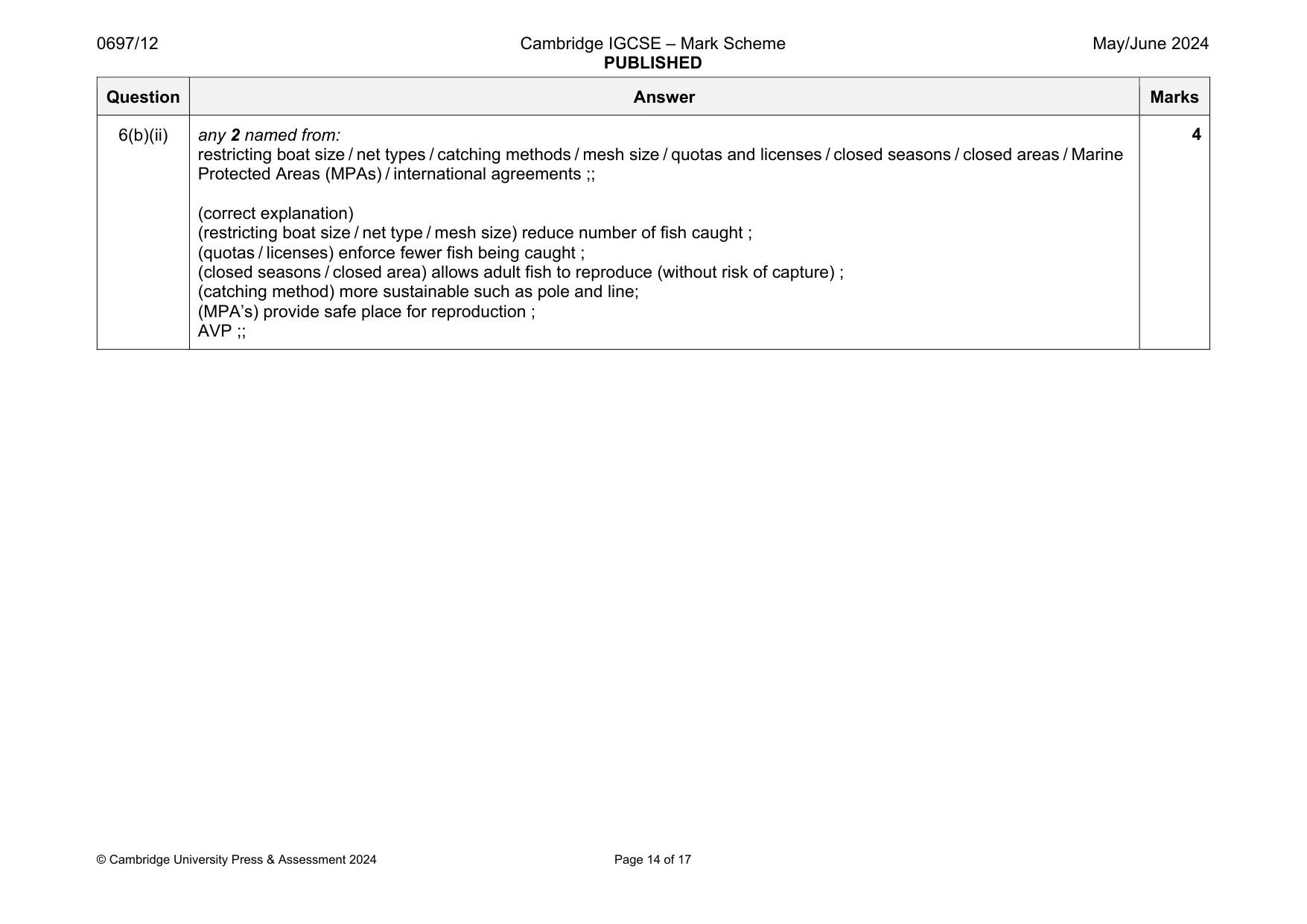
0697/12 Cambridge IGCSE – Mark Scheme PUBLISHED May/June 2024 © Cambridge University Press & Assessment 2024 Page 14 of 17 Question Answer Marks 6(b)(ii) any 2 named from: restricting boat size / net types / catching methods / mesh size / quotas and licenses / closed seasons / closed areas / Marine Protected Areas (MPAs) / international agreements ;; (correct explanation) (restricting boat size / net type / mesh size) reduce number of fish caught ; (quotas / licenses) enforce fewer fish being caught ; (closed seasons / closed area) allows adult fish to reproduce (without risk of capture) ; (catching method) more sustainable such as pole and line; (MPA’s) provide safe place for reproduction ; AVP ;; 4
Mark scheme, page 15
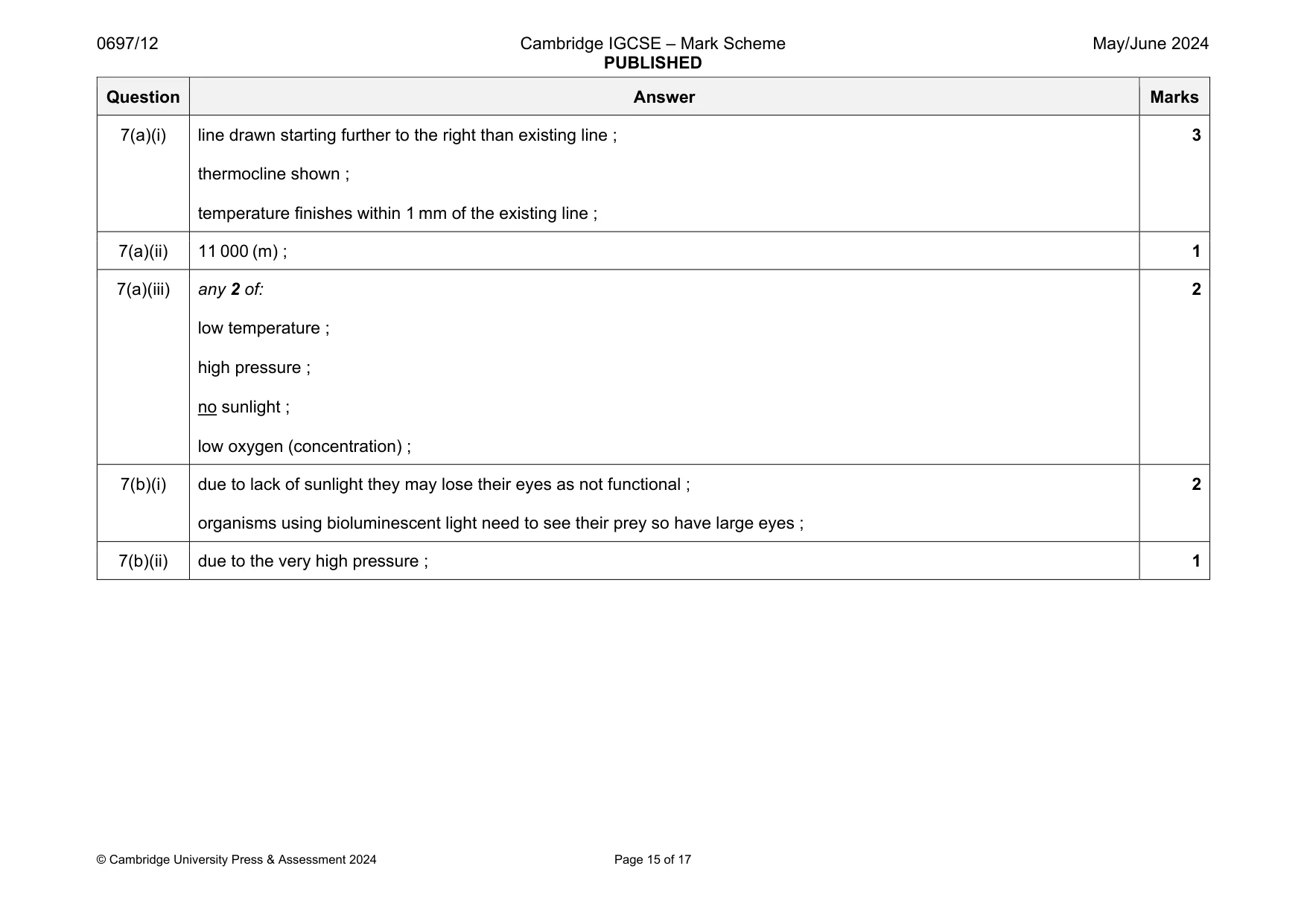
0697/12 Cambridge IGCSE – Mark Scheme PUBLISHED May/June 2024 © Cambridge University Press & Assessment 2024 Page 15 of 17 Question Answer Marks 7(a)(i) line drawn starting further to the right than existing line ; thermocline shown ; temperature finishes within 1 mm of the existing line ; 3 7(a)(ii) 11 000 (m) ; 1 7(a)(iii) any 2 of: low temperature ; high pressure ; no sunlight ; low oxygen (concentration) ; 2 7(b)(i) due to lack of sunlight they may lose their eyes as not functional ; organisms using bioluminescent light need to see their prey so have large eyes ; 2 7(b)(ii) due to the very high pressure ; 1
Mark scheme, page 16
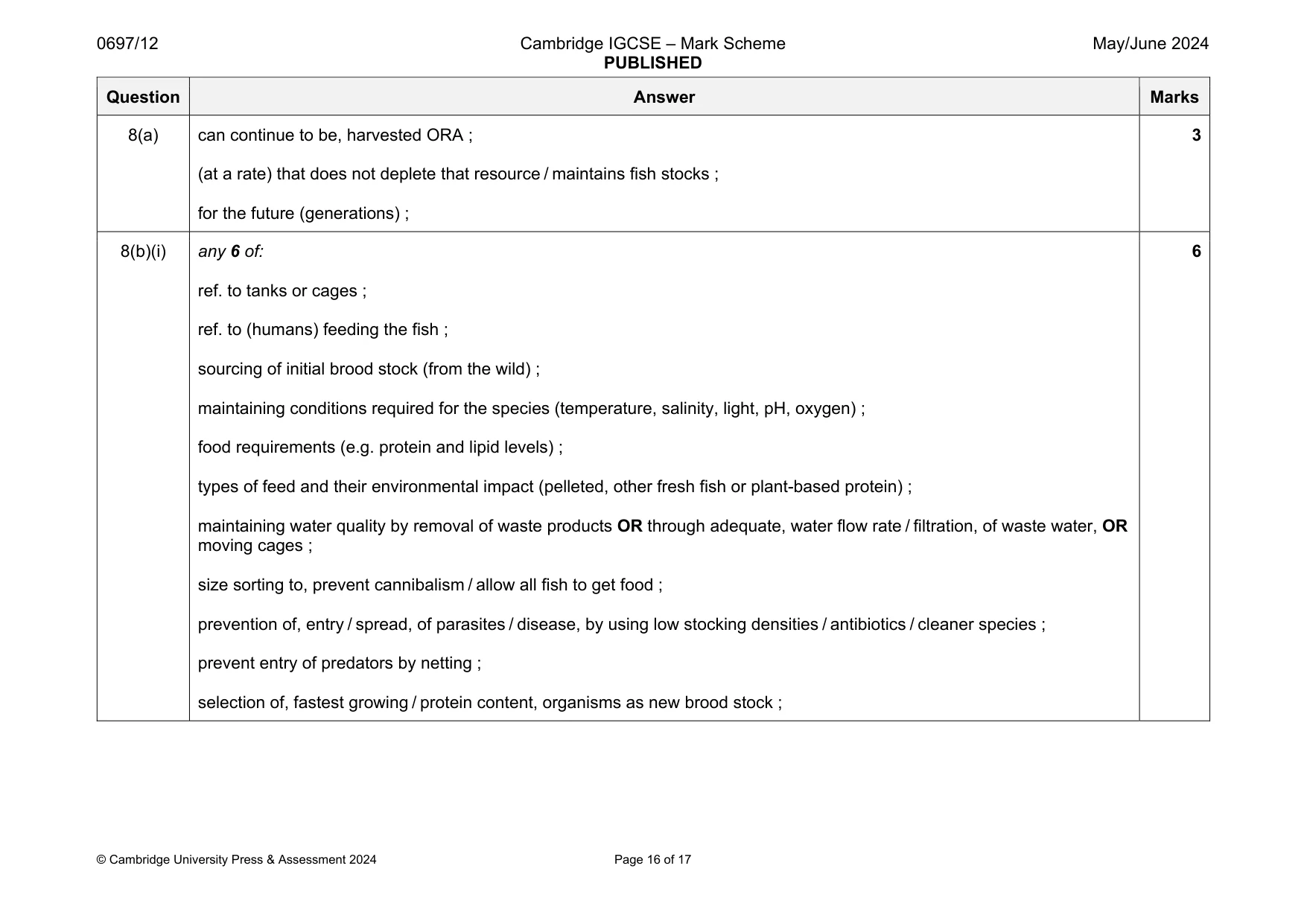
0697/12 Cambridge IGCSE – Mark Scheme PUBLISHED May/June 2024 © Cambridge University Press & Assessment 2024 Page 16 of 17 Question Answer Marks 8(a) can continue to be, harvested ORA ; (at a rate) that does not deplete that resource / maintains fish stocks ; for the future (generations) ; 3 8(b)(i) any 6 of: ref. to tanks or cages ; ref. to (humans) feeding the fish ; sourcing of initial brood stock (from the wild) ; maintaining conditions required for the species (temperature, salinity, light, pH, oxygen) ; food requirements (e.g. protein and lipid levels) ; types of feed and their environmental impact (pelleted, other fresh fish or plant-based protein) ; maintaining water quality by removal of waste products OR through adequate, water flow rate / filtration, of waste water, OR moving cages ; size sorting to, prevent cannibalism / allow all fish to get food ; prevention of, entry / spread, of parasites / disease, by using low stocking densities / antibiotics / cleaner species ; prevent entry of predators by netting ; selection of, fastest growing / protein content, organisms as new brood stock ; 6
Mark scheme, page 17
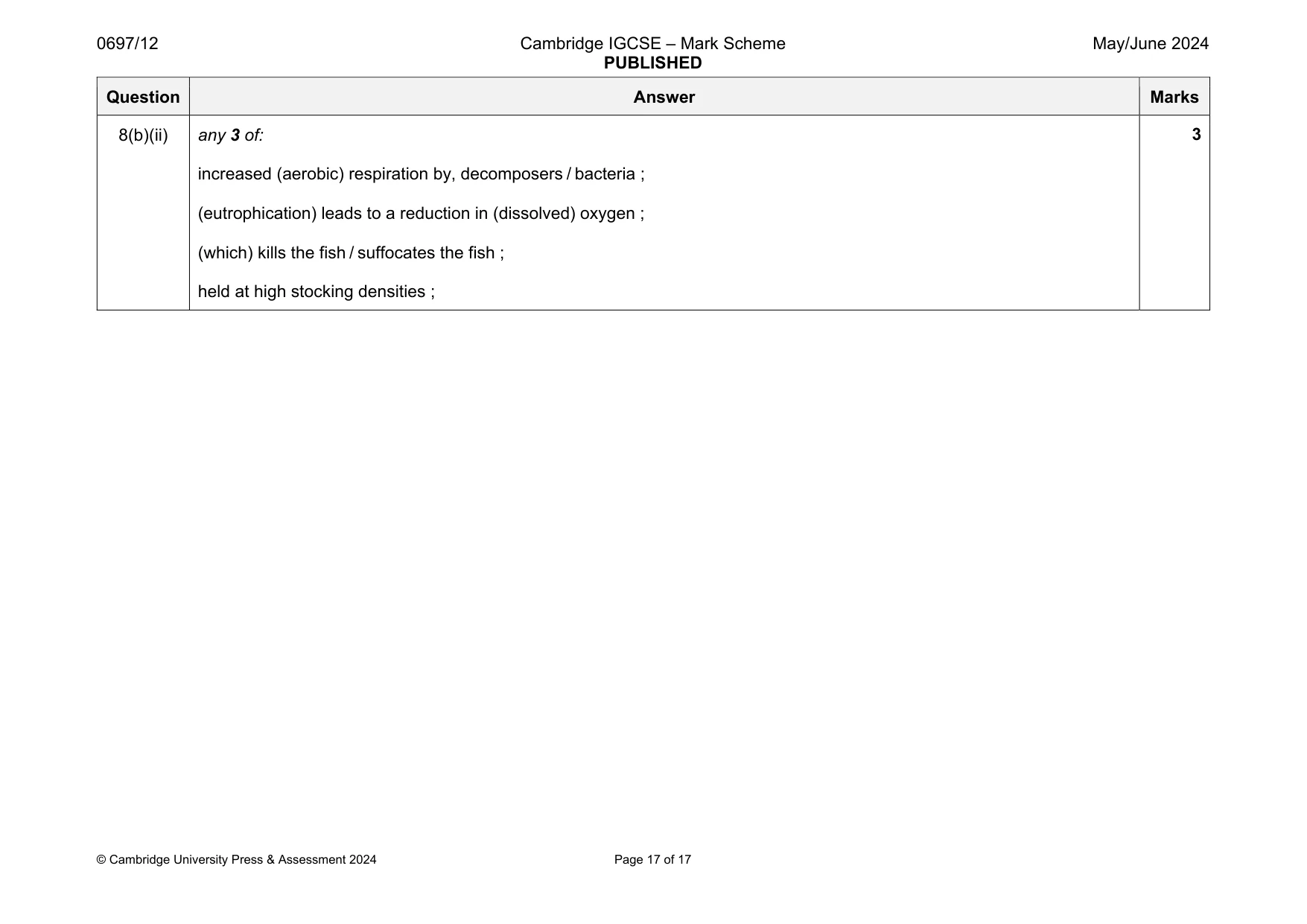
0697/12 Cambridge IGCSE – Mark Scheme PUBLISHED May/June 2024 © Cambridge University Press & Assessment 2024 Page 17 of 17 Question Answer Marks 8(b)(ii) any 3 of: increased (aerobic) respiration by, decomposers / bacteria ; (eutrophication) leads to a reduction in (dissolved) oxygen ; (which) kills the fish / suffocates the fish ; held at high stocking densities ; 3
What you needed in this session
Cambridge’s own grade thresholds for 2024 May/June, Paper 1 · Variant 2. A higher threshold means an easier paper — the bar moves with how the cohort did.