Cambridge IGCSE Marine Science (Maldives only) 0697 — 2024 May/June Paper 1 · Variant 1
0697/11/M/J/24 · 80 marks · 105 min
The question paper and its mark scheme, free to read here and free to download. This is Cambridge’s own paper, exactly as it was sat.
Question paper20 pages





Mark scheme16 pages
Answers below. Sit the paper first if you are practising.
Paper as text
Question paper, page 1
This document has 20 pages. Any blank pages are indicated. [Turn over Cambridge IGCSE™ MARINE SCIENCE 0697/11 Paper 1 Theory and Data Handling May/June 2024 1 hour 45 minutes You must answer on the question paper. No additional materials are needed. INSTRUCTIONS ● Answer all questions. ● Use a black or dark blue pen. You may use an HB pencil for any diagrams or graphs. ● Write your name, centre number and candidate number in the boxes at the top of the page. ● Write your answer to each question in the space provided. ● Do not use an erasable pen or correction fluid. ● Do not write on any bar codes. ● You may use a calculator. ● You should show all your working and use appropriate units. INFORMATION ● The total mark for this paper is 80. ● The number of marks for each question or part question is shown in brackets [ ]. * 4 8 2 6 7 0 8 6 1 3 * DC (PB/SW) 332101/3 © UCLES 2024
Question paper, page 2
2 0697/11/M/J/24 © UCLES 2024 BLANK PAGE
Question paper, page 3
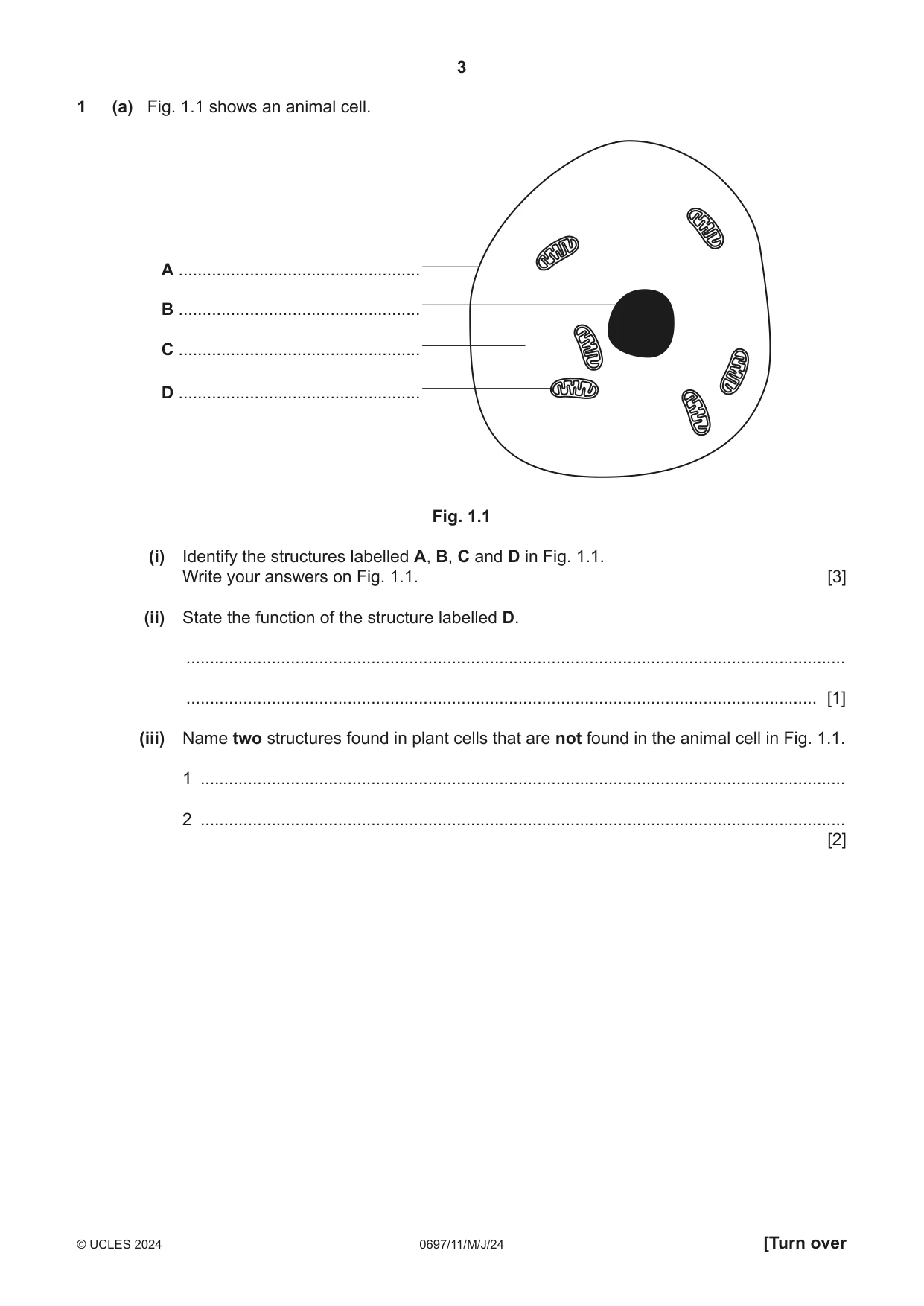
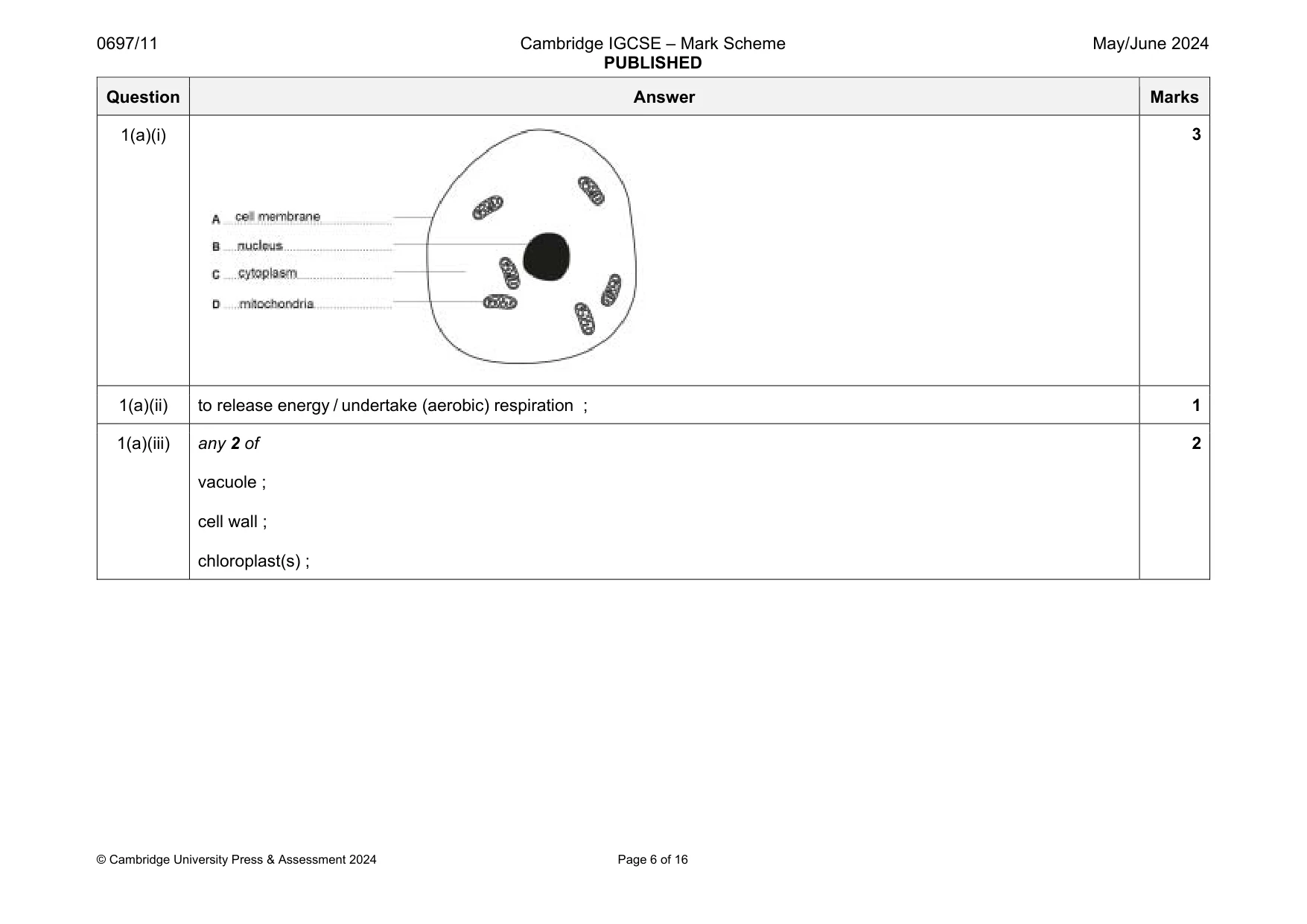
3 0697/11/M/J/24 © UCLES 2024 [Turn over 1 (a) Fig. 1.1 shows an animal cell. A … B … C … D … Fig. 1.1 (i) Identify the structures labelled A, B, C and D in Fig. 1.1. Write your answers on Fig. 1.1. [3] (ii) State the function of the structure labelled D. … … [1] (iii) Name two structures found in plant cells that are not found in the animal cell in Fig. 1.1. 1 … 2 … [2]
Question paper, page 4
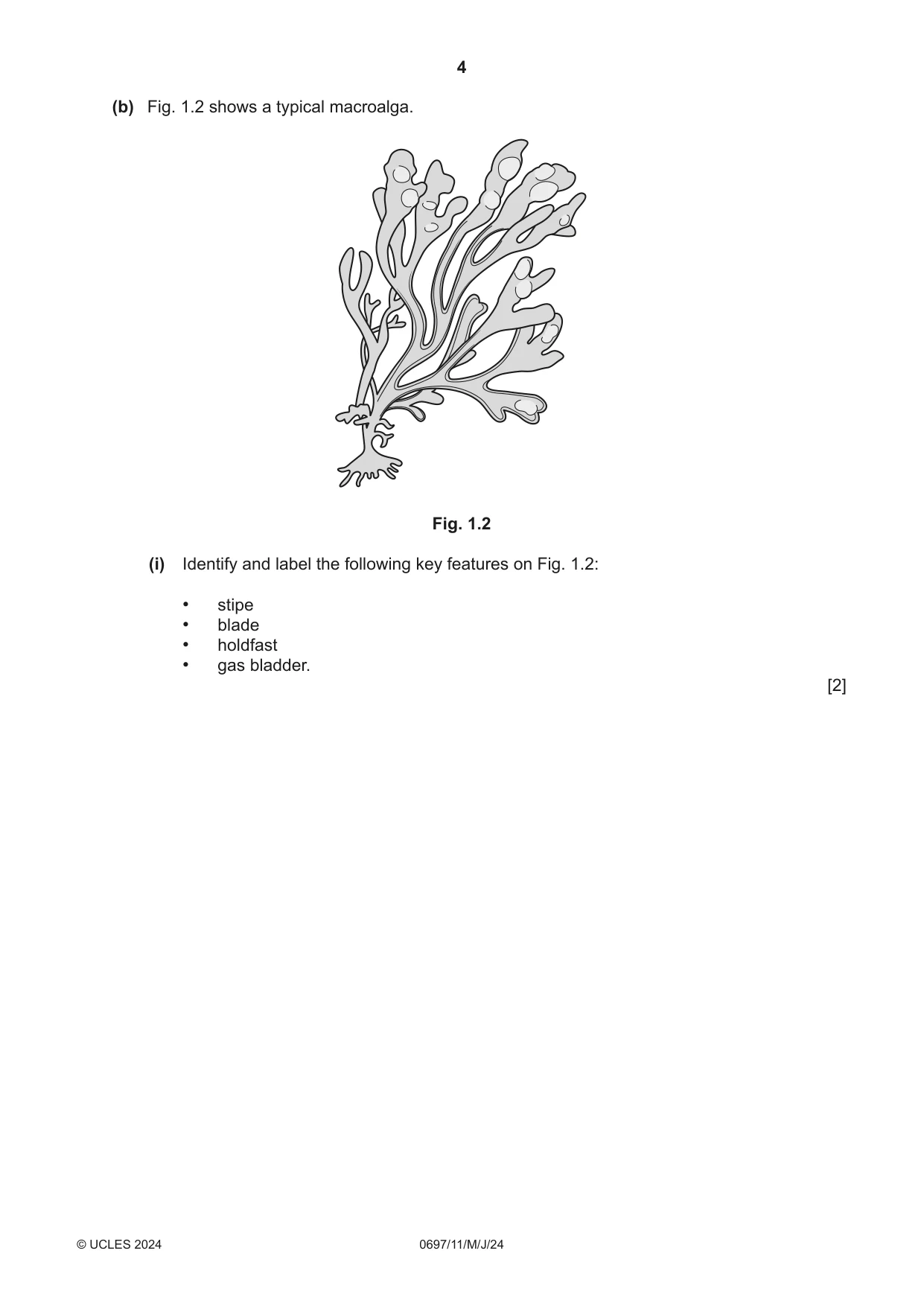
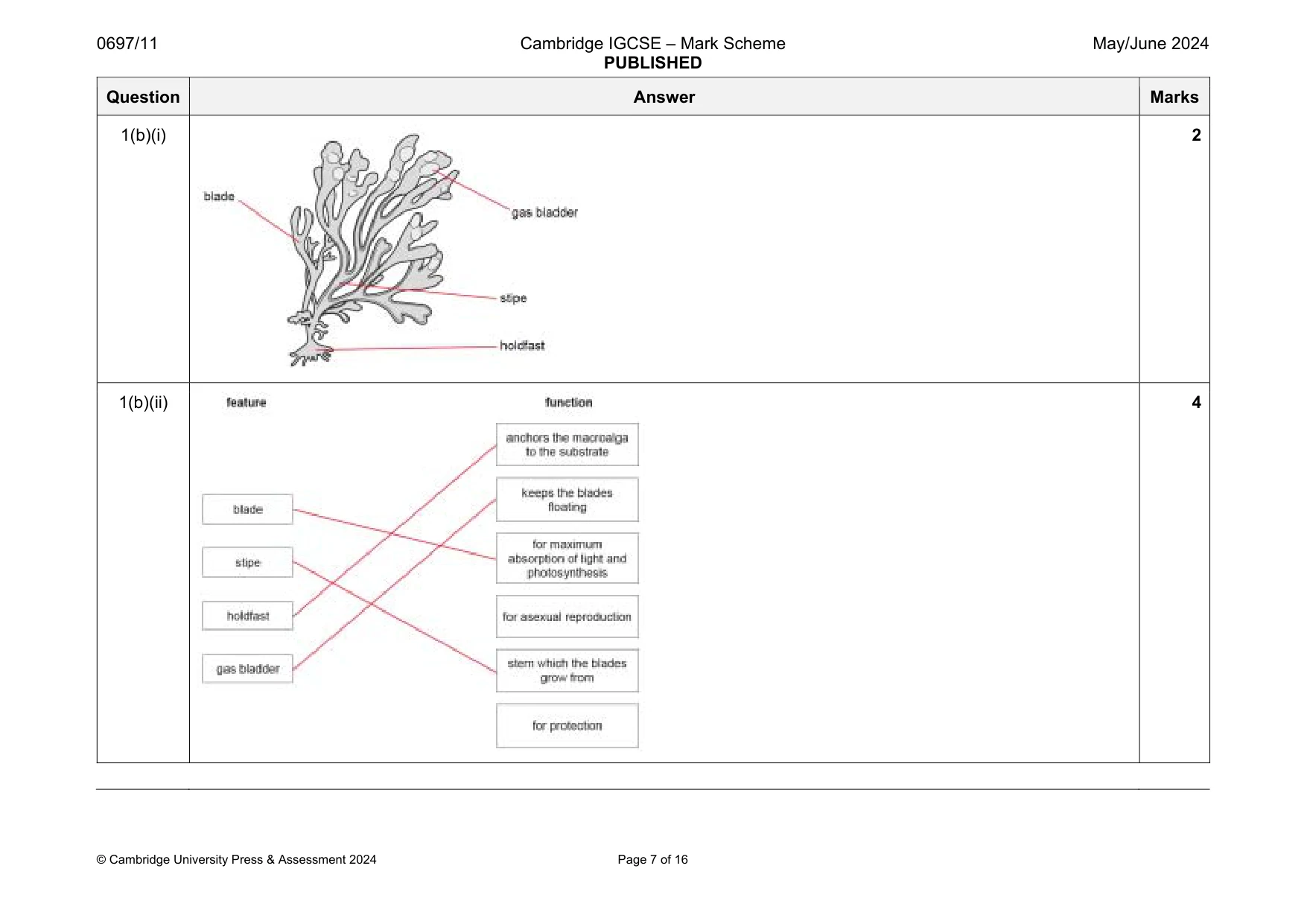
4 0697/11/M/J/24 © UCLES 2024 (b) Fig. 1.2 shows a typical macroalga. Fig. 1.2 (i) Identify and label the following key features on Fig. 1.2: • stipe • blade • holdfast • gas bladder. [2]
Question paper, page 5
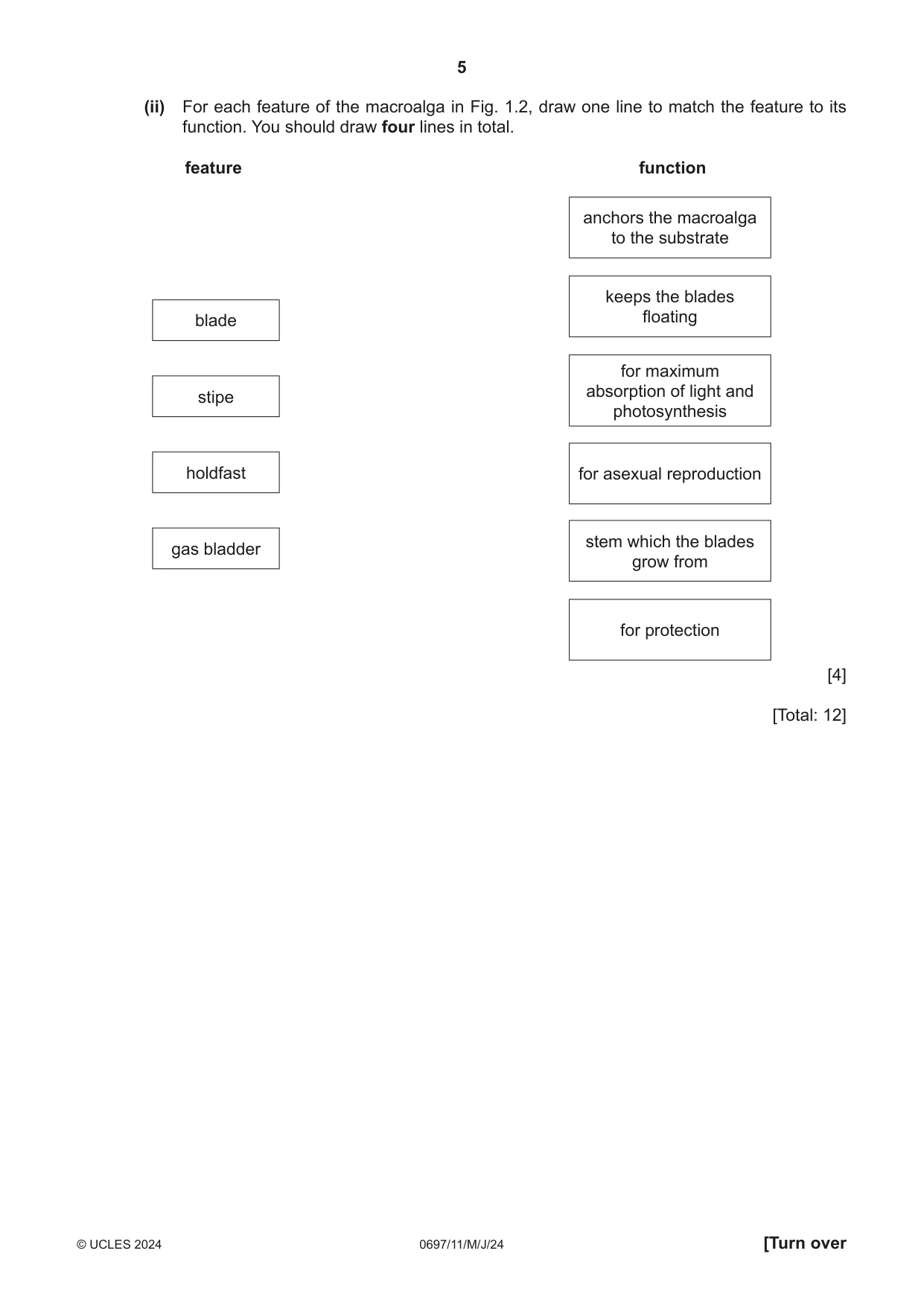
5 0697/11/M/J/24 © UCLES 2024 [Turn over (ii) For each feature of the macroalga in Fig. 1.2, draw one line to match the feature to its function. You should draw four lines in total. feature function blade stipe holdfast gas bladder anchors the macroalga to the substrate keeps the blades floating for maximum absorption of light and photosynthesis for asexual reproduction stem which the blades grow from for protection [4] [Total: 12]
Question paper, page 6
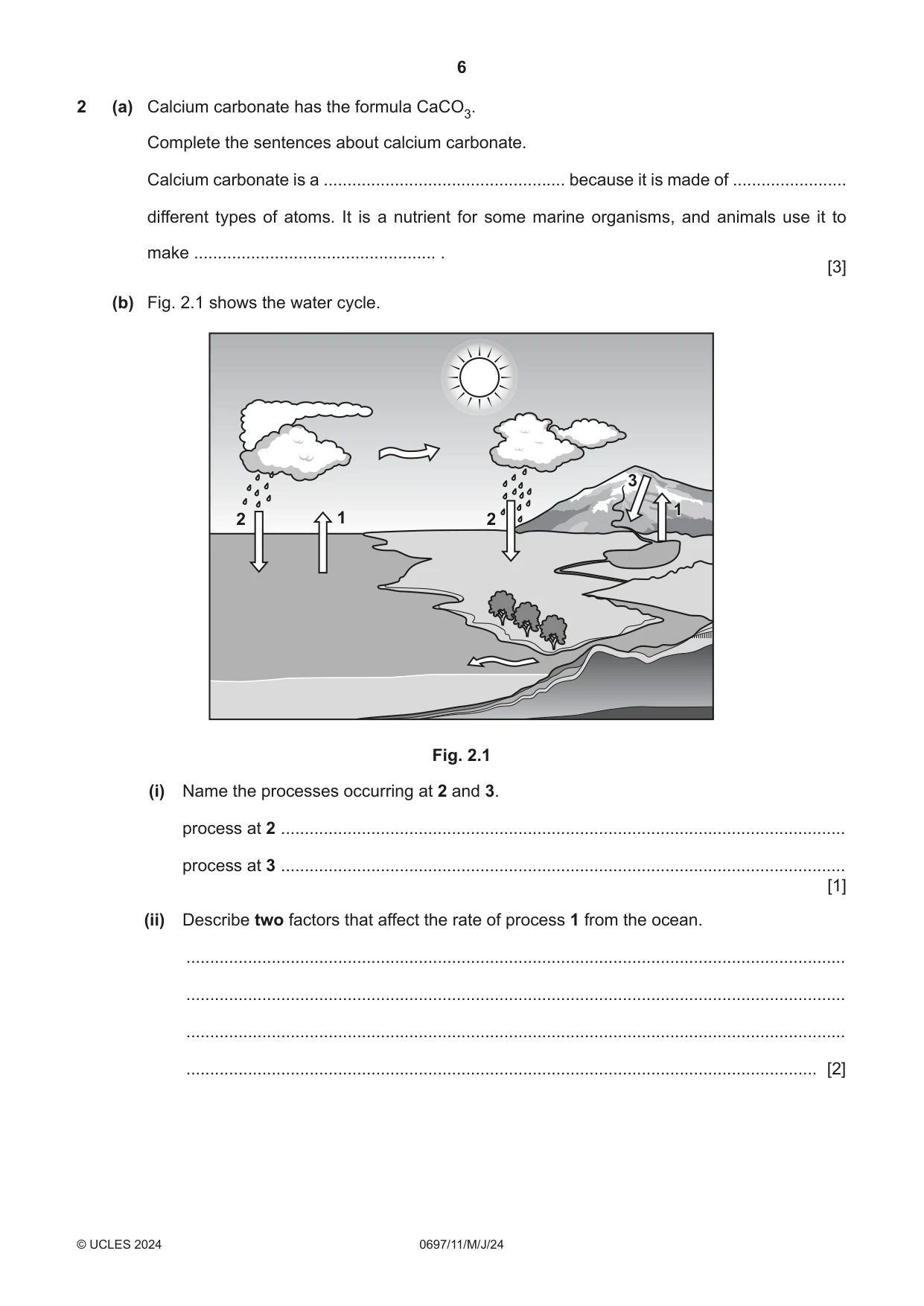
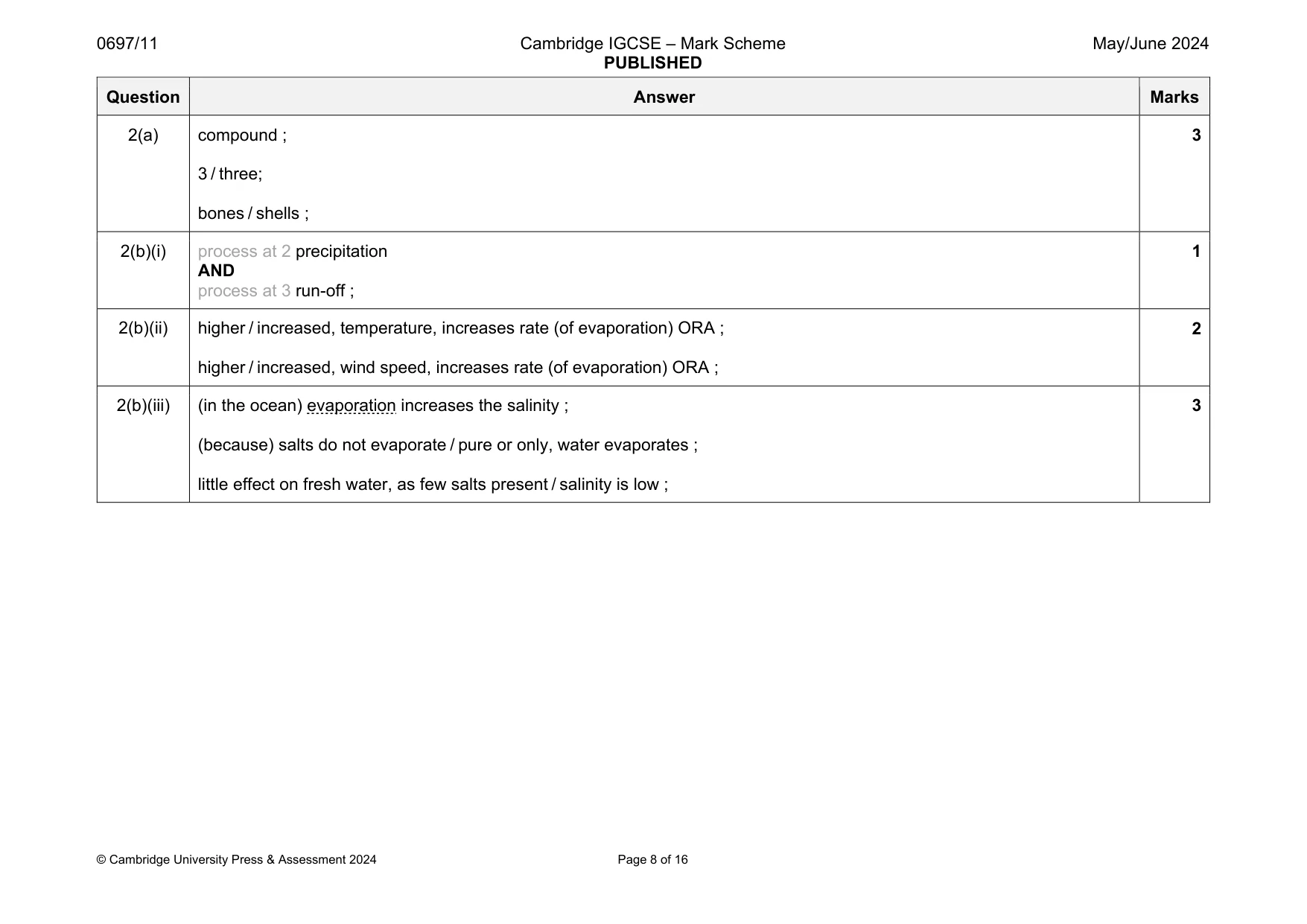
6 0697/11/ M/J/24 © UCLES 2024 2 (a) Calcium carbonate has the formula CaCO3. Complete the sentences about calcium carbonate. Calcium carbonate is a … because it is made of … different types of atoms. It is a nutrient for some marine organisms, and animals use it to make … . [3] (b) Fig. 2.1 shows the water cycle. 1 2 2 3 1 Fig. 2.1 (i) Name the processes occurring at 2 and 3. process at 2 … process at 3 … [1] (ii) Describe two factors that affect the rate of process 1 from the ocean. … … … … [2]
Question paper, page 7
7 0697/11/M/J/24 © UCLES 2024 [Turn over (iii) Explain the effect of process 1 on salinity in the ocean compared to its effect on salinity in the fresh water lake. … … … … … … [3] [Total: 9]
Question paper, page 8
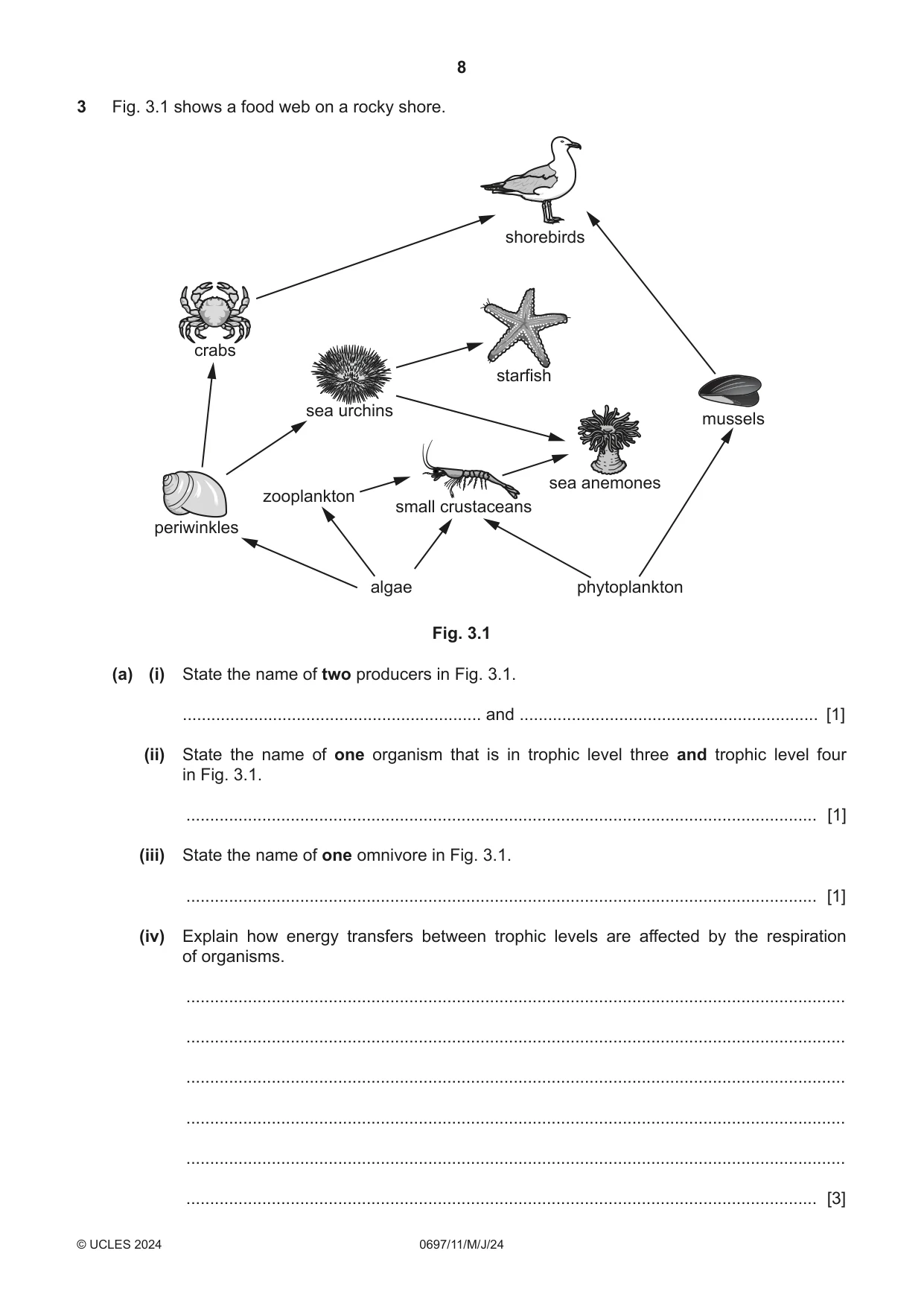
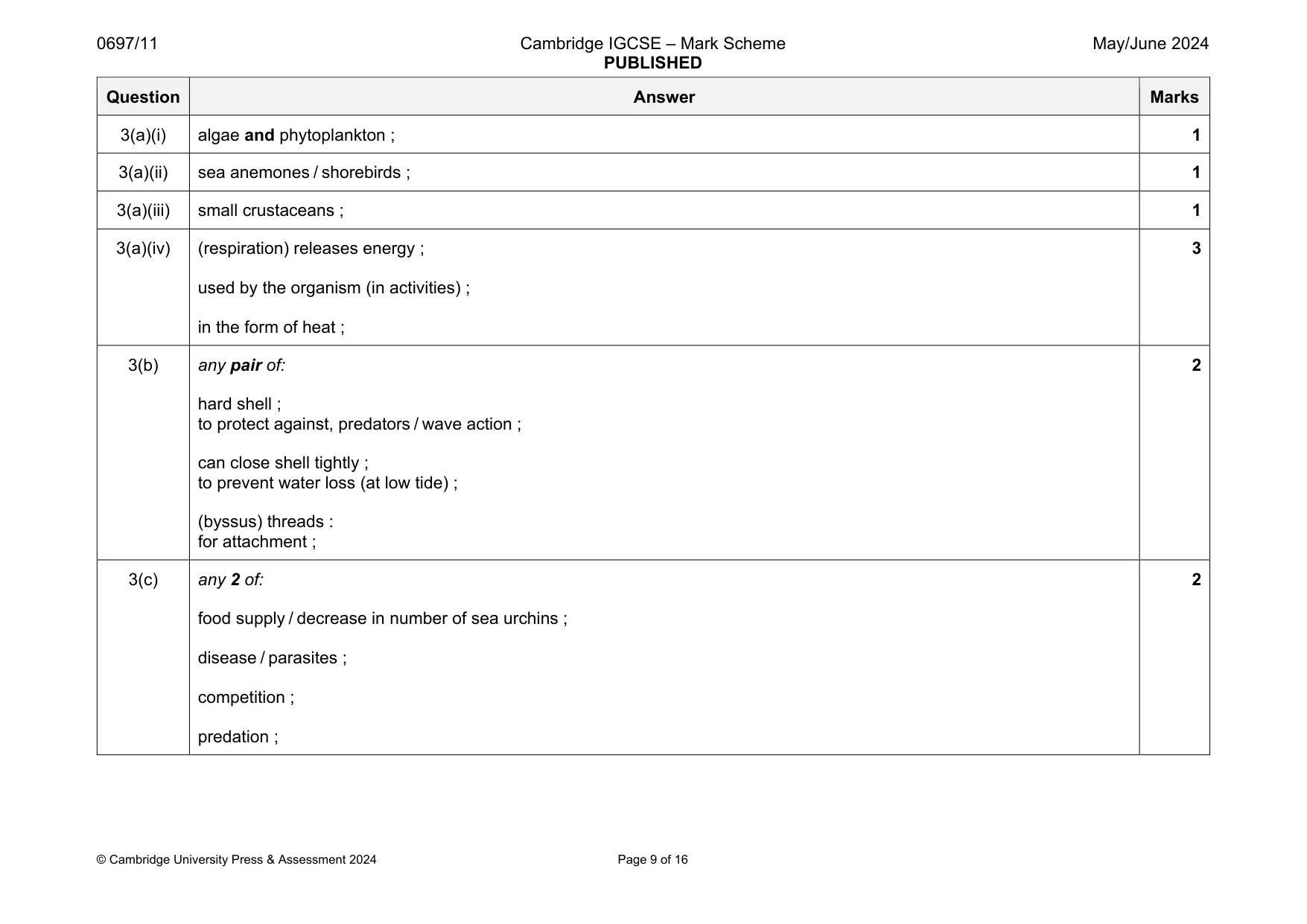
8 0697/11/ M/J/24 © UCLES 2024 3 Fig. 3.1 shows a food web on a rocky shore. small crustaceans zooplankton algae periwinkles sea urchins crabs starfish shorebirds mussels sea anemones phytoplankton Fig. 3.1 (a) (i) State the name of two producers in Fig. 3.1. … and … [1] (ii) State the name of one organism that is in trophic level three and trophic level four in Fig. 3.1. … [1] (iii) State the name of one omnivore in Fig. 3.1. … [1] (iv) Explain how energy transfers between trophic levels are affected by the respiration of organisms. … … … … … … [3]
Question paper, page 9
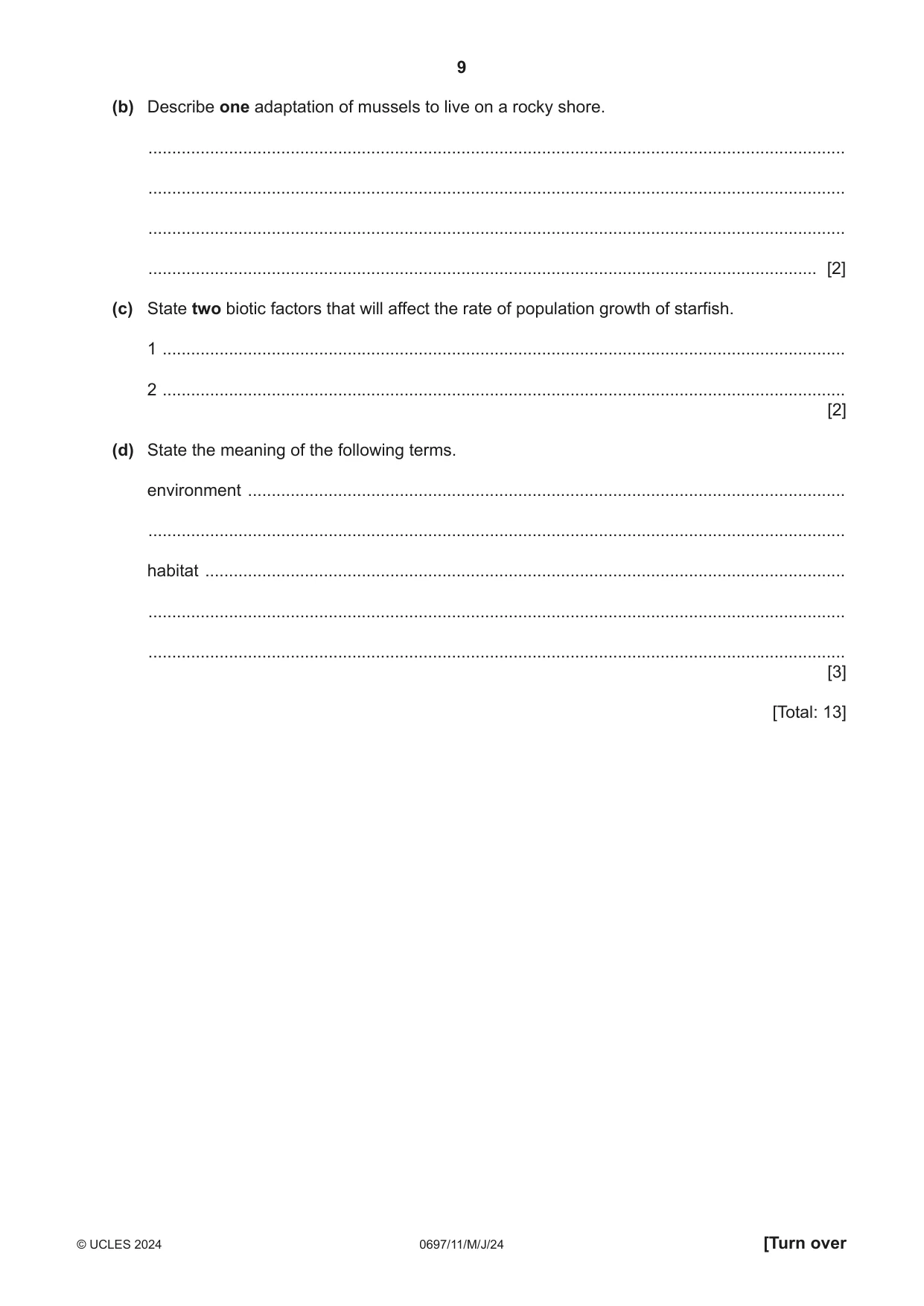
9 0697/11/M/J/24 © UCLES 2024 [Turn over (b) Describe one adaptation of mussels to live on a rocky shore. … … … … [2] (c) State two biotic factors that will affect the rate of population growth of starfish. 1 … 2 … [2] (d) State the meaning of the following terms. environment … … habitat … … … [3] [Total: 13]
Question paper, page 10
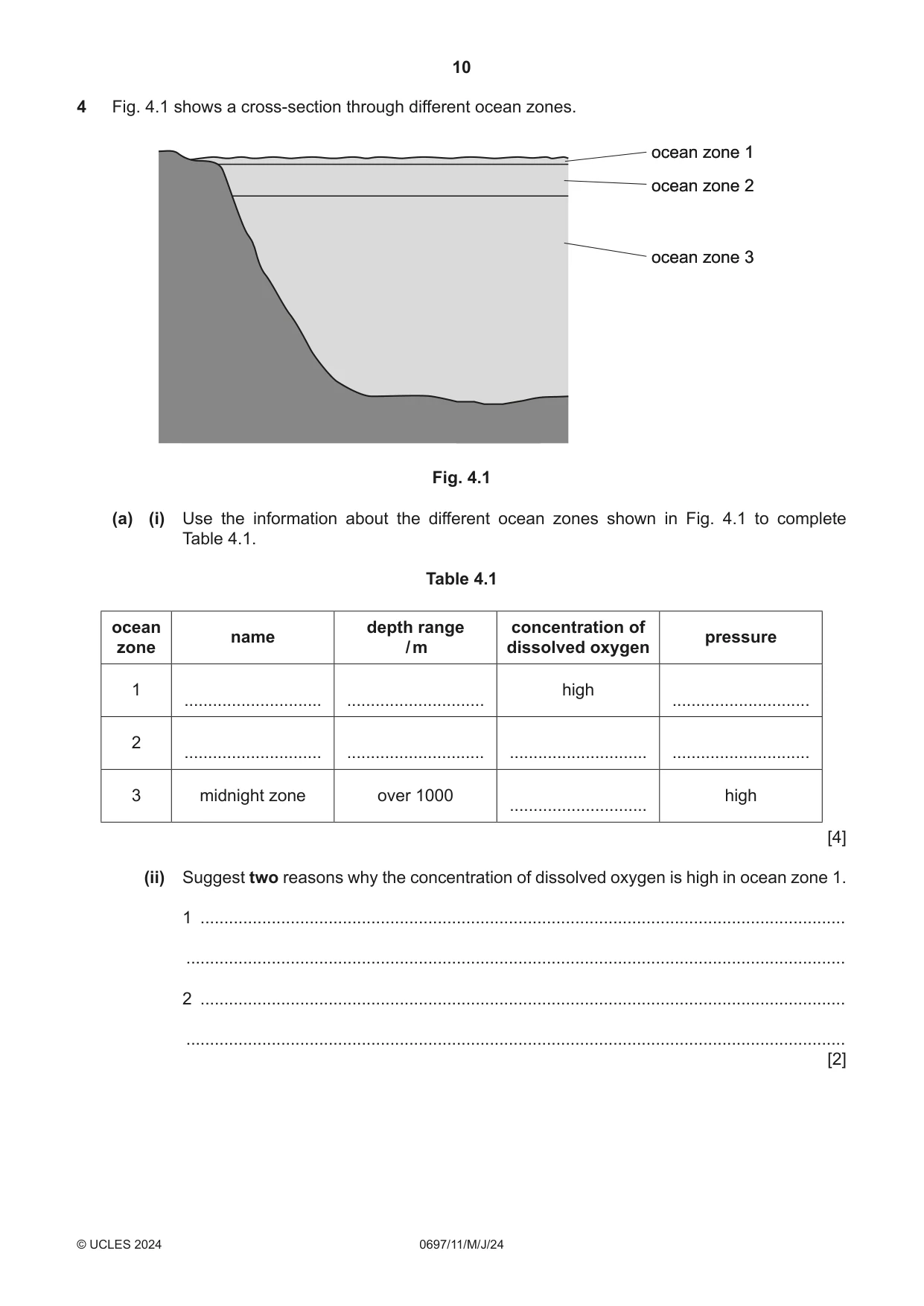
10 0697/11/M/J/24 © UCLES 2024 4 Fig. 4.1 shows a cross-section through different ocean zones. ocean zone 1 ocean zone 1 ocean zone 2 ocean zone 2 ocean zone 3 ocean zone 3 Fig. 4.1 (a) (i) Use the information about the different ocean zones shown in Fig. 4.1 to complete Table 4.1. Table 4.1 ocean zone name depth range / m concentration of dissolved oxygen pressure 1 … … high … 2 … … … … 3 midnight zone over 1000 … high [4] (ii) Suggest two reasons why the concentration of dissolved oxygen is high in ocean zone 1. 1 … … 2 … … [2]
Question paper, page 11
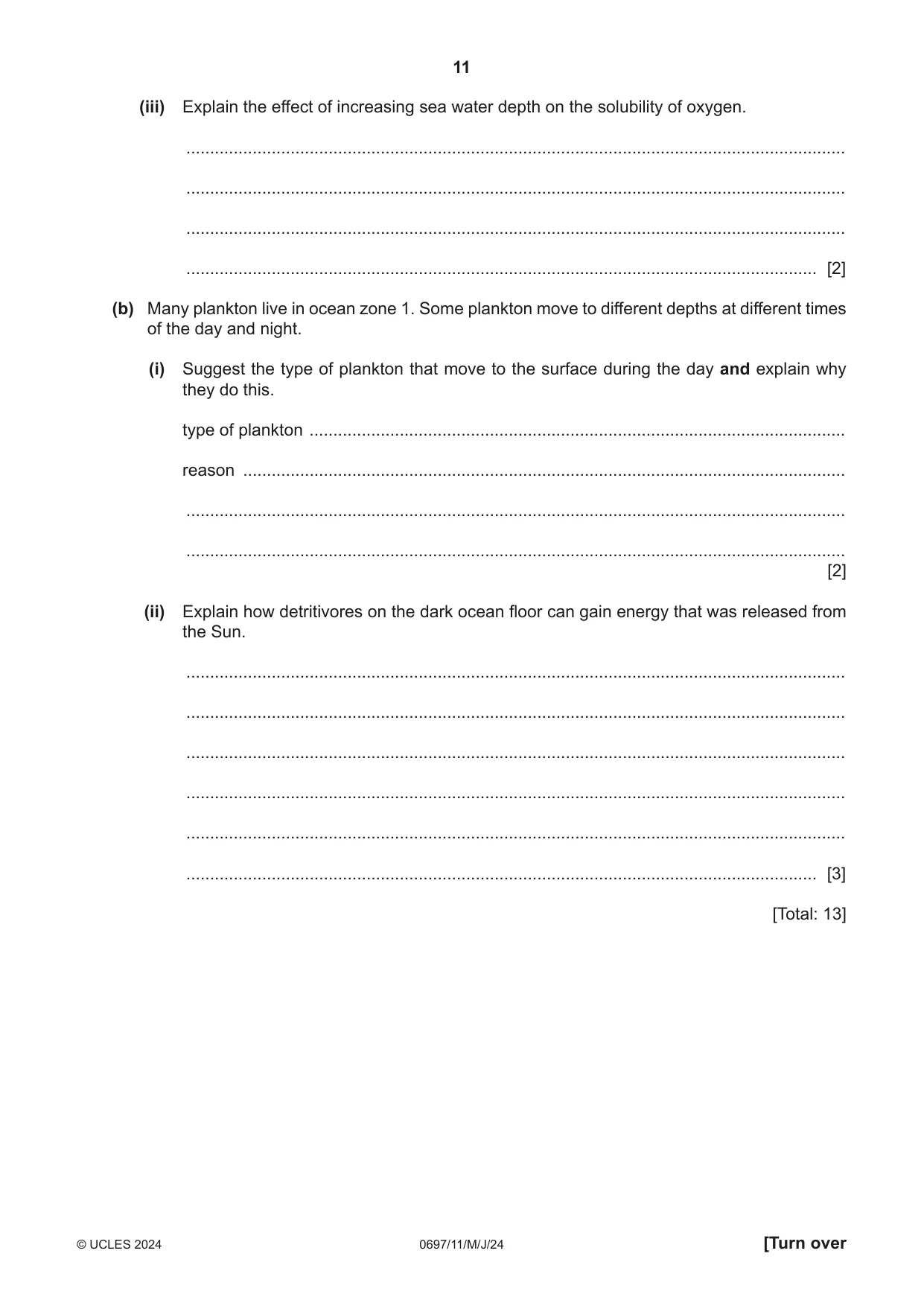
11 0697/11/M/J/24 © UCLES 2024 [Turn over (iii) Explain the effect of increasing sea water depth on the solubility of oxygen. … … … … [2] (b) Many plankton live in ocean zone 1. Some plankton move to different depths at different times of the day and night. (i) Suggest the type of plankton that move to the surface during the day and explain why they do this. type of plankton … reason … … … [2] (ii) Explain how detritivores on the dark ocean floor can gain energy that was released from the Sun. … … … … … … [3] [Total: 13]
Question paper, page 12
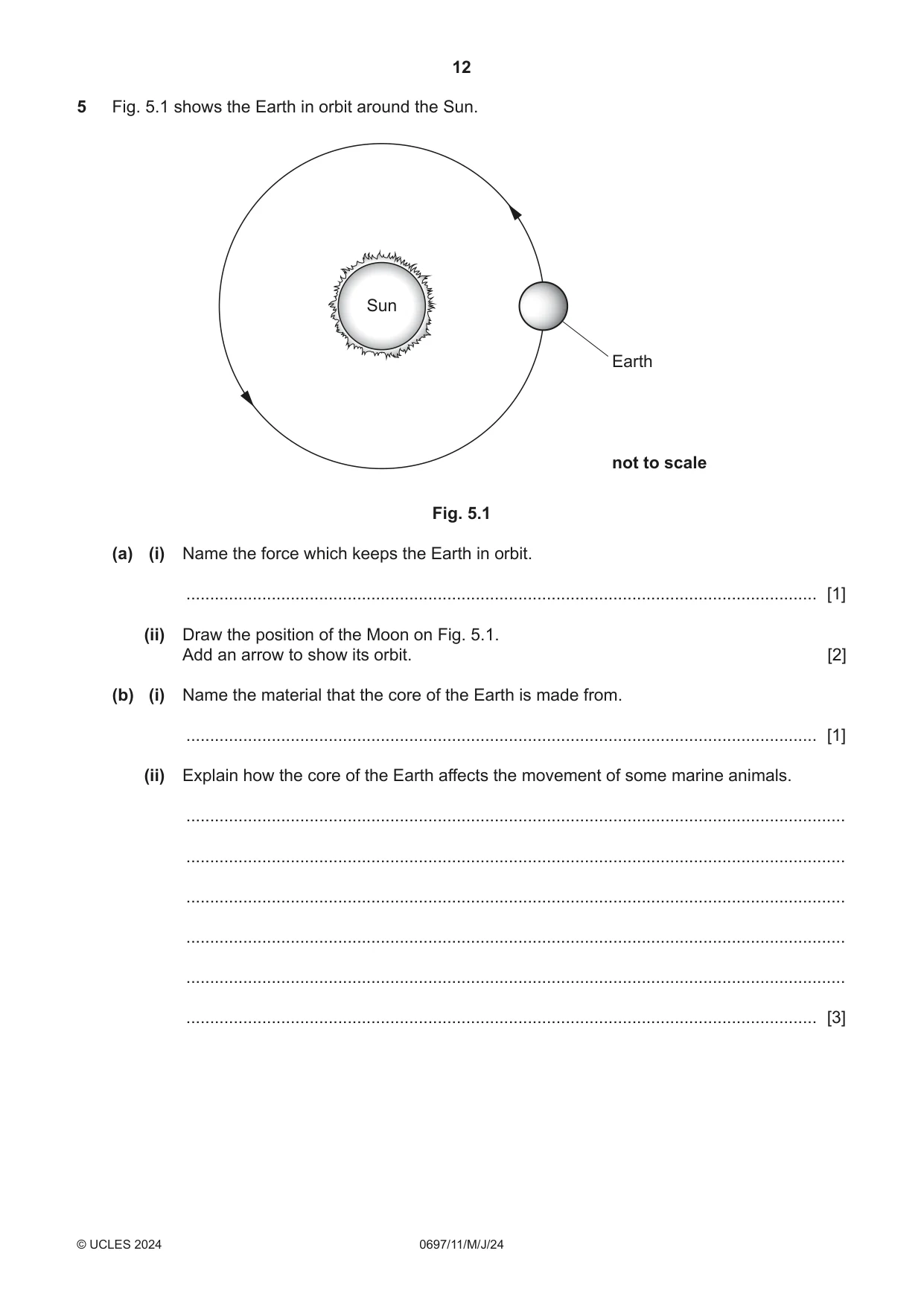
12 0697/11/M/J/24 © UCLES 2024 5 Fig. 5.1 shows the Earth in orbit around the Sun. Sun Earth not to scale Fig. 5.1 (a) (i) Name the force which keeps the Earth in orbit. … [1] (ii) Draw the position of the Moon on Fig. 5.1. Add an arrow to show its orbit. [2] (b) (i) Name the material that the core of the Earth is made from. … [1] (ii) Explain how the core of the Earth affects the movement of some marine animals. … … … … … … [3]
Question paper, page 13
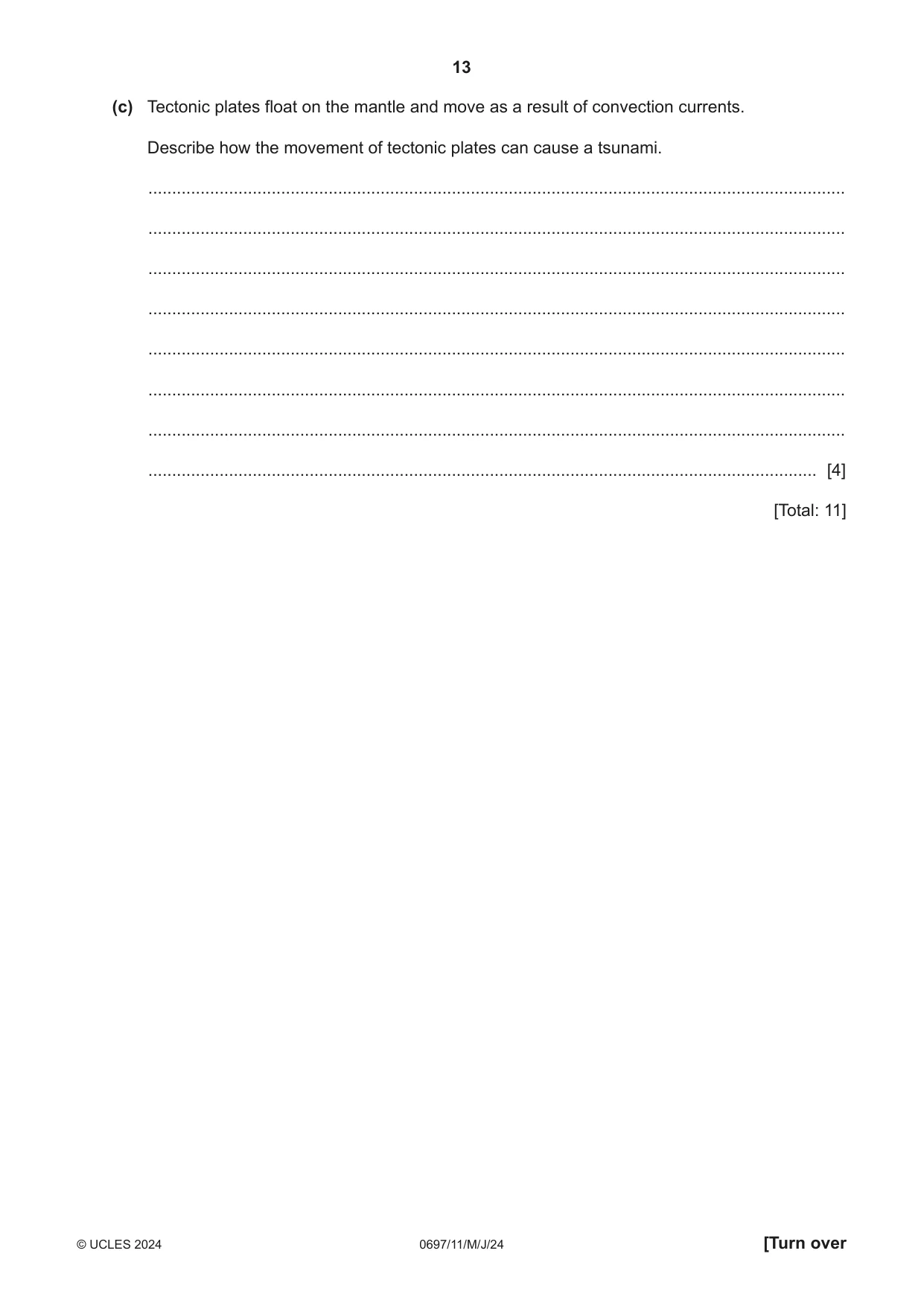
13 0697/11/M/J/24 © UCLES 2024 [Turn over (c) Tectonic plates float on the mantle and move as a result of convection currents. Describe how the movement of tectonic plates can cause a tsunami. … … … … … … … … [4] [Total: 11]
Question paper, page 14
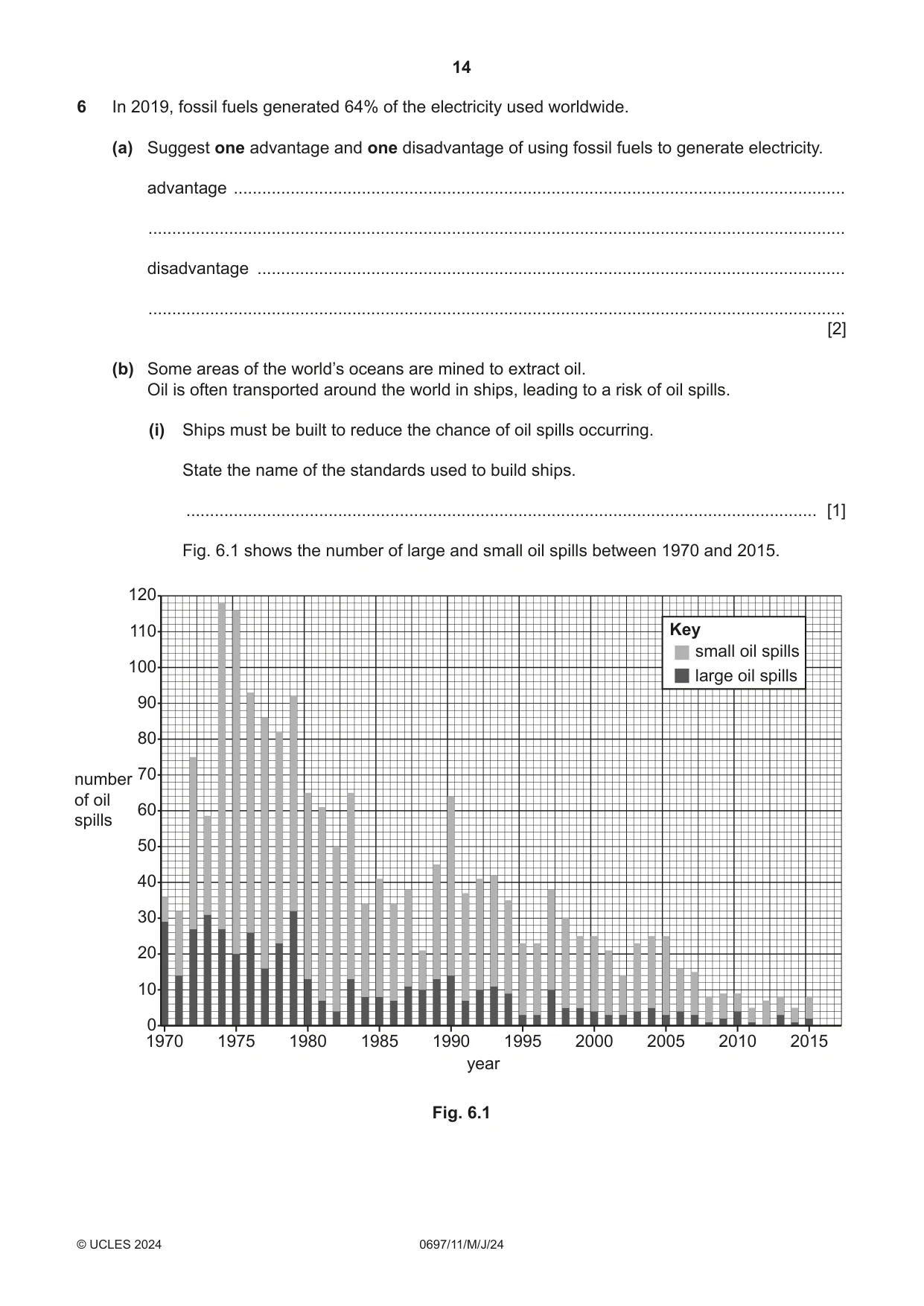
14 0697/11/M/J/24 © UCLES 2024 6 In 2019, fossil fuels generated 64% of the electricity used worldwide. (a) Suggest one advantage and one disadvantage of using fossil fuels to generate electricity. advantage … … disadvantage … … [2] (b) Some areas of the world’s oceans are mined to extract oil. Oil is often transported around the world in ships, leading to a risk of oil spills. (i) Ships must be built to reduce the chance of oil spills occurring. State the name of the standards used to build ships. … [1] Fig. 6.1 shows the number of large and small oil spills between 1970 and 2015. 0 10 20 30 40 50 60 number of oil spills 70 80 90 100 110 120 1970 1975 1980 1985 1990 1995 year 2000 2005 2010 2015 large oil spills small oil spills Key Fig. 6.1
Question paper, page 15
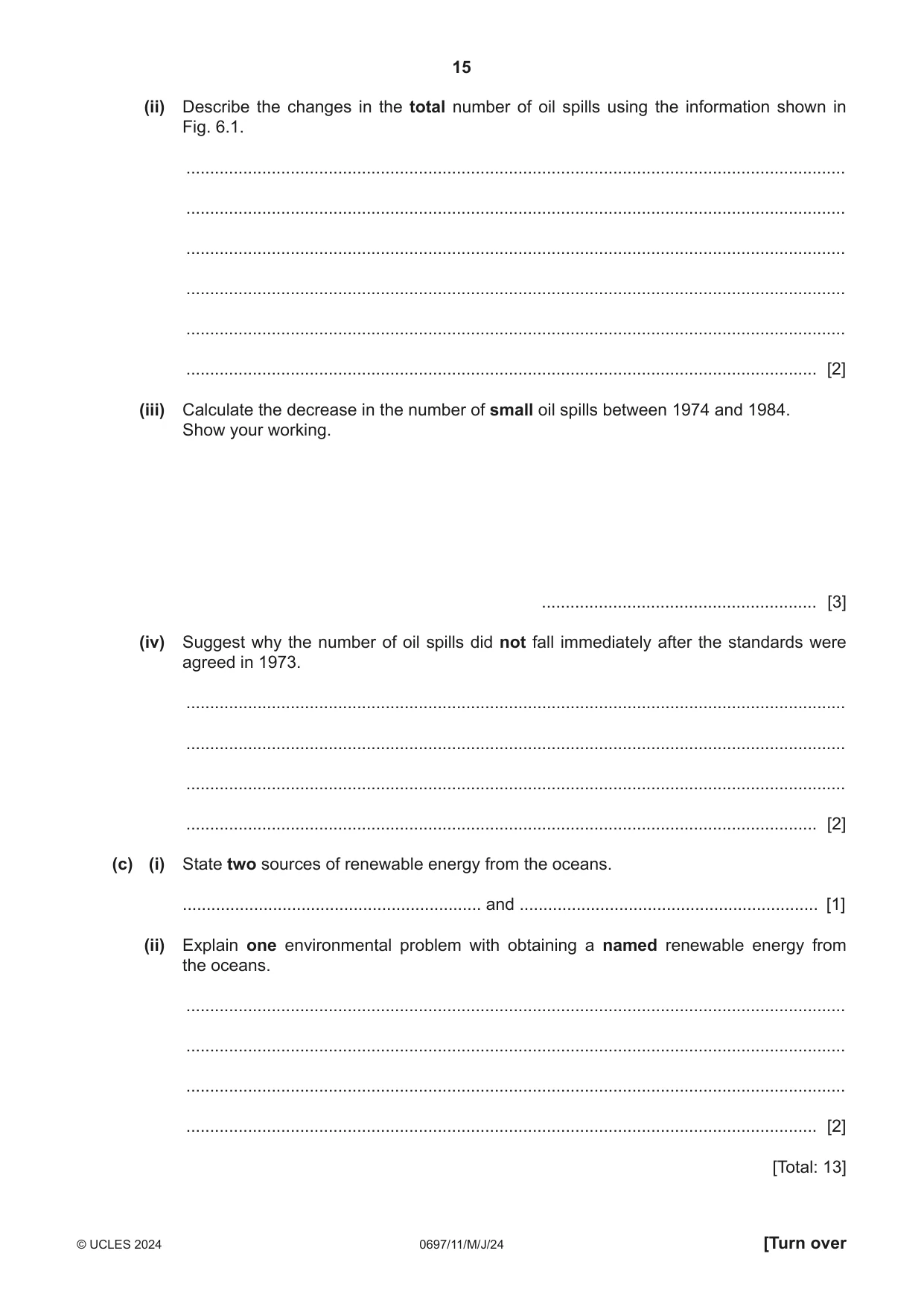
15 0697/11/M/J/24 © UCLES 2024 [Turn over (ii) Describe the changes in the total number of oil spills using the information shown in Fig. 6.1. … … … … … … [2] (iii) Calculate the decrease in the number of small oil spills between 1974 and 1984. Show your working. … [3] (iv) Suggest why the number of oil spills did not fall immediately after the standards were agreed in 1973. … … … … [2] (c) (i) State two sources of renewable energy from the oceans. … and … [1] (ii) Explain one environmental problem with obtaining a named renewable energy from the oceans. … … … … [2] [Total: 13]
Question paper, page 16
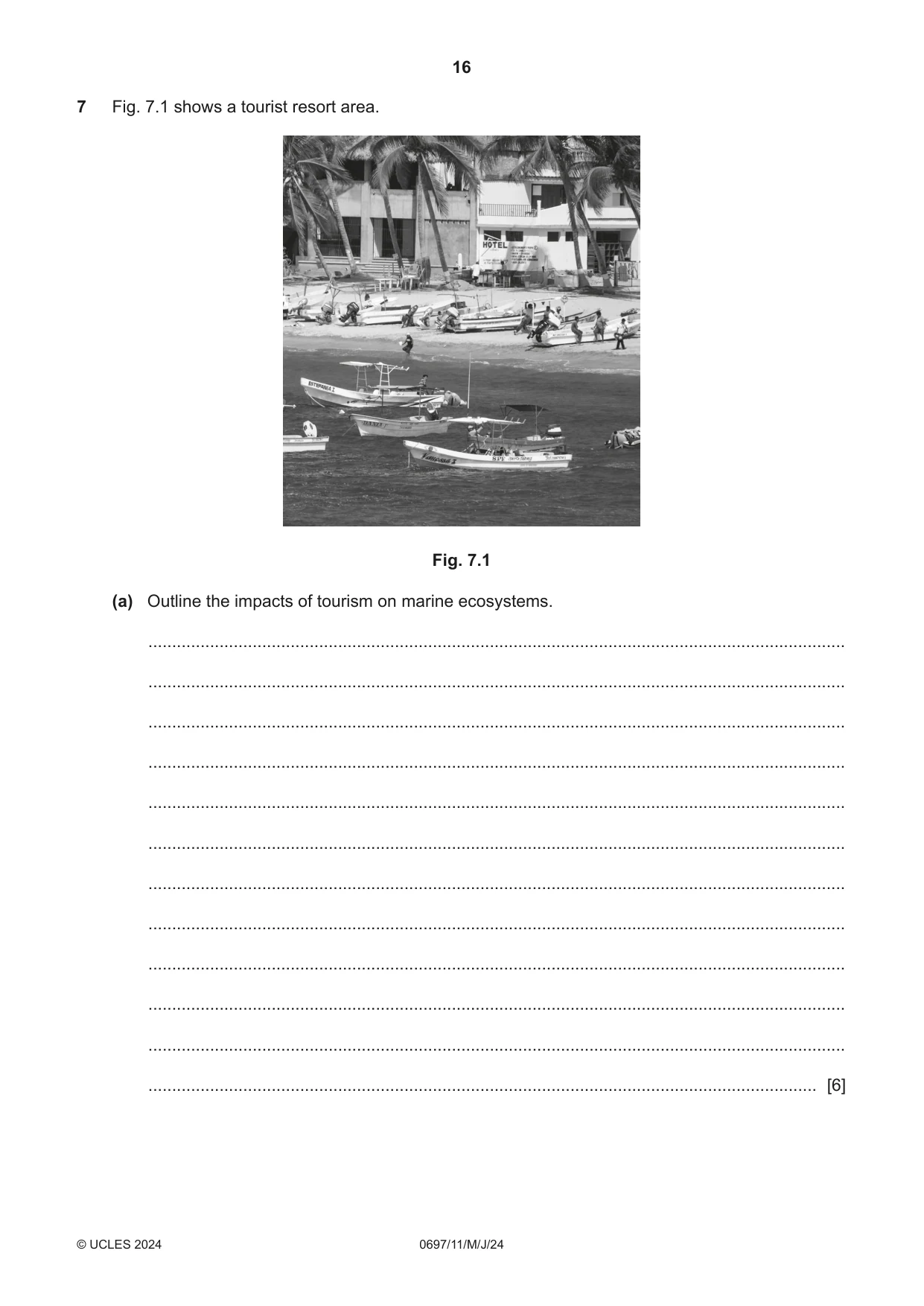
16 0697/11/M/J/24 © UCLES 2024 7 Fig. 7.1 shows a tourist resort area. Fig. 7.1 (a) Outline the impacts of tourism on marine ecosystems. … … … … … … … … … … … … [6]
Question paper, page 17
17 0697/11/M/J/24 © UCLES 2024 (b) Evaluate one named strategy for limiting the impacts of tourists on marine ecosystems. … … … … … … [3] [Total: 9]
Question paper, page 18
18 0697/11/M/J/24 © UCLES 2024 BLANK PAGE
Question paper, page 19
19 0697/11/M/J/24 © UCLES 2024 BLANK PAGE
Question paper, page 20
20 0697/11/M/J/24 © UCLES 2024 The boundaries and names shown, the designations used and the presentation of material on any maps contained in this question paper/insert do not imply official endorsement or acceptance by Cambridge Assessment International Education concerning the legal status of any country, territory, or area or any of its authorities, or of the delimitation of its frontiers or boundaries. Permission to reproduce items where third-party owned material protected by copyright is included has been sought and cleared where possible. Every reasonable effort has been made by the publisher (UCLES) to trace copyright holders, but if any items requiring clearance have unwittingly been included, the publisher will be pleased to make amends at the earliest possible opportunity. To avoid the issue of disclosure of answer-related information to candidates, all copyright acknowledgements are reproduced online in the Cambridge Assessment International Education Copyright Acknowledgements Booklet. This is produced for each series of examinations and is freely available to download at www.cambridgeinternational.org after the live examination series. Cambridge Assessment International Education is part of Cambridge Assessment. Cambridge Assessment is the brand name of the University of Cambridge Local Examinations Syndicate (UCLES), which is a department of the University of Cambridge. BLANK PAGE
Mark scheme, page 1
This document consists of 16 printed pages. © Cambridge University Press & Assessment 2024 [Turn over Cambridge IGCSE™ MARINE SCIENCE 0697/11 Paper 1 Theory and Data Handling May/June 2024 MARK SCHEME Maximum Mark: 80 Published This mark scheme is published as an aid to teachers and candidates, to indicate the requirements of the examination. It shows the basis on which Examiners were instructed to award marks. It does not indicate the details of the discussions that took place at an Examiners’ meeting before marking began, which would have considered the acceptability of alternative answers. Mark schemes should be read in conjunction with the question paper and the Principal Examiner Report for Teachers. Cambridge International will not enter into discussions about these mark schemes. Cambridge International is publishing the mark schemes for the May/June 2024 series for most Cambridge IGCSE, Cambridge International A and AS Level and Cambridge Pre-U components, and some Cambridge O Level components.
Mark scheme, page 2
0697/11 Cambridge IGCSE – Mark Scheme PUBLISHED May/June 2024 © Cambridge University Press & Assessment 2024 Page 2 of 16 Generic Marking Principles These general marking principles must be applied by all examiners when marking candidate answers. They should be applied alongside the specific content of the mark scheme or generic level descriptions for a question. Each question paper and mark scheme will also comply with these marking principles. GENERIC MARKING PRINCIPLE 1: Marks must be awarded in line with: the specific content of the mark scheme or the generic level descriptors for the question the specific skills defined in the mark scheme or in the generic level descriptors for the question the standard of response required by a candidate as exemplified by the standardisation scripts. GENERIC MARKING PRINCIPLE 2: Marks awarded are always whole marks (not half marks, or other fractions). GENERIC MARKING PRINCIPLE 3: Marks must be awarded positively: marks are awarded for correct/valid answers, as defined in the mark scheme. However, credit is given for valid answers which go beyond the scope of the syllabus and mark scheme, referring to your Team Leader as appropriate marks are awarded when candidates clearly demonstrate what they know and can do marks are not deducted for errors marks are not deducted for omissions answers should only be judged on the quality of spelling, punctuation and grammar when these features are specifically assessed by the question as indicated by the mark scheme. The meaning, however, should be unambiguous. GENERIC MARKING PRINCIPLE 4: Rules must be applied consistently, e.g. in situations where candidates have not followed instructions or in the application of generic level descriptors.
Mark scheme, page 3
0697/11 Cambridge IGCSE – Mark Scheme PUBLISHED May/June 2024 © Cambridge University Press & Assessment 2024 Page 3 of 16 GENERIC MARKING PRINCIPLE 5: Marks should be awarded using the full range of marks defined in the mark scheme for the question (however; the use of the full mark range may be limited according to the quality of the candidate responses seen). GENERIC MARKING PRINCIPLE 6: Marks awarded are based solely on the requirements as defined in the mark scheme. Marks should not be awarded with grade thresholds or grade descriptors in mind.
Mark scheme, page 4
0697/11 Cambridge IGCSE – Mark Scheme PUBLISHED May/June 2024 © Cambridge University Press & Assessment 2024 Page 4 of 16 Science-Specific Marking Principles 1 Examiners should consider the context and scientific use of any keywords when awarding marks. Although keywords may be present, marks should not be awarded if the keywords are used incorrectly. 2 The examiner should not choose between contradictory statements given in the same question part, and credit should not be awarded for any correct statement that is contradicted within the same question part. Wrong science that is irrelevant to the question should be ignored. 3 Although spellings do not have to be correct, spellings of syllabus terms must allow for clear and unambiguous separation from other syllabus terms with which they may be confused (e.g. ethane / ethene, glucagon / glycogen, refraction / reflection). 4 The error carried forward (ecf) principle should be applied, where appropriate. If an incorrect answer is subsequently used in a scientifically correct way, the candidate should be awarded these subsequent marking points. Further guidance will be included in the mark scheme where necessary and any exceptions to this general principle will be noted. 5 ‘List rule’ guidance For questions that require n responses (e.g. State two reasons …): The response should be read as continuous prose, even when numbered answer spaces are provided. Any response marked ignore in the mark scheme should not count towards n. Incorrect responses should not be awarded credit but will still count towards n. Read the entire response to check for any responses that contradict those that would otherwise be credited. Credit should not be awarded for any responses that are contradicted within the rest of the response. Where two responses contradict one another, this should be treated as a single incorrect response. Non-contradictory responses after the first n responses may be ignored even if they include incorrect science.
Mark scheme, page 5
0697/11 Cambridge IGCSE – Mark Scheme PUBLISHED May/June 2024 © Cambridge University Press & Assessment 2024 Page 5 of 16 6 Calculation specific guidance Correct answers to calculations should be given full credit even if there is no working or incorrect working, unless the question states ‘show your working’. For questions in which the number of significant figures required is not stated, credit should be awarded for correct answers when rounded by the examiner to the number of significant figures given in the mark scheme. This may not apply to measured values. For answers given in standard form (e.g. a 10n) in which the convention of restricting the value of the coefficient (a) to a value between 1 and 10 is not followed, credit may still be awarded if the answer can be converted to the answer given in the mark scheme. Unless a separate mark is given for a unit, a missing or incorrect unit will normally mean that the final calculation mark is not awarded. Exceptions to this general principle will be noted in the mark scheme. 7 Guidance for chemical equations Multiples / fractions of coefficients used in chemical equations are acceptable unless stated otherwise in the mark scheme. State symbols given in an equation should be ignored unless asked for in the question or stated otherwise in the mark scheme.
Mark scheme, page 6
0697/11 Cambridge IGCSE – Mark Scheme PUBLISHED May/June 2024 © Cambridge University Press & Assessment 2024 Page 6 of 16 Question Answer Marks 1(a)(i) 3 1(a)(ii) to release energy / undertake (aerobic) respiration ; 1 1(a)(iii) any 2 of vacuole ; cell wall ; chloroplast(s) ; 2
Mark scheme, page 7
0697/11 Cambridge IGCSE – Mark Scheme PUBLISHED May/June 2024 © Cambridge University Press & Assessment 2024 Page 7 of 16 Question Answer Marks 1(b)(i) 2 1(b)(ii) 4
Mark scheme, page 8
0697/11 Cambridge IGCSE – Mark Scheme PUBLISHED May/June 2024 © Cambridge University Press & Assessment 2024 Page 8 of 16 Question Answer Marks 2(a) compound ; 3 / three; bones / shells ; 3 2(b)(i) process at 2 precipitation AND process at 3 run-off ; 1 2(b)(ii) higher / increased, temperature, increases rate (of evaporation) ORA ; higher / increased, wind speed, increases rate (of evaporation) ORA ; 2 2(b)(iii) (in the ocean) evaporation increases the salinity ; (because) salts do not evaporate / pure or only, water evaporates ; little effect on fresh water, as few salts present / salinity is low ; 3
Mark scheme, page 9
0697/11 Cambridge IGCSE – Mark Scheme PUBLISHED May/June 2024 © Cambridge University Press & Assessment 2024 Page 9 of 16 Question Answer Marks 3(a)(i) algae and phytoplankton ; 1 3(a)(ii) sea anemones / shorebirds ; 1 3(a)(iii) small crustaceans ; 1 3(a)(iv) (respiration) releases energy ; used by the organism (in activities) ; in the form of heat ; 3 3(b) any pair of: hard shell ; to protect against, predators / wave action ; can close shell tightly ; to prevent water loss (at low tide) ; (byssus) threads : for attachment ; 2 3(c) any 2 of: food supply / decrease in number of sea urchins ; disease / parasites ; competition ; predation ; 2
Mark scheme, page 10
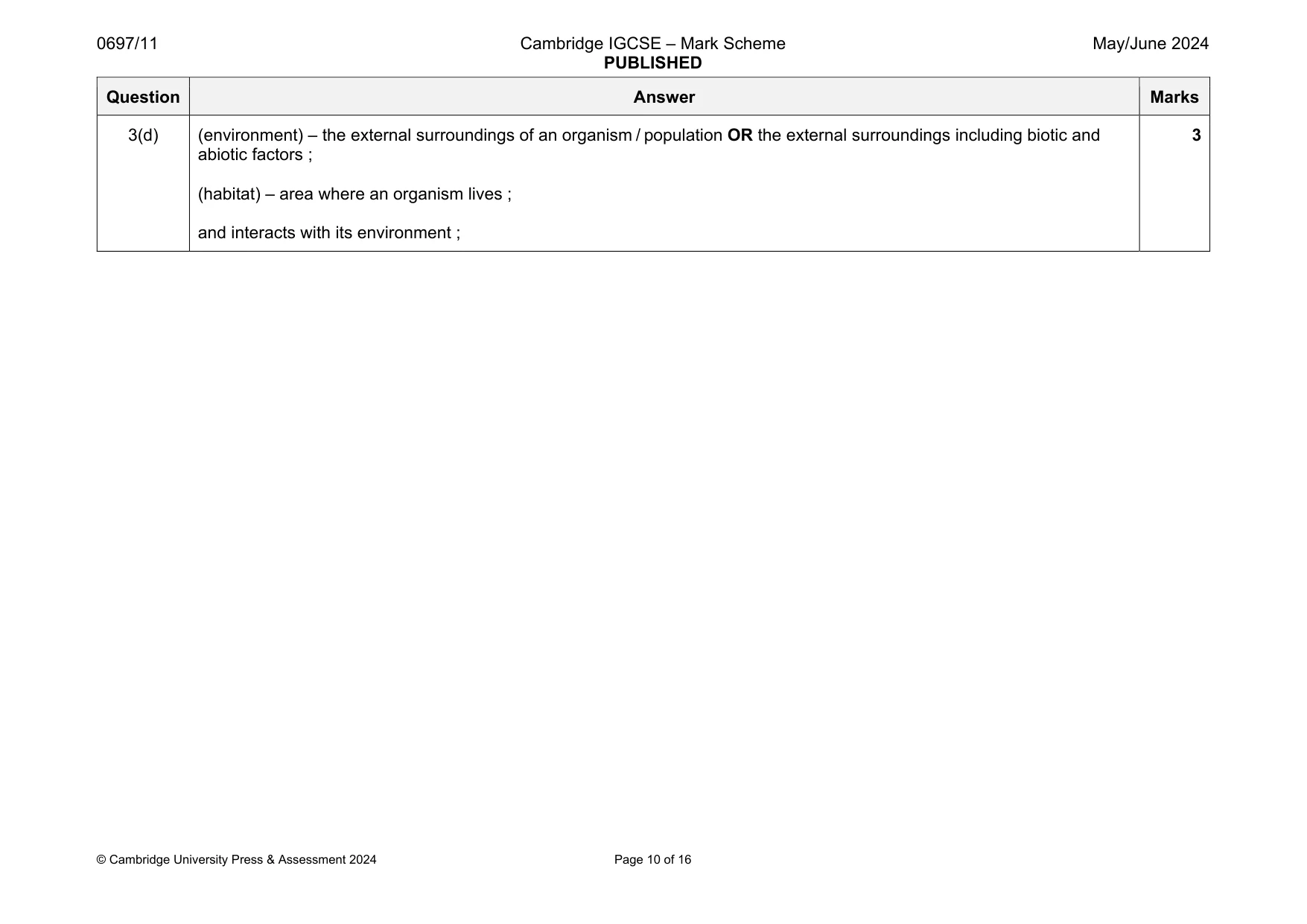
0697/11 Cambridge IGCSE – Mark Scheme PUBLISHED May/June 2024 © Cambridge University Press & Assessment 2024 Page 10 of 16 Question Answer Marks 3(d) (environment) – the external surroundings of an organism / population OR the external surroundings including biotic and abiotic factors ; (habitat) – area where an organism lives ; and interacts with its environment ; 3
Mark scheme, page 11
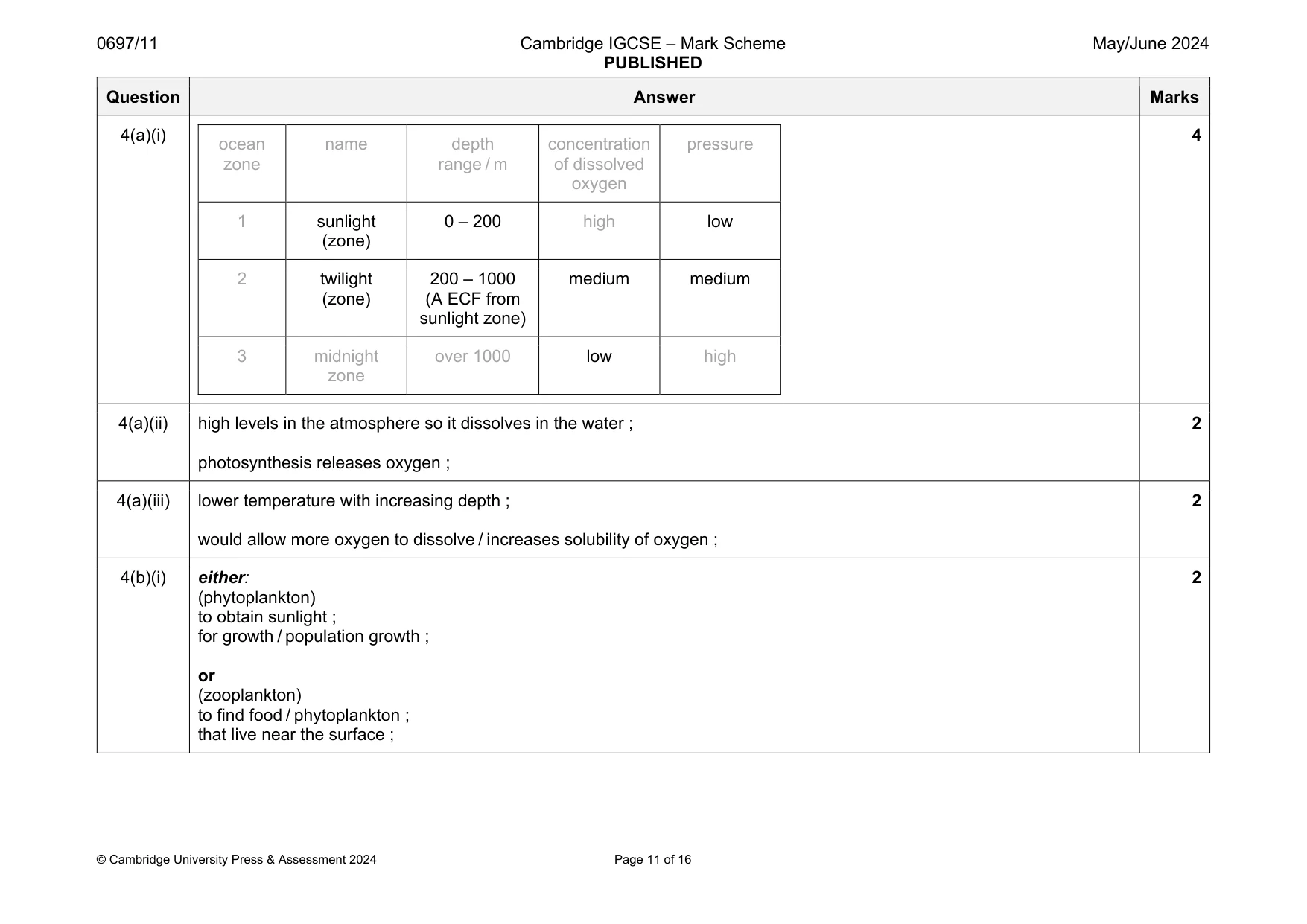
0697/11 Cambridge IGCSE – Mark Scheme PUBLISHED May/June 2024 © Cambridge University Press & Assessment 2024 Page 11 of 16 Question Answer Marks 4(a)(i) ocean zone name depth range / m concentration of dissolved oxygen pressure 1 sunlight (zone) 0 – 200 high low 2 twilight (zone) 200 – 1000 (A ECF from sunlight zone) medium medium 3 midnight zone over 1000 low high 4 4(a)(ii) high levels in the atmosphere so it dissolves in the water ; photosynthesis releases oxygen ; 2 4(a)(iii) lower temperature with increasing depth ; would allow more oxygen to dissolve / increases solubility of oxygen ; 2 4(b)(i) either: (phytoplankton) to obtain sunlight ; for growth / population growth ; or (zooplankton) to find food / phytoplankton ; that live near the surface ; 2
Mark scheme, page 12
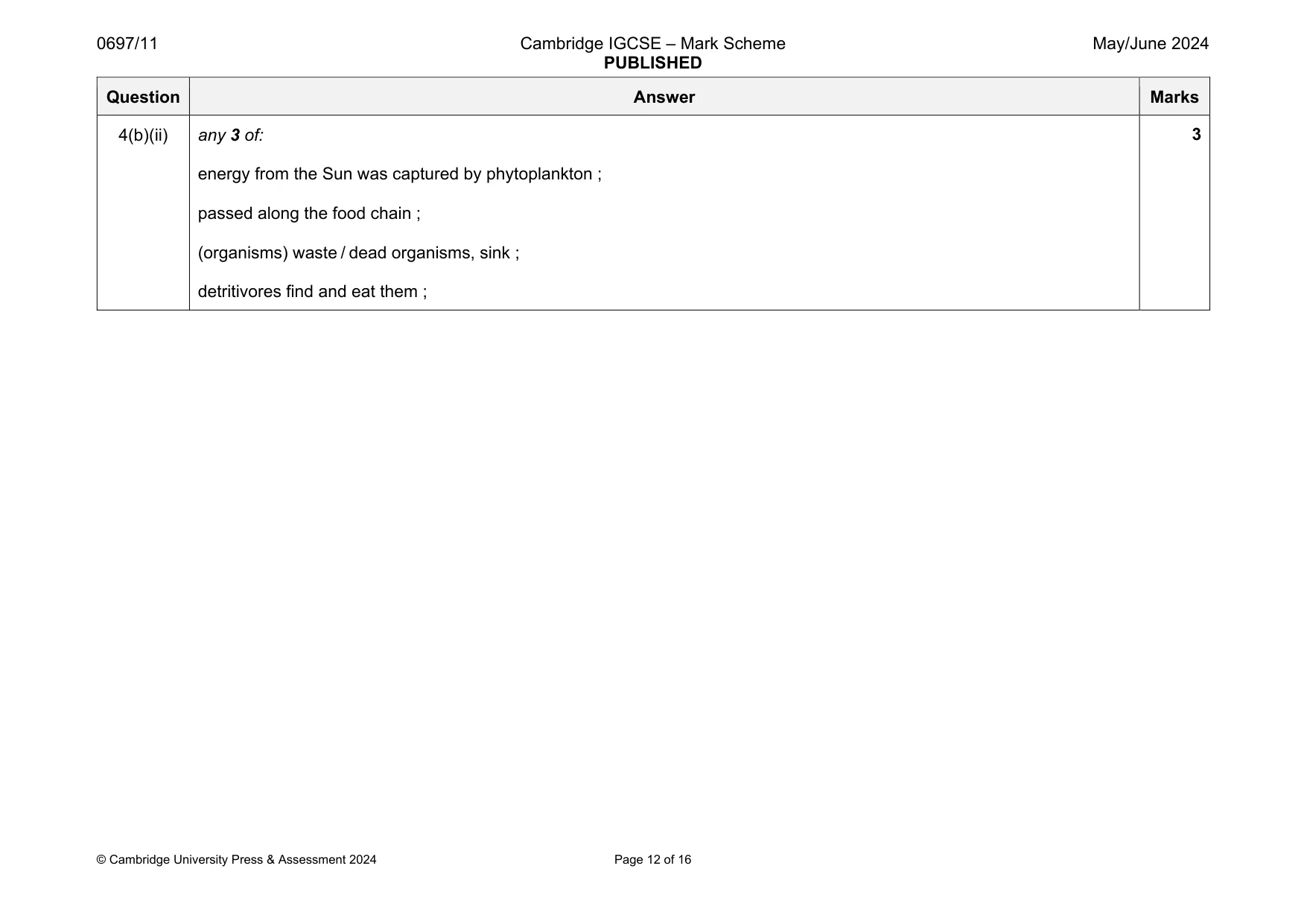
0697/11 Cambridge IGCSE – Mark Scheme PUBLISHED May/June 2024 © Cambridge University Press & Assessment 2024 Page 12 of 16 Question Answer Marks 4(b)(ii) any 3 of: energy from the Sun was captured by phytoplankton ; passed along the food chain ; (organisms) waste / dead organisms, sink ; detritivores find and eat them ; 3
Mark scheme, page 13
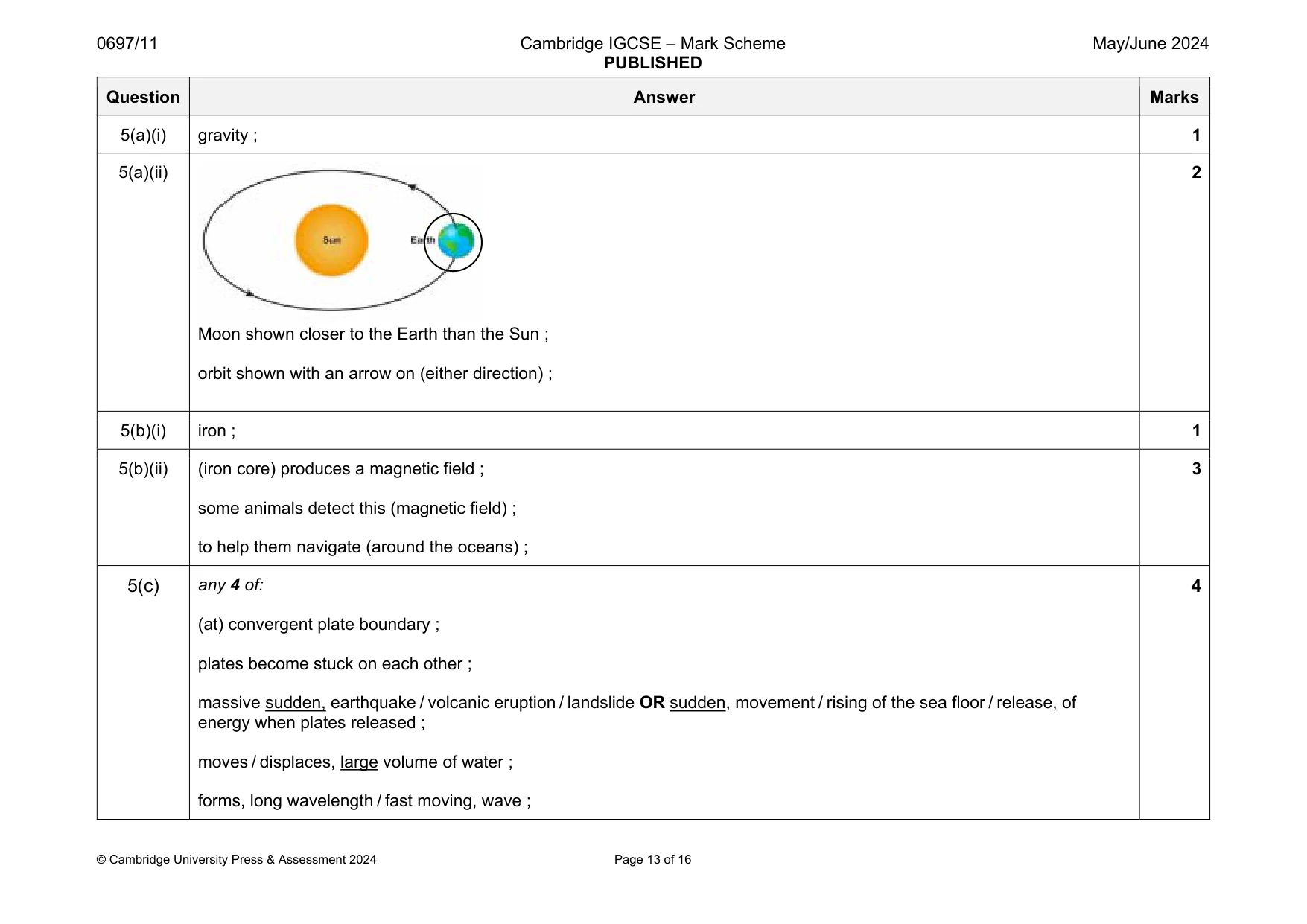
0697/11 Cambridge IGCSE – Mark Scheme PUBLISHED May/June 2024 © Cambridge University Press & Assessment 2024 Page 13 of 16 Question Answer Marks 5(a)(i) gravity ; 1 5(a)(ii) Moon shown closer to the Earth than the Sun ; orbit shown with an arrow on (either direction) ; 2 5(b)(i) iron ; 1 5(b)(ii) (iron core) produces a magnetic field ; some animals detect this (magnetic field) ; to help them navigate (around the oceans) ; 3 5(c) any 4 of: (at) convergent plate boundary ; plates become stuck on each other ; massive sudden, earthquake / volcanic eruption / landslide OR sudden, movement / rising of the sea floor / release, of energy when plates released ; moves / displaces, large volume of water ; forms, long wavelength / fast moving, wave ; 4
Mark scheme, page 14
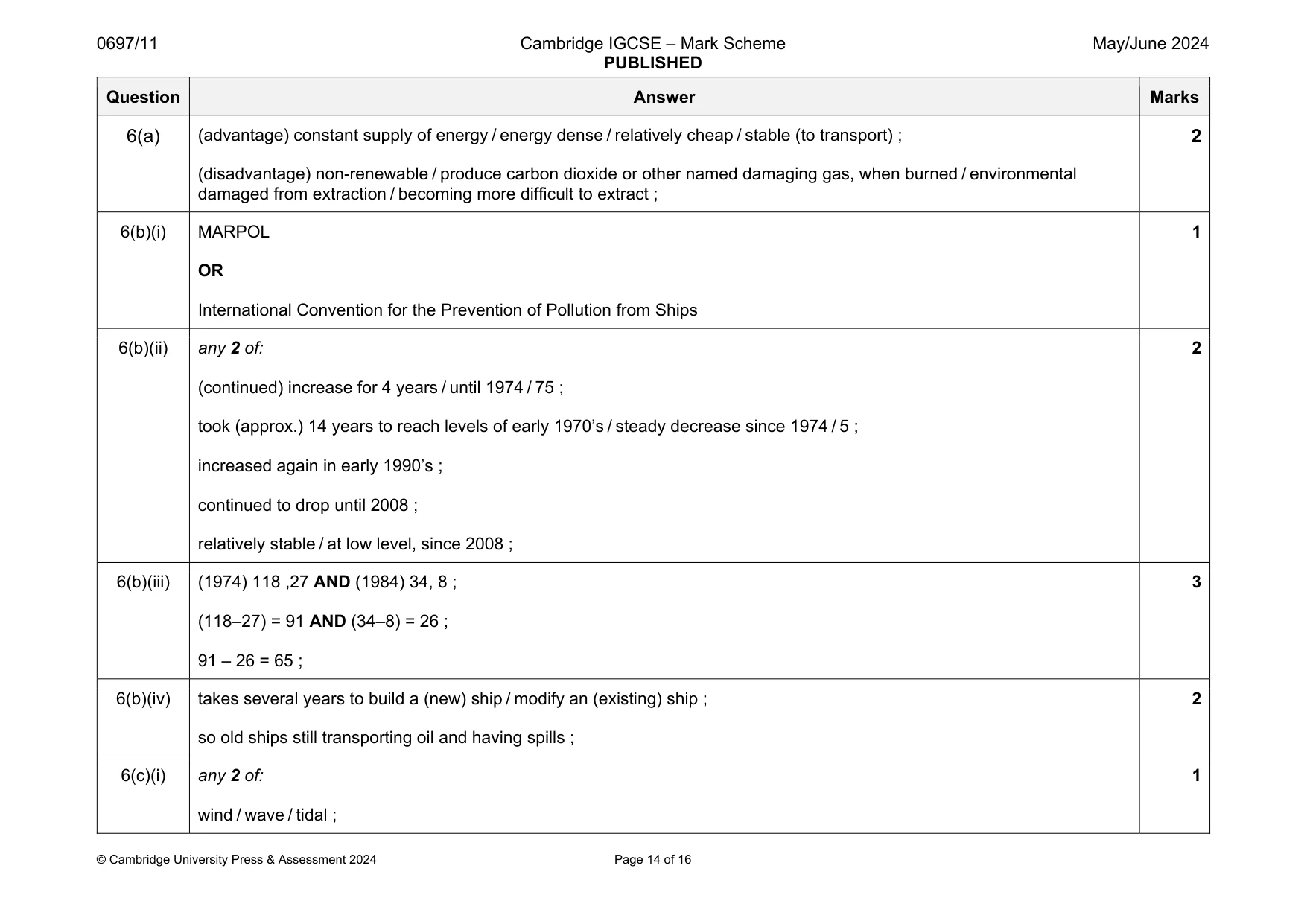
0697/11 Cambridge IGCSE – Mark Scheme PUBLISHED May/June 2024 © Cambridge University Press & Assessment 2024 Page 14 of 16 Question Answer Marks 6(a) (advantage) constant supply of energy / energy dense / relatively cheap / stable (to transport) ; (disadvantage) non-renewable / produce carbon dioxide or other named damaging gas, when burned / environmental damaged from extraction / becoming more difficult to extract ; 2 6(b)(i) MARPOL OR International Convention for the Prevention of Pollution from Ships 1 6(b)(ii) any 2 of: (continued) increase for 4 years / until 1974 / 75 ; took (approx.) 14 years to reach levels of early 1970’s / steady decrease since 1974 / 5 ; increased again in early 1990’s ; continued to drop until 2008 ; relatively stable / at low level, since 2008 ; 2 6(b)(iii) (1974) 118 ,27 AND (1984) 34, 8 ; (118–27) = 91 AND (34–8) = 26 ; 91 – 26 = 65 ; 3 6(b)(iv) takes several years to build a (new) ship / modify an (existing) ship ; so old ships still transporting oil and having spills ; 2 6(c)(i) any 2 of: wind / wave / tidal ; 1
Mark scheme, page 15
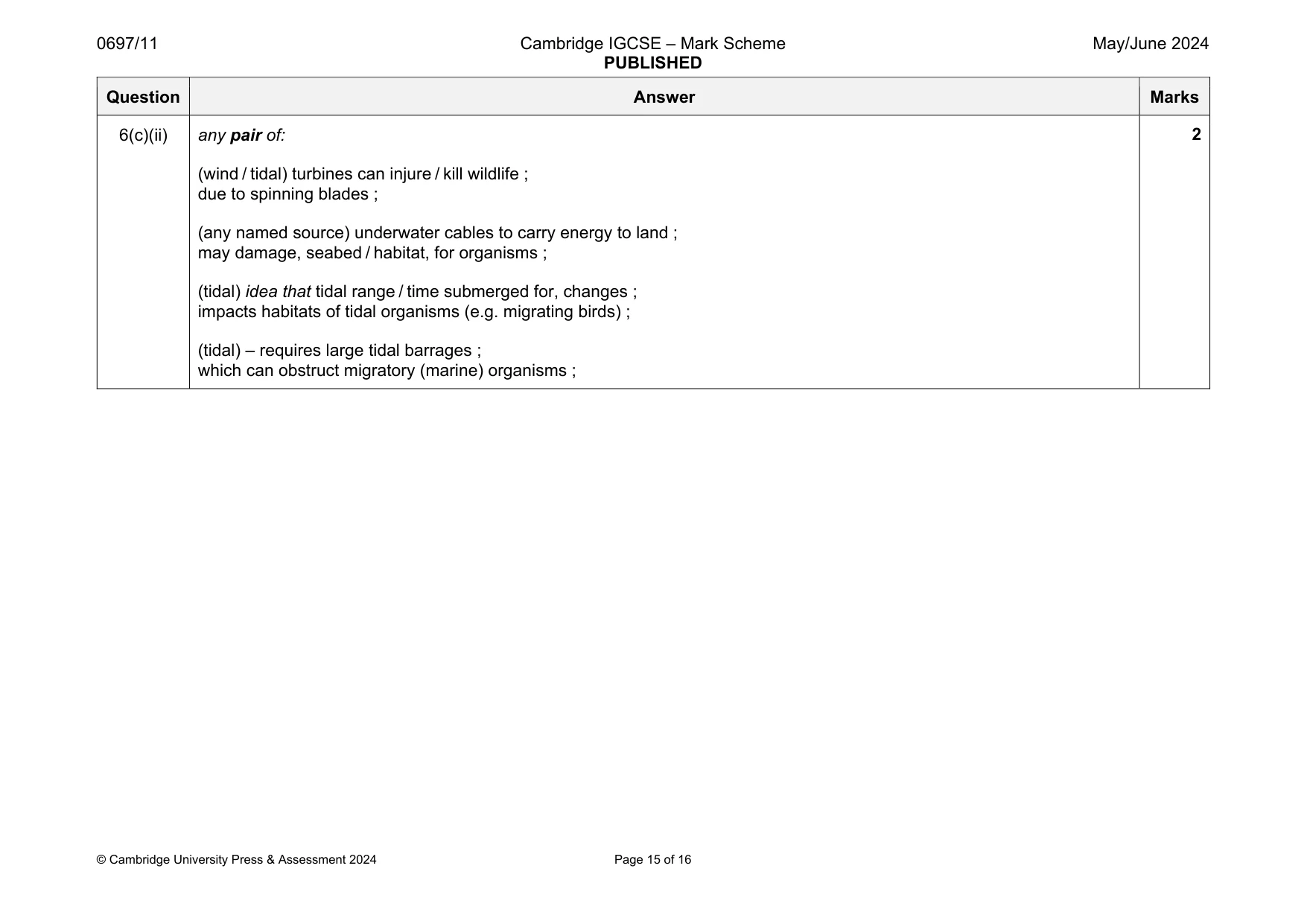
0697/11 Cambridge IGCSE – Mark Scheme PUBLISHED May/June 2024 © Cambridge University Press & Assessment 2024 Page 15 of 16 Question Answer Marks 6(c)(ii) any pair of: (wind / tidal) turbines can injure / kill wildlife ; due to spinning blades ; (any named source) underwater cables to carry energy to land ; may damage, seabed / habitat, for organisms ; (tidal) idea that tidal range / time submerged for, changes ; impacts habitats of tidal organisms (e.g. migrating birds) ; (tidal) – requires large tidal barrages ; which can obstruct migratory (marine) organisms ; 2
Mark scheme, page 16
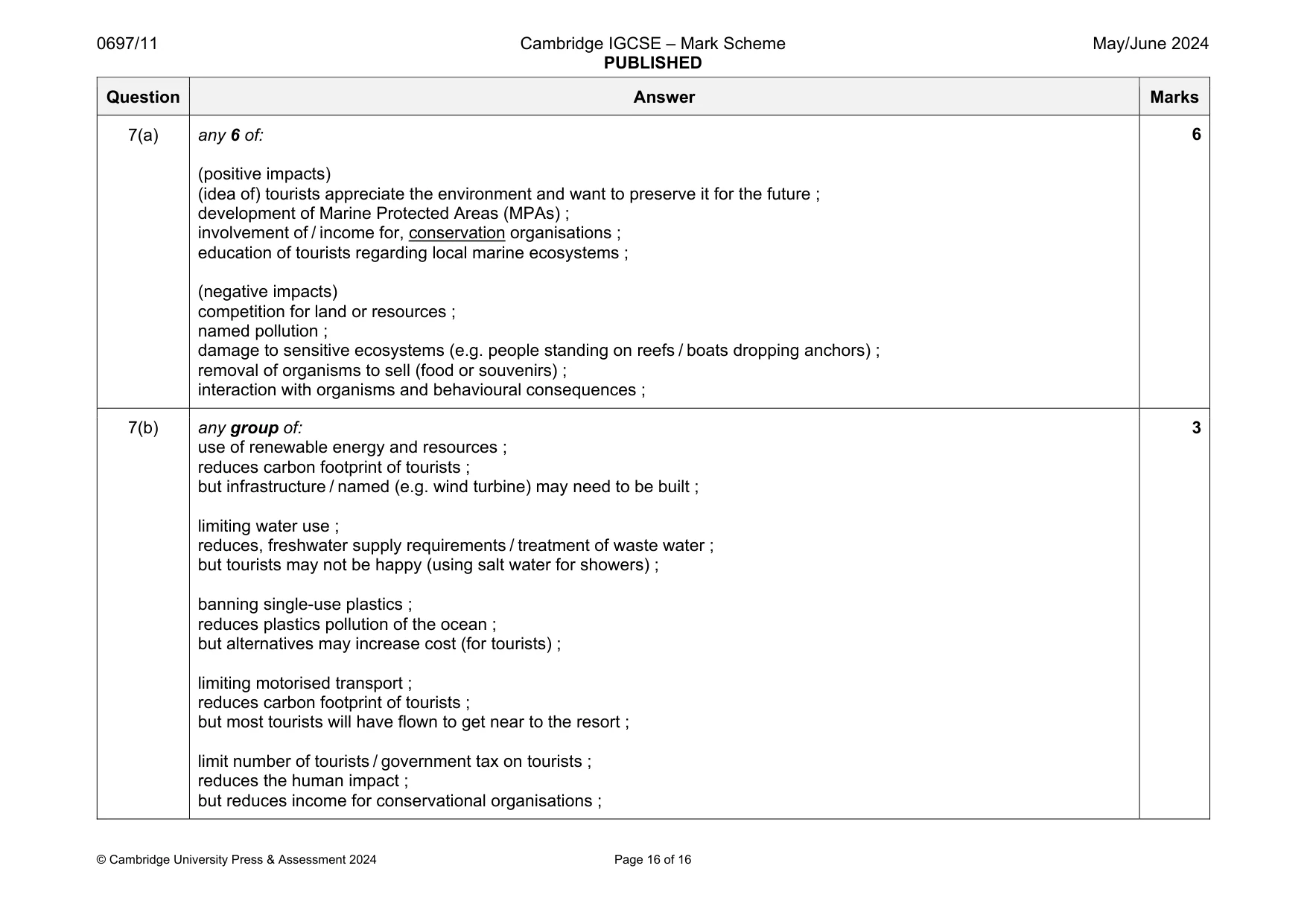
0697/11 Cambridge IGCSE – Mark Scheme PUBLISHED May/June 2024 © Cambridge University Press & Assessment 2024 Page 16 of 16 Question Answer Marks 7(a) any 6 of: (positive impacts) (idea of) tourists appreciate the environment and want to preserve it for the future ; development of Marine Protected Areas (MPAs) ; involvement of / income for, conservation organisations ; education of tourists regarding local marine ecosystems ; (negative impacts) competition for land or resources ; named pollution ; damage to sensitive ecosystems (e.g. people standing on reefs / boats dropping anchors) ; removal of organisms to sell (food or souvenirs) ; interaction with organisms and behavioural consequences ; 6 7(b) any group of: use of renewable energy and resources ; reduces carbon footprint of tourists ; but infrastructure / named (e.g. wind turbine) may need to be built ; limiting water use ; reduces, freshwater supply requirements / treatment of waste water ; but tourists may not be happy (using salt water for showers) ; banning single-use plastics ; reduces plastics pollution of the ocean ; but alternatives may increase cost (for tourists) ; limiting motorised transport ; reduces carbon footprint of tourists ; but most tourists will have flown to get near to the resort ; limit number of tourists / government tax on tourists ; reduces the human impact ; but reduces income for conservational organisations ; 3
What you needed in this session
Cambridge’s own grade thresholds for 2024 May/June, Paper 1 · Variant 1. A higher threshold means an easier paper — the bar moves with how the cohort did.