Cambridge IGCSE Marine Science (Maldives only) 0697 — 2023 May/June Paper 2 · Variant 0
0697/20/M/J/23 · 4 questions · 60 marks · ≈68 min
The question paper and its mark scheme, free to read here and free to download. This is Cambridge’s own paper, exactly as it was sat.
Question paper16 pages

Mark scheme
No mark scheme is in the library for this paper.
Questions as text
Q1 · Anchovies are small pelagic fish that feed on plankton
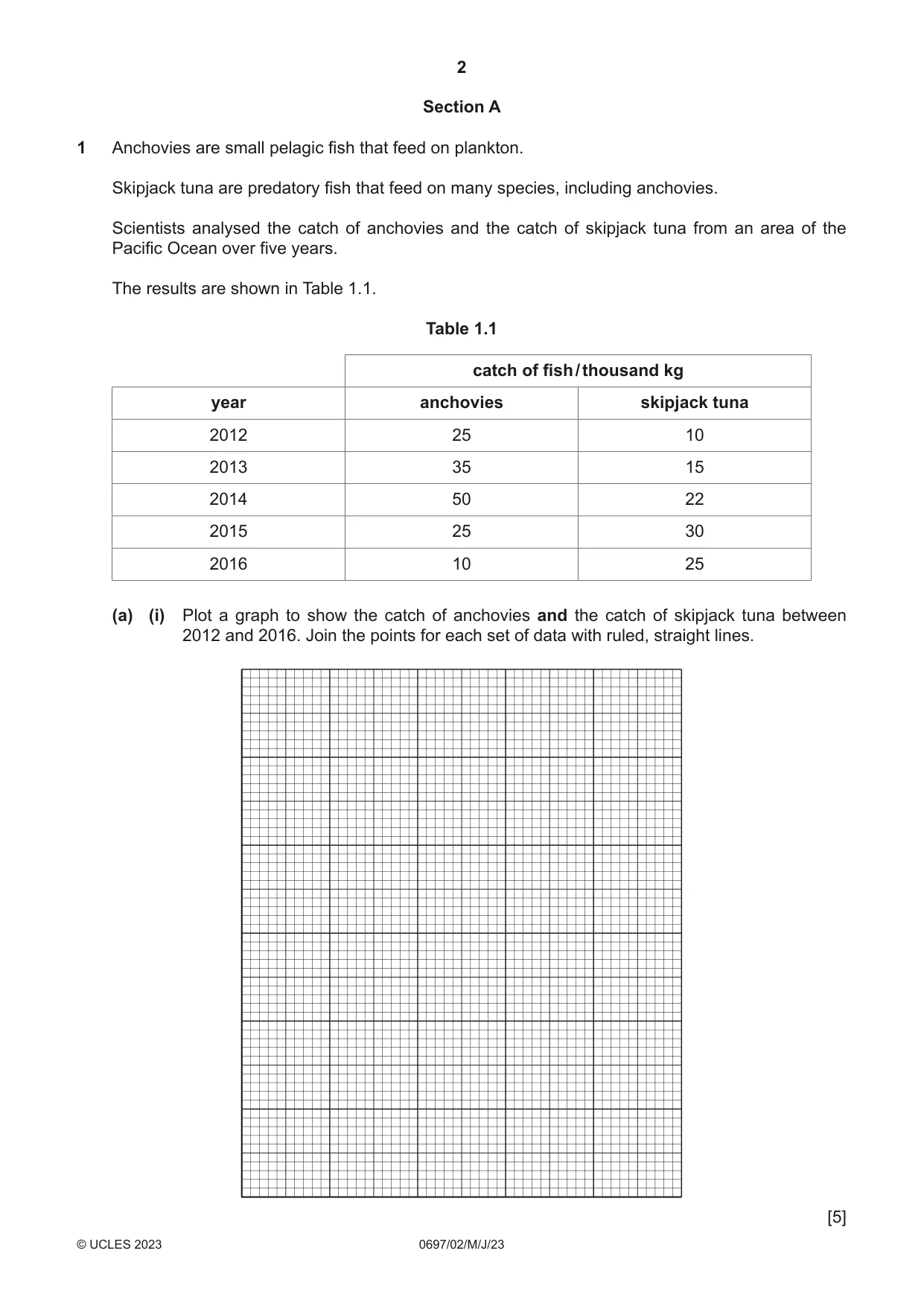
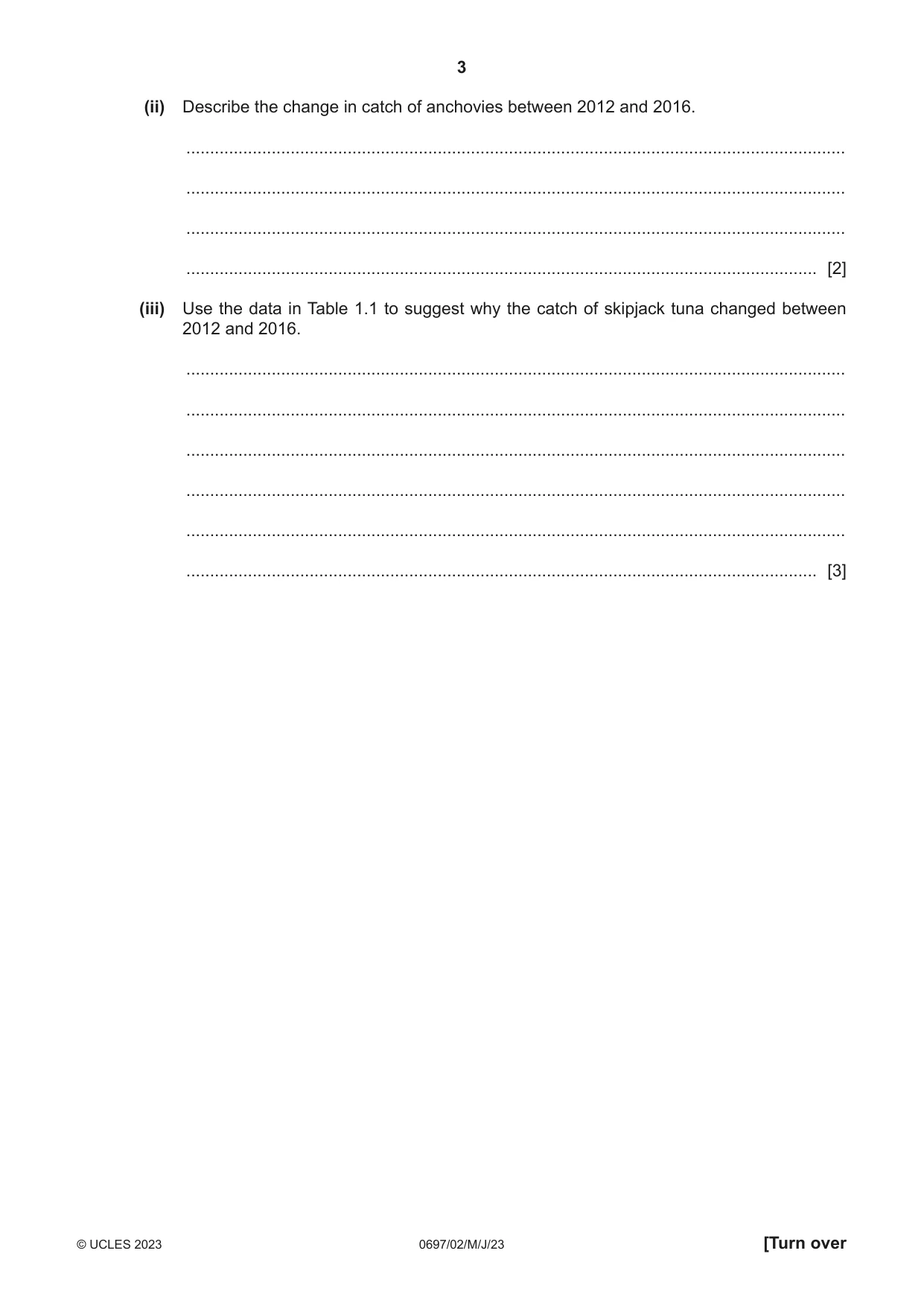
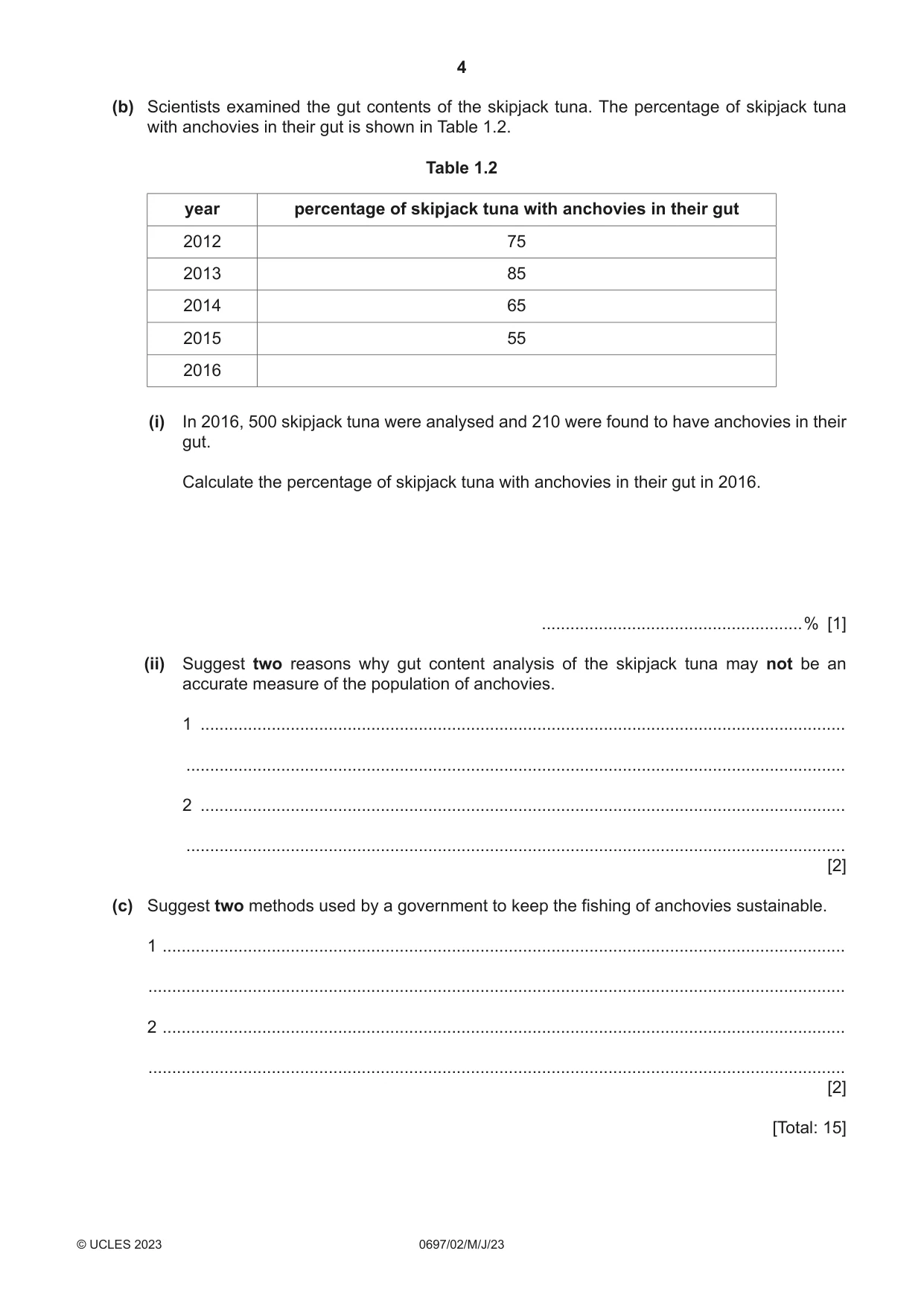
1 Anchovies are small pelagic fish that feed on plankton. Skipjack tuna are predatory fish that feed on many species, including anchovies. Scientists analysed the catch of anchovies and the catch of skipjack tuna from an area of the Pacific Ocean over five years. The results are shown in Table 1.1. Table 1.1 catch of fish / thousand kg year anchovies skipjack tuna 2012 25 10 2013 35 15 2014 50 22 2015 25 30 2016 10 25 (a) (i) Plot a graph to show the catch of anchovies and the catch of skipjack tuna between 2012 and 2016. Join the points for each set of data with ruled, straight lines. [5] (ii) Describe the change in catch of anchovies between 2012 and 2016. ........................................................................................................................................... ........................................................................................................................................... ........................................................................................................................................... ..................................................................................................................................... [2] (iii) Use the data in Table 1.1 to suggest why the catch of skipjack tuna changed between 2012 and 2016. ........................................................................................................................................... ........................................................................................................................................... ........................................................................................................................................... ........................................................................................................................................... ........................................................................................................................................... ..................................................................................................................................... [3] (b) Scientists examined the gut contents of the skipjack tuna. The percentage of skipjack tuna with anchovies in their gut is shown in Table 1.2. Table 1.2 year percentage of skipjack tuna with anchovies in their gut 2012 75 2013 85 2014 65 2015 55 2016 (i) In 2016, 500 skipjack tuna were analysed and 210 were found to have anchovies in their gut. Calculate the percentage of skipjack tuna with anchovies in their gut in 2016. .......................................................% [1] (ii) Suggest two reasons why gut content analysis of the skipjack tuna may not be an accurate measure of the population of anchovies. 1 ........................................................................................................................................ ........................................................................................................................................... 2 ........................................................................................................................................ ........................................................................................................................................... [2] (c) Suggest two methods used by a government to keep the fishing of anchovies sustainable. 1 ................................................................................................................................................ ................................................................................................................................................... 2 ................................................................................................................................................ ................................................................................................................................................... [2] [Total: 15]
Q2 · Most salmon sold for food is produced by aquaculture
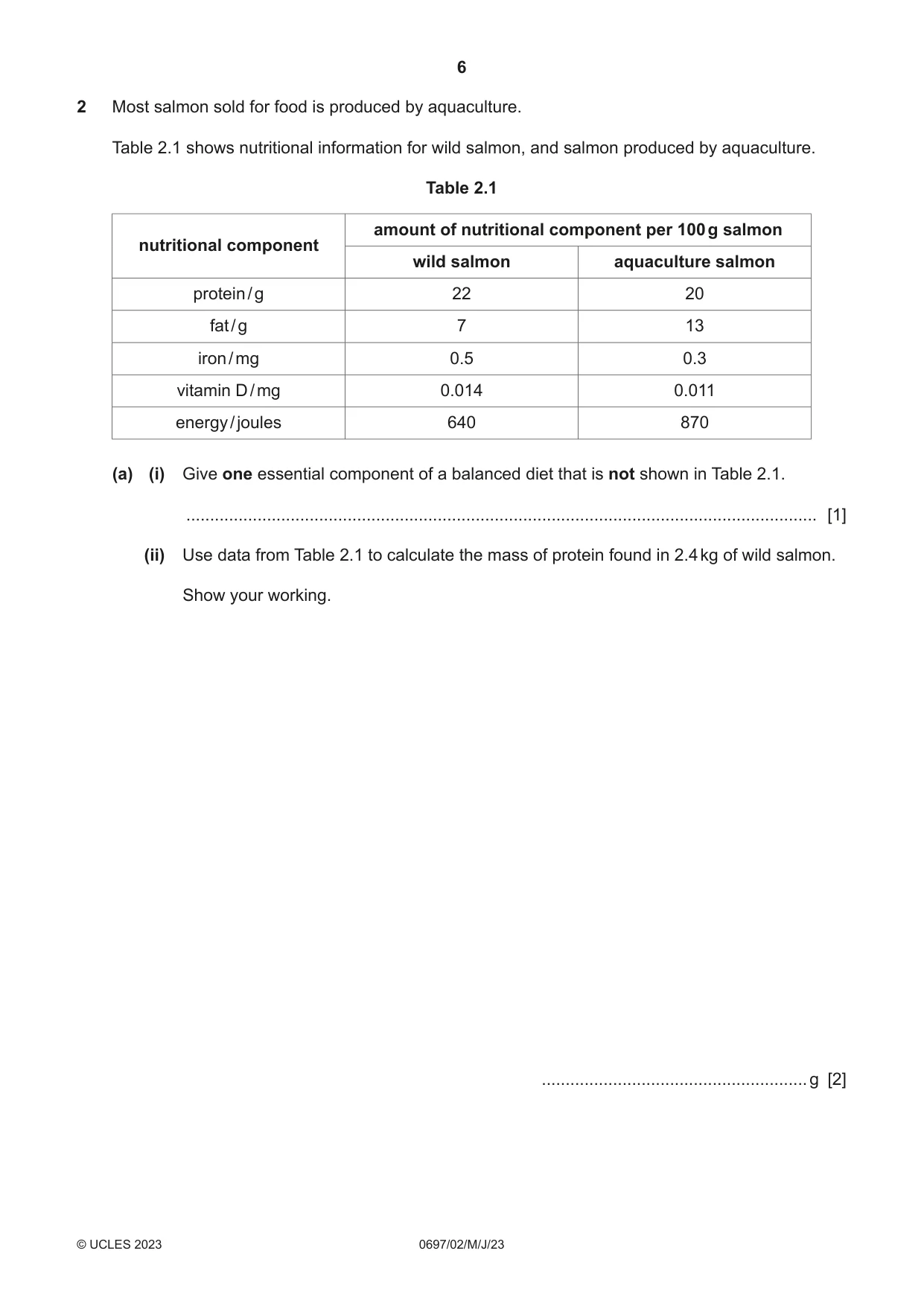
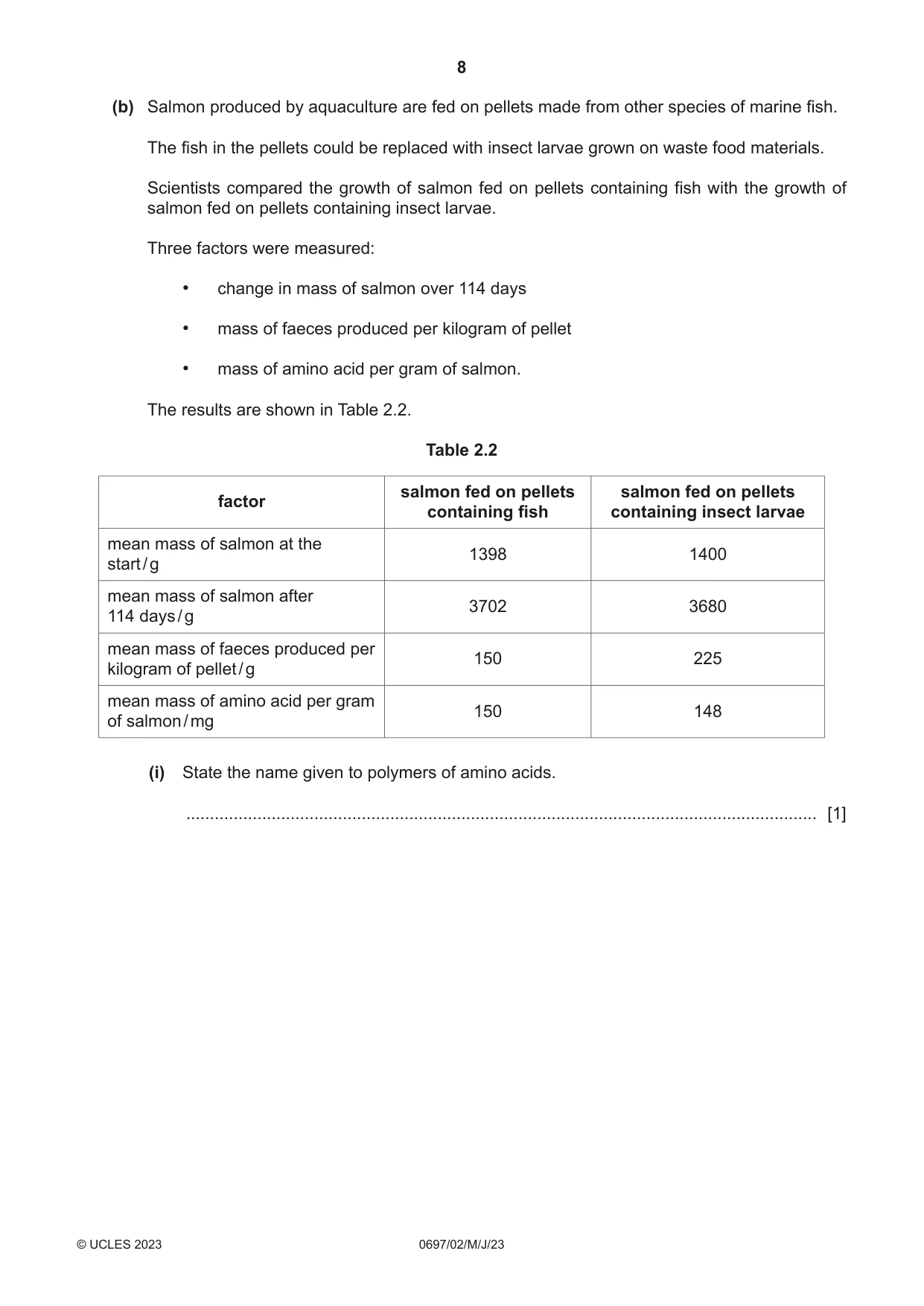
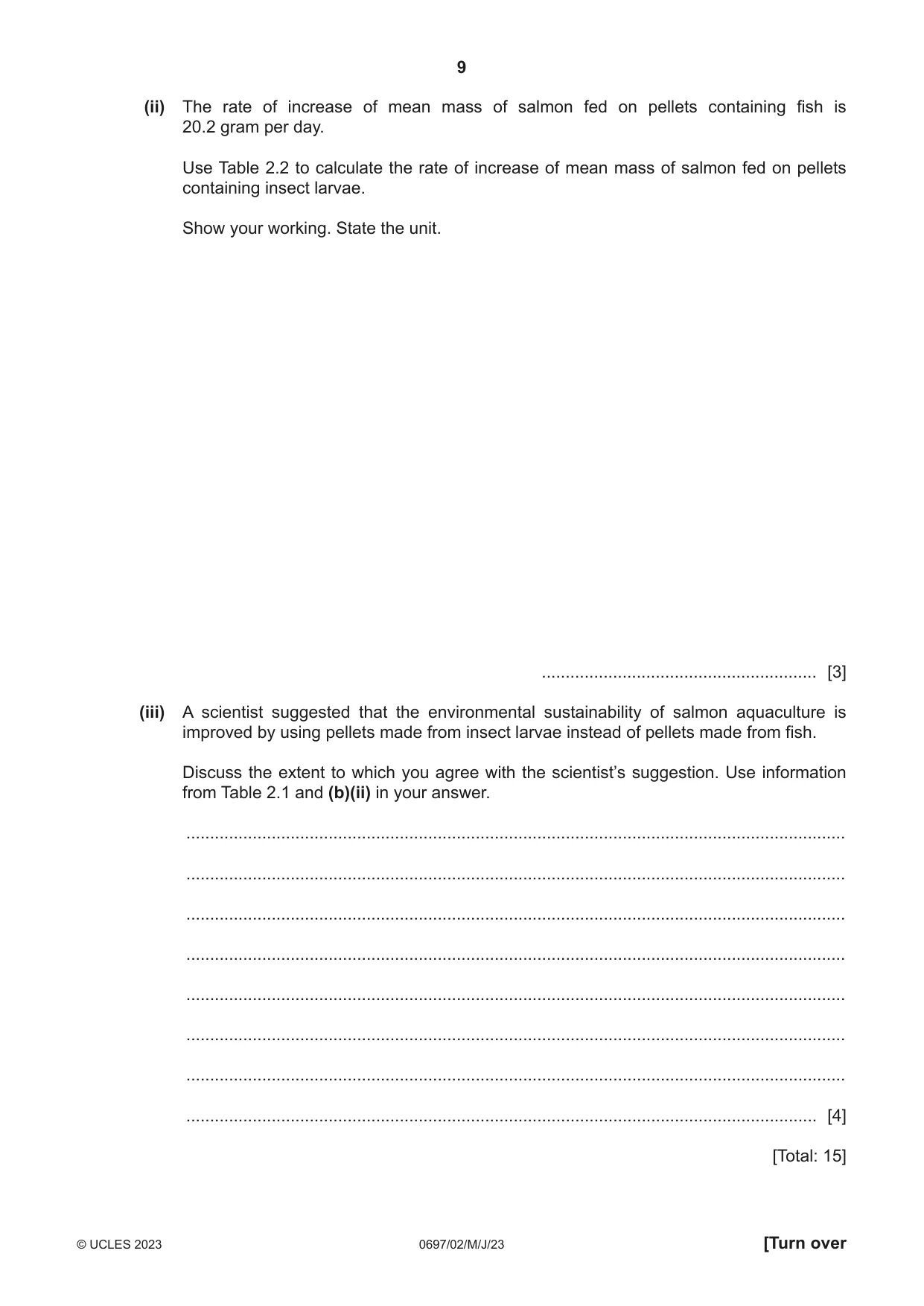
2 Most salmon sold for food is produced by aquaculture. Table 2.1 shows nutritional information for wild salmon, and salmon produced by aquaculture. Table 2.1 amount of nutritional component per 100 g salmon nutritional component wild salmon aquaculture salmon protein / g 22 20 fat / g 7 13 iron / mg 0.5 0.3 vitamin D / mg 0.014 0.011 energy / joules 640 870 (a) (i) Give one essential component of a balanced diet that is not shown in Table 2.1. ..................................................................................................................................... [1] (ii) Use data from Table 2.1 to calculate the mass of protein found in 2.4 kg of wild salmon. Show your working. ........................................................ g [2] (iii) Use Table 2.1 to suggest two explanations why some people think that it is healthier to eat wild salmon compared with aquaculture salmon. 1 ........................................................................................................................................ ........................................................................................................................................... ........................................................................................................................................... ........................................................................................................................................... 2 ........................................................................................................................................ ........................................................................................................................................... ........................................................................................................................................... ........................................................................................................................................... [4] (b) Salmon produced by aquaculture are fed on pellets made from other species of marine fish. The fish in the pellets could be replaced with insect larvae grown on waste food materials. Scientists compared the growth of salmon fed on pellets containing fish with the growth of salmon fed on pellets containing insect larvae. Three factors were measured: • change in mass of salmon over 114 days • mass of faeces produced per kilogram of pellet • mass of amino acid per gram of salmon. The results are shown in Table 2.2. Table 2.2 salmon fed on pellets salmon fed on pellets factor containing fish containing insect larvae mean mass of salmon at the 1398 1400start / g mean mass of salmon after 3702 3680114 days / g mean mass of faeces produced per 150 225kilogram of pellet / g mean mass of amino acid per gram 150 148of salmon / mg (i) State the name given to polymers of amino acids. ..................................................................................................................................... [1] (ii) The rate of increase of mean mass of salmon fed on pellets containing fish is 20.2 gram per day. Use Table 2.2 to calculate the rate of increase of mean mass of salmon fed on pellets containing insect larvae. Show your working. State the unit. .......................................................... [3] (iii) A scientist suggested that the environmental sustainability of salmon aquaculture is improved by using pellets made from insect larvae instead of pellets made from fish. Discuss the extent to which you agree with the scientist’s suggestion. Use information from Table 2.1 and (b)(ii) in your answer. ........................................................................................................................................... ........................................................................................................................................... ........................................................................................................................................... ........................................................................................................................................... ........................................................................................................................................... ........................................................................................................................................... ........................................................................................................................................... ..................................................................................................................................... [4] [Total: 15]
Q3 · Name one boat building material and describe one property that makes it suitable for this
3 (a) Name one boat building material and describe one property that makes it suitable for this. material .................................................................................. property .................................................................................................................................... ................................................................................................................................................... [2] (b) Describe the method and the environmental impacts of pelagic long‑lining. ................................................................................................................................................... ................................................................................................................................................... ................................................................................................................................................... ................................................................................................................................................... ................................................................................................................................................... ................................................................................................................................................... ................................................................................................................................................... ................................................................................................................................................... ................................................................................................................................................... ................................................................................................................................................... ................................................................................................................................................... ................................................................................................................................................... ............................................................................................................................................. [5] (c) Outline the principles of a four‑stroke diesel engine. ................................................................................................................................................... ................................................................................................................................................... ................................................................................................................................................... ................................................................................................................................................... ................................................................................................................................................... ................................................................................................................................................... ................................................................................................................................................... ................................................................................................................................................... ................................................................................................................................................... ................................................................................................................................................... ................................................................................................................................................... ................................................................................................................................................... ................................................................................................................................................... ................................................................................................................................................... ................................................................................................................................................... ................................................................................................................................................... ................................................................................................................................................... ................................................................................................................................................... ............................................................................................................................................. [8] [Total: 15]
More questions on Overview of human interactions with marine ecosystems
Q4 · Outline plate tectonic theory
4 (a) Outline plate tectonic theory. ................................................................................................................................................... ................................................................................................................................................... ................................................................................................................................................... ................................................................................................................................................... ................................................................................................................................................... ................................................................................................................................................... ................................................................................................................................................... ................................................................................................................................................... ................................................................................................................................................... ................................................................................................................................................... ................................................................................................................................................... ............................................................................................................................................. [4] (b) (i) Outline the process of photosynthesis. ........................................................................................................................................... ........................................................................................................................................... ........................................................................................................................................... ........................................................................................................................................... ........................................................................................................................................... ........................................................................................................................................... ........................................................................................................................................... ..................................................................................................................................... [3] (ii) Explain how the physical and chemical properties of sea water affect the growth of primary producers. ........................................................................................................................................... ........................................................................................................................................... ........................................................................................................................................... ........................................................................................................................................... ........................................................................................................................................... ........................................................................................................................................... ........................................................................................................................................... ........................................................................................................................................... ........................................................................................................................................... ........................................................................................................................................... ........................................................................................................................................... ........................................................................................................................................... ........................................................................................................................................... ........................................................................................................................................... ........................................................................................................................................... ........................................................................................................................................... ........................................................................................................................................... ........................................................................................................................................... ........................................................................................................................................... ........................................................................................................................................... ........................................................................................................................................... ........................................................................................................................................... ........................................................................................................................................... ........................................................................................................................................... ........................................................................................................................................... ..................................................................................................................................... [8]
What was in this paper
The subtopics covered by these 4 questions, and how many questions each got. Open one in a new tab to see every Cambridge question on it.
What you needed in this session
Cambridge’s own grade thresholds for 2023 May/June, Paper 2 · Variant 0. A higher threshold means an easier paper — the bar moves with how the cohort did.