Cambridge IGCSE Malay - Foreign Language 0546 — 2017 May/June Paper 4 · Variant 2
0546/42/M/J/17 · 50 marks · ≈56 min
The question paper and its mark scheme, free to read here and free to download. This is Cambridge’s own paper, exactly as it was sat.
Question paper8 pages

Mark scheme16 pages
Answers below. Sit the paper first if you are practising.
Paper as text
Question paper, page 1
This document consists of 6 printed pages and 2 blank pages. DC (ST/FC) 131318/2 © UCLES 2017 [Turn over Cambridge International Examinations Cambridge International General Certificate of Secondary Education * 1 8 4 7 7 5 2 9 6 3 * MALAY 0546/42 Paper 4 Writing May/June 2017 1 hour Candidates answer on the Question Paper. No Additional Materials are required. READ THESE INSTRUCTIONS FIRST Write your Centre number, candidate number and name in the spaces at the top of this page. Write in dark blue or black pen. Do not use staples, paper clips, glue or correction fluid. DO NOT WRITE IN ANY BARCODES. Answer three questions: Question 1, Question 2 and Question 3(a) or Question 3(b) or Question 3(c). The number of marks is given in brackets [ ] at the end of each question or part question.
Question paper, page 2
2 0546/42/M/J/17 © UCLES 2017 BLANK PAGE
Question paper, page 3
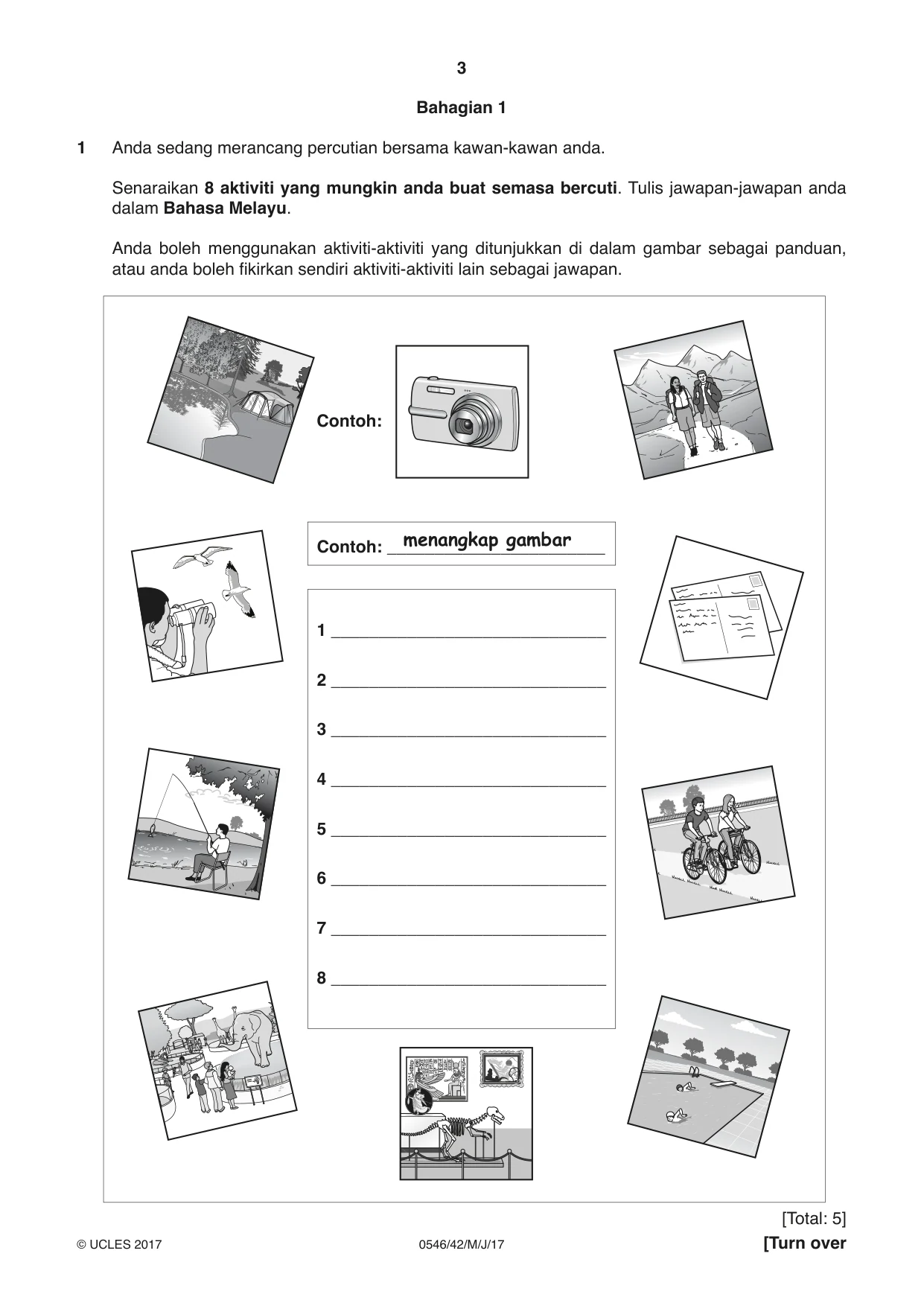
3 0546/42/M/J/17 © UCLES 2017 [Turn over Bahagian 1 1 Anda sedang merancang percutian bersama kawan-kawan anda. Senaraikan 8 aktiviti yang mungkin anda buat semasa bercuti. Tulis jawapan-jawapan anda dalam Bahasa Melayu. Anda boleh menggunakan aktiviti-aktiviti yang ditunjukkan di dalam gambar sebagai panduan, atau anda boleh fikirkan sendiri aktiviti-aktiviti lain sebagai jawapan. Contoh: menangkap gambar Contoh: _______________________ 1 _____________________________ 2 _____________________________ 3 _____________________________ 4 _____________________________ 5 _____________________________ 6 _____________________________ 7 _____________________________ 8 _____________________________ [Total: 5]
Question paper, page 4
4 0546/42/M/J/17 © UCLES 2017 2 Anda mempunyai seorang kawan baharu di Australia. Tulis emel kepadanya untuk memberitahu tentang keluarga anda. Beritahu... • anda ada berapa orang adik-beradik. • di mana ibu/bapa anda bekerja. • apa anda sekeluarga buat pada masa lapang dan mengapa. • apa anda sekeluarga akan buat pada masa cuti akan datang. Tulis antara 80–90 patah perkataan dalam Bahasa Melayu. … … … … … … … … … … … … … … … [Total: 15]
Question paper, page 5
5 0546/42/M/J/17 © UCLES 2017 [Turn over Sila buka halaman untuk Bahagian 2.
Question paper, page 6
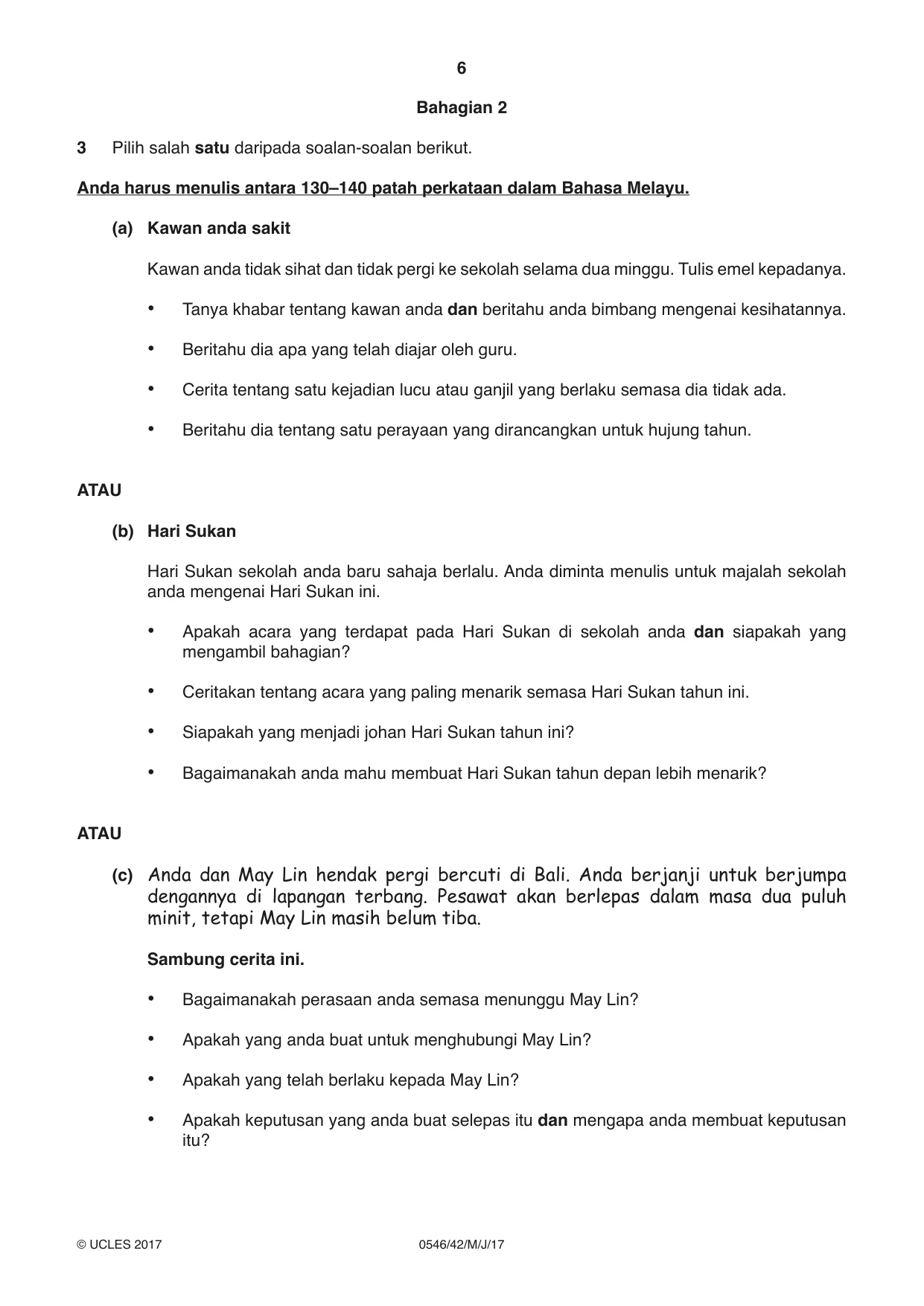
6 0546/42/M/J/17 © UCLES 2017 Bahagian 2 3 Pilih salah satu daripada soalan-soalan berikut. Anda harus menulis antara 130–140 patah perkataan dalam Bahasa Melayu. (a) Kawan anda sakit Kawan anda tidak sihat dan tidak pergi ke sekolah selama dua minggu. Tulis emel kepadanya. • Tanya khabar tentang kawan anda dan beritahu anda bimbang mengenai kesihatannya. • Beritahu dia apa yang telah diajar oleh guru. • Cerita tentang satu kejadian lucu atau ganjil yang berlaku semasa dia tidak ada. • Beritahu dia tentang satu perayaan yang dirancangkan untuk hujung tahun. ATAU (b) Hari Sukan Hari Sukan sekolah anda baru sahaja berlalu. Anda diminta menulis untuk majalah sekolah anda mengenai Hari Sukan ini. • Apakah acara yang terdapat pada Hari Sukan di sekolah anda dan siapakah yang mengambil bahagian? • Ceritakan tentang acara yang paling menarik semasa Hari Sukan tahun ini. • Siapakah yang menjadi johan Hari Sukan tahun ini? • Bagaimanakah anda mahu membuat Hari Sukan tahun depan lebih menarik? ATAU (c) Anda dan May Lin hendak pergi bercuti di Bali. Anda berjanji untuk berjumpa dengannya di lapangan terbang. Pesawat akan berlepas dalam masa dua puluh minit, tetapi May Lin masih belum tiba. Sambung cerita ini. • Bagaimanakah perasaan anda semasa menunggu May Lin? • Apakah yang anda buat untuk menghubungi May Lin? • Apakah yang telah berlaku kepada May Lin? • Apakah keputusan yang anda buat selepas itu dan mengapa anda membuat keputusan itu?
Question paper, page 7
7 0546/42/M/J/17 © UCLES 2017 TULIS JAWAPAN UNTUK SOALAN 3 DI SINI … … … … … … … … … … … … … … … … … … … … … … … … … … [Total: 30]
Question paper, page 8
8 0546/42/M/J/17 © UCLES 2017 Permission to reproduce items where third-party owned material protected by copyright is included has been sought and cleared where possible. Every reasonable effort has been made by the publisher (UCLES) to trace copyright holders, but if any items requiring clearance have unwittingly been included, the publisher will be pleased to make amends at the earliest possible opportunity. To avoid the issue of disclosure of answer-related information to candidates, all copyright acknowledgements are reproduced online in the Cambridge International Examinations Copyright Acknowledgements Booklet. This is produced for each series of examinations and is freely available to download at www.cie.org.uk after the live examination series. Cambridge International Examinations is part of the Cambridge Assessment Group. Cambridge Assessment is the brand name of University of Cambridge Local Examinations Syndicate (UCLES), which is itself a department of the University of Cambridge. BLANK PAGE
Mark scheme, page 1
® IGCSE is a registered trademark. This document consists of 16 printed pages. © UCLES 2017 [Turn over Cambridge International Examinations Cambridge International General Certificate of Secondary Education MALAY 0546/42 Paper 4 Writing May/June 2017 MARK SCHEME Maximum Mark: 50 Published This mark scheme is published as an aid to teachers and candidates, to indicate the requirements of the examination. It shows the basis on which Examiners were instructed to award marks. It does not indicate the details of the discussions that took place at an Examiners’ meeting before marking began, which would have considered the acceptability of alternative answers. Mark schemes should be read in conjunction with the question paper and the Principal Examiner Report for Teachers. Cambridge will not enter into discussions about these mark schemes. Cambridge is publishing the mark schemes for the May/June 2017 series for most Cambridge IGCSE®, Cambridge International A and AS Level and Cambridge Pre-U components, and some Cambridge O Level components.
Mark scheme, page 2
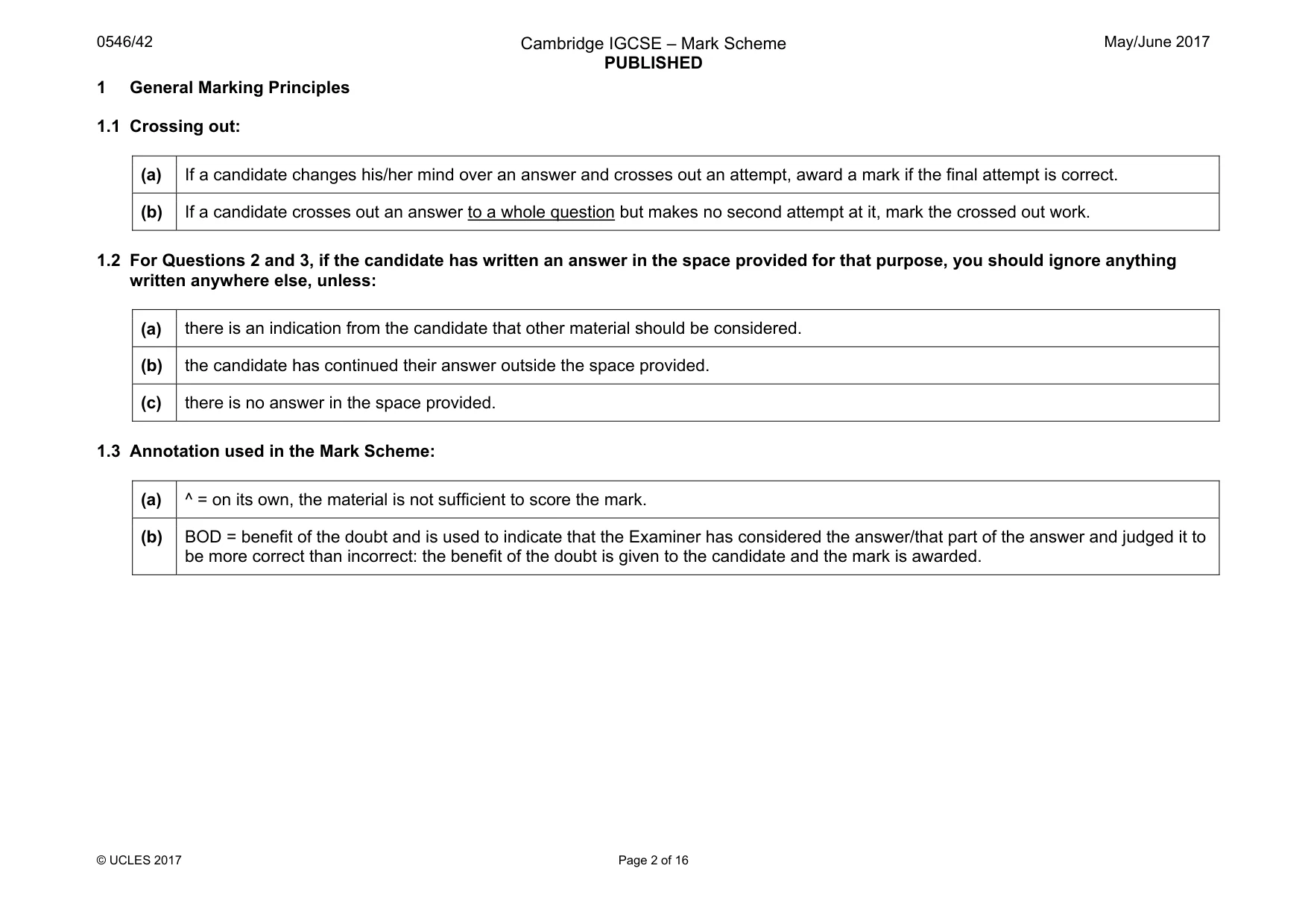
0546/42 Cambridge IGCSE – Mark Scheme PUBLISHED May/June 2017 © UCLES 2017 Page 2 of 16 1 General Marking Principles 1.1 Crossing out: (a) If a candidate changes his/her mind over an answer and crosses out an attempt, award a mark if the final attempt is correct. (b) If a candidate crosses out an answer to a whole question but makes no second attempt at it, mark the crossed out work. 1.2 For Questions 2 and 3, if the candidate has written an answer in the space provided for that purpose, you should ignore anything written anywhere else, unless: (a) there is an indication from the candidate that other material should be considered. (b) the candidate has continued their answer outside the space provided. (c) there is no answer in the space provided. 1.3 Annotation used in the Mark Scheme: (a) ^ = on its own, the material is not sufficient to score the mark. (b) BOD = benefit of the doubt and is used to indicate that the Examiner has considered the answer/that part of the answer and judged it to be more correct than incorrect: the benefit of the doubt is given to the candidate and the mark is awarded.
Mark scheme, page 3
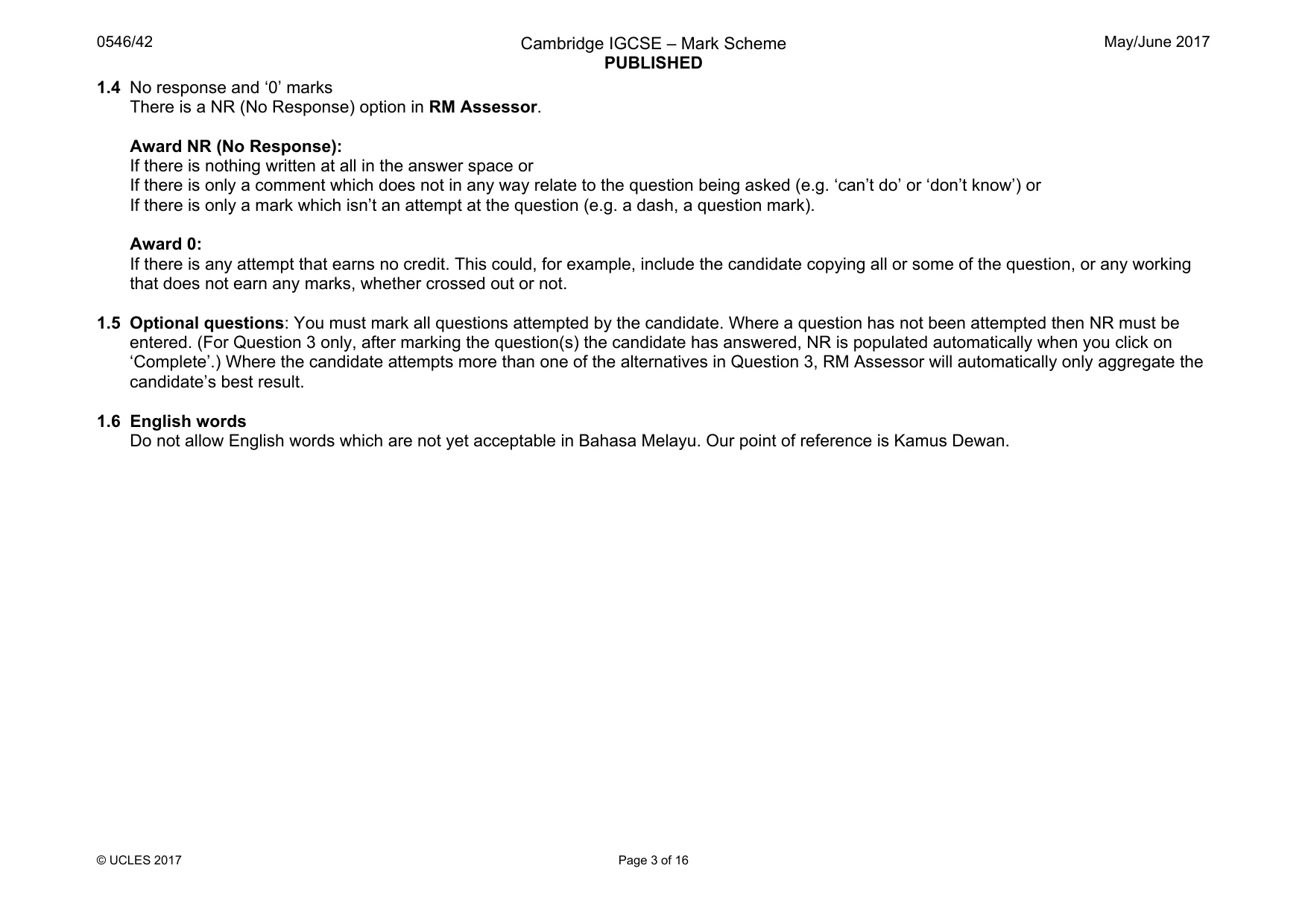
0546/42 Cambridge IGCSE – Mark Scheme PUBLISHED May/June 2017 © UCLES 2017 Page 3 of 16 1.4 No response and ‘0’ marks There is a NR (No Response) option in RM Assessor. Award NR (No Response): If there is nothing written at all in the answer space or If there is only a comment which does not in any way relate to the question being asked (e.g. ‘can’t do’ or ‘don’t know’) or If there is only a mark which isn’t an attempt at the question (e.g. a dash, a question mark). Award 0: If there is any attempt that earns no credit. This could, for example, include the candidate copying all or some of the question, or any working that does not earn any marks, whether crossed out or not. 1.5 Optional questions: You must mark all questions attempted by the candidate. Where a question has not been attempted then NR must be entered. (For Question 3 only, after marking the question(s) the candidate has answered, NR is populated automatically when you click on ‘Complete’.) Where the candidate attempts more than one of the alternatives in Question 3, RM Assessor will automatically only aggregate the candidate’s best result. 1.6 English words Do not allow English words which are not yet acceptable in Bahasa Melayu. Our point of reference is Kamus Dewan.
Mark scheme, page 4
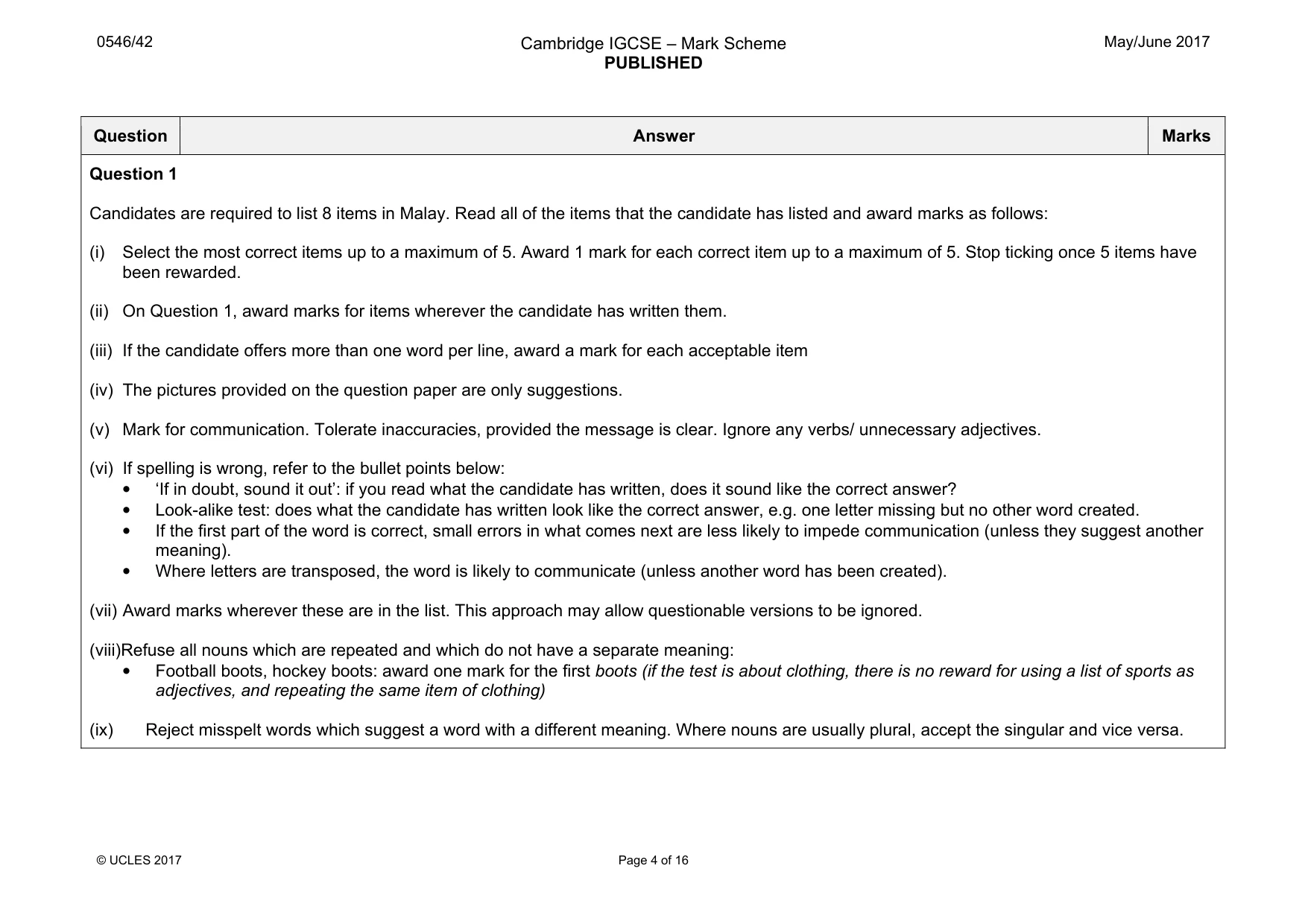
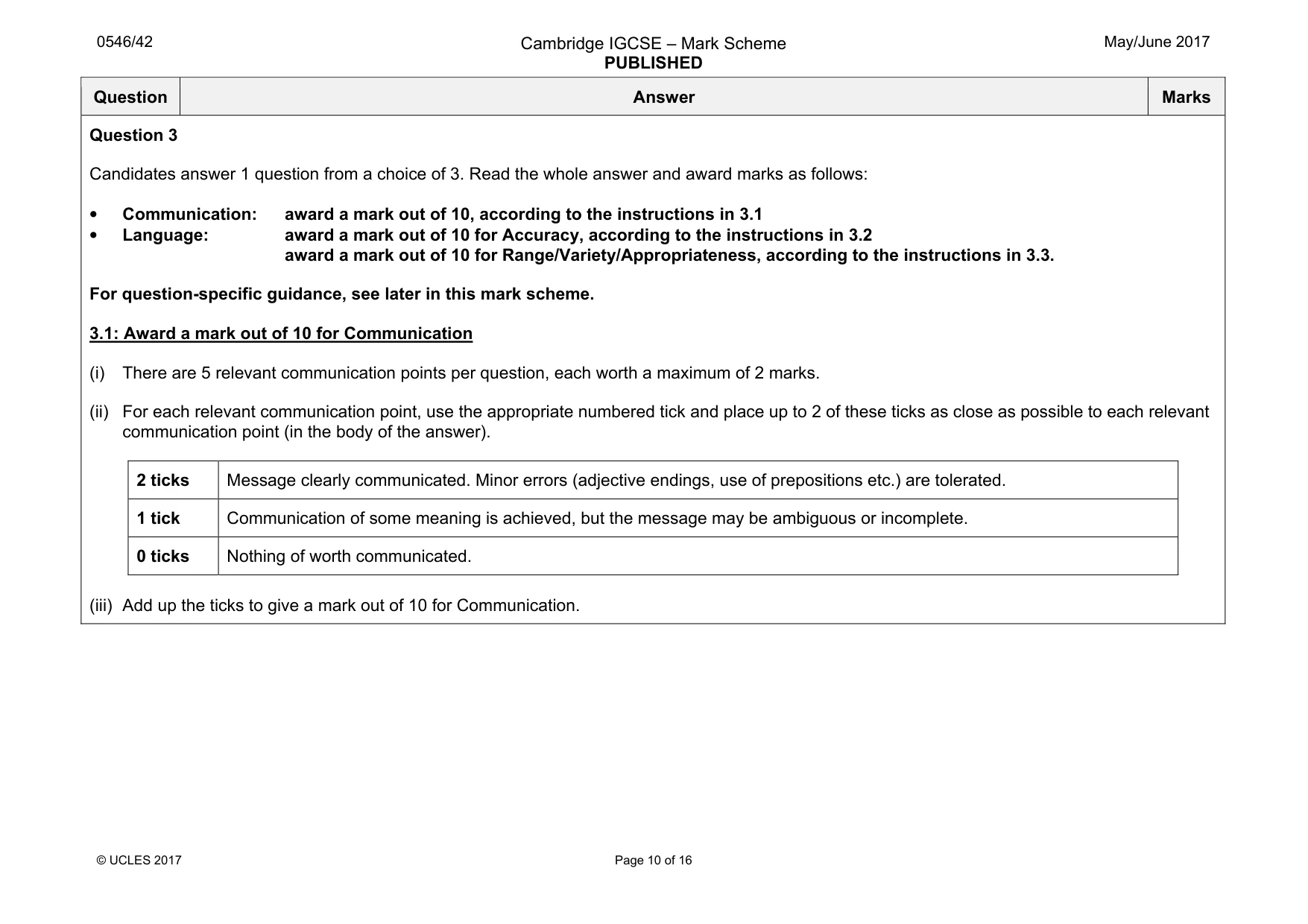
0546/42 Cambridge IGCSE – Mark Scheme PUBLISHED May/June 2017 © UCLES 2017 Page 4 of 16 Question Answer Marks Question 1 Candidates are required to list 8 items in Malay. Read all of the items that the candidate has listed and award marks as follows: (i) Select the most correct items up to a maximum of 5. Award 1 mark for each correct item up to a maximum of 5. Stop ticking once 5 items have been rewarded. (ii) On Question 1, award marks for items wherever the candidate has written them. (iii) If the candidate offers more than one word per line, award a mark for each acceptable item (iv) The pictures provided on the question paper are only suggestions. (v) Mark for communication. Tolerate inaccuracies, provided the message is clear. Ignore any verbs/ unnecessary adjectives. (vi) If spelling is wrong, refer to the bullet points below: • ‘If in doubt, sound it out’: if you read what the candidate has written, does it sound like the correct answer? • Look-alike test: does what the candidate has written look like the correct answer, e.g. one letter missing but no other word created. • If the first part of the word is correct, small errors in what comes next are less likely to impede communication (unless they suggest another meaning). • Where letters are transposed, the word is likely to communicate (unless another word has been created). (vii) Award marks wherever these are in the list. This approach may allow questionable versions to be ignored. (viii)Refuse all nouns which are repeated and which do not have a separate meaning: • Football boots, hockey boots: award one mark for the first boots (if the test is about clothing, there is no reward for using a list of sports as adjectives, and repeating the same item of clothing) (ix) Reject misspelt words which suggest a word with a different meaning. Where nouns are usually plural, accept the singular and vice versa.
Mark scheme, page 5
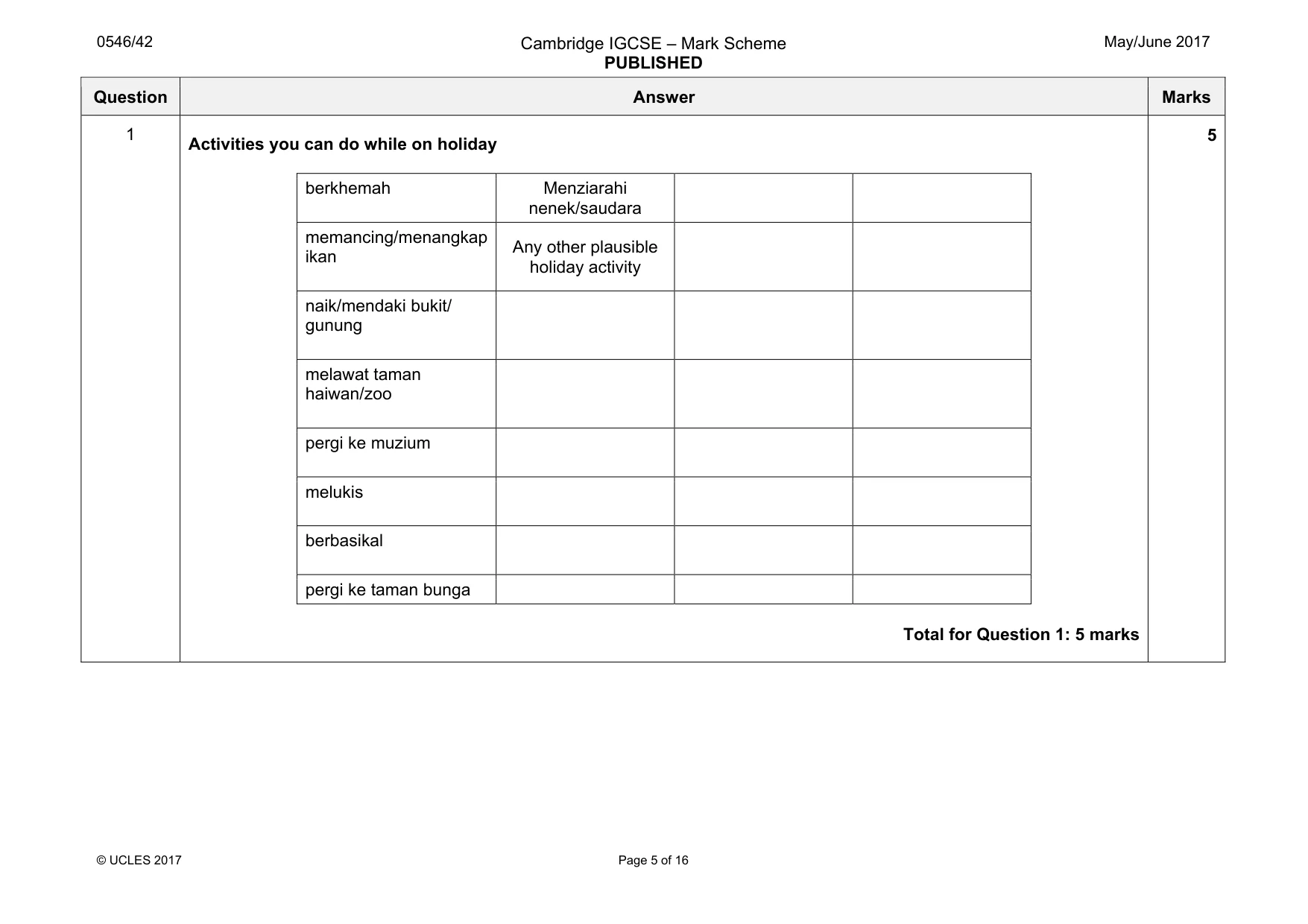
0546/42 Cambridge IGCSE – Mark Scheme PUBLISHED May/June 2017 © UCLES 2017 Page 5 of 16 Question Answer Marks 1 Activities you can do while on holiday berkhemah Menziarahi nenek/saudara memancing/menangkap ikan Any other plausible holiday activity naik/mendaki bukit/ gunung melawat taman haiwan/zoo pergi ke muzium melukis berbasikal pergi ke taman bunga Total for Question 1: 5 marks 5
Mark scheme, page 6
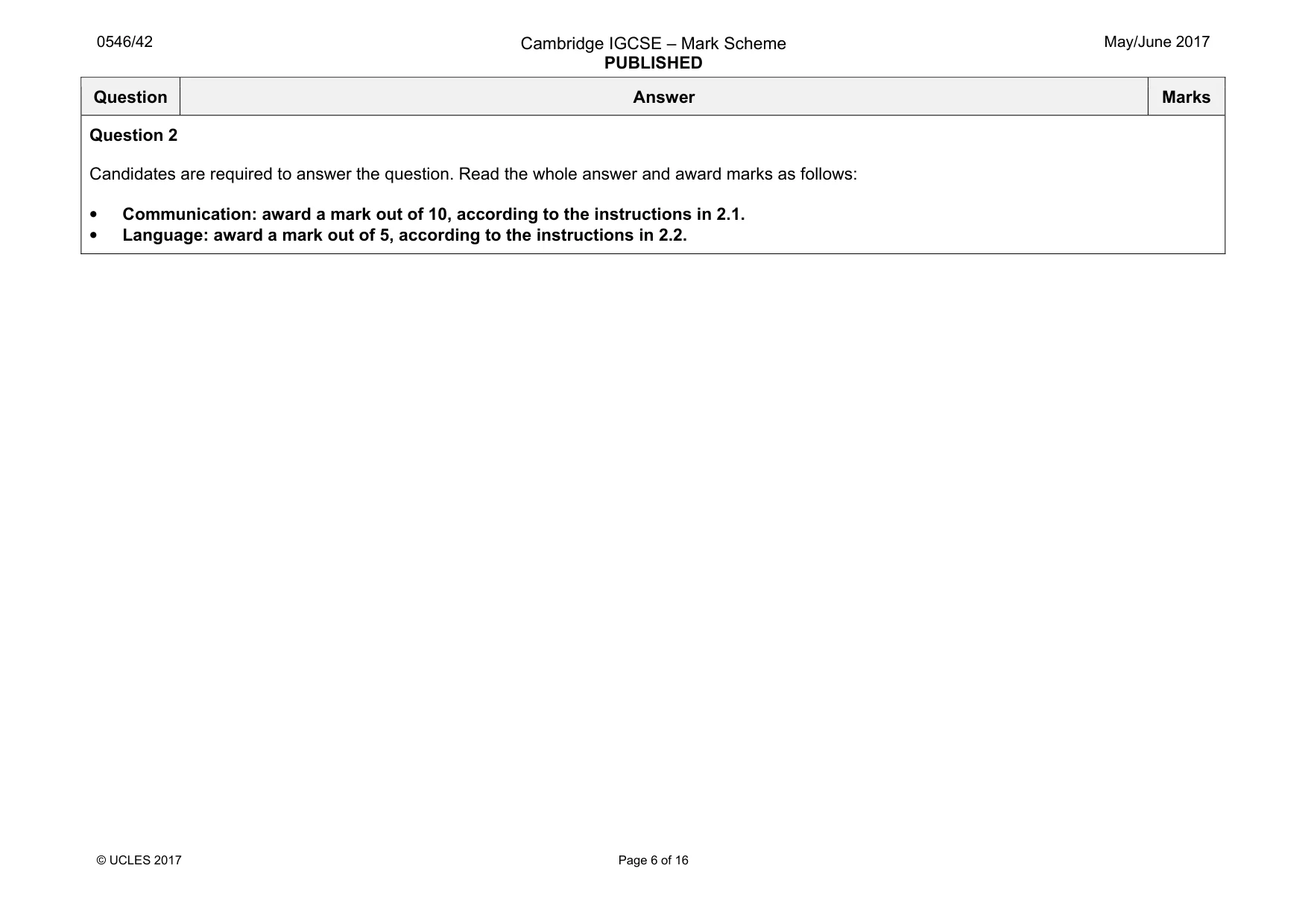
0546/42 Cambridge IGCSE – Mark Scheme PUBLISHED May/June 2017 © UCLES 2017 Page 6 of 16 Question Answer Marks Question 2 Candidates are required to answer the question. Read the whole answer and award marks as follows: • Communication: award a mark out of 10, according to the instructions in 2.1. • Language: award a mark out of 5, according to the instructions in 2.2.
Mark scheme, page 7
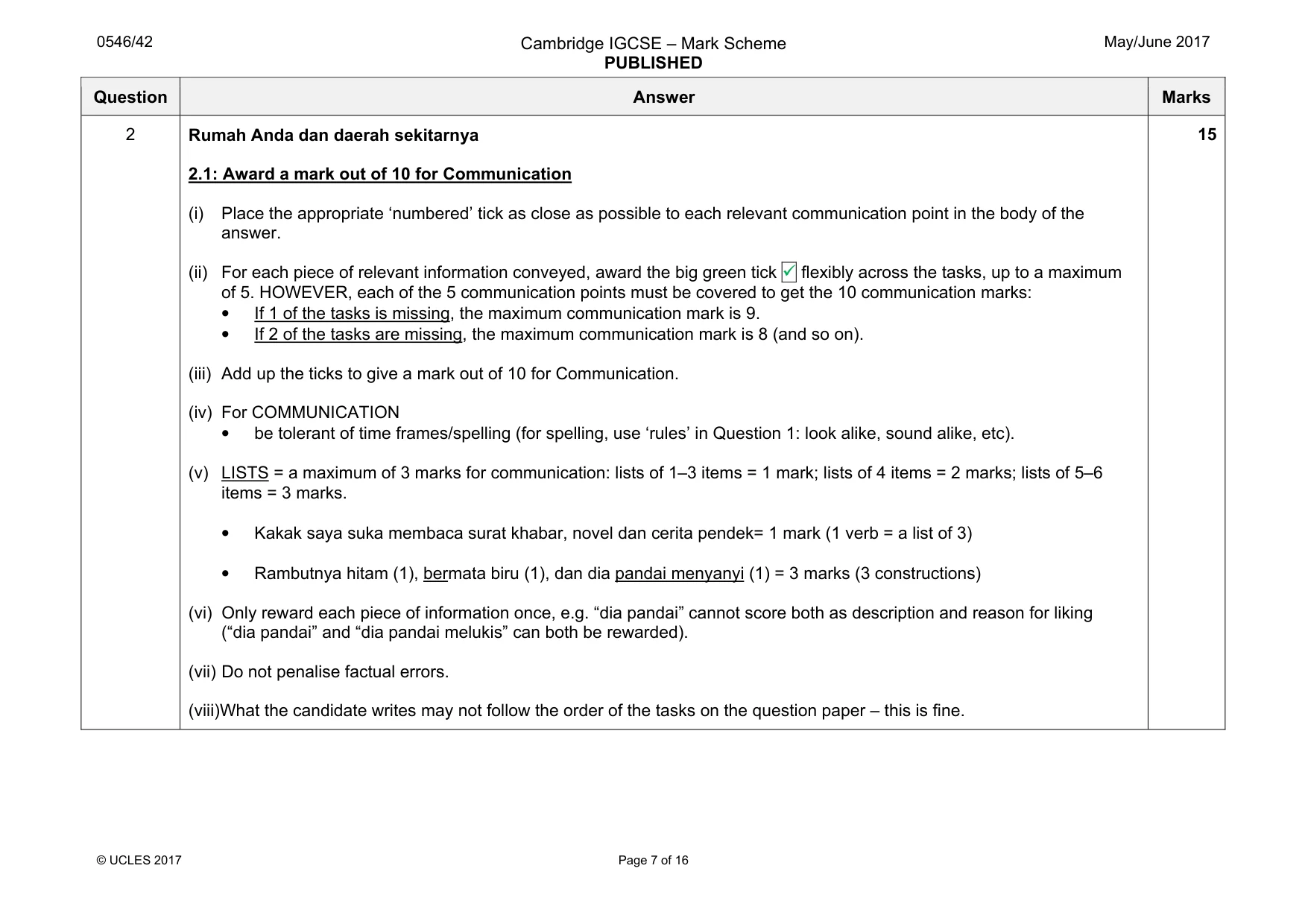
0546/42 Cambridge IGCSE – Mark Scheme PUBLISHED May/June 2017 © UCLES 2017 Page 7 of 16 Question Answer Marks 2 Rumah Anda dan daerah sekitarnya 2.1: Award a mark out of 10 for Communication (i) Place the appropriate ‘numbered’ tick as close as possible to each relevant communication point in the body of the answer. (ii) For each piece of relevant information conveyed, award the big green tick 9 flexibly across the tasks, up to a maximum of 5. HOWEVER, each of the 5 communication points must be covered to get the 10 communication marks: • If 1 of the tasks is missing, the maximum communication mark is 9. • If 2 of the tasks are missing, the maximum communication mark is 8 (and so on). (iii) Add up the ticks to give a mark out of 10 for Communication. (iv) For COMMUNICATION • be tolerant of time frames/spelling (for spelling, use ‘rules’ in Question 1: look alike, sound alike, etc). (v) LISTS = a maximum of 3 marks for communication: lists of 1–3 items = 1 mark; lists of 4 items = 2 marks; lists of 5–6 items = 3 marks. • Kakak saya suka membaca surat khabar, novel dan cerita pendek= 1 mark (1 verb = a list of 3) • Rambutnya hitam (1), bermata biru (1), dan dia pandai menyanyi (1) = 3 marks (3 constructions) (vi) Only reward each piece of information once, e.g. “dia pandai” cannot score both as description and reason for liking (“dia pandai” and “dia pandai melukis” can both be rewarded). (vii) Do not penalise factual errors. (viii)What the candidate writes may not follow the order of the tasks on the question paper – this is fine. 15
Mark scheme, page 8
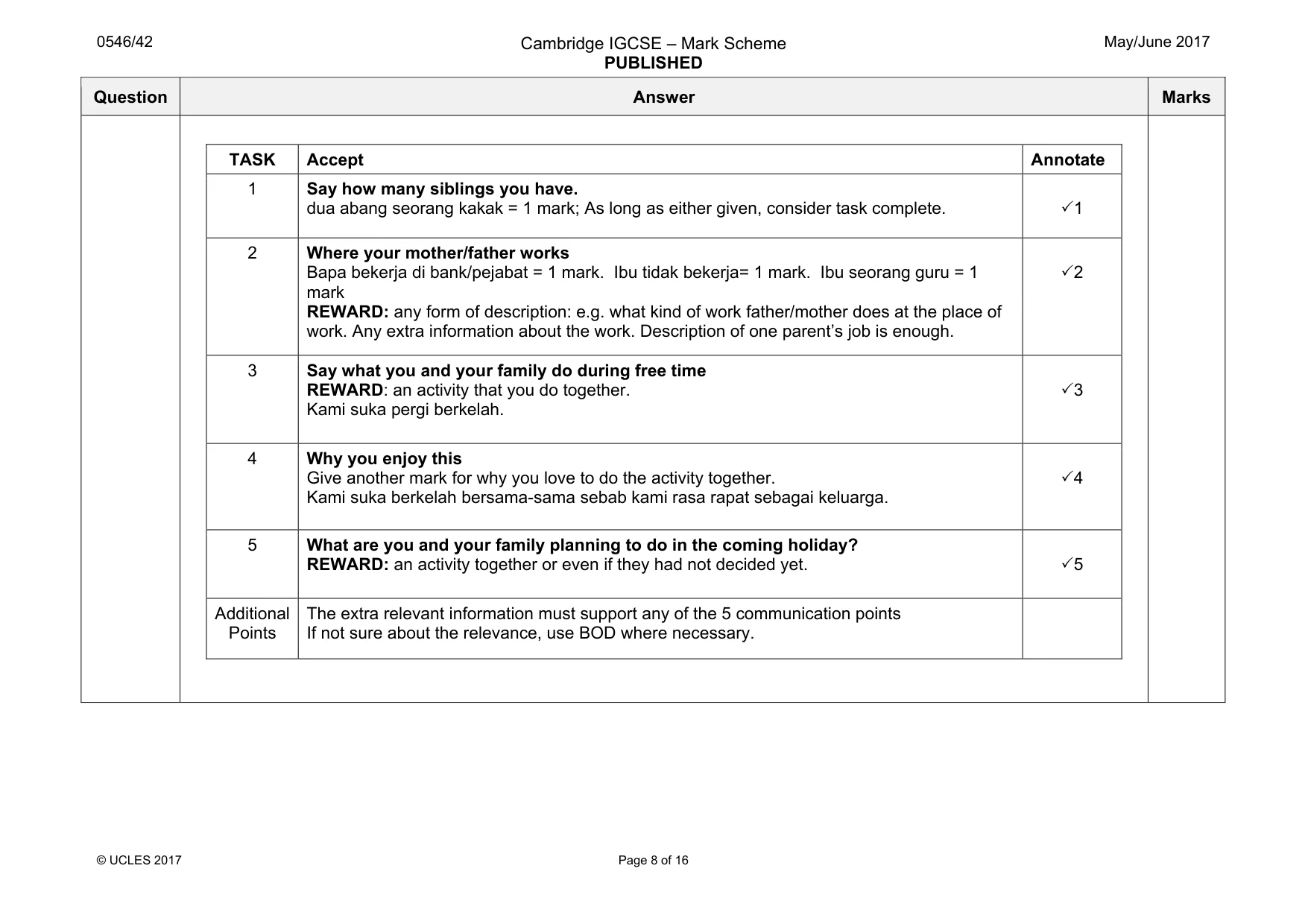
0546/42 Cambridge IGCSE – Mark Scheme PUBLISHED May/June 2017 © UCLES 2017 Page 8 of 16 Question Answer Marks TASK Accept Annotate 1 Say how many siblings you have. dua abang seorang kakak = 1 mark; As long as either given, consider task complete. 31 2 Where your mother/father works Bapa bekerja di bank/pejabat = 1 mark. Ibu tidak bekerja= 1 mark. Ibu seorang guru = 1 mark REWARD: any form of description: e.g. what kind of work father/mother does at the place of work. Any extra information about the work. Description of one parent’s job is enough. 32 3 Say what you and your family do during free time REWARD: an activity that you do together. Kami suka pergi berkelah. 33 4 Why you enjoy this Give another mark for why you love to do the activity together. Kami suka berkelah bersama-sama sebab kami rasa rapat sebagai keluarga. 34 5 What are you and your family planning to do in the coming holiday? REWARD: an activity together or even if they had not decided yet. 35 Additional Points The extra relevant information must support any of the 5 communication points If not sure about the relevance, use BOD where necessary.
Mark scheme, page 9
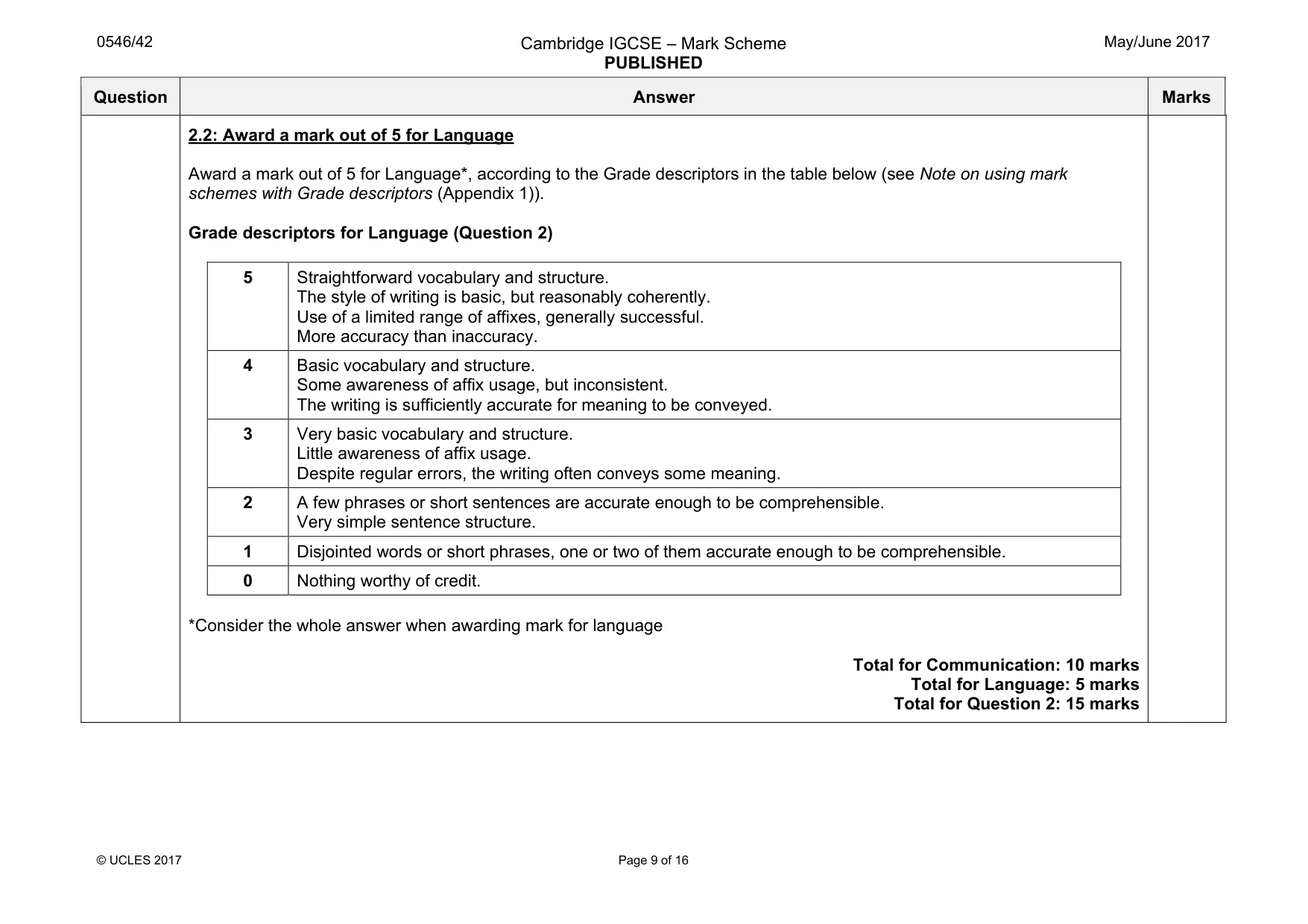
0546/42 Cambridge IGCSE – Mark Scheme PUBLISHED May/June 2017 © UCLES 2017 Page 9 of 16 Question Answer Marks 2.2: Award a mark out of 5 for Language Award a mark out of 5 for Language*, according to the Grade descriptors in the table below (see Note on using mark schemes with Grade descriptors (Appendix 1)). Grade descriptors for Language (Question 2) 5 Straightforward vocabulary and structure. The style of writing is basic, but reasonably coherently. Use of a limited range of affixes, generally successful. More accuracy than inaccuracy. 4 Basic vocabulary and structure. Some awareness of affix usage, but inconsistent. The writing is sufficiently accurate for meaning to be conveyed. 3 Very basic vocabulary and structure. Little awareness of affix usage. Despite regular errors, the writing often conveys some meaning. 2 A few phrases or short sentences are accurate enough to be comprehensible. Very simple sentence structure. 1 Disjointed words or short phrases, one or two of them accurate enough to be comprehensible. 0 Nothing worthy of credit. *Consider the whole answer when awarding mark for language Total for Communication: 10 marks Total for Language: 5 marks Total for Question 2: 15 marks
Mark scheme, page 10
0546/42 Cambridge IGCSE – Mark Scheme PUBLISHED May/June 2017 © UCLES 2017 Page 10 of 16 Question Answer Marks Question 3 Candidates answer 1 question from a choice of 3. Read the whole answer and award marks as follows: • Communication: award a mark out of 10, according to the instructions in 3.1 • Language: award a mark out of 10 for Accuracy, according to the instructions in 3.2 award a mark out of 10 for Range/Variety/Appropriateness, according to the instructions in 3.3. For question-specific guidance, see later in this mark scheme. 3.1: Award a mark out of 10 for Communication (i) There are 5 relevant communication points per question, each worth a maximum of 2 marks. (ii) For each relevant communication point, use the appropriate numbered tick and place up to 2 of these ticks as close as possible to each relevant communication point (in the body of the answer). 2 ticks Message clearly communicated. Minor errors (adjective endings, use of prepositions etc.) are tolerated. 1 tick Communication of some meaning is achieved, but the message may be ambiguous or incomplete. 0 ticks Nothing of worth communicated. (iii) Add up the ticks to give a mark out of 10 for Communication.
Mark scheme, page 11
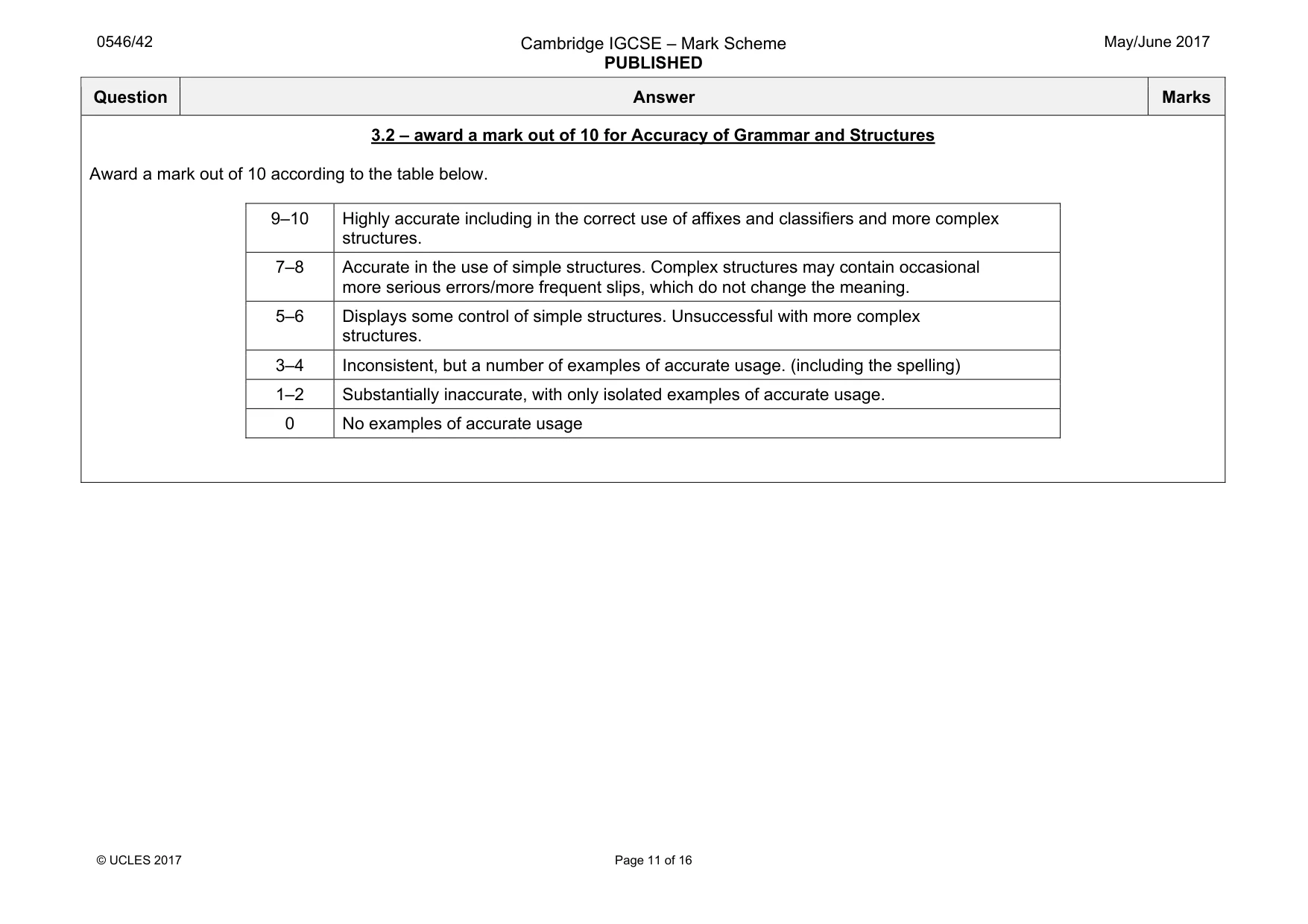
0546/42 Cambridge IGCSE – Mark Scheme PUBLISHED May/June 2017 © UCLES 2017 Page 11 of 16 Question Answer Marks 3.2 – award a mark out of 10 for Accuracy of Grammar and Structures Award a mark out of 10 according to the table below. 9–10 Highly accurate including in the correct use of affixes and classifiers and more complex structures. 7–8 Accurate in the use of simple structures. Complex structures may contain occasional more serious errors/more frequent slips, which do not change the meaning. 5–6 Displays some control of simple structures. Unsuccessful with more complex structures. 3–4 Inconsistent, but a number of examples of accurate usage. (including the spelling) 1–2 Substantially inaccurate, with only isolated examples of accurate usage. 0 No examples of accurate usage
Mark scheme, page 12
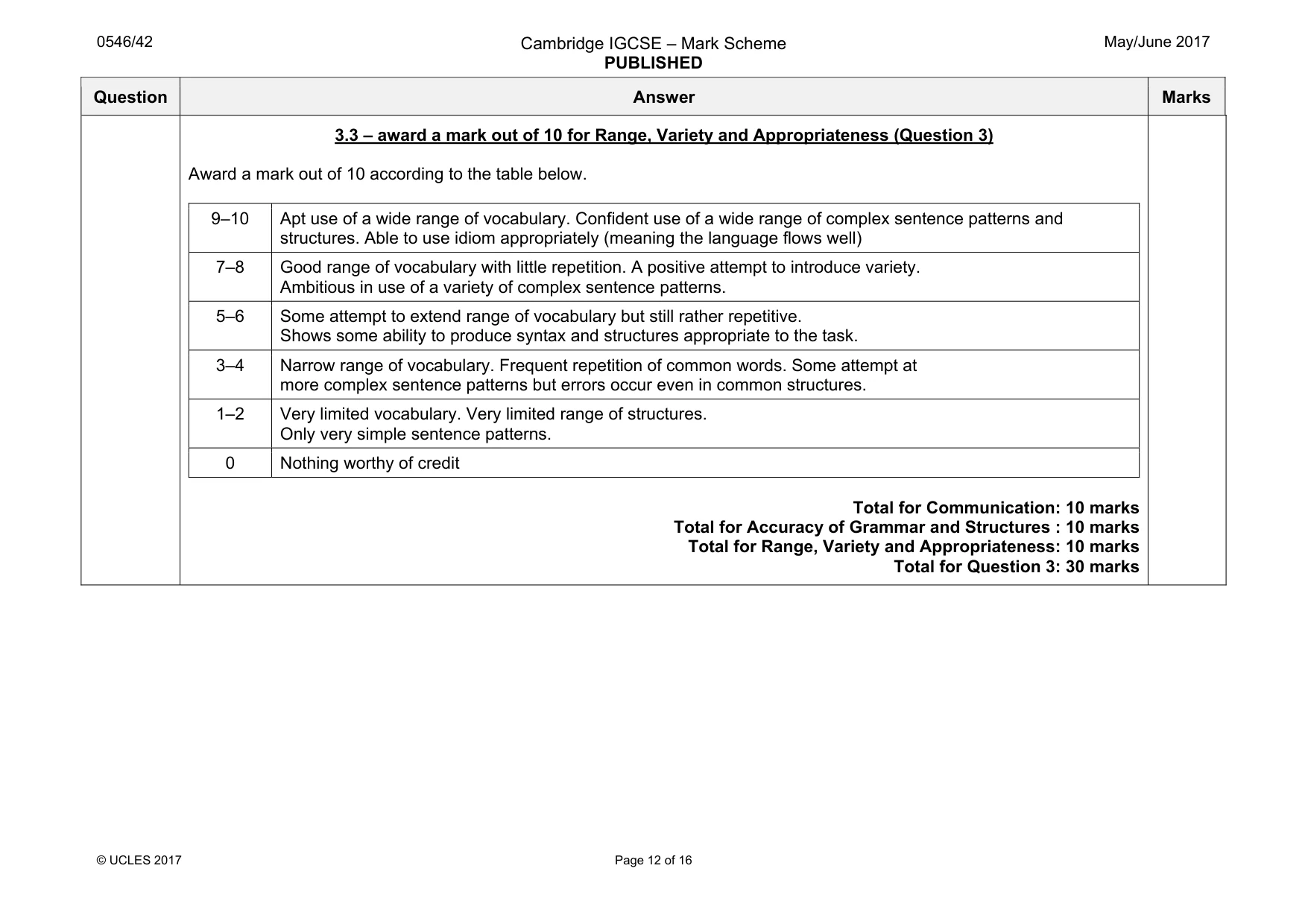
0546/42 Cambridge IGCSE – Mark Scheme PUBLISHED May/June 2017 © UCLES 2017 Page 12 of 16 Question Answer Marks 3.3 – award a mark out of 10 for Range, Variety and Appropriateness (Question 3) Award a mark out of 10 according to the table below. 9–10 Apt use of a wide range of vocabulary. Confident use of a wide range of complex sentence patterns and structures. Able to use idiom appropriately (meaning the language flows well) 7–8 Good range of vocabulary with little repetition. A positive attempt to introduce variety. Ambitious in use of a variety of complex sentence patterns. 5–6 Some attempt to extend range of vocabulary but still rather repetitive. Shows some ability to produce syntax and structures appropriate to the task. 3–4 Narrow range of vocabulary. Frequent repetition of common words. Some attempt at more complex sentence patterns but errors occur even in common structures. 1–2 Very limited vocabulary. Very limited range of structures. Only very simple sentence patterns. 0 Nothing worthy of credit Total for Communication: 10 marks Total for Accuracy of Grammar and Structures : 10 marks Total for Range, Variety and Appropriateness: 10 marks Total for Question 3: 30 marks
Mark scheme, page 13
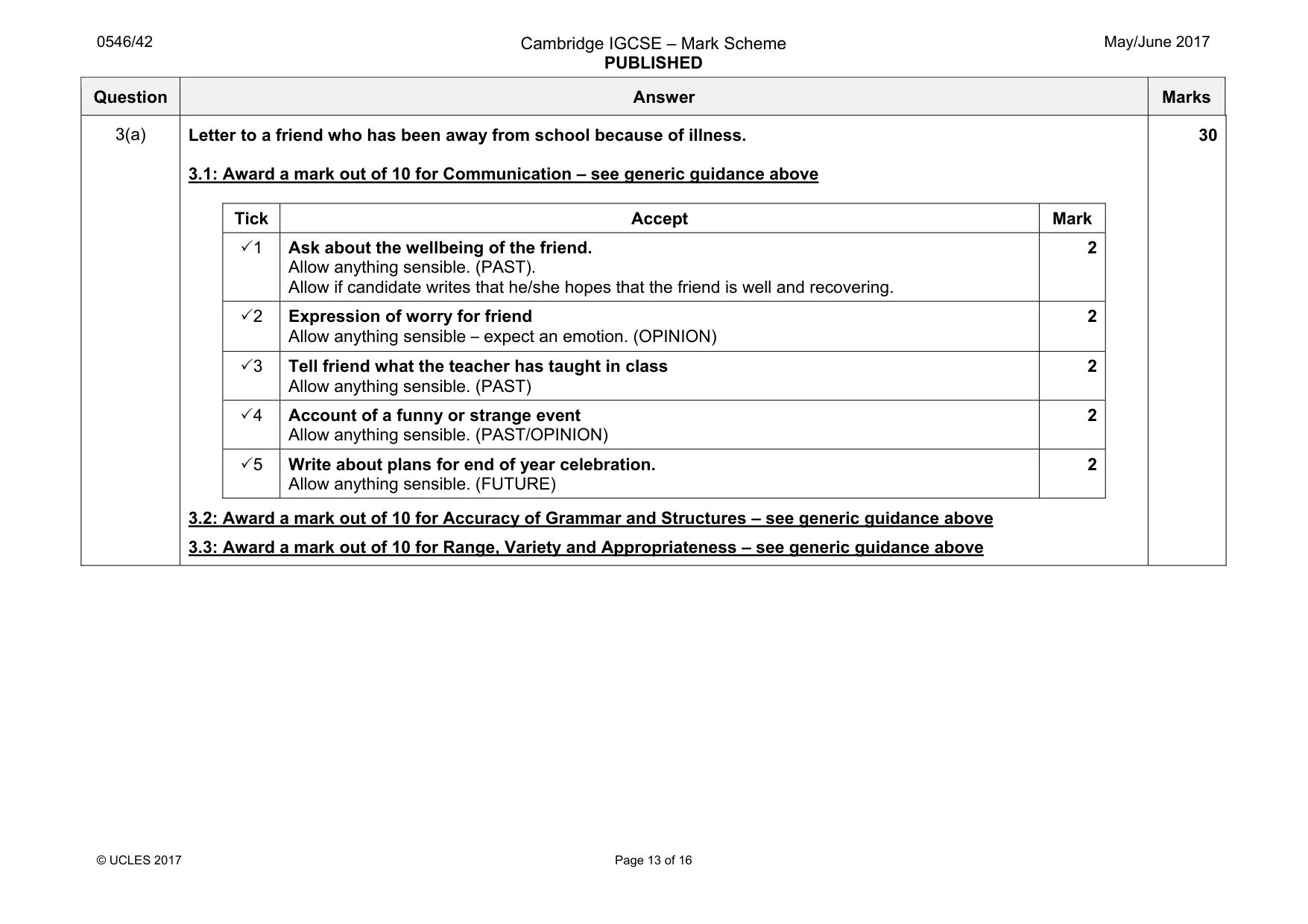
0546/42 Cambridge IGCSE – Mark Scheme PUBLISHED May/June 2017 © UCLES 2017 Page 13 of 16 Question Answer Marks 3(a) Letter to a friend who has been away from school because of illness. 3.1: Award a mark out of 10 for Communication – see generic guidance above Tick Accept Mark 31 Ask about the wellbeing of the friend. Allow anything sensible. (PAST). Allow if candidate writes that he/she hopes that the friend is well and recovering. 2 32 Expression of worry for friend Allow anything sensible – expect an emotion. (OPINION) 2 33 Tell friend what the teacher has taught in class Allow anything sensible. (PAST) 2 34 Account of a funny or strange event Allow anything sensible. (PAST/OPINION) 2 35 Write about plans for end of year celebration. Allow anything sensible. (FUTURE) 2 3.2: Award a mark out of 10 for Accuracy of Grammar and Structures – see generic guidance above 3.3: Award a mark out of 10 for Range, Variety and Appropriateness – see generic guidance above 30
Mark scheme, page 14
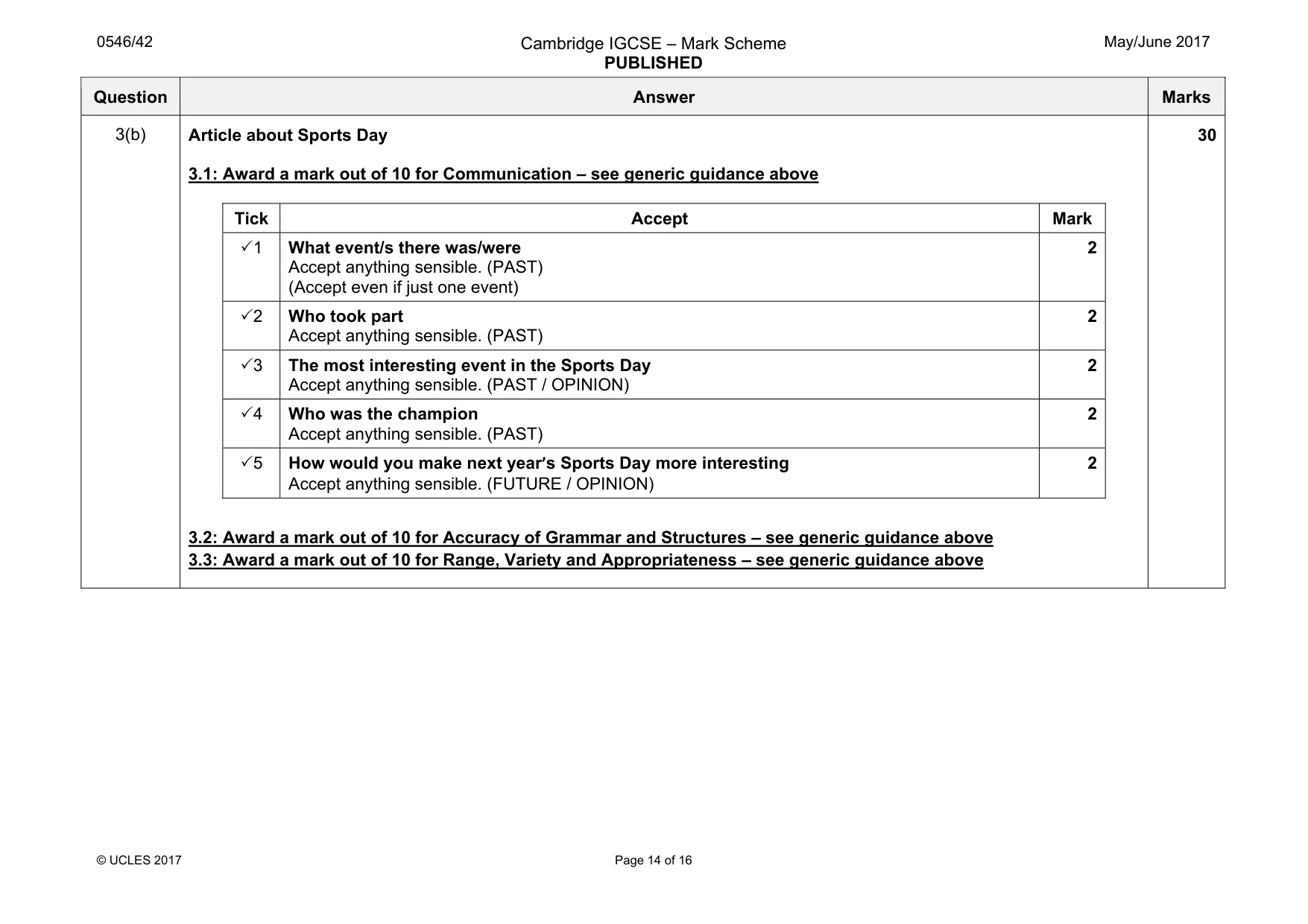
0546/42 Cambridge IGCSE – Mark Scheme PUBLISHED May/June 2017 © UCLES 2017 Page 14 of 16 Question Answer Marks 3(b) Article about Sports Day 3.1: Award a mark out of 10 for Communication – see generic guidance above Tick Accept Mark 31 What event/s there was/were Accept anything sensible. (PAST) (Accept even if just one event) 2 32 Who took part Accept anything sensible. (PAST) 2 33 The most interesting event in the Sports Day Accept anything sensible. (PAST / OPINION) 2 34 Who was the champion Accept anything sensible. (PAST) 2 35 How would you make next year’s Sports Day more interesting Accept anything sensible. (FUTURE / OPINION) 2 3.2: Award a mark out of 10 for Accuracy of Grammar and Structures – see generic guidance above 3.3: Award a mark out of 10 for Range, Variety and Appropriateness – see generic guidance above 30
Mark scheme, page 15
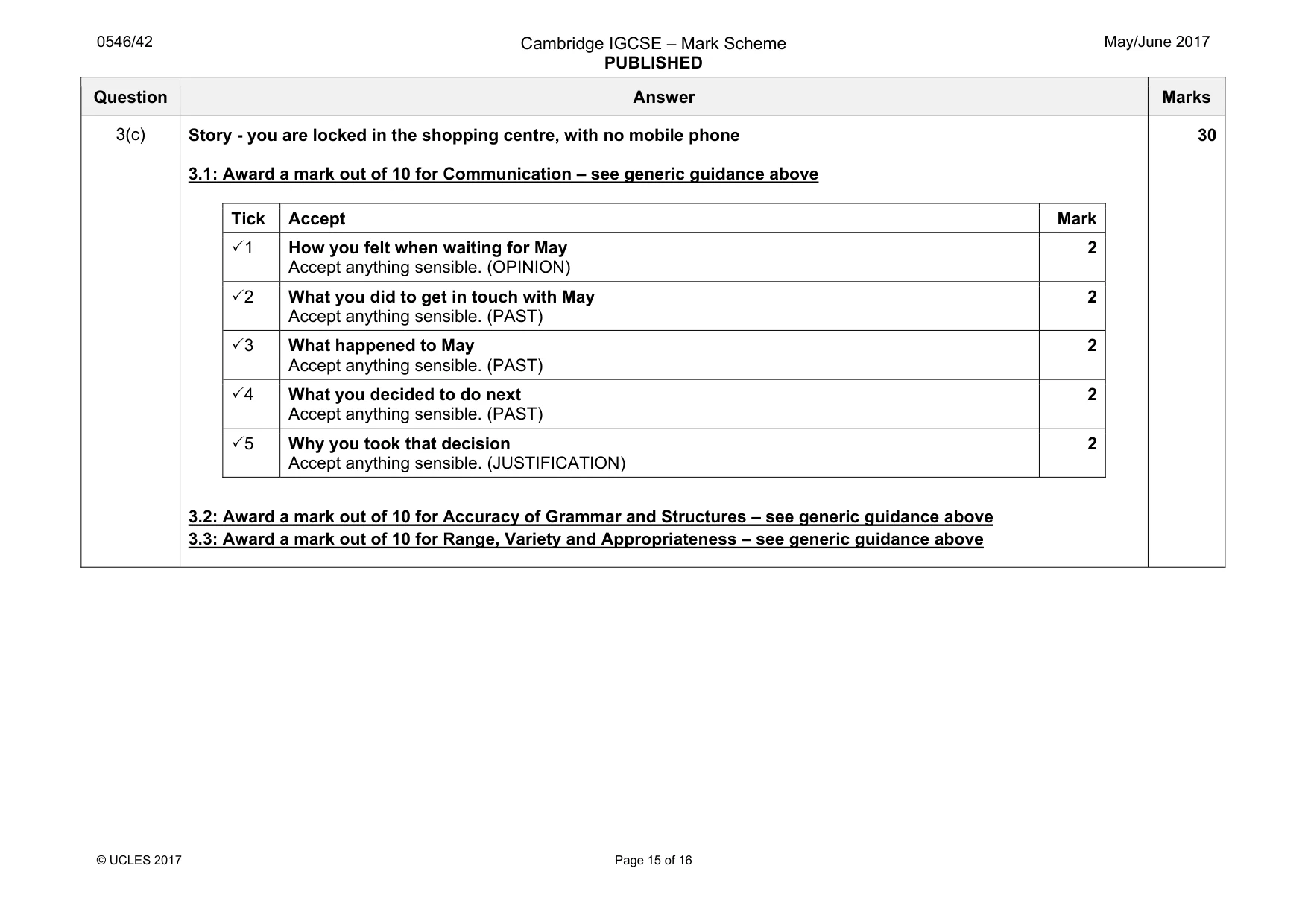
0546/42 Cambridge IGCSE – Mark Scheme PUBLISHED May/June 2017 © UCLES 2017 Page 15 of 16 Question Answer Marks 3(c) Story - you are locked in the shopping centre, with no mobile phone 3.1: Award a mark out of 10 for Communication – see generic guidance above Tick Accept Mark 31 How you felt when waiting for May Accept anything sensible. (OPINION) 2 32 What you did to get in touch with May Accept anything sensible. (PAST) 2 33 What happened to May Accept anything sensible. (PAST) 2 34 What you decided to do next Accept anything sensible. (PAST) 2 35 Why you took that decision Accept anything sensible. (JUSTIFICATION) 2 3.2: Award a mark out of 10 for Accuracy of Grammar and Structures – see generic guidance above 3.3: Award a mark out of 10 for Range, Variety and Appropriateness – see generic guidance above 30
Mark scheme, page 16
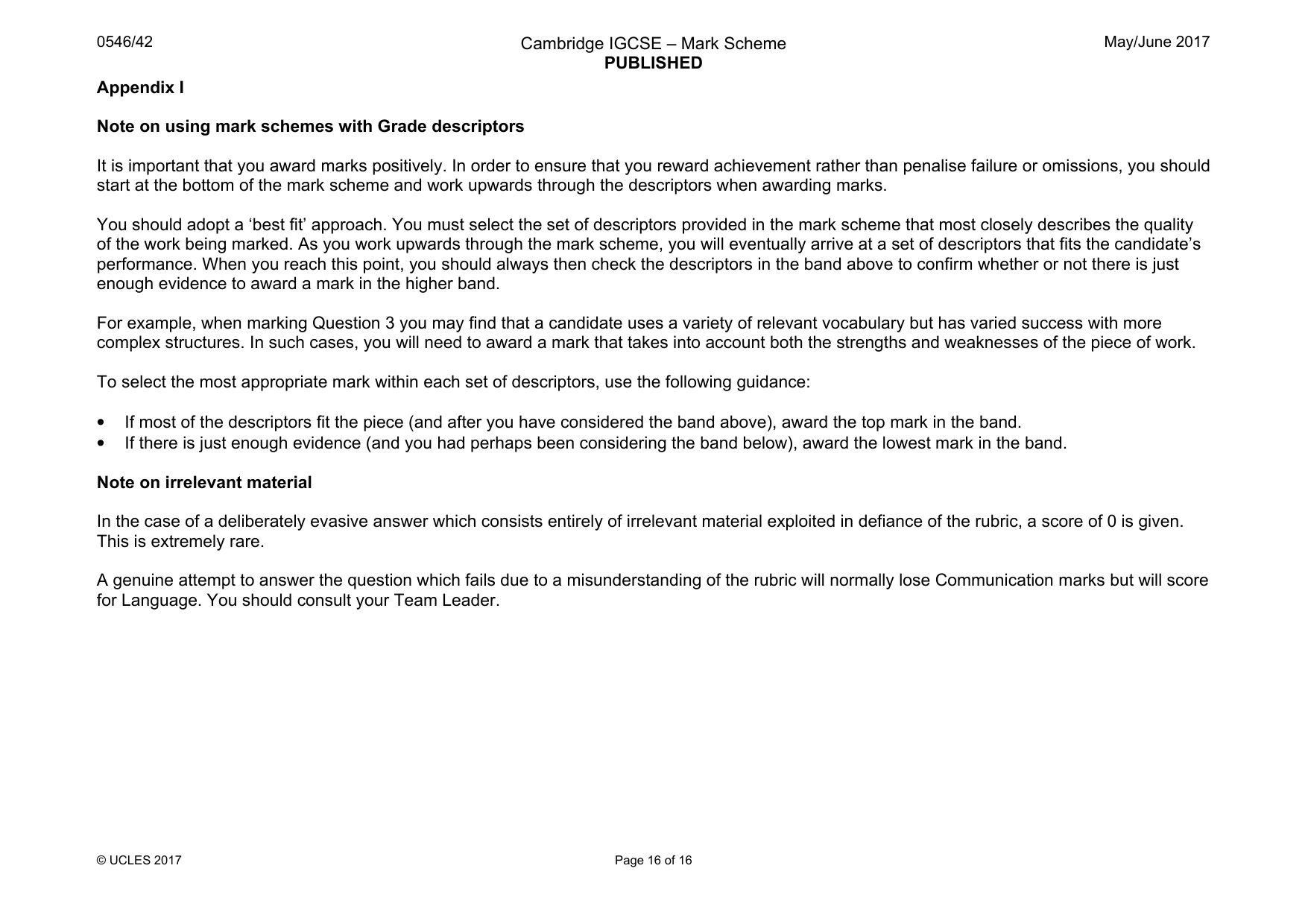
0546/42 Cambridge IGCSE – Mark Scheme PUBLISHED May/June 2017 © UCLES 2017 Page 16 of 16 Appendix I Note on using mark schemes with Grade descriptors It is important that you award marks positively. In order to ensure that you reward achievement rather than penalise failure or omissions, you should start at the bottom of the mark scheme and work upwards through the descriptors when awarding marks. You should adopt a ‘best fit’ approach. You must select the set of descriptors provided in the mark scheme that most closely describes the quality of the work being marked. As you work upwards through the mark scheme, you will eventually arrive at a set of descriptors that fits the candidate’s performance. When you reach this point, you should always then check the descriptors in the band above to confirm whether or not there is just enough evidence to award a mark in the higher band. For example, when marking Question 3 you may find that a candidate uses a variety of relevant vocabulary but has varied success with more complex structures. In such cases, you will need to award a mark that takes into account both the strengths and weaknesses of the piece of work. To select the most appropriate mark within each set of descriptors, use the following guidance: • If most of the descriptors fit the piece (and after you have considered the band above), award the top mark in the band. • If there is just enough evidence (and you had perhaps been considering the band below), award the lowest mark in the band. Note on irrelevant material In the case of a deliberately evasive answer which consists entirely of irrelevant material exploited in defiance of the rubric, a score of 0 is given. This is extremely rare. A genuine attempt to answer the question which fails due to a misunderstanding of the rubric will normally lose Communication marks but will score for Language. You should consult your Team Leader.
What you needed in this session
Cambridge’s own grade thresholds for 2017 May/June, Paper 4 · Variant 2. A higher threshold means an easier paper — the bar moves with how the cohort did.