Cambridge IGCSE Malay - Foreign Language 0546 — 2024 May/June Paper 4 · Variant 2
0546/42/M/J/24 · 45 marks · ≈51 min
The question paper and its mark scheme, free to read here and free to download. This is Cambridge’s own paper, exactly as it was sat.
Question paper8 pages
Mark scheme19 pages
Answers below. Sit the paper first if you are practising.
Paper as text
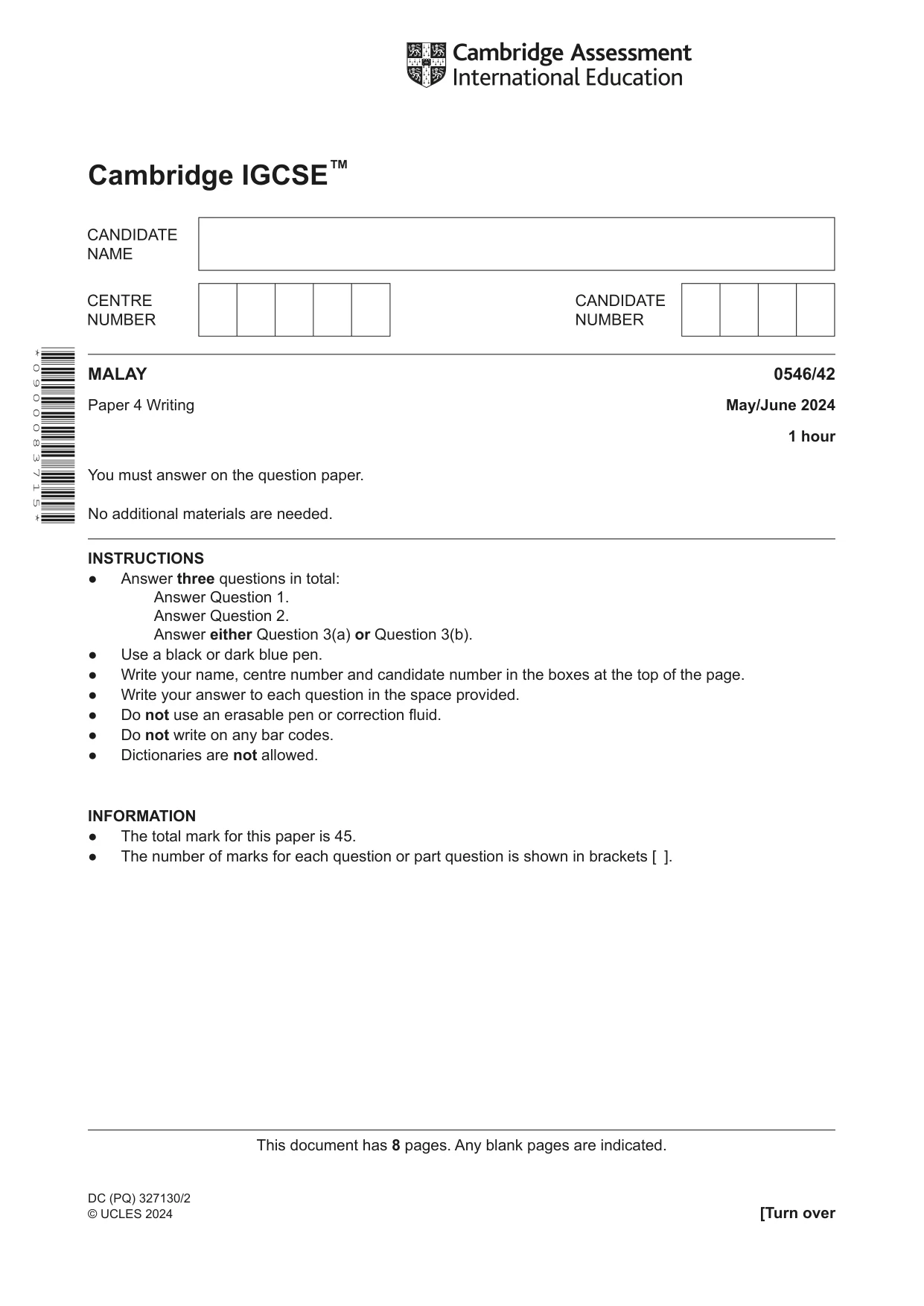
Question paper, page 1
This document has 8 pages. Any blank pages are indicated. [Turn over Cambridge IGCSE™ MALAY 0546/42 Paper 4 Writing May/June 2024 1 hour You must answer on the question paper. No additional materials are needed. INSTRUCTIONS ● Answer three questions in total: Answer Question 1. Answer Question 2. Answer either Question 3(a) or Question 3(b). ● Use a black or dark blue pen. ● Write your name, centre number and candidate number in the boxes at the top of the page. ● Write your answer to each question in the space provided. ● Do not use an erasable pen or correction fluid. ● Do not write on any bar codes. ● Dictionaries are not allowed. INFORMATION ● The total mark for this paper is 45. ● The number of marks for each question or part question is shown in brackets [ ]. * 0 9 0 0 0 8 3 7 1 5 * DC (PQ) 327130/2 © UCLES 2024
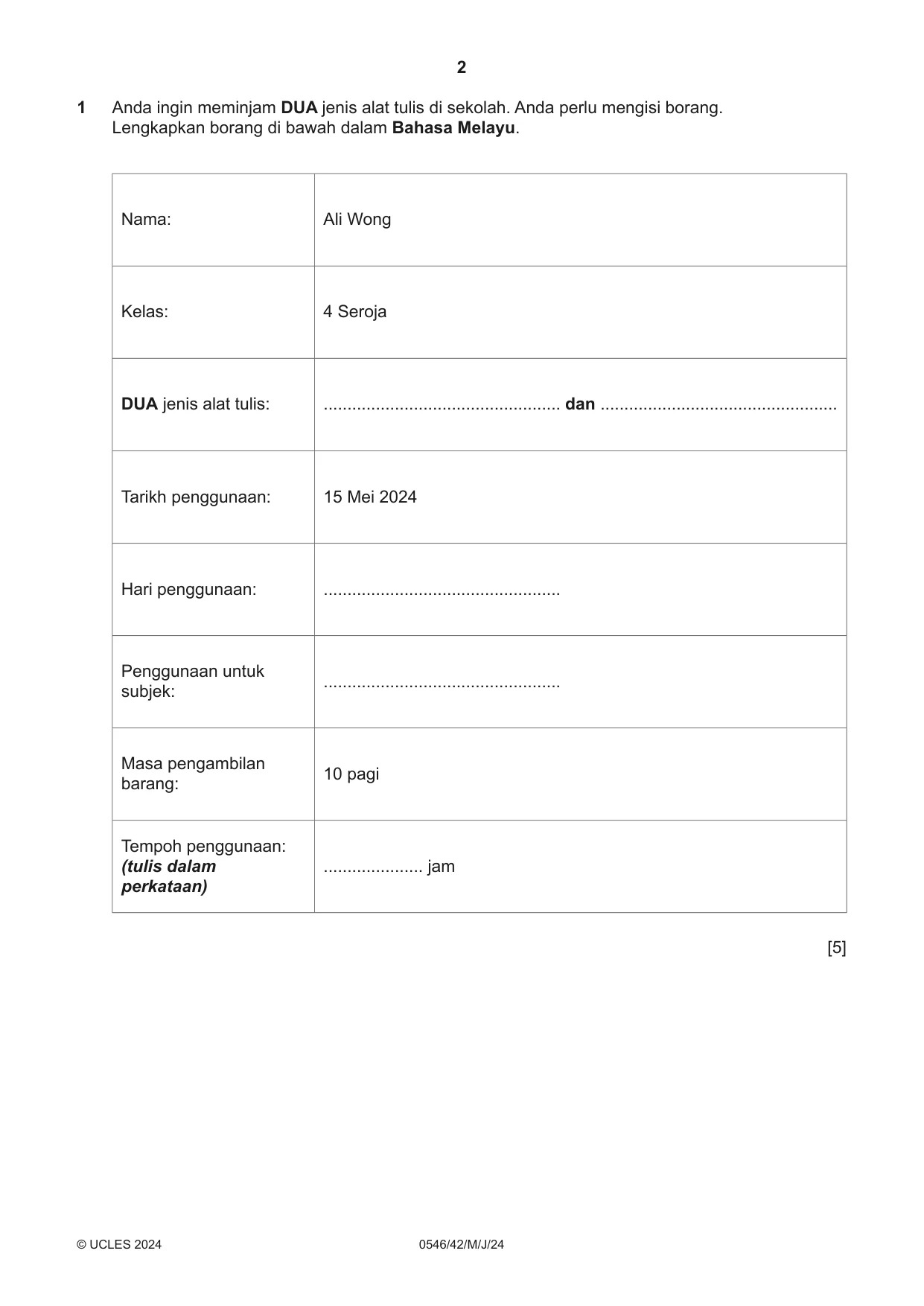
Question paper, page 2
2 0546/42/M/J/24 © UCLES 2024 1 Anda ingin meminjam DUA jenis alat tulis di sekolah. Anda perlu mengisi borang. Lengkapkan borang di bawah dalam Bahasa Melayu. Nama: Ali Wong Kelas: 4 Seroja DUA jenis alat tulis: … dan … Tarikh penggunaan: 15 Mei 2024 Hari penggunaan: … Penggunaan untuk subjek: … Masa pengambilan barang: 10 pagi Tempoh penggunaan: (tulis dalam perkataan) … jam [5]
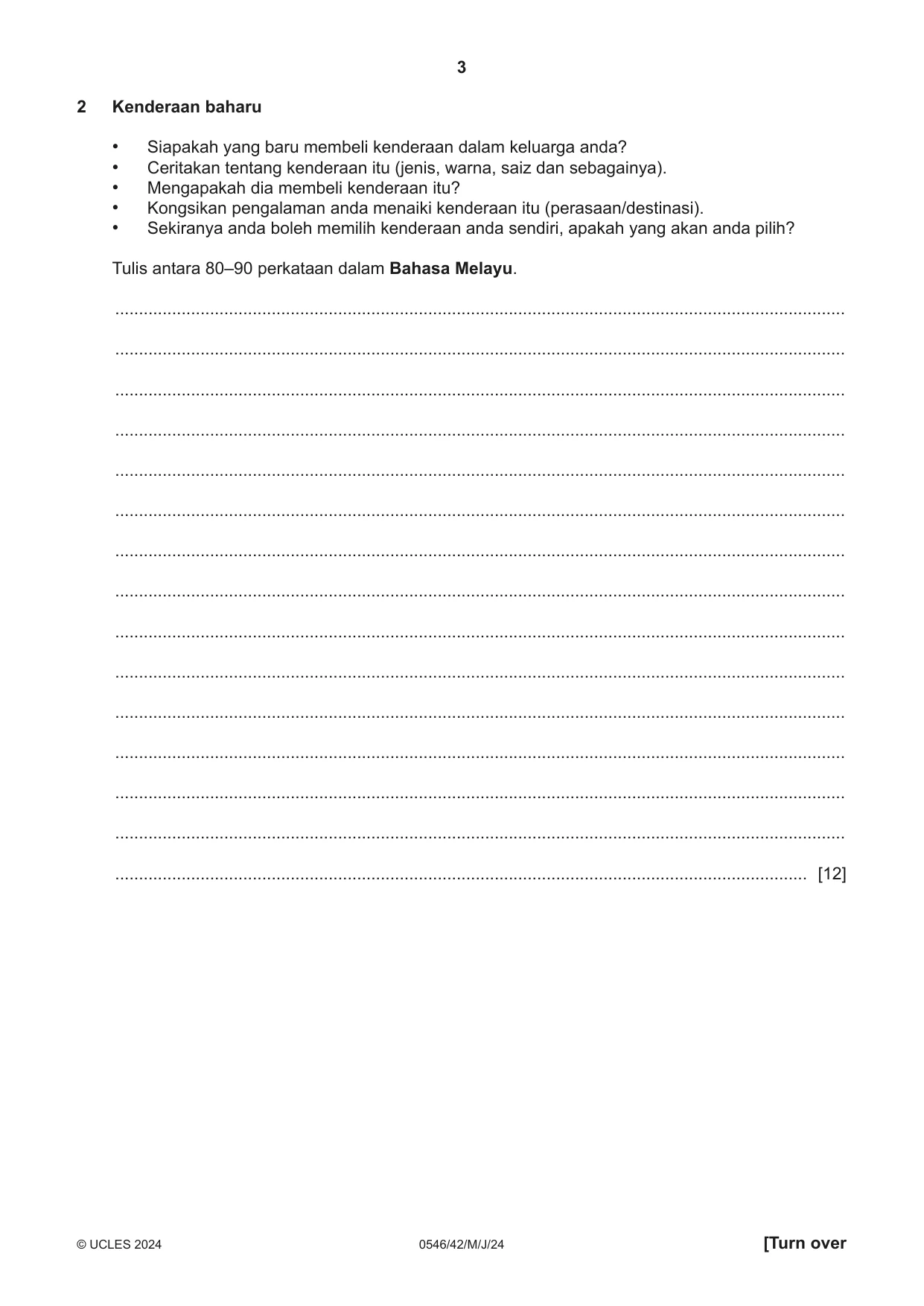
Question paper, page 3
3 0546/42/M/J/24 © UCLES 2024 [Turn over 2 Kenderaan baharu • Siapakah yang baru membeli kenderaan dalam keluarga anda? • Ceritakan tentang kenderaan itu (jenis, warna, saiz dan sebagainya). • Mengapakah dia membeli kenderaan itu? • Kongsikan pengalaman anda menaiki kenderaan itu (perasaan/destinasi). • Sekiranya anda boleh memilih kenderaan anda sendiri, apakah yang akan anda pilih? Tulis antara 80–90 perkataan dalam Bahasa Melayu. … … … … … … … … … … … … … … … [12]
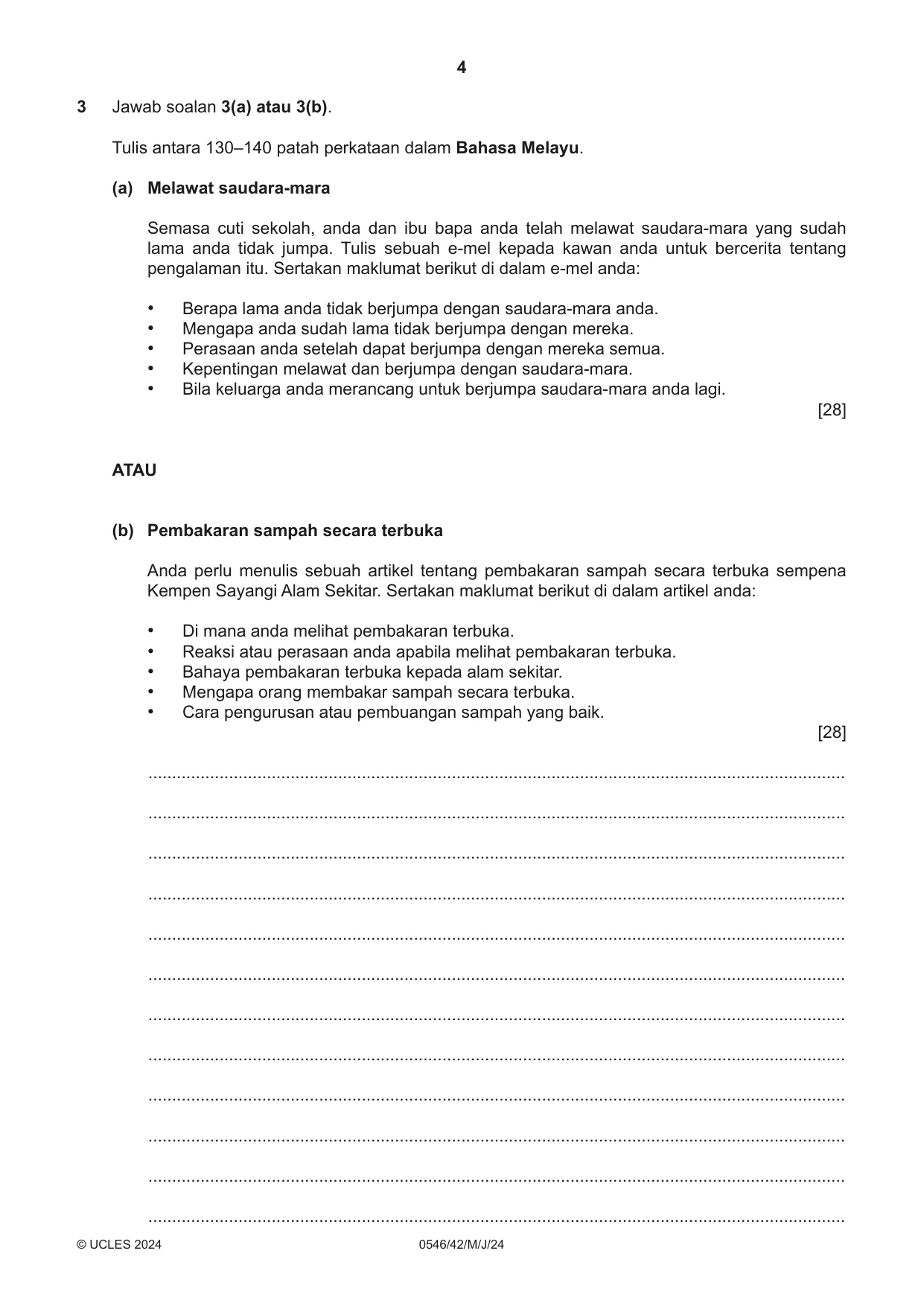
Question paper, page 4
4 0546/42/M/J/24 © UCLES 2024 3 Jawab soalan 3(a) atau 3(b). Tulis antara 130–140 patah perkataan dalam Bahasa Melayu. (a) Melawat saudara-mara Semasa cuti sekolah, anda dan ibu bapa anda telah melawat saudara-mara yang sudah lama anda tidak jumpa. Tulis sebuah e-mel kepada kawan anda untuk bercerita tentang pengalaman itu. Sertakan maklumat berikut di dalam e-mel anda: • Berapa lama anda tidak berjumpa dengan saudara-mara anda. • Mengapa anda sudah lama tidak berjumpa dengan mereka. • Perasaan anda setelah dapat berjumpa dengan mereka semua. • Kepentingan melawat dan berjumpa dengan saudara-mara. • Bila keluarga anda merancang untuk berjumpa saudara-mara anda lagi. [28] ATAU (b) Pembakaran sampah secara terbuka Anda perlu menulis sebuah artikel tentang pembakaran sampah secara terbuka sempena Kempen Sayangi Alam Sekitar. Sertakan maklumat berikut di dalam artikel anda: • Di mana anda melihat pembakaran terbuka. • Reaksi atau perasaan anda apabila melihat pembakaran terbuka. • Bahaya pembakaran terbuka kepada alam sekitar. • Mengapa orang membakar sampah secara terbuka. • Cara pengurusan atau pembuangan sampah yang baik. [28] … … … … … … … … … … … …
Question paper, page 5
5 0546/42/M/J/24 © UCLES 2024 … … … … … … … … … … … … … … … … … … … … … … … … …
Question paper, page 6
6 0546/42/M/J/24 © UCLES 2024 BLANK PAGE
Question paper, page 7
7 0546/42/M/J/24 © UCLES 2024 BLANK PAGE
Question paper, page 8
8 0546/42/M/J/24 © UCLES 2024 BLANK PAGE Permission to reproduce items where third-party owned material protected by copyright is included has been sought and cleared where possible. Every reasonable effort has been made by the publisher (UCLES) to trace copyright holders, but if any items requiring clearance have unwittingly been included, the publisher will be pleased to make amends at the earliest possible opportunity. To avoid the issue of disclosure of answer-related information to candidates, all copyright acknowledgements are reproduced online in the Cambridge Assessment International Education Copyright Acknowledgements Booklet. This is produced for each series of examinations and is freely available to download at www.cambridgeinternational.org after the live examination series. Cambridge Assessment International Education is part of Cambridge Assessment. Cambridge Assessment is the brand name of the University of Cambridge Local Examinations Syndicate (UCLES), which is a department of the University of Cambridge.
Mark scheme, page 1
This document consists of 19 printed pages. © Cambridge University Press & Assessment 2024 [Turn over Cambridge IGCSE™ MALAY 0546/42 Paper 4 Writing May/June 2024 MARK SCHEME Maximum Mark: 45 Published This mark scheme is published as an aid to teachers and candidates, to indicate the requirements of the examination. It shows the basis on which Examiners were instructed to award marks. It does not indicate the details of the discussions that took place at an Examiners’ meeting before marking began, which would have considered the acceptability of alternative answers. Mark schemes should be read in conjunction with the question paper and the Principal Examiner Report for Teachers. Cambridge International will not enter into discussions about these mark schemes. Cambridge International is publishing the mark schemes for the May/June 2024 series for most Cambridge IGCSE, Cambridge International A and AS Level and Cambridge Pre-U components, and some Cambridge O Level components.
Mark scheme, page 2
0546/42 Cambridge IGCSE – Mark Scheme PUBLISHED May/June 2024 © Cambridge University Press & Assessment 2024 Page 2 of 19 Generic Marking Principles These general marking principles must be applied by all examiners when marking candidate answers. They should be applied alongside the specific content of the mark scheme or generic level descriptions for a question. Each question paper and mark scheme will also comply with these marking principles. GENERIC MARKING PRINCIPLE 1: Marks must be awarded in line with: the specific content of the mark scheme or the generic level descriptors for the question the specific skills defined in the mark scheme or in the generic level descriptors for the question the standard of response required by a candidate as exemplified by the standardisation scripts. GENERIC MARKING PRINCIPLE 2: Marks awarded are always whole marks (not half marks, or other fractions). GENERIC MARKING PRINCIPLE 3: Marks must be awarded positively: marks are awarded for correct/valid answers, as defined in the mark scheme. However, credit is given for valid answers which go beyond the scope of the syllabus and mark scheme, referring to your Team Leader as appropriate marks are awarded when candidates clearly demonstrate what they know and can do marks are not deducted for errors marks are not deducted for omissions answers should only be judged on the quality of spelling, punctuation and grammar when these features are specifically assessed by the question as indicated by the mark scheme. The meaning, however, should be unambiguous. GENERIC MARKING PRINCIPLE 4: Rules must be applied consistently, e.g. in situations where candidates have not followed instructions or in the application of generic level descriptors.
Mark scheme, page 3
0546/42 Cambridge IGCSE – Mark Scheme PUBLISHED May/June 2024 © Cambridge University Press & Assessment 2024 Page 3 of 19 GENERIC MARKING PRINCIPLE 5: Marks should be awarded using the full range of marks defined in the mark scheme for the question (however; the use of the full mark range may be limited according to the quality of the candidate responses seen). GENERIC MARKING PRINCIPLE 6: Marks awarded are based solely on the requirements as defined in the mark scheme. Marks should not be awarded with grade thresholds or grade descriptors in mind.
Mark scheme, page 4
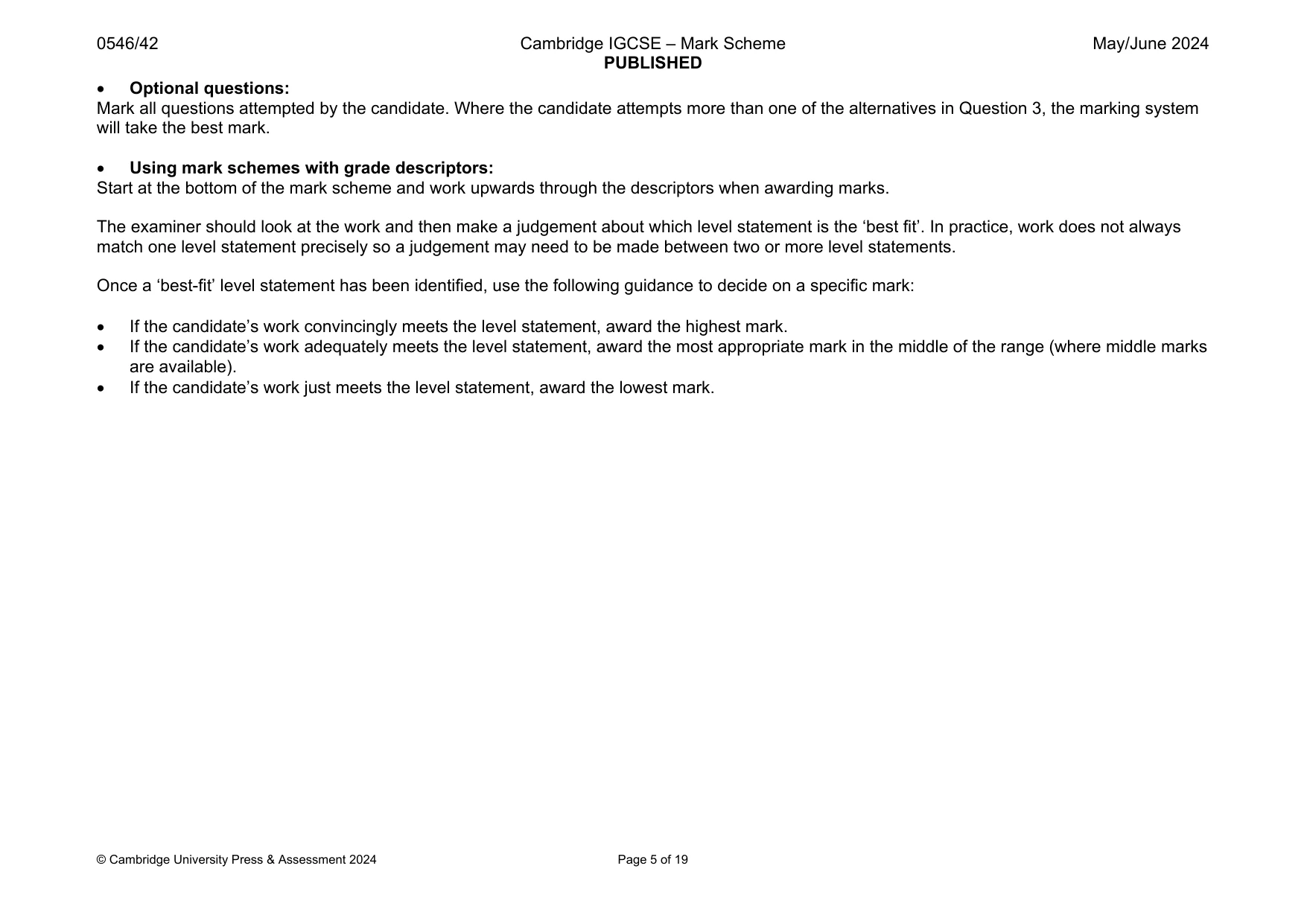
0546/42 Cambridge IGCSE – Mark Scheme PUBLISHED May/June 2024 © Cambridge University Press & Assessment 2024 Page 4 of 19 Additional Guidance Crossing out: (a) If a candidate changes his/her mind about an answer and crosses out an attempt, award a mark if the final attempt is correct. (b) If a candidate crosses out an answer to a whole question but makes no second attempt at it, mark the crossed out work. Annotations used in the mark scheme: (a) ^ = omission. This means that, on its own, the material is not sufficient to score the mark. No response and ‘0’ marks: (a) Award NR (no response): If there is nothing written at all in the answer space or If there is only a comment which does not in any way relate to the question being asked (e.g. ‘can’t do’ or ‘don’t know’) or If there is only a mark which isn’t an attempt at the question (e.g. a dash, a question mark). (b) Award 0: If there is any attempt that earns no credit, e.g. the candidate has copied out part or all of the question.
Mark scheme, page 5
0546/42 Cambridge IGCSE – Mark Scheme PUBLISHED May/June 2024 © Cambridge University Press & Assessment 2024 Page 5 of 19 Optional questions: Mark all questions attempted by the candidate. Where the candidate attempts more than one of the alternatives in Question 3, the marking system will take the best mark. Using mark schemes with grade descriptors: Start at the bottom of the mark scheme and work upwards through the descriptors when awarding marks. The examiner should look at the work and then make a judgement about which level statement is the ‘best fit’. In practice, work does not always match one level statement precisely so a judgement may need to be made between two or more level statements. Once a ‘best-fit’ level statement has been identified, use the following guidance to decide on a specific mark: If the candidate’s work convincingly meets the level statement, award the highest mark. If the candidate’s work adequately meets the level statement, award the most appropriate mark in the middle of the range (where middle marks are available). If the candidate’s work just meets the level statement, award the lowest mark.
Mark scheme, page 6
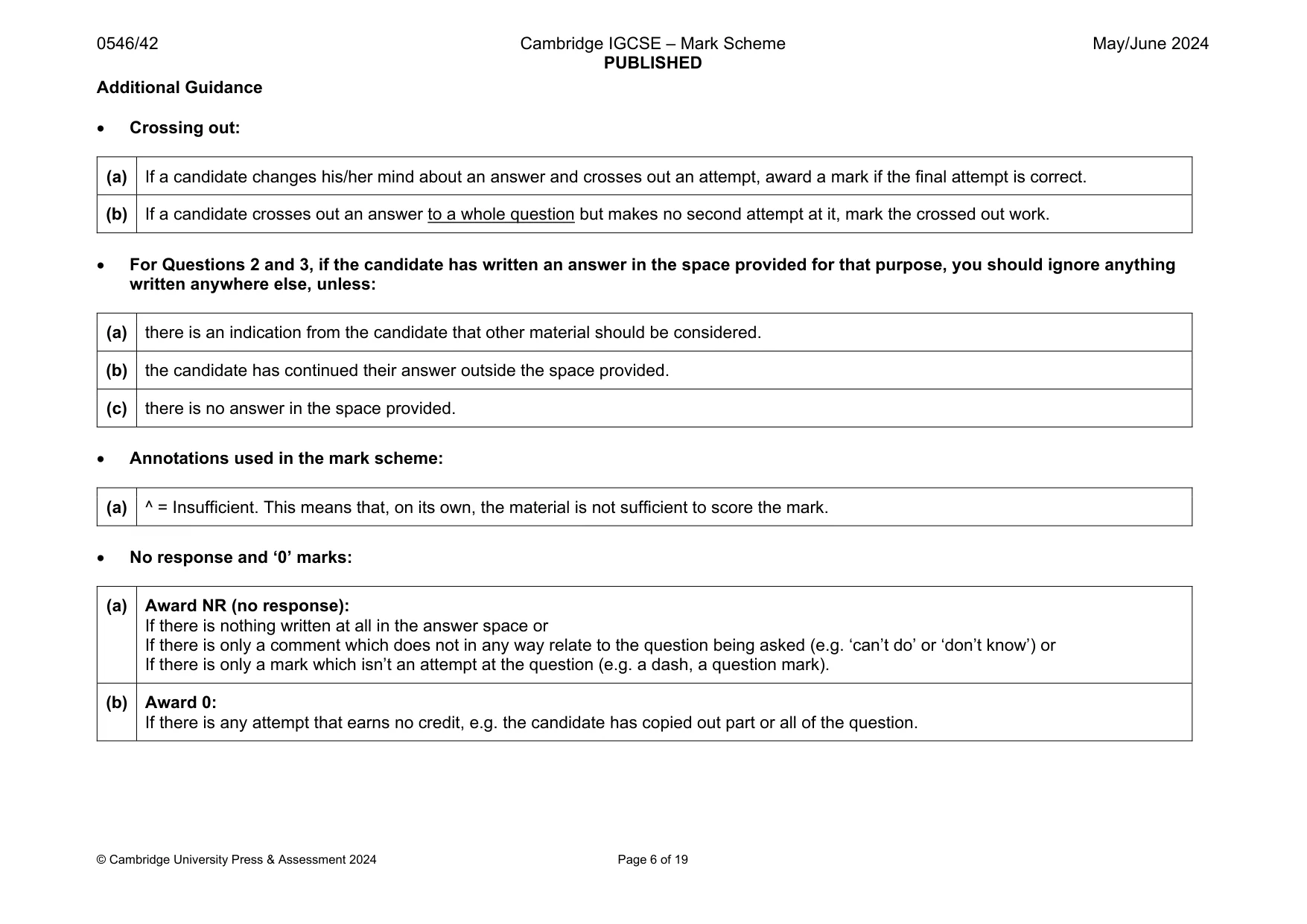
0546/42 Cambridge IGCSE – Mark Scheme PUBLISHED May/June 2024 © Cambridge University Press & Assessment 2024 Page 6 of 19 Additional Guidance Crossing out: (a) If a candidate changes his/her mind about an answer and crosses out an attempt, award a mark if the final attempt is correct. (b) If a candidate crosses out an answer to a whole question but makes no second attempt at it, mark the crossed out work. For Questions 2 and 3, if the candidate has written an answer in the space provided for that purpose, you should ignore anything written anywhere else, unless: (a) there is an indication from the candidate that other material should be considered. (b) the candidate has continued their answer outside the space provided. (c) there is no answer in the space provided. Annotations used in the mark scheme: (a) ^ = Insufficient. This means that, on its own, the material is not sufficient to score the mark. No response and ‘0’ marks: (a) Award NR (no response): If there is nothing written at all in the answer space or If there is only a comment which does not in any way relate to the question being asked (e.g. ‘can’t do’ or ‘don’t know’) or If there is only a mark which isn’t an attempt at the question (e.g. a dash, a question mark). (b) Award 0: If there is any attempt that earns no credit, e.g. the candidate has copied out part or all of the question.
Mark scheme, page 7
0546/42 Cambridge IGCSE – Mark Scheme PUBLISHED May/June 2024 © Cambridge University Press & Assessment 2024 Page 7 of 19 Optional questions: Mark all questions attempted by the candidate. Where the candidate attempts more than one of the alternatives in Question 3, the marking system will take the best mark. Using mark schemes with grade descriptors: Start at the bottom of the mark scheme and work upwards through the descriptors when awarding marks. The examiner should look at the work and then make a judgement about which level statement is the ‘best fit’. In practice, work does not always match one level statement precisely so a judgement may need to be made between two or more level statements. Once a ‘best-fit’ level statement has been identified, use the following guidance to decide on a specific mark: If the candidate’s work convincingly meets the level statement, award the highest mark. If the candidate’s work adequately meets the level statement, award the most appropriate mark in the middle of the range (where middle marks are available). If the candidate’s work just meets the level statement, award the lowest mark.
Mark scheme, page 8
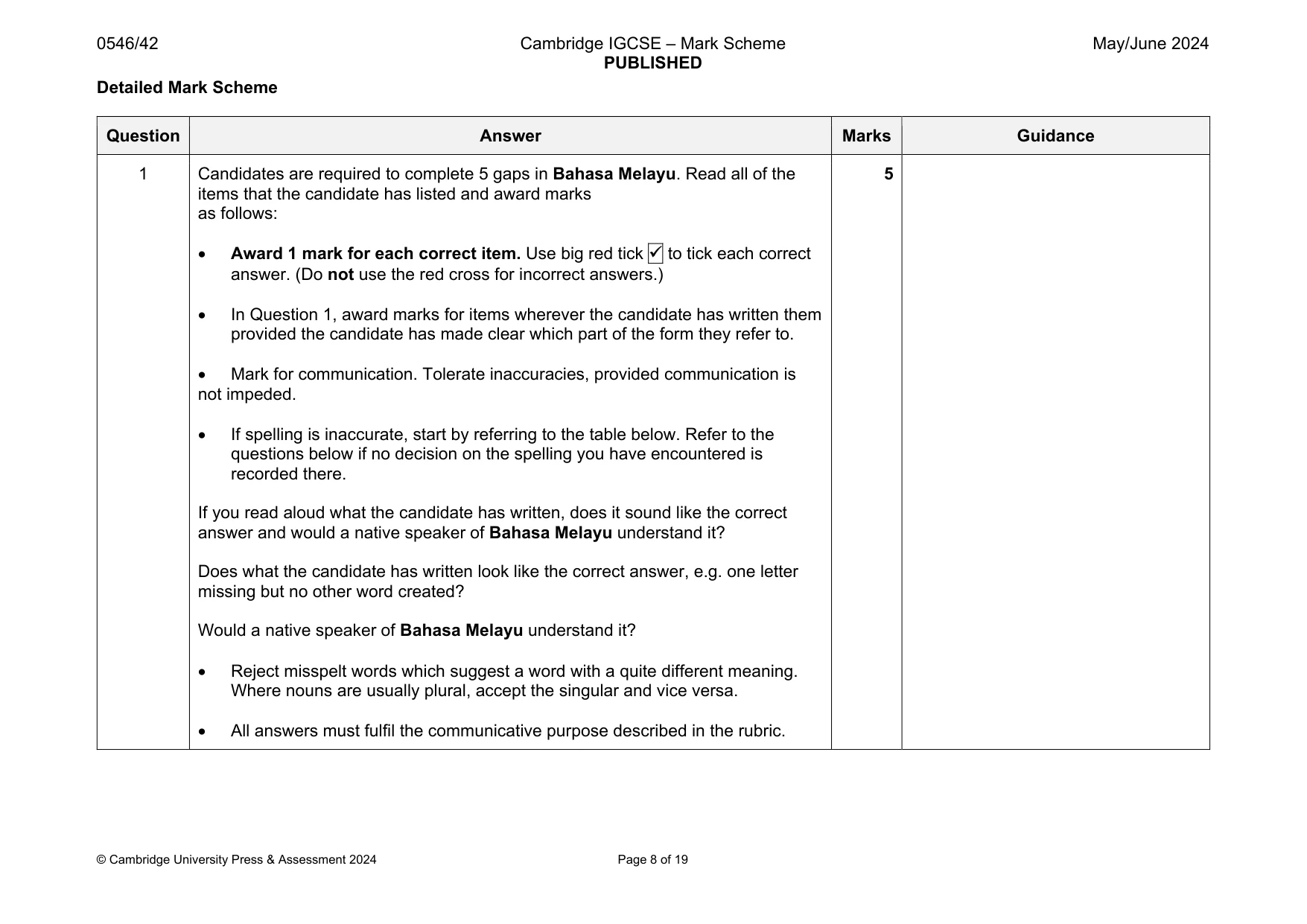
0546/42 Cambridge IGCSE – Mark Scheme PUBLISHED May/June 2024 © Cambridge University Press & Assessment 2024 Page 8 of 19 Detailed Mark Scheme Question Answer Marks Guidance 1 Candidates are required to complete 5 gaps in Bahasa Melayu. Read all of the items that the candidate has listed and award marks as follows: Award 1 mark for each correct item. Use big red tick to tick each correct answer. (Do not use the red cross for incorrect answers.) In Question 1, award marks for items wherever the candidate has written them provided the candidate has made clear which part of the form they refer to. Mark for communication. Tolerate inaccuracies, provided communication is not impeded. If spelling is inaccurate, start by referring to the table below. Refer to the questions below if no decision on the spelling you have encountered is recorded there. If you read aloud what the candidate has written, does it sound like the correct answer and would a native speaker of Bahasa Melayu understand it? Does what the candidate has written look like the correct answer, e.g. one letter missing but no other word created? Would a native speaker of Bahasa Melayu understand it? Reject misspelt words which suggest a word with a quite different meaning. Where nouns are usually plural, accept the singular and vice versa. All answers must fulfil the communicative purpose described in the rubric. 5
Mark scheme, page 9
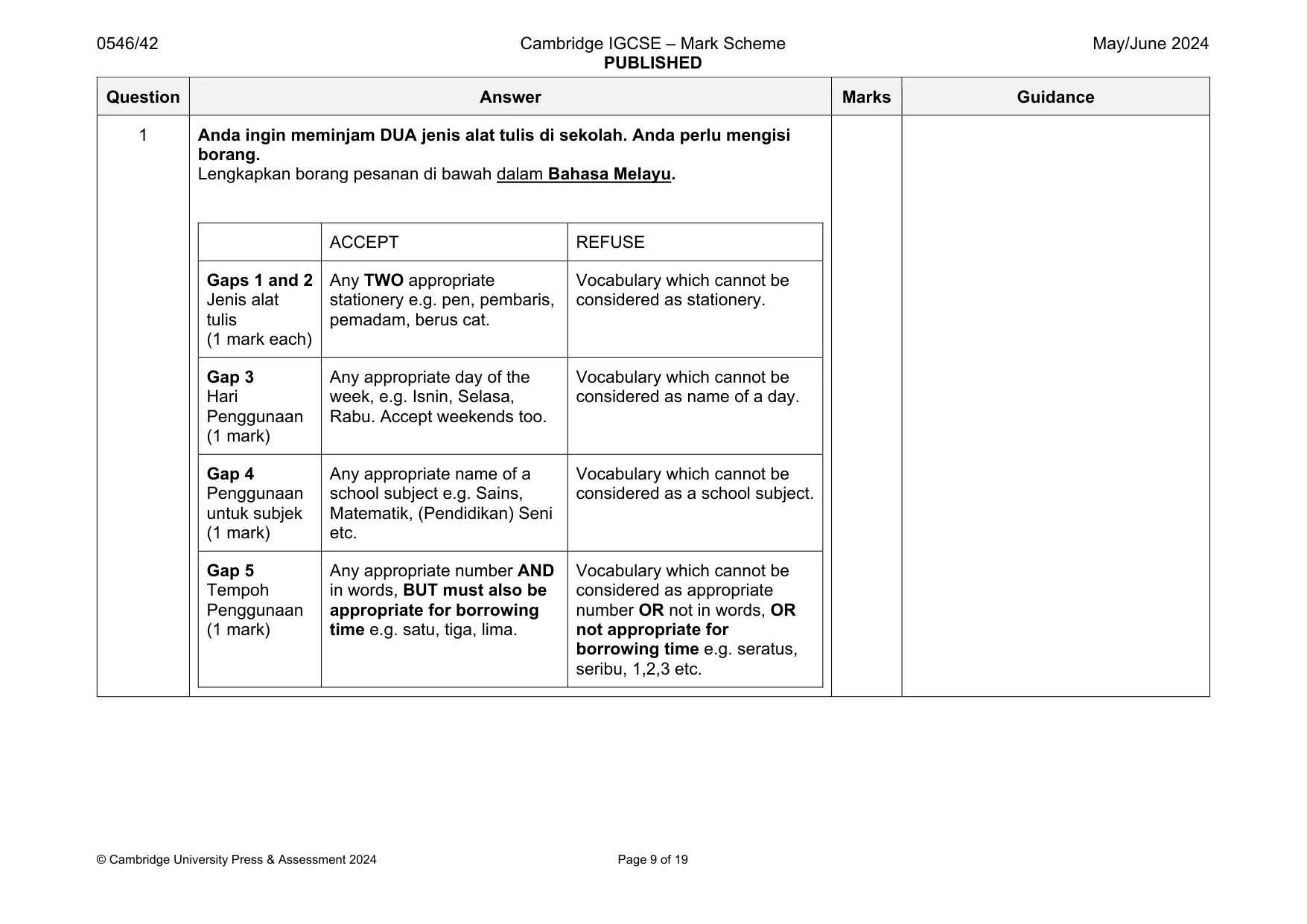
0546/42 Cambridge IGCSE – Mark Scheme PUBLISHED May/June 2024 © Cambridge University Press & Assessment 2024 Page 9 of 19 Question Answer Marks Guidance 1 Anda ingin meminjam DUA jenis alat tulis di sekolah. Anda perlu mengisi borang. Lengkapkan borang pesanan di bawah dalam Bahasa Melayu. ACCEPT REFUSE Gaps 1 and 2 Jenis alat tulis (1 mark each) Any TWO appropriate stationery e.g. pen, pembaris, pemadam, berus cat. Vocabulary which cannot be considered as stationery. Gap 3 Hari Penggunaan (1 mark) Any appropriate day of the week, e.g. Isnin, Selasa, Rabu. Accept weekends too. Vocabulary which cannot be considered as name of a day. Gap 4 Penggunaan untuk subjek (1 mark) Any appropriate name of a school subject e.g. Sains, Matematik, (Pendidikan) Seni etc. Vocabulary which cannot be considered as a school subject. Gap 5 Tempoh Penggunaan (1 mark) Any appropriate number AND in words, BUT must also be appropriate for borrowing time e.g. satu, tiga, lima. Vocabulary which cannot be considered as appropriate number OR not in words, OR not appropriate for borrowing time e.g. seratus, seribu, 1,2,3 etc.
Mark scheme, page 10
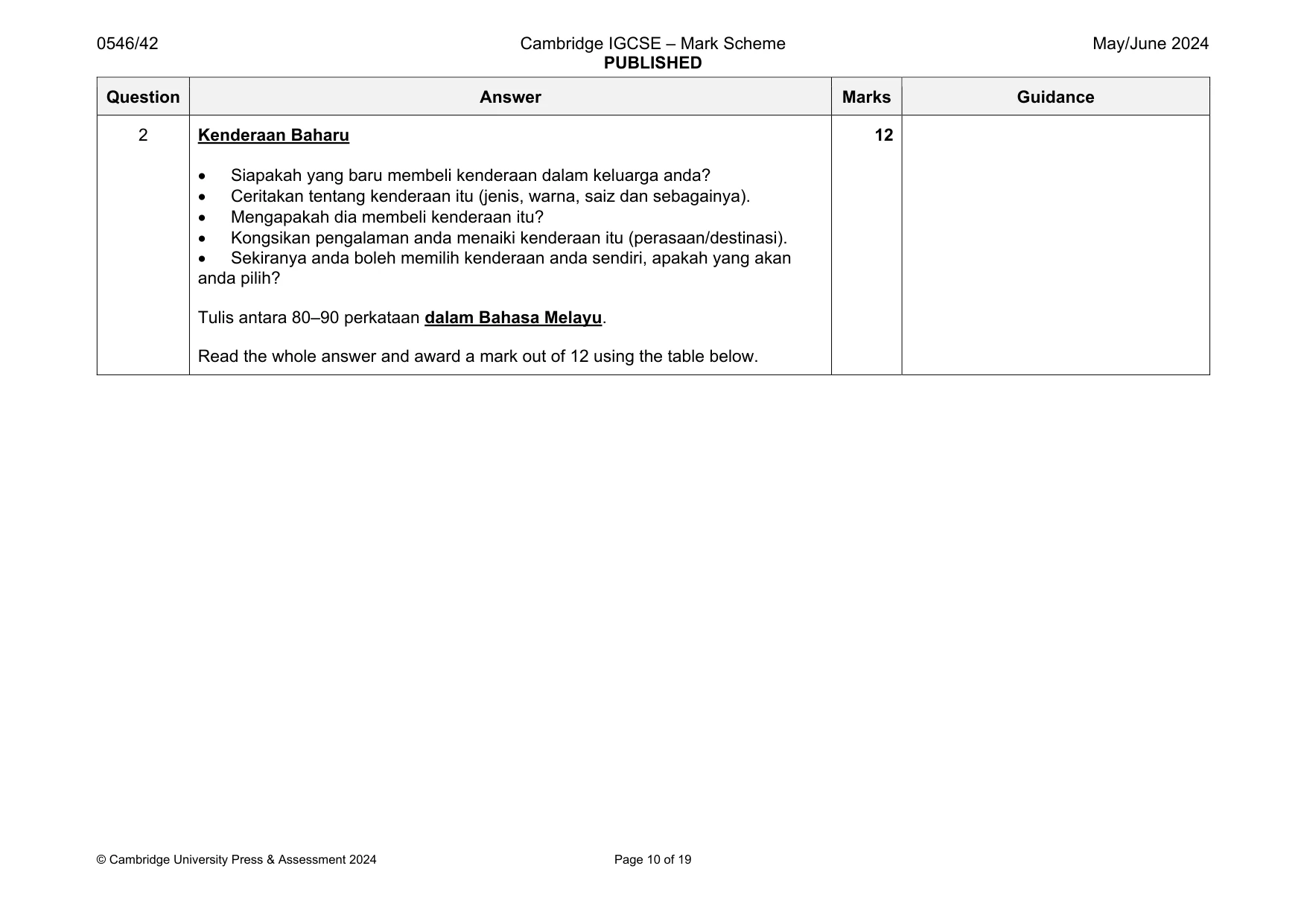
0546/42 Cambridge IGCSE – Mark Scheme PUBLISHED May/June 2024 © Cambridge University Press & Assessment 2024 Page 10 of 19 Question Answer Marks Guidance 2 Kenderaan Baharu Siapakah yang baru membeli kenderaan dalam keluarga anda? Ceritakan tentang kenderaan itu (jenis, warna, saiz dan sebagainya). Mengapakah dia membeli kenderaan itu? Kongsikan pengalaman anda menaiki kenderaan itu (perasaan/destinasi). Sekiranya anda boleh memilih kenderaan anda sendiri, apakah yang akan anda pilih? Tulis antara 80–90 perkataan dalam Bahasa Melayu. Read the whole answer and award a mark out of 12 using the table below. 12
Mark scheme, page 11
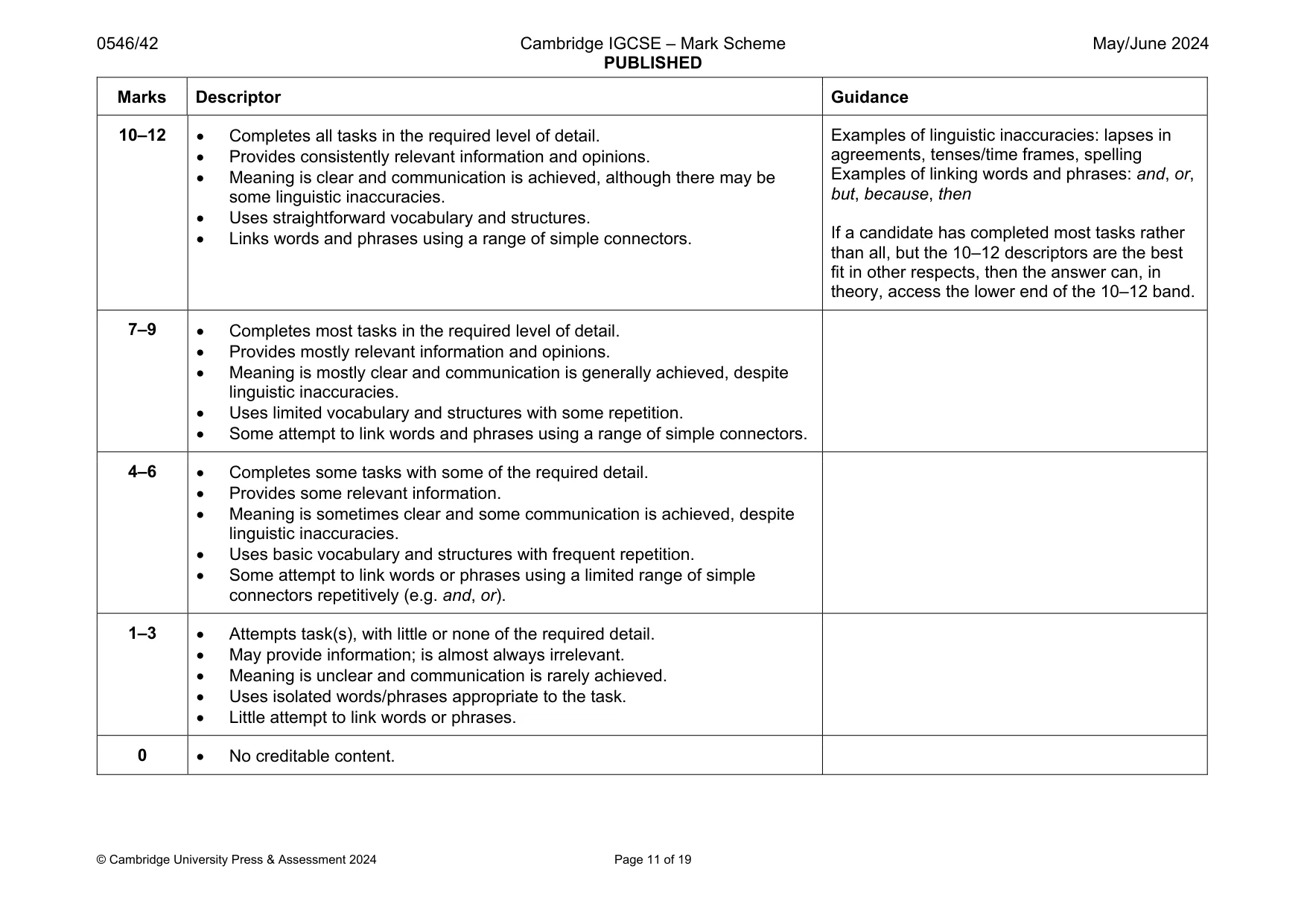
0546/42 Cambridge IGCSE – Mark Scheme PUBLISHED May/June 2024 © Cambridge University Press & Assessment 2024 Page 11 of 19 Marks Descriptor Guidance 10–12 Completes all tasks in the required level of detail. Provides consistently relevant information and opinions. Meaning is clear and communication is achieved, although there may be some linguistic inaccuracies. Uses straightforward vocabulary and structures. Links words and phrases using a range of simple connectors. Examples of linguistic inaccuracies: lapses in agreements, tenses/time frames, spelling Examples of linking words and phrases: and, or, but, because, then If a candidate has completed most tasks rather than all, but the 10–12 descriptors are the best fit in other respects, then the answer can, in theory, access the lower end of the 10–12 band. 7–9 Completes most tasks in the required level of detail. Provides mostly relevant information and opinions. Meaning is mostly clear and communication is generally achieved, despite linguistic inaccuracies. Uses limited vocabulary and structures with some repetition. Some attempt to link words and phrases using a range of simple connectors. 4–6 Completes some tasks with some of the required detail. Provides some relevant information. Meaning is sometimes clear and some communication is achieved, despite linguistic inaccuracies. Uses basic vocabulary and structures with frequent repetition. Some attempt to link words or phrases using a limited range of simple connectors repetitively (e.g. and, or). 1–3 Attempts task(s), with little or none of the required detail. May provide information; is almost always irrelevant. Meaning is unclear and communication is rarely achieved. Uses isolated words/phrases appropriate to the task. Little attempt to link words or phrases. 0 No creditable content.
Mark scheme, page 12
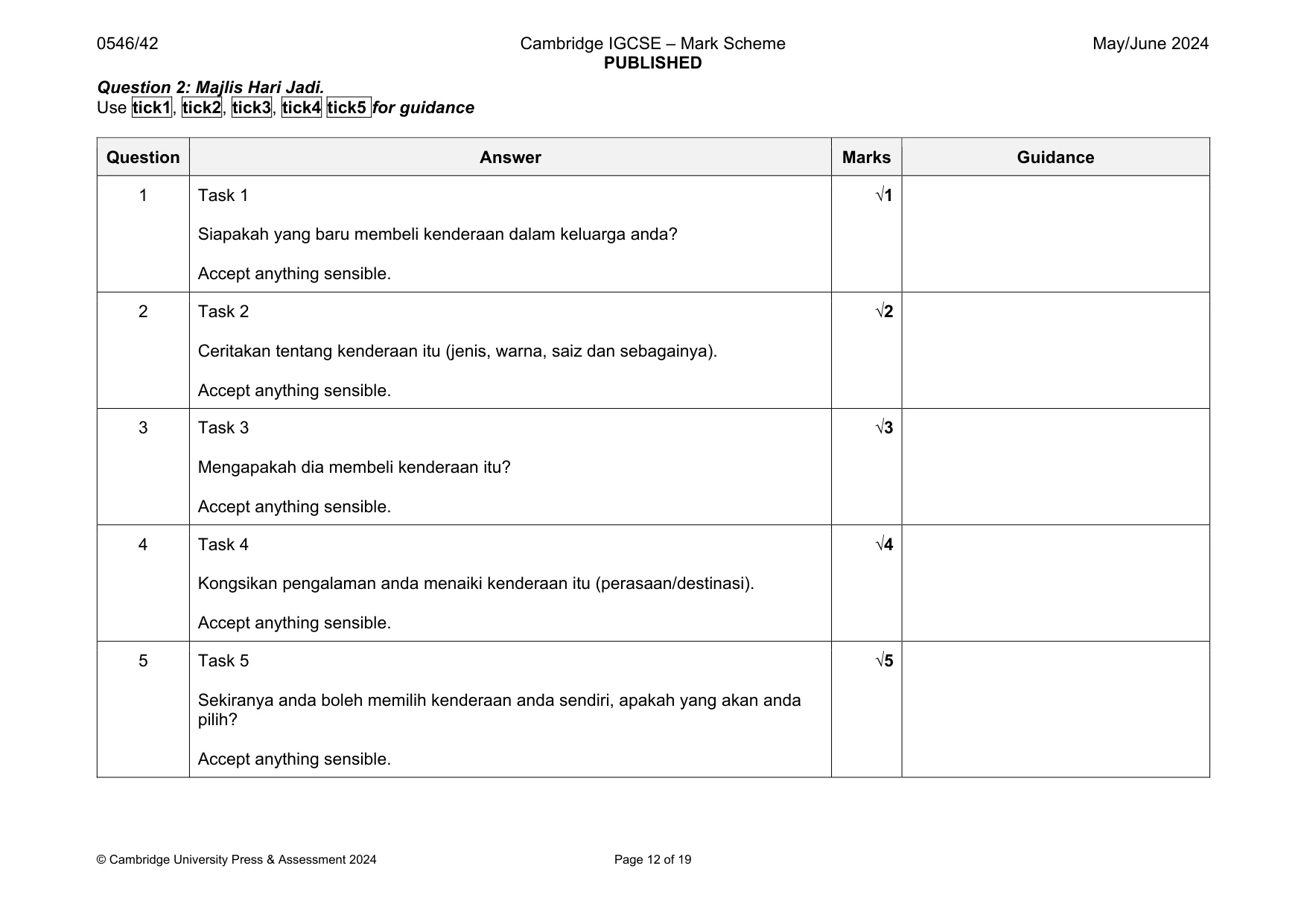
0546/42 Cambridge IGCSE – Mark Scheme PUBLISHED May/June 2024 © Cambridge University Press & Assessment 2024 Page 12 of 19 Question 2: Majlis Hari Jadi. Use tick1, tick2, tick3, tick4 tick5 for guidance Question Answer Marks Guidance 1 Task 1 Siapakah yang baru membeli kenderaan dalam keluarga anda? Accept anything sensible. √1 2 Task 2 Ceritakan tentang kenderaan itu (jenis, warna, saiz dan sebagainya). Accept anything sensible. √2 3 Task 3 Mengapakah dia membeli kenderaan itu? Accept anything sensible. √3 4 Task 4 Kongsikan pengalaman anda menaiki kenderaan itu (perasaan/destinasi). Accept anything sensible. √4 5 Task 5 Sekiranya anda boleh memilih kenderaan anda sendiri, apakah yang akan anda pilih? Accept anything sensible. √5
Mark scheme, page 13
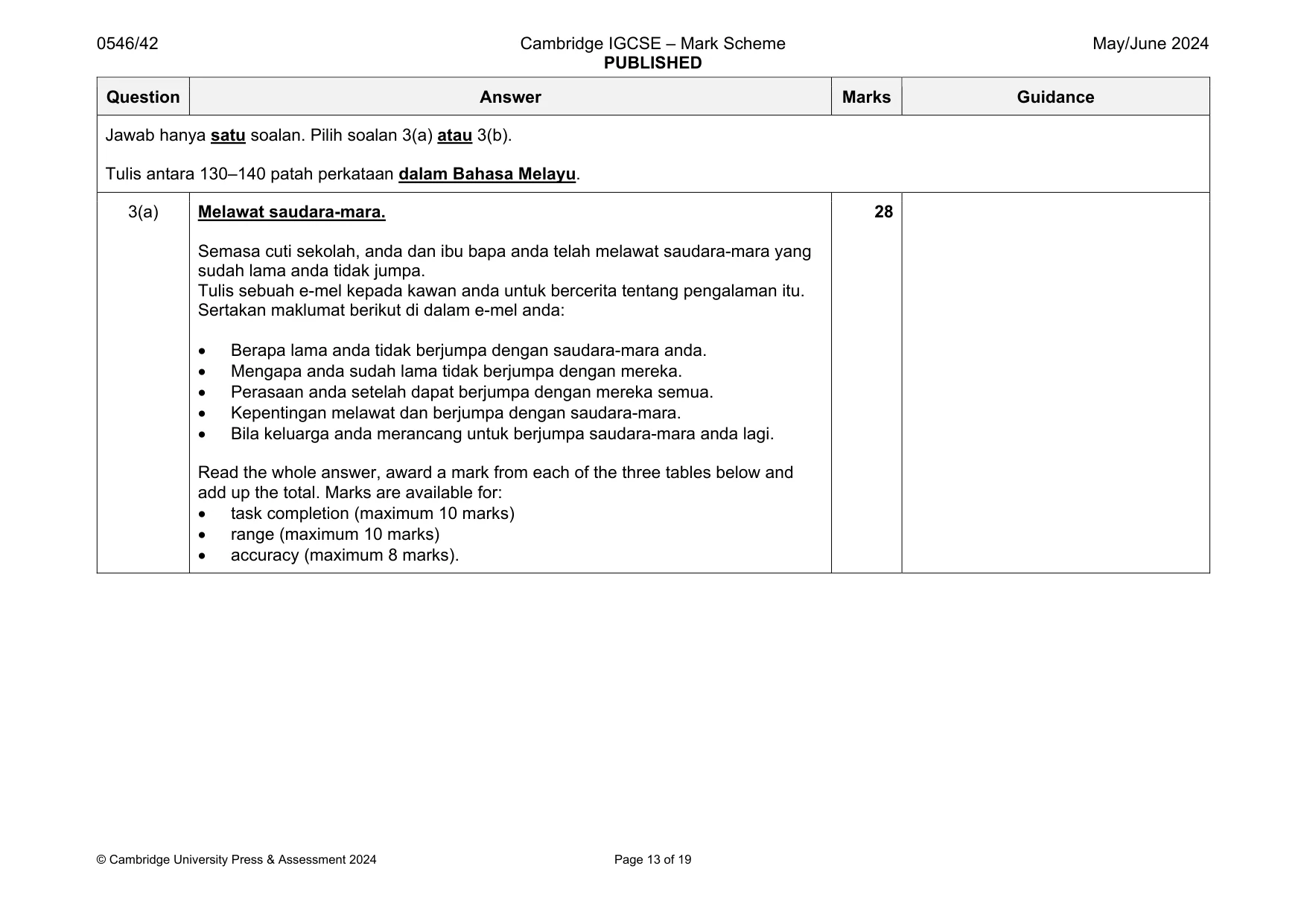
0546/42 Cambridge IGCSE – Mark Scheme PUBLISHED May/June 2024 © Cambridge University Press & Assessment 2024 Page 13 of 19 Question Answer Marks Guidance Jawab hanya satu soalan. Pilih soalan 3(a) atau 3(b). Tulis antara 130–140 patah perkataan dalam Bahasa Melayu. 3(a) Melawat saudara-mara. Semasa cuti sekolah, anda dan ibu bapa anda telah melawat saudara-mara yang sudah lama anda tidak jumpa. Tulis sebuah e-mel kepada kawan anda untuk bercerita tentang pengalaman itu. Sertakan maklumat berikut di dalam e-mel anda: Berapa lama anda tidak berjumpa dengan saudara-mara anda. Mengapa anda sudah lama tidak berjumpa dengan mereka. Perasaan anda setelah dapat berjumpa dengan mereka semua. Kepentingan melawat dan berjumpa dengan saudara-mara. Bila keluarga anda merancang untuk berjumpa saudara-mara anda lagi. Read the whole answer, award a mark from each of the three tables below and add up the total. Marks are available for: task completion (maximum 10 marks) range (maximum 10 marks) accuracy (maximum 8 marks). 28
Mark scheme, page 14
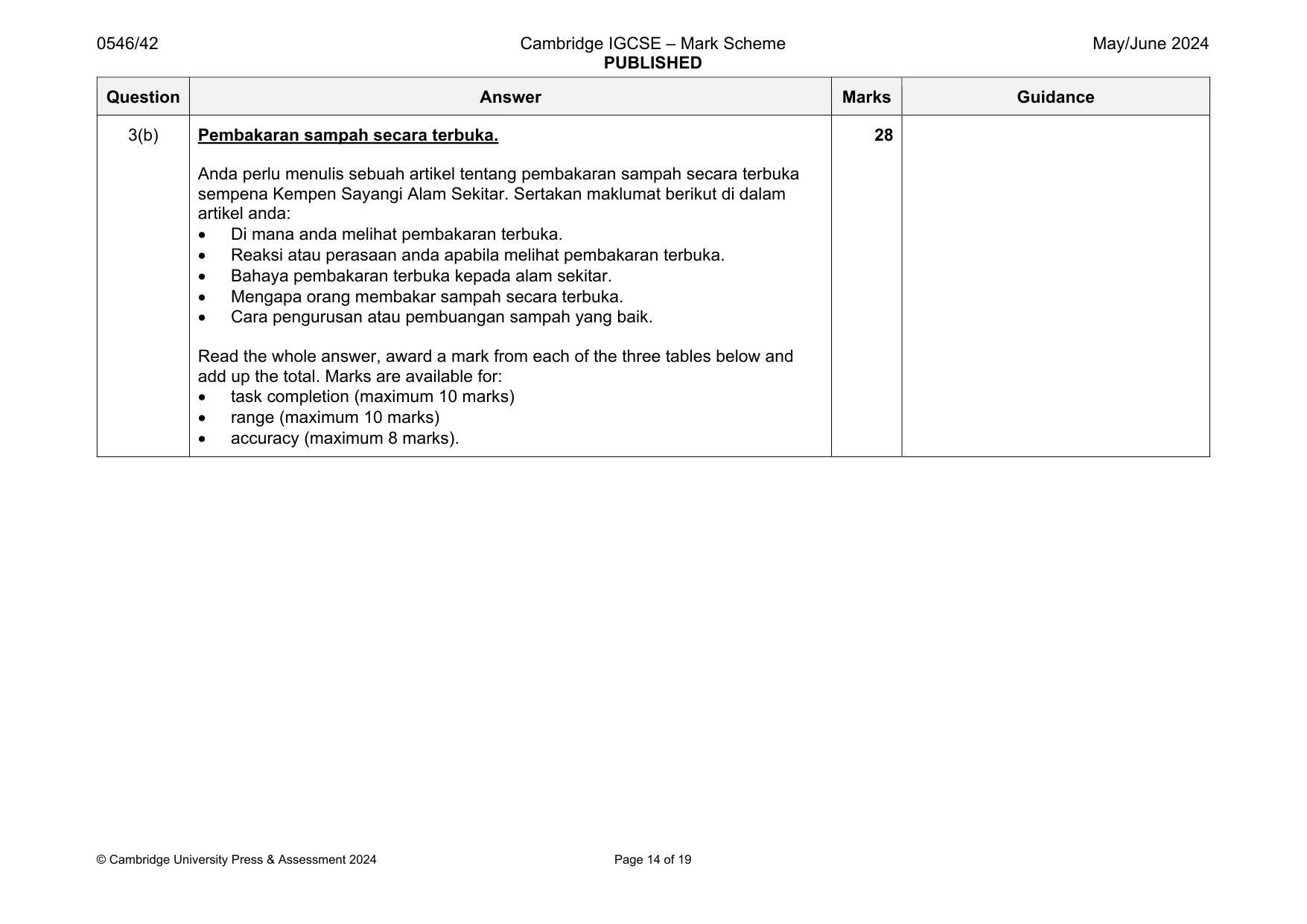
0546/42 Cambridge IGCSE – Mark Scheme PUBLISHED May/June 2024 © Cambridge University Press & Assessment 2024 Page 14 of 19 Question Answer Marks Guidance 3(b) Pembakaran sampah secara terbuka. Anda perlu menulis sebuah artikel tentang pembakaran sampah secara terbuka sempena Kempen Sayangi Alam Sekitar. Sertakan maklumat berikut di dalam artikel anda: Di mana anda melihat pembakaran terbuka. Reaksi atau perasaan anda apabila melihat pembakaran terbuka. Bahaya pembakaran terbuka kepada alam sekitar. Mengapa orang membakar sampah secara terbuka. Cara pengurusan atau pembuangan sampah yang baik. Read the whole answer, award a mark from each of the three tables below and add up the total. Marks are available for: task completion (maximum 10 marks) range (maximum 10 marks) accuracy (maximum 8 marks). 28
Mark scheme, page 15
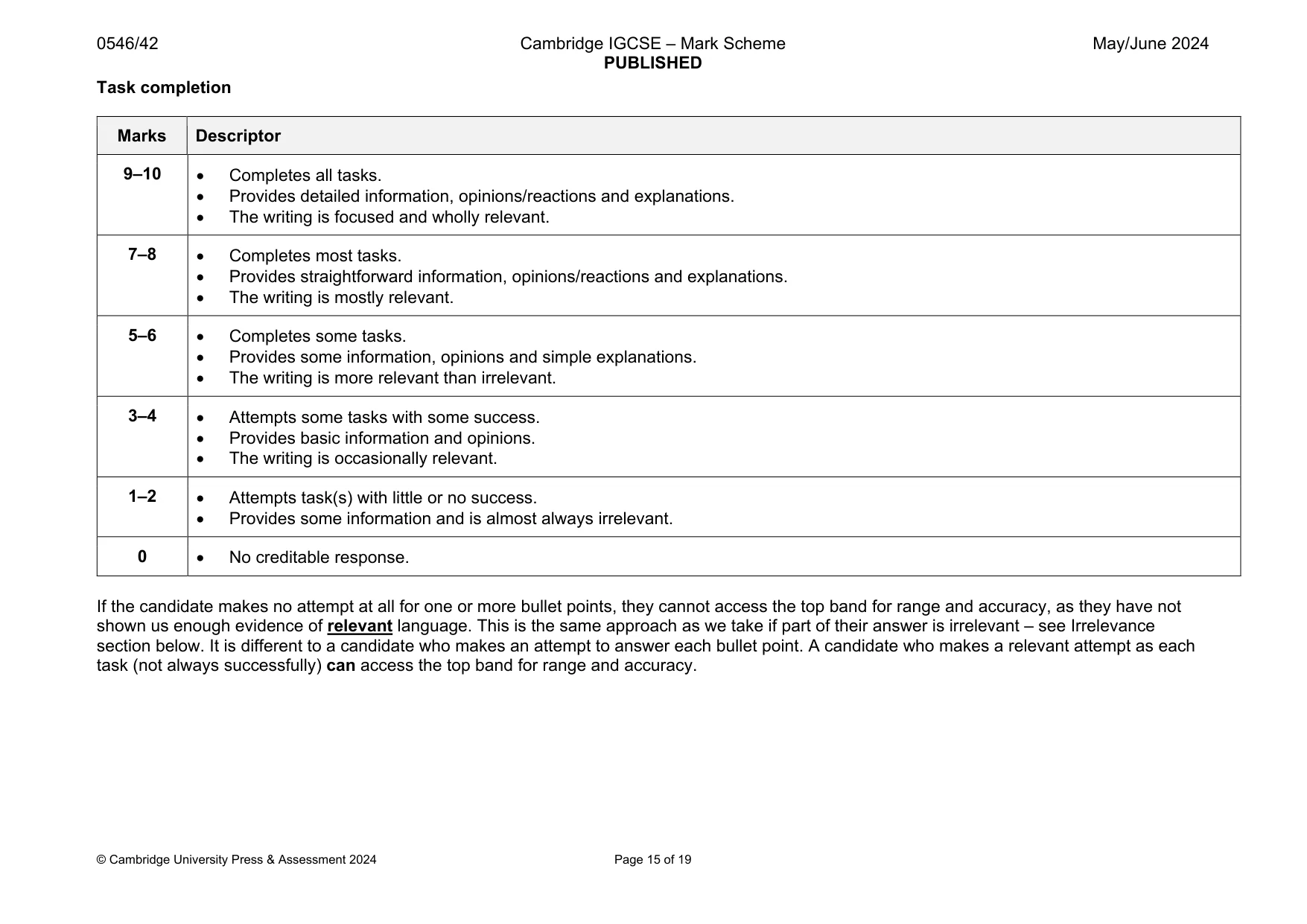
0546/42 Cambridge IGCSE – Mark Scheme PUBLISHED May/June 2024 © Cambridge University Press & Assessment 2024 Page 15 of 19 Task completion Marks Descriptor 9–10 Completes all tasks. Provides detailed information, opinions/reactions and explanations. The writing is focused and wholly relevant. 7–8 Completes most tasks. Provides straightforward information, opinions/reactions and explanations. The writing is mostly relevant. 5–6 Completes some tasks. Provides some information, opinions and simple explanations. The writing is more relevant than irrelevant. 3–4 Attempts some tasks with some success. Provides basic information and opinions. The writing is occasionally relevant. 1–2 Attempts task(s) with little or no success. Provides some information and is almost always irrelevant. 0 No creditable response. If the candidate makes no attempt at all for one or more bullet points, they cannot access the top band for range and accuracy, as they have not shown us enough evidence of relevant language. This is the same approach as we take if part of their answer is irrelevant – see Irrelevance section below. It is different to a candidate who makes an attempt to answer each bullet point. A candidate who makes a relevant attempt as each task (not always successfully) can access the top band for range and accuracy.
Mark scheme, page 16
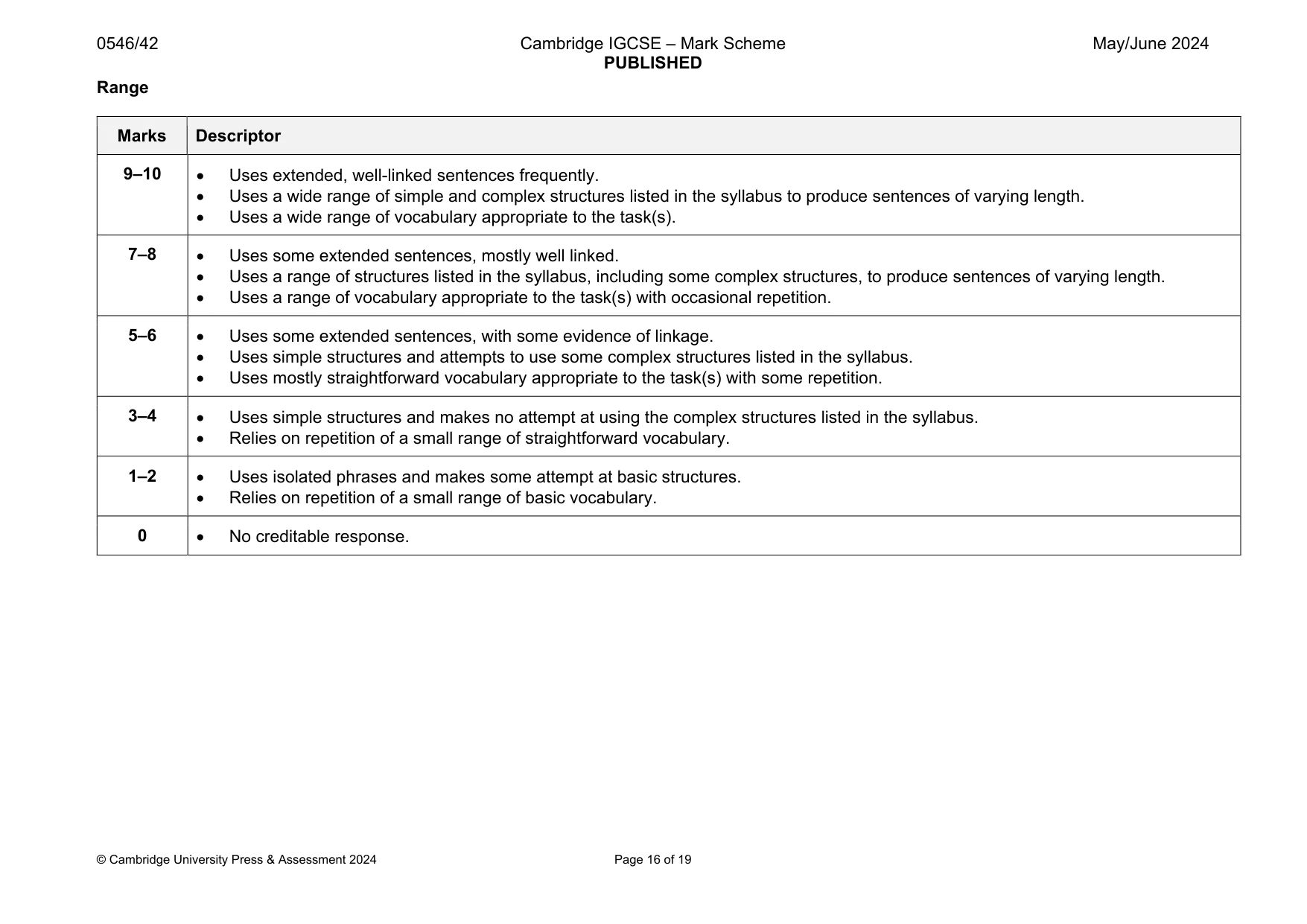
0546/42 Cambridge IGCSE – Mark Scheme PUBLISHED May/June 2024 © Cambridge University Press & Assessment 2024 Page 16 of 19 Range Marks Descriptor 9–10 Uses extended, well-linked sentences frequently. Uses a wide range of simple and complex structures listed in the syllabus to produce sentences of varying length. Uses a wide range of vocabulary appropriate to the task(s). 7–8 Uses some extended sentences, mostly well linked. Uses a range of structures listed in the syllabus, including some complex structures, to produce sentences of varying length. Uses a range of vocabulary appropriate to the task(s) with occasional repetition. 5–6 Uses some extended sentences, with some evidence of linkage. Uses simple structures and attempts to use some complex structures listed in the syllabus. Uses mostly straightforward vocabulary appropriate to the task(s) with some repetition. 3–4 Uses simple structures and makes no attempt at using the complex structures listed in the syllabus. Relies on repetition of a small range of straightforward vocabulary. 1–2 Uses isolated phrases and makes some attempt at basic structures. Relies on repetition of a small range of basic vocabulary. 0 No creditable response.
Mark scheme, page 17
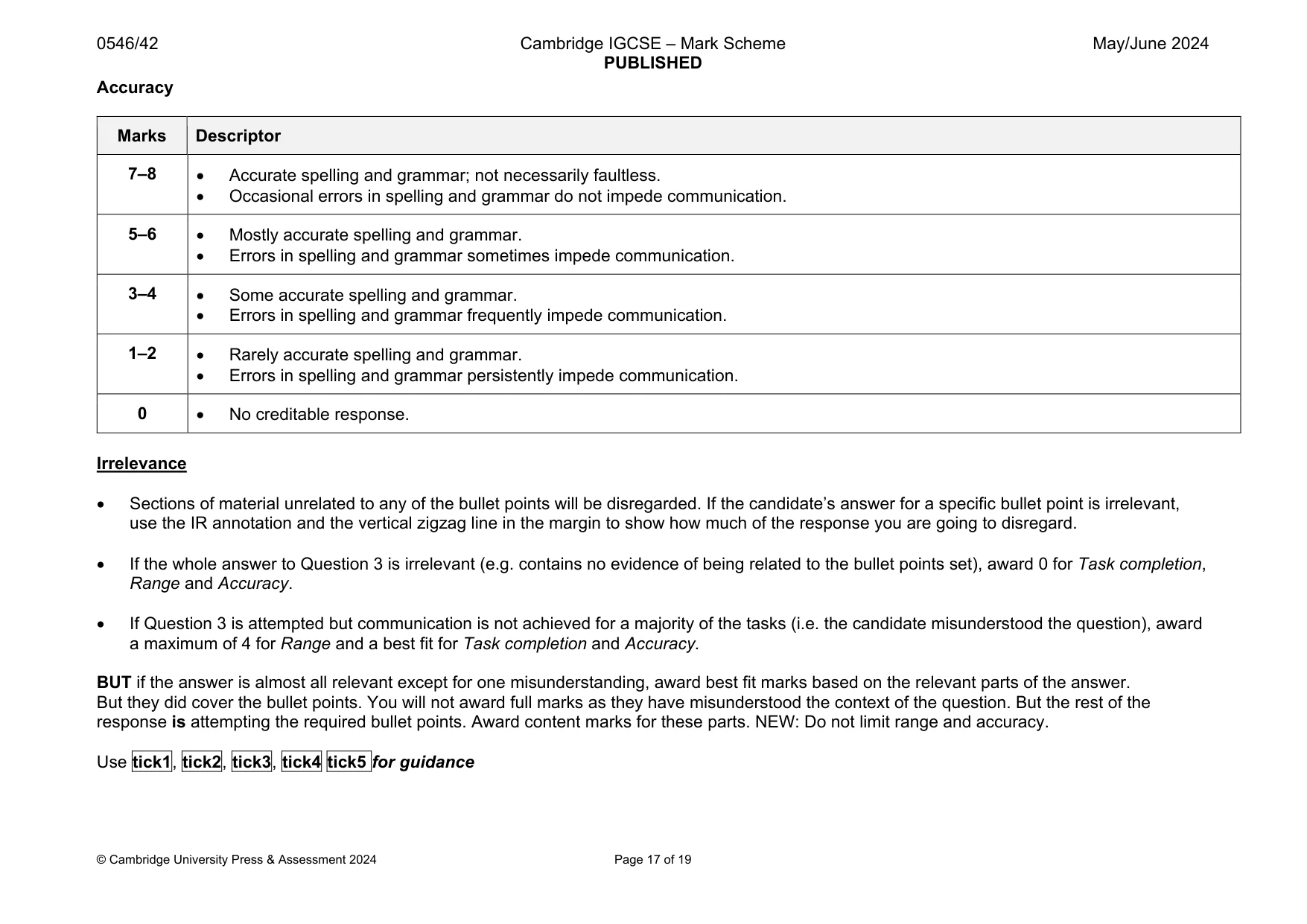
0546/42 Cambridge IGCSE – Mark Scheme PUBLISHED May/June 2024 © Cambridge University Press & Assessment 2024 Page 17 of 19 Accuracy Marks Descriptor 7–8 Accurate spelling and grammar; not necessarily faultless. Occasional errors in spelling and grammar do not impede communication. 5–6 Mostly accurate spelling and grammar. Errors in spelling and grammar sometimes impede communication. 3–4 Some accurate spelling and grammar. Errors in spelling and grammar frequently impede communication. 1–2 Rarely accurate spelling and grammar. Errors in spelling and grammar persistently impede communication. 0 No creditable response. Irrelevance Sections of material unrelated to any of the bullet points will be disregarded. If the candidate’s answer for a specific bullet point is irrelevant, use the IR annotation and the vertical zigzag line in the margin to show how much of the response you are going to disregard. If the whole answer to Question 3 is irrelevant (e.g. contains no evidence of being related to the bullet points set), award 0 for Task completion, Range and Accuracy. If Question 3 is attempted but communication is not achieved for a majority of the tasks (i.e. the candidate misunderstood the question), award a maximum of 4 for Range and a best fit for Task completion and Accuracy. BUT if the answer is almost all relevant except for one misunderstanding, award best fit marks based on the relevant parts of the answer. But they did cover the bullet points. You will not award full marks as they have misunderstood the context of the question. But the rest of the response is attempting the required bullet points. Award content marks for these parts. NEW: Do not limit range and accuracy. Use tick1, tick2, tick3, tick4 tick5 for guidance
Mark scheme, page 18
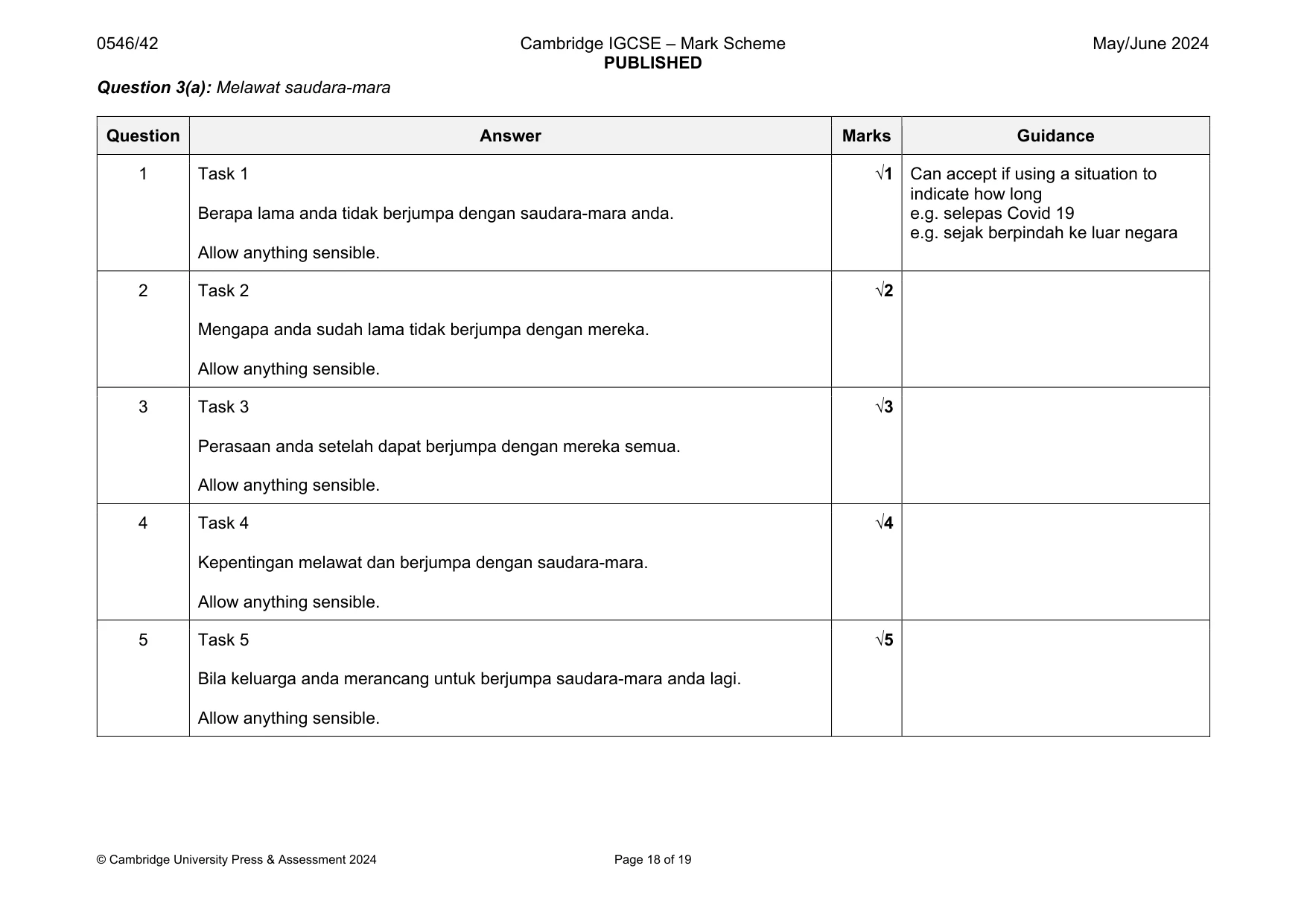
0546/42 Cambridge IGCSE – Mark Scheme PUBLISHED May/June 2024 © Cambridge University Press & Assessment 2024 Page 18 of 19 Question 3(a): Melawat saudara-mara Question Answer Marks Guidance 1 Task 1 Berapa lama anda tidak berjumpa dengan saudara-mara anda. Allow anything sensible. √1 Can accept if using a situation to indicate how long e.g. selepas Covid 19 e.g. sejak berpindah ke luar negara 2 Task 2 Mengapa anda sudah lama tidak berjumpa dengan mereka. Allow anything sensible. √2 3 Task 3 Perasaan anda setelah dapat berjumpa dengan mereka semua. Allow anything sensible. √3 4 Task 4 Kepentingan melawat dan berjumpa dengan saudara-mara. Allow anything sensible. √4 5 Task 5 Bila keluarga anda merancang untuk berjumpa saudara-mara anda lagi. Allow anything sensible. √5
Mark scheme, page 19
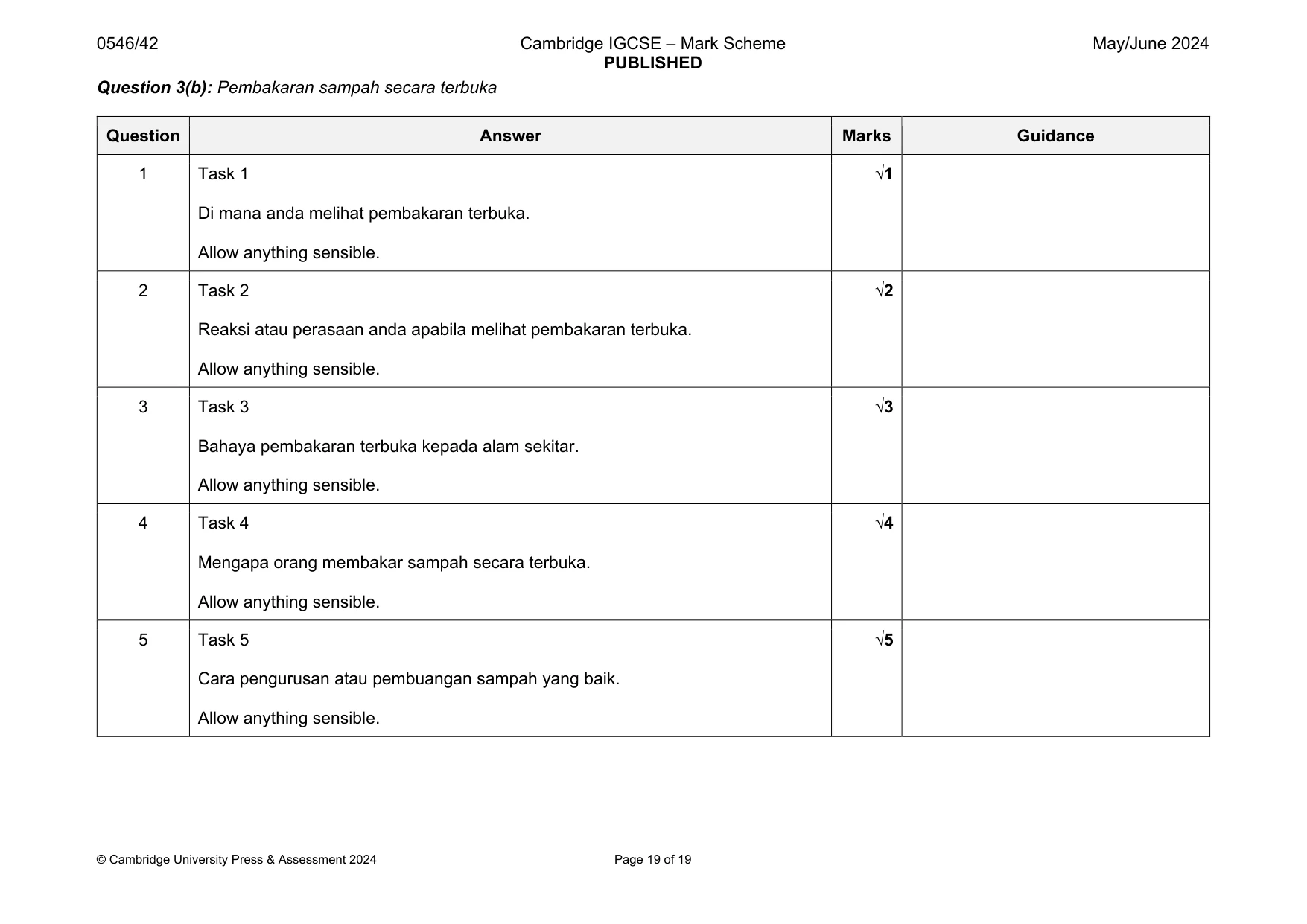
0546/42 Cambridge IGCSE – Mark Scheme PUBLISHED May/June 2024 © Cambridge University Press & Assessment 2024 Page 19 of 19 Question 3(b): Pembakaran sampah secara terbuka Question Answer Marks Guidance 1 Task 1 Di mana anda melihat pembakaran terbuka. Allow anything sensible. √1 2 Task 2 Reaksi atau perasaan anda apabila melihat pembakaran terbuka. Allow anything sensible. √2 3 Task 3 Bahaya pembakaran terbuka kepada alam sekitar. Allow anything sensible. √3 4 Task 4 Mengapa orang membakar sampah secara terbuka. Allow anything sensible. √4 5 Task 5 Cara pengurusan atau pembuangan sampah yang baik. Allow anything sensible. √5
What you needed in this session
Cambridge’s own grade thresholds for 2024 May/June, Paper 4 · Variant 2. A higher threshold means an easier paper — the bar moves with how the cohort did.