Cambridge IGCSE Malay - Foreign Language 0546 — 2015 May/June Paper 4 · Variant 3
0546/43/M/J/15 · 50 marks · ≈56 min
The question paper and its mark scheme, free to read here and free to download. This is Cambridge’s own paper, exactly as it was sat.
Question paper4 pages
Mark scheme11 pages
Answers below. Sit the paper first if you are practising.
Paper as text
Question paper, page 1
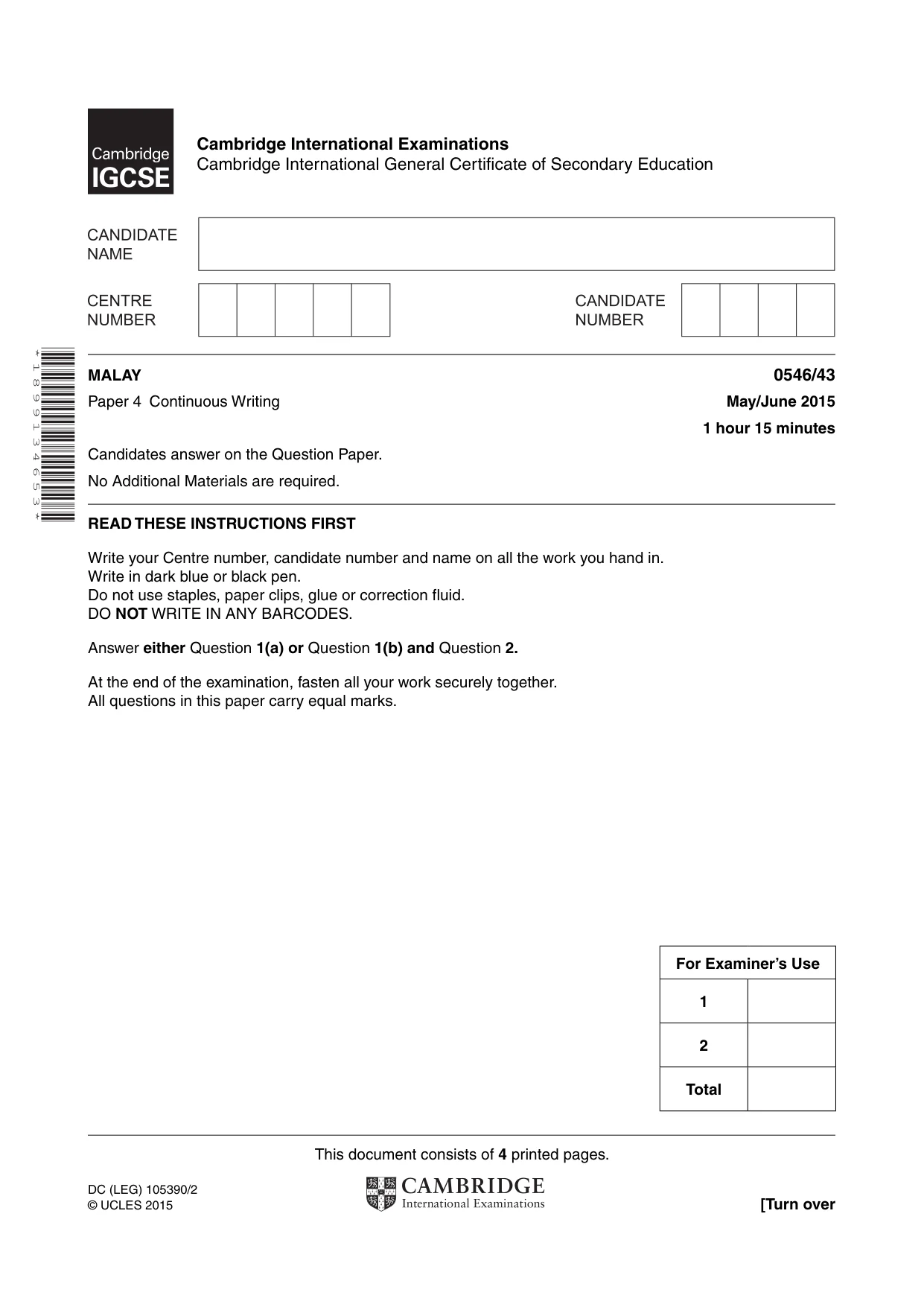
This document consists of 4 printed pages. DC (LEG) 105390/2 © UCLES 2015 [Turn over Cambridge International Examinations Cambridge International General Certificate of Secondary Education * 1 8 9 9 1 3 4 6 5 3 * MALAY 0546/43 Paper 4 Continuous Writing May/June 2015 1 hour 15 minutes Candidates answer on the Question Paper. No Additional Materials are required. READ THESE INSTRUCTIONS FIRST Write your Centre number, candidate number and name on all the work you hand in. Write in dark blue or black pen. Do not use staples, paper clips, glue or correction fluid. DO NOT WRITE IN ANY BARCODES. Answer either Question 1(a) or Question 1(b) and Question 2. At the end of the examination, fasten all your work securely together. All questions in this paper carry equal marks. For Examiner’s Use 1 2 Total
Question paper, page 2
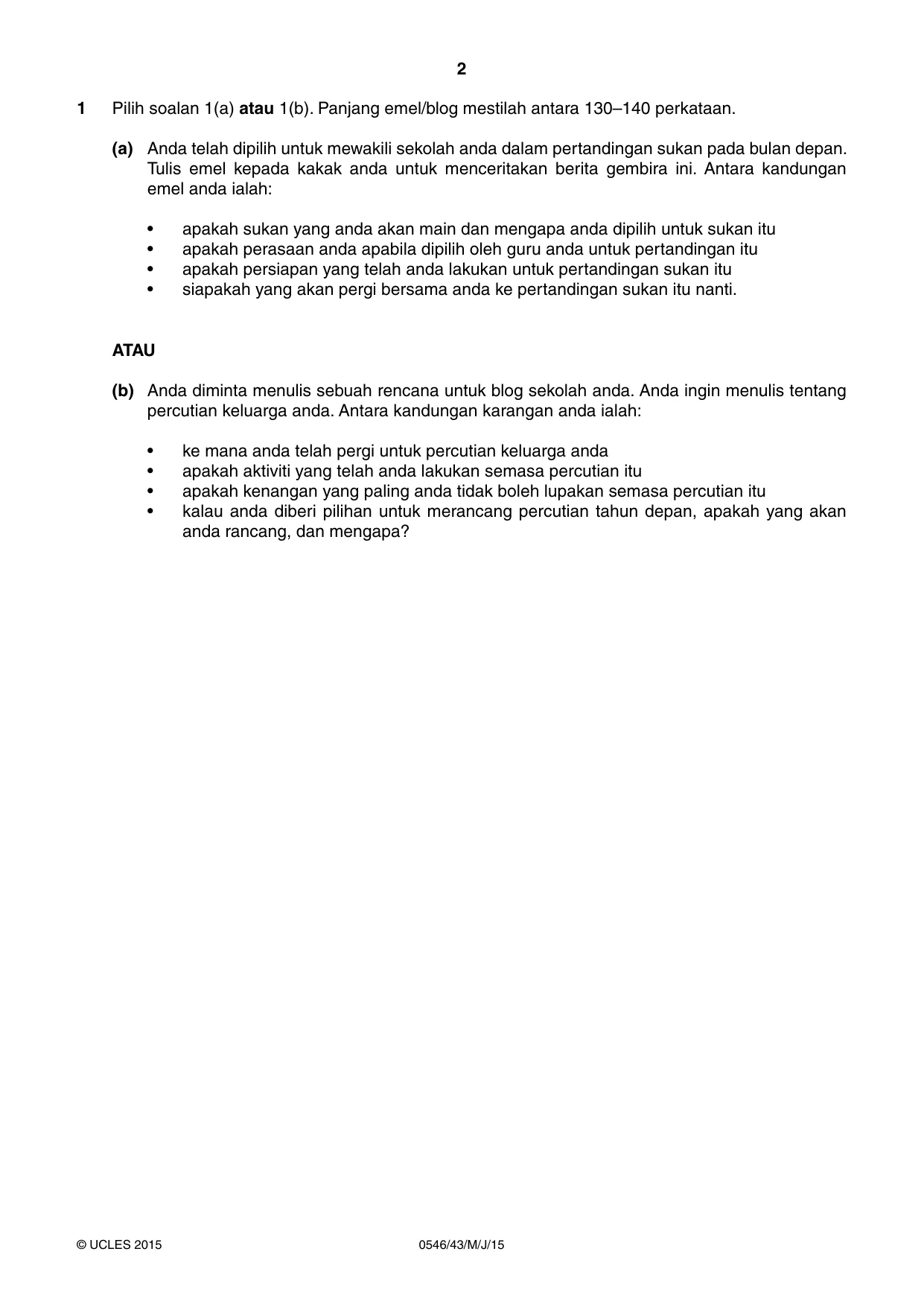
2 0546/43/M/J/15 © UCLES 2015 1 Pilih soalan 1(a) atau 1(b). Panjang emel/blog mestilah antara 130–140 perkataan. (a) Anda telah dipilih untuk mewakili sekolah anda dalam pertandingan sukan pada bulan depan. Tulis emel kepada kakak anda untuk menceritakan berita gembira ini. Antara kandungan emel anda ialah: • apakah sukan yang anda akan main dan mengapa anda dipilih untuk sukan itu • apakah perasaan anda apabila dipilih oleh guru anda untuk pertandingan itu • apakah persiapan yang telah anda lakukan untuk pertandingan sukan itu • siapakah yang akan pergi bersama anda ke pertandingan sukan itu nanti. ATAU (b) Anda diminta menulis sebuah rencana untuk blog sekolah anda. Anda ingin menulis tentang percutian keluarga anda. Antara kandungan karangan anda ialah: • ke mana anda telah pergi untuk percutian keluarga anda • apakah aktiviti yang telah anda lakukan semasa percutian itu • apakah kenangan yang paling anda tidak boleh lupakan semasa percutian itu • kalau anda diberi pilihan untuk merancang percutian tahun depan, apakah yang akan anda rancang, dan mengapa?
Question paper, page 3
3 0546/43/M/J/15 © UCLES 2015 [Turn over … … … … … … … … … … … … … … … … … … … …
Question paper, page 4
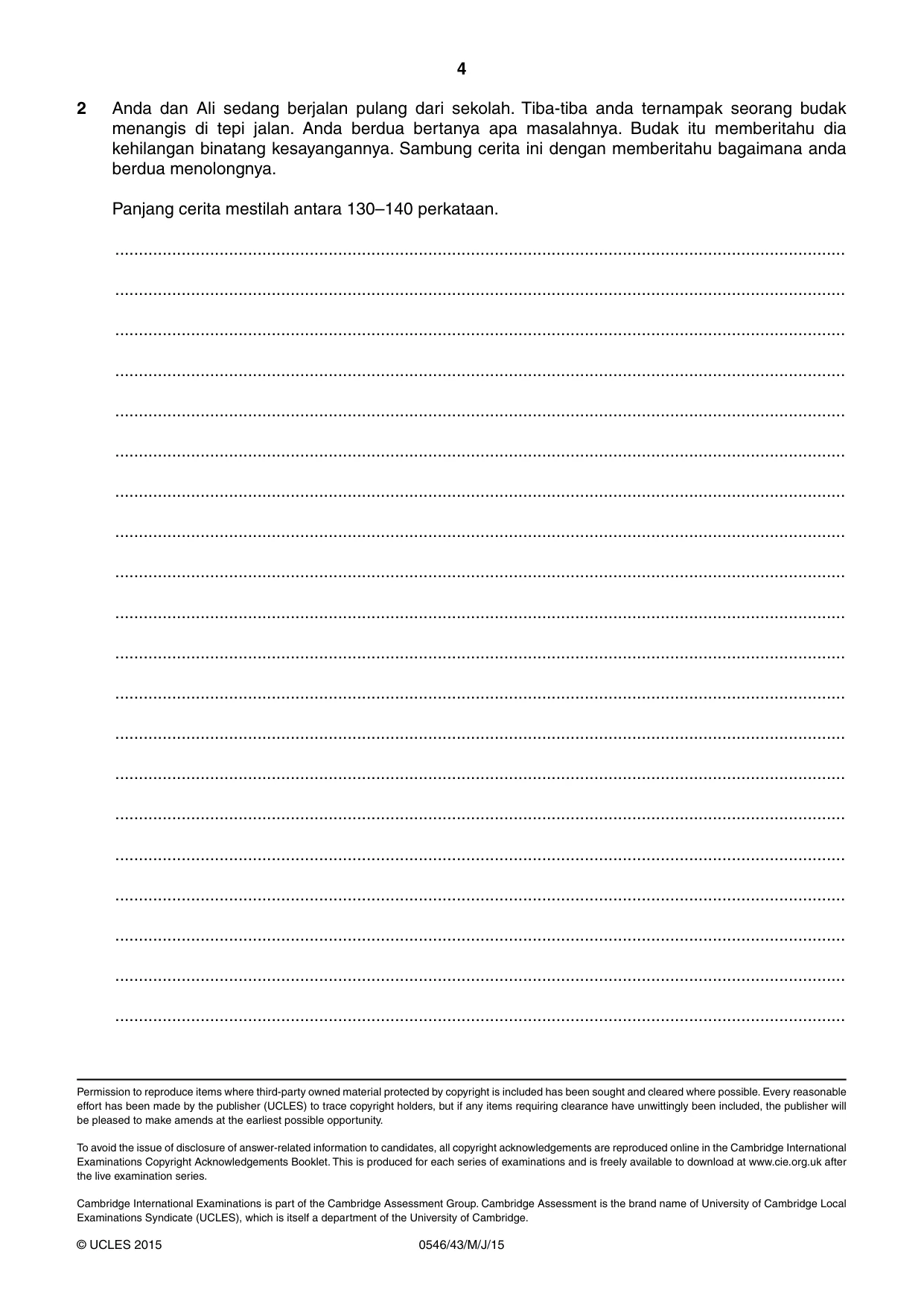
4 0546/43/M/J/15 © UCLES 2015 Permission to reproduce items where third-party owned material protected by copyright is included has been sought and cleared where possible. Every reasonable effort has been made by the publisher (UCLES) to trace copyright holders, but if any items requiring clearance have unwittingly been included, the publisher will be pleased to make amends at the earliest possible opportunity. To avoid the issue of disclosure of answer-related information to candidates, all copyright acknowledgements are reproduced online in the Cambridge International Examinations Copyright Acknowledgements Booklet. This is produced for each series of examinations and is freely available to download at www.cie.org.uk after the live examination series. Cambridge International Examinations is part of the Cambridge Assessment Group. Cambridge Assessment is the brand name of University of Cambridge Local Examinations Syndicate (UCLES), which is itself a department of the University of Cambridge. 2 Anda dan Ali sedang berjalan pulang dari sekolah. Tiba-tiba anda ternampak seorang budak menangis di tepi jalan. Anda berdua bertanya apa masalahnya. Budak itu memberitahu dia kehilangan binatang kesayangannya. Sambung cerita ini dengan memberitahu bagaimana anda berdua menolongnya. Panjang cerita mestilah antara 130–140 perkataan. … … … … … … … … … … … … … … … … … … … …
Mark scheme, page 1
® IGCSE is the registered trademark of Cambridge International Examinations. CAMBRIDGE INTERNATIONAL EXAMINATIONS Cambridge International General Certificate of Secondary Education MARK SCHEME for the May/June 2015 series 0546 FOREIGN LANGUAGE MALAY 0546/43 Paper 4 (Continuous Writing), maximum raw mark 50 This mark scheme is published as an aid to teachers and candidates, to indicate the requirements of the examination. It shows the basis on which Examiners were instructed to award marks. It does not indicate the details of the discussions that took place at an Examiners’ meeting before marking began, which would have considered the acceptability of alternative answers. Mark schemes should be read in conjunction with the question paper and the Principal Examiner Report for Teachers. Cambridge will not enter into discussions about these mark schemes. Cambridge is publishing the mark schemes for the May/June 2015 series for most Cambridge IGCSE®, Cambridge International A and AS Level components and some Cambridge O Level components.
Mark scheme, page 2
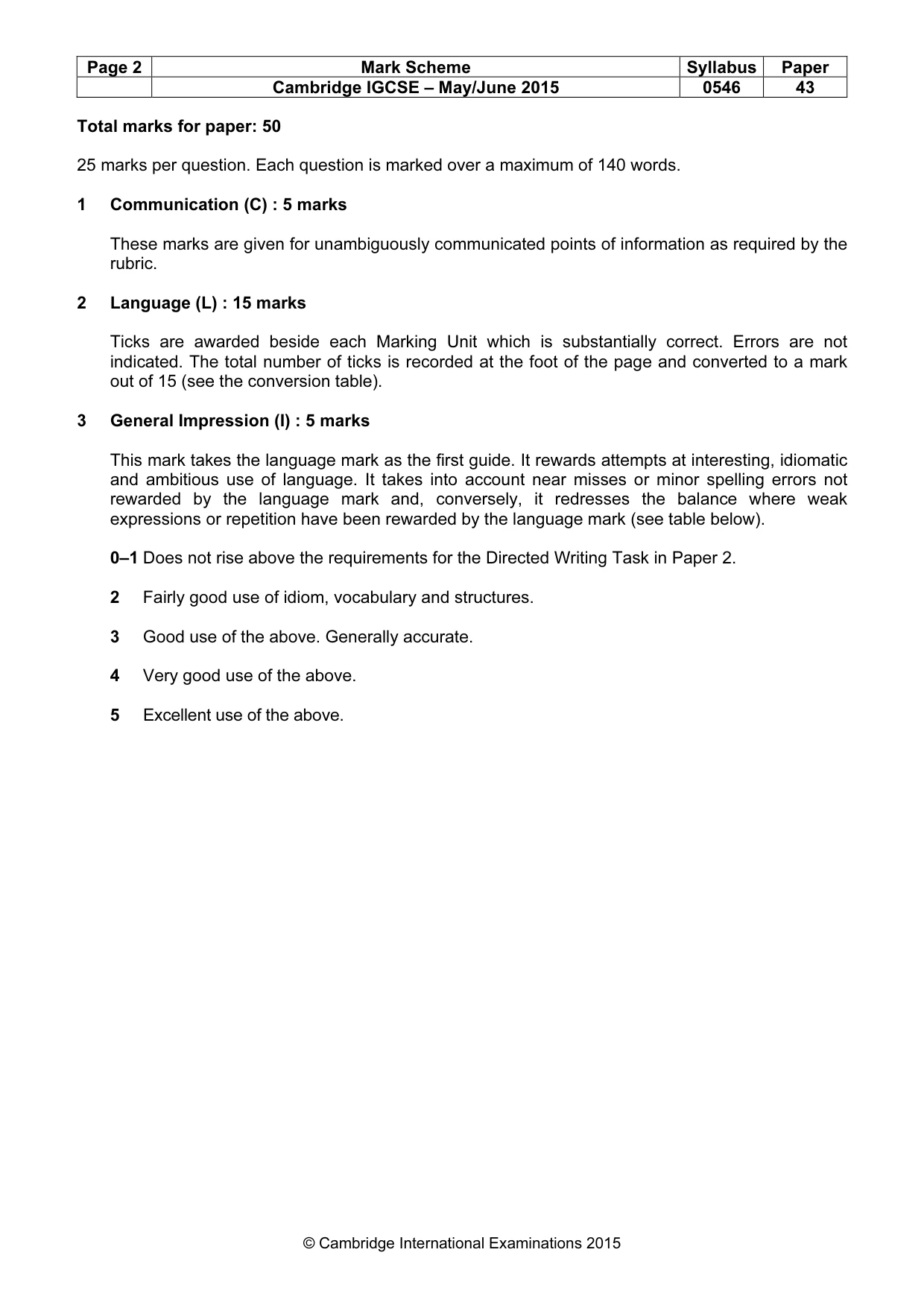
Page 2 Mark Scheme Syllabus Paper Cambridge IGCSE – May/June 2015 0546 43 © Cambridge International Examinations 2015 Total marks for paper: 50 25 marks per question. Each question is marked over a maximum of 140 words. 1 Communication (C) : 5 marks These marks are given for unambiguously communicated points of information as required by the rubric. 2 Language (L) : 15 marks Ticks are awarded beside each Marking Unit which is substantially correct. Errors are not indicated. The total number of ticks is recorded at the foot of the page and converted to a mark out of 15 (see the conversion table). 3 General Impression (I) : 5 marks This mark takes the language mark as the first guide. It rewards attempts at interesting, idiomatic and ambitious use of language. It takes into account near misses or minor spelling errors not rewarded by the language mark and, conversely, it redresses the balance where weak expressions or repetition have been rewarded by the language mark (see table below). 0–1 Does not rise above the requirements for the Directed Writing Task in Paper 2. 2 Fairly good use of idiom, vocabulary and structures. 3 Good use of the above. Generally accurate. 4 Very good use of the above. 5 Excellent use of the above.
Mark scheme, page 3
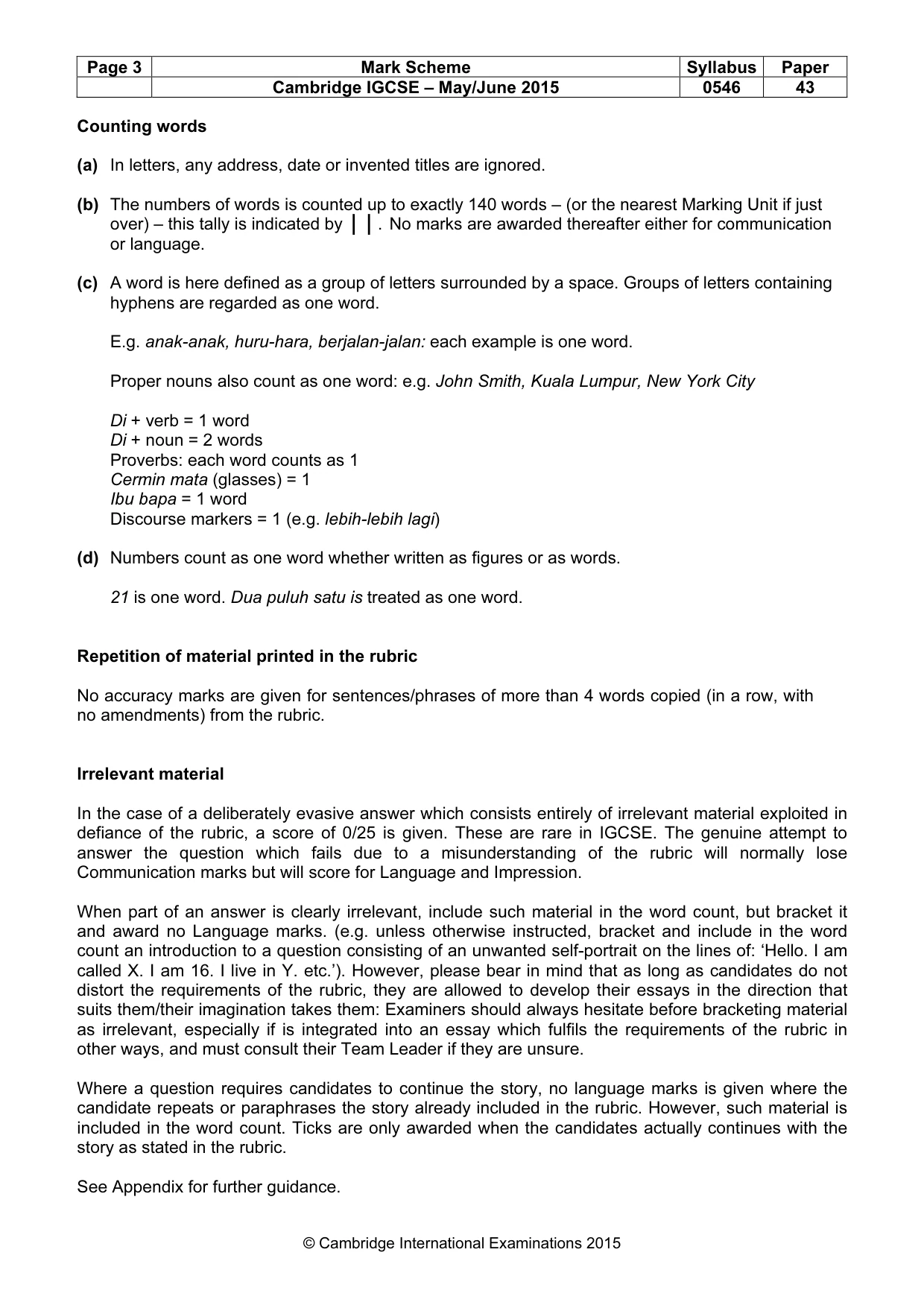
Page 3 Mark Scheme Syllabus Paper Cambridge IGCSE – May/June 2015 0546 43 © Cambridge International Examinations 2015 Counting words (a) In letters, any address, date or invented titles are ignored. (b) The numbers of words is counted up to exactly 140 words – (or the nearest Marking Unit if just over) – this tally is indicated by ││. No marks are awarded thereafter either for communication or language. (c) A word is here defined as a group of letters surrounded by a space. Groups of letters containing hyphens are regarded as one word. E.g. anak-anak, huru-hara, berjalan-jalan: each example is one word. Proper nouns also count as one word: e.g. John Smith, Kuala Lumpur, New York City Di + verb = 1 word Di + noun = 2 words Proverbs: each word counts as 1 Cermin mata (glasses) = 1 Ibu bapa = 1 word Discourse markers = 1 (e.g. lebih-lebih lagi) (d) Numbers count as one word whether written as figures or as words. 21 is one word. Dua puluh satu is treated as one word. Repetition of material printed in the rubric No accuracy marks are given for sentences/phrases of more than 4 words copied (in a row, with no amendments) from the rubric. Irrelevant material In the case of a deliberately evasive answer which consists entirely of irrelevant material exploited in defiance of the rubric, a score of 0/25 is given. These are rare in IGCSE. The genuine attempt to answer the question which fails due to a misunderstanding of the rubric will normally lose Communication marks but will score for Language and Impression. When part of an answer is clearly irrelevant, include such material in the word count, but bracket it and award no Language marks. (e.g. unless otherwise instructed, bracket and include in the word count an introduction to a question consisting of an unwanted self-portrait on the lines of: ‘Hello. I am called X. I am 16. I live in Y. etc.’). However, please bear in mind that as long as candidates do not distort the requirements of the rubric, they are allowed to develop their essays in the direction that suits them/their imagination takes them: Examiners should always hesitate before bracketing material as irrelevant, especially if is integrated into an essay which fulfils the requirements of the rubric in other ways, and must consult their Team Leader if they are unsure. Where a question requires candidates to continue the story, no language marks is given where the candidate repeats or paraphrases the story already included in the rubric. However, such material is included in the word count. Ticks are only awarded when the candidates actually continues with the story as stated in the rubric. See Appendix for further guidance.
Mark scheme, page 4
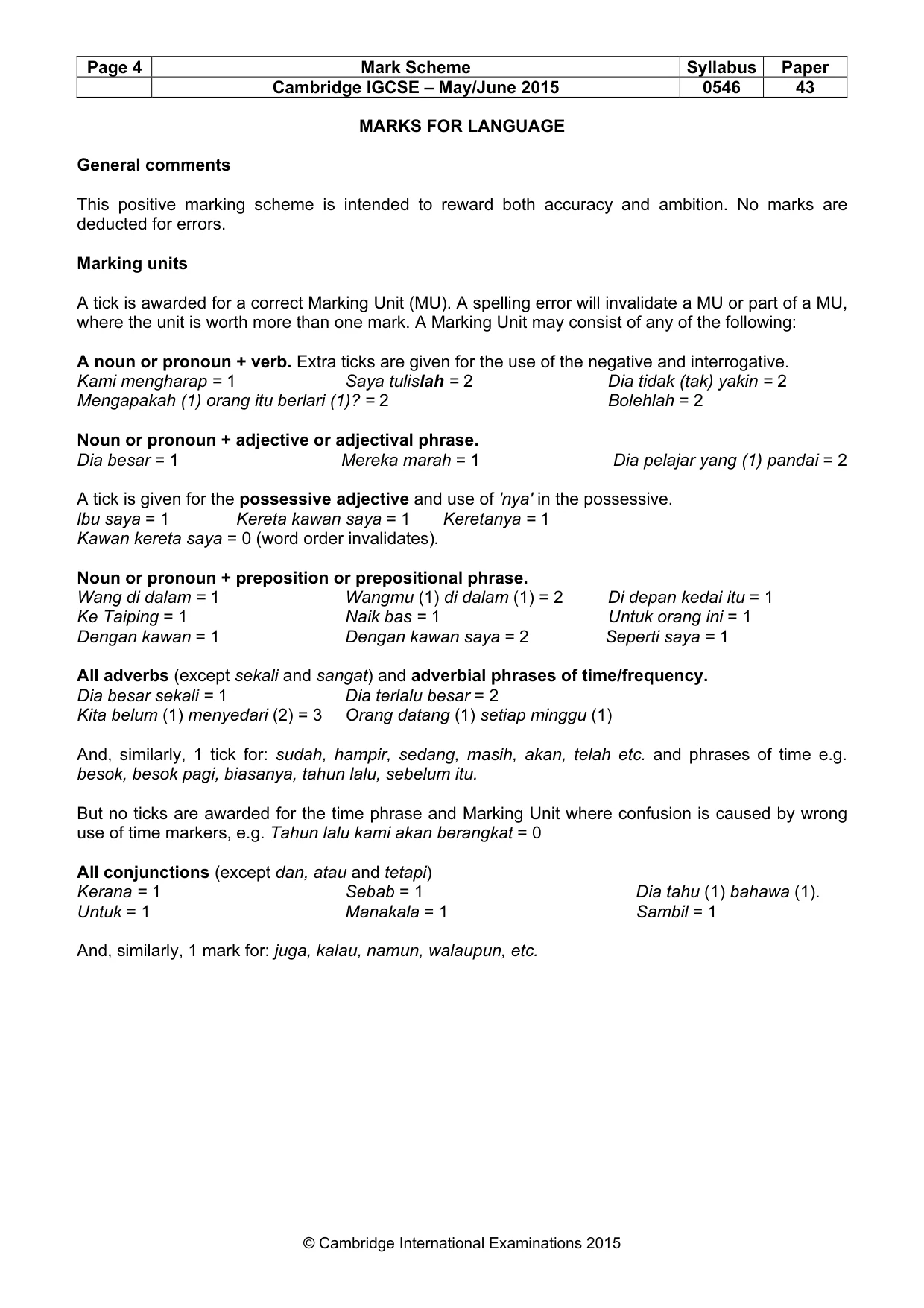
Page 4 Mark Scheme Syllabus Paper Cambridge IGCSE – May/June 2015 0546 43 © Cambridge International Examinations 2015 MARKS FOR LANGUAGE General comments This positive marking scheme is intended to reward both accuracy and ambition. No marks are deducted for errors. Marking units A tick is awarded for a correct Marking Unit (MU). A spelling error will invalidate a MU or part of a MU, where the unit is worth more than one mark. A Marking Unit may consist of any of the following: A noun or pronoun + verb. Extra ticks are given for the use of the negative and interrogative. Kami mengharap = 1 Saya tulislah = 2 Dia tidak (tak) yakin = 2 Mengapakah (1) orang itu berlari (1)? = 2 Bolehlah = 2 Noun or pronoun + adjective or adjectival phrase. Dia besar = 1 Mereka marah = 1 Dia pelajar yang (1) pandai = 2 A tick is given for the possessive adjective and use of 'nya' in the possessive. lbu saya = 1 Kereta kawan saya = 1 Keretanya = 1 Kawan kereta saya = 0 (word order invalidates). Noun or pronoun + preposition or prepositional phrase. Wang di dalam = 1 Wangmu (1) di dalam (1) = 2 Di depan kedai itu = 1 Ke Taiping = 1 Naik bas = 1 Untuk orang ini = 1 Dengan kawan = 1 Dengan kawan saya = 2 Seperti saya = 1 All adverbs (except sekali and sangat) and adverbial phrases of time/frequency. Dia besar sekali = 1 Dia terlalu besar = 2 Kita belum (1) menyedari (2) = 3 Orang datang (1) setiap minggu (1) And, similarly, 1 tick for: sudah, hampir, sedang, masih, akan, telah etc. and phrases of time e.g. besok, besok pagi, biasanya, tahun lalu, sebelum itu. But no ticks are awarded for the time phrase and Marking Unit where confusion is caused by wrong use of time markers, e.g. Tahun lalu kami akan berangkat = 0 All conjunctions (except dan, atau and tetapi) Kerana = 1 Sebab = 1 Dia tahu (1) bahawa (1). Untuk = 1 Manakala = 1 Sambil = 1 And, similarly, 1 mark for: juga, kalau, namun, walaupun, etc.
Mark scheme, page 5
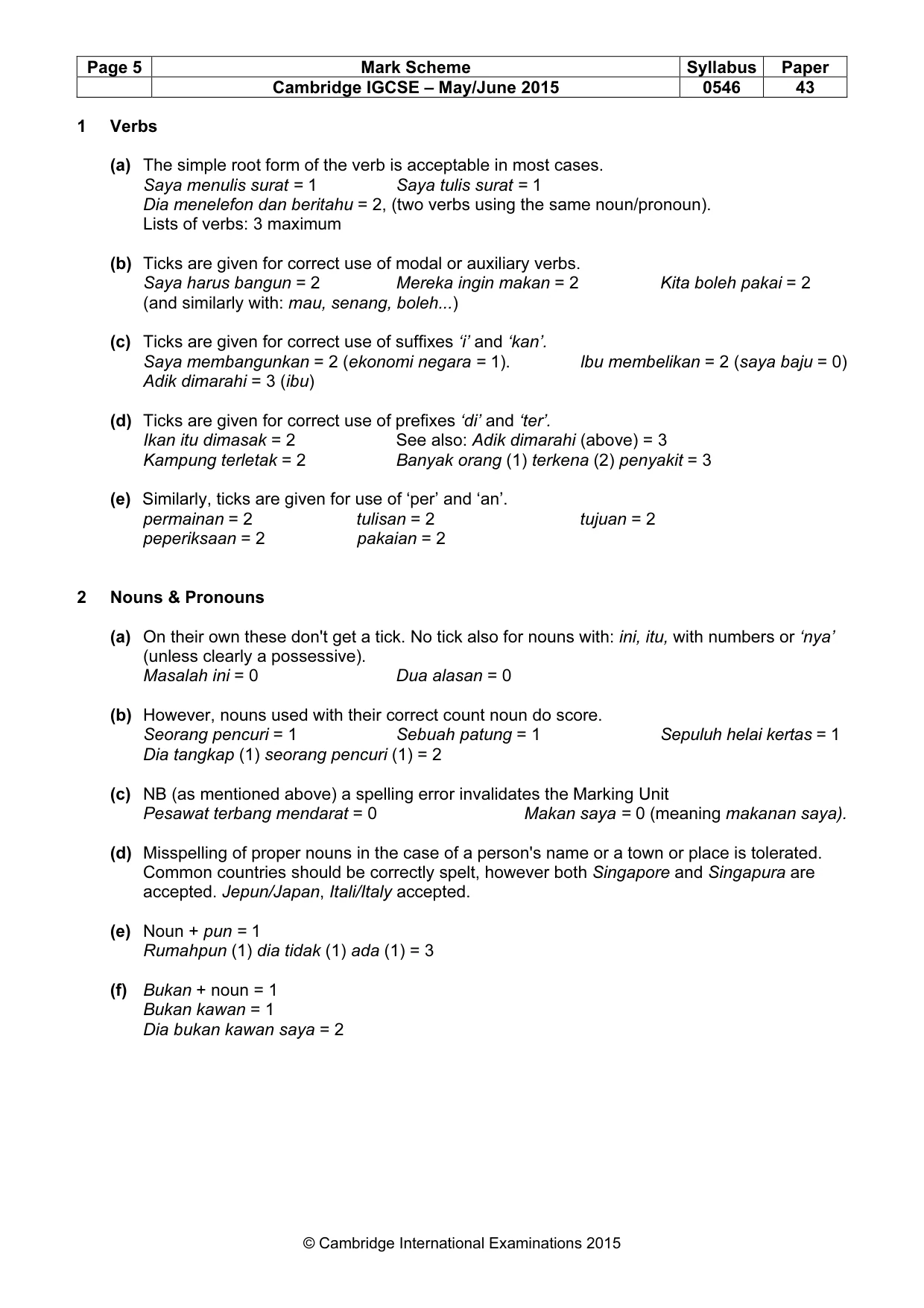
Page 5 Mark Scheme Syllabus Paper Cambridge IGCSE – May/June 2015 0546 43 © Cambridge International Examinations 2015 1 Verbs (a) The simple root form of the verb is acceptable in most cases. Saya menulis surat = 1 Saya tulis surat = 1 Dia menelefon dan beritahu = 2, (two verbs using the same noun/pronoun). Lists of verbs: 3 maximum (b) Ticks are given for correct use of modal or auxiliary verbs. Saya harus bangun = 2 Mereka ingin makan = 2 Kita boleh pakai = 2 (and similarly with: mau, senang, boleh...) (c) Ticks are given for correct use of suffixes ‘i’ and ‘kan’. Saya membangunkan = 2 (ekonomi negara = 1). lbu membelikan = 2 (saya baju = 0) Adik dimarahi = 3 (ibu) (d) Ticks are given for correct use of prefixes ‘di’ and ‘ter’. Ikan itu dimasak = 2 See also: Adik dimarahi (above) = 3 Kampung terletak = 2 Banyak orang (1) terkena (2) penyakit = 3 (e) Similarly, ticks are given for use of ‘per’ and ‘an’. permainan = 2 tulisan = 2 tujuan = 2 peperiksaan = 2 pakaian = 2 2 Nouns & Pronouns (a) On their own these don't get a tick. No tick also for nouns with: ini, itu, with numbers or ‘nya’ (unless clearly a possessive). Masalah ini = 0 Dua alasan = 0 (b) However, nouns used with their correct count noun do score. Seorang pencuri = 1 Sebuah patung = 1 Sepuluh helai kertas = 1 Dia tangkap (1) seorang pencuri (1) = 2 (c) NB (as mentioned above) a spelling error invalidates the Marking Unit Pesawat terbang mendarat = 0 Makan saya = 0 (meaning makanan saya). (d) Misspelling of proper nouns in the case of a person's name or a town or place is tolerated. Common countries should be correctly spelt, however both Singapore and Singapura are accepted. Jepun/Japan, Itali/Italy accepted. (e) Noun + pun = 1 Rumahpun (1) dia tidak (1) ada (1) = 3 (f) Bukan + noun = 1 Bukan kawan = 1 Dia bukan kawan saya = 2
Mark scheme, page 6
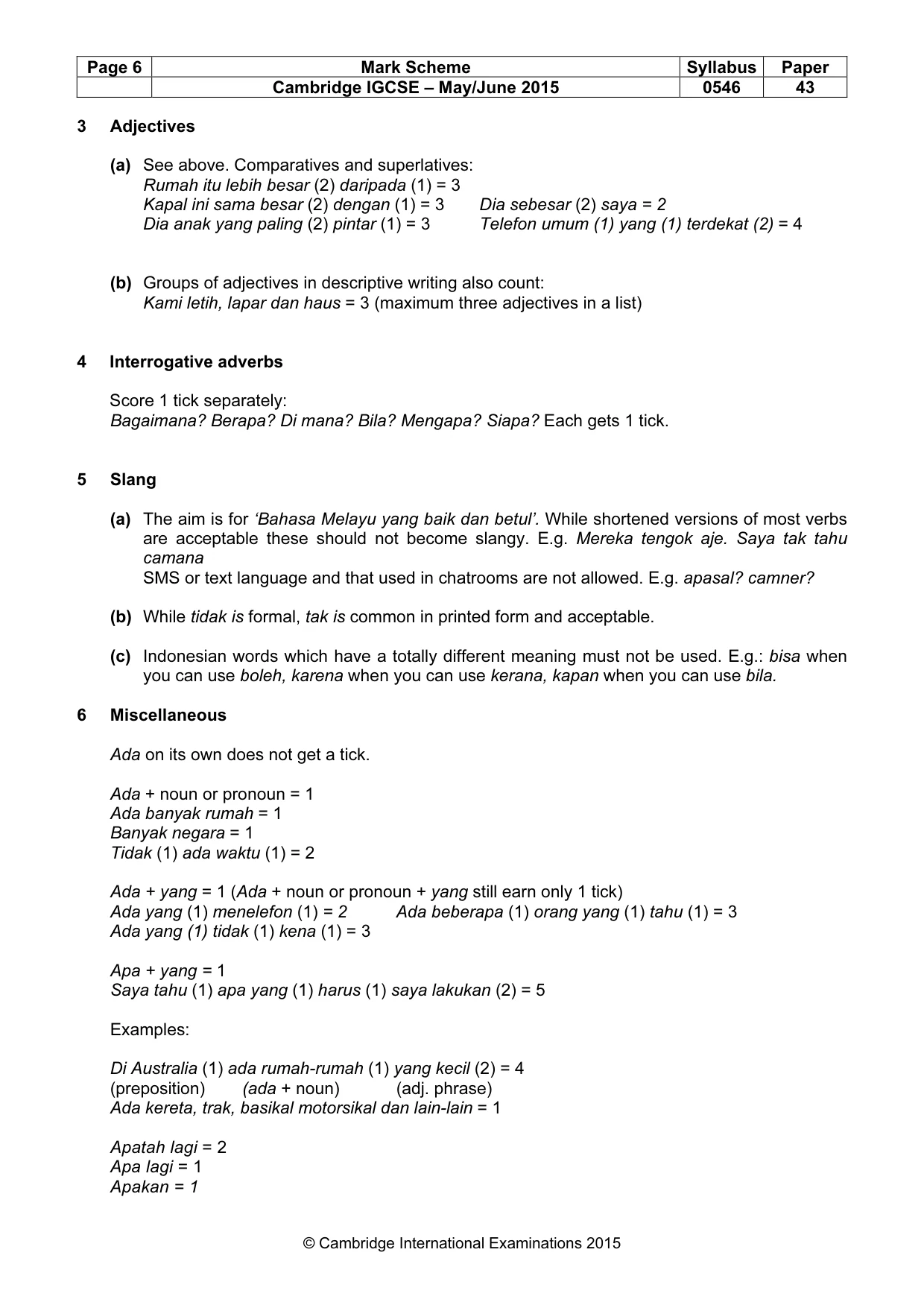
Page 6 Mark Scheme Syllabus Paper Cambridge IGCSE – May/June 2015 0546 43 © Cambridge International Examinations 2015 3 Adjectives (a) See above. Comparatives and superlatives: Rumah itu lebih besar (2) daripada (1) = 3 Kapal ini sama besar (2) dengan (1) = 3 Dia sebesar (2) saya = 2 Dia anak yang paling (2) pintar (1) = 3 Telefon umum (1) yang (1) terdekat (2) = 4 (b) Groups of adjectives in descriptive writing also count: Kami letih, lapar dan haus = 3 (maximum three adjectives in a list) 4 Interrogative adverbs Score 1 tick separately: Bagaimana? Berapa? Di mana? Bila? Mengapa? Siapa? Each gets 1 tick. 5 Slang (a) The aim is for ‘Bahasa Melayu yang baik dan betul’. While shortened versions of most verbs are acceptable these should not become slangy. E.g. Mereka tengok aje. Saya tak tahu camana SMS or text language and that used in chatrooms are not allowed. E.g. apasal? camner? (b) While tidak is formal, tak is common in printed form and acceptable. (c) Indonesian words which have a totally different meaning must not be used. E.g.: bisa when you can use boleh, karena when you can use kerana, kapan when you can use bila. 6 Miscellaneous Ada on its own does not get a tick. Ada + noun or pronoun = 1 Ada banyak rumah = 1 Banyak negara = 1 Tidak (1) ada waktu (1) = 2 Ada + yang = 1 (Ada + noun or pronoun + yang still earn only 1 tick) Ada yang (1) menelefon (1) = 2 Ada beberapa (1) orang yang (1) tahu (1) = 3 Ada yang (1) tidak (1) kena (1) = 3 Apa + yang = 1 Saya tahu (1) apa yang (1) harus (1) saya lakukan (2) = 5 Examples: Di Australia (1) ada rumah-rumah (1) yang kecil (2) = 4 (preposition) (ada + noun) (adj. phrase) Ada kereta, trak, basikal motorsikal dan lain-lain = 1 Apatah lagi = 2 Apa lagi = 1 Apakan = 1
Mark scheme, page 7
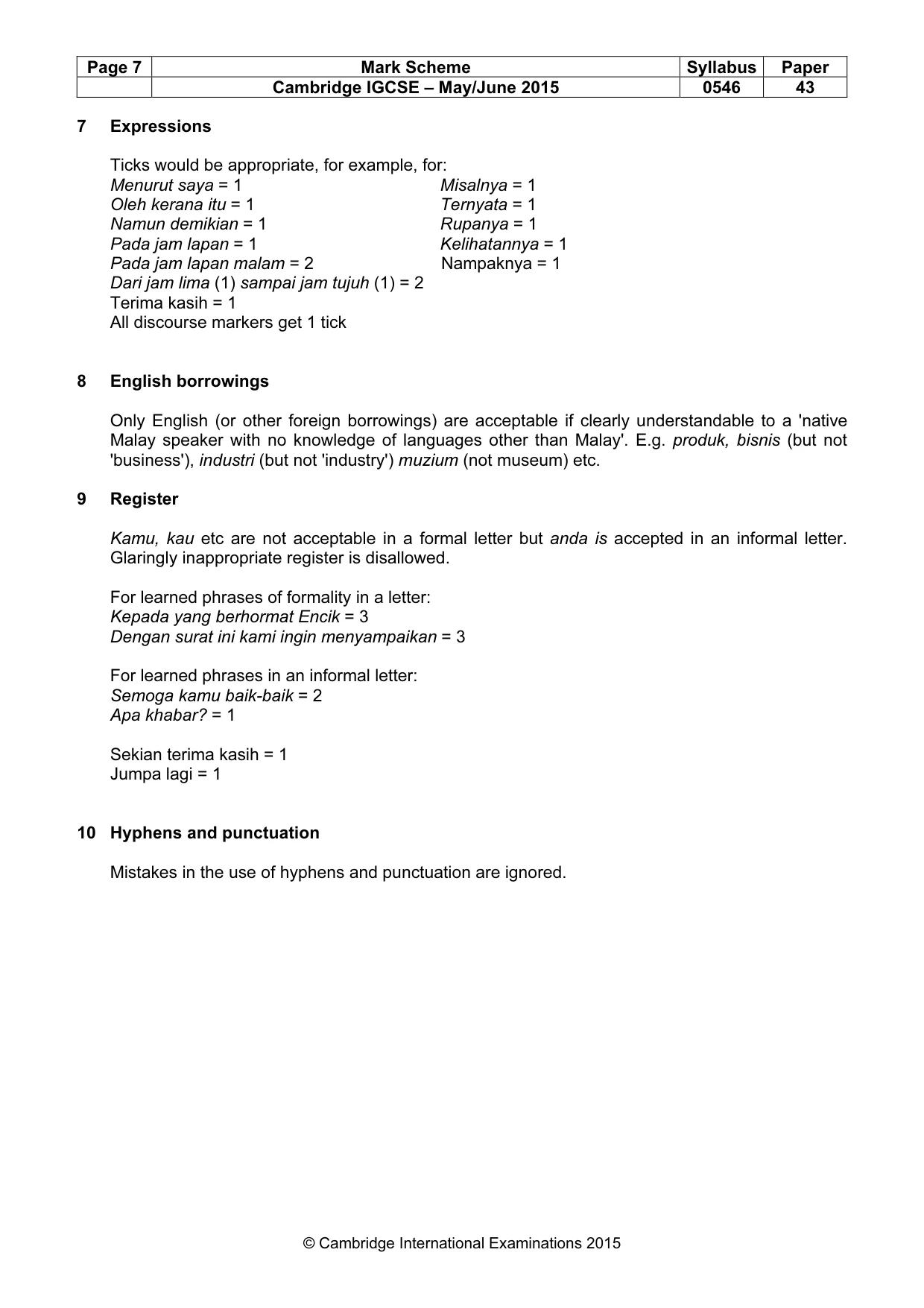
Page 7 Mark Scheme Syllabus Paper Cambridge IGCSE – May/June 2015 0546 43 © Cambridge International Examinations 2015 7 Expressions Ticks would be appropriate, for example, for: Menurut saya = 1 Misalnya = 1 Oleh kerana itu = 1 Ternyata = 1 Namun demikian = 1 Rupanya = 1 Pada jam lapan = 1 Kelihatannya = 1 Pada jam lapan malam = 2 Nampaknya = 1 Dari jam lima (1) sampai jam tujuh (1) = 2 Terima kasih = 1 All discourse markers get 1 tick 8 English borrowings Only English (or other foreign borrowings) are acceptable if clearly understandable to a 'native Malay speaker with no knowledge of languages other than Malay'. E.g. produk, bisnis (but not 'business'), industri (but not 'industry') muzium (not museum) etc. 9 Register Kamu, kau etc are not acceptable in a formal letter but anda is accepted in an informal letter. Glaringly inappropriate register is disallowed. For learned phrases of formality in a letter: Kepada yang berhormat Encik = 3 Dengan surat ini kami ingin menyampaikan = 3 For learned phrases in an informal letter: Semoga kamu baik-baik = 2 Apa khabar? = 1 Sekian terima kasih = 1 Jumpa lagi = 1 10 Hyphens and punctuation Mistakes in the use of hyphens and punctuation are ignored.
Mark scheme, page 8
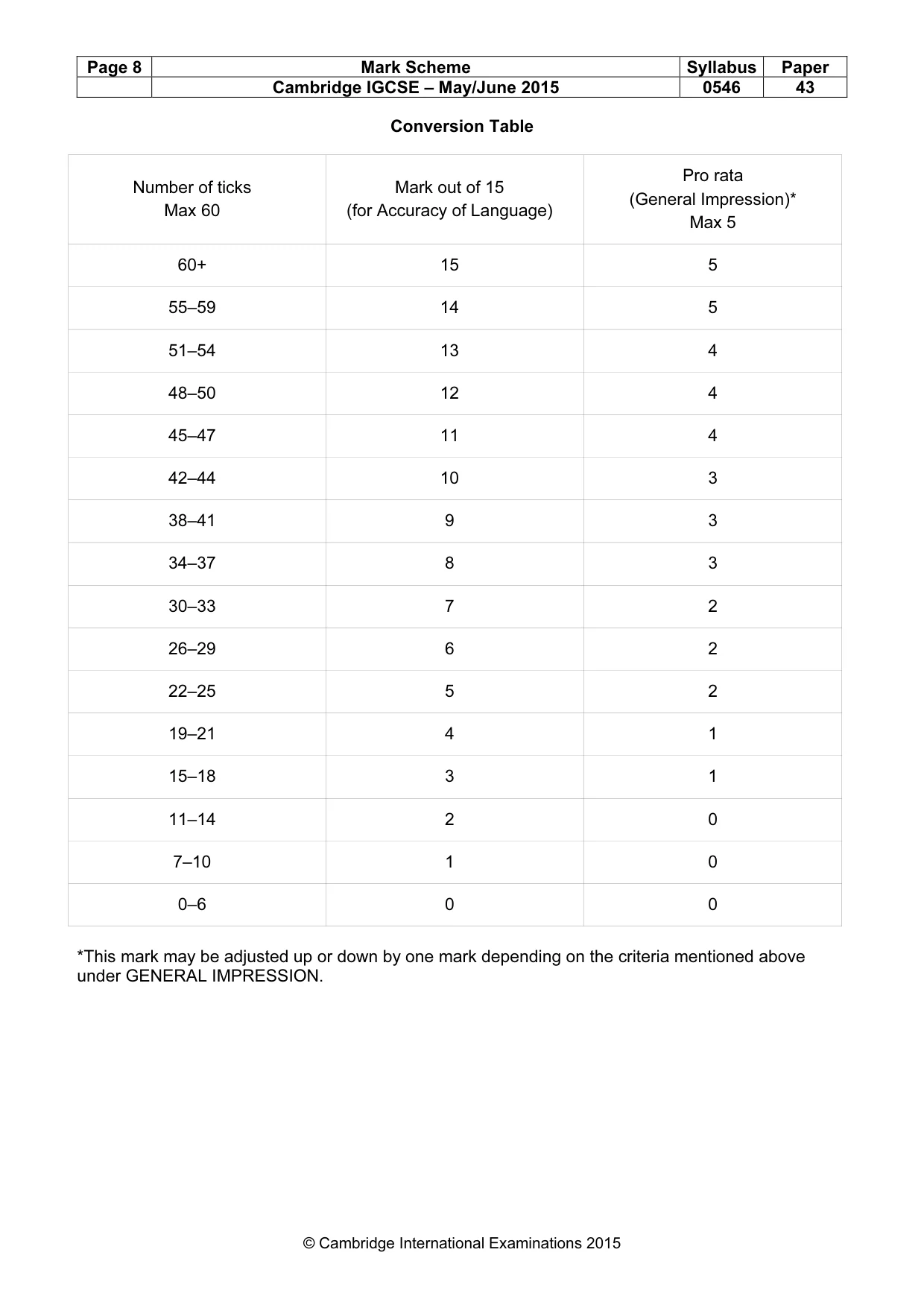
Page 8 Mark Scheme Syllabus Paper Cambridge IGCSE – May/June 2015 0546 43 © Cambridge International Examinations 2015 Conversion Table Number of ticks Max 60 Mark out of 15 (for Accuracy of Language) Pro rata (General Impression)* Max 5 60+ 15 5 55–59 14 5 51–54 13 4 48–50 12 4 45–47 11 4 42–44 10 3 38–41 9 3 34–37 8 3 30–33 7 2 26–29 6 2 22–25 5 2 19–21 4 1 15–18 3 1 11–14 2 0 7–10 1 0 0–6 0 0 *This mark may be adjusted up or down by one mark depending on the criteria mentioned above under GENERAL IMPRESSION.
Mark scheme, page 9
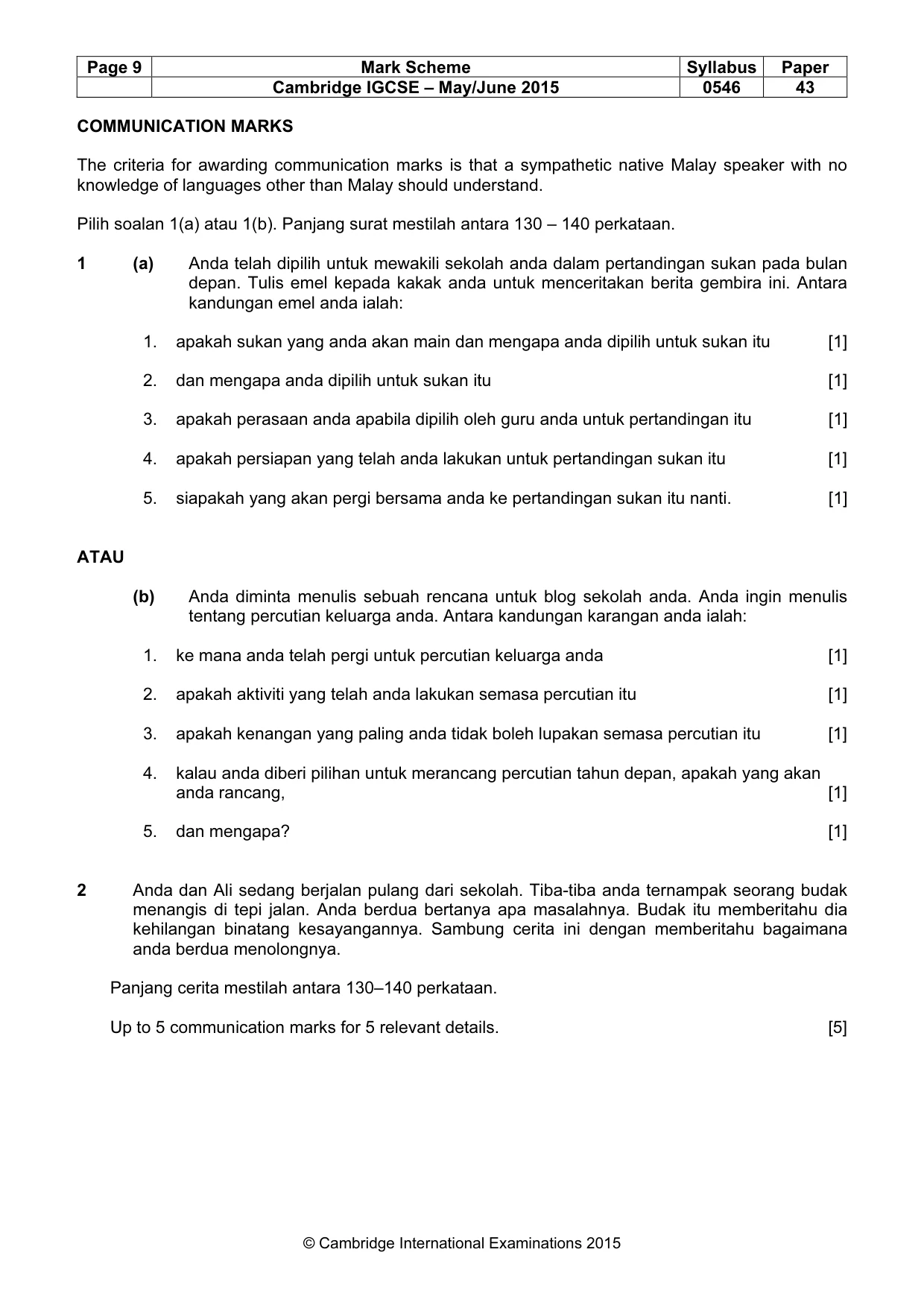
Page 9 Mark Scheme Syllabus Paper Cambridge IGCSE – May/June 2015 0546 43 © Cambridge International Examinations 2015 COMMUNICATION MARKS The criteria for awarding communication marks is that a sympathetic native Malay speaker with no knowledge of languages other than Malay should understand. Pilih soalan 1(a) atau 1(b). Panjang surat mestilah antara 130 – 140 perkataan. 1 (a) Anda telah dipilih untuk mewakili sekolah anda dalam pertandingan sukan pada bulan depan. Tulis emel kepada kakak anda untuk menceritakan berita gembira ini. Antara kandungan emel anda ialah: 1. apakah sukan yang anda akan main dan mengapa anda dipilih untuk sukan itu [1] 2. dan mengapa anda dipilih untuk sukan itu [1] 3. apakah perasaan anda apabila dipilih oleh guru anda untuk pertandingan itu [1] 4. apakah persiapan yang telah anda lakukan untuk pertandingan sukan itu [1] 5. siapakah yang akan pergi bersama anda ke pertandingan sukan itu nanti. [1] ATAU (b) Anda diminta menulis sebuah rencana untuk blog sekolah anda. Anda ingin menulis tentang percutian keluarga anda. Antara kandungan karangan anda ialah: 1. ke mana anda telah pergi untuk percutian keluarga anda [1] 2. apakah aktiviti yang telah anda lakukan semasa percutian itu [1] 3. apakah kenangan yang paling anda tidak boleh lupakan semasa percutian itu [1] 4. kalau anda diberi pilihan untuk merancang percutian tahun depan, apakah yang akan anda rancang, [1] 5. dan mengapa? [1] 2 Anda dan Ali sedang berjalan pulang dari sekolah. Tiba-tiba anda ternampak seorang budak menangis di tepi jalan. Anda berdua bertanya apa masalahnya. Budak itu memberitahu dia kehilangan binatang kesayangannya. Sambung cerita ini dengan memberitahu bagaimana anda berdua menolongnya. Panjang cerita mestilah antara 130–140 perkataan. Up to 5 communication marks for 5 relevant details. [5]
Mark scheme, page 10
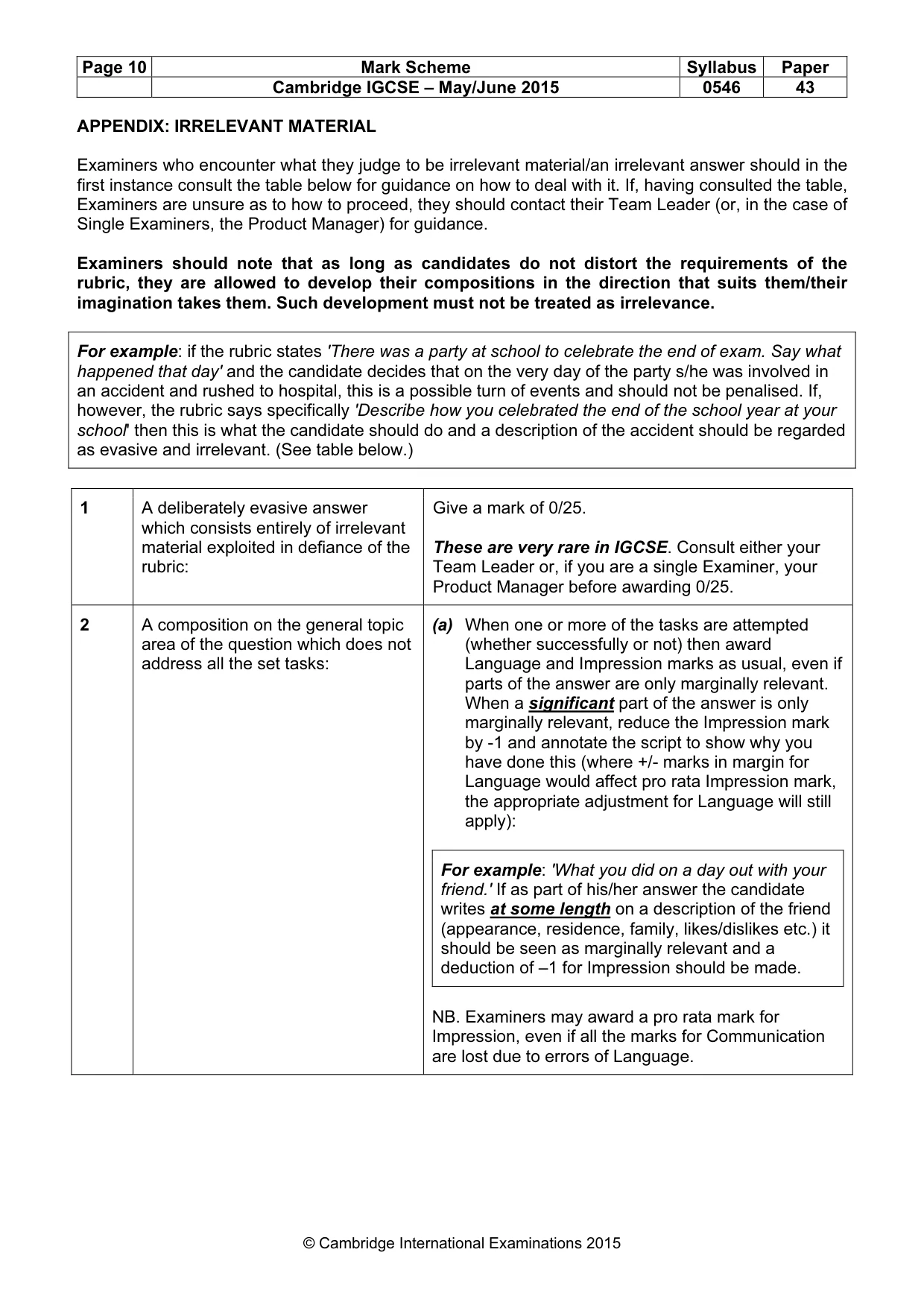
Page 10 Mark Scheme Syllabus Paper Cambridge IGCSE – May/June 2015 0546 43 © Cambridge International Examinations 2015 APPENDIX: IRRELEVANT MATERIAL Examiners who encounter what they judge to be irrelevant material/an irrelevant answer should in the first instance consult the table below for guidance on how to deal with it. If, having consulted the table, Examiners are unsure as to how to proceed, they should contact their Team Leader (or, in the case of Single Examiners, the Product Manager) for guidance. Examiners should note that as long as candidates do not distort the requirements of the rubric, they are allowed to develop their compositions in the direction that suits them/their imagination takes them. Such development must not be treated as irrelevance. For example: if the rubric states 'There was a party at school to celebrate the end of exam. Say what happened that day' and the candidate decides that on the very day of the party s/he was involved in an accident and rushed to hospital, this is a possible turn of events and should not be penalised. If, however, the rubric says specifically 'Describe how you celebrated the end of the school year at your school' then this is what the candidate should do and a description of the accident should be regarded as evasive and irrelevant. (See table below.) 1 A deliberately evasive answer which consists entirely of irrelevant material exploited in defiance of the rubric: Give a mark of 0/25. These are very rare in IGCSE. Consult either your Team Leader or, if you are a single Examiner, your Product Manager before awarding 0/25. 2 A composition on the general topic area of the question which does not address all the set tasks: (a) When one or more of the tasks are attempted (whether successfully or not) then award Language and Impression marks as usual, even if parts of the answer are only marginally relevant. When a significant part of the answer is only marginally relevant, reduce the Impression mark by -1 and annotate the script to show why you have done this (where +/- marks in margin for Language would affect pro rata Impression mark, the appropriate adjustment for Language will still apply): For example: 'What you did on a day out with your friend.' If as part of his/her answer the candidate writes at some length on a description of the friend (appearance, residence, family, likes/dislikes etc.) it should be seen as marginally relevant and a deduction of –1 for Impression should be made. NB. Examiners may award a pro rata mark for Impression, even if all the marks for Communication are lost due to errors of Language.
Mark scheme, page 11
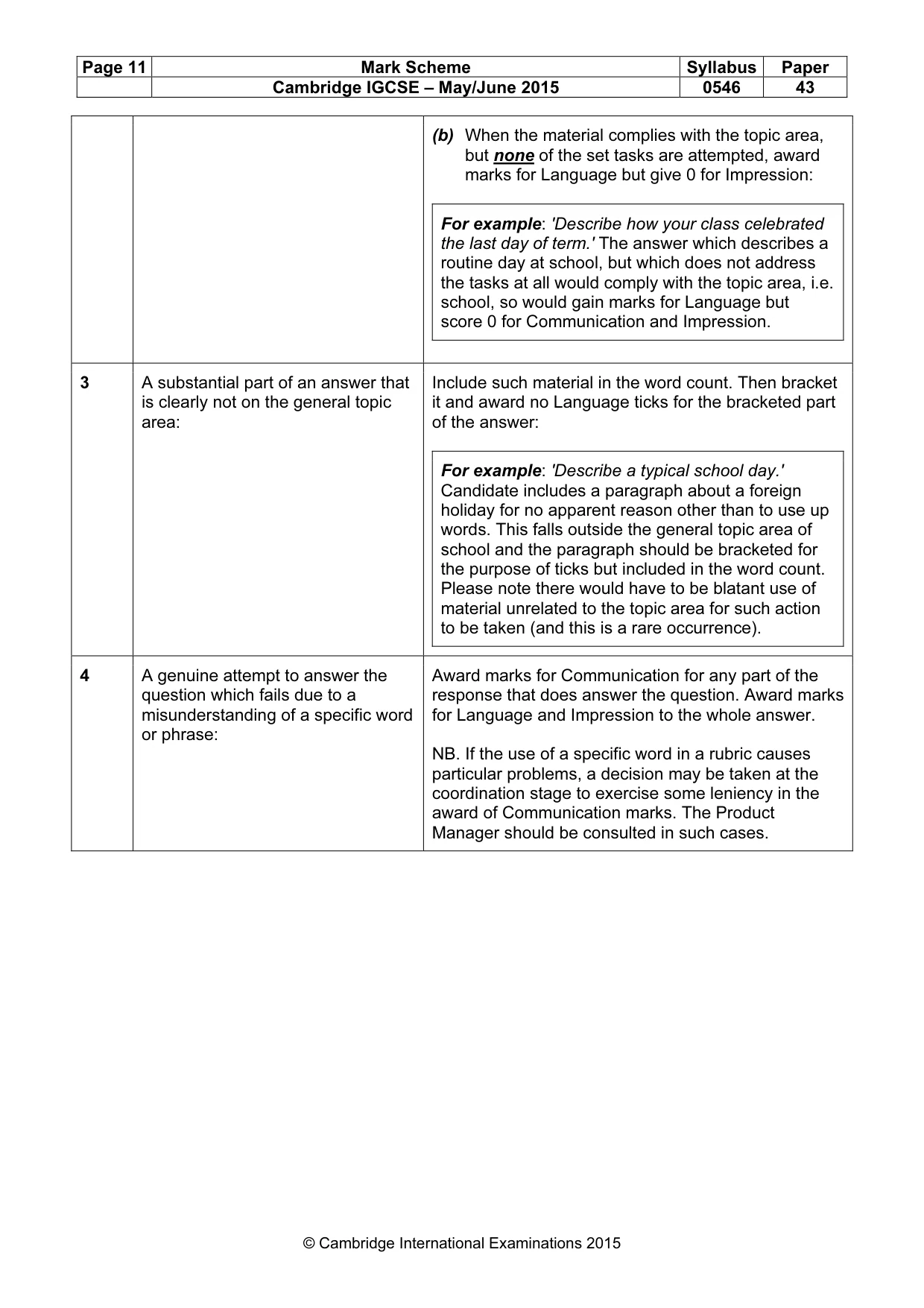
Page 11 Mark Scheme Syllabus Paper Cambridge IGCSE – May/June 2015 0546 43 © Cambridge International Examinations 2015 (b) When the material complies with the topic area, but none of the set tasks are attempted, award marks for Language but give 0 for Impression: For example: 'Describe how your class celebrated the last day of term.' The answer which describes a routine day at school, but which does not address the tasks at all would comply with the topic area, i.e. school, so would gain marks for Language but score 0 for Communication and Impression. 3 A substantial part of an answer that is clearly not on the general topic area: Include such material in the word count. Then bracket it and award no Language ticks for the bracketed part of the answer: For example: 'Describe a typical school day.' Candidate includes a paragraph about a foreign holiday for no apparent reason other than to use up words. This falls outside the general topic area of school and the paragraph should be bracketed for the purpose of ticks but included in the word count. Please note there would have to be blatant use of material unrelated to the topic area for such action to be taken (and this is a rare occurrence). 4 A genuine attempt to answer the question which fails due to a misunderstanding of a specific word or phrase: Award marks for Communication for any part of the response that does answer the question. Award marks for Language and Impression to the whole answer. NB. If the use of a specific word in a rubric causes particular problems, a decision may be taken at the coordination stage to exercise some leniency in the award of Communication marks. The Product Manager should be consulted in such cases.
What you needed in this session
Cambridge’s own grade thresholds for 2015 May/June, Paper 4 · Variant 3. A higher threshold means an easier paper — the bar moves with how the cohort did.