Cambridge IGCSE Korean (First Language) 0521 — 2020 May/June Paper 1 · Variant 1
0521/11/M/J/20
The question paper and its mark scheme, free to read here and free to download. This is Cambridge’s own paper, exactly as it was sat.
Question paper8 pages
Mark scheme7 pages
Answers below. Sit the paper first if you are practising.
Paper as text
Question paper, page 1
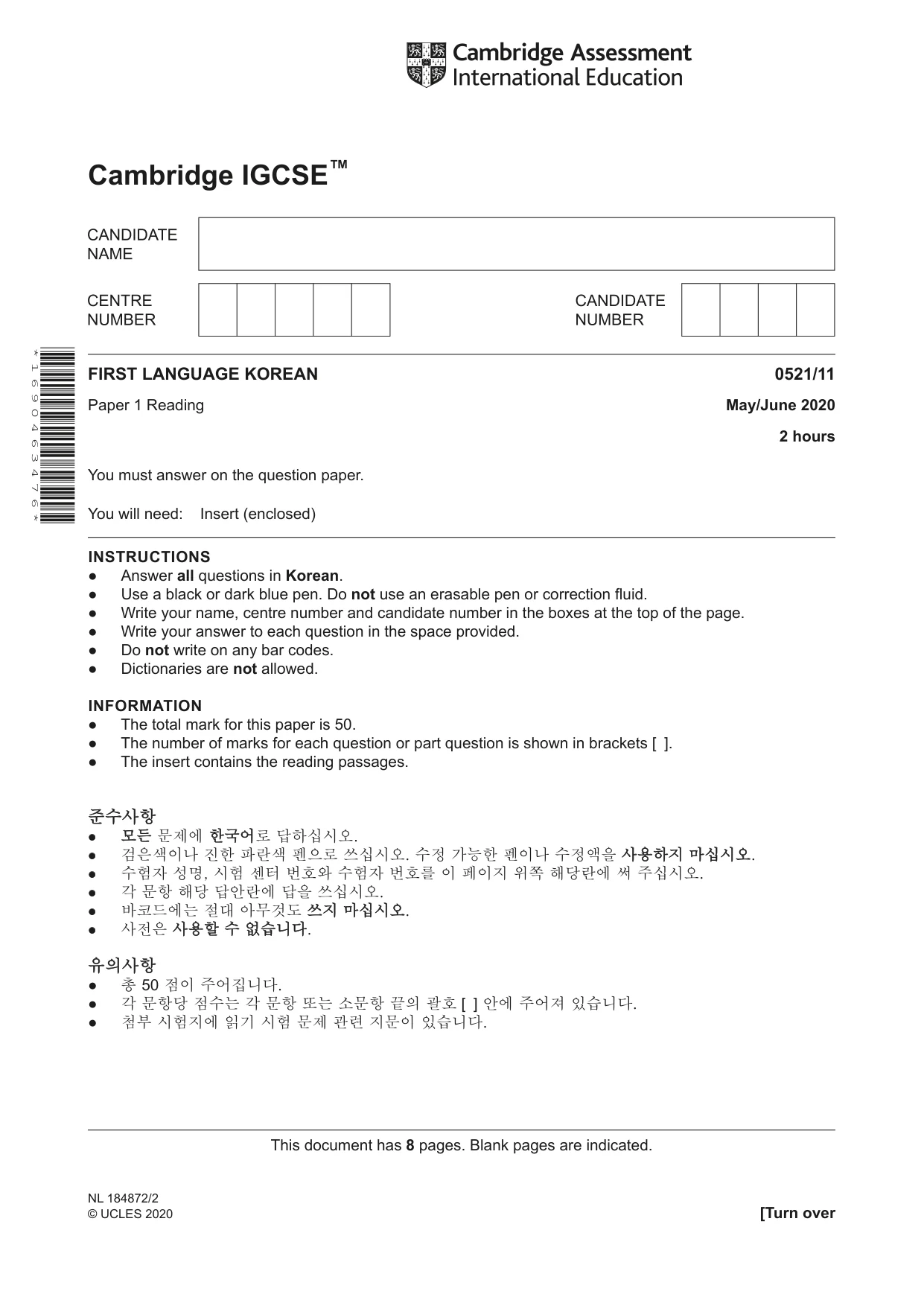
This document has 8 pages. Blank pages are indicated. NL 184872/2 © UCLES 2020 [Turn over Cambridge IGCSE™ FIRST LANGUAGE KOREAN 0521/11 Paper 1 Reading May/June 2020 2 hours You must answer on the question paper. You will need: Insert (enclosed) INSTRUCTIONS ● Answer all questions in Korean. ● Use a black or dark blue pen. Do not use an erasable pen or correction fluid. ● Write your name, centre number and candidate number in the boxes at the top of the page. ● Write your answer to each question in the space provided. ● Do not write on any bar codes. ● Dictionaries are not allowed. INFORMATION ● The total mark for this paper is 50. ● The number of marks for each question or part question is shown in brackets [ ]. ● The insert contains the reading passages. 준수사항 ● 모든 문제에 한국어로 답하십시오. ● 검은색이나 진한 파란색 펜으로 쓰십시오. 수정 가능한 펜이나 수정액을 사용하지 마십시오. ● 수험자 성명, 시험 센터 번호와 수험자 번호를 이 페이지 위쪽 해당란에 써 주십시오. ● 각 문항 해당 답안란에 답을 쓰십시오. ● 바코드에는 절대 아무것도 쓰지 마십시오. ● 사전은 사용할 수 없습니다. 유의사항 ● 총 50 점이 주어집니다. ● 각 문항당 점수는 각 문항 또는 소문항 끝의 괄호 [ ] 안에 주어져 있습니다. ● 첨부 시험지에 읽기 시험 문제 관련 지문이 있습니다. * 1 6 9 0 4 6 3 4 7 6 *
Question paper, page 2
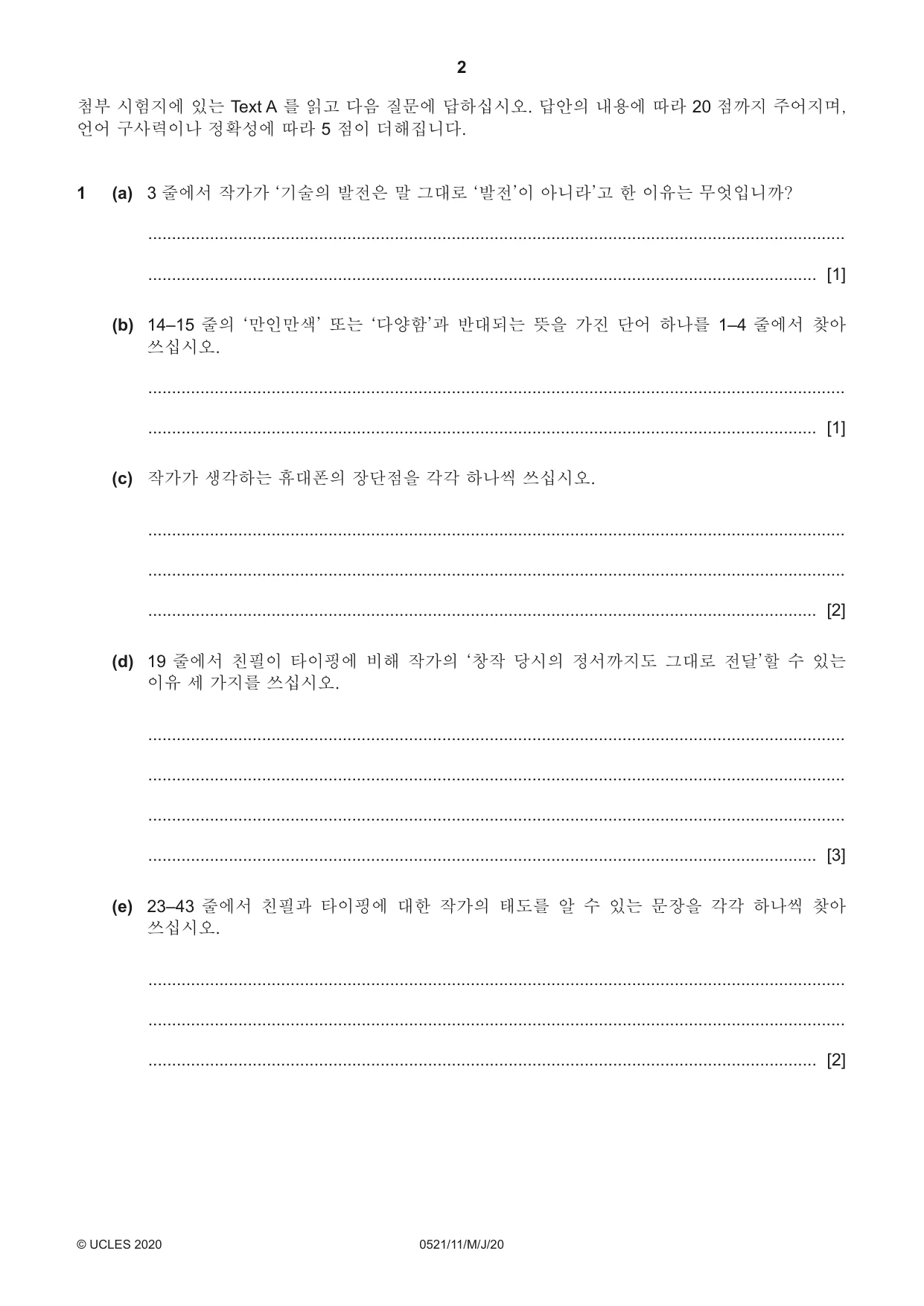
2 0521/11/M/J/20 © UCLES 2020 첨부 시험지에 있는 Text A 를 읽고 다음 질문에 답하십시오. 답안의 내용에 따라 20 점까지 주어지며, 언어 구사력이나 정확성에 따라 5 점이 더해집니다. 1 (a) 3 줄에서 작가가 ‘기술의 발전은 말 그대로 ‘발전’이 아니라’고 한 이유는 무엇입니까? … … [1] (b) 14–15 줄의 ‘만인만색’ 또는 ‘다양함’과 반대되는 뜻을 가진 단어 하나를 1–4 줄에서 찾아 쓰십시오. … … [1] (c) 작가가 생각하는 휴대폰의 장단점을 각각 하나씩 쓰십시오. … … … [2] (d) 19 줄에서 친필이 타이핑에 비해 작가의 ‘창작 당시의 정서까지도 그대로 전달’할 수 있는 이유 세 가지를 쓰십시오. … … … … [3] (e) 23–43 줄에서 친필과 타이핑에 대한 작가의 태도를 알 수 있는 문장을 각각 하나씩 찾아 쓰십시오. … … … [2]
Question paper, page 3
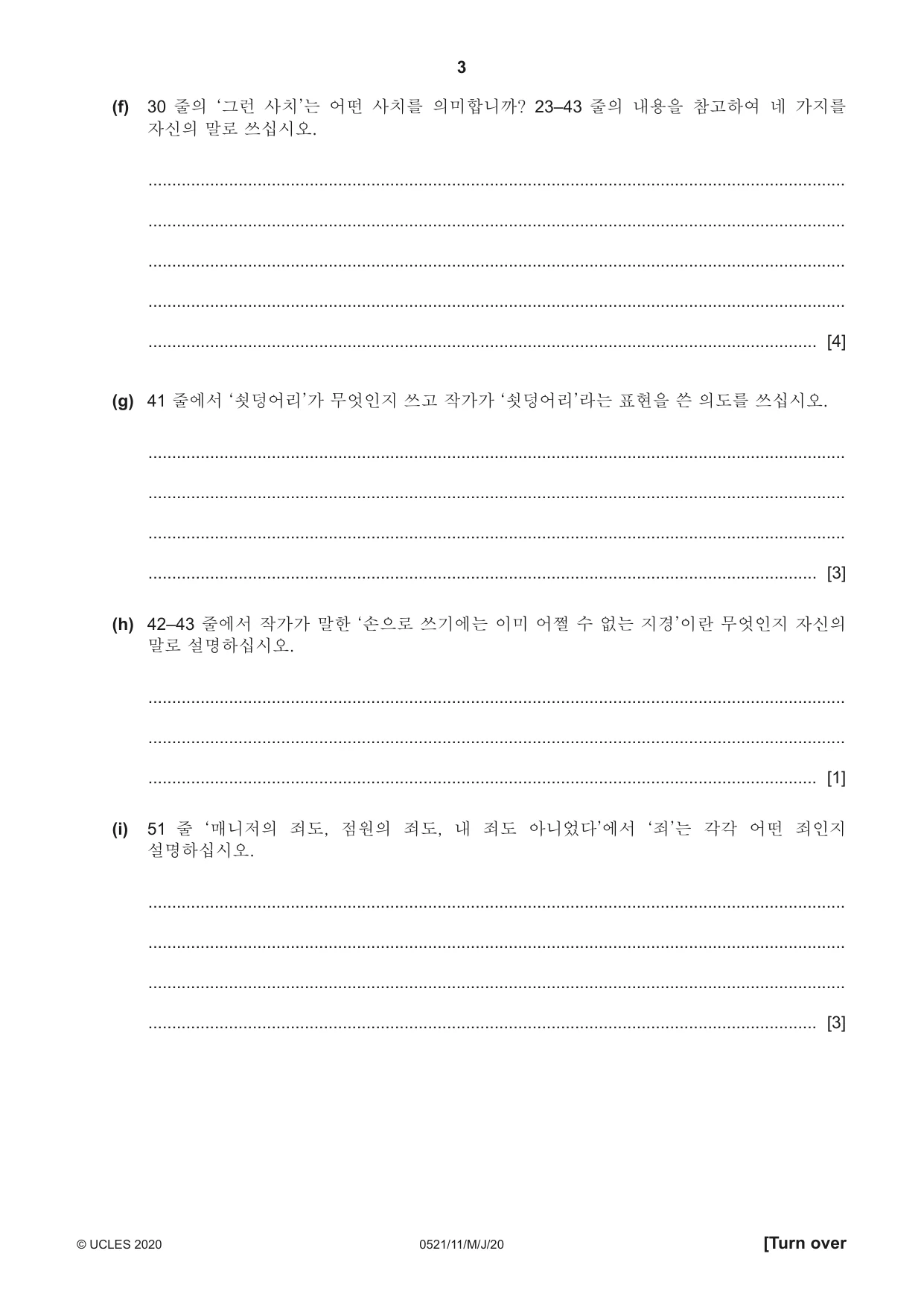
3 0521/11/M/J/20 © UCLES 2020 [Turn over (f) 30 줄의 ‘그런 사치’는 어떤 사치를 의미합니까? 23–43 줄의 내용을 참고하여 네 가지를 자신의 말로 쓰십시오. … … … … … [4] (g) 41 줄에서 ‘쇳덩어리’가 무엇인지 쓰고 작가가 ‘쇳덩어리’라는 표현을 쓴 의도를 쓰십시오. … … … … [3] (h) 42–43 줄에서 작가가 말한 ‘손으로 쓰기에는 이미 어쩔 수 없는 지경’이란 무엇인지 자신의 말로 설명하십시오. … … … [1] (i) 51 줄 ‘매니저의 죄도, 점원의 죄도, 내 죄도 아니었다’에서 ‘죄’는 각각 어떤 죄인지 설명하십시오. … … … … [3]
Question paper, page 4
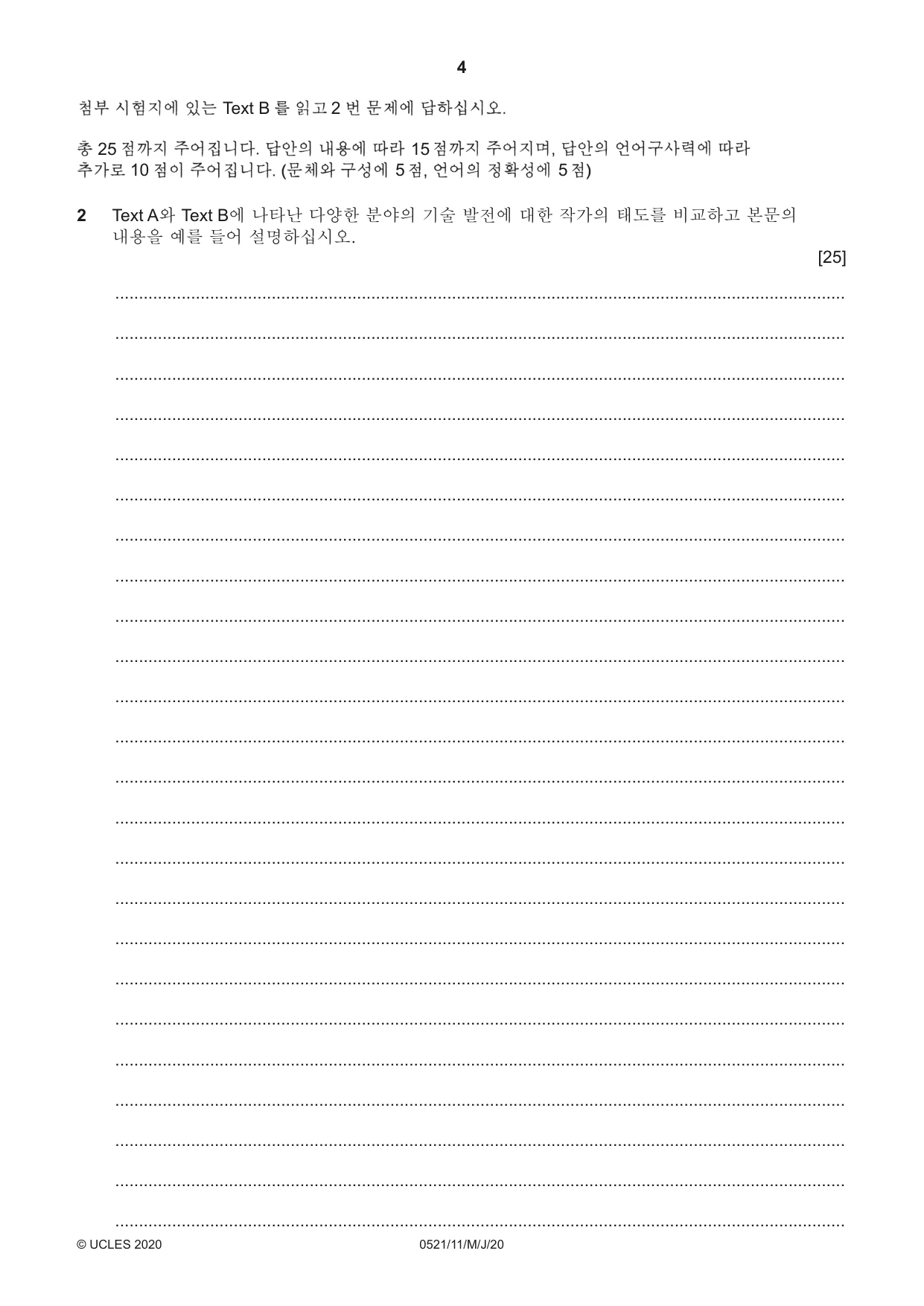
4 0521/11/M/J/20 © UCLES 2020 2 Text A와 Text B에 나타난 다양한 분야의 기술 발전에 대한 작가의 태도를 비교하고 본문의 내용을 예를 들어 설명하십시오. [25] … … … … … … … … … … … … … … … … … … … … … … … … Text B 2 25 15 10 5 5
Question paper, page 5
5 0521/11/M/J/20 © UCLES 2020 [Turn over … … … … … … … … … … … … … … … … … … … … … … … … … … … …
Question paper, page 6
6 0521/11/M/J/20 © UCLES 2020 … … … … … … … … … … … … … … … … … … … … … … … … … … … …
Question paper, page 7
7 0521/11/M/J/20 © UCLES 2020 BLANK PAGE
Question paper, page 8
8 0521/11/M/J/20 © UCLES 2020 BLANK PAGE Permission to reproduce items where third-party owned material protected by copyright is included has been sought and cleared where possible. Every reasonable effort has been made by the publisher (UCLES) to trace copyright holders, but if any items requiring clearance have unwittingly been included, the publisher will be pleased to make amends at the earliest possible opportunity. To avoid the issue of disclosure of answer-related information to candidates, all copyright acknowledgements are reproduced online in the Cambridge Assessment International Education Copyright Acknowledgements Booklet. This is produced for each series of examinations and is freely available to download at www.cambridgeinternational.org after the live examination series. Cambridge Assessment International Education is part of the Cambridge Assessment Group. Cambridge Assessment is the brand name of the University of Cambridge Local Examinations Syndicate (UCLES), which itself is a department of the University of Cambridge.
Mark scheme, page 1
This document consists of 7 printed pages. © UCLES 2020 [Turn over Cambridge IGCSE™ FIRST LANGUAGE KOREAN 0521/11 Paper 1 Reading May/June 2020 MARK SCHEME Maximum Mark: 50 Published Students did not sit exam papers in the June 2020 series due to the Covid-19 global pandemic. This mark scheme is published to support teachers and students and should be read together with the question paper. It shows the requirements of the exam. The answer column of the mark scheme shows the proposed basis on which Examiners would award marks for this exam. Where appropriate, this column also provides the most likely acceptable alternative responses expected from students. Examiners usually review the mark scheme after they have seen student responses and update the mark scheme if appropriate. In the June series, Examiners were unable to consider the acceptability of alternative responses, as there were no student responses to consider. Mark schemes should usually be read together with the Principal Examiner Report for Teachers. However, because students did not sit exam papers, there is no Principal Examiner Report for Teachers for the June 2020 series. Cambridge International will not enter into discussions about these mark schemes. Cambridge International is publishing the mark schemes for the June 2020 series for most Cambridge IGCSE™ and Cambridge International A & AS Level components, and some Cambridge O Level components.
Mark scheme, page 2
0521/11 Cambridge IGCSE – Mark Scheme PUBLISHED May/June 2020 © UCLES 2020 Page 2 of 7 Generic Marking Principles These general marking principles must be applied by all examiners when marking candidate answers. They should be applied alongside the specific content of the mark scheme or generic level descriptors for a question. Each question paper and mark scheme will also comply with these marking principles. GENERIC MARKING PRINCIPLE 1: Marks must be awarded in line with: • the specific content of the mark scheme or the generic level descriptors for the question • the specific skills defined in the mark scheme or in the generic level descriptors for the question • the standard of response required by a candidate as exemplified by the standardisation scripts. GENERIC MARKING PRINCIPLE 2: Marks awarded are always whole marks (not half marks, or other fractions). GENERIC MARKING PRINCIPLE 3: Marks must be awarded positively: • marks are awarded for correct/valid answers, as defined in the mark scheme. However, credit is given for valid answers which go beyond the scope of the syllabus and mark scheme, referring to your Team Leader as appropriate • marks are awarded when candidates clearly demonstrate what they know and can do • marks are not deducted for errors • marks are not deducted for omissions • answers should only be judged on the quality of spelling, punctuation and grammar when these features are specifically assessed by the question as indicated by the mark scheme. The meaning, however, should be unambiguous. GENERIC MARKING PRINCIPLE 4: Rules must be applied consistently e.g. in situations where candidates have not followed instructions or in the application of generic level descriptors. GENERIC MARKING PRINCIPLE 5: Marks should be awarded using the full range of marks defined in the mark scheme for the question (however; the use of the full mark range may be limited according to the quality of the candidate responses seen). GENERIC MARKING PRINCIPLE 6: Marks awarded are based solely on the requirements as defined in the mark scheme. Marks should not be awarded with grade thresholds or grade descriptors in mind.
Mark scheme, page 3
0521/11 Cambridge IGCSE – Mark Scheme PUBLISHED May/June 2020 © UCLES 2020 Page 3 of 7 Annotations available on Scoris Annotation Meaning tick correct cross incorrect ^ omission BOD benefit of the doubt NBOD not benefit of the doubt HA harmless addition IR irrelevant INVL invalidates / to show the end of a word count highlight REP repetition Please remember that schools can request copies of their scripts and will see your annotations. Therefore please ensure you use them only when appropriate and can be justified by the mark scheme. Take particular care with the cross annotation.
Mark scheme, page 4
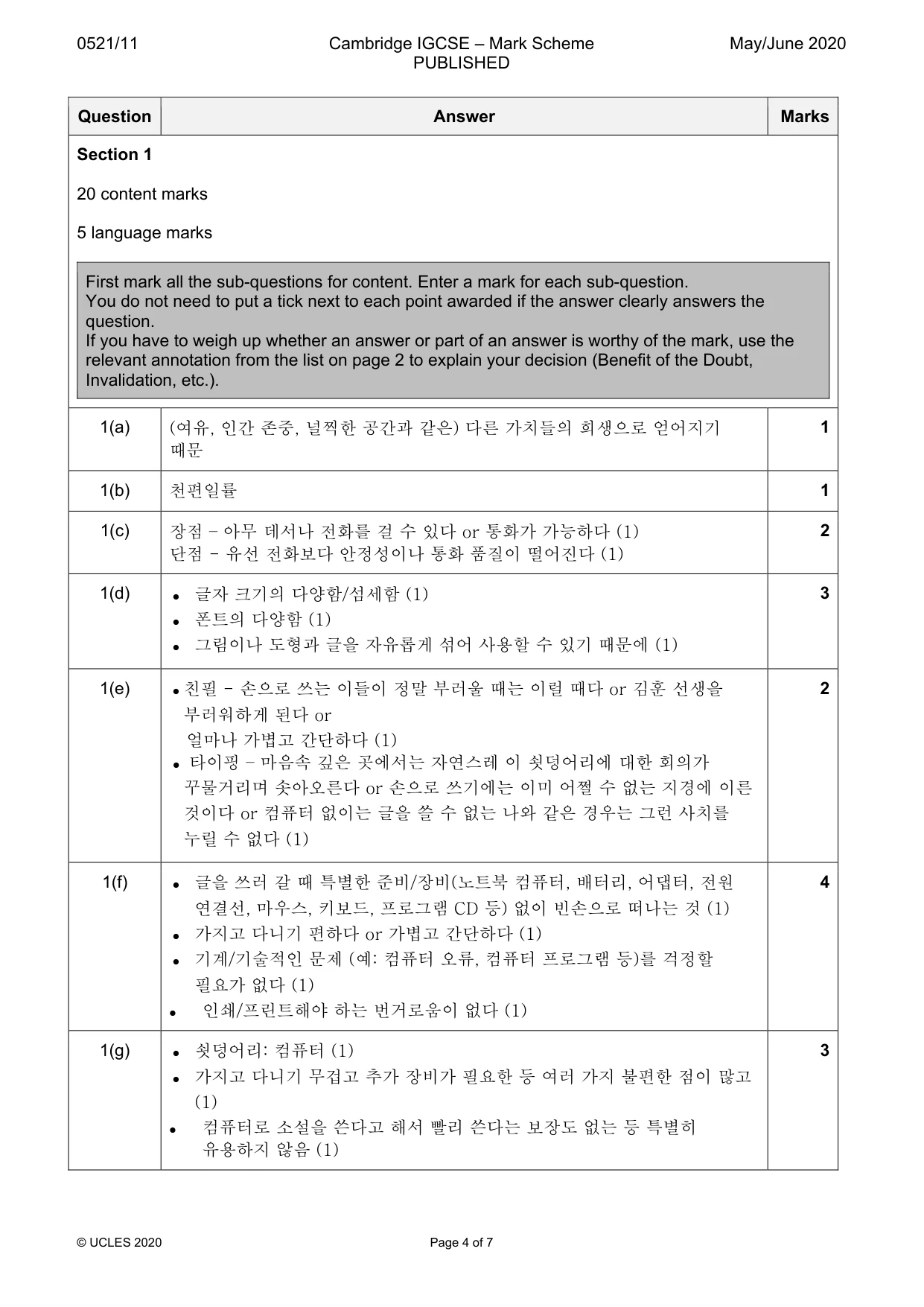
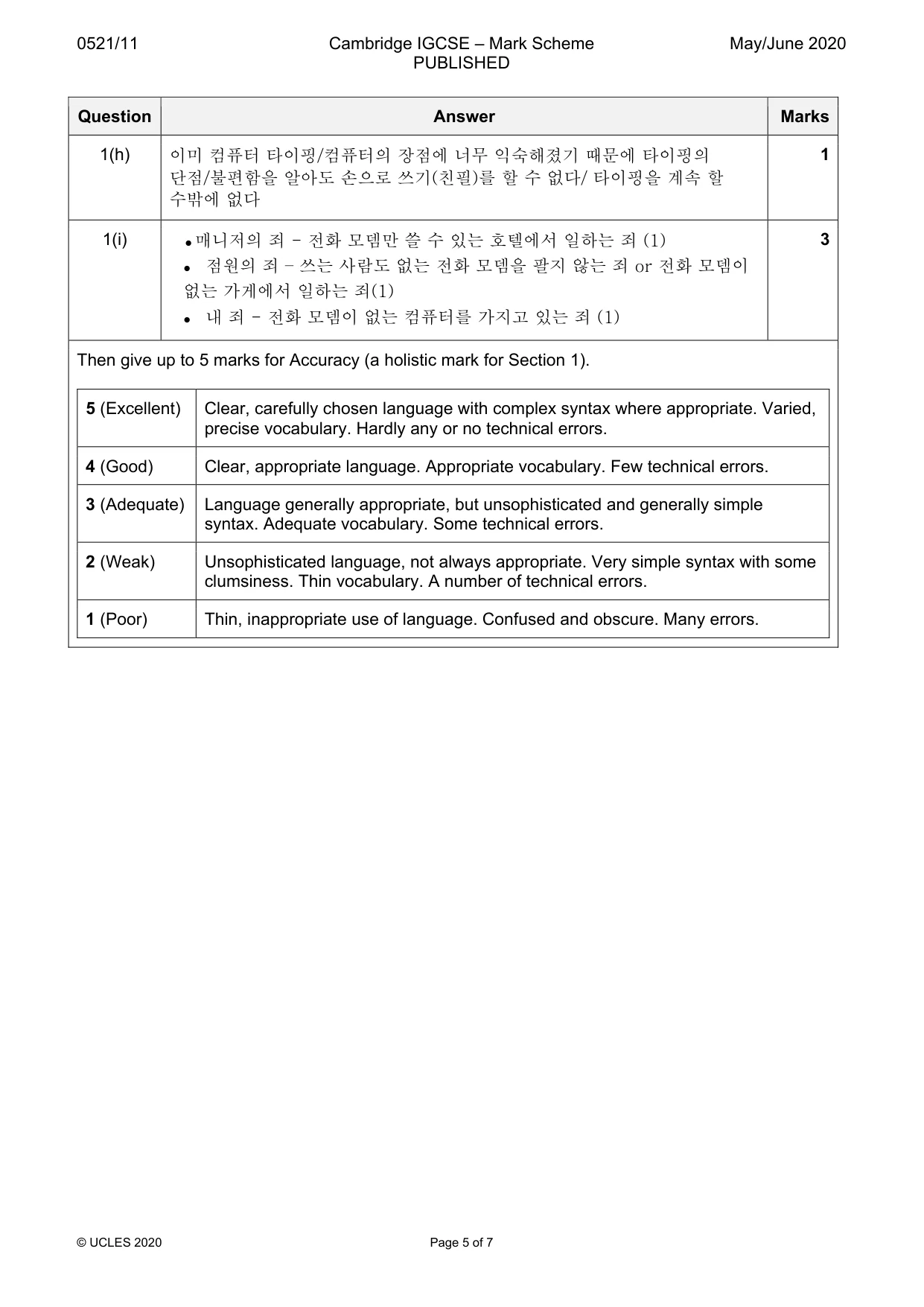
0521/11 Cambridge IGCSE – Mark Scheme PUBLISHED May/June 2020 © UCLES 2020 Page 4 of 7 Question Answer Marks Section 1 20 content marks 5 language marks First mark all the sub-questions for content. Enter a mark for each sub-question. You do not need to put a tick next to each point awarded if the answer clearly answers the question. If you have to weigh up whether an answer or part of an answer is worthy of the mark, use the relevant annotation from the list on page 2 to explain your decision (Benefit of the Doubt, Invalidation, etc.). 1(a) (여유, 인간 존중, 널찍한 공간과 같은) 다른 가치들의 희생으로 얻어지기 때문 1 1(b) 천편일률 1 1(c) 장점 – 아무 데서나 전화를 걸 수 있다 or 통화가 가능하다 (1) 단점 - 유선 전화보다 안정성이나 통화 품질이 떨어진다 (1) 2 1(d) 글자 크기의 다양함/섬세함 (1) 폰트의 다양함 (1) 그림이나 도형과 글을 자유롭게 섞어 사용할 수 있기 때문에 (1) 3 1(e) 친필 - 손으로 쓰는 이들이 정말 부러울 때는 이럴 때다 or 김훈 선생을 부러워하게 된다 or 얼마나 가볍고 간단하다 (1) 타이핑 – 마음속 깊은 곳에서는 자연스레 이 쇳덩어리에 대한 회의가 꾸물거리며 솟아오른다 or 손으로 쓰기에는 이미 어쩔 수 없는 지경에 이른 것이다 or 컴퓨터 없이는 글을 쓸 수 없는 나와 같은 경우는 그런 사치를 누릴 수 없다 (1) 2 1(f) 글을 쓰러 갈 때 특별한 준비/장비(노트북 컴퓨터, 배터리, 어댑터, 전원 연결선, 마우스, 키보드, 프로그램 CD 등) 없이 빈손으로 떠나는 것 (1) 가지고 다니기 편하다 or 가볍고 간단하다 (1) 기계/기술적인 문제 (예: 컴퓨터 오류, 컴퓨터 프로그램 등)를 걱정할 필요가 없다 (1) 인쇄/프린트해야 하는 번거로움이 없다 (1) 4 1(g) 쇳덩어리: 컴퓨터 (1) 가지고 다니기 무겁고 추가 장비가 필요한 등 여러 가지 불편한 점이 많고 (1) 컴퓨터로 소설을 쓴다고 해서 빨리 쓴다는 보장도 없는 등 특별히 유용하지 않음 (1) 3
Mark scheme, page 5
0521/11 Cambridge IGCSE – Mark Scheme PUBLISHED May/June 2020 © UCLES 2020 Page 5 of 7 Question Answer Marks 1(h) 이미 컴퓨터 타이핑/컴퓨터의 장점에 너무 익숙해졌기 때문에 타이핑의 단점/불편함을 알아도 손으로 쓰기(친필)를 할 수 없다/ 타이핑을 계속 할 수밖에 없다 1 1(i) 매니저의 죄 - 전화 모뎀만 쓸 수 있는 호텔에서 일하는 죄 (1) 점원의 죄 – 쓰는 사람도 없는 전화 모뎀을 팔지 않는 죄 or 전화 모뎀이 없는 가게에서 일하는 죄(1) 내 죄 - 전화 모뎀이 없는 컴퓨터를 가지고 있는 죄 (1) 3 Then give up to 5 marks for Accuracy (a holistic mark for Section 1). 5 (Excellent) Clear, carefully chosen language with complex syntax where appropriate. Varied, precise vocabulary. Hardly any or no technical errors. 4 (Good) Clear, appropriate language. Appropriate vocabulary. Few technical errors. 3 (Adequate) Language generally appropriate, but unsophisticated and generally simple syntax. Adequate vocabulary. Some technical errors. 2 (Weak) Unsophisticated language, not always appropriate. Very simple syntax with some clumsiness. Thin vocabulary. A number of technical errors. 1 (Poor) Thin, inappropriate use of language. Confused and obscure. Many errors.
Mark scheme, page 6
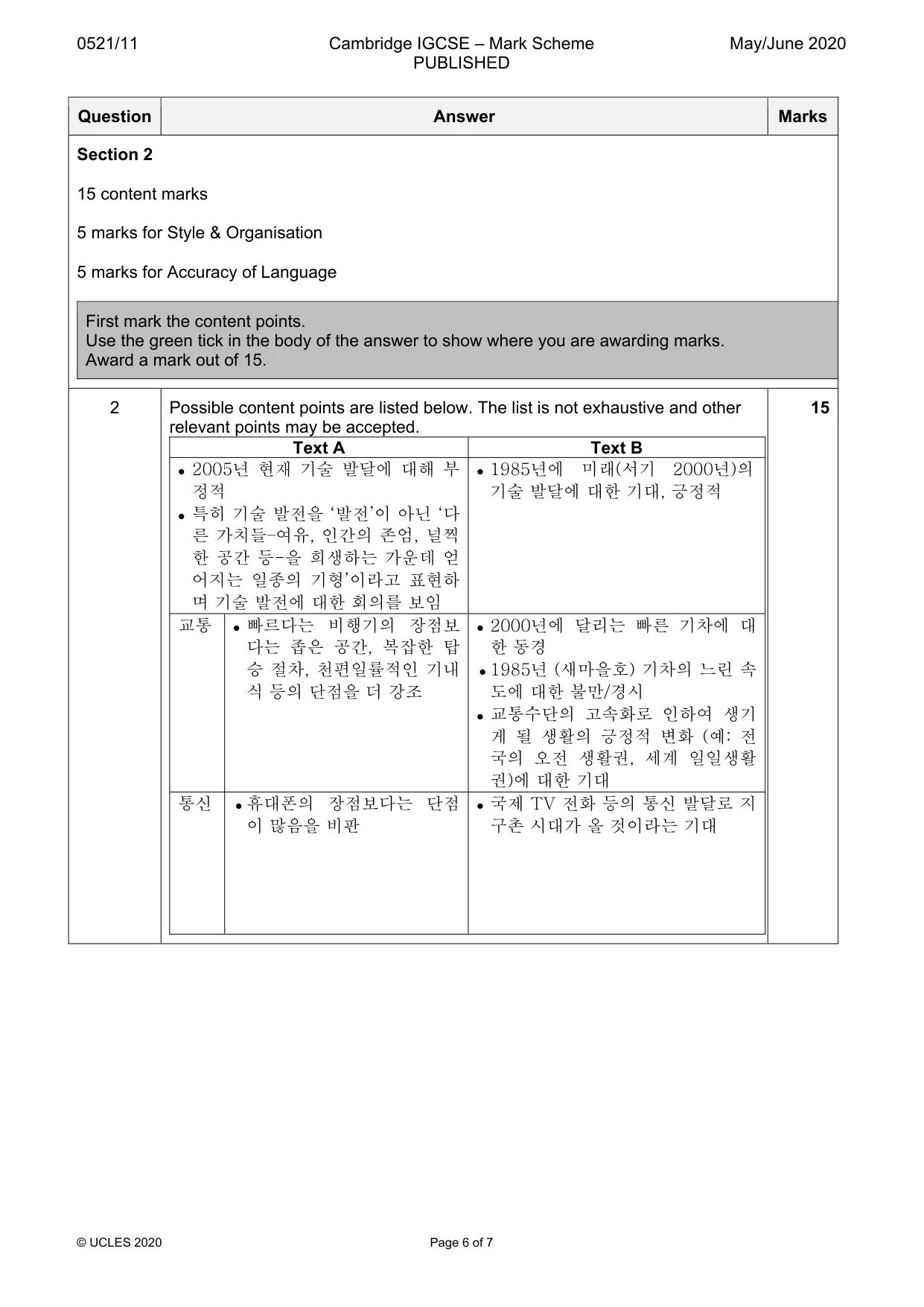
0521/11 Cambridge IGCSE – Mark Scheme PUBLISHED May/June 2020 © UCLES 2020 Page 6 of 7 Question Answer Marks Section 2 15 content marks 5 marks for Style & Organisation 5 marks for Accuracy of Language First mark the content points. Use the green tick in the body of the answer to show where you are awarding marks. Award a mark out of 15. 2 Possible content points are listed below. The list is not exhaustive and other relevant points may be accepted. Text A Text B 2005년 현재 기술 발달에 대해 부 정적 특히 기술 발전을 ‘발전’이 아닌 ‘다 른 가치들–여유, 인간의 존엄, 널찍 한 공간 등-을 희생하는 가운데 얻 어지는 일종의 기형’이라고 표현하 며 기술 발전에 대한 회의를 보임 1985년에 미래(서기 2000년)의 기술 발달에 대한 기대, 긍정적 교통 빠르다는 비행기의 장점보 다는 좁은 공간, 복잡한 탑 승 절차, 천편일률적인 기내 식 등의 단점을 더 강조 2000년에 달리는 빠른 기차에 대 한 동경 1985년 (새마을호) 기차의 느린 속 도에 대한 불만/경시 교통수단의 고속화로 인하여 생기 게 될 생활의 긍정적 변화 (예: 전 국의 오전 생활권, 세계 일일생활 권)에 대한 기대 통신 휴대폰의 장점보다는 단점 이 많음을 비판 국제 TV 전화 등의 통신 발달로 지 구촌 시대가 올 것이라는 기대 15
Mark scheme, page 7
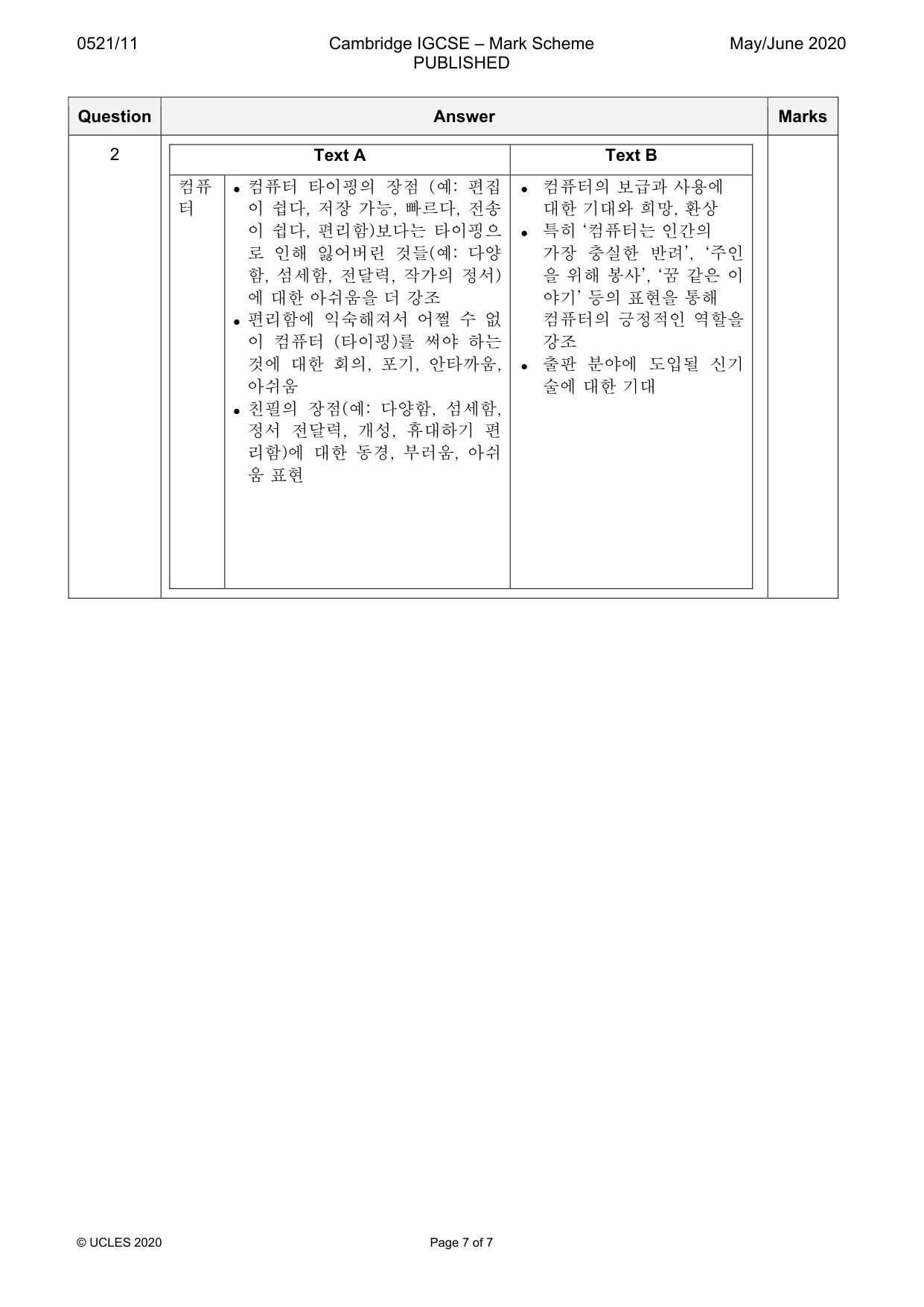
0521/11 Cambridge IGCSE – Mark Scheme PUBLISHED May/June 2020 © UCLES 2020 Page 7 of 7 Question Answer Marks 2 Text A Text B 컴퓨 터 컴퓨터 타이핑의 장점 (예: 편집 이 쉽다, 저장 가능, 빠르다, 전송 이 쉽다, 편리함)보다는 타이핑으 로 인해 잃어버린 것들(예: 다양 함, 섬세함, 전달력, 작가의 정서) 에 대한 아쉬움을 더 강조 편리함에 익숙해져서 어쩔 수 없 이 컴퓨터 (타이핑)를 써야 하는 것에 대한 회의, 포기, 안타까움, 아쉬움 친필의 장점(예: 다양함, 섬세함, 정서 전달력, 개성, 휴대하기 편 리함)에 대한 동경, 부러움, 아쉬 움 표현 컴퓨터의 보급과 사용에 대한 기대와 희망, 환상 특히 ‘컴퓨터는 인간의 가장 충실한 반려’, ‘주인 을 위해 봉사’, ‘꿈 같은 이 야기’ 등의 표현을 통해 컴퓨터의 긍정적인 역할을 강조 출판 분야에 도입될 신기 술에 대한 기대