Cambridge IGCSE Korean (First Language) 0521 — 2018 May/June Paper 1 · Variant 2
0521/12/M/J/18 · 50 marks · ≈56 min
The question paper and its mark scheme, free to read here and free to download. This is Cambridge’s own paper, exactly as it was sat.
Question paper8 pages
Mark scheme11 pages
Answers below. Sit the paper first if you are practising.
Paper as text
Question paper, page 1
This document consists of 6 printed pages, 2 blank pages and 1 Insert. NL 152837/1 © UCLES 2018 [Turn over Cambridge International Examinations Cambridge International General Certificate of Secondary Education FIRST LANGUAGE KOREAN 0521/12 Paper 1 Reading May/June 2018 2 hours Candidates answer on the Question Paper. No Additional Materials are required. READ THESE INSTRUCTIONS FIRST Write your Centre number, candidate number and name in the spaces at the top of this page. Write in dark blue or black pen. Do not use staples, paper clips, glue or correction fluid. DO NOT WRITE IN ANY BARCODES. Answer all questions in the spaces provided. Dictionaries are not permitted. The Insert contains the reading passages. The Insert is not assessed by the Examiner. The number of marks is given in brackets [ ] at the end of each question or part question. * 3 5 5 0 2 7 2 8 5 6 *
Question paper, page 2
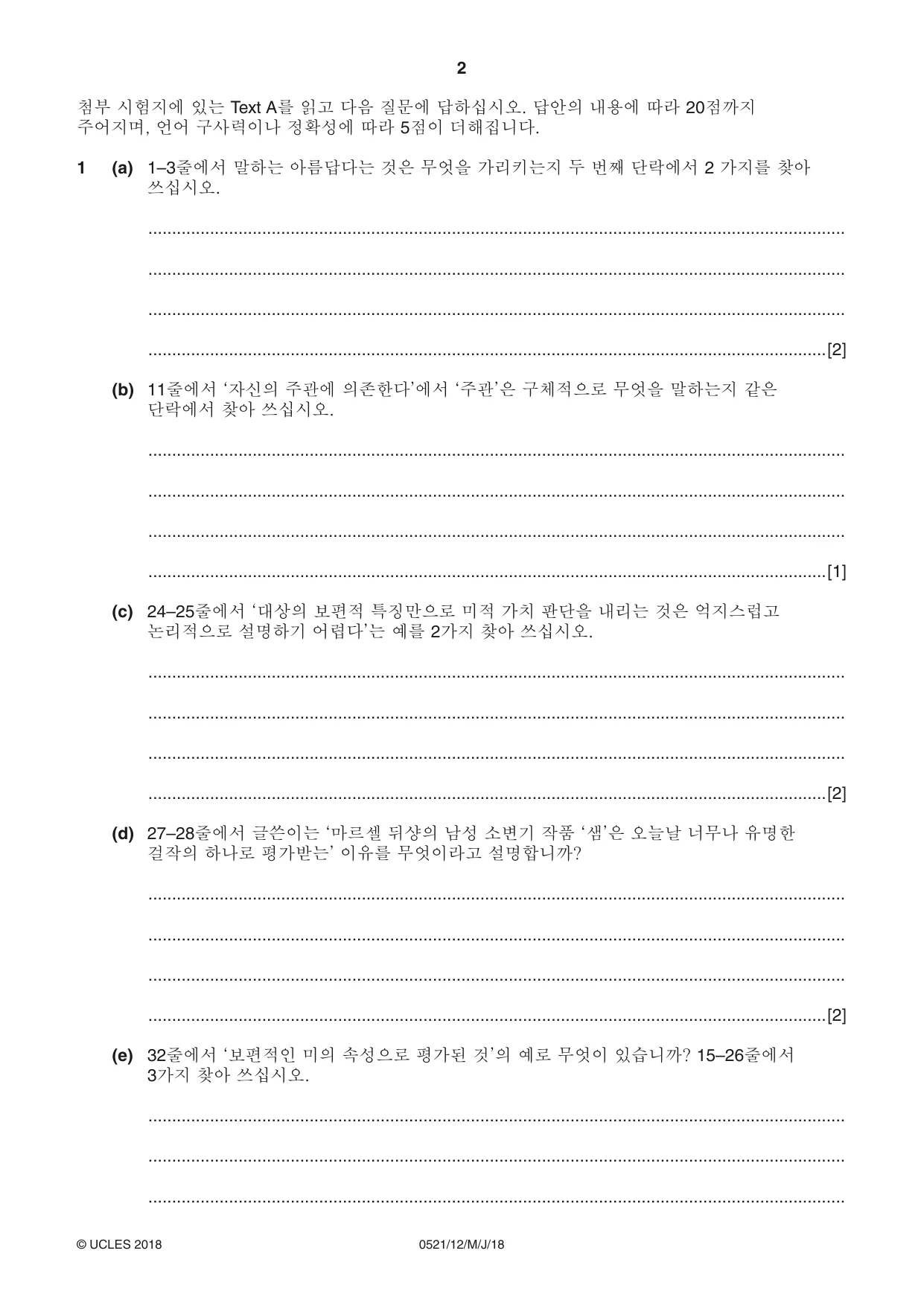
2 0521/12/M/J/18 © UCLES 2018 첨부 시험지에 있는 Text A를 읽고 다음 질문에 답하십시오. 답안의 내용에 따라 20점까지 주어지며, 언어 구사력이나 정확성에 따라 5점이 더해집니다. 1 (a) 1–3줄에서 말하는 아름답다는 것은 무엇을 가리키는지 두 번째 단락에서 2 가지를 찾아 쓰십시오. … … … …[2] (b) 11줄에서 ‘자신의 주관에 의존한다’에서 ‘주관’은 구체적으로 무엇을 말하는지 같은 단락에서 찾아 쓰십시오. … … … …[1] (c) 24–25줄에서 ‘대상의 보편적 특징만으로 미적 가치 판단을 내리는 것은 억지스럽고 논리적으로 설명하기 어렵다’는 예를 2가지 찾아 쓰십시오. … … … …[2] (d) 27–28줄에서 글쓴이는 ‘마르셀 뒤샹의 남성 소변기 작품 ‘샘’은 오늘날 너무나 유명한 걸작의 하나로 평가받는’ 이유를 무엇이라고 설명합니까? … … … …[2] (e) 32줄에서 ‘보편적인 미의 속성으로 평가된 것’의 예로 무엇이 있습니까? 15–26줄에서 3가지 찾아 쓰십시오. … … …
Question paper, page 3
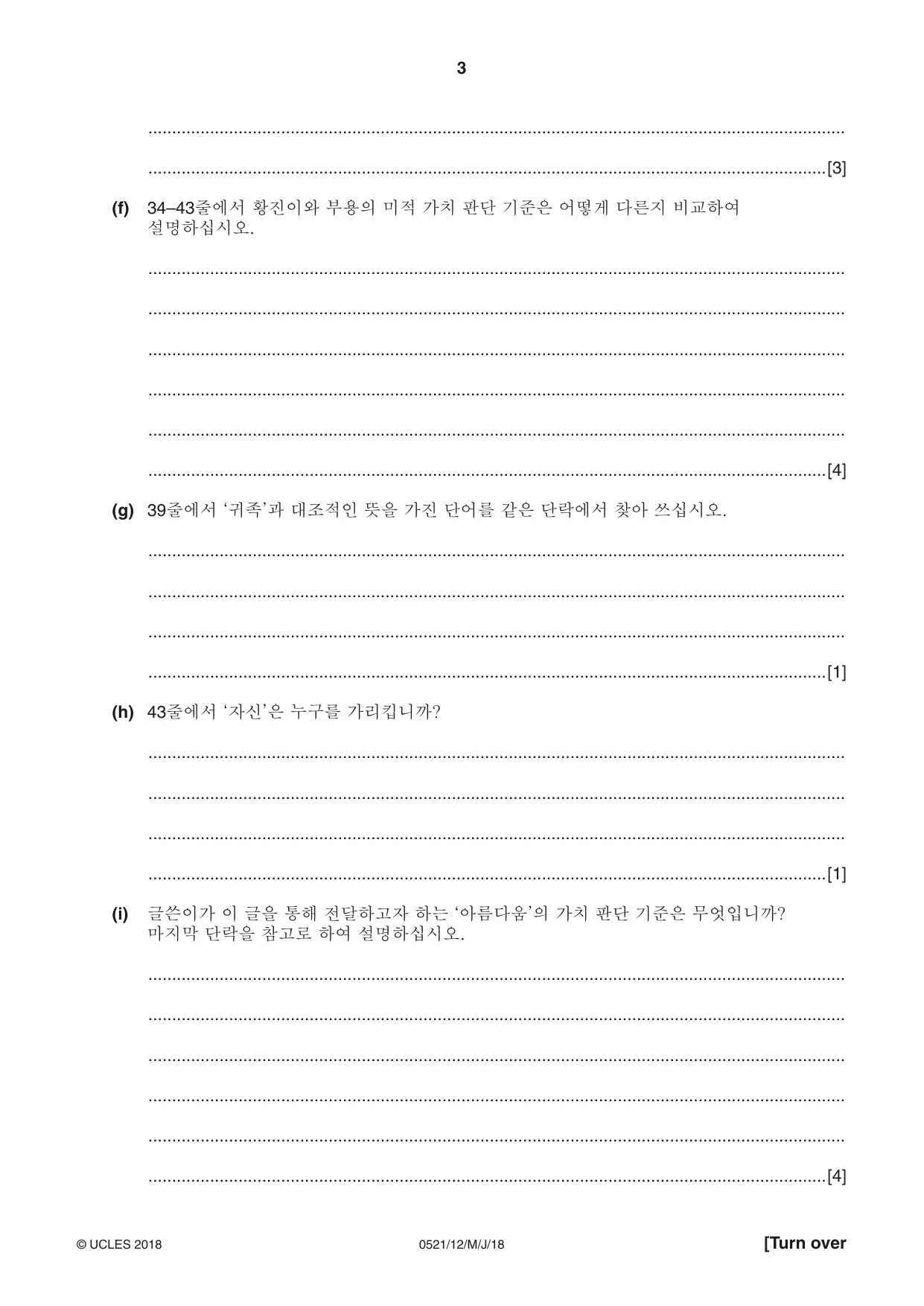
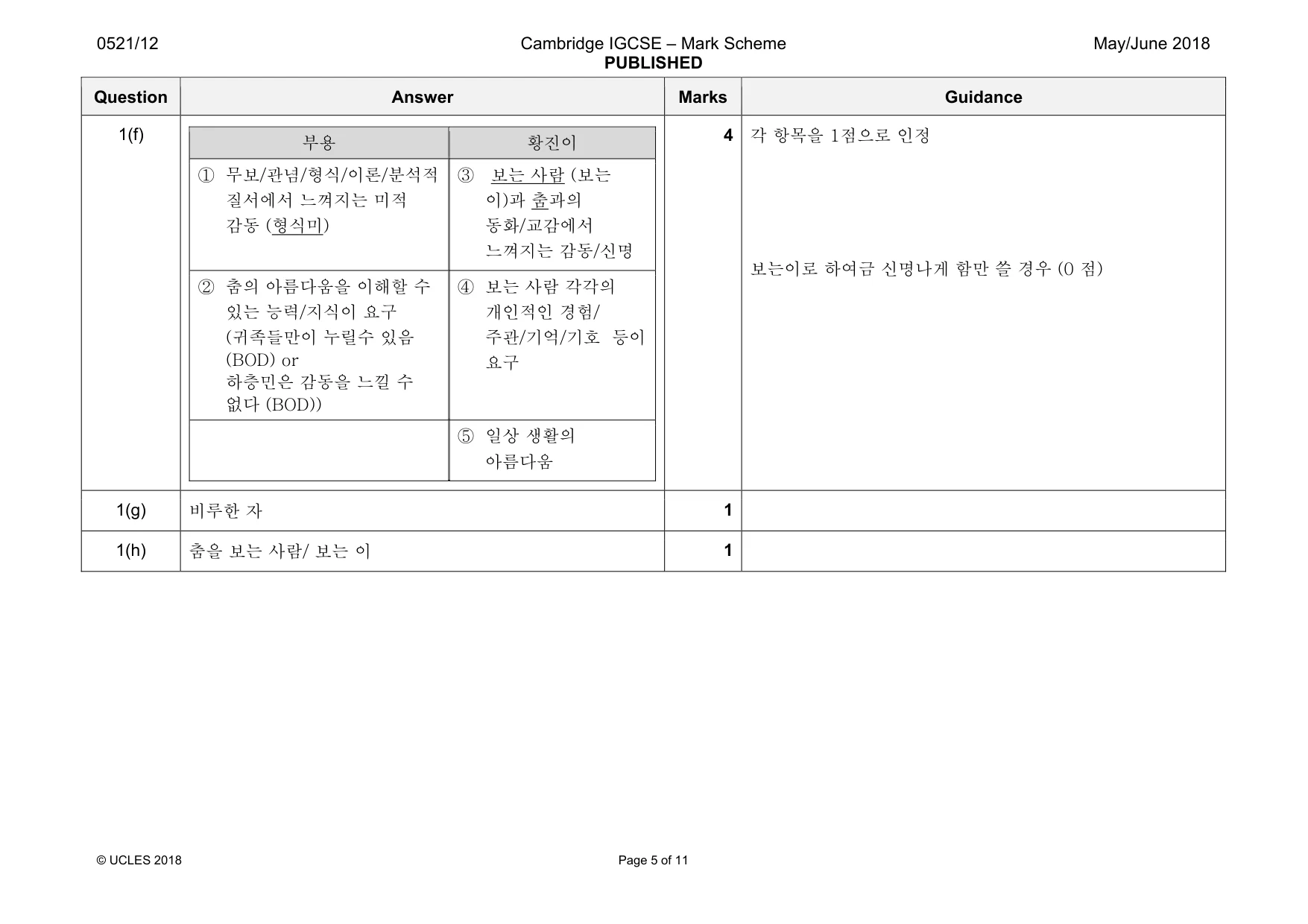
3 0521/12/M/J/18 © UCLES 2018 [Turn over … …[3] (f) 34–43줄에서 황진이와 부용의 미적 가치 판단 기준은 어떻게 다른지 비교하여 설명하십시오. … … … … … …[4] (g) 39줄에서 ‘귀족’과 대조적인 뜻을 가진 단어를 같은 단락에서 찾아 쓰십시오. … … … …[1] (h) 43줄에서 ‘자신’은 누구를 가리킵니까? … … … …[1] (i) 글쓴이가 이 글을 통해 전달하고자 하는 ‘아름다움’의 가치 판단 기준은 무엇입니까? 마지막 단락을 참고로 하여 설명하십시오. … … … … … …[4]
Question paper, page 4
4 0521/12/M/J/18 © UCLES 2018 첨부 시험지에 있는 Text B를 읽고 2번 문제에 답하십시오. 총 25점까지 주어집니다. 답안의 내용에 따라 15점까지 주어지며, 답안의 언어구사력에 따라 추가로 10점이 주어집니다. (문체와 구성에 5점, 언어의 정확성에 5점) 2 Text A Text B Text A와 B는 ‘아름다움’에 대해 설명하고 있습니다. 두 작가가 ‘아름다움’을 바라보는 관점 및 태도를 비교하여 쓰십시오. [25] … … … … … … … … … … … … … … … … … … … … … …
Question paper, page 5
5 0521/12/M/J/18 © UCLES 2018 [Turn over … … … … … … … … … … … … … … … … … … … … … … … … … … … …
Question paper, page 6
6 0521/12/M/J/18 © UCLES 2018 … … … … … … … … … … … … … … … … … … … … … … … … … … … …
Question paper, page 7
7 0521/12/M/J/18 © UCLES 2018 BLANK PAGE
Question paper, page 8
8 0521/12/M/J/18 © UCLES 2018 Permission to reproduce items where third-party owned material protected by copyright is included has been sought and cleared where possible. Every reasonable effort has been made by the publisher (UCLES) to trace copyright holders, but if any items requiring clearance have unwittingly been included, the publisher will be pleased to make amends at the earliest possible opportunity. To avoid the issue of disclosure of answer-related information to candidates, all copyright acknowledgements are reproduced online in the Cambridge International Examinations Copyright Acknowledgements Booklet. This is produced for each series of examinations and is freely available to download at www.cie.org.uk after the live examination series. Cambridge International Examinations is part of the Cambridge Assessment Group. Cambridge Assessment is the brand name of University of Cambridge Local Examinations Syndicate (UCLES), which is itself a department of the University of Cambridge. BLANK PAGE
Mark scheme, page 1
IGCSE™ is a registered trademark. This document consists of 11 printed pages. © UCLES 2018 [Turn over Cambridge Assessment International Education Cambridge International General Certificate of Secondary Education FIRST LANGUAGE KOREAN 0521/12 Paper 1 Reading May/June 2018 MARK SCHEME Maximum Mark: 50 Published This mark scheme is published as an aid to teachers and candidates, to indicate the requirements of the examination. It shows the basis on which Examiners were instructed to award marks. It does not indicate the details of the discussions that took place at an Examiners’ meeting before marking began, which would have considered the acceptability of alternative answers. Mark schemes should be read in conjunction with the question paper and the Principal Examiner Report for Teachers. Cambridge International will not enter into discussions about these mark schemes. Cambridge International is publishing the mark schemes for the May/June 2018 series for most Cambridge IGCSE™, Cambridge International A and AS Level and Cambridge Pre-U components, and some Cambridge O Level components.
Mark scheme, page 2
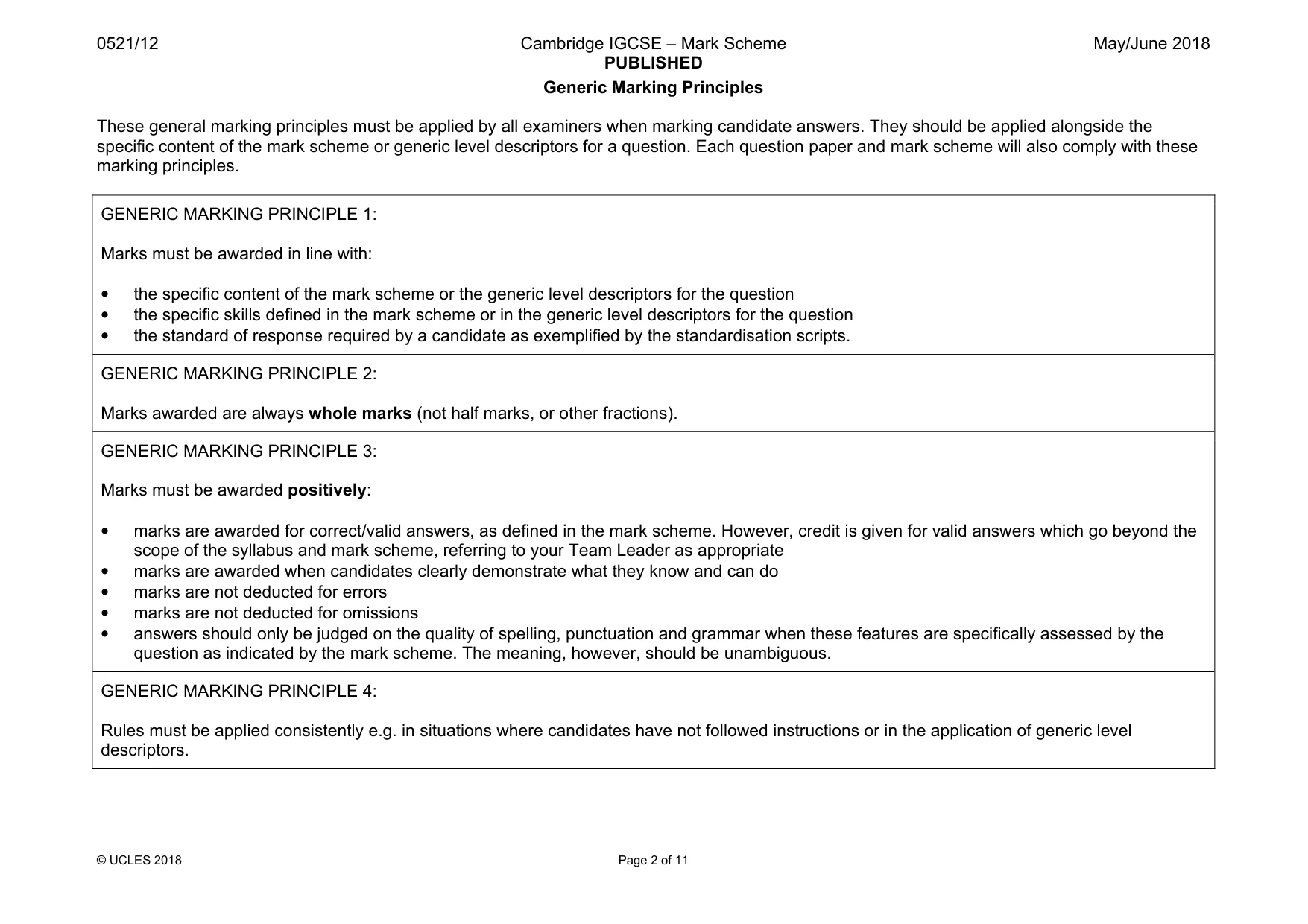
0521/12 Cambridge IGCSE – Mark Scheme PUBLISHED May/June 2018 © UCLES 2018 Page 2 of 11 Generic Marking Principles These general marking principles must be applied by all examiners when marking candidate answers. They should be applied alongside the specific content of the mark scheme or generic level descriptors for a question. Each question paper and mark scheme will also comply with these marking principles. GENERIC MARKING PRINCIPLE 1: Marks must be awarded in line with: • the specific content of the mark scheme or the generic level descriptors for the question • the specific skills defined in the mark scheme or in the generic level descriptors for the question • the standard of response required by a candidate as exemplified by the standardisation scripts. GENERIC MARKING PRINCIPLE 2: Marks awarded are always whole marks (not half marks, or other fractions). GENERIC MARKING PRINCIPLE 3: Marks must be awarded positively: • marks are awarded for correct/valid answers, as defined in the mark scheme. However, credit is given for valid answers which go beyond the scope of the syllabus and mark scheme, referring to your Team Leader as appropriate • marks are awarded when candidates clearly demonstrate what they know and can do • marks are not deducted for errors • marks are not deducted for omissions • answers should only be judged on the quality of spelling, punctuation and grammar when these features are specifically assessed by the question as indicated by the mark scheme. The meaning, however, should be unambiguous. GENERIC MARKING PRINCIPLE 4: Rules must be applied consistently e.g. in situations where candidates have not followed instructions or in the application of generic level descriptors.
Mark scheme, page 3
0521/12 Cambridge IGCSE – Mark Scheme PUBLISHED May/June 2018 © UCLES 2018 Page 3 of 11 GENERIC MARKING PRINCIPLE 5: Marks should be awarded using the full range of marks defined in the mark scheme for the question (however; the use of the full mark range may be limited according to the quality of the candidate responses seen). GENERIC MARKING PRINCIPLE 6: Marks awarded are based solely on the requirements as defined in the mark scheme. Marks should not be awarded with grade thresholds or grade descriptors in mind.
Mark scheme, page 4
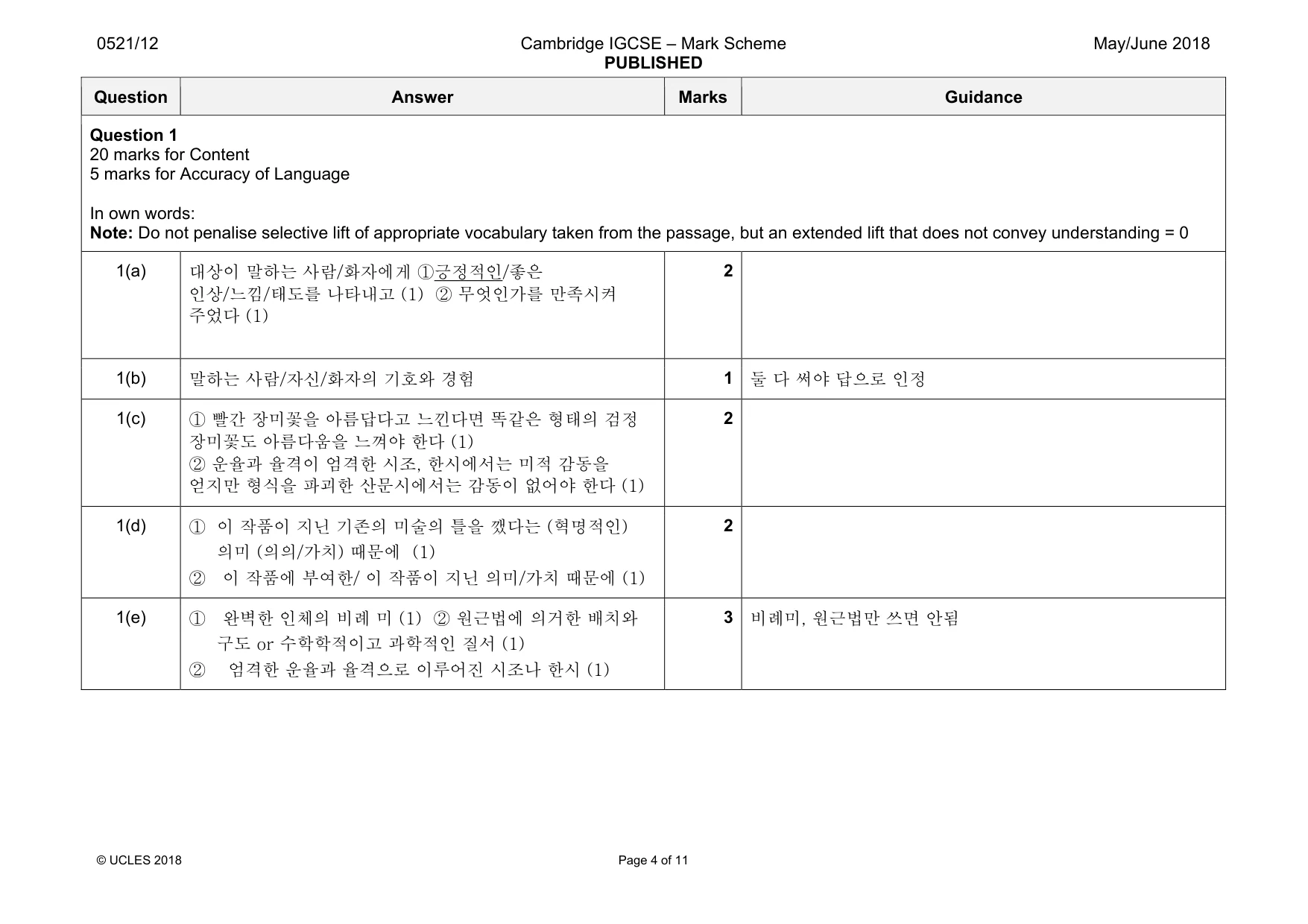
0521/12 Cambridge IGCSE – Mark Scheme PUBLISHED May/June 2018 © UCLES 2018 Page 4 of 11 Question Answer Marks Guidance Question 1 20 marks for Content 5 marks for Accuracy of Language In own words: Note: Do not penalise selective lift of appropriate vocabulary taken from the passage, but an extended lift that does not convey understanding = 0 1(a) 대상이 말하는 사람/화자에게 ①긍정적인/좋은 인상/느낌/태도를 나타내고 (1) ② 무엇인가를 만족시켜 주었다 (1) 2 1(b) 말하는 사람/자신/화자의 기호와 경험 1 둘 다 써야 답으로 인정 1(c) ① 빨간 장미꽃을 아름답다고 느낀다면 똑같은 형태의 검정 장미꽃도 아름다움을 느껴야 한다 (1) ② 운율과 율격이 엄격한 시조, 한시에서는 미적 감동을 얻지만 형식을 파괴한 산문시에서는 감동이 없어야 한다 (1) 2 1(d) ① 이 작품이 지닌 기존의 미술의 틀을 깼다는 (혁명적인) 의미 (의의/가치) 때문에 (1) ② 이 작품에 부여한/ 이 작품이 지닌 의미/가치 때문에 (1) 2 1(e) ① 완벽한 인체의 비례 미 (1) ② 원근법에 의거한 배치와 구도 or 수학학적이고 과학적인 질서 (1) ② 엄격한 운율과 율격으로 이루어진 시조나 한시 (1) 3 비례미, 원근법만 쓰면 안됨
Mark scheme, page 5
0521/12 Cambridge IGCSE – Mark Scheme PUBLISHED May/June 2018 © UCLES 2018 Page 5 of 11 Question Answer Marks Guidance 1(f) 부용 황진이 ① 무보/관념/형식/이론/분석적 질서에서 느껴지는 미적 감동 (형식미) ③ 보는 사람 (보는 이)과 춤과의 동화/교감에서 느껴지는 감동/신명 ② 춤의 아름다움을 이해할 수 있는 능력/지식이 요구 (귀족들만이 누릴수 있음 (BOD) or 하층민은 감동을 느낄 수 없다 (BOD)) ④ 보는 사람 각각의 개인적인 경험/ 주관/기억/기호 등이 요구 ⑤ 일상 생활의 아름다움 4 각 항목을 1점으로 인정 보는이로 하여금 신명나게 함만 쓸 경우 (0 점) 1(g) 비루한 자 1 1(h) 춤을 보는 사람/ 보는 이 1
Mark scheme, page 6
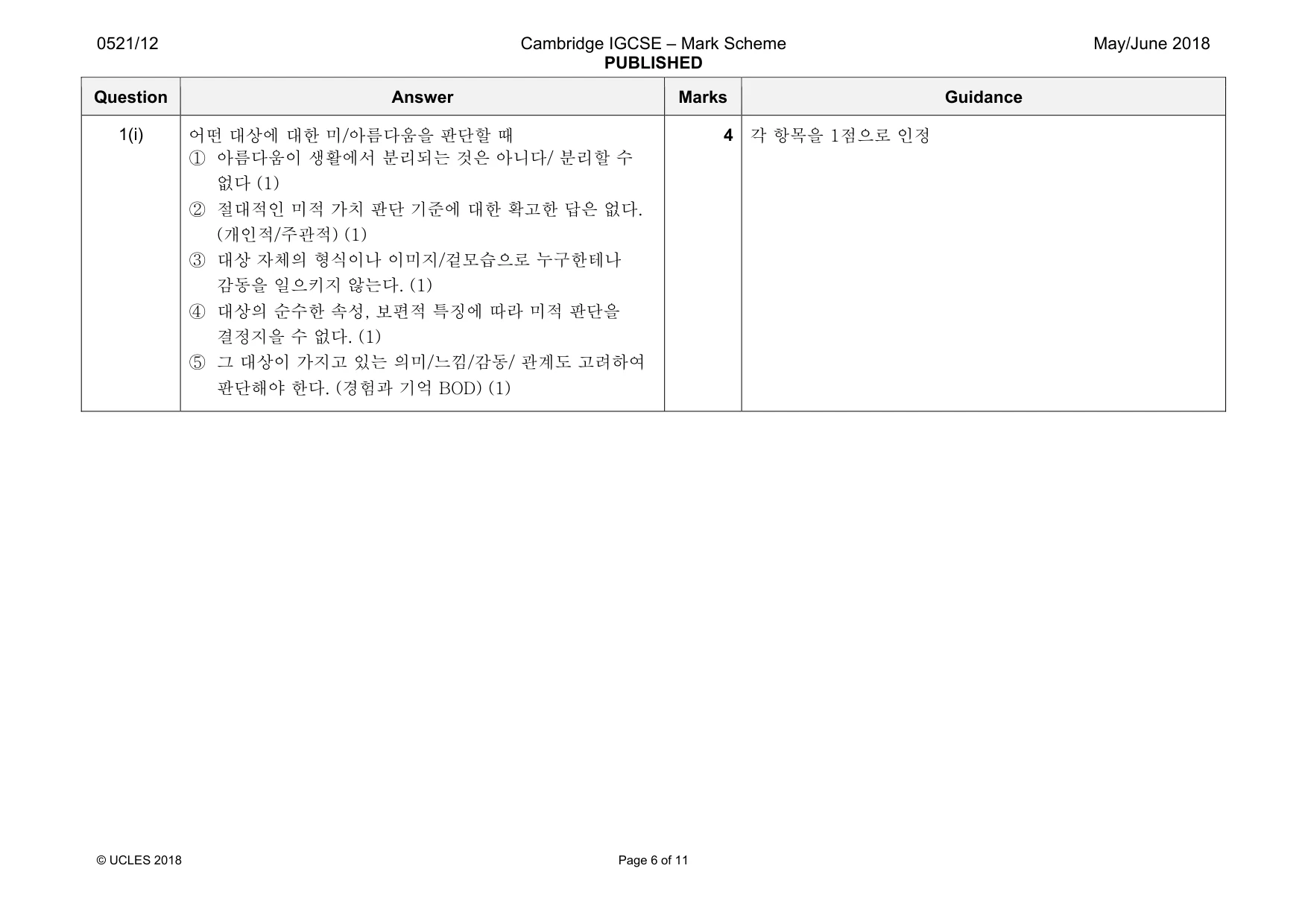
0521/12 Cambridge IGCSE – Mark Scheme PUBLISHED May/June 2018 © UCLES 2018 Page 6 of 11 Question Answer Marks Guidance 1(i) 어떤 대상에 대한 미/아름다움을 판단할 때 ① 아름다움이 생활에서 분리되는 것은 아니다/ 분리할 수 없다 (1) ② 절대적인 미적 가치 판단 기준에 대한 확고한 답은 없다. (개인적/주관적) (1) ③ 대상 자체의 형식이나 이미지/겉모습으로 누구한테나 감동을 일으키지 않는다. (1) ④ 대상의 순수한 속성, 보편적 특징에 따라 미적 판단을 결정지을 수 없다. (1) ⑤ 그 대상이 가지고 있는 의미/느낌/감동/ 관계도 고려하여 판단해야 한다. (경험과 기억 BOD) (1) 4 각 항목을 1점으로 인정
Mark scheme, page 7
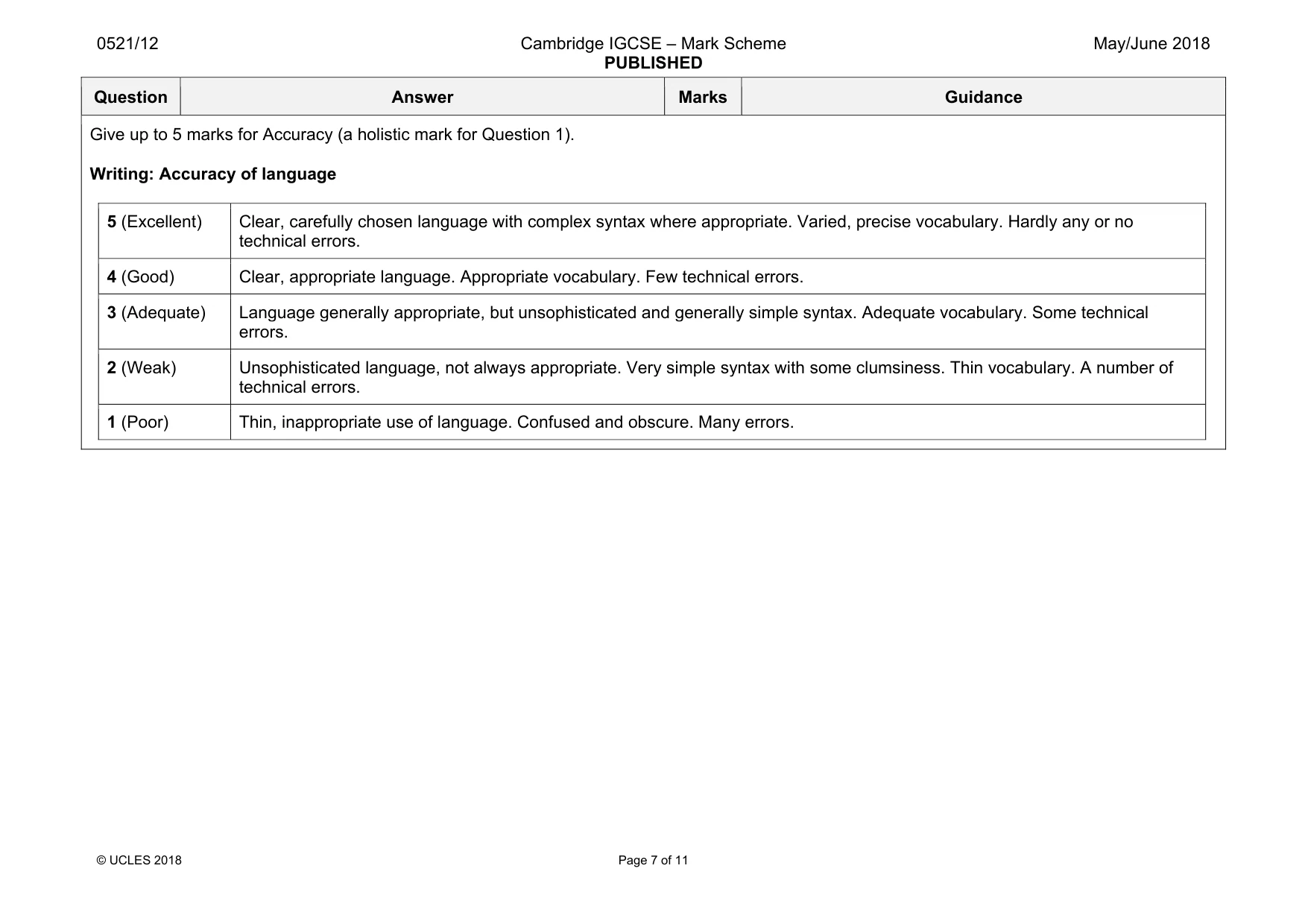
0521/12 Cambridge IGCSE – Mark Scheme PUBLISHED May/June 2018 © UCLES 2018 Page 7 of 11 Question Answer Marks Guidance Give up to 5 marks for Accuracy (a holistic mark for Question 1). Writing: Accuracy of language 5 (Excellent) Clear, carefully chosen language with complex syntax where appropriate. Varied, precise vocabulary. Hardly any or no technical errors. 4 (Good) Clear, appropriate language. Appropriate vocabulary. Few technical errors. 3 (Adequate) Language generally appropriate, but unsophisticated and generally simple syntax. Adequate vocabulary. Some technical errors. 2 (Weak) Unsophisticated language, not always appropriate. Very simple syntax with some clumsiness. Thin vocabulary. A number of technical errors. 1 (Poor) Thin, inappropriate use of language. Confused and obscure. Many errors.
Mark scheme, page 8
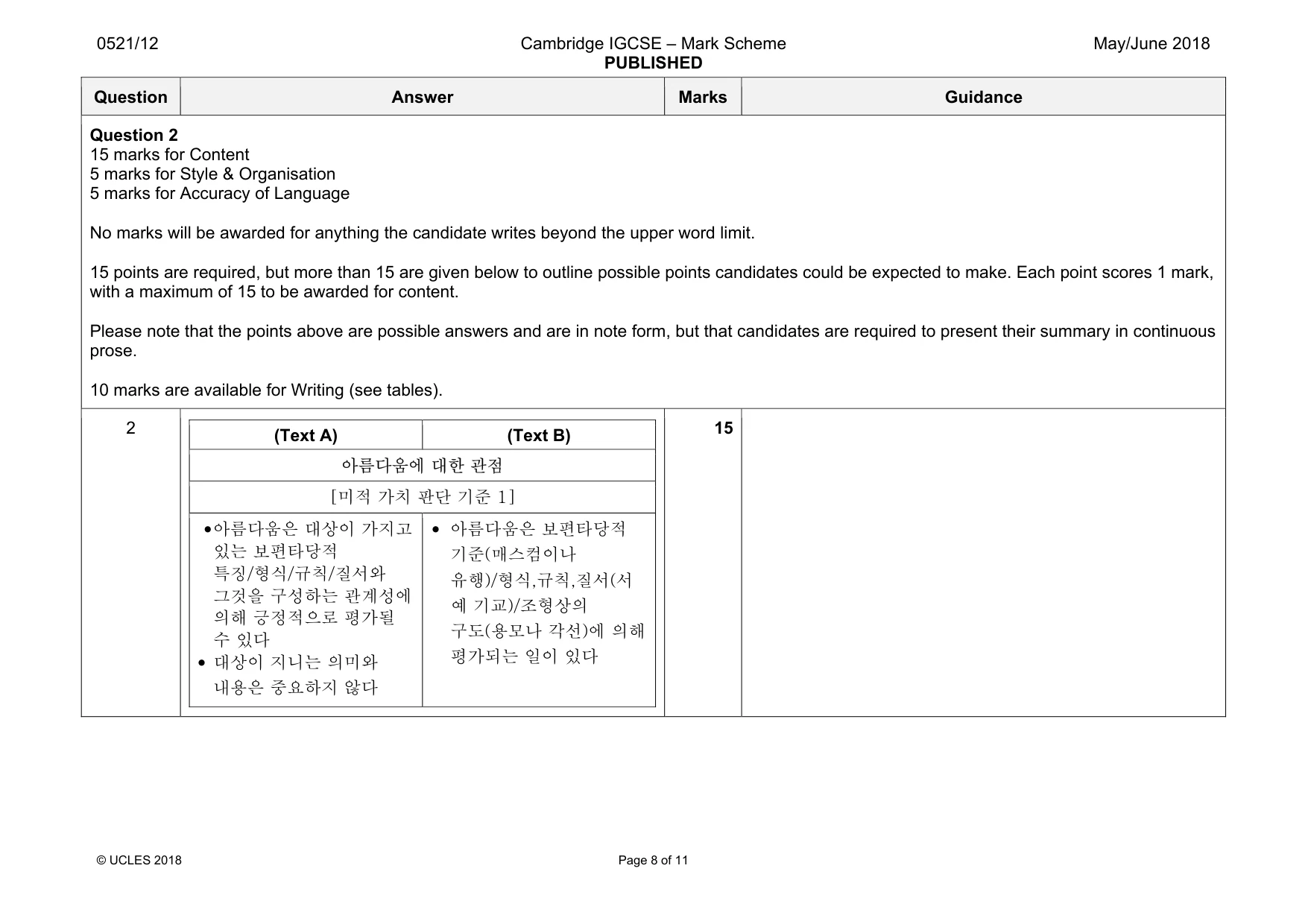
0521/12 Cambridge IGCSE – Mark Scheme PUBLISHED May/June 2018 © UCLES 2018 Page 8 of 11 Question Answer Marks Guidance Question 2 15 marks for Content 5 marks for Style & Organisation 5 marks for Accuracy of Language No marks will be awarded for anything the candidate writes beyond the upper word limit. 15 points are required, but more than 15 are given below to outline possible points candidates could be expected to make. Each point scores 1 mark, with a maximum of 15 to be awarded for content. Please note that the points above are possible answers and are in note form, but that candidates are required to present their summary in continuous prose. 10 marks are available for Writing (see tables). 2 (Text A) (Text B) 아름다움에 대한 관점 [미적 가치 판단 기준 1] • 아름다움은 대상이 가지고 있는 보편타당적 특징/형식/규칙/질서와 그것을 구성하는 관계성에 의해 긍정적으로 평가될 수 있다 • 대상이 지니는 의미와 내용은 중요하지 않다 • 아름다움은 보편타당적 기준(매스컴이나 유행)/형식,규칙,질서(서 예 기교)/조형상의 구도(용모나 각선)에 의해 평가되는 일이 있다 15
Mark scheme, page 9
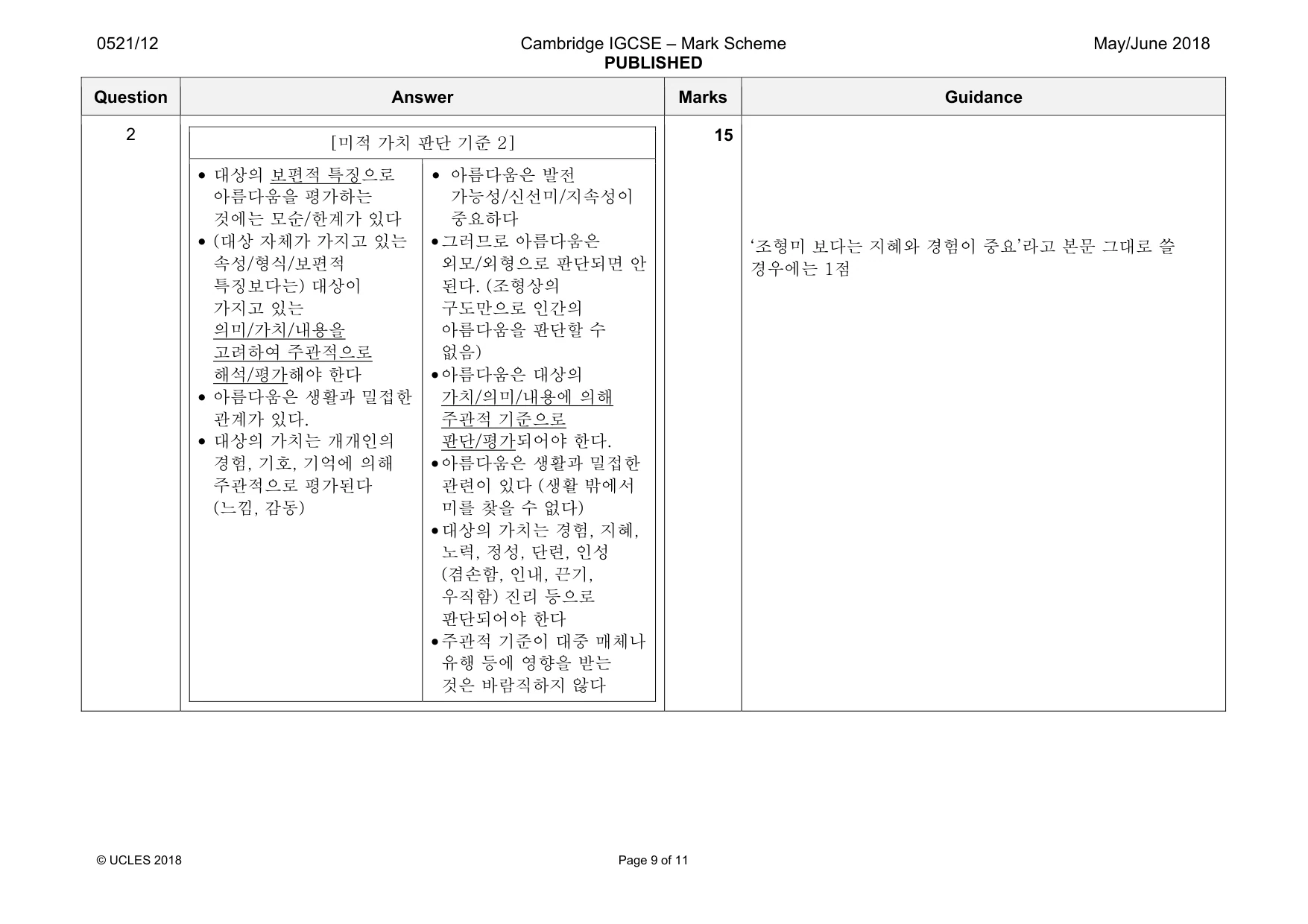
0521/12 Cambridge IGCSE – Mark Scheme PUBLISHED May/June 2018 © UCLES 2018 Page 9 of 11 Question Answer Marks Guidance 2 [미적 가치 판단 기준 2] • 대상의 보편적 특징으로 아름다움을 평가하는 것에는 모순/한계가 있다 • (대상 자체가 가지고 있는 속성/형식/보편적 특징보다는) 대상이 가지고 있는 의미/가치/내용을 고려하여 주관적으로 해석/평가해야 한다 • 아름다움은 생활과 밀접한 관계가 있다. • 대상의 가치는 개개인의 경험, 기호, 기억에 의해 주관적으로 평가된다 (느낌, 감동) • 아름다움은 발전 가능성/신선미/지속성이 중요하다 • 그러므로 아름다움은 외모/외형으로 판단되면 안 된다. (조형상의 구도만으로 인간의 아름다움을 판단할 수 없음) • 아름다움은 대상의 가치/의미/내용에 의해 주관적 기준으로 판단/평가되어야 한다. • 아름다움은 생활과 밀접한 관련이 있다 (생활 밖에서 미를 찾을 수 없다) • 대상의 가치는 경험, 지혜, 노력, 정성, 단련, 인성 (겸손함, 인내, 끈기, 우직함) 진리 등으로 판단되어야 한다 • 주관적 기준이 대중 매체나 유행 등에 영향을 받는 것은 바람직하지 않다 15 ‘조형미 보다는 지혜와 경험이 중요’라고 본문 그대로 쓸 경우에는 1점
Mark scheme, page 10
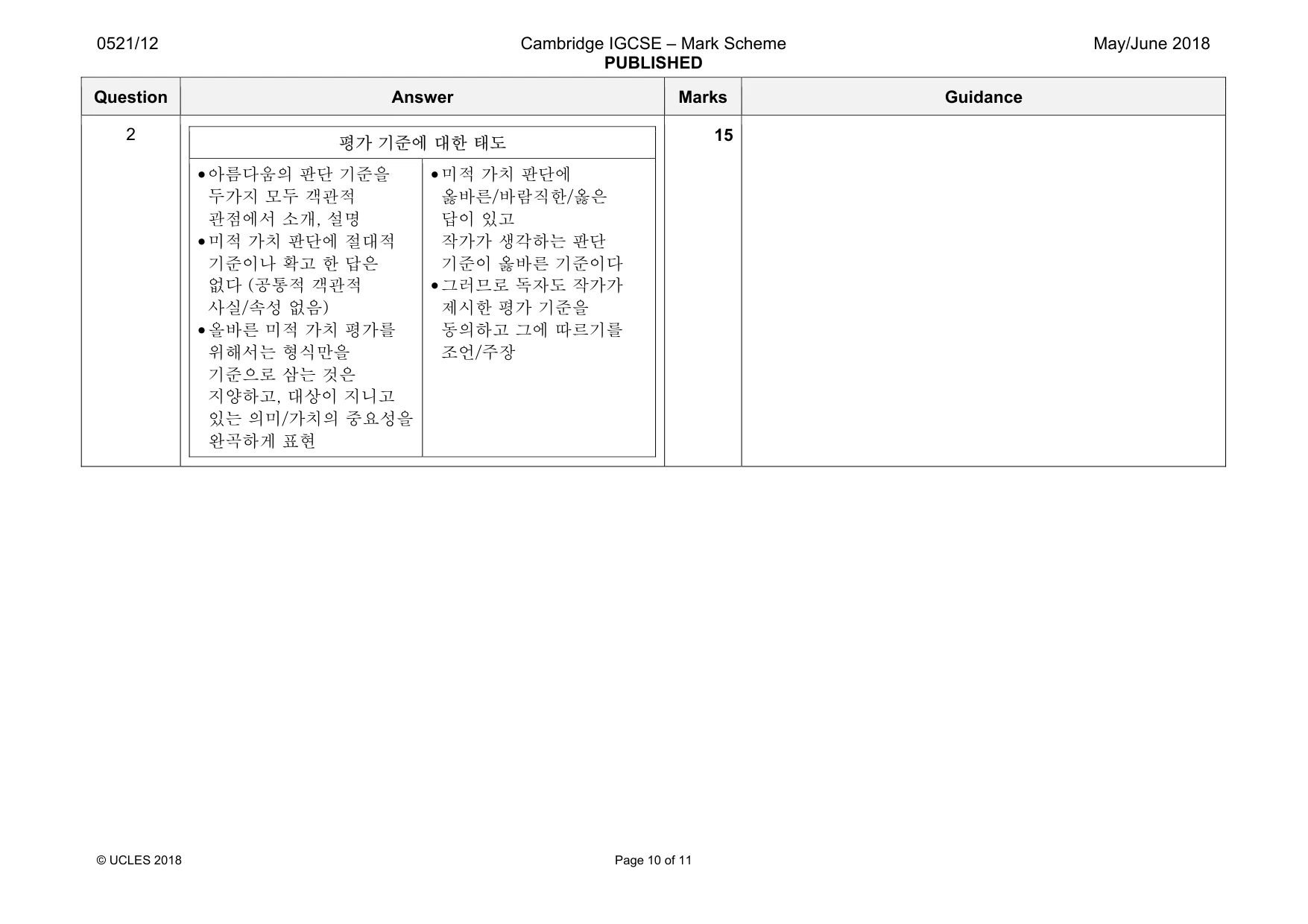
0521/12 Cambridge IGCSE – Mark Scheme PUBLISHED May/June 2018 © UCLES 2018 Page 10 of 11 Question Answer Marks Guidance 2 평가 기준에 대한 태도 • 아름다움의 판단 기준을 두가지 모두 객관적 관점에서 소개, 설명 • 미적 가치 판단에 절대적 기준이나 확고 한 답은 없다 (공통적 객관적 사실/속성 없음) • 올바른 미적 가치 평가를 위해서는 형식만을 기준으로 삼는 것은 지양하고, 대상이 지니고 있는 의미/가치의 중요성을 완곡하게 표현 • 미적 가치 판단에 옳바른/바람직한/옳은 답이 있고 작가가 생각하는 판단 기준이 옳바른 기준이다 • 그러므로 독자도 작가가 제시한 평가 기준을 동의하고 그에 따르기를 조언/주장 15
Mark scheme, page 11
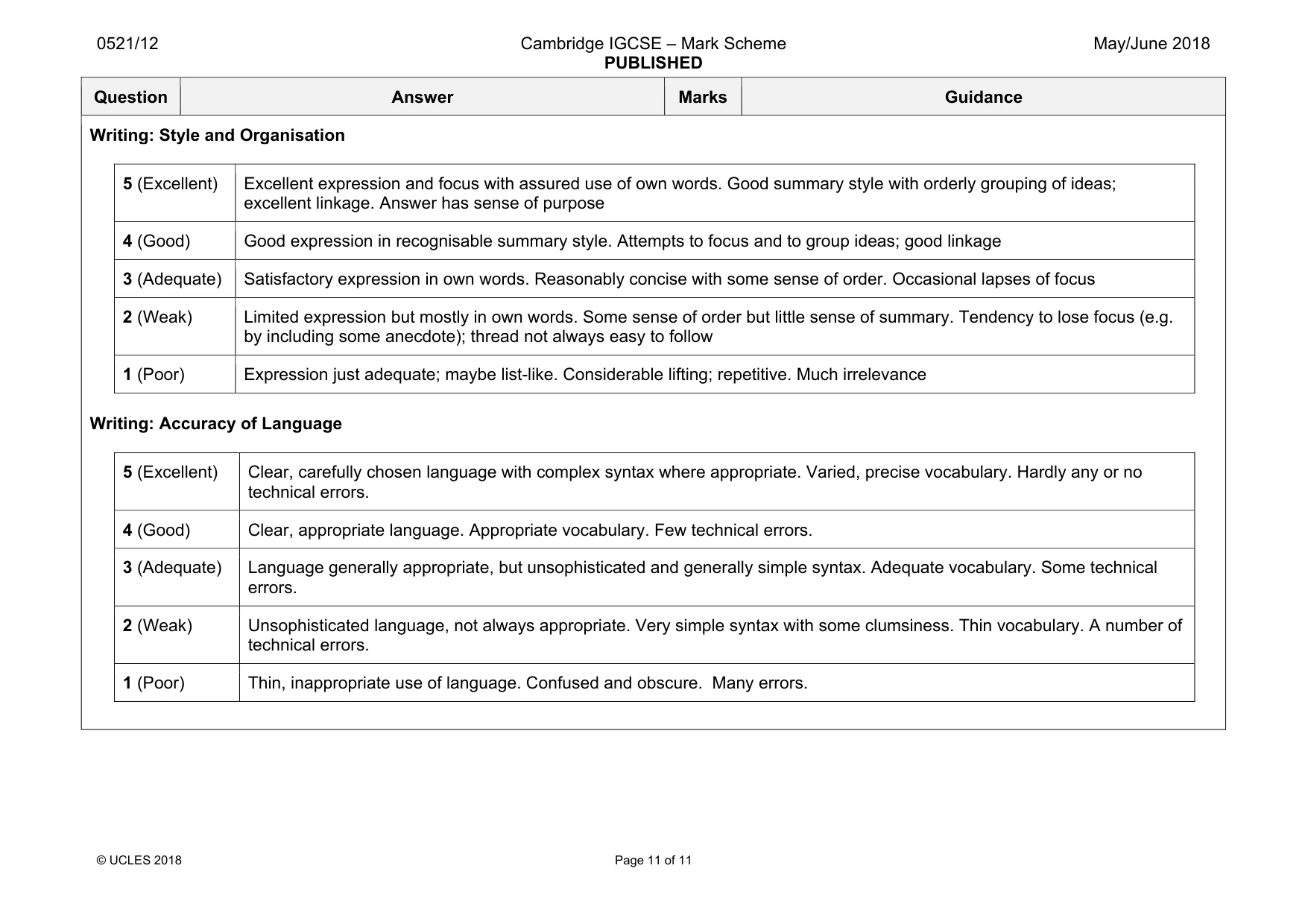
0521/12 Cambridge IGCSE – Mark Scheme PUBLISHED May/June 2018 © UCLES 2018 Page 11 of 11 Question Answer Marks Guidance Writing: Style and Organisation 5 (Excellent) Excellent expression and focus with assured use of own words. Good summary style with orderly grouping of ideas; excellent linkage. Answer has sense of purpose 4 (Good) Good expression in recognisable summary style. Attempts to focus and to group ideas; good linkage 3 (Adequate) Satisfactory expression in own words. Reasonably concise with some sense of order. Occasional lapses of focus 2 (Weak) Limited expression but mostly in own words. Some sense of order but little sense of summary. Tendency to lose focus (e.g. by including some anecdote); thread not always easy to follow 1 (Poor) Expression just adequate; maybe list-like. Considerable lifting; repetitive. Much irrelevance Writing: Accuracy of Language 5 (Excellent) Clear, carefully chosen language with complex syntax where appropriate. Varied, precise vocabulary. Hardly any or no technical errors. 4 (Good) Clear, appropriate language. Appropriate vocabulary. Few technical errors. 3 (Adequate) Language generally appropriate, but unsophisticated and generally simple syntax. Adequate vocabulary. Some technical errors. 2 (Weak) Unsophisticated language, not always appropriate. Very simple syntax with some clumsiness. Thin vocabulary. A number of technical errors. 1 (Poor) Thin, inappropriate use of language. Confused and obscure. Many errors.
What you needed in this session
Cambridge’s own grade thresholds for 2018 May/June, Paper 1 · Variant 2. A higher threshold means an easier paper — the bar moves with how the cohort did.