Cambridge IGCSE Islamiyat 0493 — 2022 Oct/Nov Paper 2 · Variant 2
0493/22/O/N/22 · 50 marks · ≈56 min
The question paper and its mark scheme, free to read here and free to download. This is Cambridge’s own paper, exactly as it was sat.
Question paper16 pages










Mark scheme11 pages
Answers below. Sit the paper first if you are practising.
Paper as text
Question paper, page 1
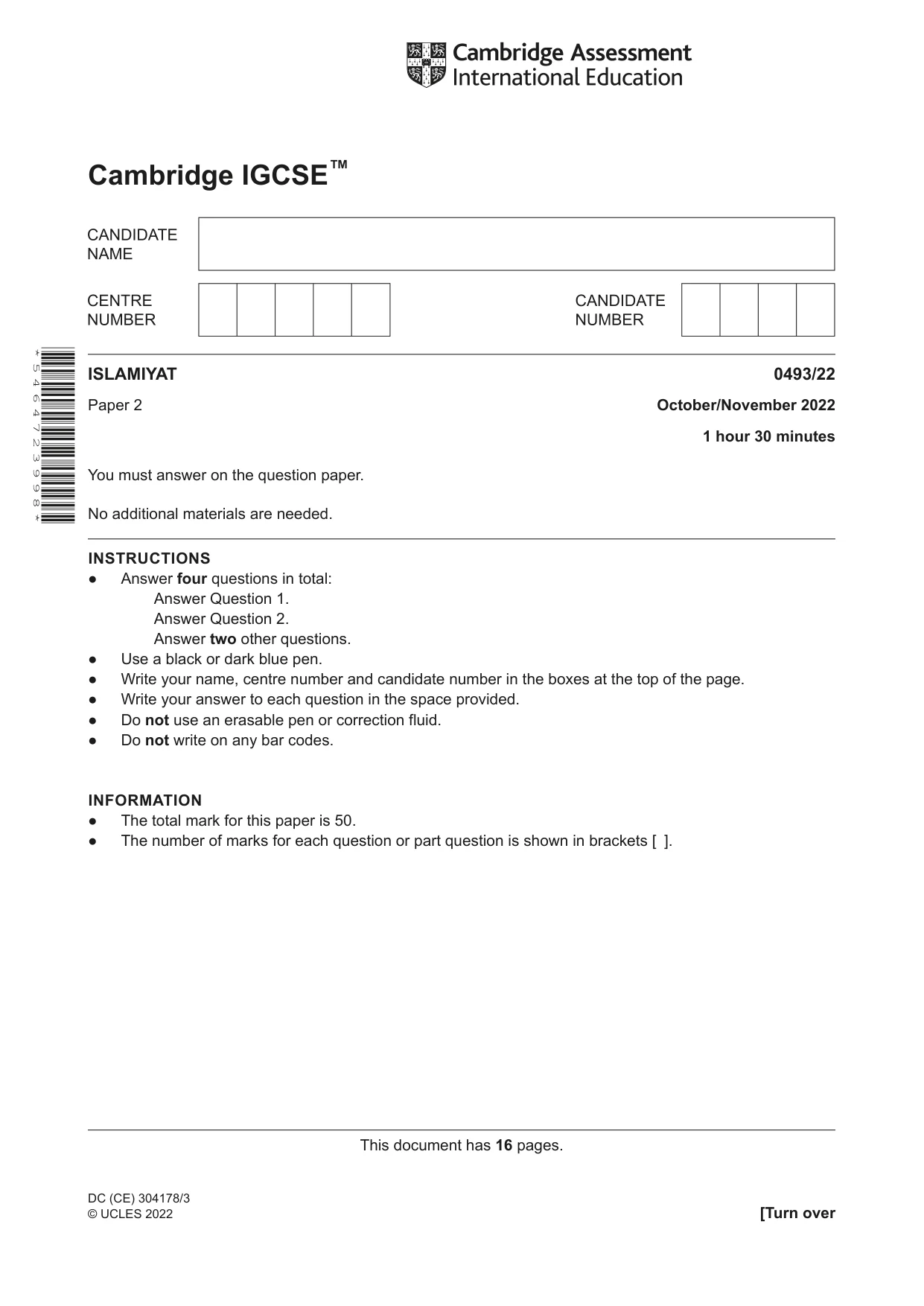
This document has 16 pages. [Turn over Cambridge IGCSE™ DC (CE) 304178/3 © UCLES 2022 ISLAMIYAT 0493/22 Paper 2 October/November 2022 1 hour 30 minutes You must answer on the question paper. No additional materials are needed. INSTRUCTIONS ● Answer four questions in total: Answer Question 1. Answer Question 2. Answer two other questions. ● Use a black or dark blue pen. ● Write your name, centre number and candidate number in the boxes at the top of the page. ● Write your answer to each question in the space provided. ● Do not use an erasable pen or correction fluid. ● Do not write on any bar codes. INFORMATION ● The total mark for this paper is 50. ● The number of marks for each question or part question is shown in brackets [ ]. * 5 4 6 4 7 2 3 9 9 8 *
Question paper, page 2
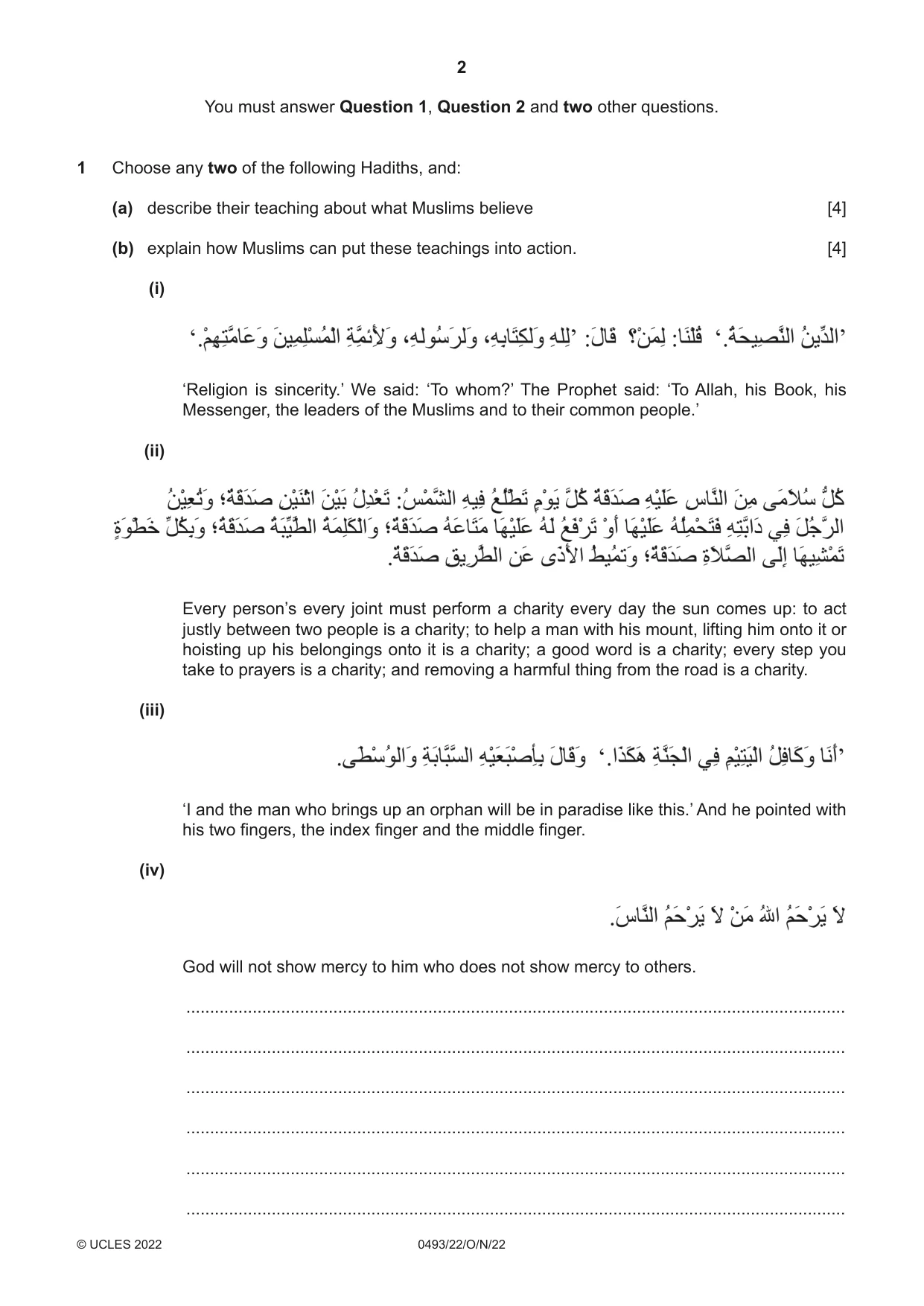
2 0493/22/O/N/22 © UCLES 2022 You must answer Question 1, Question 2 and two other questions. 1 Choose any two of the following Hadiths, and: (a) describe their teaching about what Muslims believe [4] (b) explain how Muslims can put these teachings into action. [4] (i) ‘Religion is sincerity.’ We said: ‘To whom?’ The Prophet said: ‘To Allah, his Book, his Messenger, the leaders of the Muslims and to their common people.’ (ii) Every person’s every joint must perform a charity every day the sun comes up: to act justly between two people is a charity; to help a man with his mount, lifting him onto it or hoisting up his belongings onto it is a charity; a good word is a charity; every step you take to prayers is a charity; and removing a harmful thing from the road is a charity. (iii) ‘I and the man who brings up an orphan will be in paradise like this.’ And he pointed with his two fingers, the index finger and the middle finger. (iv) God will not show mercy to him who does not show mercy to others. … … … … … …
Question paper, page 3
3 0493/22/O/N/22 © UCLES 2022 [Turn over … … … … … … … … … … … … … … … … … … … … … … … … … … … …
Question paper, page 4
4 0493/22/O/N/22 © UCLES 2022 … … … … … … … … … … … … … … … … … … … … … … … … … … … …
Question paper, page 5
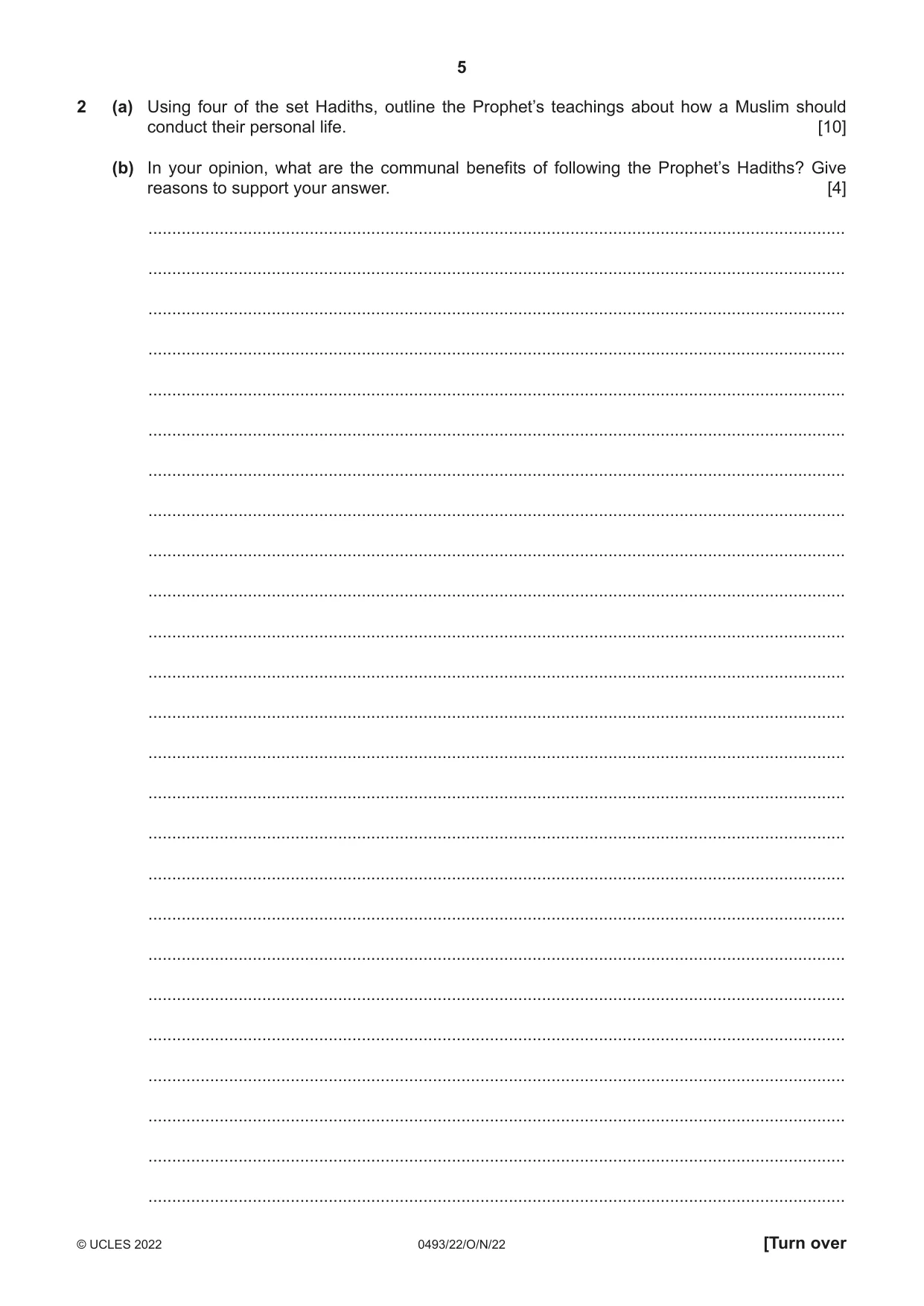
5 0493/22/O/N/22 © UCLES 2022 [Turn over 2 (a) Using four of the set Hadiths, outline the Prophet’s teachings about how a Muslim should conduct their personal life. [10] (b) In your opinion, what are the communal benefits of following the Prophet’s Hadiths? Give reasons to support your answer. [4] … … … … … … … … … … … … … … … … … … … … … … … … …
Question paper, page 6
6 0493/22/O/N/22 © UCLES 2022 … … … … … … … … … … … … … … … … … … … … … … … … … … … …
Question paper, page 7
7 0493/22/O/N/22 © UCLES 2022 [Turn over … … … … … … … … … … … … … … … … … … … … … … … … … … … …
Question paper, page 8
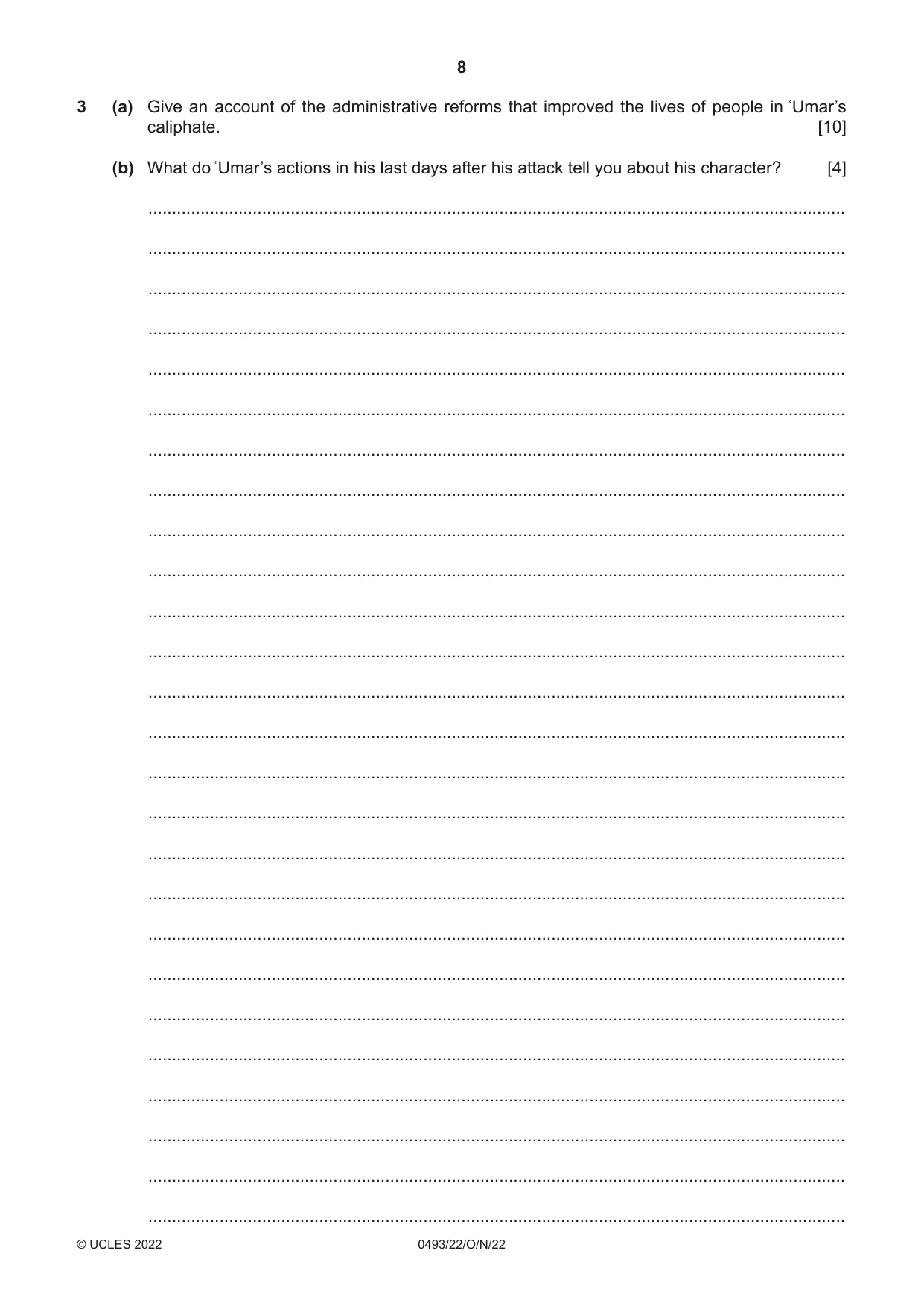
8 0493/22/O/N/22 © UCLES 2022 3 (a) Give an account of the administrative reforms that improved the lives of people in ͑ Umar’s caliphate. [10] (b) What do ͑ Umar’s actions in his last days after his attack tell you about his character? [4] … … … … … … … … … … … … … … … … … … … … … … … … … …
Question paper, page 9
9 0493/22/O/N/22 © UCLES 2022 [Turn over … … … … … … … … … … … … … … … … … … … … … … … … … … … …
Question paper, page 10
10 0493/22/O/N/22 © UCLES 2022 … … … … … … … … … … … … … … … … … … … … … … … … … … … …
Question paper, page 11
11 0493/22/O/N/22 © UCLES 2022 [Turn over 4 (a) Give an account of the ways Muslims can practise jihad peacefully in their daily lives. [10] (b) In your opinion, how do Muslims benefit from practising jihad in their daily lives? [4] … … … … … … … … … … … … … … … … … … … … … … … … … …
Question paper, page 12
12 0493/22/O/N/22 © UCLES 2022 … … … … … … … … … … … … … … … … … … … … … … … … … … … …
Question paper, page 13
13 0493/22/O/N/22 © UCLES 2022 [Turn over … … … … … … … … … … … … … … … … … … … … … … … … … … … …
Question paper, page 14
14 0493/22/O/N/22 © UCLES 2022 5 (a) Give a descriptive account of Muslim belief in life after death and the Day of Judgement. [10] (b) How does the belief in life after death affect the daily lives of Muslims? [4] … … … … … … … … … … … … … … … … … … … … … … … … … …
Question paper, page 15
15 0493/22/O/N/22 © UCLES 2022 [Turn over … … … … … … … … … … … … … … … … … … … … … … … … … … … …
Question paper, page 16
16 0493/22/O/N/22 © UCLES 2022 Permission to reproduce items where third-party owned material protected by copyright is included has been sought and cleared where possible. Every reasonable effort has been made by the publisher (UCLES) to trace copyright holders, but if any items requiring clearance have unwittingly been included, the publisher will be pleased to make amends at the earliest possible opportunity. To avoid the issue of disclosure of answer-related information to candidates, all copyright acknowledgements are reproduced online in the Cambridge Assessment International Education Copyright Acknowledgements Booklet. This is produced for each series of examinations and is freely available to download at www.cambridgeinternational.org after the live examination series. Cambridge Assessment International Education is part of Cambridge Assessment. Cambridge Assessment is the brand name of the University of Cambridge Local Examinations Syndicate (UCLES), which is a department of the University of Cambridge. … … … … … … … … … … … … … … … … … … … … … … … …
Mark scheme, page 1
This document consists of 11 printed pages. © UCLES 2022 [Turn over Cambridge IGCSE™ ISLAMIYAT 0493/22 Paper 2 October/November 2022 MARK SCHEME Maximum Mark: 50 Published This mark scheme is published as an aid to teachers and candidates, to indicate the requirements of the examination. It shows the basis on which Examiners were instructed to award marks. It does not indicate the details of the discussions that took place at an Examiners’ meeting before marking began, which would have considered the acceptability of alternative answers. Mark schemes should be read in conjunction with the question paper and the Principal Examiner Report for Teachers. Cambridge International will not enter into discussions about these mark schemes. Cambridge International is publishing the mark schemes for the October/November 2022 series for most Cambridge IGCSE™, Cambridge International A and AS Level components and some Cambridge O Level components.
Mark scheme, page 2
0493/22 Cambridge IGCSE – Mark Scheme PUBLISHED October/November 2022 © UCLES 2022 Page 2 of 11 Generic Marking Principles These general marking principles must be applied by all examiners when marking candidate answers. They should be applied alongside the specific content of the mark scheme or generic level descriptors for a question. Each question paper and mark scheme will also comply with these marking principles. GENERIC MARKING PRINCIPLE 1: Marks must be awarded in line with: • the specific content of the mark scheme or the generic level descriptors for the question • the specific skills defined in the mark scheme or in the generic level descriptors for the question • the standard of response required by a candidate as exemplified by the standardisation scripts. GENERIC MARKING PRINCIPLE 2: Marks awarded are always whole marks (not half marks, or other fractions). GENERIC MARKING PRINCIPLE 3: Marks must be awarded positively: • marks are awarded for correct/valid answers, as defined in the mark scheme. However, credit is given for valid answers which go beyond the scope of the syllabus and mark scheme, referring to your Team Leader as appropriate • marks are awarded when candidates clearly demonstrate what they know and can do • marks are not deducted for errors • marks are not deducted for omissions • answers should only be judged on the quality of spelling, punctuation and grammar when these features are specifically assessed by the question as indicated by the mark scheme. The meaning, however, should be unambiguous. GENERIC MARKING PRINCIPLE 4: Rules must be applied consistently, e.g. in situations where candidates have not followed instructions or in the application of generic level descriptors. GENERIC MARKING PRINCIPLE 5: Marks should be awarded using the full range of marks defined in the mark scheme for the question (however; the use of the full mark range may be limited according to the quality of the candidate responses seen). GENERIC MARKING PRINCIPLE 6: Marks awarded are based solely on the requirements as defined in the mark scheme. Marks should not be awarded with grade thresholds or grade descriptors in mind.
Mark scheme, page 3
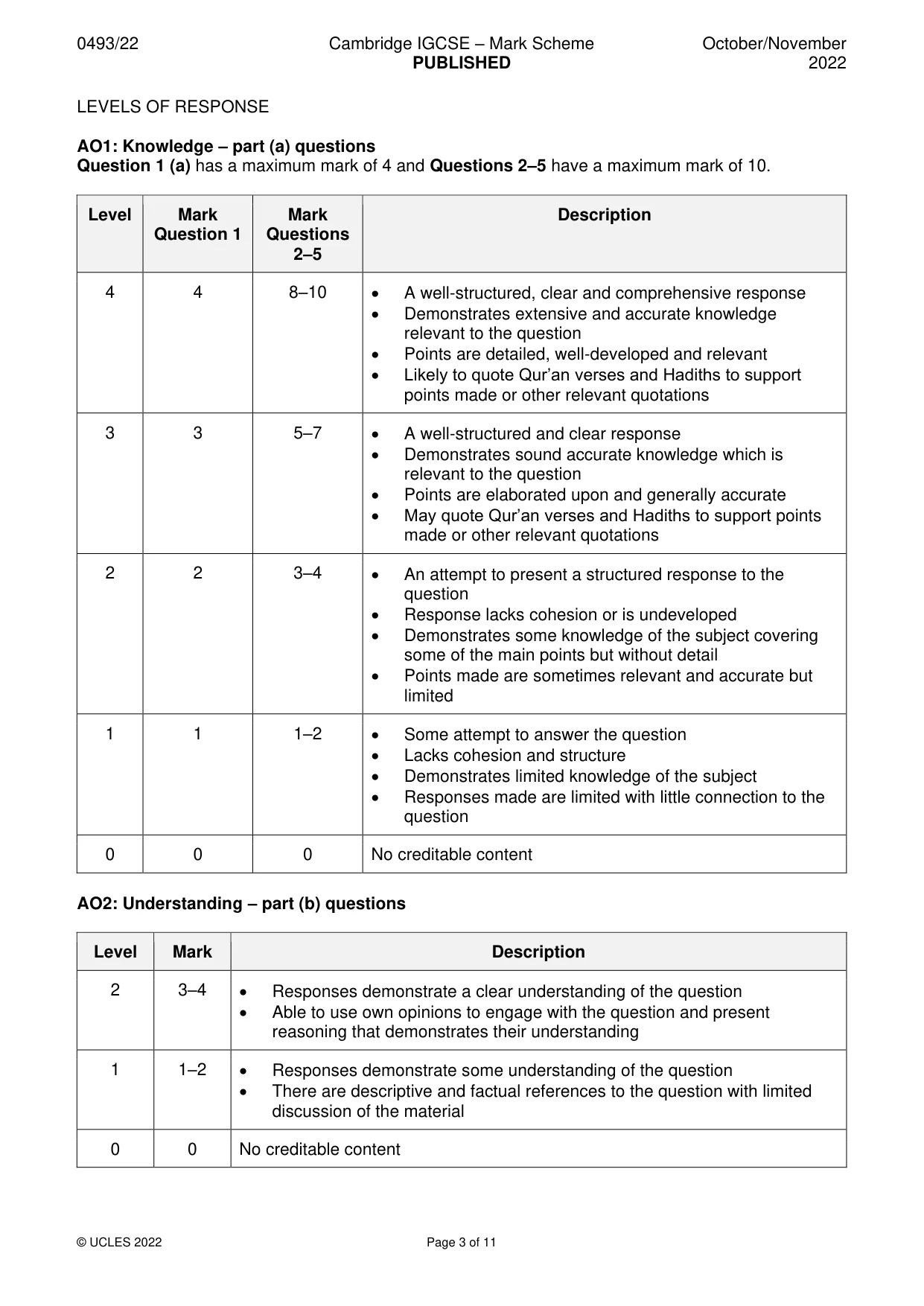
0493/22 Cambridge IGCSE – Mark Scheme PUBLISHED October/November 2022 © UCLES 2022 Page 3 of 11 LEVELS OF RESPONSE AO1: Knowledge – part (a) questions Question 1 (a) has a maximum mark of 4 and Questions 2–5 have a maximum mark of 10. Level Mark Question 1 Mark Questions 2–5 Description 4 4 8–10 • A well-structured, clear and comprehensive response • Demonstrates extensive and accurate knowledge relevant to the question • Points are detailed, well-developed and relevant • Likely to quote Qur’an verses and Hadiths to support points made or other relevant quotations 3 3 5–7 • A well-structured and clear response • Demonstrates sound accurate knowledge which is relevant to the question • Points are elaborated upon and generally accurate • May quote Qur’an verses and Hadiths to support points made or other relevant quotations 2 2 3–4 • An attempt to present a structured response to the question • Response lacks cohesion or is undeveloped • Demonstrates some knowledge of the subject covering some of the main points but without detail • Points made are sometimes relevant and accurate but limited 1 1 1–2 • Some attempt to answer the question • Lacks cohesion and structure • Demonstrates limited knowledge of the subject • Responses made are limited with little connection to the question 0 0 0 No creditable content AO2: Understanding – part (b) questions Level Mark Description 2 3–4 • Responses demonstrate a clear understanding of the question • Able to use own opinions to engage with the question and present reasoning that demonstrates their understanding 1 1–2 • Responses demonstrate some understanding of the question • There are descriptive and factual references to the question with limited discussion of the material 0 0 No creditable content
Mark scheme, page 4
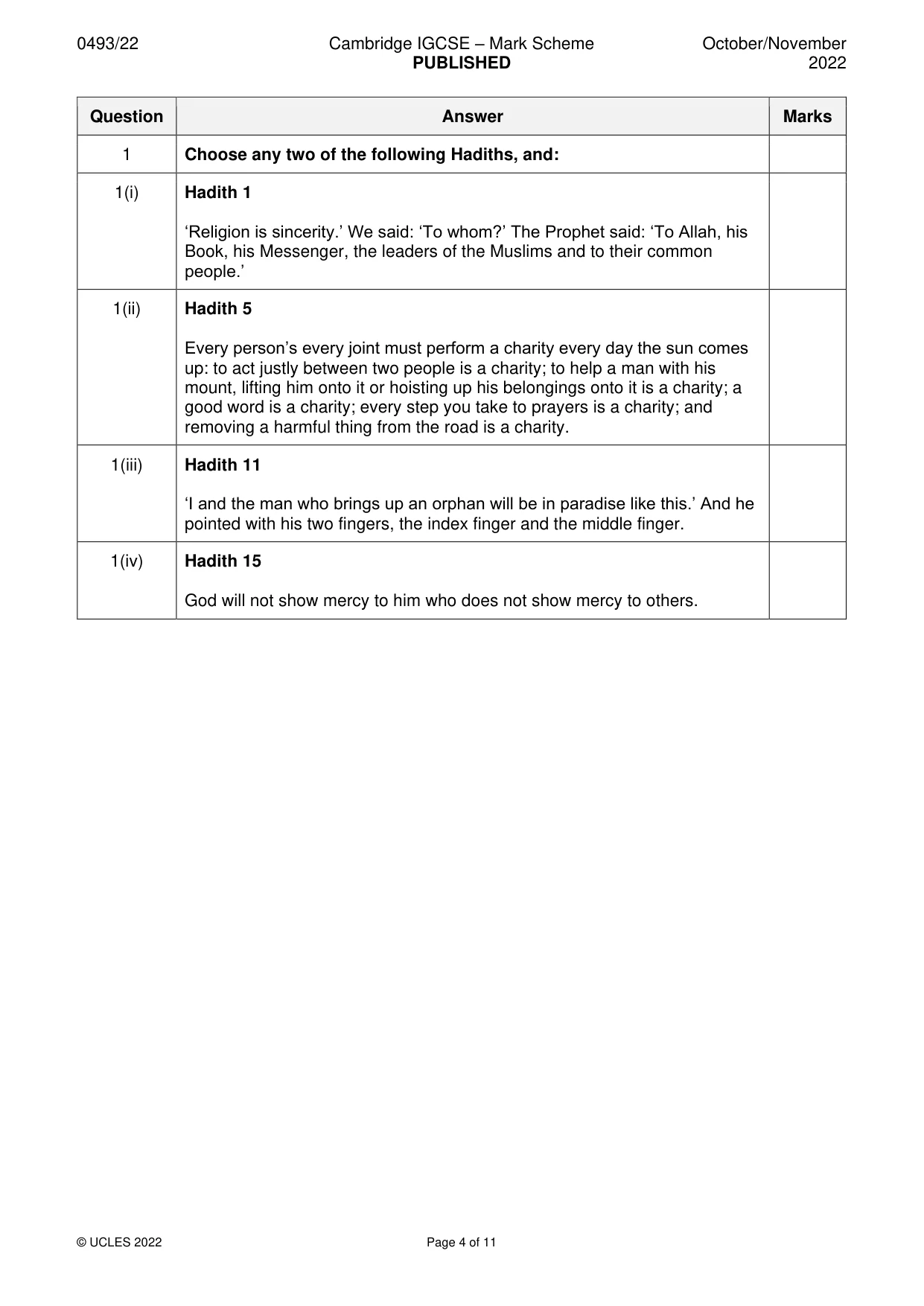
0493/22 Cambridge IGCSE – Mark Scheme PUBLISHED October/November 2022 © UCLES 2022 Page 4 of 11 Question Answer Marks 1 Choose any two of the following Hadiths, and: 1(i) Hadith 1 ‘Religion is sincerity.’ We said: ‘To whom?’ The Prophet said: ‘To Allah, his Book, his Messenger, the leaders of the Muslims and to their common people.’ 1(ii) Hadith 5 Every person’s every joint must perform a charity every day the sun comes up: to act justly between two people is a charity; to help a man with his mount, lifting him onto it or hoisting up his belongings onto it is a charity; a good word is a charity; every step you take to prayers is a charity; and removing a harmful thing from the road is a charity. 1(iii) Hadith 11 ‘I and the man who brings up an orphan will be in paradise like this.’ And he pointed with his two fingers, the index finger and the middle finger. 1(iv) Hadith 15 God will not show mercy to him who does not show mercy to others.
Mark scheme, page 5
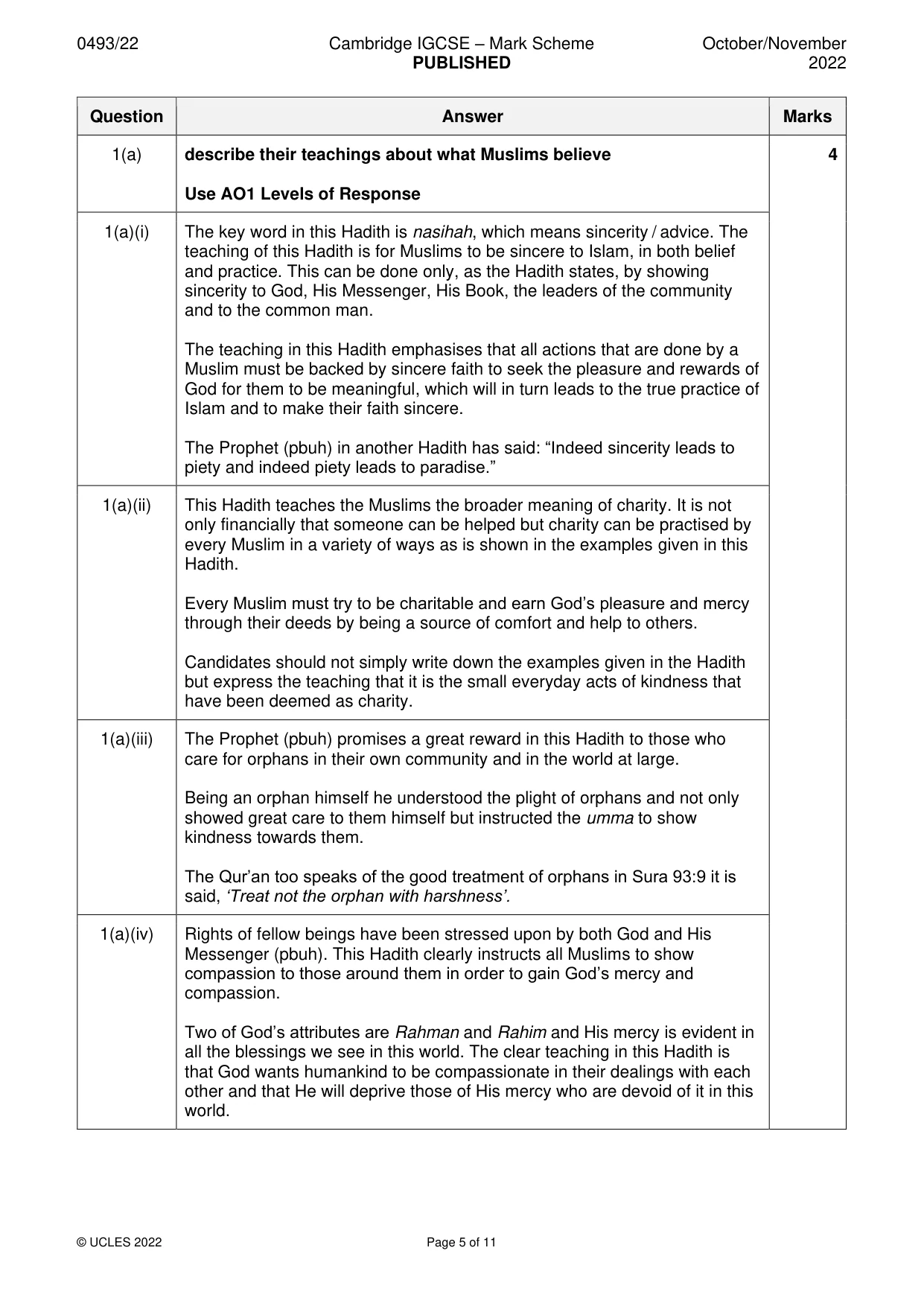
0493/22 Cambridge IGCSE – Mark Scheme PUBLISHED October/November 2022 © UCLES 2022 Page 5 of 11 Question Answer Marks 1(a) describe their teachings about what Muslims believe Use AO1 Levels of Response 4 1(a)(i) The key word in this Hadith is nasihah, which means sincerity / advice. The teaching of this Hadith is for Muslims to be sincere to Islam, in both belief and practice. This can be done only, as the Hadith states, by showing sincerity to God, His Messenger, His Book, the leaders of the community and to the common man. The teaching in this Hadith emphasises that all actions that are done by a Muslim must be backed by sincere faith to seek the pleasure and rewards of God for them to be meaningful, which will in turn leads to the true practice of Islam and to make their faith sincere. The Prophet (pbuh) in another Hadith has said: “Indeed sincerity leads to piety and indeed piety leads to paradise.” 1(a)(ii) This Hadith teaches the Muslims the broader meaning of charity. It is not only financially that someone can be helped but charity can be practised by every Muslim in a variety of ways as is shown in the examples given in this Hadith. Every Muslim must try to be charitable and earn God’s pleasure and mercy through their deeds by being a source of comfort and help to others. Candidates should not simply write down the examples given in the Hadith but express the teaching that it is the small everyday acts of kindness that have been deemed as charity. 1(a)(iii) The Prophet (pbuh) promises a great reward in this Hadith to those who care for orphans in their own community and in the world at large. Being an orphan himself he understood the plight of orphans and not only showed great care to them himself but instructed the umma to show kindness towards them. The Qur’an too speaks of the good treatment of orphans in Sura 93:9 it is said, ‘Treat not the orphan with harshness’. 1(a)(iv) Rights of fellow beings have been stressed upon by both God and His Messenger (pbuh). This Hadith clearly instructs all Muslims to show compassion to those around them in order to gain God’s mercy and compassion. Two of God’s attributes are Rahman and Rahim and His mercy is evident in all the blessings we see in this world. The clear teaching in this Hadith is that God wants humankind to be compassionate in their dealings with each other and that He will deprive those of His mercy who are devoid of it in this world.
Mark scheme, page 6
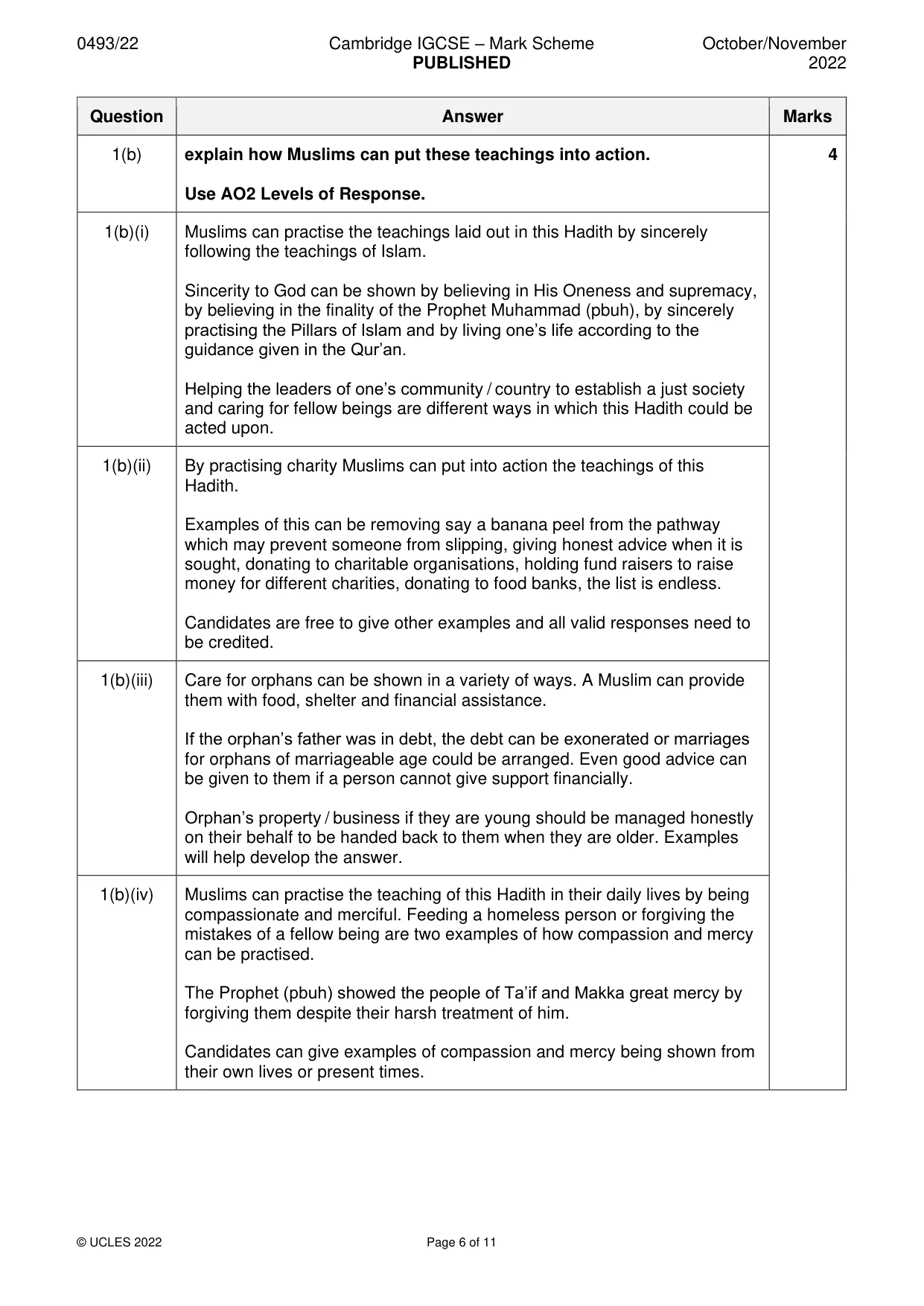
0493/22 Cambridge IGCSE – Mark Scheme PUBLISHED October/November 2022 © UCLES 2022 Page 6 of 11 Question Answer Marks 1(b) explain how Muslims can put these teachings into action. Use AO2 Levels of Response. 4 1(b)(i) Muslims can practise the teachings laid out in this Hadith by sincerely following the teachings of Islam. Sincerity to God can be shown by believing in His Oneness and supremacy, by believing in the finality of the Prophet Muhammad (pbuh), by sincerely practising the Pillars of Islam and by living one’s life according to the guidance given in the Qur’an. Helping the leaders of one’s community / country to establish a just society and caring for fellow beings are different ways in which this Hadith could be acted upon. 1(b)(ii) By practising charity Muslims can put into action the teachings of this Hadith. Examples of this can be removing say a banana peel from the pathway which may prevent someone from slipping, giving honest advice when it is sought, donating to charitable organisations, holding fund raisers to raise money for different charities, donating to food banks, the list is endless. Candidates are free to give other examples and all valid responses need to be credited. 1(b)(iii) Care for orphans can be shown in a variety of ways. A Muslim can provide them with food, shelter and financial assistance. If the orphan’s father was in debt, the debt can be exonerated or marriages for orphans of marriageable age could be arranged. Even good advice can be given to them if a person cannot give support financially. Orphan’s property / business if they are young should be managed honestly on their behalf to be handed back to them when they are older. Examples will help develop the answer. 1(b)(iv) Muslims can practise the teaching of this Hadith in their daily lives by being compassionate and merciful. Feeding a homeless person or forgiving the mistakes of a fellow being are two examples of how compassion and mercy can be practised. The Prophet (pbuh) showed the people of Ta’if and Makka great mercy by forgiving them despite their harsh treatment of him. Candidates can give examples of compassion and mercy being shown from their own lives or present times.
Mark scheme, page 7
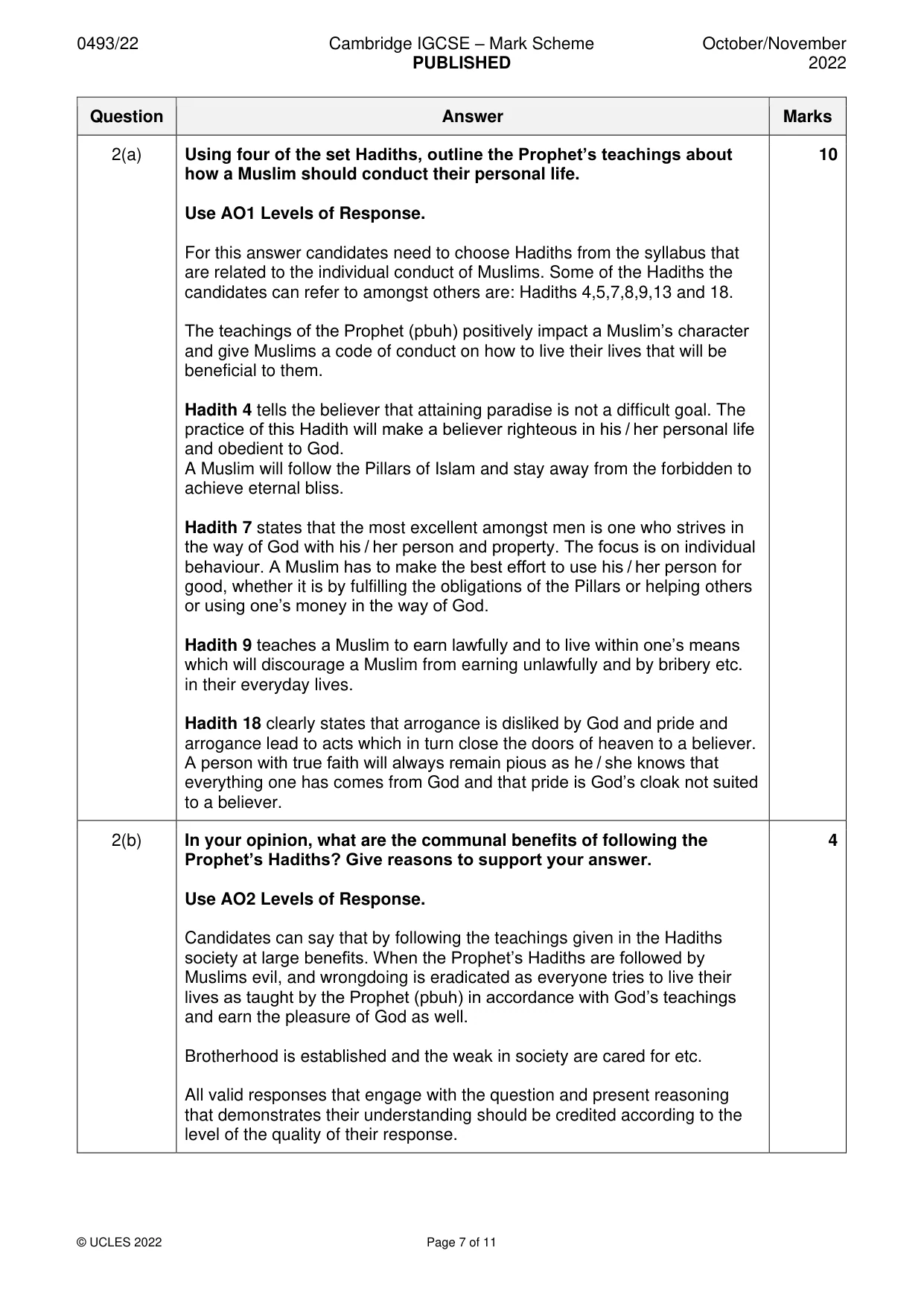
0493/22 Cambridge IGCSE – Mark Scheme PUBLISHED October/November 2022 © UCLES 2022 Page 7 of 11 Question Answer Marks 2(a) Using four of the set Hadiths, outline the Prophet’s teachings about how a Muslim should conduct their personal life. Use AO1 Levels of Response. For this answer candidates need to choose Hadiths from the syllabus that are related to the individual conduct of Muslims. Some of the Hadiths the candidates can refer to amongst others are: Hadiths 4,5,7,8,9,13 and 18. The teachings of the Prophet (pbuh) positively impact a Muslim’s character and give Muslims a code of conduct on how to live their lives that will be beneficial to them. Hadith 4 tells the believer that attaining paradise is not a difficult goal. The practice of this Hadith will make a believer righteous in his / her personal life and obedient to God. A Muslim will follow the Pillars of Islam and stay away from the forbidden to achieve eternal bliss. Hadith 7 states that the most excellent amongst men is one who strives in the way of God with his / her person and property. The focus is on individual behaviour. A Muslim has to make the best effort to use his / her person for good, whether it is by fulfilling the obligations of the Pillars or helping others or using one’s money in the way of God. Hadith 9 teaches a Muslim to earn lawfully and to live within one’s means which will discourage a Muslim from earning unlawfully and by bribery etc. in their everyday lives. Hadith 18 clearly states that arrogance is disliked by God and pride and arrogance lead to acts which in turn close the doors of heaven to a believer. A person with true faith will always remain pious as he / she knows that everything one has comes from God and that pride is God’s cloak not suited to a believer. 10 2(b) In your opinion, what are the communal benefits of following the Prophet’s Hadiths? Give reasons to support your answer. Use AO2 Levels of Response. Candidates can say that by following the teachings given in the Hadiths society at large benefits. When the Prophet’s Hadiths are followed by Muslims evil, and wrongdoing is eradicated as everyone tries to live their lives as taught by the Prophet (pbuh) in accordance with God’s teachings and earn the pleasure of God as well. Brotherhood is established and the weak in society are cared for etc. All valid responses that engage with the question and present reasoning that demonstrates their understanding should be credited according to the level of the quality of their response. 4
Mark scheme, page 8
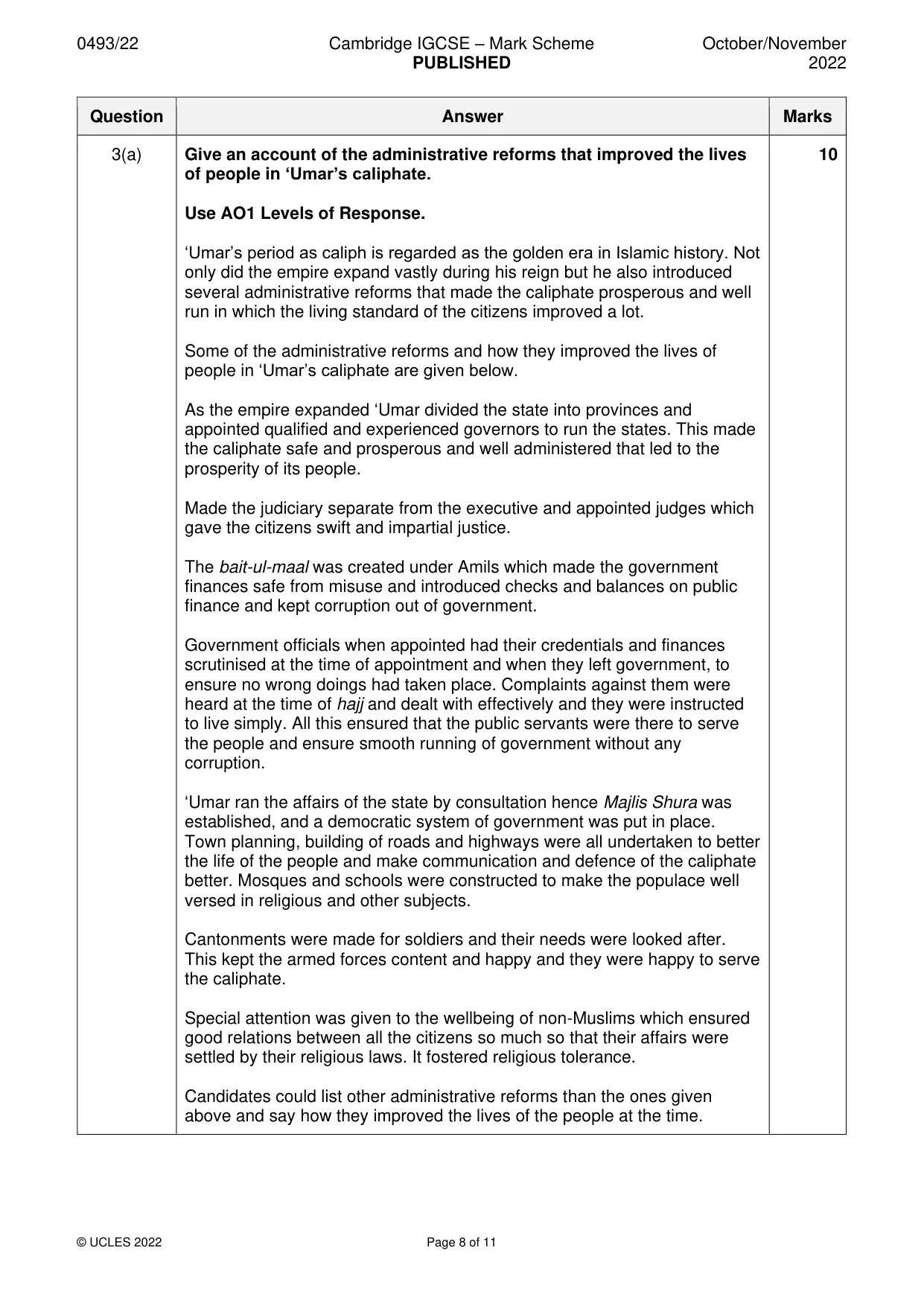
0493/22 Cambridge IGCSE – Mark Scheme PUBLISHED October/November 2022 © UCLES 2022 Page 8 of 11 Question Answer Marks 3(a) Give an account of the administrative reforms that improved the lives of people in ‘Umar’s caliphate. Use AO1 Levels of Response. ‘Umar’s period as caliph is regarded as the golden era in Islamic history. Not only did the empire expand vastly during his reign but he also introduced several administrative reforms that made the caliphate prosperous and well run in which the living standard of the citizens improved a lot. Some of the administrative reforms and how they improved the lives of people in ‘Umar’s caliphate are given below. As the empire expanded ‘Umar divided the state into provinces and appointed qualified and experienced governors to run the states. This made the caliphate safe and prosperous and well administered that led to the prosperity of its people. Made the judiciary separate from the executive and appointed judges which gave the citizens swift and impartial justice. The bait-ul-maal was created under Amils which made the government finances safe from misuse and introduced checks and balances on public finance and kept corruption out of government. Government officials when appointed had their credentials and finances scrutinised at the time of appointment and when they left government, to ensure no wrong doings had taken place. Complaints against them were heard at the time of hajj and dealt with effectively and they were instructed to live simply. All this ensured that the public servants were there to serve the people and ensure smooth running of government without any corruption. ‘Umar ran the affairs of the state by consultation hence Majlis Shura was established, and a democratic system of government was put in place. Town planning, building of roads and highways were all undertaken to better the life of the people and make communication and defence of the caliphate better. Mosques and schools were constructed to make the populace well versed in religious and other subjects. Cantonments were made for soldiers and their needs were looked after. This kept the armed forces content and happy and they were happy to serve the caliphate. Special attention was given to the wellbeing of non-Muslims which ensured good relations between all the citizens so much so that their affairs were settled by their religious laws. It fostered religious tolerance. Candidates could list other administrative reforms than the ones given above and say how they improved the lives of the people at the time. 10
Mark scheme, page 9
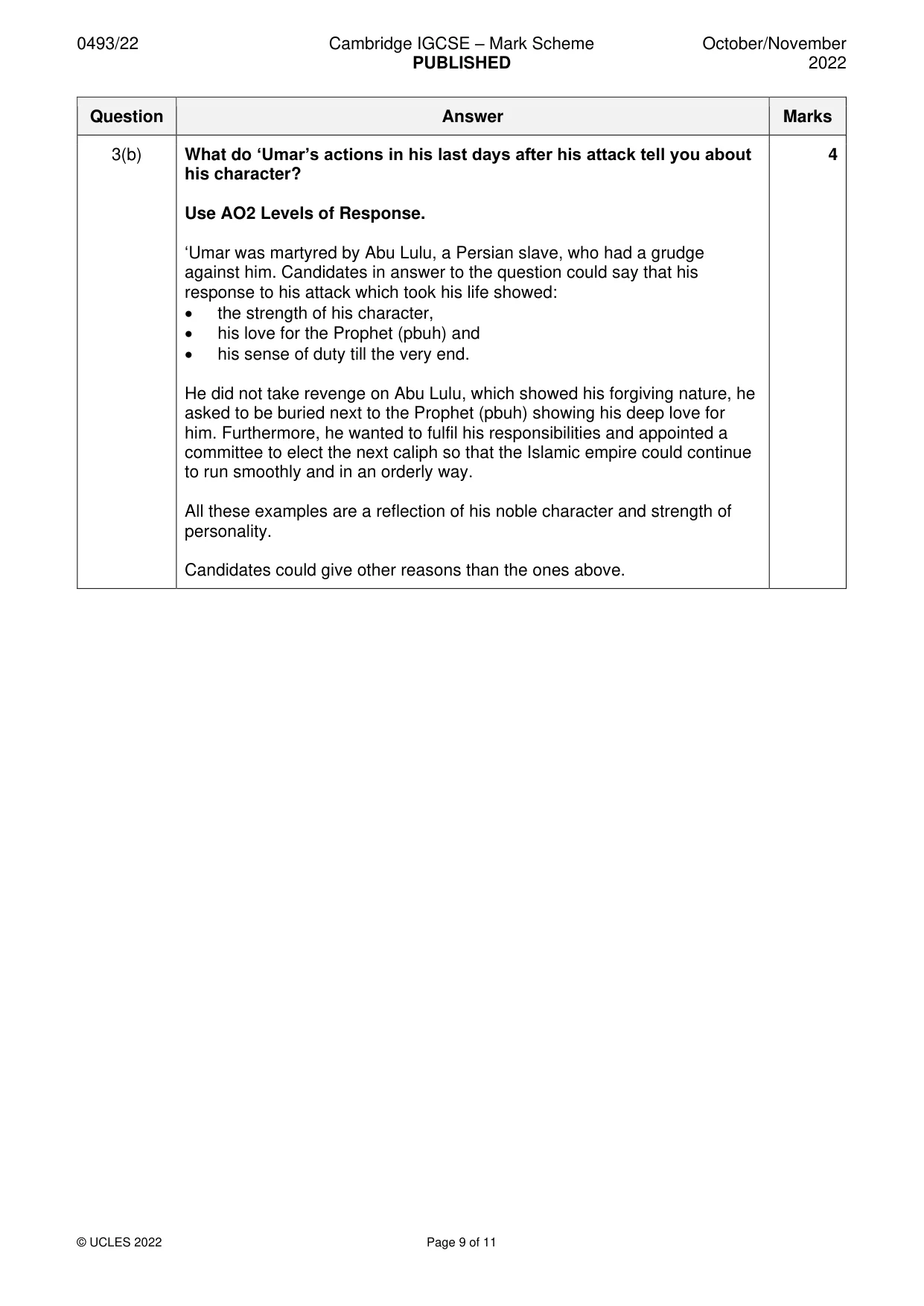
0493/22 Cambridge IGCSE – Mark Scheme PUBLISHED October/November 2022 © UCLES 2022 Page 9 of 11 Question Answer Marks 3(b) What do ‘Umar’s actions in his last days after his attack tell you about his character? Use AO2 Levels of Response. ‘Umar was martyred by Abu Lulu, a Persian slave, who had a grudge against him. Candidates in answer to the question could say that his response to his attack which took his life showed: • the strength of his character, • his love for the Prophet (pbuh) and • his sense of duty till the very end. He did not take revenge on Abu Lulu, which showed his forgiving nature, he asked to be buried next to the Prophet (pbuh) showing his deep love for him. Furthermore, he wanted to fulfil his responsibilities and appointed a committee to elect the next caliph so that the Islamic empire could continue to run smoothly and in an orderly way. All these examples are a reflection of his noble character and strength of personality. Candidates could give other reasons than the ones above. 4
Mark scheme, page 10
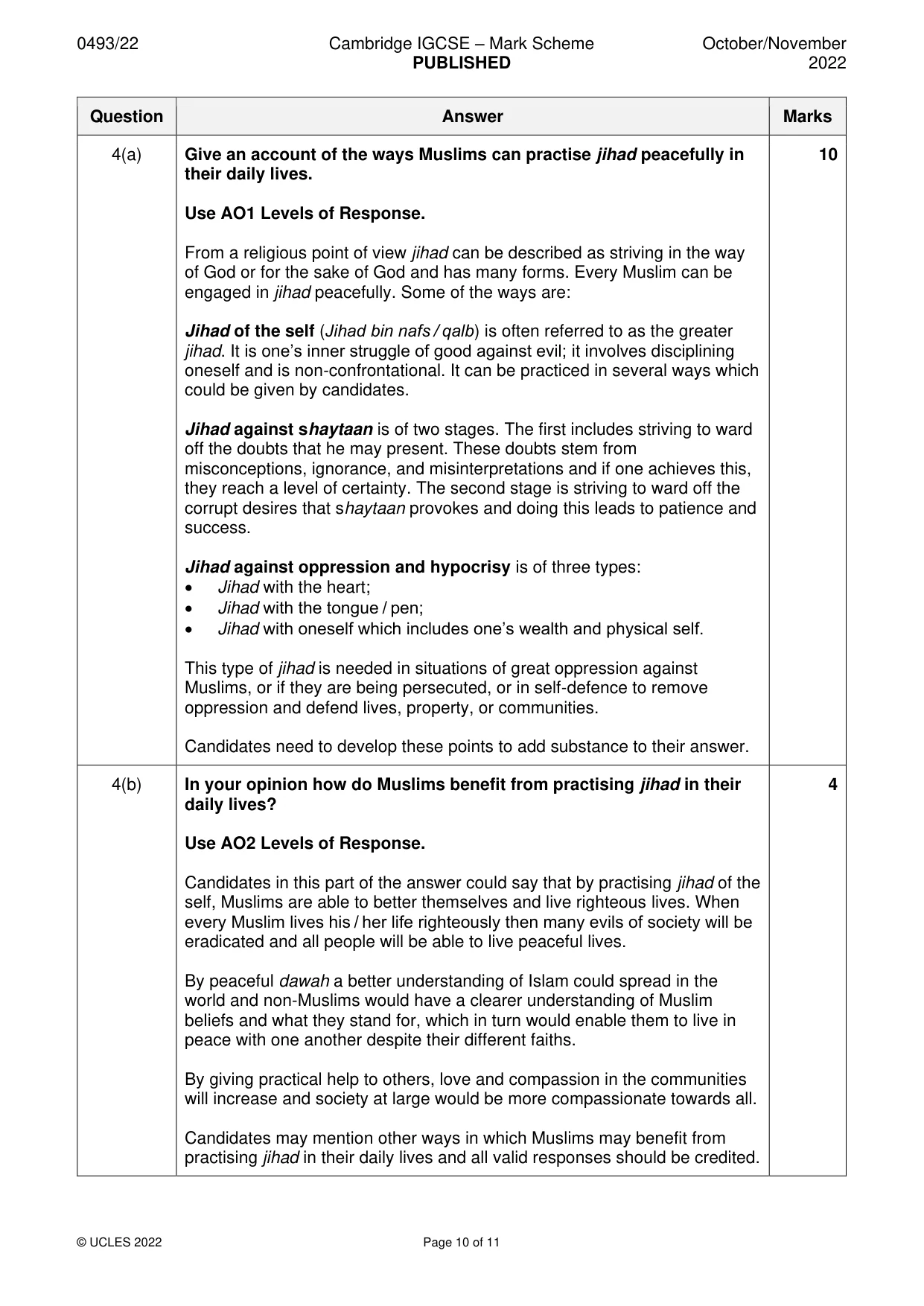
0493/22 Cambridge IGCSE – Mark Scheme PUBLISHED October/November 2022 © UCLES 2022 Page 10 of 11 Question Answer Marks 4(a) Give an account of the ways Muslims can practise jihad peacefully in their daily lives. Use AO1 Levels of Response. From a religious point of view jihad can be described as striving in the way of God or for the sake of God and has many forms. Every Muslim can be engaged in jihad peacefully. Some of the ways are: Jihad of the self (Jihad bin nafs / qalb) is often referred to as the greater jihad. It is one’s inner struggle of good against evil; it involves disciplining oneself and is non-confrontational. It can be practiced in several ways which could be given by candidates. Jihad against shaytaan is of two stages. The first includes striving to ward off the doubts that he may present. These doubts stem from misconceptions, ignorance, and misinterpretations and if one achieves this, they reach a level of certainty. The second stage is striving to ward off the corrupt desires that shaytaan provokes and doing this leads to patience and success. Jihad against oppression and hypocrisy is of three types: • Jihad with the heart; • Jihad with the tongue / pen; • Jihad with oneself which includes one’s wealth and physical self. This type of jihad is needed in situations of great oppression against Muslims, or if they are being persecuted, or in self-defence to remove oppression and defend lives, property, or communities. Candidates need to develop these points to add substance to their answer. 10 4(b) In your opinion how do Muslims benefit from practising jihad in their daily lives? Use AO2 Levels of Response. Candidates in this part of the answer could say that by practising jihad of the self, Muslims are able to better themselves and live righteous lives. When every Muslim lives his / her life righteously then many evils of society will be eradicated and all people will be able to live peaceful lives. By peaceful dawah a better understanding of Islam could spread in the world and non-Muslims would have a clearer understanding of Muslim beliefs and what they stand for, which in turn would enable them to live in peace with one another despite their different faiths. By giving practical help to others, love and compassion in the communities will increase and society at large would be more compassionate towards all. Candidates may mention other ways in which Muslims may benefit from practising jihad in their daily lives and all valid responses should be credited. 4
Mark scheme, page 11
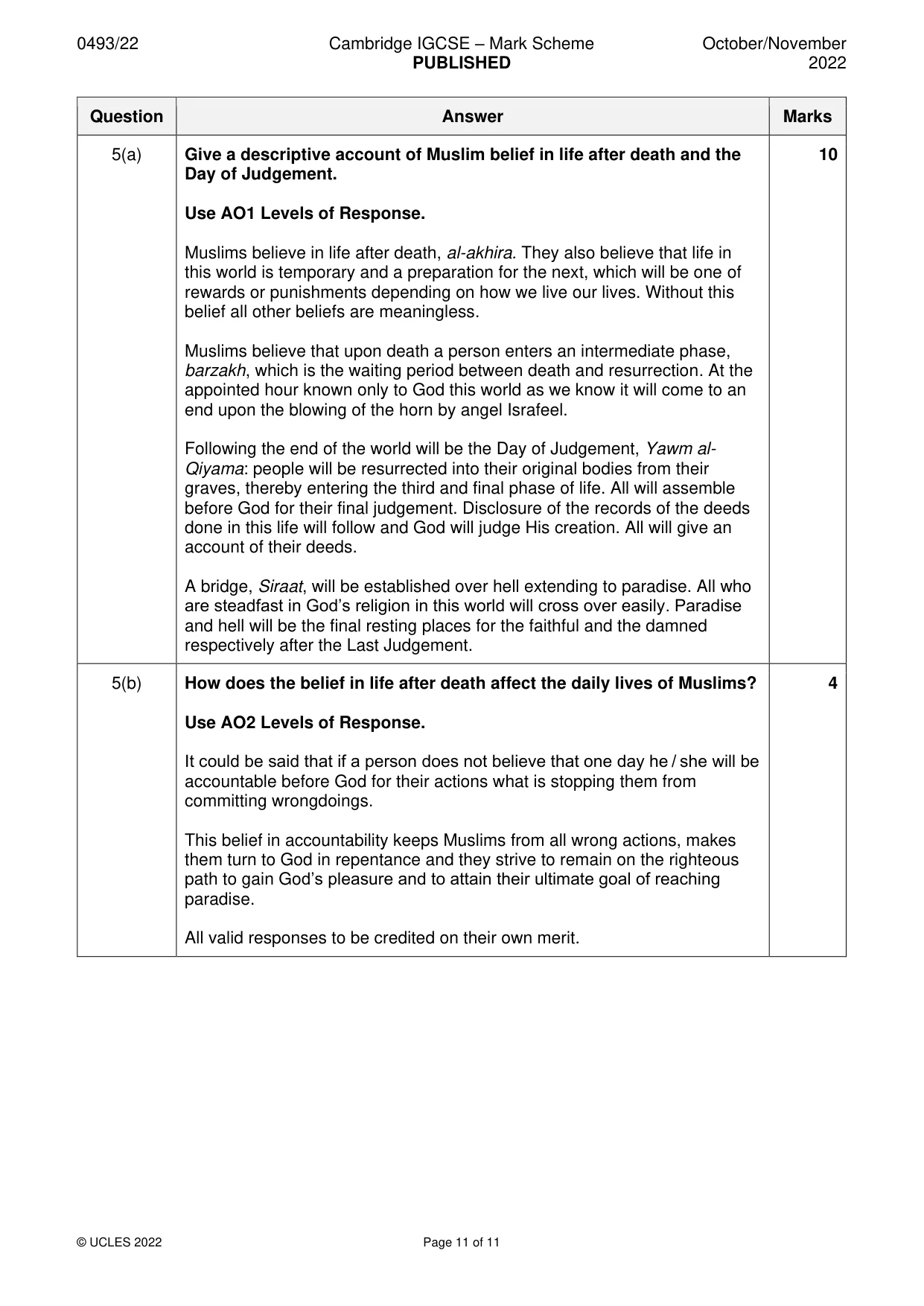
0493/22 Cambridge IGCSE – Mark Scheme PUBLISHED October/November 2022 © UCLES 2022 Page 11 of 11 Question Answer Marks 5(a) Give a descriptive account of Muslim belief in life after death and the Day of Judgement. Use AO1 Levels of Response. Muslims believe in life after death, al-akhira. They also believe that life in this world is temporary and a preparation for the next, which will be one of rewards or punishments depending on how we live our lives. Without this belief all other beliefs are meaningless. Muslims believe that upon death a person enters an intermediate phase, barzakh, which is the waiting period between death and resurrection. At the appointed hour known only to God this world as we know it will come to an end upon the blowing of the horn by angel Israfeel. Following the end of the world will be the Day of Judgement, Yawm al- Qiyama: people will be resurrected into their original bodies from their graves, thereby entering the third and final phase of life. All will assemble before God for their final judgement. Disclosure of the records of the deeds done in this life will follow and God will judge His creation. All will give an account of their deeds. A bridge, Siraat, will be established over hell extending to paradise. All who are steadfast in God’s religion in this world will cross over easily. Paradise and hell will be the final resting places for the faithful and the damned respectively after the Last Judgement. 10 5(b) How does the belief in life after death affect the daily lives of Muslims? Use AO2 Levels of Response. It could be said that if a person does not believe that one day he / she will be accountable before God for their actions what is stopping them from committing wrongdoings. This belief in accountability keeps Muslims from all wrong actions, makes them turn to God in repentance and they strive to remain on the righteous path to gain God’s pleasure and to attain their ultimate goal of reaching paradise. All valid responses to be credited on their own merit. 4
What you needed in this session
Cambridge’s own grade thresholds for 2022 Oct/Nov, Paper 2 · Variant 2. A higher threshold means an easier paper — the bar moves with how the cohort did.