Cambridge IGCSE Islamiyat 0493 — 2016 Oct/Nov Paper 2 · Variant 2
0493/22/O/N/16 · 50 marks · ≈56 min
The question paper and its mark scheme, free to read here and free to download. This is Cambridge’s own paper, exactly as it was sat.
Question paper16 pages









Mark scheme9 pages
Answers below. Sit the paper first if you are practising.
Paper as text
Question paper, page 1
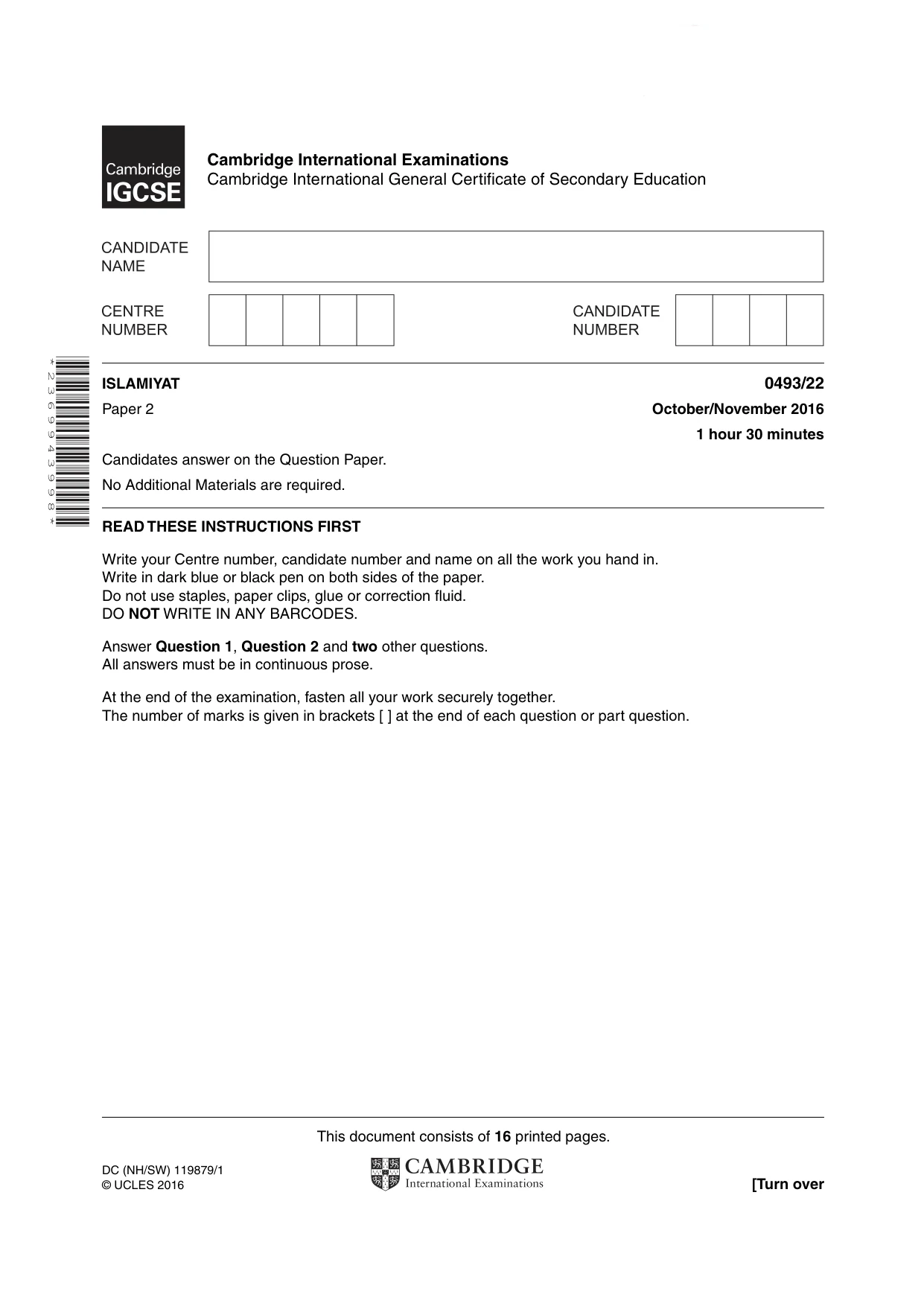
This document consists of 16 printed pages. DC (NH/SW) 119879/1 © UCLES 2016 [Turn over * 2 3 6 9 9 4 3 9 9 8 * ISLAMIYAT 0493/22 Paper 2 October/November 2016 1 hour 30 minutes Candidates answer on the Question Paper. No Additional Materials are required. READ THESE INSTRUCTIONS FIRST Write your Centre number, candidate number and name on all the work you hand in. Write in dark blue or black pen on both sides of the paper. Do not use staples, paper clips, glue or correction fluid. DO NOT WRITE IN ANY BARCODES. Answer Question 1, Question 2 and two other questions. All answers must be in continuous prose. At the end of the examination, fasten all your work securely together. The number of marks is given in brackets [ ] at the end of each question or part question. Cambridge International Examinations Cambridge International General Certificate of Secondary Education
Question paper, page 2
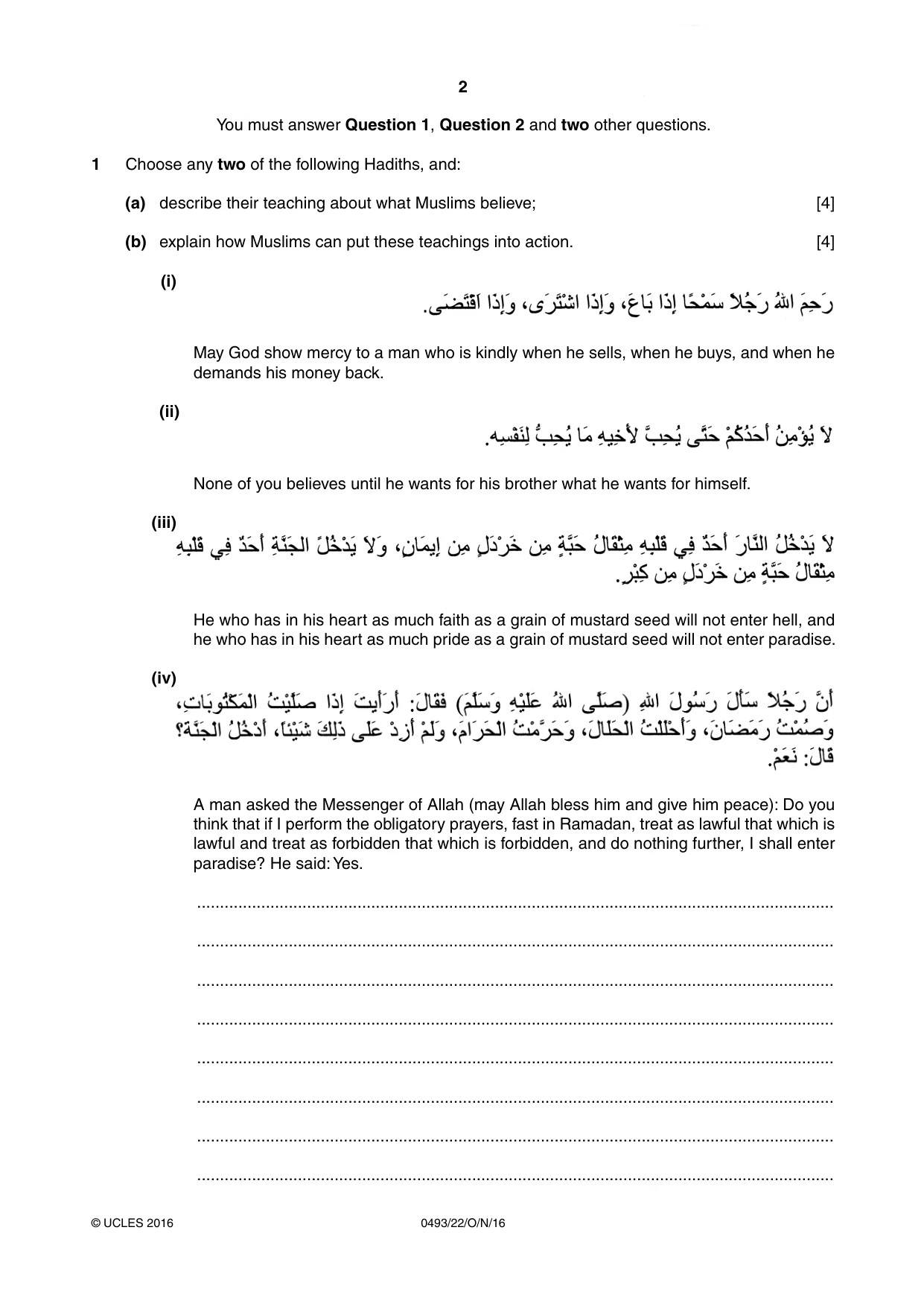
2 0493/22/O/N/16 © UCLES 2016 You must answer Question 1, Question 2 and two other questions. 1 Choose any two of the following Hadiths, and: (a) describe their teaching about what Muslims believe; [4] (b) explain how Muslims can put these teachings into action. [4] (i) May God show mercy to a man who is kindly when he sells, when he buys, and when he demands his money back. (ii) None of you believes until he wants for his brother what he wants for himself. (iii) He who has in his heart as much faith as a grain of mustard seed will not enter hell, and he who has in his heart as much pride as a grain of mustard seed will not enter paradise. (iv) A man asked the Messenger of Allah (may Allah bless him and give him peace): Do you think that if I perform the obligatory prayers, fast in Ramadan, treat as lawful that which is lawful and treat as forbidden that which is forbidden, and do nothing further, I shall enter paradise? He said: Yes. … … … … … … … …
Question paper, page 3
3 0493/22/O/N/16 © UCLES 2016 [Turn over … … … … … … … … … … … … … … … … … … … … … … … … … … … …
Question paper, page 4
4 0493/22/O/N/16 © UCLES 2016 … … … … … … … … … … … … … … … … … … … … … … … … … … … …
Question paper, page 5
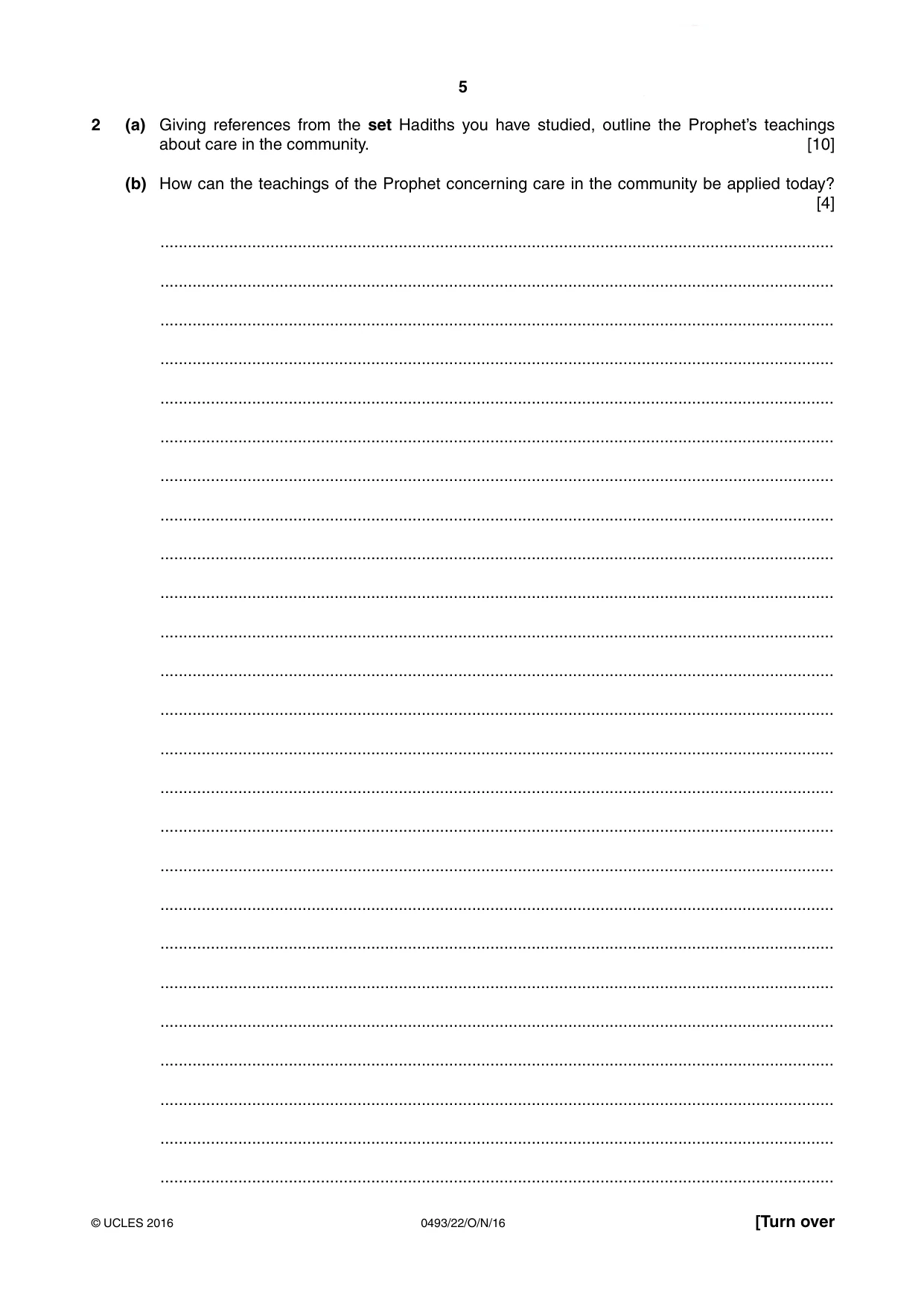
5 0493/22/O/N/16 © UCLES 2016 [Turn over 2 (a) Giving references from the set Hadiths you have studied, outline the Prophet’s teachings about care in the community. [10] (b) How can the teachings of the Prophet concerning care in the community be applied today? [4] … … … … … … … … … … … … … … … … … … … … … … … … …
Question paper, page 6
6 0493/22/O/N/16 © UCLES 2016 … … … … … … … … … … … … … … … … … … … … … … … … … … … …
Question paper, page 7
7 0493/22/O/N/16 © UCLES 2016 [Turn over … … … … … … … … … … … … … … … … … … … … … … … … … … … …
Question paper, page 8
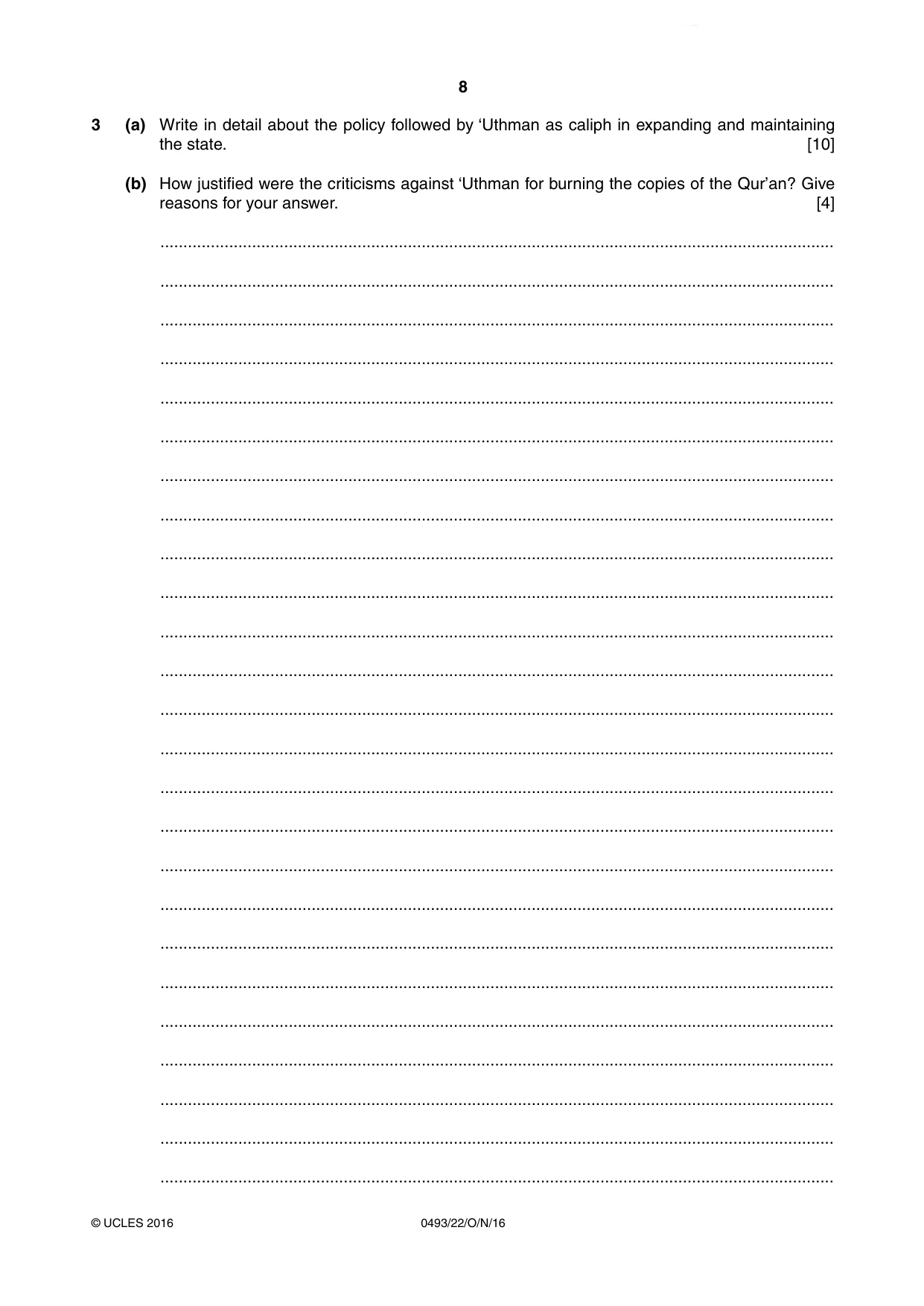
8 0493/22/O/N/16 © UCLES 2016 3 (a) Write in detail about the policy followed by ‘Uthman as caliph in expanding and maintaining the state. [10] (b) How justified were the criticisms against ‘Uthman for burning the copies of the Qur’an? Give reasons for your answer. [4] … … … … … … … … … … … … … … … … … … … … … … … … …
Question paper, page 9
9 0493/22/O/N/16 © UCLES 2016 [Turn over … … … … … … … … … … … … … … … … … … … … … … … … … … … …
Question paper, page 10
10 0493/22/O/N/16 © UCLES 2016 … … … … … … … … … … … … … … … … … … … … … … … … … … … …
Question paper, page 11
11 0493/22/O/N/16 © UCLES 2016 [Turn over 4 (a) Belief in all the prophets is one of the articles of faith in Islam. Write about this Muslim belief in detail. [10] (b) How is the message brought by these prophets important for Muslims today? [4] … … … … … … … … … … … … … … … … … … … … … … … … … …
Question paper, page 12
12 0493/22/O/N/16 © UCLES 2016 … … … … … … … … … … … … … … … … … … … … … … … … … … … …
Question paper, page 13
13 0493/22/O/N/16 © UCLES 2016 [Turn over … … … … … … … … … … … … … … … … … … … … … … … … … … … …
Question paper, page 14
14 0493/22/O/N/16 © UCLES 2016 5 (a) Describe the particular features of Friday congregational prayers (Jum’a) and the main features of the Friday sermon. [10] (b) Explain how this event upholds the unity of the Muslim community. [4] … … … … … … … … … … … … … … … … … … … … … … … … … …
Question paper, page 15
15 0493/22/O/N/16 © UCLES 2016 [Turn over … … … … … … … … … … … … … … … … … … … … … … … … … … … …
Question paper, page 16
16 0493/22/O/N/16 © UCLES 2016 Permission to reproduce items where third-party owned material protected by copyright is included has been sought and cleared where possible. Every reasonable effort has been made by the publisher (UCLES) to trace copyright holders, but if any items requiring clearance have unwittingly been included, the publisher will be pleased to make amends at the earliest possible opportunity. To avoid the issue of disclosure of answer-related information to candidates, all copyright acknowledgements are reproduced online in the Cambridge International Examinations Copyright Acknowledgements Booklet. This is produced for each series of examinations and is freely available to download at www.cie.org.uk after the live examination series. Cambridge International Examinations is part of the Cambridge Assessment Group. Cambridge Assessment is the brand name of University of Cambridge Local Examinations Syndicate (UCLES), which is itself a department of the University of Cambridge. … … … … … … … … … … … … … … … … … … … … … … … …
Mark scheme, page 1
® IGCSE is the registered trademark of Cambridge International Examinations. This document consists of 9 printed pages. © UCLES 2016 [Turn over Cambridge International Examinations Cambridge International General Certificate of Secondary Education ISLAMIYAT 0493/22 Paper 2 October/November 2016 MARK SCHEME Maximum Mark: 50 Published This mark scheme is published as an aid to teachers and candidates, to indicate the requirements of the examination. It shows the basis on which Examiners were instructed to award marks. It does not indicate the details of the discussions that took place at an Examiners’ meeting before marking began, which would have considered the acceptability of alternative answers. Mark schemes should be read in conjunction with the question paper and the Principal Examiner Report for Teachers. Cambridge will not enter into discussions about these mark schemes. Cambridge is publishing the mark schemes for the October/November 2016 series for most Cambridge IGCSE®, Cambridge International A and AS Level components and some Cambridge O Level components.
Mark scheme, page 2
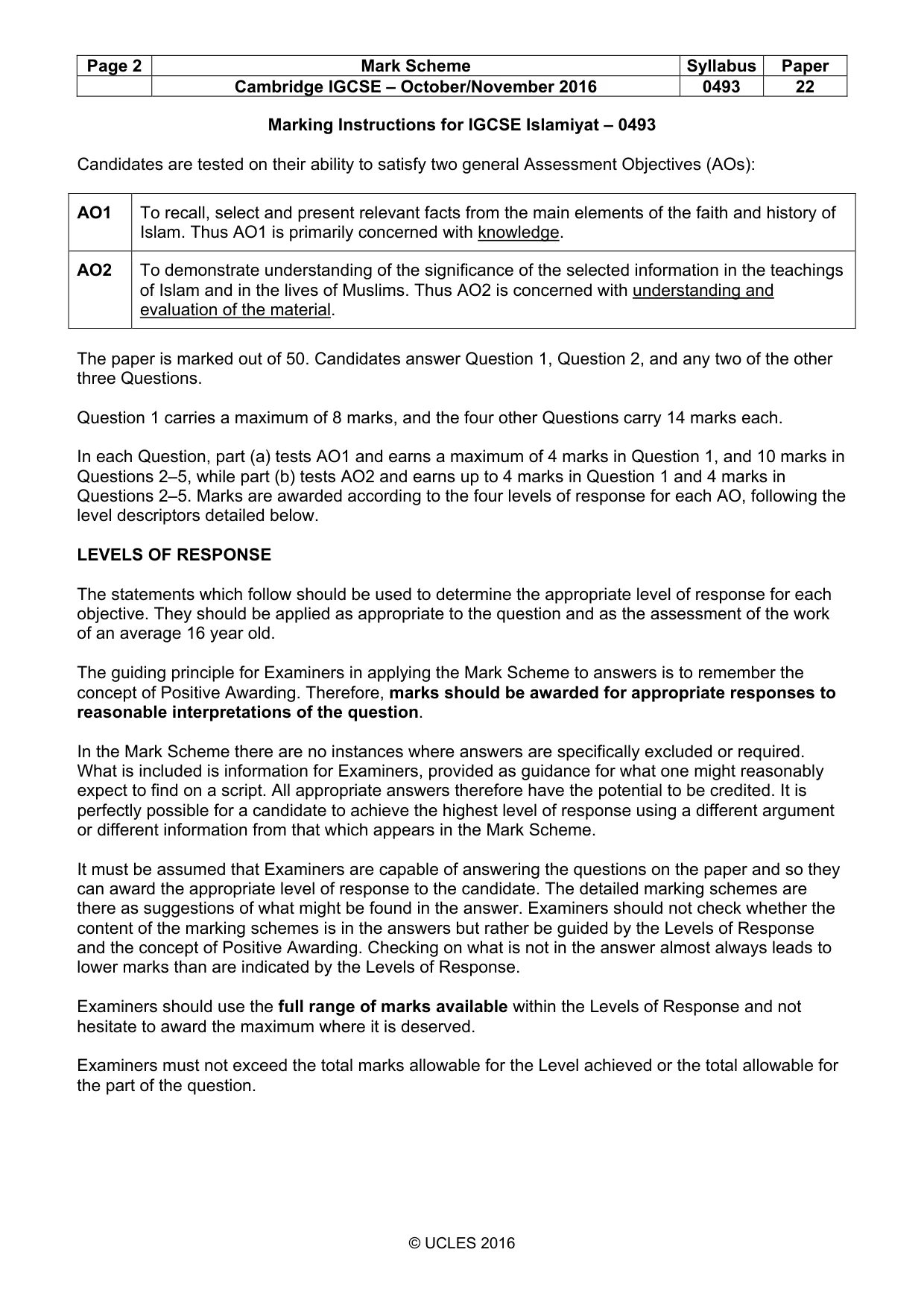
Page 2 Mark Scheme Syllabus Paper Cambridge IGCSE – October/November 2016 0493 22 © UCLES 2016 Marking Instructions for IGCSE Islamiyat – 0493 Candidates are tested on their ability to satisfy two general Assessment Objectives (AOs): AO1 To recall, select and present relevant facts from the main elements of the faith and history of Islam. Thus AO1 is primarily concerned with knowledge. AO2 To demonstrate understanding of the significance of the selected information in the teachings of Islam and in the lives of Muslims. Thus AO2 is concerned with understanding and evaluation of the material. The paper is marked out of 50. Candidates answer Question 1, Question 2, and any two of the other three Questions. Question 1 carries a maximum of 8 marks, and the four other Questions carry 14 marks each. In each Question, part (a) tests AO1 and earns a maximum of 4 marks in Question 1, and 10 marks in Questions 2–5, while part (b) tests AO2 and earns up to 4 marks in Question 1 and 4 marks in Questions 2–5. Marks are awarded according to the four levels of response for each AO, following the level descriptors detailed below. LEVELS OF RESPONSE The statements which follow should be used to determine the appropriate level of response for each objective. They should be applied as appropriate to the question and as the assessment of the work of an average 16 year old. The guiding principle for Examiners in applying the Mark Scheme to answers is to remember the concept of Positive Awarding. Therefore, marks should be awarded for appropriate responses to reasonable interpretations of the question. In the Mark Scheme there are no instances where answers are specifically excluded or required. What is included is information for Examiners, provided as guidance for what one might reasonably expect to find on a script. All appropriate answers therefore have the potential to be credited. It is perfectly possible for a candidate to achieve the highest level of response using a different argument or different information from that which appears in the Mark Scheme. It must be assumed that Examiners are capable of answering the questions on the paper and so they can award the appropriate level of response to the candidate. The detailed marking schemes are there as suggestions of what might be found in the answer. Examiners should not check whether the content of the marking schemes is in the answers but rather be guided by the Levels of Response and the concept of Positive Awarding. Checking on what is not in the answer almost always leads to lower marks than are indicated by the Levels of Response. Examiners should use the full range of marks available within the Levels of Response and not hesitate to award the maximum where it is deserved. Examiners must not exceed the total marks allowable for the Level achieved or the total allowable for the part of the question.
Mark scheme, page 3
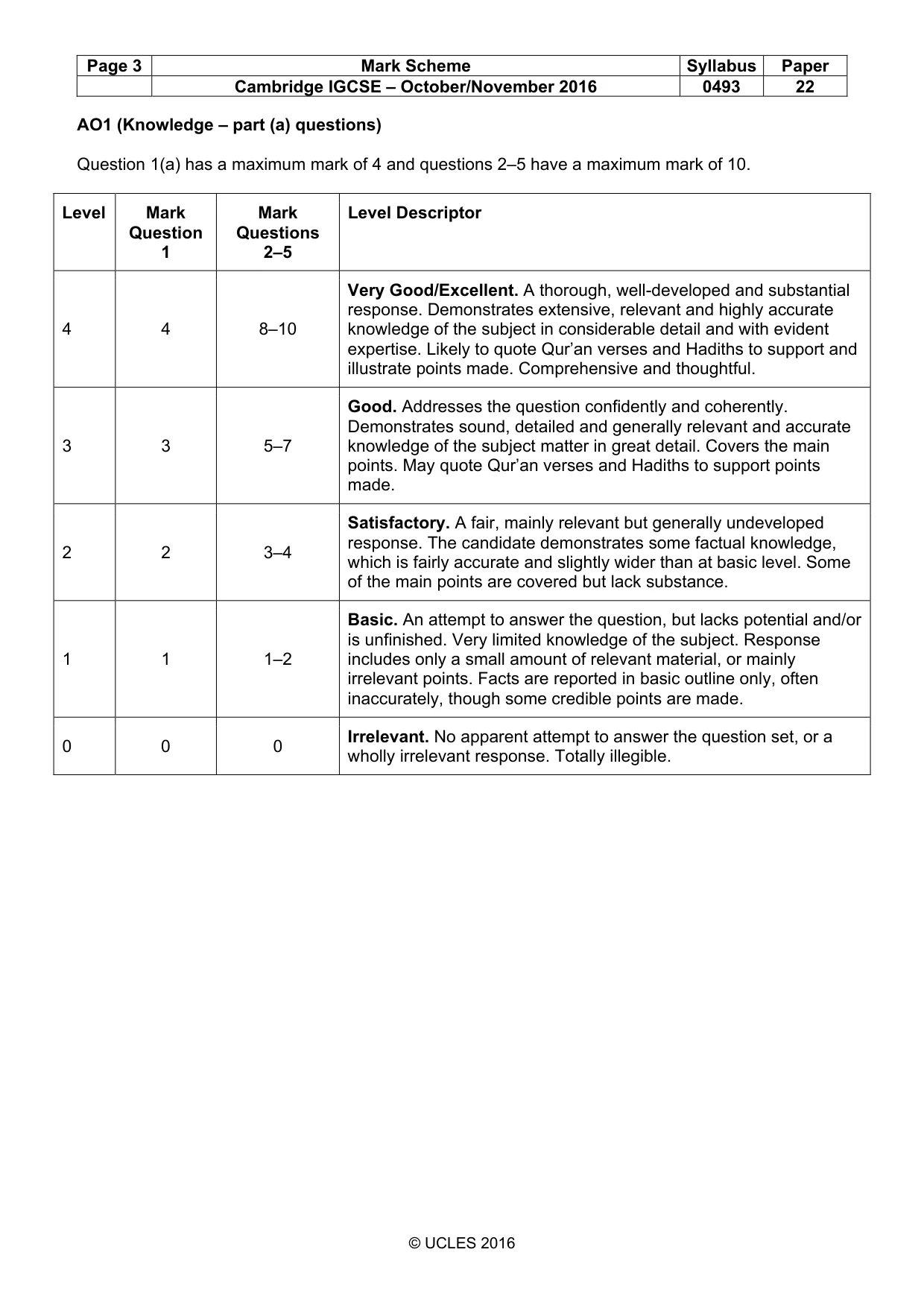
Page 3 Mark Scheme Syllabus Paper Cambridge IGCSE – October/November 2016 0493 22 © UCLES 2016 AO1 (Knowledge – part (a) questions) Question 1(a) has a maximum mark of 4 and questions 2–5 have a maximum mark of 10. Level Mark Question 1 Mark Questions 2–5 Level Descriptor 4 4 8–10 Very Good/Excellent. A thorough, well-developed and substantial response. Demonstrates extensive, relevant and highly accurate knowledge of the subject in considerable detail and with evident expertise. Likely to quote Qur’an verses and Hadiths to support and illustrate points made. Comprehensive and thoughtful. 3 3 5–7 Good. Addresses the question confidently and coherently. Demonstrates sound, detailed and generally relevant and accurate knowledge of the subject matter in great detail. Covers the main points. May quote Qur’an verses and Hadiths to support points made. 2 2 3–4 Satisfactory. A fair, mainly relevant but generally undeveloped response. The candidate demonstrates some factual knowledge, which is fairly accurate and slightly wider than at basic level. Some of the main points are covered but lack substance. 1 1 1–2 Basic. An attempt to answer the question, but lacks potential and/or is unfinished. Very limited knowledge of the subject. Response includes only a small amount of relevant material, or mainly irrelevant points. Facts are reported in basic outline only, often inaccurately, though some credible points are made. 0 0 0 Irrelevant. No apparent attempt to answer the question set, or a wholly irrelevant response. Totally illegible.
Mark scheme, page 4
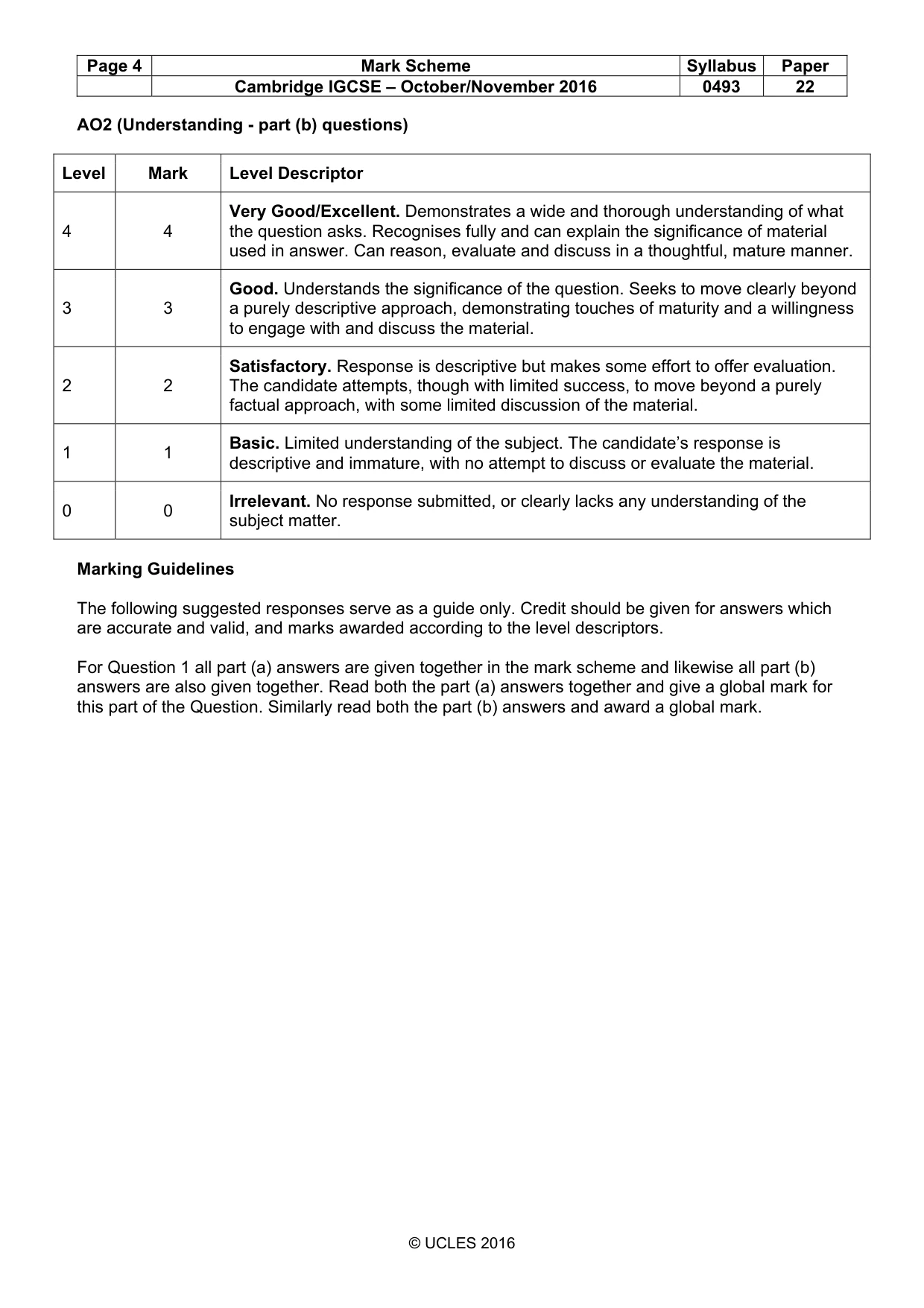
Page 4 Mark Scheme Syllabus Paper Cambridge IGCSE – October/November 2016 0493 22 © UCLES 2016 AO2 (Understanding - part (b) questions) Level Mark Level Descriptor 4 4 Very Good/Excellent. Demonstrates a wide and thorough understanding of what the question asks. Recognises fully and can explain the significance of material used in answer. Can reason, evaluate and discuss in a thoughtful, mature manner. 3 3 Good. Understands the significance of the question. Seeks to move clearly beyond a purely descriptive approach, demonstrating touches of maturity and a willingness to engage with and discuss the material. 2 2 Satisfactory. Response is descriptive but makes some effort to offer evaluation. The candidate attempts, though with limited success, to move beyond a purely factual approach, with some limited discussion of the material. 1 1 Basic. Limited understanding of the subject. The candidate’s response is descriptive and immature, with no attempt to discuss or evaluate the material. 0 0 Irrelevant. No response submitted, or clearly lacks any understanding of the subject matter. Marking Guidelines The following suggested responses serve as a guide only. Credit should be given for answers which are accurate and valid, and marks awarded according to the level descriptors. For Question 1 all part (a) answers are given together in the mark scheme and likewise all part (b) answers are also given together. Read both the part (a) answers together and give a global mark for this part of the Question. Similarly read both the part (b) answers and award a global mark.
Mark scheme, page 5
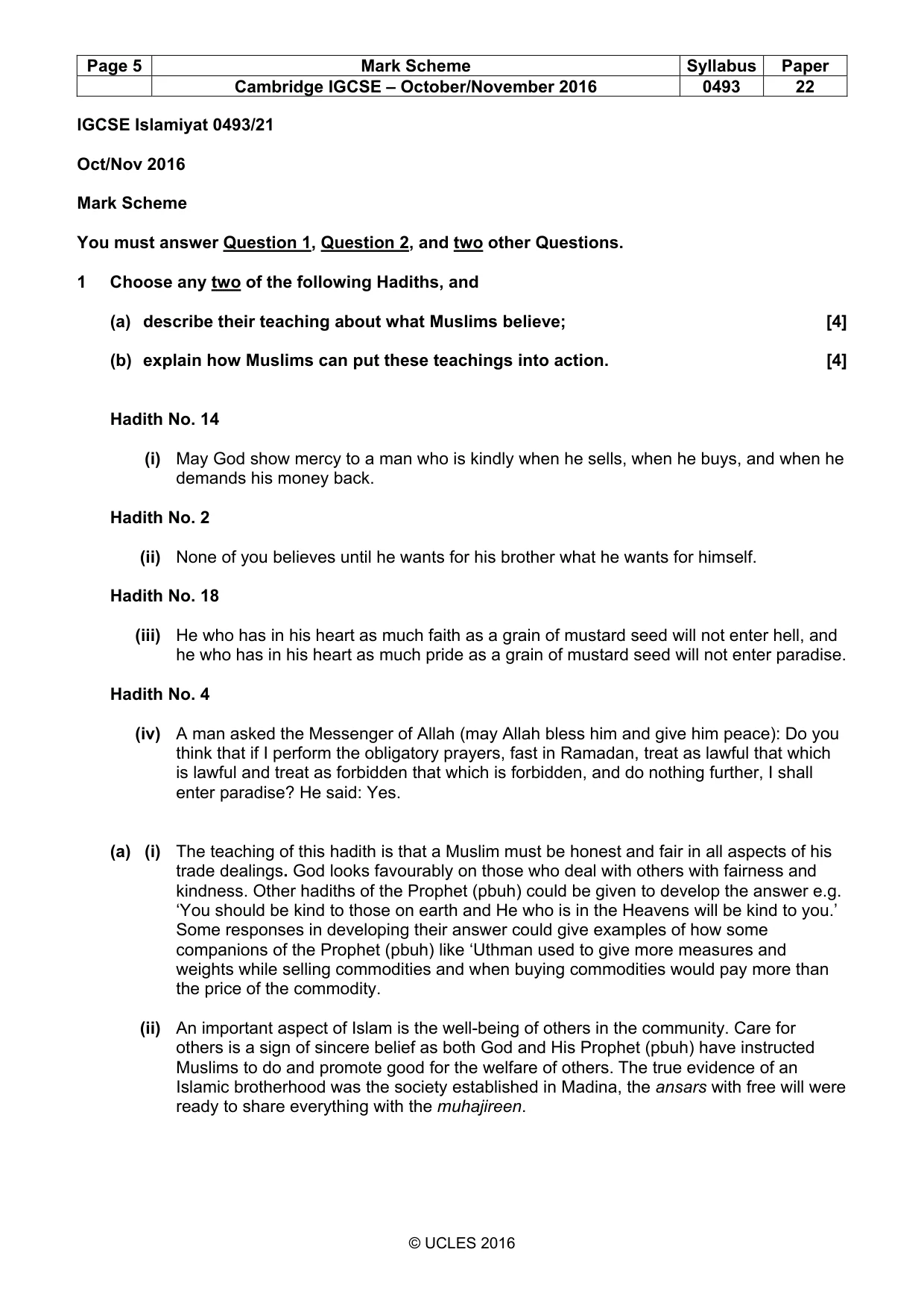
Page 5 Mark Scheme Syllabus Paper Cambridge IGCSE – October/November 2016 0493 22 © UCLES 2016 IGCSE Islamiyat 0493/21 Oct/Nov 2016 Mark Scheme You must answer Question 1, Question 2, and two other Questions. 1 Choose any two of the following Hadiths, and (a) describe their teaching about what Muslims believe; [4] (b) explain how Muslims can put these teachings into action. [4] Hadith No. 14 (i) May God show mercy to a man who is kindly when he sells, when he buys, and when he demands his money back. Hadith No. 2 (ii) None of you believes until he wants for his brother what he wants for himself. Hadith No. 18 (iii) He who has in his heart as much faith as a grain of mustard seed will not enter hell, and he who has in his heart as much pride as a grain of mustard seed will not enter paradise. Hadith No. 4 (iv) A man asked the Messenger of Allah (may Allah bless him and give him peace): Do you think that if I perform the obligatory prayers, fast in Ramadan, treat as lawful that which is lawful and treat as forbidden that which is forbidden, and do nothing further, I shall enter paradise? He said: Yes. (a) (i) The teaching of this hadith is that a Muslim must be honest and fair in all aspects of his trade dealings. God looks favourably on those who deal with others with fairness and kindness. Other hadiths of the Prophet (pbuh) could be given to develop the answer e.g. ‘You should be kind to those on earth and He who is in the Heavens will be kind to you.’ Some responses in developing their answer could give examples of how some companions of the Prophet (pbuh) like ‘Uthman used to give more measures and weights while selling commodities and when buying commodities would pay more than the price of the commodity. (ii) An important aspect of Islam is the well-being of others in the community. Care for others is a sign of sincere belief as both God and His Prophet (pbuh) have instructed Muslims to do and promote good for the welfare of others. The true evidence of an Islamic brotherhood was the society established in Madina, the ansars with free will were ready to share everything with the muhajireen.
Mark scheme, page 6
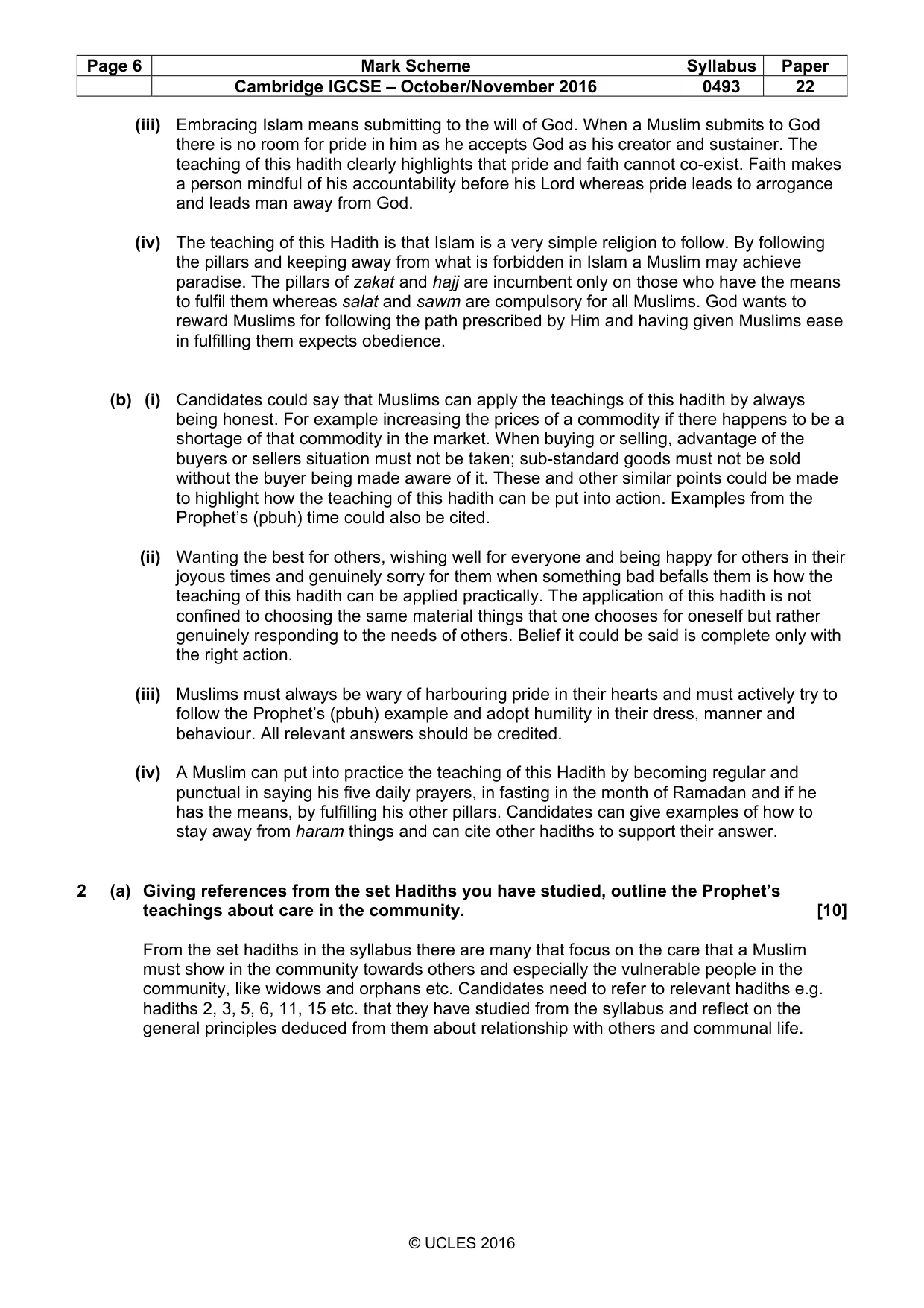
Page 6 Mark Scheme Syllabus Paper Cambridge IGCSE – October/November 2016 0493 22 © UCLES 2016 (iii) Embracing Islam means submitting to the will of God. When a Muslim submits to God there is no room for pride in him as he accepts God as his creator and sustainer. The teaching of this hadith clearly highlights that pride and faith cannot co-exist. Faith makes a person mindful of his accountability before his Lord whereas pride leads to arrogance and leads man away from God. (iv) The teaching of this Hadith is that Islam is a very simple religion to follow. By following the pillars and keeping away from what is forbidden in Islam a Muslim may achieve paradise. The pillars of zakat and hajj are incumbent only on those who have the means to fulfil them whereas salat and sawm are compulsory for all Muslims. God wants to reward Muslims for following the path prescribed by Him and having given Muslims ease in fulfilling them expects obedience. (b) (i) Candidates could say that Muslims can apply the teachings of this hadith by always being honest. For example increasing the prices of a commodity if there happens to be a shortage of that commodity in the market. When buying or selling, advantage of the buyers or sellers situation must not be taken; sub-standard goods must not be sold without the buyer being made aware of it. These and other similar points could be made to highlight how the teaching of this hadith can be put into action. Examples from the Prophet’s (pbuh) time could also be cited. (ii) Wanting the best for others, wishing well for everyone and being happy for others in their joyous times and genuinely sorry for them when something bad befalls them is how the teaching of this hadith can be applied practically. The application of this hadith is not confined to choosing the same material things that one chooses for oneself but rather genuinely responding to the needs of others. Belief it could be said is complete only with the right action. (iii) Muslims must always be wary of harbouring pride in their hearts and must actively try to follow the Prophet’s (pbuh) example and adopt humility in their dress, manner and behaviour. All relevant answers should be credited. (iv) A Muslim can put into practice the teaching of this Hadith by becoming regular and punctual in saying his five daily prayers, in fasting in the month of Ramadan and if he has the means, by fulfilling his other pillars. Candidates can give examples of how to stay away from haram things and can cite other hadiths to support their answer. 2 (a) Giving references from the set Hadiths you have studied, outline the Prophet’s teachings about care in the community. [10] From the set hadiths in the syllabus there are many that focus on the care that a Muslim must show in the community towards others and especially the vulnerable people in the community, like widows and orphans etc. Candidates need to refer to relevant hadiths e.g. hadiths 2, 3, 5, 6, 11, 15 etc. that they have studied from the syllabus and reflect on the general principles deduced from them about relationship with others and communal life.
Mark scheme, page 7
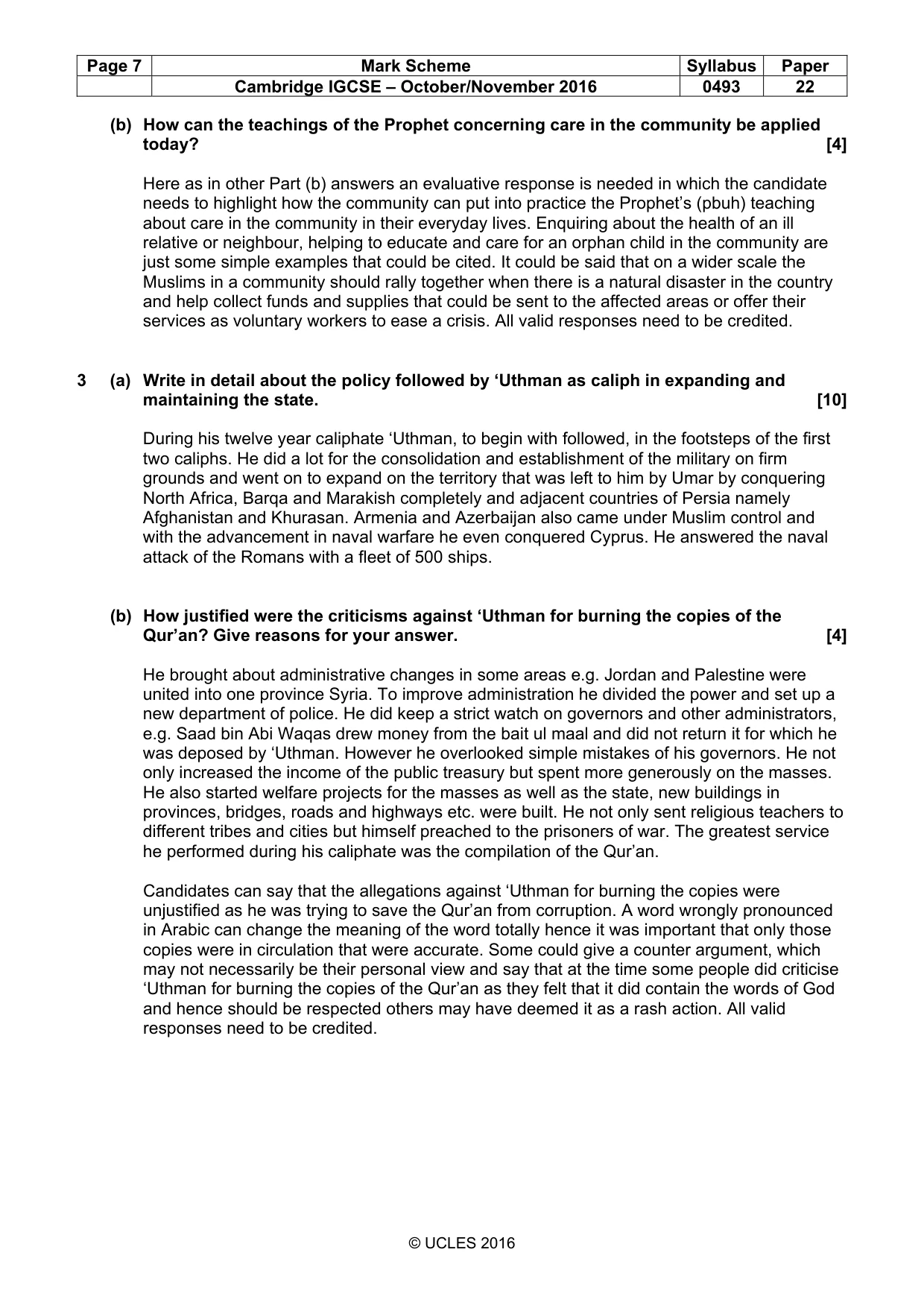
Page 7 Mark Scheme Syllabus Paper Cambridge IGCSE – October/November 2016 0493 22 © UCLES 2016 (b) How can the teachings of the Prophet concerning care in the community be applied today? [4] Here as in other Part (b) answers an evaluative response is needed in which the candidate needs to highlight how the community can put into practice the Prophet’s (pbuh) teaching about care in the community in their everyday lives. Enquiring about the health of an ill relative or neighbour, helping to educate and care for an orphan child in the community are just some simple examples that could be cited. It could be said that on a wider scale the Muslims in a community should rally together when there is a natural disaster in the country and help collect funds and supplies that could be sent to the affected areas or offer their services as voluntary workers to ease a crisis. All valid responses need to be credited. 3 (a) Write in detail about the policy followed by ‘Uthman as caliph in expanding and maintaining the state. [10] During his twelve year caliphate ‘Uthman, to begin with followed, in the footsteps of the first two caliphs. He did a lot for the consolidation and establishment of the military on firm grounds and went on to expand on the territory that was left to him by Umar by conquering North Africa, Barqa and Marakish completely and adjacent countries of Persia namely Afghanistan and Khurasan. Armenia and Azerbaijan also came under Muslim control and with the advancement in naval warfare he even conquered Cyprus. He answered the naval attack of the Romans with a fleet of 500 ships. (b) How justified were the criticisms against ‘Uthman for burning the copies of the Qur’an? Give reasons for your answer. [4] He brought about administrative changes in some areas e.g. Jordan and Palestine were united into one province Syria. To improve administration he divided the power and set up a new department of police. He did keep a strict watch on governors and other administrators, e.g. Saad bin Abi Waqas drew money from the bait ul maal and did not return it for which he was deposed by ‘Uthman. However he overlooked simple mistakes of his governors. He not only increased the income of the public treasury but spent more generously on the masses. He also started welfare projects for the masses as well as the state, new buildings in provinces, bridges, roads and highways etc. were built. He not only sent religious teachers to different tribes and cities but himself preached to the prisoners of war. The greatest service he performed during his caliphate was the compilation of the Qur’an. Candidates can say that the allegations against ‘Uthman for burning the copies were unjustified as he was trying to save the Qur’an from corruption. A word wrongly pronounced in Arabic can change the meaning of the word totally hence it was important that only those copies were in circulation that were accurate. Some could give a counter argument, which may not necessarily be their personal view and say that at the time some people did criticise ‘Uthman for burning the copies of the Qur’an as they felt that it did contain the words of God and hence should be respected others may have deemed it as a rash action. All valid responses need to be credited.
Mark scheme, page 8
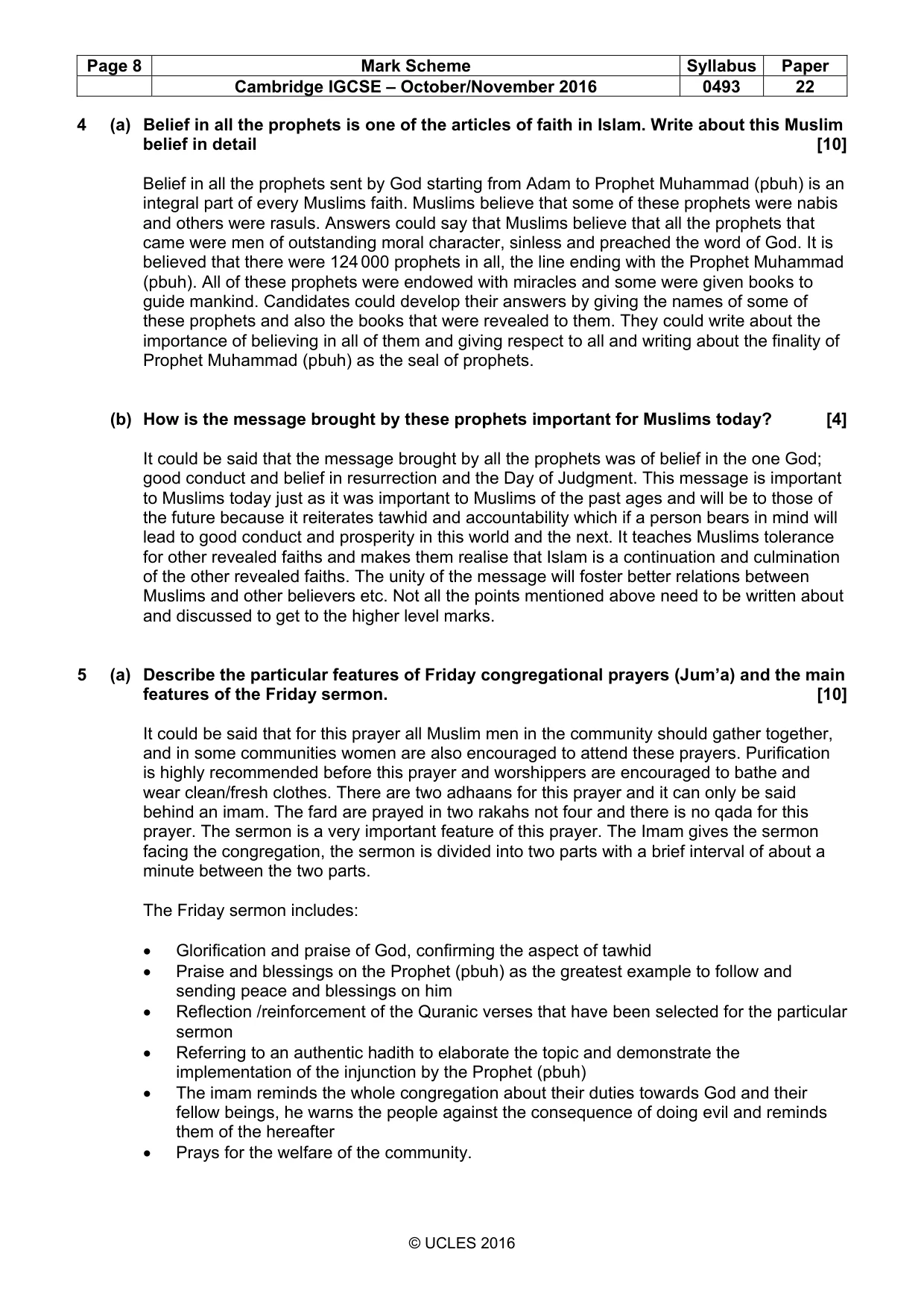
Page 8 Mark Scheme Syllabus Paper Cambridge IGCSE – October/November 2016 0493 22 © UCLES 2016 4 (a) Belief in all the prophets is one of the articles of faith in Islam. Write about this Muslim belief in detail [10] Belief in all the prophets sent by God starting from Adam to Prophet Muhammad (pbuh) is an integral part of every Muslims faith. Muslims believe that some of these prophets were nabis and others were rasuls. Answers could say that Muslims believe that all the prophets that came were men of outstanding moral character, sinless and preached the word of God. It is believed that there were 124 000 prophets in all, the line ending with the Prophet Muhammad (pbuh). All of these prophets were endowed with miracles and some were given books to guide mankind. Candidates could develop their answers by giving the names of some of these prophets and also the books that were revealed to them. They could write about the importance of believing in all of them and giving respect to all and writing about the finality of Prophet Muhammad (pbuh) as the seal of prophets. (b) How is the message brought by these prophets important for Muslims today? [4] It could be said that the message brought by all the prophets was of belief in the one God; good conduct and belief in resurrection and the Day of Judgment. This message is important to Muslims today just as it was important to Muslims of the past ages and will be to those of the future because it reiterates tawhid and accountability which if a person bears in mind will lead to good conduct and prosperity in this world and the next. It teaches Muslims tolerance for other revealed faiths and makes them realise that Islam is a continuation and culmination of the other revealed faiths. The unity of the message will foster better relations between Muslims and other believers etc. Not all the points mentioned above need to be written about and discussed to get to the higher level marks. 5 (a) Describe the particular features of Friday congregational prayers (Jum’a) and the main features of the Friday sermon. [10] It could be said that for this prayer all Muslim men in the community should gather together, and in some communities women are also encouraged to attend these prayers. Purification is highly recommended before this prayer and worshippers are encouraged to bathe and wear clean/fresh clothes. There are two adhaans for this prayer and it can only be said behind an imam. The fard are prayed in two rakahs not four and there is no qada for this prayer. The sermon is a very important feature of this prayer. The Imam gives the sermon facing the congregation, the sermon is divided into two parts with a brief interval of about a minute between the two parts. The Friday sermon includes: • Glorification and praise of God, confirming the aspect of tawhid • Praise and blessings on the Prophet (pbuh) as the greatest example to follow and sending peace and blessings on him • Reflection /reinforcement of the Quranic verses that have been selected for the particular sermon • Referring to an authentic hadith to elaborate the topic and demonstrate the implementation of the injunction by the Prophet (pbuh) • The imam reminds the whole congregation about their duties towards God and their fellow beings, he warns the people against the consequence of doing evil and reminds them of the hereafter • Prays for the welfare of the community.
Mark scheme, page 9
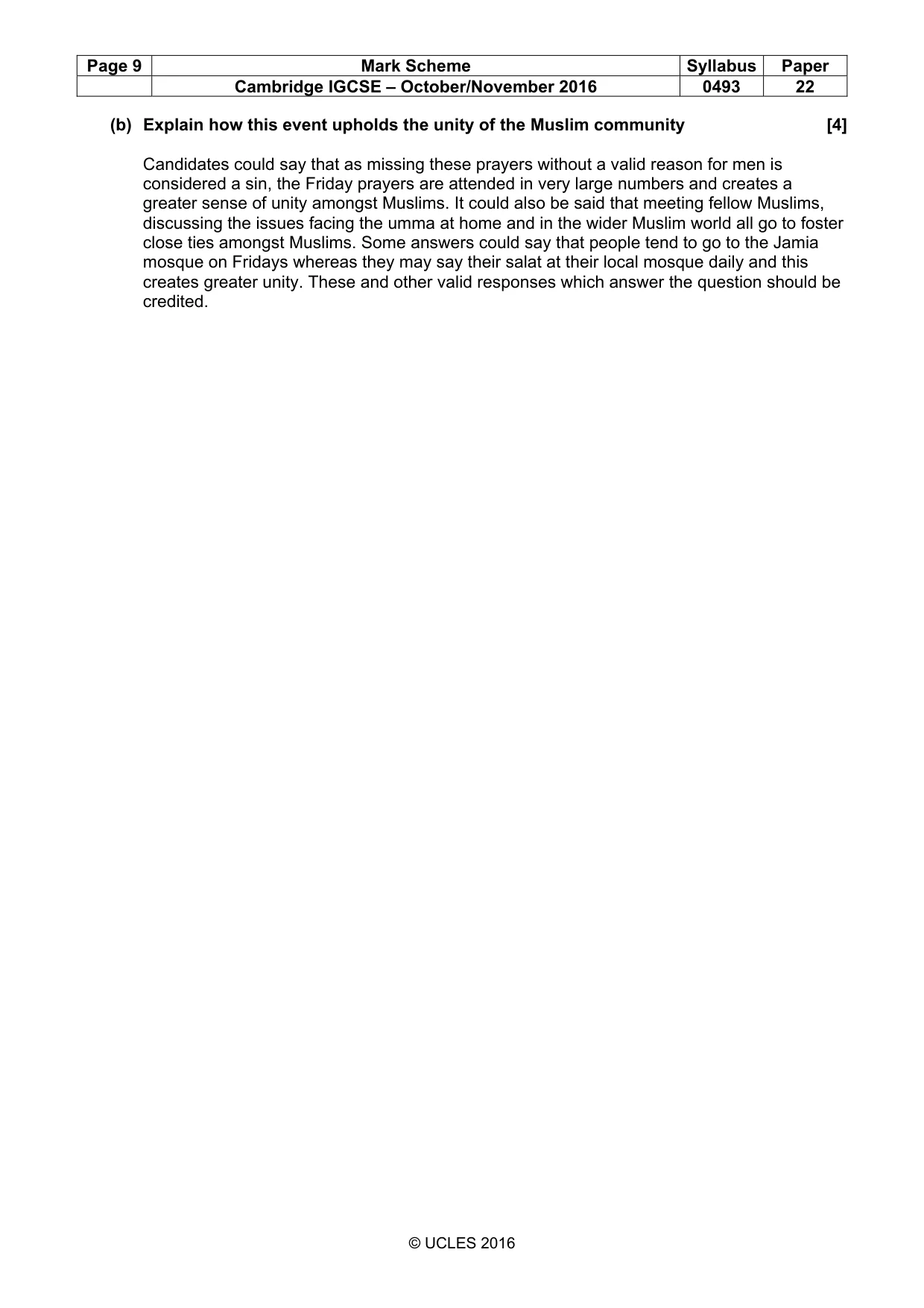
Page 9 Mark Scheme Syllabus Paper Cambridge IGCSE – October/November 2016 0493 22 © UCLES 2016 (b) Explain how this event upholds the unity of the Muslim community [4] Candidates could say that as missing these prayers without a valid reason for men is considered a sin, the Friday prayers are attended in very large numbers and creates a greater sense of unity amongst Muslims. It could also be said that meeting fellow Muslims, discussing the issues facing the umma at home and in the wider Muslim world all go to foster close ties amongst Muslims. Some answers could say that people tend to go to the Jamia mosque on Fridays whereas they may say their salat at their local mosque daily and this creates greater unity. These and other valid responses which answer the question should be credited.
What you needed in this session
Cambridge’s own grade thresholds for 2016 Oct/Nov, Paper 2 · Variant 2. A higher threshold means an easier paper — the bar moves with how the cohort did.