Cambridge IGCSE Islamiyat 0493 — 2015 Oct/Nov Paper 2 · Variant 2
0493/22/O/N/15 · 50 marks · ≈56 min
The question paper and its mark scheme, free to read here and free to download. This is Cambridge’s own paper, exactly as it was sat.
Question paper16 pages










Mark scheme7 pages
Answers below. Sit the paper first if you are practising.
Paper as text
Question paper, page 1
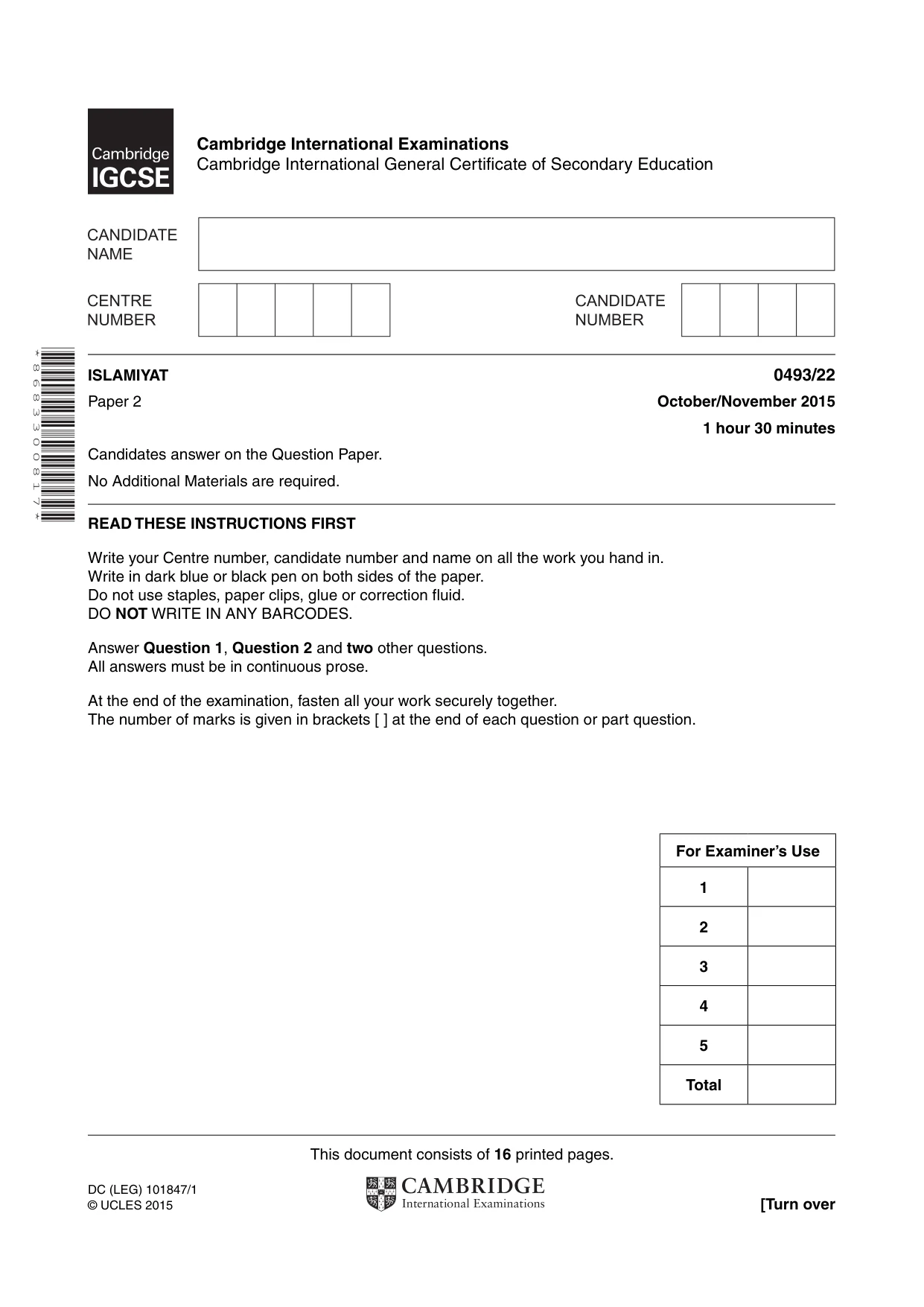
This document consists of 16 printed pages. DC (LEG) 101847/1 © UCLES 2015 [Turn over Cambridge International Examinations Cambridge International General Certificate of Secondary Education * 8 6 8 3 3 0 0 8 1 7 * ISLAMIYAT 0493/22 Paper 2 October/November 2015 1 hour 30 minutes Candidates answer on the Question Paper. No Additional Materials are required. READ THESE INSTRUCTIONS FIRST Write your Centre number, candidate number and name on all the work you hand in. Write in dark blue or black pen on both sides of the paper. Do not use staples, paper clips, glue or correction fluid. DO NOT WRITE IN ANY BARCODES. Answer Question 1, Question 2 and two other questions. All answers must be in continuous prose. At the end of the examination, fasten all your work securely together. The number of marks is given in brackets [ ] at the end of each question or part question. For Examiner’s Use 1 2 3 4 5 Total
Question paper, page 2
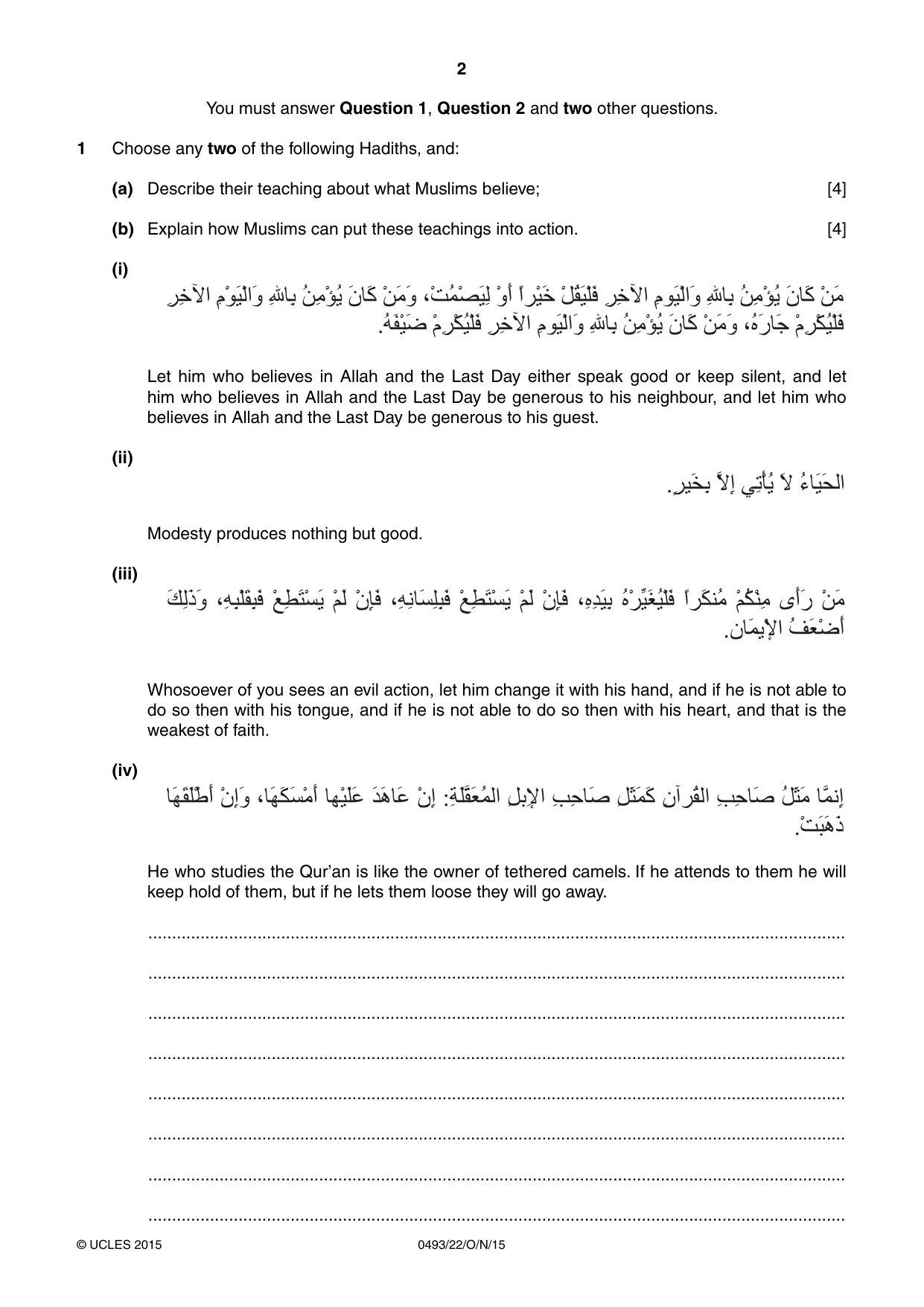
2 0493/22/O/N/15 © UCLES 2015 You must answer Question 1, Question 2 and two other questions. 1 Choose any two of the following Hadiths, and: (a) Describe their teaching about what Muslims believe; [4] (b) Explain how Muslims can put these teachings into action. [4] (i) ˶ϡ˸Ϯ˴ϴ˸ϟ˴ϭ ˶ͿΎ˶Α ˵Ϧ˶ϣ˸Ά˵ϳ ˴ϥΎ˴ϛ ˸Ϧ˴ϣ˴ϭ ˬ˸Ζ˵Ϥ˸μ˴ϴ˶ϟ ˸ϭ˴ ˱ή˸ϴ˴Χ ˸Ϟ˵Ϙ˴ϴ˸Ϡ˴ϓ ˶ή˶Χϵ ˶ϡϮ˴ϴ˸ϟ˴ϭ ˶ͿΎ˶Α ˵Ϧ˶ϣ˸Ά˵ϳ ˴ϥΎ˴ϛ ˸Ϧ˴ϣ ˶ή˶Χϵ .˵Ϫ˴ϔ˸ϴ˴ο ˸ϡ˶ή˸Ϝ˵ϴ˸Ϡ˴ϓ ˶ή˶Χϵ ˶ϡϮ˴ϴ˸ϟ˴ϭ ˶ͿΎ˶Α ˵Ϧ˶ϣ˸Ά˵ϳ ˴ϥΎ˴ϛ ˸Ϧ˴ϣ˴ϭ ˬ˵ϩ˴έΎ˴Ο ˸ϡ˶ή˸Ϝ˵ϴ˸Ϡ˴ϓ Let him who believes in Allah and the Last Day either speak good or keep silent, and let him who believes in Allah and the Last Day be generous to his neighbour, and let him who believes in Allah and the Last Day be generous to his guest. (ii) ˶· ϲ˶Η˸΄˵ϳ ˴ϻ ˵˯Ύ˴ϴ˴Τϟ .˳ήϴ˴Ψ˶Α ͉ϻ Modesty produces nothing but good. (iii) ˶Β˸Ϡ˴Ϙ˶Β˴ϓ ˸ϊ˶τ˴Θ˸δ˴ϳ ˸Ϣ˴ϟ ˸ϥ˶Έ˴ϓ ˬ˶Ϫ˶ϧΎ˴δ˶Ϡ˶Β˴ϓ ˸ϊ˶τ˴Θ˸δ˴ϳ ˸Ϣ˴ϟ ˸ϥ˶Έ˴ϓ ˬ˶ϩ˶Ϊ˴ϴ˶Α ˵ϩ˸ή͋ϴ˴ϐ˵ϴ˸Ϡ˴ϓ ˱ή˴ϜϨ˵ϣ ˸Ϣ˵Ϝ˸Ϩ˶ϣ ϯ˴˴έ ˸Ϧ˴ϣ ˴Ϛ˶ϟ˴Ϋ˴ϭ ˬ˶Ϫ .ϥΎ˴Ϥϳ˸Ϲ ˵ϒ˴ό˸ο˴ Whosoever of you sees an evil action, let him change it with his hand, and if he is not able to do so then with his tongue, and if he is not able to do so then with his heart, and that is the weakest of faith. (iv) ˶ΐ˶ΣΎ˴λ ˶Ϟ˴Μ˴Ϥ˴ϛ ˶ϥή˵Ϙϟ ˶ΐ˶ΣΎ˴λ ˵Ϟ˴Μ˴ϣ Ύ͉Ϥϧ˶· Ύ˴Ϭ˴Ϙ˴Ϡ˸σ˴ ˸ϥ˶·˴ϭ ˬΎ˴Ϭ˴Ϝ˴δ˸ϣ˴ ΎϬ˸ϴ˴Ϡ˴ϋ ˴Ϊ˴ϫΎ˴ϋ ˸ϥ˶· :˶Δ˴Ϡ͉Ϙ˴ό˵Ϥϟ ˶ϞΑ˶Ϲ .˸Ζ˴Β˴ϫ˴Ϋ He who studies the Qur’an is like the owner of tethered camels. If he attends to them he will keep hold of them, but if he lets them loose they will go away. … … … … … … … …
Question paper, page 3
3 0493/22/O/N/15 © UCLES 2015 [Turn over … … … … … … … … … … … … … … … … … … … … … … … … … … … …
Question paper, page 4
4 0493/22/O/N/15 © UCLES 2015 … … … … … … … … … … … … … … … … … … … … … … … … … … … …
Question paper, page 5
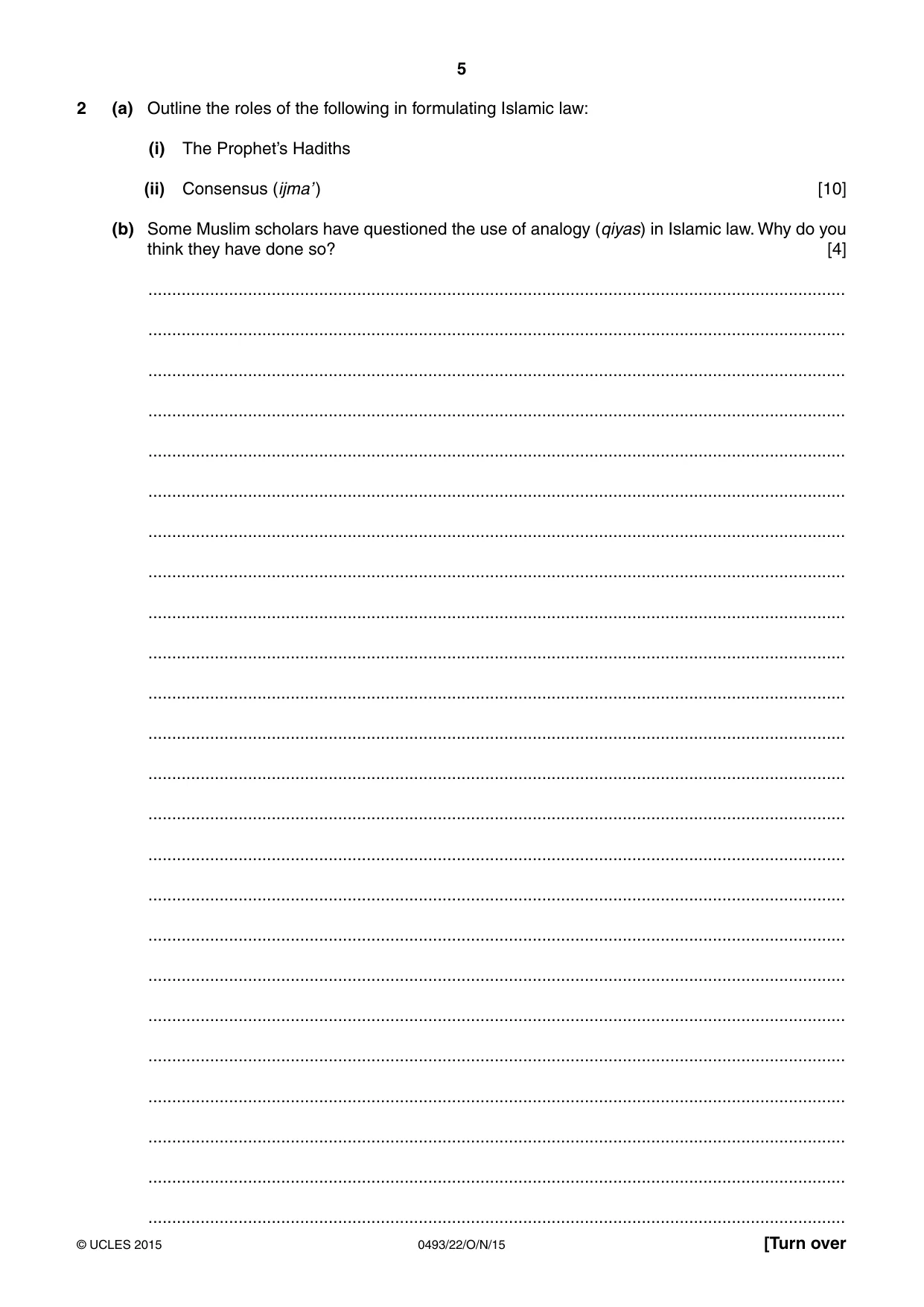
5 0493/22/O/N/15 © UCLES 2015 [Turn over 2 (a) Outline the roles of the following in formulating Islamic law: (i) The Prophet’s Hadiths (ii) Consensus (ijma’ ) [10] (b) Some Muslim scholars have questioned the use of analogy (qiyas) in Islamic law. Why do you think they have done so? [4] … … … … … … … … … … … … … … … … … … … … … … … …
Question paper, page 6
6 0493/22/O/N/15 © UCLES 2015 … … … … … … … … … … … … … … … … … … … … … … … … … … … …
Question paper, page 7
7 0493/22/O/N/15 © UCLES 2015 [Turn over … … … … … … … … … … … … … … … … … … … … … … … … … … … …
Question paper, page 8
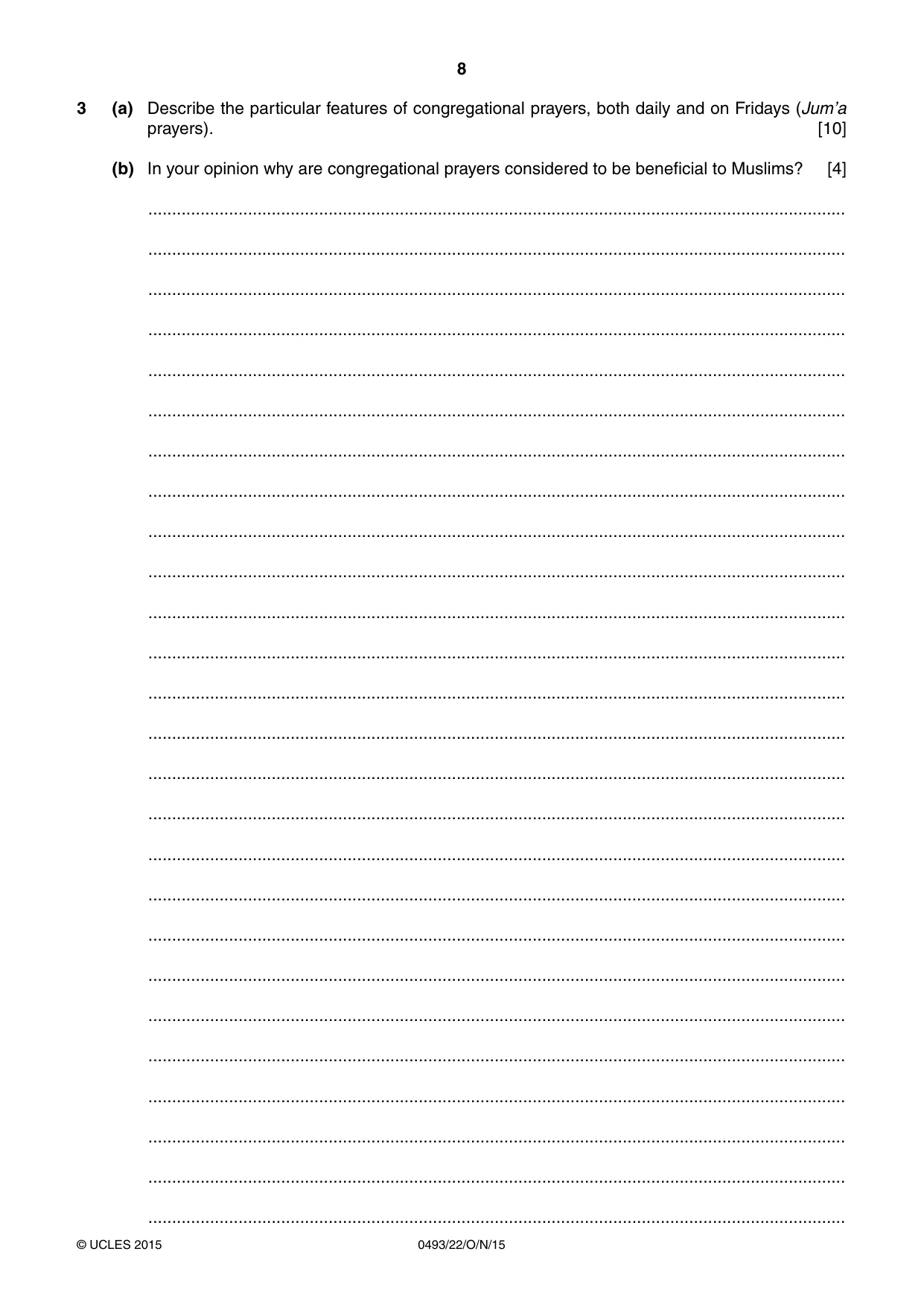
8 0493/22/O/N/15 © UCLES 2015 3 (a) Describe the particular features of congregational prayers, both daily and on Fridays (Jum’a prayers). [10] (b) In your opinion why are congregational prayers considered to be beneficial to Muslims? [4] … … … … … … … … … … … … … … … … … … … … … … … … … …
Question paper, page 9
9 0493/22/O/N/15 © UCLES 2015 [Turn over … … … … … … … … … … … … … … … … … … … … … … … … … … … …
Question paper, page 10
10 0493/22/O/N/15 © UCLES 2015 … … … … … … … … … … … … … … … … … … … … … … … … … … … …
Question paper, page 11
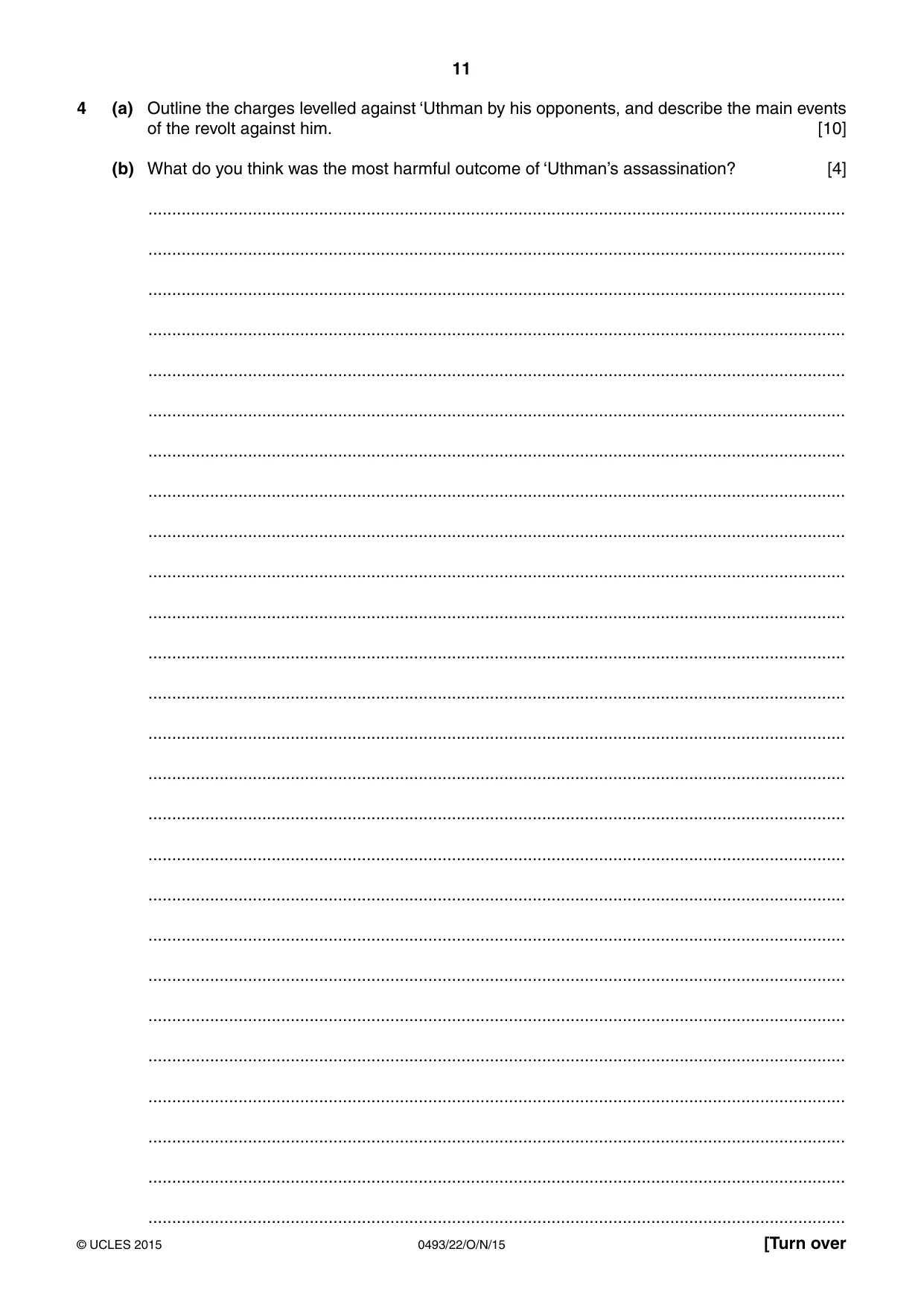
11 0493/22/O/N/15 © UCLES 2015 [Turn over 4 (a) Outline the charges levelled against ‘Uthman by his opponents, and describe the main events of the revolt against him. [10] (b) What do you think was the most harmful outcome of ‘Uthman’s assassination? [4] … … … … … … … … … … … … … … … … … … … … … … … … … …
Question paper, page 12
12 0493/22/O/N/15 © UCLES 2015 … … … … … … … … … … … … … … … … … … … … … … … … … … … …
Question paper, page 13
13 0493/22/O/N/15 © UCLES 2015 [Turn over … … … … … … … … … … … … … … … … … … … … … … … … … … … …
Question paper, page 14
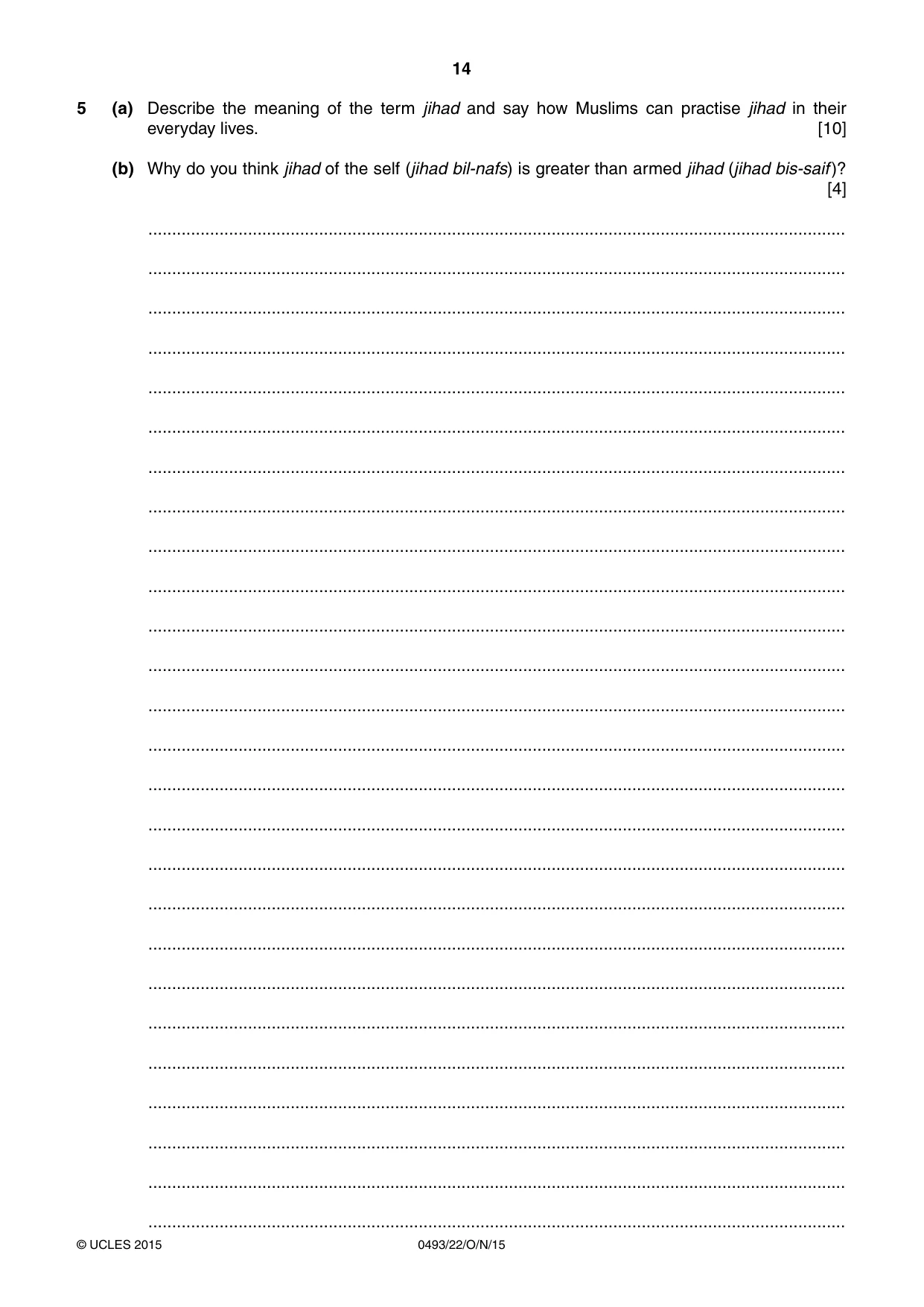
14 0493/22/O/N/15 © UCLES 2015 5 (a) Describe the meaning of the term jihad and say how Muslims can practise jihad in their everyday lives. [10] (b) Why do you think jihad of the self (jihad bil-nafs) is greater than armed jihad (jihad bis-saif )? [4] … … … … … … … … … … … … … … … … … … … … … … … … … …
Question paper, page 15
15 0493/22/O/N/15 © UCLES 2015 [Turn over … … … … … … … … … … … … … … … … … … … … … … … … … … … …
Question paper, page 16
16 0493/22/O/N/15 © UCLES 2015 Permission to reproduce items where third-party owned material protected by copyright is included has been sought and cleared where possible. Every reasonable effort has been made by the publisher (UCLES) to trace copyright holders, but if any items requiring clearance have unwittingly been included, the publisher will be pleased to make amends at the earliest possible opportunity. To avoid the issue of disclosure of answer-related information to candidates, all copyright acknowledgements are reproduced online in the Cambridge International Examinations Copyright Acknowledgements Booklet. This is produced for each series of examinations and is freely available to download at www.cie.org.uk after the live examination series. Cambridge International Examinations is part of the Cambridge Assessment Group. Cambridge Assessment is the brand name of University of Cambridge Local Examinations Syndicate (UCLES), which is itself a department of the University of Cambridge. … … … … … … … … … … … … … … … … … … … … … … … …
Mark scheme, page 1
® IGCSE is the registered trademark of Cambridge International Examinations. CAMBRIDGE INTERNATIONAL EXAMINATIONS Cambridge International General Certificate of Secondary Education MARK SCHEME for the October/November 2015 series 0493 ISLAMIYAT 0493/22 Paper 2, maximum raw mark 50 This mark scheme is published as an aid to teachers and candidates, to indicate the requirements of the examination. It shows the basis on which Examiners were instructed to award marks. It does not indicate the details of the discussions that took place at an Examiners’ meeting before marking began, which would have considered the acceptability of alternative answers. Mark schemes should be read in conjunction with the question paper and the Principal Examiner Report for Teachers. Cambridge will not enter into discussions about these mark schemes. Cambridge is publishing the mark schemes for the October/November 2015 series for most Cambridge IGCSE®, Cambridge International A and AS Level components and some Cambridge O Level components.
Mark scheme, page 2
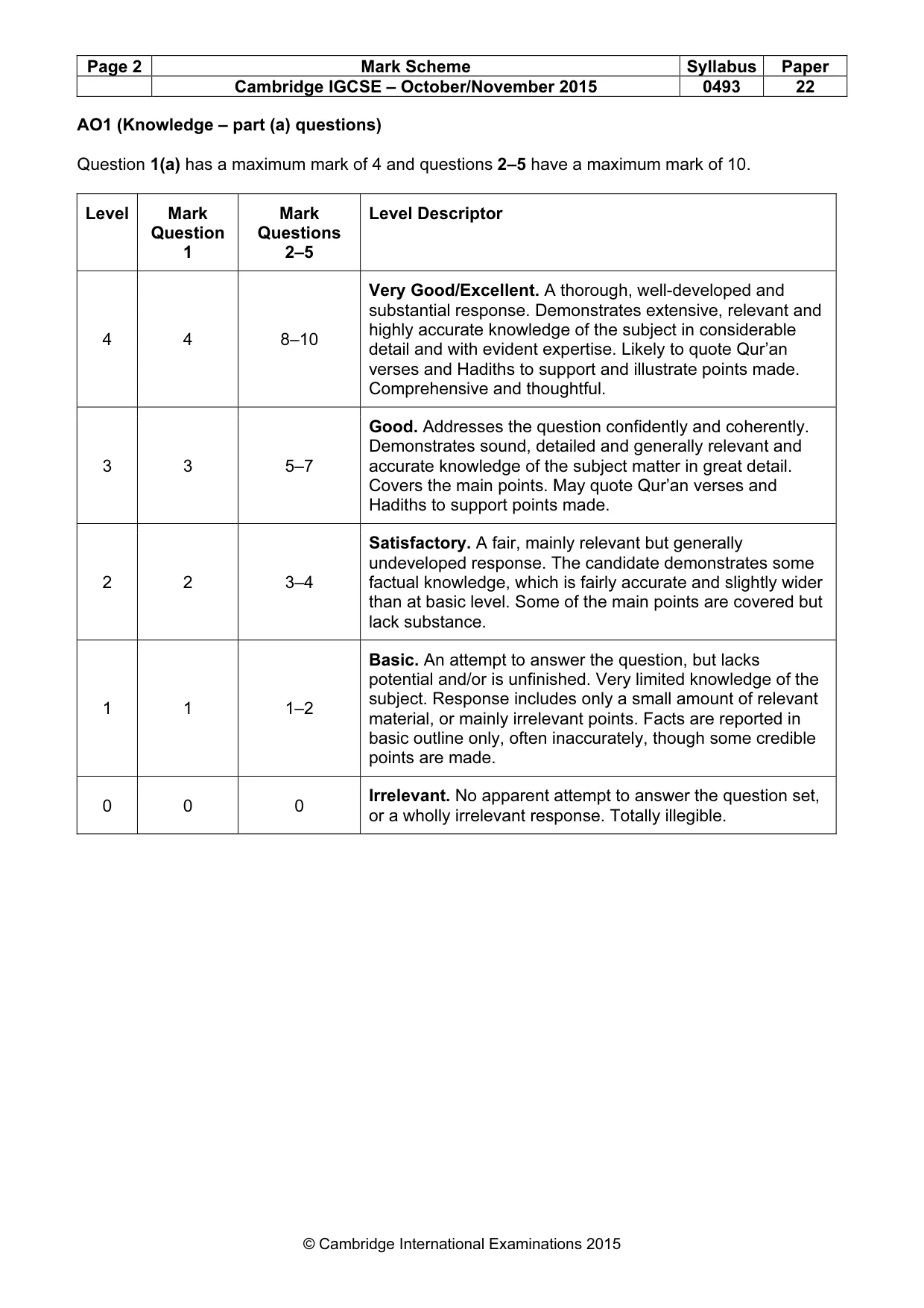
Page 2 Mark Scheme Syllabus Paper Cambridge IGCSE – October/November 2015 0493 22 © Cambridge International Examinations 2015 AO1 (Knowledge – part (a) questions) Question 1(a) has a maximum mark of 4 and questions 2–5 have a maximum mark of 10. Level Mark Question 1 Mark Questions 2–5 Level Descriptor 4 4 8–10 Very Good/Excellent. A thorough, well-developed and substantial response. Demonstrates extensive, relevant and highly accurate knowledge of the subject in considerable detail and with evident expertise. Likely to quote Qur’an verses and Hadiths to support and illustrate points made. Comprehensive and thoughtful. 3 3 5–7 Good. Addresses the question confidently and coherently. Demonstrates sound, detailed and generally relevant and accurate knowledge of the subject matter in great detail. Covers the main points. May quote Qur’an verses and Hadiths to support points made. 2 2 3–4 Satisfactory. A fair, mainly relevant but generally undeveloped response. The candidate demonstrates some factual knowledge, which is fairly accurate and slightly wider than at basic level. Some of the main points are covered but lack substance. 1 1 1–2 Basic. An attempt to answer the question, but lacks potential and/or is unfinished. Very limited knowledge of the subject. Response includes only a small amount of relevant material, or mainly irrelevant points. Facts are reported in basic outline only, often inaccurately, though some credible points are made. 0 0 0 Irrelevant. No apparent attempt to answer the question set, or a wholly irrelevant response. Totally illegible.
Mark scheme, page 3
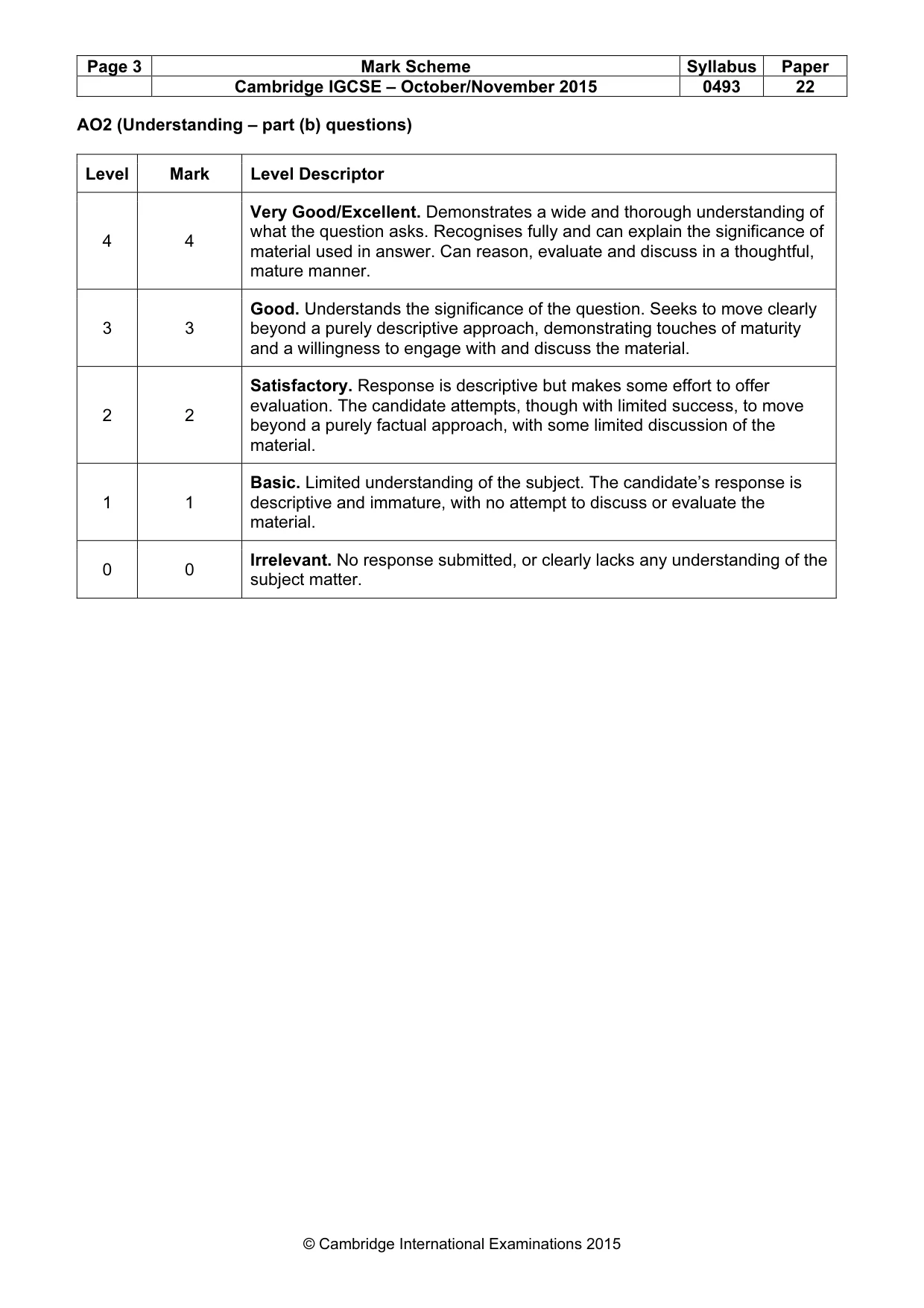
Page 3 Mark Scheme Syllabus Paper Cambridge IGCSE – October/November 2015 0493 22 © Cambridge International Examinations 2015 AO2 (Understanding – part (b) questions) Level Mark Level Descriptor 4 4 Very Good/Excellent. Demonstrates a wide and thorough understanding of what the question asks. Recognises fully and can explain the significance of material used in answer. Can reason, evaluate and discuss in a thoughtful, mature manner. 3 3 Good. Understands the significance of the question. Seeks to move clearly beyond a purely descriptive approach, demonstrating touches of maturity and a willingness to engage with and discuss the material. 2 2 Satisfactory. Response is descriptive but makes some effort to offer evaluation. The candidate attempts, though with limited success, to move beyond a purely factual approach, with some limited discussion of the material. 1 1 Basic. Limited understanding of the subject. The candidate’s response is descriptive and immature, with no attempt to discuss or evaluate the material. 0 0 Irrelevant. No response submitted, or clearly lacks any understanding of the subject matter.
Mark scheme, page 4
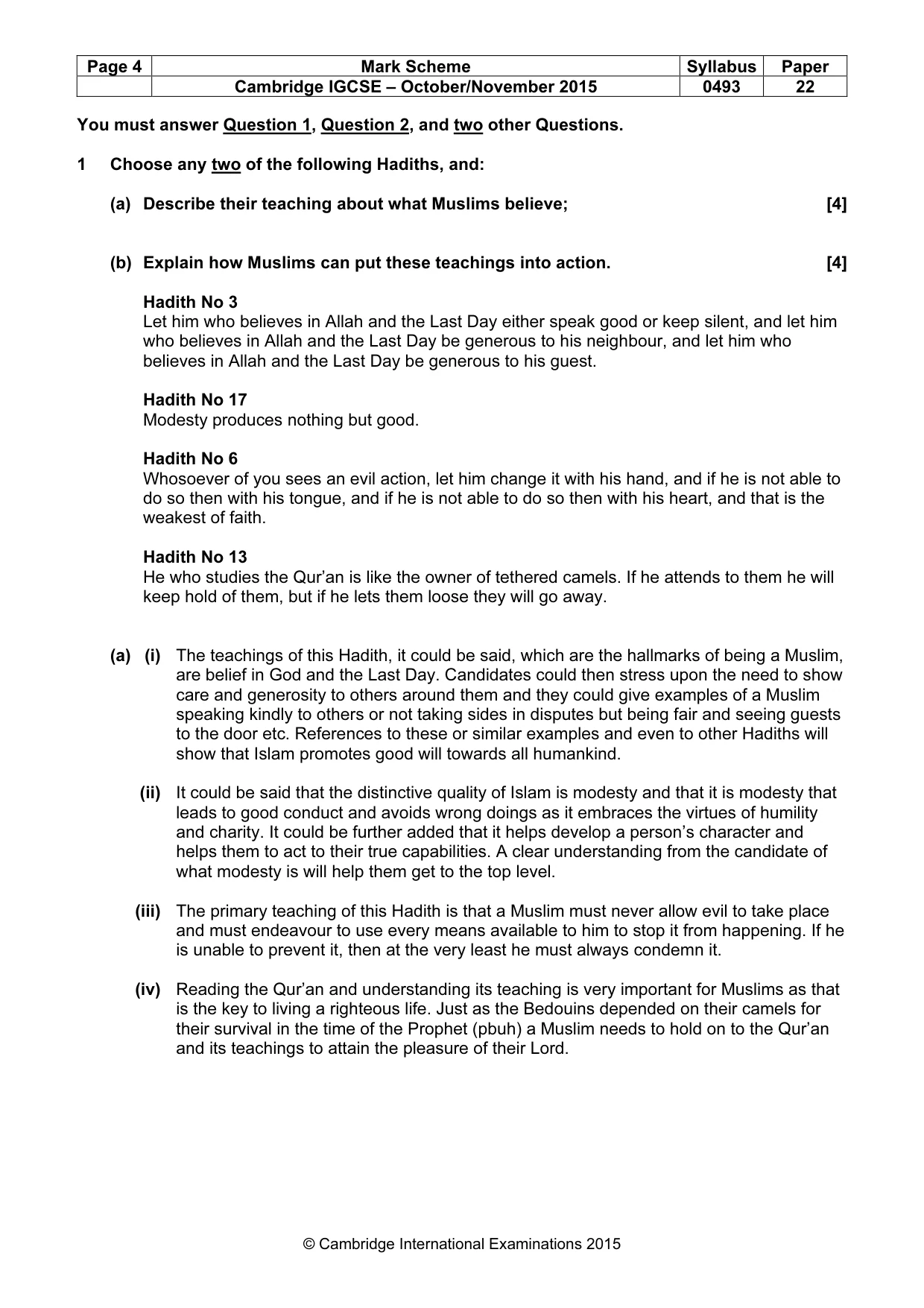
Page 4 Mark Scheme Syllabus Paper Cambridge IGCSE – October/November 2015 0493 22 © Cambridge International Examinations 2015 You must answer Question 1, Question 2, and two other Questions. 1 Choose any two of the following Hadiths, and: (a) Describe their teaching about what Muslims believe; [4] (b) Explain how Muslims can put these teachings into action. [4] Hadith No 3 Let him who believes in Allah and the Last Day either speak good or keep silent, and let him who believes in Allah and the Last Day be generous to his neighbour, and let him who believes in Allah and the Last Day be generous to his guest. Hadith No 17 Modesty produces nothing but good. Hadith No 6 Whosoever of you sees an evil action, let him change it with his hand, and if he is not able to do so then with his tongue, and if he is not able to do so then with his heart, and that is the weakest of faith. Hadith No 13 He who studies the Qur’an is like the owner of tethered camels. If he attends to them he will keep hold of them, but if he lets them loose they will go away. (a) (i) The teachings of this Hadith, it could be said, which are the hallmarks of being a Muslim, are belief in God and the Last Day. Candidates could then stress upon the need to show care and generosity to others around them and they could give examples of a Muslim speaking kindly to others or not taking sides in disputes but being fair and seeing guests to the door etc. References to these or similar examples and even to other Hadiths will show that Islam promotes good will towards all humankind. (ii) It could be said that the distinctive quality of Islam is modesty and that it is modesty that leads to good conduct and avoids wrong doings as it embraces the virtues of humility and charity. It could be further added that it helps develop a person’s character and helps them to act to their true capabilities. A clear understanding from the candidate of what modesty is will help them get to the top level. (iii) The primary teaching of this Hadith is that a Muslim must never allow evil to take place and must endeavour to use every means available to him to stop it from happening. If he is unable to prevent it, then at the very least he must always condemn it. (iv) Reading the Qur’an and understanding its teaching is very important for Muslims as that is the key to living a righteous life. Just as the Bedouins depended on their camels for their survival in the time of the Prophet (pbuh) a Muslim needs to hold on to the Qur’an and its teachings to attain the pleasure of their Lord.
Mark scheme, page 5
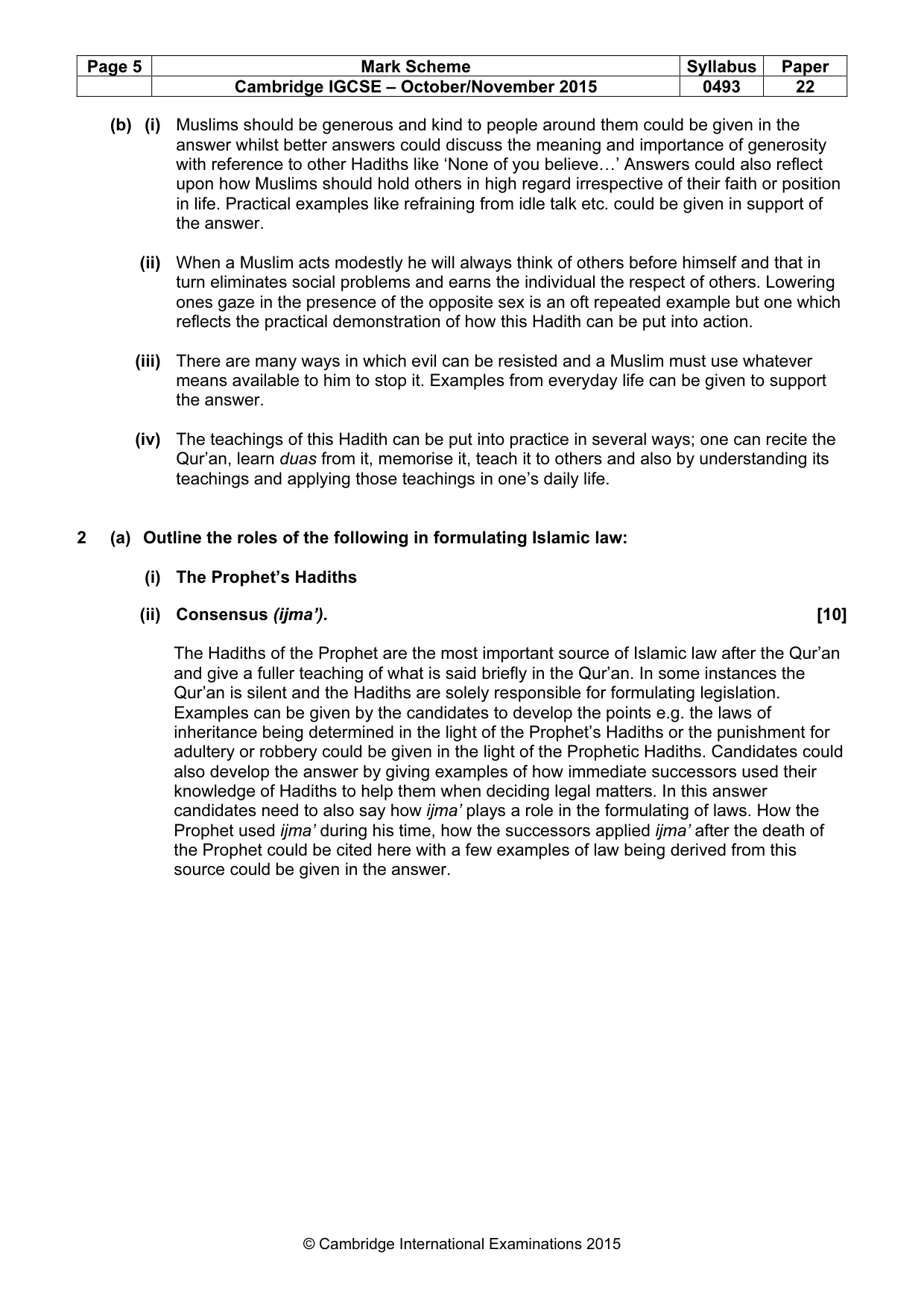
Page 5 Mark Scheme Syllabus Paper Cambridge IGCSE – October/November 2015 0493 22 © Cambridge International Examinations 2015 (b) (i) Muslims should be generous and kind to people around them could be given in the answer whilst better answers could discuss the meaning and importance of generosity with reference to other Hadiths like ‘None of you believe…’ Answers could also reflect upon how Muslims should hold others in high regard irrespective of their faith or position in life. Practical examples like refraining from idle talk etc. could be given in support of the answer. (ii) When a Muslim acts modestly he will always think of others before himself and that in turn eliminates social problems and earns the individual the respect of others. Lowering ones gaze in the presence of the opposite sex is an oft repeated example but one which reflects the practical demonstration of how this Hadith can be put into action. (iii) There are many ways in which evil can be resisted and a Muslim must use whatever means available to him to stop it. Examples from everyday life can be given to support the answer. (iv) The teachings of this Hadith can be put into practice in several ways; one can recite the Qur’an, learn duas from it, memorise it, teach it to others and also by understanding its teachings and applying those teachings in one’s daily life. 2 (a) Outline the roles of the following in formulating Islamic law: (i) The Prophet’s Hadiths (ii) Consensus (ijma’). [10] The Hadiths of the Prophet are the most important source of Islamic law after the Qur’an and give a fuller teaching of what is said briefly in the Qur’an. In some instances the Qur’an is silent and the Hadiths are solely responsible for formulating legislation. Examples can be given by the candidates to develop the points e.g. the laws of inheritance being determined in the light of the Prophet’s Hadiths or the punishment for adultery or robbery could be given in the light of the Prophetic Hadiths. Candidates could also develop the answer by giving examples of how immediate successors used their knowledge of Hadiths to help them when deciding legal matters. In this answer candidates need to also say how ijma’ plays a role in the formulating of laws. How the Prophet used ijma’ during his time, how the successors applied ijma’ after the death of the Prophet could be cited here with a few examples of law being derived from this source could be given in the answer.
Mark scheme, page 6
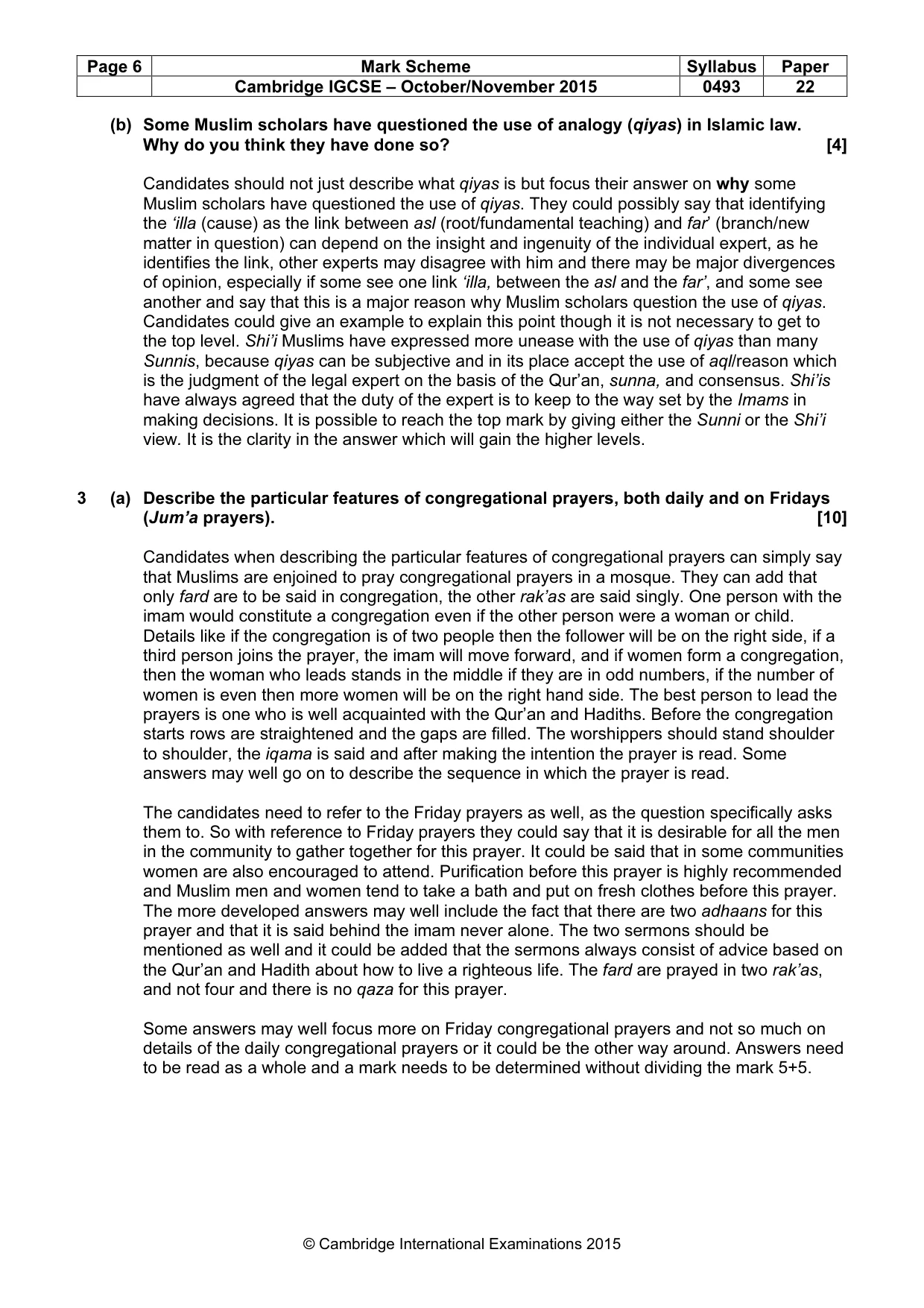
Page 6 Mark Scheme Syllabus Paper Cambridge IGCSE – October/November 2015 0493 22 © Cambridge International Examinations 2015 (b) Some Muslim scholars have questioned the use of analogy (qiyas) in Islamic law. Why do you think they have done so? [4] Candidates should not just describe what qiyas is but focus their answer on why some Muslim scholars have questioned the use of qiyas. They could possibly say that identifying the ‘illa (cause) as the link between asl (root/fundamental teaching) and far’ (branch/new matter in question) can depend on the insight and ingenuity of the individual expert, as he identifies the link, other experts may disagree with him and there may be major divergences of opinion, especially if some see one link ‘illa, between the asl and the far’, and some see another and say that this is a major reason why Muslim scholars question the use of qiyas. Candidates could give an example to explain this point though it is not necessary to get to the top level. Shi’i Muslims have expressed more unease with the use of qiyas than many Sunnis, because qiyas can be subjective and in its place accept the use of aql/reason which is the judgment of the legal expert on the basis of the Qur’an, sunna, and consensus. Shi’is have always agreed that the duty of the expert is to keep to the way set by the Imams in making decisions. It is possible to reach the top mark by giving either the Sunni or the Shi’i view. It is the clarity in the answer which will gain the higher levels. 3 (a) Describe the particular features of congregational prayers, both daily and on Fridays (Jum’a prayers). [10] Candidates when describing the particular features of congregational prayers can simply say that Muslims are enjoined to pray congregational prayers in a mosque. They can add that only fard are to be said in congregation, the other rak’as are said singly. One person with the imam would constitute a congregation even if the other person were a woman or child. Details like if the congregation is of two people then the follower will be on the right side, if a third person joins the prayer, the imam will move forward, and if women form a congregation, then the woman who leads stands in the middle if they are in odd numbers, if the number of women is even then more women will be on the right hand side. The best person to lead the prayers is one who is well acquainted with the Qur’an and Hadiths. Before the congregation starts rows are straightened and the gaps are filled. The worshippers should stand shoulder to shoulder, the iqama is said and after making the intention the prayer is read. Some answers may well go on to describe the sequence in which the prayer is read. The candidates need to refer to the Friday prayers as well, as the question specifically asks them to. So with reference to Friday prayers they could say that it is desirable for all the men in the community to gather together for this prayer. It could be said that in some communities women are also encouraged to attend. Purification before this prayer is highly recommended and Muslim men and women tend to take a bath and put on fresh clothes before this prayer. The more developed answers may well include the fact that there are two adhaans for this prayer and that it is said behind the imam never alone. The two sermons should be mentioned as well and it could be added that the sermons always consist of advice based on the Qur’an and Hadith about how to live a righteous life. The fard are prayed in two rak’as, and not four and there is no qaza for this prayer. Some answers may well focus more on Friday congregational prayers and not so much on details of the daily congregational prayers or it could be the other way around. Answers need to be read as a whole and a mark needs to be determined without dividing the mark 5+5.
Mark scheme, page 7
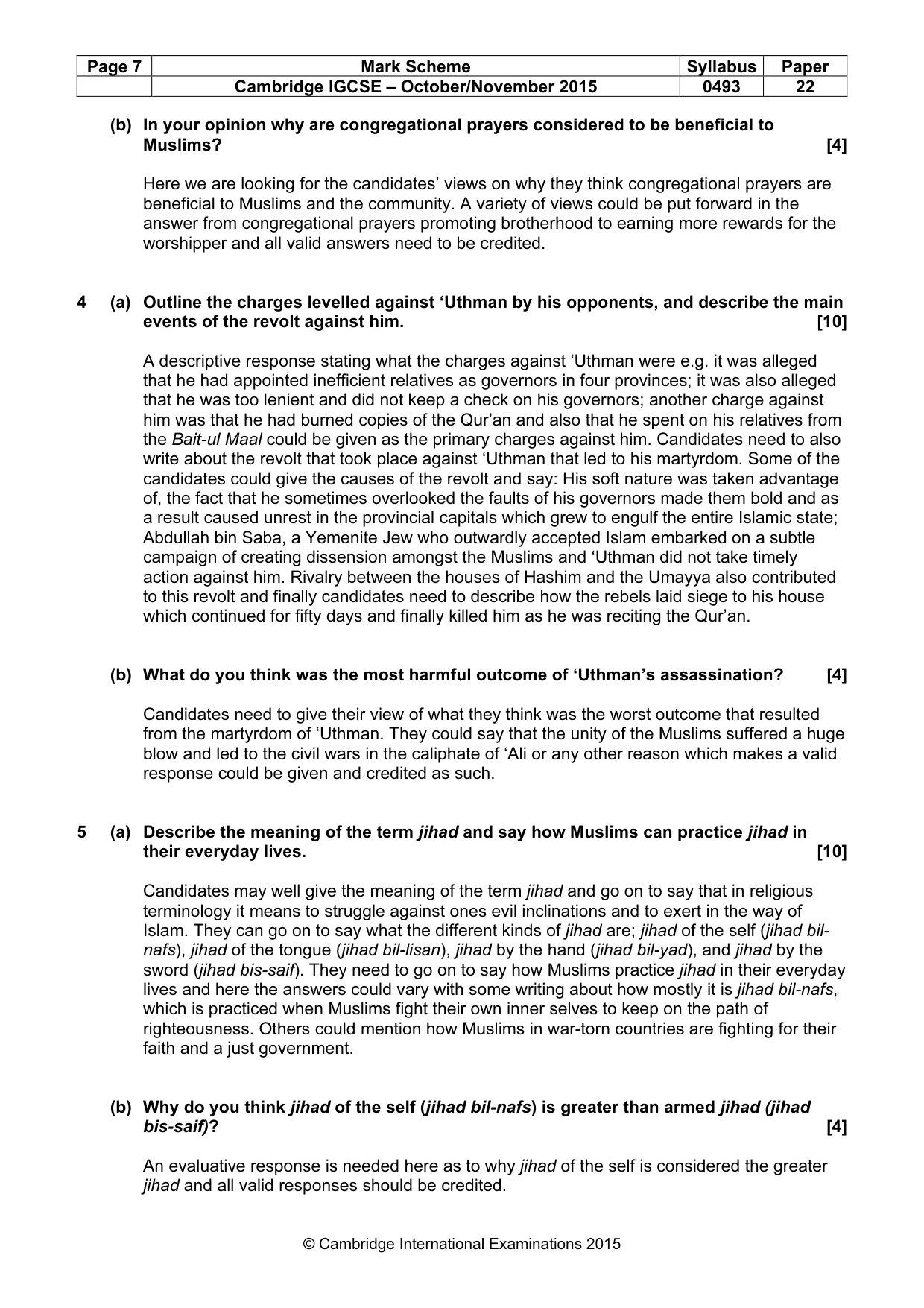
Page 7 Mark Scheme Syllabus Paper Cambridge IGCSE – October/November 2015 0493 22 © Cambridge International Examinations 2015 (b) In your opinion why are congregational prayers considered to be beneficial to Muslims? [4] Here we are looking for the candidates’ views on why they think congregational prayers are beneficial to Muslims and the community. A variety of views could be put forward in the answer from congregational prayers promoting brotherhood to earning more rewards for the worshipper and all valid answers need to be credited. 4 (a) Outline the charges levelled against ‘Uthman by his opponents, and describe the main events of the revolt against him. [10] A descriptive response stating what the charges against ‘Uthman were e.g. it was alleged that he had appointed inefficient relatives as governors in four provinces; it was also alleged that he was too lenient and did not keep a check on his governors; another charge against him was that he had burned copies of the Qur’an and also that he spent on his relatives from the Bait-ul Maal could be given as the primary charges against him. Candidates need to also write about the revolt that took place against ‘Uthman that led to his martyrdom. Some of the candidates could give the causes of the revolt and say: His soft nature was taken advantage of, the fact that he sometimes overlooked the faults of his governors made them bold and as a result caused unrest in the provincial capitals which grew to engulf the entire Islamic state; Abdullah bin Saba, a Yemenite Jew who outwardly accepted Islam embarked on a subtle campaign of creating dissension amongst the Muslims and ‘Uthman did not take timely action against him. Rivalry between the houses of Hashim and the Umayya also contributed to this revolt and finally candidates need to describe how the rebels laid siege to his house which continued for fifty days and finally killed him as he was reciting the Qur’an. (b) What do you think was the most harmful outcome of ‘Uthman’s assassination? [4] Candidates need to give their view of what they think was the worst outcome that resulted from the martyrdom of ‘Uthman. They could say that the unity of the Muslims suffered a huge blow and led to the civil wars in the caliphate of ‘Ali or any other reason which makes a valid response could be given and credited as such. 5 (a) Describe the meaning of the term jihad and say how Muslims can practice jihad in their everyday lives. [10] Candidates may well give the meaning of the term jihad and go on to say that in religious terminology it means to struggle against ones evil inclinations and to exert in the way of Islam. They can go on to say what the different kinds of jihad are; jihad of the self (jihad bil- nafs), jihad of the tongue (jihad bil-lisan), jihad by the hand (jihad bil-yad), and jihad by the sword (jihad bis-saif). They need to go on to say how Muslims practice jihad in their everyday lives and here the answers could vary with some writing about how mostly it is jihad bil-nafs, which is practiced when Muslims fight their own inner selves to keep on the path of righteousness. Others could mention how Muslims in war-torn countries are fighting for their faith and a just government. (b) Why do you think jihad of the self (jihad bil-nafs) is greater than armed jihad (jihad bis-saif)? [4] An evaluative response is needed here as to why jihad of the self is considered the greater jihad and all valid responses should be credited.
What you needed in this session
Cambridge’s own grade thresholds for 2015 Oct/Nov, Paper 2 · Variant 2. A higher threshold means an easier paper — the bar moves with how the cohort did.