Cambridge IGCSE Islamiyat 0493 — 2014 Oct/Nov Paper 2 · Variant 2
0493/22/O/N/14 · 50 marks · ≈56 min
The question paper and its mark scheme, free to read here and free to download. This is Cambridge’s own paper, exactly as it was sat.
Question paper16 pages
Mark scheme8 pages
Answers below. Sit the paper first if you are practising.
Paper as text
Question paper, page 1
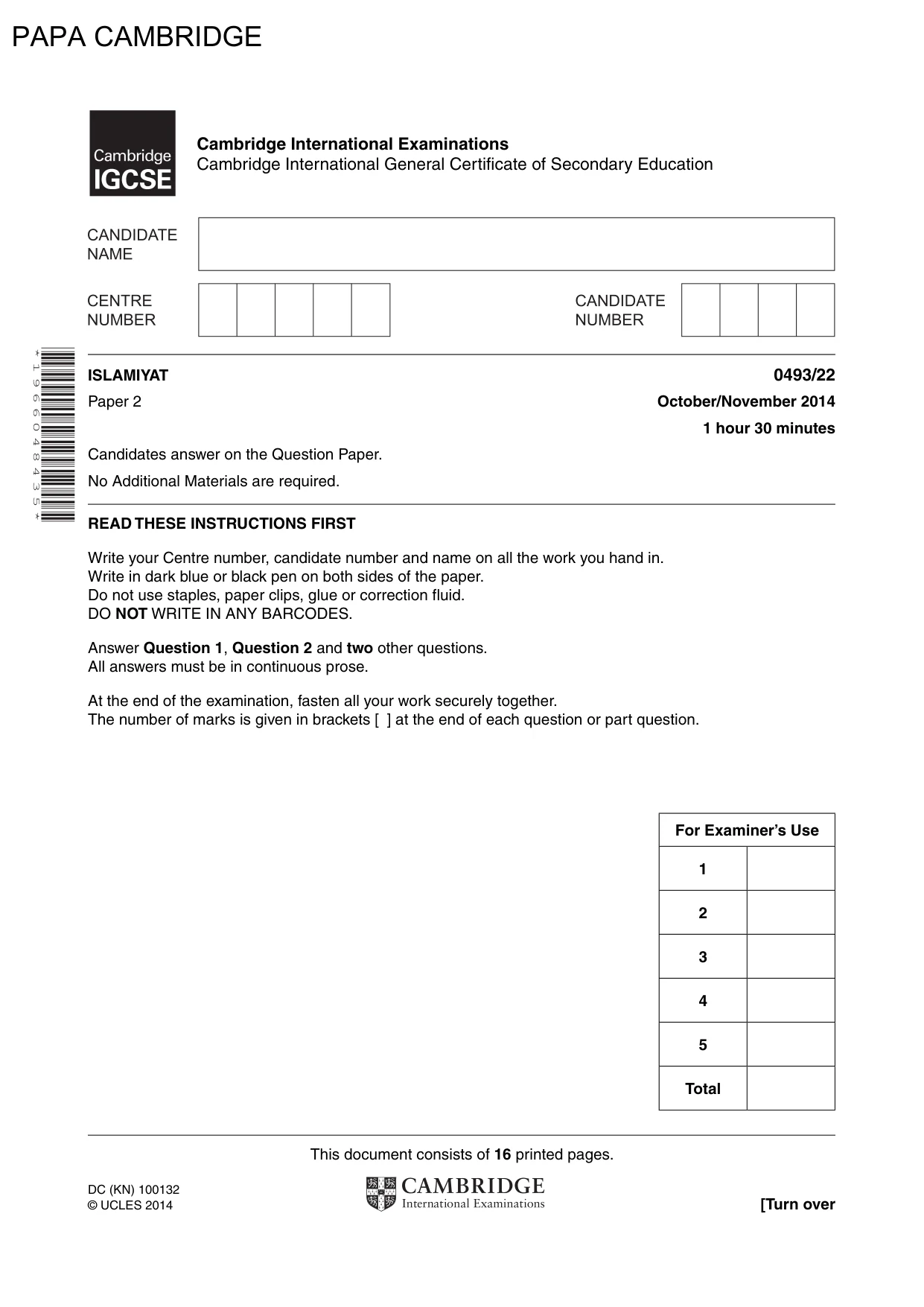
PAPA CAMBRIDGE This document consists of 16 printed pages. DC (KN) 100132 © UCLES 2014 [Turn over Cambridge International Examinations Cambridge International General Certificate of Secondary Education * 1 9 6 6 0 4 8 4 3 5 * ISLAMIYAT 0493/22 Paper 2 October/November 2014 1 hour 30 minutes Candidates answer on the Question Paper. No Additional Materials are required. READ THESE INSTRUCTIONS FIRST Write your Centre number, candidate number and name on all the work you hand in. Write in dark blue or black pen on both sides of the paper. Do not use staples, paper clips, glue or correction fluid. DO NOT WRITE IN ANY BARCODES. Answer Question 1, Question 2 and two other questions. All answers must be in continuous prose. At the end of the examination, fasten all your work securely together. The number of marks is given in brackets [ ] at the end of each question or part question. For Examiner’s Use 1 2 3 4 5 Total
Question paper, page 2
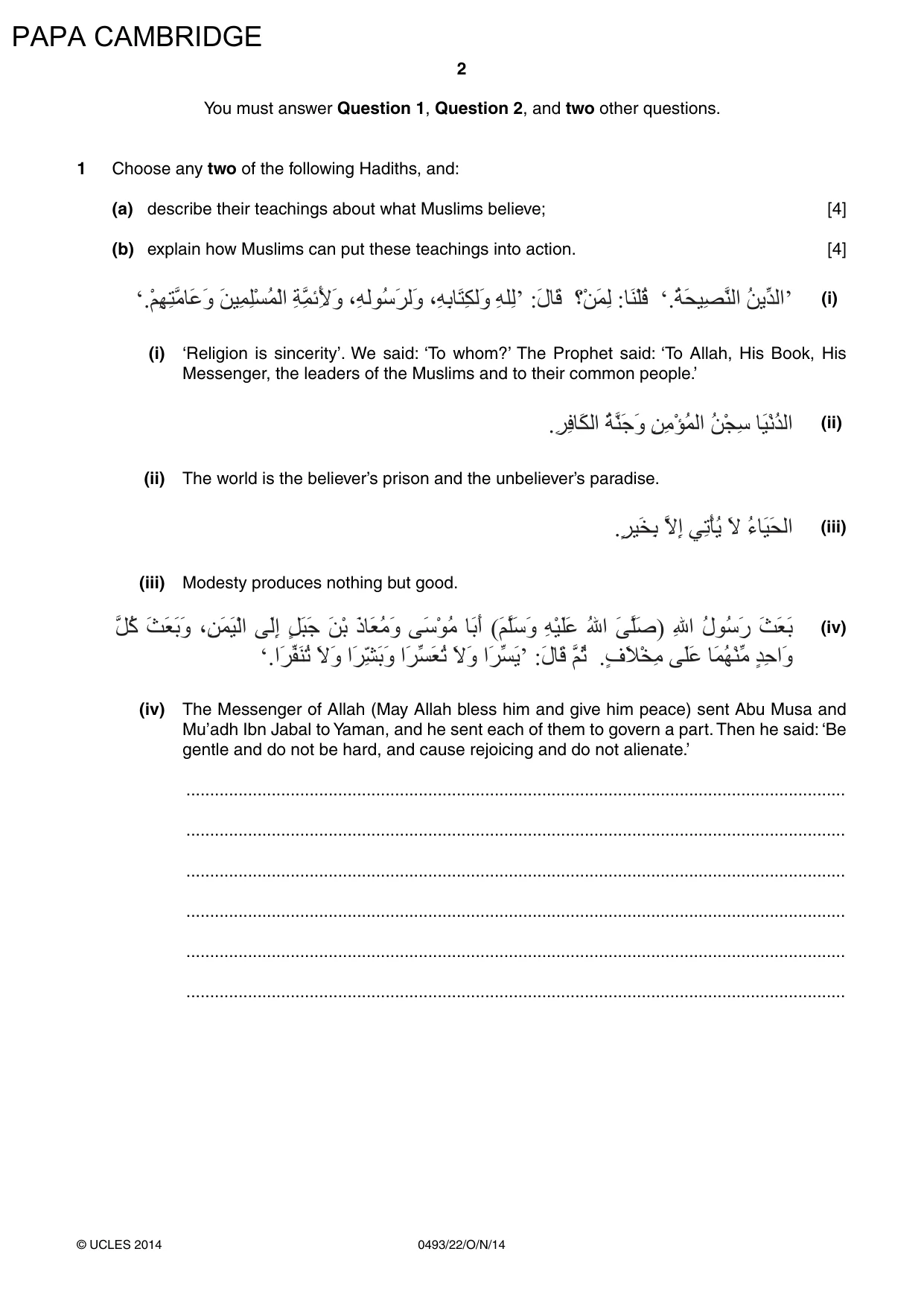
PAPA CAMBRIDGE 2 0493/22/O/N/14 © UCLES 2014 You must answer Question 1, Question 2, and two other questions. 1 Choose any two of the following Hadiths, and: (a) describe their teachings about what Muslims believe; [4] (b) explain how Muslims can put these teachings into action. [4] ’ .˵Δ˴Τϴ˶μ͉Ϩϟ ˵Ϧϳ͋Ϊϟ ‘ :˴ϝΎ˴ϗ ˮ˸Ϧ˴Ϥ˶ϟ :Ύ˴Ϩ˸Ϡ˵ϗ ’ .˸Ϣ˶Ϭ˶Θ͉ϣΎ˴ϋ˴ϭ ˴Ϧϴ˶Ϥ˶Ϡ˸δ˵Ϥ˸ϟ ˶Δ͉˶Ϥ˶˴Ϸ˴ϭ ˬ˶ϪϟϮ˵γ˴ήϟ˴ϭ ˬ˶Ϫ˶ΑΎ˴Θ˶Ϝϟ˴ϭ ˶ϪϠ˶ϟ ‘ (i) (i) ‘Religion is sincerity’. We said: ‘To whom?’ The Prophet said: ‘To Allah, His Book, His Messenger, the leaders of the Muslims and to their common people.’ .˶ή˶ϓΎ˴Ϝϟ ˵Δ͉Ϩ˴Ο˴ϭ ˶Ϧ˶ϣ˸Ά˵Ϥϟ ˵Ϧ˸Π˶γ Ύ˴ϴ˸ϧ˵Ϊϟ (ii) (ii) The world is the believer’s prison and the unbeliever’s paradise. .˳ήϴ˴Ψ˶Α ͉ϻ˶· ϲ˶Η˸΄˵ϳ ˴ϻ ˵˯Ύ˴ϴ˴Τϟ (iii) (iii) Modesty produces nothing but good. ͉Ϟ˵ϛ ˴Κ˴ό˴Α˴ϭ ˬ˶Ϧ˴Ϥ˴ϴ˸ϟ ϰ˴ϟ˶· ˳Ϟ˴Β˴Ο ˴Ϧ˸Α ˴ΫΎ˴ό˵ϣ˴ϭ ϰ˴γ˸Ϯ˵ϣ Ύ˴Α˴ (˴Ϣ͉Ϡ˴γ˴ϭ ˶Ϫ˸ϴ˴Ϡ˴ϋ ˵Ϳ ˴ϰ͉Ϡ˴λ) ˶Ϳ ˵ϝϮ˵γ˴έ ˴Κ˴ό˴Α :˴ϝΎ˴ϗ ͉Ϣ˵Λ .˳ϑ˴ϼ˸Ψ˶ϣ ϰ˴Ϡ˴ϋ Ύ˴Ϥ˵Ϭ˸Ϩ͋ϣ ˳Ϊ˶Σ˴ϭ ’ .˴ή͋ϔ˴Ϩ˵Η ˴ϻ˴ϭ ˴ή˷˶θ˴Α˴ϭ ˴ή͋δ˴ό˵Η ˴ϻ˴ϭ ˴ή͋δ˴ϳ ‘ (iv) (iv) The Messenger of Allah (May Allah bless him and give him peace) sent Abu Musa and Mu’adh Ibn Jabal to Yaman, and he sent each of them to govern a part. Then he said: ‘Be gentle and do not be hard, and cause rejoicing and do not alienate.’ … … … … … …
Question paper, page 3
PAPA CAMBRIDGE 3 0493/22/O/N/14 © UCLES 2014 [Turn over … … … … … … … … … … … … … … … … … … … … … … … … … … … …
Question paper, page 4
PAPA CAMBRIDGE 4 0493/22/O/N/14 © UCLES 2014 … … … … … … … … … … … … … … … … … … … … … … … … … … … …
Question paper, page 5
PAPA CAMBRIDGE 5 0493/22/O/N/14 © UCLES 2014 [Turn over 2 (a) Outline the main teachings of the set Hadiths about the conduct of Muslims in communal life. [10] (b) How do you think following the guidance of the Prophet (pbuh) as regards communal living can improve society today? [4] … … … … … … … … … … … … … … … … … … … … … … … … …
Question paper, page 6
PAPA CAMBRIDGE 6 0493/22/O/N/14 © UCLES 2014 … … … … … … … … … … … … … … … … … … … … … … … … … … … …
Question paper, page 7
PAPA CAMBRIDGE 7 0493/22/O/N/14 © UCLES 2014 [Turn over … … … … … … … … … … … … … … … … … … … … … … … … … … … …
Question paper, page 8
PAPA CAMBRIDGE 8 0493/22/O/N/14 © UCLES 2014 3 (a) Write an account of the Battle of Yamama fought during the caliphate of Abu Bakr, and the Battle of the Camel fought during the caliphate of ‘Ali. [10] (b) Which of these two battles was, in your opinion, the more significant? [4] … … … … … … … … … … … … … … … … … … … … … … … … … …
Question paper, page 9
PAPA CAMBRIDGE 9 0493/22/O/N/14 © UCLES 2014 [Turn over … … … … … … … … … … … … … … … … … … … … … … … … … … … …
Question paper, page 10
PAPA CAMBRIDGE 10 0493/22/O/N/14 © UCLES 2014 … … … … … … … … … … … … … … … … … … … … … … … … … … … …
Question paper, page 11
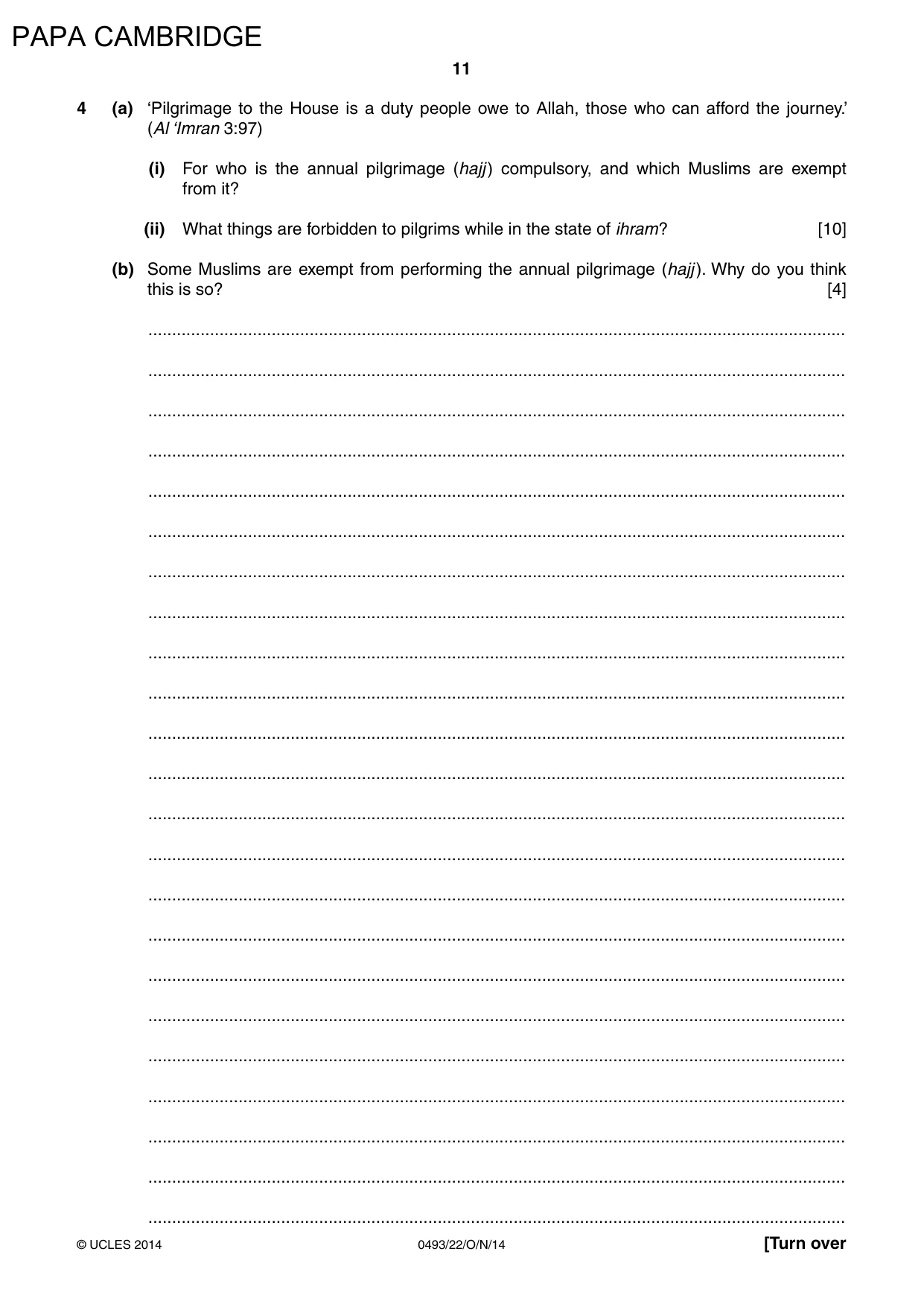
PAPA CAMBRIDGE 11 0493/22/O/N/14 © UCLES 2014 [Turn over 4 (a) ‘Pilgrimage to the House is a duty people owe to Allah, those who can afford the journey.’ (Al ‘Imran 3:97) (i) For who is the annual pilgrimage (hajj ) compulsory, and which Muslims are exempt from it? (ii) What things are forbidden to pilgrims while in the state of ihram ? [10] (b) Some Muslims are exempt from performing the annual pilgrimage (hajj ). Why do you think this is so? [4] … … … … … … … … … … … … … … … … … … … … … … …
Question paper, page 12
PAPA CAMBRIDGE 12 0493/22/O/N/14 © UCLES 2014 … … … … … … … … … … … … … … … … … … … … … … … … … … … …
Question paper, page 13
PAPA CAMBRIDGE 13 0493/22/O/N/14 © UCLES 2014 [Turn over … … … … … … … … … … … … … … … … … … … … … … … … … … … …
Question paper, page 14
PAPA CAMBRIDGE 14 0493/22/O/N/14 © UCLES 2014 5 (a) Name the revealed books mentioned in the Qur’an, giving the names of the messengers they were revealed to and the message they contained. [10] (b) All the revealed books were sent by God. What in your opinion makes the Qur’an unique? [4] … … … … … … … … … … … … … … … … … … … … … … … … … …
Question paper, page 15
PAPA CAMBRIDGE 15 0493/22/O/N/14 © UCLES 2014 [Turn over … … … … … … … … … … … … … … … … … … … … … … … … … … … …
Question paper, page 16
PAPA CAMBRIDGE 16 0493/22/O/N/14 © UCLES 2014 Permission to reproduce items where third-party owned material protected by copyright is included has been sought and cleared where possible. Every reasonable effort has been made by the publisher (UCLES) to trace copyright holders, but if any items requiring clearance have unwittingly been included, the publisher will be pleased to make amends at the earliest possible opportunity. Cambridge International Examinations is part of the Cambridge Assessment Group. Cambridge Assessment is the brand name of University of Cambridge Local Examinations Syndicate (UCLES), which is itself a department of the University of Cambridge. … … … … … … … … … … … … … … … … … … … … … … … … …
Mark scheme, page 1
PAPA CAMBRIDGE ® IGCSE is the registered trademark of Cambridge International Examinations. CAMBRIDGE INTERNATIONAL EXAMINATIONS Cambridge International General Certificate of Secondary Education MARK SCHEME for the October/November 2014 series 0493 ISLAMIYAT 0493/22 Paper 2, maximum raw mark 50 This mark scheme is published as an aid to teachers and candidates, to indicate the requirements of the examination. It shows the basis on which Examiners were instructed to award marks. It does not indicate the details of the discussions that took place at an Examiners’ meeting before marking began, which would have considered the acceptability of alternative answers. Mark schemes should be read in conjunction with the question paper and the Principal Examiner Report for Teachers. Cambridge will not enter into discussions about these mark schemes. Cambridge is publishing the mark schemes for the October/November 2014 series for most Cambridge IGCSE®, Cambridge International A and AS Level components and some Cambridge O Level components.
Mark scheme, page 2
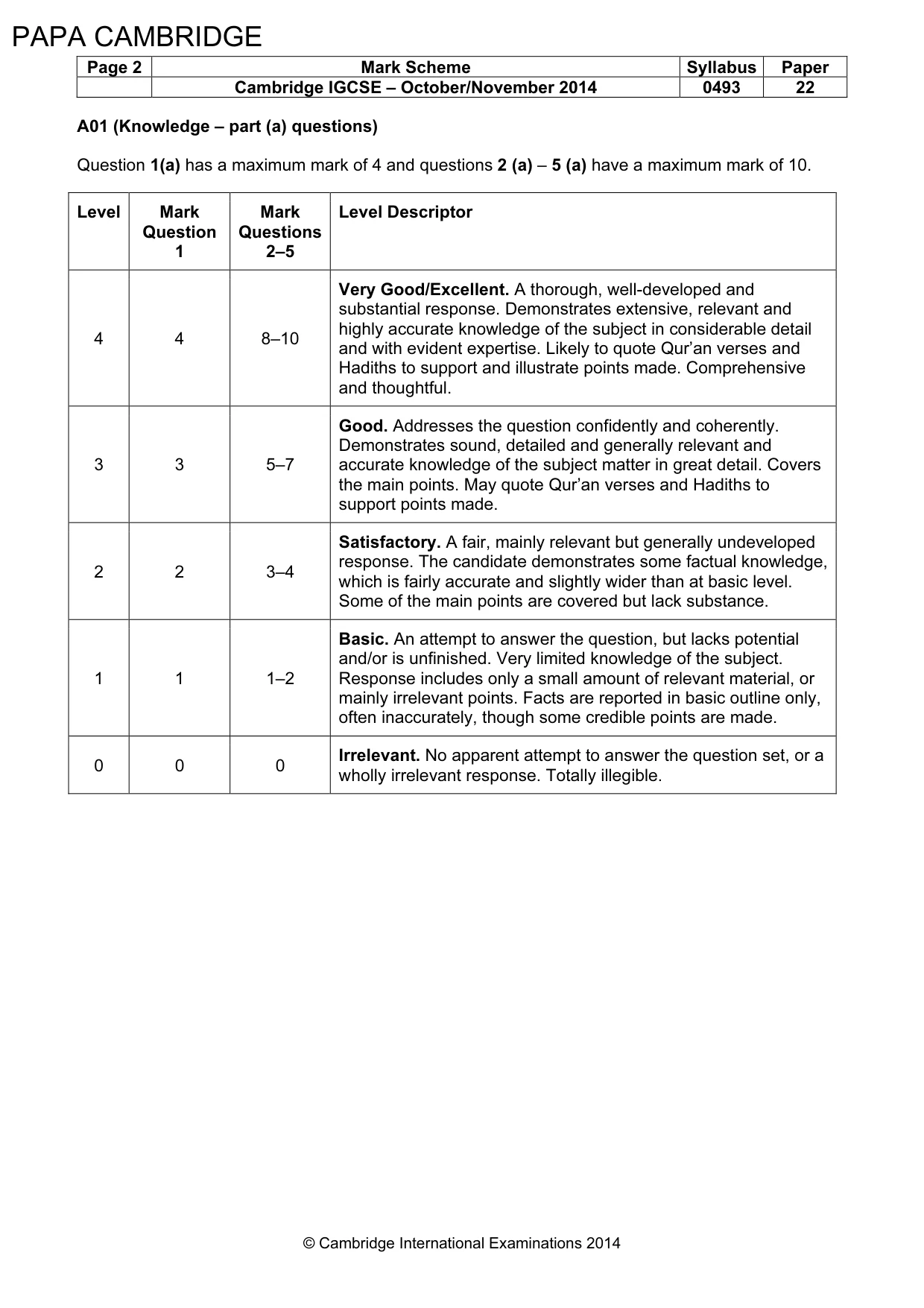
PAPA CAMBRIDGE Page 2 Mark Scheme Syllabus Paper Cambridge IGCSE – October/November 2014 0493 22 © Cambridge International Examinations 2014 A01 (Knowledge – part (a) questions) Question 1(a) has a maximum mark of 4 and questions 2 (a) – 5 (a) have a maximum mark of 10. Level Mark Question 1 Mark Questions 2–5 Level Descriptor 4 4 8–10 Very Good/Excellent. A thorough, well-developed and substantial response. Demonstrates extensive, relevant and highly accurate knowledge of the subject in considerable detail and with evident expertise. Likely to quote Qur’an verses and Hadiths to support and illustrate points made. Comprehensive and thoughtful. 3 3 5–7 Good. Addresses the question confidently and coherently. Demonstrates sound, detailed and generally relevant and accurate knowledge of the subject matter in great detail. Covers the main points. May quote Qur’an verses and Hadiths to support points made. 2 2 3–4 Satisfactory. A fair, mainly relevant but generally undeveloped response. The candidate demonstrates some factual knowledge, which is fairly accurate and slightly wider than at basic level. Some of the main points are covered but lack substance. 1 1 1–2 Basic. An attempt to answer the question, but lacks potential and/or is unfinished. Very limited knowledge of the subject. Response includes only a small amount of relevant material, or mainly irrelevant points. Facts are reported in basic outline only, often inaccurately, though some credible points are made. 0 0 0 Irrelevant. No apparent attempt to answer the question set, or a wholly irrelevant response. Totally illegible.
Mark scheme, page 3
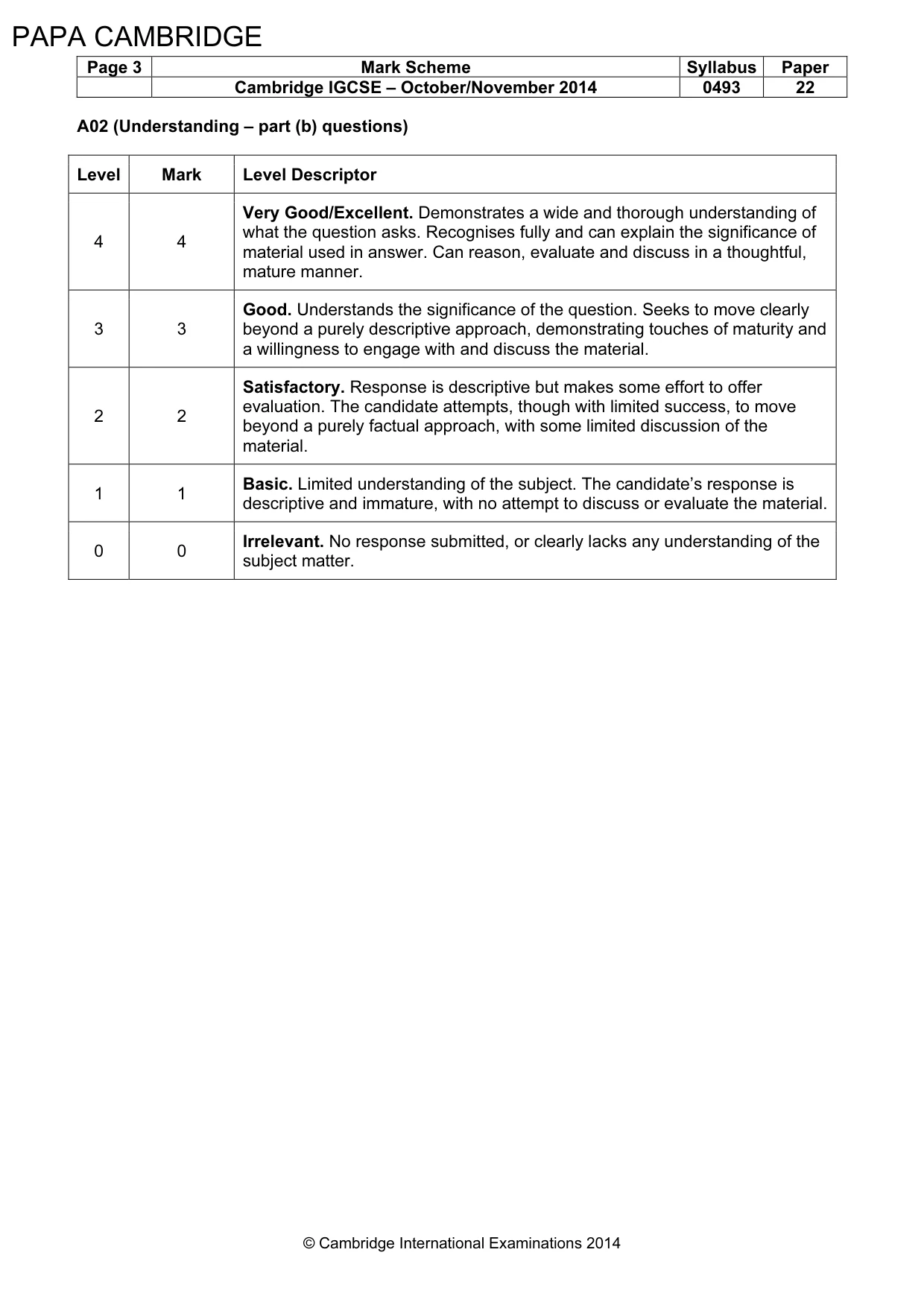
PAPA CAMBRIDGE Page 3 Mark Scheme Syllabus Paper Cambridge IGCSE – October/November 2014 0493 22 © Cambridge International Examinations 2014 A02 (Understanding – part (b) questions) Level Mark Level Descriptor 4 4 Very Good/Excellent. Demonstrates a wide and thorough understanding of what the question asks. Recognises fully and can explain the significance of material used in answer. Can reason, evaluate and discuss in a thoughtful, mature manner. 3 3 Good. Understands the significance of the question. Seeks to move clearly beyond a purely descriptive approach, demonstrating touches of maturity and a willingness to engage with and discuss the material. 2 2 Satisfactory. Response is descriptive but makes some effort to offer evaluation. The candidate attempts, though with limited success, to move beyond a purely factual approach, with some limited discussion of the material. 1 1 Basic. Limited understanding of the subject. The candidate’s response is descriptive and immature, with no attempt to discuss or evaluate the material. 0 0 Irrelevant. No response submitted, or clearly lacks any understanding of the subject matter.
Mark scheme, page 4
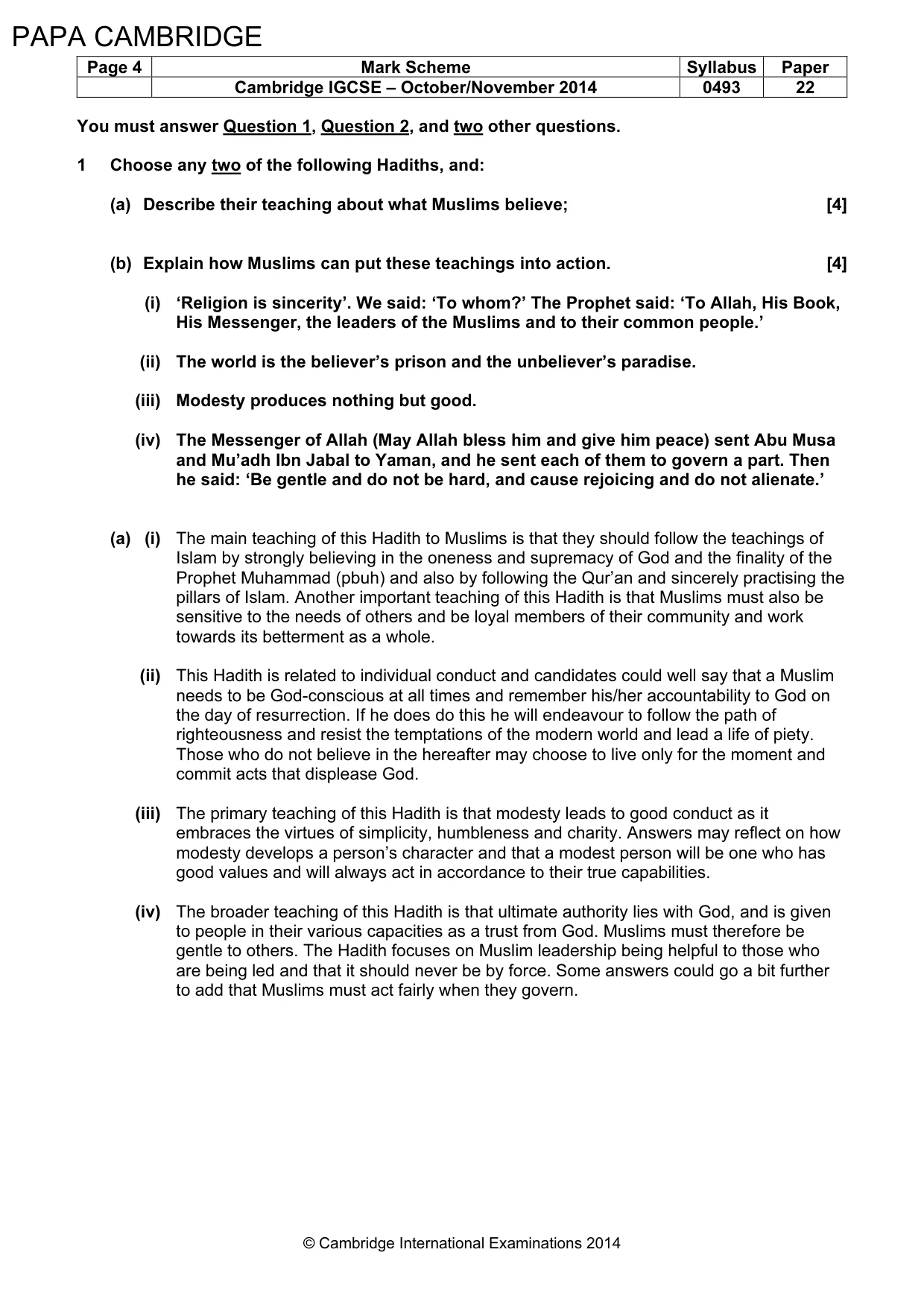
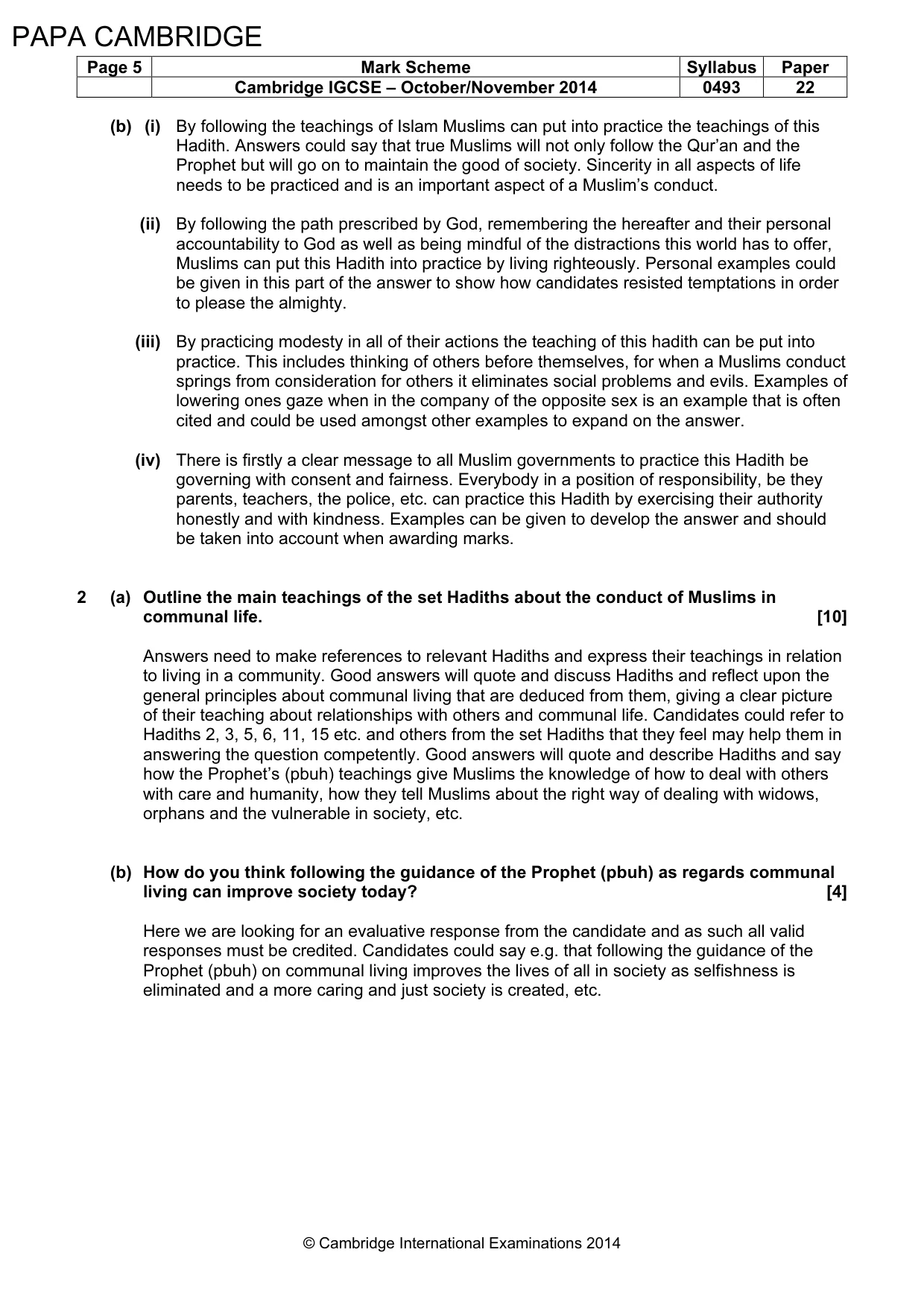
PAPA CAMBRIDGE Page 4 Mark Scheme Syllabus Paper Cambridge IGCSE – October/November 2014 0493 22 © Cambridge International Examinations 2014 You must answer Question 1, Question 2, and two other questions. 1 Choose any two of the following Hadiths, and: (a) Describe their teaching about what Muslims believe; [4] (b) Explain how Muslims can put these teachings into action. [4] (i) ‘Religion is sincerity’. We said: ‘To whom?’ The Prophet said: ‘To Allah, His Book, His Messenger, the leaders of the Muslims and to their common people.’ (ii) The world is the believer’s prison and the unbeliever’s paradise. (iii) Modesty produces nothing but good. (iv) The Messenger of Allah (May Allah bless him and give him peace) sent Abu Musa and Mu’adh Ibn Jabal to Yaman, and he sent each of them to govern a part. Then he said: ‘Be gentle and do not be hard, and cause rejoicing and do not alienate.’ (a) (i) The main teaching of this Hadith to Muslims is that they should follow the teachings of Islam by strongly believing in the oneness and supremacy of God and the finality of the Prophet Muhammad (pbuh) and also by following the Qur’an and sincerely practising the pillars of Islam. Another important teaching of this Hadith is that Muslims must also be sensitive to the needs of others and be loyal members of their community and work towards its betterment as a whole. (ii) This Hadith is related to individual conduct and candidates could well say that a Muslim needs to be God-conscious at all times and remember his/her accountability to God on the day of resurrection. If he does do this he will endeavour to follow the path of righteousness and resist the temptations of the modern world and lead a life of piety. Those who do not believe in the hereafter may choose to live only for the moment and commit acts that displease God. (iii) The primary teaching of this Hadith is that modesty leads to good conduct as it embraces the virtues of simplicity, humbleness and charity. Answers may reflect on how modesty develops a person’s character and that a modest person will be one who has good values and will always act in accordance to their true capabilities. (iv) The broader teaching of this Hadith is that ultimate authority lies with God, and is given to people in their various capacities as a trust from God. Muslims must therefore be gentle to others. The Hadith focuses on Muslim leadership being helpful to those who are being led and that it should never be by force. Some answers could go a bit further to add that Muslims must act fairly when they govern.
Mark scheme, page 5
PAPA CAMBRIDGE Page 5 Mark Scheme Syllabus Paper Cambridge IGCSE – October/November 2014 0493 22 © Cambridge International Examinations 2014 (b) (i) By following the teachings of Islam Muslims can put into practice the teachings of this Hadith. Answers could say that true Muslims will not only follow the Qur’an and the Prophet but will go on to maintain the good of society. Sincerity in all aspects of life needs to be practiced and is an important aspect of a Muslim’s conduct. (ii) By following the path prescribed by God, remembering the hereafter and their personal accountability to God as well as being mindful of the distractions this world has to offer, Muslims can put this Hadith into practice by living righteously. Personal examples could be given in this part of the answer to show how candidates resisted temptations in order to please the almighty. (iii) By practicing modesty in all of their actions the teaching of this hadith can be put into practice. This includes thinking of others before themselves, for when a Muslims conduct springs from consideration for others it eliminates social problems and evils. Examples of lowering ones gaze when in the company of the opposite sex is an example that is often cited and could be used amongst other examples to expand on the answer. (iv) There is firstly a clear message to all Muslim governments to practice this Hadith be governing with consent and fairness. Everybody in a position of responsibility, be they parents, teachers, the police, etc. can practice this Hadith by exercising their authority honestly and with kindness. Examples can be given to develop the answer and should be taken into account when awarding marks. 2 (a) Outline the main teachings of the set Hadiths about the conduct of Muslims in communal life. [10] Answers need to make references to relevant Hadiths and express their teachings in relation to living in a community. Good answers will quote and discuss Hadiths and reflect upon the general principles about communal living that are deduced from them, giving a clear picture of their teaching about relationships with others and communal life. Candidates could refer to Hadiths 2, 3, 5, 6, 11, 15 etc. and others from the set Hadiths that they feel may help them in answering the question competently. Good answers will quote and describe Hadiths and say how the Prophet’s (pbuh) teachings give Muslims the knowledge of how to deal with others with care and humanity, how they tell Muslims about the right way of dealing with widows, orphans and the vulnerable in society, etc. (b) How do you think following the guidance of the Prophet (pbuh) as regards communal living can improve society today? [4] Here we are looking for an evaluative response from the candidate and as such all valid responses must be credited. Candidates could say e.g. that following the guidance of the Prophet (pbuh) on communal living improves the lives of all in society as selfishness is eliminated and a more caring and just society is created, etc.
Mark scheme, page 6
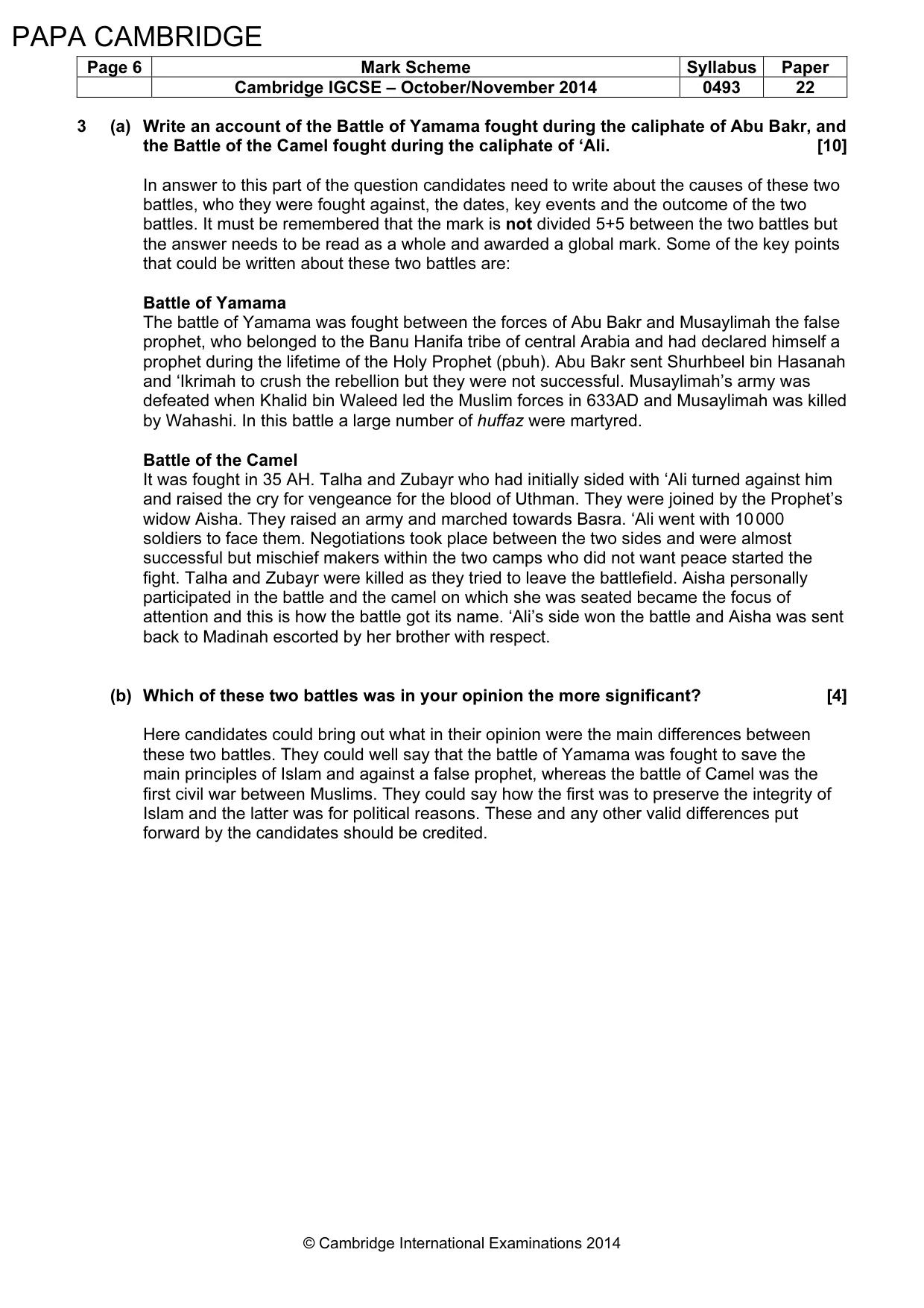
PAPA CAMBRIDGE Page 6 Mark Scheme Syllabus Paper Cambridge IGCSE – October/November 2014 0493 22 © Cambridge International Examinations 2014 3 (a) Write an account of the Battle of Yamama fought during the caliphate of Abu Bakr, and the Battle of the Camel fought during the caliphate of ‘Ali. [10] In answer to this part of the question candidates need to write about the causes of these two battles, who they were fought against, the dates, key events and the outcome of the two battles. It must be remembered that the mark is not divided 5+5 between the two battles but the answer needs to be read as a whole and awarded a global mark. Some of the key points that could be written about these two battles are: Battle of Yamama The battle of Yamama was fought between the forces of Abu Bakr and Musaylimah the false prophet, who belonged to the Banu Hanifa tribe of central Arabia and had declared himself a prophet during the lifetime of the Holy Prophet (pbuh). Abu Bakr sent Shurhbeel bin Hasanah and ‘Ikrimah to crush the rebellion but they were not successful. Musaylimah’s army was defeated when Khalid bin Waleed led the Muslim forces in 633AD and Musaylimah was killed by Wahashi. In this battle a large number of huffaz were martyred. Battle of the Camel It was fought in 35 AH. Talha and Zubayr who had initially sided with ‘Ali turned against him and raised the cry for vengeance for the blood of Uthman. They were joined by the Prophet’s widow Aisha. They raised an army and marched towards Basra. ‘Ali went with 10 000 soldiers to face them. Negotiations took place between the two sides and were almost successful but mischief makers within the two camps who did not want peace started the fight. Talha and Zubayr were killed as they tried to leave the battlefield. Aisha personally participated in the battle and the camel on which she was seated became the focus of attention and this is how the battle got its name. ‘Ali’s side won the battle and Aisha was sent back to Madinah escorted by her brother with respect. (b) Which of these two battles was in your opinion the more significant? [4] Here candidates could bring out what in their opinion were the main differences between these two battles. They could well say that the battle of Yamama was fought to save the main principles of Islam and against a false prophet, whereas the battle of Camel was the first civil war between Muslims. They could say how the first was to preserve the integrity of Islam and the latter was for political reasons. These and any other valid differences put forward by the candidates should be credited.
Mark scheme, page 7
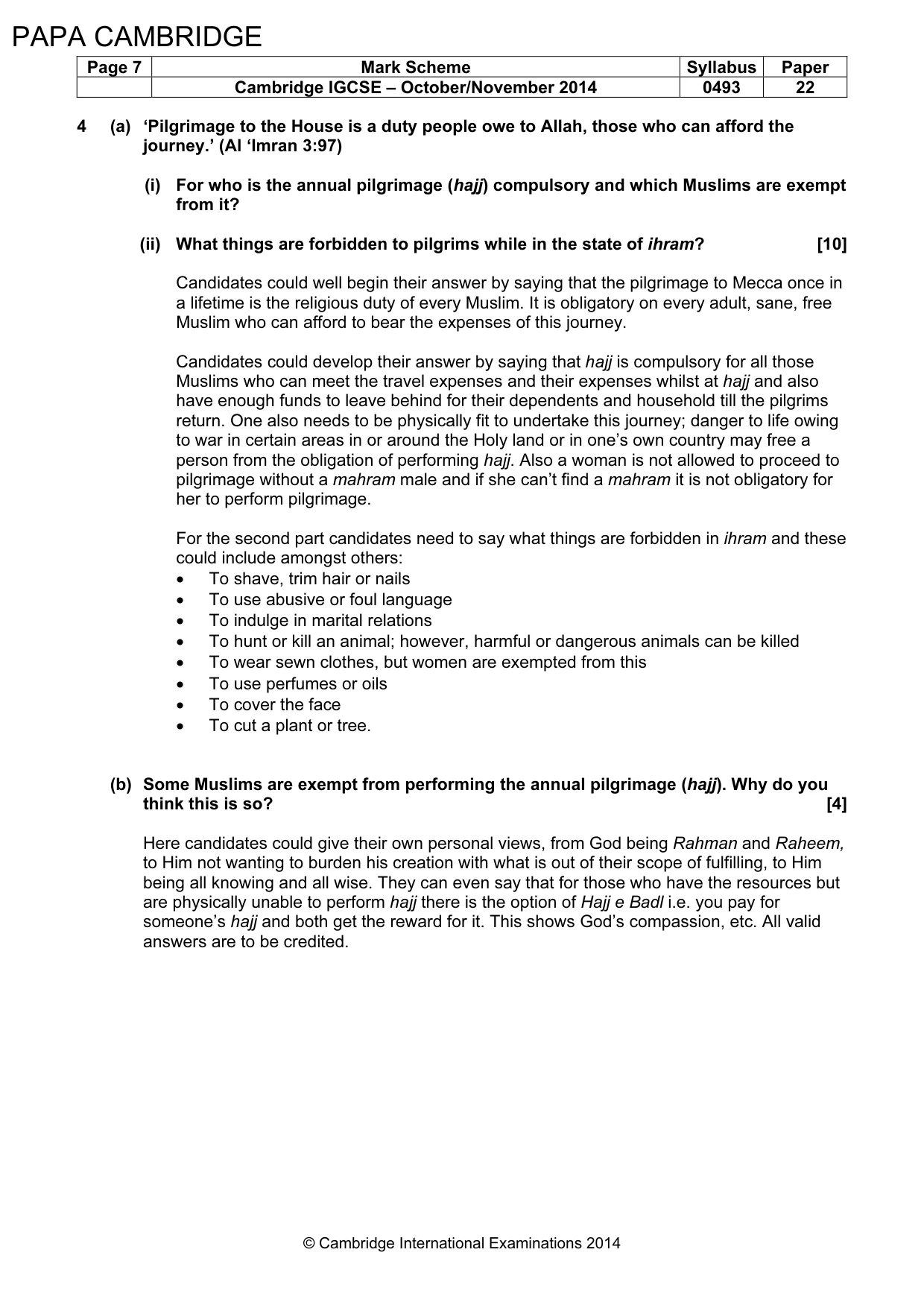
PAPA CAMBRIDGE Page 7 Mark Scheme Syllabus Paper Cambridge IGCSE – October/November 2014 0493 22 © Cambridge International Examinations 2014 4 (a) ‘Pilgrimage to the House is a duty people owe to Allah, those who can afford the journey.’ (Al ‘Imran 3:97) (i) For who is the annual pilgrimage (hajj) compulsory and which Muslims are exempt from it? (ii) What things are forbidden to pilgrims while in the state of ihram? [10] Candidates could well begin their answer by saying that the pilgrimage to Mecca once in a lifetime is the religious duty of every Muslim. It is obligatory on every adult, sane, free Muslim who can afford to bear the expenses of this journey. Candidates could develop their answer by saying that hajj is compulsory for all those Muslims who can meet the travel expenses and their expenses whilst at hajj and also have enough funds to leave behind for their dependents and household till the pilgrims return. One also needs to be physically fit to undertake this journey; danger to life owing to war in certain areas in or around the Holy land or in one’s own country may free a person from the obligation of performing hajj. Also a woman is not allowed to proceed to pilgrimage without a mahram male and if she can’t find a mahram it is not obligatory for her to perform pilgrimage. For the second part candidates need to say what things are forbidden in ihram and these could include amongst others: • To shave, trim hair or nails • To use abusive or foul language • To indulge in marital relations • To hunt or kill an animal; however, harmful or dangerous animals can be killed • To wear sewn clothes, but women are exempted from this • To use perfumes or oils • To cover the face • To cut a plant or tree. (b) Some Muslims are exempt from performing the annual pilgrimage (hajj). Why do you think this is so? [4] Here candidates could give their own personal views, from God being Rahman and Raheem, to Him not wanting to burden his creation with what is out of their scope of fulfilling, to Him being all knowing and all wise. They can even say that for those who have the resources but are physically unable to perform hajj there is the option of Hajj e Badl i.e. you pay for someone’s hajj and both get the reward for it. This shows God’s compassion, etc. All valid answers are to be credited.
Mark scheme, page 8
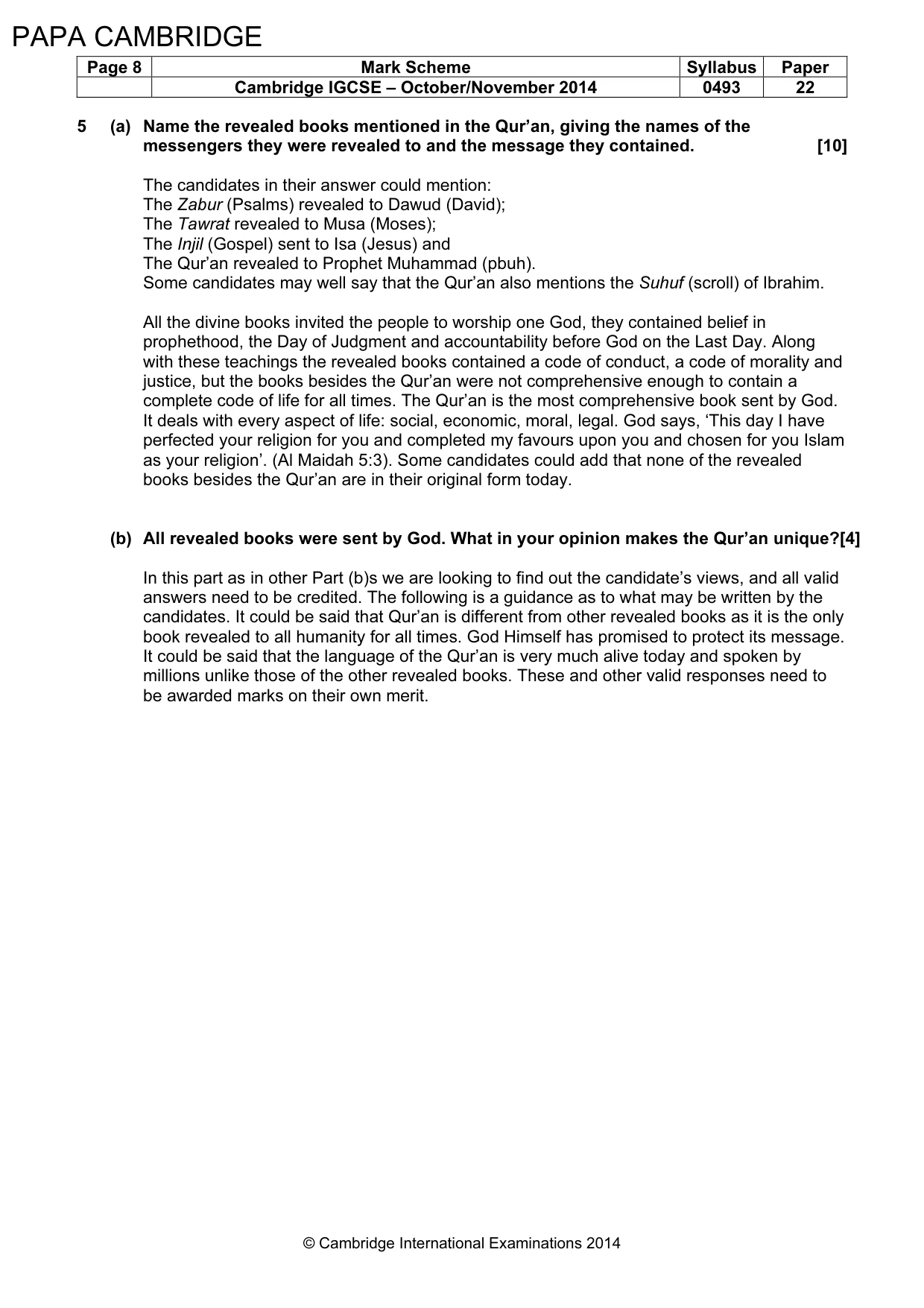
PAPA CAMBRIDGE Page 8 Mark Scheme Syllabus Paper Cambridge IGCSE – October/November 2014 0493 22 © Cambridge International Examinations 2014 5 (a) Name the revealed books mentioned in the Qur’an, giving the names of the messengers they were revealed to and the message they contained. [10] The candidates in their answer could mention: The Zabur (Psalms) revealed to Dawud (David); The Tawrat revealed to Musa (Moses); The Injil (Gospel) sent to Isa (Jesus) and The Qur’an revealed to Prophet Muhammad (pbuh). Some candidates may well say that the Qur’an also mentions the Suhuf (scroll) of Ibrahim. All the divine books invited the people to worship one God, they contained belief in prophethood, the Day of Judgment and accountability before God on the Last Day. Along with these teachings the revealed books contained a code of conduct, a code of morality and justice, but the books besides the Qur’an were not comprehensive enough to contain a complete code of life for all times. The Qur’an is the most comprehensive book sent by God. It deals with every aspect of life: social, economic, moral, legal. God says, ‘This day I have perfected your religion for you and completed my favours upon you and chosen for you Islam as your religion’. (Al Maidah 5:3). Some candidates could add that none of the revealed books besides the Qur’an are in their original form today. (b) All revealed books were sent by God. What in your opinion makes the Qur’an unique?[4] In this part as in other Part (b)s we are looking to find out the candidate’s views, and all valid answers need to be credited. The following is a guidance as to what may be written by the candidates. It could be said that Qur’an is different from other revealed books as it is the only book revealed to all humanity for all times. God Himself has promised to protect its message. It could be said that the language of the Qur’an is very much alive today and spoken by millions unlike those of the other revealed books. These and other valid responses need to be awarded marks on their own merit.
What you needed in this session
Cambridge’s own grade thresholds for 2014 Oct/Nov, Paper 2 · Variant 2. A higher threshold means an easier paper — the bar moves with how the cohort did.