Cambridge IGCSE Islamiyat 0493 — 2013 Oct/Nov Paper 2 · Variant 2
0493/22/O/N/13 · 50 marks · ≈56 min
The question paper and its mark scheme, free to read here and free to download. This is Cambridge’s own paper, exactly as it was sat.
Question paper16 pages
Mark scheme5 pages
Answers below. Sit the paper first if you are practising.
Paper as text
Question paper, page 1
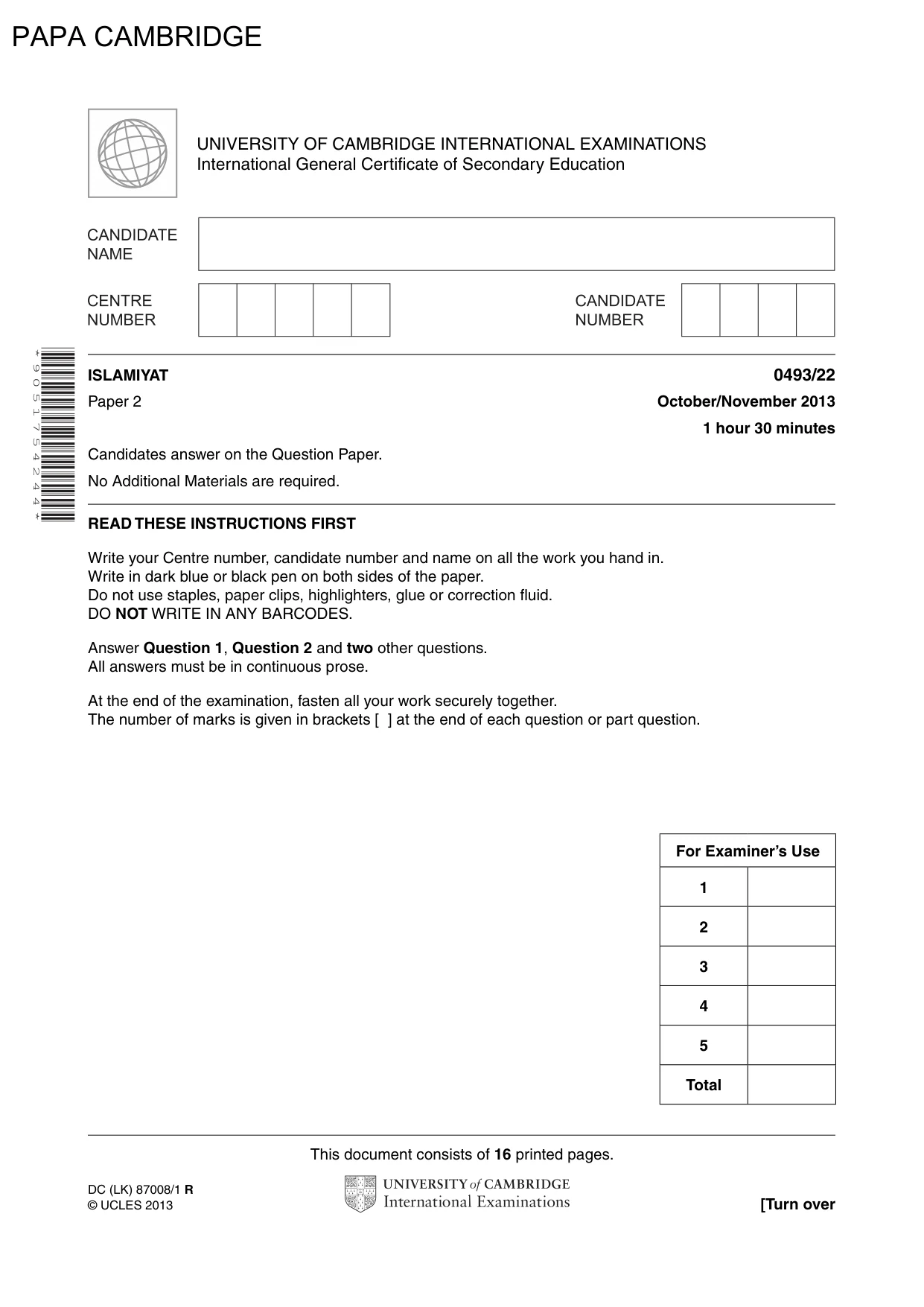
PAPA CAMBRIDGE This document consists of 16 printed pages. DC (LK) 87008/1 R © UCLES 2013 [Turn over UNIVERSITY OF CAMBRIDGE INTERNATIONAL EXAMINATIONS International General Certificate of Secondary Education * 9 0 5 1 7 5 4 2 4 4 * ISLAMIYAT 0493/22 Paper 2 October/November 2013 1 hour 30 minutes Candidates answer on the Question Paper. No Additional Materials are required. READ THESE INSTRUCTIONS FIRST Write your Centre number, candidate number and name on all the work you hand in. Write in dark blue or black pen on both sides of the paper. Do not use staples, paper clips, highlighters, glue or correction fluid. DO NOT WRITE IN ANY BARCODES. Answer Question 1, Question 2 and two other questions. All answers must be in continuous prose. At the end of the examination, fasten all your work securely together. The number of marks is given in brackets [ ] at the end of each question or part question. For Examiner’s Use 1 2 3 4 5 Total
Question paper, page 2
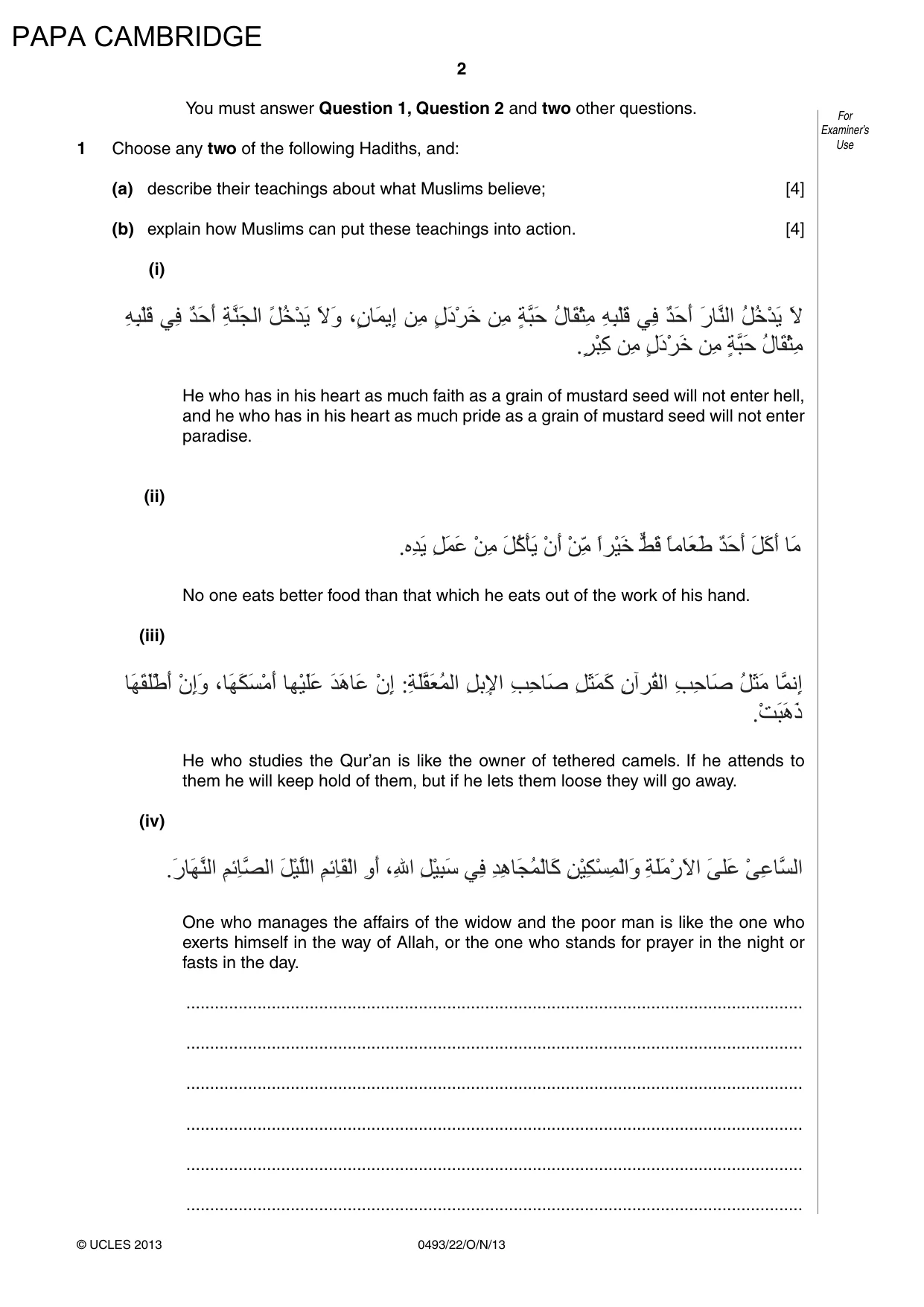
PAPA CAMBRIDGE 2 0493/22/O/N/13 © UCLES 2013 For Examiner’s Use You must answer Question 1, Question 2 and two other questions. 1 Choose any two of the following Hadiths, and: (a) describe their teachings about what Muslims believe; [4] (b) explain how Muslims can put these teachings into action. [4] (i) ˶Ϫ˶Β˸Ϡ˴ϗ ϲ˶ϓ ˲Ϊ˴Σ˴ ˶Δ͉Ϩ˴Πϟ ˱Ϟ˵Χ˸Ϊ˴ϳ ˴ϻ˴ϭ ˬ˳ϥΎ˴Ϥϳ˶· Ϧ˶ϣ ˳ϝ˴Ω˸ή˴Χ Ϧ˶ϣ ˳Δ͉Β˴Σ ˵ϝΎ˴Ϙ˸Μ˶ϣ ˶Ϫ˶Β˸Ϡ˴ϗ ϲ˶ϓ ˲Ϊ˴Σ˴ ˴έΎ͉Ϩϟ ˵Ϟ˵Χ˸Ϊ˴ϳ ˴ϻ ˳ή˸Β˶ϛ Ϧ˶ϣ ˳ϝ˴Ω˸ή˴Χ Ϧ˶ϣ ˳Δ͉Β˴Σ ˵ϝΎ˴Ϙ˸Μ˶ϣ . He who has in his heart as much faith as a grain of mustard seed will not enter hell, and he who has in his heart as much pride as a grain of mustard seed will not enter paradise. (ii) ϩ˶Ϊ˴ϳ ˶Ϟ˴Ϥ˴ϋ ˸Ϧ˶ϣ ˴Ϟ˵ϛ˸΄˴ϳ ˸ϥ˴ ˸Ϧ˷˶ϣ ˱ή˸ϴ˴Χ ͇ς˴ϗ ˱ΎϣΎ˴ό˴σ ˲Ϊ˴Σ˴ ˴Ϟ˴ϛ˴ Ύ˴ϣ . No one eats better food than that which he eats out of the work of his hand. (iii) ˶Δ˴Ϡ͉Ϙ˴ό˵Ϥϟ ˶ϞΑ˶Ϲ ˶ΐ˶ΣΎ˴λ ˶Ϟ˴Μ˴Ϥ˴ϛ ˶ϥή˵Ϙϟ ˶ΐ˶ΣΎ˴λ ˵Ϟ˴Μ˴ϣ Ύ͉Ϥϧ˶· : Ύ˴Ϭ˴Ϙ˴Ϡ˸σ˴ ˸ϥ˶·˴ϭ ˬΎ˴Ϭ˴Ϝ˴δ˸ϣ˴ ΎϬ˸ϴ˴Ϡ˴ϋ ˴Ϊ˴ϫΎ˴ϋ ˸ϥ˶· ˸Ζ˴Β˴ϫ˴Ϋ . He who studies the Qur’an is like the owner of tethered camels. If he attends to them he will keep hold of them, but if he lets them loose they will go away. (iv) ˴έΎ˴Ϭ͉Ϩϟ ˶Ϣ˶Ύ͉μϟ ˴Ϟ˸ϴ͉Ϡϟ ˶Ϣ˶Ύ˴Ϙ˸ϟ ˶ϭ˴ ˬ˶Ϳ ˶Ϟ˸ϴ˶Β˴γ ϲ˶ϓ ˶Ϊ˶ϫΎ˴Π˵Ϥ˸ϟΎ˴ϛ ˶Ϧ˸ϴ˶Ϝ˸δ˶Ϥ˸ϟ˴ϭ ˶Δ˴Ϡ˴ϣ˸έ˴ϻ ˴ϰϠ˴ϋ ˸ϰ˶ϋΎ͉δϟ . One who manages the affairs of the widow and the poor man is like the one who exerts himself in the way of Allah, or the one who stands for prayer in the night or fasts in the day. … … … … … …
Question paper, page 3
PAPA CAMBRIDGE 3 0493/22/O/N/13 © UCLES 2013 [Turn over For Examiner’s Use … … … … … … … … … … … … … … … … … … … … … … … … … … … …
Question paper, page 4
PAPA CAMBRIDGE 4 0493/22/O/N/13 © UCLES 2013 For Examiner’s Use … … … … … … … … … … … … … … … … … … … … … … … … … … … …
Question paper, page 5
PAPA CAMBRIDGE 5 0493/22/O/N/13 © UCLES 2013 [Turn over For Examiner’s Use 2 (a) Describe how the Hadiths are used in establishing law in Islam. [10] (b) ‘My community will never agree upon an error’. In your opinion why is this Hadith important for the practice of consensus (ijma)? [4] … … … … … … … … … … … … … … … … … … … … … … … … … …
Question paper, page 6
PAPA CAMBRIDGE 6 0493/22/O/N/13 © UCLES 2013 For Examiner’s Use … … … … … … … … … … … … … … … … … … … … … … … … … … … …
Question paper, page 7
PAPA CAMBRIDGE 7 0493/22/O/N/13 © UCLES 2013 [Turn over For Examiner’s Use … … … … … … … … … … … … … … … … … … … … … … … … … … … …
Question paper, page 8
PAPA CAMBRIDGE 8 0493/22/O/N/13 © UCLES 2013 For Examiner’s Use 3 (a) What were the consequences of ‘Uthman’s murder? [10] (b) ‘Ibn Muljam’s murder of ‘Ali was unjustified’. Discuss, giving reasons for your answer. [4] … … … … … … … … … … … … … … … … … … … … … … … … … …
Question paper, page 9
PAPA CAMBRIDGE 9 0493/22/O/N/13 © UCLES 2013 [Turn over For Examiner’s Use … … … … … … … … … … … … … … … … … … … … … … … … … … … …
Question paper, page 10
PAPA CAMBRIDGE 10 0493/22/O/N/13 © UCLES 2013 For Examiner’s Use … … … … … … … … … … … … … … … … … … … … … … … … … … … …
Question paper, page 11
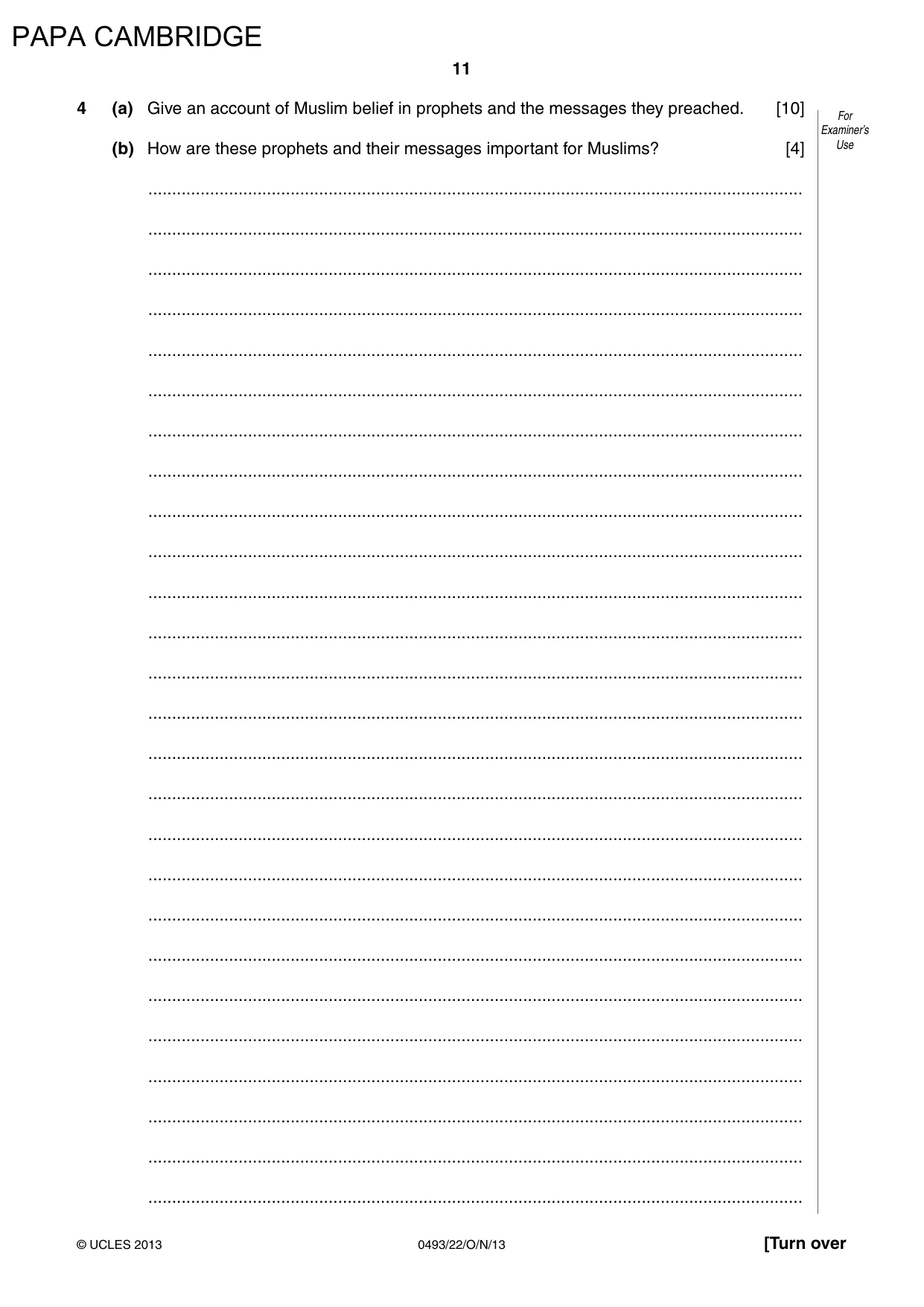
PAPA CAMBRIDGE 11 0493/22/O/N/13 © UCLES 2013 [Turn over For Examiner’s Use 4 (a) Give an account of Muslim belief in prophets and the messages they preached. [10] (b) How are these prophets and their messages important for Muslims? [4] … … … … … … … … … … … … … … … … … … … … … … … … … …
Question paper, page 12
PAPA CAMBRIDGE 12 0493/22/O/N/13 © UCLES 2013 For Examiner’s Use … … … … … … … … … … … … … … … … … … … … … … … … … … … …
Question paper, page 13
PAPA CAMBRIDGE 13 0493/22/O/N/13 © UCLES 2013 [Turn over For Examiner’s Use … … … … … … … … … … … … … … … … … … … … … … … … … … … …
Question paper, page 14
PAPA CAMBRIDGE 14 0493/22/O/N/13 © UCLES 2013 For Examiner’s Use 5 (a) How are individuals and the community benefited by almsgiving (zakat )? [10] (b) Why are Muslims encouraged to pay sadaqa during Eid-al-Fitr ? [4] … … … … … … … … … … … … … … … … … … … … … … … … … …
Question paper, page 15
PAPA CAMBRIDGE 15 0493/22/O/N/13 © UCLES 2013 [Turn over For Examiner’s Use … … … … … … … … … … … … … … … … … … … … … … … … … … … …
Question paper, page 16
PAPA CAMBRIDGE 16 0493/22/O/N/13 © UCLES 2013 For Examiner’s Use Permission to reproduce items where third-party owned material protected by copyright is included has been sought and cleared where possible. Every reasonable effort has been made by the publisher (UCLES) to trace copyright holders, but if any items requiring clearance have unwittingly been included, the publisher will be pleased to make amends at the earliest possible opportunity. University of Cambridge International Examinations is part of the Cambridge Assessment Group. Cambridge Assessment is the brand name of University of Cambridge Local Examinations Syndicate (UCLES), which is itself a department of the University of Cambridge. … … … … … … … … … … … … … … … … … … … … … … … … …
Mark scheme, page 1
PAPA CAMBRIDGE © Cambridge International Examinations 2013 CAMBRIDGE INTERNATIONAL EXAMINATIONS International General Certificate of Secondary Education MARK SCHEME for the October/November 2013 series 0493 ISLAMIYAT 0493/22 Paper 2, maximum raw mark 50 This mark scheme is published as an aid to teachers and candidates, to indicate the requirements of the examination. It shows the basis on which Examiners were instructed to award marks. It does not indicate the details of the discussions that took place at an Examiners’ meeting before marking began, which would have considered the acceptability of alternative answers. Mark schemes should be read in conjunction with the question paper and the Principal Examiner Report for Teachers. Cambridge will not enter into discussions about these mark schemes. Cambridge is publishing the mark schemes for the October/November 2013 series for most IGCSE, GCE Advanced Level and Advanced Subsidiary Level components and some Ordinary Level components.
Mark scheme, page 2
PAPA CAMBRIDGE Page 2 Mark Scheme Syllabus Paper IGCSE – October/November 2013 0493 22 © Cambridge International Examinations 2013 You must answer Question 1, Question 2 and two other questions. 1. Choose any two of the following Hadiths and: (a) describe their teachings about what Muslims believe; [4] (b) explain how Muslims can put these teachings into action. [4] (i) Hadith 18 (ii) Hadith 9 (iii) Hadith 13 (iv) Hadith 10 (a) (i) The key to paradise is having faith and belief in God’s supremacy and when a person embraces Islam they submit to the will of God and shun all pride. Faith and pride cannot co-exist. The person therefore becomes humble and God fearing which enables them to achieve the goal of paradise. However, a person with the tiniest amount of arrogance will think of themselves as the controller of their own destiny and will not be God conscious and therefore close the doors of paradise for themself. (ii) Islam lays great emphasis on the dignity of labour and encourages Muslims to earn an honest living however meagre it may be. Lawful earnings through hard work are preferred by God whereas begging and reliance on others is discouraged in Islam. (iii) Just as the desert bedouin ties the fore feet of his camel stopping it from straying away, the Qur’an keeps Muslims from going astray is the simple teaching of this Hadith. To keep their faith strong and stay on the path of righteousness Muslims must continually keep the teaching of the Qur’an fresh in their mind by reading a small portion of it every day, understanding its teachings and by putting those teachings into practice. (iv) Care for the vulnerable in society has been compared to ibadah in this Hadith. Islam lays a lot of stress on caring for and looking after the needs of others in society and the clear instruction in this Hadith is to look after the vulnerable and the rewards for doing that are comparable to performing jihad.
Mark scheme, page 3
PAPA CAMBRIDGE Page 3 Mark Scheme Syllabus Paper IGCSE – October/November 2013 0493 22 © Cambridge International Examinations 2013 (b) (i) Muslims should shun pride and be God conscious at all times. They should adopt humility in their manner, dress and life style. By following the guidance of Islam they can achieve paradise. Also, they should rely on God at all times just as the Prophet did. The doors of paradise closed upon Iblis because of his pride and Muslims should close their hearts to pride to avoid the same fate. (ii) By working honestly and diligently at whatever one’s profession is one can fulfil the teaching of this Hadith. All unfair earnings should be shunned by Muslims and no job should be looked down upon. A Muslim should try and be self-reliant. The Prophet worked as a shepherd in his youth which could be given as an example of how simple jobs in life need to be respected and no honest living should be looked down upon. (iii) The teaching of this Hadith can be very easily practiced by Muslims. They must refer to the Qur’an in their daily life. Reading the Quran’ understanding its teaching and teaching it to others and putting into practice its teachings are ways in which this Hadith can be followed. Muslims should be careful not to abandon the Qur’an and its teachings. (iv) This Hadith can be put into practice by caring for the vulnerable in society, supporting charities either financially or by doing voluntary work for them. Examples from the Prophets life or everyday life could be given to highlight the teaching being put into action. 2 (a) Describe how the Hadiths are used in establishing law in Islam. [10] Here candidates may well state that the Hadiths of the Prophet are the second most important source of Islamic law. They are second only to the Qur’an and give fuller teachings to what the Qur’an states in brief. Examples could be given here and quotes from the Qur’an recommending that Muslims follow the teachings of the Hadiths. Examples of zakat being calculated in the light of the Prophet’s Hadiths or the laws of inheritance etc. being determined by Hadiths could be given. Candidates could also state that in some cases when the Qur’an is completely silent the Hadiths are used to make laws, examples could be given in more developed answers. Also, good answers will tend to give examples of the early successors using knowledge of Hadiths to help formulate laws and this kind of elaboration is what is being looked for to get to the top end of L3/L4. The candidates could also write about how ijma and qiyas rely upon Hadiths to formulate laws. However it is not essential for them to do so. Development in the answers can be achieved with the help of examples. (b) ‘My community will never agree upon an error’. In your opinion why is this Hadith important for the practice of consensus (ijma)? [4] The focus of the answer needs to be on stating the candidate’s views on the importance of the Hadith given in the question for the practice of ijma. It could be said that the Hadith gives legitimacy to the practice of ijma whereas another viewpoint could be that when a group of scholars well versed in the teachings of the Qur’an and Hadith reach a decision in the light of the primary sources of Islamic law their chances of reaching a wrong decision are rare. Some strong candidates could develop the answer even further by saying that ijma of one generation can be revised by another which helps to keep Sharia laws in tune with the times. All valid answers are to be credited.
Mark scheme, page 4
PAPA CAMBRIDGE Page 4 Mark Scheme Syllabus Paper IGCSE – October/November 2013 0493 22 © Cambridge International Examinations 2013 3 (a) What were the consequences of ‘Uthman’s murder? [10] In answer to this question candidates could simply say that ‘Uthman’s murder led to ‘Ali’s controversial election, supported by rebels from the provinces and the Ansar and divided the umma. This struggle placed Islam in conflict that outlived ‘Ali’s caliphate. Many Quraysh left Madina and moved back to Makka which became their power base. Some who had sworn allegiance to ‘Ali reneged on their oath and the Umayyads, in particular Mu’awiya, called for avenging the murder of ‘Uthman. The rebels in turn who had attacked ‘Uthman demanded the reversal of his policies which they said were contrary to Islamic principles. ‘Ali took some quick measures demanded by the opponents of ‘Uthman and changed the governors appointed by his predecessor with those who supported him and distributed the wealth that both Umar and ‘Uthman had kept aside. However, his slow response against the murderers of ‘Uthman led to strong reactions which led to the first civil wars in Islam e.g. the battles of Camel and Siffin. The above is a guidance of what examiners might find in the answers, candidates will need to refer to some of the above points in their answer and development of them will earn them the higher levels e.g. some candidates could mention the battles of the civil wars in some detail. (b) ‘Ibn Muljam’s murder of ‘Ali was unjustified’. Discuss, giving reasons for your answer. [4] Candidates in this part of the answer need to say why in their opinion the assassination of ‘Ali by Ibn Muljam was unjustified and give reasons for it. All valid answers must be credited and the response to the statement must be backed with reasons. 4 (a) Give an account of Muslim belief in prophets and the messages they preached. [10] Belief in all the prophets sent by God is a part of every Muslims faith. Muslims believe that the line of prophets started from Adam and finished with Prophet Muhammad (pbuh). They could also say that Muslims believe in all the prophets that came before Prophet Muhammad (pbuh) and believe that some amongst them were nabis and some were rasuls. Answers may also include that Muslims consider all the prophets to be sinless and not more than human and also that they were all men of exceptional morals and character. The answers could include that the Qur’an states that there were many prophets and a Hadith of the Prophet gives the number at 124,000. Prophets were endowed with miracles and some were sent with books to guide humanity. The development in the answer could perhaps detail what the miracles of some of these prophets were and could also include the names and characteristics of some of the prophets and name the books that were revealed to them as well as write about the belief that each prophet was sent for a specific community except Prophet Muhammad (pbuh) who was sent for all humanity. Qur’anic teaching about respecting all prophets equally could also be given in the answer. In answering this question candidates also need to write how the message of all the prophets has always been the same, that is, belief in the oneness of God, tawhid, good conduct and life after death.
Mark scheme, page 5
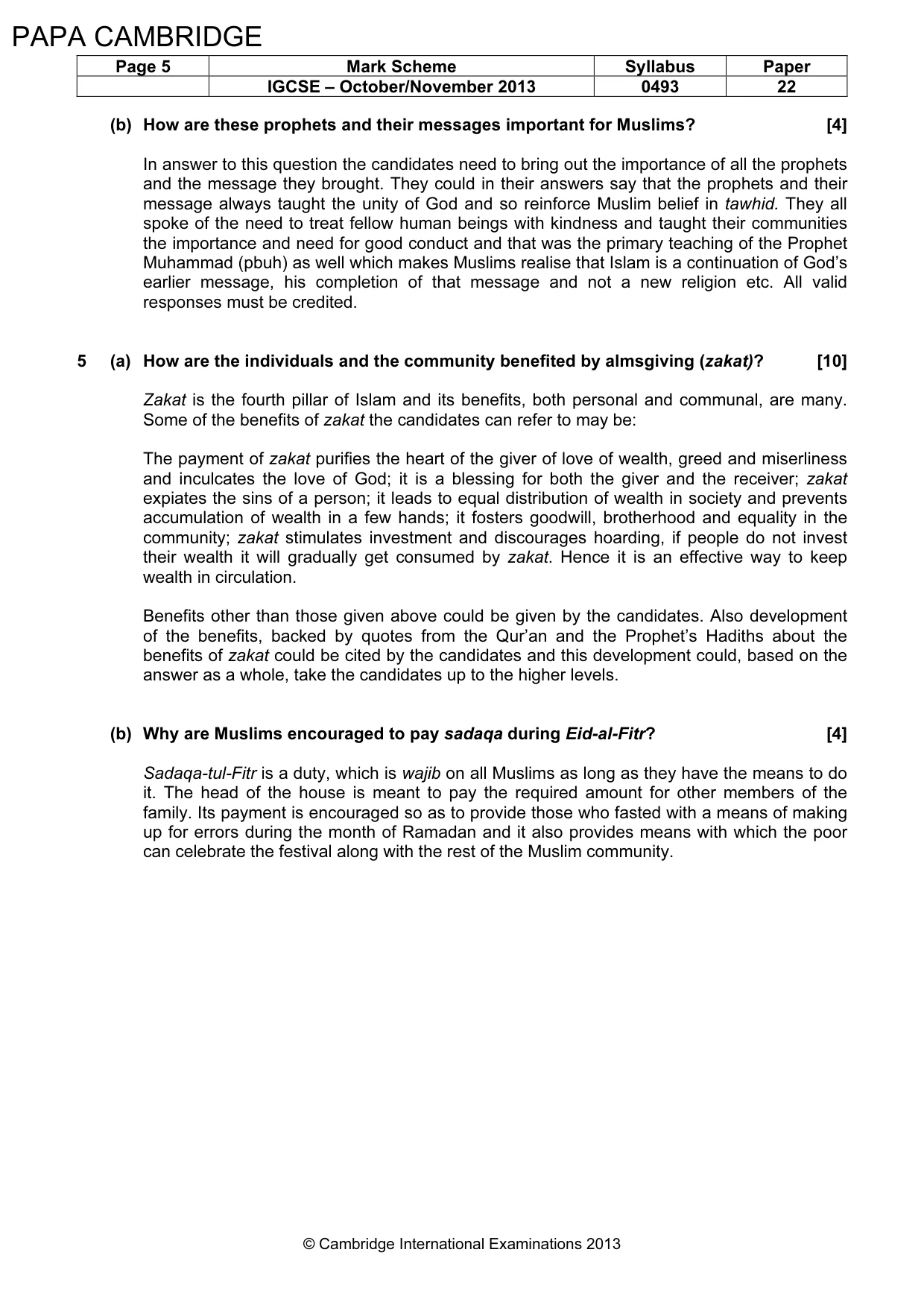
PAPA CAMBRIDGE Page 5 Mark Scheme Syllabus Paper IGCSE – October/November 2013 0493 22 © Cambridge International Examinations 2013 (b) How are these prophets and their messages important for Muslims? [4] In answer to this question the candidates need to bring out the importance of all the prophets and the message they brought. They could in their answers say that the prophets and their message always taught the unity of God and so reinforce Muslim belief in tawhid. They all spoke of the need to treat fellow human beings with kindness and taught their communities the importance and need for good conduct and that was the primary teaching of the Prophet Muhammad (pbuh) as well which makes Muslims realise that Islam is a continuation of God’s earlier message, his completion of that message and not a new religion etc. All valid responses must be credited. 5 (a) How are the individuals and the community benefited by almsgiving (zakat)? [10] Zakat is the fourth pillar of Islam and its benefits, both personal and communal, are many. Some of the benefits of zakat the candidates can refer to may be: The payment of zakat purifies the heart of the giver of love of wealth, greed and miserliness and inculcates the love of God; it is a blessing for both the giver and the receiver; zakat expiates the sins of a person; it leads to equal distribution of wealth in society and prevents accumulation of wealth in a few hands; it fosters goodwill, brotherhood and equality in the community; zakat stimulates investment and discourages hoarding, if people do not invest their wealth it will gradually get consumed by zakat. Hence it is an effective way to keep wealth in circulation. Benefits other than those given above could be given by the candidates. Also development of the benefits, backed by quotes from the Qur’an and the Prophet’s Hadiths about the benefits of zakat could be cited by the candidates and this development could, based on the answer as a whole, take the candidates up to the higher levels. (b) Why are Muslims encouraged to pay sadaqa during Eid-al-Fitr? [4] Sadaqa-tul-Fitr is a duty, which is wajib on all Muslims as long as they have the means to do it. The head of the house is meant to pay the required amount for other members of the family. Its payment is encouraged so as to provide those who fasted with a means of making up for errors during the month of Ramadan and it also provides means with which the poor can celebrate the festival along with the rest of the Muslim community.
What you needed in this session
Cambridge’s own grade thresholds for 2013 Oct/Nov, Paper 2 · Variant 2. A higher threshold means an easier paper — the bar moves with how the cohort did.