Cambridge IGCSE History (9-1) 0977 — 2022 Oct/Nov Paper 1 · Variant 1
0977/11/O/N/22 · 60 marks · ≈68 min
The question paper and its mark scheme, free to read here and free to download. This is Cambridge’s own paper, exactly as it was sat.
Question paper12 pages

Mark scheme73 pages
Answers below. Sit the paper first if you are practising.
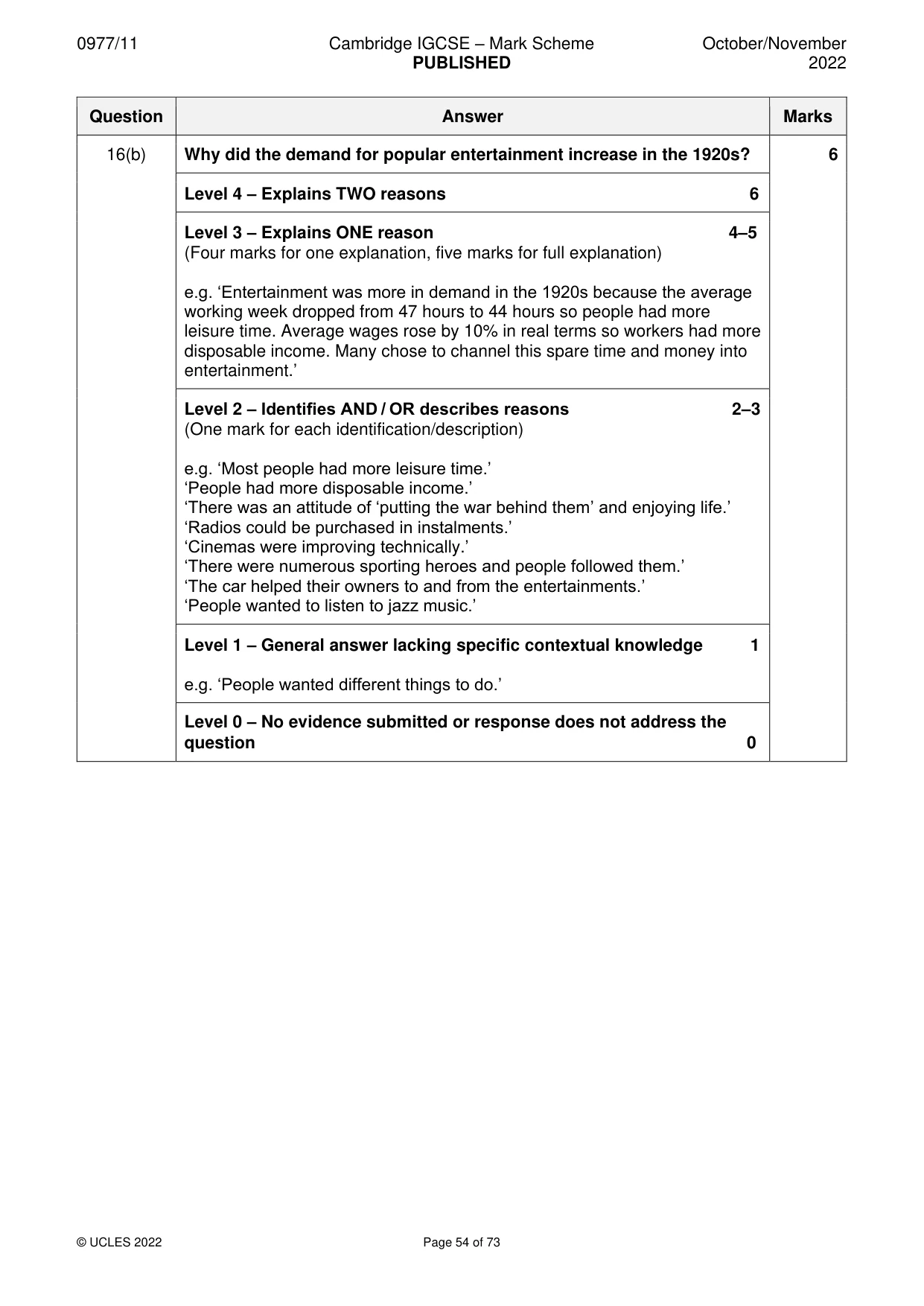
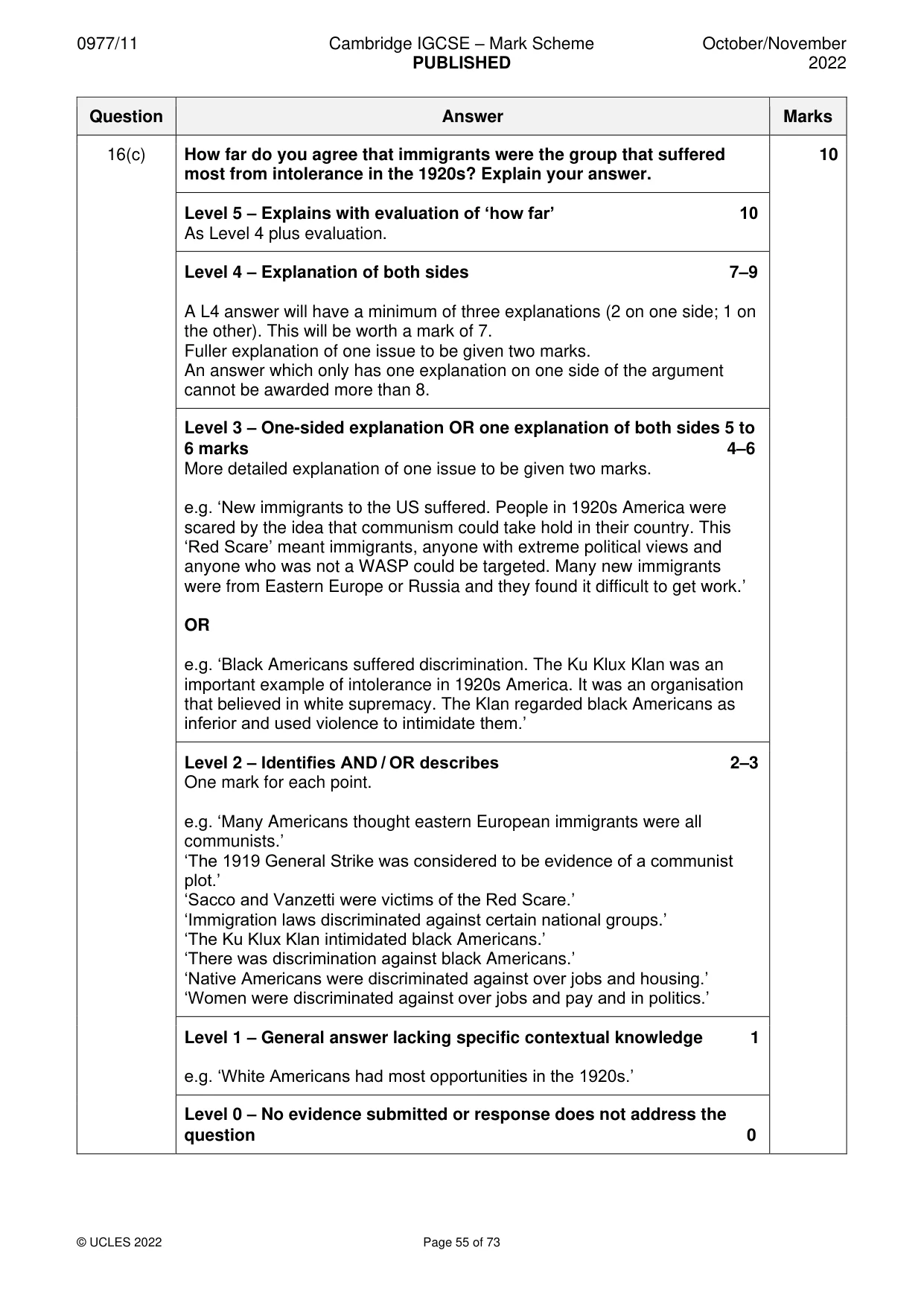
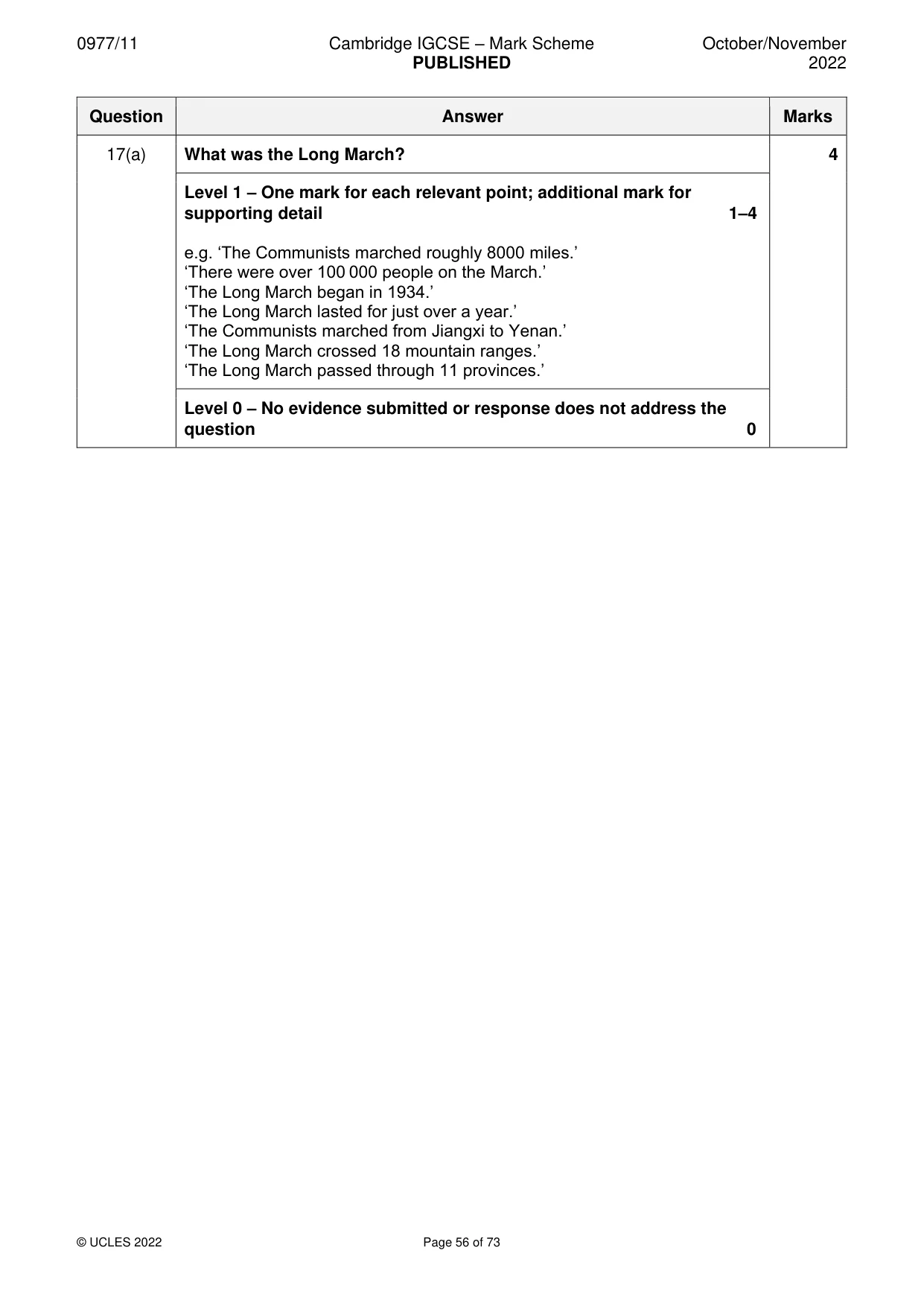
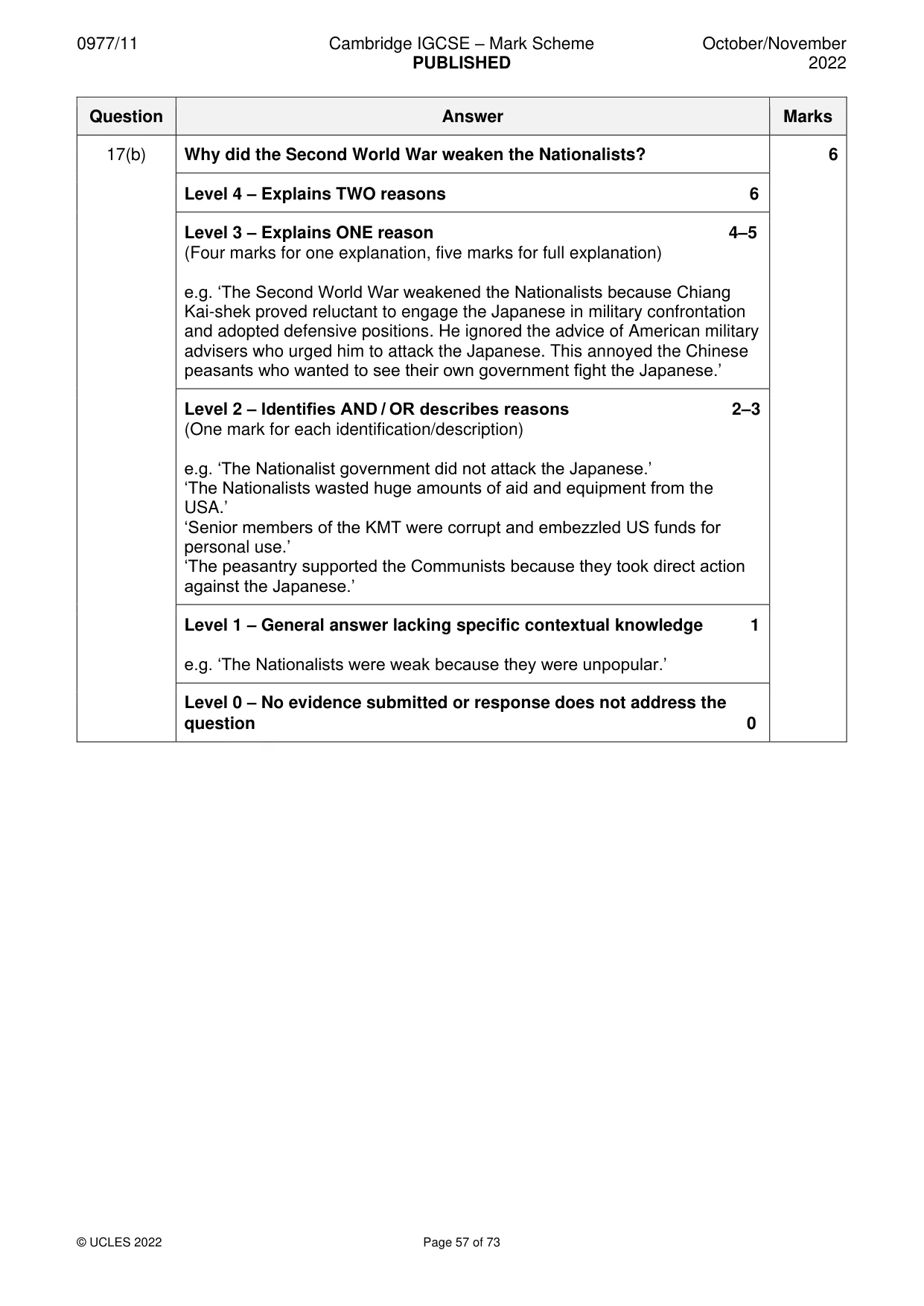
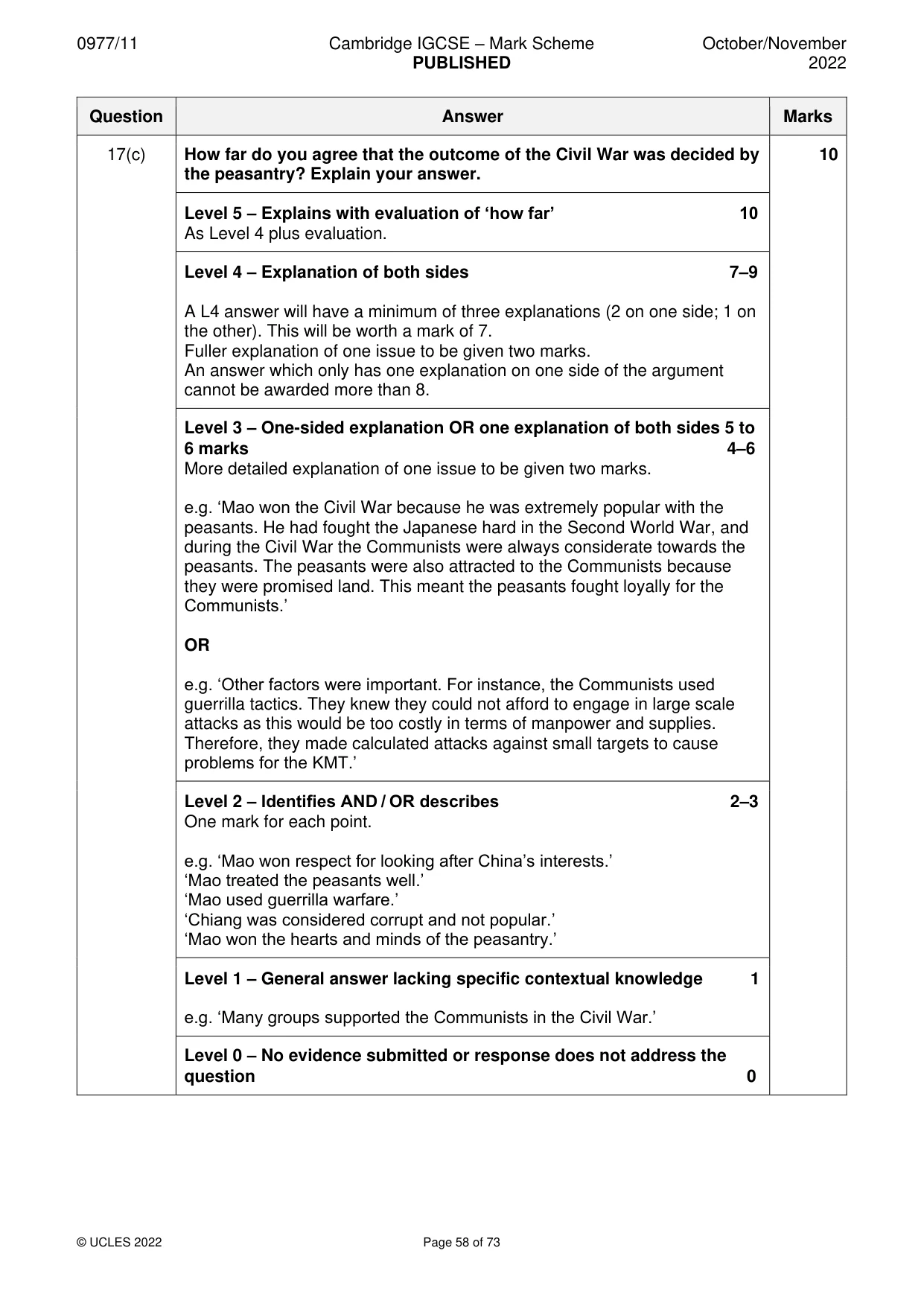
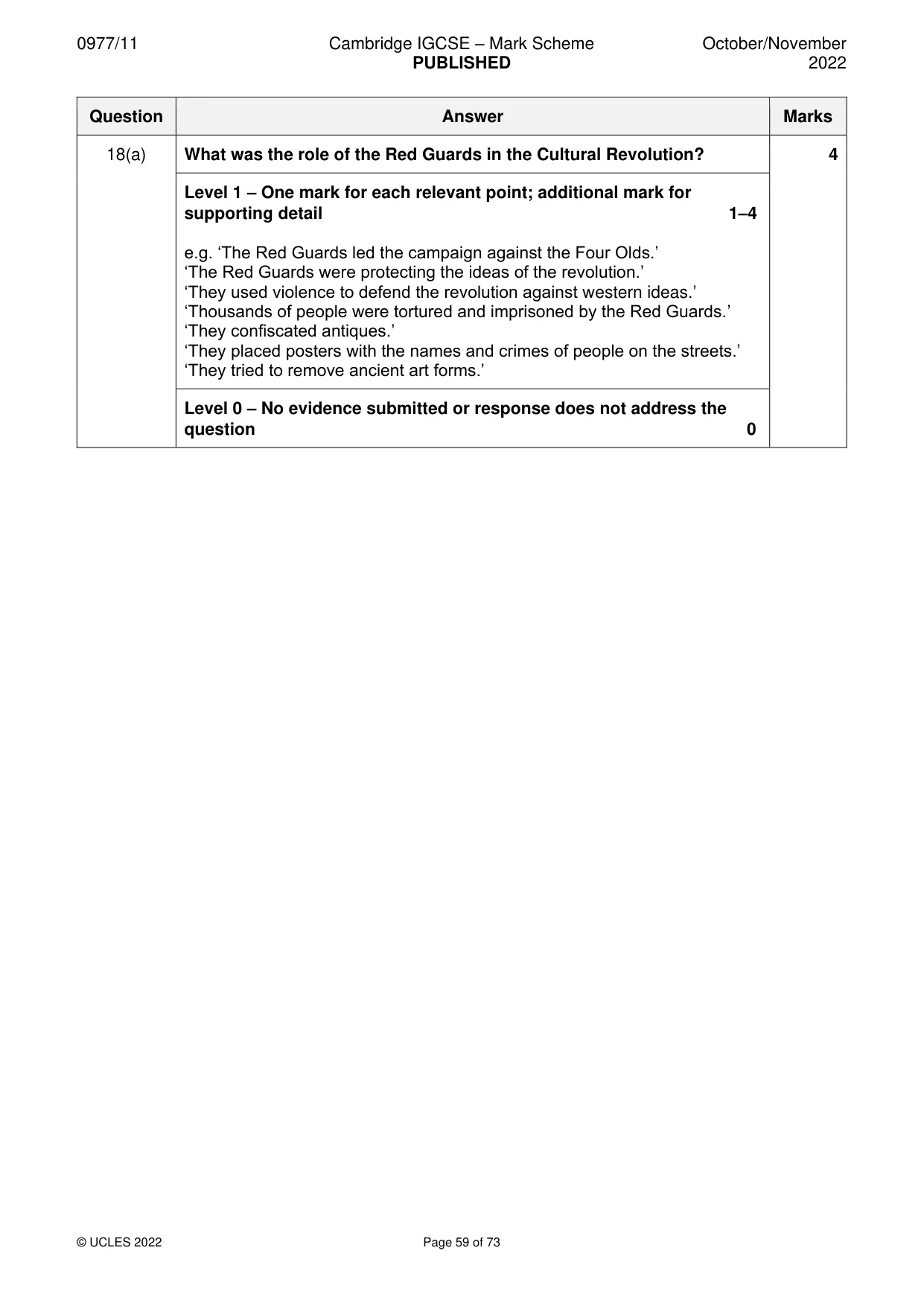
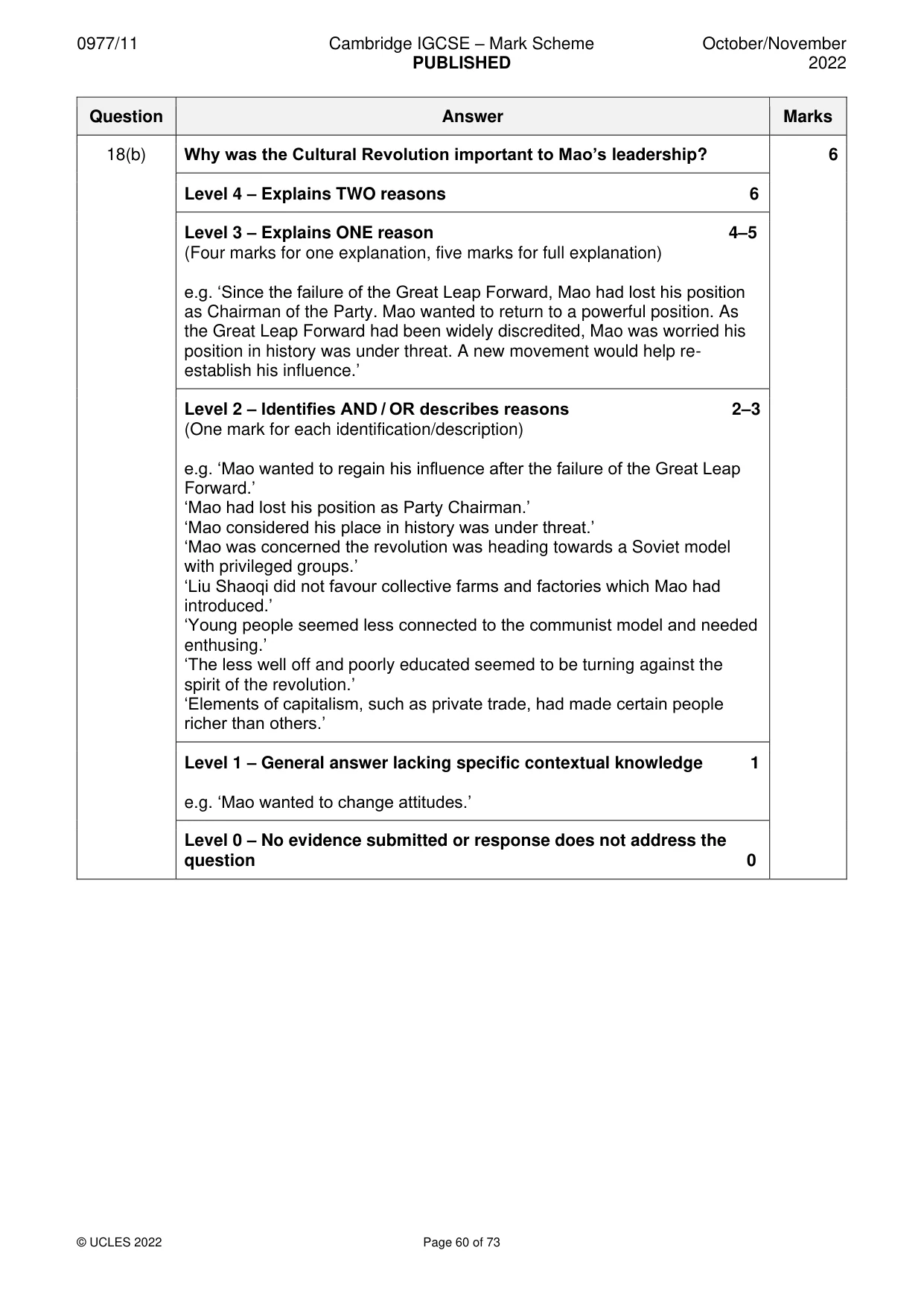
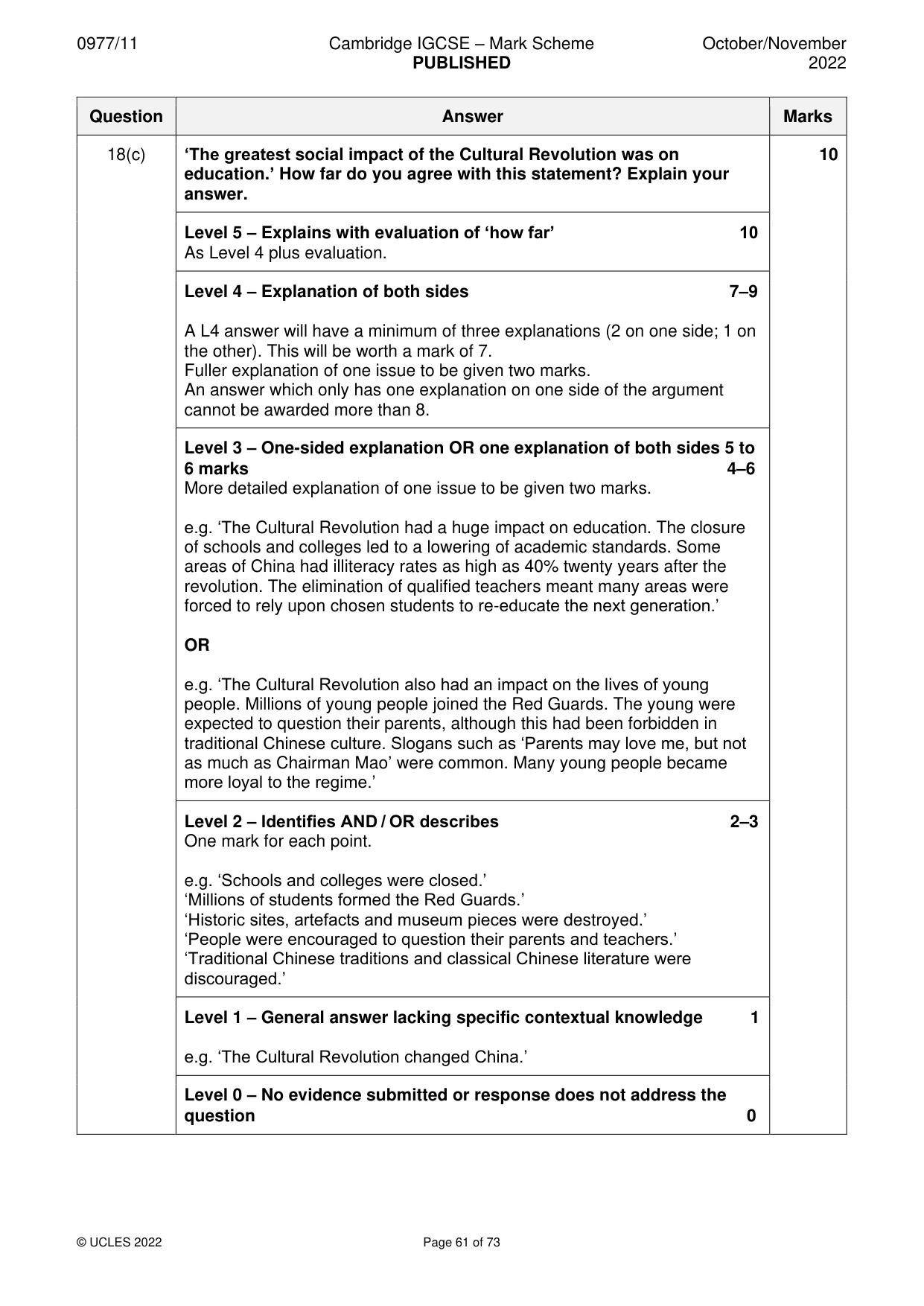
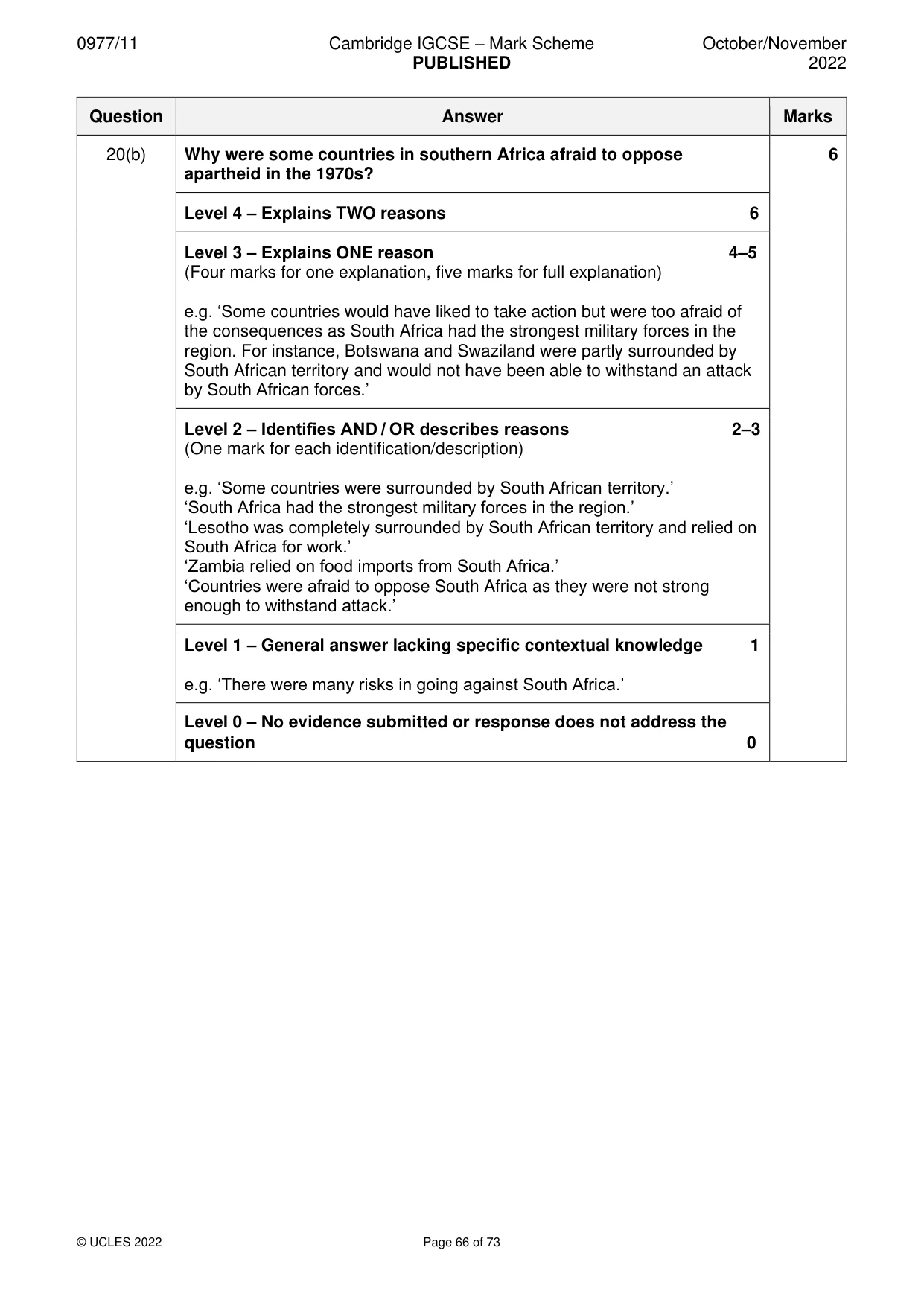
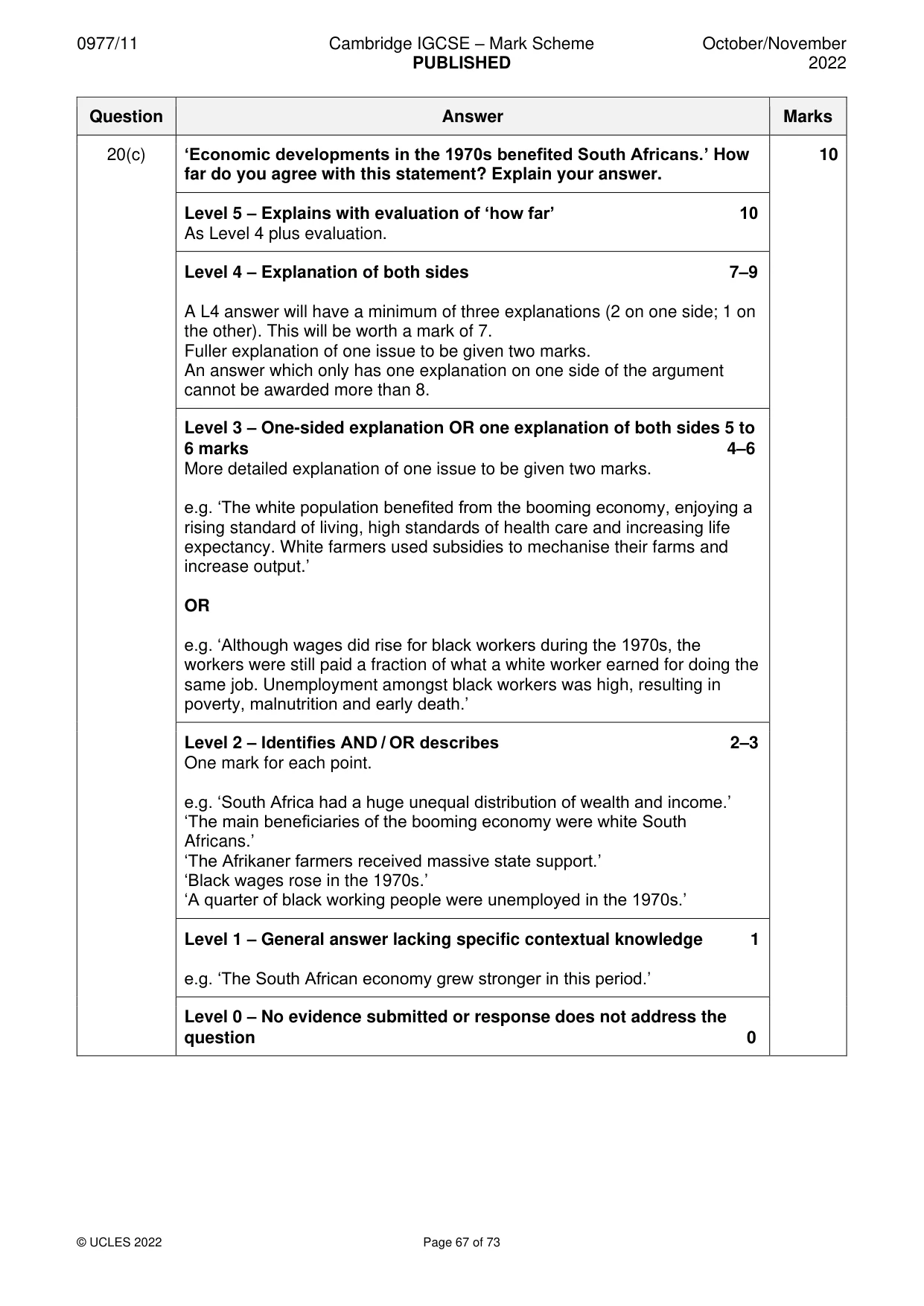
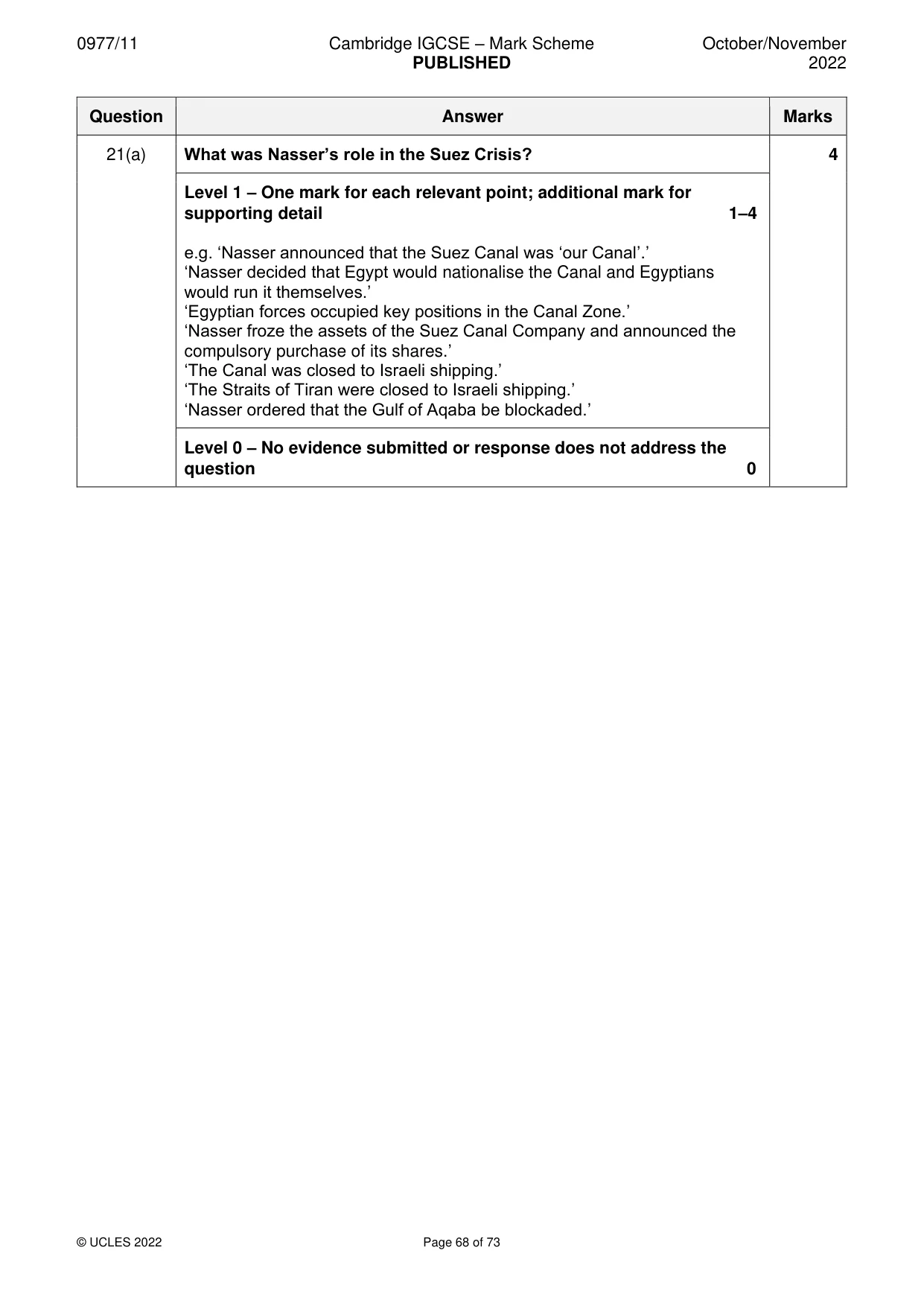
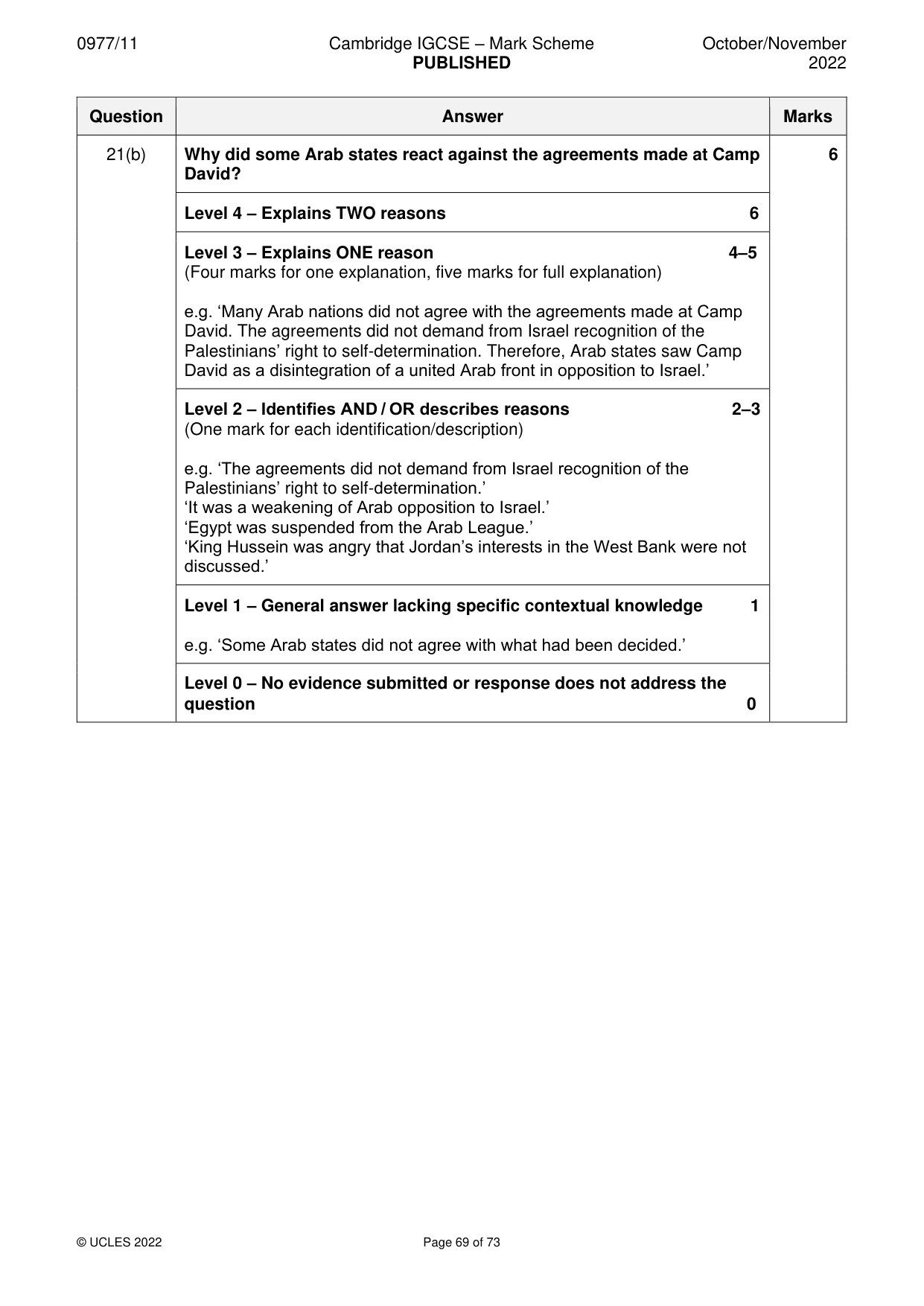
Paper as text
Question paper, page 1
This document has 12 pages. Any blank pages are indicated. [Turn over Cambridge IGCSE™(9–1) DC (DE) 319952 © UCLES 2022 * 3 4 6 2 1 9 7 6 0 0 * HISTORY 0977/11 Paper 1 October/November 2022 2 hours You must answer on the enclosed answer booklet. You will need: Answer booklet (enclosed) INSTRUCTIONS ● Answer three questions in total: Section A (Core Content): answer two questions. Section B (Depth Studies): answer one question. ● Follow the instructions on the front cover of the answer booklet. If you need additional answer paper, ask the invigilator for a continuation booklet. INFORMATION ● The total mark for this paper is 60. ● The number of marks for each question or part question is shown in brackets [ ].
Question paper, page 2
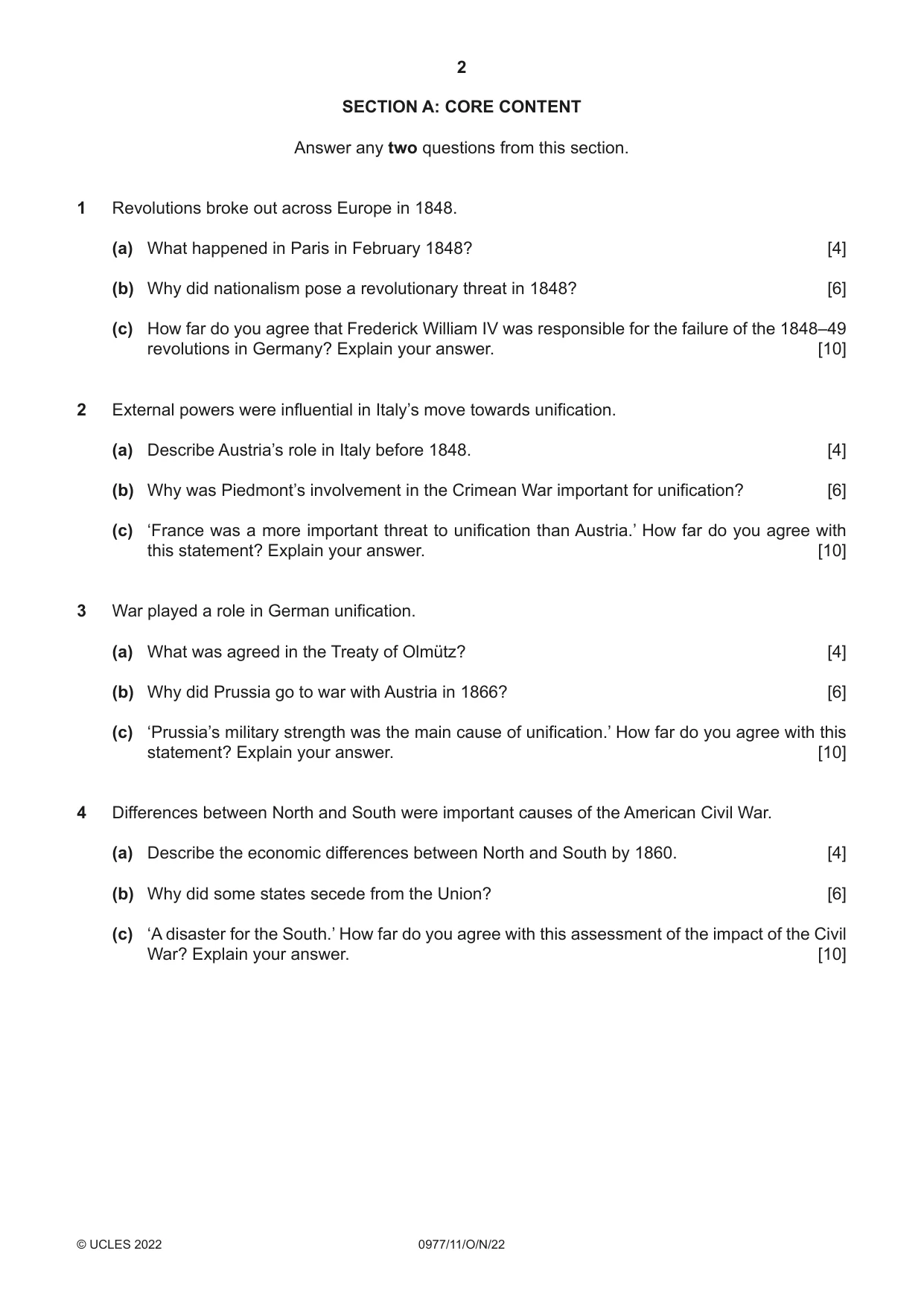
2 0977/11/O/N/22 © UCLES 2022 SECTION A: CORE CONTENT Answer any two questions from this section. 1 Revolutions broke out across Europe in 1848. (a) What happened in Paris in February 1848? [4] (b) Why did nationalism pose a revolutionary threat in 1848? [6] (c) How far do you agree that Frederick William IV was responsible for the failure of the 1848–49 revolutions in Germany? Explain your answer. [10] 2 External powers were influential in Italy’s move towards unification. (a) Describe Austria’s role in Italy before 1848. [4] (b) Why was Piedmont’s involvement in the Crimean War important for unification? [6] (c) ‘France was a more important threat to unification than Austria.’ How far do you agree with this statement? Explain your answer. [10] 3 War played a role in German unification. (a) What was agreed in the Treaty of Olmütz? [4] (b) Why did Prussia go to war with Austria in 1866? [6] (c) ‘Prussia’s military strength was the main cause of unification.’ How far do you agree with this statement? Explain your answer. [10] 4 Differences between North and South were important causes of the American Civil War. (a) Describe the economic differences between North and South by 1860. [4] (b) Why did some states secede from the Union? [6] (c) ‘A disaster for the South.’ How far do you agree with this assessment of the impact of the Civil War? Explain your answer. [10]
Question paper, page 3
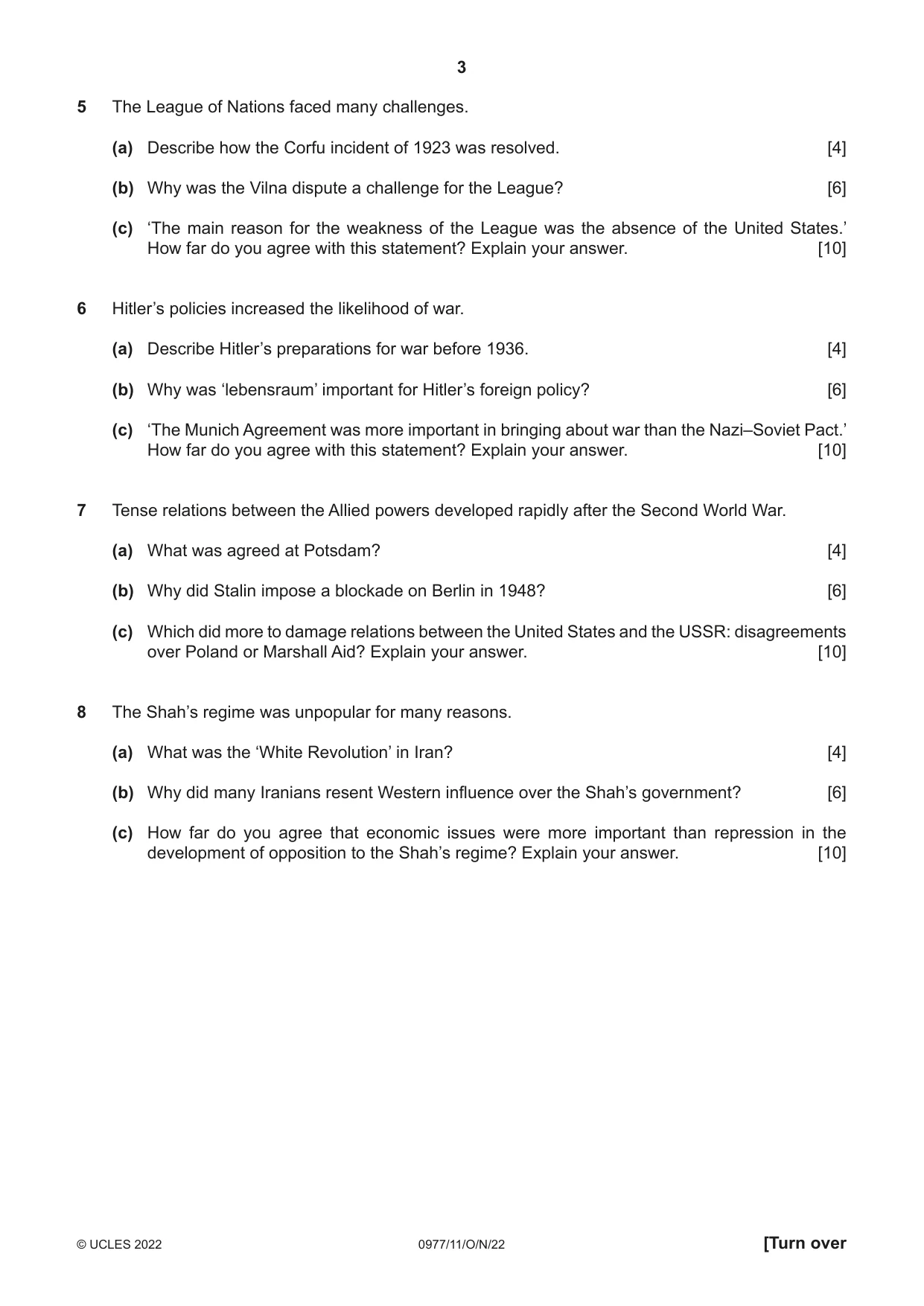
3 0977/11/O/N/22 © UCLES 2022 [Turn over 5 The League of Nations faced many challenges. (a) Describe how the Corfu incident of 1923 was resolved. [4] (b) Why was the Vilna dispute a challenge for the League? [6] (c) ‘The main reason for the weakness of the League was the absence of the United States.’ How far do you agree with this statement? Explain your answer. [10] 6 Hitler’s policies increased the likelihood of war. (a) Describe Hitler’s preparations for war before 1936. [4] (b) Why was ‘lebensraum’ important for Hitler’s foreign policy? [6] (c) ‘The Munich Agreement was more important in bringing about war than the Nazi–Soviet Pact.’ How far do you agree with this statement? Explain your answer. [10] 7 Tense relations between the Allied powers developed rapidly after the Second World War. (a) What was agreed at Potsdam? [4] (b) Why did Stalin impose a blockade on Berlin in 1948? [6] (c) Which did more to damage relations between the United States and the USSR: disagreements over Poland or Marshall Aid? Explain your answer. [10] 8 The Shah’s regime was unpopular for many reasons. (a) What was the ‘White Revolution’ in Iran? [4] (b) Why did many Iranians resent Western influence over the Shah’s government? [6] (c) How far do you agree that economic issues were more important than repression in the development of opposition to the Shah’s regime? Explain your answer. [10]
Question paper, page 4
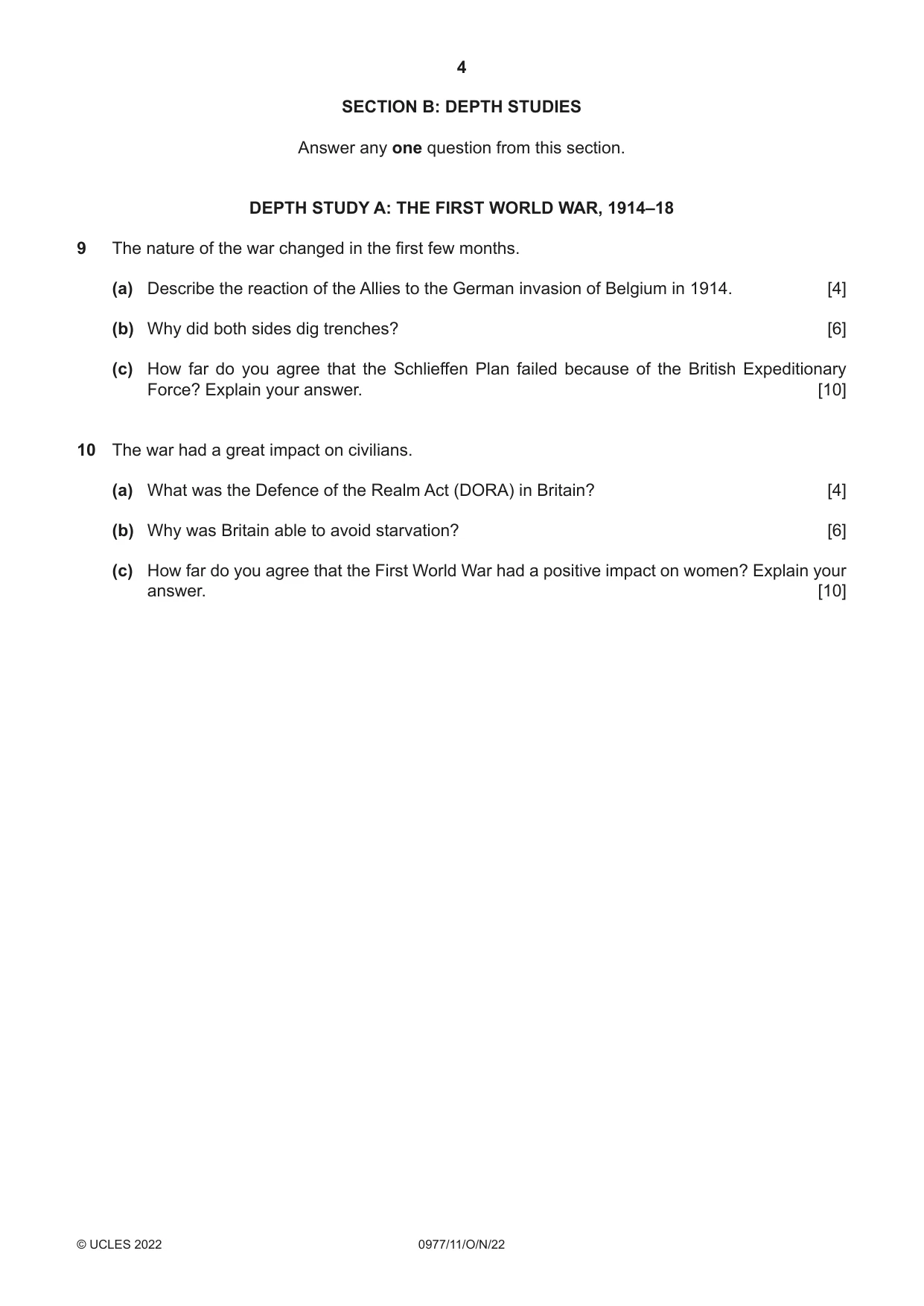
4 0977/11/O/N/22 © UCLES 2022 SECTION B: DEPTH STUDIES Answer any one question from this section. DEPTH STUDY A: THE FIRST WORLD WAR, 1914–18 9 The nature of the war changed in the first few months. (a) Describe the reaction of the Allies to the German invasion of Belgium in 1914. [4] (b) Why did both sides dig trenches? [6] (c) How far do you agree that the Schlieffen Plan failed because of the British Expeditionary Force? Explain your answer. [10] 10 The war had a great impact on civilians. (a) What was the Defence of the Realm Act (DORA) in Britain? [4] (b) Why was Britain able to avoid starvation? [6] (c) How far do you agree that the First World War had a positive impact on women? Explain your answer. [10]
Question paper, page 5
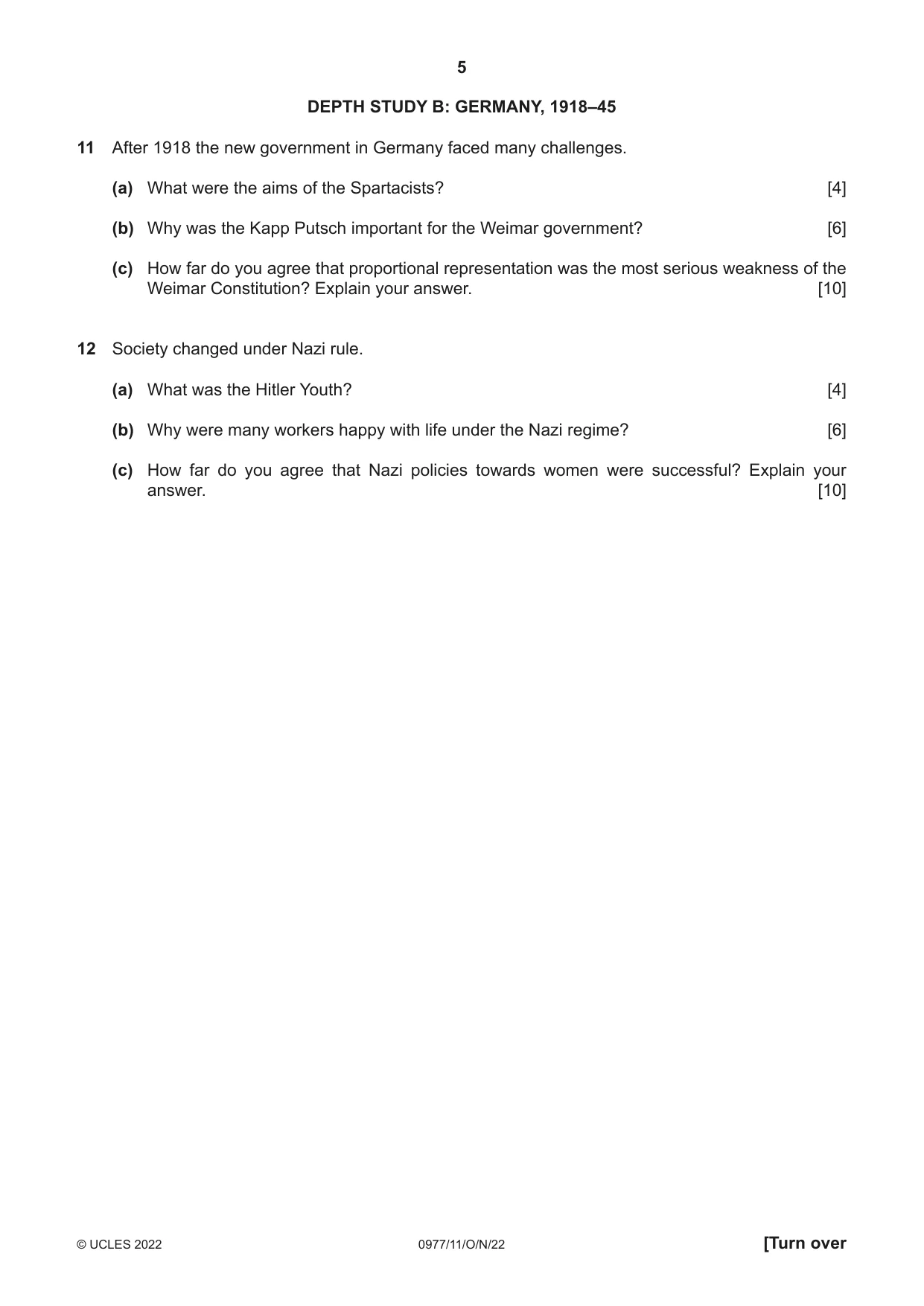
5 0977/11/O/N/22 © UCLES 2022 [Turn over DEPTH STUDY B: GERMANY, 1918–45 11 After 1918 the new government in Germany faced many challenges. (a) What were the aims of the Spartacists? [4] (b) Why was the Kapp Putsch important for the Weimar government? [6] (c) How far do you agree that proportional representation was the most serious weakness of the Weimar Constitution? Explain your answer. [10] 12 Society changed under Nazi rule. (a) What was the Hitler Youth? [4] (b) Why were many workers happy with life under the Nazi regime? [6] (c) How far do you agree that Nazi policies towards women were successful? Explain your answer. [10]
Question paper, page 6
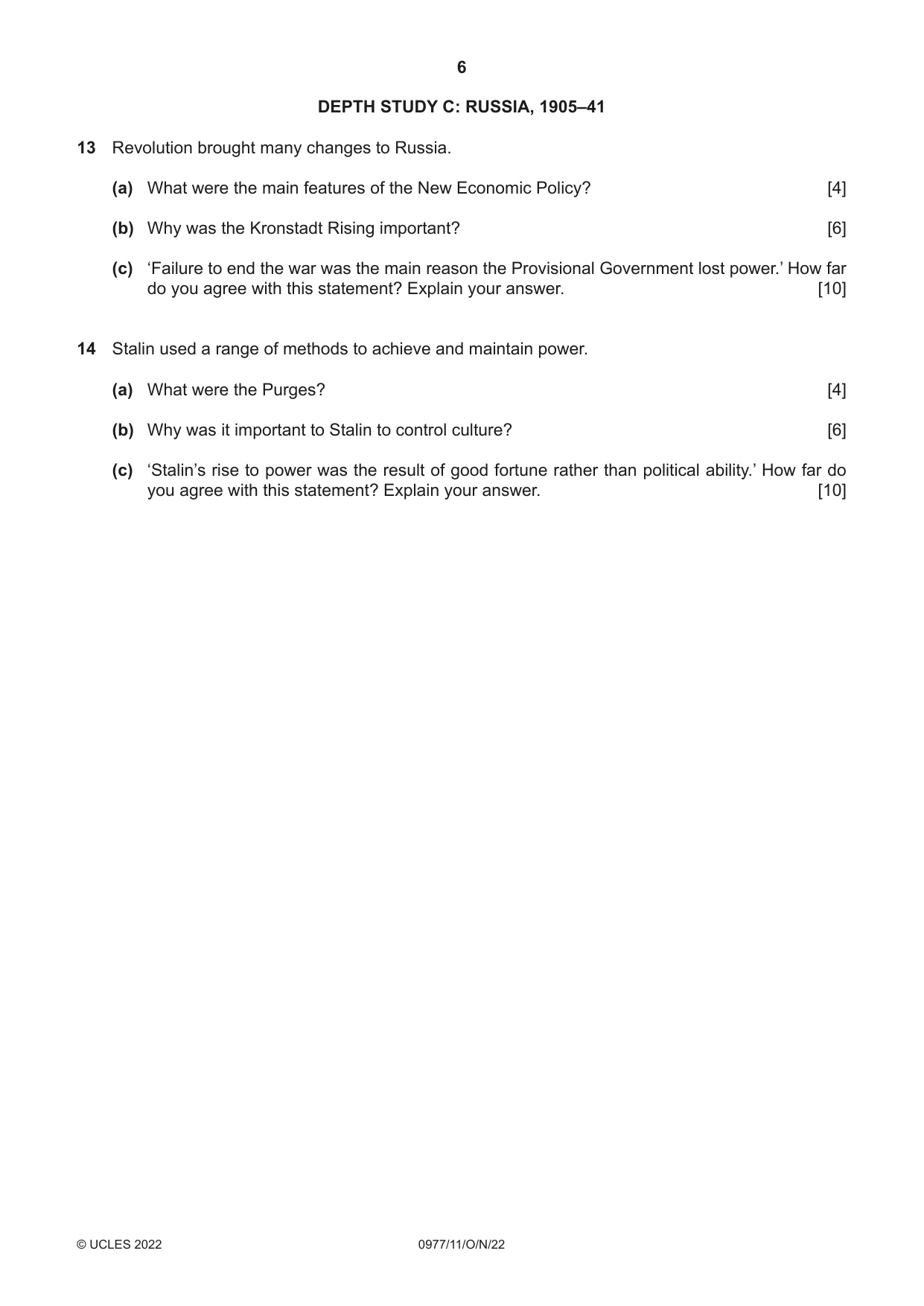
6 0977/11/O/N/22 © UCLES 2022 DEPTH STUDY C: RUSSIA, 1905–41 13 Revolution brought many changes to Russia. (a) What were the main features of the New Economic Policy? [4] (b) Why was the Kronstadt Rising important? [6] (c) ‘Failure to end the war was the main reason the Provisional Government lost power.’ How far do you agree with this statement? Explain your answer. [10] 14 Stalin used a range of methods to achieve and maintain power. (a) What were the Purges? [4] (b) Why was it important to Stalin to control culture? [6] (c) ‘Stalin’s rise to power was the result of good fortune rather than political ability.’ How far do you agree with this statement? Explain your answer. [10]
Question paper, page 7
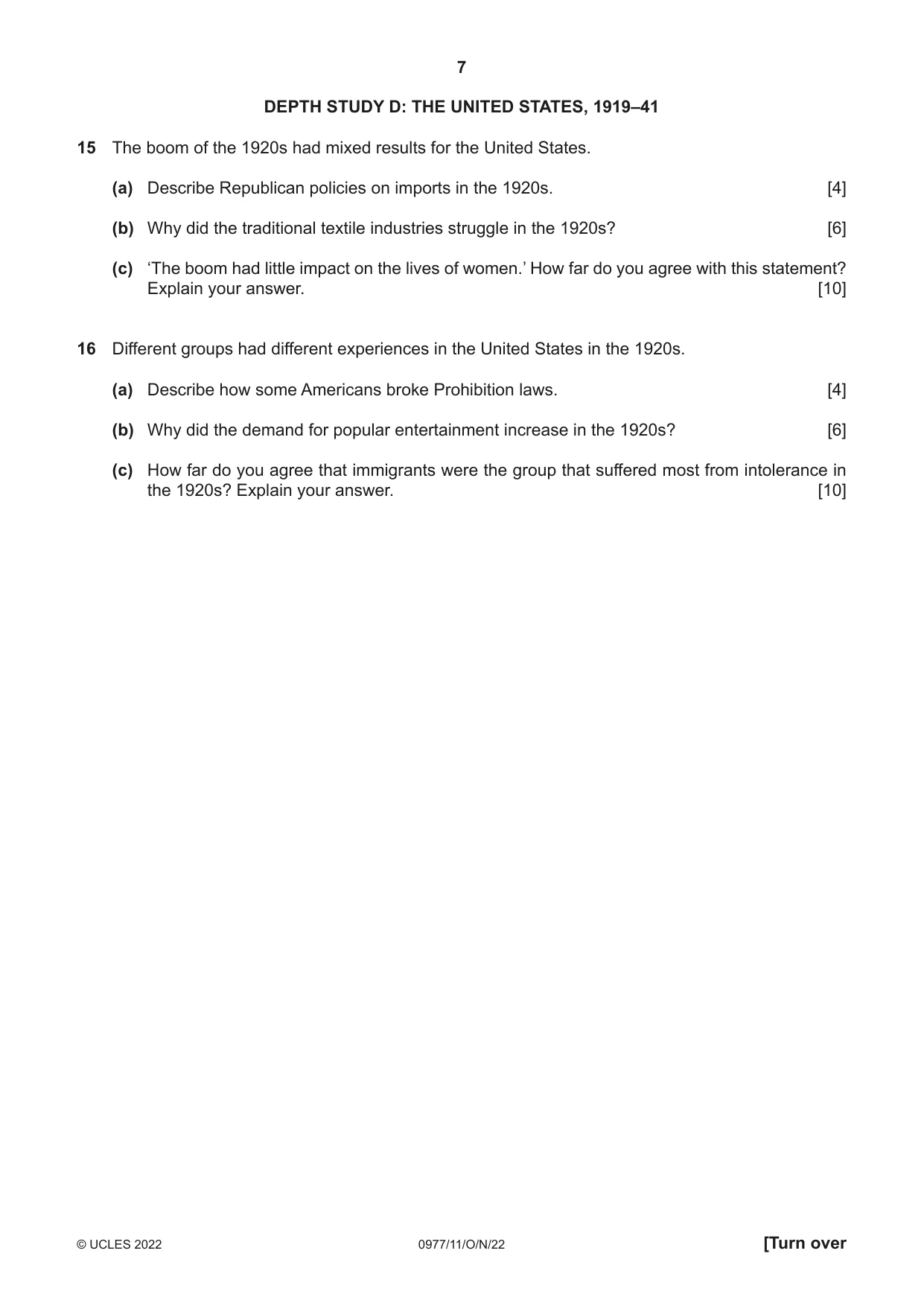
7 0977/11/O/N/22 © UCLES 2022 [Turn over DEPTH STUDY D: THE UNITED STATES, 1919–41 15 The boom of the 1920s had mixed results for the United States. (a) Describe Republican policies on imports in the 1920s. [4] (b) Why did the traditional textile industries struggle in the 1920s? [6] (c) ‘The boom had little impact on the lives of women.’ How far do you agree with this statement? Explain your answer. [10] 16 Different groups had different experiences in the United States in the 1920s. (a) Describe how some Americans broke Prohibition laws. [4] (b) Why did the demand for popular entertainment increase in the 1920s? [6] (c) How far do you agree that immigrants were the group that suffered most from intolerance in the 1920s? Explain your answer. [10]
Question paper, page 8
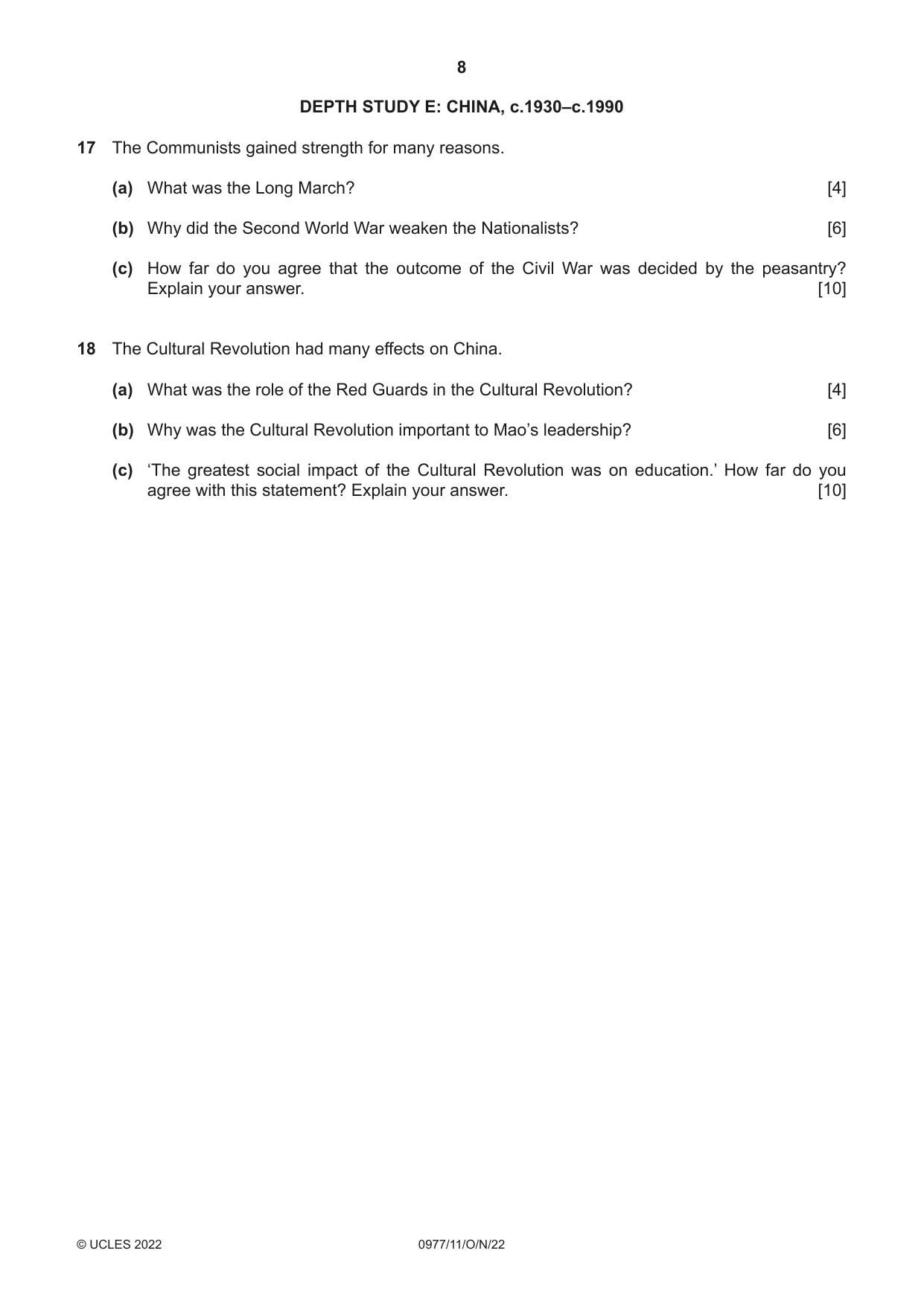
8 0977/11/O/N/22 © UCLES 2022 DEPTH STUDY E: CHINA, c.1930–c.1990 17 The Communists gained strength for many reasons. (a) What was the Long March? [4] (b) Why did the Second World War weaken the Nationalists? [6] (c) How far do you agree that the outcome of the Civil War was decided by the peasantry? Explain your answer. [10] 18 The Cultural Revolution had many effects on China. (a) What was the role of the Red Guards in the Cultural Revolution? [4] (b) Why was the Cultural Revolution important to Mao’s leadership? [6] (c) ‘The greatest social impact of the Cultural Revolution was on education.’ How far do you agree with this statement? Explain your answer. [10]
Question paper, page 9
9 0977/11/O/N/22 © UCLES 2022 [Turn over DEPTH STUDY F: SOUTH AFRICA, c.1940–c.1994 19 Even before the introduction of apartheid, the position of black South Africans deteriorated for many reasons. (a) What was the Native Urban Areas Act, 1923? [4] (b) Why were many black South Africans forced out of farming? [6] (c) How far do you agree that the impact of the Second World War was the main reason for the National Party’s success in the 1948 election? Explain your answer. [10] 20 The policy of apartheid was firmly entrenched by the 1970s. (a) Describe the United Nations’ opposition to apartheid. [4] (b) Why were some countries in southern Africa afraid to oppose apartheid in the 1970s? [6] (c) ‘Economic developments in the 1970s benefited South Africans.’ How far do you agree with this statement? Explain your answer. [10]
Question paper, page 10
10 0977/11/O/N/22 © UCLES 2022 DEPTH STUDY G: ISRAELIS AND PALESTINIANS SINCE 1945 21 Superpower involvement in the Middle East had mixed results. (a) What was Nasser’s role in the Suez Crisis? [4] (b) Why did some Arab states react against the agreements made at Camp David? [6] (c) ‘The USSR’s involvement in the Middle East had a negative impact on the Arab states.’ How far do you agree with this statement? Explain your answer. [10] 22 Gaining support has been a challenge for the Palestinians. (a) Describe Israel’s invasion of Lebanon in 1982. [4] (b) Why has it been impossible for Palestinian refugees to return home? [6] (c) How surprising is it that some Arab states did not support the Palestine Liberation Organisation (PLO)? Explain your answer. [10]
Question paper, page 11
11 0977/11/O/N/22 © UCLES 2022 BLANK PAGE
Question paper, page 12
12 0977/11/O/N/22 © UCLES 2022 Permission to reproduce items where third-party owned material protected by copyright is included has been sought and cleared where possible. Every reasonable effort has been made by the publisher (UCLES) to trace copyright holders, but if any items requiring clearance have unwittingly been included, the publisher will be pleased to make amends at the earliest possible opportunity. To avoid the issue of disclosure of answer-related information to candidates, all copyright acknowledgements are reproduced online in the Cambridge Assessment International Education Copyright Acknowledgements Booklet. This is produced for each series of examinations and is freely available to download at www.cambridgeinternational.org after the live examination series. Cambridge Assessment International Education is part of Cambridge Assessment. Cambridge Assessment is the brand name of the University of Cambridge Local Examinations Syndicate (UCLES), which is a department of the University of Cambridge. BLANK PAGE
Mark scheme, page 1
This document consists of 73 printed pages. © UCLES 2022 [Turn over Cambridge IGCSE™ (9–1) HISTORY 0977/11 Paper 1 October/November 2022 MARK SCHEME Maximum Mark: 60 Published This mark scheme is published as an aid to teachers and candidates, to indicate the requirements of the examination. It shows the basis on which Examiners were instructed to award marks. It does not indicate the details of the discussions that took place at an Examiners’ meeting before marking began, which would have considered the acceptability of alternative answers. Mark schemes should be read in conjunction with the question paper and the Principal Examiner Report for Teachers. Cambridge International will not enter into discussions about these mark schemes. Cambridge International is publishing the mark schemes for the October/November 2022 series for most Cambridge IGCSE™, Cambridge International A and AS Level components and some Cambridge O Level components.
Mark scheme, page 2
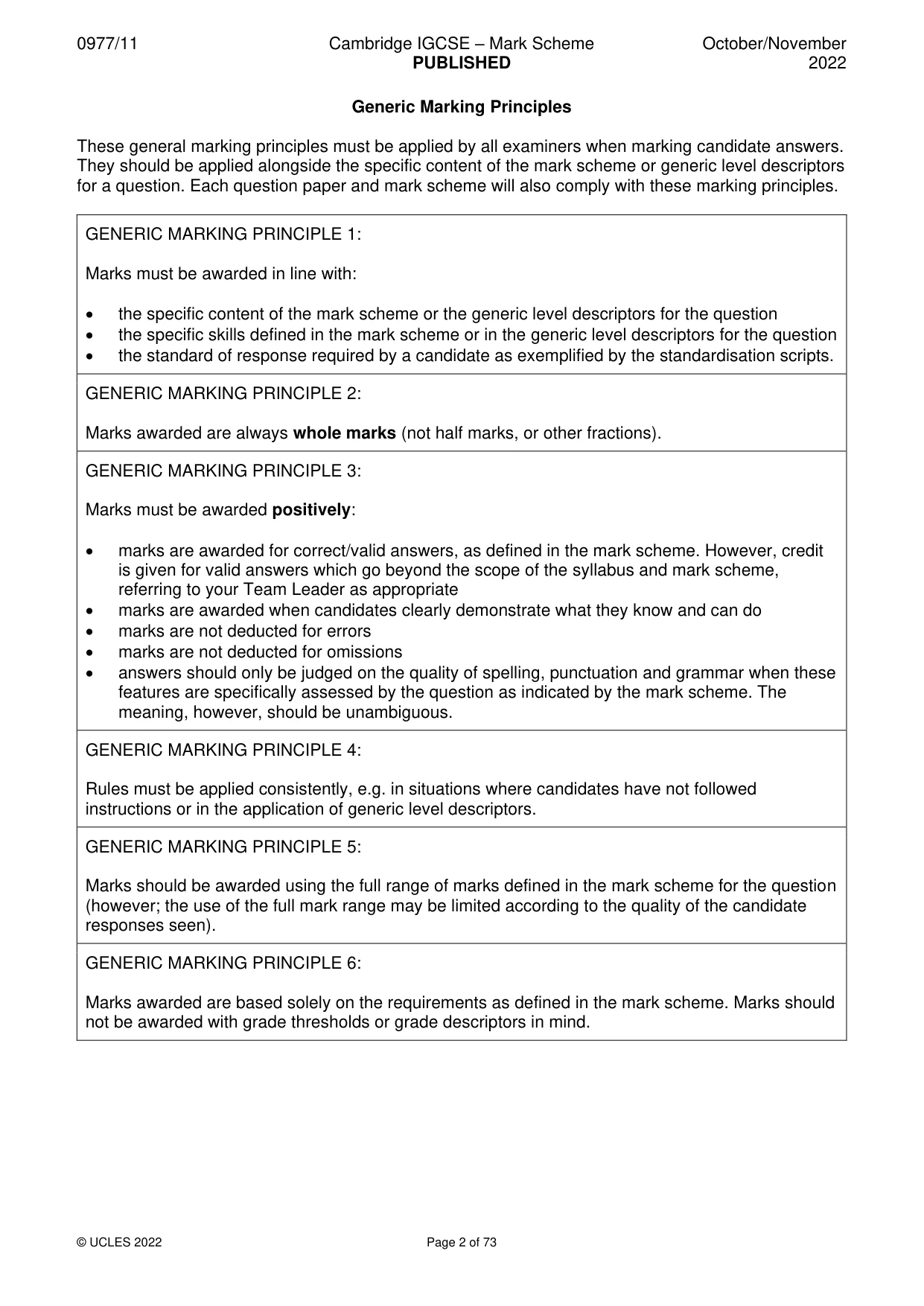
0977/11 Cambridge IGCSE – Mark Scheme PUBLISHED October/November 2022 © UCLES 2022 Page 2 of 73 Generic Marking Principles These general marking principles must be applied by all examiners when marking candidate answers. They should be applied alongside the specific content of the mark scheme or generic level descriptors for a question. Each question paper and mark scheme will also comply with these marking principles. GENERIC MARKING PRINCIPLE 1: Marks must be awarded in line with: • the specific content of the mark scheme or the generic level descriptors for the question • the specific skills defined in the mark scheme or in the generic level descriptors for the question • the standard of response required by a candidate as exemplified by the standardisation scripts. GENERIC MARKING PRINCIPLE 2: Marks awarded are always whole marks (not half marks, or other fractions). GENERIC MARKING PRINCIPLE 3: Marks must be awarded positively: • marks are awarded for correct/valid answers, as defined in the mark scheme. However, credit is given for valid answers which go beyond the scope of the syllabus and mark scheme, referring to your Team Leader as appropriate • marks are awarded when candidates clearly demonstrate what they know and can do • marks are not deducted for errors • marks are not deducted for omissions • answers should only be judged on the quality of spelling, punctuation and grammar when these features are specifically assessed by the question as indicated by the mark scheme. The meaning, however, should be unambiguous. GENERIC MARKING PRINCIPLE 4: Rules must be applied consistently, e.g. in situations where candidates have not followed instructions or in the application of generic level descriptors. GENERIC MARKING PRINCIPLE 5: Marks should be awarded using the full range of marks defined in the mark scheme for the question (however; the use of the full mark range may be limited according to the quality of the candidate responses seen). GENERIC MARKING PRINCIPLE 6: Marks awarded are based solely on the requirements as defined in the mark scheme. Marks should not be awarded with grade thresholds or grade descriptors in mind.
Mark scheme, page 3
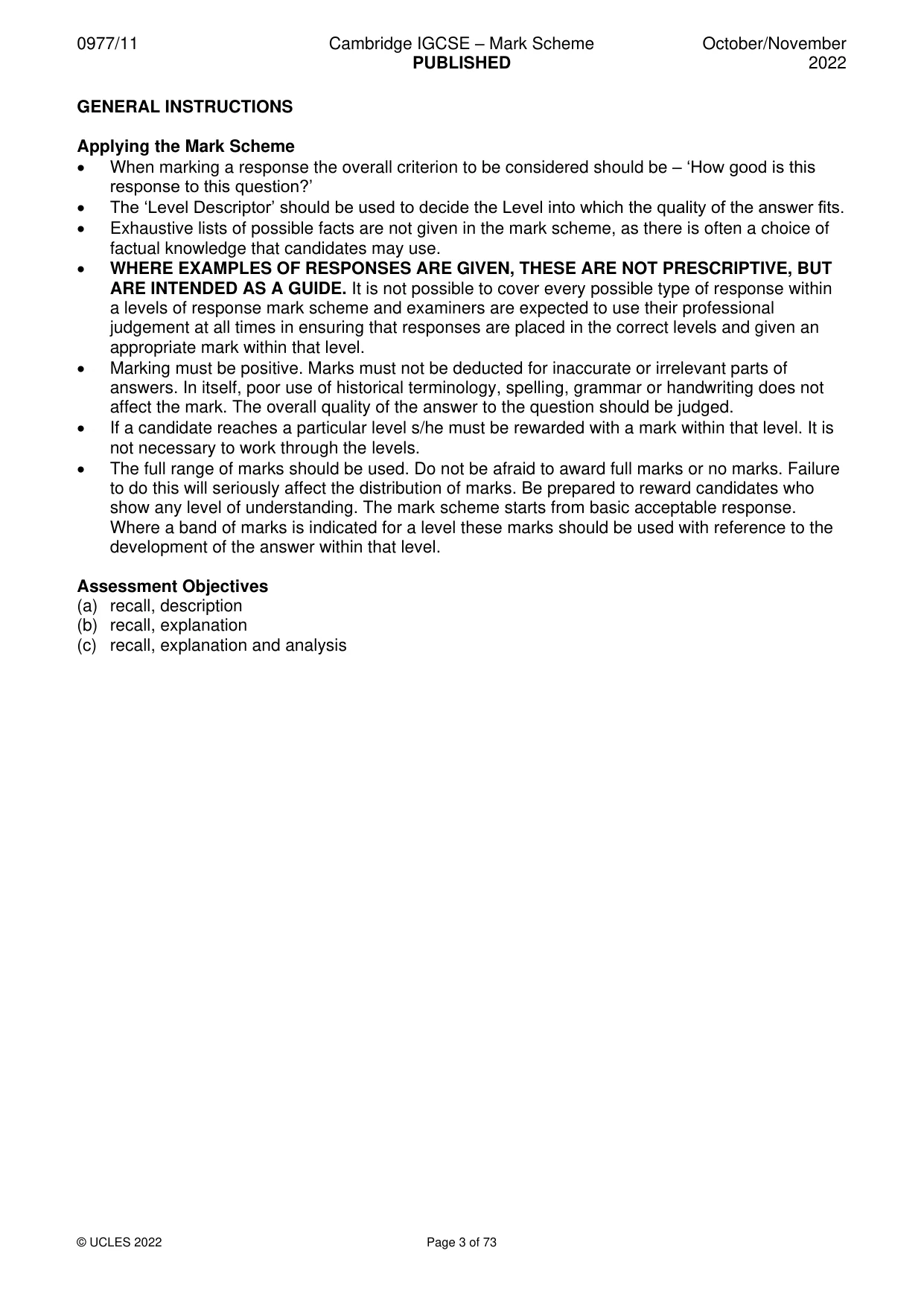
0977/11 Cambridge IGCSE – Mark Scheme PUBLISHED October/November 2022 © UCLES 2022 Page 3 of 73 GENERAL INSTRUCTIONS Applying the Mark Scheme • When marking a response the overall criterion to be considered should be – ‘How good is this response to this question?’ • The ‘Level Descriptor’ should be used to decide the Level into which the quality of the answer fits. • Exhaustive lists of possible facts are not given in the mark scheme, as there is often a choice of factual knowledge that candidates may use. • WHERE EXAMPLES OF RESPONSES ARE GIVEN, THESE ARE NOT PRESCRIPTIVE, BUT ARE INTENDED AS A GUIDE. It is not possible to cover every possible type of response within a levels of response mark scheme and examiners are expected to use their professional judgement at all times in ensuring that responses are placed in the correct levels and given an appropriate mark within that level. • Marking must be positive. Marks must not be deducted for inaccurate or irrelevant parts of answers. In itself, poor use of historical terminology, spelling, grammar or handwriting does not affect the mark. The overall quality of the answer to the question should be judged. • If a candidate reaches a particular level s/he must be rewarded with a mark within that level. It is not necessary to work through the levels. • The full range of marks should be used. Do not be afraid to award full marks or no marks. Failure to do this will seriously affect the distribution of marks. Be prepared to reward candidates who show any level of understanding. The mark scheme starts from basic acceptable response. Where a band of marks is indicated for a level these marks should be used with reference to the development of the answer within that level. Assessment Objectives (a) recall, description (b) recall, explanation (c) recall, explanation and analysis
Mark scheme, page 4
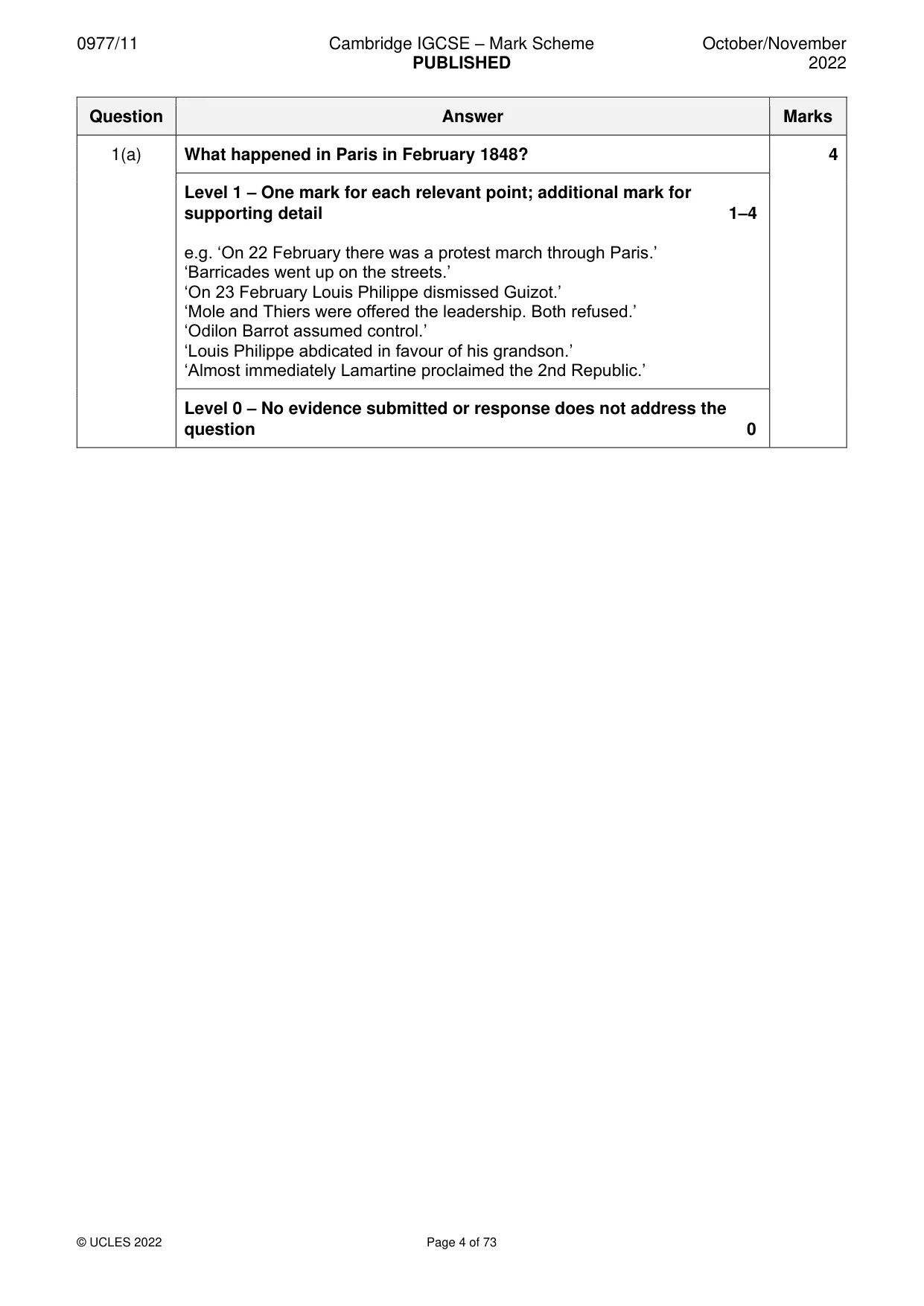
0977/11 Cambridge IGCSE – Mark Scheme PUBLISHED October/November 2022 © UCLES 2022 Page 4 of 73 Question Answer Marks 1(a) What happened in Paris in February 1848? 4 Level 1 – One mark for each relevant point; additional mark for supporting detail 1–4 e.g. ‘On 22 February there was a protest march through Paris.’ ‘Barricades went up on the streets.’ ‘On 23 February Louis Philippe dismissed Guizot.’ ‘Mole and Thiers were offered the leadership. Both refused.’ ‘Odilon Barrot assumed control.’ ‘Louis Philippe abdicated in favour of his grandson.’ ‘Almost immediately Lamartine proclaimed the 2nd Republic.’ Level 0 – No evidence submitted or response does not address the question 0
Mark scheme, page 5
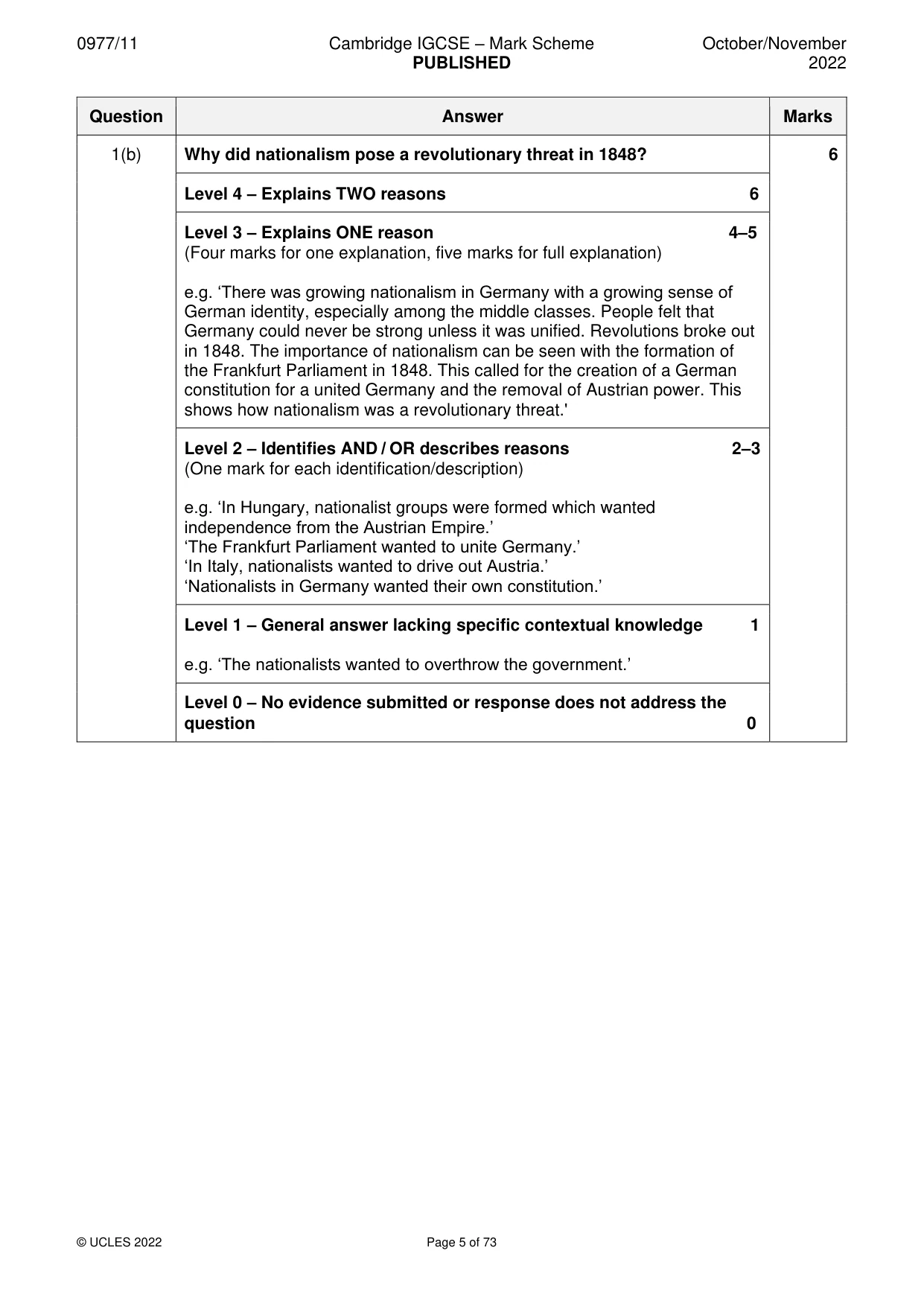
0977/11 Cambridge IGCSE – Mark Scheme PUBLISHED October/November 2022 © UCLES 2022 Page 5 of 73 Question Answer Marks 1(b) Why did nationalism pose a revolutionary threat in 1848? 6 Level 4 – Explains TWO reasons 6 Level 3 – Explains ONE reason 4–5 (Four marks for one explanation, five marks for full explanation) e.g. ‘There was growing nationalism in Germany with a growing sense of German identity, especially among the middle classes. People felt that Germany could never be strong unless it was unified. Revolutions broke out in 1848. The importance of nationalism can be seen with the formation of the Frankfurt Parliament in 1848. This called for the creation of a German constitution for a united Germany and the removal of Austrian power. This shows how nationalism was a revolutionary threat.' Level 2 – Identifies AND / OR describes reasons 2–3 (One mark for each identification/description) e.g. ‘In Hungary, nationalist groups were formed which wanted independence from the Austrian Empire.’ ‘The Frankfurt Parliament wanted to unite Germany.’ ‘In Italy, nationalists wanted to drive out Austria.’ ‘Nationalists in Germany wanted their own constitution.’ Level 1 – General answer lacking specific contextual knowledge 1 e.g. ‘The nationalists wanted to overthrow the government.’ Level 0 – No evidence submitted or response does not address the question 0
Mark scheme, page 6
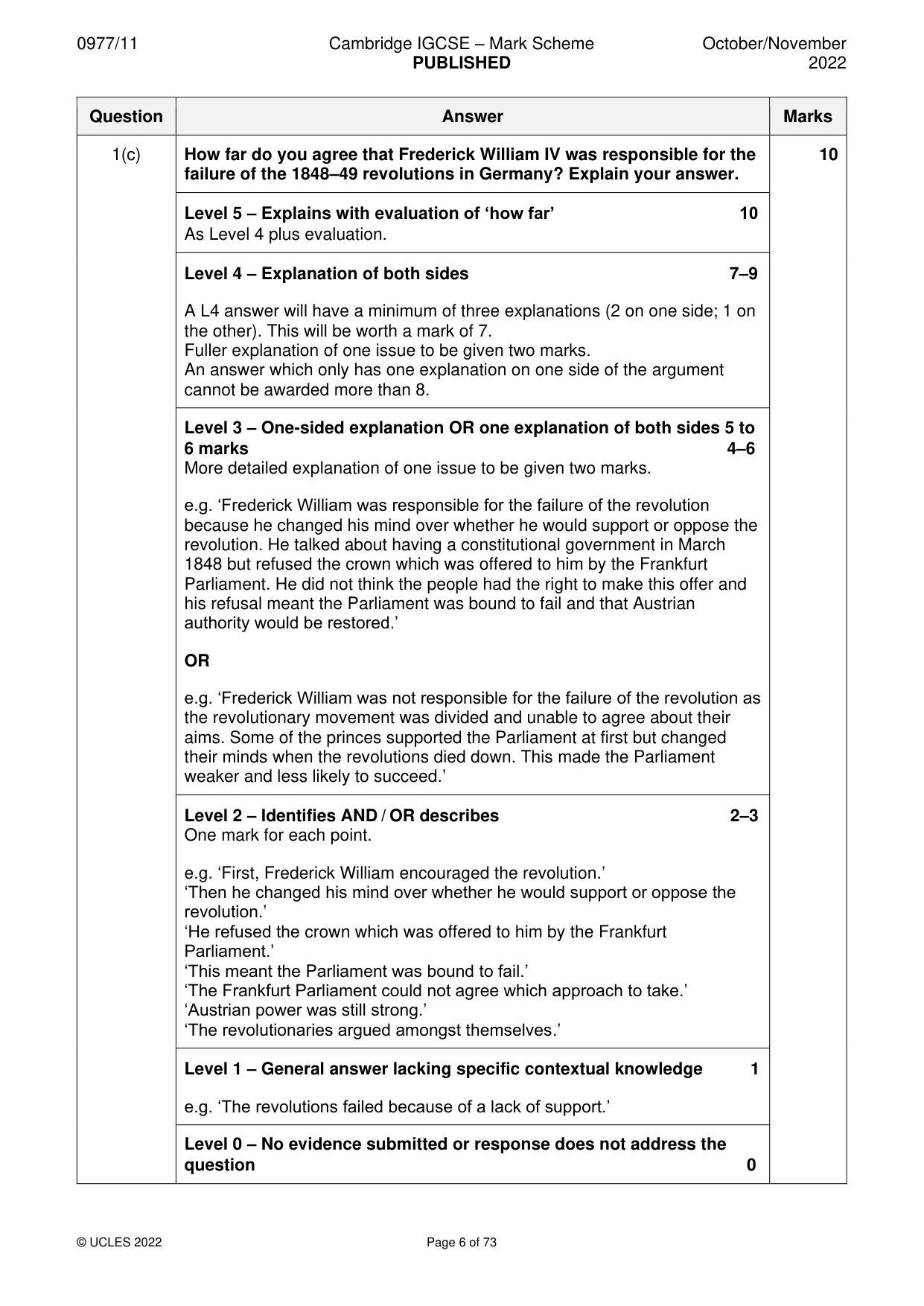
0977/11 Cambridge IGCSE – Mark Scheme PUBLISHED October/November 2022 © UCLES 2022 Page 6 of 73 Question Answer Marks 1(c) How far do you agree that Frederick William IV was responsible for the failure of the 1848–49 revolutions in Germany? Explain your answer. 10 Level 5 – Explains with evaluation of ‘how far’ 10 As Level 4 plus evaluation. Level 4 – Explanation of both sides 7–9 A L4 answer will have a minimum of three explanations (2 on one side; 1 on the other). This will be worth a mark of 7. Fuller explanation of one issue to be given two marks. An answer which only has one explanation on one side of the argument cannot be awarded more than 8. Level 3 – One-sided explanation OR one explanation of both sides 5 to 6 marks 4–6 More detailed explanation of one issue to be given two marks. e.g. ‘Frederick William was responsible for the failure of the revolution because he changed his mind over whether he would support or oppose the revolution. He talked about having a constitutional government in March 1848 but refused the crown which was offered to him by the Frankfurt Parliament. He did not think the people had the right to make this offer and his refusal meant the Parliament was bound to fail and that Austrian authority would be restored.’ OR e.g. ‘Frederick William was not responsible for the failure of the revolution as the revolutionary movement was divided and unable to agree about their aims. Some of the princes supported the Parliament at first but changed their minds when the revolutions died down. This made the Parliament weaker and less likely to succeed.’ Level 2 – Identifies AND / OR describes 2–3 One mark for each point. e.g. ‘First, Frederick William encouraged the revolution.’ ‘Then he changed his mind over whether he would support or oppose the revolution.’ ‘He refused the crown which was offered to him by the Frankfurt Parliament.’ ‘This meant the Parliament was bound to fail.’ ‘The Frankfurt Parliament could not agree which approach to take.’ ‘Austrian power was still strong.’ ‘The revolutionaries argued amongst themselves.’ Level 1 – General answer lacking specific contextual knowledge 1 e.g. ‘The revolutions failed because of a lack of support.’ Level 0 – No evidence submitted or response does not address the question 0
Mark scheme, page 7
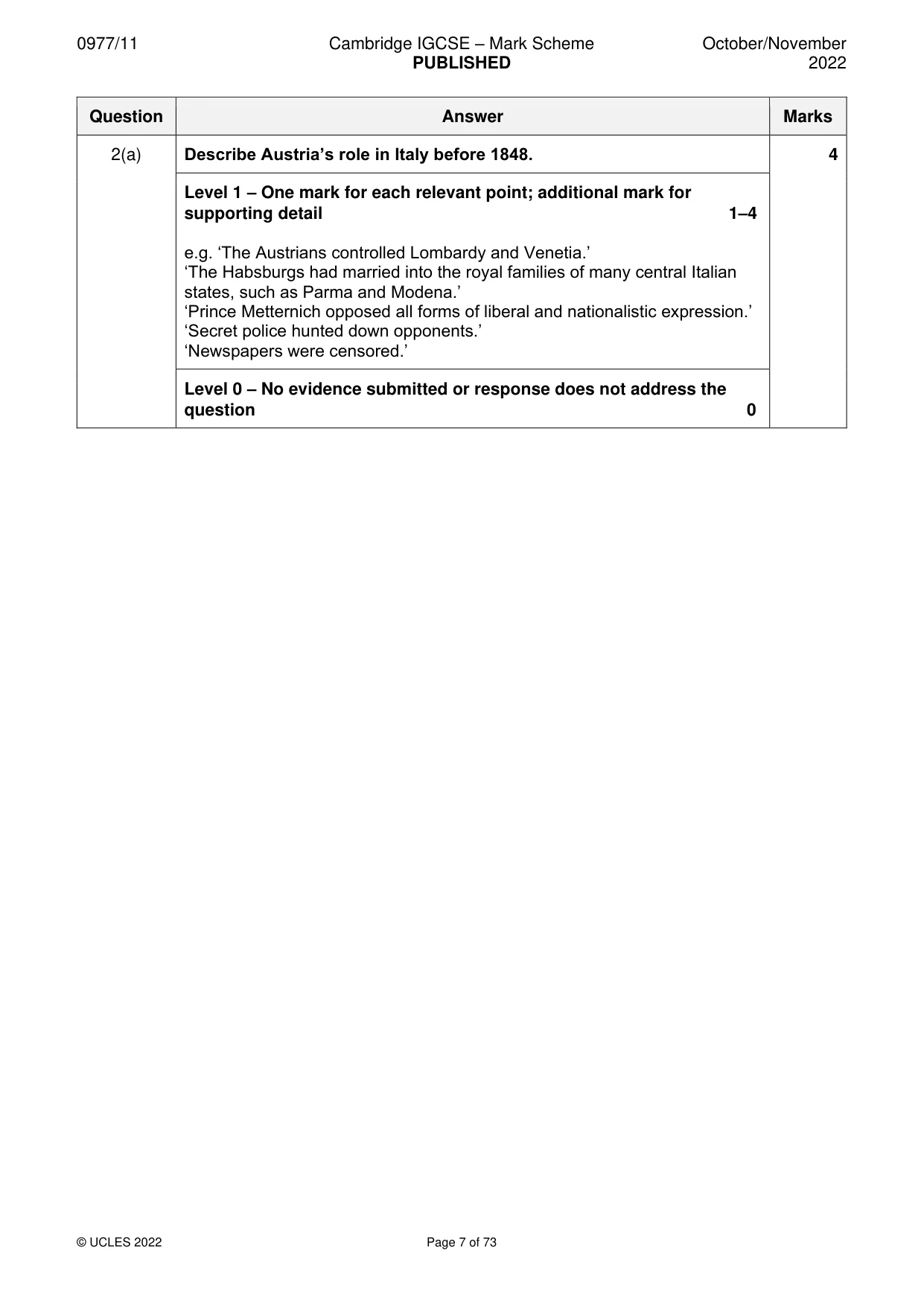
0977/11 Cambridge IGCSE – Mark Scheme PUBLISHED October/November 2022 © UCLES 2022 Page 7 of 73 Question Answer Marks 2(a) Describe Austria’s role in Italy before 1848. 4 Level 1 – One mark for each relevant point; additional mark for supporting detail 1–4 e.g. ‘The Austrians controlled Lombardy and Venetia.’ ‘The Habsburgs had married into the royal families of many central Italian states, such as Parma and Modena.’ ‘Prince Metternich opposed all forms of liberal and nationalistic expression.’ ‘Secret police hunted down opponents.’ ‘Newspapers were censored.’ Level 0 – No evidence submitted or response does not address the question 0
Mark scheme, page 8
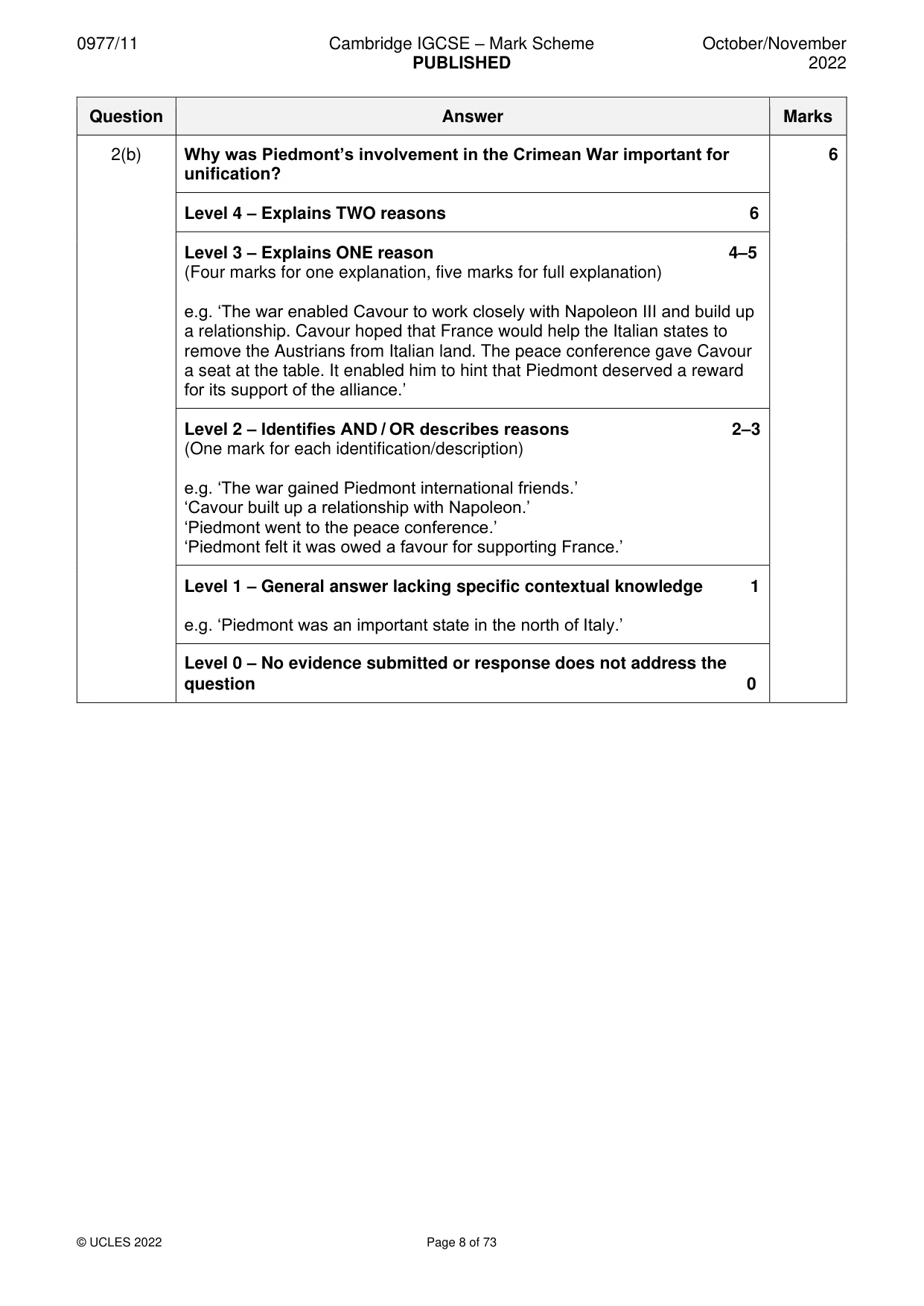
0977/11 Cambridge IGCSE – Mark Scheme PUBLISHED October/November 2022 © UCLES 2022 Page 8 of 73 Question Answer Marks 2(b) Why was Piedmont’s involvement in the Crimean War important for unification? 6 Level 4 – Explains TWO reasons 6 Level 3 – Explains ONE reason 4–5 (Four marks for one explanation, five marks for full explanation) e.g. ‘The war enabled Cavour to work closely with Napoleon III and build up a relationship. Cavour hoped that France would help the Italian states to remove the Austrians from Italian land. The peace conference gave Cavour a seat at the table. It enabled him to hint that Piedmont deserved a reward for its support of the alliance.’ Level 2 – Identifies AND / OR describes reasons 2–3 (One mark for each identification/description) e.g. ‘The war gained Piedmont international friends.’ ‘Cavour built up a relationship with Napoleon.’ ‘Piedmont went to the peace conference.’ ‘Piedmont felt it was owed a favour for supporting France.’ Level 1 – General answer lacking specific contextual knowledge 1 e.g. ‘Piedmont was an important state in the north of Italy.’ Level 0 – No evidence submitted or response does not address the question 0
Mark scheme, page 9
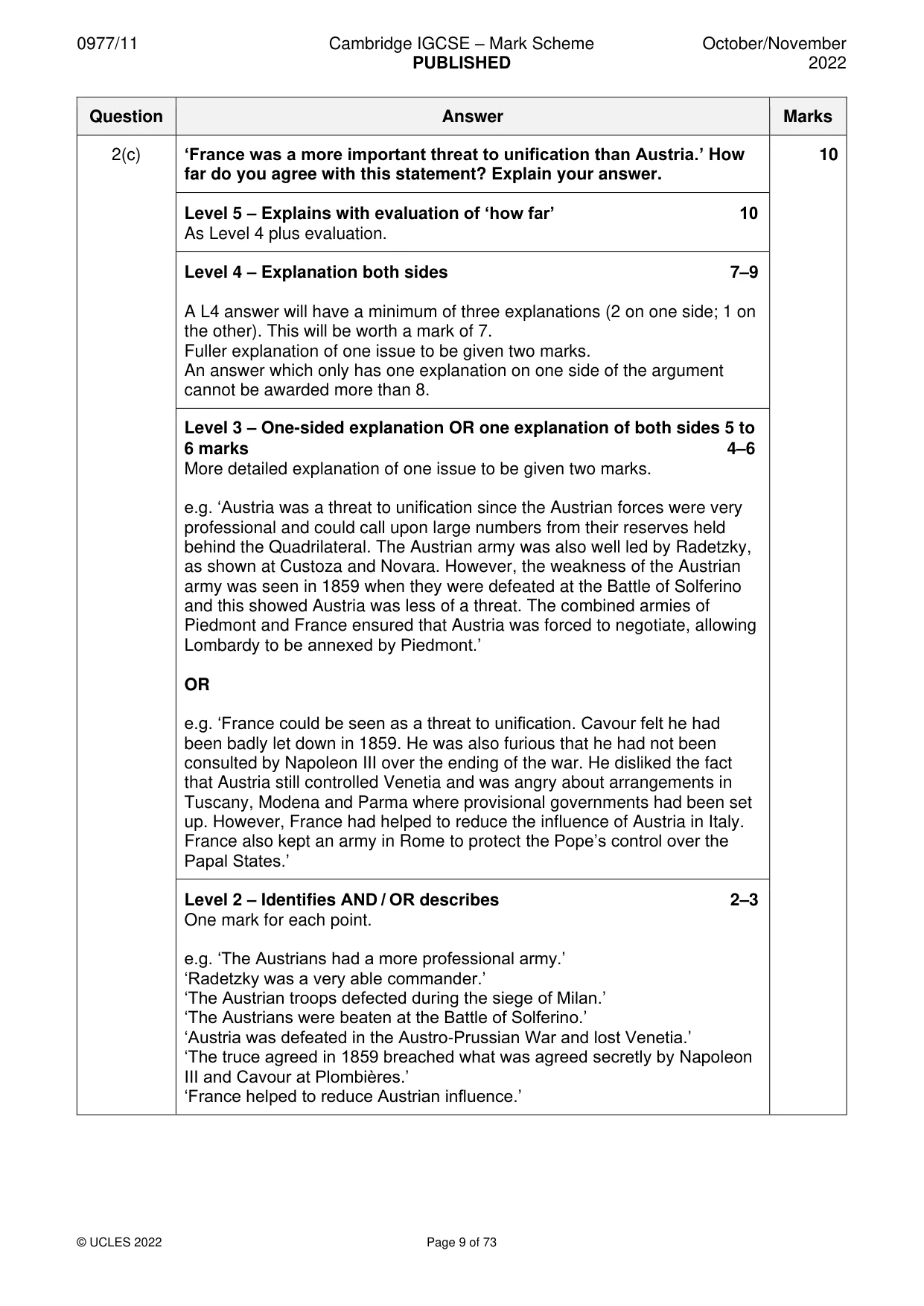
0977/11 Cambridge IGCSE – Mark Scheme PUBLISHED October/November 2022 © UCLES 2022 Page 9 of 73 Question Answer Marks 2(c) ‘France was a more important threat to unification than Austria.’ How far do you agree with this statement? Explain your answer. 10 Level 5 – Explains with evaluation of ‘how far’ 10 As Level 4 plus evaluation. Level 4 – Explanation both sides 7–9 A L4 answer will have a minimum of three explanations (2 on one side; 1 on the other). This will be worth a mark of 7. Fuller explanation of one issue to be given two marks. An answer which only has one explanation on one side of the argument cannot be awarded more than 8. Level 3 – One-sided explanation OR one explanation of both sides 5 to 6 marks 4–6 More detailed explanation of one issue to be given two marks. e.g. ‘Austria was a threat to unification since the Austrian forces were very professional and could call upon large numbers from their reserves held behind the Quadrilateral. The Austrian army was also well led by Radetzky, as shown at Custoza and Novara. However, the weakness of the Austrian army was seen in 1859 when they were defeated at the Battle of Solferino and this showed Austria was less of a threat. The combined armies of Piedmont and France ensured that Austria was forced to negotiate, allowing Lombardy to be annexed by Piedmont.’ OR e.g. ‘France could be seen as a threat to unification. Cavour felt he had been badly let down in 1859. He was also furious that he had not been consulted by Napoleon III over the ending of the war. He disliked the fact that Austria still controlled Venetia and was angry about arrangements in Tuscany, Modena and Parma where provisional governments had been set up. However, France had helped to reduce the influence of Austria in Italy. France also kept an army in Rome to protect the Pope’s control over the Papal States.’ Level 2 – Identifies AND / OR describes 2–3 One mark for each point. e.g. ‘The Austrians had a more professional army.’ ‘Radetzky was a very able commander.’ ‘The Austrian troops defected during the siege of Milan.’ ‘The Austrians were beaten at the Battle of Solferino.’ ‘Austria was defeated in the Austro-Prussian War and lost Venetia.’ ‘The truce agreed in 1859 breached what was agreed secretly by Napoleon III and Cavour at Plombières.’ ‘France helped to reduce Austrian influence.’
Mark scheme, page 10
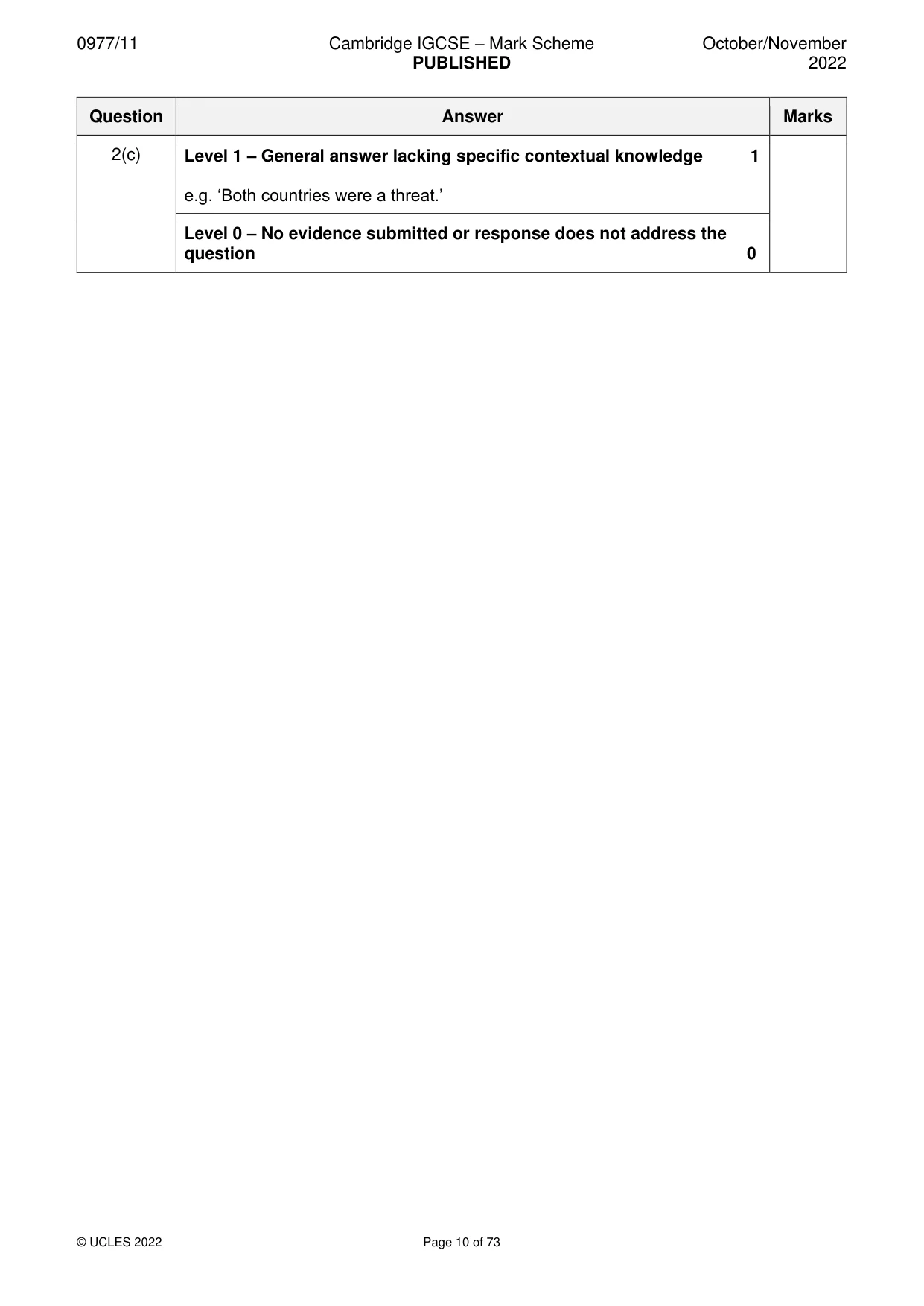
0977/11 Cambridge IGCSE – Mark Scheme PUBLISHED October/November 2022 © UCLES 2022 Page 10 of 73 Question Answer Marks 2(c) Level 1 – General answer lacking specific contextual knowledge 1 e.g. ‘Both countries were a threat.’ Level 0 – No evidence submitted or response does not address the question 0
Mark scheme, page 11
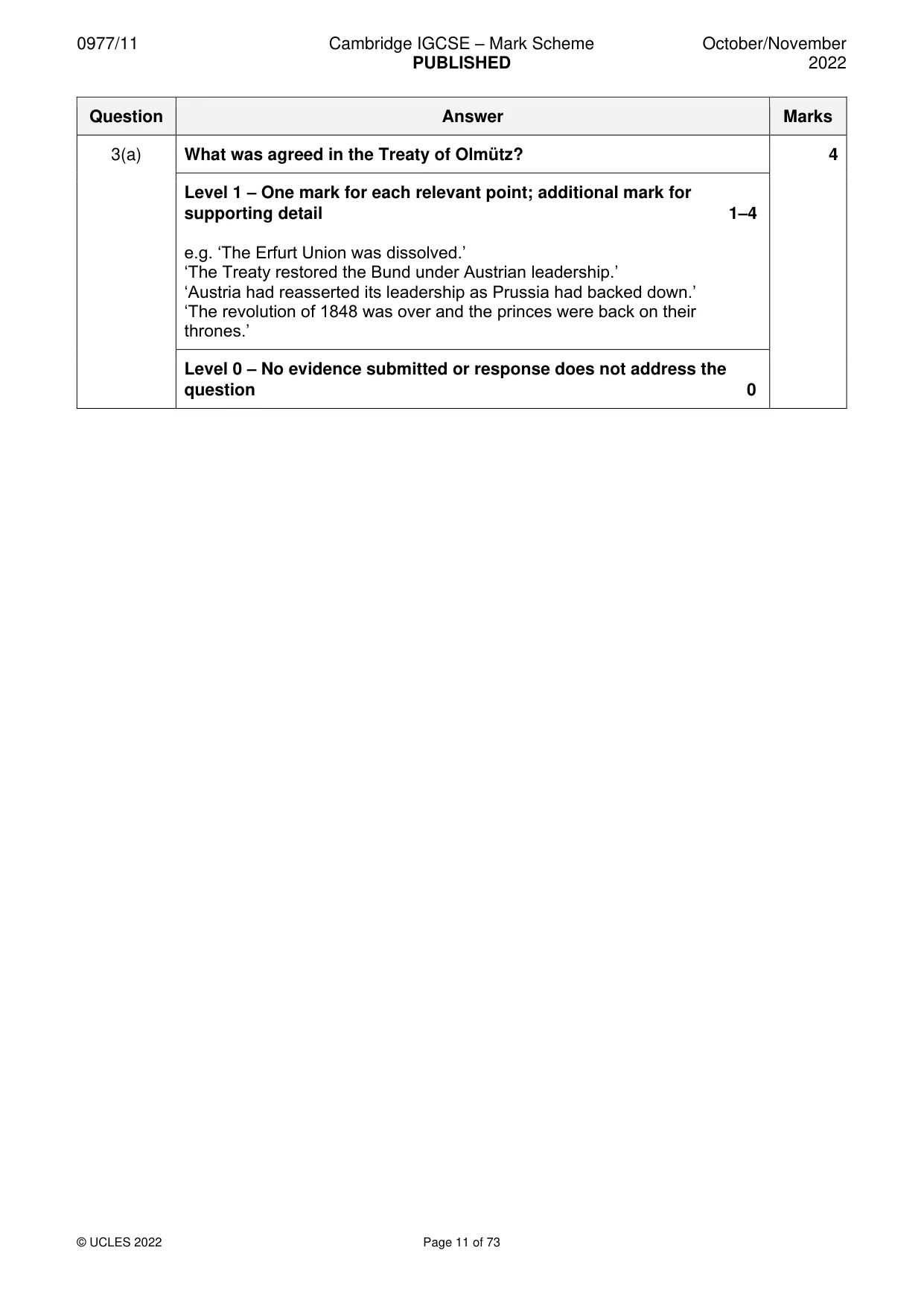
0977/11 Cambridge IGCSE – Mark Scheme PUBLISHED October/November 2022 © UCLES 2022 Page 11 of 73 Question Answer Marks 3(a) What was agreed in the Treaty of Olmütz? 4 Level 1 – One mark for each relevant point; additional mark for supporting detail 1–4 e.g. ‘The Erfurt Union was dissolved.’ ‘The Treaty restored the Bund under Austrian leadership.’ ‘Austria had reasserted its leadership as Prussia had backed down.’ ‘The revolution of 1848 was over and the princes were back on their thrones.’ Level 0 – No evidence submitted or response does not address the question 0
Mark scheme, page 12
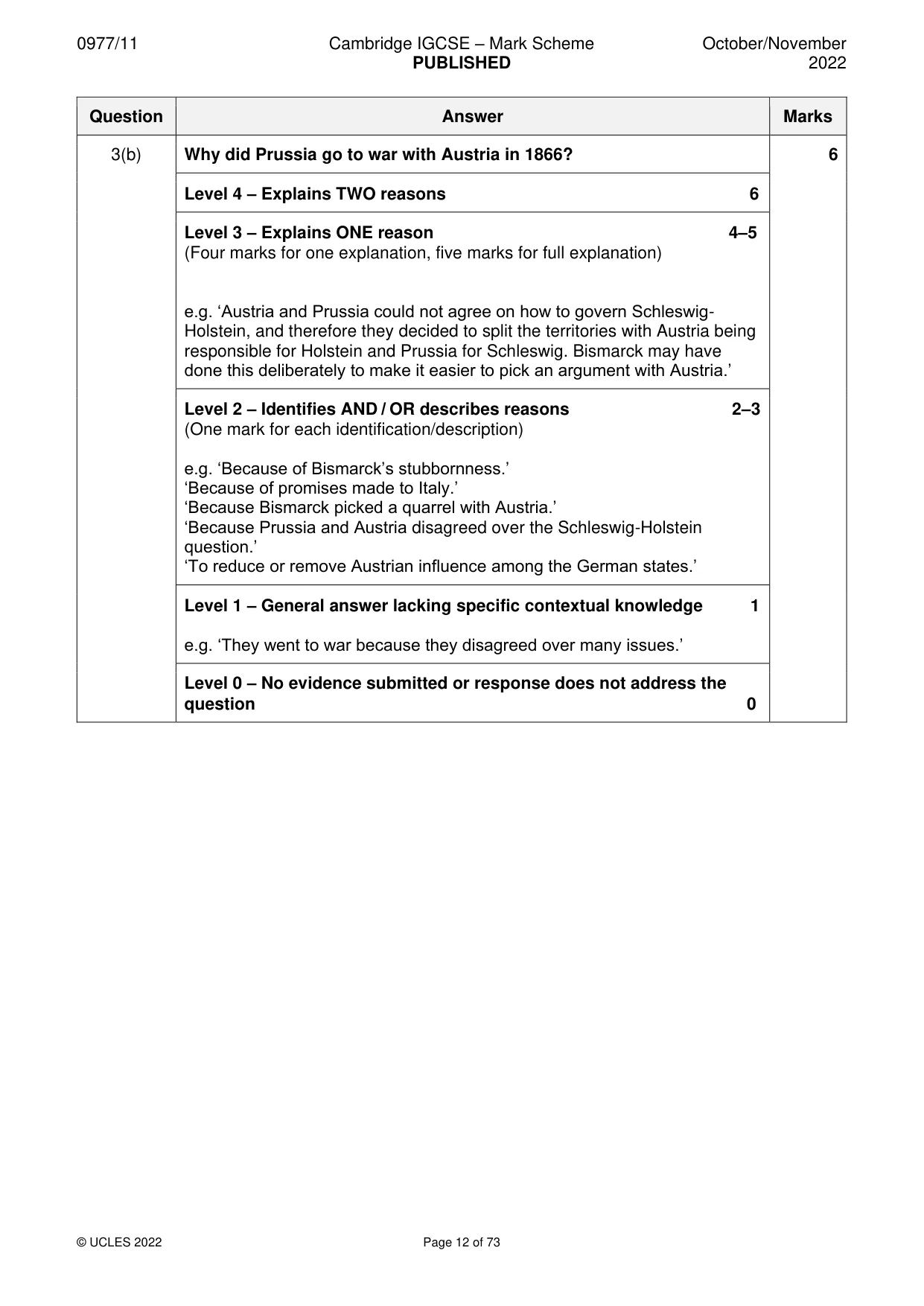
0977/11 Cambridge IGCSE – Mark Scheme PUBLISHED October/November 2022 © UCLES 2022 Page 12 of 73 Question Answer Marks 3(b) Why did Prussia go to war with Austria in 1866? 6 Level 4 – Explains TWO reasons 6 Level 3 – Explains ONE reason 4–5 (Four marks for one explanation, five marks for full explanation) e.g. ‘Austria and Prussia could not agree on how to govern Schleswig- Holstein, and therefore they decided to split the territories with Austria being responsible for Holstein and Prussia for Schleswig. Bismarck may have done this deliberately to make it easier to pick an argument with Austria.’ Level 2 – Identifies AND / OR describes reasons 2–3 (One mark for each identification/description) e.g. ‘Because of Bismarck’s stubbornness.’ ‘Because of promises made to Italy.’ ‘Because Bismarck picked a quarrel with Austria.’ ‘Because Prussia and Austria disagreed over the Schleswig-Holstein question.’ ‘To reduce or remove Austrian influence among the German states.’ Level 1 – General answer lacking specific contextual knowledge 1 e.g. ‘They went to war because they disagreed over many issues.’ Level 0 – No evidence submitted or response does not address the question 0
Mark scheme, page 13
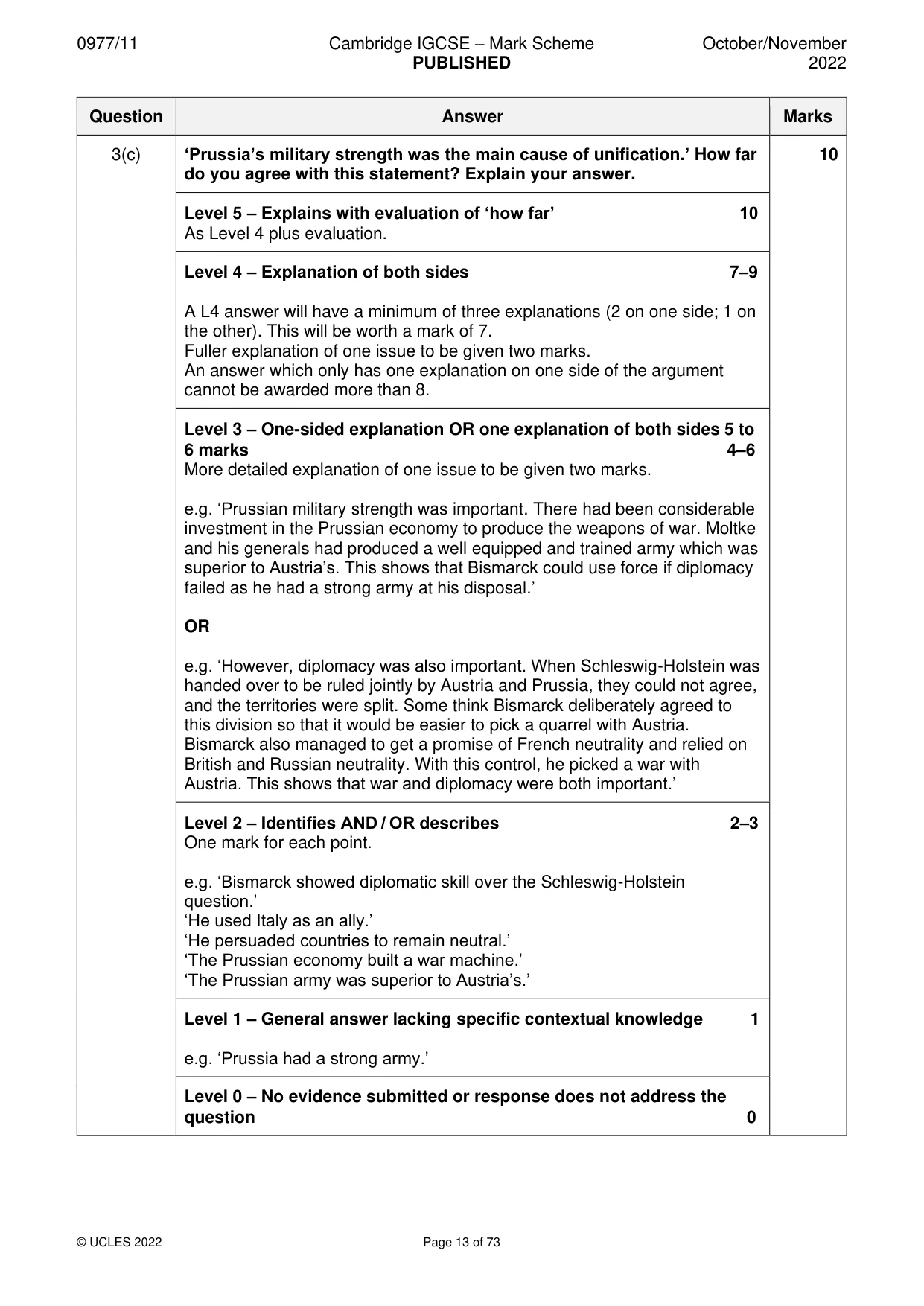
0977/11 Cambridge IGCSE – Mark Scheme PUBLISHED October/November 2022 © UCLES 2022 Page 13 of 73 Question Answer Marks 3(c) ‘Prussia’s military strength was the main cause of unification.’ How far do you agree with this statement? Explain your answer. 10 Level 5 – Explains with evaluation of ‘how far’ 10 As Level 4 plus evaluation. Level 4 – Explanation of both sides 7–9 A L4 answer will have a minimum of three explanations (2 on one side; 1 on the other). This will be worth a mark of 7. Fuller explanation of one issue to be given two marks. An answer which only has one explanation on one side of the argument cannot be awarded more than 8. Level 3 – One-sided explanation OR one explanation of both sides 5 to 6 marks 4–6 More detailed explanation of one issue to be given two marks. e.g. ‘Prussian military strength was important. There had been considerable investment in the Prussian economy to produce the weapons of war. Moltke and his generals had produced a well equipped and trained army which was superior to Austria’s. This shows that Bismarck could use force if diplomacy failed as he had a strong army at his disposal.’ OR e.g. ‘However, diplomacy was also important. When Schleswig-Holstein was handed over to be ruled jointly by Austria and Prussia, they could not agree, and the territories were split. Some think Bismarck deliberately agreed to this division so that it would be easier to pick a quarrel with Austria. Bismarck also managed to get a promise of French neutrality and relied on British and Russian neutrality. With this control, he picked a war with Austria. This shows that war and diplomacy were both important.’ Level 2 – Identifies AND / OR describes 2–3 One mark for each point. e.g. ‘Bismarck showed diplomatic skill over the Schleswig-Holstein question.’ ‘He used Italy as an ally.’ ‘He persuaded countries to remain neutral.’ ‘The Prussian economy built a war machine.’ ‘The Prussian army was superior to Austria’s.’ Level 1 – General answer lacking specific contextual knowledge 1 e.g. ‘Prussia had a strong army.’ Level 0 – No evidence submitted or response does not address the question 0
Mark scheme, page 14
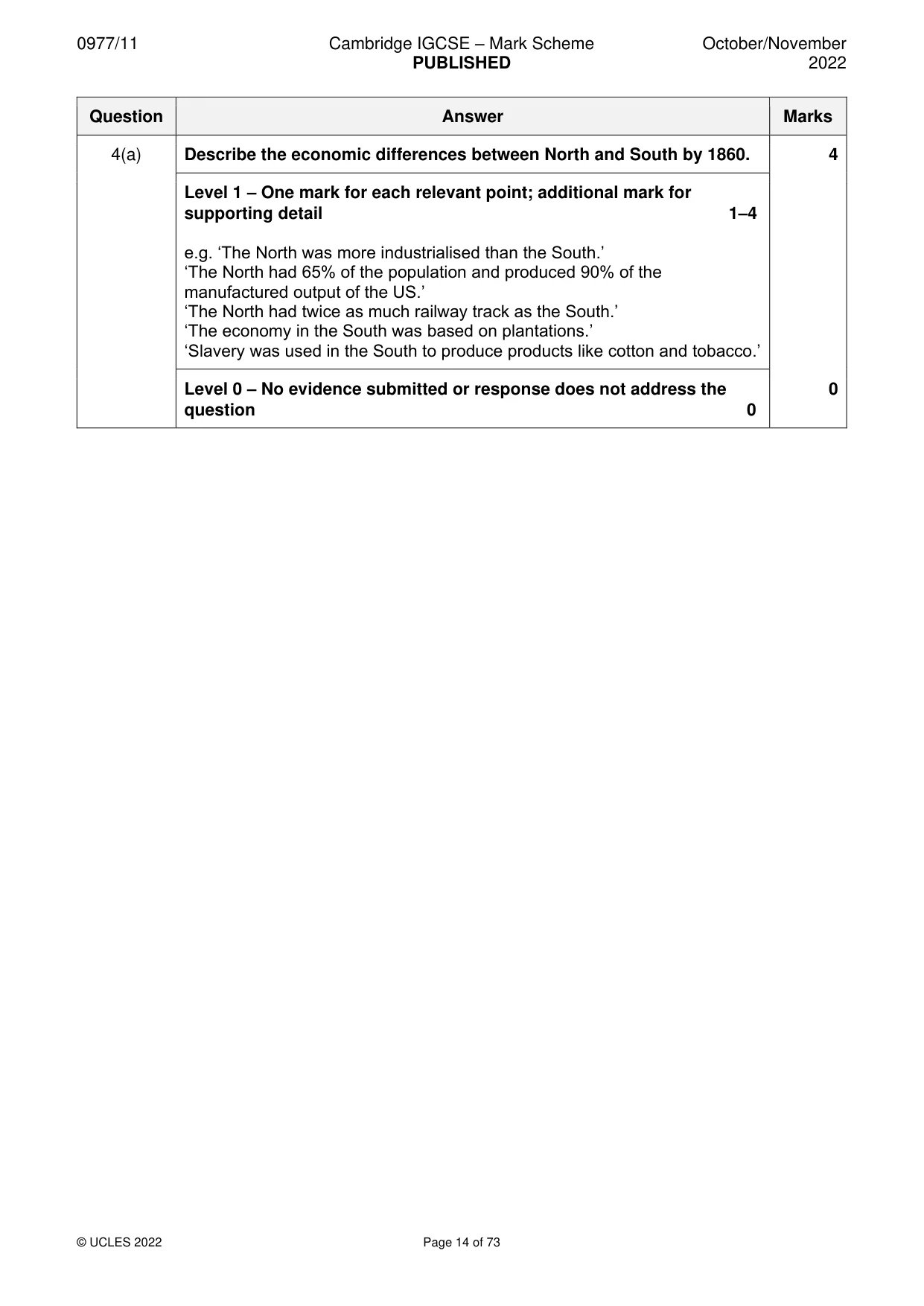
0977/11 Cambridge IGCSE – Mark Scheme PUBLISHED October/November 2022 © UCLES 2022 Page 14 of 73 Question Answer Marks 4(a) Describe the economic differences between North and South by 1860. 4 Level 1 – One mark for each relevant point; additional mark for supporting detail 1–4 e.g. ‘The North was more industrialised than the South.’ ‘The North had 65% of the population and produced 90% of the manufactured output of the US.’ ‘The North had twice as much railway track as the South.’ ‘The economy in the South was based on plantations.’ ‘Slavery was used in the South to produce products like cotton and tobacco.’ Level 0 – No evidence submitted or response does not address the question 0 0
Mark scheme, page 15
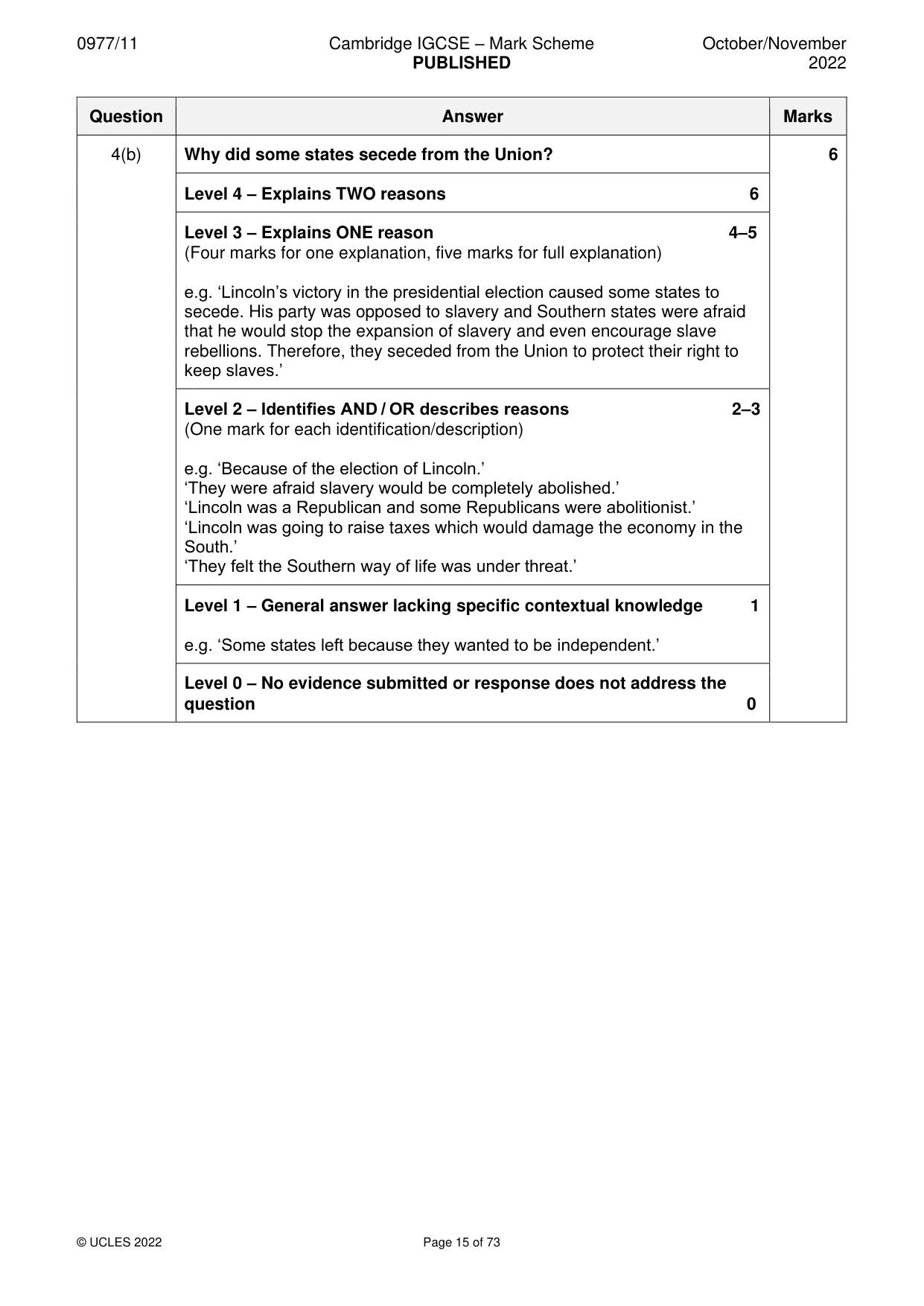
0977/11 Cambridge IGCSE – Mark Scheme PUBLISHED October/November 2022 © UCLES 2022 Page 15 of 73 Question Answer Marks 4(b) Why did some states secede from the Union? 6 Level 4 – Explains TWO reasons 6 Level 3 – Explains ONE reason 4–5 (Four marks for one explanation, five marks for full explanation) e.g. ‘Lincoln’s victory in the presidential election caused some states to secede. His party was opposed to slavery and Southern states were afraid that he would stop the expansion of slavery and even encourage slave rebellions. Therefore, they seceded from the Union to protect their right to keep slaves.’ Level 2 – Identifies AND / OR describes reasons 2–3 (One mark for each identification/description) e.g. ‘Because of the election of Lincoln.’ ‘They were afraid slavery would be completely abolished.’ ‘Lincoln was a Republican and some Republicans were abolitionist.’ ‘Lincoln was going to raise taxes which would damage the economy in the South.’ ‘They felt the Southern way of life was under threat.’ Level 1 – General answer lacking specific contextual knowledge 1 e.g. ‘Some states left because they wanted to be independent.’ Level 0 – No evidence submitted or response does not address the question 0
Mark scheme, page 16
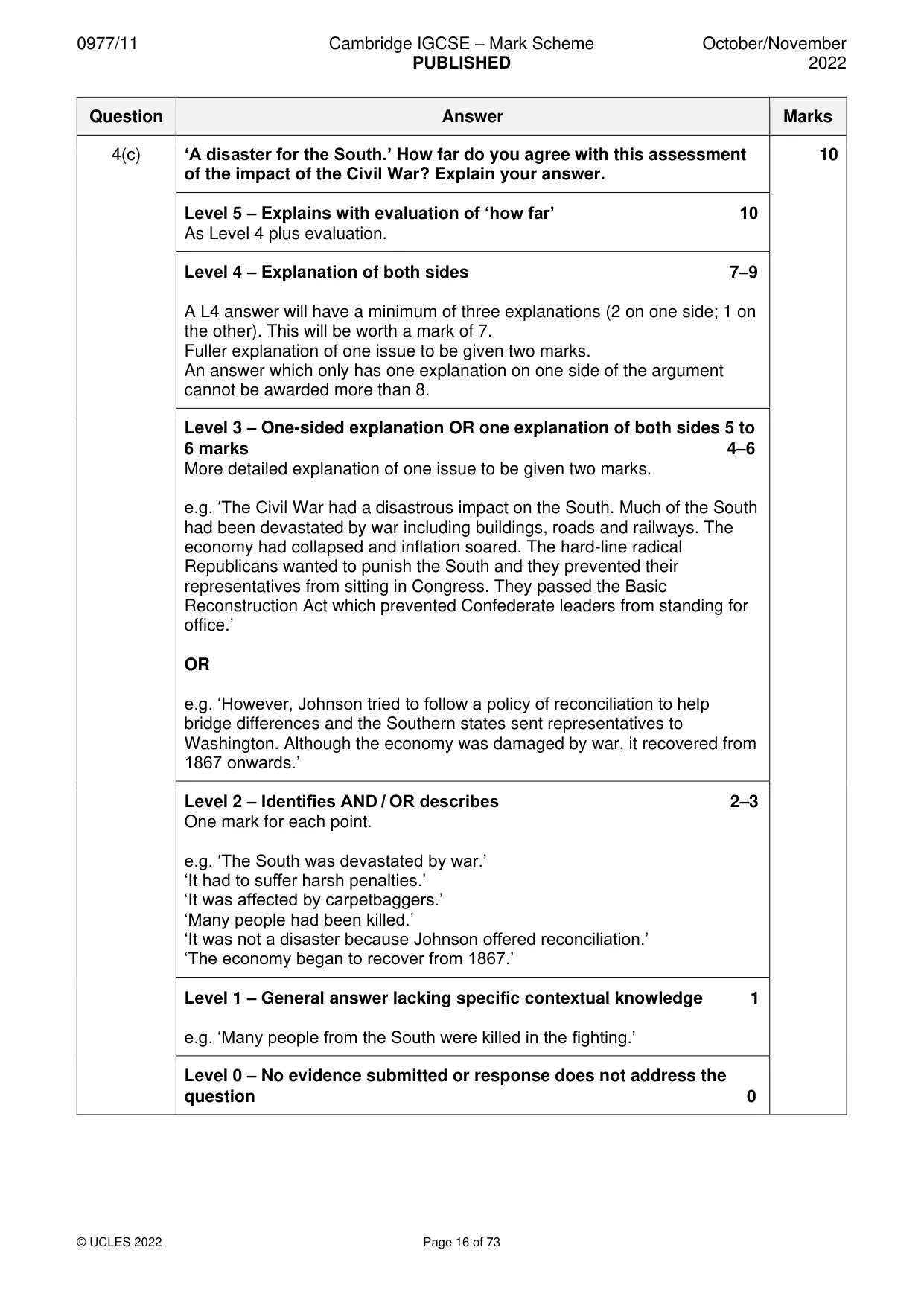
0977/11 Cambridge IGCSE – Mark Scheme PUBLISHED October/November 2022 © UCLES 2022 Page 16 of 73 Question Answer Marks 4(c) ‘A disaster for the South.’ How far do you agree with this assessment of the impact of the Civil War? Explain your answer. 10 Level 5 – Explains with evaluation of ‘how far’ 10 As Level 4 plus evaluation. Level 4 – Explanation of both sides 7–9 A L4 answer will have a minimum of three explanations (2 on one side; 1 on the other). This will be worth a mark of 7. Fuller explanation of one issue to be given two marks. An answer which only has one explanation on one side of the argument cannot be awarded more than 8. Level 3 – One-sided explanation OR one explanation of both sides 5 to 6 marks 4–6 More detailed explanation of one issue to be given two marks. e.g. ‘The Civil War had a disastrous impact on the South. Much of the South had been devastated by war including buildings, roads and railways. The economy had collapsed and inflation soared. The hard-line radical Republicans wanted to punish the South and they prevented their representatives from sitting in Congress. They passed the Basic Reconstruction Act which prevented Confederate leaders from standing for office.’ OR e.g. ‘However, Johnson tried to follow a policy of reconciliation to help bridge differences and the Southern states sent representatives to Washington. Although the economy was damaged by war, it recovered from 1867 onwards.’ Level 2 – Identifies AND / OR describes 2–3 One mark for each point. e.g. ‘The South was devastated by war.’ ‘It had to suffer harsh penalties.’ ‘It was affected by carpetbaggers.’ ‘Many people had been killed.’ ‘It was not a disaster because Johnson offered reconciliation.’ ‘The economy began to recover from 1867.’ Level 1 – General answer lacking specific contextual knowledge 1 e.g. ‘Many people from the South were killed in the fighting.’ Level 0 – No evidence submitted or response does not address the question 0
Mark scheme, page 17
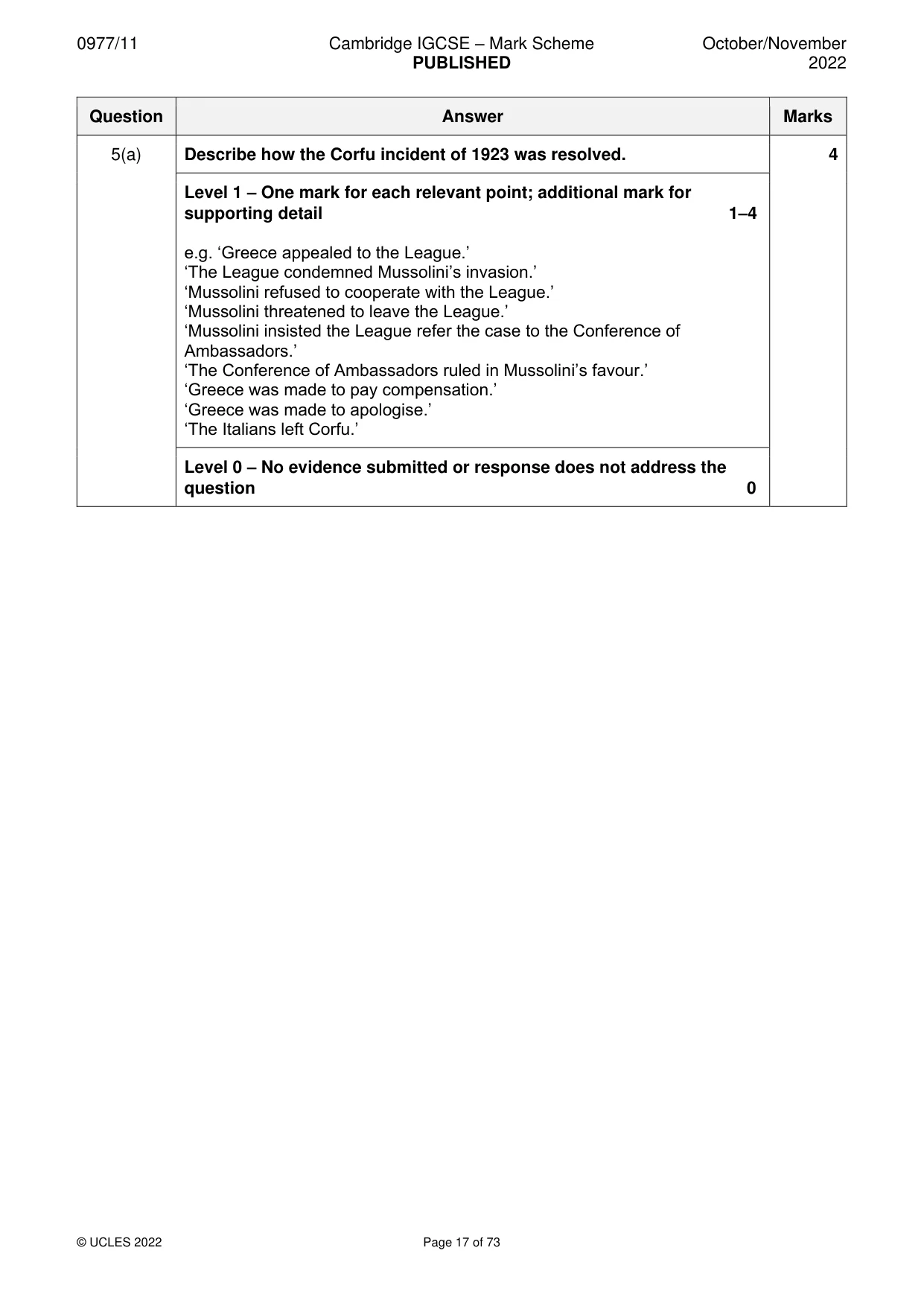
0977/11 Cambridge IGCSE – Mark Scheme PUBLISHED October/November 2022 © UCLES 2022 Page 17 of 73 Question Answer Marks 5(a) Describe how the Corfu incident of 1923 was resolved. 4 Level 1 – One mark for each relevant point; additional mark for supporting detail 1–4 e.g. ‘Greece appealed to the League.’ ‘The League condemned Mussolini’s invasion.’ ‘Mussolini refused to cooperate with the League.’ ‘Mussolini threatened to leave the League.’ ‘Mussolini insisted the League refer the case to the Conference of Ambassadors.’ ‘The Conference of Ambassadors ruled in Mussolini’s favour.’ ‘Greece was made to pay compensation.’ ‘Greece was made to apologise.’ ‘The Italians left Corfu.’ Level 0 – No evidence submitted or response does not address the question 0
Mark scheme, page 18
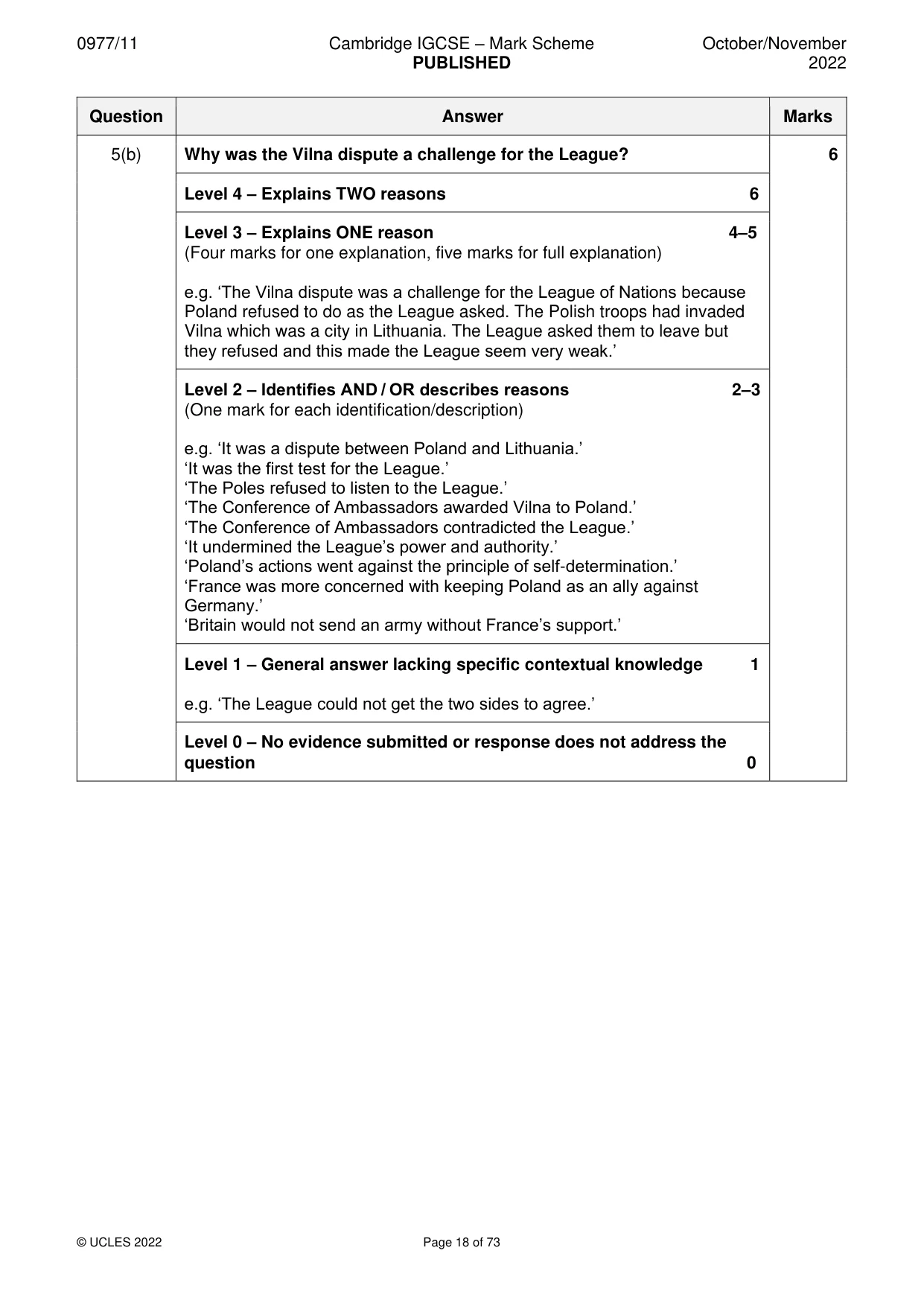
0977/11 Cambridge IGCSE – Mark Scheme PUBLISHED October/November 2022 © UCLES 2022 Page 18 of 73 Question Answer Marks 5(b) Why was the Vilna dispute a challenge for the League? 6 Level 4 – Explains TWO reasons 6 Level 3 – Explains ONE reason 4–5 (Four marks for one explanation, five marks for full explanation) e.g. ‘The Vilna dispute was a challenge for the League of Nations because Poland refused to do as the League asked. The Polish troops had invaded Vilna which was a city in Lithuania. The League asked them to leave but they refused and this made the League seem very weak.’ Level 2 – Identifies AND / OR describes reasons 2–3 (One mark for each identification/description) e.g. ‘It was a dispute between Poland and Lithuania.’ ‘It was the first test for the League.’ ‘The Poles refused to listen to the League.’ ‘The Conference of Ambassadors awarded Vilna to Poland.’ ‘The Conference of Ambassadors contradicted the League.’ ‘It undermined the League’s power and authority.’ ‘Poland’s actions went against the principle of self-determination.’ ‘France was more concerned with keeping Poland as an ally against Germany.’ ‘Britain would not send an army without France’s support.’ Level 1 – General answer lacking specific contextual knowledge 1 e.g. ‘The League could not get the two sides to agree.’ Level 0 – No evidence submitted or response does not address the question 0
Mark scheme, page 19
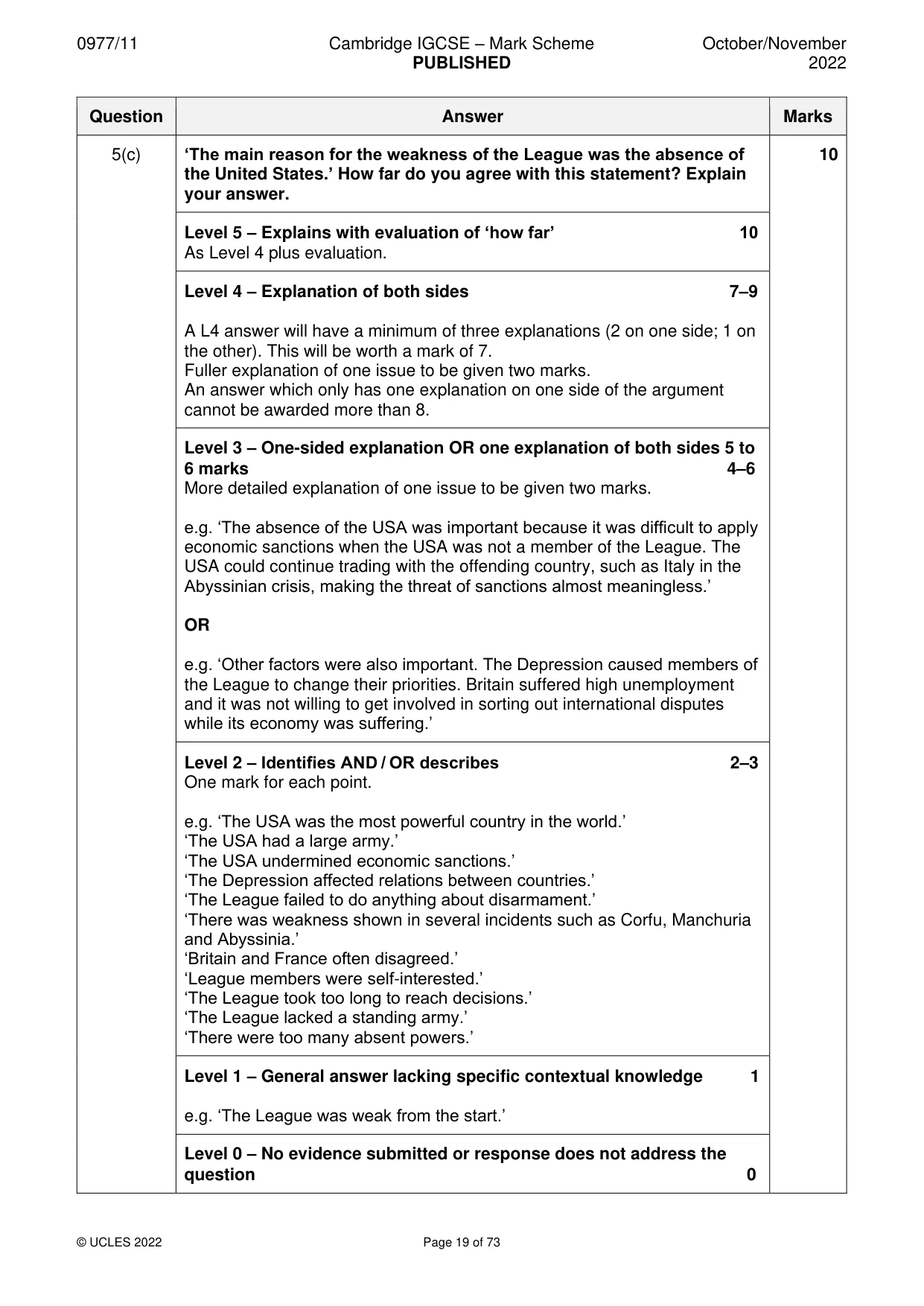
0977/11 Cambridge IGCSE – Mark Scheme PUBLISHED October/November 2022 © UCLES 2022 Page 19 of 73 Question Answer Marks 5(c) ‘The main reason for the weakness of the League was the absence of the United States.’ How far do you agree with this statement? Explain your answer. 10 Level 5 – Explains with evaluation of ‘how far’ 10 As Level 4 plus evaluation. Level 4 – Explanation of both sides 7–9 A L4 answer will have a minimum of three explanations (2 on one side; 1 on the other). This will be worth a mark of 7. Fuller explanation of one issue to be given two marks. An answer which only has one explanation on one side of the argument cannot be awarded more than 8. Level 3 – One-sided explanation OR one explanation of both sides 5 to 6 marks 4–6 More detailed explanation of one issue to be given two marks. e.g. ‘The absence of the USA was important because it was difficult to apply economic sanctions when the USA was not a member of the League. The USA could continue trading with the offending country, such as Italy in the Abyssinian crisis, making the threat of sanctions almost meaningless.’ OR e.g. ‘Other factors were also important. The Depression caused members of the League to change their priorities. Britain suffered high unemployment and it was not willing to get involved in sorting out international disputes while its economy was suffering.’ Level 2 – Identifies AND / OR describes 2–3 One mark for each point. e.g. ‘The USA was the most powerful country in the world.’ ‘The USA had a large army.’ ‘The USA undermined economic sanctions.’ ‘The Depression affected relations between countries.’ ‘The League failed to do anything about disarmament.’ ‘There was weakness shown in several incidents such as Corfu, Manchuria and Abyssinia.’ ‘Britain and France often disagreed.’ ‘League members were self-interested.’ ‘The League took too long to reach decisions.’ ‘The League lacked a standing army.’ ‘There were too many absent powers.’ Level 1 – General answer lacking specific contextual knowledge 1 e.g. ‘The League was weak from the start.’ Level 0 – No evidence submitted or response does not address the question 0
Mark scheme, page 20
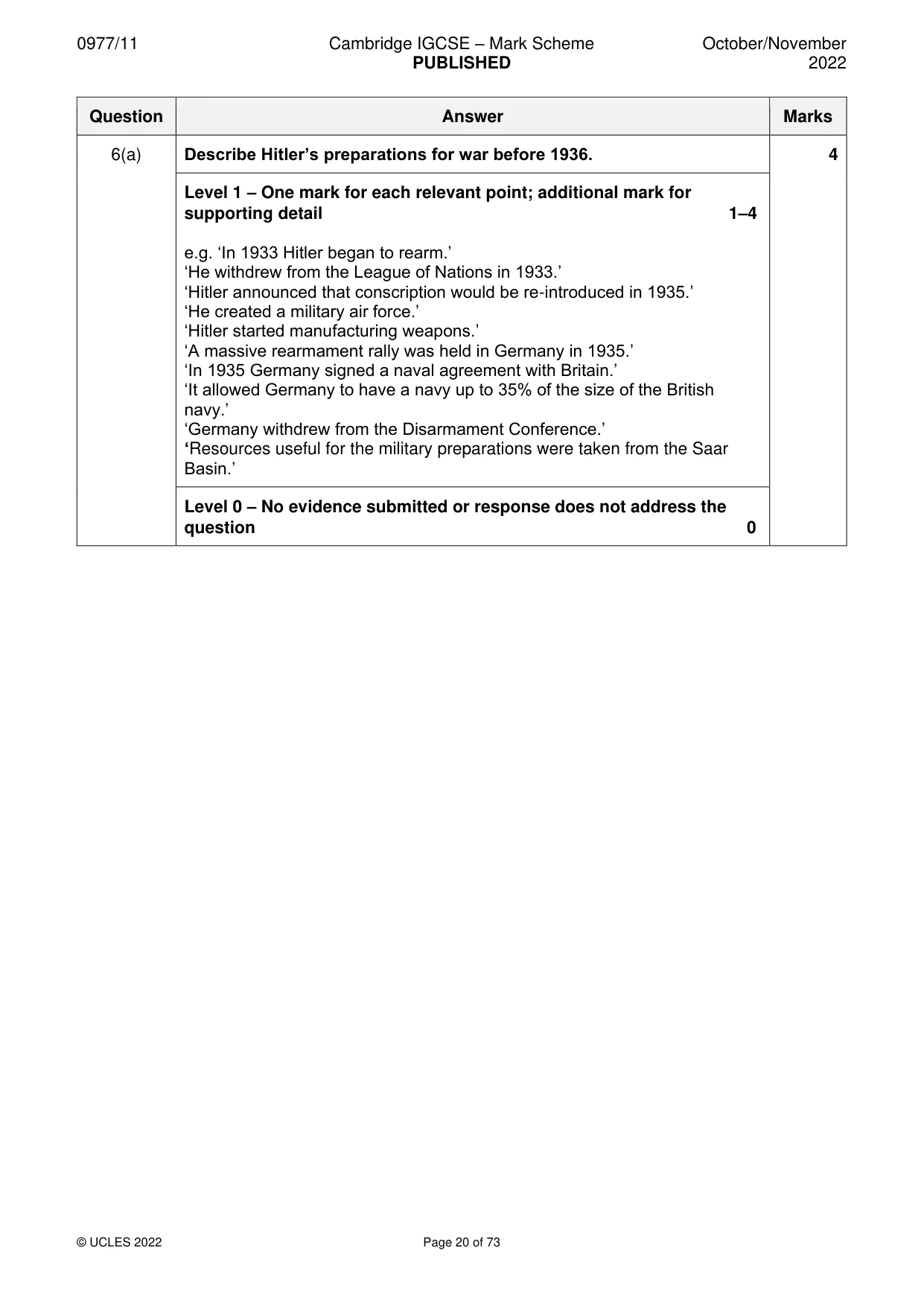
0977/11 Cambridge IGCSE – Mark Scheme PUBLISHED October/November 2022 © UCLES 2022 Page 20 of 73 Question Answer Marks 6(a) Describe Hitler’s preparations for war before 1936. 4 Level 1 – One mark for each relevant point; additional mark for supporting detail 1–4 e.g. ‘In 1933 Hitler began to rearm.’ ‘He withdrew from the League of Nations in 1933.’ ‘Hitler announced that conscription would be re-introduced in 1935.’ ‘He created a military air force.’ ‘Hitler started manufacturing weapons.’ ‘A massive rearmament rally was held in Germany in 1935.’ ‘In 1935 Germany signed a naval agreement with Britain.’ ‘It allowed Germany to have a navy up to 35% of the size of the British navy.’ ‘Germany withdrew from the Disarmament Conference.’ ‘Resources useful for the military preparations were taken from the Saar Basin.’ Level 0 – No evidence submitted or response does not address the question 0
Mark scheme, page 21
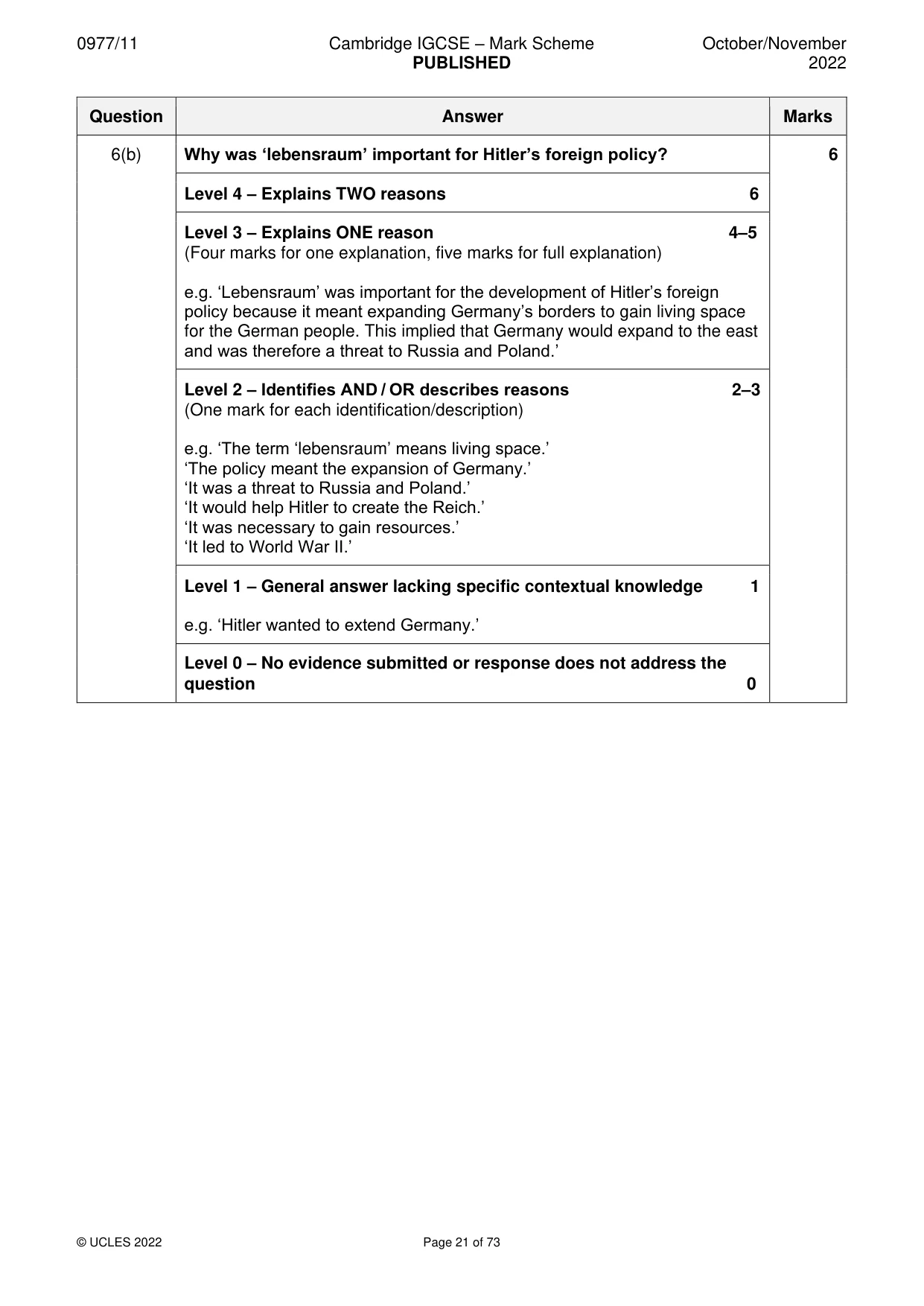
0977/11 Cambridge IGCSE – Mark Scheme PUBLISHED October/November 2022 © UCLES 2022 Page 21 of 73 Question Answer Marks 6(b) Why was ‘lebensraum’ important for Hitler’s foreign policy? 6 Level 4 – Explains TWO reasons 6 Level 3 – Explains ONE reason 4–5 (Four marks for one explanation, five marks for full explanation) e.g. ‘Lebensraum’ was important for the development of Hitler’s foreign policy because it meant expanding Germany’s borders to gain living space for the German people. This implied that Germany would expand to the east and was therefore a threat to Russia and Poland.’ Level 2 – Identifies AND / OR describes reasons 2–3 (One mark for each identification/description) e.g. ‘The term ‘lebensraum’ means living space.’ ‘The policy meant the expansion of Germany.’ ‘It was a threat to Russia and Poland.’ ‘It would help Hitler to create the Reich.’ ‘It was necessary to gain resources.’ ‘It led to World War II.’ Level 1 – General answer lacking specific contextual knowledge 1 e.g. ‘Hitler wanted to extend Germany.’ Level 0 – No evidence submitted or response does not address the question 0
Mark scheme, page 22
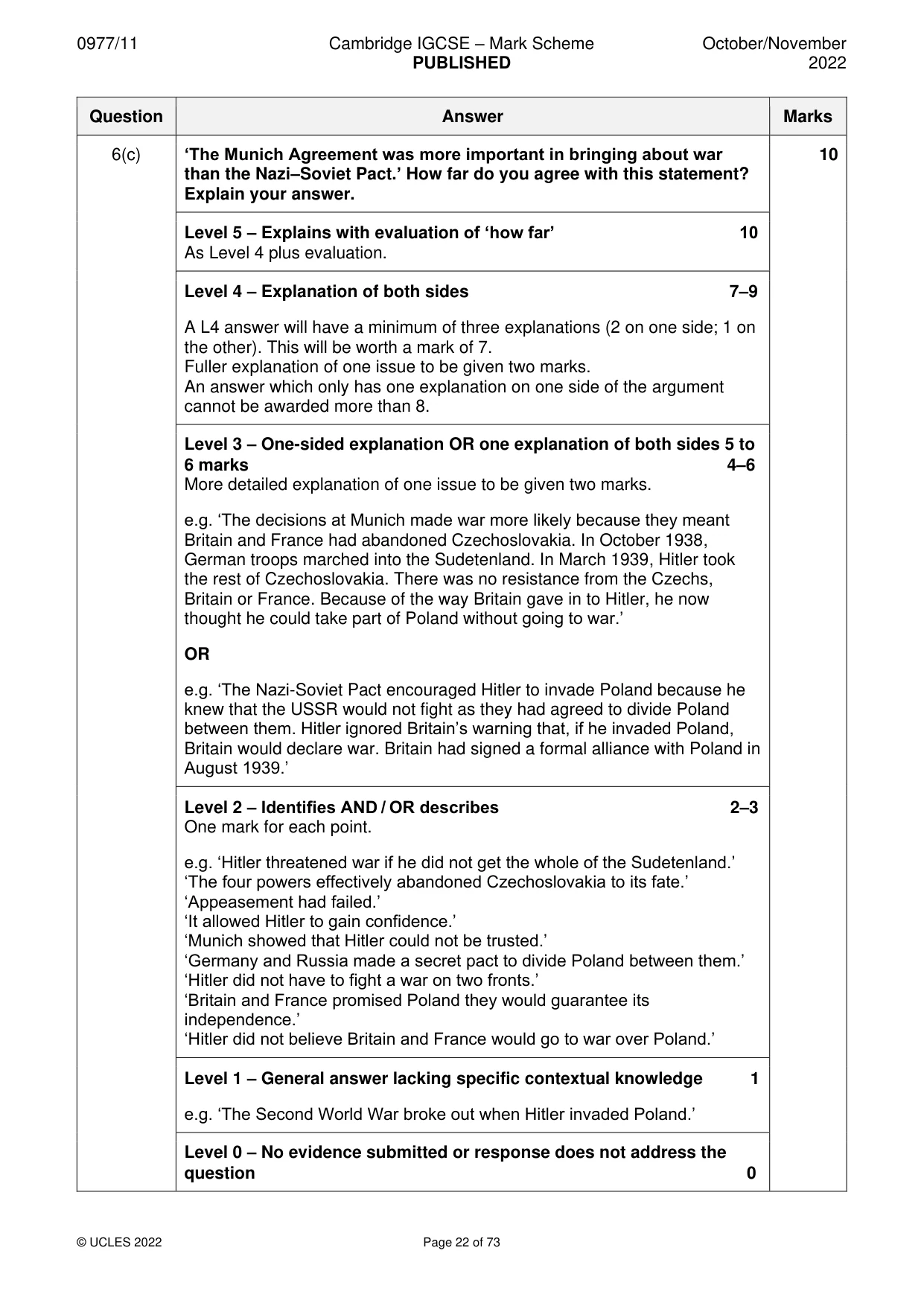
0977/11 Cambridge IGCSE – Mark Scheme PUBLISHED October/November 2022 © UCLES 2022 Page 22 of 73 Question Answer Marks 6(c) ‘The Munich Agreement was more important in bringing about war than the Nazi–Soviet Pact.’ How far do you agree with this statement? Explain your answer. 10 Level 5 – Explains with evaluation of ‘how far’ 10 As Level 4 plus evaluation. Level 4 – Explanation of both sides 7–9 A L4 answer will have a minimum of three explanations (2 on one side; 1 on the other). This will be worth a mark of 7. Fuller explanation of one issue to be given two marks. An answer which only has one explanation on one side of the argument cannot be awarded more than 8. Level 3 – One-sided explanation OR one explanation of both sides 5 to 6 marks 4–6 More detailed explanation of one issue to be given two marks. e.g. ‘The decisions at Munich made war more likely because they meant Britain and France had abandoned Czechoslovakia. In October 1938, German troops marched into the Sudetenland. In March 1939, Hitler took the rest of Czechoslovakia. There was no resistance from the Czechs, Britain or France. Because of the way Britain gave in to Hitler, he now thought he could take part of Poland without going to war.’ OR e.g. ‘The Nazi-Soviet Pact encouraged Hitler to invade Poland because he knew that the USSR would not fight as they had agreed to divide Poland between them. Hitler ignored Britain’s warning that, if he invaded Poland, Britain would declare war. Britain had signed a formal alliance with Poland in August 1939.’ Level 2 – Identifies AND / OR describes 2–3 One mark for each point. e.g. ‘Hitler threatened war if he did not get the whole of the Sudetenland.’ ‘The four powers effectively abandoned Czechoslovakia to its fate.’ ‘Appeasement had failed.’ ‘It allowed Hitler to gain confidence.’ ‘Munich showed that Hitler could not be trusted.’ ‘Germany and Russia made a secret pact to divide Poland between them.’ ‘Hitler did not have to fight a war on two fronts.’ ‘Britain and France promised Poland they would guarantee its independence.’ ‘Hitler did not believe Britain and France would go to war over Poland.’ Level 1 – General answer lacking specific contextual knowledge 1 e.g. ‘The Second World War broke out when Hitler invaded Poland.’ Level 0 – No evidence submitted or response does not address the question 0
Mark scheme, page 23
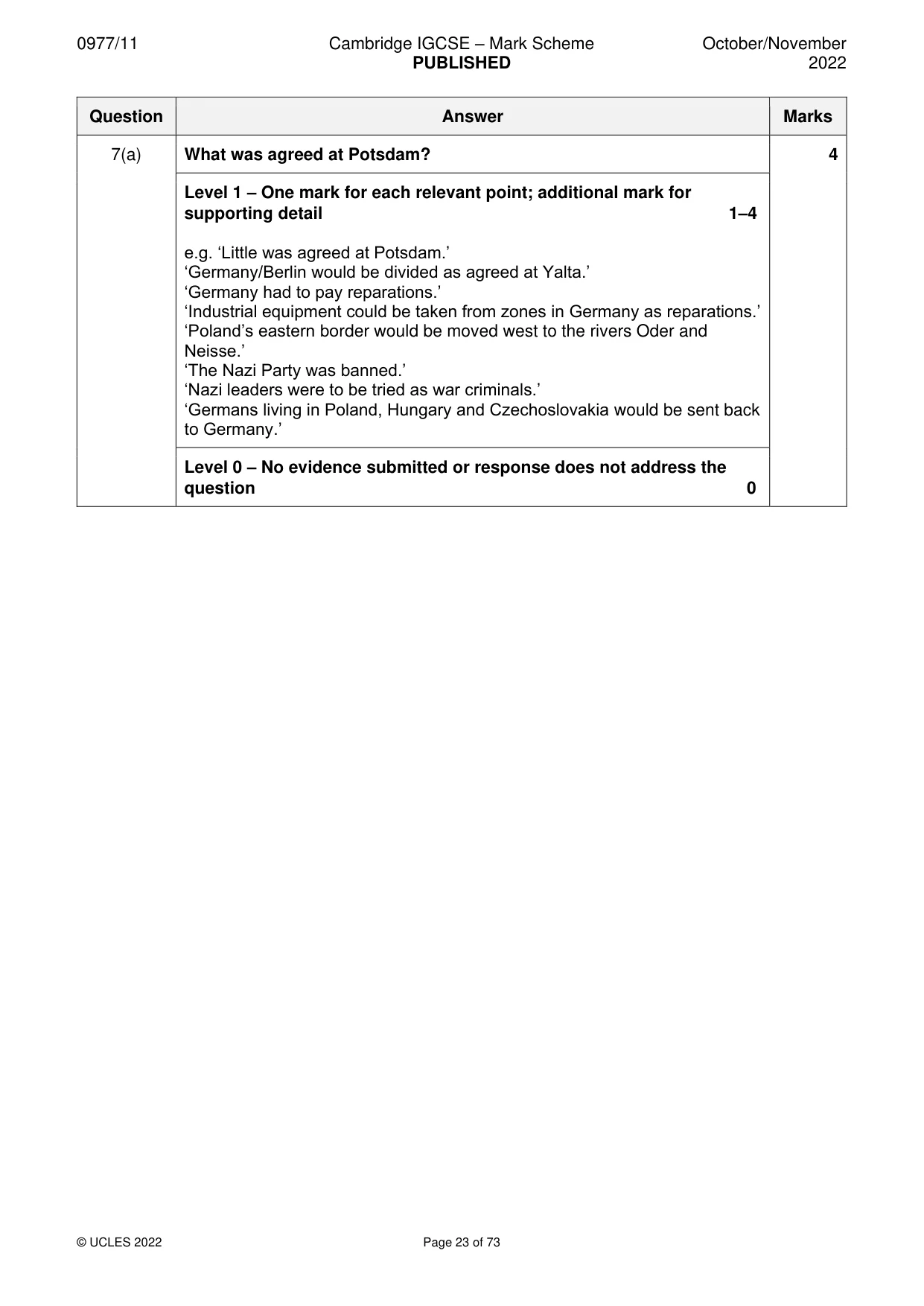
0977/11 Cambridge IGCSE – Mark Scheme PUBLISHED October/November 2022 © UCLES 2022 Page 23 of 73 Question Answer Marks 7(a) What was agreed at Potsdam? 4 Level 1 – One mark for each relevant point; additional mark for supporting detail 1–4 e.g. ‘Little was agreed at Potsdam.’ ‘Germany/Berlin would be divided as agreed at Yalta.’ ‘Germany had to pay reparations.’ ‘Industrial equipment could be taken from zones in Germany as reparations.’ ‘Poland’s eastern border would be moved west to the rivers Oder and Neisse.’ ‘The Nazi Party was banned.’ ‘Nazi leaders were to be tried as war criminals.’ ‘Germans living in Poland, Hungary and Czechoslovakia would be sent back to Germany.’ Level 0 – No evidence submitted or response does not address the question 0
Mark scheme, page 24
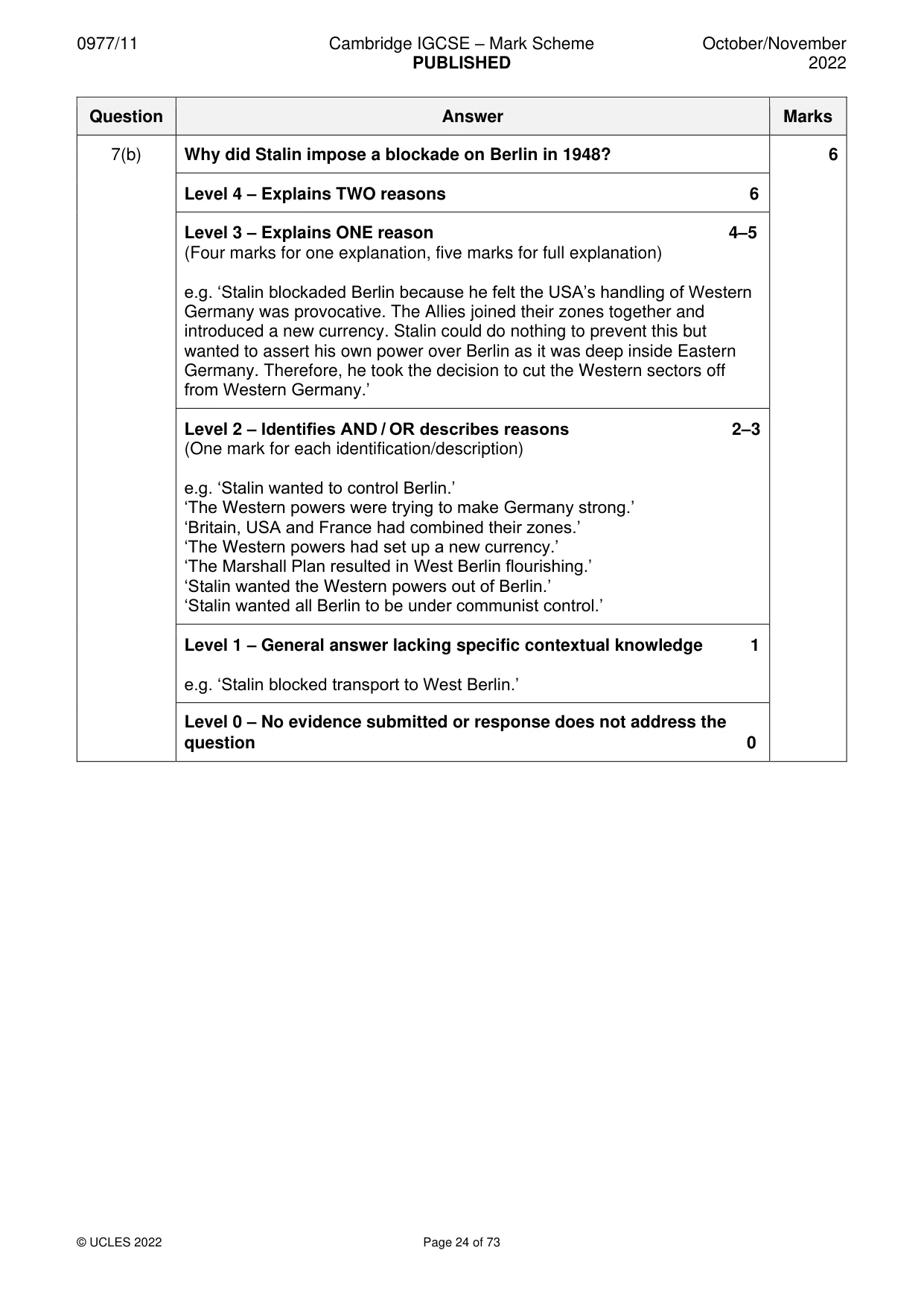
0977/11 Cambridge IGCSE – Mark Scheme PUBLISHED October/November 2022 © UCLES 2022 Page 24 of 73 Question Answer Marks 7(b) Why did Stalin impose a blockade on Berlin in 1948? 6 Level 4 – Explains TWO reasons 6 Level 3 – Explains ONE reason 4–5 (Four marks for one explanation, five marks for full explanation) e.g. ‘Stalin blockaded Berlin because he felt the USA’s handling of Western Germany was provocative. The Allies joined their zones together and introduced a new currency. Stalin could do nothing to prevent this but wanted to assert his own power over Berlin as it was deep inside Eastern Germany. Therefore, he took the decision to cut the Western sectors off from Western Germany.’ Level 2 – Identifies AND / OR describes reasons 2–3 (One mark for each identification/description) e.g. ‘Stalin wanted to control Berlin.’ ‘The Western powers were trying to make Germany strong.’ ‘Britain, USA and France had combined their zones.’ ‘The Western powers had set up a new currency.’ ‘The Marshall Plan resulted in West Berlin flourishing.’ ‘Stalin wanted the Western powers out of Berlin.’ ‘Stalin wanted all Berlin to be under communist control.’ Level 1 – General answer lacking specific contextual knowledge 1 e.g. ‘Stalin blocked transport to West Berlin.’ Level 0 – No evidence submitted or response does not address the question 0
Mark scheme, page 25
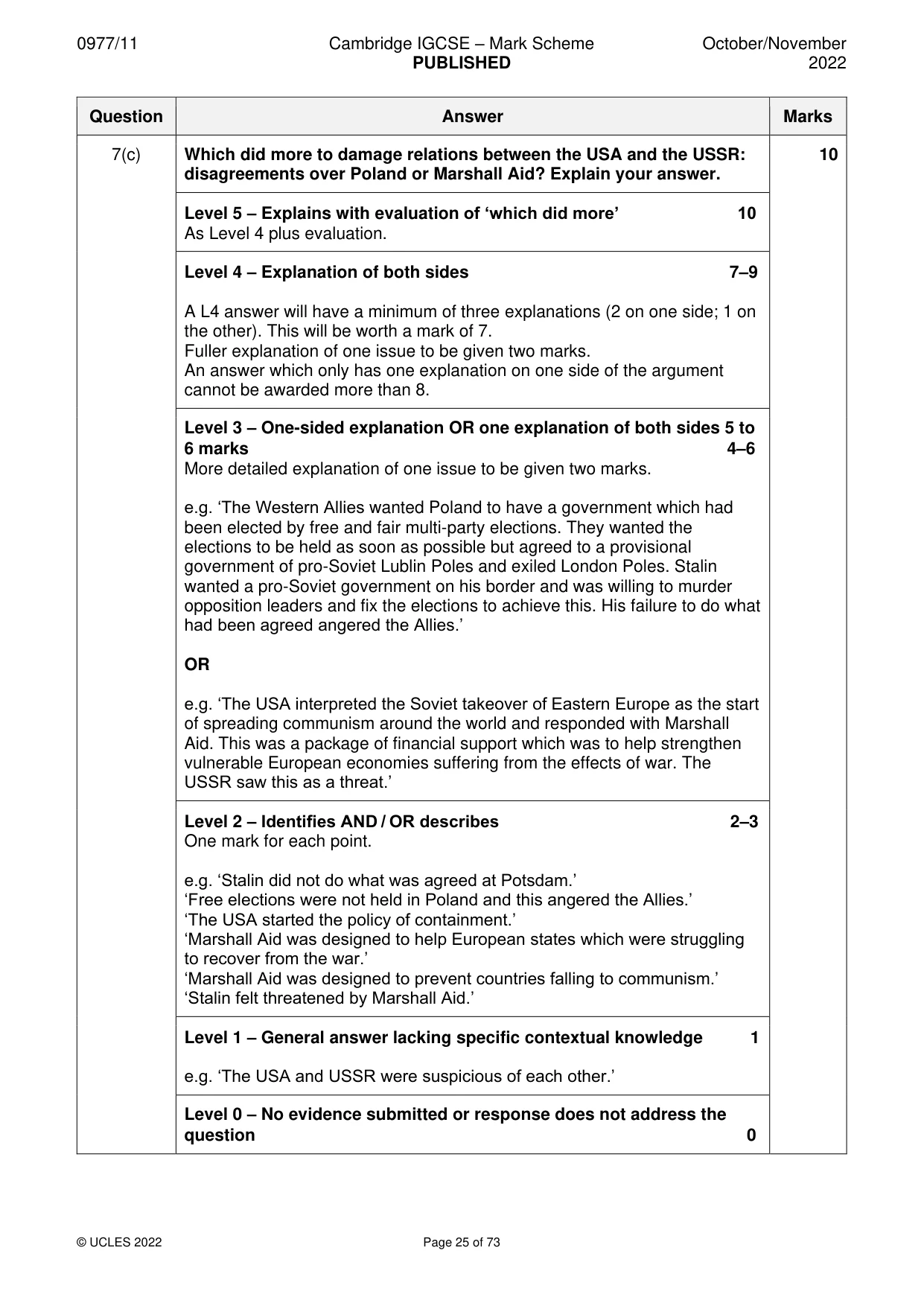
0977/11 Cambridge IGCSE – Mark Scheme PUBLISHED October/November 2022 © UCLES 2022 Page 25 of 73 Question Answer Marks 7(c) Which did more to damage relations between the USA and the USSR: disagreements over Poland or Marshall Aid? Explain your answer. 10 Level 5 – Explains with evaluation of ‘which did more’ 10 As Level 4 plus evaluation. Level 4 – Explanation of both sides 7–9 A L4 answer will have a minimum of three explanations (2 on one side; 1 on the other). This will be worth a mark of 7. Fuller explanation of one issue to be given two marks. An answer which only has one explanation on one side of the argument cannot be awarded more than 8. Level 3 – One-sided explanation OR one explanation of both sides 5 to 6 marks 4–6 More detailed explanation of one issue to be given two marks. e.g. ‘The Western Allies wanted Poland to have a government which had been elected by free and fair multi-party elections. They wanted the elections to be held as soon as possible but agreed to a provisional government of pro-Soviet Lublin Poles and exiled London Poles. Stalin wanted a pro-Soviet government on his border and was willing to murder opposition leaders and fix the elections to achieve this. His failure to do what had been agreed angered the Allies.’ OR e.g. ‘The USA interpreted the Soviet takeover of Eastern Europe as the start of spreading communism around the world and responded with Marshall Aid. This was a package of financial support which was to help strengthen vulnerable European economies suffering from the effects of war. The USSR saw this as a threat.’ Level 2 – Identifies AND / OR describes 2–3 One mark for each point. e.g. ‘Stalin did not do what was agreed at Potsdam.’ ‘Free elections were not held in Poland and this angered the Allies.’ ‘The USA started the policy of containment.’ ‘Marshall Aid was designed to help European states which were struggling to recover from the war.’ ‘Marshall Aid was designed to prevent countries falling to communism.’ ‘Stalin felt threatened by Marshall Aid.’ Level 1 – General answer lacking specific contextual knowledge 1 e.g. ‘The USA and USSR were suspicious of each other.’ Level 0 – No evidence submitted or response does not address the question 0
Mark scheme, page 26
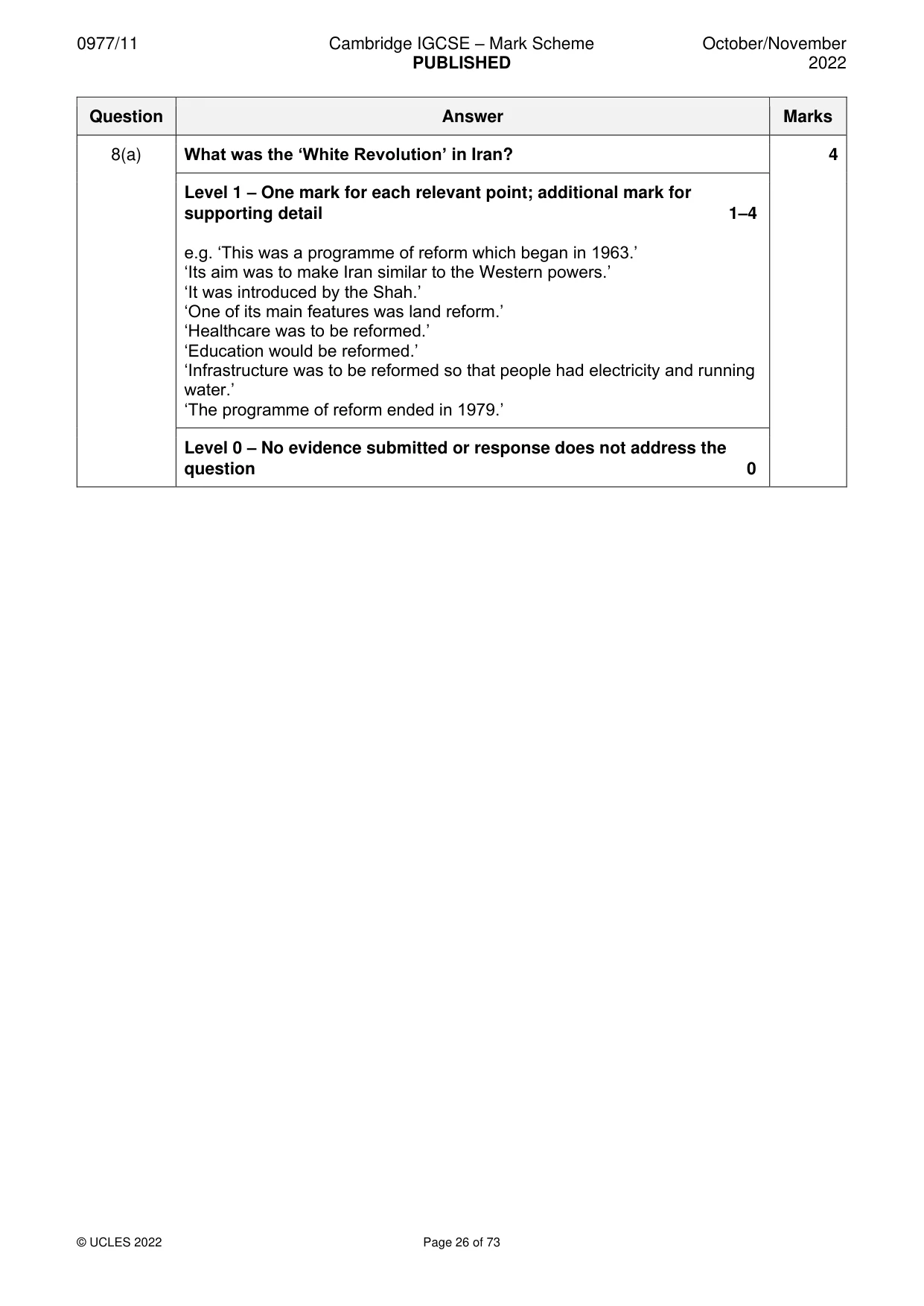
0977/11 Cambridge IGCSE – Mark Scheme PUBLISHED October/November 2022 © UCLES 2022 Page 26 of 73 Question Answer Marks 8(a) What was the ‘White Revolution’ in Iran? 4 Level 1 – One mark for each relevant point; additional mark for supporting detail 1–4 e.g. ‘This was a programme of reform which began in 1963.’ ‘Its aim was to make Iran similar to the Western powers.’ ‘It was introduced by the Shah.’ ‘One of its main features was land reform.’ ‘Healthcare was to be reformed.’ ‘Education would be reformed.’ ‘Infrastructure was to be reformed so that people had electricity and running water.’ ‘The programme of reform ended in 1979.’ Level 0 – No evidence submitted or response does not address the question 0
Mark scheme, page 27
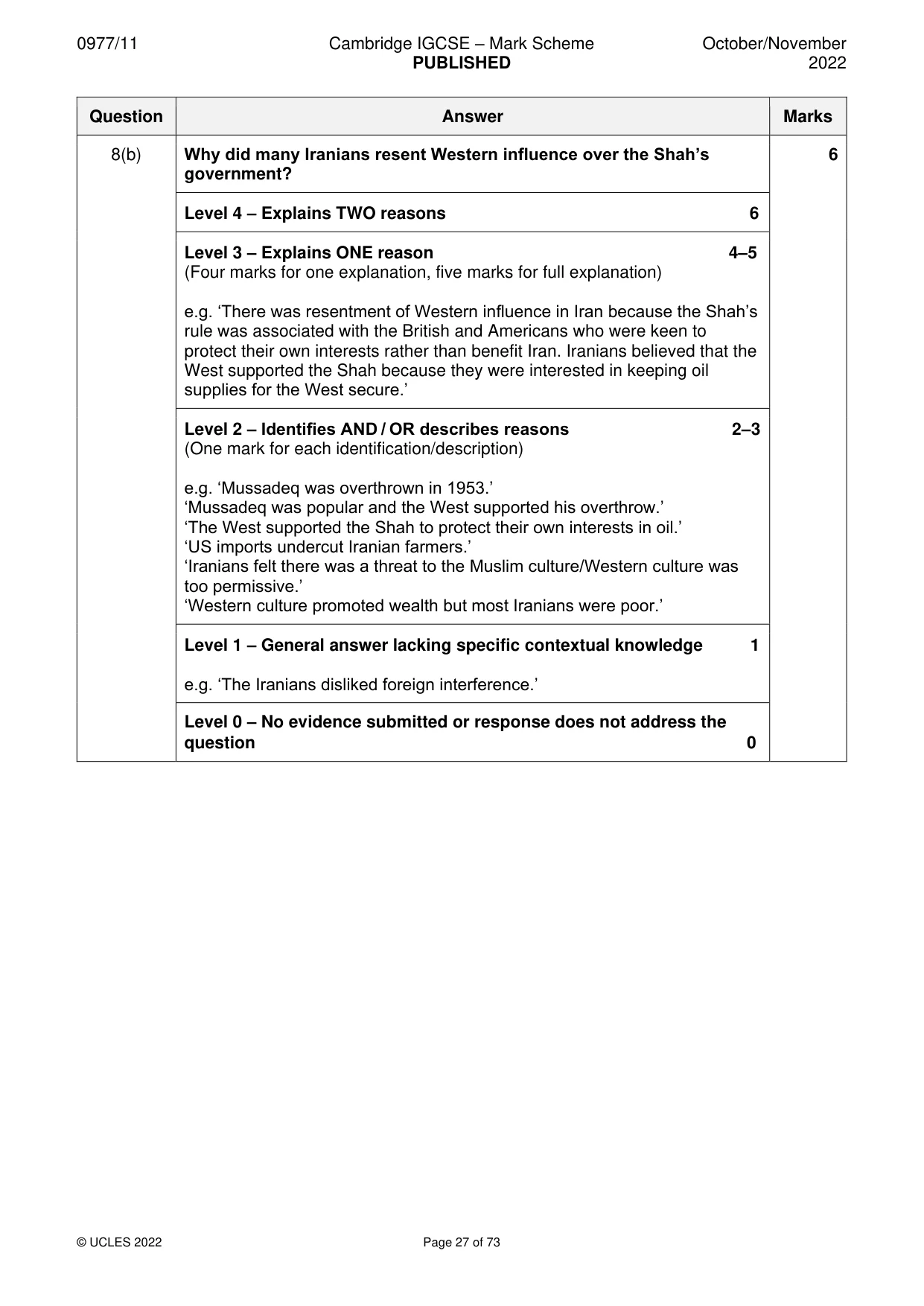
0977/11 Cambridge IGCSE – Mark Scheme PUBLISHED October/November 2022 © UCLES 2022 Page 27 of 73 Question Answer Marks 8(b) Why did many Iranians resent Western influence over the Shah’s government? 6 Level 4 – Explains TWO reasons 6 Level 3 – Explains ONE reason 4–5 (Four marks for one explanation, five marks for full explanation) e.g. ‘There was resentment of Western influence in Iran because the Shah’s rule was associated with the British and Americans who were keen to protect their own interests rather than benefit Iran. Iranians believed that the West supported the Shah because they were interested in keeping oil supplies for the West secure.’ Level 2 – Identifies AND / OR describes reasons 2–3 (One mark for each identification/description) e.g. ‘Mussadeq was overthrown in 1953.’ ‘Mussadeq was popular and the West supported his overthrow.’ ‘The West supported the Shah to protect their own interests in oil.’ ‘US imports undercut Iranian farmers.’ ‘Iranians felt there was a threat to the Muslim culture/Western culture was too permissive.’ ‘Western culture promoted wealth but most Iranians were poor.’ Level 1 – General answer lacking specific contextual knowledge 1 e.g. ‘The Iranians disliked foreign interference.’ Level 0 – No evidence submitted or response does not address the question 0
Mark scheme, page 28
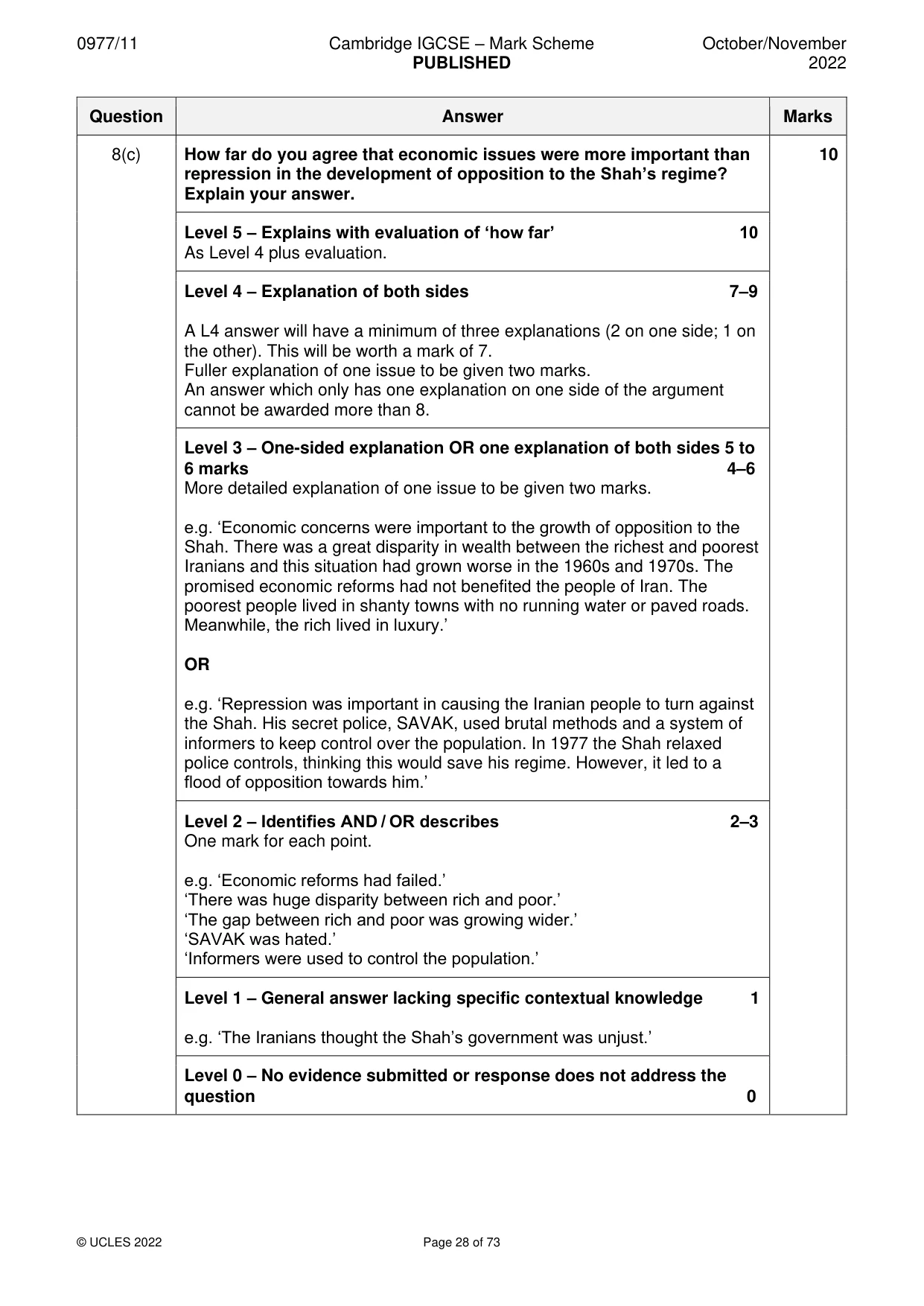
0977/11 Cambridge IGCSE – Mark Scheme PUBLISHED October/November 2022 © UCLES 2022 Page 28 of 73 Question Answer Marks 8(c) How far do you agree that economic issues were more important than repression in the development of opposition to the Shah’s regime? Explain your answer. 10 Level 5 – Explains with evaluation of ‘how far’ 10 As Level 4 plus evaluation. Level 4 – Explanation of both sides 7–9 A L4 answer will have a minimum of three explanations (2 on one side; 1 on the other). This will be worth a mark of 7. Fuller explanation of one issue to be given two marks. An answer which only has one explanation on one side of the argument cannot be awarded more than 8. Level 3 – One-sided explanation OR one explanation of both sides 5 to 6 marks 4–6 More detailed explanation of one issue to be given two marks. e.g. ‘Economic concerns were important to the growth of opposition to the Shah. There was a great disparity in wealth between the richest and poorest Iranians and this situation had grown worse in the 1960s and 1970s. The promised economic reforms had not benefited the people of Iran. The poorest people lived in shanty towns with no running water or paved roads. Meanwhile, the rich lived in luxury.’ OR e.g. ‘Repression was important in causing the Iranian people to turn against the Shah. His secret police, SAVAK, used brutal methods and a system of informers to keep control over the population. In 1977 the Shah relaxed police controls, thinking this would save his regime. However, it led to a flood of opposition towards him.’ Level 2 – Identifies AND / OR describes 2–3 One mark for each point. e.g. ‘Economic reforms had failed.’ ‘There was huge disparity between rich and poor.’ ‘The gap between rich and poor was growing wider.’ ‘SAVAK was hated.’ ‘Informers were used to control the population.’ Level 1 – General answer lacking specific contextual knowledge 1 e.g. ‘The Iranians thought the Shah’s government was unjust.’ Level 0 – No evidence submitted or response does not address the question 0
Mark scheme, page 29
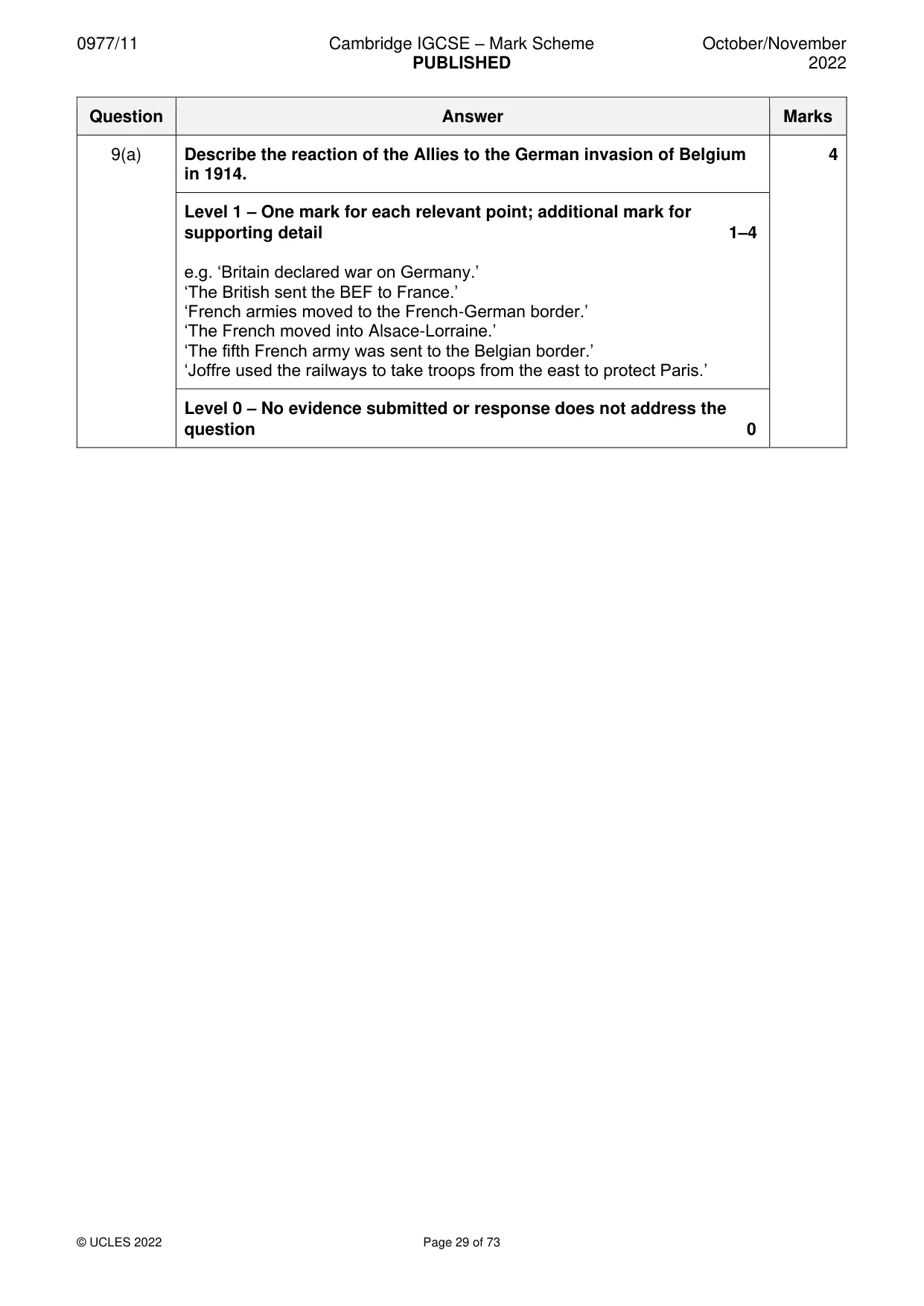
0977/11 Cambridge IGCSE – Mark Scheme PUBLISHED October/November 2022 © UCLES 2022 Page 29 of 73 Question Answer Marks 9(a) Describe the reaction of the Allies to the German invasion of Belgium in 1914. 4 Level 1 – One mark for each relevant point; additional mark for supporting detail 1–4 e.g. ‘Britain declared war on Germany.’ ‘The British sent the BEF to France.’ ‘French armies moved to the French-German border.’ ‘The French moved into Alsace-Lorraine.’ ‘The fifth French army was sent to the Belgian border.’ ‘Joffre used the railways to take troops from the east to protect Paris.’ Level 0 – No evidence submitted or response does not address the question 0
Mark scheme, page 30
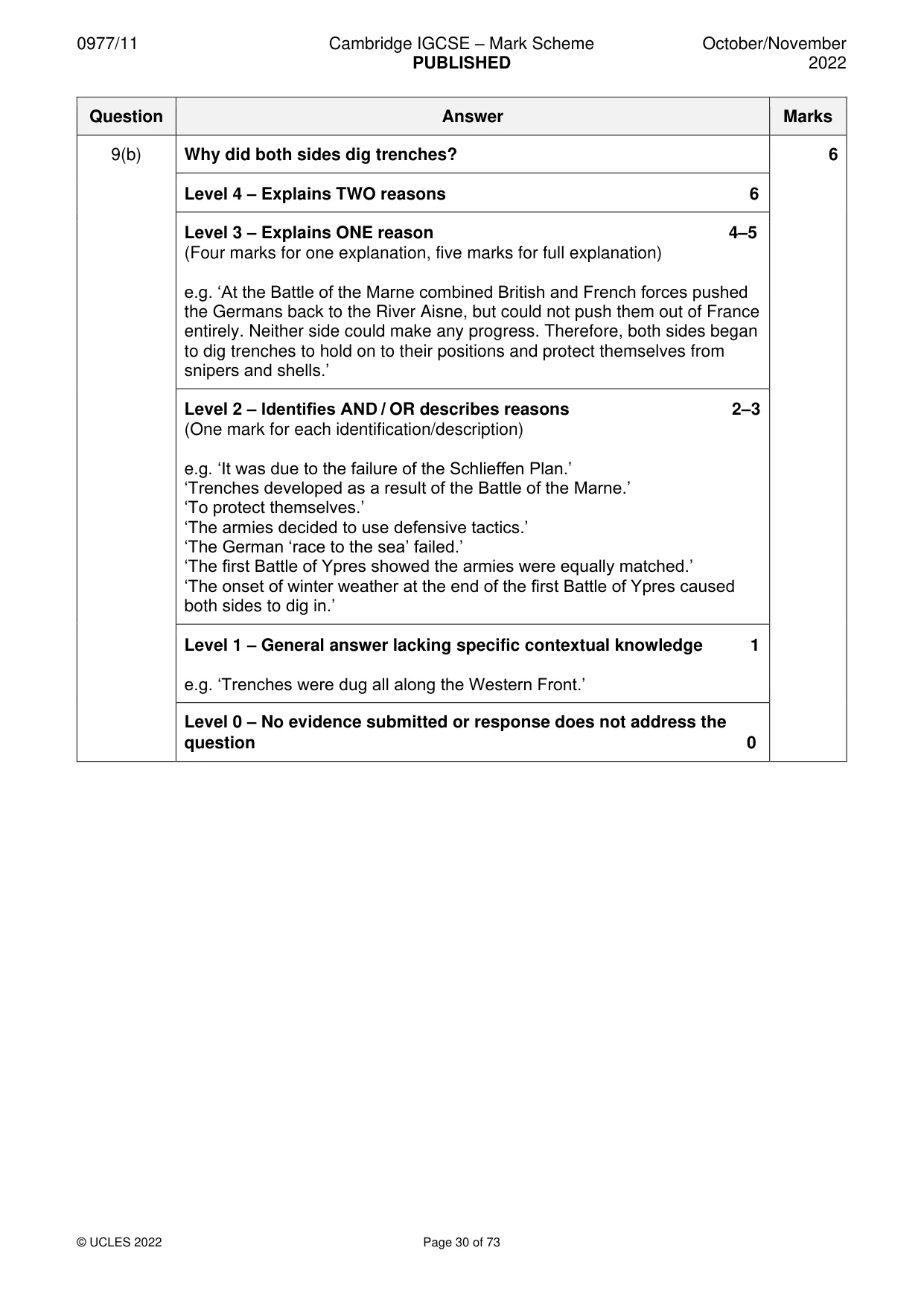
0977/11 Cambridge IGCSE – Mark Scheme PUBLISHED October/November 2022 © UCLES 2022 Page 30 of 73 Question Answer Marks 9(b) Why did both sides dig trenches? 6 Level 4 – Explains TWO reasons 6 Level 3 – Explains ONE reason 4–5 (Four marks for one explanation, five marks for full explanation) e.g. ‘At the Battle of the Marne combined British and French forces pushed the Germans back to the River Aisne, but could not push them out of France entirely. Neither side could make any progress. Therefore, both sides began to dig trenches to hold on to their positions and protect themselves from snipers and shells.’ Level 2 – Identifies AND / OR describes reasons 2–3 (One mark for each identification/description) e.g. ‘It was due to the failure of the Schlieffen Plan.’ ‘Trenches developed as a result of the Battle of the Marne.’ ‘To protect themselves.’ ‘The armies decided to use defensive tactics.’ ‘The German ‘race to the sea’ failed.’ ‘The first Battle of Ypres showed the armies were equally matched.’ ‘The onset of winter weather at the end of the first Battle of Ypres caused both sides to dig in.’ Level 1 – General answer lacking specific contextual knowledge 1 e.g. ‘Trenches were dug all along the Western Front.’ Level 0 – No evidence submitted or response does not address the question 0
Mark scheme, page 31
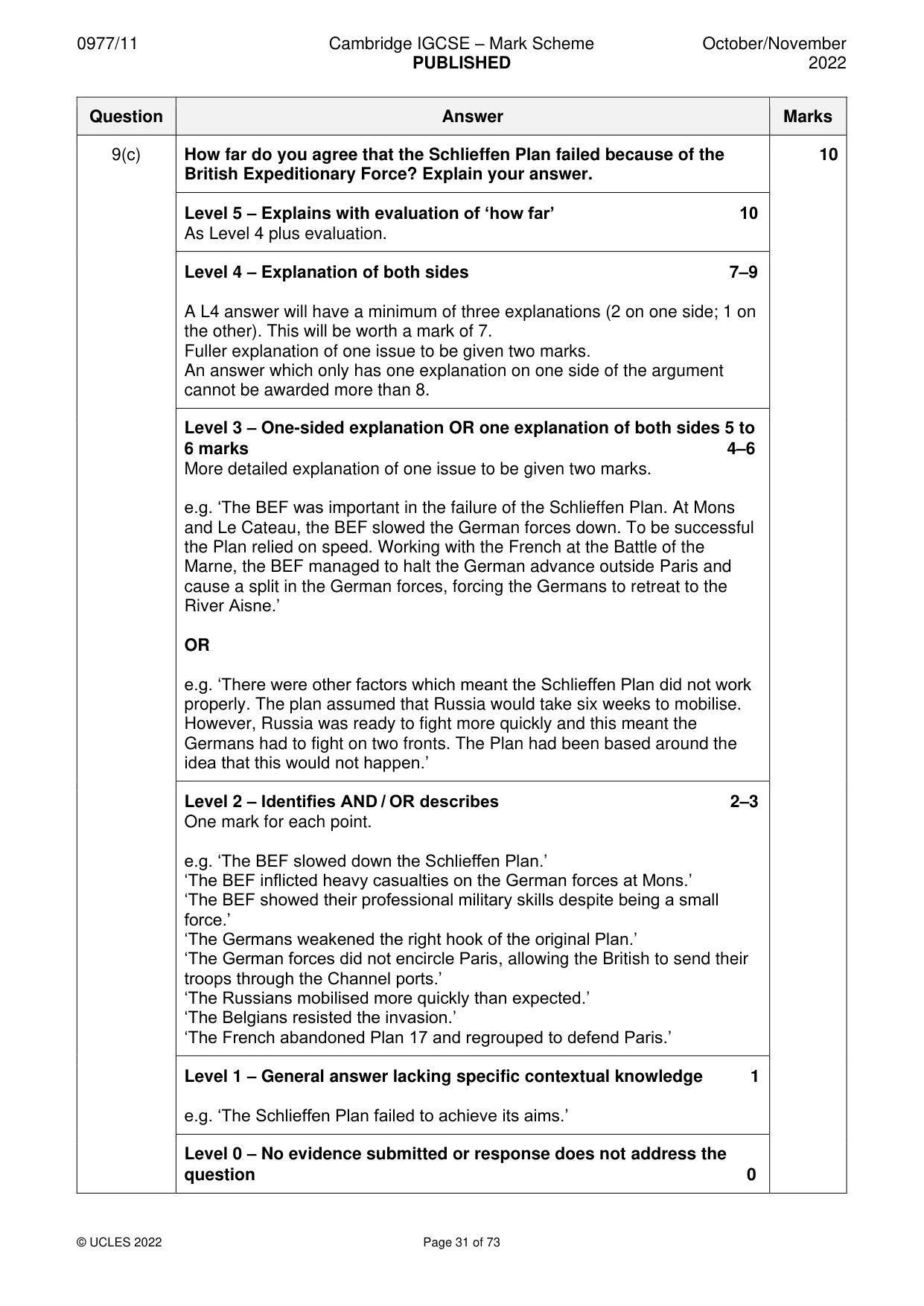
0977/11 Cambridge IGCSE – Mark Scheme PUBLISHED October/November 2022 © UCLES 2022 Page 31 of 73 Question Answer Marks 9(c) How far do you agree that the Schlieffen Plan failed because of the British Expeditionary Force? Explain your answer. 10 Level 5 – Explains with evaluation of ‘how far’ 10 As Level 4 plus evaluation. Level 4 – Explanation of both sides 7–9 A L4 answer will have a minimum of three explanations (2 on one side; 1 on the other). This will be worth a mark of 7. Fuller explanation of one issue to be given two marks. An answer which only has one explanation on one side of the argument cannot be awarded more than 8. Level 3 – One-sided explanation OR one explanation of both sides 5 to 6 marks 4–6 More detailed explanation of one issue to be given two marks. e.g. ‘The BEF was important in the failure of the Schlieffen Plan. At Mons and Le Cateau, the BEF slowed the German forces down. To be successful the Plan relied on speed. Working with the French at the Battle of the Marne, the BEF managed to halt the German advance outside Paris and cause a split in the German forces, forcing the Germans to retreat to the River Aisne.’ OR e.g. ‘There were other factors which meant the Schlieffen Plan did not work properly. The plan assumed that Russia would take six weeks to mobilise. However, Russia was ready to fight more quickly and this meant the Germans had to fight on two fronts. The Plan had been based around the idea that this would not happen.’ Level 2 – Identifies AND / OR describes 2–3 One mark for each point. e.g. ‘The BEF slowed down the Schlieffen Plan.’ ‘The BEF inflicted heavy casualties on the German forces at Mons.’ ‘The BEF showed their professional military skills despite being a small force.’ ‘The Germans weakened the right hook of the original Plan.’ ‘The German forces did not encircle Paris, allowing the British to send their troops through the Channel ports.’ ‘The Russians mobilised more quickly than expected.’ ‘The Belgians resisted the invasion.’ ‘The French abandoned Plan 17 and regrouped to defend Paris.’ Level 1 – General answer lacking specific contextual knowledge 1 e.g. ‘The Schlieffen Plan failed to achieve its aims.’ Level 0 – No evidence submitted or response does not address the question 0
Mark scheme, page 32
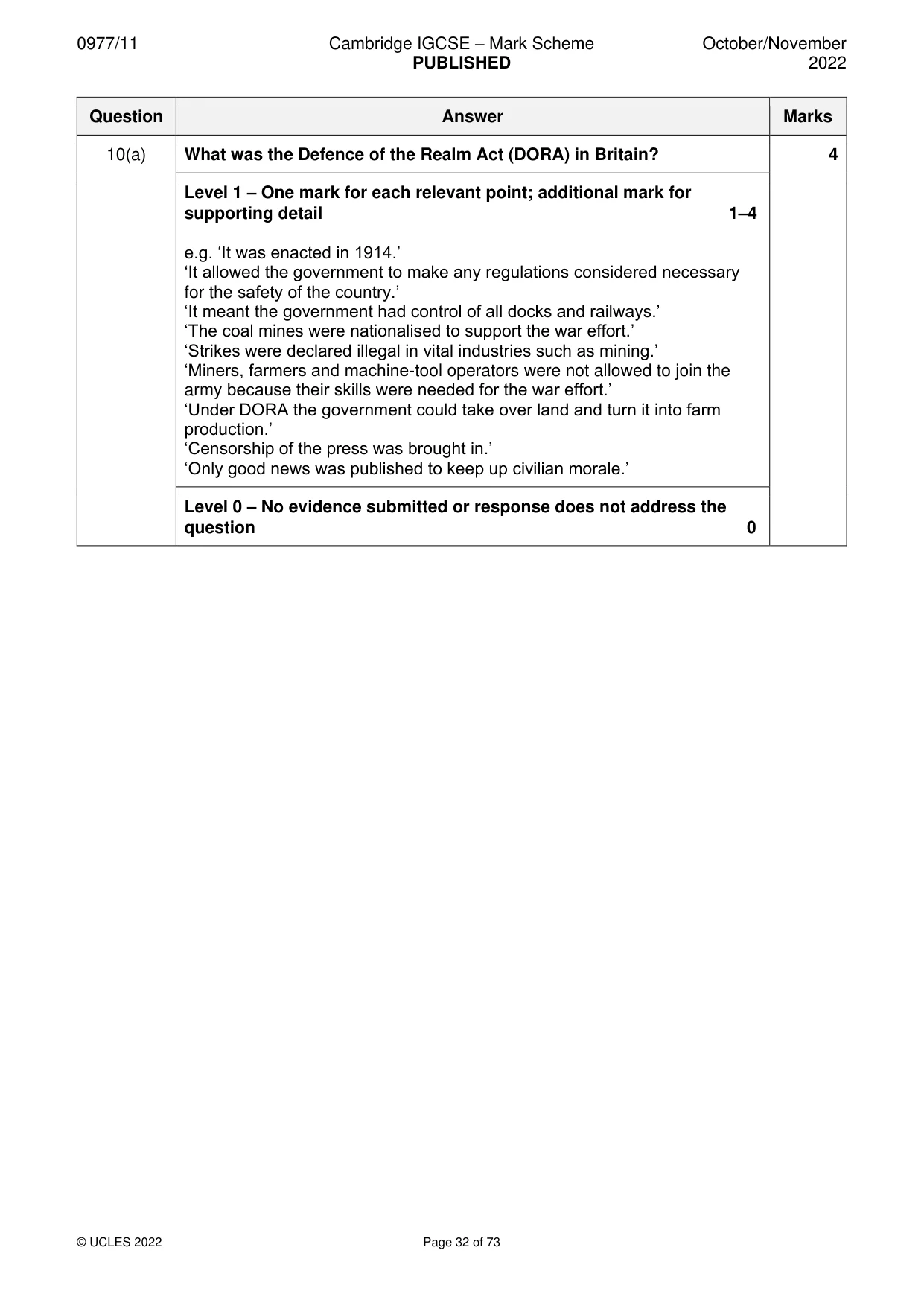
0977/11 Cambridge IGCSE – Mark Scheme PUBLISHED October/November 2022 © UCLES 2022 Page 32 of 73 Question Answer Marks 10(a) What was the Defence of the Realm Act (DORA) in Britain? 4 Level 1 – One mark for each relevant point; additional mark for supporting detail 1–4 e.g. ‘It was enacted in 1914.’ ‘It allowed the government to make any regulations considered necessary for the safety of the country.’ ‘It meant the government had control of all docks and railways.’ ‘The coal mines were nationalised to support the war effort.’ ‘Strikes were declared illegal in vital industries such as mining.’ ‘Miners, farmers and machine-tool operators were not allowed to join the army because their skills were needed for the war effort.’ ‘Under DORA the government could take over land and turn it into farm production.’ ‘Censorship of the press was brought in.’ ‘Only good news was published to keep up civilian morale.’ Level 0 – No evidence submitted or response does not address the question 0
Mark scheme, page 33
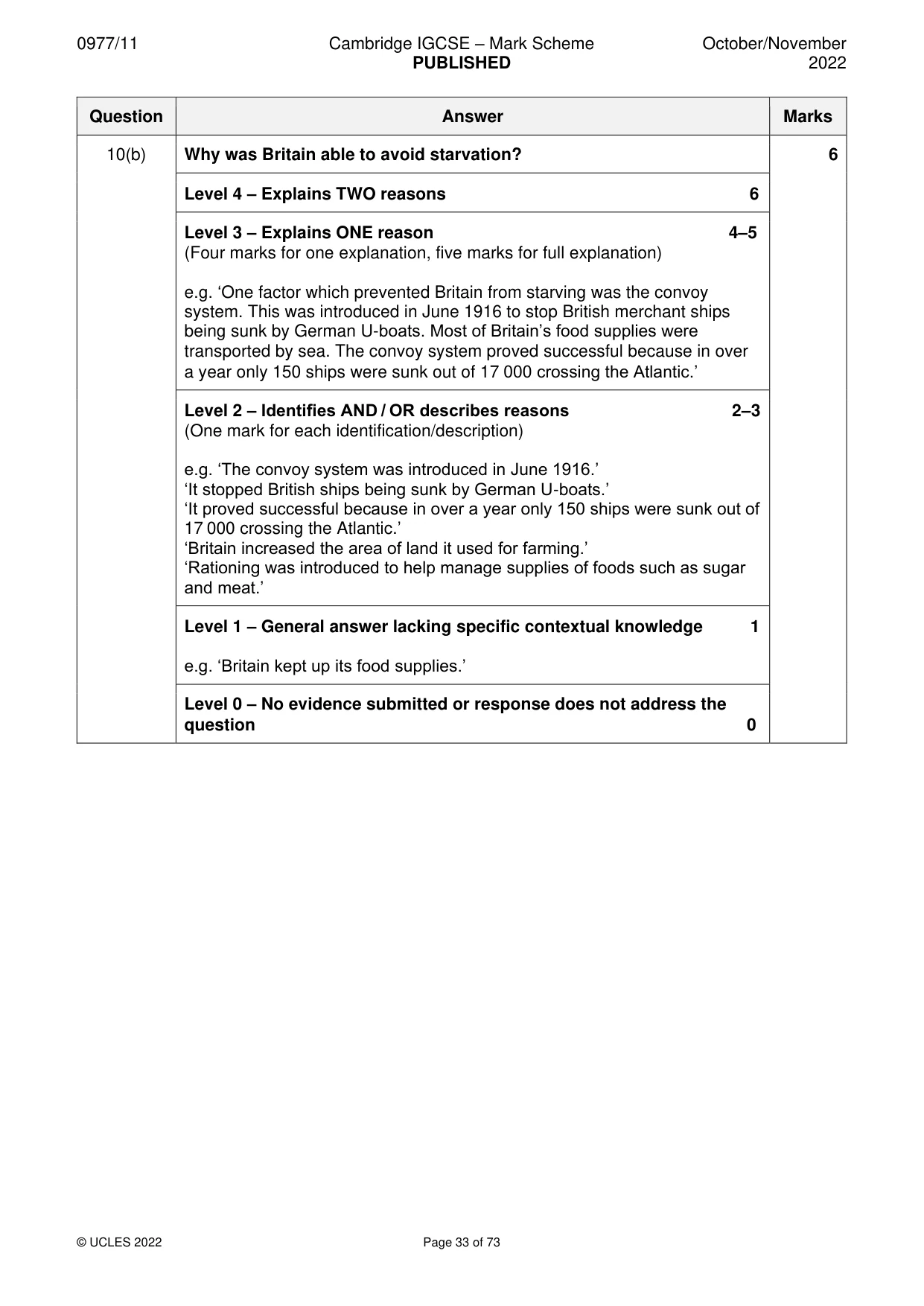
0977/11 Cambridge IGCSE – Mark Scheme PUBLISHED October/November 2022 © UCLES 2022 Page 33 of 73 Question Answer Marks 10(b) Why was Britain able to avoid starvation? 6 Level 4 – Explains TWO reasons 6 Level 3 – Explains ONE reason 4–5 (Four marks for one explanation, five marks for full explanation) e.g. ‘One factor which prevented Britain from starving was the convoy system. This was introduced in June 1916 to stop British merchant ships being sunk by German U-boats. Most of Britain’s food supplies were transported by sea. The convoy system proved successful because in over a year only 150 ships were sunk out of 17 000 crossing the Atlantic.’ Level 2 – Identifies AND / OR describes reasons 2–3 (One mark for each identification/description) e.g. ‘The convoy system was introduced in June 1916.’ ‘It stopped British ships being sunk by German U-boats.’ ‘It proved successful because in over a year only 150 ships were sunk out of 17 000 crossing the Atlantic.’ ‘Britain increased the area of land it used for farming.’ ‘Rationing was introduced to help manage supplies of foods such as sugar and meat.’ Level 1 – General answer lacking specific contextual knowledge 1 e.g. ‘Britain kept up its food supplies.’ Level 0 – No evidence submitted or response does not address the question 0
Mark scheme, page 34
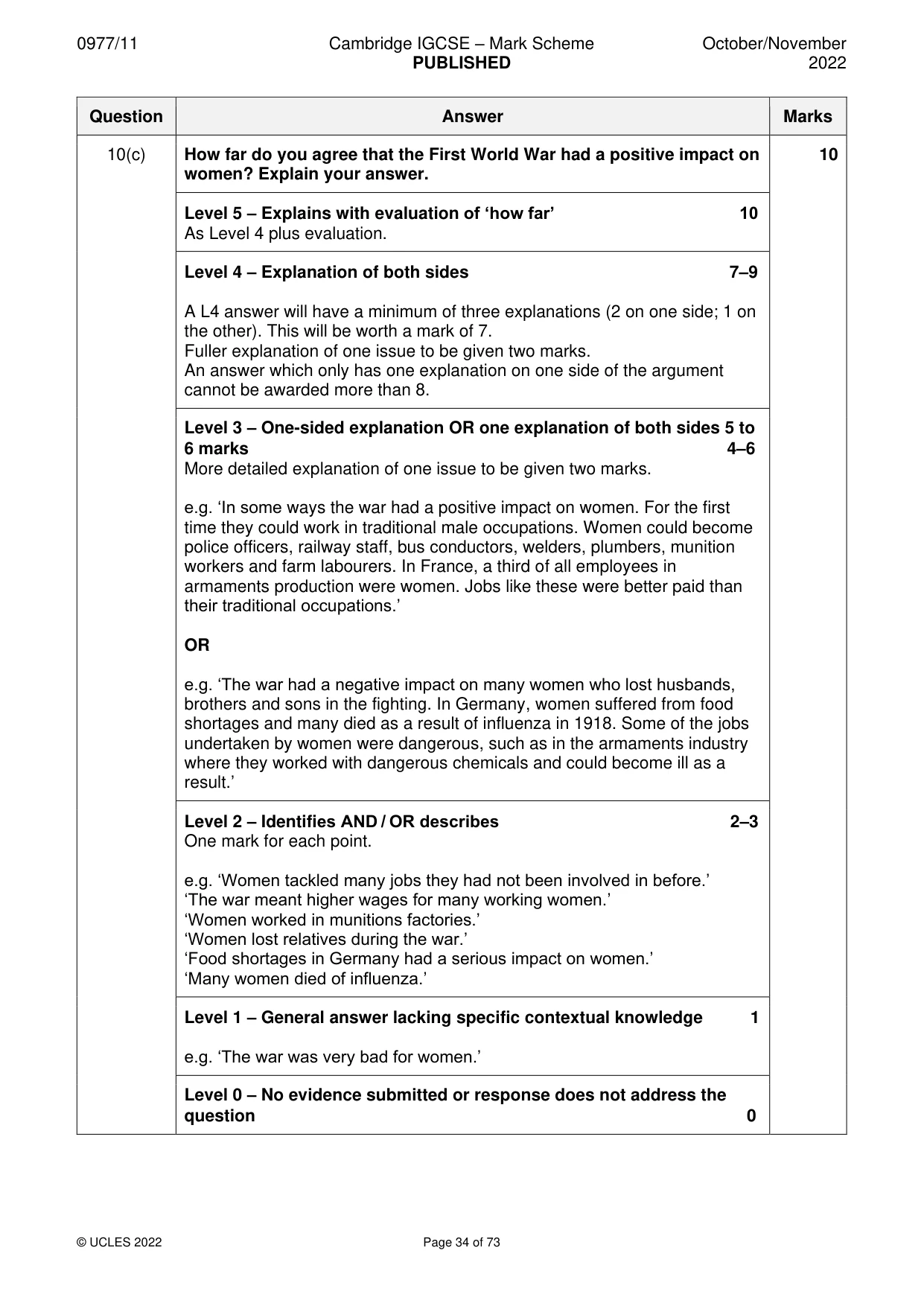
0977/11 Cambridge IGCSE – Mark Scheme PUBLISHED October/November 2022 © UCLES 2022 Page 34 of 73 Question Answer Marks 10(c) How far do you agree that the First World War had a positive impact on women? Explain your answer. 10 Level 5 – Explains with evaluation of ‘how far’ 10 As Level 4 plus evaluation. Level 4 – Explanation of both sides 7–9 A L4 answer will have a minimum of three explanations (2 on one side; 1 on the other). This will be worth a mark of 7. Fuller explanation of one issue to be given two marks. An answer which only has one explanation on one side of the argument cannot be awarded more than 8. Level 3 – One-sided explanation OR one explanation of both sides 5 to 6 marks 4–6 More detailed explanation of one issue to be given two marks. e.g. ‘In some ways the war had a positive impact on women. For the first time they could work in traditional male occupations. Women could become police officers, railway staff, bus conductors, welders, plumbers, munition workers and farm labourers. In France, a third of all employees in armaments production were women. Jobs like these were better paid than their traditional occupations.’ OR e.g. ‘The war had a negative impact on many women who lost husbands, brothers and sons in the fighting. In Germany, women suffered from food shortages and many died as a result of influenza in 1918. Some of the jobs undertaken by women were dangerous, such as in the armaments industry where they worked with dangerous chemicals and could become ill as a result.’ Level 2 – Identifies AND / OR describes 2–3 One mark for each point. e.g. ‘Women tackled many jobs they had not been involved in before.’ ‘The war meant higher wages for many working women.’ ‘Women worked in munitions factories.’ ‘Women lost relatives during the war.’ ‘Food shortages in Germany had a serious impact on women.’ ‘Many women died of influenza.’ Level 1 – General answer lacking specific contextual knowledge 1 e.g. ‘The war was very bad for women.’ Level 0 – No evidence submitted or response does not address the question 0
Mark scheme, page 35
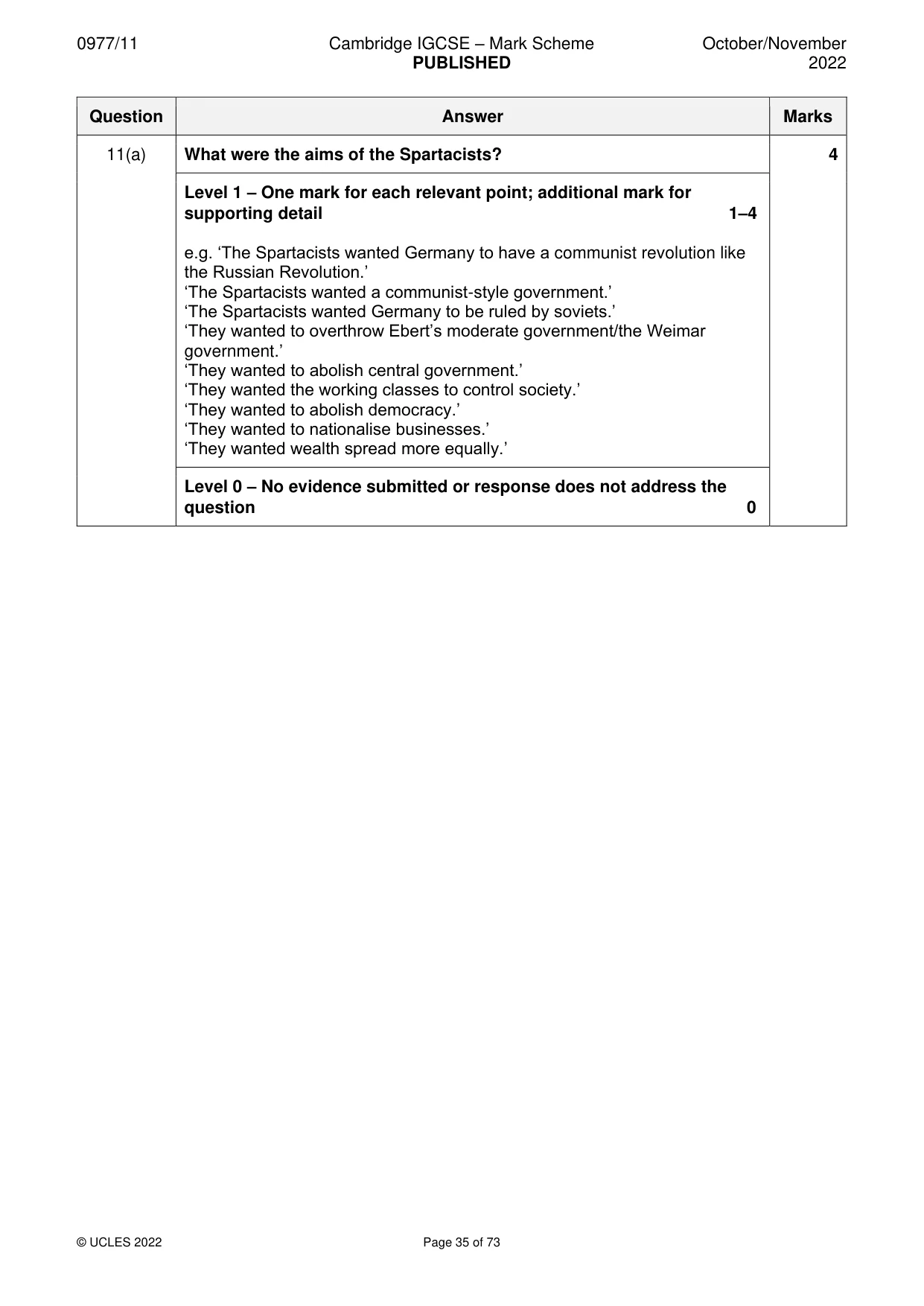
0977/11 Cambridge IGCSE – Mark Scheme PUBLISHED October/November 2022 © UCLES 2022 Page 35 of 73 Question Answer Marks 11(a) What were the aims of the Spartacists? 4 Level 1 – One mark for each relevant point; additional mark for supporting detail 1–4 e.g. ‘The Spartacists wanted Germany to have a communist revolution like the Russian Revolution.’ ‘The Spartacists wanted a communist-style government.’ ‘The Spartacists wanted Germany to be ruled by soviets.’ ‘They wanted to overthrow Ebert’s moderate government/the Weimar government.’ ‘They wanted to abolish central government.’ ‘They wanted the working classes to control society.’ ‘They wanted to abolish democracy.’ ‘They wanted to nationalise businesses.’ ‘They wanted wealth spread more equally.’ Level 0 – No evidence submitted or response does not address the question 0
Mark scheme, page 36
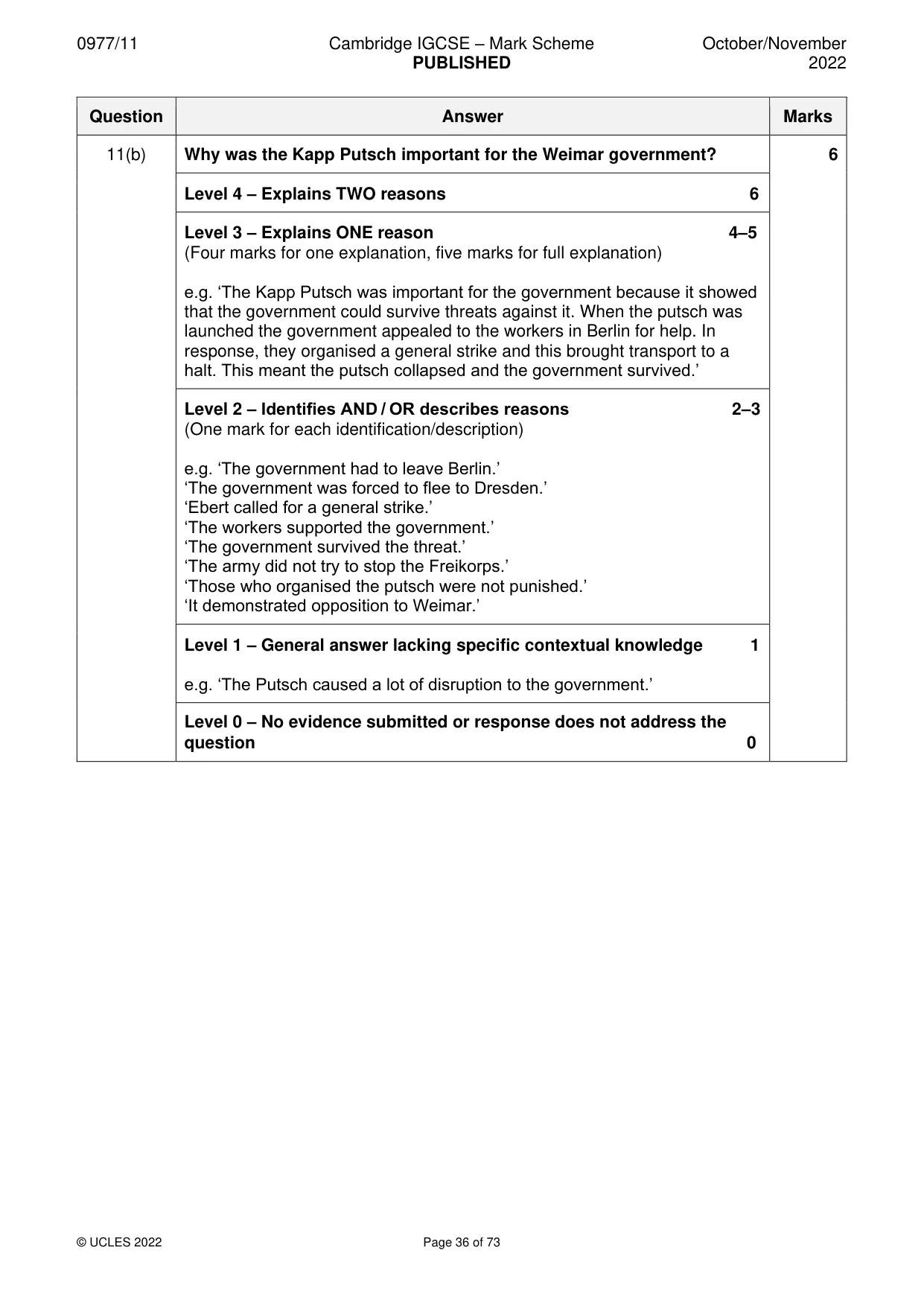
0977/11 Cambridge IGCSE – Mark Scheme PUBLISHED October/November 2022 © UCLES 2022 Page 36 of 73 Question Answer Marks 11(b) Why was the Kapp Putsch important for the Weimar government? 6 Level 4 – Explains TWO reasons 6 Level 3 – Explains ONE reason 4–5 (Four marks for one explanation, five marks for full explanation) e.g. ‘The Kapp Putsch was important for the government because it showed that the government could survive threats against it. When the putsch was launched the government appealed to the workers in Berlin for help. In response, they organised a general strike and this brought transport to a halt. This meant the putsch collapsed and the government survived.’ Level 2 – Identifies AND / OR describes reasons 2–3 (One mark for each identification/description) e.g. ‘The government had to leave Berlin.’ ‘The government was forced to flee to Dresden.’ ‘Ebert called for a general strike.’ ‘The workers supported the government.’ ‘The government survived the threat.’ ‘The army did not try to stop the Freikorps.’ ‘Those who organised the putsch were not punished.’ ‘It demonstrated opposition to Weimar.’ Level 1 – General answer lacking specific contextual knowledge 1 e.g. ‘The Putsch caused a lot of disruption to the government.’ Level 0 – No evidence submitted or response does not address the question 0
Mark scheme, page 37
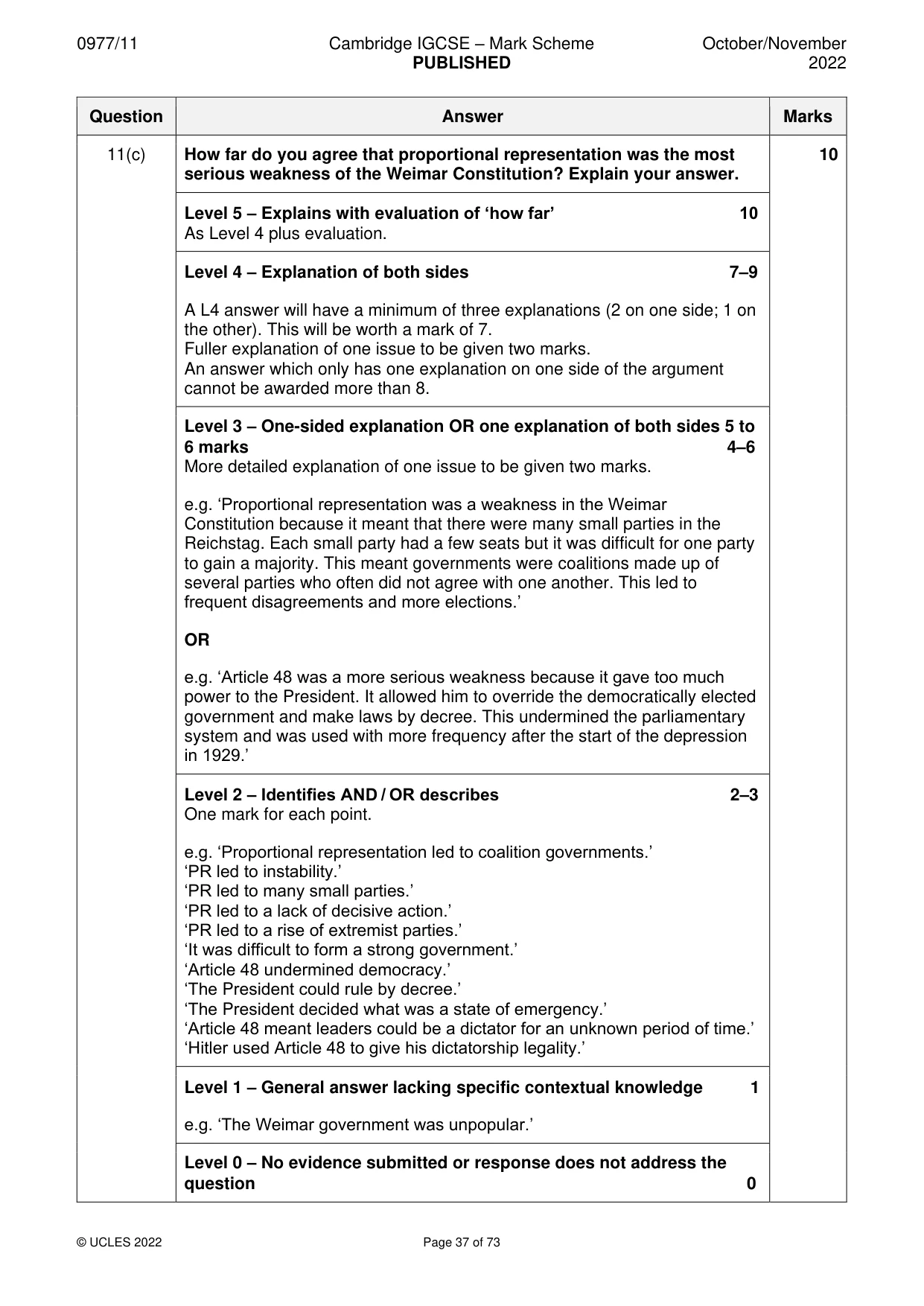
0977/11 Cambridge IGCSE – Mark Scheme PUBLISHED October/November 2022 © UCLES 2022 Page 37 of 73 Question Answer Marks 11(c) How far do you agree that proportional representation was the most serious weakness of the Weimar Constitution? Explain your answer. 10 Level 5 – Explains with evaluation of ‘how far’ 10 As Level 4 plus evaluation. Level 4 – Explanation of both sides 7–9 A L4 answer will have a minimum of three explanations (2 on one side; 1 on the other). This will be worth a mark of 7. Fuller explanation of one issue to be given two marks. An answer which only has one explanation on one side of the argument cannot be awarded more than 8. Level 3 – One-sided explanation OR one explanation of both sides 5 to 6 marks 4–6 More detailed explanation of one issue to be given two marks. e.g. ‘Proportional representation was a weakness in the Weimar Constitution because it meant that there were many small parties in the Reichstag. Each small party had a few seats but it was difficult for one party to gain a majority. This meant governments were coalitions made up of several parties who often did not agree with one another. This led to frequent disagreements and more elections.’ OR e.g. ‘Article 48 was a more serious weakness because it gave too much power to the President. It allowed him to override the democratically elected government and make laws by decree. This undermined the parliamentary system and was used with more frequency after the start of the depression in 1929.’ Level 2 – Identifies AND / OR describes 2–3 One mark for each point. e.g. ‘Proportional representation led to coalition governments.’ ‘PR led to instability.’ ‘PR led to many small parties.’ ‘PR led to a lack of decisive action.’ ‘PR led to a rise of extremist parties.’ ‘It was difficult to form a strong government.’ ‘Article 48 undermined democracy.’ ‘The President could rule by decree.’ ‘The President decided what was a state of emergency.’ ‘Article 48 meant leaders could be a dictator for an unknown period of time.’ ‘Hitler used Article 48 to give his dictatorship legality.’ Level 1 – General answer lacking specific contextual knowledge 1 e.g. ‘The Weimar government was unpopular.’ Level 0 – No evidence submitted or response does not address the question 0
Mark scheme, page 38
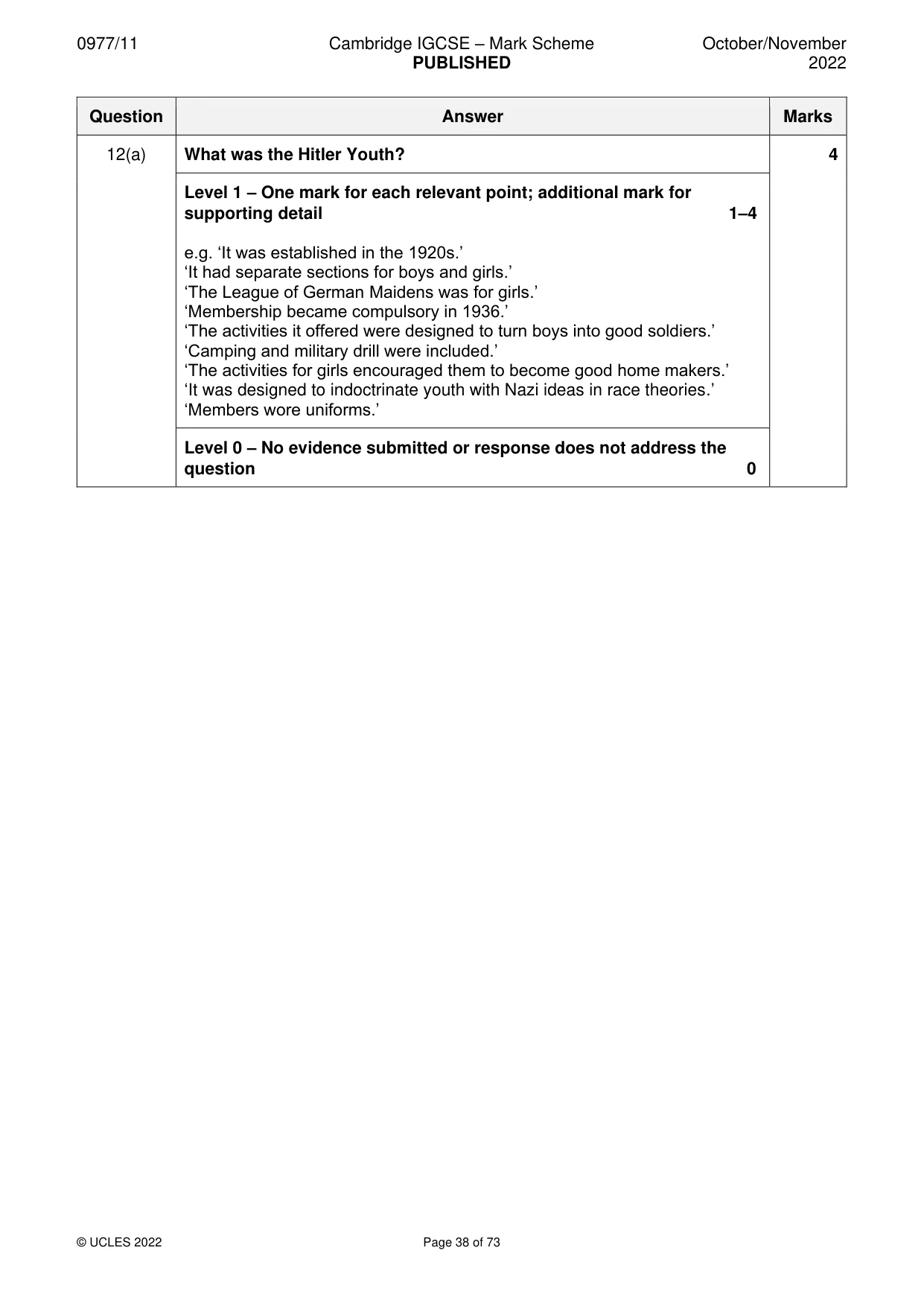
0977/11 Cambridge IGCSE – Mark Scheme PUBLISHED October/November 2022 © UCLES 2022 Page 38 of 73 Question Answer Marks 12(a) What was the Hitler Youth? 4 Level 1 – One mark for each relevant point; additional mark for supporting detail 1–4 e.g. ‘It was established in the 1920s.’ ‘It had separate sections for boys and girls.’ ‘The League of German Maidens was for girls.’ ‘Membership became compulsory in 1936.’ ‘The activities it offered were designed to turn boys into good soldiers.’ ‘Camping and military drill were included.’ ‘The activities for girls encouraged them to become good home makers.’ ‘It was designed to indoctrinate youth with Nazi ideas in race theories.’ ‘Members wore uniforms.’ Level 0 – No evidence submitted or response does not address the question 0
Mark scheme, page 39
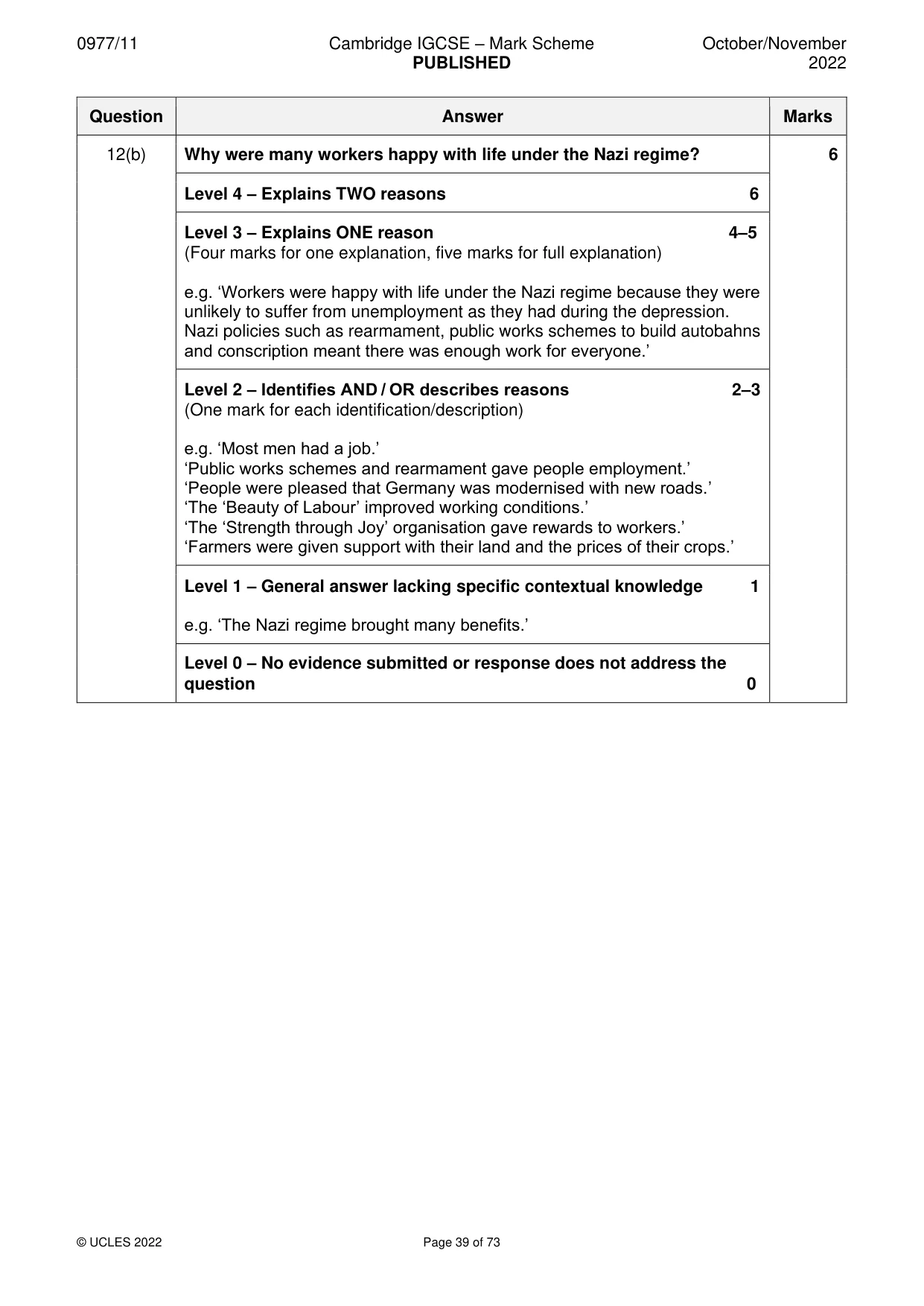
0977/11 Cambridge IGCSE – Mark Scheme PUBLISHED October/November 2022 © UCLES 2022 Page 39 of 73 Question Answer Marks 12(b) Why were many workers happy with life under the Nazi regime? 6 Level 4 – Explains TWO reasons 6 Level 3 – Explains ONE reason 4–5 (Four marks for one explanation, five marks for full explanation) e.g. ‘Workers were happy with life under the Nazi regime because they were unlikely to suffer from unemployment as they had during the depression. Nazi policies such as rearmament, public works schemes to build autobahns and conscription meant there was enough work for everyone.’ Level 2 – Identifies AND / OR describes reasons 2–3 (One mark for each identification/description) e.g. ‘Most men had a job.’ ‘Public works schemes and rearmament gave people employment.’ ‘People were pleased that Germany was modernised with new roads.’ ‘The ‘Beauty of Labour’ improved working conditions.’ ‘The ‘Strength through Joy’ organisation gave rewards to workers.’ ‘Farmers were given support with their land and the prices of their crops.’ Level 1 – General answer lacking specific contextual knowledge 1 e.g. ‘The Nazi regime brought many benefits.’ Level 0 – No evidence submitted or response does not address the question 0
Mark scheme, page 40
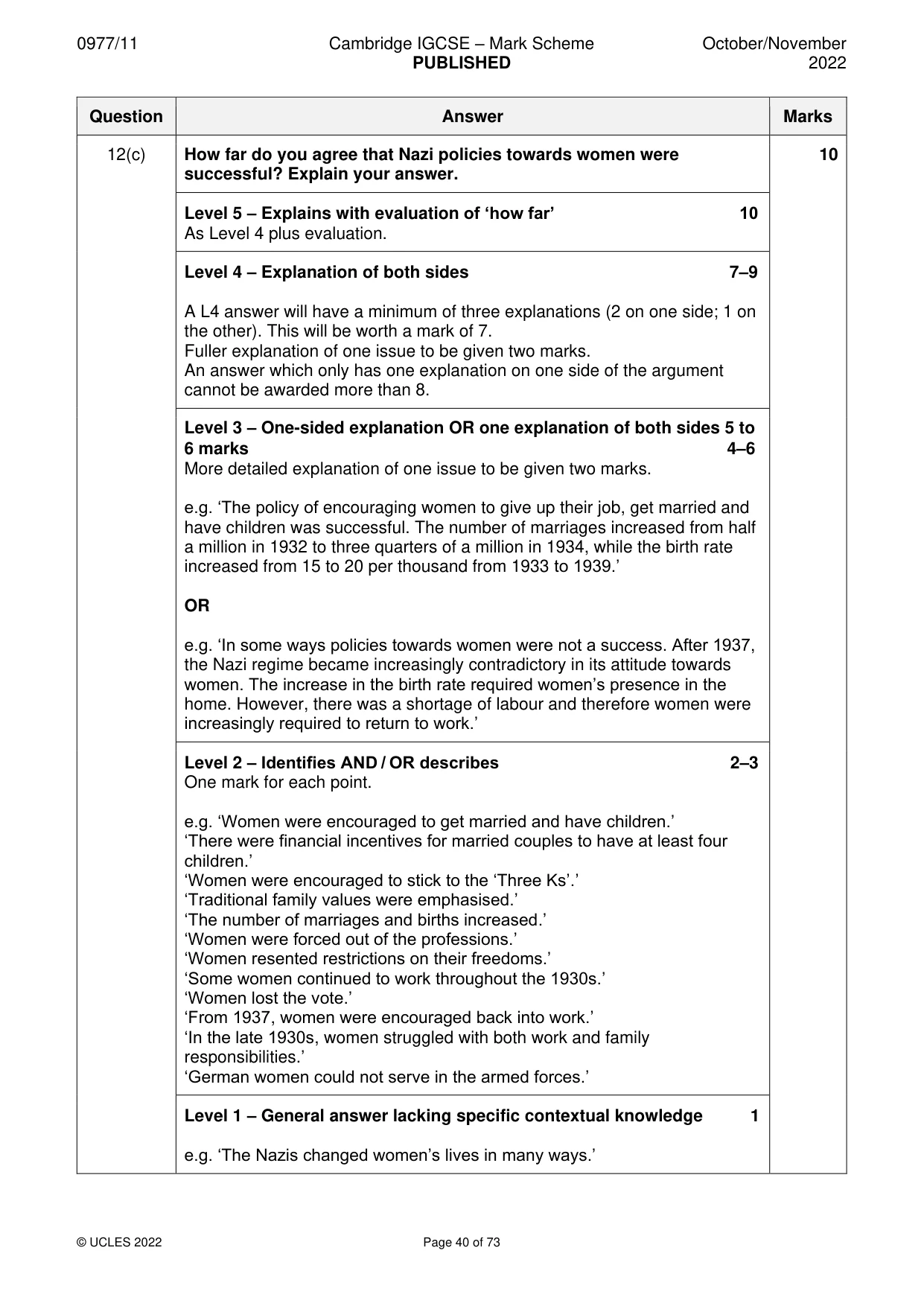
0977/11 Cambridge IGCSE – Mark Scheme PUBLISHED October/November 2022 © UCLES 2022 Page 40 of 73 Question Answer Marks 12(c) How far do you agree that Nazi policies towards women were successful? Explain your answer. 10 Level 5 – Explains with evaluation of ‘how far’ 10 As Level 4 plus evaluation. Level 4 – Explanation of both sides 7–9 A L4 answer will have a minimum of three explanations (2 on one side; 1 on the other). This will be worth a mark of 7. Fuller explanation of one issue to be given two marks. An answer which only has one explanation on one side of the argument cannot be awarded more than 8. Level 3 – One-sided explanation OR one explanation of both sides 5 to 6 marks 4–6 More detailed explanation of one issue to be given two marks. e.g. ‘The policy of encouraging women to give up their job, get married and have children was successful. The number of marriages increased from half a million in 1932 to three quarters of a million in 1934, while the birth rate increased from 15 to 20 per thousand from 1933 to 1939.’ OR e.g. ‘In some ways policies towards women were not a success. After 1937, the Nazi regime became increasingly contradictory in its attitude towards women. The increase in the birth rate required women’s presence in the home. However, there was a shortage of labour and therefore women were increasingly required to return to work.’ Level 2 – Identifies AND / OR describes 2–3 One mark for each point. e.g. ‘Women were encouraged to get married and have children.’ ‘There were financial incentives for married couples to have at least four children.’ ‘Women were encouraged to stick to the ‘Three Ks’.’ ‘Traditional family values were emphasised.’ ‘The number of marriages and births increased.’ ‘Women were forced out of the professions.’ ‘Women resented restrictions on their freedoms.’ ‘Some women continued to work throughout the 1930s.’ ‘Women lost the vote.’ ‘From 1937, women were encouraged back into work.’ ‘In the late 1930s, women struggled with both work and family responsibilities.’ ‘German women could not serve in the armed forces.’ Level 1 – General answer lacking specific contextual knowledge 1 e.g. ‘The Nazis changed women’s lives in many ways.’
Mark scheme, page 41
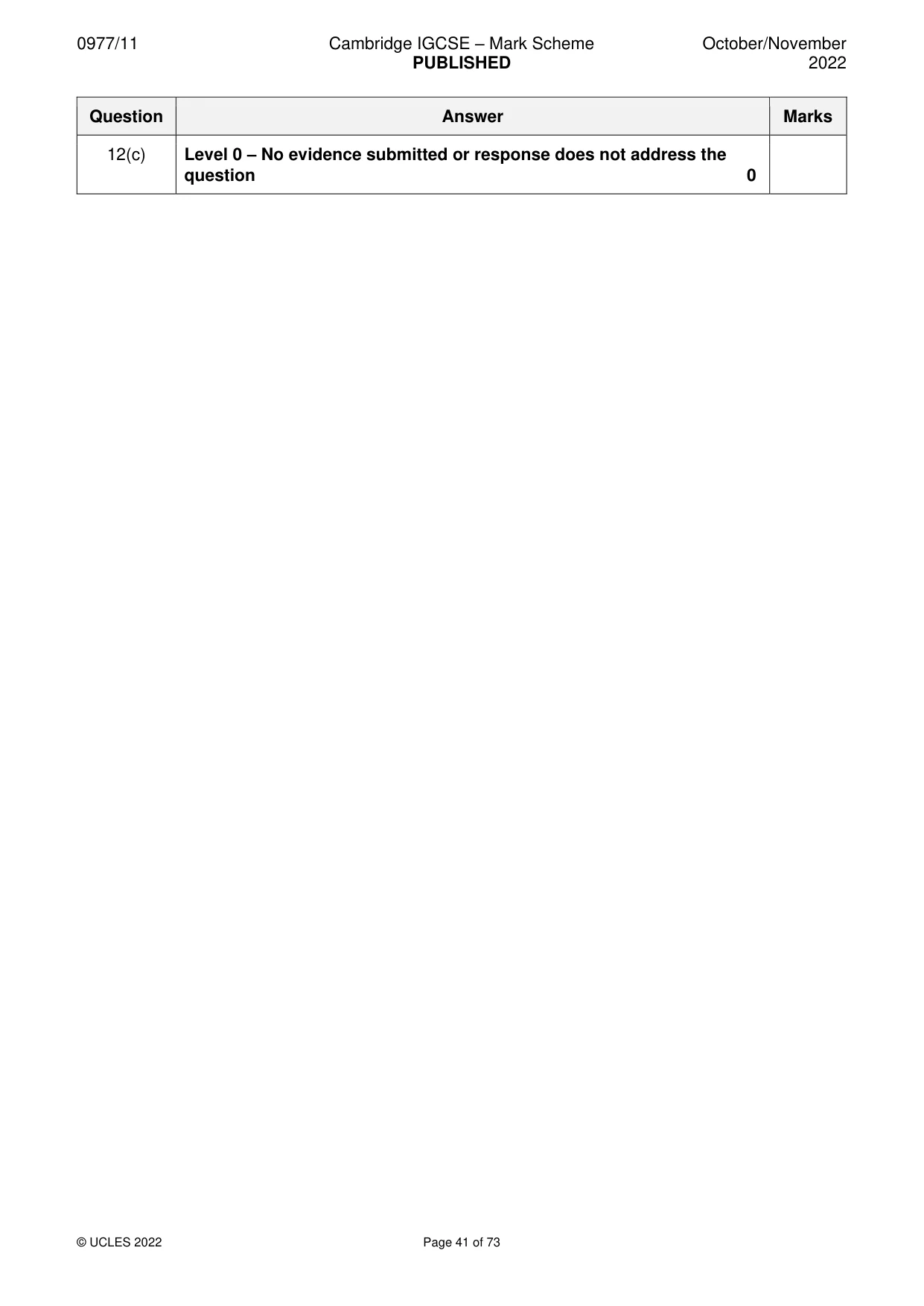
0977/11 Cambridge IGCSE – Mark Scheme PUBLISHED October/November 2022 © UCLES 2022 Page 41 of 73 Question Answer Marks 12(c) Level 0 – No evidence submitted or response does not address the question 0
Mark scheme, page 42
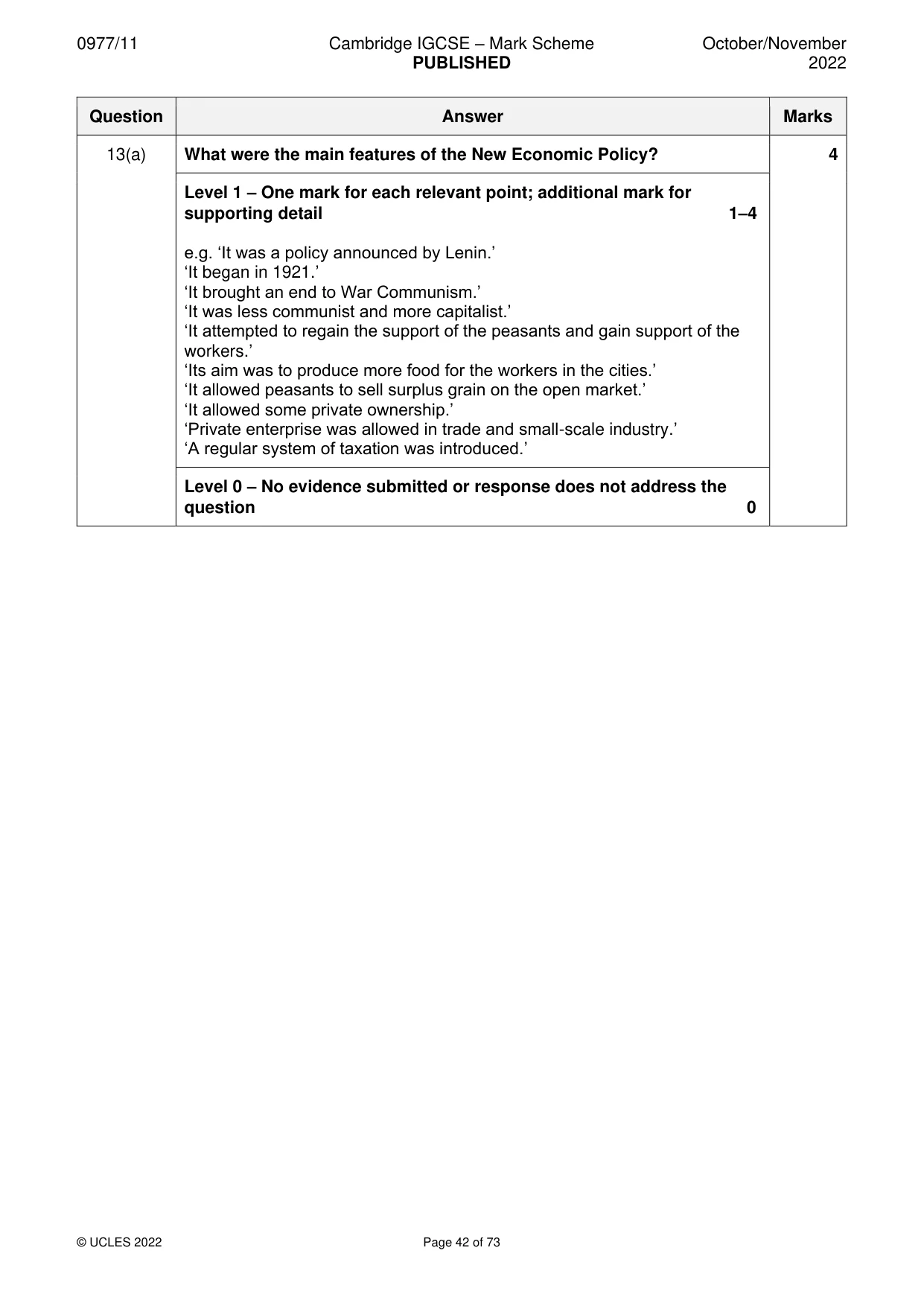
0977/11 Cambridge IGCSE – Mark Scheme PUBLISHED October/November 2022 © UCLES 2022 Page 42 of 73 Question Answer Marks 13(a) What were the main features of the New Economic Policy? 4 Level 1 – One mark for each relevant point; additional mark for supporting detail 1–4 e.g. ‘It was a policy announced by Lenin.’ ‘It began in 1921.’ ‘It brought an end to War Communism.’ ‘It was less communist and more capitalist.’ ‘It attempted to regain the support of the peasants and gain support of the workers.’ ‘Its aim was to produce more food for the workers in the cities.’ ‘It allowed peasants to sell surplus grain on the open market.’ ‘It allowed some private ownership.’ ‘Private enterprise was allowed in trade and small-scale industry.’ ‘A regular system of taxation was introduced.’ Level 0 – No evidence submitted or response does not address the question 0
Mark scheme, page 43
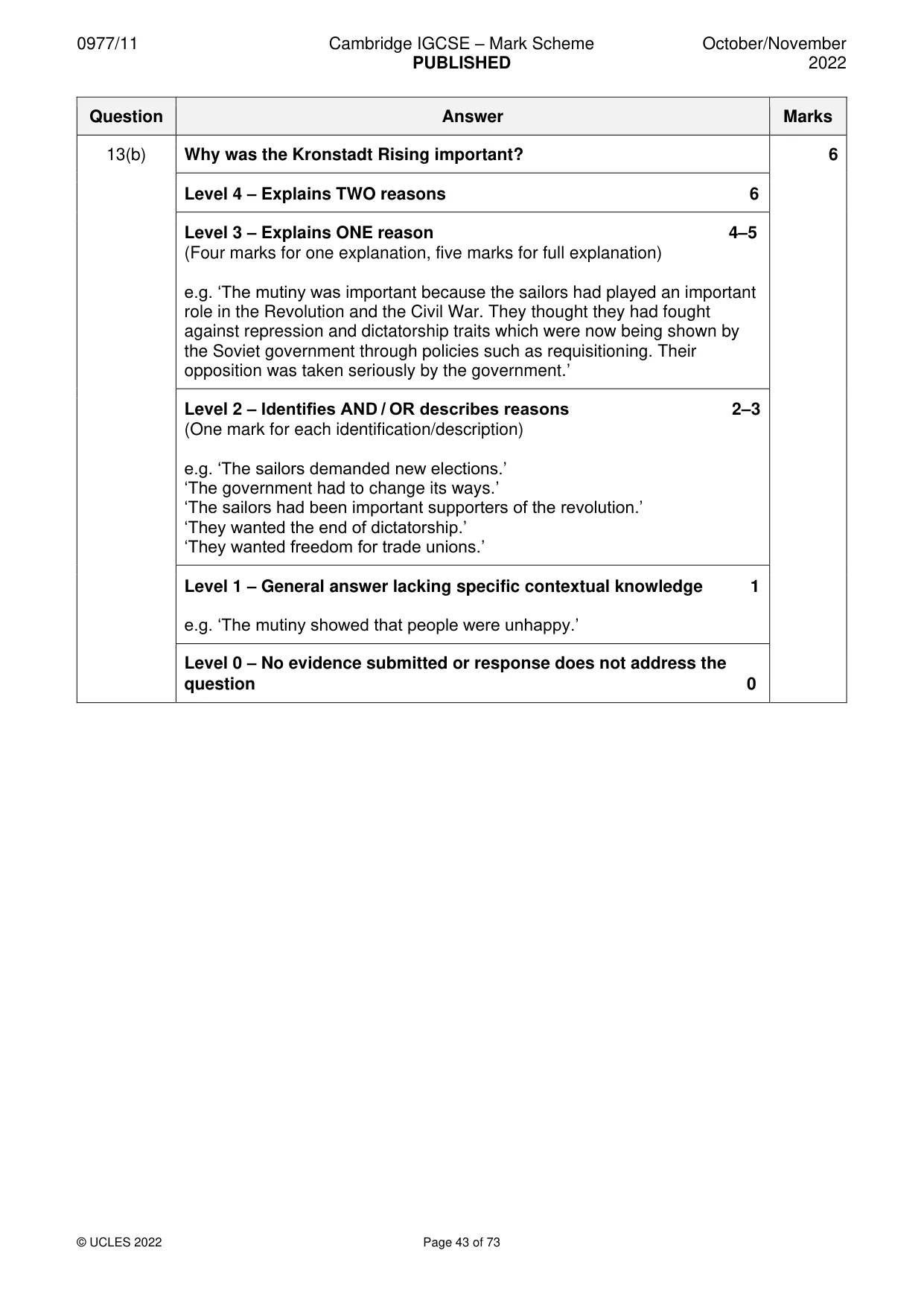
0977/11 Cambridge IGCSE – Mark Scheme PUBLISHED October/November 2022 © UCLES 2022 Page 43 of 73 Question Answer Marks 13(b) Why was the Kronstadt Rising important? 6 Level 4 – Explains TWO reasons 6 Level 3 – Explains ONE reason 4–5 (Four marks for one explanation, five marks for full explanation) e.g. ‘The mutiny was important because the sailors had played an important role in the Revolution and the Civil War. They thought they had fought against repression and dictatorship traits which were now being shown by the Soviet government through policies such as requisitioning. Their opposition was taken seriously by the government.’ Level 2 – Identifies AND / OR describes reasons 2–3 (One mark for each identification/description) e.g. ‘The sailors demanded new elections.’ ‘The government had to change its ways.’ ‘The sailors had been important supporters of the revolution.’ ‘They wanted the end of dictatorship.’ ‘They wanted freedom for trade unions.’ Level 1 – General answer lacking specific contextual knowledge 1 e.g. ‘The mutiny showed that people were unhappy.’ Level 0 – No evidence submitted or response does not address the question 0
Mark scheme, page 44
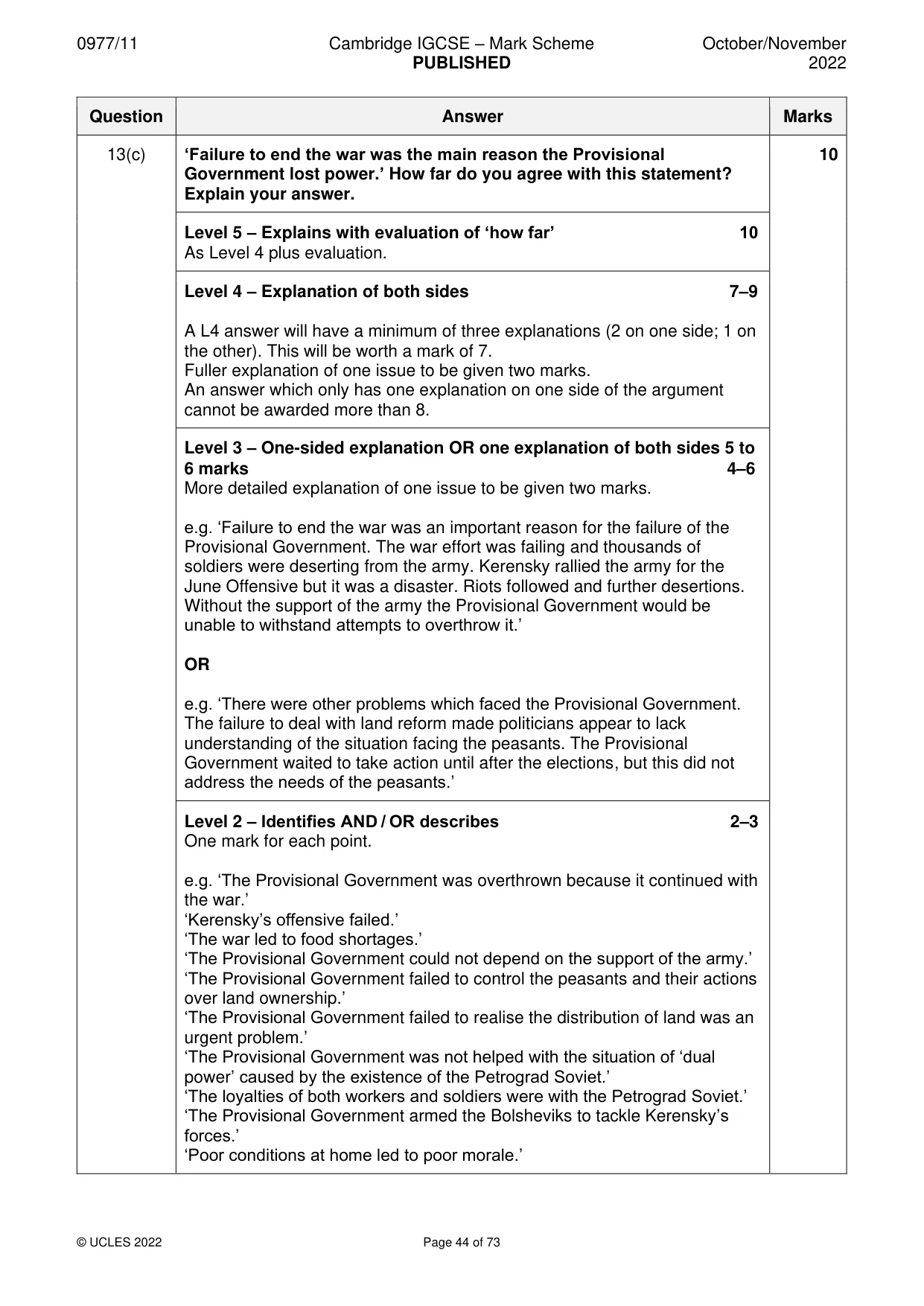
0977/11 Cambridge IGCSE – Mark Scheme PUBLISHED October/November 2022 © UCLES 2022 Page 44 of 73 Question Answer Marks 13(c) ‘Failure to end the war was the main reason the Provisional Government lost power.’ How far do you agree with this statement? Explain your answer. 10 Level 5 – Explains with evaluation of ‘how far’ 10 As Level 4 plus evaluation. Level 4 – Explanation of both sides 7–9 A L4 answer will have a minimum of three explanations (2 on one side; 1 on the other). This will be worth a mark of 7. Fuller explanation of one issue to be given two marks. An answer which only has one explanation on one side of the argument cannot be awarded more than 8. Level 3 – One-sided explanation OR one explanation of both sides 5 to 6 marks 4–6 More detailed explanation of one issue to be given two marks. e.g. ‘Failure to end the war was an important reason for the failure of the Provisional Government. The war effort was failing and thousands of soldiers were deserting from the army. Kerensky rallied the army for the June Offensive but it was a disaster. Riots followed and further desertions. Without the support of the army the Provisional Government would be unable to withstand attempts to overthrow it.’ OR e.g. ‘There were other problems which faced the Provisional Government. The failure to deal with land reform made politicians appear to lack understanding of the situation facing the peasants. The Provisional Government waited to take action until after the elections, but this did not address the needs of the peasants.’ Level 2 – Identifies AND / OR describes 2–3 One mark for each point. e.g. ‘The Provisional Government was overthrown because it continued with the war.’ ‘Kerensky’s offensive failed.’ ‘The war led to food shortages.’ ‘The Provisional Government could not depend on the support of the army.’ ‘The Provisional Government failed to control the peasants and their actions over land ownership.’ ‘The Provisional Government failed to realise the distribution of land was an urgent problem.’ ‘The Provisional Government was not helped with the situation of ‘dual power’ caused by the existence of the Petrograd Soviet.’ ‘The loyalties of both workers and soldiers were with the Petrograd Soviet.’ ‘The Provisional Government armed the Bolsheviks to tackle Kerensky’s forces.’ ‘Poor conditions at home led to poor morale.’
Mark scheme, page 45
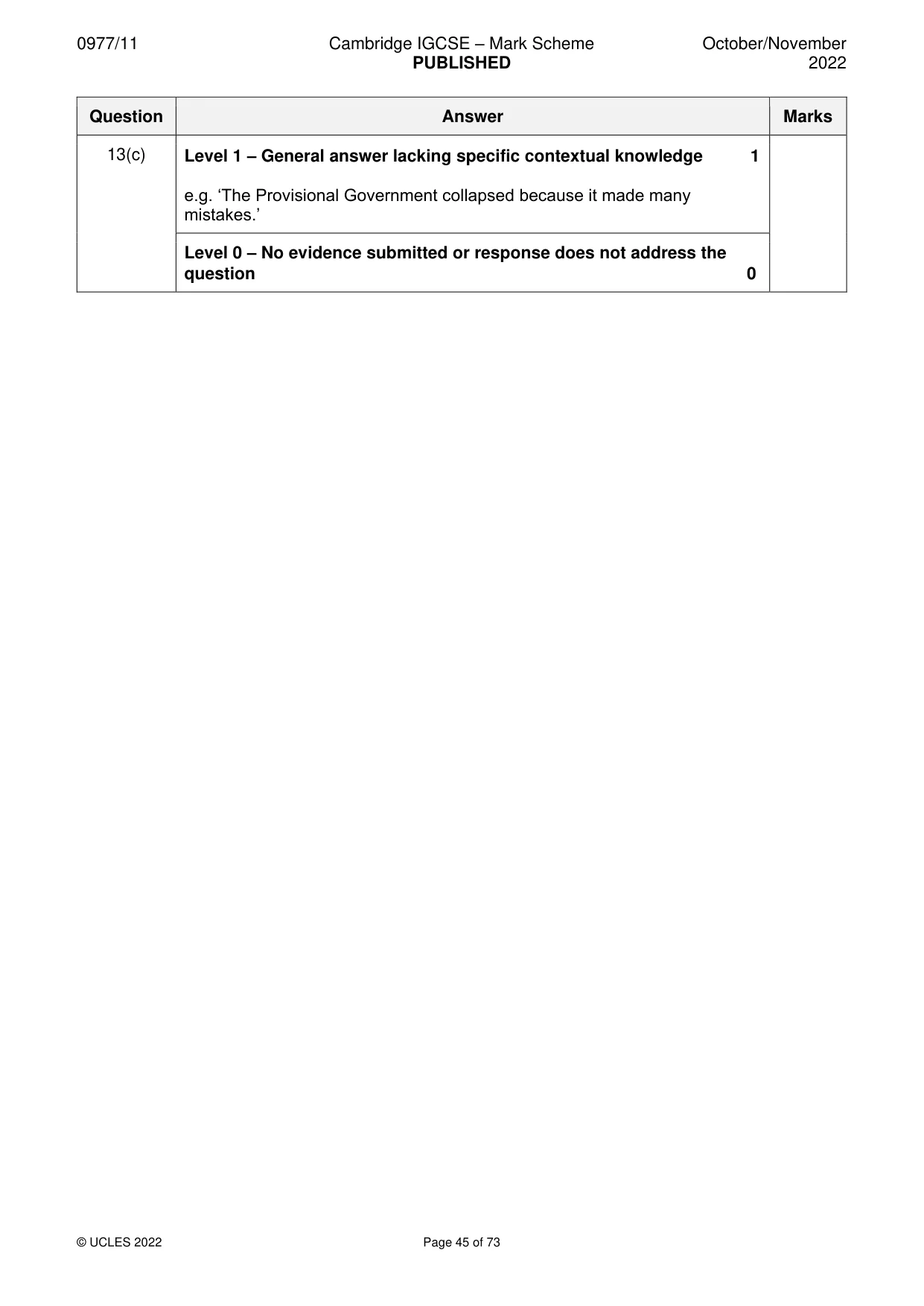
0977/11 Cambridge IGCSE – Mark Scheme PUBLISHED October/November 2022 © UCLES 2022 Page 45 of 73 Question Answer Marks 13(c) Level 1 – General answer lacking specific contextual knowledge 1 e.g. ‘The Provisional Government collapsed because it made many mistakes.’ Level 0 – No evidence submitted or response does not address the question 0
Mark scheme, page 46
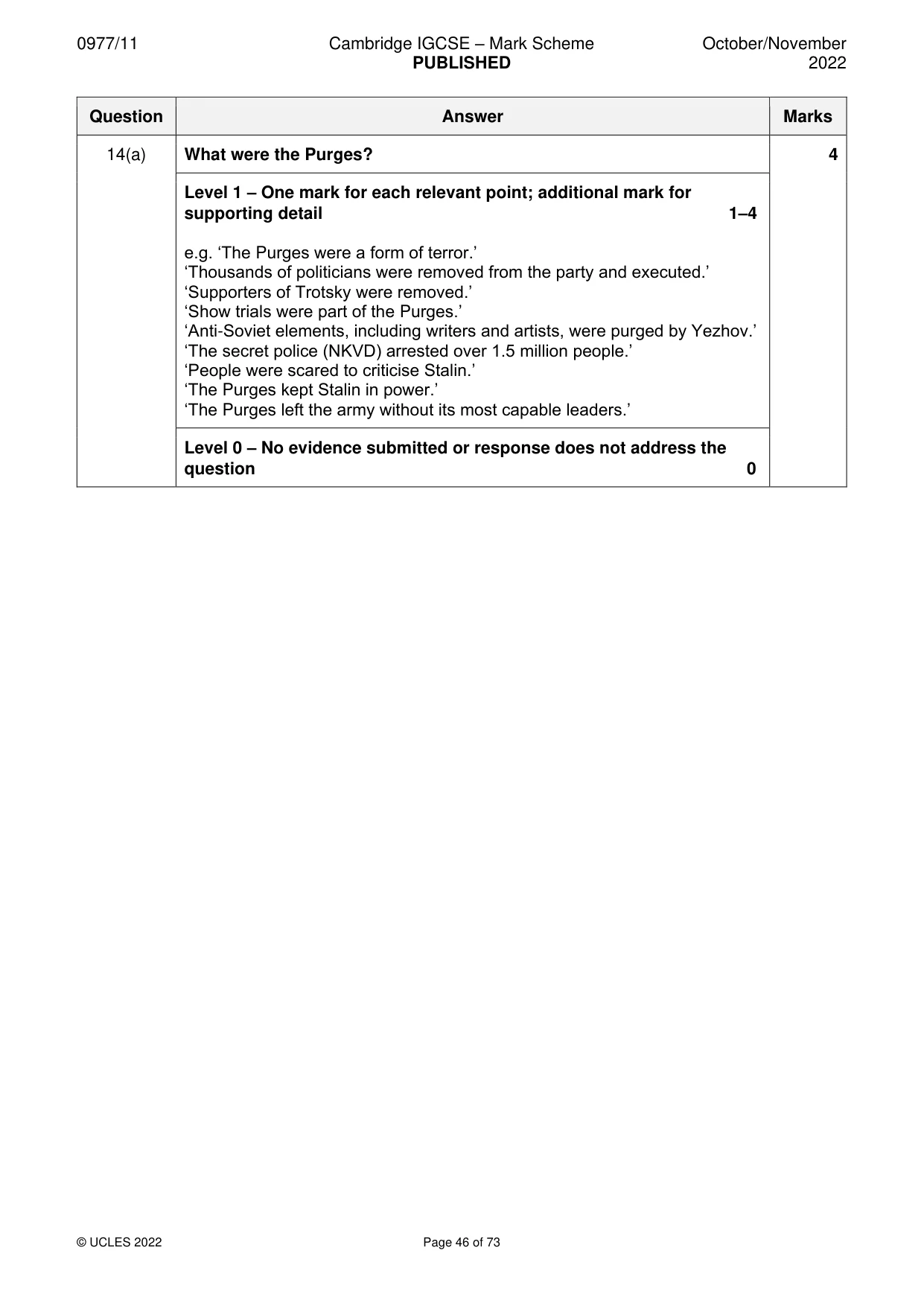
0977/11 Cambridge IGCSE – Mark Scheme PUBLISHED October/November 2022 © UCLES 2022 Page 46 of 73 Question Answer Marks 14(a) What were the Purges? 4 Level 1 – One mark for each relevant point; additional mark for supporting detail 1–4 e.g. ‘The Purges were a form of terror.’ ‘Thousands of politicians were removed from the party and executed.’ ‘Supporters of Trotsky were removed.’ ‘Show trials were part of the Purges.’ ‘Anti-Soviet elements, including writers and artists, were purged by Yezhov.’ ‘The secret police (NKVD) arrested over 1.5 million people.’ ‘People were scared to criticise Stalin.’ ‘The Purges kept Stalin in power.’ ‘The Purges left the army without its most capable leaders.’ Level 0 – No evidence submitted or response does not address the question 0
Mark scheme, page 47
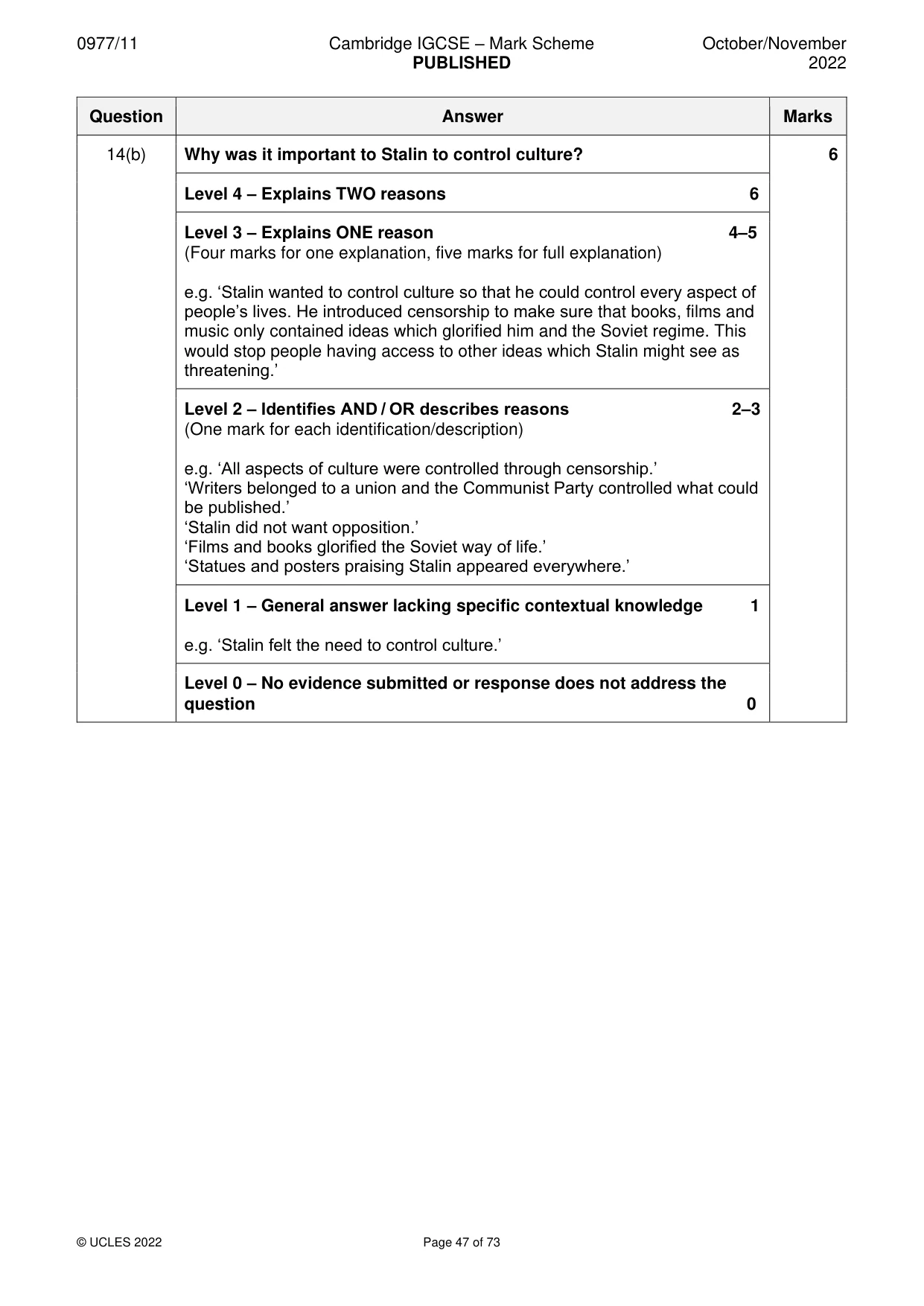
0977/11 Cambridge IGCSE – Mark Scheme PUBLISHED October/November 2022 © UCLES 2022 Page 47 of 73 Question Answer Marks 14(b) Why was it important to Stalin to control culture? 6 Level 4 – Explains TWO reasons 6 Level 3 – Explains ONE reason 4–5 (Four marks for one explanation, five marks for full explanation) e.g. ‘Stalin wanted to control culture so that he could control every aspect of people’s lives. He introduced censorship to make sure that books, films and music only contained ideas which glorified him and the Soviet regime. This would stop people having access to other ideas which Stalin might see as threatening.’ Level 2 – Identifies AND / OR describes reasons 2–3 (One mark for each identification/description) e.g. ‘All aspects of culture were controlled through censorship.’ ‘Writers belonged to a union and the Communist Party controlled what could be published.’ ‘Stalin did not want opposition.’ ‘Films and books glorified the Soviet way of life.’ ‘Statues and posters praising Stalin appeared everywhere.’ Level 1 – General answer lacking specific contextual knowledge 1 e.g. ‘Stalin felt the need to control culture.’ Level 0 – No evidence submitted or response does not address the question 0
Mark scheme, page 48
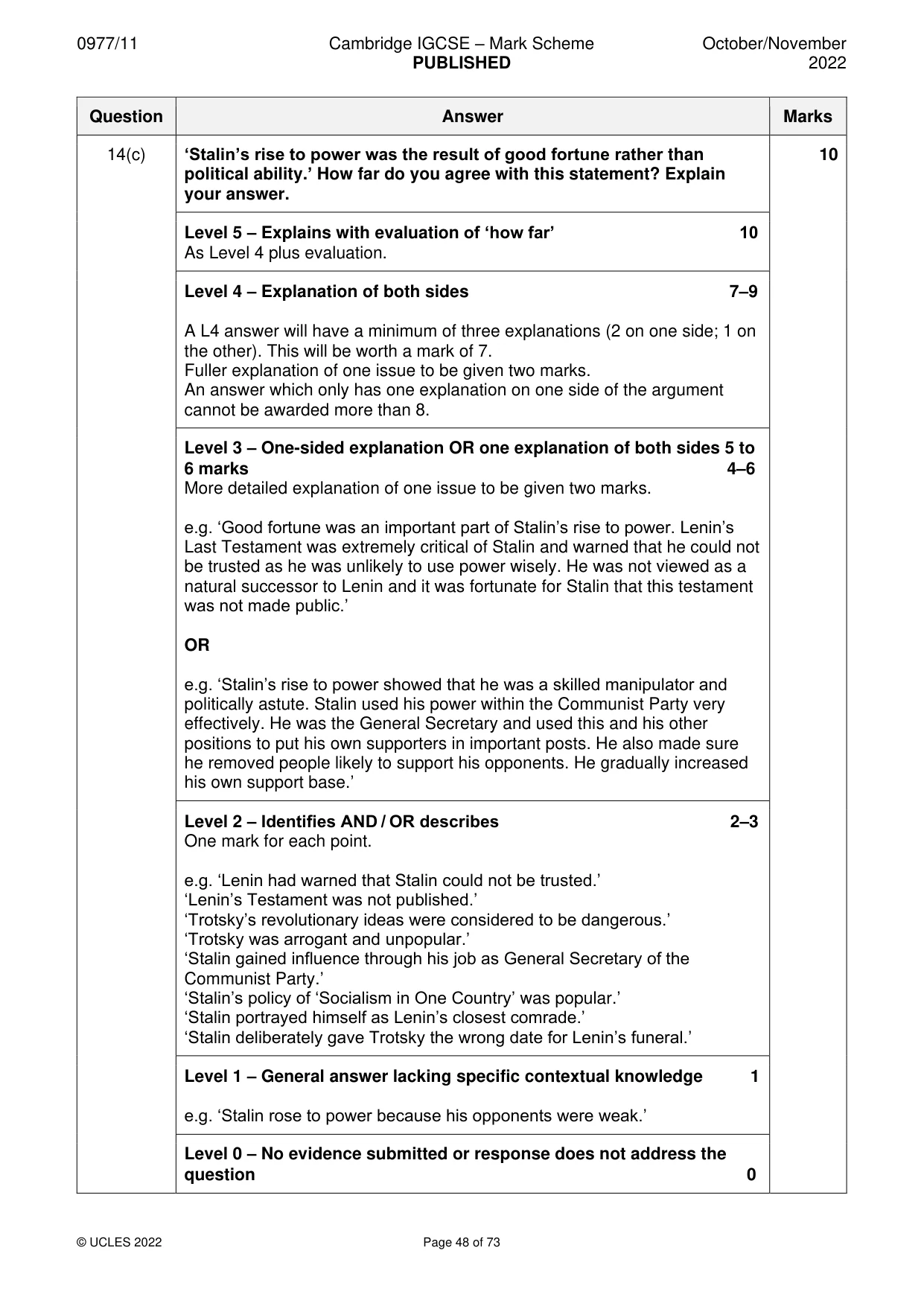
0977/11 Cambridge IGCSE – Mark Scheme PUBLISHED October/November 2022 © UCLES 2022 Page 48 of 73 Question Answer Marks 14(c) ‘Stalin’s rise to power was the result of good fortune rather than political ability.’ How far do you agree with this statement? Explain your answer. 10 Level 5 – Explains with evaluation of ‘how far’ 10 As Level 4 plus evaluation. Level 4 – Explanation of both sides 7–9 A L4 answer will have a minimum of three explanations (2 on one side; 1 on the other). This will be worth a mark of 7. Fuller explanation of one issue to be given two marks. An answer which only has one explanation on one side of the argument cannot be awarded more than 8. Level 3 – One-sided explanation OR one explanation of both sides 5 to 6 marks 4–6 More detailed explanation of one issue to be given two marks. e.g. ‘Good fortune was an important part of Stalin’s rise to power. Lenin’s Last Testament was extremely critical of Stalin and warned that he could not be trusted as he was unlikely to use power wisely. He was not viewed as a natural successor to Lenin and it was fortunate for Stalin that this testament was not made public.’ OR e.g. ‘Stalin’s rise to power showed that he was a skilled manipulator and politically astute. Stalin used his power within the Communist Party very effectively. He was the General Secretary and used this and his other positions to put his own supporters in important posts. He also made sure he removed people likely to support his opponents. He gradually increased his own support base.’ Level 2 – Identifies AND / OR describes 2–3 One mark for each point. e.g. ‘Lenin had warned that Stalin could not be trusted.’ ‘Lenin’s Testament was not published.’ ‘Trotsky’s revolutionary ideas were considered to be dangerous.’ ‘Trotsky was arrogant and unpopular.’ ‘Stalin gained influence through his job as General Secretary of the Communist Party.’ ‘Stalin’s policy of ‘Socialism in One Country’ was popular.’ ‘Stalin portrayed himself as Lenin’s closest comrade.’ ‘Stalin deliberately gave Trotsky the wrong date for Lenin’s funeral.’ Level 1 – General answer lacking specific contextual knowledge 1 e.g. ‘Stalin rose to power because his opponents were weak.’ Level 0 – No evidence submitted or response does not address the question 0
Mark scheme, page 49
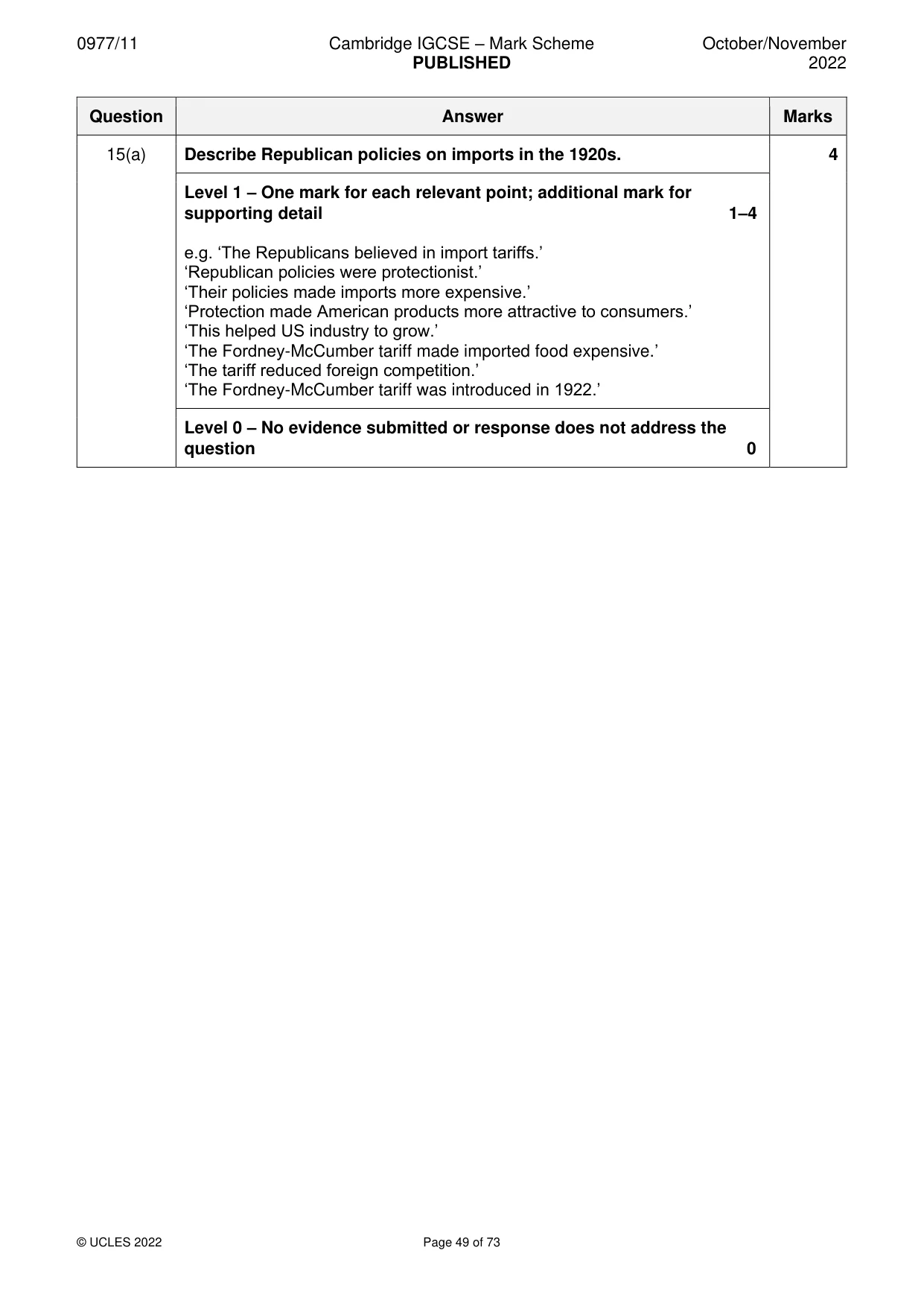
0977/11 Cambridge IGCSE – Mark Scheme PUBLISHED October/November 2022 © UCLES 2022 Page 49 of 73 Question Answer Marks 15(a) Describe Republican policies on imports in the 1920s. 4 Level 1 – One mark for each relevant point; additional mark for supporting detail 1–4 e.g. ‘The Republicans believed in import tariffs.’ ‘Republican policies were protectionist.’ ‘Their policies made imports more expensive.’ ‘Protection made American products more attractive to consumers.’ ‘This helped US industry to grow.’ ‘The Fordney-McCumber tariff made imported food expensive.’ ‘The tariff reduced foreign competition.’ ‘The Fordney-McCumber tariff was introduced in 1922.’ Level 0 – No evidence submitted or response does not address the question 0
Mark scheme, page 50
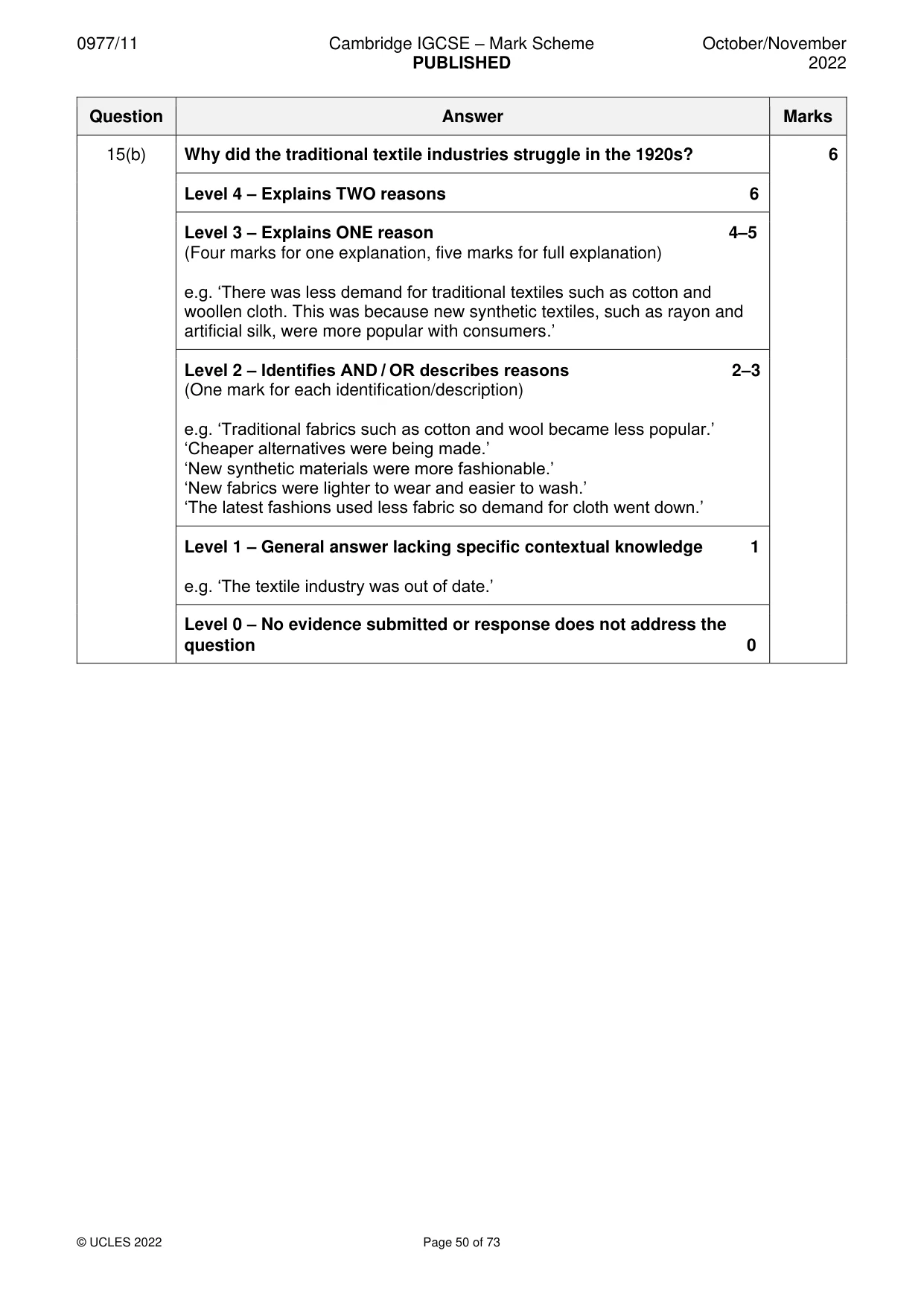
0977/11 Cambridge IGCSE – Mark Scheme PUBLISHED October/November 2022 © UCLES 2022 Page 50 of 73 Question Answer Marks 15(b) Why did the traditional textile industries struggle in the 1920s? 6 Level 4 – Explains TWO reasons 6 Level 3 – Explains ONE reason 4–5 (Four marks for one explanation, five marks for full explanation) e.g. ‘There was less demand for traditional textiles such as cotton and woollen cloth. This was because new synthetic textiles, such as rayon and artificial silk, were more popular with consumers.’ Level 2 – Identifies AND / OR describes reasons 2–3 (One mark for each identification/description) e.g. ‘Traditional fabrics such as cotton and wool became less popular.’ ‘Cheaper alternatives were being made.’ ‘New synthetic materials were more fashionable.’ ‘New fabrics were lighter to wear and easier to wash.’ ‘The latest fashions used less fabric so demand for cloth went down.’ Level 1 – General answer lacking specific contextual knowledge 1 e.g. ‘The textile industry was out of date.’ Level 0 – No evidence submitted or response does not address the question 0
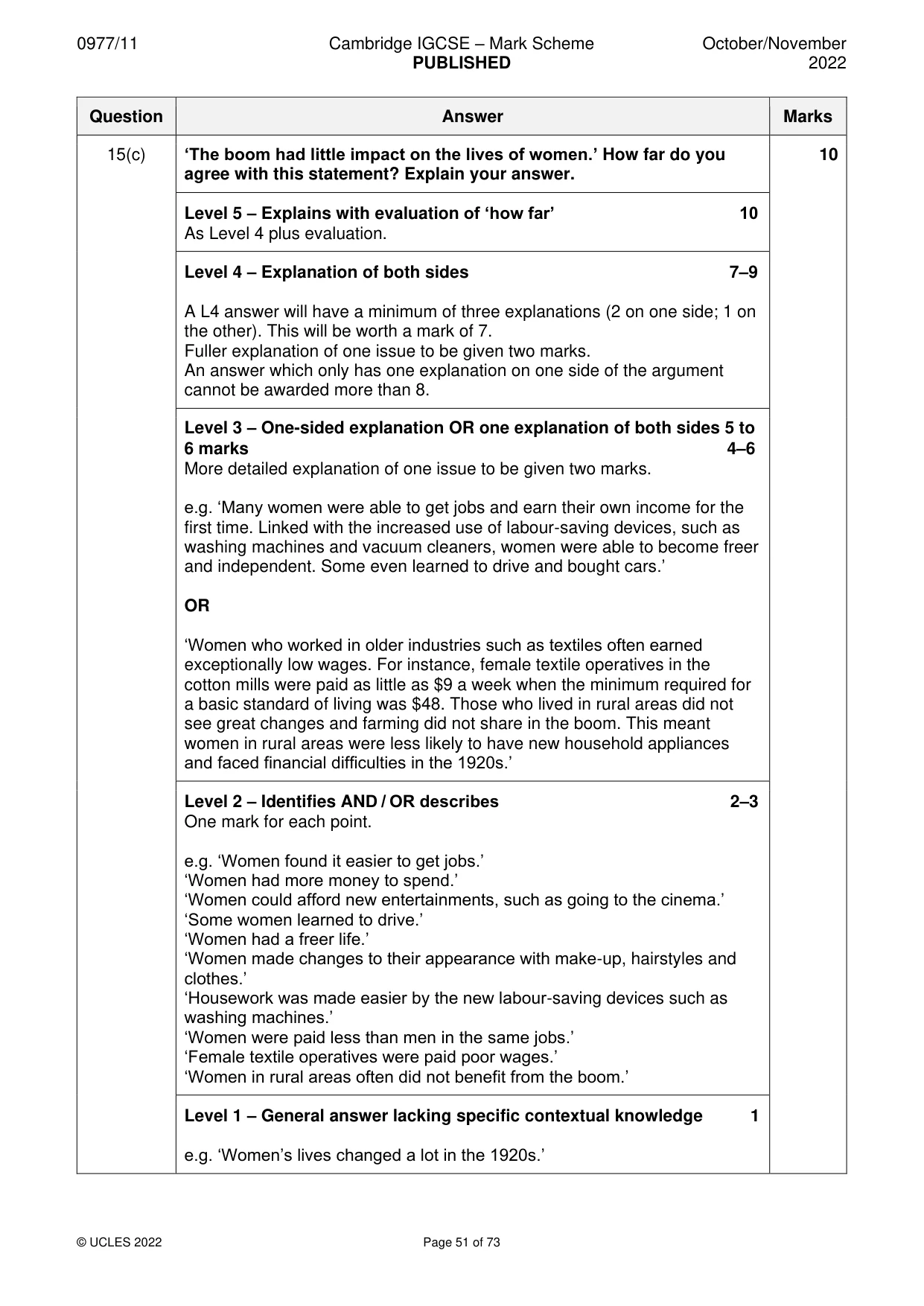
Mark scheme, page 51
0977/11 Cambridge IGCSE – Mark Scheme PUBLISHED October/November 2022 © UCLES 2022 Page 51 of 73 Question Answer Marks 15(c) ‘The boom had little impact on the lives of women.’ How far do you agree with this statement? Explain your answer. 10 Level 5 – Explains with evaluation of ‘how far’ 10 As Level 4 plus evaluation. Level 4 – Explanation of both sides 7–9 A L4 answer will have a minimum of three explanations (2 on one side; 1 on the other). This will be worth a mark of 7. Fuller explanation of one issue to be given two marks. An answer which only has one explanation on one side of the argument cannot be awarded more than 8. Level 3 – One-sided explanation OR one explanation of both sides 5 to 6 marks 4–6 More detailed explanation of one issue to be given two marks. e.g. ‘Many women were able to get jobs and earn their own income for the first time. Linked with the increased use of labour-saving devices, such as washing machines and vacuum cleaners, women were able to become freer and independent. Some even learned to drive and bought cars.’ OR ‘Women who worked in older industries such as textiles often earned exceptionally low wages. For instance, female textile operatives in the cotton mills were paid as little as $9 a week when the minimum required for a basic standard of living was $48. Those who lived in rural areas did not see great changes and farming did not share in the boom. This meant women in rural areas were less likely to have new household appliances and faced financial difficulties in the 1920s.’ Level 2 – Identifies AND / OR describes 2–3 One mark for each point. e.g. ‘Women found it easier to get jobs.’ ‘Women had more money to spend.’ ‘Women could afford new entertainments, such as going to the cinema.’ ‘Some women learned to drive.’ ‘Women had a freer life.’ ‘Women made changes to their appearance with make-up, hairstyles and clothes.’ ‘Housework was made easier by the new labour-saving devices such as washing machines.’ ‘Women were paid less than men in the same jobs.’ ‘Female textile operatives were paid poor wages.’ ‘Women in rural areas often did not benefit from the boom.’ Level 1 – General answer lacking specific contextual knowledge 1 e.g. ‘Women’s lives changed a lot in the 1920s.’
Mark scheme, page 52
0977/11 Cambridge IGCSE – Mark Scheme PUBLISHED October/November 2022 © UCLES 2022 Page 52 of 73 Question Answer Marks 15(c) Level 0 – No evidence submitted or response does not address the question 0
Mark scheme, page 53
0977/11 Cambridge IGCSE – Mark Scheme PUBLISHED October/November 2022 © UCLES 2022 Page 53 of 73 Question Answer Marks 16(a) Describe how some Americans broke Prohibition laws. 4 Level 1 – One mark for each relevant point; additional mark for supporting detail 1–4 e.g. ‘Many Americans went to speakeasies.’ ‘Speakeasies were supplied with illegal liquor.’ ‘Bootleggers smuggled illegal liquor into the country.’ ‘Some brewed their own drinks known as moonshine.’ ‘Corrupt policemen and judges did not enforce Prohibition laws.’ Level 0 – No evidence submitted or response does not address the question 0
Mark scheme, page 54
0977/11 Cambridge IGCSE – Mark Scheme PUBLISHED October/November 2022 © UCLES 2022 Page 54 of 73 Question Answer Marks 16(b) Why did the demand for popular entertainment increase in the 1920s? 6 Level 4 – Explains TWO reasons 6 Level 3 – Explains ONE reason 4–5 (Four marks for one explanation, five marks for full explanation) e.g. ‘Entertainment was more in demand in the 1920s because the average working week dropped from 47 hours to 44 hours so people had more leisure time. Average wages rose by 10% in real terms so workers had more disposable income. Many chose to channel this spare time and money into entertainment.’ Level 2 – Identifies AND / OR describes reasons 2–3 (One mark for each identification/description) e.g. ‘Most people had more leisure time.’ ‘People had more disposable income.’ ‘There was an attitude of ‘putting the war behind them’ and enjoying life.’ ‘Radios could be purchased in instalments.’ ‘Cinemas were improving technically.’ ‘There were numerous sporting heroes and people followed them.’ ‘The car helped their owners to and from the entertainments.’ ‘People wanted to listen to jazz music.’ Level 1 – General answer lacking specific contextual knowledge 1 e.g. ‘People wanted different things to do.’ Level 0 – No evidence submitted or response does not address the question 0
Mark scheme, page 55
0977/11 Cambridge IGCSE – Mark Scheme PUBLISHED October/November 2022 © UCLES 2022 Page 55 of 73 Question Answer Marks 16(c) How far do you agree that immigrants were the group that suffered most from intolerance in the 1920s? Explain your answer. 10 Level 5 – Explains with evaluation of ‘how far’ 10 As Level 4 plus evaluation. Level 4 – Explanation of both sides 7–9 A L4 answer will have a minimum of three explanations (2 on one side; 1 on the other). This will be worth a mark of 7. Fuller explanation of one issue to be given two marks. An answer which only has one explanation on one side of the argument cannot be awarded more than 8. Level 3 – One-sided explanation OR one explanation of both sides 5 to 6 marks 4–6 More detailed explanation of one issue to be given two marks. e.g. ‘New immigrants to the US suffered. People in 1920s America were scared by the idea that communism could take hold in their country. This ‘Red Scare’ meant immigrants, anyone with extreme political views and anyone who was not a WASP could be targeted. Many new immigrants were from Eastern Europe or Russia and they found it difficult to get work.’ OR e.g. ‘Black Americans suffered discrimination. The Ku Klux Klan was an important example of intolerance in 1920s America. It was an organisation that believed in white supremacy. The Klan regarded black Americans as inferior and used violence to intimidate them.’ Level 2 – Identifies AND / OR describes 2–3 One mark for each point. e.g. ‘Many Americans thought eastern European immigrants were all communists.’ ‘The 1919 General Strike was considered to be evidence of a communist plot.’ ‘Sacco and Vanzetti were victims of the Red Scare.’ ‘Immigration laws discriminated against certain national groups.’ ‘The Ku Klux Klan intimidated black Americans.’ ‘There was discrimination against black Americans.’ ‘Native Americans were discriminated against over jobs and housing.’ ‘Women were discriminated against over jobs and pay and in politics.’ Level 1 – General answer lacking specific contextual knowledge 1 e.g. ‘White Americans had most opportunities in the 1920s.’ Level 0 – No evidence submitted or response does not address the question 0
Mark scheme, page 56
0977/11 Cambridge IGCSE – Mark Scheme PUBLISHED October/November 2022 © UCLES 2022 Page 56 of 73 Question Answer Marks 17(a) What was the Long March? 4 Level 1 – One mark for each relevant point; additional mark for supporting detail 1–4 e.g. ‘The Communists marched roughly 8000 miles.’ ‘There were over 100 000 people on the March.’ ‘The Long March began in 1934.’ ‘The Long March lasted for just over a year.’ ‘The Communists marched from Jiangxi to Yenan.’ ‘The Long March crossed 18 mountain ranges.’ ‘The Long March passed through 11 provinces.’ Level 0 – No evidence submitted or response does not address the question 0
Mark scheme, page 57
0977/11 Cambridge IGCSE – Mark Scheme PUBLISHED October/November 2022 © UCLES 2022 Page 57 of 73 Question Answer Marks 17(b) Why did the Second World War weaken the Nationalists? 6 Level 4 – Explains TWO reasons 6 Level 3 – Explains ONE reason 4–5 (Four marks for one explanation, five marks for full explanation) e.g. ‘The Second World War weakened the Nationalists because Chiang Kai-shek proved reluctant to engage the Japanese in military confrontation and adopted defensive positions. He ignored the advice of American military advisers who urged him to attack the Japanese. This annoyed the Chinese peasants who wanted to see their own government fight the Japanese.’ Level 2 – Identifies AND / OR describes reasons 2–3 (One mark for each identification/description) e.g. ‘The Nationalist government did not attack the Japanese.’ ‘The Nationalists wasted huge amounts of aid and equipment from the USA.’ ‘Senior members of the KMT were corrupt and embezzled US funds for personal use.’ ‘The peasantry supported the Communists because they took direct action against the Japanese.’ Level 1 – General answer lacking specific contextual knowledge 1 e.g. ‘The Nationalists were weak because they were unpopular.’ Level 0 – No evidence submitted or response does not address the question 0
Mark scheme, page 58
0977/11 Cambridge IGCSE – Mark Scheme PUBLISHED October/November 2022 © UCLES 2022 Page 58 of 73 Question Answer Marks 17(c) How far do you agree that the outcome of the Civil War was decided by the peasantry? Explain your answer. 10 Level 5 – Explains with evaluation of ‘how far’ 10 As Level 4 plus evaluation. Level 4 – Explanation of both sides 7–9 A L4 answer will have a minimum of three explanations (2 on one side; 1 on the other). This will be worth a mark of 7. Fuller explanation of one issue to be given two marks. An answer which only has one explanation on one side of the argument cannot be awarded more than 8. Level 3 – One-sided explanation OR one explanation of both sides 5 to 6 marks 4–6 More detailed explanation of one issue to be given two marks. e.g. ‘Mao won the Civil War because he was extremely popular with the peasants. He had fought the Japanese hard in the Second World War, and during the Civil War the Communists were always considerate towards the peasants. The peasants were also attracted to the Communists because they were promised land. This meant the peasants fought loyally for the Communists.’ OR e.g. ‘Other factors were important. For instance, the Communists used guerrilla tactics. They knew they could not afford to engage in large scale attacks as this would be too costly in terms of manpower and supplies. Therefore, they made calculated attacks against small targets to cause problems for the KMT.’ Level 2 – Identifies AND / OR describes 2–3 One mark for each point. e.g. ‘Mao won respect for looking after China’s interests.’ ‘Mao treated the peasants well.’ ‘Mao used guerrilla warfare.’ ‘Chiang was considered corrupt and not popular.’ ‘Mao won the hearts and minds of the peasantry.’ Level 1 – General answer lacking specific contextual knowledge 1 e.g. ‘Many groups supported the Communists in the Civil War.’ Level 0 – No evidence submitted or response does not address the question 0
Mark scheme, page 59
0977/11 Cambridge IGCSE – Mark Scheme PUBLISHED October/November 2022 © UCLES 2022 Page 59 of 73 Question Answer Marks 18(a) What was the role of the Red Guards in the Cultural Revolution? 4 Level 1 – One mark for each relevant point; additional mark for supporting detail 1–4 e.g. ‘The Red Guards led the campaign against the Four Olds.’ ‘The Red Guards were protecting the ideas of the revolution.’ ‘They used violence to defend the revolution against western ideas.’ ‘Thousands of people were tortured and imprisoned by the Red Guards.’ ‘They confiscated antiques.’ ‘They placed posters with the names and crimes of people on the streets.’ ‘They tried to remove ancient art forms.’ Level 0 – No evidence submitted or response does not address the question 0
Mark scheme, page 60
0977/11 Cambridge IGCSE – Mark Scheme PUBLISHED October/November 2022 © UCLES 2022 Page 60 of 73 Question Answer Marks 18(b) Why was the Cultural Revolution important to Mao’s leadership? 6 Level 4 – Explains TWO reasons 6 Level 3 – Explains ONE reason 4–5 (Four marks for one explanation, five marks for full explanation) e.g. ‘Since the failure of the Great Leap Forward, Mao had lost his position as Chairman of the Party. Mao wanted to return to a powerful position. As the Great Leap Forward had been widely discredited, Mao was worried his position in history was under threat. A new movement would help re- establish his influence.’ Level 2 – Identifies AND / OR describes reasons 2–3 (One mark for each identification/description) e.g. ‘Mao wanted to regain his influence after the failure of the Great Leap Forward.’ ‘Mao had lost his position as Party Chairman.’ ‘Mao considered his place in history was under threat.’ ‘Mao was concerned the revolution was heading towards a Soviet model with privileged groups.’ ‘Liu Shaoqi did not favour collective farms and factories which Mao had introduced.’ ‘Young people seemed less connected to the communist model and needed enthusing.’ ‘The less well off and poorly educated seemed to be turning against the spirit of the revolution.’ ‘Elements of capitalism, such as private trade, had made certain people richer than others.’ Level 1 – General answer lacking specific contextual knowledge 1 e.g. ‘Mao wanted to change attitudes.’ Level 0 – No evidence submitted or response does not address the question 0
Mark scheme, page 61
0977/11 Cambridge IGCSE – Mark Scheme PUBLISHED October/November 2022 © UCLES 2022 Page 61 of 73 Question Answer Marks 18(c) ‘The greatest social impact of the Cultural Revolution was on education.’ How far do you agree with this statement? Explain your answer. 10 Level 5 – Explains with evaluation of ‘how far’ 10 As Level 4 plus evaluation. Level 4 – Explanation of both sides 7–9 A L4 answer will have a minimum of three explanations (2 on one side; 1 on the other). This will be worth a mark of 7. Fuller explanation of one issue to be given two marks. An answer which only has one explanation on one side of the argument cannot be awarded more than 8. Level 3 – One-sided explanation OR one explanation of both sides 5 to 6 marks 4–6 More detailed explanation of one issue to be given two marks. e.g. ‘The Cultural Revolution had a huge impact on education. The closure of schools and colleges led to a lowering of academic standards. Some areas of China had illiteracy rates as high as 40% twenty years after the revolution. The elimination of qualified teachers meant many areas were forced to rely upon chosen students to re-educate the next generation.’ OR e.g. ‘The Cultural Revolution also had an impact on the lives of young people. Millions of young people joined the Red Guards. The young were expected to question their parents, although this had been forbidden in traditional Chinese culture. Slogans such as ‘Parents may love me, but not as much as Chairman Mao’ were common. Many young people became more loyal to the regime.’ Level 2 – Identifies AND / OR describes 2–3 One mark for each point. e.g. ‘Schools and colleges were closed.’ ‘Millions of students formed the Red Guards.’ ‘Historic sites, artefacts and museum pieces were destroyed.’ ‘People were encouraged to question their parents and teachers.’ ‘Traditional Chinese traditions and classical Chinese literature were discouraged.’ Level 1 – General answer lacking specific contextual knowledge 1 e.g. ‘The Cultural Revolution changed China.’ Level 0 – No evidence submitted or response does not address the question 0
Mark scheme, page 62
0977/11 Cambridge IGCSE – Mark Scheme PUBLISHED October/November 2022 © UCLES 2022 Page 62 of 73 Question Answer Marks 19(a) What was the Native Urban Areas Act, 1923? 4 Level 1 – One mark for each relevant point; additional mark for supporting detail 1–4 e.g. ‘This act introduced segregated housing.’ ‘Towns and cities were divided into black and white areas.’ ‘It meant townships were built.’ ‘It meant towns were for white people only.’ ‘Black South Africans were only admitted to white areas to work.’ Level 0 – No evidence submitted or response does not address the question 0
Mark scheme, page 63
0977/11 Cambridge IGCSE – Mark Scheme PUBLISHED October/November 2022 © UCLES 2022 Page 63 of 73 Question Answer Marks 19(b) Why were many black South Africans forced out of farming? 6 Level 4 – Explains TWO reasons 6 Level 3 – Explains ONE reason 4–5 (Four marks for one explanation, five marks for full explanation) e.g. ‘Many black South Africans were forced out of farming because of the 1913 Natives Land Act. Under the act, only 7% of South African land was allocated to black farmers. This prevented them from practising sharecropping and they were thrown off the land.’ Level 2 – Identifies AND / OR describes reasons 2–3 (One mark for each identification/description) e.g. ‘The 1913 Natives Land Act prevented black people from owning land.’ ‘Black people could only own land in the native reserves.’ ‘The 1913 Natives Land Act prevented black people from practising sharecropping.’ ‘The 1913 Act forced black people to seek work on white-owned farms.’ ‘Black people could only occupy white-owned land if they worked for the farmer.’ ‘Black people became cheap labour on large farms run by white people.’ Level 1 – General answer lacking specific contextual knowledge 1 e.g. ‘Black people could not afford to buy land.’ Level 0 – No evidence submitted or response does not address the question 0
Mark scheme, page 64
0977/11 Cambridge IGCSE – Mark Scheme PUBLISHED October/November 2022 © UCLES 2022 Page 64 of 73 Question Answer Marks 19(c) How far do you agree that the impact of the Second World War was the main reason for the National Party’s success in the 1948 election? Explain your answer. 10 Level 5 – Explains with evaluation of ‘how far’ 10 As Level 4 plus evaluation. Level 4 – Explanation of both sides 7–9 A L4 answer will have a minimum of three explanations (2 on one side; 1 on the other). This will be worth a mark of 7. Fuller explanation of one issue to be given two marks. An answer which only has one explanation on one side of the argument cannot be awarded more than 8. Level 3 – One-sided explanation OR one explanation of both sides 5 to 6 marks 4–6 More detailed explanation of one issue to be given two marks. e.g. ‘The Second World War caused changes which were partly responsible for the National Party winning the election in 1948. The war led to industrial expansion and the need for black workers who moved to the towns. They began to outnumber white people. The United Party government responded by relaxing some laws and regulations. Many white South Africans and Afrikaners saw these changes as a threat and voted for the National Party.’ OR e.g. ‘The voting system was partly responsible for the Nationalist victory. The National Party and the Afrikaner Party won 79 seats in the House of Assembly against a combined total of 74 won by the United Party and the Labour Party. Due to the ‘first past the post’ system, the National Party had won more seats, even though the United Party had received 11% more votes.’ Level 2 – Identifies AND / OR describes 2–3 One mark for each point. e.g. ‘Malan’s Party appealed to many white voters.’ ‘The changes brought about by the war were not welcomed by many white people.’ ‘Malan had the support of the press.’ ‘He won over the workers in the industrial heart of South Africa.’ ‘Malan formed an alliance with the Afrikaner Party.’ ‘The first past the post system gave Malan the majority.’ Level 1 – General answer lacking specific contextual knowledge 1 e.g. ‘The opposition to the National Party was weak.’ Level 0 – No evidence submitted or response does not address the question 0
Mark scheme, page 65
0977/11 Cambridge IGCSE – Mark Scheme PUBLISHED October/November 2022 © UCLES 2022 Page 65 of 73 Question Answer Marks 20(a) Describe the United Nations’ opposition to apartheid. 4 Level 1 – One mark for each relevant point; additional mark for supporting detail 1–4 e.g. ‘The UN led international criticism of apartheid.’ ‘The General Assembly passed annual resolutions condemning apartheid.’ ‘The General Assembly set up a Special Committee on Apartheid.’ ‘The UN Unit on Apartheid produced publications on racism in South Africa.’ ‘In 1973, the General Assembly declared apartheid to be ‘a crime against humanity’.’ Level 0 – No evidence submitted or response does not address the question 0
Mark scheme, page 66
0977/11 Cambridge IGCSE – Mark Scheme PUBLISHED October/November 2022 © UCLES 2022 Page 66 of 73 Question Answer Marks 20(b) Why were some countries in southern Africa afraid to oppose apartheid in the 1970s? 6 Level 4 – Explains TWO reasons 6 Level 3 – Explains ONE reason 4–5 (Four marks for one explanation, five marks for full explanation) e.g. ‘Some countries would have liked to take action but were too afraid of the consequences as South Africa had the strongest military forces in the region. For instance, Botswana and Swaziland were partly surrounded by South African territory and would not have been able to withstand an attack by South African forces.’ Level 2 – Identifies AND / OR describes reasons 2–3 (One mark for each identification/description) e.g. ‘Some countries were surrounded by South African territory.’ ‘South Africa had the strongest military forces in the region.’ ‘Lesotho was completely surrounded by South African territory and relied on South Africa for work.’ ‘Zambia relied on food imports from South Africa.’ ‘Countries were afraid to oppose South Africa as they were not strong enough to withstand attack.’ Level 1 – General answer lacking specific contextual knowledge 1 e.g. ‘There were many risks in going against South Africa.’ Level 0 – No evidence submitted or response does not address the question 0
Mark scheme, page 67
0977/11 Cambridge IGCSE – Mark Scheme PUBLISHED October/November 2022 © UCLES 2022 Page 67 of 73 Question Answer Marks 20(c) ‘Economic developments in the 1970s benefited South Africans.’ How far do you agree with this statement? Explain your answer. 10 Level 5 – Explains with evaluation of ‘how far’ 10 As Level 4 plus evaluation. Level 4 – Explanation of both sides 7–9 A L4 answer will have a minimum of three explanations (2 on one side; 1 on the other). This will be worth a mark of 7. Fuller explanation of one issue to be given two marks. An answer which only has one explanation on one side of the argument cannot be awarded more than 8. Level 3 – One-sided explanation OR one explanation of both sides 5 to 6 marks 4–6 More detailed explanation of one issue to be given two marks. e.g. ‘The white population benefited from the booming economy, enjoying a rising standard of living, high standards of health care and increasing life expectancy. White farmers used subsidies to mechanise their farms and increase output.’ OR e.g. ‘Although wages did rise for black workers during the 1970s, the workers were still paid a fraction of what a white worker earned for doing the same job. Unemployment amongst black workers was high, resulting in poverty, malnutrition and early death.’ Level 2 – Identifies AND / OR describes 2–3 One mark for each point. e.g. ‘South Africa had a huge unequal distribution of wealth and income.’ ‘The main beneficiaries of the booming economy were white South Africans.’ ‘The Afrikaner farmers received massive state support.’ ‘Black wages rose in the 1970s.’ ‘A quarter of black working people were unemployed in the 1970s.’ Level 1 – General answer lacking specific contextual knowledge 1 e.g. ‘The South African economy grew stronger in this period.’ Level 0 – No evidence submitted or response does not address the question 0
Mark scheme, page 68
0977/11 Cambridge IGCSE – Mark Scheme PUBLISHED October/November 2022 © UCLES 2022 Page 68 of 73 Question Answer Marks 21(a) What was Nasser’s role in the Suez Crisis? 4 Level 1 – One mark for each relevant point; additional mark for supporting detail 1–4 e.g. ‘Nasser announced that the Suez Canal was ‘our Canal’.’ ‘Nasser decided that Egypt would nationalise the Canal and Egyptians would run it themselves.’ ‘Egyptian forces occupied key positions in the Canal Zone.’ ‘Nasser froze the assets of the Suez Canal Company and announced the compulsory purchase of its shares.’ ‘The Canal was closed to Israeli shipping.’ ‘The Straits of Tiran were closed to Israeli shipping.’ ‘Nasser ordered that the Gulf of Aqaba be blockaded.’ Level 0 – No evidence submitted or response does not address the question 0
Mark scheme, page 69
0977/11 Cambridge IGCSE – Mark Scheme PUBLISHED October/November 2022 © UCLES 2022 Page 69 of 73 Question Answer Marks 21(b) Why did some Arab states react against the agreements made at Camp David? 6 Level 4 – Explains TWO reasons 6 Level 3 – Explains ONE reason 4–5 (Four marks for one explanation, five marks for full explanation) e.g. ‘Many Arab nations did not agree with the agreements made at Camp David. The agreements did not demand from Israel recognition of the Palestinians’ right to self-determination. Therefore, Arab states saw Camp David as a disintegration of a united Arab front in opposition to Israel.’ Level 2 – Identifies AND / OR describes reasons 2–3 (One mark for each identification/description) e.g. ‘The agreements did not demand from Israel recognition of the Palestinians’ right to self-determination.’ ‘It was a weakening of Arab opposition to Israel.’ ‘Egypt was suspended from the Arab League.’ ‘King Hussein was angry that Jordan’s interests in the West Bank were not discussed.’ Level 1 – General answer lacking specific contextual knowledge 1 e.g. ‘Some Arab states did not agree with what had been decided.’ Level 0 – No evidence submitted or response does not address the question 0
Mark scheme, page 70
0977/11 Cambridge IGCSE – Mark Scheme PUBLISHED October/November 2022 © UCLES 2022 Page 70 of 73 Question Answer Marks 21(c) ‘The USSR’s involvement in the Middle East had a negative impact on the Arab states.’ How far do you agree with this statement? Explain your answer. 10 Level 5 – Explains with evaluation of ‘how far’ 10 As Level 4 plus evaluation. Level 4 – Explanation of both sides 7–9 A L4 answer will have a minimum of three explanations (2 on one side; 1 on the other). This will be worth a mark of 7. Fuller explanation of one issue to be given two marks. An answer which only has one explanation on one side of the argument cannot be awarded more than 8. Level 3 – One-sided explanation OR one explanation of both sides 5 to 6 marks 4–6 More detailed explanation of one issue to be given two marks. e.g. ‘In some ways the USSR was an effective ally for the Arab states. In 1955, the Russians started to sell weapons to Nasser to attempt a balancing of power in the region. During the Six-Day War, the Russians supported the Arabs and, despite their defeat, the support continued up to 1973. The USSR also provided support to Egypt in projects such as building the Aswan Dam.’ OR e.g. ‘In other ways the USSR had a negative influence. In 1967, the USSR passed on intelligence to the Arab states about Israeli troop movements on the border of Syria. This was later proved to be false but was one of the main reasons the Six-Day War was launched. Some leaders, for instance President Sadat, were concerned they were being used by the USSR as a pawn in the Cold War and relations cooled in the 1970s.’ Level 2 – Identifies AND / OR describes 2–3 One mark for each point. e.g. ‘Czechoslovakia, an ally of the USSR, provided weapons to Egypt in the Suez Crisis.’ ‘The USSR used the Suez Crisis to divert attention away from events in Hungary.’ ‘The USSR provided aid for the Aswan Dam.’ ‘Weapons were supplied which helped the Arab states in the Yom Kippur War.’ Level 1 – General answer lacking specific contextual knowledge 1 e.g. ‘The USSR was involved in many countries in the Middle East.’ Level 0 – No evidence submitted or response does not address the question 0
Mark scheme, page 71
0977/11 Cambridge IGCSE – Mark Scheme PUBLISHED October/November 2022 © UCLES 2022 Page 71 of 73 Question Answer Marks 22(a) Describe Israel’s invasion of Lebanon in 1982. 4 Level 1 – One mark for each relevant point; additional mark for supporting detail 1–4 e.g. ‘Israel invaded Lebanon in June 1982.’ ‘The attack was prompted by the assassination of the Israeli ambassador in London.’ ‘The attack was code-named Peace for Galilee.’ ‘The Israelis laid siege to Beirut.’ ‘There were many civilian casualties.’ Level 0 – No evidence submitted or response does not address the question 0
Mark scheme, page 72
0977/11 Cambridge IGCSE – Mark Scheme PUBLISHED October/November 2022 © UCLES 2022 Page 72 of 73 Question Answer Marks 22(b) Why has it been impossible for Palestinian refugees to return home? 6 Level 4 – Explains TWO reasons 6 Level 3 – Explains ONE reason 4–5 (Four marks for one explanation, five marks for full explanation) e.g. ‘One reason the Palestinians could not return home was that Israel would not let them unless the Arab states agreed to allow Israel to keep the land captured in the 1948 war. Of course, the Arab states would not agree to this and so the Palestinian refugees had no option but to stay in the camps.’ Level 2 – Identifies AND / OR describes reasons 2–3 (One mark for each identification/description) e.g. ‘Jews had occupied their homes.’ ‘Israel would not allow the refugees to return.’ ‘The refugee crisis worsened as a result of the 1967 war.’ ‘Refugees fled from Sinai, Gaza, Jerusalem and the West Bank.’ ‘The Israeli government encouraged Jewish settlers to move into these areas.’ ‘In Gaza and the West Bank the Israeli government designated areas as ‘state land’.’ ‘This tied Gaza and the West Bank permanently to Israel.’ Level 1 – General answer lacking specific contextual knowledge 1 e.g. ‘The area was war-torn and dangerous.’ Level 0 – No evidence submitted or response does not address the question 0
Mark scheme, page 73
0977/11 Cambridge IGCSE – Mark Scheme PUBLISHED October/November 2022 © UCLES 2022 Page 73 of 73 Question Answer Marks 22(c) How surprising is it that some Arab states did not support the Palestine Liberation Organisation (PLO)? Explain your answer. 10 Level 5 – Explains with evaluation of ‘how surprising’ 10 As Level 4 plus evaluation. Level 4 – Explanation of both sides 7–9 A L4 answer will have a minimum of three explanations (2 on one side; 1 on the other). This will be worth a mark of 7. Fuller explanation of one issue to be given two marks. An answer which only has one explanation on one side of the argument cannot be awarded more than 8. Level 3 – One-sided explanation OR one explanation of both sides 5 to 6 marks 4–6 More detailed explanation of one issue to be given two marks. e.g. ‘It is not surprising that some Arab states did not support the PLO. Jordan had been supportive of the PLO but, after the Dawson’s Field hijacking, King Hussein of Jordan ordered his army to take control of the PLO bases in Jordan. King Hussein was worried that, by maintaining support for an organisation which had committed the hijacking, he would lose valuable allies. PLO offices in Jordan were shut down and their newspapers banned.’ OR e.g. ‘It is surprising that Arab states have not supported the PLO. When the West Bank was captured by the Israelis in 1967, 350 000 Palestinians fled. The Palestinians became refugees and yet some Arab countries would not support them even though they were Arabs too.’ Level 2 – Identifies AND / OR describes 2–3 One mark for each point. e.g. ‘The Arab states viewed Palestinian refugees as a problem.’ ‘Jordan expelled the Palestinian Liberation Organisation (PLO).’ ‘The PLO was forced out of Lebanon in 1982.’ ‘President Sadat of Egypt recognised Israel.’ ‘Palestinians felt they were let down by the Arab states in the Six-Day War.’ ‘The Arab states made no progress against Israel in the Yom Kippur War.’ Level 1 – General answer lacking specific contextual knowledge 1 e.g. ‘The PLO was not popular in some states.’ Level 0 – No evidence submitted or response does not address the question 0
What you needed in this session
Cambridge’s own grade thresholds for 2022 Oct/Nov, Paper 1 · Variant 1. A higher threshold means an easier paper — the bar moves with how the cohort did.