Cambridge IGCSE History (9-1) 0977 — 2020 Oct/Nov Paper 1 · Variant 1
0977/11/O/N/20 · 60 marks · ≈68 min
The question paper and its mark scheme, free to read here and free to download. This is Cambridge’s own paper, exactly as it was sat.
Question paper12 pages

Mark scheme66 pages
Answers below. Sit the paper first if you are practising.
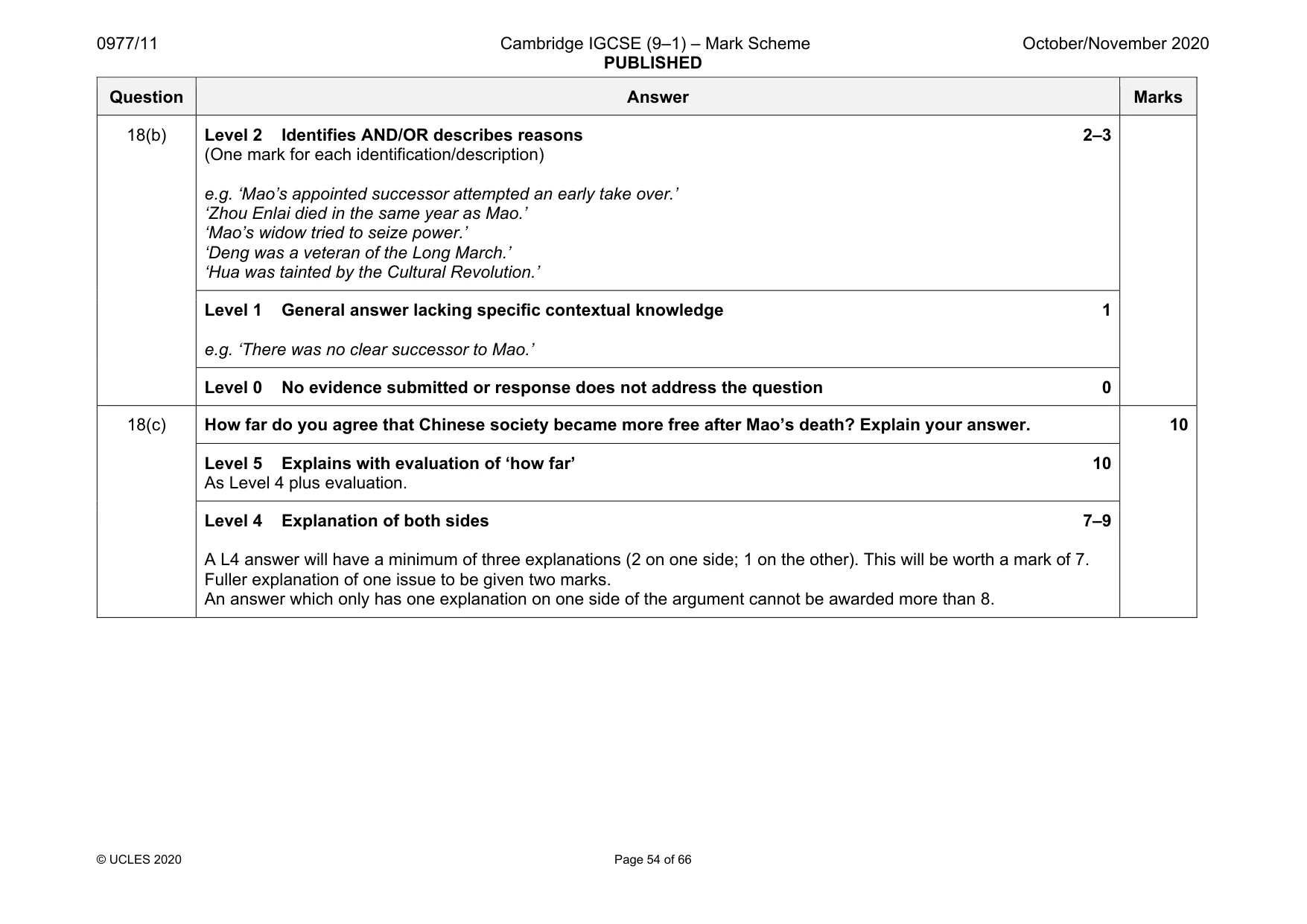
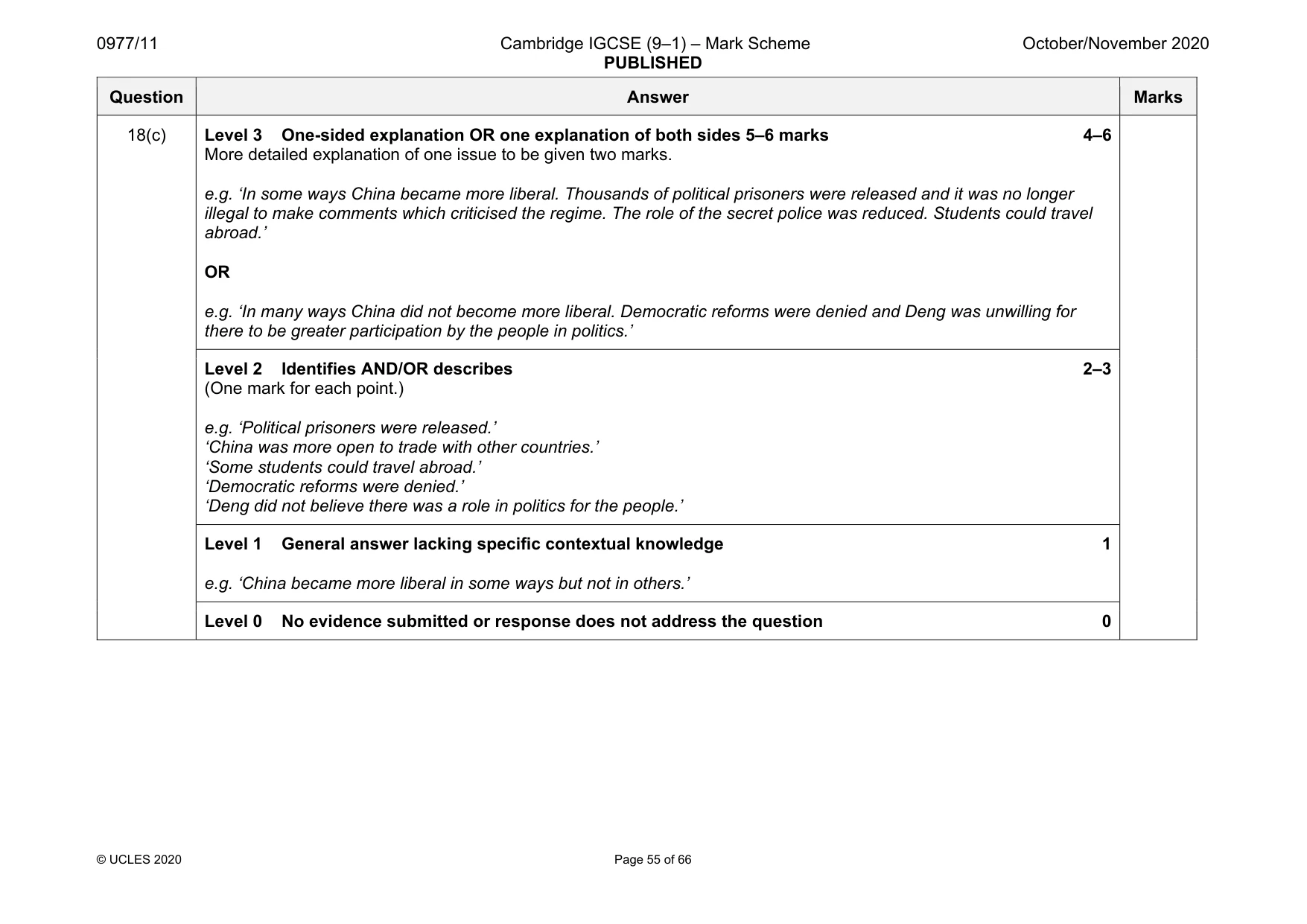
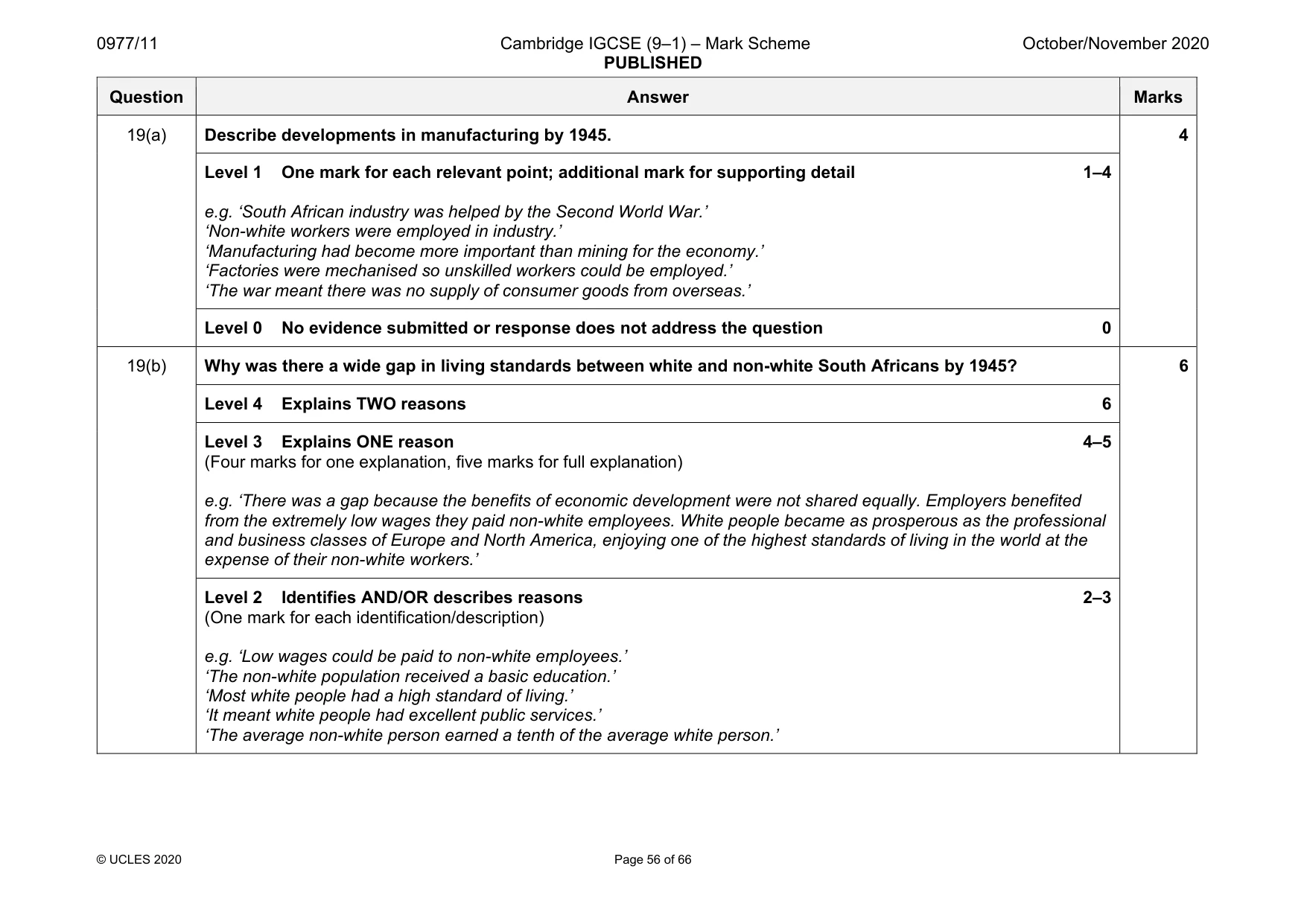
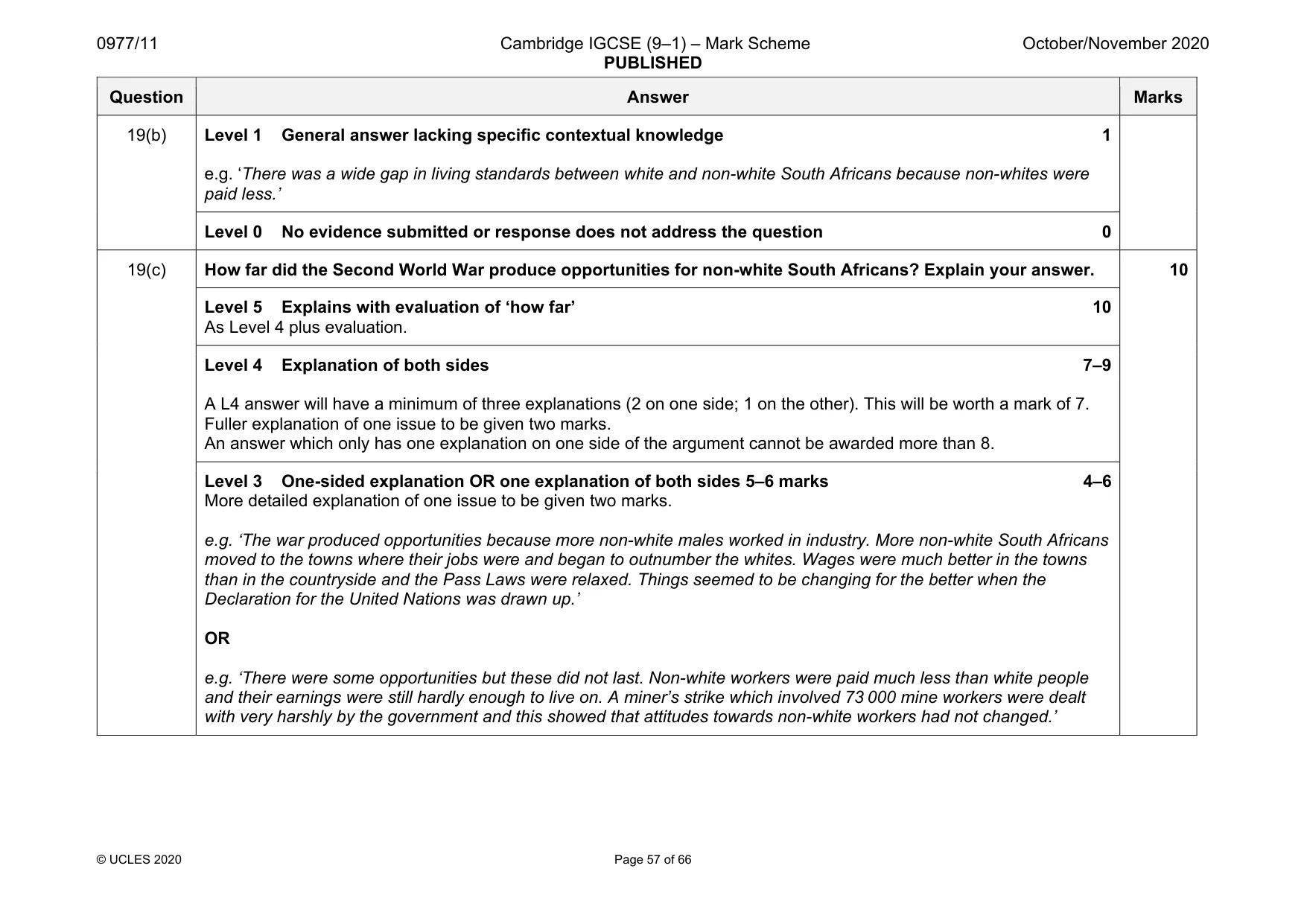
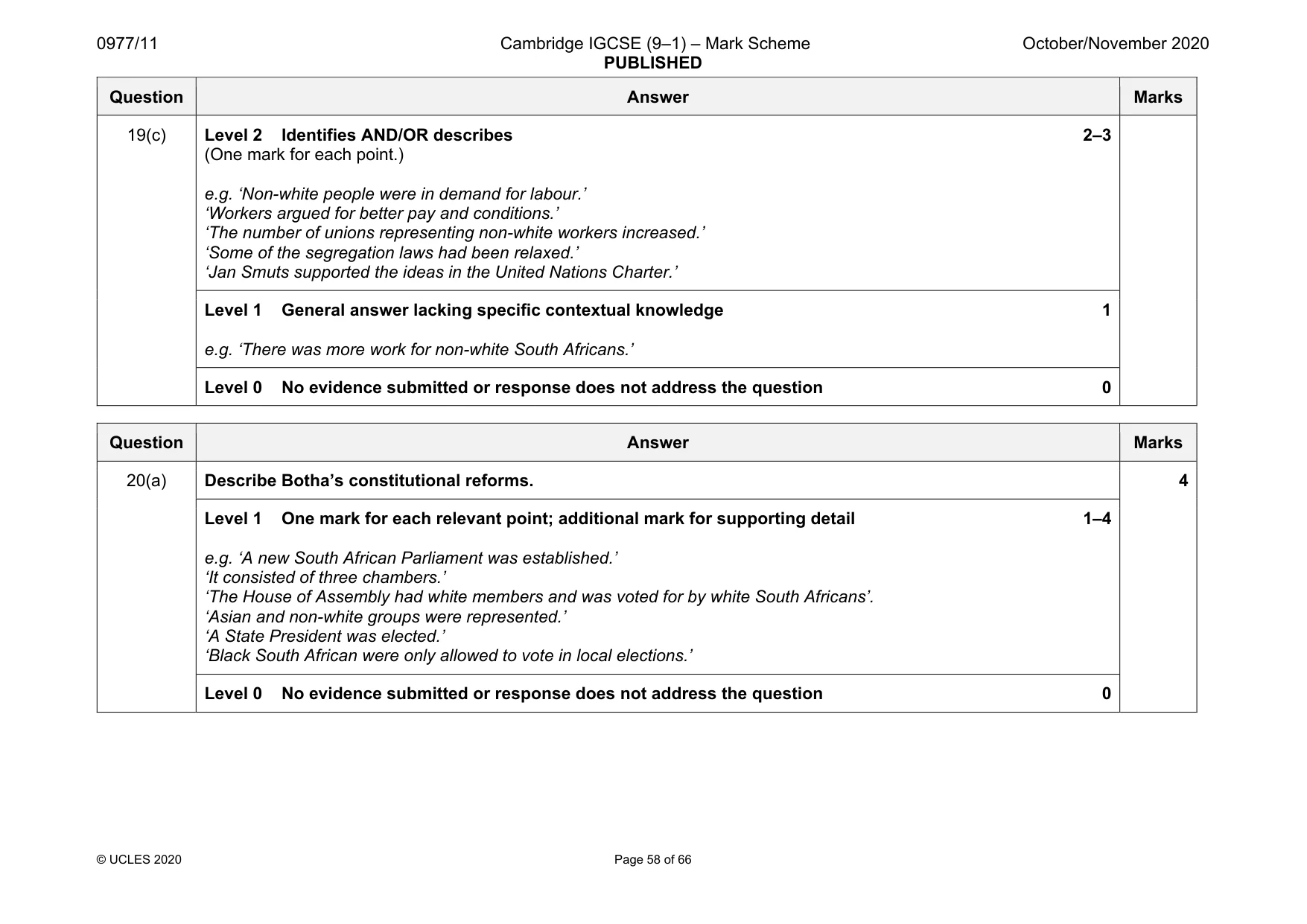
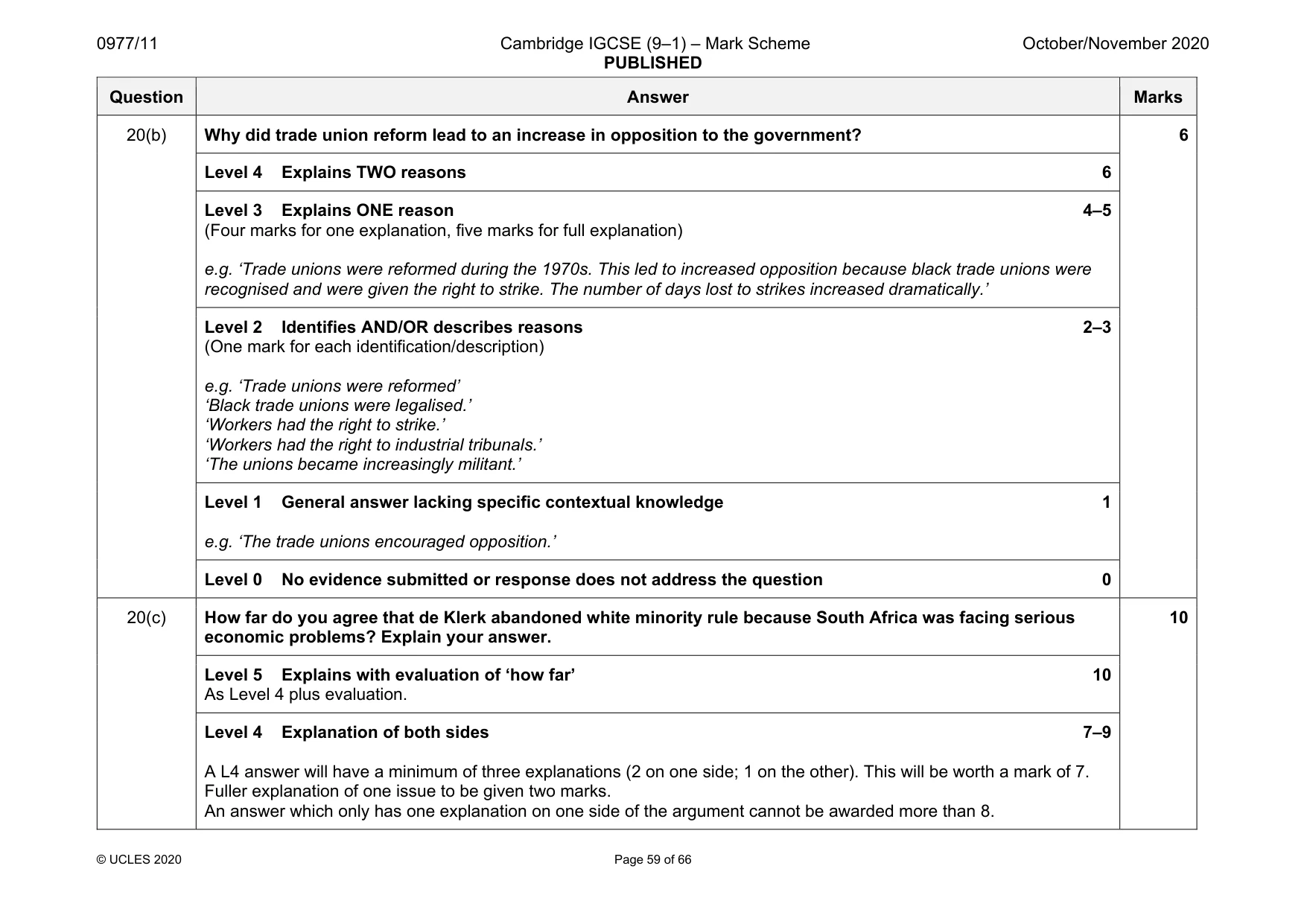
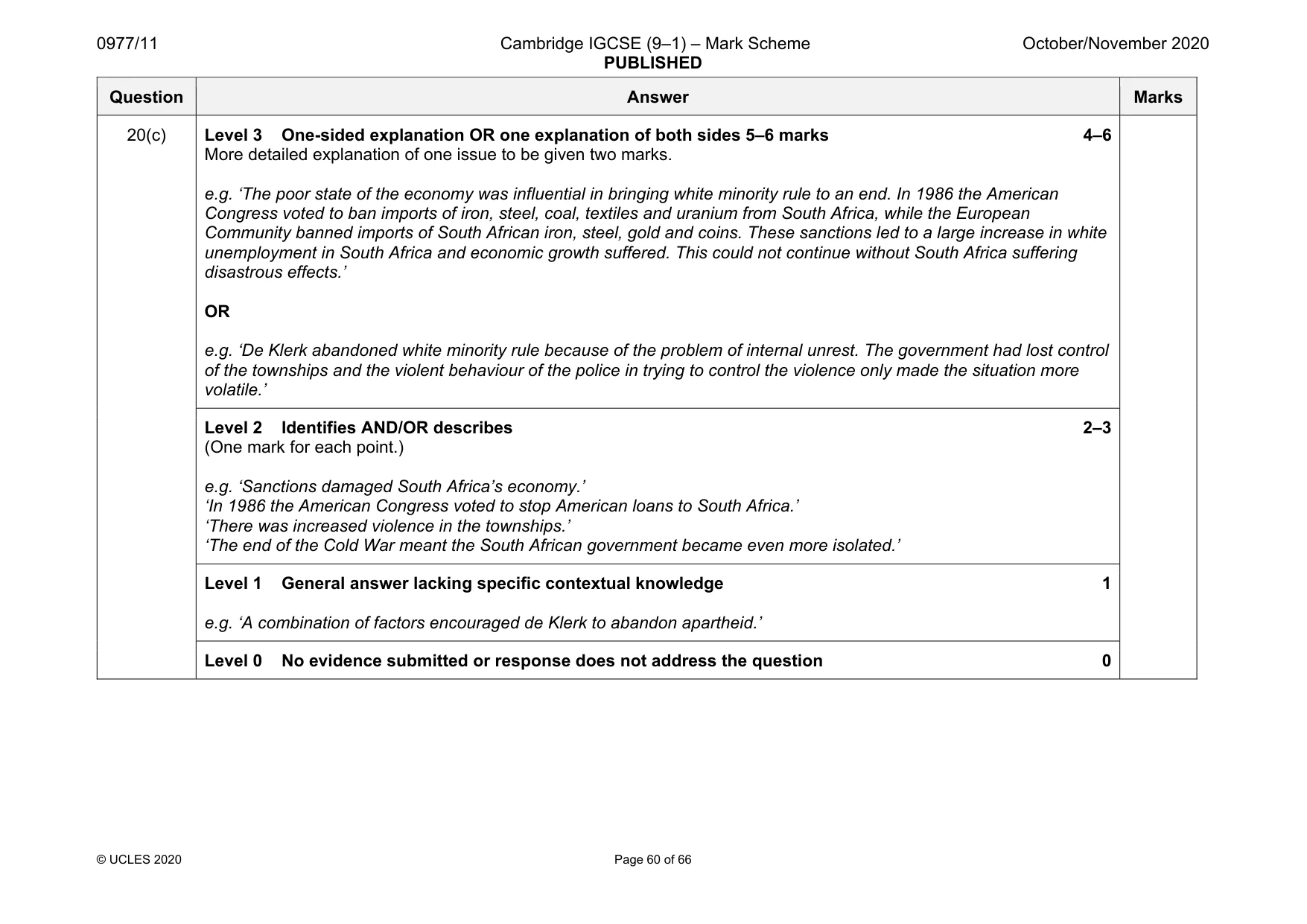
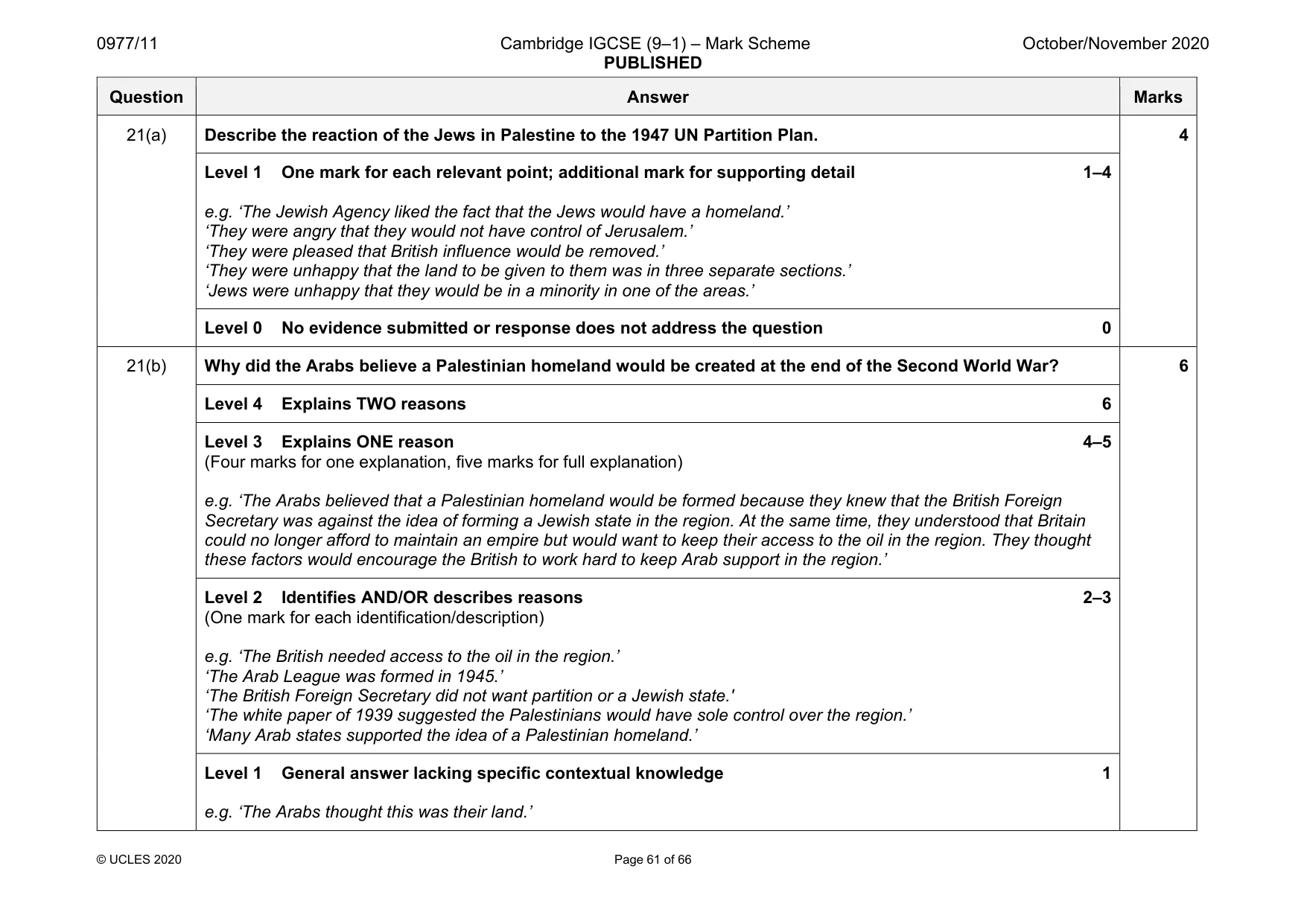
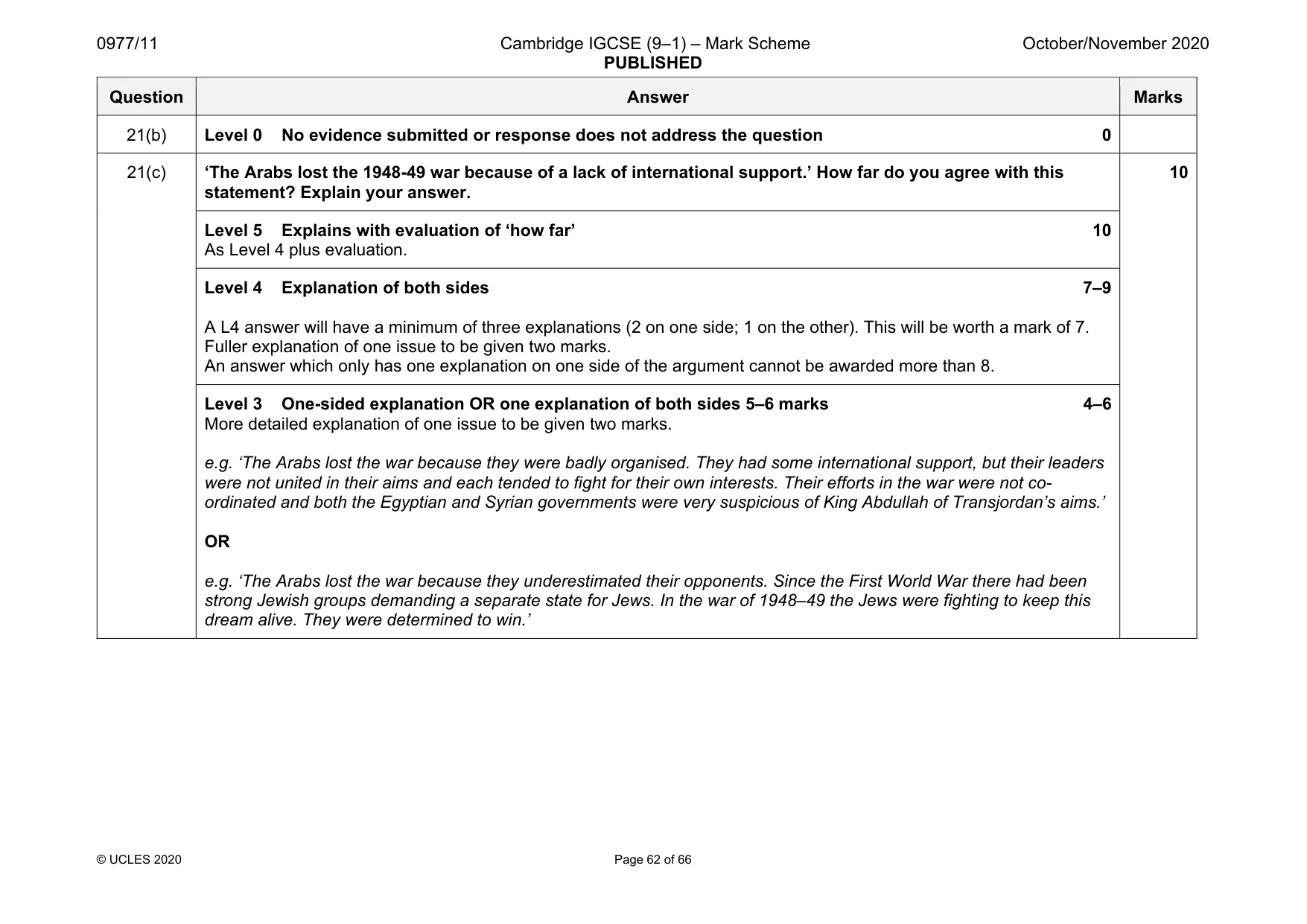
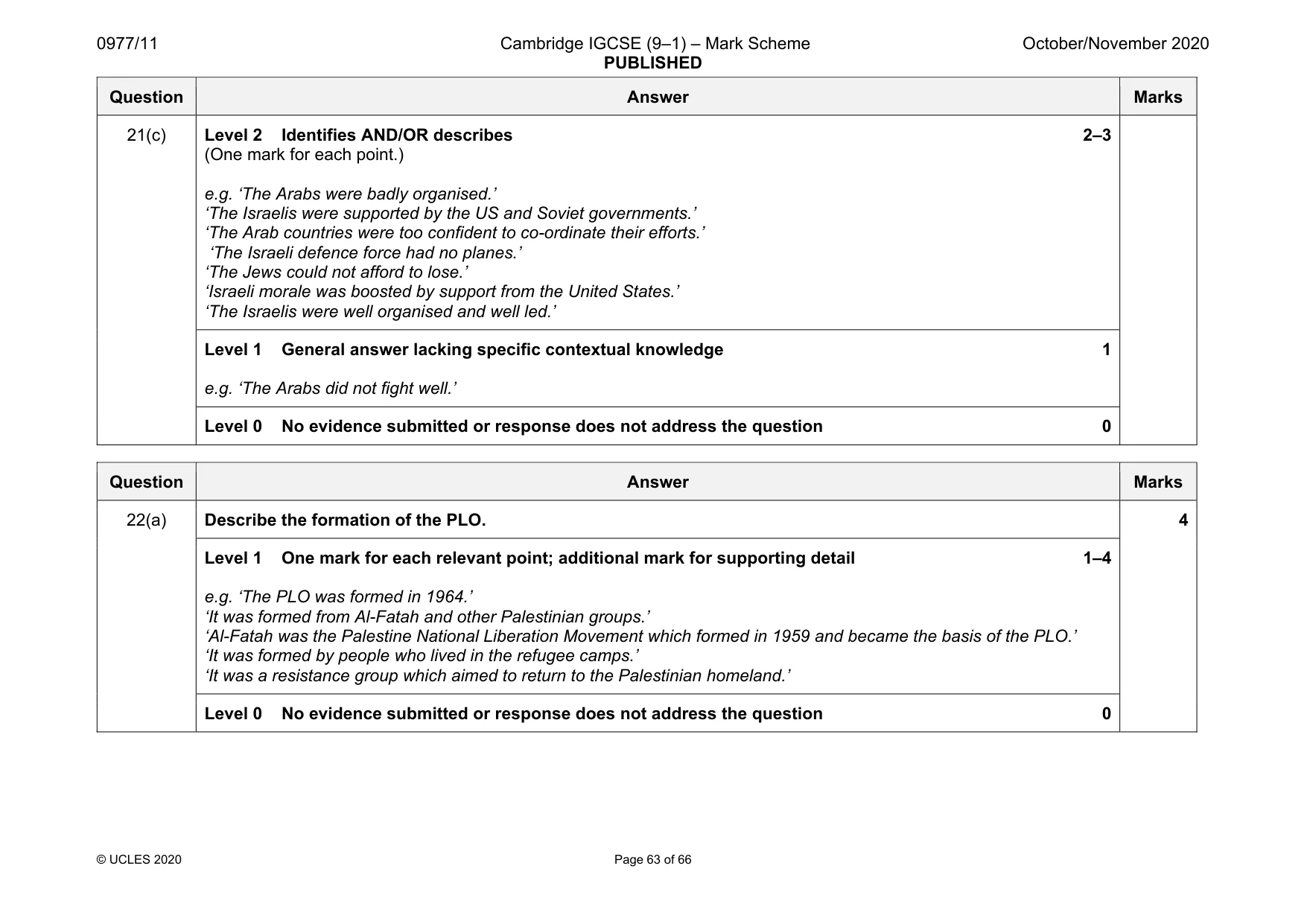
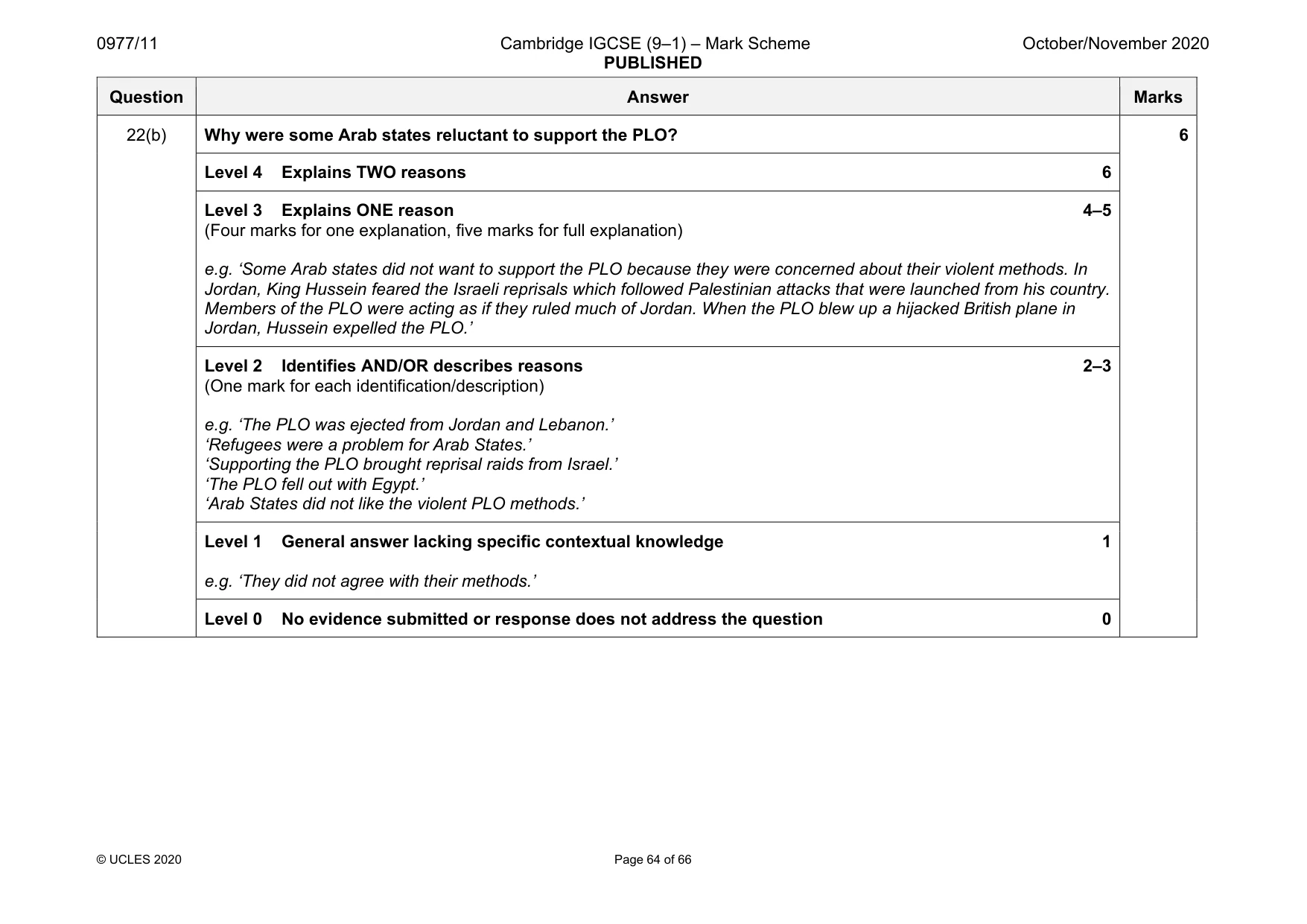
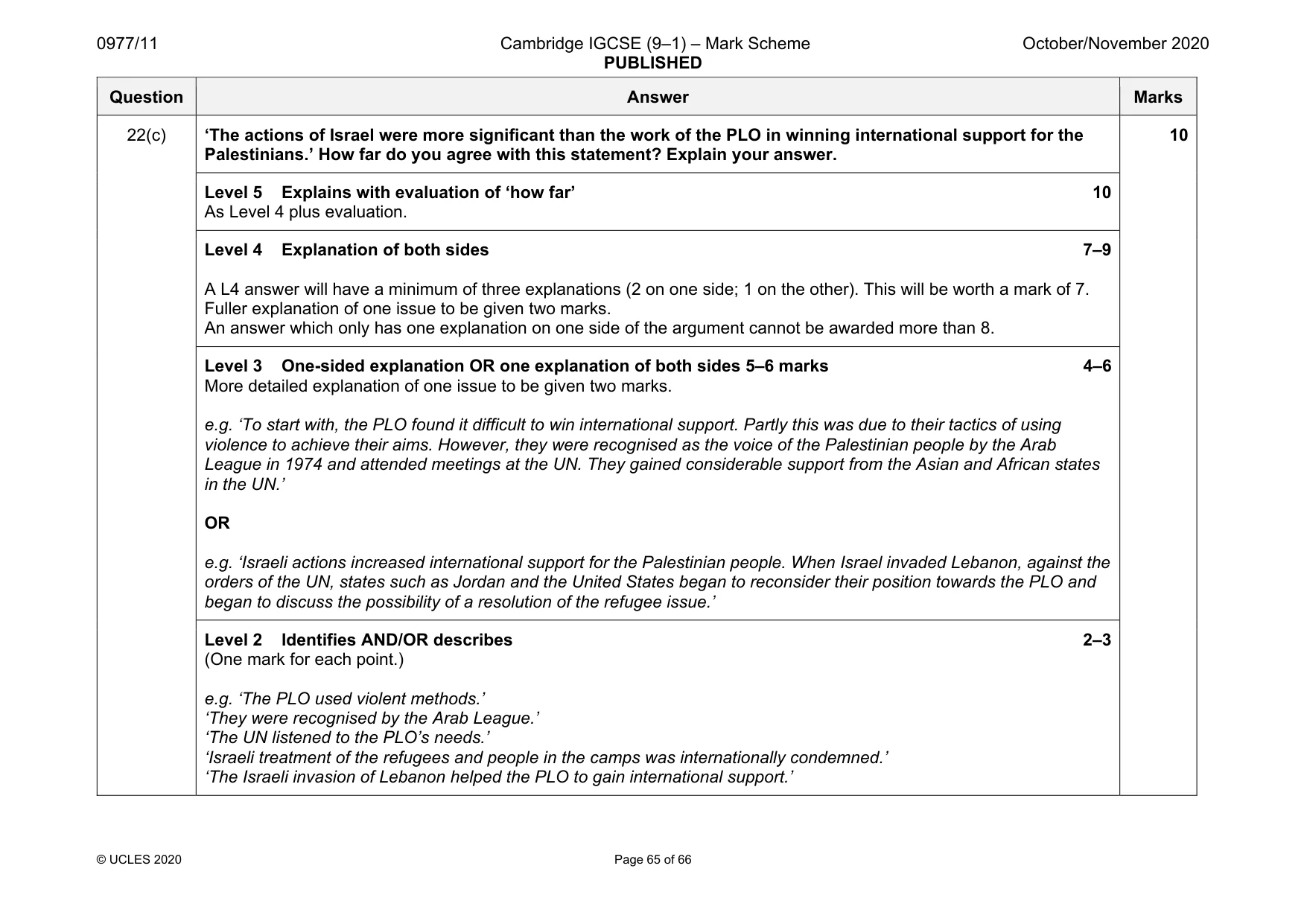
Paper as text
Question paper, page 1
Cambridge IGCSE™(9–1) This document has 12 pages. Blank pages are indicated. HISTORY 0977/11 Paper 1 October/November 2020 2 hours You must answer on the enclosed answer booklet. You will need: Answer booklet (enclosed) INSTRUCTIONS ● Answer three questions in total: Section A (Core Content): answer two questions. Section B (Depth Studies): answer one question. ● Follow the instructions on the front cover of the answer booklet. If you need additional answer paper, ask the invigilator for a continuation booklet. INFORMATION ● The total mark for this paper is 60. ● The number of marks for each question or part question is shown in brackets [ ]. * 3 3 4 5 4 8 0 8 7 5 * DC (KN) 204315 © UCLES 2020 [Turn over
Question paper, page 2
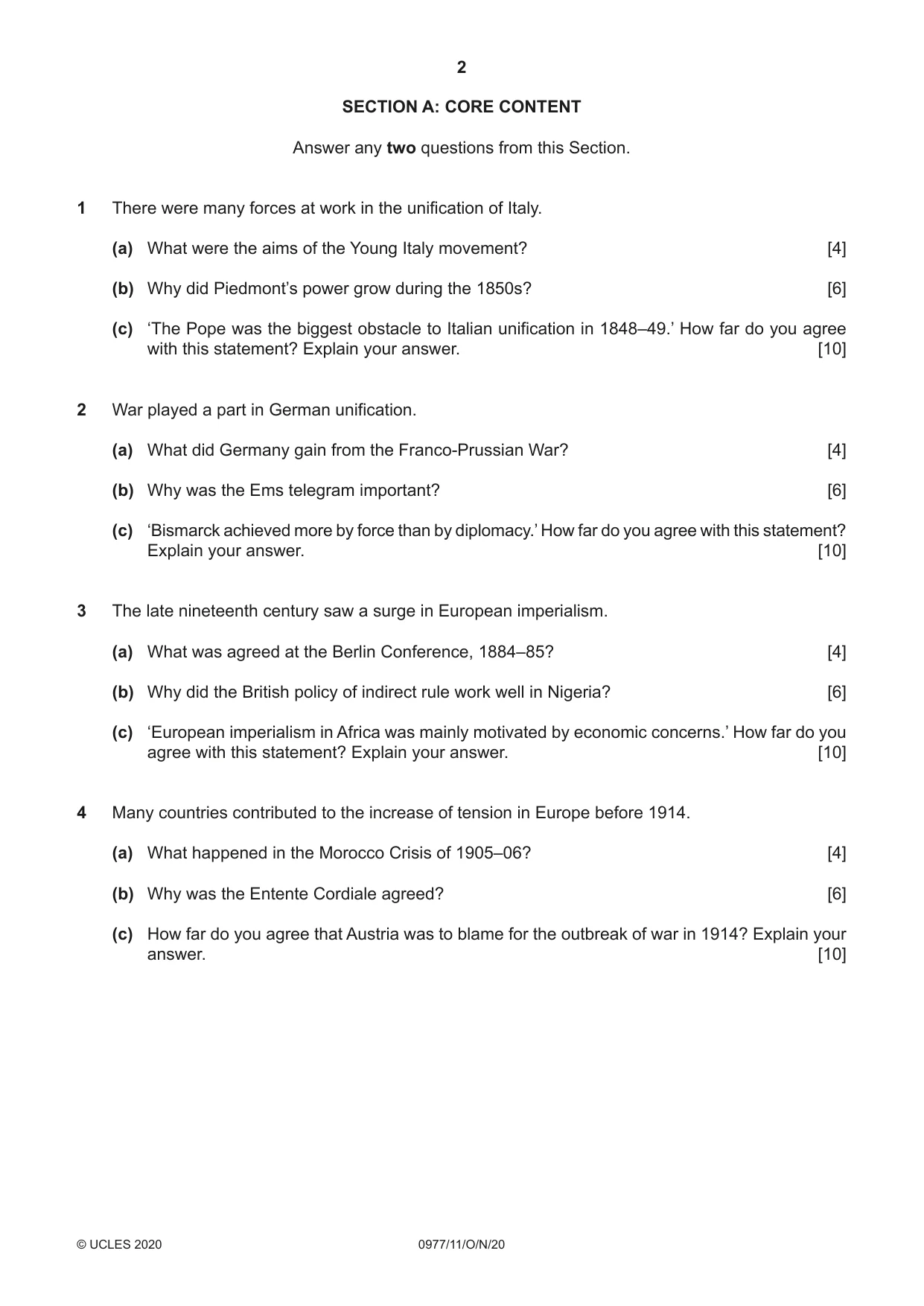
2 0977/11/O/N/20 © UCLES 2020 SECTION A: CORE CONTENT Answer any two questions from this Section. 1 There were many forces at work in the unification of Italy. (a) What were the aims of the Young Italy movement? [4] (b) Why did Piedmont’s power grow during the 1850s? [6] (c) ‘The Pope was the biggest obstacle to Italian unification in 1848–49.’ How far do you agree with this statement? Explain your answer. [10] 2 War played a part in German unification. (a) What did Germany gain from the Franco-Prussian War? [4] (b) Why was the Ems telegram important? [6] (c) ‘Bismarck achieved more by force than by diplomacy.’ How far do you agree with this statement? Explain your answer. [10] 3 The late nineteenth century saw a surge in European imperialism. (a) What was agreed at the Berlin Conference, 1884–85? [4] (b) Why did the British policy of indirect rule work well in Nigeria? [6] (c) ‘European imperialism in Africa was mainly motivated by economic concerns.’ How far do you agree with this statement? Explain your answer. [10] 4 Many countries contributed to the increase of tension in Europe before 1914. (a) What happened in the Morocco Crisis of 1905–06? [4] (b) Why was the Entente Cordiale agreed? [6] (c) How far do you agree that Austria was to blame for the outbreak of war in 1914? Explain your answer. [10]
Question paper, page 3
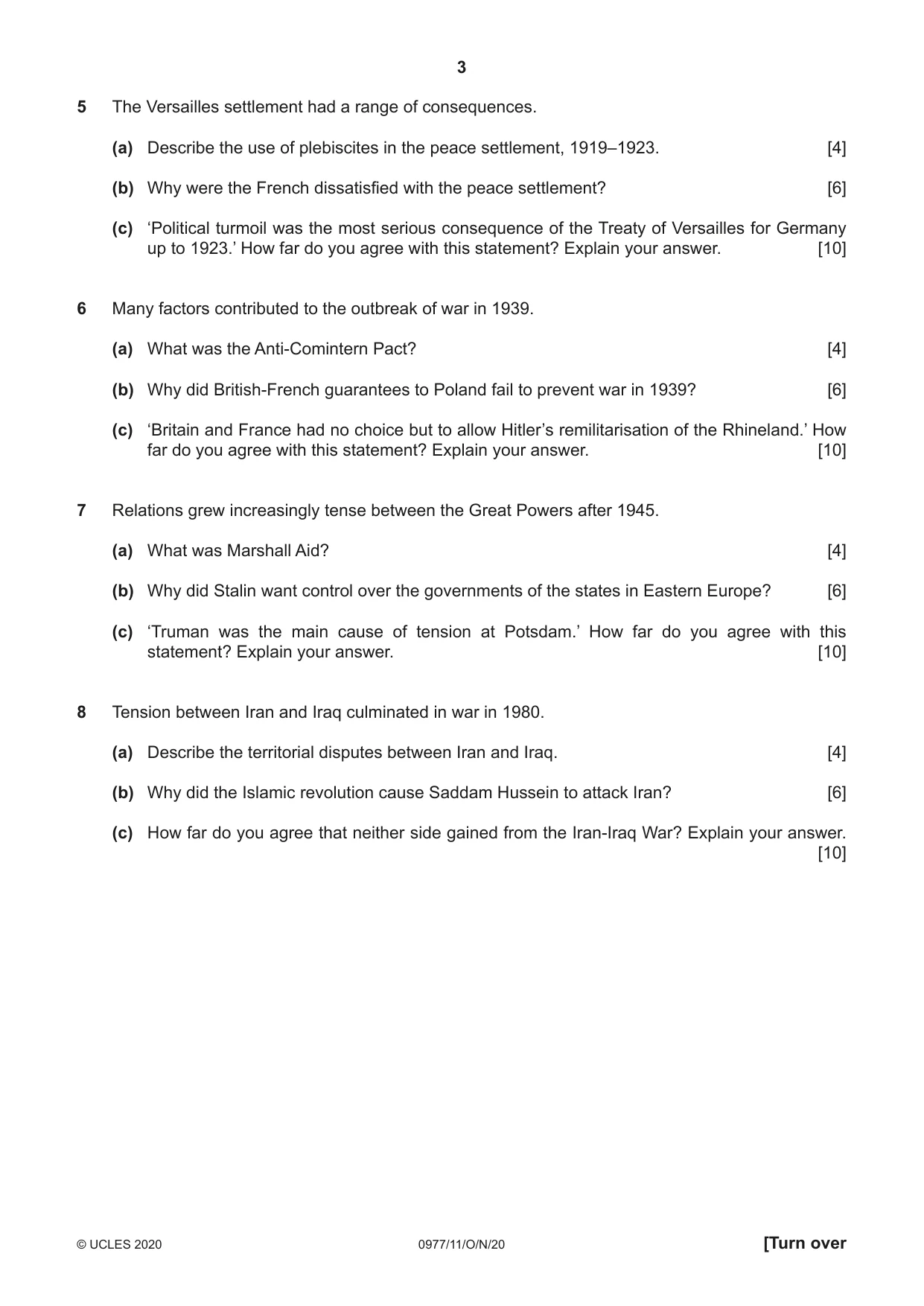
3 0977/11/O/N/20 © UCLES 2020 [Turn over 5 The Versailles settlement had a range of consequences. (a) Describe the use of plebiscites in the peace settlement, 1919–1923. [4] (b) Why were the French dissatisfied with the peace settlement? [6] (c) ‘Political turmoil was the most serious consequence of the Treaty of Versailles for Germany up to 1923.’ How far do you agree with this statement? Explain your answer. [10] 6 Many factors contributed to the outbreak of war in 1939. (a) What was the Anti-Comintern Pact? [4] (b) Why did British-French guarantees to Poland fail to prevent war in 1939? [6] (c) ‘Britain and France had no choice but to allow Hitler’s remilitarisation of the Rhineland.’ How far do you agree with this statement? Explain your answer. [10] 7 Relations grew increasingly tense between the Great Powers after 1945. (a) What was Marshall Aid? [4] (b) Why did Stalin want control over the governments of the states in Eastern Europe? [6] (c) ‘Truman was the main cause of tension at Potsdam.’ How far do you agree with this statement? Explain your answer. [10] 8 Tension between Iran and Iraq culminated in war in 1980. (a) Describe the territorial disputes between Iran and Iraq. [4] (b) Why did the Islamic revolution cause Saddam Hussein to attack Iran? [6] (c) How far do you agree that neither side gained from the Iran-Iraq War? Explain your answer. [10]
Question paper, page 4
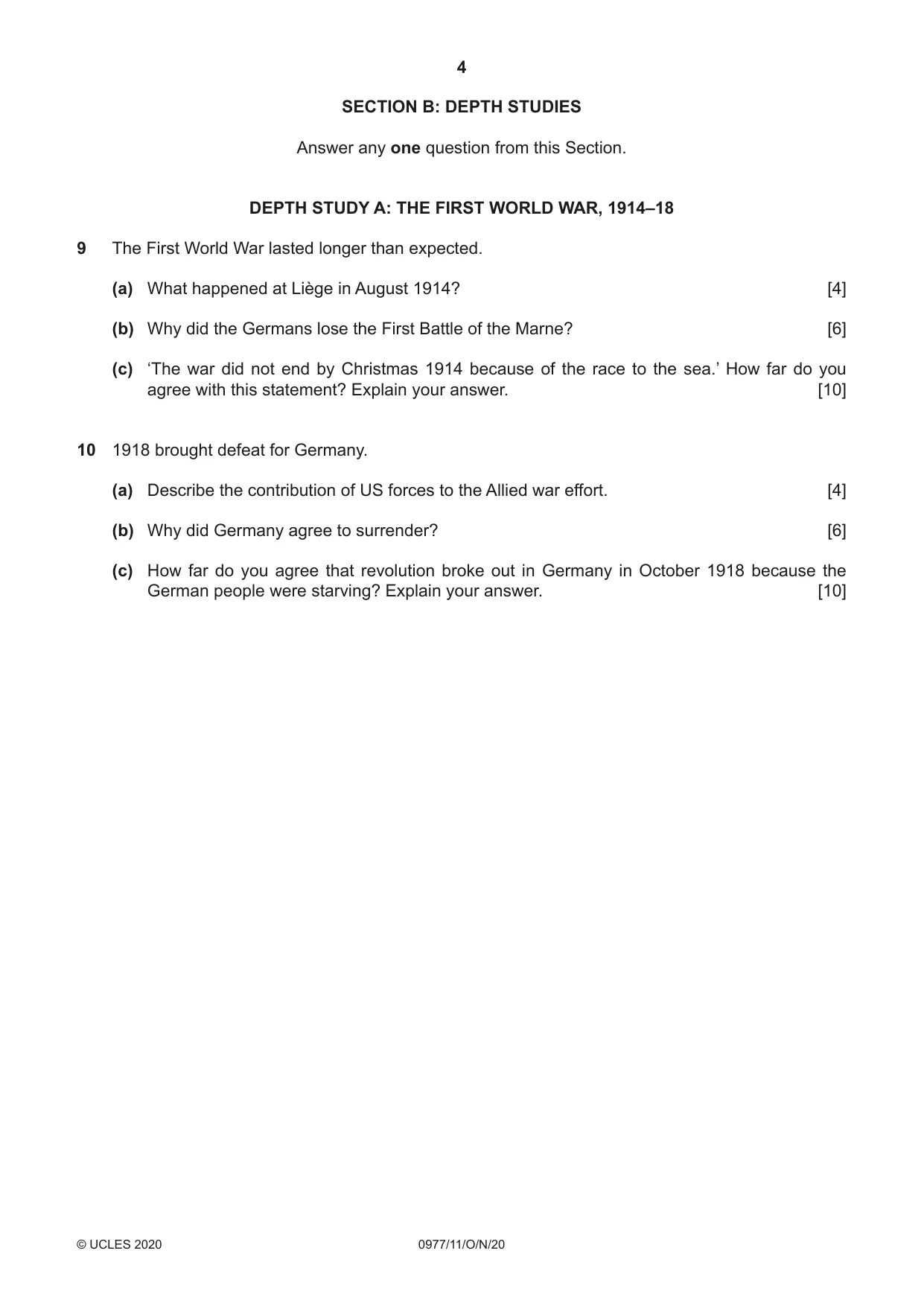
4 0977/11/O/N/20 © UCLES 2020 SECTION B: DEPTH STUDIES Answer any one question from this Section. DEPTH STUDY A: THE FIRST WORLD WAR, 1914–18 9 The First World War lasted longer than expected. (a) What happened at Liège in August 1914? [4] (b) Why did the Germans lose the First Battle of the Marne? [6] (c) ‘The war did not end by Christmas 1914 because of the race to the sea.’ How far do you agree with this statement? Explain your answer. [10] 10 1918 brought defeat for Germany. (a) Describe the contribution of US forces to the Allied war effort. [4] (b) Why did Germany agree to surrender? [6] (c) How far do you agree that revolution broke out in Germany in October 1918 because the German people were starving? Explain your answer. [10]
Question paper, page 5
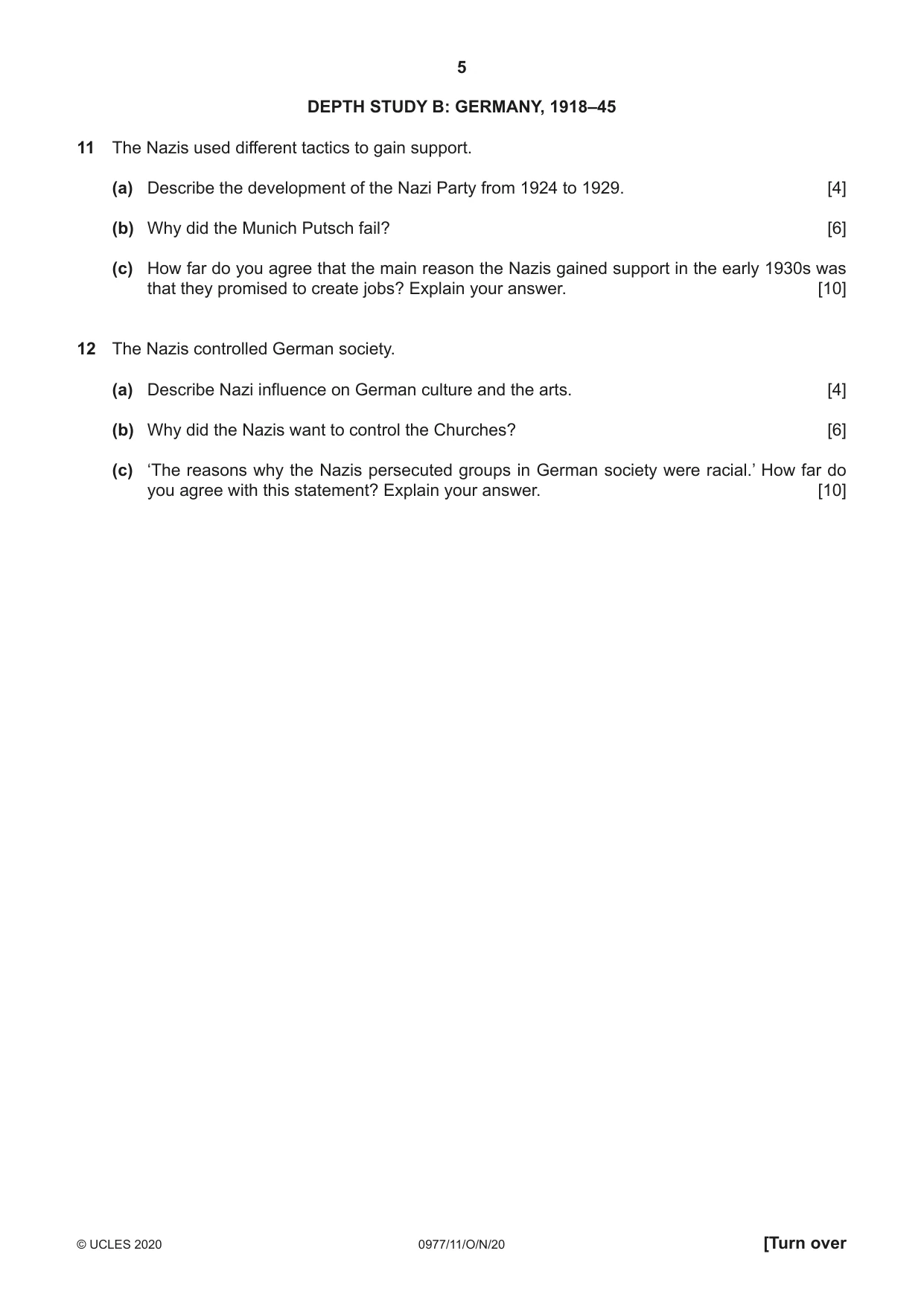
5 0977/11/O/N/20 © UCLES 2020 [Turn over DEPTH STUDY B: GERMANY, 1918–45 11 The Nazis used different tactics to gain support. (a) Describe the development of the Nazi Party from 1924 to 1929. [4] (b) Why did the Munich Putsch fail? [6] (c) How far do you agree that the main reason the Nazis gained support in the early 1930s was that they promised to create jobs? Explain your answer. [10] 12 The Nazis controlled German society. (a) Describe Nazi influence on German culture and the arts. [4] (b) Why did the Nazis want to control the Churches? [6] (c) ‘The reasons why the Nazis persecuted groups in German society were racial.’ How far do you agree with this statement? Explain your answer. [10]
Question paper, page 6
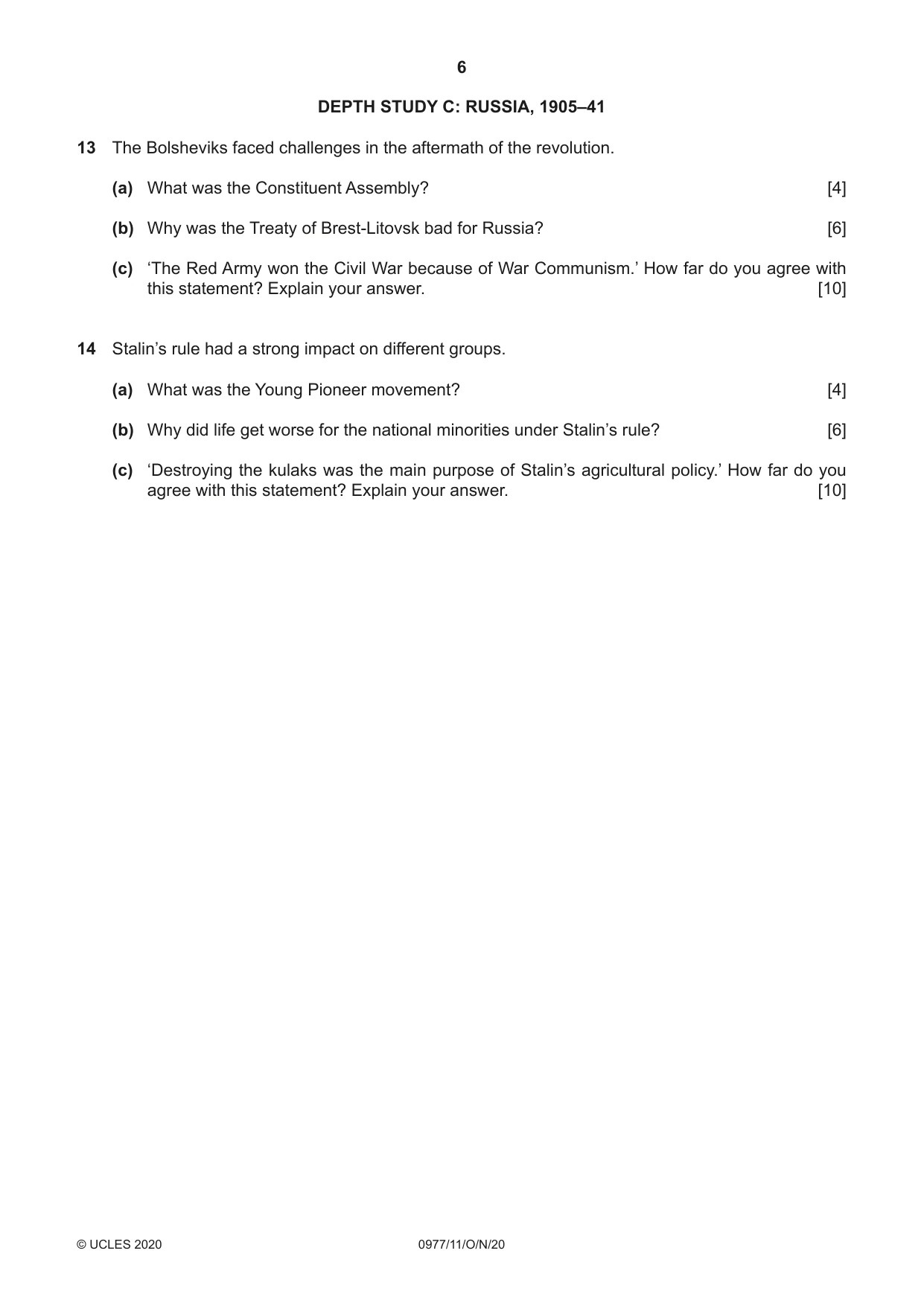
6 0977/11/O/N/20 © UCLES 2020 DEPTH STUDY C: RUSSIA, 1905–41 13 The Bolsheviks faced challenges in the aftermath of the revolution. (a) What was the Constituent Assembly? [4] (b) Why was the Treaty of Brest-Litovsk bad for Russia? [6] (c) ‘The Red Army won the Civil War because of War Communism.’ How far do you agree with this statement? Explain your answer. [10] 14 Stalin’s rule had a strong impact on different groups. (a) What was the Young Pioneer movement? [4] (b) Why did life get worse for the national minorities under Stalin’s rule? [6] (c) ‘Destroying the kulaks was the main purpose of Stalin’s agricultural policy.’ How far do you agree with this statement? Explain your answer. [10]
Question paper, page 7
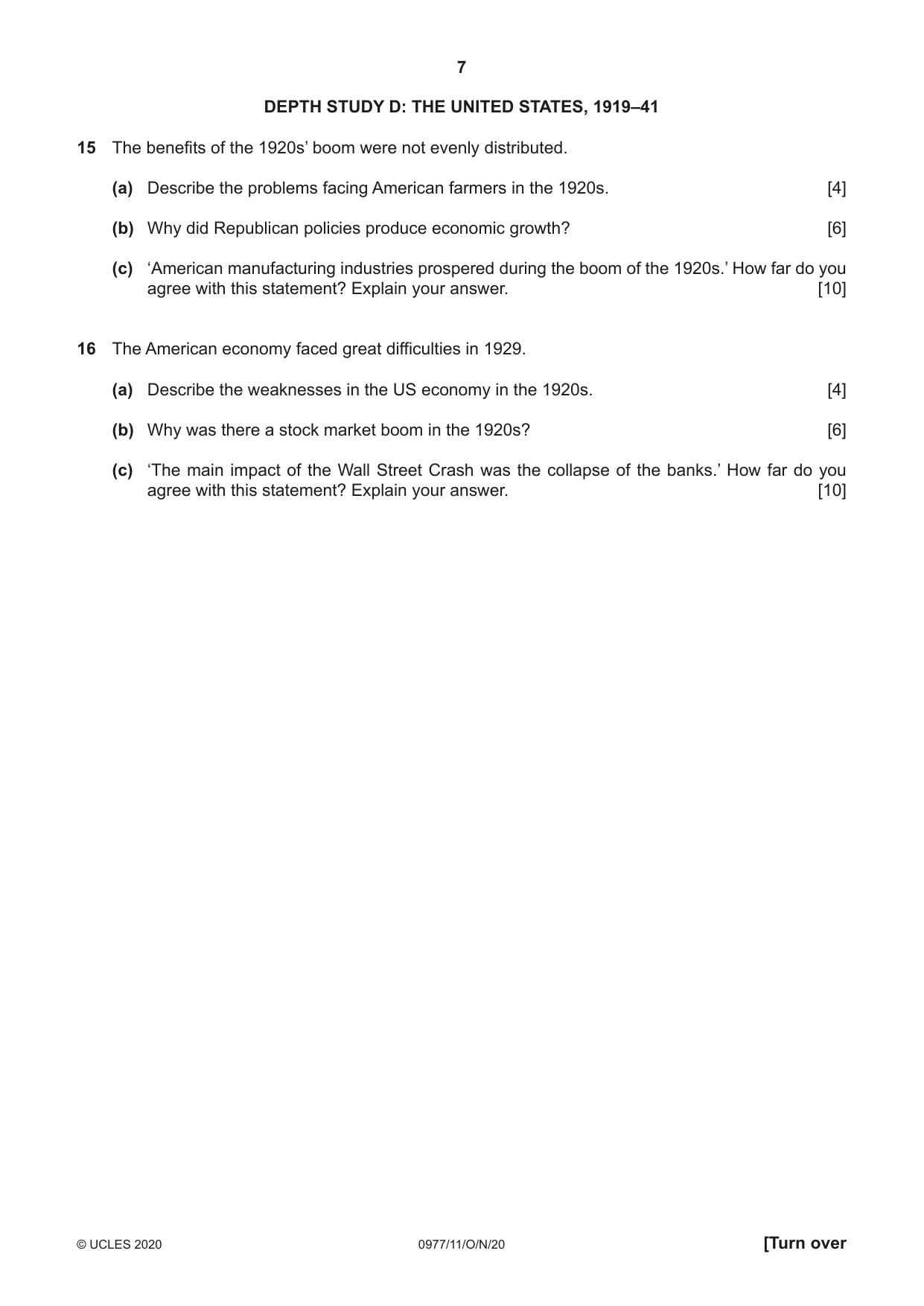
7 0977/11/O/N/20 © UCLES 2020 [Turn over DEPTH STUDY D: THE UNITED STATES, 1919–41 15 The benefits of the 1920s’ boom were not evenly distributed. (a) Describe the problems facing American farmers in the 1920s. [4] (b) Why did Republican policies produce economic growth? [6] (c) ‘American manufacturing industries prospered during the boom of the 1920s.’ How far do you agree with this statement? Explain your answer. [10] 16 The American economy faced great difficulties in 1929. (a) Describe the weaknesses in the US economy in the 1920s. [4] (b) Why was there a stock market boom in the 1920s? [6] (c) ‘The main impact of the Wall Street Crash was the collapse of the banks.’ How far do you agree with this statement? Explain your answer. [10]
Question paper, page 8
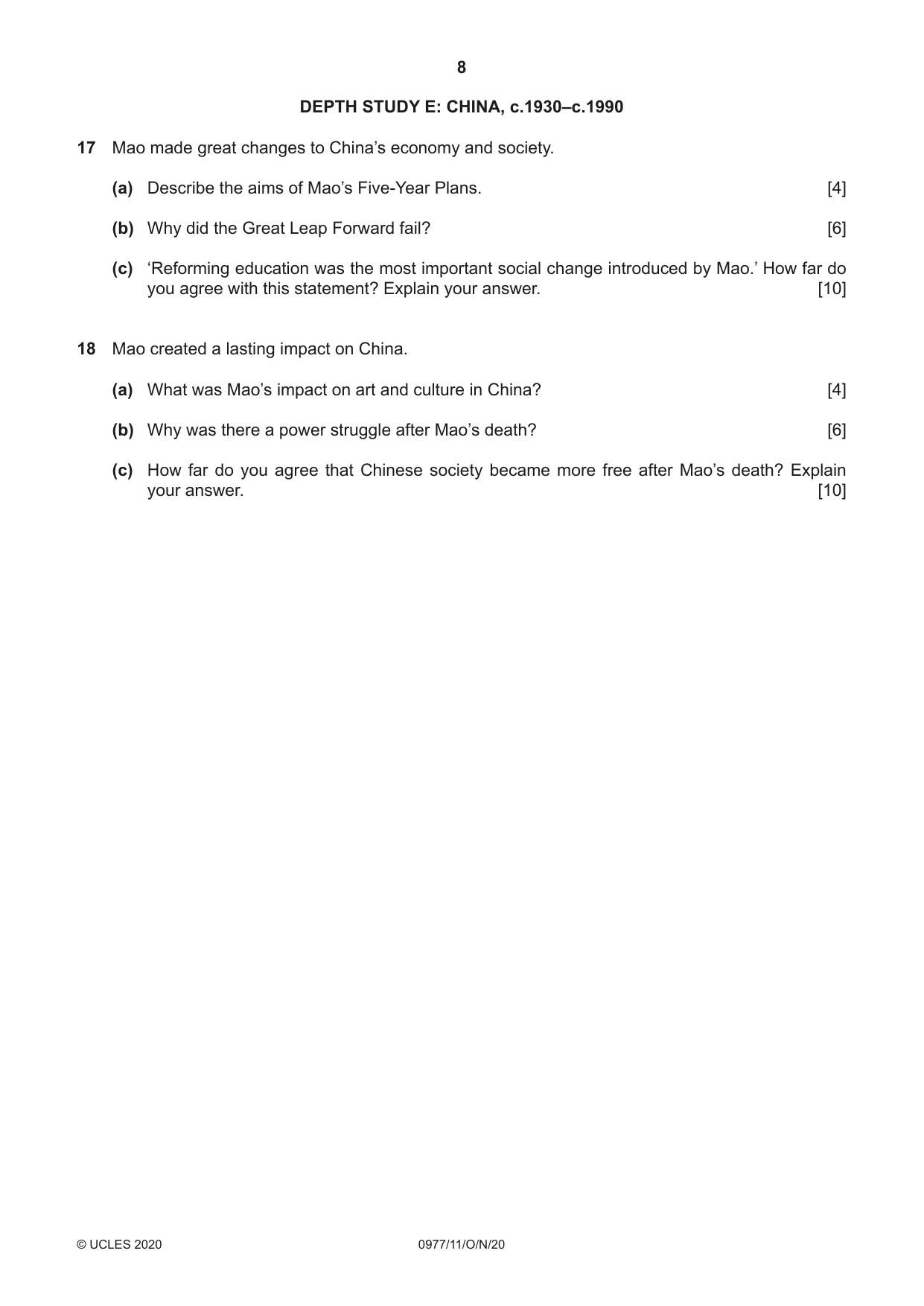
8 0977/11/O/N/20 © UCLES 2020 DEPTH STUDY E: CHINA, c.1930–c.1990 17 Mao made great changes to China’s economy and society. (a) Describe the aims of Mao’s Five-Year Plans. [4] (b) Why did the Great Leap Forward fail? [6] (c) ‘Reforming education was the most important social change introduced by Mao.’ How far do you agree with this statement? Explain your answer. [10] 18 Mao created a lasting impact on China. (a) What was Mao’s impact on art and culture in China? [4] (b) Why was there a power struggle after Mao’s death? [6] (c) How far do you agree that Chinese society became more free after Mao’s death? Explain your answer. [10]
Question paper, page 9
9 0977/11/O/N/20 © UCLES 2020 [Turn over DEPTH STUDY F: SOUTH AFRICA, c.1940–c.1994 19 The Second World War brought change to South Africa. (a) Describe developments in manufacturing by 1945. [4] (b) Why was there a wide gap in living standards between white and non-white South Africans by 1945? [6] (c) How far did the Second World War produce opportunities for non-white South Africans? Explain your answer. [10] 20 By the 1980s it was clear that apartheid was under pressure. (a) Describe Botha’s constitutional reforms. [4] (b) Why did trade union reform lead to an increase in opposition to the government? [6] (c) How far do you agree that de Klerk abandoned white minority rule because South Africa was facing serious economic problems? Explain your answer. [10]
Question paper, page 10
10 0977/11/O/N/20 © UCLES 2020 DEPTH STUDY G: ISRAELIS AND PALESTINIANS SINCE 1945 21 The formation of Israel created great tension. (a) Describe the reaction of the Jews in Palestine to the 1947 UN Partition Plan. [4] (b) Why did the Arabs believe a Palestinian homeland would be created at the end of the Second World War? [6] (c) ‘The Arabs lost the 1948–49 war because of a lack of international support.’ How far do you agree with this statement? Explain your answer. [10] 22 The Palestine Liberation Organisation (PLO) has achieved mixed results. (a) Describe the formation of the PLO. [4] (b) Why were some Arab states reluctant to support the PLO? [6] (c) ‘The actions of Israel were more significant than the work of the PLO in winning international support for the Palestinians.’ How far do you agree with this statement? Explain your answer. [10]
Question paper, page 11
11 0977/11/O/N/20 © UCLES 2020 BLANK PAGE
Question paper, page 12
12 0977/11/O/N/20 © UCLES 2020 Permission to reproduce items where third-party owned material protected by copyright is included has been sought and cleared where possible. Every reasonable effort has been made by the publisher (UCLES) to trace copyright holders, but if any items requiring clearance have unwittingly been included, the publisher will be pleased to make amends at the earliest possible opportunity. To avoid the issue of disclosure of answer-related information to candidates, all copyright acknowledgements are reproduced online in the Cambridge Assessment International Education Copyright Acknowledgements Booklet. This is produced for each series of examinations and is freely available to download at www.cambridgeinternational.org after the live examination series. Cambridge Assessment International Education is part of the Cambridge Assessment Group. Cambridge Assessment is the brand name of the University of Cambridge Local Examinations Syndicate (UCLES), which itself is a department of the University of Cambridge. BLANK PAGE
Mark scheme, page 1
This document consists of 66 printed pages. © UCLES 2020 [Turn over Cambridge IGCSE™ (9–1) HISTORY 0977/11 Paper 1 October/November 2020 MARK SCHEME Maximum Mark: 60 Published This mark scheme is published as an aid to teachers and candidates, to indicate the requirements of the examination. It shows the basis on which Examiners were instructed to award marks. It does not indicate the details of the discussions that took place at an Examiners’ meeting before marking began, which would have considered the acceptability of alternative answers. Mark schemes should be read in conjunction with the question paper and the Principal Examiner Report for Teachers. Cambridge International will not enter into discussions about these mark schemes. Cambridge International is publishing the mark schemes for the October/November 2020 series for most Cambridge IGCSE™, Cambridge International A and AS Level and Cambridge Pre-U components, and some Cambridge O Level components.
Mark scheme, page 2
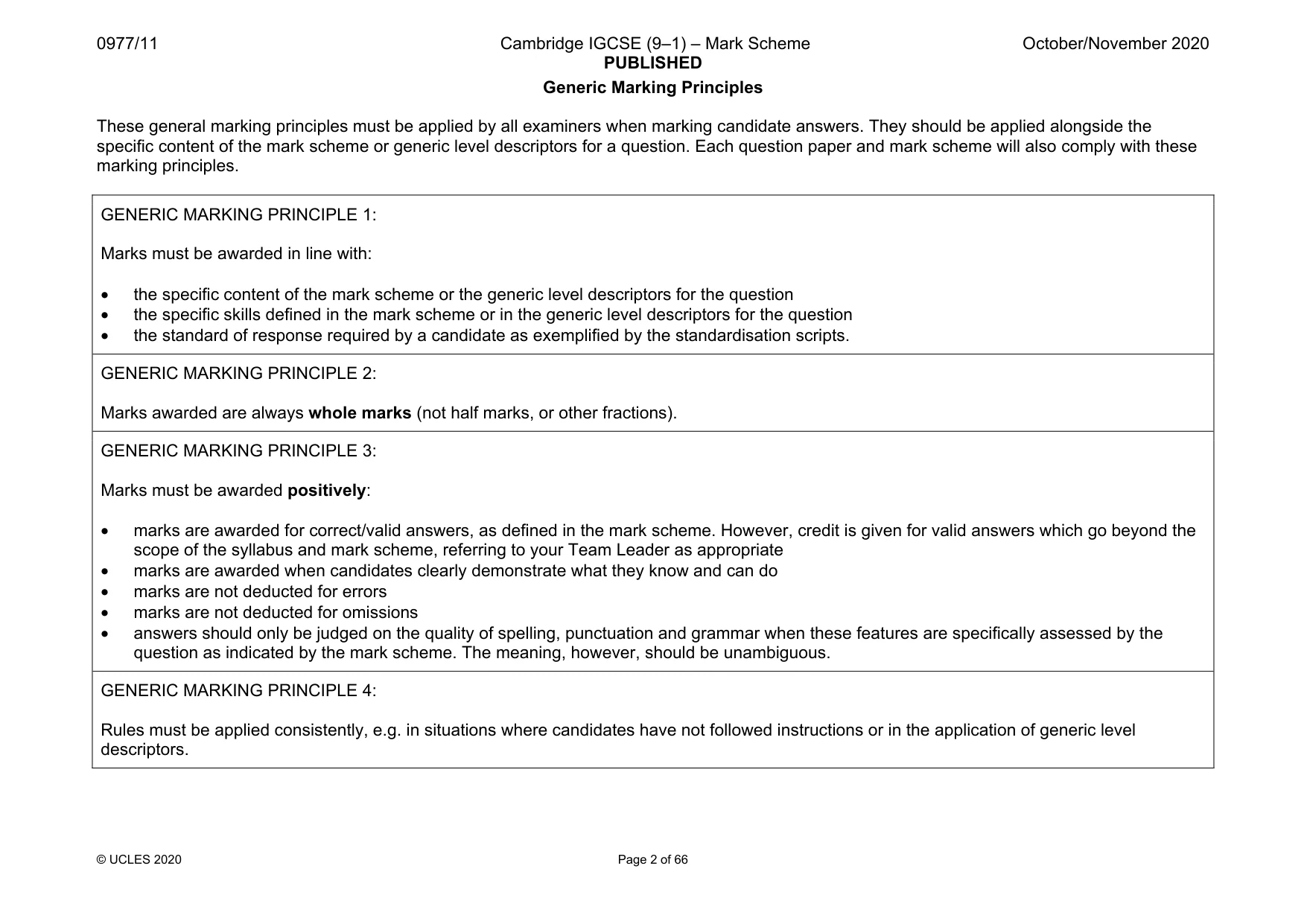
0977/11 Cambridge IGCSE (9–1) – Mark Scheme PUBLISHED October/November 2020 © UCLES 2020 Page 2 of 66 Generic Marking Principles These general marking principles must be applied by all examiners when marking candidate answers. They should be applied alongside the specific content of the mark scheme or generic level descriptors for a question. Each question paper and mark scheme will also comply with these marking principles. GENERIC MARKING PRINCIPLE 1: Marks must be awarded in line with: • the specific content of the mark scheme or the generic level descriptors for the question • the specific skills defined in the mark scheme or in the generic level descriptors for the question • the standard of response required by a candidate as exemplified by the standardisation scripts. GENERIC MARKING PRINCIPLE 2: Marks awarded are always whole marks (not half marks, or other fractions). GENERIC MARKING PRINCIPLE 3: Marks must be awarded positively: • marks are awarded for correct/valid answers, as defined in the mark scheme. However, credit is given for valid answers which go beyond the scope of the syllabus and mark scheme, referring to your Team Leader as appropriate • marks are awarded when candidates clearly demonstrate what they know and can do • marks are not deducted for errors • marks are not deducted for omissions • answers should only be judged on the quality of spelling, punctuation and grammar when these features are specifically assessed by the question as indicated by the mark scheme. The meaning, however, should be unambiguous. GENERIC MARKING PRINCIPLE 4: Rules must be applied consistently, e.g. in situations where candidates have not followed instructions or in the application of generic level descriptors.
Mark scheme, page 3
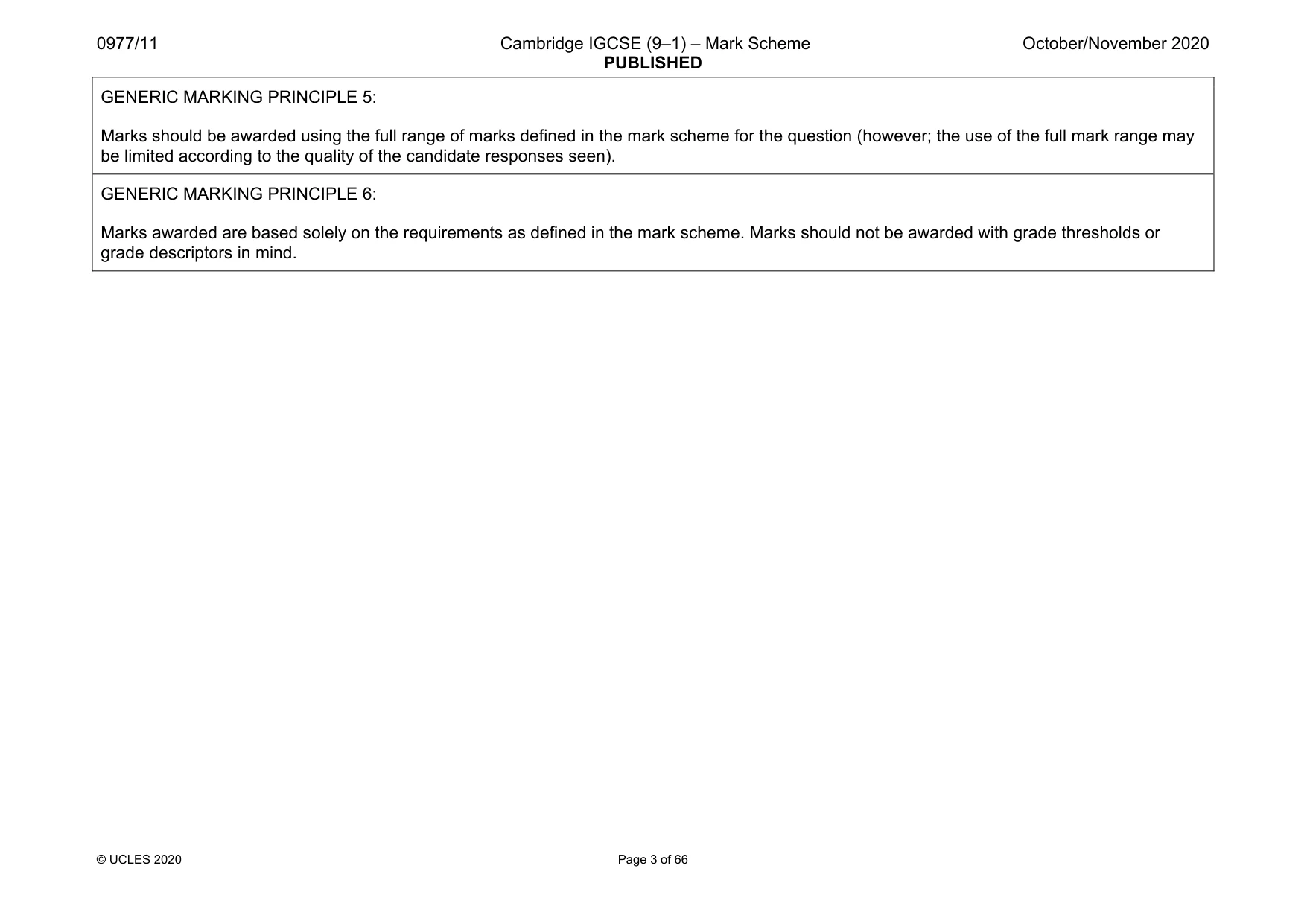
0977/11 Cambridge IGCSE (9–1) – Mark Scheme PUBLISHED October/November 2020 © UCLES 2020 Page 3 of 66 GENERIC MARKING PRINCIPLE 5: Marks should be awarded using the full range of marks defined in the mark scheme for the question (however; the use of the full mark range may be limited according to the quality of the candidate responses seen). GENERIC MARKING PRINCIPLE 6: Marks awarded are based solely on the requirements as defined in the mark scheme. Marks should not be awarded with grade thresholds or grade descriptors in mind.
Mark scheme, page 4
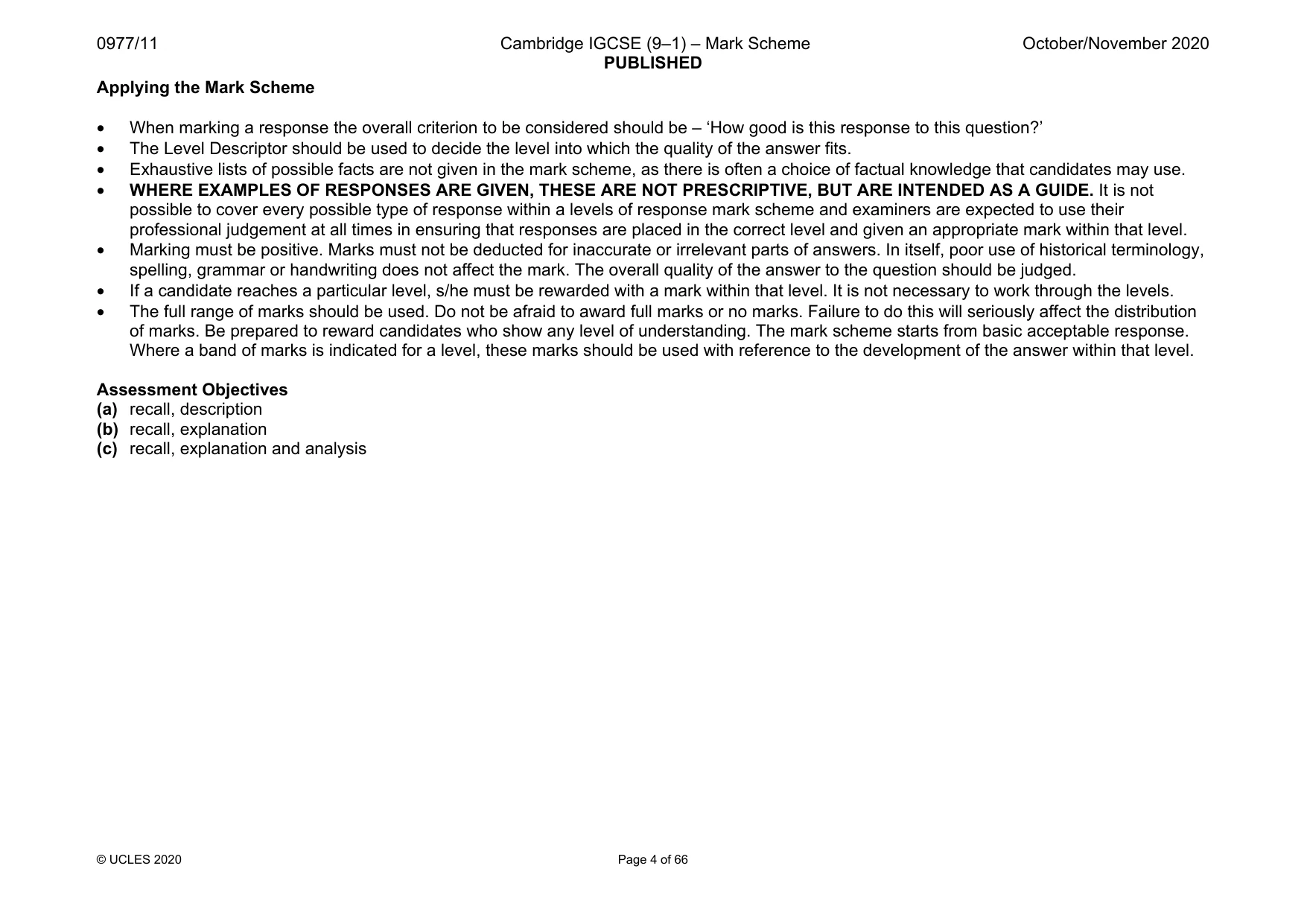
0977/11 Cambridge IGCSE (9–1) – Mark Scheme PUBLISHED October/November 2020 © UCLES 2020 Page 4 of 66 Applying the Mark Scheme • When marking a response the overall criterion to be considered should be – ‘How good is this response to this question?’ • The Level Descriptor should be used to decide the level into which the quality of the answer fits. • Exhaustive lists of possible facts are not given in the mark scheme, as there is often a choice of factual knowledge that candidates may use. • WHERE EXAMPLES OF RESPONSES ARE GIVEN, THESE ARE NOT PRESCRIPTIVE, BUT ARE INTENDED AS A GUIDE. It is not possible to cover every possible type of response within a levels of response mark scheme and examiners are expected to use their professional judgement at all times in ensuring that responses are placed in the correct level and given an appropriate mark within that level. • Marking must be positive. Marks must not be deducted for inaccurate or irrelevant parts of answers. In itself, poor use of historical terminology, spelling, grammar or handwriting does not affect the mark. The overall quality of the answer to the question should be judged. • If a candidate reaches a particular level, s/he must be rewarded with a mark within that level. It is not necessary to work through the levels. • The full range of marks should be used. Do not be afraid to award full marks or no marks. Failure to do this will seriously affect the distribution of marks. Be prepared to reward candidates who show any level of understanding. The mark scheme starts from basic acceptable response. Where a band of marks is indicated for a level, these marks should be used with reference to the development of the answer within that level. Assessment Objectives (a) recall, description (b) recall, explanation (c) recall, explanation and analysis
Mark scheme, page 5
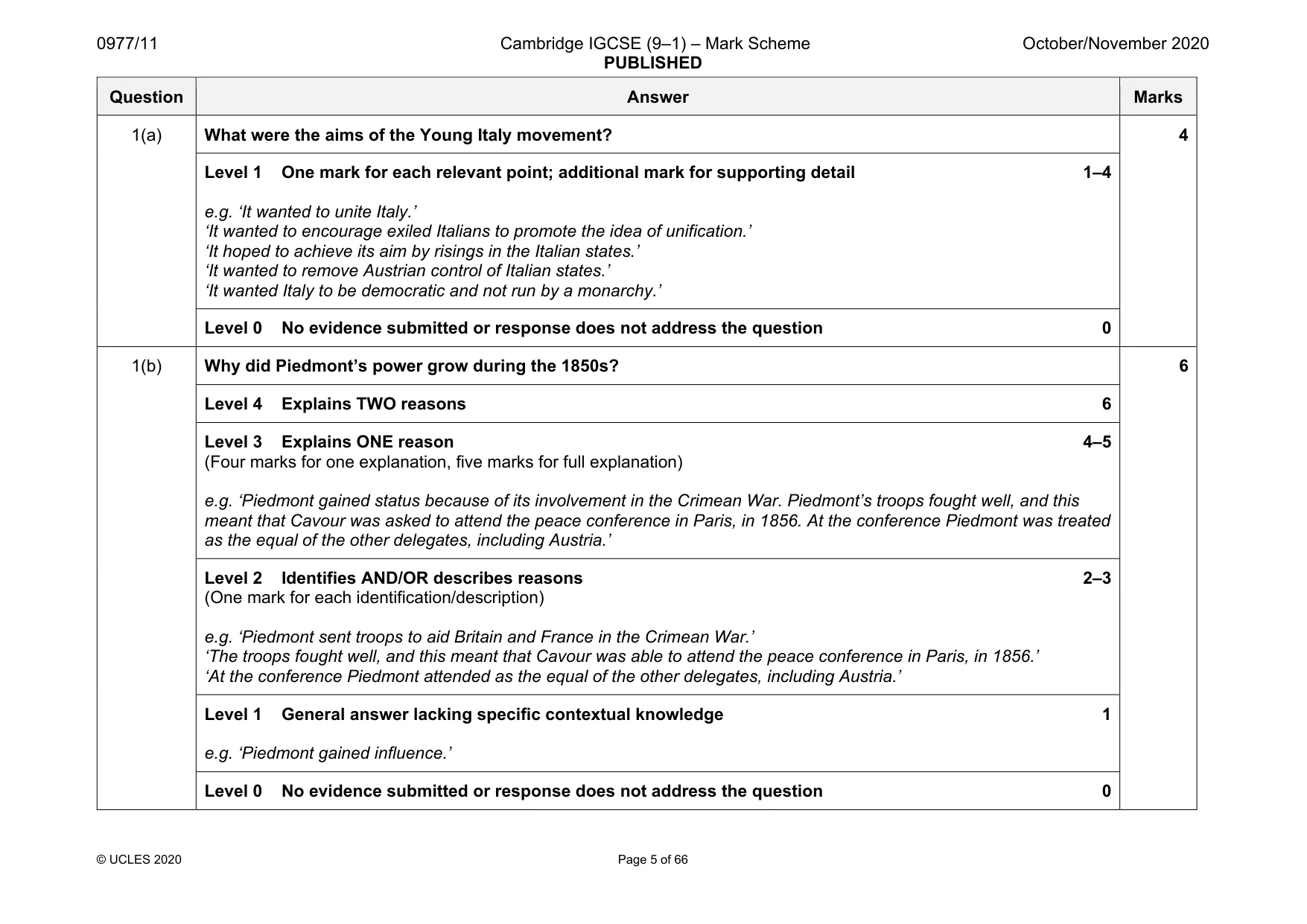
0977/11 Cambridge IGCSE (9–1) – Mark Scheme PUBLISHED October/November 2020 © UCLES 2020 Page 5 of 66 Question Answer Marks 1(a) What were the aims of the Young Italy movement? 4 Level 1 One mark for each relevant point; additional mark for supporting detail 1–4 e.g. ‘It wanted to unite Italy.’ ‘It wanted to encourage exiled Italians to promote the idea of unification.’ ‘It hoped to achieve its aim by risings in the Italian states.’ ‘It wanted to remove Austrian control of Italian states.’ ‘It wanted Italy to be democratic and not run by a monarchy.’ Level 0 No evidence submitted or response does not address the question 0 1(b) Why did Piedmont’s power grow during the 1850s? 6 Level 4 Explains TWO reasons 6 Level 3 Explains ONE reason 4–5 (Four marks for one explanation, five marks for full explanation) e.g. ‘Piedmont gained status because of its involvement in the Crimean War. Piedmont’s troops fought well, and this meant that Cavour was asked to attend the peace conference in Paris, in 1856. At the conference Piedmont was treated as the equal of the other delegates, including Austria.’ Level 2 Identifies AND/OR describes reasons 2–3 (One mark for each identification/description) e.g. ‘Piedmont sent troops to aid Britain and France in the Crimean War.’ ‘The troops fought well, and this meant that Cavour was able to attend the peace conference in Paris, in 1856.’ ‘At the conference Piedmont attended as the equal of the other delegates, including Austria.’ Level 1 General answer lacking specific contextual knowledge 1 e.g. ‘Piedmont gained influence.’ Level 0 No evidence submitted or response does not address the question 0
Mark scheme, page 6
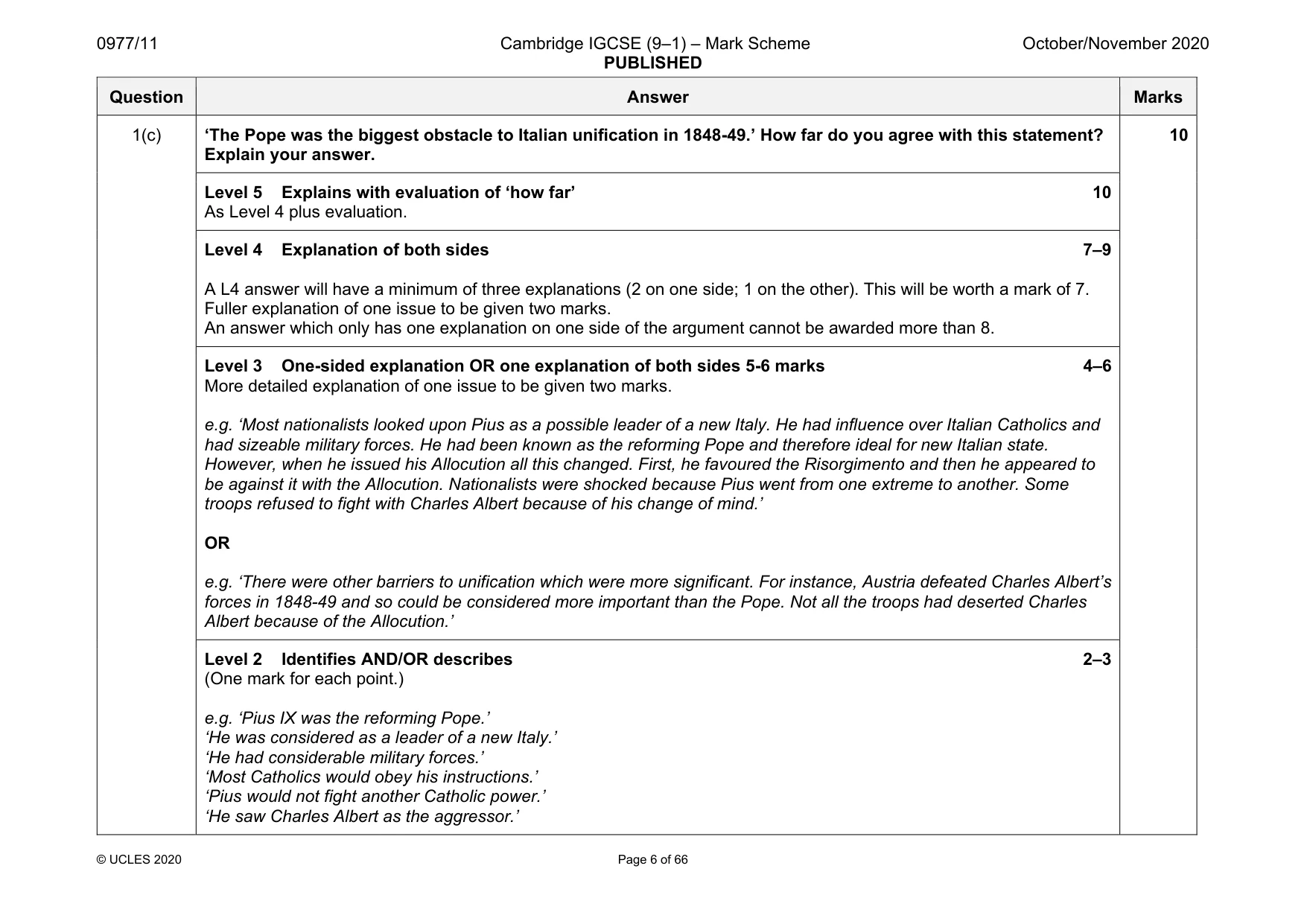
0977/11 Cambridge IGCSE (9–1) – Mark Scheme PUBLISHED October/November 2020 © UCLES 2020 Page 6 of 66 Question Answer Marks 1(c) ‘The Pope was the biggest obstacle to Italian unification in 1848-49.’ How far do you agree with this statement? Explain your answer. 10 Level 5 Explains with evaluation of ‘how far’ 10 As Level 4 plus evaluation. Level 4 Explanation of both sides 7–9 A L4 answer will have a minimum of three explanations (2 on one side; 1 on the other). This will be worth a mark of 7. Fuller explanation of one issue to be given two marks. An answer which only has one explanation on one side of the argument cannot be awarded more than 8. Level 3 One-sided explanation OR one explanation of both sides 5-6 marks 4–6 More detailed explanation of one issue to be given two marks. e.g. ‘Most nationalists looked upon Pius as a possible leader of a new Italy. He had influence over Italian Catholics and had sizeable military forces. He had been known as the reforming Pope and therefore ideal for new Italian state. However, when he issued his Allocution all this changed. First, he favoured the Risorgimento and then he appeared to be against it with the Allocution. Nationalists were shocked because Pius went from one extreme to another. Some troops refused to fight with Charles Albert because of his change of mind.’ OR e.g. ‘There were other barriers to unification which were more significant. For instance, Austria defeated Charles Albert’s forces in 1848-49 and so could be considered more important than the Pope. Not all the troops had deserted Charles Albert because of the Allocution.’ Level 2 Identifies AND/OR describes 2–3 (One mark for each point.) e.g. ‘Pius IX was the reforming Pope.’ ‘He was considered as a leader of a new Italy.’ ‘He had considerable military forces.’ ‘Most Catholics would obey his instructions.’ ‘Pius would not fight another Catholic power.’ ‘He saw Charles Albert as the aggressor.’
Mark scheme, page 7
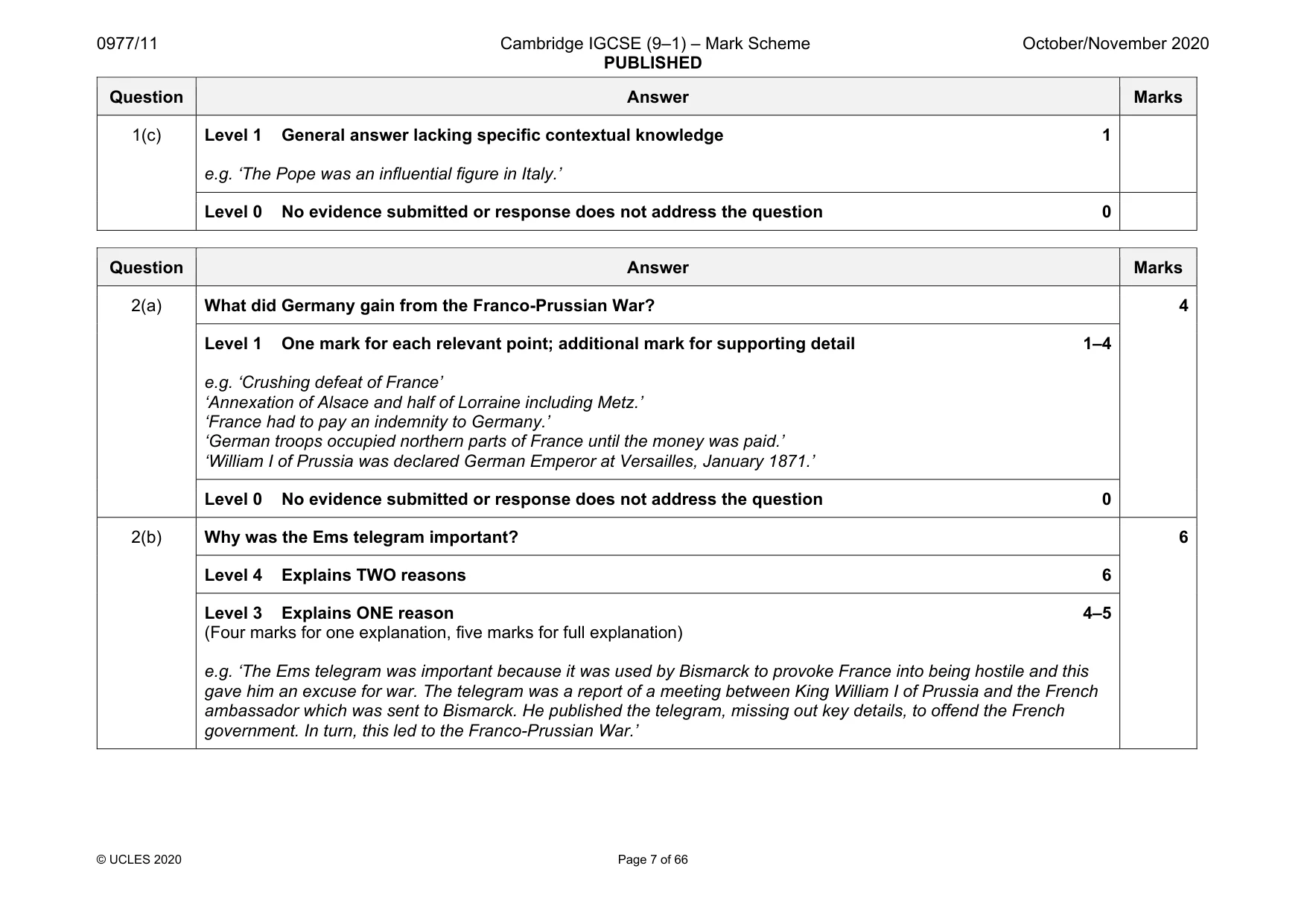
0977/11 Cambridge IGCSE (9–1) – Mark Scheme PUBLISHED October/November 2020 © UCLES 2020 Page 7 of 66 Question Answer Marks 1(c) Level 1 General answer lacking specific contextual knowledge 1 e.g. ‘The Pope was an influential figure in Italy.’ Level 0 No evidence submitted or response does not address the question 0 Question Answer Marks 2(a) What did Germany gain from the Franco-Prussian War? 4 Level 1 One mark for each relevant point; additional mark for supporting detail 1–4 e.g. ‘Crushing defeat of France’ ‘Annexation of Alsace and half of Lorraine including Metz.’ ‘France had to pay an indemnity to Germany.’ ‘German troops occupied northern parts of France until the money was paid.’ ‘William I of Prussia was declared German Emperor at Versailles, January 1871.’ Level 0 No evidence submitted or response does not address the question 0 2(b) Why was the Ems telegram important? 6 Level 4 Explains TWO reasons 6 Level 3 Explains ONE reason 4–5 (Four marks for one explanation, five marks for full explanation) e.g. ‘The Ems telegram was important because it was used by Bismarck to provoke France into being hostile and this gave him an excuse for war. The telegram was a report of a meeting between King William I of Prussia and the French ambassador which was sent to Bismarck. He published the telegram, missing out key details, to offend the French government. In turn, this led to the Franco-Prussian War.’
Mark scheme, page 8
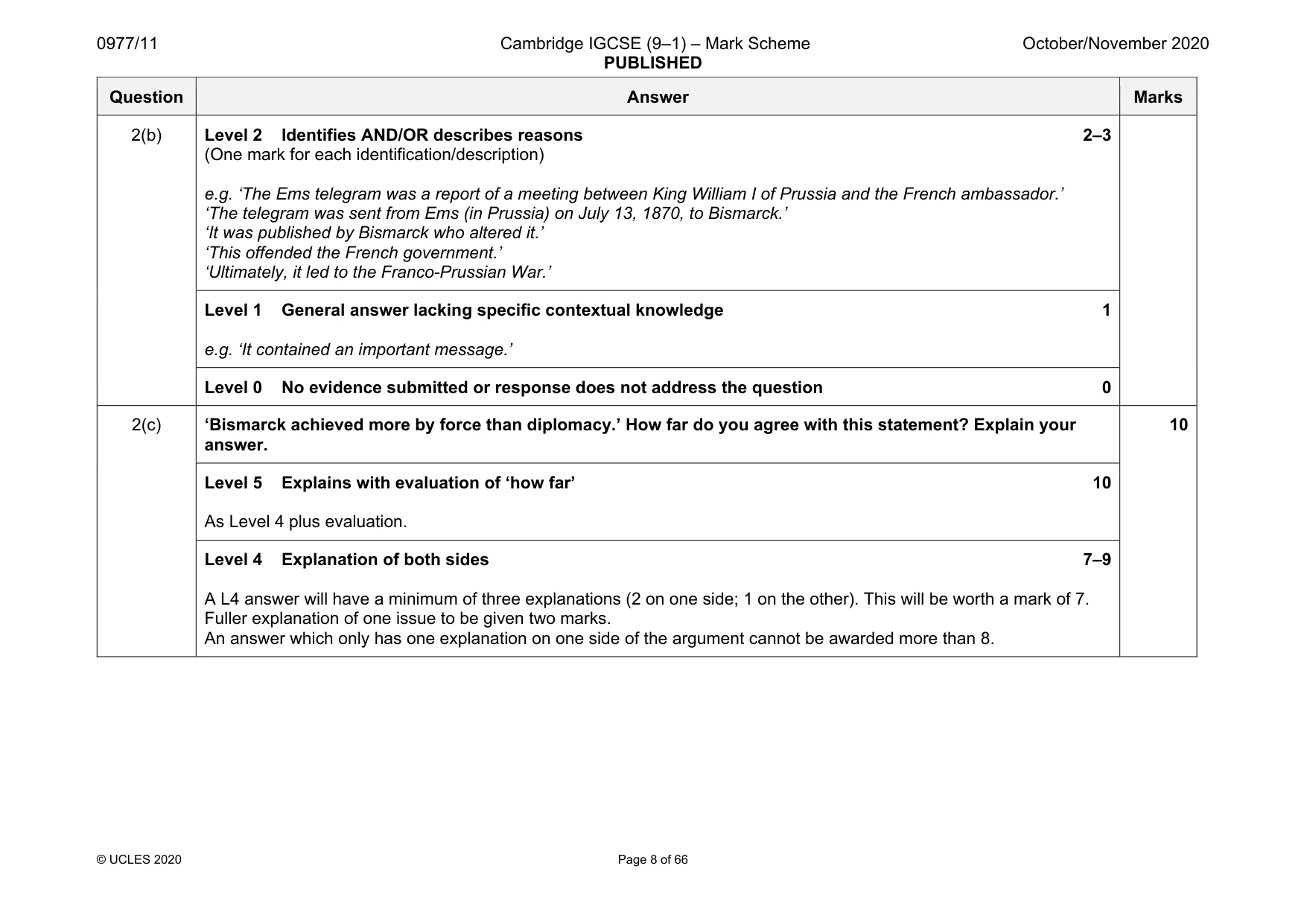
0977/11 Cambridge IGCSE (9–1) – Mark Scheme PUBLISHED October/November 2020 © UCLES 2020 Page 8 of 66 Question Answer Marks 2(b) Level 2 Identifies AND/OR describes reasons 2–3 (One mark for each identification/description) e.g. ‘The Ems telegram was a report of a meeting between King William I of Prussia and the French ambassador.’ ‘The telegram was sent from Ems (in Prussia) on July 13, 1870, to Bismarck.’ ‘It was published by Bismarck who altered it.’ ‘This offended the French government.’ ‘Ultimately, it led to the Franco-Prussian War.’ Level 1 General answer lacking specific contextual knowledge 1 e.g. ‘It contained an important message.’ Level 0 No evidence submitted or response does not address the question 0 2(c) ‘Bismarck achieved more by force than diplomacy.’ How far do you agree with this statement? Explain your answer. 10 Level 5 Explains with evaluation of ‘how far’ 10 As Level 4 plus evaluation. Level 4 Explanation of both sides 7–9 A L4 answer will have a minimum of three explanations (2 on one side; 1 on the other). This will be worth a mark of 7. Fuller explanation of one issue to be given two marks. An answer which only has one explanation on one side of the argument cannot be awarded more than 8.
Mark scheme, page 9
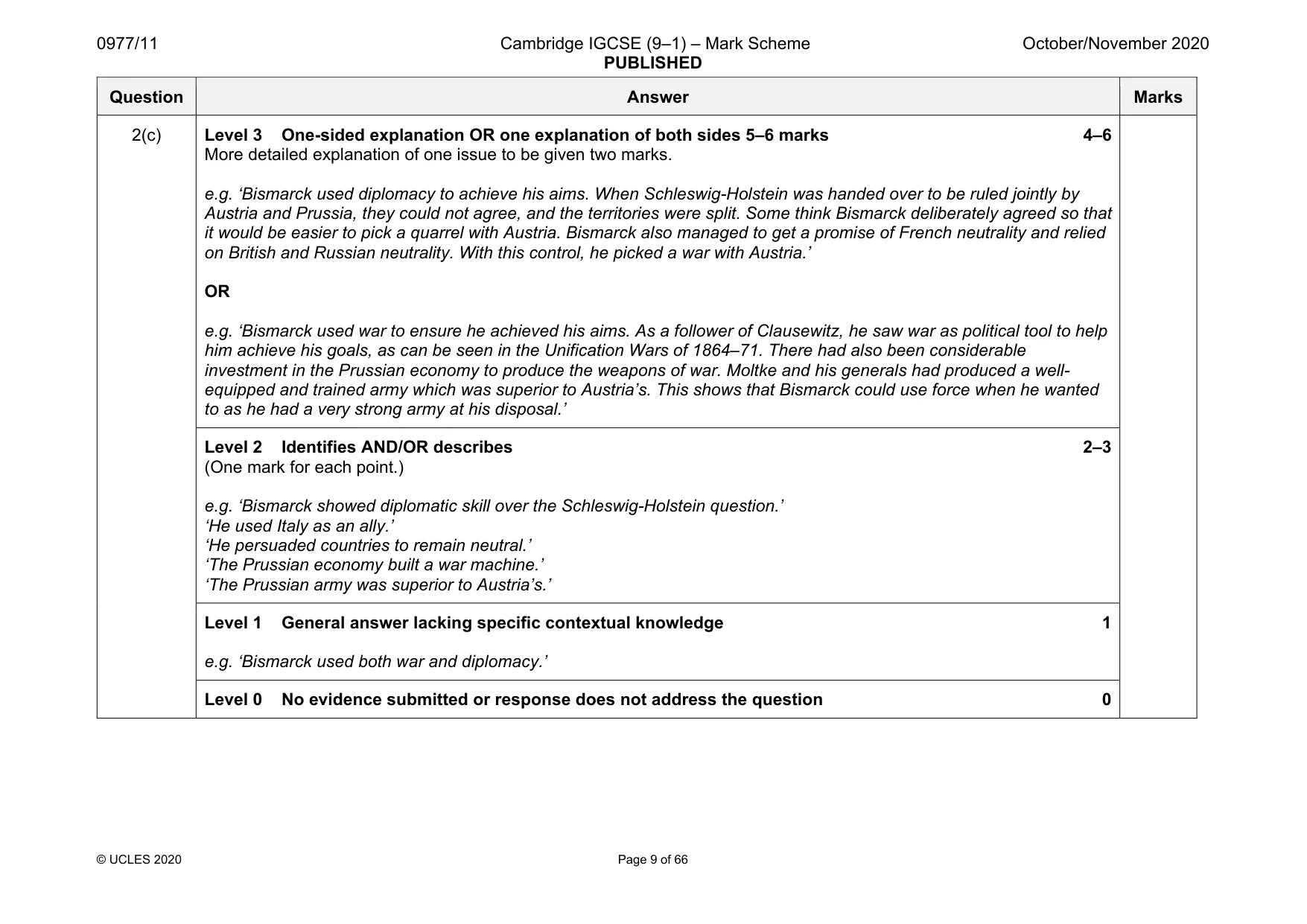
0977/11 Cambridge IGCSE (9–1) – Mark Scheme PUBLISHED October/November 2020 © UCLES 2020 Page 9 of 66 Question Answer Marks 2(c) Level 3 One-sided explanation OR one explanation of both sides 5–6 marks 4–6 More detailed explanation of one issue to be given two marks. e.g. ‘Bismarck used diplomacy to achieve his aims. When Schleswig-Holstein was handed over to be ruled jointly by Austria and Prussia, they could not agree, and the territories were split. Some think Bismarck deliberately agreed so that it would be easier to pick a quarrel with Austria. Bismarck also managed to get a promise of French neutrality and relied on British and Russian neutrality. With this control, he picked a war with Austria.’ OR e.g. ‘Bismarck used war to ensure he achieved his aims. As a follower of Clausewitz, he saw war as political tool to help him achieve his goals, as can be seen in the Unification Wars of 1864–71. There had also been considerable investment in the Prussian economy to produce the weapons of war. Moltke and his generals had produced a well- equipped and trained army which was superior to Austria’s. This shows that Bismarck could use force when he wanted to as he had a very strong army at his disposal.’ Level 2 Identifies AND/OR describes 2–3 (One mark for each point.) e.g. ‘Bismarck showed diplomatic skill over the Schleswig-Holstein question.’ ‘He used Italy as an ally.’ ‘He persuaded countries to remain neutral.’ ‘The Prussian economy built a war machine.’ ‘The Prussian army was superior to Austria’s.’ Level 1 General answer lacking specific contextual knowledge 1 e.g. ‘Bismarck used both war and diplomacy.’ Level 0 No evidence submitted or response does not address the question 0
Mark scheme, page 10
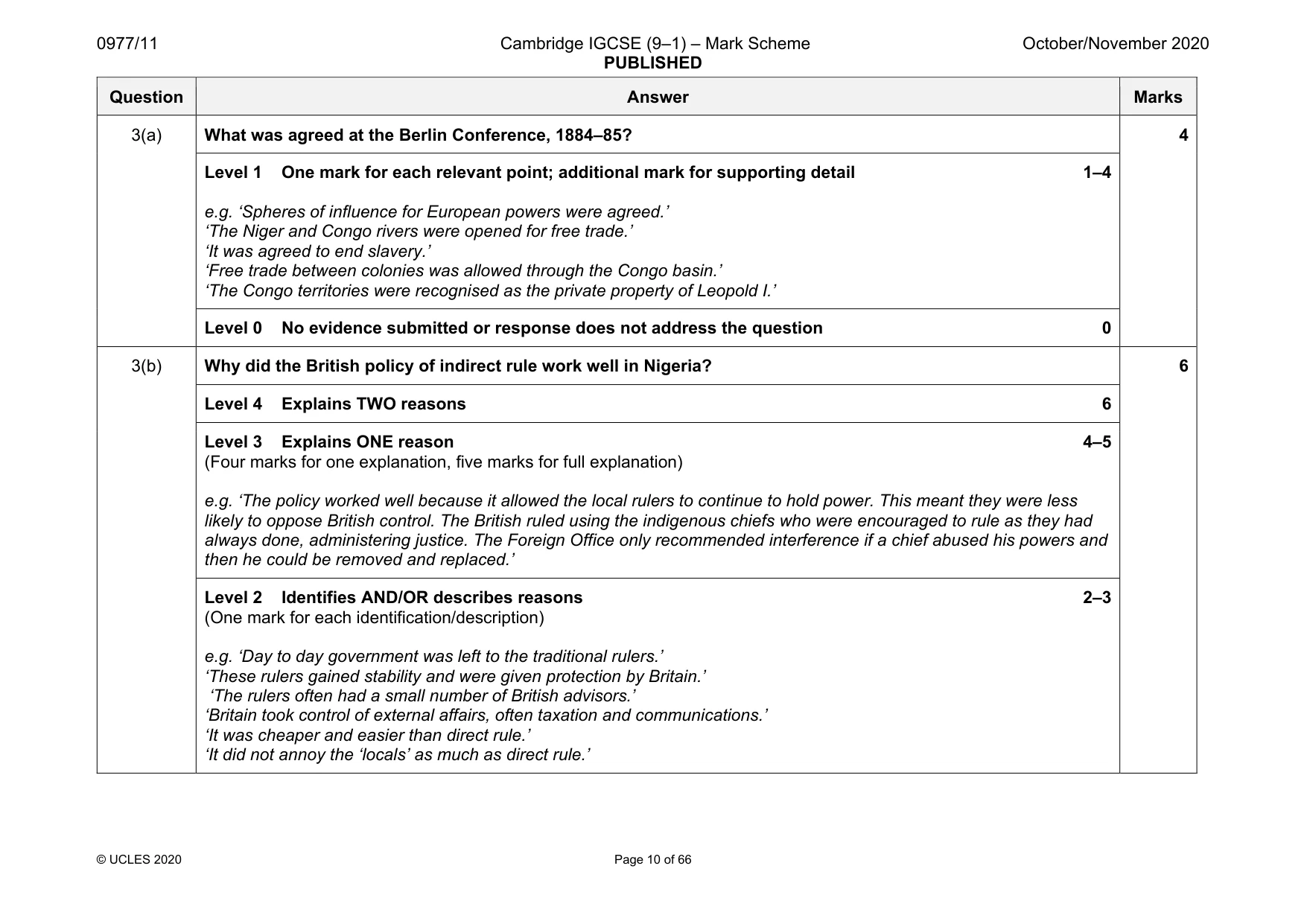
0977/11 Cambridge IGCSE (9–1) – Mark Scheme PUBLISHED October/November 2020 © UCLES 2020 Page 10 of 66 Question Answer Marks 3(a) What was agreed at the Berlin Conference, 1884–85? 4 Level 1 One mark for each relevant point; additional mark for supporting detail 1–4 e.g. ‘Spheres of influence for European powers were agreed.’ ‘The Niger and Congo rivers were opened for free trade.’ ‘It was agreed to end slavery.’ ‘Free trade between colonies was allowed through the Congo basin.’ ‘The Congo territories were recognised as the private property of Leopold I.’ Level 0 No evidence submitted or response does not address the question 0 3(b) Why did the British policy of indirect rule work well in Nigeria? 6 Level 4 Explains TWO reasons 6 Level 3 Explains ONE reason 4–5 (Four marks for one explanation, five marks for full explanation) e.g. ‘The policy worked well because it allowed the local rulers to continue to hold power. This meant they were less likely to oppose British control. The British ruled using the indigenous chiefs who were encouraged to rule as they had always done, administering justice. The Foreign Office only recommended interference if a chief abused his powers and then he could be removed and replaced.’ Level 2 Identifies AND/OR describes reasons 2–3 (One mark for each identification/description) e.g. ‘Day to day government was left to the traditional rulers.’ ‘These rulers gained stability and were given protection by Britain.’ ‘The rulers often had a small number of British advisors.’ ‘Britain took control of external affairs, often taxation and communications.’ ‘It was cheaper and easier than direct rule.’ ‘It did not annoy the ‘locals’ as much as direct rule.’
Mark scheme, page 11
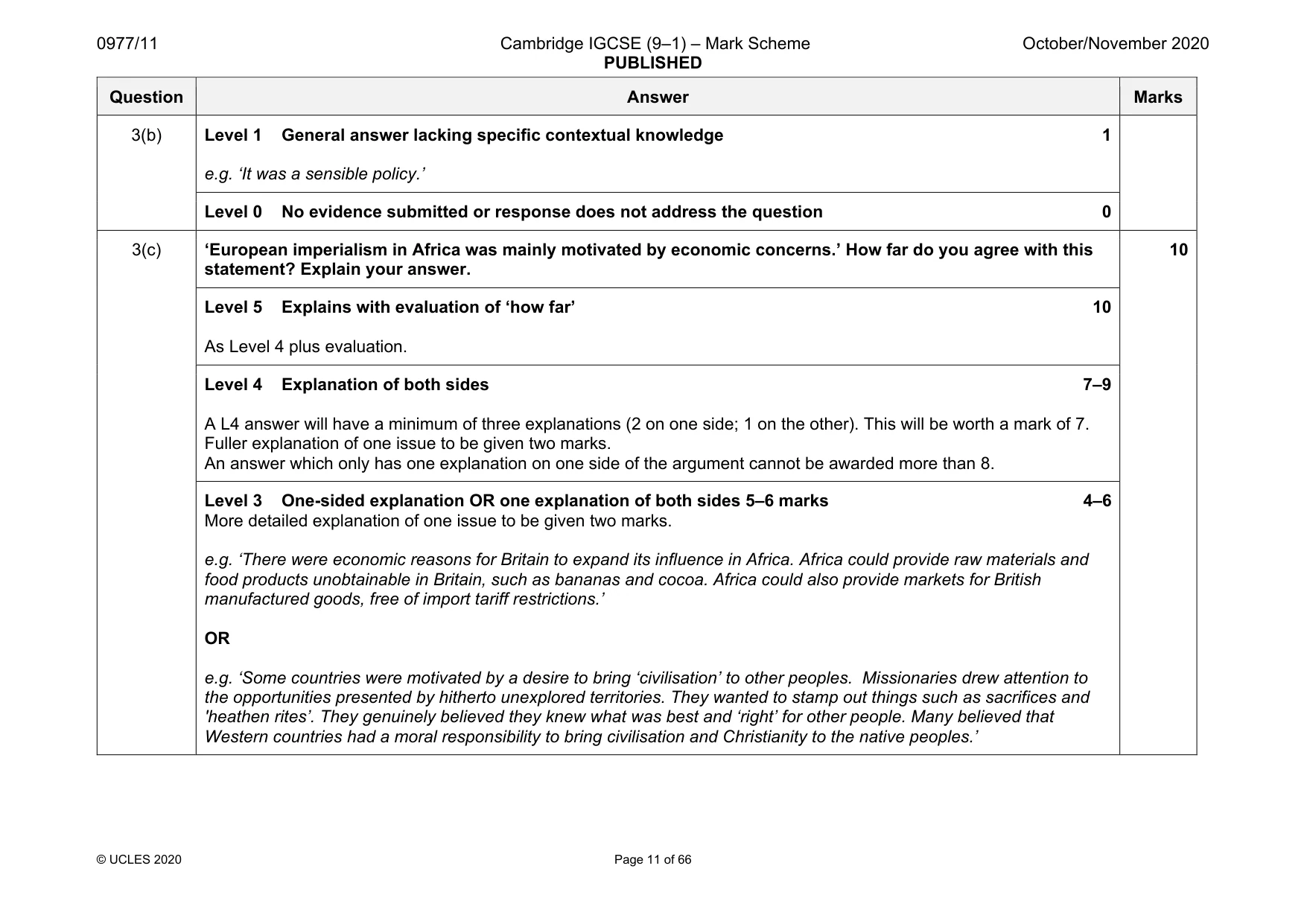
0977/11 Cambridge IGCSE (9–1) – Mark Scheme PUBLISHED October/November 2020 © UCLES 2020 Page 11 of 66 Question Answer Marks 3(b) Level 1 General answer lacking specific contextual knowledge 1 e.g. ‘It was a sensible policy.’ Level 0 No evidence submitted or response does not address the question 0 3(c) ‘European imperialism in Africa was mainly motivated by economic concerns.’ How far do you agree with this statement? Explain your answer. 10 Level 5 Explains with evaluation of ‘how far’ 10 As Level 4 plus evaluation. Level 4 Explanation of both sides 7–9 A L4 answer will have a minimum of three explanations (2 on one side; 1 on the other). This will be worth a mark of 7. Fuller explanation of one issue to be given two marks. An answer which only has one explanation on one side of the argument cannot be awarded more than 8. Level 3 One-sided explanation OR one explanation of both sides 5–6 marks 4–6 More detailed explanation of one issue to be given two marks. e.g. ‘There were economic reasons for Britain to expand its influence in Africa. Africa could provide raw materials and food products unobtainable in Britain, such as bananas and cocoa. Africa could also provide markets for British manufactured goods, free of import tariff restrictions.’ OR e.g. ‘Some countries were motivated by a desire to bring ‘civilisation’ to other peoples. Missionaries drew attention to the opportunities presented by hitherto unexplored territories. They wanted to stamp out things such as sacrifices and 'heathen rites’. They genuinely believed they knew what was best and ‘right’ for other people. Many believed that Western countries had a moral responsibility to bring civilisation and Christianity to the native peoples.’
Mark scheme, page 12
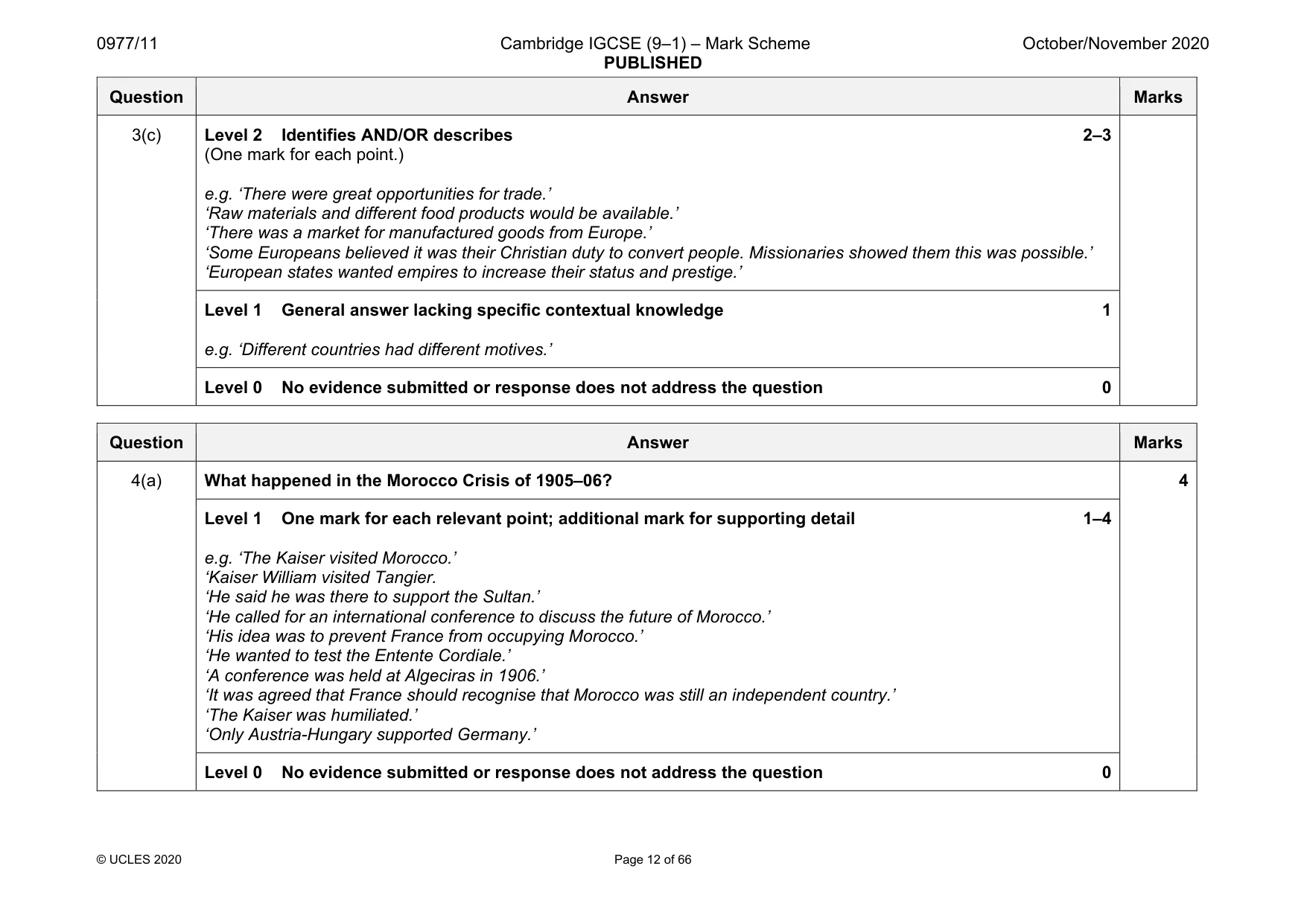
0977/11 Cambridge IGCSE (9–1) – Mark Scheme PUBLISHED October/November 2020 © UCLES 2020 Page 12 of 66 Question Answer Marks 3(c) Level 2 Identifies AND/OR describes 2–3 (One mark for each point.) e.g. ‘There were great opportunities for trade.’ ‘Raw materials and different food products would be available.’ ‘There was a market for manufactured goods from Europe.’ ‘Some Europeans believed it was their Christian duty to convert people. Missionaries showed them this was possible.’ ‘European states wanted empires to increase their status and prestige.’ Level 1 General answer lacking specific contextual knowledge 1 e.g. ‘Different countries had different motives.’ Level 0 No evidence submitted or response does not address the question 0 Question Answer Marks 4(a) What happened in the Morocco Crisis of 1905–06? 4 Level 1 One mark for each relevant point; additional mark for supporting detail 1–4 e.g. ‘The Kaiser visited Morocco.’ ‘Kaiser William visited Tangier. ‘He said he was there to support the Sultan.’ ‘He called for an international conference to discuss the future of Morocco.’ ‘His idea was to prevent France from occupying Morocco.’ ‘He wanted to test the Entente Cordiale.’ ‘A conference was held at Algeciras in 1906.’ ‘It was agreed that France should recognise that Morocco was still an independent country.’ ‘The Kaiser was humiliated.’ ‘Only Austria-Hungary supported Germany.’ Level 0 No evidence submitted or response does not address the question 0
Mark scheme, page 13
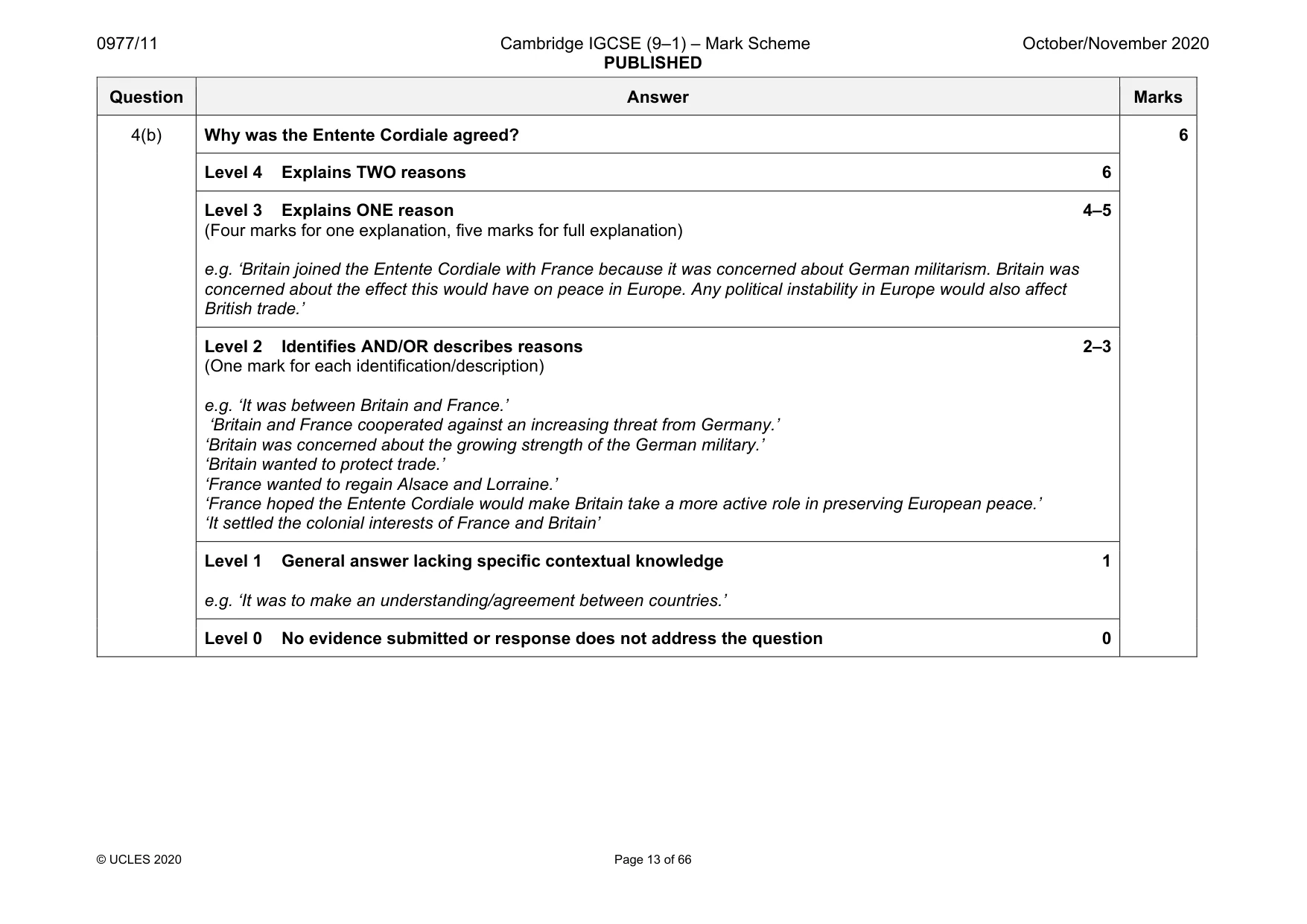
0977/11 Cambridge IGCSE (9–1) – Mark Scheme PUBLISHED October/November 2020 © UCLES 2020 Page 13 of 66 Question Answer Marks 4(b) Why was the Entente Cordiale agreed? 6 Level 4 Explains TWO reasons 6 Level 3 Explains ONE reason 4–5 (Four marks for one explanation, five marks for full explanation) e.g. ‘Britain joined the Entente Cordiale with France because it was concerned about German militarism. Britain was concerned about the effect this would have on peace in Europe. Any political instability in Europe would also affect British trade.’ Level 2 Identifies AND/OR describes reasons 2–3 (One mark for each identification/description) e.g. ‘It was between Britain and France.’ ‘Britain and France cooperated against an increasing threat from Germany.’ ‘Britain was concerned about the growing strength of the German military.’ ‘Britain wanted to protect trade.’ ‘France wanted to regain Alsace and Lorraine.’ ‘France hoped the Entente Cordiale would make Britain take a more active role in preserving European peace.’ ‘It settled the colonial interests of France and Britain’ Level 1 General answer lacking specific contextual knowledge 1 e.g. ‘It was to make an understanding/agreement between countries.’ Level 0 No evidence submitted or response does not address the question 0
Mark scheme, page 14
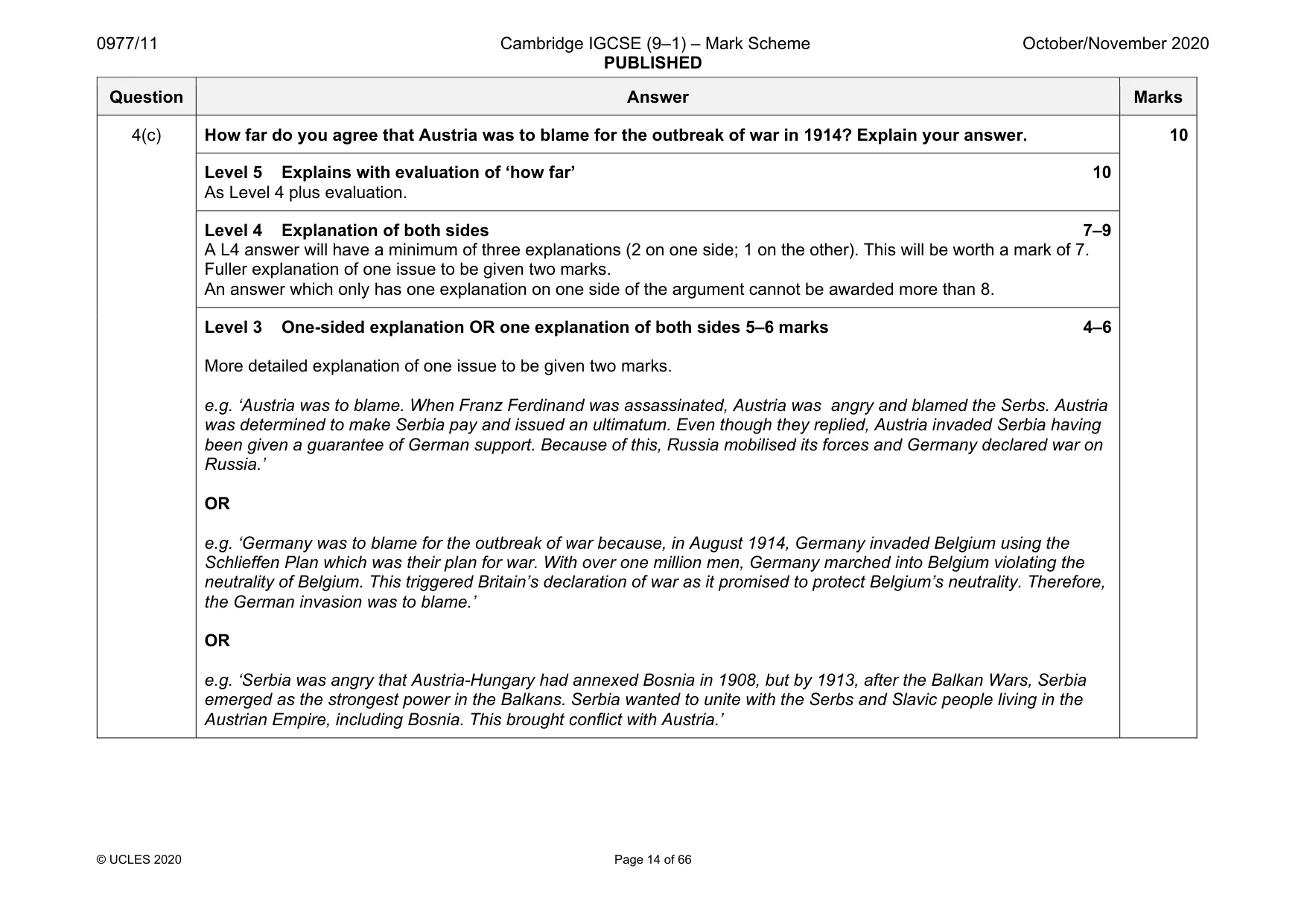
0977/11 Cambridge IGCSE (9–1) – Mark Scheme PUBLISHED October/November 2020 © UCLES 2020 Page 14 of 66 Question Answer Marks 4(c) How far do you agree that Austria was to blame for the outbreak of war in 1914? Explain your answer. 10 Level 5 Explains with evaluation of ‘how far’ 10 As Level 4 plus evaluation. Level 4 Explanation of both sides 7–9 A L4 answer will have a minimum of three explanations (2 on one side; 1 on the other). This will be worth a mark of 7. Fuller explanation of one issue to be given two marks. An answer which only has one explanation on one side of the argument cannot be awarded more than 8. Level 3 One-sided explanation OR one explanation of both sides 5–6 marks 4–6 More detailed explanation of one issue to be given two marks. e.g. ‘Austria was to blame. When Franz Ferdinand was assassinated, Austria was angry and blamed the Serbs. Austria was determined to make Serbia pay and issued an ultimatum. Even though they replied, Austria invaded Serbia having been given a guarantee of German support. Because of this, Russia mobilised its forces and Germany declared war on Russia.’ OR e.g. ‘Germany was to blame for the outbreak of war because, in August 1914, Germany invaded Belgium using the Schlieffen Plan which was their plan for war. With over one million men, Germany marched into Belgium violating the neutrality of Belgium. This triggered Britain’s declaration of war as it promised to protect Belgium’s neutrality. Therefore, the German invasion was to blame.’ OR e.g. ‘Serbia was angry that Austria-Hungary had annexed Bosnia in 1908, but by 1913, after the Balkan Wars, Serbia emerged as the strongest power in the Balkans. Serbia wanted to unite with the Serbs and Slavic people living in the Austrian Empire, including Bosnia. This brought conflict with Austria.’
Mark scheme, page 15
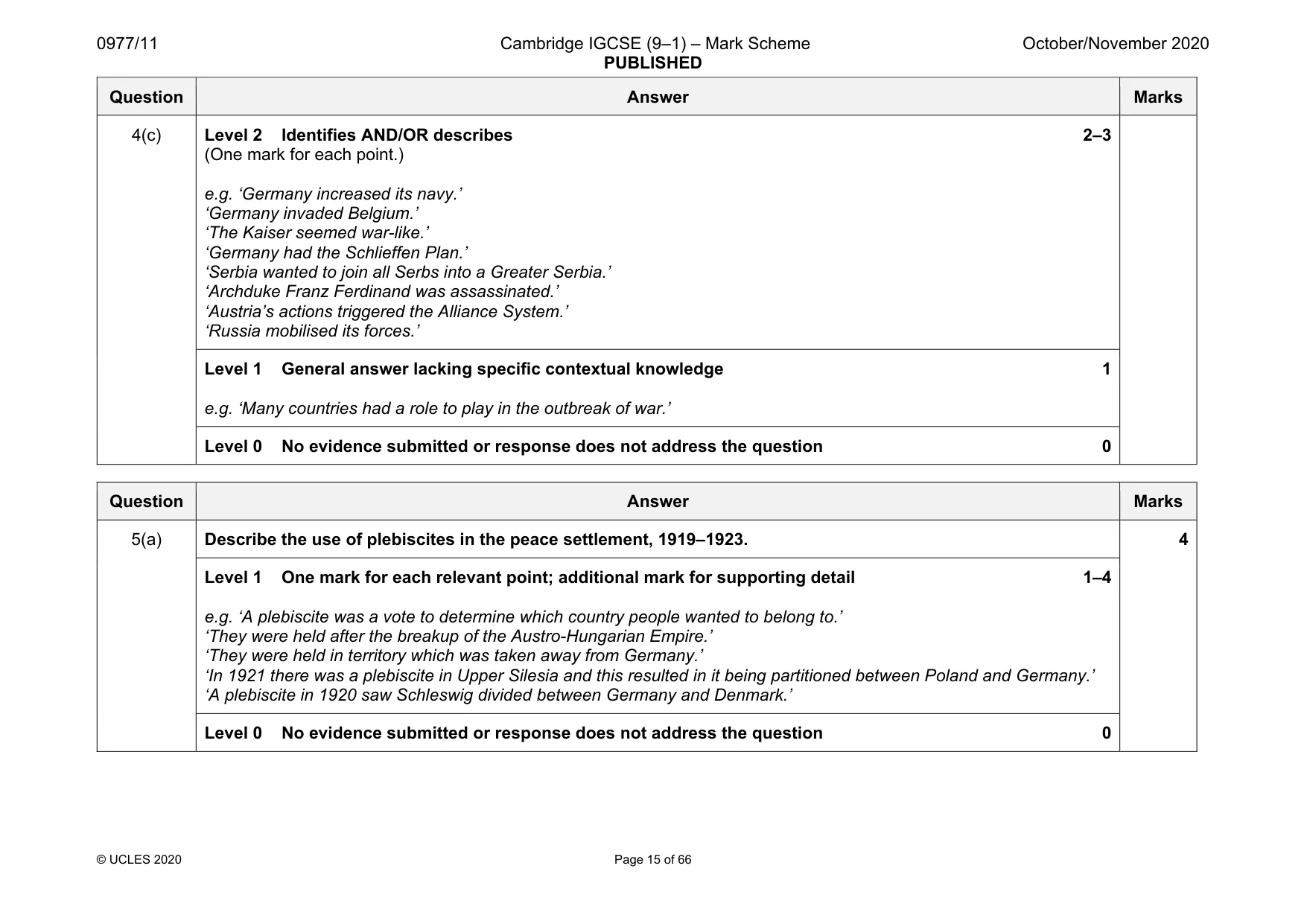
0977/11 Cambridge IGCSE (9–1) – Mark Scheme PUBLISHED October/November 2020 © UCLES 2020 Page 15 of 66 Question Answer Marks 4(c) Level 2 Identifies AND/OR describes 2–3 (One mark for each point.) e.g. ‘Germany increased its navy.’ ‘Germany invaded Belgium.’ ‘The Kaiser seemed war-like.’ ‘Germany had the Schlieffen Plan.’ ‘Serbia wanted to join all Serbs into a Greater Serbia.’ ‘Archduke Franz Ferdinand was assassinated.’ ‘Austria’s actions triggered the Alliance System.’ ‘Russia mobilised its forces.’ Level 1 General answer lacking specific contextual knowledge 1 e.g. ‘Many countries had a role to play in the outbreak of war.’ Level 0 No evidence submitted or response does not address the question 0 Question Answer Marks 5(a) Describe the use of plebiscites in the peace settlement, 1919–1923. 4 Level 1 One mark for each relevant point; additional mark for supporting detail 1–4 e.g. ‘A plebiscite was a vote to determine which country people wanted to belong to.’ ‘They were held after the breakup of the Austro-Hungarian Empire.’ ‘They were held in territory which was taken away from Germany.’ ‘In 1921 there was a plebiscite in Upper Silesia and this resulted in it being partitioned between Poland and Germany.’ ‘A plebiscite in 1920 saw Schleswig divided between Germany and Denmark.’ Level 0 No evidence submitted or response does not address the question 0
Mark scheme, page 16
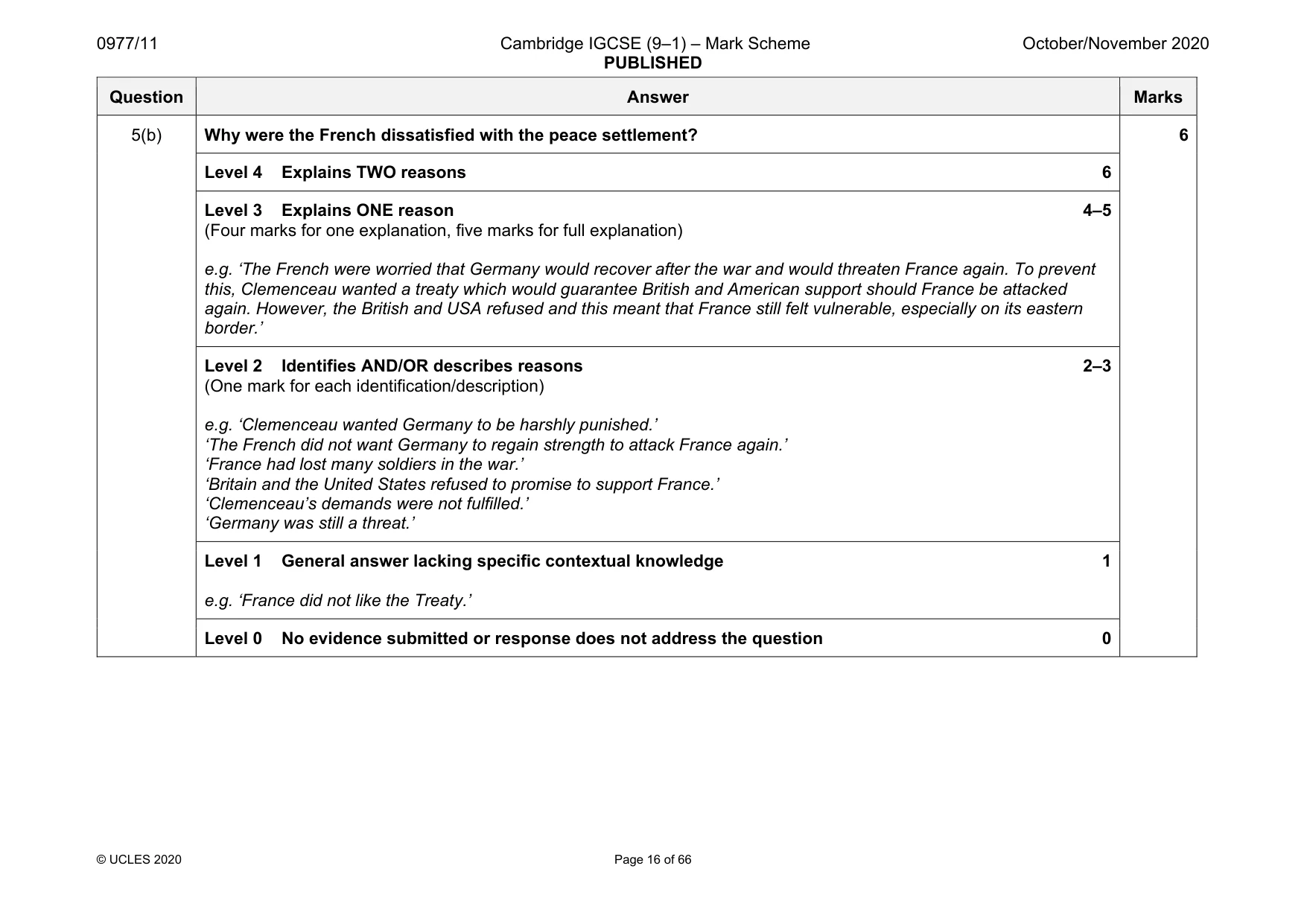
0977/11 Cambridge IGCSE (9–1) – Mark Scheme PUBLISHED October/November 2020 © UCLES 2020 Page 16 of 66 Question Answer Marks 5(b) Why were the French dissatisfied with the peace settlement? 6 Level 4 Explains TWO reasons 6 Level 3 Explains ONE reason 4–5 (Four marks for one explanation, five marks for full explanation) e.g. ‘The French were worried that Germany would recover after the war and would threaten France again. To prevent this, Clemenceau wanted a treaty which would guarantee British and American support should France be attacked again. However, the British and USA refused and this meant that France still felt vulnerable, especially on its eastern border.’ Level 2 Identifies AND/OR describes reasons 2–3 (One mark for each identification/description) e.g. ‘Clemenceau wanted Germany to be harshly punished.’ ‘The French did not want Germany to regain strength to attack France again.’ ‘France had lost many soldiers in the war.’ ‘Britain and the United States refused to promise to support France.’ ‘Clemenceau’s demands were not fulfilled.’ ‘Germany was still a threat.’ Level 1 General answer lacking specific contextual knowledge 1 e.g. ‘France did not like the Treaty.’ Level 0 No evidence submitted or response does not address the question 0
Mark scheme, page 17
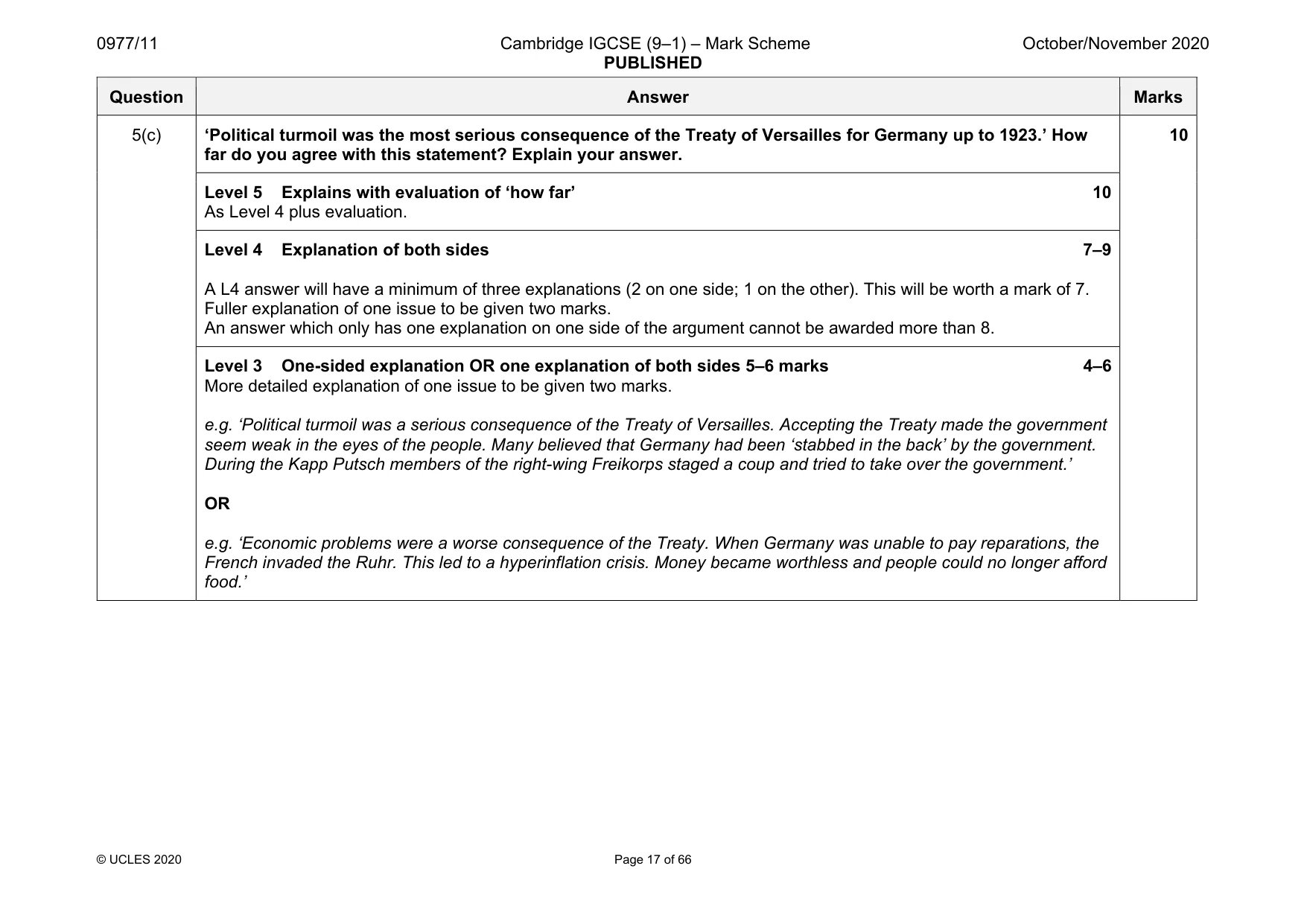
0977/11 Cambridge IGCSE (9–1) – Mark Scheme PUBLISHED October/November 2020 © UCLES 2020 Page 17 of 66 Question Answer Marks 5(c) ‘Political turmoil was the most serious consequence of the Treaty of Versailles for Germany up to 1923.’ How far do you agree with this statement? Explain your answer. 10 Level 5 Explains with evaluation of ‘how far’ 10 As Level 4 plus evaluation. Level 4 Explanation of both sides 7–9 A L4 answer will have a minimum of three explanations (2 on one side; 1 on the other). This will be worth a mark of 7. Fuller explanation of one issue to be given two marks. An answer which only has one explanation on one side of the argument cannot be awarded more than 8. Level 3 One-sided explanation OR one explanation of both sides 5–6 marks 4–6 More detailed explanation of one issue to be given two marks. e.g. ‘Political turmoil was a serious consequence of the Treaty of Versailles. Accepting the Treaty made the government seem weak in the eyes of the people. Many believed that Germany had been ‘stabbed in the back’ by the government. During the Kapp Putsch members of the right-wing Freikorps staged a coup and tried to take over the government.’ OR e.g. ‘Economic problems were a worse consequence of the Treaty. When Germany was unable to pay reparations, the French invaded the Ruhr. This led to a hyperinflation crisis. Money became worthless and people could no longer afford food.’
Mark scheme, page 18
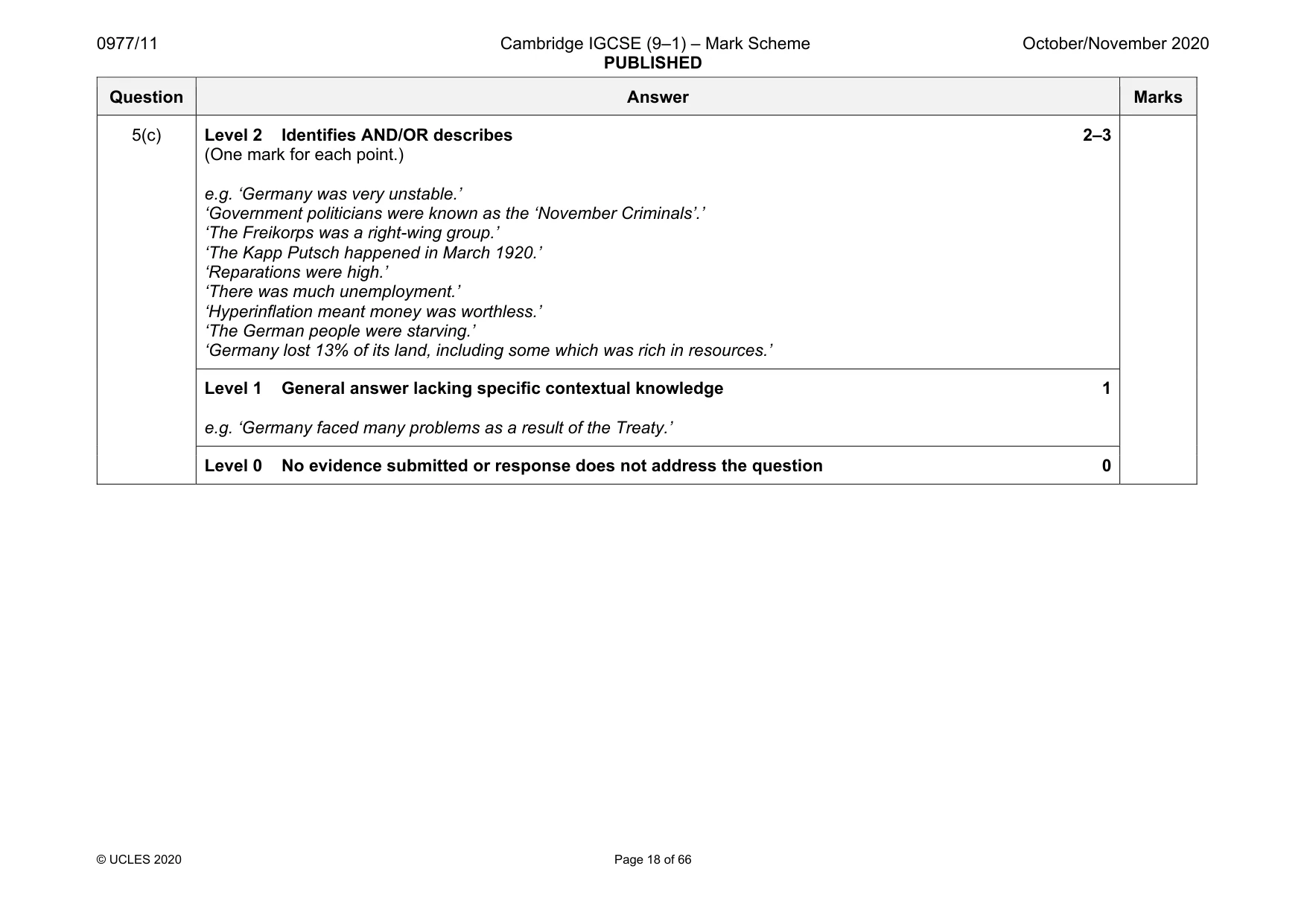
0977/11 Cambridge IGCSE (9–1) – Mark Scheme PUBLISHED October/November 2020 © UCLES 2020 Page 18 of 66 Question Answer Marks 5(c) Level 2 Identifies AND/OR describes 2–3 (One mark for each point.) e.g. ‘Germany was very unstable.’ ‘Government politicians were known as the ‘November Criminals’.’ ‘The Freikorps was a right-wing group.’ ‘The Kapp Putsch happened in March 1920.’ ‘Reparations were high.’ ‘There was much unemployment.’ ‘Hyperinflation meant money was worthless.’ ‘The German people were starving.’ ‘Germany lost 13% of its land, including some which was rich in resources.’ Level 1 General answer lacking specific contextual knowledge 1 e.g. ‘Germany faced many problems as a result of the Treaty.’ Level 0 No evidence submitted or response does not address the question 0
Mark scheme, page 19
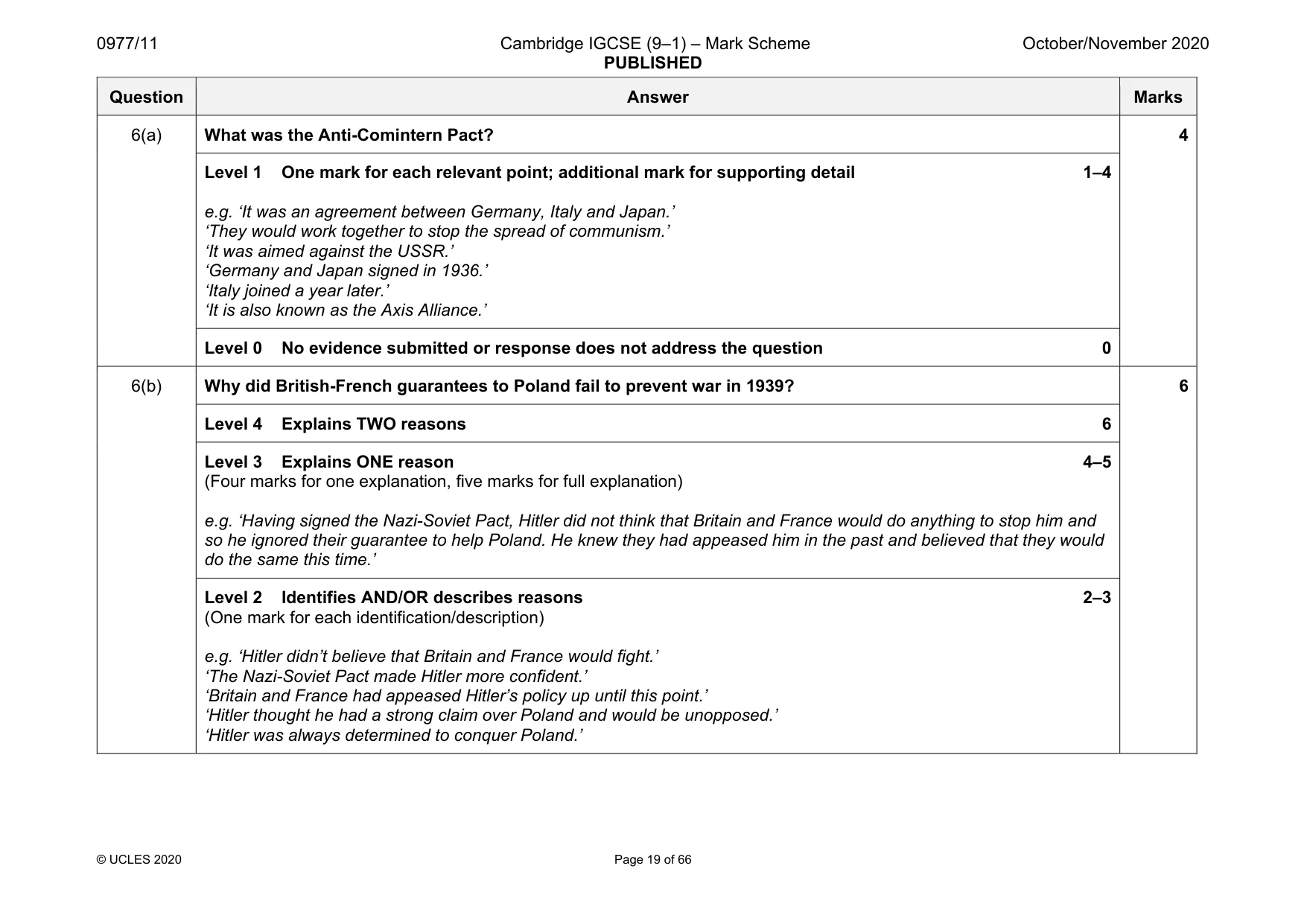
0977/11 Cambridge IGCSE (9–1) – Mark Scheme PUBLISHED October/November 2020 © UCLES 2020 Page 19 of 66 Question Answer Marks 6(a) What was the Anti-Comintern Pact? 4 Level 1 One mark for each relevant point; additional mark for supporting detail 1–4 e.g. ‘It was an agreement between Germany, Italy and Japan.’ ‘They would work together to stop the spread of communism.’ ‘It was aimed against the USSR.’ ‘Germany and Japan signed in 1936.’ ‘Italy joined a year later.’ ‘It is also known as the Axis Alliance.’ Level 0 No evidence submitted or response does not address the question 0 6(b) Why did British-French guarantees to Poland fail to prevent war in 1939? 6 Level 4 Explains TWO reasons 6 Level 3 Explains ONE reason 4–5 (Four marks for one explanation, five marks for full explanation) e.g. ‘Having signed the Nazi-Soviet Pact, Hitler did not think that Britain and France would do anything to stop him and so he ignored their guarantee to help Poland. He knew they had appeased him in the past and believed that they would do the same this time.’ Level 2 Identifies AND/OR describes reasons 2–3 (One mark for each identification/description) e.g. ‘Hitler didn’t believe that Britain and France would fight.’ ‘The Nazi-Soviet Pact made Hitler more confident.’ ‘Britain and France had appeased Hitler’s policy up until this point.’ ‘Hitler thought he had a strong claim over Poland and would be unopposed.’ ‘Hitler was always determined to conquer Poland.’
Mark scheme, page 20
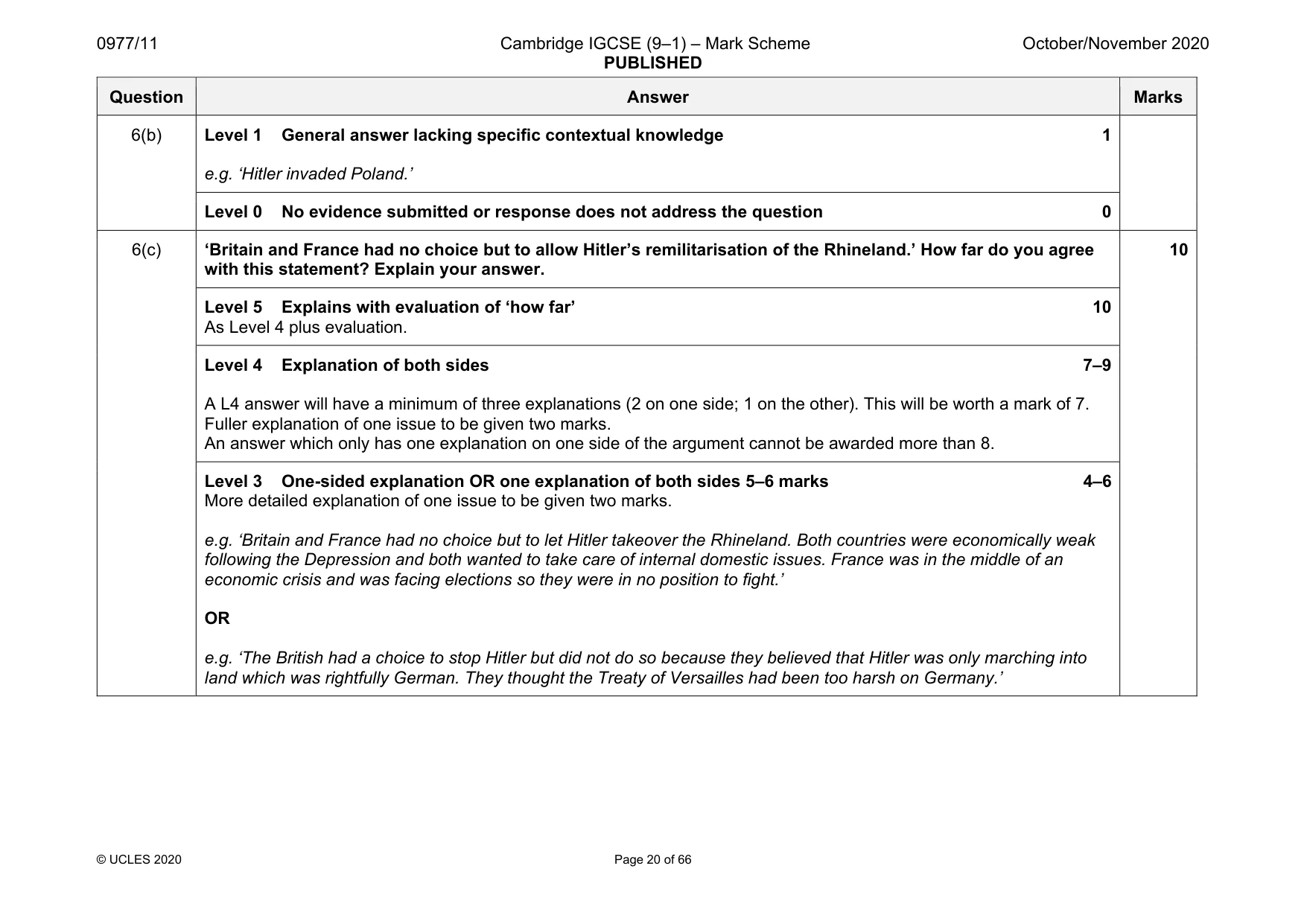
0977/11 Cambridge IGCSE (9–1) – Mark Scheme PUBLISHED October/November 2020 © UCLES 2020 Page 20 of 66 Question Answer Marks 6(b) Level 1 General answer lacking specific contextual knowledge 1 e.g. ‘Hitler invaded Poland.’ Level 0 No evidence submitted or response does not address the question 0 6(c) ‘Britain and France had no choice but to allow Hitler’s remilitarisation of the Rhineland.’ How far do you agree with this statement? Explain your answer. 10 Level 5 Explains with evaluation of ‘how far’ 10 As Level 4 plus evaluation. Level 4 Explanation of both sides 7–9 A L4 answer will have a minimum of three explanations (2 on one side; 1 on the other). This will be worth a mark of 7. Fuller explanation of one issue to be given two marks. An answer which only has one explanation on one side of the argument cannot be awarded more than 8. Level 3 One-sided explanation OR one explanation of both sides 5–6 marks 4–6 More detailed explanation of one issue to be given two marks. e.g. ‘Britain and France had no choice but to let Hitler takeover the Rhineland. Both countries were economically weak following the Depression and both wanted to take care of internal domestic issues. France was in the middle of an economic crisis and was facing elections so they were in no position to fight.’ OR e.g. ‘The British had a choice to stop Hitler but did not do so because they believed that Hitler was only marching into land which was rightfully German. They thought the Treaty of Versailles had been too harsh on Germany.’
Mark scheme, page 21
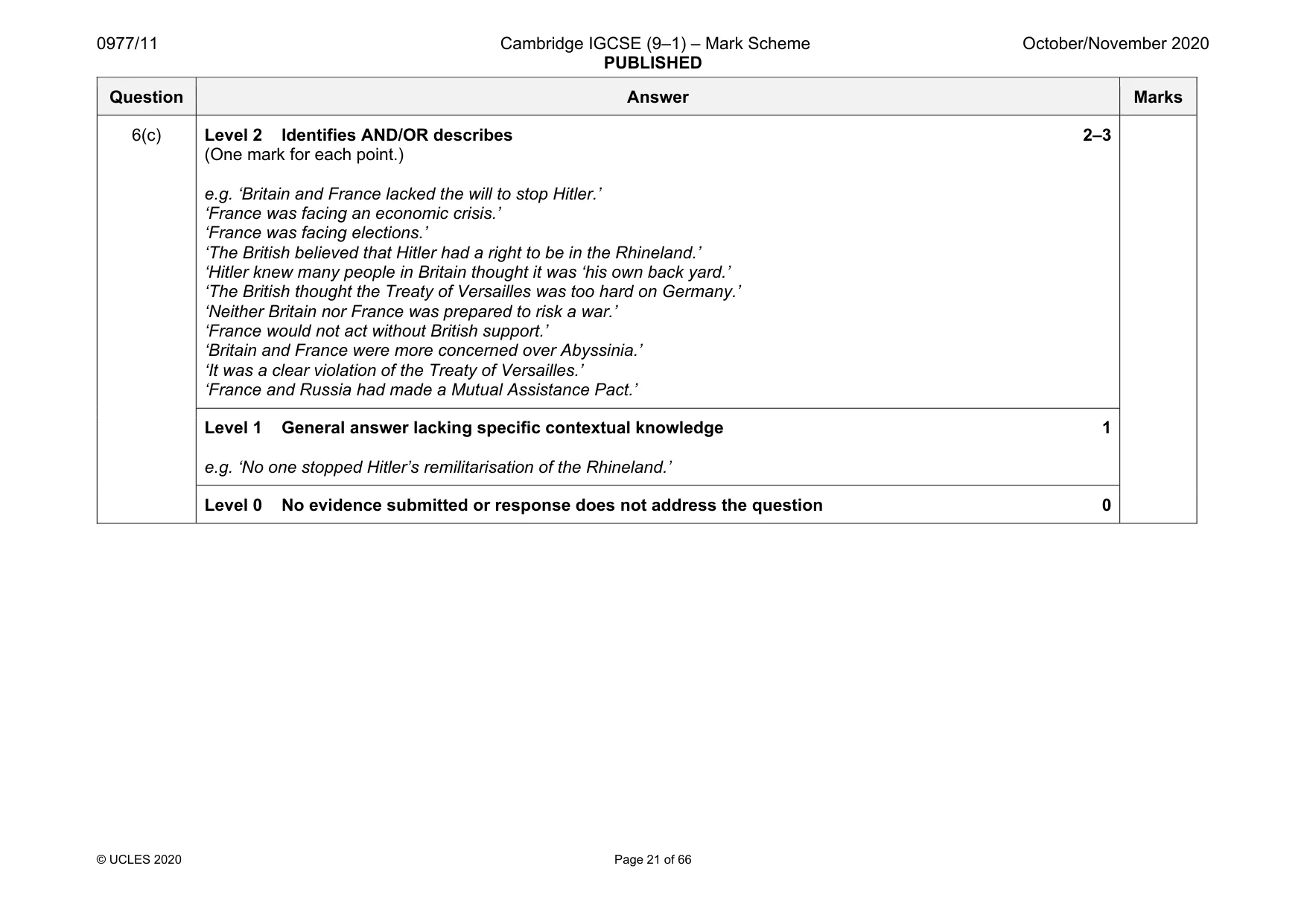
0977/11 Cambridge IGCSE (9–1) – Mark Scheme PUBLISHED October/November 2020 © UCLES 2020 Page 21 of 66 Question Answer Marks 6(c) Level 2 Identifies AND/OR describes 2–3 (One mark for each point.) e.g. ‘Britain and France lacked the will to stop Hitler.’ ‘France was facing an economic crisis.’ ‘France was facing elections.’ ‘The British believed that Hitler had a right to be in the Rhineland.’ ‘Hitler knew many people in Britain thought it was ‘his own back yard.’ ‘The British thought the Treaty of Versailles was too hard on Germany.’ ‘Neither Britain nor France was prepared to risk a war.’ ‘France would not act without British support.’ ‘Britain and France were more concerned over Abyssinia.’ ‘It was a clear violation of the Treaty of Versailles.’ ‘France and Russia had made a Mutual Assistance Pact.’ Level 1 General answer lacking specific contextual knowledge 1 e.g. ‘No one stopped Hitler’s remilitarisation of the Rhineland.’ Level 0 No evidence submitted or response does not address the question 0
Mark scheme, page 22
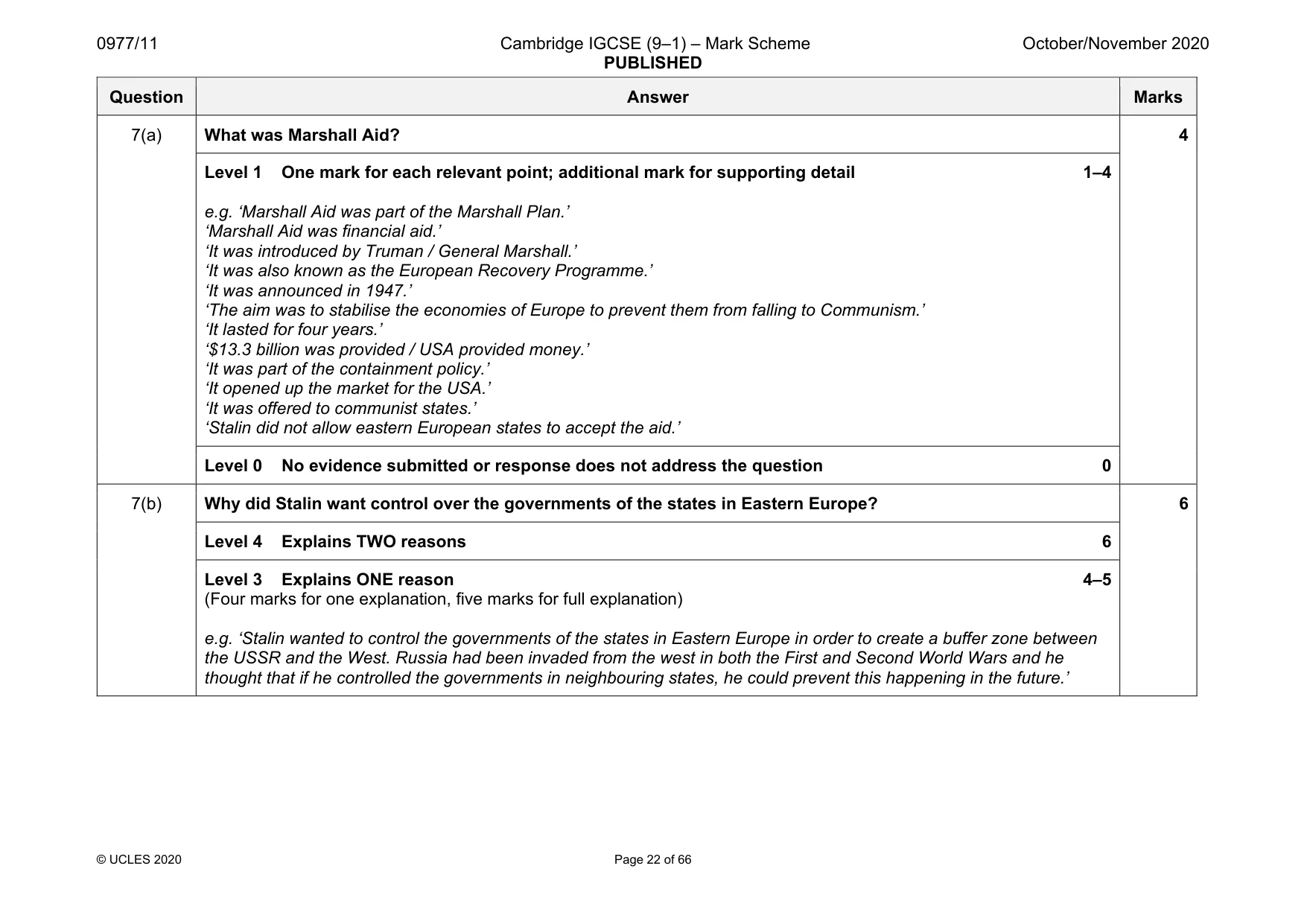
0977/11 Cambridge IGCSE (9–1) – Mark Scheme PUBLISHED October/November 2020 © UCLES 2020 Page 22 of 66 Question Answer Marks 7(a) What was Marshall Aid? 4 Level 1 One mark for each relevant point; additional mark for supporting detail 1–4 e.g. ‘Marshall Aid was part of the Marshall Plan.’ ‘Marshall Aid was financial aid.’ ‘It was introduced by Truman / General Marshall.’ ‘It was also known as the European Recovery Programme.’ ‘It was announced in 1947.’ ‘The aim was to stabilise the economies of Europe to prevent them from falling to Communism.’ ‘It lasted for four years.’ ‘$13.3 billion was provided / USA provided money.’ ‘It was part of the containment policy.’ ‘It opened up the market for the USA.’ ‘It was offered to communist states.’ ‘Stalin did not allow eastern European states to accept the aid.’ Level 0 No evidence submitted or response does not address the question 0 7(b) Why did Stalin want control over the governments of the states in Eastern Europe? 6 Level 4 Explains TWO reasons 6 Level 3 Explains ONE reason 4–5 (Four marks for one explanation, five marks for full explanation) e.g. ‘Stalin wanted to control the governments of the states in Eastern Europe in order to create a buffer zone between the USSR and the West. Russia had been invaded from the west in both the First and Second World Wars and he thought that if he controlled the governments in neighbouring states, he could prevent this happening in the future.’
Mark scheme, page 23
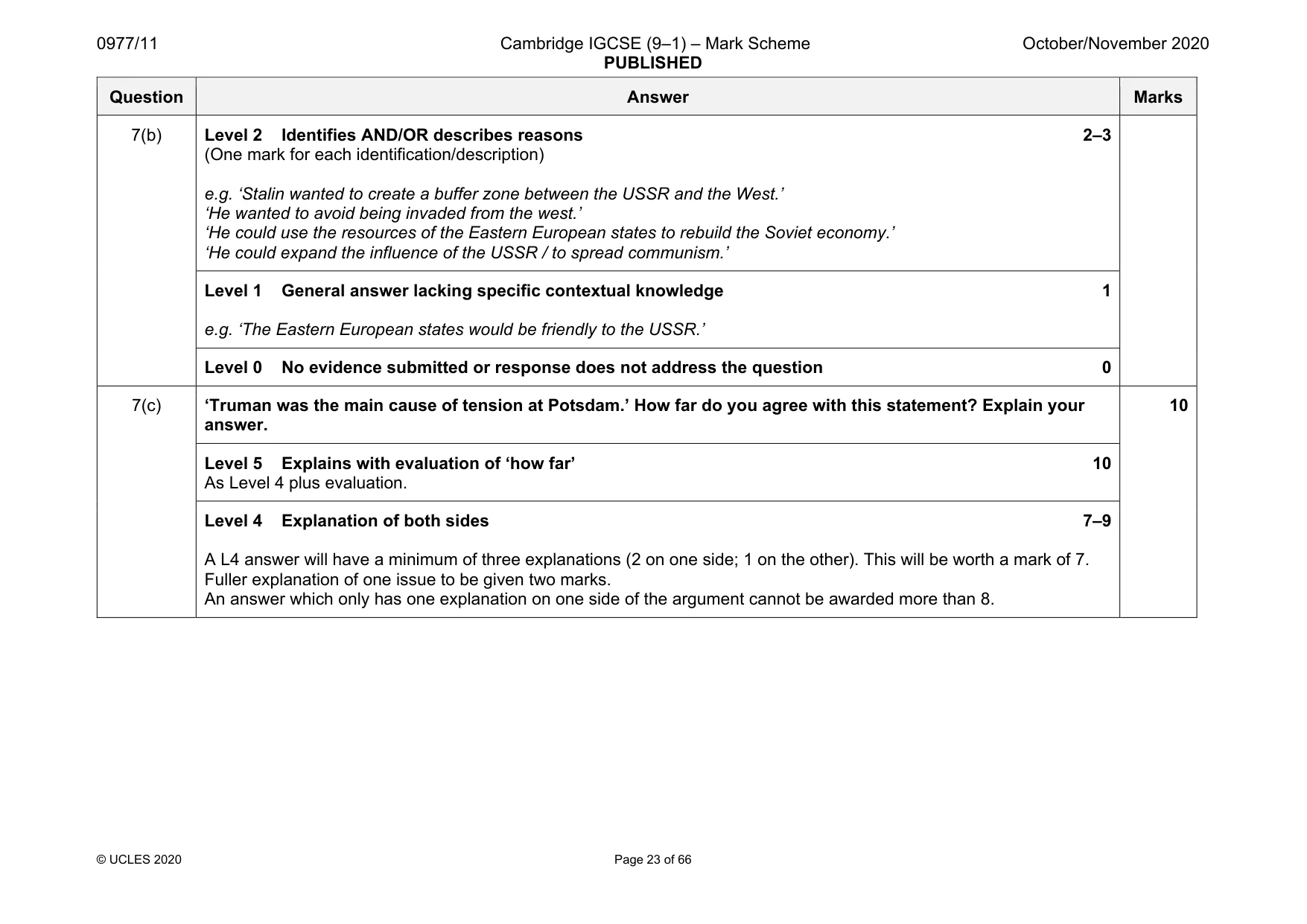
0977/11 Cambridge IGCSE (9–1) – Mark Scheme PUBLISHED October/November 2020 © UCLES 2020 Page 23 of 66 Question Answer Marks 7(b) Level 2 Identifies AND/OR describes reasons 2–3 (One mark for each identification/description) e.g. ‘Stalin wanted to create a buffer zone between the USSR and the West.’ ‘He wanted to avoid being invaded from the west.’ ‘He could use the resources of the Eastern European states to rebuild the Soviet economy.’ ‘He could expand the influence of the USSR / to spread communism.’ Level 1 General answer lacking specific contextual knowledge 1 e.g. ‘The Eastern European states would be friendly to the USSR.’ Level 0 No evidence submitted or response does not address the question 0 7(c) ‘Truman was the main cause of tension at Potsdam.’ How far do you agree with this statement? Explain your answer. 10 Level 5 Explains with evaluation of ‘how far’ 10 As Level 4 plus evaluation. Level 4 Explanation of both sides 7–9 A L4 answer will have a minimum of three explanations (2 on one side; 1 on the other). This will be worth a mark of 7. Fuller explanation of one issue to be given two marks. An answer which only has one explanation on one side of the argument cannot be awarded more than 8.
Mark scheme, page 24
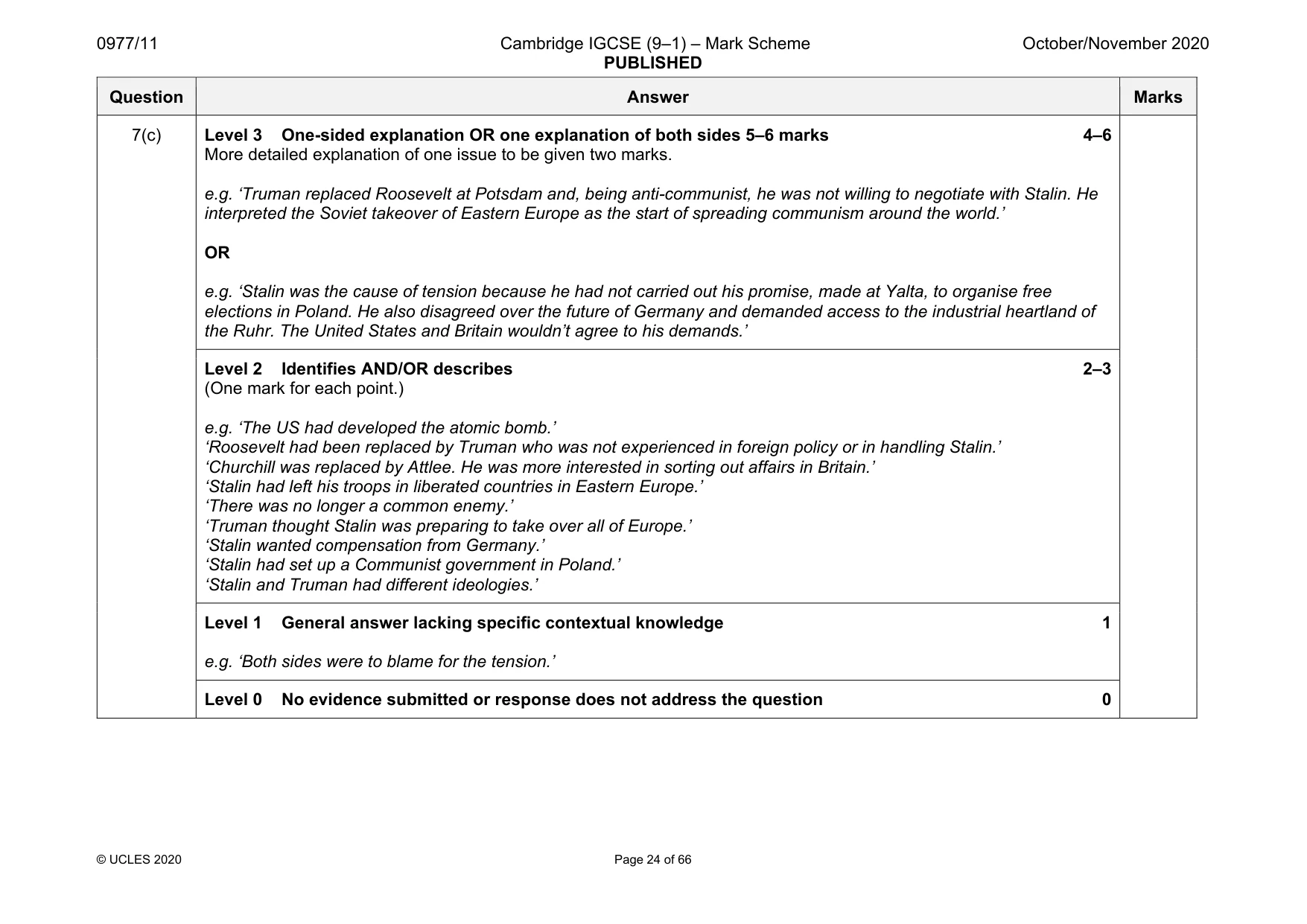
0977/11 Cambridge IGCSE (9–1) – Mark Scheme PUBLISHED October/November 2020 © UCLES 2020 Page 24 of 66 Question Answer Marks 7(c) Level 3 One-sided explanation OR one explanation of both sides 5–6 marks 4–6 More detailed explanation of one issue to be given two marks. e.g. ‘Truman replaced Roosevelt at Potsdam and, being anti-communist, he was not willing to negotiate with Stalin. He interpreted the Soviet takeover of Eastern Europe as the start of spreading communism around the world.’ OR e.g. ‘Stalin was the cause of tension because he had not carried out his promise, made at Yalta, to organise free elections in Poland. He also disagreed over the future of Germany and demanded access to the industrial heartland of the Ruhr. The United States and Britain wouldn’t agree to his demands.’ Level 2 Identifies AND/OR describes 2–3 (One mark for each point.) e.g. ‘The US had developed the atomic bomb.’ ‘Roosevelt had been replaced by Truman who was not experienced in foreign policy or in handling Stalin.’ ‘Churchill was replaced by Attlee. He was more interested in sorting out affairs in Britain.’ ‘Stalin had left his troops in liberated countries in Eastern Europe.’ ‘There was no longer a common enemy.’ ‘Truman thought Stalin was preparing to take over all of Europe.’ ‘Stalin wanted compensation from Germany.’ ‘Stalin had set up a Communist government in Poland.’ ‘Stalin and Truman had different ideologies.’ Level 1 General answer lacking specific contextual knowledge 1 e.g. ‘Both sides were to blame for the tension.’ Level 0 No evidence submitted or response does not address the question 0
Mark scheme, page 25
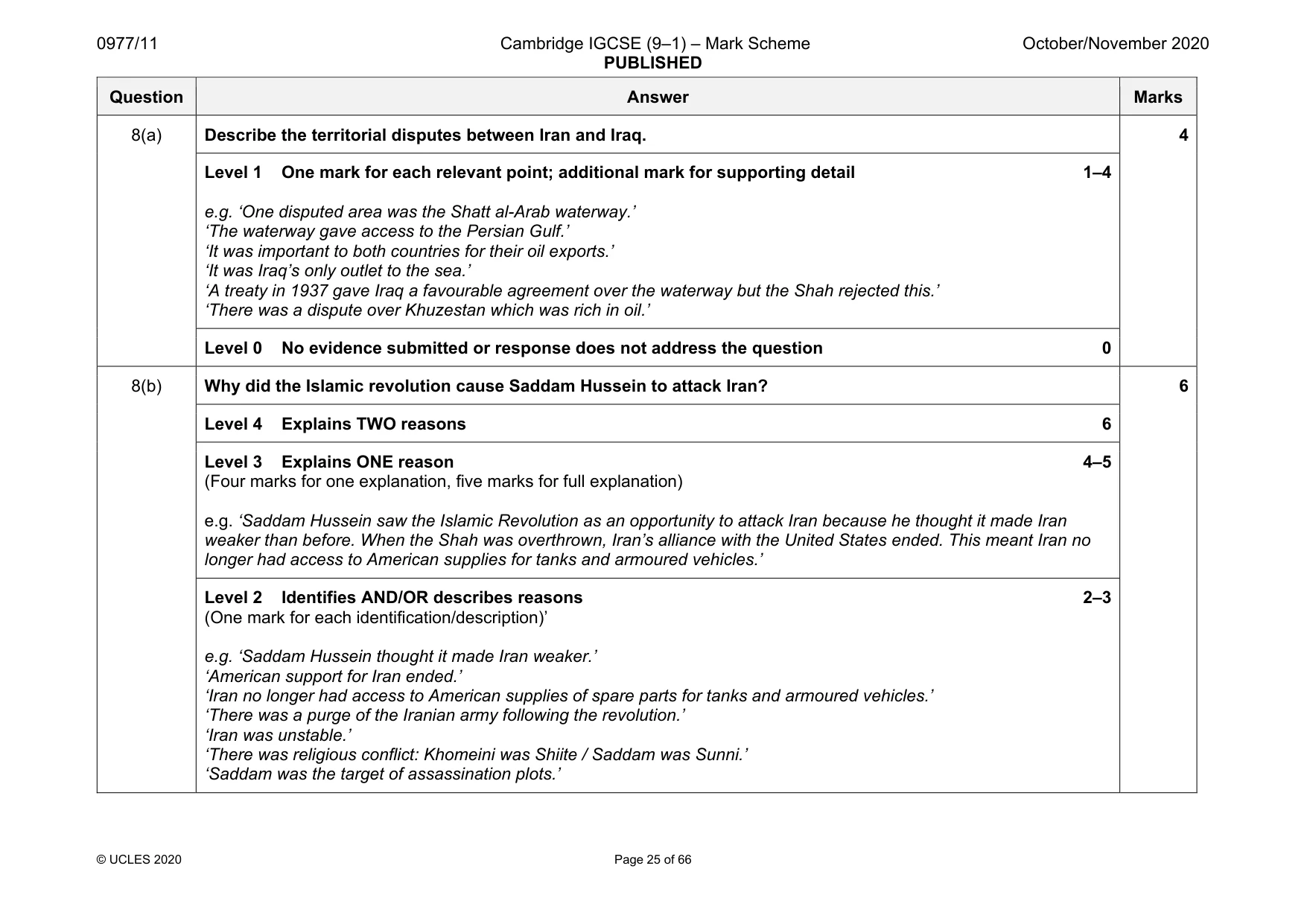
0977/11 Cambridge IGCSE (9–1) – Mark Scheme PUBLISHED October/November 2020 © UCLES 2020 Page 25 of 66 Question Answer Marks 8(a) Describe the territorial disputes between Iran and Iraq. 4 Level 1 One mark for each relevant point; additional mark for supporting detail 1–4 e.g. ‘One disputed area was the Shatt al-Arab waterway.’ ‘The waterway gave access to the Persian Gulf.’ ‘It was important to both countries for their oil exports.’ ‘It was Iraq’s only outlet to the sea.’ ‘A treaty in 1937 gave Iraq a favourable agreement over the waterway but the Shah rejected this.’ ‘There was a dispute over Khuzestan which was rich in oil.’ Level 0 No evidence submitted or response does not address the question 0 8(b) Why did the Islamic revolution cause Saddam Hussein to attack Iran? 6 Level 4 Explains TWO reasons 6 Level 3 Explains ONE reason 4–5 (Four marks for one explanation, five marks for full explanation) e.g. ‘Saddam Hussein saw the Islamic Revolution as an opportunity to attack Iran because he thought it made Iran weaker than before. When the Shah was overthrown, Iran’s alliance with the United States ended. This meant Iran no longer had access to American supplies for tanks and armoured vehicles.’ Level 2 Identifies AND/OR describes reasons 2–3 (One mark for each identification/description)’ e.g. ‘Saddam Hussein thought it made Iran weaker.’ ‘American support for Iran ended.’ ‘Iran no longer had access to American supplies of spare parts for tanks and armoured vehicles.’ ‘There was a purge of the Iranian army following the revolution.’ ‘Iran was unstable.’ ‘There was religious conflict: Khomeini was Shiite / Saddam was Sunni.’ ‘Saddam was the target of assassination plots.’
Mark scheme, page 26
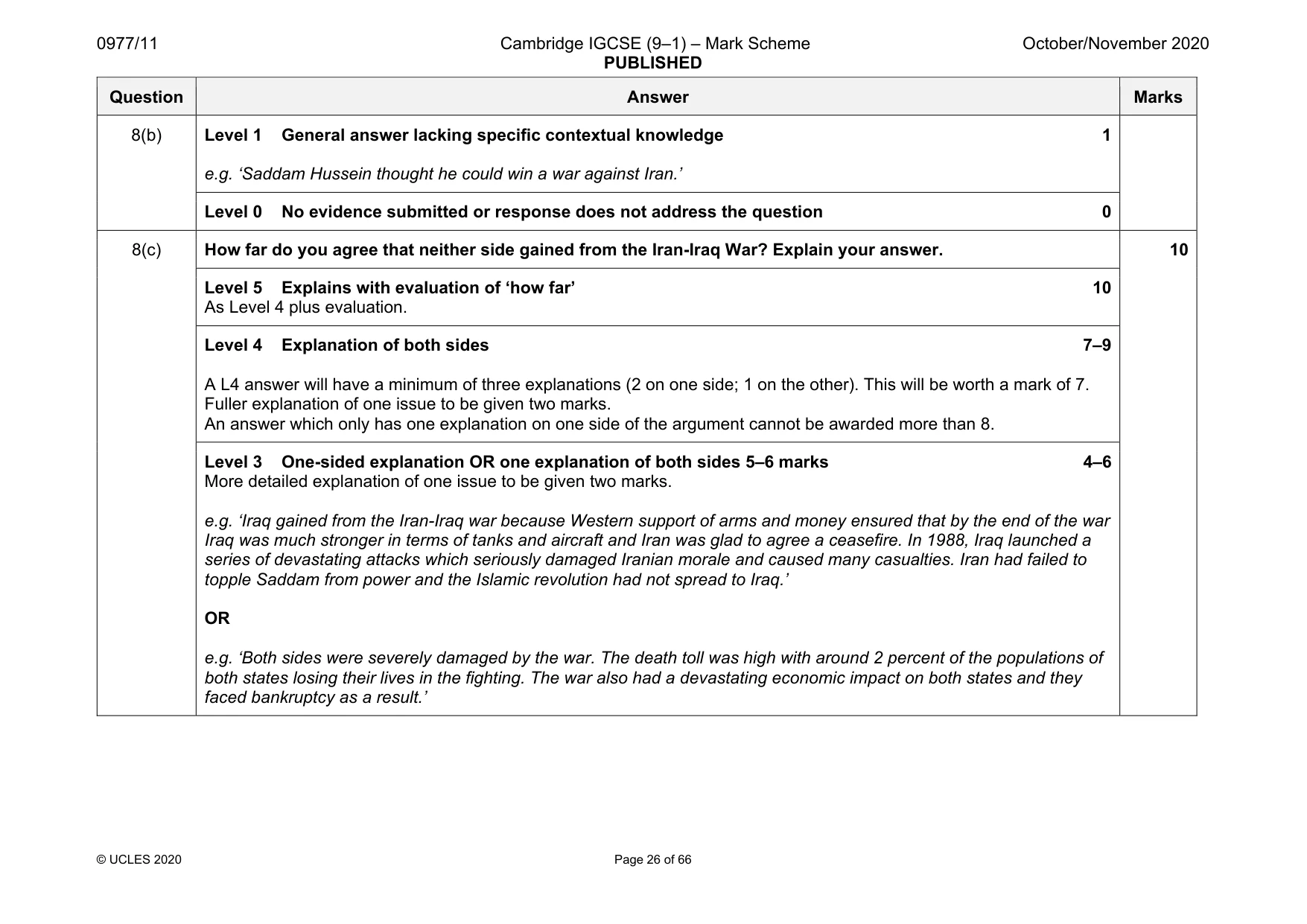
0977/11 Cambridge IGCSE (9–1) – Mark Scheme PUBLISHED October/November 2020 © UCLES 2020 Page 26 of 66 Question Answer Marks 8(b) Level 1 General answer lacking specific contextual knowledge 1 e.g. ‘Saddam Hussein thought he could win a war against Iran.’ Level 0 No evidence submitted or response does not address the question 0 8(c) How far do you agree that neither side gained from the Iran-Iraq War? Explain your answer. 10 Level 5 Explains with evaluation of ‘how far’ 10 As Level 4 plus evaluation. Level 4 Explanation of both sides 7–9 A L4 answer will have a minimum of three explanations (2 on one side; 1 on the other). This will be worth a mark of 7. Fuller explanation of one issue to be given two marks. An answer which only has one explanation on one side of the argument cannot be awarded more than 8. Level 3 One-sided explanation OR one explanation of both sides 5–6 marks 4–6 More detailed explanation of one issue to be given two marks. e.g. ‘Iraq gained from the Iran-Iraq war because Western support of arms and money ensured that by the end of the war Iraq was much stronger in terms of tanks and aircraft and Iran was glad to agree a ceasefire. In 1988, Iraq launched a series of devastating attacks which seriously damaged Iranian morale and caused many casualties. Iran had failed to topple Saddam from power and the Islamic revolution had not spread to Iraq.’ OR e.g. ‘Both sides were severely damaged by the war. The death toll was high with around 2 percent of the populations of both states losing their lives in the fighting. The war also had a devastating economic impact on both states and they faced bankruptcy as a result.’
Mark scheme, page 27
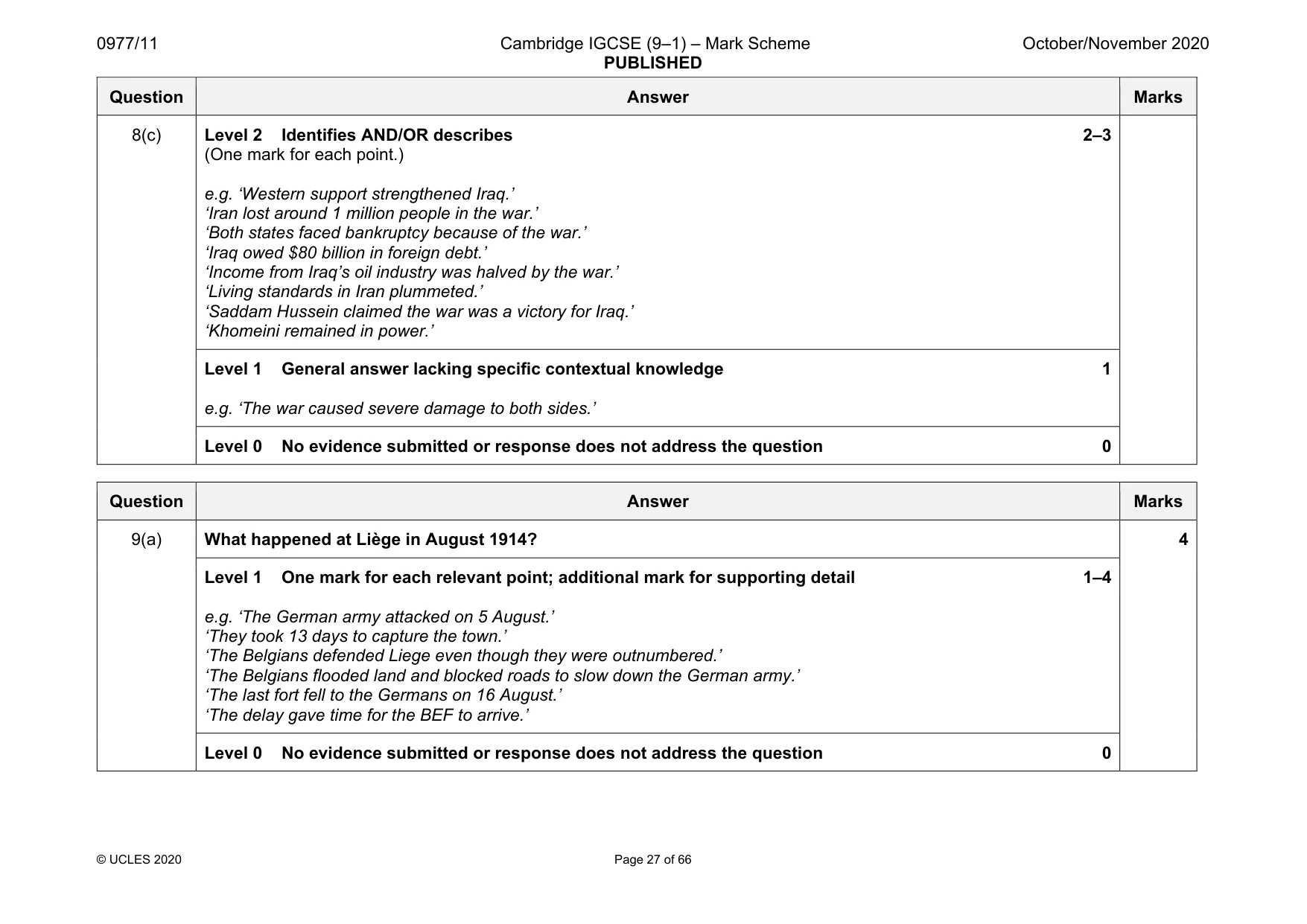
0977/11 Cambridge IGCSE (9–1) – Mark Scheme PUBLISHED October/November 2020 © UCLES 2020 Page 27 of 66 Question Answer Marks 8(c) Level 2 Identifies AND/OR describes 2–3 (One mark for each point.) e.g. ‘Western support strengthened Iraq.’ ‘Iran lost around 1 million people in the war.’ ‘Both states faced bankruptcy because of the war.’ ‘Iraq owed $80 billion in foreign debt.’ ‘Income from Iraq’s oil industry was halved by the war.’ ‘Living standards in Iran plummeted.’ ‘Saddam Hussein claimed the war was a victory for Iraq.’ ‘Khomeini remained in power.’ Level 1 General answer lacking specific contextual knowledge 1 e.g. ‘The war caused severe damage to both sides.’ Level 0 No evidence submitted or response does not address the question 0 Question Answer Marks 9(a) What happened at Liège in August 1914? 4 Level 1 One mark for each relevant point; additional mark for supporting detail 1–4 e.g. ‘The German army attacked on 5 August.’ ‘They took 13 days to capture the town.’ ‘The Belgians defended Liege even though they were outnumbered.’ ‘The Belgians flooded land and blocked roads to slow down the German army.’ ‘The last fort fell to the Germans on 16 August.’ ‘The delay gave time for the BEF to arrive.’ Level 0 No evidence submitted or response does not address the question 0
Mark scheme, page 28
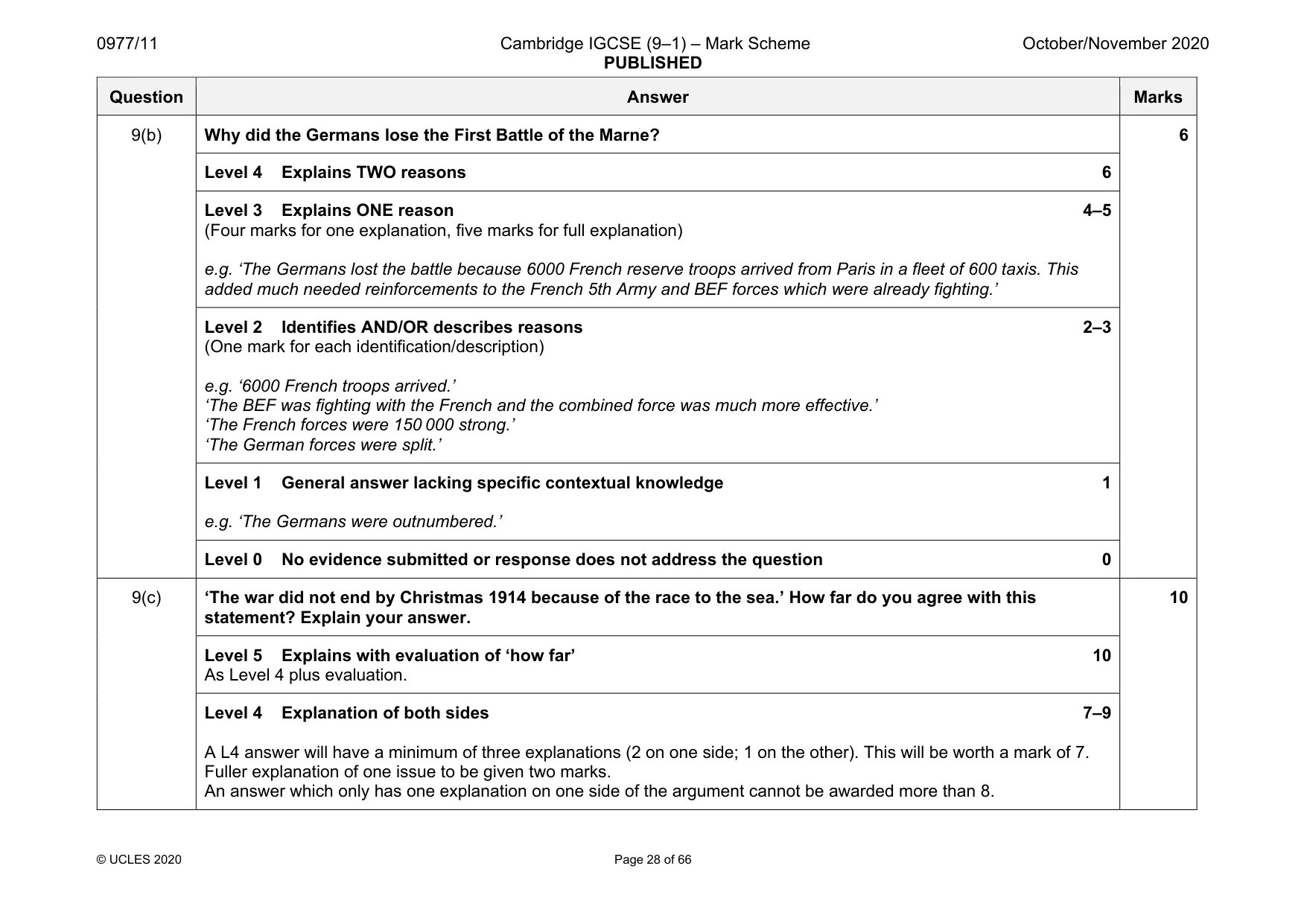
0977/11 Cambridge IGCSE (9–1) – Mark Scheme PUBLISHED October/November 2020 © UCLES 2020 Page 28 of 66 Question Answer Marks 9(b) Why did the Germans lose the First Battle of the Marne? 6 Level 4 Explains TWO reasons 6 Level 3 Explains ONE reason 4–5 (Four marks for one explanation, five marks for full explanation) e.g. ‘The Germans lost the battle because 6000 French reserve troops arrived from Paris in a fleet of 600 taxis. This added much needed reinforcements to the French 5th Army and BEF forces which were already fighting.’ Level 2 Identifies AND/OR describes reasons 2–3 (One mark for each identification/description) e.g. ‘6000 French troops arrived.’ ‘The BEF was fighting with the French and the combined force was much more effective.’ ‘The French forces were 150 000 strong.’ ‘The German forces were split.’ Level 1 General answer lacking specific contextual knowledge 1 e.g. ‘The Germans were outnumbered.’ Level 0 No evidence submitted or response does not address the question 0 9(c) ‘The war did not end by Christmas 1914 because of the race to the sea.’ How far do you agree with this statement? Explain your answer. 10 Level 5 Explains with evaluation of ‘how far’ 10 As Level 4 plus evaluation. Level 4 Explanation of both sides 7–9 A L4 answer will have a minimum of three explanations (2 on one side; 1 on the other). This will be worth a mark of 7. Fuller explanation of one issue to be given two marks. An answer which only has one explanation on one side of the argument cannot be awarded more than 8.
Mark scheme, page 29
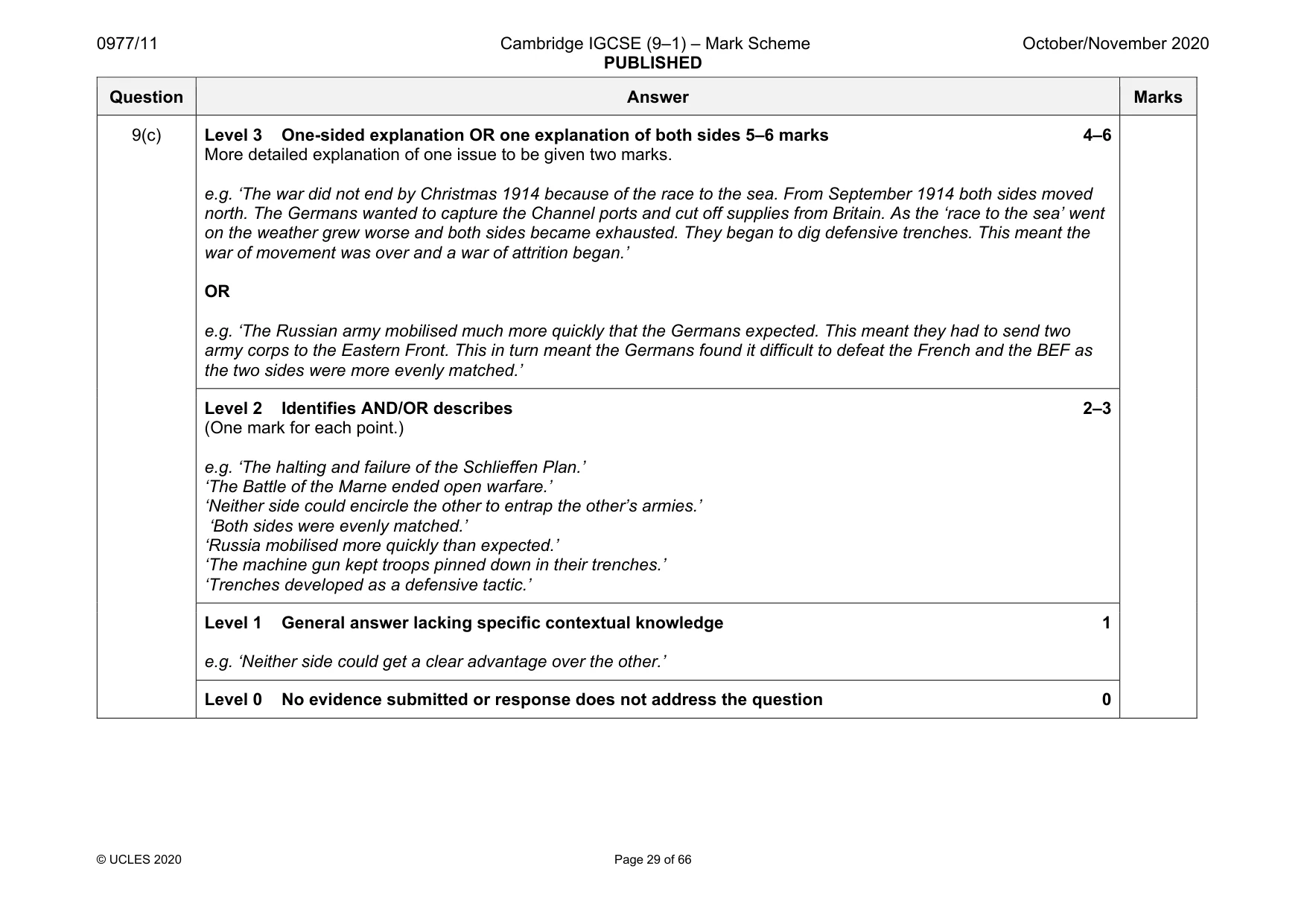
0977/11 Cambridge IGCSE (9–1) – Mark Scheme PUBLISHED October/November 2020 © UCLES 2020 Page 29 of 66 Question Answer Marks 9(c) Level 3 One-sided explanation OR one explanation of both sides 5–6 marks 4–6 More detailed explanation of one issue to be given two marks. e.g. ‘The war did not end by Christmas 1914 because of the race to the sea. From September 1914 both sides moved north. The Germans wanted to capture the Channel ports and cut off supplies from Britain. As the ‘race to the sea’ went on the weather grew worse and both sides became exhausted. They began to dig defensive trenches. This meant the war of movement was over and a war of attrition began.’ OR e.g. ‘The Russian army mobilised much more quickly that the Germans expected. This meant they had to send two army corps to the Eastern Front. This in turn meant the Germans found it difficult to defeat the French and the BEF as the two sides were more evenly matched.’ Level 2 Identifies AND/OR describes 2–3 (One mark for each point.) e.g. ‘The halting and failure of the Schlieffen Plan.’ ‘The Battle of the Marne ended open warfare.’ ‘Neither side could encircle the other to entrap the other’s armies.’ ‘Both sides were evenly matched.’ ‘Russia mobilised more quickly than expected.’ ‘The machine gun kept troops pinned down in their trenches.’ ‘Trenches developed as a defensive tactic.’ Level 1 General answer lacking specific contextual knowledge 1 e.g. ‘Neither side could get a clear advantage over the other.’ Level 0 No evidence submitted or response does not address the question 0
Mark scheme, page 30
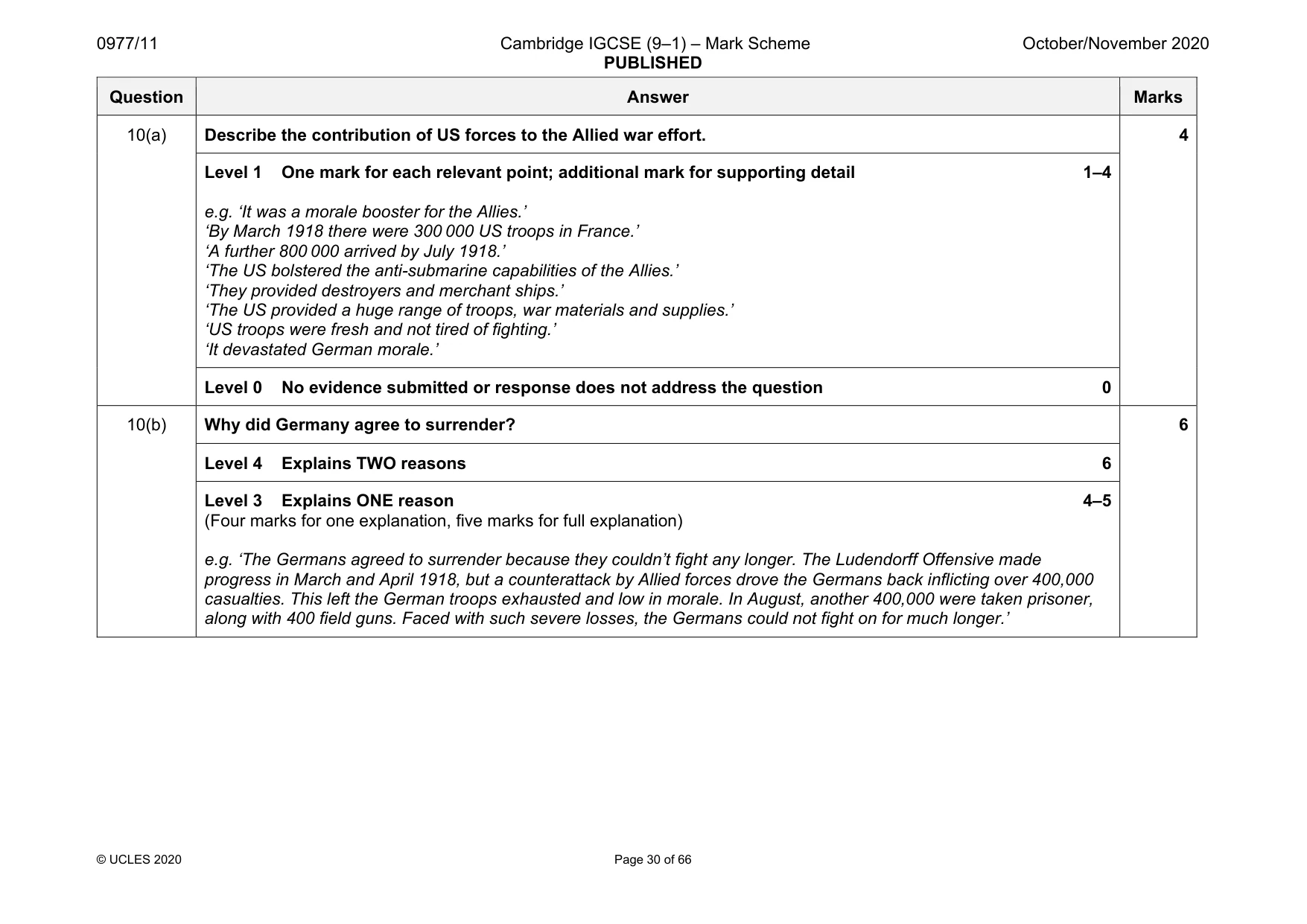
0977/11 Cambridge IGCSE (9–1) – Mark Scheme PUBLISHED October/November 2020 © UCLES 2020 Page 30 of 66 Question Answer Marks 10(a) Describe the contribution of US forces to the Allied war effort. 4 Level 1 One mark for each relevant point; additional mark for supporting detail 1–4 e.g. ‘It was a morale booster for the Allies.’ ‘By March 1918 there were 300 000 US troops in France.’ ‘A further 800 000 arrived by July 1918.’ ‘The US bolstered the anti-submarine capabilities of the Allies.’ ‘They provided destroyers and merchant ships.’ ‘The US provided a huge range of troops, war materials and supplies.’ ‘US troops were fresh and not tired of fighting.’ ‘It devastated German morale.’ Level 0 No evidence submitted or response does not address the question 0 10(b) Why did Germany agree to surrender? 6 Level 4 Explains TWO reasons 6 Level 3 Explains ONE reason 4–5 (Four marks for one explanation, five marks for full explanation) e.g. ‘The Germans agreed to surrender because they couldn’t fight any longer. The Ludendorff Offensive made progress in March and April 1918, but a counterattack by Allied forces drove the Germans back inflicting over 400,000 casualties. This left the German troops exhausted and low in morale. In August, another 400,000 were taken prisoner, along with 400 field guns. Faced with such severe losses, the Germans could not fight on for much longer.’
Mark scheme, page 31
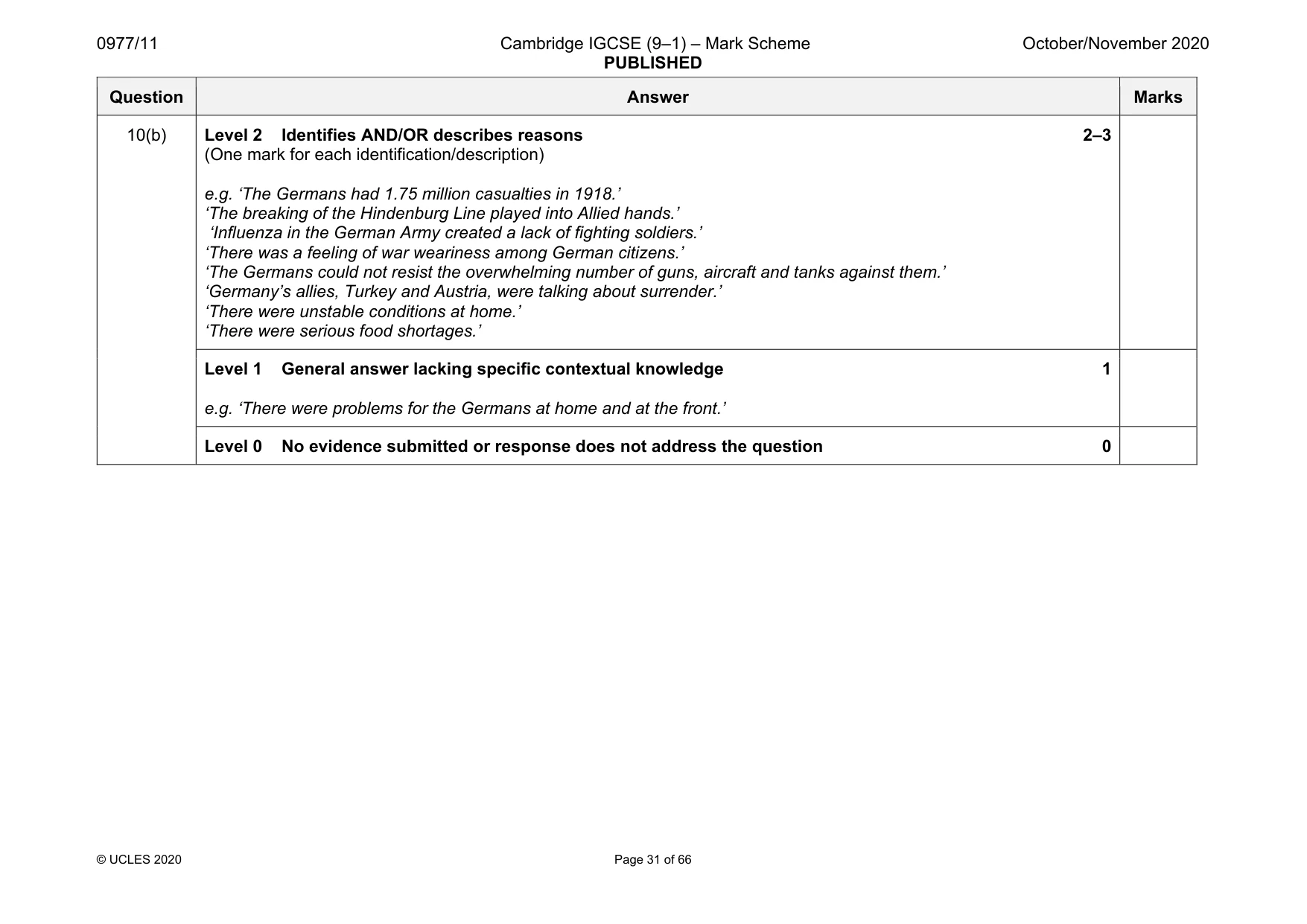
0977/11 Cambridge IGCSE (9–1) – Mark Scheme PUBLISHED October/November 2020 © UCLES 2020 Page 31 of 66 Question Answer Marks 10(b) Level 2 Identifies AND/OR describes reasons 2–3 (One mark for each identification/description) e.g. ‘The Germans had 1.75 million casualties in 1918.’ ‘The breaking of the Hindenburg Line played into Allied hands.’ ‘Influenza in the German Army created a lack of fighting soldiers.’ ‘There was a feeling of war weariness among German citizens.’ ‘The Germans could not resist the overwhelming number of guns, aircraft and tanks against them.’ ‘Germany’s allies, Turkey and Austria, were talking about surrender.’ ‘There were unstable conditions at home.’ ‘There were serious food shortages.’ Level 1 General answer lacking specific contextual knowledge 1 e.g. ‘There were problems for the Germans at home and at the front.’ Level 0 No evidence submitted or response does not address the question 0
Mark scheme, page 32
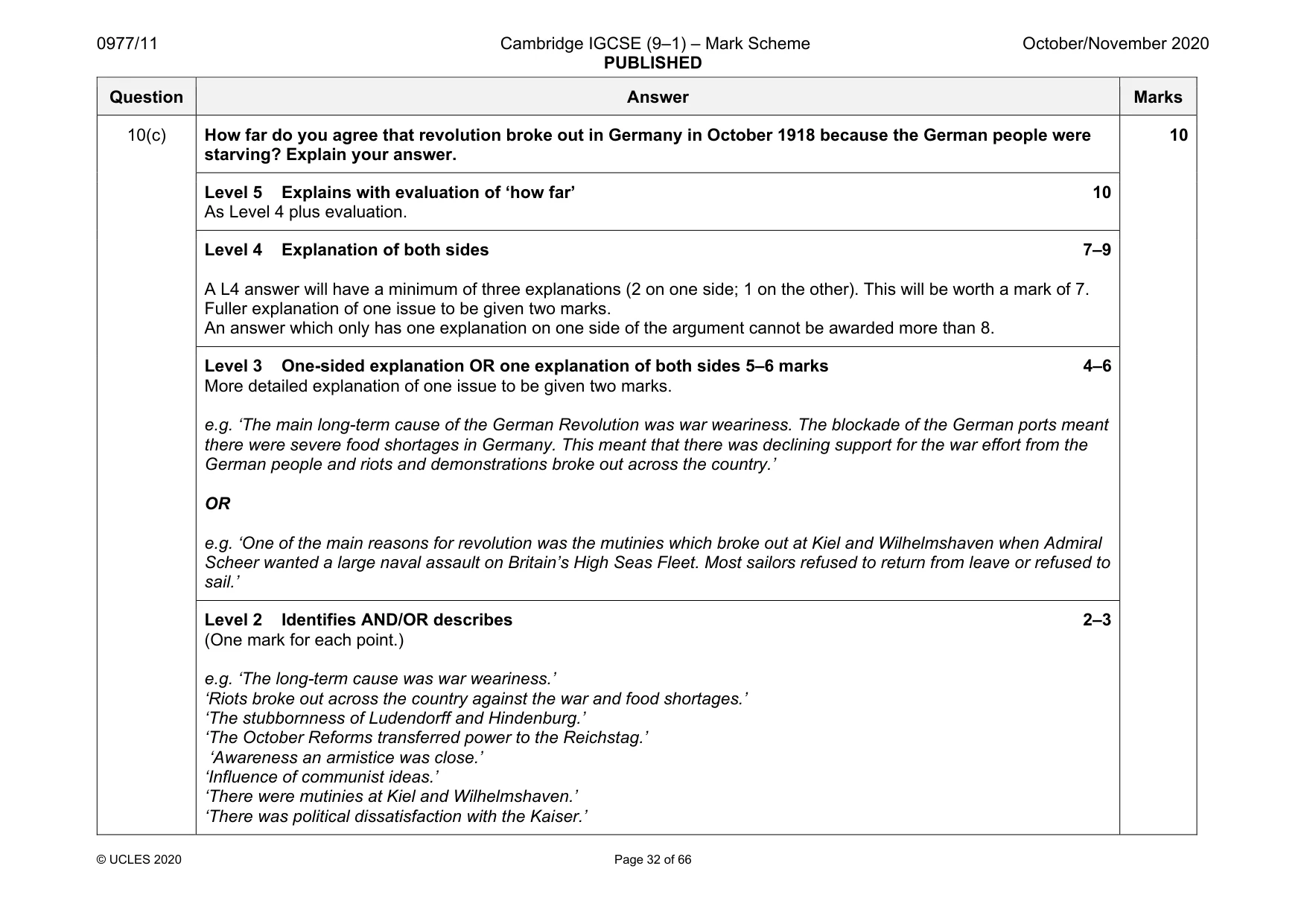
0977/11 Cambridge IGCSE (9–1) – Mark Scheme PUBLISHED October/November 2020 © UCLES 2020 Page 32 of 66 Question Answer Marks 10(c) How far do you agree that revolution broke out in Germany in October 1918 because the German people were starving? Explain your answer. 10 Level 5 Explains with evaluation of ‘how far’ 10 As Level 4 plus evaluation. Level 4 Explanation of both sides 7–9 A L4 answer will have a minimum of three explanations (2 on one side; 1 on the other). This will be worth a mark of 7. Fuller explanation of one issue to be given two marks. An answer which only has one explanation on one side of the argument cannot be awarded more than 8. Level 3 One-sided explanation OR one explanation of both sides 5–6 marks 4–6 More detailed explanation of one issue to be given two marks. e.g. ‘The main long-term cause of the German Revolution was war weariness. The blockade of the German ports meant there were severe food shortages in Germany. This meant that there was declining support for the war effort from the German people and riots and demonstrations broke out across the country.’ OR e.g. ‘One of the main reasons for revolution was the mutinies which broke out at Kiel and Wilhelmshaven when Admiral Scheer wanted a large naval assault on Britain’s High Seas Fleet. Most sailors refused to return from leave or refused to sail.’ Level 2 Identifies AND/OR describes 2–3 (One mark for each point.) e.g. ‘The long-term cause was war weariness.’ ‘Riots broke out across the country against the war and food shortages.’ ‘The stubbornness of Ludendorff and Hindenburg.’ ‘The October Reforms transferred power to the Reichstag.’ ‘Awareness an armistice was close.’ ‘Influence of communist ideas.’ ‘There were mutinies at Kiel and Wilhelmshaven.’ ‘There was political dissatisfaction with the Kaiser.’
Mark scheme, page 33
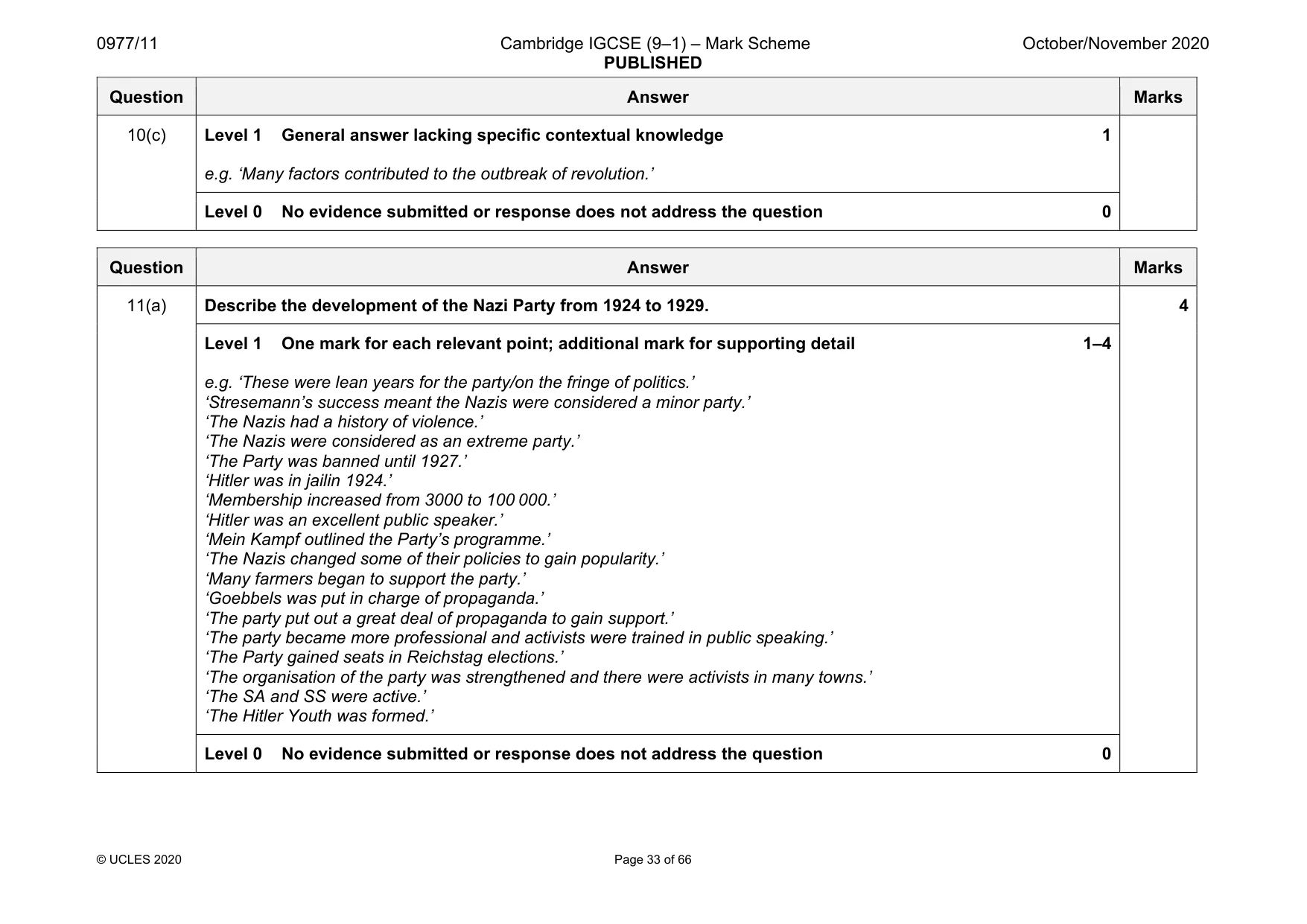
0977/11 Cambridge IGCSE (9–1) – Mark Scheme PUBLISHED October/November 2020 © UCLES 2020 Page 33 of 66 Question Answer Marks 10(c) Level 1 General answer lacking specific contextual knowledge 1 e.g. ‘Many factors contributed to the outbreak of revolution.’ Level 0 No evidence submitted or response does not address the question 0 Question Answer Marks 11(a) Describe the development of the Nazi Party from 1924 to 1929. 4 Level 1 One mark for each relevant point; additional mark for supporting detail 1–4 e.g. ‘These were lean years for the party/on the fringe of politics.’ ‘Stresemann’s success meant the Nazis were considered a minor party.’ ‘The Nazis had a history of violence.’ ‘The Nazis were considered as an extreme party.’ ‘The Party was banned until 1927.’ ‘Hitler was in jailin 1924.’ ‘Membership increased from 3000 to 100 000.’ ‘Hitler was an excellent public speaker.’ ‘Mein Kampf outlined the Party’s programme.’ ‘The Nazis changed some of their policies to gain popularity.’ ‘Many farmers began to support the party.’ ‘Goebbels was put in charge of propaganda.’ ‘The party put out a great deal of propaganda to gain support.’ ‘The party became more professional and activists were trained in public speaking.’ ‘The Party gained seats in Reichstag elections.’ ‘The organisation of the party was strengthened and there were activists in many towns.’ ‘The SA and SS were active.’ ‘The Hitler Youth was formed.’ Level 0 No evidence submitted or response does not address the question 0
Mark scheme, page 34
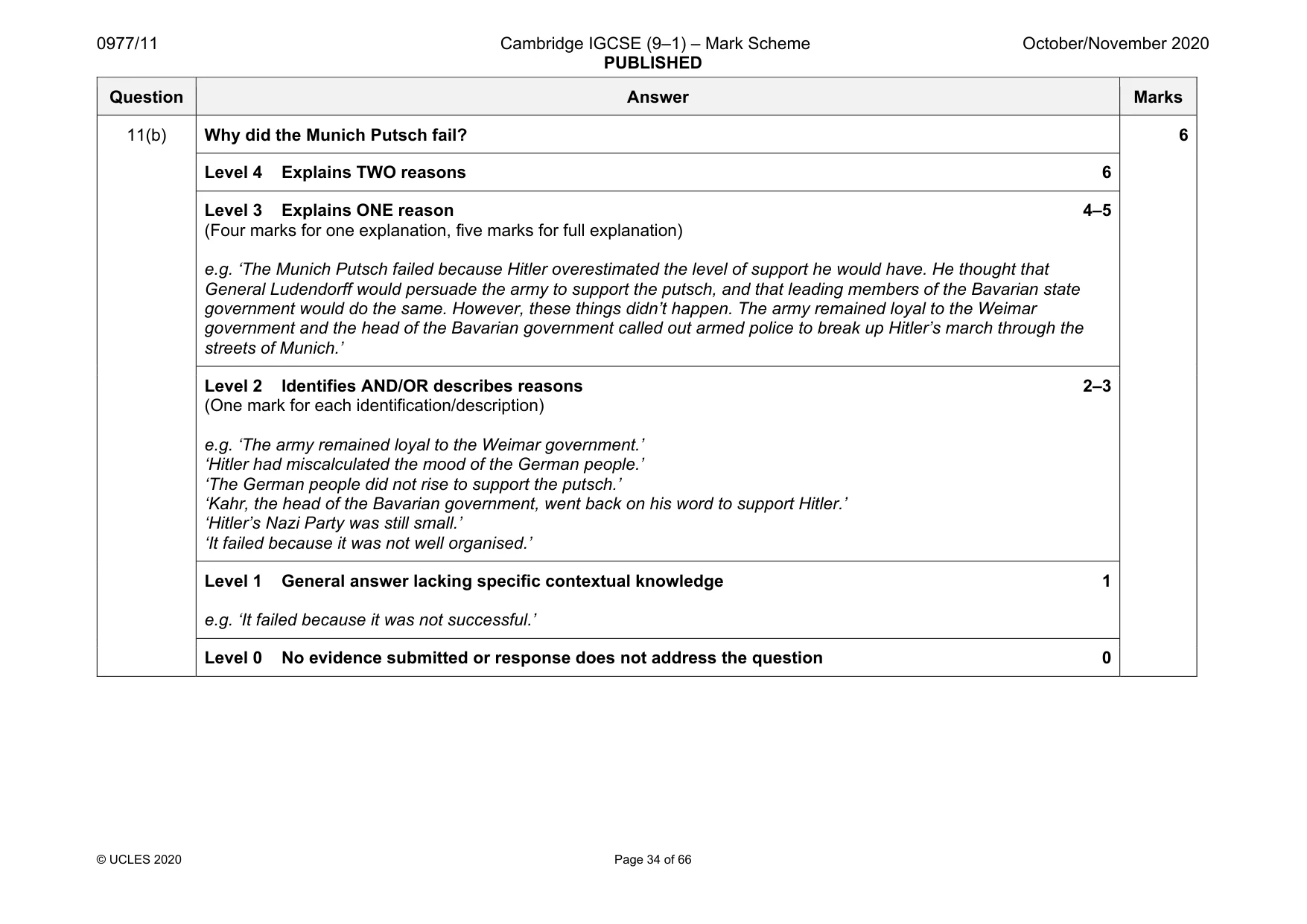
0977/11 Cambridge IGCSE (9–1) – Mark Scheme PUBLISHED October/November 2020 © UCLES 2020 Page 34 of 66 Question Answer Marks 11(b) Why did the Munich Putsch fail? 6 Level 4 Explains TWO reasons 6 Level 3 Explains ONE reason 4–5 (Four marks for one explanation, five marks for full explanation) e.g. ‘The Munich Putsch failed because Hitler overestimated the level of support he would have. He thought that General Ludendorff would persuade the army to support the putsch, and that leading members of the Bavarian state government would do the same. However, these things didn’t happen. The army remained loyal to the Weimar government and the head of the Bavarian government called out armed police to break up Hitler’s march through the streets of Munich.’ Level 2 Identifies AND/OR describes reasons 2–3 (One mark for each identification/description) e.g. ‘The army remained loyal to the Weimar government.’ ‘Hitler had miscalculated the mood of the German people.’ ‘The German people did not rise to support the putsch.’ ‘Kahr, the head of the Bavarian government, went back on his word to support Hitler.’ ‘Hitler’s Nazi Party was still small.’ ‘It failed because it was not well organised.’ Level 1 General answer lacking specific contextual knowledge 1 e.g. ‘It failed because it was not successful.’ Level 0 No evidence submitted or response does not address the question 0
Mark scheme, page 35
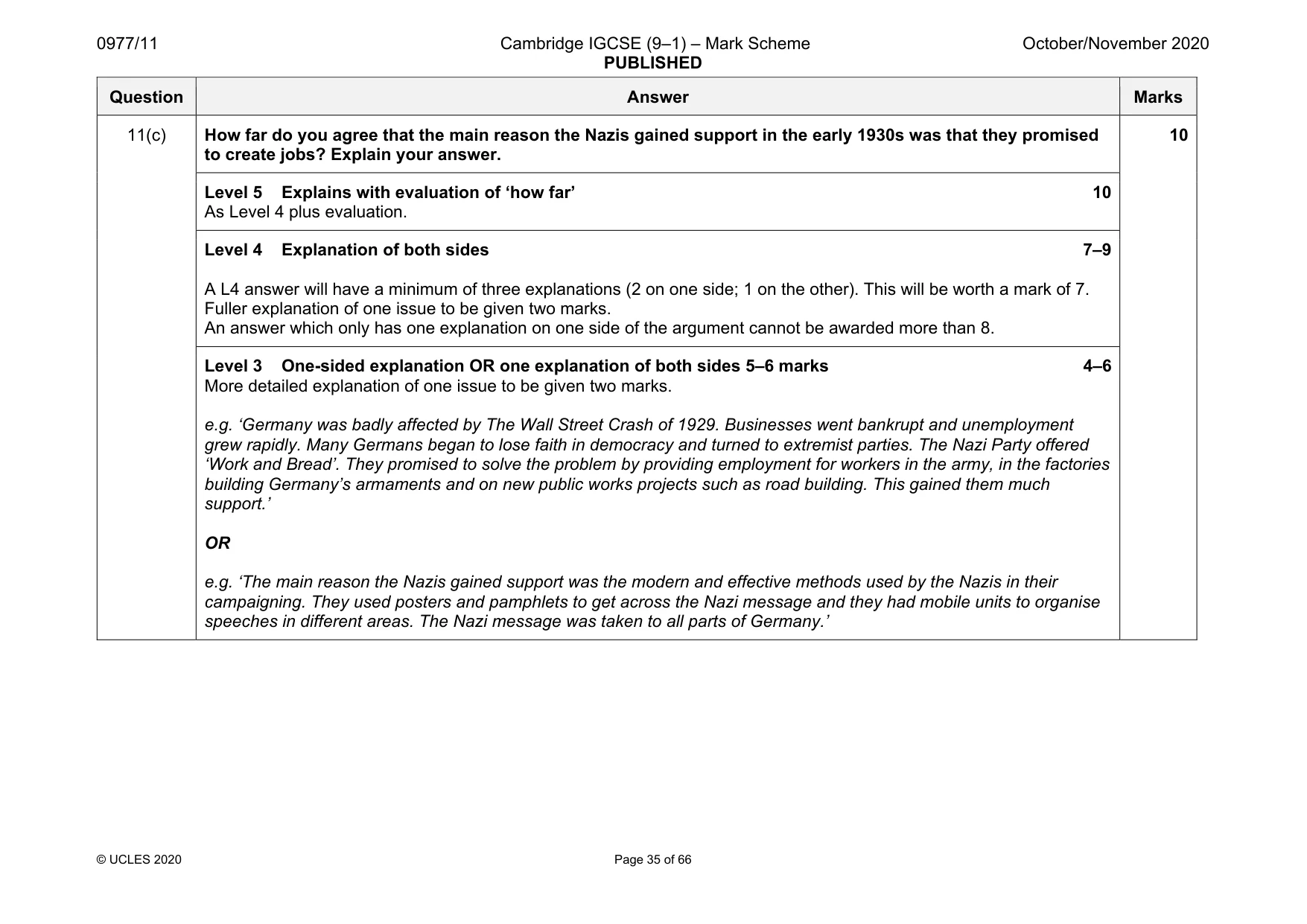
0977/11 Cambridge IGCSE (9–1) – Mark Scheme PUBLISHED October/November 2020 © UCLES 2020 Page 35 of 66 Question Answer Marks 11(c) How far do you agree that the main reason the Nazis gained support in the early 1930s was that they promised to create jobs? Explain your answer. 10 Level 5 Explains with evaluation of ‘how far’ 10 As Level 4 plus evaluation. Level 4 Explanation of both sides 7–9 A L4 answer will have a minimum of three explanations (2 on one side; 1 on the other). This will be worth a mark of 7. Fuller explanation of one issue to be given two marks. An answer which only has one explanation on one side of the argument cannot be awarded more than 8. Level 3 One-sided explanation OR one explanation of both sides 5–6 marks 4–6 More detailed explanation of one issue to be given two marks. e.g. ‘Germany was badly affected by The Wall Street Crash of 1929. Businesses went bankrupt and unemployment grew rapidly. Many Germans began to lose faith in democracy and turned to extremist parties. The Nazi Party offered ‘Work and Bread’. They promised to solve the problem by providing employment for workers in the army, in the factories building Germany’s armaments and on new public works projects such as road building. This gained them much support.’ OR e.g. ‘The main reason the Nazis gained support was the modern and effective methods used by the Nazis in their campaigning. They used posters and pamphlets to get across the Nazi message and they had mobile units to organise speeches in different areas. The Nazi message was taken to all parts of Germany.’
Mark scheme, page 36
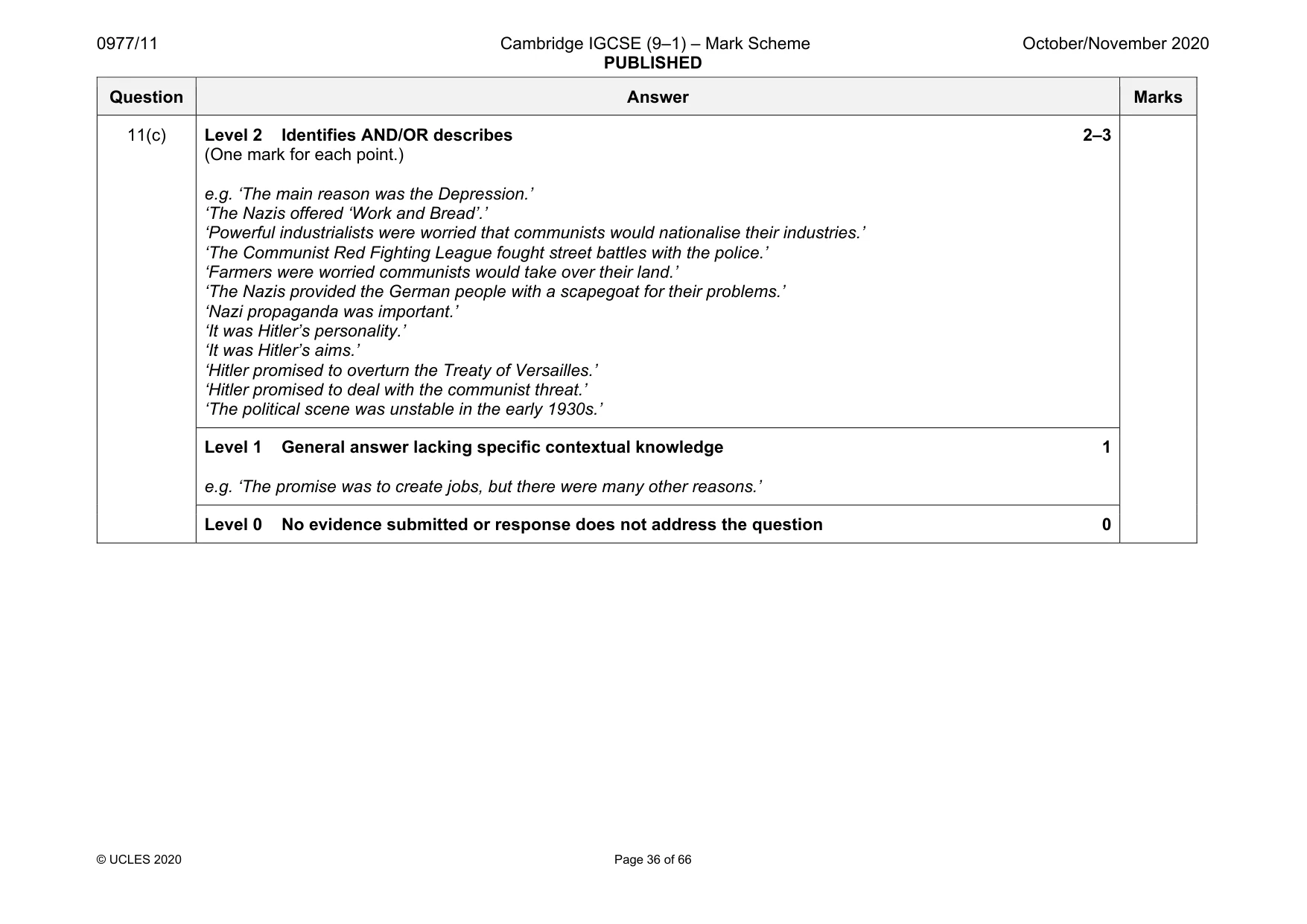
0977/11 Cambridge IGCSE (9–1) – Mark Scheme PUBLISHED October/November 2020 © UCLES 2020 Page 36 of 66 Question Answer Marks 11(c) Level 2 Identifies AND/OR describes 2–3 (One mark for each point.) e.g. ‘The main reason was the Depression.’ ‘The Nazis offered ‘Work and Bread’.’ ‘Powerful industrialists were worried that communists would nationalise their industries.’ ‘The Communist Red Fighting League fought street battles with the police.’ ‘Farmers were worried communists would take over their land.’ ‘The Nazis provided the German people with a scapegoat for their problems.’ ‘Nazi propaganda was important.’ ‘It was Hitler’s personality.’ ‘It was Hitler’s aims.’ ‘Hitler promised to overturn the Treaty of Versailles.’ ‘Hitler promised to deal with the communist threat.’ ‘The political scene was unstable in the early 1930s.’ Level 1 General answer lacking specific contextual knowledge 1 e.g. ‘The promise was to create jobs, but there were many other reasons.’ Level 0 No evidence submitted or response does not address the question 0
Mark scheme, page 37
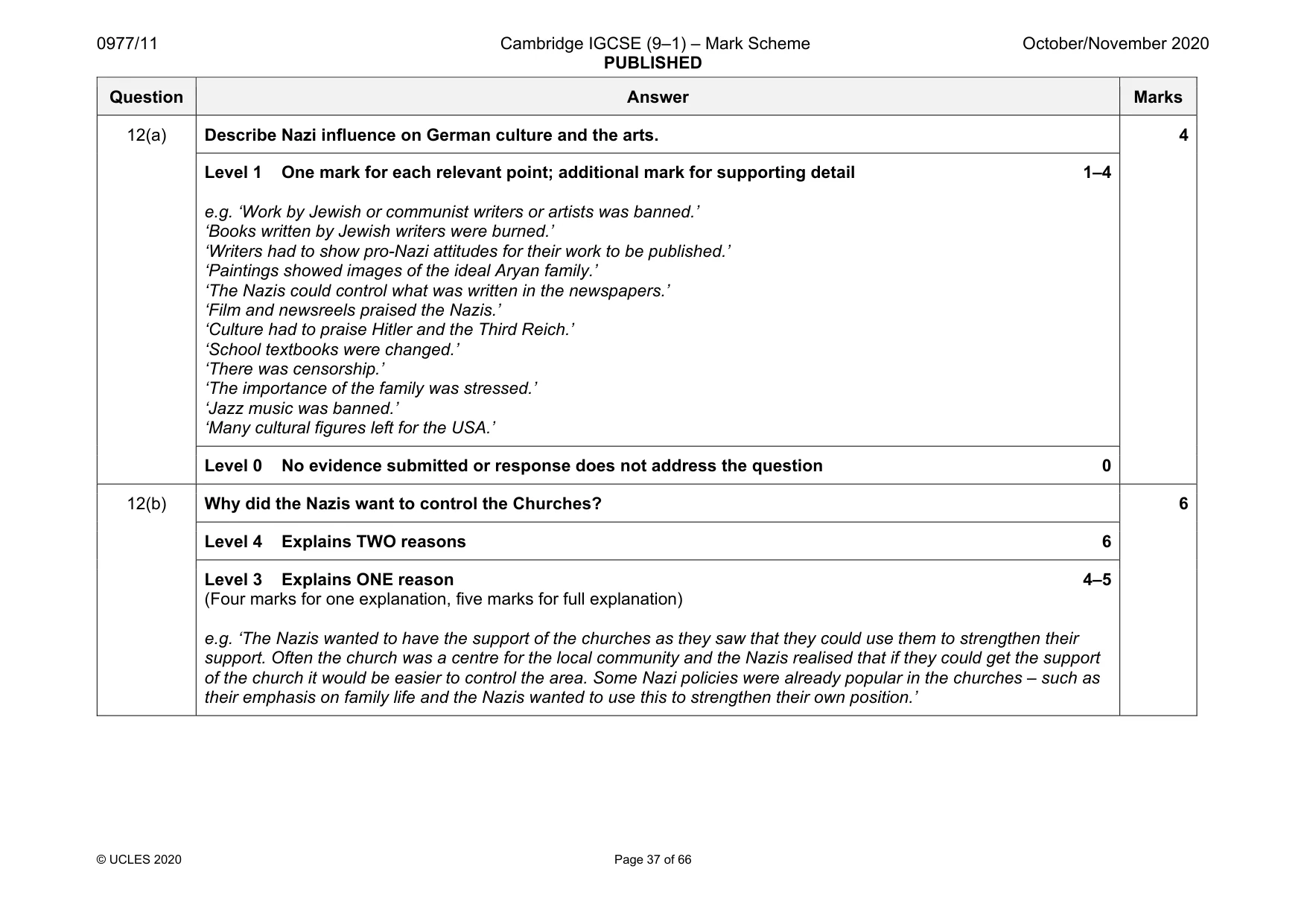
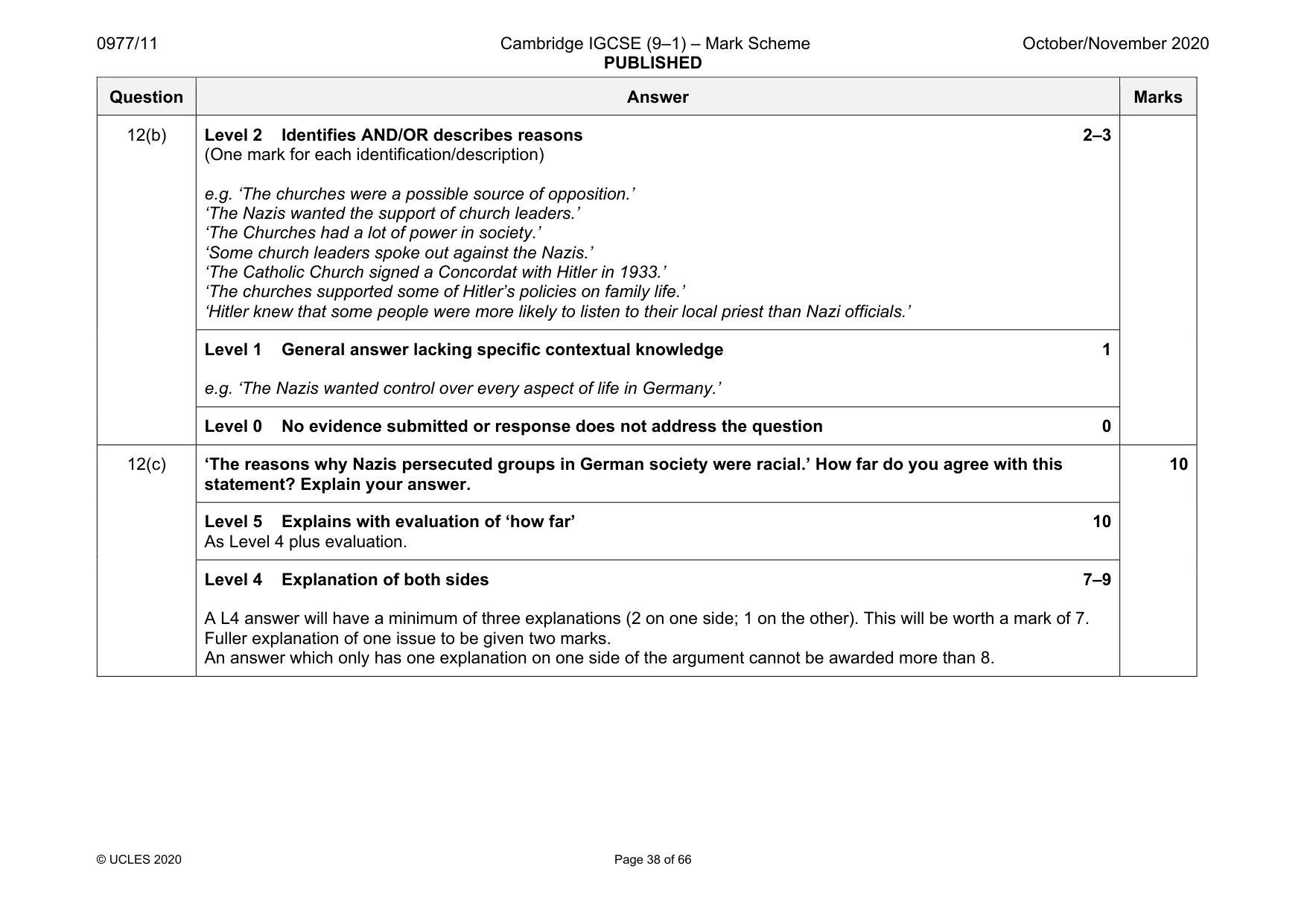
0977/11 Cambridge IGCSE (9–1) – Mark Scheme PUBLISHED October/November 2020 © UCLES 2020 Page 37 of 66 Question Answer Marks 12(a) Describe Nazi influence on German culture and the arts. 4 Level 1 One mark for each relevant point; additional mark for supporting detail 1–4 e.g. ‘Work by Jewish or communist writers or artists was banned.’ ‘Books written by Jewish writers were burned.’ ‘Writers had to show pro-Nazi attitudes for their work to be published.’ ‘Paintings showed images of the ideal Aryan family.’ ‘The Nazis could control what was written in the newspapers.’ ‘Film and newsreels praised the Nazis.’ ‘Culture had to praise Hitler and the Third Reich.’ ‘School textbooks were changed.’ ‘There was censorship.’ ‘The importance of the family was stressed.’ ‘Jazz music was banned.’ ‘Many cultural figures left for the USA.’ Level 0 No evidence submitted or response does not address the question 0 12(b) Why did the Nazis want to control the Churches? 6 Level 4 Explains TWO reasons 6 Level 3 Explains ONE reason 4–5 (Four marks for one explanation, five marks for full explanation) e.g. ‘The Nazis wanted to have the support of the churches as they saw that they could use them to strengthen their support. Often the church was a centre for the local community and the Nazis realised that if they could get the support of the church it would be easier to control the area. Some Nazi policies were already popular in the churches – such as their emphasis on family life and the Nazis wanted to use this to strengthen their own position.’
Mark scheme, page 38
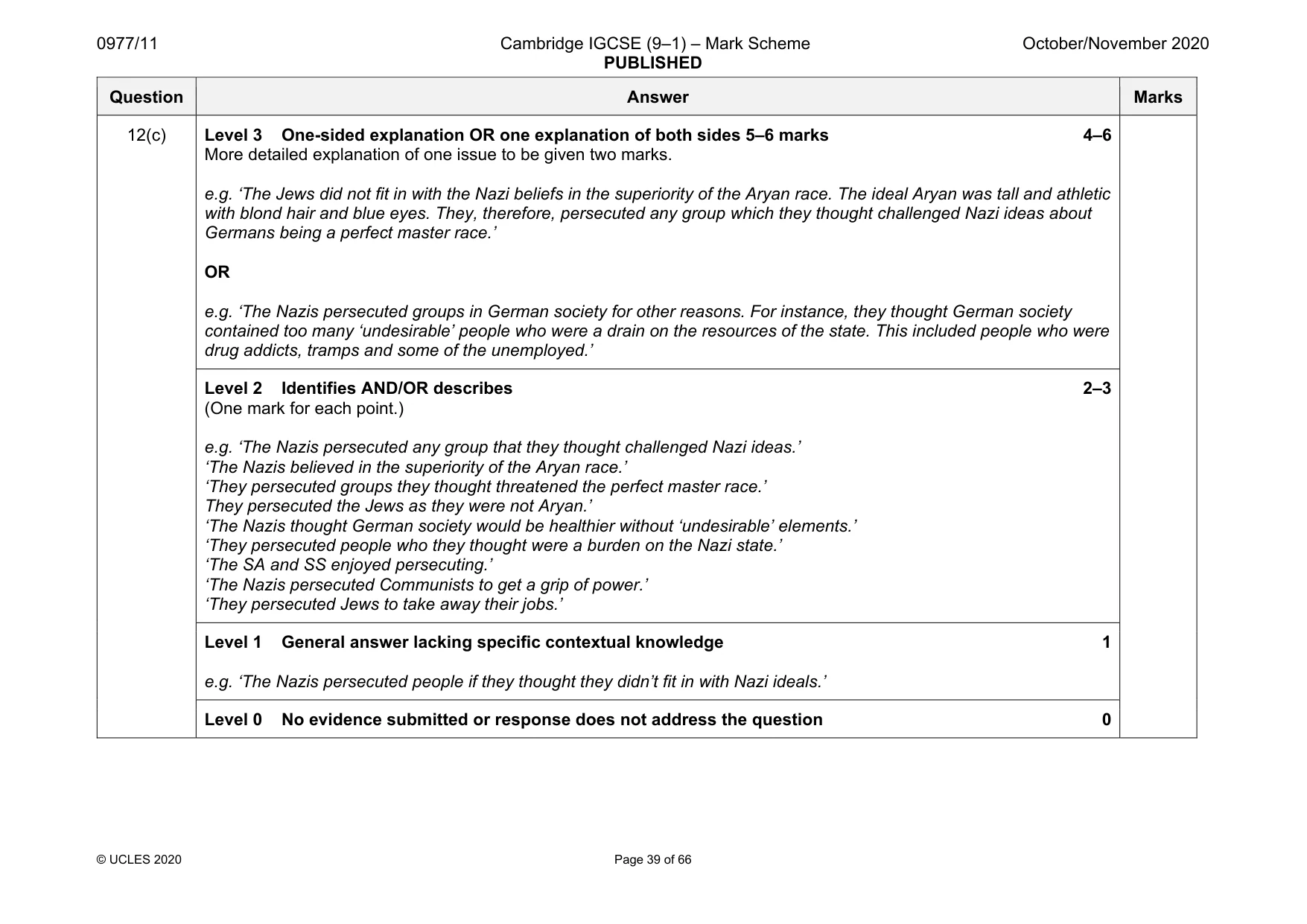
0977/11 Cambridge IGCSE (9–1) – Mark Scheme PUBLISHED October/November 2020 © UCLES 2020 Page 38 of 66 Question Answer Marks 12(b) Level 2 Identifies AND/OR describes reasons 2–3 (One mark for each identification/description) e.g. ‘The churches were a possible source of opposition.’ ‘The Nazis wanted the support of church leaders.’ ‘The Churches had a lot of power in society.’ ‘Some church leaders spoke out against the Nazis.’ ‘The Catholic Church signed a Concordat with Hitler in 1933.’ ‘The churches supported some of Hitler’s policies on family life.’ ‘Hitler knew that some people were more likely to listen to their local priest than Nazi officials.’ Level 1 General answer lacking specific contextual knowledge 1 e.g. ‘The Nazis wanted control over every aspect of life in Germany.’ Level 0 No evidence submitted or response does not address the question 0 12(c) ‘The reasons why Nazis persecuted groups in German society were racial.’ How far do you agree with this statement? Explain your answer. 10 Level 5 Explains with evaluation of ‘how far’ 10 As Level 4 plus evaluation. Level 4 Explanation of both sides 7–9 A L4 answer will have a minimum of three explanations (2 on one side; 1 on the other). This will be worth a mark of 7. Fuller explanation of one issue to be given two marks. An answer which only has one explanation on one side of the argument cannot be awarded more than 8.
Mark scheme, page 39
0977/11 Cambridge IGCSE (9–1) – Mark Scheme PUBLISHED October/November 2020 © UCLES 2020 Page 39 of 66 Question Answer Marks 12(c) Level 3 One-sided explanation OR one explanation of both sides 5–6 marks 4–6 More detailed explanation of one issue to be given two marks. e.g. ‘The Jews did not fit in with the Nazi beliefs in the superiority of the Aryan race. The ideal Aryan was tall and athletic with blond hair and blue eyes. They, therefore, persecuted any group which they thought challenged Nazi ideas about Germans being a perfect master race.’ OR e.g. ‘The Nazis persecuted groups in German society for other reasons. For instance, they thought German society contained too many ‘undesirable’ people who were a drain on the resources of the state. This included people who were drug addicts, tramps and some of the unemployed.’ Level 2 Identifies AND/OR describes 2–3 (One mark for each point.) e.g. ‘The Nazis persecuted any group that they thought challenged Nazi ideas.’ ‘The Nazis believed in the superiority of the Aryan race.’ ‘They persecuted groups they thought threatened the perfect master race.’ They persecuted the Jews as they were not Aryan.’ ‘The Nazis thought German society would be healthier without ‘undesirable’ elements.’ ‘They persecuted people who they thought were a burden on the Nazi state.’ ‘The SA and SS enjoyed persecuting.’ ‘The Nazis persecuted Communists to get a grip of power.’ ‘They persecuted Jews to take away their jobs.’ Level 1 General answer lacking specific contextual knowledge 1 e.g. ‘The Nazis persecuted people if they thought they didn’t fit in with Nazi ideals.’ Level 0 No evidence submitted or response does not address the question 0
Mark scheme, page 40
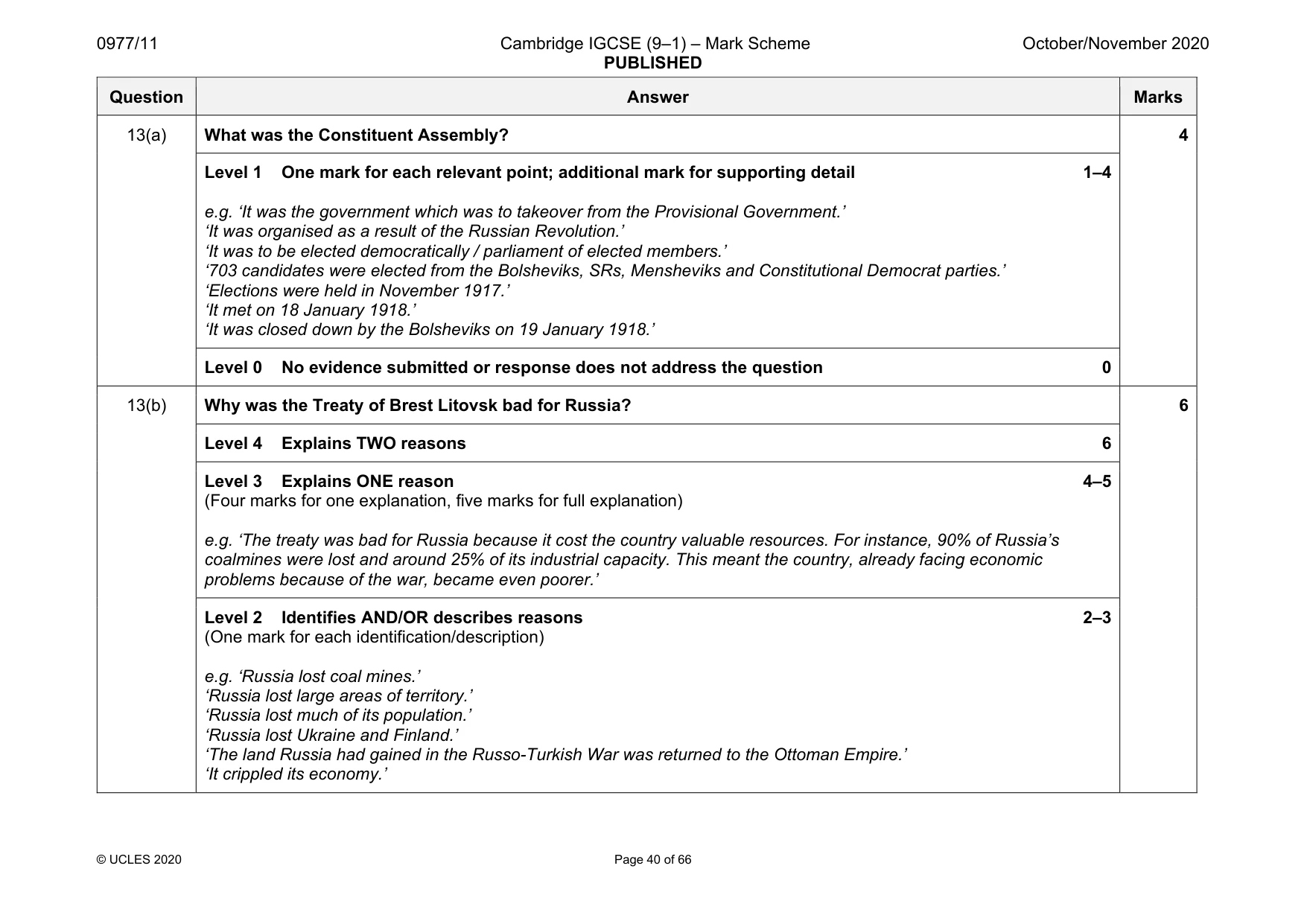
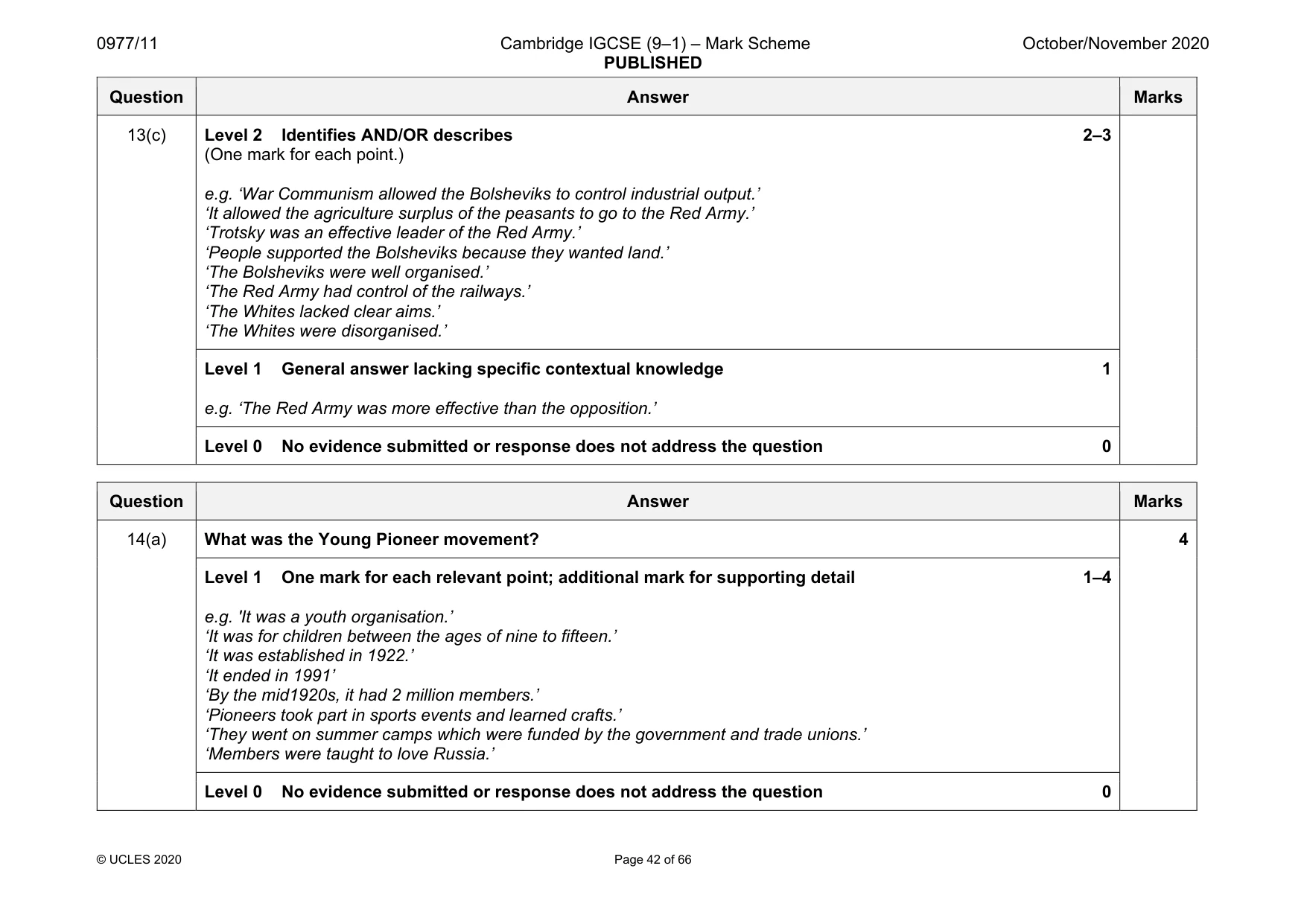
0977/11 Cambridge IGCSE (9–1) – Mark Scheme PUBLISHED October/November 2020 © UCLES 2020 Page 40 of 66 Question Answer Marks 13(a) What was the Constituent Assembly? 4 Level 1 One mark for each relevant point; additional mark for supporting detail 1–4 e.g. ‘It was the government which was to takeover from the Provisional Government.’ ‘It was organised as a result of the Russian Revolution.’ ‘It was to be elected democratically / parliament of elected members.’ ‘703 candidates were elected from the Bolsheviks, SRs, Mensheviks and Constitutional Democrat parties.’ ‘Elections were held in November 1917.’ ‘It met on 18 January 1918.’ ‘It was closed down by the Bolsheviks on 19 January 1918.’ Level 0 No evidence submitted or response does not address the question 0 13(b) Why was the Treaty of Brest Litovsk bad for Russia? 6 Level 4 Explains TWO reasons 6 Level 3 Explains ONE reason 4–5 (Four marks for one explanation, five marks for full explanation) e.g. ‘The treaty was bad for Russia because it cost the country valuable resources. For instance, 90% of Russia’s coalmines were lost and around 25% of its industrial capacity. This meant the country, already facing economic problems because of the war, became even poorer.’ Level 2 Identifies AND/OR describes reasons 2–3 (One mark for each identification/description) e.g. ‘Russia lost coal mines.’ ‘Russia lost large areas of territory.’ ‘Russia lost much of its population.’ ‘Russia lost Ukraine and Finland.’ ‘The land Russia had gained in the Russo-Turkish War was returned to the Ottoman Empire.’ ‘It crippled its economy.’
Mark scheme, page 41
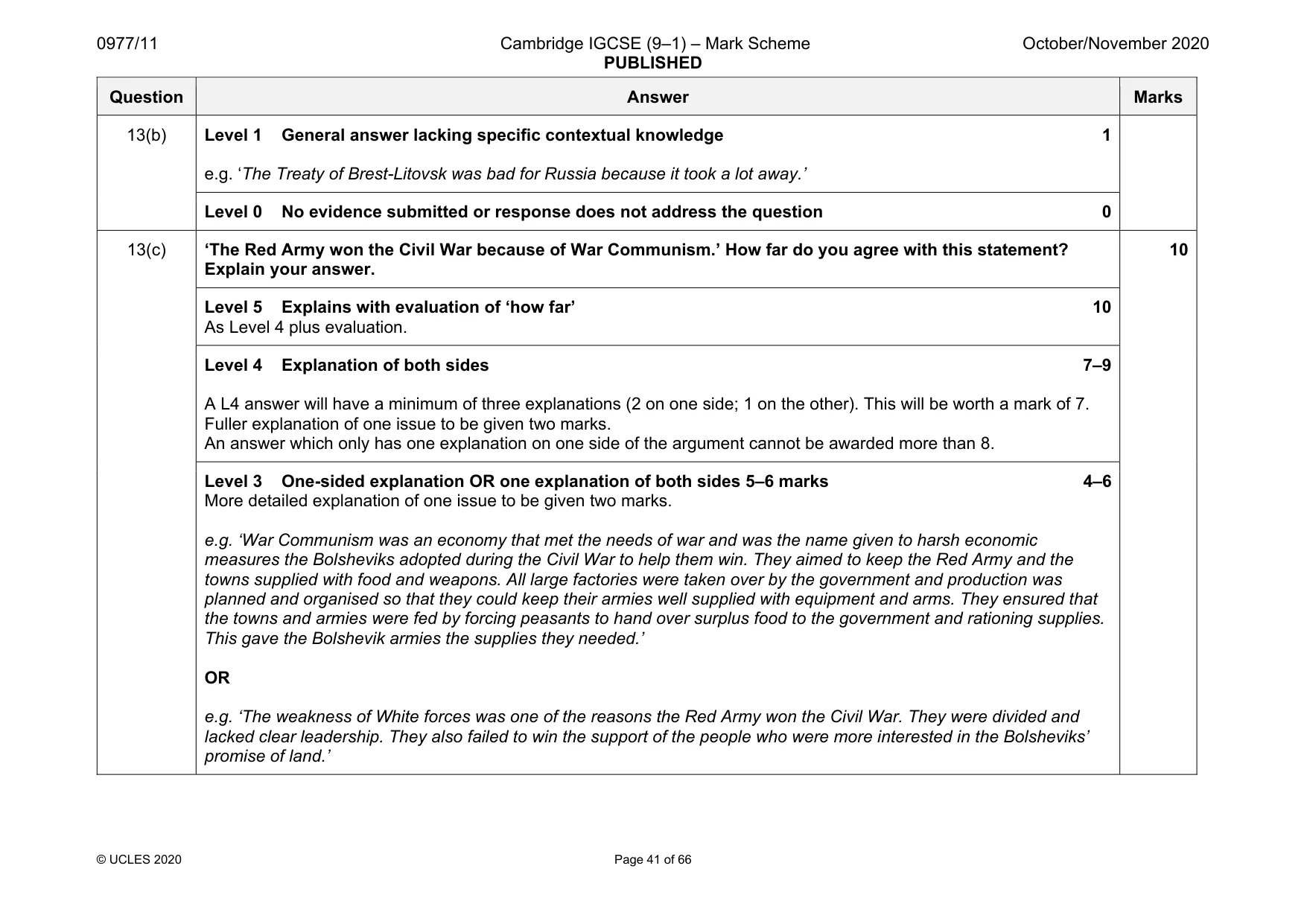
0977/11 Cambridge IGCSE (9–1) – Mark Scheme PUBLISHED October/November 2020 © UCLES 2020 Page 41 of 66 Question Answer Marks 13(b) Level 1 General answer lacking specific contextual knowledge 1 e.g. ‘The Treaty of Brest-Litovsk was bad for Russia because it took a lot away.’ Level 0 No evidence submitted or response does not address the question 0 13(c) ‘The Red Army won the Civil War because of War Communism.’ How far do you agree with this statement? Explain your answer. 10 Level 5 Explains with evaluation of ‘how far’ 10 As Level 4 plus evaluation. Level 4 Explanation of both sides 7–9 A L4 answer will have a minimum of three explanations (2 on one side; 1 on the other). This will be worth a mark of 7. Fuller explanation of one issue to be given two marks. An answer which only has one explanation on one side of the argument cannot be awarded more than 8. Level 3 One-sided explanation OR one explanation of both sides 5–6 marks 4–6 More detailed explanation of one issue to be given two marks. e.g. ‘War Communism was an economy that met the needs of war and was the name given to harsh economic measures the Bolsheviks adopted during the Civil War to help them win. They aimed to keep the Red Army and the towns supplied with food and weapons. All large factories were taken over by the government and production was planned and organised so that they could keep their armies well supplied with equipment and arms. They ensured that the towns and armies were fed by forcing peasants to hand over surplus food to the government and rationing supplies. This gave the Bolshevik armies the supplies they needed.’ OR e.g. ‘The weakness of White forces was one of the reasons the Red Army won the Civil War. They were divided and lacked clear leadership. They also failed to win the support of the people who were more interested in the Bolsheviks’ promise of land.’
Mark scheme, page 42
0977/11 Cambridge IGCSE (9–1) – Mark Scheme PUBLISHED October/November 2020 © UCLES 2020 Page 42 of 66 Question Answer Marks 13(c) Level 2 Identifies AND/OR describes 2–3 (One mark for each point.) e.g. ‘War Communism allowed the Bolsheviks to control industrial output.’ ‘It allowed the agriculture surplus of the peasants to go to the Red Army.’ ‘Trotsky was an effective leader of the Red Army.’ ‘People supported the Bolsheviks because they wanted land.’ ‘The Bolsheviks were well organised.’ ‘The Red Army had control of the railways.’ ‘The Whites lacked clear aims.’ ‘The Whites were disorganised.’ Level 1 General answer lacking specific contextual knowledge 1 e.g. ‘The Red Army was more effective than the opposition.’ Level 0 No evidence submitted or response does not address the question 0 Question Answer Marks 14(a) What was the Young Pioneer movement? 4 Level 1 One mark for each relevant point; additional mark for supporting detail 1–4 e.g. 'It was a youth organisation.’ ‘It was for children between the ages of nine to fifteen.’ ‘It was established in 1922.’ ‘It ended in 1991’ ‘By the mid1920s, it had 2 million members.’ ‘Pioneers took part in sports events and learned crafts.’ ‘They went on summer camps which were funded by the government and trade unions.’ ‘Members were taught to love Russia.’ Level 0 No evidence submitted or response does not address the question 0
Mark scheme, page 43
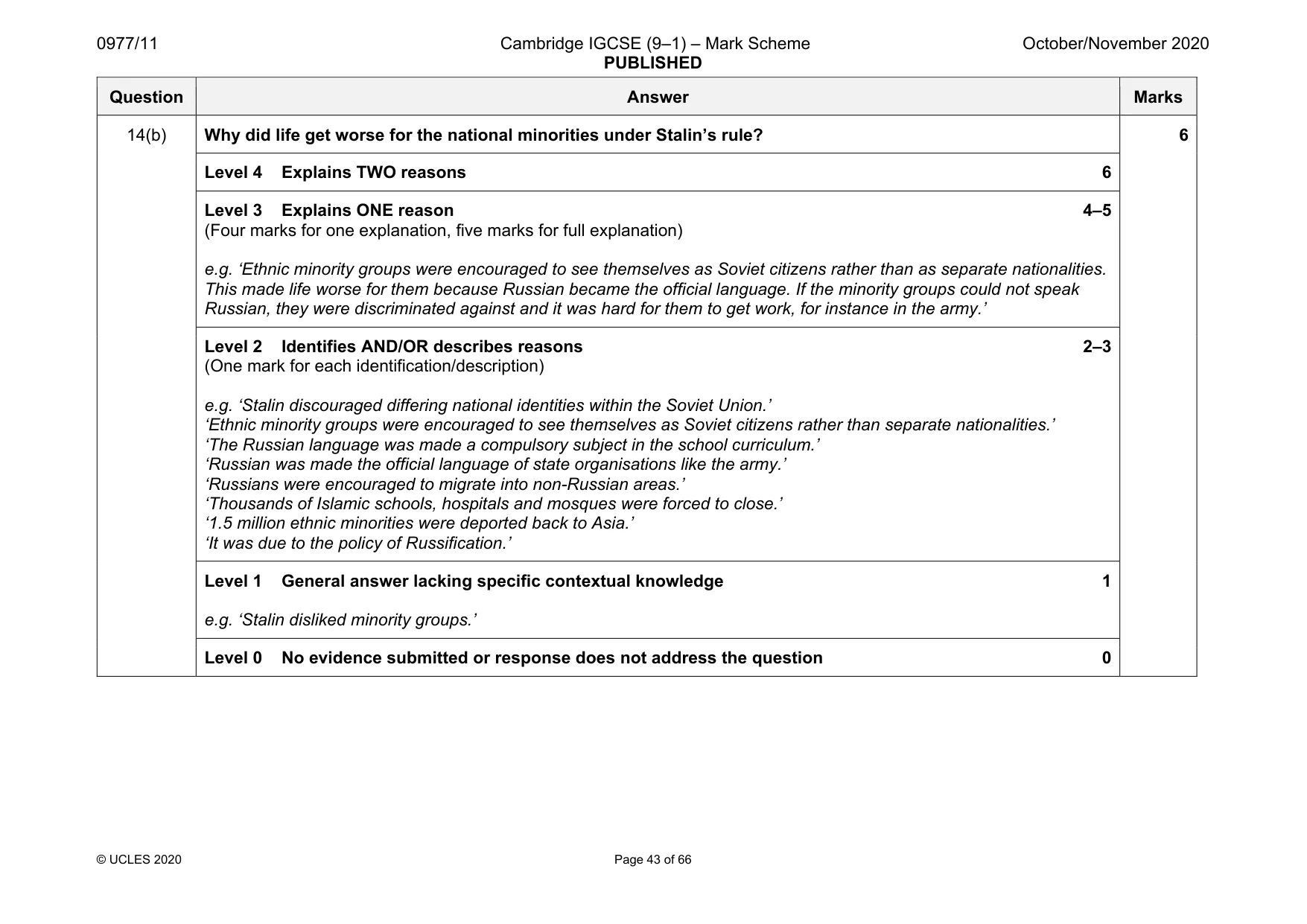
0977/11 Cambridge IGCSE (9–1) – Mark Scheme PUBLISHED October/November 2020 © UCLES 2020 Page 43 of 66 Question Answer Marks 14(b) Why did life get worse for the national minorities under Stalin’s rule? 6 Level 4 Explains TWO reasons 6 Level 3 Explains ONE reason 4–5 (Four marks for one explanation, five marks for full explanation) e.g. ‘Ethnic minority groups were encouraged to see themselves as Soviet citizens rather than as separate nationalities. This made life worse for them because Russian became the official language. If the minority groups could not speak Russian, they were discriminated against and it was hard for them to get work, for instance in the army.’ Level 2 Identifies AND/OR describes reasons 2–3 (One mark for each identification/description) e.g. ‘Stalin discouraged differing national identities within the Soviet Union.’ ‘Ethnic minority groups were encouraged to see themselves as Soviet citizens rather than separate nationalities.’ ‘The Russian language was made a compulsory subject in the school curriculum.’ ‘Russian was made the official language of state organisations like the army.’ ‘Russians were encouraged to migrate into non-Russian areas.’ ‘Thousands of Islamic schools, hospitals and mosques were forced to close.’ ‘1.5 million ethnic minorities were deported back to Asia.’ ‘It was due to the policy of Russification.’ Level 1 General answer lacking specific contextual knowledge 1 e.g. ‘Stalin disliked minority groups.’ Level 0 No evidence submitted or response does not address the question 0
Mark scheme, page 44
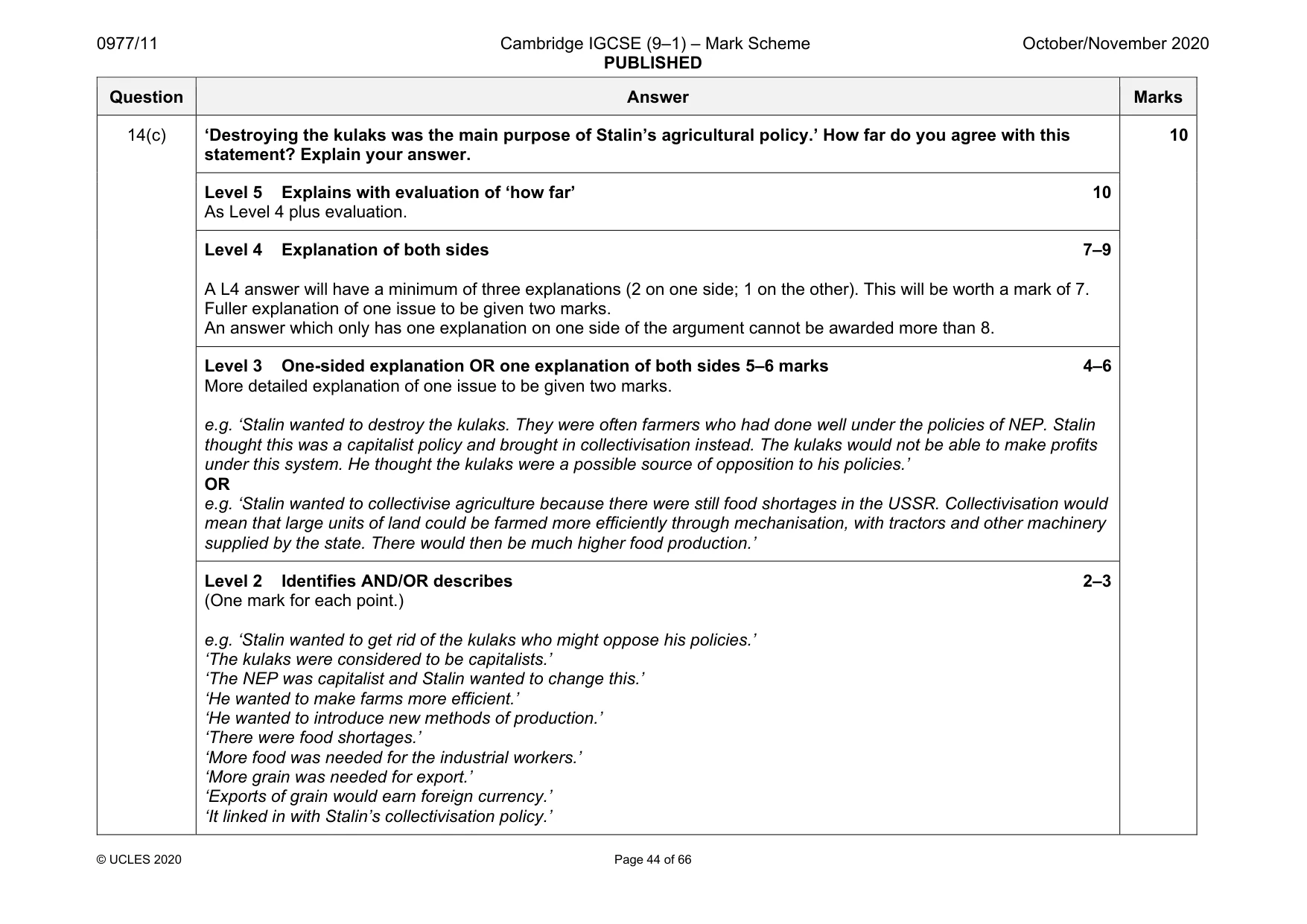
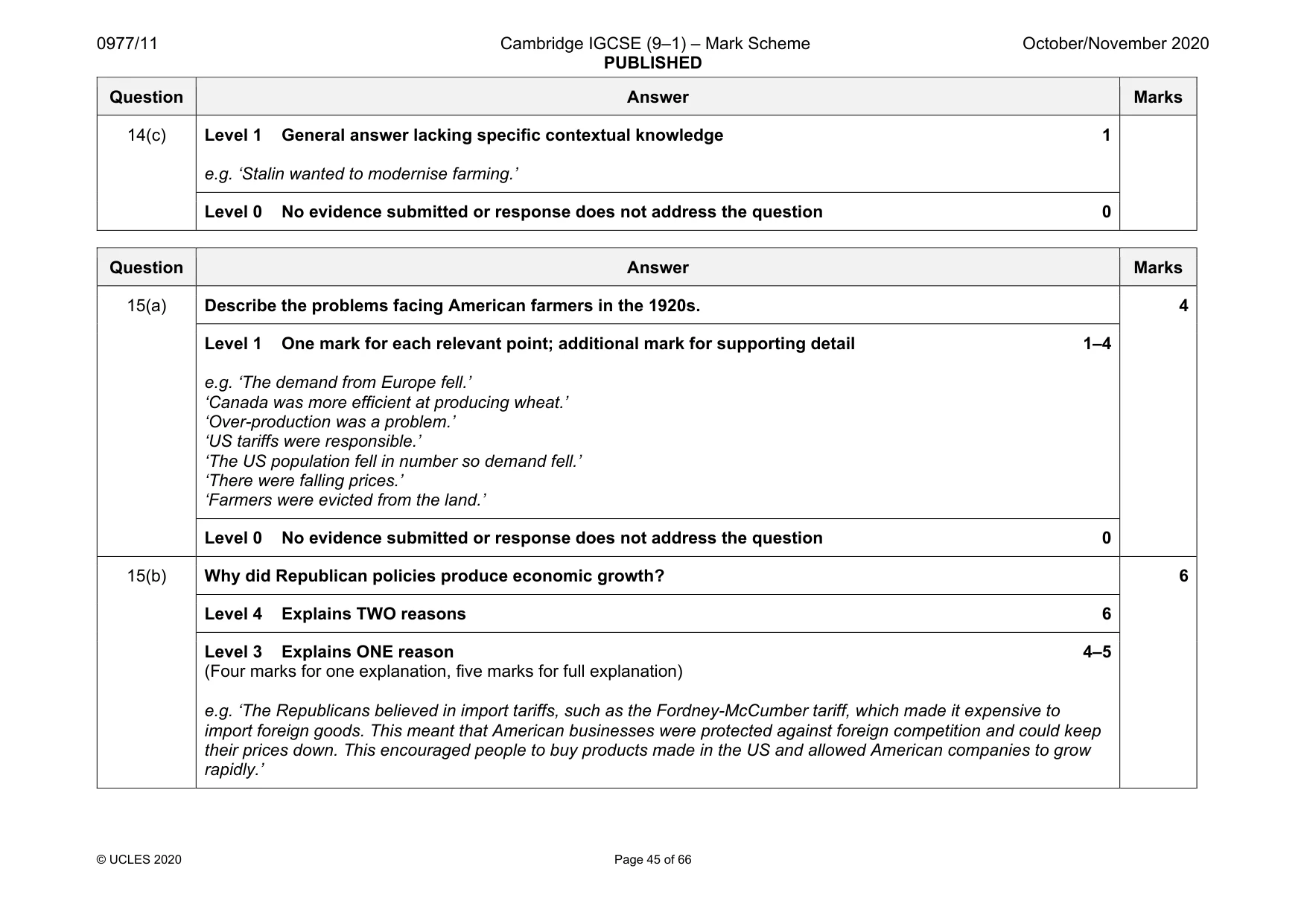
0977/11 Cambridge IGCSE (9–1) – Mark Scheme PUBLISHED October/November 2020 © UCLES 2020 Page 44 of 66 Question Answer Marks 14(c) ‘Destroying the kulaks was the main purpose of Stalin’s agricultural policy.’ How far do you agree with this statement? Explain your answer. 10 Level 5 Explains with evaluation of ‘how far’ 10 As Level 4 plus evaluation. Level 4 Explanation of both sides 7–9 A L4 answer will have a minimum of three explanations (2 on one side; 1 on the other). This will be worth a mark of 7. Fuller explanation of one issue to be given two marks. An answer which only has one explanation on one side of the argument cannot be awarded more than 8. Level 3 One-sided explanation OR one explanation of both sides 5–6 marks 4–6 More detailed explanation of one issue to be given two marks. e.g. ‘Stalin wanted to destroy the kulaks. They were often farmers who had done well under the policies of NEP. Stalin thought this was a capitalist policy and brought in collectivisation instead. The kulaks would not be able to make profits under this system. He thought the kulaks were a possible source of opposition to his policies.’ OR e.g. ‘Stalin wanted to collectivise agriculture because there were still food shortages in the USSR. Collectivisation would mean that large units of land could be farmed more efficiently through mechanisation, with tractors and other machinery supplied by the state. There would then be much higher food production.’ Level 2 Identifies AND/OR describes 2–3 (One mark for each point.) e.g. ‘Stalin wanted to get rid of the kulaks who might oppose his policies.’ ‘The kulaks were considered to be capitalists.’ ‘The NEP was capitalist and Stalin wanted to change this.’ ‘He wanted to make farms more efficient.’ ‘He wanted to introduce new methods of production.’ ‘There were food shortages.’ ‘More food was needed for the industrial workers.’ ‘More grain was needed for export.’ ‘Exports of grain would earn foreign currency.’ ‘It linked in with Stalin’s collectivisation policy.’
Mark scheme, page 45
0977/11 Cambridge IGCSE (9–1) – Mark Scheme PUBLISHED October/November 2020 © UCLES 2020 Page 45 of 66 Question Answer Marks 14(c) Level 1 General answer lacking specific contextual knowledge 1 e.g. ‘Stalin wanted to modernise farming.’ Level 0 No evidence submitted or response does not address the question 0 Question Answer Marks 15(a) Describe the problems facing American farmers in the 1920s. 4 Level 1 One mark for each relevant point; additional mark for supporting detail 1–4 e.g. ‘The demand from Europe fell.’ ‘Canada was more efficient at producing wheat.’ ‘Over-production was a problem.’ ‘US tariffs were responsible.’ ‘The US population fell in number so demand fell.’ ‘There were falling prices.’ ‘Farmers were evicted from the land.’ Level 0 No evidence submitted or response does not address the question 0 15(b) Why did Republican policies produce economic growth? 6 Level 4 Explains TWO reasons 6 Level 3 Explains ONE reason 4–5 (Four marks for one explanation, five marks for full explanation) e.g. ‘The Republicans believed in import tariffs, such as the Fordney-McCumber tariff, which made it expensive to import foreign goods. This meant that American businesses were protected against foreign competition and could keep their prices down. This encouraged people to buy products made in the US and allowed American companies to grow rapidly.’
Mark scheme, page 46
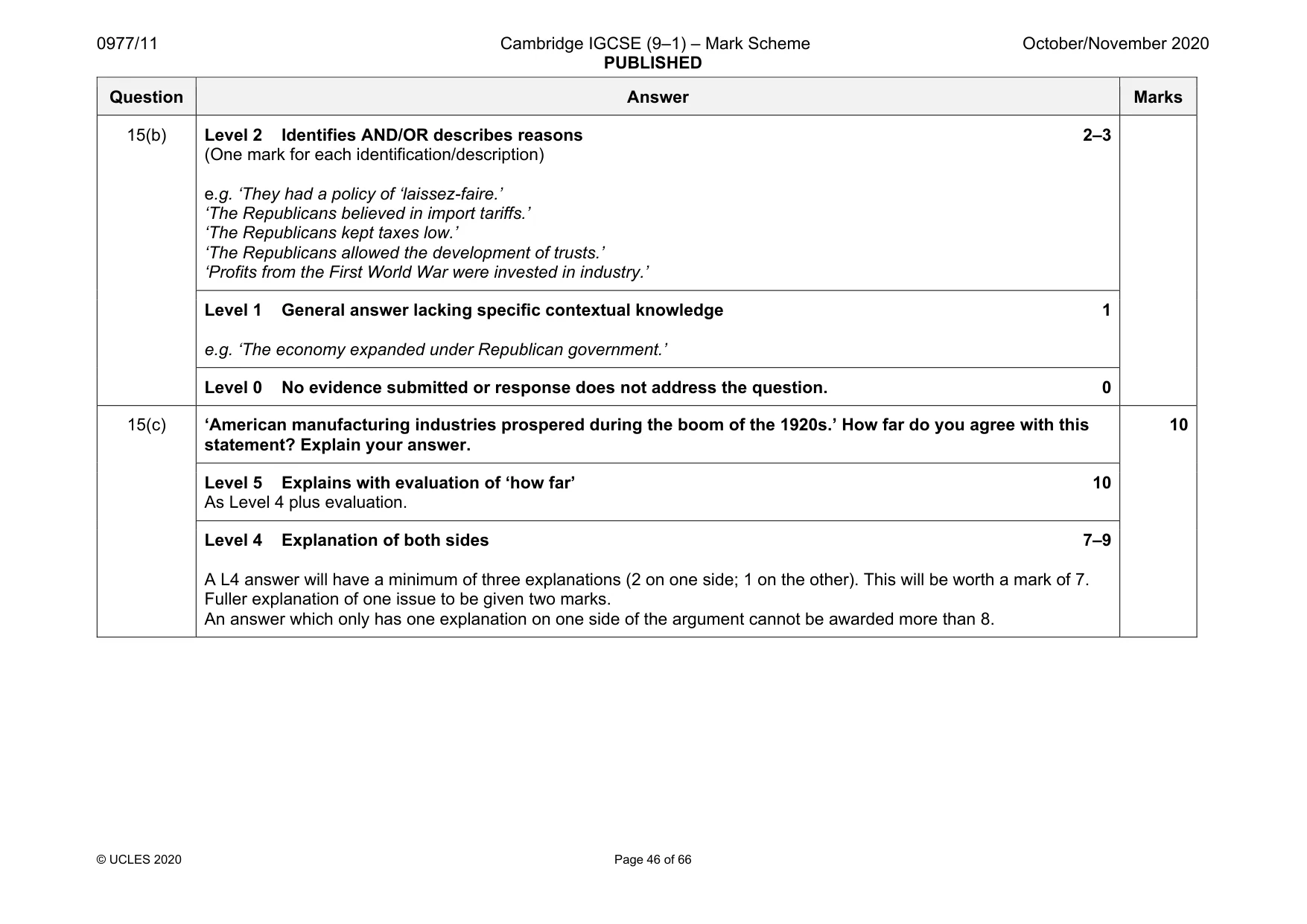
0977/11 Cambridge IGCSE (9–1) – Mark Scheme PUBLISHED October/November 2020 © UCLES 2020 Page 46 of 66 Question Answer Marks 15(b) Level 2 Identifies AND/OR describes reasons 2–3 (One mark for each identification/description) e.g. ‘They had a policy of ‘laissez-faire.’ ‘The Republicans believed in import tariffs.’ ‘The Republicans kept taxes low.’ ‘The Republicans allowed the development of trusts.’ ‘Profits from the First World War were invested in industry.’ Level 1 General answer lacking specific contextual knowledge 1 e.g. ‘The economy expanded under Republican government.’ Level 0 No evidence submitted or response does not address the question. 0 15(c) ‘American manufacturing industries prospered during the boom of the 1920s.’ How far do you agree with this statement? Explain your answer. 10 Level 5 Explains with evaluation of ‘how far’ 10 As Level 4 plus evaluation. Level 4 Explanation of both sides 7–9 A L4 answer will have a minimum of three explanations (2 on one side; 1 on the other). This will be worth a mark of 7. Fuller explanation of one issue to be given two marks. An answer which only has one explanation on one side of the argument cannot be awarded more than 8.
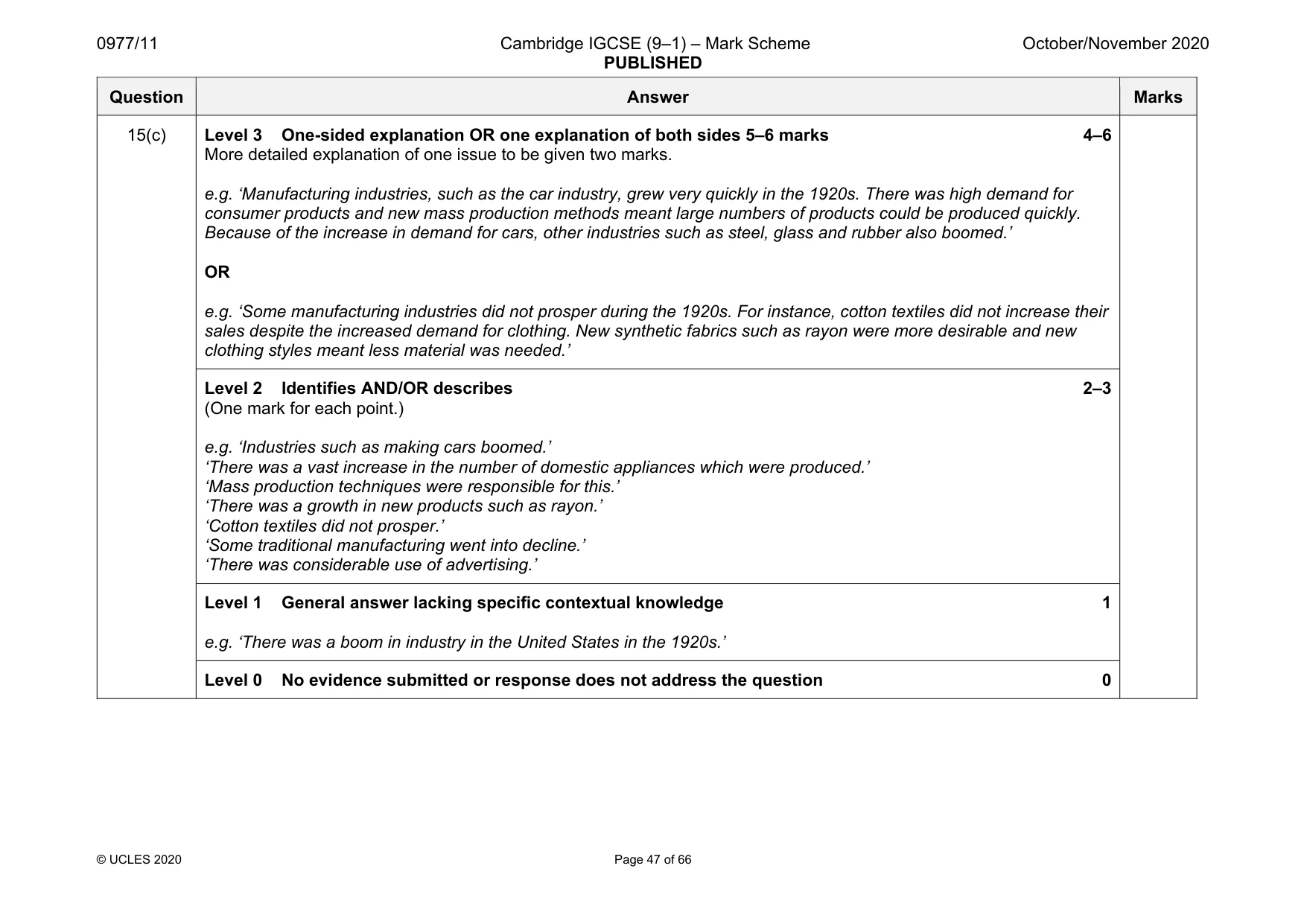
Mark scheme, page 47
0977/11 Cambridge IGCSE (9–1) – Mark Scheme PUBLISHED October/November 2020 © UCLES 2020 Page 47 of 66 Question Answer Marks 15(c) Level 3 One-sided explanation OR one explanation of both sides 5–6 marks 4–6 More detailed explanation of one issue to be given two marks. e.g. ‘Manufacturing industries, such as the car industry, grew very quickly in the 1920s. There was high demand for consumer products and new mass production methods meant large numbers of products could be produced quickly. Because of the increase in demand for cars, other industries such as steel, glass and rubber also boomed.’ OR e.g. ‘Some manufacturing industries did not prosper during the 1920s. For instance, cotton textiles did not increase their sales despite the increased demand for clothing. New synthetic fabrics such as rayon were more desirable and new clothing styles meant less material was needed.’ Level 2 Identifies AND/OR describes 2–3 (One mark for each point.) e.g. ‘Industries such as making cars boomed.’ ‘There was a vast increase in the number of domestic appliances which were produced.’ ‘Mass production techniques were responsible for this.’ ‘There was a growth in new products such as rayon.’ ‘Cotton textiles did not prosper.’ ‘Some traditional manufacturing went into decline.’ ‘There was considerable use of advertising.’ Level 1 General answer lacking specific contextual knowledge 1 e.g. ‘There was a boom in industry in the United States in the 1920s.’ Level 0 No evidence submitted or response does not address the question 0
Mark scheme, page 48
0977/11 Cambridge IGCSE (9–1) – Mark Scheme PUBLISHED October/November 2020 © UCLES 2020 Page 48 of 66 Question Answer Marks 16(a) Describe the weaknesses in the US economy in the 1920s. 4 Level 1 One mark for each relevant point; additional mark for supporting detail 1–4 e.g. ‘Overproduction of consumer goods.’ ‘Farmers saturated the market.’ ‘As more and more people, who could afford consumer products, were buying them, demand started to drop.’ ‘Wages did not rise and prices did not fall.’ ‘People in Europe could not afford US goods.’ ‘European countries imposed tariffs on American goods.’ ‘There was an uneven distribution of income.’ Level 0 No evidence submitted or response does not address the question 0 16(b) Why was there a stock market boom in the 1920s? 6 Level 4 Explains TWO reasons 6 Level 3 Explains ONE reason 4–5 (Four marks for one explanation, five marks for full explanation) e.g. ‘There was a stock market boom in the 1920s because companies were doing well and people were keen to buy shares. If a company was growing, a speculator could buy shares and sell them only a few months later and make a profit. Many people who did not usually invest in the stock market bought shares.’ Level 2 Identifies AND/OR describes reasons 2–3 (One mark for each identification/description) e.g. ‘Speculators could make profits easily.’ ‘Companies were growing and making profits.’ ‘People bought shares ‘on the margin’.’ ‘The banks were happy to lend money for people to buy shares.’
Mark scheme, page 49
0977/11 Cambridge IGCSE (9–1) – Mark Scheme PUBLISHED October/November 2020 © UCLES 2020 Page 49 of 66 Question Answer Marks 16(b) Level 1 General answer lacking specific contextual knowledge 1 e.g. ‘American business was doing well.’ Level 0 No evidence submitted or response does not address the question 0 16(c) ‘The main impact of the Wall Street Crash was the collapse of the banks.’ How far do you agree with this statement? Explain your answer. 10 Level 5 Explains with evaluation of ‘how far’ 10 As Level 4 plus evaluation. Level 4 Explanation of both sides 7–9 A L4 answer will have a minimum of three explanations (2 on one side; 1 on the other). This will be worth a mark of 7. Fuller explanation of one issue to be given two marks. An answer which only has one explanation on one side of the argument cannot be awarded more than 8. Level 3 One-sided explanation OR one explanation of both sides 5–6 marks 4–6 More detailed explanation of one issue to be given two marks. e.g. ‘The collapse of the banks was the main impact of the Wall Street Crash. When the stock market collapsed the banks, which had lent money to speculators to buy shares, lost a huge amount of money. Many went bankrupt. This meant that anyone who had savings in the bank also lost their money.’ OR e.g. ‘Unemployment was the main impact of the Wall Street Crash. As businesses crashed people lost their jobs. By 1933 almost 25% of the workforce was unemployed. There were no welfare benefits and people had no money for food or rent.’
Mark scheme, page 50
0977/11 Cambridge IGCSE (9–1) – Mark Scheme PUBLISHED October/November 2020 © UCLES 2020 Page 50 of 66 Question Answer Marks 16(c) Level 2 Identifies AND/OR describes 2–3 (One mark for each point.) e.g. ‘The banks went bankrupt.’ ‘People lost their savings.’ ‘Businesses failed.’ ‘Factories shut down.’ ‘Demand for goods fell even further.’ ‘Unemployment rose sharply.’ ‘People had no money for food or housing.’ Level 1 General answer lacking specific contextual knowledge 1 e.g. ‘The Wall Street Crash had a bad impact on Americans.’ Level 0 No evidence submitted or response does not address the question 0 Question Answer Marks 17(a) Describe the aims of Mao’s Five-Year Plans. 4 Level 1 One mark for each relevant point; additional mark for supporting detail 1–4 e.g. ‘Mao wanted to increase China’s industrial production.’ ‘He wanted to use industry to increase military strength.’ ‘He wanted to encourage workers to support the regime.’ ‘He wanted to increase output in heavy industry such as coal and steel.’ Level 0 No evidence submitted or response does not address the question 0
Mark scheme, page 51
0977/11 Cambridge IGCSE (9–1) – Mark Scheme PUBLISHED October/November 2020 © UCLES 2020 Page 51 of 66 Question Answer Marks 17(b) Why did the Great Leap Forward fail? 6 Level 4 Explains TWO reasons 6 Level 3 Explains ONE reason 4–5 (Four marks for one explanation, five marks for full explanation) e.g. ‘The Great Leap Forward failed because Mao insisted on following communist principles and getting rid of bourgeois experts. He removed the middle class of experts running the factories, businesses, hospitals and universities. He wanted another revolution to hand back control to the peasants and workers. This proved to be a disaster in the Great Leap Forward because he lost the skilled people he needed.’ Level 2 Identifies AND/OR describes reasons 2–3 (One mark for each identification/description) e.g. ‘Mao wanted to give control to the peasants.’ ‘Mao insisted on the commune system.’ ‘There was a lack of technical help.’ ‘There was a lack of central planning.’ ‘Targets were unrealistic.’ ‘There was a shortage of skilled workers.’ ‘Farmers went to work in factories and the crops failed.’ Level 1 General answer lacking specific contextual knowledge 1 e.g. ‘It failed because it was badly planned.’ Level 0 No evidence submitted or response does not address the question 0
Mark scheme, page 52
0977/11 Cambridge IGCSE (9–1) – Mark Scheme PUBLISHED October/November 2020 © UCLES 2020 Page 52 of 66 Question Answer Marks 17(c) ‘Reforming education was the most important social change introduced by Mao.’ How far do you agree with this statement? Explain your answer. 10 Level 5 Explains with evaluation of ‘how far’ 10 As Level 4 plus evaluation. Level 4 Explanation of both sides 7–9 A L4 answer will have a minimum of three explanations (2 on one side; 1 on the other). This will be worth a mark of 7. Fuller explanation of one issue to be given two marks. An answer which only has one explanation on one side of the argument cannot be awarded more than 8. Level 3 One-sided explanation OR one explanation of both sides 5–6 marks 4–6 More detailed explanation of one issue to be given two marks. e.g. ‘Reforming education was important. Mao believed that everyone should be able to read and write. This would benefit industry and agriculture. China needed professionals such as doctors. These needed to be educated. A nationwide literacy drive was launched and by 1960 over 90% of the population could read.’ OR e.g. ‘One important social change was the way women were treated. Mao questioned many traditional practices, such as foot binding and forced marriage, and made these illegal. He believed women should be treated equally and not as second-class citizens. He realised women were a great source of untapped labour and gave them equal opportunities in education and work.’ Level 2 Identifies AND/OR describes 2–3 (One mark for each point.) e.g. ‘Mao wanted to remove traditional practices.’ ‘He wanted a literate society.’ ‘Mao wanted to improve his people’s well-being.’ ‘He needed a healthy workforce.’ ‘Mao introduced reforms so women were treated equally.’ ‘He introduced policies to combat disease and improve hygiene.’
Mark scheme, page 53
0977/11 Cambridge IGCSE (9–1) – Mark Scheme PUBLISHED October/November 2020 © UCLES 2020 Page 53 of 66 Question Answer Marks 17(c) Level 1 General answer lacking specific contextual knowledge 1 e.g. ‘Mao introduced many changes to improve China.’ Level 0 No evidence submitted or response does not address the question 0 Question Answer Marks 18(a) What was Mao’s impact on art and culture in China? 4 Level 1 One mark for each relevant point; additional mark for supporting detail 1–4 e.g. ‘Artists and writers had to produce works which supported the revolution.’ ‘Western music was banned.’ ‘Traditional Chinese opera was replaced by specially written modern works.’ ‘There was strict censorship.’ ‘Traditional art forms and literature were banned.’ Level 0 No evidence submitted or response does not address the question 0 18(b) Why was there a power struggle after Mao’s death? 6 Level 4 Explains TWO reasons 6 Level 3 Explains ONE reason 4–5 (Four marks for one explanation, five marks for full explanation) e.g. ‘In 1969, Mao had nominated his successor as Lin Piao. He was not willing to wait to take power and tried to seize power in 1971. He disappeared with several military leaders. This meant there was no clear successor from this point and so rivals competed for power.’
Mark scheme, page 54
0977/11 Cambridge IGCSE (9–1) – Mark Scheme PUBLISHED October/November 2020 © UCLES 2020 Page 54 of 66 Question Answer Marks 18(b) Level 2 Identifies AND/OR describes reasons 2–3 (One mark for each identification/description) e.g. ‘Mao’s appointed successor attempted an early take over.’ ‘Zhou Enlai died in the same year as Mao.’ ‘Mao’s widow tried to seize power.’ ‘Deng was a veteran of the Long March.’ ‘Hua was tainted by the Cultural Revolution.’ Level 1 General answer lacking specific contextual knowledge 1 e.g. ‘There was no clear successor to Mao.’ Level 0 No evidence submitted or response does not address the question 0 18(c) How far do you agree that Chinese society became more free after Mao’s death? Explain your answer. 10 Level 5 Explains with evaluation of ‘how far’ 10 As Level 4 plus evaluation. Level 4 Explanation of both sides 7–9 A L4 answer will have a minimum of three explanations (2 on one side; 1 on the other). This will be worth a mark of 7. Fuller explanation of one issue to be given two marks. An answer which only has one explanation on one side of the argument cannot be awarded more than 8.
Mark scheme, page 55
0977/11 Cambridge IGCSE (9–1) – Mark Scheme PUBLISHED October/November 2020 © UCLES 2020 Page 55 of 66 Question Answer Marks 18(c) Level 3 One-sided explanation OR one explanation of both sides 5–6 marks 4–6 More detailed explanation of one issue to be given two marks. e.g. ‘In some ways China became more liberal. Thousands of political prisoners were released and it was no longer illegal to make comments which criticised the regime. The role of the secret police was reduced. Students could travel abroad.’ OR e.g. ‘In many ways China did not become more liberal. Democratic reforms were denied and Deng was unwilling for there to be greater participation by the people in politics.’ Level 2 Identifies AND/OR describes 2–3 (One mark for each point.) e.g. ‘Political prisoners were released.’ ‘China was more open to trade with other countries.’ ‘Some students could travel abroad.’ ‘Democratic reforms were denied.’ ‘Deng did not believe there was a role in politics for the people.’ Level 1 General answer lacking specific contextual knowledge 1 e.g. ‘China became more liberal in some ways but not in others.’ Level 0 No evidence submitted or response does not address the question 0
Mark scheme, page 56
0977/11 Cambridge IGCSE (9–1) – Mark Scheme PUBLISHED October/November 2020 © UCLES 2020 Page 56 of 66 Question Answer Marks 19(a) Describe developments in manufacturing by 1945. 4 Level 1 One mark for each relevant point; additional mark for supporting detail 1–4 e.g. ‘South African industry was helped by the Second World War.’ ‘Non-white workers were employed in industry.’ ‘Manufacturing had become more important than mining for the economy.’ ‘Factories were mechanised so unskilled workers could be employed.’ ‘The war meant there was no supply of consumer goods from overseas.’ Level 0 No evidence submitted or response does not address the question 0 19(b) Why was there a wide gap in living standards between white and non-white South Africans by 1945? 6 Level 4 Explains TWO reasons 6 Level 3 Explains ONE reason 4–5 (Four marks for one explanation, five marks for full explanation) e.g. ‘There was a gap because the benefits of economic development were not shared equally. Employers benefited from the extremely low wages they paid non-white employees. White people became as prosperous as the professional and business classes of Europe and North America, enjoying one of the highest standards of living in the world at the expense of their non-white workers.’ Level 2 Identifies AND/OR describes reasons 2–3 (One mark for each identification/description) e.g. ‘Low wages could be paid to non-white employees.’ ‘The non-white population received a basic education.’ ‘Most white people had a high standard of living.’ ‘It meant white people had excellent public services.’ ‘The average non-white person earned a tenth of the average white person.’
Mark scheme, page 57
0977/11 Cambridge IGCSE (9–1) – Mark Scheme PUBLISHED October/November 2020 © UCLES 2020 Page 57 of 66 Question Answer Marks 19(b) Level 1 General answer lacking specific contextual knowledge 1 e.g. ‘There was a wide gap in living standards between white and non-white South Africans because non-whites were paid less.’ Level 0 No evidence submitted or response does not address the question 0 19(c) How far did the Second World War produce opportunities for non-white South Africans? Explain your answer. 10 Level 5 Explains with evaluation of ‘how far’ 10 As Level 4 plus evaluation. Level 4 Explanation of both sides 7–9 A L4 answer will have a minimum of three explanations (2 on one side; 1 on the other). This will be worth a mark of 7. Fuller explanation of one issue to be given two marks. An answer which only has one explanation on one side of the argument cannot be awarded more than 8. Level 3 One-sided explanation OR one explanation of both sides 5–6 marks 4–6 More detailed explanation of one issue to be given two marks. e.g. ‘The war produced opportunities because more non-white males worked in industry. More non-white South Africans moved to the towns where their jobs were and began to outnumber the whites. Wages were much better in the towns than in the countryside and the Pass Laws were relaxed. Things seemed to be changing for the better when the Declaration for the United Nations was drawn up.’ OR e.g. ‘There were some opportunities but these did not last. Non-white workers were paid much less than white people and their earnings were still hardly enough to live on. A miner’s strike which involved 73 000 mine workers were dealt with very harshly by the government and this showed that attitudes towards non-white workers had not changed.’
Mark scheme, page 58
0977/11 Cambridge IGCSE (9–1) – Mark Scheme PUBLISHED October/November 2020 © UCLES 2020 Page 58 of 66 Question Answer Marks 19(c) Level 2 Identifies AND/OR describes 2–3 (One mark for each point.) e.g. ‘Non-white people were in demand for labour.’ ‘Workers argued for better pay and conditions.’ ‘The number of unions representing non-white workers increased.’ ‘Some of the segregation laws had been relaxed.’ ‘Jan Smuts supported the ideas in the United Nations Charter.’ Level 1 General answer lacking specific contextual knowledge 1 e.g. ‘There was more work for non-white South Africans.’ Level 0 No evidence submitted or response does not address the question 0 Question Answer Marks 20(a) Describe Botha’s constitutional reforms. 4 Level 1 One mark for each relevant point; additional mark for supporting detail 1–4 e.g. ‘A new South African Parliament was established.’ ‘It consisted of three chambers.’ ‘The House of Assembly had white members and was voted for by white South Africans’. ‘Asian and non-white groups were represented.’ ‘A State President was elected.’ ‘Black South African were only allowed to vote in local elections.’ Level 0 No evidence submitted or response does not address the question 0
Mark scheme, page 59
0977/11 Cambridge IGCSE (9–1) – Mark Scheme PUBLISHED October/November 2020 © UCLES 2020 Page 59 of 66 Question Answer Marks 20(b) Why did trade union reform lead to an increase in opposition to the government? 6 Level 4 Explains TWO reasons 6 Level 3 Explains ONE reason 4–5 (Four marks for one explanation, five marks for full explanation) e.g. ‘Trade unions were reformed during the 1970s. This led to increased opposition because black trade unions were recognised and were given the right to strike. The number of days lost to strikes increased dramatically.’ Level 2 Identifies AND/OR describes reasons 2–3 (One mark for each identification/description) e.g. ‘Trade unions were reformed’ ‘Black trade unions were legalised.’ ‘Workers had the right to strike.’ ‘Workers had the right to industrial tribunals.’ ‘The unions became increasingly militant.’ Level 1 General answer lacking specific contextual knowledge 1 e.g. ‘The trade unions encouraged opposition.’ Level 0 No evidence submitted or response does not address the question 0 20(c) How far do you agree that de Klerk abandoned white minority rule because South Africa was facing serious economic problems? Explain your answer. 10 Level 5 Explains with evaluation of ‘how far’ 10 As Level 4 plus evaluation. Level 4 Explanation of both sides 7–9 A L4 answer will have a minimum of three explanations (2 on one side; 1 on the other). This will be worth a mark of 7. Fuller explanation of one issue to be given two marks. An answer which only has one explanation on one side of the argument cannot be awarded more than 8.
Mark scheme, page 60
0977/11 Cambridge IGCSE (9–1) – Mark Scheme PUBLISHED October/November 2020 © UCLES 2020 Page 60 of 66 Question Answer Marks 20(c) Level 3 One-sided explanation OR one explanation of both sides 5–6 marks 4–6 More detailed explanation of one issue to be given two marks. e.g. ‘The poor state of the economy was influential in bringing white minority rule to an end. In 1986 the American Congress voted to ban imports of iron, steel, coal, textiles and uranium from South Africa, while the European Community banned imports of South African iron, steel, gold and coins. These sanctions led to a large increase in white unemployment in South Africa and economic growth suffered. This could not continue without South Africa suffering disastrous effects.’ OR e.g. ‘De Klerk abandoned white minority rule because of the problem of internal unrest. The government had lost control of the townships and the violent behaviour of the police in trying to control the violence only made the situation more volatile.’ Level 2 Identifies AND/OR describes 2–3 (One mark for each point.) e.g. ‘Sanctions damaged South Africa’s economy.’ ‘In 1986 the American Congress voted to stop American loans to South Africa.’ ‘There was increased violence in the townships.’ ‘The end of the Cold War meant the South African government became even more isolated.’ Level 1 General answer lacking specific contextual knowledge 1 e.g. ‘A combination of factors encouraged de Klerk to abandon apartheid.’ Level 0 No evidence submitted or response does not address the question 0
Mark scheme, page 61
0977/11 Cambridge IGCSE (9–1) – Mark Scheme PUBLISHED October/November 2020 © UCLES 2020 Page 61 of 66 Question Answer Marks 21(a) Describe the reaction of the Jews in Palestine to the 1947 UN Partition Plan. 4 Level 1 One mark for each relevant point; additional mark for supporting detail 1–4 e.g. ‘The Jewish Agency liked the fact that the Jews would have a homeland.’ ‘They were angry that they would not have control of Jerusalem.’ ‘They were pleased that British influence would be removed.’ ‘They were unhappy that the land to be given to them was in three separate sections.’ ‘Jews were unhappy that they would be in a minority in one of the areas.’ Level 0 No evidence submitted or response does not address the question 0 21(b) Why did the Arabs believe a Palestinian homeland would be created at the end of the Second World War? 6 Level 4 Explains TWO reasons 6 Level 3 Explains ONE reason 4–5 (Four marks for one explanation, five marks for full explanation) e.g. ‘The Arabs believed that a Palestinian homeland would be formed because they knew that the British Foreign Secretary was against the idea of forming a Jewish state in the region. At the same time, they understood that Britain could no longer afford to maintain an empire but would want to keep their access to the oil in the region. They thought these factors would encourage the British to work hard to keep Arab support in the region.’ Level 2 Identifies AND/OR describes reasons 2–3 (One mark for each identification/description) e.g. ‘The British needed access to the oil in the region.’ ‘The Arab League was formed in 1945.’ ‘The British Foreign Secretary did not want partition or a Jewish state.' ‘The white paper of 1939 suggested the Palestinians would have sole control over the region.’ ‘Many Arab states supported the idea of a Palestinian homeland.’ Level 1 General answer lacking specific contextual knowledge 1 e.g. ‘The Arabs thought this was their land.’
Mark scheme, page 62
0977/11 Cambridge IGCSE (9–1) – Mark Scheme PUBLISHED October/November 2020 © UCLES 2020 Page 62 of 66 Question Answer Marks 21(b) Level 0 No evidence submitted or response does not address the question 0 21(c) ‘The Arabs lost the 1948-49 war because of a lack of international support.’ How far do you agree with this statement? Explain your answer. 10 Level 5 Explains with evaluation of ‘how far’ 10 As Level 4 plus evaluation. Level 4 Explanation of both sides 7–9 A L4 answer will have a minimum of three explanations (2 on one side; 1 on the other). This will be worth a mark of 7. Fuller explanation of one issue to be given two marks. An answer which only has one explanation on one side of the argument cannot be awarded more than 8. Level 3 One-sided explanation OR one explanation of both sides 5–6 marks 4–6 More detailed explanation of one issue to be given two marks. e.g. ‘The Arabs lost the war because they were badly organised. They had some international support, but their leaders were not united in their aims and each tended to fight for their own interests. Their efforts in the war were not co- ordinated and both the Egyptian and Syrian governments were very suspicious of King Abdullah of Transjordan’s aims.’ OR e.g. ‘The Arabs lost the war because they underestimated their opponents. Since the First World War there had been strong Jewish groups demanding a separate state for Jews. In the war of 1948–49 the Jews were fighting to keep this dream alive. They were determined to win.’
Mark scheme, page 63
0977/11 Cambridge IGCSE (9–1) – Mark Scheme PUBLISHED October/November 2020 © UCLES 2020 Page 63 of 66 Question Answer Marks 21(c) Level 2 Identifies AND/OR describes 2–3 (One mark for each point.) e.g. ‘The Arabs were badly organised.’ ‘The Israelis were supported by the US and Soviet governments.’ ‘The Arab countries were too confident to co-ordinate their efforts.’ ‘The Israeli defence force had no planes.’ ‘The Jews could not afford to lose.’ ‘Israeli morale was boosted by support from the United States.’ ‘The Israelis were well organised and well led.’ Level 1 General answer lacking specific contextual knowledge 1 e.g. ‘The Arabs did not fight well.’ Level 0 No evidence submitted or response does not address the question 0 Question Answer Marks 22(a) Describe the formation of the PLO. 4 Level 1 One mark for each relevant point; additional mark for supporting detail 1–4 e.g. ‘The PLO was formed in 1964.’ ‘It was formed from Al-Fatah and other Palestinian groups.’ ‘Al-Fatah was the Palestine National Liberation Movement which formed in 1959 and became the basis of the PLO.’ ‘It was formed by people who lived in the refugee camps.’ ‘It was a resistance group which aimed to return to the Palestinian homeland.’ Level 0 No evidence submitted or response does not address the question 0
Mark scheme, page 64
0977/11 Cambridge IGCSE (9–1) – Mark Scheme PUBLISHED October/November 2020 © UCLES 2020 Page 64 of 66 Question Answer Marks 22(b) Why were some Arab states reluctant to support the PLO? 6 Level 4 Explains TWO reasons 6 Level 3 Explains ONE reason 4–5 (Four marks for one explanation, five marks for full explanation) e.g. ‘Some Arab states did not want to support the PLO because they were concerned about their violent methods. In Jordan, King Hussein feared the Israeli reprisals which followed Palestinian attacks that were launched from his country. Members of the PLO were acting as if they ruled much of Jordan. When the PLO blew up a hijacked British plane in Jordan, Hussein expelled the PLO.’ Level 2 Identifies AND/OR describes reasons 2–3 (One mark for each identification/description) e.g. ‘The PLO was ejected from Jordan and Lebanon.’ ‘Refugees were a problem for Arab States.’ ‘Supporting the PLO brought reprisal raids from Israel.’ ‘The PLO fell out with Egypt.’ ‘Arab States did not like the violent PLO methods.’ Level 1 General answer lacking specific contextual knowledge 1 e.g. ‘They did not agree with their methods.’ Level 0 No evidence submitted or response does not address the question 0
Mark scheme, page 65
0977/11 Cambridge IGCSE (9–1) – Mark Scheme PUBLISHED October/November 2020 © UCLES 2020 Page 65 of 66 Question Answer Marks 22(c) ‘The actions of Israel were more significant than the work of the PLO in winning international support for the Palestinians.’ How far do you agree with this statement? Explain your answer. 10 Level 5 Explains with evaluation of ‘how far’ 10 As Level 4 plus evaluation. Level 4 Explanation of both sides 7–9 A L4 answer will have a minimum of three explanations (2 on one side; 1 on the other). This will be worth a mark of 7. Fuller explanation of one issue to be given two marks. An answer which only has one explanation on one side of the argument cannot be awarded more than 8. Level 3 One-sided explanation OR one explanation of both sides 5–6 marks 4–6 More detailed explanation of one issue to be given two marks. e.g. ‘To start with, the PLO found it difficult to win international support. Partly this was due to their tactics of using violence to achieve their aims. However, they were recognised as the voice of the Palestinian people by the Arab League in 1974 and attended meetings at the UN. They gained considerable support from the Asian and African states in the UN.’ OR e.g. ‘Israeli actions increased international support for the Palestinian people. When Israel invaded Lebanon, against the orders of the UN, states such as Jordan and the United States began to reconsider their position towards the PLO and began to discuss the possibility of a resolution of the refugee issue.’ Level 2 Identifies AND/OR describes 2–3 (One mark for each point.) e.g. ‘The PLO used violent methods.’ ‘They were recognised by the Arab League.’ ‘The UN listened to the PLO’s needs.’ ‘Israeli treatment of the refugees and people in the camps was internationally condemned.’ ‘The Israeli invasion of Lebanon helped the PLO to gain international support.’
Mark scheme, page 66
0977/11 Cambridge IGCSE (9–1) – Mark Scheme PUBLISHED October/November 2020 © UCLES 2020 Page 66 of 66 Question Answer Marks 22(c) Level 1 General answer lacking specific contextual knowledge 1 e.g. ‘The position of the Palestinian people has not been improved by either side.’ Level 0 No evidence submitted or response does not address the question 0
What you needed in this session
Cambridge’s own grade thresholds for 2020 Oct/Nov, Paper 1 · Variant 1. A higher threshold means an easier paper — the bar moves with how the cohort did.