Cambridge IGCSE History (9-1) 0977 — 2020 Oct/Nov Paper 2 · Variant 1
0977/21/O/N/20 · 50 marks · ≈56 min
The question paper and its mark scheme, free to read here and free to download. This is Cambridge’s own paper, exactly as it was sat.
Question paper12 pages
Mark scheme14 pages
Answers below. Sit the paper first if you are practising.
Paper as text
Question paper, page 1
Cambridge IGCSE™(9–1) This document has 12 pages. Blank pages are indicated. DC (PQ) 206243 © UCLES 2020 [Turn over HISTORY 0977/21 Paper 2 October/November 2020 2 hours You must answer on the enclosed answer booklet. You will need: Answer booklet (enclosed) INSTRUCTIONS ● Answer all the questions on one option only. Option A: Nineteenth century topic Option B: Twentieth century topic ● Follow the instructions on the front cover of the answer booklet. If you need additional answer paper, ask the invigilator for a continuation booklet. INFORMATION ● The total mark for this paper is 50. ● The number of marks for each question or part question is shown in brackets [ ]. * 1 5 8 1 6 8 8 9 4 8 *
Question paper, page 2
2 0977/21/O/N/20 © UCLES 2020 Option A: Nineteenth century topic WAS JOHN BROWN A HERO OR A VILLAIN? Study the Background Information and the sources carefully, and then answer all the questions. Background Information John Brown learned his abolitionist views from his father. In 1855 he went to Kansas to oppose pro-slavery forces and in 1856 led an attack on the pro-slavery settlement at Pottawatomie Creek where five men were hacked to death. In 1859 Brown turned his attention to Virginia, a slave-owning state. He rented a farmhouse and started to gather rifles, gunpowder and swords. On 16 October he led a group of armed men in an attack on the federal arsenal at Harpers Ferry. He planned to use the twenty thousand weapons in the arsenal to equip slaves who, he hoped, would rise up in rebellion against slavery. Brown managed to gain control of the armoury but on 18 October ninety US Marines arrived and Brown and his men were soon either captured or killed. Brown was charged with treason against the state of Virginia, tried and hanged. Reactions to Brown’s actions and execution have often been extreme, both at the time and since. He has been represented as both a hero and a villain. SOURCE A John Brown, a mad visionary, hit on a deadly plan. The slaves, he thought, might be persuaded to rebel against their masters if Northern sympathisers would provide them with weapons. He therefore proposed to descend on a suitable spot in the South, launch a revolt and, as the slaves flocked to join him, organise them into an army. It was a ridiculous fantasy, well illustrating Brown’s insanity, the abolitionists’ ignorance of the South and their growing tolerance of bloodshed and treason. Brown easily raised money in the North and he and eighteen followers descended on the federal arsenal at Harpers Ferry. He was dealt with without difficulty by the US army. Brown’s handful of men was soon forced to surrender, and Brown himself was taken to Richmond, tried and hanged. Brown thrilled New England. Abolitionist clergy welcomed the slave rebellion which, they thought, Brown’s actions would stimulate. Their ravings drowned the numerous Northern voices which condemned Brown as a criminal. The impressions made on the South were deep. Here at last was the nightmare come true: the abolitionist appeal to the slaves to rebel. John Brown’s raid thus marks the point of no return: it began the uncoiling of a terrible chain of events leading to rebellion and war. From a history book published in 1985.
Question paper, page 3
3 0977/21/O/N/20 © UCLES 2020 [Turn over SOURCE B John Brown left a permanent mark on American history. His raid at Harpers Ferry resulted in both reverence and revulsion. It was a turning point in American history, away from compromise and towards war. When Brown and his small army of twenty-one men took over the federal arsenal and rifle factory, it was the fulfilment of a pledge to God to increase hostility toward slavery. Brown was a religious man who with every drop of his honest blood hated slavery and dedicated himself to eradicating it by any means necessary. To his mind his duty was clear and he never faltered. Expecting slaves to join them, Brown and his men waited in the armoury while the townspeople surrounded the building. Gunfire was exchanged and eight of Brown’s men were killed or captured. Brown was wounded in the attack and taken to jail at Charlestown. The bravest man and most self-sacrificing soul in American history was hanged at Charlestown in December 1859. He set an example of moral courage, and of single-hearted devotion to an ideal, for all men and for all ages. From a recent account of the raid at Harpers Ferry. SOURCE C Did John Brown draw his sword against slavery and thereby lose his life in vain? To this I answer ten thousand times, No! No man fails who so grandly gives himself to a righteous cause. No man could possibly fail who, when on his way to be executed, could so forget himself as to stop and kiss a little child, one of the hated race for whom he was to die. Did John Brown fail? John Brown began the war that ended slavery. If we look over places for which this honour is claimed, we shall find not Carolina, but Virginia, not Fort Sumter, but Harpers Ferry, and the arsenal began the war that ended American slavery and made this free Republic. Until this blow was struck, the prospect for freedom was dim, shadowy and uncertain. From a speech in Harpers Ferry by Frederick Douglass, 30 May 1881. Douglass was an ex-slave and leading abolitionist. SOURCE D Brown and his bandits made a desperate onslaught on the persons and property of the people of Virginia. It is a matter of great regret that the cowardly villains who sent them on their desperate venture cannot grace the same gallows from which they will swing. We feel angry at the tone of the Northern newspapers. Are treason, murder and robbery less hateful, would insurrection and house burning have been less dreadful, because, according to the New York Times, Brown was courageous and convinced of the rightfulness of his acts? This would mean that because Brown glories in what he has done, his life should be spared. Is not the New York Times ashamed of itself for pandering to the depraved sympathy of the city in which it is located? Brown denies that he planned a slave insurrection. What then were the swords for? Did he not intend the swords and other weapons to be used by the slaves in resistance to the masters? We have come to the conclusion that if the South is to maintain her rights, her property, and the lives of her citizens, she must rely upon herself, and not look North for aid or sympathy. From a newspaper, published in Richmond, Virginia, November 1859.
Question paper, page 4
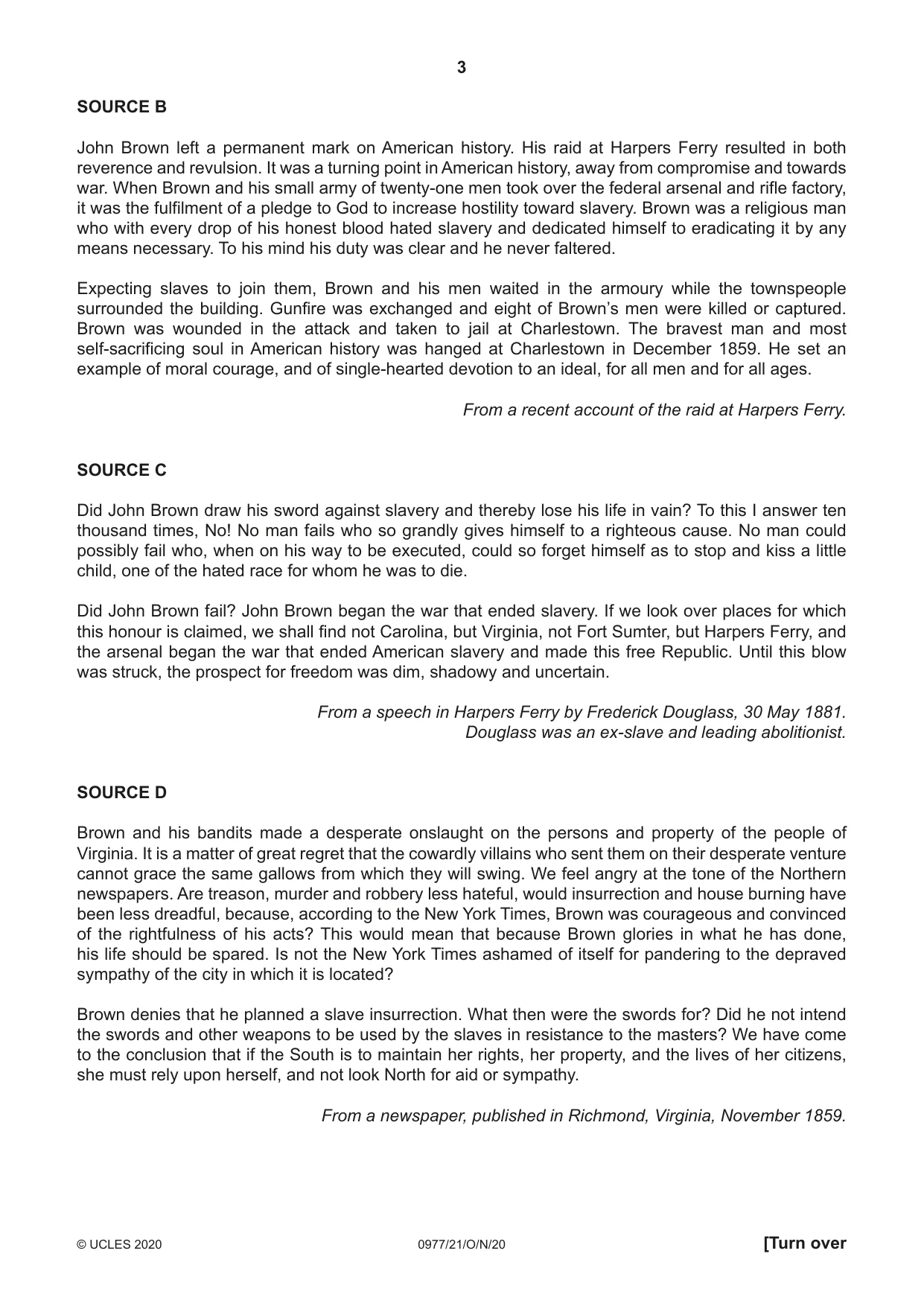
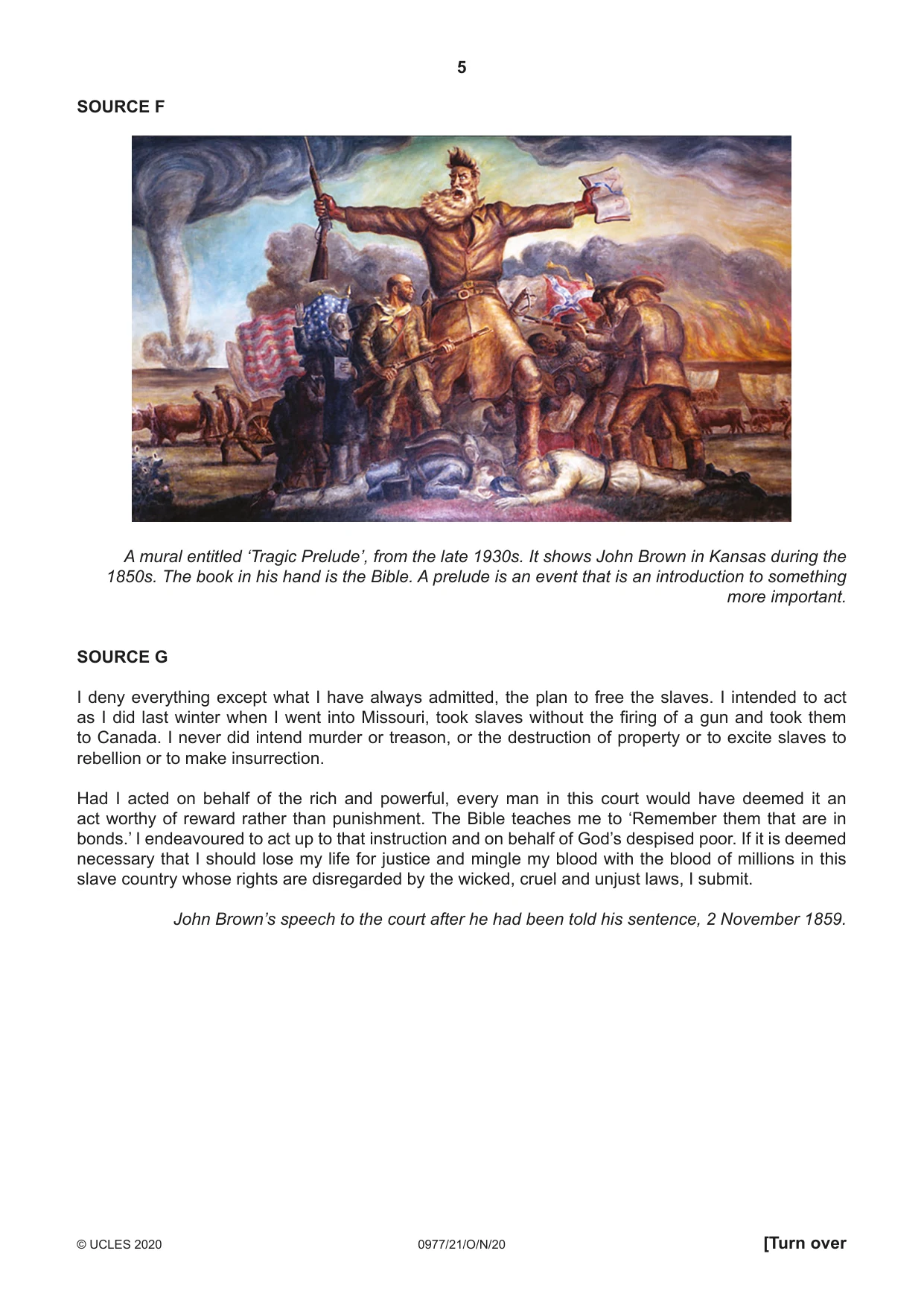
4 0977/21/O/N/20 © UCLES 2020 SOURCE E An illustration called ‘The Last Moments of John Brown’, published in Philadelphia in 1885. It shows Brown leaving jail on his way to his execution. The artist has shown Brown kissing a black child as described at the time in a Northern newspaper. However, most accounts say that only soldiers were present when Brown left the jail.
Question paper, page 5
5 0977/21/O/N/20 © UCLES 2020 [Turn over SOURCE F A mural entitled ‘Tragic Prelude’, from the late 1930s. It shows John Brown in Kansas during the 1850s. The book in his hand is the Bible. A prelude is an event that is an introduction to something more important. SOURCE G I deny everything except what I have always admitted, the plan to free the slaves. I intended to act as I did last winter when I went into Missouri, took slaves without the firing of a gun and took them to Canada. I never did intend murder or treason, or the destruction of property or to excite slaves to rebellion or to make insurrection. Had I acted on behalf of the rich and powerful, every man in this court would have deemed it an act worthy of reward rather than punishment. The Bible teaches me to ‘Remember them that are in bonds.’ I endeavoured to act up to that instruction and on behalf of God’s despised poor. If it is deemed necessary that I should lose my life for justice and mingle my blood with the blood of millions in this slave country whose rights are disregarded by the wicked, cruel and unjust laws, I submit. John Brown’s speech to the court after he had been told his sentence, 2 November 1859.
Question paper, page 6
6 0977/21/O/N/20 © UCLES 2020 SOURCE H John Brown dies to-day! As Republicans, maintaining as we do, that no one in the North has a right to interfere with slavery, we cannot say that he suffers unlawfully. The man’s heroism which is as great as a martyr and his constancy to his convictions have led to sympathy on his behalf throughout the North, but nowhere is the opinion supported that he should not be answerable for his act. As long as we are part of the Union we cannot join the opposition to the punishment which the infatuated old man will suffer. When the right of a Sovereign State to inflict a punishment for breaking its laws is questioned, disunion is being advocated. For that we are not prepared. To our more radical readers these views will be unacceptable. When the fanatical action of the South dissolves the ties that hold North and South together, then we may have reason to support any means, including force, to emancipate every human being on American soil. Until then, we have a firm belief that the execution of Brown will hasten the downfall of the accursed system against which he waged war. From a Republican newspaper published in Chicago, Illinois, 2 December 1859.
Question paper, page 7
7 0977/21/O/N/20 © UCLES 2020 [Turn over Now answer all the following questions. You may use any of the sources to help you answer the questions, in addition to those sources which you are told to use. In answering the questions you should use your knowledge of the topic to help you interpret and evaluate the sources. 1 Study Sources A and B. How far do these two sources agree? Explain your answer using details of the sources. [7] 2 Study Sources C and D. Does Source D prove that Douglass (Source C) was wrong? Explain your answer using details of the sources and your knowledge. [8] 3 Study Sources E and F. How similar are these two illustrations? Explain your answer using details of the sources and your knowledge. [8] 4 Study Source G. How useful would this source be to a historian studying John Brown and the raid on Harpers Ferry? Explain your answer using details of the source and your knowledge. [7] 5 Study Source H. Are you surprised by this source? Explain your answer using details of the source and your knowledge. [8] 6 Study all the sources. How far do these sources provide convincing evidence that John Brown was a hero? Use the sources to explain your answer. [12]
Question paper, page 8
8 0977/21/O/N/20 © UCLES 2020 Option B: Twentieth century topic HOW FAR WAS KHRUSHCHEV SUCCESSFUL IN THE CUBAN MISSILE CRISIS? Study the Background Information and the sources carefully, and then answer all the questions. Background Information On 14 October 1962 an American U-2 reconnaissance plane obtained photographic evidence of Soviet missile sites in Cuba. This led to the Cuban Missile Crisis. The crisis was resolved at the end of October when Khrushchev agreed to remove the missiles and Kennedy agreed not to invade Cuba. Kennedy also secretly agreed to remove American missiles from Turkey. Did Khrushchev achieve what he wanted by placing missiles in Cuba? Any answer to this question needs to take into account his motives in putting the missiles there in the first place. Was he merely trying to protect Cuba from the USA, or was he planning to attack the USA? Was it an attempt to strengthen the Soviet Union’s overall military position in relation to the West? Some have suggested the Soviet Union was trying to defend its position as world leader of Communism against its rival China. By the end of the crisis it appeared to many people that Khrushchev had backed down and been humiliated. But was this really the case? SOURCE A Khrushchev was able to claim a victory over the missile crisis. He argued that Kennedy had now promised not to invade Cuba, so the continued existence of a socialist Cuba in the Soviet sphere of influence was guaranteed. This is clearly significant, especially if you accept the view that this was the main reason that Khrushchev put missiles on Cuba in the first place. Khrushchev must also be given credit for being prepared to back down in the face of nuclear war, especially when so many saw his handling of the crisis as a humiliation for the Soviet Union. However, the Soviet military were particularly angry. They had to accept a hasty withdrawal from Cuba, as well as the ultimate humiliation of having US officials count the missiles as they were removed. Castro was also furious with Khrushchev. He was not consulted on the final deal about the missiles or the withdrawal of Soviet bomber planes and troops which had been sent to help the Cuban army. In the following months Khrushchev had to rebuild his relations with Castro and prevent a Chinese-Cuban alliance developing. From a history book published in 2008.
Question paper, page 9
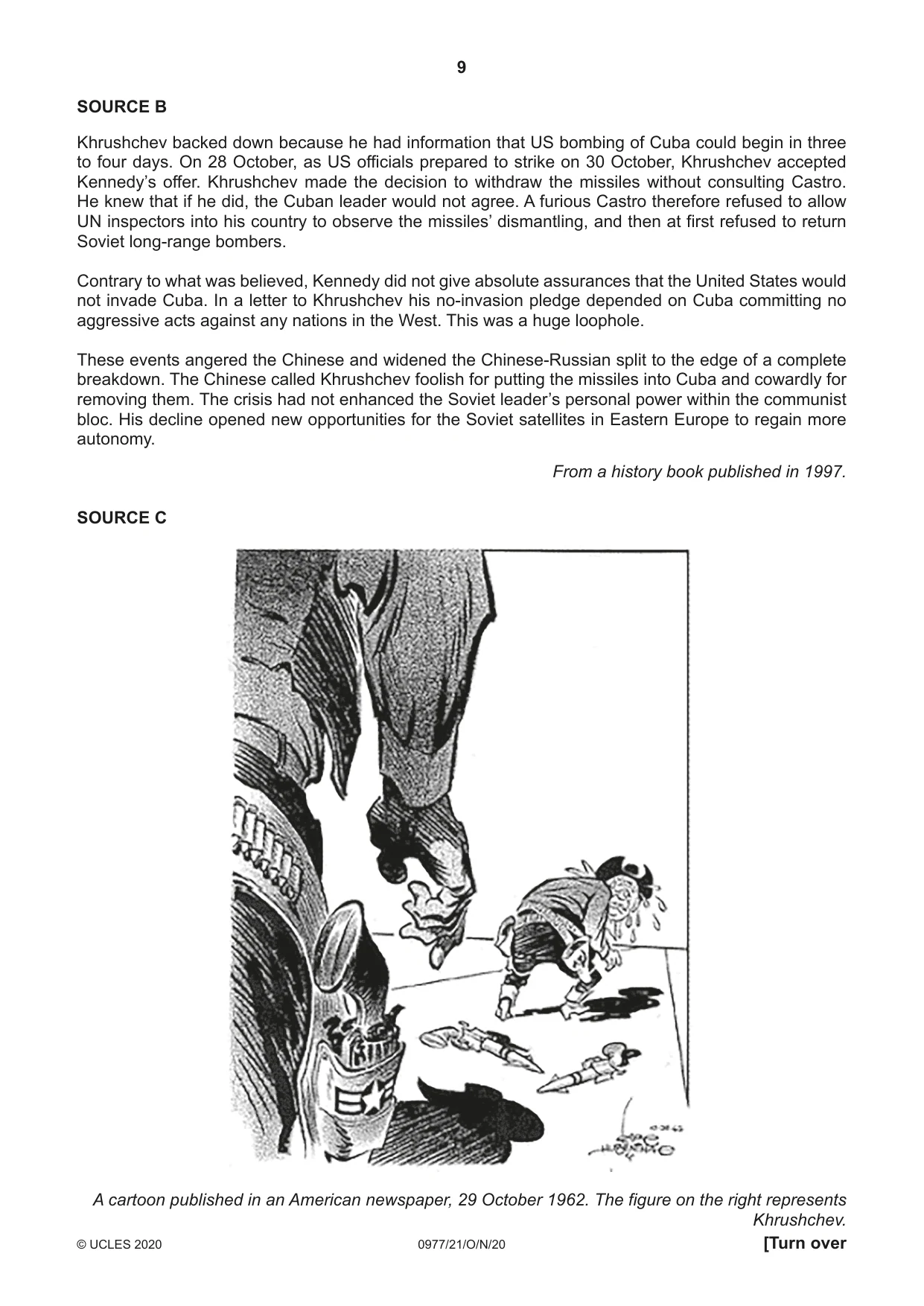
9 0977/21/O/N/20 © UCLES 2020 [Turn over SOURCE B Khrushchev backed down because he had information that US bombing of Cuba could begin in three to four days. On 28 October, as US officials prepared to strike on 30 October, Khrushchev accepted Kennedy’s offer. Khrushchev made the decision to withdraw the missiles without consulting Castro. He knew that if he did, the Cuban leader would not agree. A furious Castro therefore refused to allow UN inspectors into his country to observe the missiles’ dismantling, and then at first refused to return Soviet long-range bombers. Contrary to what was believed, Kennedy did not give absolute assurances that the United States would not invade Cuba. In a letter to Khrushchev his no-invasion pledge depended on Cuba committing no aggressive acts against any nations in the West. This was a huge loophole. These events angered the Chinese and widened the Chinese-Russian split to the edge of a complete breakdown. The Chinese called Khrushchev foolish for putting the missiles into Cuba and cowardly for removing them. The crisis had not enhanced the Soviet leader’s personal power within the communist bloc. His decline opened new opportunities for the Soviet satellites in Eastern Europe to regain more autonomy. From a history book published in 1997. SOURCE C A cartoon published in an American newspaper, 29 October 1962. The figure on the right represents Khrushchev.
Question paper, page 10
10 0977/21/O/N/20 © UCLES 2020 SOURCE D MEMORANDUM FOR THE PRESIDENT The speech should point out that our success in Cuba does not prove that force can solve everything. Significant steps have been taken to lift the threat of war. This has been made possible by the unity of the American people and by the belated recognition by Khrushchev that his adventure was a dangerous miscalculation which was bringing the world close to war. The events of the last weeks have fully exposed Castro, and we are confident that the forces of change will take care of his regime more effectively than invasion could. If we had not acted, we would have allowed a drastic revision of the world balance of power. Our use of force was effective because the Communists knew that they were in the wrong and could not justify their actions to the world. From a report written by Arthur Schlesinger, 29 October 1962. He is advising Kennedy on a speech he was due to make to the American people. Schlesinger was a senior adviser to the President. SOURCE E The United States’ reactionary forces have been doing everything to overthrow Cuba’s revolutionary government and restore their domination there. Revolutionary Cuba was compelled to take all measures to strengthen her defence and agreement was reached to station Soviet missiles in Cuba. Our only aim was to defend Cuba. All talk that Cuba was being converted into a base for an attack on the USA was a vicious lie. The President of the United States declared that if we agreed to remove these weapons, the United States would not invade Cuba. We had shipped weapons to Cuba precisely to prevent such aggression against Cuba. Which side won? One may say that it was sanity and the cause of peace that won. The Soviet Union has not only exposed the US imperialist intrigues against Cuba but when Cuba was threatened we sent weapons and people ready to fight shoulder to shoulder with the Cuban people. From a speech by Khrushchev to the Supreme Soviet (the Parliament of the USSR), 12 December 1962.
Question paper, page 11
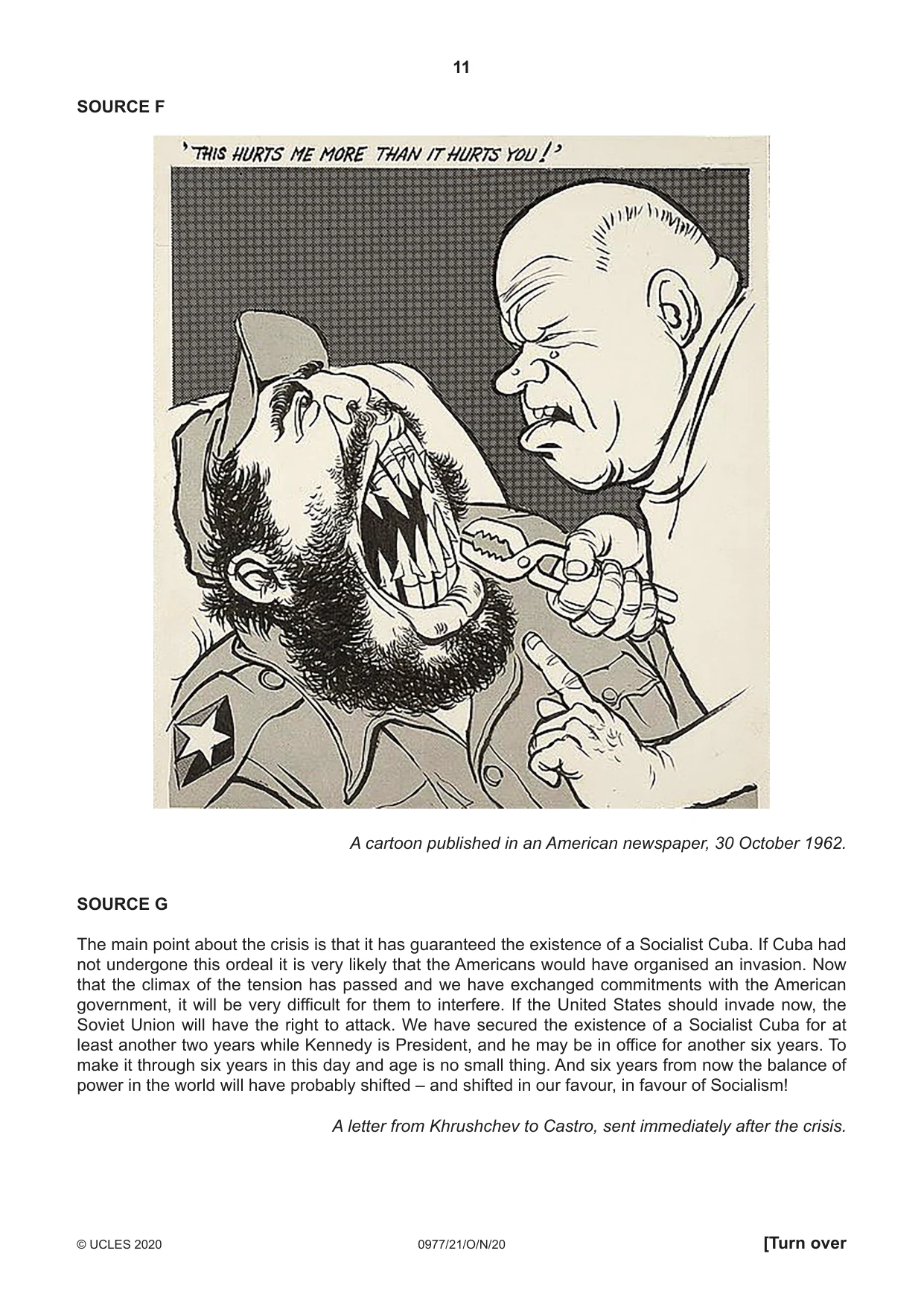
11 0977/21/O/N/20 © UCLES 2020 [Turn over SOURCE F A cartoon published in an American newspaper, 30 October 1962. SOURCE G The main point about the crisis is that it has guaranteed the existence of a Socialist Cuba. If Cuba had not undergone this ordeal it is very likely that the Americans would have organised an invasion. Now that the climax of the tension has passed and we have exchanged commitments with the American government, it will be very difficult for them to interfere. If the United States should invade now, the Soviet Union will have the right to attack. We have secured the existence of a Socialist Cuba for at least another two years while Kennedy is President, and he may be in office for another six years. To make it through six years in this day and age is no small thing. And six years from now the balance of power in the world will have probably shifted – and shifted in our favour, in favour of Socialism! A letter from Khrushchev to Castro, sent immediately after the crisis.
Question paper, page 12
12 0977/21/O/N/20 © UCLES 2020 Permission to reproduce items where third-party owned material protected by copyright is included has been sought and cleared where possible. Every reasonable effort has been made by the publisher (UCLES) to trace copyright holders, but if any items requiring clearance have unwittingly been included, the publisher will be pleased to make amends at the earliest possible opportunity. To avoid the issue of disclosure of answer-related information to candidates, all copyright acknowledgements are reproduced online in the Cambridge Assessment International Education Copyright Acknowledgements Booklet. This is produced for each series of examinations and is freely available to download at www.cambridgeinternational.org after the live examination series. Cambridge Assessment International Education is part of the Cambridge Assessment Group. Cambridge Assessment is the brand name of the University of Cambridge Local Examinations Syndicate (UCLES), which itself is a department of the University of Cambridge. Now answer all the following questions. You may use any of the sources to help you answer the questions, in addition to those sources which you are told to use. In answering the questions you should use your knowledge of the topic to help you interpret and evaluate the sources. 1 Study Sources A and B. How far do these two sources agree? Explain your answer using details of the sources. [7] 2 Study Source C. Why was this cartoon published on 29 October 1962? Explain your answer using details of the source and your knowledge. [8] 3 Study Sources D and E. How far does Source D make Source E surprising? Explain your answer using details of the sources and your knowledge. [8] 4 Study Source F. What is the cartoonist’s message? Explain your answer using details of the source and your knowledge. [8] 5 Study Source G. How far does this source prove that Khrushchev’s motive in the Missile Crisis was to protect Cuba? Explain your answer using details of the source and your knowledge. [7] 6 Study all the sources. How far do these sources provide convincing evidence that the Cuban Missile Crisis was a success for Khrushchev? Use the sources to explain your answer. [12]
Mark scheme, page 1
This document consists of 14 printed pages. © UCLES 2020 [Turn over Cambridge IGCSE™ (9–1) HISTORY 0977/21 Paper 2 October/November 2020 MARK SCHEME Maximum Mark: 50 Published This mark scheme is published as an aid to teachers and candidates, to indicate the requirements of the examination. It shows the basis on which Examiners were instructed to award marks. It does not indicate the details of the discussions that took place at an Examiners’ meeting before marking began, which would have considered the acceptability of alternative answers. Mark schemes should be read in conjunction with the question paper and the Principal Examiner Report for Teachers. Cambridge International will not enter into discussions about these mark schemes. Cambridge International is publishing the mark schemes for the October/November 2020 series for most Cambridge IGCSE™, Cambridge International A and AS Level and Cambridge Pre-U components, and some Cambridge O Level components.
Mark scheme, page 2
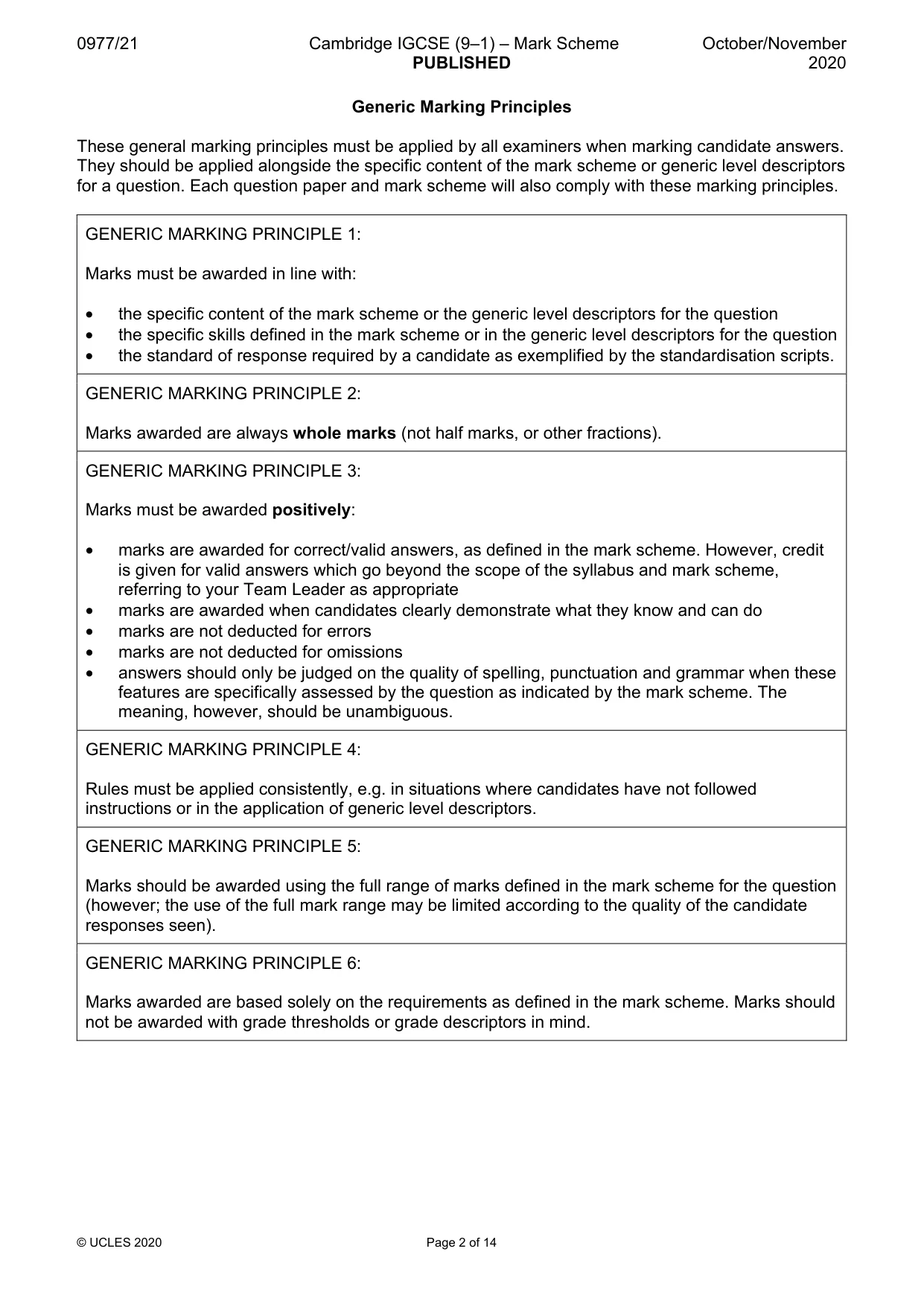
0977/21 Cambridge IGCSE (9–1) – Mark Scheme PUBLISHED October/November 2020 © UCLES 2020 Page 2 of 14 Generic Marking Principles These general marking principles must be applied by all examiners when marking candidate answers. They should be applied alongside the specific content of the mark scheme or generic level descriptors for a question. Each question paper and mark scheme will also comply with these marking principles. GENERIC MARKING PRINCIPLE 1: Marks must be awarded in line with: • the specific content of the mark scheme or the generic level descriptors for the question • the specific skills defined in the mark scheme or in the generic level descriptors for the question • the standard of response required by a candidate as exemplified by the standardisation scripts. GENERIC MARKING PRINCIPLE 2: Marks awarded are always whole marks (not half marks, or other fractions). GENERIC MARKING PRINCIPLE 3: Marks must be awarded positively: • marks are awarded for correct/valid answers, as defined in the mark scheme. However, credit is given for valid answers which go beyond the scope of the syllabus and mark scheme, referring to your Team Leader as appropriate • marks are awarded when candidates clearly demonstrate what they know and can do • marks are not deducted for errors • marks are not deducted for omissions • answers should only be judged on the quality of spelling, punctuation and grammar when these features are specifically assessed by the question as indicated by the mark scheme. The meaning, however, should be unambiguous. GENERIC MARKING PRINCIPLE 4: Rules must be applied consistently, e.g. in situations where candidates have not followed instructions or in the application of generic level descriptors. GENERIC MARKING PRINCIPLE 5: Marks should be awarded using the full range of marks defined in the mark scheme for the question (however; the use of the full mark range may be limited according to the quality of the candidate responses seen). GENERIC MARKING PRINCIPLE 6: Marks awarded are based solely on the requirements as defined in the mark scheme. Marks should not be awarded with grade thresholds or grade descriptors in mind.
Mark scheme, page 3
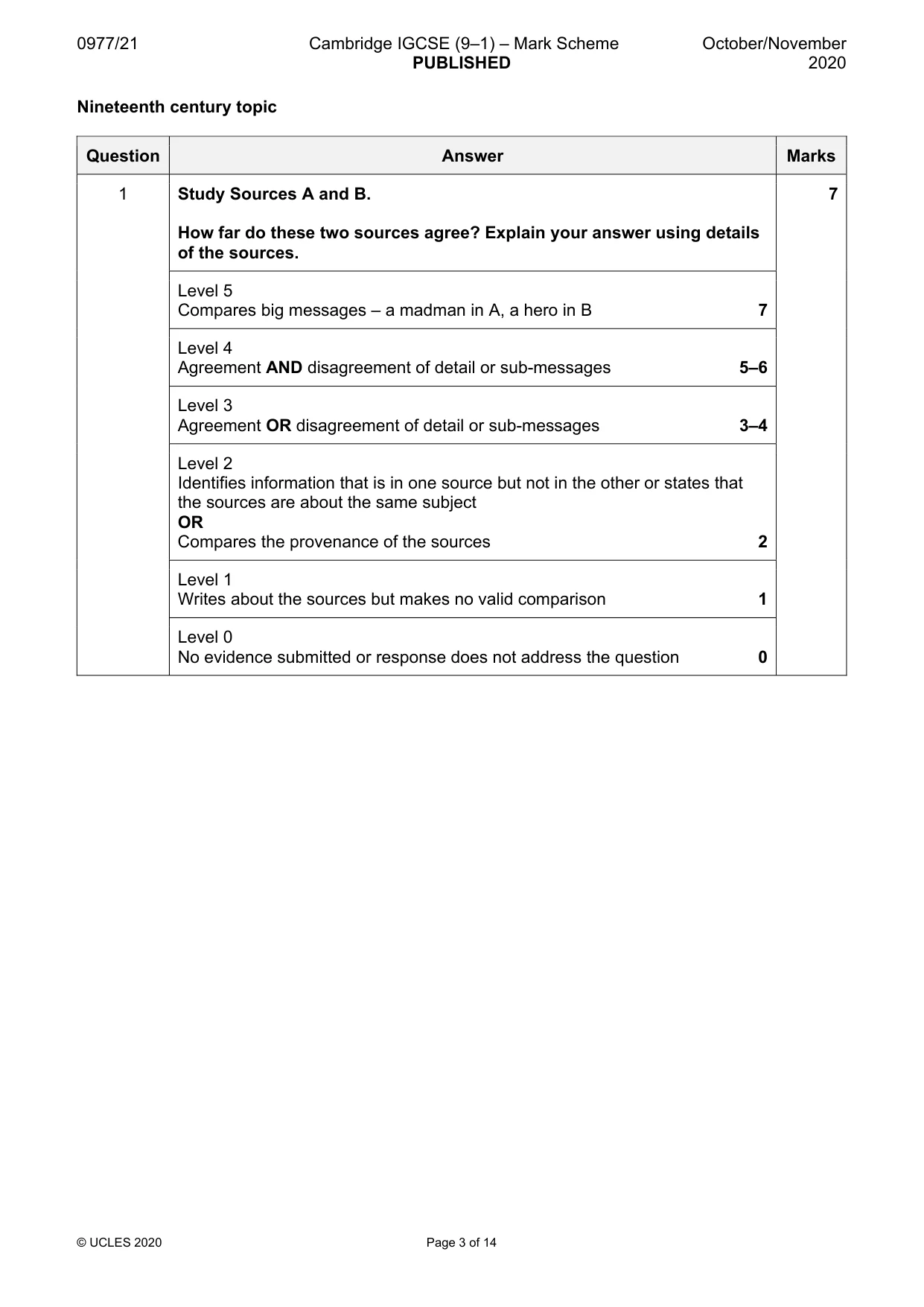
0977/21 Cambridge IGCSE (9–1) – Mark Scheme PUBLISHED October/November 2020 © UCLES 2020 Page 3 of 14 Nineteenth century topic Question Answer Marks 1 Study Sources A and B. How far do these two sources agree? Explain your answer using details of the sources. 7 Level 5 Compares big messages – a madman in A, a hero in B 7 Level 4 Agreement AND disagreement of detail or sub-messages 5–6 Level 3 Agreement OR disagreement of detail or sub-messages 3–4 Level 2 Identifies information that is in one source but not in the other or states that the sources are about the same subject OR Compares the provenance of the sources 2 Level 1 Writes about the sources but makes no valid comparison 1 Level 0 No evidence submitted or response does not address the question 0
Mark scheme, page 4
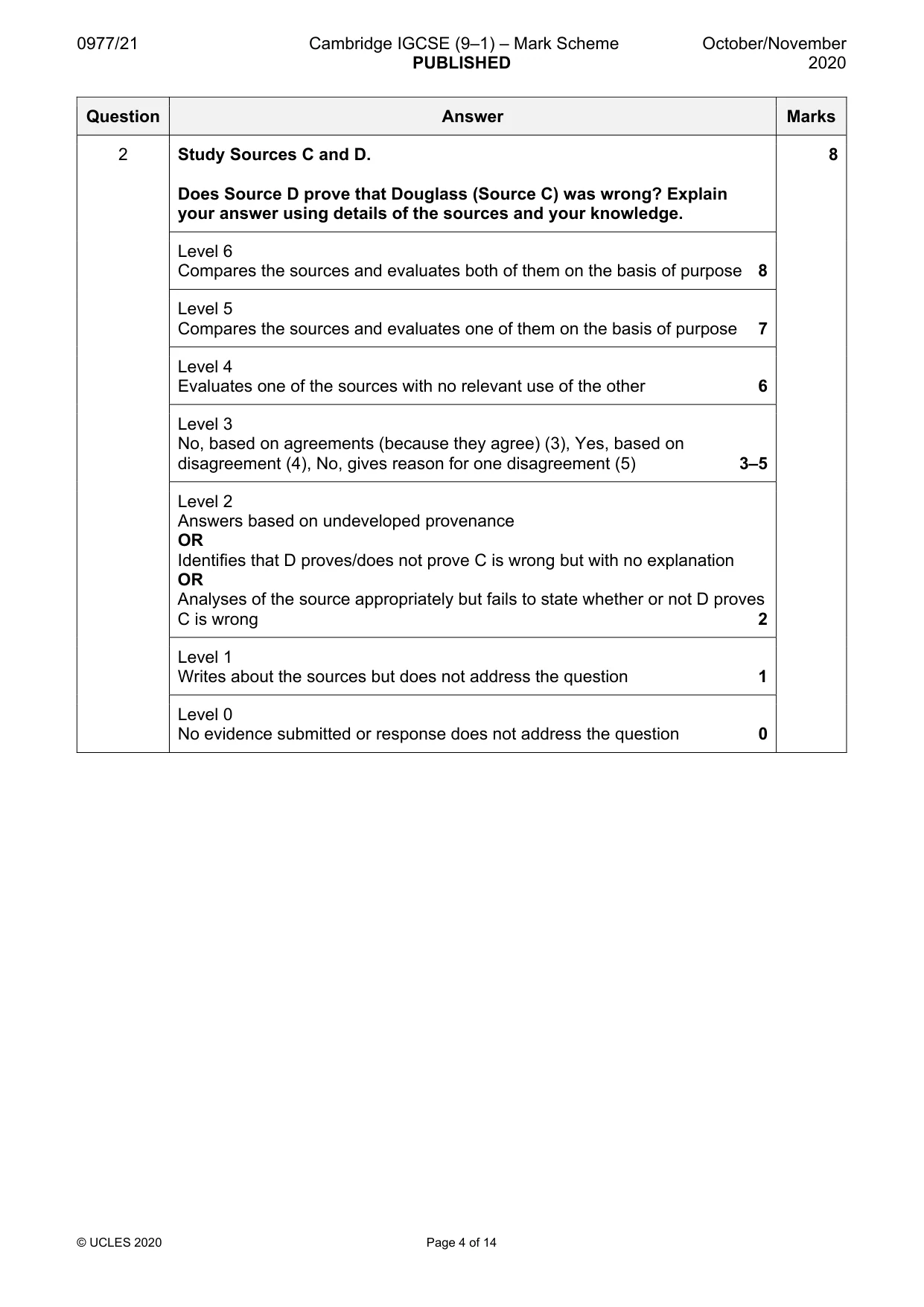
0977/21 Cambridge IGCSE (9–1) – Mark Scheme PUBLISHED October/November 2020 © UCLES 2020 Page 4 of 14 Question Answer Marks 2 Study Sources C and D. Does Source D prove that Douglass (Source C) was wrong? Explain your answer using details of the sources and your knowledge. 8 Level 6 Compares the sources and evaluates both of them on the basis of purpose 8 Level 5 Compares the sources and evaluates one of them on the basis of purpose 7 Level 4 Evaluates one of the sources with no relevant use of the other 6 Level 3 No, based on agreements (because they agree) (3), Yes, based on disagreement (4), No, gives reason for one disagreement (5) 3–5 Level 2 Answers based on undeveloped provenance OR Identifies that D proves/does not prove C is wrong but with no explanation OR Analyses of the source appropriately but fails to state whether or not D proves C is wrong 2 Level 1 Writes about the sources but does not address the question 1 Level 0 No evidence submitted or response does not address the question 0
Mark scheme, page 5
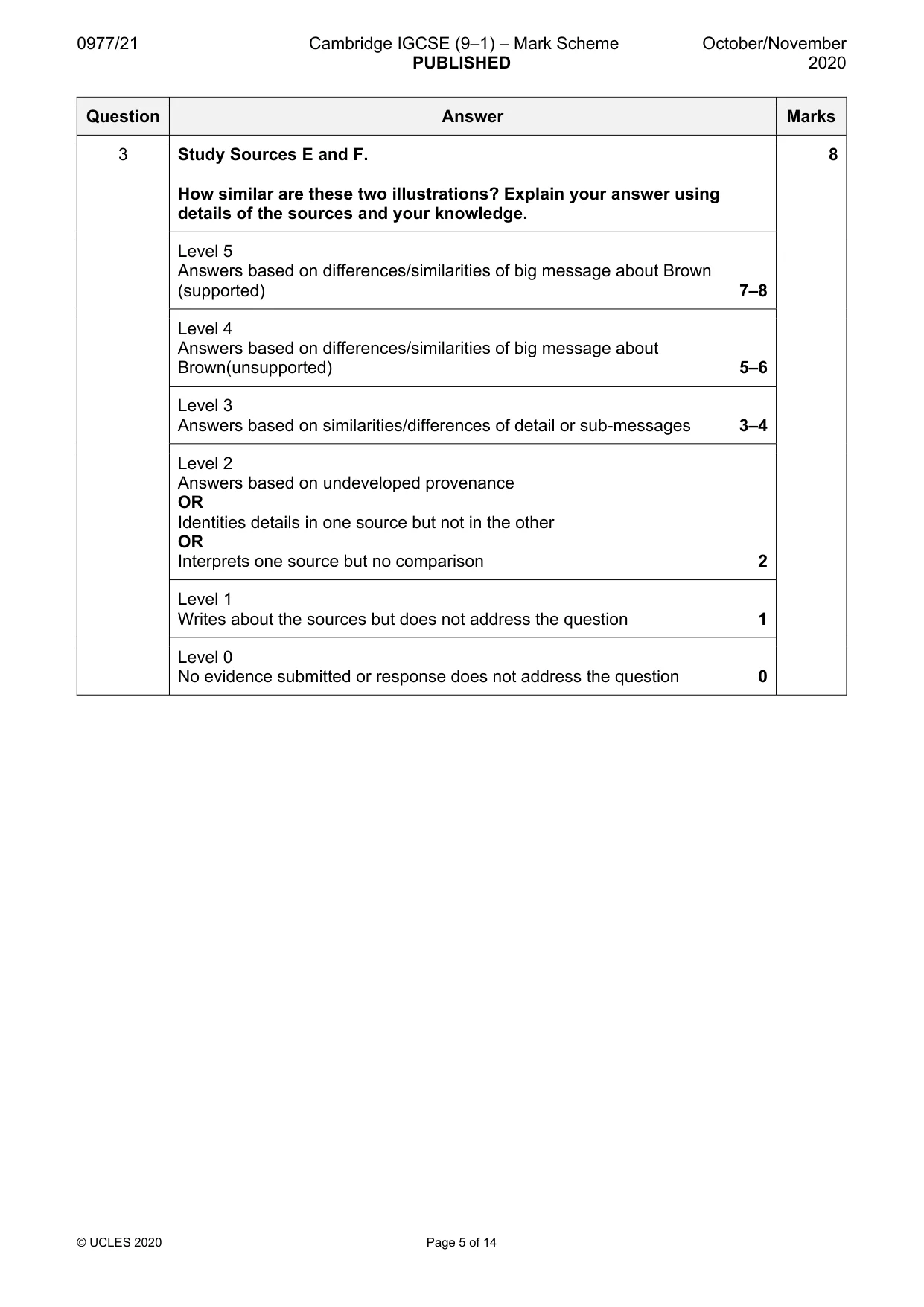
0977/21 Cambridge IGCSE (9–1) – Mark Scheme PUBLISHED October/November 2020 © UCLES 2020 Page 5 of 14 Question Answer Marks 3 Study Sources E and F. How similar are these two illustrations? Explain your answer using details of the sources and your knowledge. 8 Level 5 Answers based on differences/similarities of big message about Brown (supported) 7–8 Level 4 Answers based on differences/similarities of big message about Brown(unsupported) 5–6 Level 3 Answers based on similarities/differences of detail or sub-messages 3–4 Level 2 Answers based on undeveloped provenance OR Identities details in one source but not in the other OR Interprets one source but no comparison 2 Level 1 Writes about the sources but does not address the question 1 Level 0 No evidence submitted or response does not address the question 0
Mark scheme, page 6
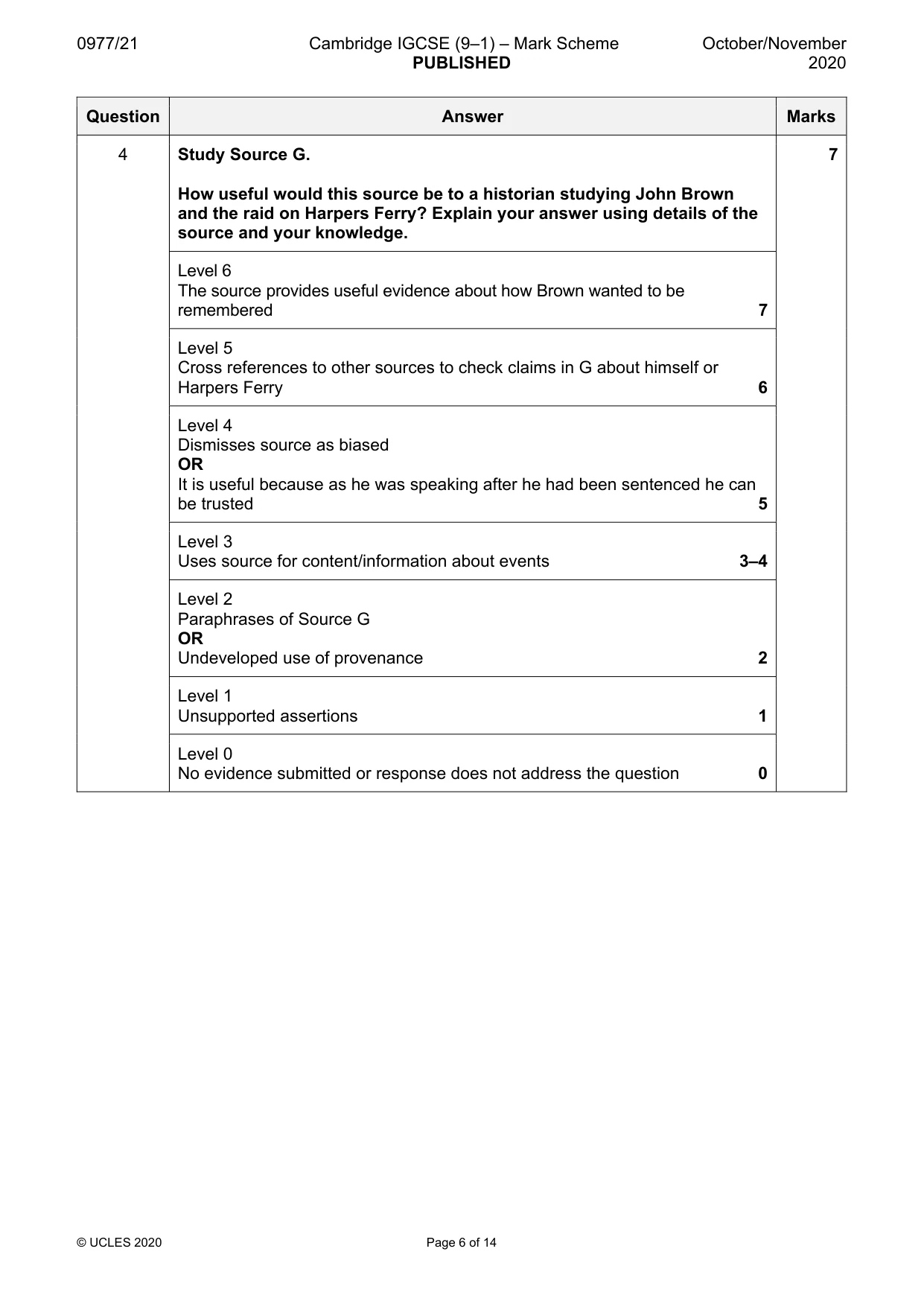
0977/21 Cambridge IGCSE (9–1) – Mark Scheme PUBLISHED October/November 2020 © UCLES 2020 Page 6 of 14 Question Answer Marks 4 Study Source G. How useful would this source be to a historian studying John Brown and the raid on Harpers Ferry? Explain your answer using details of the source and your knowledge. 7 Level 6 The source provides useful evidence about how Brown wanted to be remembered 7 Level 5 Cross references to other sources to check claims in G about himself or Harpers Ferry 6 Level 4 Dismisses source as biased OR It is useful because as he was speaking after he had been sentenced he can be trusted 5 Level 3 Uses source for content/information about events 3–4 Level 2 Paraphrases of Source G OR Undeveloped use of provenance 2 Level 1 Unsupported assertions 1 Level 0 No evidence submitted or response does not address the question 0
Mark scheme, page 7
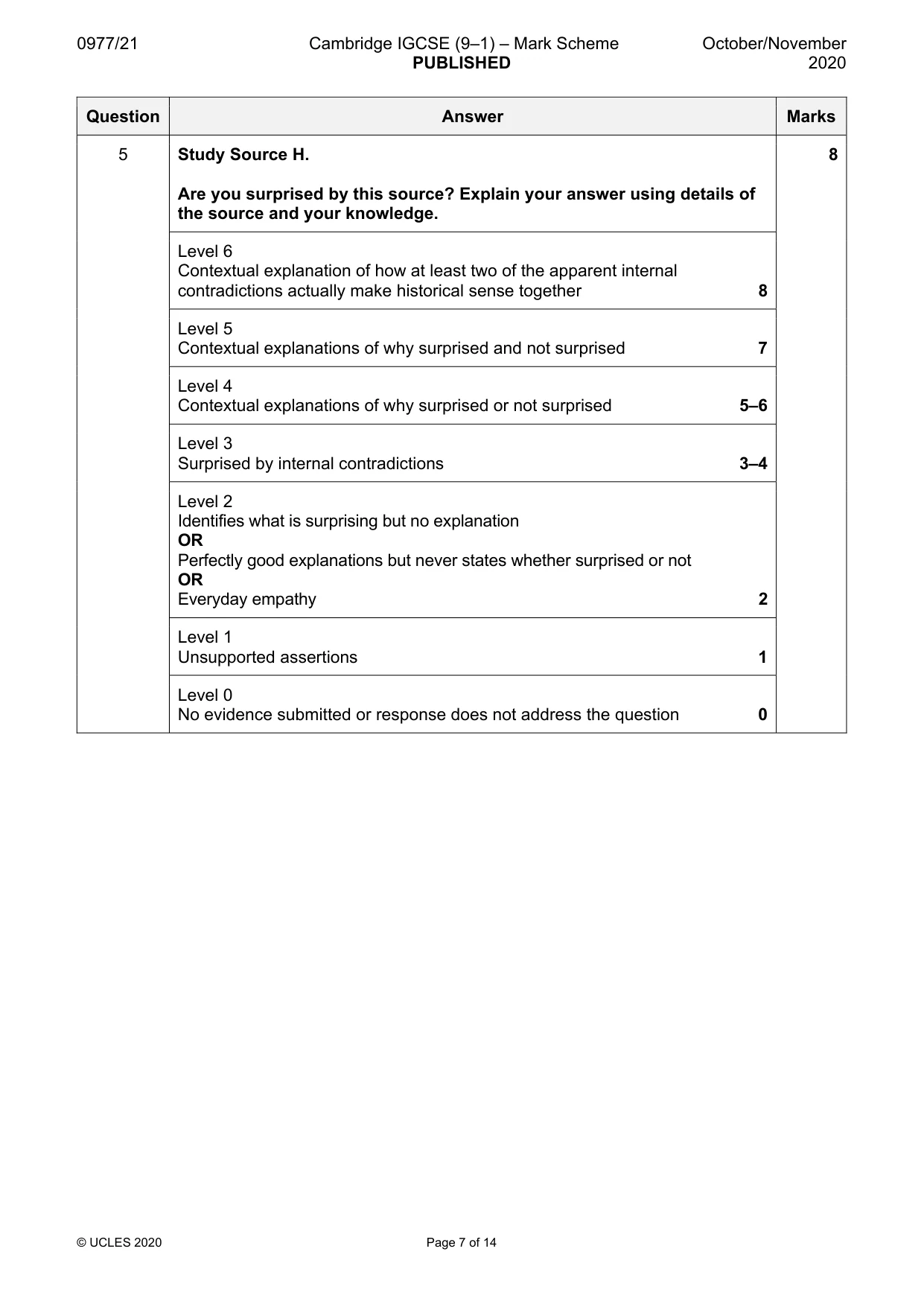
0977/21 Cambridge IGCSE (9–1) – Mark Scheme PUBLISHED October/November 2020 © UCLES 2020 Page 7 of 14 Question Answer Marks 5 Study Source H. Are you surprised by this source? Explain your answer using details of the source and your knowledge. 8 Level 6 Contextual explanation of how at least two of the apparent internal contradictions actually make historical sense together 8 Level 5 Contextual explanations of why surprised and not surprised 7 Level 4 Contextual explanations of why surprised or not surprised 5–6 Level 3 Surprised by internal contradictions 3–4 Level 2 Identifies what is surprising but no explanation OR Perfectly good explanations but never states whether surprised or not OR Everyday empathy 2 Level 1 Unsupported assertions 1 Level 0 No evidence submitted or response does not address the question 0
Mark scheme, page 8
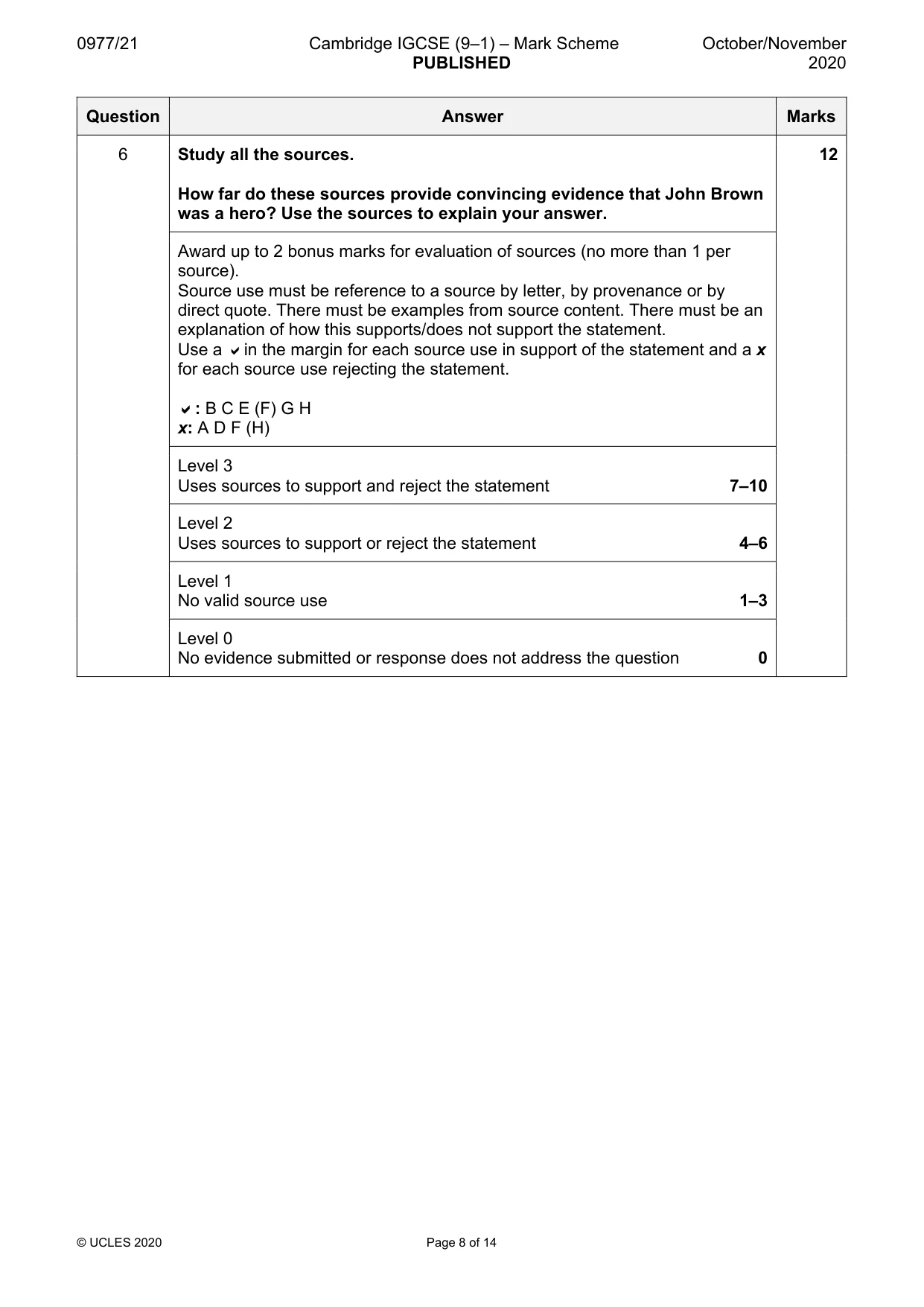
0977/21 Cambridge IGCSE (9–1) – Mark Scheme PUBLISHED October/November 2020 © UCLES 2020 Page 8 of 14 Question Answer Marks 6 Study all the sources. How far do these sources provide convincing evidence that John Brown was a hero? Use the sources to explain your answer. 12 Award up to 2 bonus marks for evaluation of sources (no more than 1 per source). Source use must be reference to a source by letter, by provenance or by direct quote. There must be examples from source content. There must be an explanation of how this supports/does not support the statement. Use a in the margin for each source use in support of the statement and a x for each source use rejecting the statement. : B C E (F) G H x: A D F (H) Level 3 Uses sources to support and reject the statement 7–10 Level 2 Uses sources to support or reject the statement 4–6 Level 1 No valid source use 1–3 Level 0 No evidence submitted or response does not address the question 0
Mark scheme, page 9
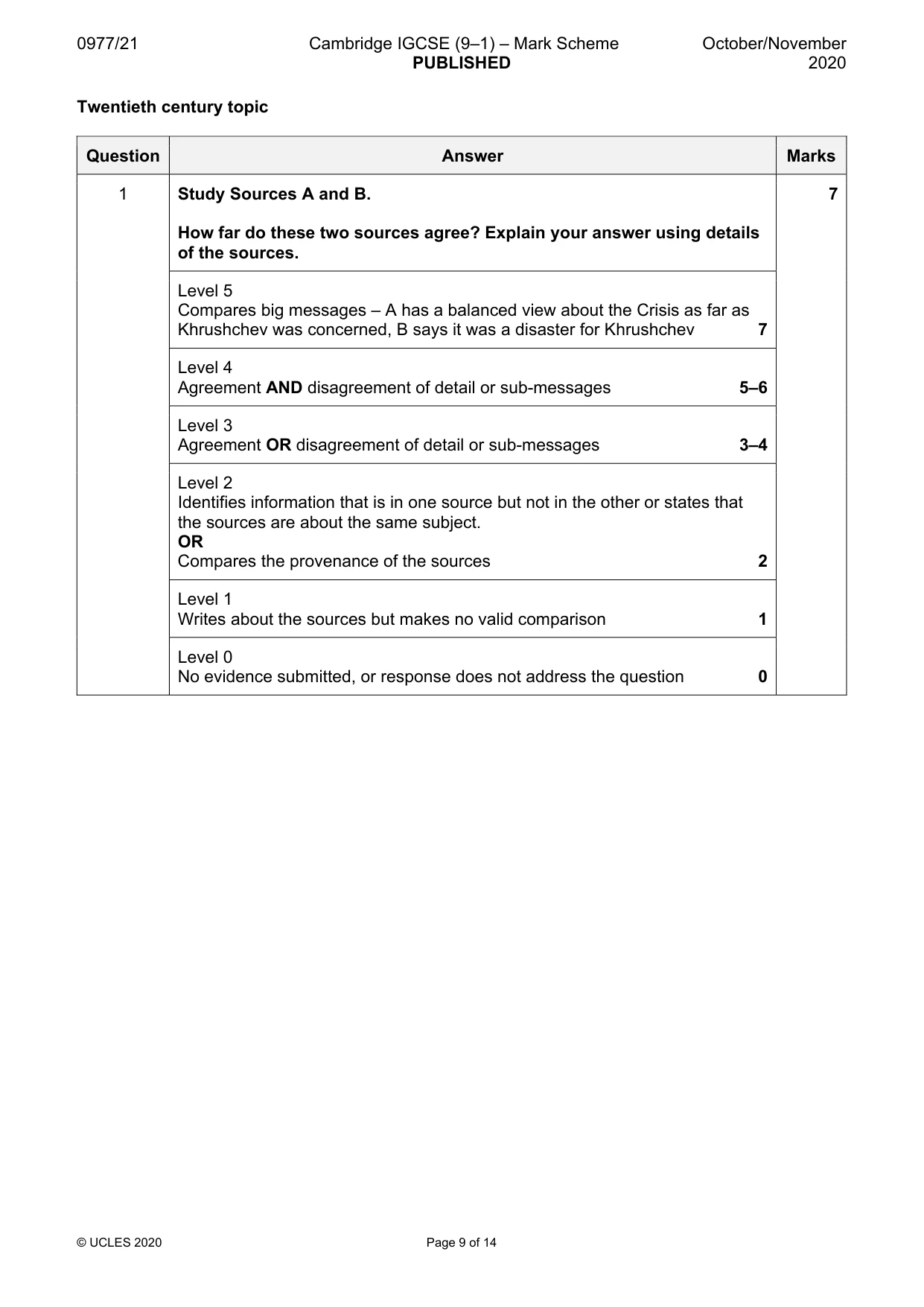
0977/21 Cambridge IGCSE (9–1) – Mark Scheme PUBLISHED October/November 2020 © UCLES 2020 Page 9 of 14 Twentieth century topic Question Answer Marks 1 Study Sources A and B. How far do these two sources agree? Explain your answer using details of the sources. 7 Level 5 Compares big messages – A has a balanced view about the Crisis as far as Khrushchev was concerned, B says it was a disaster for Khrushchev 7 Level 4 Agreement AND disagreement of detail or sub-messages 5–6 Level 3 Agreement OR disagreement of detail or sub-messages 3–4 Level 2 Identifies information that is in one source but not in the other or states that the sources are about the same subject. OR Compares the provenance of the sources 2 Level 1 Writes about the sources but makes no valid comparison 1 Level 0 No evidence submitted, or response does not address the question 0
Mark scheme, page 10
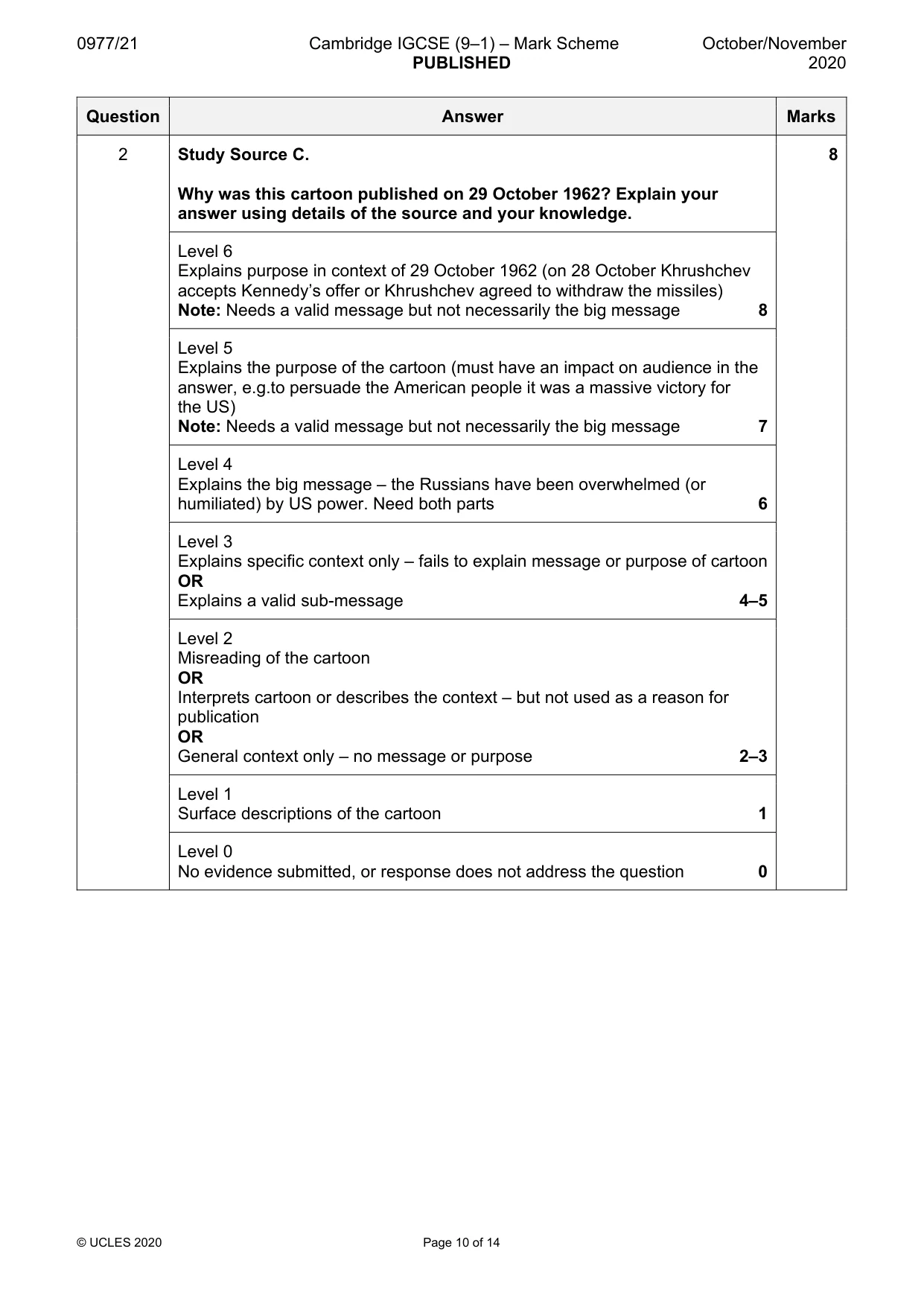
0977/21 Cambridge IGCSE (9–1) – Mark Scheme PUBLISHED October/November 2020 © UCLES 2020 Page 10 of 14 Question Answer Marks 2 Study Source C. Why was this cartoon published on 29 October 1962? Explain your answer using details of the source and your knowledge. 8 Level 6 Explains purpose in context of 29 October 1962 (on 28 October Khrushchev accepts Kennedy’s offer or Khrushchev agreed to withdraw the missiles) Note: Needs a valid message but not necessarily the big message 8 Level 5 Explains the purpose of the cartoon (must have an impact on audience in the answer, e.g.to persuade the American people it was a massive victory for the US) Note: Needs a valid message but not necessarily the big message 7 Level 4 Explains the big message – the Russians have been overwhelmed (or humiliated) by US power. Need both parts 6 Level 3 Explains specific context only – fails to explain message or purpose of cartoon OR Explains a valid sub-message 4–5 Level 2 Misreading of the cartoon OR Interprets cartoon or describes the context – but not used as a reason for publication OR General context only – no message or purpose 2–3 Level 1 Surface descriptions of the cartoon 1 Level 0 No evidence submitted, or response does not address the question 0
Mark scheme, page 11
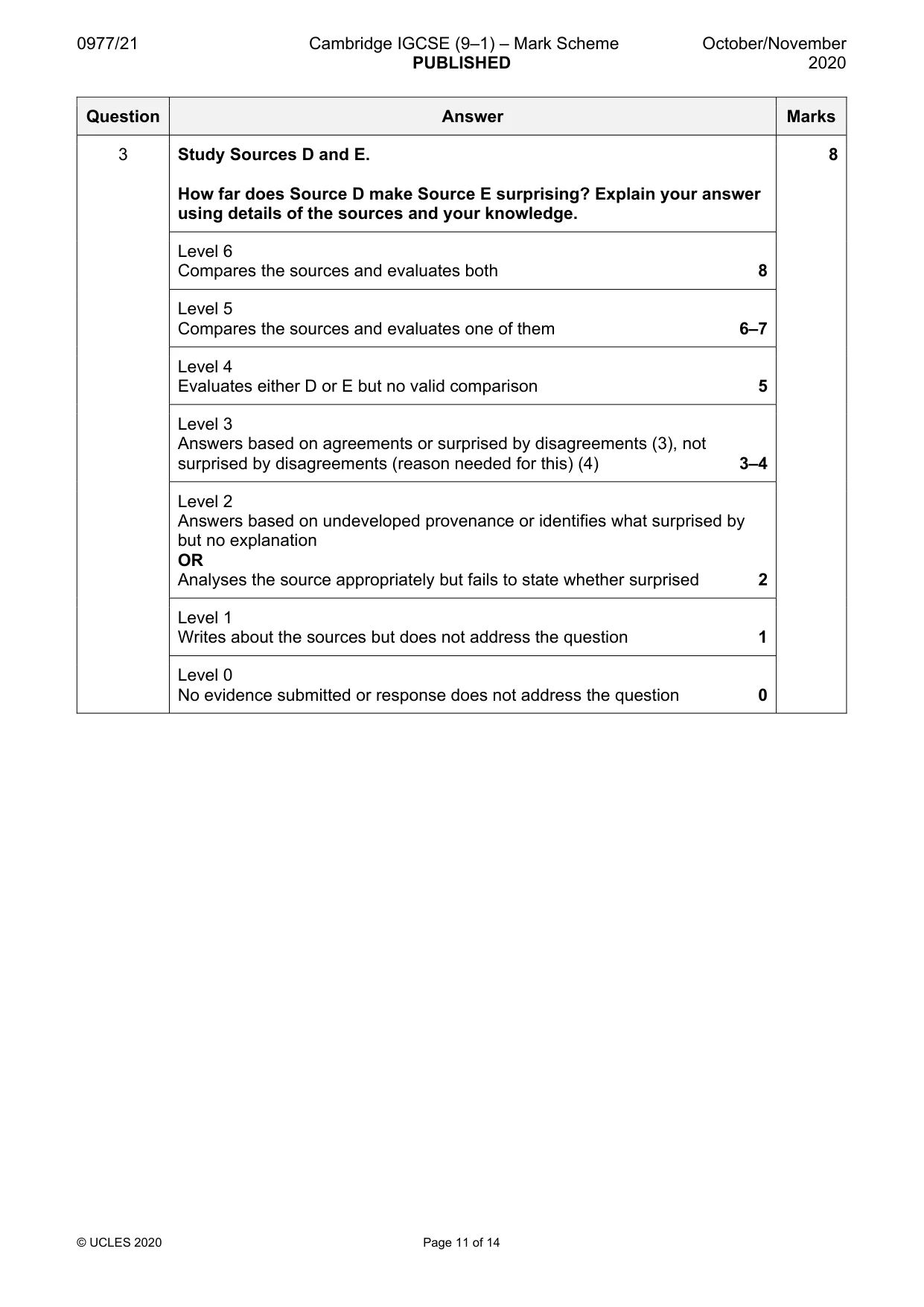
0977/21 Cambridge IGCSE (9–1) – Mark Scheme PUBLISHED October/November 2020 © UCLES 2020 Page 11 of 14 Question Answer Marks 3 Study Sources D and E. How far does Source D make Source E surprising? Explain your answer using details of the sources and your knowledge. 8 Level 6 Compares the sources and evaluates both 8 Level 5 Compares the sources and evaluates one of them 6–7 Level 4 Evaluates either D or E but no valid comparison 5 Level 3 Answers based on agreements or surprised by disagreements (3), not surprised by disagreements (reason needed for this) (4) 3–4 Level 2 Answers based on undeveloped provenance or identifies what surprised by but no explanation OR Analyses the source appropriately but fails to state whether surprised 2 Level 1 Writes about the sources but does not address the question 1 Level 0 No evidence submitted or response does not address the question 0
Mark scheme, page 12
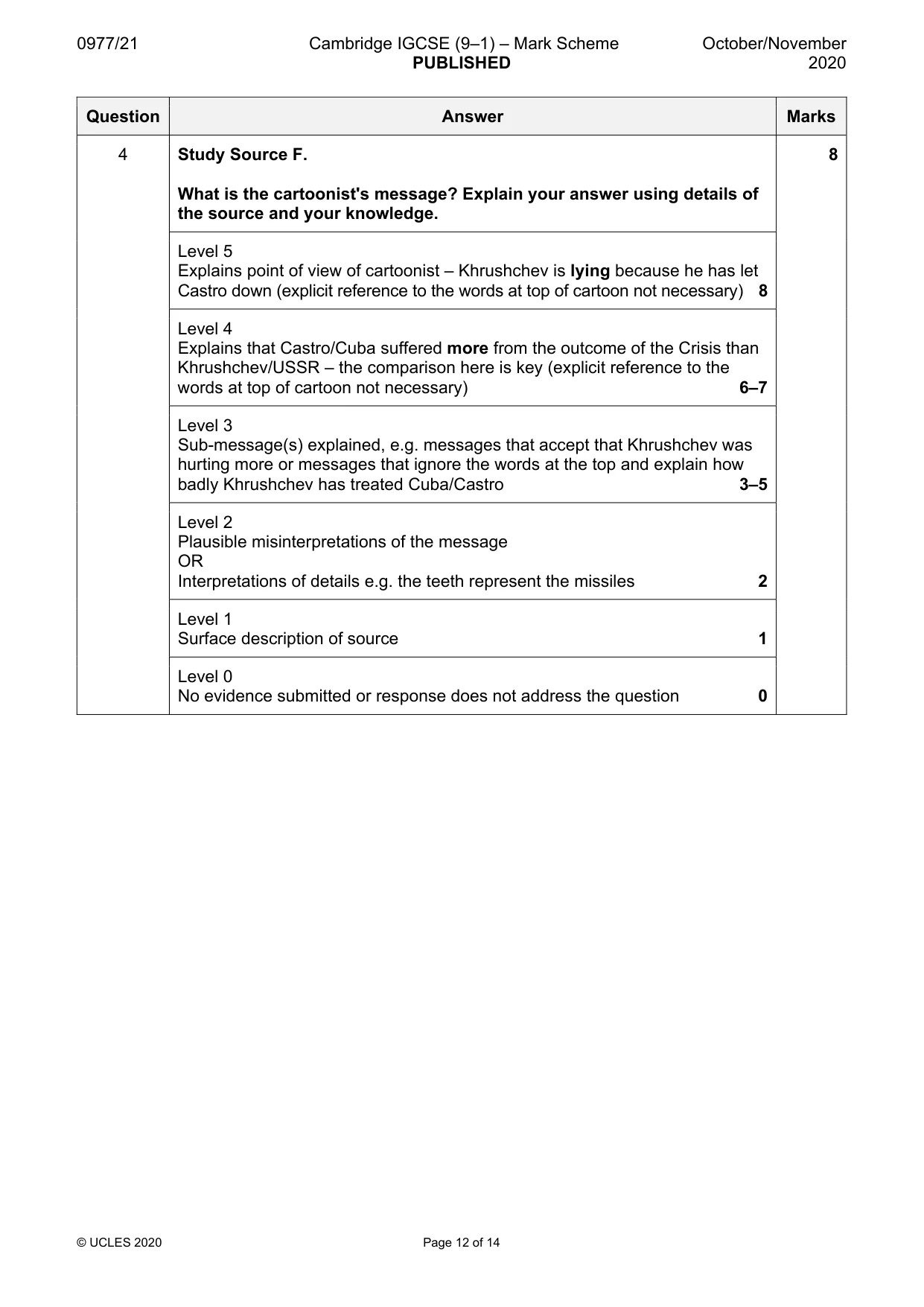
0977/21 Cambridge IGCSE (9–1) – Mark Scheme PUBLISHED October/November 2020 © UCLES 2020 Page 12 of 14 Question Answer Marks 4 Study Source F. What is the cartoonist's message? Explain your answer using details of the source and your knowledge. 8 Level 5 Explains point of view of cartoonist – Khrushchev is lying because he has let Castro down (explicit reference to the words at top of cartoon not necessary) 8 Level 4 Explains that Castro/Cuba suffered more from the outcome of the Crisis than Khrushchev/USSR – the comparison here is key (explicit reference to the words at top of cartoon not necessary) 6–7 Level 3 Sub-message(s) explained, e.g. messages that accept that Khrushchev was hurting more or messages that ignore the words at the top and explain how badly Khrushchev has treated Cuba/Castro 3–5 Level 2 Plausible misinterpretations of the message OR Interpretations of details e.g. the teeth represent the missiles 2 Level 1 Surface description of source 1 Level 0 No evidence submitted or response does not address the question 0
Mark scheme, page 13
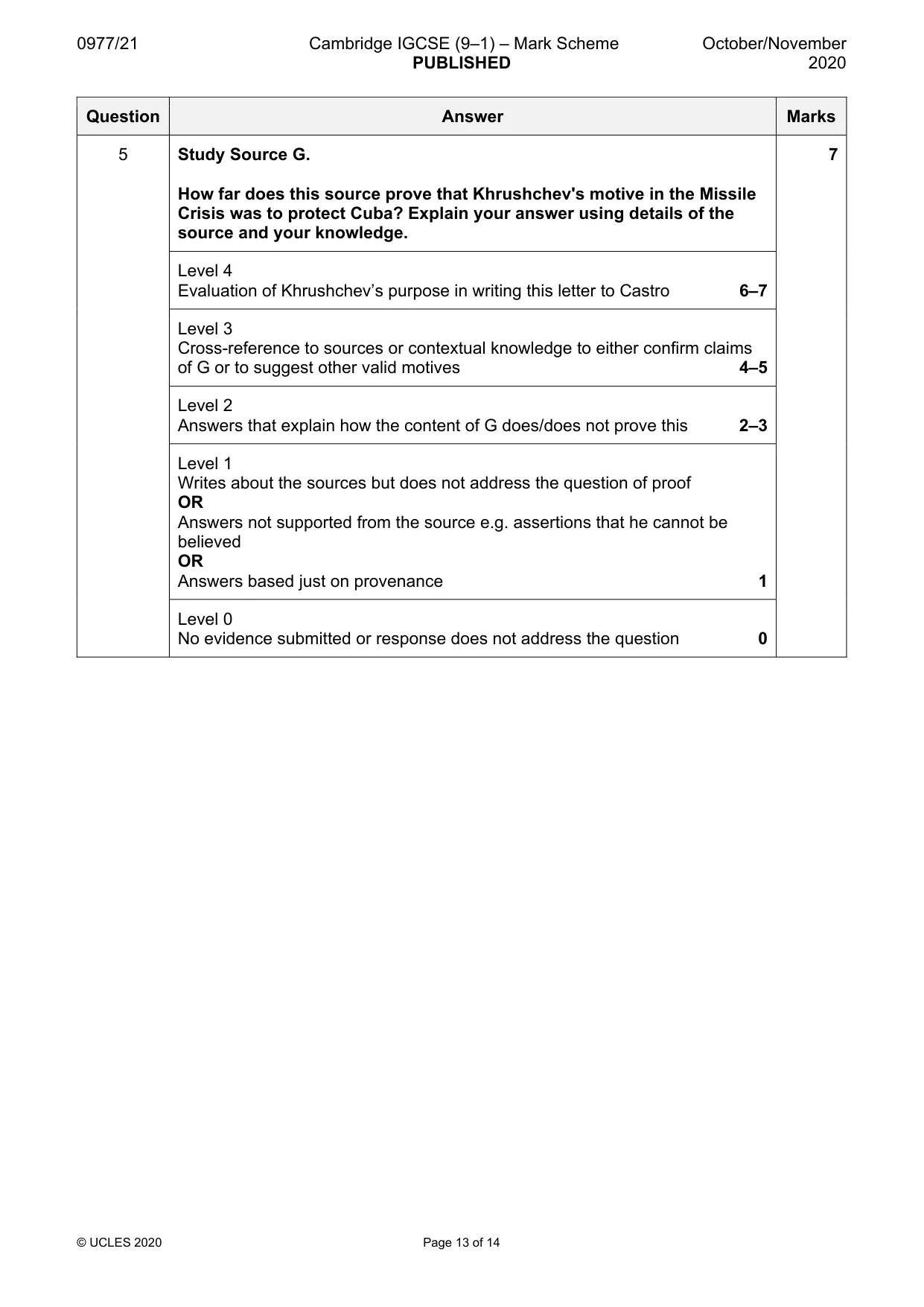
0977/21 Cambridge IGCSE (9–1) – Mark Scheme PUBLISHED October/November 2020 © UCLES 2020 Page 13 of 14 Question Answer Marks 5 Study Source G. How far does this source prove that Khrushchev's motive in the Missile Crisis was to protect Cuba? Explain your answer using details of the source and your knowledge. 7 Level 4 Evaluation of Khrushchev’s purpose in writing this letter to Castro 6–7 Level 3 Cross-reference to sources or contextual knowledge to either confirm claims of G or to suggest other valid motives 4–5 Level 2 Answers that explain how the content of G does/does not prove this 2–3 Level 1 Writes about the sources but does not address the question of proof OR Answers not supported from the source e.g. assertions that he cannot be believed OR Answers based just on provenance 1 Level 0 No evidence submitted or response does not address the question 0
Mark scheme, page 14
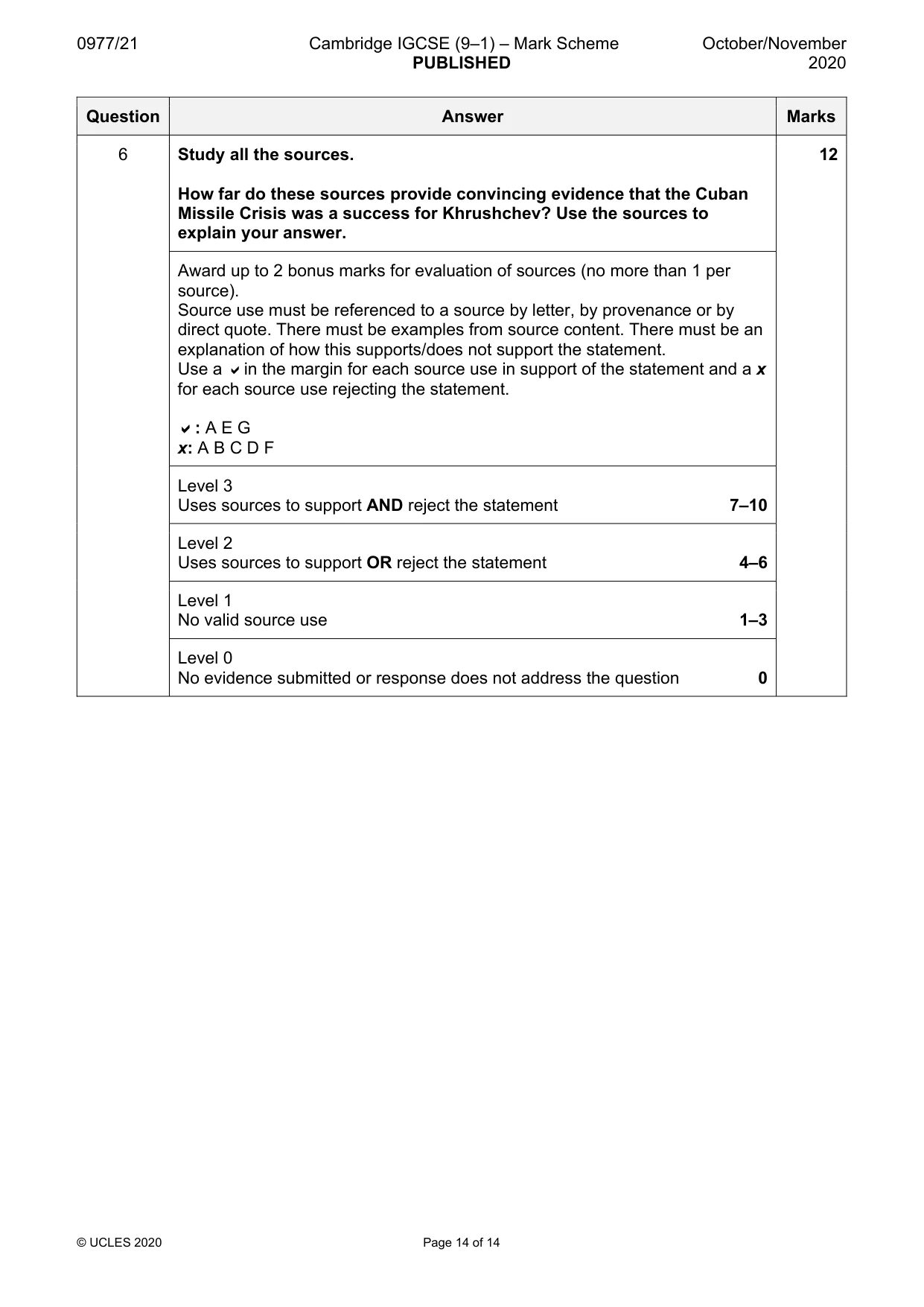
0977/21 Cambridge IGCSE (9–1) – Mark Scheme PUBLISHED October/November 2020 © UCLES 2020 Page 14 of 14 Question Answer Marks 6 Study all the sources. How far do these sources provide convincing evidence that the Cuban Missile Crisis was a success for Khrushchev? Use the sources to explain your answer. 12 Award up to 2 bonus marks for evaluation of sources (no more than 1 per source). Source use must be referenced to a source by letter, by provenance or by direct quote. There must be examples from source content. There must be an explanation of how this supports/does not support the statement. Use a in the margin for each source use in support of the statement and a x for each source use rejecting the statement. : A E G x: A B C D F Level 3 Uses sources to support AND reject the statement 7–10 Level 2 Uses sources to support OR reject the statement 4–6 Level 1 No valid source use 1–3 Level 0 No evidence submitted or response does not address the question 0
What you needed in this session
Cambridge’s own grade thresholds for 2020 Oct/Nov, Paper 2 · Variant 1. A higher threshold means an easier paper — the bar moves with how the cohort did.