Cambridge IGCSE History (9-1) 0977 — 2019 Oct/Nov Paper 2 · Variant 1
0977/21/O/N/19 · 50 marks · ≈56 min
The question paper and its mark scheme, free to read here and free to download. This is Cambridge’s own paper, exactly as it was sat.
Question paper12 pages

Mark scheme8 pages
Answers below. Sit the paper first if you are practising.
Paper as text
Question paper, page 1
This document consists of 11 printed pages, 1 blank page and 1 Insert. DC (CE/TP) 182727 © UCLES 2019 [Turn over Cambridge Assessment International Education Cambridge International General Certificate of Secondary Education (9–1) * 9 0 1 9 1 0 7 5 5 8 * HISTORY 0977/21 Paper 2 October/November 2019 2 hours No Additional Materials are required. READ THESE INSTRUCTIONS FIRST An answer booklet is provided inside this question paper. You should follow the instructions on the front cover of the answer booklet. If you need additional answer paper ask the invigilator for a continuation booklet. This paper has two options. Choose one option, and answer all of the questions on that topic. Option A: Nineteenth century topic [p2–p6] Option B: Twentieth century topic [p8–p12] The number of marks is given in brackets [ ] at the end of each question or part question.
Question paper, page 2
2 0977/21/O/N/19 © UCLES 2019 Option A: Nineteenth century topic HOW IMPORTANT WAS GIUSEPPE MAZZINI TO ITALIAN UNIFICATION? Study the Background Information and the sources carefully, and then answer all the questions. Background Information Giuseppe Mazzini is a controversial figure in the story of the Risorgimento. In 1831 he founded the Young Italy movement through which he aimed to unify the whole of Italy into a republic. He planned to achieve this through his writings and through revolution and he spent most of his life either being involved in failed uprisings or being exiled from Italy. He was often more highly regarded outside Italy than he was in his own country. Some, like Cavour, regarded him as a dangerous revolutionary who did Italy harm. After the Kingdom of Italy was created in 1861, Mazzini refused to swear allegiance to the new kingdom and continued to be involved in rebellions. He described the new Italy as ‘a corpse rotten with materialism and egoism’. Others saw him as an unrealistic dreamer. However, it has been argued that he was an inspirational figure who created Italian national consciousness. The final step in the creation of a united Italy was made in 1870, with the annexation of Rome. By this time Mazzini was no longer regarded as a threat and attitudes towards him in Italy began to change. How important was Mazzini to Italian unification? SOURCE A Giuseppe Mazzini was born in Genoa on 22 June 1805. After university he joined the Carbonari but by 1830 he was disillusioned with them. He saw little future for a secret society whose members did not even know what they were working for. In the first few months of 1831 Mazzini was occupied with one of the greatest achievements of his life, and one which had a great effect on the progress of the Risorgimento. This was the establishment of Young Italy. Though its plans for action ended in failure, its significance was that it helped to build up a national consciousness in Italy and to give the idea of national unity pride of place over any federal solution. In this way Mazzini provided the psychological and spiritual foundation on which Cavour, Garibaldi and Victor Emmanuel II were to build the new Italy. His goal for Italy was clear. He wanted to see an independent unitary republic, with full democratic rights for every citizen and complete freedom from foreign domination and the power of the pope. To this national plan he added the hope of a closer association of nations. When he later ruled the Republic of Rome for a short time in 1849, he took steps towards establishing reforms affecting the whole life of the Papal States. He abolished the death penalty, he removed taxes which oppressed the lower class and he introduced universal suffrage and freedom of the press. As far as possible, he suppressed acts of anti-clerical violence. Though republican in name, this was a liberal government in the grand manner, and won approval of English liberals. From a recent account about Mazzini.
Question paper, page 3
3 0977/21/O/N/19 © UCLES 2019 [Turn over SOURCE B Born in Genoa in 1805, Mazzini went on to earn his degree in law at the university there and began his life as a revolutionary. He started to become affiliated with the Carbonari group, which used force in certain areas to spark a revolution. However, he was soon forced to flee to France. While there, Mazzini founded his most important contribution to Italian unification – Young Italy. Mazzini actually conducted this group from abroad in France. Young Italy was a specific group consisting of liberal intellectuals working for a strong central government after Italian unification. This group amassed around fifty to sixty thousand members, and lasted roughly two decades. Mazzini called for the removal of Austrian influence in Italy, an end to the pope’s temporal power over the Papal States, and the creation of a republican national government. Mazzini was not successful because on the one hand he was too intellectual, but on the other his thinking was terribly vague. His writings appealed to a few revolutionaries but not to the peasants. He failed to realise how important it was to win mass popular support. His ideas inspired some hopeless attempts at revolution and if it was not for his part in the Roman Republic, his reputation would be only as an unrealistic and romantic hothead. While briefly in charge of the Republic, he ruled in a tolerant and enlightened way. However, when the Republic was attacked by the French, it was Garibaldi who organised and led the defence. From a recent account about Mazzini. SOURCE C An open letter to Charles Albert If I believed you to be an ordinary king, with a narrow tyrannical outlook, I would not address you in the language of free men. But you, Sire, are not such a king. You have strength of mind and high principles. There is a crown more brilliant and sublime than that of Piedmont, a crown that awaits the man who dares to think of it, who dedicates his life to winning it. Place yourself at the head of the nation, write on your flag ‘Union, Liberty, Independence’. Free Italy from the barbarian. Your safety lies on the sword’s point. Draw it and use it. You can become either the greatest of men or the last of Italian tyrants. If you do not take up the cause of freedom, others will do it without you and against you. This was published and privately circulated amongst revolutionaries in Italy in 1831. Although it was written by Mazzini, the author was simply described as ‘An Italian’. SOURCE D Those who in later days have quoted my letter to Charles Albert as either a justification of their own desertion of the republican banner, or in order to accuse me of too great a readiness to abandon my convictions, attack me on a false ground. By publicly declaring to him that his own heart should have taught him his duty towards Italy, my object was to prove to my countrymen his absolute lack of those qualities which could have made the performance of that duty possible. Written and published by Mazzini, 1861.
Question paper, page 4
4 0977/21/O/N/19 © UCLES 2019 SOURCE E If Mazzini had bothered to realise that I too knew something about fighting battles and had allowed me to invade the Kingdom of Naples whose inhabitants were waiting for our arrival with open arms – how the circumstances would have changed! What a prospect would have opened up for a country not yet completely cast down by foreign invasion! Instead of which, Mazzini called all the troops back to Rome and so offered them up in one appetising dish to the tyrant of France. Everyone knew Rome was impossible to defend. The correct strategy would have been to deploy most of the forces in the numerous defensible sites throughout the Republican State and allow me to continue my victorious march southwards into Bourbon territory. From Garibaldi’s memoirs, published in 1860. He is describing events in Rome in 1849. SOURCE F We still believe in liberty and Italian unification and we do not believe in any initiatives coming from Piedmont. But nor do we have the slightest confidence in the schemes you have pushed from 1852 until the uprising of last June. You believe what you are told far too easily. You think the people are behind you, whereas unfortunately they are not waiting to start a revolution. These are your mistakes, the fatal delusions which have led you from error to error, and so have caused you to lose the support of most of our republicans. Many of your old supporters have become so discouraged that they have turned to other parties and policies; and some have become bitter critics of you. As for ourselves, we still share your political views and retain our former affection for you, but in future we shall act to stop what we think is wrong. We may even have to speak out in public and follow a different policy of our own. Your mistakes, and they are serious, are these: to impose action without preparation and with too few people; to think that a simple uprising can be converted quickly into an extensive revolution; to think that action is more important than success. We do not ask you to remain idle and waste the brave and generous strength which you contribute to the cause; only that you will for the moment stop agitating for action, until we have plans and money and men; until we can confront the enemy with a large force of all those who believe in Italy. A letter from three of Mazzini’s former supporters to Mazzini, January 1858.
Question paper, page 5
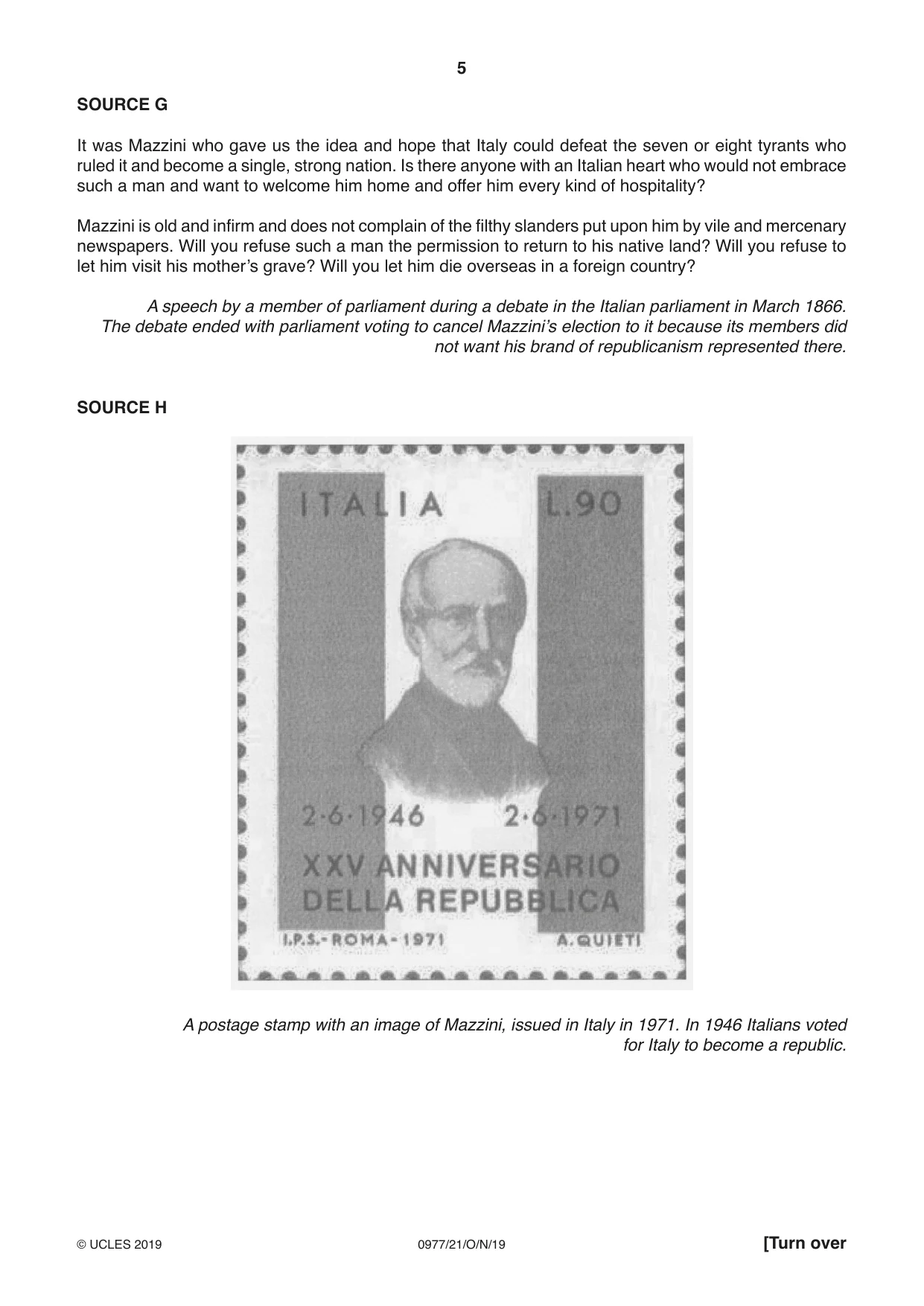
5 0977/21/O/N/19 © UCLES 2019 [Turn over SOURCE G It was Mazzini who gave us the idea and hope that Italy could defeat the seven or eight tyrants who ruled it and become a single, strong nation. Is there anyone with an Italian heart who would not embrace such a man and want to welcome him home and offer him every kind of hospitality? Mazzini is old and infirm and does not complain of the filthy slanders put upon him by vile and mercenary newspapers. Will you refuse such a man the permission to return to his native land? Will you refuse to let him visit his mother’s grave? Will you let him die overseas in a foreign country? A speech by a member of parliament during a debate in the Italian parliament in March 1866. The debate ended with parliament voting to cancel Mazzini’s election to it because its members did not want his brand of republicanism represented there. SOURCE H A postage stamp with an image of Mazzini, issued in Italy in 1971. In 1946 Italians voted for Italy to become a republic.
Question paper, page 6
6 0977/21/O/N/19 © UCLES 2019 Now answer all the following questions. You may use any of the sources to help you answer the questions, in addition to those sources which you are told to use. In answering the questions you should use your knowledge of the topic to help you interpret and evaluate the sources. 1 Study Sources A and B. How far do these two sources agree? Explain your answer using details of the sources. [7] 2 Study Sources C and D. Why did Mazzini publish Source D in 1861? Explain your answer using details of the sources and your knowledge. [8] 3 Study Source E. Do you trust Garibaldi’s account? Explain your answer using details of the source and your knowledge. [8] 4 Study Sources F and G. Does Source G make Source F surprising? Explain your answer using details of the sources and your knowledge. [8] 5 Study Source H. How useful is Source H as evidence about Mazzini? Explain your answer using details of the source and your knowledge. [7] 6 Study all the sources. How far do these sources provide convincing evidence that Mazzini helped Italian unification? Use the sources to explain your answer. [12]
Question paper, page 7
7 0977/21/O/N/19 © UCLES 2019 [Turn over BLANK PAGE
Question paper, page 8
8 0977/21/O/N/19 © UCLES 2019 Option B: Twentieth century topic WHO WAS TO BLAME FOR THE CRISIS OVER KUWAIT IN 1990? Study the Background Information and the sources carefully, and then answer all the questions. Background Information The crisis over Kuwait that developed during 1989–90 had many causes. Iraqis had long felt that Kuwait was really part of their country. Relations between the two countries grew worse because of the huge amount of money Iraq borrowed from Kuwait to fight the war against Iran. Iraq felt that the war had helped protect Kuwait from Iran and asked Kuwait to cancel the debt as Iraq was in great economic difficulties. Kuwait refused. Relations grew worse when Kuwait refused to reduce its production of oil, thus keeping the price low. Iraq needed the price to go up. Iraq also claimed that Kuwait was slant- drilling across the border into its Rumaila oilfield. It has been claimed that US policy towards Iraq during this period was unclear. On the one hand, Iraq suspected the United States and Kuwait of plotting together to keep Iraq weak. On the other hand, the United States appeared to give the impression that it was not particularly worried by the Iraq- Kuwait dispute. On 2 August 1990 the crisis deepened when Iraq invaded Kuwait. This eventually led to Operation Desert Storm and the Gulf War. Who was to blame for the crisis over Kuwait? SOURCE A Iraq emerged from the war with Iran with the port of Basra blocked. This put pressure on Iraq to turn to its other possible outlet to the sea that was blocked by Kuwaiti control of the islands of Warba and Bubiyan. In September 1990 the Iraq Press Office issued a statement, ‘The Political Background to the Current Events’, in which it quoted from the Iraq government in 1938, ‘Iraq would like to rent a piece of land from Kuwait for establishing a deep harbour.’ Iraqi Foreign Minister, Tariq Aziz, made it quite clear that Iraq’s motives for taking over Kuwait were economic, commercial and strategic. In a letter sent to all foreign ministers on 4 September, he denounced Britain for having created and sustained since 1899 an ‘artificial entity called Kuwait’ which cut off Iraq from ‘its natural access to the waters of the Arabian Gulf’, and went on to say that all Iraqi governments had insisted that Iraq must have Kuwait to guarantee its commercial and economic interests and its national security. King Hussein of Jordan made the same point, in a broadcast on American TV on 22 September 1990, when he said that Iraq had been seeking ‘an agreement with Kuwait that would secure it an independent access to the sea which it considers of vital national interest’. Iraq emerged from the war with Iran with a huge debt and wanted OPEC to push up the price of oil but Kuwait disagreed. It had invested in capitalist industry and finance in the West so much that a large part of Kuwait’s income came from these investments. The Kuwaiti rulers had become Western capitalists with the same interest in not having too high a price for oil. Iraq regarded this refusal to raise the price of oil as a plot to prevent it recovering from the war. Combined with their long-standing claim to Kuwait as a means of obtaining a vitally-needed secure trade route to the sea, this decided Iraq to take military action. From a recent article about the causes of the Gulf War.
Question paper, page 9
9 0977/21/O/N/19 © UCLES 2019 [Turn over SOURCE B Iraq’s miscalculation was on a grand scale, involving errors of strategy and timing. Few in the Arab world denied that Iraq had valid grievances; what it lacked was the patience to solve them by the traditional Arab approach of discussion. Iraq had good reasons to see itself as a regional superpower. Yet geography and economics conspired to frustrate Iraq’s aims. The geographical shackles stemmed from the way Britain and France carved up the Ottoman Empire after the First World War. Britain repaid debts to the Kuwaiti ruling family by turning their city-port into a separate state. This meant Iraq could not reach the sea and had no deep-water port. Its short coastline could not be developed because two Kuwaiti islands, Bubiyan and Warba, straddled the approaches. Iraq tried to overcome being landlocked by building pipelines through neighbouring countries but these were often closed. Iraq had done everything it could to prevent being landlocked. Iraq’s economic problems stemmed from the falling price of oil. Kuwait ignored demands for a production cut, refused to lease the strategic islands, and delayed over requests that Iraq’s war debts should be forgiven. Its obstructive attitude led Iraq to suspect that Kuwait had secretly obtained security guarantees from the United States. The motive of the United States, Iraq thought, was to prevent it from becoming too powerful. The belief that Kuwait was part of Iraq was deeply embedded in the Iraqi consciousness, and was a cause Iraqis would defend with their lives, but Saddam Hussein miscalculated the impact on world opinion of the seizure of the whole of Kuwait, rather than just the parts he needed. He overestimated the Arab resolve to keep American forces out of the Gulf, overestimated the USSR’s willingness to help, and underestimated American resolve. From a book published in 1992. SOURCE C They will never forgive us our victory – our technological achievements. What we face now is a loss of $14 billion a year in oil prices. This is a conspiracy to make us live in famine. This is an American policy and there are Arabs who are mobilised in the service of that policy. We have to stand up to those who have come with a poisoned dagger and thrust it into our backs. Oh God almighty, be witness that we have warned them. From a speech by Saddam Hussein at a public meeting, 17 July 1989. SOURCE D Top Secret We went on a visit to the headquarters of the CIA [the US Central Intelligence Agency] in November 1989, a visit which the Americans wanted to be top secret so that it would not raise the sensitivities of our brothers in the Gulf, and also the Iranians and Iraqis. We agreed with the CIA that we should exchange information about Iran and Iraq, especially in the fields of armaments and political and social conditions. We agreed on the necessity to exploit the deteriorating economic situation in Iraq so that we can press its government to accept the designation of our frontiers. The CIA gave us its ideas about how we can conduct the suitable means of pressure. A report by two Kuwaiti officials who secretly visited a unit of the CIA working with the Kuwait government to prevent any threat to the Kuwaiti royal family. This report was written for the Kuwaiti government and was found in their files by the Iraqis when they invaded Kuwait.
Question paper, page 10
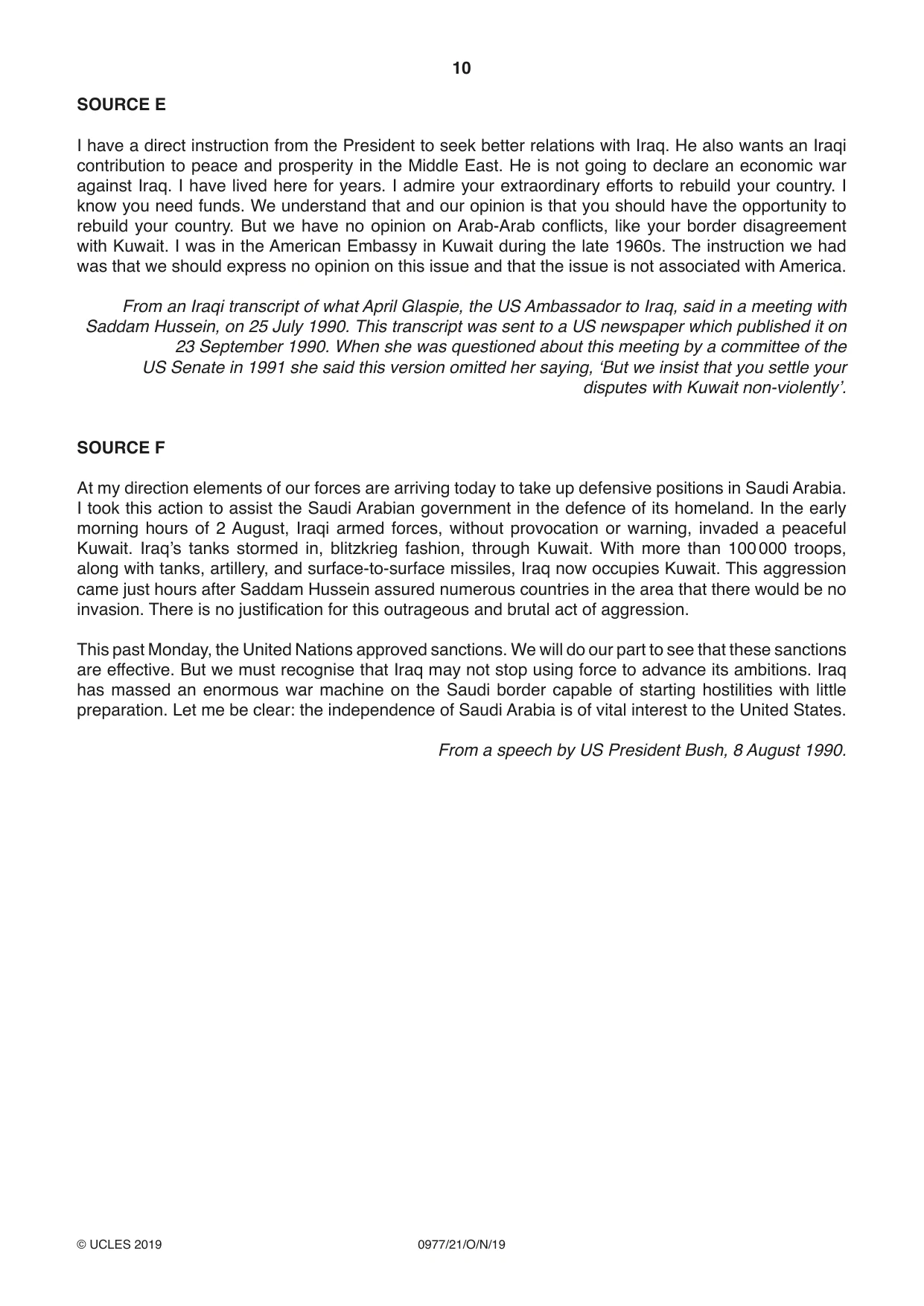
10 0977/21/O/N/19 © UCLES 2019 SOURCE E I have a direct instruction from the President to seek better relations with Iraq. He also wants an Iraqi contribution to peace and prosperity in the Middle East. He is not going to declare an economic war against Iraq. I have lived here for years. I admire your extraordinary efforts to rebuild your country. I know you need funds. We understand that and our opinion is that you should have the opportunity to rebuild your country. But we have no opinion on Arab-Arab conflicts, like your border disagreement with Kuwait. I was in the American Embassy in Kuwait during the late 1960s. The instruction we had was that we should express no opinion on this issue and that the issue is not associated with America. From an Iraqi transcript of what April Glaspie, the US Ambassador to Iraq, said in a meeting with Saddam Hussein, on 25 July 1990. This transcript was sent to a US newspaper which published it on 23 September 1990. When she was questioned about this meeting by a committee of the US Senate in 1991 she said this version omitted her saying, ‘But we insist that you settle your disputes with Kuwait non-violently’. SOURCE F At my direction elements of our forces are arriving today to take up defensive positions in Saudi Arabia. I took this action to assist the Saudi Arabian government in the defence of its homeland. In the early morning hours of 2 August, Iraqi armed forces, without provocation or warning, invaded a peaceful Kuwait. Iraq’s tanks stormed in, blitzkrieg fashion, through Kuwait. With more than 100 000 troops, along with tanks, artillery, and surface-to-surface missiles, Iraq now occupies Kuwait. This aggression came just hours after Saddam Hussein assured numerous countries in the area that there would be no invasion. There is no justification for this outrageous and brutal act of aggression. This past Monday, the United Nations approved sanctions. We will do our part to see that these sanctions are effective. But we must recognise that Iraq may not stop using force to advance its ambitions. Iraq has massed an enormous war machine on the Saudi border capable of starting hostilities with little preparation. Let me be clear: the independence of Saudi Arabia is of vital interest to the United States. From a speech by US President Bush, 8 August 1990.
Question paper, page 11
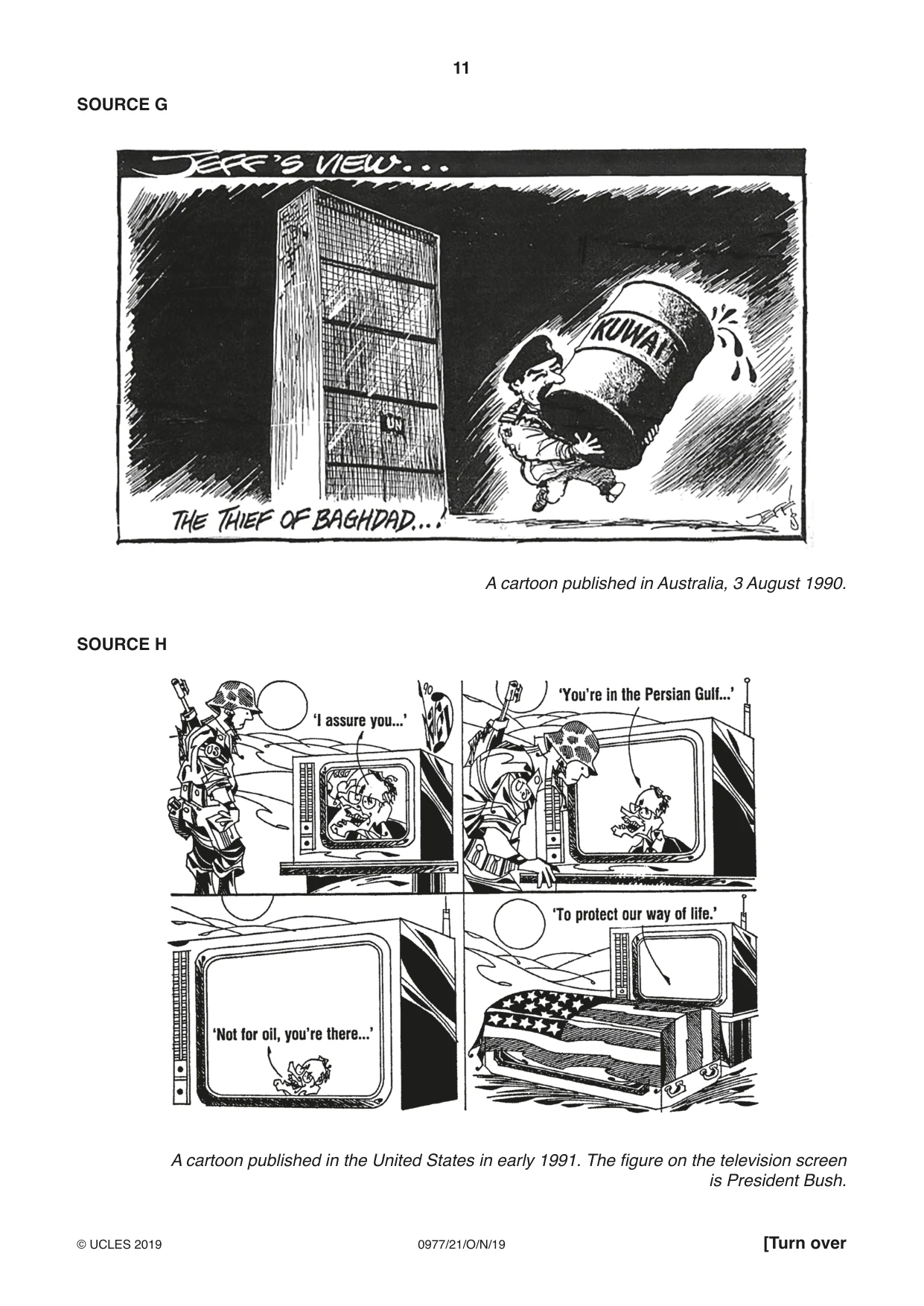
11 0977/21/O/N/19 © UCLES 2019 [Turn over SOURCE G A cartoon published in Australia, 3 August 1990. SOURCE H A cartoon published in the United States in early 1991. The figure on the television screen is President Bush.
Question paper, page 12
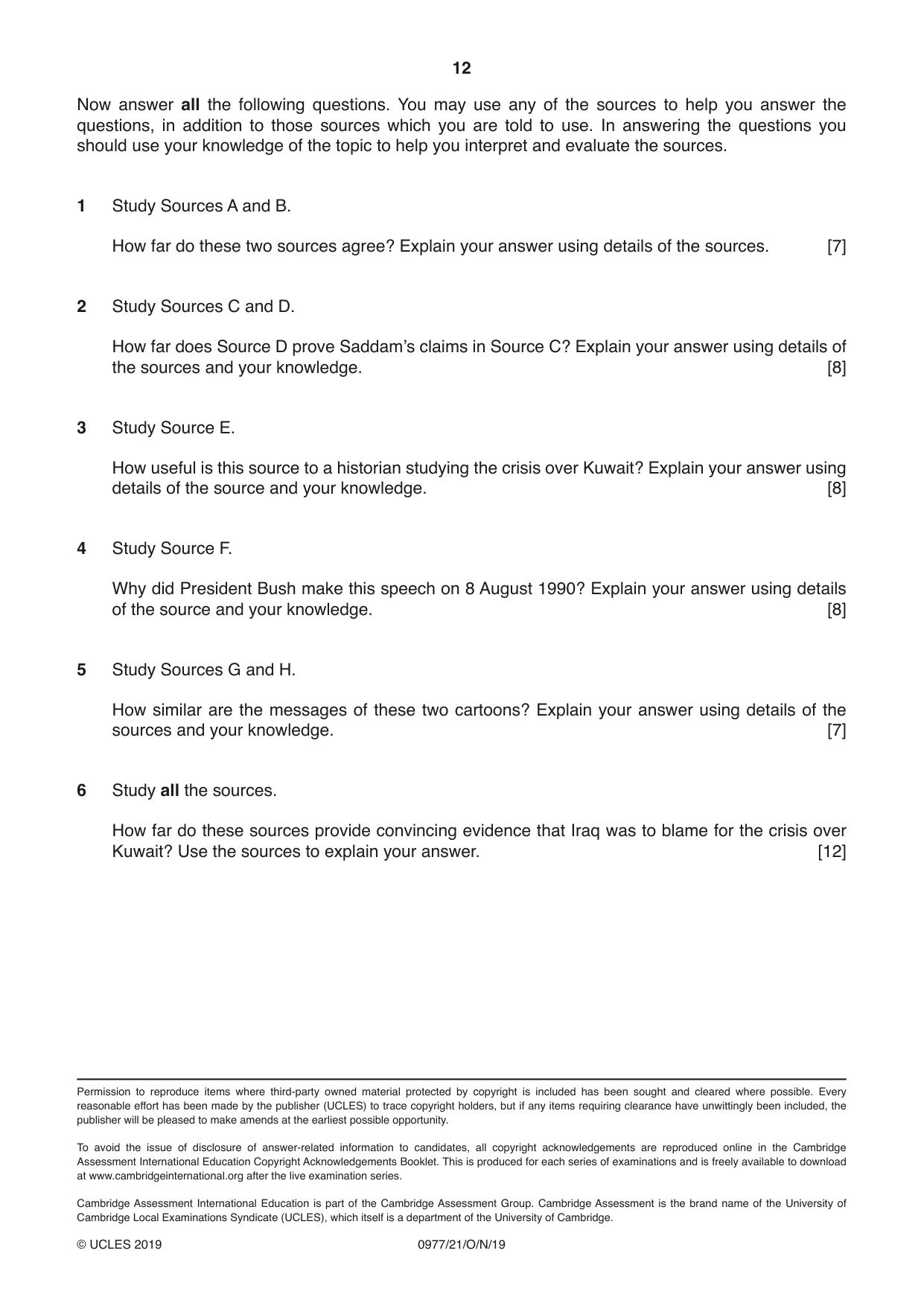
12 0977/21/O/N/19 © UCLES 2019 Now answer all the following questions. You may use any of the sources to help you answer the questions, in addition to those sources which you are told to use. In answering the questions you should use your knowledge of the topic to help you interpret and evaluate the sources. 1 Study Sources A and B. How far do these two sources agree? Explain your answer using details of the sources. [7] 2 Study Sources C and D. How far does Source D prove Saddam’s claims in Source C? Explain your answer using details of the sources and your knowledge. [8] 3 Study Source E. How useful is this source to a historian studying the crisis over Kuwait? Explain your answer using details of the source and your knowledge. [8] 4 Study Source F. Why did President Bush make this speech on 8 August 1990? Explain your answer using details of the source and your knowledge. [8] 5 Study Sources G and H. How similar are the messages of these two cartoons? Explain your answer using details of the sources and your knowledge. [7] 6 Study all the sources. How far do these sources provide convincing evidence that Iraq was to blame for the crisis over Kuwait? Use the sources to explain your answer. [12] Permission to reproduce items where third-party owned material protected by copyright is included has been sought and cleared where possible. Every reasonable effort has been made by the publisher (UCLES) to trace copyright holders, but if any items requiring clearance have unwittingly been included, the publisher will be pleased to make amends at the earliest possible opportunity. To avoid the issue of disclosure of answer-related information to candidates, all copyright acknowledgements are reproduced online in the Cambridge Assessment International Education Copyright Acknowledgements Booklet. This is produced for each series of examinations and is freely available to download at www.cambridgeinternational.org after the live examination series. Cambridge Assessment International Education is part of the Cambridge Assessment Group. Cambridge Assessment is the brand name of the University of Cambridge Local Examinations Syndicate (UCLES), which itself is a department of the University of Cambridge.
Mark scheme, page 1
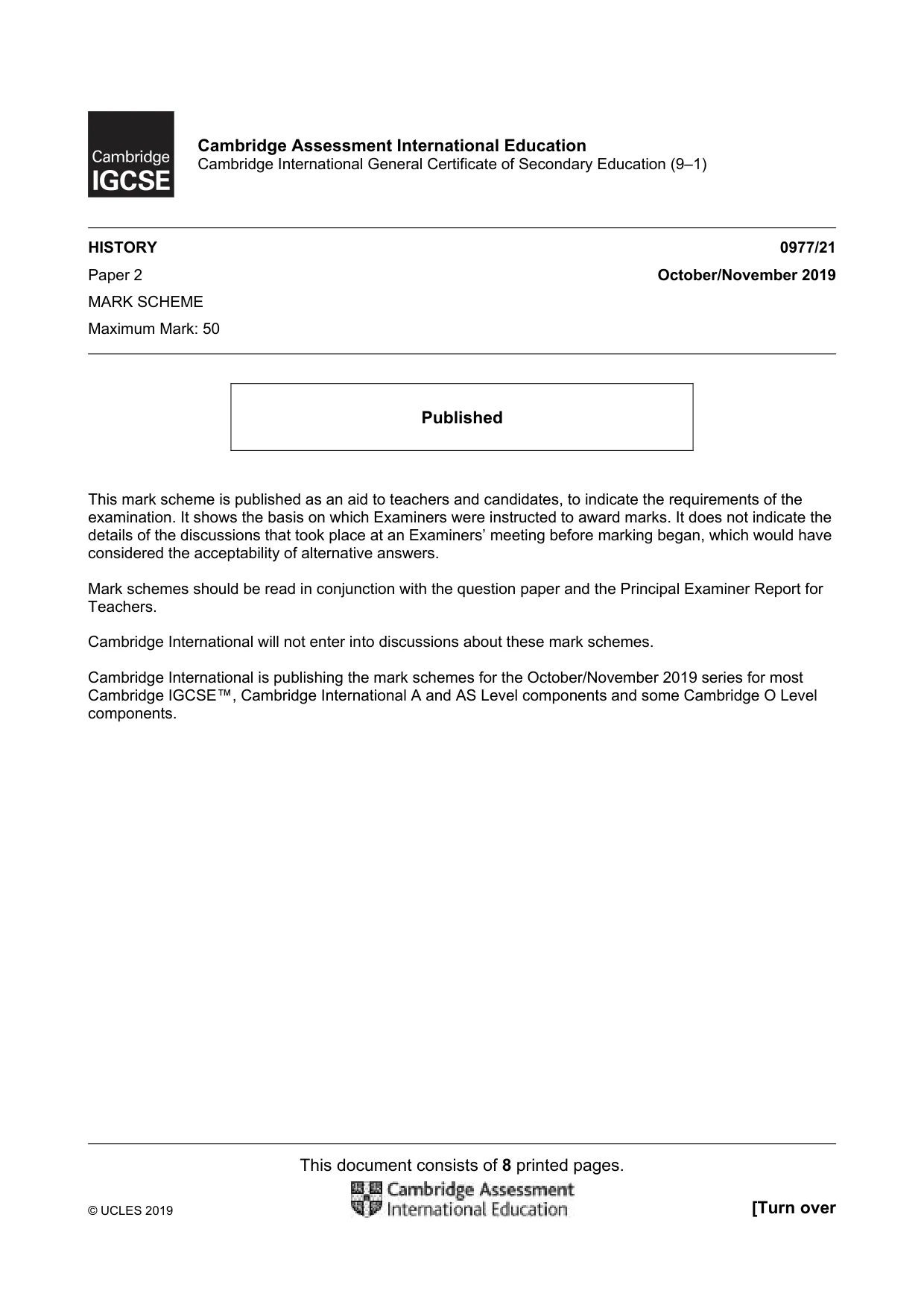
This document consists of 8 printed pages. © UCLES 2019 [Turn over Cambridge Assessment International Education Cambridge International General Certificate of Secondary Education (9–1) HISTORY 0977/21 Paper 2 October/November 2019 MARK SCHEME Maximum Mark: 50 Published This mark scheme is published as an aid to teachers and candidates, to indicate the requirements of the examination. It shows the basis on which Examiners were instructed to award marks. It does not indicate the details of the discussions that took place at an Examiners’ meeting before marking began, which would have considered the acceptability of alternative answers. Mark schemes should be read in conjunction with the question paper and the Principal Examiner Report for Teachers. Cambridge International will not enter into discussions about these mark schemes. Cambridge International is publishing the mark schemes for the October/November 2019 series for most Cambridge IGCSE™, Cambridge International A and AS Level components and some Cambridge O Level components.
Mark scheme, page 2
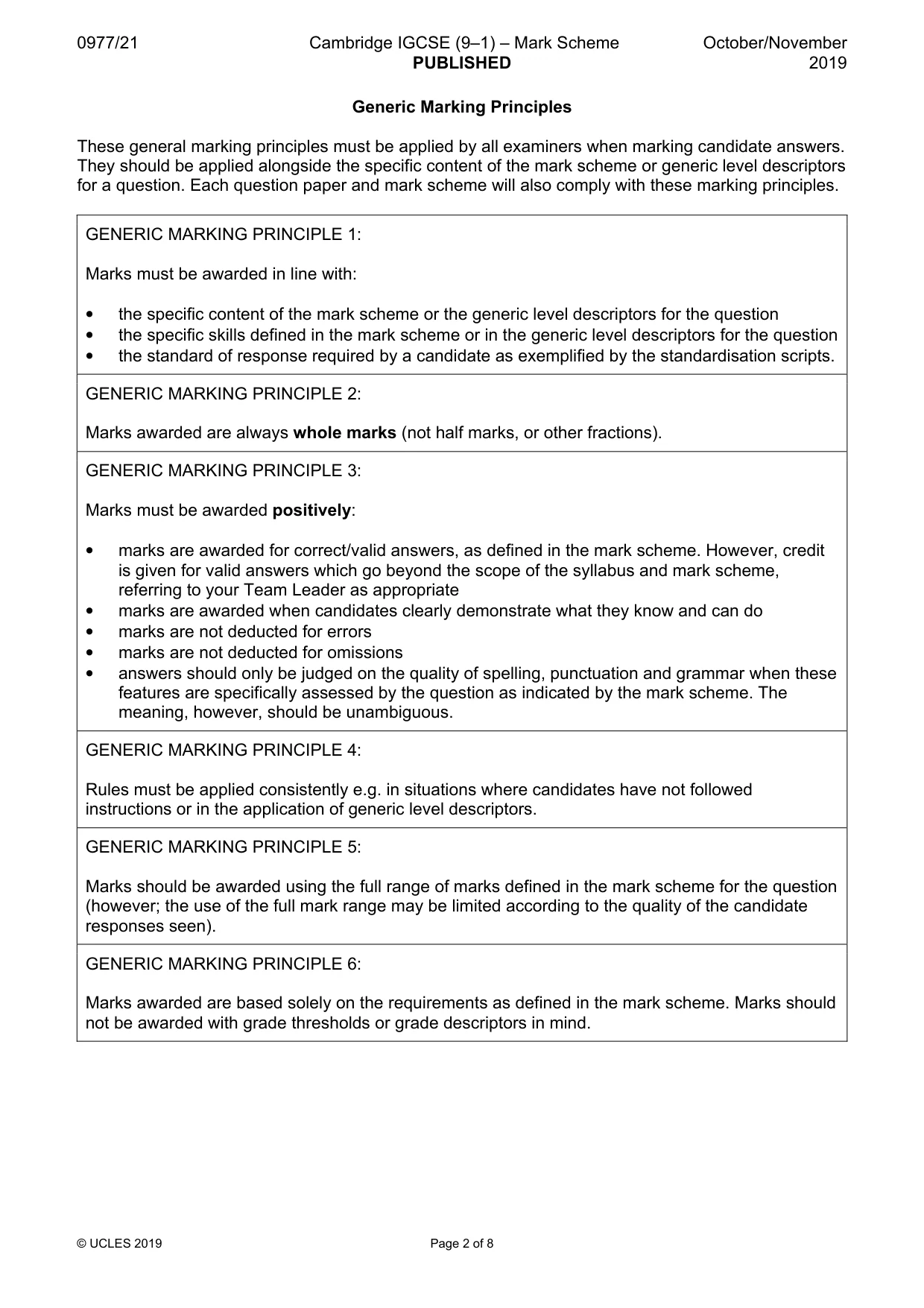
0977/21 Cambridge IGCSE (9–1) – Mark Scheme PUBLISHED October/November 2019 © UCLES 2019 Page 2 of 8 Generic Marking Principles These general marking principles must be applied by all examiners when marking candidate answers. They should be applied alongside the specific content of the mark scheme or generic level descriptors for a question. Each question paper and mark scheme will also comply with these marking principles. GENERIC MARKING PRINCIPLE 1: Marks must be awarded in line with: • the specific content of the mark scheme or the generic level descriptors for the question • the specific skills defined in the mark scheme or in the generic level descriptors for the question • the standard of response required by a candidate as exemplified by the standardisation scripts. GENERIC MARKING PRINCIPLE 2: Marks awarded are always whole marks (not half marks, or other fractions). GENERIC MARKING PRINCIPLE 3: Marks must be awarded positively: • marks are awarded for correct/valid answers, as defined in the mark scheme. However, credit is given for valid answers which go beyond the scope of the syllabus and mark scheme, referring to your Team Leader as appropriate • marks are awarded when candidates clearly demonstrate what they know and can do • marks are not deducted for errors • marks are not deducted for omissions • answers should only be judged on the quality of spelling, punctuation and grammar when these features are specifically assessed by the question as indicated by the mark scheme. The meaning, however, should be unambiguous. GENERIC MARKING PRINCIPLE 4: Rules must be applied consistently e.g. in situations where candidates have not followed instructions or in the application of generic level descriptors. GENERIC MARKING PRINCIPLE 5: Marks should be awarded using the full range of marks defined in the mark scheme for the question (however; the use of the full mark range may be limited according to the quality of the candidate responses seen). GENERIC MARKING PRINCIPLE 6: Marks awarded are based solely on the requirements as defined in the mark scheme. Marks should not be awarded with grade thresholds or grade descriptors in mind.
Mark scheme, page 3
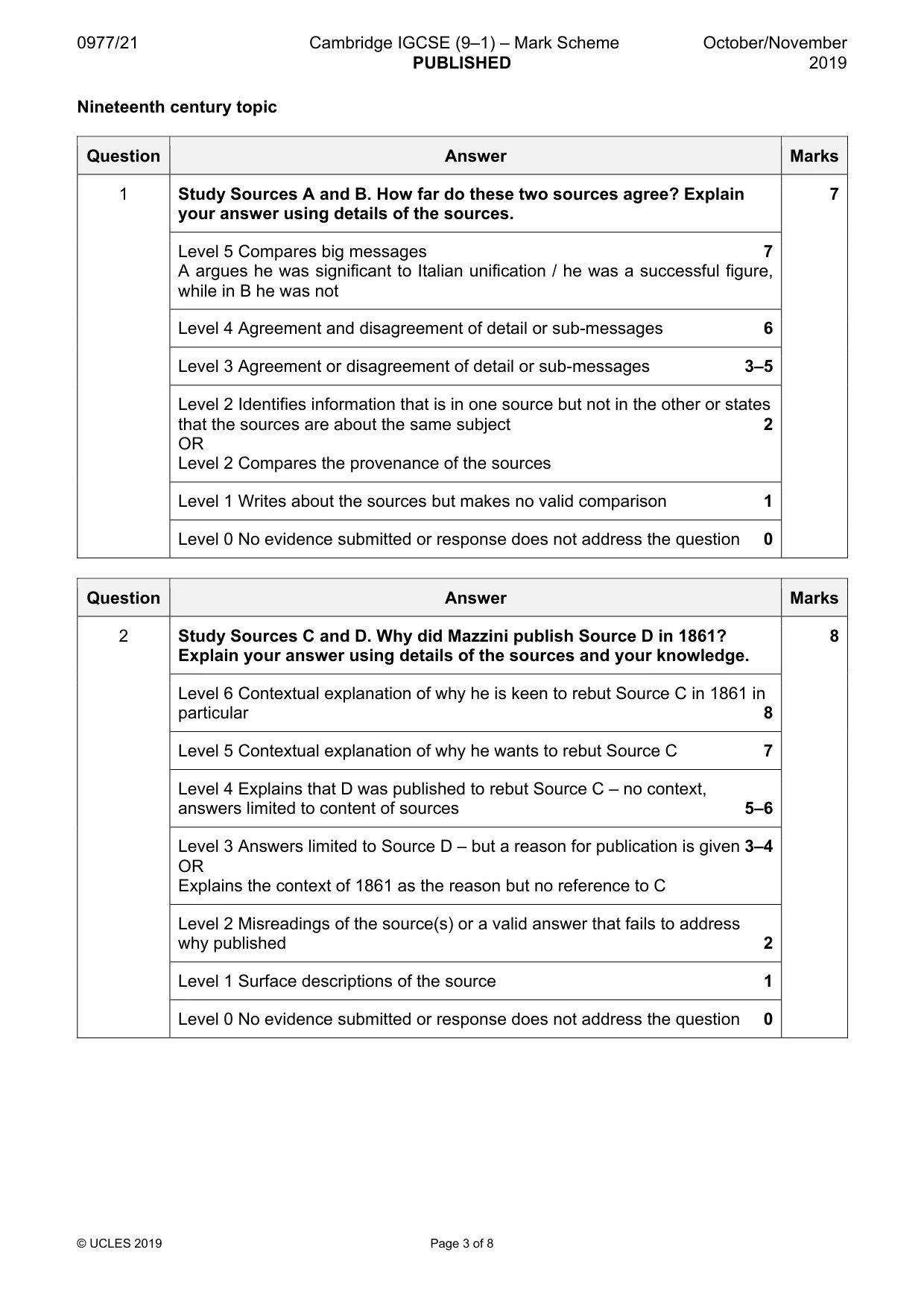
0977/21 Cambridge IGCSE (9–1) – Mark Scheme PUBLISHED October/November 2019 © UCLES 2019 Page 3 of 8 Nineteenth century topic Question Answer Marks 1 Study Sources A and B. How far do these two sources agree? Explain your answer using details of the sources. 7 Level 5 Compares big messages 7 A argues he was significant to Italian unification / he was a successful figure, while in B he was not Level 4 Agreement and disagreement of detail or sub-messages 6 Level 3 Agreement or disagreement of detail or sub-messages 3–5 Level 2 Identifies information that is in one source but not in the other or states that the sources are about the same subject 2 OR Level 2 Compares the provenance of the sources Level 1 Writes about the sources but makes no valid comparison 1 Level 0 No evidence submitted or response does not address the question 0 Question Answer Marks 2 Study Sources C and D. Why did Mazzini publish Source D in 1861? Explain your answer using details of the sources and your knowledge. 8 Level 6 Contextual explanation of why he is keen to rebut Source C in 1861 in particular 8 Level 5 Contextual explanation of why he wants to rebut Source C 7 Level 4 Explains that D was published to rebut Source C – no context, answers limited to content of sources 5–6 Level 3 Answers limited to Source D – but a reason for publication is given 3–4 OR Explains the context of 1861 as the reason but no reference to C Level 2 Misreadings of the source(s) or a valid answer that fails to address why published 2 Level 1 Surface descriptions of the source 1 Level 0 No evidence submitted or response does not address the question 0
Mark scheme, page 4
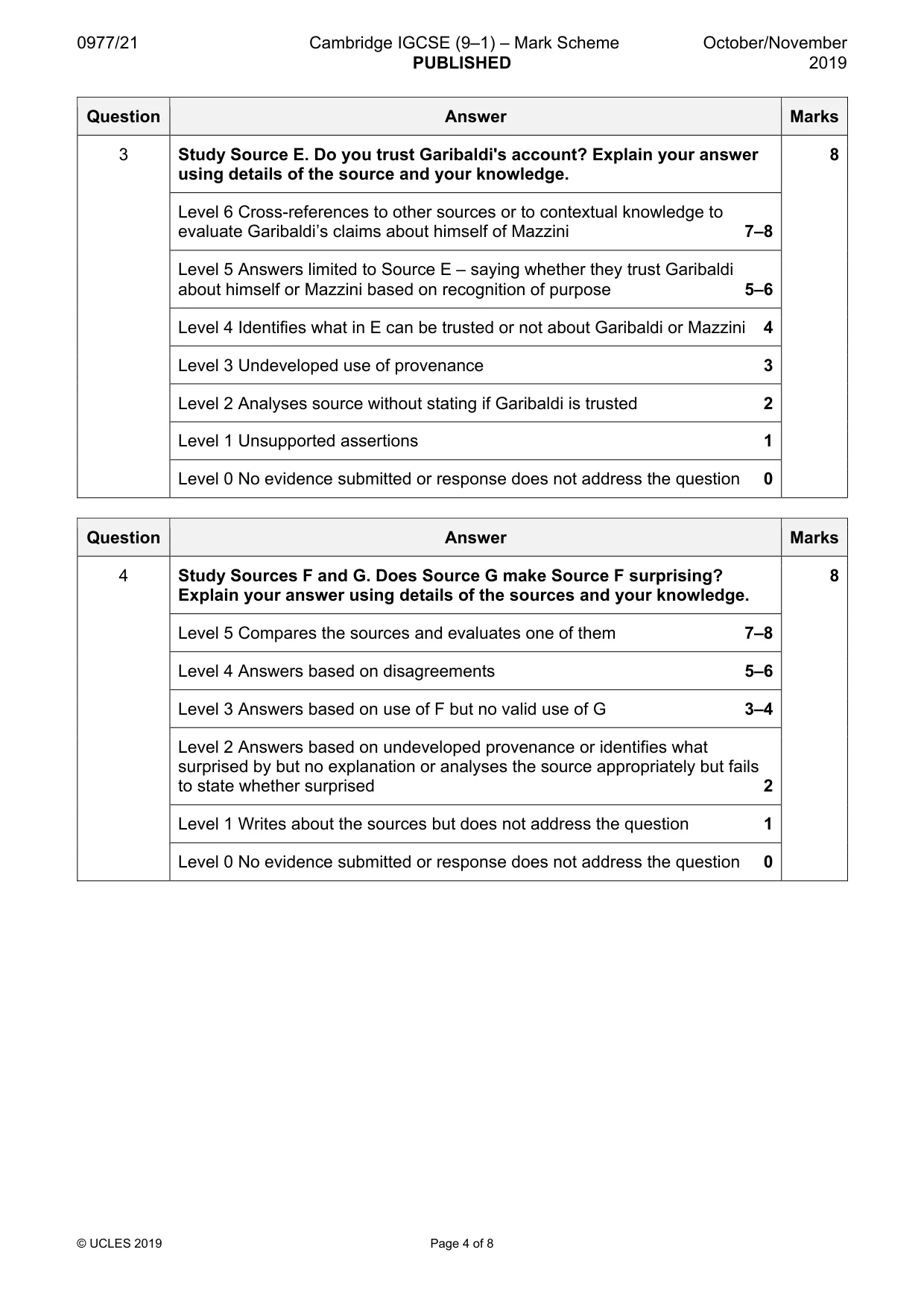
0977/21 Cambridge IGCSE (9–1) – Mark Scheme PUBLISHED October/November 2019 © UCLES 2019 Page 4 of 8 Question Answer Marks 3 Study Source E. Do you trust Garibaldi's account? Explain your answer using details of the source and your knowledge. 8 Level 6 Cross-references to other sources or to contextual knowledge to evaluate Garibaldi’s claims about himself of Mazzini 7–8 Level 5 Answers limited to Source E – saying whether they trust Garibaldi about himself or Mazzini based on recognition of purpose 5–6 Level 4 Identifies what in E can be trusted or not about Garibaldi or Mazzini 4 Level 3 Undeveloped use of provenance 3 Level 2 Analyses source without stating if Garibaldi is trusted 2 Level 1 Unsupported assertions 1 Level 0 No evidence submitted or response does not address the question 0 Question Answer Marks 4 Study Sources F and G. Does Source G make Source F surprising? Explain your answer using details of the sources and your knowledge. 8 Level 5 Compares the sources and evaluates one of them 7–8 Level 4 Answers based on disagreements 5–6 Level 3 Answers based on use of F but no valid use of G 3–4 Level 2 Answers based on undeveloped provenance or identifies what surprised by but no explanation or analyses the source appropriately but fails to state whether surprised 2 Level 1 Writes about the sources but does not address the question 1 Level 0 No evidence submitted or response does not address the question 0
Mark scheme, page 5
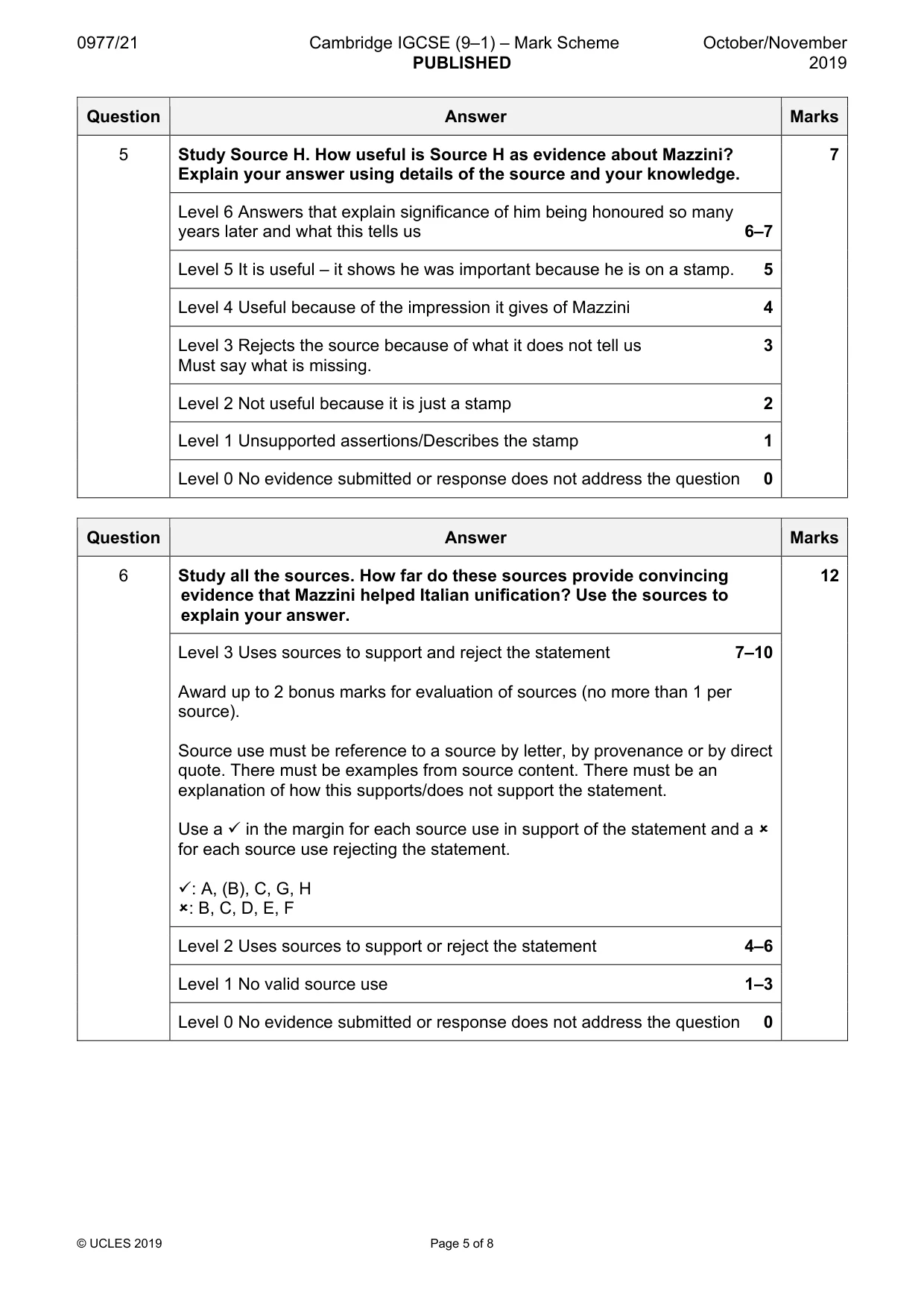
0977/21 Cambridge IGCSE (9–1) – Mark Scheme PUBLISHED October/November 2019 © UCLES 2019 Page 5 of 8 Question Answer Marks 5 Study Source H. How useful is Source H as evidence about Mazzini? Explain your answer using details of the source and your knowledge. 7 Level 6 Answers that explain significance of him being honoured so many years later and what this tells us 6–7 Level 5 It is useful – it shows he was important because he is on a stamp. 5 Level 4 Useful because of the impression it gives of Mazzini 4 Level 3 Rejects the source because of what it does not tell us 3 Must say what is missing. Level 2 Not useful because it is just a stamp 2 Level 1 Unsupported assertions/Describes the stamp 1 Level 0 No evidence submitted or response does not address the question 0 Question Answer Marks 6 Study all the sources. How far do these sources provide convincing evidence that Mazzini helped Italian unification? Use the sources to explain your answer. 12 Level 3 Uses sources to support and reject the statement 7–10 Award up to 2 bonus marks for evaluation of sources (no more than 1 per source). Source use must be reference to a source by letter, by provenance or by direct quote. There must be examples from source content. There must be an explanation of how this supports/does not support the statement. Use a 9 in the margin for each source use in support of the statement and a 8 for each source use rejecting the statement. 9: A, (B), C, G, H 8: B, C, D, E, F Level 2 Uses sources to support or reject the statement 4–6 Level 1 No valid source use 1–3 Level 0 No evidence submitted or response does not address the question 0
Mark scheme, page 6
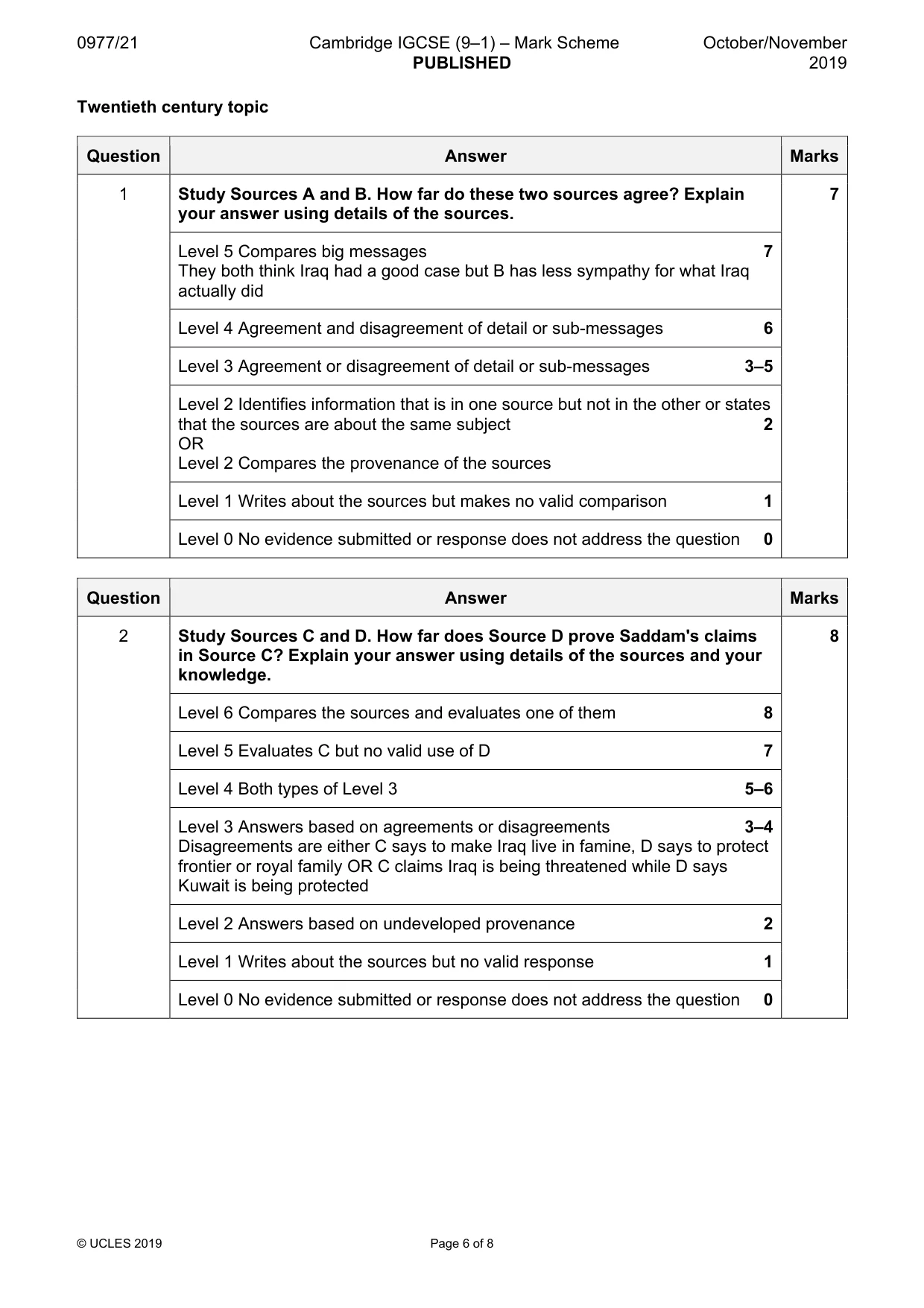
0977/21 Cambridge IGCSE (9–1) – Mark Scheme PUBLISHED October/November 2019 © UCLES 2019 Page 6 of 8 Twentieth century topic Question Answer Marks 1 Study Sources A and B. How far do these two sources agree? Explain your answer using details of the sources. 7 Level 5 Compares big messages 7 They both think Iraq had a good case but B has less sympathy for what Iraq actually did Level 4 Agreement and disagreement of detail or sub-messages 6 Level 3 Agreement or disagreement of detail or sub-messages 3–5 Level 2 Identifies information that is in one source but not in the other or states that the sources are about the same subject 2 OR Level 2 Compares the provenance of the sources Level 1 Writes about the sources but makes no valid comparison 1 Level 0 No evidence submitted or response does not address the question 0 Question Answer Marks 2 Study Sources C and D. How far does Source D prove Saddam's claims in Source C? Explain your answer using details of the sources and your knowledge. 8 Level 6 Compares the sources and evaluates one of them 8 Level 5 Evaluates C but no valid use of D 7 Level 4 Both types of Level 3 5–6 Level 3 Answers based on agreements or disagreements 3–4 Disagreements are either C says to make Iraq live in famine, D says to protect frontier or royal family OR C claims Iraq is being threatened while D says Kuwait is being protected Level 2 Answers based on undeveloped provenance 2 Level 1 Writes about the sources but no valid response 1 Level 0 No evidence submitted or response does not address the question 0
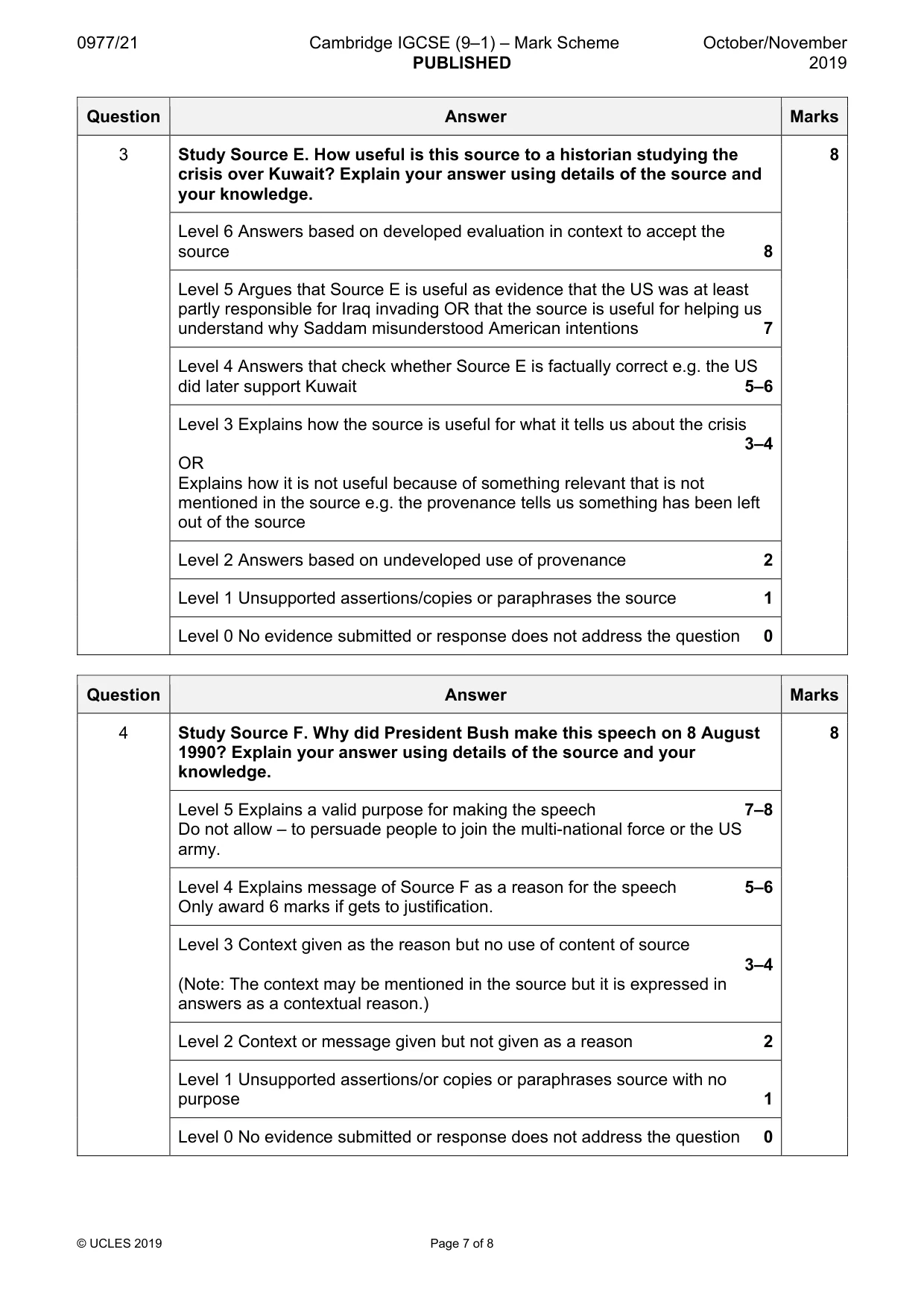
Mark scheme, page 7
0977/21 Cambridge IGCSE (9–1) – Mark Scheme PUBLISHED October/November 2019 © UCLES 2019 Page 7 of 8 Question Answer Marks 3 Study Source E. How useful is this source to a historian studying the crisis over Kuwait? Explain your answer using details of the source and your knowledge. 8 Level 6 Answers based on developed evaluation in context to accept the source 8 Level 5 Argues that Source E is useful as evidence that the US was at least partly responsible for Iraq invading OR that the source is useful for helping us understand why Saddam misunderstood American intentions 7 Level 4 Answers that check whether Source E is factually correct e.g. the US did later support Kuwait 5–6 Level 3 Explains how the source is useful for what it tells us about the crisis 3–4 OR Explains how it is not useful because of something relevant that is not mentioned in the source e.g. the provenance tells us something has been left out of the source Level 2 Answers based on undeveloped use of provenance 2 Level 1 Unsupported assertions/copies or paraphrases the source 1 Level 0 No evidence submitted or response does not address the question 0 Question Answer Marks 4 Study Source F. Why did President Bush make this speech on 8 August 1990? Explain your answer using details of the source and your knowledge. 8 Level 5 Explains a valid purpose for making the speech 7–8 Do not allow – to persuade people to join the multi-national force or the US army. Level 4 Explains message of Source F as a reason for the speech 5–6 Only award 6 marks if gets to justification. Level 3 Context given as the reason but no use of content of source 3–4 (Note: The context may be mentioned in the source but it is expressed in answers as a contextual reason.) Level 2 Context or message given but not given as a reason 2 Level 1 Unsupported assertions/or copies or paraphrases source with no purpose 1 Level 0 No evidence submitted or response does not address the question 0
Mark scheme, page 8
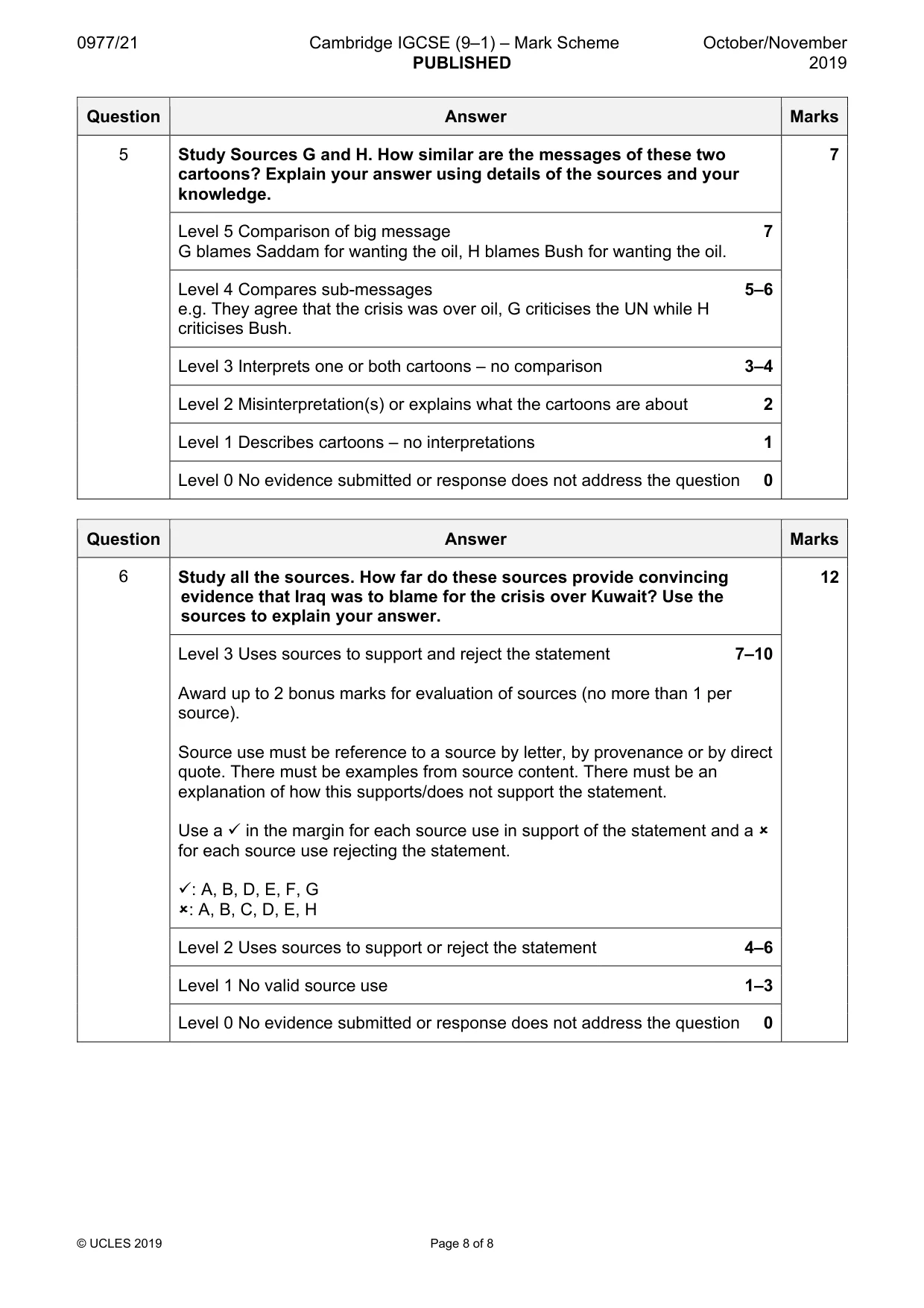
0977/21 Cambridge IGCSE (9–1) – Mark Scheme PUBLISHED October/November 2019 © UCLES 2019 Page 8 of 8 Question Answer Marks 5 Study Sources G and H. How similar are the messages of these two cartoons? Explain your answer using details of the sources and your knowledge. 7 Level 5 Comparison of big message 7 G blames Saddam for wanting the oil, H blames Bush for wanting the oil. Level 4 Compares sub-messages 5–6 e.g. They agree that the crisis was over oil, G criticises the UN while H criticises Bush. Level 3 Interprets one or both cartoons – no comparison 3–4 Level 2 Misinterpretation(s) or explains what the cartoons are about 2 Level 1 Describes cartoons – no interpretations 1 Level 0 No evidence submitted or response does not address the question 0 Question Answer Marks 6 Study all the sources. How far do these sources provide convincing evidence that Iraq was to blame for the crisis over Kuwait? Use the sources to explain your answer. 12 Level 3 Uses sources to support and reject the statement 7–10 Award up to 2 bonus marks for evaluation of sources (no more than 1 per source). Source use must be reference to a source by letter, by provenance or by direct quote. There must be examples from source content. There must be an explanation of how this supports/does not support the statement. Use a 9 in the margin for each source use in support of the statement and a 8 for each source use rejecting the statement. 9: A, B, D, E, F, G 8: A, B, C, D, E, H Level 2 Uses sources to support or reject the statement 4–6 Level 1 No valid source use 1–3 Level 0 No evidence submitted or response does not address the question 0
What you needed in this session
Cambridge’s own grade thresholds for 2019 Oct/Nov, Paper 2 · Variant 1. A higher threshold means an easier paper — the bar moves with how the cohort did.