Cambridge IGCSE History (9-1) 0977 — 2018 Oct/Nov Paper 2 · Variant 1
0977/21/O/N/18 · 50 marks · ≈56 min
The question paper and its mark scheme, free to read here and free to download. This is Cambridge’s own paper, exactly as it was sat.
Question paper12 pages

Mark scheme10 pages
Answers below. Sit the paper first if you are practising.
Paper as text
Question paper, page 1
* 6 6 9 8 6 3 1 1 1 9 * This document consists of 11 printed pages, 1 blank page and 1 Insert. DC (RW) 164139 © UCLES 2018 [Turn over Cambridge International Examinations Cambridge International General Certificate of Secondary Education (9–1) HISTORY 0977/21 Paper 2 October/November 2018 2 hours No Additional Materials are required. READ THESE INSTRUCTIONS FIRST An answer booklet is provided inside this question paper. You should follow the instructions on the front cover of the answer booklet. If you need additional answer paper ask the invigilator for a continuation booklet. This paper has two options. Choose one option, and answer all of the questions on that topic. Option A: 19th Century topic [p2–p6] Option B: 20th Century topic [p8–p12] The number of marks is given in brackets [ ] at the end of each question or part question.
Question paper, page 2
2 0977/21/O/N/18 © UCLES 2018 Option A: 19th Century topic HOW JUSTIFIED WAS THE FOREIGN RESPONSE TO THE BOXER RISING? Study the Background Information and the sources carefully, and then answer all the questions. Background Information The Boxer Rebellion lasted from 1899 to 1901 and involved attacks on foreigners, especially Christian missionaries. The Boxers were reacting to increasing European and American interference in China. This came in several forms including foreign missionaries trying to convert the Chinese to Christianity and attempts by countries like Britain, France, Germany, Japan and Russia to partition the country between them. Foreign countries claimed that China was backward and its people were barbarians. They also claimed that closer contact with foreigners would benefit China. For them, the actions of the Boxers seemed to confirm this and justify their interference in China. When attacks on foreigners began, the position of the Empress was unclear, although imperial troops did later fight alongside the Boxers. The Chinese government’s failure to stop the Boxers, and the siege of foreigners in the Legation Quarter of Beijing, led to further foreign intervention with an international force arriving in August 1900. It defeated the Boxers and set about exacting revenge. Was this foreign intervention justified? SOURCE A The Boxers were a peasant secret society of the traditional superstitious type. In 1898, in Shandong province, this society became a focus of resentment against the Germans, who were turning the province into their colony in a brutal manner – not only exploiting it economically but also burning villages to punish them for ‘unfriendliness’. Also people throughout China were becoming more and more enraged by the missionaries, who were behaving quite openly as advance agents for their governments who were picking off parts of China. These abuses at a time when China was being openly surveyed for inter-imperialist partition made the peasant rebels anti-foreign and anti-missionary. It is a cruel imperialist libel to call the movement ‘reactionary’. On the contrary, it was a heroic, spontaneous effort of the common people of China to defend its national existence against the robbers who wanted to cut it up. The tragedy of the Boxers was that they lacked clear policies and lacked understanding of the relationship of forces either at home or internationally. This made them an easy prey to deception and doomed them to defeat. The feudal rulers at Beijing, seeing the movement was spreading like lightning, pretended to put themselves at its head. But even as fighting was going on they begged the foreign governments not to be taken in by appearances and make the mistake of suspecting the dynasty of ‘favouring the common folk’. The dynasty was waiting to turn its troops against the patriotic ‘rebels’ and in almost every area of China royal officials took no part in the rebellion. Taking advantage of the situation, the foreigners mobilised a strong force and stormed into Beijing delivering slaughter and looting. The Boxer rising had been betrayed and smashed. From a book about the history of China entitled ‘From Opium War to Liberation’, published in China in 1956.
Question paper, page 3
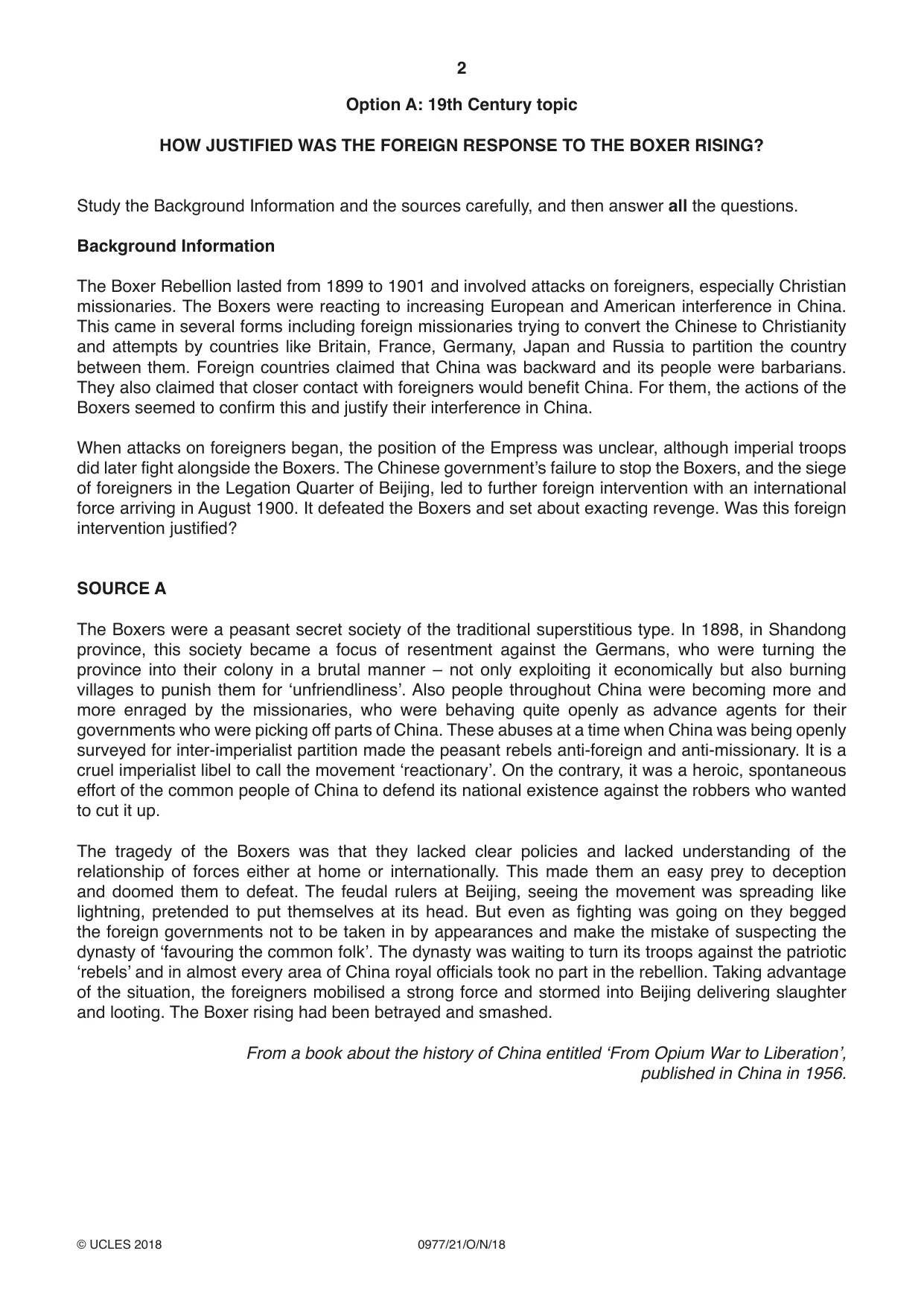
3 0977/21/O/N/18 © UCLES 2018 [Turn over SOURCE B The foreigners had a lot to put up with. They came to trade, which was natural and legitimate. When the Chinese refused to let them trade for reasons that were self-centred and obsolete, and expressed in an offensive manner, the foreigners could hardly be expected to sympathise. In China, female children were often killed at birth or offered for sale. The missionaries opened orphanages for these children but this led to stories that they were mutilating the bodies while practising magic. In nine cases out of ten the Boxer was a Chinese peasant in fancy dress. The superstitious nonsense with which the Boxers surrounded themselves appealed strongly to the peasantry and brightened their drab lives. Their first riots had their origins in their hatred of foreigners and their conflicts with Christians. It was the Empress’s decision that the Boxers were encouraged instead of being suppressed, and it was her decision that the foreign envoys should be massacred. It is difficult to understand why she took an opportunity in the Boxer Rising. It is true that she could draw on no other help in her unequal struggle with the foreign powers but it was her decision to rely on a rabble of uncontrollable fanatics who were bound to unite the squabbling foreign powers. She had always been superstitious, and now the Boxers’ magic powers established some sort of hold on her mind. She was playing her last card. She would call in the dark forces of the spirit world. The purpose of the siege of the Legation Quarter, to which the Empress devoted her energies for two months, was to wipe out the entire foreign community in Beijing and was pursued with diligence in the face of protests from the foreign powers and her own officials. From a history book published in Britain in 1959. SOURCE C A cartoon about the Boxer Rebellion published in a French magazine, July 1899. ‘Barbarie’ means ‘Barbarism’.
Question paper, page 4
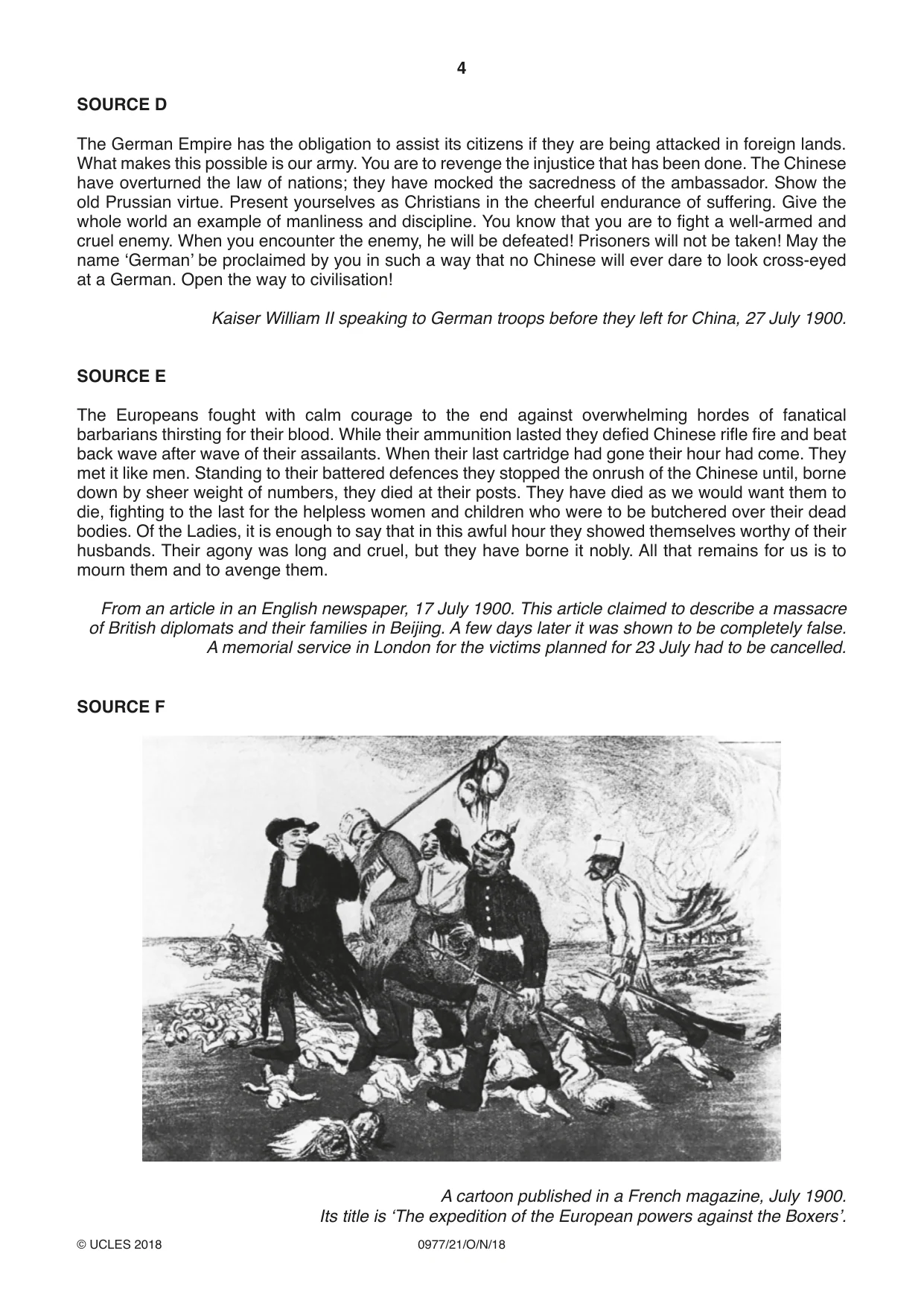
4 0977/21/O/N/18 © UCLES 2018 SOURCE D The German Empire has the obligation to assist its citizens if they are being attacked in foreign lands. What makes this possible is our army. You are to revenge the injustice that has been done. The Chinese have overturned the law of nations; they have mocked the sacredness of the ambassador. Show the old Prussian virtue. Present yourselves as Christians in the cheerful endurance of suffering. Give the whole world an example of manliness and discipline. You know that you are to fight a well-armed and cruel enemy. When you encounter the enemy, he will be defeated! Prisoners will not be taken! May the name ‘German’ be proclaimed by you in such a way that no Chinese will ever dare to look cross-eyed at a German. Open the way to civilisation! Kaiser William II speaking to German troops before they left for China, 27 July 1900. SOURCE E The Europeans fought with calm courage to the end against overwhelming hordes of fanatical barbarians thirsting for their blood. While their ammunition lasted they defied Chinese rifle fire and beat back wave after wave of their assailants. When their last cartridge had gone their hour had come. They met it like men. Standing to their battered defences they stopped the onrush of the Chinese until, borne down by sheer weight of numbers, they died at their posts. They have died as we would want them to die, fighting to the last for the helpless women and children who were to be butchered over their dead bodies. Of the Ladies, it is enough to say that in this awful hour they showed themselves worthy of their husbands. Their agony was long and cruel, but they have borne it nobly. All that remains for us is to mourn them and to avenge them. From an article in an English newspaper, 17 July 1900. This article claimed to describe a massacre of British diplomats and their families in Beijing. A few days later it was shown to be completely false. A memorial service in London for the victims planned for 23 July had to be cancelled. SOURCE F A cartoon published in a French magazine, July 1900. Its title is ‘The expedition of the European powers against the Boxers’.
Question paper, page 5
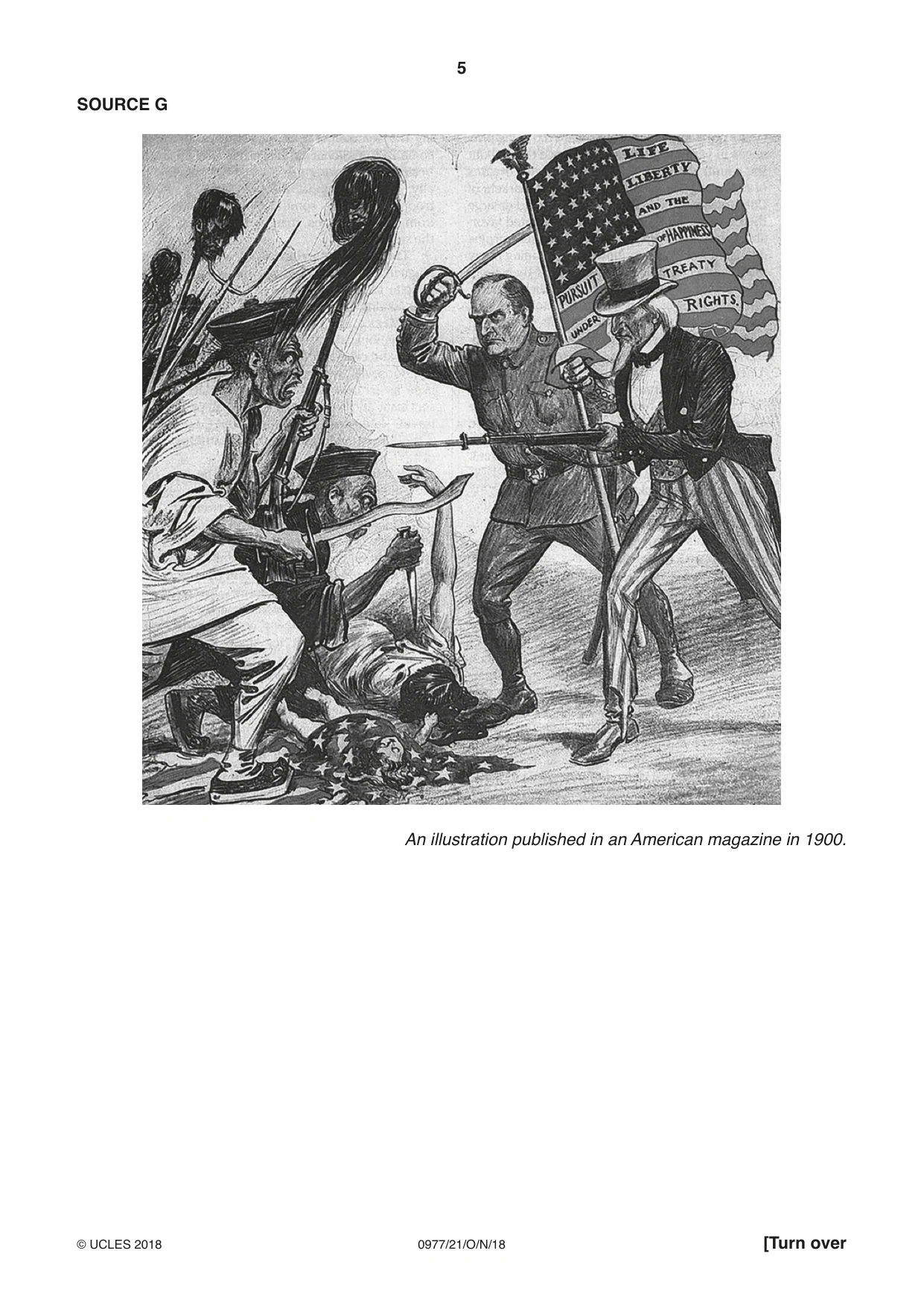
5 0977/21/O/N/18 © UCLES 2018 [Turn over SOURCE G An illustration published in an American magazine in 1900.
Question paper, page 6
6 0977/21/O/N/18 © UCLES 2018 Now answer all the following questions. You may use any of the sources to help you answer the questions, in addition to those sources which you are told to use. In answering the questions you should use your knowledge of the topic to help you interpret and evaluate the sources. 1 Study Sources A and B. How far do these two sources agree? Explain your answer using details of the sources. [7] 2 Study Source C. What is the cartoonist’s message? Explain your answer using details of the source and your knowledge. [8] 3 Study Source D. Are you surprised by this source? Explain your answer using details of the source and your knowledge. [7] 4 Study Source E. Why was this source published in England in July 1900? Explain your answer using details of the source and your knowledge. [8] 5 Study Sources F and G. Would the artists of these two sources have agreed about events in China in 1900? Explain your answer using details of the sources and your knowledge. [8] 6 Study all the sources. How far do these sources provide convincing evidence that the foreign response to the Boxer Rising was justified? Use the sources to explain your answer. [12]
Question paper, page 7
7 0977/21/O/N/18 © UCLES 2018 [Turn over BLANK PAGE
Question paper, page 8
8 0977/21/O/N/18 © UCLES 2018 Option B: 20th Century topic HOW FAR DID ITALY BENEFIT FROM ITS RELATIONSHIP WITH GERMANY? Study the Background Information and the sources carefully, and then answer all the questions. Background Information To many at the time, and to many since, it seemed inevitable that because of their ideological similarities, Nazi Germany and Mussolini’s Italy would be allies. However, their relationship was not quite this straightforward. Despite early differences over Austria, in October 1936 Germany and Italy signed a treaty forming the Rome-Berlin Axis. This did not stop other countries such as Britain, France and the USSR trying to win the friendship of one or the other of them. Some suspected that the interests of Germany and Italy were not always the same. However, in May 1939 they signed the Pact of Steel, a political and military alliance which stated that if one country was at war, the other would come to its support. Did Italy benefit from its relationship with Germany? SOURCE A By the end of 1937 Mussolini had rarely been so happy. Alongside Germany and Japan, he felt at the centre of the ‘most formidable military combination that has ever existed’. To introduce a further element of ‘Prussianisation’ his soldiers were ordered to adopt the German goose step march. Mussolini privately accepted that the Nazification of Austria was inescapable, though he mistakenly assumed that Hitler would warn him in time to prepare the Italian public for his change of policy. In March 1938, Hitler marched into Austria after notifying Rome only at the very last moment. Italy thus lost the immense advantage of having only a weak buffer state on her northern frontier. Having often promised that he would fight to defend Austrian independence, now in March Mussolini protested he had never said anything so foolish. Hitler had been careful not to tell Mussolini of his plans to extend Germany’s living space and calculated that, as Italy had its hands full in Spain, he could meanwhile take Austria and Czechoslovakia, possibly without offering his partner anything in return. He had gradually been displacing Italy in the commerce of south-eastern Europe. Mussolini was seriously worried and occasionally he spoke of changing sides in Europe. He still hoped to ride several horses at once but such behaviour was irresponsible, unrealistic and hardly that of a potential ally. From a history book published in 1981.
Question paper, page 9
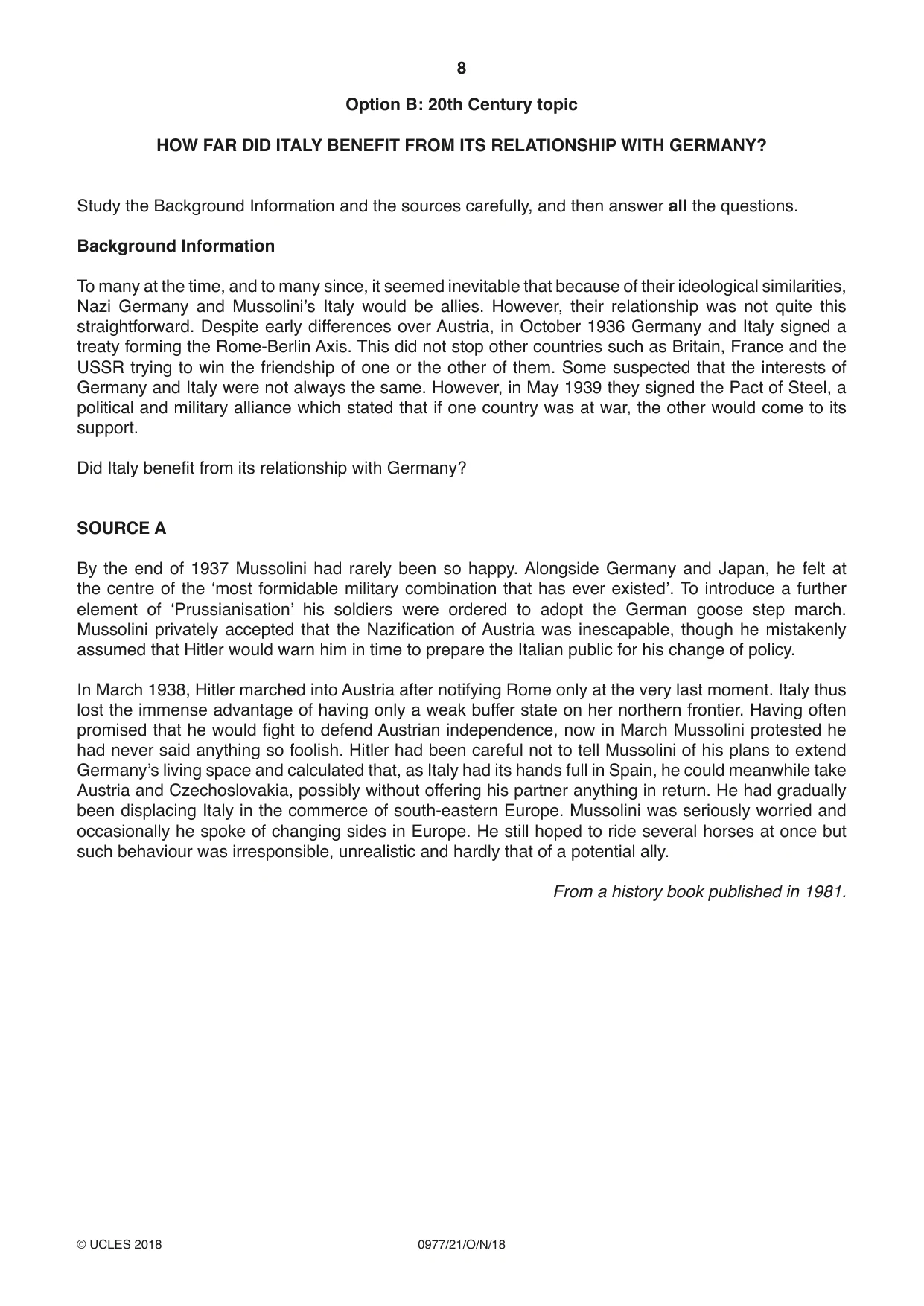
9 0977/21/O/N/18 © UCLES 2018 [Turn over SOURCE B A British cartoon published in May 1935. The figures on the right are Goebbels, Hitler and Göring. SOURCE C Germany is swayed towards Italy not so much because of its defiance of the League of Nations but because of its success. While sanctions were still in operation there was little sign of any rapprochement between the two dictators. It was only when sanctions were lifted that Germany, which only respects force, found something in Italy worth cultivating. Any appearance now of over-keenness by us to improve relations with Italy will only increase its charms in the eyes of Hitler. It is doubtful how far any gesture of friendliness by us would make Italy change its policy of re-constituting the Roman Empire, no matter how fantastic and unreal this may be. However, unless we reply to Mussolini’s advances, he will return to increasing collaboration and understanding with Germany, which will work to our eventual danger. A generous response might help produce a detente. If our rearmament continues it will be worthwhile for Italy to maintain relations of friendship with Britain. Written by Sir Anthony Eden for his colleagues in the British government, November 1936. Eden was in charge of British foreign policy.
Question paper, page 10
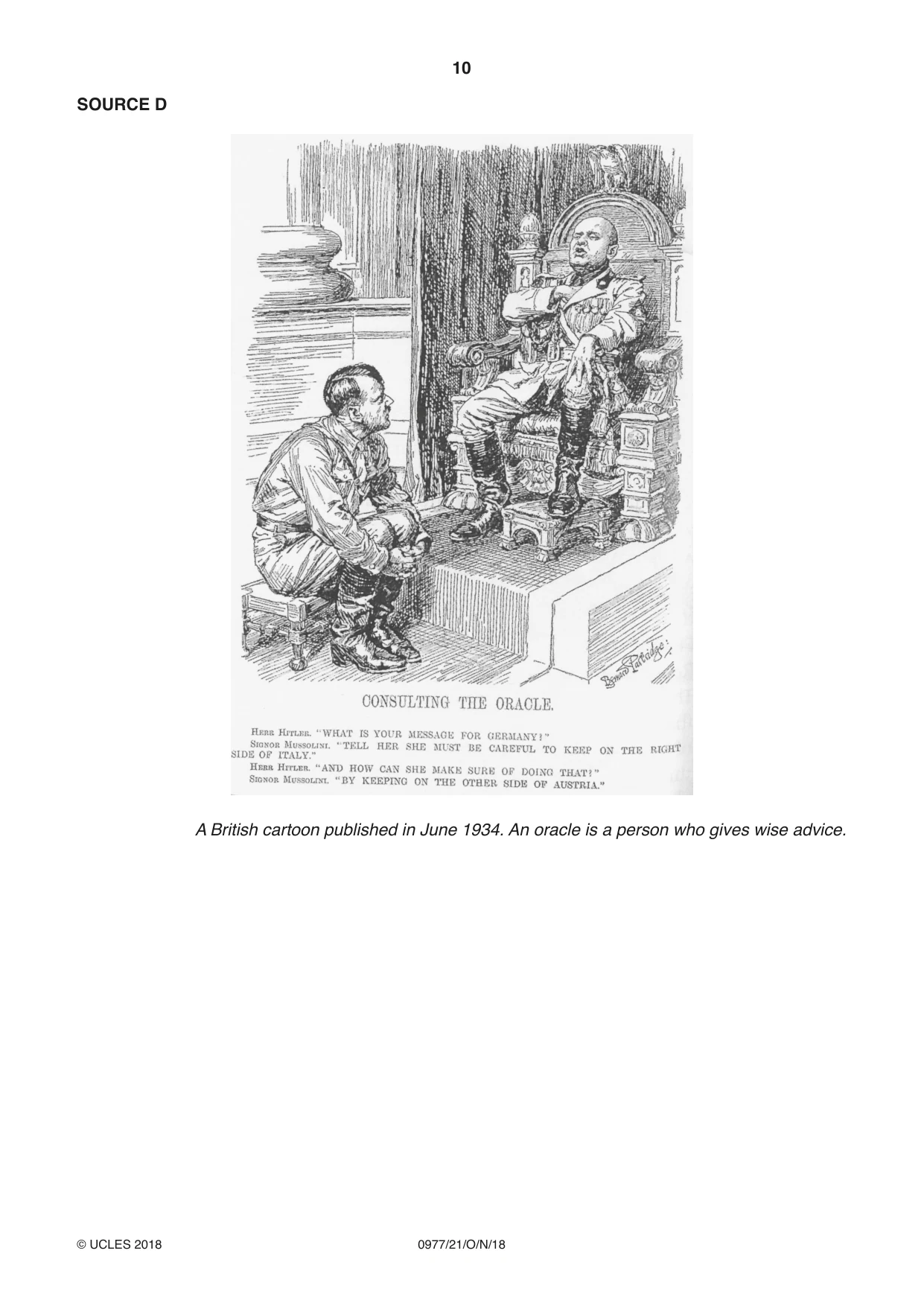
10 0977/21/O/N/18 © UCLES 2018 SOURCE D A British cartoon published in June 1934. An oracle is a person who gives wise advice.
Question paper, page 11
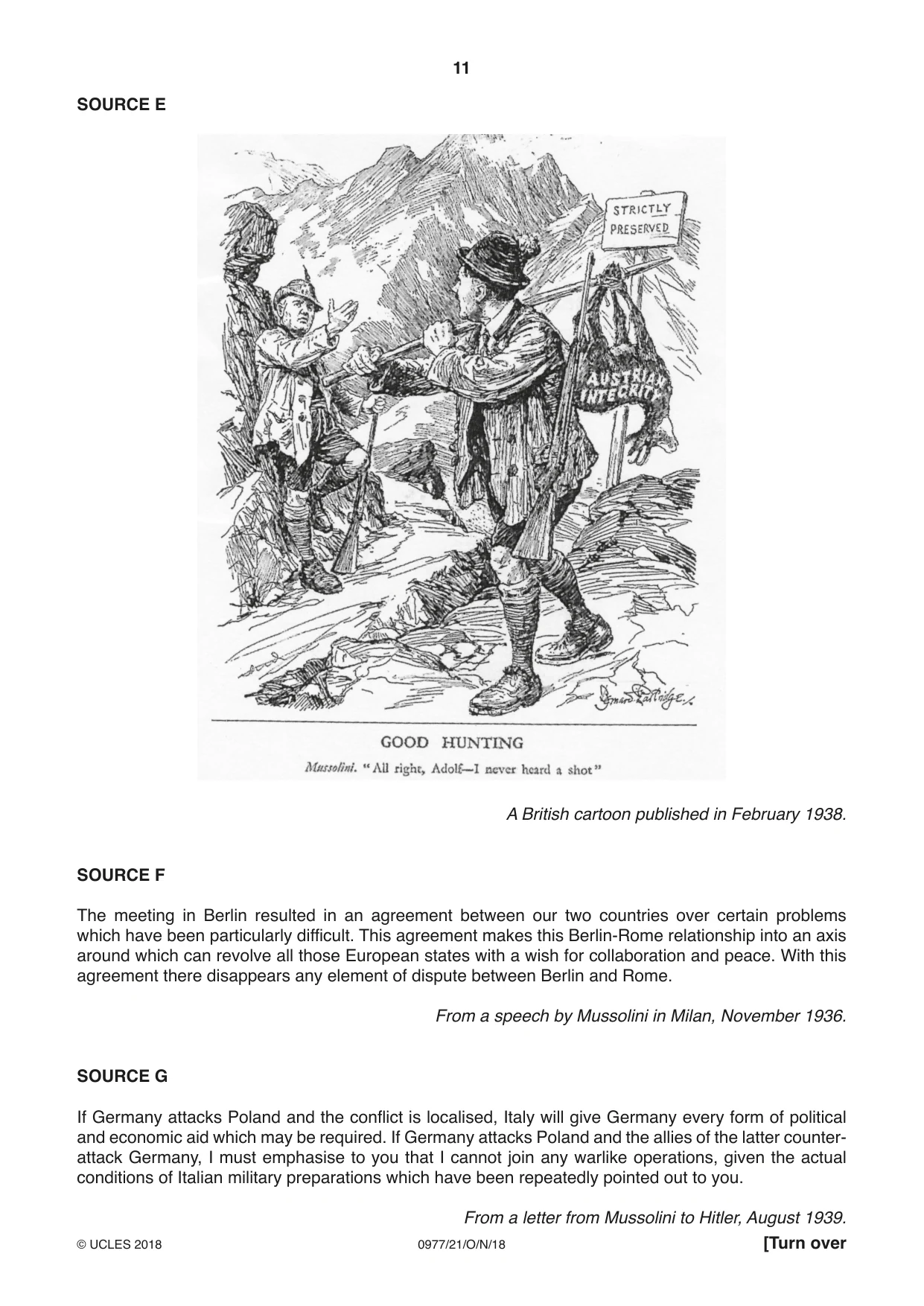
11 0977/21/O/N/18 © UCLES 2018 [Turn over SOURCE E A British cartoon published in February 1938. SOURCE F The meeting in Berlin resulted in an agreement between our two countries over certain problems which have been particularly difficult. This agreement makes this Berlin-Rome relationship into an axis around which can revolve all those European states with a wish for collaboration and peace. With this agreement there disappears any element of dispute between Berlin and Rome. From a speech by Mussolini in Milan, November 1936. SOURCE G If Germany attacks Poland and the conflict is localised, Italy will give Germany every form of political and economic aid which may be required. If Germany attacks Poland and the allies of the latter counter- attack Germany, I must emphasise to you that I cannot join any warlike operations, given the actual conditions of Italian military preparations which have been repeatedly pointed out to you. From a letter from Mussolini to Hitler, August 1939.
Question paper, page 12
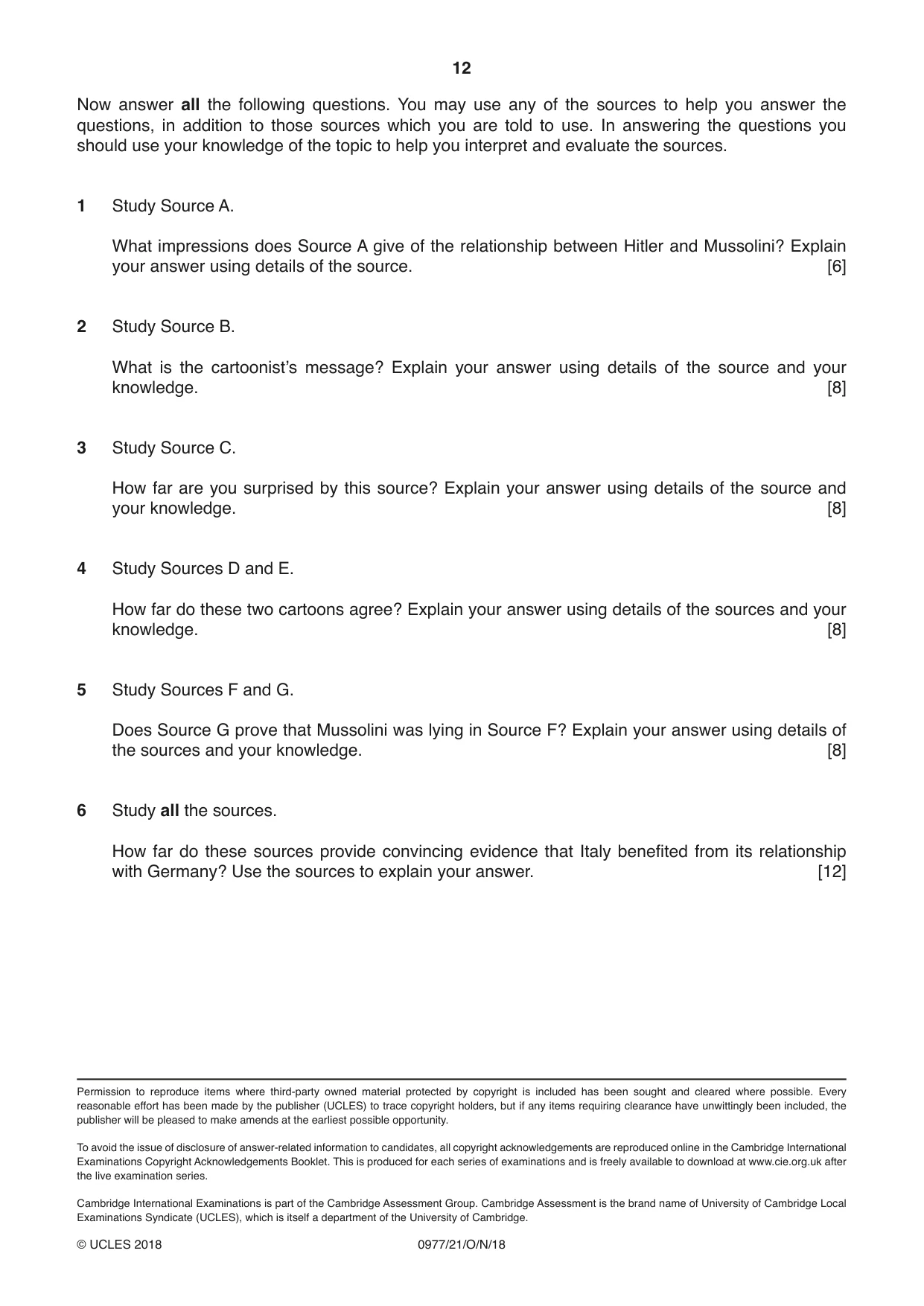
12 0977/21/O/N/18 © UCLES 2018 Now answer all the following questions. You may use any of the sources to help you answer the questions, in addition to those sources which you are told to use. In answering the questions you should use your knowledge of the topic to help you interpret and evaluate the sources. 1 Study Source A. What impressions does Source A give of the relationship between Hitler and Mussolini? Explain your answer using details of the source. [6] 2 Study Source B. What is the cartoonist’s message? Explain your answer using details of the source and your knowledge. [8] 3 Study Source C. How far are you surprised by this source? Explain your answer using details of the source and your knowledge. [8] 4 Study Sources D and E. How far do these two cartoons agree? Explain your answer using details of the sources and your knowledge. [8] 5 Study Sources F and G. Does Source G prove that Mussolini was lying in Source F? Explain your answer using details of the sources and your knowledge. [8] 6 Study all the sources. How far do these sources provide convincing evidence that Italy benefited from its relationship with Germany? Use the sources to explain your answer. [12] Permission to reproduce items where third-party owned material protected by copyright is included has been sought and cleared where possible. Every reasonable effort has been made by the publisher (UCLES) to trace copyright holders, but if any items requiring clearance have unwittingly been included, the publisher will be pleased to make amends at the earliest possible opportunity. To avoid the issue of disclosure of answer-related information to candidates, all copyright acknowledgements are reproduced online in the Cambridge International Examinations Copyright Acknowledgements Booklet. This is produced for each series of examinations and is freely available to download at www.cie.org.uk after the live examination series. Cambridge International Examinations is part of the Cambridge Assessment Group. Cambridge Assessment is the brand name of University of Cambridge Local Examinations Syndicate (UCLES), which is itself a department of the University of Cambridge.
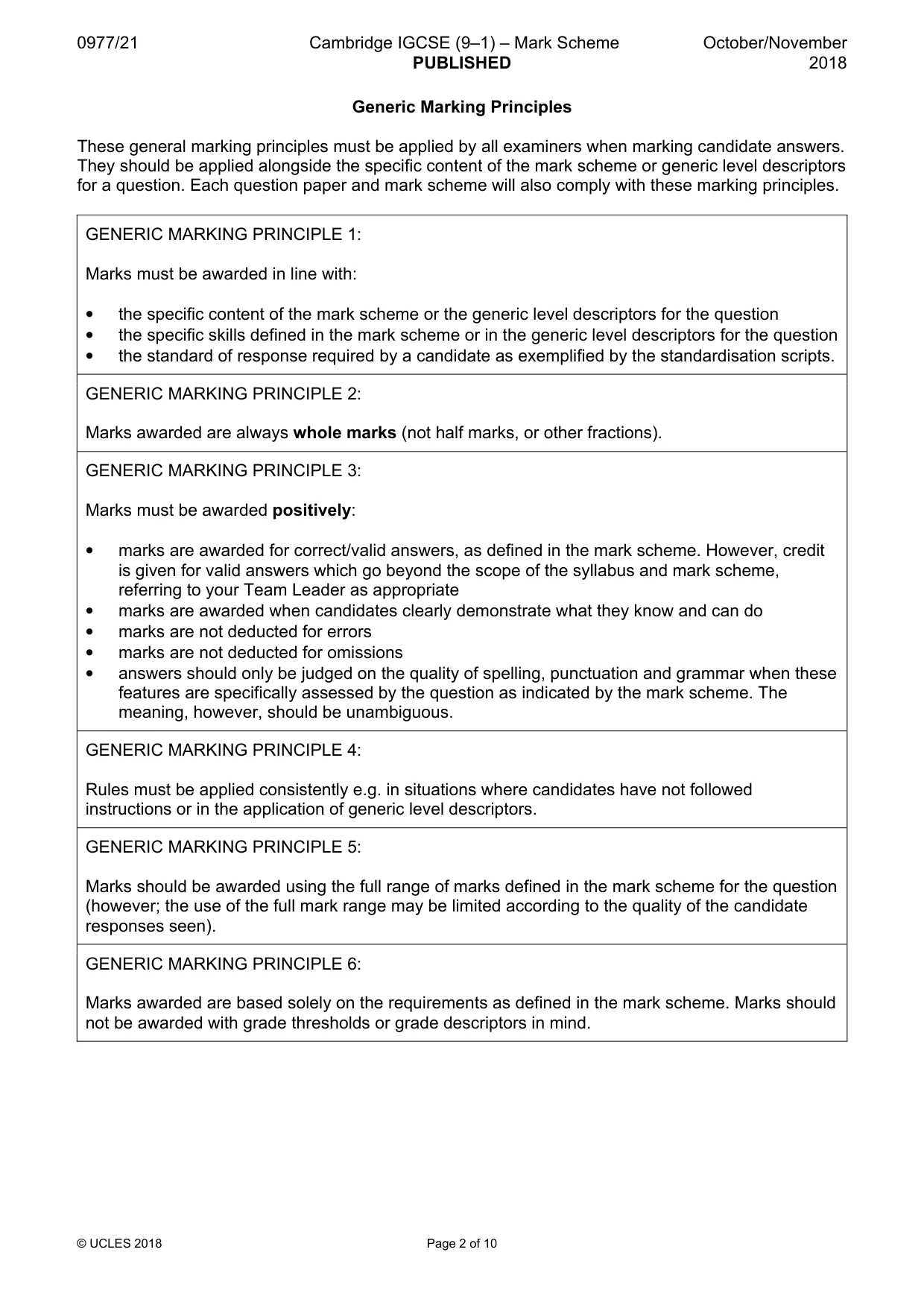
Mark scheme, page 1
This document consists of 10 printed pages. © UCLES 2018 [Turn over Cambridge Assessment International Education Cambridge International General Certificate of Secondary Education (9–1) HISTORY (9–1) 0977/21 Paper 2 October/November 2018 MARK SCHEME Maximum Mark: 50 Published This mark scheme is published as an aid to teachers and candidates, to indicate the requirements of the examination. It shows the basis on which Examiners were instructed to award marks. It does not indicate the details of the discussions that took place at an Examiners’ meeting before marking began, which would have considered the acceptability of alternative answers. Mark schemes should be read in conjunction with the question paper and the Principal Examiner Report for Teachers. Cambridge International will not enter into discussions about these mark schemes. Cambridge International is publishing the mark schemes for the October/November 2018 series for most Cambridge IGCSE™, Cambridge International A and AS Level components and some Cambridge O Level components.
Mark scheme, page 2
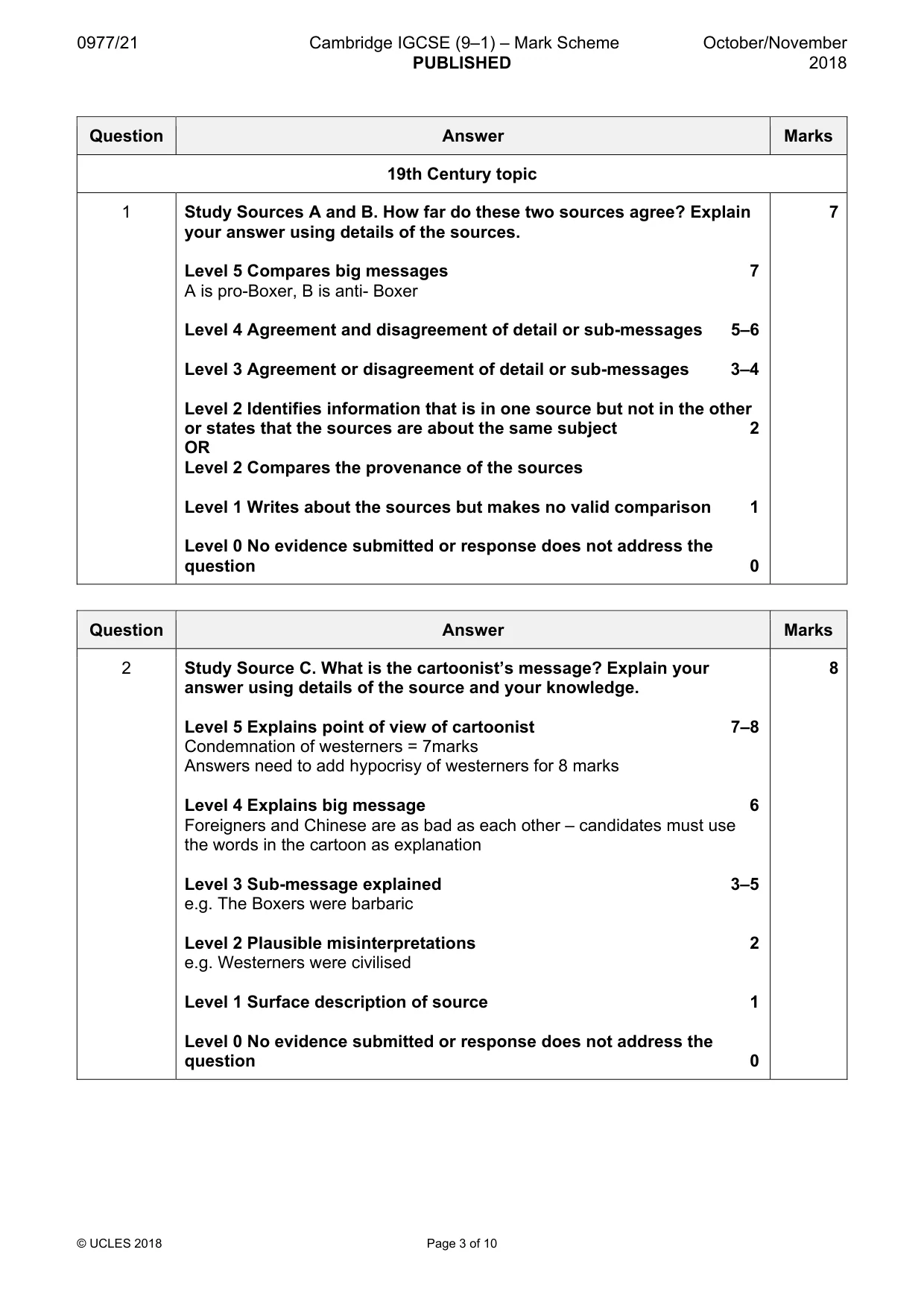
0977/21 Cambridge IGCSE (9–1) – Mark Scheme PUBLISHED October/November 2018 © UCLES 2018 Page 2 of 10 Generic Marking Principles These general marking principles must be applied by all examiners when marking candidate answers. They should be applied alongside the specific content of the mark scheme or generic level descriptors for a question. Each question paper and mark scheme will also comply with these marking principles. GENERIC MARKING PRINCIPLE 1: Marks must be awarded in line with: • the specific content of the mark scheme or the generic level descriptors for the question • the specific skills defined in the mark scheme or in the generic level descriptors for the question • the standard of response required by a candidate as exemplified by the standardisation scripts. GENERIC MARKING PRINCIPLE 2: Marks awarded are always whole marks (not half marks, or other fractions). GENERIC MARKING PRINCIPLE 3: Marks must be awarded positively: • marks are awarded for correct/valid answers, as defined in the mark scheme. However, credit is given for valid answers which go beyond the scope of the syllabus and mark scheme, referring to your Team Leader as appropriate • marks are awarded when candidates clearly demonstrate what they know and can do • marks are not deducted for errors • marks are not deducted for omissions • answers should only be judged on the quality of spelling, punctuation and grammar when these features are specifically assessed by the question as indicated by the mark scheme. The meaning, however, should be unambiguous. GENERIC MARKING PRINCIPLE 4: Rules must be applied consistently e.g. in situations where candidates have not followed instructions or in the application of generic level descriptors. GENERIC MARKING PRINCIPLE 5: Marks should be awarded using the full range of marks defined in the mark scheme for the question (however; the use of the full mark range may be limited according to the quality of the candidate responses seen). GENERIC MARKING PRINCIPLE 6: Marks awarded are based solely on the requirements as defined in the mark scheme. Marks should not be awarded with grade thresholds or grade descriptors in mind.
Mark scheme, page 3
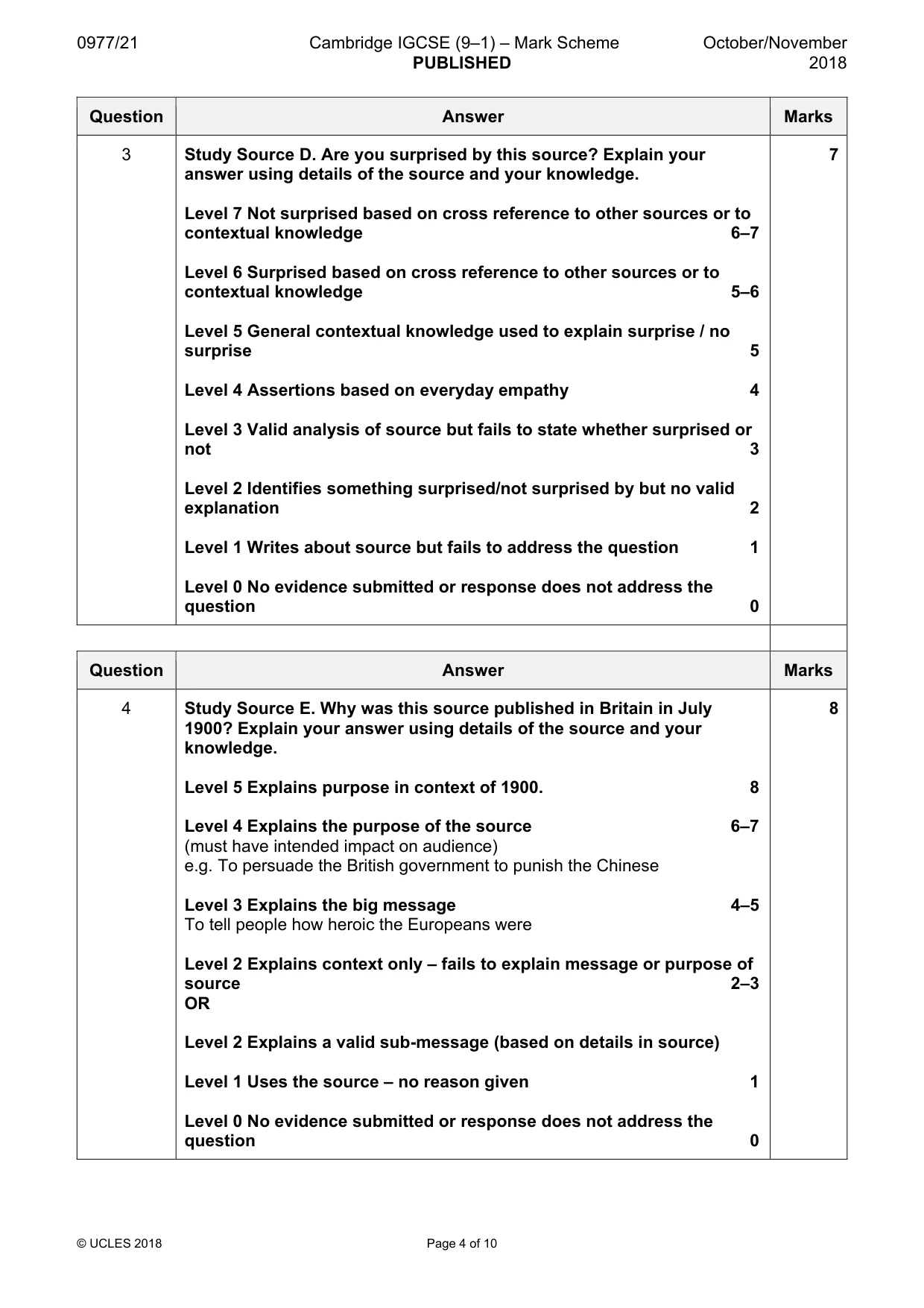
0977/21 Cambridge IGCSE (9–1) – Mark Scheme PUBLISHED October/November 2018 © UCLES 2018 Page 3 of 10 Question Answer Marks 19th Century topic 1 Study Sources A and B. How far do these two sources agree? Explain your answer using details of the sources. Level 5 Compares big messages 7 A is pro-Boxer, B is anti- Boxer Level 4 Agreement and disagreement of detail or sub-messages 5–6 Level 3 Agreement or disagreement of detail or sub-messages 3–4 Level 2 Identifies information that is in one source but not in the other or states that the sources are about the same subject 2 OR Level 2 Compares the provenance of the sources Level 1 Writes about the sources but makes no valid comparison 1 Level 0 No evidence submitted or response does not address the question 0 7 Question Answer Marks 2 Study Source C. What is the cartoonist’s message? Explain your answer using details of the source and your knowledge. Level 5 Explains point of view of cartoonist 7–8 Condemnation of westerners = 7marks Answers need to add hypocrisy of westerners for 8 marks Level 4 Explains big message 6 Foreigners and Chinese are as bad as each other – candidates must use the words in the cartoon as explanation Level 3 Sub-message explained 3–5 e.g. The Boxers were barbaric Level 2 Plausible misinterpretations 2 e.g. Westerners were civilised Level 1 Surface description of source 1 Level 0 No evidence submitted or response does not address the question 0 8
Mark scheme, page 4
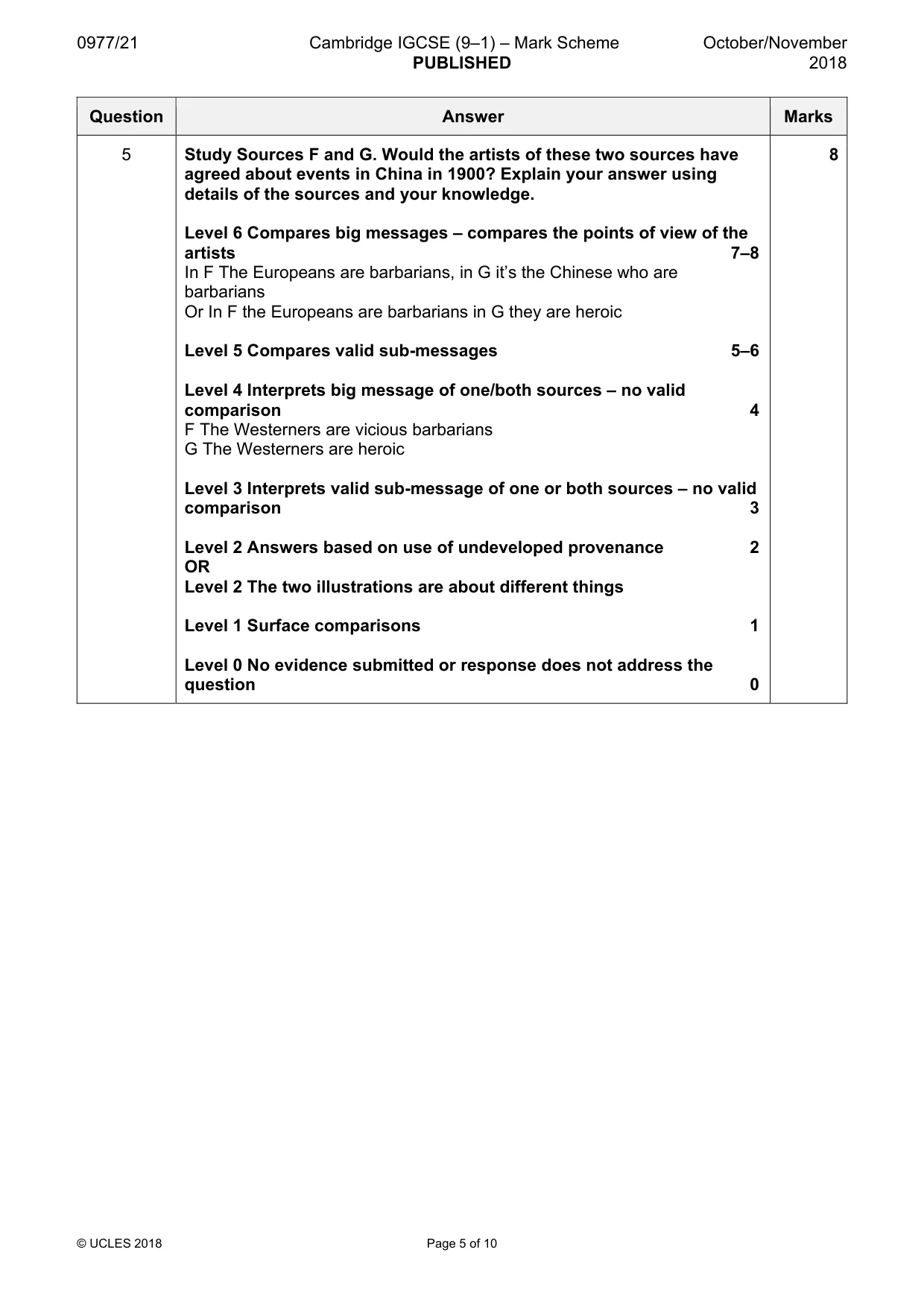
0977/21 Cambridge IGCSE (9–1) – Mark Scheme PUBLISHED October/November 2018 © UCLES 2018 Page 4 of 10 Question Answer Marks 3 Study Source D. Are you surprised by this source? Explain your answer using details of the source and your knowledge. Level 7 Not surprised based on cross reference to other sources or to contextual knowledge 6–7 Level 6 Surprised based on cross reference to other sources or to contextual knowledge 5–6 Level 5 General contextual knowledge used to explain surprise / no surprise 5 Level 4 Assertions based on everyday empathy 4 Level 3 Valid analysis of source but fails to state whether surprised or not 3 Level 2 Identifies something surprised/not surprised by but no valid explanation 2 Level 1 Writes about source but fails to address the question 1 Level 0 No evidence submitted or response does not address the question 0 7 Question Answer Marks 4 Study Source E. Why was this source published in Britain in July 1900? Explain your answer using details of the source and your knowledge. Level 5 Explains purpose in context of 1900. 8 Level 4 Explains the purpose of the source 6–7 (must have intended impact on audience) e.g. To persuade the British government to punish the Chinese Level 3 Explains the big message 4–5 To tell people how heroic the Europeans were Level 2 Explains context only – fails to explain message or purpose of source 2–3 OR Level 2 Explains a valid sub-message (based on details in source) Level 1 Uses the source – no reason given 1 Level 0 No evidence submitted or response does not address the question 0 8
Mark scheme, page 5
0977/21 Cambridge IGCSE (9–1) – Mark Scheme PUBLISHED October/November 2018 © UCLES 2018 Page 5 of 10 Question Answer Marks 5 Study Sources F and G. Would the artists of these two sources have agreed about events in China in 1900? Explain your answer using details of the sources and your knowledge. Level 6 Compares big messages – compares the points of view of the artists 7–8 In F The Europeans are barbarians, in G it’s the Chinese who are barbarians Or In F the Europeans are barbarians in G they are heroic Level 5 Compares valid sub-messages 5–6 Level 4 Interprets big message of one/both sources – no valid comparison 4 F The Westerners are vicious barbarians G The Westerners are heroic Level 3 Interprets valid sub-message of one or both sources – no valid comparison 3 Level 2 Answers based on use of undeveloped provenance 2 OR Level 2 The two illustrations are about different things Level 1 Surface comparisons 1 Level 0 No evidence submitted or response does not address the question 0 8
Mark scheme, page 6
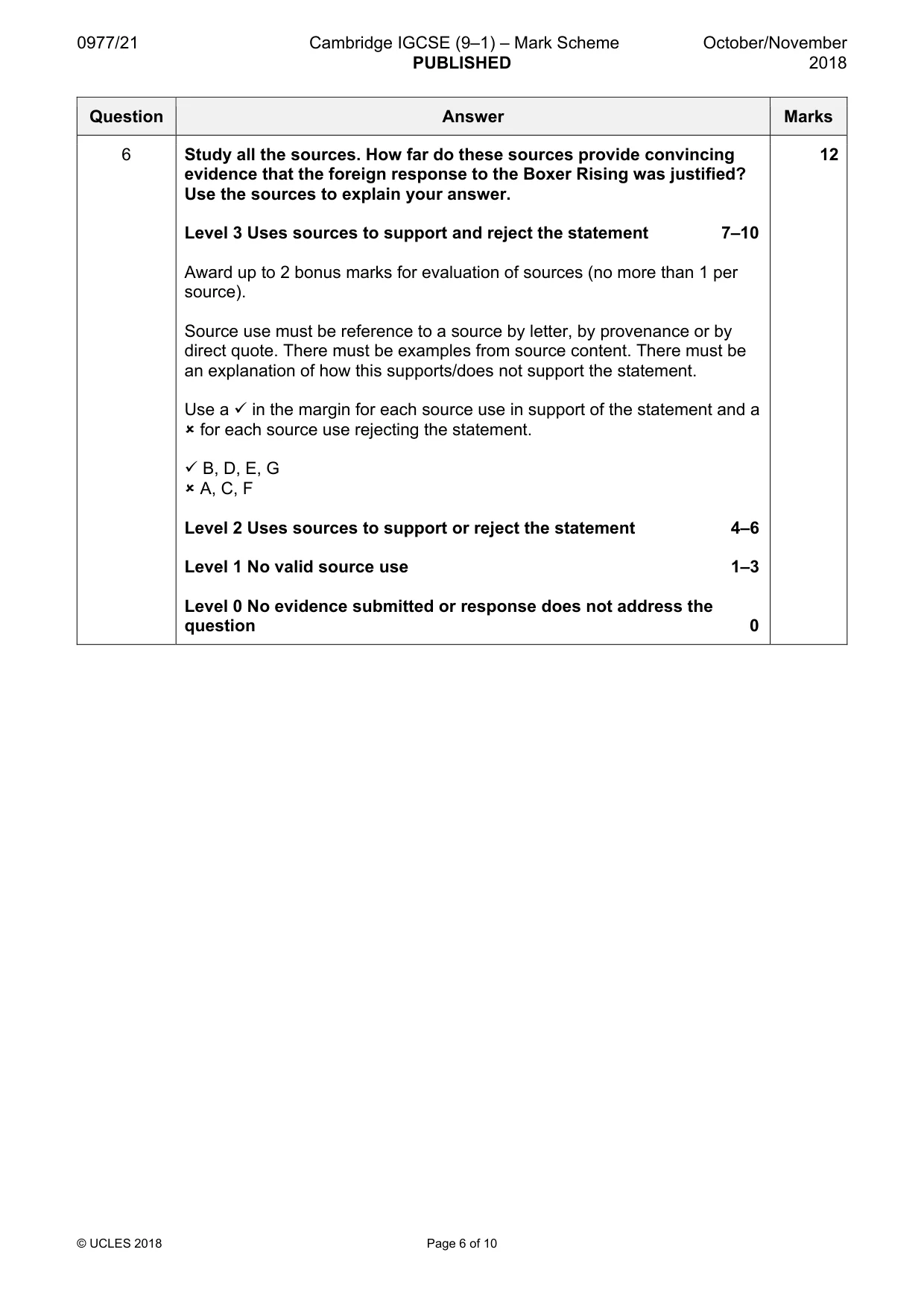
0977/21 Cambridge IGCSE (9–1) – Mark Scheme PUBLISHED October/November 2018 © UCLES 2018 Page 6 of 10 Question Answer Marks 6 Study all the sources. How far do these sources provide convincing evidence that the foreign response to the Boxer Rising was justified? Use the sources to explain your answer. Level 3 Uses sources to support and reject the statement 7–10 Award up to 2 bonus marks for evaluation of sources (no more than 1 per source). Source use must be reference to a source by letter, by provenance or by direct quote. There must be examples from source content. There must be an explanation of how this supports/does not support the statement. Use a 9 in the margin for each source use in support of the statement and a 8 for each source use rejecting the statement. 9 B, D, E, G 8 A, C, F Level 2 Uses sources to support or reject the statement 4–6 Level 1 No valid source use 1–3 Level 0 No evidence submitted or response does not address the question 0 12
Mark scheme, page 7
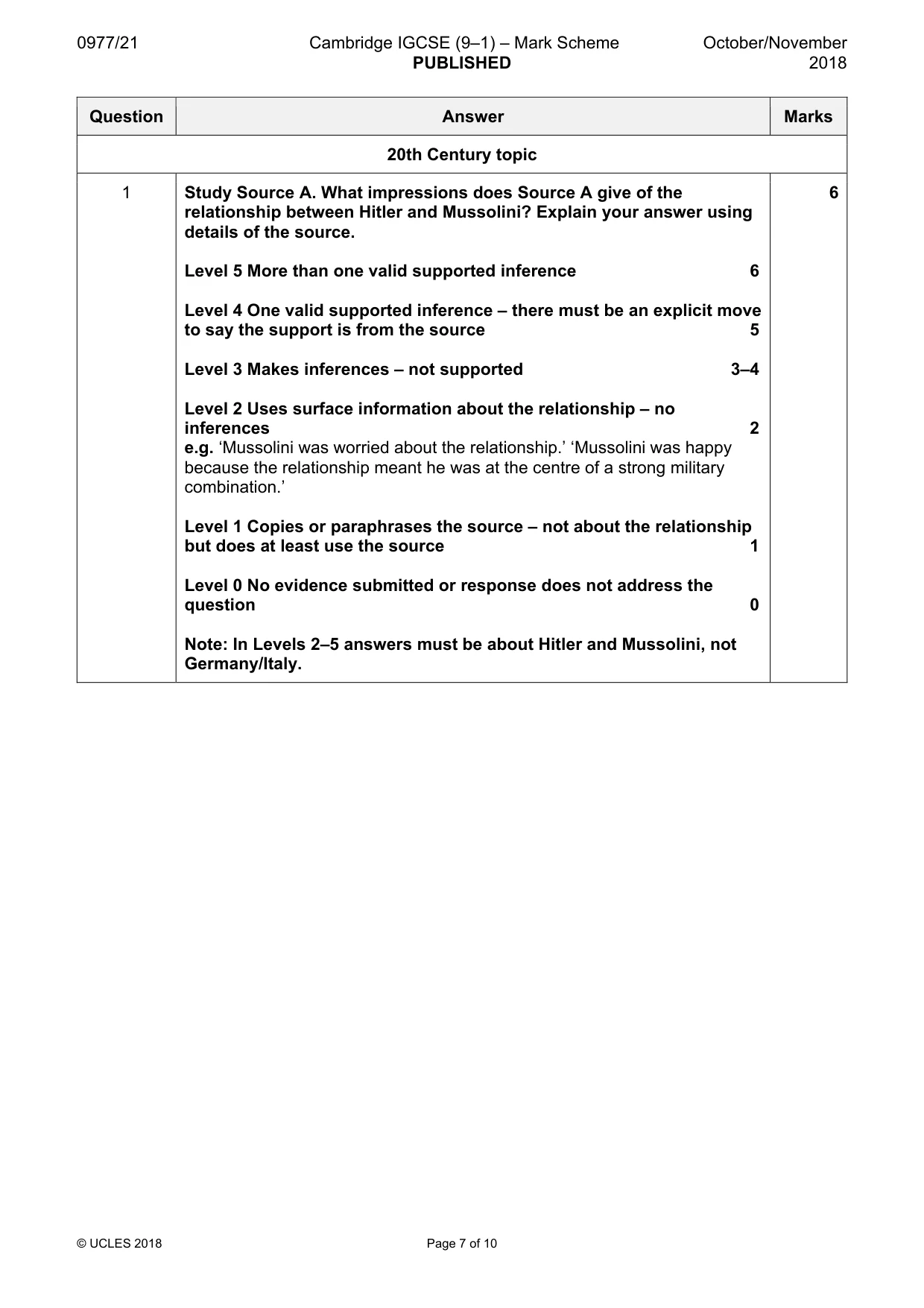
0977/21 Cambridge IGCSE (9–1) – Mark Scheme PUBLISHED October/November 2018 © UCLES 2018 Page 7 of 10 Question Answer Marks 20th Century topic 1 Study Source A. What impressions does Source A give of the relationship between Hitler and Mussolini? Explain your answer using details of the source. Level 5 More than one valid supported inference 6 Level 4 One valid supported inference – there must be an explicit move to say the support is from the source 5 Level 3 Makes inferences – not supported 3–4 Level 2 Uses surface information about the relationship – no inferences 2 e.g. ‘Mussolini was worried about the relationship.’ ‘Mussolini was happy because the relationship meant he was at the centre of a strong military combination.’ Level 1 Copies or paraphrases the source – not about the relationship but does at least use the source 1 Level 0 No evidence submitted or response does not address the question 0 Note: In Levels 2–5 answers must be about Hitler and Mussolini, not Germany/Italy. 6
Mark scheme, page 8
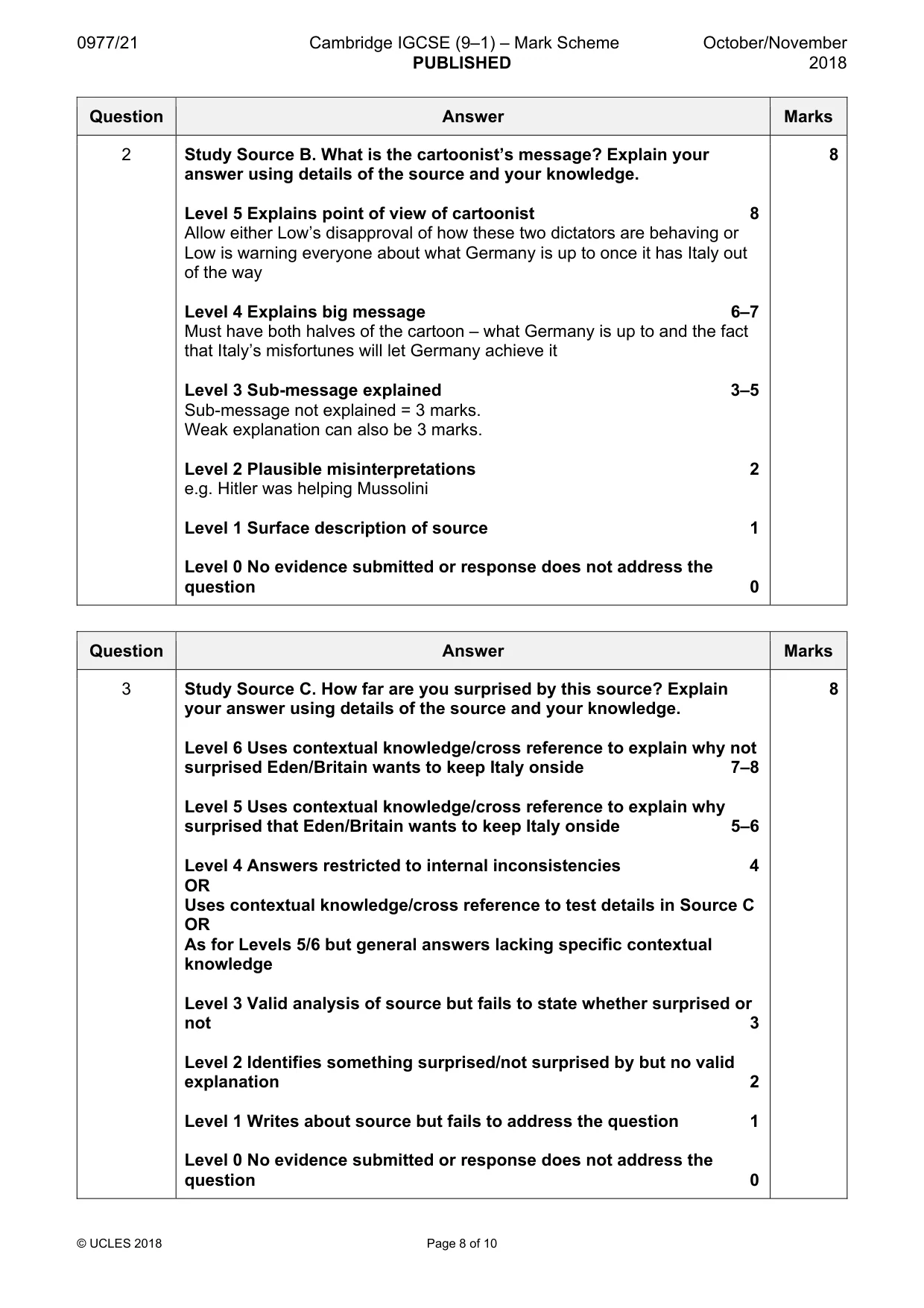
0977/21 Cambridge IGCSE (9–1) – Mark Scheme PUBLISHED October/November 2018 © UCLES 2018 Page 8 of 10 Question Answer Marks 2 Study Source B. What is the cartoonist’s message? Explain your answer using details of the source and your knowledge. Level 5 Explains point of view of cartoonist 8 Allow either Low’s disapproval of how these two dictators are behaving or Low is warning everyone about what Germany is up to once it has Italy out of the way Level 4 Explains big message 6–7 Must have both halves of the cartoon – what Germany is up to and the fact that Italy’s misfortunes will let Germany achieve it Level 3 Sub-message explained 3–5 Sub-message not explained = 3 marks. Weak explanation can also be 3 marks. Level 2 Plausible misinterpretations 2 e.g. Hitler was helping Mussolini Level 1 Surface description of source 1 Level 0 No evidence submitted or response does not address the question 0 8 Question Answer Marks 3 Study Source C. How far are you surprised by this source? Explain your answer using details of the source and your knowledge. Level 6 Uses contextual knowledge/cross reference to explain why not surprised Eden/Britain wants to keep Italy onside 7–8 Level 5 Uses contextual knowledge/cross reference to explain why surprised that Eden/Britain wants to keep Italy onside 5–6 Level 4 Answers restricted to internal inconsistencies 4 OR Uses contextual knowledge/cross reference to test details in Source C OR As for Levels 5/6 but general answers lacking specific contextual knowledge Level 3 Valid analysis of source but fails to state whether surprised or not 3 Level 2 Identifies something surprised/not surprised by but no valid explanation 2 Level 1 Writes about source but fails to address the question 1 Level 0 No evidence submitted or response does not address the question 0 8
Mark scheme, page 9
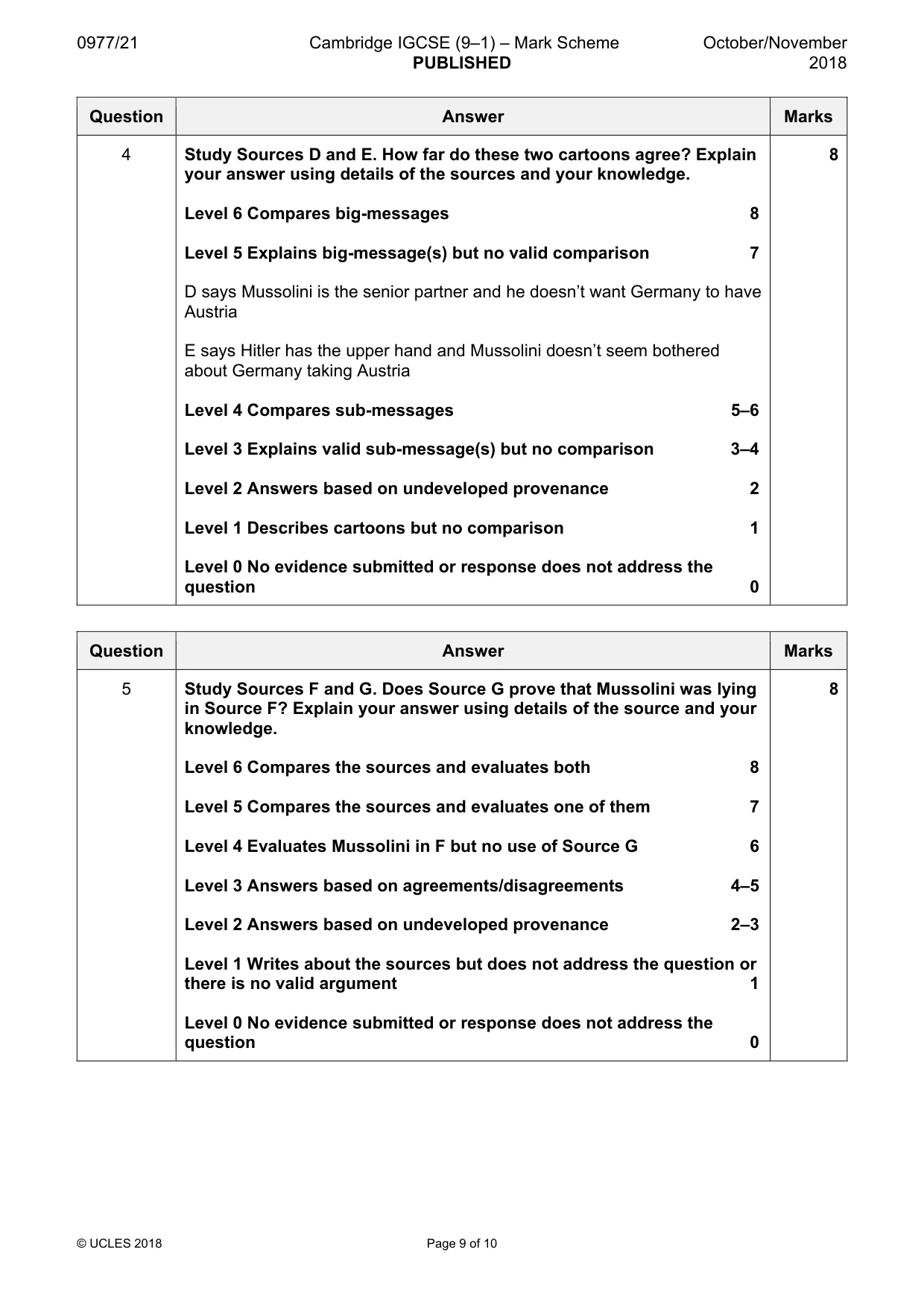
0977/21 Cambridge IGCSE (9–1) – Mark Scheme PUBLISHED October/November 2018 © UCLES 2018 Page 9 of 10 Question Answer Marks 4 Study Sources D and E. How far do these two cartoons agree? Explain your answer using details of the sources and your knowledge. Level 6 Compares big-messages 8 Level 5 Explains big-message(s) but no valid comparison 7 D says Mussolini is the senior partner and he doesn’t want Germany to have Austria E says Hitler has the upper hand and Mussolini doesn’t seem bothered about Germany taking Austria Level 4 Compares sub-messages 5–6 Level 3 Explains valid sub-message(s) but no comparison 3–4 Level 2 Answers based on undeveloped provenance 2 Level 1 Describes cartoons but no comparison 1 Level 0 No evidence submitted or response does not address the question 0 8 Question Answer Marks 5 Study Sources F and G. Does Source G prove that Mussolini was lying in Source F? Explain your answer using details of the source and your knowledge. Level 6 Compares the sources and evaluates both 8 Level 5 Compares the sources and evaluates one of them 7 Level 4 Evaluates Mussolini in F but no use of Source G 6 Level 3 Answers based on agreements/disagreements 4–5 Level 2 Answers based on undeveloped provenance 2–3 Level 1 Writes about the sources but does not address the question or there is no valid argument 1 Level 0 No evidence submitted or response does not address the question 0 8
Mark scheme, page 10
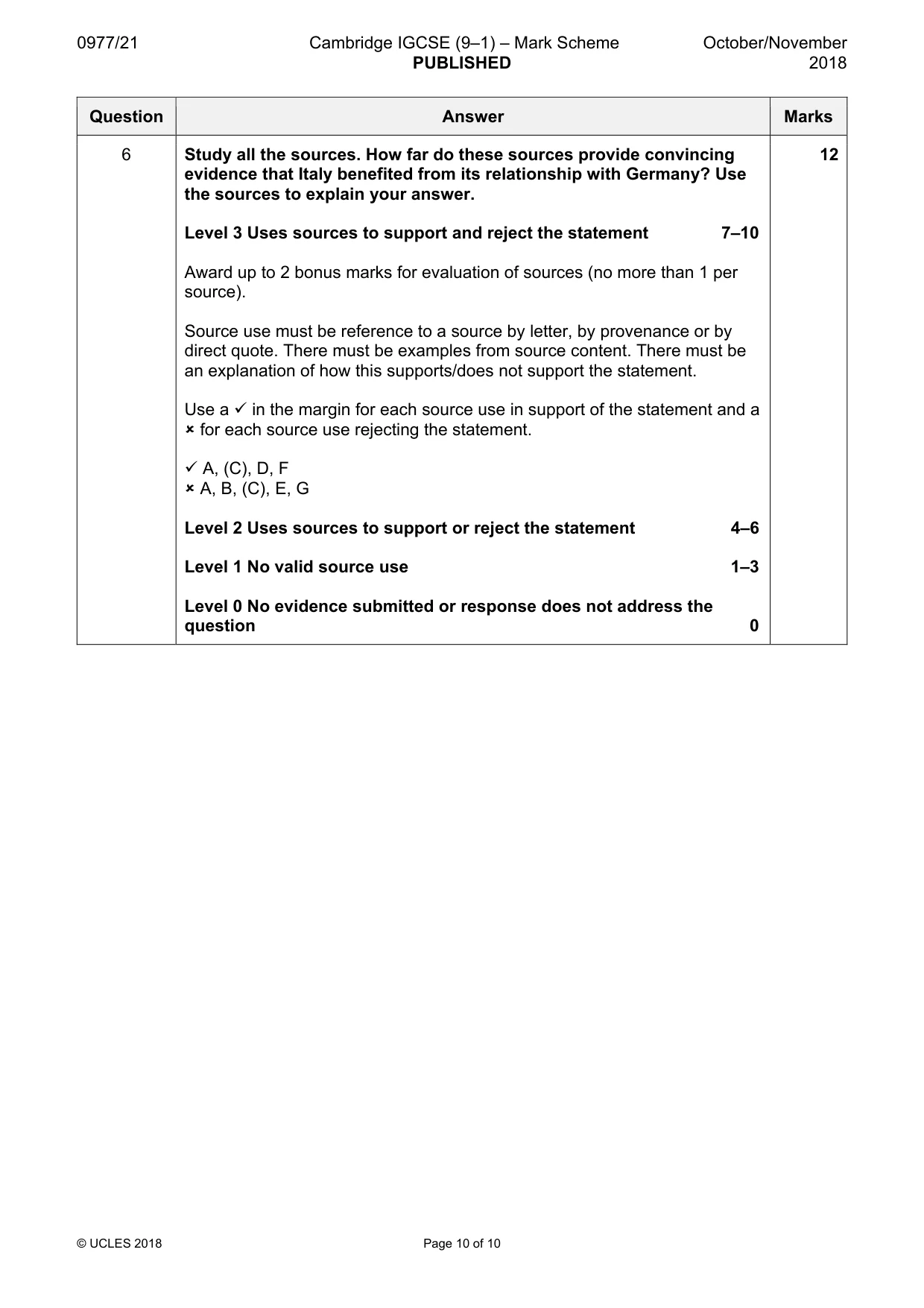
0977/21 Cambridge IGCSE (9–1) – Mark Scheme PUBLISHED October/November 2018 © UCLES 2018 Page 10 of 10 Question Answer Marks 6 Study all the sources. How far do these sources provide convincing evidence that Italy benefited from its relationship with Germany? Use the sources to explain your answer. Level 3 Uses sources to support and reject the statement 7–10 Award up to 2 bonus marks for evaluation of sources (no more than 1 per source). Source use must be reference to a source by letter, by provenance or by direct quote. There must be examples from source content. There must be an explanation of how this supports/does not support the statement. Use a 9 in the margin for each source use in support of the statement and a 8 for each source use rejecting the statement. 9 A, (C), D, F 8 A, B, (C), E, G Level 2 Uses sources to support or reject the statement 4–6 Level 1 No valid source use 1–3 Level 0 No evidence submitted or response does not address the question 0 12
What you needed in this session
Cambridge’s own grade thresholds for 2018 Oct/Nov, Paper 2 · Variant 1. A higher threshold means an easier paper — the bar moves with how the cohort did.