Cambridge IGCSE Global Perspectives 0457 — 2015 Oct/Nov Paper 3 · Variant 2
0457/32/O/N/15 · 60 marks · ≈68 min
The question paper and its mark scheme, free to read here and free to download. This is Cambridge’s own paper, exactly as it was sat.
Question paper8 pages




Mark scheme13 pages
Answers below. Sit the paper first if you are practising.

Paper as text
Question paper, page 1
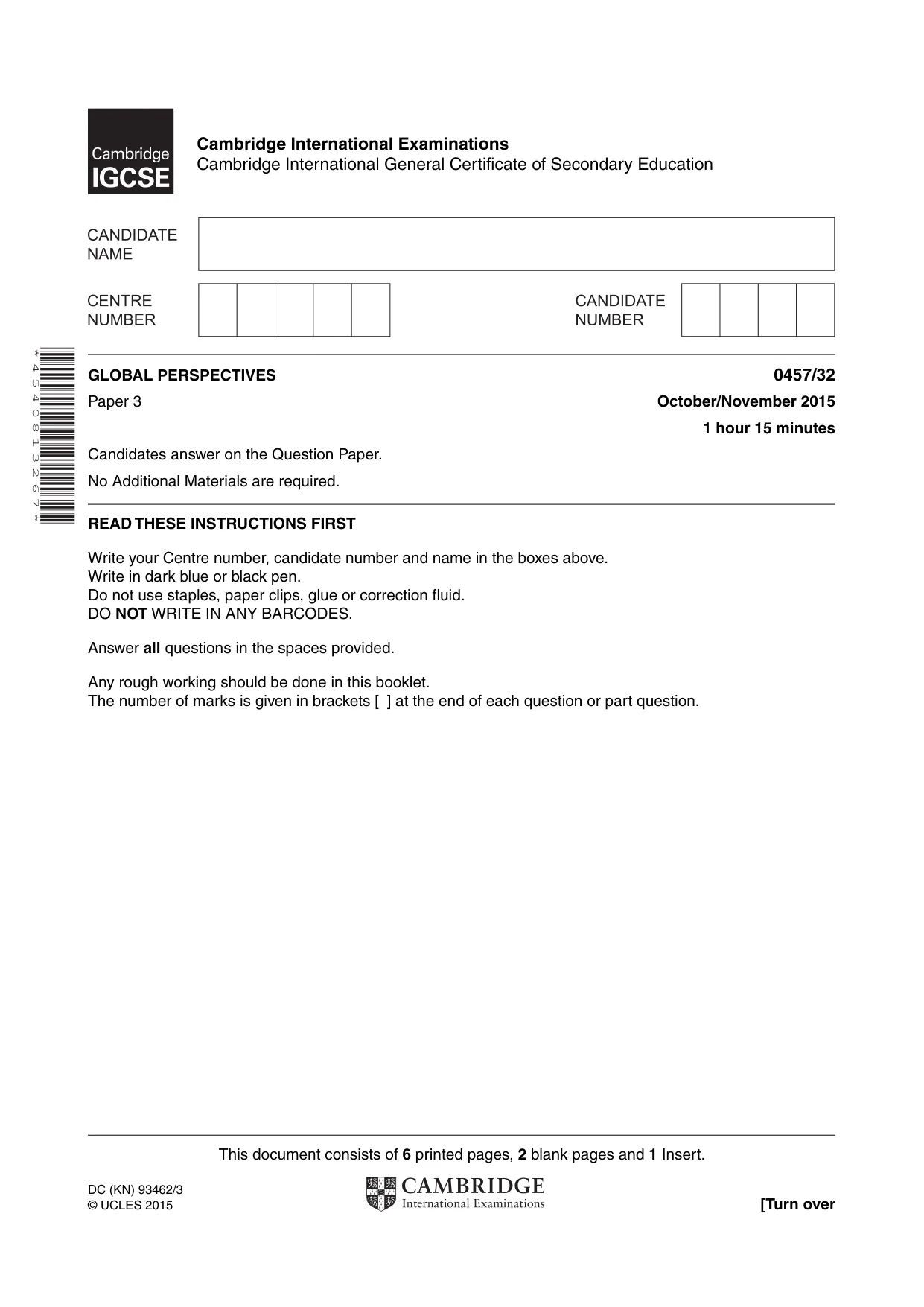
This document consists of 6 printed pages, 2 blank pages and 1 Insert. DC (KN) 93462/3 © UCLES 2015 [Turn over Cambridge International Examinations Cambridge International General Certificate of Secondary Education * 4 5 4 0 8 1 3 2 6 7 * GLOBAL PERSPECTIVES 0457/32 Paper 3 October/November 2015 1 hour 15 minutes Candidates answer on the Question Paper. No Additional Materials are required. READ THESE INSTRUCTIONS FIRST Write your Centre number, candidate number and name in the boxes above. Write in dark blue or black pen. Do not use staples, paper clips, glue or correction fluid. DO NOT WRITE IN ANY BARCODES. Answer all questions in the spaces provided. Any rough working should be done in this booklet. The number of marks is given in brackets [ ] at the end of each question or part question.
Question paper, page 2
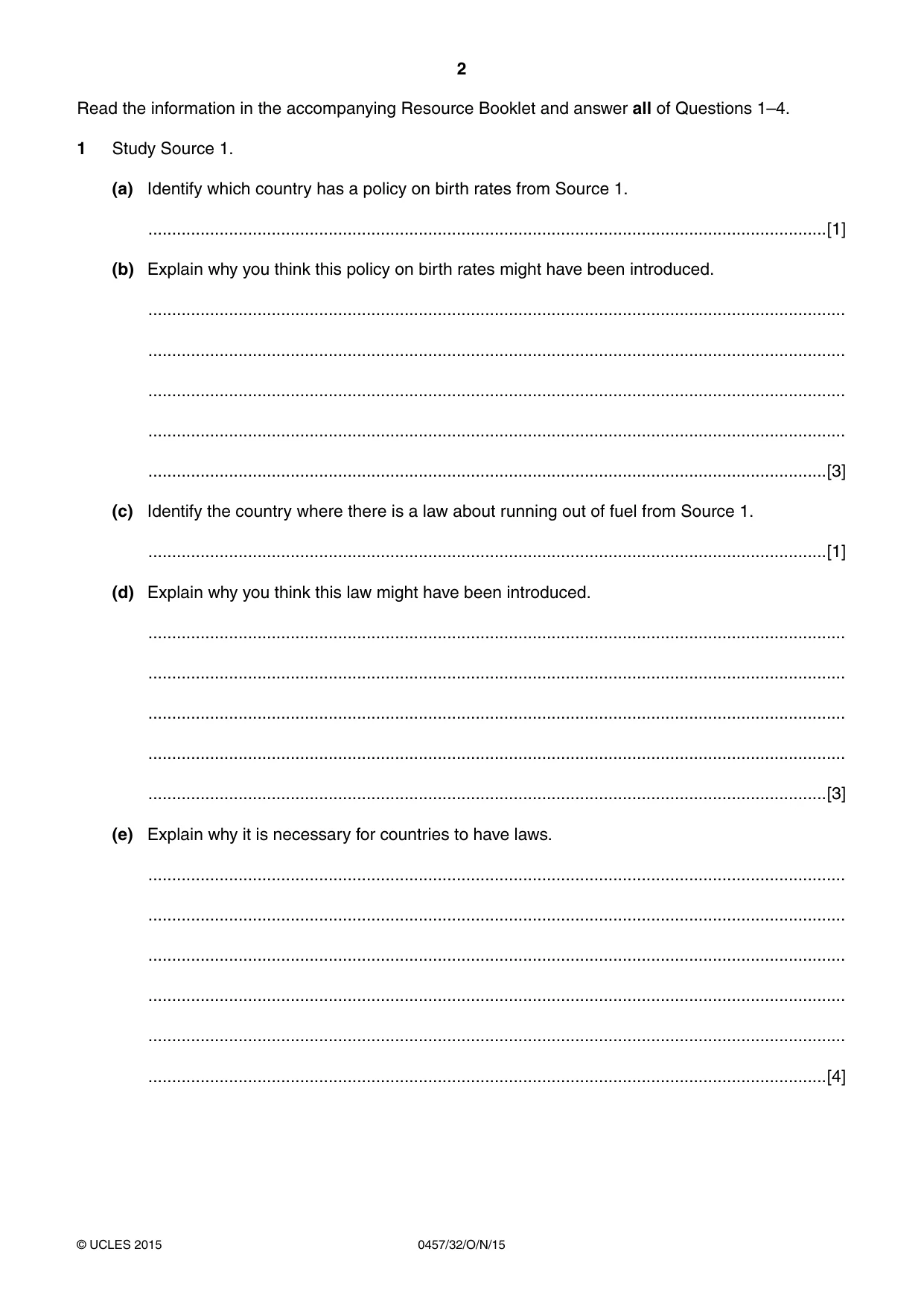
2 0457/32/O/N/15 © UCLES 2015 Read the information in the accompanying Resource Booklet and answer all of Questions 1–4. 1 Study Source 1. (a) Identify which country has a policy on birth rates from Source 1. …[1] (b) Explain why you think this policy on birth rates might have been introduced. … … … … …[3] (c) Identify the country where there is a law about running out of fuel from Source 1. …[1] (d) Explain why you think this law might have been introduced. … … … … …[3] (e) Explain why it is necessary for countries to have laws. … … … … … …[4]
Question paper, page 3
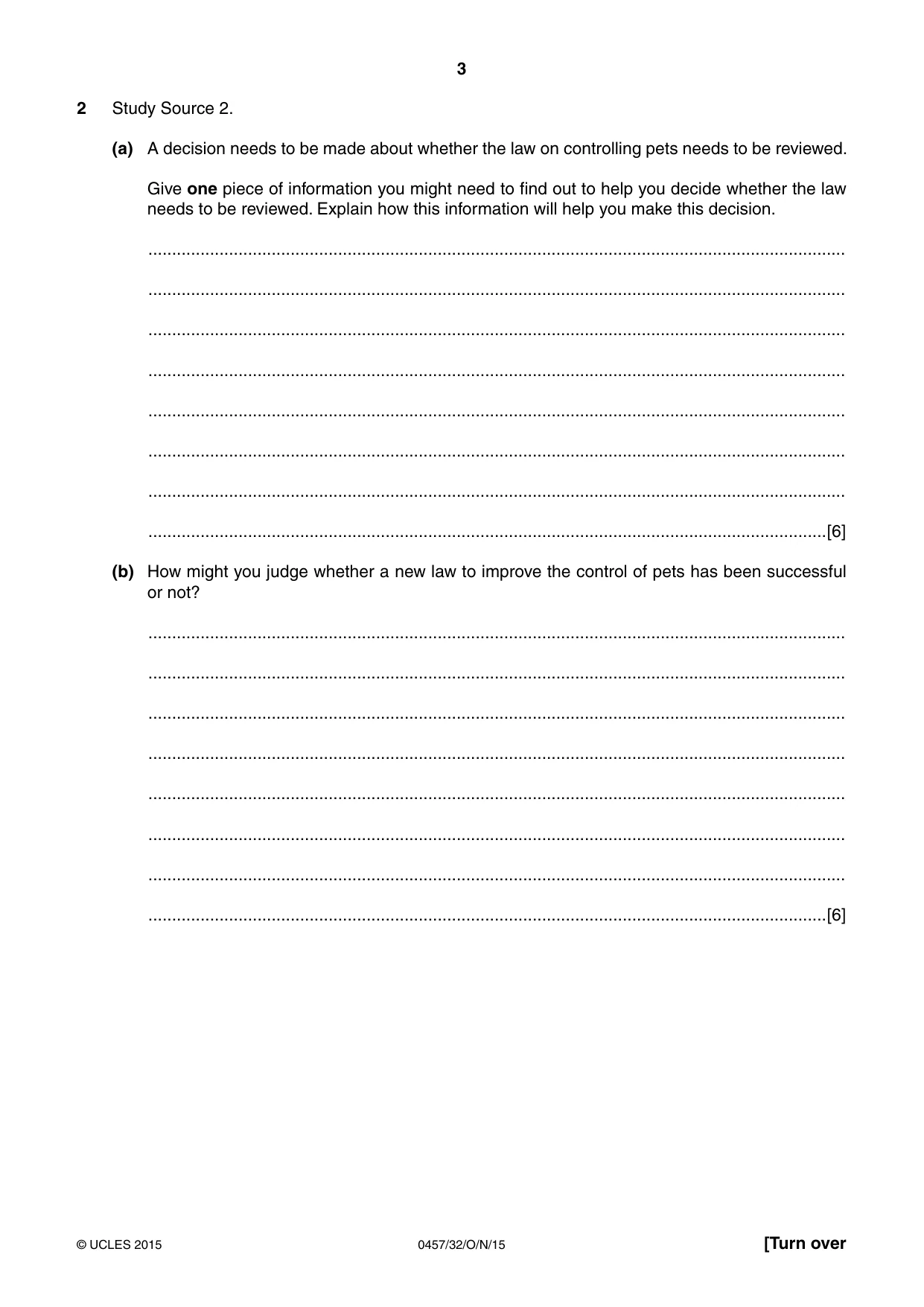
3 0457/32/O/N/15 © UCLES 2015 [Turn over 2 Study Source 2. (a) A decision needs to be made about whether the law on controlling pets needs to be reviewed. Give one piece of information you might need to find out to help you decide whether the law needs to be reviewed. Explain how this information will help you make this decision. … … … … … … … …[6] (b) How might you judge whether a new law to improve the control of pets has been successful or not? … … … … … … … …[6]
Question paper, page 4
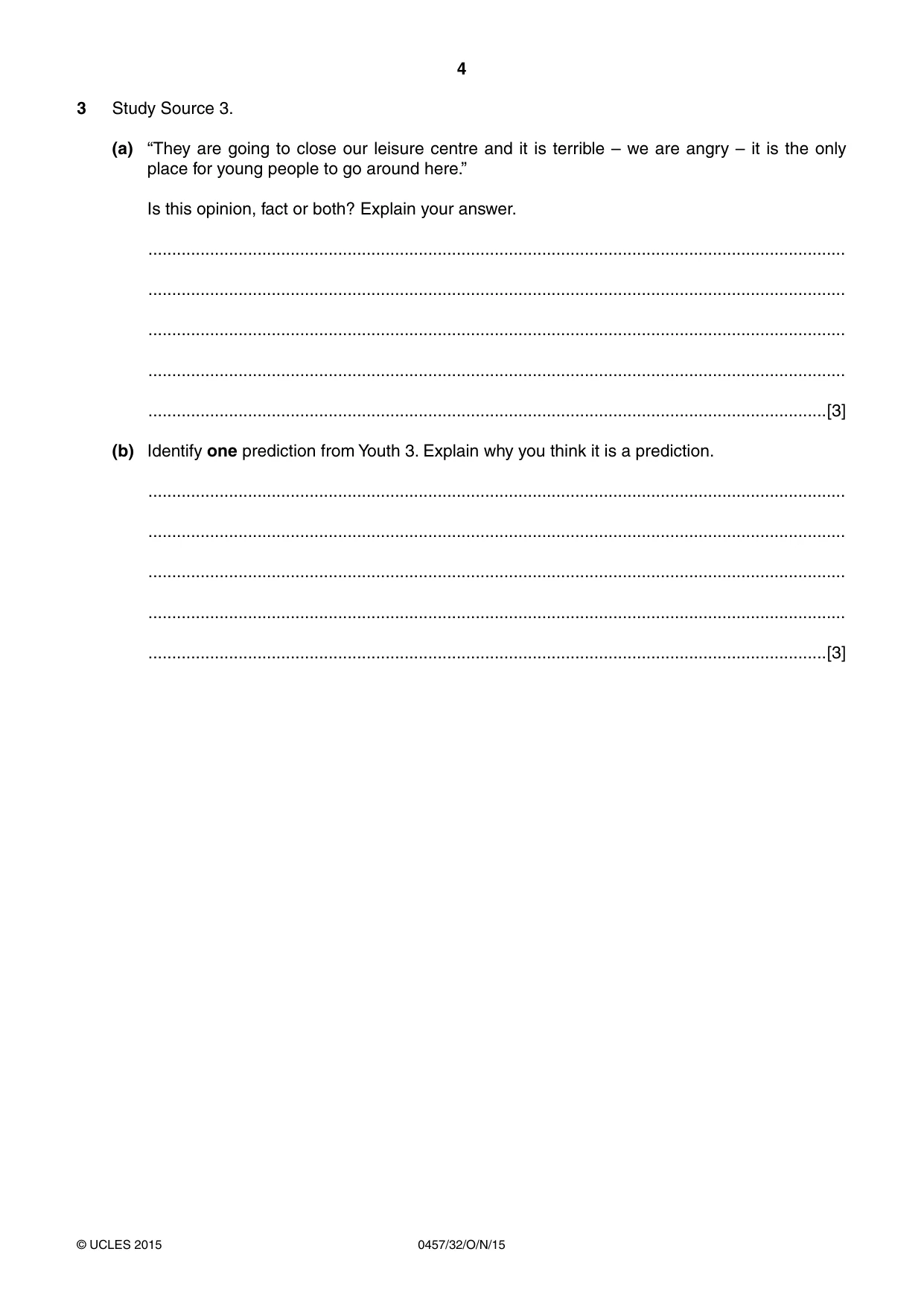
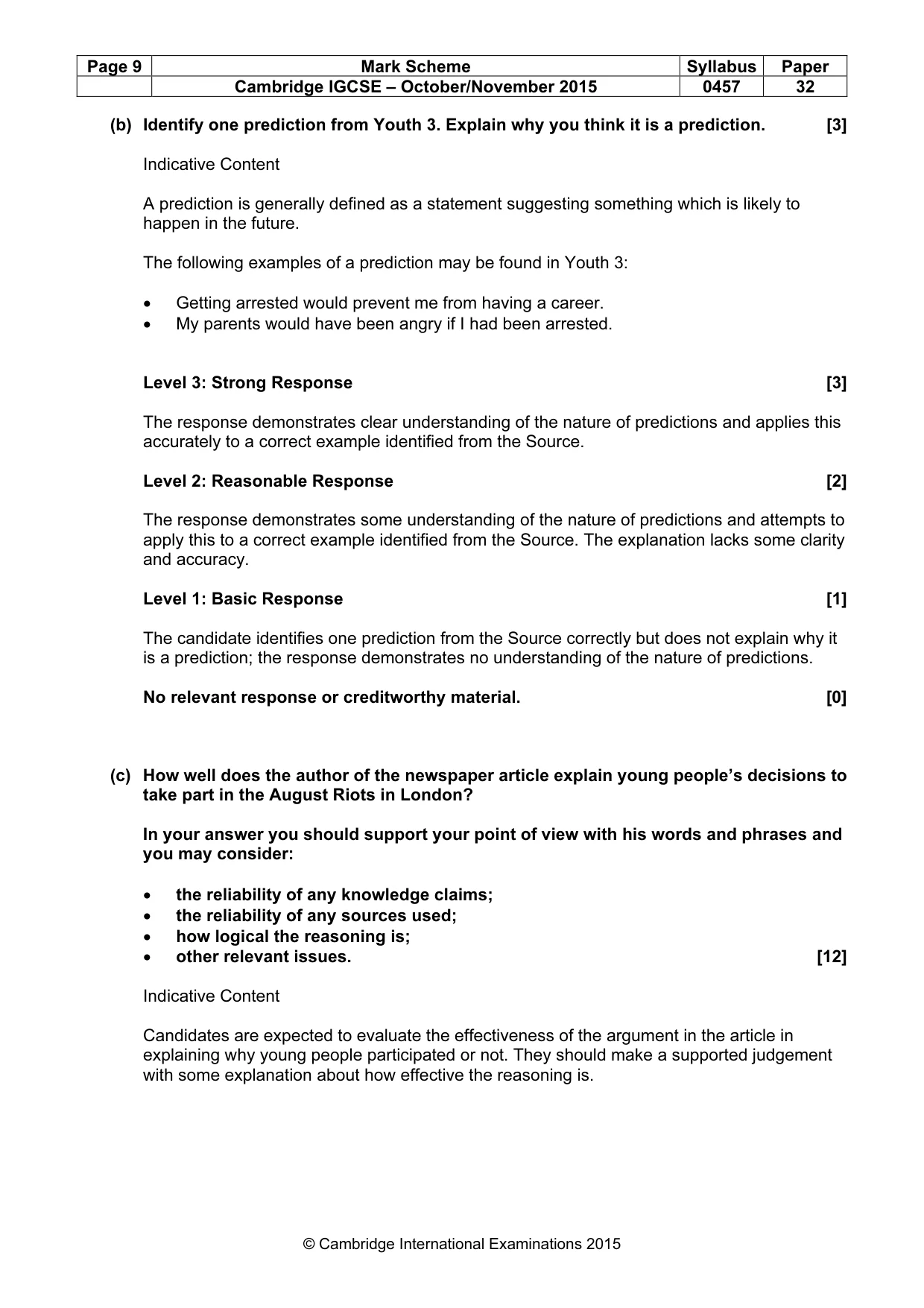
4 0457/32/O/N/15 © UCLES 2015 3 Study Source 3. (a) “They are going to close our leisure centre and it is terrible – we are angry – it is the only place for young people to go around here.” Is this opinion, fact or both? Explain your answer. … … … … …[3] (b) Identify one prediction from Youth 3. Explain why you think it is a prediction. … … … … …[3]
Question paper, page 5
5 0457/32/O/N/15 © UCLES 2015 [Turn over (c) How well does the author of the newspaper article explain young people’s decisions to take part in the August riots in London? In your answer you should support your point of view with his words and phrases and you may consider: • the reliability of any knowledge claims; • the reliability of any sources used; • how logical the reasoning is; • other relevant issues. … … … … … … … … … … … … … … …[12]
Question paper, page 6
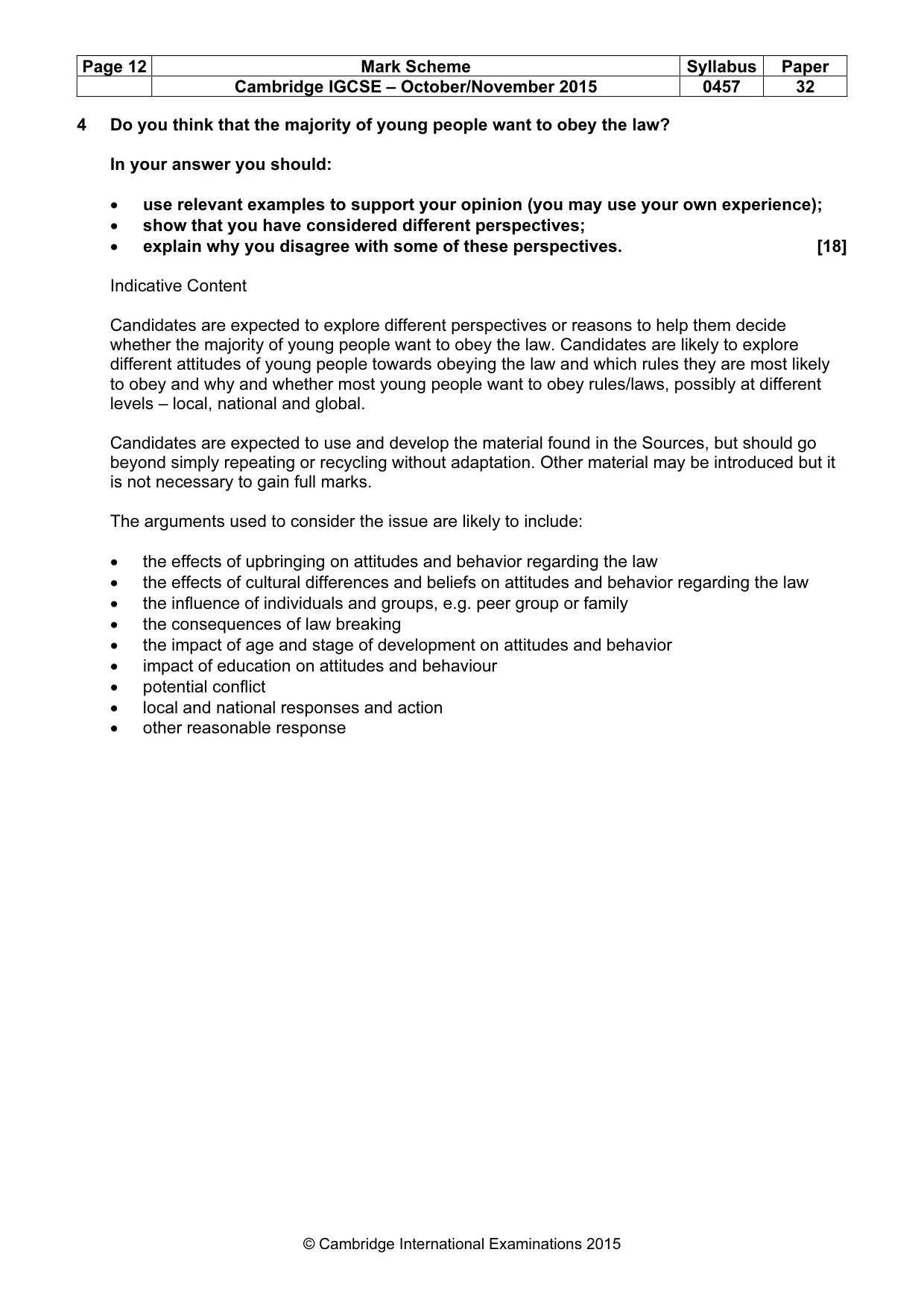
6 0457/32/O/N/15 © UCLES 2015 4 Do you think that the majority of young people want to obey the law? In your answer you should: • use relevant examples to support your opinion (you may use your own experience); • show that you have considered different perspectives; • explain why you disagree with some of these perspectives. … … … … … … … … … … … … … … … … … … … … … … … … …[18]
Question paper, page 7
7 0457/32/O/N/15 © UCLES 2015 BLANK PAGE
Question paper, page 8
8 0457/32/O/N/15 © UCLES 2015 Permission to reproduce items where third-party owned material protected by copyright is included has been sought and cleared where possible. Every reasonable effort has been made by the publisher (UCLES) to trace copyright holders, but if any items requiring clearance have unwittingly been included, the publisher will be pleased to make amends at the earliest possible opportunity. To avoid the issue of disclosure of answer-related information to candidates, all copyright acknowledgements are reproduced online in the Cambridge International Examinations Copyright Acknowledgements Booklet. This is produced for each series of examinations and is freely available to download at www.cie.org.uk after the live examination series. Cambridge International Examinations is part of the Cambridge Assessment Group. Cambridge Assessment is the brand name of University of Cambridge Local Examinations Syndicate (UCLES), which is itself a department of the University of Cambridge. BLANK PAGE
Mark scheme, page 1
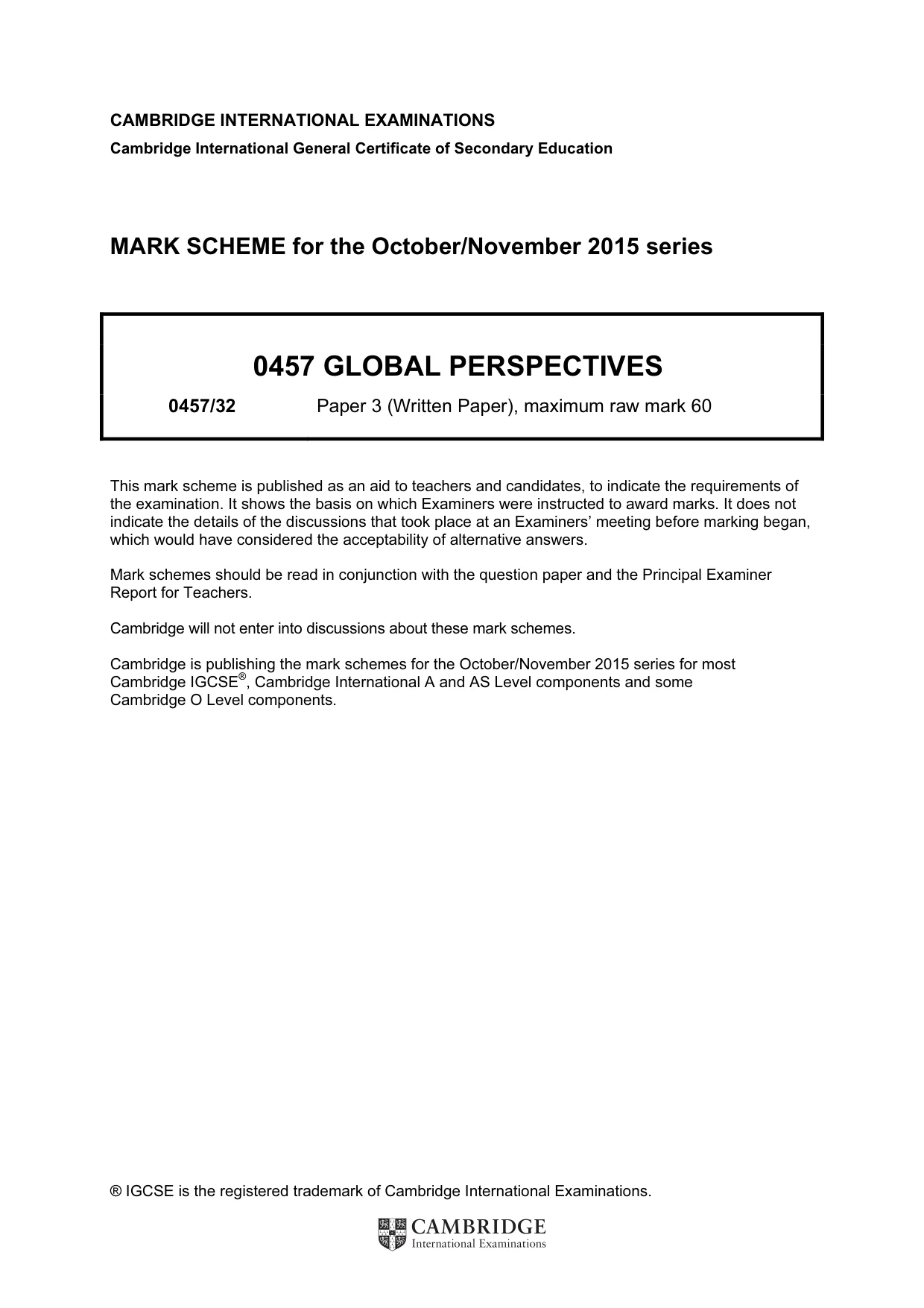
® IGCSE is the registered trademark of Cambridge International Examinations. CAMBRIDGE INTERNATIONAL EXAMINATIONS Cambridge International General Certificate of Secondary Education MARK SCHEME for the October/November 2015 series 0457 GLOBAL PERSPECTIVES 0457/32 Paper 3 (Written Paper), maximum raw mark 60 This mark scheme is published as an aid to teachers and candidates, to indicate the requirements of the examination. It shows the basis on which Examiners were instructed to award marks. It does not indicate the details of the discussions that took place at an Examiners’ meeting before marking began, which would have considered the acceptability of alternative answers. Mark schemes should be read in conjunction with the question paper and the Principal Examiner Report for Teachers. Cambridge will not enter into discussions about these mark schemes. Cambridge is publishing the mark schemes for the October/November 2015 series for most Cambridge IGCSE®, Cambridge International A and AS Level components and some Cambridge O Level components.
Mark scheme, page 2
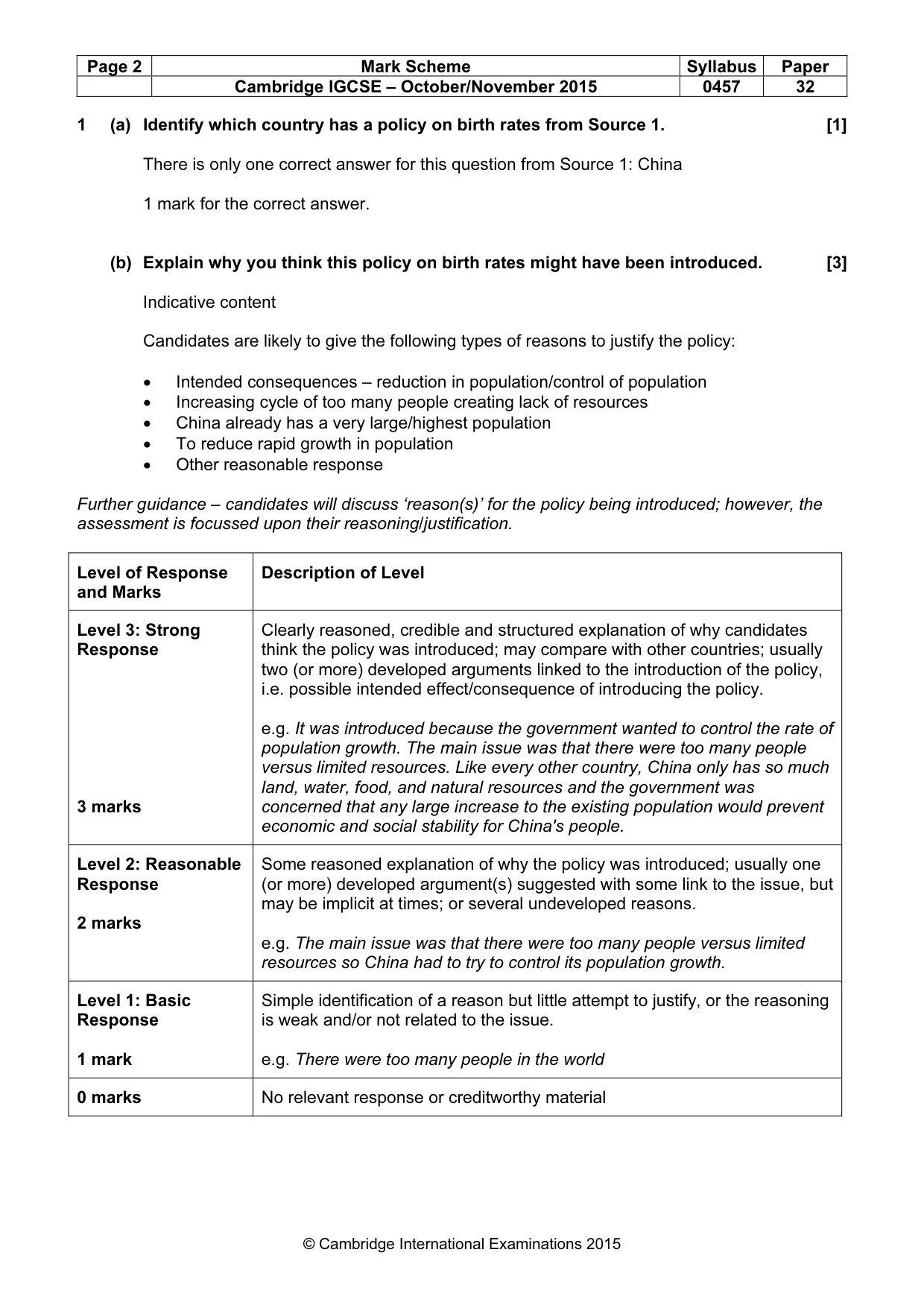
Page 2 Mark Scheme Syllabus Paper Cambridge IGCSE – October/November 2015 0457 32 © Cambridge International Examinations 2015 1 (a) Identify which country has a policy on birth rates from Source 1. [1] There is only one correct answer for this question from Source 1: China 1 mark for the correct answer. (b) Explain why you think this policy on birth rates might have been introduced. [3] Indicative content Candidates are likely to give the following types of reasons to justify the policy: • Intended consequences – reduction in population/control of population • Increasing cycle of too many people creating lack of resources • China already has a very large/highest population • To reduce rapid growth in population • Other reasonable response Further guidance – candidates will discuss ‘reason(s)’ for the policy being introduced; however, the assessment is focussed upon their reasoning/justification. Level of Response and Marks Description of Level Level 3: Strong Response 3 marks Clearly reasoned, credible and structured explanation of why candidates think the policy was introduced; may compare with other countries; usually two (or more) developed arguments linked to the introduction of the policy, i.e. possible intended effect/consequence of introducing the policy. e.g. It was introduced because the government wanted to control the rate of population growth. The main issue was that there were too many people versus limited resources. Like every other country, China only has so much land, water, food, and natural resources and the government was concerned that any large increase to the existing population would prevent economic and social stability for China's people. Level 2: Reasonable Response 2 marks Some reasoned explanation of why the policy was introduced; usually one (or more) developed argument(s) suggested with some link to the issue, but may be implicit at times; or several undeveloped reasons. e.g. The main issue was that there were too many people versus limited resources so China had to try to control its population growth. Level 1: Basic Response 1 mark Simple identification of a reason but little attempt to justify, or the reasoning is weak and/or not related to the issue. e.g. There were too many people in the world 0 marks No relevant response or creditworthy material
Mark scheme, page 3
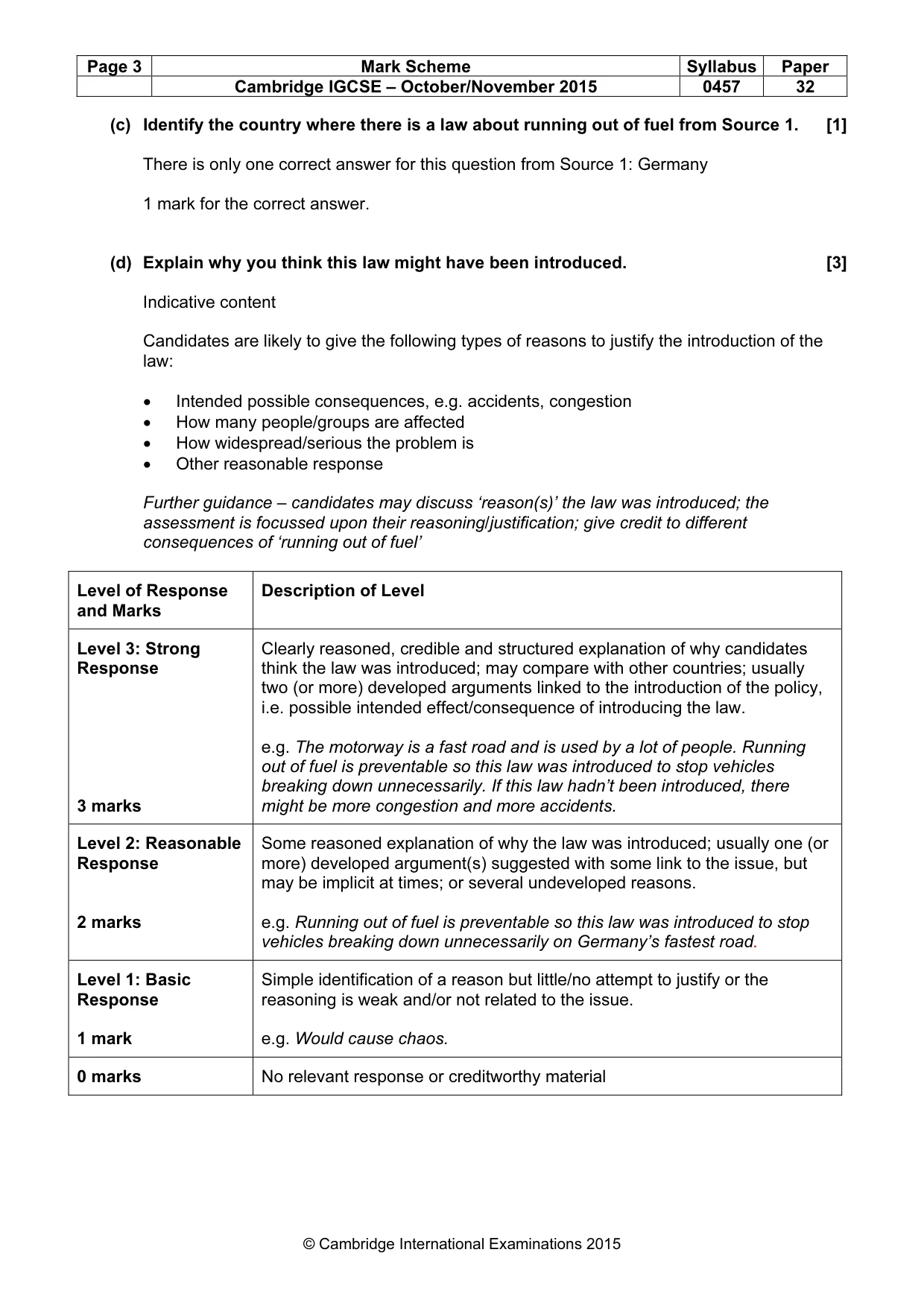
Page 3 Mark Scheme Syllabus Paper Cambridge IGCSE – October/November 2015 0457 32 © Cambridge International Examinations 2015 (c) Identify the country where there is a law about running out of fuel from Source 1. [1] There is only one correct answer for this question from Source 1: Germany 1 mark for the correct answer. (d) Explain why you think this law might have been introduced. [3] Indicative content Candidates are likely to give the following types of reasons to justify the introduction of the law: • Intended possible consequences, e.g. accidents, congestion • How many people/groups are affected • How widespread/serious the problem is • Other reasonable response Further guidance – candidates may discuss ‘reason(s)’ the law was introduced; the assessment is focussed upon their reasoning/justification; give credit to different consequences of ‘running out of fuel’ Level of Response and Marks Description of Level Level 3: Strong Response 3 marks Clearly reasoned, credible and structured explanation of why candidates think the law was introduced; may compare with other countries; usually two (or more) developed arguments linked to the introduction of the policy, i.e. possible intended effect/consequence of introducing the law. e.g. The motorway is a fast road and is used by a lot of people. Running out of fuel is preventable so this law was introduced to stop vehicles breaking down unnecessarily. If this law hadn’t been introduced, there might be more congestion and more accidents. Level 2: Reasonable Response 2 marks Some reasoned explanation of why the law was introduced; usually one (or more) developed argument(s) suggested with some link to the issue, but may be implicit at times; or several undeveloped reasons. e.g. Running out of fuel is preventable so this law was introduced to stop vehicles breaking down unnecessarily on Germany’s fastest road. Level 1: Basic Response 1 mark Simple identification of a reason but little/no attempt to justify or the reasoning is weak and/or not related to the issue. e.g. Would cause chaos. 0 marks No relevant response or creditworthy material
Mark scheme, page 4
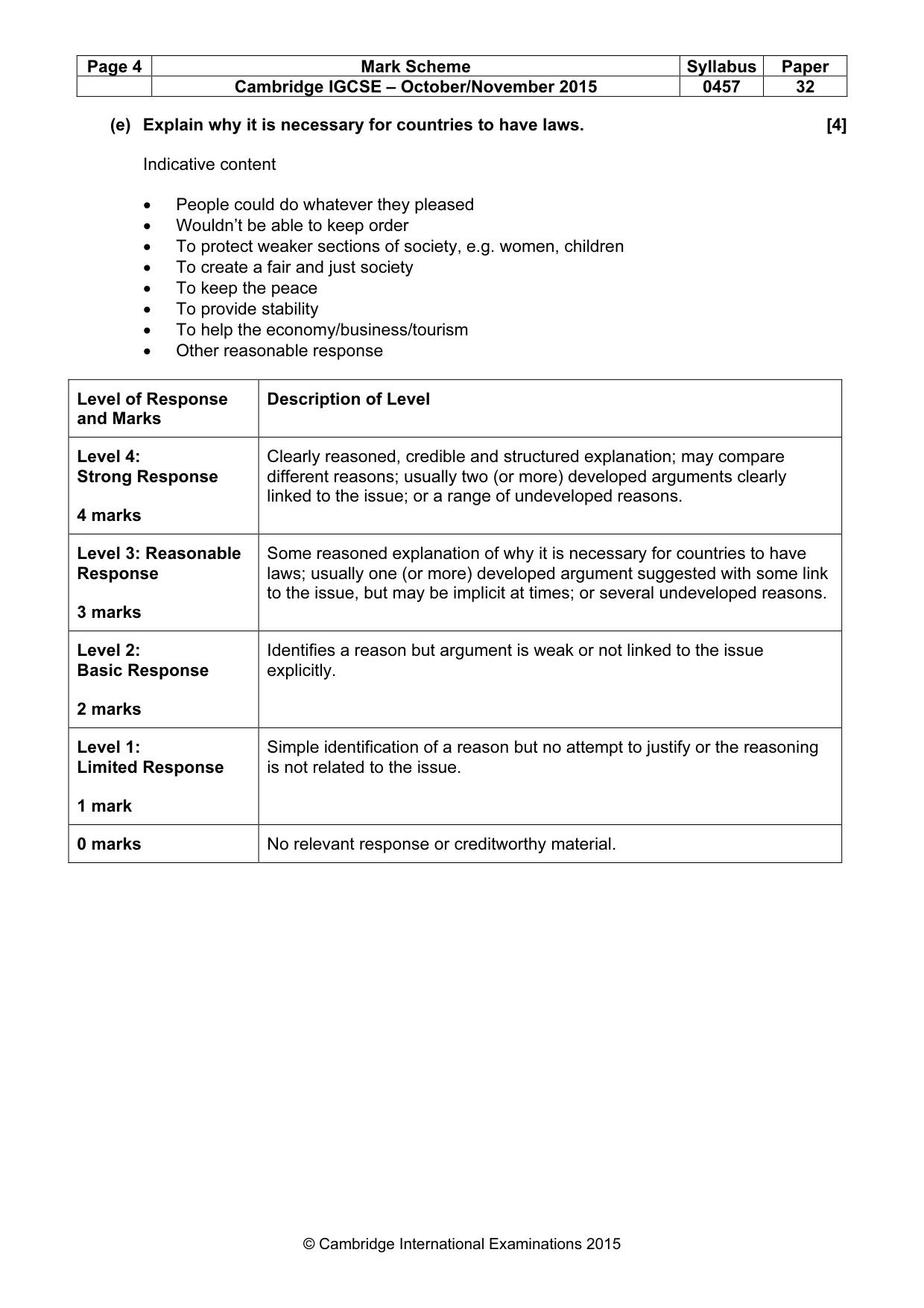
Page 4 Mark Scheme Syllabus Paper Cambridge IGCSE – October/November 2015 0457 32 © Cambridge International Examinations 2015 (e) Explain why it is necessary for countries to have laws. [4] Indicative content • People could do whatever they pleased • Wouldn’t be able to keep order • To protect weaker sections of society, e.g. women, children • To create a fair and just society • To keep the peace • To provide stability • To help the economy/business/tourism • Other reasonable response Level of Response and Marks Description of Level Level 4: Strong Response 4 marks Clearly reasoned, credible and structured explanation; may compare different reasons; usually two (or more) developed arguments clearly linked to the issue; or a range of undeveloped reasons. Level 3: Reasonable Response 3 marks Some reasoned explanation of why it is necessary for countries to have laws; usually one (or more) developed argument suggested with some link to the issue, but may be implicit at times; or several undeveloped reasons. Level 2: Basic Response 2 marks Identifies a reason but argument is weak or not linked to the issue explicitly. Level 1: Limited Response 1 mark Simple identification of a reason but no attempt to justify or the reasoning is not related to the issue. 0 marks No relevant response or creditworthy material.
Mark scheme, page 5
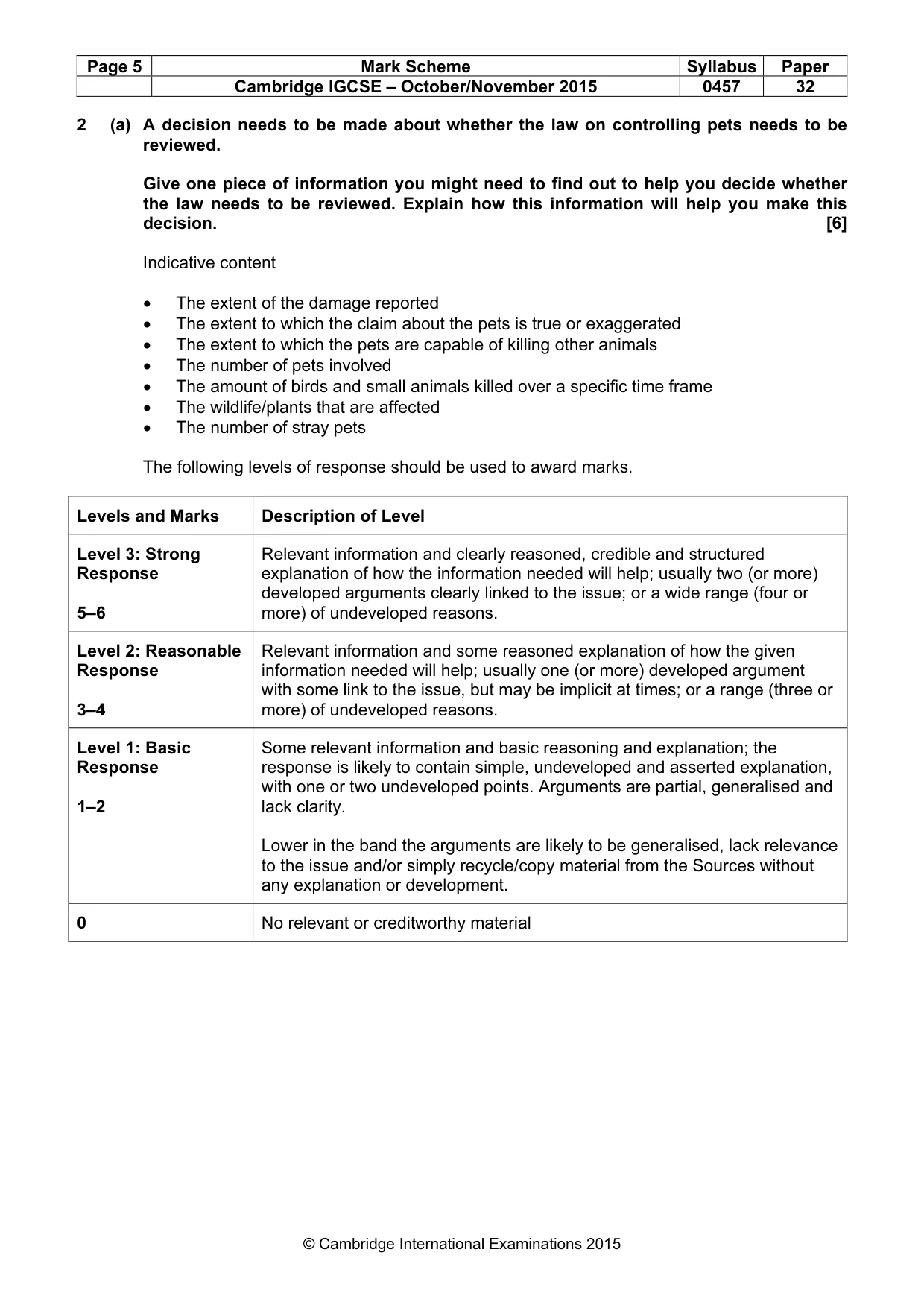
Page 5 Mark Scheme Syllabus Paper Cambridge IGCSE – October/November 2015 0457 32 © Cambridge International Examinations 2015 2 (a) A decision needs to be made about whether the law on controlling pets needs to be reviewed. Give one piece of information you might need to find out to help you decide whether the law needs to be reviewed. Explain how this information will help you make this decision. [6] Indicative content • The extent of the damage reported • The extent to which the claim about the pets is true or exaggerated • The extent to which the pets are capable of killing other animals • The number of pets involved • The amount of birds and small animals killed over a specific time frame • The wildlife/plants that are affected • The number of stray pets The following levels of response should be used to award marks. Levels and Marks Description of Level Level 3: Strong Response 5–6 Relevant information and clearly reasoned, credible and structured explanation of how the information needed will help; usually two (or more) developed arguments clearly linked to the issue; or a wide range (four or more) of undeveloped reasons. Level 2: Reasonable Response 3–4 Relevant information and some reasoned explanation of how the given information needed will help; usually one (or more) developed argument with some link to the issue, but may be implicit at times; or a range (three or more) of undeveloped reasons. Level 1: Basic Response 1–2 Some relevant information and basic reasoning and explanation; the response is likely to contain simple, undeveloped and asserted explanation, with one or two undeveloped points. Arguments are partial, generalised and lack clarity. Lower in the band the arguments are likely to be generalised, lack relevance to the issue and/or simply recycle/copy material from the Sources without any explanation or development. 0 No relevant or creditworthy material
Mark scheme, page 6
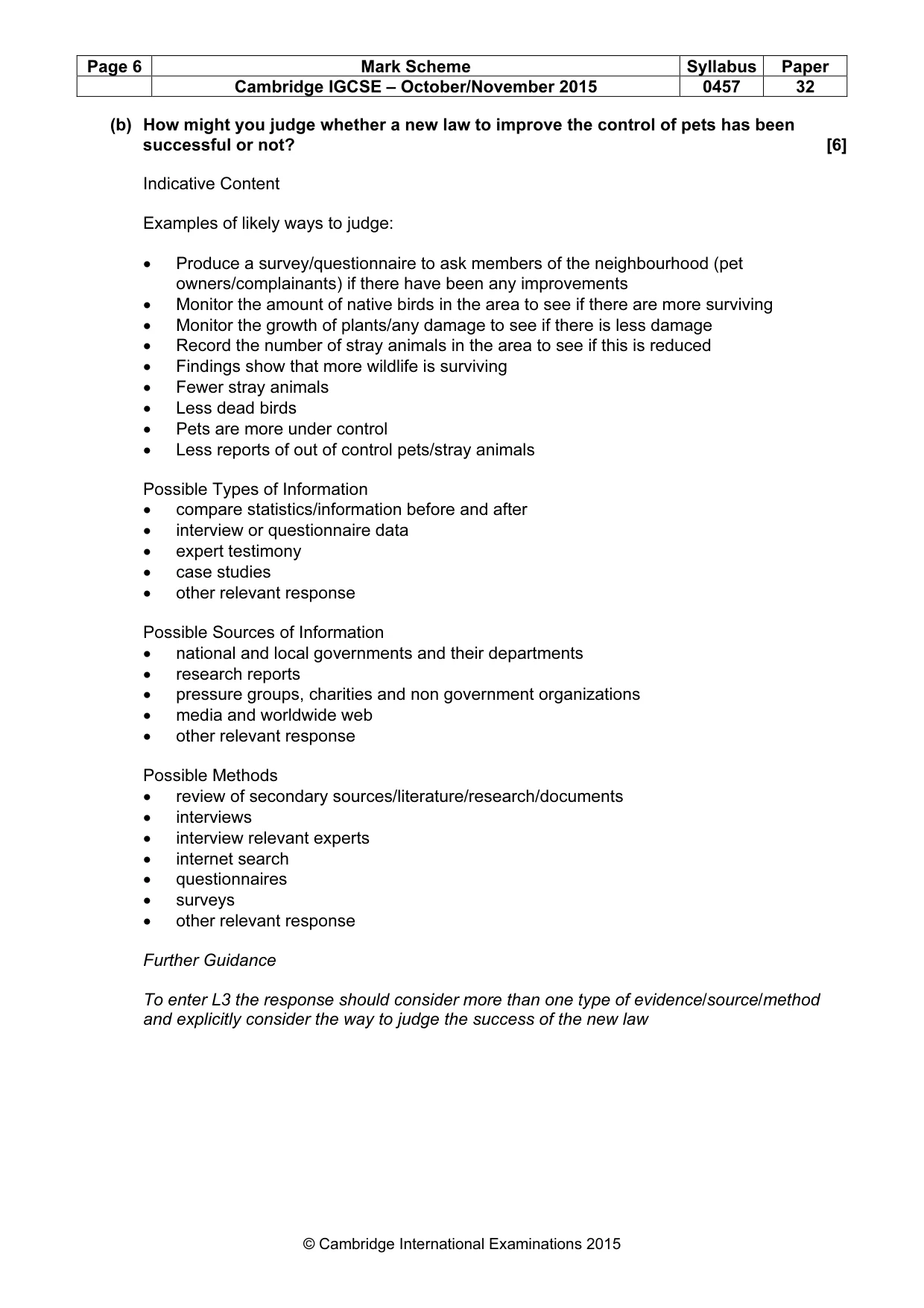
Page 6 Mark Scheme Syllabus Paper Cambridge IGCSE – October/November 2015 0457 32 © Cambridge International Examinations 2015 (b) How might you judge whether a new law to improve the control of pets has been successful or not? [6] Indicative Content Examples of likely ways to judge: • Produce a survey/questionnaire to ask members of the neighbourhood (pet owners/complainants) if there have been any improvements • Monitor the amount of native birds in the area to see if there are more surviving • Monitor the growth of plants/any damage to see if there is less damage • Record the number of stray animals in the area to see if this is reduced • Findings show that more wildlife is surviving • Fewer stray animals • Less dead birds • Pets are more under control • Less reports of out of control pets/stray animals Possible Types of Information • compare statistics/information before and after • interview or questionnaire data • expert testimony • case studies • other relevant response Possible Sources of Information • national and local governments and their departments • research reports • pressure groups, charities and non government organizations • media and worldwide web • other relevant response Possible Methods • review of secondary sources/literature/research/documents • interviews • interview relevant experts • internet search • questionnaires • surveys • other relevant response Further Guidance To enter L3 the response should consider more than one type of evidence/source/method and explicitly consider the way to judge the success of the new law
Mark scheme, page 7
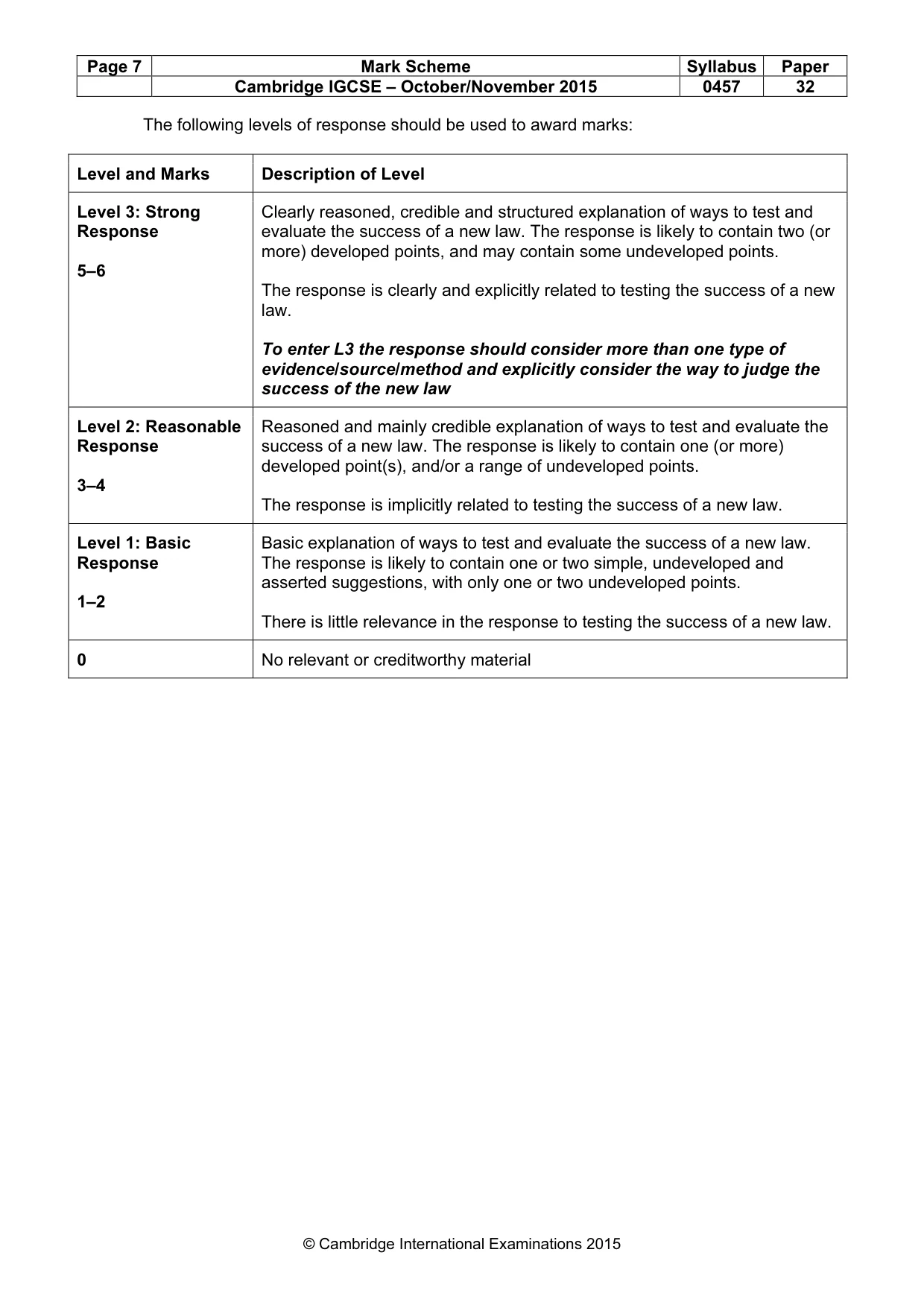
Page 7 Mark Scheme Syllabus Paper Cambridge IGCSE – October/November 2015 0457 32 © Cambridge International Examinations 2015 The following levels of response should be used to award marks: Level and Marks Description of Level Level 3: Strong Response 5–6 Clearly reasoned, credible and structured explanation of ways to test and evaluate the success of a new law. The response is likely to contain two (or more) developed points, and may contain some undeveloped points. The response is clearly and explicitly related to testing the success of a new law. To enter L3 the response should consider more than one type of evidence/source/method and explicitly consider the way to judge the success of the new law Level 2: Reasonable Response 3–4 Reasoned and mainly credible explanation of ways to test and evaluate the success of a new law. The response is likely to contain one (or more) developed point(s), and/or a range of undeveloped points. The response is implicitly related to testing the success of a new law. Level 1: Basic Response 1–2 Basic explanation of ways to test and evaluate the success of a new law. The response is likely to contain one or two simple, undeveloped and asserted suggestions, with only one or two undeveloped points. There is little relevance in the response to testing the success of a new law. 0 No relevant or creditworthy material
Mark scheme, page 8
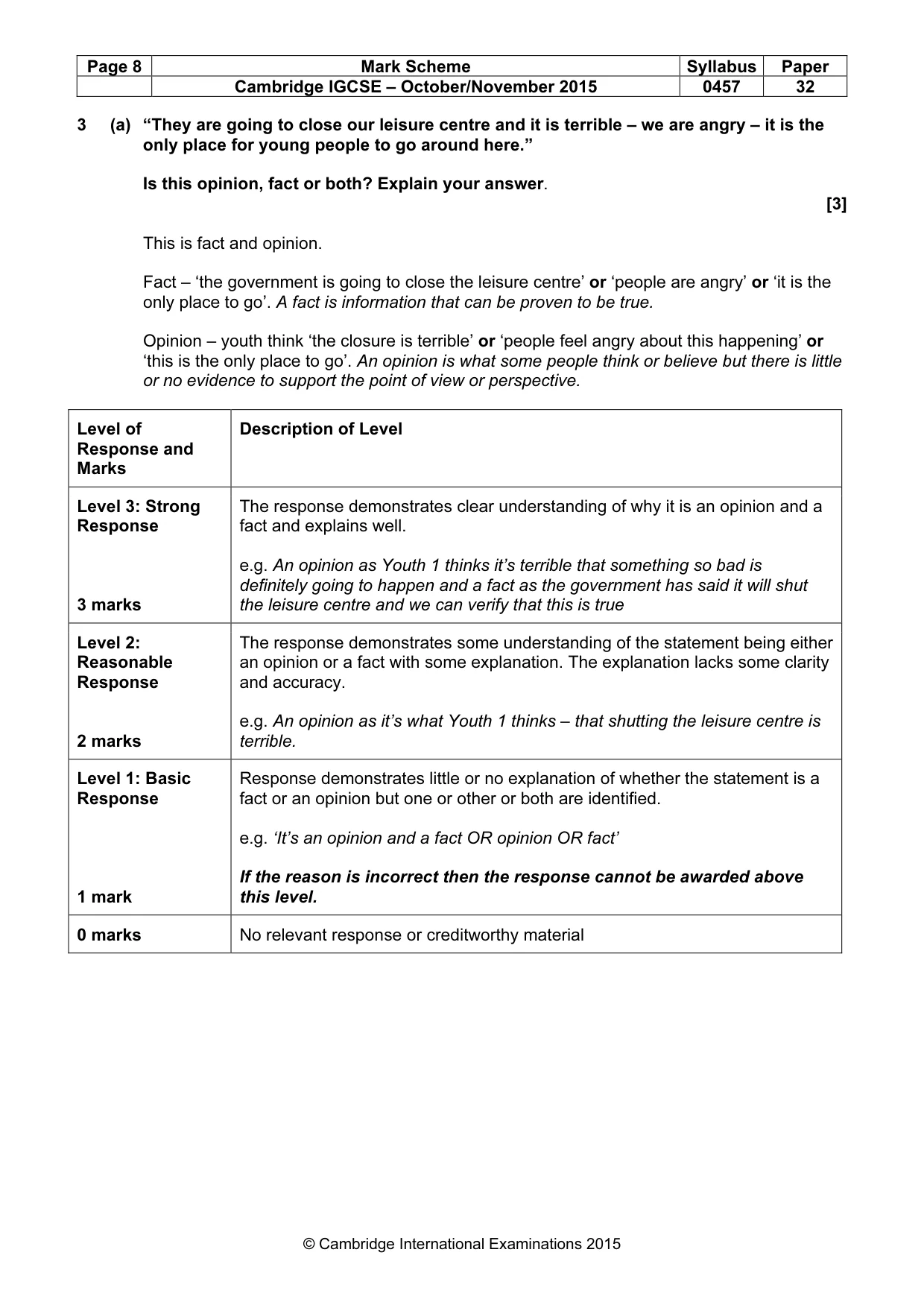
Page 8 Mark Scheme Syllabus Paper Cambridge IGCSE – October/November 2015 0457 32 © Cambridge International Examinations 2015 3 (a) “They are going to close our leisure centre and it is terrible – we are angry – it is the only place for young people to go around here.” Is this opinion, fact or both? Explain your answer. [3] This is fact and opinion. Fact – ‘the government is going to close the leisure centre’ or ‘people are angry’ or ‘it is the only place to go’. A fact is information that can be proven to be true. Opinion – youth think ‘the closure is terrible’ or ‘people feel angry about this happening’ or ‘this is the only place to go’. An opinion is what some people think or believe but there is little or no evidence to support the point of view or perspective. Level of Response and Marks Description of Level Level 3: Strong Response 3 marks The response demonstrates clear understanding of why it is an opinion and a fact and explains well. e.g. An opinion as Youth 1 thinks it’s terrible that something so bad is definitely going to happen and a fact as the government has said it will shut the leisure centre and we can verify that this is true Level 2: Reasonable Response 2 marks The response demonstrates some understanding of the statement being either an opinion or a fact with some explanation. The explanation lacks some clarity and accuracy. e.g. An opinion as it’s what Youth 1 thinks – that shutting the leisure centre is terrible. Level 1: Basic Response 1 mark Response demonstrates little or no explanation of whether the statement is a fact or an opinion but one or other or both are identified. e.g. ‘It’s an opinion and a fact OR opinion OR fact’ If the reason is incorrect then the response cannot be awarded above this level. 0 marks No relevant response or creditworthy material
Mark scheme, page 9
Page 9 Mark Scheme Syllabus Paper Cambridge IGCSE – October/November 2015 0457 32 © Cambridge International Examinations 2015 (b) Identify one prediction from Youth 3. Explain why you think it is a prediction. [3] Indicative Content A prediction is generally defined as a statement suggesting something which is likely to happen in the future. The following examples of a prediction may be found in Youth 3: • Getting arrested would prevent me from having a career. • My parents would have been angry if I had been arrested. Level 3: Strong Response [3] The response demonstrates clear understanding of the nature of predictions and applies this accurately to a correct example identified from the Source. Level 2: Reasonable Response [2] The response demonstrates some understanding of the nature of predictions and attempts to apply this to a correct example identified from the Source. The explanation lacks some clarity and accuracy. Level 1: Basic Response [1] The candidate identifies one prediction from the Source correctly but does not explain why it is a prediction; the response demonstrates no understanding of the nature of predictions. No relevant response or creditworthy material. [0] (c) How well does the author of the newspaper article explain young people’s decisions to take part in the August Riots in London? In your answer you should support your point of view with his words and phrases and you may consider: • the reliability of any knowledge claims; • the reliability of any sources used; • how logical the reasoning is; • other relevant issues. [12] Indicative Content Candidates are expected to evaluate the effectiveness of the argument in the article in explaining why young people participated or not. They should make a supported judgement with some explanation about how effective the reasoning is.
Mark scheme, page 10
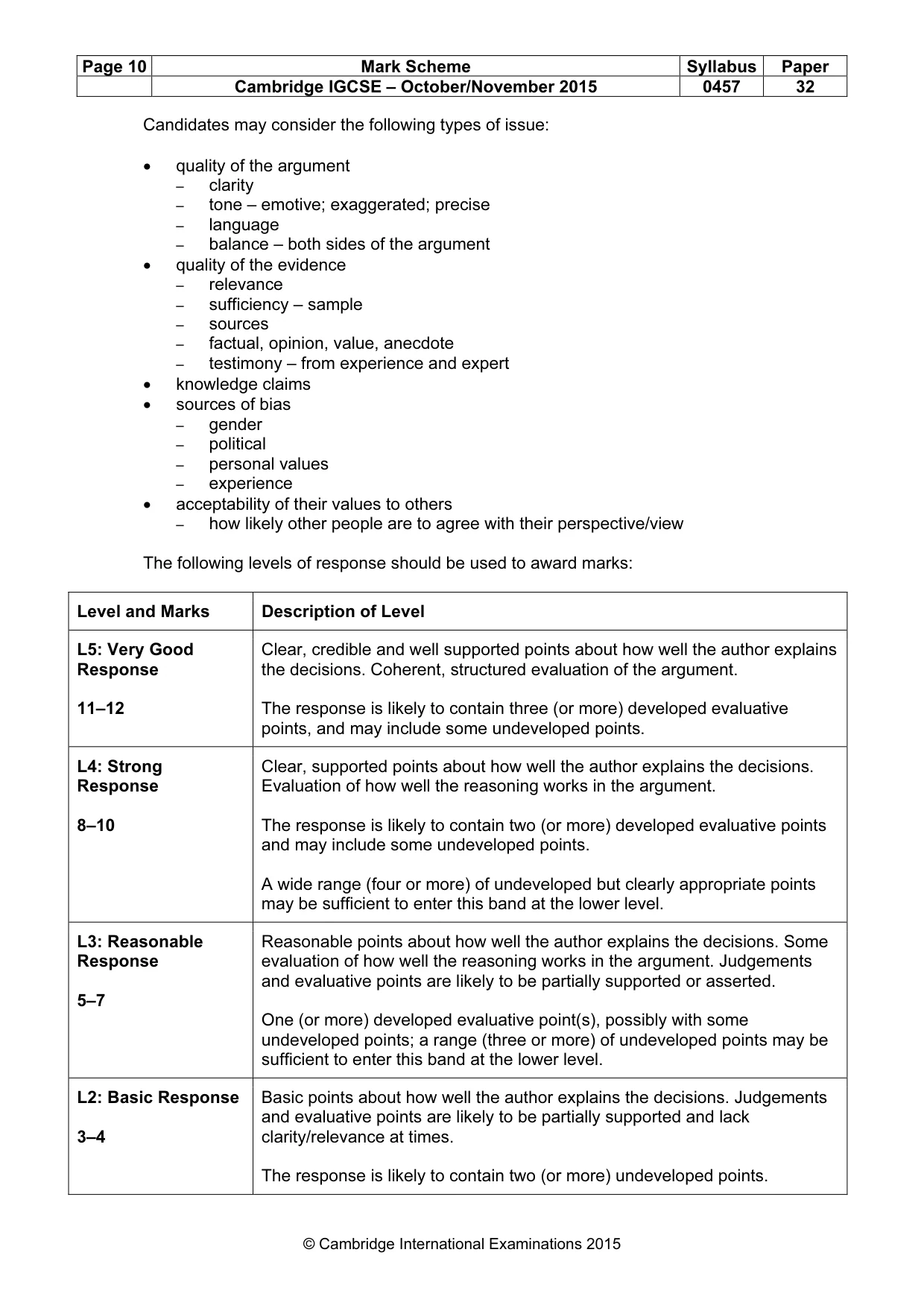
Page 10 Mark Scheme Syllabus Paper Cambridge IGCSE – October/November 2015 0457 32 © Cambridge International Examinations 2015 Candidates may consider the following types of issue: • quality of the argument – clarity – tone – emotive; exaggerated; precise – language – balance – both sides of the argument • quality of the evidence – relevance – sufficiency – sample – sources – factual, opinion, value, anecdote – testimony – from experience and expert • knowledge claims • sources of bias – gender – political – personal values – experience • acceptability of their values to others – how likely other people are to agree with their perspective/view The following levels of response should be used to award marks: Level and Marks Description of Level L5: Very Good Response 11–12 Clear, credible and well supported points about how well the author explains the decisions. Coherent, structured evaluation of the argument. The response is likely to contain three (or more) developed evaluative points, and may include some undeveloped points. L4: Strong Response 8–10 Clear, supported points about how well the author explains the decisions. Evaluation of how well the reasoning works in the argument. The response is likely to contain two (or more) developed evaluative points and may include some undeveloped points. A wide range (four or more) of undeveloped but clearly appropriate points may be sufficient to enter this band at the lower level. L3: Reasonable Response 5–7 Reasonable points about how well the author explains the decisions. Some evaluation of how well the reasoning works in the argument. Judgements and evaluative points are likely to be partially supported or asserted. One (or more) developed evaluative point(s), possibly with some undeveloped points; a range (three or more) of undeveloped points may be sufficient to enter this band at the lower level. L2: Basic Response 3–4 Basic points about how well the author explains the decisions. Judgements and evaluative points are likely to be partially supported and lack clarity/relevance at times. The response is likely to contain two (or more) undeveloped points.
Mark scheme, page 11
Page 11 Mark Scheme Syllabus Paper Cambridge IGCSE – October/November 2015 0457 32 © Cambridge International Examinations 2015 Level and Marks Description of Level L1: Limited Response 1–2 Limited and unsupported points about how well the author explains the decisions. The response is likely to consider the argument only briefly and/or tangentially. There is little clarity. Answers at this level may repeat source material with little understanding or simply agree/disagree with the argument presented. The response may not contain any clear evaluative points. 0 No relevant or creditworthy material
Mark scheme, page 12
Page 12 Mark Scheme Syllabus Paper Cambridge IGCSE – October/November 2015 0457 32 © Cambridge International Examinations 2015 4 Do you think that the majority of young people want to obey the law? In your answer you should: • use relevant examples to support your opinion (you may use your own experience); • show that you have considered different perspectives; • explain why you disagree with some of these perspectives. [18] Indicative Content Candidates are expected to explore different perspectives or reasons to help them decide whether the majority of young people want to obey the law. Candidates are likely to explore different attitudes of young people towards obeying the law and which rules they are most likely to obey and why and whether most young people want to obey rules/laws, possibly at different levels – local, national and global. Candidates are expected to use and develop the material found in the Sources, but should go beyond simply repeating or recycling without adaptation. Other material may be introduced but it is not necessary to gain full marks. The arguments used to consider the issue are likely to include: • the effects of upbringing on attitudes and behavior regarding the law • the effects of cultural differences and beliefs on attitudes and behavior regarding the law • the influence of individuals and groups, e.g. peer group or family • the consequences of law breaking • the impact of age and stage of development on attitudes and behavior • impact of education on attitudes and behaviour • potential conflict • local and national responses and action • other reasonable response
Mark scheme, page 13
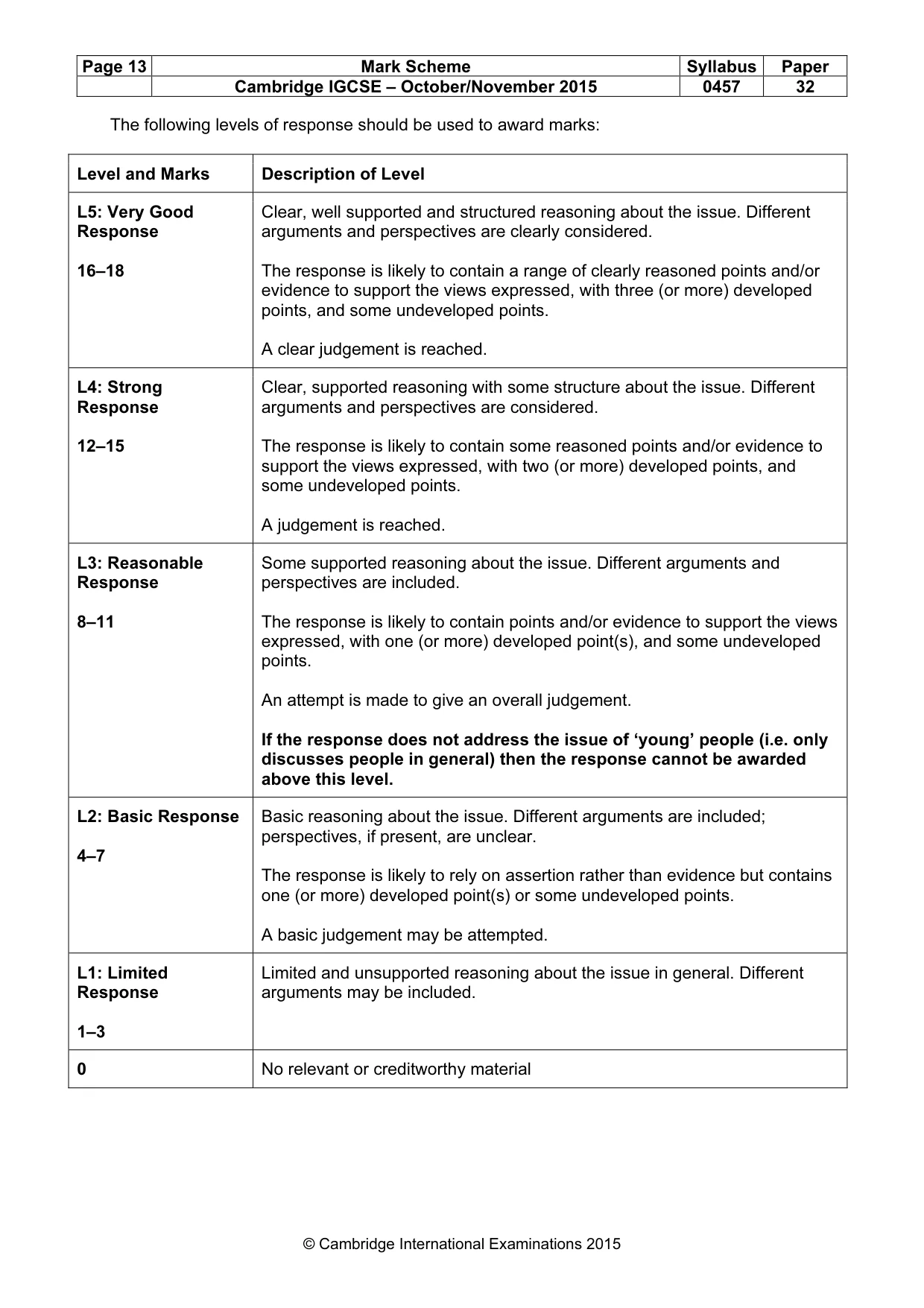
Page 13 Mark Scheme Syllabus Paper Cambridge IGCSE – October/November 2015 0457 32 © Cambridge International Examinations 2015 The following levels of response should be used to award marks: Level and Marks Description of Level L5: Very Good Response 16–18 Clear, well supported and structured reasoning about the issue. Different arguments and perspectives are clearly considered. The response is likely to contain a range of clearly reasoned points and/or evidence to support the views expressed, with three (or more) developed points, and some undeveloped points. A clear judgement is reached. L4: Strong Response 12–15 Clear, supported reasoning with some structure about the issue. Different arguments and perspectives are considered. The response is likely to contain some reasoned points and/or evidence to support the views expressed, with two (or more) developed points, and some undeveloped points. A judgement is reached. L3: Reasonable Response 8–11 Some supported reasoning about the issue. Different arguments and perspectives are included. The response is likely to contain points and/or evidence to support the views expressed, with one (or more) developed point(s), and some undeveloped points. An attempt is made to give an overall judgement. If the response does not address the issue of ‘young’ people (i.e. only discusses people in general) then the response cannot be awarded above this level. L2: Basic Response 4–7 Basic reasoning about the issue. Different arguments are included; perspectives, if present, are unclear. The response is likely to rely on assertion rather than evidence but contains one (or more) developed point(s) or some undeveloped points. A basic judgement may be attempted. L1: Limited Response 1–3 Limited and unsupported reasoning about the issue in general. Different arguments may be included. 0 No relevant or creditworthy material
What you needed in this session
Cambridge’s own grade thresholds for 2015 Oct/Nov, Paper 3 · Variant 2. A higher threshold means an easier paper — the bar moves with how the cohort did.