Cambridge IGCSE Global Perspectives 0457 — 2015 Feb/March Paper 3 · Variant 2
0457/32/F/M/15 · 60 marks · ≈68 min
The question paper and its mark scheme, free to read here and free to download. This is Cambridge’s own paper, exactly as it was sat.
Question paper8 pages




Mark scheme15 pages
Answers below. Sit the paper first if you are practising.
Paper as text
Question paper, page 1
This document consists of 6 printed pages, 2 blank pages and 1 Insert. DC (LK) 93445/4 © UCLES 2015 [Turn over * 0 0 2 0 9 8 6 8 0 7 * GLOBAL PERSPECTIVES 0457/32 Paper 3 February/March 2015 1 hour 15 minutes Candidates answer on the Question Paper. No Additional Materials are required. READ THESE INSTRUCTIONS FIRST Write your Centre number, candidate number and name in the boxes above. Write in dark blue or black pen. Do not use staples, paper clips, glue or correction fluid. DO NOT WRITE IN ANY BARCODES. Answer all questions in the spaces provided. Any rough working should be done in this booklet. The number of marks is given in brackets [ ] at the end of each question or part question. Cambridge International Examinations Cambridge International General Certificate of Secondary Education
Question paper, page 2
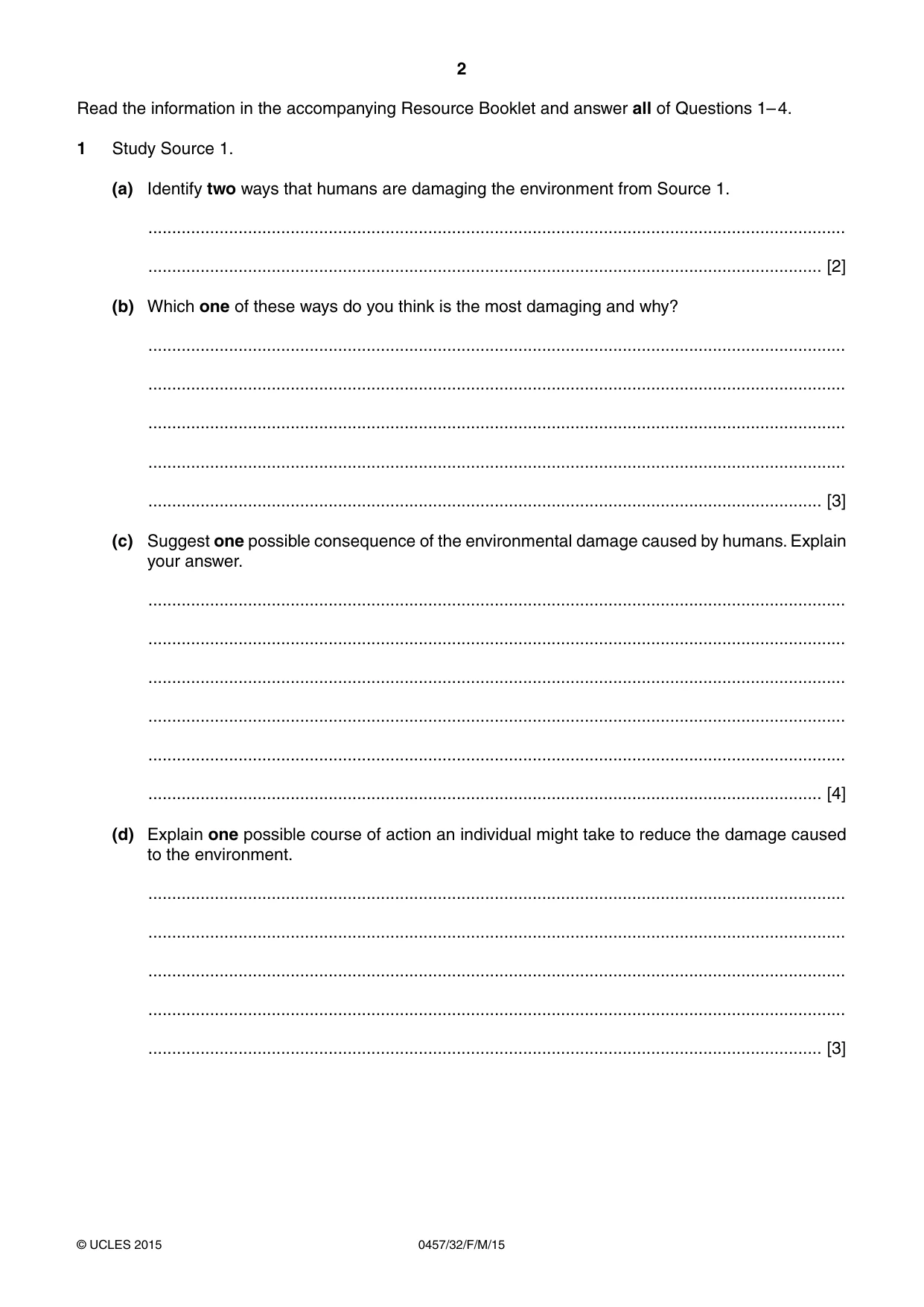
2 0457/32/F/M/15 © UCLES 2015 Read the information in the accompanying Resource Booklet and answer all of Questions 1– 4. 1 Study Source 1. (a) Identify two ways that humans are damaging the environment from Source 1. … … [2] (b) Which one of these ways do you think is the most damaging and why? … … … … … [3] (c) Suggest one possible consequence of the environmental damage caused by humans. Explain your answer. … … … … … … [4] (d) Explain one possible course of action an individual might take to reduce the damage caused to the environment. … … … … … [3]
Question paper, page 3
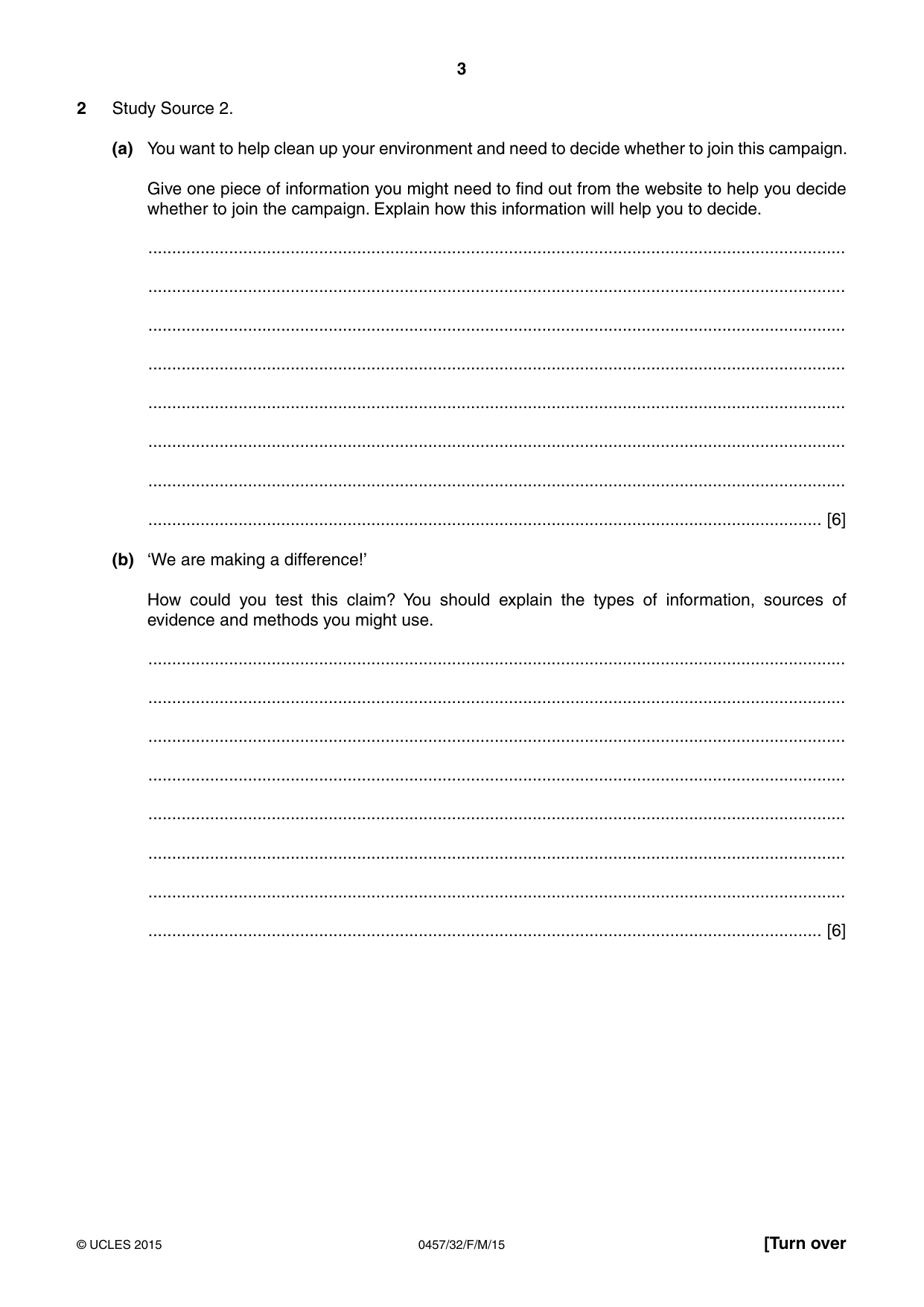
3 0457/32/F/M/15 © UCLES 2015 [Turn over 2 Study Source 2. (a) You want to help clean up your environment and need to decide whether to join this campaign. Give one piece of information you might need to find out from the website to help you decide whether to join the campaign. Explain how this information will help you to decide. … … … … … … … … [6] (b) ‘We are making a difference!’ How could you test this claim? You should explain the types of information, sources of evidence and methods you might use. … … … … … … … … [6]
Question paper, page 4
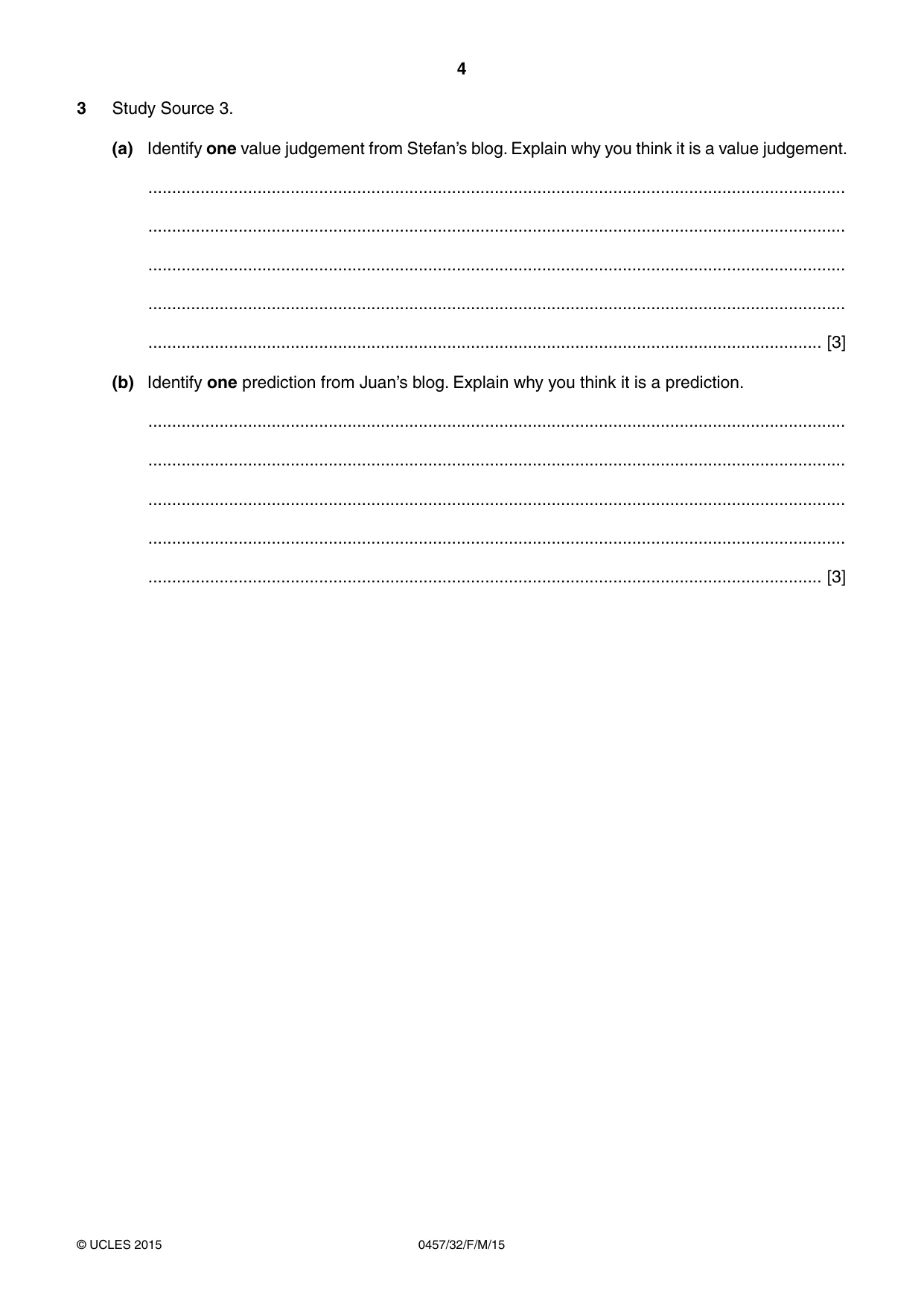
4 0457/32/F/M/15 © UCLES 2015 3 Study Source 3. (a) Identify one value judgement from Stefan’s blog. Explain why you think it is a value judgement. … … … … … [3] (b) Identify one prediction from Juan’s blog. Explain why you think it is a prediction. … … … … … [3]
Question paper, page 5
5 0457/32/F/M/15 © UCLES 2015 [Turn over (c) Whose argument do you think is the most reasonable, Stefan’s or Juan’s? Explain why. In your answer you should support your judgement with their words and phrases and you may consider: • the strength of the knowledge claims; • the reliability and validity of any evidence; • how logical the reasoning is; • other relevant issues. … … … … … … … … … … … … … … … [12]
Question paper, page 6
6 0457/32/F/M/15 © UCLES 2015 4 Do you think that global warming is most likely to be reduced by global, local or individual action? In your answer you should: • give reasons for your opinion; • use relevant examples to support your opinion (you may use your own experience); • show that you have considered different perspectives; • explain why you disagree with some of these perspectives. … … … … … … … … … … … … … … … … … … … … … … … … … [18]
Question paper, page 7
7 0457/32/F/M/15 © UCLES 2015 BLANK PAGE
Question paper, page 8
8 0457/32/F/M/15 © UCLES 2015 Permission to reproduce items where third-party owned material protected by copyright is included has been sought and cleared where possible. Every reasonable effort has been made by the publisher (UCLES) to trace copyright holders, but if any items requiring clearance have unwittingly been included, the publisher will be pleased to make amends at the earliest possible opportunity. To avoid the issue of disclosure of answer-related information to candidates, all copyright acknowledgements are reproduced online in the Cambridge International Examinations Copyright Acknowledgements Booklet. This is produced for each series of examinations and is freely available to download at www.cie.org.uk after the live examination series. Cambridge International Examinations is part of the Cambridge Assessment Group. Cambridge Assessment is the brand name of University of Cambridge Local Examinations Syndicate (UCLES), which is itself a department of the University of Cambridge. BLANK PAGE
Mark scheme, page 1
® IGCSE is the registered trademark of Cambridge International Examinations. CAMBRIDGE INTERNATIONAL EXAMINATIONS Cambridge International General Certificate of Secondary Education MARK SCHEME for the March 2015 series 0457 GLOBAL PERSPECTIVES 0457/32 Paper 3 (Written Paper), maximum raw mark 60 This mark scheme is published as an aid to teachers and candidates, to indicate the requirements of the examination. It shows the basis on which Examiners were instructed to award marks. It does not indicate the details of the discussions that took place at an Examiners’ meeting before marking began, which would have considered the acceptability of alternative answers. Mark schemes should be read in conjunction with the question paper and the Principal Examiner Report for Teachers. Cambridge will not enter into discussions about these mark schemes. Cambridge is publishing the mark schemes for the March 2015 series for most Cambridge IGCSE® components.
Mark scheme, page 2
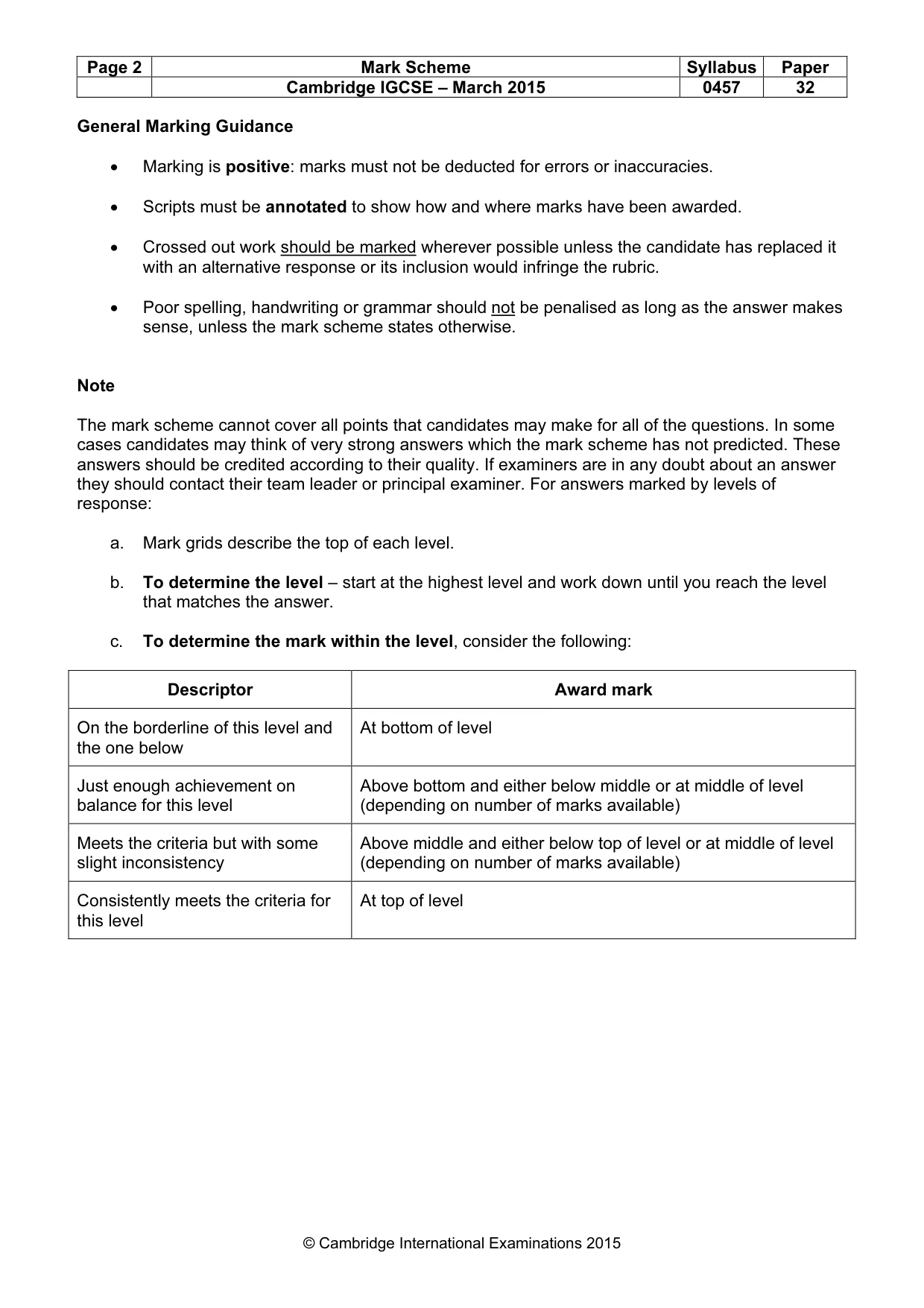
Page 2 Mark Scheme Syllabus Paper Cambridge IGCSE – March 2015 0457 32 © Cambridge International Examinations 2015 General Marking Guidance • Marking is positive: marks must not be deducted for errors or inaccuracies. • Scripts must be annotated to show how and where marks have been awarded. • Crossed out work should be marked wherever possible unless the candidate has replaced it with an alternative response or its inclusion would infringe the rubric. • Poor spelling, handwriting or grammar should not be penalised as long as the answer makes sense, unless the mark scheme states otherwise. Note The mark scheme cannot cover all points that candidates may make for all of the questions. In some cases candidates may think of very strong answers which the mark scheme has not predicted. These answers should be credited according to their quality. If examiners are in any doubt about an answer they should contact their team leader or principal examiner. For answers marked by levels of response: a. Mark grids describe the top of each level. b. To determine the level – start at the highest level and work down until you reach the level that matches the answer. c. To determine the mark within the level, consider the following: Descriptor Award mark On the borderline of this level and the one below At bottom of level Just enough achievement on balance for this level Above bottom and either below middle or at middle of level (depending on number of marks available) Meets the criteria but with some slight inconsistency Above middle and either below top of level or at middle of level (depending on number of marks available) Consistently meets the criteria for this level At top of level
Mark scheme, page 3
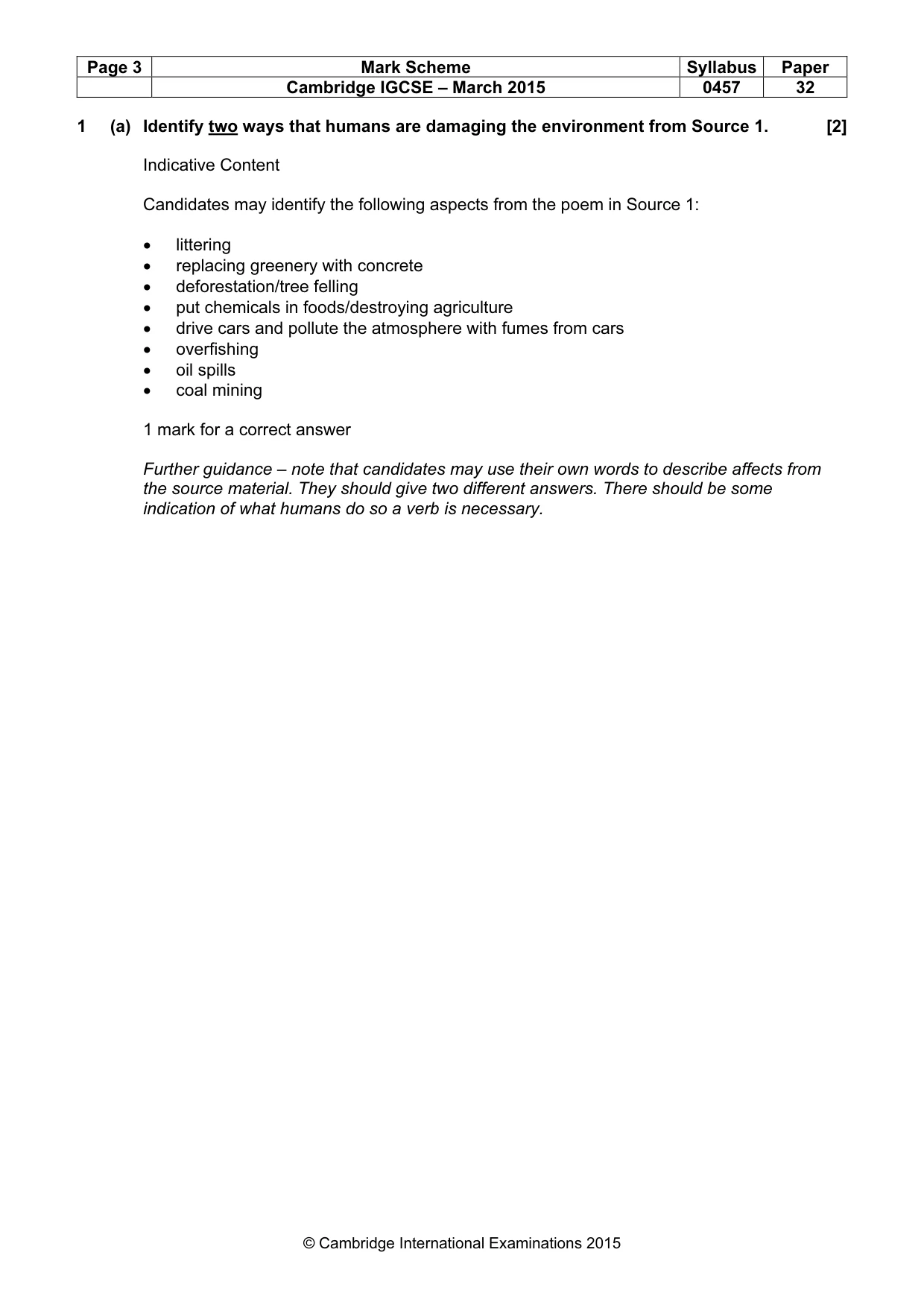
Page 3 Mark Scheme Syllabus Paper Cambridge IGCSE – March 2015 0457 32 © Cambridge International Examinations 2015 1 (a) Identify two ways that humans are damaging the environment from Source 1. [2] Indicative Content Candidates may identify the following aspects from the poem in Source 1: • littering • replacing greenery with concrete • deforestation/tree felling • put chemicals in foods/destroying agriculture • drive cars and pollute the atmosphere with fumes from cars • overfishing • oil spills • coal mining 1 mark for a correct answer Further guidance – note that candidates may use their own words to describe affects from the source material. They should give two different answers. There should be some indication of what humans do so a verb is necessary.
Mark scheme, page 4
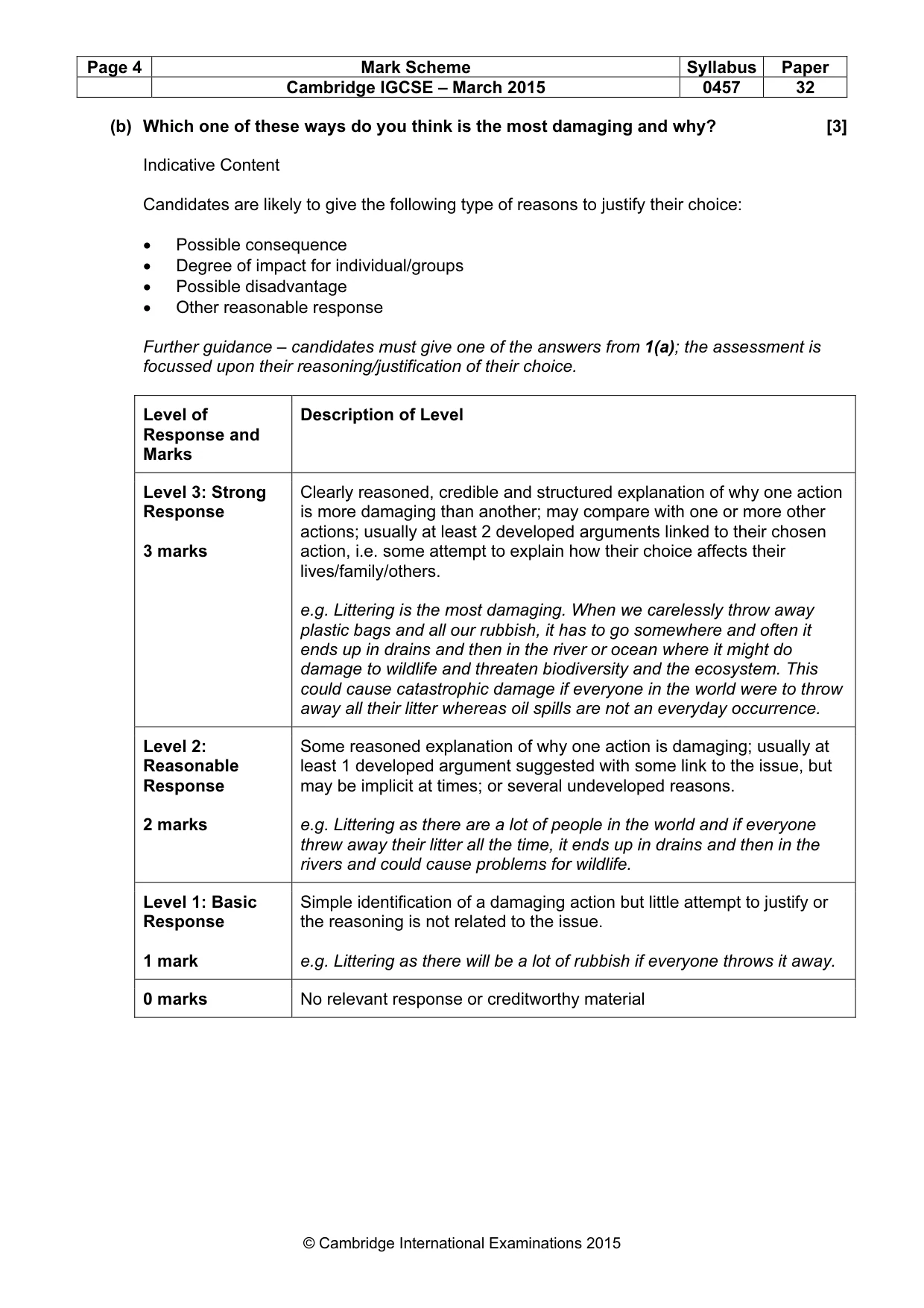
Page 4 Mark Scheme Syllabus Paper Cambridge IGCSE – March 2015 0457 32 © Cambridge International Examinations 2015 (b) Which one of these ways do you think is the most damaging and why? [3] Indicative Content Candidates are likely to give the following type of reasons to justify their choice: • Possible consequence • Degree of impact for individual/groups • Possible disadvantage • Other reasonable response Further guidance – candidates must give one of the answers from 1(a); the assessment is focussed upon their reasoning/justification of their choice. Level of Response and Marks Description of Level Level 3: Strong Response 3 marks Clearly reasoned, credible and structured explanation of why one action is more damaging than another; may compare with one or more other actions; usually at least 2 developed arguments linked to their chosen action, i.e. some attempt to explain how their choice affects their lives/family/others. e.g. Littering is the most damaging. When we carelessly throw away plastic bags and all our rubbish, it has to go somewhere and often it ends up in drains and then in the river or ocean where it might do damage to wildlife and threaten biodiversity and the ecosystem. This could cause catastrophic damage if everyone in the world were to throw away all their litter whereas oil spills are not an everyday occurrence. Level 2: Reasonable Response 2 marks Some reasoned explanation of why one action is damaging; usually at least 1 developed argument suggested with some link to the issue, but may be implicit at times; or several undeveloped reasons. e.g. Littering as there are a lot of people in the world and if everyone threw away their litter all the time, it ends up in drains and then in the rivers and could cause problems for wildlife. Level 1: Basic Response 1 mark Simple identification of a damaging action but little attempt to justify or the reasoning is not related to the issue. e.g. Littering as there will be a lot of rubbish if everyone throws it away. 0 marks No relevant response or creditworthy material
Mark scheme, page 5
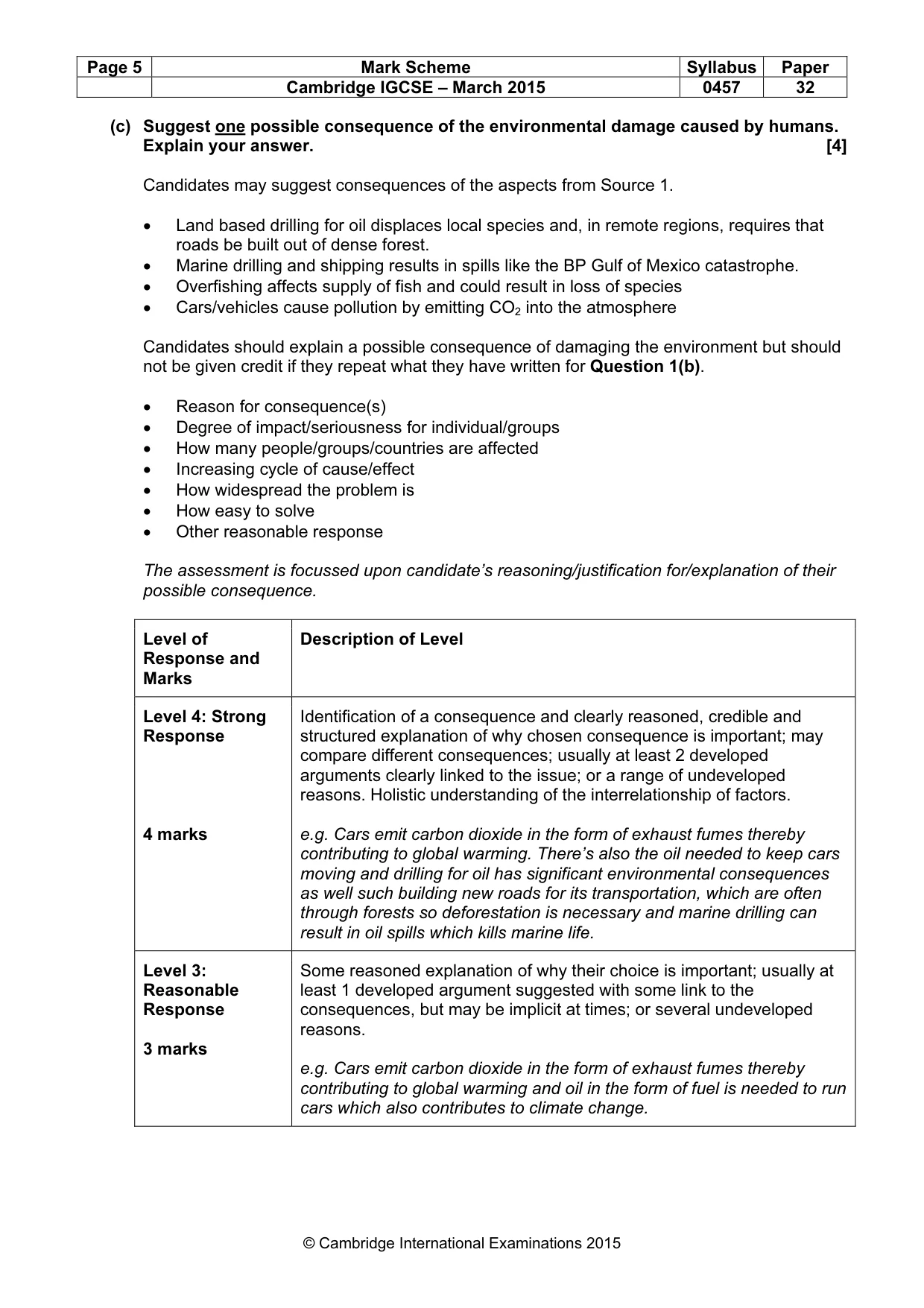
Page 5 Mark Scheme Syllabus Paper Cambridge IGCSE – March 2015 0457 32 © Cambridge International Examinations 2015 (c) Suggest one possible consequence of the environmental damage caused by humans. Explain your answer. [4] Candidates may suggest consequences of the aspects from Source 1. • Land based drilling for oil displaces local species and, in remote regions, requires that roads be built out of dense forest. • Marine drilling and shipping results in spills like the BP Gulf of Mexico catastrophe. • Overfishing affects supply of fish and could result in loss of species • Cars/vehicles cause pollution by emitting CO2 into the atmosphere Candidates should explain a possible consequence of damaging the environment but should not be given credit if they repeat what they have written for Question 1(b). • Reason for consequence(s) • Degree of impact/seriousness for individual/groups • How many people/groups/countries are affected • Increasing cycle of cause/effect • How widespread the problem is • How easy to solve • Other reasonable response The assessment is focussed upon candidate’s reasoning/justification for/explanation of their possible consequence. Level of Response and Marks Description of Level Level 4: Strong Response 4 marks Identification of a consequence and clearly reasoned, credible and structured explanation of why chosen consequence is important; may compare different consequences; usually at least 2 developed arguments clearly linked to the issue; or a range of undeveloped reasons. Holistic understanding of the interrelationship of factors. e.g. Cars emit carbon dioxide in the form of exhaust fumes thereby contributing to global warming. There’s also the oil needed to keep cars moving and drilling for oil has significant environmental consequences as well such building new roads for its transportation, which are often through forests so deforestation is necessary and marine drilling can result in oil spills which kills marine life. Level 3: Reasonable Response 3 marks Some reasoned explanation of why their choice is important; usually at least 1 developed argument suggested with some link to the consequences, but may be implicit at times; or several undeveloped reasons. e.g. Cars emit carbon dioxide in the form of exhaust fumes thereby contributing to global warming and oil in the form of fuel is needed to run cars which also contributes to climate change.
Mark scheme, page 6
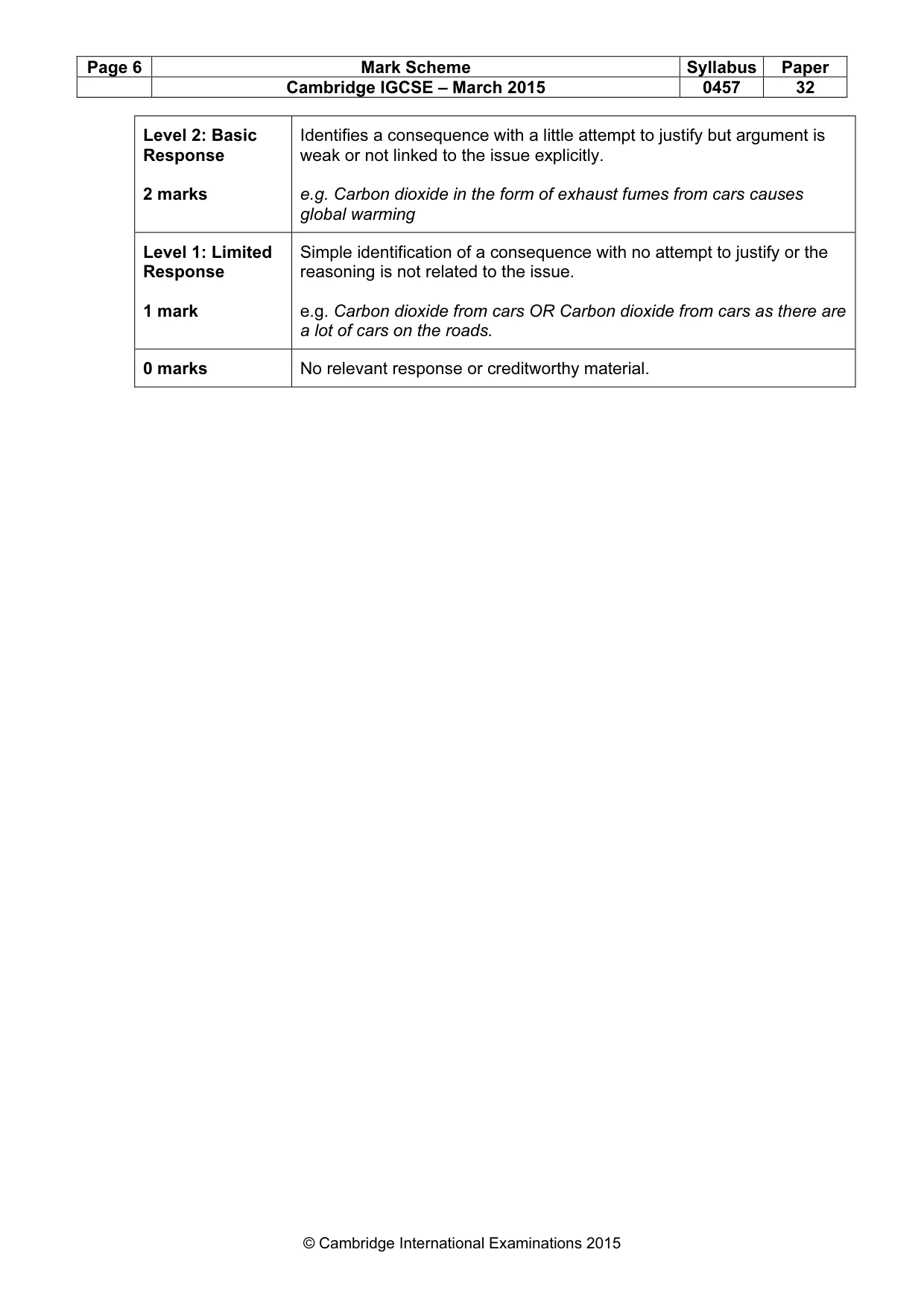
Page 6 Mark Scheme Syllabus Paper Cambridge IGCSE – March 2015 0457 32 © Cambridge International Examinations 2015 Level 2: Basic Response 2 marks Identifies a consequence with a little attempt to justify but argument is weak or not linked to the issue explicitly. e.g. Carbon dioxide in the form of exhaust fumes from cars causes global warming Level 1: Limited Response 1 mark Simple identification of a consequence with no attempt to justify or the reasoning is not related to the issue. e.g. Carbon dioxide from cars OR Carbon dioxide from cars as there are a lot of cars on the roads. 0 marks No relevant response or creditworthy material.
Mark scheme, page 7
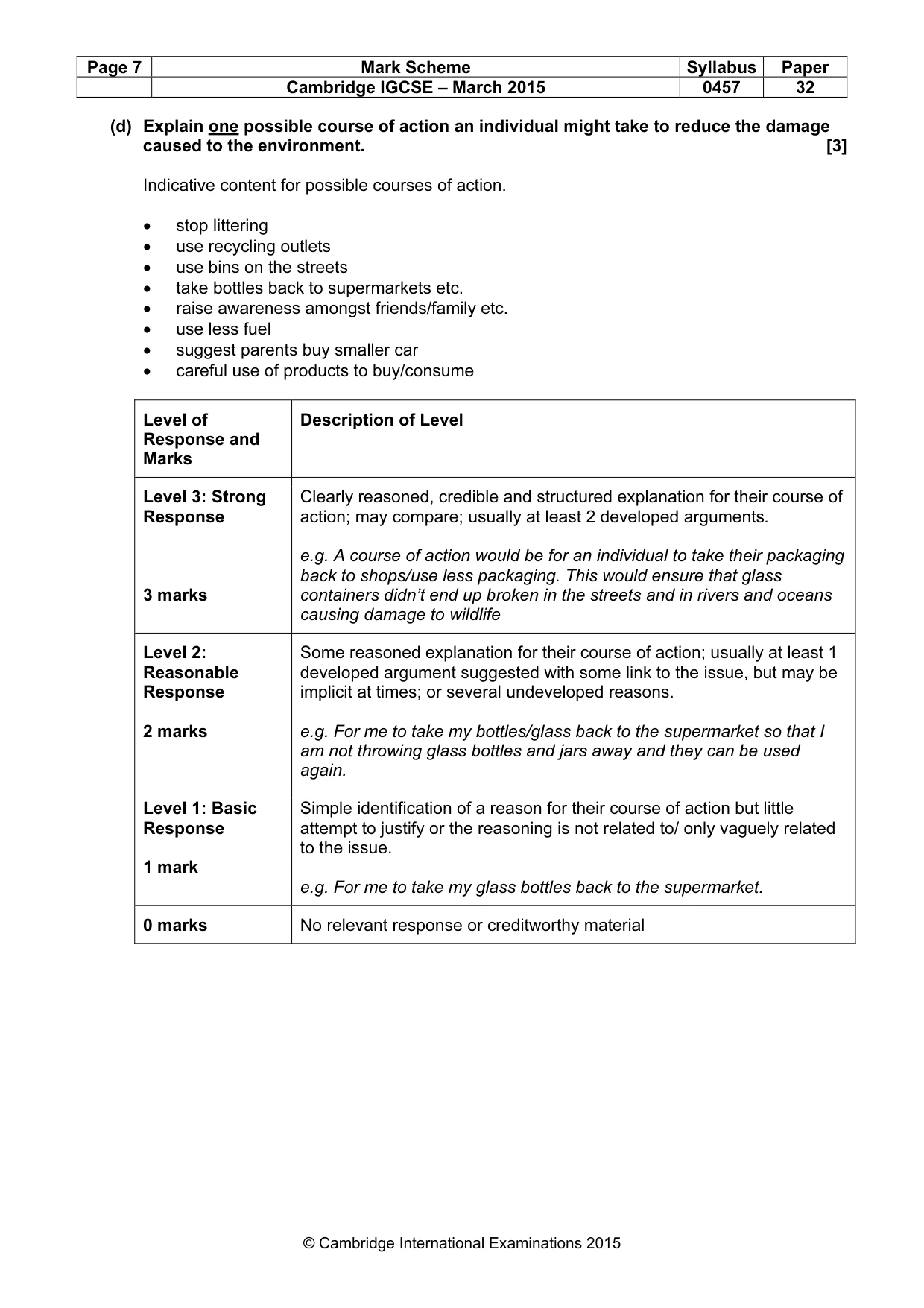
Page 7 Mark Scheme Syllabus Paper Cambridge IGCSE – March 2015 0457 32 © Cambridge International Examinations 2015 (d) Explain one possible course of action an individual might take to reduce the damage caused to the environment. [3] Indicative content for possible courses of action. • stop littering • use recycling outlets • use bins on the streets • take bottles back to supermarkets etc. • raise awareness amongst friends/family etc. • use less fuel • suggest parents buy smaller car • careful use of products to buy/consume Level of Response and Marks Description of Level Level 3: Strong Response 3 marks Clearly reasoned, credible and structured explanation for their course of action; may compare; usually at least 2 developed arguments. e.g. A course of action would be for an individual to take their packaging back to shops/use less packaging. This would ensure that glass containers didn’t end up broken in the streets and in rivers and oceans causing damage to wildlife Level 2: Reasonable Response 2 marks Some reasoned explanation for their course of action; usually at least 1 developed argument suggested with some link to the issue, but may be implicit at times; or several undeveloped reasons. e.g. For me to take my bottles/glass back to the supermarket so that I am not throwing glass bottles and jars away and they can be used again. Level 1: Basic Response 1 mark Simple identification of a reason for their course of action but little attempt to justify or the reasoning is not related to/ only vaguely related to the issue. e.g. For me to take my glass bottles back to the supermarket. 0 marks No relevant response or creditworthy material
Mark scheme, page 8
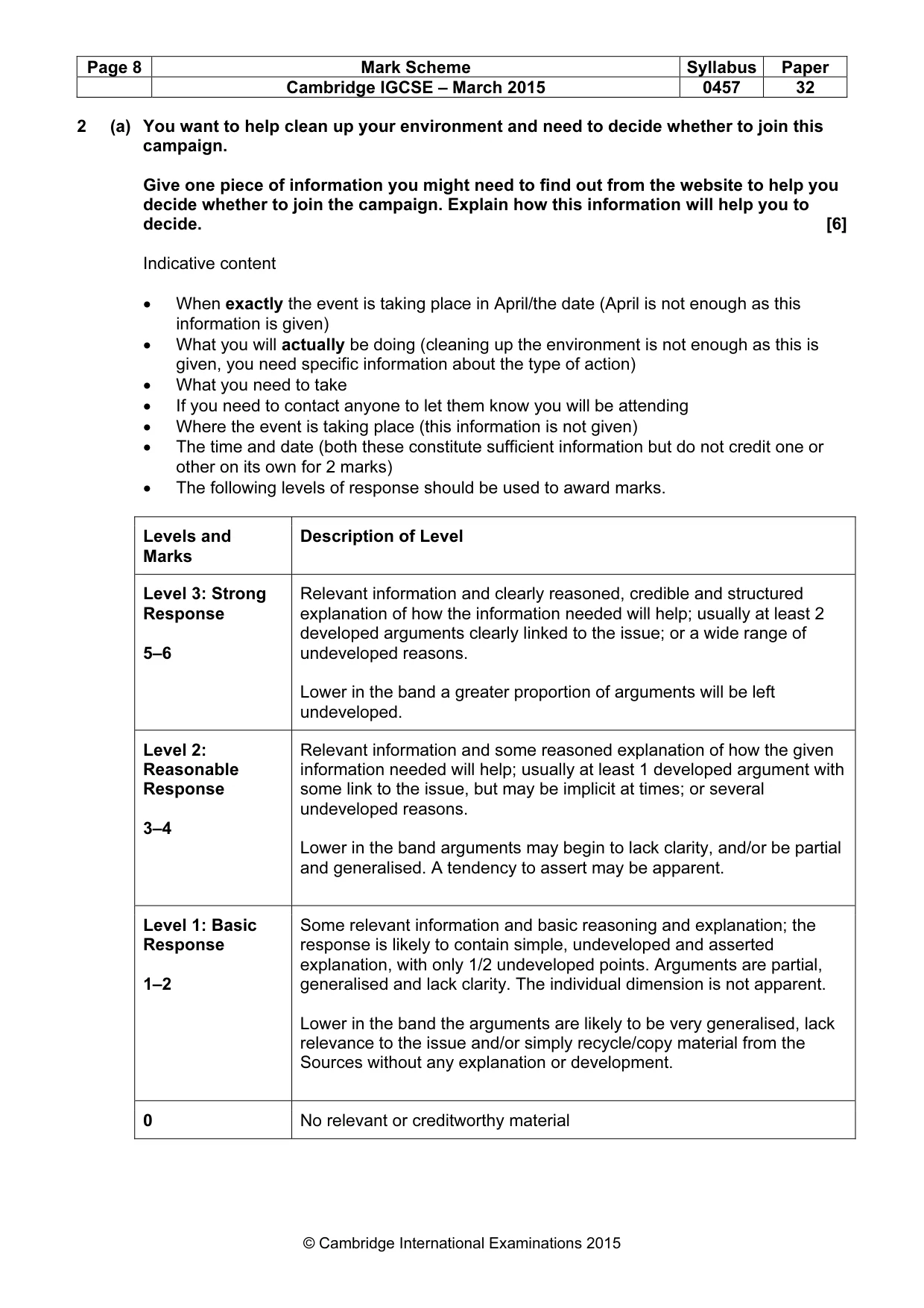
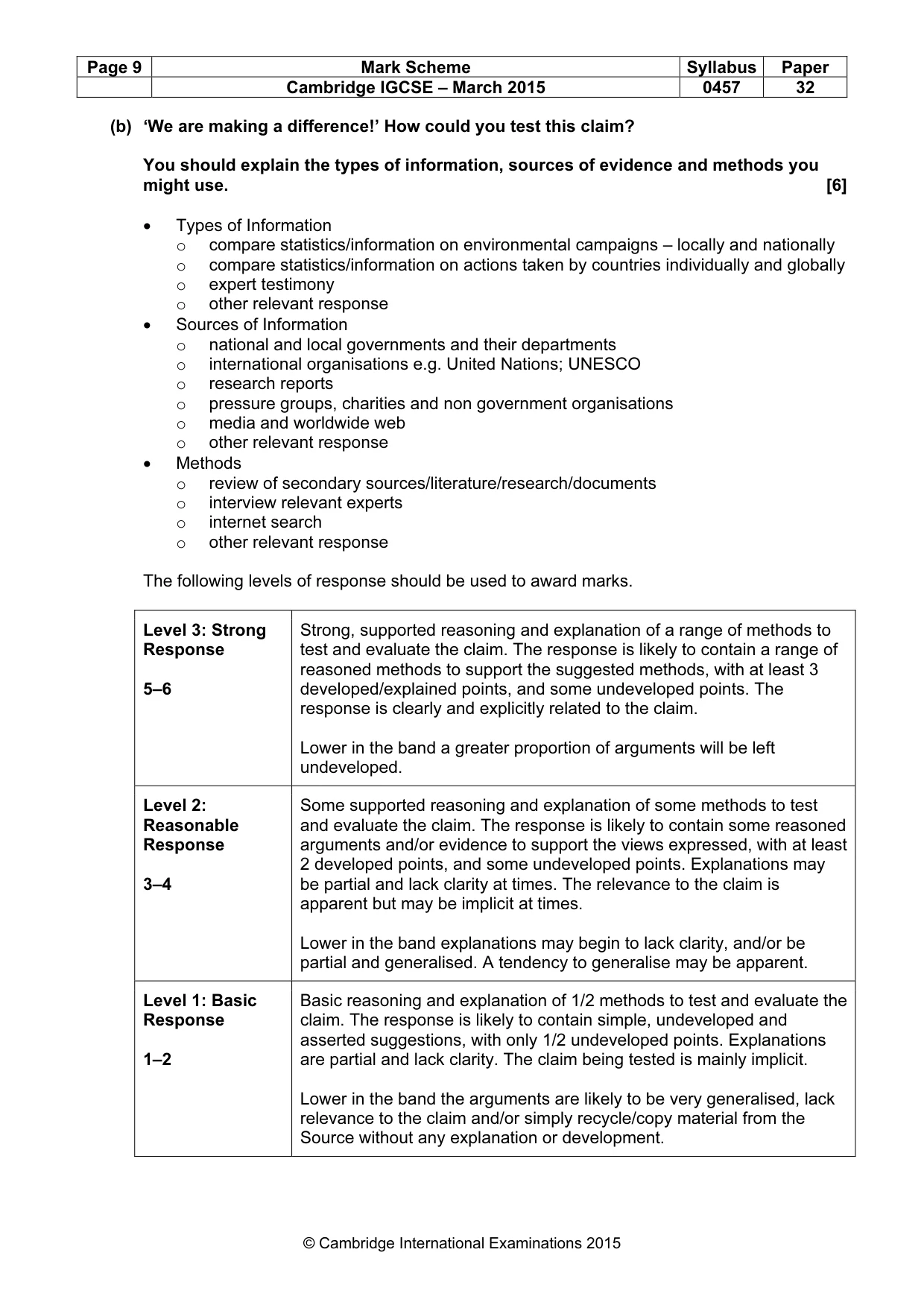
Page 8 Mark Scheme Syllabus Paper Cambridge IGCSE – March 2015 0457 32 © Cambridge International Examinations 2015 2 (a) You want to help clean up your environment and need to decide whether to join this campaign. Give one piece of information you might need to find out from the website to help you decide whether to join the campaign. Explain how this information will help you to decide. [6] Indicative content • When exactly the event is taking place in April/the date (April is not enough as this information is given) • What you will actually be doing (cleaning up the environment is not enough as this is given, you need specific information about the type of action) • What you need to take • If you need to contact anyone to let them know you will be attending • Where the event is taking place (this information is not given) • The time and date (both these constitute sufficient information but do not credit one or other on its own for 2 marks) • The following levels of response should be used to award marks. Levels and Marks Description of Level Level 3: Strong Response 5–6 Relevant information and clearly reasoned, credible and structured explanation of how the information needed will help; usually at least 2 developed arguments clearly linked to the issue; or a wide range of undeveloped reasons. Lower in the band a greater proportion of arguments will be left undeveloped. Level 2: Reasonable Response 3–4 Relevant information and some reasoned explanation of how the given information needed will help; usually at least 1 developed argument with some link to the issue, but may be implicit at times; or several undeveloped reasons. Lower in the band arguments may begin to lack clarity, and/or be partial and generalised. A tendency to assert may be apparent. Level 1: Basic Response 1–2 Some relevant information and basic reasoning and explanation; the response is likely to contain simple, undeveloped and asserted explanation, with only 1/2 undeveloped points. Arguments are partial, generalised and lack clarity. The individual dimension is not apparent. Lower in the band the arguments are likely to be very generalised, lack relevance to the issue and/or simply recycle/copy material from the Sources without any explanation or development. 0 No relevant or creditworthy material
Mark scheme, page 9
Page 9 Mark Scheme Syllabus Paper Cambridge IGCSE – March 2015 0457 32 © Cambridge International Examinations 2015 (b) ‘We are making a difference!’ How could you test this claim? You should explain the types of information, sources of evidence and methods you might use. [6] • Types of Information o compare statistics/information on environmental campaigns – locally and nationally o compare statistics/information on actions taken by countries individually and globally o expert testimony o other relevant response • Sources of Information o national and local governments and their departments o international organisations e.g. United Nations; UNESCO o research reports o pressure groups, charities and non government organisations o media and worldwide web o other relevant response • Methods o review of secondary sources/literature/research/documents o interview relevant experts o internet search o other relevant response The following levels of response should be used to award marks. Level 3: Strong Response 5–6 Strong, supported reasoning and explanation of a range of methods to test and evaluate the claim. The response is likely to contain a range of reasoned methods to support the suggested methods, with at least 3 developed/explained points, and some undeveloped points. The response is clearly and explicitly related to the claim. Lower in the band a greater proportion of arguments will be left undeveloped. Level 2: Reasonable Response 3–4 Some supported reasoning and explanation of some methods to test and evaluate the claim. The response is likely to contain some reasoned arguments and/or evidence to support the views expressed, with at least 2 developed points, and some undeveloped points. Explanations may be partial and lack clarity at times. The relevance to the claim is apparent but may be implicit at times. Lower in the band explanations may begin to lack clarity, and/or be partial and generalised. A tendency to generalise may be apparent. Level 1: Basic Response 1–2 Basic reasoning and explanation of 1/2 methods to test and evaluate the claim. The response is likely to contain simple, undeveloped and asserted suggestions, with only 1/2 undeveloped points. Explanations are partial and lack clarity. The claim being tested is mainly implicit. Lower in the band the arguments are likely to be very generalised, lack relevance to the claim and/or simply recycle/copy material from the Source without any explanation or development.
Mark scheme, page 10
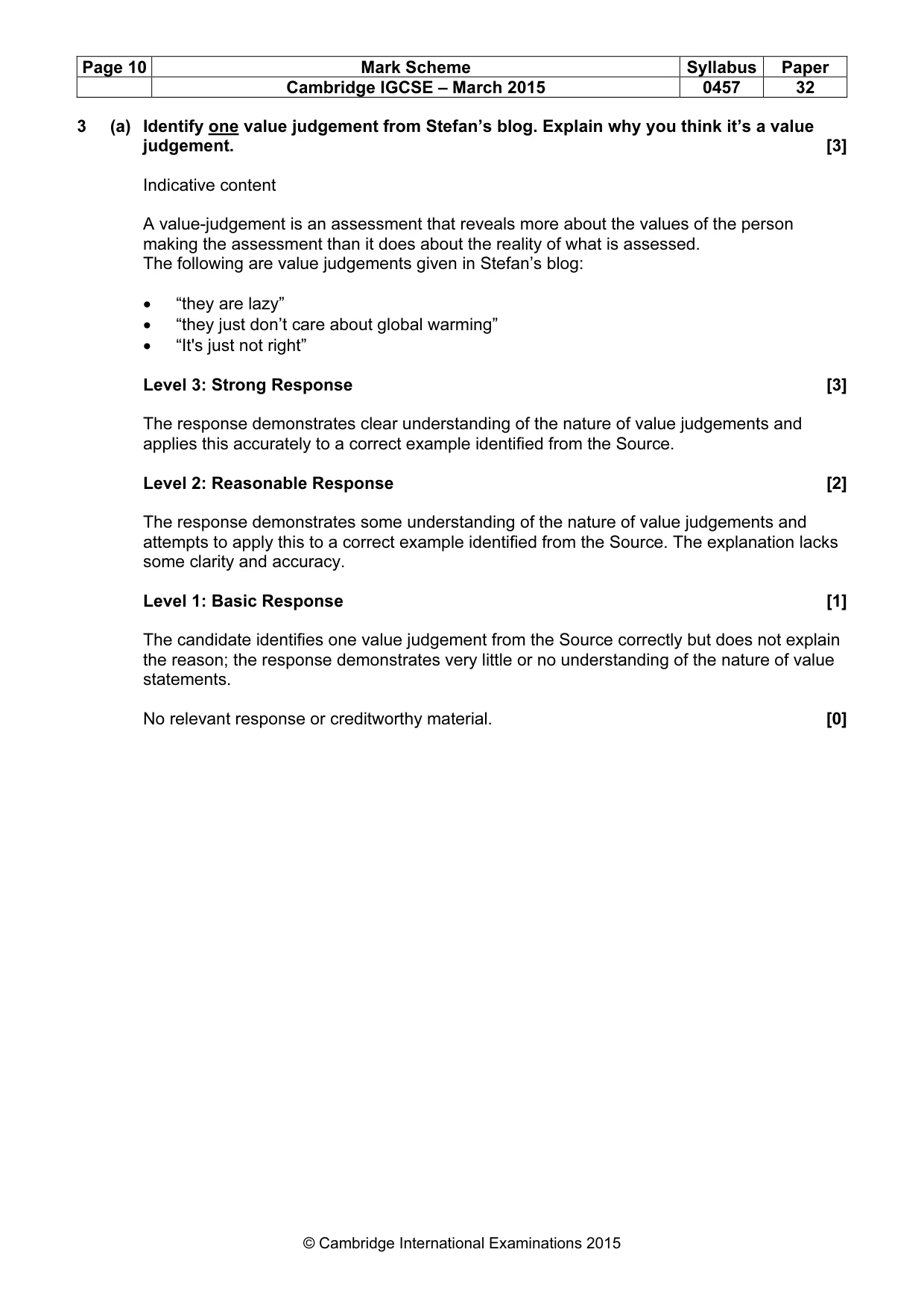
Page 10 Mark Scheme Syllabus Paper Cambridge IGCSE – March 2015 0457 32 © Cambridge International Examinations 2015 3 (a) Identify one value judgement from Stefan’s blog. Explain why you think it’s a value judgement. [3] Indicative content A value-judgement is an assessment that reveals more about the values of the person making the assessment than it does about the reality of what is assessed. The following are value judgements given in Stefan’s blog: • “they are lazy” • “they just don’t care about global warming” • “It's just not right” Level 3: Strong Response [3] The response demonstrates clear understanding of the nature of value judgements and applies this accurately to a correct example identified from the Source. Level 2: Reasonable Response [2] The response demonstrates some understanding of the nature of value judgements and attempts to apply this to a correct example identified from the Source. The explanation lacks some clarity and accuracy. Level 1: Basic Response [1] The candidate identifies one value judgement from the Source correctly but does not explain the reason; the response demonstrates very little or no understanding of the nature of value statements. No relevant response or creditworthy material. [0]
Mark scheme, page 11
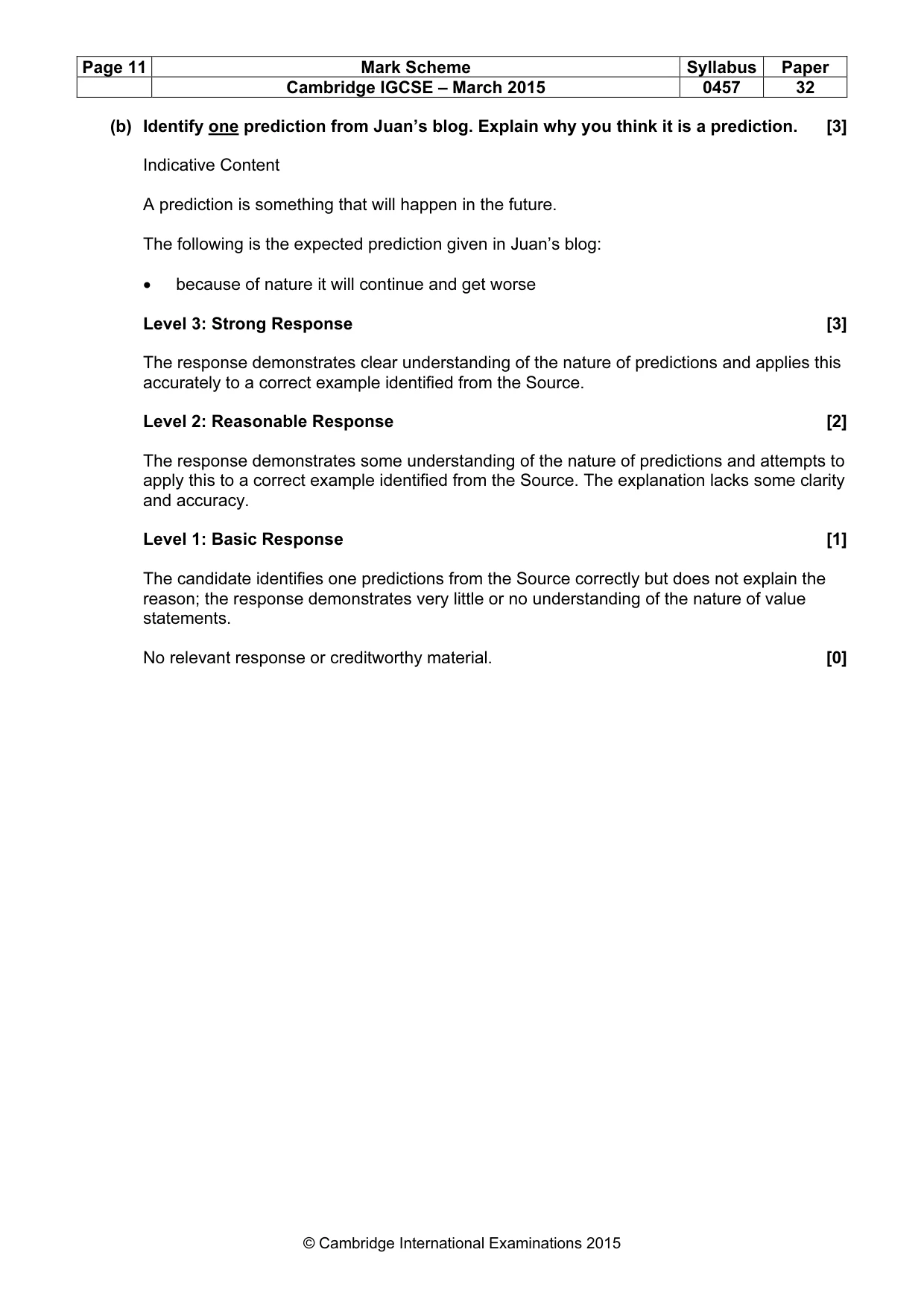
Page 11 Mark Scheme Syllabus Paper Cambridge IGCSE – March 2015 0457 32 © Cambridge International Examinations 2015 (b) Identify one prediction from Juan’s blog. Explain why you think it is a prediction. [3] Indicative Content A prediction is something that will happen in the future. The following is the expected prediction given in Juan’s blog: • because of nature it will continue and get worse Level 3: Strong Response [3] The response demonstrates clear understanding of the nature of predictions and applies this accurately to a correct example identified from the Source. Level 2: Reasonable Response [2] The response demonstrates some understanding of the nature of predictions and attempts to apply this to a correct example identified from the Source. The explanation lacks some clarity and accuracy. Level 1: Basic Response [1] The candidate identifies one predictions from the Source correctly but does not explain the reason; the response demonstrates very little or no understanding of the nature of value statements. No relevant response or creditworthy material. [0]
Mark scheme, page 12
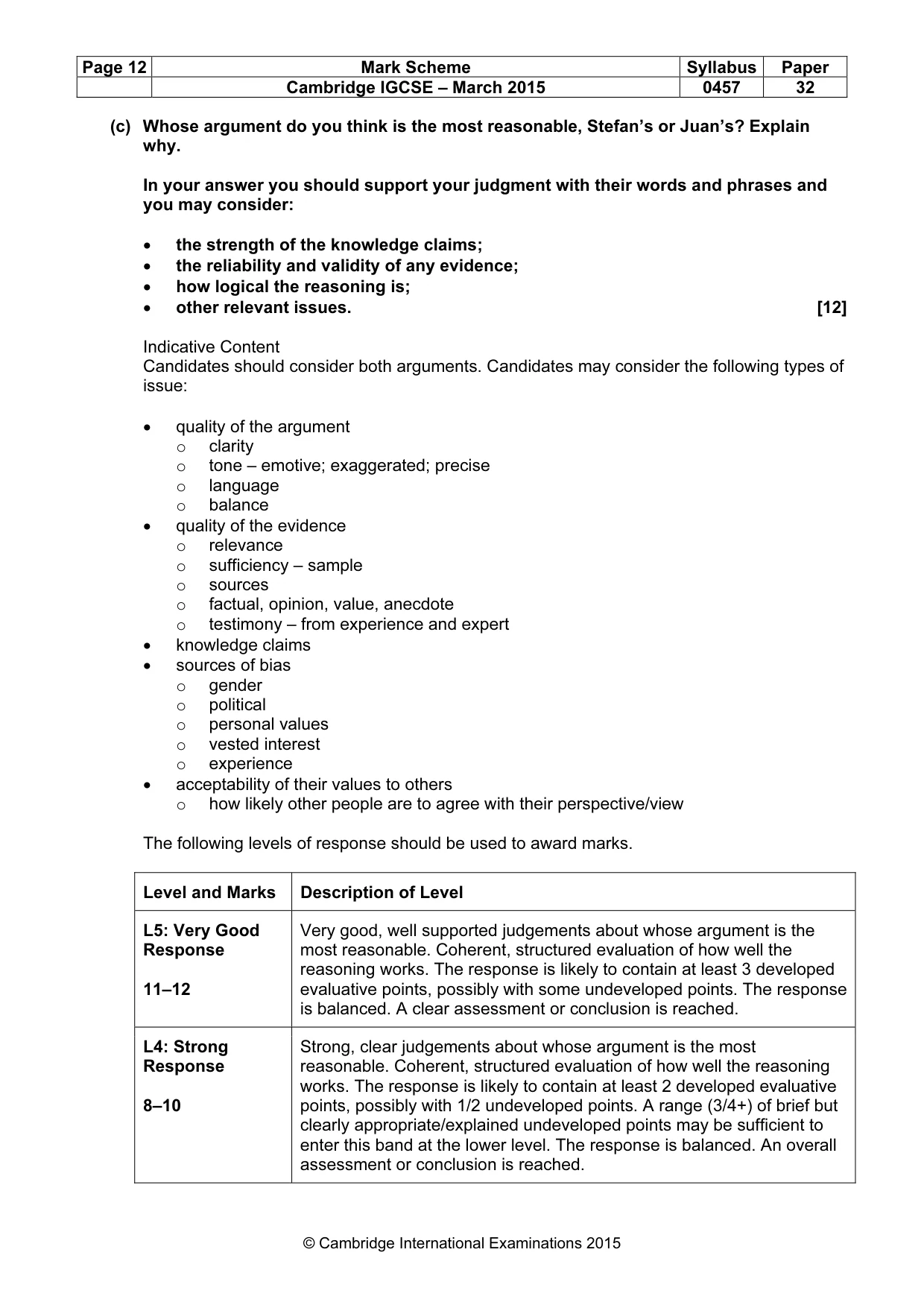
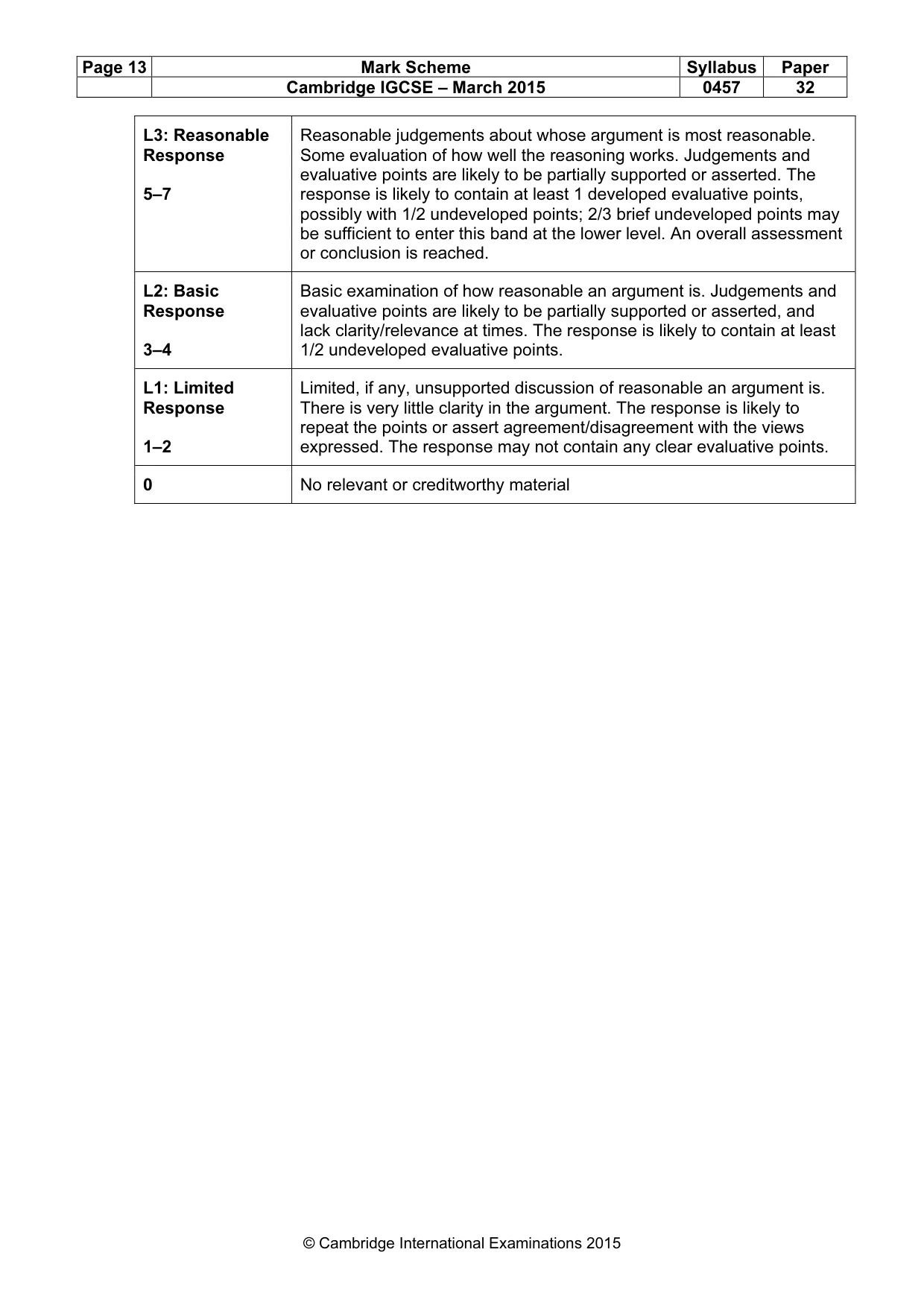
Page 12 Mark Scheme Syllabus Paper Cambridge IGCSE – March 2015 0457 32 © Cambridge International Examinations 2015 (c) Whose argument do you think is the most reasonable, Stefan’s or Juan’s? Explain why. In your answer you should support your judgment with their words and phrases and you may consider: • the strength of the knowledge claims; • the reliability and validity of any evidence; • how logical the reasoning is; • other relevant issues. [12] Indicative Content Candidates should consider both arguments. Candidates may consider the following types of issue: • quality of the argument o clarity o tone – emotive; exaggerated; precise o language o balance • quality of the evidence o relevance o sufficiency – sample o sources o factual, opinion, value, anecdote o testimony – from experience and expert • knowledge claims • sources of bias o gender o political o personal values o vested interest o experience • acceptability of their values to others o how likely other people are to agree with their perspective/view The following levels of response should be used to award marks. Level and Marks Description of Level L5: Very Good Response 11–12 Very good, well supported judgements about whose argument is the most reasonable. Coherent, structured evaluation of how well the reasoning works. The response is likely to contain at least 3 developed evaluative points, possibly with some undeveloped points. The response is balanced. A clear assessment or conclusion is reached. L4: Strong Response 8–10 Strong, clear judgements about whose argument is the most reasonable. Coherent, structured evaluation of how well the reasoning works. The response is likely to contain at least 2 developed evaluative points, possibly with 1/2 undeveloped points. A range (3/4+) of brief but clearly appropriate/explained undeveloped points may be sufficient to enter this band at the lower level. The response is balanced. An overall assessment or conclusion is reached.
Mark scheme, page 13
Page 13 Mark Scheme Syllabus Paper Cambridge IGCSE – March 2015 0457 32 © Cambridge International Examinations 2015 L3: Reasonable Response 5–7 Reasonable judgements about whose argument is most reasonable. Some evaluation of how well the reasoning works. Judgements and evaluative points are likely to be partially supported or asserted. The response is likely to contain at least 1 developed evaluative points, possibly with 1/2 undeveloped points; 2/3 brief undeveloped points may be sufficient to enter this band at the lower level. An overall assessment or conclusion is reached. L2: Basic Response 3–4 Basic examination of how reasonable an argument is. Judgements and evaluative points are likely to be partially supported or asserted, and lack clarity/relevance at times. The response is likely to contain at least 1/2 undeveloped evaluative points. L1: Limited Response 1–2 Limited, if any, unsupported discussion of reasonable an argument is. There is very little clarity in the argument. The response is likely to repeat the points or assert agreement/disagreement with the views expressed. The response may not contain any clear evaluative points. 0 No relevant or creditworthy material
Mark scheme, page 14
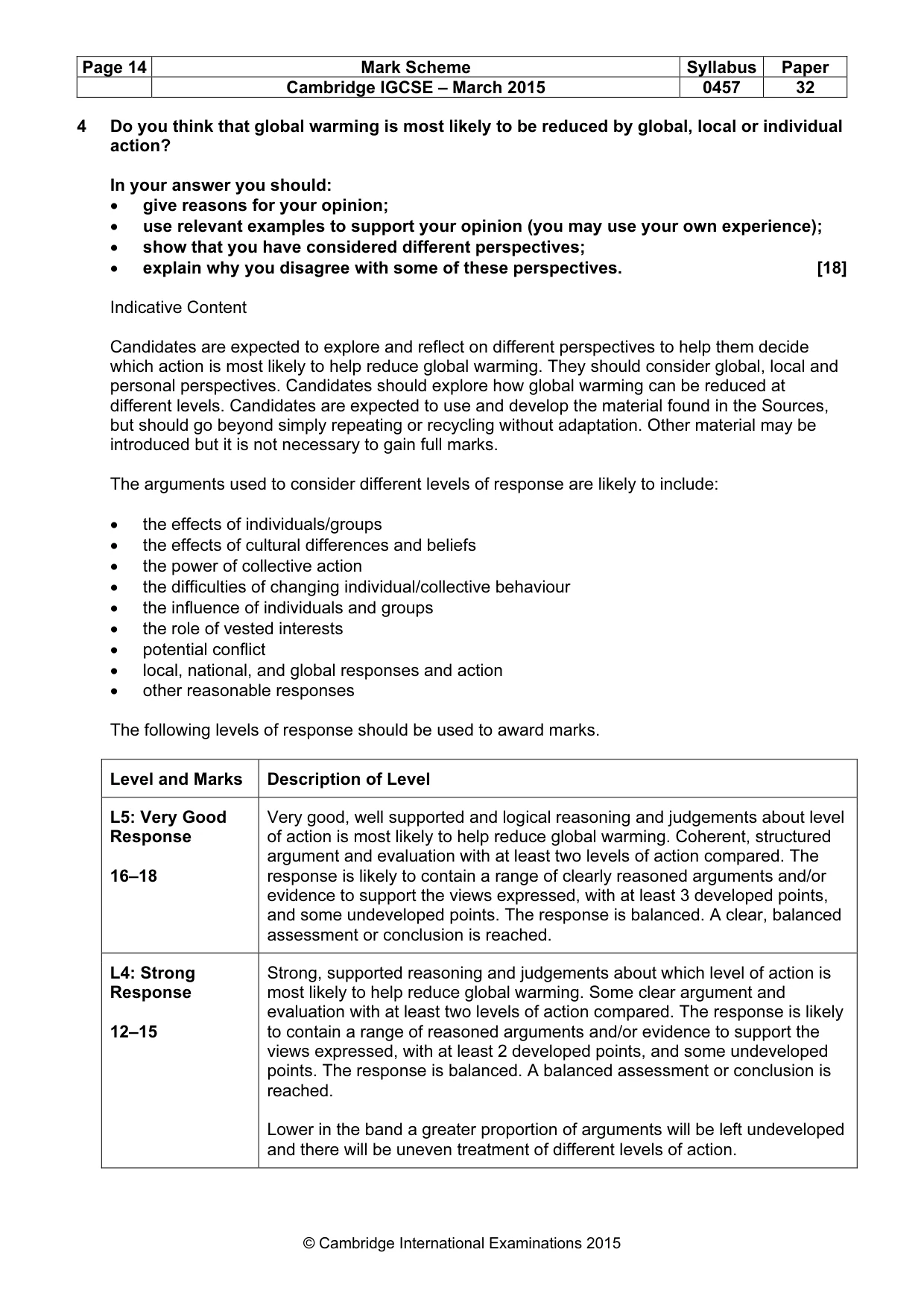
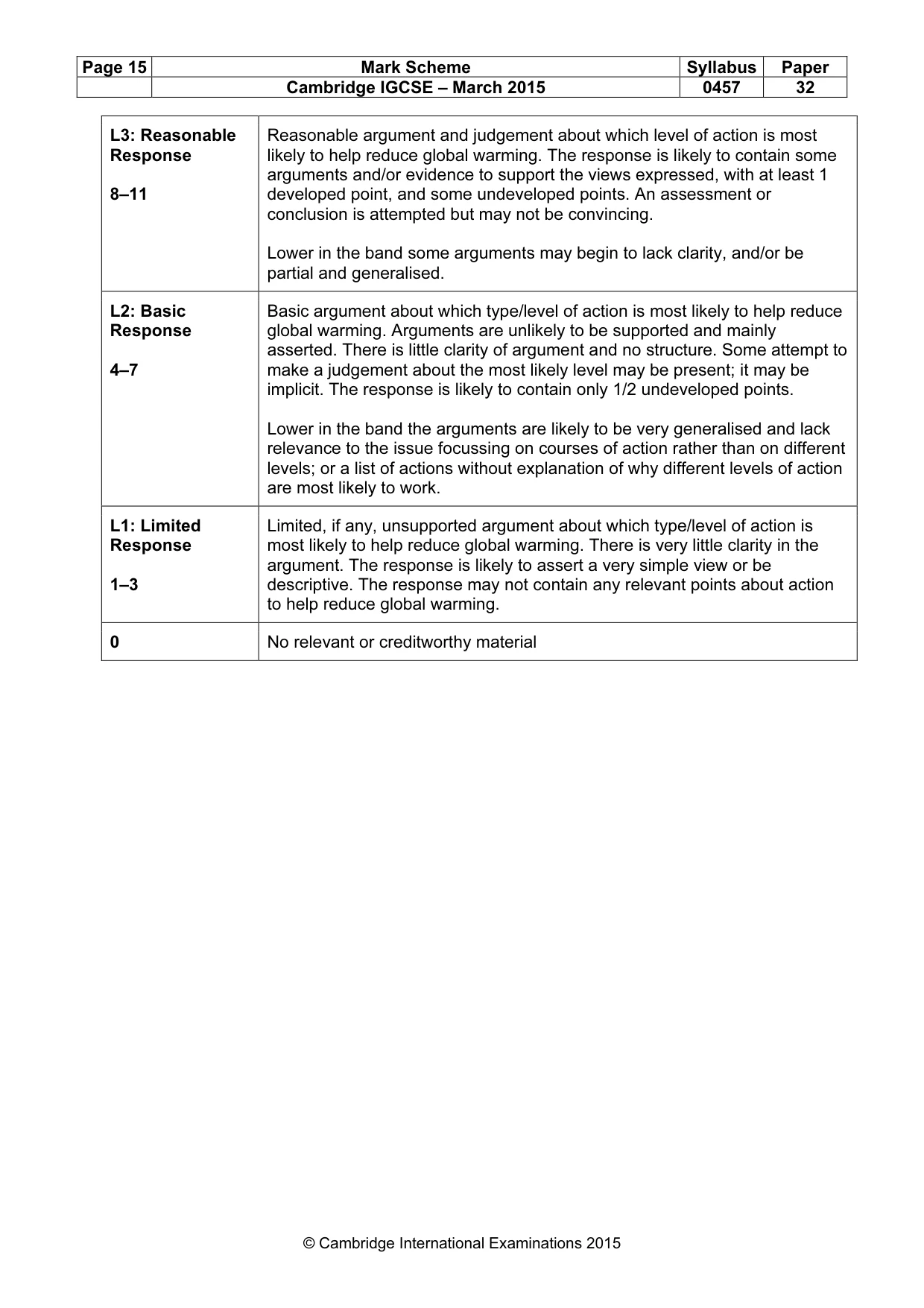
Page 14 Mark Scheme Syllabus Paper Cambridge IGCSE – March 2015 0457 32 © Cambridge International Examinations 2015 4 Do you think that global warming is most likely to be reduced by global, local or individual action? In your answer you should: • give reasons for your opinion; • use relevant examples to support your opinion (you may use your own experience); • show that you have considered different perspectives; • explain why you disagree with some of these perspectives. [18] Indicative Content Candidates are expected to explore and reflect on different perspectives to help them decide which action is most likely to help reduce global warming. They should consider global, local and personal perspectives. Candidates should explore how global warming can be reduced at different levels. Candidates are expected to use and develop the material found in the Sources, but should go beyond simply repeating or recycling without adaptation. Other material may be introduced but it is not necessary to gain full marks. The arguments used to consider different levels of response are likely to include: • the effects of individuals/groups • the effects of cultural differences and beliefs • the power of collective action • the difficulties of changing individual/collective behaviour • the influence of individuals and groups • the role of vested interests • potential conflict • local, national, and global responses and action • other reasonable responses The following levels of response should be used to award marks. Level and Marks Description of Level L5: Very Good Response 16–18 Very good, well supported and logical reasoning and judgements about level of action is most likely to help reduce global warming. Coherent, structured argument and evaluation with at least two levels of action compared. The response is likely to contain a range of clearly reasoned arguments and/or evidence to support the views expressed, with at least 3 developed points, and some undeveloped points. The response is balanced. A clear, balanced assessment or conclusion is reached. L4: Strong Response 12–15 Strong, supported reasoning and judgements about which level of action is most likely to help reduce global warming. Some clear argument and evaluation with at least two levels of action compared. The response is likely to contain a range of reasoned arguments and/or evidence to support the views expressed, with at least 2 developed points, and some undeveloped points. The response is balanced. A balanced assessment or conclusion is reached. Lower in the band a greater proportion of arguments will be left undeveloped and there will be uneven treatment of different levels of action.
Mark scheme, page 15
Page 15 Mark Scheme Syllabus Paper Cambridge IGCSE – March 2015 0457 32 © Cambridge International Examinations 2015 L3: Reasonable Response 8–11 Reasonable argument and judgement about which level of action is most likely to help reduce global warming. The response is likely to contain some arguments and/or evidence to support the views expressed, with at least 1 developed point, and some undeveloped points. An assessment or conclusion is attempted but may not be convincing. Lower in the band some arguments may begin to lack clarity, and/or be partial and generalised. L2: Basic Response 4–7 Basic argument about which type/level of action is most likely to help reduce global warming. Arguments are unlikely to be supported and mainly asserted. There is little clarity of argument and no structure. Some attempt to make a judgement about the most likely level may be present; it may be implicit. The response is likely to contain only 1/2 undeveloped points. Lower in the band the arguments are likely to be very generalised and lack relevance to the issue focussing on courses of action rather than on different levels; or a list of actions without explanation of why different levels of action are most likely to work. L1: Limited Response 1–3 Limited, if any, unsupported argument about which type/level of action is most likely to help reduce global warming. There is very little clarity in the argument. The response is likely to assert a very simple view or be descriptive. The response may not contain any relevant points about action to help reduce global warming. 0 No relevant or creditworthy material
What you needed in this session
Cambridge’s own grade thresholds for 2015 Feb/March, Paper 3 · Variant 2. A higher threshold means an easier paper — the bar moves with how the cohort did.