Cambridge IGCSE Global Perspectives 0457 — 2014 May/June Paper 3 · Variant 2
0457/32/M/J/14 · 60 marks · ≈68 min
The question paper and its mark scheme, free to read here and free to download. This is Cambridge’s own paper, exactly as it was sat.
Question paper8 pages


Mark scheme11 pages
Answers below. Sit the paper first if you are practising.
Paper as text
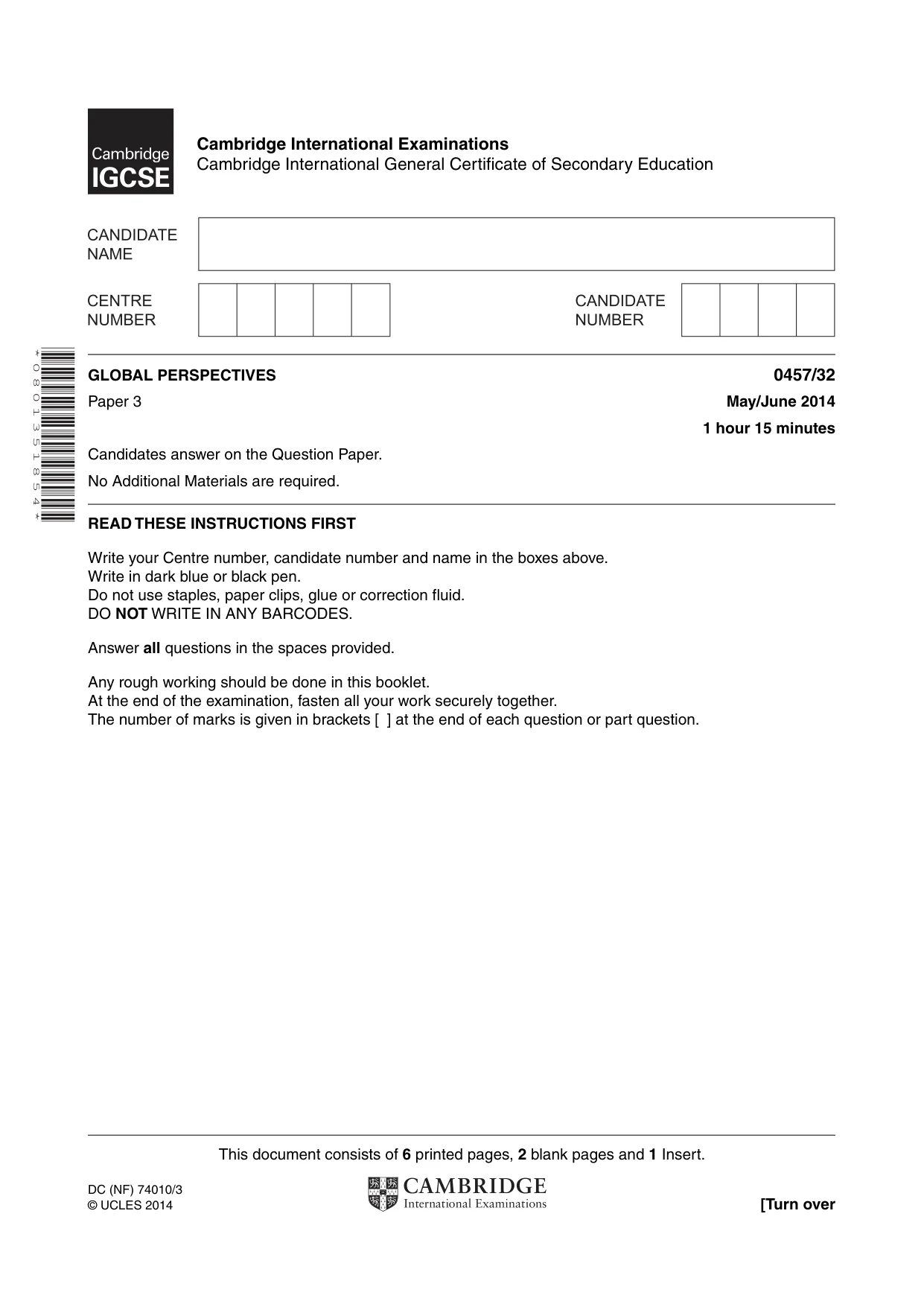
Question paper, page 1
This document consists of 6 printed pages, 2 blank pages and 1 Insert. DC (NF) 74010/3 © UCLES 2014 [Turn over Cambridge International Examinations Cambridge International General Certificate of Secondary Education * 0 8 0 1 3 5 1 8 5 4 * GLOBAL PERSPECTIVES 0457/32 Paper 3 May/June 2014 1 hour 15 minutes Candidates answer on the Question Paper. No Additional Materials are required. READ THESE INSTRUCTIONS FIRST Write your Centre number, candidate number and name in the boxes above. Write in dark blue or black pen. Do not use staples, paper clips, glue or correction fluid. DO NOT WRITE IN ANY BARCODES. Answer all questions in the spaces provided. Any rough working should be done in this booklet. At the end of the examination, fasten all your work securely together. The number of marks is given in brackets [ ] at the end of each question or part question.
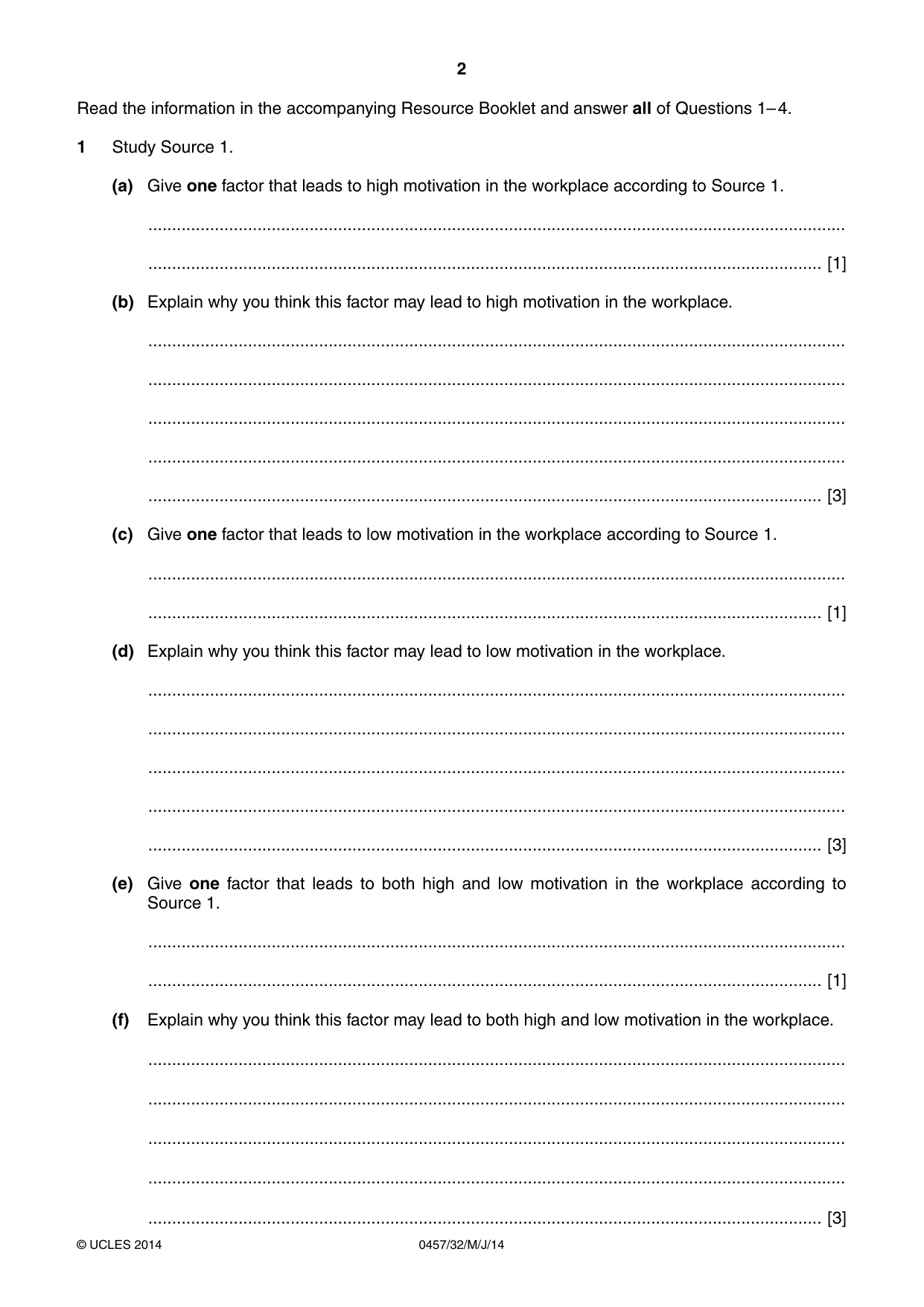
Question paper, page 2
2 0457/32/M/J/14 © UCLES 2014 Read the information in the accompanying Resource Booklet and answer all of Questions 1– 4. 1 Study Source 1. (a) Give one factor that leads to high motivation in the workplace according to Source 1. … … [1] (b) Explain why you think this factor may lead to high motivation in the workplace. … … … … … [3] (c) Give one factor that leads to low motivation in the workplace according to Source 1. … … [1] (d) Explain why you think this factor may lead to low motivation in the workplace. … … … … … [3] (e) Give one factor that leads to both high and low motivation in the workplace according to Source 1. … … [1] (f) Explain why you think this factor may lead to both high and low motivation in the workplace. … … … … … [3]
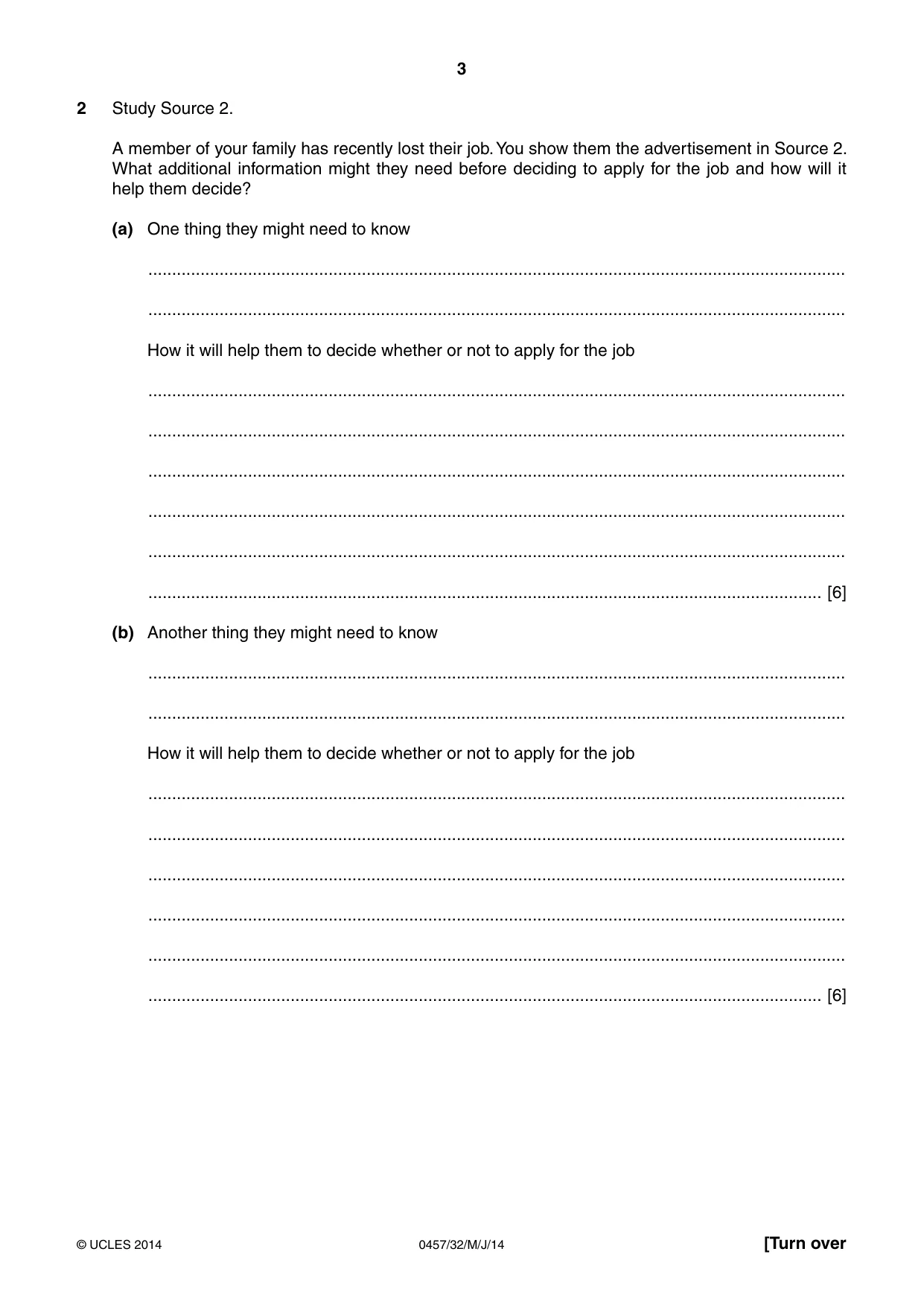
Question paper, page 3
3 0457/32/M/J/14 © UCLES 2014 [Turn over 2 Study Source 2. A member of your family has recently lost their job. You show them the advertisement in Source 2. What additional information might they need before deciding to apply for the job and how will it help them decide? (a) One thing they might need to know … … How it will help them to decide whether or not to apply for the job … … … … … … [6] (b) Another thing they might need to know … … How it will help them to decide whether or not to apply for the job … … … … … … [6]
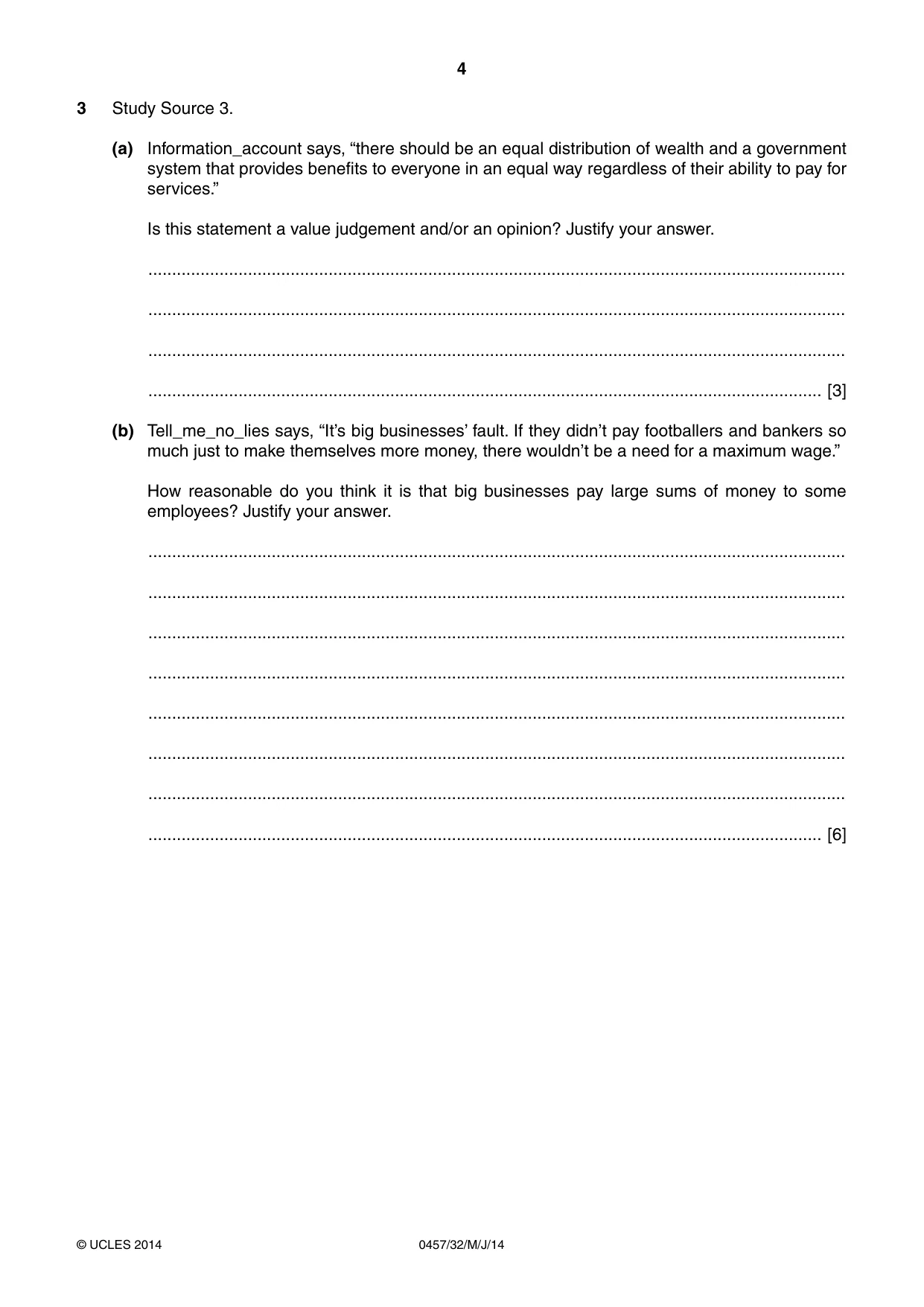
Question paper, page 4
4 0457/32/M/J/14 © UCLES 2014 3 Study Source 3. (a) Information_account says, “there should be an equal distribution of wealth and a government system that provides benefits to everyone in an equal way regardless of their ability to pay for services.” Is this statement a value judgement and/or an opinion? Justify your answer. … … … … [3] (b) Tell_me_no_lies says, “It’s big businesses’ fault. If they didn’t pay footballers and bankers so much just to make themselves more money, there wouldn’t be a need for a maximum wage.” How reasonable do you think it is that big businesses pay large sums of money to some employees? Justify your answer. … … … … … … … … [6]
Question paper, page 5
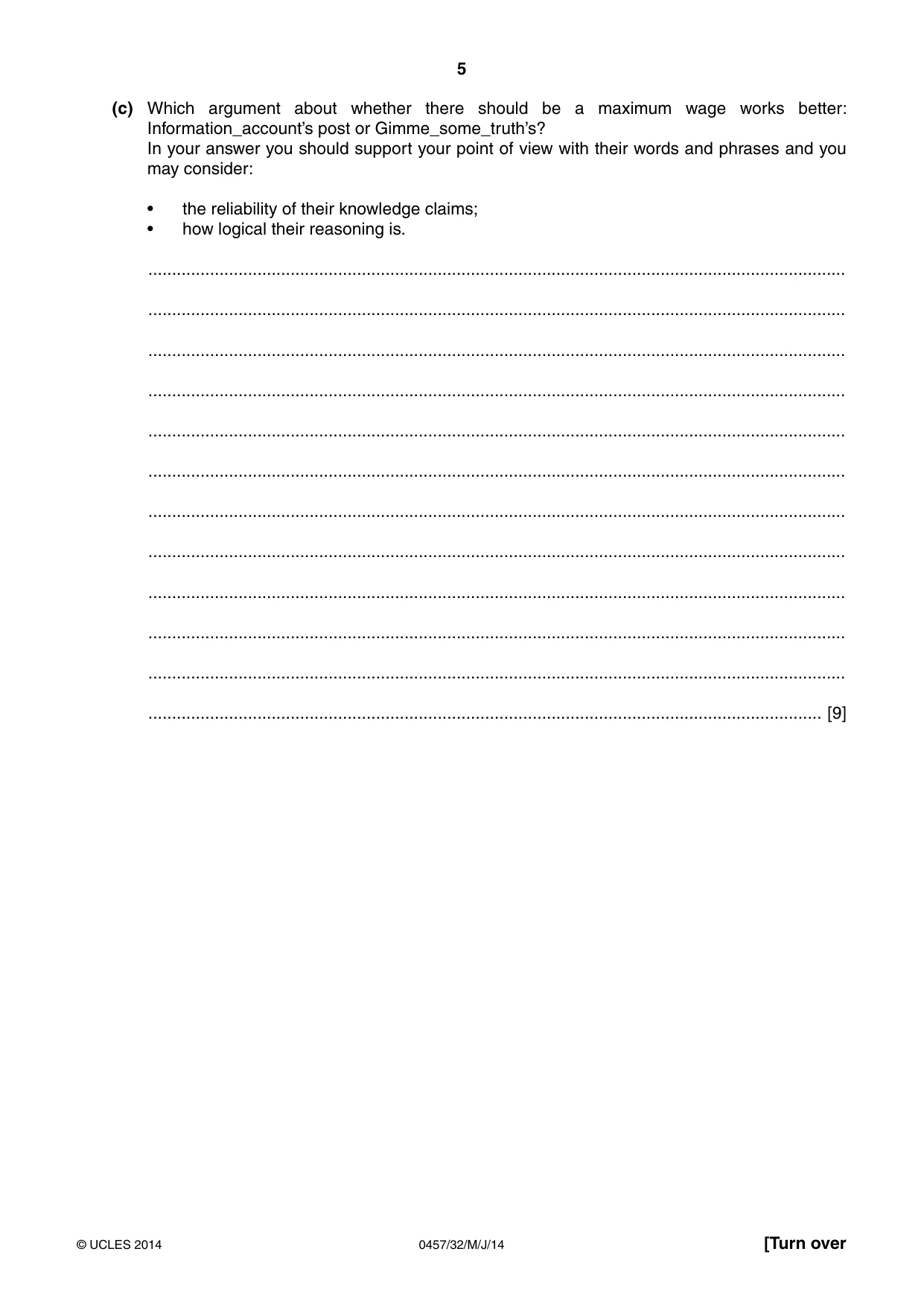
5 0457/32/M/J/14 © UCLES 2014 [Turn over (c) Which argument about whether there should be a maximum wage works better: Information_account’s post or Gimme_some_truth’s? In your answer you should support your point of view with their words and phrases and you may consider: • the reliability of their knowledge claims; • how logical their reasoning is. … … … … … … … … … … … … [9]
Question paper, page 6
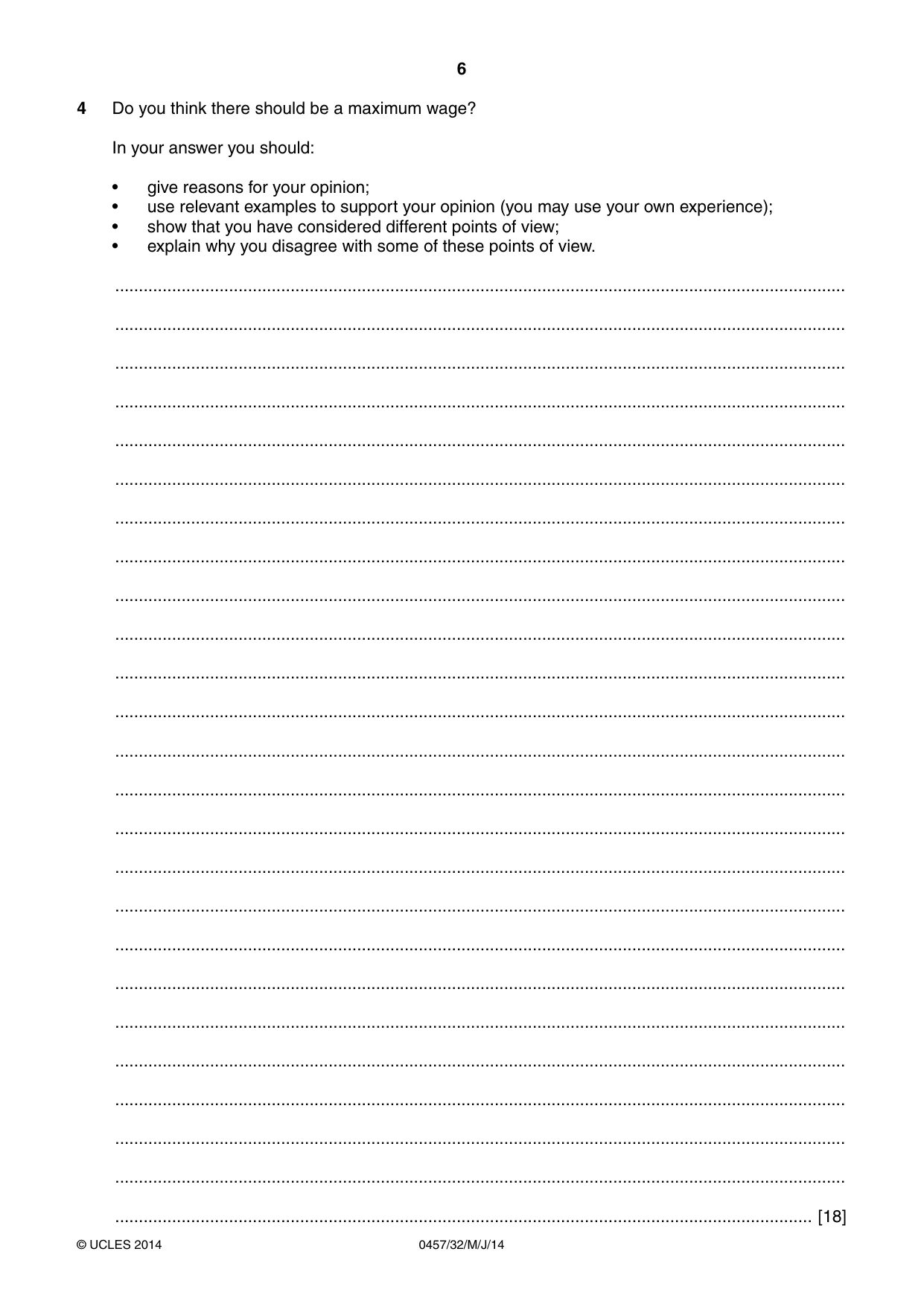
6 0457/32/M/J/14 © UCLES 2014 4 Do you think there should be a maximum wage? In your answer you should: • give reasons for your opinion; • use relevant examples to support your opinion (you may use your own experience); • show that you have considered different points of view; • explain why you disagree with some of these points of view. … … … … … … … … … … … … … … … … … … … … … … … … … [18]
Question paper, page 7
7 0457/32/M/J/14 © UCLES 2014 BLANK PAGE
Question paper, page 8
8 0457/32/M/J/14 © UCLES 2014 BLANK PAGE Permission to reproduce items where third-party owned material protected by copyright is included has been sought and cleared where possible. Every reasonable effort has been made by the publisher (UCLES) to trace copyright holders, but if any items requiring clearance have unwittingly been included, the publisher will be pleased to make amends at the earliest possible opportunity. Cambridge International Examinations is part of the Cambridge Assessment Group. Cambridge Assessment is the brand name of University of Cambridge Local Examinations Syndicate (UCLES), which is itself a department of the University of Cambridge.
Mark scheme, page 1
CAMBRIDGE INTERNATIONAL EXAMINATIONS International General Certificate of Secondary Education MARK SCHEME for the May/June 2014 series 0457 GLOBAL PERSPECTIVES 0457/32 Paper 3 (Written Paper), maximum raw mark 60 This mark scheme is published as an aid to teachers and candidates, to indicate the requirements of the examination. It shows the basis on which Examiners were instructed to award marks. It does not indicate the details of the discussions that took place at an Examiners’ meeting before marking began, which would have considered the acceptability of alternative answers. Mark schemes should be read in conjunction with the question paper and the Principal Examiner Report for Teachers. Cambridge will not enter into discussions about these mark schemes. Cambridge is publishing the mark schemes for the May/June 2014 series for most IGCSE, GCE Advanced Level and Advanced Subsidiary Level components and some Ordinary Level components.
Mark scheme, page 2
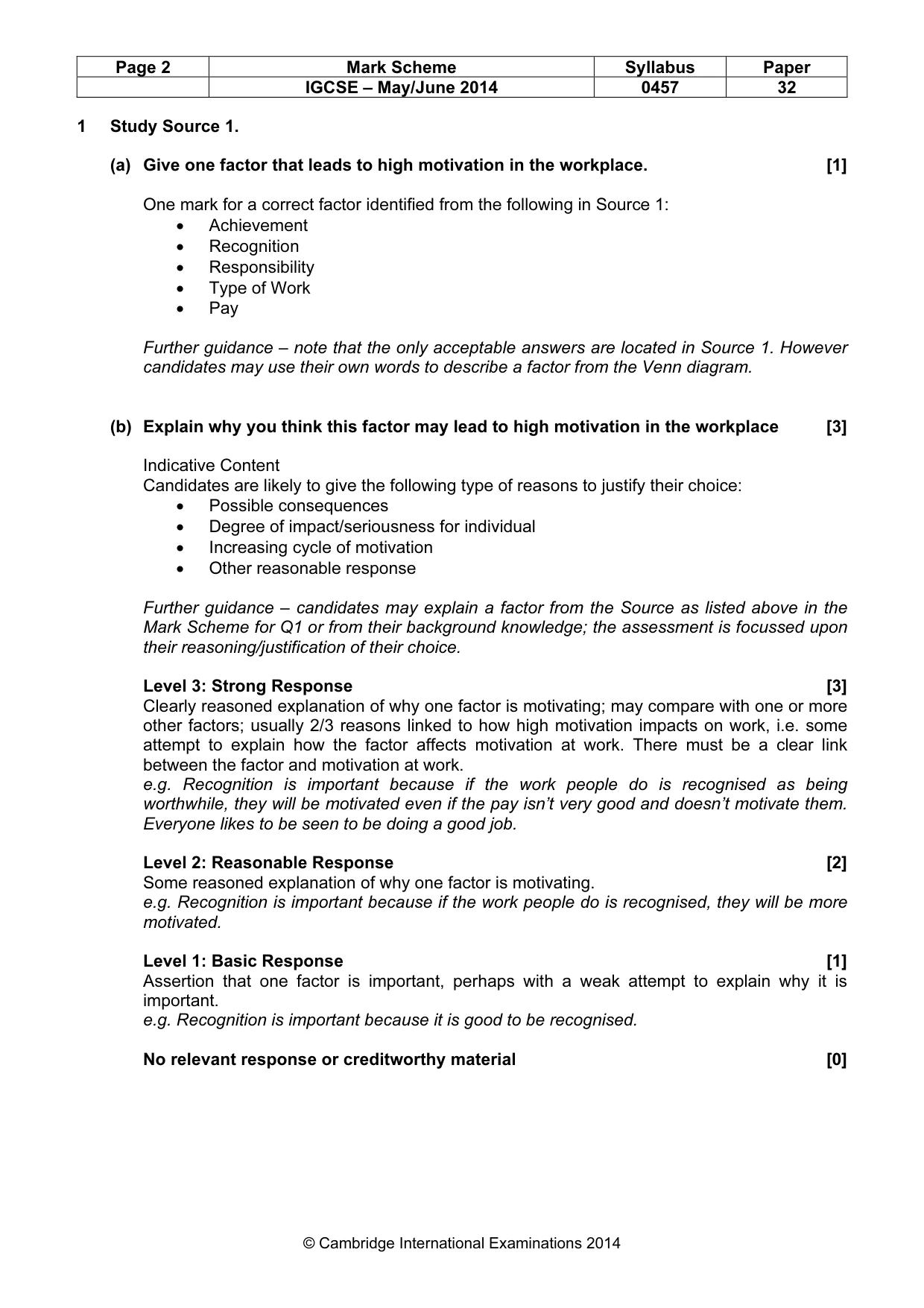
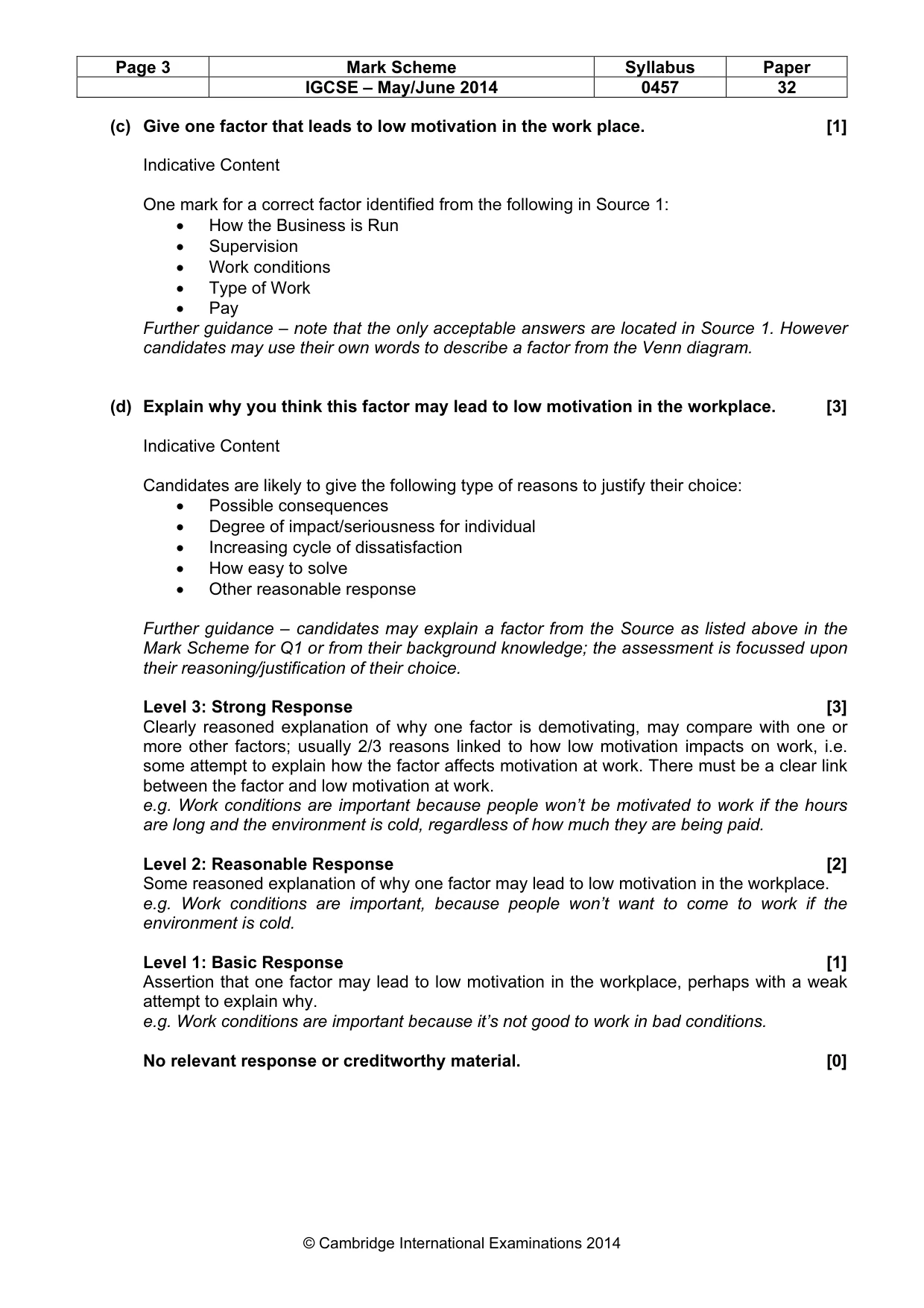
Page 2 Mark Scheme Syllabus Paper IGCSE – May/June 2014 0457 32 © Cambridge International Examinations 2014 1 Study Source 1. (a) Give one factor that leads to high motivation in the workplace. [1] One mark for a correct factor identified from the following in Source 1: • Achievement • Recognition • Responsibility • Type of Work • Pay Further guidance – note that the only acceptable answers are located in Source 1. However candidates may use their own words to describe a factor from the Venn diagram. (b) Explain why you think this factor may lead to high motivation in the workplace [3] Indicative Content Candidates are likely to give the following type of reasons to justify their choice: • Possible consequences • Degree of impact/seriousness for individual • Increasing cycle of motivation • Other reasonable response Further guidance – candidates may explain a factor from the Source as listed above in the Mark Scheme for Q1 or from their background knowledge; the assessment is focussed upon their reasoning/justification of their choice. Level 3: Strong Response [3] Clearly reasoned explanation of why one factor is motivating; may compare with one or more other factors; usually 2/3 reasons linked to how high motivation impacts on work, i.e. some attempt to explain how the factor affects motivation at work. There must be a clear link between the factor and motivation at work. e.g. Recognition is important because if the work people do is recognised as being worthwhile, they will be motivated even if the pay isn’t very good and doesn’t motivate them. Everyone likes to be seen to be doing a good job. Level 2: Reasonable Response [2] Some reasoned explanation of why one factor is motivating. e.g. Recognition is important because if the work people do is recognised, they will be more motivated. Level 1: Basic Response [1] Assertion that one factor is important, perhaps with a weak attempt to explain why it is important. e.g. Recognition is important because it is good to be recognised. No relevant response or creditworthy material [0]
Mark scheme, page 3
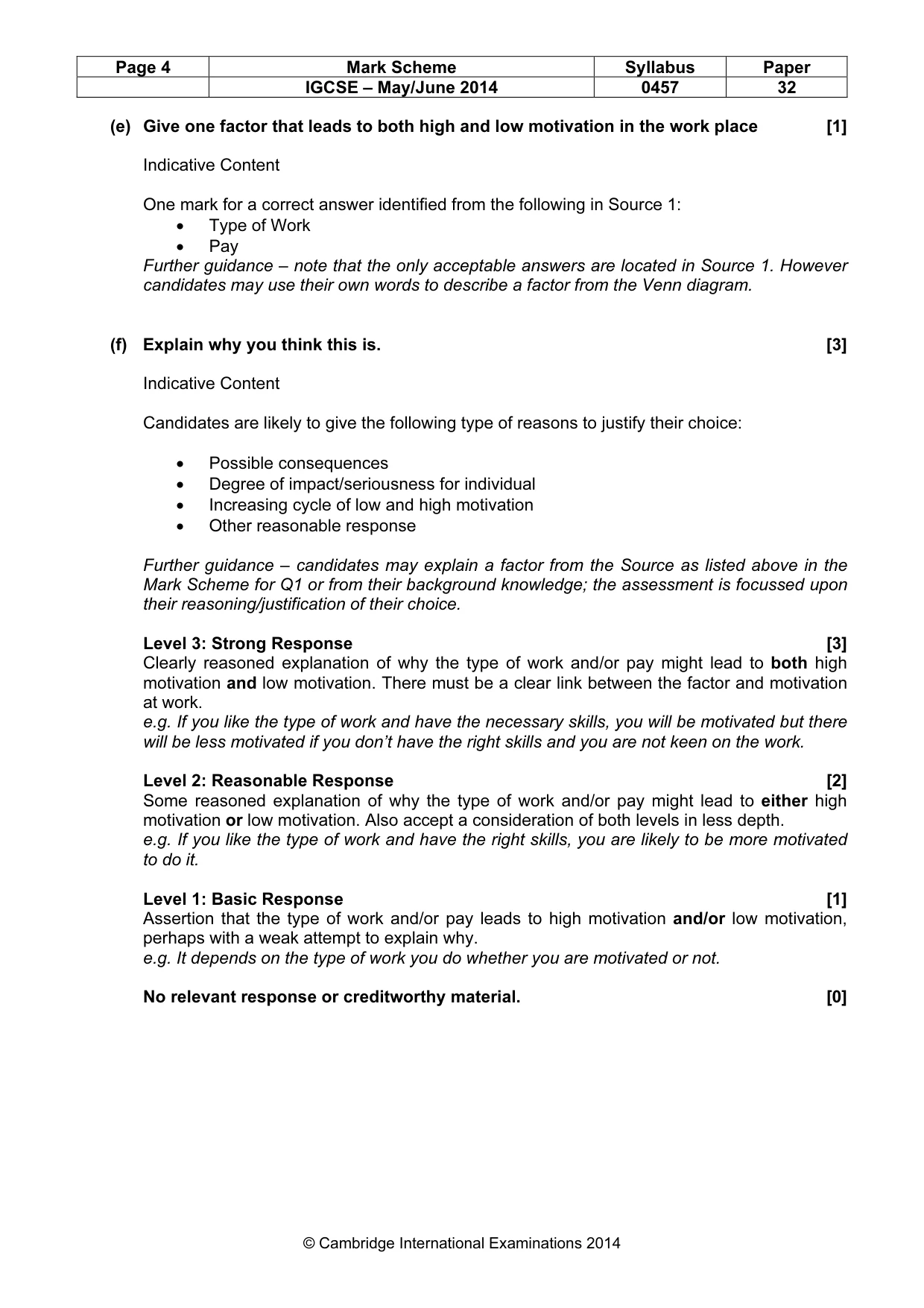
Page 3 Mark Scheme Syllabus Paper IGCSE – May/June 2014 0457 32 © Cambridge International Examinations 2014 (c) Give one factor that leads to low motivation in the work place. [1] Indicative Content One mark for a correct factor identified from the following in Source 1: • How the Business is Run • Supervision • Work conditions • Type of Work • Pay Further guidance – note that the only acceptable answers are located in Source 1. However candidates may use their own words to describe a factor from the Venn diagram. (d) Explain why you think this factor may lead to low motivation in the workplace. [3] Indicative Content Candidates are likely to give the following type of reasons to justify their choice: • Possible consequences • Degree of impact/seriousness for individual • Increasing cycle of dissatisfaction • How easy to solve • Other reasonable response Further guidance – candidates may explain a factor from the Source as listed above in the Mark Scheme for Q1 or from their background knowledge; the assessment is focussed upon their reasoning/justification of their choice. Level 3: Strong Response [3] Clearly reasoned explanation of why one factor is demotivating, may compare with one or more other factors; usually 2/3 reasons linked to how low motivation impacts on work, i.e. some attempt to explain how the factor affects motivation at work. There must be a clear link between the factor and low motivation at work. e.g. Work conditions are important because people won’t be motivated to work if the hours are long and the environment is cold, regardless of how much they are being paid. Level 2: Reasonable Response [2] Some reasoned explanation of why one factor may lead to low motivation in the workplace. e.g. Work conditions are important, because people won’t want to come to work if the environment is cold. Level 1: Basic Response [1] Assertion that one factor may lead to low motivation in the workplace, perhaps with a weak attempt to explain why. e.g. Work conditions are important because it’s not good to work in bad conditions. No relevant response or creditworthy material. [0]
Mark scheme, page 4
Page 4 Mark Scheme Syllabus Paper IGCSE – May/June 2014 0457 32 © Cambridge International Examinations 2014 (e) Give one factor that leads to both high and low motivation in the work place [1] Indicative Content One mark for a correct answer identified from the following in Source 1: • Type of Work • Pay Further guidance – note that the only acceptable answers are located in Source 1. However candidates may use their own words to describe a factor from the Venn diagram. (f) Explain why you think this is. [3] Indicative Content Candidates are likely to give the following type of reasons to justify their choice: • Possible consequences • Degree of impact/seriousness for individual • Increasing cycle of low and high motivation • Other reasonable response Further guidance – candidates may explain a factor from the Source as listed above in the Mark Scheme for Q1 or from their background knowledge; the assessment is focussed upon their reasoning/justification of their choice. Level 3: Strong Response [3] Clearly reasoned explanation of why the type of work and/or pay might lead to both high motivation and low motivation. There must be a clear link between the factor and motivation at work. e.g. If you like the type of work and have the necessary skills, you will be motivated but there will be less motivated if you don’t have the right skills and you are not keen on the work. Level 2: Reasonable Response [2] Some reasoned explanation of why the type of work and/or pay might lead to either high motivation or low motivation. Also accept a consideration of both levels in less depth. e.g. If you like the type of work and have the right skills, you are likely to be more motivated to do it. Level 1: Basic Response [1] Assertion that the type of work and/or pay leads to high motivation and/or low motivation, perhaps with a weak attempt to explain why. e.g. It depends on the type of work you do whether you are motivated or not. No relevant response or creditworthy material. [0]
Mark scheme, page 5
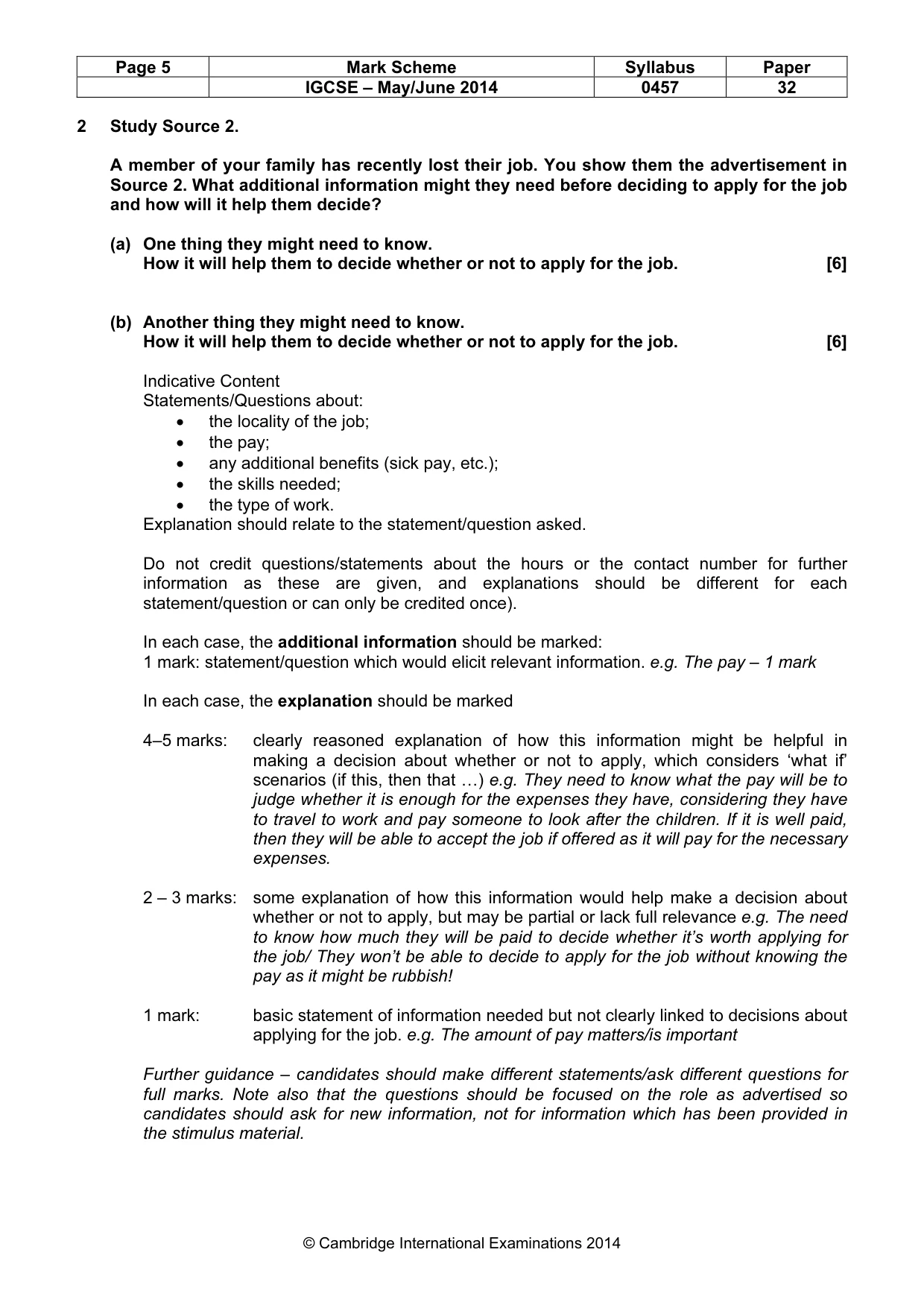
Page 5 Mark Scheme Syllabus Paper IGCSE – May/June 2014 0457 32 © Cambridge International Examinations 2014 2 Study Source 2. A member of your family has recently lost their job. You show them the advertisement in Source 2. What additional information might they need before deciding to apply for the job and how will it help them decide? (a) One thing they might need to know. How it will help them to decide whether or not to apply for the job. [6] (b) Another thing they might need to know. How it will help them to decide whether or not to apply for the job. [6] Indicative Content Statements/Questions about: • the locality of the job; • the pay; • any additional benefits (sick pay, etc.); • the skills needed; • the type of work. Explanation should relate to the statement/question asked. Do not credit questions/statements about the hours or the contact number for further information as these are given, and explanations should be different for each statement/question or can only be credited once). In each case, the additional information should be marked: 1 mark: statement/question which would elicit relevant information. e.g. The pay – 1 mark In each case, the explanation should be marked 4–5 marks: clearly reasoned explanation of how this information might be helpful in making a decision about whether or not to apply, which considers ‘what if’ scenarios (if this, then that …) e.g. They need to know what the pay will be to judge whether it is enough for the expenses they have, considering they have to travel to work and pay someone to look after the children. If it is well paid, then they will be able to accept the job if offered as it will pay for the necessary expenses. 2 – 3 marks: some explanation of how this information would help make a decision about whether or not to apply, but may be partial or lack full relevance e.g. The need to know how much they will be paid to decide whether it’s worth applying for the job/ They won’t be able to decide to apply for the job without knowing the pay as it might be rubbish! 1 mark: basic statement of information needed but not clearly linked to decisions about applying for the job. e.g. The amount of pay matters/is important Further guidance – candidates should make different statements/ask different questions for full marks. Note also that the questions should be focused on the role as advertised so candidates should ask for new information, not for information which has been provided in the stimulus material.
Mark scheme, page 6
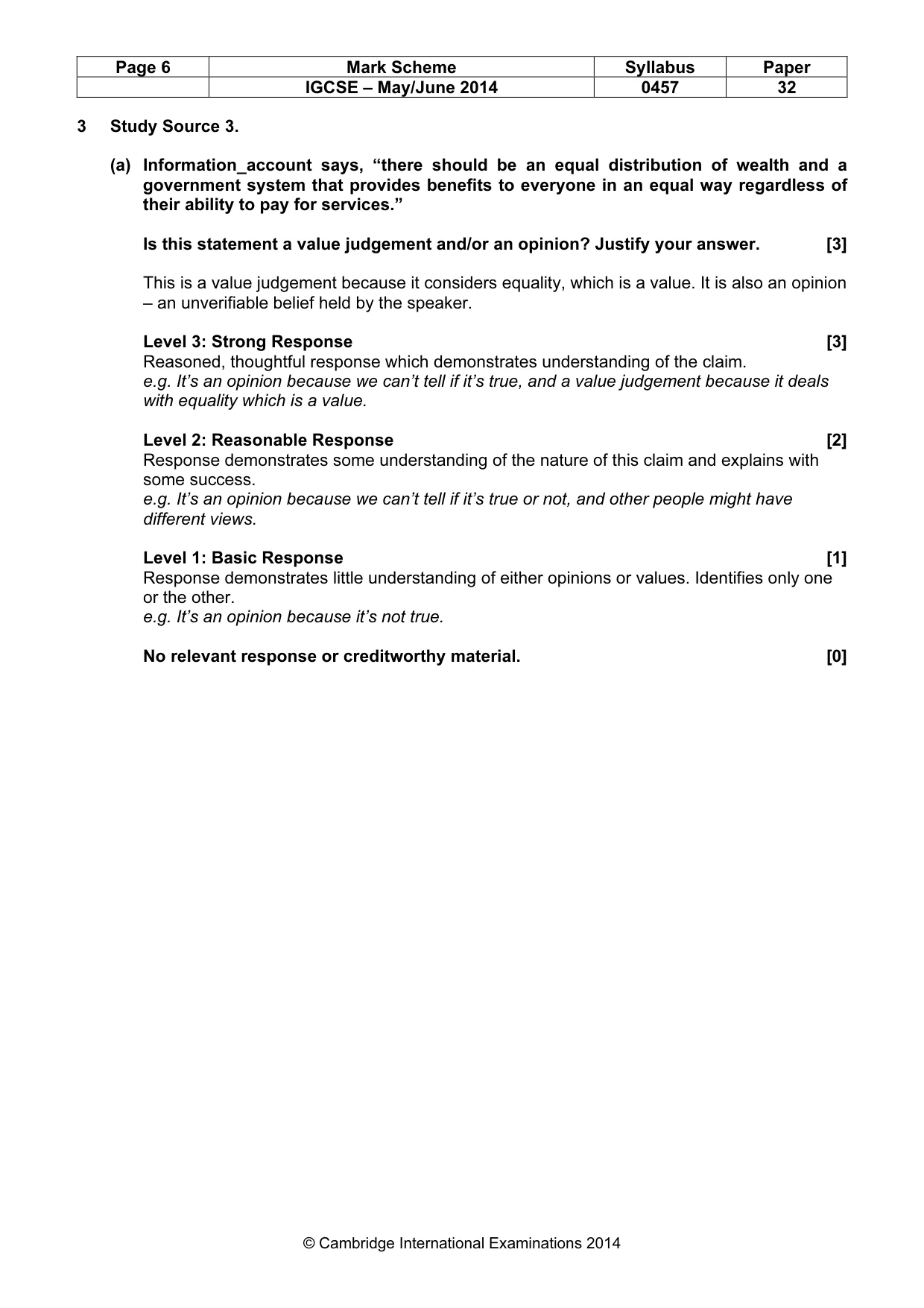
Page 6 Mark Scheme Syllabus Paper IGCSE – May/June 2014 0457 32 © Cambridge International Examinations 2014 3 Study Source 3. (a) Information_account says, “there should be an equal distribution of wealth and a government system that provides benefits to everyone in an equal way regardless of their ability to pay for services.” Is this statement a value judgement and/or an opinion? Justify your answer. [3] This is a value judgement because it considers equality, which is a value. It is also an opinion – an unverifiable belief held by the speaker. Level 3: Strong Response [3] Reasoned, thoughtful response which demonstrates understanding of the claim. e.g. It’s an opinion because we can’t tell if it’s true, and a value judgement because it deals with equality which is a value. Level 2: Reasonable Response [2] Response demonstrates some understanding of the nature of this claim and explains with some success. e.g. It’s an opinion because we can’t tell if it’s true or not, and other people might have different views. Level 1: Basic Response [1] Response demonstrates little understanding of either opinions or values. Identifies only one or the other. e.g. It’s an opinion because it’s not true. No relevant response or creditworthy material. [0]
Mark scheme, page 7
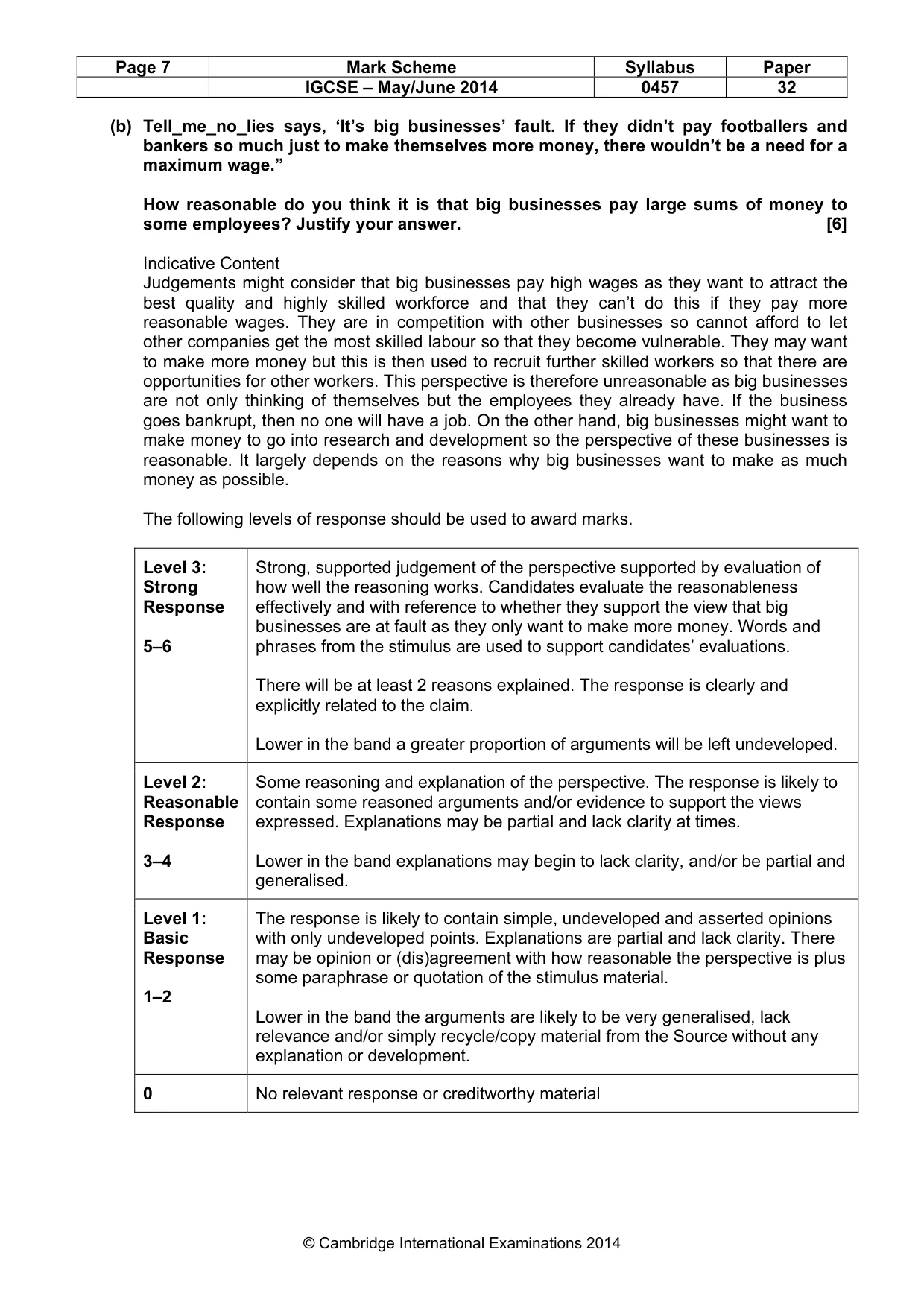
Page 7 Mark Scheme Syllabus Paper IGCSE – May/June 2014 0457 32 © Cambridge International Examinations 2014 (b) Tell_me_no_lies says, ‘It’s big businesses’ fault. If they didn’t pay footballers and bankers so much just to make themselves more money, there wouldn’t be a need for a maximum wage.” How reasonable do you think it is that big businesses pay large sums of money to some employees? Justify your answer. [6] Indicative Content Judgements might consider that big businesses pay high wages as they want to attract the best quality and highly skilled workforce and that they can’t do this if they pay more reasonable wages. They are in competition with other businesses so cannot afford to let other companies get the most skilled labour so that they become vulnerable. They may want to make more money but this is then used to recruit further skilled workers so that there are opportunities for other workers. This perspective is therefore unreasonable as big businesses are not only thinking of themselves but the employees they already have. If the business goes bankrupt, then no one will have a job. On the other hand, big businesses might want to make money to go into research and development so the perspective of these businesses is reasonable. It largely depends on the reasons why big businesses want to make as much money as possible. The following levels of response should be used to award marks. Level 3: Strong Response 5–6 Strong, supported judgement of the perspective supported by evaluation of how well the reasoning works. Candidates evaluate the reasonableness effectively and with reference to whether they support the view that big businesses are at fault as they only want to make more money. Words and phrases from the stimulus are used to support candidates’ evaluations. There will be at least 2 reasons explained. The response is clearly and explicitly related to the claim. Lower in the band a greater proportion of arguments will be left undeveloped. Level 2: Reasonable Response 3–4 Some reasoning and explanation of the perspective. The response is likely to contain some reasoned arguments and/or evidence to support the views expressed. Explanations may be partial and lack clarity at times. Lower in the band explanations may begin to lack clarity, and/or be partial and generalised. Level 1: Basic Response 1–2 The response is likely to contain simple, undeveloped and asserted opinions with only undeveloped points. Explanations are partial and lack clarity. There may be opinion or (dis)agreement with how reasonable the perspective is plus some paraphrase or quotation of the stimulus material. Lower in the band the arguments are likely to be very generalised, lack relevance and/or simply recycle/copy material from the Source without any explanation or development. 0 No relevant response or creditworthy material
Mark scheme, page 8
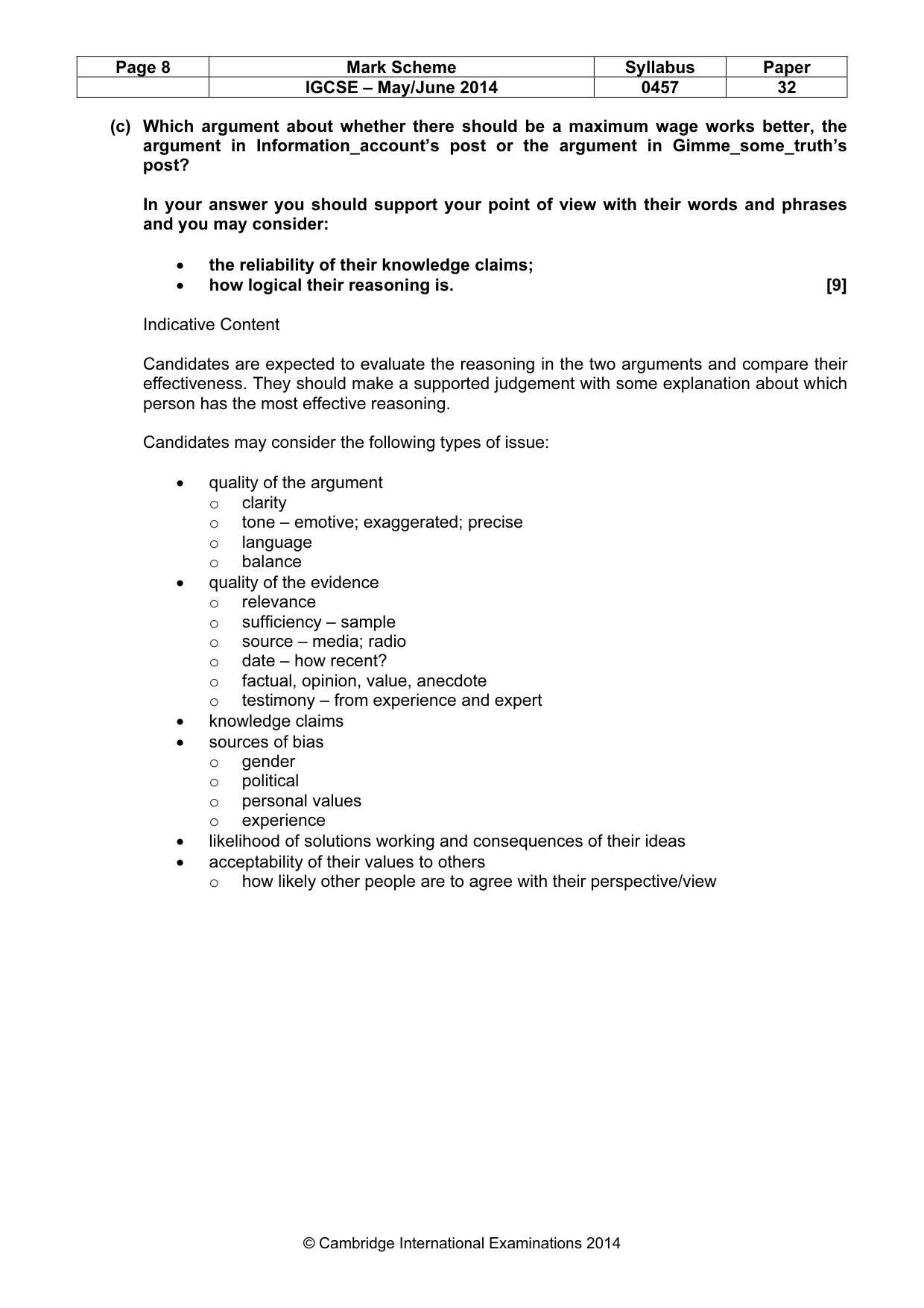
Page 8 Mark Scheme Syllabus Paper IGCSE – May/June 2014 0457 32 © Cambridge International Examinations 2014 (c) Which argument about whether there should be a maximum wage works better, the argument in Information_account’s post or the argument in Gimme_some_truth’s post? In your answer you should support your point of view with their words and phrases and you may consider: • the reliability of their knowledge claims; • how logical their reasoning is. [9] Indicative Content Candidates are expected to evaluate the reasoning in the two arguments and compare their effectiveness. They should make a supported judgement with some explanation about which person has the most effective reasoning. Candidates may consider the following types of issue: • quality of the argument o clarity o tone – emotive; exaggerated; precise o language o balance • quality of the evidence o relevance o sufficiency – sample o source – media; radio o date – how recent? o factual, opinion, value, anecdote o testimony – from experience and expert • knowledge claims • sources of bias o gender o political o personal values o experience • likelihood of solutions working and consequences of their ideas • acceptability of their values to others o how likely other people are to agree with their perspective/view
Mark scheme, page 9
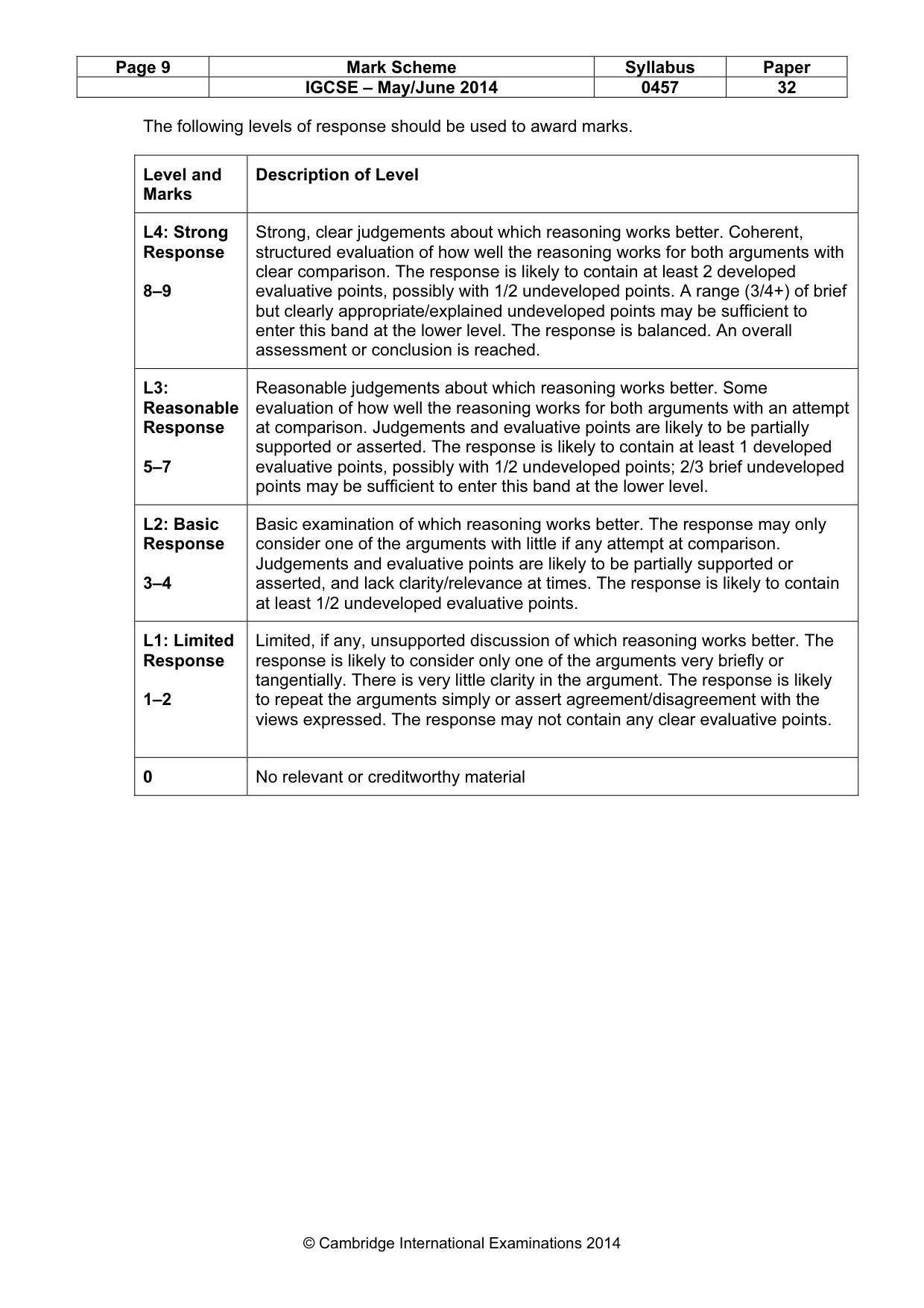
Page 9 Mark Scheme Syllabus Paper IGCSE – May/June 2014 0457 32 © Cambridge International Examinations 2014 The following levels of response should be used to award marks. Level and Marks Description of Level L4: Strong Response 8–9 Strong, clear judgements about which reasoning works better. Coherent, structured evaluation of how well the reasoning works for both arguments with clear comparison. The response is likely to contain at least 2 developed evaluative points, possibly with 1/2 undeveloped points. A range (3/4+) of brief but clearly appropriate/explained undeveloped points may be sufficient to enter this band at the lower level. The response is balanced. An overall assessment or conclusion is reached. L3: Reasonable Response 5–7 Reasonable judgements about which reasoning works better. Some evaluation of how well the reasoning works for both arguments with an attempt at comparison. Judgements and evaluative points are likely to be partially supported or asserted. The response is likely to contain at least 1 developed evaluative points, possibly with 1/2 undeveloped points; 2/3 brief undeveloped points may be sufficient to enter this band at the lower level. L2: Basic Response 3–4 Basic examination of which reasoning works better. The response may only consider one of the arguments with little if any attempt at comparison. Judgements and evaluative points are likely to be partially supported or asserted, and lack clarity/relevance at times. The response is likely to contain at least 1/2 undeveloped evaluative points. L1: Limited Response 1–2 Limited, if any, unsupported discussion of which reasoning works better. The response is likely to consider only one of the arguments very briefly or tangentially. There is very little clarity in the argument. The response is likely to repeat the arguments simply or assert agreement/disagreement with the views expressed. The response may not contain any clear evaluative points. 0 No relevant or creditworthy material
Mark scheme, page 10
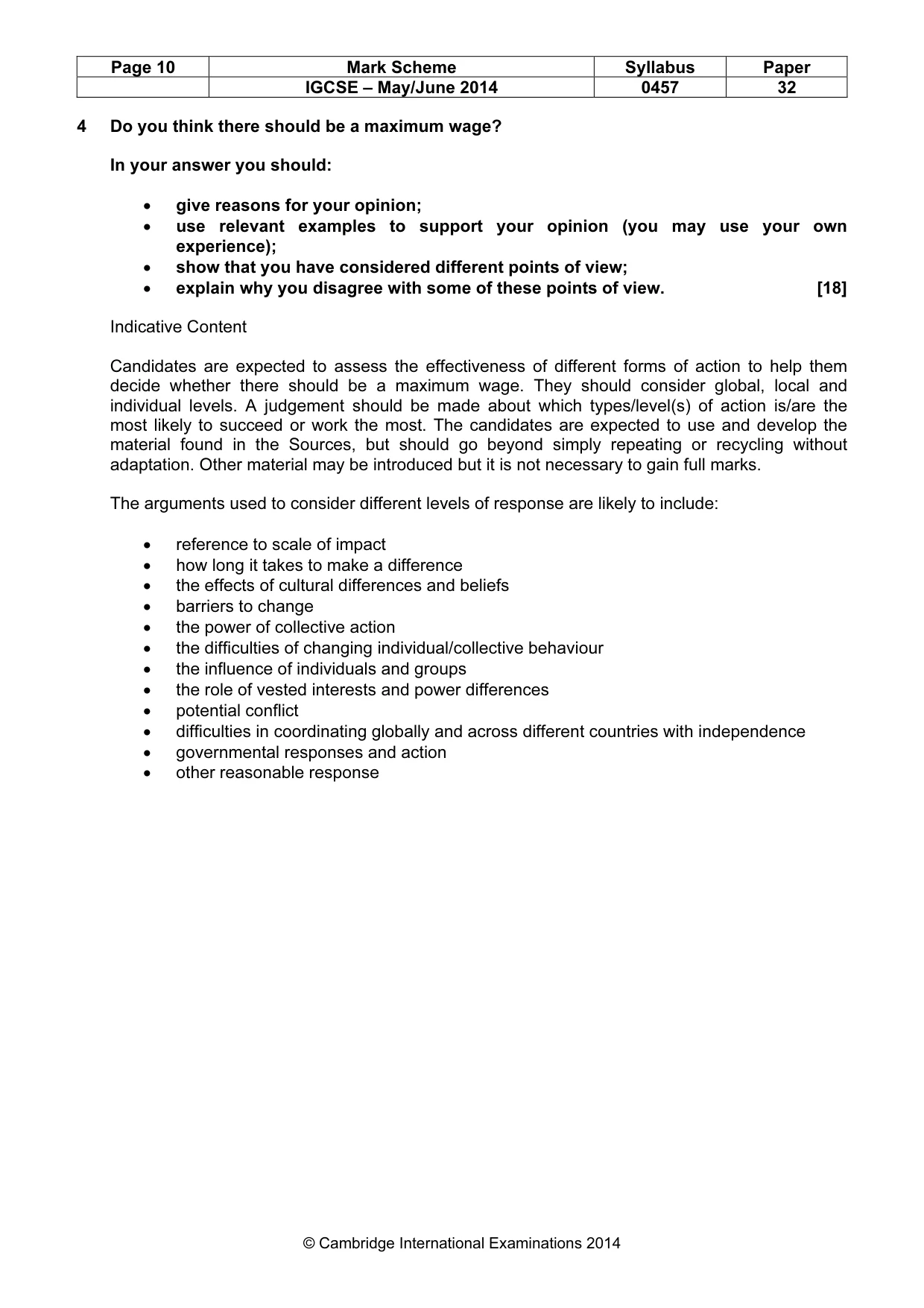
Page 10 Mark Scheme Syllabus Paper IGCSE – May/June 2014 0457 32 © Cambridge International Examinations 2014 4 Do you think there should be a maximum wage? In your answer you should: • give reasons for your opinion; • use relevant examples to support your opinion (you may use your own experience); • show that you have considered different points of view; • explain why you disagree with some of these points of view. [18] Indicative Content Candidates are expected to assess the effectiveness of different forms of action to help them decide whether there should be a maximum wage. They should consider global, local and individual levels. A judgement should be made about which types/level(s) of action is/are the most likely to succeed or work the most. The candidates are expected to use and develop the material found in the Sources, but should go beyond simply repeating or recycling without adaptation. Other material may be introduced but it is not necessary to gain full marks. The arguments used to consider different levels of response are likely to include: • reference to scale of impact • how long it takes to make a difference • the effects of cultural differences and beliefs • barriers to change • the power of collective action • the difficulties of changing individual/collective behaviour • the influence of individuals and groups • the role of vested interests and power differences • potential conflict • difficulties in coordinating globally and across different countries with independence • governmental responses and action • other reasonable response
Mark scheme, page 11
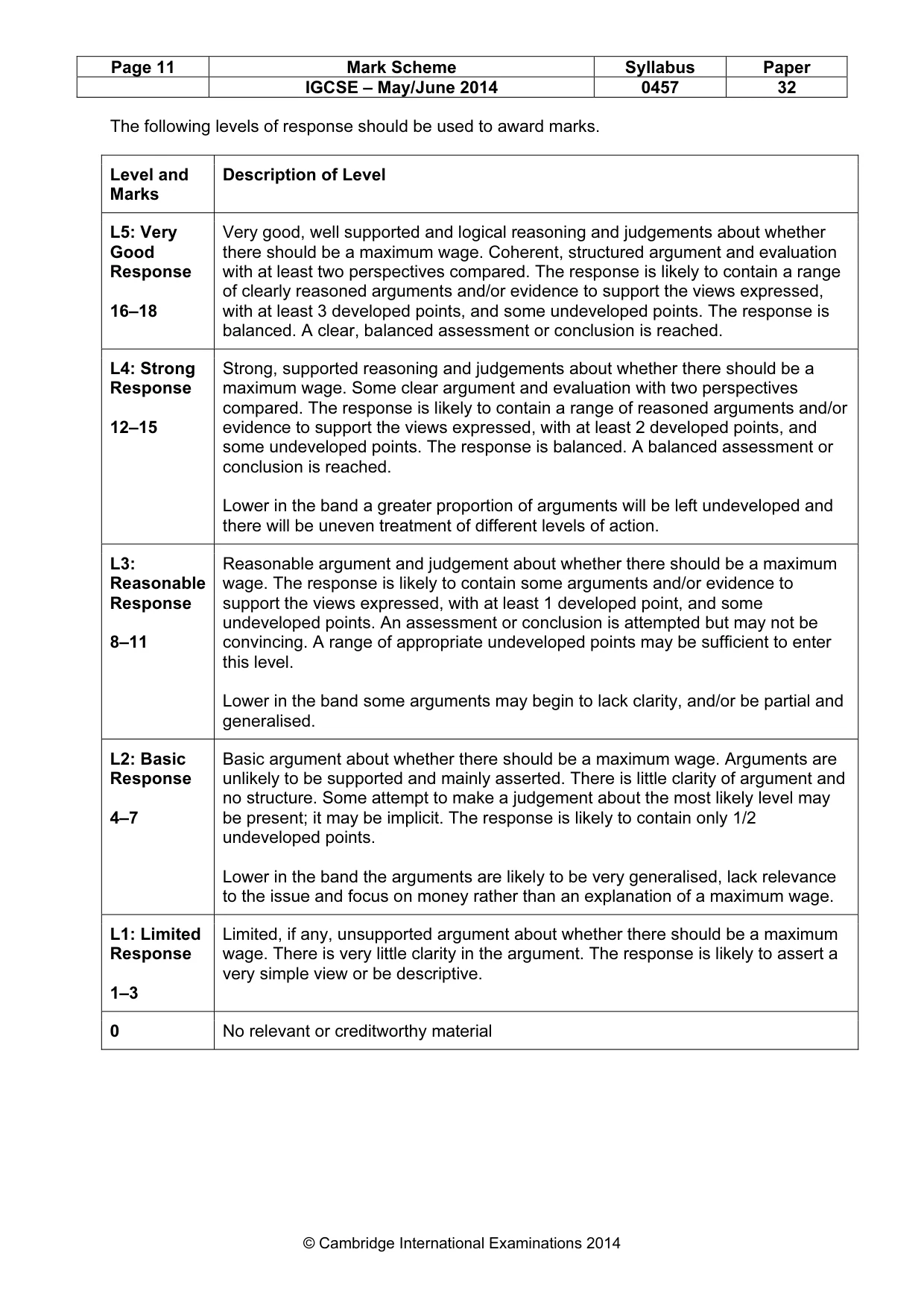
Page 11 Mark Scheme Syllabus Paper IGCSE – May/June 2014 0457 32 © Cambridge International Examinations 2014 The following levels of response should be used to award marks. Level and Marks Description of Level L5: Very Good Response 16–18 Very good, well supported and logical reasoning and judgements about whether there should be a maximum wage. Coherent, structured argument and evaluation with at least two perspectives compared. The response is likely to contain a range of clearly reasoned arguments and/or evidence to support the views expressed, with at least 3 developed points, and some undeveloped points. The response is balanced. A clear, balanced assessment or conclusion is reached. L4: Strong Response 12–15 Strong, supported reasoning and judgements about whether there should be a maximum wage. Some clear argument and evaluation with two perspectives compared. The response is likely to contain a range of reasoned arguments and/or evidence to support the views expressed, with at least 2 developed points, and some undeveloped points. The response is balanced. A balanced assessment or conclusion is reached. Lower in the band a greater proportion of arguments will be left undeveloped and there will be uneven treatment of different levels of action. L3: Reasonable Response 8–11 Reasonable argument and judgement about whether there should be a maximum wage. The response is likely to contain some arguments and/or evidence to support the views expressed, with at least 1 developed point, and some undeveloped points. An assessment or conclusion is attempted but may not be convincing. A range of appropriate undeveloped points may be sufficient to enter this level. Lower in the band some arguments may begin to lack clarity, and/or be partial and generalised. L2: Basic Response 4–7 Basic argument about whether there should be a maximum wage. Arguments are unlikely to be supported and mainly asserted. There is little clarity of argument and no structure. Some attempt to make a judgement about the most likely level may be present; it may be implicit. The response is likely to contain only 1/2 undeveloped points. Lower in the band the arguments are likely to be very generalised, lack relevance to the issue and focus on money rather than an explanation of a maximum wage. L1: Limited Response 1–3 Limited, if any, unsupported argument about whether there should be a maximum wage. There is very little clarity in the argument. The response is likely to assert a very simple view or be descriptive. 0 No relevant or creditworthy material
What you needed in this session
Cambridge’s own grade thresholds for 2014 May/June, Paper 3 · Variant 2. A higher threshold means an easier paper — the bar moves with how the cohort did.