Cambridge IGCSE Global Perspectives 0457 — 2013 Oct/Nov Paper 3 · Variant 1
0457/31/O/N/13 · 60 marks · ≈68 min
The question paper and its mark scheme, free to read here and free to download. This is Cambridge’s own paper, exactly as it was sat.
Question paper8 pages



Mark scheme13 pages
Answers below. Sit the paper first if you are practising.

Paper as text
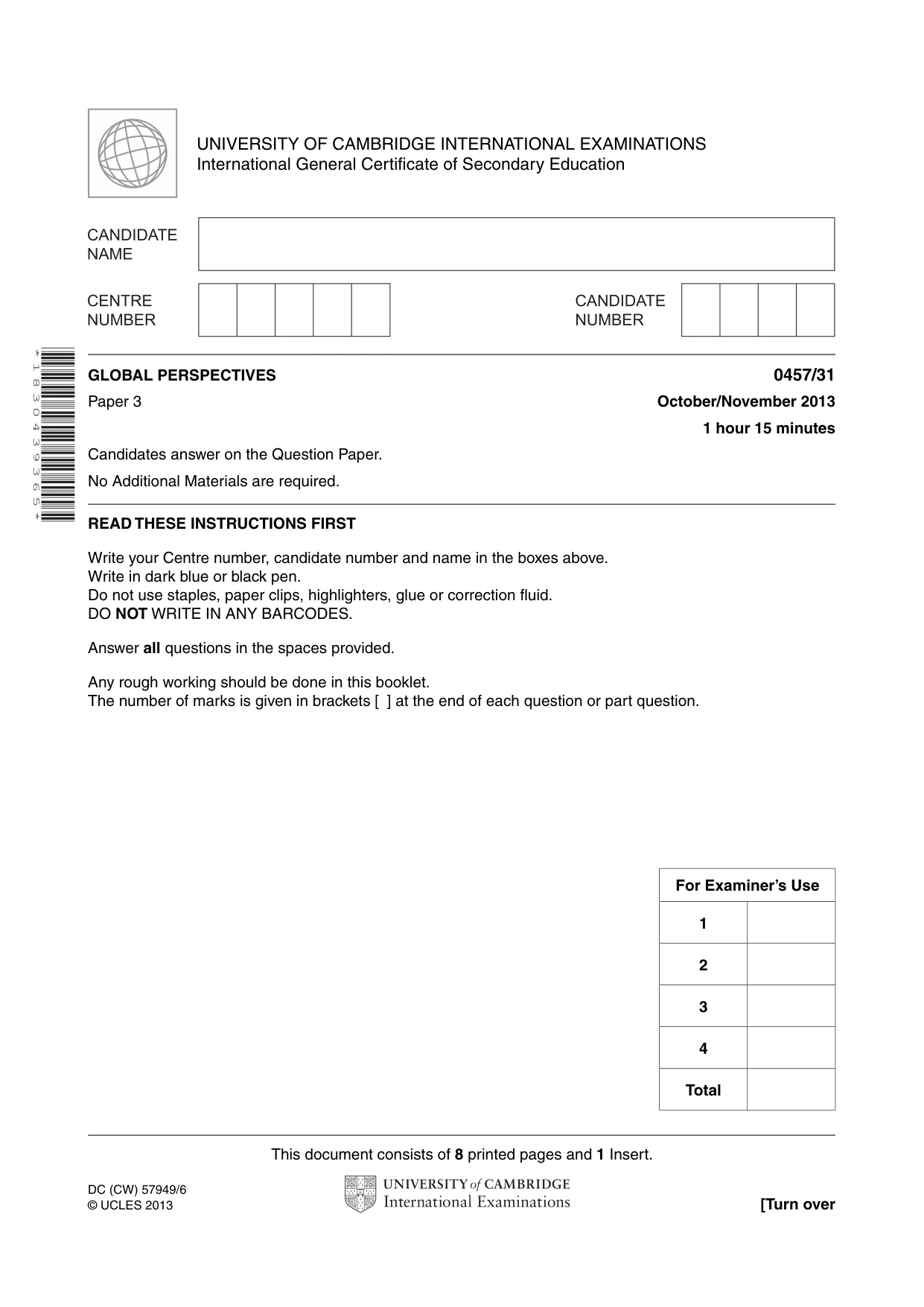
Question paper, page 1
This document consists of 8 printed pages and 1 Insert. DC (CW) 57949/6 © UCLES 2013 [Turn over UNIVERSITY OF CAMBRIDGE INTERNATIONAL EXAMINATIONS International General Certificate of Secondary Education * 1 8 3 0 4 3 9 3 6 5 * GLOBAL PERSPECTIVES 0457/31 Paper 3 October/November 2013 1 hour 15 minutes Candidates answer on the Question Paper. No Additional Materials are required. READ THESE INSTRUCTIONS FIRST Write your Centre number, candidate number and name in the boxes above. Write in dark blue or black pen. Do not use staples, paper clips, highlighters, glue or correction fluid. DO NOT WRITE IN ANY BARCODES. Answer all questions in the spaces provided. Any rough working should be done in this booklet. The number of marks is given in brackets [ ] at the end of each question or part question. For Examiner’s Use 1 2 3 4 Total
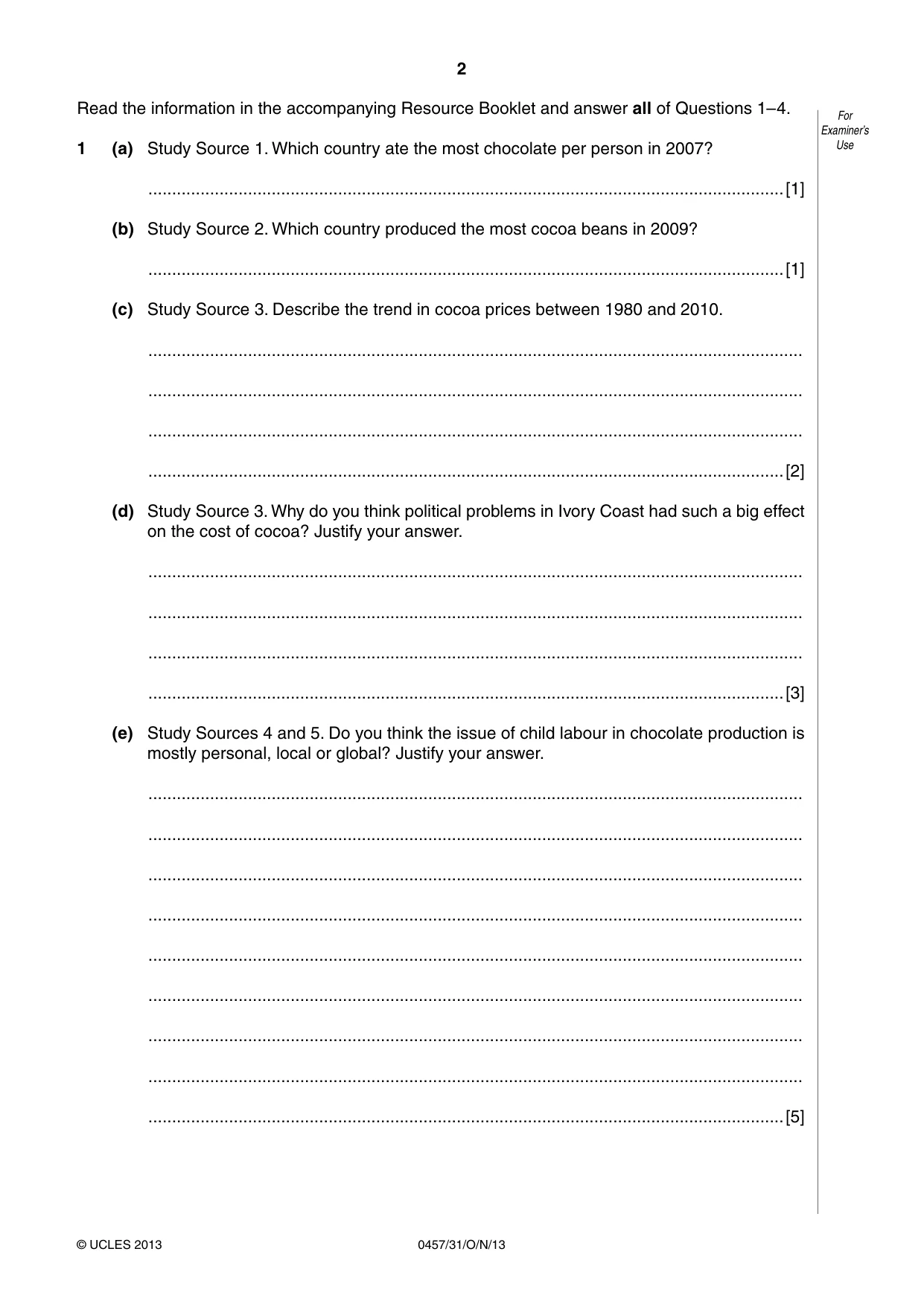
Question paper, page 2
2 0457/31/O/N/13 © UCLES 2013 For Examiner’s Use Read the information in the accompanying Resource Booklet and answer all of Questions 1–4. 1 (a) Study Source 1. Which country ate the most chocolate per person in 2007? …[1] (b) Study Source 2. Which country produced the most cocoa beans in 2009? …[1] (c) Study Source 3. Describe the trend in cocoa prices between 1980 and 2010. … … … …[2] (d) Study Source 3. Why do you think political problems in Ivory Coast had such a big effect on the cost of cocoa? Justify your answer. … … … …[3] (e) Study Sources 4 and 5. Do you think the issue of child labour in chocolate production is mostly personal, local or global? Justify your answer. … … … … … … … … …[5]
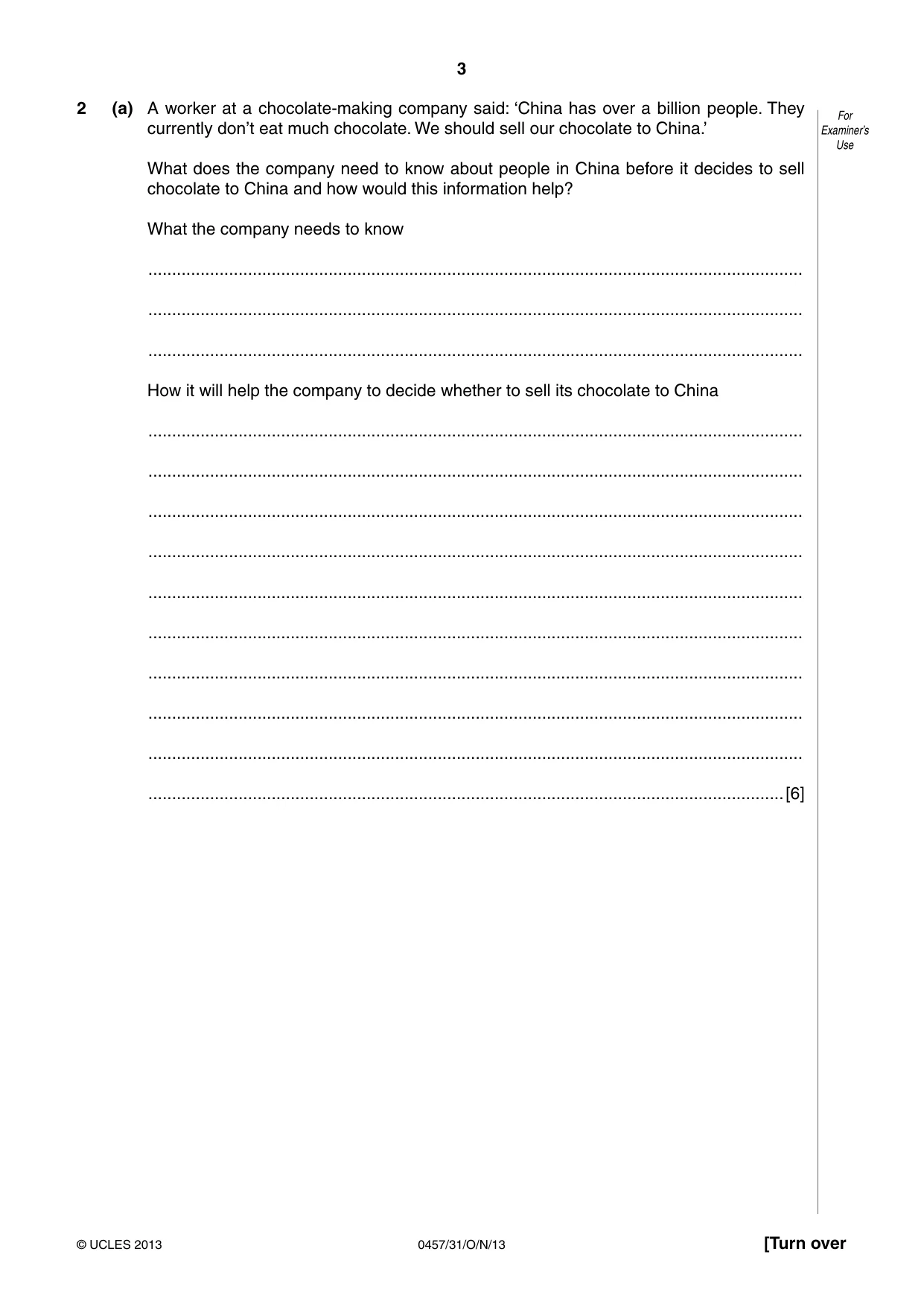
Question paper, page 3
3 0457/31/O/N/13 © UCLES 2013 [Turn over For Examiner’s Use 2 (a) A worker at a chocolate-making company said: ‘China has over a billion people. They currently don’t eat much chocolate. We should sell our chocolate to China.’ What does the company need to know about people in China before it decides to sell chocolate to China and how would this information help? What the company needs to know … … … How it will help the company to decide whether to sell its chocolate to China … … … … … … … … … …[6]
Question paper, page 4
4 0457/31/O/N/13 © UCLES 2013 For Examiner’s Use Study Sources 4 and 5. (b) A cocoa farm inspector sees children working on a cocoa farm. The farmer tells the inspector that they are his children, just helping out. What does the inspector need to find out to be sure that there is no child exploitation on this farm and how would this information help? What the inspector needs to find out … … … How it will help the inspector to be sure that there is no child exploitation on this farm … … … … … … … … … …[6]
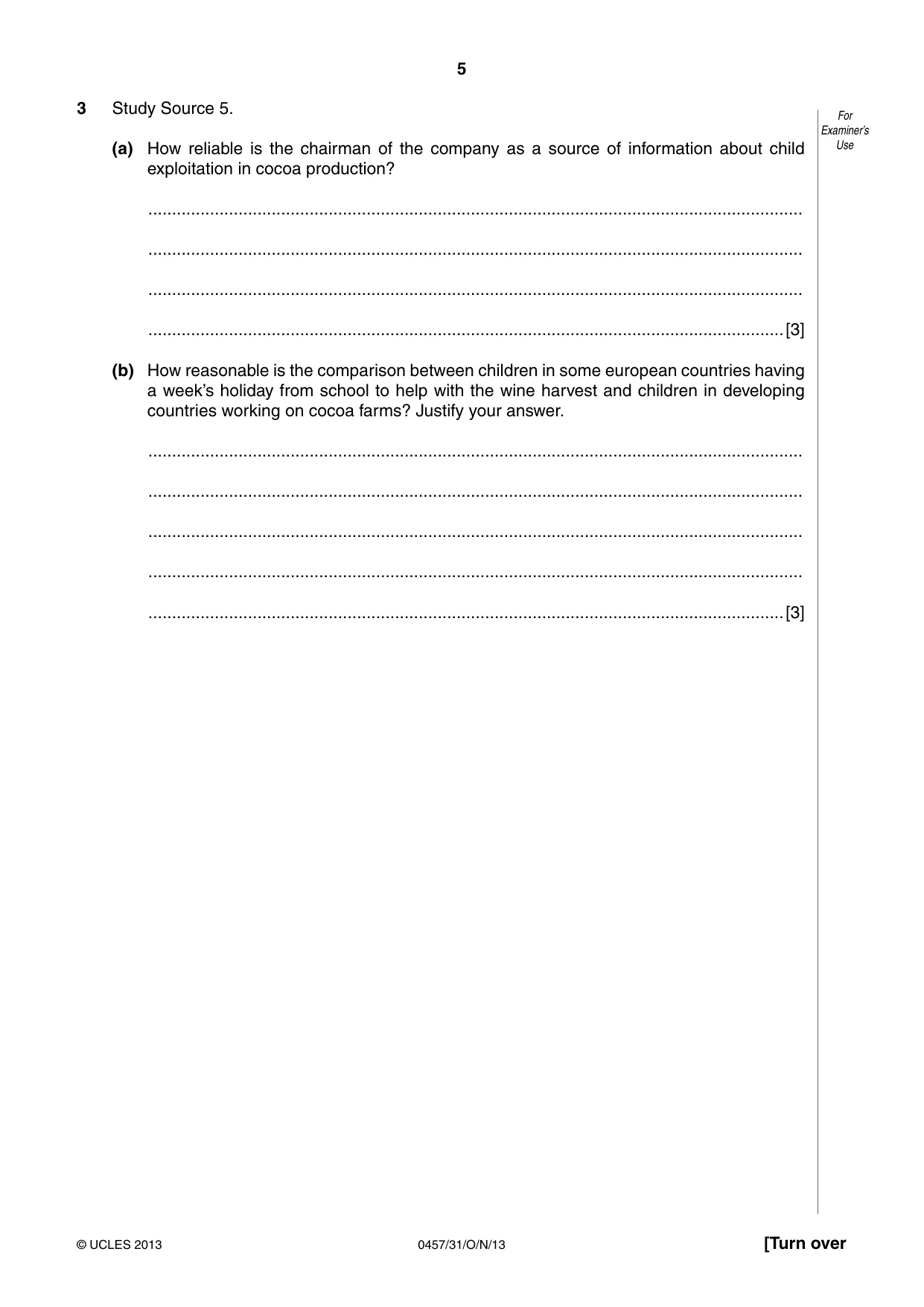
Question paper, page 5
5 0457/31/O/N/13 © UCLES 2013 [Turn over For Examiner’s Use 3 Study Source 5. (a) How reliable is the chairman of the company as a source of information about child exploitation in cocoa production? … … … …[3] (b) How reasonable is the comparison between children in some european countries having a week’s holiday from school to help with the wine harvest and children in developing countries working on cocoa farms? Justify your answer. … … … … …[3]
Question paper, page 6
6 0457/31/O/N/13 © UCLES 2013 For Examiner’s Use (c) How well does Get_real’s reasoning work to show that child labour is ‘ethically not a problem’? In your answer you should support your point of view with their words and phrases and you may consider: • how well Get_real responds to comments by the chairman and No_slavery; • the relevance of child labour in Canada; • how reasonable Get_real’s opinions are; • whether you accept any values Get_real uses and why; • any other relevant issues. … … … … … … … … … … … … … … … … … … … … … …[12]
Question paper, page 7
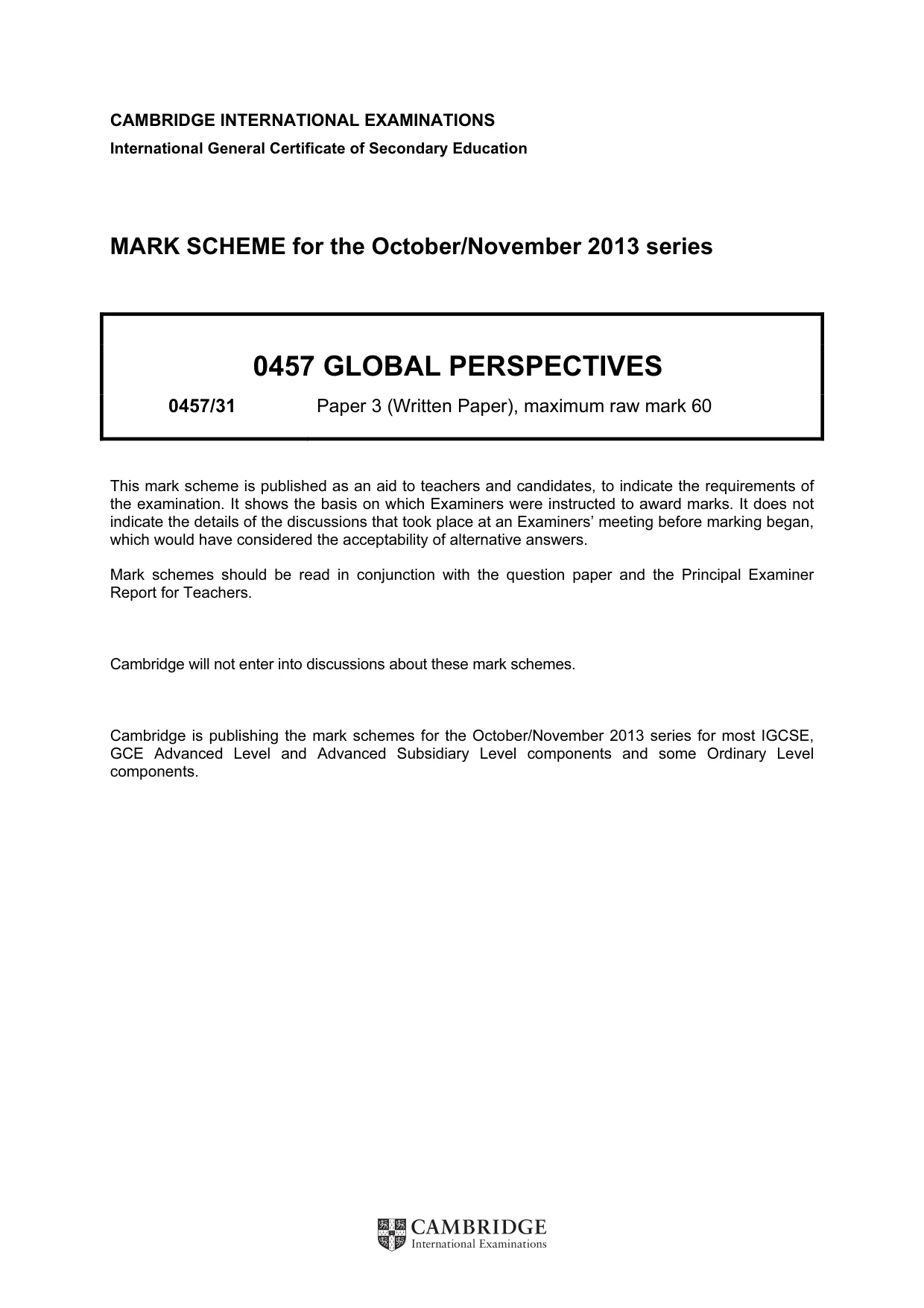
7 0457/31/O/N/13 © UCLES 2013 [Turn over For Examiner’s Use 4 Is it ever acceptable for children to work? In your answer you should: • state your conclusion; • give reasons for your opinion; • use relevant examples to support your opinion (you may use your own experience); • show that you have considered different points of view; • explain why you disagreed with some of these points of view. … … … … … … … … … … … … … … … … … … … … … … … … …
Question paper, page 8
8 0457/31/O/N/13 © UCLES 2013 … … … … … … … … … … … …[18] Copyright Acknowledgements: Source 3 © adapted: http://www.howprofit.com/portfolio/future/long-term-cocoa-price.html. Permission to reproduce items where third-party owned material protected by copyright is included has been sought and cleared where possible. Every reasonable effort has been made by the publisher (UCLES) to trace copyright holders, but if any items requiring clearance have unwittingly been included, the publisher will be pleased to make amends at the earliest possible opportunity. University of Cambridge International Examinations is part of the Cambridge Assessment Group. Cambridge Assessment is the brand name of University of Cambridge Local Examinations Syndicate (UCLES), which is itself a department of the University of Cambridge.
Mark scheme, page 1
CAMBRIDGE INTERNATIONAL EXAMINATIONS International General Certificate of Secondary Education MARK SCHEME for the October/November 2013 series 0457 GLOBAL PERSPECTIVES 0457/31 Paper 3 (Written Paper), maximum raw mark 60 This mark scheme is published as an aid to teachers and candidates, to indicate the requirements of the examination. It shows the basis on which Examiners were instructed to award marks. It does not indicate the details of the discussions that took place at an Examiners’ meeting before marking began, which would have considered the acceptability of alternative answers. Mark schemes should be read in conjunction with the question paper and the Principal Examiner Report for Teachers. Cambridge will not enter into discussions about these mark schemes. Cambridge is publishing the mark schemes for the October/November 2013 series for most IGCSE, GCE Advanced Level and Advanced Subsidiary Level components and some Ordinary Level components.
Mark scheme, page 2
Page 2 Mark Scheme Syllabus Paper IGCSE – October/November 2013 0457 31 © Cambridge International Examinations 2013 1 (a) Which country ate the most chocolate per person in 2007? [1] Candidates may identify the following country: Ireland. 1 mark for the correct answer. (b) Which country produced the most cocoa beans in 2009? [1] Candidates may identify the following country: Ivory Coast. 1 mark for the correct answer. (c) Describe the trend in cocoa prices between 1980 and 2010. [2] Candidates may identify the following aspects of the trends: • Prices go down and then up • There is much short term variation within the trends 1 mark for the correct answer, up to a maximum of two marks. (d) Why do you think political problems in Ivory Coast had such a big effect on the cost of cocoa? Justify your answer. [3] Indicative Content The following points are likely to be made: • Disruption to normal patterns of work • Strikes • Shortage of raw materials • Damage to crops • Transportation disrupted • Political uncertainty affecting prices in the market • Working to rule or ‘go slow’ • Other reasonable response
Mark scheme, page 3
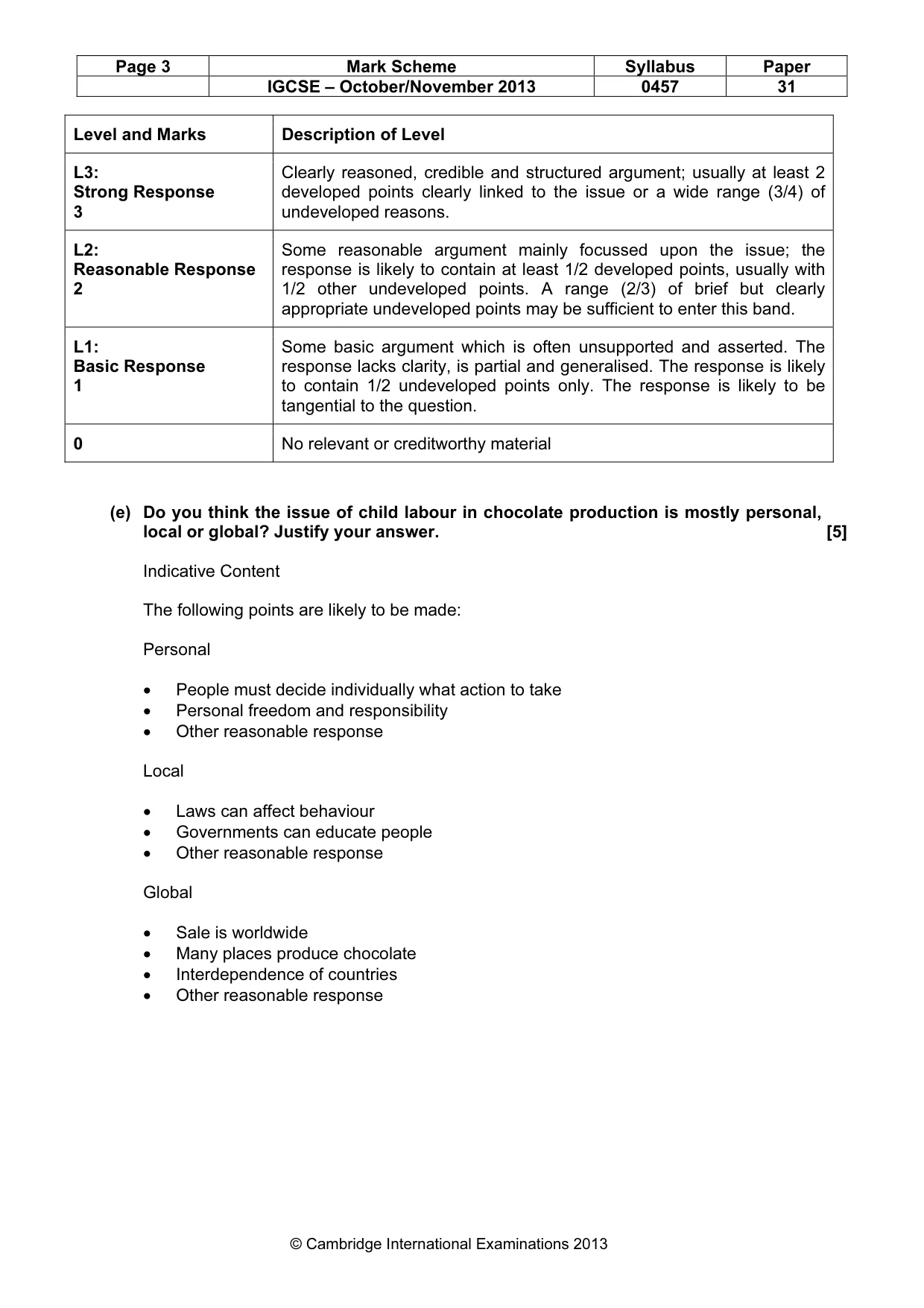
Page 3 Mark Scheme Syllabus Paper IGCSE – October/November 2013 0457 31 © Cambridge International Examinations 2013 Level and Marks Description of Level L3: Strong Response 3 Clearly reasoned, credible and structured argument; usually at least 2 developed points clearly linked to the issue or a wide range (3/4) of undeveloped reasons. L2: Reasonable Response 2 Some reasonable argument mainly focussed upon the issue; the response is likely to contain at least 1/2 developed points, usually with 1/2 other undeveloped points. A range (2/3) of brief but clearly appropriate undeveloped points may be sufficient to enter this band. L1: Basic Response 1 Some basic argument which is often unsupported and asserted. The response lacks clarity, is partial and generalised. The response is likely to contain 1/2 undeveloped points only. The response is likely to be tangential to the question. 0 No relevant or creditworthy material (e) Do you think the issue of child labour in chocolate production is mostly personal, local or global? Justify your answer. [5] Indicative Content The following points are likely to be made: Personal • People must decide individually what action to take • Personal freedom and responsibility • Other reasonable response Local • Laws can affect behaviour • Governments can educate people • Other reasonable response Global • Sale is worldwide • Many places produce chocolate • Interdependence of countries • Other reasonable response
Mark scheme, page 4
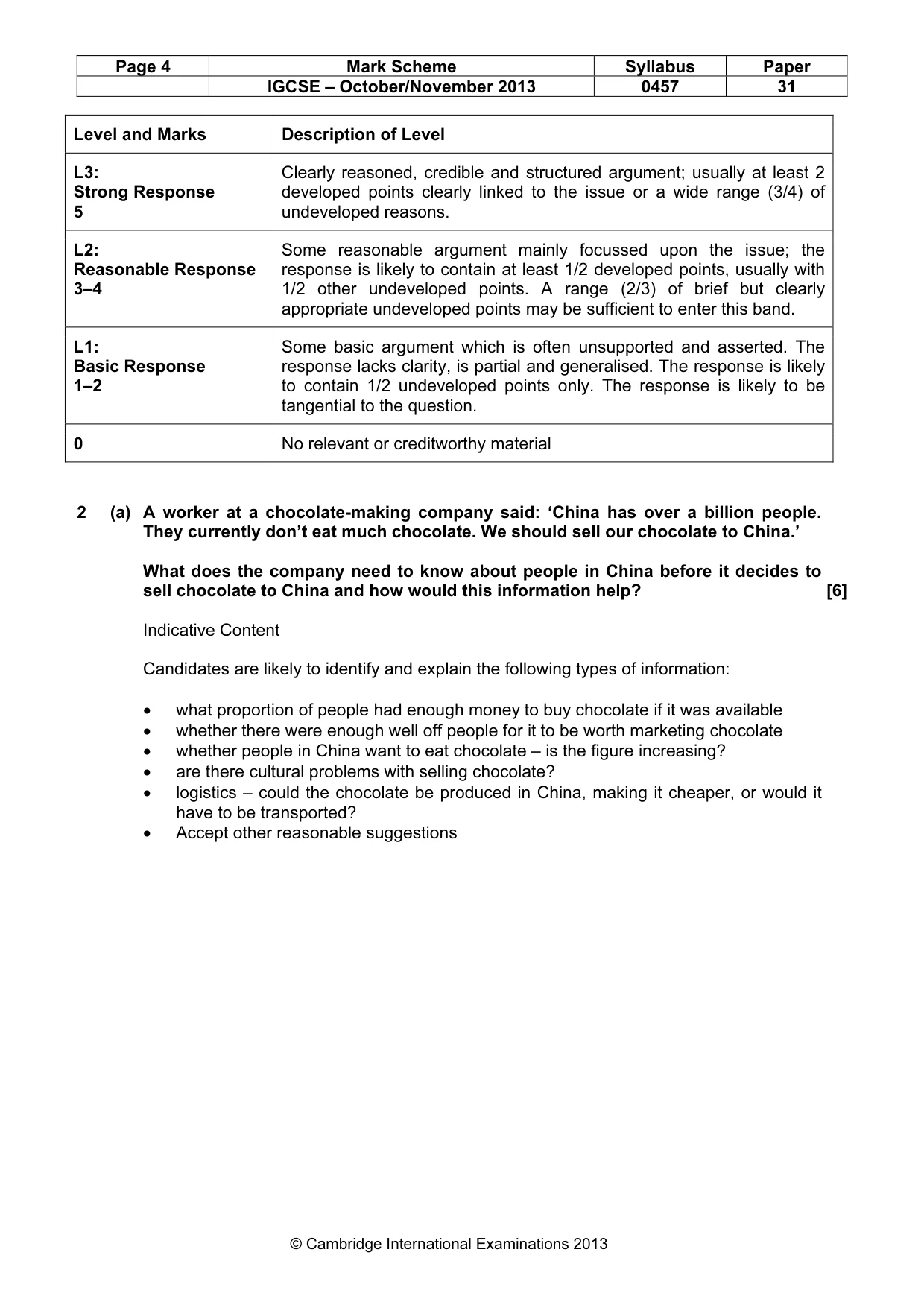
Page 4 Mark Scheme Syllabus Paper IGCSE – October/November 2013 0457 31 © Cambridge International Examinations 2013 Level and Marks Description of Level L3: Strong Response 5 Clearly reasoned, credible and structured argument; usually at least 2 developed points clearly linked to the issue or a wide range (3/4) of undeveloped reasons. L2: Reasonable Response 3–4 Some reasonable argument mainly focussed upon the issue; the response is likely to contain at least 1/2 developed points, usually with 1/2 other undeveloped points. A range (2/3) of brief but clearly appropriate undeveloped points may be sufficient to enter this band. L1: Basic Response 1–2 Some basic argument which is often unsupported and asserted. The response lacks clarity, is partial and generalised. The response is likely to contain 1/2 undeveloped points only. The response is likely to be tangential to the question. 0 No relevant or creditworthy material 2 (a) A worker at a chocolate-making company said: ‘China has over a billion people. They currently don’t eat much chocolate. We should sell our chocolate to China.’ What does the company need to know about people in China before it decides to sell chocolate to China and how would this information help? [6] Indicative Content Candidates are likely to identify and explain the following types of information: • what proportion of people had enough money to buy chocolate if it was available • whether there were enough well off people for it to be worth marketing chocolate • whether people in China want to eat chocolate – is the figure increasing? • are there cultural problems with selling chocolate? • logistics – could the chocolate be produced in China, making it cheaper, or would it have to be transported? • Accept other reasonable suggestions
Mark scheme, page 5
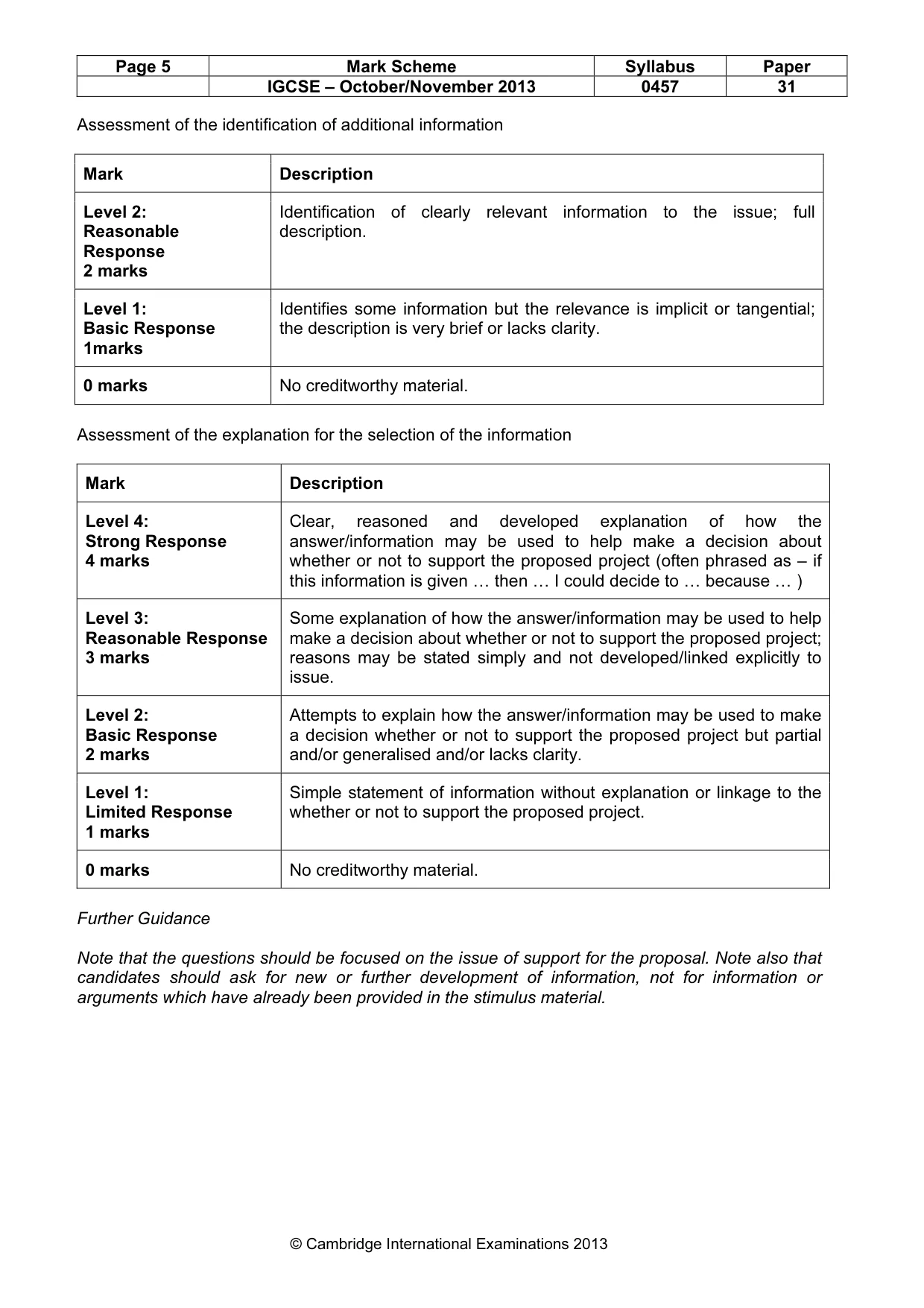
Page 5 Mark Scheme Syllabus Paper IGCSE – October/November 2013 0457 31 © Cambridge International Examinations 2013 Assessment of the identification of additional information Mark Description Level 2: Reasonable Response 2 marks Identification of clearly relevant information to the issue; full description. Level 1: Basic Response 1marks Identifies some information but the relevance is implicit or tangential; the description is very brief or lacks clarity. 0 marks No creditworthy material. Assessment of the explanation for the selection of the information Mark Description Level 4: Strong Response 4 marks Clear, reasoned and developed explanation of how the answer/information may be used to help make a decision about whether or not to support the proposed project (often phrased as – if this information is given … then … I could decide to … because … ) Level 3: Reasonable Response 3 marks Some explanation of how the answer/information may be used to help make a decision about whether or not to support the proposed project; reasons may be stated simply and not developed/linked explicitly to issue. Level 2: Basic Response 2 marks Attempts to explain how the answer/information may be used to make a decision whether or not to support the proposed project but partial and/or generalised and/or lacks clarity. Level 1: Limited Response 1 marks Simple statement of information without explanation or linkage to the whether or not to support the proposed project. 0 marks No creditworthy material. Further Guidance Note that the questions should be focused on the issue of support for the proposal. Note also that candidates should ask for new or further development of information, not for information or arguments which have already been provided in the stimulus material.
Mark scheme, page 6
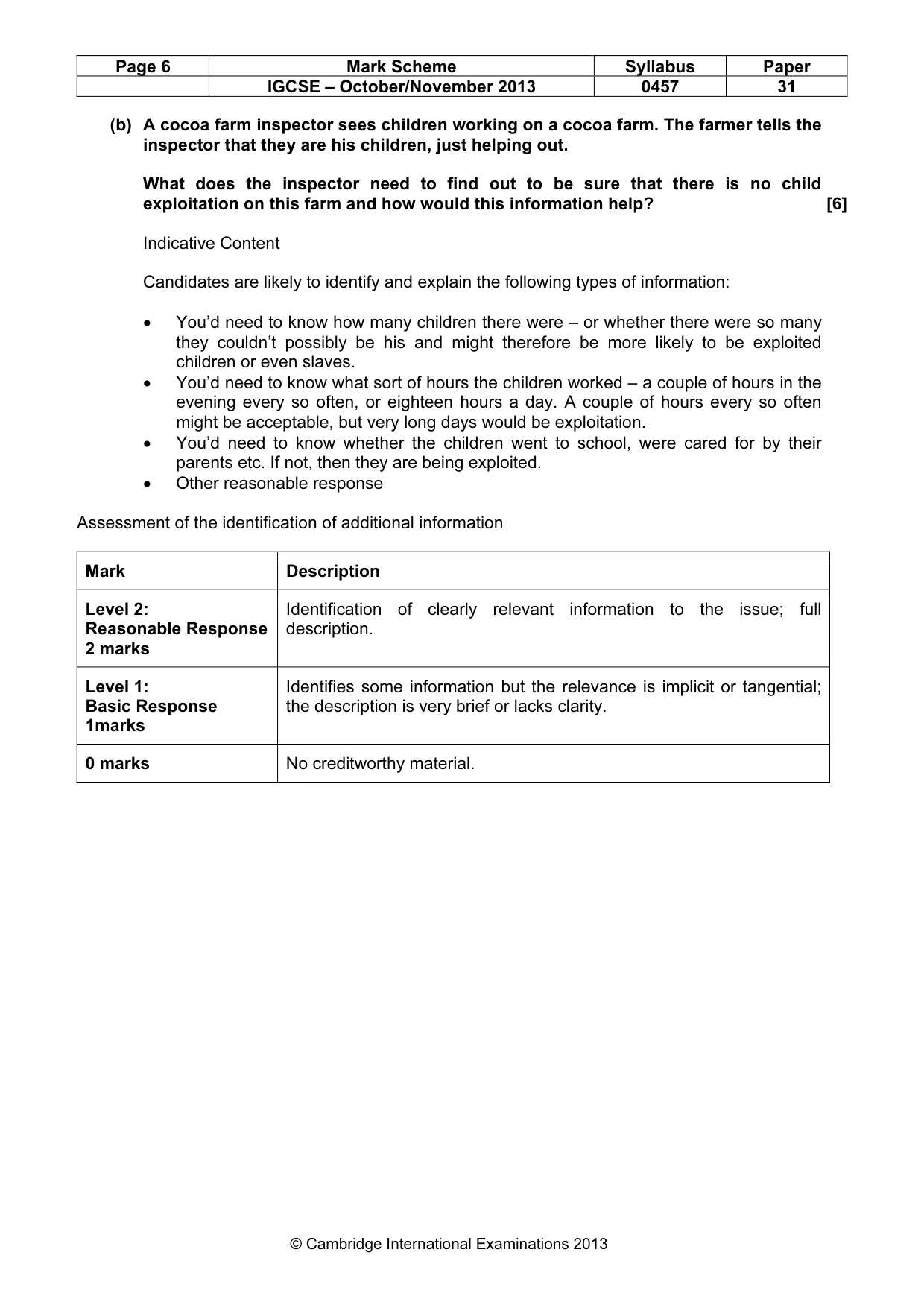
Page 6 Mark Scheme Syllabus Paper IGCSE – October/November 2013 0457 31 © Cambridge International Examinations 2013 (b) A cocoa farm inspector sees children working on a cocoa farm. The farmer tells the inspector that they are his children, just helping out. What does the inspector need to find out to be sure that there is no child exploitation on this farm and how would this information help? [6] Indicative Content Candidates are likely to identify and explain the following types of information: • You’d need to know how many children there were – or whether there were so many they couldn’t possibly be his and might therefore be more likely to be exploited children or even slaves. • You’d need to know what sort of hours the children worked – a couple of hours in the evening every so often, or eighteen hours a day. A couple of hours every so often might be acceptable, but very long days would be exploitation. • You’d need to know whether the children went to school, were cared for by their parents etc. If not, then they are being exploited. • Other reasonable response Assessment of the identification of additional information Mark Description Level 2: Reasonable Response 2 marks Identification of clearly relevant information to the issue; full description. Level 1: Basic Response 1marks Identifies some information but the relevance is implicit or tangential; the description is very brief or lacks clarity. 0 marks No creditworthy material.
Mark scheme, page 7
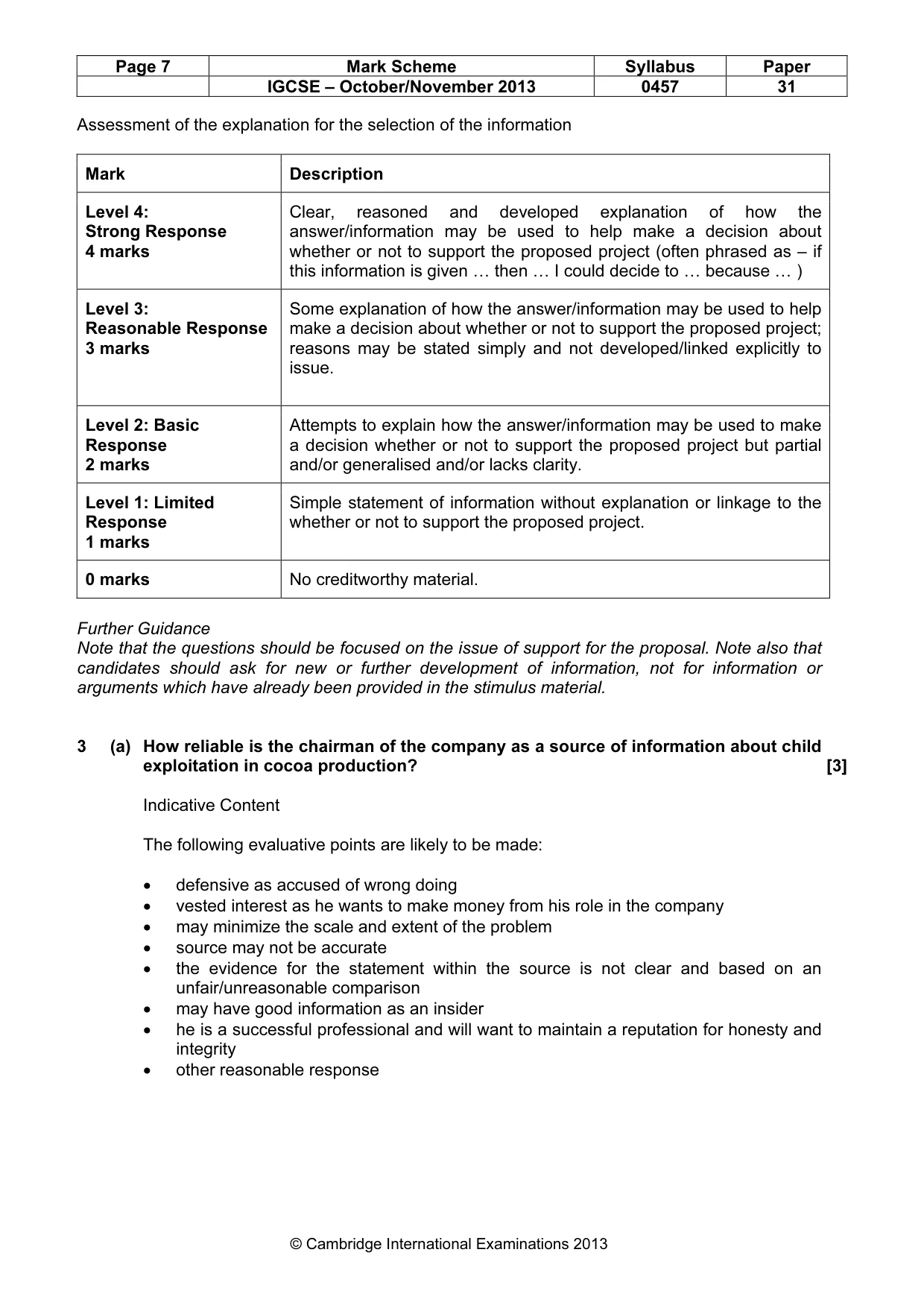
Page 7 Mark Scheme Syllabus Paper IGCSE – October/November 2013 0457 31 © Cambridge International Examinations 2013 Assessment of the explanation for the selection of the information Mark Description Level 4: Strong Response 4 marks Clear, reasoned and developed explanation of how the answer/information may be used to help make a decision about whether or not to support the proposed project (often phrased as – if this information is given … then … I could decide to … because … ) Level 3: Reasonable Response 3 marks Some explanation of how the answer/information may be used to help make a decision about whether or not to support the proposed project; reasons may be stated simply and not developed/linked explicitly to issue. Level 2: Basic Response 2 marks Attempts to explain how the answer/information may be used to make a decision whether or not to support the proposed project but partial and/or generalised and/or lacks clarity. Level 1: Limited Response 1 marks Simple statement of information without explanation or linkage to the whether or not to support the proposed project. 0 marks No creditworthy material. Further Guidance Note that the questions should be focused on the issue of support for the proposal. Note also that candidates should ask for new or further development of information, not for information or arguments which have already been provided in the stimulus material. 3 (a) How reliable is the chairman of the company as a source of information about child exploitation in cocoa production? [3] Indicative Content The following evaluative points are likely to be made: • defensive as accused of wrong doing • vested interest as he wants to make money from his role in the company • may minimize the scale and extent of the problem • source may not be accurate • the evidence for the statement within the source is not clear and based on an unfair/unreasonable comparison • may have good information as an insider • he is a successful professional and will want to maintain a reputation for honesty and integrity • other reasonable response
Mark scheme, page 8
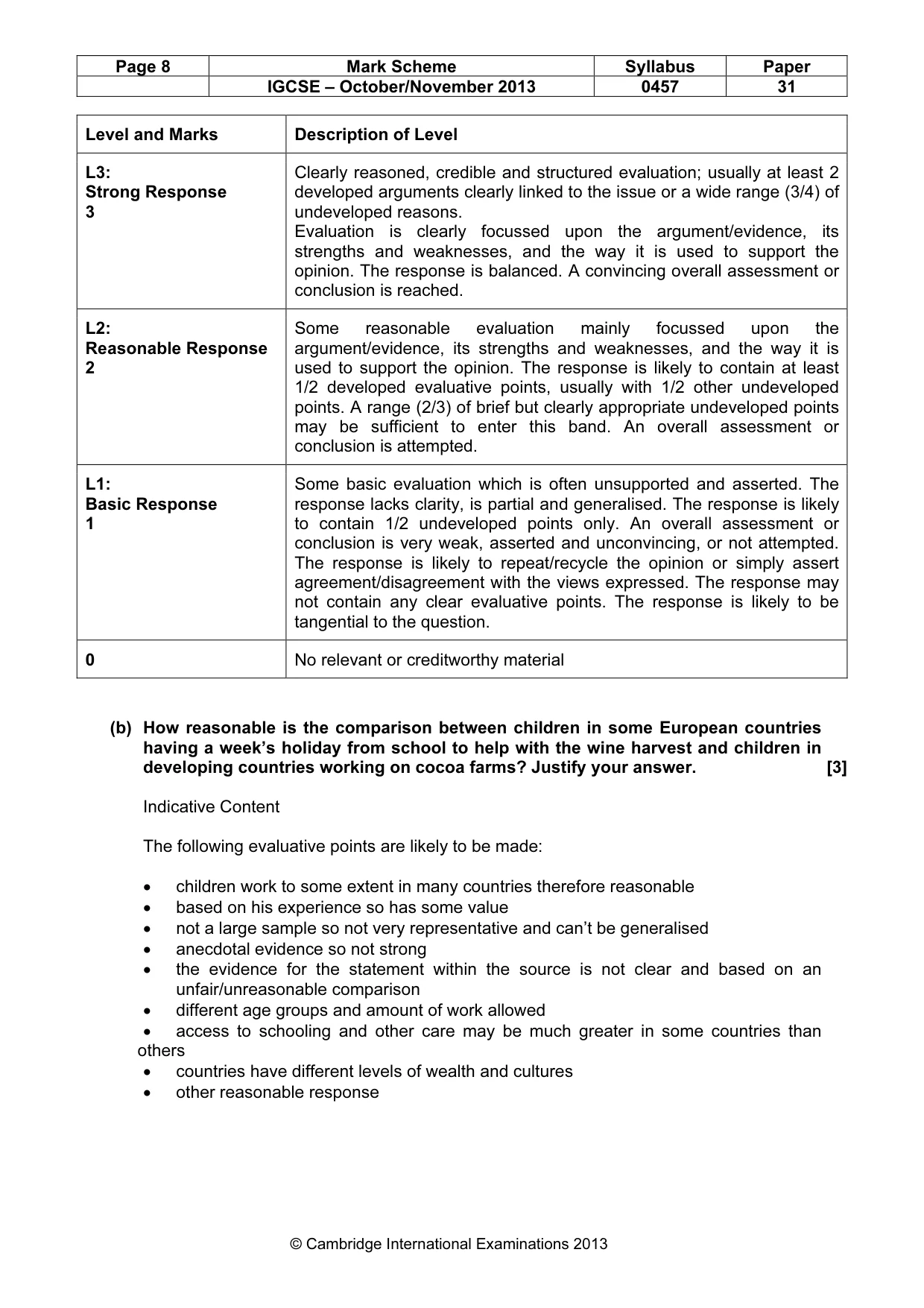
Page 8 Mark Scheme Syllabus Paper IGCSE – October/November 2013 0457 31 © Cambridge International Examinations 2013 Level and Marks Description of Level L3: Strong Response 3 Clearly reasoned, credible and structured evaluation; usually at least 2 developed arguments clearly linked to the issue or a wide range (3/4) of undeveloped reasons. Evaluation is clearly focussed upon the argument/evidence, its strengths and weaknesses, and the way it is used to support the opinion. The response is balanced. A convincing overall assessment or conclusion is reached. L2: Reasonable Response 2 Some reasonable evaluation mainly focussed upon the argument/evidence, its strengths and weaknesses, and the way it is used to support the opinion. The response is likely to contain at least 1/2 developed evaluative points, usually with 1/2 other undeveloped points. A range (2/3) of brief but clearly appropriate undeveloped points may be sufficient to enter this band. An overall assessment or conclusion is attempted. L1: Basic Response 1 Some basic evaluation which is often unsupported and asserted. The response lacks clarity, is partial and generalised. The response is likely to contain 1/2 undeveloped points only. An overall assessment or conclusion is very weak, asserted and unconvincing, or not attempted. The response is likely to repeat/recycle the opinion or simply assert agreement/disagreement with the views expressed. The response may not contain any clear evaluative points. The response is likely to be tangential to the question. 0 No relevant or creditworthy material (b) How reasonable is the comparison between children in some European countries having a week’s holiday from school to help with the wine harvest and children in developing countries working on cocoa farms? Justify your answer. [3] Indicative Content The following evaluative points are likely to be made: • children work to some extent in many countries therefore reasonable • based on his experience so has some value • not a large sample so not very representative and can’t be generalised • anecdotal evidence so not strong • the evidence for the statement within the source is not clear and based on an unfair/unreasonable comparison • different age groups and amount of work allowed • access to schooling and other care may be much greater in some countries than others • countries have different levels of wealth and cultures • other reasonable response
Mark scheme, page 9
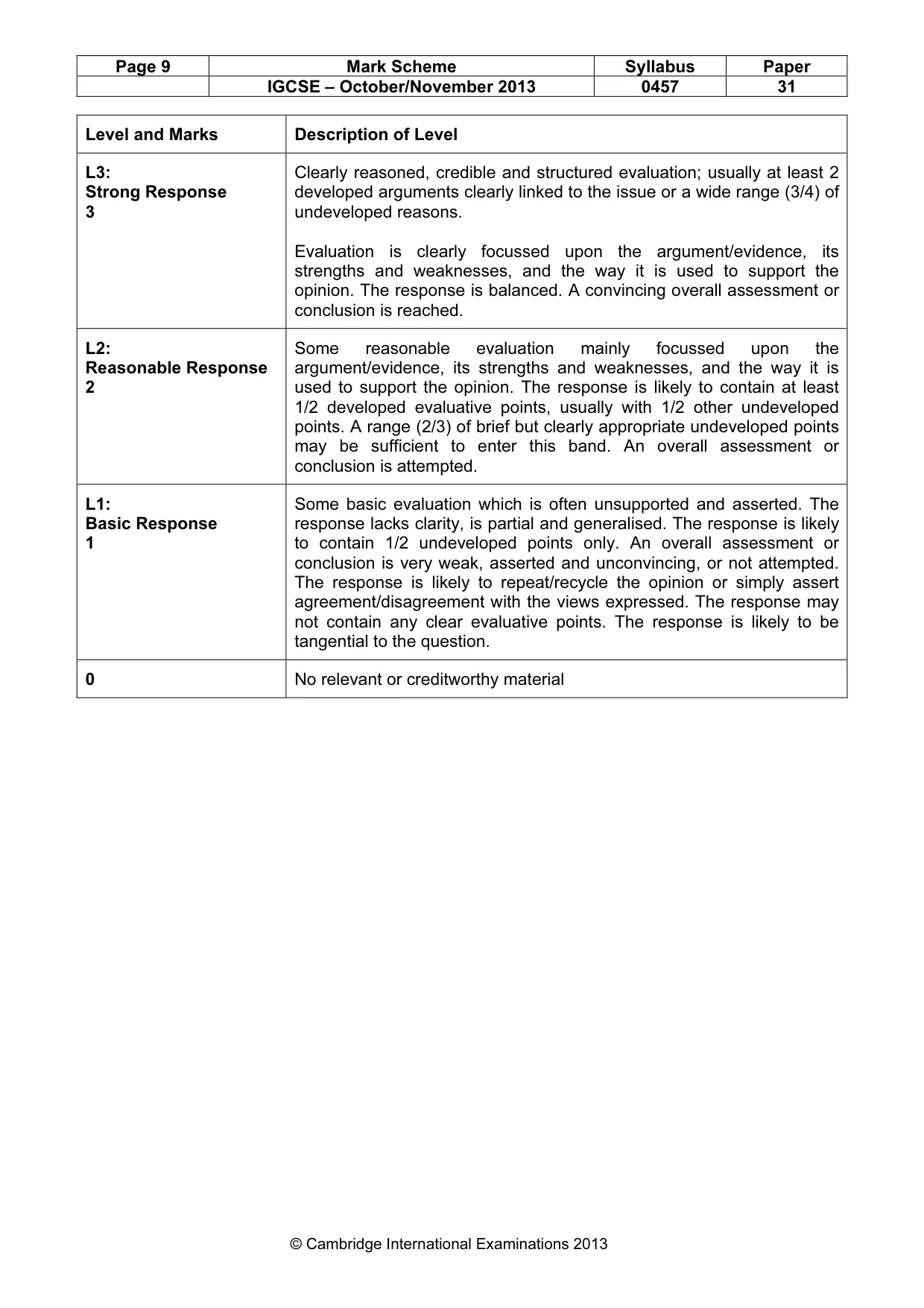
Page 9 Mark Scheme Syllabus Paper IGCSE – October/November 2013 0457 31 © Cambridge International Examinations 2013 Level and Marks Description of Level L3: Strong Response 3 Clearly reasoned, credible and structured evaluation; usually at least 2 developed arguments clearly linked to the issue or a wide range (3/4) of undeveloped reasons. Evaluation is clearly focussed upon the argument/evidence, its strengths and weaknesses, and the way it is used to support the opinion. The response is balanced. A convincing overall assessment or conclusion is reached. L2: Reasonable Response 2 Some reasonable evaluation mainly focussed upon the argument/evidence, its strengths and weaknesses, and the way it is used to support the opinion. The response is likely to contain at least 1/2 developed evaluative points, usually with 1/2 other undeveloped points. A range (2/3) of brief but clearly appropriate undeveloped points may be sufficient to enter this band. An overall assessment or conclusion is attempted. L1: Basic Response 1 Some basic evaluation which is often unsupported and asserted. The response lacks clarity, is partial and generalised. The response is likely to contain 1/2 undeveloped points only. An overall assessment or conclusion is very weak, asserted and unconvincing, or not attempted. The response is likely to repeat/recycle the opinion or simply assert agreement/disagreement with the views expressed. The response may not contain any clear evaluative points. The response is likely to be tangential to the question. 0 No relevant or creditworthy material
Mark scheme, page 10
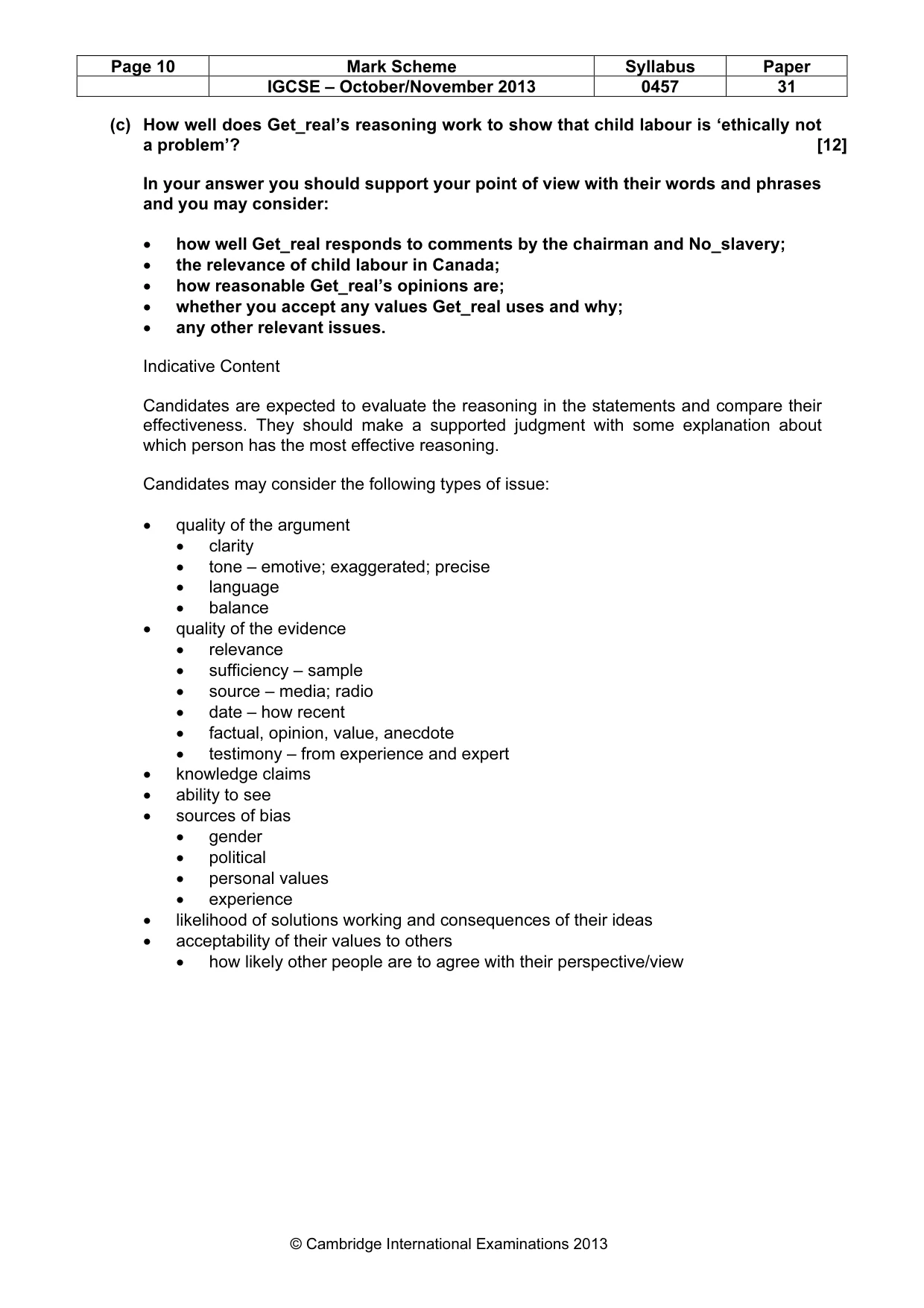
Page 10 Mark Scheme Syllabus Paper IGCSE – October/November 2013 0457 31 © Cambridge International Examinations 2013 (c) How well does Get_real’s reasoning work to show that child labour is ‘ethically not a problem’? [12] In your answer you should support your point of view with their words and phrases and you may consider: • how well Get_real responds to comments by the chairman and No_slavery; • the relevance of child labour in Canada; • how reasonable Get_real’s opinions are; • whether you accept any values Get_real uses and why; • any other relevant issues. Indicative Content Candidates are expected to evaluate the reasoning in the statements and compare their effectiveness. They should make a supported judgment with some explanation about which person has the most effective reasoning. Candidates may consider the following types of issue: • quality of the argument • clarity • tone – emotive; exaggerated; precise • language • balance • quality of the evidence • relevance • sufficiency – sample • source – media; radio • date – how recent • factual, opinion, value, anecdote • testimony – from experience and expert • knowledge claims • ability to see • sources of bias • gender • political • personal values • experience • likelihood of solutions working and consequences of their ideas • acceptability of their values to others • how likely other people are to agree with their perspective/view
Mark scheme, page 11
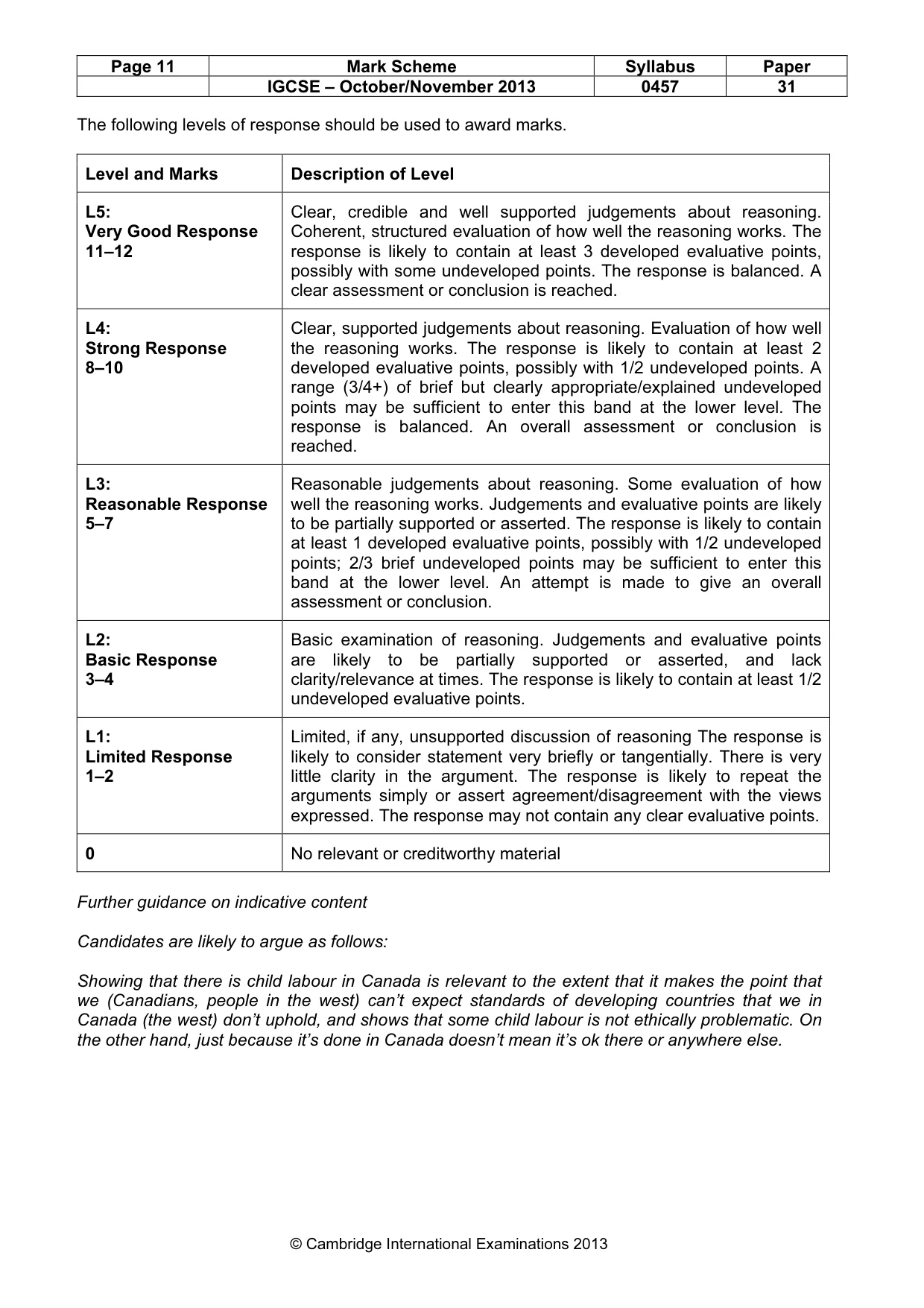
Page 11 Mark Scheme Syllabus Paper IGCSE – October/November 2013 0457 31 © Cambridge International Examinations 2013 The following levels of response should be used to award marks. Level and Marks Description of Level L5: Very Good Response 11–12 Clear, credible and well supported judgements about reasoning. Coherent, structured evaluation of how well the reasoning works. The response is likely to contain at least 3 developed evaluative points, possibly with some undeveloped points. The response is balanced. A clear assessment or conclusion is reached. L4: Strong Response 8–10 Clear, supported judgements about reasoning. Evaluation of how well the reasoning works. The response is likely to contain at least 2 developed evaluative points, possibly with 1/2 undeveloped points. A range (3/4+) of brief but clearly appropriate/explained undeveloped points may be sufficient to enter this band at the lower level. The response is balanced. An overall assessment or conclusion is reached. L3: Reasonable Response 5–7 Reasonable judgements about reasoning. Some evaluation of how well the reasoning works. Judgements and evaluative points are likely to be partially supported or asserted. The response is likely to contain at least 1 developed evaluative points, possibly with 1/2 undeveloped points; 2/3 brief undeveloped points may be sufficient to enter this band at the lower level. An attempt is made to give an overall assessment or conclusion. L2: Basic Response 3–4 Basic examination of reasoning. Judgements and evaluative points are likely to be partially supported or asserted, and lack clarity/relevance at times. The response is likely to contain at least 1/2 undeveloped evaluative points. L1: Limited Response 1–2 Limited, if any, unsupported discussion of reasoning The response is likely to consider statement very briefly or tangentially. There is very little clarity in the argument. The response is likely to repeat the arguments simply or assert agreement/disagreement with the views expressed. The response may not contain any clear evaluative points. 0 No relevant or creditworthy material Further guidance on indicative content Candidates are likely to argue as follows: Showing that there is child labour in Canada is relevant to the extent that it makes the point that we (Canadians, people in the west) can’t expect standards of developing countries that we in Canada (the west) don’t uphold, and shows that some child labour is not ethically problematic. On the other hand, just because it’s done in Canada doesn’t mean it’s ok there or anywhere else.
Mark scheme, page 12
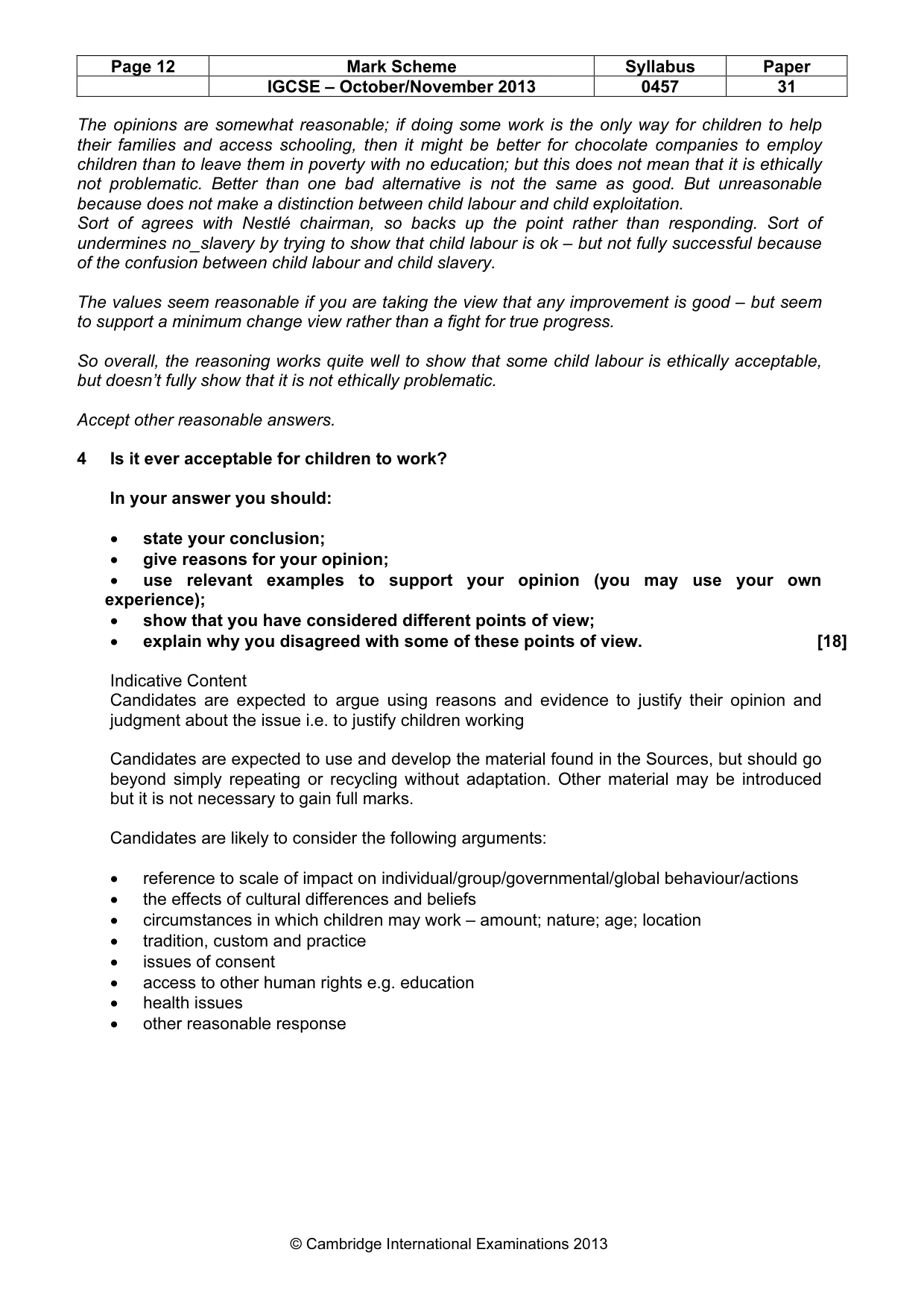
Page 12 Mark Scheme Syllabus Paper IGCSE – October/November 2013 0457 31 © Cambridge International Examinations 2013 The opinions are somewhat reasonable; if doing some work is the only way for children to help their families and access schooling, then it might be better for chocolate companies to employ children than to leave them in poverty with no education; but this does not mean that it is ethically not problematic. Better than one bad alternative is not the same as good. But unreasonable because does not make a distinction between child labour and child exploitation. Sort of agrees with Nestlé chairman, so backs up the point rather than responding. Sort of undermines no_slavery by trying to show that child labour is ok – but not fully successful because of the confusion between child labour and child slavery. The values seem reasonable if you are taking the view that any improvement is good – but seem to support a minimum change view rather than a fight for true progress. So overall, the reasoning works quite well to show that some child labour is ethically acceptable, but doesn’t fully show that it is not ethically problematic. Accept other reasonable answers. 4 Is it ever acceptable for children to work? In your answer you should: • state your conclusion; • give reasons for your opinion; • use relevant examples to support your opinion (you may use your own experience); • show that you have considered different points of view; • explain why you disagreed with some of these points of view. [18] Indicative Content Candidates are expected to argue using reasons and evidence to justify their opinion and judgment about the issue i.e. to justify children working Candidates are expected to use and develop the material found in the Sources, but should go beyond simply repeating or recycling without adaptation. Other material may be introduced but it is not necessary to gain full marks. Candidates are likely to consider the following arguments: • reference to scale of impact on individual/group/governmental/global behaviour/actions • the effects of cultural differences and beliefs • circumstances in which children may work – amount; nature; age; location • tradition, custom and practice • issues of consent • access to other human rights e.g. education • health issues • other reasonable response
Mark scheme, page 13
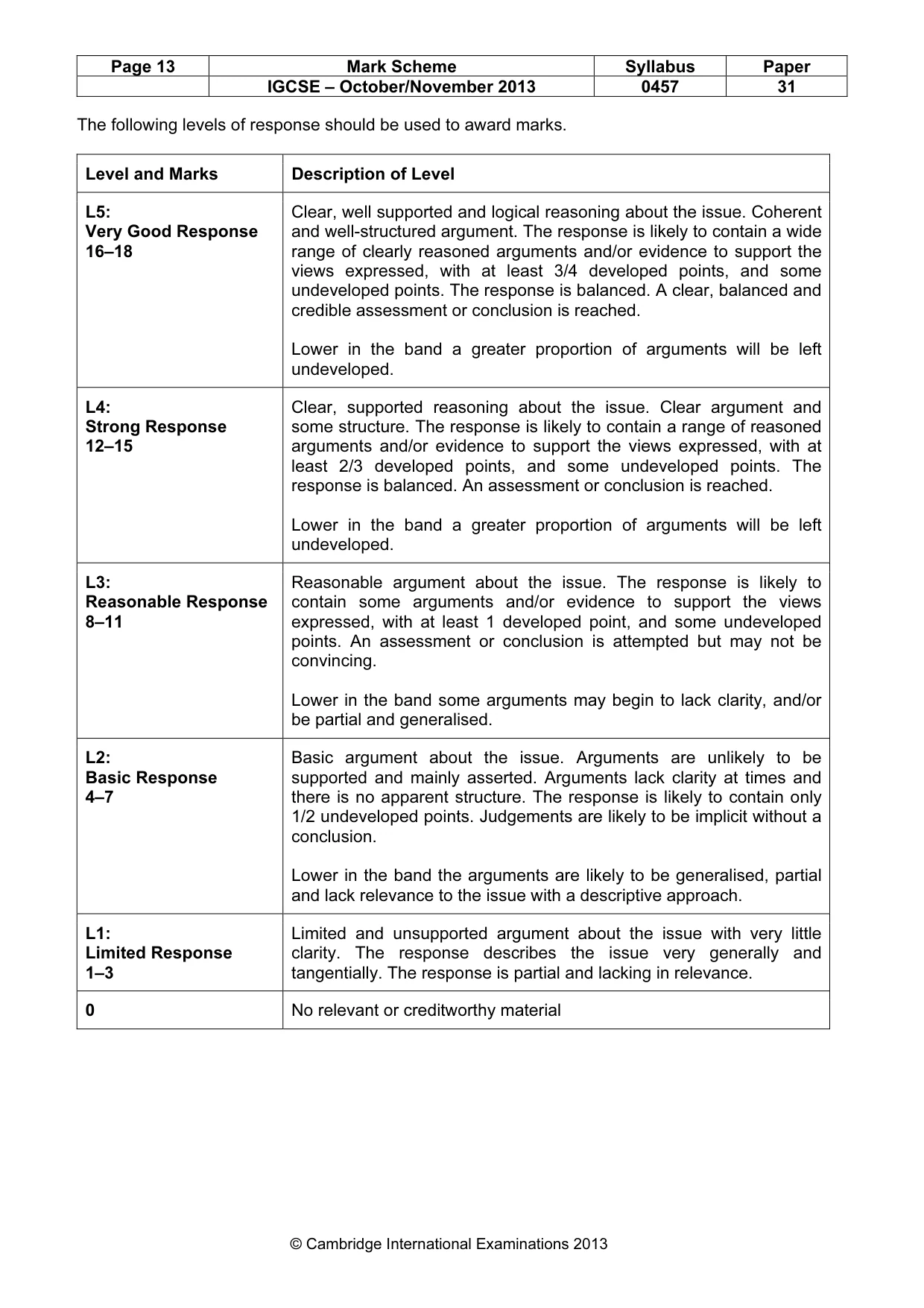
Page 13 Mark Scheme Syllabus Paper IGCSE – October/November 2013 0457 31 © Cambridge International Examinations 2013 The following levels of response should be used to award marks. Level and Marks Description of Level L5: Very Good Response 16–18 Clear, well supported and logical reasoning about the issue. Coherent and well-structured argument. The response is likely to contain a wide range of clearly reasoned arguments and/or evidence to support the views expressed, with at least 3/4 developed points, and some undeveloped points. The response is balanced. A clear, balanced and credible assessment or conclusion is reached. Lower in the band a greater proportion of arguments will be left undeveloped. L4: Strong Response 12–15 Clear, supported reasoning about the issue. Clear argument and some structure. The response is likely to contain a range of reasoned arguments and/or evidence to support the views expressed, with at least 2/3 developed points, and some undeveloped points. The response is balanced. An assessment or conclusion is reached. Lower in the band a greater proportion of arguments will be left undeveloped. L3: Reasonable Response 8–11 Reasonable argument about the issue. The response is likely to contain some arguments and/or evidence to support the views expressed, with at least 1 developed point, and some undeveloped points. An assessment or conclusion is attempted but may not be convincing. Lower in the band some arguments may begin to lack clarity, and/or be partial and generalised. L2: Basic Response 4–7 Basic argument about the issue. Arguments are unlikely to be supported and mainly asserted. Arguments lack clarity at times and there is no apparent structure. The response is likely to contain only 1/2 undeveloped points. Judgements are likely to be implicit without a conclusion. Lower in the band the arguments are likely to be generalised, partial and lack relevance to the issue with a descriptive approach. L1: Limited Response 1–3 Limited and unsupported argument about the issue with very little clarity. The response describes the issue very generally and tangentially. The response is partial and lacking in relevance. 0 No relevant or creditworthy material
What you needed in this session
Cambridge’s own grade thresholds for 2013 Oct/Nov, Paper 3 · Variant 1. A higher threshold means an easier paper — the bar moves with how the cohort did.