Cambridge IGCSE Global Perspectives 0457 — 2013 May/June Paper 3 · Variant 2
0457/32/M/J/13 · 60 marks · ≈68 min
The question paper and its mark scheme, free to read here and free to download. This is Cambridge’s own paper, exactly as it was sat.
Question paper8 pages

Mark scheme14 pages
Answers below. Sit the paper first if you are practising.
Paper as text
Question paper, page 1
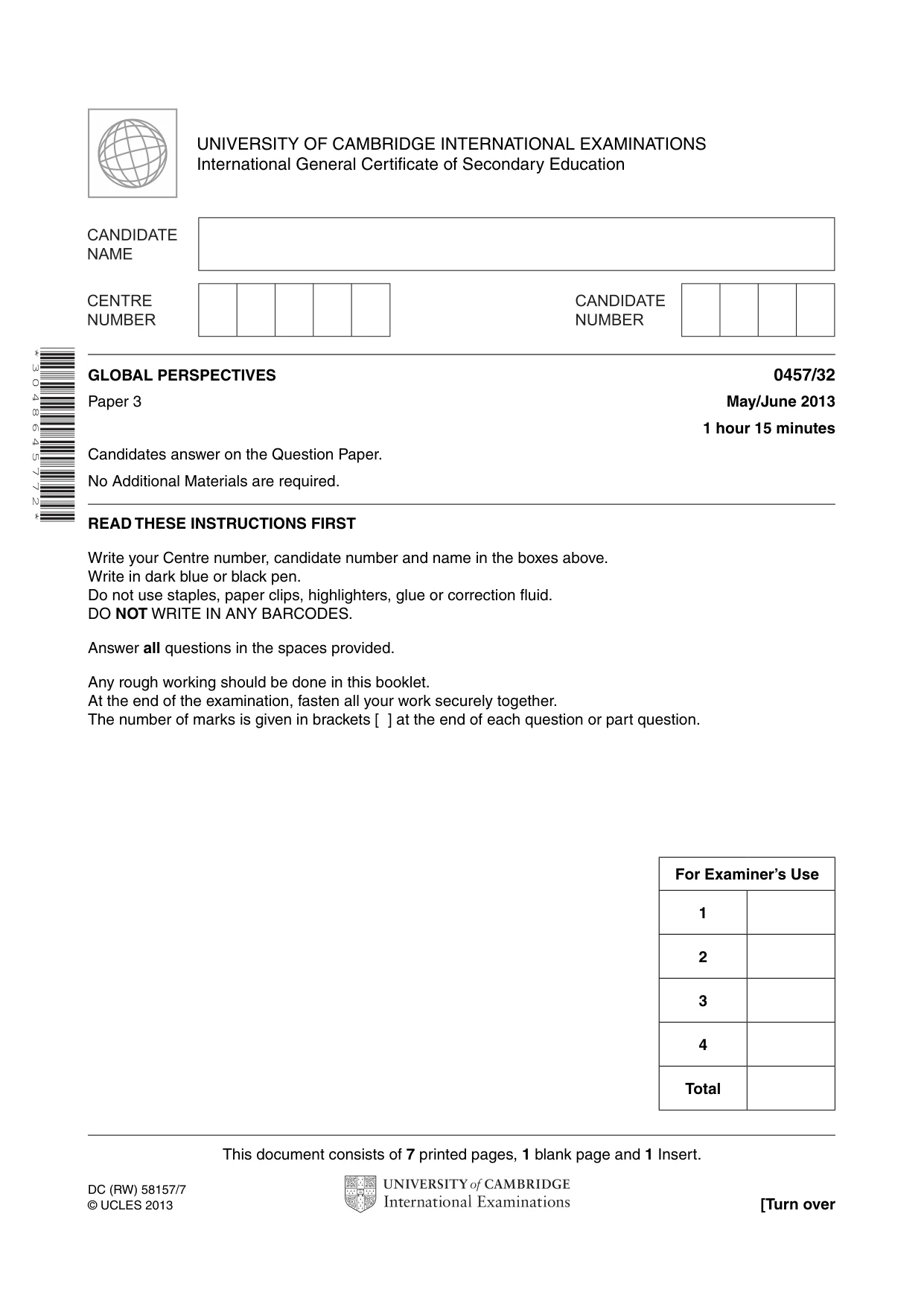
This document consists of 7 printed pages, 1 blank page and 1 Insert. DC (RW) 58157/7 © UCLES 2013 [Turn over UNIVERSITY OF CAMBRIDGE INTERNATIONAL EXAMINATIONS International General Certificate of Secondary Education * 3 0 4 8 6 4 5 7 7 2 * GLOBAL PERSPECTIVES 0457/32 Paper 3 May/June 2013 1 hour 15 minutes Candidates answer on the Question Paper. No Additional Materials are required. READ THESE INSTRUCTIONS FIRST Write your Centre number, candidate number and name in the boxes above. Write in dark blue or black pen. Do not use staples, paper clips, highlighters, glue or correction fluid. DO NOT WRITE IN ANY BARCODES. Answer all questions in the spaces provided. Any rough working should be done in this booklet. At the end of the examination, fasten all your work securely together. The number of marks is given in brackets [ ] at the end of each question or part question. For Examiner’s Use 1 2 3 4 Total
Question paper, page 2
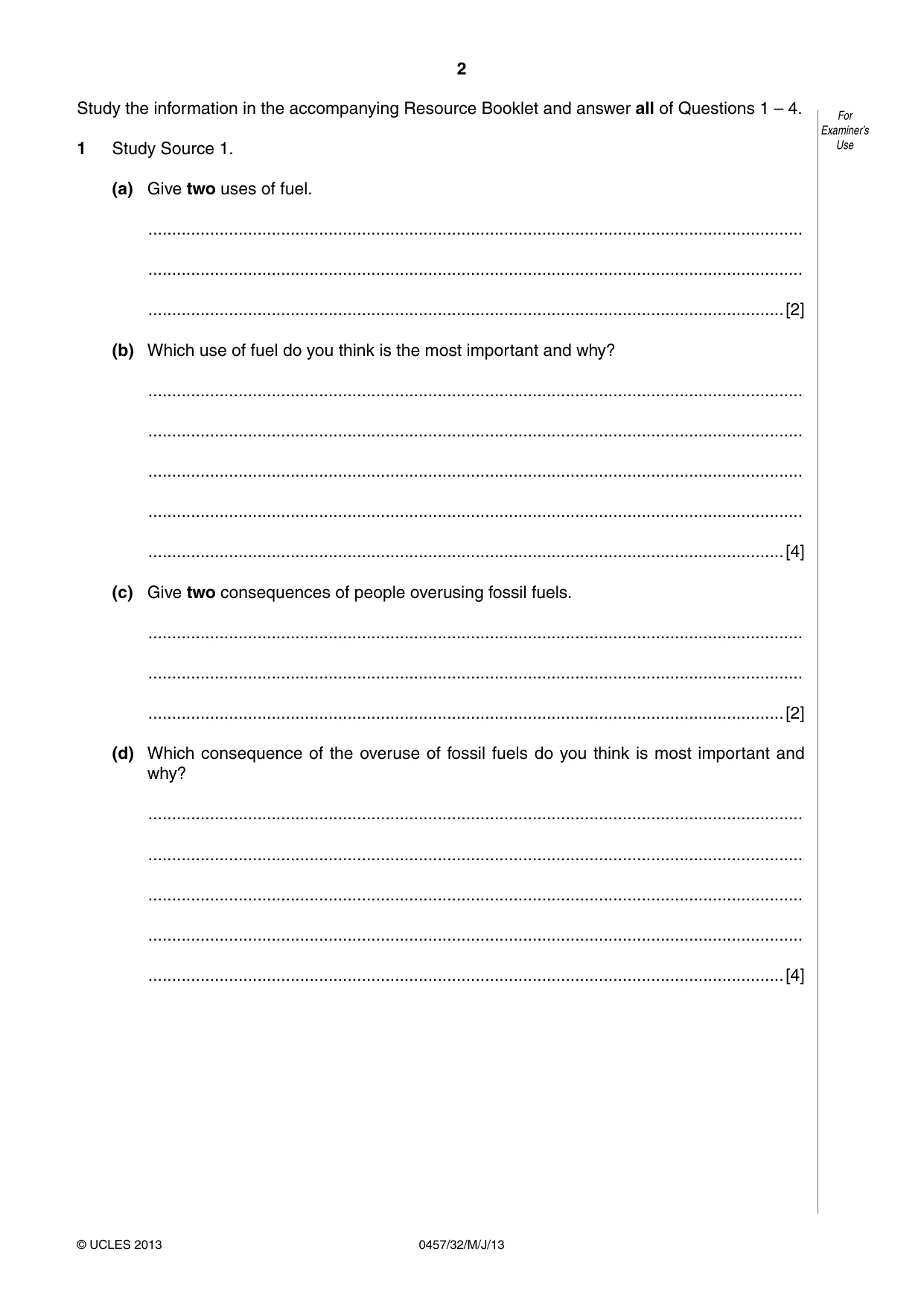
2 0457/32/M/J/13 © UCLES 2013 For Examiner’s Use Study the information in the accompanying Resource Booklet and answer all of Questions 1 – 4. 1 Study Source 1. (a) Give two uses of fuel. … … …[2] (b) Which use of fuel do you think is the most important and why? … … … … …[4] (c) Give two consequences of people overusing fossil fuels. … … …[2] (d) Which consequence of the overuse of fossil fuels do you think is most important and why? … … … … …[4]
Question paper, page 3
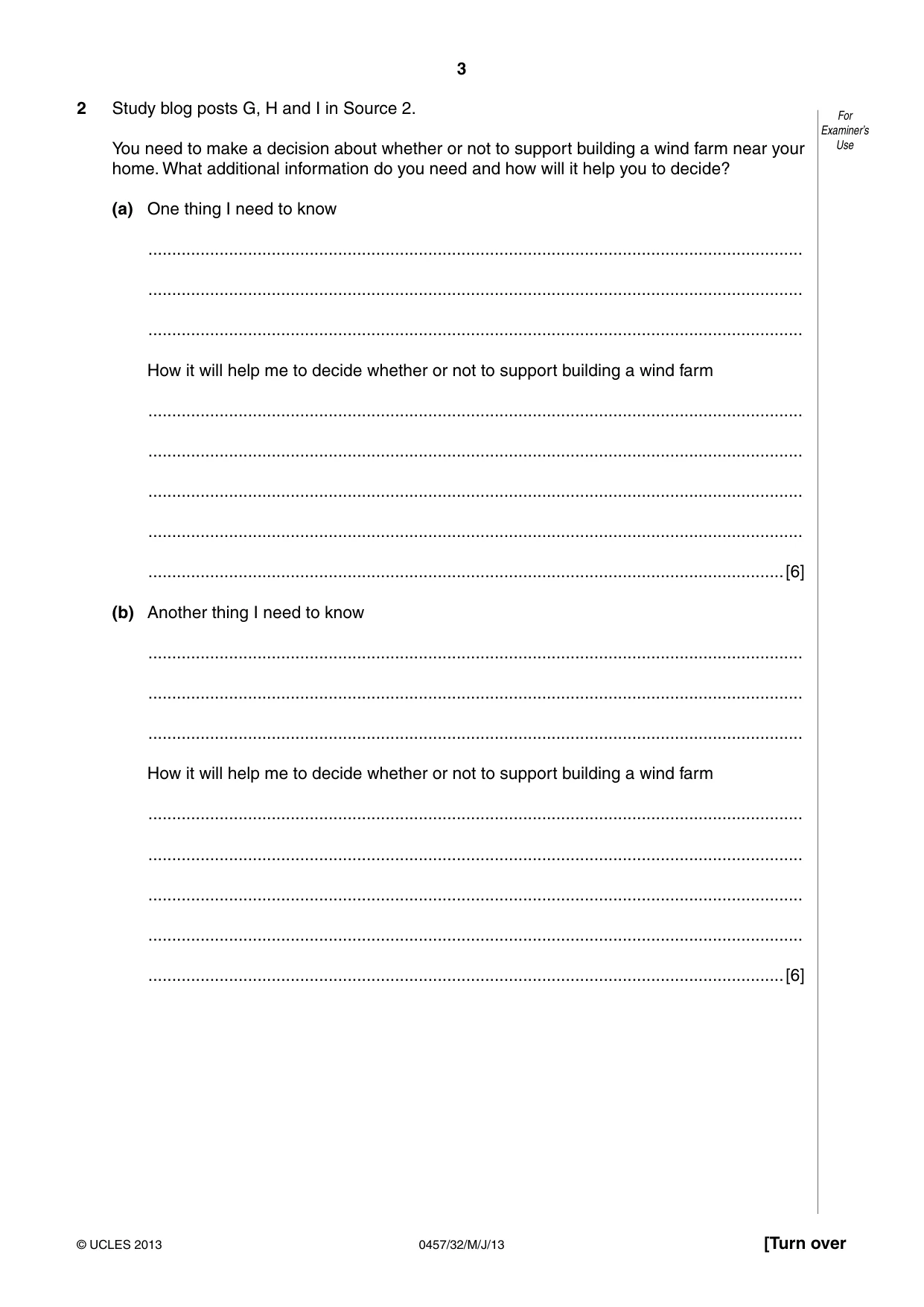
3 0457/32/M/J/13 © UCLES 2013 [Turn over For Examiner’s Use 2 Study blog posts G, H and I in Source 2. You need to make a decision about whether or not to support building a wind farm near your home. What additional information do you need and how will it help you to decide? (a) One thing I need to know … … … How it will help me to decide whether or not to support building a wind farm … … … … …[6] (b) Another thing I need to know … … … How it will help me to decide whether or not to support building a wind farm … … … … …[6]
Question paper, page 4
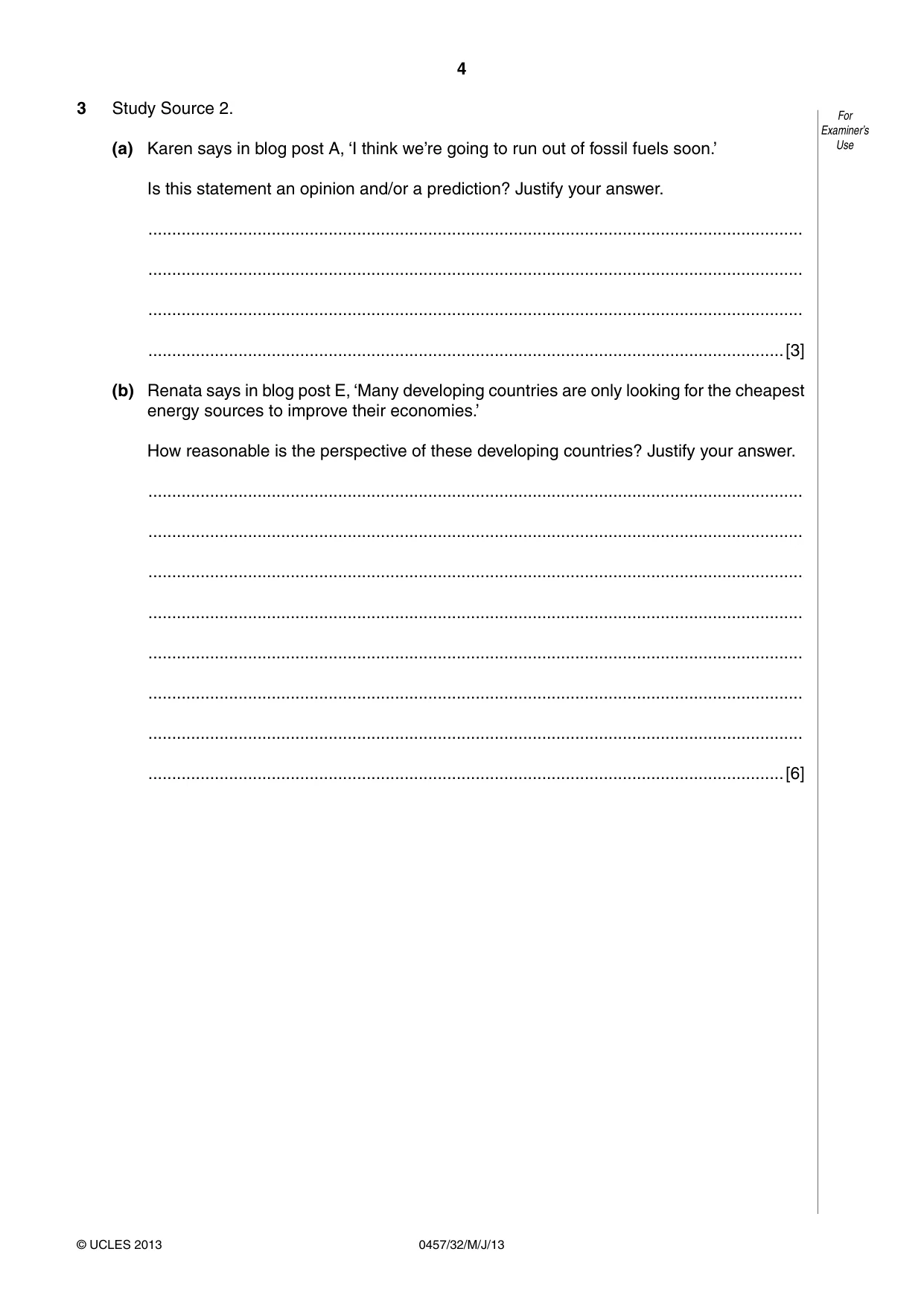
4 0457/32/M/J/13 © UCLES 2013 For Examiner’s Use 3 Study Source 2. (a) Karen says in blog post A, ‘I think we’re going to run out of fossil fuels soon.’ Is this statement an opinion and/or a prediction? Justify your answer. … … … …[3] (b) Renata says in blog post E, ‘Many developing countries are only looking for the cheapest energy sources to improve their economies.’ How reasonable is the perspective of these developing countries? Justify your answer. … … … … … … … …[6]
Question paper, page 5
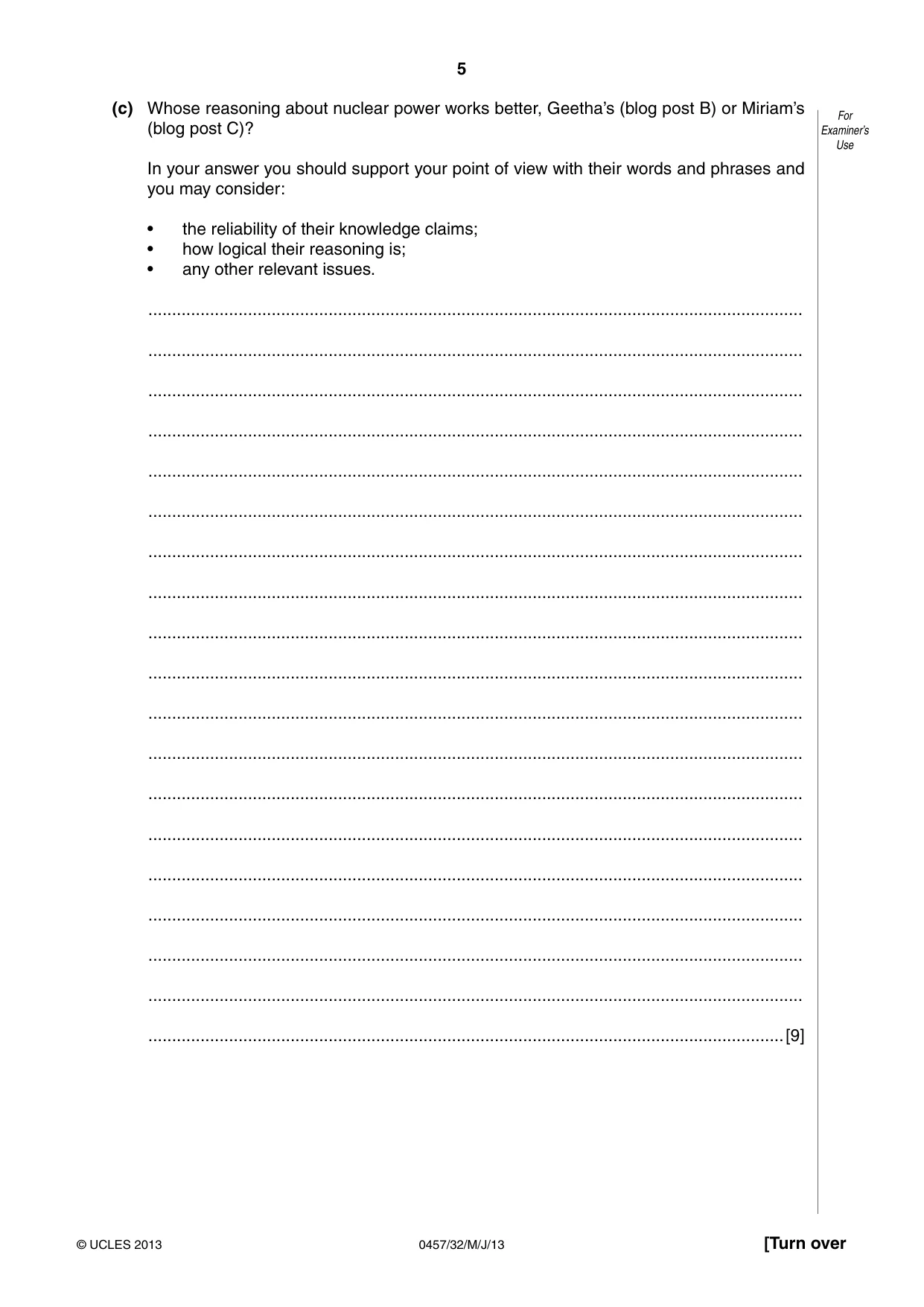
5 0457/32/M/J/13 © UCLES 2013 [Turn over For Examiner’s Use (c) Whose reasoning about nuclear power works better, Geetha’s (blog post B) or Miriam’s (blog post C)? In your answer you should support your point of view with their words and phrases and you may consider: • the reliability of their knowledge claims; • how logical their reasoning is; • any other relevant issues. … … … … … … … … … … … … … … … … … … …[9]
Question paper, page 6
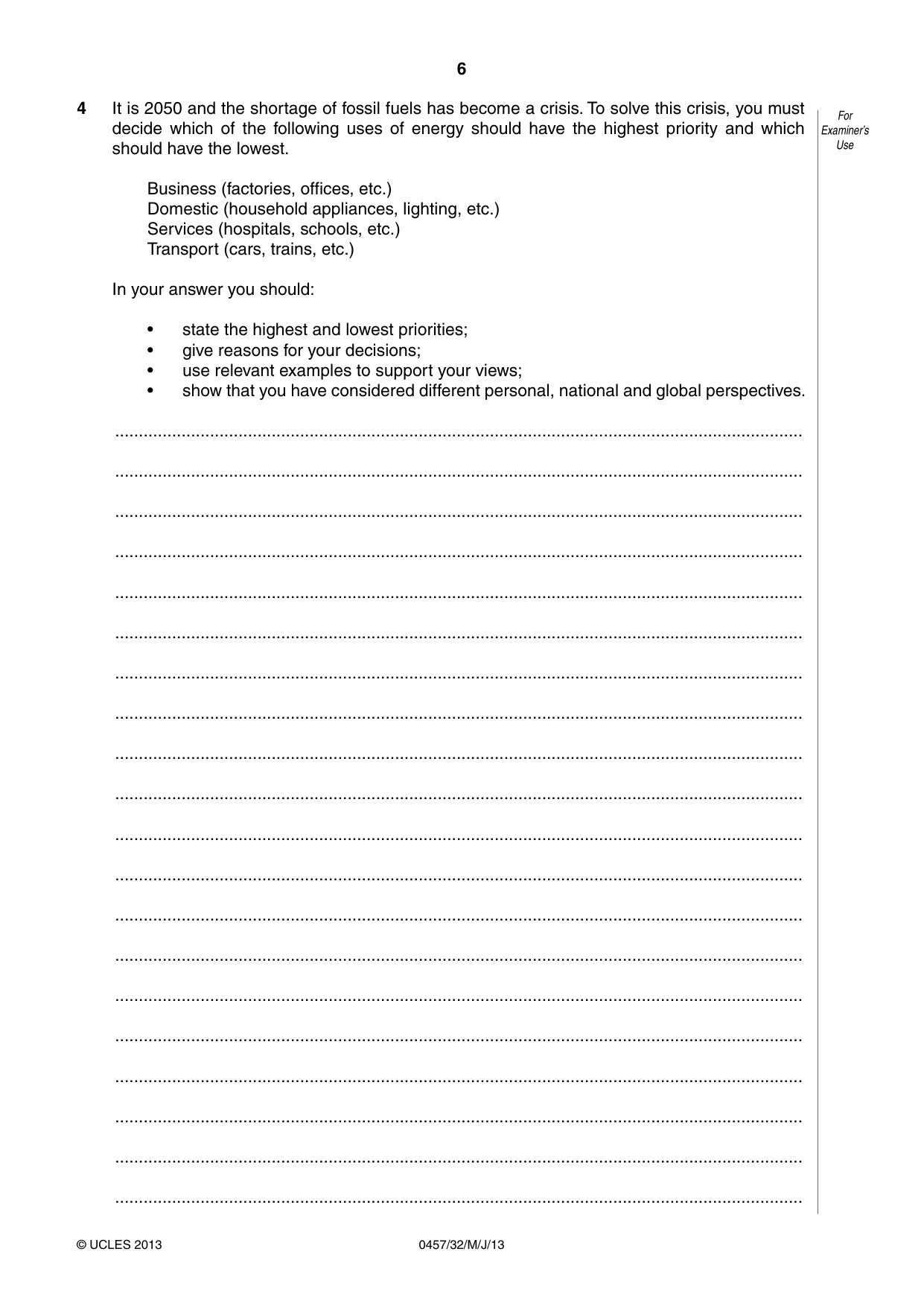
6 0457/32/M/J/13 © UCLES 2013 For Examiner’s Use 4 It is 2050 and the shortage of fossil fuels has become a crisis. To solve this crisis, you must decide which of the following uses of energy should have the highest priority and which should have the lowest. Business (factories, offices, etc.) Domestic (household appliances, lighting, etc.) Services (hospitals, schools, etc.) Transport (cars, trains, etc.) In your answer you should: • state the highest and lowest priorities; • give reasons for your decisions; • use relevant examples to support your views; • show that you have considered different personal, national and global perspectives. … … … … … … … … … … … … … … … … … … … …
Question paper, page 7
7 0457/32/M/J/13 © UCLES 2013 For Examiner’s Use … … … … … … … … … … … … … … … …[18]
Question paper, page 8
8 0457/32/M/J/13 © UCLES 2013 Permission to reproduce items where third-party owned material protected by copyright is included has been sought and cleared where possible. Every reasonable effort has been made by the publisher (UCLES) to trace copyright holders, but if any items requiring clearance have unwittingly been included, the publisher will be pleased to make amends at the earliest possible opportunity. University of Cambridge International Examinations is part of the Cambridge Assessment Group. Cambridge Assessment is the brand name of University of Cambridge Local Examinations Syndicate (UCLES), which is itself a department of the University of Cambridge. BLANK PAGE
Mark scheme, page 1
CAMBRIDGE INTERNATIONAL EXAMINATIONS International General Certificate of Secondary Education MARK SCHEME for the May/June 2013 series 0457 GLOBAL PERSPECTIVES 0457/32 Paper 3 (Written Paper), maximum raw mark 60 This mark scheme is published as an aid to teachers and candidates, to indicate the requirements of the examination. It shows the basis on which Examiners were instructed to award marks. It does not indicate the details of the discussions that took place at an Examiners’ meeting before marking began, which would have considered the acceptability of alternative answers. Mark schemes should be read in conjunction with the question paper and the Principal Examiner Report for Teachers. Cambridge will not enter into discussions about these mark schemes. Cambridge is publishing the mark schemes for the May/June 2013 series for most IGCSE, GCE Advanced Level and Advanced Subsidiary Level components and some Ordinary Level components.
Mark scheme, page 2
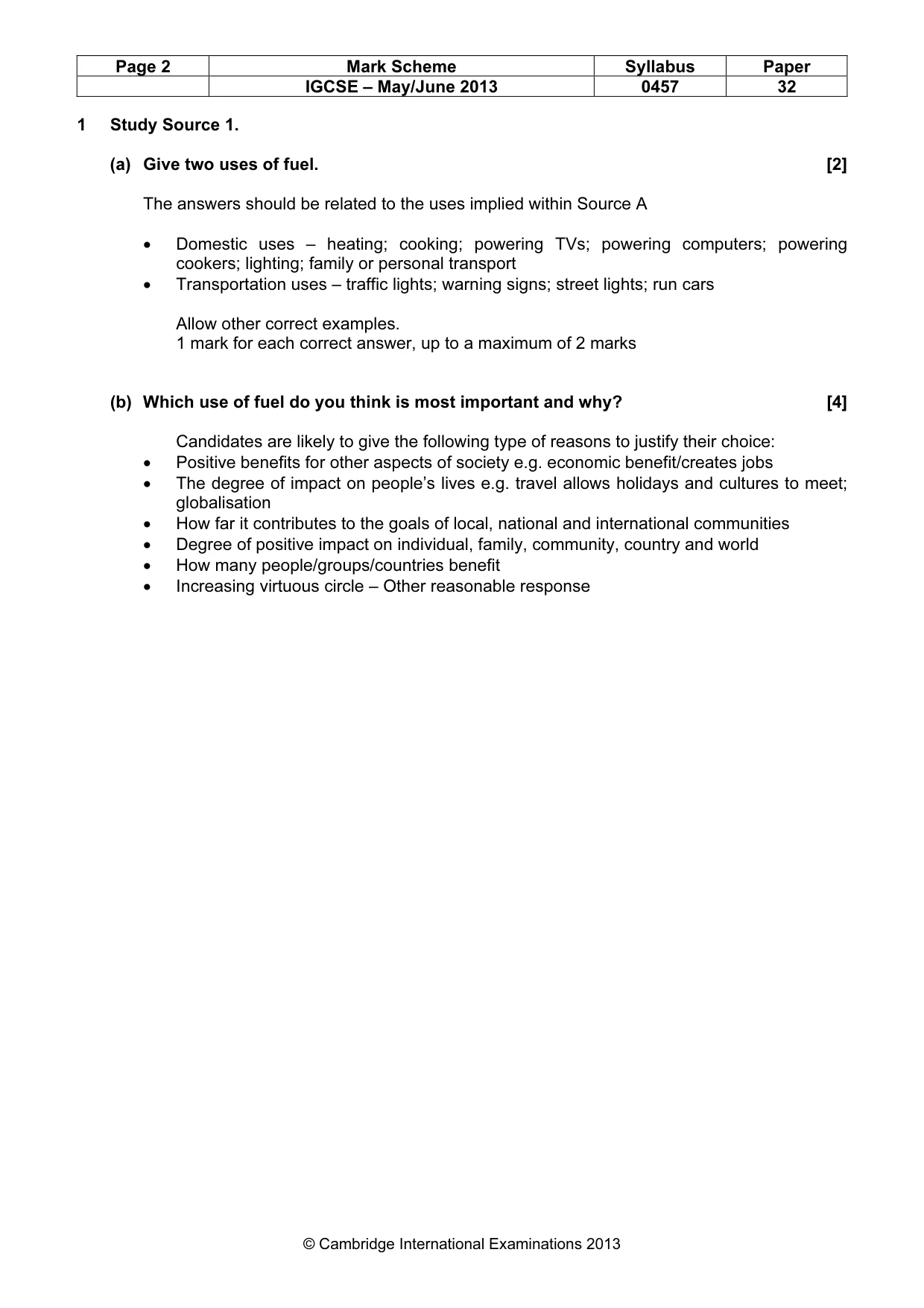
Page 2 Mark Scheme Syllabus Paper IGCSE – May/June 2013 0457 32 © Cambridge International Examinations 2013 1 Study Source 1. (a) Give two uses of fuel. [2] The answers should be related to the uses implied within Source A • Domestic uses – heating; cooking; powering TVs; powering computers; powering cookers; lighting; family or personal transport • Transportation uses – traffic lights; warning signs; street lights; run cars Allow other correct examples. 1 mark for each correct answer, up to a maximum of 2 marks (b) Which use of fuel do you think is most important and why? [4] Candidates are likely to give the following type of reasons to justify their choice: • Positive benefits for other aspects of society e.g. economic benefit/creates jobs • The degree of impact on people’s lives e.g. travel allows holidays and cultures to meet; globalisation • How far it contributes to the goals of local, national and international communities • Degree of positive impact on individual, family, community, country and world • How many people/groups/countries benefit • Increasing virtuous circle – Other reasonable response
Mark scheme, page 3
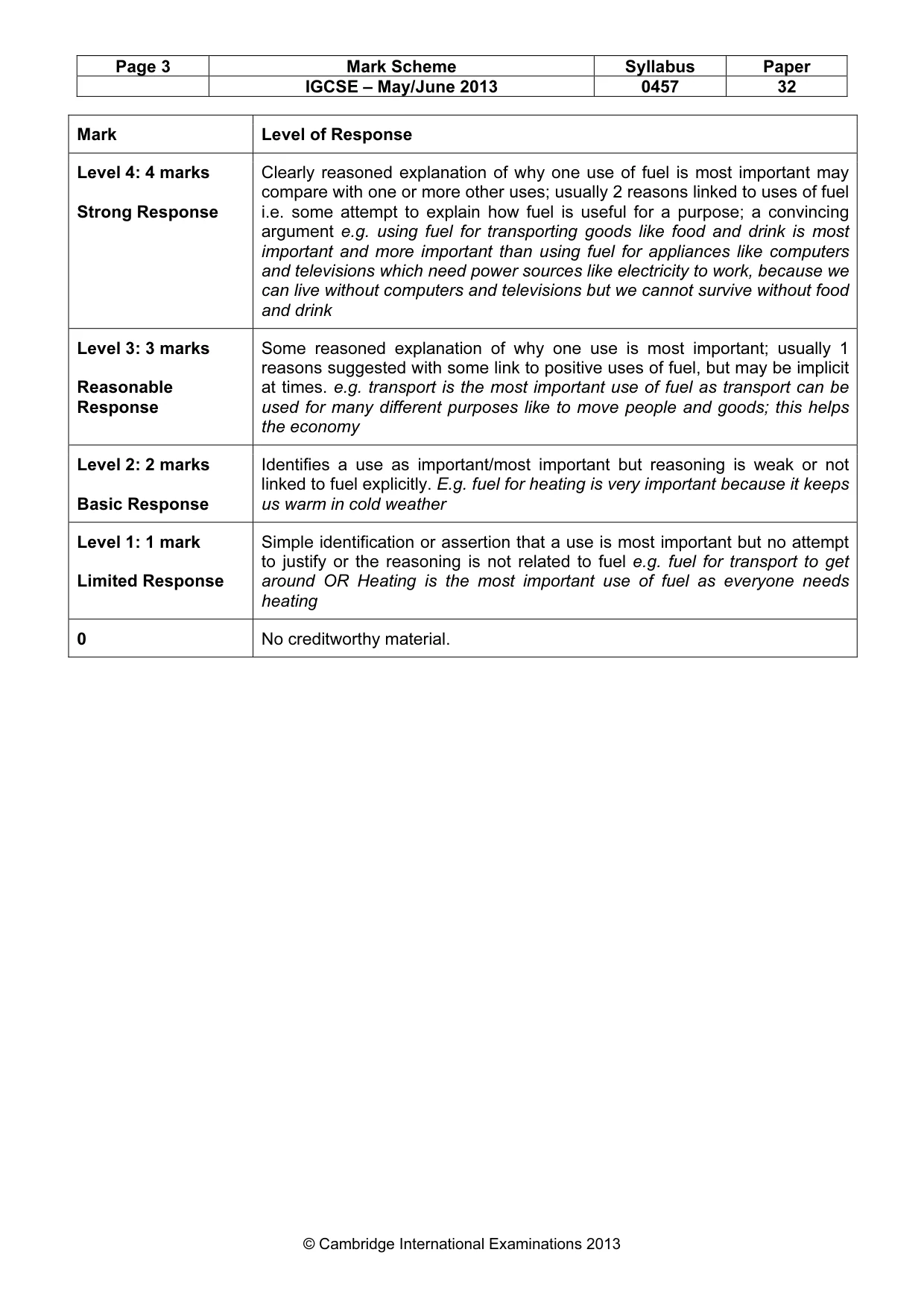
Page 3 Mark Scheme Syllabus Paper IGCSE – May/June 2013 0457 32 © Cambridge International Examinations 2013 Mark Level of Response Level 4: 4 marks Strong Response Clearly reasoned explanation of why one use of fuel is most important may compare with one or more other uses; usually 2 reasons linked to uses of fuel i.e. some attempt to explain how fuel is useful for a purpose; a convincing argument e.g. using fuel for transporting goods like food and drink is most important and more important than using fuel for appliances like computers and televisions which need power sources like electricity to work, because we can live without computers and televisions but we cannot survive without food and drink Level 3: 3 marks Reasonable Response Some reasoned explanation of why one use is most important; usually 1 reasons suggested with some link to positive uses of fuel, but may be implicit at times. e.g. transport is the most important use of fuel as transport can be used for many different purposes like to move people and goods; this helps the economy Level 2: 2 marks Basic Response Identifies a use as important/most important but reasoning is weak or not linked to fuel explicitly. E.g. fuel for heating is very important because it keeps us warm in cold weather Level 1: 1 mark Limited Response Simple identification or assertion that a use is most important but no attempt to justify or the reasoning is not related to fuel e.g. fuel for transport to get around OR Heating is the most important use of fuel as everyone needs heating 0 No creditworthy material.
Mark scheme, page 4
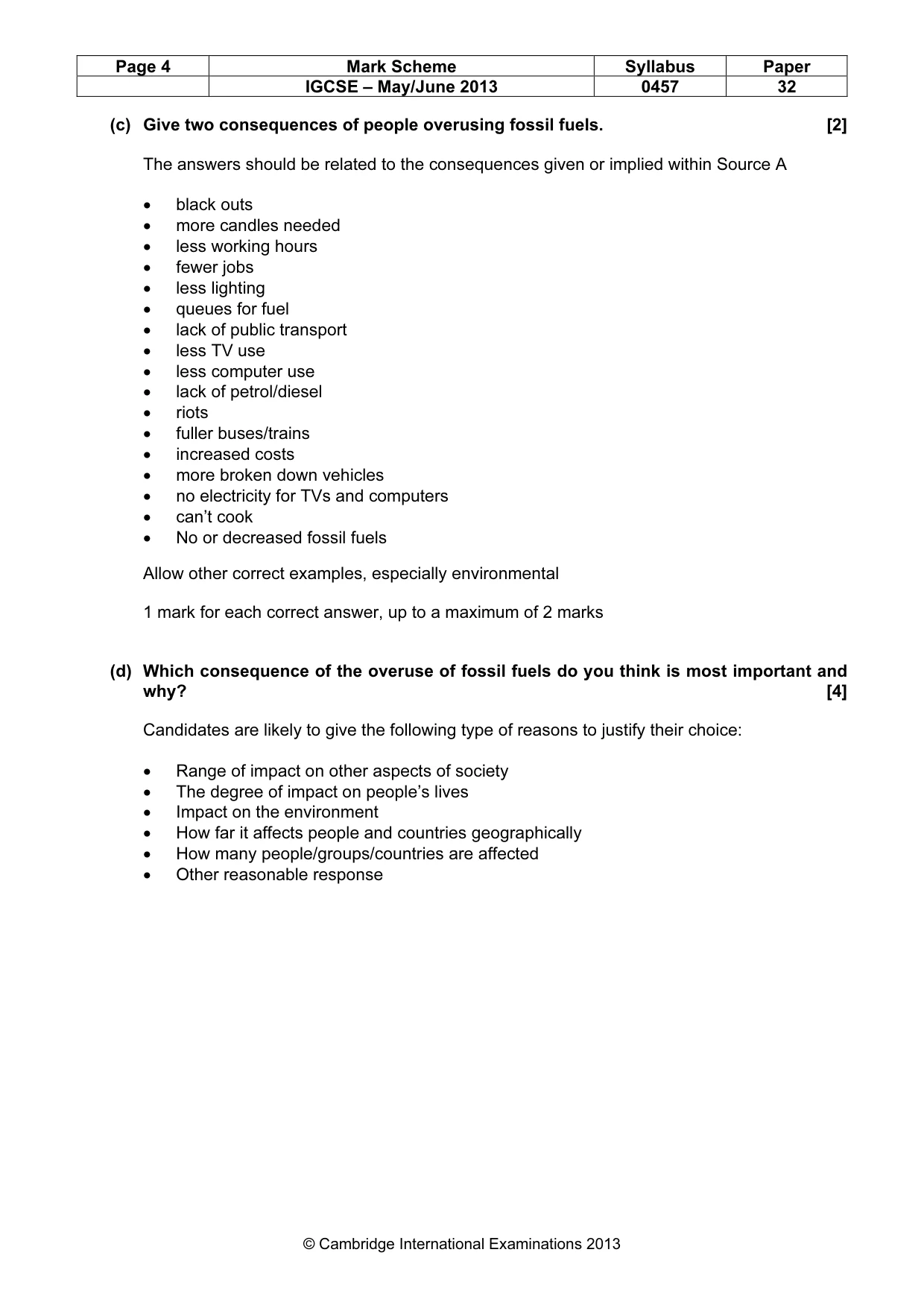
Page 4 Mark Scheme Syllabus Paper IGCSE – May/June 2013 0457 32 © Cambridge International Examinations 2013 (c) Give two consequences of people overusing fossil fuels. [2] The answers should be related to the consequences given or implied within Source A • black outs • more candles needed • less working hours • fewer jobs • less lighting • queues for fuel • lack of public transport • less TV use • less computer use • lack of petrol/diesel • riots • fuller buses/trains • increased costs • more broken down vehicles • no electricity for TVs and computers • can’t cook • No or decreased fossil fuels Allow other correct examples, especially environmental 1 mark for each correct answer, up to a maximum of 2 marks (d) Which consequence of the overuse of fossil fuels do you think is most important and why? [4] Candidates are likely to give the following type of reasons to justify their choice: • Range of impact on other aspects of society • The degree of impact on people’s lives • Impact on the environment • How far it affects people and countries geographically • How many people/groups/countries are affected • Other reasonable response
Mark scheme, page 5
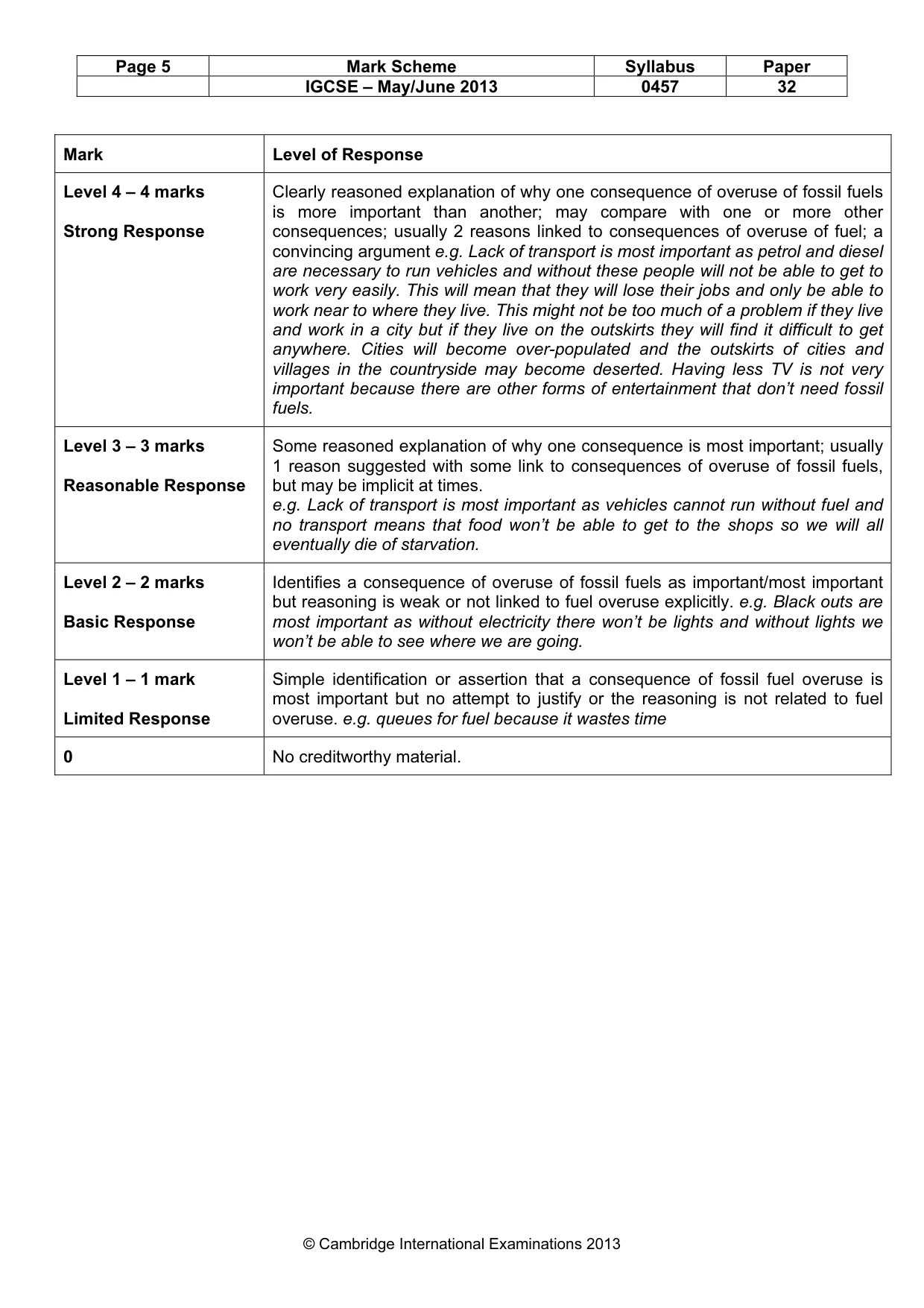
Page 5 Mark Scheme Syllabus Paper IGCSE – May/June 2013 0457 32 © Cambridge International Examinations 2013 Mark Level of Response Level 4 – 4 marks Strong Response Clearly reasoned explanation of why one consequence of overuse of fossil fuels is more important than another; may compare with one or more other consequences; usually 2 reasons linked to consequences of overuse of fuel; a convincing argument e.g. Lack of transport is most important as petrol and diesel are necessary to run vehicles and without these people will not be able to get to work very easily. This will mean that they will lose their jobs and only be able to work near to where they live. This might not be too much of a problem if they live and work in a city but if they live on the outskirts they will find it difficult to get anywhere. Cities will become over-populated and the outskirts of cities and villages in the countryside may become deserted. Having less TV is not very important because there are other forms of entertainment that don’t need fossil fuels. Level 3 – 3 marks Reasonable Response Some reasoned explanation of why one consequence is most important; usually 1 reason suggested with some link to consequences of overuse of fossil fuels, but may be implicit at times. e.g. Lack of transport is most important as vehicles cannot run without fuel and no transport means that food won’t be able to get to the shops so we will all eventually die of starvation. Level 2 – 2 marks Basic Response Identifies a consequence of overuse of fossil fuels as important/most important but reasoning is weak or not linked to fuel overuse explicitly. e.g. Black outs are most important as without electricity there won’t be lights and without lights we won’t be able to see where we are going. Level 1 – 1 mark Limited Response Simple identification or assertion that a consequence of fossil fuel overuse is most important but no attempt to justify or the reasoning is not related to fuel overuse. e.g. queues for fuel because it wastes time 0 No creditworthy material.
Mark scheme, page 6
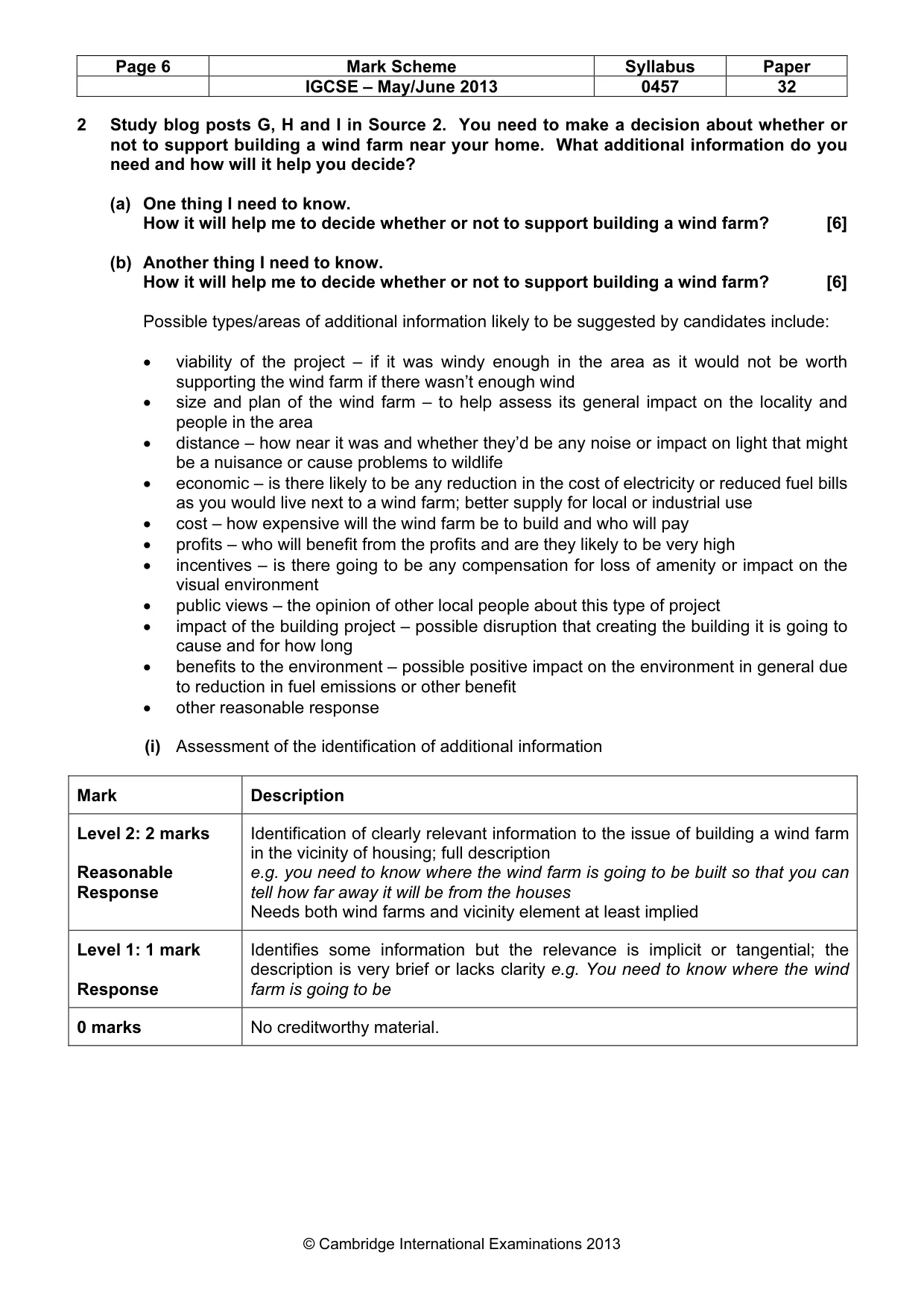
Page 6 Mark Scheme Syllabus Paper IGCSE – May/June 2013 0457 32 © Cambridge International Examinations 2013 2 Study blog posts G, H and I in Source 2. You need to make a decision about whether or not to support building a wind farm near your home. What additional information do you need and how will it help you decide? (a) One thing I need to know. How it will help me to decide whether or not to support building a wind farm? [6] (b) Another thing I need to know. How it will help me to decide whether or not to support building a wind farm? [6] Possible types/areas of additional information likely to be suggested by candidates include: • viability of the project – if it was windy enough in the area as it would not be worth supporting the wind farm if there wasn’t enough wind • size and plan of the wind farm – to help assess its general impact on the locality and people in the area • distance – how near it was and whether they’d be any noise or impact on light that might be a nuisance or cause problems to wildlife • economic – is there likely to be any reduction in the cost of electricity or reduced fuel bills as you would live next to a wind farm; better supply for local or industrial use • cost – how expensive will the wind farm be to build and who will pay • profits – who will benefit from the profits and are they likely to be very high • incentives – is there going to be any compensation for loss of amenity or impact on the visual environment • public views – the opinion of other local people about this type of project • impact of the building project – possible disruption that creating the building it is going to cause and for how long • benefits to the environment – possible positive impact on the environment in general due to reduction in fuel emissions or other benefit • other reasonable response (i) Assessment of the identification of additional information Mark Description Level 2: 2 marks Reasonable Response Identification of clearly relevant information to the issue of building a wind farm in the vicinity of housing; full description e.g. you need to know where the wind farm is going to be built so that you can tell how far away it will be from the houses Needs both wind farms and vicinity element at least implied Level 1: 1 mark Response Identifies some information but the relevance is implicit or tangential; the description is very brief or lacks clarity e.g. You need to know where the wind farm is going to be 0 marks No creditworthy material.
Mark scheme, page 7
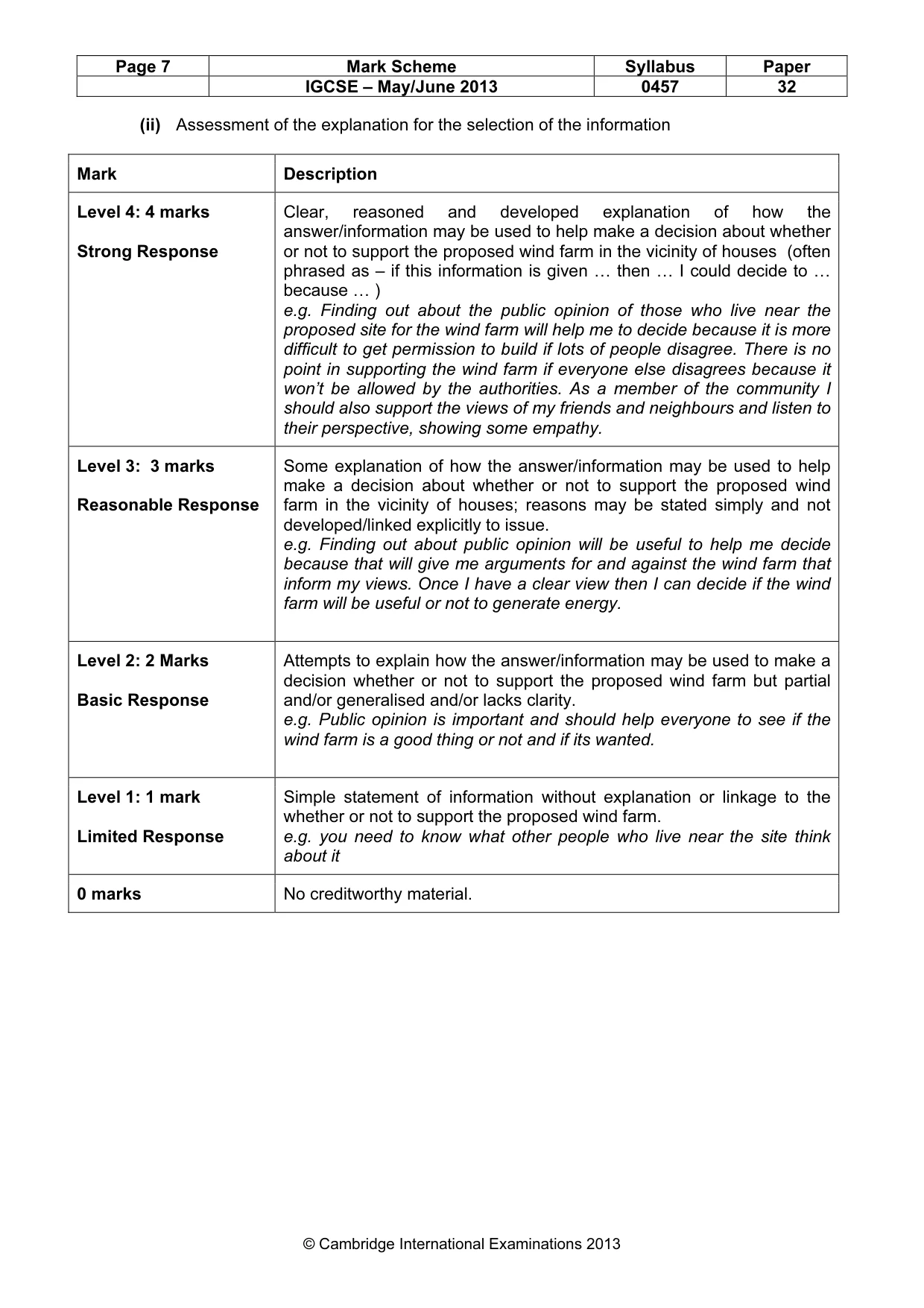
Page 7 Mark Scheme Syllabus Paper IGCSE – May/June 2013 0457 32 © Cambridge International Examinations 2013 (ii) Assessment of the explanation for the selection of the information Mark Description Level 4: 4 marks Strong Response Clear, reasoned and developed explanation of how the answer/information may be used to help make a decision about whether or not to support the proposed wind farm in the vicinity of houses (often phrased as – if this information is given … then … I could decide to … because … ) e.g. Finding out about the public opinion of those who live near the proposed site for the wind farm will help me to decide because it is more difficult to get permission to build if lots of people disagree. There is no point in supporting the wind farm if everyone else disagrees because it won’t be allowed by the authorities. As a member of the community I should also support the views of my friends and neighbours and listen to their perspective, showing some empathy. Level 3: 3 marks Reasonable Response Some explanation of how the answer/information may be used to help make a decision about whether or not to support the proposed wind farm in the vicinity of houses; reasons may be stated simply and not developed/linked explicitly to issue. e.g. Finding out about public opinion will be useful to help me decide because that will give me arguments for and against the wind farm that inform my views. Once I have a clear view then I can decide if the wind farm will be useful or not to generate energy. Level 2: 2 Marks Basic Response Attempts to explain how the answer/information may be used to make a decision whether or not to support the proposed wind farm but partial and/or generalised and/or lacks clarity. e.g. Public opinion is important and should help everyone to see if the wind farm is a good thing or not and if its wanted. Level 1: 1 mark Limited Response Simple statement of information without explanation or linkage to the whether or not to support the proposed wind farm. e.g. you need to know what other people who live near the site think about it 0 marks No creditworthy material.
Mark scheme, page 8
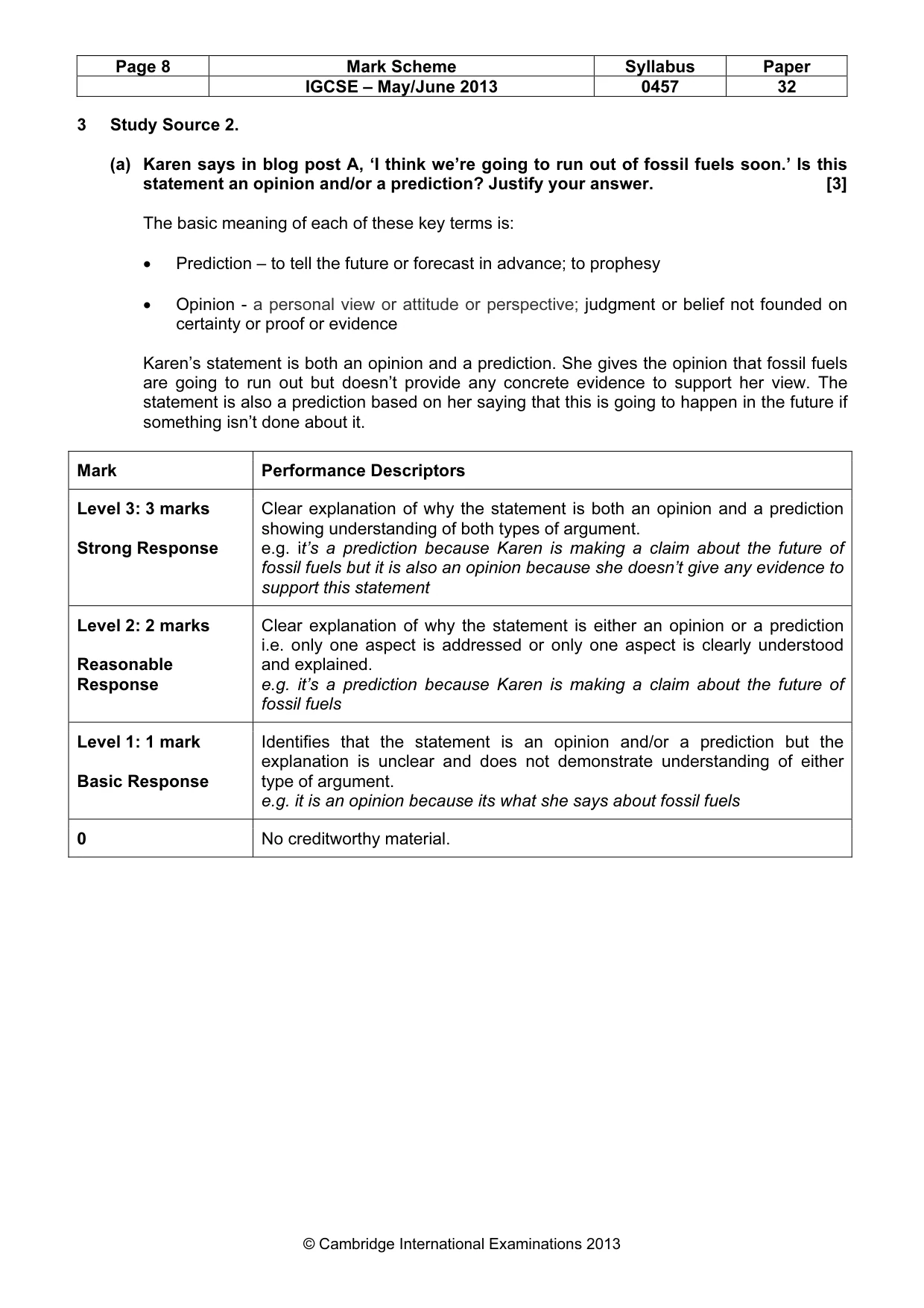
Page 8 Mark Scheme Syllabus Paper IGCSE – May/June 2013 0457 32 © Cambridge International Examinations 2013 3 Study Source 2. (a) Karen says in blog post A, ‘I think we’re going to run out of fossil fuels soon.’ Is this statement an opinion and/or a prediction? Justify your answer. [3] The basic meaning of each of these key terms is: • Prediction – to tell the future or forecast in advance; to prophesy • Opinion - a personal view or attitude or perspective; judgment or belief not founded on certainty or proof or evidence Karen’s statement is both an opinion and a prediction. She gives the opinion that fossil fuels are going to run out but doesn’t provide any concrete evidence to support her view. The statement is also a prediction based on her saying that this is going to happen in the future if something isn’t done about it. Mark Performance Descriptors Level 3: 3 marks Strong Response Clear explanation of why the statement is both an opinion and a prediction showing understanding of both types of argument. e.g. it’s a prediction because Karen is making a claim about the future of fossil fuels but it is also an opinion because she doesn’t give any evidence to support this statement Level 2: 2 marks Reasonable Response Clear explanation of why the statement is either an opinion or a prediction i.e. only one aspect is addressed or only one aspect is clearly understood and explained. e.g. it’s a prediction because Karen is making a claim about the future of fossil fuels Level 1: 1 mark Basic Response Identifies that the statement is an opinion and/or a prediction but the explanation is unclear and does not demonstrate understanding of either type of argument. e.g. it is an opinion because its what she says about fossil fuels 0 No creditworthy material.
Mark scheme, page 9
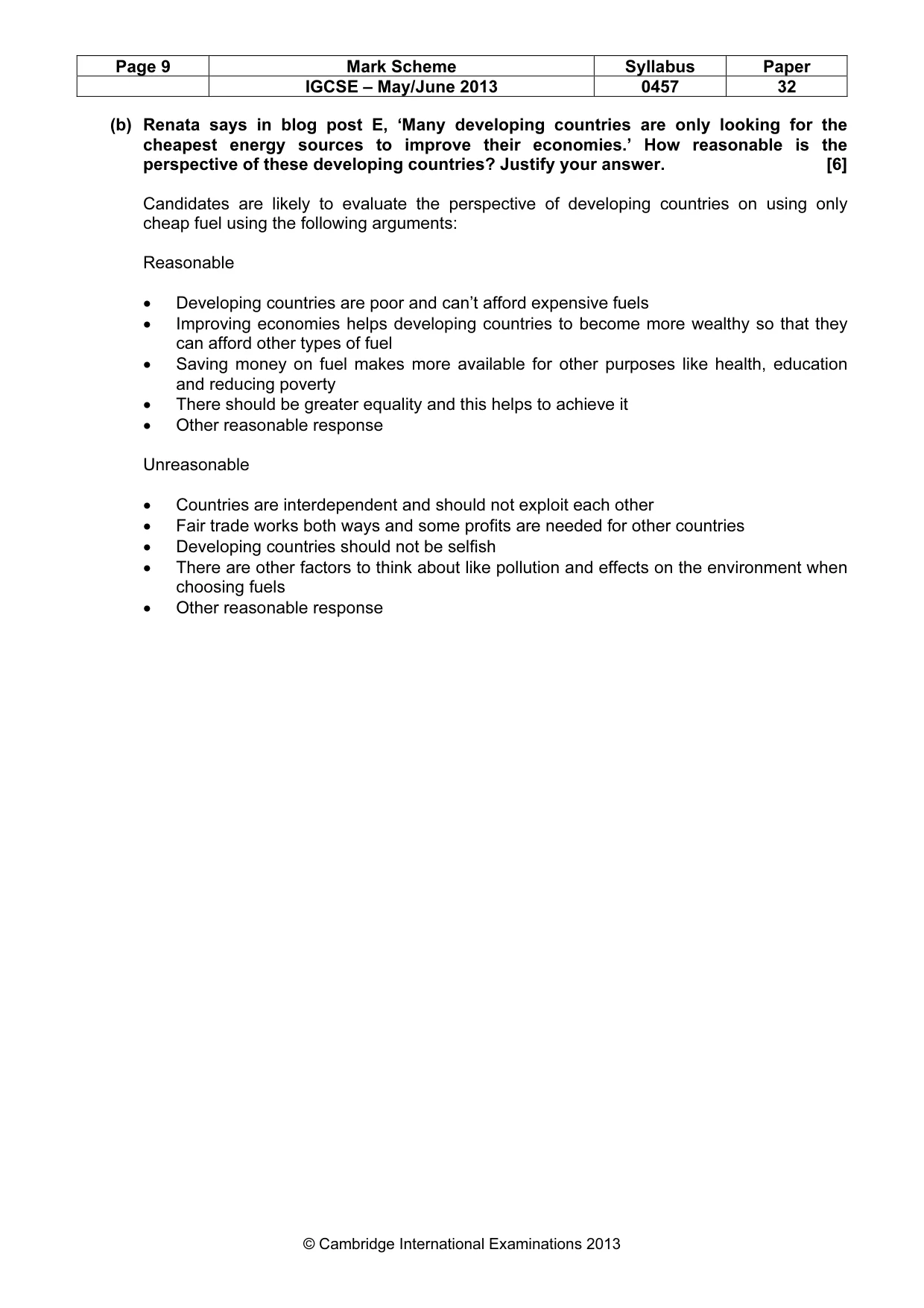
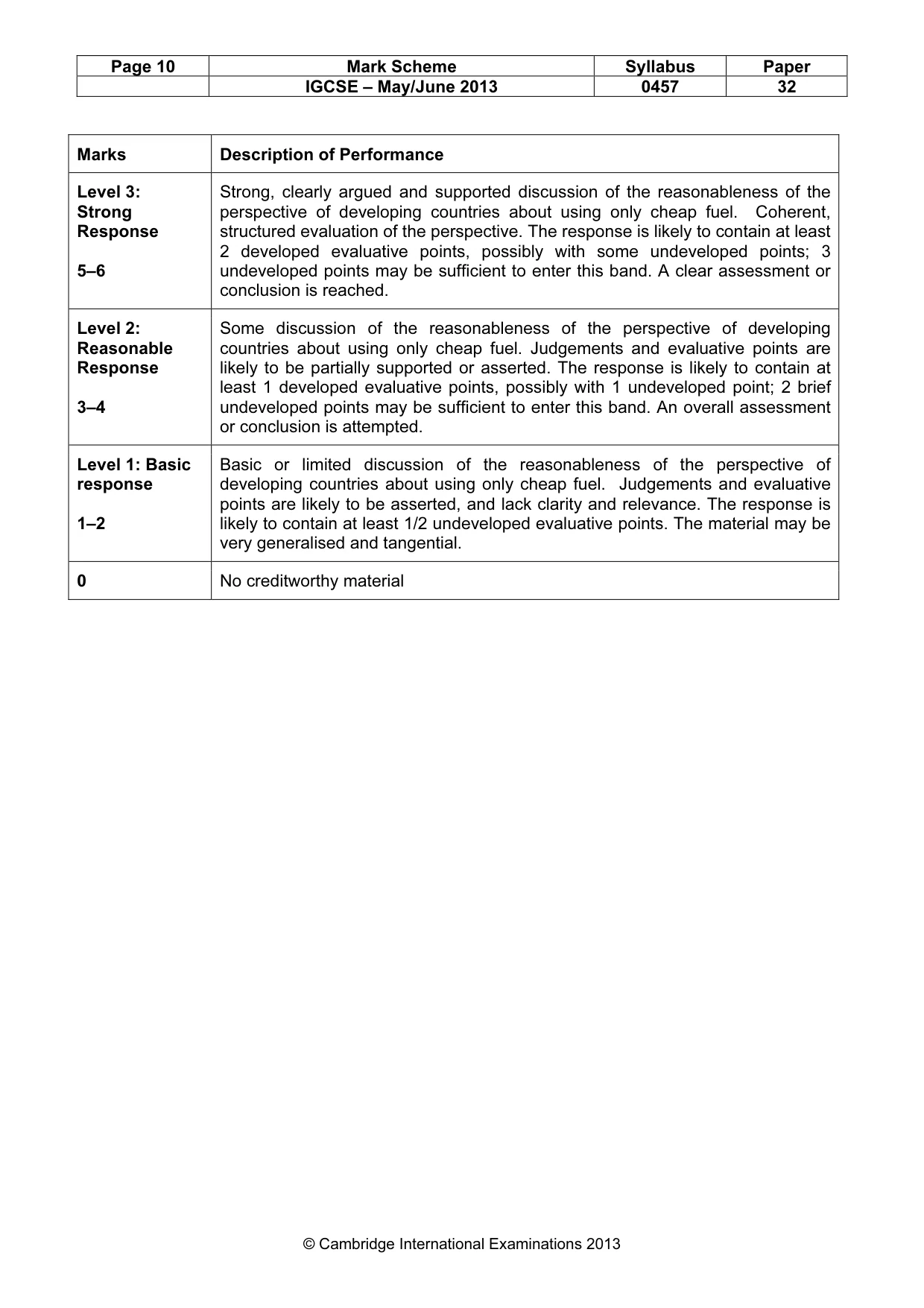
Page 9 Mark Scheme Syllabus Paper IGCSE – May/June 2013 0457 32 © Cambridge International Examinations 2013 (b) Renata says in blog post E, ‘Many developing countries are only looking for the cheapest energy sources to improve their economies.’ How reasonable is the perspective of these developing countries? Justify your answer. [6] Candidates are likely to evaluate the perspective of developing countries on using only cheap fuel using the following arguments: Reasonable • Developing countries are poor and can’t afford expensive fuels • Improving economies helps developing countries to become more wealthy so that they can afford other types of fuel • Saving money on fuel makes more available for other purposes like health, education and reducing poverty • There should be greater equality and this helps to achieve it • Other reasonable response Unreasonable • Countries are interdependent and should not exploit each other • Fair trade works both ways and some profits are needed for other countries • Developing countries should not be selfish • There are other factors to think about like pollution and effects on the environment when choosing fuels • Other reasonable response
Mark scheme, page 10
Page 10 Mark Scheme Syllabus Paper IGCSE – May/June 2013 0457 32 © Cambridge International Examinations 2013 Marks Description of Performance Level 3: Strong Response 5–6 Strong, clearly argued and supported discussion of the reasonableness of the perspective of developing countries about using only cheap fuel. Coherent, structured evaluation of the perspective. The response is likely to contain at least 2 developed evaluative points, possibly with some undeveloped points; 3 undeveloped points may be sufficient to enter this band. A clear assessment or conclusion is reached. Level 2: Reasonable Response 3–4 Some discussion of the reasonableness of the perspective of developing countries about using only cheap fuel. Judgements and evaluative points are likely to be partially supported or asserted. The response is likely to contain at least 1 developed evaluative points, possibly with 1 undeveloped point; 2 brief undeveloped points may be sufficient to enter this band. An overall assessment or conclusion is attempted. Level 1: Basic response 1–2 Basic or limited discussion of the reasonableness of the perspective of developing countries about using only cheap fuel. Judgements and evaluative points are likely to be asserted, and lack clarity and relevance. The response is likely to contain at least 1/2 undeveloped evaluative points. The material may be very generalised and tangential. 0 No creditworthy material
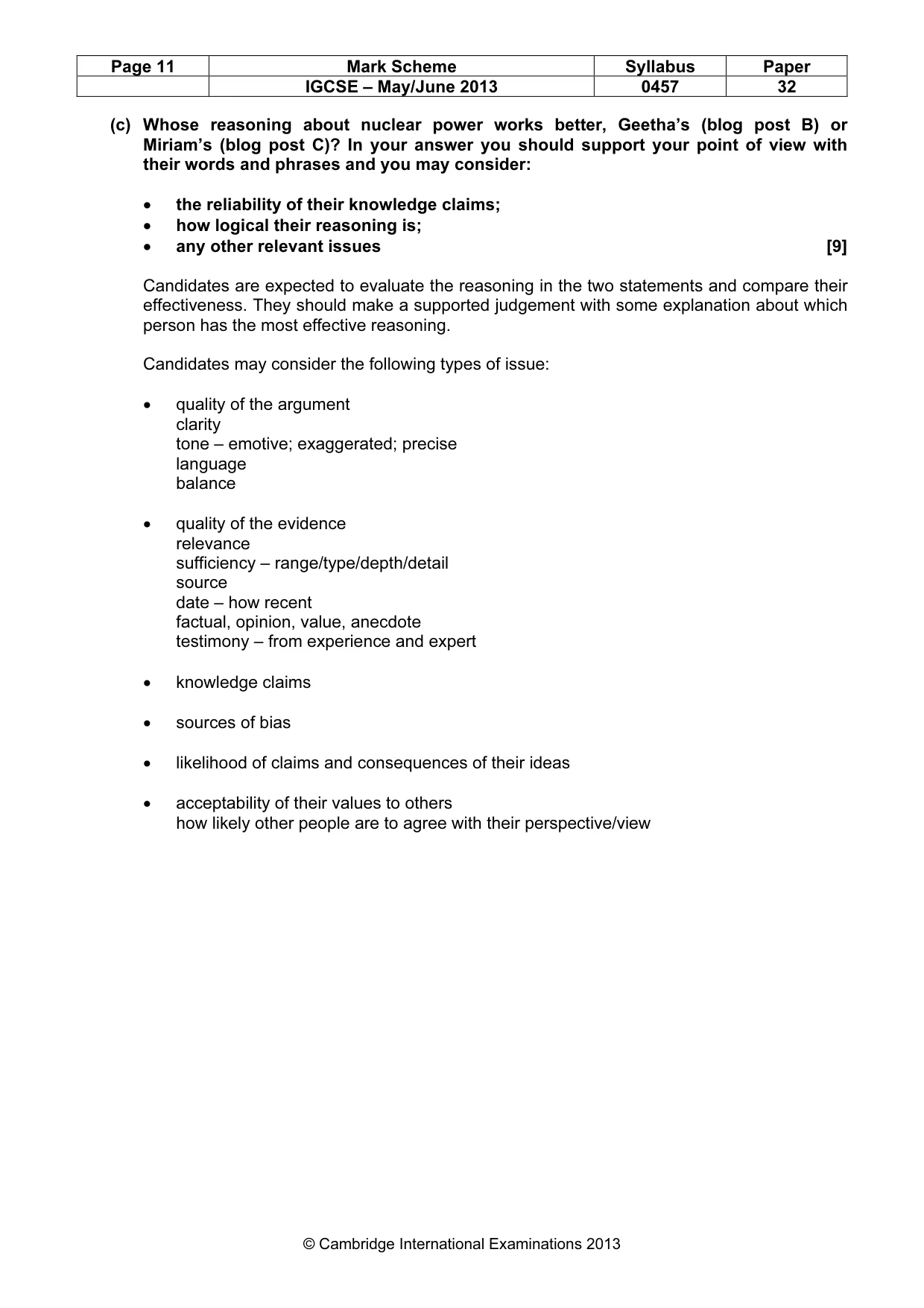
Mark scheme, page 11
Page 11 Mark Scheme Syllabus Paper IGCSE – May/June 2013 0457 32 © Cambridge International Examinations 2013 (c) Whose reasoning about nuclear power works better, Geetha’s (blog post B) or Miriam’s (blog post C)? In your answer you should support your point of view with their words and phrases and you may consider: • the reliability of their knowledge claims; • how logical their reasoning is; • any other relevant issues [9] Candidates are expected to evaluate the reasoning in the two statements and compare their effectiveness. They should make a supported judgement with some explanation about which person has the most effective reasoning. Candidates may consider the following types of issue: • quality of the argument clarity tone – emotive; exaggerated; precise language balance • quality of the evidence relevance sufficiency – range/type/depth/detail source date – how recent factual, opinion, value, anecdote testimony – from experience and expert • knowledge claims • sources of bias • likelihood of claims and consequences of their ideas • acceptability of their values to others how likely other people are to agree with their perspective/view
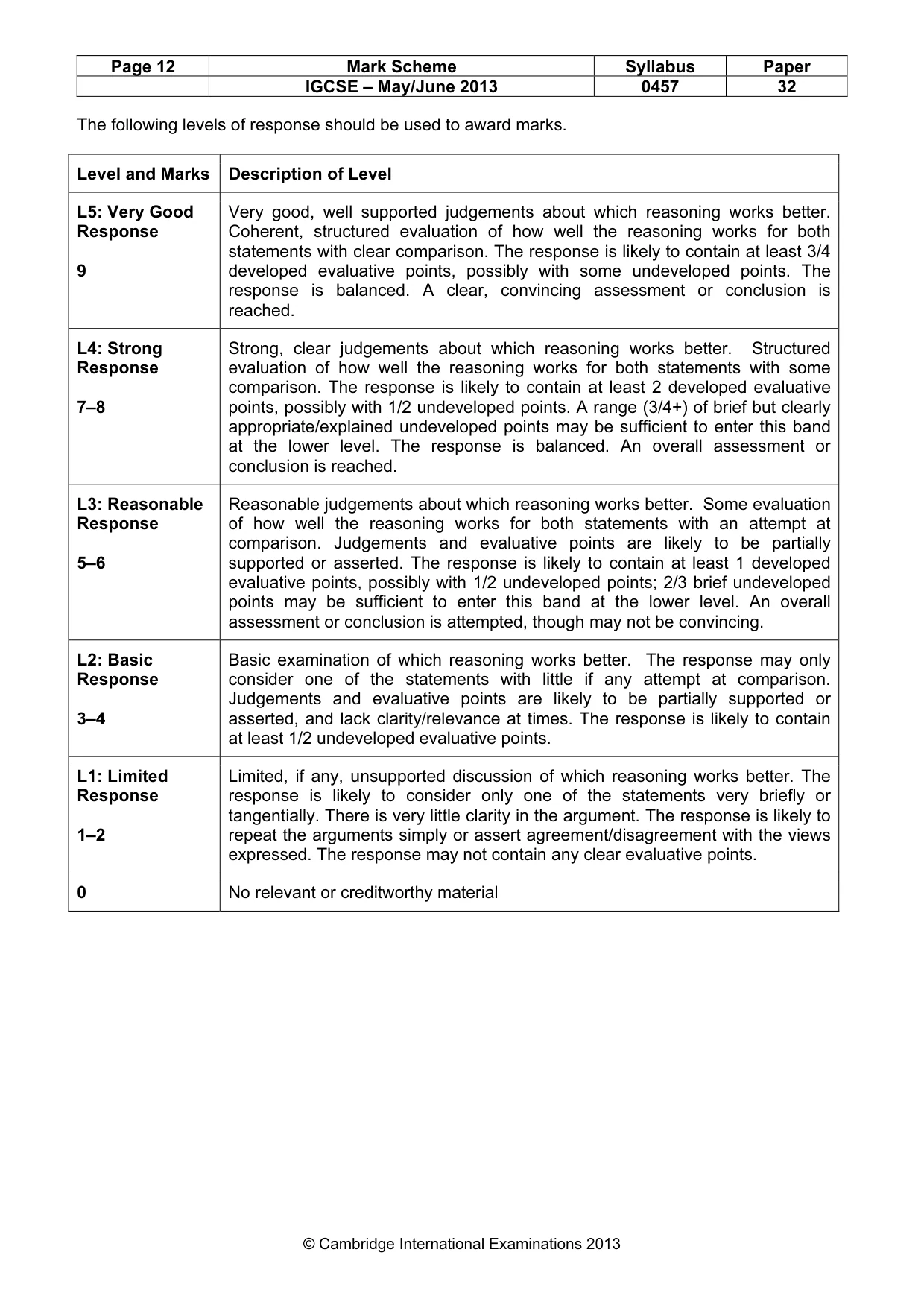
Mark scheme, page 12
Page 12 Mark Scheme Syllabus Paper IGCSE – May/June 2013 0457 32 © Cambridge International Examinations 2013 The following levels of response should be used to award marks. Level and Marks Description of Level L5: Very Good Response 9 Very good, well supported judgements about which reasoning works better. Coherent, structured evaluation of how well the reasoning works for both statements with clear comparison. The response is likely to contain at least 3/4 developed evaluative points, possibly with some undeveloped points. The response is balanced. A clear, convincing assessment or conclusion is reached. L4: Strong Response 7–8 Strong, clear judgements about which reasoning works better. Structured evaluation of how well the reasoning works for both statements with some comparison. The response is likely to contain at least 2 developed evaluative points, possibly with 1/2 undeveloped points. A range (3/4+) of brief but clearly appropriate/explained undeveloped points may be sufficient to enter this band at the lower level. The response is balanced. An overall assessment or conclusion is reached. L3: Reasonable Response 5–6 Reasonable judgements about which reasoning works better. Some evaluation of how well the reasoning works for both statements with an attempt at comparison. Judgements and evaluative points are likely to be partially supported or asserted. The response is likely to contain at least 1 developed evaluative points, possibly with 1/2 undeveloped points; 2/3 brief undeveloped points may be sufficient to enter this band at the lower level. An overall assessment or conclusion is attempted, though may not be convincing. L2: Basic Response 3–4 Basic examination of which reasoning works better. The response may only consider one of the statements with little if any attempt at comparison. Judgements and evaluative points are likely to be partially supported or asserted, and lack clarity/relevance at times. The response is likely to contain at least 1/2 undeveloped evaluative points. L1: Limited Response 1–2 Limited, if any, unsupported discussion of which reasoning works better. The response is likely to consider only one of the statements very briefly or tangentially. There is very little clarity in the argument. The response is likely to repeat the arguments simply or assert agreement/disagreement with the views expressed. The response may not contain any clear evaluative points. 0 No relevant or creditworthy material
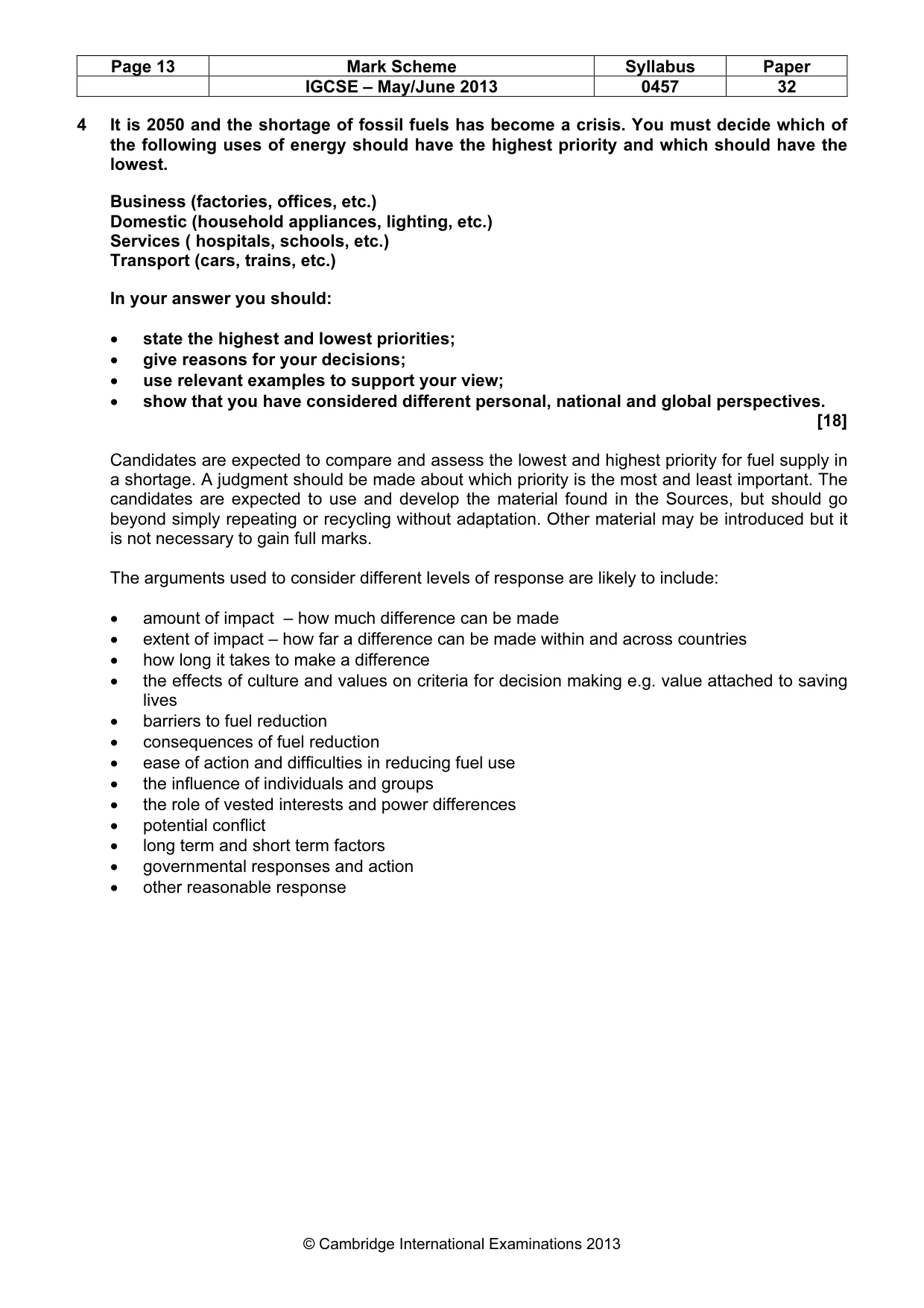
Mark scheme, page 13
Page 13 Mark Scheme Syllabus Paper IGCSE – May/June 2013 0457 32 © Cambridge International Examinations 2013 4 It is 2050 and the shortage of fossil fuels has become a crisis. You must decide which of the following uses of energy should have the highest priority and which should have the lowest. Business (factories, offices, etc.) Domestic (household appliances, lighting, etc.) Services ( hospitals, schools, etc.) Transport (cars, trains, etc.) In your answer you should: • state the highest and lowest priorities; • give reasons for your decisions; • use relevant examples to support your view; • show that you have considered different personal, national and global perspectives. [18] Candidates are expected to compare and assess the lowest and highest priority for fuel supply in a shortage. A judgment should be made about which priority is the most and least important. The candidates are expected to use and develop the material found in the Sources, but should go beyond simply repeating or recycling without adaptation. Other material may be introduced but it is not necessary to gain full marks. The arguments used to consider different levels of response are likely to include: • amount of impact – how much difference can be made • extent of impact – how far a difference can be made within and across countries • how long it takes to make a difference • the effects of culture and values on criteria for decision making e.g. value attached to saving lives • barriers to fuel reduction • consequences of fuel reduction • ease of action and difficulties in reducing fuel use • the influence of individuals and groups • the role of vested interests and power differences • potential conflict • long term and short term factors • governmental responses and action • other reasonable response
Mark scheme, page 14
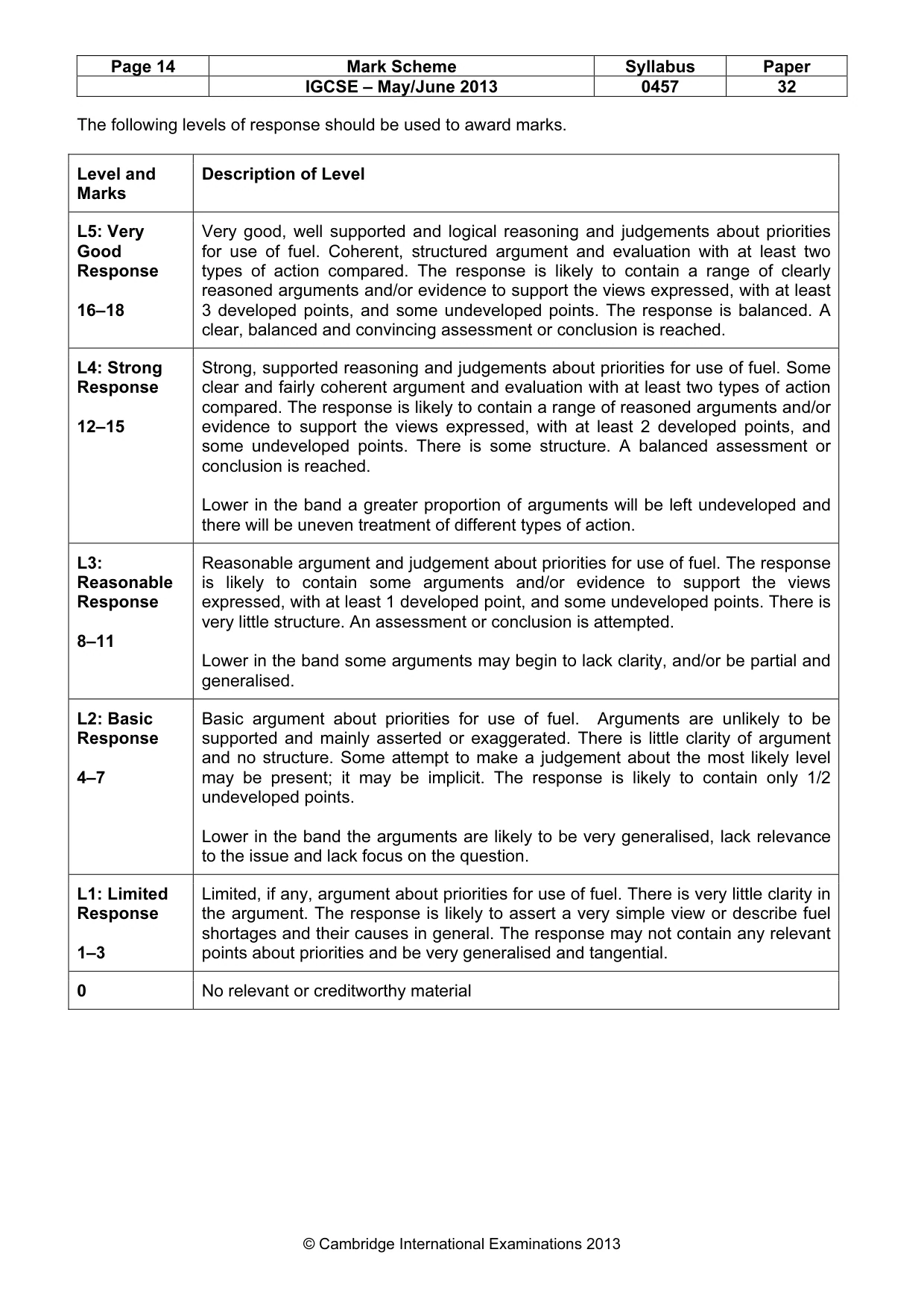
Page 14 Mark Scheme Syllabus Paper IGCSE – May/June 2013 0457 32 © Cambridge International Examinations 2013 The following levels of response should be used to award marks. Level and Marks Description of Level L5: Very Good Response 16–18 Very good, well supported and logical reasoning and judgements about priorities for use of fuel. Coherent, structured argument and evaluation with at least two types of action compared. The response is likely to contain a range of clearly reasoned arguments and/or evidence to support the views expressed, with at least 3 developed points, and some undeveloped points. The response is balanced. A clear, balanced and convincing assessment or conclusion is reached. L4: Strong Response 12–15 Strong, supported reasoning and judgements about priorities for use of fuel. Some clear and fairly coherent argument and evaluation with at least two types of action compared. The response is likely to contain a range of reasoned arguments and/or evidence to support the views expressed, with at least 2 developed points, and some undeveloped points. There is some structure. A balanced assessment or conclusion is reached. Lower in the band a greater proportion of arguments will be left undeveloped and there will be uneven treatment of different types of action. L3: Reasonable Response 8–11 Reasonable argument and judgement about priorities for use of fuel. The response is likely to contain some arguments and/or evidence to support the views expressed, with at least 1 developed point, and some undeveloped points. There is very little structure. An assessment or conclusion is attempted. Lower in the band some arguments may begin to lack clarity, and/or be partial and generalised. L2: Basic Response 4–7 Basic argument about priorities for use of fuel. Arguments are unlikely to be supported and mainly asserted or exaggerated. There is little clarity of argument and no structure. Some attempt to make a judgement about the most likely level may be present; it may be implicit. The response is likely to contain only 1/2 undeveloped points. Lower in the band the arguments are likely to be very generalised, lack relevance to the issue and lack focus on the question. L1: Limited Response 1–3 Limited, if any, argument about priorities for use of fuel. There is very little clarity in the argument. The response is likely to assert a very simple view or describe fuel shortages and their causes in general. The response may not contain any relevant points about priorities and be very generalised and tangential. 0 No relevant or creditworthy material
What you needed in this session
Cambridge’s own grade thresholds for 2013 May/June, Paper 3 · Variant 2. A higher threshold means an easier paper — the bar moves with how the cohort did.