Cambridge IGCSE German - Foreign Language 0525 — 2020 Oct/Nov Paper 1 · Variant 2
0525/12/O/N/20 · 45 marks · ≈51 min
The question paper and its mark scheme, free to read here and free to download. This is Cambridge’s own paper, exactly as it was sat.
Question paper16 pages


Mark scheme17 pages
Answers below. Sit the paper first if you are practising.
Paper as text
Question paper, page 1
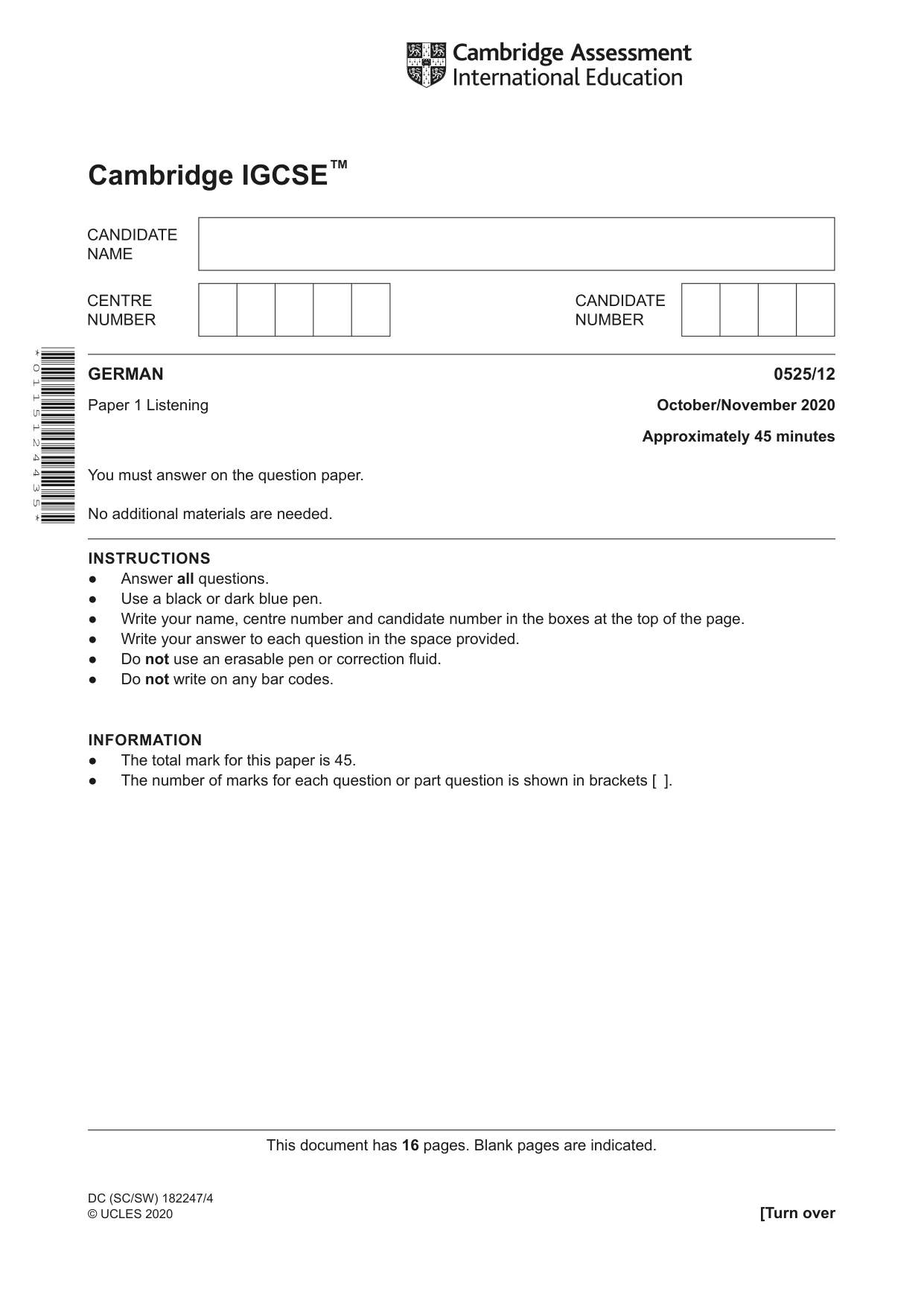
Cambridge IGCSE™ This document has 16 pages. Blank pages are indicated. GERMAN 0525/12 Paper 1 Listening October/November 2020 Approximately 45 minutes You must answer on the question paper. No additional materials are needed. INSTRUCTIONS ● Answer all questions. ● Use a black or dark blue pen. ● Write your name, centre number and candidate number in the boxes at the top of the page. ● Write your answer to each question in the space provided. ● Do not use an erasable pen or correction fluid. ● Do not write on any bar codes. INFORMATION ● The total mark for this paper is 45. ● The number of marks for each question or part question is shown in brackets [ ]. DC (SC/SW) 182247/4 © UCLES 2020 [Turn over * 0 1 1 5 1 2 4 4 3 5 *
Question paper, page 2
2 0525/12/O/N/20 © UCLES 2020 BLANK PAGE
Question paper, page 3
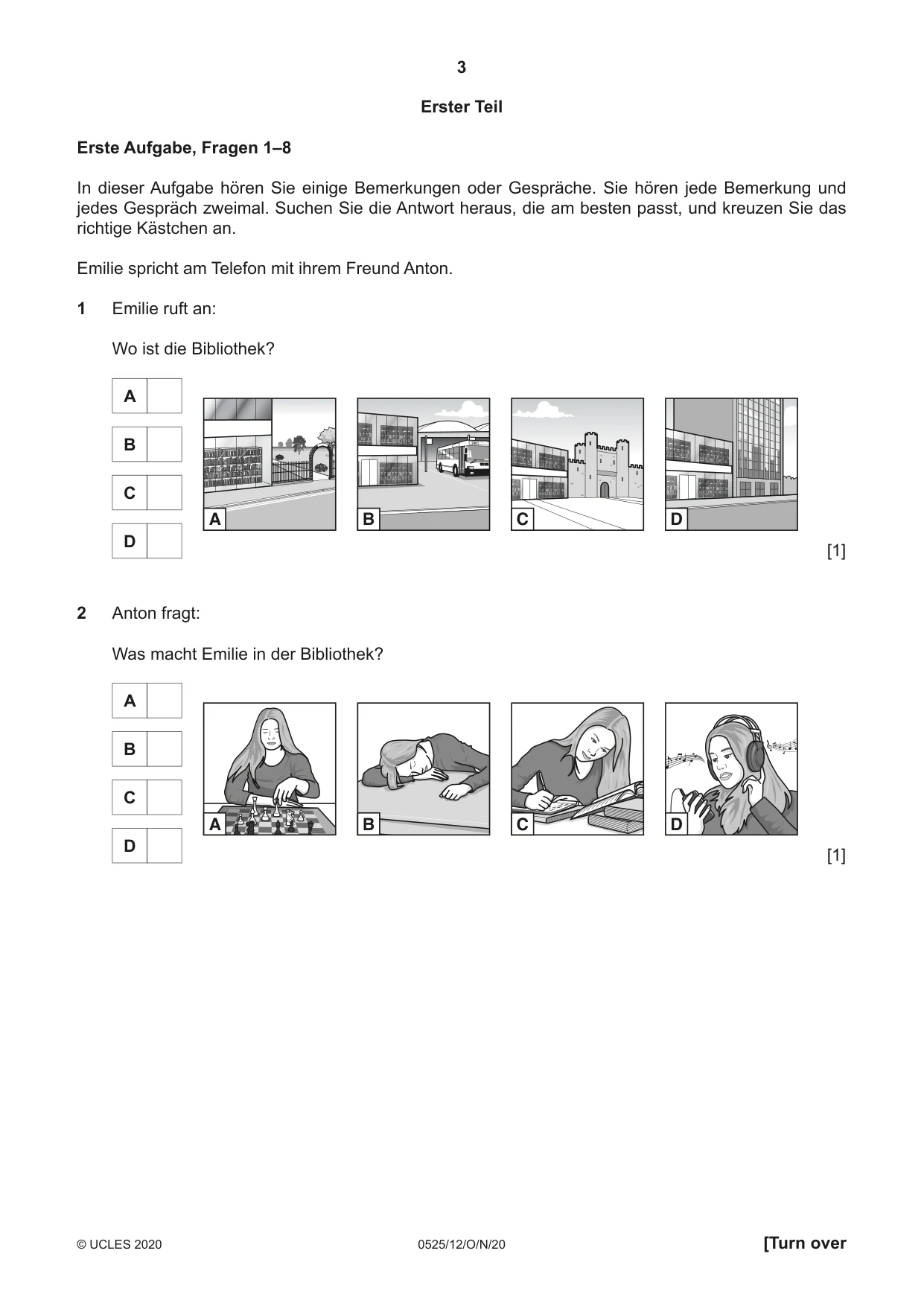
3 0525/12/O/N/20 © UCLES 2020 [Turn over Erster Teil Erste Aufgabe, Fragen 1–8 In dieser Aufgabe hören Sie einige Bemerkungen oder Gespräche. Sie hören jede Bemerkung und jedes Gespräch zweimal. Suchen Sie die Antwort heraus, die am besten passt, und kreuzen Sie das richtige Kästchen an. Emilie spricht am Telefon mit ihrem Freund Anton. 1 Emilie ruft an: Wo ist die Bibliothek? A B C D A B C D [1] 2 Anton fragt: Was macht Emilie in der Bibliothek? A B C D A B C D [1]
Question paper, page 4
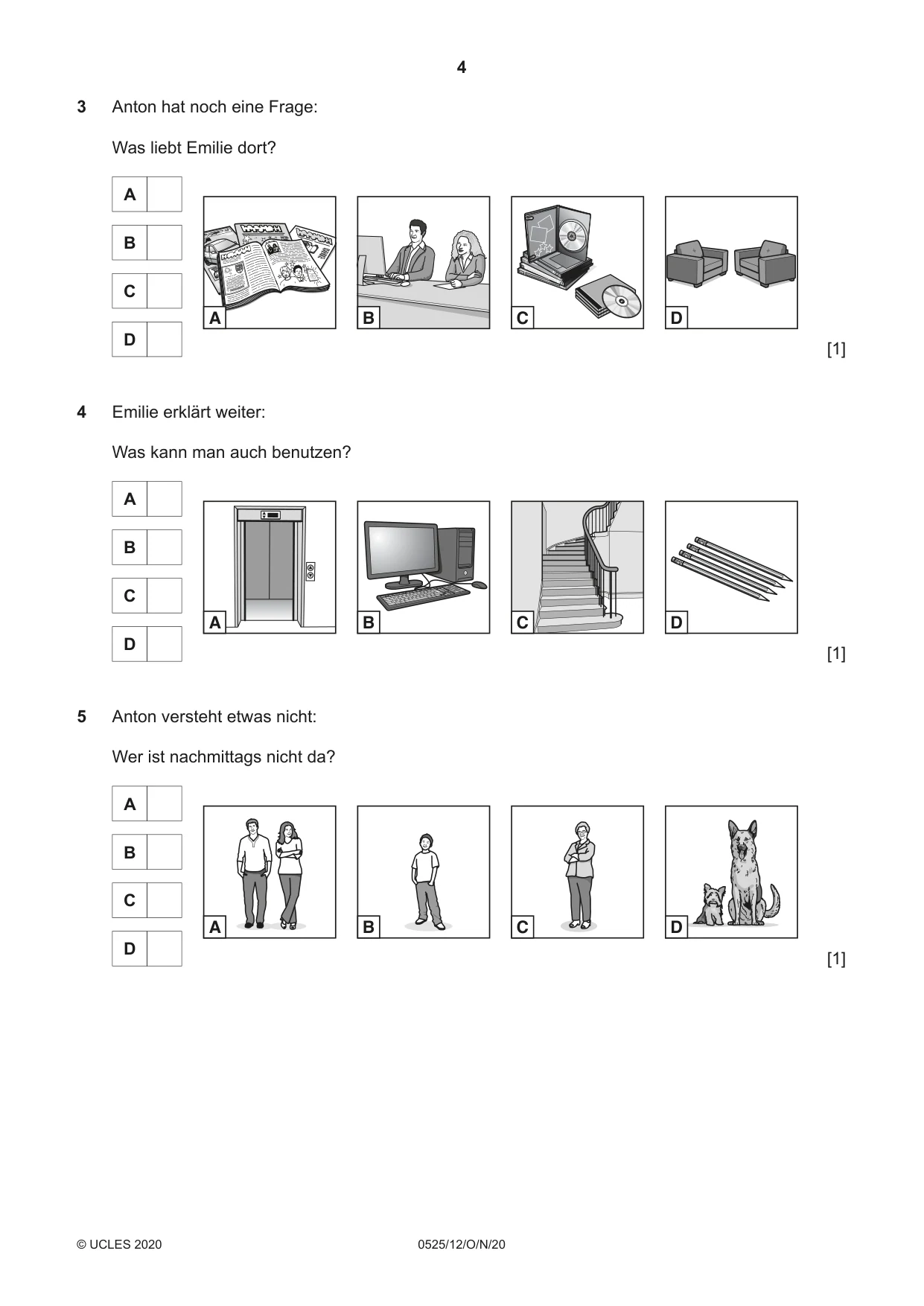
4 0525/12/O/N/20 © UCLES 2020 3 Anton hat noch eine Frage: Was liebt Emilie dort? A B C D A B C D [1] 4 Emilie erklärt weiter: Was kann man auch benutzen? A B C D A B C D [1] 5 Anton versteht etwas nicht: Wer ist nachmittags nicht da? A B C D A B C D [1]
Question paper, page 5
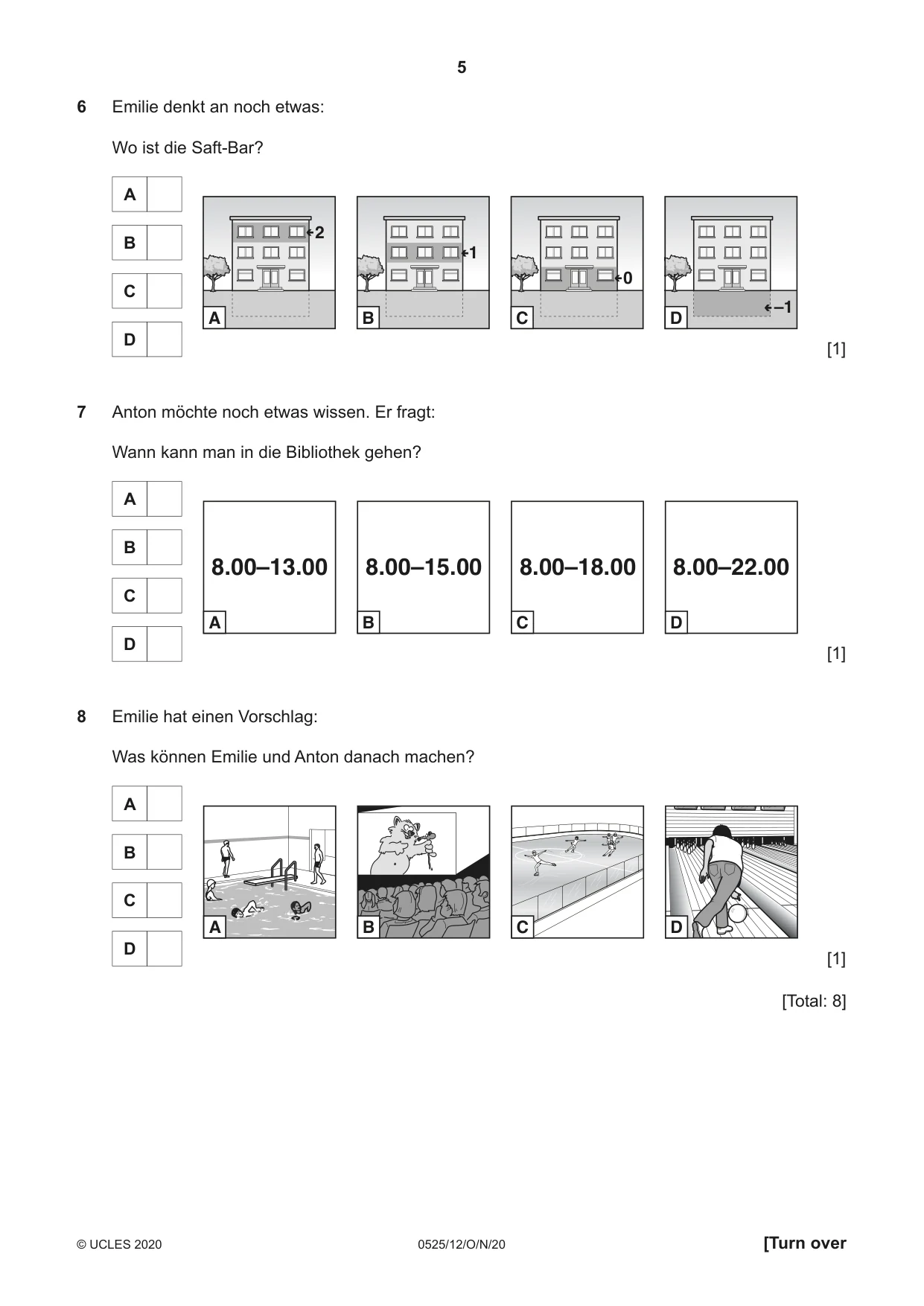
5 0525/12/O/N/20 © UCLES 2020 [Turn over 6 Emilie denkt an noch etwas: Wo ist die Saft-Bar? A B C D 2 1 0 –1 A B C D [1] 7 Anton möchte noch etwas wissen. Er fragt: Wann kann man in die Bibliothek gehen? A B C D 8.00–13.00 8.00–15.00 8.00–18.00 8.00–22.00 A B C D [1] 8 Emilie hat einen Vorschlag: Was können Emilie und Anton danach machen? A B C D A B C D [1] [Total: 8]
Question paper, page 6
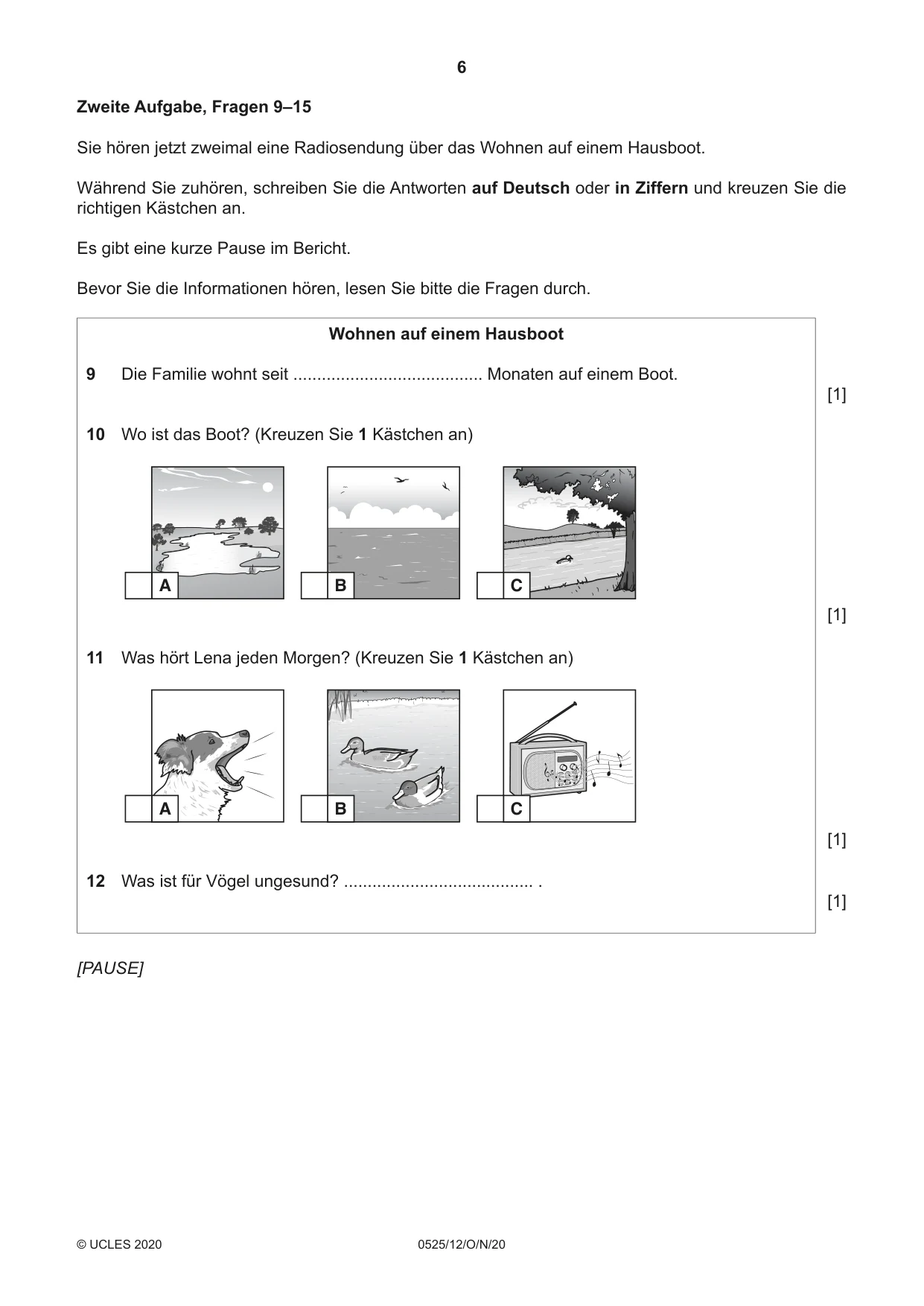
6 0525/12/O/N/20 © UCLES 2020 Zweite Aufgabe, Fragen 9–15 Sie hören jetzt zweimal eine Radiosendung über das Wohnen auf einem Hausboot. Während Sie zuhören, schreiben Sie die Antworten auf Deutsch oder in Ziffern und kreuzen Sie die richtigen Kästchen an. Es gibt eine kurze Pause im Bericht. Bevor Sie die Informationen hören, lesen Sie bitte die Fragen durch. Wohnen auf einem Hausboot 9 Die Familie wohnt seit … Monaten auf einem Boot. 10 Wo ist das Boot? (Kreuzen Sie 1 Kästchen an) A B C 11 Was hört Lena jeden Morgen? (Kreuzen Sie 1 Kästchen an) A B C 12 Was ist für Vögel ungesund? … . [1] [1] [1] [1] [PAUSE]
Question paper, page 7
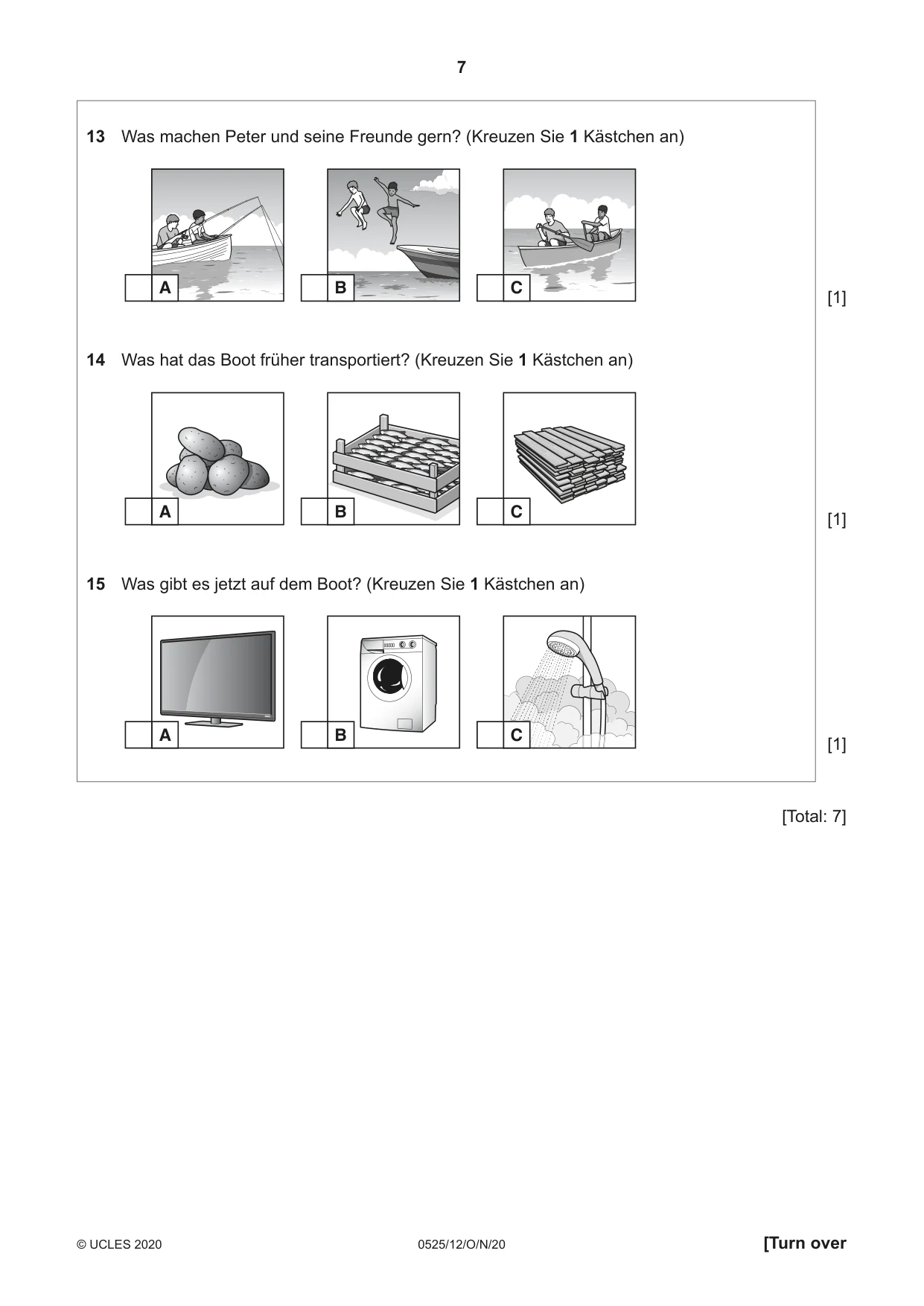
7 0525/12/O/N/20 © UCLES 2020 [Turn over 13 Was machen Peter und seine Freunde gern? (Kreuzen Sie 1 Kästchen an) A B C 14 Was hat das Boot früher transportiert? (Kreuzen Sie 1 Kästchen an) A B C 15 Was gibt es jetzt auf dem Boot? (Kreuzen Sie 1 Kästchen an) A B C [1] [1] [1] [Total: 7]
Question paper, page 8
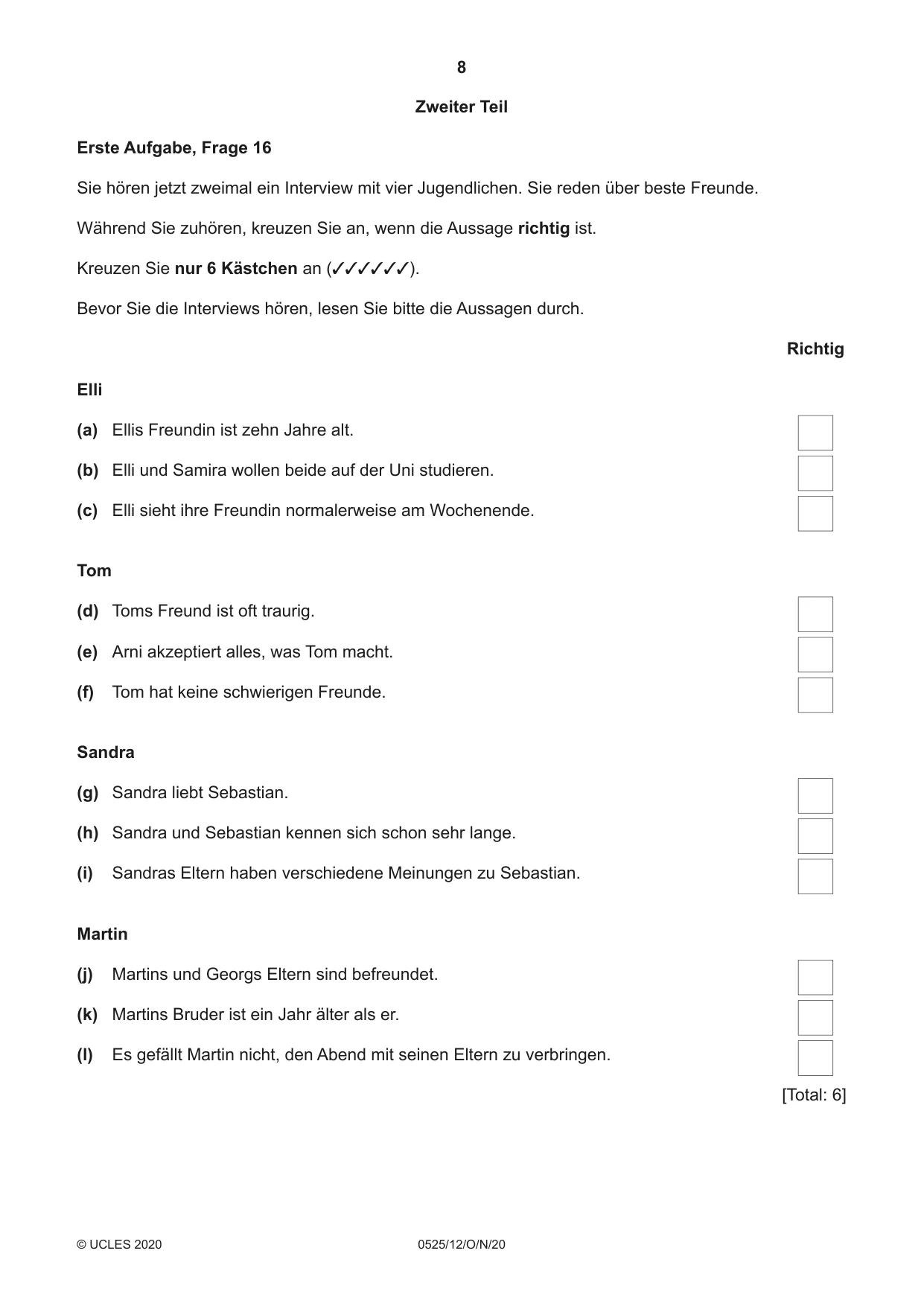
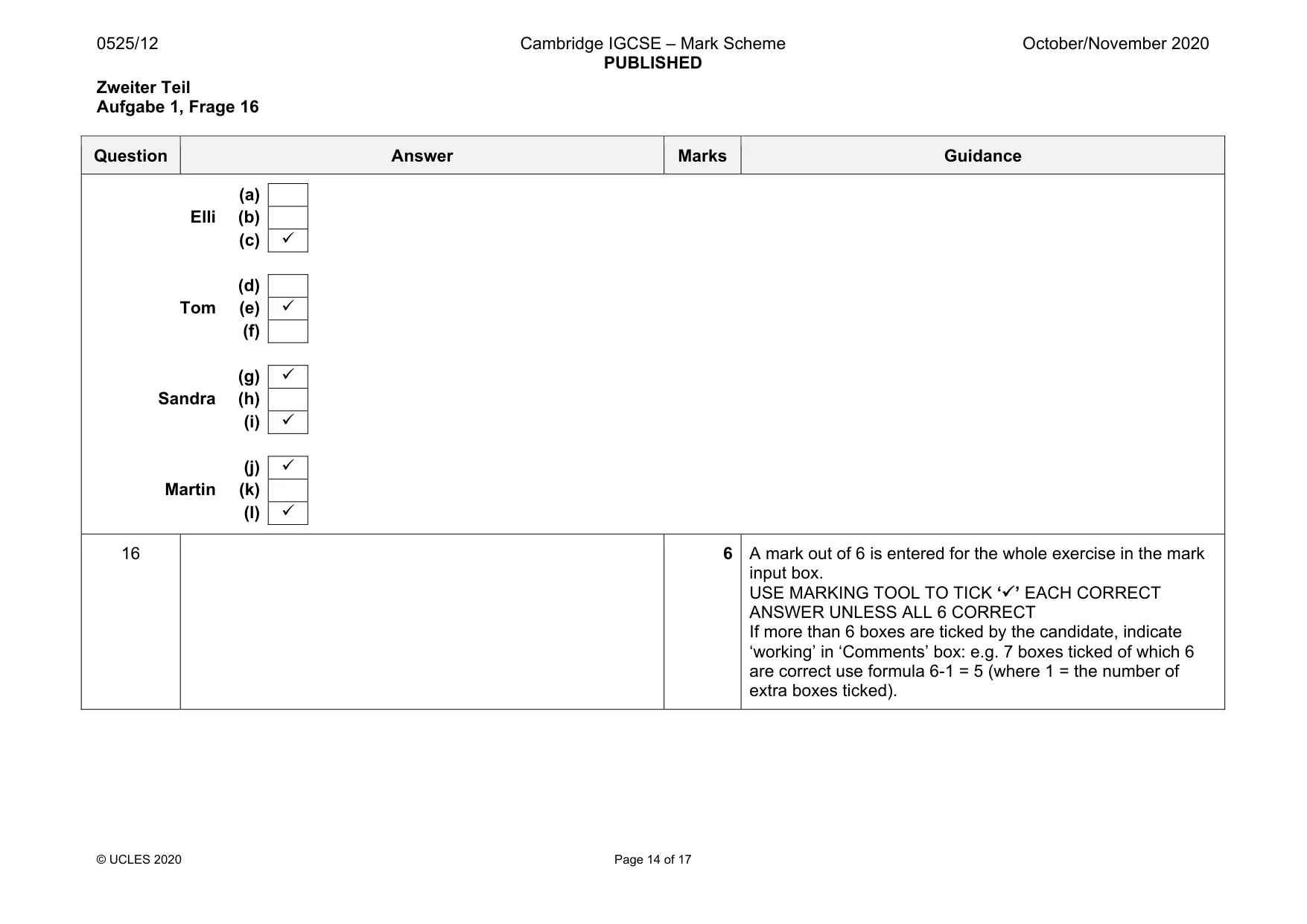
8 0525/12/O/N/20 © UCLES 2020 Zweiter Teil Erste Aufgabe, Frage 16 Sie hören jetzt zweimal ein Interview mit vier Jugendlichen. Sie reden über beste Freunde. Während Sie zuhören, kreuzen Sie an, wenn die Aussage richtig ist. Kreuzen Sie nur 6 Kästchen an (✓✓✓✓✓✓). Bevor Sie die Interviews hören, lesen Sie bitte die Aussagen durch. Richtig Elli (a) Ellis Freundin ist zehn Jahre alt. (b) Elli und Samira wollen beide auf der Uni studieren. (c) Elli sieht ihre Freundin normalerweise am Wochenende. Tom (d) Toms Freund ist oft traurig. (e) Arni akzeptiert alles, was Tom macht. (f) Tom hat keine schwierigen Freunde. Sandra (g) Sandra liebt Sebastian. (h) Sandra und Sebastian kennen sich schon sehr lange. (i) Sandras Eltern haben verschiedene Meinungen zu Sebastian. Martin (j) Martins und Georgs Eltern sind befreundet. (k) Martins Bruder ist ein Jahr älter als er. (l) Es gefällt Martin nicht, den Abend mit seinen Eltern zu verbringen. [Total: 6]
Question paper, page 9
9 0525/12/O/N/20 © UCLES 2020 [Turn over BLANK PAGE
Question paper, page 10
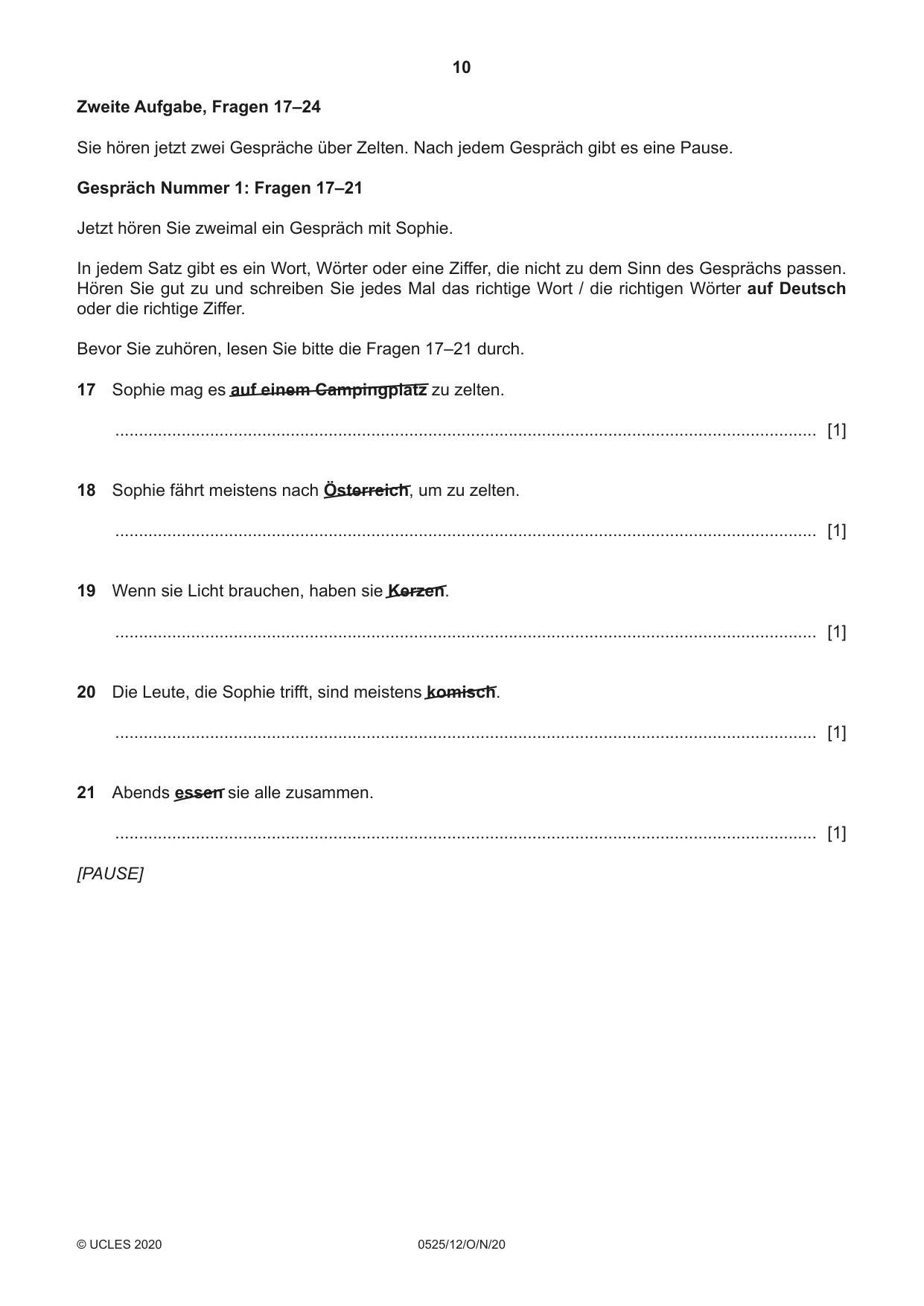
10 0525/12/O/N/20 © UCLES 2020 Zweite Aufgabe, Fragen 17–24 Sie hören jetzt zwei Gespräche über Zelten. Nach jedem Gespräch gibt es eine Pause. Gespräch Nummer 1: Fragen 17–21 Jetzt hören Sie zweimal ein Gespräch mit Sophie. In jedem Satz gibt es ein Wort, Wörter oder eine Ziffer, die nicht zu dem Sinn des Gesprächs passen. Hören Sie gut zu und schreiben Sie jedes Mal das richtige Wort / die richtigen Wörter auf Deutsch oder die richtige Ziffer. Bevor Sie zuhören, lesen Sie bitte die Fragen 17–21 durch. 17 Sophie mag es auf einem Campingplatz zu zelten. … [1] 18 Sophie fährt meistens nach Österreich, um zu zelten. … [1] 19 Wenn sie Licht brauchen, haben sie Kerzen. … [1] 20 Die Leute, die Sophie trifft, sind meistens komisch. … [1] 21 Abends essen sie alle zusammen. … [1] [PAUSE]
Question paper, page 11
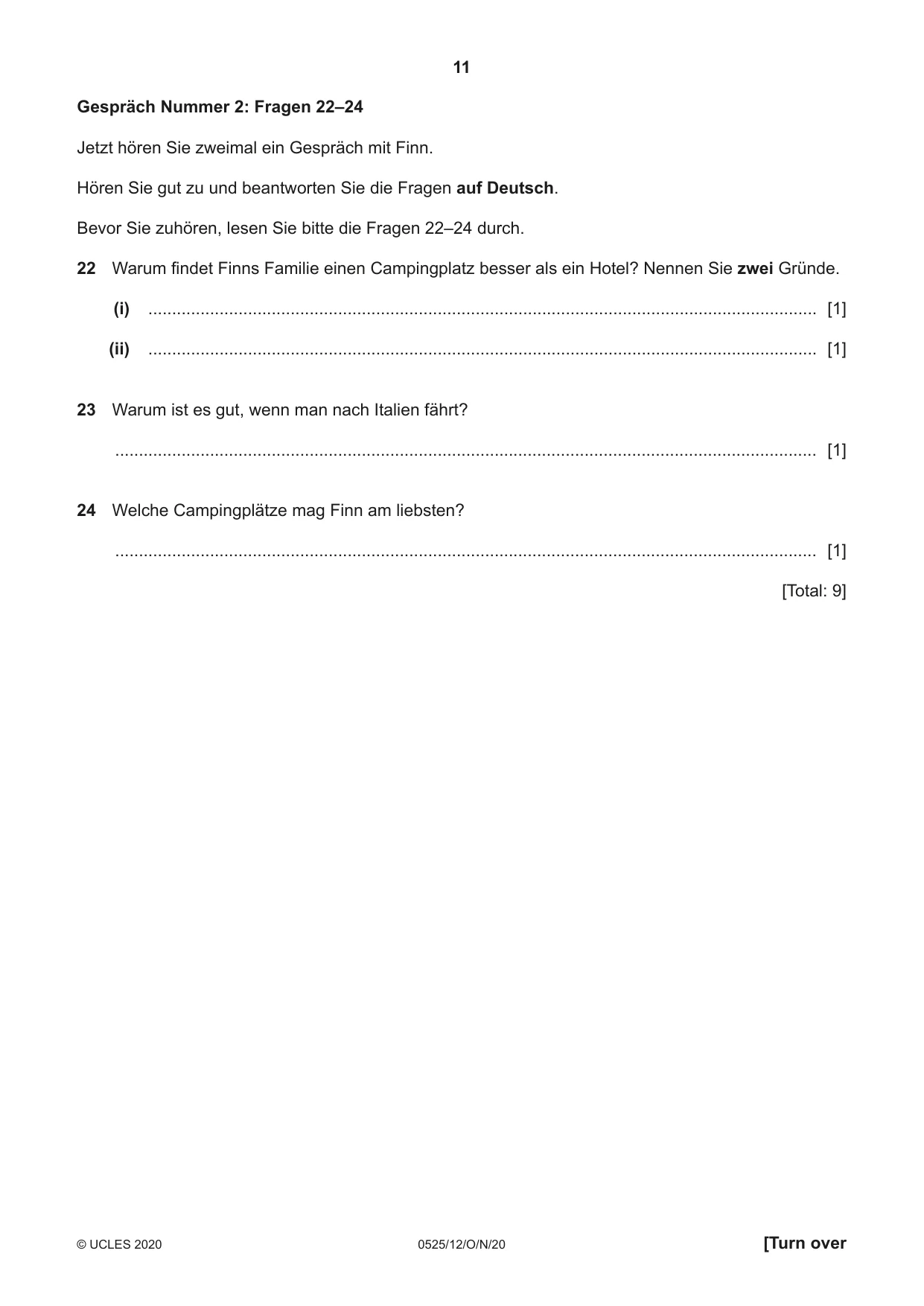
11 0525/12/O/N/20 © UCLES 2020 [Turn over Gespräch Nummer 2: Fragen 22–24 Jetzt hören Sie zweimal ein Gespräch mit Finn. Hören Sie gut zu und beantworten Sie die Fragen auf Deutsch. Bevor Sie zuhören, lesen Sie bitte die Fragen 22–24 durch. 22 Warum findet Finns Familie einen Campingplatz besser als ein Hotel? Nennen Sie zwei Gründe. (i) … [1] (ii) … [1] 23 Warum ist es gut, wenn man nach Italien fährt? … [1] 24 Welche Campingplätze mag Finn am liebsten? … [1] [Total: 9]
Question paper, page 12
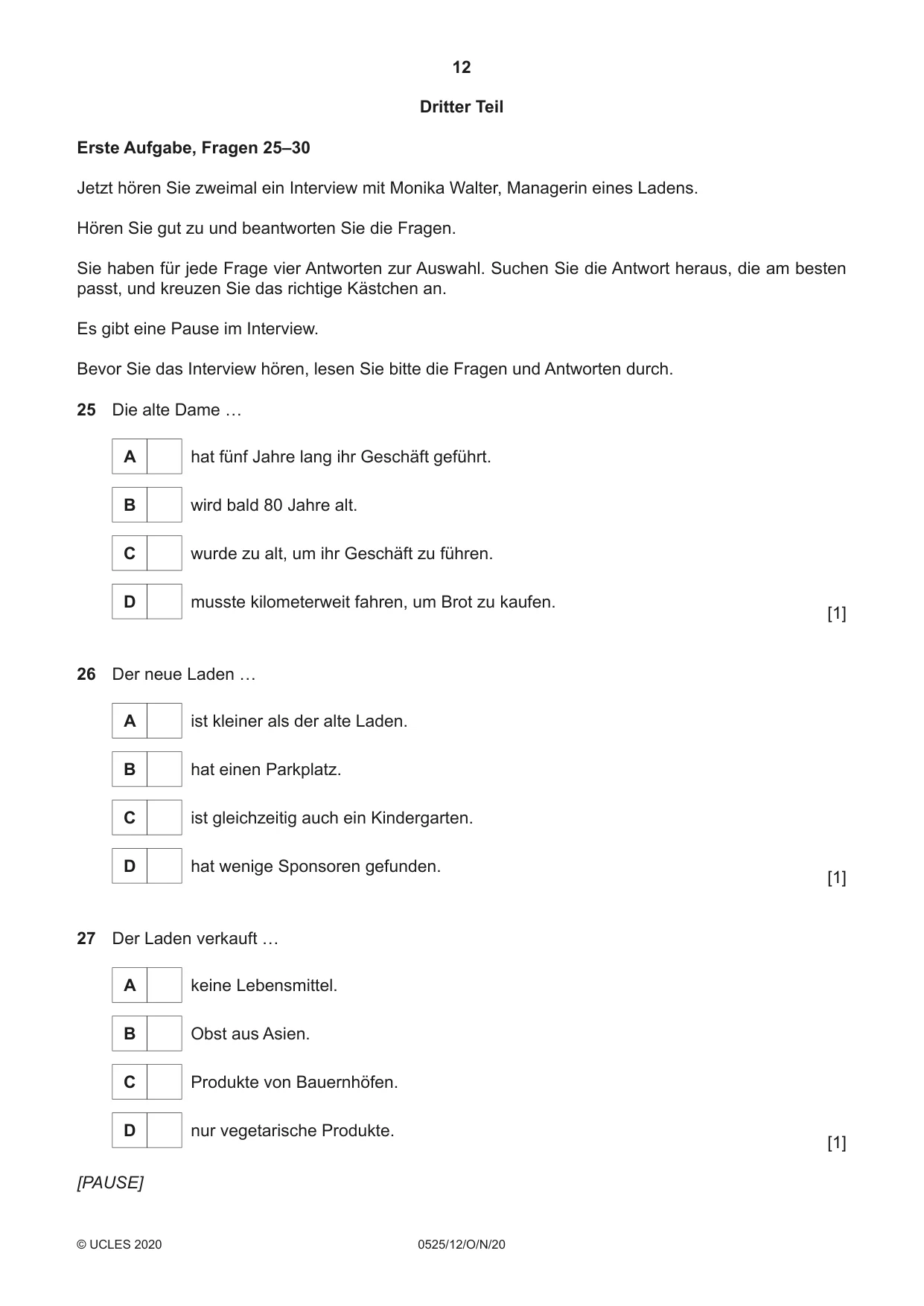
12 0525/12/O/N/20 © UCLES 2020 Dritter Teil Erste Aufgabe, Fragen 25–30 Jetzt hören Sie zweimal ein Interview mit Monika Walter, Managerin eines Ladens. Hören Sie gut zu und beantworten Sie die Fragen. Sie haben für jede Frage vier Antworten zur Auswahl. Suchen Sie die Antwort heraus, die am besten passt, und kreuzen Sie das richtige Kästchen an. Es gibt eine Pause im Interview. Bevor Sie das Interview hören, lesen Sie bitte die Fragen und Antworten durch. 25 Die alte Dame … wurde zu alt, um ihr Geschäft zu führen. musste kilometerweit fahren, um Brot zu kaufen. A B C D hat fünf Jahre lang ihr Geschäft geführt. wird bald 80 Jahre alt. [1] 26 Der neue Laden … ist gleichzeitig auch ein Kindergarten. hat wenige Sponsoren gefunden. A B C D ist kleiner als der alte Laden. hat einen Parkplatz. [1] 27 Der Laden verkauft … Produkte von Bauernhöfen. nur vegetarische Produkte. A B C D keine Lebensmittel. Obst aus Asien. [1] [PAUSE]
Question paper, page 13
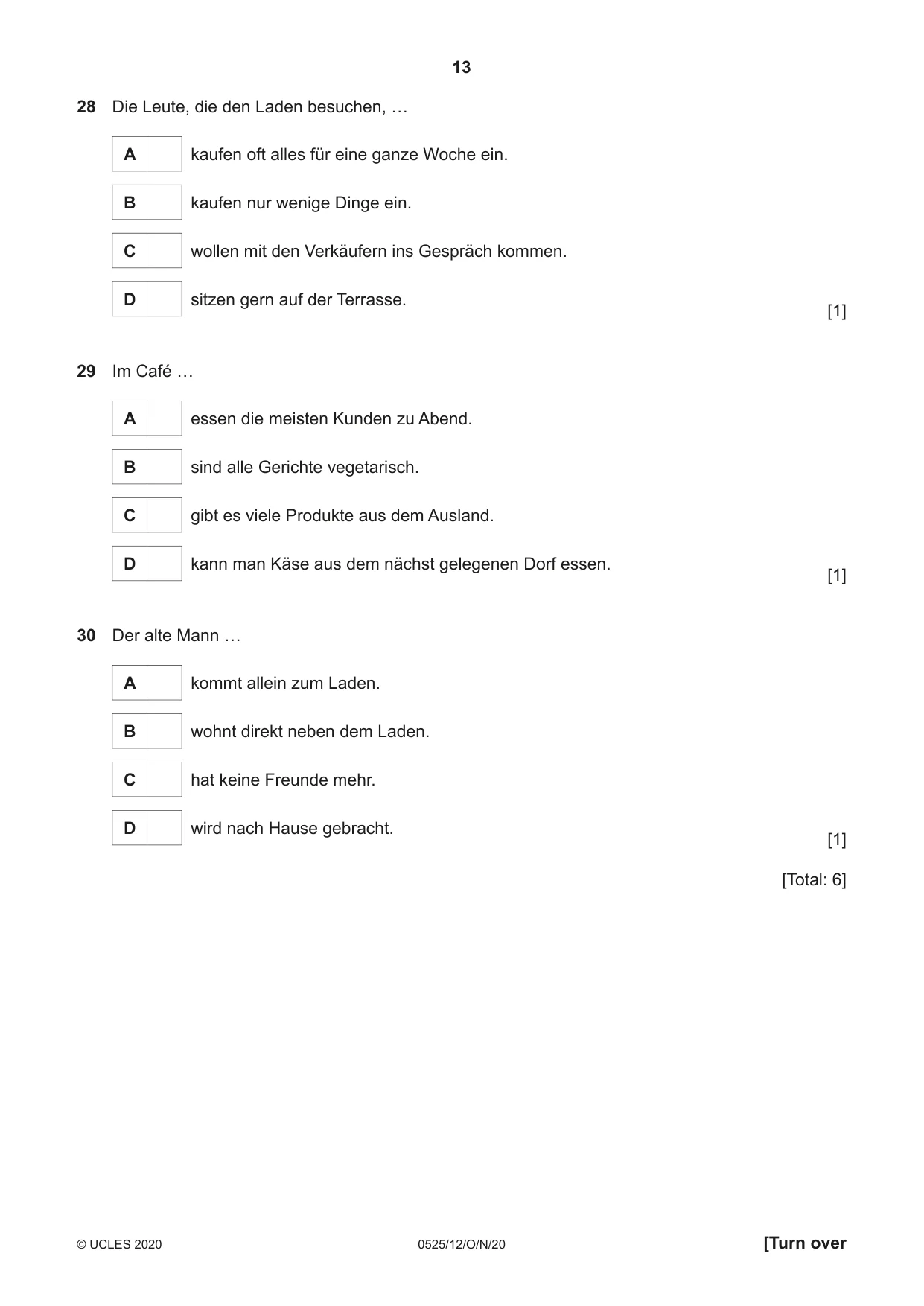
13 0525/12/O/N/20 © UCLES 2020 [Turn over 28 Die Leute, die den Laden besuchen, … wollen mit den Verkäufern ins Gespräch kommen. sitzen gern auf der Terrasse. A B C D kaufen oft alles für eine ganze Woche ein. kaufen nur wenige Dinge ein. [1] 29 Im Café … gibt es viele Produkte aus dem Ausland. kann man Käse aus dem nächst gelegenen Dorf essen. A B C D essen die meisten Kunden zu Abend. sind alle Gerichte vegetarisch. [1] 30 Der alte Mann … hat keine Freunde mehr. wird nach Hause gebracht. A B C D kommt allein zum Laden. wohnt direkt neben dem Laden. [1] [Total: 6]
Question paper, page 14
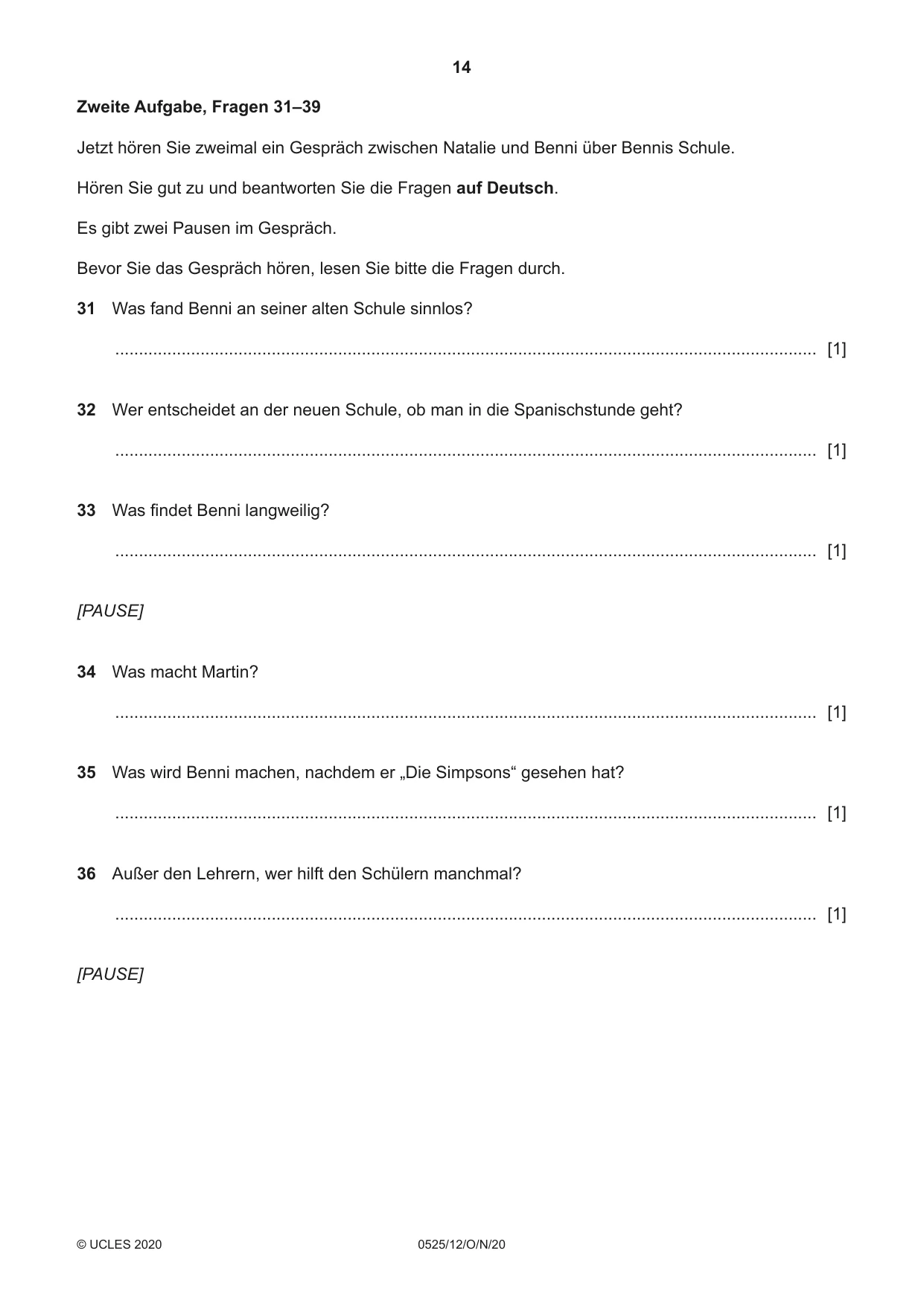
14 0525/12/O/N/20 © UCLES 2020 Zweite Aufgabe, Fragen 31–39 Jetzt hören Sie zweimal ein Gespräch zwischen Natalie und Benni über Bennis Schule. Hören Sie gut zu und beantworten Sie die Fragen auf Deutsch. Es gibt zwei Pausen im Gespräch. Bevor Sie das Gespräch hören, lesen Sie bitte die Fragen durch. 31 Was fand Benni an seiner alten Schule sinnlos? … [1] 32 Wer entscheidet an der neuen Schule, ob man in die Spanischstunde geht? … [1] 33 Was findet Benni langweilig? … [1] [PAUSE] 34 Was macht Martin? … [1] 35 Was wird Benni machen, nachdem er „Die Simpsons“ gesehen hat? … [1] 36 Außer den Lehrern, wer hilft den Schülern manchmal? … [1] [PAUSE]
Question paper, page 15
15 0525/12/O/N/20 © UCLES 2020 37 Wie viel Schulgeld müssen Bennis Eltern pro Monat zahlen? … [1] 38 Warum wollen die Eltern Benni auf ein Internat in England schicken? … [1] 39 Was würde Benni an einer englischen Schule nicht gefallen? … [1] [Total: 9]
Question paper, page 16
16 0525/12/O/N/20 © UCLES 2020 Permission to reproduce items where third-party owned material protected by copyright is included has been sought and cleared where possible. Every reasonable effort has been made by the publisher (UCLES) to trace copyright holders, but if any items requiring clearance have unwittingly been included, the publisher will be pleased to make amends at the earliest possible opportunity. To avoid the issue of disclosure of answer-related information to candidates, all copyright acknowledgements are reproduced online in the Cambridge Assessment International Education Copyright Acknowledgements Booklet. This is produced for each series of examinations and is freely available to download at www.cambridgeinternational.org after the live examination series. Cambridge Assessment International Education is part of the Cambridge Assessment Group. Cambridge Assessment is the brand name of the University of Cambridge Local Examinations Syndicate (UCLES), which itself is a department of the University of Cambridge. BLANK PAGE
Mark scheme, page 1
This document consists of 17 printed pages. © UCLES 2020 [Turn over Cambridge IGCSE™ GERMAN 0525/12 Paper 1 Listening October/November 2020 MARK SCHEME Maximum Mark: 45 Published This mark scheme is published as an aid to teachers and candidates, to indicate the requirements of the examination. It shows the basis on which Examiners were instructed to award marks. It does not indicate the details of the discussions that took place at an Examiners’ meeting before marking began, which would have considered the acceptability of alternative answers. Mark schemes should be read in conjunction with the question paper and the Principal Examiner Report for Teachers. Cambridge International will not enter into discussions about these mark schemes. Cambridge International is publishing the mark schemes for the October/November 2020 series for most Cambridge IGCSE™, Cambridge International A and AS Level and Cambridge Pre-U components, and some Cambridge O Level components.
Mark scheme, page 2
0525/12 Cambridge IGCSE – Mark Scheme PUBLISHED October/November 2020 © UCLES 2020 Page 2 of 17 Generic Marking Principles These general marking principles must be applied by all examiners when marking candidate answers. They should be applied alongside the specific content of the mark scheme or generic level descriptors for a question. Each question paper and mark scheme will also comply with these marking principles. GENERIC MARKING PRINCIPLE 1: Marks must be awarded in line with: • the specific content of the mark scheme or the generic level descriptors for the question • the specific skills defined in the mark scheme or in the generic level descriptors for the question • the standard of response required by a candidate as exemplified by the standardisation scripts. GENERIC MARKING PRINCIPLE 2: Marks awarded are always whole marks (not half marks, or other fractions). GENERIC MARKING PRINCIPLE 3: Marks must be awarded positively: • marks are awarded for correct/valid answers, as defined in the mark scheme. However, credit is given for valid answers which go beyond the scope of the syllabus and mark scheme, referring to your Team Leader as appropriate • marks are awarded when candidates clearly demonstrate what they know and can do • marks are not deducted for errors • marks are not deducted for omissions • answers should only be judged on the quality of spelling, punctuation and grammar when these features are specifically assessed by the question as indicated by the mark scheme. The meaning, however, should be unambiguous. GENERIC MARKING PRINCIPLE 4: Rules must be applied consistently, e.g. in situations where candidates have not followed instructions or in the application of generic level descriptors.
Mark scheme, page 3
0525/12 Cambridge IGCSE – Mark Scheme PUBLISHED October/November 2020 © UCLES 2020 Page 3 of 17 GENERIC MARKING PRINCIPLE 5: Marks should be awarded using the full range of marks defined in the mark scheme for the question (however; the use of the full mark range may be limited according to the quality of the candidate responses seen). GENERIC MARKING PRINCIPLE 6: Marks awarded are based solely on the requirements as defined in the mark scheme. Marks should not be awarded with grade thresholds or grade descriptors in mind.
Mark scheme, page 4
0525/12 Cambridge IGCSE – Mark Scheme PUBLISHED October/November 2020 © UCLES 2020 Page 4 of 17 1 The Standardisation process Before the Standardisation Team Meeting (STM) As scripts arrive in Cambridge from Centres they will be sent to a scanning bureau so that they can be made available in RM Assessor. Scripts should be available in RM Assessor 9 working days after the date when the paper was taken by candidates. At this point, Examiners will be able to start ‘browsing’ and/or provisional marking. ‘Browsing’ (for Assistant Examiners who are not attending an STM) If you are an Assistant Examiner who is not attending a Standardisation Team Meeting, ‘browsing’ involves you looking at (but not marking) scripts in RM Assessor and then submitting your queries about answers not covered by the Provisional Mark Scheme. The Standardisation Team will take your queries into account when they finalise the Mark Scheme. Your input is important because a comprehensive Mark Scheme will result in more reliable marking. Instructions on how to ‘browse’ are provided in the RM Assessor user guide. Provisional marking (members of the Standardisation Team only) As part of their ‘browsing’, members of the Standardisation Team are required to provisionally mark a number of scripts ahead of the Standardisation Team Meeting. Instructions are provided in the RM Assessor user guide (STM version). The Standardisation Team Meeting The Standardisation Team meets to finalise the Mark Scheme and agree the marks for those scripts that will be used to standardise the marking team (Practice and Standardisation scripts) and monitor the marking (Seeding scripts). The Final Mark Scheme The Final Mark Scheme will be made available on the RM Support Portal after the STM Meeting but it can take a couple of days to appear there. It will also be circulated by email. Once you receive the Final Mark Scheme you will be able to start work on the Practice and Standardisation scripts (see the RM Assessor user guide for details). You must not start work on your Practice scripts until you have received the Final Mark Scheme. Practice scripts Practice scripts are designed to familiarise you with the question paper and the Mark Scheme. They may contain common incorrect or unexpected answers. There may be guidance notes attached to a page which you should read carefully.
Mark scheme, page 5
0525/12 Cambridge IGCSE – Mark Scheme PUBLISHED October/November 2020 © UCLES 2020 Page 5 of 17 Standardisation scripts Once you have marked any Practice scripts, and have consulted your Team Leader (TL) re any queries you have about the Final Mark Scheme, you will be able to download your Standardisation scripts. (These are the equivalent of a co-ordination sample.) You should mark them carefully according to the Final Mark Scheme and guidance provided. Your Principal Examiner (PE) or TL will check your marking of the standardisation scripts and will provide feedback. If the PE/TL is satisfied with your marking, you will be authorised to start live marking. Alternatively, you may be asked to mark further standardisation scripts. You must complete the standardisation process before beginning your live marking for the component. Seeding scripts Seeding scripts enable your PE/TL to monitor your marking throughout the marking period. During the course of marking, according to a pre- determined rate of frequency, you will receive regular seeded scripts to mark. These scripts will already have been given a definitive mark by a Standardisation Team. Your PE/TL will be able to check your marking against the definitive marks for the script and s/he may provide feedback to you. Additional objects Occasionally you may come across a script with an ‘additional object’ attached to it. This may be a word-processed document (where the candidate has applied for special arrangements for the exam). You must read all of the ‘additional object’ as well as the question paper booklet to ensure that the entire candidate response has been seen and marked. Where you consider an answer is incomplete, please look for any additional writing on facing pages and on blank pages. Blank pages Using the annotation tool, you must tick the bottom of each blank page included at the end of the script to confirm that all pages of the booklet have been read and any additional material there has been noted (and marked where appropriate).
Mark scheme, page 6
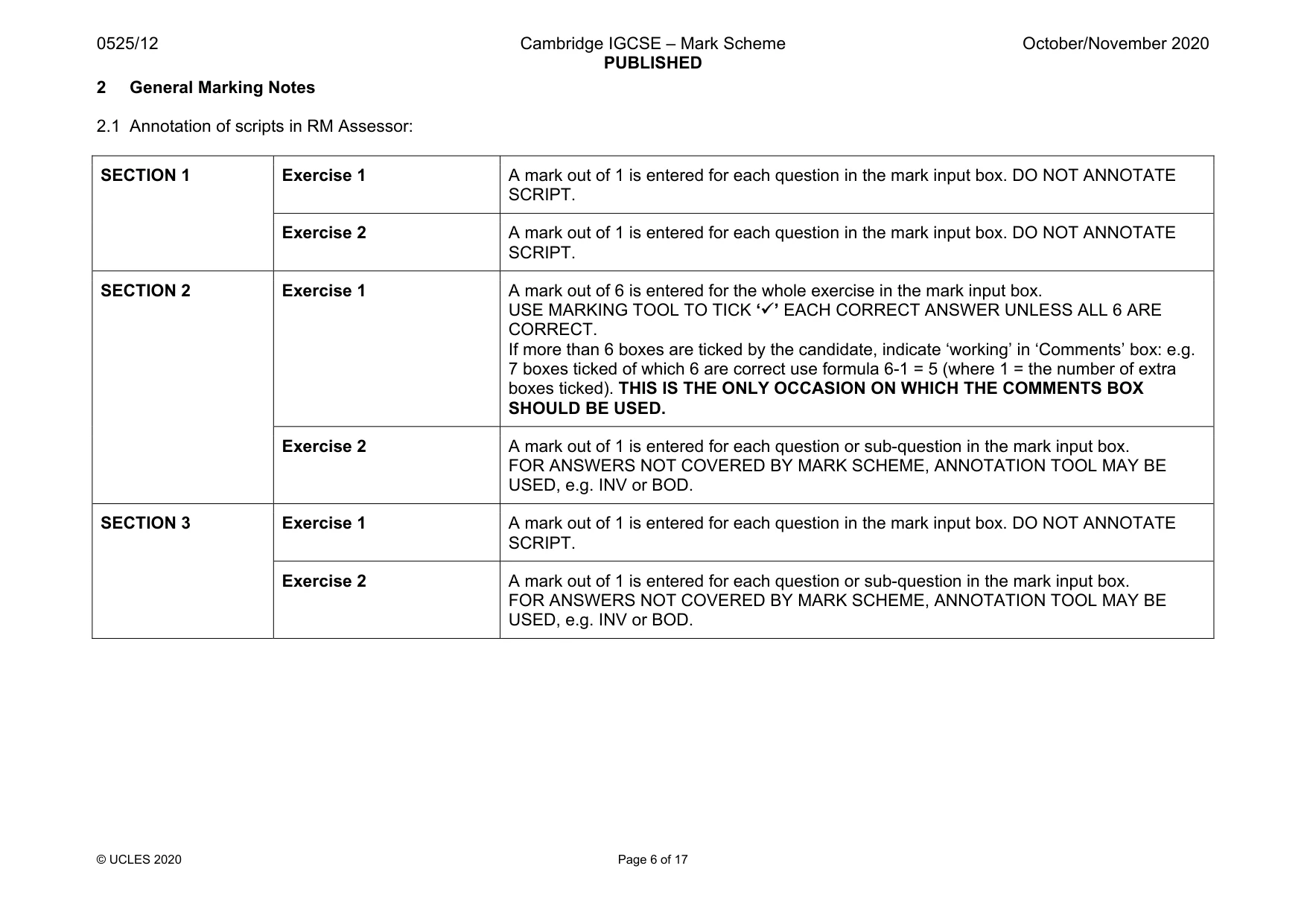
0525/12 Cambridge IGCSE – Mark Scheme PUBLISHED October/November 2020 © UCLES 2020 Page 6 of 17 2 General Marking Notes 2.1 Annotation of scripts in RM Assessor: SECTION 1 Exercise 1 A mark out of 1 is entered for each question in the mark input box. DO NOT ANNOTATE SCRIPT. Exercise 2 A mark out of 1 is entered for each question in the mark input box. DO NOT ANNOTATE SCRIPT. SECTION 2 Exercise 1 A mark out of 6 is entered for the whole exercise in the mark input box. USE MARKING TOOL TO TICK ‘’ EACH CORRECT ANSWER UNLESS ALL 6 ARE CORRECT. If more than 6 boxes are ticked by the candidate, indicate ‘working’ in ‘Comments’ box: e.g. 7 boxes ticked of which 6 are correct use formula 6-1 = 5 (where 1 = the number of extra boxes ticked). THIS IS THE ONLY OCCASION ON WHICH THE COMMENTS BOX SHOULD BE USED. Exercise 2 A mark out of 1 is entered for each question or sub-question in the mark input box. FOR ANSWERS NOT COVERED BY MARK SCHEME, ANNOTATION TOOL MAY BE USED, e.g. INV or BOD. SECTION 3 Exercise 1 A mark out of 1 is entered for each question in the mark input box. DO NOT ANNOTATE SCRIPT. Exercise 2 A mark out of 1 is entered for each question or sub-question in the mark input box. FOR ANSWERS NOT COVERED BY MARK SCHEME, ANNOTATION TOOL MAY BE USED, e.g. INV or BOD.
Mark scheme, page 7
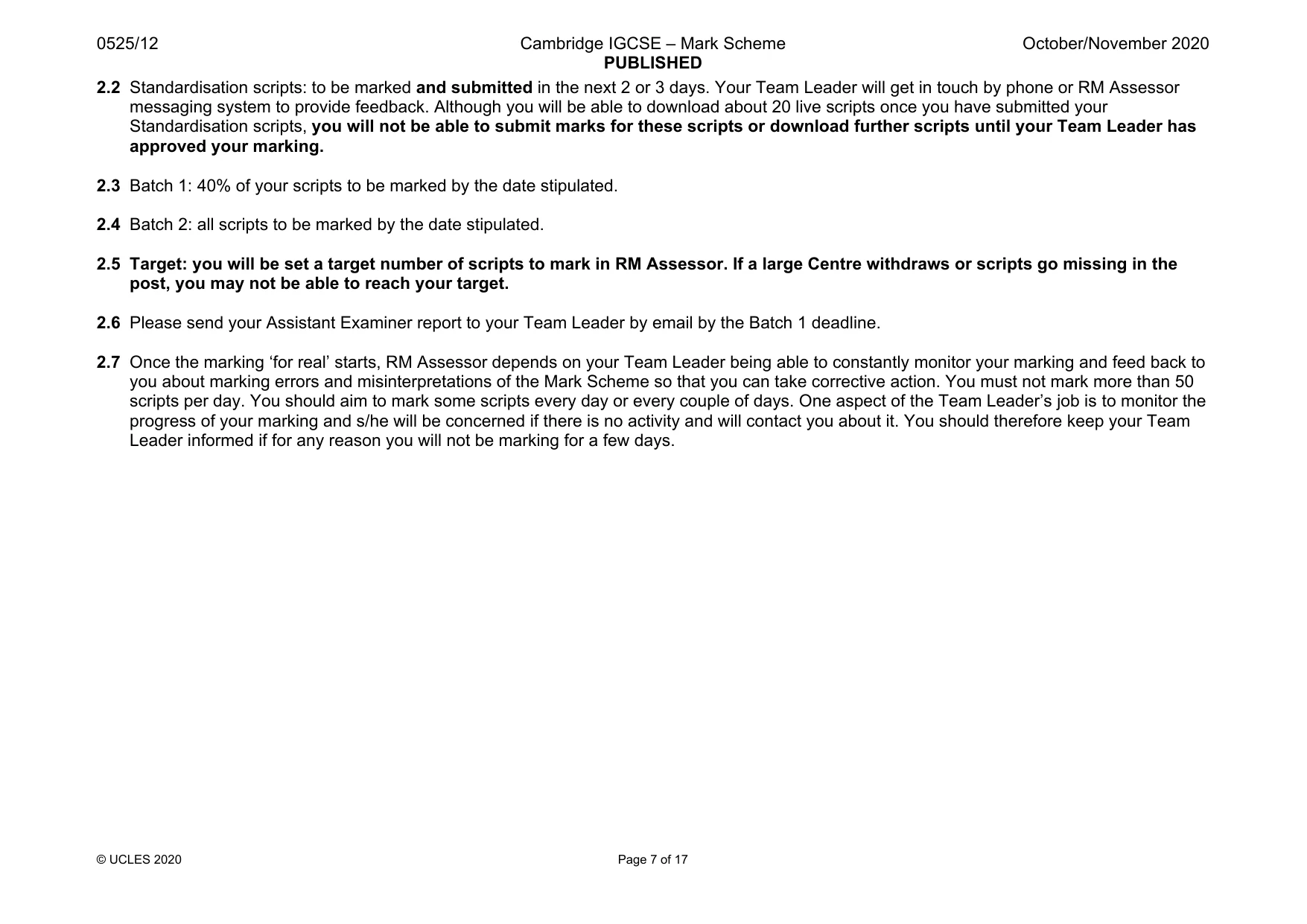
0525/12 Cambridge IGCSE – Mark Scheme PUBLISHED October/November 2020 © UCLES 2020 Page 7 of 17 2.2 Standardisation scripts: to be marked and submitted in the next 2 or 3 days. Your Team Leader will get in touch by phone or RM Assessor messaging system to provide feedback. Although you will be able to download about 20 live scripts once you have submitted your Standardisation scripts, you will not be able to submit marks for these scripts or download further scripts until your Team Leader has approved your marking. 2.3 Batch 1: 40% of your scripts to be marked by the date stipulated. 2.4 Batch 2: all scripts to be marked by the date stipulated. 2.5 Target: you will be set a target number of scripts to mark in RM Assessor. If a large Centre withdraws or scripts go missing in the post, you may not be able to reach your target. 2.6 Please send your Assistant Examiner report to your Team Leader by email by the Batch 1 deadline. 2.7 Once the marking ‘for real’ starts, RM Assessor depends on your Team Leader being able to constantly monitor your marking and feed back to you about marking errors and misinterpretations of the Mark Scheme so that you can take corrective action. You must not mark more than 50 scripts per day. You should aim to mark some scripts every day or every couple of days. One aspect of the Team Leader’s job is to monitor the progress of your marking and s/he will be concerned if there is no activity and will contact you about it. You should therefore keep your Team Leader informed if for any reason you will not be marking for a few days.
Mark scheme, page 8
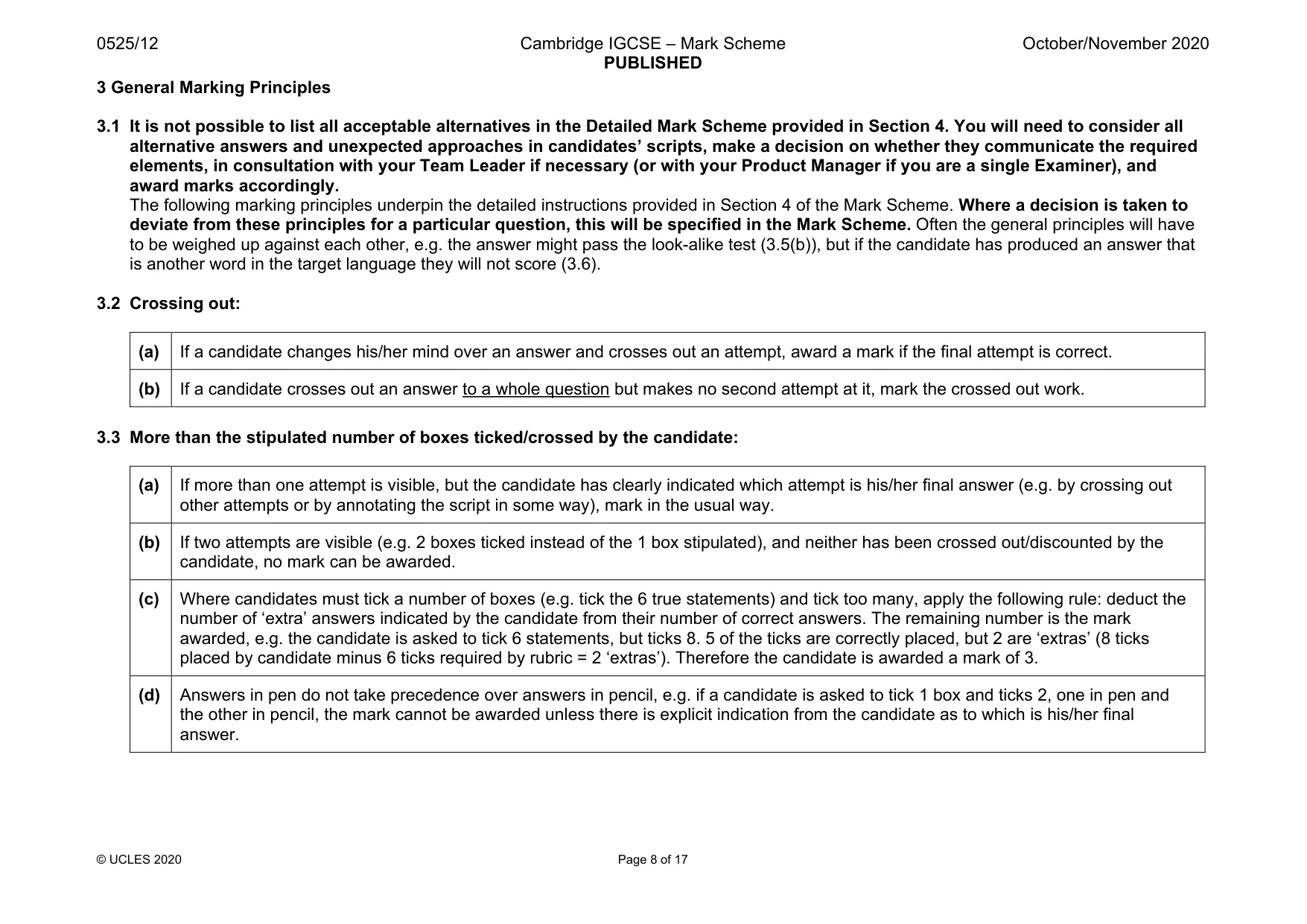
0525/12 Cambridge IGCSE – Mark Scheme PUBLISHED October/November 2020 © UCLES 2020 Page 8 of 17 3 General Marking Principles 3.1 It is not possible to list all acceptable alternatives in the Detailed Mark Scheme provided in Section 4. You will need to consider all alternative answers and unexpected approaches in candidates’ scripts, make a decision on whether they communicate the required elements, in consultation with your Team Leader if necessary (or with your Product Manager if you are a single Examiner), and award marks accordingly. The following marking principles underpin the detailed instructions provided in Section 4 of the Mark Scheme. Where a decision is taken to deviate from these principles for a particular question, this will be specified in the Mark Scheme. Often the general principles will have to be weighed up against each other, e.g. the answer might pass the look-alike test (3.5(b)), but if the candidate has produced an answer that is another word in the target language they will not score (3.6). 3.2 Crossing out: (a) If a candidate changes his/her mind over an answer and crosses out an attempt, award a mark if the final attempt is correct. (b) If a candidate crosses out an answer to a whole question but makes no second attempt at it, mark the crossed out work. 3.3 More than the stipulated number of boxes ticked/crossed by the candidate: (a) If more than one attempt is visible, but the candidate has clearly indicated which attempt is his/her final answer (e.g. by crossing out other attempts or by annotating the script in some way), mark in the usual way. (b) If two attempts are visible (e.g. 2 boxes ticked instead of the 1 box stipulated), and neither has been crossed out/discounted by the candidate, no mark can be awarded. (c) Where candidates must tick a number of boxes (e.g. tick the 6 true statements) and tick too many, apply the following rule: deduct the number of ‘extra’ answers indicated by the candidate from their number of correct answers. The remaining number is the mark awarded, e.g. the candidate is asked to tick 6 statements, but ticks 8. 5 of the ticks are correctly placed, but 2 are ‘extras’ (8 ticks placed by candidate minus 6 ticks required by rubric = 2 ‘extras’). Therefore the candidate is awarded a mark of 3. (d) Answers in pen do not take precedence over answers in pencil, e.g. if a candidate is asked to tick 1 box and ticks 2, one in pen and the other in pencil, the mark cannot be awarded unless there is explicit indication from the candidate as to which is his/her final answer.
Mark scheme, page 9
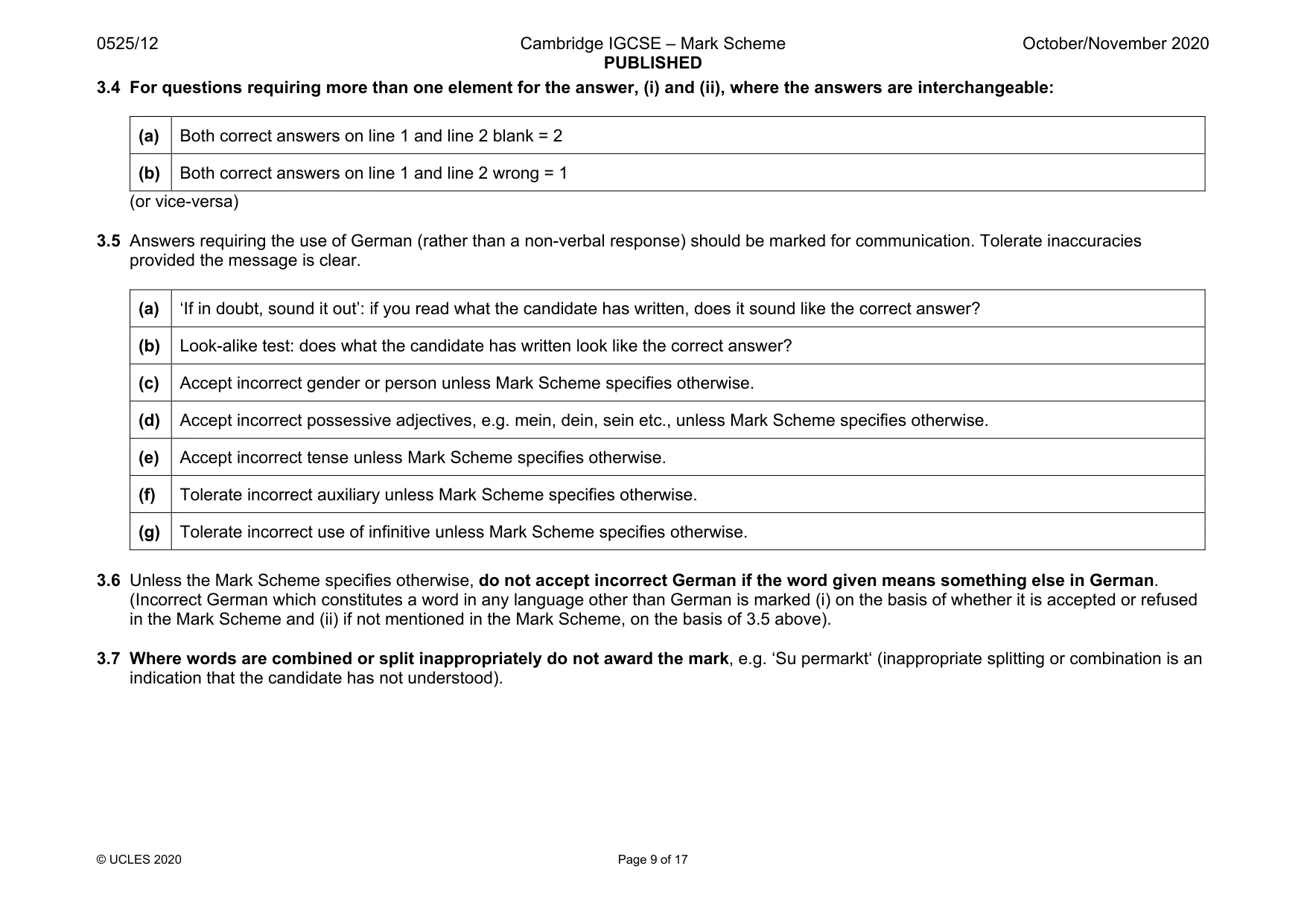
0525/12 Cambridge IGCSE – Mark Scheme PUBLISHED October/November 2020 © UCLES 2020 Page 9 of 17 3.4 For questions requiring more than one element for the answer, (i) and (ii), where the answers are interchangeable: (a) Both correct answers on line 1 and line 2 blank = 2 (b) Both correct answers on line 1 and line 2 wrong = 1 (or vice-versa) 3.5 Answers requiring the use of German (rather than a non-verbal response) should be marked for communication. Tolerate inaccuracies provided the message is clear. (a) ‘If in doubt, sound it out’: if you read what the candidate has written, does it sound like the correct answer? (b) Look-alike test: does what the candidate has written look like the correct answer? (c) Accept incorrect gender or person unless Mark Scheme specifies otherwise. (d) Accept incorrect possessive adjectives, e.g. mein, dein, sein etc., unless Mark Scheme specifies otherwise. (e) Accept incorrect tense unless Mark Scheme specifies otherwise. (f) Tolerate incorrect auxiliary unless Mark Scheme specifies otherwise. (g) Tolerate incorrect use of infinitive unless Mark Scheme specifies otherwise. 3.6 Unless the Mark Scheme specifies otherwise, do not accept incorrect German if the word given means something else in German. (Incorrect German which constitutes a word in any language other than German is marked (i) on the basis of whether it is accepted or refused in the Mark Scheme and (ii) if not mentioned in the Mark Scheme, on the basis of 3.5 above). 3.7 Where words are combined or split inappropriately do not award the mark, e.g. ‘Su permarkt‘ (inappropriate splitting or combination is an indication that the candidate has not understood).
Mark scheme, page 10
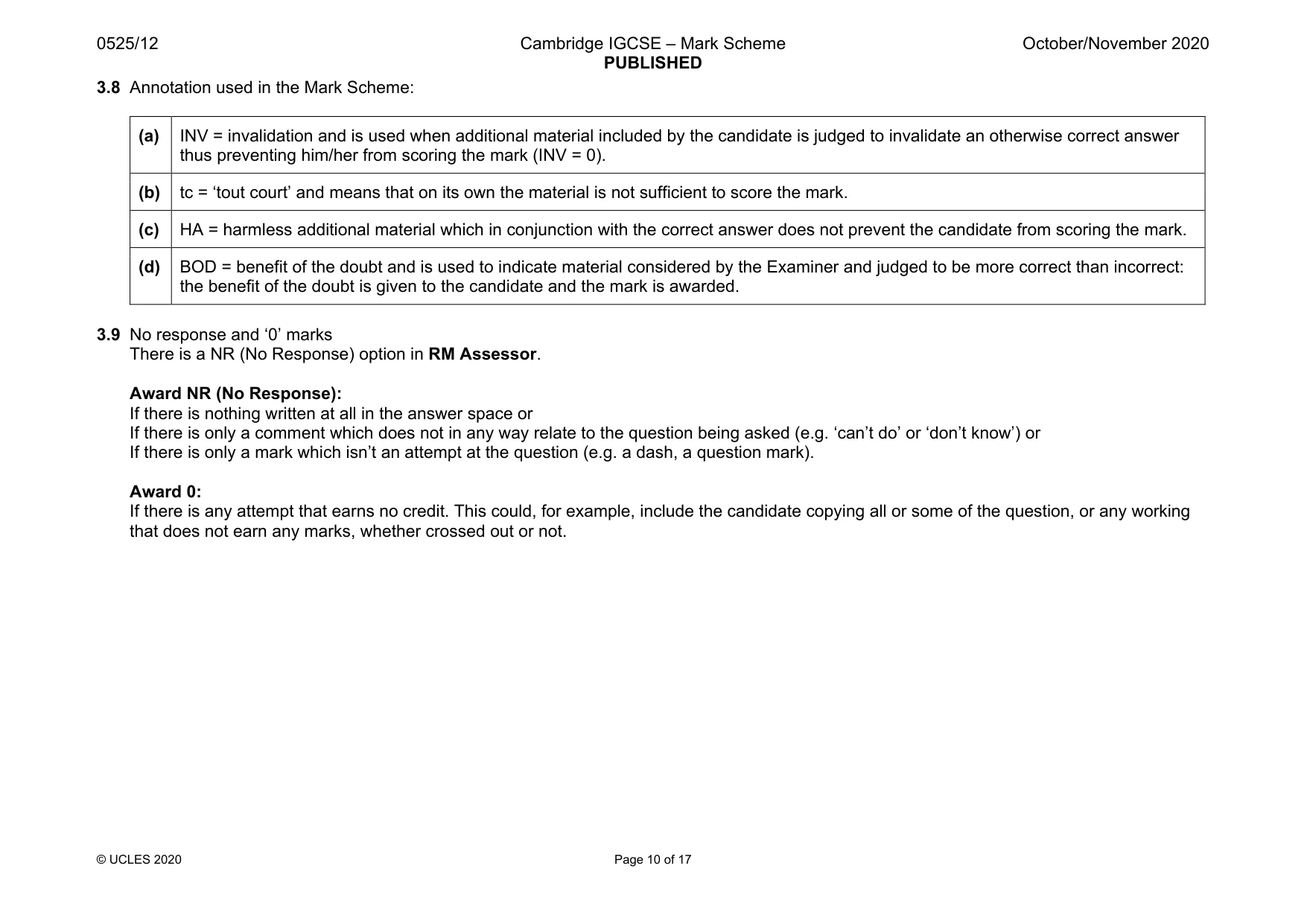
0525/12 Cambridge IGCSE – Mark Scheme PUBLISHED October/November 2020 © UCLES 2020 Page 10 of 17 3.8 Annotation used in the Mark Scheme: (a) INV = invalidation and is used when additional material included by the candidate is judged to invalidate an otherwise correct answer thus preventing him/her from scoring the mark (INV = 0). (b) tc = ‘tout court’ and means that on its own the material is not sufficient to score the mark. (c) HA = harmless additional material which in conjunction with the correct answer does not prevent the candidate from scoring the mark. (d) BOD = benefit of the doubt and is used to indicate material considered by the Examiner and judged to be more correct than incorrect: the benefit of the doubt is given to the candidate and the mark is awarded. 3.9 No response and ‘0’ marks There is a NR (No Response) option in RM Assessor. Award NR (No Response): If there is nothing written at all in the answer space or If there is only a comment which does not in any way relate to the question being asked (e.g. ‘can’t do’ or ‘don’t know’) or If there is only a mark which isn’t an attempt at the question (e.g. a dash, a question mark). Award 0: If there is any attempt that earns no credit. This could, for example, include the candidate copying all or some of the question, or any working that does not earn any marks, whether crossed out or not.
Mark scheme, page 11
0525/12 Cambridge IGCSE – Mark Scheme PUBLISHED October/November 2020 © UCLES 2020 Page 11 of 17 3.10 Extra material: It is the candidate’s responsibility to answer questions in such a way as to demonstrate to the Examiner that s/he has understood the recorded material. Where candidates introduce extra, irrelevant material to an otherwise correct answer the danger is that the Examiner is being forced to ‘choose’ the correct answer and s/he cannot be certain that the candidate has shown understanding. Where the Examiner is put in this position the mark cannot be awarded. The Detailed Mark Scheme cannot cover all eventualities and where specific instructions are not provided, Examiners must check the transcript to ensure the correct elements which would qualify for the mark are not contradicted or distorted by any extra material. The following, general, rules should be applied: (a) Extra material, mentioned in the Mark Scheme, which reinforces the correct answer or in itself constitutes an alternative correct answer: this is acceptable and is not penalised (b) Extra material which constitutes an alternative answer, but which is not explicitly mentioned in the Mark Scheme: the Examiner needs to decide, by consulting the transcript and the Team Leader if necessary, whether the alternative answer constitutes: (i) an alternative correct answer, in which case this falls into category (a) and the answer should be rewarded (ii) or an answer which on its own would be refused, in which case this falls into category (c) and the answer should be refused (c) Extra material which constitutes an alternative answer specifically refused in the Mark Scheme: this puts the Examiner in the position of having to ‘choose’ which is the candidate’s ‘final’ answer – the Examiner cannot be sure what the candidate has understood – and the mark cannot be awarded (d) Extra material which distorts or contradicts the correct answer: this affects communication – the Examiner cannot be sure what the candidate has understood – and the mark cannot be awarded (e) Extra material introduced by the candidate and which does not feature in the original transcript: this affects communication – the Examiner cannot be sure what the candidate has understood – and the mark cannot be awarded. It can sometimes be difficult to draw the line between what is a deduction made by an able candidate on the basis of what they have heard and pure guesswork. Therefore where a particular answer is not covered in the Mark Scheme, Examiners should consult their Team Leader
Mark scheme, page 12
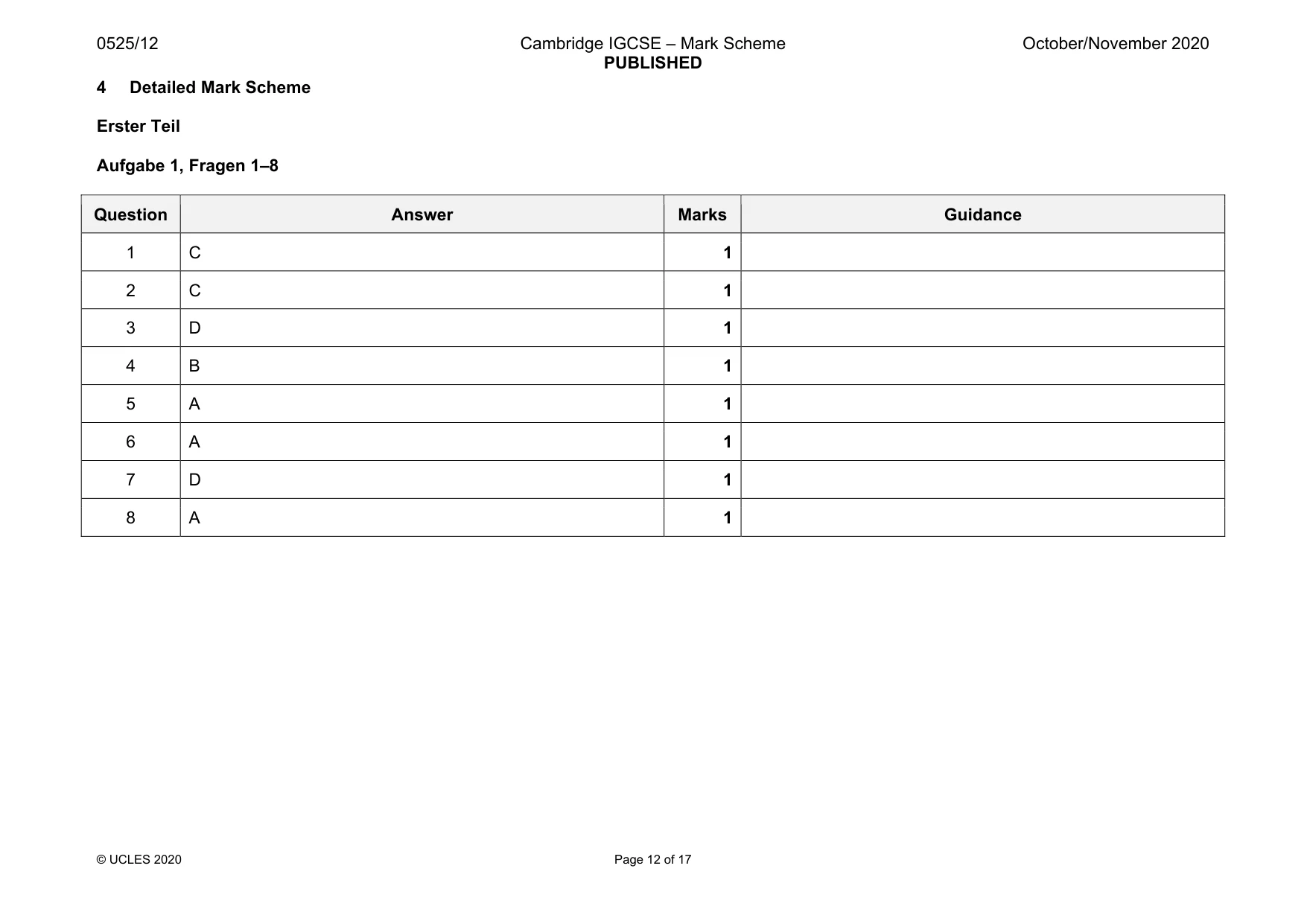
0525/12 Cambridge IGCSE – Mark Scheme PUBLISHED October/November 2020 © UCLES 2020 Page 12 of 17 4 Detailed Mark Scheme Erster Teil Aufgabe 1, Fragen 1–8 Question Answer Marks Guidance 1 C 1 2 C 1 3 D 1 4 B 1 5 A 1 6 A 1 7 D 1 8 A 1
Mark scheme, page 13
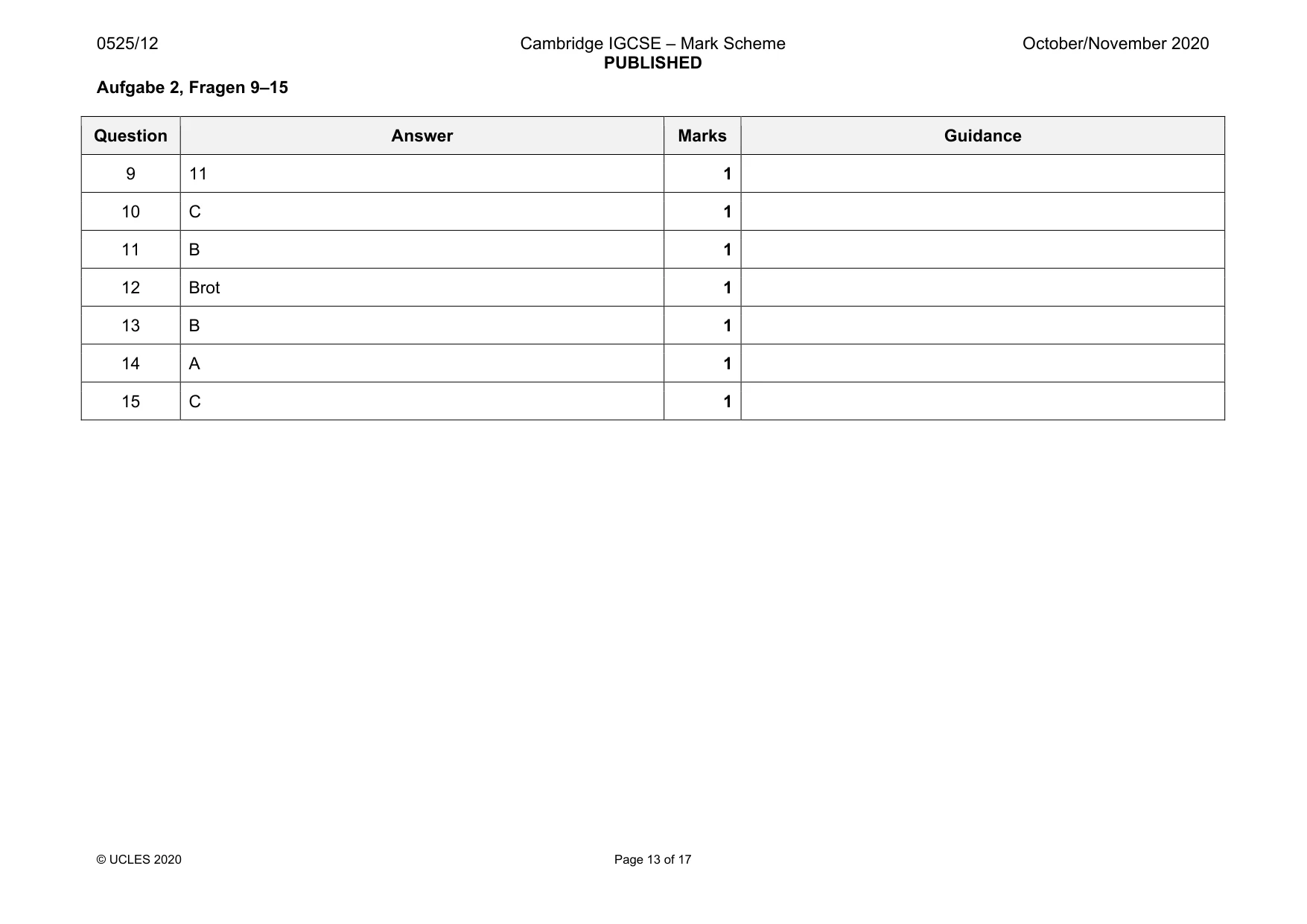
0525/12 Cambridge IGCSE – Mark Scheme PUBLISHED October/November 2020 © UCLES 2020 Page 13 of 17 Aufgabe 2, Fragen 9–15 Question Answer Marks Guidance 9 11 1 10 C 1 11 B 1 12 Brot 1 13 B 1 14 A 1 15 C 1
Mark scheme, page 14
0525/12 Cambridge IGCSE – Mark Scheme PUBLISHED October/November 2020 © UCLES 2020 Page 14 of 17 Zweiter Teil Aufgabe 1, Frage 16 Question Answer Marks Guidance (a) Elli (b) (c) (d) Tom (e) (f) (g) Sandra (h) (i) (j) Martin (k) (l) 16 6 A mark out of 6 is entered for the whole exercise in the mark input box. USE MARKING TOOL TO TICK ‘’ EACH CORRECT ANSWER UNLESS ALL 6 CORRECT If more than 6 boxes are ticked by the candidate, indicate ‘working’ in ‘Comments’ box: e.g. 7 boxes ticked of which 6 are correct use formula 6-1 = 5 (where 1 = the number of extra boxes ticked).
Mark scheme, page 15
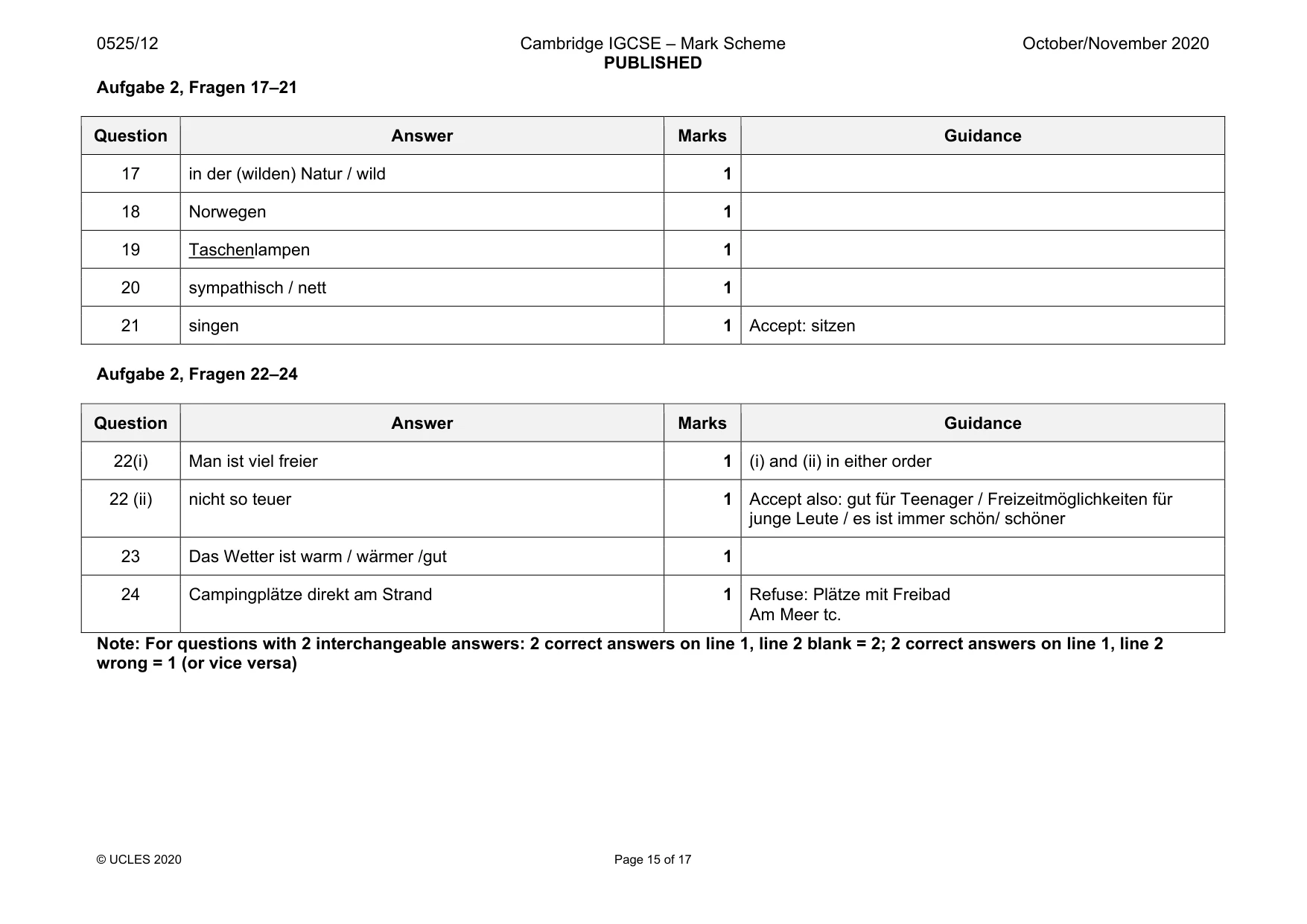
0525/12 Cambridge IGCSE – Mark Scheme PUBLISHED October/November 2020 © UCLES 2020 Page 15 of 17 Aufgabe 2, Fragen 17–21 Question Answer Marks Guidance 17 in der (wilden) Natur / wild 1 18 Norwegen 1 19 Taschenlampen 1 20 sympathisch / nett 1 21 singen 1 Accept: sitzen Aufgabe 2, Fragen 22–24 Question Answer Marks Guidance 22(i) Man ist viel freier 1 (i) and (ii) in either order 22 (ii) nicht so teuer 1 Accept also: gut für Teenager / Freizeitmöglichkeiten für junge Leute / es ist immer schön/ schöner 23 Das Wetter ist warm / wärmer /gut 1 24 Campingplätze direkt am Strand 1 Refuse: Plätze mit Freibad Am Meer tc. Note: For questions with 2 interchangeable answers: 2 correct answers on line 1, line 2 blank = 2; 2 correct answers on line 1, line 2 wrong = 1 (or vice versa)
Mark scheme, page 16
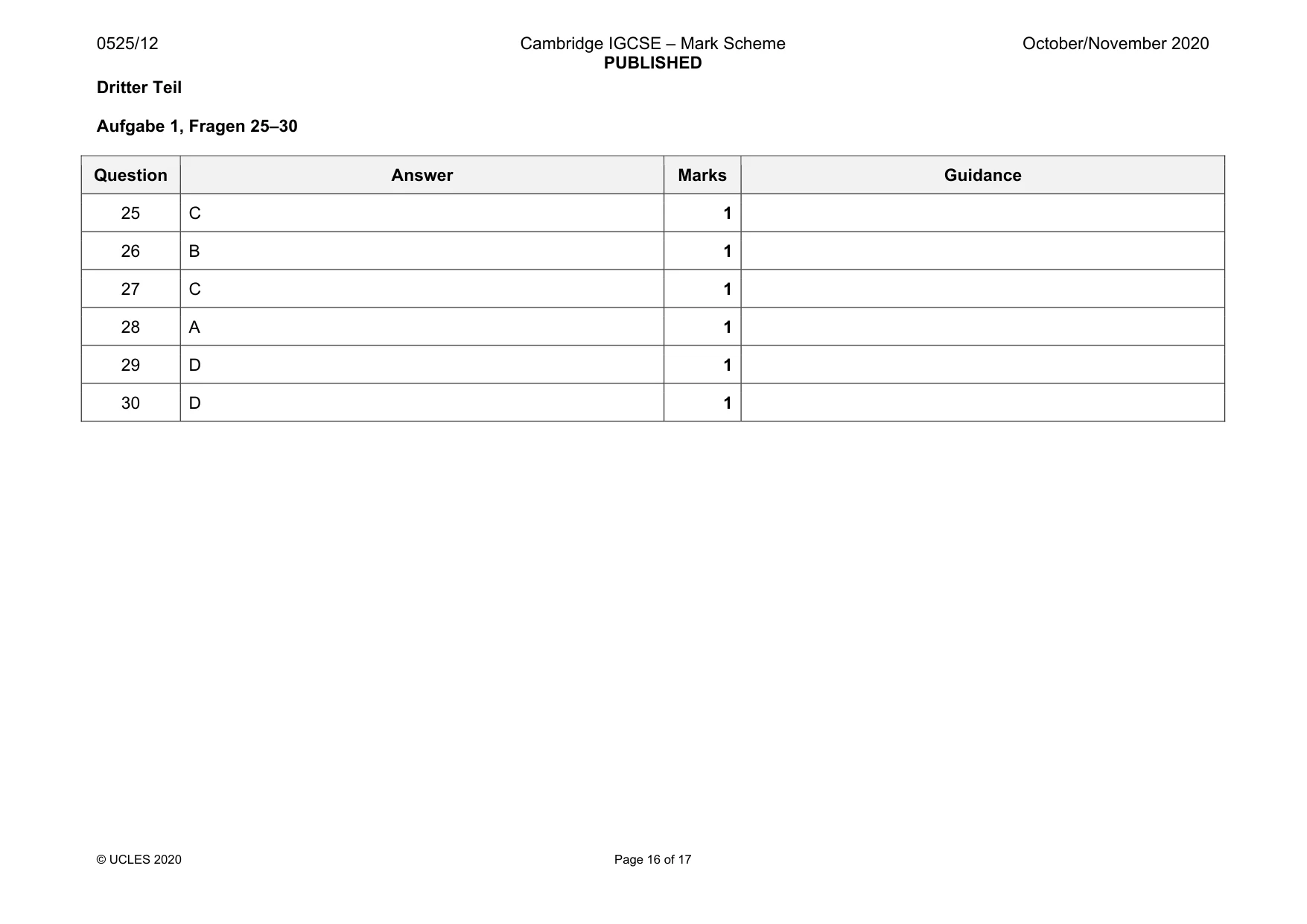
0525/12 Cambridge IGCSE – Mark Scheme PUBLISHED October/November 2020 © UCLES 2020 Page 16 of 17 Dritter Teil Aufgabe 1, Fragen 25–30 Question Answer Marks Guidance 25 C 1 26 B 1 27 C 1 28 A 1 29 D 1 30 D 1
Mark scheme, page 17
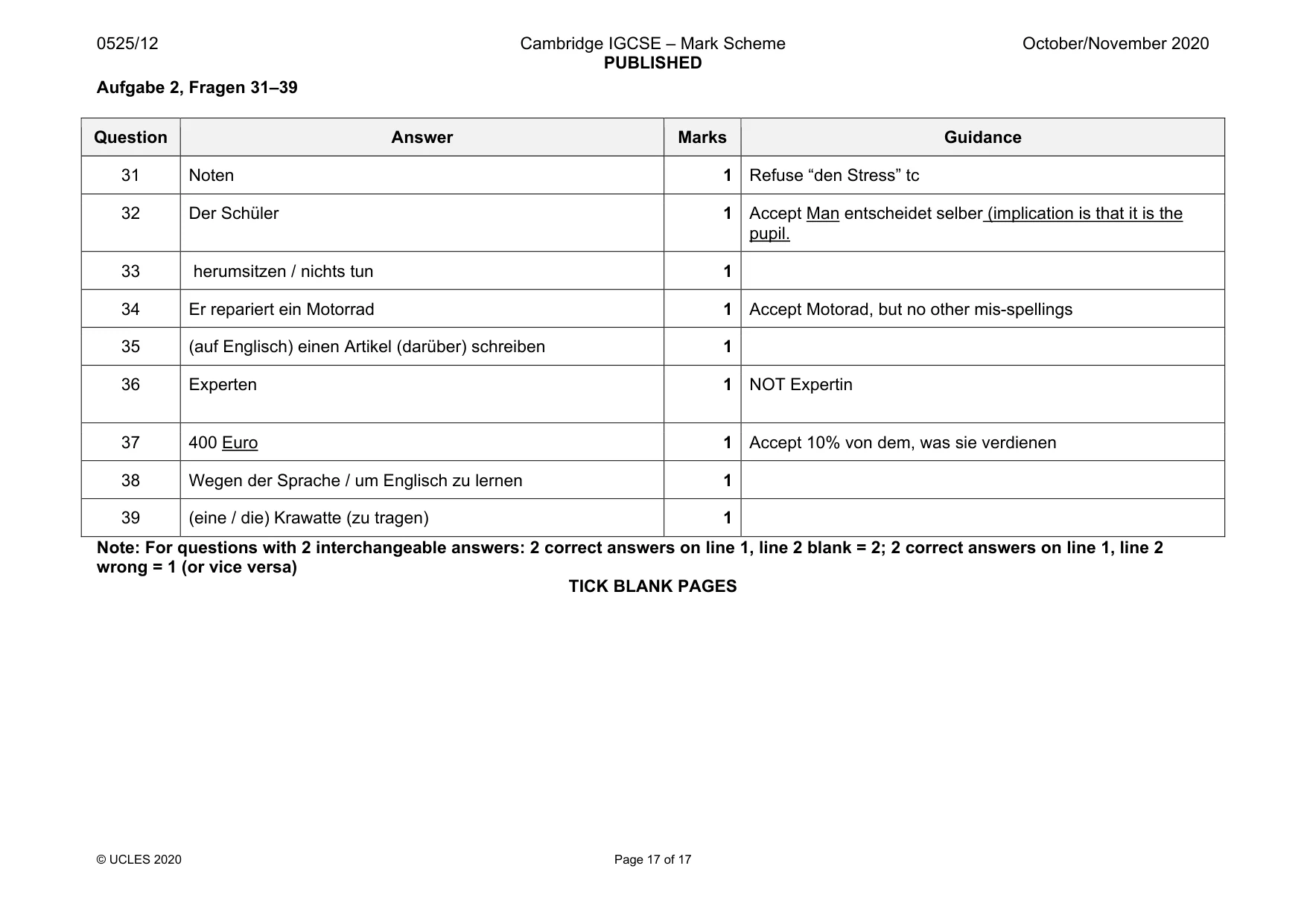
0525/12 Cambridge IGCSE – Mark Scheme PUBLISHED October/November 2020 © UCLES 2020 Page 17 of 17 Aufgabe 2, Fragen 31–39 Question Answer Marks Guidance 31 Noten 1 Refuse “den Stress” tc 32 Der Schüler 1 Accept Man entscheidet selber (implication is that it is the pupil. 33 herumsitzen / nichts tun 1 34 Er repariert ein Motorrad 1 Accept Motorad, but no other mis-spellings 35 (auf Englisch) einen Artikel (darüber) schreiben 1 36 Experten 1 NOT Expertin 37 400 Euro 1 Accept 10% von dem, was sie verdienen 38 Wegen der Sprache / um Englisch zu lernen 1 39 (eine / die) Krawatte (zu tragen) 1 Note: For questions with 2 interchangeable answers: 2 correct answers on line 1, line 2 blank = 2; 2 correct answers on line 1, line 2 wrong = 1 (or vice versa) TICK BLANK PAGES
What you needed in this session
Cambridge’s own grade thresholds for 2020 Oct/Nov, Paper 1 · Variant 2. A higher threshold means an easier paper — the bar moves with how the cohort did.