Cambridge IGCSE German - Foreign Language 0525 — 2018 Oct/Nov Paper 1 · Variant 2
0525/12/O/N/18 · 45 marks · ≈51 min
The question paper and its mark scheme, free to read here and free to download. This is Cambridge’s own paper, exactly as it was sat.
Question paper16 pages



Mark scheme13 pages
Answers below. Sit the paper first if you are practising.
Paper as text
Question paper, page 1
* 0 8 8 0 8 4 6 4 8 4 * This document consists of 13 printed pages and 3 blank pages. DC (RW/SG) 148063/4 © UCLES 2018 [Turn over Cambridge International Examinations Cambridge International General Certificate of Secondary Education GERMAN 0525/12 Paper 1 Listening October/November 2018 Approx. 45 minutes Candidates answer on the Question Paper. No Additional Materials are required. READ THESE INSTRUCTIONS FIRST Write your Centre number, candidate number and name in the spaces at the top of this page. Write in dark blue or black pen. Do not use staples, paper clips, glue or correction fluid. DO NOT WRITE IN ANY BARCODES. Answer all questions. The number of marks is given in brackets [ ] at the end of each question or part question. The syllabus is approved for use in England, Wales and Northern Ireland as a Cambridge International Level 1/Level 2 Certificate.
Question paper, page 2
2 0525/12/O/N/18 © UCLES 2018 BLANK PAGE
Question paper, page 3
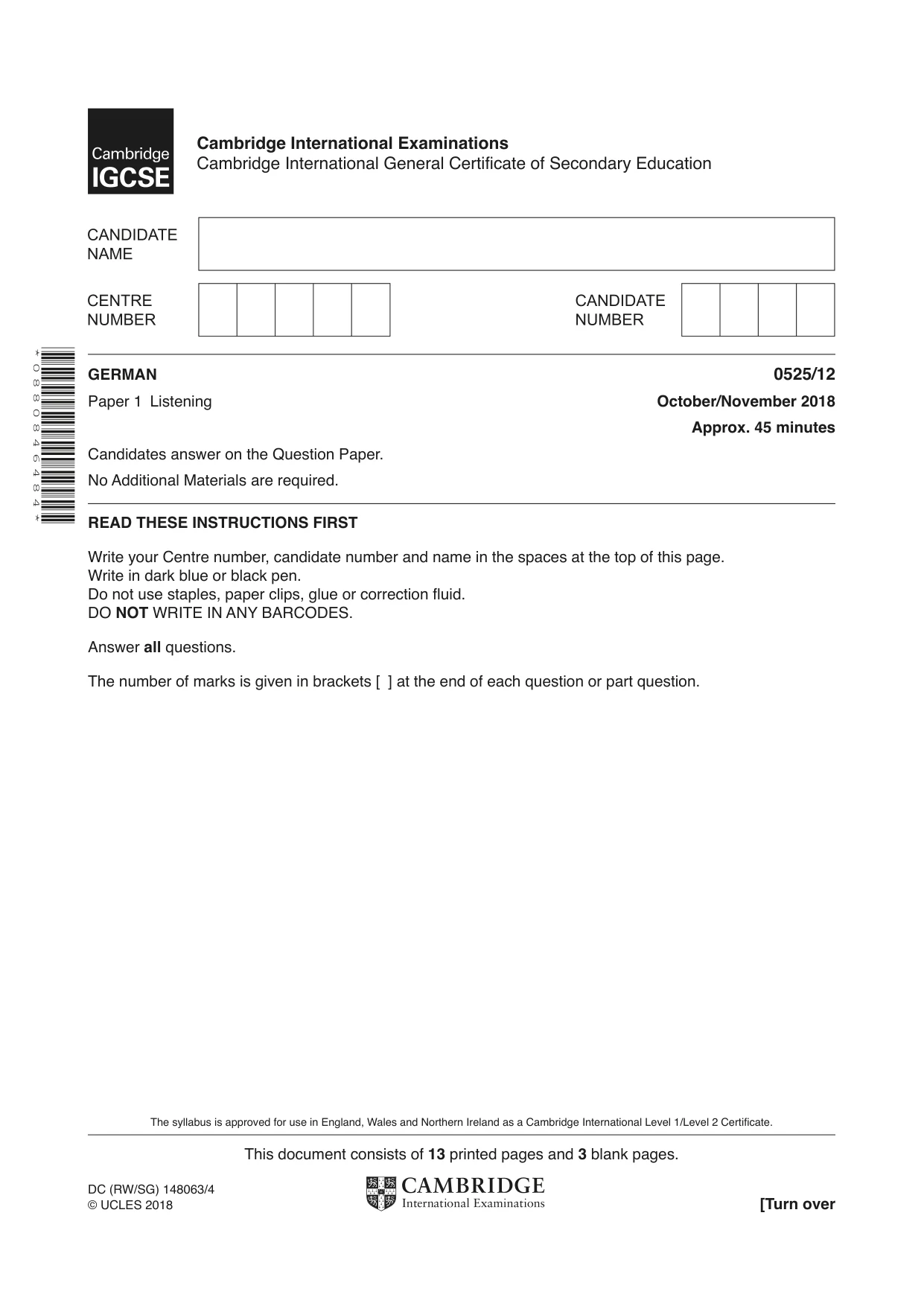
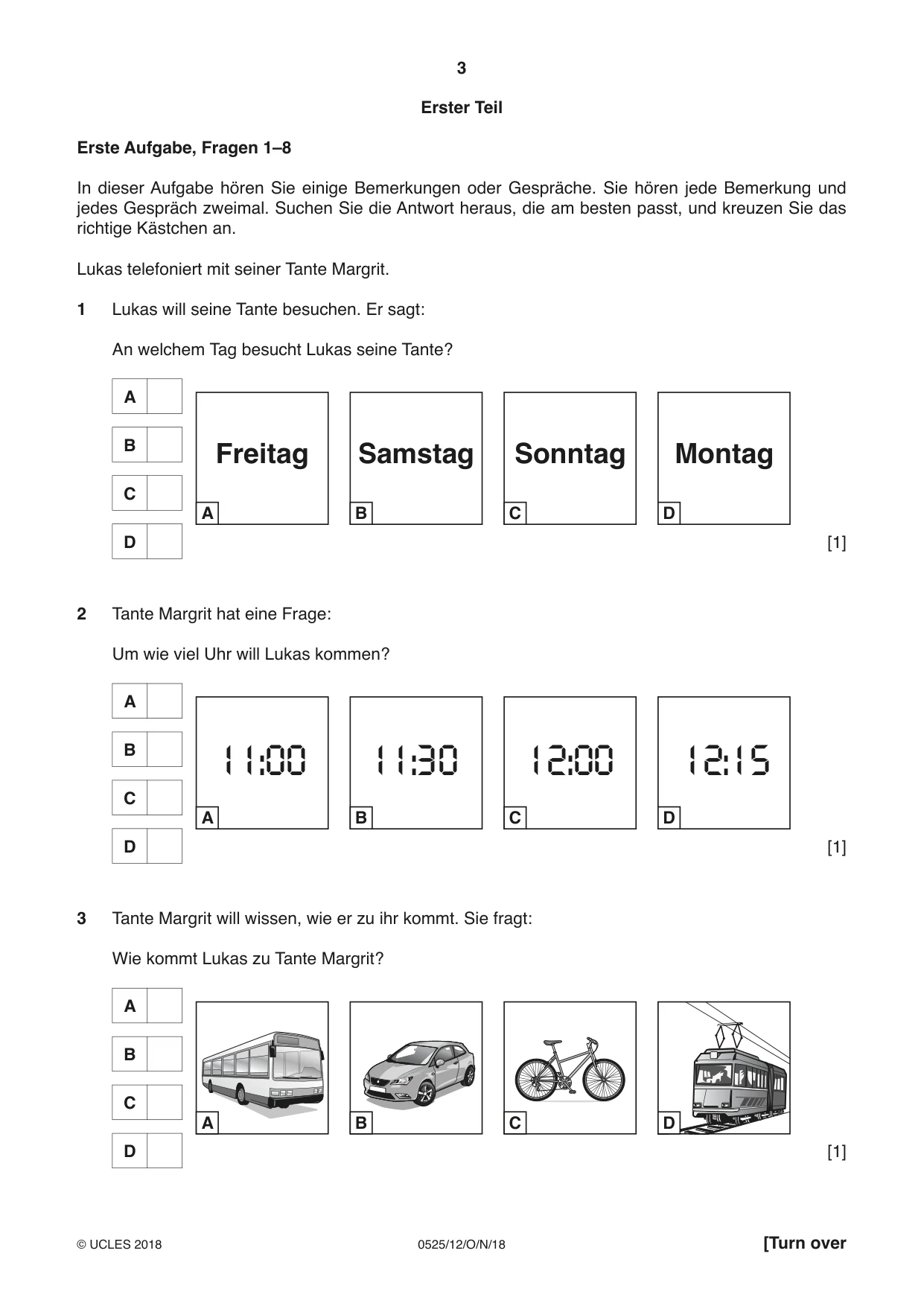
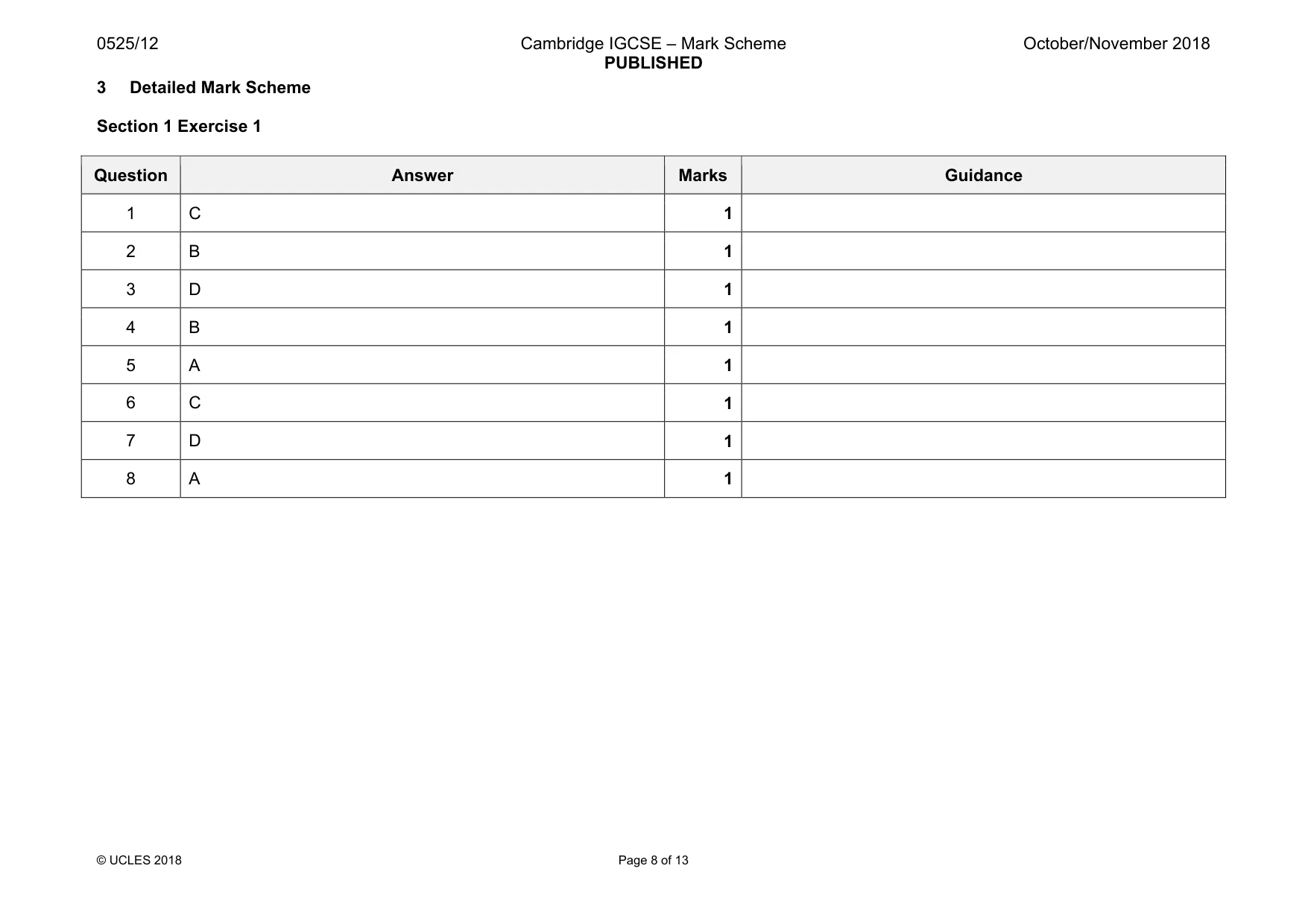
3 0525/12/O/N/18 © UCLES 2018 [Turn over Erster Teil Erste Aufgabe, Fragen 1–8 In dieser Aufgabe hören Sie einige Bemerkungen oder Gespräche. Sie hören jede Bemerkung und jedes Gespräch zweimal. Suchen Sie die Antwort heraus, die am besten passt, und kreuzen Sie das richtige Kästchen an. Lukas telefoniert mit seiner Tante Margrit. 1 Lukas will seine Tante besuchen. Er sagt: An welchem Tag besucht Lukas seine Tante? A B C D Freitag Samstag Sonntag Montag A B C D [1] 2 Tante Margrit hat eine Frage: Um wie viel Uhr will Lukas kommen? A B C D 11:00 11:30 12:00 12:15 A B C D [1] 3 Tante Margrit will wissen, wie er zu ihr kommt. Sie fragt: Wie kommt Lukas zu Tante Margrit? A B C D A B C D [1]
Question paper, page 4
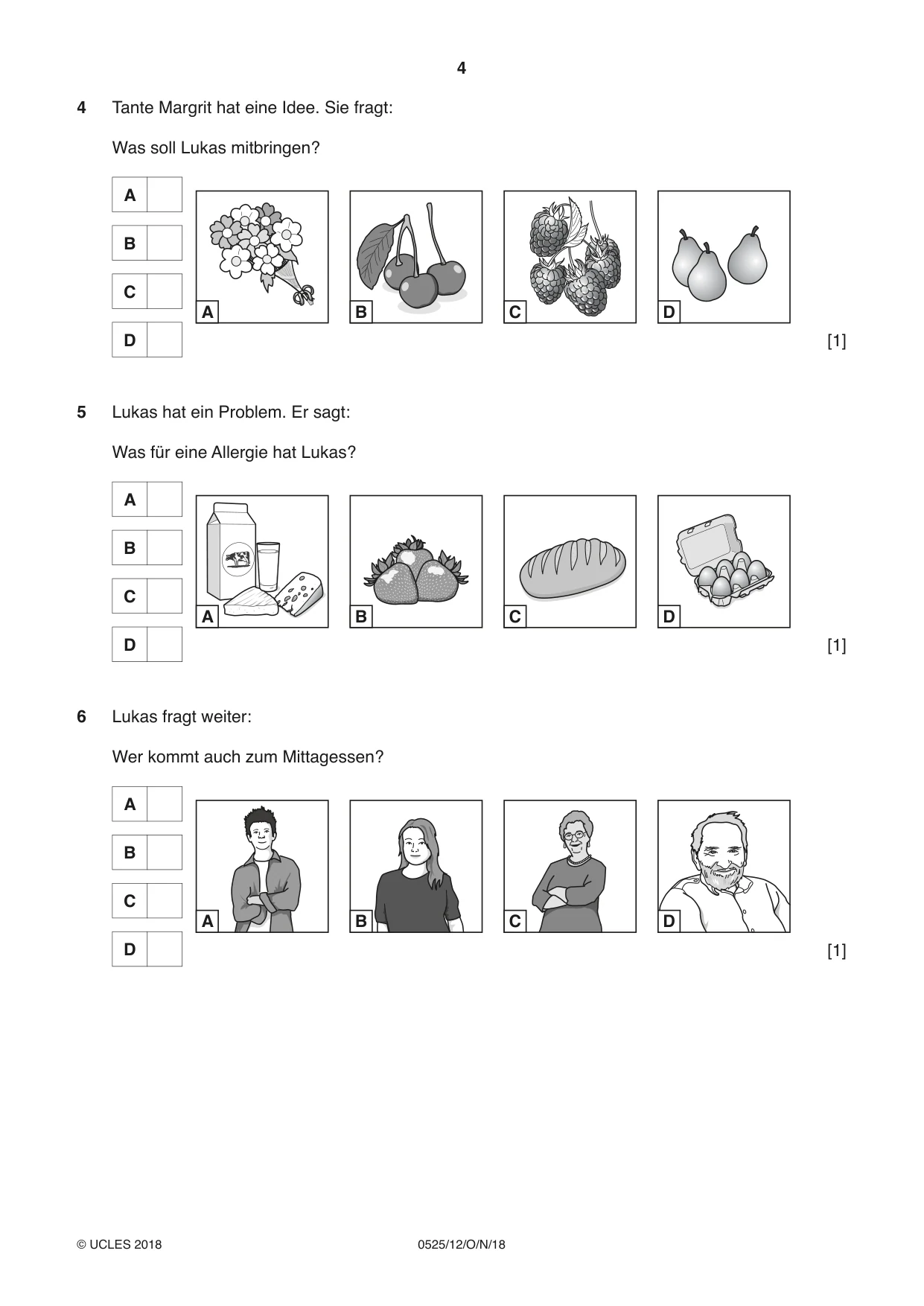
4 0525/12/O/N/18 © UCLES 2018 4 Tante Margrit hat eine Idee. Sie fragt: Was soll Lukas mitbringen? A B C D A B C D [1] 5 Lukas hat ein Problem. Er sagt: Was für eine Allergie hat Lukas? A B C D A B C D [1] 6 Lukas fragt weiter: Wer kommt auch zum Mittagessen? A B C D A B C D [1]
Question paper, page 5
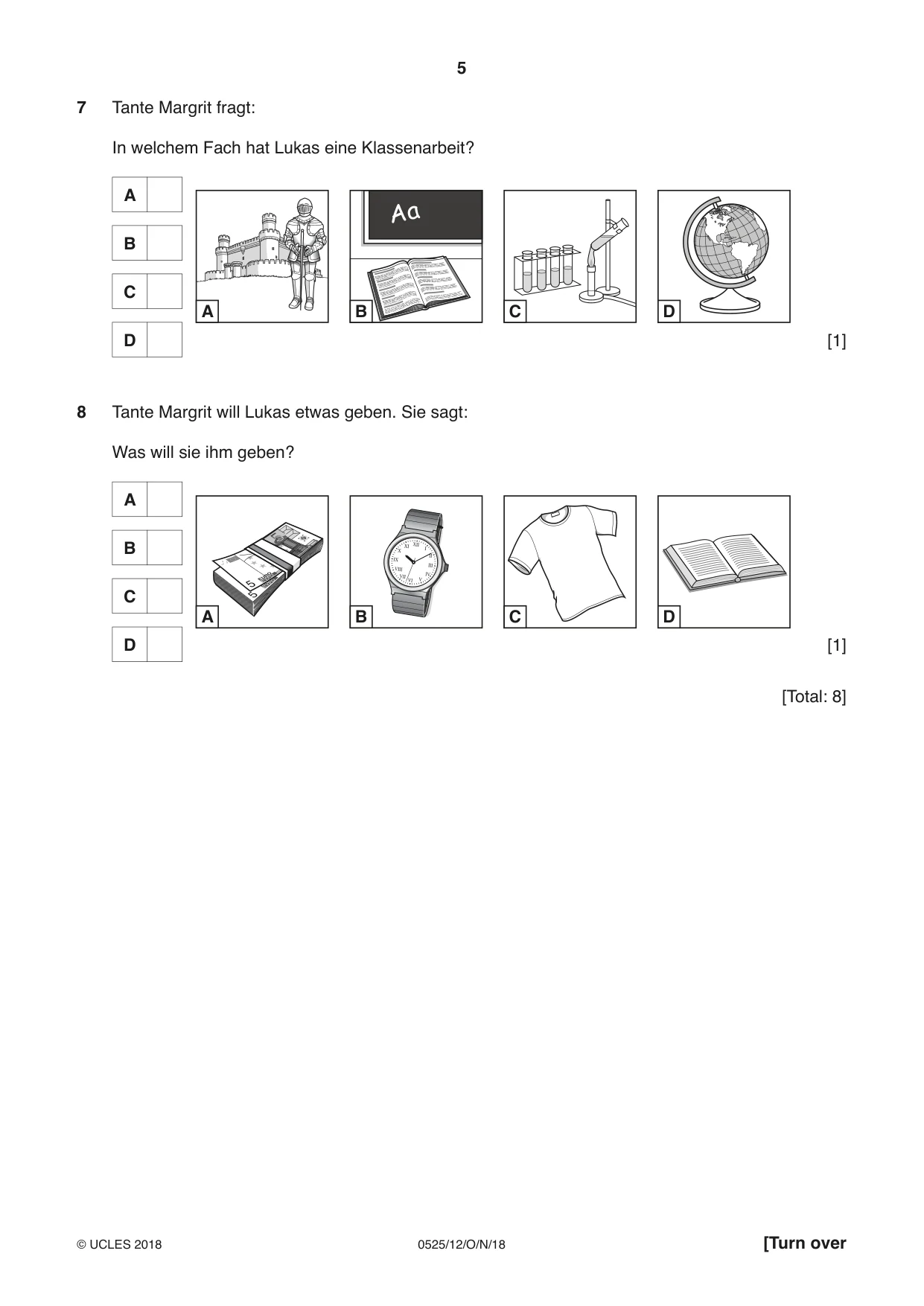
5 0525/12/O/N/18 © UCLES 2018 [Turn over 7 Tante Margrit fragt: In welchem Fach hat Lukas eine Klassenarbeit? A B C D Aa A B C D [1] 8 Tante Margrit will Lukas etwas geben. Sie sagt: Was will sie ihm geben? A B C D A B C D [1] [Total: 8]
Question paper, page 6
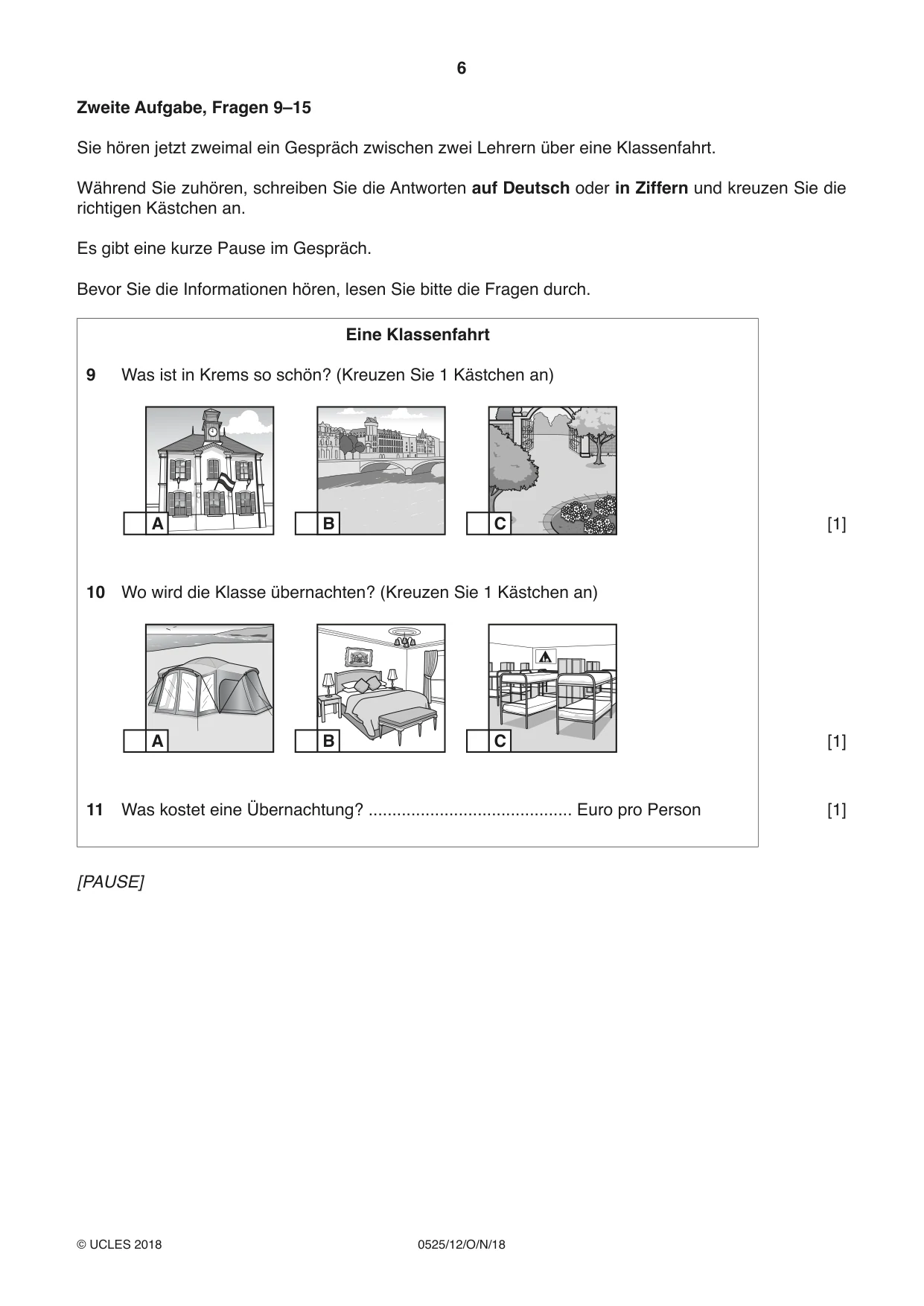
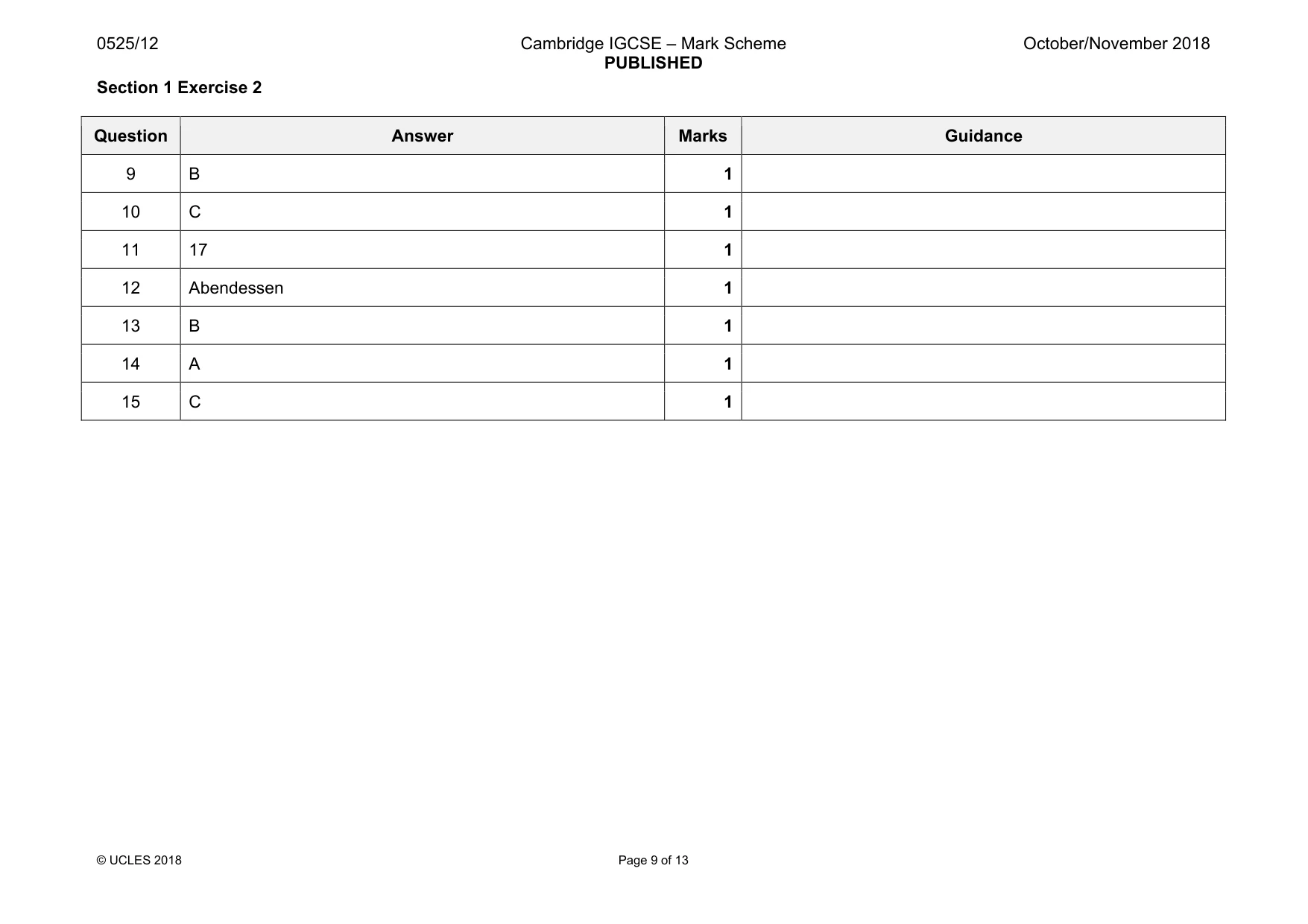
6 0525/12/O/N/18 © UCLES 2018 Zweite Aufgabe, Fragen 9–15 Sie hören jetzt zweimal ein Gespräch zwischen zwei Lehrern über eine Klassenfahrt. Während Sie zuhören, schreiben Sie die Antworten auf Deutsch oder in Ziffern und kreuzen Sie die richtigen Kästchen an. Es gibt eine kurze Pause im Gespräch. Bevor Sie die Informationen hören, lesen Sie bitte die Fragen durch. Eine Klassenfahrt 9 Was ist in Krems so schön? (Kreuzen Sie 1 Kästchen an) A B C 10 Wo wird die Klasse übernachten? (Kreuzen Sie 1 Kästchen an) A B C 11 Was kostet eine Übernachtung? … Euro pro Person [1] [1] [1] [PAUSE]
Question paper, page 7
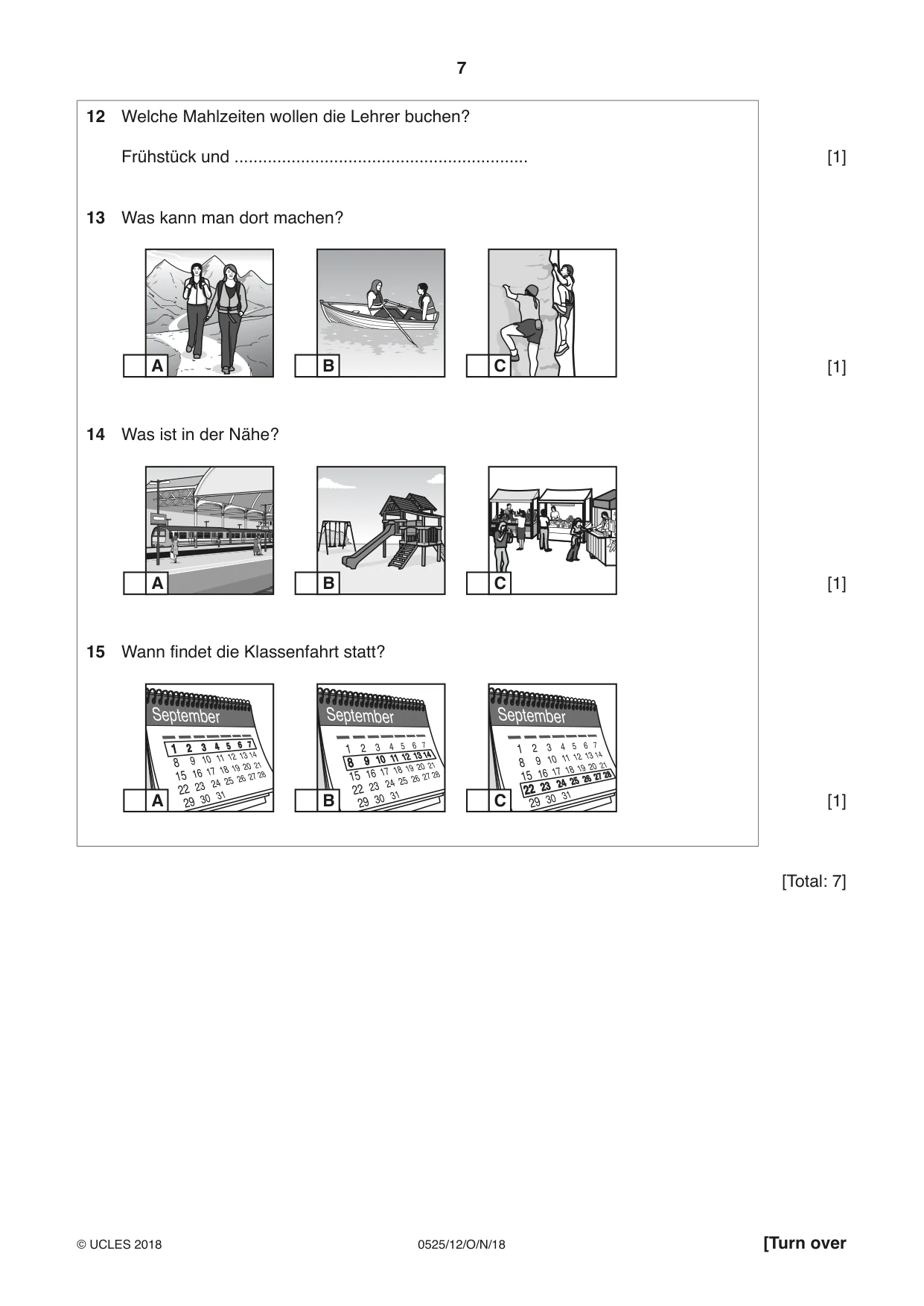
7 0525/12/O/N/18 © UCLES 2018 [Turn over 12 Welche Mahlzeiten wollen die Lehrer buchen? Frühstück und … 13 Was kann man dort machen? A B C 14 Was ist in der Nähe? A B C 15 Wann findet die Klassenfahrt statt? September September September A B C [1] [1] [1] [1] [Total: 7]
Question paper, page 8
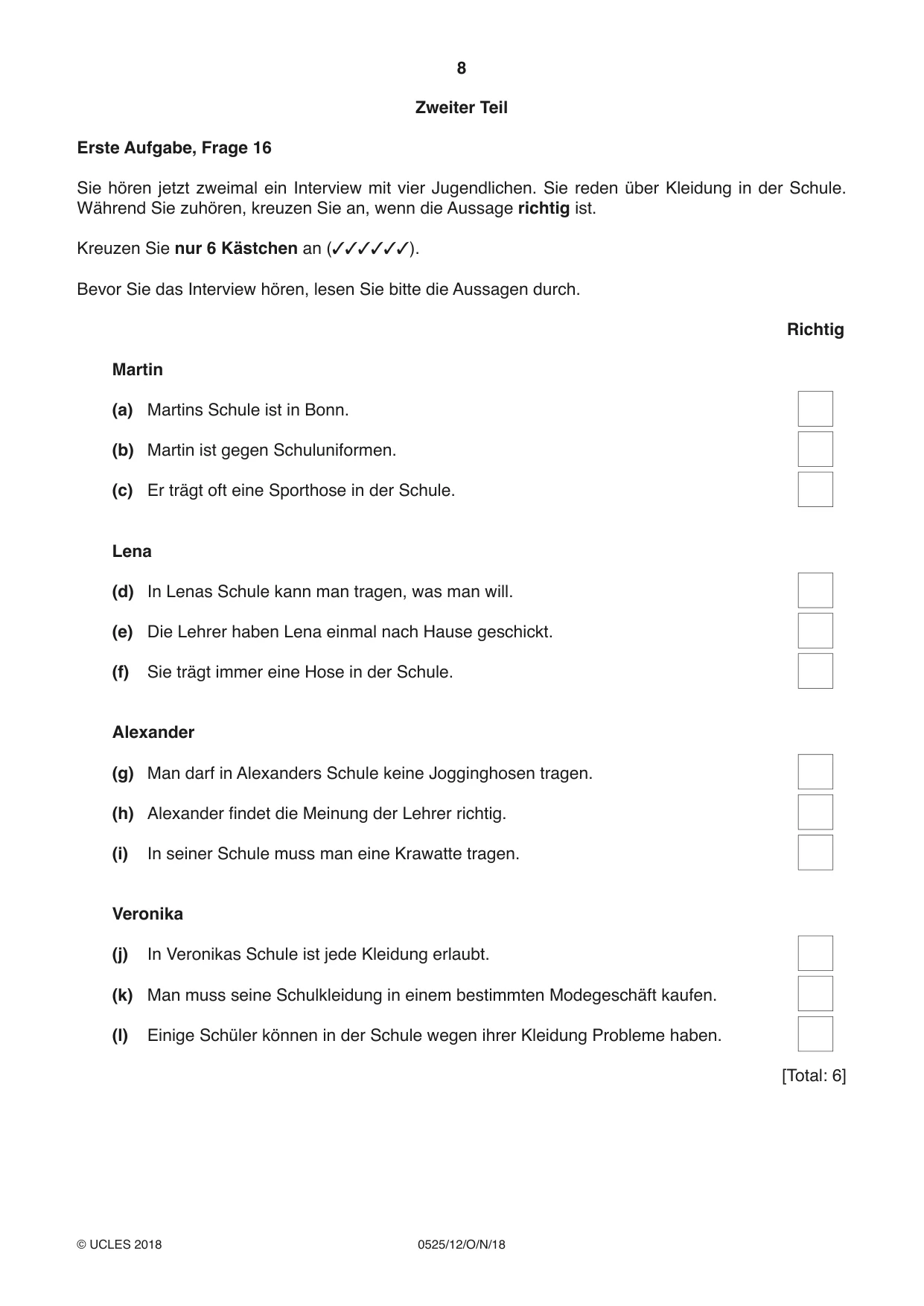
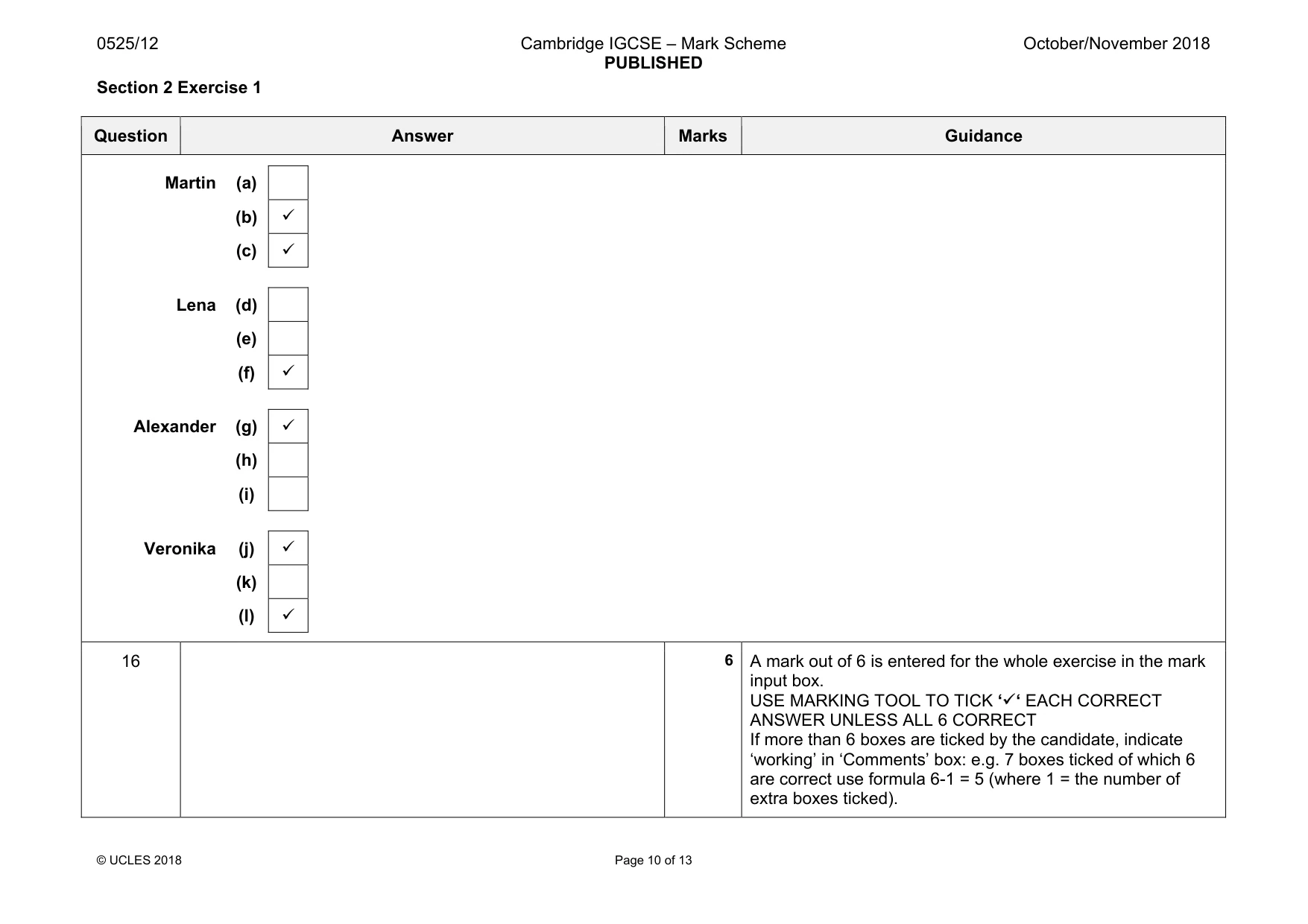
8 0525/12/O/N/18 © UCLES 2018 Zweiter Teil Erste Aufgabe, Frage 16 Sie hören jetzt zweimal ein Interview mit vier Jugendlichen. Sie reden über Kleidung in der Schule. Während Sie zuhören, kreuzen Sie an, wenn die Aussage richtig ist. Kreuzen Sie nur 6 Kästchen an (333333). Bevor Sie das Interview hören, lesen Sie bitte die Aussagen durch. Richtig Martin (a) Martins Schule ist in Bonn. (b) Martin ist gegen Schuluniformen. (c) Er trägt oft eine Sporthose in der Schule. Lena (d) In Lenas Schule kann man tragen, was man will. (e) Die Lehrer haben Lena einmal nach Hause geschickt. (f) Sie trägt immer eine Hose in der Schule. Alexander (g) Man darf in Alexanders Schule keine Jogginghosen tragen. (h) Alexander findet die Meinung der Lehrer richtig. (i) In seiner Schule muss man eine Krawatte tragen. Veronika (j) In Veronikas Schule ist jede Kleidung erlaubt. (k) Man muss seine Schulkleidung in einem bestimmten Modegeschäft kaufen. (l) Einige Schüler können in der Schule wegen ihrer Kleidung Probleme haben. [Total: 6]
Question paper, page 9
9 0525/12/O/N/18 © UCLES 2018 [Turn over BLANK PAGE
Question paper, page 10
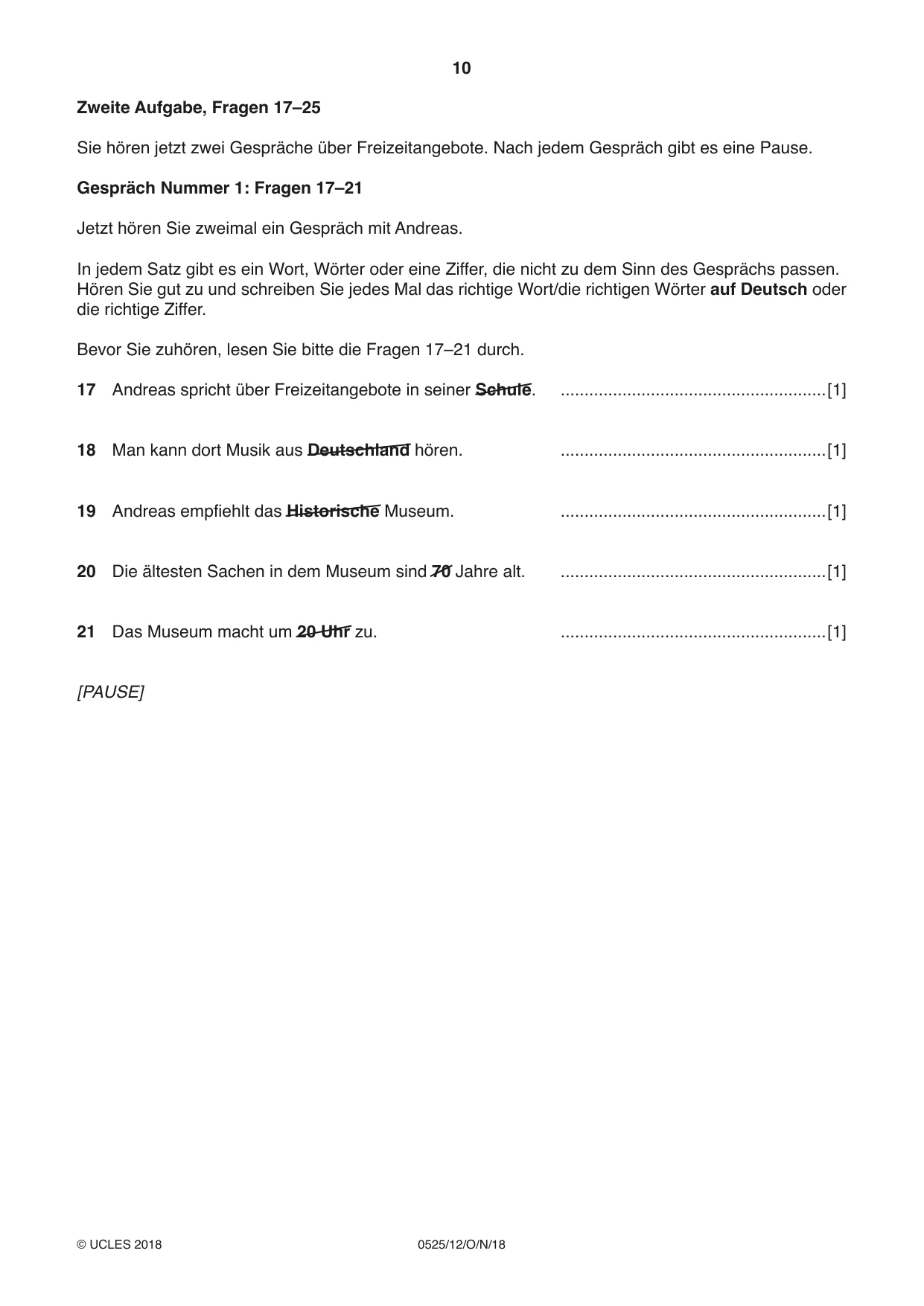
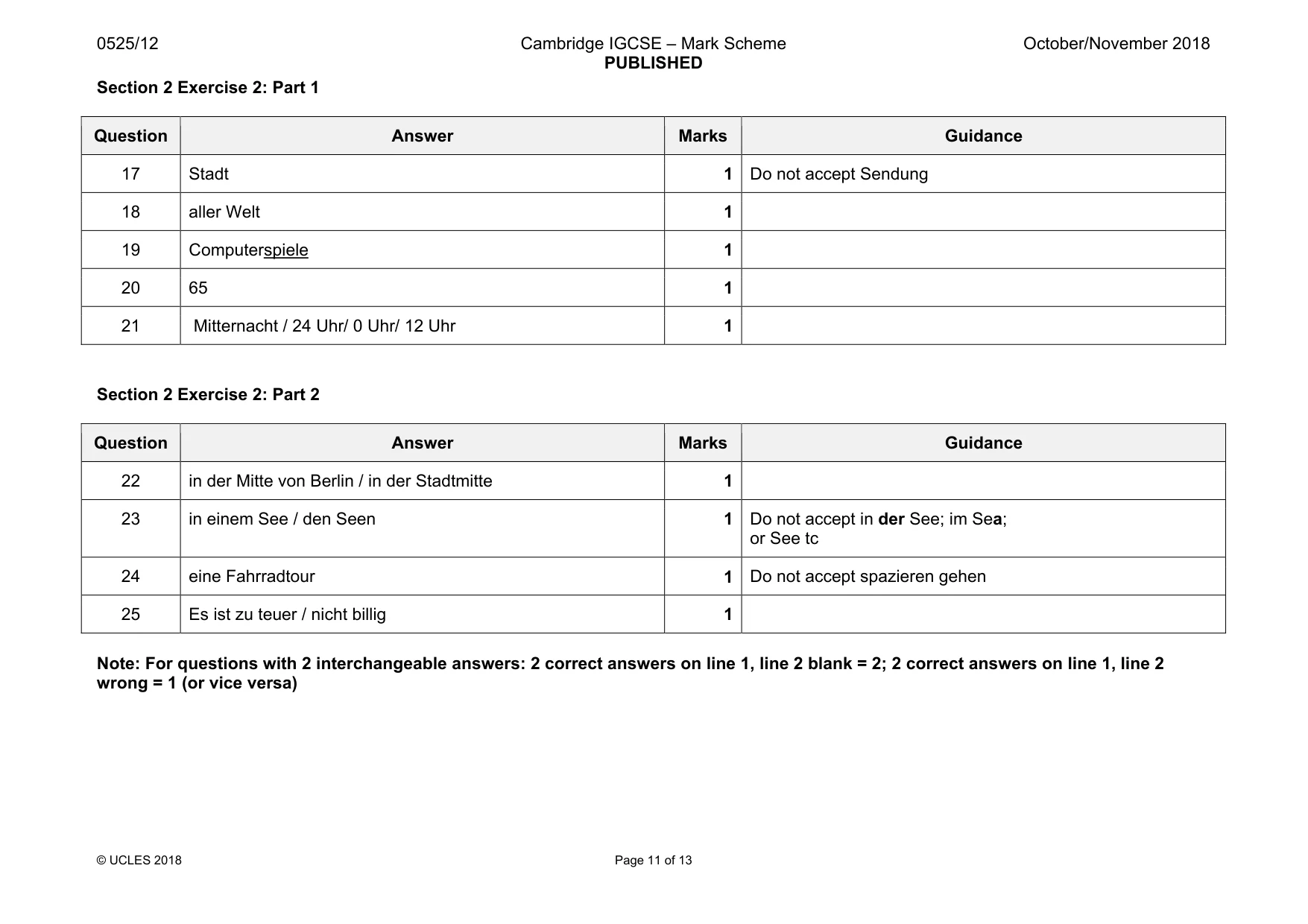
10 0525/12/O/N/18 © UCLES 2018 Zweite Aufgabe, Fragen 17–25 Sie hören jetzt zwei Gespräche über Freizeitangebote. Nach jedem Gespräch gibt es eine Pause. Gespräch Nummer 1: Fragen 17–21 Jetzt hören Sie zweimal ein Gespräch mit Andreas. In jedem Satz gibt es ein Wort, Wörter oder eine Ziffer, die nicht zu dem Sinn des Gesprächs passen. Hören Sie gut zu und schreiben Sie jedes Mal das richtige Wort/die richtigen Wörter auf Deutsch oder die richtige Ziffer. Bevor Sie zuhören, lesen Sie bitte die Fragen 17–21 durch. 17 Andreas spricht über Freizeitangebote in seiner Schule. …[1] 18 Man kann dort Musik aus Deutschland hören. …[1] 19 Andreas empfiehlt das Historische Museum. …[1] 20 Die ältesten Sachen in dem Museum sind 70 Jahre alt. …[1] 21 Das Museum macht um 20 Uhr zu. …[1] [PAUSE]
Question paper, page 11
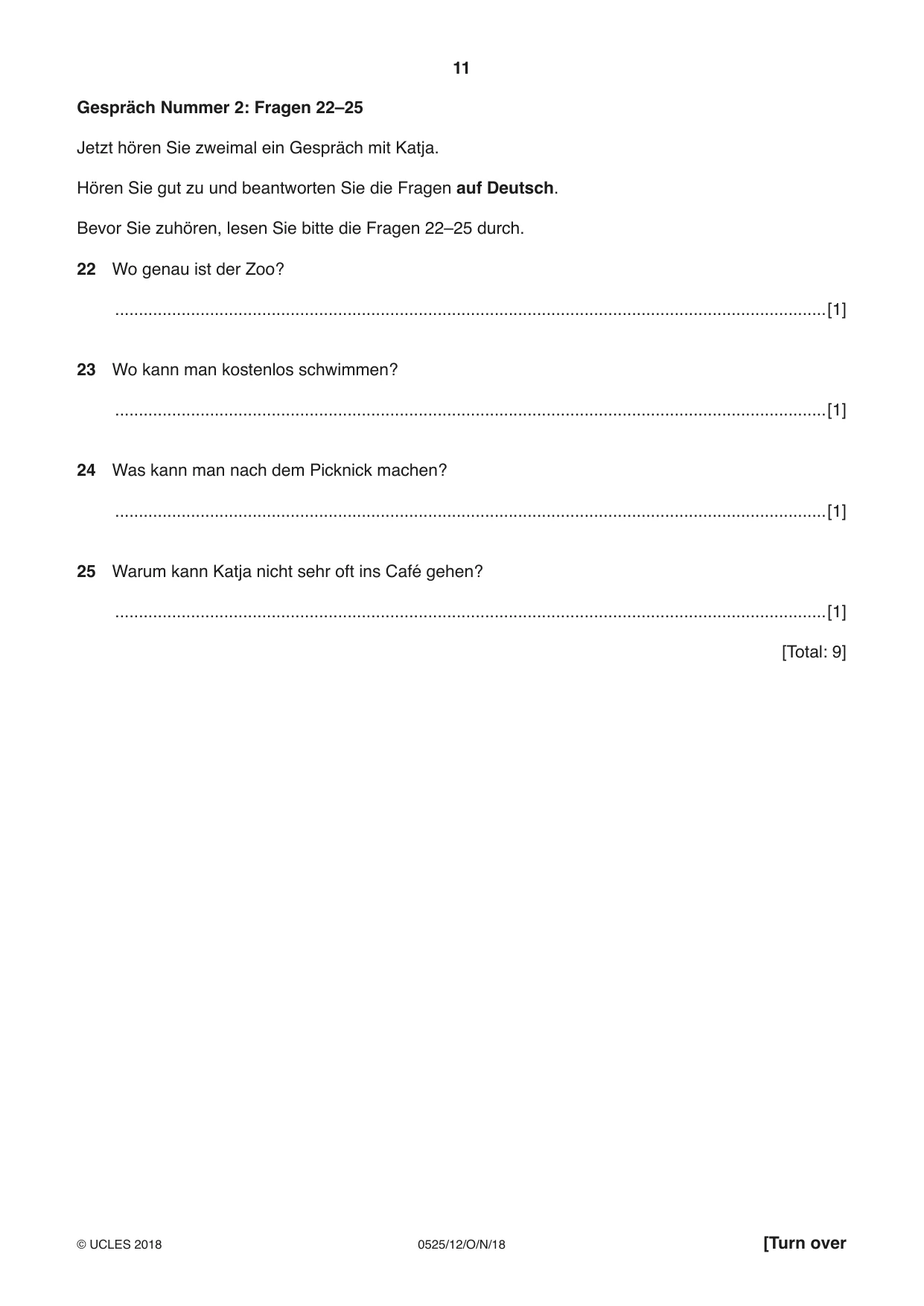
11 0525/12/O/N/18 © UCLES 2018 [Turn over Gespräch Nummer 2: Fragen 22–25 Jetzt hören Sie zweimal ein Gespräch mit Katja. Hören Sie gut zu und beantworten Sie die Fragen auf Deutsch. Bevor Sie zuhören, lesen Sie bitte die Fragen 22–25 durch. 22 Wo genau ist der Zoo? …[1] 23 Wo kann man kostenlos schwimmen? …[1] 24 Was kann man nach dem Picknick machen? …[1] 25 Warum kann Katja nicht sehr oft ins Café gehen? …[1] [Total: 9]
Question paper, page 12
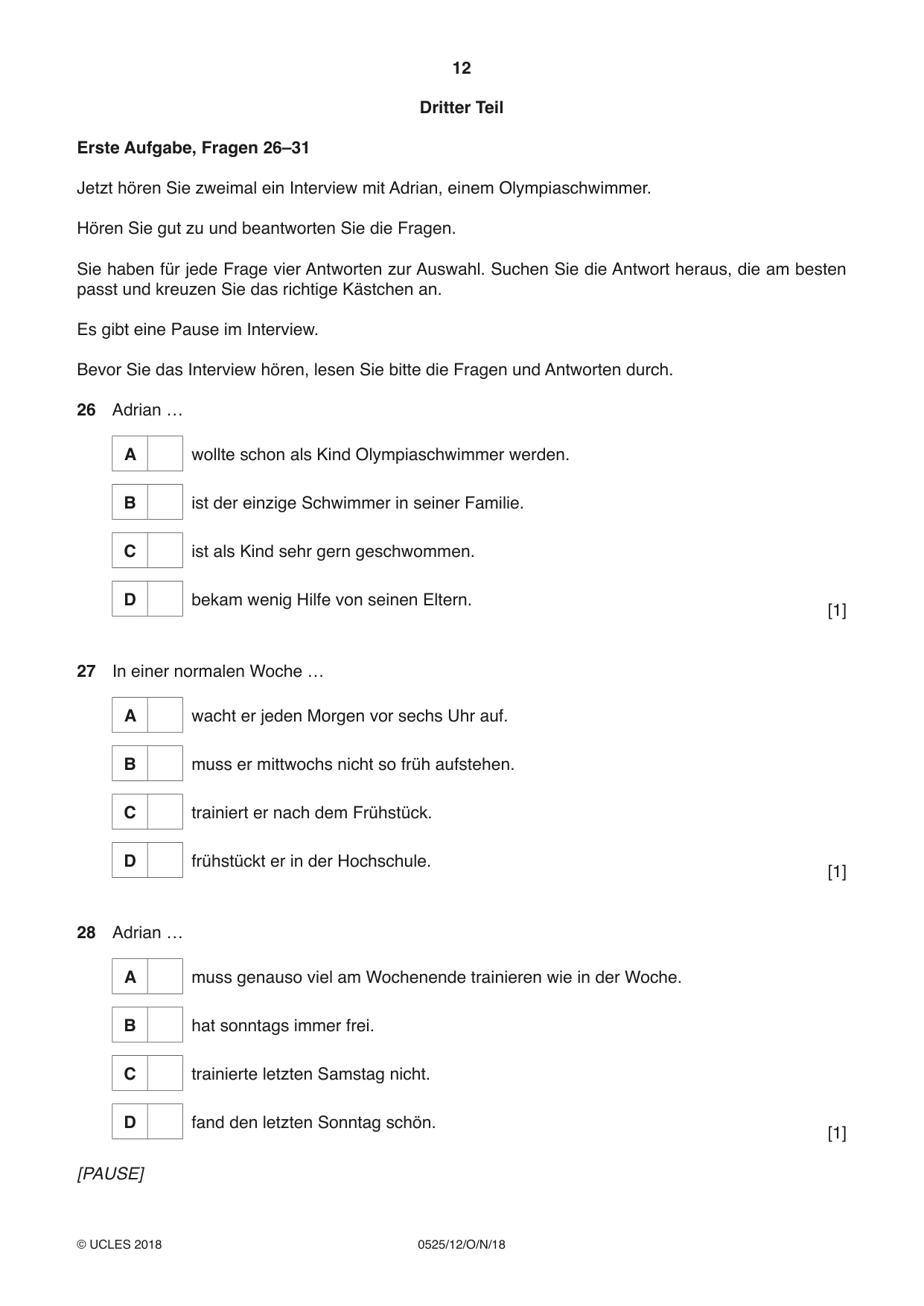
12 0525/12/O/N/18 © UCLES 2018 Dritter Teil Erste Aufgabe, Fragen 26–31 Jetzt hören Sie zweimal ein Interview mit Adrian, einem Olympiaschwimmer. Hören Sie gut zu und beantworten Sie die Fragen. Sie haben für jede Frage vier Antworten zur Auswahl. Suchen Sie die Antwort heraus, die am besten passt und kreuzen Sie das richtige Kästchen an. Es gibt eine Pause im Interview. Bevor Sie das Interview hören, lesen Sie bitte die Fragen und Antworten durch. 26 Adrian … A wollte schon als Kind Olympiaschwimmer werden. B ist der einzige Schwimmer in seiner Familie. C ist als Kind sehr gern geschwommen. D bekam wenig Hilfe von seinen Eltern. [1] 27 In einer normalen Woche … A wacht er jeden Morgen vor sechs Uhr auf. B muss er mittwochs nicht so früh aufstehen. C trainiert er nach dem Frühstück. D frühstückt er in der Hochschule. [1] 28 Adrian … A muss genauso viel am Wochenende trainieren wie in der Woche. B hat sonntags immer frei. C trainierte letzten Samstag nicht. D fand den letzten Sonntag schön. [1] [PAUSE]
Question paper, page 13
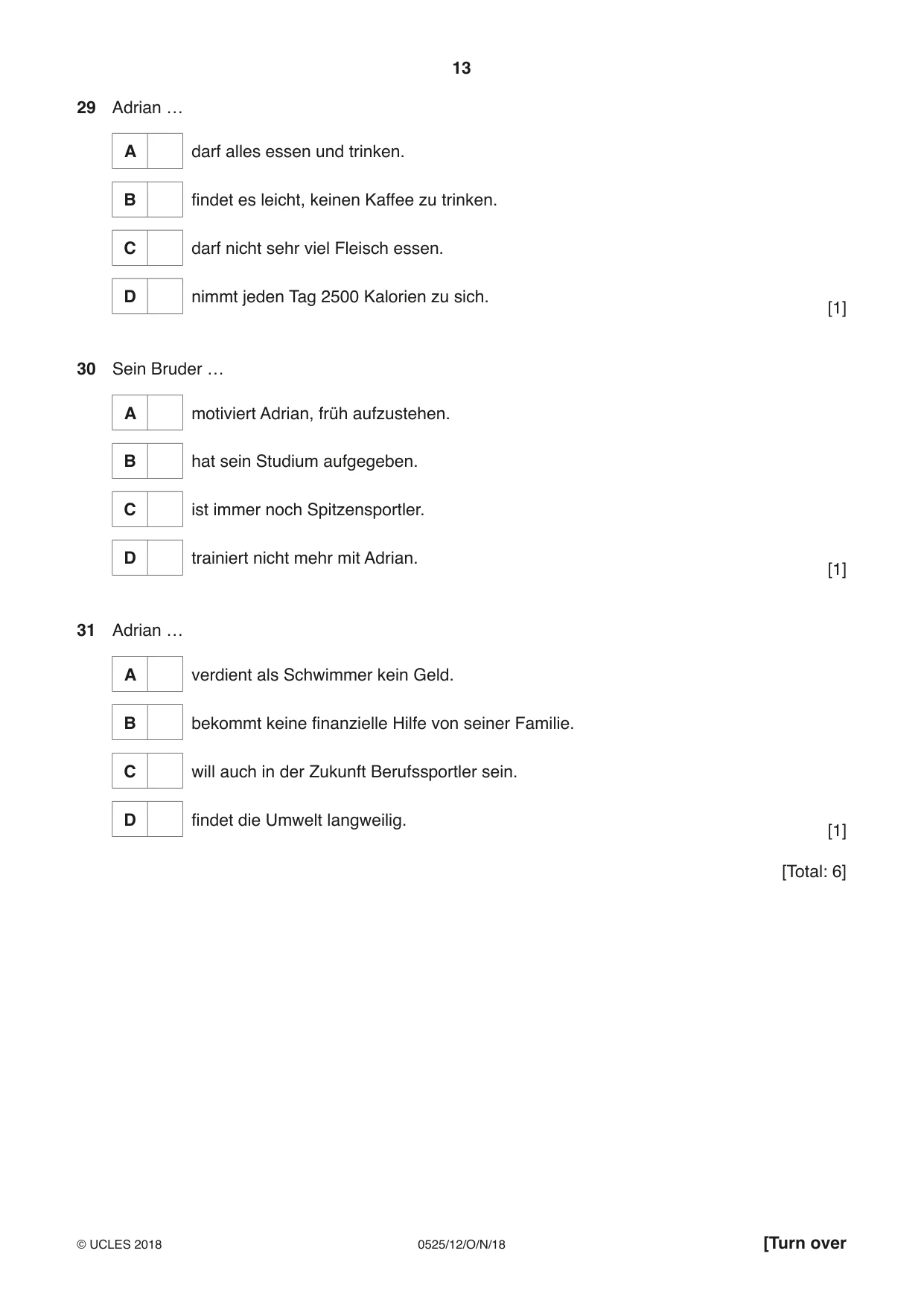
13 0525/12/O/N/18 © UCLES 2018 [Turn over 29 Adrian … A darf alles essen und trinken. B findet es leicht, keinen Kaffee zu trinken. C darf nicht sehr viel Fleisch essen. D nimmt jeden Tag 2500 Kalorien zu sich. [1] 30 Sein Bruder … A motiviert Adrian, früh aufzustehen. B hat sein Studium aufgegeben. C ist immer noch Spitzensportler. D trainiert nicht mehr mit Adrian. [1] 31 Adrian … A verdient als Schwimmer kein Geld. B bekommt keine finanzielle Hilfe von seiner Familie. C will auch in der Zukunft Berufssportler sein. D findet die Umwelt langweilig. [1] [Total: 6]
Question paper, page 14
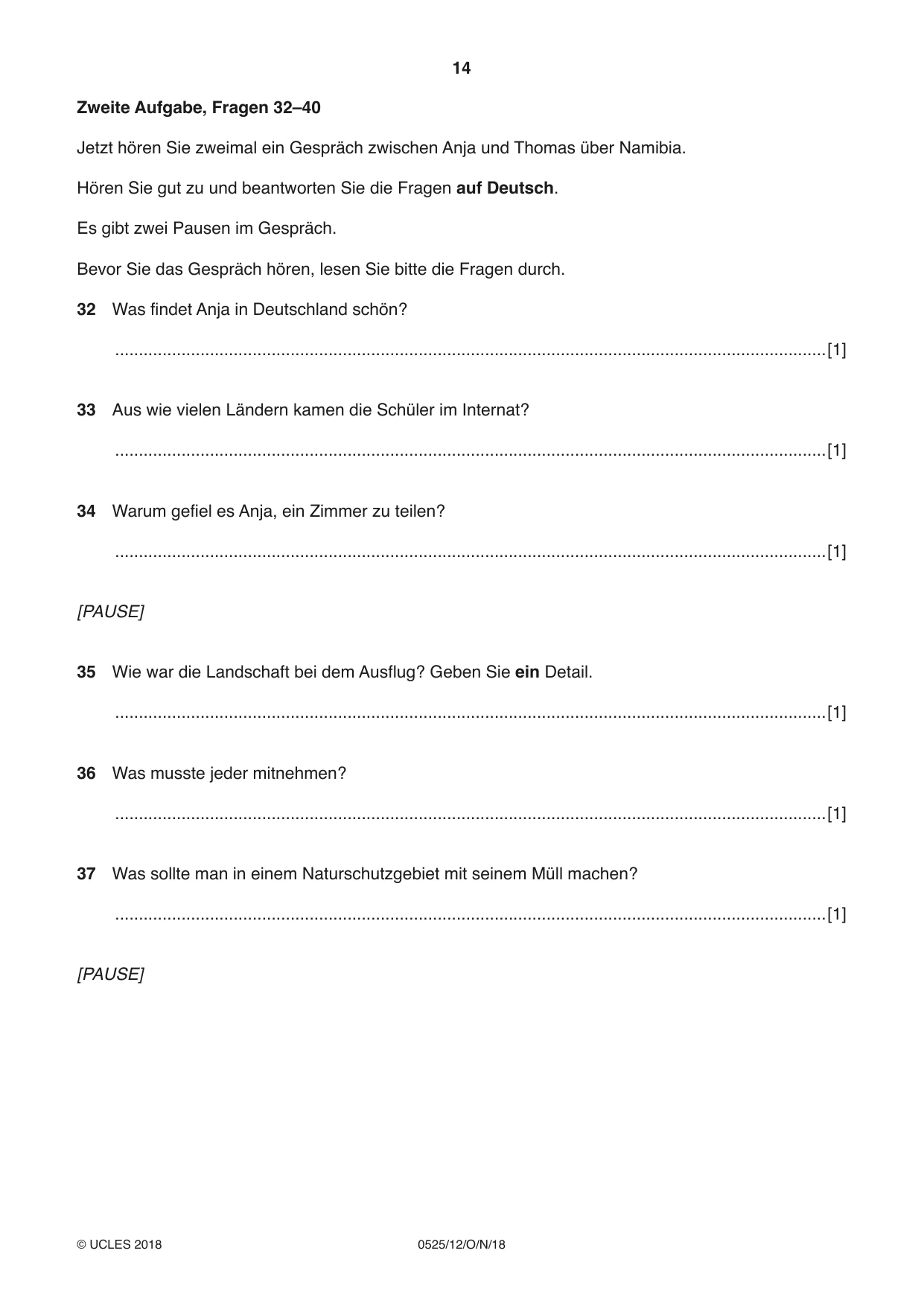
14 0525/12/O/N/18 © UCLES 2018 Zweite Aufgabe, Fragen 32–40 Jetzt hören Sie zweimal ein Gespräch zwischen Anja und Thomas über Namibia. Hören Sie gut zu und beantworten Sie die Fragen auf Deutsch. Es gibt zwei Pausen im Gespräch. Bevor Sie das Gespräch hören, lesen Sie bitte die Fragen durch. 32 Was findet Anja in Deutschland schön? …[1] 33 Aus wie vielen Ländern kamen die Schüler im Internat? …[1] 34 Warum gefiel es Anja, ein Zimmer zu teilen? …[1] [PAUSE] 35 Wie war die Landschaft bei dem Ausflug? Geben Sie ein Detail. …[1] 36 Was musste jeder mitnehmen? …[1] 37 Was sollte man in einem Naturschutzgebiet mit seinem Müll machen? …[1] [PAUSE]
Question paper, page 15
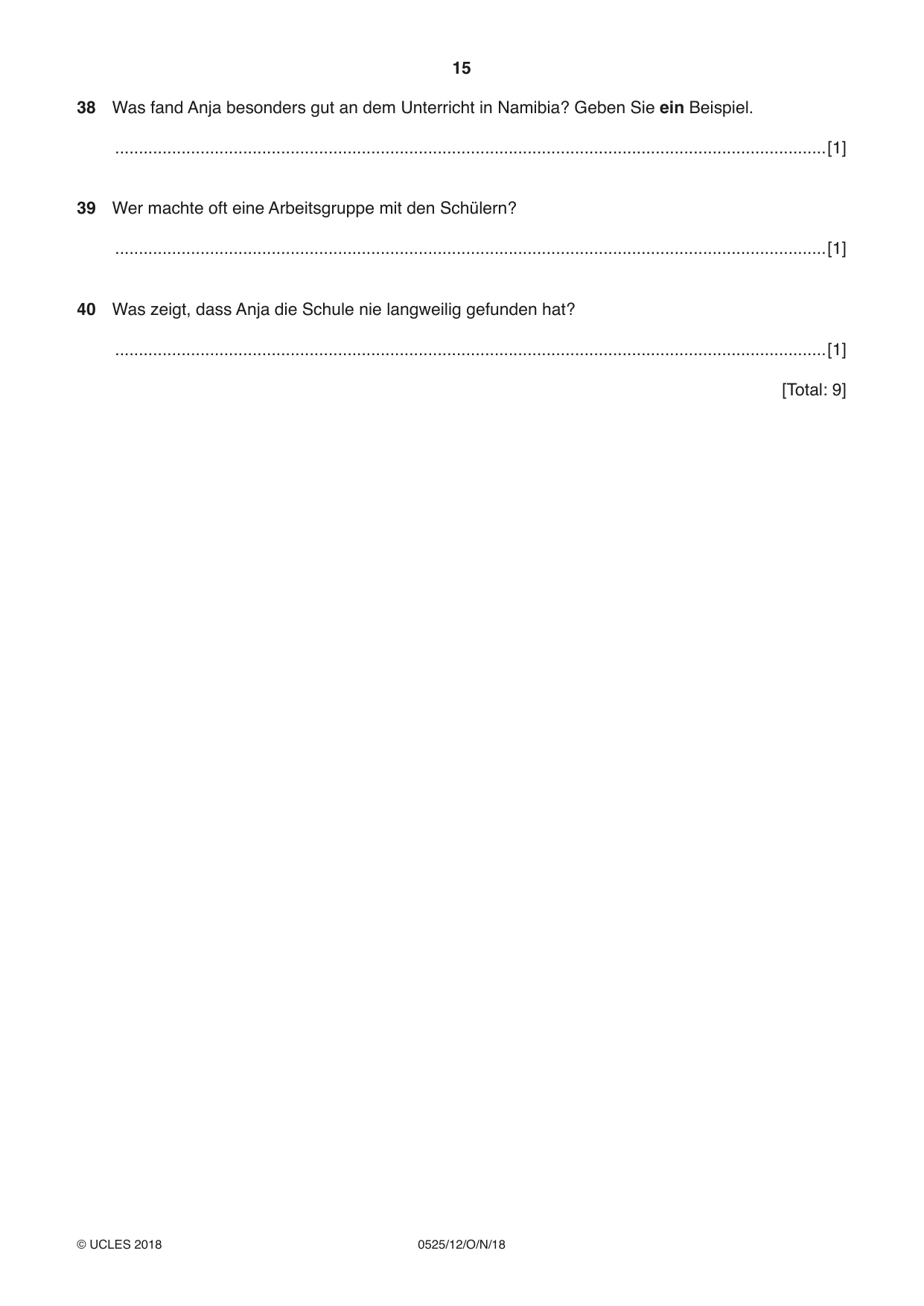
15 0525/12/O/N/18 © UCLES 2018 38 Was fand Anja besonders gut an dem Unterricht in Namibia? Geben Sie ein Beispiel. …[1] 39 Wer machte oft eine Arbeitsgruppe mit den Schülern? …[1] 40 Was zeigt, dass Anja die Schule nie langweilig gefunden hat? …[1] [Total: 9]
Question paper, page 16
16 0525/12/O/N/18 © UCLES 2018 Permission to reproduce items where third-party owned material protected by copyright is included has been sought and cleared where possible. Every reasonable effort has been made by the publisher (UCLES) to trace copyright holders, but if any items requiring clearance have unwittingly been included, the publisher will be pleased to make amends at the earliest possible opportunity. To avoid the issue of disclosure of answer-related information to candidates, all copyright acknowledgements are reproduced online in the Cambridge International Examinations Copyright Acknowledgements Booklet. This is produced for each series of examinations and is freely available to download at www.cie.org.uk after the live examination series. Cambridge International Examinations is part of the Cambridge Assessment Group. Cambridge Assessment is the brand name of University of Cambridge Local Examinations Syndicate (UCLES), which is itself a department of the University of Cambridge. BLANK PAGE
Mark scheme, page 1
This syllabus is approved for use in England, Wales and Northern Ireland as a Cambridge International Level 1/Level 2 Certificate. This document consists of 13 printed pages. © UCLES 2018 [Turn over Cambridge Assessment International Education Cambridge International General Certificate of Secondary Education FOREIGN LANGUAGE GERMAN 0525/12 Paper 1 Listening October/November 2018 MARK SCHEME Maximum Mark: 45 Published This mark scheme is published as an aid to teachers and candidates, to indicate the requirements of the examination. It shows the basis on which Examiners were instructed to award marks. It does not indicate the details of the discussions that took place at an Examiners’ meeting before marking began, which would have considered the acceptability of alternative answers. Mark schemes should be read in conjunction with the question paper and the Principal Examiner Report for Teachers. Cambridge International will not enter into discussions about these mark schemes. Cambridge International is publishing the mark schemes for the October/November 2018 series for most Cambridge IGCSE™, Cambridge International A and AS Level components and some Cambridge O Level components.
Mark scheme, page 2
0525/12 Cambridge IGCSE – Mark Scheme PUBLISHED October/November 2018 © UCLES 2018 Page 2 of 13 1 Generic Marking Principles These general marking principles must be applied by all examiners when marking candidate answers. They should be applied alongside the specific content of the mark scheme or generic level descriptors for a question. Each question paper and mark scheme will also comply with these marking principles. GENERIC MARKING PRINCIPLE 1: Marks must be awarded in line with: • the specific content of the mark scheme or the generic level descriptors for the question • the specific skills defined in the mark scheme or in the generic level descriptors for the question • the standard of response required by a candidate as exemplified by the standardisation scripts. GENERIC MARKING PRINCIPLE 2: Marks awarded are always whole marks (not half marks, or other fractions). GENERIC MARKING PRINCIPLE 3: Marks must be awarded positively: • marks are awarded for correct/valid answers, as defined in the mark scheme. However, credit is given for valid answers which go beyond the scope of the syllabus and mark scheme, referring to your Team Leader as appropriate • marks are awarded when candidates clearly demonstrate what they know and can do • marks are not deducted for errors • marks are not deducted for omissions • answers should only be judged on the quality of spelling, punctuation and grammar when these features are specifically assessed by the question as indicated by the mark scheme. The meaning, however, should be unambiguous. GENERIC MARKING PRINCIPLE 4: Rules must be applied consistently e.g. in situations where candidates have not followed instructions or in the application of generic level descriptors.
Mark scheme, page 3
0525/12 Cambridge IGCSE – Mark Scheme PUBLISHED October/November 2018 © UCLES 2018 Page 3 of 13 GENERIC MARKING PRINCIPLE 5: Marks should be awarded using the full range of marks defined in the mark scheme for the question (however; the use of the full mark range may be limited according to the quality of the candidate responses seen). GENERIC MARKING PRINCIPLE 6: Marks awarded are based solely on the requirements as defined in the mark scheme. Marks should not be awarded with grade thresholds or grade descriptors in mind.
Mark scheme, page 4
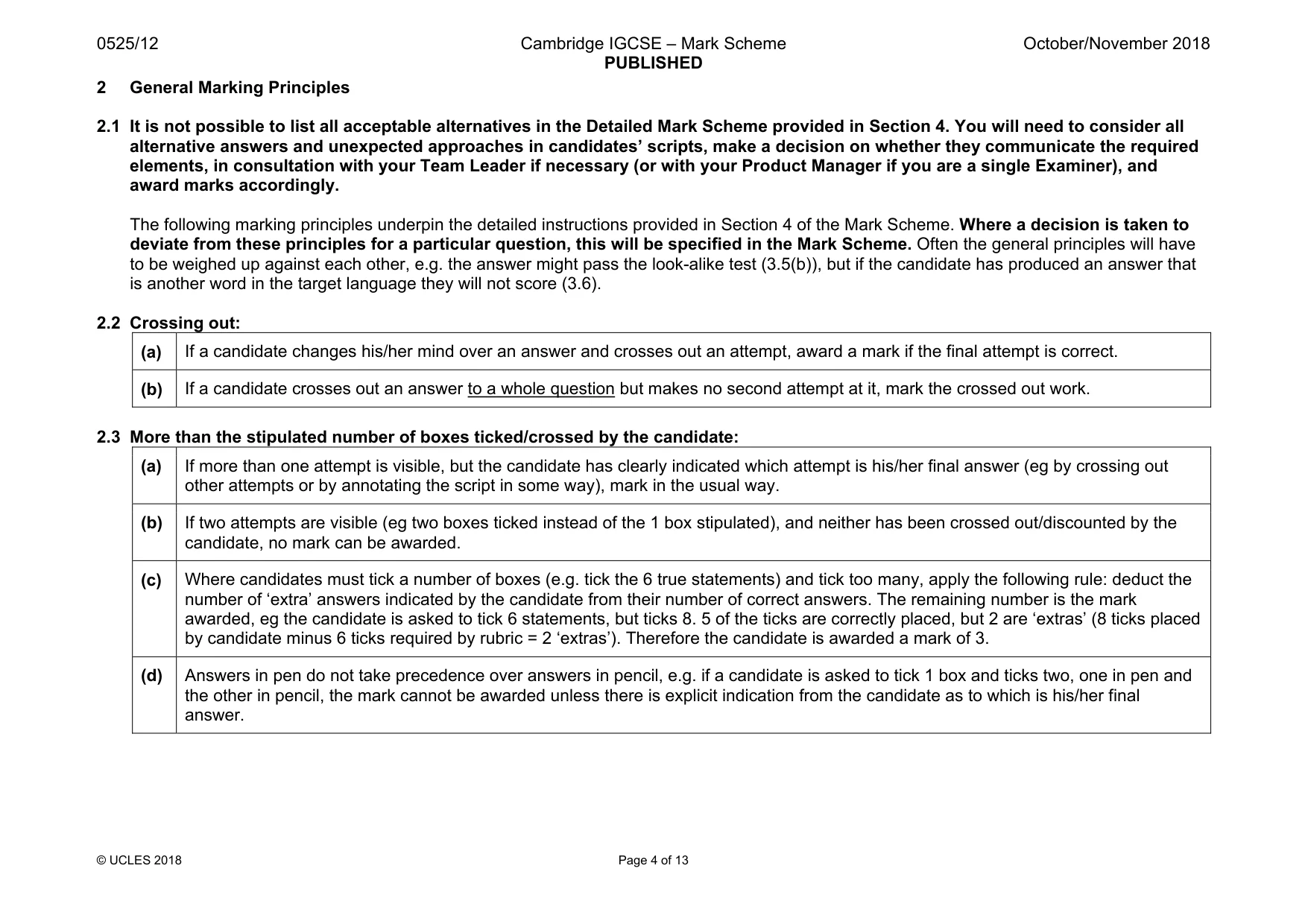
0525/12 Cambridge IGCSE – Mark Scheme PUBLISHED October/November 2018 © UCLES 2018 Page 4 of 13 2 General Marking Principles 2.1 It is not possible to list all acceptable alternatives in the Detailed Mark Scheme provided in Section 4. You will need to consider all alternative answers and unexpected approaches in candidates’ scripts, make a decision on whether they communicate the required elements, in consultation with your Team Leader if necessary (or with your Product Manager if you are a single Examiner), and award marks accordingly. The following marking principles underpin the detailed instructions provided in Section 4 of the Mark Scheme. Where a decision is taken to deviate from these principles for a particular question, this will be specified in the Mark Scheme. Often the general principles will have to be weighed up against each other, e.g. the answer might pass the look-alike test (3.5(b)), but if the candidate has produced an answer that is another word in the target language they will not score (3.6). 2.2 Crossing out: (a) If a candidate changes his/her mind over an answer and crosses out an attempt, award a mark if the final attempt is correct. (b) If a candidate crosses out an answer to a whole question but makes no second attempt at it, mark the crossed out work. 2.3 More than the stipulated number of boxes ticked/crossed by the candidate: (a) If more than one attempt is visible, but the candidate has clearly indicated which attempt is his/her final answer (eg by crossing out other attempts or by annotating the script in some way), mark in the usual way. (b) If two attempts are visible (eg two boxes ticked instead of the 1 box stipulated), and neither has been crossed out/discounted by the candidate, no mark can be awarded. (c) Where candidates must tick a number of boxes (e.g. tick the 6 true statements) and tick too many, apply the following rule: deduct the number of ‘extra’ answers indicated by the candidate from their number of correct answers. The remaining number is the mark awarded, eg the candidate is asked to tick 6 statements, but ticks 8. 5 of the ticks are correctly placed, but 2 are ‘extras’ (8 ticks placed by candidate minus 6 ticks required by rubric = 2 ‘extras’). Therefore the candidate is awarded a mark of 3. (d) Answers in pen do not take precedence over answers in pencil, e.g. if a candidate is asked to tick 1 box and ticks two, one in pen and the other in pencil, the mark cannot be awarded unless there is explicit indication from the candidate as to which is his/her final answer.
Mark scheme, page 5
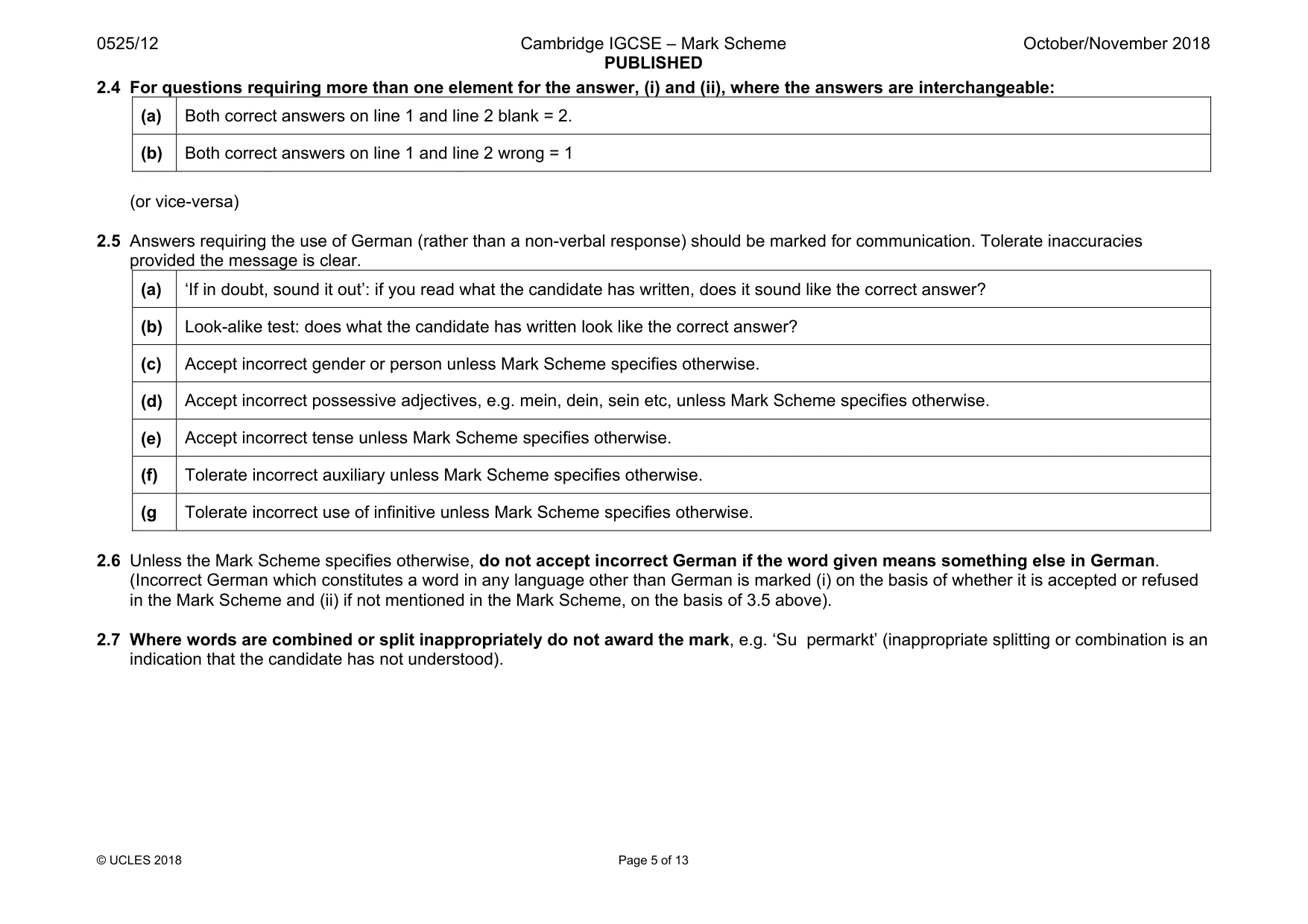
0525/12 Cambridge IGCSE – Mark Scheme PUBLISHED October/November 2018 © UCLES 2018 Page 5 of 13 2.4 For questions requiring more than one element for the answer, (i) and (ii), where the answers are interchangeable: (a) Both correct answers on line 1 and line 2 blank = 2. (b) Both correct answers on line 1 and line 2 wrong = 1 (or vice-versa) 2.5 Answers requiring the use of German (rather than a non-verbal response) should be marked for communication. Tolerate inaccuracies provided the message is clear. (a) ‘If in doubt, sound it out’: if you read what the candidate has written, does it sound like the correct answer? (b) Look-alike test: does what the candidate has written look like the correct answer? (c) Accept incorrect gender or person unless Mark Scheme specifies otherwise. (d) Accept incorrect possessive adjectives, e.g. mein, dein, sein etc, unless Mark Scheme specifies otherwise. (e) Accept incorrect tense unless Mark Scheme specifies otherwise. (f) Tolerate incorrect auxiliary unless Mark Scheme specifies otherwise. (g Tolerate incorrect use of infinitive unless Mark Scheme specifies otherwise. 2.6 Unless the Mark Scheme specifies otherwise, do not accept incorrect German if the word given means something else in German. (Incorrect German which constitutes a word in any language other than German is marked (i) on the basis of whether it is accepted or refused in the Mark Scheme and (ii) if not mentioned in the Mark Scheme, on the basis of 3.5 above). 2.7 Where words are combined or split inappropriately do not award the mark, e.g. ‘Su permarkt’ (inappropriate splitting or combination is an indication that the candidate has not understood).
Mark scheme, page 6
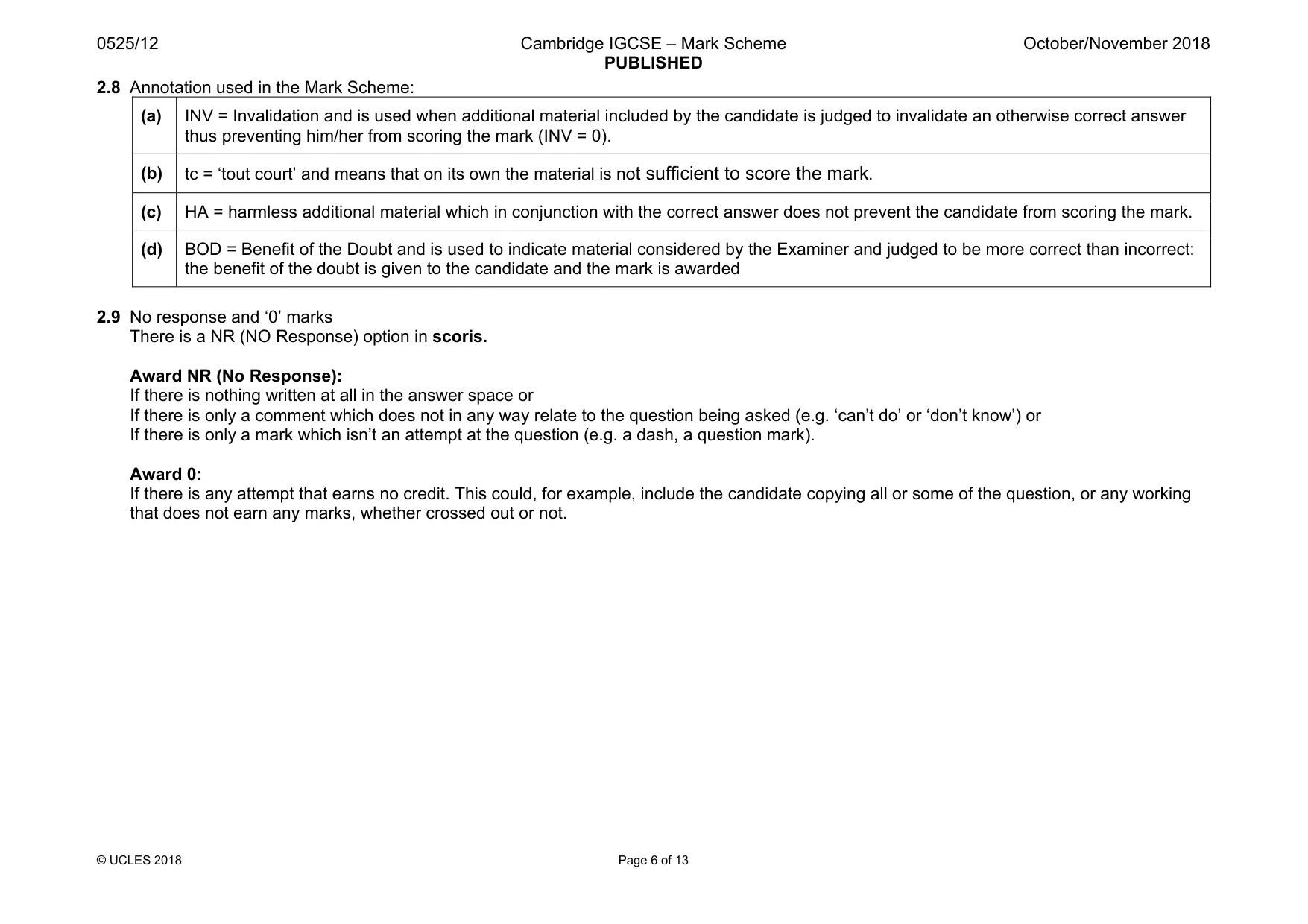
0525/12 Cambridge IGCSE – Mark Scheme PUBLISHED October/November 2018 © UCLES 2018 Page 6 of 13 2.8 Annotation used in the Mark Scheme: (a) INV = Invalidation and is used when additional material included by the candidate is judged to invalidate an otherwise correct answer thus preventing him/her from scoring the mark (INV = 0). (b) tc = ‘tout court’ and means that on its own the material is not sufficient to score the mark. (c) HA = harmless additional material which in conjunction with the correct answer does not prevent the candidate from scoring the mark. (d) BOD = Benefit of the Doubt and is used to indicate material considered by the Examiner and judged to be more correct than incorrect: the benefit of the doubt is given to the candidate and the mark is awarded 2.9 No response and ‘0’ marks There is a NR (NO Response) option in scoris. Award NR (No Response): If there is nothing written at all in the answer space or If there is only a comment which does not in any way relate to the question being asked (e.g. ‘can’t do’ or ‘don’t know’) or If there is only a mark which isn’t an attempt at the question (e.g. a dash, a question mark). Award 0: If there is any attempt that earns no credit. This could, for example, include the candidate copying all or some of the question, or any working that does not earn any marks, whether crossed out or not.
Mark scheme, page 7
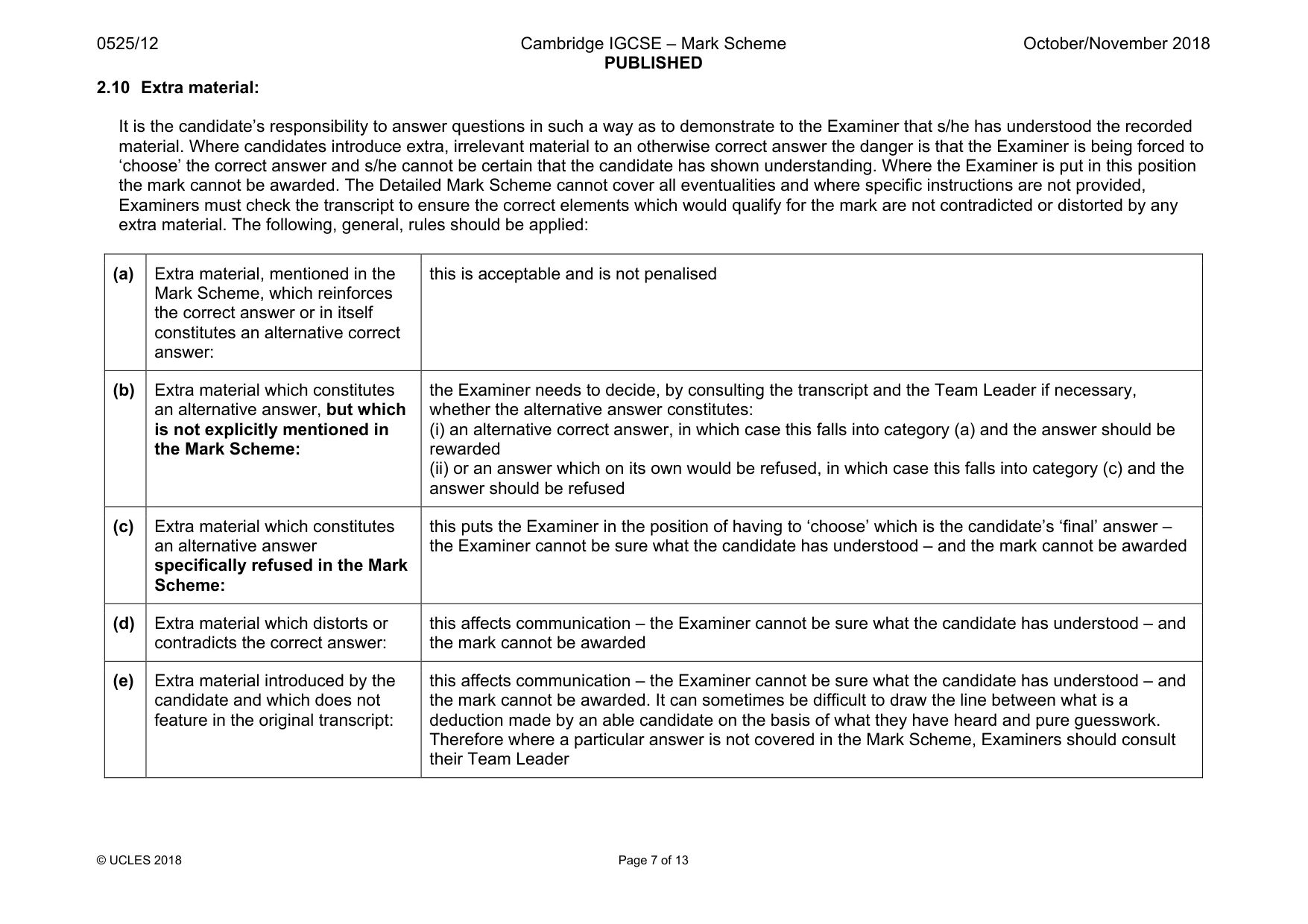
0525/12 Cambridge IGCSE – Mark Scheme PUBLISHED October/November 2018 © UCLES 2018 Page 7 of 13 2.10 Extra material: It is the candidate’s responsibility to answer questions in such a way as to demonstrate to the Examiner that s/he has understood the recorded material. Where candidates introduce extra, irrelevant material to an otherwise correct answer the danger is that the Examiner is being forced to ‘choose’ the correct answer and s/he cannot be certain that the candidate has shown understanding. Where the Examiner is put in this position the mark cannot be awarded. The Detailed Mark Scheme cannot cover all eventualities and where specific instructions are not provided, Examiners must check the transcript to ensure the correct elements which would qualify for the mark are not contradicted or distorted by any extra material. The following, general, rules should be applied: (a) Extra material, mentioned in the Mark Scheme, which reinforces the correct answer or in itself constitutes an alternative correct answer: this is acceptable and is not penalised (b) Extra material which constitutes an alternative answer, but which is not explicitly mentioned in the Mark Scheme: the Examiner needs to decide, by consulting the transcript and the Team Leader if necessary, whether the alternative answer constitutes: (i) an alternative correct answer, in which case this falls into category (a) and the answer should be rewarded (ii) or an answer which on its own would be refused, in which case this falls into category (c) and the answer should be refused (c) Extra material which constitutes an alternative answer specifically refused in the Mark Scheme: this puts the Examiner in the position of having to ‘choose’ which is the candidate’s ‘final’ answer – the Examiner cannot be sure what the candidate has understood – and the mark cannot be awarded (d) Extra material which distorts or contradicts the correct answer: this affects communication – the Examiner cannot be sure what the candidate has understood – and the mark cannot be awarded (e) Extra material introduced by the candidate and which does not feature in the original transcript: this affects communication – the Examiner cannot be sure what the candidate has understood – and the mark cannot be awarded. It can sometimes be difficult to draw the line between what is a deduction made by an able candidate on the basis of what they have heard and pure guesswork. Therefore where a particular answer is not covered in the Mark Scheme, Examiners should consult their Team Leader
Mark scheme, page 8
0525/12 Cambridge IGCSE – Mark Scheme PUBLISHED October/November 2018 © UCLES 2018 Page 8 of 13 3 Detailed Mark Scheme Section 1 Exercise 1 Question Answer Marks Guidance 1 C 1 2 B 1 3 D 1 4 B 1 5 A 1 6 C 1 7 D 1 8 A 1
Mark scheme, page 9
0525/12 Cambridge IGCSE – Mark Scheme PUBLISHED October/November 2018 © UCLES 2018 Page 9 of 13 Section 1 Exercise 2 Question Answer Marks Guidance 9 B 1 10 C 1 11 17 1 12 Abendessen 1 13 B 1 14 A 1 15 C 1
Mark scheme, page 10
0525/12 Cambridge IGCSE – Mark Scheme PUBLISHED October/November 2018 © UCLES 2018 Page 10 of 13 Section 2 Exercise 1 Question Answer Marks Guidance Martin (a) (b) 9 (c) 9 Lena (d) (e) (f) 9 Alexander (g) 9 (h) (i) Veronika (j) 9 (k) (l) 9 16 6 A mark out of 6 is entered for the whole exercise in the mark input box. USE MARKING TOOL TO TICK ‘9‘ EACH CORRECT ANSWER UNLESS ALL 6 CORRECT If more than 6 boxes are ticked by the candidate, indicate ‘working’ in ‘Comments’ box: e.g. 7 boxes ticked of which 6 are correct use formula 6-1 = 5 (where 1 = the number of extra boxes ticked).
Mark scheme, page 11
0525/12 Cambridge IGCSE – Mark Scheme PUBLISHED October/November 2018 © UCLES 2018 Page 11 of 13 Section 2 Exercise 2: Part 1 Question Answer Marks Guidance 17 Stadt 1 Do not accept Sendung 18 aller Welt 1 19 Computerspiele 1 20 65 1 21 Mitternacht / 24 Uhr/ 0 Uhr/ 12 Uhr 1 Section 2 Exercise 2: Part 2 Question Answer Marks Guidance 22 in der Mitte von Berlin / in der Stadtmitte 1 23 in einem See / den Seen 1 Do not accept in der See; im Sea; or See tc 24 eine Fahrradtour 1 Do not accept spazieren gehen 25 Es ist zu teuer / nicht billig 1 Note: For questions with 2 interchangeable answers: 2 correct answers on line 1, line 2 blank = 2; 2 correct answers on line 1, line 2 wrong = 1 (or vice versa)
Mark scheme, page 12
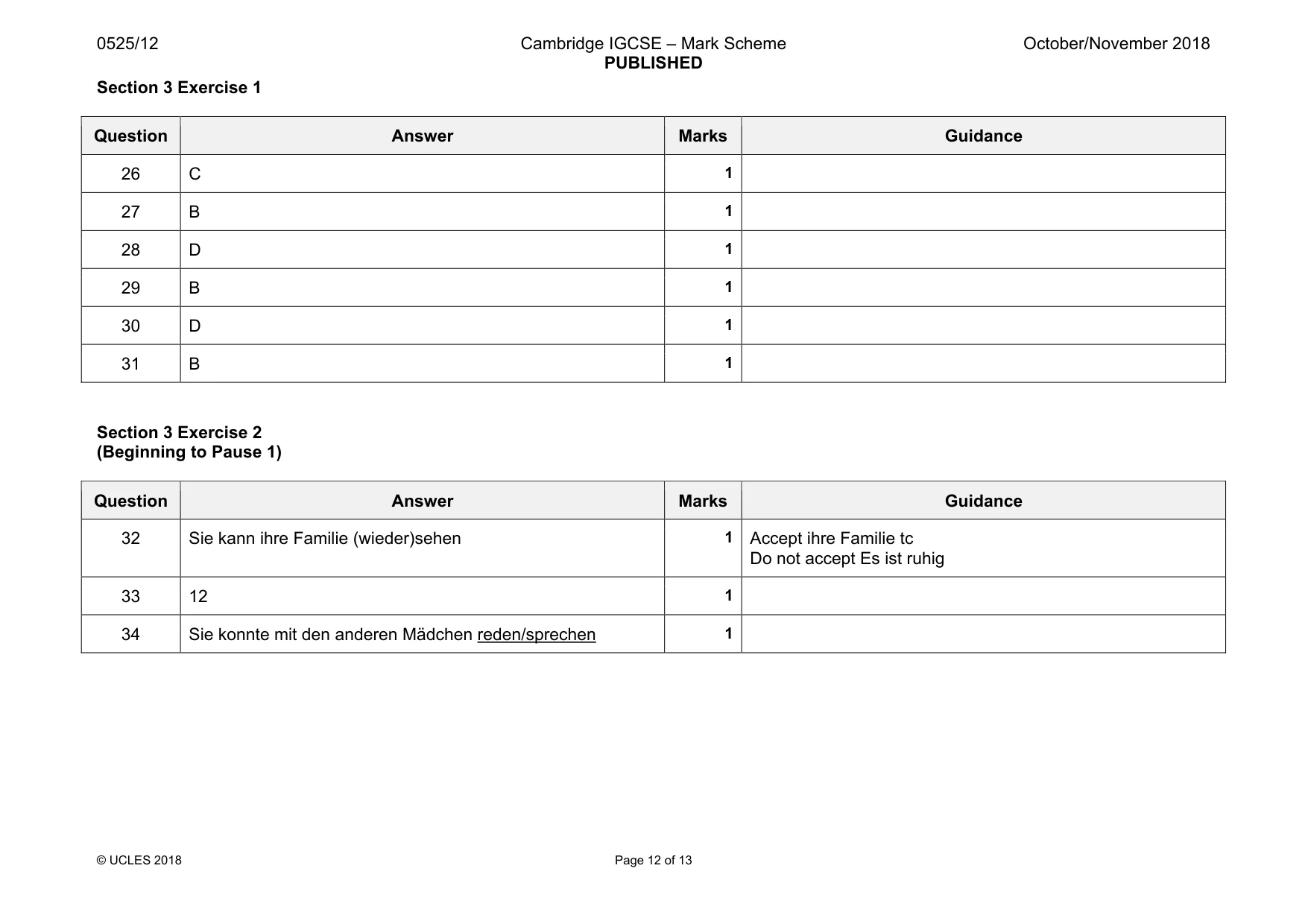
0525/12 Cambridge IGCSE – Mark Scheme PUBLISHED October/November 2018 © UCLES 2018 Page 12 of 13 Section 3 Exercise 1 Question Answer Marks Guidance 26 C 1 27 B 1 28 D 1 29 B 1 30 D 1 31 B 1 Section 3 Exercise 2 (Beginning to Pause 1) Question Answer Marks Guidance 32 Sie kann ihre Familie (wieder)sehen 1 Accept ihre Familie tc Do not accept Es ist ruhig 33 12 1 34 Sie konnte mit den anderen Mädchen reden/sprechen 1
Mark scheme, page 13
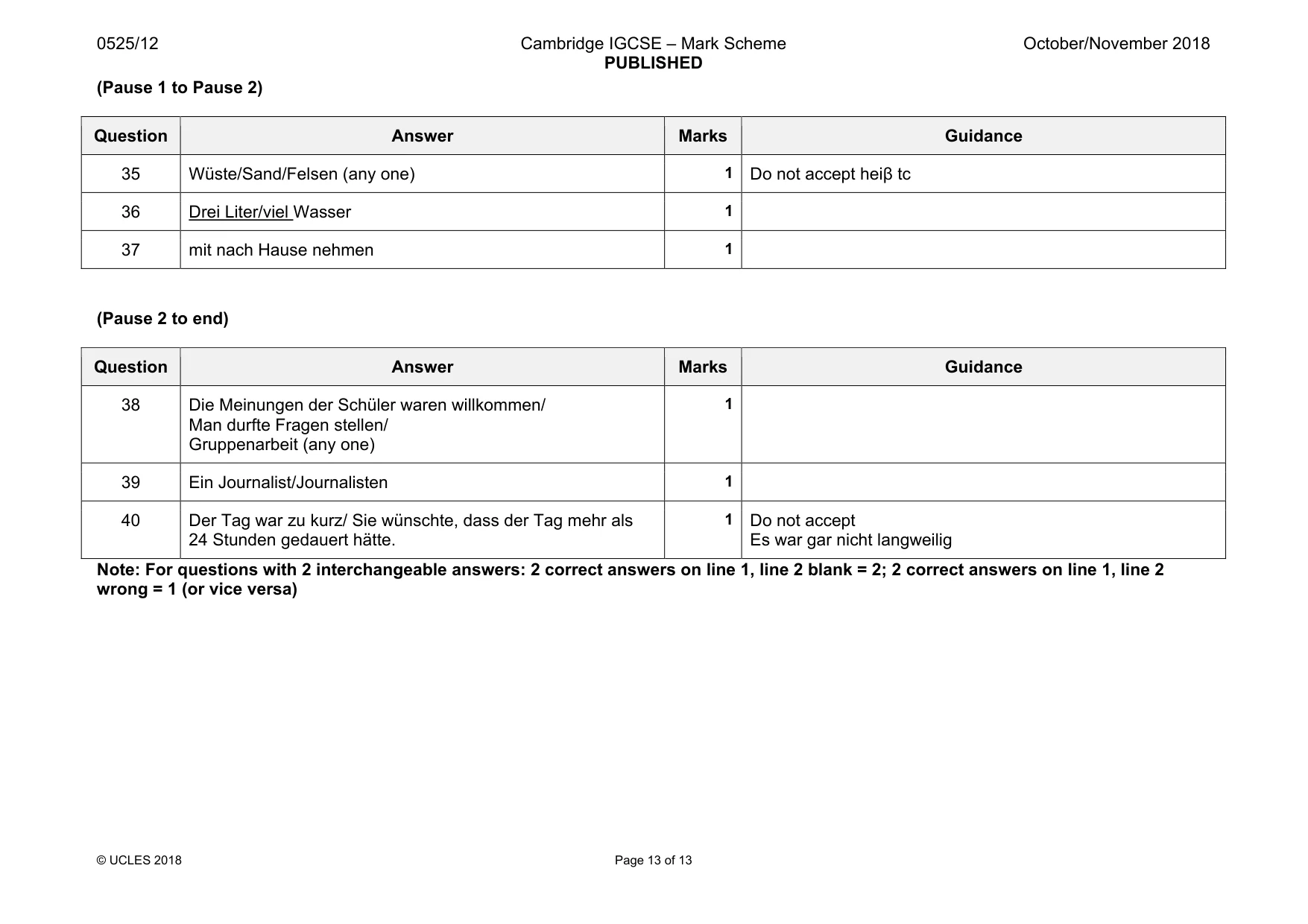
0525/12 Cambridge IGCSE – Mark Scheme PUBLISHED October/November 2018 © UCLES 2018 Page 13 of 13 (Pause 1 to Pause 2) Question Answer Marks Guidance 35 Wüste/Sand/Felsen (any one) 1 Do not accept heiβ tc 36 Drei Liter/viel Wasser 1 37 mit nach Hause nehmen 1 (Pause 2 to end) Question Answer Marks Guidance 38 Die Meinungen der Schüler waren willkommen/ Man durfte Fragen stellen/ Gruppenarbeit (any one) 1 39 Ein Journalist/Journalisten 1 40 Der Tag war zu kurz/ Sie wünschte, dass der Tag mehr als 24 Stunden gedauert hätte. 1 Do not accept Es war gar nicht langweilig Note: For questions with 2 interchangeable answers: 2 correct answers on line 1, line 2 blank = 2; 2 correct answers on line 1, line 2 wrong = 1 (or vice versa)
What you needed in this session
Cambridge’s own grade thresholds for 2018 Oct/Nov, Paper 1 · Variant 2. A higher threshold means an easier paper — the bar moves with how the cohort did.