Cambridge IGCSE Geography (9-1) 0976 — 2023 May/June Paper 2 · Variant 2
0976/22/M/J/23 · 6 questions · 60 marks · ≈68 min
The question paper and its mark scheme, free to read here and free to download. This is Cambridge’s own paper, exactly as it was sat.
Question paper16 pages

Mark scheme8 pages
Answers below. Sit the paper first if you are practising.
Questions as text
Q1 · Study the map extract for West Kilbride, Scotland
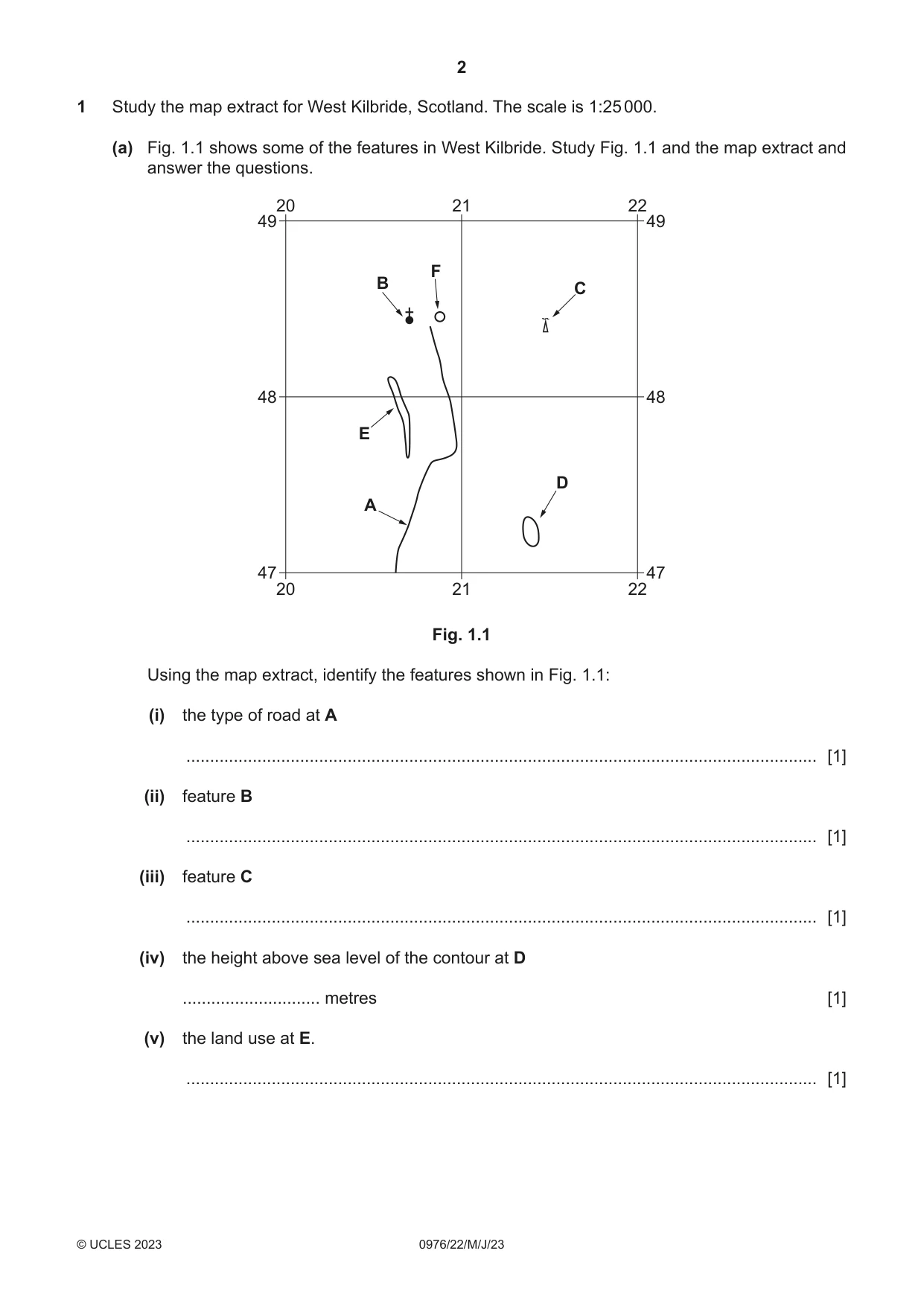
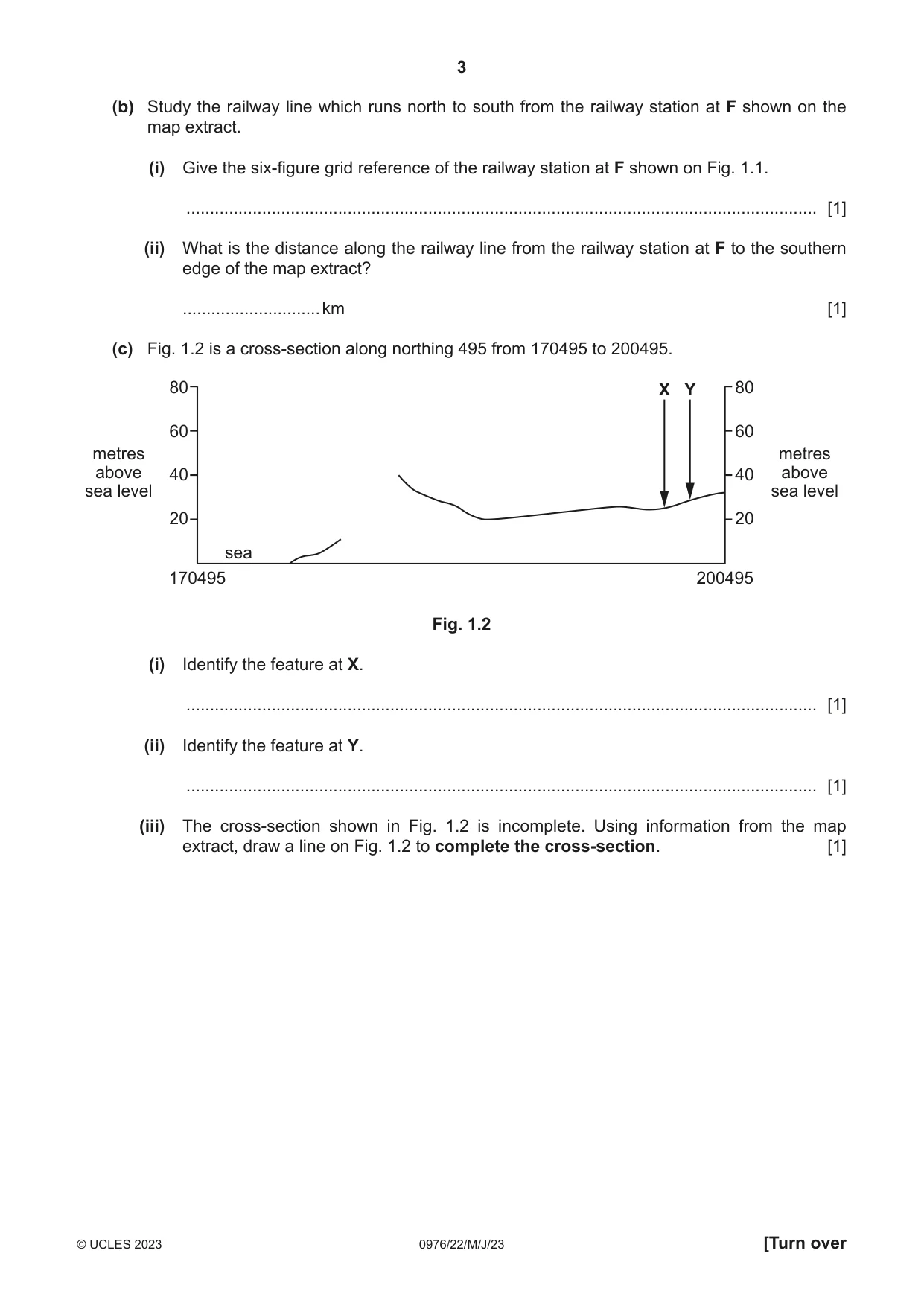
1 Study the map extract for West Kilbride, Scotland. The scale is 1:25 000. (a) Fig. 1.1 shows some of the features in West Kilbride. Study Fig. 1.1 and the map extract and answer the questions. 20 21 22 49 49 F B C 48 48 E D A 47 47 20 21 22 Fig. 1.1 Using the map extract, identify the features shown in Fig. 1.1: (i) the type of road at A ..................................................................................................................................... [1] (ii) feature B ..................................................................................................................................... [1] (iii) feature C ..................................................................................................................................... [1] (iv) the height above sea level of the contour at D ............................. metres [1] (v) the land use at E. ..................................................................................................................................... [1] (b) Study the railway line which runs north to south from the railway station at F shown on the map extract. (i) Give the six‑figure grid reference of the railway station at F shown on Fig. 1.1. ..................................................................................................................................... [1] (ii) What is the distance along the railway line from the railway station at F to the southern edge of the map extract? ............................. km [1] (c) Fig. 1.2 is a cross‑section along northing 495 from 170495 to 200495. 80 X Y 80 60 60 metres metres above 40 40 above sea level sea level 20 20 sea 170495 200495 Fig. 1.2 (i) Identify the feature at X. ..................................................................................................................................... [1] (ii) Identify the feature at Y. ..................................................................................................................................... [1] (iii) The cross‑section shown in Fig. 1.2 is incomplete. Using information from the map extract, draw a line on Fig. 1.2 to complete the cross‑section. [1] (d) Look at the coastline on the western side of the map extract. (i) Identify four tourist attractions along the coastline. 1 ........................................................................................................................................ 2 ........................................................................................................................................ 3 ........................................................................................................................................ 4 .................................................................................................................................. [4] (ii) Describe the physical (natural) features of the coastline shown on the map extract. ........................................................................................................................................... ........................................................................................................................................... ........................................................................................................................................... ........................................................................................................................................... ........................................................................................................................................... ..................................................................................................................................... [3] (e) Describe how relief has affected the route of the railway line. ................................................................................................................................................... ................................................................................................................................................... ................................................................................................................................................... ................................................................................................................................................... ................................................................................................................................................... ............................................................................................................................................. [3] [Total: 20]
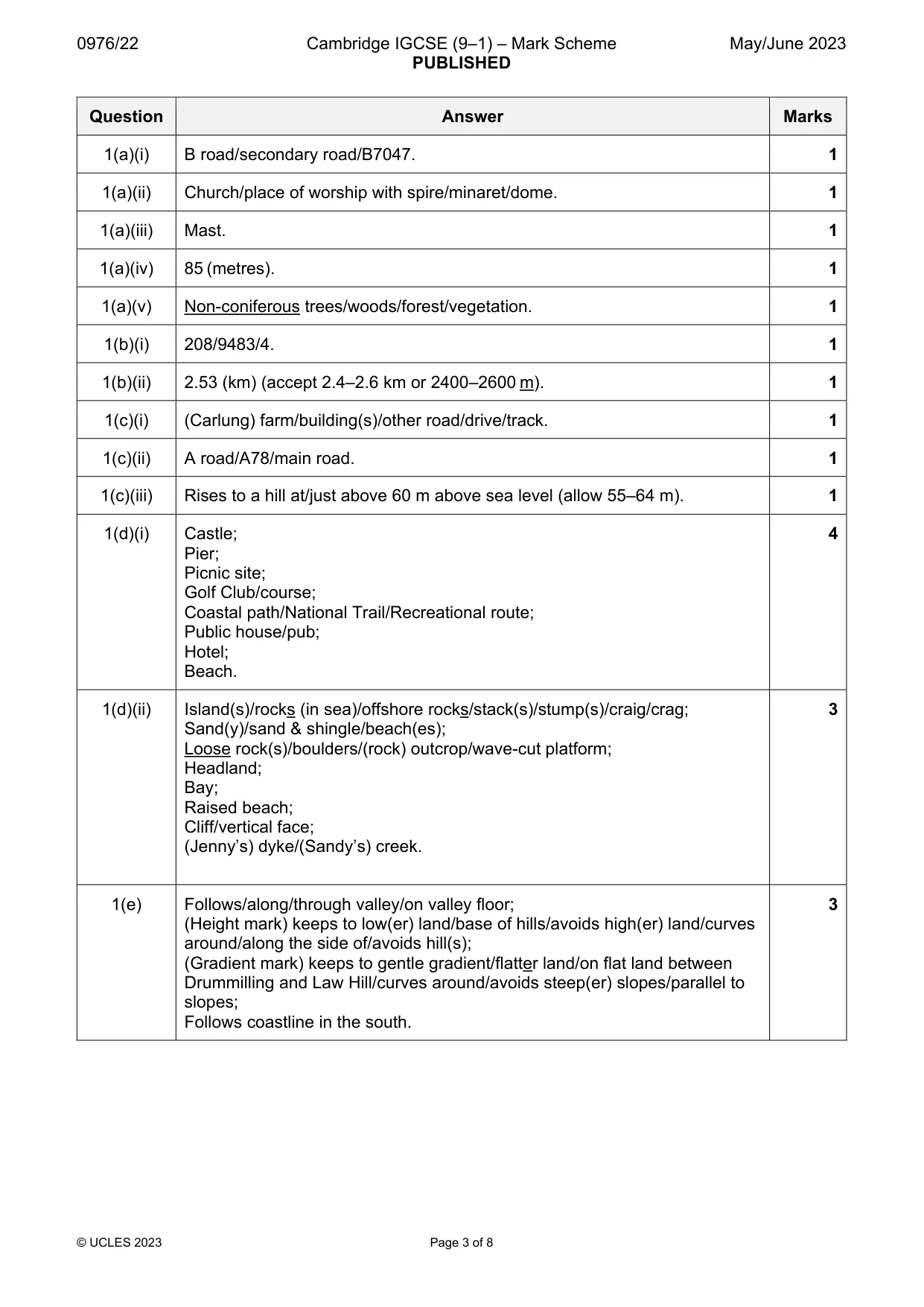
Mark scheme: Question Answer Marks 1(a)(i) B road/secondary road/B7047. 1 1(a)(ii) Church/place of worship with spire/minaret/dome. 1 1(a)(iii) Mast. 1 1(a)(iv) 85 (metres). 1 1(a)(v) Non-coniferous trees/woods/forest/vegetation. 1 1(b)(i) 208/9483/4. 1 1(b)(ii) 2.53 (km) (accept 2.4–2.6 km or 2400–2600 m). 1 1(c)(i) (Carlung) farm/building(s)/other road/drive/track. 1 1(c)(ii) A road/A78/main road. 1 1(c)(iii) Rises to a hill at/just above 60 m above sea level (allow 55–64 m). 1 1(d)(i) Castle; 4 Pier; Picnic site; Golf Club/course; Coastal path/National Trail/Recreational route; Public house/pub; Hotel; Beach. 1(d)(ii) Island(s)/rocks (in sea)/offshore rocks/stack(s)/stump(s)/craig/crag; 3 Sand(y)/sand & shingle/beach(es); Loose rock(s)/boulders/(rock) outcrop/wave-cut platform; Headland; Bay; Raised beach; Cliff/vertical face; (Jenny’s) dyke/(Sandy’s) creek. 1(e) Follows/along/through valley/on valley floor; 3 (Height mark) keeps to low(er) land/base of hills/avoids high(er) land/curves around/along the side of/avoids hill(s); (Gradient mark) keeps to gentle gradient/flatter land/on flat land between Drummilling and Law Hill/curves around/avoids steep(er) slopes/parallel to slopes; Follows coastline in the south.
More questions on Settlements (rural and urban) and service provision
Question 2
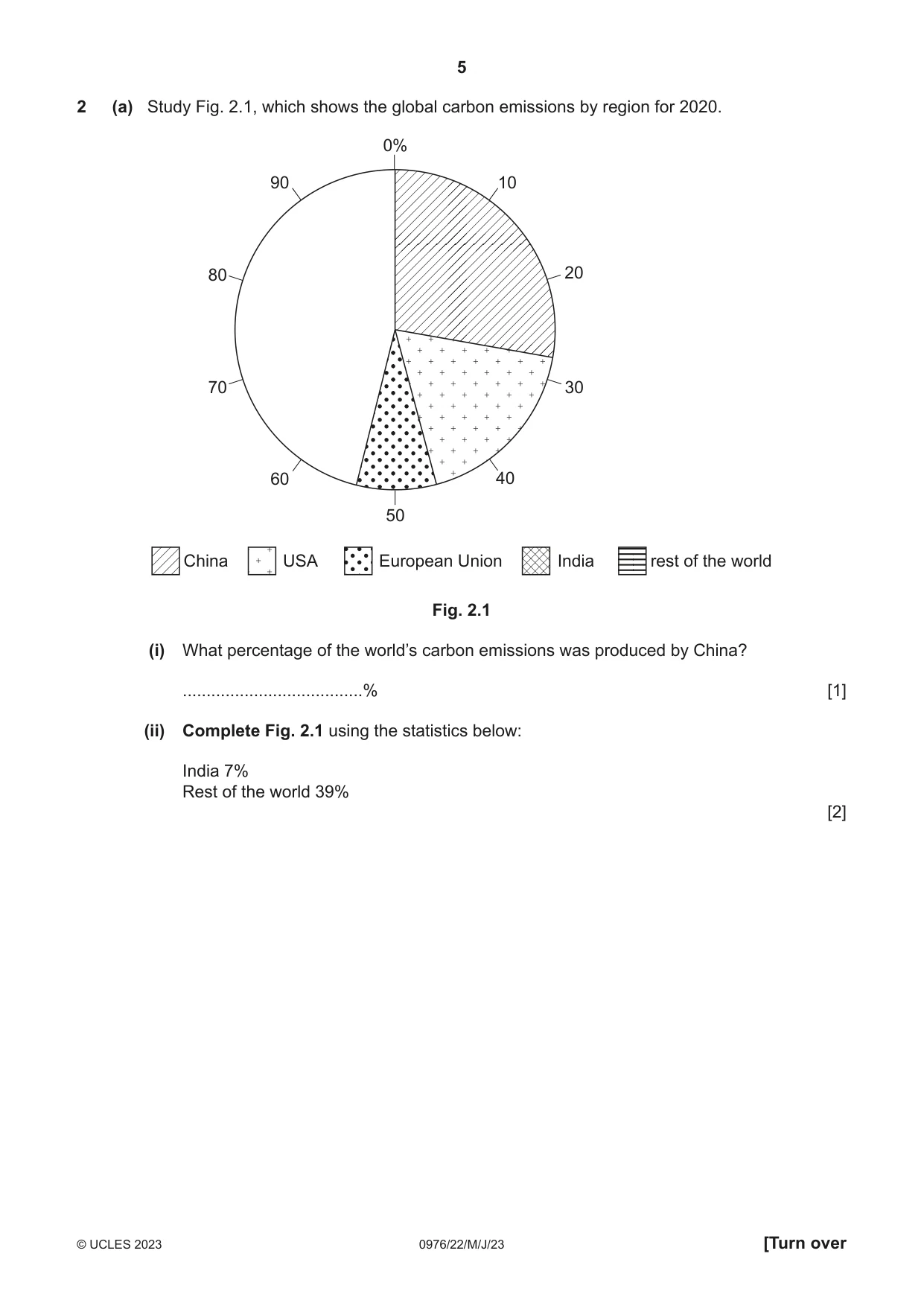
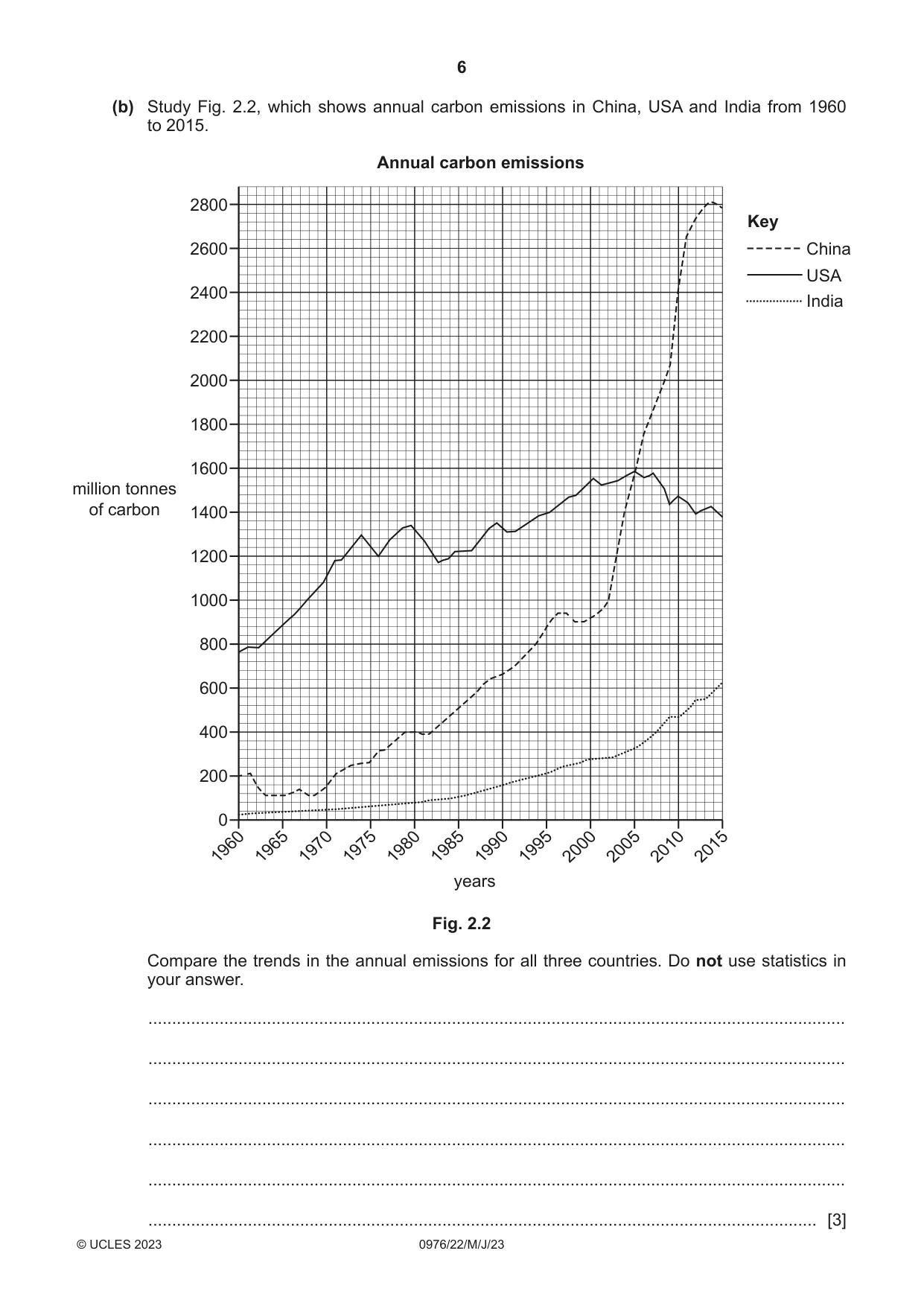
2 (a) Study Fig. 2.1, which shows the global carbon emissions by region for 2020. 0% 90 10 80 20 70 30 60 40 50 China USA European Union India rest of the world Fig. 2.1 (i) What percentage of the world’s carbon emissions was produced by China? ......................................% [1] (ii) Complete Fig. 2.1 using the statistics below: India 7% Rest of the world 39% [2] (b) Study Fig. 2.2, which shows annual carbon emissions in China, USA and India from 1960 to 2015. Annual carbon emissions 2800 Key 2600 China USA 2400 India 2200 2000 1800 1600 million tonnes of carbon 1400 1200 1000 800 600 400 200 0 196019651970197519801985199019952000200520102015 years Fig. 2.2 Compare the trends in the annual emissions for all three countries. Do not use statistics in your answer. ................................................................................................................................................... ................................................................................................................................................... ................................................................................................................................................... ................................................................................................................................................... ................................................................................................................................................... ............................................................................................................................................. [3] (c) Suggest two reasons why an LEDC such as India will have lower carbon emissions per person than an MEDC such as the USA. 1 ................................................................................................................................................ ................................................................................................................................................... 2 ................................................................................................................................................ ............................................................................................................................................. [2] [Total: 8]
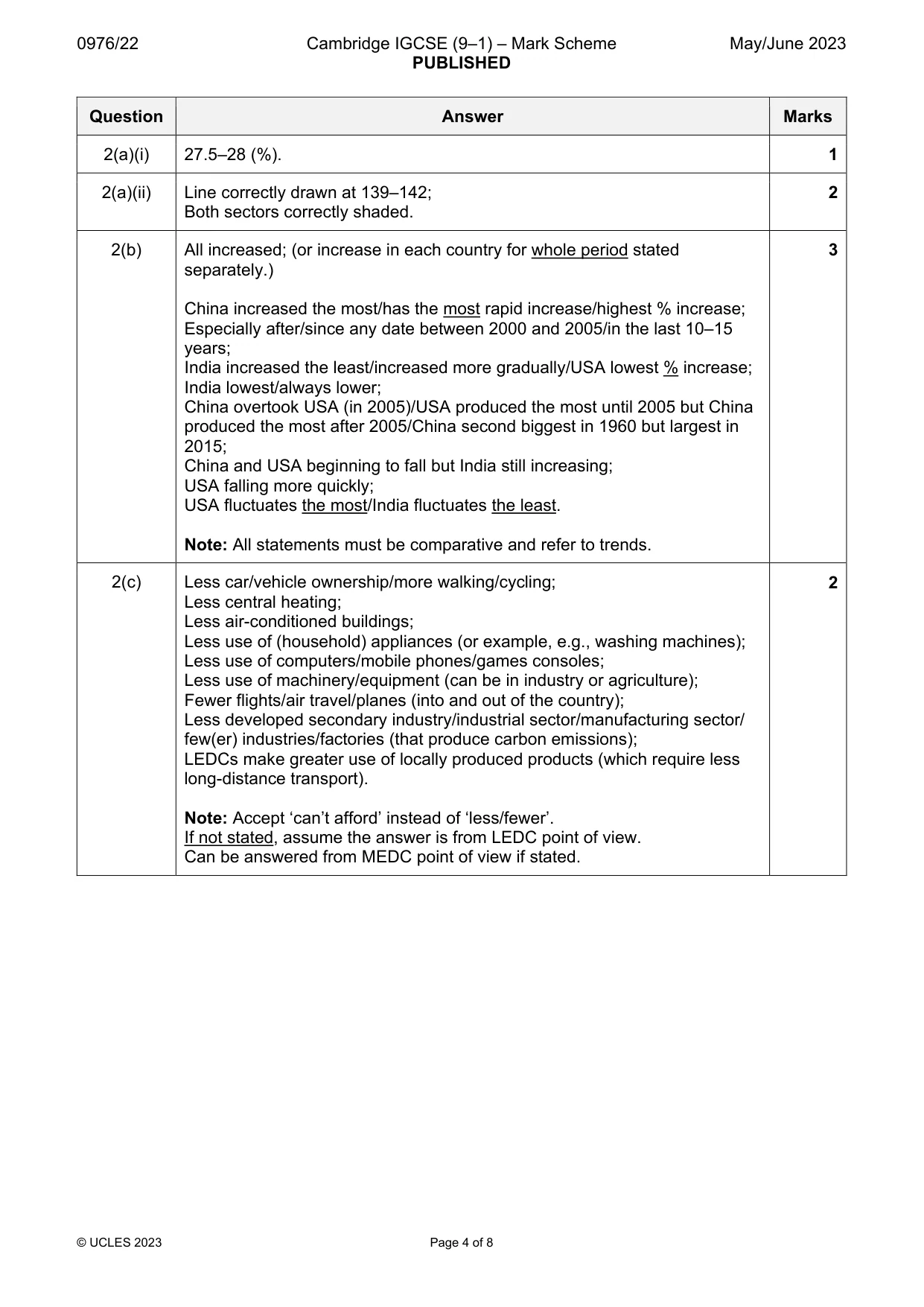
Mark scheme: 2(a)(i) 27.5–28 (%). 1 2(a)(ii) Line correctly drawn at 139–142; 2 Both sectors correctly shaded. 2(b) All increased; (or increase in each country for whole period stated 3 separately.) China increased the most/has the most rapid increase/highest % increase; Especially after/since any date between 2000 and 2005/in the last 10–15 years; India increased the least/increased more gradually/USA lowest % increase; India lowest/always lower; China overtook USA (in 2005)/USA produced the most until 2005 but China produced the most after 2005/China second biggest in 1960 but largest in 2015; China and USA beginning to fall but India still increasing; USA falling more quickly; USA fluctuates the most/India fluctuates the least. Note: All statements must be comparative and refer to trends. 2(c) Less car/vehicle ownership/more walking/cycling; 2 Less central heating; Less air-conditioned buildings; Less use of (household) appliances (or example, e.g., washing machines); Less use of computers/mobile phones/games consoles; Less use of machinery/equipment (can be in industry or agriculture); Fewer flights/air travel/planes (into and out of the country); Less developed secondary industry/industrial sector/manufacturing sector/ few(er) industries/factories (that produce carbon emissions); LEDCs make greater use of locally produced products (which require less long-distance transport). Note: Accept ‘can’t afford’ instead of ‘less/fewer’. If not stated, assume the answer is from LEDC point of view. Can be answered from MEDC point of view if stated.
Question 3
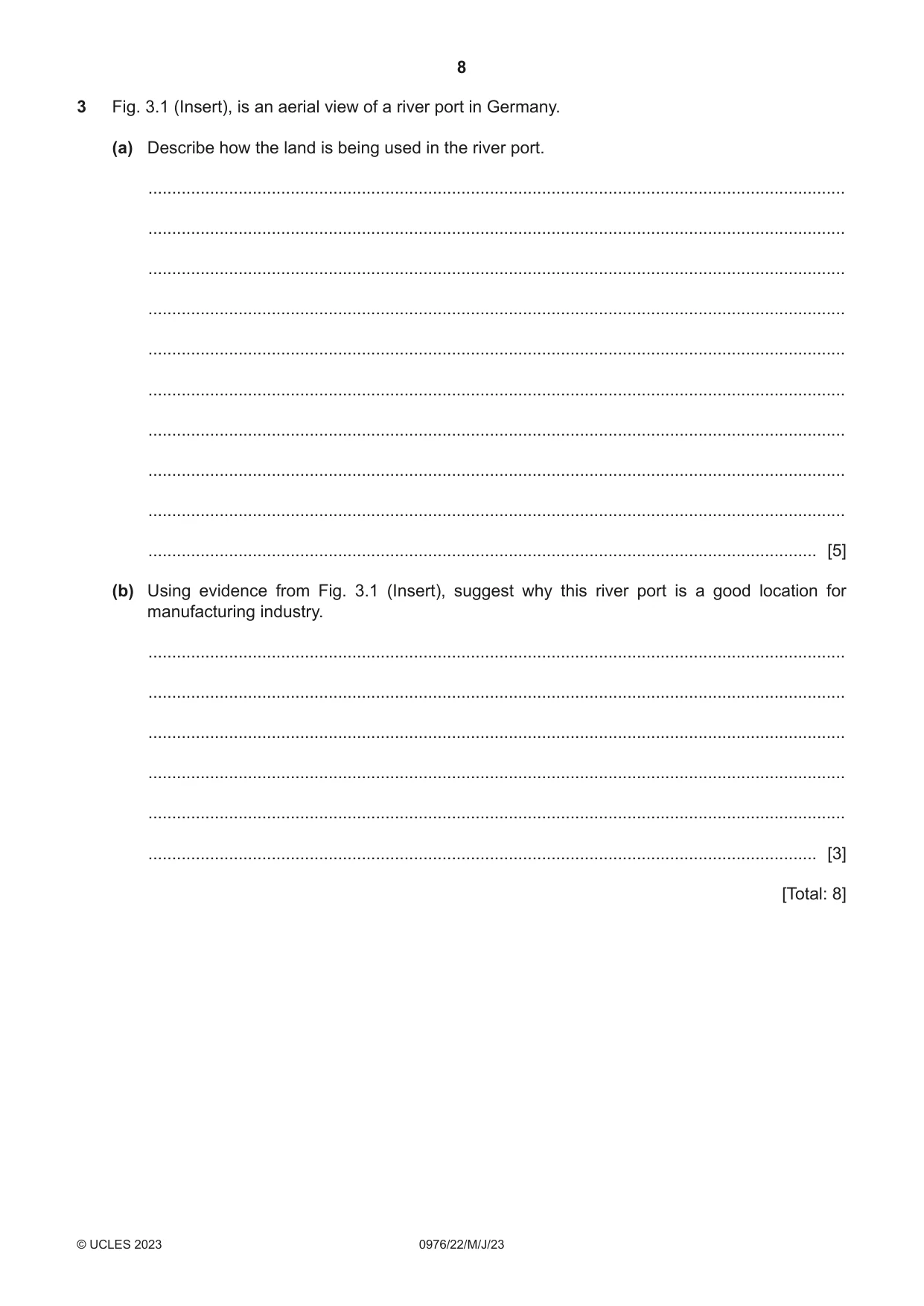
3 Fig. 3.1 (Insert), is an aerial view of a river port in Germany. (a) Describe how the land is being used in the river port. ................................................................................................................................................... ................................................................................................................................................... ................................................................................................................................................... ................................................................................................................................................... ................................................................................................................................................... ................................................................................................................................................... ................................................................................................................................................... ................................................................................................................................................... ................................................................................................................................................... ............................................................................................................................................. [5] (b) Using evidence from Fig. 3.1 (Insert), suggest why this river port is a good location for manufacturing industry. ................................................................................................................................................... ................................................................................................................................................... ................................................................................................................................................... ................................................................................................................................................... ................................................................................................................................................... ............................................................................................................................................. [3] [Total: 8]
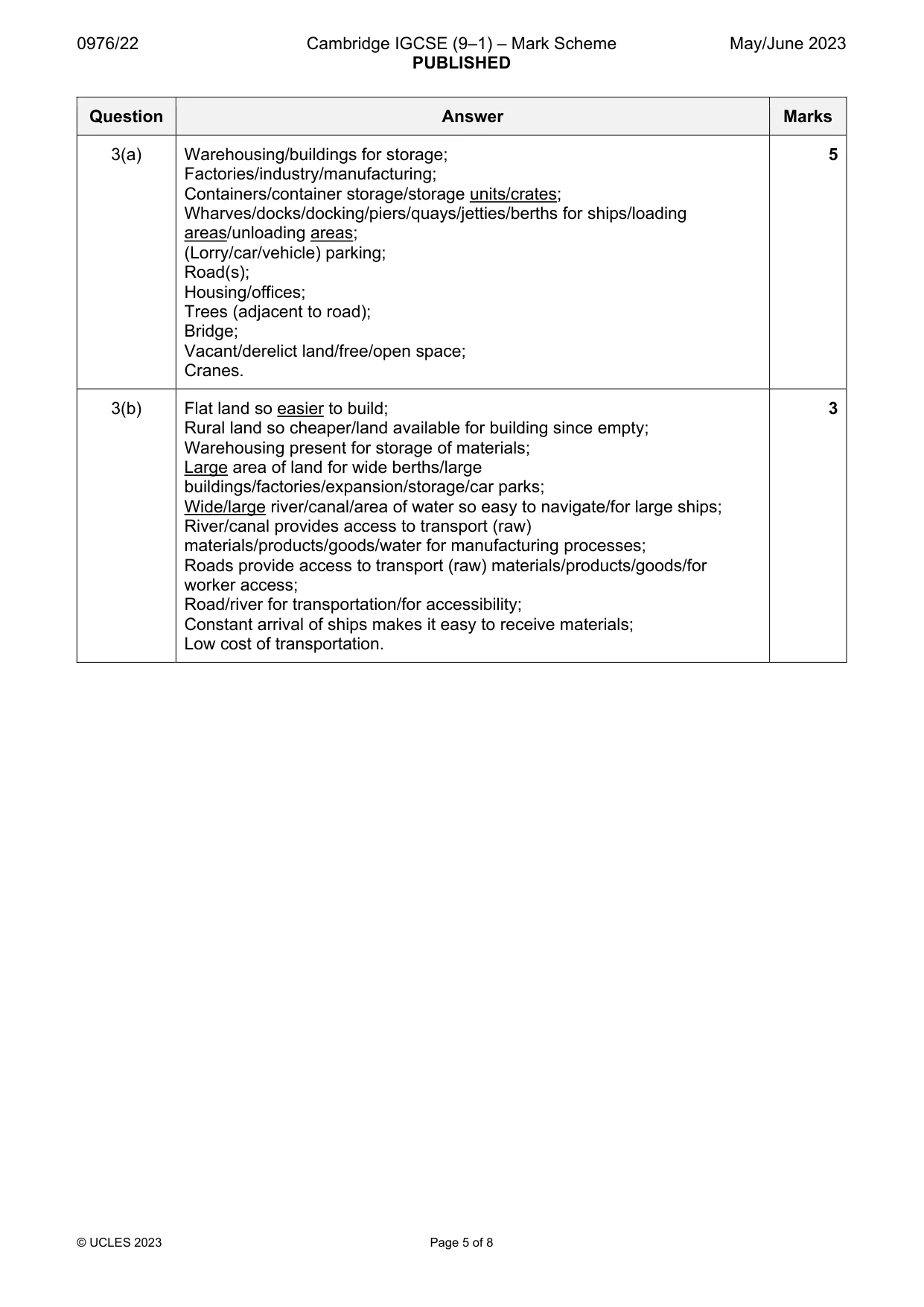
Mark scheme: 3(a) Warehousing/buildings for storage; 5 Factories/industry/manufacturing; Containers/container storage/storage units/crates; Wharves/docks/docking/piers/quays/jetties/berths for ships/loading areas/unloading areas; (Lorry/car/vehicle) parking; Road(s); Housing/offices; Trees (adjacent to road); Bridge; Vacant/derelict land/free/open space; Cranes. 3(b) Flat land so easier to build; 3 Rural land so cheaper/land available for building since empty; Warehousing present for storage of materials; Large area of land for wide berths/large buildings/factories/expansion/storage/car parks; Wide/large river/canal/area of water so easy to navigate/for large ships; River/canal provides access to transport (raw) materials/products/goods/water for manufacturing processes; Roads provide access to transport (raw) materials/products/goods/for worker access; Road/river for transportation/for accessibility; Constant arrival of ships makes it easy to receive materials; Low cost of transportation.
More questions on Settlements (rural and urban) and service provision
Question 4
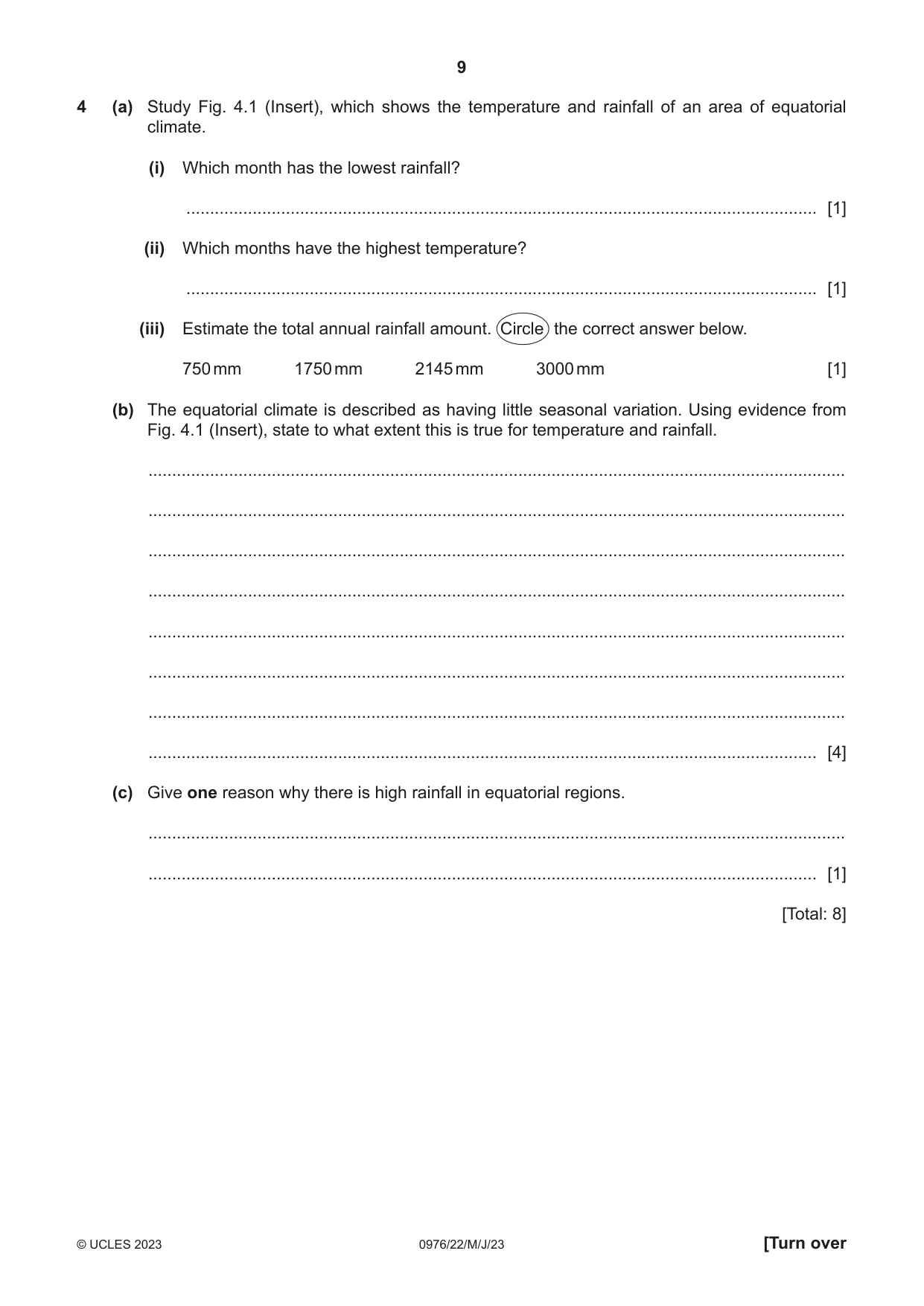
4 (a) Study Fig. 4.1 (Insert), which shows the temperature and rainfall of an area of equatorial climate. (i) Which month has the lowest rainfall? ..................................................................................................................................... [1] (ii) Which months have the highest temperature? ..................................................................................................................................... [1] (iii) Estimate the total annual rainfall amount. Circle the correct answer below. 750 mm 1750 mm 2145 mm 3000 mm [1] (b) The equatorial climate is described as having little seasonal variation. Using evidence from Fig. 4.1 (Insert), state to what extent this is true for temperature and rainfall. ................................................................................................................................................... ................................................................................................................................................... ................................................................................................................................................... ................................................................................................................................................... ................................................................................................................................................... ................................................................................................................................................... ................................................................................................................................................... ............................................................................................................................................. [4] (c) Give one reason why there is high rainfall in equatorial regions. ................................................................................................................................................... ............................................................................................................................................. [1] [Total: 8]
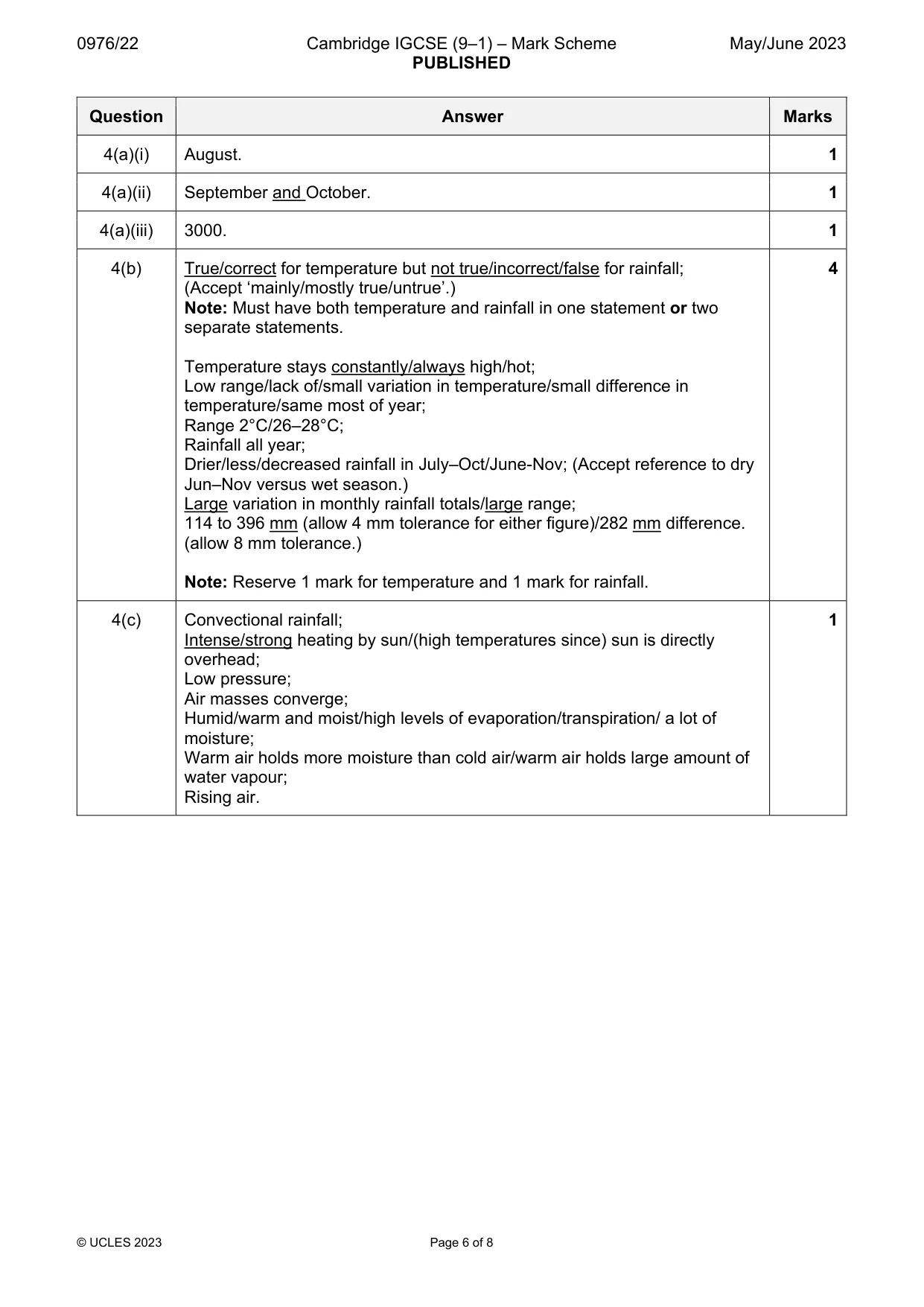
Mark scheme: 4(a)(i) August. 1 4(a)(ii) September and October. 1 4(a)(iii) 3000. 1 4(b) True/correct for temperature but not true/incorrect/false for rainfall; 4 (Accept ‘mainly/mostly true/untrue’.) Note: Must have both temperature and rainfall in one statement or two separate statements. Temperature stays constantly/always high/hot; Low range/lack of/small variation in temperature/small difference in temperature/same most of year; Range 2°C/26–28°C; Rainfall all year; Drier/less/decreased rainfall in July–Oct/June-Nov; (Accept reference to dry Jun–Nov versus wet season.) Large variation in monthly rainfall totals/large range; 114 to 396 mm (allow 4 mm tolerance for either figure)/282 mm difference. (allow 8 mm tolerance.) Note: Reserve 1 mark for temperature and 1 mark for rainfall. 4(c) Convectional rainfall; 1 Intense/strong heating by sun/(high temperatures since) sun is directly overhead; Low pressure; Air masses converge; Humid/warm and moist/high levels of evaporation/transpiration/ a lot of moisture; Warm air holds more moisture than cold air/warm air holds large amount of water vapour; Rising air.
Q5 · The HDI indicators for three countries in 2020
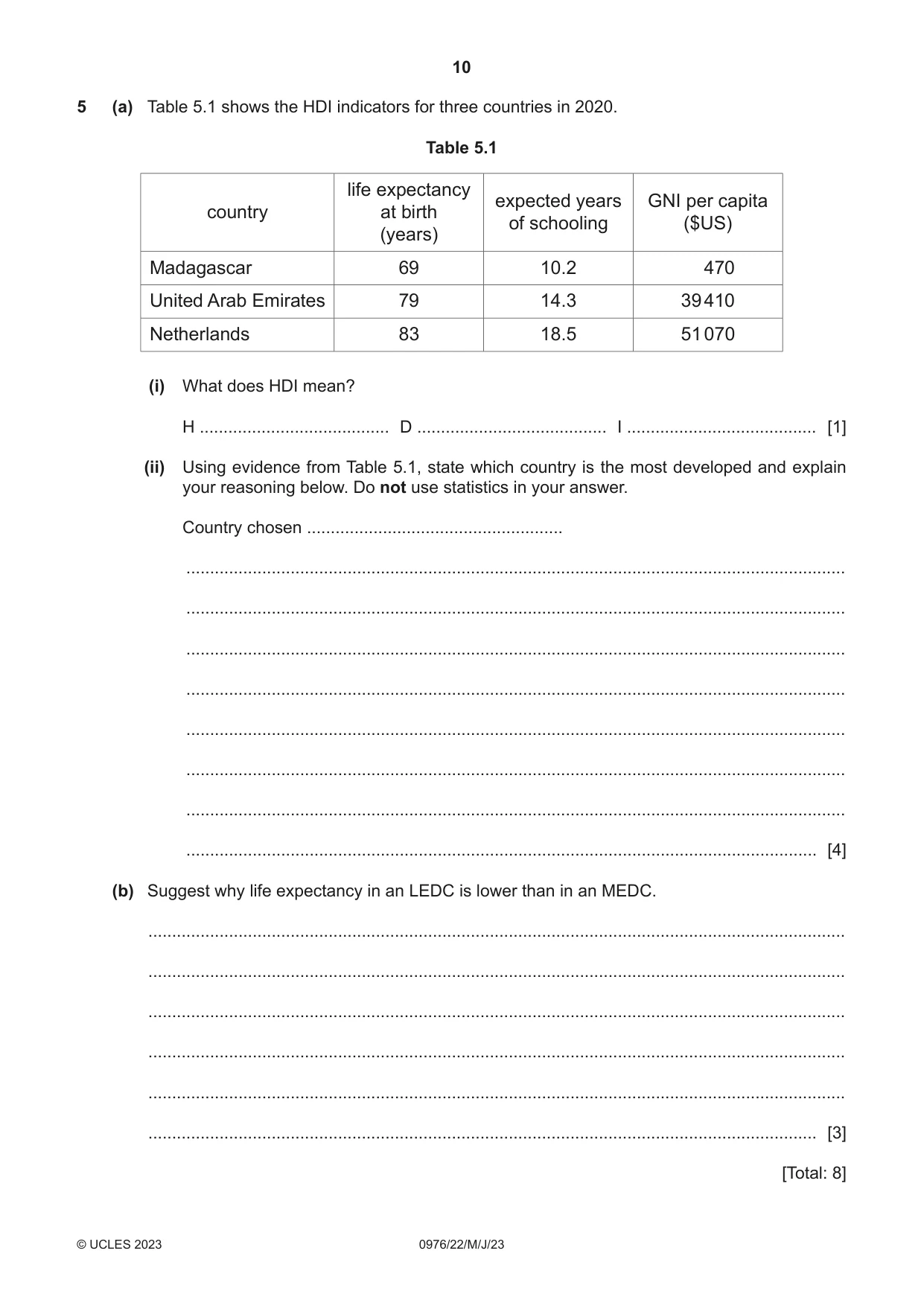
5 (a) Table 5.1 shows the HDI indicators for three countries in 2020. Table 5.1 life expectancy expected years GNI per capita country at birth of schooling ($US) (years) Madagascar 69 10.2 470 United Arab Emirates 79 14.3 39 410 Netherlands 83 18.5 51 070 (i) What does HDI mean? H ........................................ D ........................................ I ........................................ [1] (ii) Using evidence from Table 5.1, state which country is the most developed and explain your reasoning below. Do not use statistics in your answer. Country chosen ...................................................... ........................................................................................................................................... ........................................................................................................................................... ........................................................................................................................................... ........................................................................................................................................... ........................................................................................................................................... ........................................................................................................................................... ........................................................................................................................................... ..................................................................................................................................... [4] (b) Suggest why life expectancy in an LEDC is lower than in an MEDC. ................................................................................................................................................... ................................................................................................................................................... ................................................................................................................................................... ................................................................................................................................................... ................................................................................................................................................... ............................................................................................................................................. [3] [Total: 8]
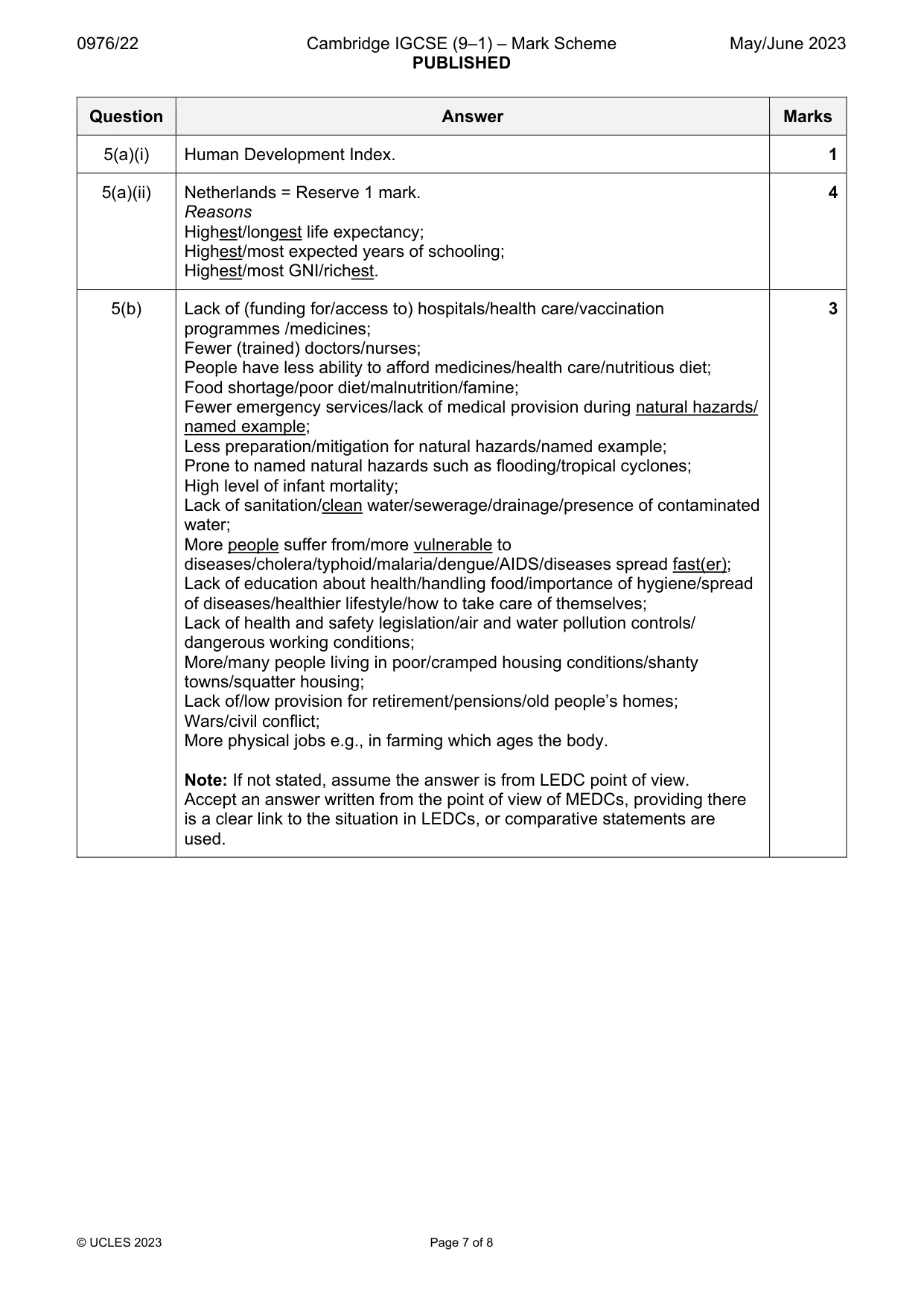
Mark scheme: 5(a)(i) Human Development Index. 1 5(a)(ii) Netherlands = Reserve 1 mark. 4 Reasons Highest/longest life expectancy; Highest/most expected years of schooling; Highest/most GNI/richest. 5(b) Lack of (funding for/access to) hospitals/health care/vaccination 3 programmes /medicines; Fewer (trained) doctors/nurses; People have less ability to afford medicines/health care/nutritious diet; Food shortage/poor diet/malnutrition/famine; Fewer emergency services/lack of medical provision during natural hazards/ named example; Less preparation/mitigation for natural hazards/named example; Prone to named natural hazards such as flooding/tropical cyclones; High level of infant mortality; Lack of sanitation/clean water/sewerage/drainage/presence of contaminated water; More people suffer from/more vulnerable to diseases/cholera/typhoid/malaria/dengue/AIDS/diseases spread fast(er); Lack of education about health/handling food/importance of hygiene/spread of diseases/healthier lifestyle/how to take care of themselves; Lack of health and safety legislation/air and water pollution controls/ dangerous working conditions; More/many people living in poor/cramped housing conditions/shanty towns/squatter housing; Lack of/low provision for retirement/pensions/old people’s homes; Wars/civil conflict; More physical jobs e.g., in farming which ages the body. Note: If not stated, assume the answer is from LEDC point of view. Accept an answer written from the point of view of MEDCs, providing there is a clear link to the situation in LEDCs, or comparative statements are used.
Question 6
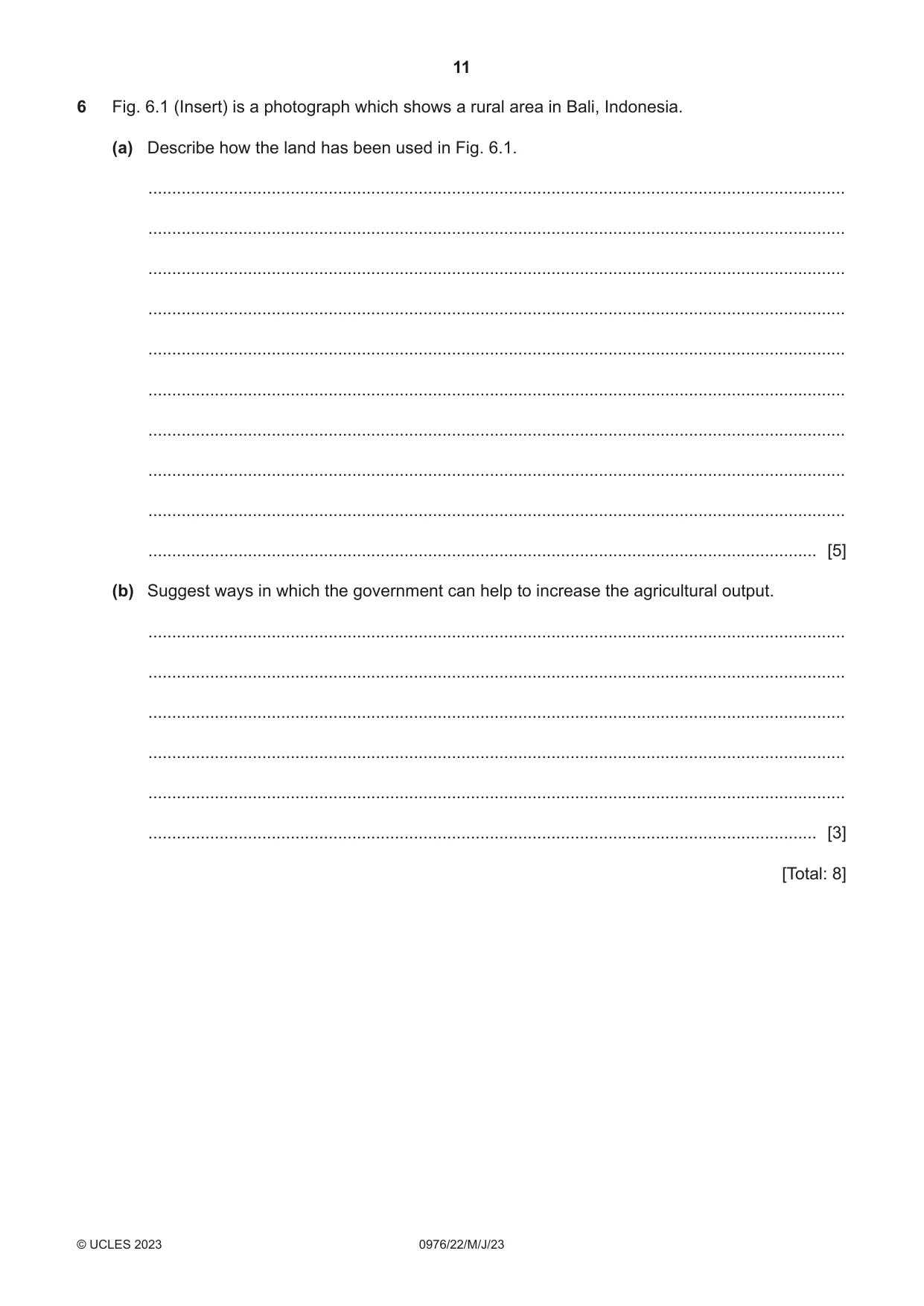
6 Fig. 6.1 (Insert) is a photograph which shows a rural area in Bali, Indonesia. (a) Describe how the land has been used in Fig. 6.1. ................................................................................................................................................... ................................................................................................................................................... ................................................................................................................................................... ................................................................................................................................................... ................................................................................................................................................... ................................................................................................................................................... ................................................................................................................................................... ................................................................................................................................................... ................................................................................................................................................... ............................................................................................................................................. [5] (b) Suggest ways in which the government can help to increase the agricultural output. ................................................................................................................................................... ................................................................................................................................................... ................................................................................................................................................... ................................................................................................................................................... ................................................................................................................................................... ............................................................................................................................................. [3] [Total: 8] Additional pages If you use the following pages to complete the answer to any question, the question number must be clearly shown. .................................................................................................................................................................. .................................................................................................................................................................. .................................................................................................................................................................. .................................................................................................................................................................. .................................................................................................................................................................. .................................................................................................................................................................. .................................................................................................................................................................. .................................................................................................................................................................. .................................................................................................................................................................. .................................................................................................................................................................. .................................................................................................................................................................. .................................................................................................................................................................. .................................................................................................................................................................. .................................................................................................................................................................. .................................................................................................................................................................. .................................................................................................................................................................. .................................................................................................................................................................. .................................................................................................................................................................. .................................................................................................................................................................. .................................................................................................................................................................. .................................................................................................................................................................. .................................................................................................................................................................. .................................................................................................................................................................. .................................................................................................................................................................. .................................................................................................................................................................. .................................................................................................................................................................. .................................................................................................................................................................. .................................................................................................................................................................. .................................................................................................................................................................. .................................................................................................................................................................. .................................................................................................................................................................. .................................................................................................................................................................. .................................................................................................................................................................. .................................................................................................................................................................. .................................................................................................................................................................. .................................................................................................................................................................. .................................................................................................................................................................. .................................................................................................................................................................. .................................................................................................................................................................. .................................................................................................................................................................. .................................................................................................................................................................. .................................................................................................................................................................. .................................................................................................................................................................. .................................................................................................................................................................. .................................................................................................................................................................. .................................................................................................................................................................. .................................................................................................................................................................. .................................................................................................................................................................. .................................................................................................................................................................. .................................................................................................................................................................. .................................................................................................................................................................. .................................................................................................................................................................. ..................................................................................................................................................................
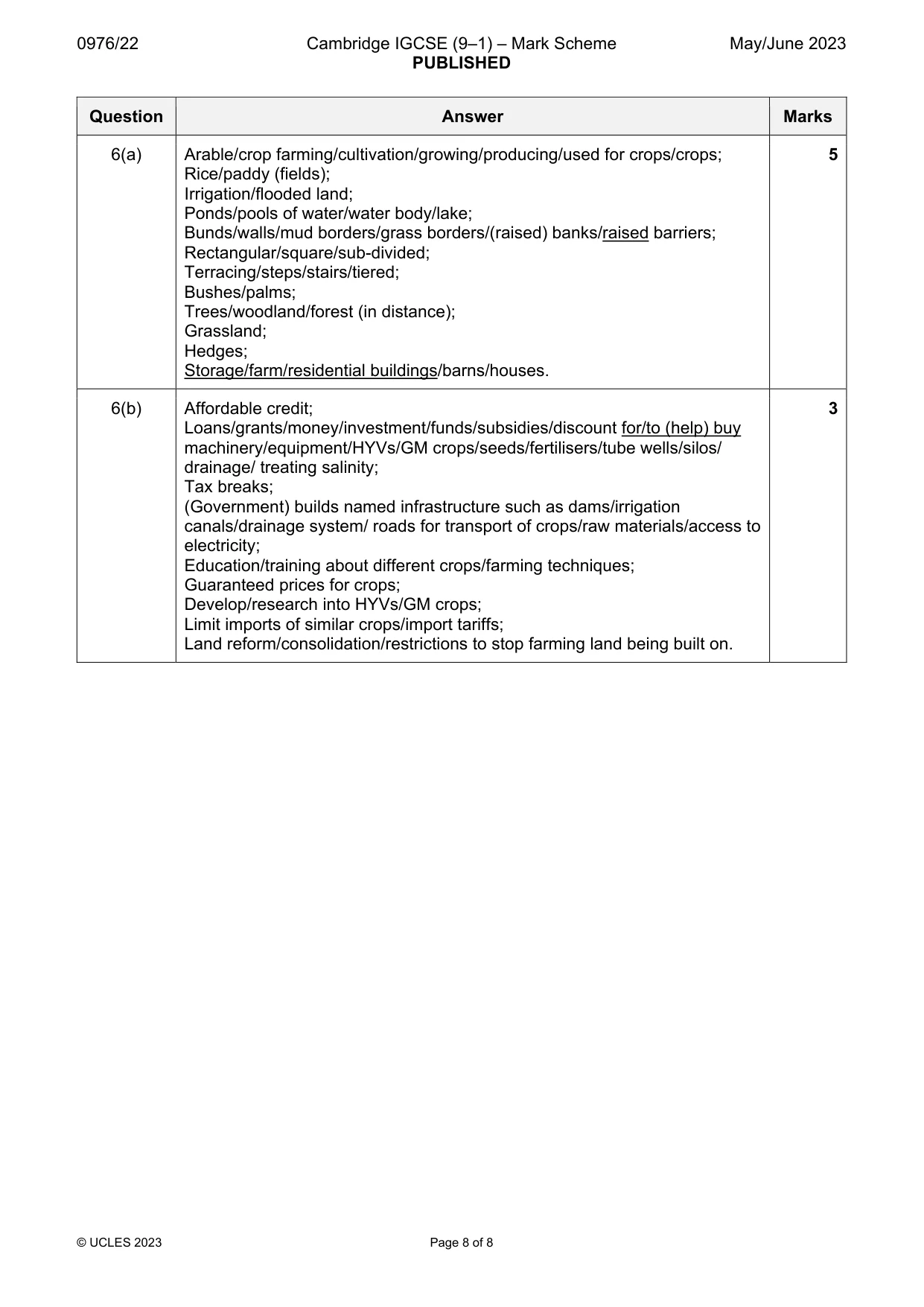
Mark scheme: 6(a) Arable/crop farming/cultivation/growing/producing/used for crops/crops; 5 Rice/paddy (fields); Irrigation/flooded land; Ponds/pools of water/water body/lake; Bunds/walls/mud borders/grass borders/(raised) banks/raised barriers; Rectangular/square/sub-divided; Terracing/steps/stairs/tiered; Bushes/palms; Trees/woodland/forest (in distance); Grassland; Hedges; Storage/farm/residential buildings/barns/houses. 6(b) Affordable credit; 3 Loans/grants/money/investment/funds/subsidies/discount for/to (help) buy machinery/equipment/HYVs/GM crops/seeds/fertilisers/tube wells/silos/ drainage/ treating salinity; Tax breaks; (Government) builds named infrastructure such as dams/irrigation canals/drainage system/ roads for transport of crops/raw materials/access to electricity; Education/training about different crops/farming techniques; Guaranteed prices for crops; Develop/research into HYVs/GM crops; Limit imports of similar crops/import tariffs; Land reform/consolidation/restrictions to stop farming land being built on.
What was in this paper
The subtopics covered by these 6 questions, and how many questions each got. Open one in a new tab to see every Cambridge question on it.
What you needed in this session
Cambridge’s own grade thresholds for 2023 May/June, Paper 2 · Variant 2. A higher threshold means an easier paper — the bar moves with how the cohort did.