Cambridge IGCSE Geography 0460 — 2023 Feb/March Paper 1 · Variant 2
0460/12/F/M/23 · 75 marks · ≈84 min
The question paper and its mark scheme, free to read here and free to download. This is Cambridge’s own paper, exactly as it was sat.
Question paper32 pages


Mark scheme22 pages
Answers below. Sit the paper first if you are practising.
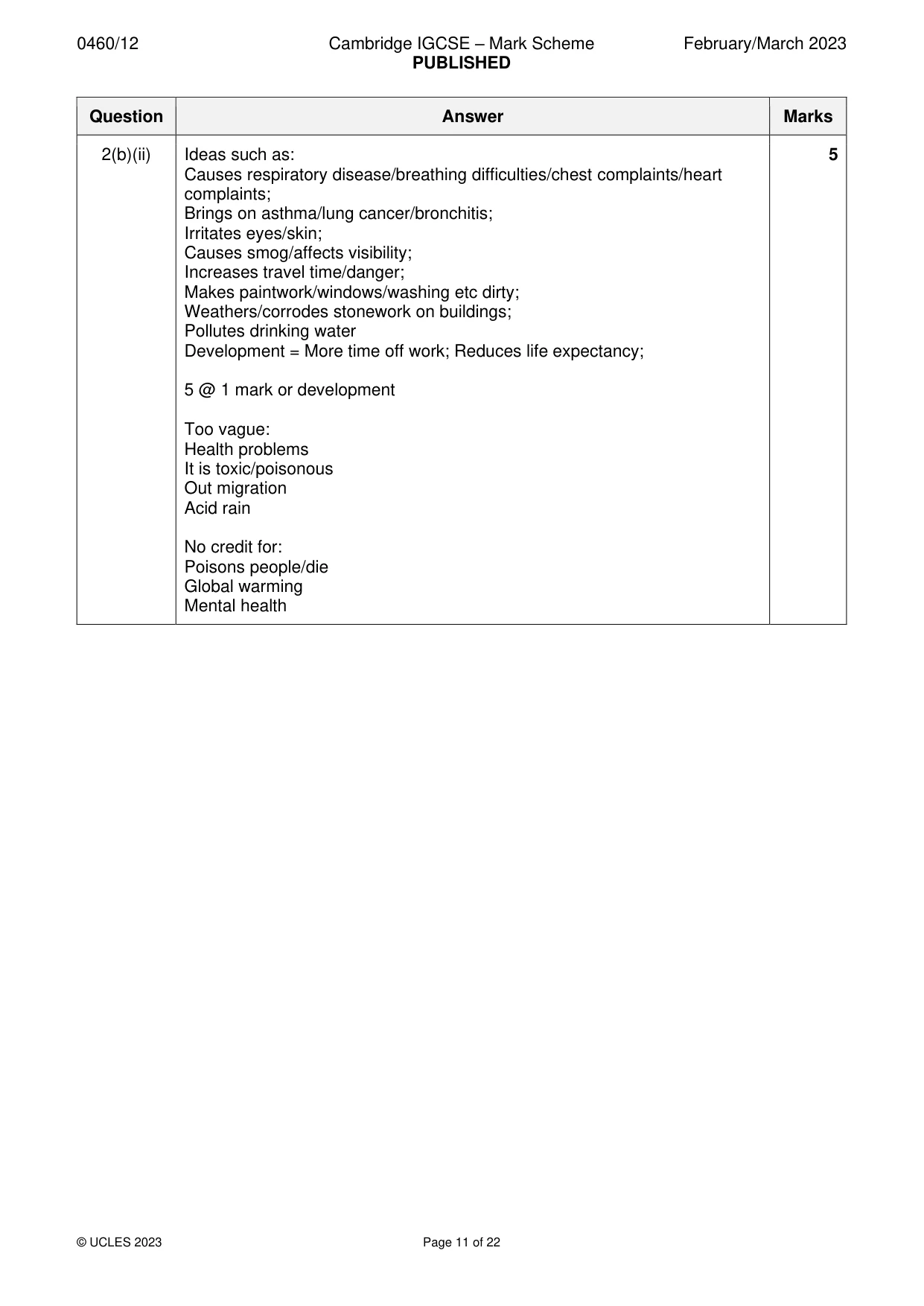
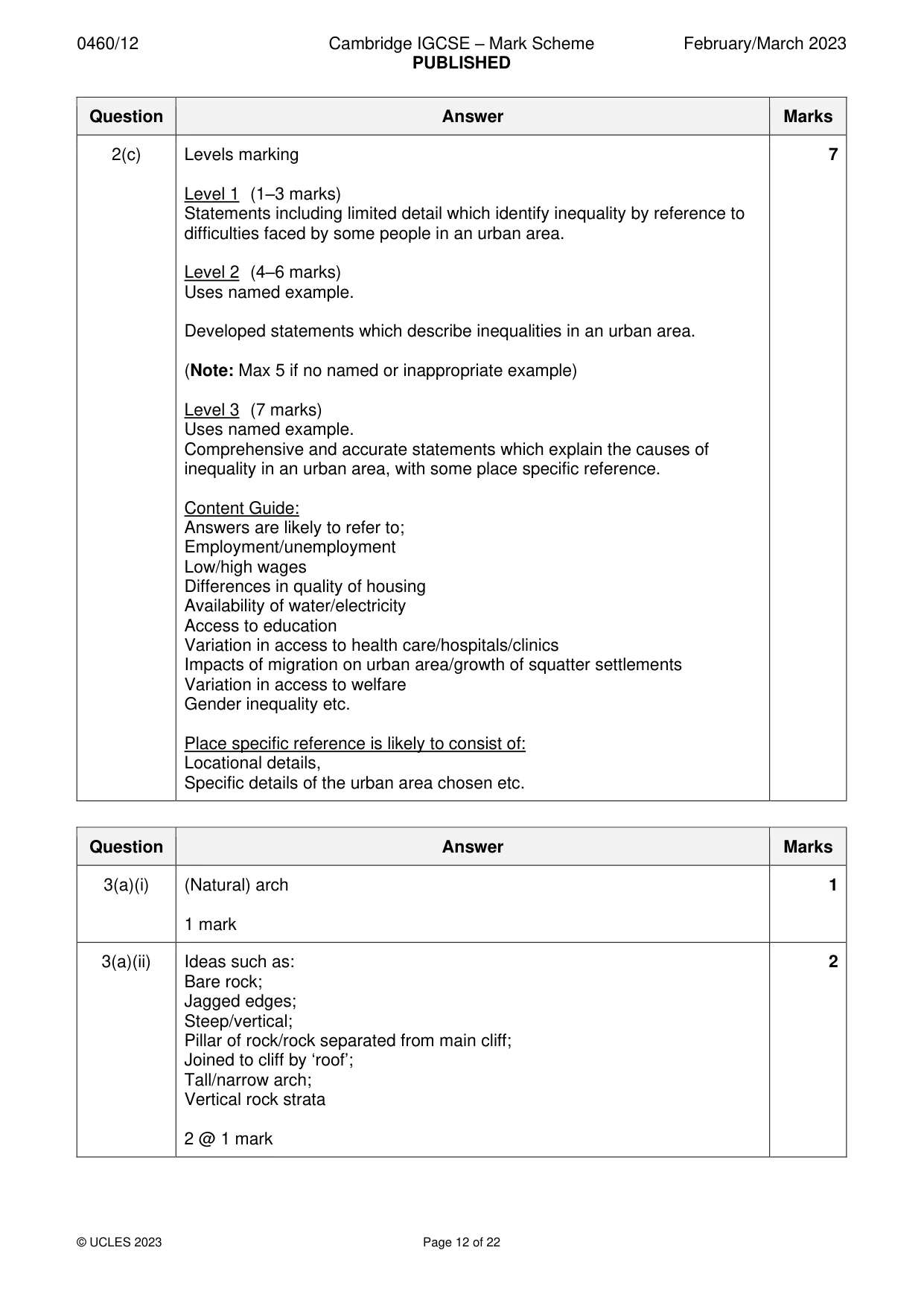
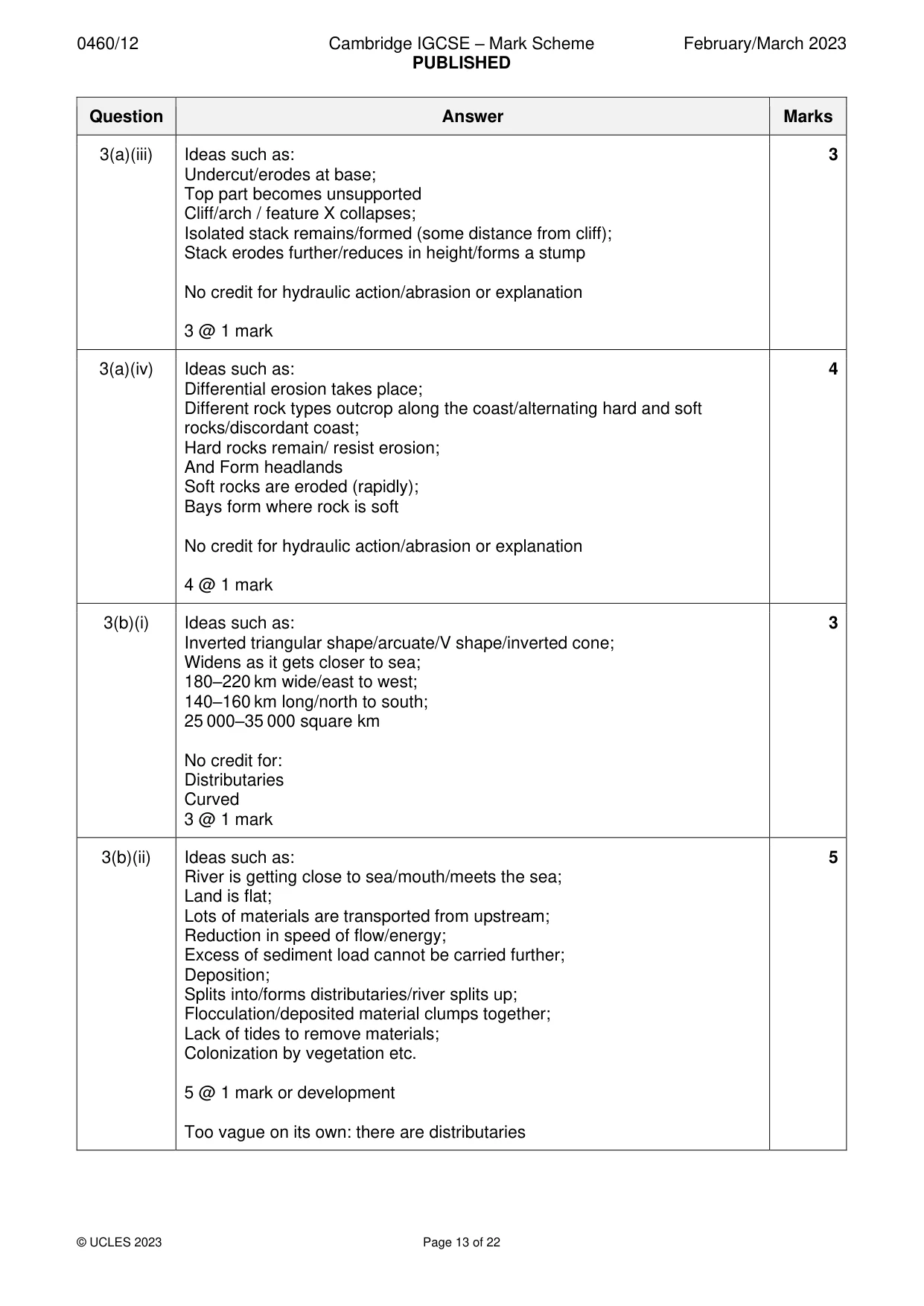
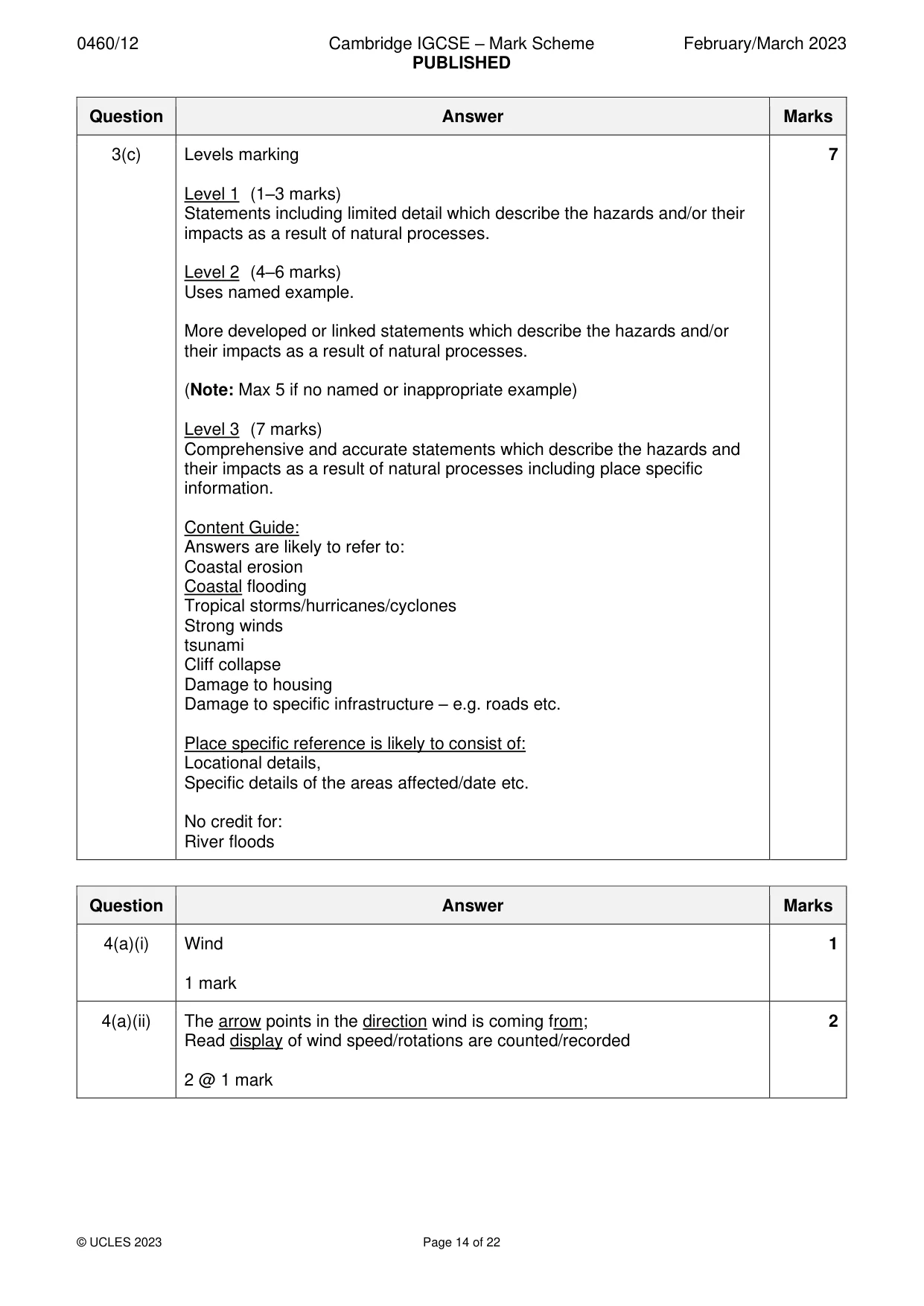
Paper as text
Question paper, page 1
This document has 32 pages. Any blank pages are indicated. [Turn over Cambridge IGCSE™ GEOGRAPHY 0460/12 Paper 1 Geographical Themes February/March 2023 1 hour 45 minutes You must answer on the question paper. You will need: Insert (enclosed) Calculator Ruler INSTRUCTIONS ● Answer three questions in total, one from each section. ● Use a black or dark blue pen. You may use an HB pencil for any diagrams or graphs. ● Write your name, centre number and candidate number in the boxes at the top of the page. ● Write your answer to each question in the space provided. ● Do not use an erasable pen or correction fluid. ● Do not write on any bar codes. ● If additional space is needed, you should use the lined pages at the end of this booklet; the question number or numbers must be clearly shown. INFORMATION ● The total mark for this paper is 75. ● The number of marks for each question or part question is shown in brackets [ ]. ● The insert contains additional resources referred to in the questions. Definitions MEDCs – More Economically Developed Countries LEDCs – Less Economically Developed Countries * 4 4 6 6 7 7 9 8 0 4 * DC (RW/SG) 311896/3 © UCLES 2023
Question paper, page 2
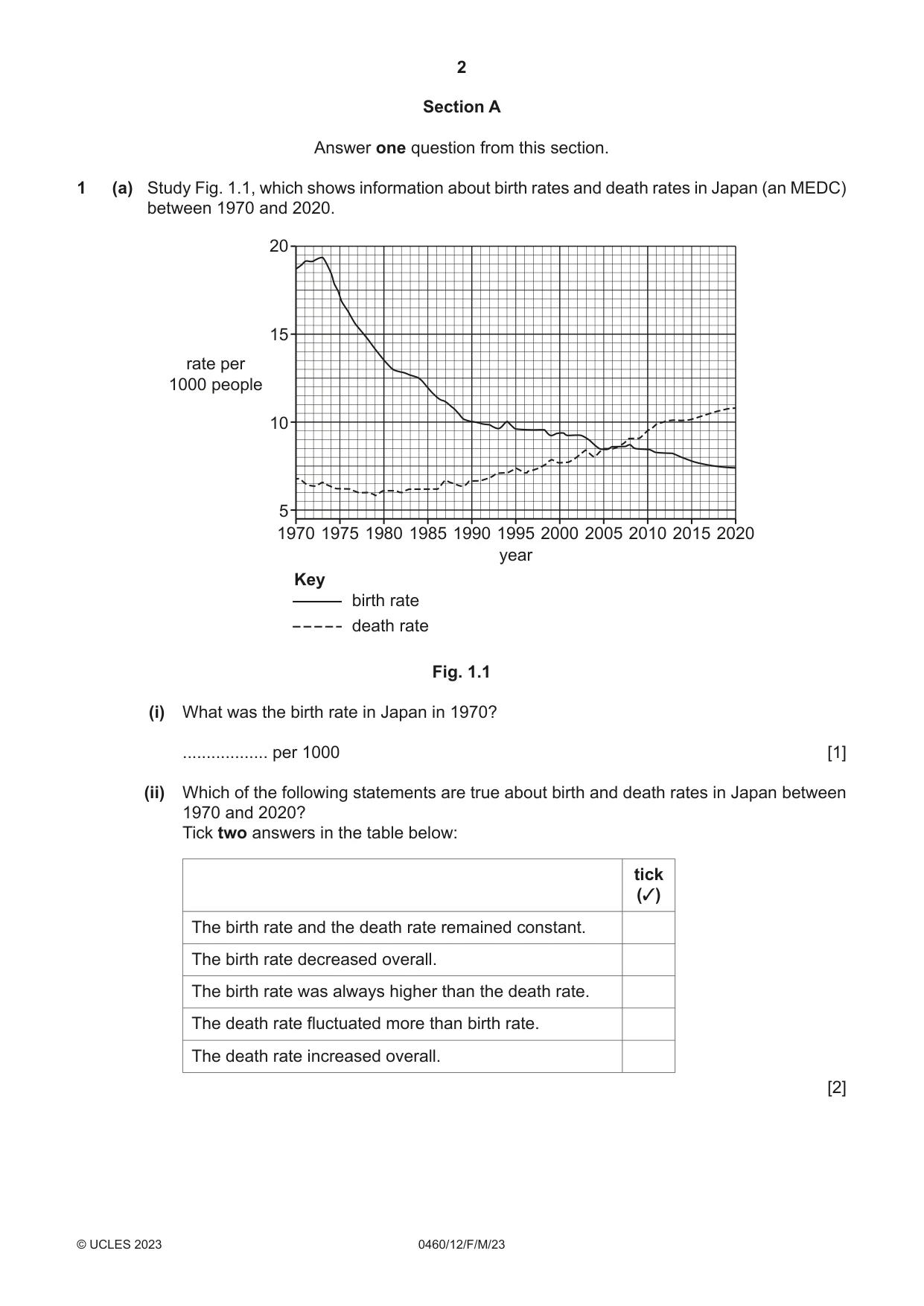
2 0460/12/F/M/23 © UCLES 2023 Section A Answer one question from this section. 1 (a) Study Fig. 1.1, which shows information about birth rates and death rates in Japan (an MEDC) between 1970 and 2020. 1970 1975 1980 1985 1990 1995 year 2000 2005 2010 2015 2020 5 10 15 20 rate per 1000 people Key birth rate death rate Fig. 1.1 (i) What was the birth rate in Japan in 1970? … per 1000 [1] (ii) Which of the following statements are true about birth and death rates in Japan between 1970 and 2020? Tick two answers in the table below: tick (✓) The birth rate and the death rate remained constant. The birth rate decreased overall. The birth rate was always higher than the death rate. The death rate fluctuated more than birth rate. The death rate increased overall. [2]
Question paper, page 3
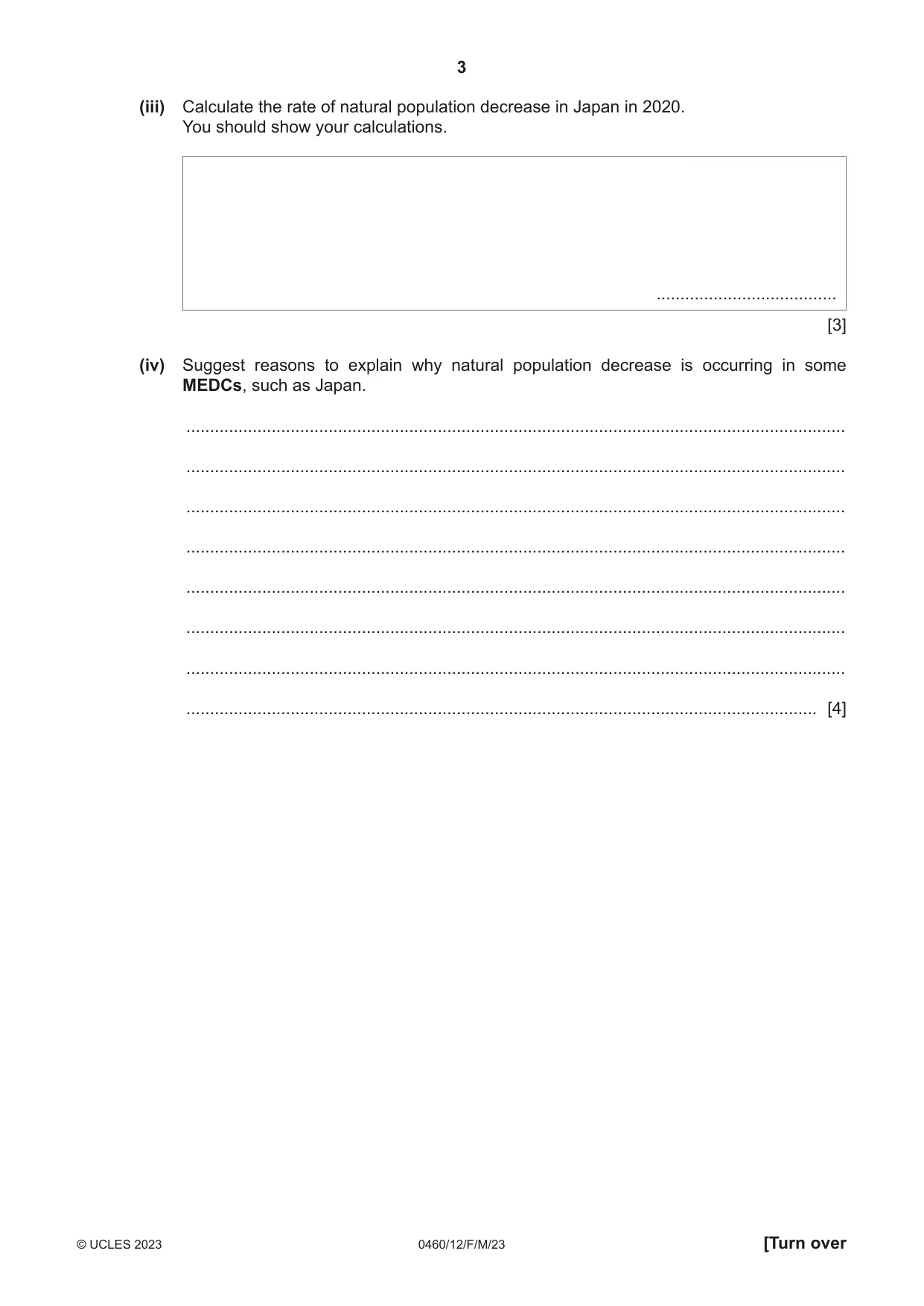
3 0460/12/F/M/23 © UCLES 2023 [Turn over (iii) Calculate the rate of natural population decrease in Japan in 2020. You should show your calculations. … [3] (iv) Suggest reasons to explain why natural population decrease is occurring in some MEDCs, such as Japan. … … … … … … … … [4]
Question paper, page 4
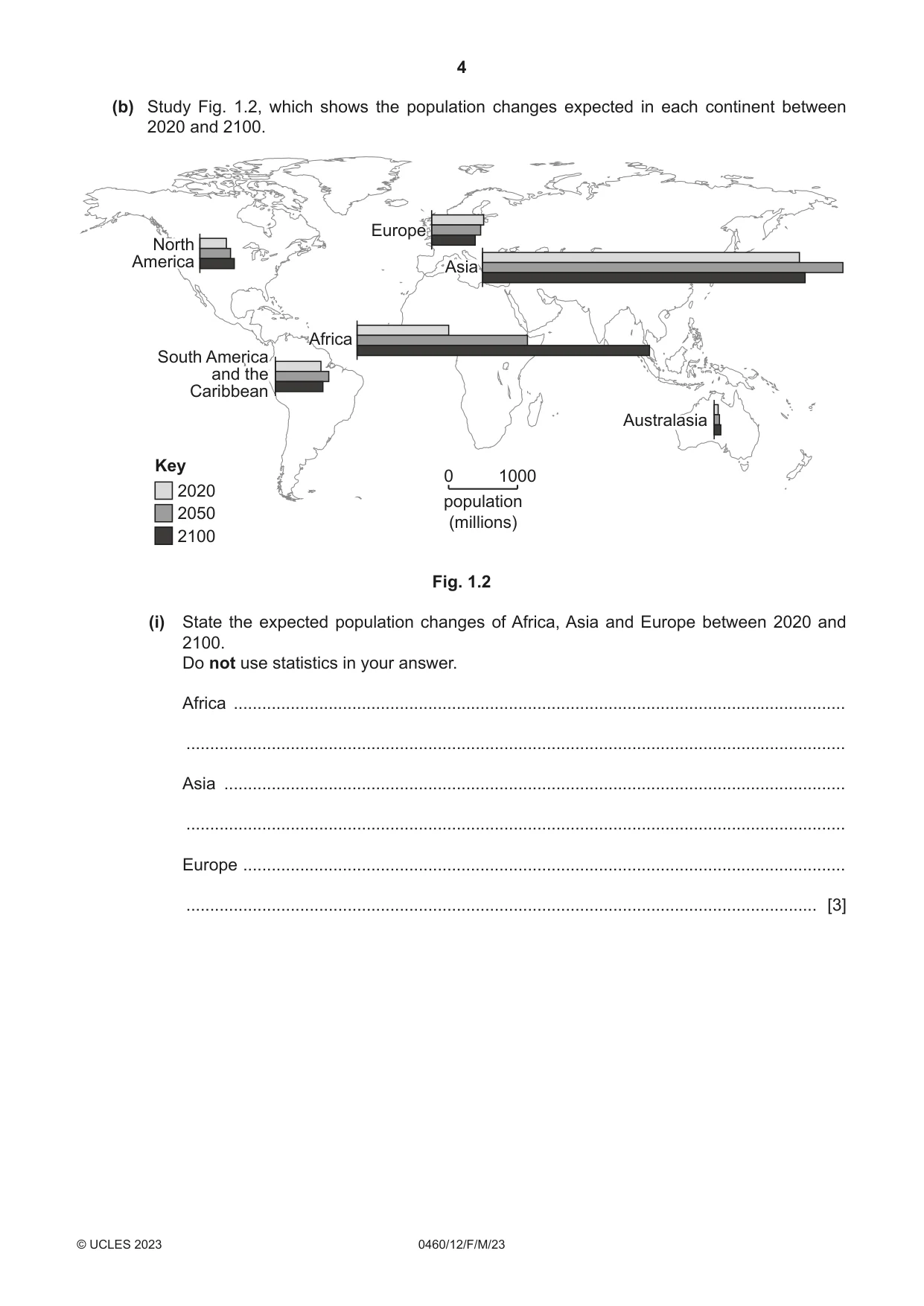
4 0460/12/F/M/23 © UCLES 2023 (b) Study Fig. 1.2, which shows the population changes expected in each continent between 2020 and 2100. North America Key 2020 2050 2100 0 1000 population (millions) South America and the Caribbean Africa Europe Asia Australasia Fig. 1.2 (i) State the expected population changes of Africa, Asia and Europe between 2020 and 2100. Do not use statistics in your answer. Africa … … Asia … … Europe … … [3]
Question paper, page 5
5 0460/12/F/M/23 © UCLES 2023 [Turn over (ii) Suggest the problems likely to be faced by the economies of LEDCs where rapid population growth occurs. … … … … … … … … … … [5]
Question paper, page 6
6 0460/12/F/M/23 © UCLES 2023 (c) For a named country you have studied, describe the positive and negative impacts of a policy used to influence population growth. Name of country … … … … … … … … … … … … … … … … … … … … … … … … … [7] [Total: 25]
Question paper, page 7
7 0460/12/F/M/23 © UCLES 2023 [Turn over 2 (a) Study Figs. 2.1, 2.2, 2.3 and 2.4 (Insert), which are photographs taken of different urban land uses in Warsaw, Poland (an MEDC in Eastern Europe). (i) Which photograph shows an area where redevelopment is taking place? Circle one answer from the list below. Fig. 2.1 Fig. 2.2 Fig. 2.3 Fig. 2.4 [1] (ii) Suggest two reasons why traffic congestion may be a problem in the areas shown in Figs. 2.1, 2.2, 2.3 and 2.4. 1 … … 2 … … [2] (iii) Explain how public transport, such as the trams shown in Fig. 2.2, reduces traffic congestion. … … … … … … [3] (iv) State two other methods that can be used to reduce traffic congestion in urban areas. For each method explain how it reduces traffic congestion. Method 1 … Explanation … … … Method 2 … Explanation … … … [4]
Question paper, page 8
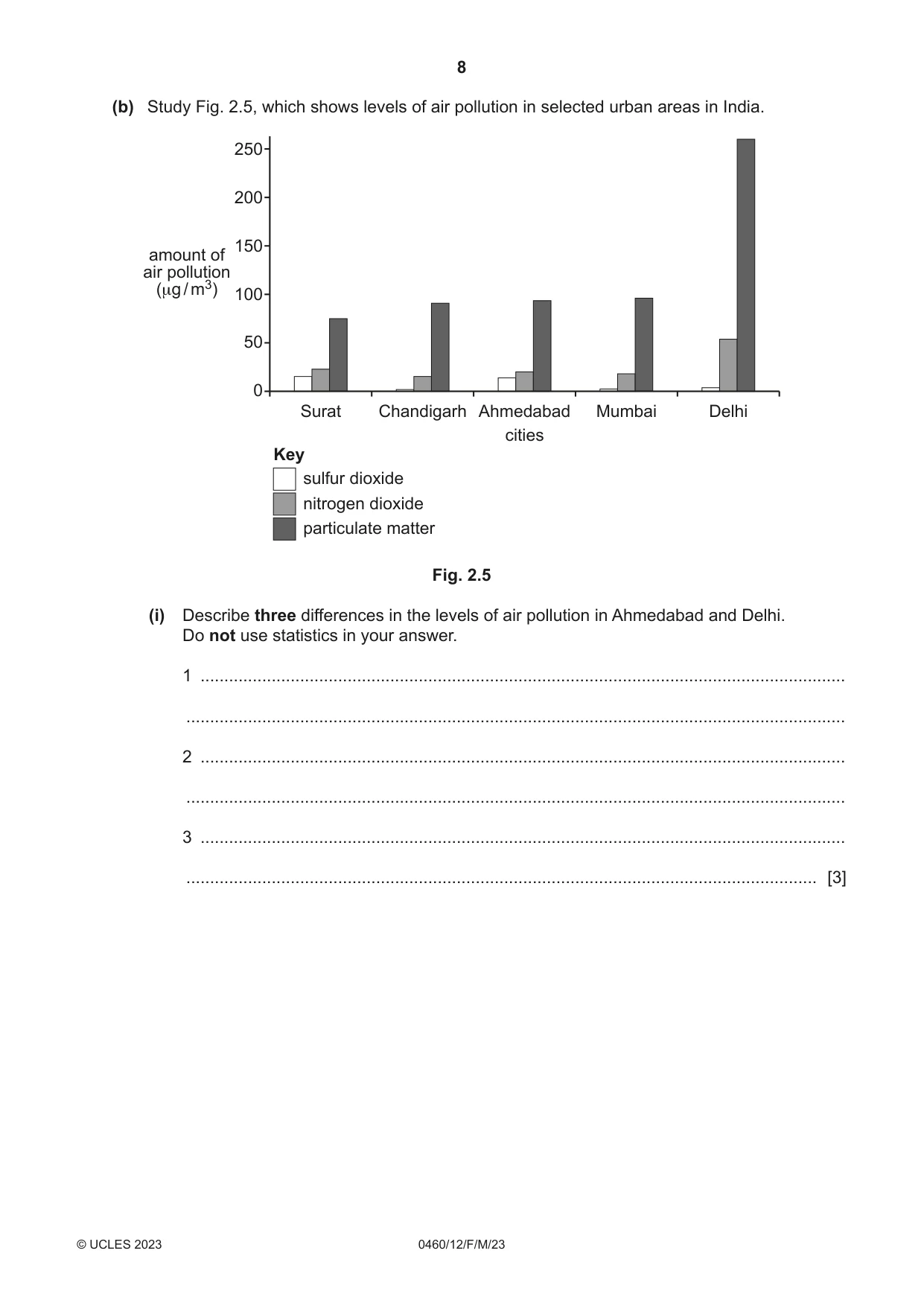
8 0460/12/F/M/23 © UCLES 2023 (b) Study Fig. 2.5, which shows levels of air pollution in selected urban areas in India. Surat sulfur dioxide nitrogen dioxide particulate matter Chandigarh Ahmedabad cities Mumbai Delhi 250 200 150 100 50 0 amount of air pollution (μg / m3) Key Fig. 2.5 (i) Describe three differences in the levels of air pollution in Ahmedabad and Delhi. Do not use statistics in your answer. 1 … … 2 … … 3 … … [3]
Question paper, page 9
9 0460/12/F/M/23 © UCLES 2023 [Turn over (ii) Describe the impacts of air pollution on people who live in urban areas. … … … … … … … … … … [5]
Question paper, page 10
10 0460/12/F/M/23 © UCLES 2023 (c) For a named urban area you have studied, explain the causes of inequality. Name of urban area … … … … … … … … … … … … … … … … … … … … … … … [7] [Total: 25]
Question paper, page 11
11 0460/12/F/M/23 © UCLES 2023 [Turn over Section B Answer one question from this section. 3 (a) Study Fig. 3.1 (Insert), which is a photograph of a coastal landform. (i) Identify the type of coastal landform marked by X in Fig. 3.1. … [1] (ii) Describe two features of the coastal landform shown in Fig. 3.1. 1 … … 2 … … [2] (iii) Suggest how the landform shown in Fig. 3.1 may change in the future as a result of coastal erosion. … … … … … … [3] (iv) The coastal landform shown in Fig. 3.1 is located on a headland. Explain why headlands form along some coastlines. … … … … … … … … [4]
Question paper, page 12
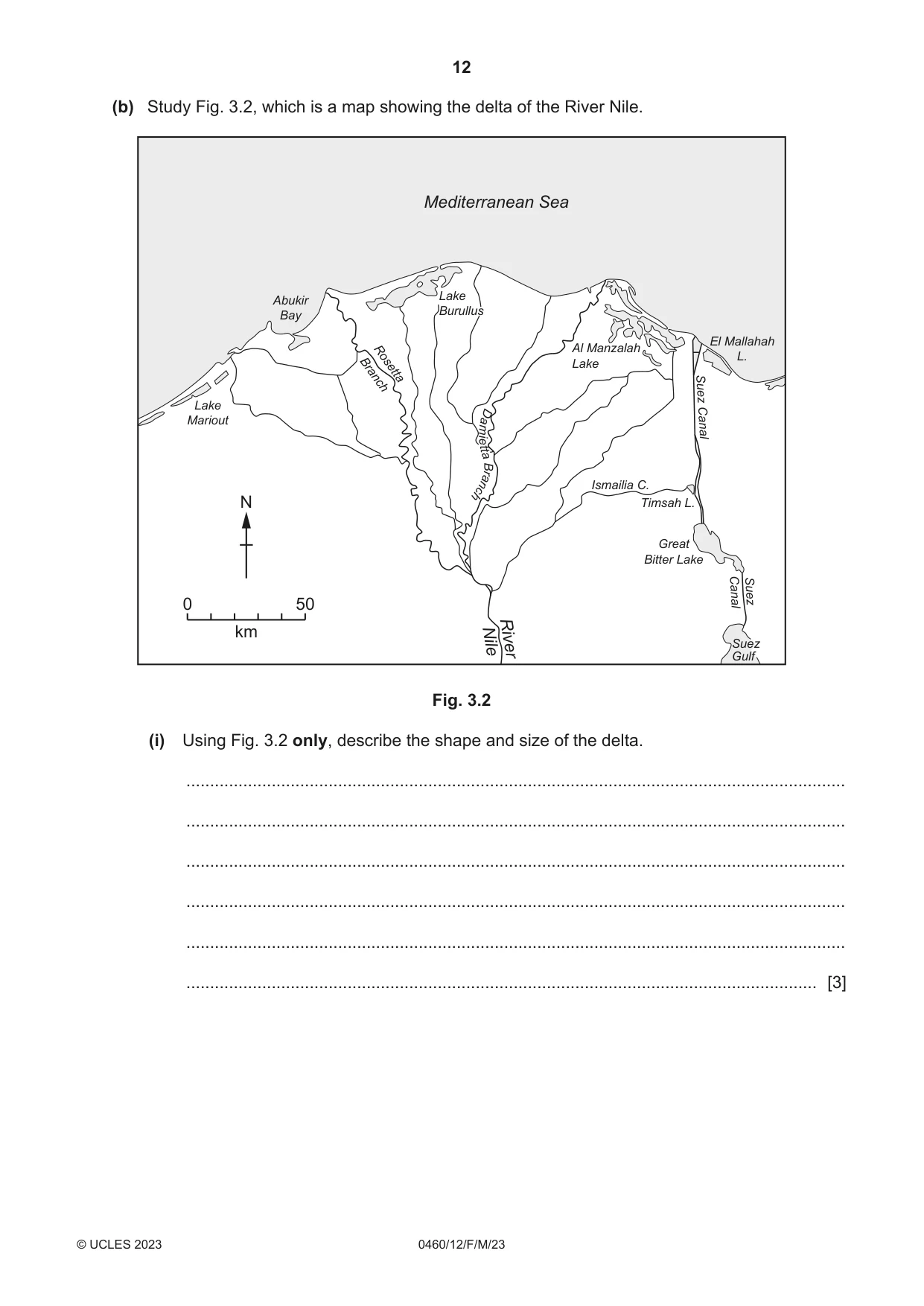
12 0460/12/F/M/23 © UCLES 2023 (b) Study Fig. 3.2, which is a map showing the delta of the River Nile. River Nile Lake Mariout Abukir Bay Rosetta Branch D a m i e t t a B r a n c h Ismailia C. Suez Canal Suez Canal Lake Burullus Al Manzalah Lake Timsah L. Great Bitter Lake El Mallahah L. Mediterranean Sea Suez Gulf 0 50 N km Fig. 3.2 (i) Using Fig. 3.2 only, describe the shape and size of the delta. … … … … … … [3]
Question paper, page 13
13 0460/12/F/M/23 © UCLES 2023 [Turn over (ii) Suggest why the River Nile has formed a delta in the area shown in Fig. 3.2. … … … … … … … … … … [5]
Question paper, page 14
14 0460/12/F/M/23 © UCLES 2023 (c) For a named coastline you have studied, describe the hazards resulting from natural processes and their impacts on people. Name of coastline … … … … … … … … … … … … … … … … … … … … … … … [7] [Total: 25]
Question paper, page 15
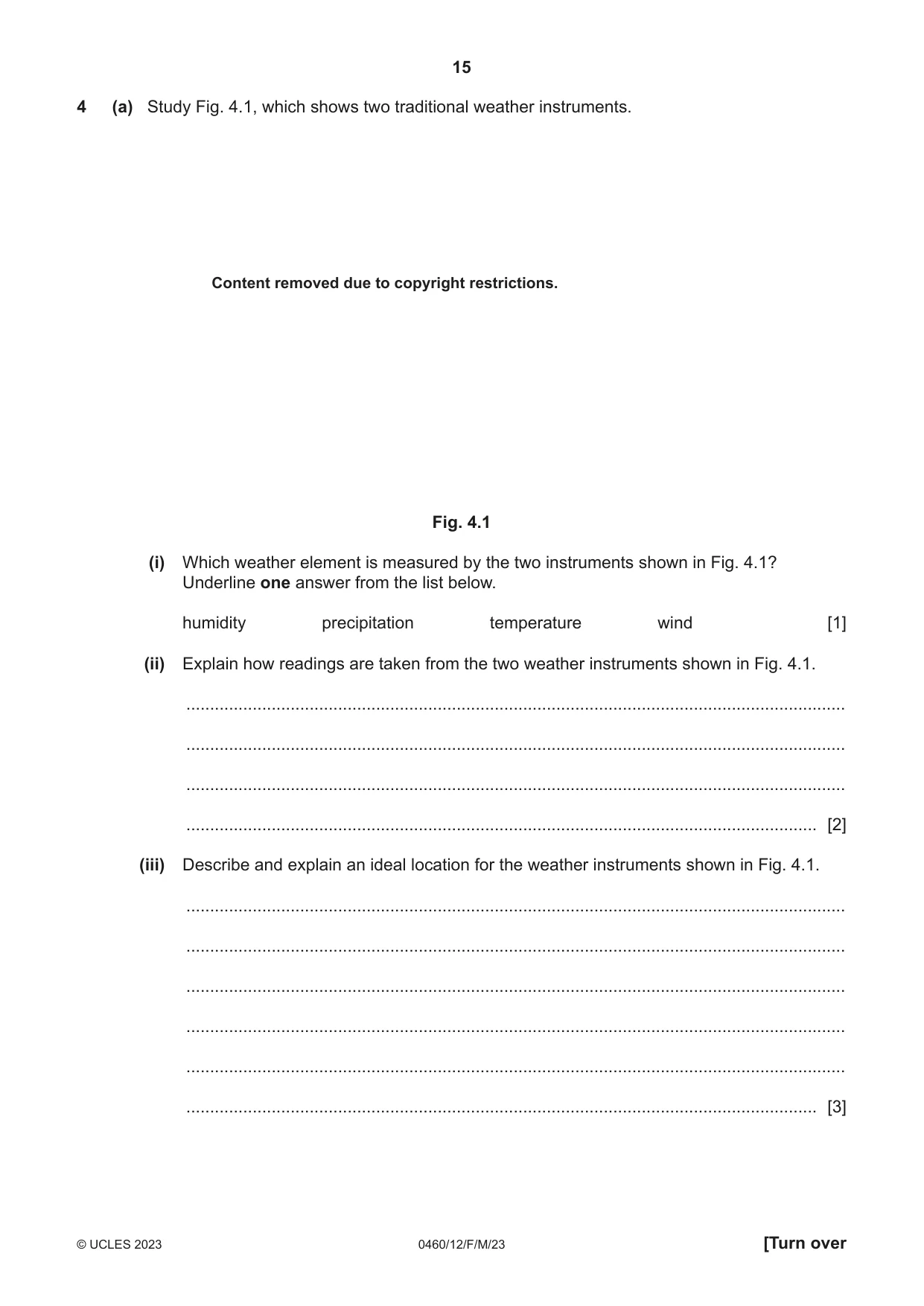
15 0460/12/F/M/23 © UCLES 2023 [Turn over 4 (a) Study Fig. 4.1, which shows two traditional weather instruments. Fig. 4.1 (i) Which weather element is measured by the two instruments shown in Fig. 4.1? Underline one answer from the list below. humidity precipitation temperature wind [1] (ii) Explain how readings are taken from the two weather instruments shown in Fig. 4.1. … … … … [2] (iii) Describe and explain an ideal location for the weather instruments shown in Fig. 4.1. … … … … … … [3] Content removed due to copyright restrictions.
Question paper, page 16
16 0460/12/F/M/23 © UCLES 2023 (iv) Describe the disadvantages of using traditional instruments rather than digital ones to record weather data. … … … … … … … … [4]
Question paper, page 17
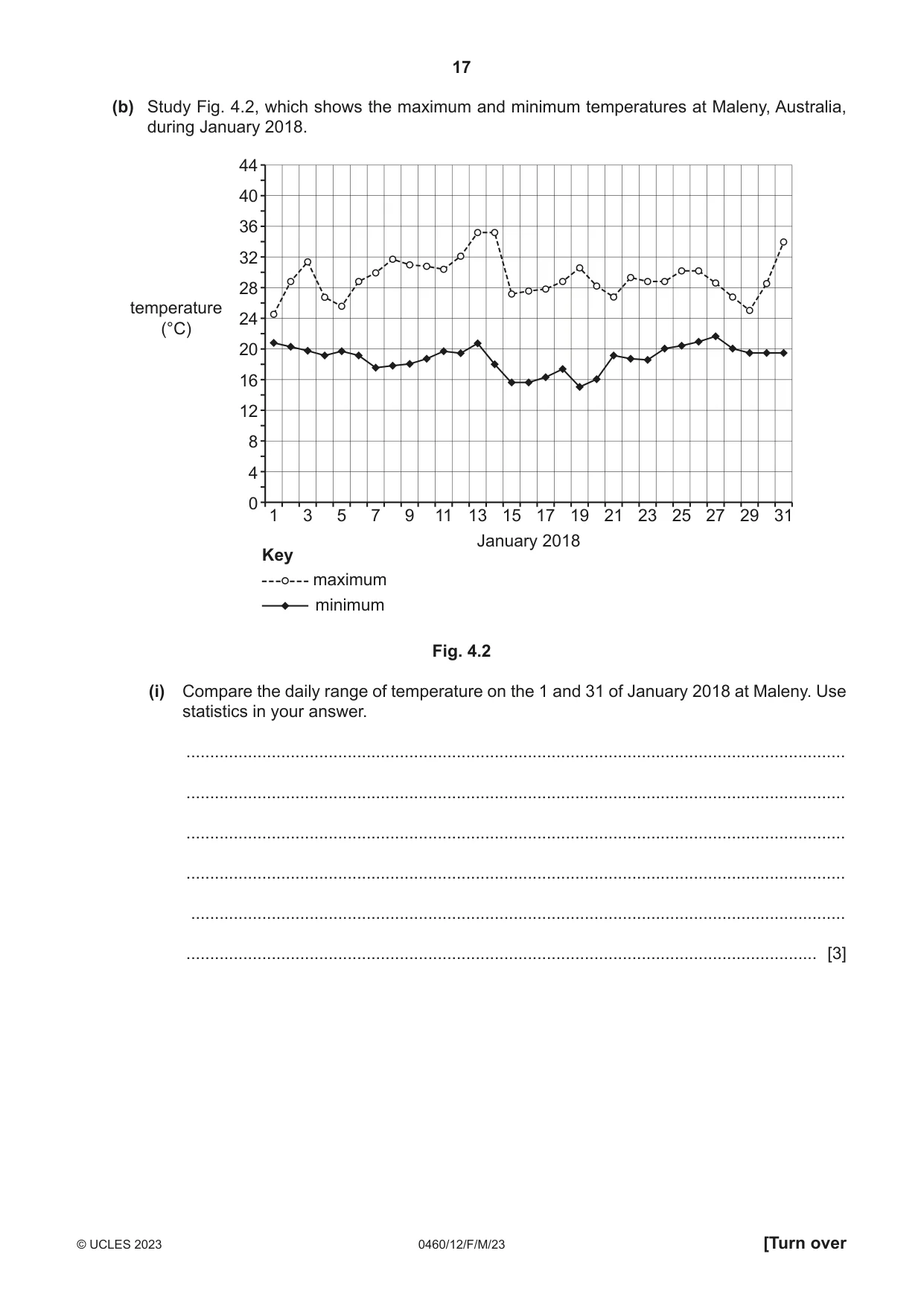
17 0460/12/F/M/23 © UCLES 2023 [Turn over (b) Study Fig. 4.2, which shows the maximum and minimum temperatures at Maleny, Australia, during January 2018. 1 0 4 8 12 16 20 24 28 32 36 40 44 3 5 7 9 11 13 15 17 January 2018 19 21 23 25 27 29 31 temperature (°C) Key minimum maximum Fig. 4.2 (i) Compare the daily range of temperature on the 1 and 31 of January 2018 at Maleny. Use statistics in your answer. … … … … … … [3]
Question paper, page 18
18 0460/12/F/M/23 © UCLES 2023 (ii) Explain how a traditional weather instrument can be used to obtain data to show changes in maximum and minimum temperature for a period of one month. … … … … … … … … … … [5]
Question paper, page 19
19 0460/12/F/M/23 © UCLES 2023 [Turn over (c) For a named river you have studied, explain why flooding occurs. Name of river … … … … … … … … … … … … … … … … … … … … … … … … [7] [Total: 25]
Question paper, page 20
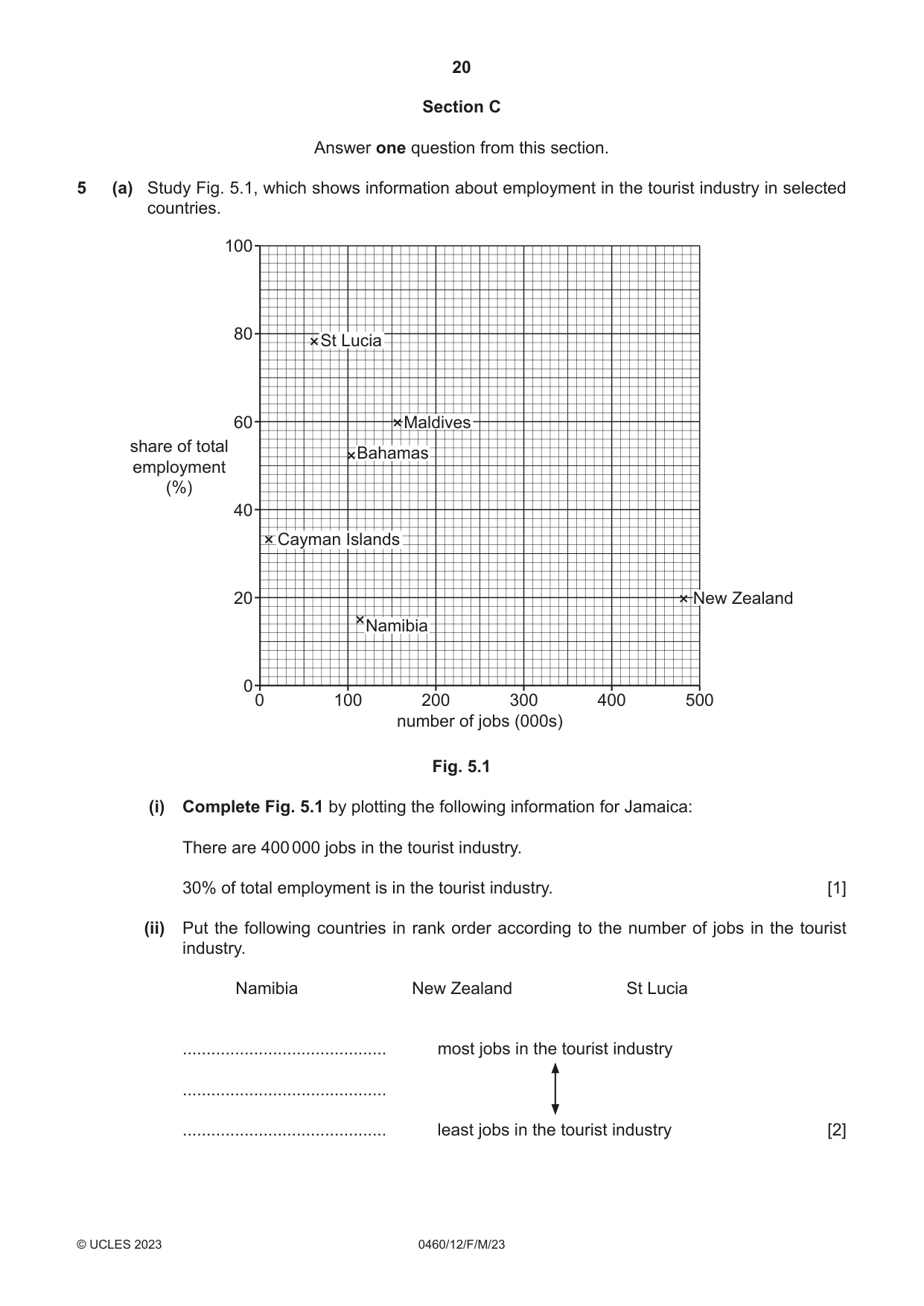
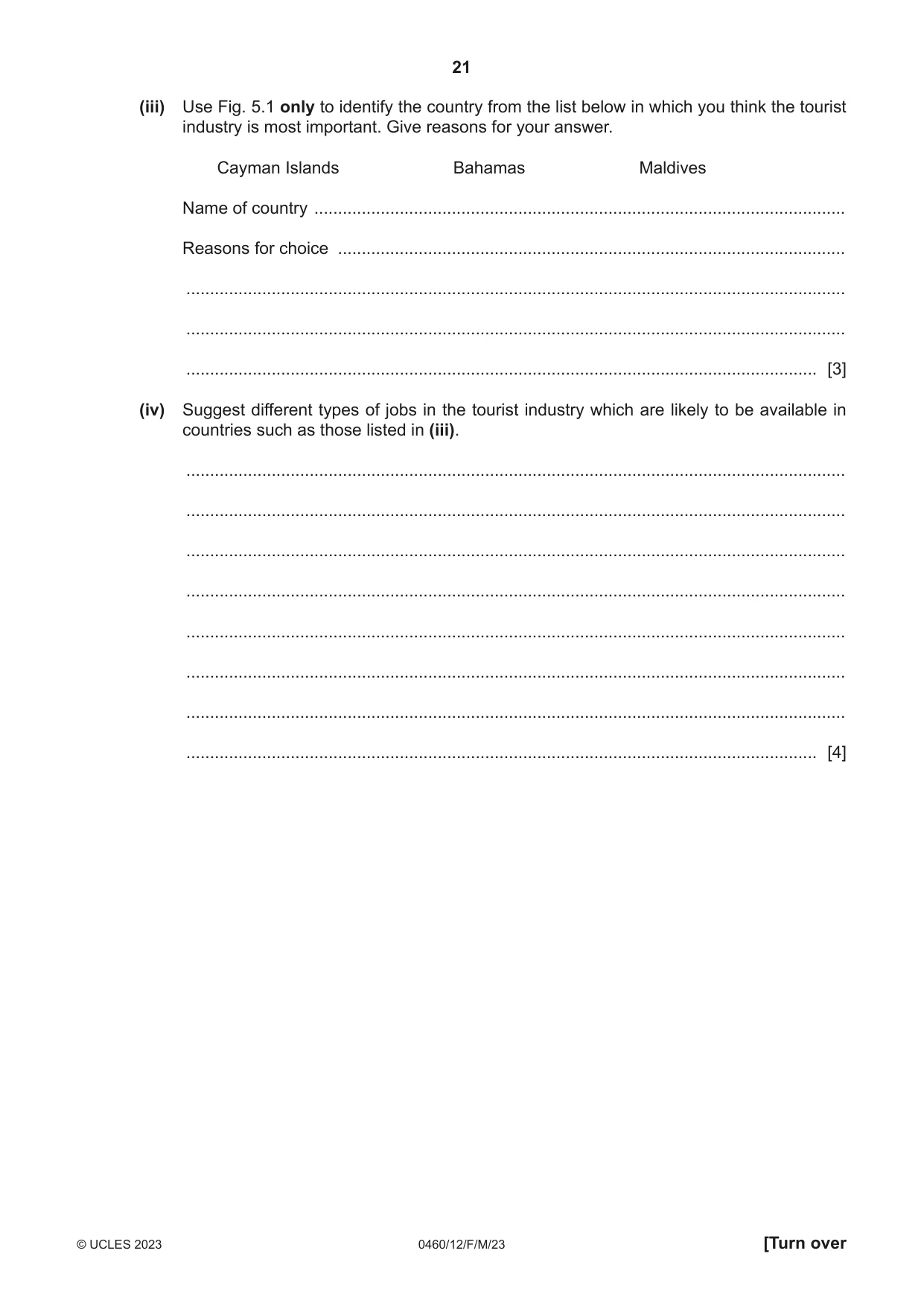
20 0460/12/F/M/23 © UCLES 2023 Section C Answer one question from this section. 5 (a) Study Fig. 5.1, which shows information about employment in the tourist industry in selected countries. share of total employment (%) 100 80 60 40 20 500 400 number of jobs (000s) 300 200 100 0 0 Namibia New Zealand Cayman Islands Maldives Bahamas St Lucia Fig. 5.1 (i) Complete Fig. 5.1 by plotting the following information for Jamaica: There are 400 000 jobs in the tourist industry. 30% of total employment is in the tourist industry. [1] (ii) Put the following countries in rank order according to the number of jobs in the tourist industry. Namibia New Zealand St Lucia … most jobs in the tourist industry … … least jobs in the tourist industry [2]
Question paper, page 21
21 0460/12/F/M/23 © UCLES 2023 [Turn over (iii) Use Fig. 5.1 only to identify the country from the list below in which you think the tourist industry is most important. Give reasons for your answer. Cayman Islands Bahamas Maldives Name of country … Reasons for choice … … … … [3] (iv) Suggest different types of jobs in the tourist industry which are likely to be available in countries such as those listed in (iii). … … … … … … … … [4]
Question paper, page 22
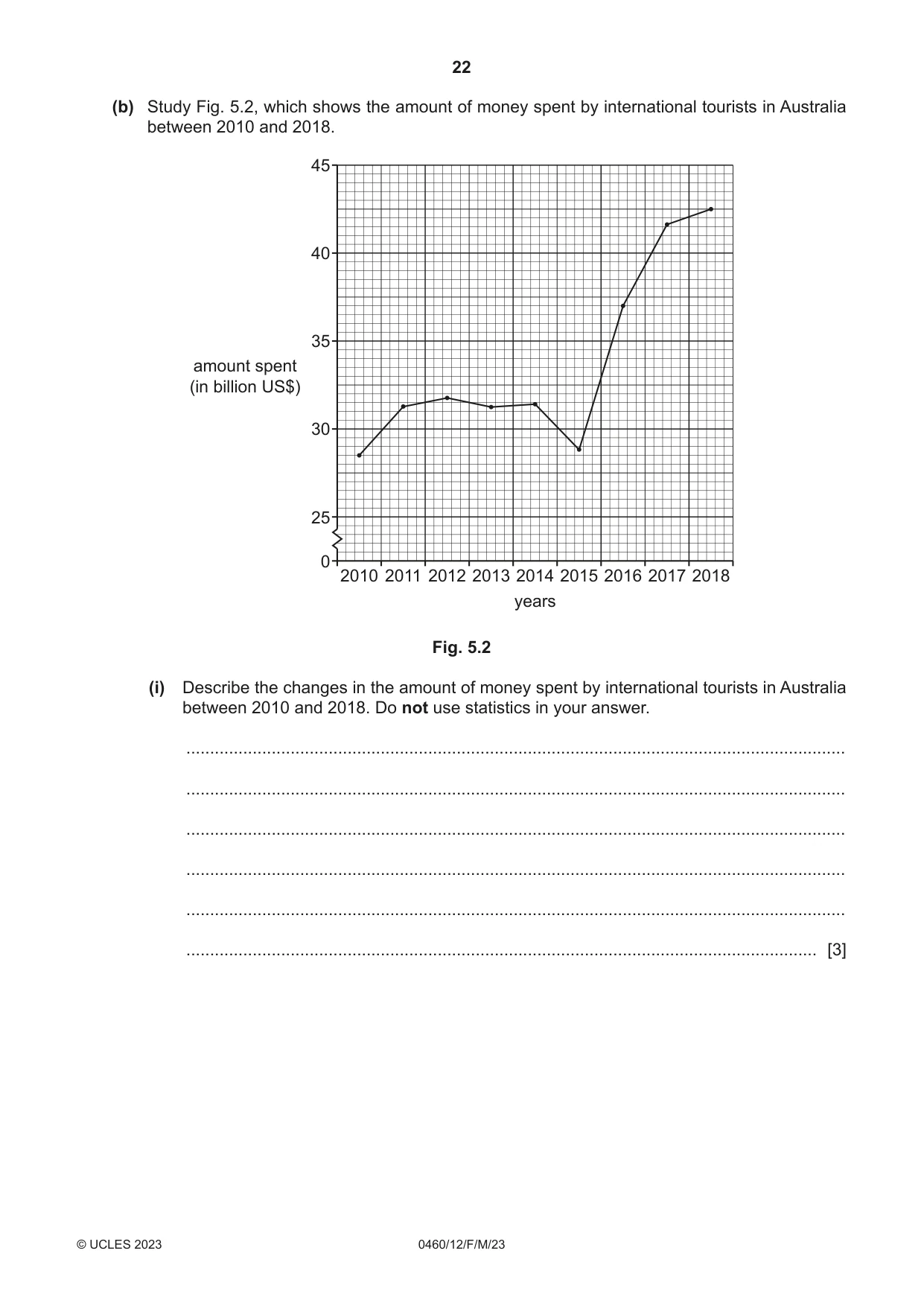
22 0460/12/F/M/23 © UCLES 2023 (b) Study Fig. 5.2, which shows the amount of money spent by international tourists in Australia between 2010 and 2018. amount spent (in billion US$) 45 40 35 30 25 0 2010 2011 2012 2013 2014 years 2015 2016 2017 2018 Fig. 5.2 (i) Describe the changes in the amount of money spent by international tourists in Australia between 2010 and 2018. Do not use statistics in your answer. … … … … … … [3]
Question paper, page 23
23 0460/12/F/M/23 © UCLES 2023 [Turn over (ii) Explain how the local natural environment may be at risk when large‑scale tourism becomes important in an area. … … … … … … … … … … [5]
Question paper, page 24
24 0460/12/F/M/23 © UCLES 2023 (c) For a named example you have studied, explain how physical (natural) attractions have led to the development of the tourist industry. Name of example … … … … … … … … … … … … … … … … … … … … … … [7] [Total: 25]
Question paper, page 25
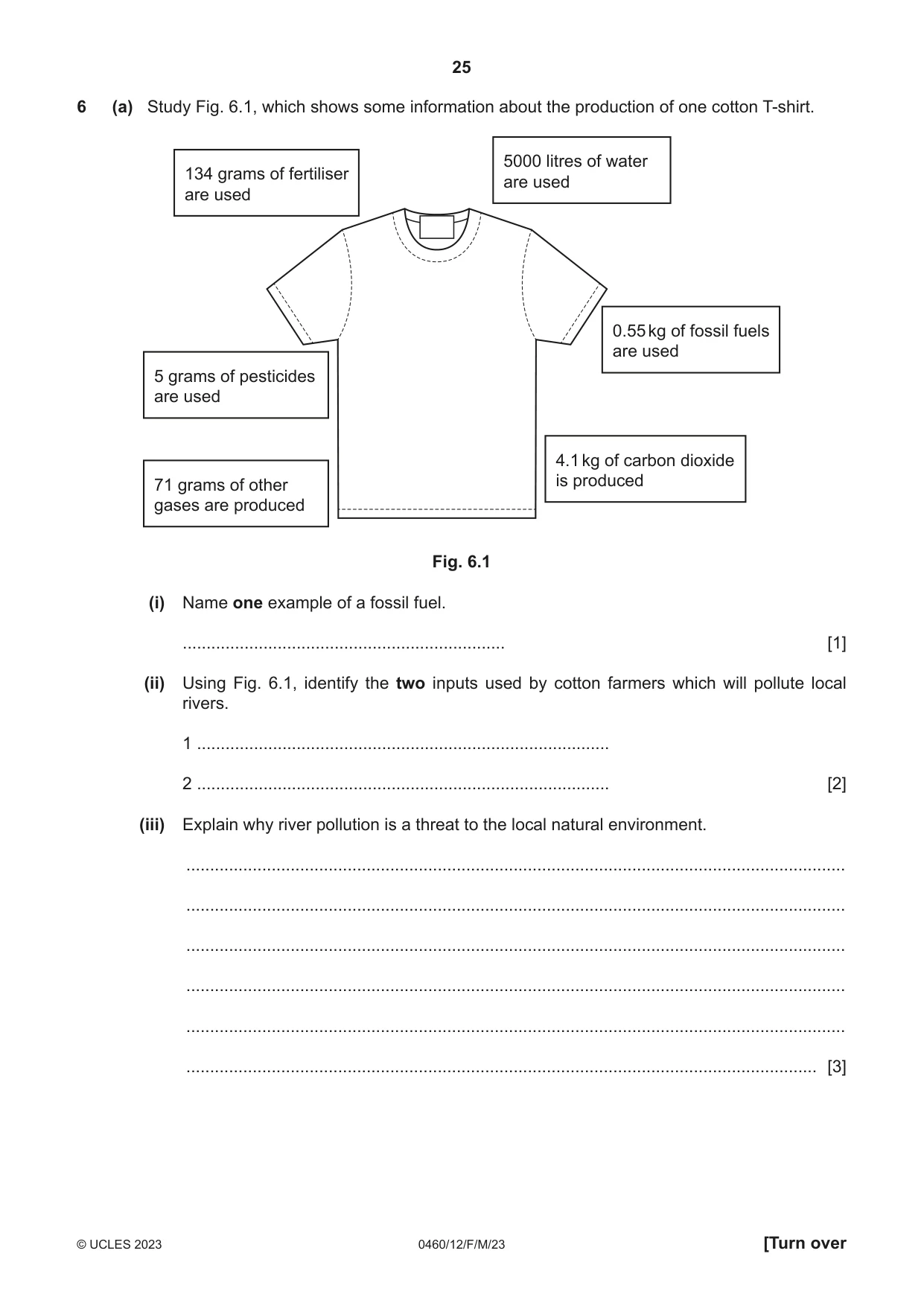
25 0460/12/F/M/23 © UCLES 2023 [Turn over 6 (a) Study Fig. 6.1, which shows some information about the production of one cotton T‑shirt. 5000 litres of water are used 134 grams of fertiliser are used 5 grams of pesticides are used 71 grams of other gases are produced 0.55 kg of fossil fuels are used 4.1 kg of carbon dioxide is produced Fig. 6.1 (i) Name one example of a fossil fuel. … [1] (ii) Using Fig. 6.1, identify the two inputs used by cotton farmers which will pollute local rivers. 1 … 2 … [2] (iii) Explain why river pollution is a threat to the local natural environment. … … … … … … [3]
Question paper, page 26
26 0460/12/F/M/23 © UCLES 2023 (iv) Explain how carbon dioxide produced by economic activities causes global warming to increase. … … … … … … … … [4]
Question paper, page 27
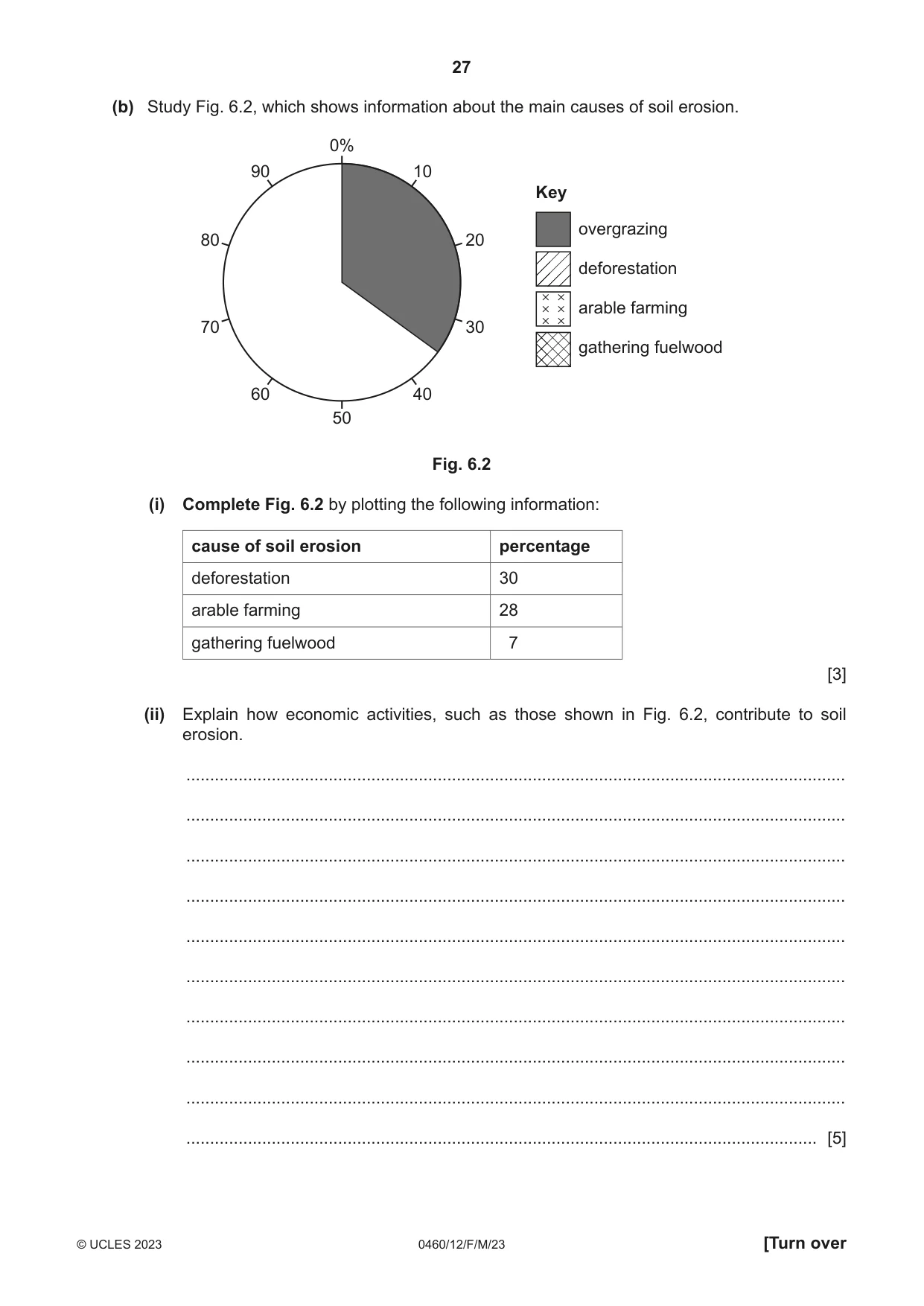
27 0460/12/F/M/23 © UCLES 2023 [Turn over (b) Study Fig. 6.2, which shows information about the main causes of soil erosion. Key 0% 50 40 10 60 90 30 20 70 80 overgrazing deforestation arable farming gathering fuelwood Fig. 6.2 (i) Complete Fig. 6.2 by plotting the following information: cause of soil erosion percentage deforestation 30 arable farming 28 gathering fuelwood 7 [3] (ii) Explain how economic activities, such as those shown in Fig. 6.2, contribute to soil erosion. … … … … … … … … … … [5]
Question paper, page 28
28 0460/12/F/M/23 © UCLES 2023 (c) Describe the effects of desertification on people and the natural environment. You should refer to places where desertification is occurring. … … … … … … … … … … … … … … … … … … … … … [7] [Total: 25]
Question paper, page 29
29 0460/12/F/M/23 © UCLES 2023 Additional pages If you use the following page to complete the answer to any question, the question number must be clearly shown. … … … … … … … … … … … … … … … … … … … … … … … … … …
Question paper, page 30
30 0460/12/F/M/23 © UCLES 2023 … … … … … … … … … … … … … … … … … … … … … … … … … … … …
Question paper, page 31
31 0460/12/F/M/23 © UCLES 2023 BLANK PAGE
Question paper, page 32
32 0460/12/F/M/23 © UCLES 2023 The boundaries and names shown, the designations used and the presentation of material on any maps contained in this question paper/insert do not imply official endorsement or acceptance by Cambridge Assessment International Education concerning the legal status of any country, territory, or area or any of its authorities, or of the delimitation of its frontiers or boundaries. Permission to reproduce items where third‑party owned material protected by copyright is included has been sought and cleared where possible. Every reasonable effort has been made by the publisher (UCLES) to trace copyright holders, but if any items requiring clearance have unwittingly been included, the publisher will be pleased to make amends at the earliest possible opportunity. To avoid the issue of disclosure of answer‑related information to candidates, all copyright acknowledgements are reproduced online in the Cambridge Assessment International Education Copyright Acknowledgements Booklet. This is produced for each series of examinations and is freely available to download at www.cambridgeinternational.org after the live examination series. Cambridge Assessment International Education is part of Cambridge Assessment. Cambridge Assessment is the brand name of the University of Cambridge Local Examinations Syndicate (UCLES), which is a department of the University of Cambridge. BLANK PAGE
Mark scheme, page 1
This document consists of 22 printed pages. © UCLES 2023 [Turn over Cambridge IGCSE™ GEOGRAPHY 0460/12 Paper 1 February/March 2023 MARK SCHEME Maximum Mark: 75 Published This mark scheme is published as an aid to teachers and candidates, to indicate the requirements of the examination. It shows the basis on which Examiners were instructed to award marks. It does not indicate the details of the discussions that took place at an Examiners’ meeting before marking began, which would have considered the acceptability of alternative answers. Mark schemes should be read in conjunction with the question paper and the Principal Examiner Report for Teachers. Cambridge International will not enter into discussions about these mark schemes. Cambridge International is publishing the mark schemes for the February/March 2023 series for most Cambridge IGCSE™, Cambridge International A and AS Level components and some Cambridge O Level components.
Mark scheme, page 2
0460/12 Cambridge IGCSE – Mark Scheme PUBLISHED February/March 2023 © UCLES 2023 Page 2 of 22 Generic Marking Principles These general marking principles must be applied by all examiners when marking candidate answers. They should be applied alongside the specific content of the mark scheme or generic level descriptors for a question. Each question paper and mark scheme will also comply with these marking principles. GENERIC MARKING PRINCIPLE 1: Marks must be awarded in line with: • the specific content of the mark scheme or the generic level descriptors for the question • the specific skills defined in the mark scheme or in the generic level descriptors for the question • the standard of response required by a candidate as exemplified by the standardisation scripts. GENERIC MARKING PRINCIPLE 2: Marks awarded are always whole marks (not half marks, or other fractions). GENERIC MARKING PRINCIPLE 3: Marks must be awarded positively: • marks are awarded for correct/valid answers, as defined in the mark scheme. However, credit is given for valid answers which go beyond the scope of the syllabus and mark scheme, referring to your Team Leader as appropriate • marks are awarded when candidates clearly demonstrate what they know and can do • marks are not deducted for errors • marks are not deducted for omissions • answers should only be judged on the quality of spelling, punctuation and grammar when these features are specifically assessed by the question as indicated by the mark scheme. The meaning, however, should be unambiguous. GENERIC MARKING PRINCIPLE 4: Rules must be applied consistently, e.g. in situations where candidates have not followed instructions or in the application of generic level descriptors. GENERIC MARKING PRINCIPLE 5: Marks should be awarded using the full range of marks defined in the mark scheme for the question (however; the use of the full mark range may be limited according to the quality of the candidate responses seen). GENERIC MARKING PRINCIPLE 6: Marks awarded are based solely on the requirements as defined in the mark scheme. Marks should not be awarded with grade thresholds or grade descriptors in mind.
Mark scheme, page 3
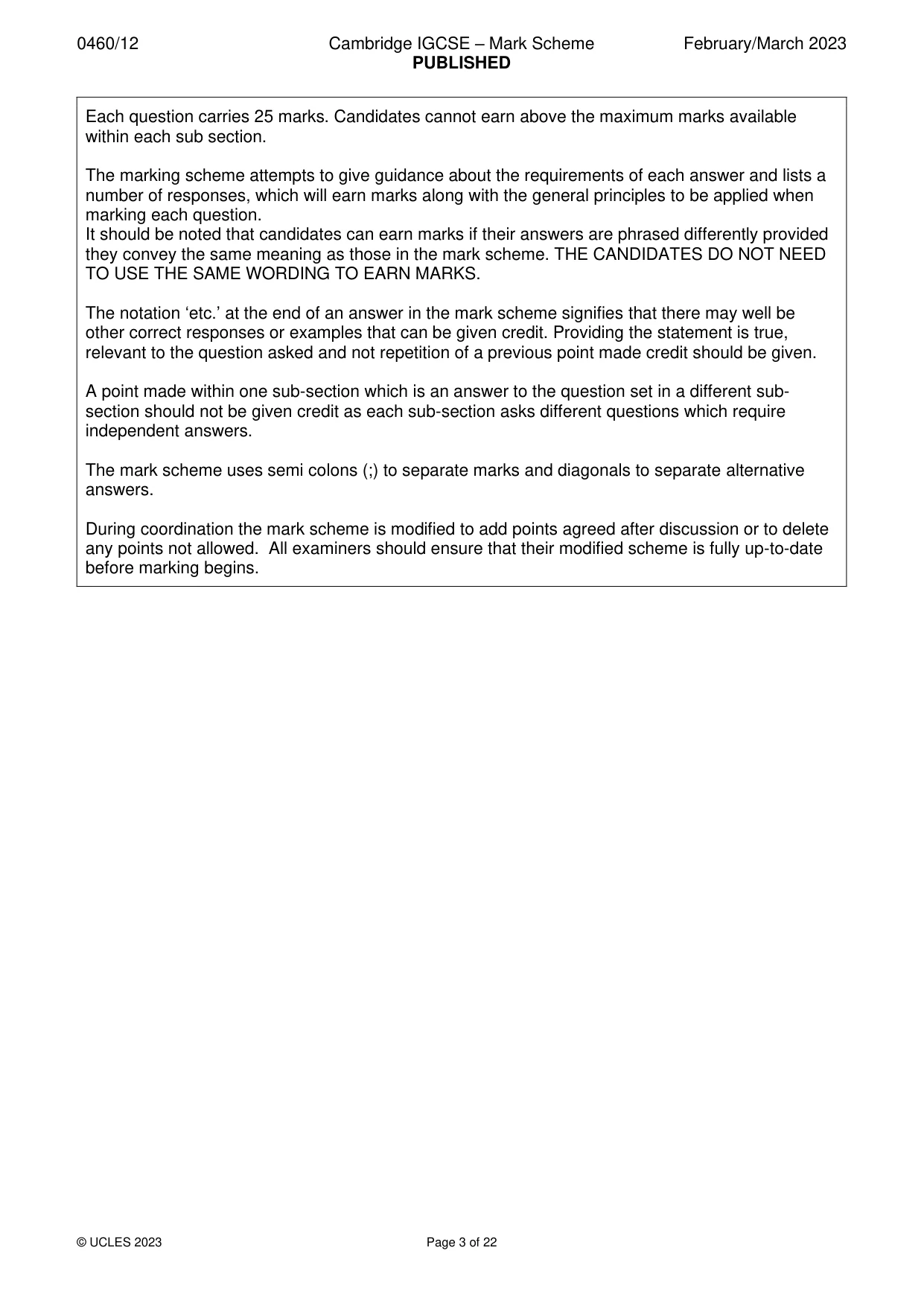
0460/12 Cambridge IGCSE – Mark Scheme PUBLISHED February/March 2023 © UCLES 2023 Page 3 of 22 Each question carries 25 marks. Candidates cannot earn above the maximum marks available within each sub section. The marking scheme attempts to give guidance about the requirements of each answer and lists a number of responses, which will earn marks along with the general principles to be applied when marking each question. It should be noted that candidates can earn marks if their answers are phrased differently provided they convey the same meaning as those in the mark scheme. THE CANDIDATES DO NOT NEED TO USE THE SAME WORDING TO EARN MARKS. The notation ‘etc.’ at the end of an answer in the mark scheme signifies that there may well be other correct responses or examples that can be given credit. Providing the statement is true, relevant to the question asked and not repetition of a previous point made credit should be given. A point made within one sub-section which is an answer to the question set in a different sub- section should not be given credit as each sub-section asks different questions which require independent answers. The mark scheme uses semi colons (;) to separate marks and diagonals to separate alternative answers. During coordination the mark scheme is modified to add points agreed after discussion or to delete any points not allowed. All examiners should ensure that their modified scheme is fully up-to-date before marking begins.
Mark scheme, page 4
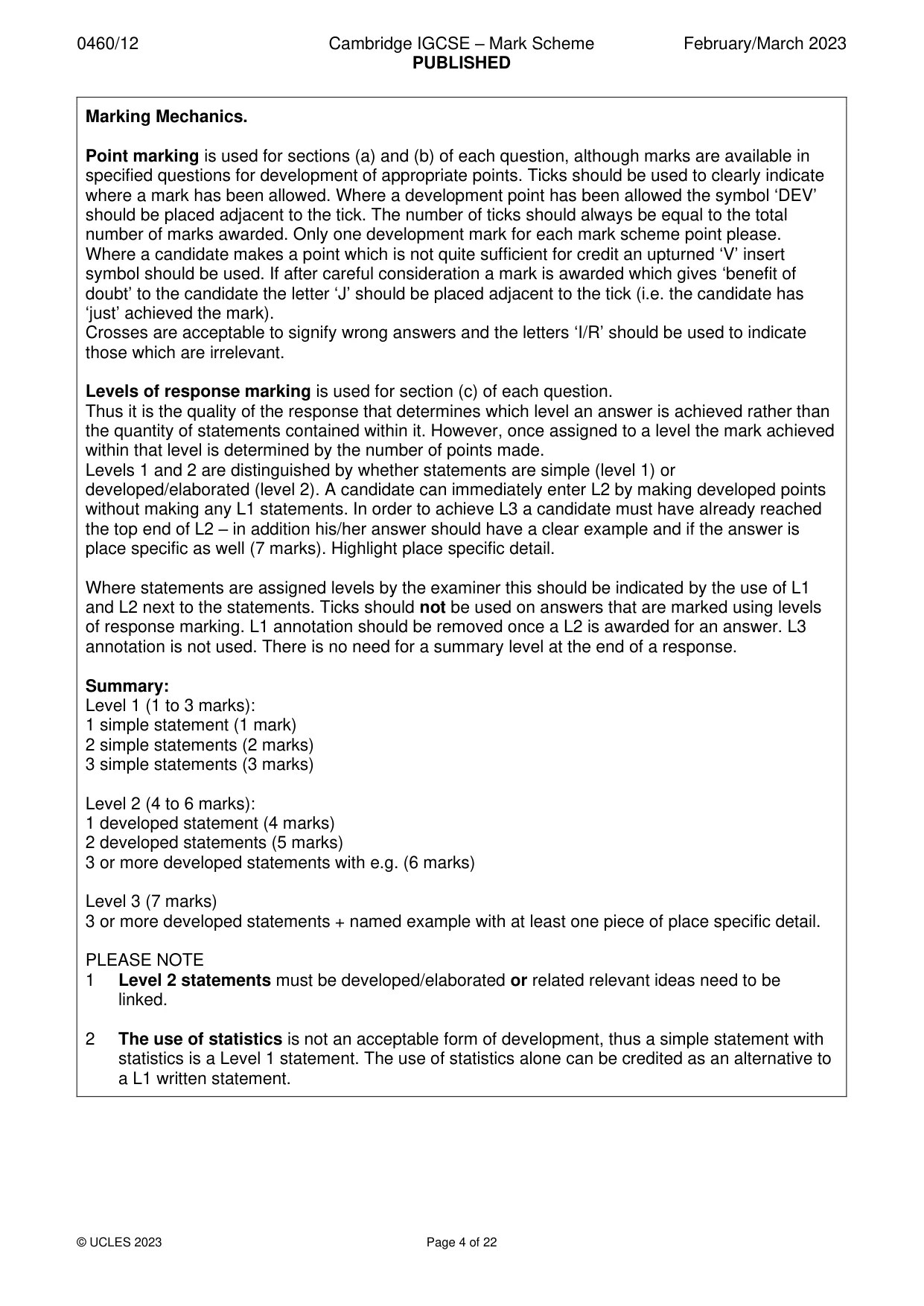
0460/12 Cambridge IGCSE – Mark Scheme PUBLISHED February/March 2023 © UCLES 2023 Page 4 of 22 Marking Mechanics. Point marking is used for sections (a) and (b) of each question, although marks are available in specified questions for development of appropriate points. Ticks should be used to clearly indicate where a mark has been allowed. Where a development point has been allowed the symbol ‘DEV’ should be placed adjacent to the tick. The number of ticks should always be equal to the total number of marks awarded. Only one development mark for each mark scheme point please. Where a candidate makes a point which is not quite sufficient for credit an upturned ‘V’ insert symbol should be used. If after careful consideration a mark is awarded which gives ‘benefit of doubt’ to the candidate the letter ‘J’ should be placed adjacent to the tick (i.e. the candidate has ‘just’ achieved the mark). Crosses are acceptable to signify wrong answers and the letters ‘I/R’ should be used to indicate those which are irrelevant. Levels of response marking is used for section (c) of each question. Thus it is the quality of the response that determines which level an answer is achieved rather than the quantity of statements contained within it. However, once assigned to a level the mark achieved within that level is determined by the number of points made. Levels 1 and 2 are distinguished by whether statements are simple (level 1) or developed/elaborated (level 2). A candidate can immediately enter L2 by making developed points without making any L1 statements. In order to achieve L3 a candidate must have already reached the top end of L2 – in addition his/her answer should have a clear example and if the answer is place specific as well (7 marks). Highlight place specific detail. Where statements are assigned levels by the examiner this should be indicated by the use of L1 and L2 next to the statements. Ticks should not be used on answers that are marked using levels of response marking. L1 annotation should be removed once a L2 is awarded for an answer. L3 annotation is not used. There is no need for a summary level at the end of a response. Summary: Level 1 (1 to 3 marks): 1 simple statement (1 mark) 2 simple statements (2 marks) 3 simple statements (3 marks) Level 2 (4 to 6 marks): 1 developed statement (4 marks) 2 developed statements (5 marks) 3 or more developed statements with e.g. (6 marks) Level 3 (7 marks) 3 or more developed statements + named example with at least one piece of place specific detail. PLEASE NOTE 1 Level 2 statements must be developed/elaborated or related relevant ideas need to be linked. 2 The use of statistics is not an acceptable form of development, thus a simple statement with statistics is a Level 1 statement. The use of statistics alone can be credited as an alternative to a L1 written statement.
Mark scheme, page 5
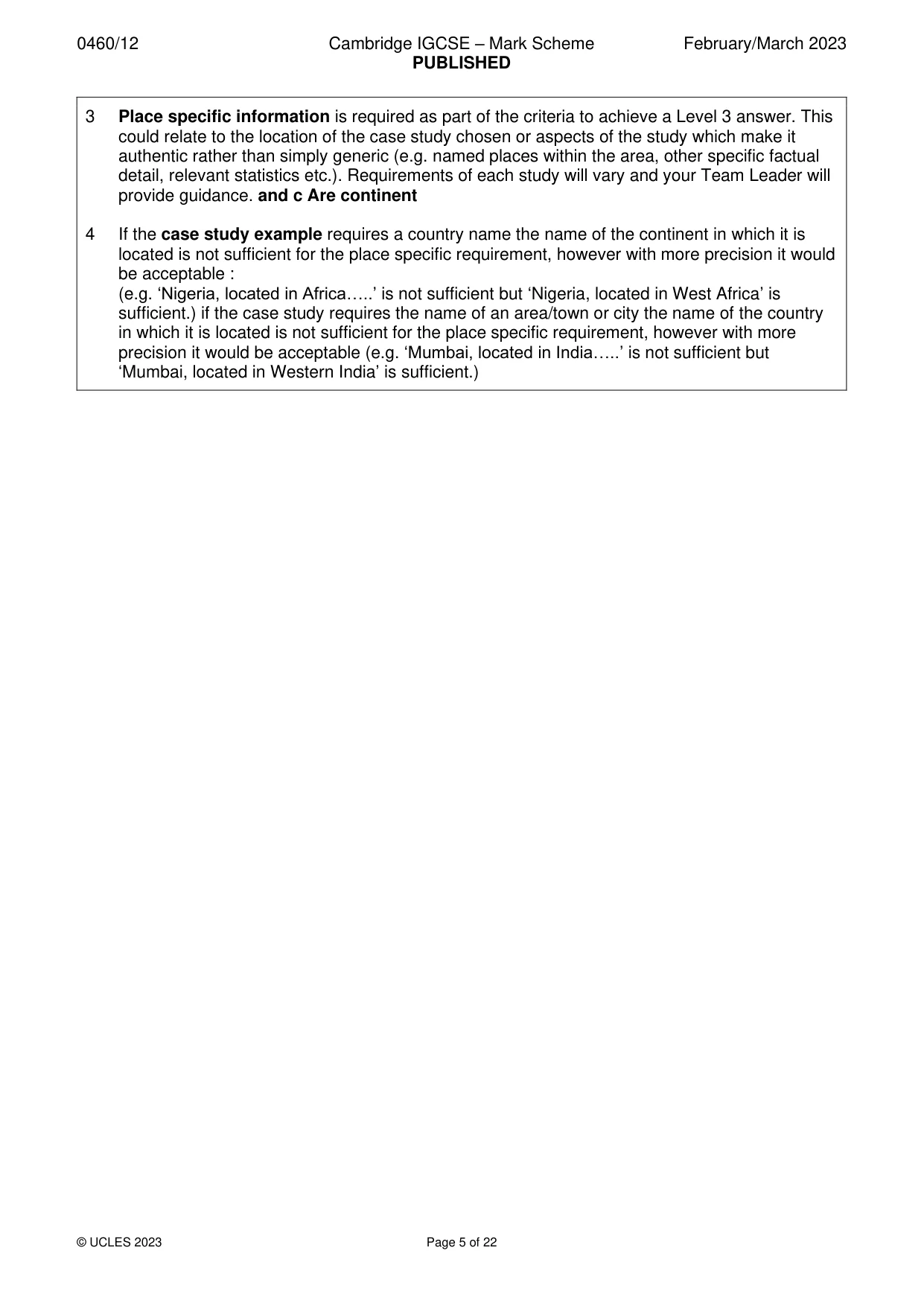
0460/12 Cambridge IGCSE – Mark Scheme PUBLISHED February/March 2023 © UCLES 2023 Page 5 of 22 3 Place specific information is required as part of the criteria to achieve a Level 3 answer. This could relate to the location of the case study chosen or aspects of the study which make it authentic rather than simply generic (e.g. named places within the area, other specific factual detail, relevant statistics etc.). Requirements of each study will vary and your Team Leader will provide guidance. and c Are continent 4 If the case study example requires a country name the name of the continent in which it is located is not sufficient for the place specific requirement, however with more precision it would be acceptable : (e.g. ‘Nigeria, located in Africa…..’ is not sufficient but ‘Nigeria, located in West Africa’ is sufficient.) if the case study requires the name of an area/town or city the name of the country in which it is located is not sufficient for the place specific requirement, however with more precision it would be acceptable (e.g. ‘Mumbai, located in India…..’ is not sufficient but ‘Mumbai, located in Western India’ is sufficient.)
Mark scheme, page 6
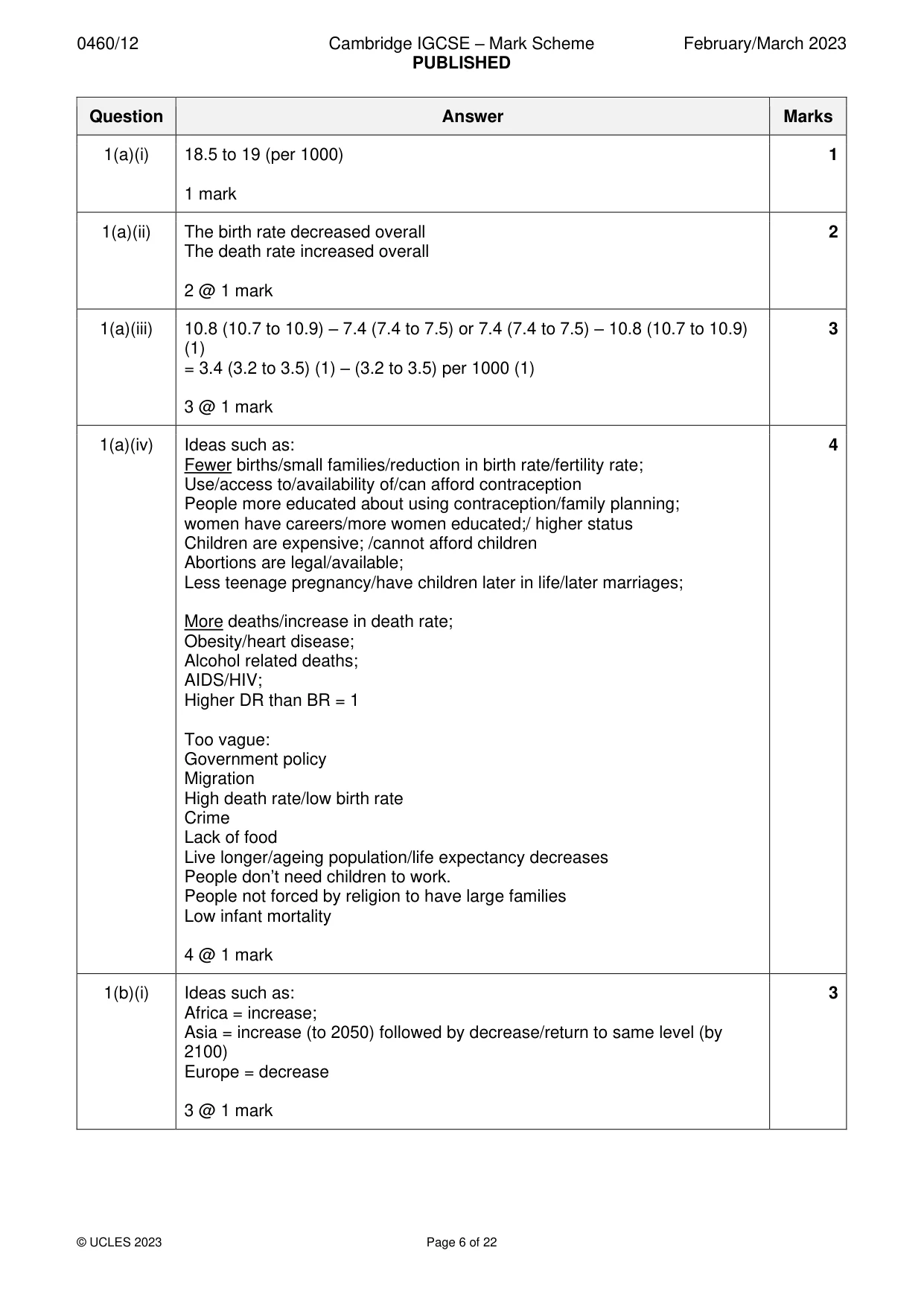
0460/12 Cambridge IGCSE – Mark Scheme PUBLISHED February/March 2023 © UCLES 2023 Page 6 of 22 Question Answer Marks 1(a)(i) 18.5 to 19 (per 1000) 1 mark 1 1(a)(ii) The birth rate decreased overall The death rate increased overall 2 @ 1 mark 2 1(a)(iii) 10.8 (10.7 to 10.9) – 7.4 (7.4 to 7.5) or 7.4 (7.4 to 7.5) – 10.8 (10.7 to 10.9) (1) = 3.4 (3.2 to 3.5) (1) – (3.2 to 3.5) per 1000 (1) 3 @ 1 mark 3 1(a)(iv) Ideas such as: Fewer births/small families/reduction in birth rate/fertility rate; Use/access to/availability of/can afford contraception People more educated about using contraception/family planning; women have careers/more women educated;/ higher status Children are expensive; /cannot afford children Abortions are legal/available; Less teenage pregnancy/have children later in life/later marriages; More deaths/increase in death rate; Obesity/heart disease; Alcohol related deaths; AIDS/HIV; Higher DR than BR = 1 Too vague: Government policy Migration High death rate/low birth rate Crime Lack of food Live longer/ageing population/life expectancy decreases People don’t need children to work. People not forced by religion to have large families Low infant mortality 4 @ 1 mark 4 1(b)(i) Ideas such as: Africa = increase; Asia = increase (to 2050) followed by decrease/return to same level (by 2100) Europe = decrease 3 @ 1 mark 3
Mark scheme, page 7
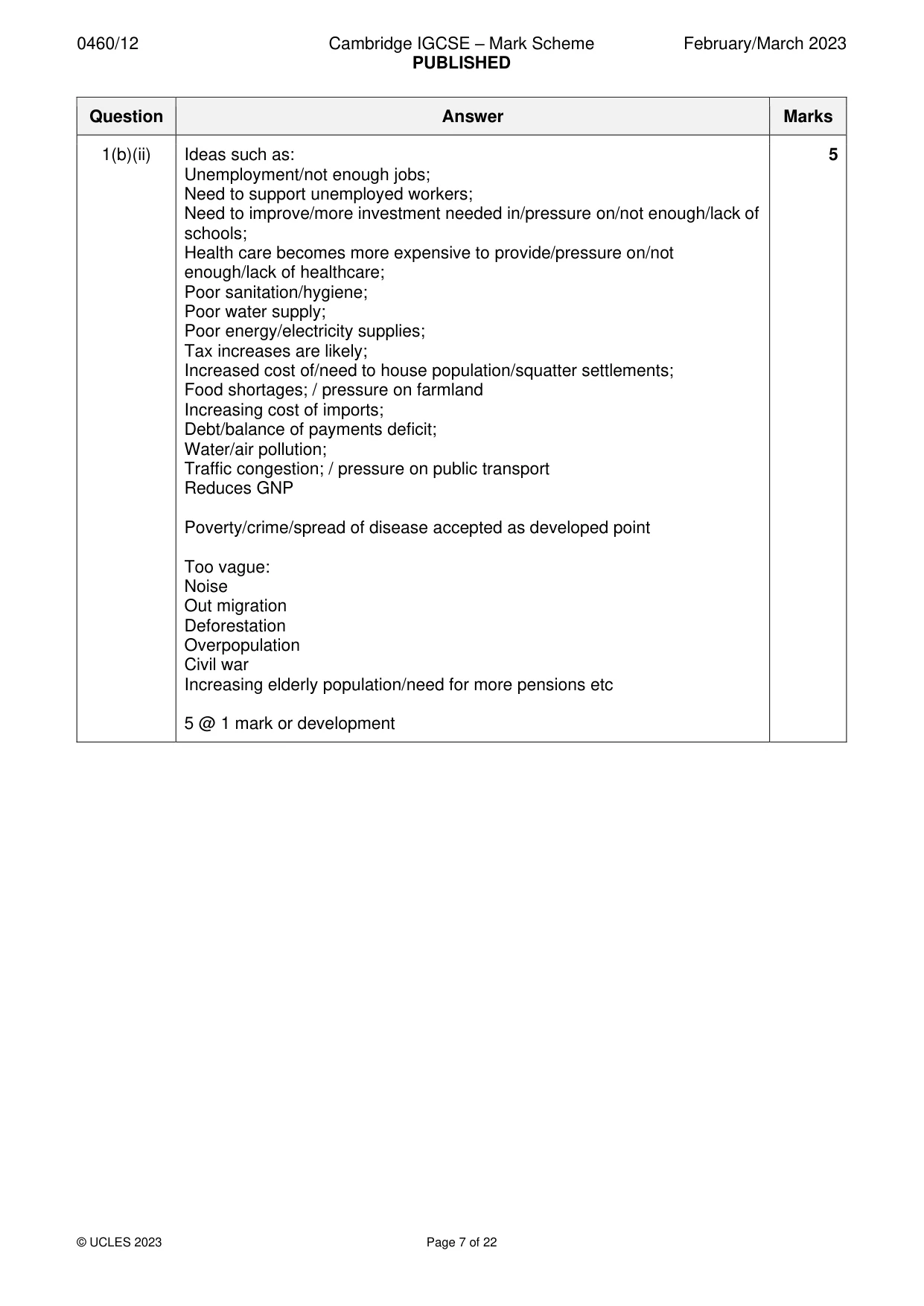
0460/12 Cambridge IGCSE – Mark Scheme PUBLISHED February/March 2023 © UCLES 2023 Page 7 of 22 Question Answer Marks 1(b)(ii) Ideas such as: Unemployment/not enough jobs; Need to support unemployed workers; Need to improve/more investment needed in/pressure on/not enough/lack of schools; Health care becomes more expensive to provide/pressure on/not enough/lack of healthcare; Poor sanitation/hygiene; Poor water supply; Poor energy/electricity supplies; Tax increases are likely; Increased cost of/need to house population/squatter settlements; Food shortages; / pressure on farmland Increasing cost of imports; Debt/balance of payments deficit; Water/air pollution; Traffic congestion; / pressure on public transport Reduces GNP Poverty/crime/spread of disease accepted as developed point Too vague: Noise Out migration Deforestation Overpopulation Civil war Increasing elderly population/need for more pensions etc 5 @ 1 mark or development 5
Mark scheme, page 8
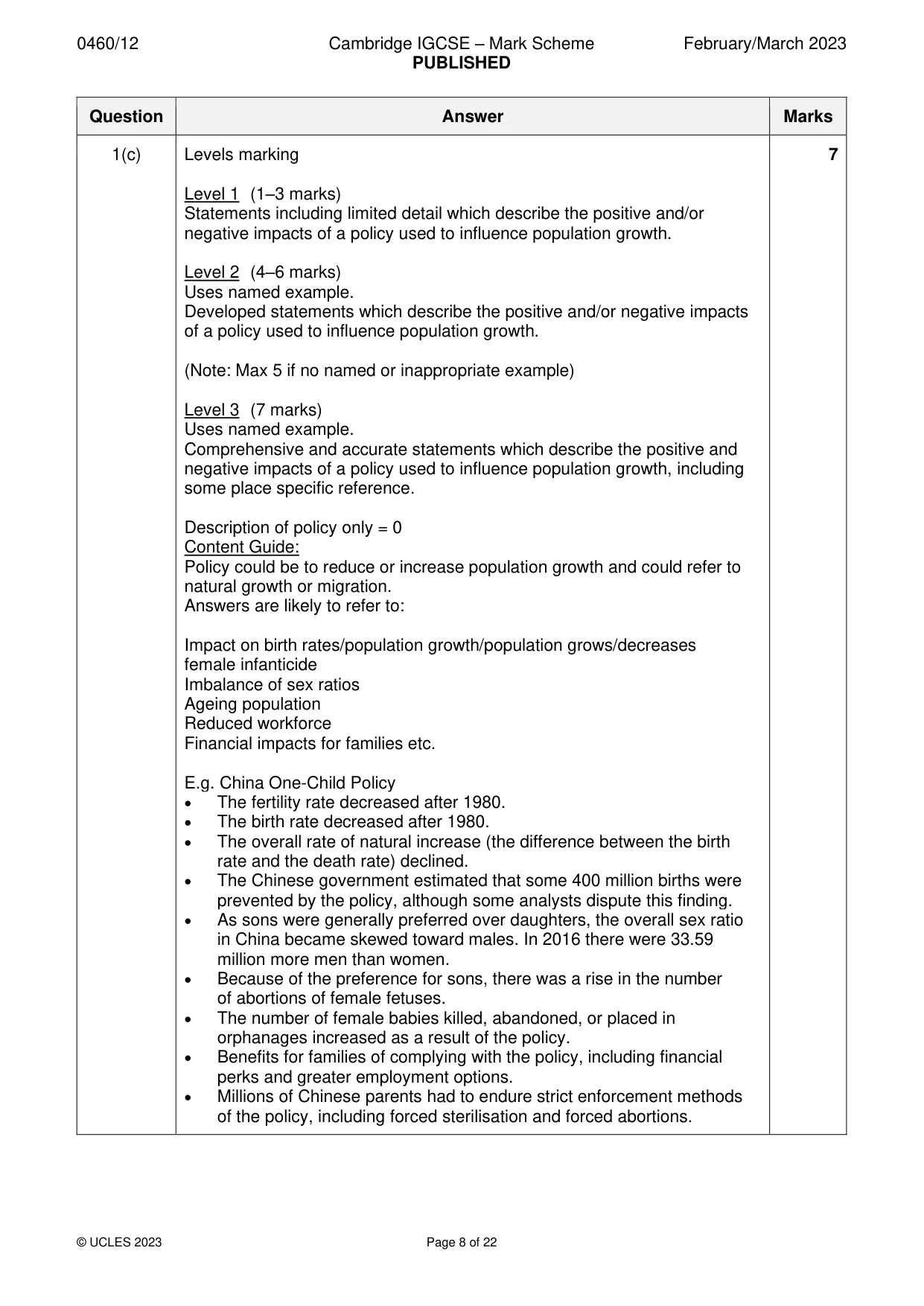
0460/12 Cambridge IGCSE – Mark Scheme PUBLISHED February/March 2023 © UCLES 2023 Page 8 of 22 Question Answer Marks 1(c) Levels marking Level 1 (1–3 marks) Statements including limited detail which describe the positive and/or negative impacts of a policy used to influence population growth. Level 2 (4–6 marks) Uses named example. Developed statements which describe the positive and/or negative impacts of a policy used to influence population growth. (Note: Max 5 if no named or inappropriate example) Level 3 (7 marks) Uses named example. Comprehensive and accurate statements which describe the positive and negative impacts of a policy used to influence population growth, including some place specific reference. Description of policy only = 0 Content Guide: Policy could be to reduce or increase population growth and could refer to natural growth or migration. Answers are likely to refer to: Impact on birth rates/population growth/population grows/decreases female infanticide Imbalance of sex ratios Ageing population Reduced workforce Financial impacts for families etc. E.g. China One-Child Policy • The fertility rate decreased after 1980. • The birth rate decreased after 1980. • The overall rate of natural increase (the difference between the birth rate and the death rate) declined. • The Chinese government estimated that some 400 million births were prevented by the policy, although some analysts dispute this finding. • As sons were generally preferred over daughters, the overall sex ratio in China became skewed toward males. In 2016 there were 33.59 million more men than women. • Because of the preference for sons, there was a rise in the number of abortions of female fetuses. • The number of female babies killed, abandoned, or placed in orphanages increased as a result of the policy. • Benefits for families of complying with the policy, including financial perks and greater employment options. • Millions of Chinese parents had to endure strict enforcement methods of the policy, including forced sterilisation and forced abortions. 7
Mark scheme, page 9
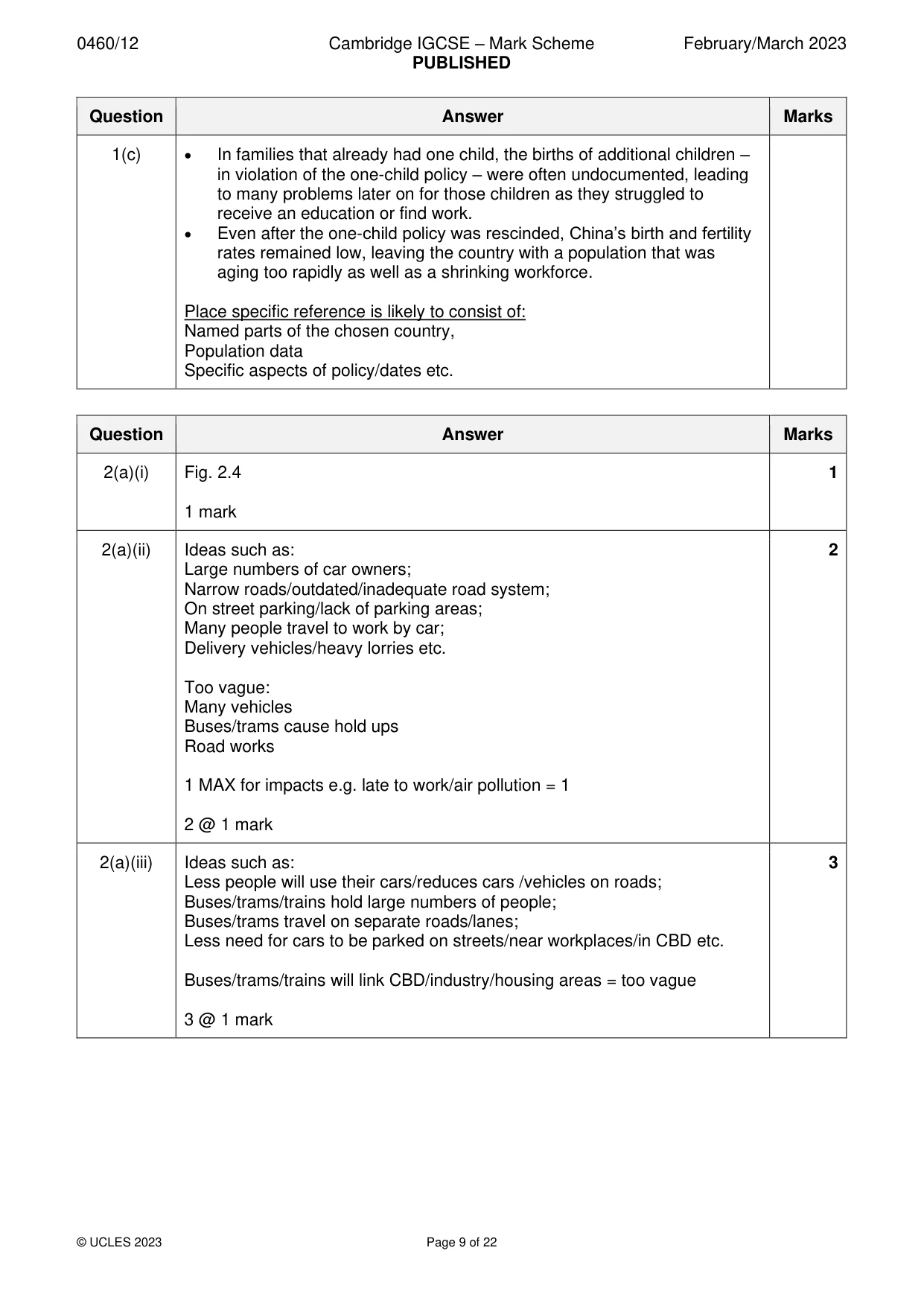
0460/12 Cambridge IGCSE – Mark Scheme PUBLISHED February/March 2023 © UCLES 2023 Page 9 of 22 Question Answer Marks 1(c) • In families that already had one child, the births of additional children – in violation of the one-child policy – were often undocumented, leading to many problems later on for those children as they struggled to receive an education or find work. • Even after the one-child policy was rescinded, China’s birth and fertility rates remained low, leaving the country with a population that was aging too rapidly as well as a shrinking workforce. Place specific reference is likely to consist of: Named parts of the chosen country, Population data Specific aspects of policy/dates etc. Question Answer Marks 2(a)(i) Fig. 2.4 1 mark 1 2(a)(ii) Ideas such as: Large numbers of car owners; Narrow roads/outdated/inadequate road system; On street parking/lack of parking areas; Many people travel to work by car; Delivery vehicles/heavy lorries etc. Too vague: Many vehicles Buses/trams cause hold ups Road works 1 MAX for impacts e.g. late to work/air pollution = 1 2 @ 1 mark 2 2(a)(iii) Ideas such as: Less people will use their cars/reduces cars /vehicles on roads; Buses/trams/trains hold large numbers of people; Buses/trams travel on separate roads/lanes; Less need for cars to be parked on streets/near workplaces/in CBD etc. Buses/trams/trains will link CBD/industry/housing areas = too vague 3 @ 1 mark 3
Mark scheme, page 10
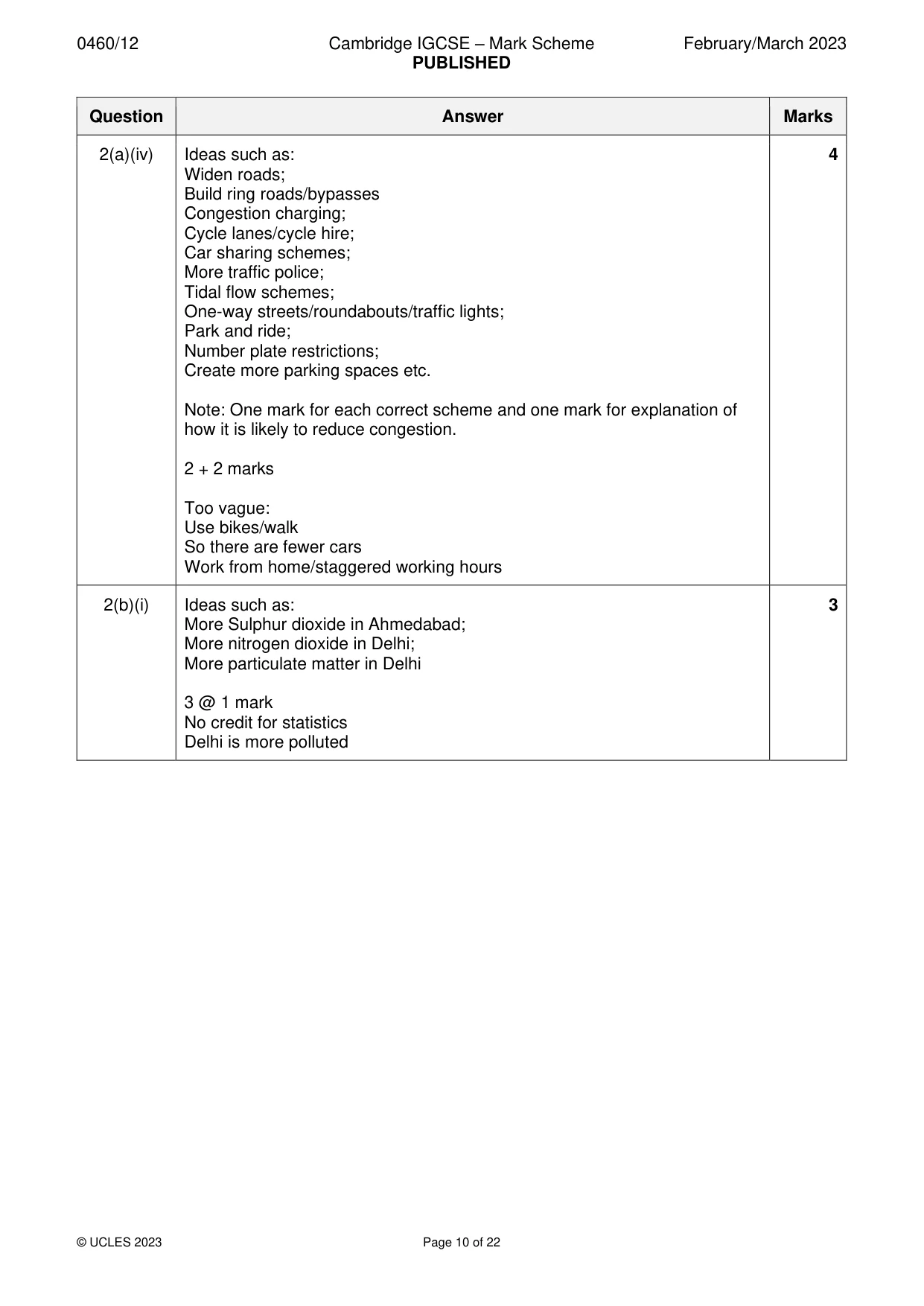
0460/12 Cambridge IGCSE – Mark Scheme PUBLISHED February/March 2023 © UCLES 2023 Page 10 of 22 Question Answer Marks 2(a)(iv) Ideas such as: Widen roads; Build ring roads/bypasses Congestion charging; Cycle lanes/cycle hire; Car sharing schemes; More traffic police; Tidal flow schemes; One-way streets/roundabouts/traffic lights; Park and ride; Number plate restrictions; Create more parking spaces etc. Note: One mark for each correct scheme and one mark for explanation of how it is likely to reduce congestion. 2 + 2 marks Too vague: Use bikes/walk So there are fewer cars Work from home/staggered working hours 4 2(b)(i) Ideas such as: More Sulphur dioxide in Ahmedabad; More nitrogen dioxide in Delhi; More particulate matter in Delhi 3 @ 1 mark No credit for statistics Delhi is more polluted 3
Mark scheme, page 11
0460/12 Cambridge IGCSE – Mark Scheme PUBLISHED February/March 2023 © UCLES 2023 Page 11 of 22 Question Answer Marks 2(b)(ii) Ideas such as: Causes respiratory disease/breathing difficulties/chest complaints/heart complaints; Brings on asthma/lung cancer/bronchitis; Irritates eyes/skin; Causes smog/affects visibility; Increases travel time/danger; Makes paintwork/windows/washing etc dirty; Weathers/corrodes stonework on buildings; Pollutes drinking water Development = More time off work; Reduces life expectancy; 5 @ 1 mark or development Too vague: Health problems It is toxic/poisonous Out migration Acid rain No credit for: Poisons people/die Global warming Mental health 5
Mark scheme, page 12
0460/12 Cambridge IGCSE – Mark Scheme PUBLISHED February/March 2023 © UCLES 2023 Page 12 of 22 Question Answer Marks 2(c) Levels marking Level 1 (1–3 marks) Statements including limited detail which identify inequality by reference to difficulties faced by some people in an urban area. Level 2 (4–6 marks) Uses named example. Developed statements which describe inequalities in an urban area. (Note: Max 5 if no named or inappropriate example) Level 3 (7 marks) Uses named example. Comprehensive and accurate statements which explain the causes of inequality in an urban area, with some place specific reference. Content Guide: Answers are likely to refer to; Employment/unemployment Low/high wages Differences in quality of housing Availability of water/electricity Access to education Variation in access to health care/hospitals/clinics Impacts of migration on urban area/growth of squatter settlements Variation in access to welfare Gender inequality etc. Place specific reference is likely to consist of: Locational details, Specific details of the urban area chosen etc. 7 Question Answer Marks 3(a)(i) (Natural) arch 1 mark 1 3(a)(ii) Ideas such as: Bare rock; Jagged edges; Steep/vertical; Pillar of rock/rock separated from main cliff; Joined to cliff by ‘roof’; Tall/narrow arch; Vertical rock strata 2 @ 1 mark 2
Mark scheme, page 13
0460/12 Cambridge IGCSE – Mark Scheme PUBLISHED February/March 2023 © UCLES 2023 Page 13 of 22 Question Answer Marks 3(a)(iii) Ideas such as: Undercut/erodes at base; Top part becomes unsupported Cliff/arch / feature X collapses; Isolated stack remains/formed (some distance from cliff); Stack erodes further/reduces in height/forms a stump No credit for hydraulic action/abrasion or explanation 3 @ 1 mark 3 3(a)(iv) Ideas such as: Differential erosion takes place; Different rock types outcrop along the coast/alternating hard and soft rocks/discordant coast; Hard rocks remain/ resist erosion; And Form headlands Soft rocks are eroded (rapidly); Bays form where rock is soft No credit for hydraulic action/abrasion or explanation 4 @ 1 mark 4 3(b)(i) Ideas such as: Inverted triangular shape/arcuate/V shape/inverted cone; Widens as it gets closer to sea; 180–220 km wide/east to west; 140–160 km long/north to south; 25 000–35 000 square km No credit for: Distributaries Curved 3 @ 1 mark 3 3(b)(ii) Ideas such as: River is getting close to sea/mouth/meets the sea; Land is flat; Lots of materials are transported from upstream; Reduction in speed of flow/energy; Excess of sediment load cannot be carried further; Deposition; Splits into/forms distributaries/river splits up; Flocculation/deposited material clumps together; Lack of tides to remove materials; Colonization by vegetation etc. 5 @ 1 mark or development Too vague on its own: there are distributaries 5
Mark scheme, page 14
0460/12 Cambridge IGCSE – Mark Scheme PUBLISHED February/March 2023 © UCLES 2023 Page 14 of 22 Question Answer Marks 3(c) Levels marking Level 1 (1–3 marks) Statements including limited detail which describe the hazards and/or their impacts as a result of natural processes. Level 2 (4–6 marks) Uses named example. More developed or linked statements which describe the hazards and/or their impacts as a result of natural processes. (Note: Max 5 if no named or inappropriate example) Level 3 (7 marks) Comprehensive and accurate statements which describe the hazards and their impacts as a result of natural processes including place specific information. Content Guide: Answers are likely to refer to: Coastal erosion Coastal flooding Tropical storms/hurricanes/cyclones Strong winds tsunami Cliff collapse Damage to housing Damage to specific infrastructure – e.g. roads etc. Place specific reference is likely to consist of: Locational details, Specific details of the areas affected/date etc. No credit for: River floods 7 Question Answer Marks 4(a)(i) Wind 1 mark 1 4(a)(ii) The arrow points in the direction wind is coming from; Read display of wind speed/rotations are counted/recorded 2 @ 1 mark 2
Mark scheme, page 15
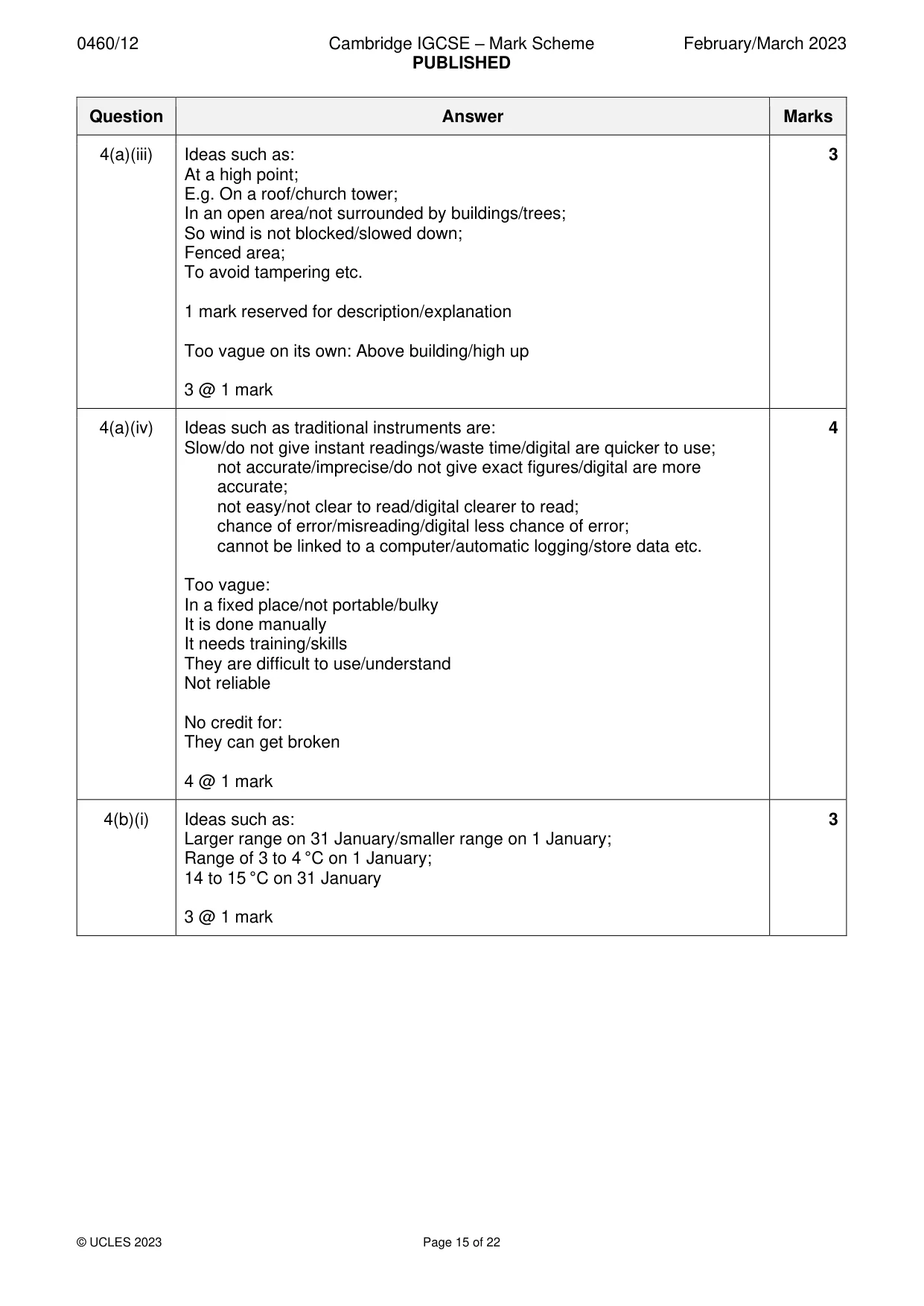
0460/12 Cambridge IGCSE – Mark Scheme PUBLISHED February/March 2023 © UCLES 2023 Page 15 of 22 Question Answer Marks 4(a)(iii) Ideas such as: At a high point; E.g. On a roof/church tower; In an open area/not surrounded by buildings/trees; So wind is not blocked/slowed down; Fenced area; To avoid tampering etc. 1 mark reserved for description/explanation Too vague on its own: Above building/high up 3 @ 1 mark 3 4(a)(iv) Ideas such as traditional instruments are: Slow/do not give instant readings/waste time/digital are quicker to use; not accurate/imprecise/do not give exact figures/digital are more accurate; not easy/not clear to read/digital clearer to read; chance of error/misreading/digital less chance of error; cannot be linked to a computer/automatic logging/store data etc. Too vague: In a fixed place/not portable/bulky It is done manually It needs training/skills They are difficult to use/understand Not reliable No credit for: They can get broken 4 @ 1 mark 4 4(b)(i) Ideas such as: Larger range on 31 January/smaller range on 1 January; Range of 3 to 4 °C on 1 January; 14 to 15 °C on 31 January 3 @ 1 mark 3
Mark scheme, page 16
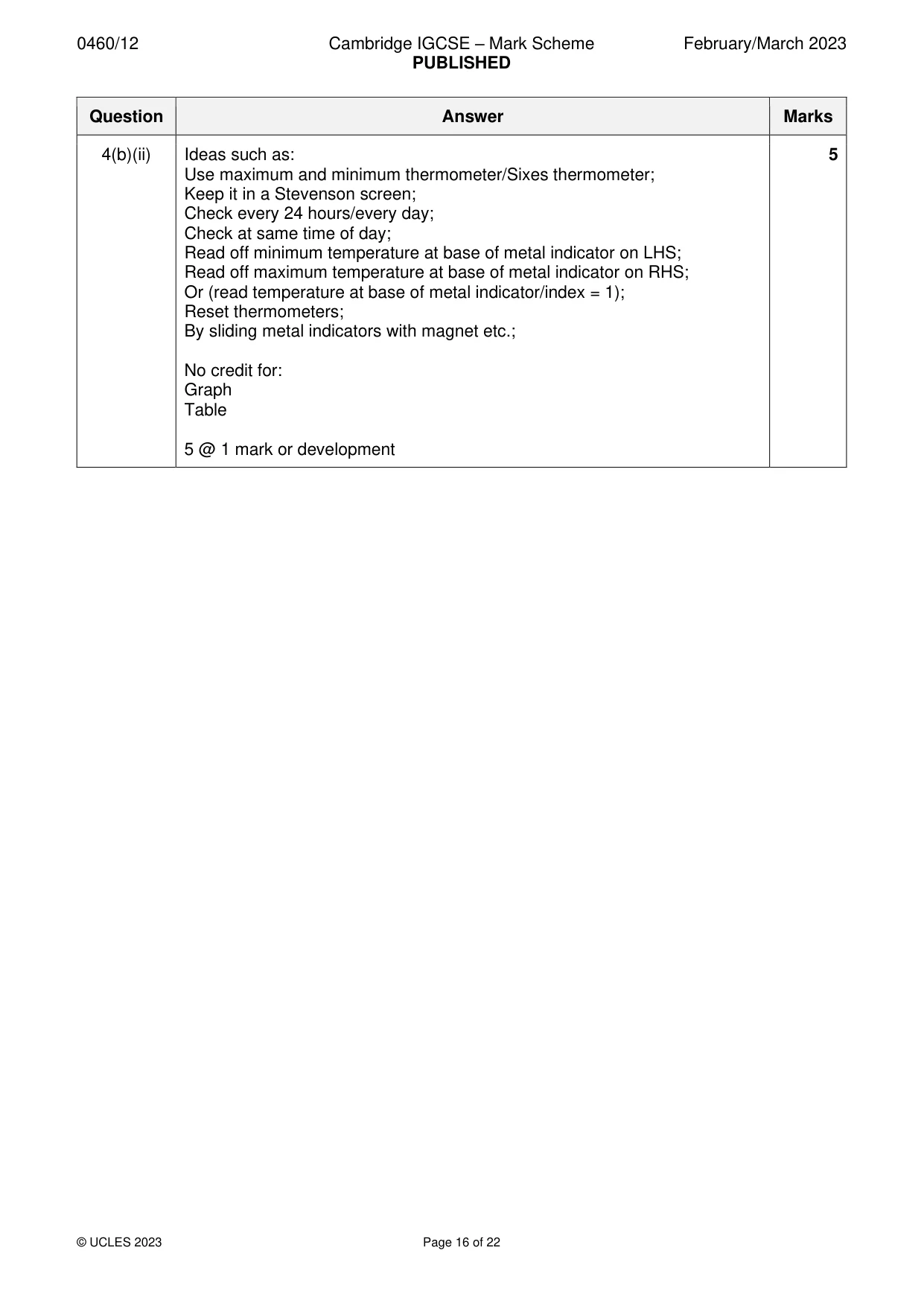
0460/12 Cambridge IGCSE – Mark Scheme PUBLISHED February/March 2023 © UCLES 2023 Page 16 of 22 Question Answer Marks 4(b)(ii) Ideas such as: Use maximum and minimum thermometer/Sixes thermometer; Keep it in a Stevenson screen; Check every 24 hours/every day; Check at same time of day; Read off minimum temperature at base of metal indicator on LHS; Read off maximum temperature at base of metal indicator on RHS; Or (read temperature at base of metal indicator/index = 1); Reset thermometers; By sliding metal indicators with magnet etc.; No credit for: Graph Table 5 @ 1 mark or development 5
Mark scheme, page 17
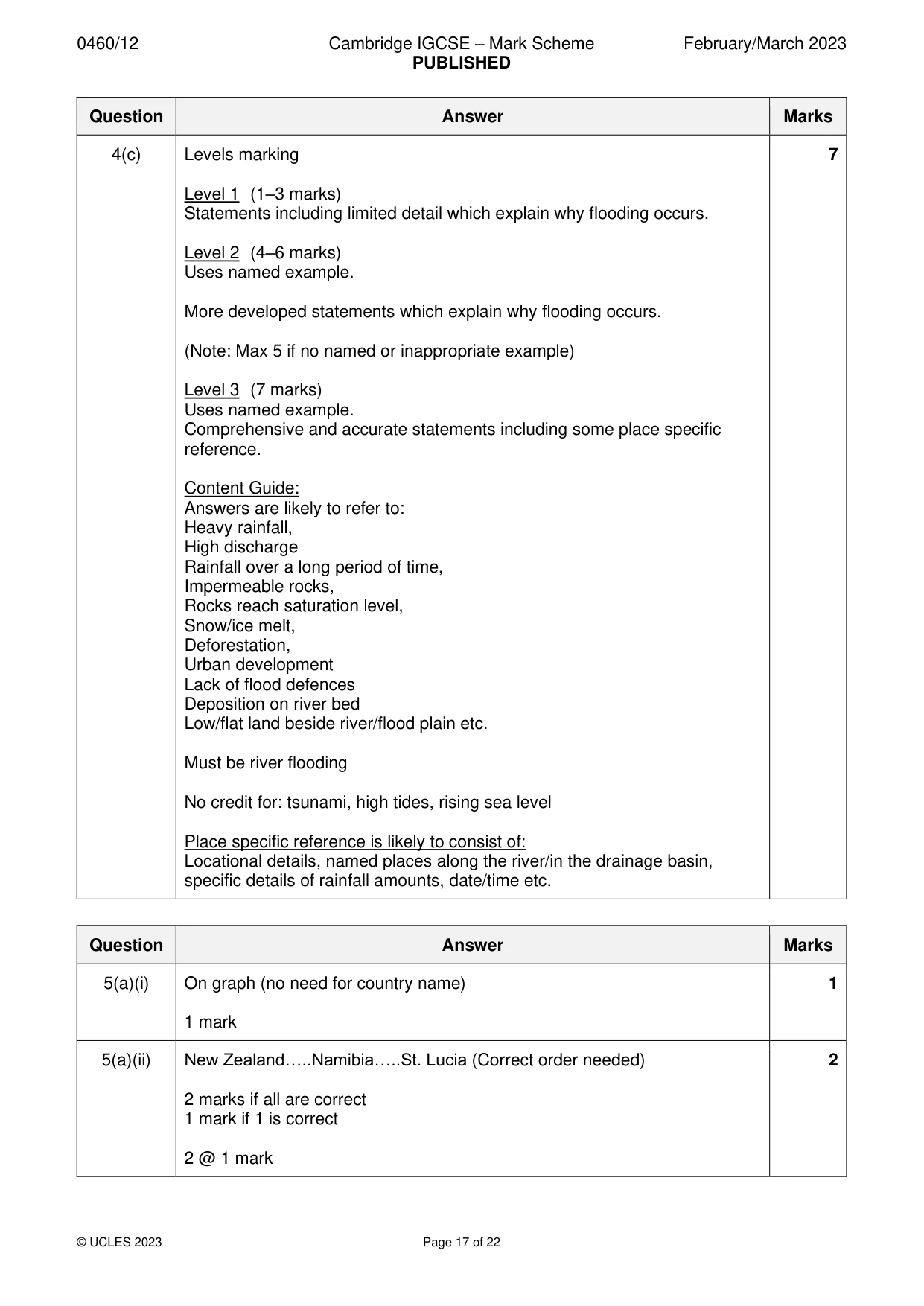
0460/12 Cambridge IGCSE – Mark Scheme PUBLISHED February/March 2023 © UCLES 2023 Page 17 of 22 Question Answer Marks 4(c) Levels marking Level 1 (1–3 marks) Statements including limited detail which explain why flooding occurs. Level 2 (4–6 marks) Uses named example. More developed statements which explain why flooding occurs. (Note: Max 5 if no named or inappropriate example) Level 3 (7 marks) Uses named example. Comprehensive and accurate statements including some place specific reference. Content Guide: Answers are likely to refer to: Heavy rainfall, High discharge Rainfall over a long period of time, Impermeable rocks, Rocks reach saturation level, Snow/ice melt, Deforestation, Urban development Lack of flood defences Deposition on river bed Low/flat land beside river/flood plain etc. Must be river flooding No credit for: tsunami, high tides, rising sea level Place specific reference is likely to consist of: Locational details, named places along the river/in the drainage basin, specific details of rainfall amounts, date/time etc. 7 Question Answer Marks 5(a)(i) On graph (no need for country name) 1 mark 1 5(a)(ii) New Zealand…..Namibia…..St. Lucia (Correct order needed) 2 marks if all are correct 1 mark if 1 is correct 2 @ 1 mark 2
Mark scheme, page 18
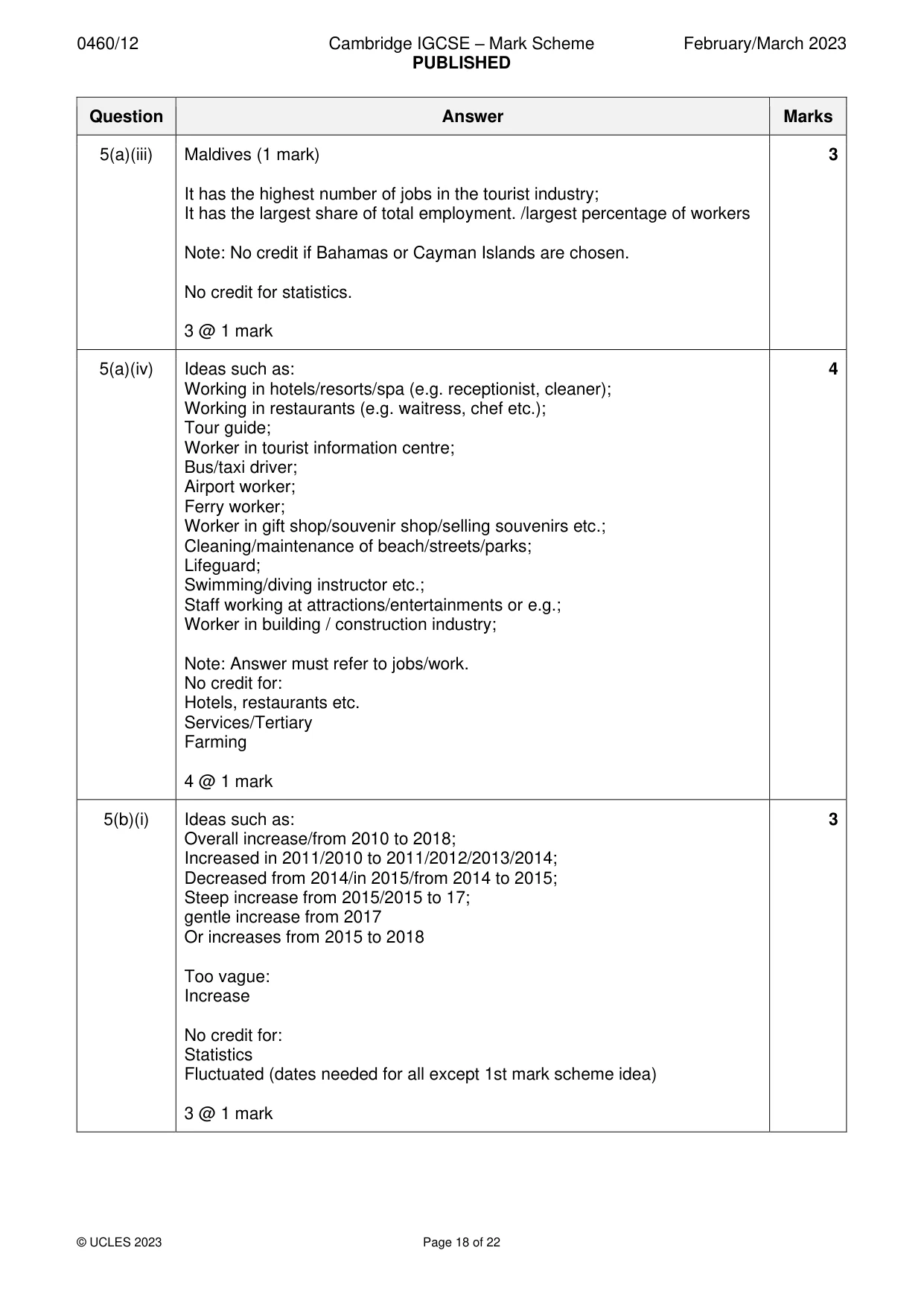
0460/12 Cambridge IGCSE – Mark Scheme PUBLISHED February/March 2023 © UCLES 2023 Page 18 of 22 Question Answer Marks 5(a)(iii) Maldives (1 mark) It has the highest number of jobs in the tourist industry; It has the largest share of total employment. /largest percentage of workers Note: No credit if Bahamas or Cayman Islands are chosen. No credit for statistics. 3 @ 1 mark 3 5(a)(iv) Ideas such as: Working in hotels/resorts/spa (e.g. receptionist, cleaner); Working in restaurants (e.g. waitress, chef etc.); Tour guide; Worker in tourist information centre; Bus/taxi driver; Airport worker; Ferry worker; Worker in gift shop/souvenir shop/selling souvenirs etc.; Cleaning/maintenance of beach/streets/parks; Lifeguard; Swimming/diving instructor etc.; Staff working at attractions/entertainments or e.g.; Worker in building / construction industry; Note: Answer must refer to jobs/work. No credit for: Hotels, restaurants etc. Services/Tertiary Farming 4 @ 1 mark 4 5(b)(i) Ideas such as: Overall increase/from 2010 to 2018; Increased in 2011/2010 to 2011/2012/2013/2014; Decreased from 2014/in 2015/from 2014 to 2015; Steep increase from 2015/2015 to 17; gentle increase from 2017 Or increases from 2015 to 2018 Too vague: Increase No credit for: Statistics Fluctuated (dates needed for all except 1st mark scheme idea) 3 @ 1 mark 3
Mark scheme, page 19
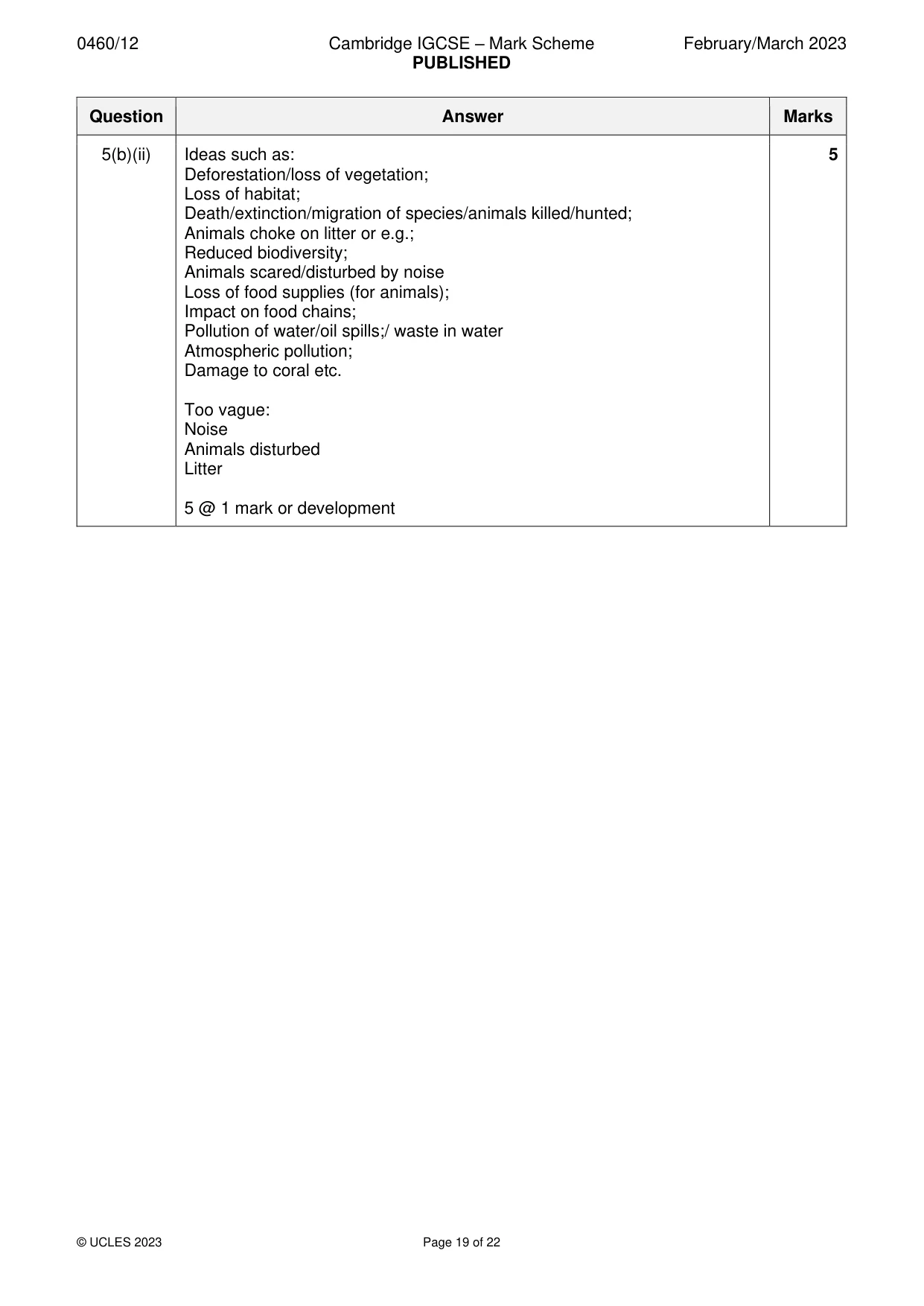
0460/12 Cambridge IGCSE – Mark Scheme PUBLISHED February/March 2023 © UCLES 2023 Page 19 of 22 Question Answer Marks 5(b)(ii) Ideas such as: Deforestation/loss of vegetation; Loss of habitat; Death/extinction/migration of species/animals killed/hunted; Animals choke on litter or e.g.; Reduced biodiversity; Animals scared/disturbed by noise Loss of food supplies (for animals); Impact on food chains; Pollution of water/oil spills;/ waste in water Atmospheric pollution; Damage to coral etc. Too vague: Noise Animals disturbed Litter 5 @ 1 mark or development 5
Mark scheme, page 20
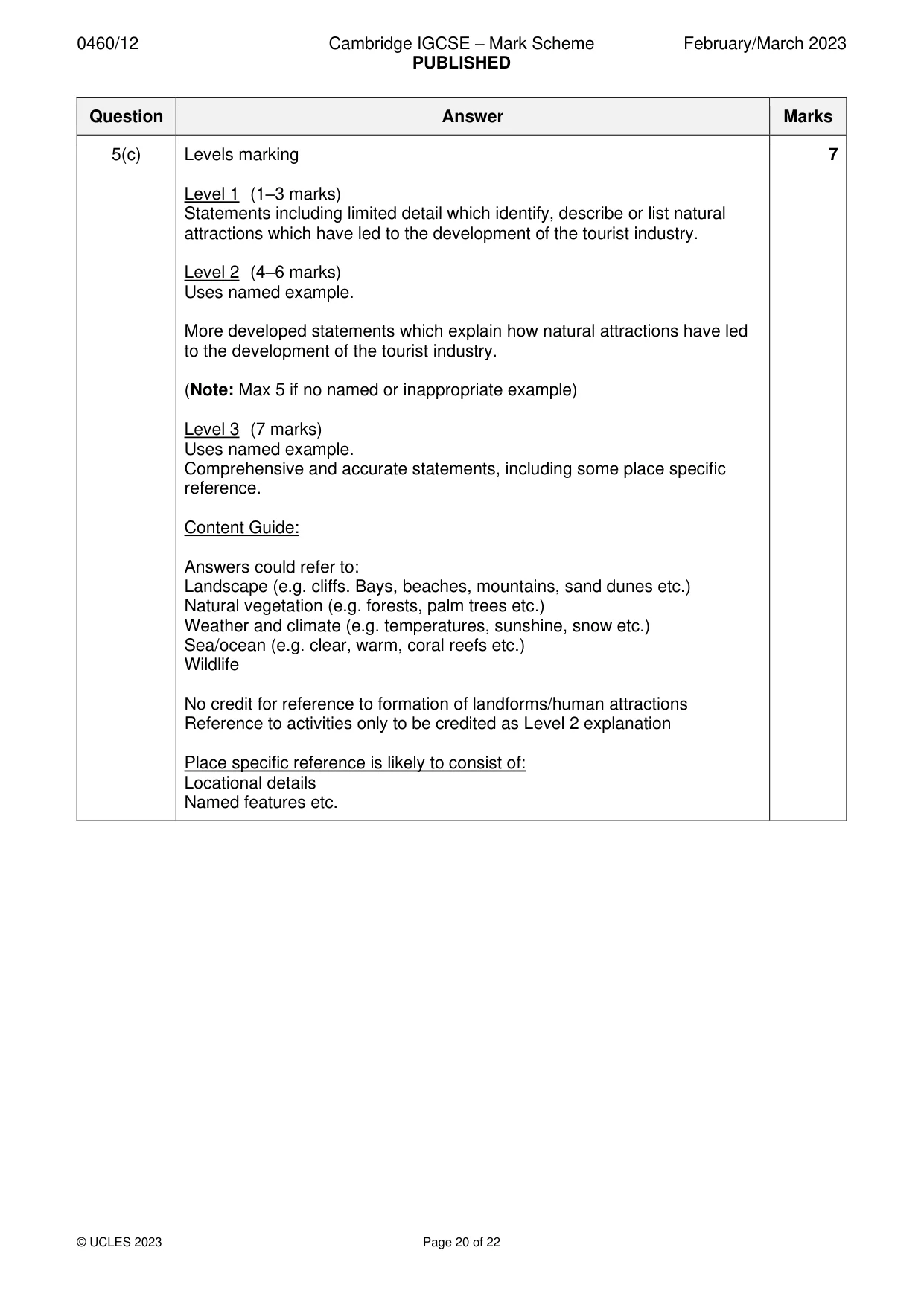
0460/12 Cambridge IGCSE – Mark Scheme PUBLISHED February/March 2023 © UCLES 2023 Page 20 of 22 Question Answer Marks 5(c) Levels marking Level 1 (1–3 marks) Statements including limited detail which identify, describe or list natural attractions which have led to the development of the tourist industry. Level 2 (4–6 marks) Uses named example. More developed statements which explain how natural attractions have led to the development of the tourist industry. (Note: Max 5 if no named or inappropriate example) Level 3 (7 marks) Uses named example. Comprehensive and accurate statements, including some place specific reference. Content Guide: Answers could refer to: Landscape (e.g. cliffs. Bays, beaches, mountains, sand dunes etc.) Natural vegetation (e.g. forests, palm trees etc.) Weather and climate (e.g. temperatures, sunshine, snow etc.) Sea/ocean (e.g. clear, warm, coral reefs etc.) Wildlife No credit for reference to formation of landforms/human attractions Reference to activities only to be credited as Level 2 explanation Place specific reference is likely to consist of: Locational details Named features etc. 7
Mark scheme, page 21
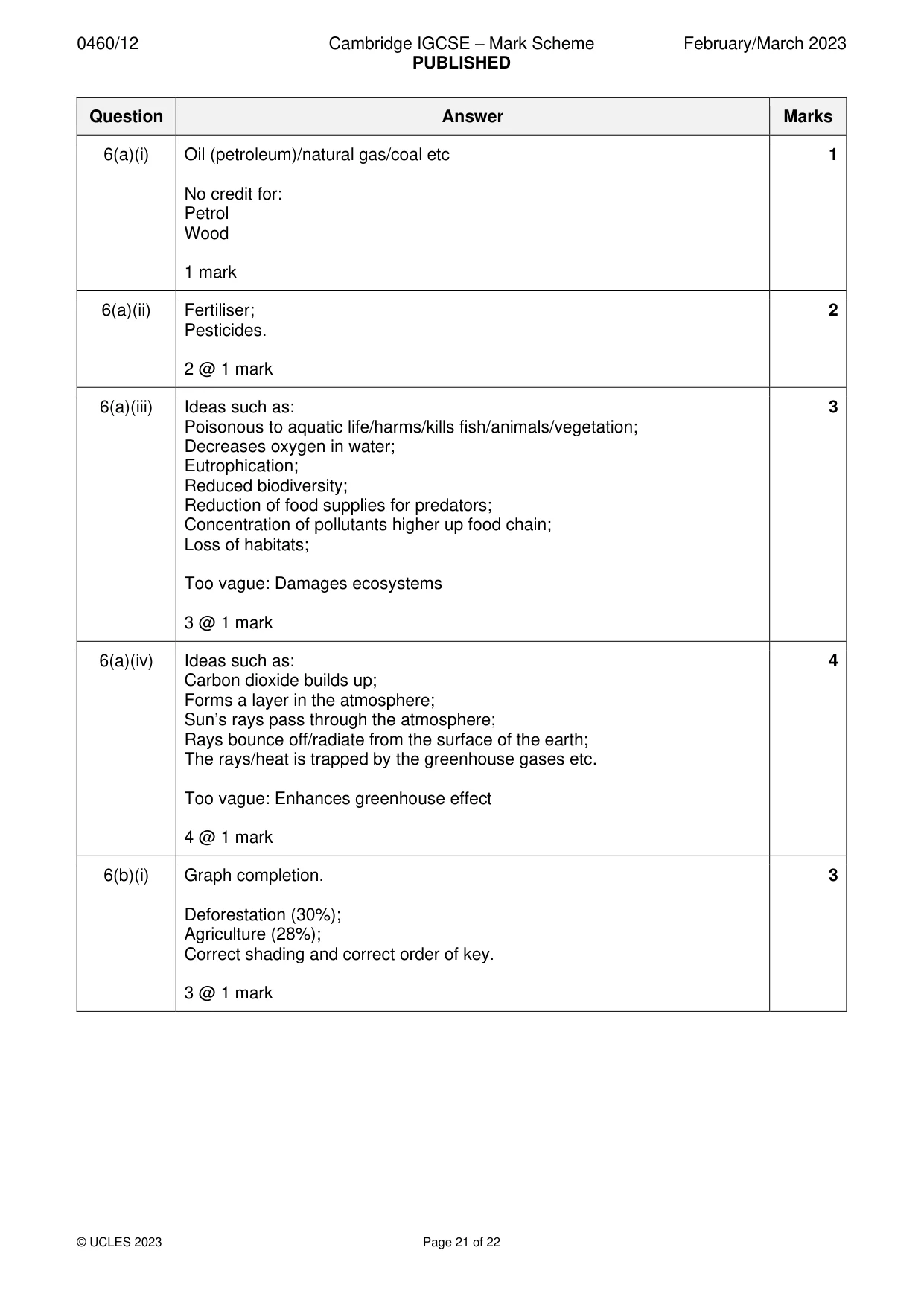
0460/12 Cambridge IGCSE – Mark Scheme PUBLISHED February/March 2023 © UCLES 2023 Page 21 of 22 Question Answer Marks 6(a)(i) Oil (petroleum)/natural gas/coal etc No credit for: Petrol Wood 1 mark 1 6(a)(ii) Fertiliser; Pesticides. 2 @ 1 mark 2 6(a)(iii) Ideas such as: Poisonous to aquatic life/harms/kills fish/animals/vegetation; Decreases oxygen in water; Eutrophication; Reduced biodiversity; Reduction of food supplies for predators; Concentration of pollutants higher up food chain; Loss of habitats; Too vague: Damages ecosystems 3 @ 1 mark 3 6(a)(iv) Ideas such as: Carbon dioxide builds up; Forms a layer in the atmosphere; Sun’s rays pass through the atmosphere; Rays bounce off/radiate from the surface of the earth; The rays/heat is trapped by the greenhouse gases etc. Too vague: Enhances greenhouse effect 4 @ 1 mark 4 6(b)(i) Graph completion. Deforestation (30%); Agriculture (28%); Correct shading and correct order of key. 3 @ 1 mark 3
Mark scheme, page 22
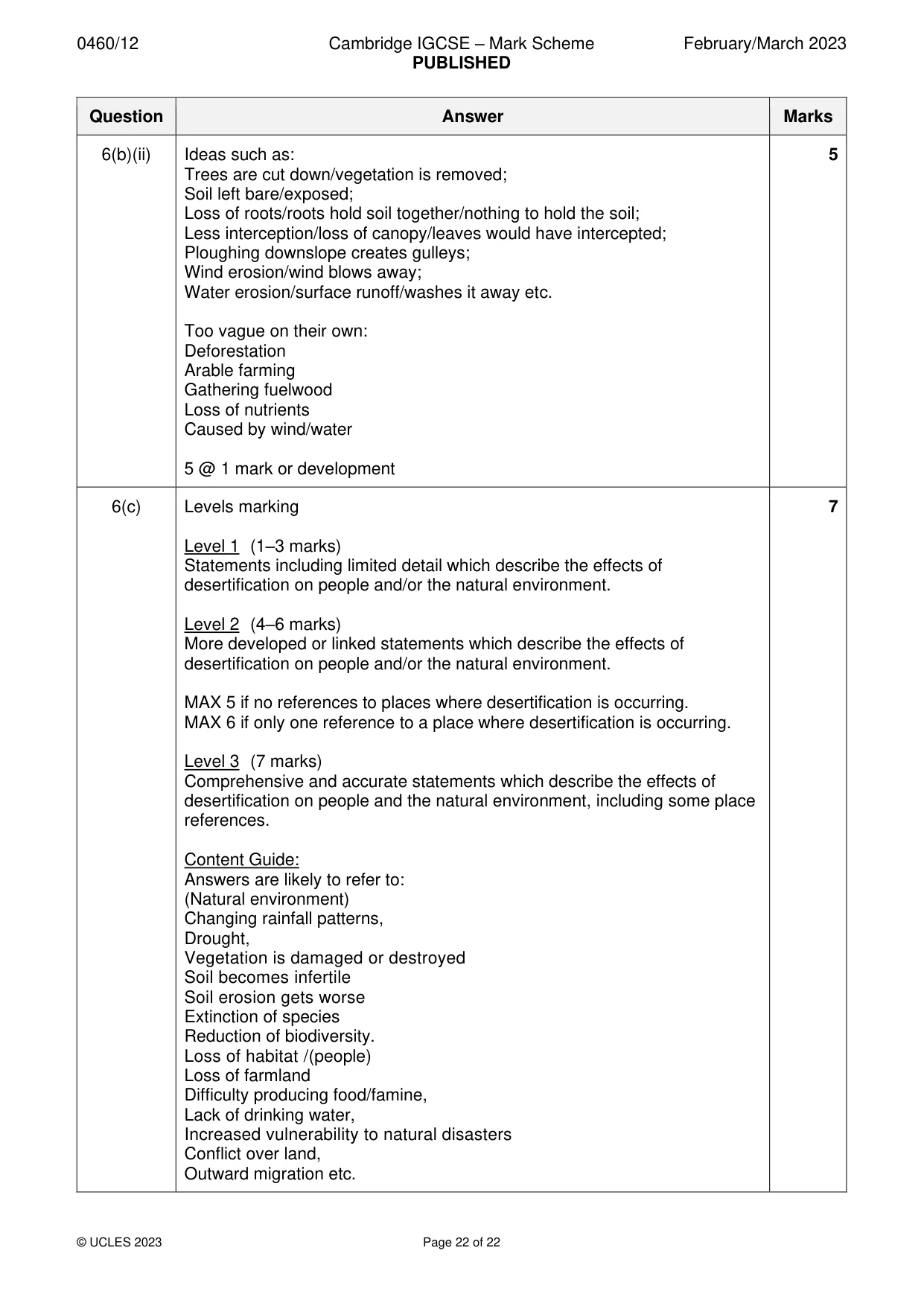
0460/12 Cambridge IGCSE – Mark Scheme PUBLISHED February/March 2023 © UCLES 2023 Page 22 of 22 Question Answer Marks 6(b)(ii) Ideas such as: Trees are cut down/vegetation is removed; Soil left bare/exposed; Loss of roots/roots hold soil together/nothing to hold the soil; Less interception/loss of canopy/leaves would have intercepted; Ploughing downslope creates gulleys; Wind erosion/wind blows away; Water erosion/surface runoff/washes it away etc. Too vague on their own: Deforestation Arable farming Gathering fuelwood Loss of nutrients Caused by wind/water 5 @ 1 mark or development 5 6(c) Levels marking Level 1 (1–3 marks) Statements including limited detail which describe the effects of desertification on people and/or the natural environment. Level 2 (4–6 marks) More developed or linked statements which describe the effects of desertification on people and/or the natural environment. MAX 5 if no references to places where desertification is occurring. MAX 6 if only one reference to a place where desertification is occurring. Level 3 (7 marks) Comprehensive and accurate statements which describe the effects of desertification on people and the natural environment, including some place references. Content Guide: Answers are likely to refer to: (Natural environment) Changing rainfall patterns, Drought, Vegetation is damaged or destroyed Soil becomes infertile Soil erosion gets worse Extinction of species Reduction of biodiversity. Loss of habitat /(people) Loss of farmland Difficulty producing food/famine, Lack of drinking water, Increased vulnerability to natural disasters Conflict over land, Outward migration etc. 7
What you needed in this session
Cambridge’s own grade thresholds for 2023 Feb/March, Paper 1 · Variant 2. A higher threshold means an easier paper — the bar moves with how the cohort did.