Cambridge IGCSE Geography 0460 — 2022 Feb/March Paper 1 · Variant 2
0460/12/F/M/22 · 75 marks · ≈84 min
The question paper and its mark scheme, free to read here and free to download. This is Cambridge’s own paper, exactly as it was sat.
Question paper28 pages


Mark scheme16 pages
Answers below. Sit the paper first if you are practising.
Paper as text
Question paper, page 1
This document has 28 pages. [Turn over Cambridge IGCSE™ DC (KN/CT) 304216/5 © UCLES 2022 * 5 1 7 1 9 9 7 0 3 9 * GEOGRAPHY 0460/12 Paper 1 Geographical Themes February/March 2022 1 hour 45 minutes You must answer on the question paper. You will need: Insert (enclosed) Calculator Ruler INSTRUCTIONS ● Answer three questions in total, one from each section. ● Use a black or dark blue pen. You may use an HB pencil for any diagrams or graphs. ● Write your name, centre number and candidate number in the boxes at the top of the page. ● Write your answer to each question in the space provided. ● Do not use an erasable pen or correction fluid. ● Do not write on any bar codes. ● If additional space is needed, you should use the lined pages at the end of this booklet; the question number or numbers must be clearly shown. INFORMATION ● The total mark for this paper is 75. ● The number of marks for each question or part question is shown in brackets [ ]. ● The insert contains additional resources referred to in the questions. Definitions MEDCs – More Economically Developed Countries LEDCs – Less Economically Developed Countries
Question paper, page 2
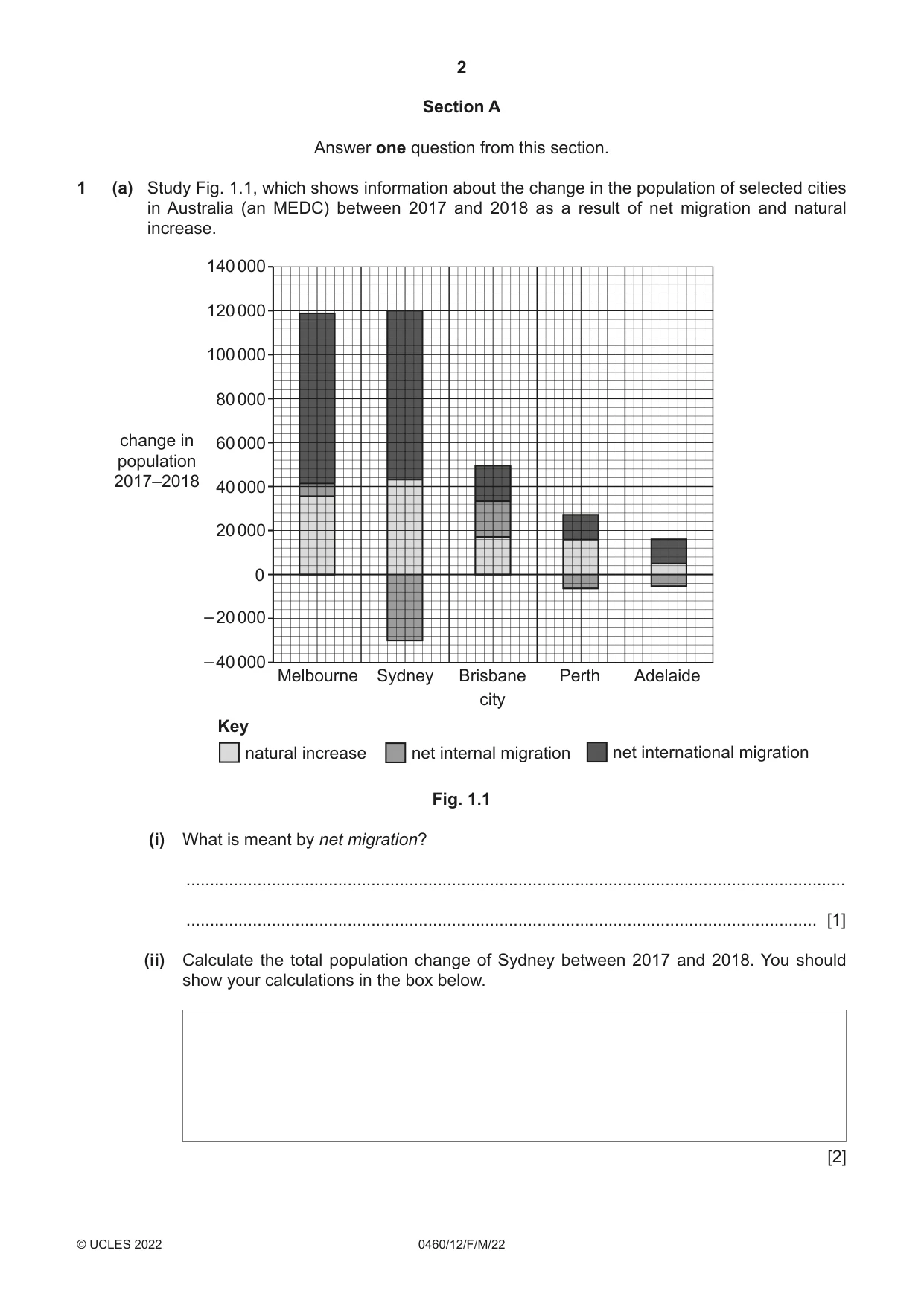
2 0460/12/F/M/22 © UCLES 2022 Section A Answer one question from this section. 1 (a) Study Fig. 1.1, which shows information about the change in the population of selected cities in Australia (an MEDC) between 2017 and 2018 as a result of net migration and natural increase. 0 20 000 Melbourne Key natural increase Sydney Brisbane city Perth Adelaide – 20 000 – 40 000 40 000 60 000 80 000 change in population 2017–2018 100 000 120 000 140 000 net internal migration net international migration Fig. 1.1 (i) What is meant by net migration? … … [1] (ii) Calculate the total population change of Sydney between 2017 and 2018. You should show your calculations in the box below. [2]
Question paper, page 3
3 0460/12/F/M/22 © UCLES 2022 [Turn over (iii) Suggest three different reasons why there is a large amount of international migration to cities such as Melbourne and Sydney. 1 … … 2 … … 3 … … [3] (iv) Many international migrants arrive in Australia from countries in Asia, such as China and Indonesia. Describe the problems which may be faced by these migrants when they arrive in Australian cities. … … … … … … … … [4]
Question paper, page 4
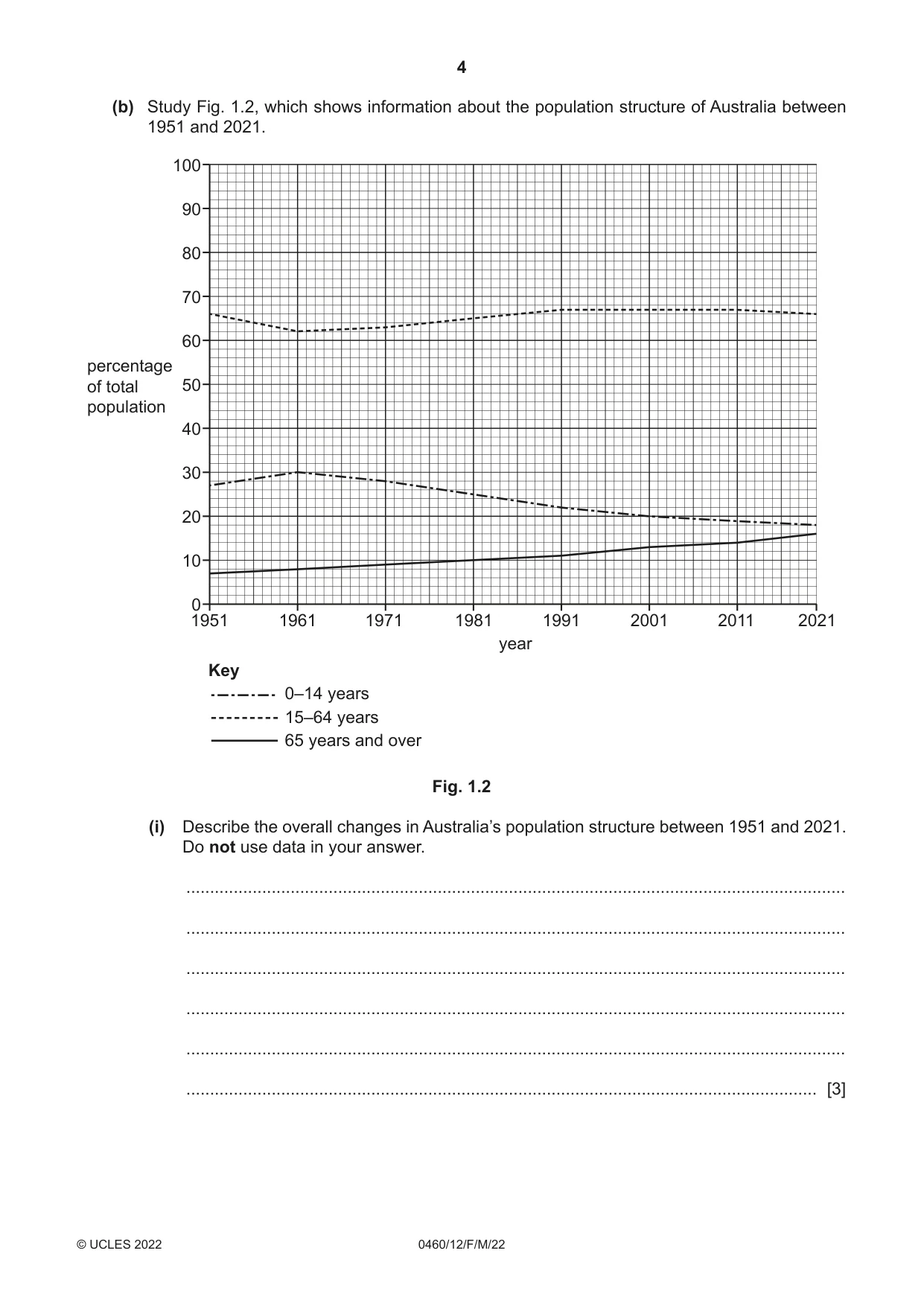
4 0460/12/F/M/22 © UCLES 2022 (b) Study Fig. 1.2, which shows information about the population structure of Australia between 1951 and 2021. 0 1951 Key 1961 0–14 years 15–64 years 65 years and over 1971 1981 1991 2001 2011 2021 10 20 30 40 50 60 percentage of total population 70 80 90 100 year Fig. 1.2 (i) Describe the overall changes in Australia’s population structure between 1951 and 2021. Do not use data in your answer. … … … … … … [3]
Question paper, page 5
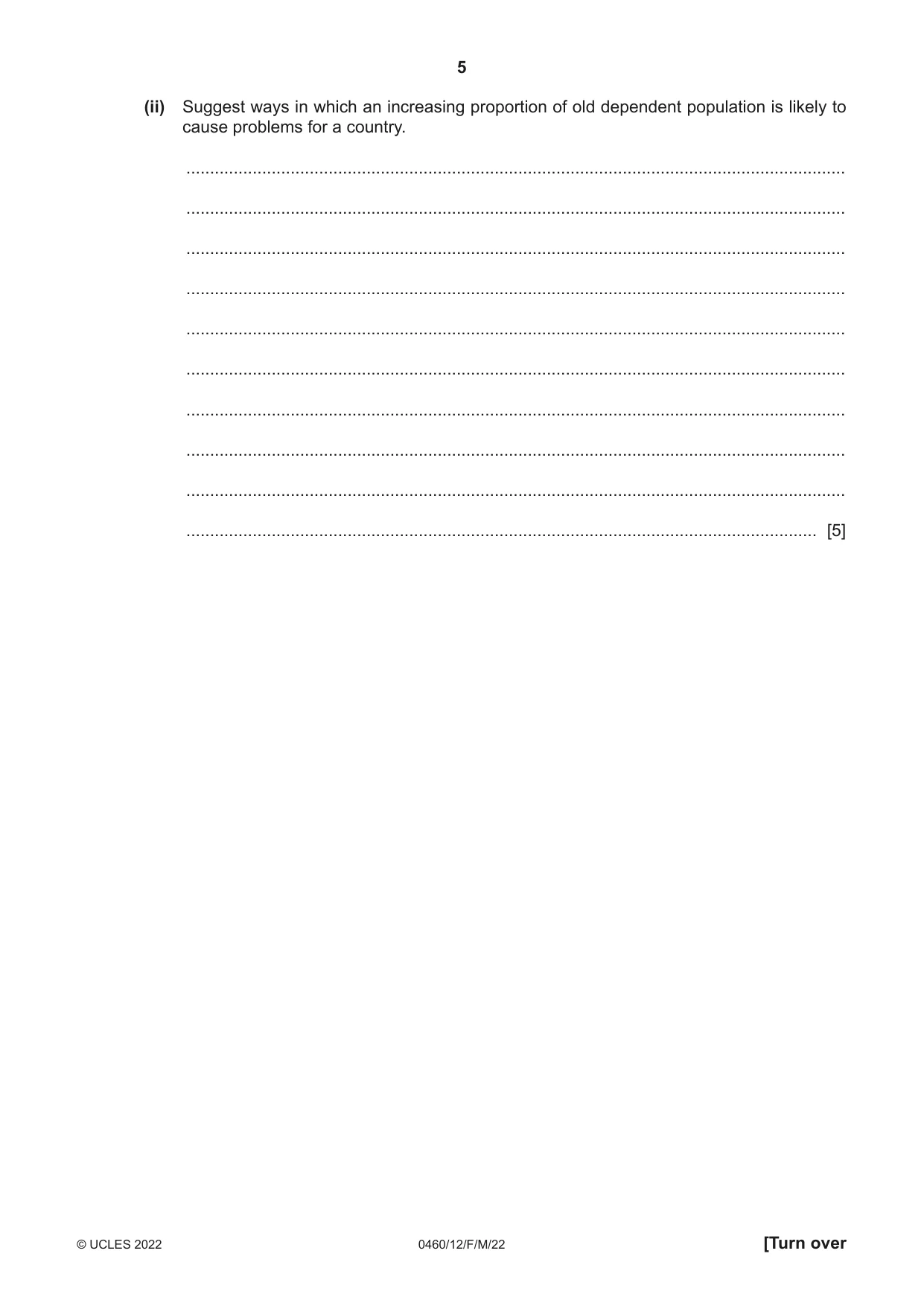
5 0460/12/F/M/22 © UCLES 2022 [Turn over (ii) Suggest ways in which an increasing proportion of old dependent population is likely to cause problems for a country. … … … … … … … … … … [5]
Question paper, page 6
6 0460/12/F/M/22 © UCLES 2022 (c) For a named country you have studied, describe the problems caused by overpopulation. Name of country … … … … … … … … … … … … … … … … … … … … … … … … … … [7] [Total: 25]
Question paper, page 7
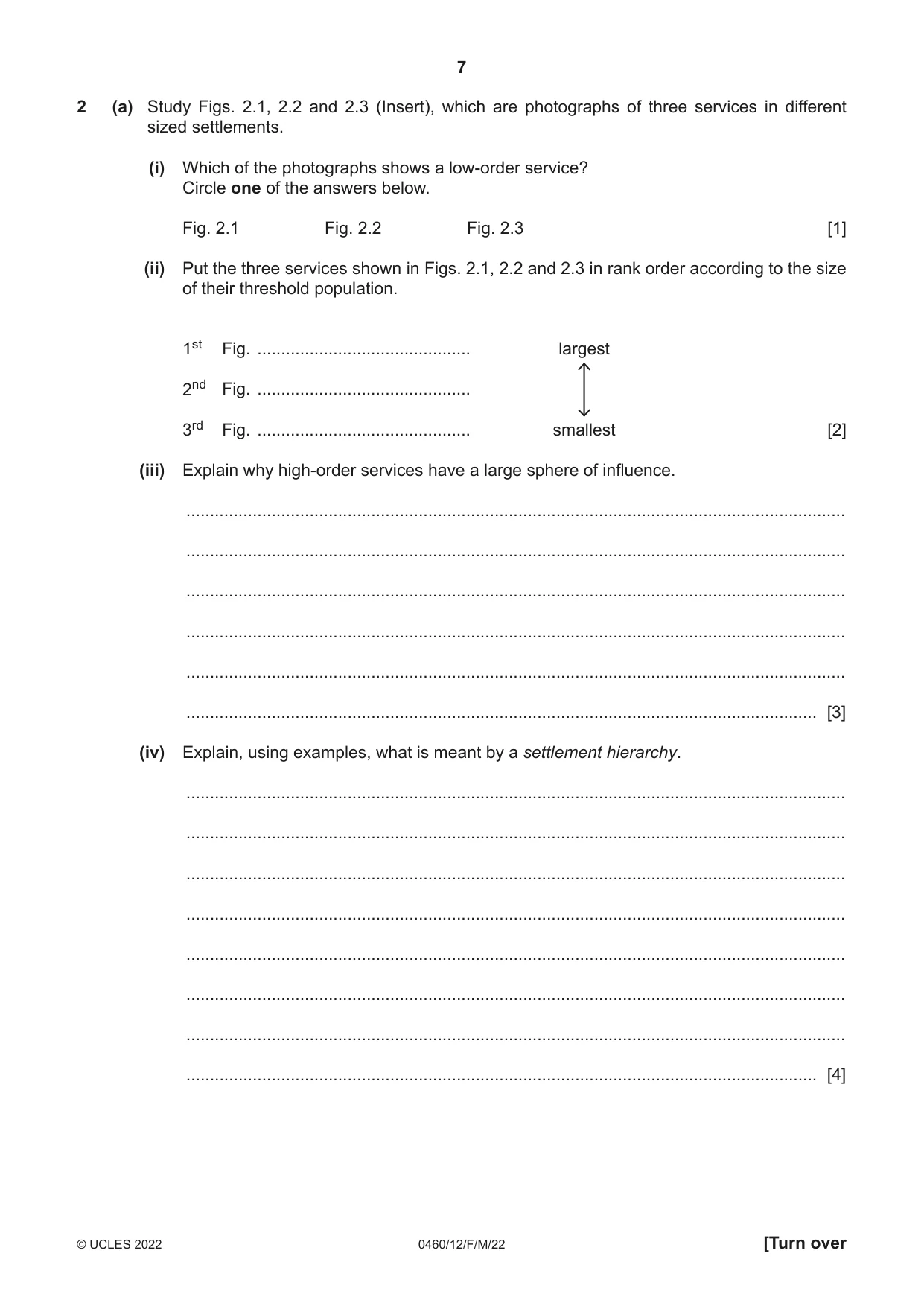
7 0460/12/F/M/22 © UCLES 2022 [Turn over 2 (a) Study Figs. 2.1, 2.2 and 2.3 (Insert), which are photographs of three services in different sized settlements. (i) Which of the photographs shows a low-order service? Circle one of the answers below. Fig. 2.1 Fig. 2.2 Fig. 2.3 [1] (ii) Put the three services shown in Figs. 2.1, 2.2 and 2.3 in rank order according to the size of their threshold population. 1st Fig. … largest 2nd Fig. … 3rd Fig. … smallest [2] (iii) Explain why high-order services have a large sphere of influence. … … … … … … [3] (iv) Explain, using examples, what is meant by a settlement hierarchy. … … … … … … … … [4]
Question paper, page 8
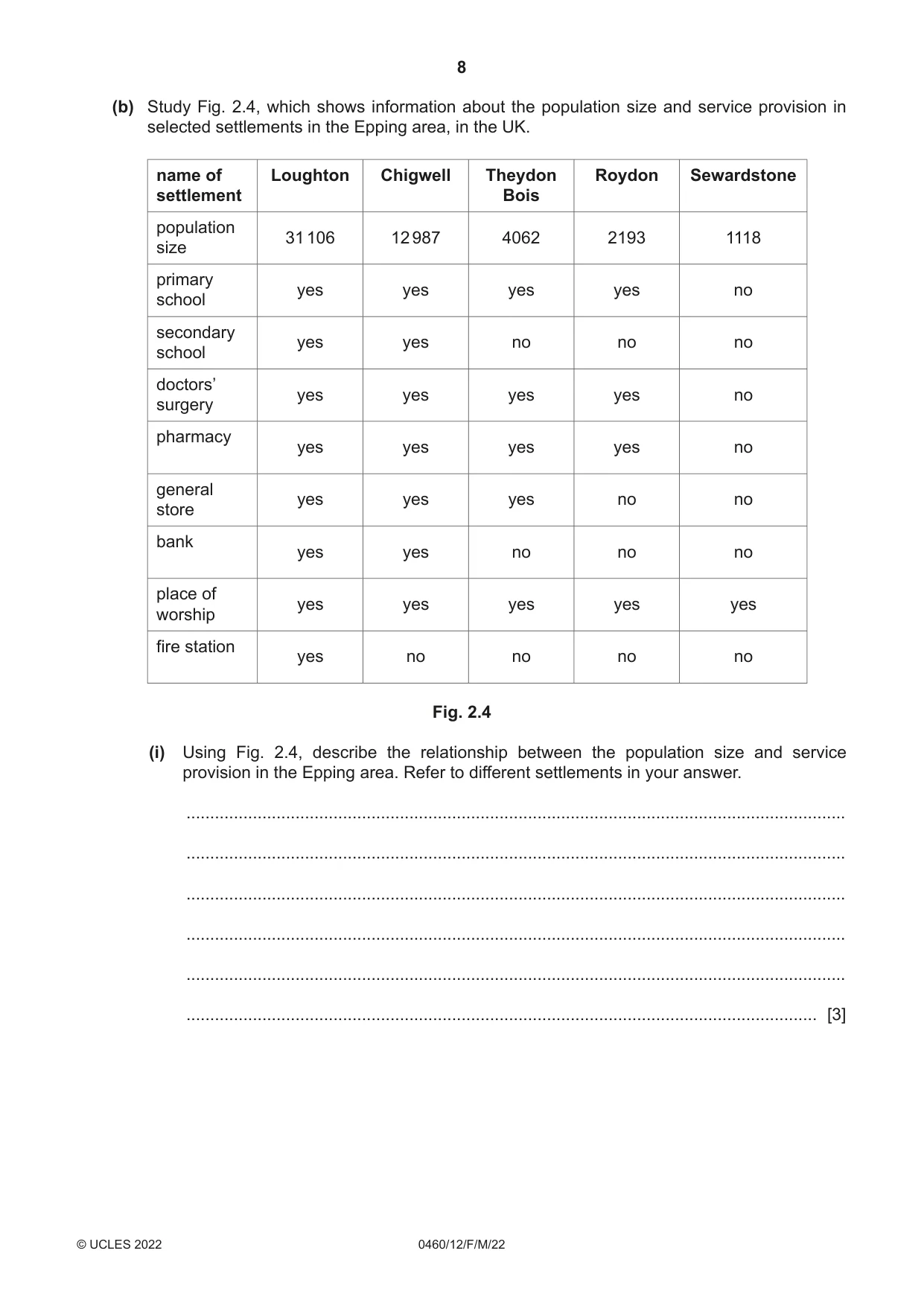
8 0460/12/F/M/22 © UCLES 2022 (b) Study Fig. 2.4, which shows information about the population size and service provision in selected settlements in the Epping area, in the UK. name of settlement Loughton Chigwell Theydon Bois Roydon Sewardstone population size 31 106 12 987 4062 2193 1118 primary school yes yes yes yes no secondary school yes yes no no no doctors’ surgery yes yes yes yes no pharmacy yes yes yes yes no general store yes yes yes no no bank yes yes no no no place of worship yes yes yes yes yes fire station yes no no no no Fig. 2.4 (i) Using Fig. 2.4, describe the relationship between the population size and service provision in the Epping area. Refer to different settlements in your answer. … … … … … … [3]
Question paper, page 9
9 0460/12/F/M/22 © UCLES 2022 [Turn over (ii) Suggest reasons why there is a relationship between settlement size and the number of services provided in the Epping area. … … … … … … … … … … [5]
Question paper, page 10
10 0460/12/F/M/22 © UCLES 2022 (c) For a named urban area you have studied, describe the impacts of urban sprawl. Name of urban area … … … … … … … … … … … … … … … … … … … … … … … … … … [7] [Total: 25]
Question paper, page 11
11 0460/12/F/M/22 © UCLES 2022 [Turn over TURN PAGE FOR QUESTION 3
Question paper, page 12
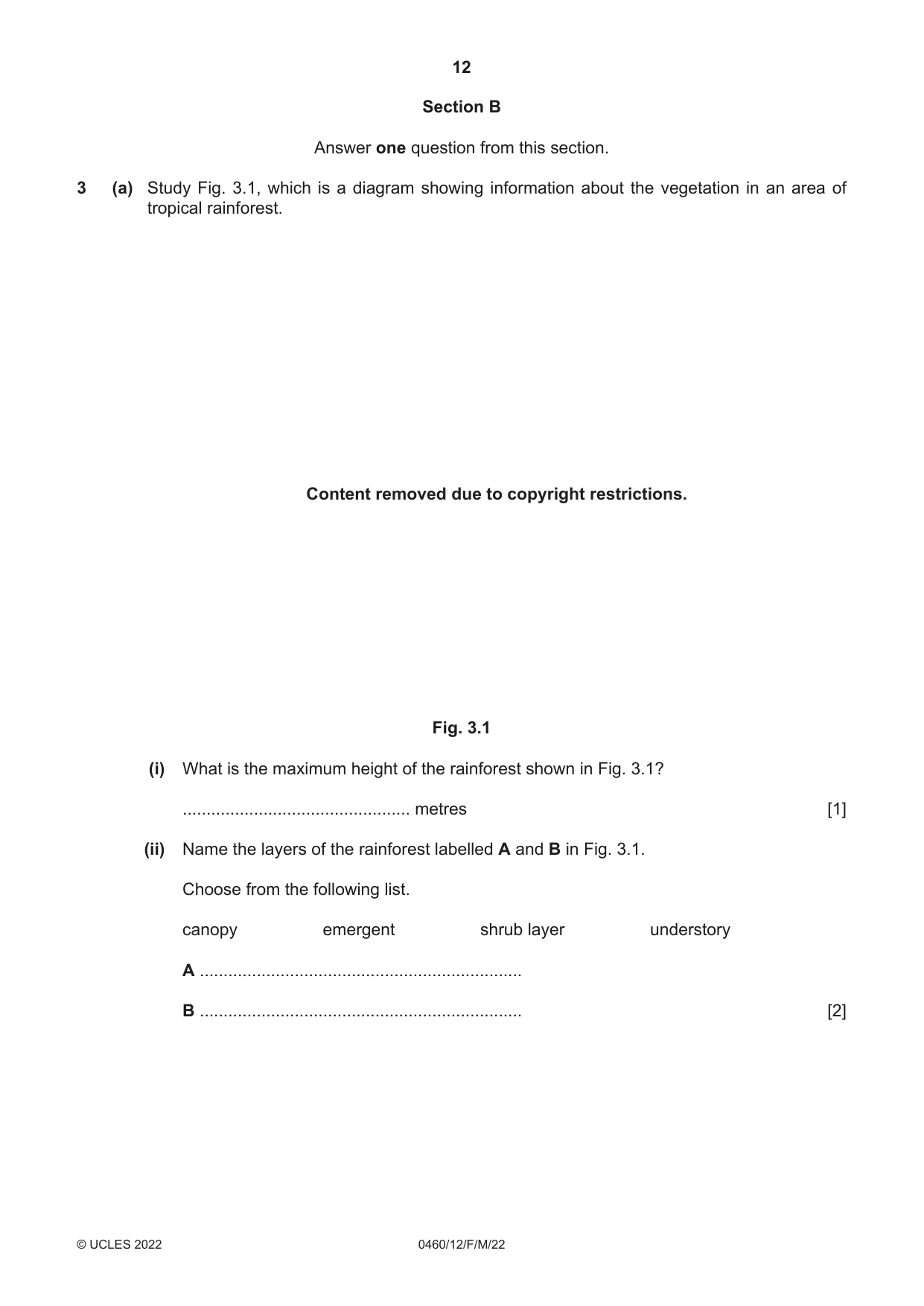
12 0460/12/F/M/22 © UCLES 2022 Section B Answer one question from this section. 3 (a) Study Fig. 3.1, which is a diagram showing information about the vegetation in an area of tropical rainforest. Fig. 3.1 (i) What is the maximum height of the rainforest shown in Fig. 3.1? … metres [1] (ii) Name the layers of the rainforest labelled A and B in Fig. 3.1. Choose from the following list. canopy emergent shrub layer understory A … B … [2] Content removed due to copyright restrictions.
Question paper, page 13
13 0460/12/F/M/22 © UCLES 2022 [Turn over (iii) Suggest reasons why some types of wildlife live above 25 metres but other types live below 5 metres in the rainforest shown in Fig. 3.1. … … … … … … [3] (iv) Explain why some trees in the tropical rainforest have: – buttress roots … … … … – drip tip leaves. … … … … [4]
Question paper, page 14
14 0460/12/F/M/22 © UCLES 2022 (b) Study Figs. 3.2 and 3.3 (Insert), which are maps showing Borneo in 1973 and 2015. (i) Using Figs. 3.2 and 3.3 only, describe the distribution of the areas where deforestation took place in Borneo between 1973 and 2015. … … … … … … [3] (ii) Suggest reasons why deforestation has taken place in areas of tropical rainforest such as Borneo. … … … … … … … … … … [5]
Question paper, page 15
15 0460/12/F/M/22 © UCLES 2022 [Turn over (c) Describe the impacts of deforestation on the global natural environment. You should refer to named areas affected in different parts of the world. … … … … … … … … … … … … … … … … … … … … … … … … … … [7] [Total: 25]
Question paper, page 16
16 0460/12/F/M/22 © UCLES 2022 4 (a) Study Fig. 4.1 (Insert), which is a photograph of part of a river. (i) Identify the river landform labelled X in Fig. 4.1. … [1] (ii) Describe two features of the landform labelled X in Fig. 4.1. 1 … … 2 … … [2] (iii) Explain how the landform labelled X in Fig. 4.1 was formed. … … … … … … [3] (iv) Give two advantages and two disadvantages of living close to a river such as the one shown in Fig. 4.1. Advantage 1 … … Advantage 2 … … Disadvantage 1 … … Disadvantage 2 … … [4]
Question paper, page 17
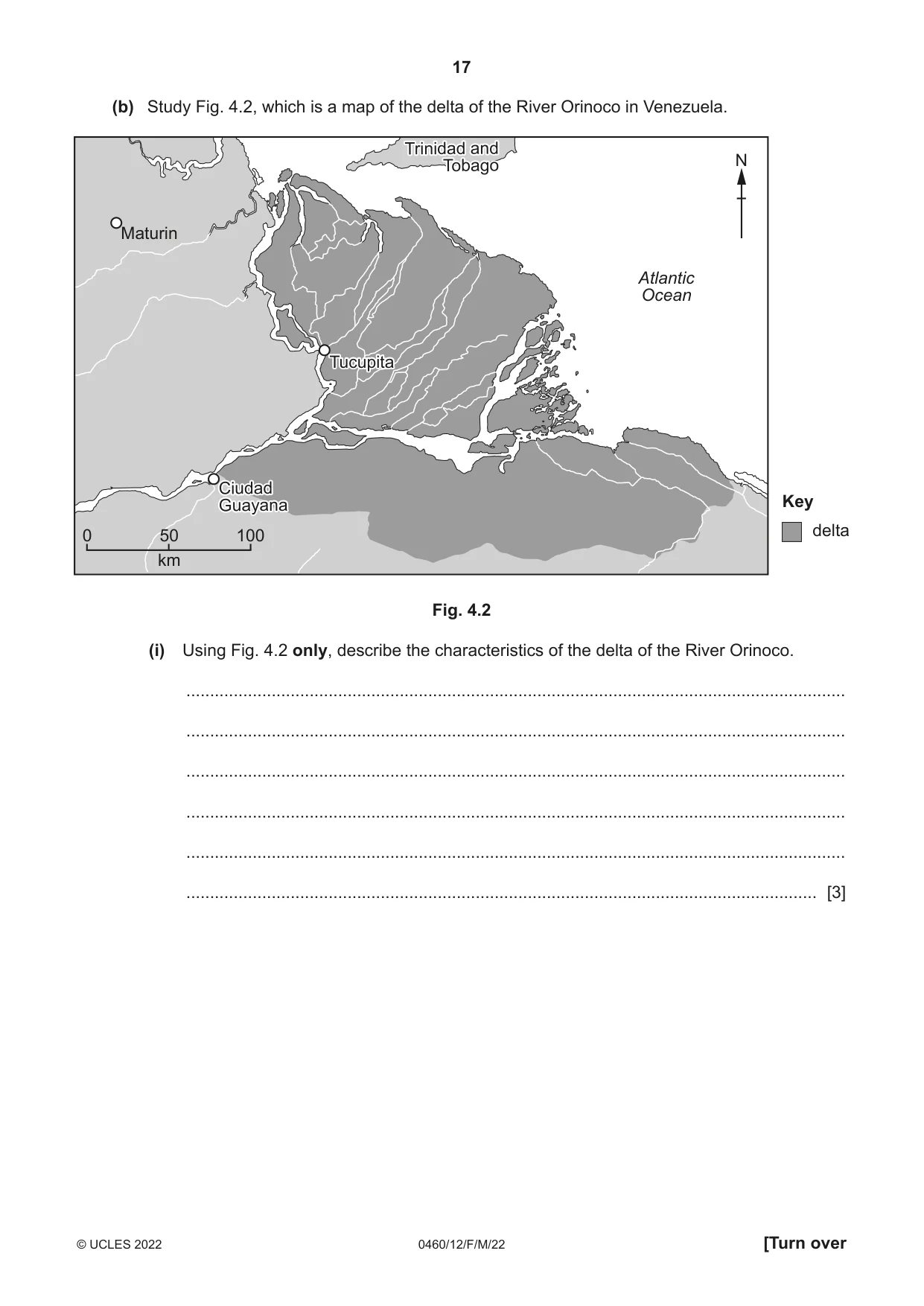
17 0460/12/F/M/22 © UCLES 2022 [Turn over (b) Study Fig. 4.2, which is a map of the delta of the River Orinoco in Venezuela. Atlantic Ocean Maturin Tucupita Ciudad Guayana Tucupita Ciudad Guayana Trinidad and Tobago Trinidad and Tobago 0 50 km 100 N delta Key Fig. 4.2 (i) Using Fig. 4.2 only, describe the characteristics of the delta of the River Orinoco. … … … … … … [3]
Question paper, page 18
18 0460/12/F/M/22 © UCLES 2022 (ii) Explain how a delta is formed. … … … … … … … … … … [5]
Question paper, page 19
19 0460/12/F/M/22 © UCLES 2022 [Turn over (c) Draw a labelled diagram to show the features of a waterfall. Explain how a waterfall is formed. … … … … … … … … … … … … … … … … [7] [Total: 25]
Question paper, page 20
20 0460/12/F/M/22 © UCLES 2022 Section C Answer one question from this section. 5 (a) Study Fig. 5.1 (Insert), which is a photograph of an area in Bangladesh (an LEDC) where subsistence farming takes place. (i) Define subsistence farming. … … [1] (ii) Describe the relief of the area shown in Fig. 5.1. … … … … [2] (iii) Suggest how the relief of the area shown in Fig. 5.1 is likely to influence agricultural land use. … … … … … … [3] (iv) Explain why many farmers in LEDCs are subsistence farmers. … … … … … … … … [4]
Question paper, page 21
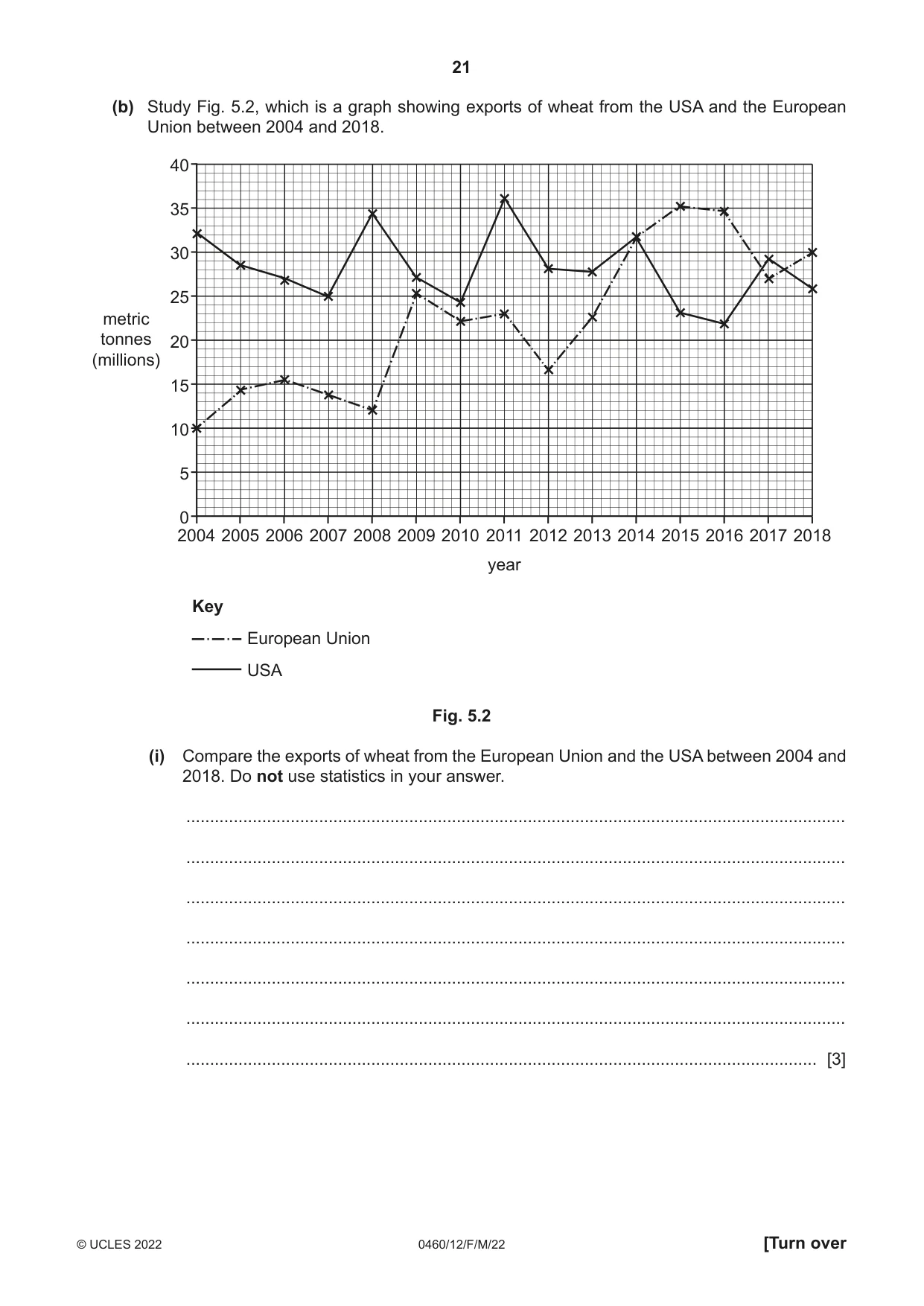
21 0460/12/F/M/22 © UCLES 2022 [Turn over (b) Study Fig. 5.2, which is a graph showing exports of wheat from the USA and the European Union between 2004 and 2018. 2004 Key 2005 2006 2007 2008 2009 2010 2011 year 2012 2013 2014 2015 2016 2017 2018 0 5 10 15 20 25 30 35 40 metric tonnes (millions) European Union USA Fig. 5.2 (i) Compare the exports of wheat from the European Union and the USA between 2004 and 2018. Do not use statistics in your answer. … … … … … … … [3]
Question paper, page 22
22 0460/12/F/M/22 © UCLES 2022 (ii) Explain why the production of crops, such as wheat, varies from year to year. … … … … … … … … … … [5]
Question paper, page 23
23 0460/12/F/M/22 © UCLES 2022 [Turn over (c) For a named country or area you have studied, describe the impacts of food shortages. Name of country or area … … … … … … … … … … … … … … … … … … … … … … … … … … [7] [Total: 25]
Question paper, page 24
24 0460/12/F/M/22 © UCLES 2022 6 (a) Study Fig. 6.1 (Insert), which is a photograph of a manufacturing industry. (i) Define manufacturing industry. … … [1] (ii) Describe two features of the manufacturing industry shown in Fig. 6.1. 1 … … 2 … … [2] (iii) From the list below circle three inputs of the manufacturing industry shown in Fig. 6.1. energy finished products fumes labour transporting processing profit raw materials selling [3] (iv) Explain why transport links are an important factor when the location is being chosen for a factory. … … … … … … … … … [4]
Question paper, page 25
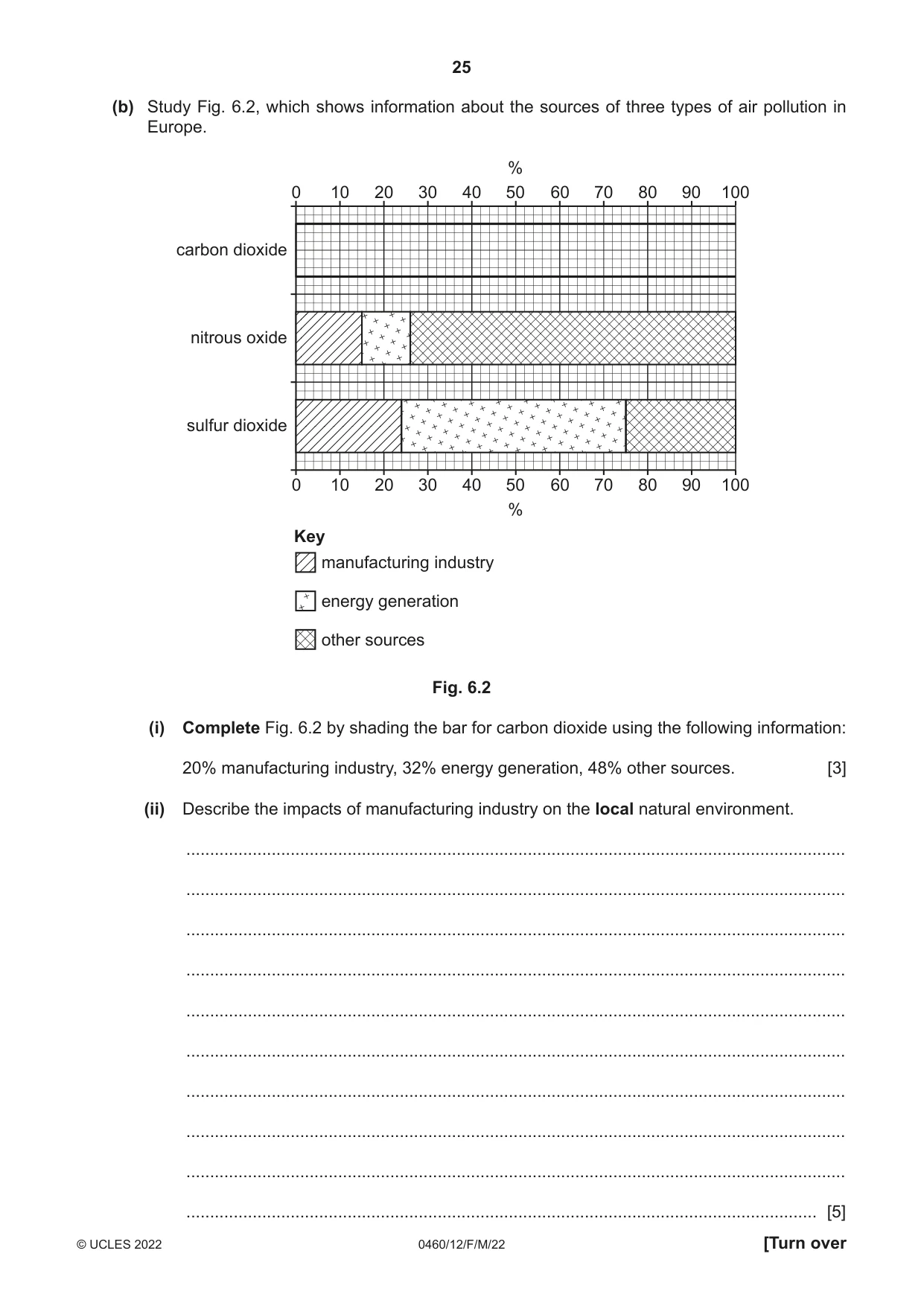
25 0460/12/F/M/22 © UCLES 2022 [Turn over (b) Study Fig. 6.2, which shows information about the sources of three types of air pollution in Europe. sulfur dioxide nitrous oxide carbon dioxide 0 10 20 30 40 50 % 60 70 80 90 100 0 10 20 30 40 50 % 60 70 80 90 100 Key manufacturing industry energy generation other sources Fig. 6.2 (i) Complete Fig. 6.2 by shading the bar for carbon dioxide using the following information: 20% manufacturing industry, 32% energy generation, 48% other sources. [3] (ii) Describe the impacts of manufacturing industry on the local natural environment. … … … … … … … … … … [5]
Question paper, page 26
26 0460/12/F/M/22 © UCLES 2022 (c) For a named area you have studied, explain how an economic activity is managed sustainably. Name of area … Economic activity … … … … … … … … … … … … … … … … … … … … … … … … … [7] [Total: 25]
Question paper, page 27
27 0460/12/F/M/22 © UCLES 2022 Additional pages If you use the following pages to complete the answer to any question, the question number must be clearly shown. … … … … … … … … … … … … … … … … … … … … … … … … … …
Question paper, page 28
28 0460/12/F/M/22 © UCLES 2022 … … … … … … … … … … … … … … … … … … … … … … The boundaries and names shown, the designations used and the presentation of material on any maps contained in this question paper/insert do not imply official endorsement or acceptance by Cambridge Assessment International Education concerning the legal status of any country, territory, or area or any of its authorities, or of the delimitation of its frontiers or boundaries. Permission to reproduce items where third-party owned material protected by copyright is included has been sought and cleared where possible. Every reasonable effort has been made by the publisher (UCLES) to trace copyright holders, but if any items requiring clearance have unwittingly been included, the publisher will be pleased to make amends at the earliest possible opportunity. To avoid the issue of disclosure of answer-related information to candidates, all copyright acknowledgements are reproduced online in the Cambridge Assessment International Education Copyright Acknowledgements Booklet. This is produced for each series of examinations and is freely available to download at www.cambridgeinternational.org after the live examination series. Cambridge Assessment International Education is part of Cambridge Assessment. Cambridge Assessment is the brand name of the University of Cambridge Local Examinations Syndicate (UCLES), which is a department of the University of Cambridge.
Mark scheme, page 1
This document consists of 16 printed pages. © UCLES 2022 [Turn over Cambridge IGCSE™ GEOGRAPHY 0460/12 Paper 1 February/March 2022 MARK SCHEME Maximum Mark: 75 Published This mark scheme is published as an aid to teachers and candidates, to indicate the requirements of the examination. It shows the basis on which Examiners were instructed to award marks. It does not indicate the details of the discussions that took place at an Examiners’ meeting before marking began, which would have considered the acceptability of alternative answers. Mark schemes should be read in conjunction with the question paper and the Principal Examiner Report for Teachers. Cambridge International will not enter into discussions about these mark schemes. Cambridge International is publishing the mark schemes for the February/March 2022 series for most Cambridge IGCSE™, Cambridge International A and AS Level components and some Cambridge O Level components.
Mark scheme, page 2
0460/12 Cambridge IGCSE – Mark Scheme PUBLISHED February/March 2022 © UCLES 2022 Page 2 of 16 Generic Marking Principles These general marking principles must be applied by all examiners when marking candidate answers. They should be applied alongside the specific content of the mark scheme or generic level descriptors for a question. Each question paper and mark scheme will also comply with these marking principles. GENERIC MARKING PRINCIPLE 1: Marks must be awarded in line with: • the specific content of the mark scheme or the generic level descriptors for the question • the specific skills defined in the mark scheme or in the generic level descriptors for the question • the standard of response required by a candidate as exemplified by the standardisation scripts. GENERIC MARKING PRINCIPLE 2: Marks awarded are always whole marks (not half marks, or other fractions). GENERIC MARKING PRINCIPLE 3: Marks must be awarded positively: • marks are awarded for correct/valid answers, as defined in the mark scheme. However, credit is given for valid answers which go beyond the scope of the syllabus and mark scheme, referring to your Team Leader as appropriate • marks are awarded when candidates clearly demonstrate what they know and can do • marks are not deducted for errors • marks are not deducted for omissions • answers should only be judged on the quality of spelling, punctuation and grammar when these features are specifically assessed by the question as indicated by the mark scheme. The meaning, however, should be unambiguous. GENERIC MARKING PRINCIPLE 4: Rules must be applied consistently, e.g. in situations where candidates have not followed instructions or in the application of generic level descriptors. GENERIC MARKING PRINCIPLE 5: Marks should be awarded using the full range of marks defined in the mark scheme for the question (however; the use of the full mark range may be limited according to the quality of the candidate responses seen). GENERIC MARKING PRINCIPLE 6: Marks awarded are based solely on the requirements as defined in the mark scheme. Marks should not be awarded with grade thresholds or grade descriptors in mind.
Mark scheme, page 3
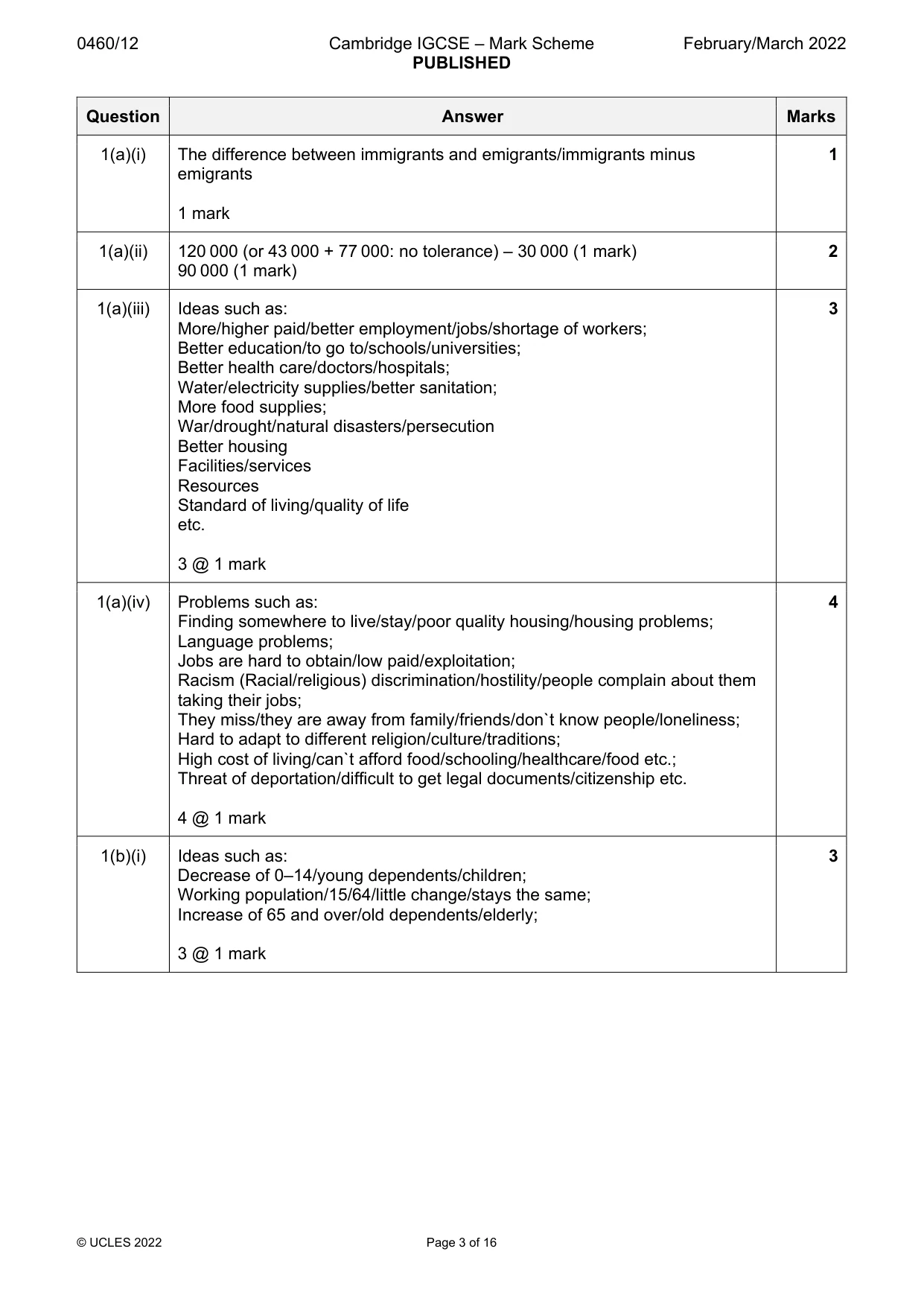
0460/12 Cambridge IGCSE – Mark Scheme PUBLISHED February/March 2022 © UCLES 2022 Page 3 of 16 Question Answer Marks 1(a)(i) The difference between immigrants and emigrants/immigrants minus emigrants 1 mark 1 1(a)(ii) 120 000 (or 43 000 + 77 000: no tolerance) – 30 000 (1 mark) 90 000 (1 mark) 2 1(a)(iii) Ideas such as: More/higher paid/better employment/jobs/shortage of workers; Better education/to go to/schools/universities; Better health care/doctors/hospitals; Water/electricity supplies/better sanitation; More food supplies; War/drought/natural disasters/persecution Better housing Facilities/services Resources Standard of living/quality of life etc. 3 @ 1 mark 3 1(a)(iv) Problems such as: Finding somewhere to live/stay/poor quality housing/housing problems; Language problems; Jobs are hard to obtain/low paid/exploitation; Racism (Racial/religious) discrimination/hostility/people complain about them taking their jobs; They miss/they are away from family/friends/don`t know people/loneliness; Hard to adapt to different religion/culture/traditions; High cost of living/can`t afford food/schooling/healthcare/food etc.; Threat of deportation/difficult to get legal documents/citizenship etc. 4 @ 1 mark 4 1(b)(i) Ideas such as: Decrease of 0–14/young dependents/children; Working population/15/64/little change/stays the same; Increase of 65 and over/old dependents/elderly; 3 @ 1 mark 3
Mark scheme, page 4
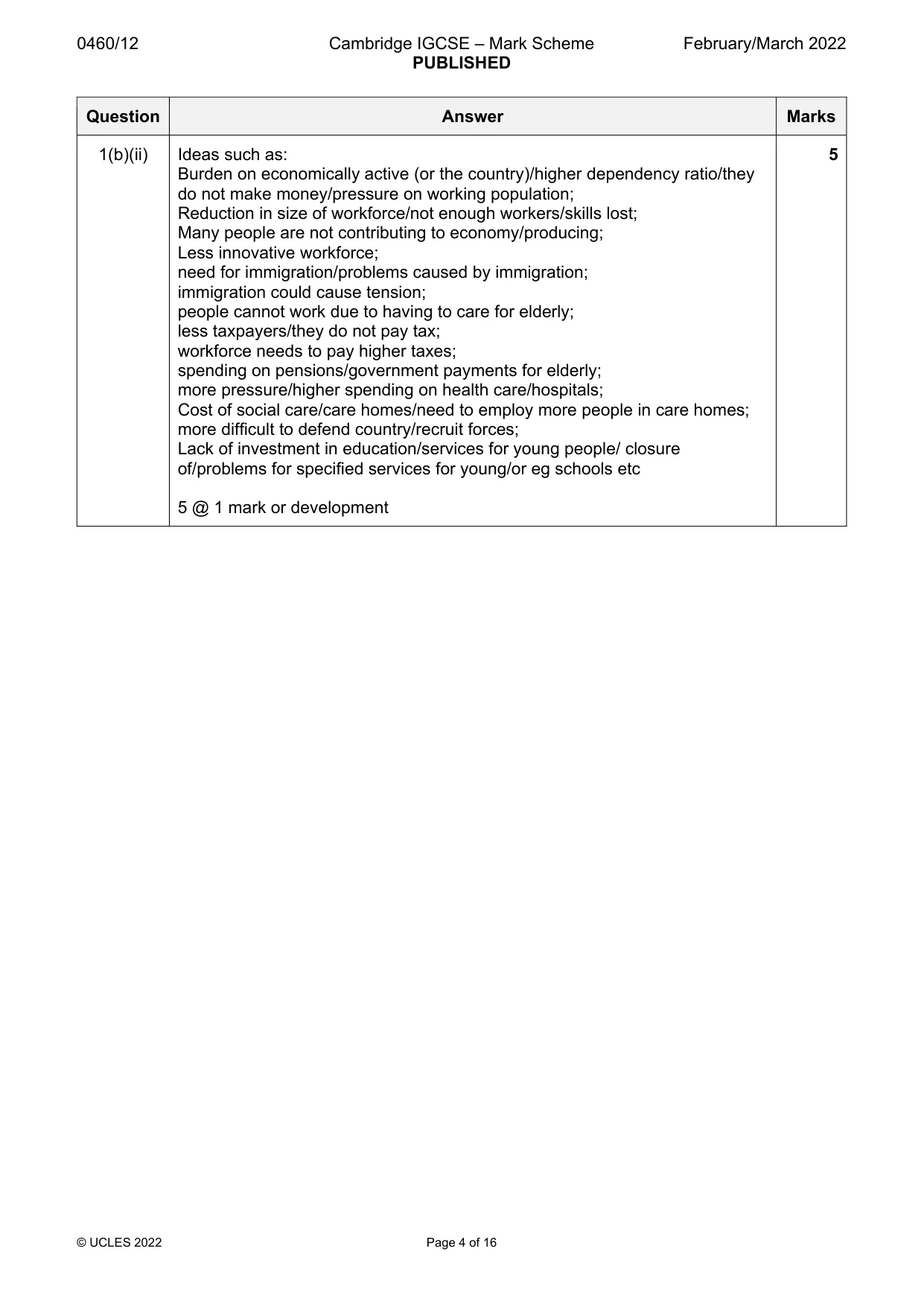
0460/12 Cambridge IGCSE – Mark Scheme PUBLISHED February/March 2022 © UCLES 2022 Page 4 of 16 Question Answer Marks 1(b)(ii) Ideas such as: Burden on economically active (or the country)/higher dependency ratio/they do not make money/pressure on working population; Reduction in size of workforce/not enough workers/skills lost; Many people are not contributing to economy/producing; Less innovative workforce; need for immigration/problems caused by immigration; immigration could cause tension; people cannot work due to having to care for elderly; less taxpayers/they do not pay tax; workforce needs to pay higher taxes; spending on pensions/government payments for elderly; more pressure/higher spending on health care/hospitals; Cost of social care/care homes/need to employ more people in care homes; more difficult to defend country/recruit forces; Lack of investment in education/services for young people/ closure of/problems for specified services for young/or eg schools etc 5 @ 1 mark or development 5
Mark scheme, page 5
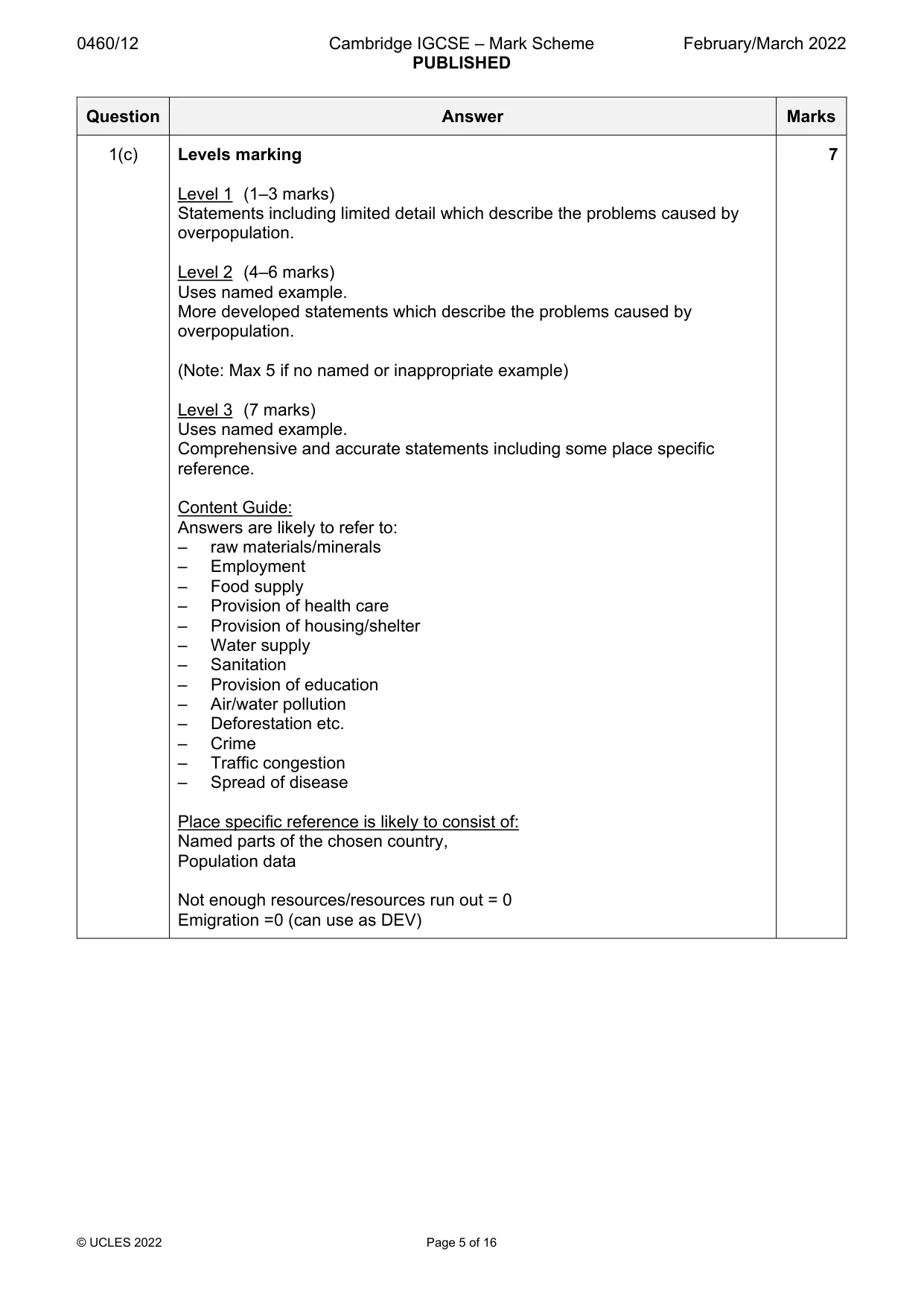
0460/12 Cambridge IGCSE – Mark Scheme PUBLISHED February/March 2022 © UCLES 2022 Page 5 of 16 Question Answer Marks 1(c) Levels marking Level 1 (1–3 marks) Statements including limited detail which describe the problems caused by overpopulation. Level 2 (4–6 marks) Uses named example. More developed statements which describe the problems caused by overpopulation. (Note: Max 5 if no named or inappropriate example) Level 3 (7 marks) Uses named example. Comprehensive and accurate statements including some place specific reference. Content Guide: Answers are likely to refer to: – raw materials/minerals – Employment – Food supply – Provision of health care – Provision of housing/shelter – Water supply – Sanitation – Provision of education – Air/water pollution – Deforestation etc. – Crime – Traffic congestion – Spread of disease Place specific reference is likely to consist of: Named parts of the chosen country, Population data Not enough resources/resources run out = 0 Emigration =0 (can use as DEV) 7
Mark scheme, page 6
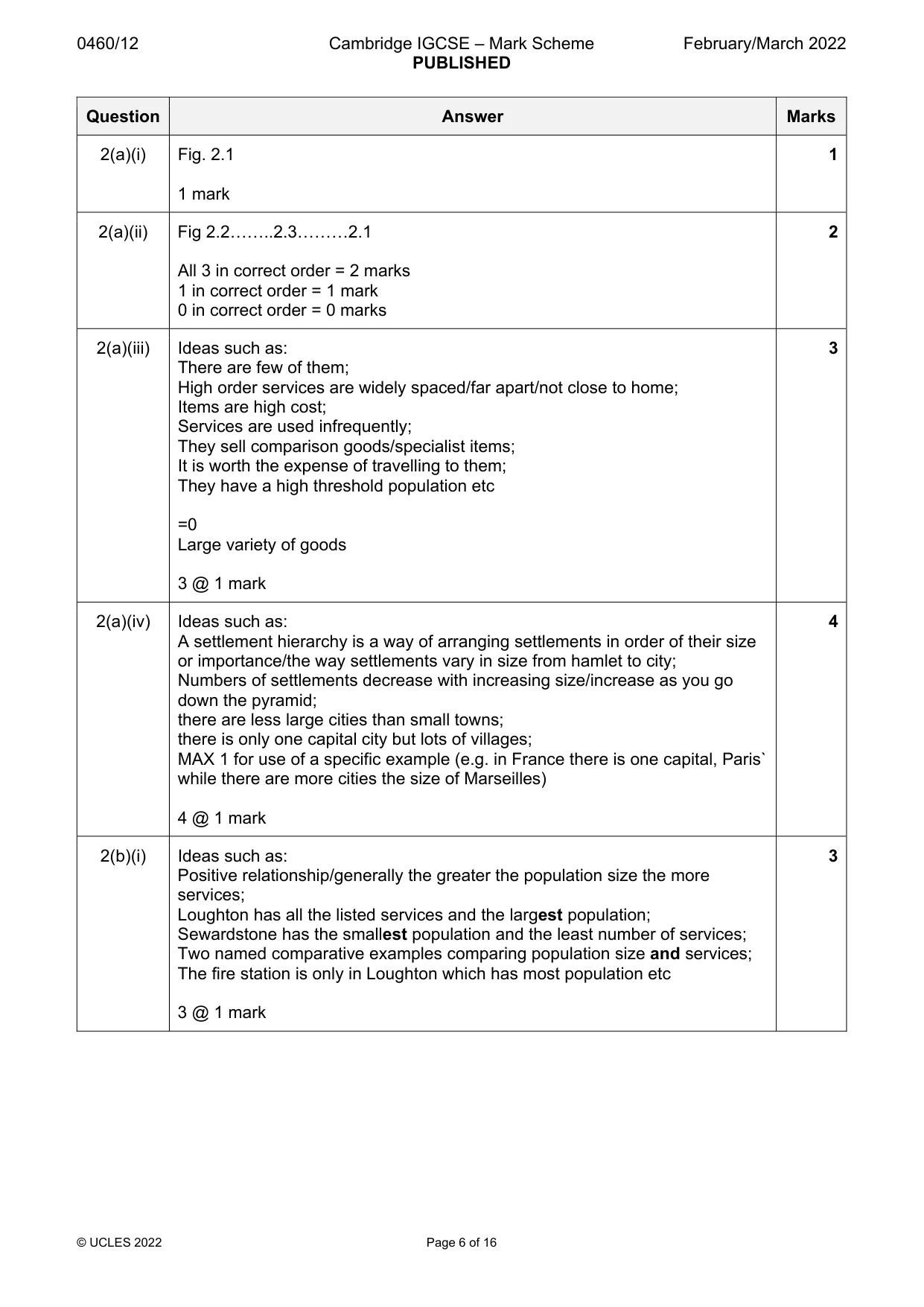
0460/12 Cambridge IGCSE – Mark Scheme PUBLISHED February/March 2022 © UCLES 2022 Page 6 of 16 Question Answer Marks 2(a)(i) Fig. 2.1 1 mark 1 2(a)(ii) Fig 2.2……..2.3………2.1 All 3 in correct order = 2 marks 1 in correct order = 1 mark 0 in correct order = 0 marks 2 2(a)(iii) Ideas such as: There are few of them; High order services are widely spaced/far apart/not close to home; Items are high cost; Services are used infrequently; They sell comparison goods/specialist items; It is worth the expense of travelling to them; They have a high threshold population etc =0 Large variety of goods 3 @ 1 mark 3 2(a)(iv) Ideas such as: A settlement hierarchy is a way of arranging settlements in order of their size or importance/the way settlements vary in size from hamlet to city; Numbers of settlements decrease with increasing size/increase as you go down the pyramid; there are less large cities than small towns; there is only one capital city but lots of villages; MAX 1 for use of a specific example (e.g. in France there is one capital, Paris` while there are more cities the size of Marseilles) 4 @ 1 mark 4 2(b)(i) Ideas such as: Positive relationship/generally the greater the population size the more services; Loughton has all the listed services and the largest population; Sewardstone has the smallest population and the least number of services; Two named comparative examples comparing population size and services; The fire station is only in Loughton which has most population etc 3 @ 1 mark 3
Mark scheme, page 7
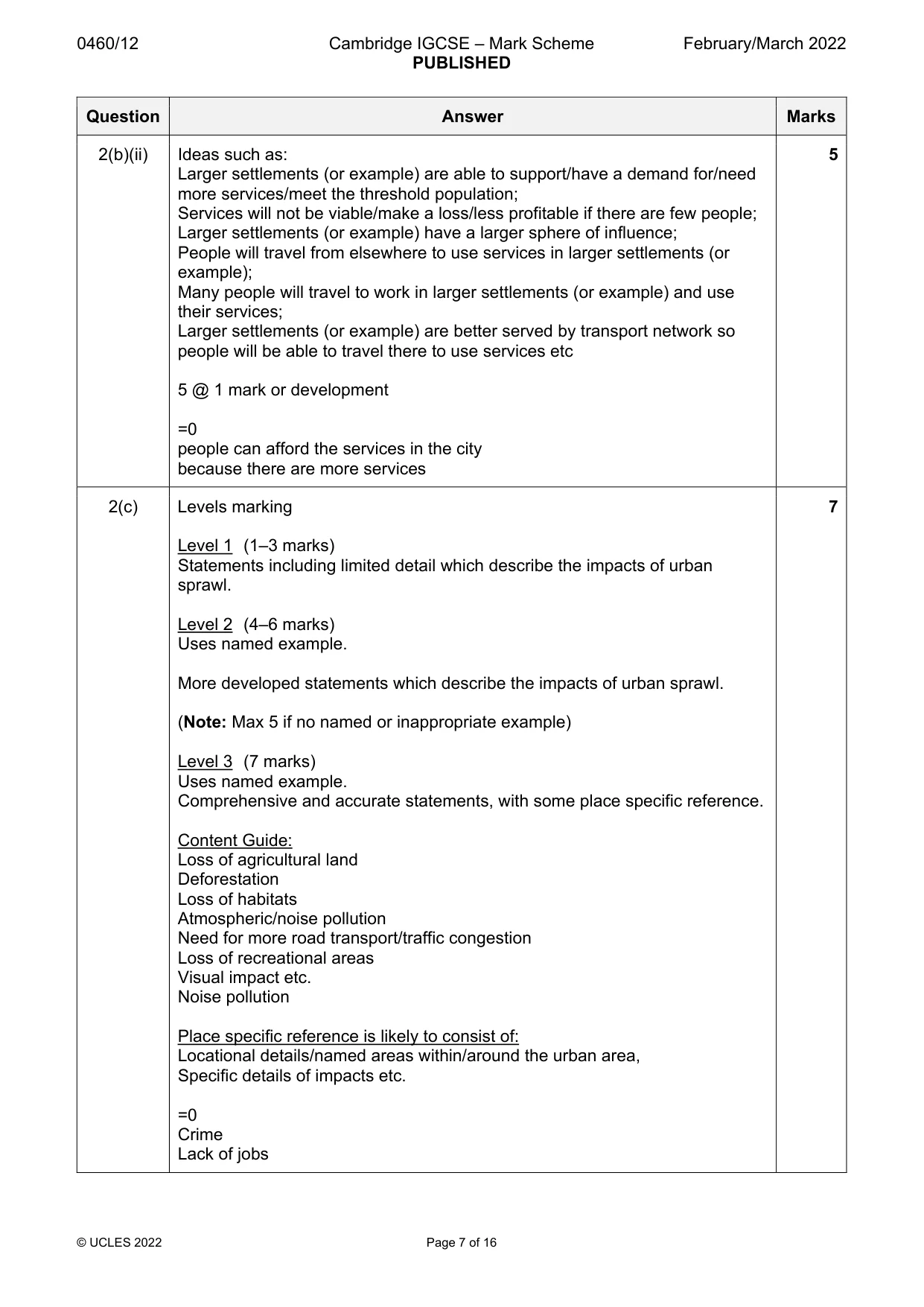
0460/12 Cambridge IGCSE – Mark Scheme PUBLISHED February/March 2022 © UCLES 2022 Page 7 of 16 Question Answer Marks 2(b)(ii) Ideas such as: Larger settlements (or example) are able to support/have a demand for/need more services/meet the threshold population; Services will not be viable/make a loss/less profitable if there are few people; Larger settlements (or example) have a larger sphere of influence; People will travel from elsewhere to use services in larger settlements (or example); Many people will travel to work in larger settlements (or example) and use their services; Larger settlements (or example) are better served by transport network so people will be able to travel there to use services etc 5 @ 1 mark or development =0 people can afford the services in the city because there are more services 5 2(c) Levels marking Level 1 (1–3 marks) Statements including limited detail which describe the impacts of urban sprawl. Level 2 (4–6 marks) Uses named example. More developed statements which describe the impacts of urban sprawl. (Note: Max 5 if no named or inappropriate example) Level 3 (7 marks) Uses named example. Comprehensive and accurate statements, with some place specific reference. Content Guide: Loss of agricultural land Deforestation Loss of habitats Atmospheric/noise pollution Need for more road transport/traffic congestion Loss of recreational areas Visual impact etc. Noise pollution Place specific reference is likely to consist of: Locational details/named areas within/around the urban area, Specific details of impacts etc. =0 Crime Lack of jobs 7
Mark scheme, page 8
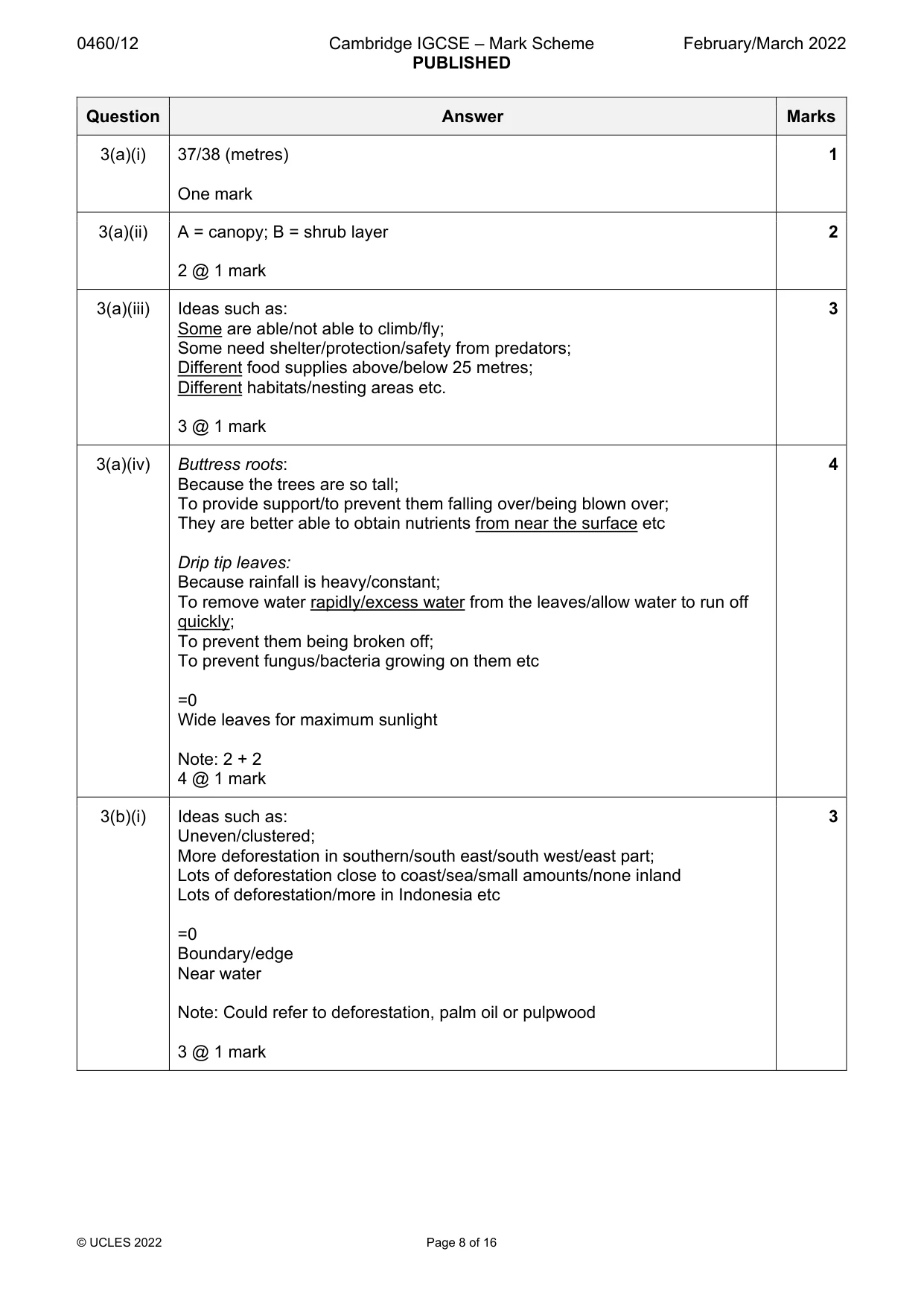
0460/12 Cambridge IGCSE – Mark Scheme PUBLISHED February/March 2022 © UCLES 2022 Page 8 of 16 Question Answer Marks 3(a)(i) 37/38 (metres) One mark 1 3(a)(ii) A = canopy; B = shrub layer 2 @ 1 mark 2 3(a)(iii) Ideas such as: Some are able/not able to climb/fly; Some need shelter/protection/safety from predators; Different food supplies above/below 25 metres; Different habitats/nesting areas etc. 3 @ 1 mark 3 3(a)(iv) Buttress roots: Because the trees are so tall; To provide support/to prevent them falling over/being blown over; They are better able to obtain nutrients from near the surface etc Drip tip leaves: Because rainfall is heavy/constant; To remove water rapidly/excess water from the leaves/allow water to run off quickly; To prevent them being broken off; To prevent fungus/bacteria growing on them etc =0 Wide leaves for maximum sunlight Note: 2 + 2 4 @ 1 mark 4 3(b)(i) Ideas such as: Uneven/clustered; More deforestation in southern/south east/south west/east part; Lots of deforestation close to coast/sea/small amounts/none inland Lots of deforestation/more in Indonesia etc =0 Boundary/edge Near water Note: Could refer to deforestation, palm oil or pulpwood 3 @ 1 mark 3
Mark scheme, page 9
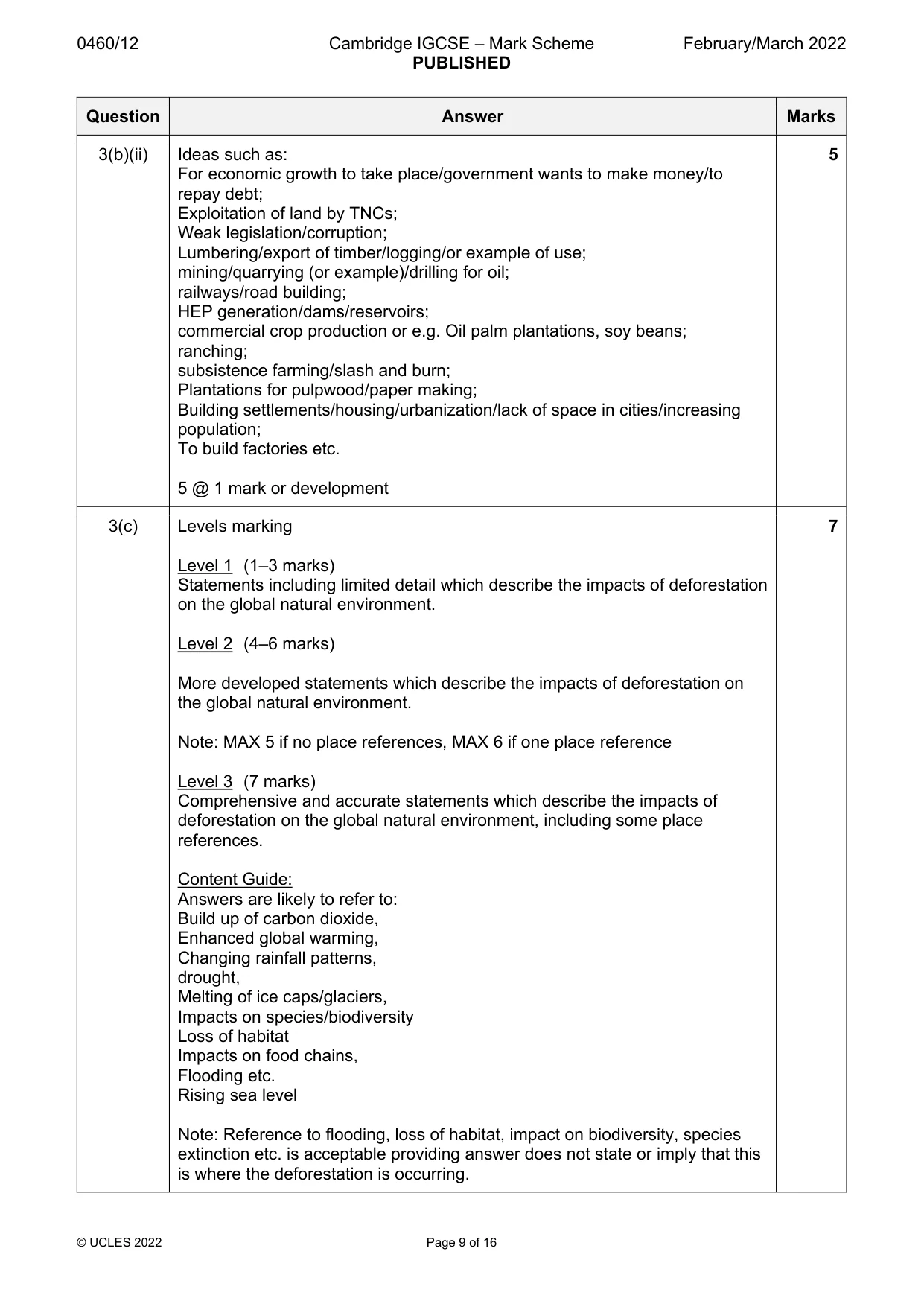
0460/12 Cambridge IGCSE – Mark Scheme PUBLISHED February/March 2022 © UCLES 2022 Page 9 of 16 Question Answer Marks 3(b)(ii) Ideas such as: For economic growth to take place/government wants to make money/to repay debt; Exploitation of land by TNCs; Weak legislation/corruption; Lumbering/export of timber/logging/or example of use; mining/quarrying (or example)/drilling for oil; railways/road building; HEP generation/dams/reservoirs; commercial crop production or e.g. Oil palm plantations, soy beans; ranching; subsistence farming/slash and burn; Plantations for pulpwood/paper making; Building settlements/housing/urbanization/lack of space in cities/increasing population; To build factories etc. 5 @ 1 mark or development 5 3(c) Levels marking Level 1 (1–3 marks) Statements including limited detail which describe the impacts of deforestation on the global natural environment. Level 2 (4–6 marks) More developed statements which describe the impacts of deforestation on the global natural environment. Note: MAX 5 if no place references, MAX 6 if one place reference Level 3 (7 marks) Comprehensive and accurate statements which describe the impacts of deforestation on the global natural environment, including some place references. Content Guide: Answers are likely to refer to: Build up of carbon dioxide, Enhanced global warming, Changing rainfall patterns, drought, Melting of ice caps/glaciers, Impacts on species/biodiversity Loss of habitat Impacts on food chains, Flooding etc. Rising sea level Note: Reference to flooding, loss of habitat, impact on biodiversity, species extinction etc. is acceptable providing answer does not state or imply that this is where the deforestation is occurring. 7
Mark scheme, page 10
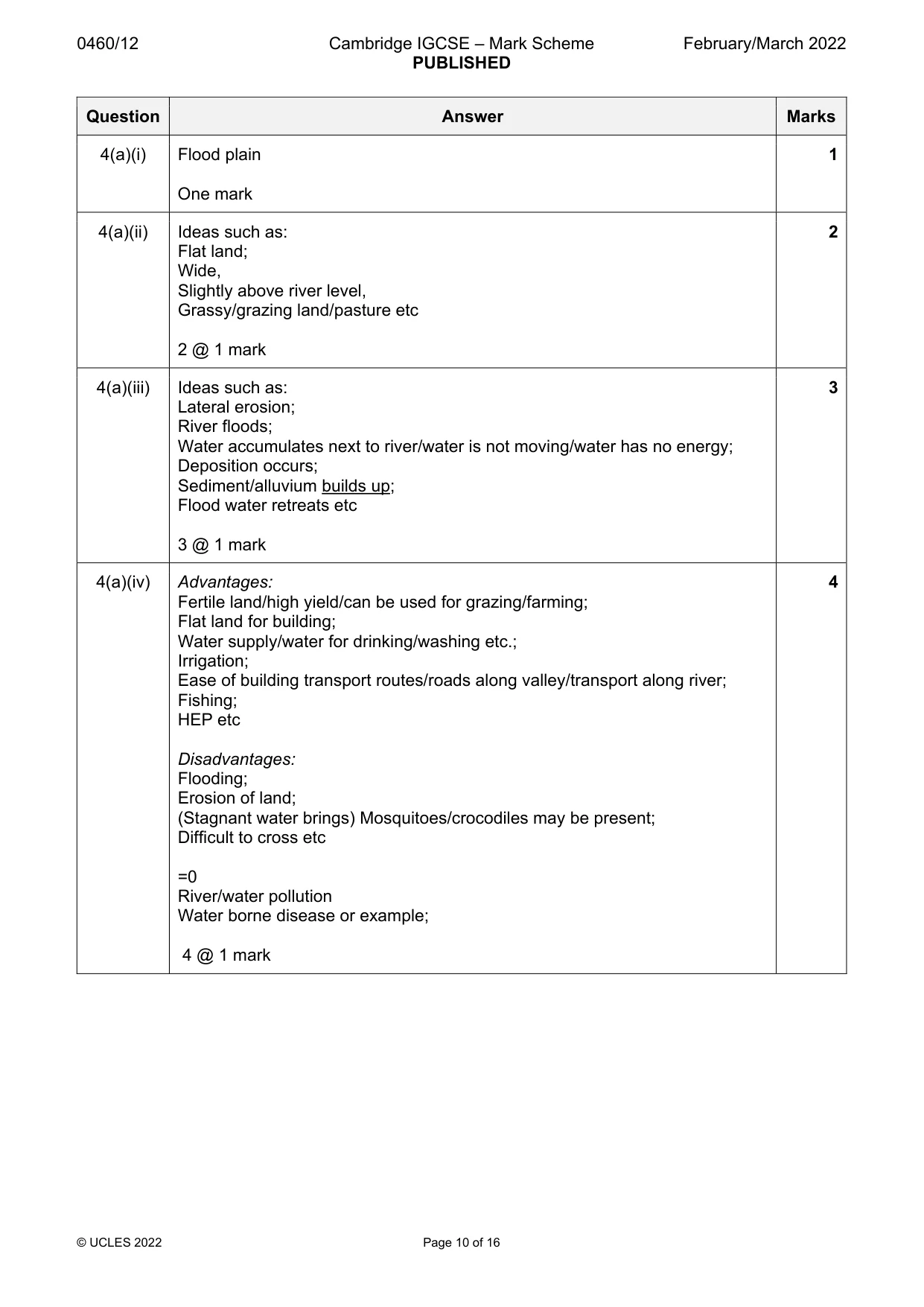
0460/12 Cambridge IGCSE – Mark Scheme PUBLISHED February/March 2022 © UCLES 2022 Page 10 of 16 Question Answer Marks 4(a)(i) Flood plain One mark 1 4(a)(ii) Ideas such as: Flat land; Wide, Slightly above river level, Grassy/grazing land/pasture etc 2 @ 1 mark 2 4(a)(iii) Ideas such as: Lateral erosion; River floods; Water accumulates next to river/water is not moving/water has no energy; Deposition occurs; Sediment/alluvium builds up; Flood water retreats etc 3 @ 1 mark 3 4(a)(iv) Advantages: Fertile land/high yield/can be used for grazing/farming; Flat land for building; Water supply/water for drinking/washing etc.; Irrigation; Ease of building transport routes/roads along valley/transport along river; Fishing; HEP etc Disadvantages: Flooding; Erosion of land; (Stagnant water brings) Mosquitoes/crocodiles may be present; Difficult to cross etc =0 River/water pollution Water borne disease or example; 4 @ 1 mark 4
Mark scheme, page 11
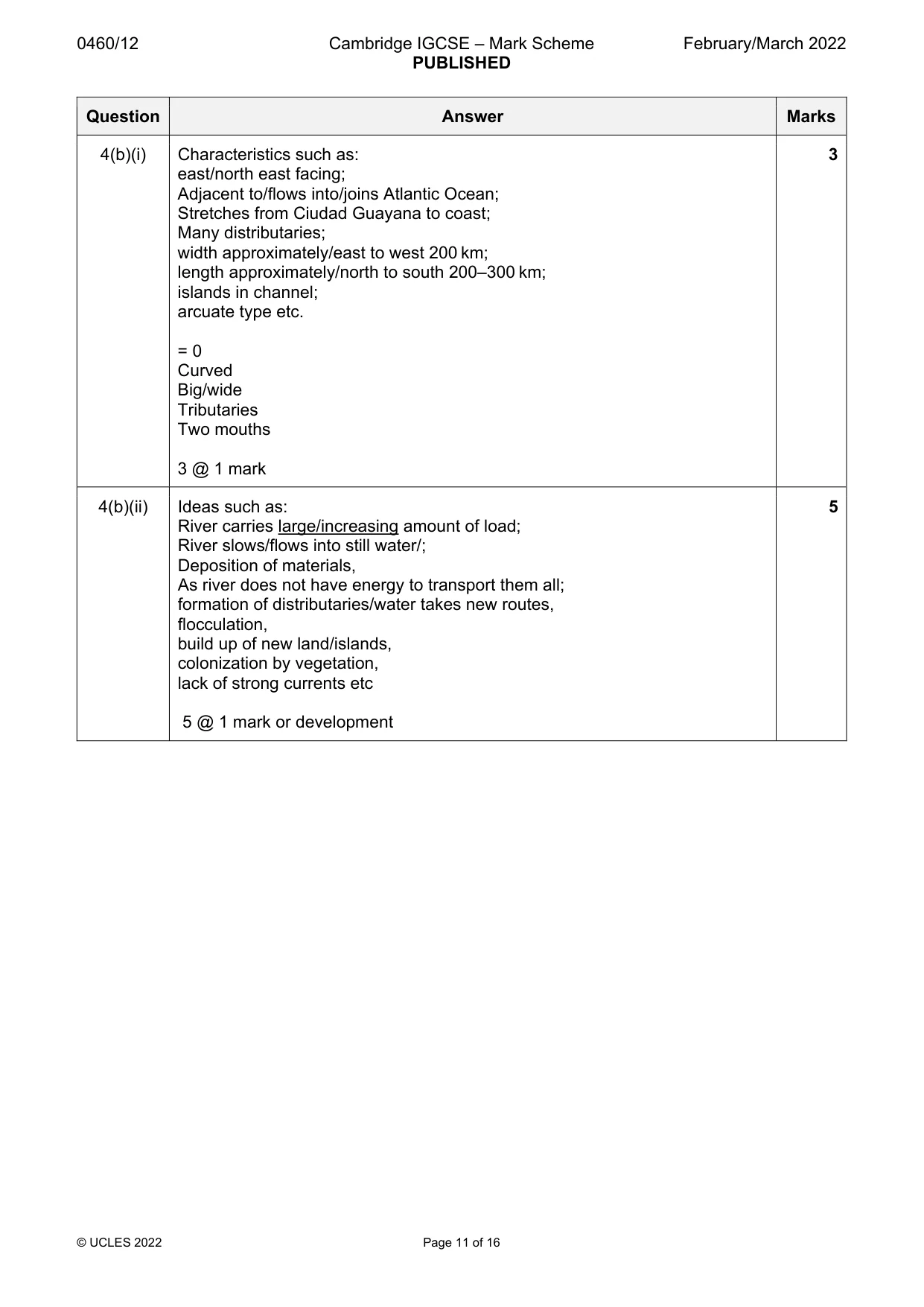
0460/12 Cambridge IGCSE – Mark Scheme PUBLISHED February/March 2022 © UCLES 2022 Page 11 of 16 Question Answer Marks 4(b)(i) Characteristics such as: east/north east facing; Adjacent to/flows into/joins Atlantic Ocean; Stretches from Ciudad Guayana to coast; Many distributaries; width approximately/east to west 200 km; length approximately/north to south 200–300 km; islands in channel; arcuate type etc. = 0 Curved Big/wide Tributaries Two mouths 3 @ 1 mark 3 4(b)(ii) Ideas such as: River carries large/increasing amount of load; River slows/flows into still water/; Deposition of materials, As river does not have energy to transport them all; formation of distributaries/water takes new routes, flocculation, build up of new land/islands, colonization by vegetation, lack of strong currents etc 5 @ 1 mark or development 5
Mark scheme, page 12
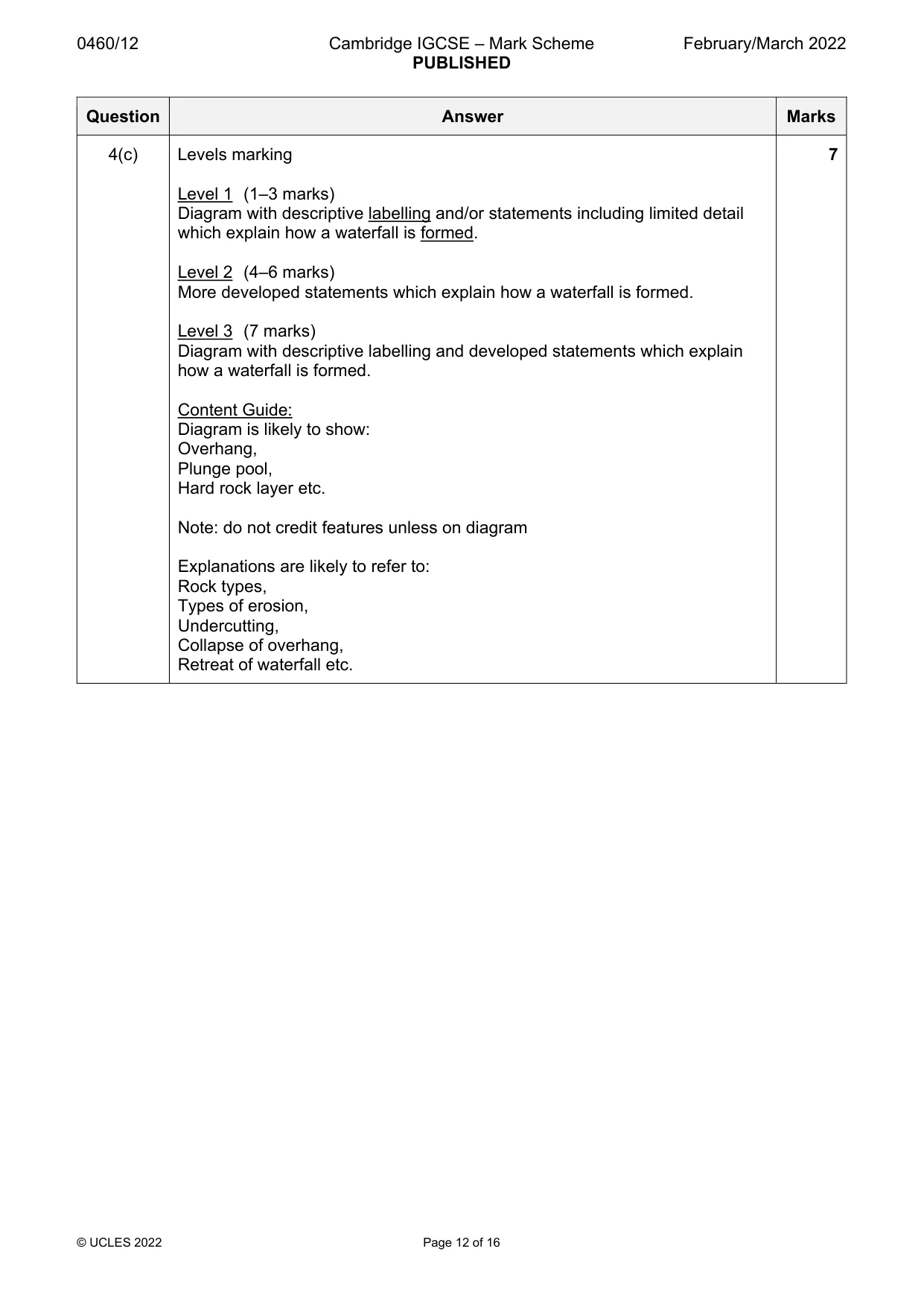
0460/12 Cambridge IGCSE – Mark Scheme PUBLISHED February/March 2022 © UCLES 2022 Page 12 of 16 Question Answer Marks 4(c) Levels marking Level 1 (1–3 marks) Diagram with descriptive labelling and/or statements including limited detail which explain how a waterfall is formed. Level 2 (4–6 marks) More developed statements which explain how a waterfall is formed. Level 3 (7 marks) Diagram with descriptive labelling and developed statements which explain how a waterfall is formed. Content Guide: Diagram is likely to show: Overhang, Plunge pool, Hard rock layer etc. Note: do not credit features unless on diagram Explanations are likely to refer to: Rock types, Types of erosion, Undercutting, Collapse of overhang, Retreat of waterfall etc. 7
Mark scheme, page 13
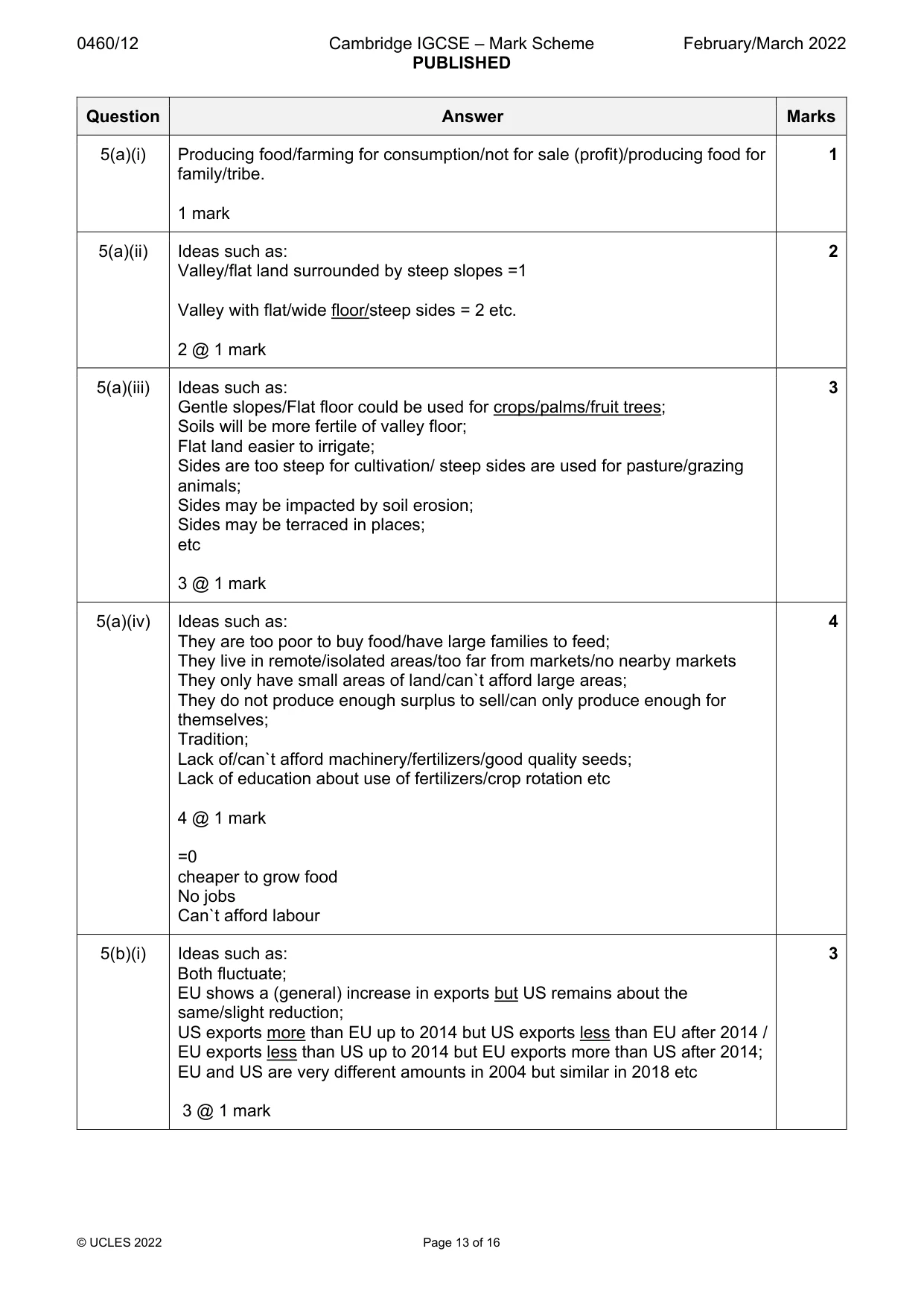
0460/12 Cambridge IGCSE – Mark Scheme PUBLISHED February/March 2022 © UCLES 2022 Page 13 of 16 Question Answer Marks 5(a)(i) Producing food/farming for consumption/not for sale (profit)/producing food for family/tribe. 1 mark 1 5(a)(ii) Ideas such as: Valley/flat land surrounded by steep slopes =1 Valley with flat/wide floor/steep sides = 2 etc. 2 @ 1 mark 2 5(a)(iii) Ideas such as: Gentle slopes/Flat floor could be used for crops/palms/fruit trees; Soils will be more fertile of valley floor; Flat land easier to irrigate; Sides are too steep for cultivation/ steep sides are used for pasture/grazing animals; Sides may be impacted by soil erosion; Sides may be terraced in places; etc 3 @ 1 mark 3 5(a)(iv) Ideas such as: They are too poor to buy food/have large families to feed; They live in remote/isolated areas/too far from markets/no nearby markets They only have small areas of land/can`t afford large areas; They do not produce enough surplus to sell/can only produce enough for themselves; Tradition; Lack of/can`t afford machinery/fertilizers/good quality seeds; Lack of education about use of fertilizers/crop rotation etc 4 @ 1 mark =0 cheaper to grow food No jobs Can`t afford labour 4 5(b)(i) Ideas such as: Both fluctuate; EU shows a (general) increase in exports but US remains about the same/slight reduction; US exports more than EU up to 2014 but US exports less than EU after 2014 / EU exports less than US up to 2014 but EU exports more than US after 2014; EU and US are very different amounts in 2004 but similar in 2018 etc 3 @ 1 mark 3
Mark scheme, page 14
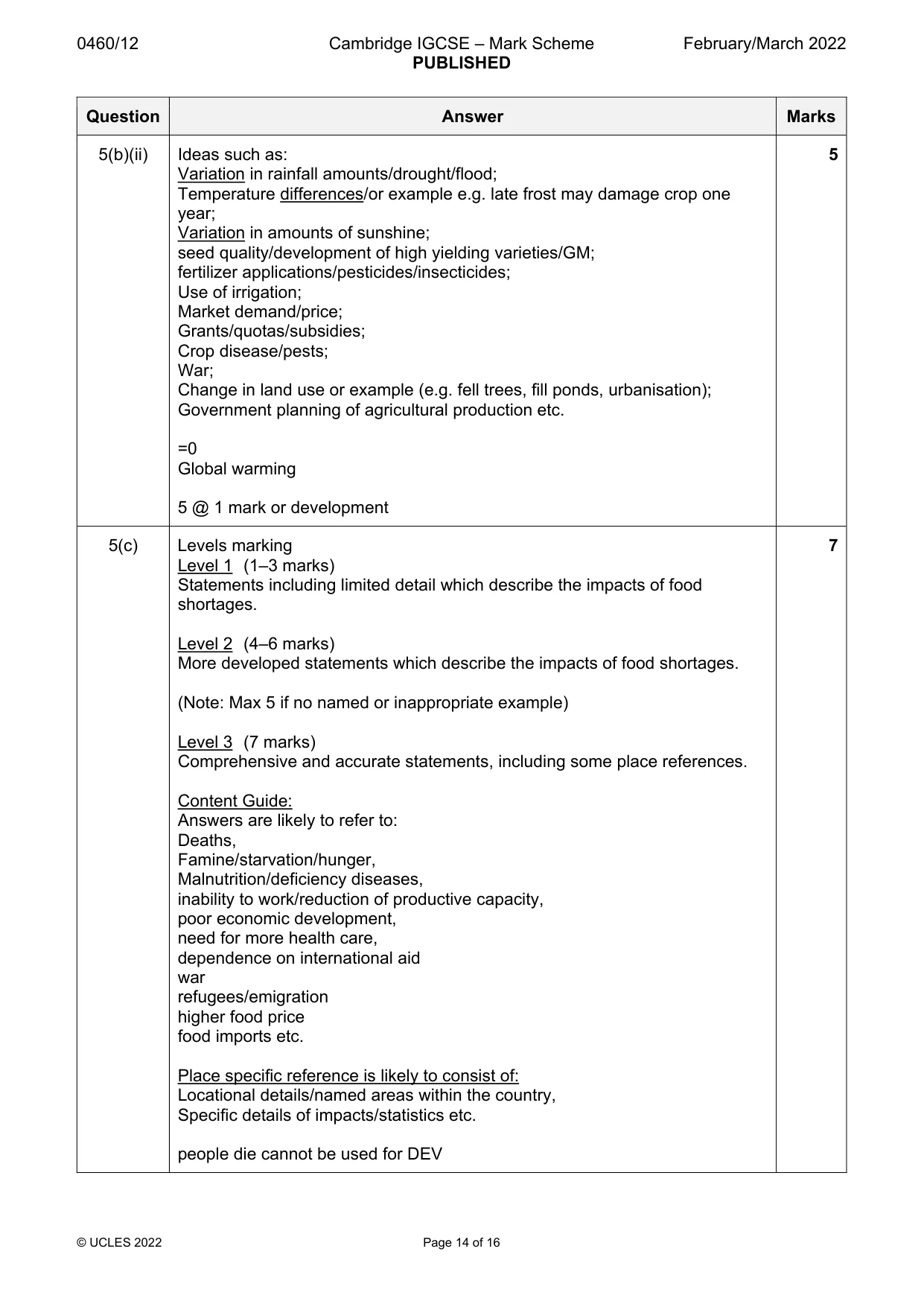
0460/12 Cambridge IGCSE – Mark Scheme PUBLISHED February/March 2022 © UCLES 2022 Page 14 of 16 Question Answer Marks 5(b)(ii) Ideas such as: Variation in rainfall amounts/drought/flood; Temperature differences/or example e.g. late frost may damage crop one year; Variation in amounts of sunshine; seed quality/development of high yielding varieties/GM; fertilizer applications/pesticides/insecticides; Use of irrigation; Market demand/price; Grants/quotas/subsidies; Crop disease/pests; War; Change in land use or example (e.g. fell trees, fill ponds, urbanisation); Government planning of agricultural production etc. =0 Global warming 5 @ 1 mark or development 5 5(c) Levels marking Level 1 (1–3 marks) Statements including limited detail which describe the impacts of food shortages. Level 2 (4–6 marks) More developed statements which describe the impacts of food shortages. (Note: Max 5 if no named or inappropriate example) Level 3 (7 marks) Comprehensive and accurate statements, including some place references. Content Guide: Answers are likely to refer to: Deaths, Famine/starvation/hunger, Malnutrition/deficiency diseases, inability to work/reduction of productive capacity, poor economic development, need for more health care, dependence on international aid war refugees/emigration higher food price food imports etc. Place specific reference is likely to consist of: Locational details/named areas within the country, Specific details of impacts/statistics etc. people die cannot be used for DEV 7
Mark scheme, page 15
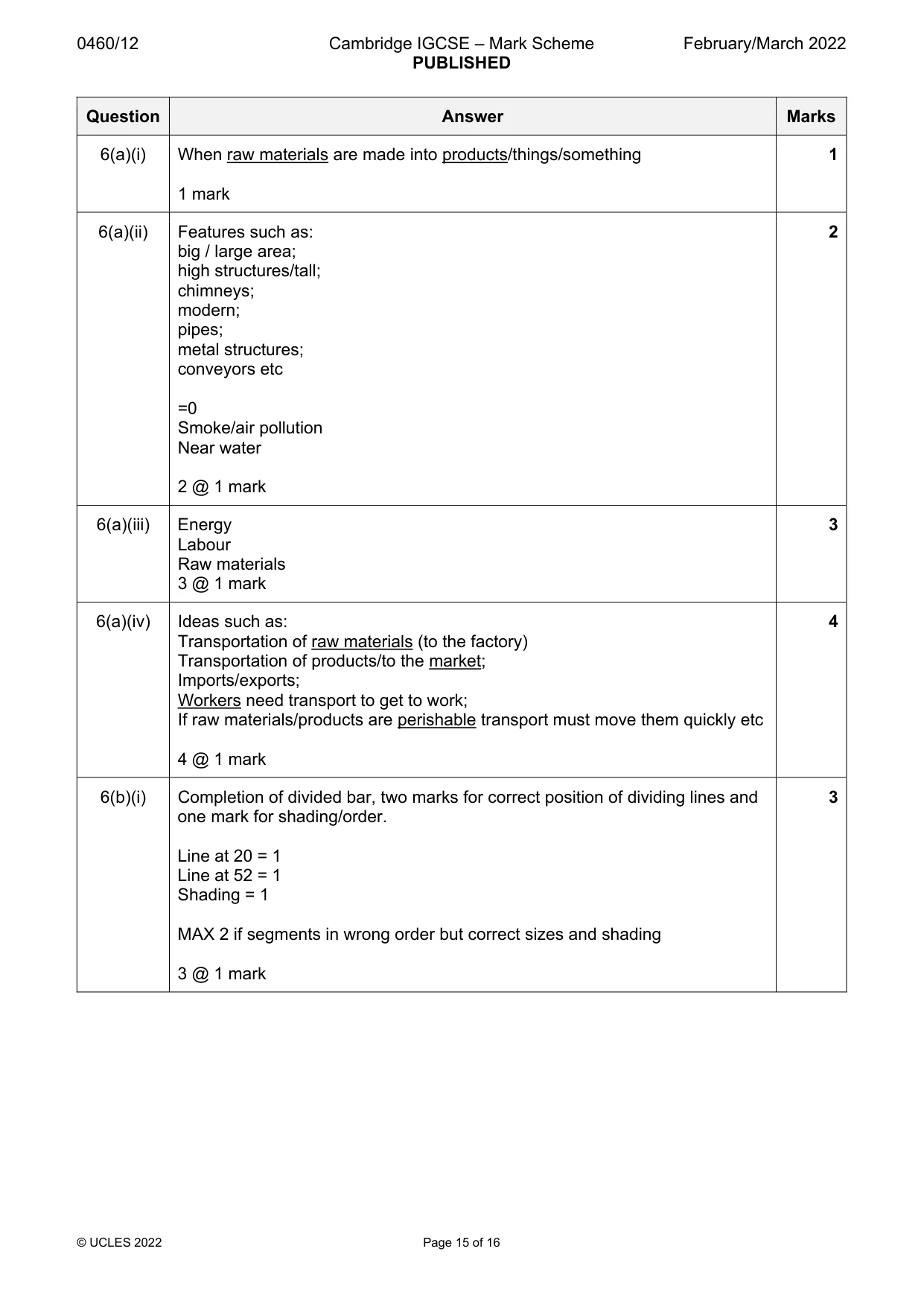
0460/12 Cambridge IGCSE – Mark Scheme PUBLISHED February/March 2022 © UCLES 2022 Page 15 of 16 Question Answer Marks 6(a)(i) When raw materials are made into products/things/something 1 mark 1 6(a)(ii) Features such as: big / large area; high structures/tall; chimneys; modern; pipes; metal structures; conveyors etc =0 Smoke/air pollution Near water 2 @ 1 mark 2 6(a)(iii) Energy Labour Raw materials 3 @ 1 mark 3 6(a)(iv) Ideas such as: Transportation of raw materials (to the factory) Transportation of products/to the market; Imports/exports; Workers need transport to get to work; If raw materials/products are perishable transport must move them quickly etc 4 @ 1 mark 4 6(b)(i) Completion of divided bar, two marks for correct position of dividing lines and one mark for shading/order. Line at 20 = 1 Line at 52 = 1 Shading = 1 MAX 2 if segments in wrong order but correct sizes and shading 3 @ 1 mark 3
Mark scheme, page 16
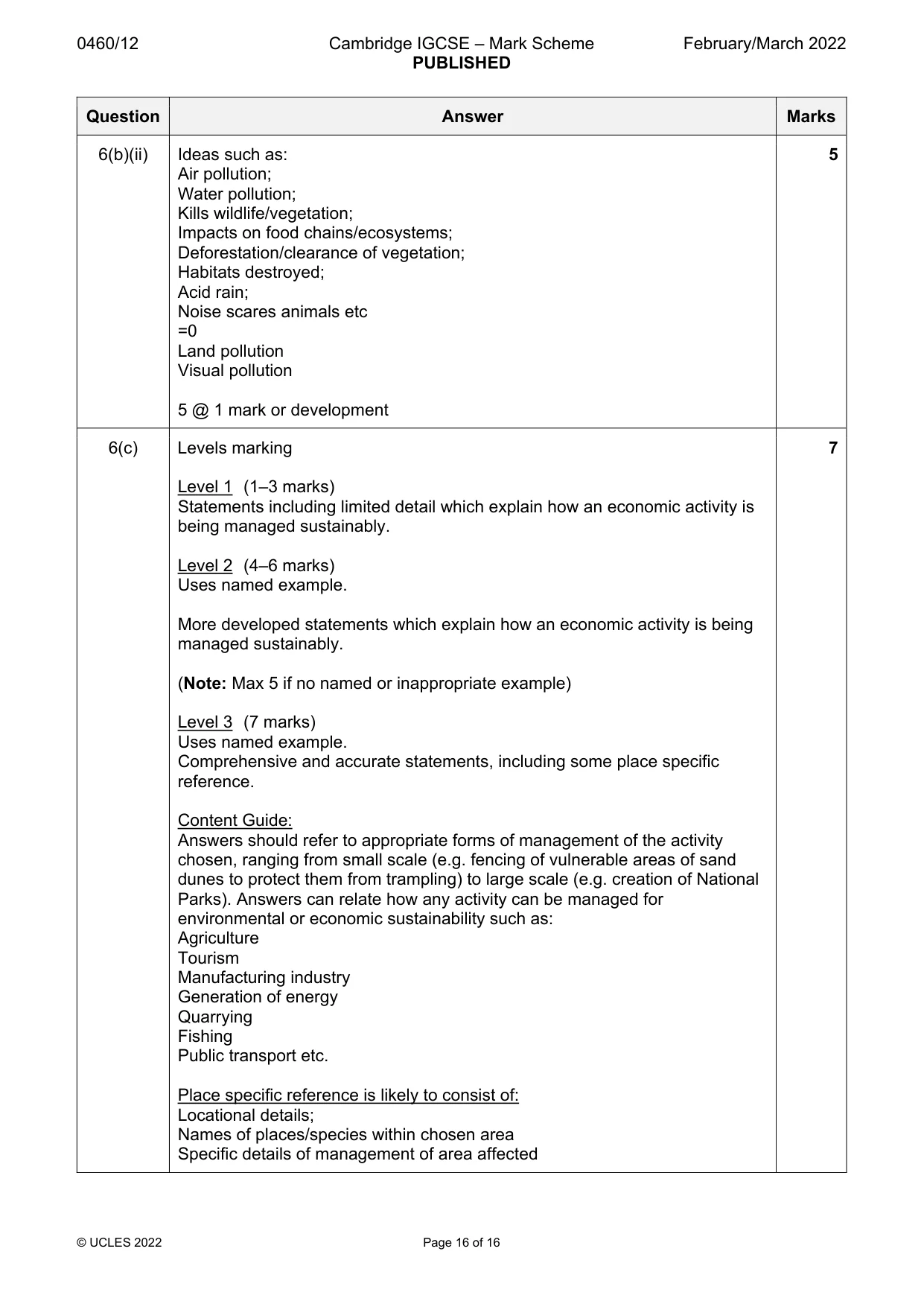
0460/12 Cambridge IGCSE – Mark Scheme PUBLISHED February/March 2022 © UCLES 2022 Page 16 of 16 Question Answer Marks 6(b)(ii) Ideas such as: Air pollution; Water pollution; Kills wildlife/vegetation; Impacts on food chains/ecosystems; Deforestation/clearance of vegetation; Habitats destroyed; Acid rain; Noise scares animals etc =0 Land pollution Visual pollution 5 @ 1 mark or development 5 6(c) Levels marking Level 1 (1–3 marks) Statements including limited detail which explain how an economic activity is being managed sustainably. Level 2 (4–6 marks) Uses named example. More developed statements which explain how an economic activity is being managed sustainably. (Note: Max 5 if no named or inappropriate example) Level 3 (7 marks) Uses named example. Comprehensive and accurate statements, including some place specific reference. Content Guide: Answers should refer to appropriate forms of management of the activity chosen, ranging from small scale (e.g. fencing of vulnerable areas of sand dunes to protect them from trampling) to large scale (e.g. creation of National Parks). Answers can relate how any activity can be managed for environmental or economic sustainability such as: Agriculture Tourism Manufacturing industry Generation of energy Quarrying Fishing Public transport etc. Place specific reference is likely to consist of: Locational details; Names of places/species within chosen area Specific details of management of area affected 7
What you needed in this session
Cambridge’s own grade thresholds for 2022 Feb/March, Paper 1 · Variant 2. A higher threshold means an easier paper — the bar moves with how the cohort did.