Cambridge IGCSE Geography 0460 — 2021 Feb/March Paper 1 · Variant 2
0460/12/F/M/21 · 75 marks · ≈84 min
The question paper and its mark scheme, free to read here and free to download. This is Cambridge’s own paper, exactly as it was sat.
Question paper32 pages






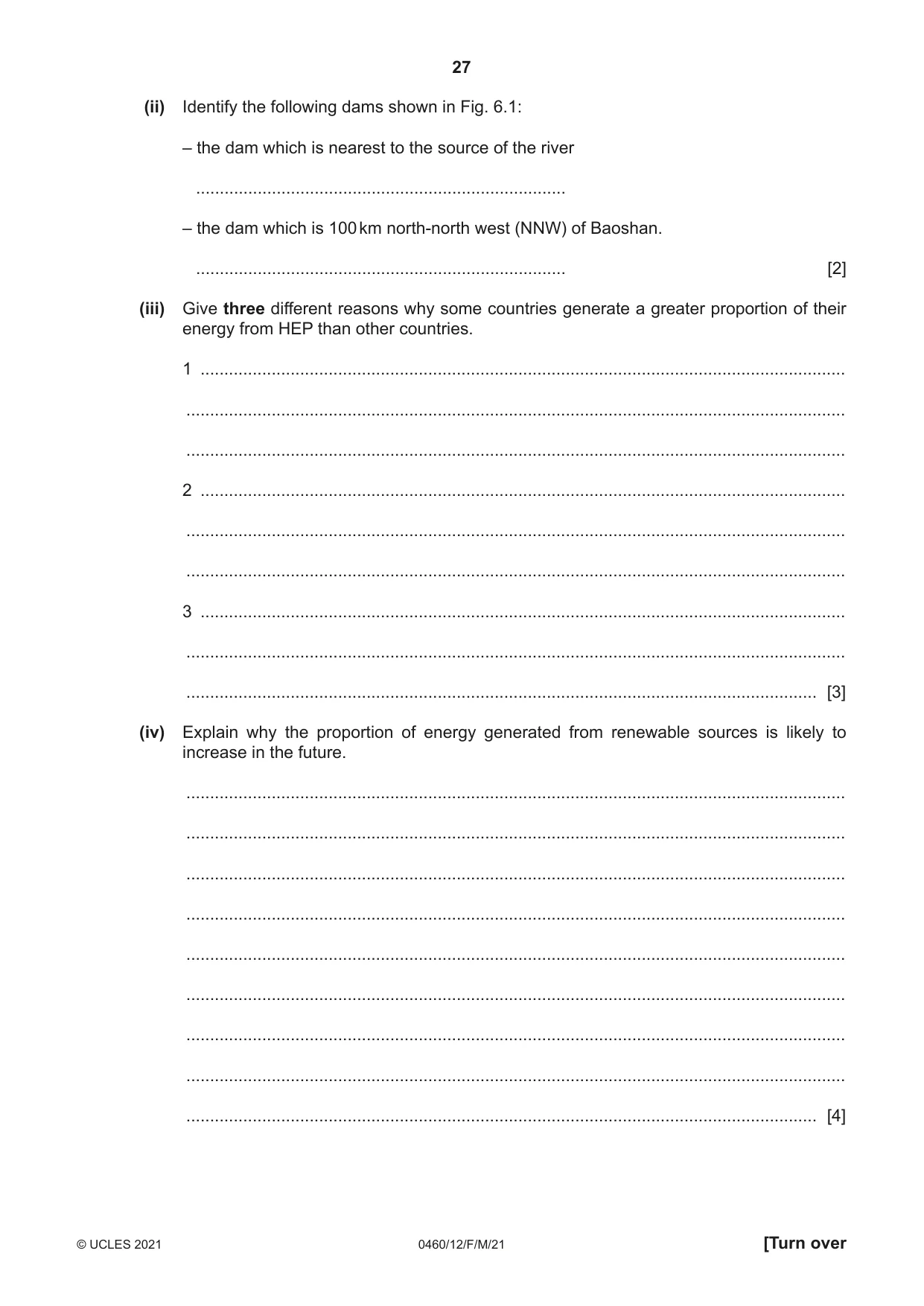




Mark scheme18 pages
Answers below. Sit the paper first if you are practising.
Paper as text
Question paper, page 1
This document has 32 pages. Any blank pages are indicated. Cambridge IGCSE™ * 0 2 5 7 4 1 9 6 0 6 * GEOGRAPHY 0460/12 Paper 1 Geographical Themes February/March 2021 1 hour 45 minutes You must answer on the question paper. You will need: Insert (enclosed) Calculator Ruler INSTRUCTIONS ● Answer three questions in total, one from each section. ● Use a black or dark blue pen. You may use an HB pencil for any diagrams or graphs. ● Write your name, centre number and candidate number in the boxes at the top of the page. ● Write your answer to each question in the space provided. ● Do not use an erasable pen or correction fluid. ● Do not write on any bar codes. ● If additional space is needed, you should use the lined pages at the end of this booklet; the question number or numbers must be clearly shown. INFORMATION ● The total mark for this paper is 75. ● The number of marks for each question or part question is shown in brackets [ ]. ● The insert contains additional resources referred to in the questions. Definitions MEDCs – More Economically Developed Countries LEDCs – Less Economically Developed Countries DC (ST/JG) 199592/4 © UCLES 2021 [Turn over
Question paper, page 2
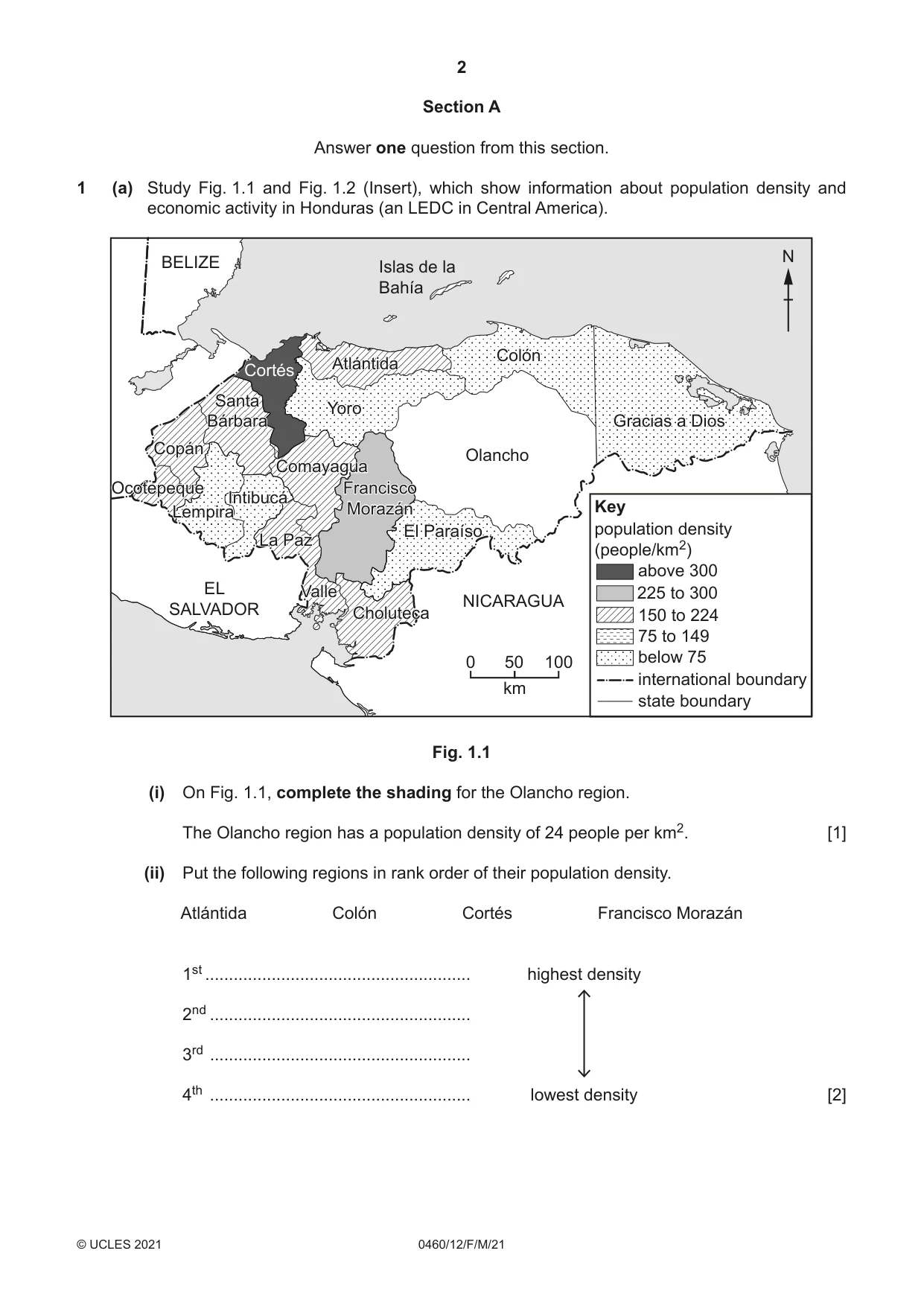
2 0460/12/F/M/21 © UCLES 2021 Section A Answer one question from this section. 1 (a) Study Fig. 1.1 and Fig. 1.2 (Insert), which show information about population density and economic activity in Honduras (an LEDC in Central America). below 75 75 to 149 state boundary international boundary 150 to 224 225 to 300 above 300 population density (people/km2) Key NICARAGUA EL SALVADOR BELIZE N 0 50 100 km Colón Colón Gracias a Dios Gracias a Dios Yoro Yoro Islas de la Bahía Cortés Santa Bárbara Santa Bárbara Copán Copán Ocotepeque Ocotepeque Lempira Lempira Intibucá Intibucá La Paz La Paz El Paraíso El Paraíso Valle Valle Choluteca Choluteca Comayagua Comayagua Francisco Morazán Francisco Morazán Olancho Atlántida Atlántida Fig. 1.1 (i) On Fig. 1.1, complete the shading for the Olancho region. The Olancho region has a population density of 24 people per km2. [1] (ii) Put the following regions in rank order of their population density. Atlántida Colón Cortés Francisco Morazán 1st … highest density 2nd … 3rd … 4th … lowest density [2]
Question paper, page 3
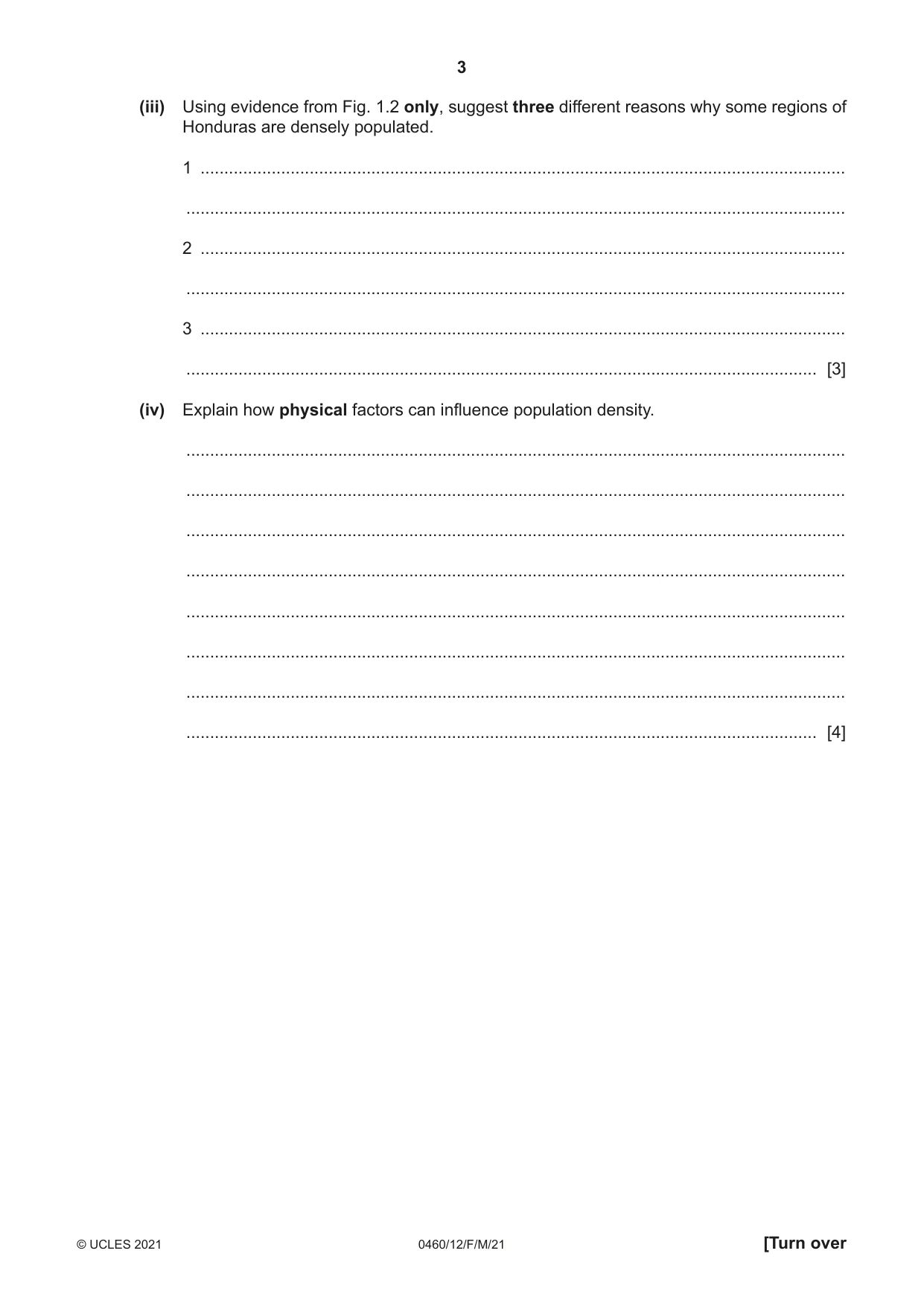
3 0460/12/F/M/21 © UCLES 2021 [Turn over (iii) Using evidence from Fig. 1.2 only, suggest three different reasons why some regions of Honduras are densely populated. 1 … … 2 … … 3 … … [3] (iv) Explain how physical factors can influence population density. … … … … … … … … [4]
Question paper, page 4
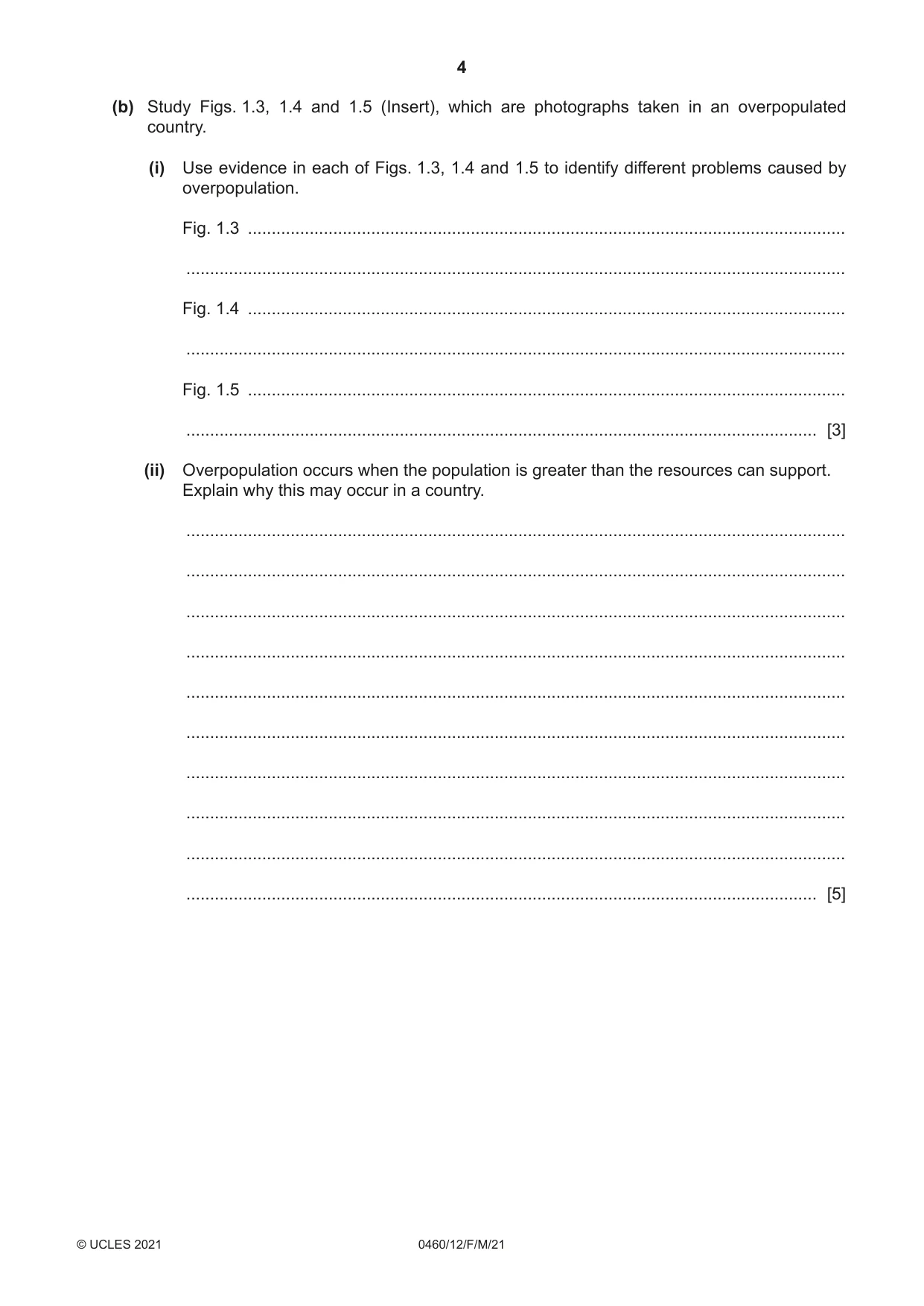
4 0460/12/F/M/21 © UCLES 2021 (b) Study Figs. 1.3, 1.4 and 1.5 (Insert), which are photographs taken in an overpopulated country. (i) Use evidence in each of Figs. 1.3, 1.4 and 1.5 to identify different problems caused by overpopulation. Fig. 1.3 … … Fig. 1.4 … … Fig. 1.5 … … [3] (ii) Overpopulation occurs when the population is greater than the resources can support. Explain why this may occur in a country. … … … … … … … … … … [5]
Question paper, page 5
5 0460/12/F/M/21 © UCLES 2021 [Turn over (c) For a named country you have studied, describe a government policy used to influence population growth. Country … … … … … … … … … … … … … … … … … … … … … … … … … [7] [Total: 25]
Question paper, page 6
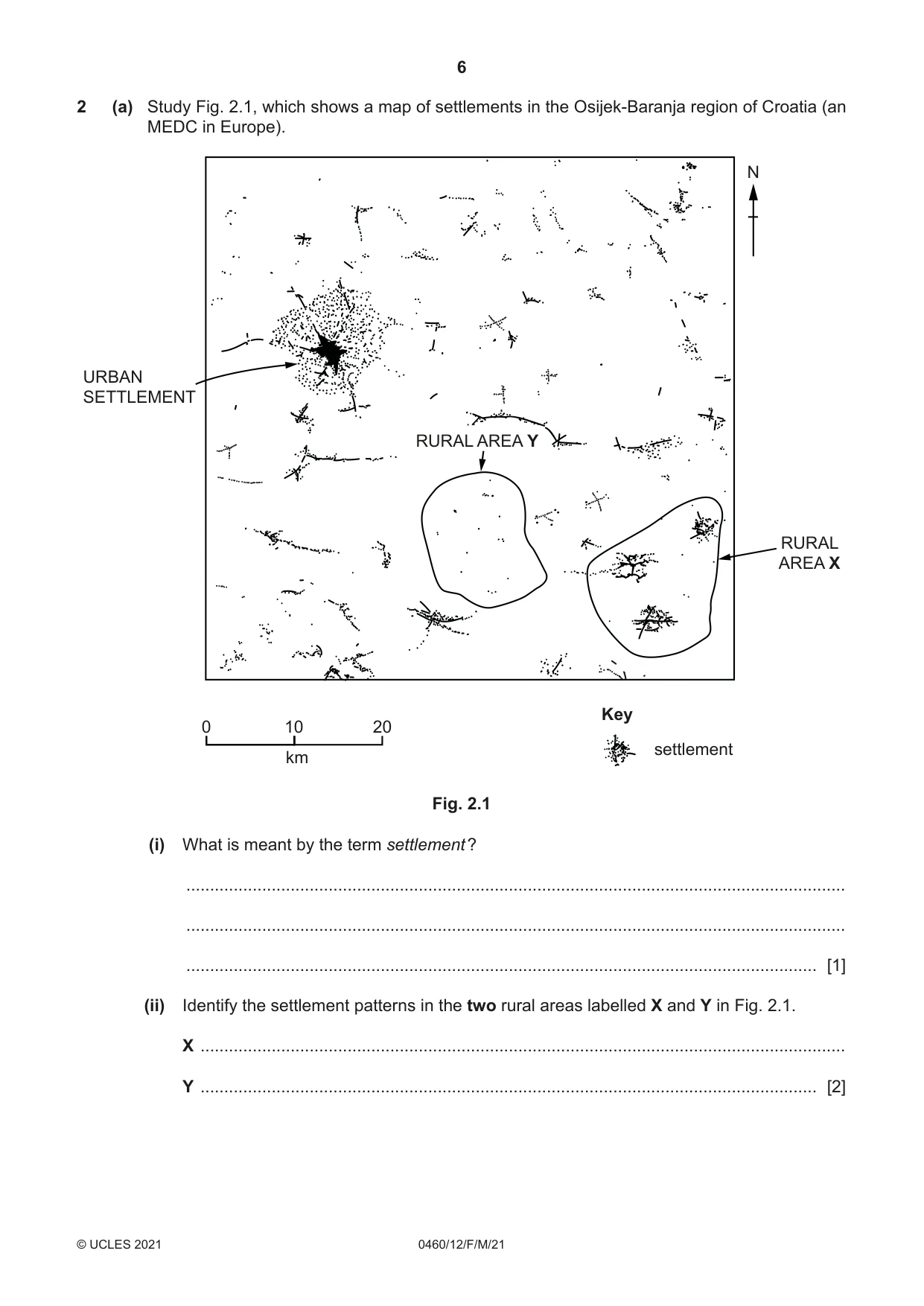
6 0460/12/F/M/21 © UCLES 2021 2 (a) Study Fig. 2.1, which shows a map of settlements in the Osijek-Baranja region of Croatia (an MEDC in Europe). N RURAL AREA Y RURAL AREA X 0 10 20 settlement km Key URBAN SETTLEMENT Fig. 2.1 (i) What is meant by the term settlement ? … … … [1] (ii) Identify the settlement patterns in the two rural areas labelled X and Y in Fig. 2.1. X … Y … [2]
Question paper, page 7
7 0460/12/F/M/21 © UCLES 2021 [Turn over (iii) Suggest three factors which may have resulted in the growth of linear settlement patterns in parts of the area shown in Fig. 2.1. 1 … … 2 … … 3 … … [3] (iv) Suggest likely differences in service provision between the urban and rural settlements shown in Fig. 2.1. … … … … … … … … [4]
Question paper, page 8
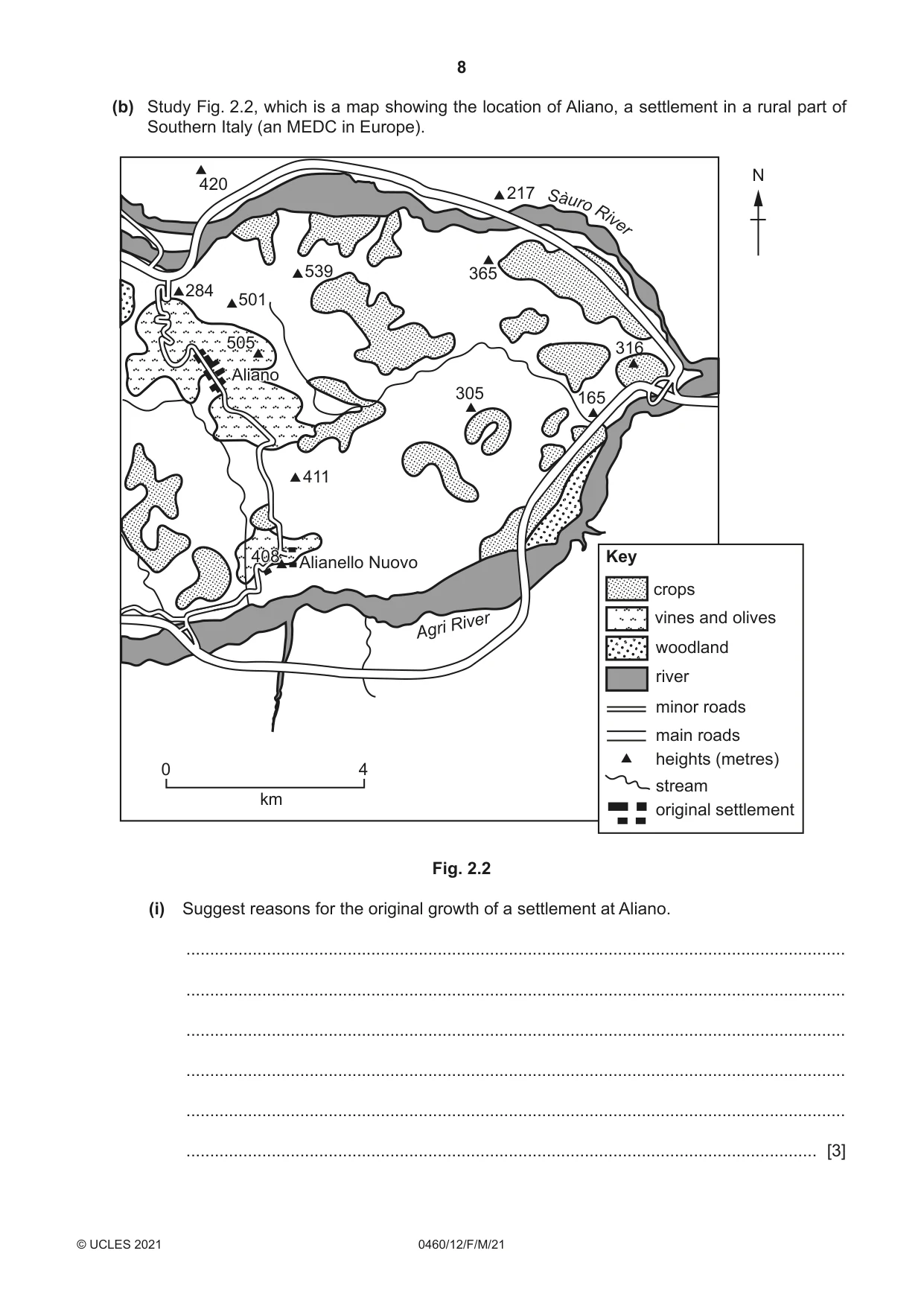
8 0460/12/F/M/21 © UCLES 2021 (b) Study Fig. 2.2, which is a map showing the location of Aliano, a settlement in a rural part of Southern Italy (an MEDC in Europe). 0 4 km 284 501 505 505 539 420 365 217 305 165 316 411 408 408 Sàu r o R iv er Agri River Alianello Nuovo N Key crops vines and olives woodland river minor roads main roads heights (metres) stream original settlement Aliano Aliano Fig. 2.2 (i) Suggest reasons for the original growth of a settlement at Aliano. … … … … … … [3]
Question paper, page 9
9 0460/12/F/M/21 © UCLES 2021 [Turn over (ii) The population of Aliano is now less than 1000 people. Explain why the population has declined in settlements in some rural areas in MEDCs. … … … … … … … … … … [5]
Question paper, page 10
10 0460/12/F/M/21 © UCLES 2021 (c) The function of a settlement is its purpose, such as: – a port – a tourist resort – administration – manufacturing. For a named settlement you have studied, state its function(s) and explain why this/these function(s) developed there. Name of settlement … Function(s) … … … … … … … … … … … … … … … … … … … … … [7] [Total: 25]
Question paper, page 11
11 0460/12/F/M/21 © UCLES 2021 [Turn over TURN PAGE FOR QUESTION 3
Question paper, page 12
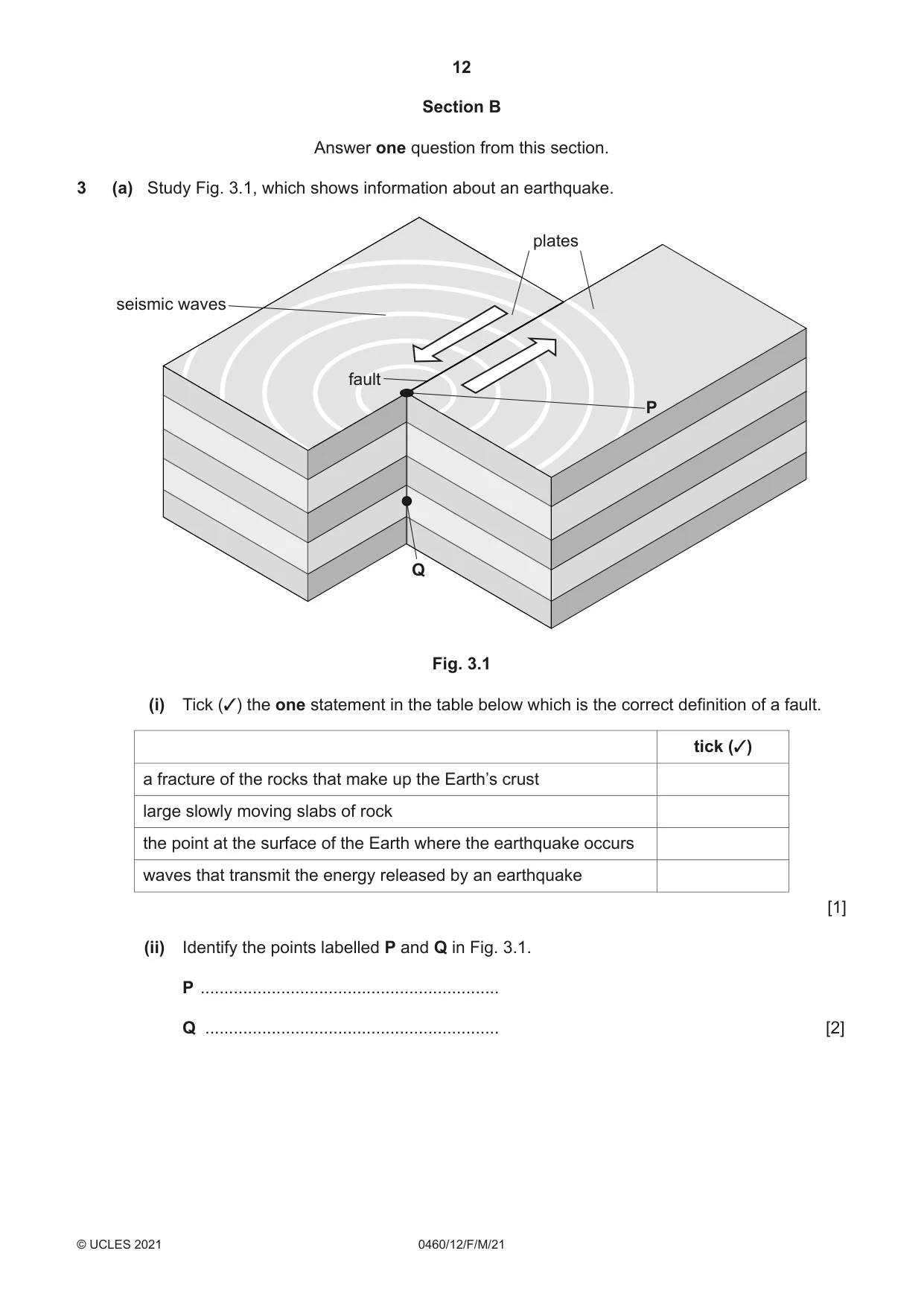
12 0460/12/F /M /21 © UCLES 2021 Section B Answer one question from this section. 3 (a) Study Fig. 3.1, which shows information about an earthquake. plates seismic waves fault Q P Fig. 3.1 (i) Tick (3) the one statement in the table below which is the correct definition of a fault. tick (3) a fracture of the rocks that make up the Earth’s crust large slowly moving slabs of rock the point at the surface of the Earth where the earthquake occurs waves that transmit the energy released by an earthquake [1] (ii) Identify the points labelled P and Q in Fig. 3.1. P … Q … [2]
Question paper, page 13
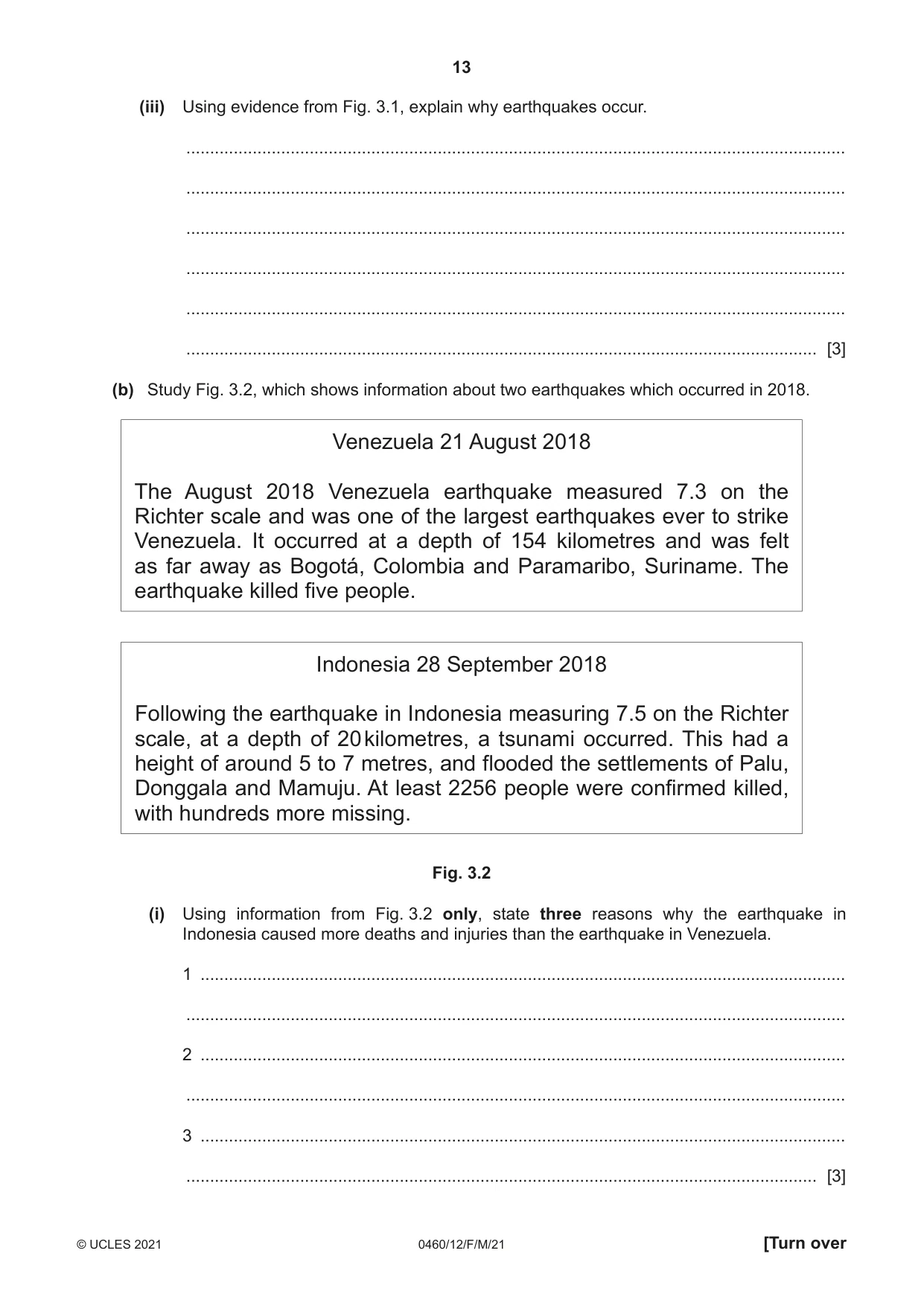
13 0460/12/F/M/21 © UCLES 2021 [Turn over (iii) Using evidence from Fig. 3.1, explain why earthquakes occur. … … … … … … [3] (b) Study Fig. 3.2, which shows information about two earthquakes which occurred in 2018. Venezuela 21 August 2018 The August 2018 Venezuela earthquake measured 7.3 on the Richter scale and was one of the largest earthquakes ever to strike Venezuela. It occurred at a depth of 154 kilometres and was felt as far away as Bogotá, Colombia and Paramaribo, Suriname. The earthquake killed five people. Indonesia 28 September 2018 Following the earthquake in Indonesia measuring 7.5 on the Richter scale, at a depth of 20 kilometres, a tsunami occurred. This had a height of around 5 to 7 metres, and flooded the settlements of Palu, Donggala and Mamuju. At least 2256 people were confirmed killed, with hundreds more missing. Fig. 3.2 (i) Using information from Fig. 3.2 only, state three reasons why the earthquake in Indonesia caused more deaths and injuries than the earthquake in Venezuela. 1 … … 2 … … 3 … … [3]
Question paper, page 14
14 0460/12/F/M/21 © UCLES 2021 (ii) Explain why large earthquakes are likely to cause more deaths and injuries in LEDCs than in MEDCs. … … … … … … … … [4] (iii) Explain why many people live in areas which are at risk from earthquakes. … … … … … … … … … … [5]
Question paper, page 15
15 0460/12/F/M/21 © UCLES 2021 [Turn over (c) For a named volcano you have studied, explain the causes of an eruption. Name of volcano … … … … … … … … … … … … … … … … … … … … … … … … … … [7] [Total: 25]
Question paper, page 16
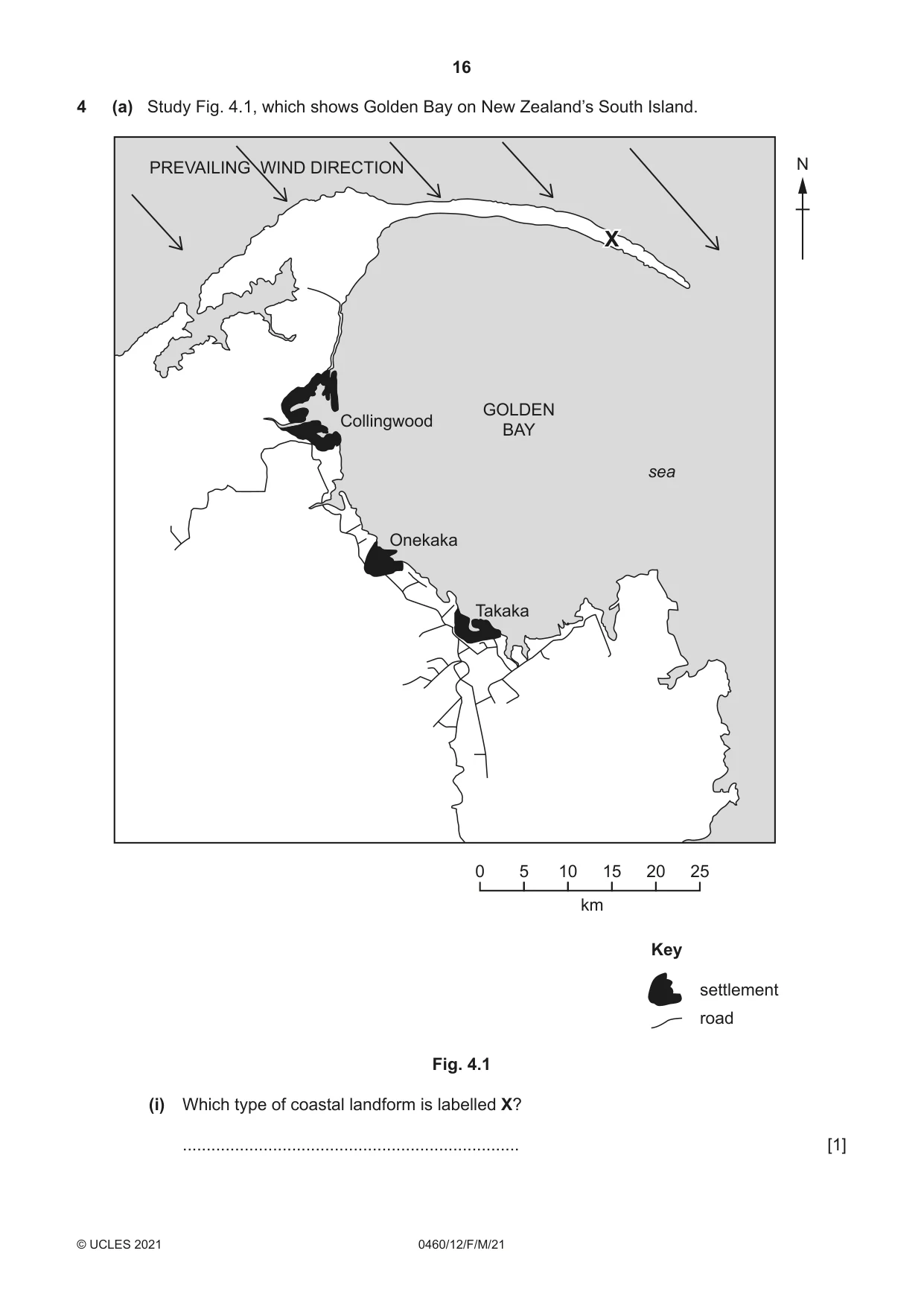
16 0460/12/F/M/21 © UCLES 2021 4 (a) Study Fig. 4.1, which shows Golden Bay on New Zealand’s South Island. N GOLDEN BAY sea Collingwood Onekaka Takaka PREVAILING WIND DIRECTION 0 5 10 15 20 25 km Key settlement road X Fig. 4.1 (i) Which type of coastal landform is labelled X? … [1]
Question paper, page 17
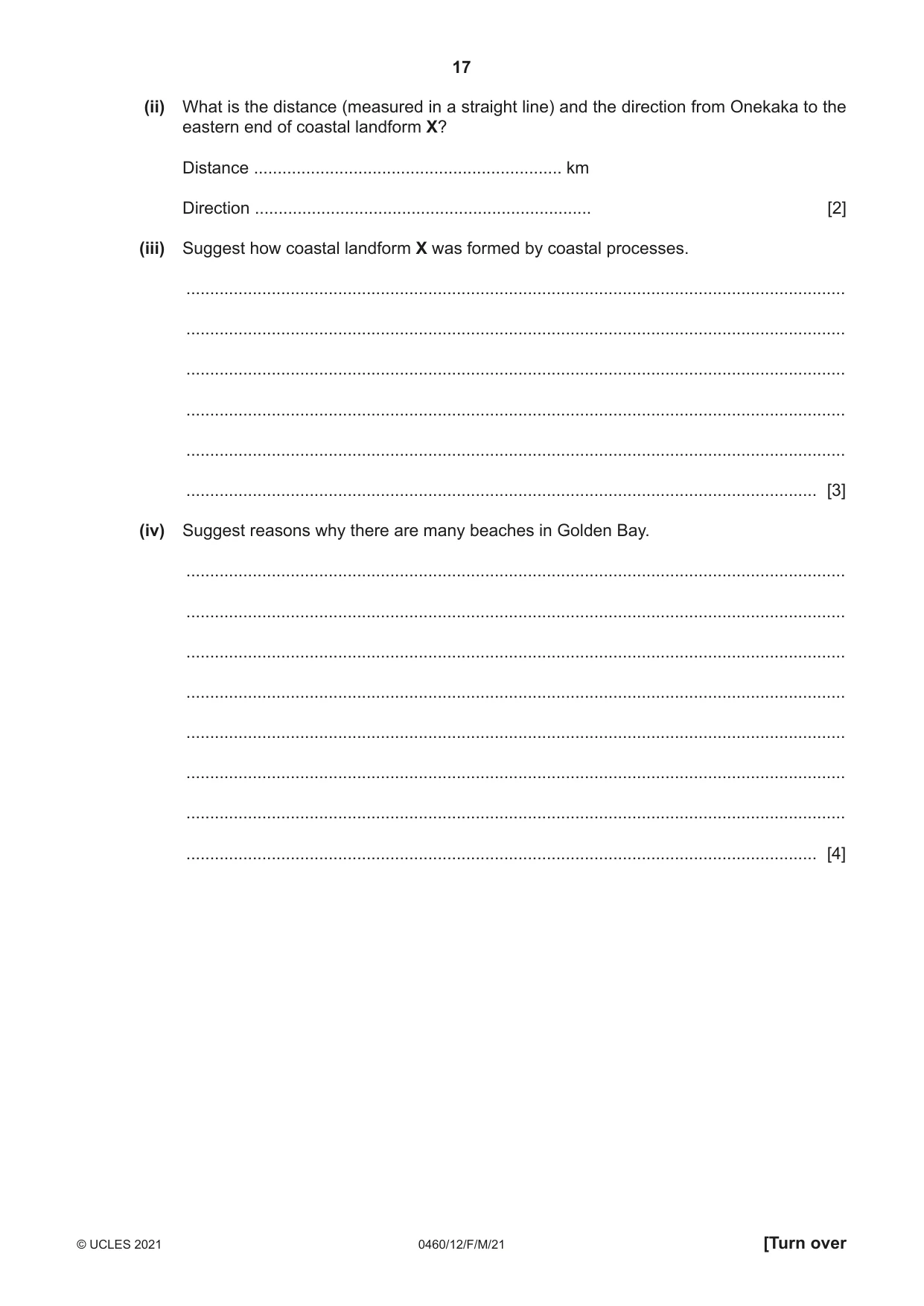
17 0460/12/F/M/21 © UCLES 2021 [Turn over (ii) What is the distance (measured in a straight line) and the direction from Onekaka to the eastern end of coastal landform X? Distance … km Direction … [2] (iii) Suggest how coastal landform X was formed by coastal processes. … … … … … … [3] (iv) Suggest reasons why there are many beaches in Golden Bay. … … … … … … … … [4]
Question paper, page 18
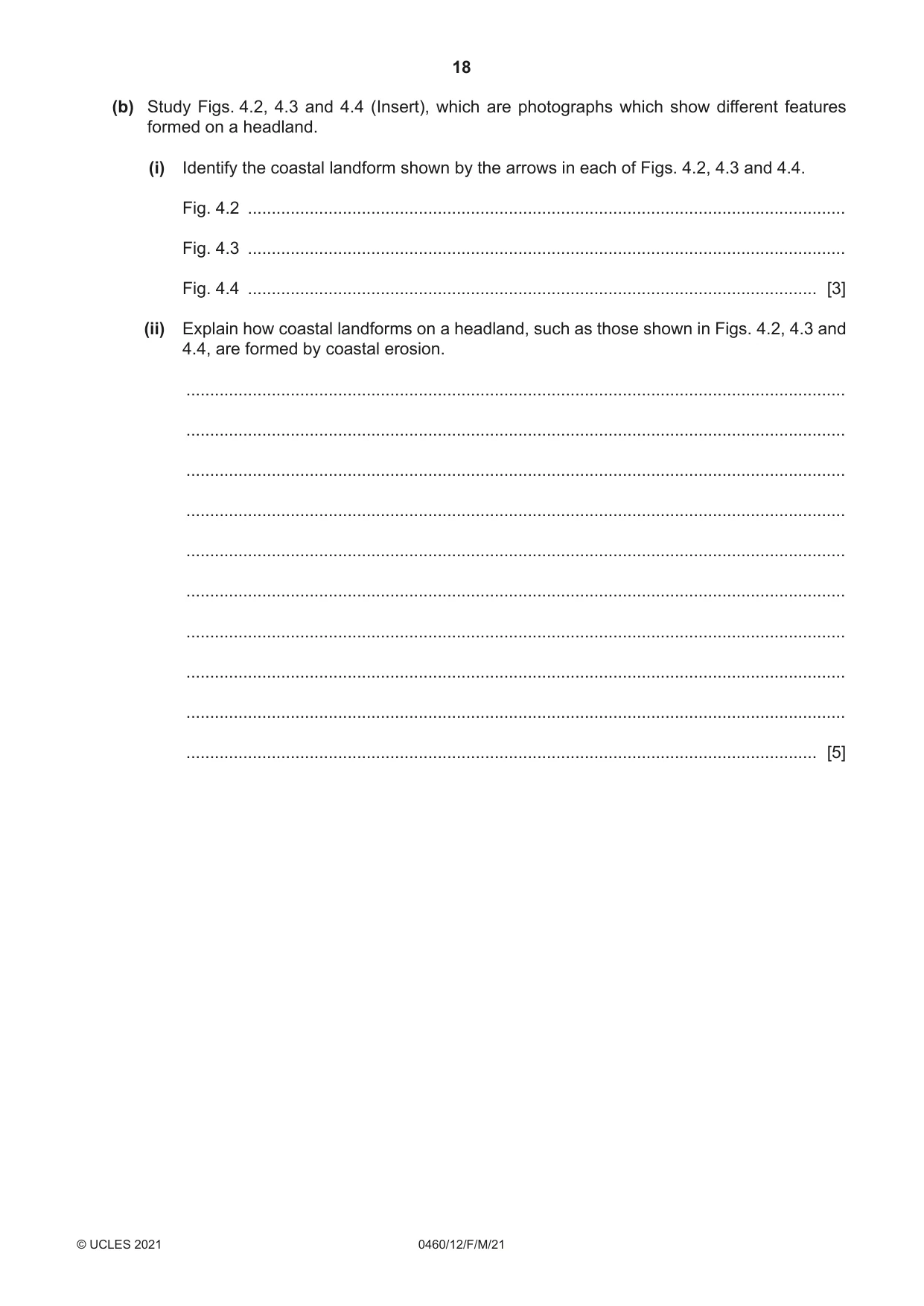
18 0460/12/F/M/21 © UCLES 2021 (b) Study Figs. 4.2, 4.3 and 4.4 (Insert), which are photographs which show different features formed on a headland. (i) Identify the coastal landform shown by the arrows in each of Figs. 4.2, 4.3 and 4.4. Fig. 4.2 … Fig. 4.3 … Fig. 4.4 … [3] (ii) Explain how coastal landforms on a headland, such as those shown in Figs. 4.2, 4.3 and 4.4, are formed by coastal erosion. … … … … … … … … … … [5]
Question paper, page 19
19 0460/12/F/M/21 © UCLES 2021 [Turn over (c) For a named area of coastline you have studied, explain how it provides opportunities for people. Area of coastline … … … … … … … … … … … … … … … … … … … … … … … … … … [7] [Total: 25]
Question paper, page 20
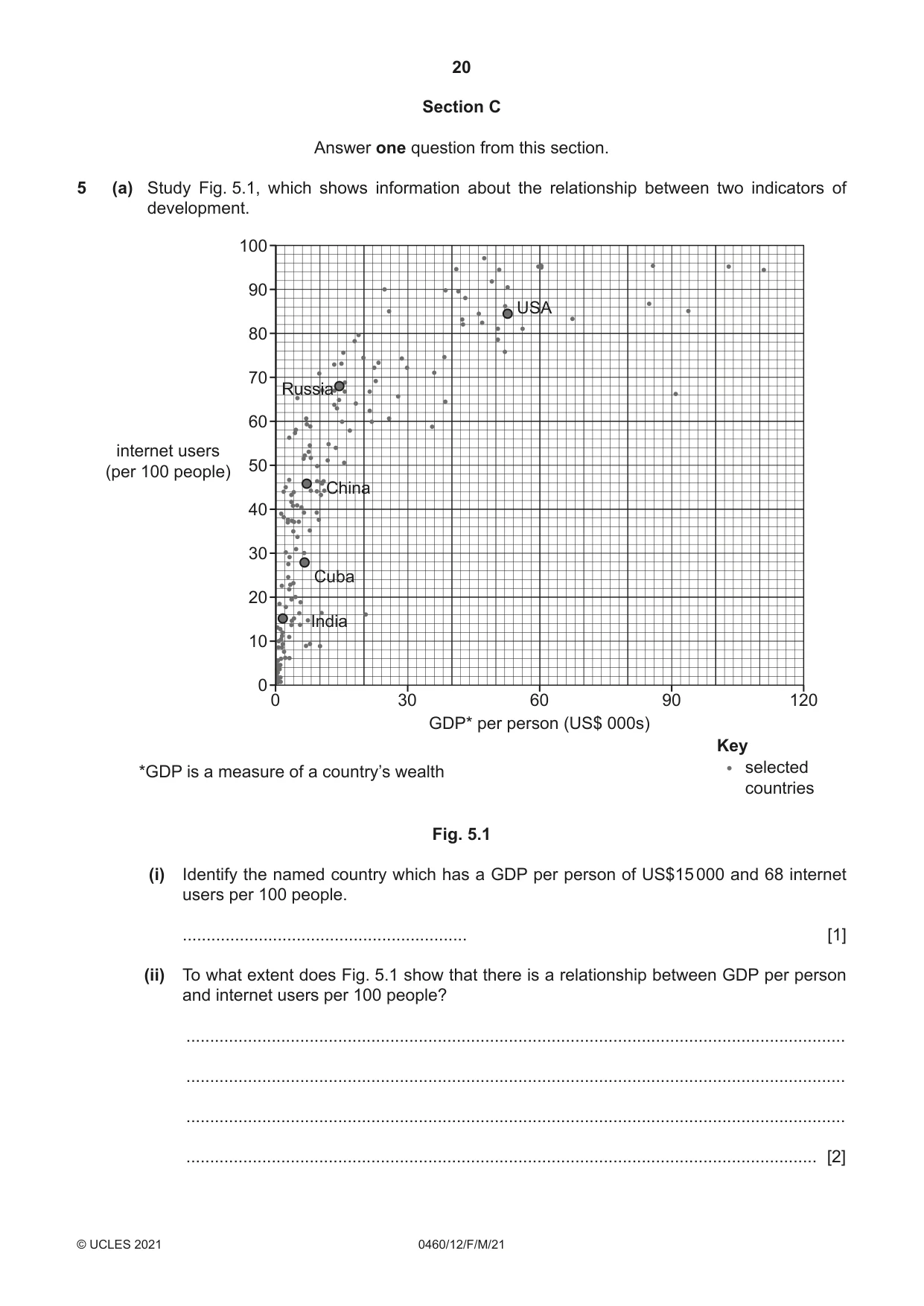
20 0460/12/F/M/21 © UCLES 2021 Section C Answer one question from this section. 5 (a) Study Fig. 5.1, which shows information about the relationship between two indicators of development. India Cuba China Russia USA Key selected countries 0 0 10 20 30 40 50 60 70 80 90 100 30 60 90 120 GDP* per person (US$ 000s) internet users (per 100 people) *GDP is a measure of a country’s wealth Fig. 5.1 (i) Identify the named country which has a GDP per person of US$15 000 and 68 internet users per 100 people. … [1] (ii) To what extent does Fig. 5.1 show that there is a relationship between GDP per person and internet users per 100 people? … … … … [2]
Question paper, page 21
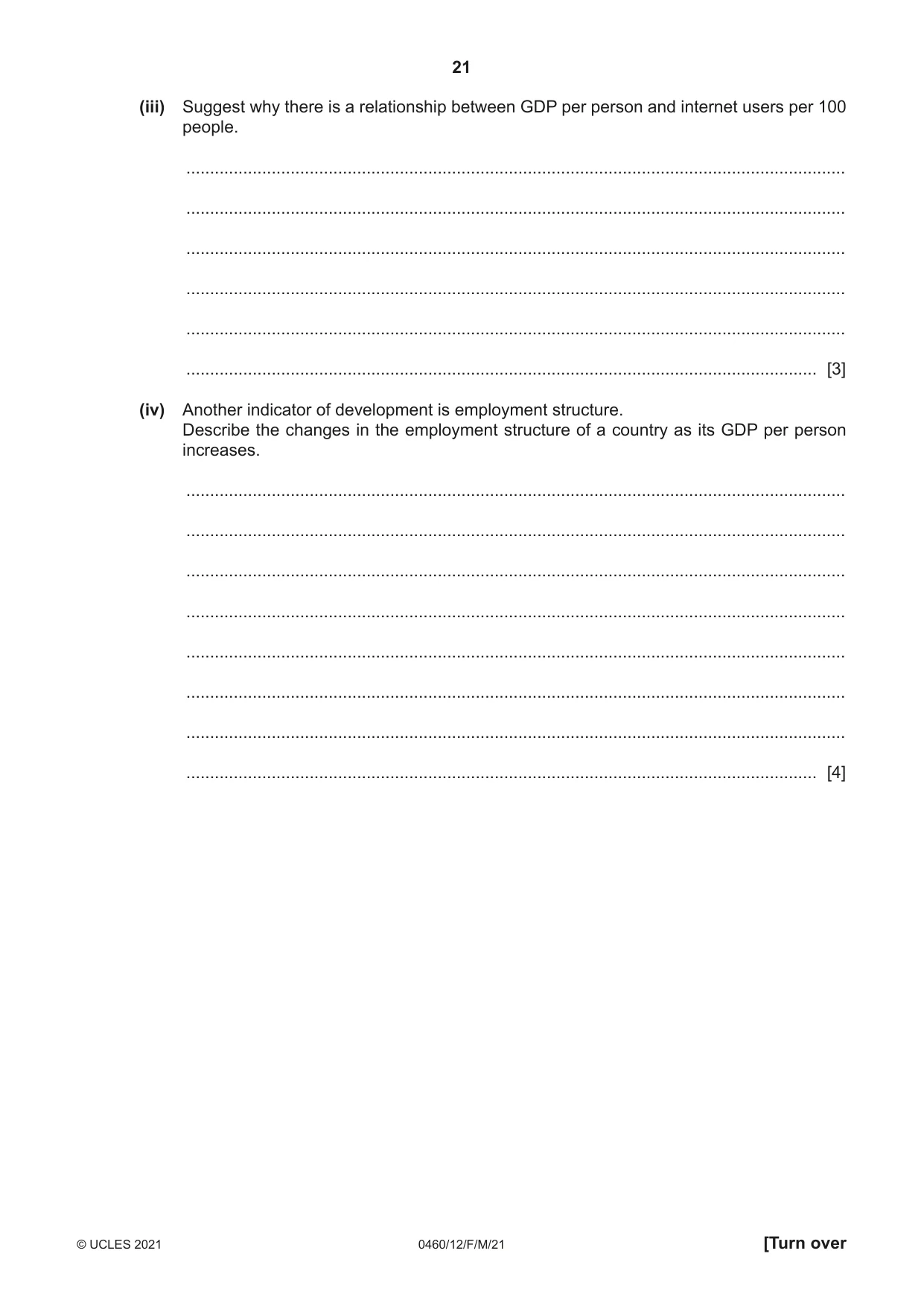
21 0460/12/F/M/21 © UCLES 2021 [Turn over (iii) Suggest why there is a relationship between GDP per person and internet users per 100 people. … … … … … … [3] (iv) Another indicator of development is employment structure. Describe the changes in the employment structure of a country as its GDP per person increases. … … … … … … … … [4]
Question paper, page 22
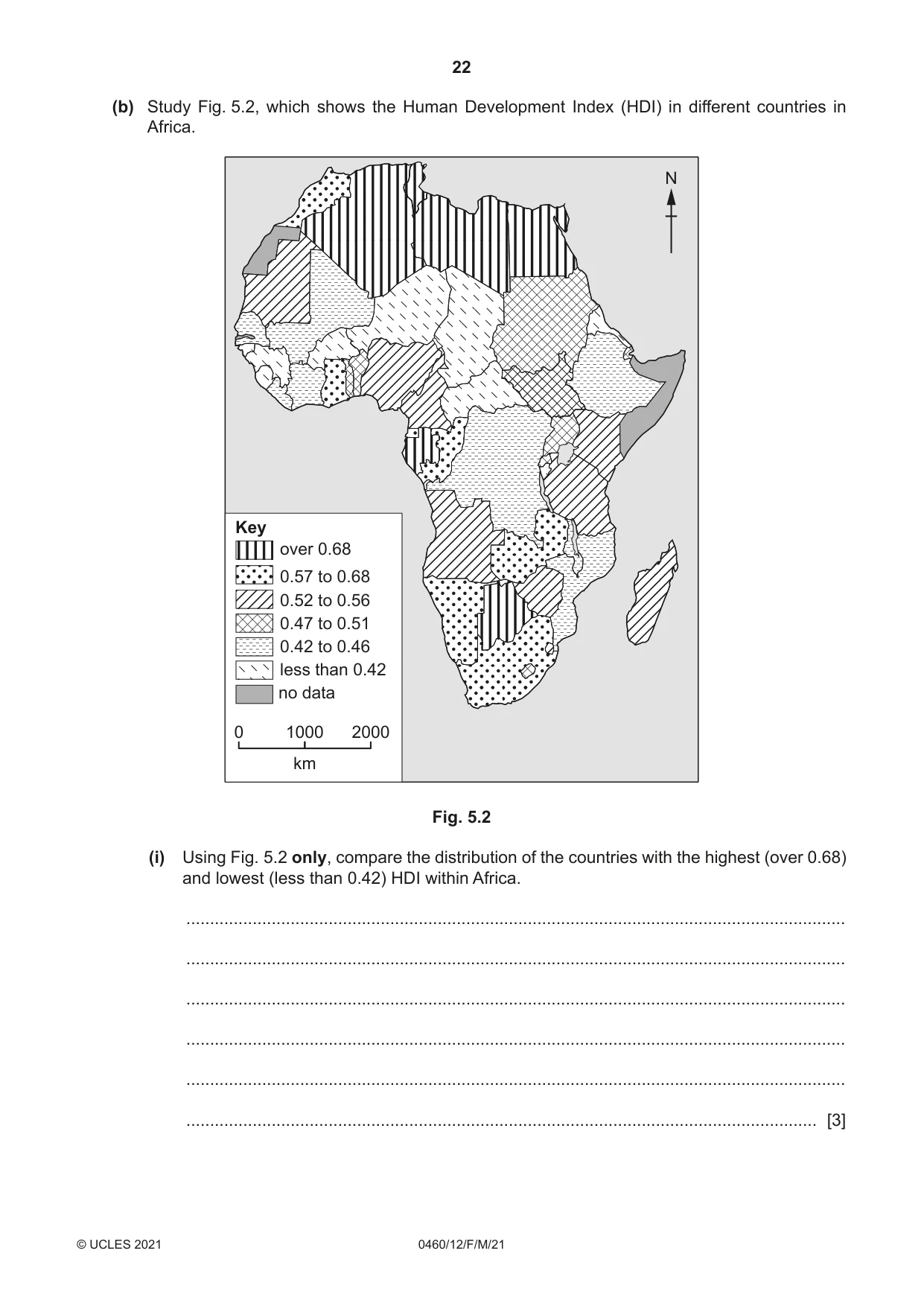
22 0460/12/F/M/21 © UCLES 2021 (b) Study Fig. 5.2, which shows the Human Development Index (HDI) in different countries in Africa. Key N less than 0.42 0.42 to 0.46 0.47 to 0.51 0.57 to 0.68 0.52 to 0.56 over 0.68 no data 0 1000 2000 km Fig. 5.2 (i) Using Fig. 5.2 only, compare the distribution of the countries with the highest (over 0.68) and lowest (less than 0.42) HDI within Africa. … … … … … … [3]
Question paper, page 23
23 0460/12/F/M/21 © UCLES 2021 [Turn over (ii) Explain why there are inequalities in wealth between countries. … … … … … … … … … … [5]
Question paper, page 24
24 0460/12/F/M/21 © UCLES 2021 (c) For a named transnational corporation (TNC) you have studied, explain why it operates in many countries. Name of transnational corporation (TNC) … … … … … … … … … … … … … … … … … … … … … … … … … … [7] [Total: 25]
Question paper, page 25
25 0460/12/F/M/21 © UCLES 2021 [Turn over TURN PAGE FOR QUESTION 6
Question paper, page 26
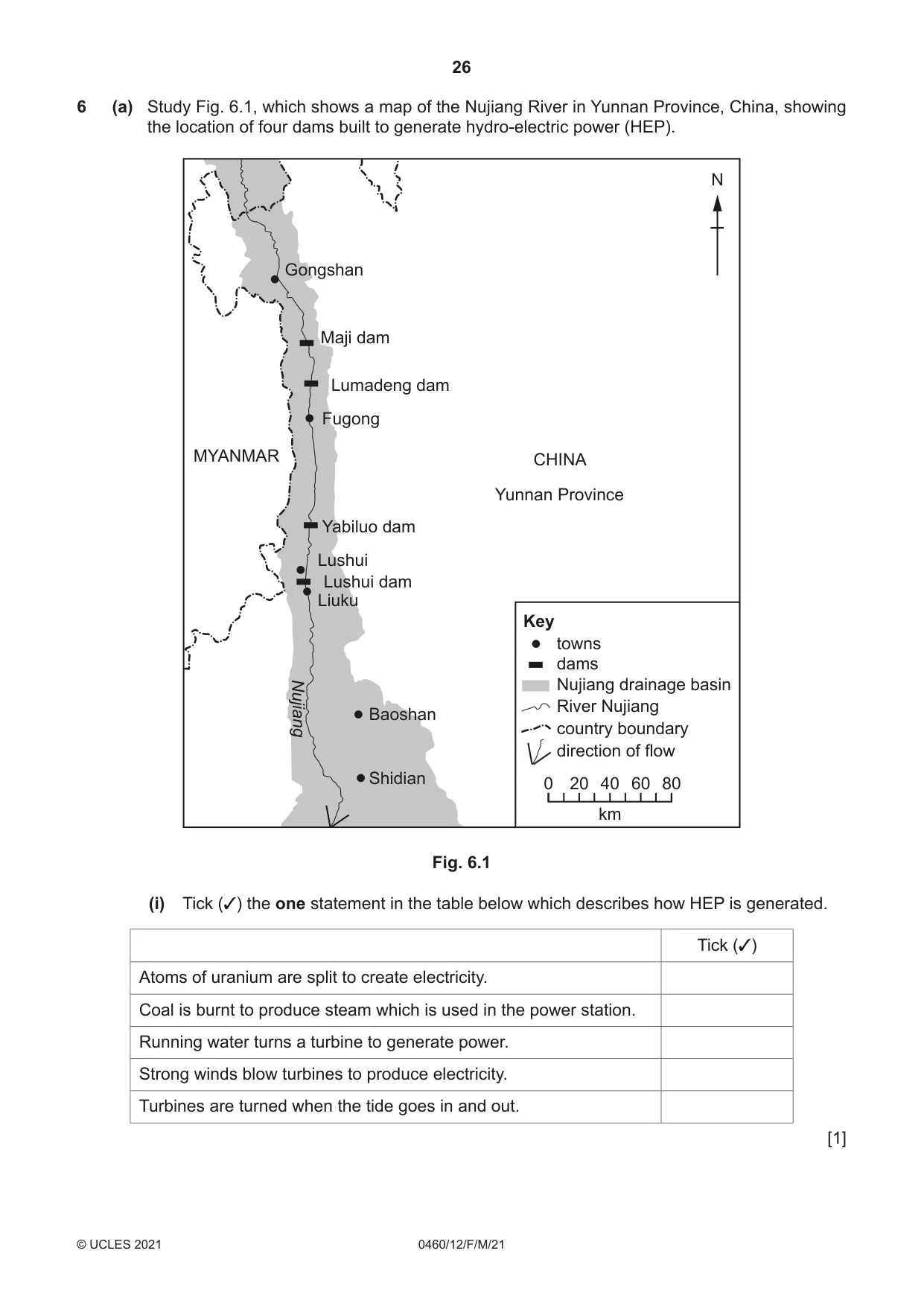
26 0460/12/F/M/21 © UCLES 2021 6 (a) Study Fig. 6.1, which shows a map of the Nujiang River in Yunnan Province, China, showing the location of four dams built to generate hydro-electric power (HEP). CHINA MYANMAR Yunnan Province Shidian Baoshan towns dams Nujiang drainage basin River Nujiang country boundary direction of flow Lushui Fugong Lumadeng dam Maji dam Gongshan Lushui dam Liuku Yabiluo dam Nujiang Key N 0 20 40 60 80 km Fig. 6.1 (i) Tick (3) the one statement in the table below which describes how HEP is generated. Tick (3) Atoms of uranium are split to create electricity. Coal is burnt to produce steam which is used in the power station. Running water turns a turbine to generate power. Strong winds blow turbines to produce electricity. Turbines are turned when the tide goes in and out. [1]
Question paper, page 27
27 0460/12/F/M/21 © UCLES 2021 [Turn over (ii) Identify the following dams shown in Fig. 6.1: – the dam which is nearest to the source of the river … – the dam which is 100 km north-north west (NNW) of Baoshan. … [2] (iii) Give three different reasons why some countries generate a greater proportion of their energy from HEP than other countries. 1 … … … 2 … … … 3 … … … [3] (iv) Explain why the proportion of energy generated from renewable sources is likely to increase in the future. … … … … … … … … … [4]
Question paper, page 28
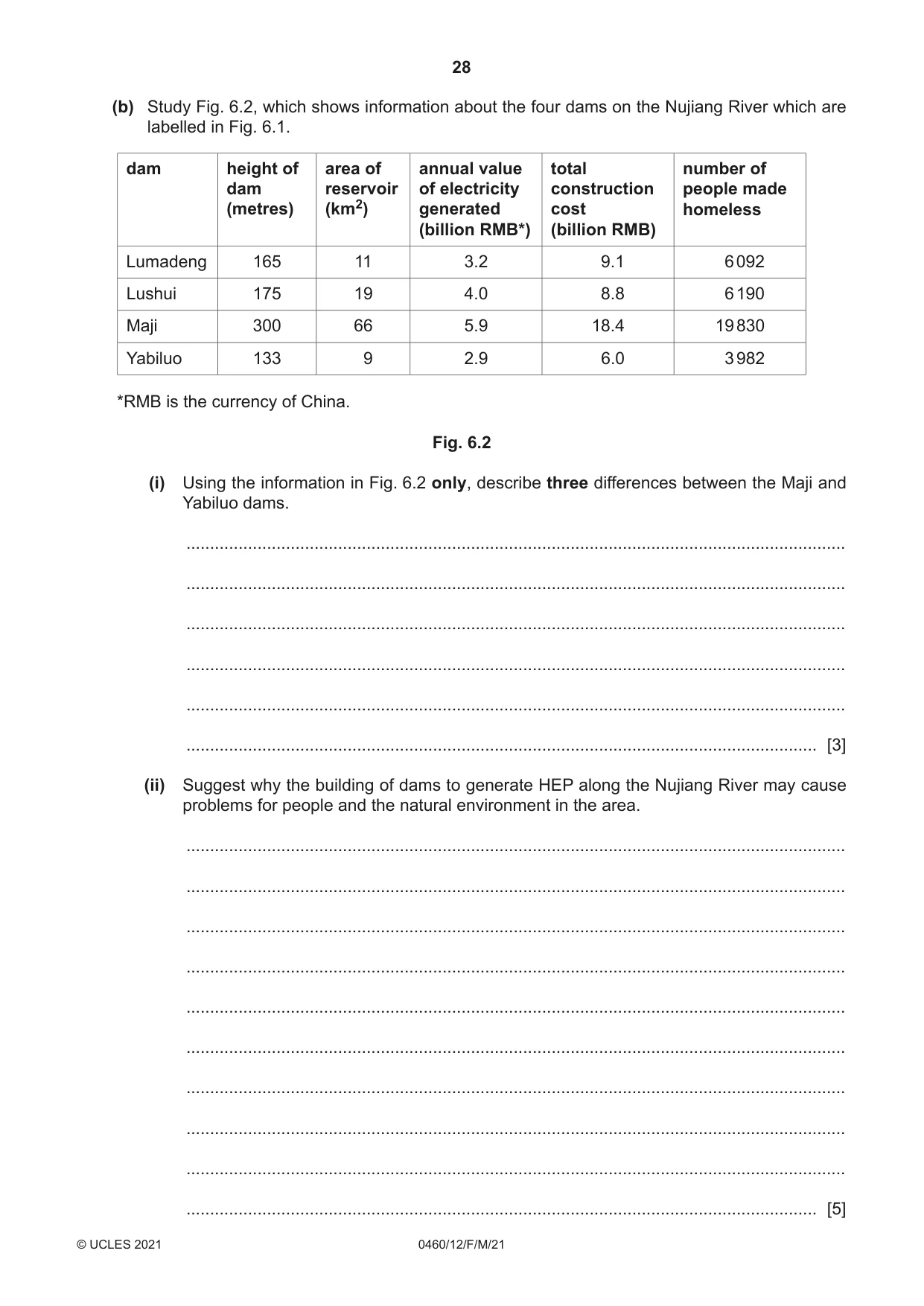
28 0460/12/F/M/21 © UCLES 2021 (b) Study Fig. 6.2, which shows information about the four dams on the Nujiang River which are labelled in Fig. 6.1. dam height of dam (metres) area of reservoir (km2) annual value of electricity generated (billion RMB*) total construction cost (billion RMB) number of people made homeless Lumadeng 165 11 3.2 9.1 6 092 Lushui 175 19 4.0 8.8 6 190 Maji 300 66 5.9 18.4 19 830 Yabiluo 133 9 2.9 6.0 3 982 *RMB is the currency of China. Fig. 6.2 (i) Using the information in Fig. 6.2 only, describe three differences between the Maji and Yabiluo dams. … … … … … … [3] (ii) Suggest why the building of dams to generate HEP along the Nujiang River may cause problems for people and the natural environment in the area. … … … … … … … … … … [5]
Question paper, page 29
29 0460/12/F/M/21 © UCLES 2021 (c) For a named country or area you have studied, explain how clean water is supplied for domestic use. Name of country or area… … … … … … … … … … … … … … … … … … … … … … … … … … [7] [Total: 25]
Question paper, page 30
30 0460/12/F/M/21 © UCLES 2021 Additional Pages If you use the following lined pages to complete the answer(s) to any question(s), the question number(s) must be clearly shown. … … … … … … … … … … … … … … … … … … … … … … … … … …
Question paper, page 31
31 0460/12/F/M/21 © UCLES 2021 … … … … … … … … … … … … … … … … … … … … … … … … … … … …
Question paper, page 32
32 0460/12/F/M/21 © UCLES 2021 BLANK PAGE The boundaries and names shown, the designations used and the presentation of material on any maps contained in this question paper/insert do not imply official endorsement or acceptance by Cambridge Assessment International Education concerning the legal status of any country, territory, or area or any of its authorities, or of the delimitation of its frontiers or boundaries. Permission to reproduce items where third-party owned material protected by copyright is included has been sought and cleared where possible. Every reasonable effort has been made by the publisher (UCLES) to trace copyright holders, but if any items requiring clearance have unwittingly been included, the publisher will be pleased to make amends at the earliest possible opportunity. To avoid the issue of disclosure of answer-related information to candidates, all copyright acknowledgements are reproduced online in the Cambridge Assessment International Education Copyright Acknowledgements Booklet. This is produced for each series of examinations and is freely available to download at www.cambridgeinternational.org after the live examination series. Cambridge Assessment International Education is part of the Cambridge Assessment Group. Cambridge Assessment is the brand name of the University of Cambridge Local Examinations Syndicate (UCLES), which itself is a department of the University of Cambridge.
Mark scheme, page 1
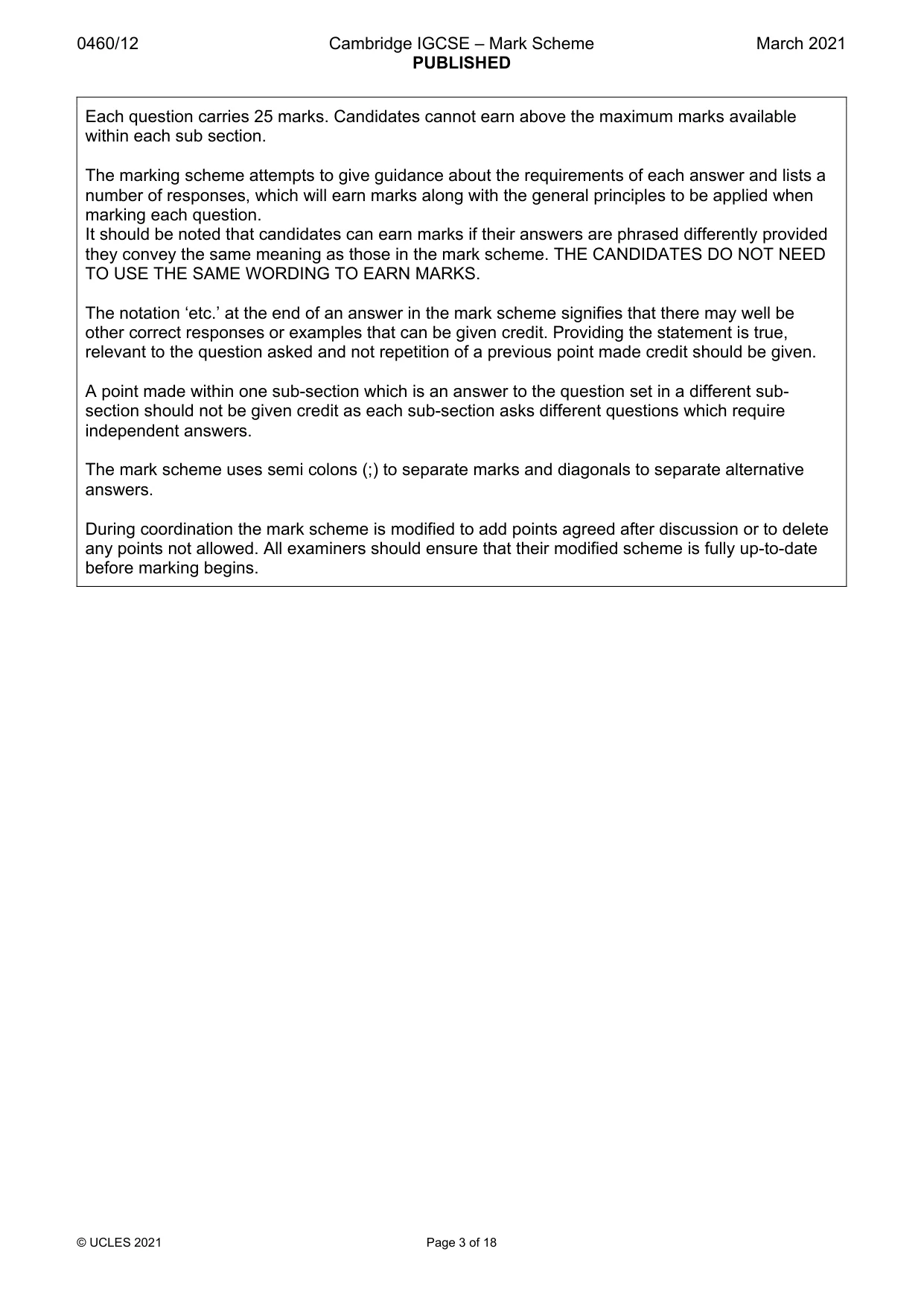
This document consists of 18 printed pages. © UCLES 2021 [Turn over Cambridge IGCSE™ GEOGRAPHY 0460/12 Paper 1 March 2021 MARK SCHEME Maximum Mark: 75 Published This mark scheme is published as an aid to teachers and candidates, to indicate the requirements of the examination. It shows the basis on which Examiners were instructed to award marks. It does not indicate the details of the discussions that took place at an Examiners’ meeting before marking began, which would have considered the acceptability of alternative answers. Mark schemes should be read in conjunction with the question paper and the Principal Examiner Report for Teachers. Cambridge International will not enter into discussions about these mark schemes. Cambridge International is publishing the mark schemes for the March 2021 series for most Cambridge IGCSE™, Cambridge International A and AS Level components and some Cambridge O Level components.
Mark scheme, page 2
0460/12 Cambridge IGCSE – Mark Scheme PUBLISHED March 2021 © UCLES 2021 Page 2 of 18 Generic Marking Principles These general marking principles must be applied by all examiners when marking candidate answers. They should be applied alongside the specific content of the mark scheme or generic level descriptors for a question. Each question paper and mark scheme will also comply with these marking principles. GENERIC MARKING PRINCIPLE 1: Marks must be awarded in line with: • the specific content of the mark scheme or the generic level descriptors for the question • the specific skills defined in the mark scheme or in the generic level descriptors for the question • the standard of response required by a candidate as exemplified by the standardisation scripts. GENERIC MARKING PRINCIPLE 2: Marks awarded are always whole marks (not half marks, or other fractions). GENERIC MARKING PRINCIPLE 3: Marks must be awarded positively: • marks are awarded for correct/valid answers, as defined in the mark scheme. However, credit is given for valid answers which go beyond the scope of the syllabus and mark scheme, referring to your Team Leader as appropriate • marks are awarded when candidates clearly demonstrate what they know and can do • marks are not deducted for errors • marks are not deducted for omissions • answers should only be judged on the quality of spelling, punctuation and grammar when these features are specifically assessed by the question as indicated by the mark scheme. The meaning, however, should be unambiguous. GENERIC MARKING PRINCIPLE 4: Rules must be applied consistently, e.g. in situations where candidates have not followed instructions or in the application of generic level descriptors. GENERIC MARKING PRINCIPLE 5: Marks should be awarded using the full range of marks defined in the mark scheme for the question (however; the use of the full mark range may be limited according to the quality of the candidate responses seen). GENERIC MARKING PRINCIPLE 6: Marks awarded are based solely on the requirements as defined in the mark scheme. Marks should not be awarded with grade thresholds or grade descriptors in mind.
Mark scheme, page 3
0460/12 Cambridge IGCSE – Mark Scheme PUBLISHED March 2021 © UCLES 2021 Page 3 of 18 Each question carries 25 marks. Candidates cannot earn above the maximum marks available within each sub section. The marking scheme attempts to give guidance about the requirements of each answer and lists a number of responses, which will earn marks along with the general principles to be applied when marking each question. It should be noted that candidates can earn marks if their answers are phrased differently provided they convey the same meaning as those in the mark scheme. THE CANDIDATES DO NOT NEED TO USE THE SAME WORDING TO EARN MARKS. The notation ‘etc.’ at the end of an answer in the mark scheme signifies that there may well be other correct responses or examples that can be given credit. Providing the statement is true, relevant to the question asked and not repetition of a previous point made credit should be given. A point made within one sub-section which is an answer to the question set in a different sub- section should not be given credit as each sub-section asks different questions which require independent answers. The mark scheme uses semi colons (;) to separate marks and diagonals to separate alternative answers. During coordination the mark scheme is modified to add points agreed after discussion or to delete any points not allowed. All examiners should ensure that their modified scheme is fully up-to-date before marking begins.
Mark scheme, page 4
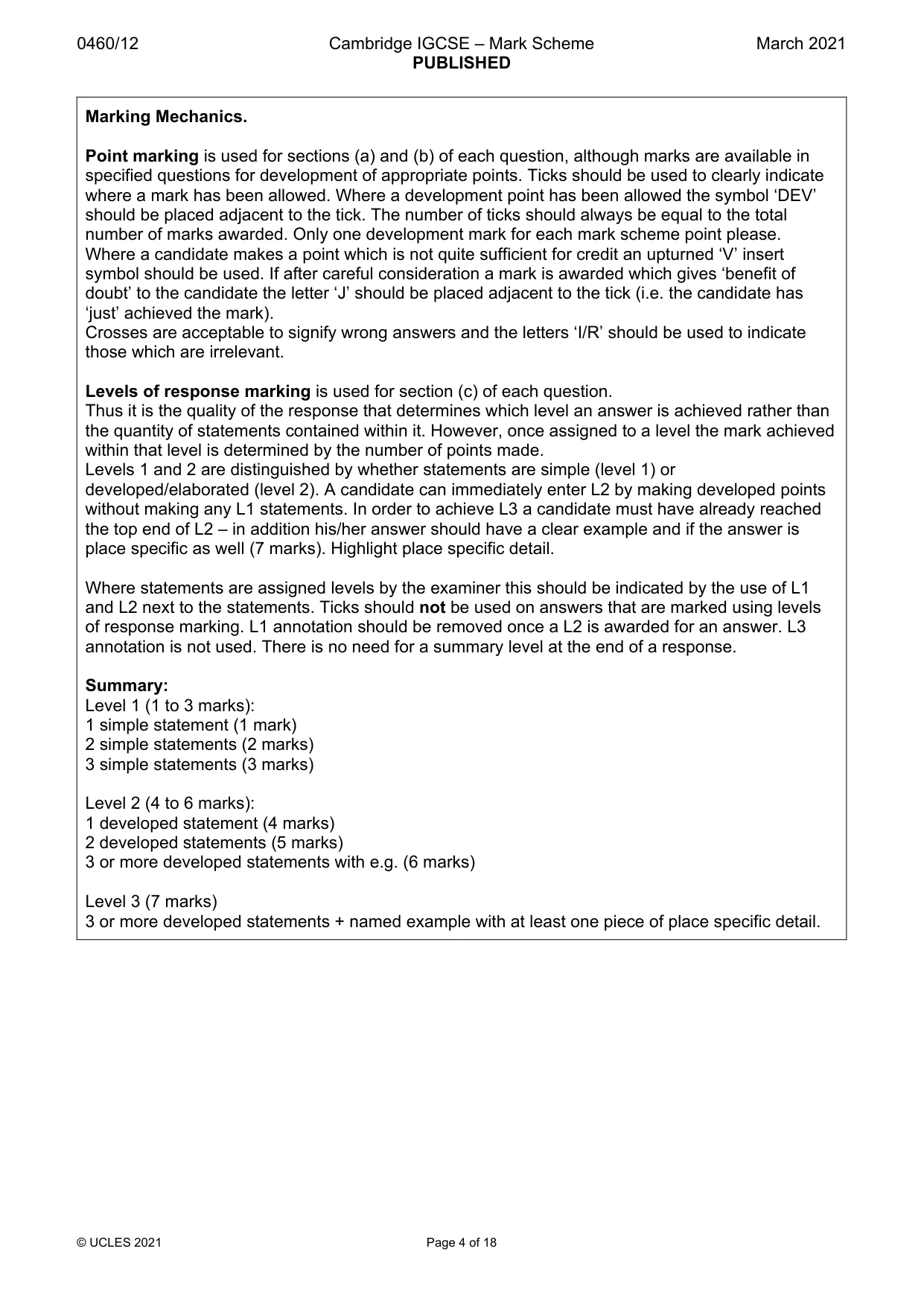
0460/12 Cambridge IGCSE – Mark Scheme PUBLISHED March 2021 © UCLES 2021 Page 4 of 18 Marking Mechanics. Point marking is used for sections (a) and (b) of each question, although marks are available in specified questions for development of appropriate points. Ticks should be used to clearly indicate where a mark has been allowed. Where a development point has been allowed the symbol ‘DEV’ should be placed adjacent to the tick. The number of ticks should always be equal to the total number of marks awarded. Only one development mark for each mark scheme point please. Where a candidate makes a point which is not quite sufficient for credit an upturned ‘V’ insert symbol should be used. If after careful consideration a mark is awarded which gives ‘benefit of doubt’ to the candidate the letter ‘J’ should be placed adjacent to the tick (i.e. the candidate has ‘just’ achieved the mark). Crosses are acceptable to signify wrong answers and the letters ‘I/R’ should be used to indicate those which are irrelevant. Levels of response marking is used for section (c) of each question. Thus it is the quality of the response that determines which level an answer is achieved rather than the quantity of statements contained within it. However, once assigned to a level the mark achieved within that level is determined by the number of points made. Levels 1 and 2 are distinguished by whether statements are simple (level 1) or developed/elaborated (level 2). A candidate can immediately enter L2 by making developed points without making any L1 statements. In order to achieve L3 a candidate must have already reached the top end of L2 – in addition his/her answer should have a clear example and if the answer is place specific as well (7 marks). Highlight place specific detail. Where statements are assigned levels by the examiner this should be indicated by the use of L1 and L2 next to the statements. Ticks should not be used on answers that are marked using levels of response marking. L1 annotation should be removed once a L2 is awarded for an answer. L3 annotation is not used. There is no need for a summary level at the end of a response. Summary: Level 1 (1 to 3 marks): 1 simple statement (1 mark) 2 simple statements (2 marks) 3 simple statements (3 marks) Level 2 (4 to 6 marks): 1 developed statement (4 marks) 2 developed statements (5 marks) 3 or more developed statements with e.g. (6 marks) Level 3 (7 marks) 3 or more developed statements + named example with at least one piece of place specific detail.
Mark scheme, page 5
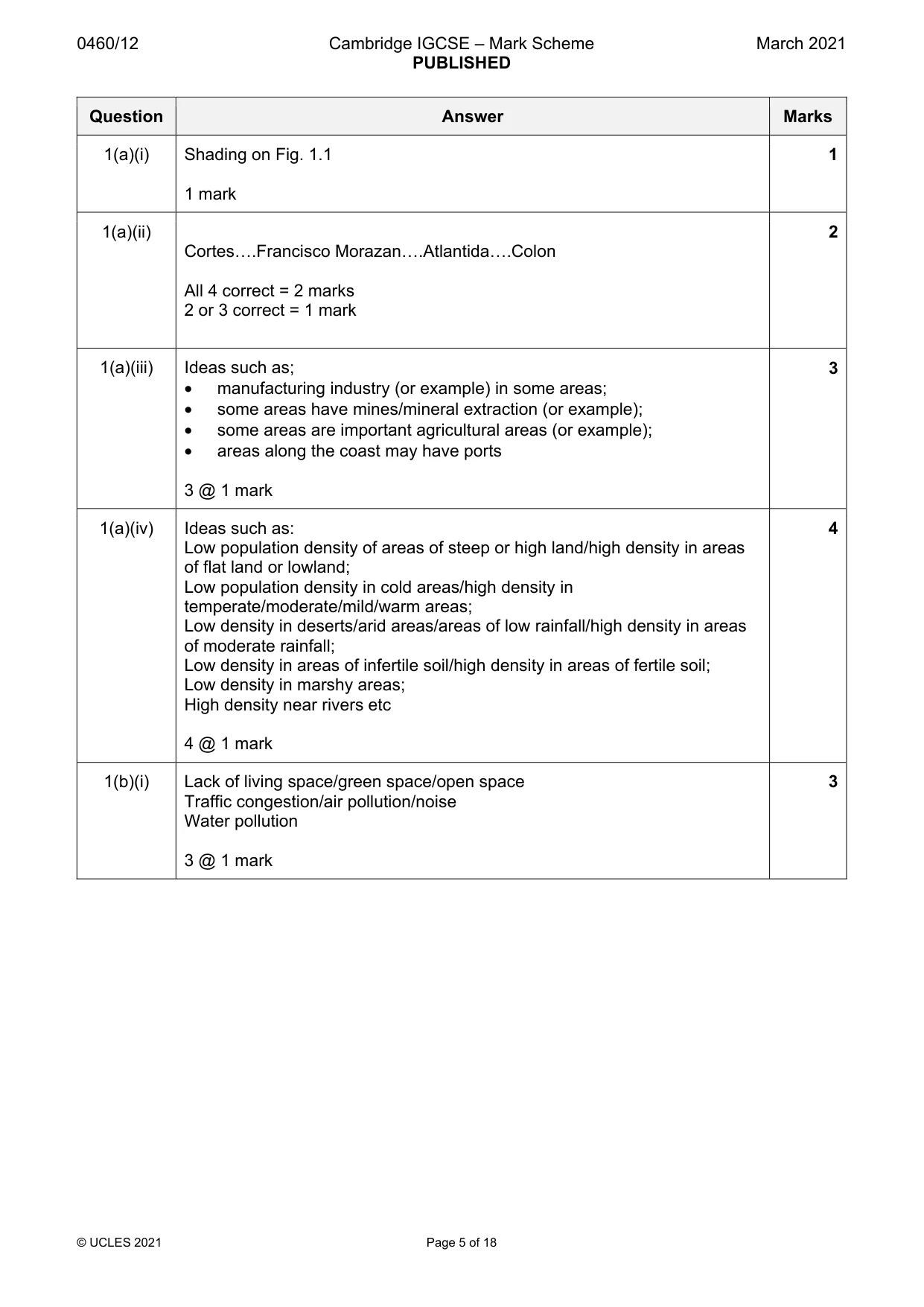
0460/12 Cambridge IGCSE – Mark Scheme PUBLISHED March 2021 © UCLES 2021 Page 5 of 18 Question Answer Marks 1(a)(i) Shading on Fig. 1.1 1 mark 1 1(a)(ii) Cortes….Francisco Morazan….Atlantida….Colon All 4 correct = 2 marks 2 or 3 correct = 1 mark 2 1(a)(iii) Ideas such as; • manufacturing industry (or example) in some areas; • some areas have mines/mineral extraction (or example); • some areas are important agricultural areas (or example); • areas along the coast may have ports 3 @ 1 mark 3 1(a)(iv) Ideas such as: Low population density of areas of steep or high land/high density in areas of flat land or lowland; Low population density in cold areas/high density in temperate/moderate/mild/warm areas; Low density in deserts/arid areas/areas of low rainfall/high density in areas of moderate rainfall; Low density in areas of infertile soil/high density in areas of fertile soil; Low density in marshy areas; High density near rivers etc 4 @ 1 mark 4 1(b)(i) Lack of living space/green space/open space Traffic congestion/air pollution/noise Water pollution 3 @ 1 mark 3
Mark scheme, page 6
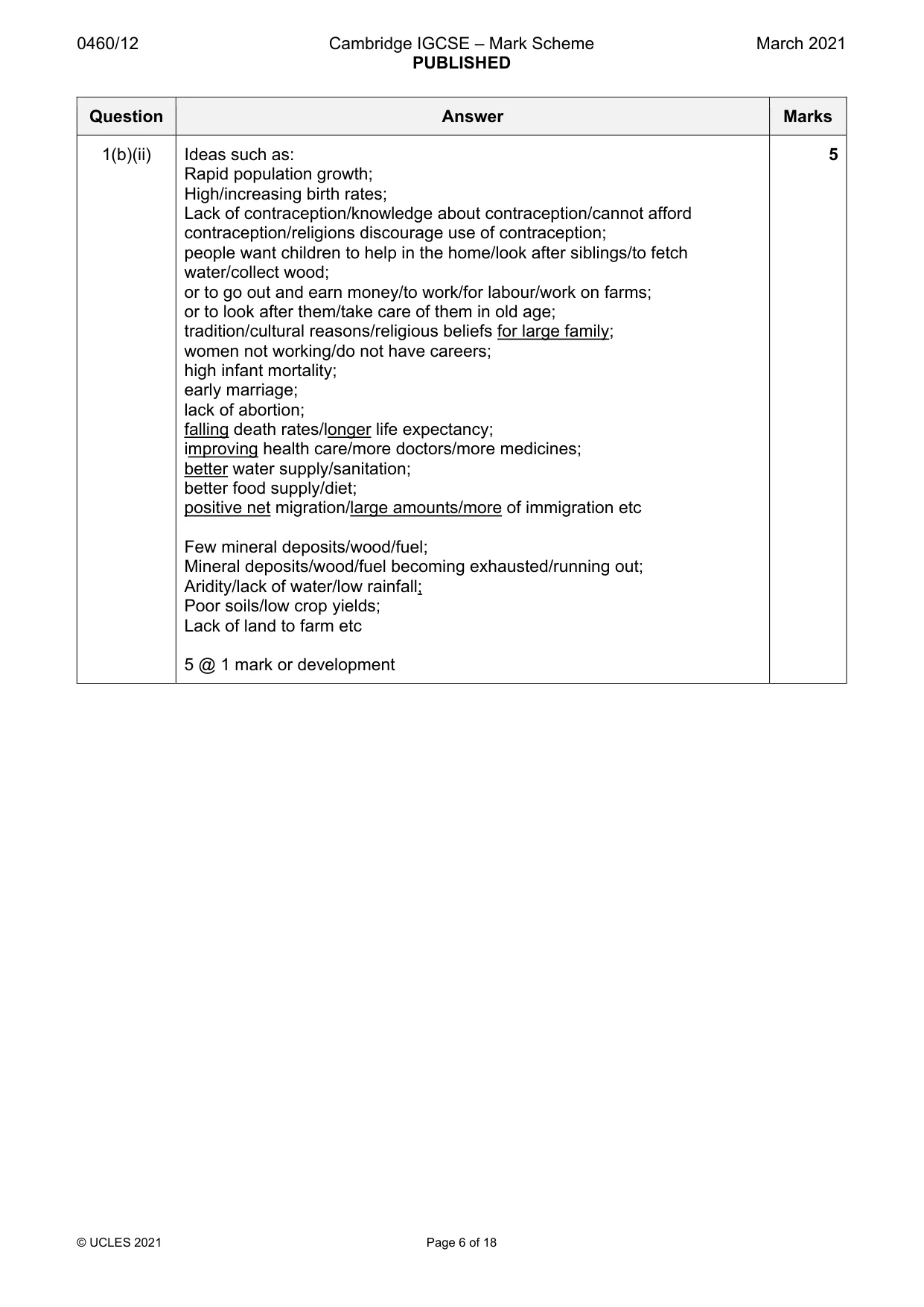
0460/12 Cambridge IGCSE – Mark Scheme PUBLISHED March 2021 © UCLES 2021 Page 6 of 18 Question Answer Marks 1(b)(ii) Ideas such as: Rapid population growth; High/increasing birth rates; Lack of contraception/knowledge about contraception/cannot afford contraception/religions discourage use of contraception; people want children to help in the home/look after siblings/to fetch water/collect wood; or to go out and earn money/to work/for labour/work on farms; or to look after them/take care of them in old age; tradition/cultural reasons/religious beliefs for large family; women not working/do not have careers; high infant mortality; early marriage; lack of abortion; falling death rates/longer life expectancy; improving health care/more doctors/more medicines; better water supply/sanitation; better food supply/diet; positive net migration/large amounts/more of immigration etc Few mineral deposits/wood/fuel; Mineral deposits/wood/fuel becoming exhausted/running out; Aridity/lack of water/low rainfall; Poor soils/low crop yields; Lack of land to farm etc 5 @ 1 mark or development 5
Mark scheme, page 7
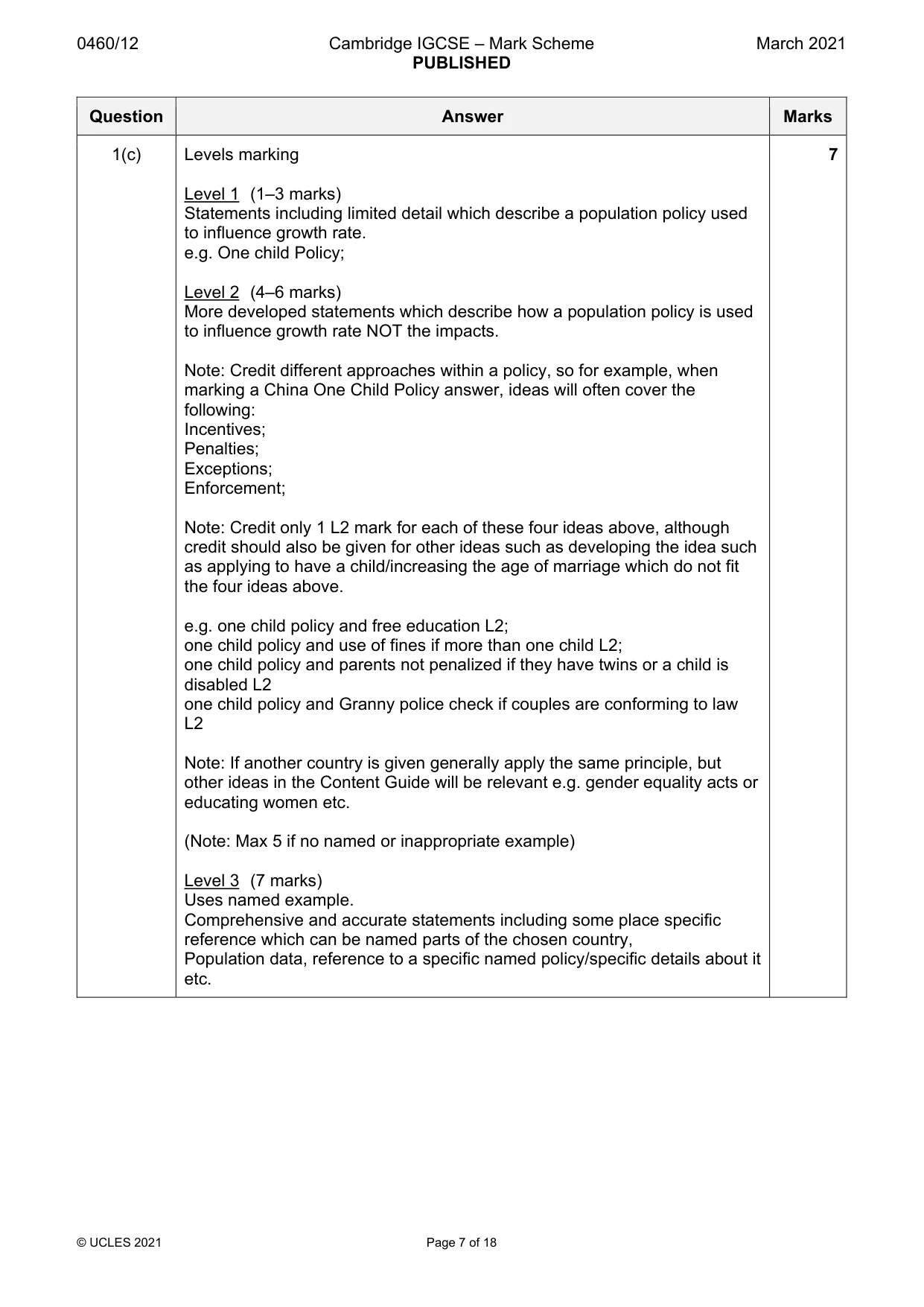
0460/12 Cambridge IGCSE – Mark Scheme PUBLISHED March 2021 © UCLES 2021 Page 7 of 18 Question Answer Marks 1(c) Levels marking Level 1 (1–3 marks) Statements including limited detail which describe a population policy used to influence growth rate. e.g. One child Policy; Level 2 (4–6 marks) More developed statements which describe how a population policy is used to influence growth rate NOT the impacts. Note: Credit different approaches within a policy, so for example, when marking a China One Child Policy answer, ideas will often cover the following: Incentives; Penalties; Exceptions; Enforcement; Note: Credit only 1 L2 mark for each of these four ideas above, although credit should also be given for other ideas such as developing the idea such as applying to have a child/increasing the age of marriage which do not fit the four ideas above. e.g. one child policy and free education L2; one child policy and use of fines if more than one child L2; one child policy and parents not penalized if they have twins or a child is disabled L2 one child policy and Granny police check if couples are conforming to law L2 Note: If another country is given generally apply the same principle, but other ideas in the Content Guide will be relevant e.g. gender equality acts or educating women etc. (Note: Max 5 if no named or inappropriate example) Level 3 (7 marks) Uses named example. Comprehensive and accurate statements including some place specific reference which can be named parts of the chosen country, Population data, reference to a specific named policy/specific details about it etc. 7
Mark scheme, page 8
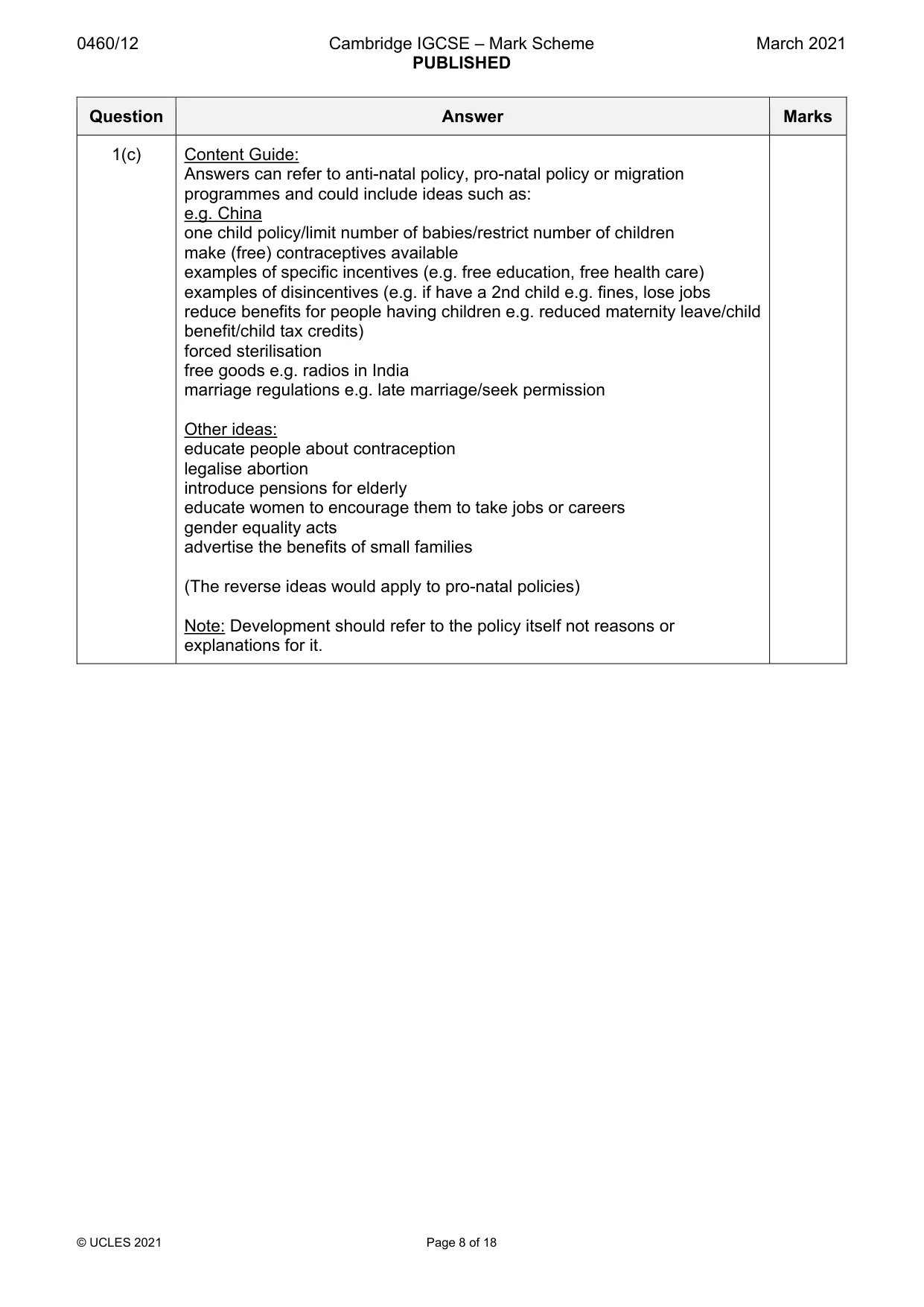
0460/12 Cambridge IGCSE – Mark Scheme PUBLISHED March 2021 © UCLES 2021 Page 8 of 18 Question Answer Marks 1(c) Content Guide: Answers can refer to anti-natal policy, pro-natal policy or migration programmes and could include ideas such as: e.g. China one child policy/limit number of babies/restrict number of children make (free) contraceptives available examples of specific incentives (e.g. free education, free health care) examples of disincentives (e.g. if have a 2nd child e.g. fines, lose jobs reduce benefits for people having children e.g. reduced maternity leave/child benefit/child tax credits) forced sterilisation free goods e.g. radios in India marriage regulations e.g. late marriage/seek permission Other ideas: educate people about contraception legalise abortion introduce pensions for elderly educate women to encourage them to take jobs or careers gender equality acts advertise the benefits of small families (The reverse ideas would apply to pro-natal policies) Note: Development should refer to the policy itself not reasons or explanations for it.
Mark scheme, page 9
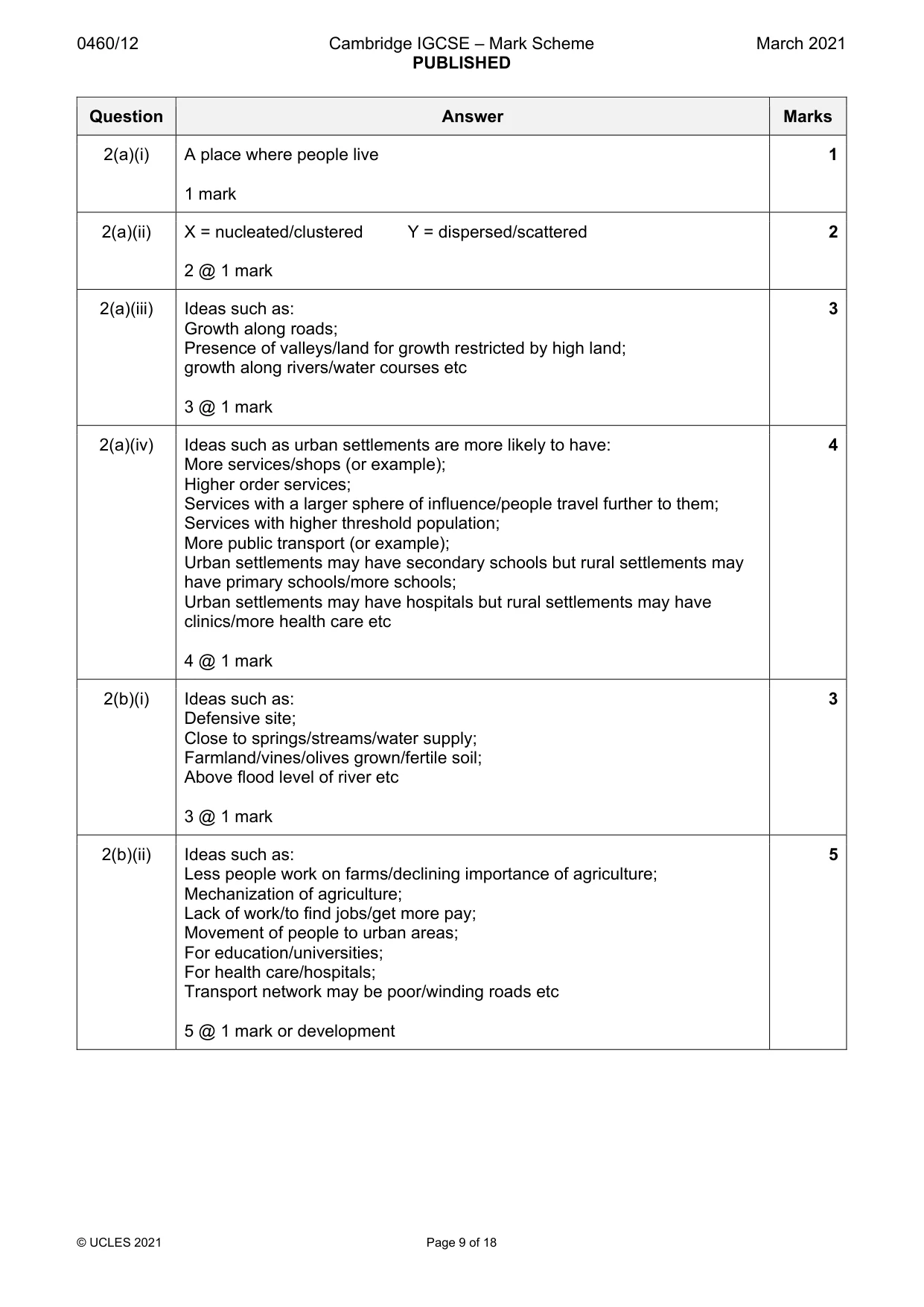
0460/12 Cambridge IGCSE – Mark Scheme PUBLISHED March 2021 © UCLES 2021 Page 9 of 18 Question Answer Marks 2(a)(i) A place where people live 1 mark 1 2(a)(ii) X = nucleated/clustered Y = dispersed/scattered 2 @ 1 mark 2 2(a)(iii) Ideas such as: Growth along roads; Presence of valleys/land for growth restricted by high land; growth along rivers/water courses etc 3 @ 1 mark 3 2(a)(iv) Ideas such as urban settlements are more likely to have: More services/shops (or example); Higher order services; Services with a larger sphere of influence/people travel further to them; Services with higher threshold population; More public transport (or example); Urban settlements may have secondary schools but rural settlements may have primary schools/more schools; Urban settlements may have hospitals but rural settlements may have clinics/more health care etc 4 @ 1 mark 4 2(b)(i) Ideas such as: Defensive site; Close to springs/streams/water supply; Farmland/vines/olives grown/fertile soil; Above flood level of river etc 3 @ 1 mark 3 2(b)(ii) Ideas such as: Less people work on farms/declining importance of agriculture; Mechanization of agriculture; Lack of work/to find jobs/get more pay; Movement of people to urban areas; For education/universities; For health care/hospitals; Transport network may be poor/winding roads etc 5 @ 1 mark or development 5
Mark scheme, page 10
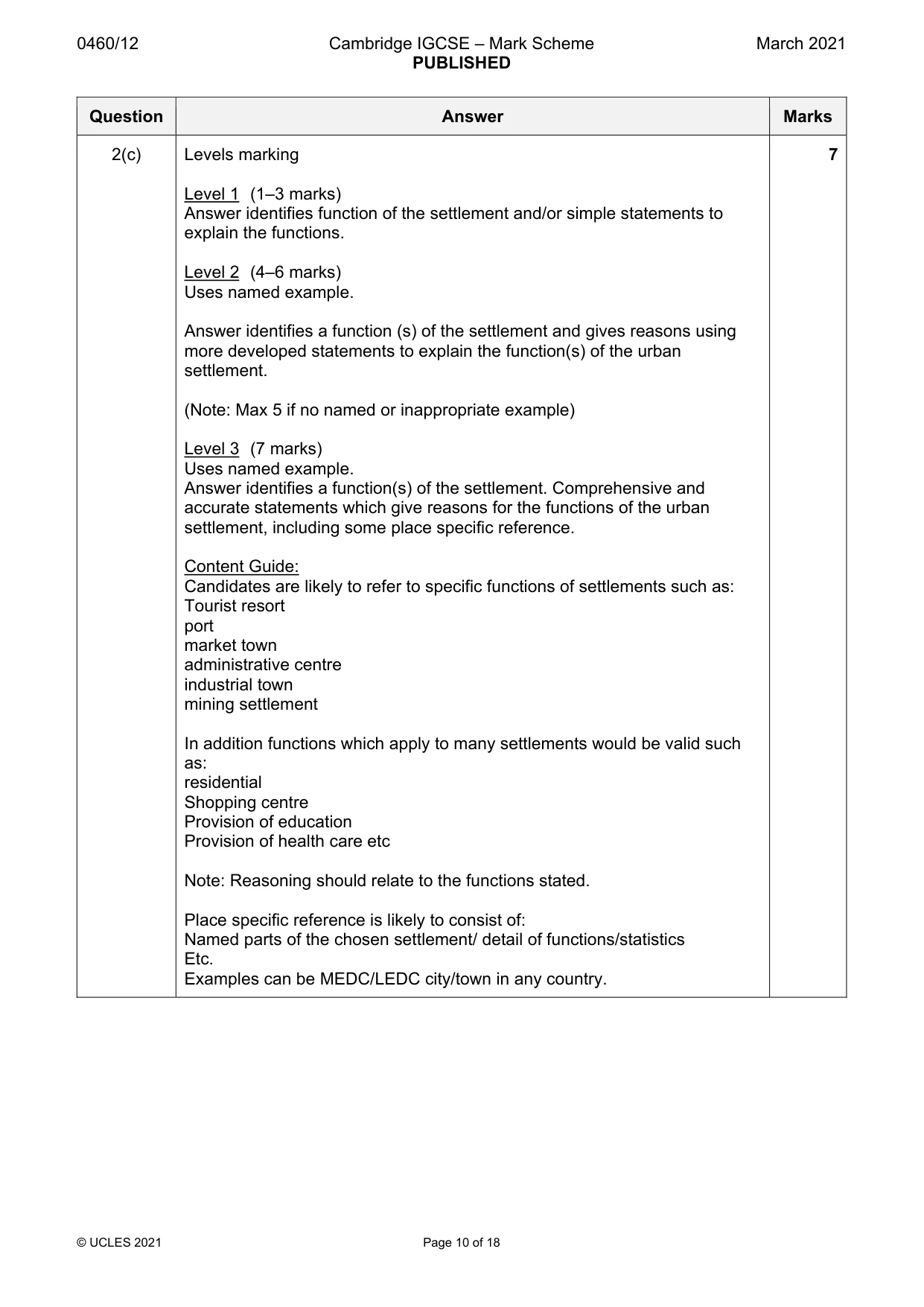
0460/12 Cambridge IGCSE – Mark Scheme PUBLISHED March 2021 © UCLES 2021 Page 10 of 18 Question Answer Marks 2(c) Levels marking Level 1 (1–3 marks) Answer identifies function of the settlement and/or simple statements to explain the functions. Level 2 (4–6 marks) Uses named example. Answer identifies a function (s) of the settlement and gives reasons using more developed statements to explain the function(s) of the urban settlement. (Note: Max 5 if no named or inappropriate example) Level 3 (7 marks) Uses named example. Answer identifies a function(s) of the settlement. Comprehensive and accurate statements which give reasons for the functions of the urban settlement, including some place specific reference. Content Guide: Candidates are likely to refer to specific functions of settlements such as: Tourist resort port market town administrative centre industrial town mining settlement In addition functions which apply to many settlements would be valid such as: residential Shopping centre Provision of education Provision of health care etc Note: Reasoning should relate to the functions stated. Place specific reference is likely to consist of: Named parts of the chosen settlement/ detail of functions/statistics Etc. Examples can be MEDC/LEDC city/town in any country. 7
Mark scheme, page 11
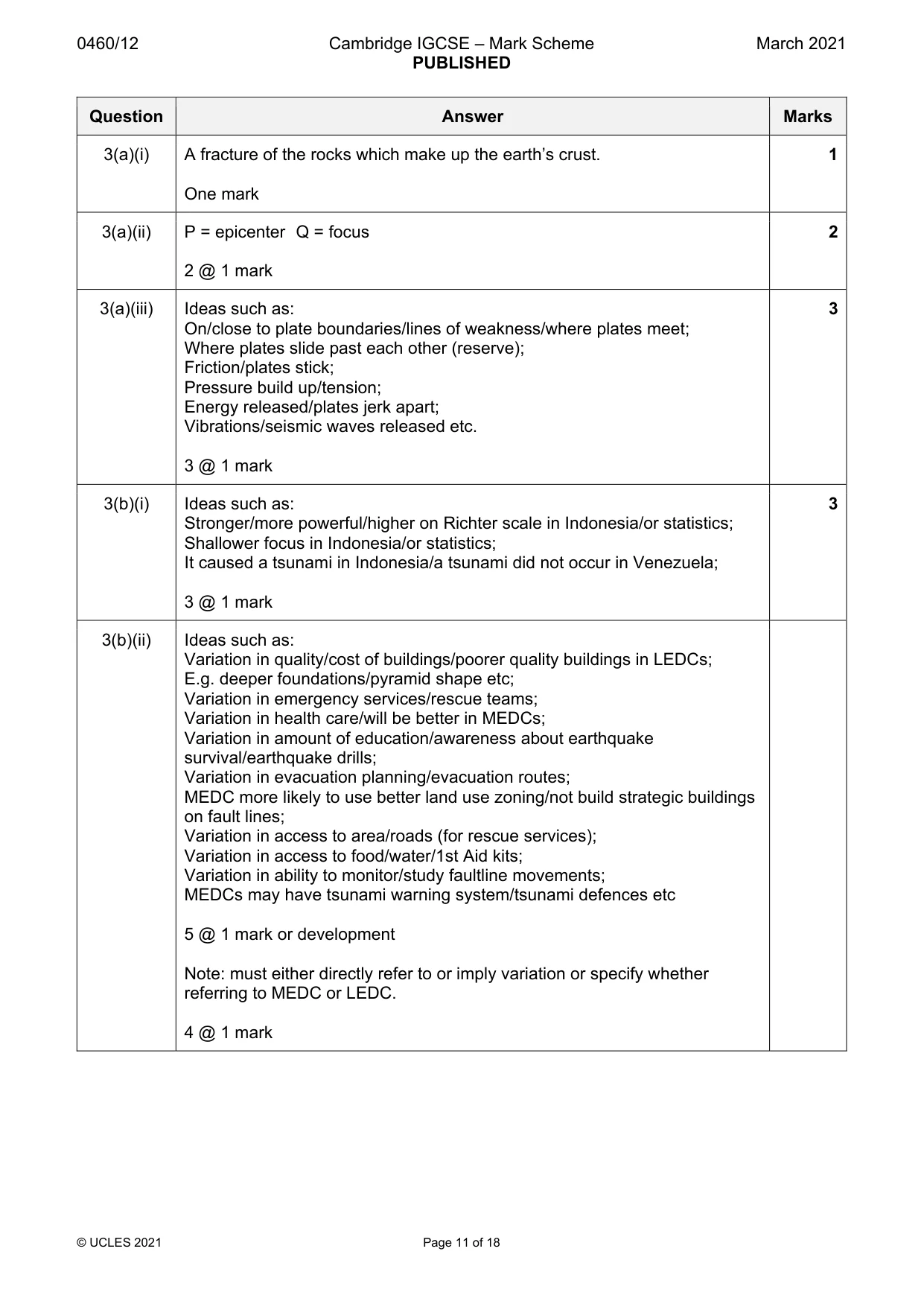
0460/12 Cambridge IGCSE – Mark Scheme PUBLISHED March 2021 © UCLES 2021 Page 11 of 18 Question Answer Marks 3(a)(i) A fracture of the rocks which make up the earth’s crust. One mark 1 3(a)(ii) P = epicenter Q = focus 2 @ 1 mark 2 3(a)(iii) Ideas such as: On/close to plate boundaries/lines of weakness/where plates meet; Where plates slide past each other (reserve); Friction/plates stick; Pressure build up/tension; Energy released/plates jerk apart; Vibrations/seismic waves released etc. 3 @ 1 mark 3 3(b)(i) Ideas such as: Stronger/more powerful/higher on Richter scale in Indonesia/or statistics; Shallower focus in Indonesia/or statistics; It caused a tsunami in Indonesia/a tsunami did not occur in Venezuela; 3 @ 1 mark 3 3(b)(ii) Ideas such as: Variation in quality/cost of buildings/poorer quality buildings in LEDCs; E.g. deeper foundations/pyramid shape etc; Variation in emergency services/rescue teams; Variation in health care/will be better in MEDCs; Variation in amount of education/awareness about earthquake survival/earthquake drills; Variation in evacuation planning/evacuation routes; MEDC more likely to use better land use zoning/not build strategic buildings on fault lines; Variation in access to area/roads (for rescue services); Variation in access to food/water/1st Aid kits; Variation in ability to monitor/study faultline movements; MEDCs may have tsunami warning system/tsunami defences etc 5 @ 1 mark or development Note: must either directly refer to or imply variation or specify whether referring to MEDC or LEDC. 4 @ 1 mark
Mark scheme, page 12
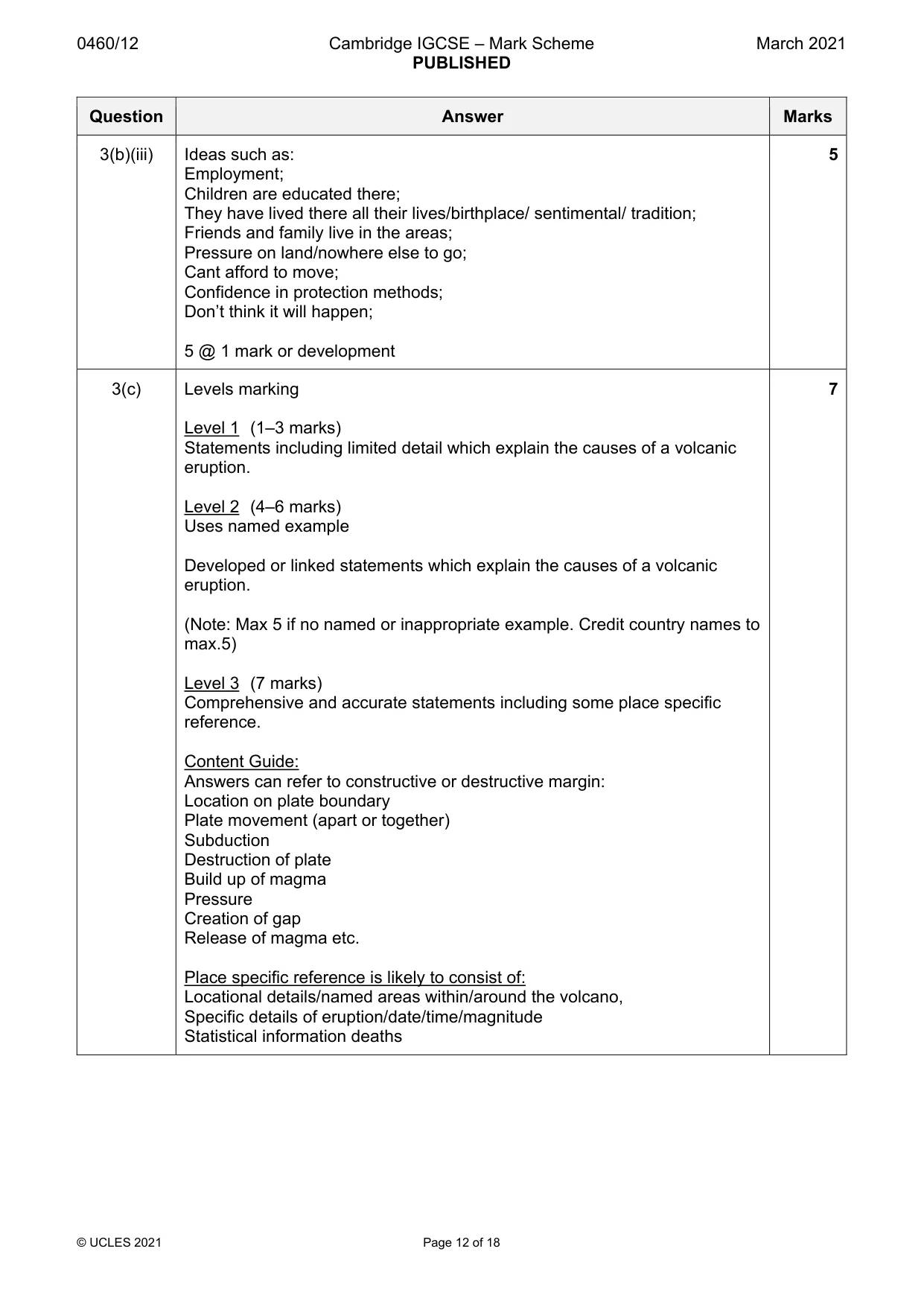
0460/12 Cambridge IGCSE – Mark Scheme PUBLISHED March 2021 © UCLES 2021 Page 12 of 18 Question Answer Marks 3(b)(iii) Ideas such as: Employment; Children are educated there; They have lived there all their lives/birthplace/ sentimental/ tradition; Friends and family live in the areas; Pressure on land/nowhere else to go; Cant afford to move; Confidence in protection methods; Don’t think it will happen; 5 @ 1 mark or development 5 3(c) Levels marking Level 1 (1–3 marks) Statements including limited detail which explain the causes of a volcanic eruption. Level 2 (4–6 marks) Uses named example Developed or linked statements which explain the causes of a volcanic eruption. (Note: Max 5 if no named or inappropriate example. Credit country names to max.5) Level 3 (7 marks) Comprehensive and accurate statements including some place specific reference. Content Guide: Answers can refer to constructive or destructive margin: Location on plate boundary Plate movement (apart or together) Subduction Destruction of plate Build up of magma Pressure Creation of gap Release of magma etc. Place specific reference is likely to consist of: Locational details/named areas within/around the volcano, Specific details of eruption/date/time/magnitude Statistical information deaths 7
Mark scheme, page 13
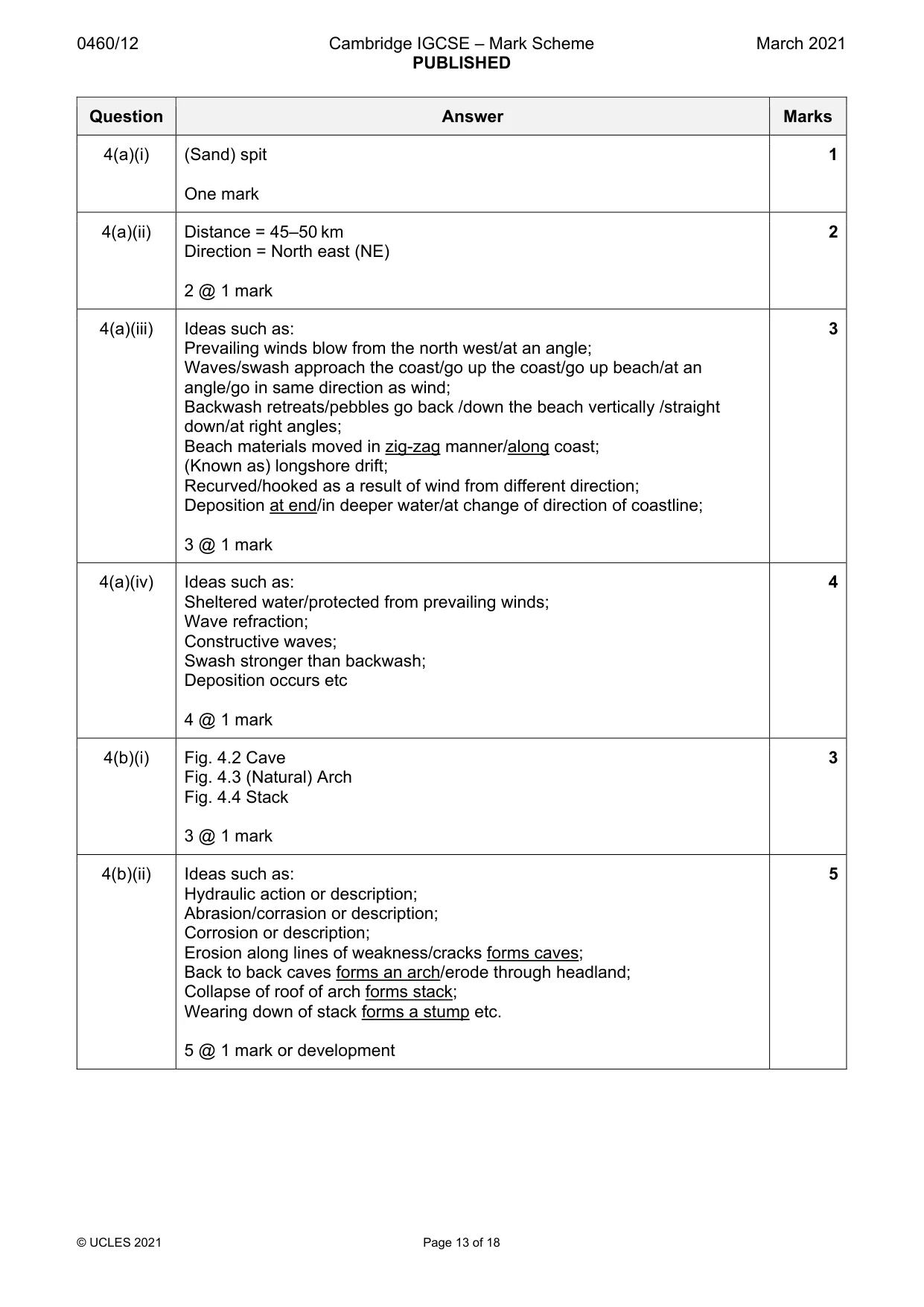
0460/12 Cambridge IGCSE – Mark Scheme PUBLISHED March 2021 © UCLES 2021 Page 13 of 18 Question Answer Marks 4(a)(i) (Sand) spit One mark 1 4(a)(ii) Distance = 45–50 km Direction = North east (NE) 2 @ 1 mark 2 4(a)(iii) Ideas such as: Prevailing winds blow from the north west/at an angle; Waves/swash approach the coast/go up the coast/go up beach/at an angle/go in same direction as wind; Backwash retreats/pebbles go back /down the beach vertically /straight down/at right angles; Beach materials moved in zig-zag manner/along coast; (Known as) longshore drift; Recurved/hooked as a result of wind from different direction; Deposition at end/in deeper water/at change of direction of coastline; 3 @ 1 mark 3 4(a)(iv) Ideas such as: Sheltered water/protected from prevailing winds; Wave refraction; Constructive waves; Swash stronger than backwash; Deposition occurs etc 4 @ 1 mark 4 4(b)(i) Fig. 4.2 Cave Fig. 4.3 (Natural) Arch Fig. 4.4 Stack 3 @ 1 mark 3 4(b)(ii) Ideas such as: Hydraulic action or description; Abrasion/corrasion or description; Corrosion or description; Erosion along lines of weakness/cracks forms caves; Back to back caves forms an arch/erode through headland; Collapse of roof of arch forms stack; Wearing down of stack forms a stump etc. 5 @ 1 mark or development 5
Mark scheme, page 14
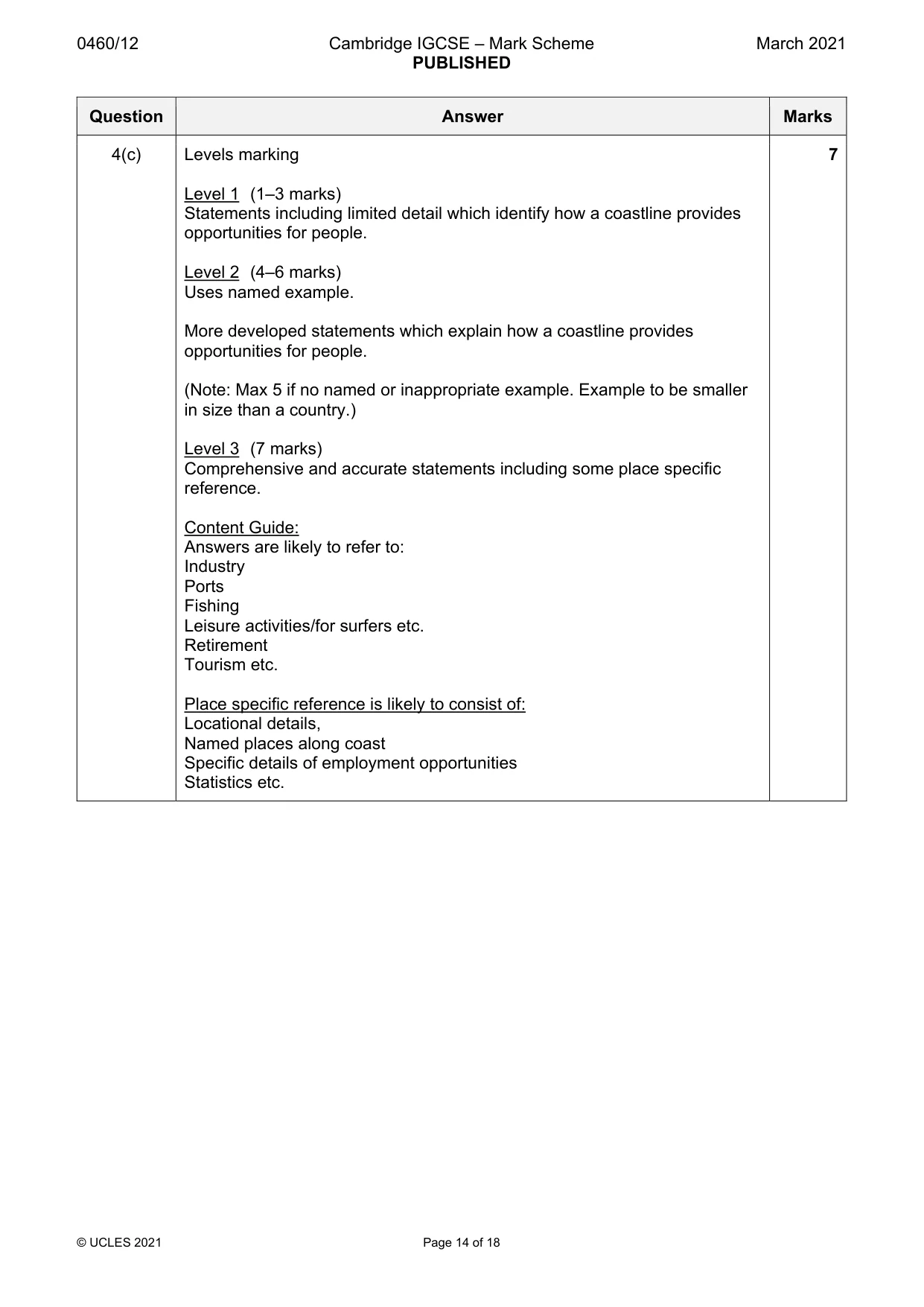
0460/12 Cambridge IGCSE – Mark Scheme PUBLISHED March 2021 © UCLES 2021 Page 14 of 18 Question Answer Marks 4(c) Levels marking Level 1 (1–3 marks) Statements including limited detail which identify how a coastline provides opportunities for people. Level 2 (4–6 marks) Uses named example. More developed statements which explain how a coastline provides opportunities for people. (Note: Max 5 if no named or inappropriate example. Example to be smaller in size than a country.) Level 3 (7 marks) Comprehensive and accurate statements including some place specific reference. Content Guide: Answers are likely to refer to: Industry Ports Fishing Leisure activities/for surfers etc. Retirement Tourism etc. Place specific reference is likely to consist of: Locational details, Named places along coast Specific details of employment opportunities Statistics etc. 7
Mark scheme, page 15
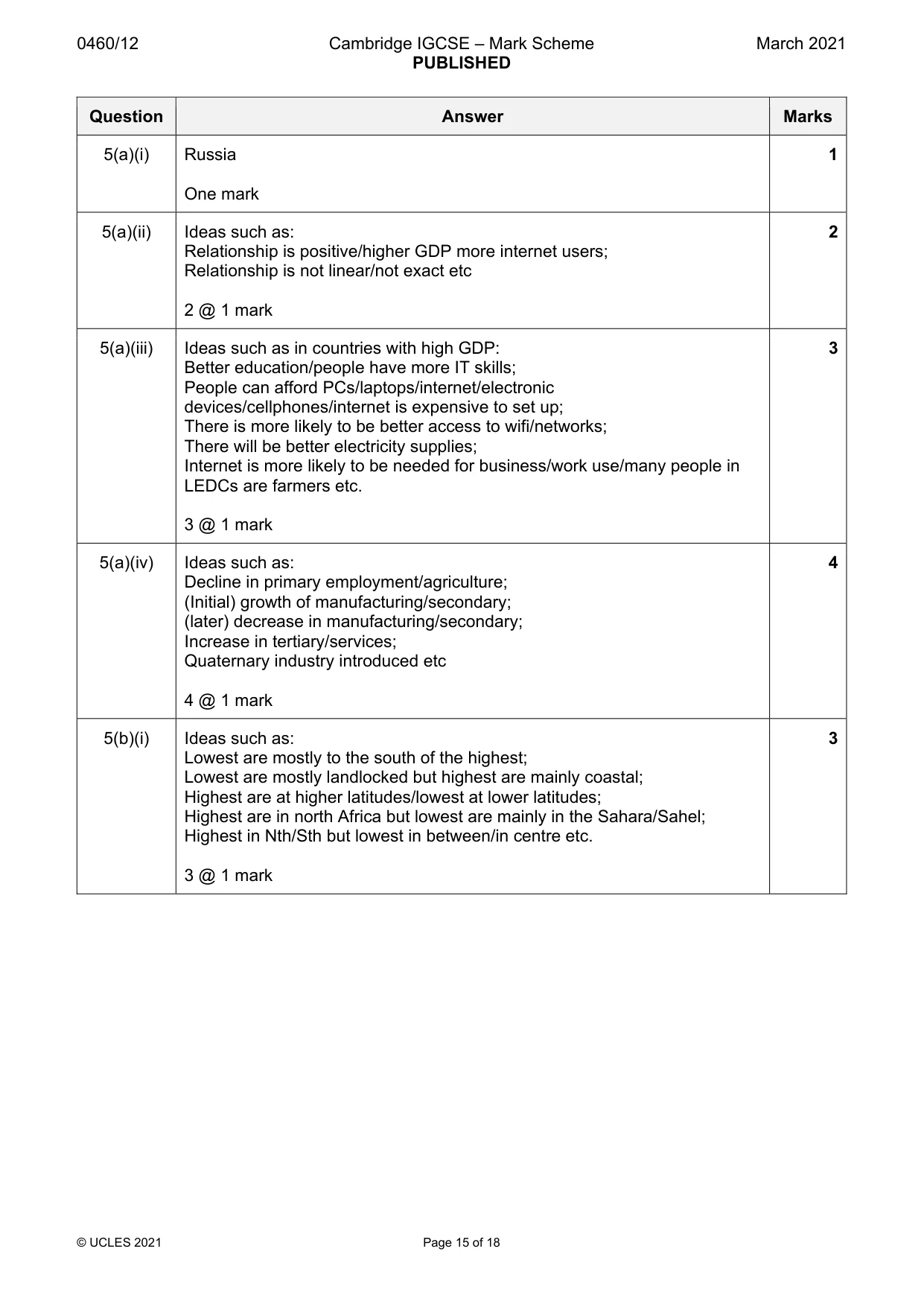
0460/12 Cambridge IGCSE – Mark Scheme PUBLISHED March 2021 © UCLES 2021 Page 15 of 18 Question Answer Marks 5(a)(i) Russia One mark 1 5(a)(ii) Ideas such as: Relationship is positive/higher GDP more internet users; Relationship is not linear/not exact etc 2 @ 1 mark 2 5(a)(iii) Ideas such as in countries with high GDP: Better education/people have more IT skills; People can afford PCs/laptops/internet/electronic devices/cellphones/internet is expensive to set up; There is more likely to be better access to wifi/networks; There will be better electricity supplies; Internet is more likely to be needed for business/work use/many people in LEDCs are farmers etc. 3 @ 1 mark 3 5(a)(iv) Ideas such as: Decline in primary employment/agriculture; (Initial) growth of manufacturing/secondary; (later) decrease in manufacturing/secondary; Increase in tertiary/services; Quaternary industry introduced etc 4 @ 1 mark 4 5(b)(i) Ideas such as: Lowest are mostly to the south of the highest; Lowest are mostly landlocked but highest are mainly coastal; Highest are at higher latitudes/lowest at lower latitudes; Highest are in north Africa but lowest are mainly in the Sahara/Sahel; Highest in Nth/Sth but lowest in between/in centre etc. 3 @ 1 mark 3
Mark scheme, page 16
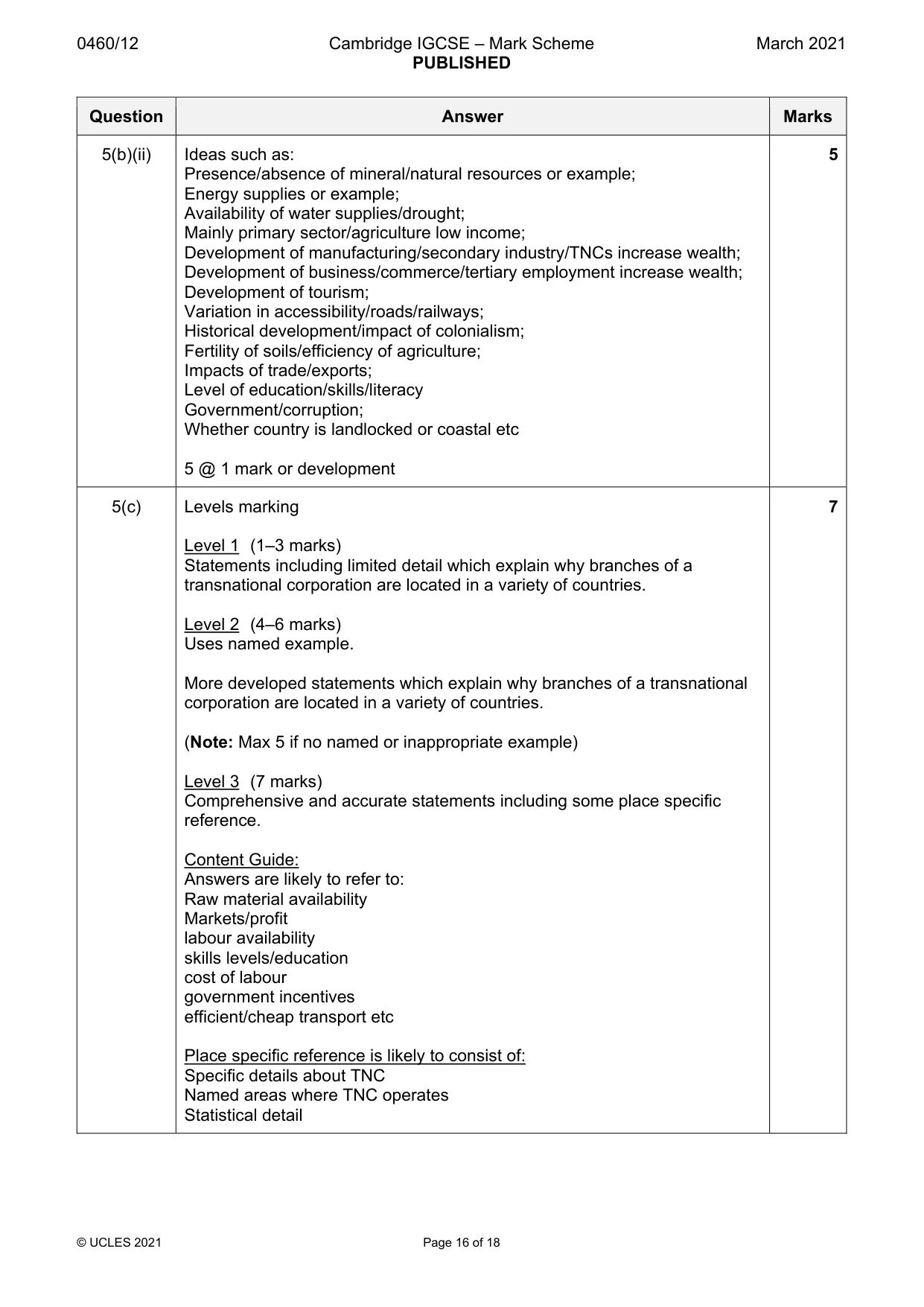
0460/12 Cambridge IGCSE – Mark Scheme PUBLISHED March 2021 © UCLES 2021 Page 16 of 18 Question Answer Marks 5(b)(ii) Ideas such as: Presence/absence of mineral/natural resources or example; Energy supplies or example; Availability of water supplies/drought; Mainly primary sector/agriculture low income; Development of manufacturing/secondary industry/TNCs increase wealth; Development of business/commerce/tertiary employment increase wealth; Development of tourism; Variation in accessibility/roads/railways; Historical development/impact of colonialism; Fertility of soils/efficiency of agriculture; Impacts of trade/exports; Level of education/skills/literacy Government/corruption; Whether country is landlocked or coastal etc 5 @ 1 mark or development 5 5(c) Levels marking Level 1 (1–3 marks) Statements including limited detail which explain why branches of a transnational corporation are located in a variety of countries. Level 2 (4–6 marks) Uses named example. More developed statements which explain why branches of a transnational corporation are located in a variety of countries. (Note: Max 5 if no named or inappropriate example) Level 3 (7 marks) Comprehensive and accurate statements including some place specific reference. Content Guide: Answers are likely to refer to: Raw material availability Markets/profit labour availability skills levels/education cost of labour government incentives efficient/cheap transport etc Place specific reference is likely to consist of: Specific details about TNC Named areas where TNC operates Statistical detail 7
Mark scheme, page 17
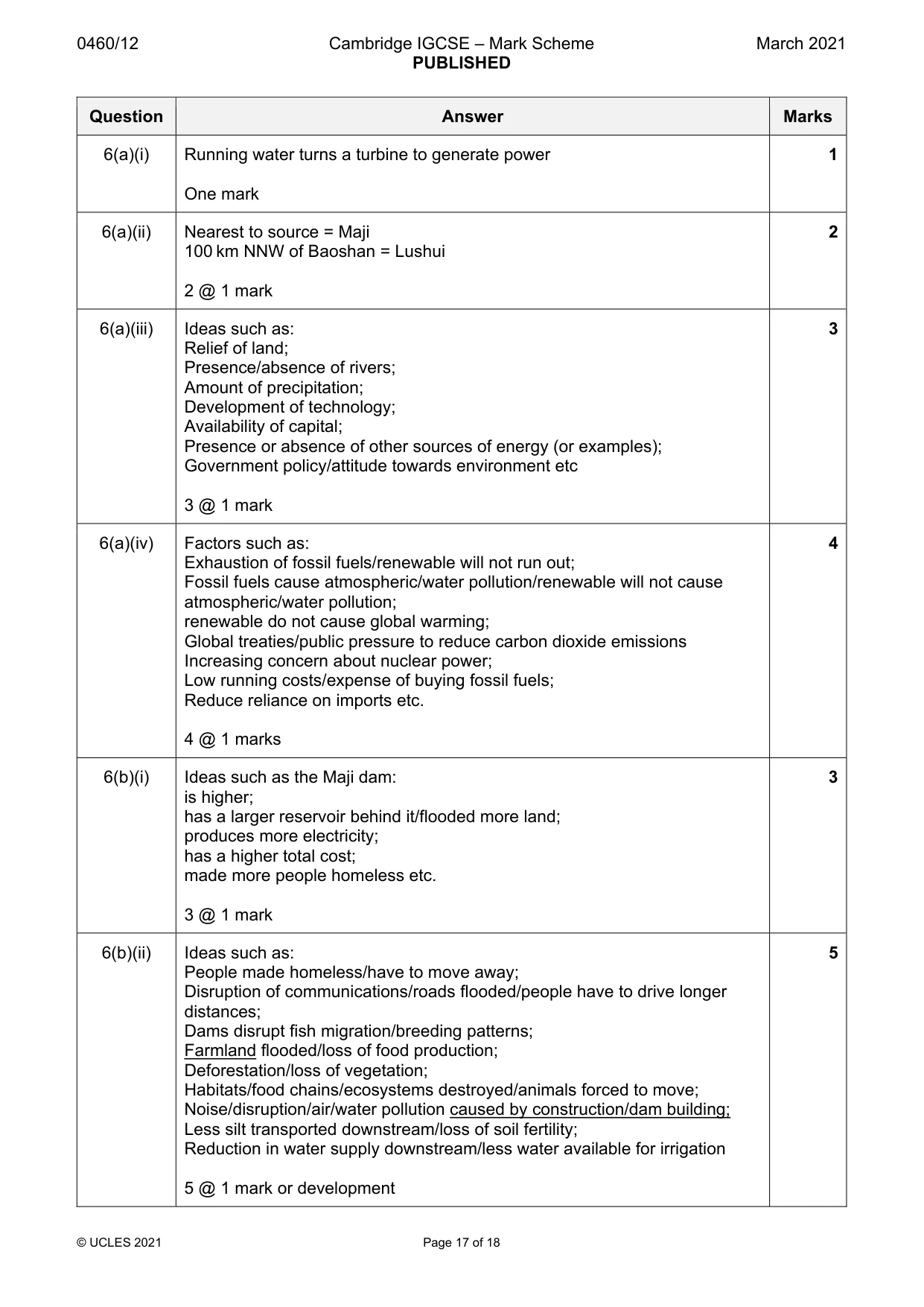
0460/12 Cambridge IGCSE – Mark Scheme PUBLISHED March 2021 © UCLES 2021 Page 17 of 18 Question Answer Marks 6(a)(i) Running water turns a turbine to generate power One mark 1 6(a)(ii) Nearest to source = Maji 100 km NNW of Baoshan = Lushui 2 @ 1 mark 2 6(a)(iii) Ideas such as: Relief of land; Presence/absence of rivers; Amount of precipitation; Development of technology; Availability of capital; Presence or absence of other sources of energy (or examples); Government policy/attitude towards environment etc 3 @ 1 mark 3 6(a)(iv) Factors such as: Exhaustion of fossil fuels/renewable will not run out; Fossil fuels cause atmospheric/water pollution/renewable will not cause atmospheric/water pollution; renewable do not cause global warming; Global treaties/public pressure to reduce carbon dioxide emissions Increasing concern about nuclear power; Low running costs/expense of buying fossil fuels; Reduce reliance on imports etc. 4 @ 1 marks 4 6(b)(i) Ideas such as the Maji dam: is higher; has a larger reservoir behind it/flooded more land; produces more electricity; has a higher total cost; made more people homeless etc. 3 @ 1 mark 3 6(b)(ii) Ideas such as: People made homeless/have to move away; Disruption of communications/roads flooded/people have to drive longer distances; Dams disrupt fish migration/breeding patterns; Farmland flooded/loss of food production; Deforestation/loss of vegetation; Habitats/food chains/ecosystems destroyed/animals forced to move; Noise/disruption/air/water pollution caused by construction/dam building; Less silt transported downstream/loss of soil fertility; Reduction in water supply downstream/less water available for irrigation 5 @ 1 mark or development 5
Mark scheme, page 18
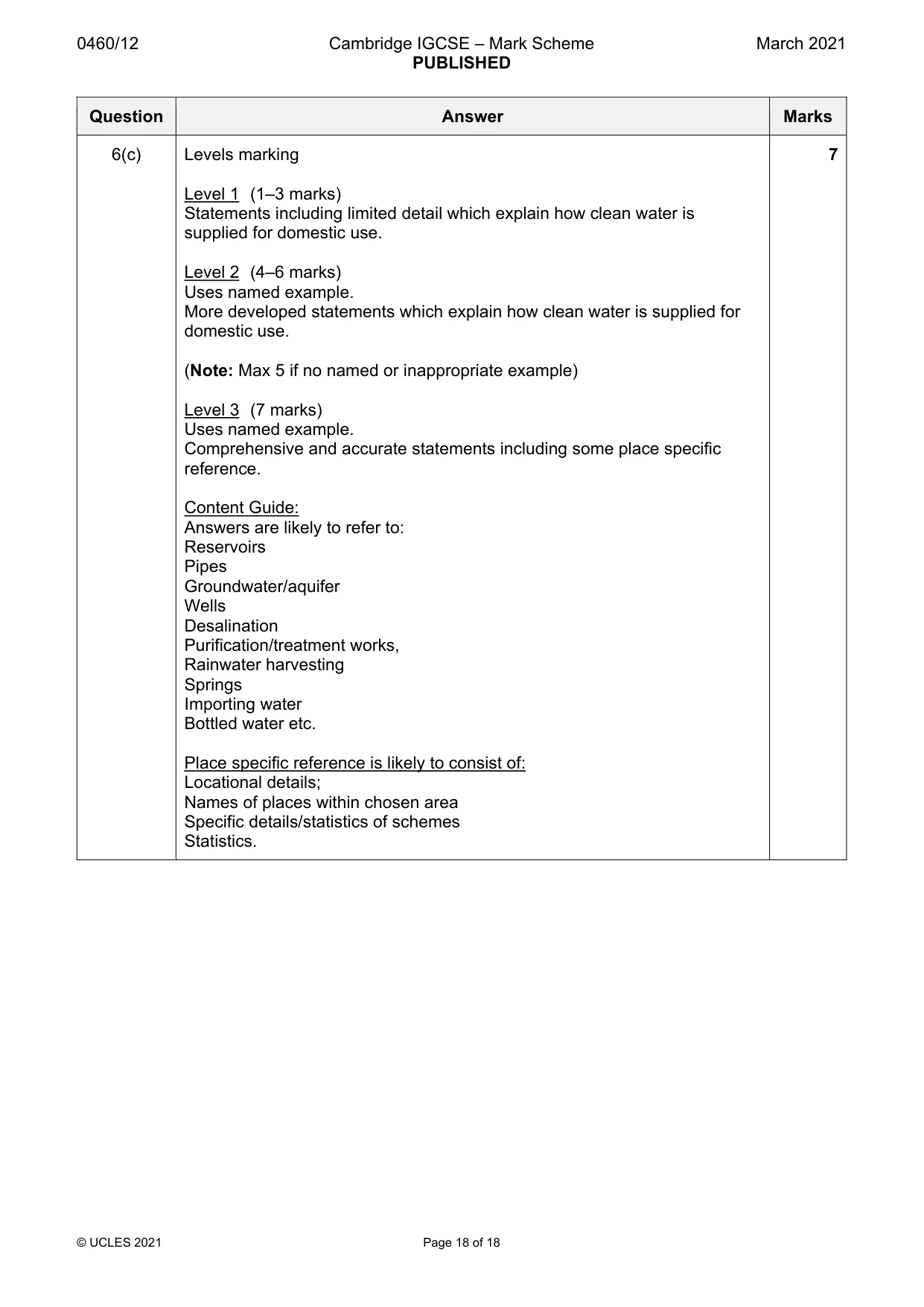
0460/12 Cambridge IGCSE – Mark Scheme PUBLISHED March 2021 © UCLES 2021 Page 18 of 18 Question Answer Marks 6(c) Levels marking Level 1 (1–3 marks) Statements including limited detail which explain how clean water is supplied for domestic use. Level 2 (4–6 marks) Uses named example. More developed statements which explain how clean water is supplied for domestic use. (Note: Max 5 if no named or inappropriate example) Level 3 (7 marks) Uses named example. Comprehensive and accurate statements including some place specific reference. Content Guide: Answers are likely to refer to: Reservoirs Pipes Groundwater/aquifer Wells Desalination Purification/treatment works, Rainwater harvesting Springs Importing water Bottled water etc. Place specific reference is likely to consist of: Locational details; Names of places within chosen area Specific details/statistics of schemes Statistics. 7
What you needed in this session
Cambridge’s own grade thresholds for 2021 Feb/March, Paper 1 · Variant 2. A higher threshold means an easier paper — the bar moves with how the cohort did.