Cambridge IGCSE Geography 0460 — 2017 Feb/March Paper 1 · Variant 2
0460/12/F/M/17 · 75 marks · ≈84 min
The question paper and its mark scheme, free to read here and free to download. This is Cambridge’s own paper, exactly as it was sat.
Question paper28 pages


Mark scheme15 pages
Answers below. Sit the paper first if you are practising.
Paper as text
Question paper, page 1
This document consists of 27 printed pages, 1 blank page and 1 Insert. DC (NH/FD) 125659/6 © UCLES 2017 [Turn over * 7 2 4 3 0 2 8 4 4 6 * GEOGRAPHY 0460/12 Paper 1 February/March 2017 1 hour 45 minutes Candidates answer on the Question Paper. Additional Materials: Ruler Calculator READ THESE INSTRUCTIONS FIRST Write your Centre number, candidate number and name in the spaces provided. Write in dark blue or black pen. You may use an HB pencil for any diagrams or graphs. Do not use staples, paper clips, glue or correction fluid. DO NOT WRITE IN ANY BARCODES. Write your answer to each question in the space provided. If additional space is required, you should use the lined pages at the end of this booklet. The question number(s) must be clearly shown. Answer three questions, one from each section. The Insert contains Photograph A for Question 2, Fig. 5 and Photograph B for Question 3, Photograph C for Question 5 and Photograph D for Question 6. The Insert is not required by the Examiner. Sketch maps and diagrams should be drawn whenever they serve to illustrate an answer. At the end of the examination, fasten all your work securely together. The number of marks is given in brackets [ ] at the end of each question or part question. Definitions MEDCs – More Economically Developed Countries LEDCs – Less Economically Developed Countries The syllabus is approved for use in England, Wales and Northern Ireland as a Cambridge International Level 1/Level 2 Certificate. Cambridge International Examinations Cambridge International General Certificate of Secondary Education
Question paper, page 2
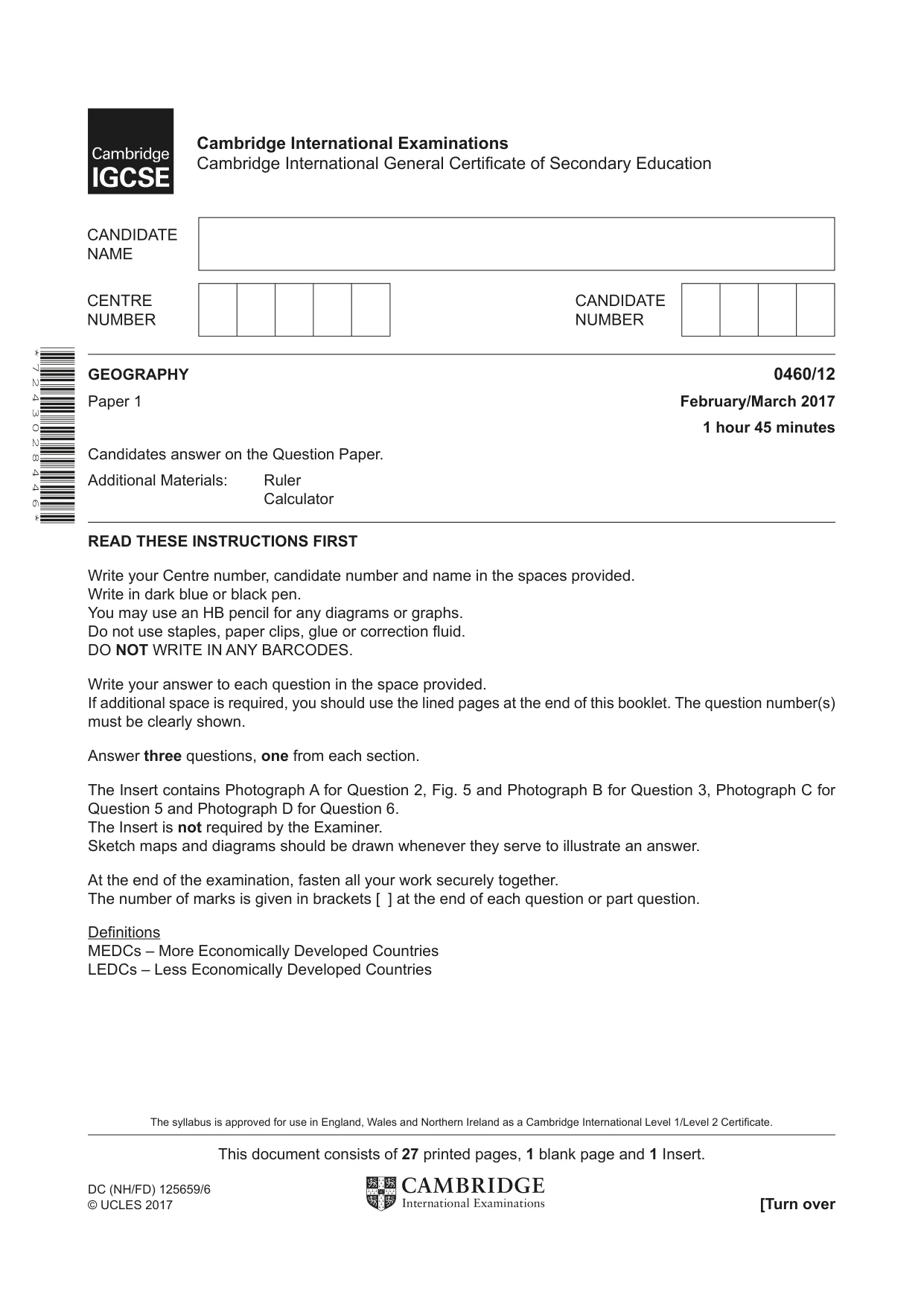
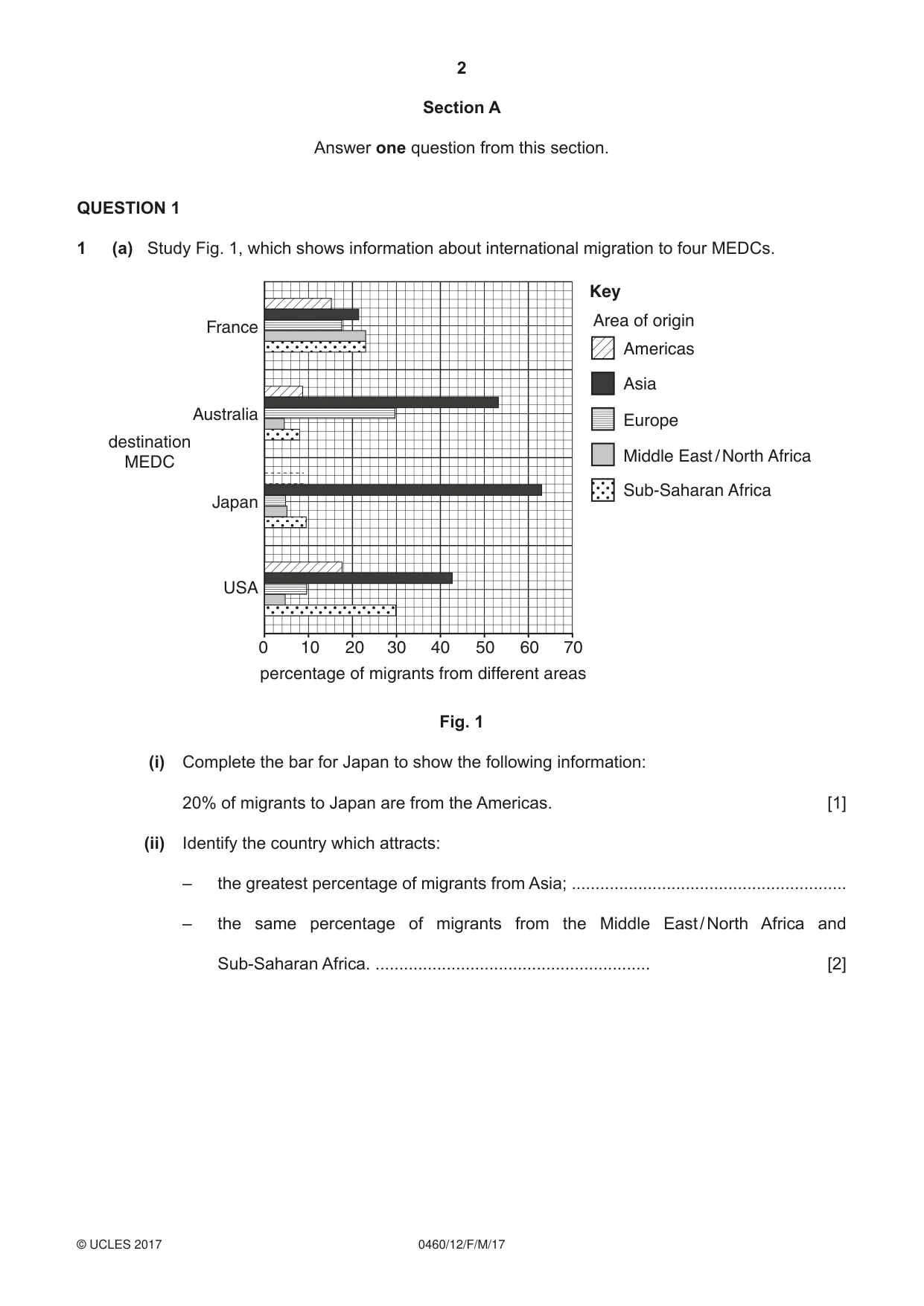
2 0460/12/F/M/17 © UCLES 2017 Section A Answer one question from this section. QUESTION 1 1 (a) Study Fig. 1, which shows information about international migration to four MEDCs. 0 USA Japan Australia destination MEDC France 10 20 30 percentage of migrants from different areas 40 Key Area of origin Americas Asia Europe Middle East / North Africa Sub-Saharan Africa 50 60 70 Fig. 1 (i) Complete the bar for Japan to show the following information: 20% of migrants to Japan are from the Americas. [1] (ii) Identify the country which attracts: – the greatest percentage of migrants from Asia; … – the same percentage of migrants from the Middle East / North Africa and Sub-Saharan Africa. … [2]
Question paper, page 3
3 0460/12/F/M/17 © UCLES 2017 [Turn over (iii) Using evidence from Fig. 1 only, compare the pattern of international migration to France and the USA. … … … … … …[3] (iv) Suggest reasons for the percentages of people who migrate to France and the USA from different areas. … … … … … … … …[4]
Question paper, page 4
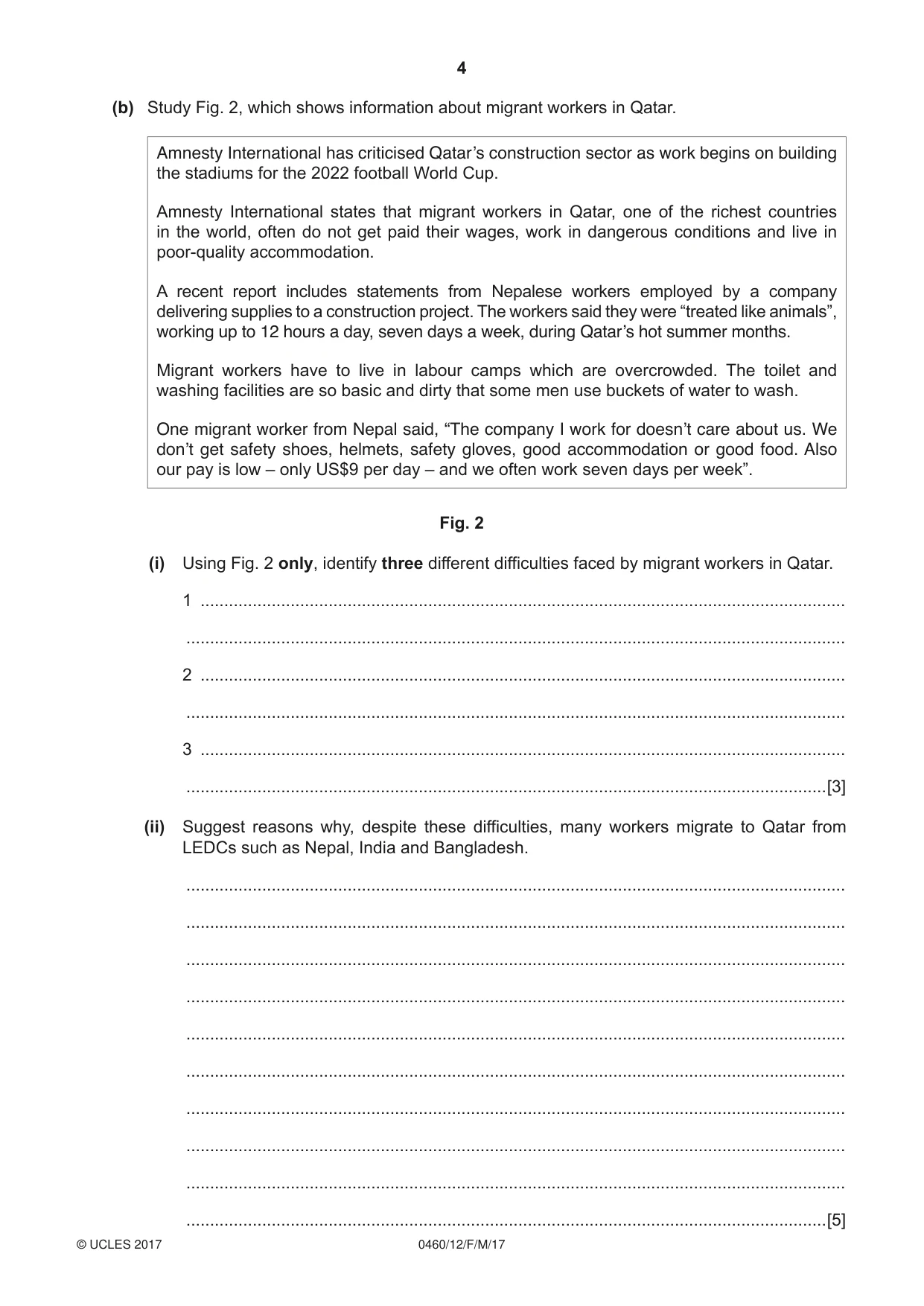
4 0460/12/F/M/17 © UCLES 2017 (b) Study Fig. 2, which shows information about migrant workers in Qatar. Amnesty International has criticised Qatar’s construction sector as work begins on building the stadiums for the 2022 football World Cup. Amnesty International states that migrant workers in Qatar, one of the richest countries in the world, often do not get paid their wages, work in dangerous conditions and live in poor-quality accommodation. A recent report includes statements from Nepalese workers employed by a company delivering supplies to a construction project. The workers said they were “treated like animals”, working up to 12 hours a day, seven days a week, during Qatar’s hot summer months. Migrant workers have to live in labour camps which are overcrowded. The toilet and washing facilities are so basic and dirty that some men use buckets of water to wash. One migrant worker from Nepal said, “The company I work for doesn’t care about us. We don’t get safety shoes, helmets, safety gloves, good accommodation or good food. Also our pay is low – only US$9 per day – and we often work seven days per week”. Fig. 2 (i) Using Fig. 2 only, identify three different difficulties faced by migrant workers in Qatar. 1 … … 2 … … 3 … …[3] (ii) Suggest reasons why, despite these difficulties, many workers migrate to Qatar from LEDCs such as Nepal, India and Bangladesh. … … … … … … … … … …[5]
Question paper, page 5
5 0460/12/F/M/17 © UCLES 2017 [Turn over (c) For a named country you have studied, explain why rapid natural population growth is taking place. Name of country … … … … … … … … … … … … … … … … … … … … … … … … …[7] [Total: 25 marks] END OF QUESTION 1
Question paper, page 6
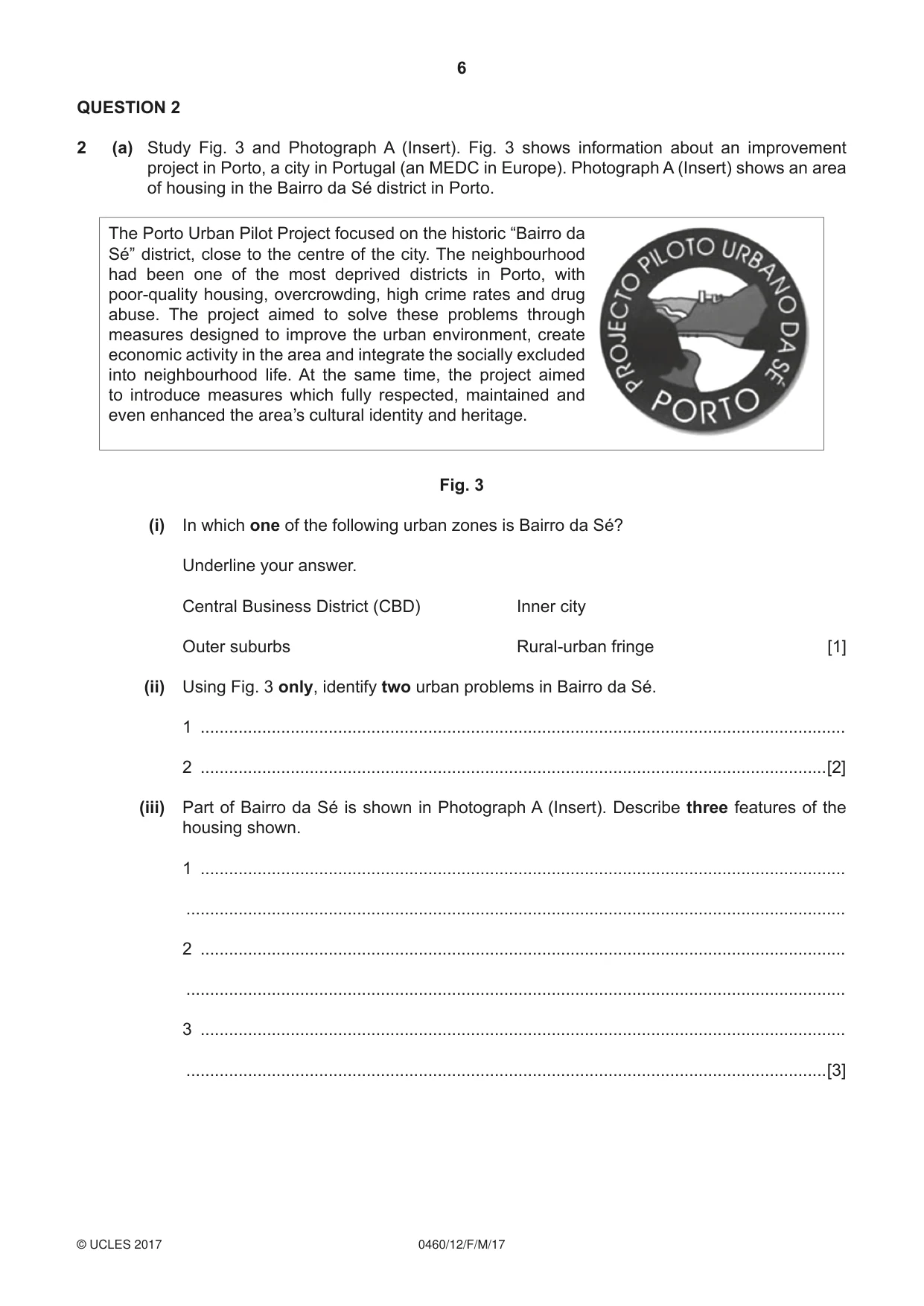
6 0460/12/F/M/17 © UCLES 2017 QUESTION 2 2 (a) Study Fig. 3 and Photograph A (Insert). Fig. 3 shows information about an improvement project in Porto, a city in Portugal (an MEDC in Europe). Photograph A (Insert) shows an area of housing in the Bairro da Sé district in Porto. The Porto Urban Pilot Project focused on the historic “Bairro da Sé” district, close to the centre of the city. The neighbourhood had been one of the most deprived districts in Porto, with poor-quality housing, overcrowding, high crime rates and drug abuse. The project aimed to solve these problems through measures designed to improve the urban environment, create economic activity in the area and integrate the socially excluded into neighbourhood life. At the same time, the project aimed to introduce measures which fully respected, maintained and even enhanced the area’s cultural identity and heritage. Fig. 3 (i) In which one of the following urban zones is Bairro da Sé? Underline your answer. Central Business District (CBD) Inner city Outer suburbs Rural-urban fringe [1] (ii) Using Fig. 3 only, identify two urban problems in Bairro da Sé. 1 … 2 …[2] (iii) Part of Bairro da Sé is shown in Photograph A (Insert). Describe three features of the housing shown. 1 … … 2 … … 3 … …[3]
Question paper, page 7
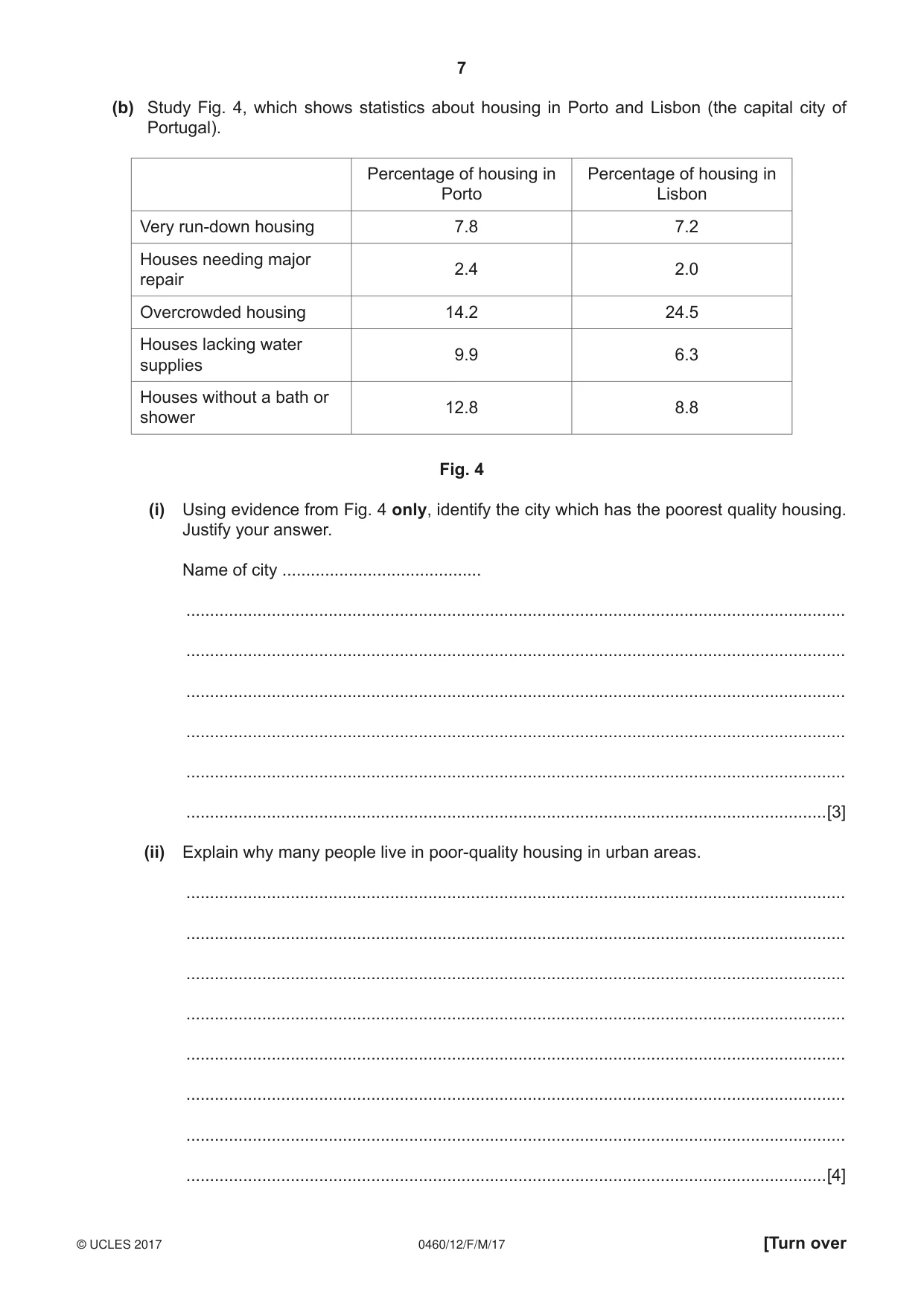
7 0460/12/F/M/17 © UCLES 2017 [Turn over (b) Study Fig. 4, which shows statistics about housing in Porto and Lisbon (the capital city of Portugal). Percentage of housing in Porto Percentage of housing in Lisbon Very run-down housing 7.8 7.2 Houses needing major repair 2.4 2.0 Overcrowded housing 14.2 24.5 Houses lacking water supplies 9.9 6.3 Houses without a bath or shower 12.8 8.8 Fig. 4 (i) Using evidence from Fig. 4 only, identify the city which has the poorest quality housing. Justify your answer. Name of city … … … … … … …[3] (ii) Explain why many people live in poor-quality housing in urban areas. … … … … … … … …[4]
Question paper, page 8
8 0460/12/F/M/17 © UCLES 2017 (iii) Describe attempts which have been made to reduce housing problems in urban areas. … … … … … … … … … …[5]
Question paper, page 9
9 0460/12/F/M/17 © UCLES 2017 [Turn over (c) For an urban area you have studied, describe a change in land use which has taken place and explain its impacts. Name of urban area … … … … … … … … … … … … … … … … … … … … … … …[7] [Total: 25 marks] END OF QUESTION 2
Question paper, page 10
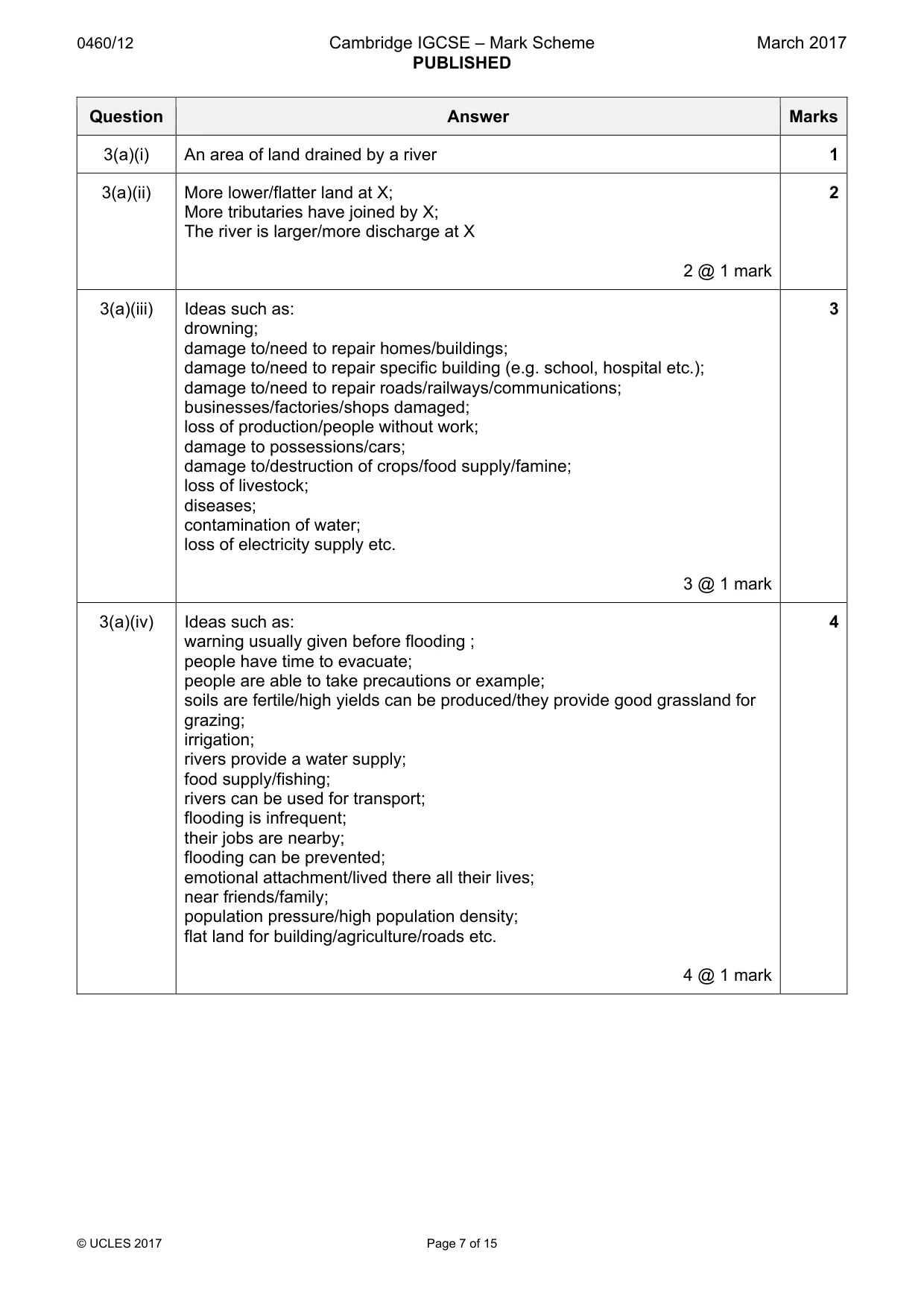
10 0460/12/F/M/17 © UCLES 2017 Section B Answer one question from this section. QUESTION 3 3 (a) Study Fig. 5 (Insert), which is a map of the Kelantan drainage basin in Malaysia (an LEDC in Asia). (i) What is meant by a drainage basin? … …[1] (ii) In December 2014 flooding occurred in many parts of the Kelantan drainage basin. Using evidence from Fig. 5 only, suggest two reasons why flooding is more likely in area X than Y. 1 … … 2 … …[2] (iii) Suggest three different hazards which are likely to have been caused by flooding in area X in December 2014. 1 … … 2 … … 3 … …[3]
Question paper, page 11
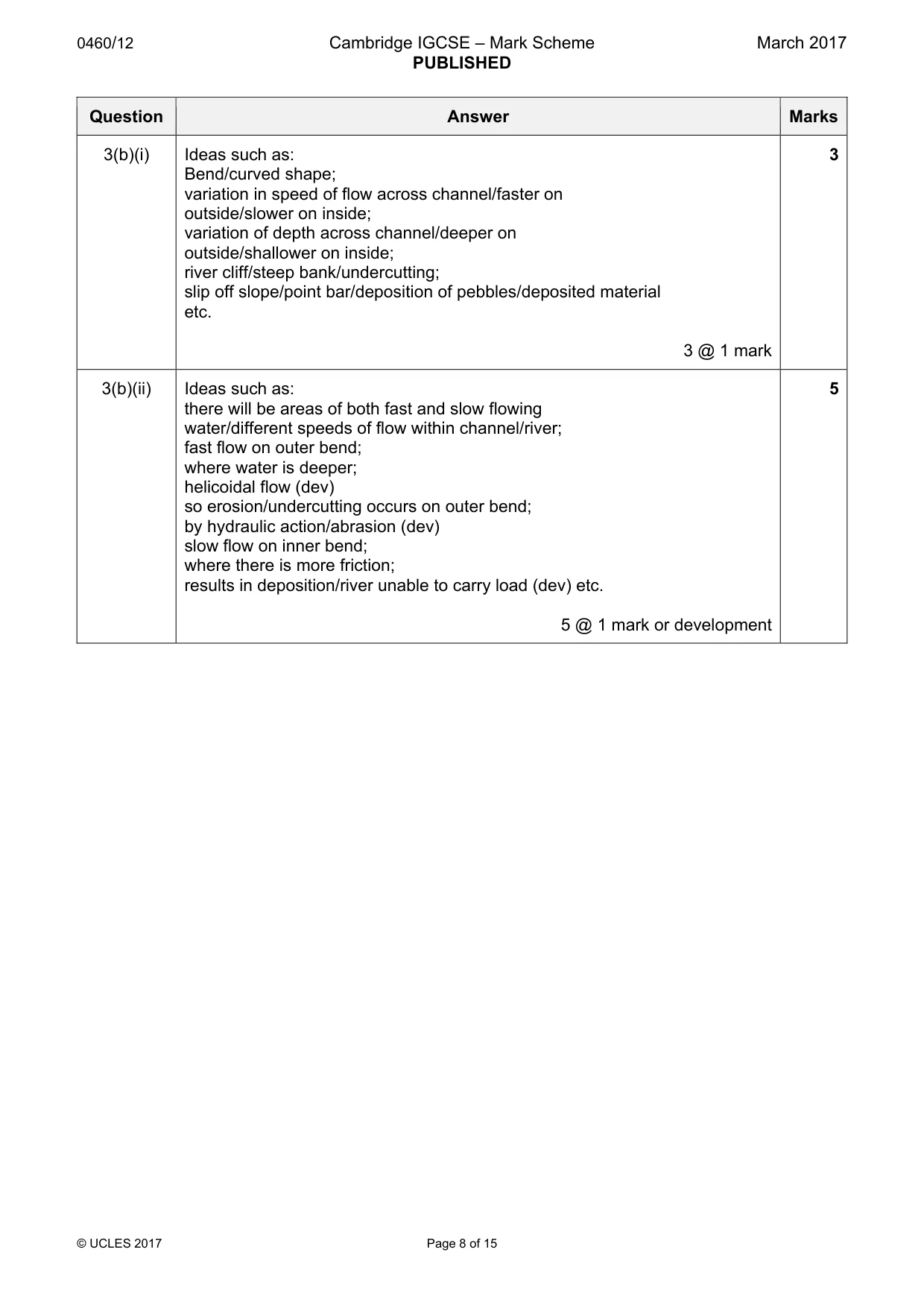
11 0460/12/F/M/17 © UCLES 2017 [Turn over (iv) Explain why many people still live in places like area X, even though flooding is likely to occur. … … … … … … … …[4] (b) Study Photograph B (Insert), which shows a meander. (i) Describe the features shown on Photograph B which are typical of a meander. … … … … … …[3] (ii) Explain why both erosion and deposition are likely to occur on the meander shown in Photograph B. … … … … … … … … … …[5]
Question paper, page 12
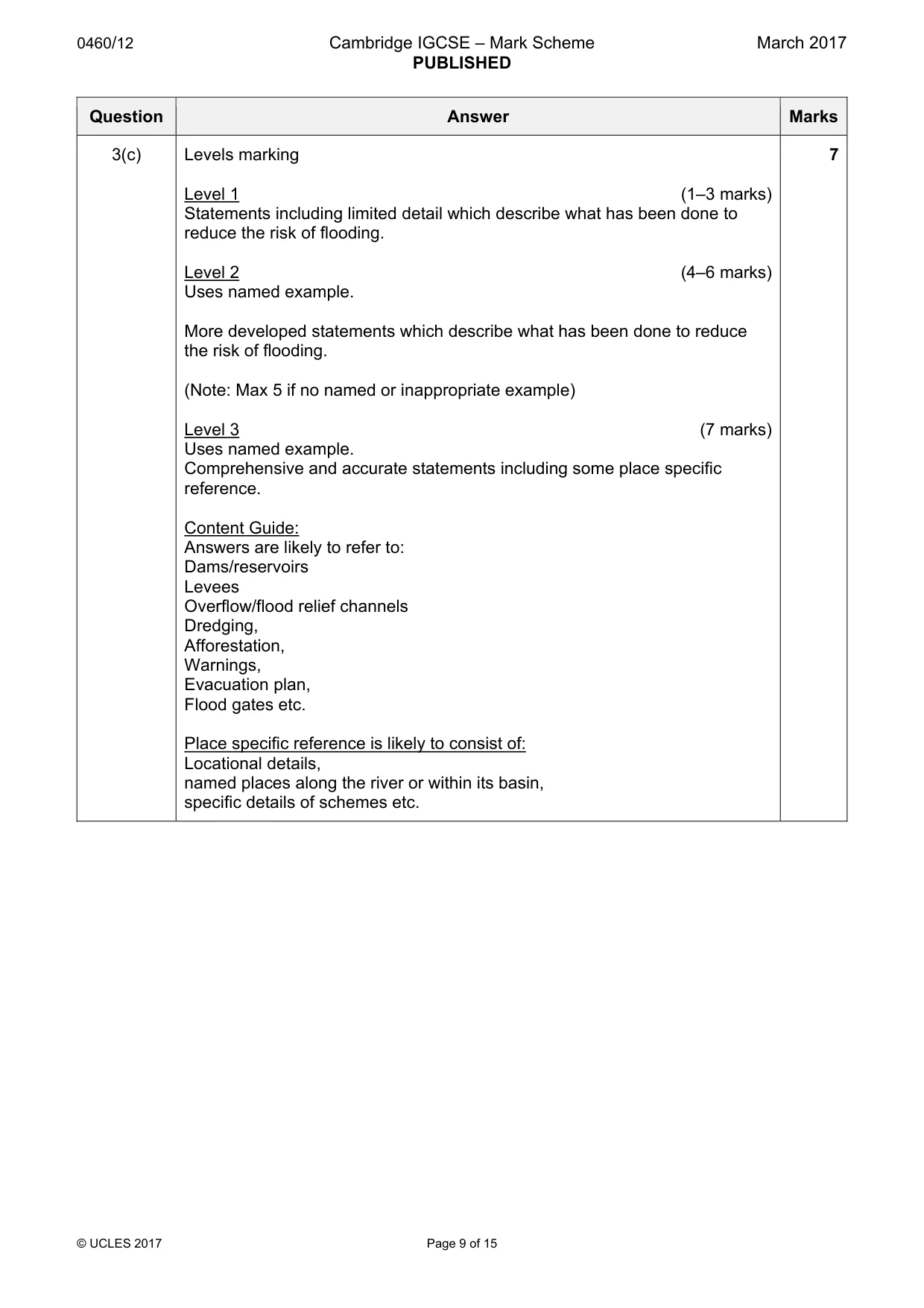
12 0460/12/F/M/17 © UCLES 2017 (c) For a named river you have studied, describe what has been done to reduce the risk of flooding. Name of river … … … … … … … … … … … … … … … … … … … … … … …[7] [Total: 25 marks] END OF QUESTION 3
Question paper, page 13
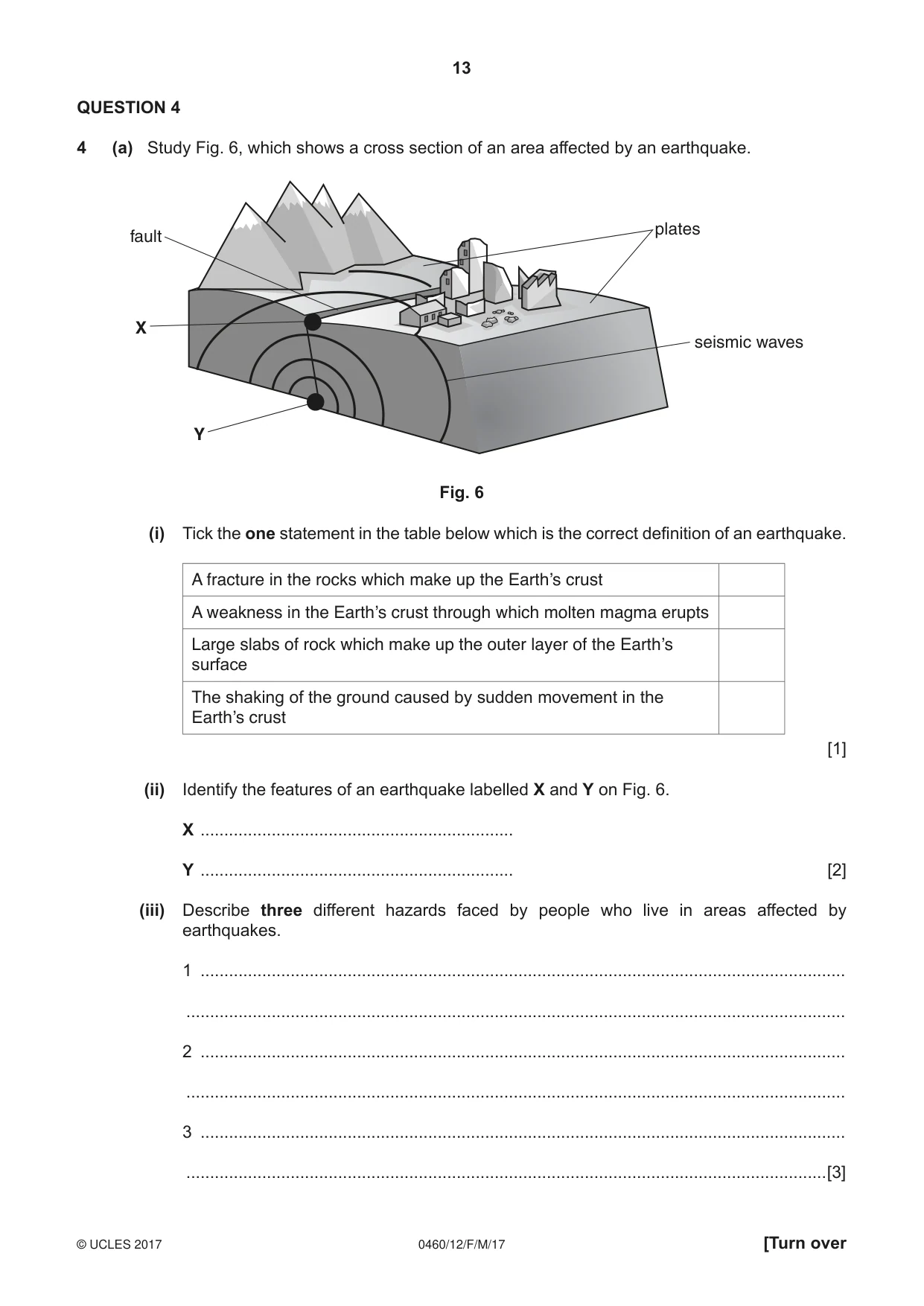
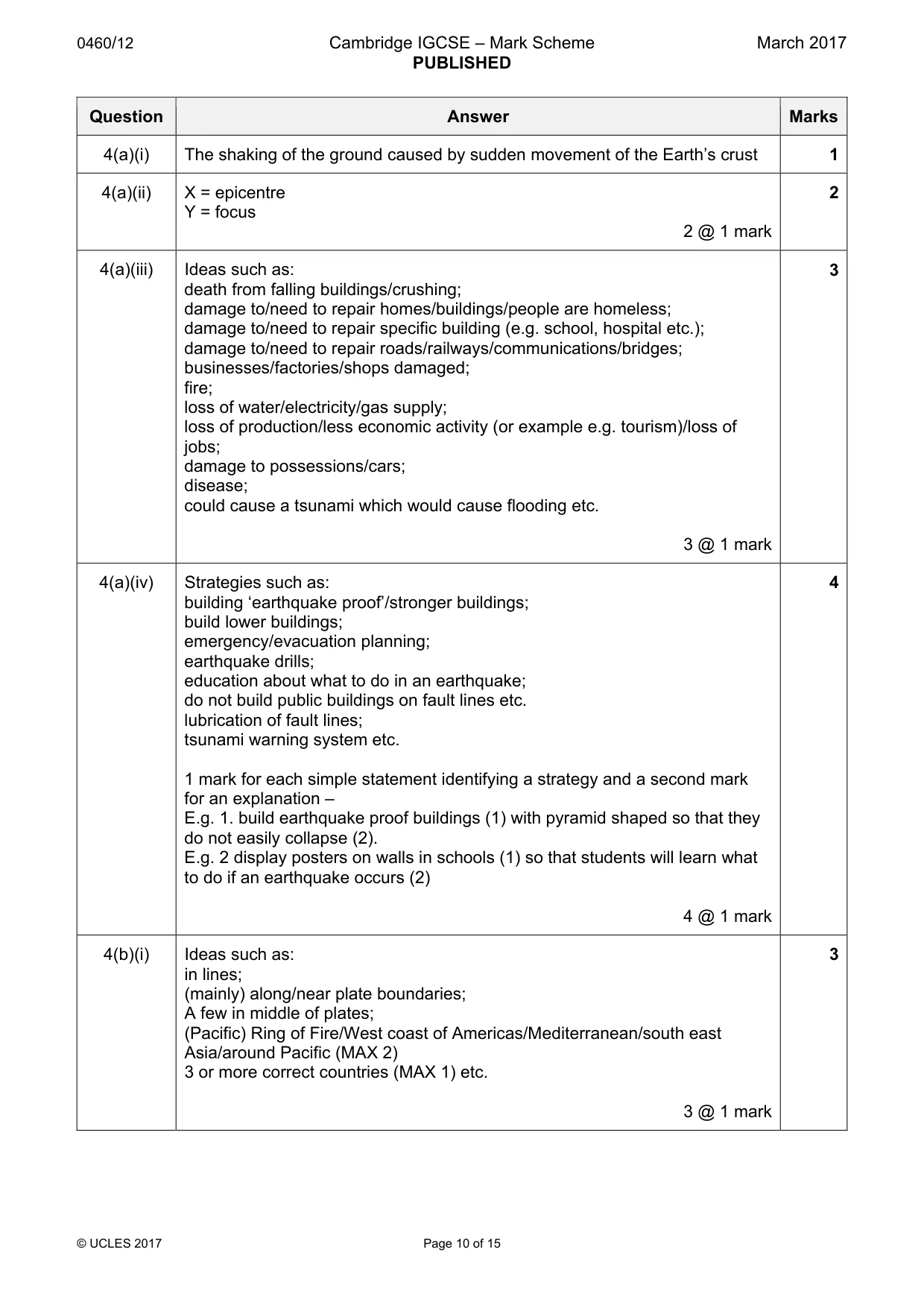
13 0460/12/F/M/17 © UCLES 2017 [Turn over QUESTION 4 4 (a) Study Fig. 6, which shows a cross section of an area affected by an earthquake. fault plates seismic waves X Y Fig. 6 (i) Tick the one statement in the table below which is the correct definition of an earthquake. A fracture in the rocks which make up the Earth’s crust A weakness in the Earth’s crust through which molten magma erupts Large slabs of rock which make up the outer layer of the Earth’s surface The shaking of the ground caused by sudden movement in the Earth’s crust [1] (ii) Identify the features of an earthquake labelled X and Y on Fig. 6. X … Y … [2] (iii) Describe three different hazards faced by people who live in areas affected by earthquakes. 1 … … 2 … … 3 … …[3]
Question paper, page 14
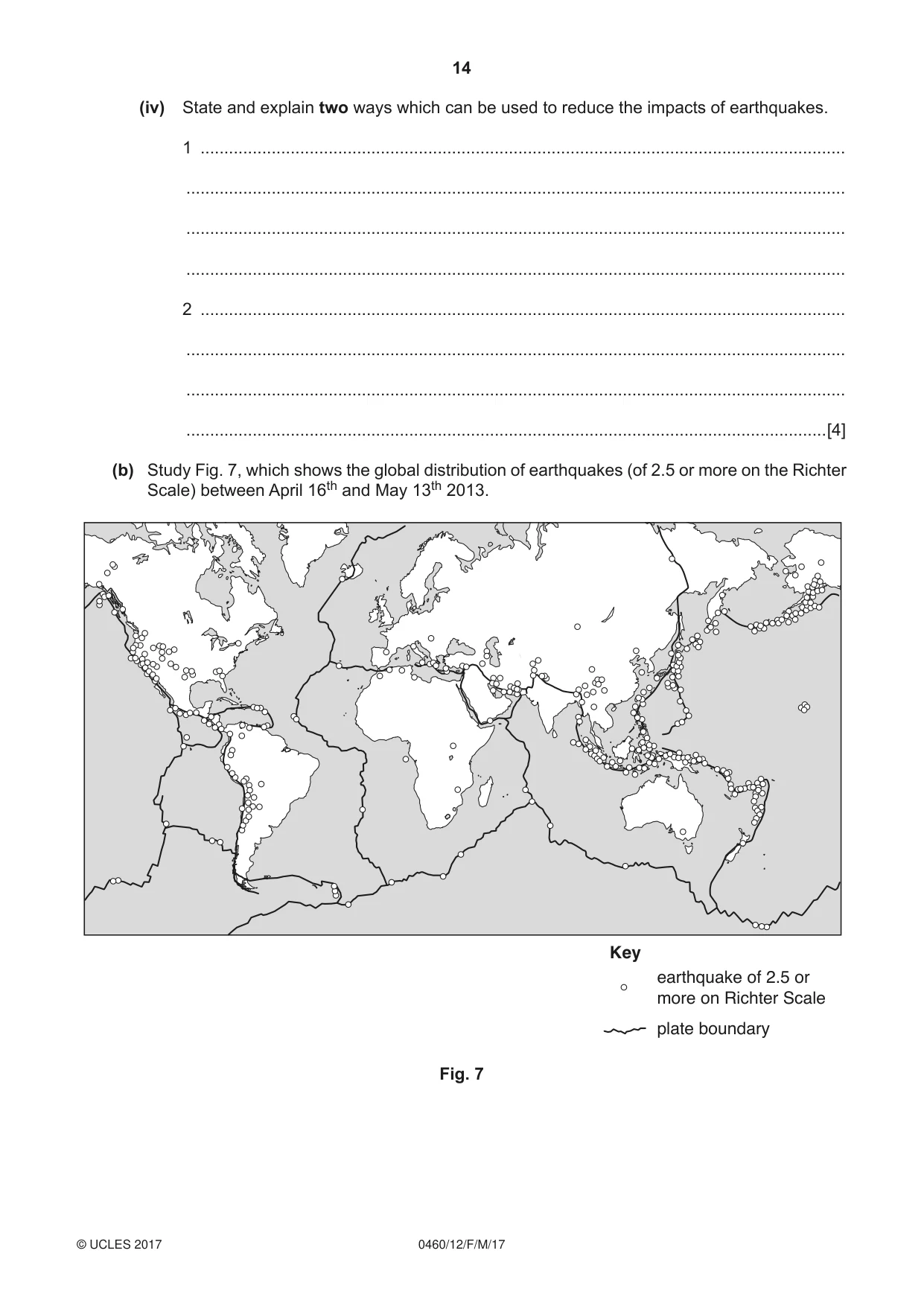
14 0460/12/F/M/17 © UCLES 2017 (iv) State and explain two ways which can be used to reduce the impacts of earthquakes. 1 … … … … 2 … … … …[4] (b) Study Fig. 7, which shows the global distribution of earthquakes (of 2.5 or more on the Richter Scale) between April 16th and May 13th 2013. Key earthquake of 2.5 or more on Richter Scale plate boundary Fig. 7
Question paper, page 15
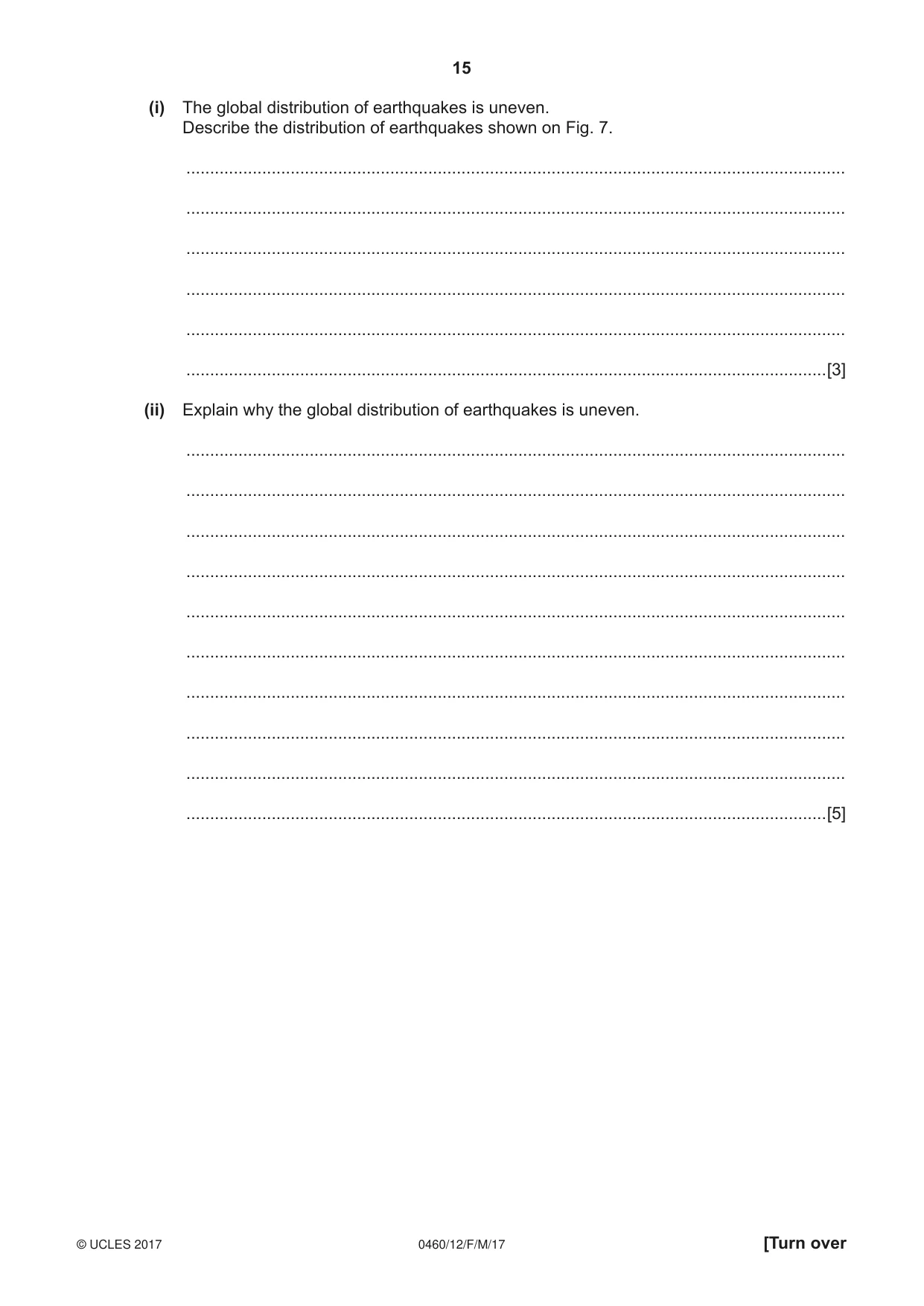
15 0460/12/F/M/17 © UCLES 2017 [Turn over (i) The global distribution of earthquakes is uneven. Describe the distribution of earthquakes shown on Fig. 7. … … … … … …[3] (ii) Explain why the global distribution of earthquakes is uneven. … … … … … … … … … …[5]
Question paper, page 16
16 0460/12/F/M/17 © UCLES 2017 (c) Another natural hazard is a volcanic eruption. For a named volcano you have studied, explain the causes of an eruption. Name of volcano … … … … … … … … … … … … … … … … … … … … …[7] [Total: 25 marks] END OF QUESTION 4
Question paper, page 17
17 0460/12/F/M/17 © UCLES 2017 [Turn over TURN PAGE FOR QUESTION 5
Question paper, page 18
18 0460/12/F/M/17 © UCLES 2017 Section C Answer one question from this section. QUESTION 5 5 (a) Study Figs. 8A and 8B, which are maps showing information about domestic and international tourism in India. Content removed due to copyright restrictions.
Question paper, page 19
0460/12/F/M/17 © UCLES 2017 [Turn over 19 (i) Complete Fig. 8B using the following information. Use the key provided. The percentage of international tourists visiting Maharashtra is 21%. [1] (ii) Explain the difference between the terms domestic and international tourist. … … … …[2] Content removed due to copyright restrictions.
Question paper, page 20
20 0460/12/F/M/17 © UCLES 2017 (iii) Using Figs. 8A and 8B only, name a state which: – has between 10.1% and 20% of both domestic and international tourists; … – has a greater percentage of international than domestic tourists; … – has the largest percentage of domestic tourists. … [3] (iv) Explain why the growth of tourism in an area leads to the development of its infrastructure. … … … … … … … …[4]
Question paper, page 21
21 0460/12/F/M/17 © UCLES 2017 [Turn over (b) Study Photograph C (Insert), which was taken in Mauritius, an island in the Indian Ocean which is visited by many tourists from countries in Europe, such as the UK and Germany. (i) Describe the physical attractions for tourists from Europe which are shown in Photograph C. … … … … … …[3] (ii) Explain how the human landscape can also attract tourists to an area. … … … … … … … … … …[5]
Question paper, page 22
22 0460/12/F/M/17 © UCLES 2017 (c) For a named area you have studied, describe the problems caused by tourism for local people and the local natural environment. Name of area … … … … … … … … … … … … … … … … … … … … … … …[7] [Total: 25 marks] END OF QUESTION 5
Question paper, page 23
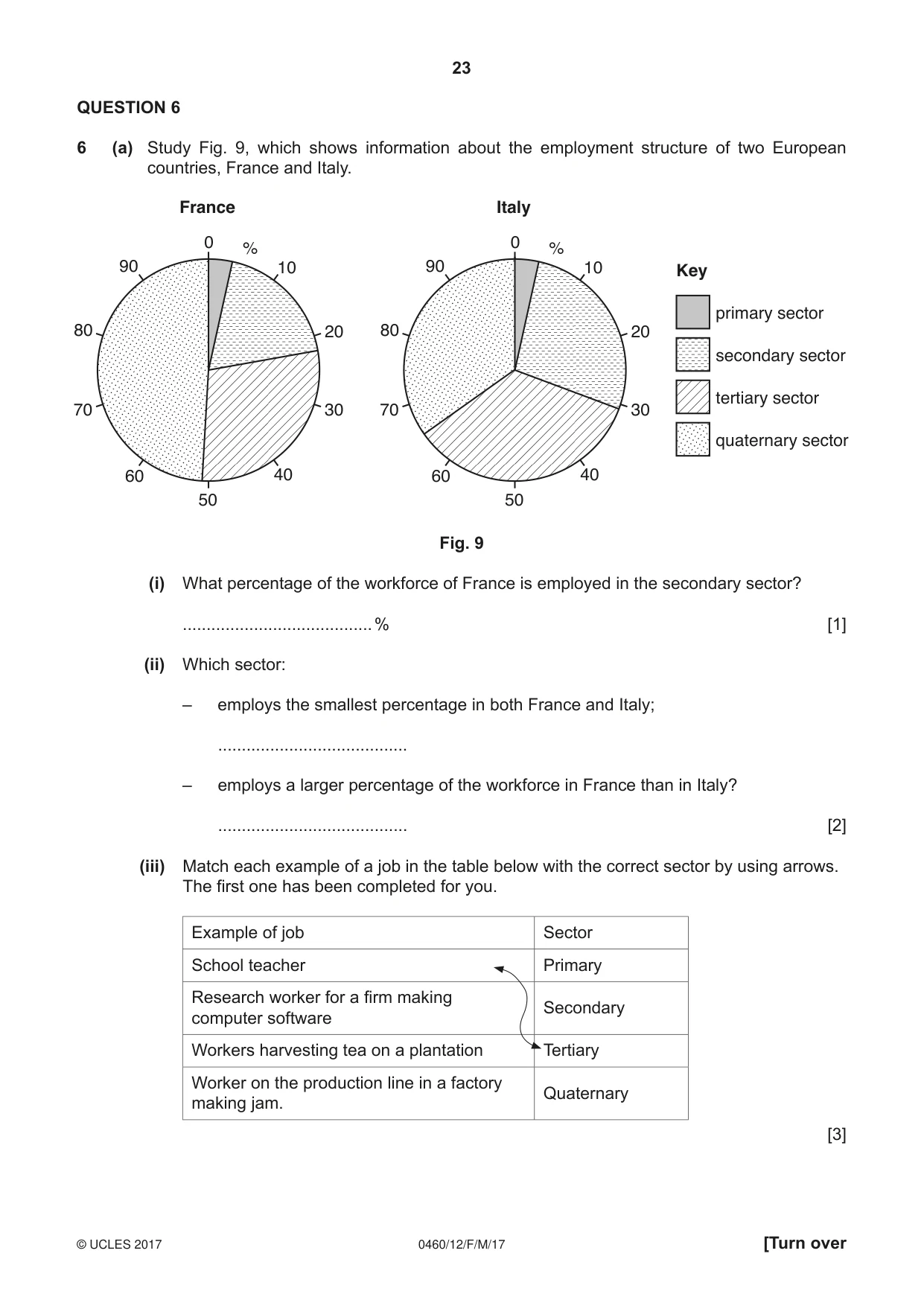
23 0460/12/F/M/17 © UCLES 2017 [Turn over QUESTION 6 6 (a) Study Fig. 9, which shows information about the employment structure of two European countries, France and Italy. France 0 % % 10 20 30 40 50 60 70 80 90 Italy Key 0 10 20 primary sector secondary sector tertiary sector quaternary sector 30 40 50 60 70 80 90 Fig. 9 (i) What percentage of the workforce of France is employed in the secondary sector? … % [1] (ii) Which sector: – employs the smallest percentage in both France and Italy; … – employs a larger percentage of the workforce in France than in Italy? … [2] (iii) Match each example of a job in the table below with the correct sector by using arrows. The first one has been completed for you. Example of job Sector School teacher Primary Research worker for a firm making computer software Secondary Workers harvesting tea on a plantation Tertiary Worker on the production line in a factory making jam. Quaternary [3]
Question paper, page 24
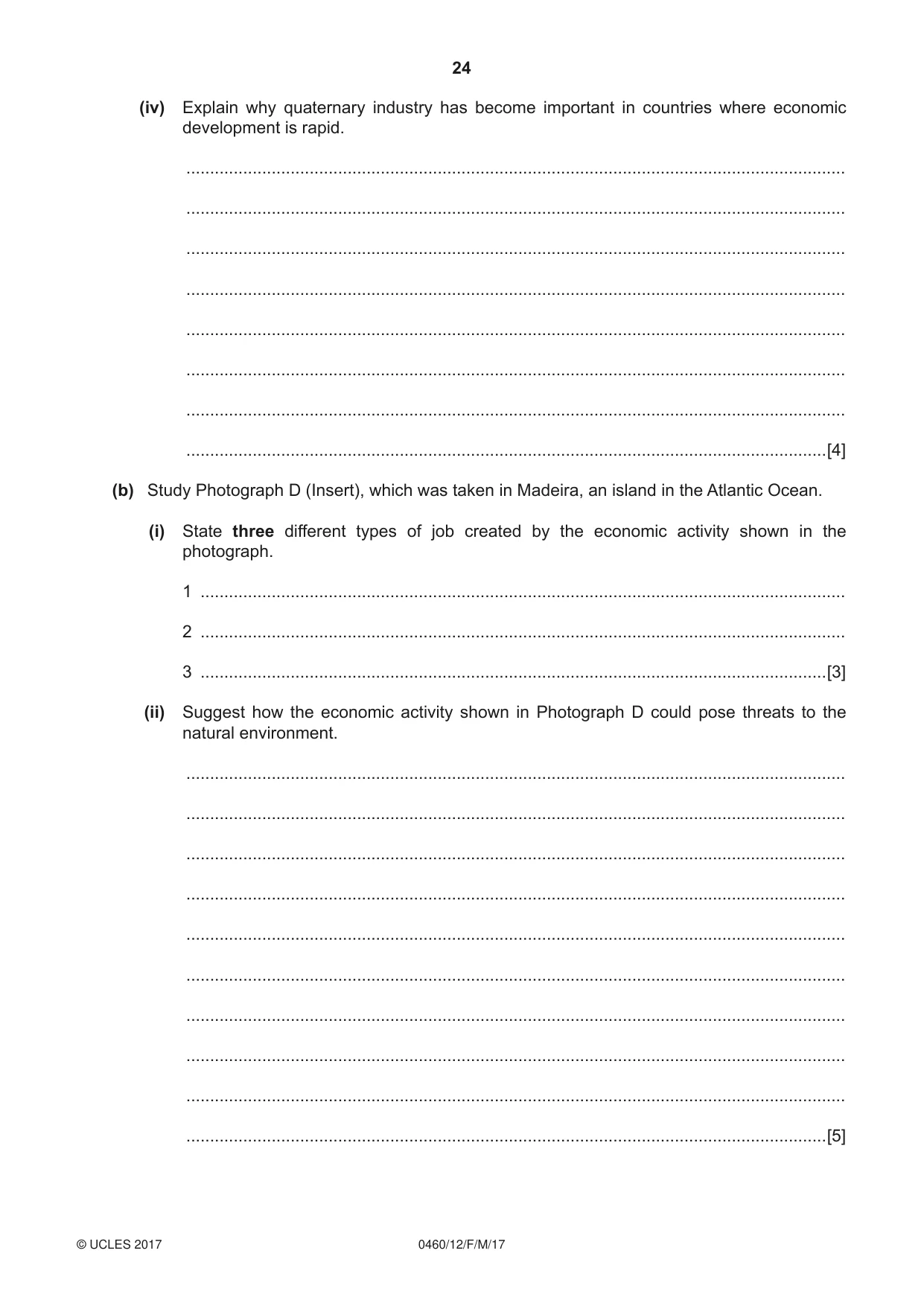
24 0460/12/F/M/17 © UCLES 2017 (iv) Explain why quaternary industry has become important in countries where economic development is rapid. … … … … … … … …[4] (b) Study Photograph D (Insert), which was taken in Madeira, an island in the Atlantic Ocean. (i) State three different types of job created by the economic activity shown in the photograph. 1 … 2 … 3 …[3] (ii) Suggest how the economic activity shown in Photograph D could pose threats to the natural environment. … … … … … … … … … …[5]
Question paper, page 25
25 0460/12/F/M/17 © UCLES 2017 (c) For an example of an economic activity in a named area you have studied, describe how the threats to the natural environment are being managed. Name of area … Economic activity … … … … … … … … … … … … … … … … … … … … … …[7] [Total: 25 marks] END OF QUESTION 6
Question paper, page 26
26 0460/12/F/M/17 © UCLES 2017 Additional Pages If you use the following lined pages to complete the answer(s) to any question(s), the question number(s) must be clearly shown. … … … … … … … … … … … … … … … … … … … … … … … … … …
Question paper, page 27
27 0460/12/F/M/17 © UCLES 2017 … … … … … … … … … … … … … … … … … … … … … … … … … … … …
Question paper, page 28
28 0460/12/F/M/17 © UCLES 2017 Permission to reproduce items where third-party owned material protected by copyright is included has been sought and cleared where possible. Every reasonable effort has been made by the publisher (UCLES) to trace copyright holders, but if any items requiring clearance have unwittingly been included, the publisher will be pleased to make amends at the earliest possible opportunity. To avoid the issue of disclosure of answer-related information to candidates, all copyright acknowledgements are reproduced online in the Cambridge International Examinations Copyright Acknowledgements Booklet. This is produced for each series of examinations and is freely available to download at www.cie.org.uk after the live examination series. Cambridge International Examinations is part of the Cambridge Assessment Group. Cambridge Assessment is the brand name of University of Cambridge Local Examinations Syndicate (UCLES), which is itself a department of the University of Cambridge. BLANK PAGE
Mark scheme, page 1
® IGCSE is a registered trademark. This syllabus is approved for use in England, Wales and Northern Ireland as a Cambridge International Level 1/Level 2 Certificate. This document consists of 15 printed pages. © UCLES 2017 [Turn over Cambridge International Examinations Cambridge International General Certificate of Secondary Education GEOGRAPHY 0460/12 Paper 1 March 2017 MARK SCHEME Maximum Mark: 75 Published This mark scheme is published as an aid to teachers and candidates, to indicate the requirements of the examination. It shows the basis on which Examiners were instructed to award marks. It does not indicate the details of the discussions that took place at an Examiners’ meeting before marking began, which would have considered the acceptability of alternative answers. Mark schemes should be read in conjunction with the question paper and the Principal Examiner Report for Teachers. Cambridge will not enter into discussions about these mark schemes. Cambridge is publishing the mark schemes for the March 2017 series for most Cambridge IGCSE®, Cambridge International A and AS Level components and some Cambridge O Level components.
Mark scheme, page 2
0460/12 Cambridge IGCSE – Mark Scheme PUBLISHED March 2017 © UCLES 2017 Page 2 of 15 Levels of response marking is used for section (c) of each question. Thus it is the quality of the response that determines which level an answer is achieved rather than the quantity of statements contained within it. However, once assigned to a level the mark achieved within that level is determined by the number of points made. Levels 1 and 2 are distinguished by whether statements are simple (level 1) or developed/elaborated (level 2). A candidate can immediately enter L2 by making developed points without making any L1 statements. In order to achieve L3 a candidate must have already reached the top end of L2 – in addition his/her answer should have a clear example and if the answer is place specific as well (7 marks). Highlight place specific detail. Where statements are assigned levels by the examiner this should be indicated by the use of L1 and L2 next to the statements. Ticks should not be used on answers that are marked using levels of response marking. L1 annotation should be removed once a L2 is awarded for an answer. L3 annotation is not used. There is no need for a summary level at the end of a response. Summary: Level 1 (1 to 3 marks): 1 simple statement (1 mark) 2 simple statements (2 marks) 3 simple statements (3 marks) Level 2 (4 to 6 marks): 1 developed statement (4 marks) 2 developed statements (5 marks) 3 or more developed statements with e.g. (6 marks) Level 3 (7 marks) 3 or more developed statements + named example with at least one piece of place specific detail.
Mark scheme, page 3
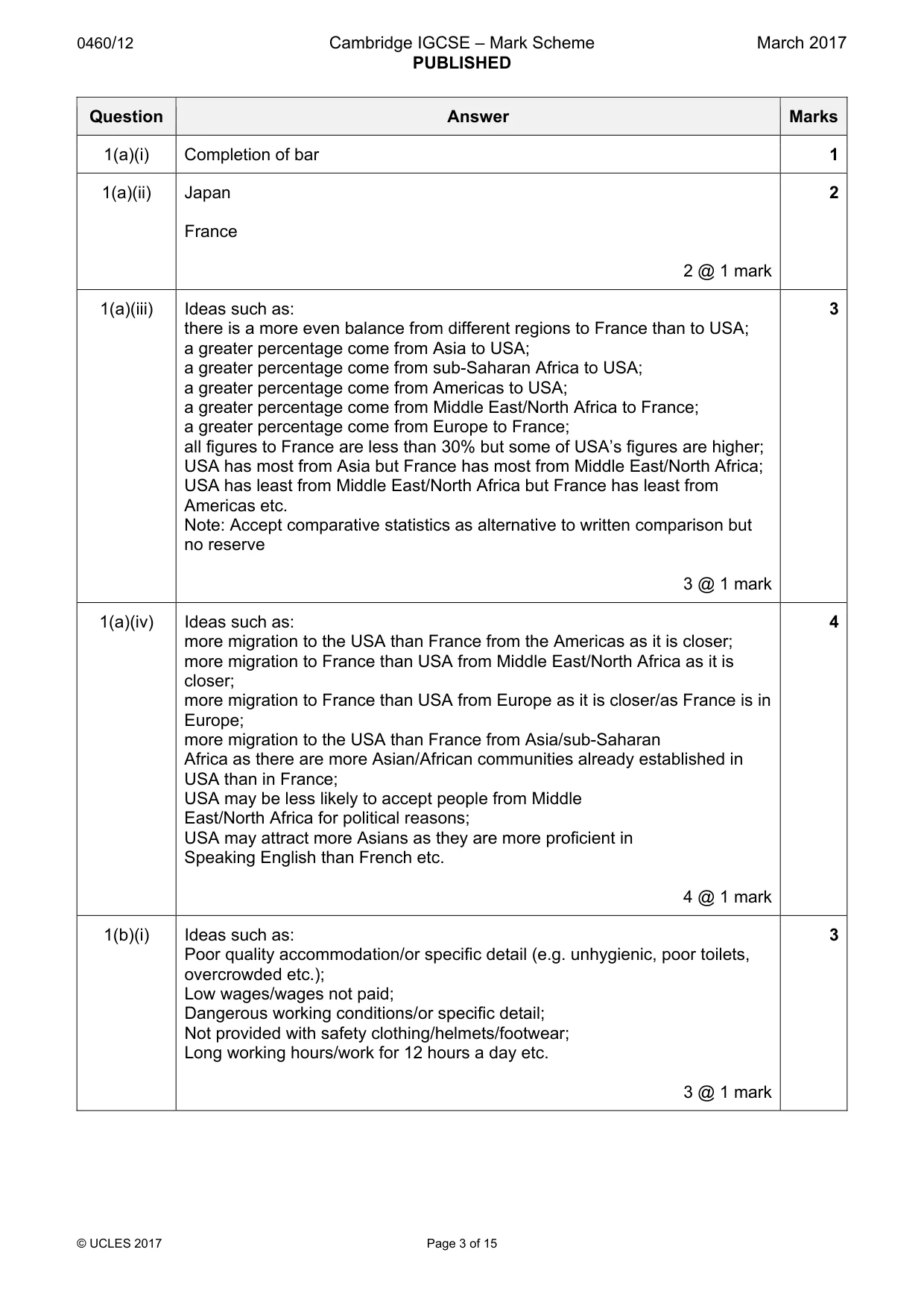
0460/12 Cambridge IGCSE – Mark Scheme PUBLISHED March 2017 © UCLES 2017 Page 3 of 15 Question Answer Marks 1(a)(i) Completion of bar 1 1(a)(ii) Japan France 2 @ 1 mark 2 1(a)(iii) Ideas such as: there is a more even balance from different regions to France than to USA; a greater percentage come from Asia to USA; a greater percentage come from sub-Saharan Africa to USA; a greater percentage come from Americas to USA; a greater percentage come from Middle East/North Africa to France; a greater percentage come from Europe to France; all figures to France are less than 30% but some of USA’s figures are higher; USA has most from Asia but France has most from Middle East/North Africa; USA has least from Middle East/North Africa but France has least from Americas etc. Note: Accept comparative statistics as alternative to written comparison but no reserve 3 @ 1 mark 3 1(a)(iv) Ideas such as: more migration to the USA than France from the Americas as it is closer; more migration to France than USA from Middle East/North Africa as it is closer; more migration to France than USA from Europe as it is closer/as France is in Europe; more migration to the USA than France from Asia/sub-Saharan Africa as there are more Asian/African communities already established in USA than in France; USA may be less likely to accept people from Middle East/North Africa for political reasons; USA may attract more Asians as they are more proficient in Speaking English than French etc. 4 @ 1 mark 4 1(b)(i) Ideas such as: Poor quality accommodation/or specific detail (e.g. unhygienic, poor toilets, overcrowded etc.); Low wages/wages not paid; Dangerous working conditions/or specific detail; Not provided with safety clothing/helmets/footwear; Long working hours/work for 12 hours a day etc. 3 @ 1 mark 3
Mark scheme, page 4
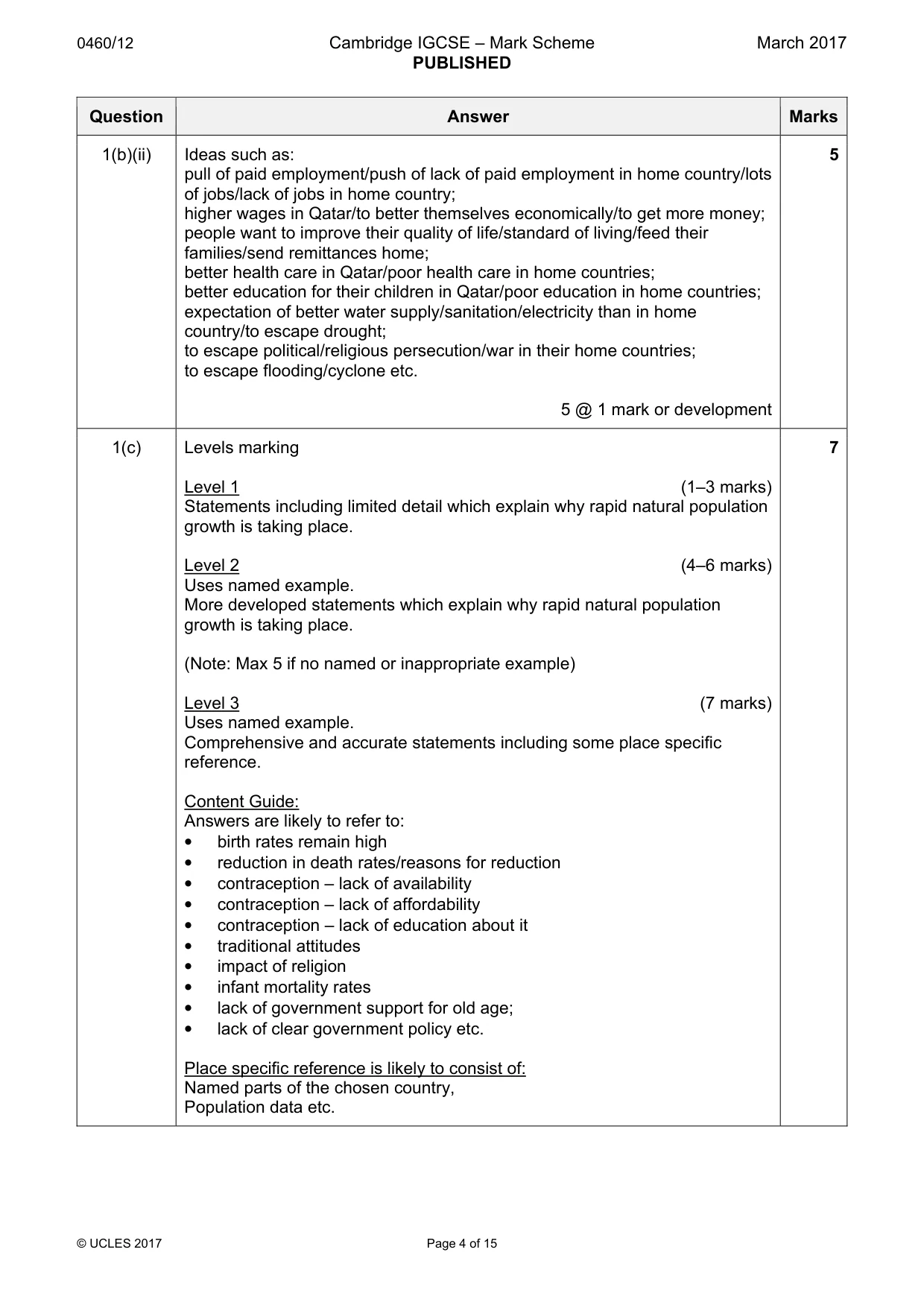
0460/12 Cambridge IGCSE – Mark Scheme PUBLISHED March 2017 © UCLES 2017 Page 4 of 15 Question Answer Marks 1(b)(ii) Ideas such as: pull of paid employment/push of lack of paid employment in home country/lots of jobs/lack of jobs in home country; higher wages in Qatar/to better themselves economically/to get more money; people want to improve their quality of life/standard of living/feed their families/send remittances home; better health care in Qatar/poor health care in home countries; better education for their children in Qatar/poor education in home countries; expectation of better water supply/sanitation/electricity than in home country/to escape drought; to escape political/religious persecution/war in their home countries; to escape flooding/cyclone etc. 5 @ 1 mark or development 5 1(c) Levels marking Level 1 (1–3 marks) Statements including limited detail which explain why rapid natural population growth is taking place. Level 2 (4–6 marks) Uses named example. More developed statements which explain why rapid natural population growth is taking place. (Note: Max 5 if no named or inappropriate example) Level 3 (7 marks) Uses named example. Comprehensive and accurate statements including some place specific reference. Content Guide: Answers are likely to refer to: • birth rates remain high • reduction in death rates/reasons for reduction • contraception – lack of availability • contraception – lack of affordability • contraception – lack of education about it • traditional attitudes • impact of religion • infant mortality rates • lack of government support for old age; • lack of clear government policy etc. Place specific reference is likely to consist of: Named parts of the chosen country, Population data etc. 7
Mark scheme, page 5
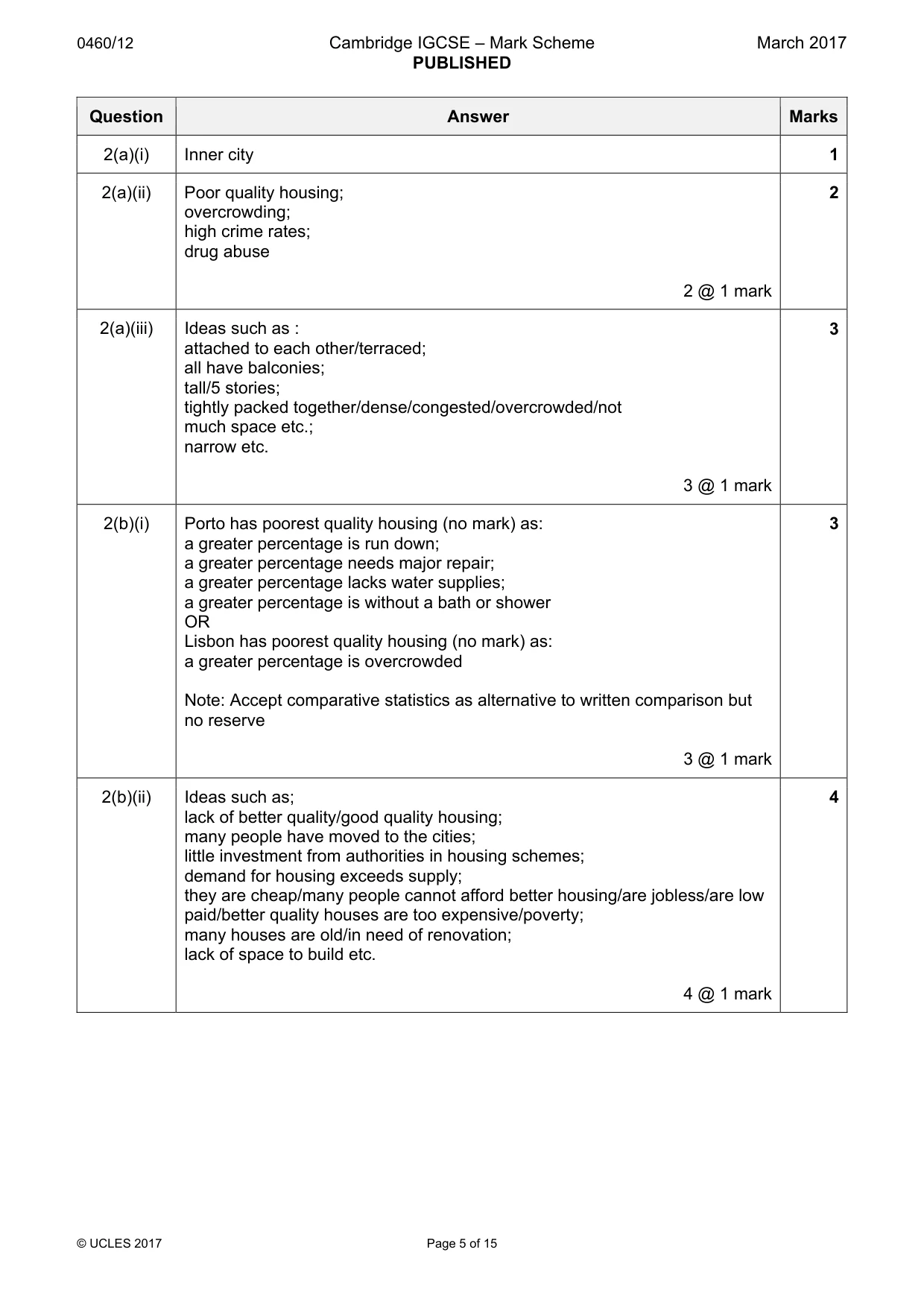
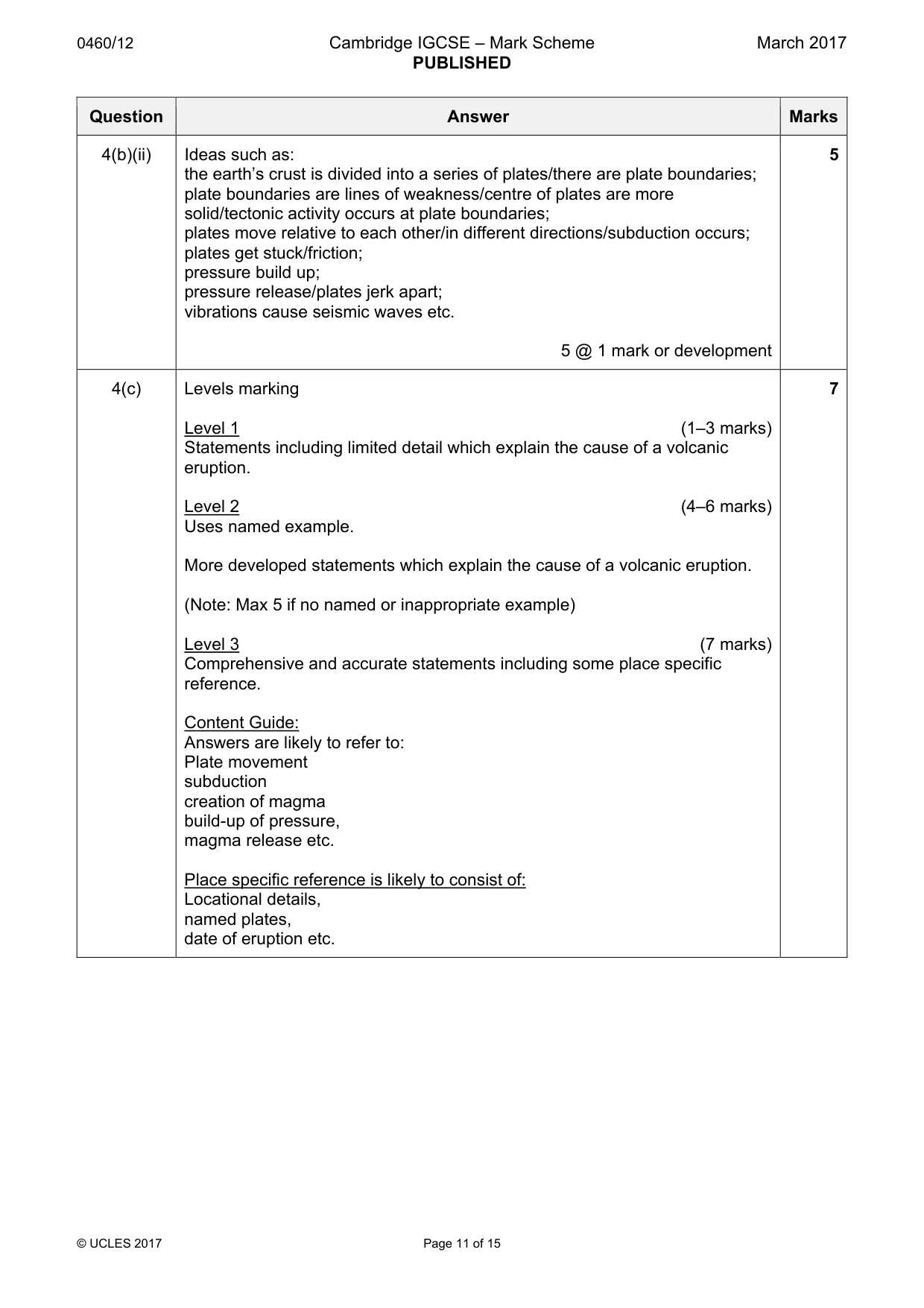
0460/12 Cambridge IGCSE – Mark Scheme PUBLISHED March 2017 © UCLES 2017 Page 5 of 15 Question Answer Marks 2(a)(i) Inner city 1 2(a)(ii) Poor quality housing; overcrowding; high crime rates; drug abuse 2 @ 1 mark 2 2(a)(iii) Ideas such as : attached to each other/terraced; all have balconies; tall/5 stories; tightly packed together/dense/congested/overcrowded/not much space etc.; narrow etc. 3 @ 1 mark 3 2(b)(i) Porto has poorest quality housing (no mark) as: a greater percentage is run down; a greater percentage needs major repair; a greater percentage lacks water supplies; a greater percentage is without a bath or shower OR Lisbon has poorest quality housing (no mark) as: a greater percentage is overcrowded Note: Accept comparative statistics as alternative to written comparison but no reserve 3 @ 1 mark 3 2(b)(ii) Ideas such as; lack of better quality/good quality housing; many people have moved to the cities; little investment from authorities in housing schemes; demand for housing exceeds supply; they are cheap/many people cannot afford better housing/are jobless/are low paid/better quality houses are too expensive/poverty; many houses are old/in need of renovation; lack of space to build etc. 4 @ 1 mark 4
Mark scheme, page 6
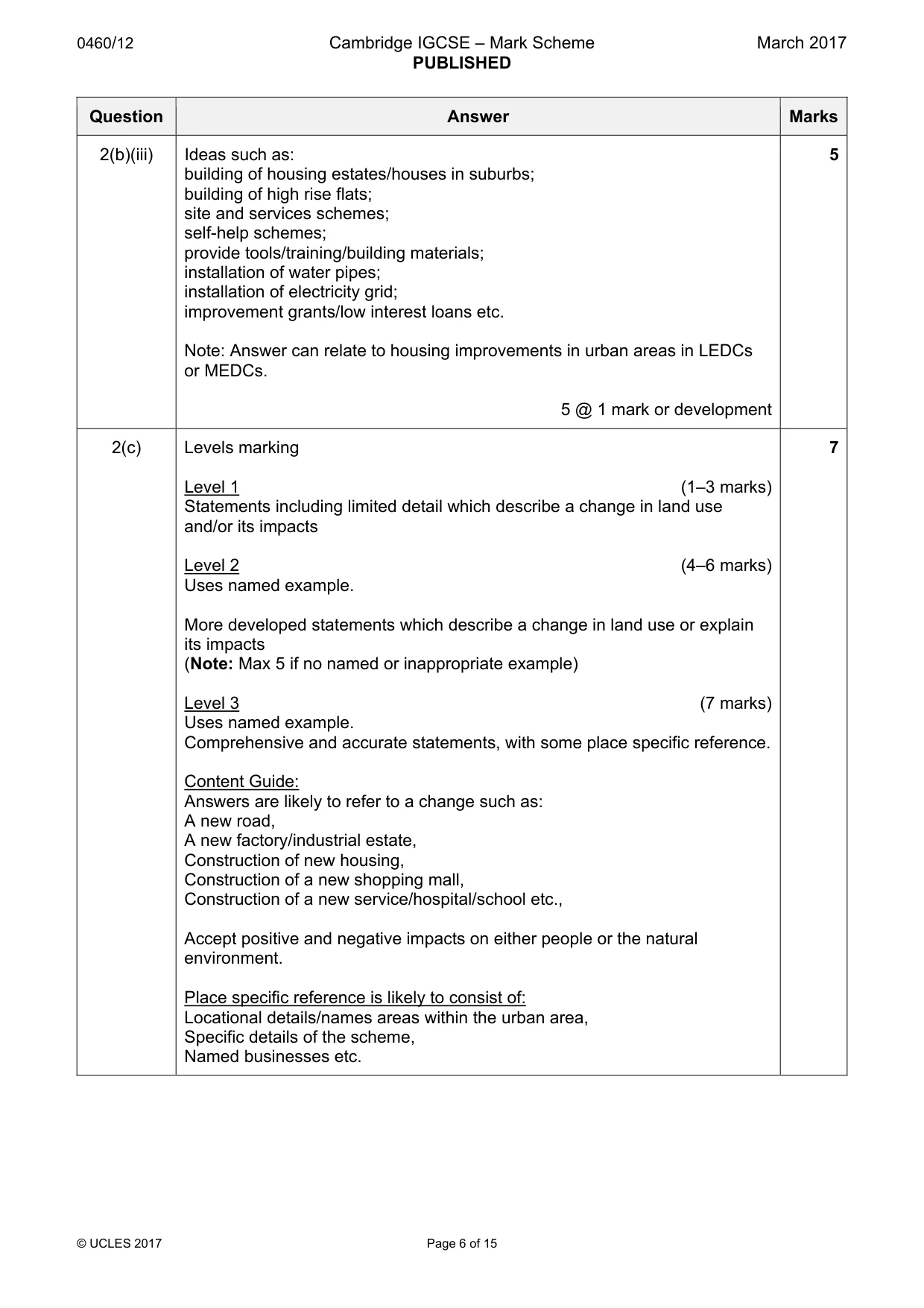
0460/12 Cambridge IGCSE – Mark Scheme PUBLISHED March 2017 © UCLES 2017 Page 6 of 15 Question Answer Marks 2(b)(iii) Ideas such as: building of housing estates/houses in suburbs; building of high rise flats; site and services schemes; self-help schemes; provide tools/training/building materials; installation of water pipes; installation of electricity grid; improvement grants/low interest loans etc. Note: Answer can relate to housing improvements in urban areas in LEDCs or MEDCs. 5 @ 1 mark or development 5 2(c) Levels marking Level 1 (1–3 marks) Statements including limited detail which describe a change in land use and/or its impacts Level 2 (4–6 marks) Uses named example. More developed statements which describe a change in land use or explain its impacts (Note: Max 5 if no named or inappropriate example) Level 3 (7 marks) Uses named example. Comprehensive and accurate statements, with some place specific reference. Content Guide: Answers are likely to refer to a change such as: A new road, A new factory/industrial estate, Construction of new housing, Construction of a new shopping mall, Construction of a new service/hospital/school etc., Accept positive and negative impacts on either people or the natural environment. Place specific reference is likely to consist of: Locational details/names areas within the urban area, Specific details of the scheme, Named businesses etc. 7
Mark scheme, page 7
0460/12 Cambridge IGCSE – Mark Scheme PUBLISHED March 2017 © UCLES 2017 Page 7 of 15 Question Answer Marks 3(a)(i) An area of land drained by a river 1 3(a)(ii) More lower/flatter land at X; More tributaries have joined by X; The river is larger/more discharge at X 2 @ 1 mark 2 3(a)(iii) Ideas such as: drowning; damage to/need to repair homes/buildings; damage to/need to repair specific building (e.g. school, hospital etc.); damage to/need to repair roads/railways/communications; businesses/factories/shops damaged; loss of production/people without work; damage to possessions/cars; damage to/destruction of crops/food supply/famine; loss of livestock; diseases; contamination of water; loss of electricity supply etc. 3 @ 1 mark 3 3(a)(iv) Ideas such as: warning usually given before flooding ; people have time to evacuate; people are able to take precautions or example; soils are fertile/high yields can be produced/they provide good grassland for grazing; irrigation; rivers provide a water supply; food supply/fishing; rivers can be used for transport; flooding is infrequent; their jobs are nearby; flooding can be prevented; emotional attachment/lived there all their lives; near friends/family; population pressure/high population density; flat land for building/agriculture/roads etc. 4 @ 1 mark 4
Mark scheme, page 8
0460/12 Cambridge IGCSE – Mark Scheme PUBLISHED March 2017 © UCLES 2017 Page 8 of 15 Question Answer Marks 3(b)(i) Ideas such as: Bend/curved shape; variation in speed of flow across channel/faster on outside/slower on inside; variation of depth across channel/deeper on outside/shallower on inside; river cliff/steep bank/undercutting; slip off slope/point bar/deposition of pebbles/deposited material etc. 3 @ 1 mark 3 3(b)(ii) Ideas such as: there will be areas of both fast and slow flowing water/different speeds of flow within channel/river; fast flow on outer bend; where water is deeper; helicoidal flow (dev) so erosion/undercutting occurs on outer bend; by hydraulic action/abrasion (dev) slow flow on inner bend; where there is more friction; results in deposition/river unable to carry load (dev) etc. 5 @ 1 mark or development 5
Mark scheme, page 9
0460/12 Cambridge IGCSE – Mark Scheme PUBLISHED March 2017 © UCLES 2017 Page 9 of 15 Question Answer Marks 3(c) Levels marking Level 1 (1–3 marks) Statements including limited detail which describe what has been done to reduce the risk of flooding. Level 2 (4–6 marks) Uses named example. More developed statements which describe what has been done to reduce the risk of flooding. (Note: Max 5 if no named or inappropriate example) Level 3 (7 marks) Uses named example. Comprehensive and accurate statements including some place specific reference. Content Guide: Answers are likely to refer to: Dams/reservoirs Levees Overflow/flood relief channels Dredging, Afforestation, Warnings, Evacuation plan, Flood gates etc. Place specific reference is likely to consist of: Locational details, named places along the river or within its basin, specific details of schemes etc. 7
Mark scheme, page 10
0460/12 Cambridge IGCSE – Mark Scheme PUBLISHED March 2017 © UCLES 2017 Page 10 of 15 Question Answer Marks 4(a)(i) The shaking of the ground caused by sudden movement of the Earth’s crust 1 4(a)(ii) X = epicentre Y = focus 2 @ 1 mark 2 4(a)(iii) Ideas such as: death from falling buildings/crushing; damage to/need to repair homes/buildings/people are homeless; damage to/need to repair specific building (e.g. school, hospital etc.); damage to/need to repair roads/railways/communications/bridges; businesses/factories/shops damaged; fire; loss of water/electricity/gas supply; loss of production/less economic activity (or example e.g. tourism)/loss of jobs; damage to possessions/cars; disease; could cause a tsunami which would cause flooding etc. 3 @ 1 mark 3 4(a)(iv) Strategies such as: building ‘earthquake proof’/stronger buildings; build lower buildings; emergency/evacuation planning; earthquake drills; education about what to do in an earthquake; do not build public buildings on fault lines etc. lubrication of fault lines; tsunami warning system etc. 1 mark for each simple statement identifying a strategy and a second mark for an explanation – E.g. 1. build earthquake proof buildings (1) with pyramid shaped so that they do not easily collapse (2). E.g. 2 display posters on walls in schools (1) so that students will learn what to do if an earthquake occurs (2) 4 @ 1 mark 4 4(b)(i) Ideas such as: in lines; (mainly) along/near plate boundaries; A few in middle of plates; (Pacific) Ring of Fire/West coast of Americas/Mediterranean/south east Asia/around Pacific (MAX 2) 3 or more correct countries (MAX 1) etc. 3 @ 1 mark 3
Mark scheme, page 11
0460/12 Cambridge IGCSE – Mark Scheme PUBLISHED March 2017 © UCLES 2017 Page 11 of 15 Question Answer Marks 4(b)(ii) Ideas such as: the earth’s crust is divided into a series of plates/there are plate boundaries; plate boundaries are lines of weakness/centre of plates are more solid/tectonic activity occurs at plate boundaries; plates move relative to each other/in different directions/subduction occurs; plates get stuck/friction; pressure build up; pressure release/plates jerk apart; vibrations cause seismic waves etc. 5 @ 1 mark or development 5 4(c) Levels marking Level 1 (1–3 marks) Statements including limited detail which explain the cause of a volcanic eruption. Level 2 (4–6 marks) Uses named example. More developed statements which explain the cause of a volcanic eruption. (Note: Max 5 if no named or inappropriate example) Level 3 (7 marks) Comprehensive and accurate statements including some place specific reference. Content Guide: Answers are likely to refer to: Plate movement subduction creation of magma build-up of pressure, magma release etc. Place specific reference is likely to consist of: Locational details, named plates, date of eruption etc. 7
Mark scheme, page 12
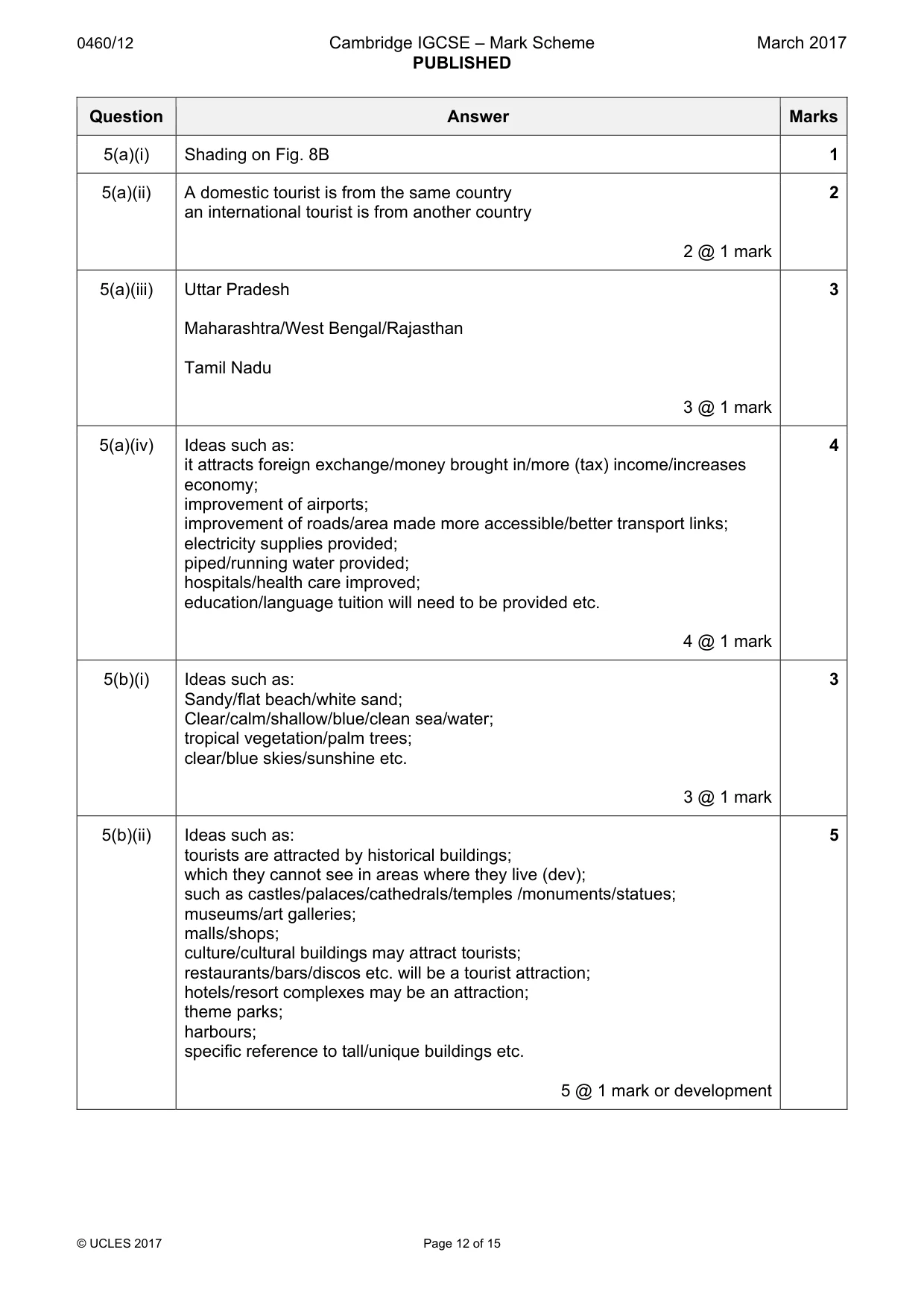
0460/12 Cambridge IGCSE – Mark Scheme PUBLISHED March 2017 © UCLES 2017 Page 12 of 15 Question Answer Marks 5(a)(i) Shading on Fig. 8B 1 5(a)(ii) A domestic tourist is from the same country an international tourist is from another country 2 @ 1 mark 2 5(a)(iii) Uttar Pradesh Maharashtra/West Bengal/Rajasthan Tamil Nadu 3 @ 1 mark 3 5(a)(iv) Ideas such as: it attracts foreign exchange/money brought in/more (tax) income/increases economy; improvement of airports; improvement of roads/area made more accessible/better transport links; electricity supplies provided; piped/running water provided; hospitals/health care improved; education/language tuition will need to be provided etc. 4 @ 1 mark 4 5(b)(i) Ideas such as: Sandy/flat beach/white sand; Clear/calm/shallow/blue/clean sea/water; tropical vegetation/palm trees; clear/blue skies/sunshine etc. 3 @ 1 mark 3 5(b)(ii) Ideas such as: tourists are attracted by historical buildings; which they cannot see in areas where they live (dev); such as castles/palaces/cathedrals/temples /monuments/statues; museums/art galleries; malls/shops; culture/cultural buildings may attract tourists; restaurants/bars/discos etc. will be a tourist attraction; hotels/resort complexes may be an attraction; theme parks; harbours; specific reference to tall/unique buildings etc. 5 @ 1 mark or development 5
Mark scheme, page 13
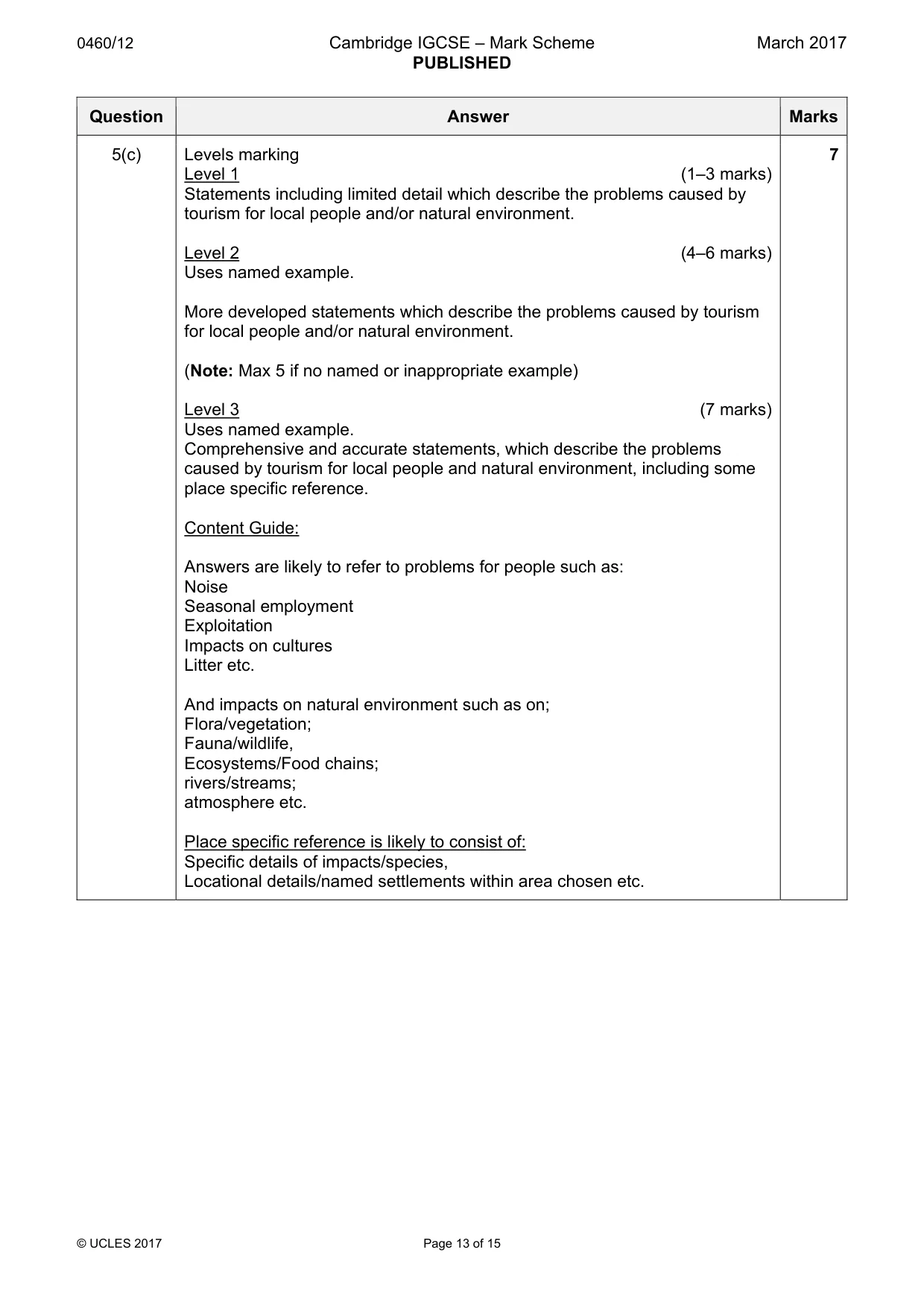
0460/12 Cambridge IGCSE – Mark Scheme PUBLISHED March 2017 © UCLES 2017 Page 13 of 15 Question Answer Marks 5(c) Levels marking Level 1 (1–3 marks) Statements including limited detail which describe the problems caused by tourism for local people and/or natural environment. Level 2 (4–6 marks) Uses named example. More developed statements which describe the problems caused by tourism for local people and/or natural environment. (Note: Max 5 if no named or inappropriate example) Level 3 (7 marks) Uses named example. Comprehensive and accurate statements, which describe the problems caused by tourism for local people and natural environment, including some place specific reference. Content Guide: Answers are likely to refer to problems for people such as: Noise Seasonal employment Exploitation Impacts on cultures Litter etc. And impacts on natural environment such as on; Flora/vegetation; Fauna/wildlife, Ecosystems/Food chains; rivers/streams; atmosphere etc. Place specific reference is likely to consist of: Specific details of impacts/species, Locational details/named settlements within area chosen etc. 7
Mark scheme, page 14
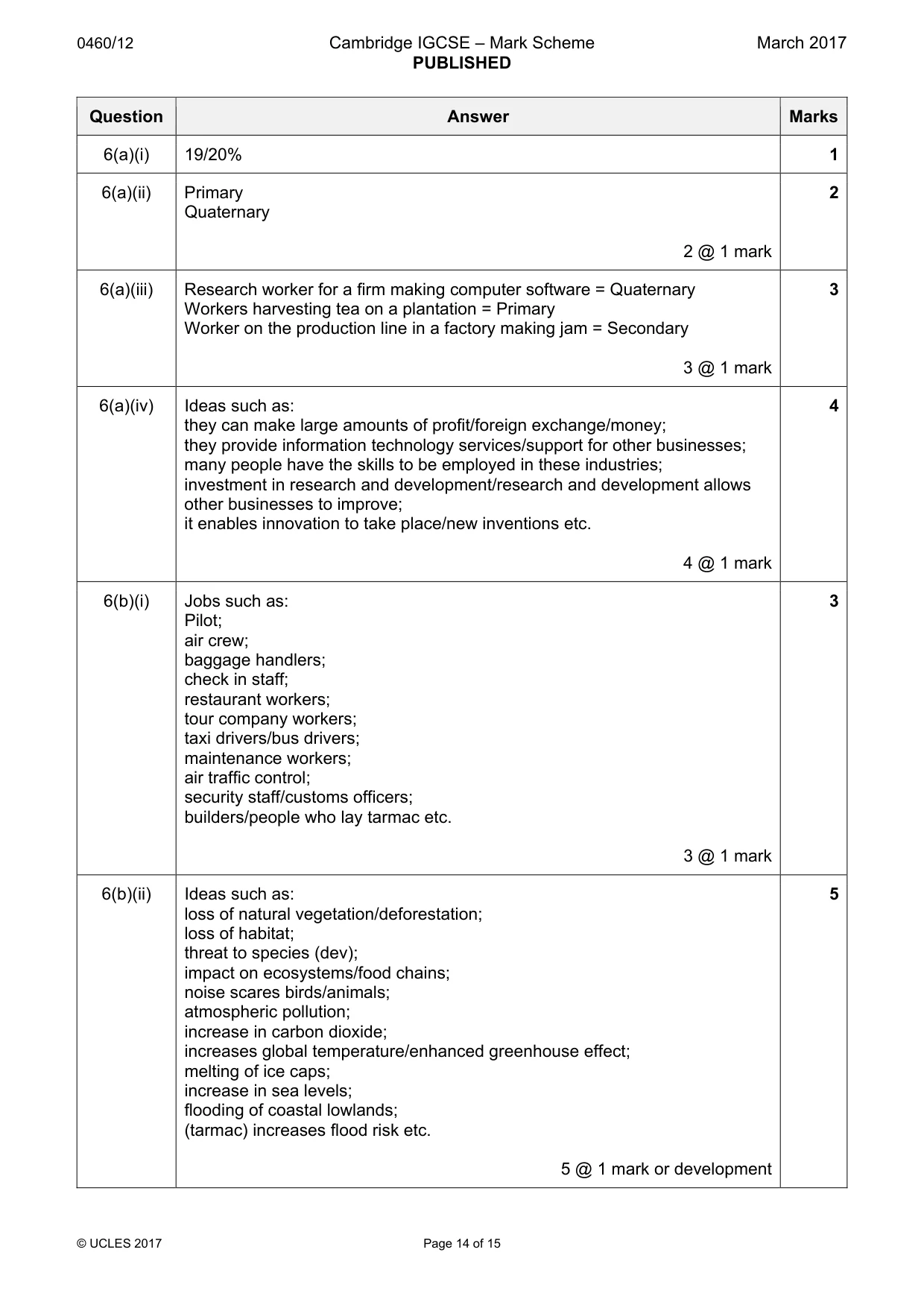
0460/12 Cambridge IGCSE – Mark Scheme PUBLISHED March 2017 © UCLES 2017 Page 14 of 15 Question Answer Marks 6(a)(i) 19/20% 1 6(a)(ii) Primary Quaternary 2 @ 1 mark 2 6(a)(iii) Research worker for a firm making computer software = Quaternary Workers harvesting tea on a plantation = Primary Worker on the production line in a factory making jam = Secondary 3 @ 1 mark 3 6(a)(iv) Ideas such as: they can make large amounts of profit/foreign exchange/money; they provide information technology services/support for other businesses; many people have the skills to be employed in these industries; investment in research and development/research and development allows other businesses to improve; it enables innovation to take place/new inventions etc. 4 @ 1 mark 4 6(b)(i) Jobs such as: Pilot; air crew; baggage handlers; check in staff; restaurant workers; tour company workers; taxi drivers/bus drivers; maintenance workers; air traffic control; security staff/customs officers; builders/people who lay tarmac etc. 3 @ 1 mark 3 6(b)(ii) Ideas such as: loss of natural vegetation/deforestation; loss of habitat; threat to species (dev); impact on ecosystems/food chains; noise scares birds/animals; atmospheric pollution; increase in carbon dioxide; increases global temperature/enhanced greenhouse effect; melting of ice caps; increase in sea levels; flooding of coastal lowlands; (tarmac) increases flood risk etc. 5 @ 1 mark or development 5
Mark scheme, page 15
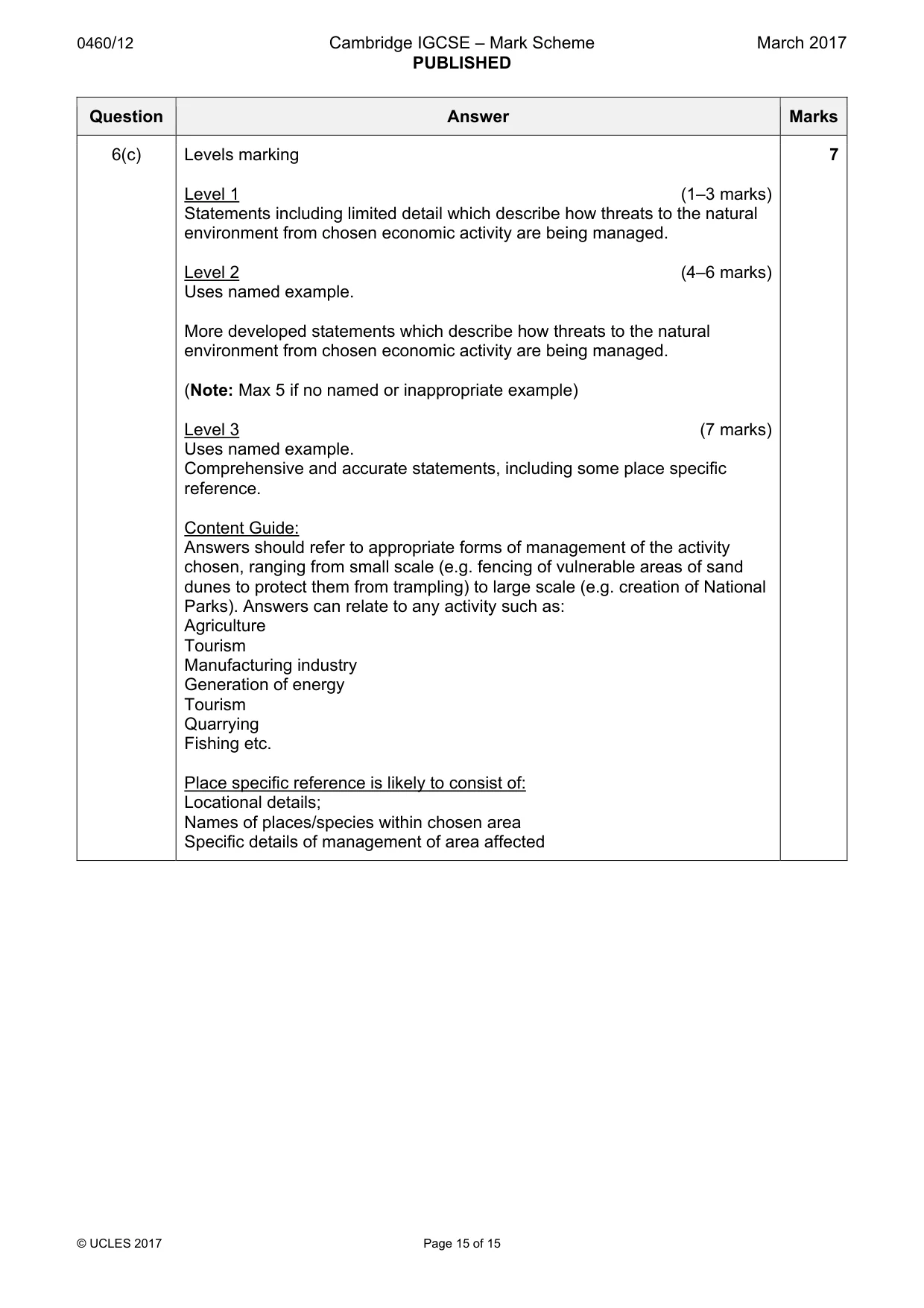
0460/12 Cambridge IGCSE – Mark Scheme PUBLISHED March 2017 © UCLES 2017 Page 15 of 15 Question Answer Marks 6(c) Levels marking Level 1 (1–3 marks) Statements including limited detail which describe how threats to the natural environment from chosen economic activity are being managed. Level 2 (4–6 marks) Uses named example. More developed statements which describe how threats to the natural environment from chosen economic activity are being managed. (Note: Max 5 if no named or inappropriate example) Level 3 (7 marks) Uses named example. Comprehensive and accurate statements, including some place specific reference. Content Guide: Answers should refer to appropriate forms of management of the activity chosen, ranging from small scale (e.g. fencing of vulnerable areas of sand dunes to protect them from trampling) to large scale (e.g. creation of National Parks). Answers can relate to any activity such as: Agriculture Tourism Manufacturing industry Generation of energy Tourism Quarrying Fishing etc. Place specific reference is likely to consist of: Locational details; Names of places/species within chosen area Specific details of management of area affected 7
What you needed in this session
Cambridge’s own grade thresholds for 2017 Feb/March, Paper 1 · Variant 2. A higher threshold means an easier paper — the bar moves with how the cohort did.