Cambridge IGCSE French - Foreign Language 0520 — 2019 Feb/March Paper 1 · Variant 2
0520/12/F/M/19 · 45 marks · ≈51 min
The question paper and its mark scheme, free to read here and free to download. This is Cambridge’s own paper, exactly as it was sat.
Question paper12 pages

Mark scheme14 pages
Answers below. Sit the paper first if you are practising.
Paper as text
Question paper, page 1
This document consists of 11 printed pages and 1 blank page. DC (JM/TP) 164158/2 © UCLES 2019 [Turn over * 2 2 3 9 2 1 8 5 0 9 * This syllabus is regulated for use in England, Wales and Northern Ireland as a Cambridge International Level 1/Level 2 Certificate. Cambridge Assessment International Education Cambridge International General Certificate of Secondary Education FRENCH 0520/12 Paper 1 Listening February/March 2019 Approx. 45 minutes Candidates answer on the Question Paper. No Additional Materials are required. READ THESE INSTRUCTIONS FIRST Write your centre number, candidate number and name in the spaces at the top of this page. Write in dark blue or black pen. Do not use staples, paper clips, glue or correction fluid. DO NOT WRITE IN ANY BARCODES. Answer all questions. The number of marks is given in brackets [ ] at the end of each question or part question.
Question paper, page 2
2 0520/12/F/M/19 © UCLES 2019 BLANK PAGE
Question paper, page 3
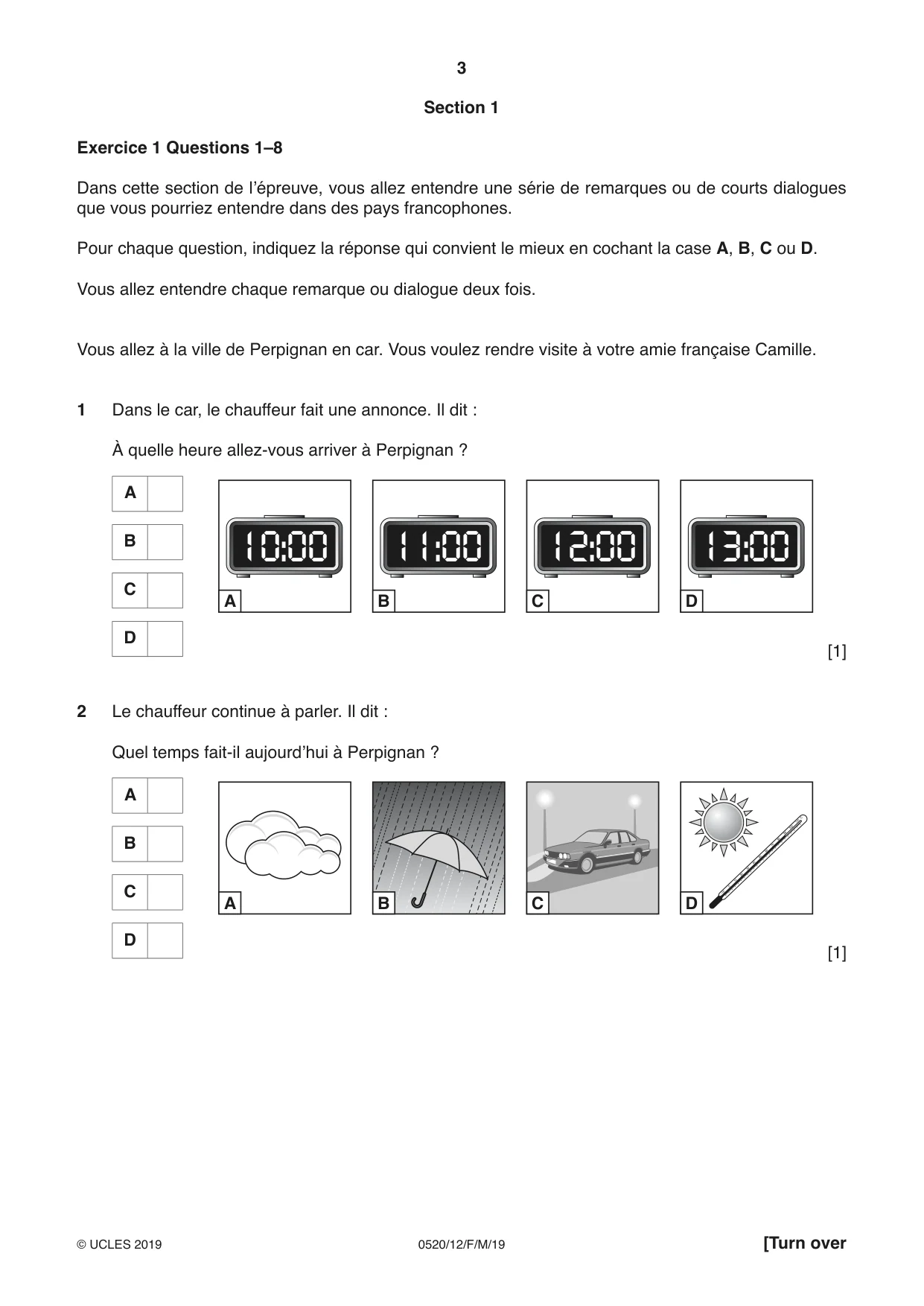
3 0520/12/F/M/19 © UCLES 2019 [Turn over Section 1 Exercice 1 Questions 1–8 Dans cette section de l’épreuve, vous allez entendre une série de remarques ou de courts dialogues que vous pourriez entendre dans des pays francophones. Pour chaque question, indiquez la réponse qui convient le mieux en cochant la case A, B, C ou D. Vous allez entendre chaque remarque ou dialogue deux fois. Vous allez à la ville de Perpignan en car. Vous voulez rendre visite à votre amie française Camille. 1 Dans le car, le chauffeur fait une annonce. Il dit : À quelle heure allez-vous arriver à Perpignan ? A 10:00 11:00 12:00 13:00 A B C D [1] B C D 2 Le chauffeur continue à parler. Il dit : Quel temps fait-il aujourd’hui à Perpignan ? A A B C D [1] B C D
Question paper, page 4
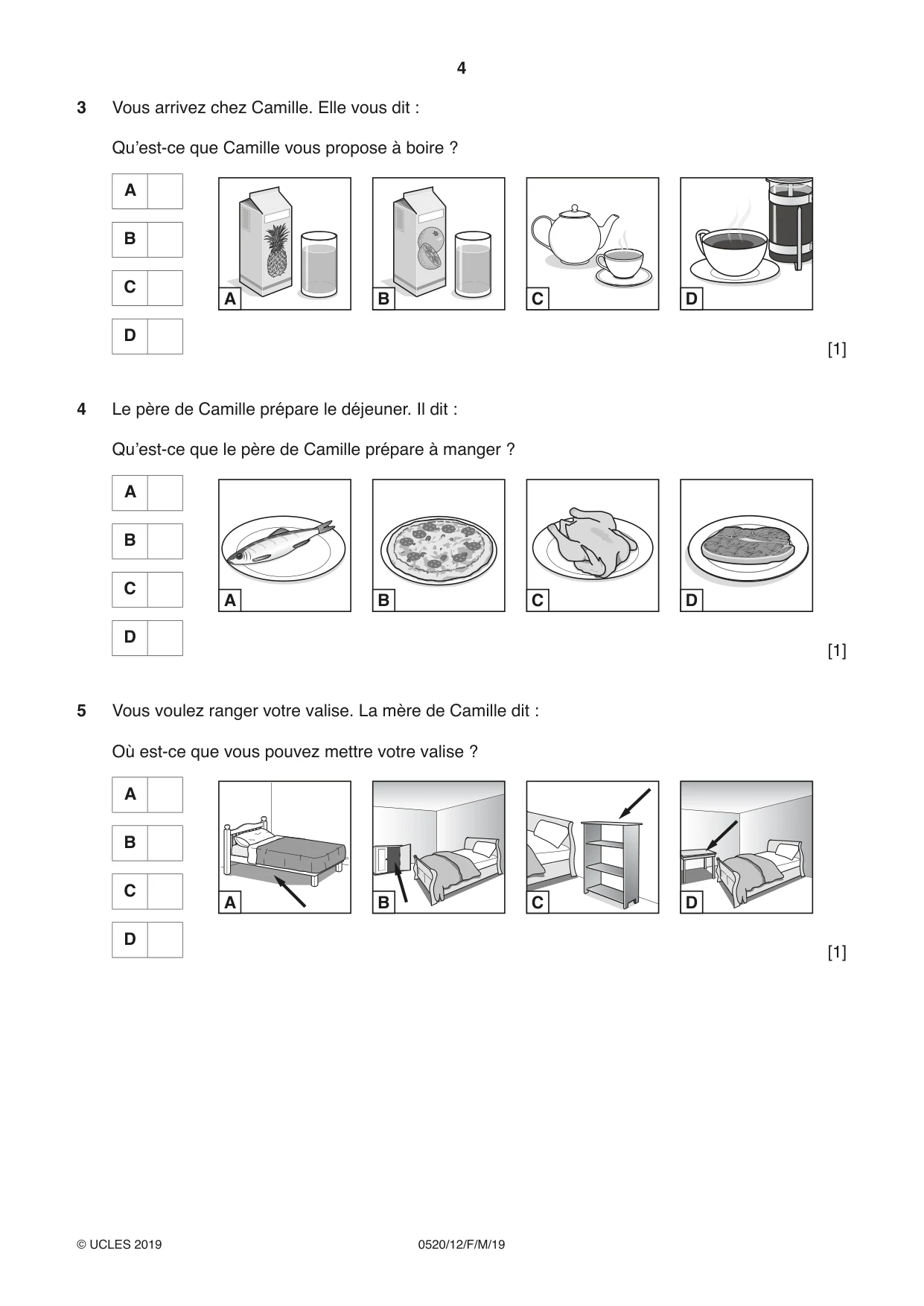
4 0520/12/F/M/19 © UCLES 2019 3 Vous arrivez chez Camille. Elle vous dit : Qu’est-ce que Camille vous propose à boire ? A A B C D [1] B C D 4 Le père de Camille prépare le déjeuner. Il dit : Qu’est-ce que le père de Camille prépare à manger ? A A B C D [1] B C D 5 Vous voulez ranger votre valise. La mère de Camille dit : Où est-ce que vous pouvez mettre votre valise ? A A B C D [1] B C D
Question paper, page 5
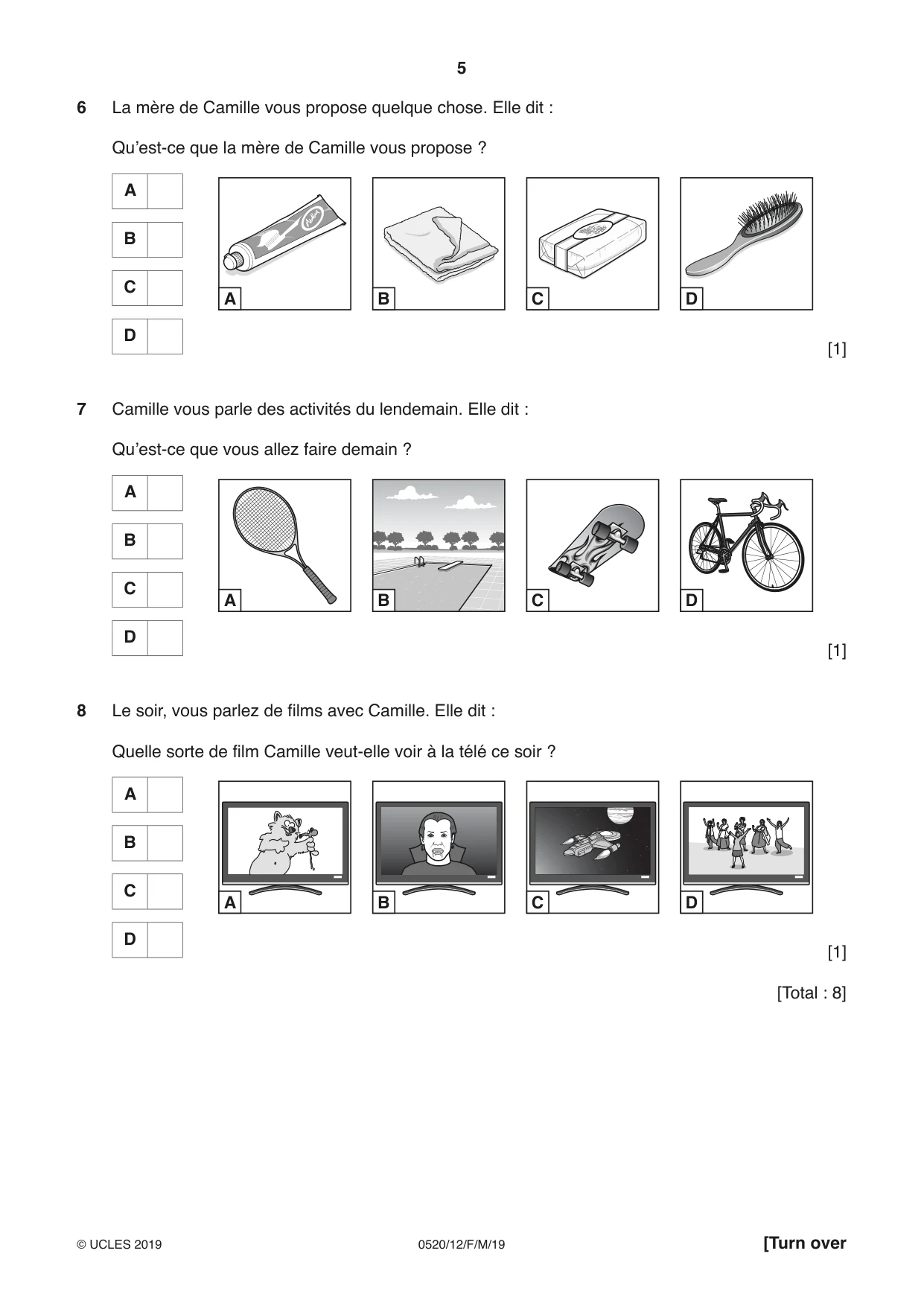
5 0520/12/F/M/19 © UCLES 2019 [Turn over 6 La mère de Camille vous propose quelque chose. Elle dit : Qu’est-ce que la mère de Camille vous propose ? A A B C D [1] B C D 7 Camille vous parle des activités du lendemain. Elle dit : Qu’est-ce que vous allez faire demain ? A A B C D [1] B C D 8 Le soir, vous parlez de films avec Camille. Elle dit : Quelle sorte de film Camille veut-elle voir à la télé ce soir ? A A B C D [1] B C D [Total : 8]
Question paper, page 6
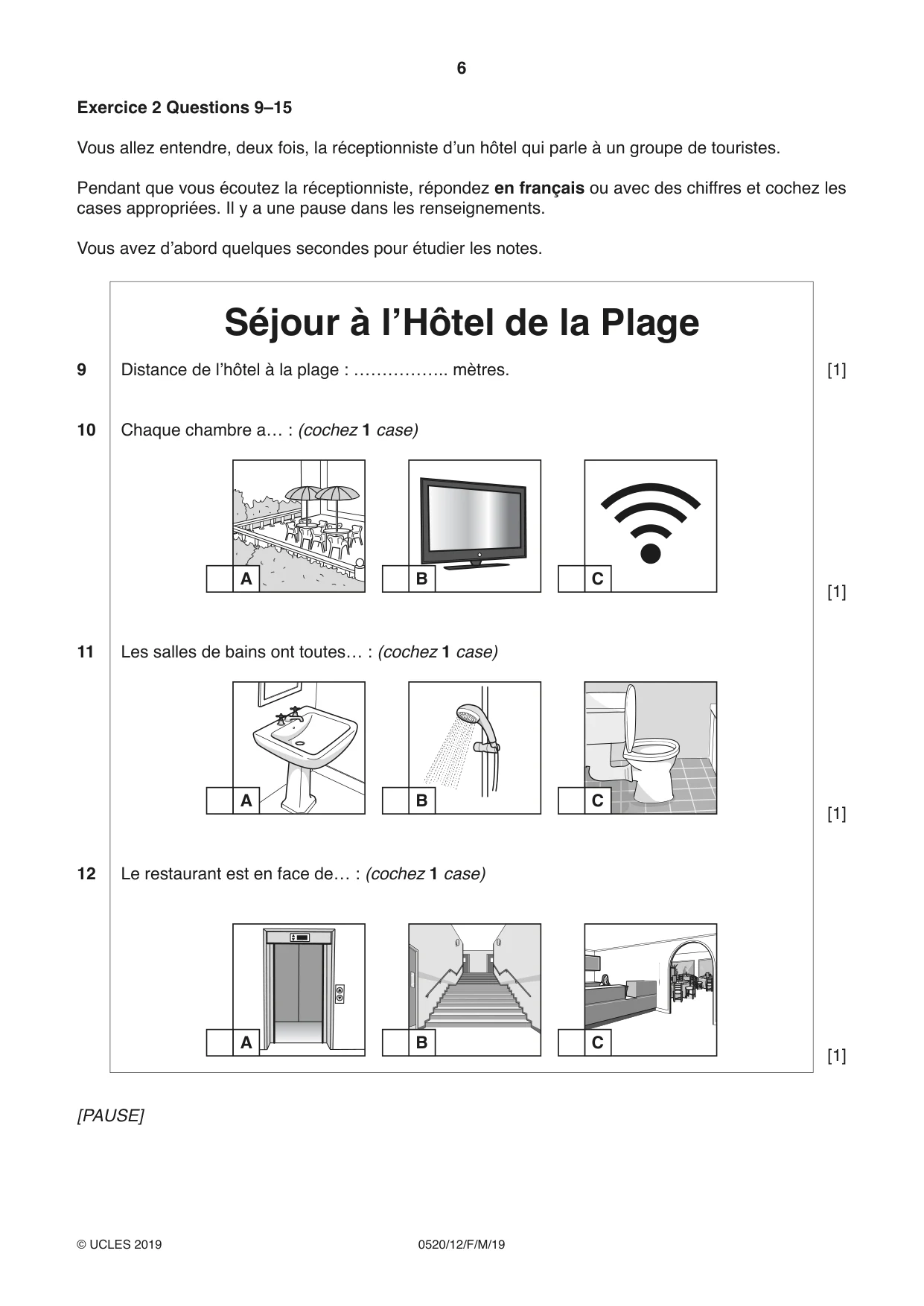
6 0520/12/F/M/19 © UCLES 2019 Exercice 2 Questions 9–15 Vous allez entendre, deux fois, la réceptionniste d’un hôtel qui parle à un groupe de touristes. Pendant que vous écoutez la réceptionniste, répondez en français ou avec des chiffres et cochez les cases appropriées. Il y a une pause dans les renseignements. Vous avez d’abord quelques secondes pour étudier les notes. Séjour à l’Hôtel de la Plage 9 Distance de l’hôtel à la plage : …………….. mètres. [1] 10 Chaque chambre a… : (cochez 1 case) A B C [1] 11 Les salles de bains ont toutes… : (cochez 1 case) A B C [1] 12 Le restaurant est en face de… : (cochez 1 case) A B C [1] [PAUSE]
Question paper, page 7
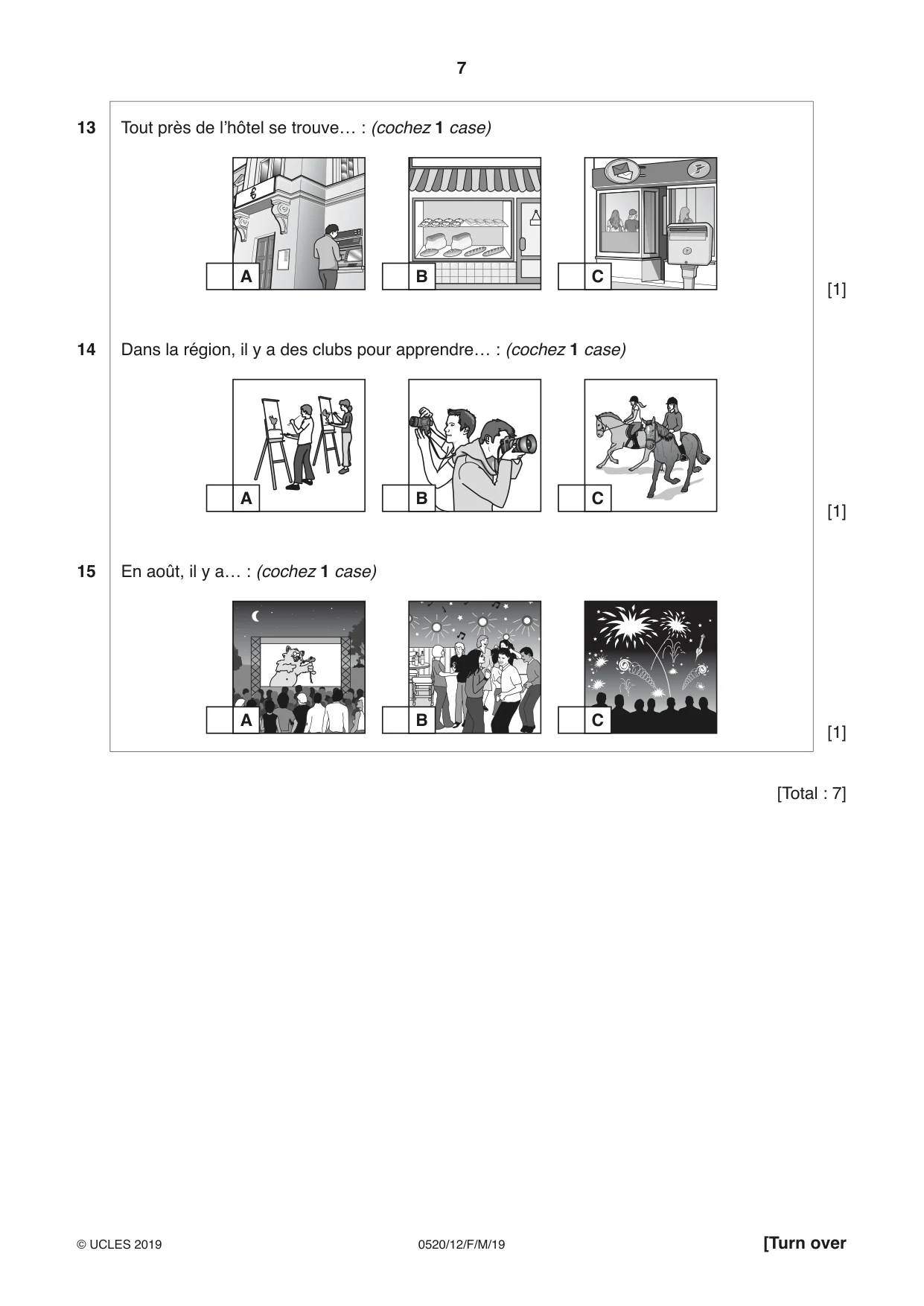
7 0520/12/F/M/19 © UCLES 2019 [Turn over 13 Tout près de l’hôtel se trouve… : (cochez 1 case) B A B C [1] 14 Dans la région, il y a des clubs pour apprendre… : (cochez 1 case) A B C [1] 15 En août, il y a… : (cochez 1 case) A B C [1] [Total : 7]
Question paper, page 8
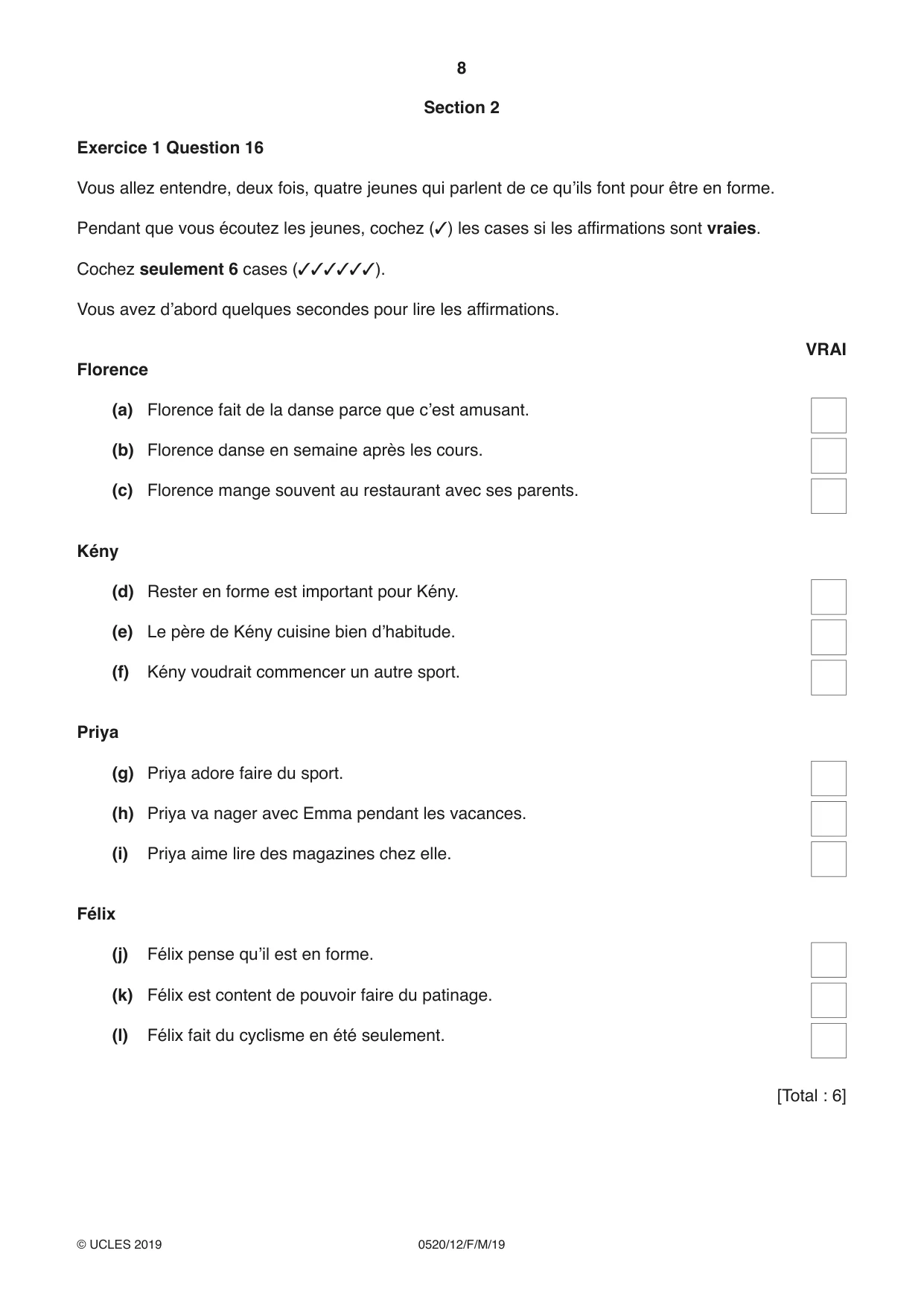
8 0520/12/F/M/19 © UCLES 2019 Section 2 Exercice 1 Question 16 Vous allez entendre, deux fois, quatre jeunes qui parlent de ce qu’ils font pour être en forme. Pendant que vous écoutez les jeunes, cochez (✓) les cases si les affirmations sont vraies. Cochez seulement 6 cases (✓✓✓✓✓✓). Vous avez d’abord quelques secondes pour lire les affirmations. VRAI Florence (a) Florence fait de la danse parce que c’est amusant. (b) Florence danse en semaine après les cours. (c) Florence mange souvent au restaurant avec ses parents. Kény (d) Rester en forme est important pour Kény. (e) Le père de Kény cuisine bien d’habitude. (f) Kény voudrait commencer un autre sport. Priya (g) Priya adore faire du sport. (h) Priya va nager avec Emma pendant les vacances. (i) Priya aime lire des magazines chez elle. Félix (j) Félix pense qu’il est en forme. (k) Félix est content de pouvoir faire du patinage. (l) Félix fait du cyclisme en été seulement. [Total : 6]
Question paper, page 9
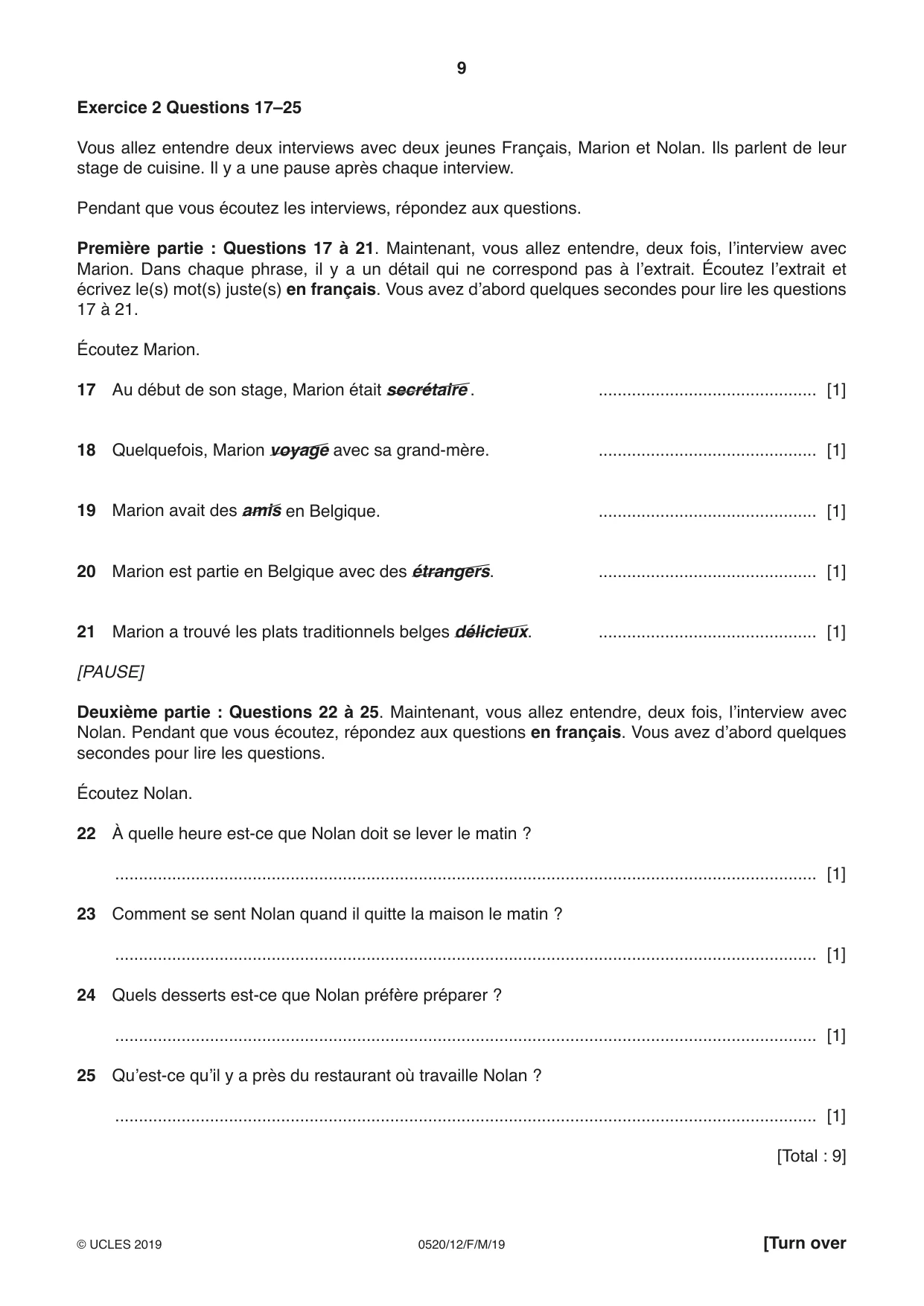
9 0520/12/F/M/19 © UCLES 2019 [Turn over Exercice 2 Questions 17–25 Vous allez entendre deux interviews avec deux jeunes Français, Marion et Nolan. Ils parlent de leur stage de cuisine. Il y a une pause après chaque interview. Pendant que vous écoutez les interviews, répondez aux questions. Première partie : Questions 17 à 21. Maintenant, vous allez entendre, deux fois, l’interview avec Marion. Dans chaque phrase, il y a un détail qui ne correspond pas à l’extrait. Écoutez l’extrait et écrivez le(s) mot(s) juste(s) en français. Vous avez d’abord quelques secondes pour lire les questions 17 à 21. Écoutez Marion. 17 Au début de son stage, Marion était secrétaire . … [1] 18 Quelquefois, Marion voyage avec sa grand-mère. … [1] 19 Marion avait des amis en Belgique. … [1] 20 Marion est partie en Belgique avec des étrangers. … [1] 21 Marion a trouvé les plats traditionnels belges délicieux. … [1] [PAUSE] Deuxième partie : Questions 22 à 25. Maintenant, vous allez entendre, deux fois, l’interview avec Nolan. Pendant que vous écoutez, répondez aux questions en français. Vous avez d’abord quelques secondes pour lire les questions. Écoutez Nolan. 22 À quelle heure est-ce que Nolan doit se lever le matin ? … [1] 23 Comment se sent Nolan quand il quitte la maison le matin ? … [1] 24 Quels desserts est-ce que Nolan préfère préparer ? … [1] 25 Qu’est-ce qu’il y a près du restaurant où travaille Nolan ? … [1] [Total : 9]
Question paper, page 10
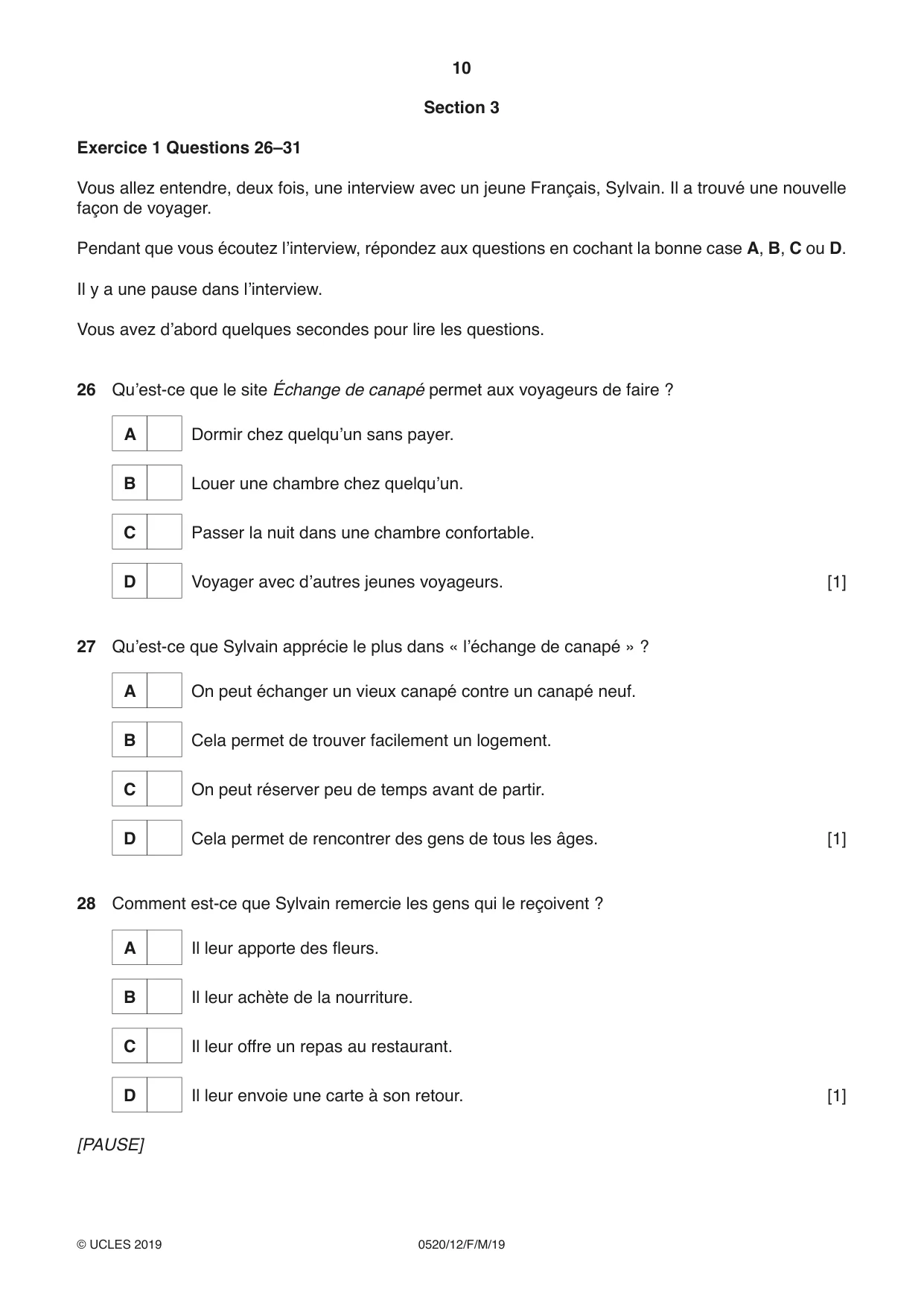
10 0520/12/F/M/19 © UCLES 2019 Section 3 Exercice 1 Questions 26–31 Vous allez entendre, deux fois, une interview avec un jeune Français, Sylvain. Il a trouvé une nouvelle façon de voyager. Pendant que vous écoutez l’interview, répondez aux questions en cochant la bonne case A, B, C ou D. Il y a une pause dans l’interview. Vous avez d’abord quelques secondes pour lire les questions. 26 Qu’est-ce que le site Échange de canapé permet aux voyageurs de faire ? A Dormir chez quelqu’un sans payer. B Louer une chambre chez quelqu’un. C Passer la nuit dans une chambre confortable. D Voyager avec d’autres jeunes voyageurs. [1] 27 Qu’est-ce que Sylvain apprécie le plus dans « l’échange de canapé » ? A On peut échanger un vieux canapé contre un canapé neuf. B Cela permet de trouver facilement un logement. C On peut réserver peu de temps avant de partir. D Cela permet de rencontrer des gens de tous les âges. [1] 28 Comment est-ce que Sylvain remercie les gens qui le reçoivent ? A Il leur apporte des fleurs. B Il leur achète de la nourriture. C Il leur offre un repas au restaurant. D Il leur envoie une carte à son retour. [1] [PAUSE]
Question paper, page 11
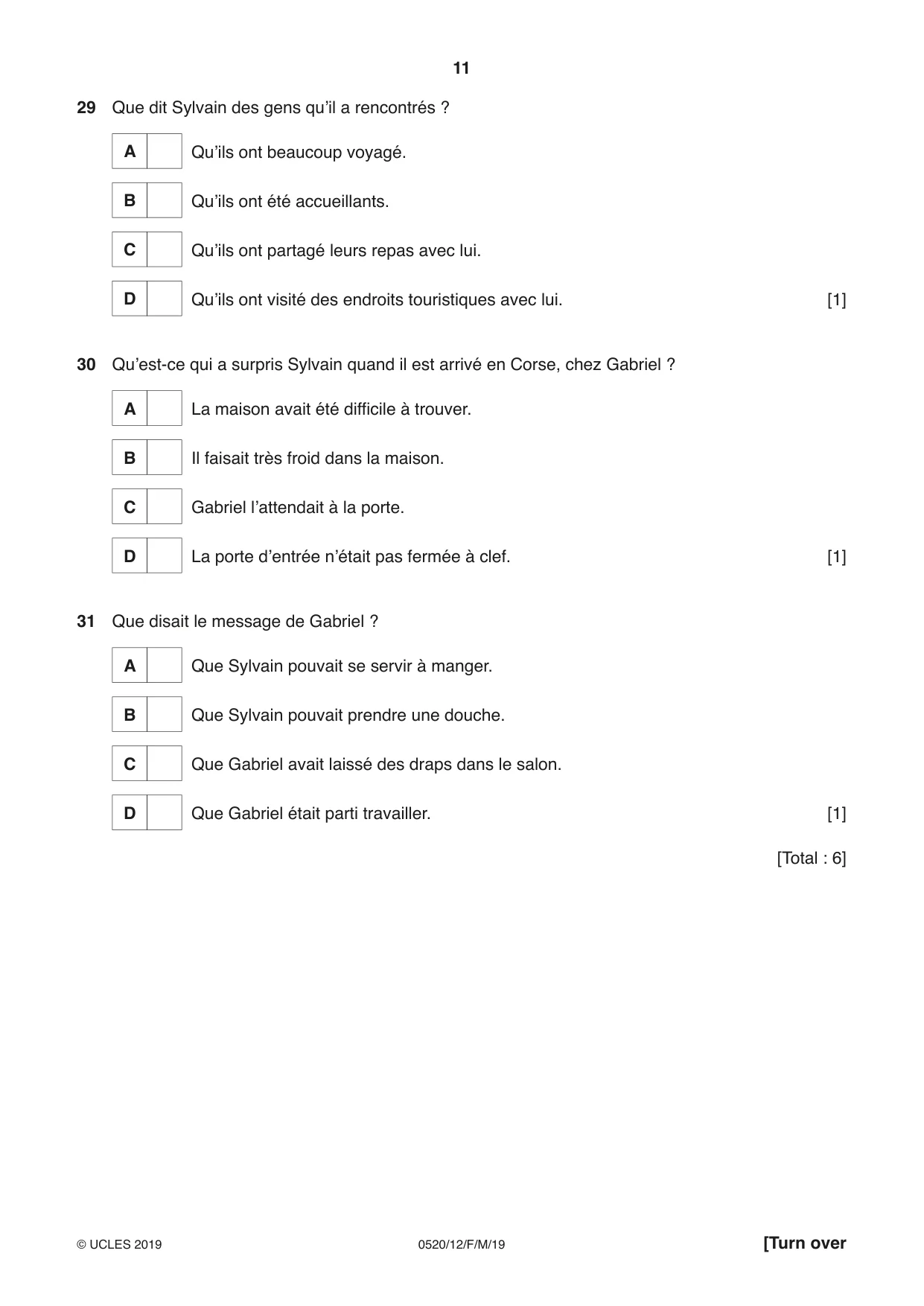
11 0520/12/F/M/19 © UCLES 2019 [Turn over 29 Que dit Sylvain des gens qu’il a rencontrés ? A Qu’ils ont beaucoup voyagé. B Qu’ils ont été accueillants. C Qu’ils ont partagé leurs repas avec lui. D Qu’ils ont visité des endroits touristiques avec lui. [1] 30 Qu’est-ce qui a surpris Sylvain quand il est arrivé en Corse, chez Gabriel ? A La maison avait été difficile à trouver. B Il faisait très froid dans la maison. C Gabriel l’attendait à la porte. D La porte d’entrée n’était pas fermée à clef. [1] 31 Que disait le message de Gabriel ? A Que Sylvain pouvait se servir à manger. B Que Sylvain pouvait prendre une douche. C Que Gabriel avait laissé des draps dans le salon. D Que Gabriel était parti travailler. [1] [Total : 6]
Question paper, page 12
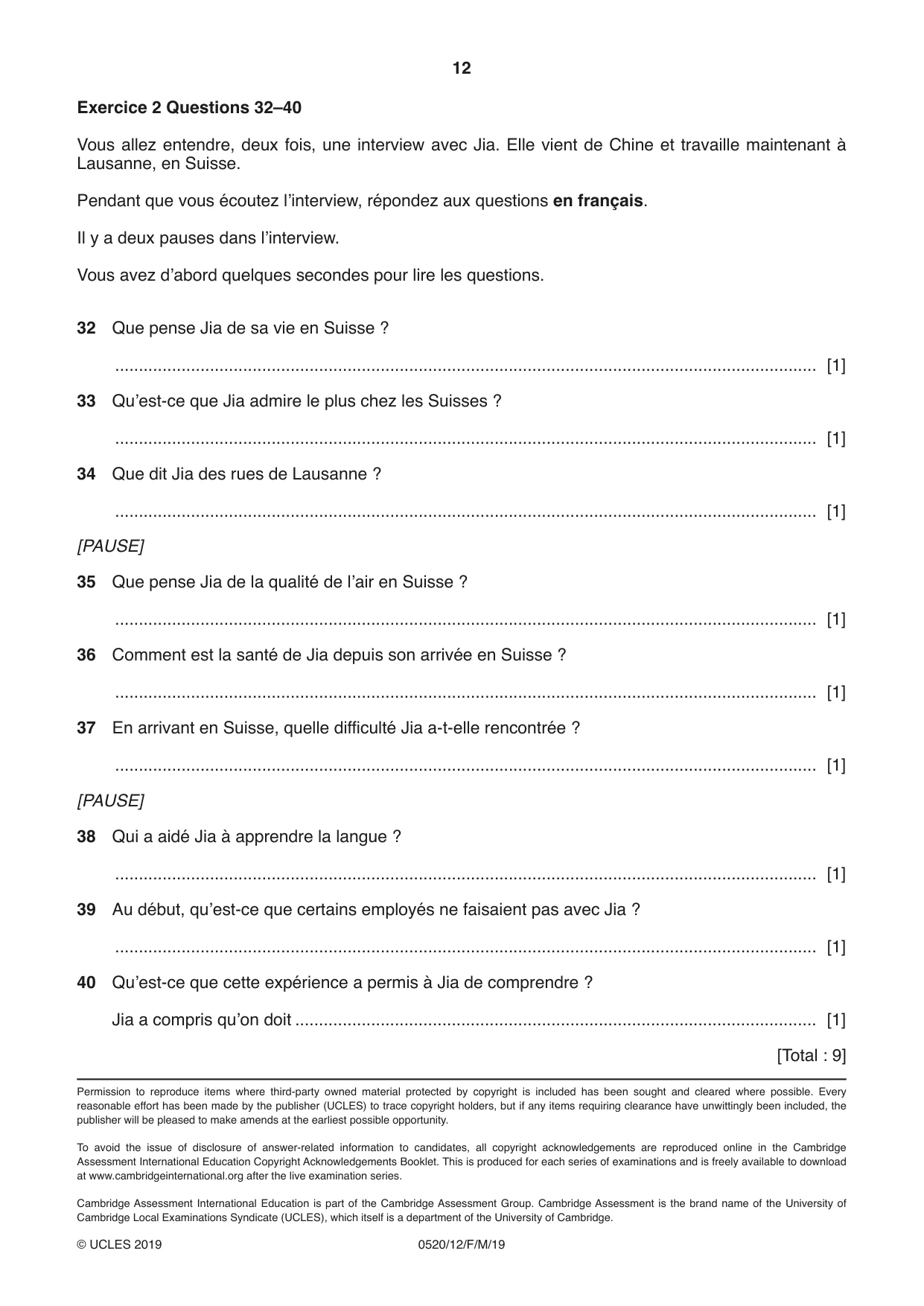
12 0520/12/F/M/19 © UCLES 2019 Exercice 2 Questions 32–40 Vous allez entendre, deux fois, une interview avec Jia. Elle vient de Chine et travaille maintenant à Lausanne, en Suisse. Pendant que vous écoutez l’interview, répondez aux questions en français. Il y a deux pauses dans l’interview. Vous avez d’abord quelques secondes pour lire les questions. 32 Que pense Jia de sa vie en Suisse ? … [1] 33 Qu’est-ce que Jia admire le plus chez les Suisses ? … [1] 34 Que dit Jia des rues de Lausanne ? … [1] [PAUSE] 35 Que pense Jia de la qualité de l’air en Suisse ? … [1] 36 Comment est la santé de Jia depuis son arrivée en Suisse ? … [1] 37 En arrivant en Suisse, quelle difficulté Jia a-t-elle rencontrée ? … [1] [PAUSE] 38 Qui a aidé Jia à apprendre la langue ? … [1] 39 Au début, qu’est-ce que certains employés ne faisaient pas avec Jia ? … [1] 40 Qu’est-ce que cette expérience a permis à Jia de comprendre ? Jia a compris qu’on doit … [1] [Total : 9] Permission to reproduce items where third-party owned material protected by copyright is included has been sought and cleared where possible. Every reasonable effort has been made by the publisher (UCLES) to trace copyright holders, but if any items requiring clearance have unwittingly been included, the publisher will be pleased to make amends at the earliest possible opportunity. To avoid the issue of disclosure of answer-related information to candidates, all copyright acknowledgements are reproduced online in the Cambridge Assessment International Education Copyright Acknowledgements Booklet. This is produced for each series of examinations and is freely available to download at www.cambridgeinternational.org after the live examination series. Cambridge Assessment International Education is part of the Cambridge Assessment Group. Cambridge Assessment is the brand name of the University of Cambridge Local Examinations Syndicate (UCLES), which itself is a department of the University of Cambridge.
Mark scheme, page 1
This syllabus is regulated for use in England, Wales and Northern Ireland as a Cambridge International Level 1/Level 2 Certificate. This document consists of 14 printed pages. © UCLES 2019 [Turn over Cambridge Assessment International Education Cambridge International General Certificate of Secondary Education FRENCH 0520/12 Paper 1 Listening March 2019 MARK SCHEME Maximum Mark: 45 Published This mark scheme is published as an aid to teachers and candidates, to indicate the requirements of the examination. It shows the basis on which Examiners were instructed to award marks. It does not indicate the details of the discussions that took place at an Examiners’ meeting before marking began, which would have considered the acceptability of alternative answers. Mark schemes should be read in conjunction with the question paper and the Principal Examiner Report for Teachers. Cambridge International will not enter into discussions about these mark schemes. Cambridge International is publishing the mark schemes for the March 2019 series for most Cambridge IGCSE™, Cambridge International A and AS Level components and some Cambridge O Level components.
Mark scheme, page 2
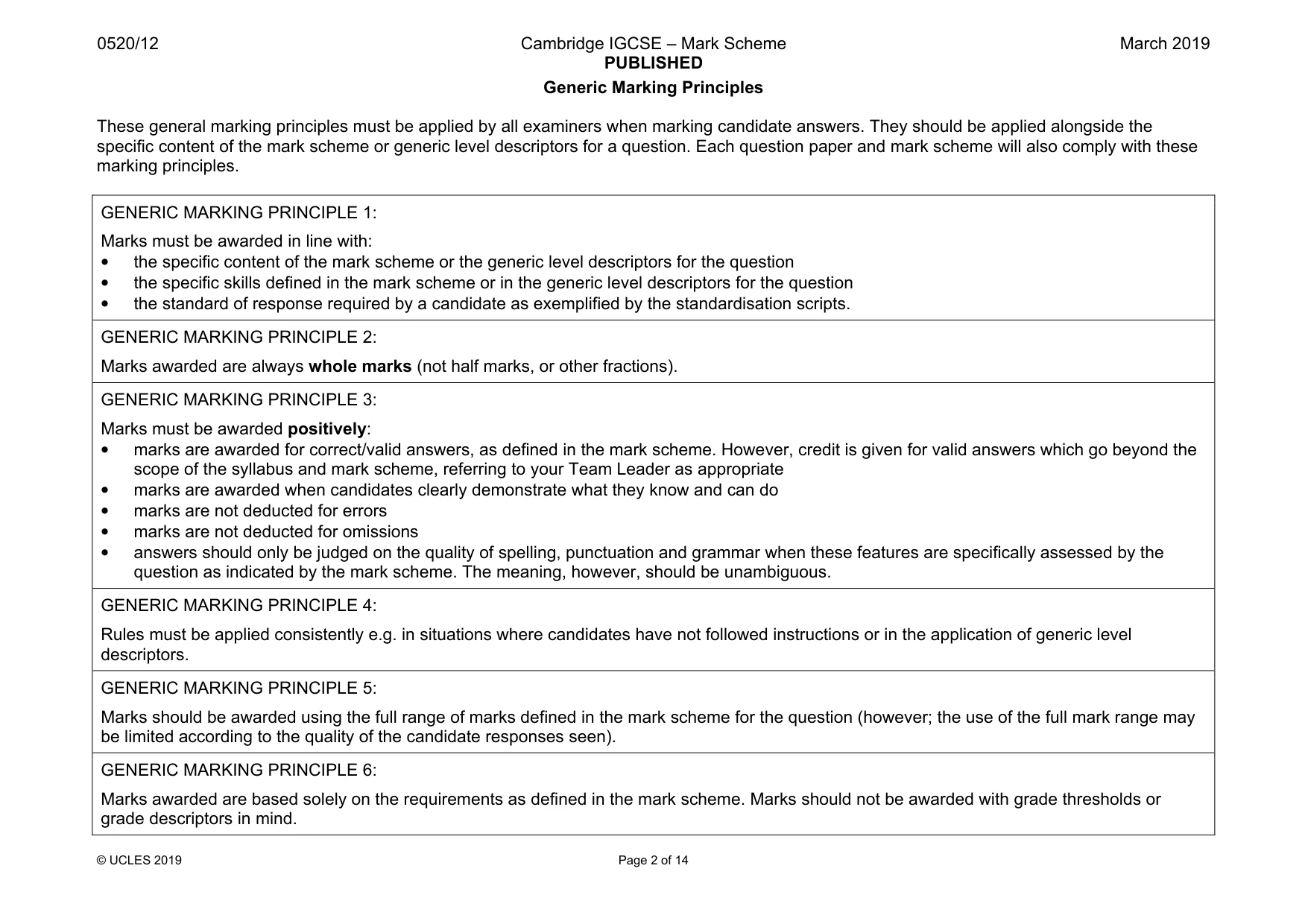
0520/12 Cambridge IGCSE – Mark Scheme PUBLISHED March 2019 © UCLES 2019 Page 2 of 14 Generic Marking Principles These general marking principles must be applied by all examiners when marking candidate answers. They should be applied alongside the specific content of the mark scheme or generic level descriptors for a question. Each question paper and mark scheme will also comply with these marking principles. GENERIC MARKING PRINCIPLE 1: Marks must be awarded in line with: • the specific content of the mark scheme or the generic level descriptors for the question • the specific skills defined in the mark scheme or in the generic level descriptors for the question • the standard of response required by a candidate as exemplified by the standardisation scripts. GENERIC MARKING PRINCIPLE 2: Marks awarded are always whole marks (not half marks, or other fractions). GENERIC MARKING PRINCIPLE 3: Marks must be awarded positively: • marks are awarded for correct/valid answers, as defined in the mark scheme. However, credit is given for valid answers which go beyond the scope of the syllabus and mark scheme, referring to your Team Leader as appropriate • marks are awarded when candidates clearly demonstrate what they know and can do • marks are not deducted for errors • marks are not deducted for omissions • answers should only be judged on the quality of spelling, punctuation and grammar when these features are specifically assessed by the question as indicated by the mark scheme. The meaning, however, should be unambiguous. GENERIC MARKING PRINCIPLE 4: Rules must be applied consistently e.g. in situations where candidates have not followed instructions or in the application of generic level descriptors. GENERIC MARKING PRINCIPLE 5: Marks should be awarded using the full range of marks defined in the mark scheme for the question (however; the use of the full mark range may be limited according to the quality of the candidate responses seen). GENERIC MARKING PRINCIPLE 6: Marks awarded are based solely on the requirements as defined in the mark scheme. Marks should not be awarded with grade thresholds or grade descriptors in mind.
Mark scheme, page 3
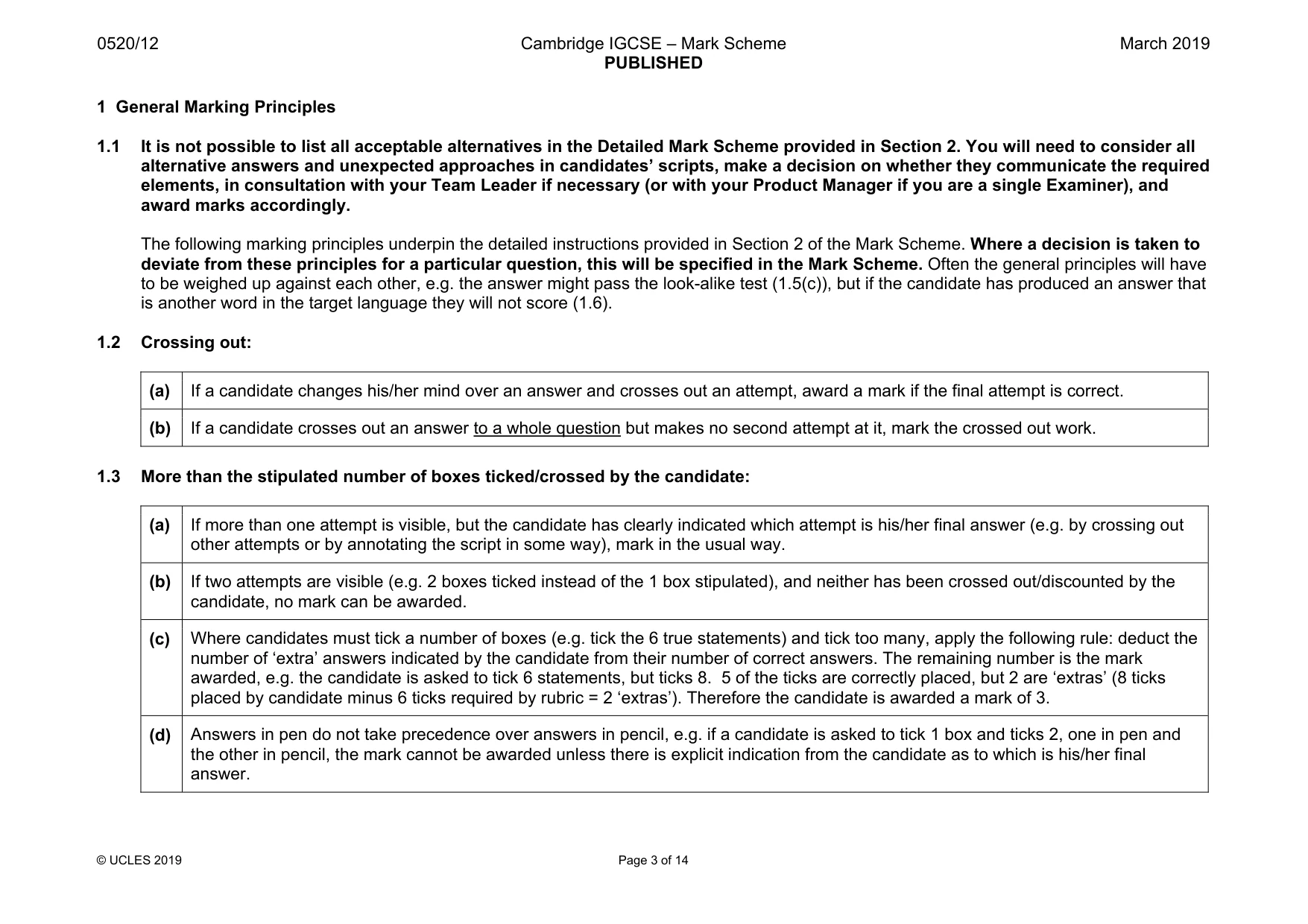
0520/12 Cambridge IGCSE – Mark Scheme PUBLISHED March 2019 © UCLES 2019 Page 3 of 14 1 General Marking Principles 1.1 It is not possible to list all acceptable alternatives in the Detailed Mark Scheme provided in Section 2. You will need to consider all alternative answers and unexpected approaches in candidates’ scripts, make a decision on whether they communicate the required elements, in consultation with your Team Leader if necessary (or with your Product Manager if you are a single Examiner), and award marks accordingly. The following marking principles underpin the detailed instructions provided in Section 2 of the Mark Scheme. Where a decision is taken to deviate from these principles for a particular question, this will be specified in the Mark Scheme. Often the general principles will have to be weighed up against each other, e.g. the answer might pass the look-alike test (1.5(c)), but if the candidate has produced an answer that is another word in the target language they will not score (1.6). 1.2 Crossing out: (a) If a candidate changes his/her mind over an answer and crosses out an attempt, award a mark if the final attempt is correct. (b) If a candidate crosses out an answer to a whole question but makes no second attempt at it, mark the crossed out work. 1.3 More than the stipulated number of boxes ticked/crossed by the candidate: (a) If more than one attempt is visible, but the candidate has clearly indicated which attempt is his/her final answer (e.g. by crossing out other attempts or by annotating the script in some way), mark in the usual way. (b) If two attempts are visible (e.g. 2 boxes ticked instead of the 1 box stipulated), and neither has been crossed out/discounted by the candidate, no mark can be awarded. (c) Where candidates must tick a number of boxes (e.g. tick the 6 true statements) and tick too many, apply the following rule: deduct the number of ‘extra’ answers indicated by the candidate from their number of correct answers. The remaining number is the mark awarded, e.g. the candidate is asked to tick 6 statements, but ticks 8. 5 of the ticks are correctly placed, but 2 are ‘extras’ (8 ticks placed by candidate minus 6 ticks required by rubric = 2 ‘extras’). Therefore the candidate is awarded a mark of 3. (d) Answers in pen do not take precedence over answers in pencil, e.g. if a candidate is asked to tick 1 box and ticks 2, one in pen and the other in pencil, the mark cannot be awarded unless there is explicit indication from the candidate as to which is his/her final answer.
Mark scheme, page 4
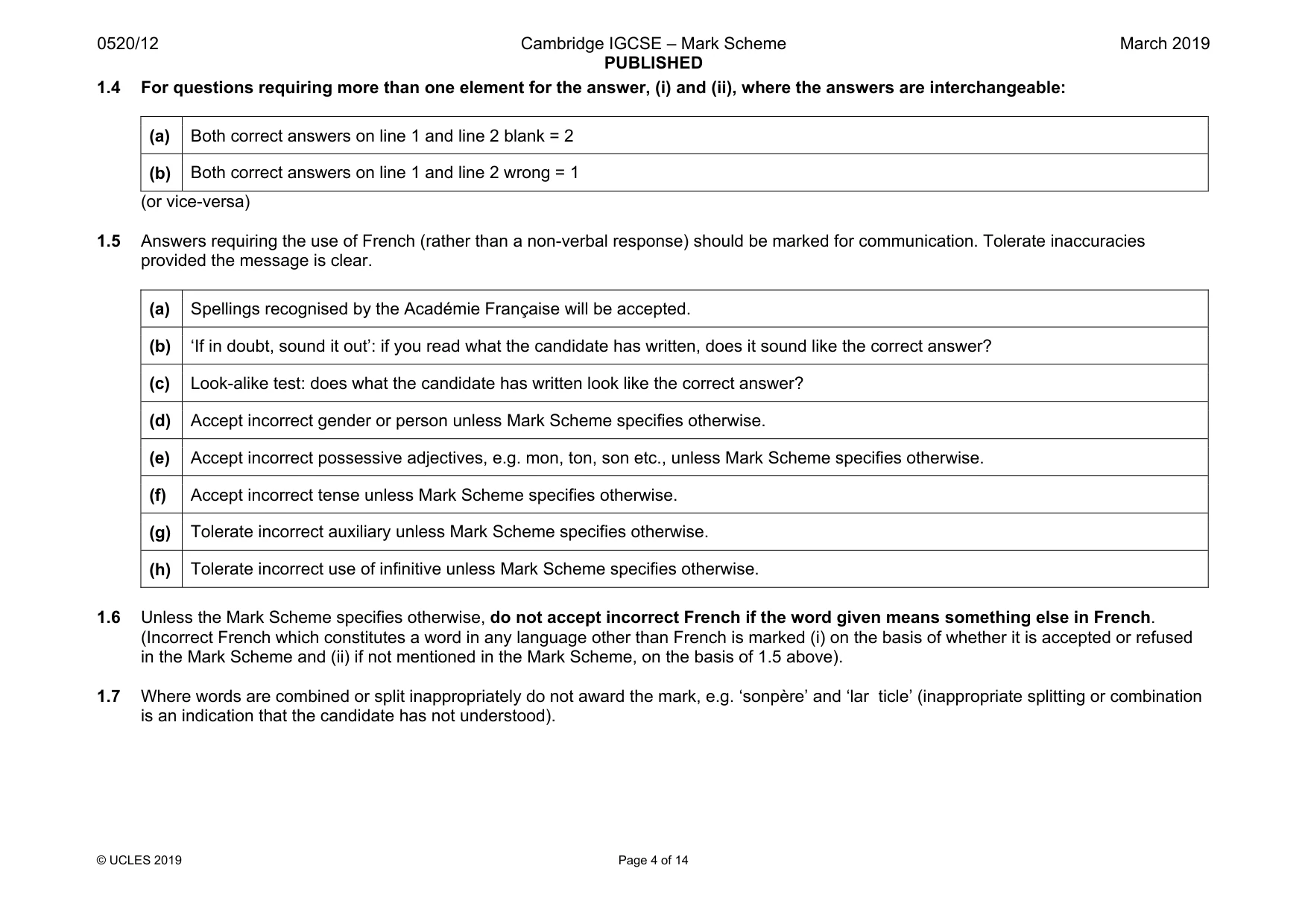
0520/12 Cambridge IGCSE – Mark Scheme PUBLISHED March 2019 © UCLES 2019 Page 4 of 14 1.4 For questions requiring more than one element for the answer, (i) and (ii), where the answers are interchangeable: (a) Both correct answers on line 1 and line 2 blank = 2 (b) Both correct answers on line 1 and line 2 wrong = 1 (or vice-versa) 1.5 Answers requiring the use of French (rather than a non-verbal response) should be marked for communication. Tolerate inaccuracies provided the message is clear. (a) Spellings recognised by the Académie Française will be accepted. (b) ‘If in doubt, sound it out’: if you read what the candidate has written, does it sound like the correct answer? (c) Look-alike test: does what the candidate has written look like the correct answer? (d) Accept incorrect gender or person unless Mark Scheme specifies otherwise. (e) Accept incorrect possessive adjectives, e.g. mon, ton, son etc., unless Mark Scheme specifies otherwise. (f) Accept incorrect tense unless Mark Scheme specifies otherwise. (g) Tolerate incorrect auxiliary unless Mark Scheme specifies otherwise. (h) Tolerate incorrect use of infinitive unless Mark Scheme specifies otherwise. 1.6 Unless the Mark Scheme specifies otherwise, do not accept incorrect French if the word given means something else in French. (Incorrect French which constitutes a word in any language other than French is marked (i) on the basis of whether it is accepted or refused in the Mark Scheme and (ii) if not mentioned in the Mark Scheme, on the basis of 1.5 above). 1.7 Where words are combined or split inappropriately do not award the mark, e.g. ‘sonpère’ and ‘lar ticle’ (inappropriate splitting or combination is an indication that the candidate has not understood).
Mark scheme, page 5
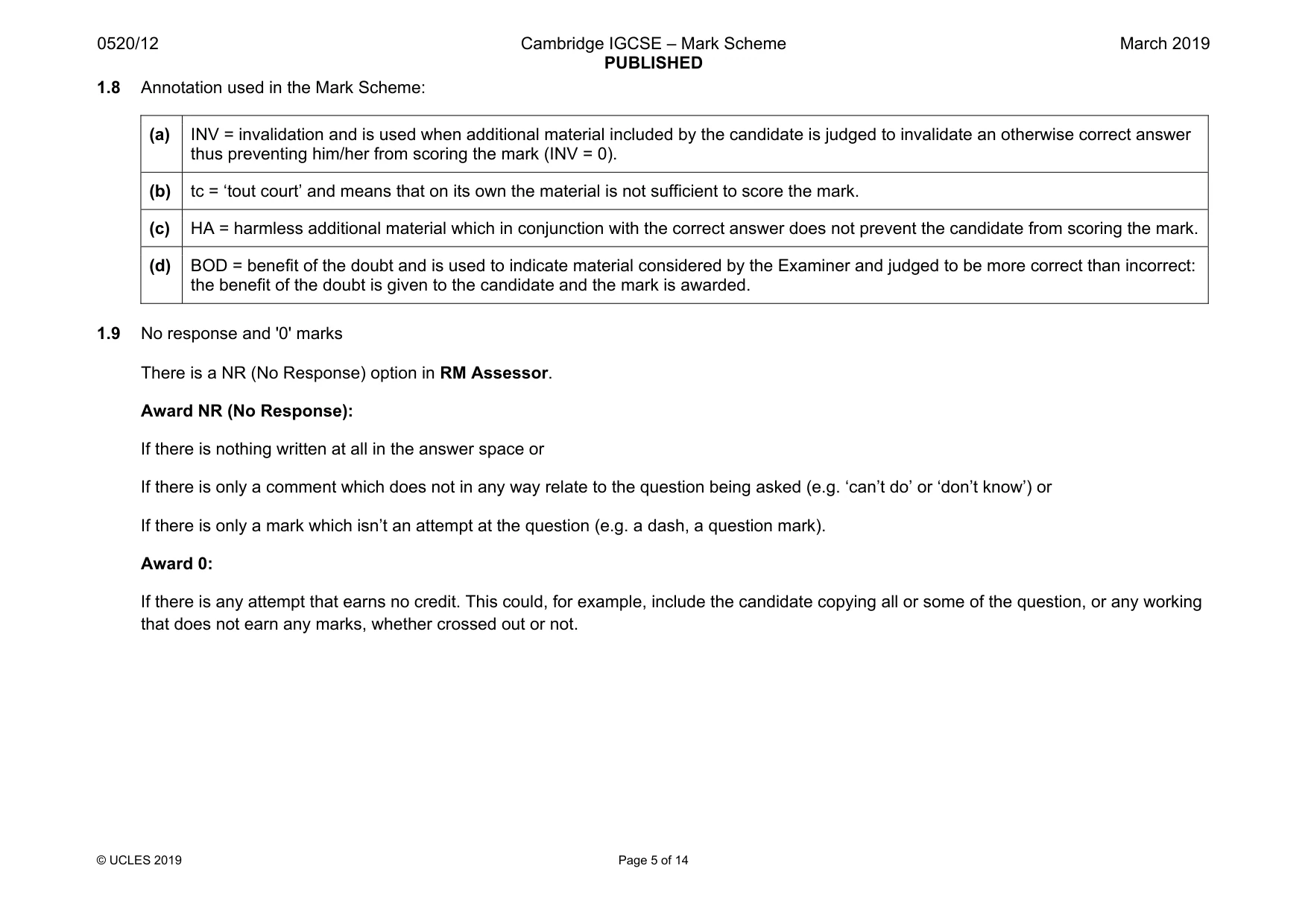
0520/12 Cambridge IGCSE – Mark Scheme PUBLISHED March 2019 © UCLES 2019 Page 5 of 14 1.8 Annotation used in the Mark Scheme: (a) INV = invalidation and is used when additional material included by the candidate is judged to invalidate an otherwise correct answer thus preventing him/her from scoring the mark (INV = 0). (b) tc = ‘tout court’ and means that on its own the material is not sufficient to score the mark. (c) HA = harmless additional material which in conjunction with the correct answer does not prevent the candidate from scoring the mark. (d) BOD = benefit of the doubt and is used to indicate material considered by the Examiner and judged to be more correct than incorrect: the benefit of the doubt is given to the candidate and the mark is awarded. 1.9 No response and '0' marks There is a NR (No Response) option in RM Assessor. Award NR (No Response): If there is nothing written at all in the answer space or If there is only a comment which does not in any way relate to the question being asked (e.g. ‘can’t do’ or ‘don’t know’) or If there is only a mark which isn’t an attempt at the question (e.g. a dash, a question mark). Award 0: If there is any attempt that earns no credit. This could, for example, include the candidate copying all or some of the question, or any working that does not earn any marks, whether crossed out or not.
Mark scheme, page 6
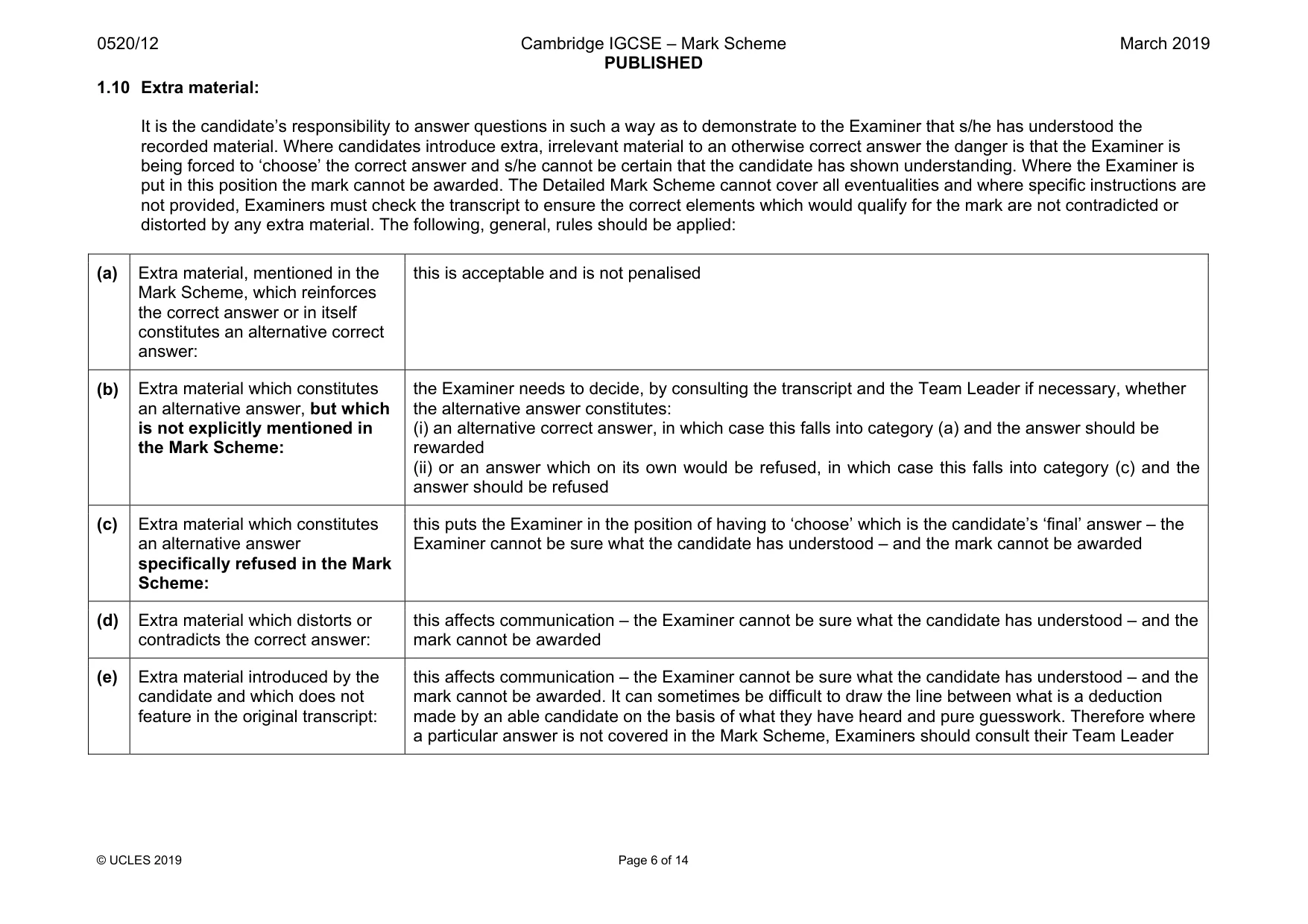
0520/12 Cambridge IGCSE – Mark Scheme PUBLISHED March 2019 © UCLES 2019 Page 6 of 14 1.10 Extra material: It is the candidate’s responsibility to answer questions in such a way as to demonstrate to the Examiner that s/he has understood the recorded material. Where candidates introduce extra, irrelevant material to an otherwise correct answer the danger is that the Examiner is being forced to ‘choose’ the correct answer and s/he cannot be certain that the candidate has shown understanding. Where the Examiner is put in this position the mark cannot be awarded. The Detailed Mark Scheme cannot cover all eventualities and where specific instructions are not provided, Examiners must check the transcript to ensure the correct elements which would qualify for the mark are not contradicted or distorted by any extra material. The following, general, rules should be applied: (a) Extra material, mentioned in the Mark Scheme, which reinforces the correct answer or in itself constitutes an alternative correct answer: this is acceptable and is not penalised (b) Extra material which constitutes an alternative answer, but which is not explicitly mentioned in the Mark Scheme: the Examiner needs to decide, by consulting the transcript and the Team Leader if necessary, whether the alternative answer constitutes: (i) an alternative correct answer, in which case this falls into category (a) and the answer should be rewarded (ii) or an answer which on its own would be refused, in which case this falls into category (c) and the answer should be refused (c) Extra material which constitutes an alternative answer specifically refused in the Mark Scheme: this puts the Examiner in the position of having to ‘choose’ which is the candidate’s ‘final’ answer – the Examiner cannot be sure what the candidate has understood – and the mark cannot be awarded (d) Extra material which distorts or contradicts the correct answer: this affects communication – the Examiner cannot be sure what the candidate has understood – and the mark cannot be awarded (e) Extra material introduced by the candidate and which does not feature in the original transcript: this affects communication – the Examiner cannot be sure what the candidate has understood – and the mark cannot be awarded. It can sometimes be difficult to draw the line between what is a deduction made by an able candidate on the basis of what they have heard and pure guesswork. Therefore where a particular answer is not covered in the Mark Scheme, Examiners should consult their Team Leader
Mark scheme, page 7
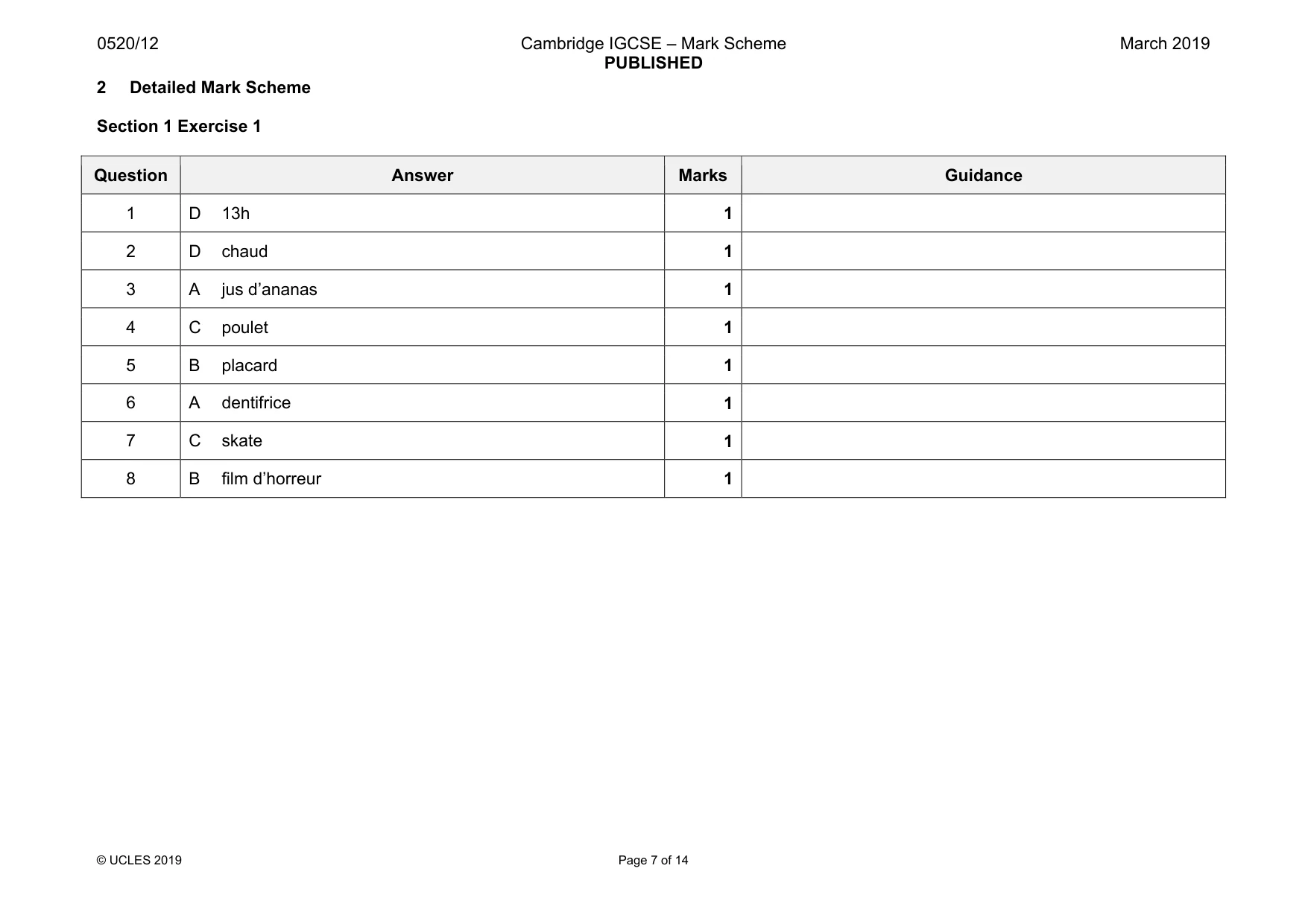
0520/12 Cambridge IGCSE – Mark Scheme PUBLISHED March 2019 © UCLES 2019 Page 7 of 14 2 Detailed Mark Scheme Section 1 Exercise 1 Question Answer Marks Guidance 1 D 13h 1 2 D chaud 1 3 A jus d’ananas 1 4 C poulet 1 5 B placard 1 6 A dentifrice 1 7 C skate 1 8 B film d’horreur 1
Mark scheme, page 8
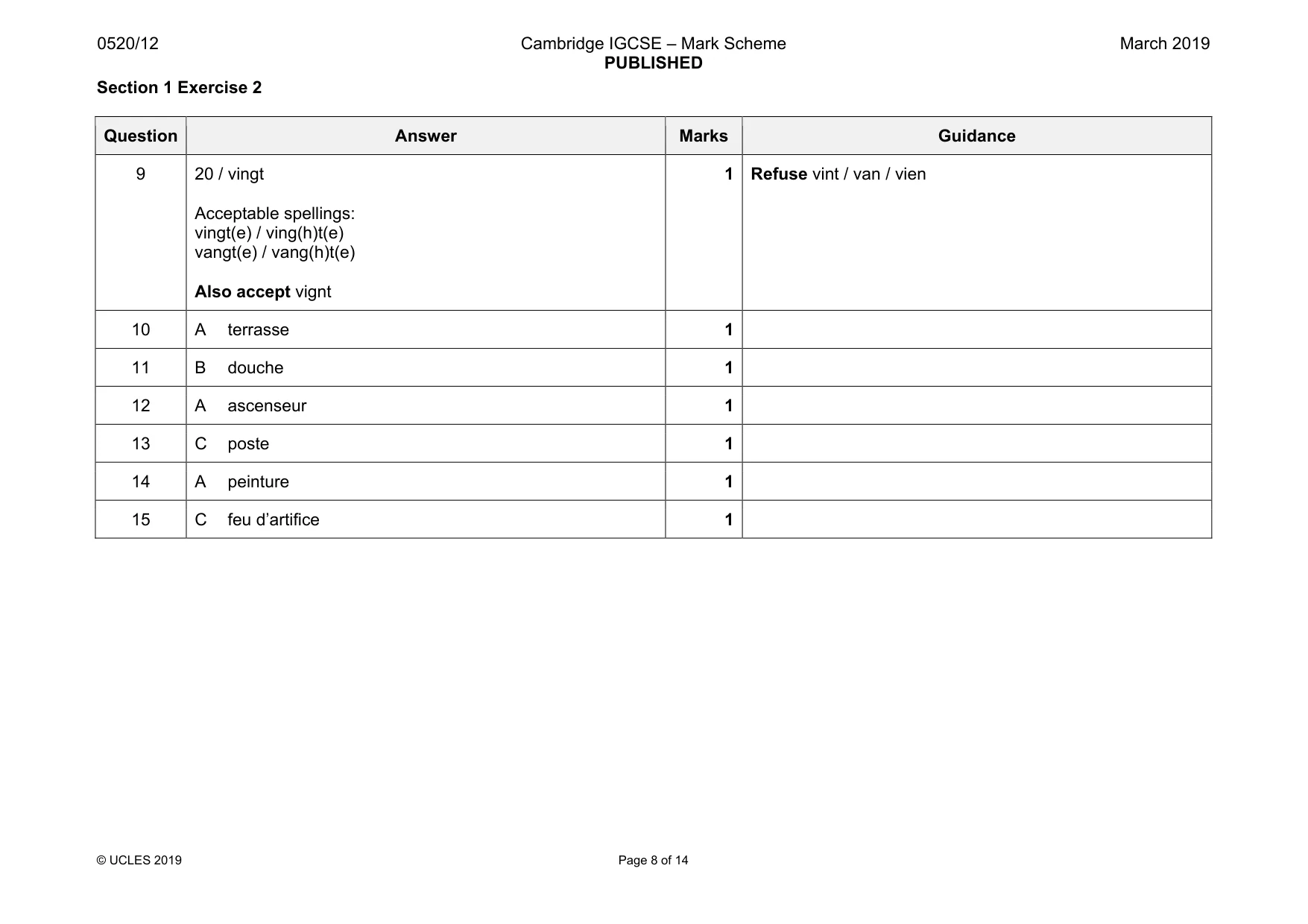
0520/12 Cambridge IGCSE – Mark Scheme PUBLISHED March 2019 © UCLES 2019 Page 8 of 14 Section 1 Exercise 2 Question Answer Marks Guidance 9 20 / vingt Acceptable spellings: vingt(e) / ving(h)t(e) vangt(e) / vang(h)t(e) Also accept vignt 1 Refuse vint / van / vien 10 A terrasse 1 11 B douche 1 12 A ascenseur 1 13 C poste 1 14 A peinture 1 15 C feu d’artifice 1
Mark scheme, page 9
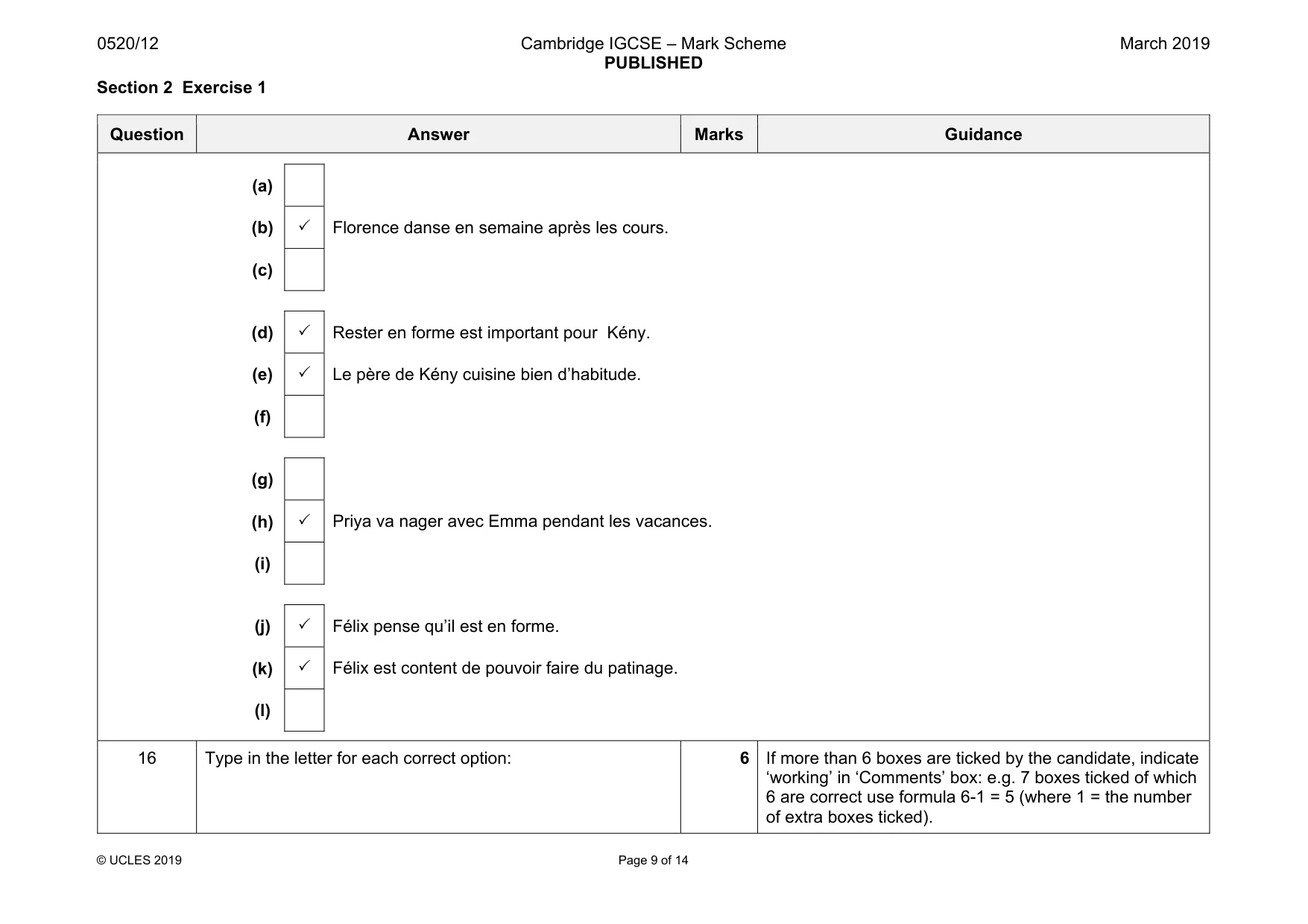
0520/12 Cambridge IGCSE – Mark Scheme PUBLISHED March 2019 © UCLES 2019 Page 9 of 14 Section 2 Exercise 1 Question Answer Marks Guidance (a) (b) 3 Florence danse en semaine après les cours. (c) (d) 3 Rester en forme est important pour Kény. (e) 3 Le père de Kény cuisine bien d’habitude. (f) (g) (h) 3 Priya va nager avec Emma pendant les vacances. (i) (j) 3 Félix pense qu’il est en forme. (k) 3 Félix est content de pouvoir faire du patinage. (l) 16 Type in the letter for each correct option: 6 If more than 6 boxes are ticked by the candidate, indicate ‘working’ in ‘Comments’ box: e.g. 7 boxes ticked of which 6 are correct use formula 6-1 = 5 (where 1 = the number of extra boxes ticked).
Mark scheme, page 10
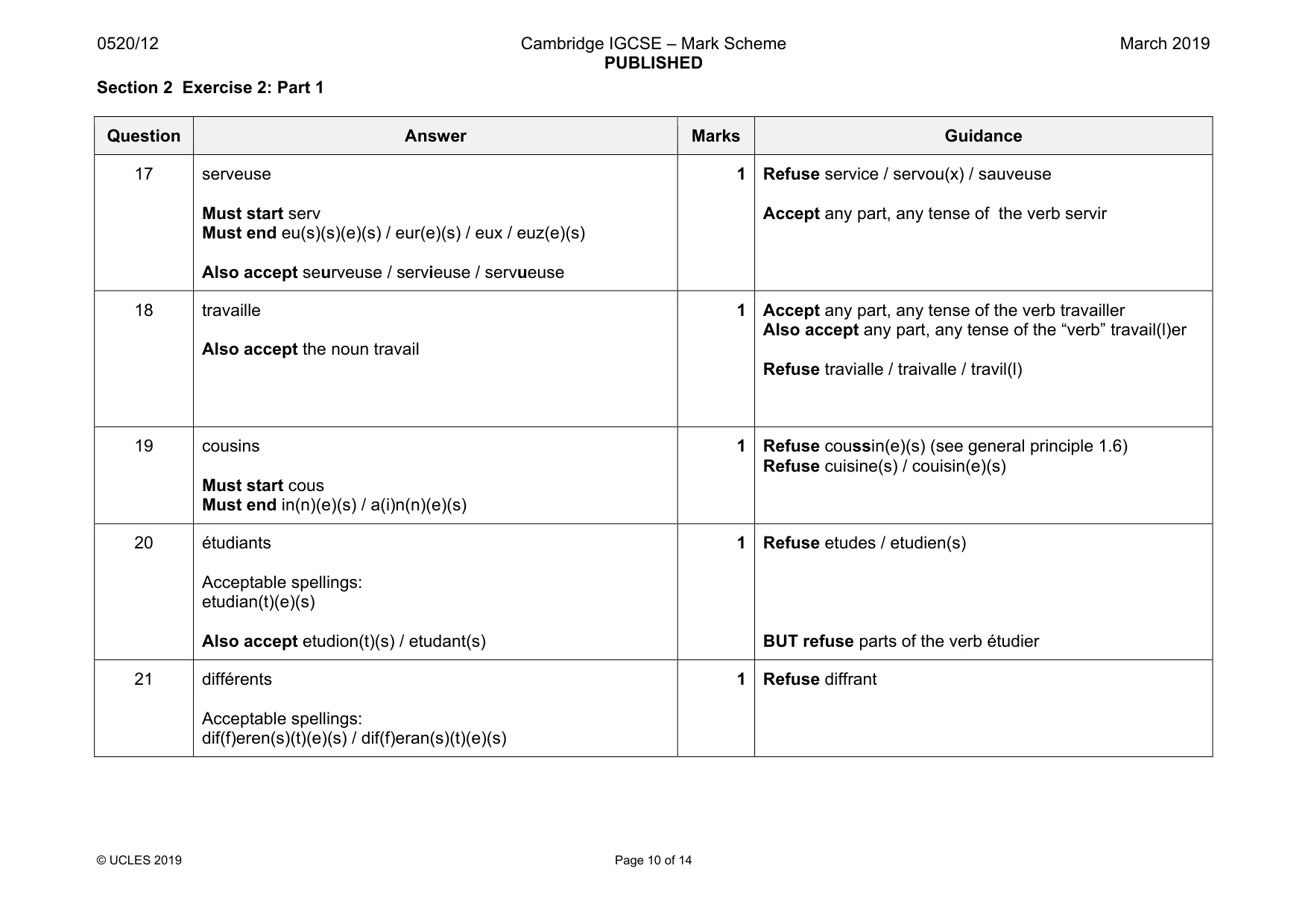
0520/12 Cambridge IGCSE – Mark Scheme PUBLISHED March 2019 © UCLES 2019 Page 10 of 14 Section 2 Exercise 2: Part 1 Question Answer Marks Guidance 17 serveuse Must start serv Must end eu(s)(s)(e)(s) / eur(e)(s) / eux / euz(e)(s) Also accept seurveuse / servieuse / servueuse 1 Refuse service / servou(x) / sauveuse Accept any part, any tense of the verb servir 18 travaille Also accept the noun travail 1 Accept any part, any tense of the verb travailler Also accept any part, any tense of the “verb” travail(l)er Refuse travialle / traivalle / travil(l) 19 cousins Must start cous Must end in(n)(e)(s) / a(i)n(n)(e)(s) 1 Refuse coussin(e)(s) (see general principle 1.6) Refuse cuisine(s) / couisin(e)(s) 20 étudiants Acceptable spellings: etudian(t)(e)(s) Also accept etudion(t)(s) / etudant(s) 1 Refuse etudes / etudien(s) BUT refuse parts of the verb étudier 21 différents Acceptable spellings: dif(f)eren(s)(t)(e)(s) / dif(f)eran(s)(t)(e)(s) 1 Refuse diffrant
Mark scheme, page 11
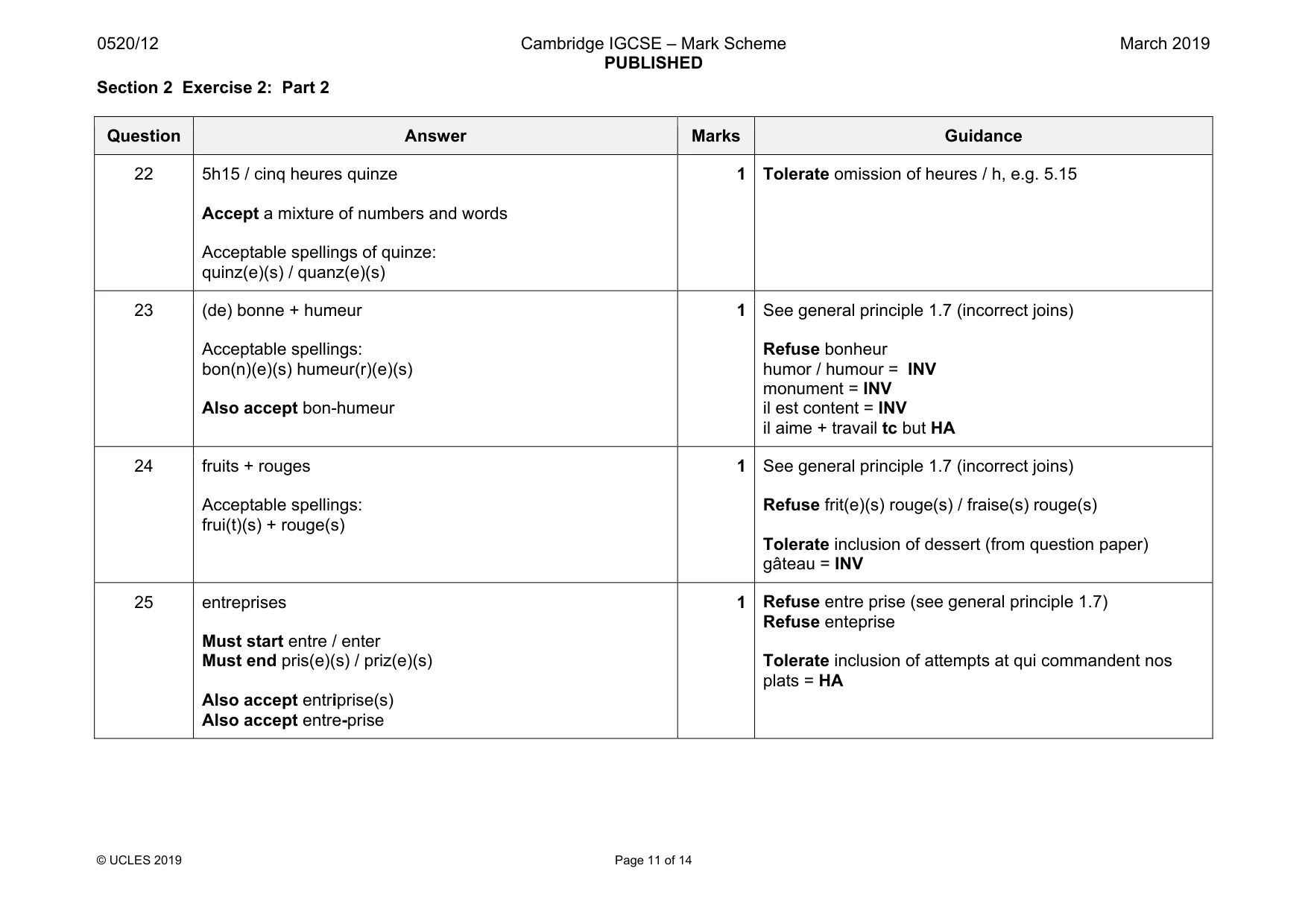
0520/12 Cambridge IGCSE – Mark Scheme PUBLISHED March 2019 © UCLES 2019 Page 11 of 14 Section 2 Exercise 2: Part 2 Question Answer Marks Guidance 22 5h15 / cinq heures quinze Accept a mixture of numbers and words Acceptable spellings of quinze: quinz(e)(s) / quanz(e)(s) 1 Tolerate omission of heures / h, e.g. 5.15 23 (de) bonne + humeur Acceptable spellings: bon(n)(e)(s) humeur(r)(e)(s) Also accept bon-humeur 1 See general principle 1.7 (incorrect joins) Refuse bonheur humor / humour = INV monument = INV il est content = INV il aime + travail tc but HA 24 fruits + rouges Acceptable spellings: frui(t)(s) + rouge(s) 1 See general principle 1.7 (incorrect joins) Refuse frit(e)(s) rouge(s) / fraise(s) rouge(s) Tolerate inclusion of dessert (from question paper) gâteau = INV 25 entreprises Must start entre / enter Must end pris(e)(s) / priz(e)(s) Also accept entriprise(s) Also accept entre-prise 1 Refuse entre prise (see general principle 1.7) Refuse enteprise Tolerate inclusion of attempts at qui commandent nos plats = HA
Mark scheme, page 12
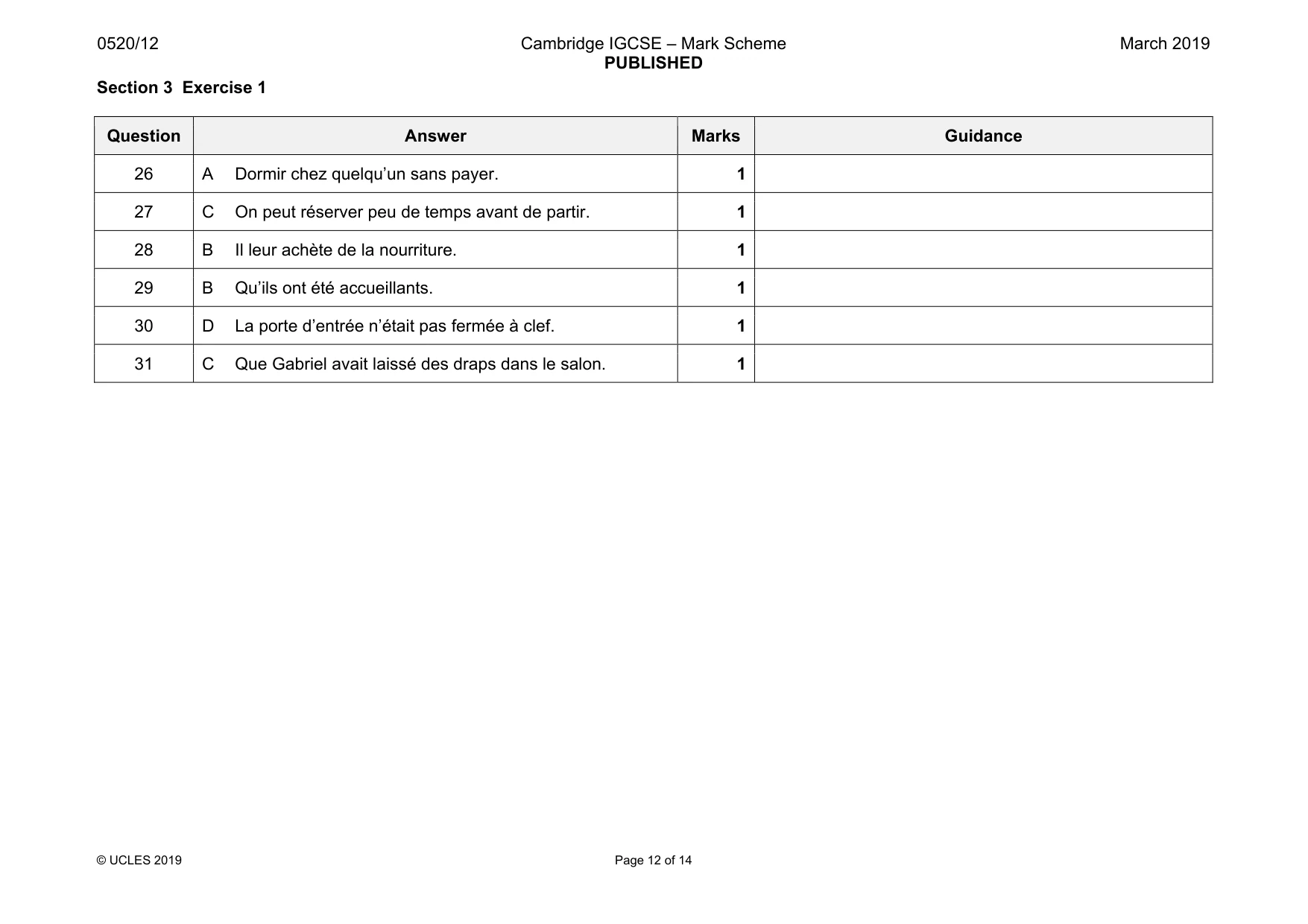
0520/12 Cambridge IGCSE – Mark Scheme PUBLISHED March 2019 © UCLES 2019 Page 12 of 14 Section 3 Exercise 1 Question Answer Marks Guidance 26 A Dormir chez quelqu’un sans payer. 1 27 C On peut réserver peu de temps avant de partir. 1 28 B Il leur achète de la nourriture. 1 29 B Qu’ils ont été accueillants. 1 30 D La porte d’entrée n’était pas fermée à clef. 1 31 C Que Gabriel avait laissé des draps dans le salon. 1
Mark scheme, page 13
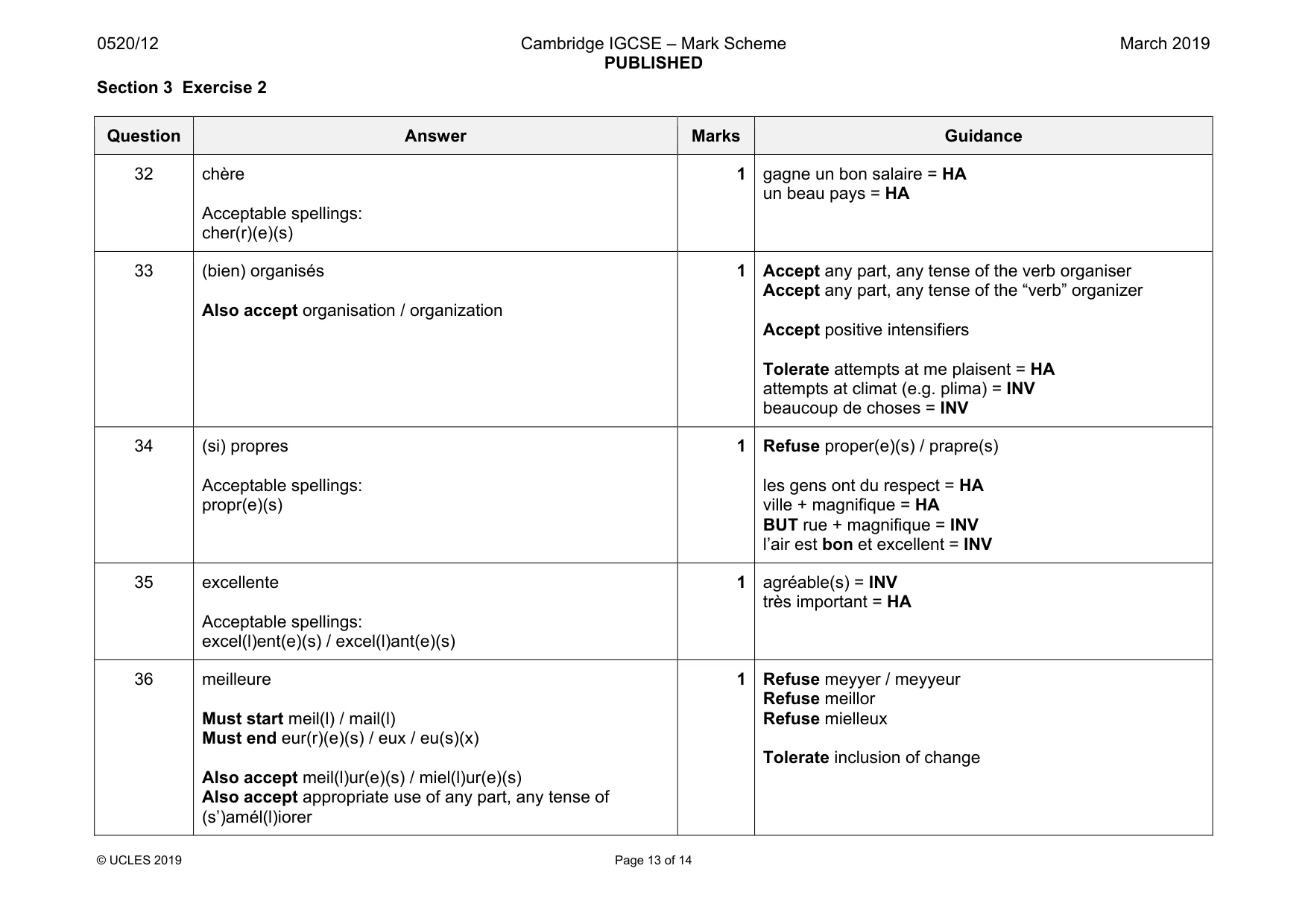
0520/12 Cambridge IGCSE – Mark Scheme PUBLISHED March 2019 © UCLES 2019 Page 13 of 14 Section 3 Exercise 2 Question Answer Marks Guidance 32 chère Acceptable spellings: cher(r)(e)(s) 1 gagne un bon salaire = HA un beau pays = HA 33 (bien) organisés Also accept organisation / organization 1 Accept any part, any tense of the verb organiser Accept any part, any tense of the “verb” organizer Accept positive intensifiers Tolerate attempts at me plaisent = HA attempts at climat (e.g. plima) = INV beaucoup de choses = INV 34 (si) propres Acceptable spellings: propr(e)(s) 1 Refuse proper(e)(s) / prapre(s) les gens ont du respect = HA ville + magnifique = HA BUT rue + magnifique = INV l’air est bon et excellent = INV 35 excellente Acceptable spellings: excel(l)ent(e)(s) / excel(l)ant(e)(s) 1 agréable(s) = INV très important = HA 36 meilleure Must start meil(l) / mail(l) Must end eur(r)(e)(s) / eux / eu(s)(x) Also accept meil(l)ur(e)(s) / miel(l)ur(e)(s) Also accept appropriate use of any part, any tense of (s’)amél(l)iorer 1 Refuse meyyer / meyyeur Refuse meillor Refuse mielleux Tolerate inclusion of change
Mark scheme, page 14
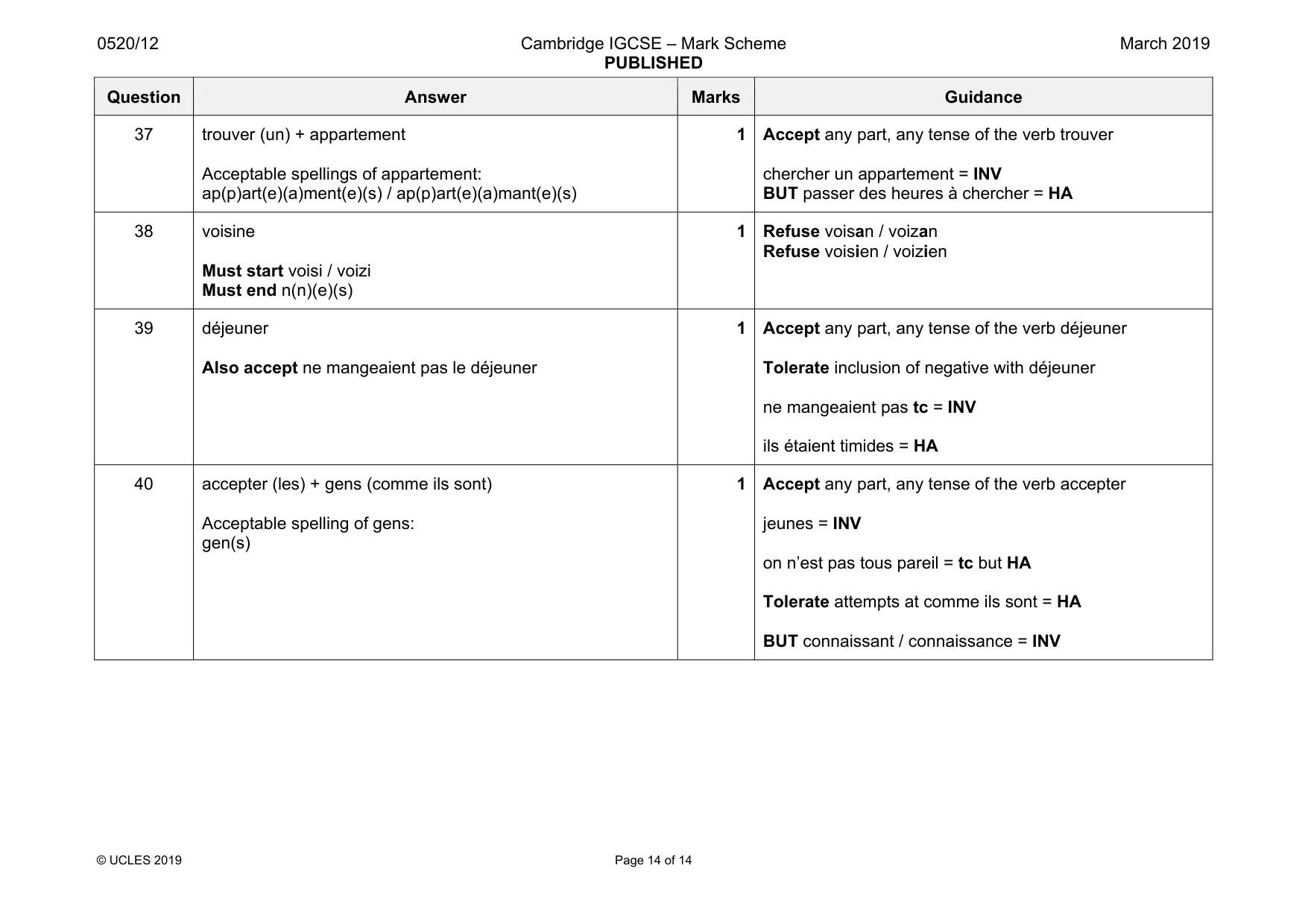
0520/12 Cambridge IGCSE – Mark Scheme PUBLISHED March 2019 © UCLES 2019 Page 14 of 14 Question Answer Marks Guidance 37 trouver (un) + appartement Acceptable spellings of appartement: ap(p)art(e)(a)ment(e)(s) / ap(p)art(e)(a)mant(e)(s) 1 Accept any part, any tense of the verb trouver chercher un appartement = INV BUT passer des heures à chercher = HA 38 voisine Must start voisi / voizi Must end n(n)(e)(s) 1 Refuse voisan / voizan Refuse voisien / voizien 39 déjeuner Also accept ne mangeaient pas le déjeuner 1 Accept any part, any tense of the verb déjeuner Tolerate inclusion of negative with déjeuner ne mangeaient pas tc = INV ils étaient timides = HA 40 accepter (les) + gens (comme ils sont) Acceptable spelling of gens: gen(s) 1 Accept any part, any tense of the verb accepter jeunes = INV on n’est pas tous pareil = tc but HA Tolerate attempts at comme ils sont = HA BUT connaissant / connaissance = INV
What you needed in this session
Cambridge’s own grade thresholds for 2019 Feb/March, Paper 1 · Variant 2. A higher threshold means an easier paper — the bar moves with how the cohort did.