Cambridge IGCSE French - Foreign Language 0520 — 2018 Oct/Nov Paper 1 · Variant 3
0520/13/O/N/18 · 45 marks · ≈51 min
The question paper and its mark scheme, free to read here and free to download. This is Cambridge’s own paper, exactly as it was sat.
Question paper12 pages

Mark scheme14 pages
Answers below. Sit the paper first if you are practising.
Paper as text
Question paper, page 1
* 6 1 3 9 7 6 0 7 9 8 * This document consists of 11 printed pages and 1 blank page. DC (SR/SG) 146414/2 © UCLES 2018 [Turn over FRENCH 0520/13 Paper 1 Listening October/November 2018 Approx. 45 minutes Candidates answer on the Question Paper. No Additional Materials are required. READ THESE INSTRUCTIONS FIRST Write your Centre number, candidate number and name in the spaces at the top of this page. Write in dark blue or black pen. Do not use staples, paper clips, glue or correction fluid. DO NOT WRITE IN ANY BARCODES. Answer all questions. The number of marks is given in brackets [ ] at the end of each question or part question. This syllabus is approved for use in England, Wales and Northern Ireland as a Cambridge International Level 1/Level 2 Certificate. Cambridge International Examinations Cambridge International General Certificate of Secondary Education
Question paper, page 2
2 0520/13/O/N/18 © UCLES 2018 BLANK PAGE Permission to reproduce items where third-party owned material protected by copyright is included has been sought and cleared where possible. Every reasonable effort has been made by the publisher (UCLES) to trace copyright holders, but if any items requiring clearance have unwittingly been included, the publisher will be pleased to make amends at the earliest possible opportunity. To avoid the issue of disclosure of answer-related information to candidates, all copyright acknowledgements are reproduced online in the Cambridge International Examinations Copyright Acknowledgements Booklet. This is produced for each series of examinations and is freely available to download at www.cie.org.uk after the live examination series. Cambridge International Examinations is part of the Cambridge Assessment Group. Cambridge Assessment is the brand name of University of Cambridge Local Examinations Syndicate (UCLES), which is itself a department of the University of Cambridge.
Question paper, page 3
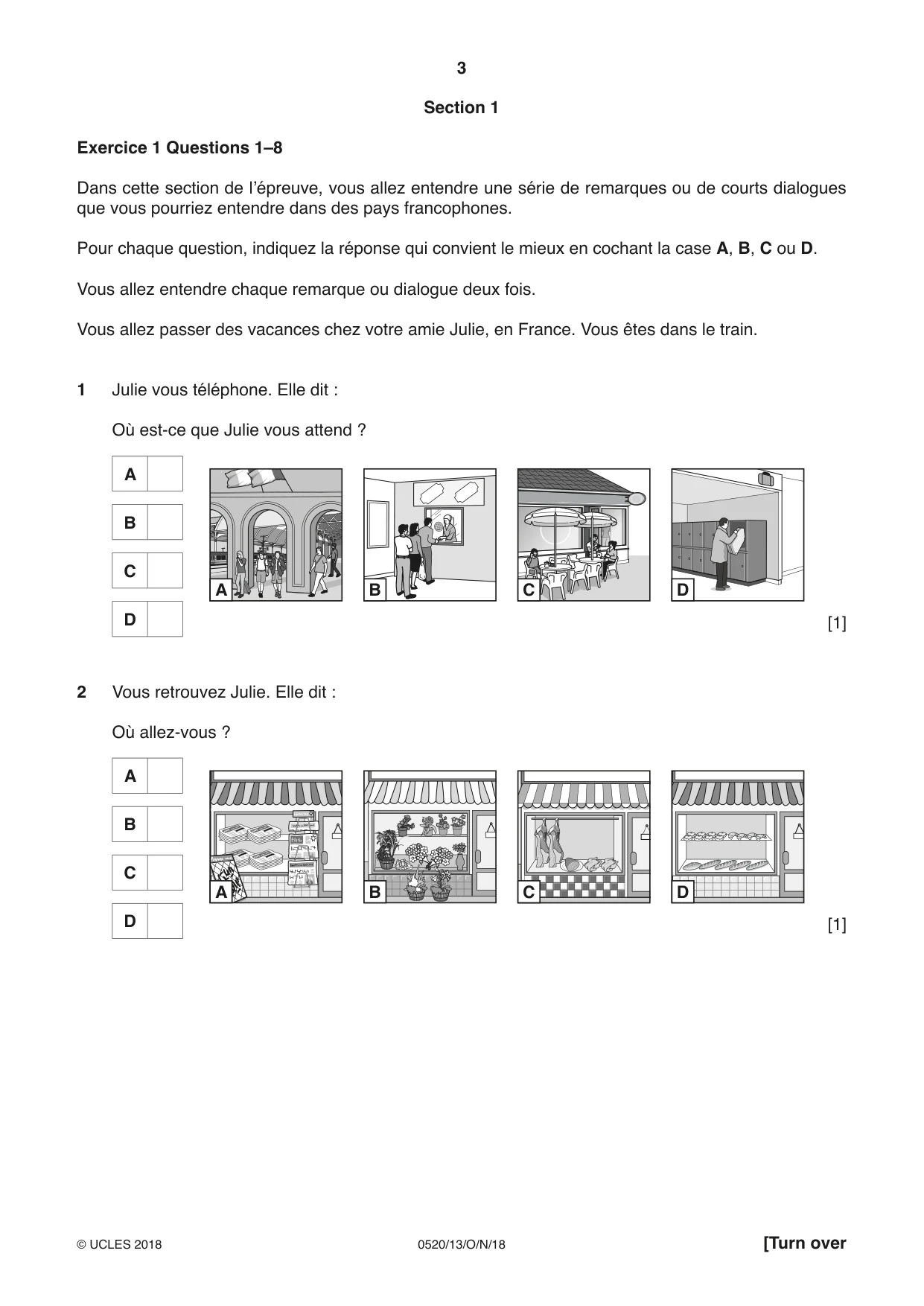
3 0520/13/O/N/18 © UCLES 2018 [Turn over Section 1 Exercice 1 Questions 1–8 Dans cette section de l’épreuve, vous allez entendre une série de remarques ou de courts dialogues que vous pourriez entendre dans des pays francophones. Pour chaque question, indiquez la réponse qui convient le mieux en cochant la case A, B, C ou D. Vous allez entendre chaque remarque ou dialogue deux fois. Vous allez passer des vacances chez votre amie Julie, en France. Vous êtes dans le train. 1 Julie vous téléphone. Elle dit : Où est-ce que Julie vous attend ? A A B C D [1] B C D 2 Vous retrouvez Julie. Elle dit : Où allez-vous ? A A B C D [1] B C D
Question paper, page 4
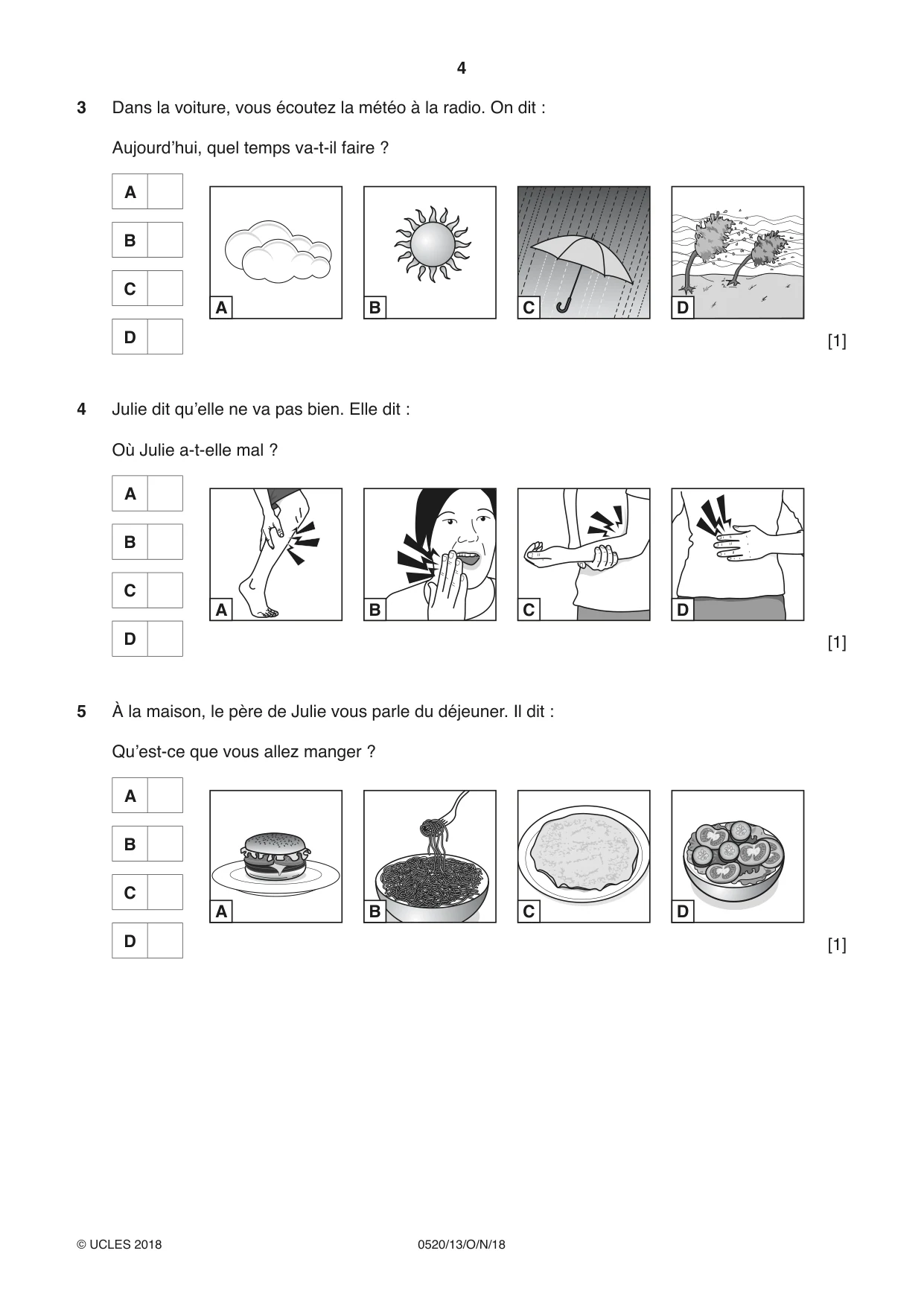
4 0520/13/O/N/18 © UCLES 2018 3 Dans la voiture, vous écoutez la météo à la radio. On dit : Aujourd’hui, quel temps va-t-il faire ? A A B C D [1] B C D 4 Julie dit qu’elle ne va pas bien. Elle dit : Où Julie a-t-elle mal ? A A B C D [1] B C D 5 À la maison, le père de Julie vous parle du déjeuner. Il dit : Qu’est-ce que vous allez manger ? A A B C D [1] B C D
Question paper, page 5
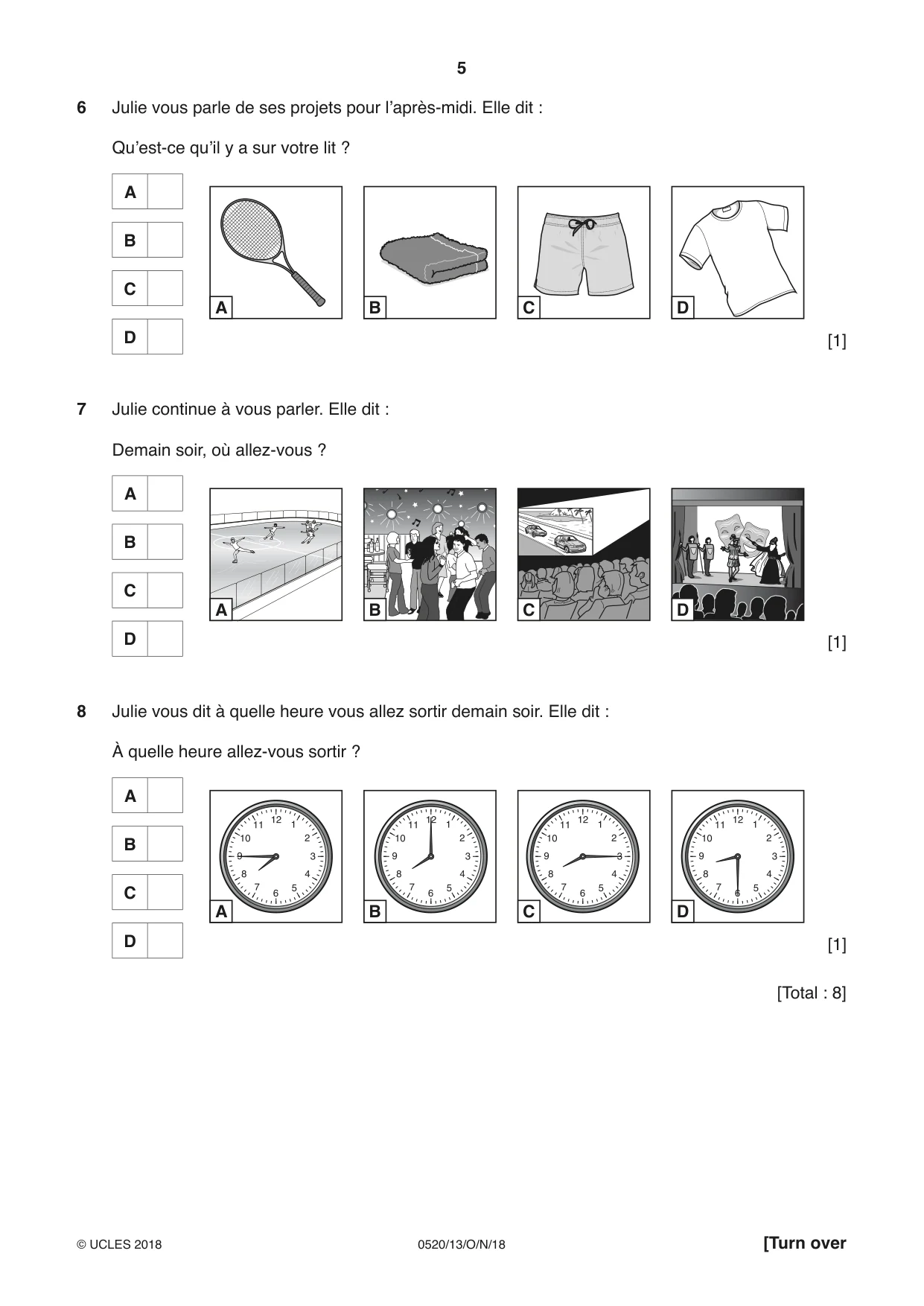
5 0520/13/O/N/18 © UCLES 2018 [Turn over 6 Julie vous parle de ses projets pour l’après-midi. Elle dit : Qu’est-ce qu’il y a sur votre lit ? A A B C D [1] B C D 7 Julie continue à vous parler. Elle dit : Demain soir, où allez-vous ? A A B C D [1] B C D 8 Julie vous dit à quelle heure vous allez sortir demain soir. Elle dit : À quelle heure allez-vous sortir ? A A B C D [1] B C D [Total : 8]
Question paper, page 6
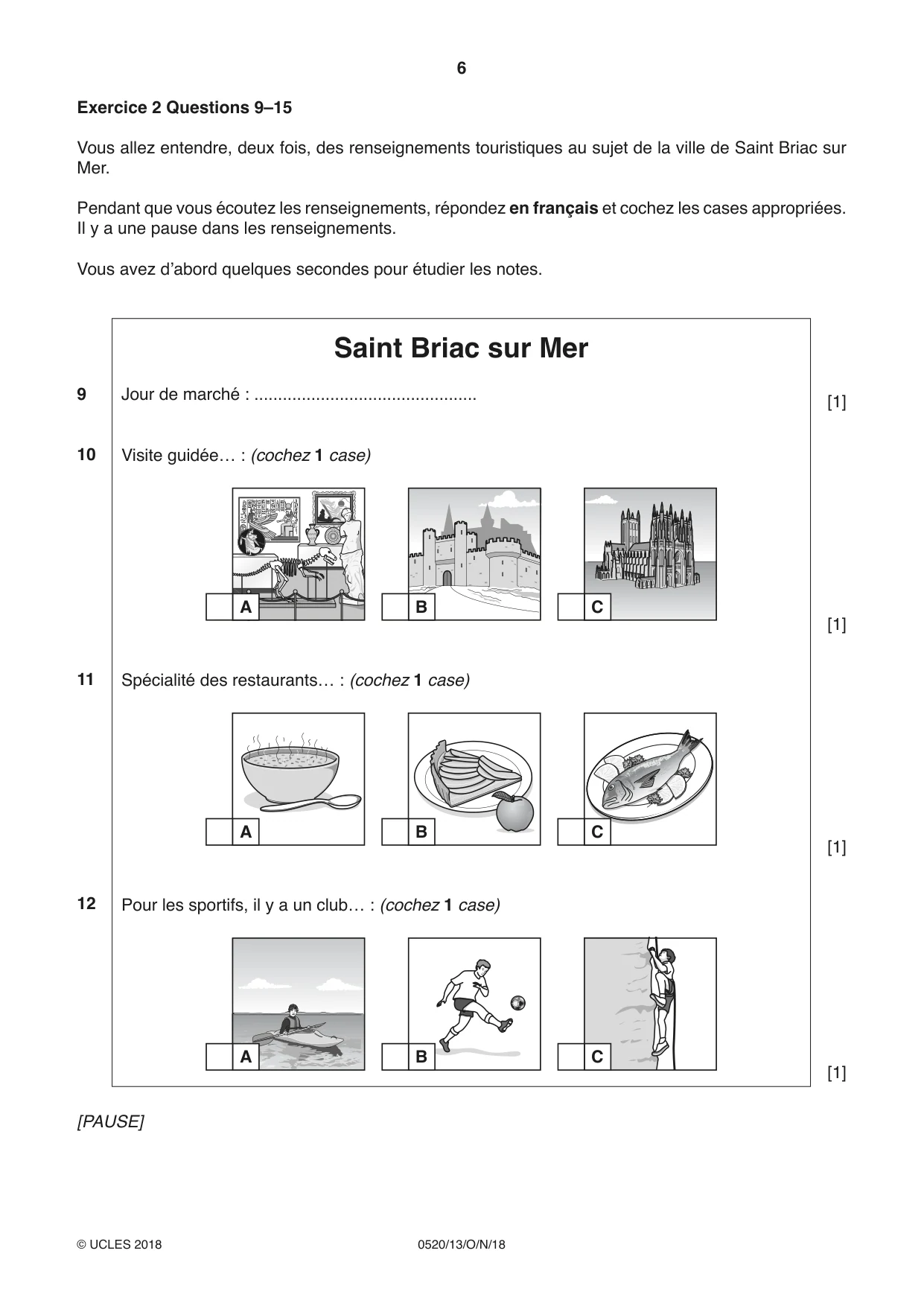
6 0520/13/O/N/18 © UCLES 2018 Exercice 2 Questions 9–15 Vous allez entendre, deux fois, des renseignements touristiques au sujet de la ville de Saint Briac sur Mer. Pendant que vous écoutez les renseignements, répondez en français et cochez les cases appropriées. Il y a une pause dans les renseignements. Vous avez d’abord quelques secondes pour étudier les notes. 9 10 11 12 [1] [1] [1] [1] Saint Briac sur Mer Jour de marché : … Visite guidée… : (cochez 1 case) A B C Spécialité des restaurants… : (cochez 1 case) A B C Pour les sportifs, il y a un club… : (cochez 1 case) A B C [PAUSE]
Question paper, page 7
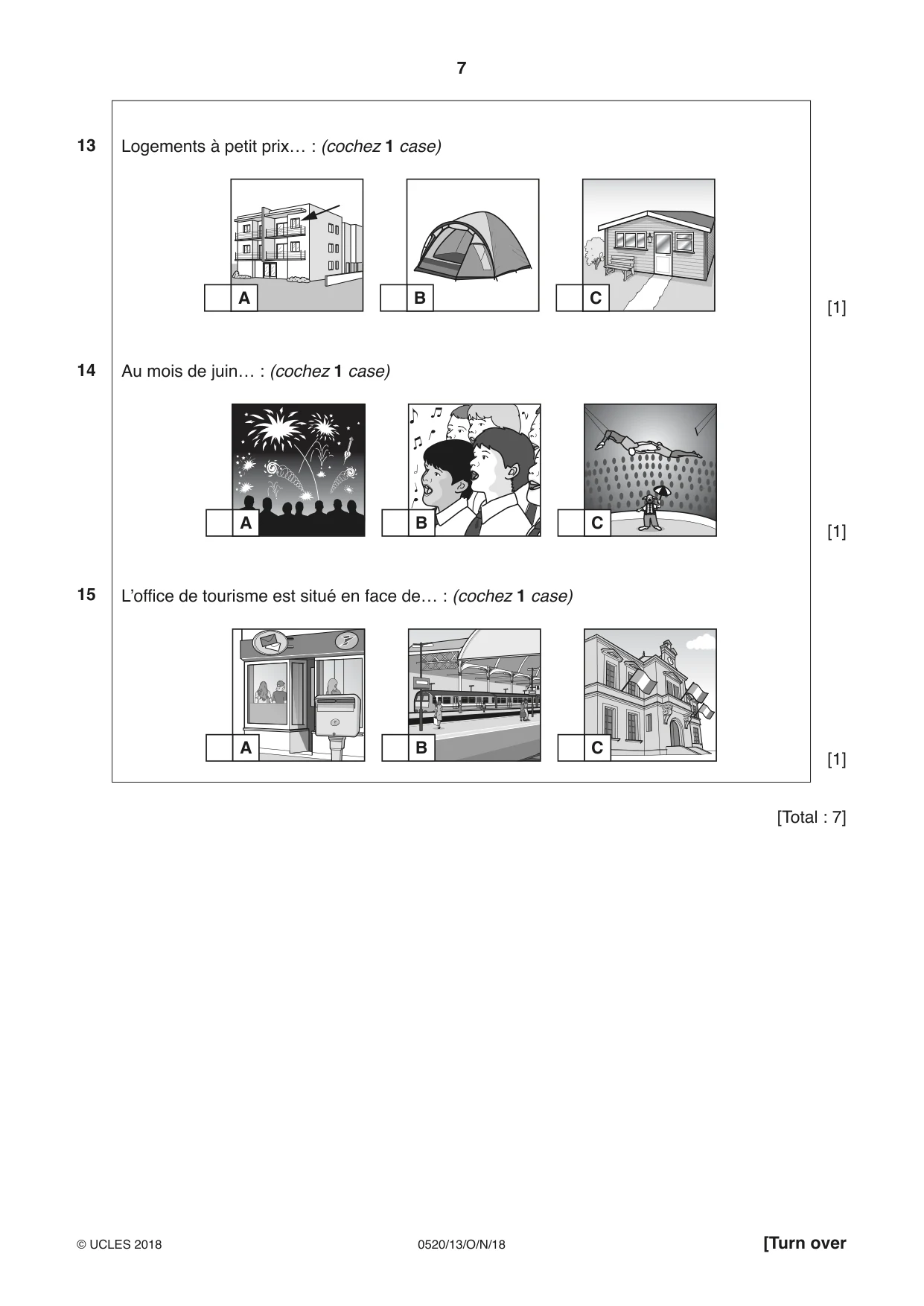
7 0520/13/O/N/18 © UCLES 2018 [Turn over 13 14 15 [1] [1] [1] Logements à petit prix… : (cochez 1 case) A B C Au mois de juin… : (cochez 1 case) A B C L’office de tourisme est situé en face de… : (cochez 1 case) A B C [Total : 7]
Question paper, page 8
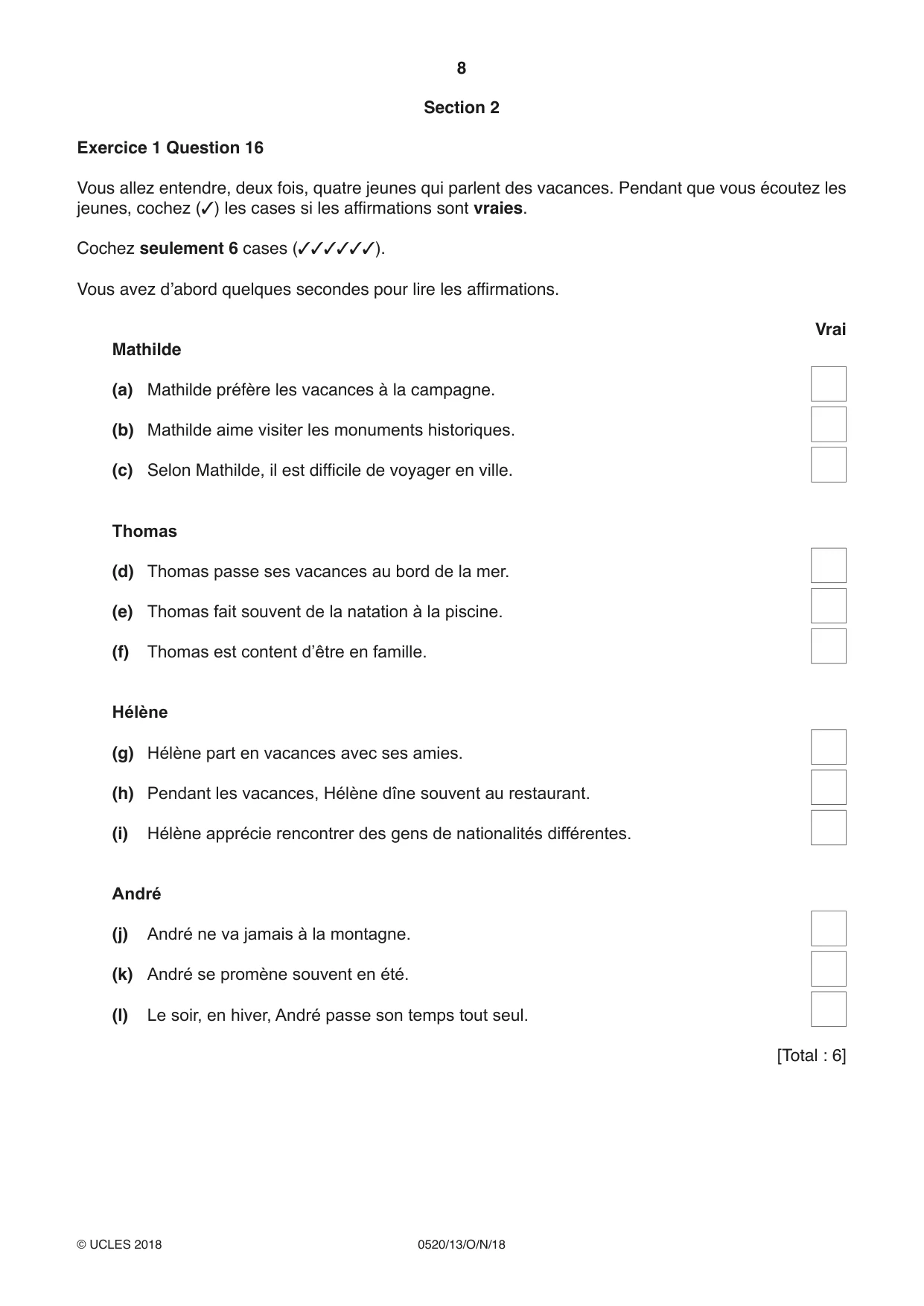
8 0520/13/O/N/18 © UCLES 2018 Section 2 Exercice 1 Question 16 Vous allez entendre, deux fois, quatre jeunes qui parlent des vacances. Pendant que vous écoutez les jeunes, cochez (3) les cases si les affirmations sont vraies. Cochez seulement 6 cases (333333). Vous avez d’abord quelques secondes pour lire les affirmations. Vrai Mathilde (a) Mathilde préfère les vacances à la campagne. (b) Mathilde aime visiter les monuments historiques. (c) Selon Mathilde, il est difficile de voyager en ville. Thomas (d) Thomas passe ses vacances au bord de la mer. (e) Thomas fait souvent de la natation à la piscine. (f) Thomas est content d’être en famille. Hélène (g) Hélène part en vacances avec ses amies. (h) Pendant les vacances, Hélène dîne souvent au restaurant. (i) Hélène apprécie rencontrer des gens de nationalités différentes. André (j) André ne va jamais à la montagne. (k) André se promène souvent en été. (l) Le soir, en hiver, André passe son temps tout seul. [Total : 6]
Question paper, page 9
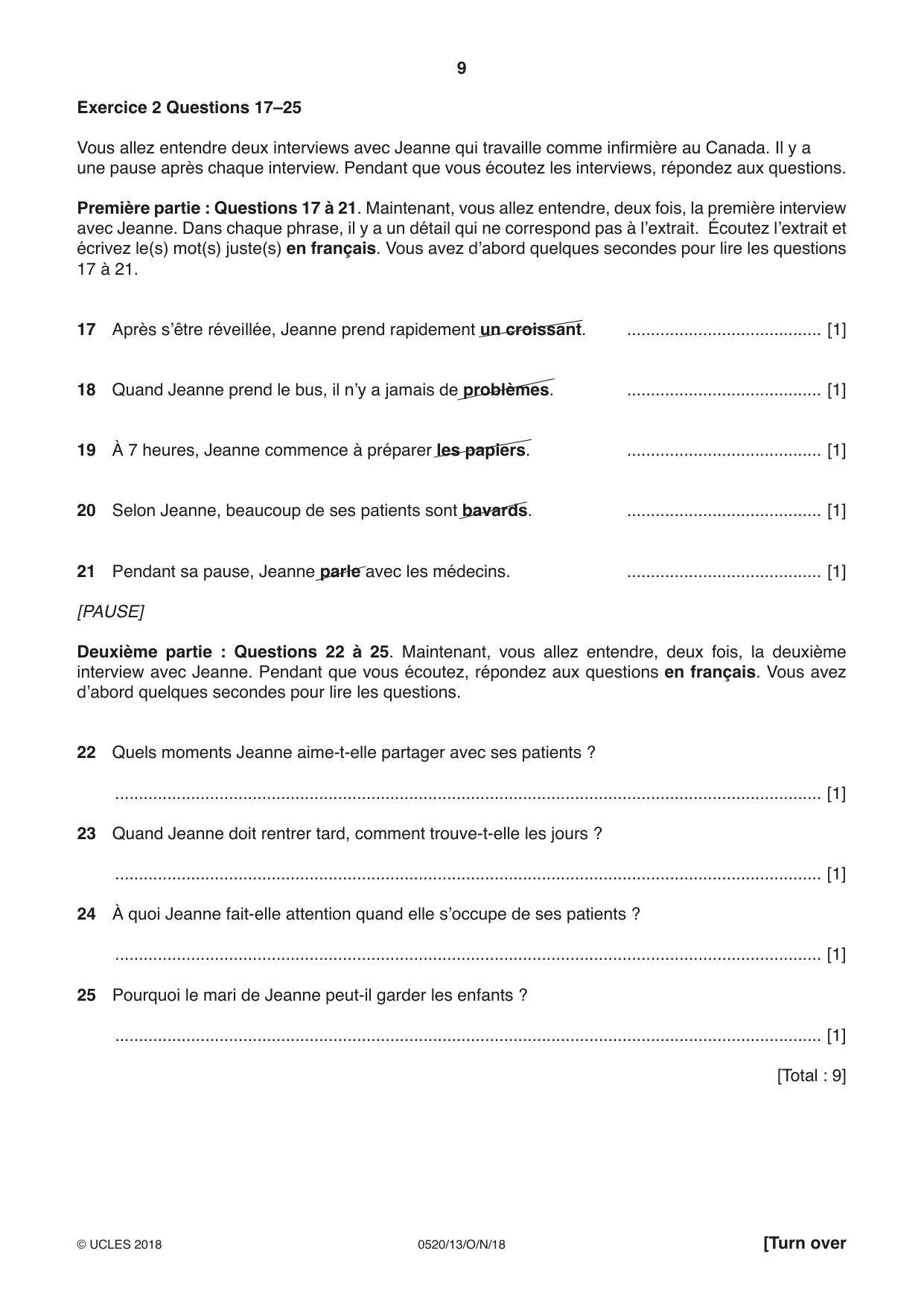
9 0520/13/O/N/18 © UCLES 2018 [Turn over Exercice 2 Questions 17–25 Vous allez entendre deux interviews avec Jeanne qui travaille comme infirmière au Canada. Il y a une pause après chaque interview. Pendant que vous écoutez les interviews, répondez aux questions. Première partie : Questions 17 à 21. Maintenant, vous allez entendre, deux fois, la première interview avec Jeanne. Dans chaque phrase, il y a un détail qui ne correspond pas à l’extrait. Écoutez l’extrait et écrivez le(s) mot(s) juste(s) en français. Vous avez d’abord quelques secondes pour lire les questions 17 à 21. 17 Après s’être réveillée, Jeanne prend rapidement un croissant. … [1] 18 Quand Jeanne prend le bus, il n’y a jamais de problèmes. … [1] 19 À 7 heures, Jeanne commence à préparer les papiers. … [1] 20 Selon Jeanne, beaucoup de ses patients sont bavards. … [1] 21 Pendant sa pause, Jeanne parle avec les médecins. … [1] [PAUSE] Deuxième partie : Questions 22 à 25. Maintenant, vous allez entendre, deux fois, la deuxième interview avec Jeanne. Pendant que vous écoutez, répondez aux questions en français. Vous avez d’abord quelques secondes pour lire les questions. 22 Quels moments Jeanne aime-t-elle partager avec ses patients ? … [1] 23 Quand Jeanne doit rentrer tard, comment trouve-t-elle les jours ? … [1] 24 À quoi Jeanne fait-elle attention quand elle s’occupe de ses patients ? … [1] 25 Pourquoi le mari de Jeanne peut-il garder les enfants ? … [1] [Total : 9]
Question paper, page 10
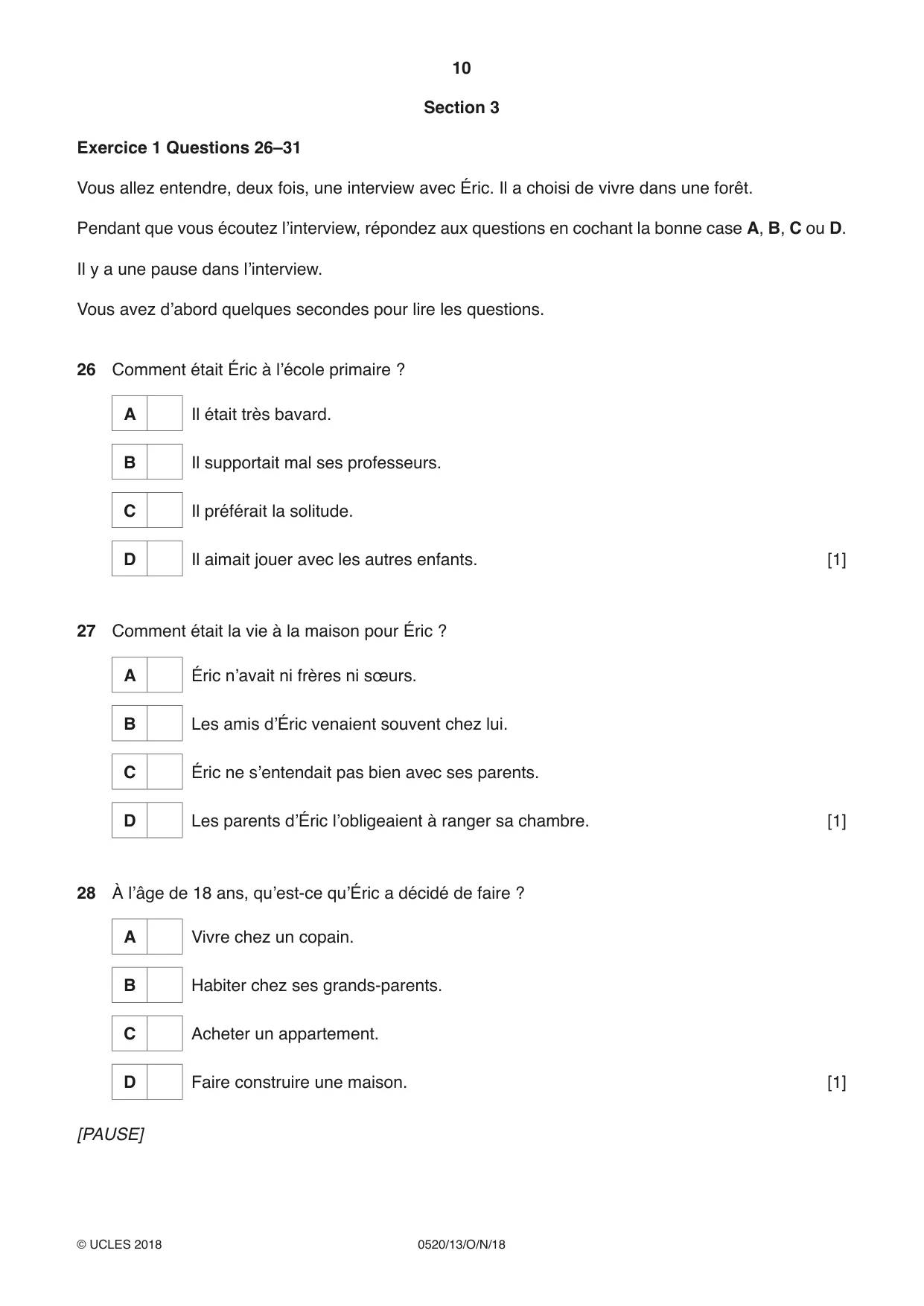
10 0520/13/O/N/18 © UCLES 2018 Section 3 Exercice 1 Questions 26–31 Vous allez entendre, deux fois, une interview avec Éric. Il a choisi de vivre dans une forêt. Pendant que vous écoutez l’interview, répondez aux questions en cochant la bonne case A, B, C ou D. Il y a une pause dans l’interview. Vous avez d’abord quelques secondes pour lire les questions. 26 Comment était Éric à l’école primaire ? A Il était très bavard. B Il supportait mal ses professeurs. C Il préférait la solitude. D Il aimait jouer avec les autres enfants. [1] 27 Comment était la vie à la maison pour Éric ? A Éric n’avait ni frères ni sœurs. B Les amis d’Éric venaient souvent chez lui. C Éric ne s’entendait pas bien avec ses parents. D Les parents d’Éric l’obligeaient à ranger sa chambre. [1] 28 À l’âge de 18 ans, qu’est-ce qu’Éric a décidé de faire ? A Vivre chez un copain. B Habiter chez ses grands-parents. C Acheter un appartement. D Faire construire une maison. [1] [PAUSE]
Question paper, page 11
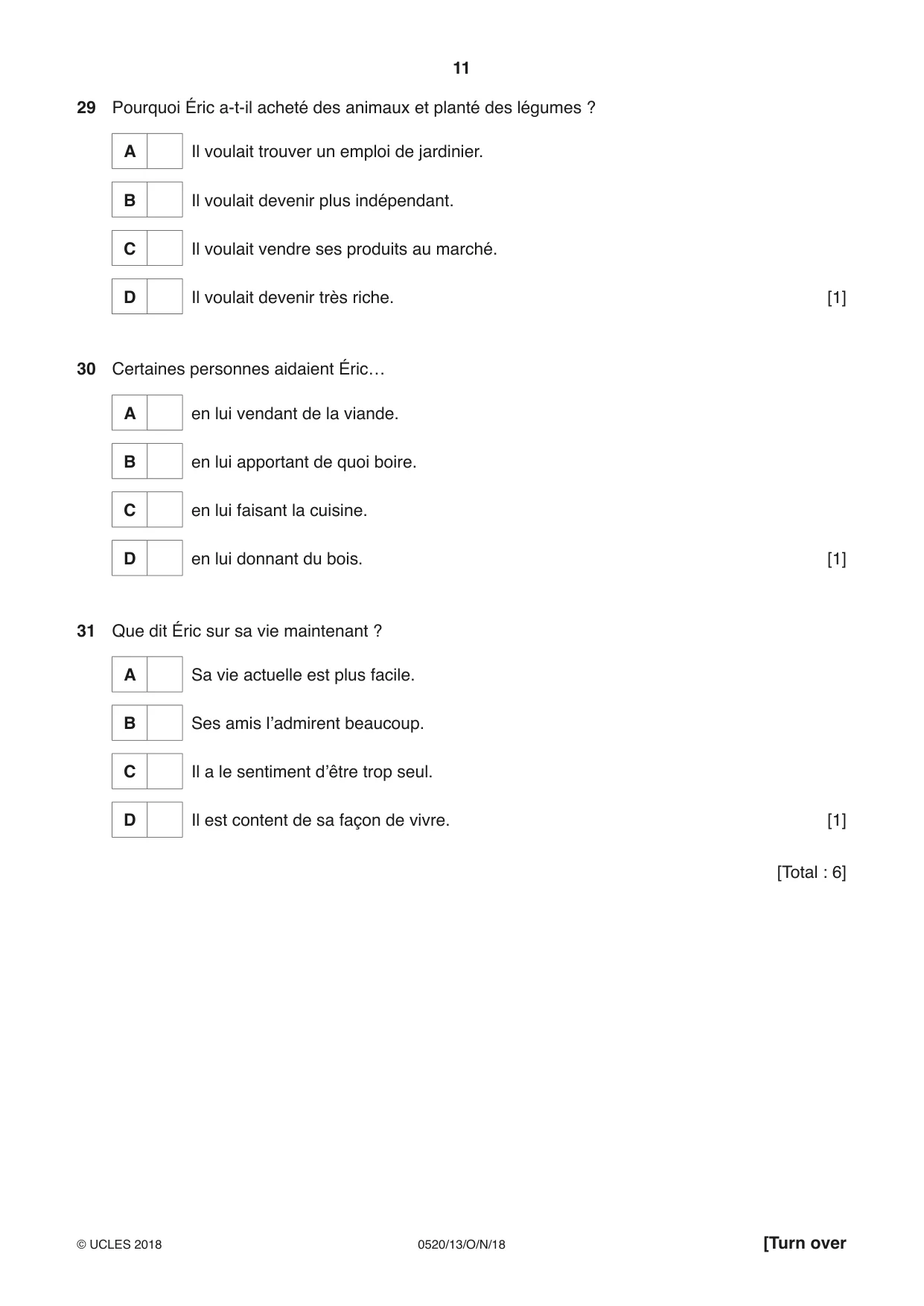
11 0520/13/O/N/18 © UCLES 2018 [Turn over 29 Pourquoi Éric a-t-il acheté des animaux et planté des légumes ? A Il voulait trouver un emploi de jardinier. B Il voulait devenir plus indépendant. C Il voulait vendre ses produits au marché. D Il voulait devenir très riche. [1] 30 Certaines personnes aidaient Éric… A en lui vendant de la viande. B en lui apportant de quoi boire. C en lui faisant la cuisine. D en lui donnant du bois. [1] 31 Que dit Éric sur sa vie maintenant ? A Sa vie actuelle est plus facile. B Ses amis l’admirent beaucoup. C Il a le sentiment d’être trop seul. D Il est content de sa façon de vivre. [1] [Total : 6]
Question paper, page 12
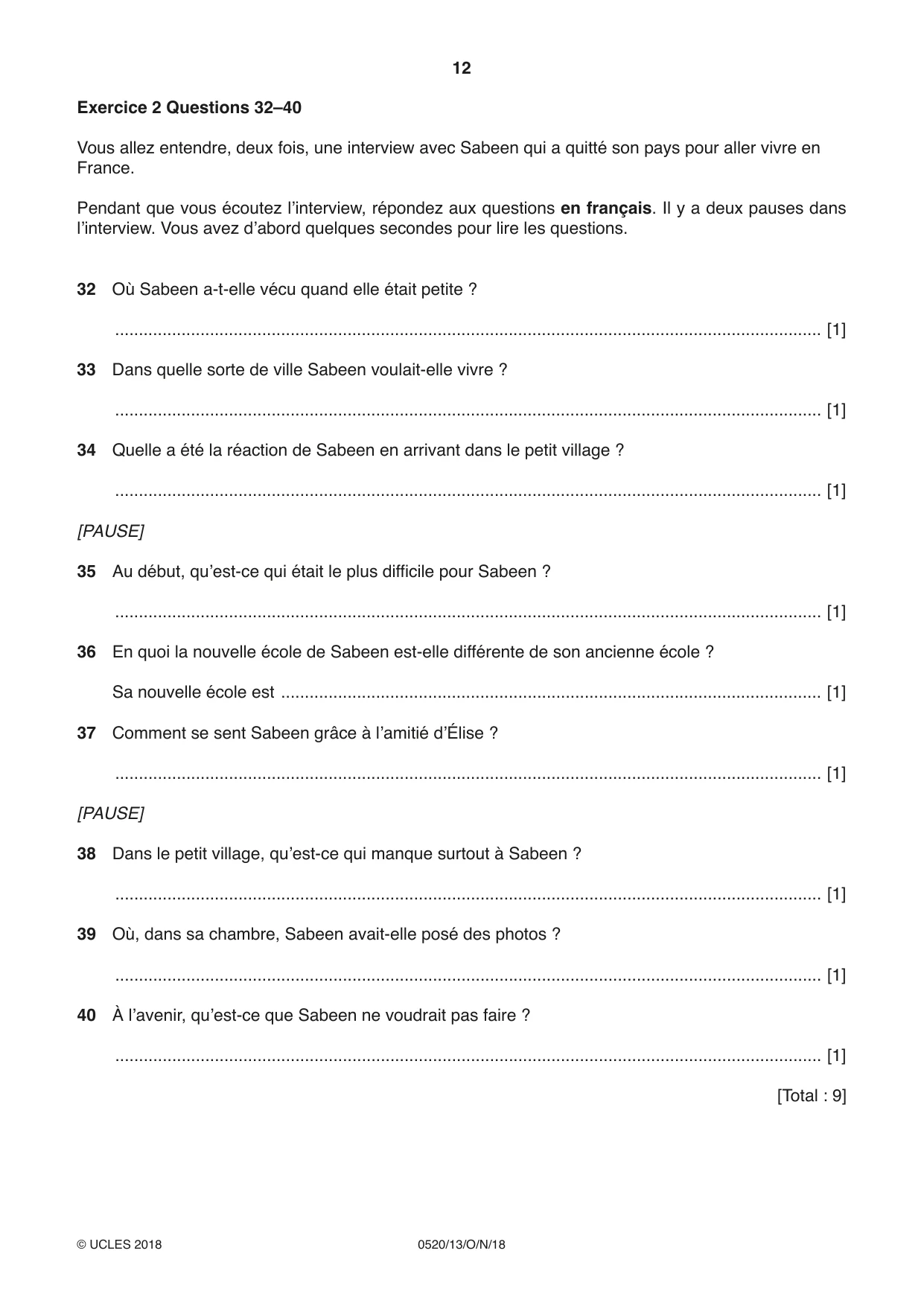
12 0520/13/O/N/18 © UCLES 2018 Exercice 2 Questions 32–40 Vous allez entendre, deux fois, une interview avec Sabeen qui a quitté son pays pour aller vivre en France. Pendant que vous écoutez l’interview, répondez aux questions en français. Il y a deux pauses dans l’interview. Vous avez d’abord quelques secondes pour lire les questions. 32 Où Sabeen a-t-elle vécu quand elle était petite ? … [1] 33 Dans quelle sorte de ville Sabeen voulait-elle vivre ? … [1] 34 Quelle a été la réaction de Sabeen en arrivant dans le petit village ? … [1] [PAUSE] 35 Au début, qu’est-ce qui était le plus difficile pour Sabeen ? … [1] 36 En quoi la nouvelle école de Sabeen est-elle différente de son ancienne école ? Sa nouvelle école est … [1] 37 Comment se sent Sabeen grâce à l’amitié d’Élise ? … [1] [PAUSE] 38 Dans le petit village, qu’est-ce qui manque surtout à Sabeen ? … [1] 39 Où, dans sa chambre, Sabeen avait-elle posé des photos ? … [1] 40 À l’avenir, qu’est-ce que Sabeen ne voudrait pas faire ? … [1] [Total : 9]
Mark scheme, page 1
This syllabus is approved for use in England, Wales and Northern Ireland as a Cambridge International Level 1/Level 2 Certificate. This document consists of 14 printed pages. © UCLES 2018 [Turn over Cambridge Assessment International Education Cambridge International General Certificate of Secondary Education FRENCH 0520/13 Paper 1 Listening October/November 2018 MARK SCHEME Maximum Mark: 45 Published This mark scheme is published as an aid to teachers and candidates, to indicate the requirements of the examination. It shows the basis on which Examiners were instructed to award marks. It does not indicate the details of the discussions that took place at an Examiners’ meeting before marking began, which would have considered the acceptability of alternative answers. Mark schemes should be read in conjunction with the question paper and the Principal Examiner Report for Teachers. Cambridge International will not enter into discussions about these mark schemes. Cambridge International is publishing the mark schemes for the October/November 2018 series for most Cambridge IGCSE™, Cambridge International A and AS Level components and some Cambridge O Level components.
Mark scheme, page 2
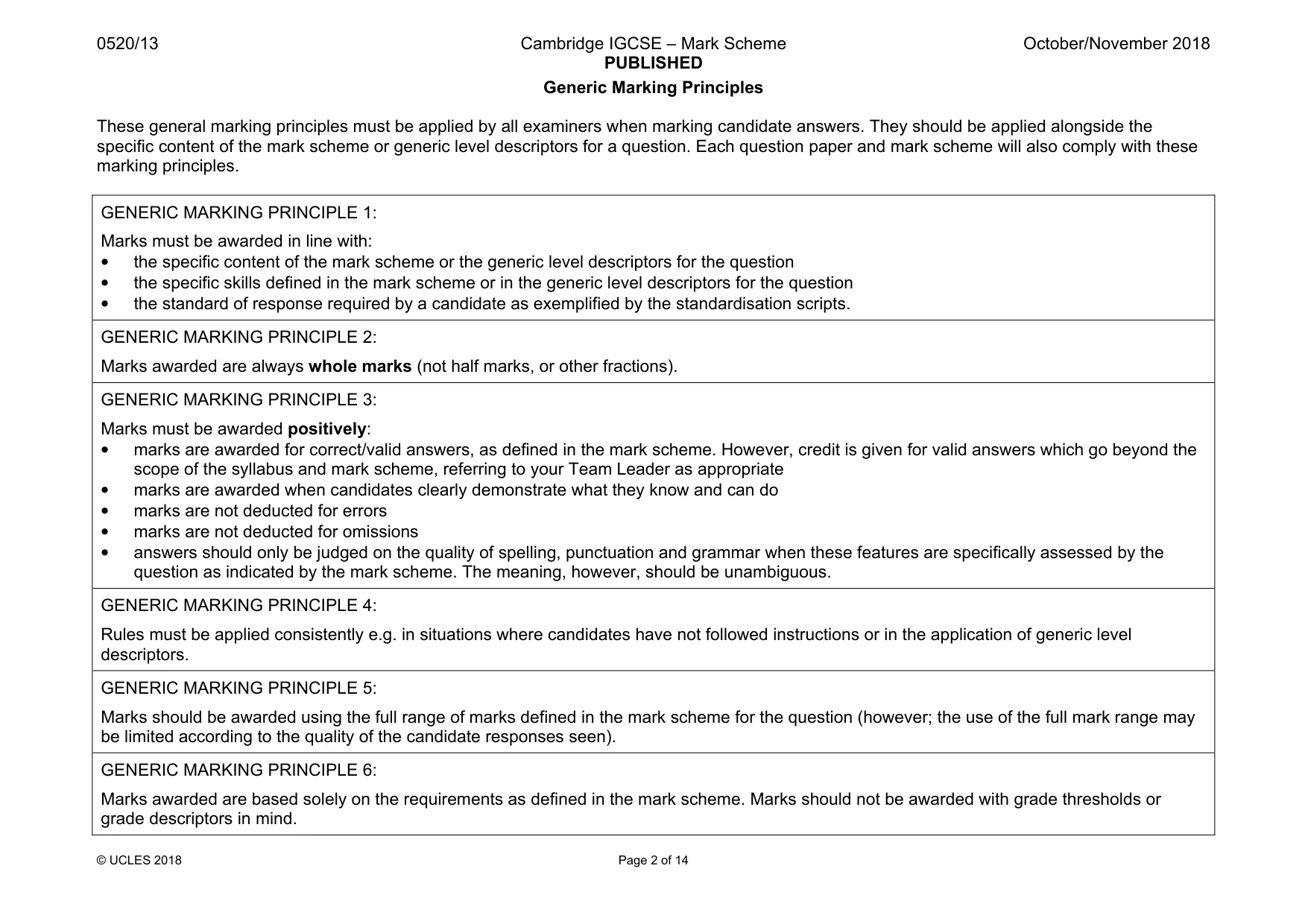
0520/13 Cambridge IGCSE – Mark Scheme PUBLISHED October/November 2018 © UCLES 2018 Page 2 of 14 Generic Marking Principles These general marking principles must be applied by all examiners when marking candidate answers. They should be applied alongside the specific content of the mark scheme or generic level descriptors for a question. Each question paper and mark scheme will also comply with these marking principles. GENERIC MARKING PRINCIPLE 1: Marks must be awarded in line with: • the specific content of the mark scheme or the generic level descriptors for the question • the specific skills defined in the mark scheme or in the generic level descriptors for the question • the standard of response required by a candidate as exemplified by the standardisation scripts. GENERIC MARKING PRINCIPLE 2: Marks awarded are always whole marks (not half marks, or other fractions). GENERIC MARKING PRINCIPLE 3: Marks must be awarded positively: • marks are awarded for correct/valid answers, as defined in the mark scheme. However, credit is given for valid answers which go beyond the scope of the syllabus and mark scheme, referring to your Team Leader as appropriate • marks are awarded when candidates clearly demonstrate what they know and can do • marks are not deducted for errors • marks are not deducted for omissions • answers should only be judged on the quality of spelling, punctuation and grammar when these features are specifically assessed by the question as indicated by the mark scheme. The meaning, however, should be unambiguous. GENERIC MARKING PRINCIPLE 4: Rules must be applied consistently e.g. in situations where candidates have not followed instructions or in the application of generic level descriptors. GENERIC MARKING PRINCIPLE 5: Marks should be awarded using the full range of marks defined in the mark scheme for the question (however; the use of the full mark range may be limited according to the quality of the candidate responses seen). GENERIC MARKING PRINCIPLE 6: Marks awarded are based solely on the requirements as defined in the mark scheme. Marks should not be awarded with grade thresholds or grade descriptors in mind.
Mark scheme, page 3
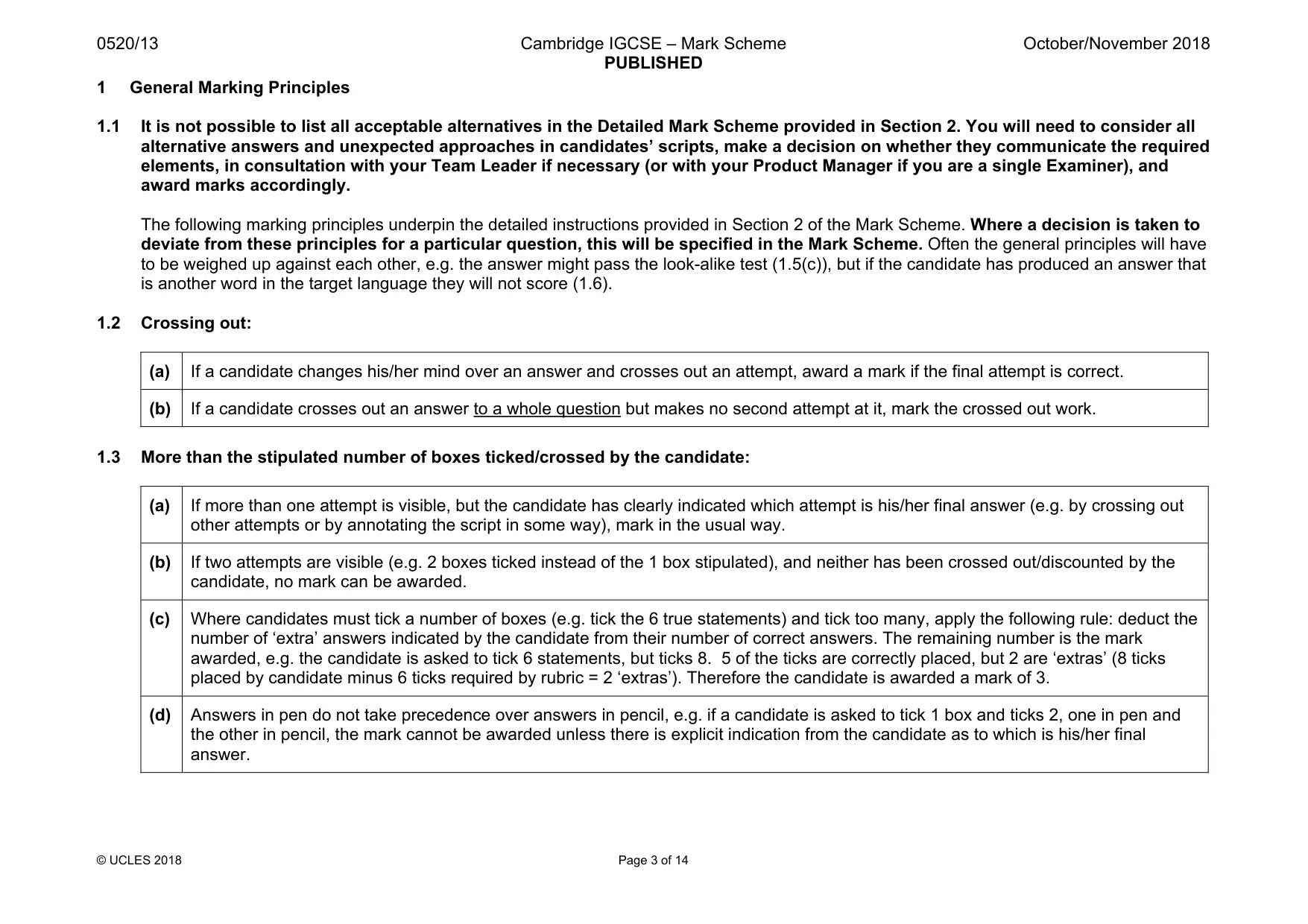
0520/13 Cambridge IGCSE – Mark Scheme PUBLISHED October/November 2018 © UCLES 2018 Page 3 of 14 1 General Marking Principles 1.1 It is not possible to list all acceptable alternatives in the Detailed Mark Scheme provided in Section 2. You will need to consider all alternative answers and unexpected approaches in candidates’ scripts, make a decision on whether they communicate the required elements, in consultation with your Team Leader if necessary (or with your Product Manager if you are a single Examiner), and award marks accordingly. The following marking principles underpin the detailed instructions provided in Section 2 of the Mark Scheme. Where a decision is taken to deviate from these principles for a particular question, this will be specified in the Mark Scheme. Often the general principles will have to be weighed up against each other, e.g. the answer might pass the look-alike test (1.5(c)), but if the candidate has produced an answer that is another word in the target language they will not score (1.6). 1.2 Crossing out: (a) If a candidate changes his/her mind over an answer and crosses out an attempt, award a mark if the final attempt is correct. (b) If a candidate crosses out an answer to a whole question but makes no second attempt at it, mark the crossed out work. 1.3 More than the stipulated number of boxes ticked/crossed by the candidate: (a) If more than one attempt is visible, but the candidate has clearly indicated which attempt is his/her final answer (e.g. by crossing out other attempts or by annotating the script in some way), mark in the usual way. (b) If two attempts are visible (e.g. 2 boxes ticked instead of the 1 box stipulated), and neither has been crossed out/discounted by the candidate, no mark can be awarded. (c) Where candidates must tick a number of boxes (e.g. tick the 6 true statements) and tick too many, apply the following rule: deduct the number of ‘extra’ answers indicated by the candidate from their number of correct answers. The remaining number is the mark awarded, e.g. the candidate is asked to tick 6 statements, but ticks 8. 5 of the ticks are correctly placed, but 2 are ‘extras’ (8 ticks placed by candidate minus 6 ticks required by rubric = 2 ‘extras’). Therefore the candidate is awarded a mark of 3. (d) Answers in pen do not take precedence over answers in pencil, e.g. if a candidate is asked to tick 1 box and ticks 2, one in pen and the other in pencil, the mark cannot be awarded unless there is explicit indication from the candidate as to which is his/her final answer.
Mark scheme, page 4
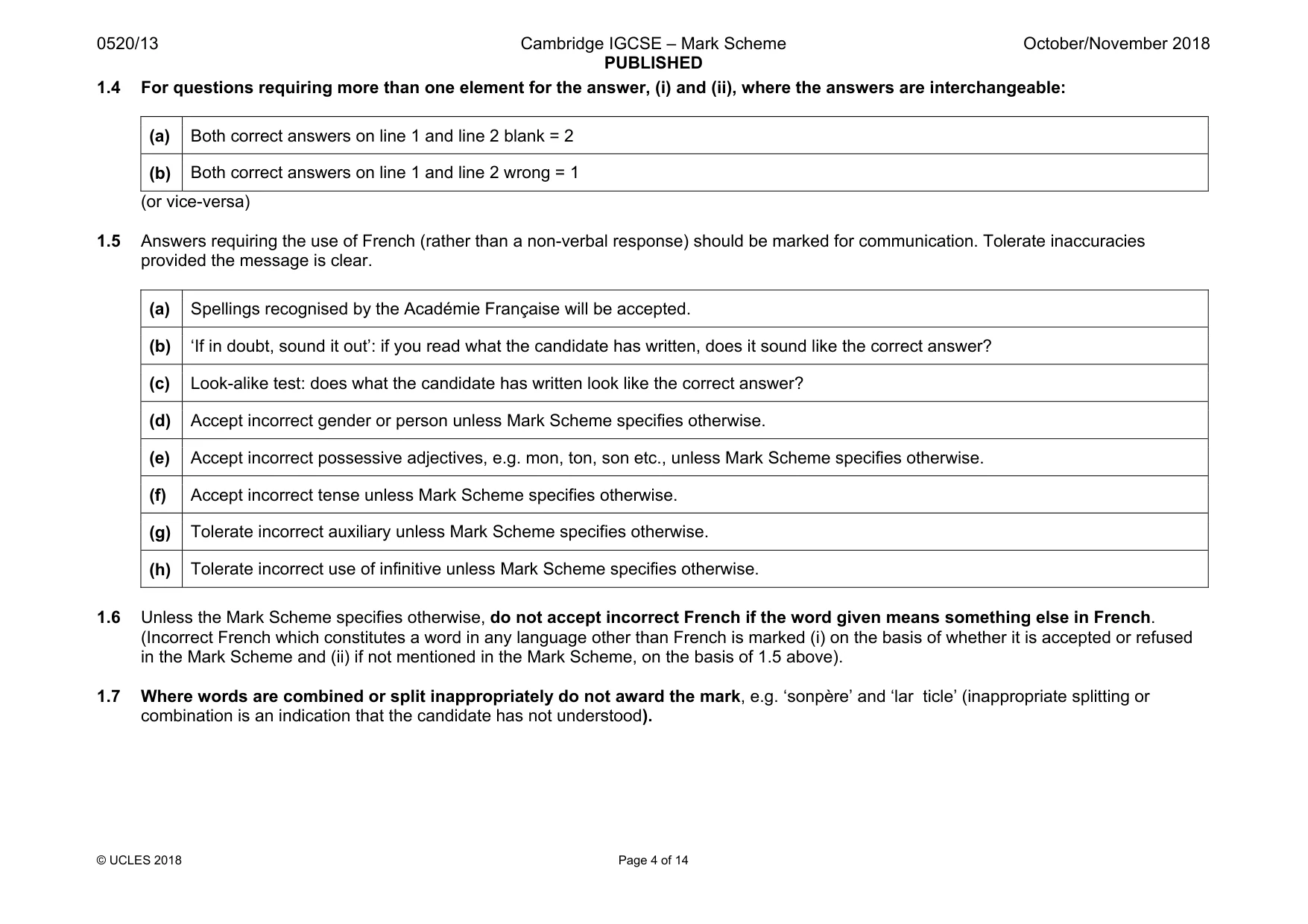
0520/13 Cambridge IGCSE – Mark Scheme PUBLISHED October/November 2018 © UCLES 2018 Page 4 of 14 1.4 For questions requiring more than one element for the answer, (i) and (ii), where the answers are interchangeable: (a) Both correct answers on line 1 and line 2 blank = 2 (b) Both correct answers on line 1 and line 2 wrong = 1 (or vice-versa) 1.5 Answers requiring the use of French (rather than a non-verbal response) should be marked for communication. Tolerate inaccuracies provided the message is clear. (a) Spellings recognised by the Académie Française will be accepted. (b) ‘If in doubt, sound it out’: if you read what the candidate has written, does it sound like the correct answer? (c) Look-alike test: does what the candidate has written look like the correct answer? (d) Accept incorrect gender or person unless Mark Scheme specifies otherwise. (e) Accept incorrect possessive adjectives, e.g. mon, ton, son etc., unless Mark Scheme specifies otherwise. (f) Accept incorrect tense unless Mark Scheme specifies otherwise. (g) Tolerate incorrect auxiliary unless Mark Scheme specifies otherwise. (h) Tolerate incorrect use of infinitive unless Mark Scheme specifies otherwise. 1.6 Unless the Mark Scheme specifies otherwise, do not accept incorrect French if the word given means something else in French. (Incorrect French which constitutes a word in any language other than French is marked (i) on the basis of whether it is accepted or refused in the Mark Scheme and (ii) if not mentioned in the Mark Scheme, on the basis of 1.5 above). 1.7 Where words are combined or split inappropriately do not award the mark, e.g. ‘sonpère’ and ‘lar ticle’ (inappropriate splitting or combination is an indication that the candidate has not understood).
Mark scheme, page 5
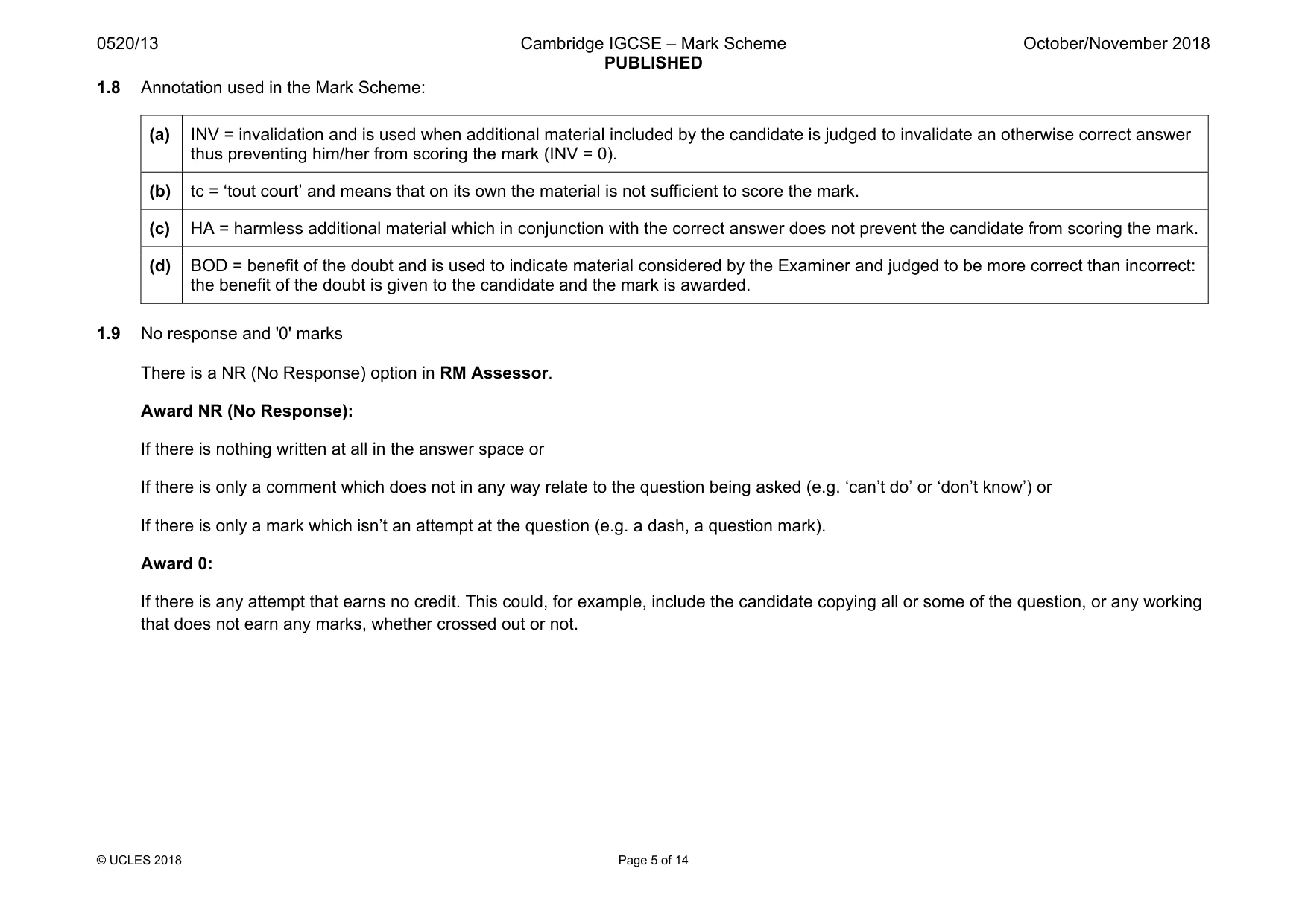
0520/13 Cambridge IGCSE – Mark Scheme PUBLISHED October/November 2018 © UCLES 2018 Page 5 of 14 1.8 Annotation used in the Mark Scheme: (a) INV = invalidation and is used when additional material included by the candidate is judged to invalidate an otherwise correct answer thus preventing him/her from scoring the mark (INV = 0). (b) tc = ‘tout court’ and means that on its own the material is not sufficient to score the mark. (c) HA = harmless additional material which in conjunction with the correct answer does not prevent the candidate from scoring the mark. (d) BOD = benefit of the doubt and is used to indicate material considered by the Examiner and judged to be more correct than incorrect: the benefit of the doubt is given to the candidate and the mark is awarded. 1.9 No response and '0' marks There is a NR (No Response) option in RM Assessor. Award NR (No Response): If there is nothing written at all in the answer space or If there is only a comment which does not in any way relate to the question being asked (e.g. ‘can’t do’ or ‘don’t know’) or If there is only a mark which isn’t an attempt at the question (e.g. a dash, a question mark). Award 0: If there is any attempt that earns no credit. This could, for example, include the candidate copying all or some of the question, or any working that does not earn any marks, whether crossed out or not.
Mark scheme, page 6
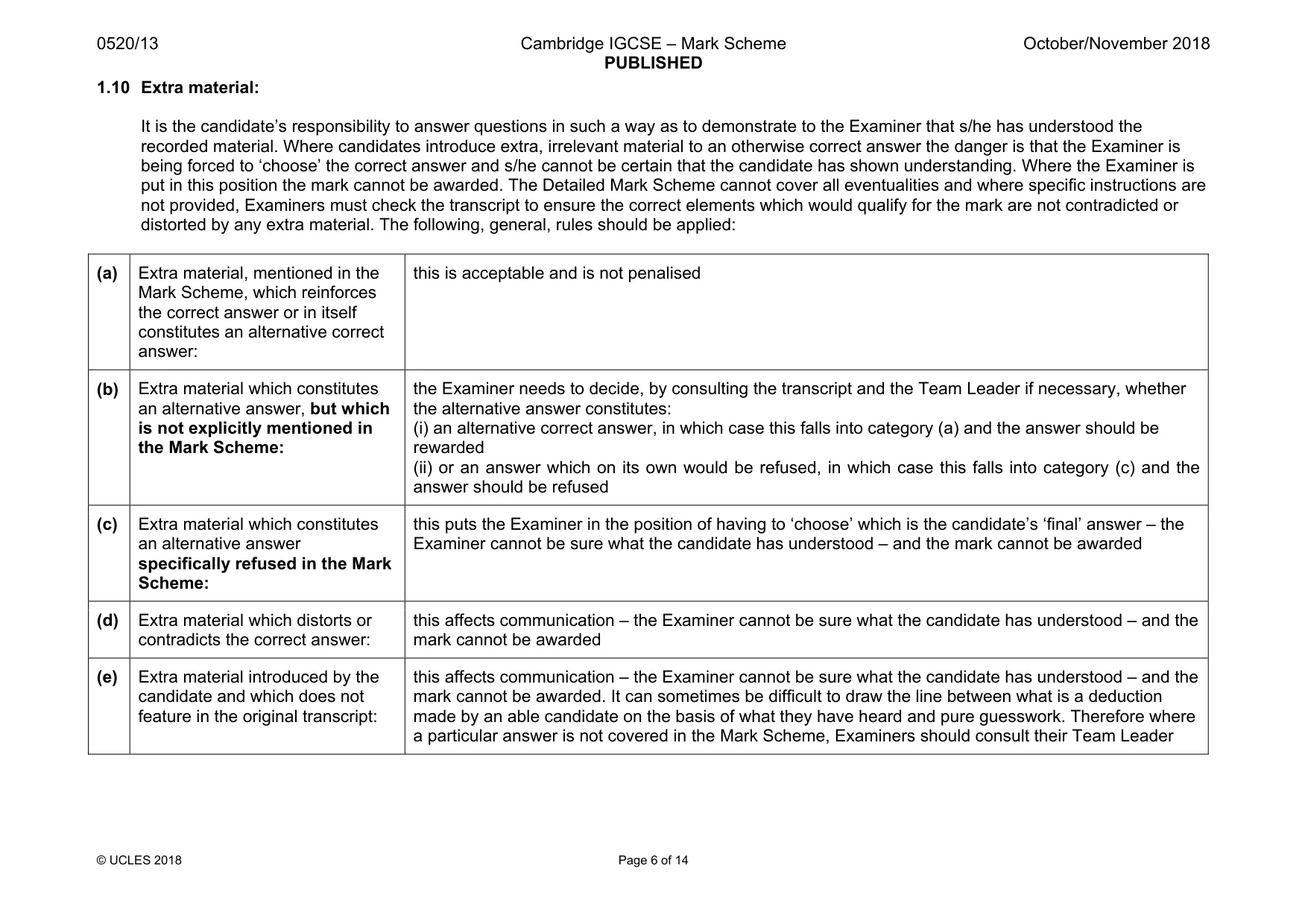
0520/13 Cambridge IGCSE – Mark Scheme PUBLISHED October/November 2018 © UCLES 2018 Page 6 of 14 1.10 Extra material: It is the candidate’s responsibility to answer questions in such a way as to demonstrate to the Examiner that s/he has understood the recorded material. Where candidates introduce extra, irrelevant material to an otherwise correct answer the danger is that the Examiner is being forced to ‘choose’ the correct answer and s/he cannot be certain that the candidate has shown understanding. Where the Examiner is put in this position the mark cannot be awarded. The Detailed Mark Scheme cannot cover all eventualities and where specific instructions are not provided, Examiners must check the transcript to ensure the correct elements which would qualify for the mark are not contradicted or distorted by any extra material. The following, general, rules should be applied: (a) Extra material, mentioned in the Mark Scheme, which reinforces the correct answer or in itself constitutes an alternative correct answer: this is acceptable and is not penalised (b) Extra material which constitutes an alternative answer, but which is not explicitly mentioned in the Mark Scheme: the Examiner needs to decide, by consulting the transcript and the Team Leader if necessary, whether the alternative answer constitutes: (i) an alternative correct answer, in which case this falls into category (a) and the answer should be rewarded (ii) or an answer which on its own would be refused, in which case this falls into category (c) and the answer should be refused (c) Extra material which constitutes an alternative answer specifically refused in the Mark Scheme: this puts the Examiner in the position of having to ‘choose’ which is the candidate’s ‘final’ answer – the Examiner cannot be sure what the candidate has understood – and the mark cannot be awarded (d) Extra material which distorts or contradicts the correct answer: this affects communication – the Examiner cannot be sure what the candidate has understood – and the mark cannot be awarded (e) Extra material introduced by the candidate and which does not feature in the original transcript: this affects communication – the Examiner cannot be sure what the candidate has understood – and the mark cannot be awarded. It can sometimes be difficult to draw the line between what is a deduction made by an able candidate on the basis of what they have heard and pure guesswork. Therefore where a particular answer is not covered in the Mark Scheme, Examiners should consult their Team Leader
Mark scheme, page 7
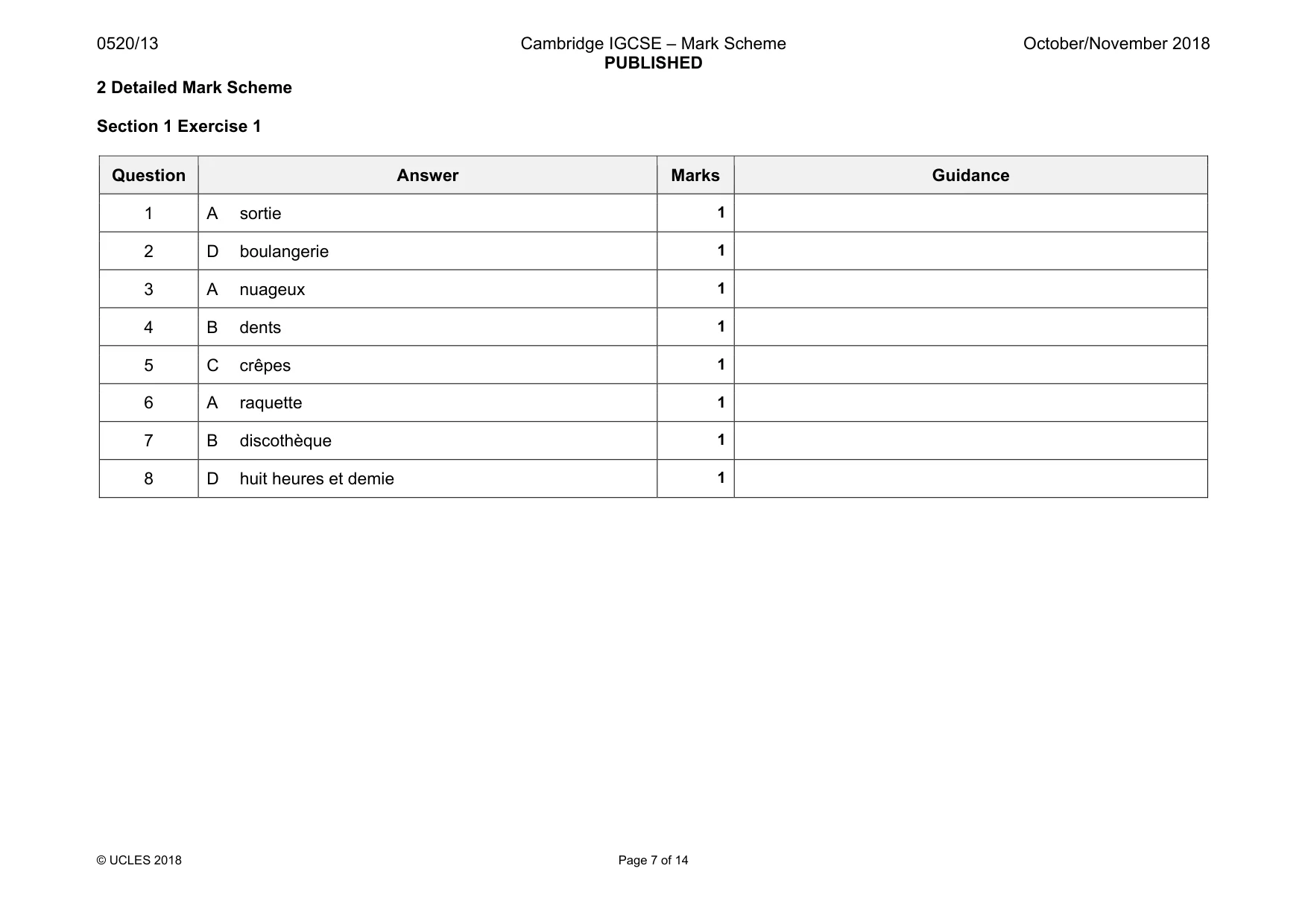
0520/13 Cambridge IGCSE – Mark Scheme PUBLISHED October/November 2018 © UCLES 2018 Page 7 of 14 2 Detailed Mark Scheme Section 1 Exercise 1 Question Answer Marks Guidance 1 A sortie 1 2 D boulangerie 1 3 A nuageux 1 4 B dents 1 5 C crêpes 1 6 A raquette 1 7 B discothèque 1 8 D huit heures et demie 1
Mark scheme, page 8
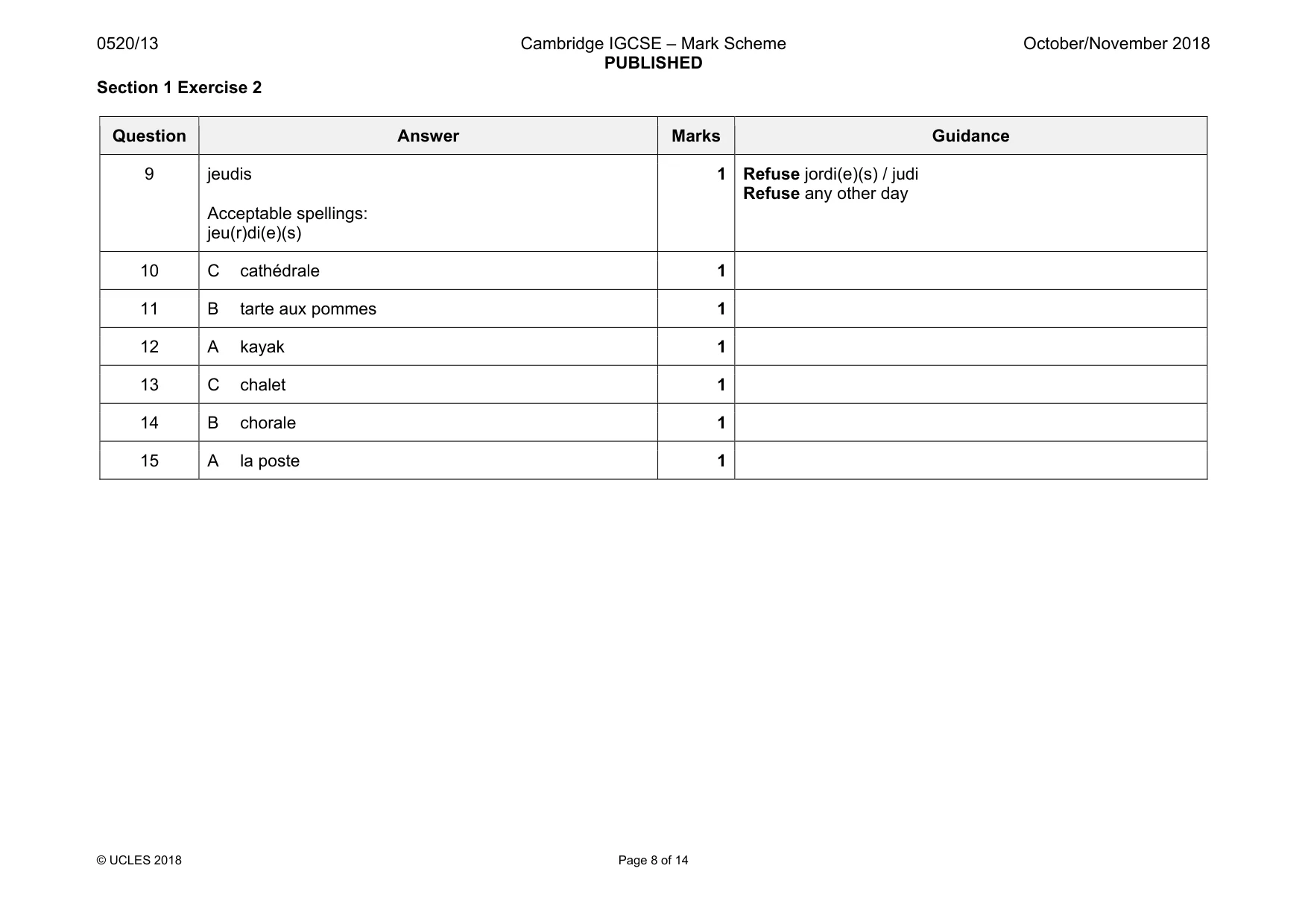
0520/13 Cambridge IGCSE – Mark Scheme PUBLISHED October/November 2018 © UCLES 2018 Page 8 of 14 Section 1 Exercise 2 Question Answer Marks Guidance 9 jeudis Acceptable spellings: jeu(r)di(e)(s) 1 Refuse jordi(e)(s) / judi Refuse any other day 10 C cathédrale 1 11 B tarte aux pommes 1 12 A kayak 1 13 C chalet 1 14 B chorale 1 15 A la poste 1
Mark scheme, page 9
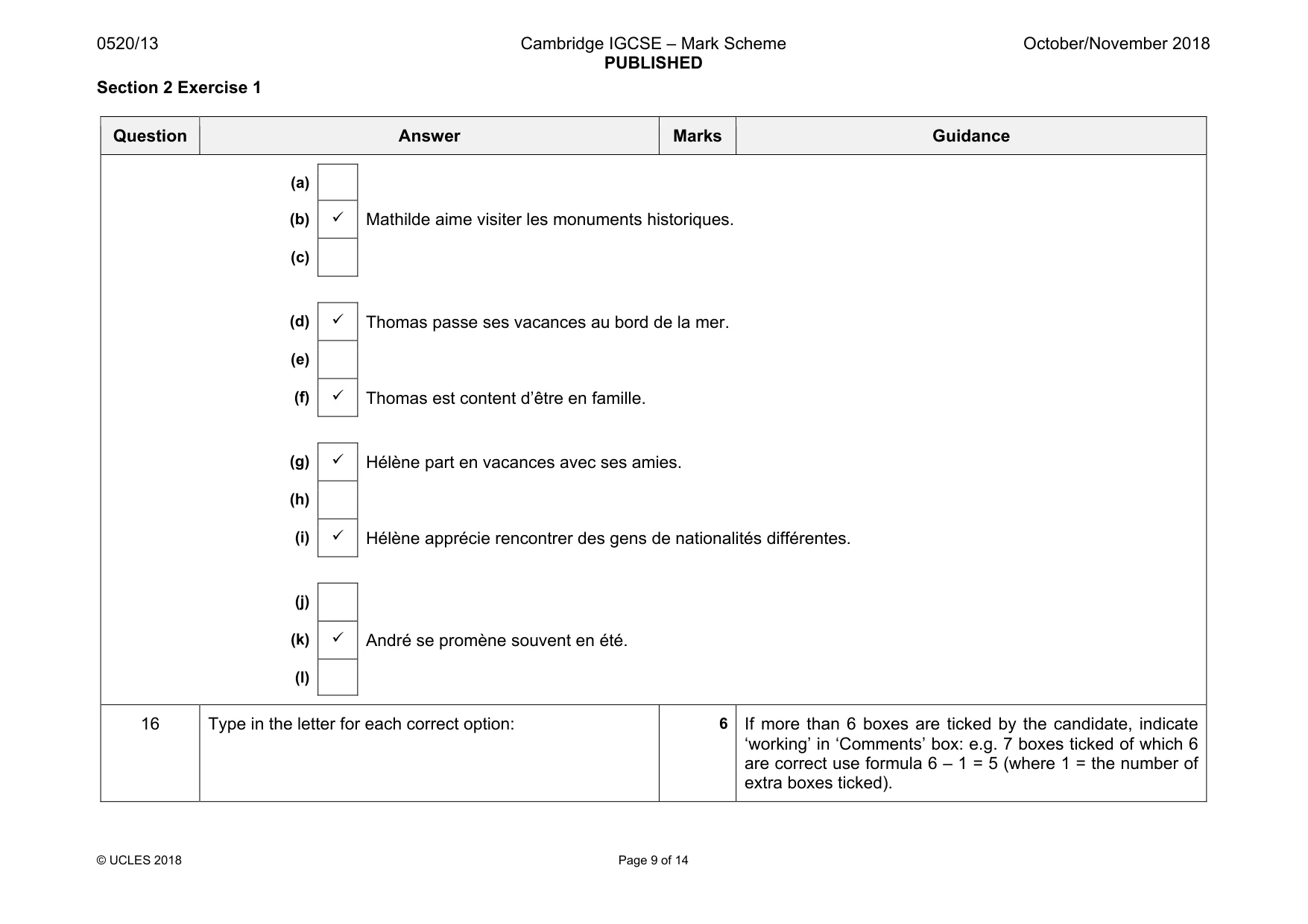
0520/13 Cambridge IGCSE – Mark Scheme PUBLISHED October/November 2018 © UCLES 2018 Page 9 of 14 Section 2 Exercise 1 Question Answer Marks Guidance (a) (b) 9 Mathilde aime visiter les monuments historiques. (c) (d) 9 Thomas passe ses vacances au bord de la mer. (e) (f) 9 Thomas est content d’être en famille. (g) 9 Hélène part en vacances avec ses amies. (h) (i) 9 Hélène apprécie rencontrer des gens de nationalités différentes. (j) (k) 9 André se promène souvent en été. (l) 16 Type in the letter for each correct option: 6 If more than 6 boxes are ticked by the candidate, indicate ‘working’ in ‘Comments’ box: e.g. 7 boxes ticked of which 6 are correct use formula 6 – 1 = 5 (where 1 = the number of extra boxes ticked).
Mark scheme, page 10
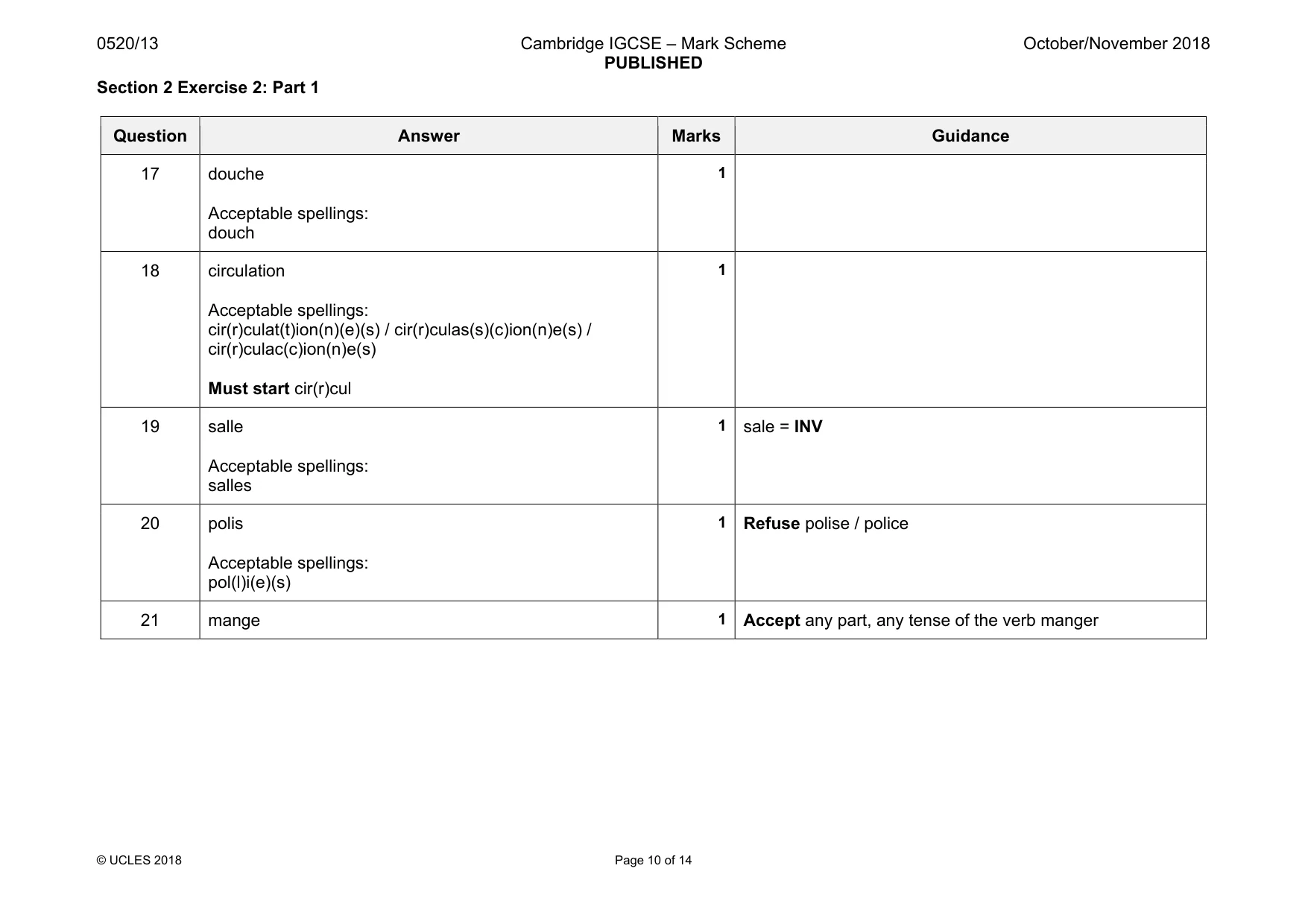
0520/13 Cambridge IGCSE – Mark Scheme PUBLISHED October/November 2018 © UCLES 2018 Page 10 of 14 Section 2 Exercise 2: Part 1 Question Answer Marks Guidance 17 douche Acceptable spellings: douch 1 18 circulation Acceptable spellings: cir(r)culat(t)ion(n)(e)(s) / cir(r)culas(s)(c)ion(n)e(s) / cir(r)culac(c)ion(n)e(s) Must start cir(r)cul 1 19 salle Acceptable spellings: salles 1 sale = INV 20 polis Acceptable spellings: pol(l)i(e)(s) 1 Refuse polise / police 21 mange 1 Accept any part, any tense of the verb manger
Mark scheme, page 11
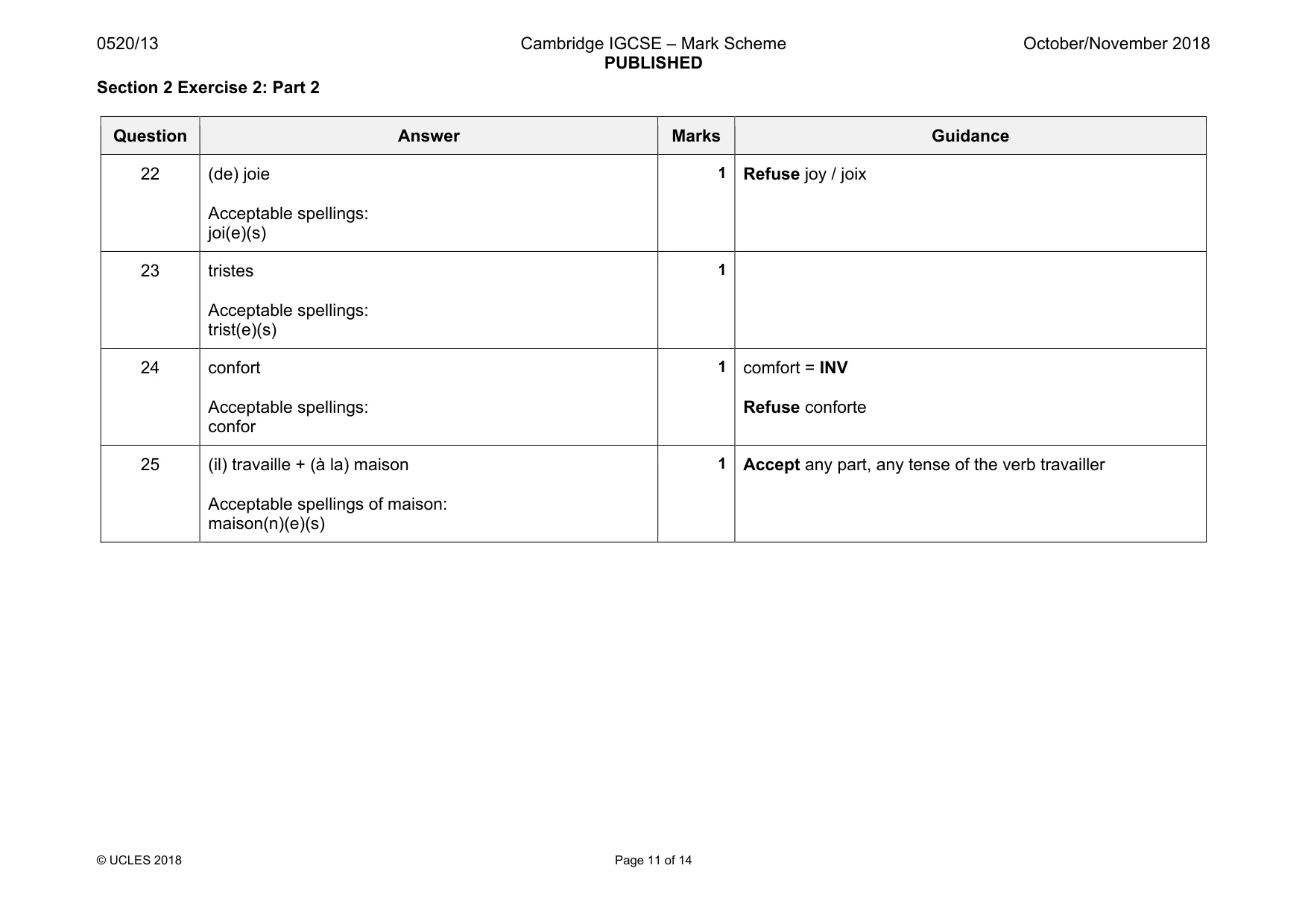
0520/13 Cambridge IGCSE – Mark Scheme PUBLISHED October/November 2018 © UCLES 2018 Page 11 of 14 Section 2 Exercise 2: Part 2 Question Answer Marks Guidance 22 (de) joie Acceptable spellings: joi(e)(s) 1 Refuse joy / joix 23 tristes Acceptable spellings: trist(e)(s) 1 24 confort Acceptable spellings: confor 1 comfort = INV Refuse conforte 25 (il) travaille + (à la) maison Acceptable spellings of maison: maison(n)(e)(s) 1 Accept any part, any tense of the verb travailler
Mark scheme, page 12
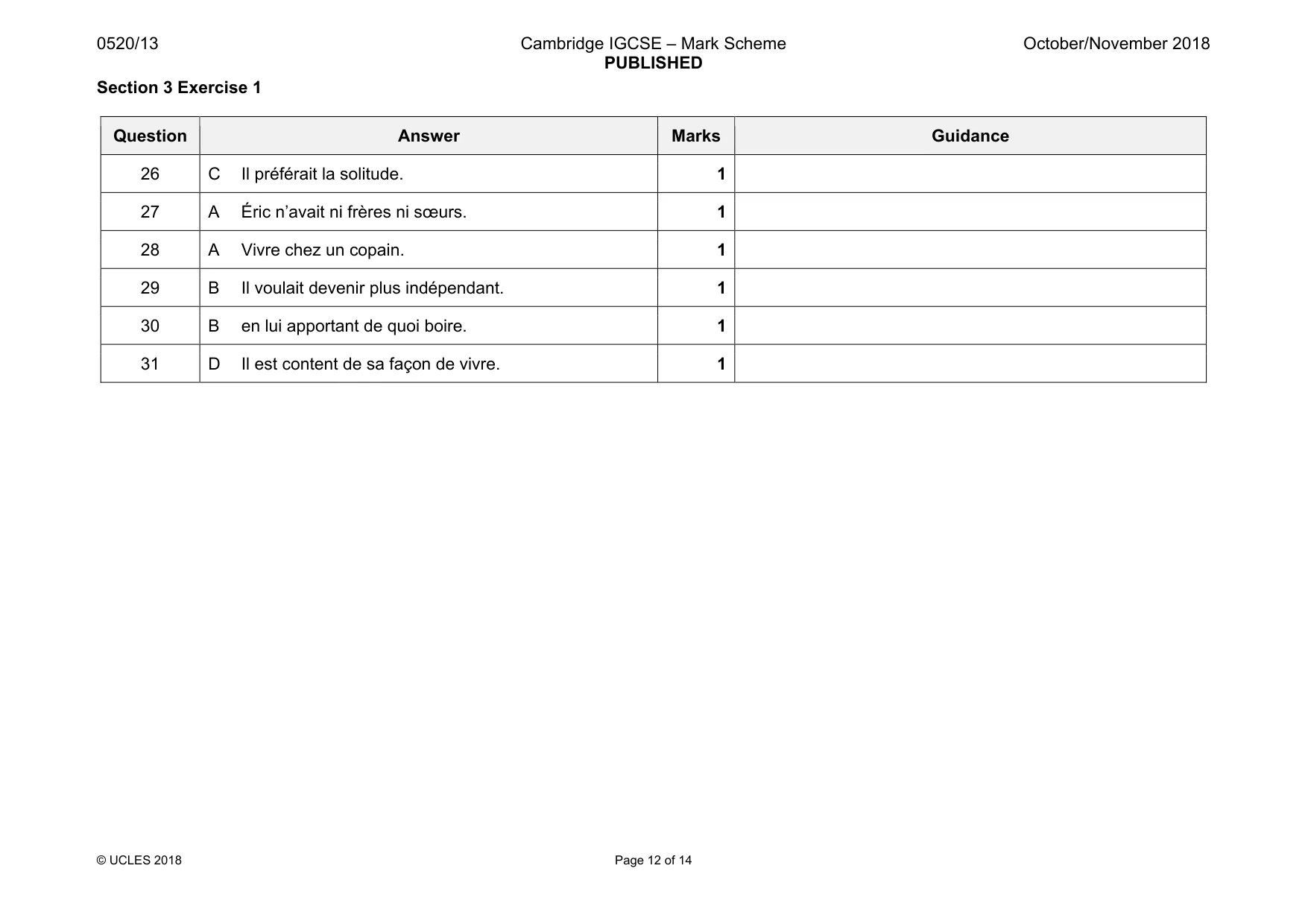
0520/13 Cambridge IGCSE – Mark Scheme PUBLISHED October/November 2018 © UCLES 2018 Page 12 of 14 Section 3 Exercise 1 Question Answer Marks Guidance 26 C Il préférait la solitude. 1 27 A Éric n’avait ni frères ni sœurs. 1 28 A Vivre chez un copain. 1 29 B Il voulait devenir plus indépendant. 1 30 B en lui apportant de quoi boire. 1 31 D Il est content de sa façon de vivre. 1
Mark scheme, page 13
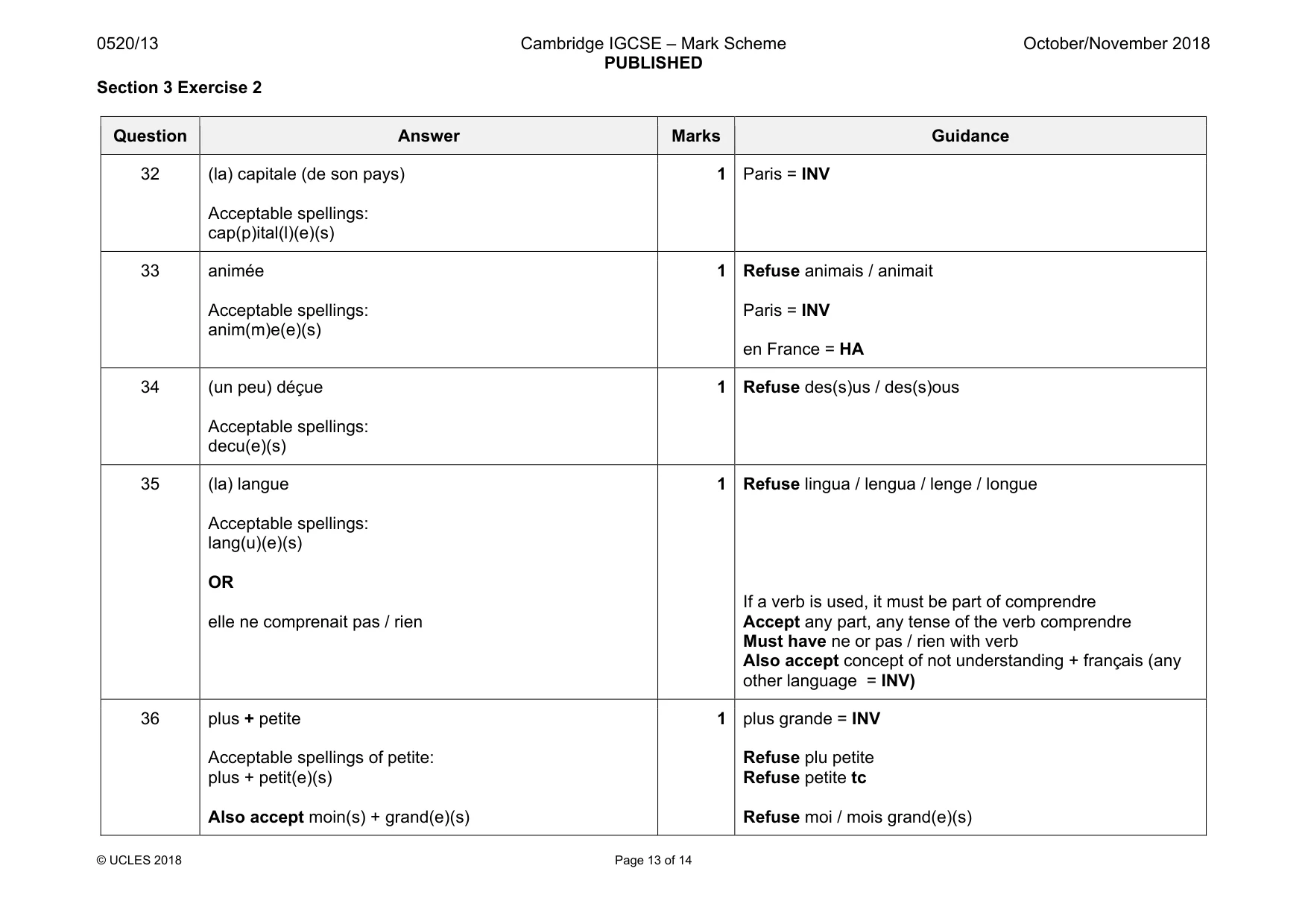
0520/13 Cambridge IGCSE – Mark Scheme PUBLISHED October/November 2018 © UCLES 2018 Page 13 of 14 Section 3 Exercise 2 Question Answer Marks Guidance 32 (la) capitale (de son pays) Acceptable spellings: cap(p)ital(l)(e)(s) 1 Paris = INV 33 animée Acceptable spellings: anim(m)e(e)(s) 1 Refuse animais / animait Paris = INV en France = HA 34 (un peu) déçue Acceptable spellings: decu(e)(s) 1 Refuse des(s)us / des(s)ous 35 (la) langue Acceptable spellings: lang(u)(e)(s) OR elle ne comprenait pas / rien 1 Refuse lingua / lengua / lenge / longue If a verb is used, it must be part of comprendre Accept any part, any tense of the verb comprendre Must have ne or pas / rien with verb Also accept concept of not understanding + français (any other language = INV) 36 plus + petite Acceptable spellings of petite: plus + petit(e)(s) Also accept moin(s) + grand(e)(s) 1 plus grande = INV Refuse plu petite Refuse petite tc Refuse moi / mois grand(e)(s)
Mark scheme, page 14
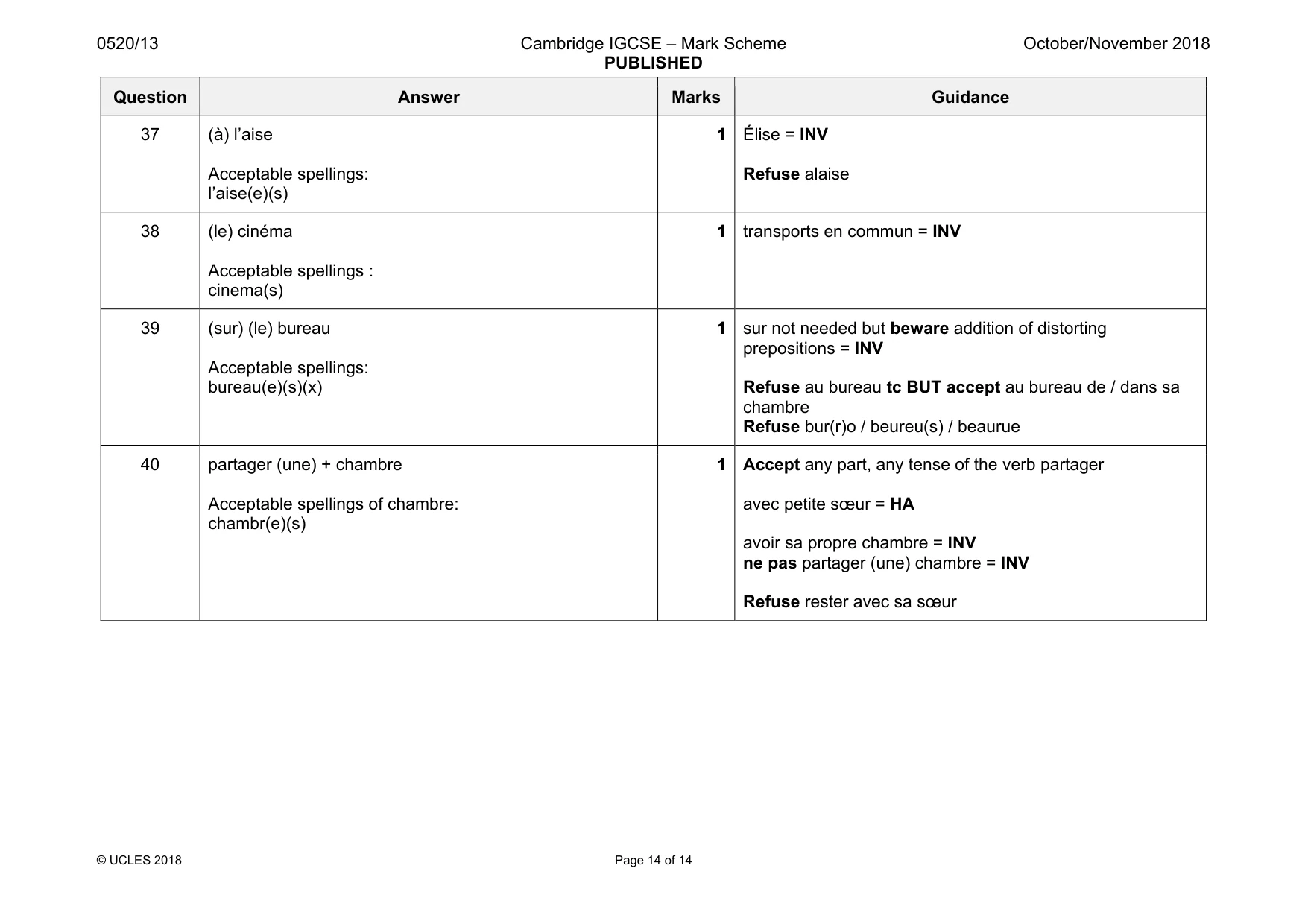
0520/13 Cambridge IGCSE – Mark Scheme PUBLISHED October/November 2018 © UCLES 2018 Page 14 of 14 Question Answer Marks Guidance 37 (à) l’aise Acceptable spellings: l’aise(e)(s) 1 Élise = INV Refuse alaise 38 (le) cinéma Acceptable spellings : cinema(s) 1 transports en commun = INV 39 (sur) (le) bureau Acceptable spellings: bureau(e)(s)(x) 1 sur not needed but beware addition of distorting prepositions = INV Refuse au bureau tc BUT accept au bureau de / dans sa chambre Refuse bur(r)o / beureu(s) / beaurue 40 partager (une) + chambre Acceptable spellings of chambre: chambr(e)(s) 1 Accept any part, any tense of the verb partager avec petite sœur = HA avoir sa propre chambre = INV ne pas partager (une) chambre = INV Refuse rester avec sa sœur
What you needed in this session
Cambridge’s own grade thresholds for 2018 Oct/Nov, Paper 1 · Variant 3. A higher threshold means an easier paper — the bar moves with how the cohort did.