Cambridge IGCSE Food and Nutrition 0648 — 2015 May/June Paper 1 · Variant 1
0648/11/M/J/15
The question paper and its mark scheme, free to read here and free to download. This is Cambridge’s own paper, exactly as it was sat.
Question paper12 pages


Mark scheme9 pages
Answers below. Sit the paper first if you are practising.
Paper as text
Question paper, page 1
This document consists of 12 printed pages. DC (NF/CGW) 106101 © UCLES 2015 [Turn over Cambridge International Examinations Cambridge International General Certificate of Secondary Education * 0 7 9 2 1 6 6 3 1 7 * FOOD AND NUTRITION 0648/01 Paper 1 Theory May/June 2015 2 hours Candidates answer on the Question Paper. No Additional Materials are required. READ THESE INSTRUCTIONS FIRST Write your Centre number, candidate number and name on all the work you hand in. Write in dark blue or black pen. You may use an HB pencil for any diagrams or graphs. Do not use staples, paper clips, glue or correction fluid. DO NOT WRITE IN ANY BARCODES. Section A Answer all questions. You are advised to spend no longer than 45 minutes on Section A. Section B Answer all questions. Section C Answer either Question 7(a) or 7(b). At the end of the examination, fasten all your work securely together. The number of marks is given in brackets [ ] at the end of each question or part question.
Question paper, page 2
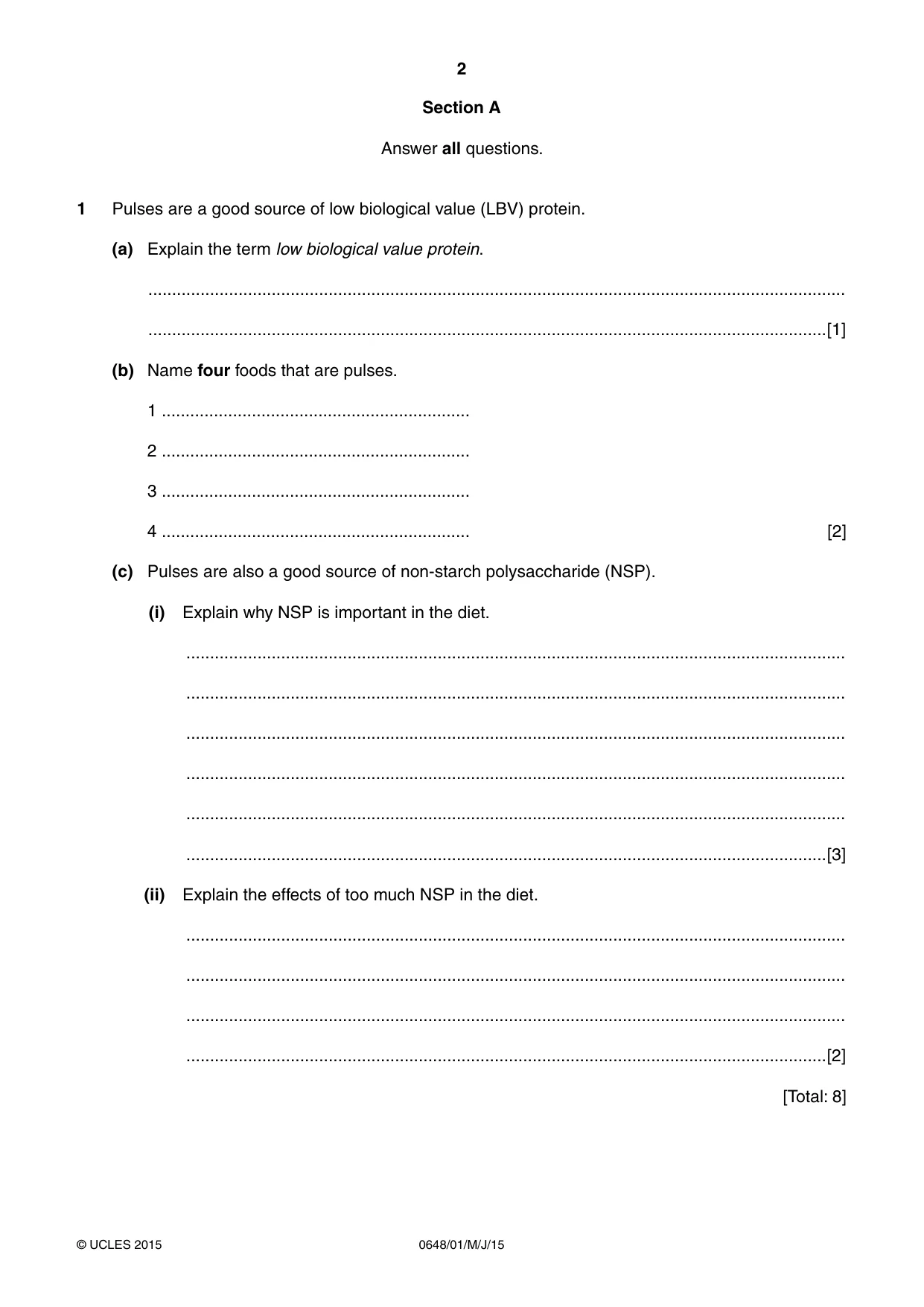
2 0648/01/M/J/15 © UCLES 2015 Section A Answer all questions. 1 Pulses are a good source of low biological value (LBV) protein. (a) Explain the term low biological value protein. … …[1] (b) Name four foods that are pulses. 1 … 2 … 3 … 4 … [2] (c) Pulses are also a good source of non-starch polysaccharide (NSP). (i) Explain why NSP is important in the diet. … … … … … …[3] (ii) Explain the effects of too much NSP in the diet. … … … …[2] [Total: 8]
Question paper, page 3
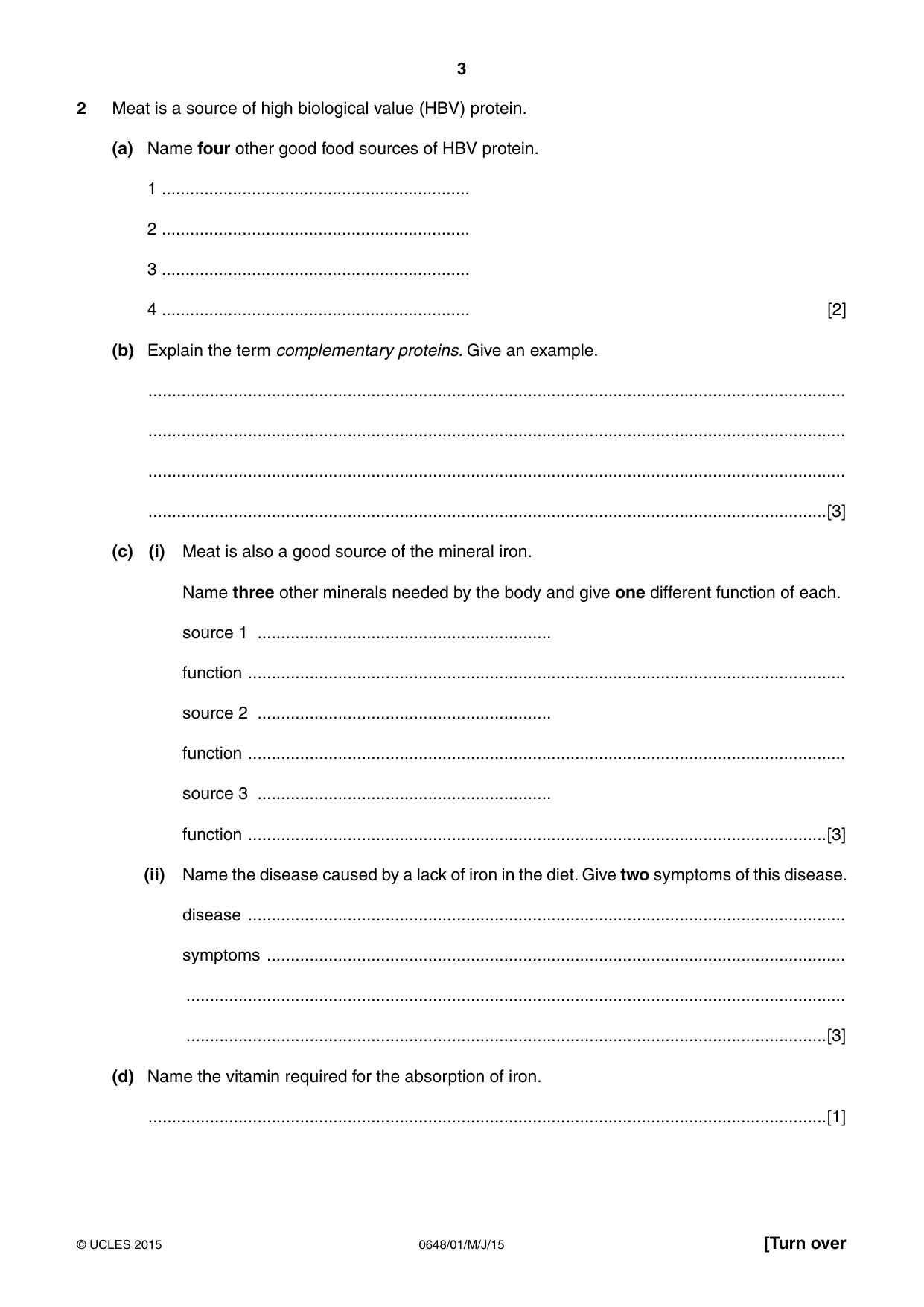
3 0648/01/M/J/15 © UCLES 2015 [Turn over 2 Meat is a source of high biological value (HBV) protein. (a) Name four other good food sources of HBV protein. 1 … 2 … 3 … 4 … [2] (b) Explain the term complementary proteins. Give an example. … … … …[3] (c) (i) Meat is also a good source of the mineral iron. Name three other minerals needed by the body and give one different function of each. source 1 … function … source 2 … function … source 3 … function …[3] (ii) Name the disease caused by a lack of iron in the diet. Give two symptoms of this disease. disease … symptoms … … …[3] (d) Name the vitamin required for the absorption of iron. …[1]
Question paper, page 4
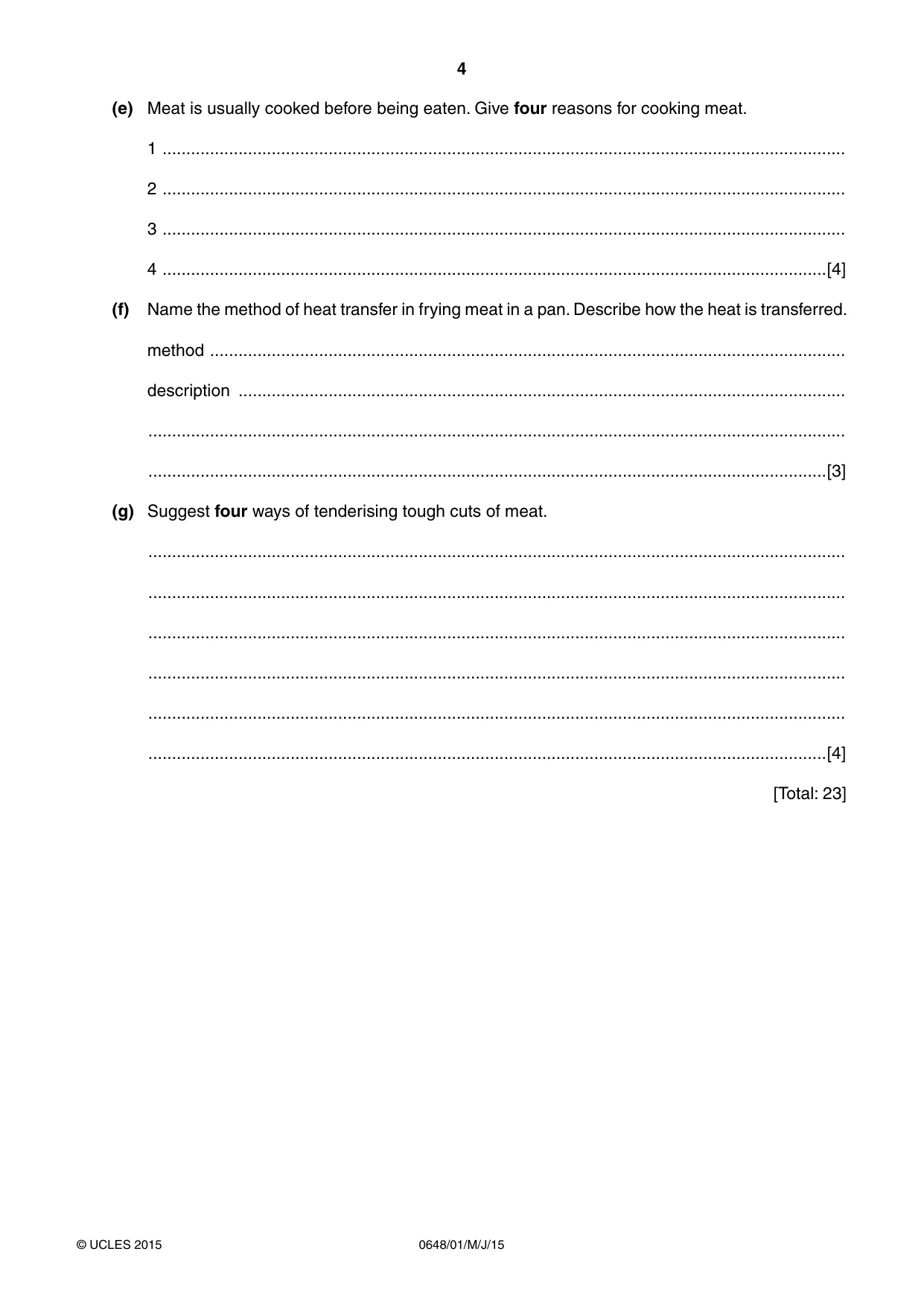
4 0648/01/M/J/15 © UCLES 2015 (e) Meat is usually cooked before being eaten. Give four reasons for cooking meat. 1 … 2 … 3 … 4 …[4] (f) Name the method of heat transfer in frying meat in a pan. Describe how the heat is transferred. method … description … … …[3] (g) Suggest four ways of tenderising tough cuts of meat. … … … … … …[4] [Total: 23]
Question paper, page 5
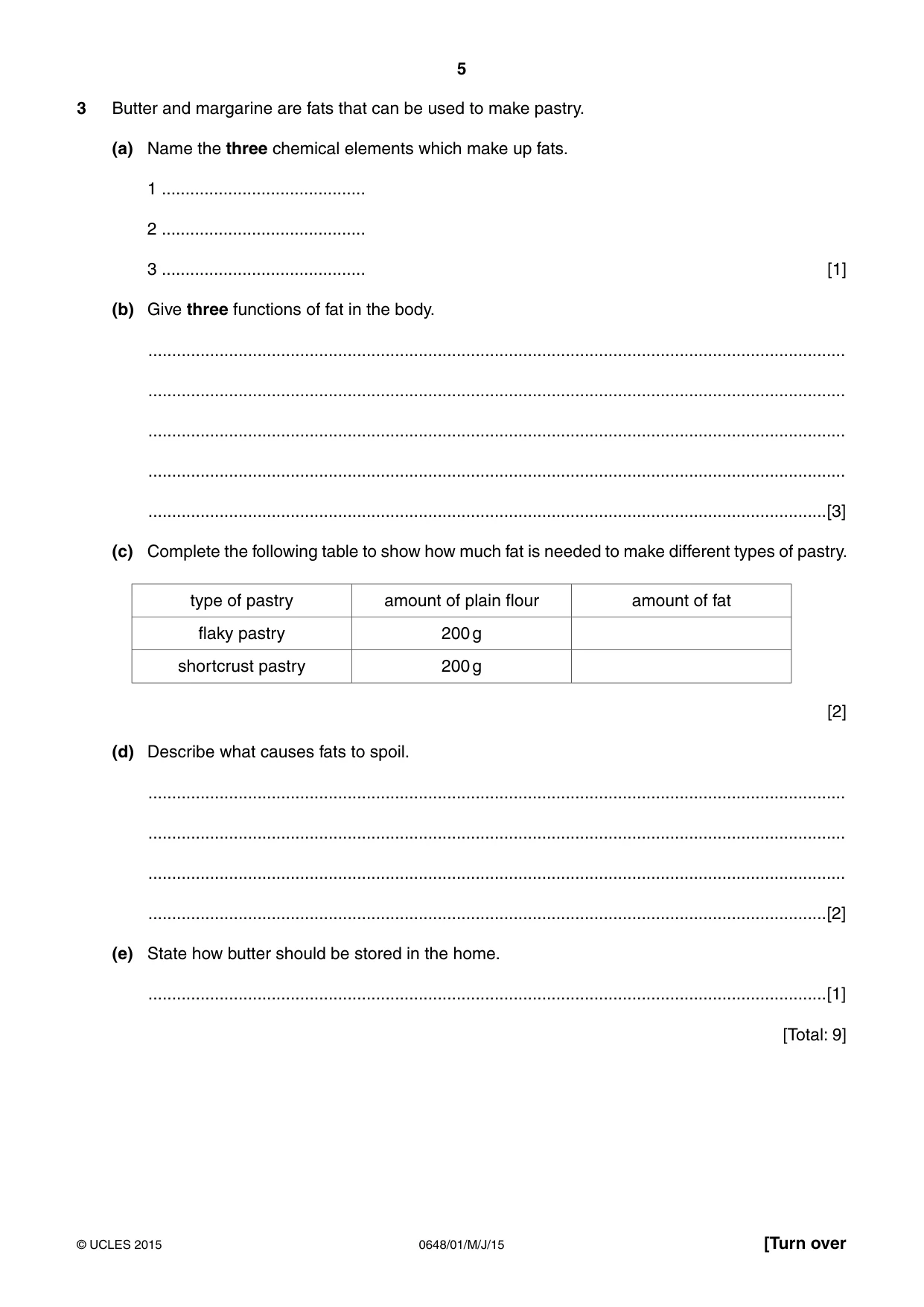
5 0648/01/M/J/15 © UCLES 2015 [Turn over 3 Butter and margarine are fats that can be used to make pastry. (a) Name the three chemical elements which make up fats. 1 … 2 … 3 … [1] (b) Give three functions of fat in the body. … … … … …[3] (c) Complete the following table to show how much fat is needed to make different types of pastry. type of pastry amount of plain flour amount of fat flaky pastry 200 g shortcrust pastry 200 g [2] (d) Describe what causes fats to spoil. … … … …[2] (e) State how butter should be stored in the home. …[1] [Total: 9]
Question paper, page 6
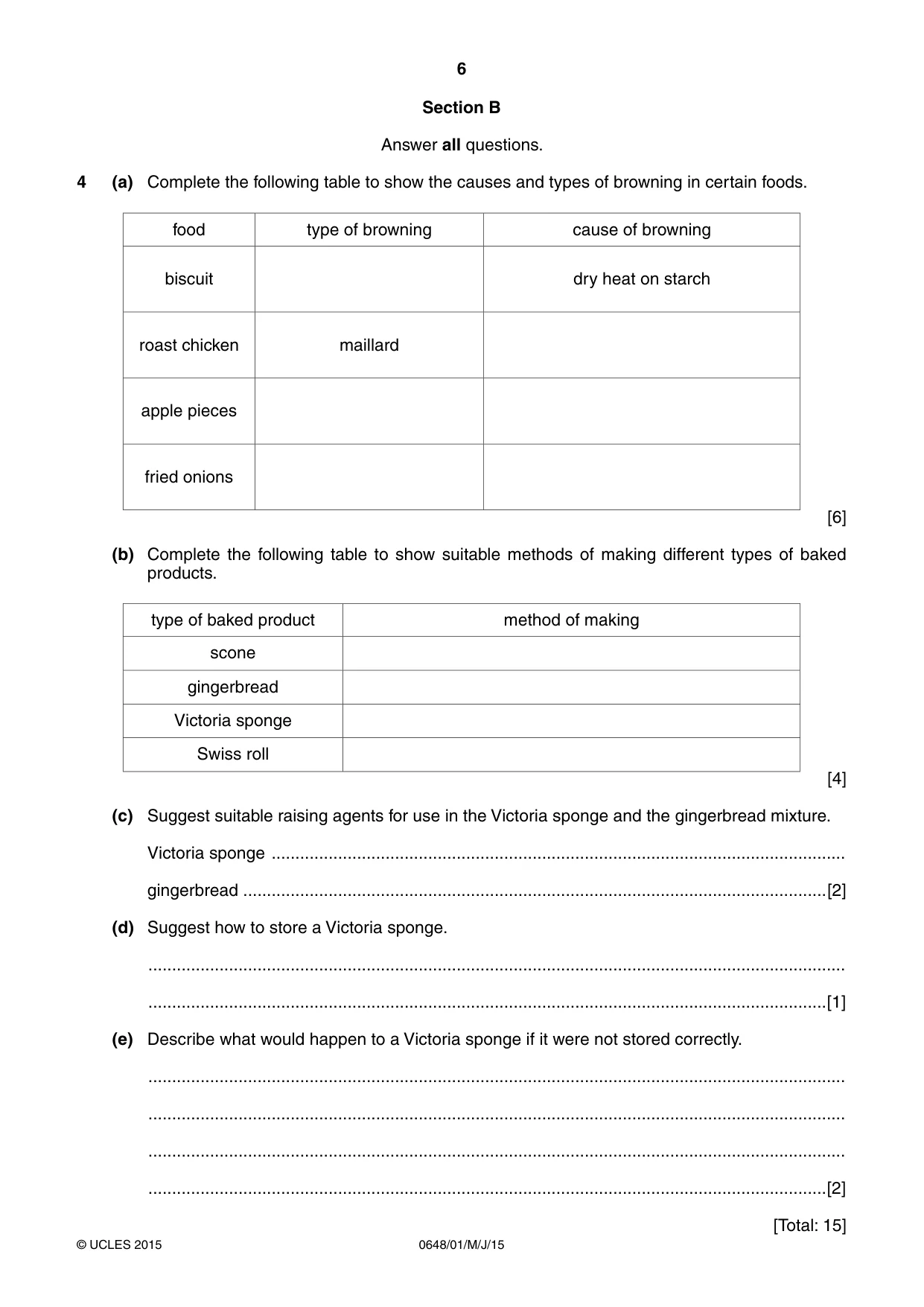
6 0648/01/M/J/15 © UCLES 2015 Section B Answer all questions. 4 (a) Complete the following table to show the causes and types of browning in certain foods. food type of browning cause of browning biscuit dry heat on starch roast chicken maillard apple pieces fried onions [6] (b) Complete the following table to show suitable methods of making different types of baked products. type of baked product method of making scone gingerbread Victoria sponge Swiss roll [4] (c) Suggest suitable raising agents for use in the Victoria sponge and the gingerbread mixture. Victoria sponge … gingerbread …[2] (d) Suggest how to store a Victoria sponge. … …[1] (e) Describe what would happen to a Victoria sponge if it were not stored correctly. … … … …[2] [Total: 15]
Question paper, page 7
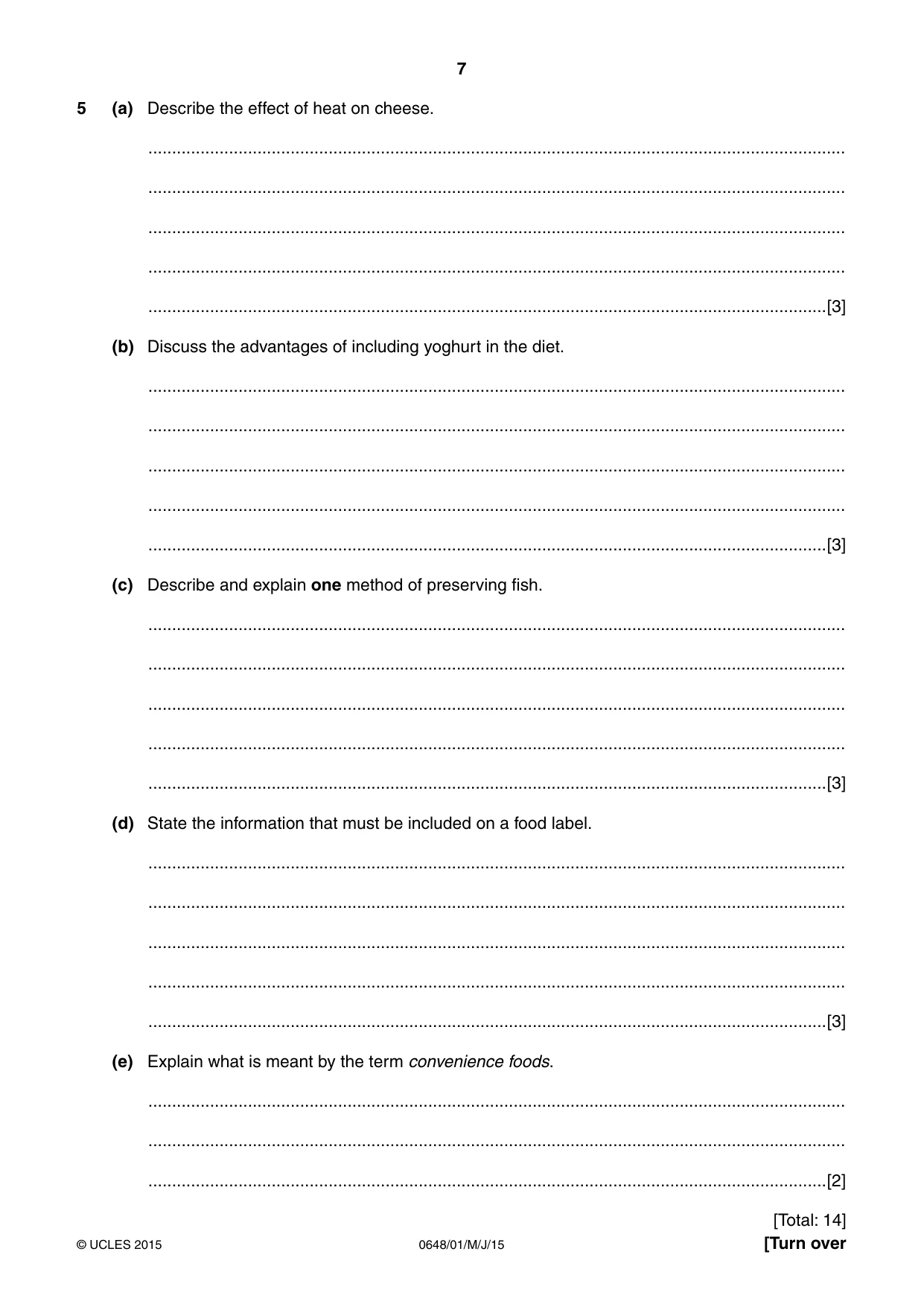
7 0648/01/M/J/15 © UCLES 2015 [Turn over 5 (a) Describe the effect of heat on cheese. … … … … …[3] (b) Discuss the advantages of including yoghurt in the diet. … … … … …[3] (c) Describe and explain one method of preserving fish. … … … … …[3] (d) State the information that must be included on a food label. … … … … …[3] (e) Explain what is meant by the term convenience foods. … … …[2] [Total: 14]
Question paper, page 8
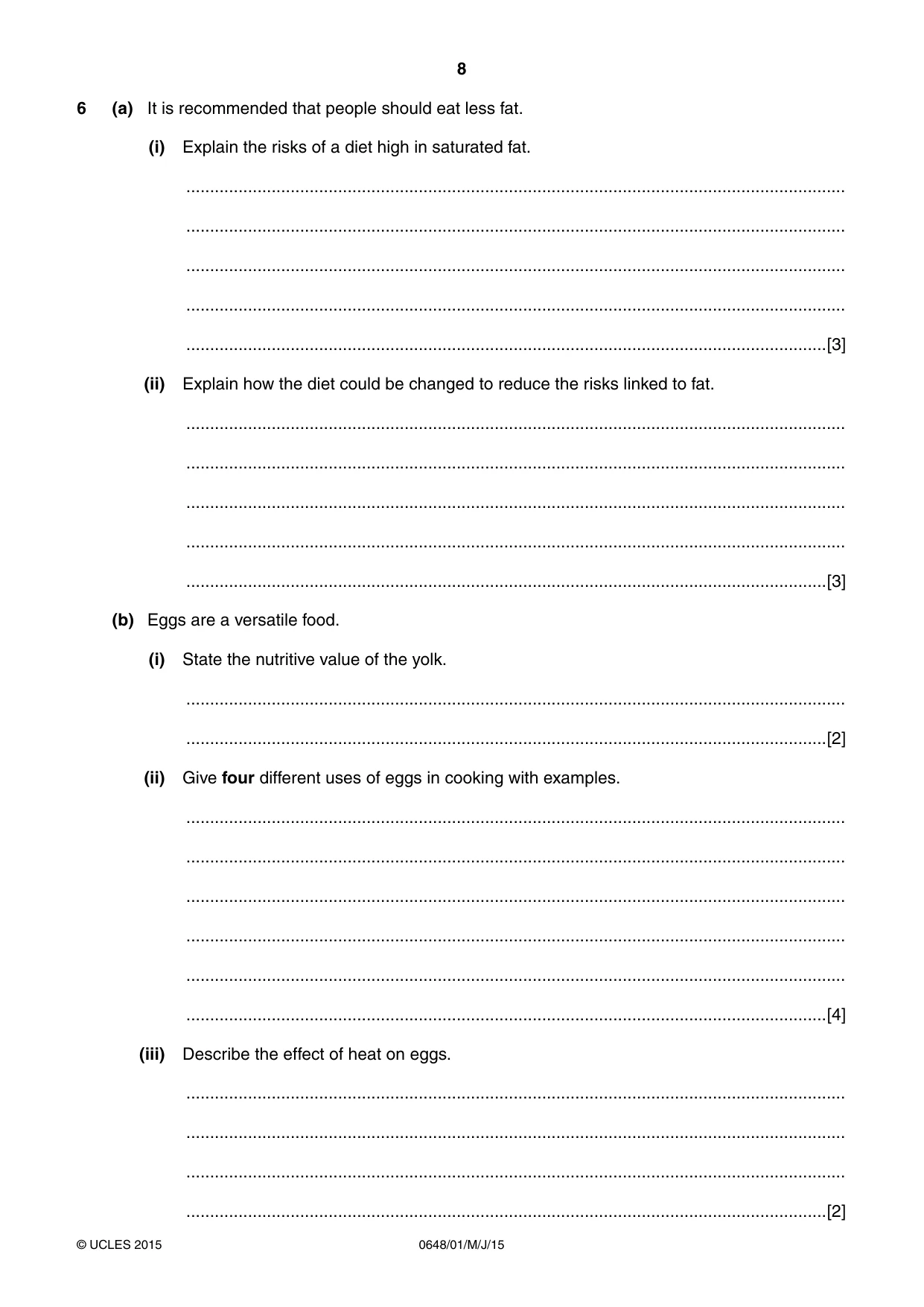
8 0648/01/M/J/15 © UCLES 2015 6 (a) It is recommended that people should eat less fat. (i) Explain the risks of a diet high in saturated fat. … … … … …[3] (ii) Explain how the diet could be changed to reduce the risks linked to fat. … … … … …[3] (b) Eggs are a versatile food. (i) State the nutritive value of the yolk. … …[2] (ii) Give four different uses of eggs in cooking with examples. … … … … … …[4] (iii) Describe the effect of heat on eggs. … … … …[2]
Question paper, page 9
9 0648/01/M/J/15 © UCLES 2015 [Turn over (iv) Describe and explain one method of testing the freshness of an egg. … … …[2] [Total: 16]
Question paper, page 10
10 0648/01/M/J/15 © UCLES 2015 Section C Answer either Question 7(a) or 7(b). 7 (a) Discuss the importance of hygiene in the storing, preparation and cooking of foods. Explain the term contamination and suggest ways to avoid food contamination. [15] OR (b) Discuss the factors affecting the choice of foods for convalescents and athletes. [15] … … … … … … … … … … … … … … … … … … … … … …
Question paper, page 11
11 0648/01/M/J/15 © UCLES 2015 [Turn over … … … … … … … … … … … … … … … … … … … … … … … … … … … …
Question paper, page 12
12 0648/01/M/J/15 © UCLES 2015 … … … … … … … … … … … … … … … … … … … … … … … [Total: 15] Permission to reproduce items where third-party owned material protected by copyright is included has been sought and cleared where possible. Every reasonable effort has been made by the publisher (UCLES) to trace copyright holders, but if any items requiring clearance have unwittingly been included, the publisher will be pleased to make amends at the earliest possible opportunity. To avoid the issue of disclosure of answer-related information to candidates, all copyright acknowledgements are reproduced online in the Cambridge International Examinations Copyright Acknowledgements Booklet. This is produced for each series of examinations and is freely available to download at www.cie.org.uk after the live examination series. Cambridge International Examinations is part of the Cambridge Assessment Group. Cambridge Assessment is the brand name of University of Cambridge Local Examinations Syndicate (UCLES), which is itself a department of the University of Cambridge.
Mark scheme, page 1
® IGCSE is the registered trademark of Cambridge International Examinations. CAMBRIDGE INTERNATIONAL EXAMINATIONS Cambridge International General Certificate of Secondary Education MARK SCHEME for the May/June 2015 series 0648 FOOD AND NUTRITION 0648/01 Paper 1 (Theory), maximum raw mark 100 This mark scheme is published as an aid to teachers and candidates, to indicate the requirements of the examination. It shows the basis on which Examiners were instructed to award marks. It does not indicate the details of the discussions that took place at an Examiners’ meeting before marking began, which would have considered the acceptability of alternative answers. Mark schemes should be read in conjunction with the question paper and the Principal Examiner Report for Teachers. Cambridge will not enter into discussions about these mark schemes. Cambridge is publishing the mark schemes for the May/June 2015 series for most Cambridge IGCSE®, Cambridge International A and AS Level components and some Cambridge O Level components.
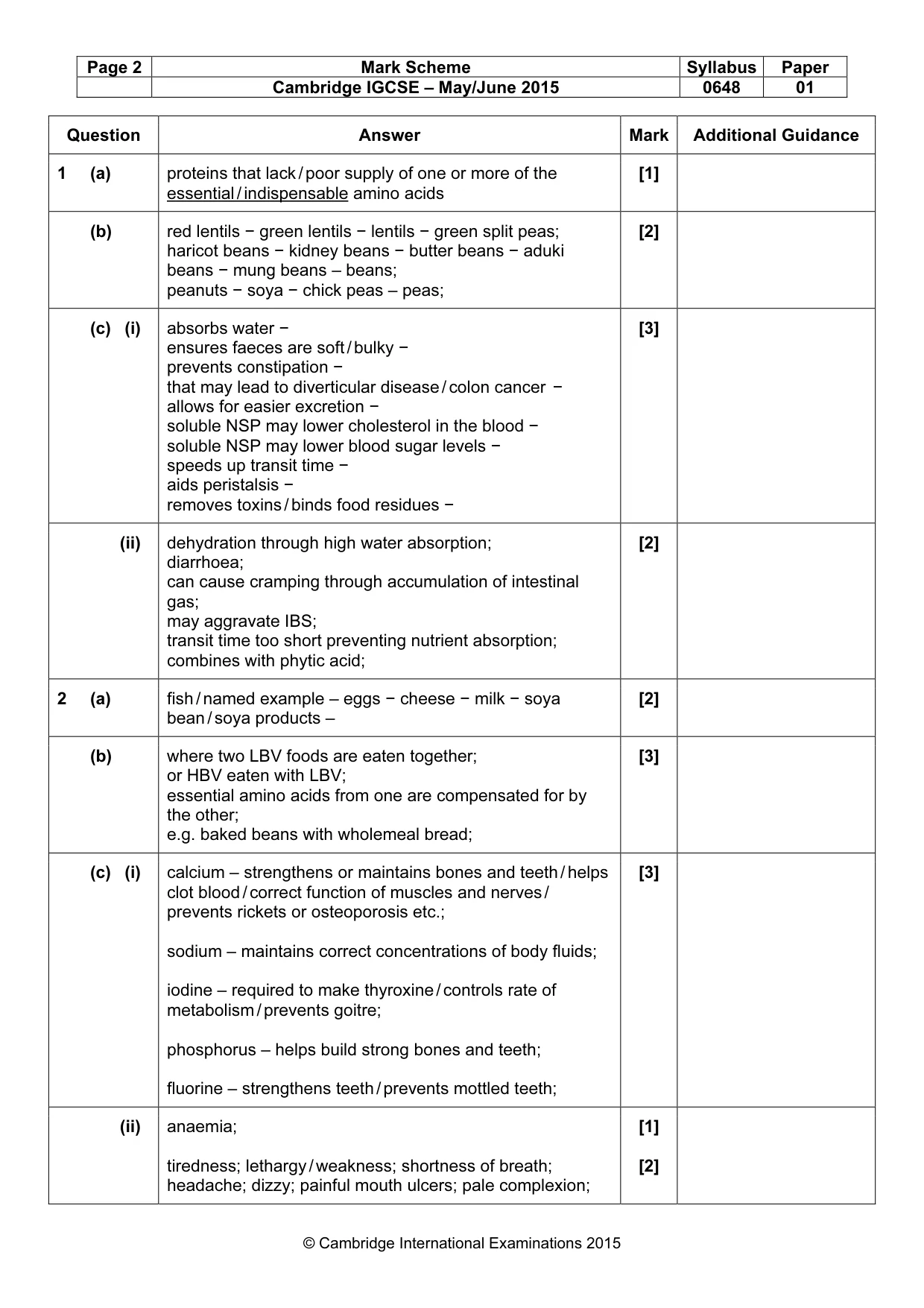
Mark scheme, page 2
Page 2 Mark Scheme Syllabus Paper Cambridge IGCSE – May/June 2015 0648 01 © Cambridge International Examinations 2015 Question Answer Mark Additional Guidance 1 (a) proteins that lack / poor supply of one or more of the essential / indispensable amino acids [1] (b) red lentils − green lentils − lentils − green split peas; haricot beans − kidney beans − butter beans − aduki beans − mung beans – beans; peanuts − soya − chick peas – peas; [2] (c) (i) absorbs water − ensures faeces are soft / bulky − prevents constipation − that may lead to diverticular disease / colon cancer − allows for easier excretion − soluble NSP may lower cholesterol in the blood − soluble NSP may lower blood sugar levels − speeds up transit time − aids peristalsis − removes toxins / binds food residues − [3] (ii) dehydration through high water absorption; diarrhoea; can cause cramping through accumulation of intestinal gas; may aggravate IBS; transit time too short preventing nutrient absorption; combines with phytic acid; [2] 2 (a) fish / named example – eggs − cheese − milk − soya bean / soya products – [2] (b) where two LBV foods are eaten together; or HBV eaten with LBV; essential amino acids from one are compensated for by the other; e.g. baked beans with wholemeal bread; [3] (c) (i) calcium – strengthens or maintains bones and teeth / helps clot blood / correct function of muscles and nerves / prevents rickets or osteoporosis etc.; sodium – maintains correct concentrations of body fluids; iodine – required to make thyroxine / controls rate of metabolism / prevents goitre; phosphorus – helps build strong bones and teeth; fluorine – strengthens teeth / prevents mottled teeth; [3] (ii) anaemia; tiredness; lethargy / weakness; shortness of breath; headache; dizzy; painful mouth ulcers; pale complexion; [1] [2]
Mark scheme, page 3
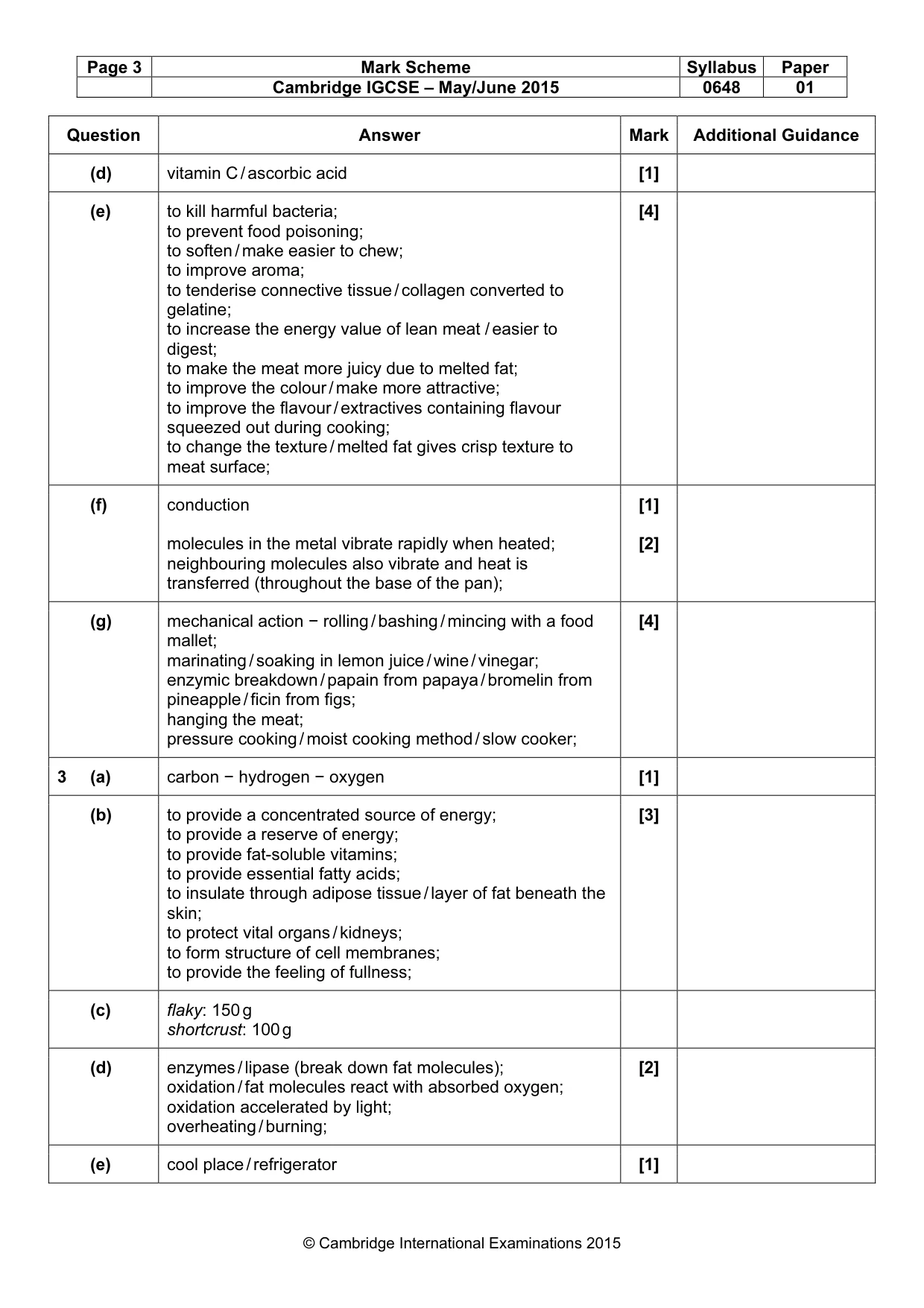
Page 3 Mark Scheme Syllabus Paper Cambridge IGCSE – May/June 2015 0648 01 © Cambridge International Examinations 2015 Question Answer Mark Additional Guidance (d) vitamin C / ascorbic acid [1] (e) to kill harmful bacteria; to prevent food poisoning; to soften / make easier to chew; to improve aroma; to tenderise connective tissue / collagen converted to gelatine; to increase the energy value of lean meat / easier to digest; to make the meat more juicy due to melted fat; to improve the colour / make more attractive; to improve the flavour / extractives containing flavour squeezed out during cooking; to change the texture / melted fat gives crisp texture to meat surface; [4] (f) conduction molecules in the metal vibrate rapidly when heated; neighbouring molecules also vibrate and heat is transferred (throughout the base of the pan); [1] [2] (g) mechanical action − rolling / bashing / mincing with a food mallet; marinating / soaking in lemon juice / wine / vinegar; enzymic breakdown / papain from papaya / bromelin from pineapple / ficin from figs; hanging the meat; pressure cooking / moist cooking method / slow cooker; [4] 3 (a) carbon − hydrogen − oxygen [1] (b) to provide a concentrated source of energy; to provide a reserve of energy; to provide fat-soluble vitamins; to provide essential fatty acids; to insulate through adipose tissue / layer of fat beneath the skin; to protect vital organs / kidneys; to form structure of cell membranes; to provide the feeling of fullness; [3] (c) flaky: 150 g shortcrust: 100 g (d) enzymes / lipase (break down fat molecules); oxidation / fat molecules react with absorbed oxygen; oxidation accelerated by light; overheating / burning; [2] (e) cool place / refrigerator [1]
Mark scheme, page 4
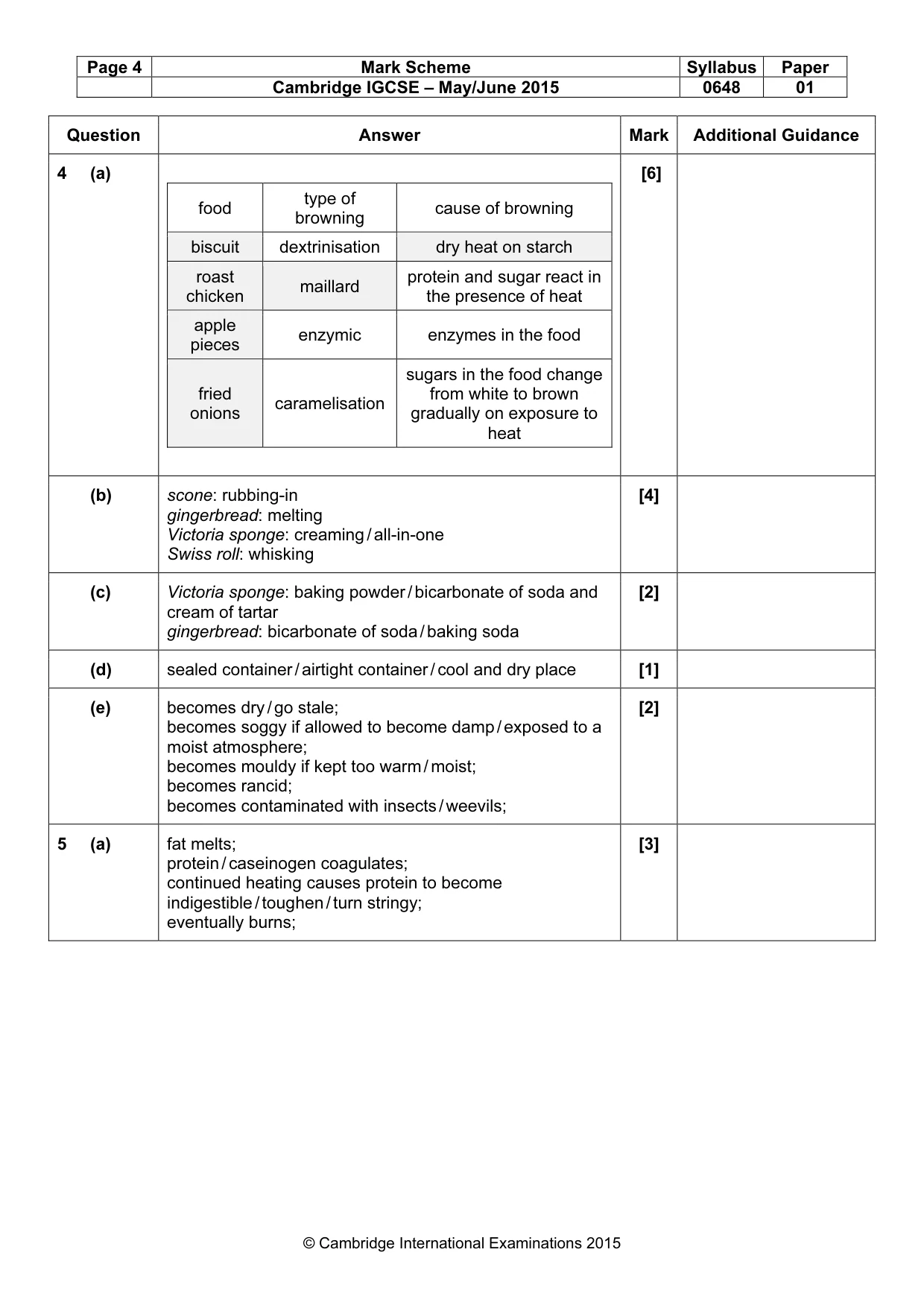
Page 4 Mark Scheme Syllabus Paper Cambridge IGCSE – May/June 2015 0648 01 © Cambridge International Examinations 2015 Question Answer Mark Additional Guidance 4 (a) food type of browning cause of browning biscuit dextrinisation dry heat on starch roast chicken maillard protein and sugar react in the presence of heat apple pieces enzymic enzymes in the food fried onions caramelisation sugars in the food change from white to brown gradually on exposure to heat [6] (b) scone: rubbing-in gingerbread: melting Victoria sponge: creaming / all-in-one Swiss roll: whisking [4] (c) Victoria sponge: baking powder / bicarbonate of soda and cream of tartar gingerbread: bicarbonate of soda / baking soda [2] (d) sealed container / airtight container / cool and dry place [1] (e) becomes dry / go stale; becomes soggy if allowed to become damp / exposed to a moist atmosphere; becomes mouldy if kept too warm / moist; becomes rancid; becomes contaminated with insects / weevils; [2] 5 (a) fat melts; protein / caseinogen coagulates; continued heating causes protein to become indigestible / toughen / turn stringy; eventually burns; [3]
Mark scheme, page 5
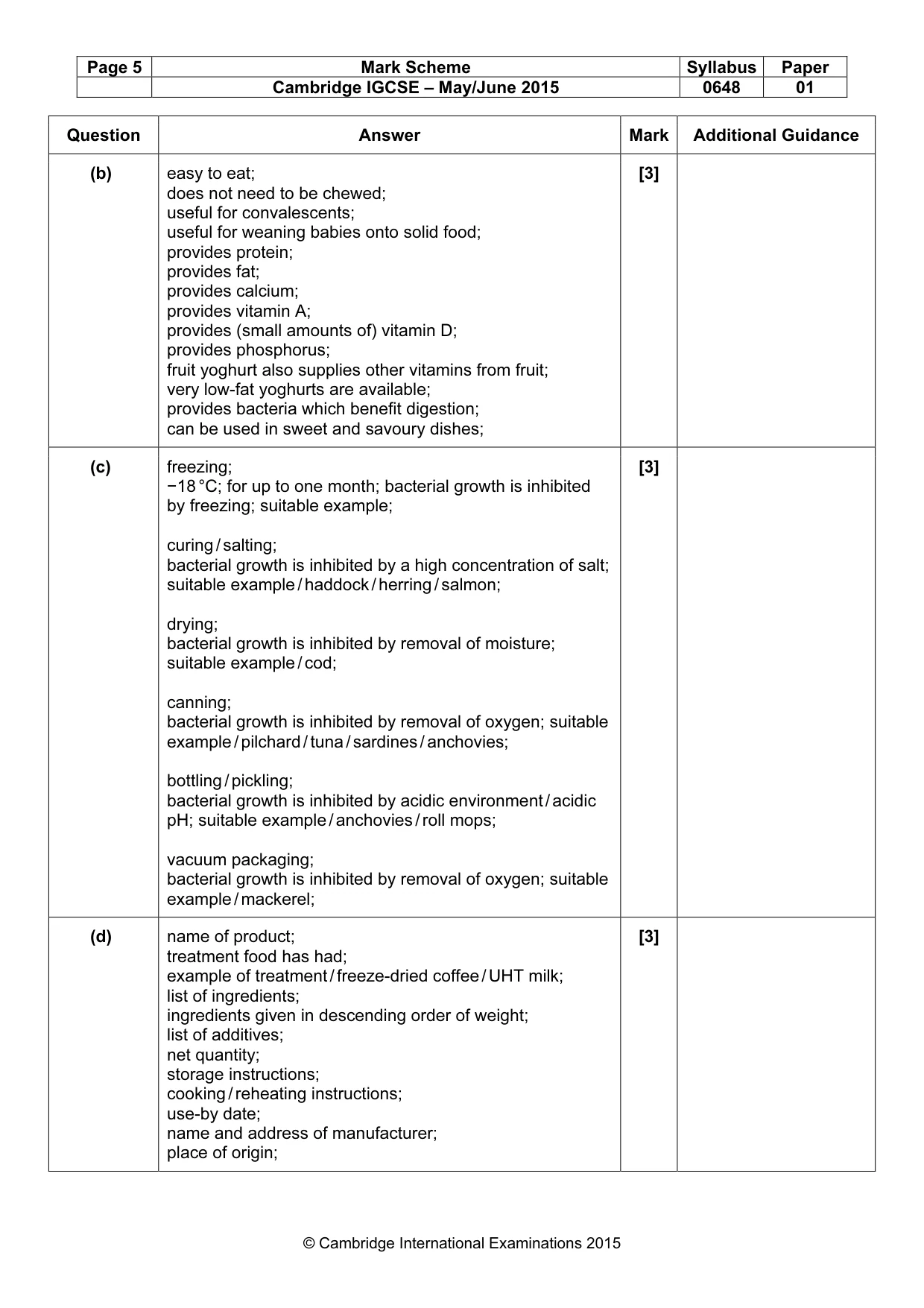
Page 5 Mark Scheme Syllabus Paper Cambridge IGCSE – May/June 2015 0648 01 © Cambridge International Examinations 2015 Question Answer Mark Additional Guidance (b) easy to eat; does not need to be chewed; useful for convalescents; useful for weaning babies onto solid food; provides protein; provides fat; provides calcium; provides vitamin A; provides (small amounts of) vitamin D; provides phosphorus; fruit yoghurt also supplies other vitamins from fruit; very low-fat yoghurts are available; provides bacteria which benefit digestion; can be used in sweet and savoury dishes; [3] (c) freezing; −18 °C; for up to one month; bacterial growth is inhibited by freezing; suitable example; curing / salting; bacterial growth is inhibited by a high concentration of salt; suitable example / haddock / herring / salmon; drying; bacterial growth is inhibited by removal of moisture; suitable example / cod; canning; bacterial growth is inhibited by removal of oxygen; suitable example / pilchard / tuna / sardines / anchovies; bottling / pickling; bacterial growth is inhibited by acidic environment / acidic pH; suitable example / anchovies / roll mops; vacuum packaging; bacterial growth is inhibited by removal of oxygen; suitable example / mackerel; [3] (d) name of product; treatment food has had; example of treatment / freeze-dried coffee / UHT milk; list of ingredients; ingredients given in descending order of weight; list of additives; net quantity; storage instructions; cooking / reheating instructions; use-by date; name and address of manufacturer; place of origin; [3]
Mark scheme, page 6
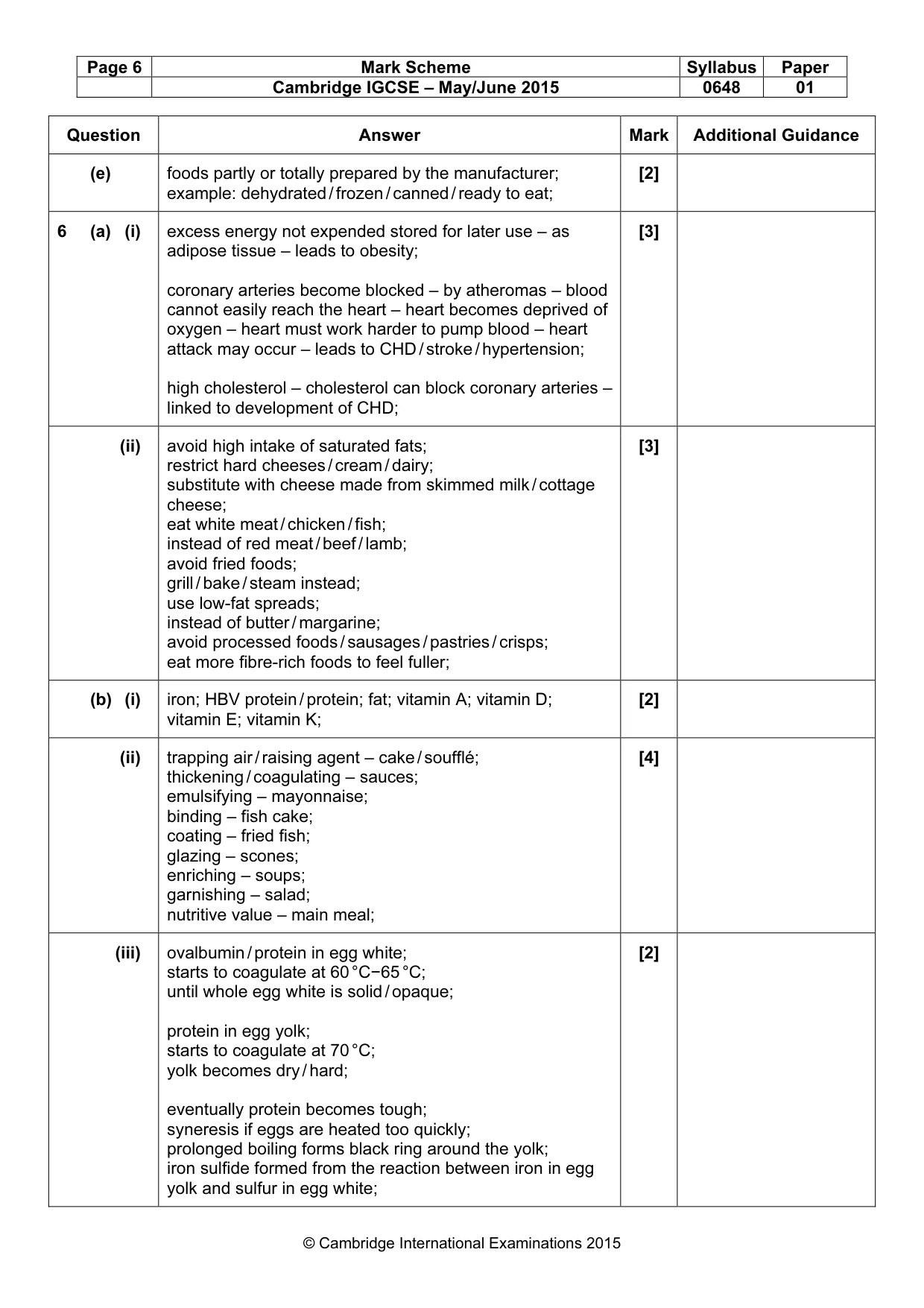
Page 6 Mark Scheme Syllabus Paper Cambridge IGCSE – May/June 2015 0648 01 © Cambridge International Examinations 2015 Question Answer Mark Additional Guidance (e) foods partly or totally prepared by the manufacturer; example: dehydrated / frozen / canned / ready to eat; [2] 6 (a) (i) excess energy not expended stored for later use – as adipose tissue – leads to obesity; coronary arteries become blocked – by atheromas – blood cannot easily reach the heart – heart becomes deprived of oxygen – heart must work harder to pump blood – heart attack may occur – leads to CHD / stroke / hypertension; high cholesterol – cholesterol can block coronary arteries – linked to development of CHD; [3] (ii) avoid high intake of saturated fats; restrict hard cheeses / cream / dairy; substitute with cheese made from skimmed milk / cottage cheese; eat white meat / chicken / fish; instead of red meat / beef / lamb; avoid fried foods; grill / bake / steam instead; use low-fat spreads; instead of butter / margarine; avoid processed foods / sausages / pastries / crisps; eat more fibre-rich foods to feel fuller; [3] (b) (i) iron; HBV protein / protein; fat; vitamin A; vitamin D; vitamin E; vitamin K; [2] (ii) trapping air / raising agent – cake / soufflé; thickening / coagulating – sauces; emulsifying – mayonnaise; binding – fish cake; coating – fried fish; glazing – scones; enriching – soups; garnishing – salad; nutritive value – main meal; [4] (iii) ovalbumin / protein in egg white; starts to coagulate at 60 °C−65 °C; until whole egg white is solid / opaque; protein in egg yolk; starts to coagulate at 70 °C; yolk becomes dry / hard; eventually protein becomes tough; syneresis if eggs are heated too quickly; prolonged boiling forms black ring around the yolk; iron sulfide formed from the reaction between iron in egg yolk and sulfur in egg white; [2]
Mark scheme, page 7
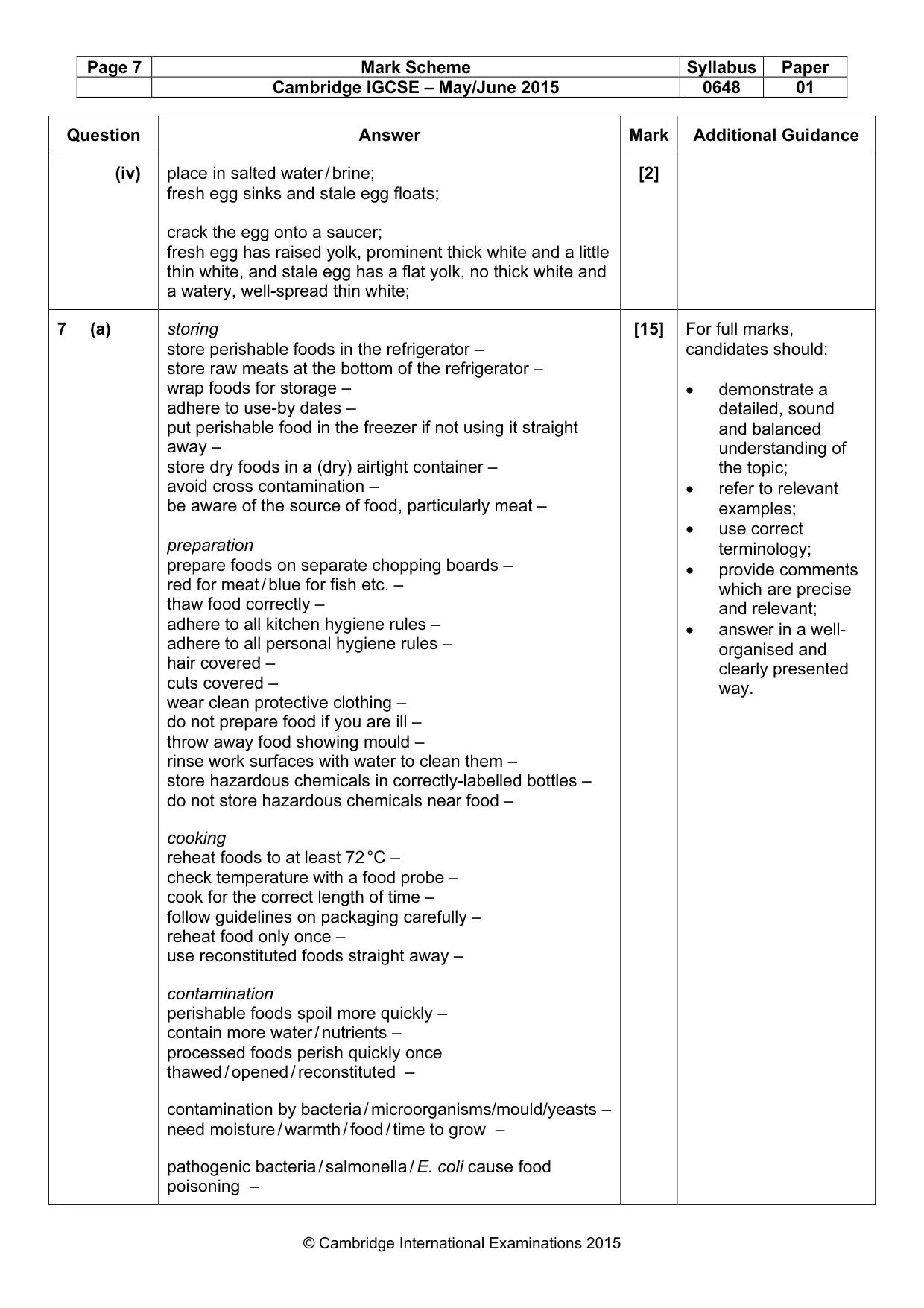
Page 7 Mark Scheme Syllabus Paper Cambridge IGCSE – May/June 2015 0648 01 © Cambridge International Examinations 2015 Question Answer Mark Additional Guidance (iv) place in salted water / brine; fresh egg sinks and stale egg floats; crack the egg onto a saucer; fresh egg has raised yolk, prominent thick white and a little thin white, and stale egg has a flat yolk, no thick white and a watery, well-spread thin white; [2] 7 (a) storing store perishable foods in the refrigerator – store raw meats at the bottom of the refrigerator – wrap foods for storage – adhere to use-by dates – put perishable food in the freezer if not using it straight away – store dry foods in a (dry) airtight container – avoid cross contamination – be aware of the source of food, particularly meat – preparation prepare foods on separate chopping boards – red for meat / blue for fish etc. – thaw food correctly – adhere to all kitchen hygiene rules – adhere to all personal hygiene rules – hair covered – cuts covered – wear clean protective clothing – do not prepare food if you are ill – throw away food showing mould – rinse work surfaces with water to clean them – store hazardous chemicals in correctly-labelled bottles – do not store hazardous chemicals near food – cooking reheat foods to at least 72 °C – check temperature with a food probe – cook for the correct length of time – follow guidelines on packaging carefully – reheat food only once – use reconstituted foods straight away – contamination perishable foods spoil more quickly – contain more water / nutrients – processed foods perish quickly once thawed / opened / reconstituted – contamination by bacteria / microorganisms/mould/yeasts – need moisture / warmth / food / time to grow – pathogenic bacteria / salmonella / E. coli cause food poisoning – [15] For full marks, candidates should: • demonstrate a detailed, sound and balanced understanding of the topic; • refer to relevant examples; • use correct terminology; • provide comments which are precise and relevant; • answer in a well- organised and clearly presented way.
Mark scheme, page 8
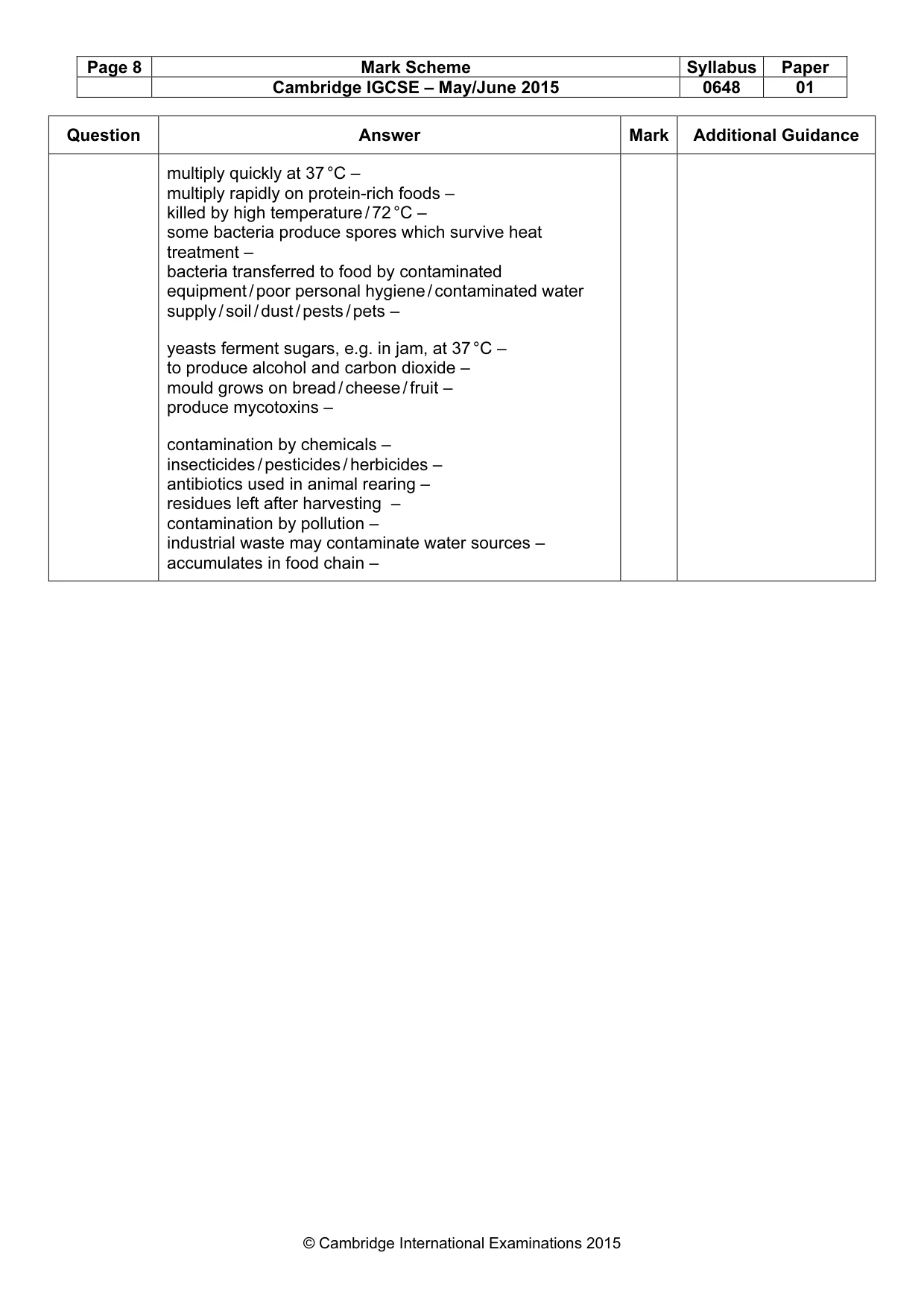
Page 8 Mark Scheme Syllabus Paper Cambridge IGCSE – May/June 2015 0648 01 © Cambridge International Examinations 2015 Question Answer Mark Additional Guidance multiply quickly at 37 °C – multiply rapidly on protein-rich foods – killed by high temperature / 72 °C – some bacteria produce spores which survive heat treatment – bacteria transferred to food by contaminated equipment / poor personal hygiene / contaminated water supply / soil / dust / pests / pets – yeasts ferment sugars, e.g. in jam, at 37 °C – to produce alcohol and carbon dioxide – mould grows on bread / cheese / fruit – produce mycotoxins – contamination by chemicals – insecticides / pesticides / herbicides – antibiotics used in animal rearing – residues left after harvesting – contamination by pollution – industrial waste may contaminate water sources – accumulates in food chain –
Mark scheme, page 9
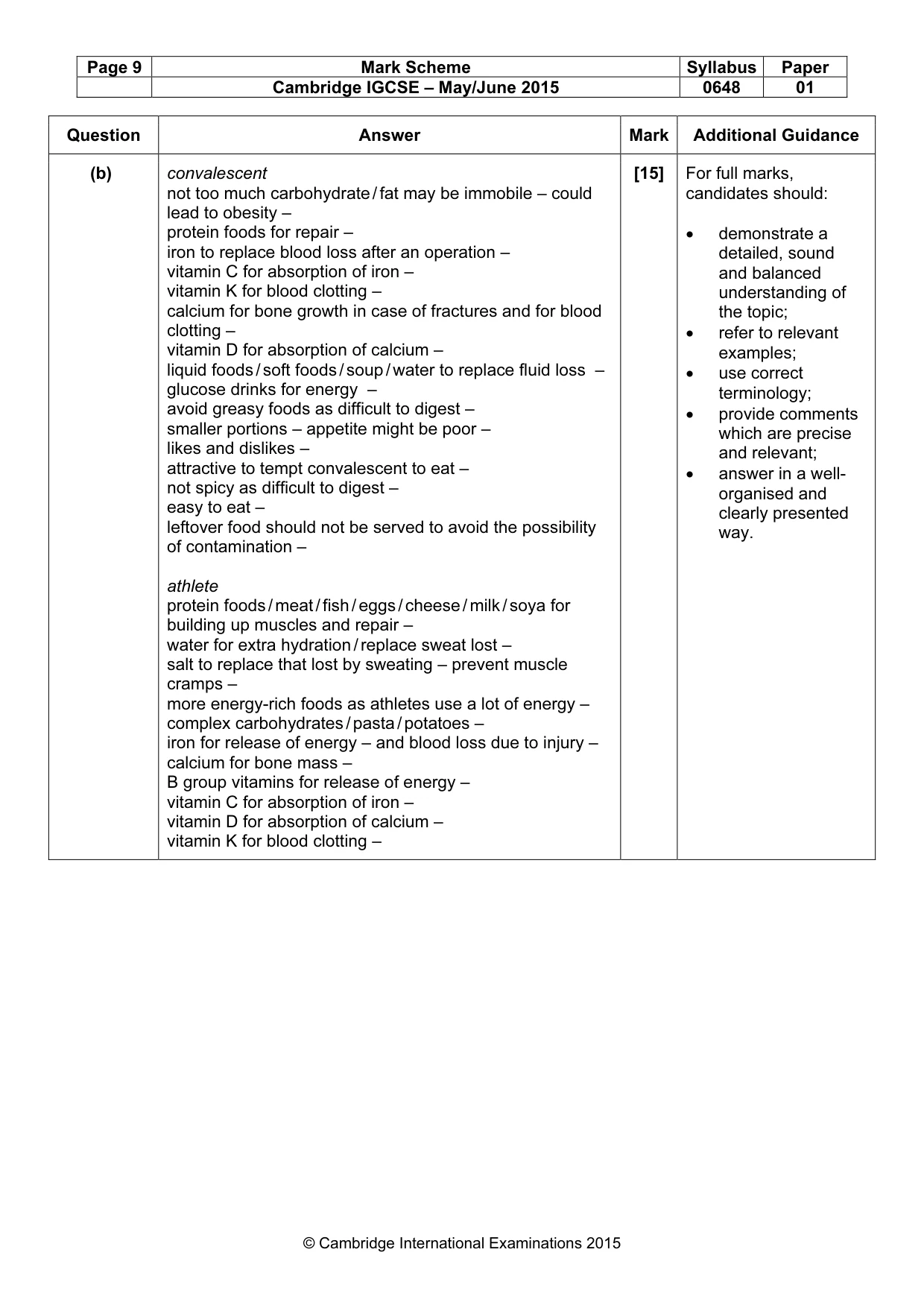
Page 9 Mark Scheme Syllabus Paper Cambridge IGCSE – May/June 2015 0648 01 © Cambridge International Examinations 2015 Question Answer Mark Additional Guidance (b) convalescent not too much carbohydrate / fat may be immobile – could lead to obesity – protein foods for repair – iron to replace blood loss after an operation – vitamin C for absorption of iron – vitamin K for blood clotting – calcium for bone growth in case of fractures and for blood clotting – vitamin D for absorption of calcium – liquid foods / soft foods / soup / water to replace fluid loss – glucose drinks for energy – avoid greasy foods as difficult to digest – smaller portions – appetite might be poor – likes and dislikes – attractive to tempt convalescent to eat – not spicy as difficult to digest – easy to eat – leftover food should not be served to avoid the possibility of contamination – athlete protein foods / meat / fish / eggs / cheese / milk / soya for building up muscles and repair – water for extra hydration / replace sweat lost – salt to replace that lost by sweating – prevent muscle cramps – more energy-rich foods as athletes use a lot of energy – complex carbohydrates / pasta / potatoes – iron for release of energy – and blood loss due to injury – calcium for bone mass – B group vitamins for release of energy – vitamin C for absorption of iron – vitamin D for absorption of calcium – vitamin K for blood clotting – [15] For full marks, candidates should: • demonstrate a detailed, sound and balanced understanding of the topic; • refer to relevant examples; • use correct terminology; • provide comments which are precise and relevant; • answer in a well- organised and clearly presented way.