Cambridge IGCSE Food and Nutrition 0648 — 2011 Oct/Nov Paper 1 · Variant 1
0648/11/O/N/11 · 100 marks · ≈113 min
The question paper and its mark scheme, free to read here and free to download. This is Cambridge’s own paper, exactly as it was sat.
Question paper16 pages

Mark scheme14 pages
Answers below. Sit the paper first if you are practising.
Paper as text
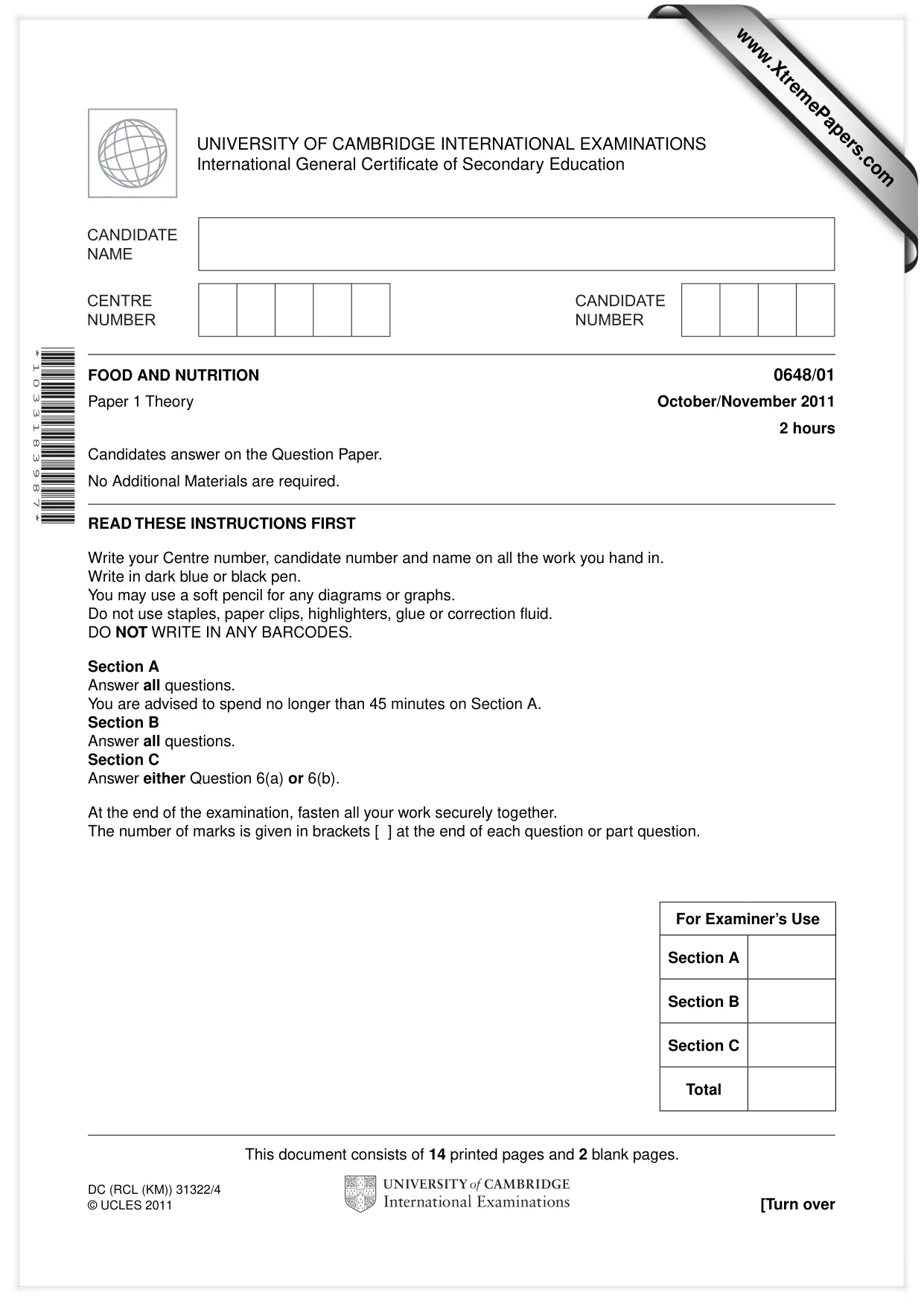
Question paper, page 1
This document consists of 14 printed pages and 2 blank pages. DC (RCL (KM)) 31322/4 © UCLES 2011 [Turn over UNIVERSITY OF CAMBRIDGE INTERNATIONAL EXAMINATIONS International General Certificate of Secondary Education * 1 0 3 3 1 8 3 9 8 7 * FOOD AND NUTRITION 0648/01 Paper 1 Theory October/November 2011 2 hours Candidates answer on the Question Paper. No Additional Materials are required. READ THESE INSTRUCTIONS FIRST Write your Centre number, candidate number and name on all the work you hand in. Write in dark blue or black pen. You may use a soft pencil for any diagrams or graphs. Do not use staples, paper clips, highlighters, glue or correction fluid. DO NOT WRITE IN ANY BARCODES. Section A Answer all questions. You are advised to spend no longer than 45 minutes on Section A. Section B Answer all questions. Section C Answer either Question 6(a) or 6(b). At the end of the examination, fasten all your work securely together. The number of marks is given in brackets [ ] at the end of each question or part question. For Examiner’s Use Section A Section B Section C Total www.XtremePapers.com
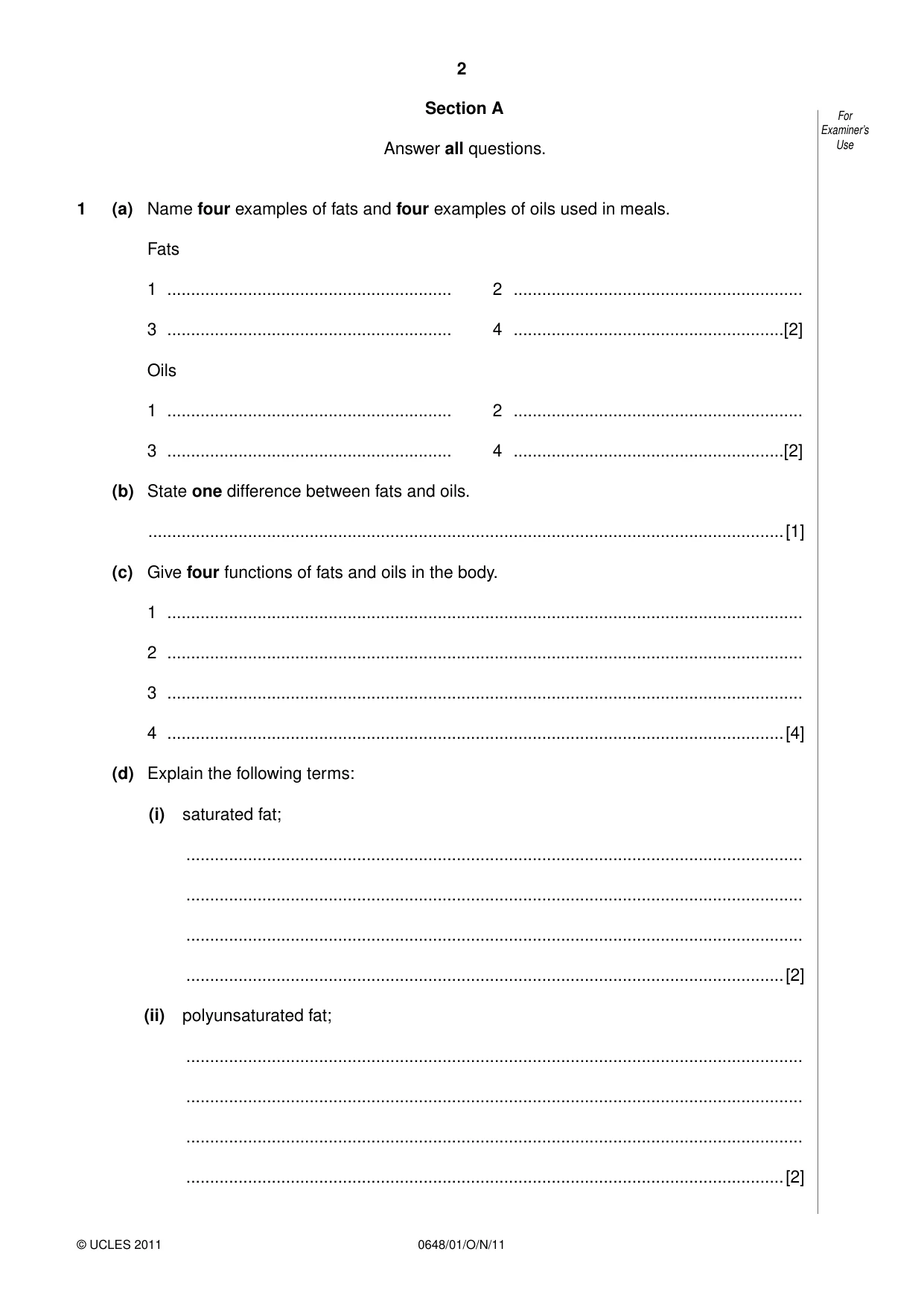
Question paper, page 2
2 0648/01/O/N/11 © UCLES 2011 For Examiner’s Use Section A Answer all questions. 1 (a) Name four examples of fats and four examples of oils used in meals. Fats 1 … 2 … 3 … 4 …[2] Oils 1 … 2 … 3 … 4 …[2] (b) State one difference between fats and oils. …[1] (c) Give four functions of fats and oils in the body. 1 … 2 … 3 … 4 …[4] (d) Explain the following terms: (i) saturated fat; … … … …[2] (ii) polyunsaturated fat; … … … …[2]
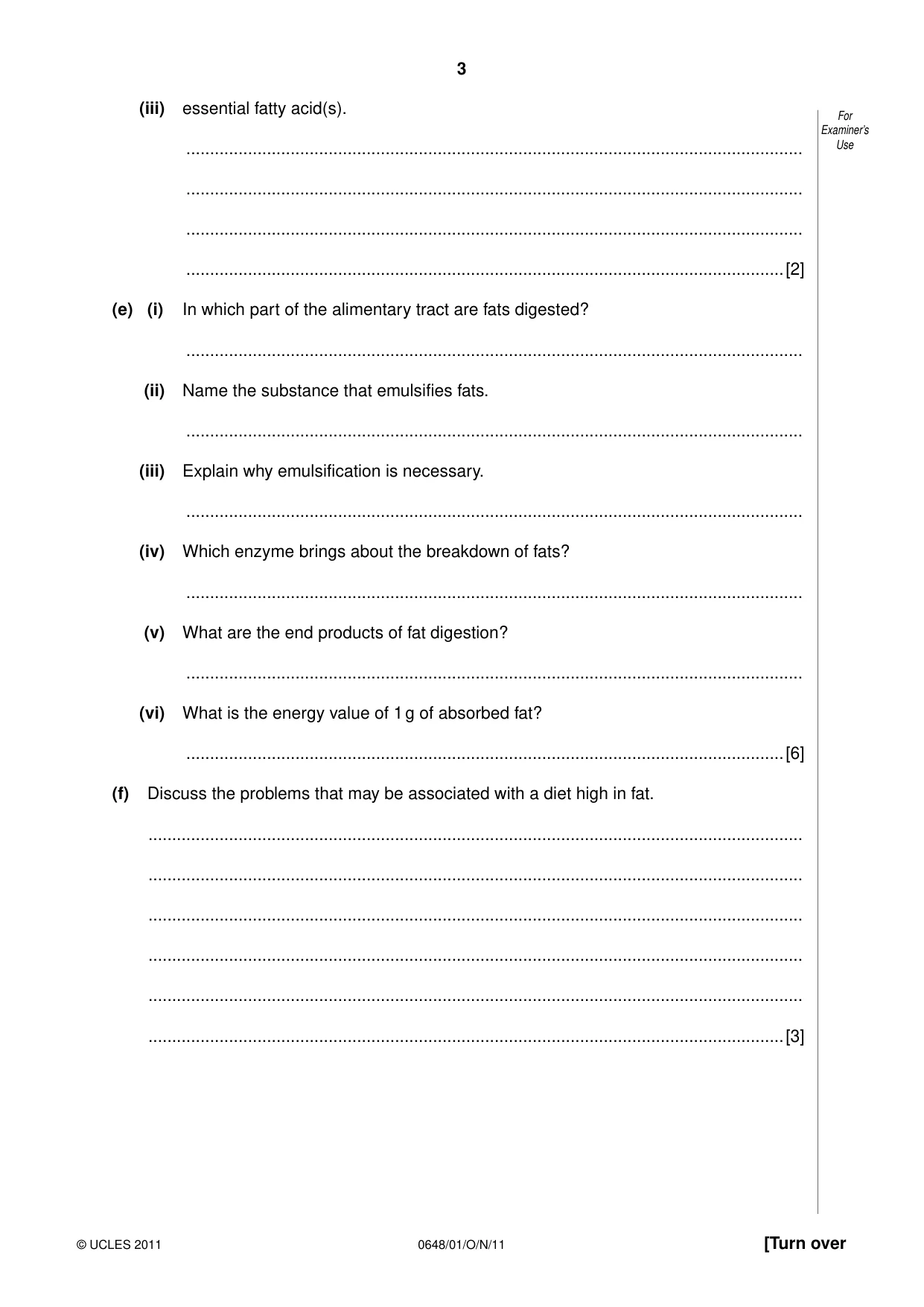
Question paper, page 3
3 [Turn over 0648/01/O/N/11 © UCLES 2011 For Examiner’s Use (iii) essential fatty acid(s). … … … …[2] (e) (i) In which part of the alimentary tract are fats digested? … (ii) Name the substance that emulsifies fats. … (iii) Explain why emulsification is necessary. … (iv) Which enzyme brings about the breakdown of fats? … (v) What are the end products of fat digestion? … (vi) What is the energy value of 1 g of absorbed fat? …[6] (f) Discuss the problems that may be associated with a diet high in fat. … … … … … …[3]
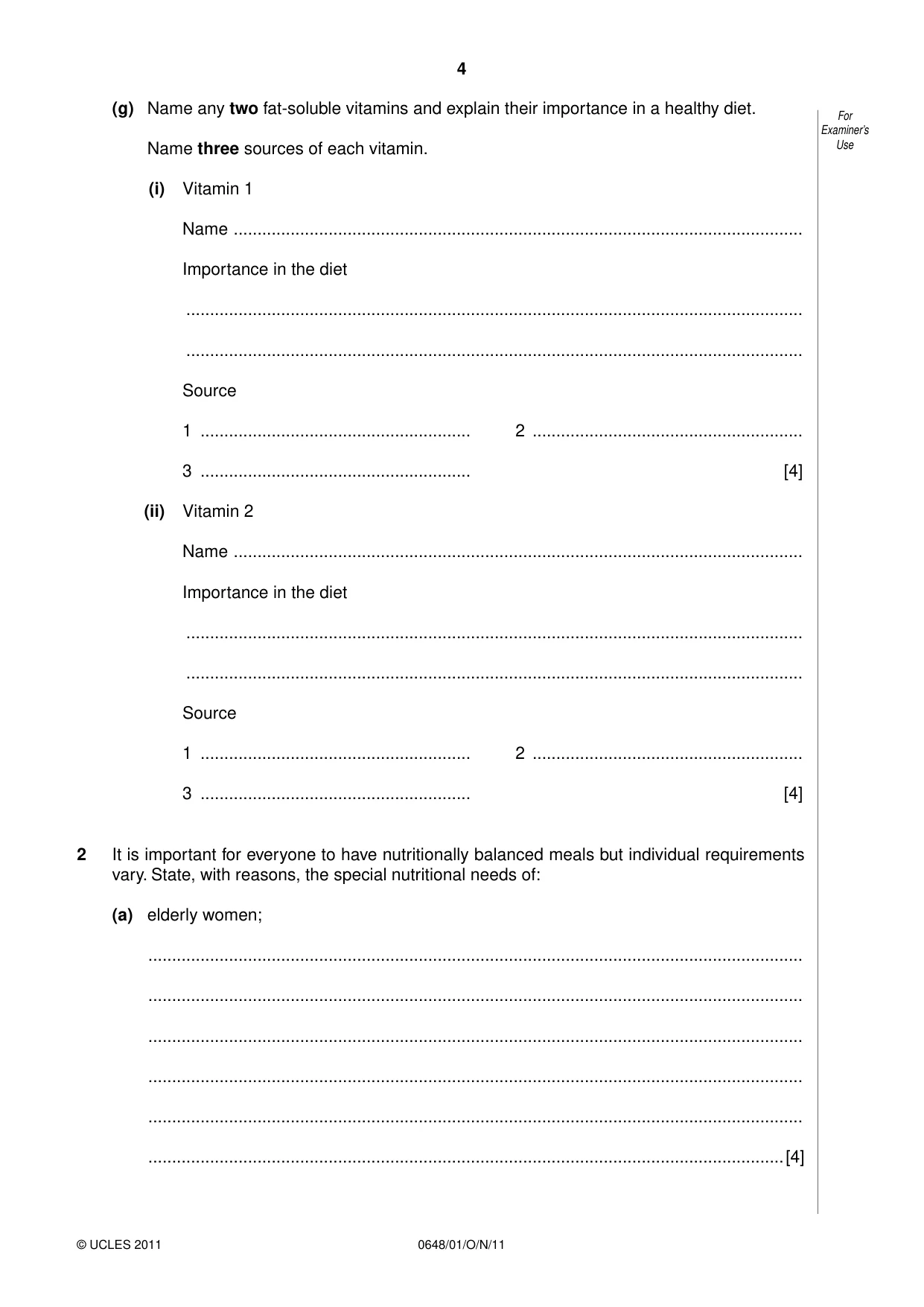
Question paper, page 4
4 0648/01/O/N/11 © UCLES 2011 For Examiner’s Use (g) Name any two fat-soluble vitamins and explain their importance in a healthy diet. Name three sources of each vitamin. (i) Vitamin 1 Name … Importance in the diet … … Source 1 … 2 … 3 … [4] (ii) Vitamin 2 Name … Importance in the diet … … Source 1 … 2 … 3 … [4] 2 It is important for everyone to have nutritionally balanced meals but individual requirements vary. State, with reasons, the special nutritional needs of: (a) elderly women; … … … … … …[4]
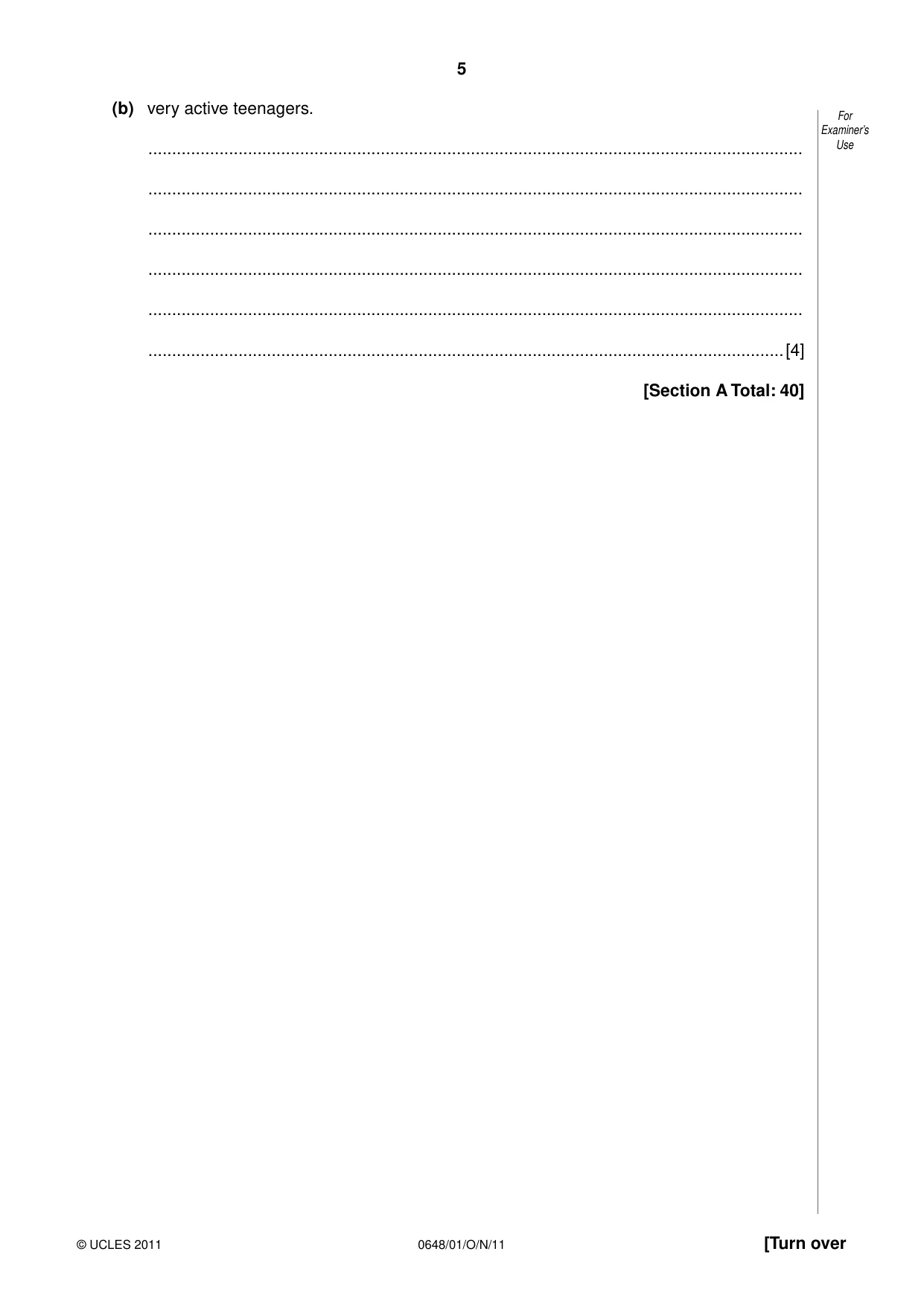
Question paper, page 5
5 [Turn over 0648/01/O/N/11 © UCLES 2011 For Examiner’s Use (b) very active teenagers. … … … … … …[4] [Section A Total: 40]
Question paper, page 6
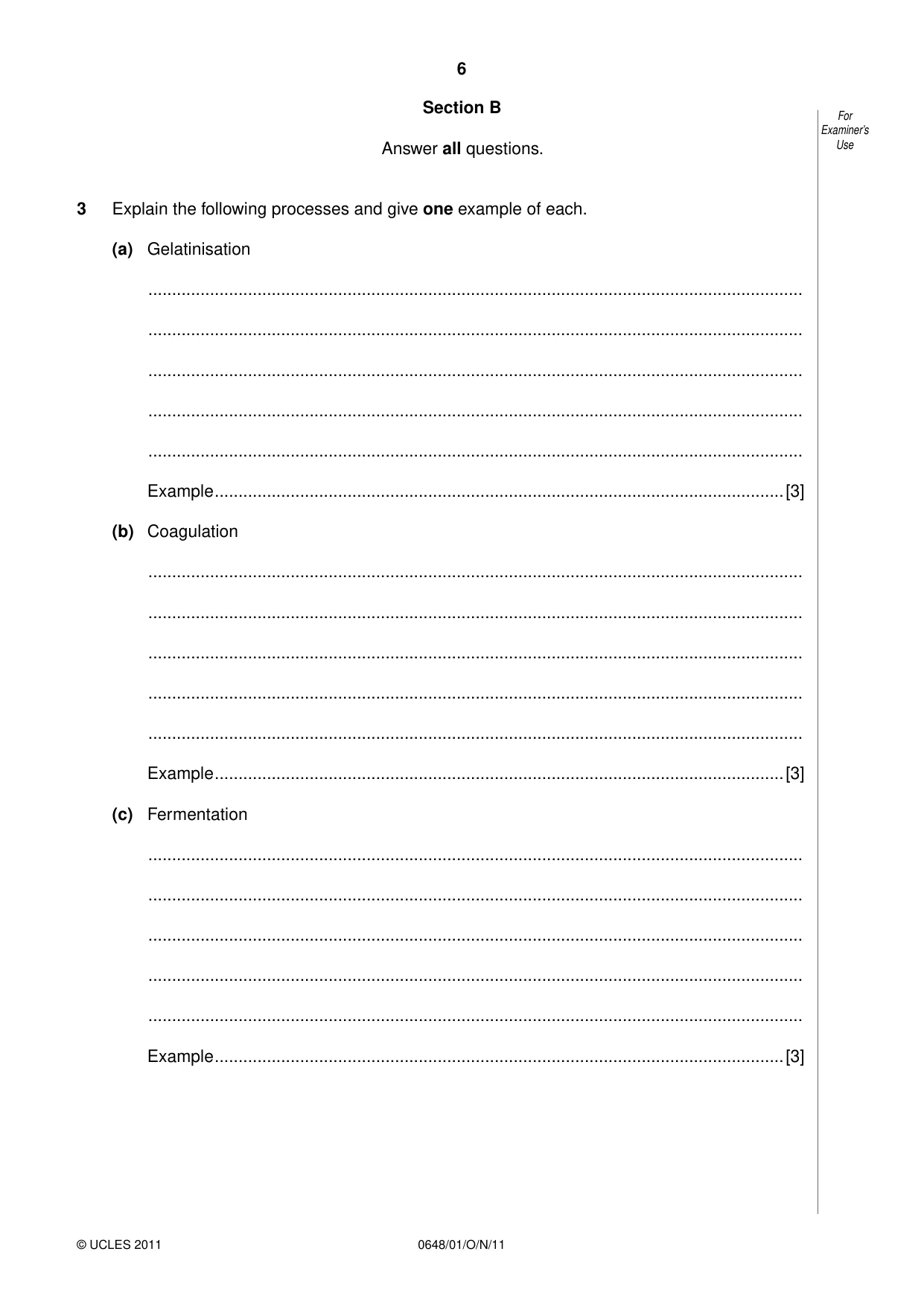
6 0648/01/O/N/11 © UCLES 2011 For Examiner’s Use Section B Answer all questions. 3 Explain the following processes and give one example of each. (a) Gelatinisation … … … … … Example …[3] (b) Coagulation … … … … … Example …[3] (c) Fermentation … … … … … Example …[3]
Question paper, page 7
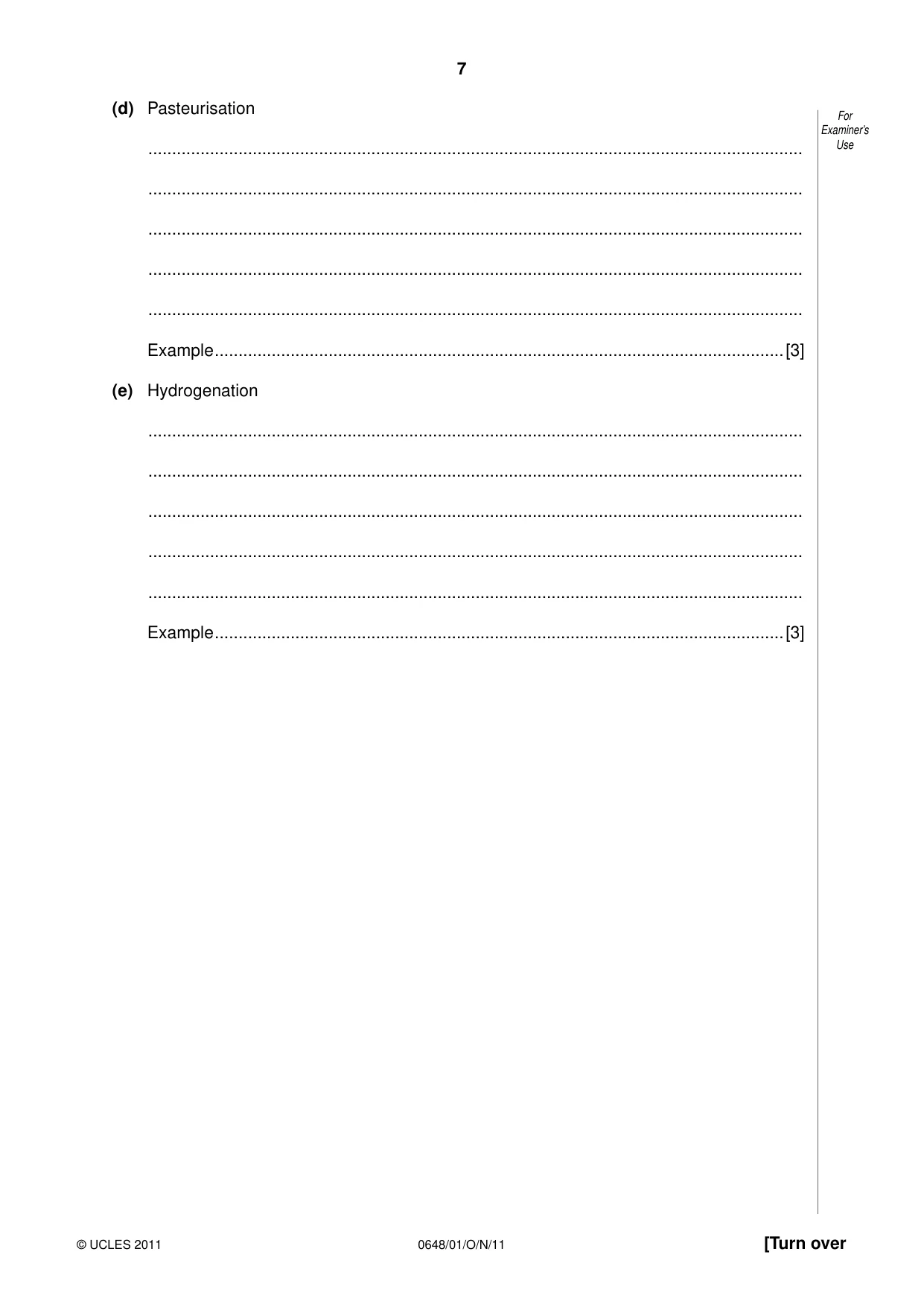
7 [Turn over 0648/01/O/N/11 © UCLES 2011 For Examiner’s Use (d) Pasteurisation … … … … … Example …[3] (e) Hydrogenation … … … … … Example …[3]
Question paper, page 8
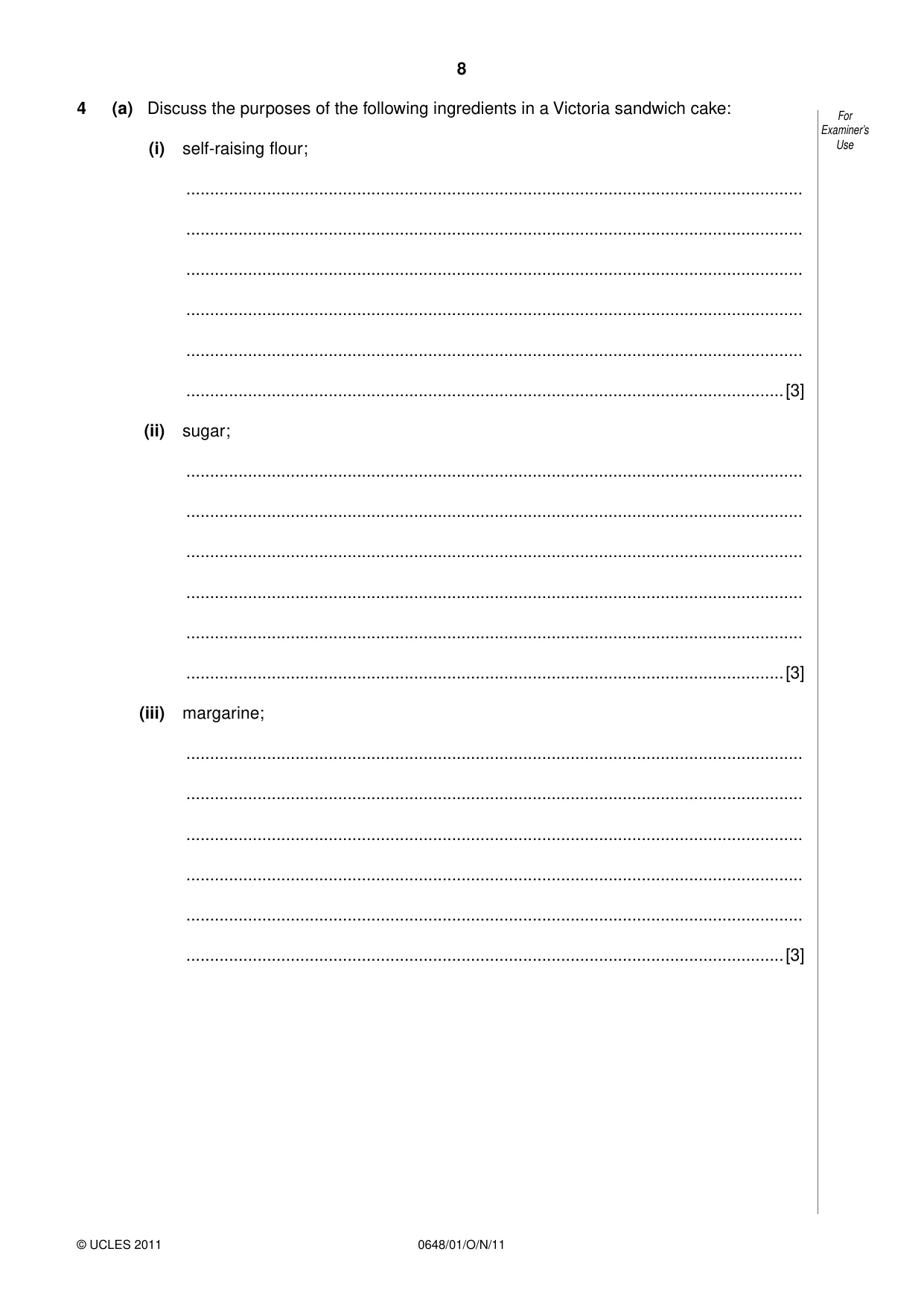
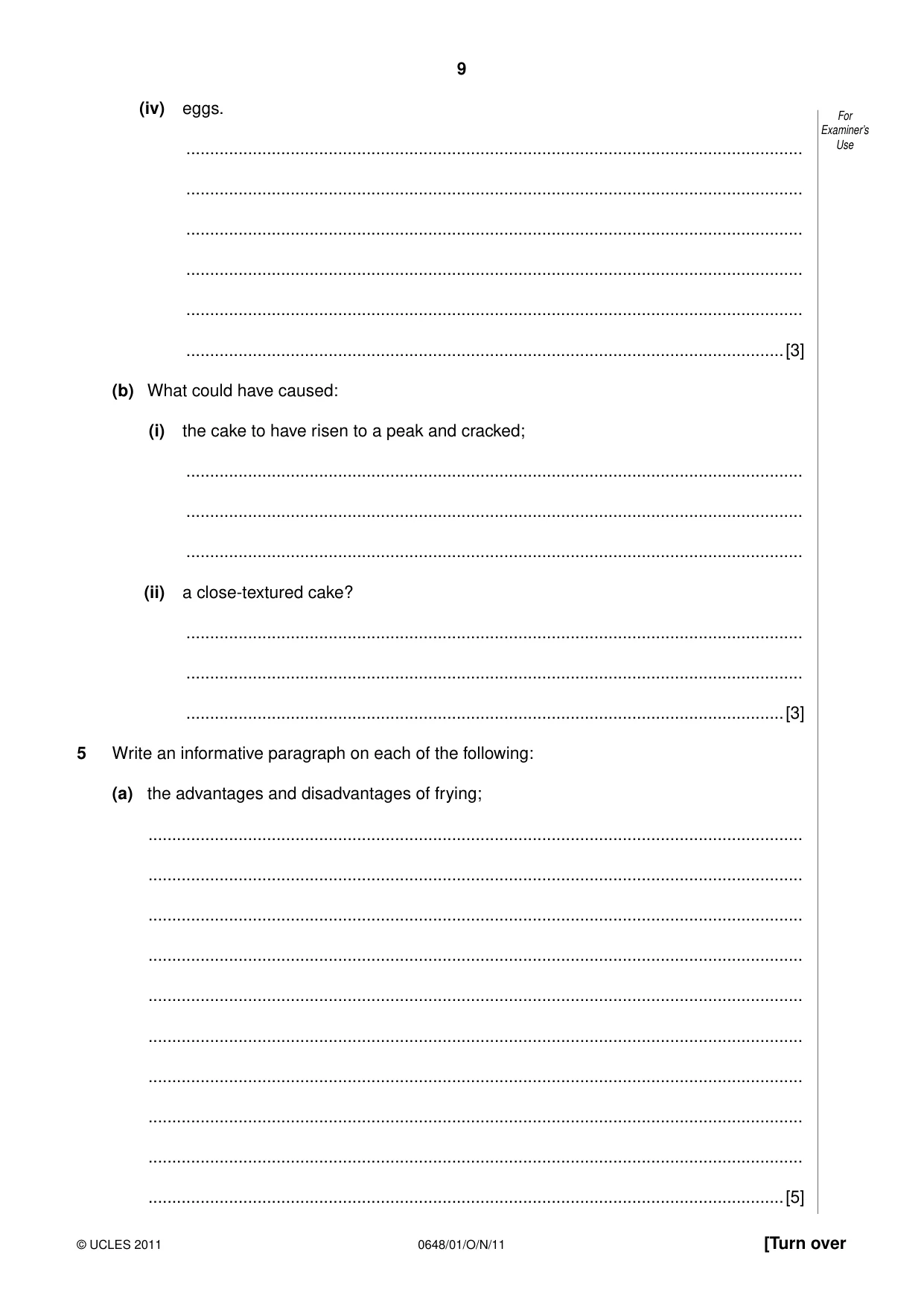
8 0648/01/O/N/11 © UCLES 2011 For Examiner’s Use 4 (a) Discuss the purposes of the following ingredients in a Victoria sandwich cake: (i) self-raising flour; … … … … … …[3] (ii) sugar; … … … … … …[3] (iii) margarine; … … … … … …[3]
Question paper, page 9
9 [Turn over 0648/01/O/N/11 © UCLES 2011 For Examiner’s Use (iv) eggs. … … … … … …[3] (b) What could have caused: (i) the cake to have risen to a peak and cracked; … … … (ii) a close-textured cake? … … …[3] 5 Write an informative paragraph on each of the following: (a) the advantages and disadvantages of frying; … … … … … … … … … …[5]
Question paper, page 10
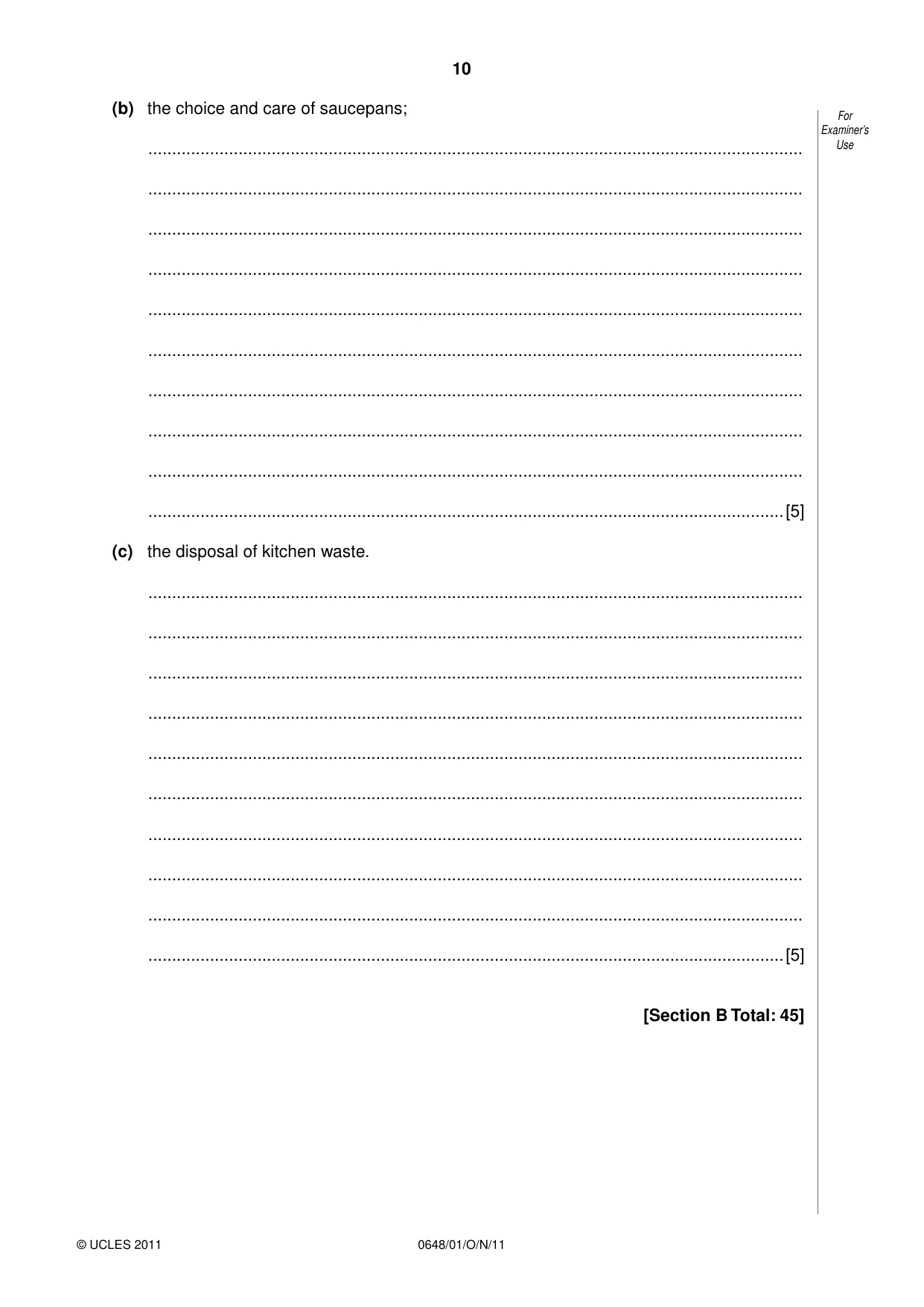
10 0648/01/O/N/11 © UCLES 2011 For Examiner’s Use (b) the choice and care of saucepans; … … … … … … … … … …[5] (c) the disposal of kitchen waste. … … … … … … … … … …[5] [Section B Total: 45]
Question paper, page 11
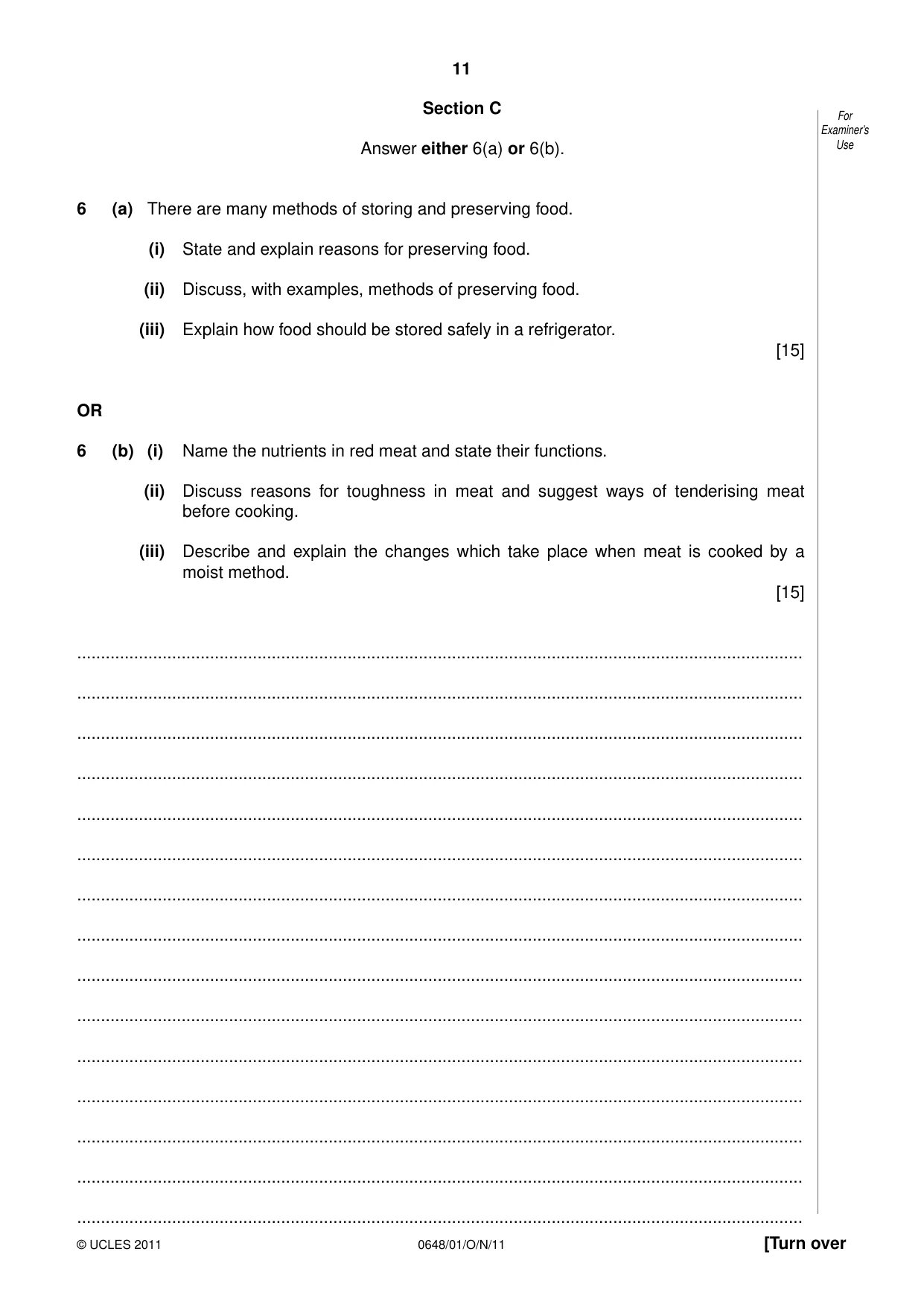
11 [Turn over 0648/01/O/N/11 © UCLES 2011 For Examiner’s Use Section C Answer either 6(a) or 6(b). 6 (a) There are many methods of storing and preserving food. (i) State and explain reasons for preserving food. (ii) Discuss, with examples, methods of preserving food. (iii) Explain how food should be stored safely in a refrigerator. [15] OR 6 (b) (i) Name the nutrients in red meat and state their functions. (ii) Discuss reasons for toughness in meat and suggest ways of tenderising meat before cooking. (iii) Describe and explain the changes which take place when meat is cooked by a moist method. [15] … … … … … … … … … … … … … … …
Question paper, page 12
12 0648/01/O/N/11 © UCLES 2011 For Examiner’s Use … … … … … … … … … … … … … … … … … … … … … … … … … … … …
Question paper, page 13
13 [Turn over 0648/01/O/N/11 © UCLES 2011 For Examiner’s Use … … … … … … … … … … … … … … … … … … … … … … … … … … … …
Question paper, page 14
14 0648/01/O/N/11 © UCLES 2011 For Examiner’s Use … … … … … … … … … … … … … … … … … … … … … … … … … … [Section C Total: 15] [Total for Paper: 100]
Question paper, page 15
15 © UCLES 2011 0648/01/O/N/11 BLANK PAGE
Question paper, page 16
16 0648/01/O/N/11 © UCLES 2011 Permission to reproduce items where third-party owned material protected by copyright is included has been sought and cleared where possible. Every reasonable effort has been made by the publisher (UCLES) to trace copyright holders, but if any items requiring clearance have unwittingly been included, the publisher will be pleased to make amends at the earliest possible opportunity. University of Cambridge International Examinations is part of the Cambridge Assessment Group. Cambridge Assessment is the brand name of University of Cambridge Local Examinations Syndicate (UCLES), which is itself a department of the University of Cambridge. BLANK PAGE
Mark scheme, page 1
UNIVERSITY OF CAMBRIDGE INTERNATIONAL EXAMINATIONS International General Certificate of Secondary Education MARK SCHEME for the October/November 2011 question paper for the guidance of teachers 0648 FOOD AND NUTRITION 0648/01 Paper 1 (Theory), maximum raw mark 100 This mark scheme is published as an aid to teachers and candidates, to indicate the requirements of the examination. It shows the basis on which Examiners were instructed to award marks. It does not indicate the details of the discussions that took place at an Examiners’ meeting before marking began, which would have considered the acceptability of alternative answers. Mark schemes must be read in conjunction with the question papers and the report on the examination. • Cambridge will not enter into discussions or correspondence in connection with these mark schemes. Cambridge is publishing the mark schemes for the October/November 2011 question papers for most IGCSE, GCE Advanced Level and Advanced Subsidiary Level syllabuses and some Ordinary Level syllabuses. www.XtremePapers.com
Mark scheme, page 2
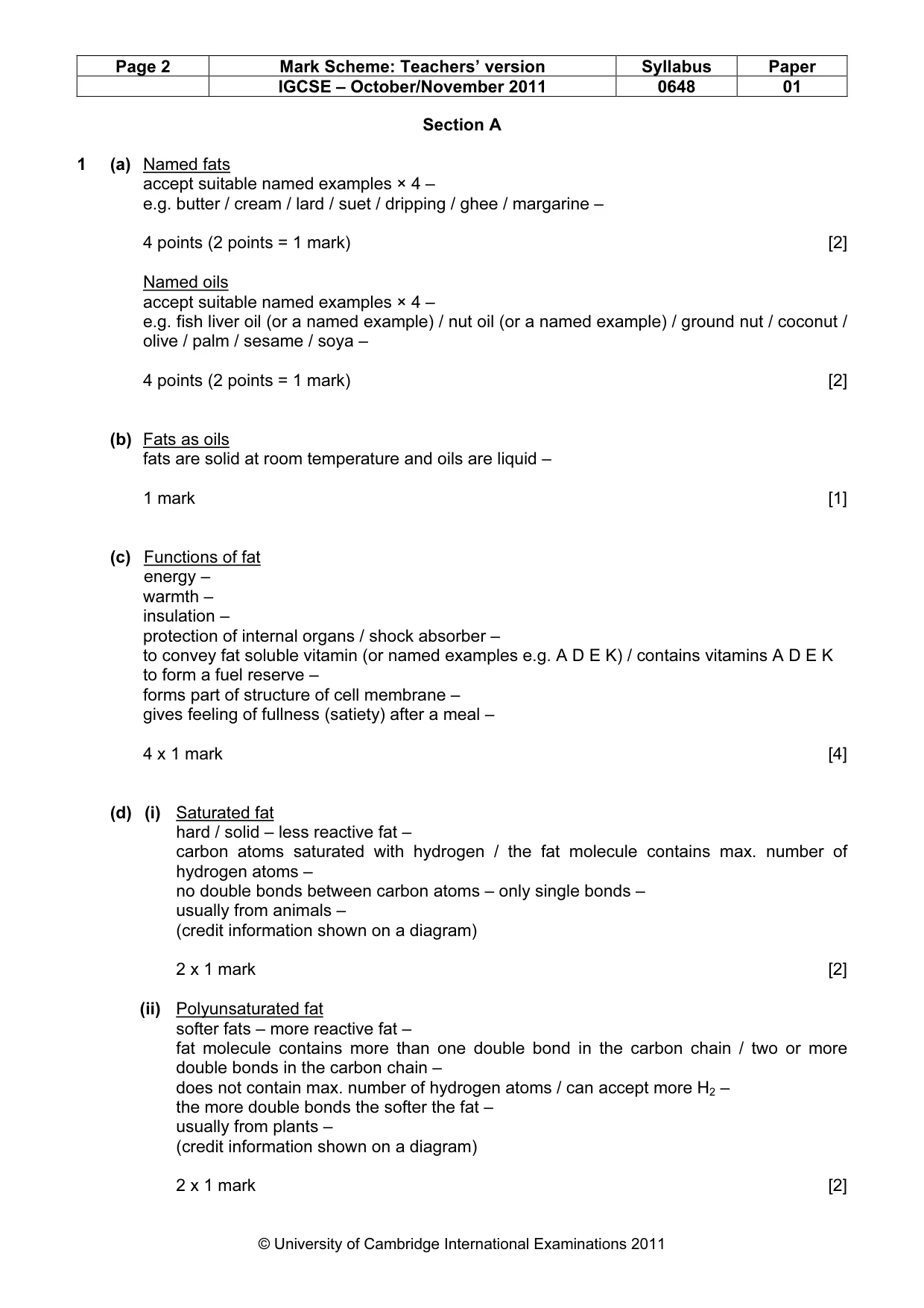
Page 2 Mark Scheme: Teachers’ version Syllabus Paper IGCSE – October/November 2011 0648 01 © University of Cambridge International Examinations 2011 Section A 1 (a) Named fats accept suitable named examples × 4 – e.g. butter / cream / lard / suet / dripping / ghee / margarine – 4 points (2 points = 1 mark) [2] Named oils accept suitable named examples × 4 – e.g. fish liver oil (or a named example) / nut oil (or a named example) / ground nut / coconut / olive / palm / sesame / soya – 4 points (2 points = 1 mark) [2] (b) Fats as oils fats are solid at room temperature and oils are liquid – 1 mark [1] (c) Functions of fat energy – warmth – insulation – protection of internal organs / shock absorber – to convey fat soluble vitamin (or named examples e.g. A D E K) / contains vitamins A D E K to form a fuel reserve – forms part of structure of cell membrane – gives feeling of fullness (satiety) after a meal – 4 x 1 mark [4] (d) (i) Saturated fat hard / solid – less reactive fat – carbon atoms saturated with hydrogen / the fat molecule contains max. number of hydrogen atoms – no double bonds between carbon atoms – only single bonds – usually from animals – (credit information shown on a diagram) 2 x 1 mark [2] (ii) Polyunsaturated fat softer fats – more reactive fat – fat molecule contains more than one double bond in the carbon chain / two or more double bonds in the carbon chain – does not contain max. number of hydrogen atoms / can accept more H2 – the more double bonds the softer the fat – usually from plants – (credit information shown on a diagram) 2 x 1 mark [2]
Mark scheme, page 3
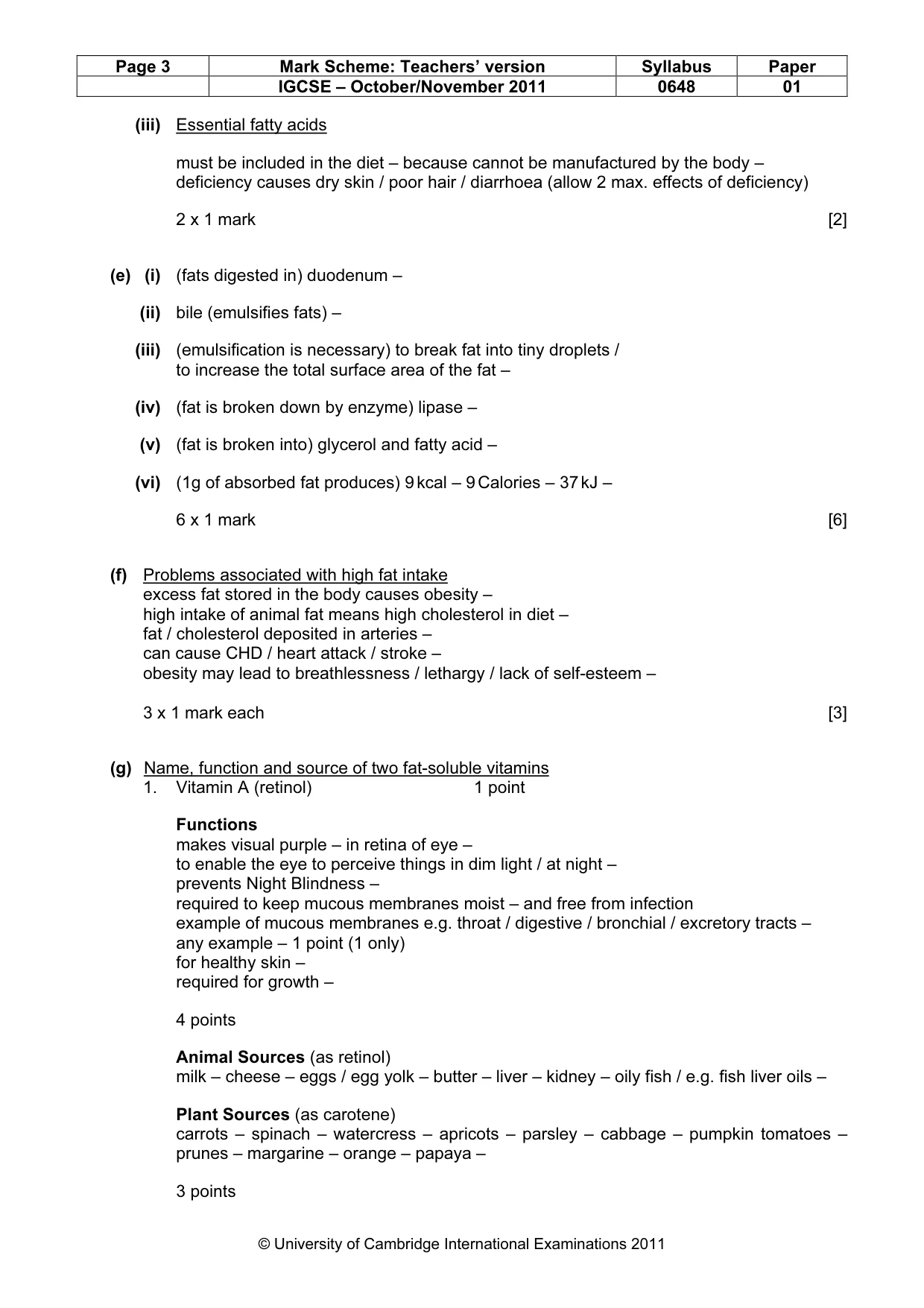
Page 3 Mark Scheme: Teachers’ version Syllabus Paper IGCSE – October/November 2011 0648 01 © University of Cambridge International Examinations 2011 (iii) Essential fatty acids must be included in the diet – because cannot be manufactured by the body – deficiency causes dry skin / poor hair / diarrhoea (allow 2 max. effects of deficiency) 2 x 1 mark [2] (e) (i) (fats digested in) duodenum – (ii) bile (emulsifies fats) – (iii) (emulsification is necessary) to break fat into tiny droplets / to increase the total surface area of the fat – (iv) (fat is broken down by enzyme) lipase – (v) (fat is broken into) glycerol and fatty acid – (vi) (1g of absorbed fat produces) 9 kcal – 9 Calories – 37 kJ – 6 x 1 mark [6] (f) Problems associated with high fat intake excess fat stored in the body causes obesity – high intake of animal fat means high cholesterol in diet – fat / cholesterol deposited in arteries – can cause CHD / heart attack / stroke – obesity may lead to breathlessness / lethargy / lack of self-esteem – 3 x 1 mark each [3] (g) Name, function and source of two fat-soluble vitamins 1. Vitamin A (retinol) 1 point Functions makes visual purple – in retina of eye – to enable the eye to perceive things in dim light / at night – prevents Night Blindness – required to keep mucous membranes moist – and free from infection example of mucous membranes e.g. throat / digestive / bronchial / excretory tracts – any example – 1 point (1 only) for healthy skin – required for growth – 4 points Animal Sources (as retinol) milk – cheese – eggs / egg yolk – butter – liver – kidney – oily fish / e.g. fish liver oils – Plant Sources (as carotene) carrots – spinach – watercress – apricots – parsley – cabbage – pumpkin tomatoes – prunes – margarine – orange – papaya – 3 points
Mark scheme, page 4
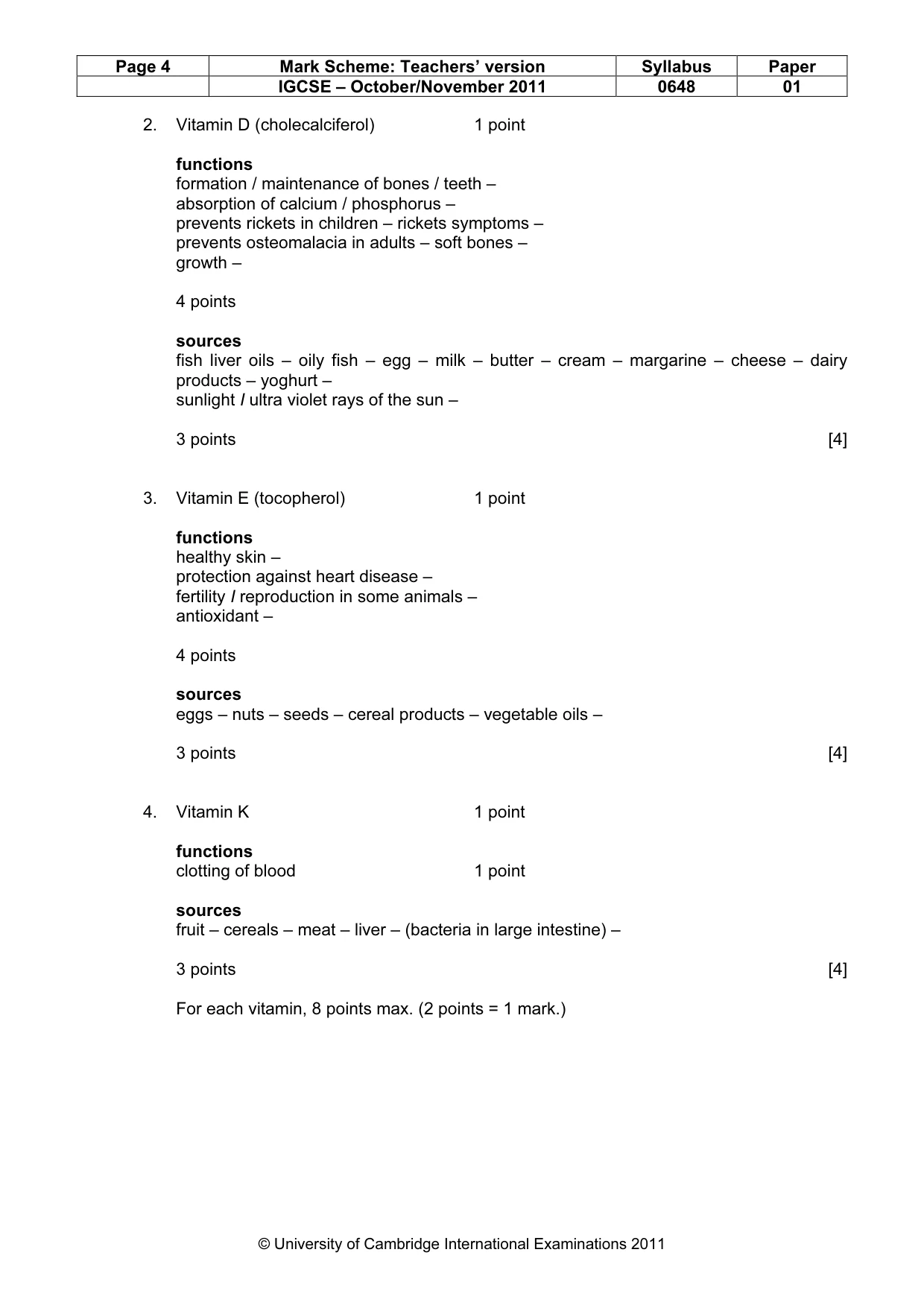
Page 4 Mark Scheme: Teachers’ version Syllabus Paper IGCSE – October/November 2011 0648 01 © University of Cambridge International Examinations 2011 2. Vitamin D (cholecalciferol) 1 point functions formation / maintenance of bones / teeth – absorption of calcium / phosphorus – prevents rickets in children – rickets symptoms – prevents osteomalacia in adults – soft bones – growth – 4 points sources fish liver oils – oily fish – egg – milk – butter – cream – margarine – cheese – dairy products – yoghurt – sunlight I ultra violet rays of the sun – 3 points [4] 3. Vitamin E (tocopherol) 1 point functions healthy skin – protection against heart disease – fertility I reproduction in some animals – antioxidant – 4 points sources eggs – nuts – seeds – cereal products – vegetable oils – 3 points [4] 4. Vitamin K 1 point functions clotting of blood 1 point sources fruit – cereals – meat – liver – (bacteria in large intestine) – 3 points [4] For each vitamin, 8 points max. (2 points = 1 mark.)
Mark scheme, page 5
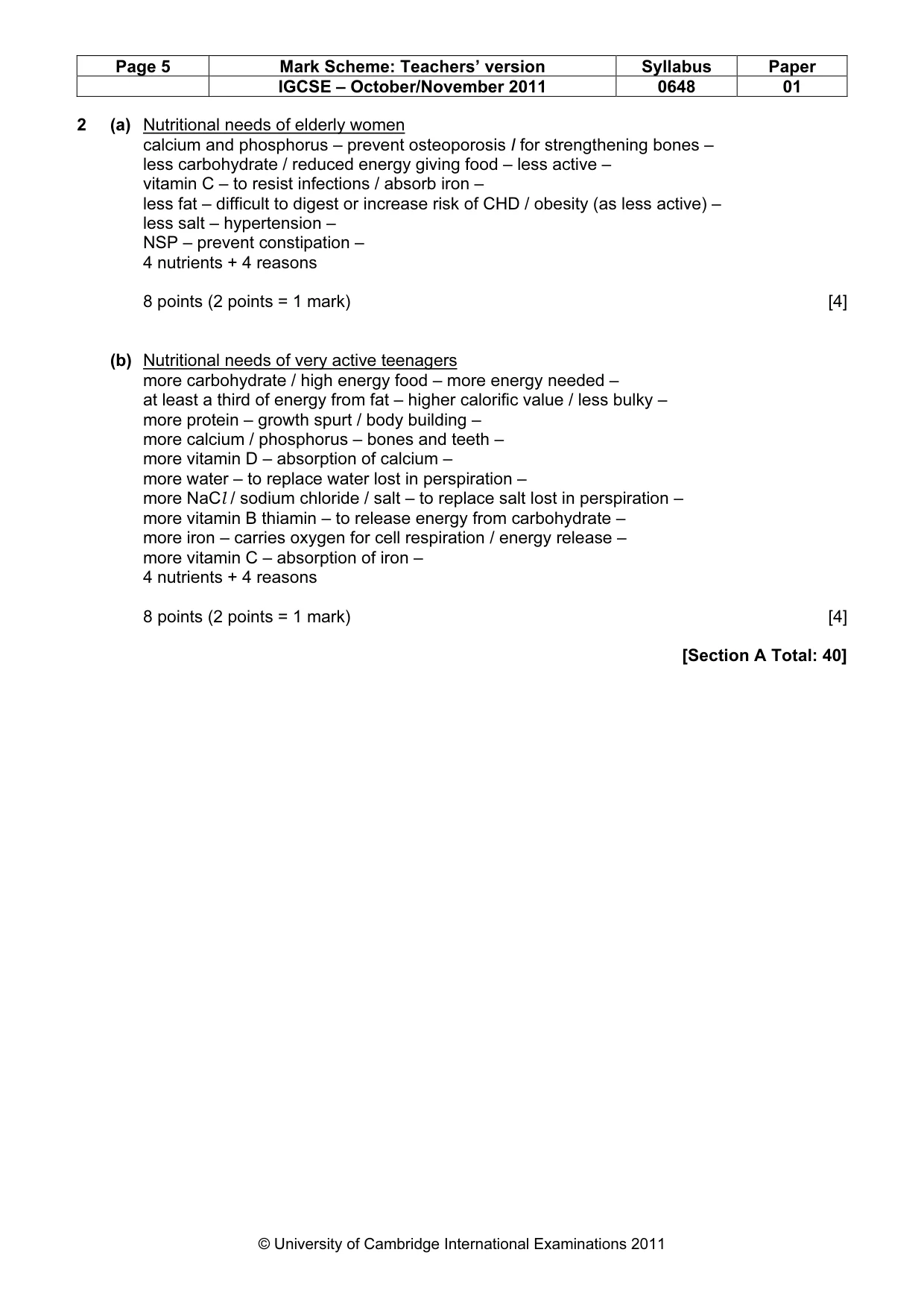
Page 5 Mark Scheme: Teachers’ version Syllabus Paper IGCSE – October/November 2011 0648 01 © University of Cambridge International Examinations 2011 2 (a) Nutritional needs of elderly women calcium and phosphorus – prevent osteoporosis I for strengthening bones – less carbohydrate / reduced energy giving food – less active – vitamin C – to resist infections / absorb iron – less fat – difficult to digest or increase risk of CHD / obesity (as less active) – less salt – hypertension – NSP – prevent constipation – 4 nutrients + 4 reasons 8 points (2 points = 1 mark) [4] (b) Nutritional needs of very active teenagers more carbohydrate / high energy food – more energy needed – at least a third of energy from fat – higher calorific value / less bulky – more protein – growth spurt / body building – more calcium / phosphorus – bones and teeth – more vitamin D – absorption of calcium – more water – to replace water lost in perspiration – more NaCl / sodium chloride / salt – to replace salt lost in perspiration – more vitamin B thiamin – to release energy from carbohydrate – more iron – carries oxygen for cell respiration / energy release – more vitamin C – absorption of iron – 4 nutrients + 4 reasons 8 points (2 points = 1 mark) [4] [Section A Total: 40]
Mark scheme, page 6
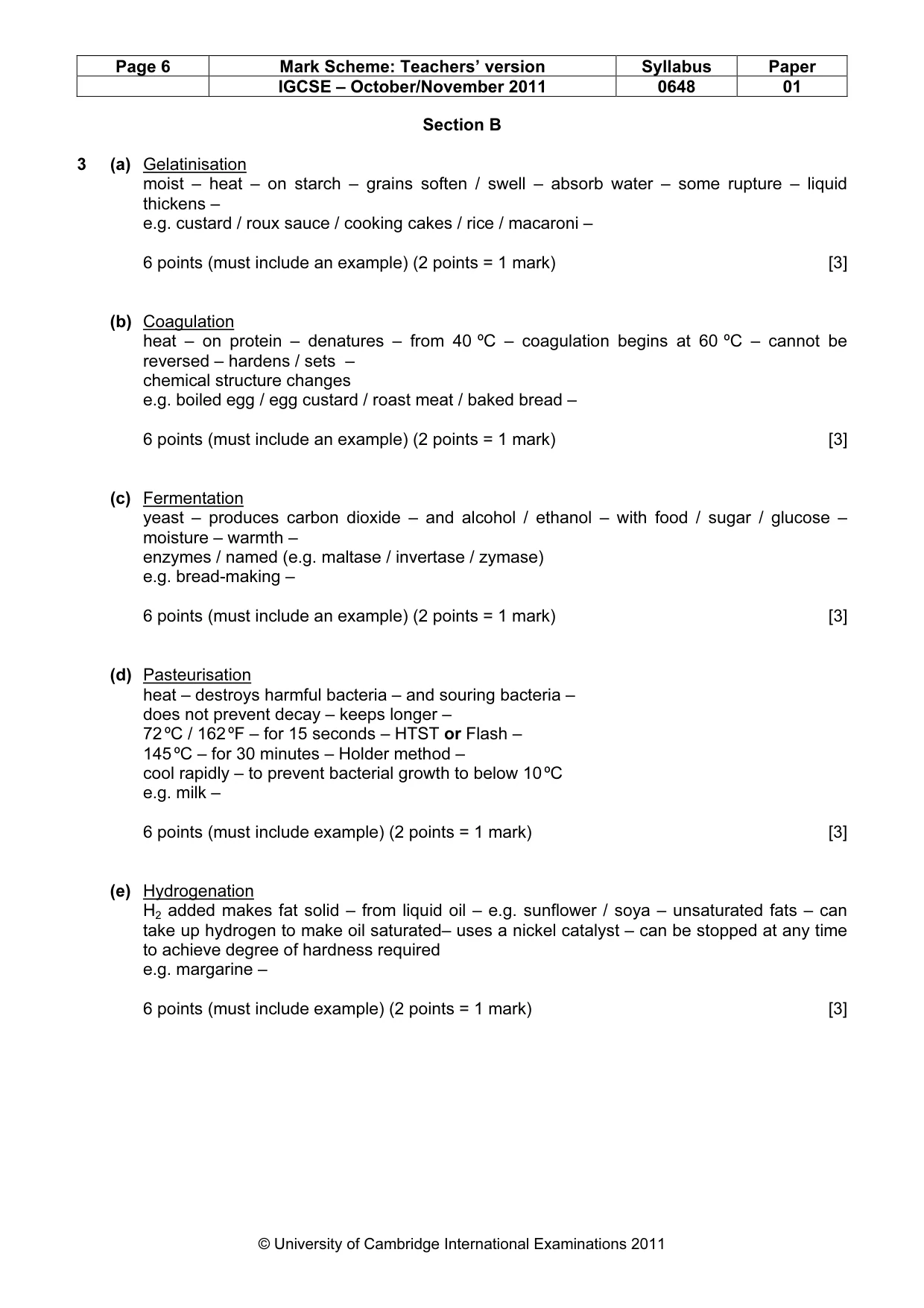
Page 6 Mark Scheme: Teachers’ version Syllabus Paper IGCSE – October/November 2011 0648 01 © University of Cambridge International Examinations 2011 Section B 3 (a) Gelatinisation moist – heat – on starch – grains soften / swell – absorb water – some rupture – liquid thickens – e.g. custard / roux sauce / cooking cakes / rice / macaroni – 6 points (must include an example) (2 points = 1 mark) [3] (b) Coagulation heat – on protein – denatures – from 40 ºC – coagulation begins at 60 ºC – cannot be reversed – hardens / sets – chemical structure changes e.g. boiled egg / egg custard / roast meat / baked bread – 6 points (must include an example) (2 points = 1 mark) [3] (c) Fermentation yeast – produces carbon dioxide – and alcohol / ethanol – with food / sugar / glucose – moisture – warmth – enzymes / named (e.g. maltase / invertase / zymase) e.g. bread-making – 6 points (must include an example) (2 points = 1 mark) [3] (d) Pasteurisation heat – destroys harmful bacteria – and souring bacteria – does not prevent decay – keeps longer – 72 ºC / 162 ºF – for 15 seconds – HTST or Flash – 145 ºC – for 30 minutes – Holder method – cool rapidly – to prevent bacterial growth to below 10 ºC e.g. milk – 6 points (must include example) (2 points = 1 mark) [3] (e) Hydrogenation H2 added makes fat solid – from liquid oil – e.g. sunflower / soya – unsaturated fats – can take up hydrogen to make oil saturated– uses a nickel catalyst – can be stopped at any time to achieve degree of hardness required e.g. margarine – 6 points (must include example) (2 points = 1 mark) [3]
Mark scheme, page 7
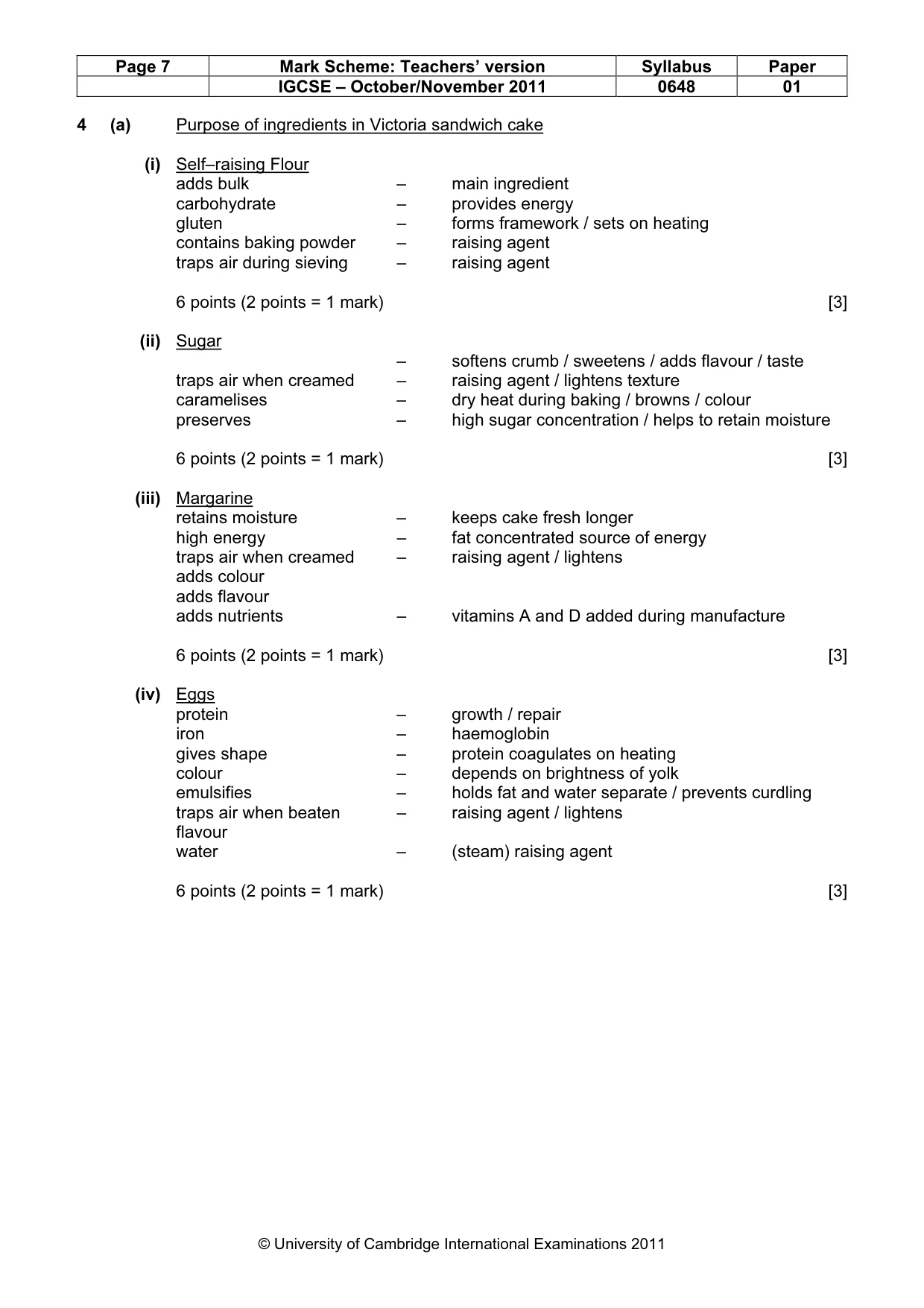
Page 7 Mark Scheme: Teachers’ version Syllabus Paper IGCSE – October/November 2011 0648 01 © University of Cambridge International Examinations 2011 4 (a) Purpose of ingredients in Victoria sandwich cake (i) Self–raising Flour adds bulk – main ingredient carbohydrate – provides energy gluten – forms framework / sets on heating contains baking powder – raising agent traps air during sieving – raising agent 6 points (2 points = 1 mark) [3] (ii) Sugar – softens crumb / sweetens / adds flavour / taste traps air when creamed – raising agent / lightens texture caramelises – dry heat during baking / browns / colour preserves – high sugar concentration / helps to retain moisture 6 points (2 points = 1 mark) [3] (iii) Margarine retains moisture – keeps cake fresh longer high energy – fat concentrated source of energy traps air when creamed – raising agent / lightens adds colour adds flavour adds nutrients – vitamins A and D added during manufacture 6 points (2 points = 1 mark) [3] (iv) Eggs protein – growth / repair iron – haemoglobin gives shape – protein coagulates on heating colour – depends on brightness of yolk emulsifies – holds fat and water separate / prevents curdling traps air when beaten – raising agent / lightens flavour water – (steam) raising agent 6 points (2 points = 1 mark) [3]
Mark scheme, page 8
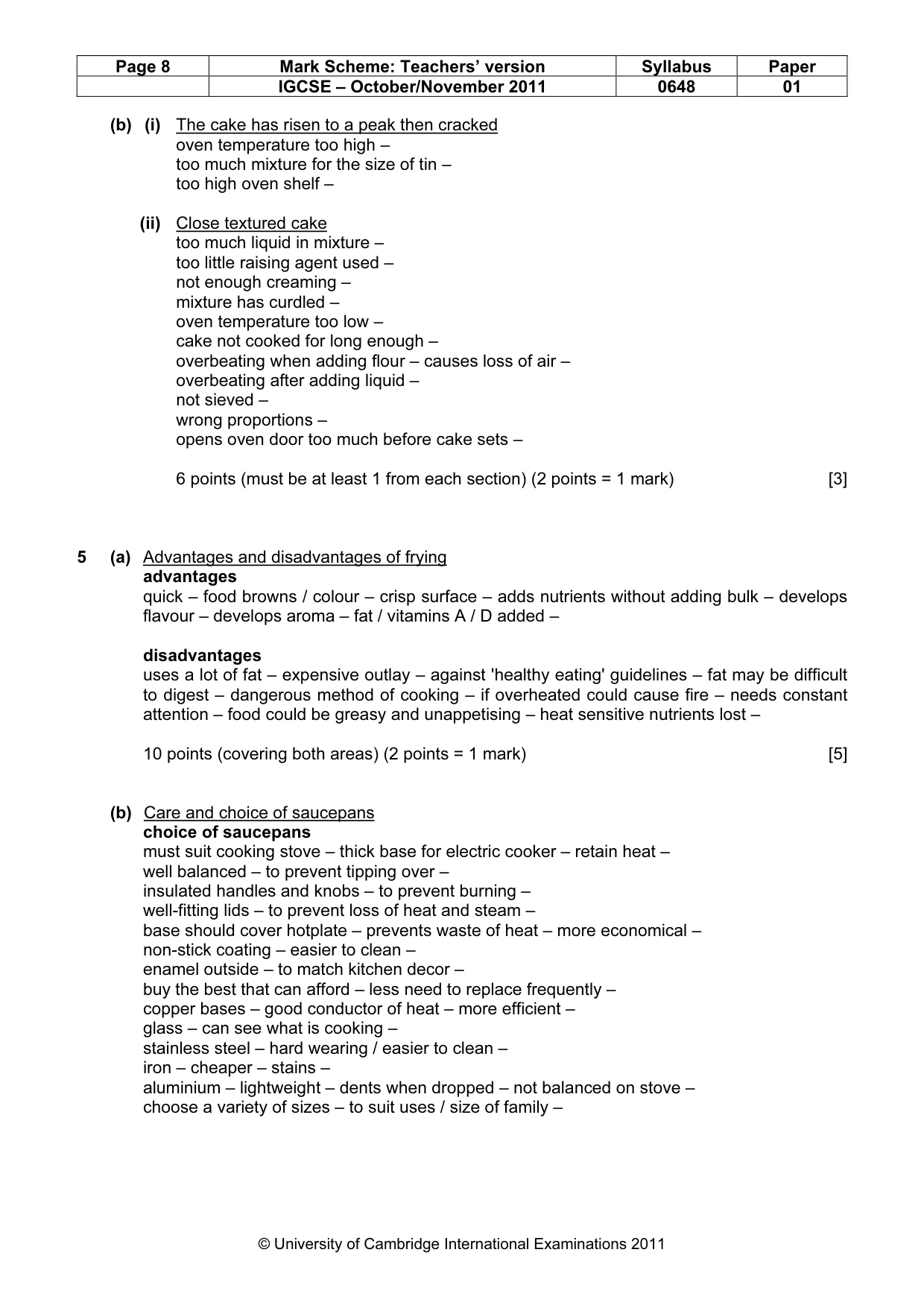
Page 8 Mark Scheme: Teachers’ version Syllabus Paper IGCSE – October/November 2011 0648 01 © University of Cambridge International Examinations 2011 (b) (i) The cake has risen to a peak then cracked oven temperature too high – too much mixture for the size of tin – too high oven shelf – (ii) Close textured cake too much liquid in mixture – too little raising agent used – not enough creaming – mixture has curdled – oven temperature too low – cake not cooked for long enough – overbeating when adding flour – causes loss of air – overbeating after adding liquid – not sieved – wrong proportions – opens oven door too much before cake sets – 6 points (must be at least 1 from each section) (2 points = 1 mark) [3] 5 (a) Advantages and disadvantages of frying advantages quick – food browns / colour – crisp surface – adds nutrients without adding bulk – develops flavour – develops aroma – fat / vitamins A / D added – disadvantages uses a lot of fat – expensive outlay – against 'healthy eating' guidelines – fat may be difficult to digest – dangerous method of cooking – if overheated could cause fire – needs constant attention – food could be greasy and unappetising – heat sensitive nutrients lost – 10 points (covering both areas) (2 points = 1 mark) [5] (b) Care and choice of saucepans choice of saucepans must suit cooking stove – thick base for electric cooker – retain heat – well balanced – to prevent tipping over – insulated handles and knobs – to prevent burning – well-fitting lids – to prevent loss of heat and steam – base should cover hotplate – prevents waste of heat – more economical – non-stick coating – easier to clean – enamel outside – to match kitchen decor – buy the best that can afford – less need to replace frequently – copper bases – good conductor of heat – more efficient – glass – can see what is cooking – stainless steel – hard wearing / easier to clean – iron – cheaper – stains – aluminium – lightweight – dents when dropped – not balanced on stove – choose a variety of sizes – to suit uses / size of family –
Mark scheme, page 9
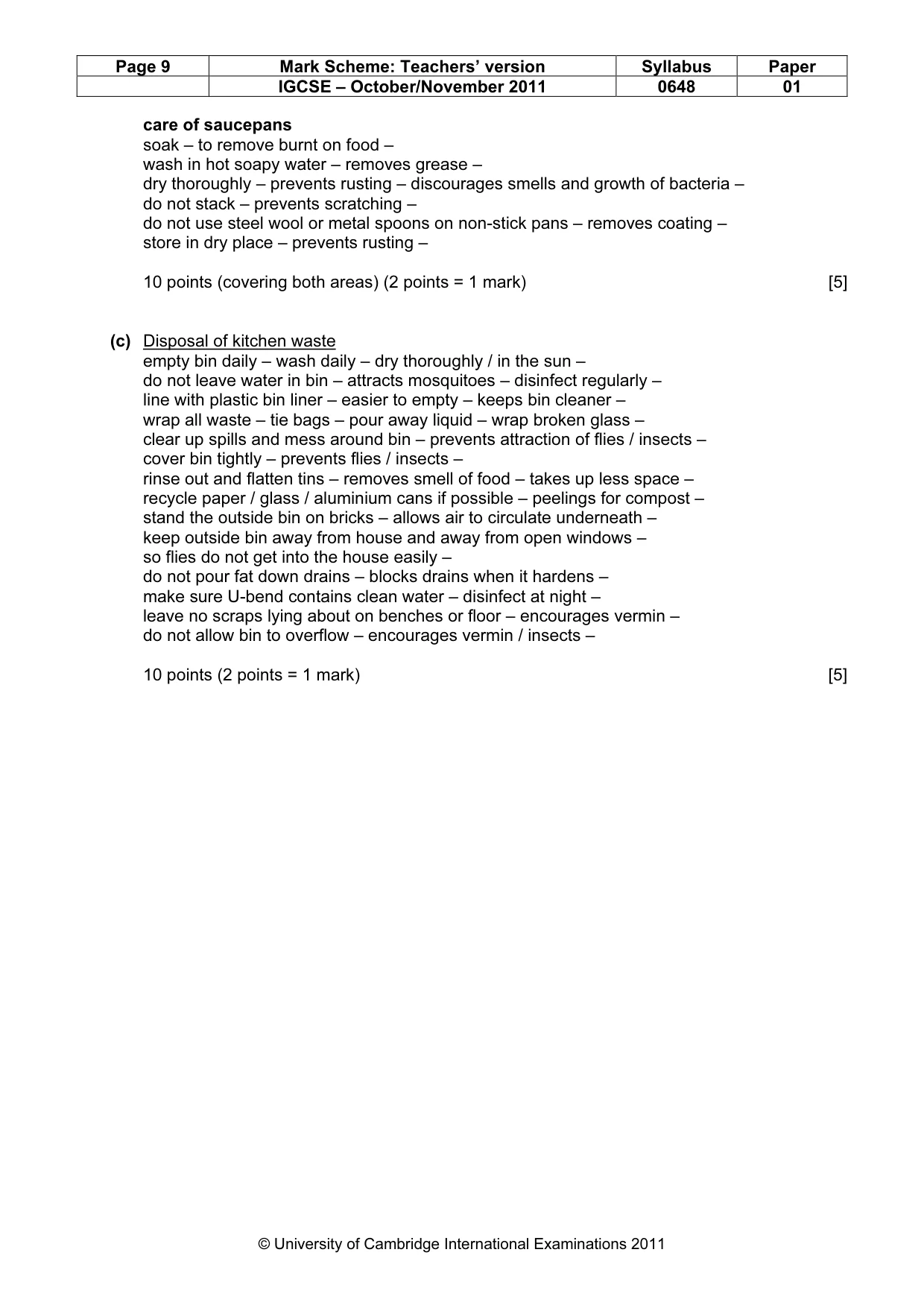
Page 9 Mark Scheme: Teachers’ version Syllabus Paper IGCSE – October/November 2011 0648 01 © University of Cambridge International Examinations 2011 care of saucepans soak – to remove burnt on food – wash in hot soapy water – removes grease – dry thoroughly – prevents rusting – discourages smells and growth of bacteria – do not stack – prevents scratching – do not use steel wool or metal spoons on non-stick pans – removes coating – store in dry place – prevents rusting – 10 points (covering both areas) (2 points = 1 mark) [5] (c) Disposal of kitchen waste empty bin daily – wash daily – dry thoroughly / in the sun – do not leave water in bin – attracts mosquitoes – disinfect regularly – line with plastic bin liner – easier to empty – keeps bin cleaner – wrap all waste – tie bags – pour away liquid – wrap broken glass – clear up spills and mess around bin – prevents attraction of flies / insects – cover bin tightly – prevents flies / insects – rinse out and flatten tins – removes smell of food – takes up less space – recycle paper / glass / aluminium cans if possible – peelings for compost – stand the outside bin on bricks – allows air to circulate underneath – keep outside bin away from house and away from open windows – so flies do not get into the house easily – do not pour fat down drains – blocks drains when it hardens – make sure U-bend contains clean water – disinfect at night – leave no scraps lying about on benches or floor – encourages vermin – do not allow bin to overflow – encourages vermin / insects – 10 points (2 points = 1 mark) [5]
Mark scheme, page 10
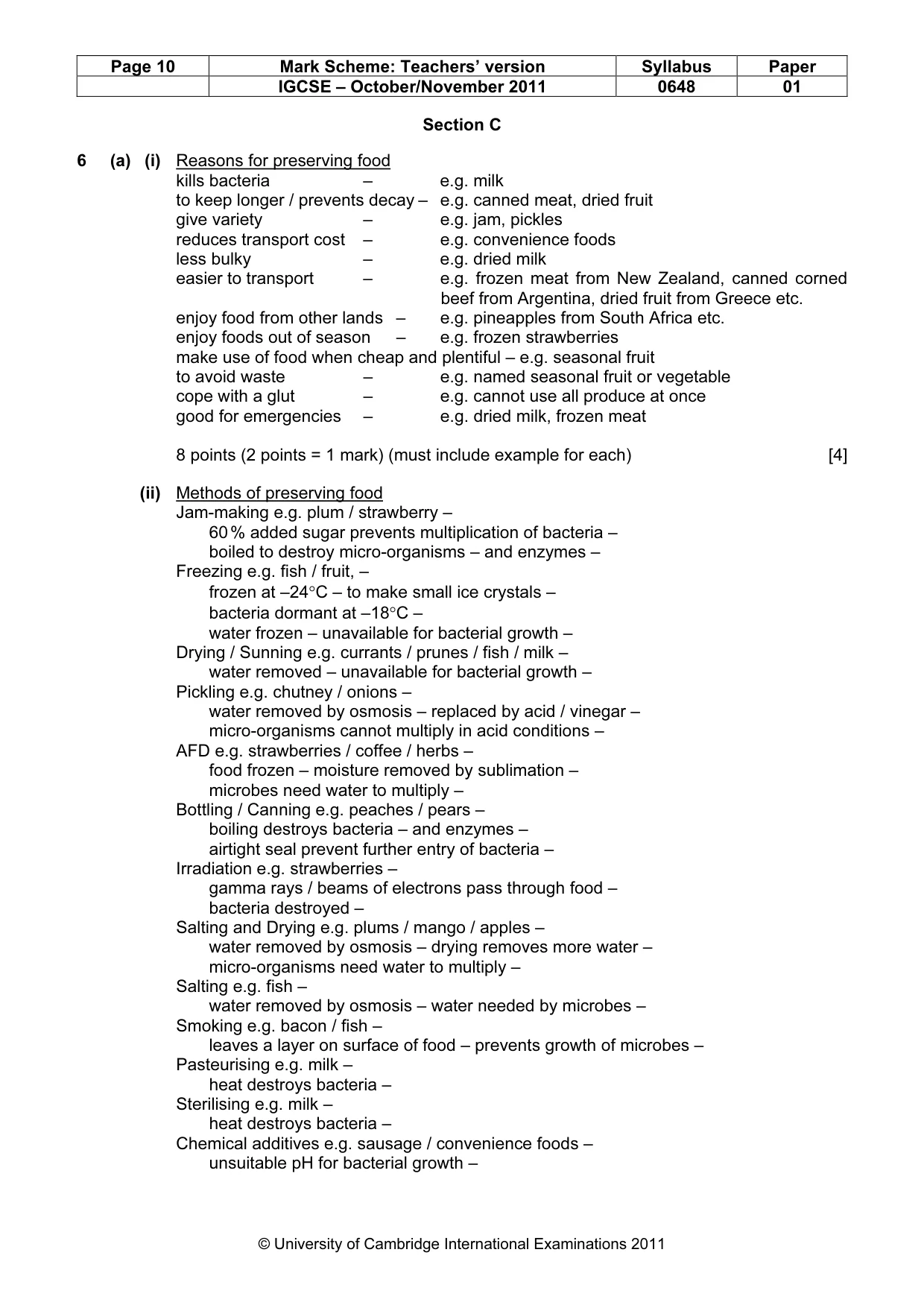
Page 10 Mark Scheme: Teachers’ version Syllabus Paper IGCSE – October/November 2011 0648 01 © University of Cambridge International Examinations 2011 Section C 6 (a) (i) Reasons for preserving food kills bacteria – e.g. milk to keep longer / prevents decay – e.g. canned meat, dried fruit give variety – e.g. jam, pickles reduces transport cost – e.g. convenience foods less bulky – e.g. dried milk easier to transport – e.g. frozen meat from New Zealand, canned corned beef from Argentina, dried fruit from Greece etc. enjoy food from other lands – e.g. pineapples from South Africa etc. enjoy foods out of season – e.g. frozen strawberries make use of food when cheap and plentiful – e.g. seasonal fruit to avoid waste – e.g. named seasonal fruit or vegetable cope with a glut – e.g. cannot use all produce at once good for emergencies – e.g. dried milk, frozen meat 8 points (2 points = 1 mark) (must include example for each) [4] (ii) Methods of preserving food Jam-making e.g. plum / strawberry – 60 % added sugar prevents multiplication of bacteria – boiled to destroy micro-organisms – and enzymes – Freezing e.g. fish / fruit, – frozen at –24°C – to make small ice crystals – bacteria dormant at –18°C – water frozen – unavailable for bacterial growth – Drying / Sunning e.g. currants / prunes / fish / milk – water removed – unavailable for bacterial growth – Pickling e.g. chutney / onions – water removed by osmosis – replaced by acid / vinegar – micro-organisms cannot multiply in acid conditions – AFD e.g. strawberries / coffee / herbs – food frozen – moisture removed by sublimation – microbes need water to multiply – Bottling / Canning e.g. peaches / pears – boiling destroys bacteria – and enzymes – airtight seal prevent further entry of bacteria – Irradiation e.g. strawberries – gamma rays / beams of electrons pass through food – bacteria destroyed – Salting and Drying e.g. plums / mango / apples – water removed by osmosis – drying removes more water – micro-organisms need water to multiply – Salting e.g. fish – water removed by osmosis – water needed by microbes – Smoking e.g. bacon / fish – leaves a layer on surface of food – prevents growth of microbes – Pasteurising e.g. milk – heat destroys bacteria – Sterilising e.g. milk – heat destroys bacteria – Chemical additives e.g. sausage / convenience foods – unsuitable pH for bacterial growth –
Mark scheme, page 11
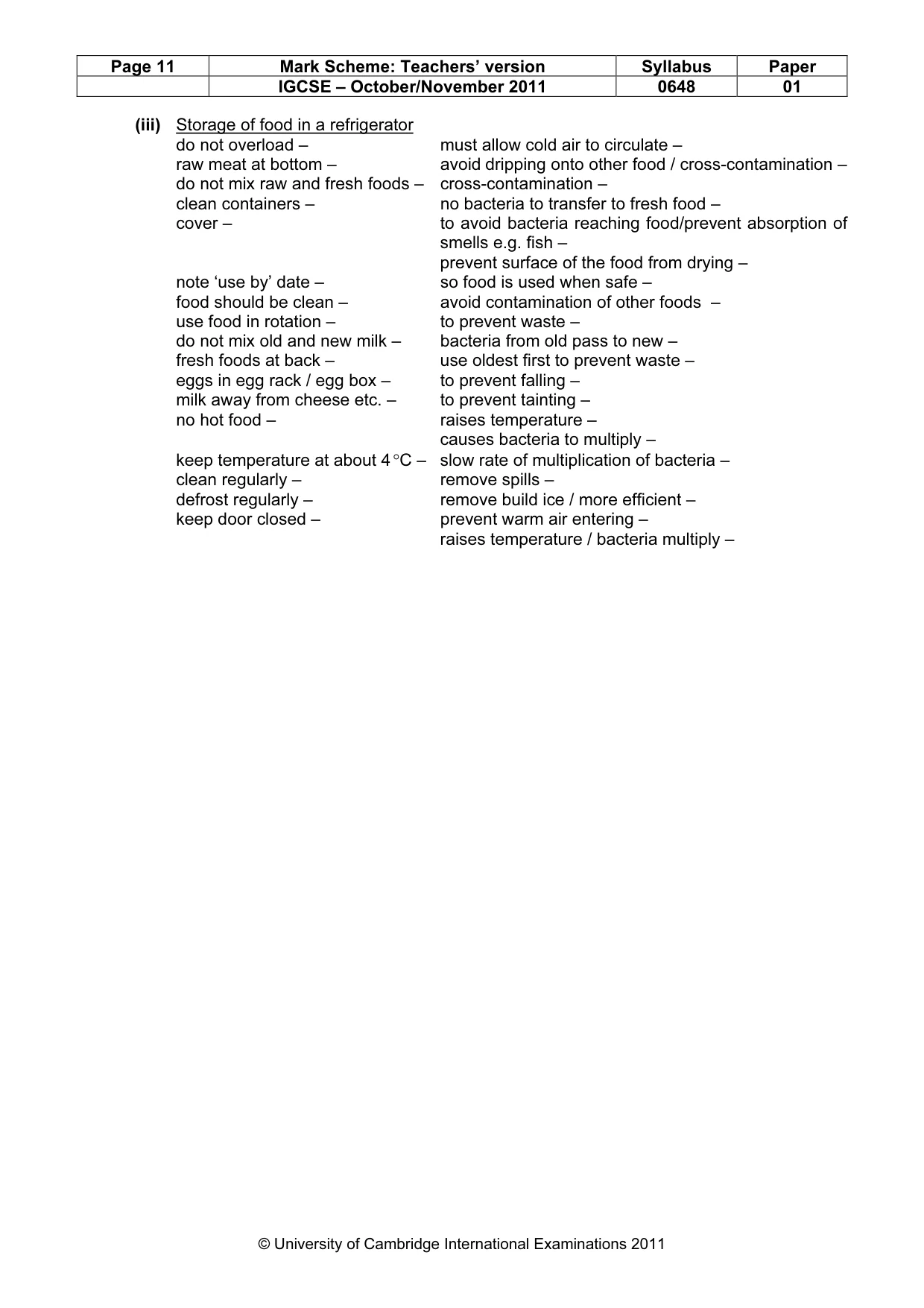
Page 11 Mark Scheme: Teachers’ version Syllabus Paper IGCSE – October/November 2011 0648 01 © University of Cambridge International Examinations 2011 (iii) Storage of food in a refrigerator do not overload – must allow cold air to circulate – raw meat at bottom – avoid dripping onto other food / cross-contamination – do not mix raw and fresh foods – cross-contamination – clean containers – no bacteria to transfer to fresh food – cover – to avoid bacteria reaching food/prevent absorption of smells e.g. fish – prevent surface of the food from drying – note ‘use by’ date – so food is used when safe – food should be clean – avoid contamination of other foods – use food in rotation – to prevent waste – do not mix old and new milk – bacteria from old pass to new – fresh foods at back – use oldest first to prevent waste – eggs in egg rack / egg box – to prevent falling – milk away from cheese etc. – to prevent tainting – no hot food – raises temperature – causes bacteria to multiply – keep temperature at about 4 °C – slow rate of multiplication of bacteria – clean regularly – remove spills – defrost regularly – remove build ice / more efficient – keep door closed – prevent warm air entering – raises temperature / bacteria multiply –
Mark scheme, page 12
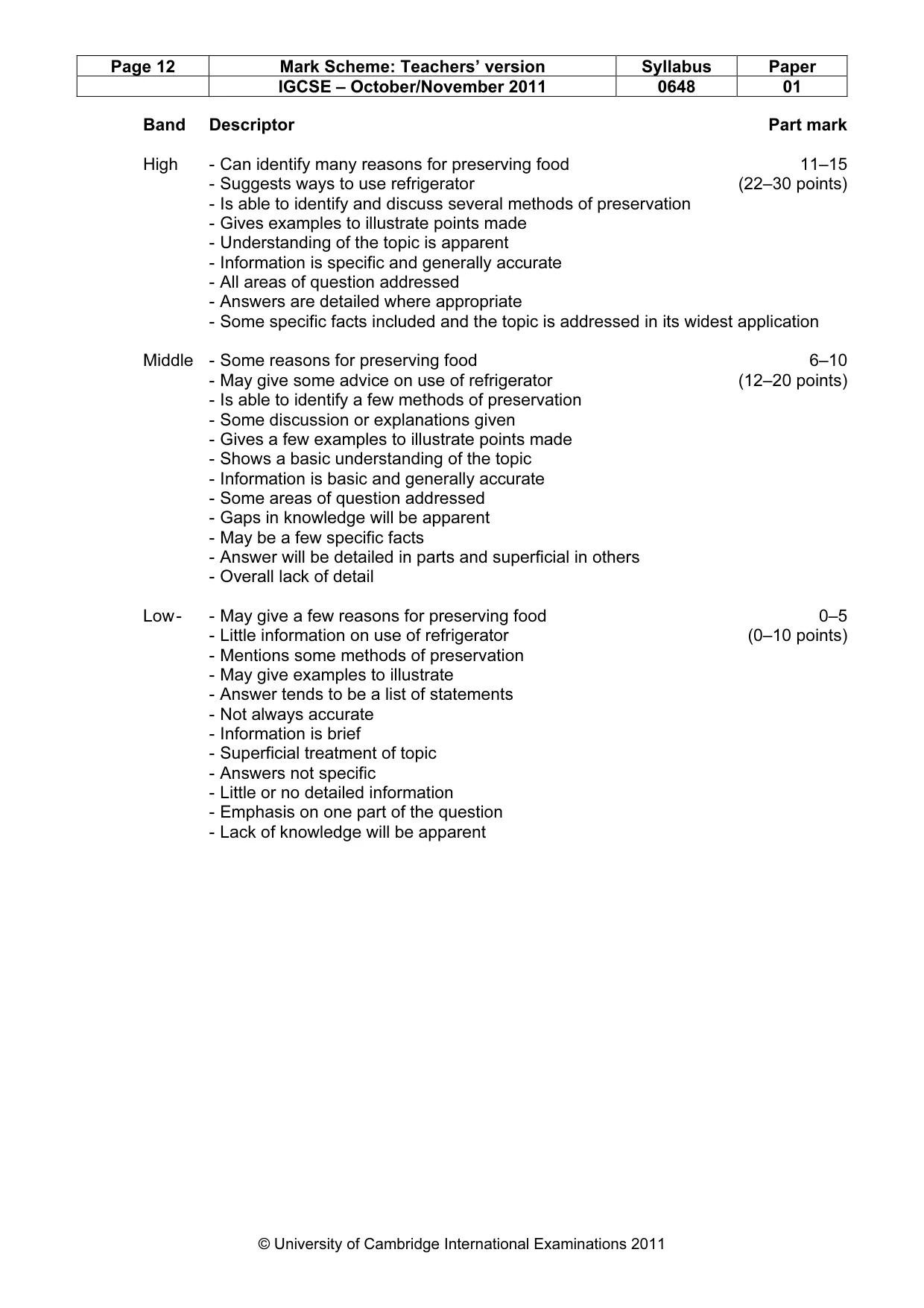
Page 12 Mark Scheme: Teachers’ version Syllabus Paper IGCSE – October/November 2011 0648 01 © University of Cambridge International Examinations 2011 Band Descriptor Part mark High - Can identify many reasons for preserving food 11–15 - Suggests ways to use refrigerator (22–30 points) - Is able to identify and discuss several methods of preservation - Gives examples to illustrate points made - Understanding of the topic is apparent - Information is specific and generally accurate - All areas of question addressed - Answers are detailed where appropriate - Some specific facts included and the topic is addressed in its widest application Middle - Some reasons for preserving food 6–10 - May give some advice on use of refrigerator (12–20 points) - Is able to identify a few methods of preservation - Some discussion or explanations given - Gives a few examples to illustrate points made - Shows a basic understanding of the topic - Information is basic and generally accurate - Some areas of question addressed - Gaps in knowledge will be apparent - May be a few specific facts - Answer will be detailed in parts and superficial in others - Overall lack of detail Low - - May give a few reasons for preserving food 0–5 - Little information on use of refrigerator (0–10 points) - Mentions some methods of preservation - May give examples to illustrate - Answer tends to be a list of statements - Not always accurate - Information is brief - Superficial treatment of topic - Answers not specific - Little or no detailed information - Emphasis on one part of the question - Lack of knowledge will be apparent
Mark scheme, page 13
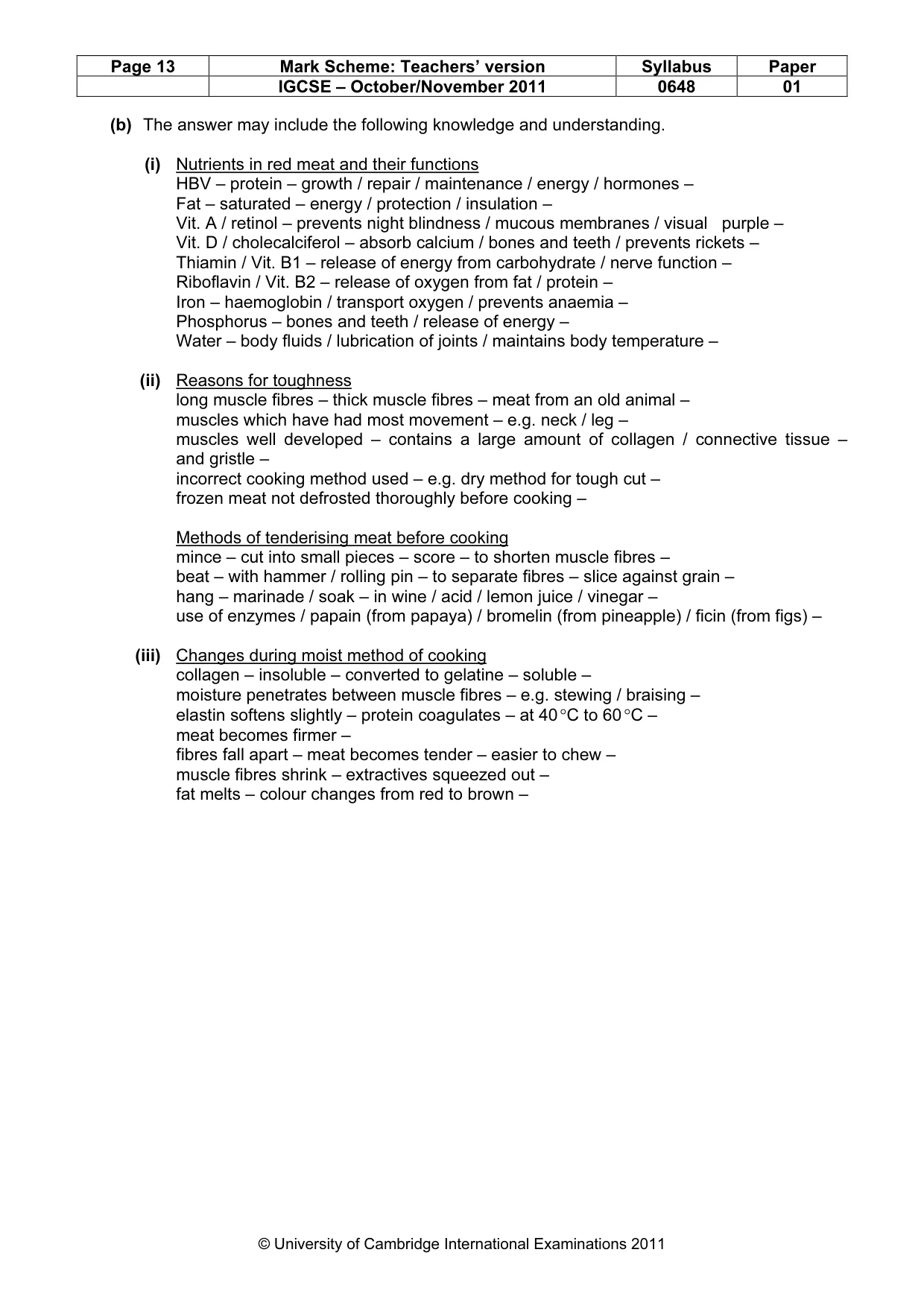
Page 13 Mark Scheme: Teachers’ version Syllabus Paper IGCSE – October/November 2011 0648 01 © University of Cambridge International Examinations 2011 (b) The answer may include the following knowledge and understanding. (i) Nutrients in red meat and their functions HBV – protein – growth / repair / maintenance / energy / hormones – Fat – saturated – energy / protection / insulation – Vit. A / retinol – prevents night blindness / mucous membranes / visual purple – Vit. D / cholecalciferol – absorb calcium / bones and teeth / prevents rickets – Thiamin / Vit. B1 – release of energy from carbohydrate / nerve function – Riboflavin / Vit. B2 – release of oxygen from fat / protein – Iron – haemoglobin / transport oxygen / prevents anaemia – Phosphorus – bones and teeth / release of energy – Water – body fluids / lubrication of joints / maintains body temperature – (ii) Reasons for toughness long muscle fibres – thick muscle fibres – meat from an old animal – muscles which have had most movement – e.g. neck / leg – muscles well developed – contains a large amount of collagen / connective tissue – and gristle – incorrect cooking method used – e.g. dry method for tough cut – frozen meat not defrosted thoroughly before cooking – Methods of tenderising meat before cooking mince – cut into small pieces – score – to shorten muscle fibres – beat – with hammer / rolling pin – to separate fibres – slice against grain – hang – marinade / soak – in wine / acid / lemon juice / vinegar – use of enzymes / papain (from papaya) / bromelin (from pineapple) / ficin (from figs) – (iii) Changes during moist method of cooking collagen – insoluble – converted to gelatine – soluble – moisture penetrates between muscle fibres – e.g. stewing / braising – elastin softens slightly – protein coagulates – at 40 °C to 60 °C – meat becomes firmer – fibres fall apart – meat becomes tender – easier to chew – muscle fibres shrink – extractives squeezed out – fat melts – colour changes from red to brown –
Mark scheme, page 14
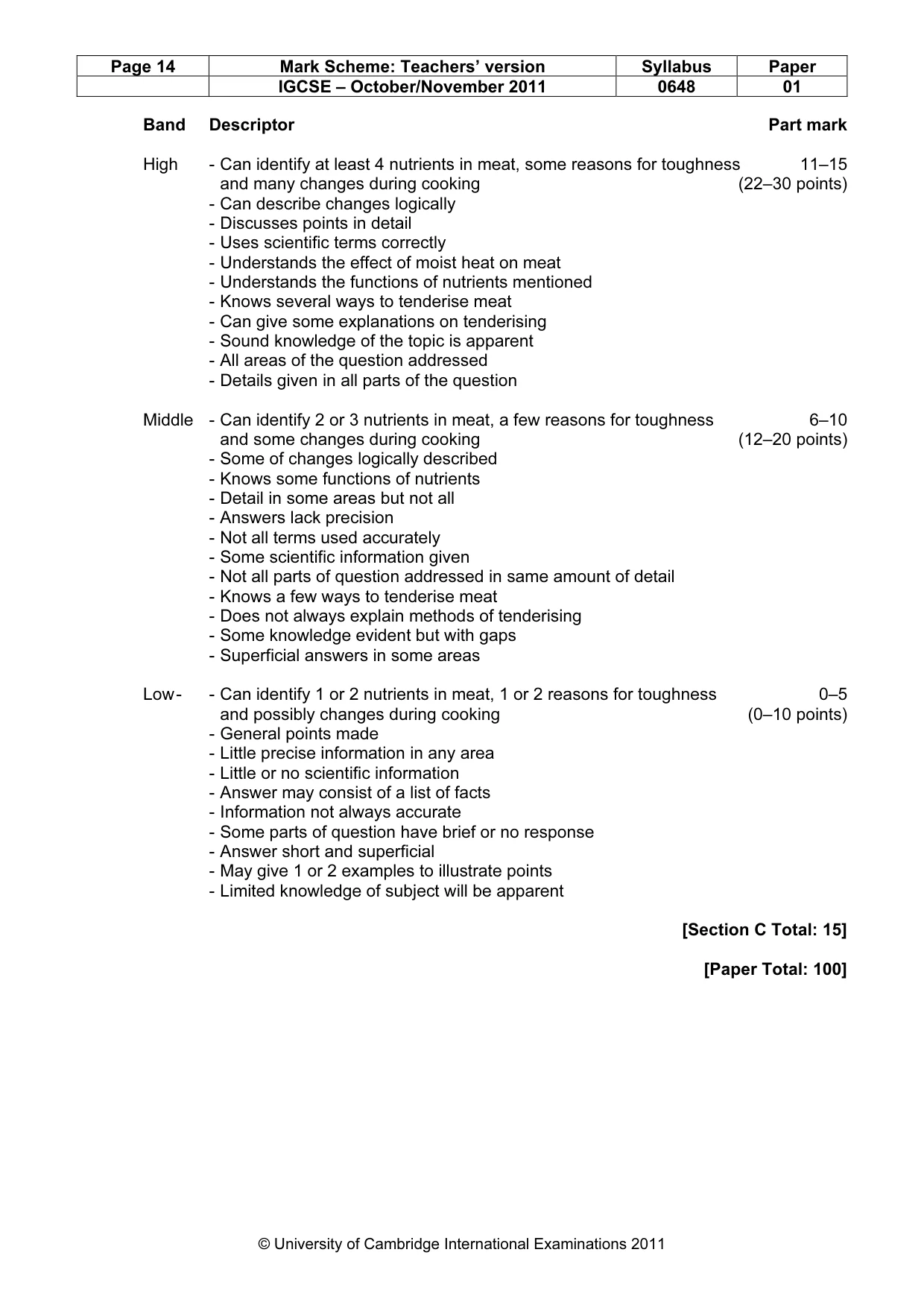
Page 14 Mark Scheme: Teachers’ version Syllabus Paper IGCSE – October/November 2011 0648 01 © University of Cambridge International Examinations 2011 Band Descriptor Part mark High - Can identify at least 4 nutrients in meat, some reasons for toughness 11–15 and many changes during cooking (22–30 points) - Can describe changes logically - Discusses points in detail - Uses scientific terms correctly - Understands the effect of moist heat on meat - Understands the functions of nutrients mentioned - Knows several ways to tenderise meat - Can give some explanations on tenderising - Sound knowledge of the topic is apparent - All areas of the question addressed - Details given in all parts of the question Middle - Can identify 2 or 3 nutrients in meat, a few reasons for toughness 6–10 and some changes during cooking (12–20 points) - Some of changes logically described - Knows some functions of nutrients - Detail in some areas but not all - Answers lack precision - Not all terms used accurately - Some scientific information given - Not all parts of question addressed in same amount of detail - Knows a few ways to tenderise meat - Does not always explain methods of tenderising - Some knowledge evident but with gaps - Superficial answers in some areas Low - - Can identify 1 or 2 nutrients in meat, 1 or 2 reasons for toughness 0–5 and possibly changes during cooking (0–10 points) - General points made - Little precise information in any area - Little or no scientific information - Answer may consist of a list of facts - Information not always accurate - Some parts of question have brief or no response - Answer short and superficial - May give 1 or 2 examples to illustrate points - Limited knowledge of subject will be apparent [Section C Total: 15] [Paper Total: 100]
What you needed in this session
Cambridge’s own grade thresholds for 2011 Oct/Nov, Paper 1 · Variant 1. A higher threshold means an easier paper — the bar moves with how the cohort did.