Cambridge IGCSE Food and Nutrition 0648 — 2011 May/June Paper 1 · Variant 1
0648/11/M/J/11 · 100 marks · ≈113 min
The question paper and its mark scheme, free to read here and free to download. This is Cambridge’s own paper, exactly as it was sat.
Question paper12 pages

Mark scheme12 pages
Answers below. Sit the paper first if you are practising.
Paper as text
Question paper, page 1
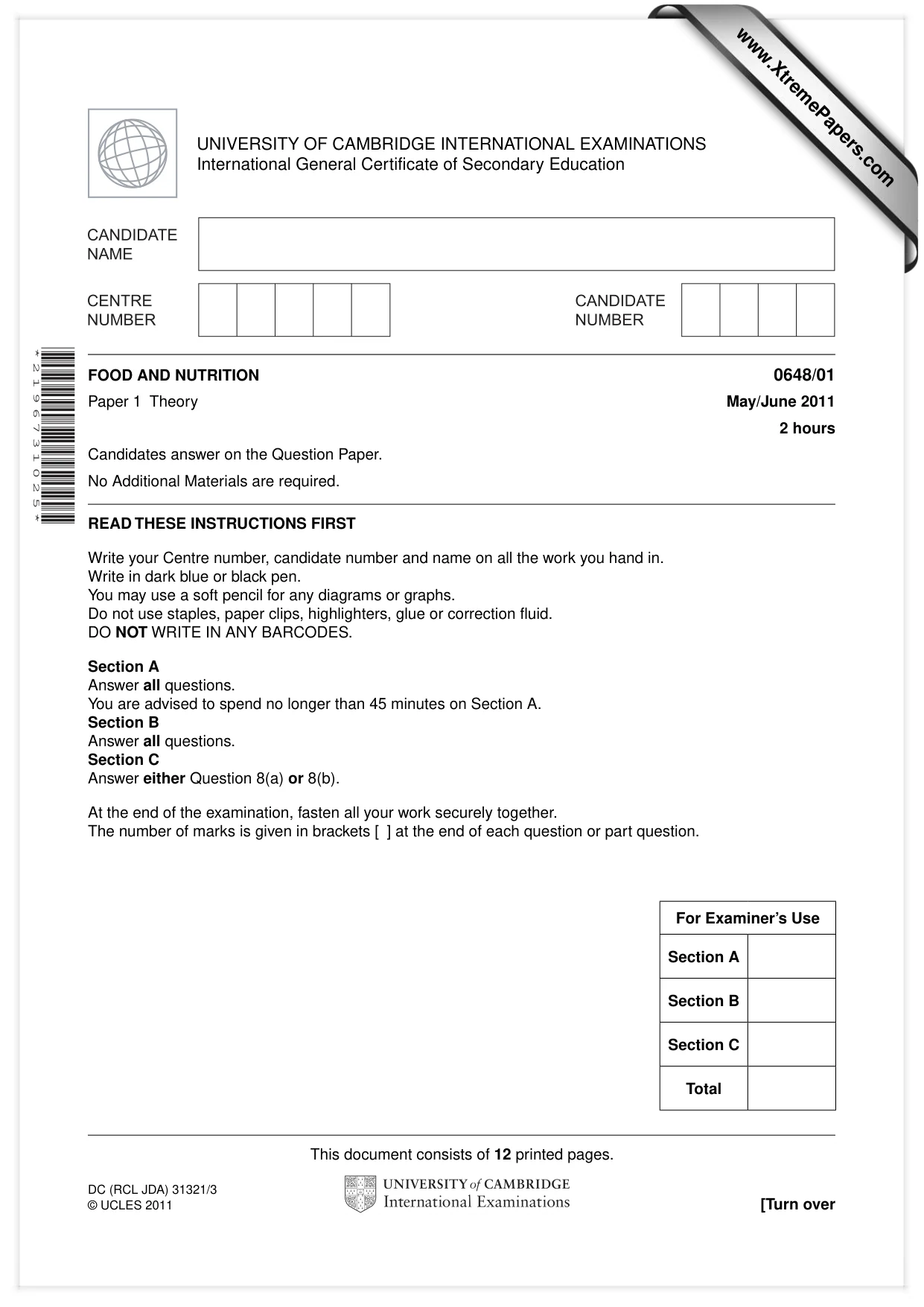
This document consists of 12 printed pages. DC (RCL JDA) 31321/3 © UCLES 2011 [Turn over UNIVERSITY OF CAMBRIDGE INTERNATIONAL EXAMINATIONS International General Certificate of Secondary Education * 2 1 9 6 7 3 1 0 2 5 * FOOD AND NUTRITION 0648/01 Paper 1 Theory May/June 2011 2 hours Candidates answer on the Question Paper. No Additional Materials are required. READ THESE INSTRUCTIONS FIRST Write your Centre number, candidate number and name on all the work you hand in. Write in dark blue or black pen. You may use a soft pencil for any diagrams or graphs. Do not use staples, paper clips, highlighters, glue or correction fluid. DO NOT WRITE IN ANY BARCODES. Section A Answer all questions. You are advised to spend no longer than 45 minutes on Section A. Section B Answer all questions. Section C Answer either Question 8(a) or 8(b). At the end of the examination, fasten all your work securely together. The number of marks is given in brackets [ ] at the end of each question or part question. For Examiner’s Use Section A Section B Section C Total www.XtremePapers.com
Question paper, page 2
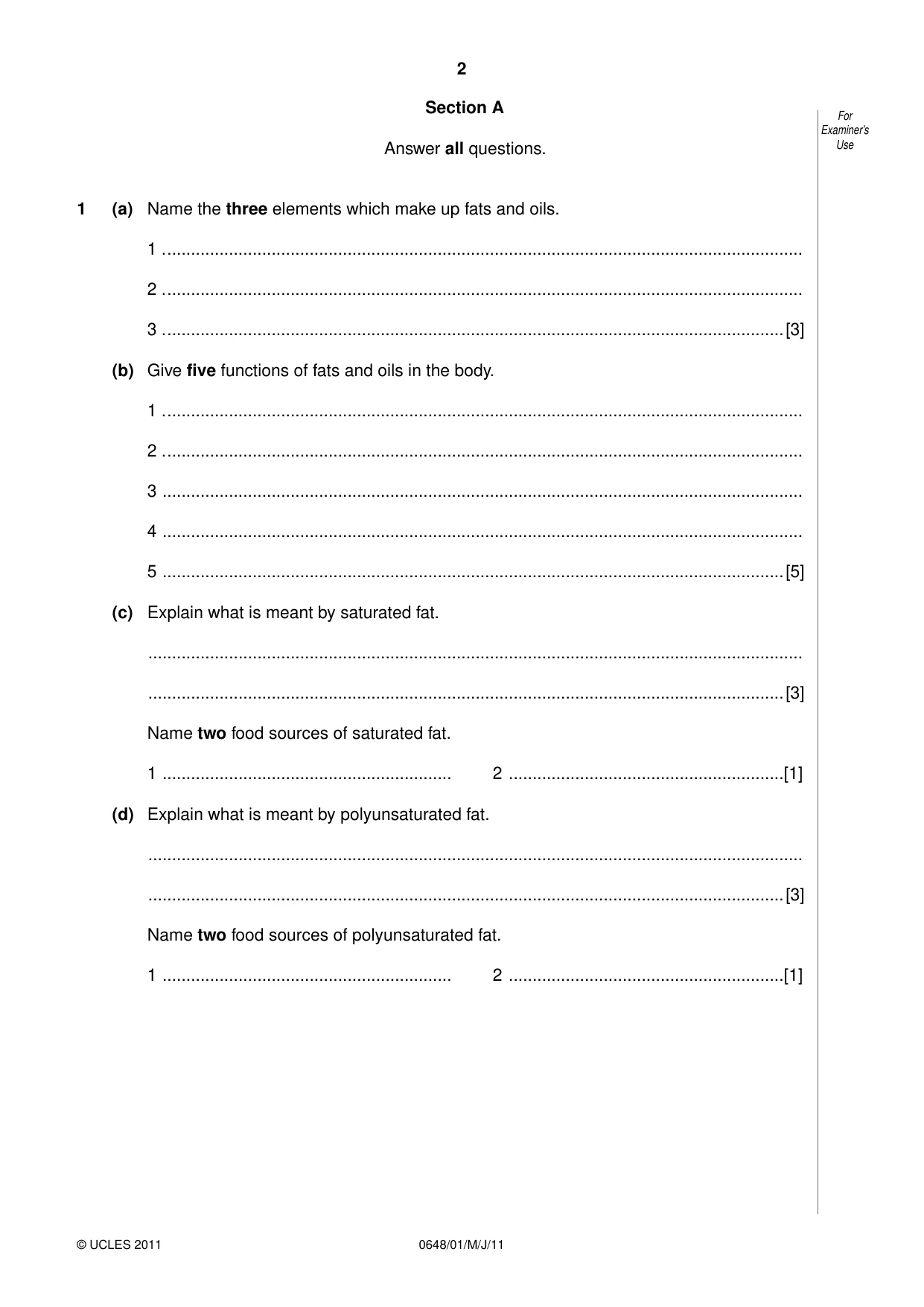
2 0648/01/M/J/11 © UCLES 2011 For Examiner’s Use Section A Answer all questions. 1 (a) Name the three elements which make up fats and oils. 1 . … 2 . … 3 . …[3] (b) Give five functions of fats and oils in the body. 1 . … 2 . … 3 … 4 … 5 …[5] (c) Explain what is meant by saturated fat. … …[3] Name two food sources of saturated fat. 1 … 2 …[1] (d) Explain what is meant by polyunsaturated fat. … …[3] Name two food sources of polyunsaturated fat. 1 … 2 …[1]
Question paper, page 3
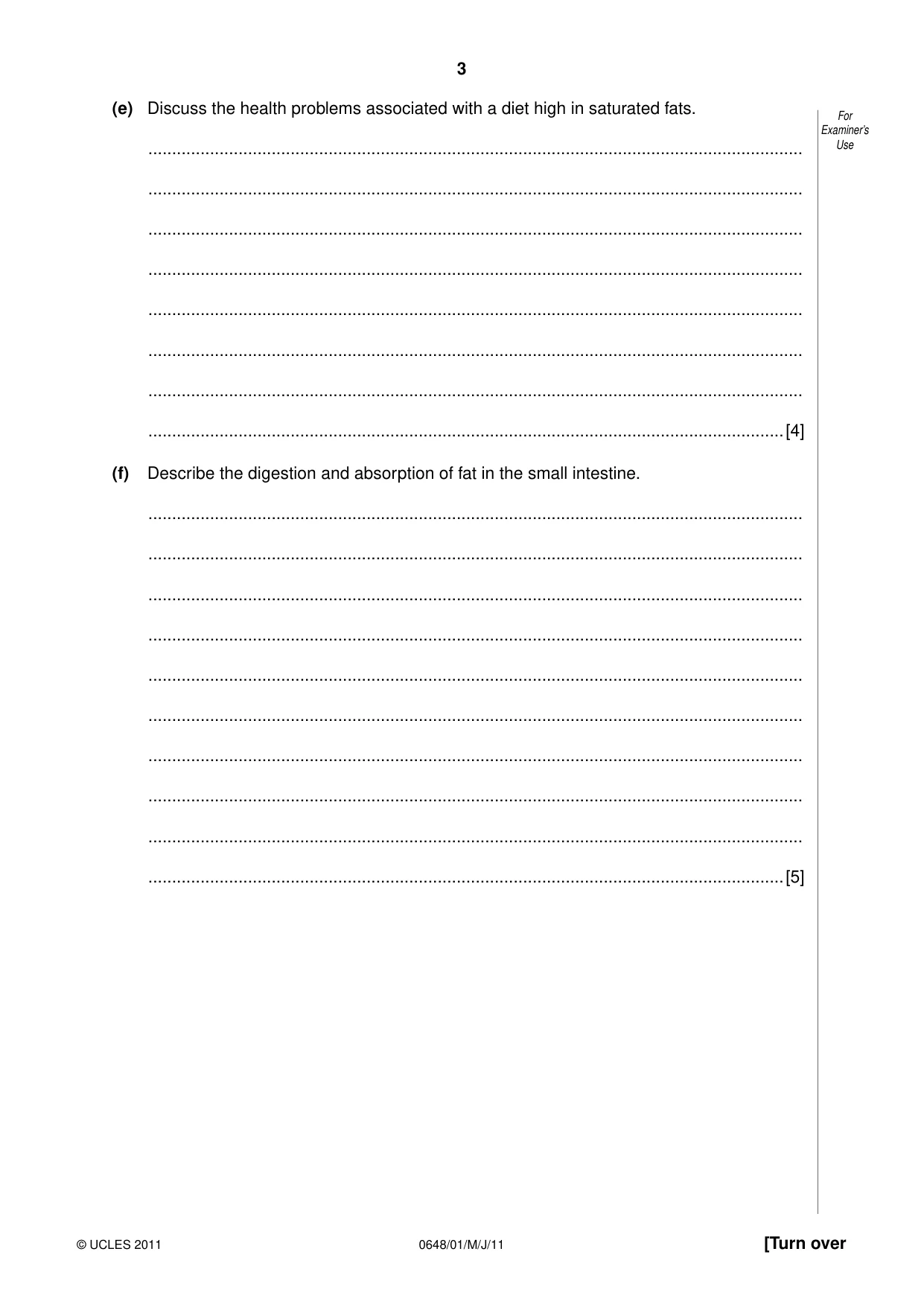
3 0648/01/M/J/11 © UCLES 2011 [Turn over For Examiner’s Use (e) Discuss the health problems associated with a diet high in saturated fats. … … … … … … … …[4] (f) Describe the digestion and absorption of fat in the small intestine. … … … … … … … … … …[5]
Question paper, page 4
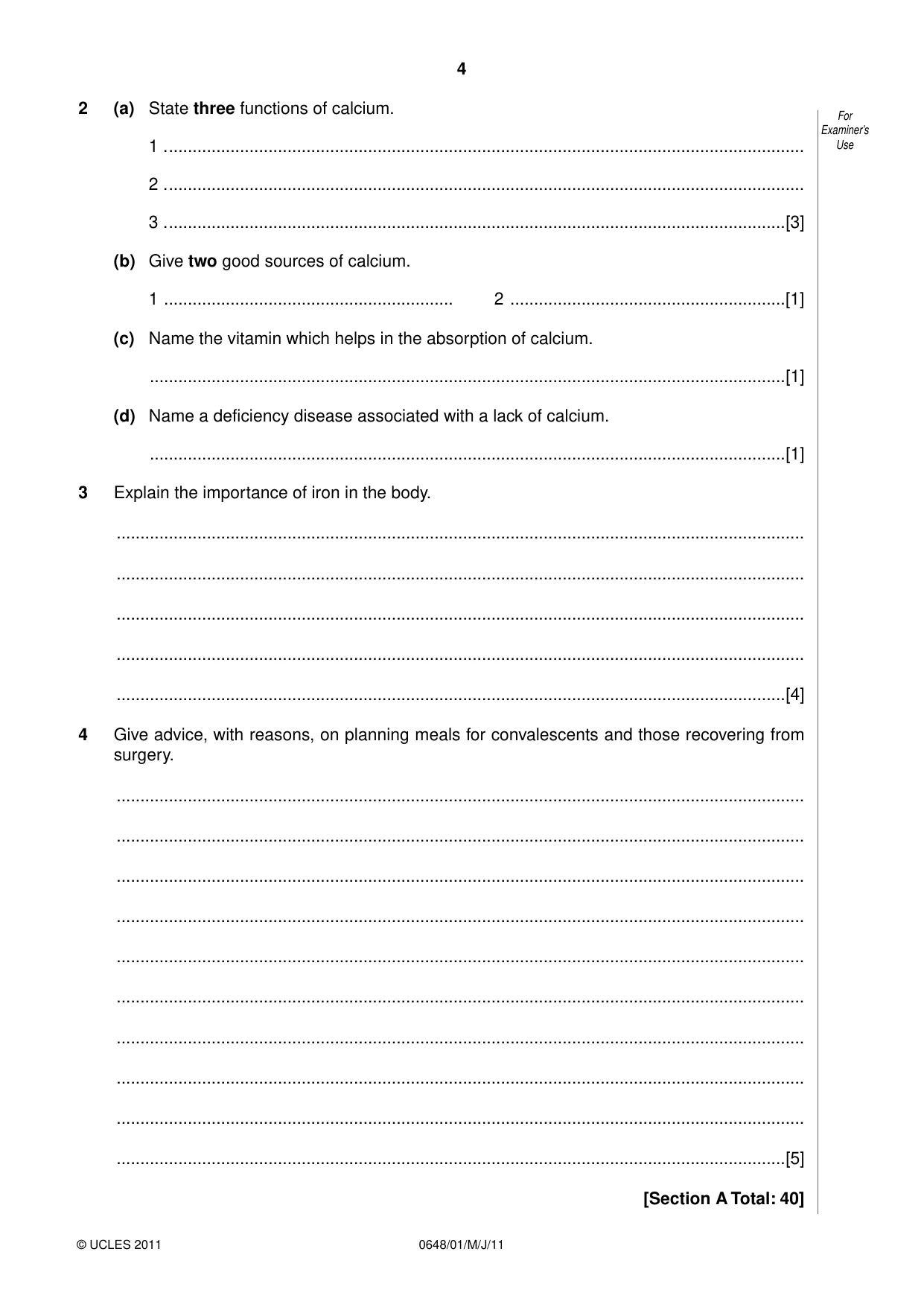
4 0648/01/M/J/11 © UCLES 2011 For Examiner’s Use 2 (a) State three functions of calcium. 1 . … 2 . … 3 . …[3] (b) Give two good sources of calcium. 1 … 2 …[1] (c) Name the vitamin which helps in the absorption of calcium. …[1] (d) Name a deficiency disease associated with a lack of calcium. …[1] 3 Explain the importance of iron in the body. … … … … …[4] 4 Give advice, with reasons, on planning meals for convalescents and those recovering from surgery. … … … … … … … … … …[5] [Section A Total: 40]
Question paper, page 5
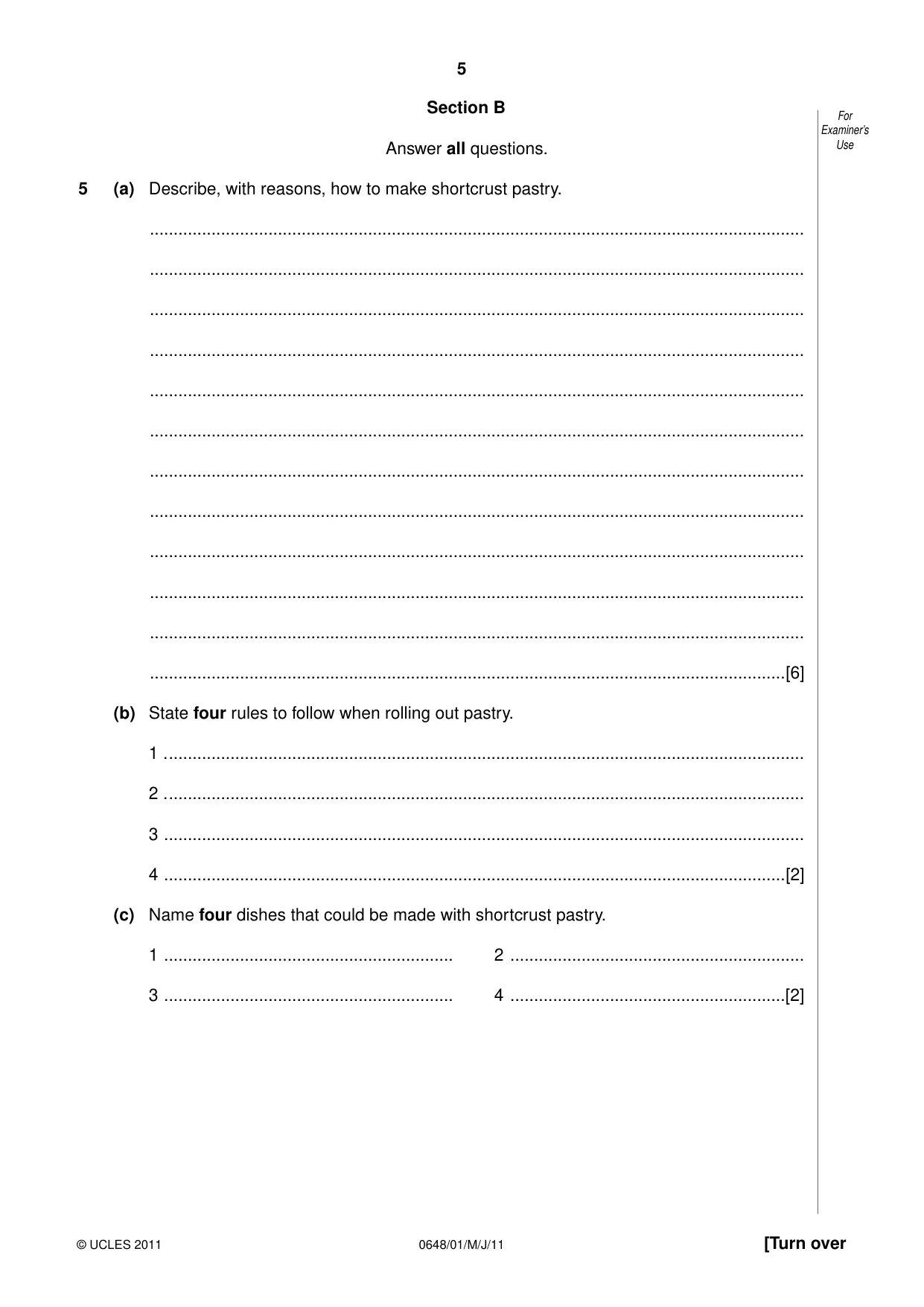
5 0648/01/M/J/11 © UCLES 2011 [Turn over For Examiner’s Use Section B Answer all questions. 5 (a) Describe, with reasons, how to make shortcrust pastry. … … … … … … … … … … … …[6] (b) State four rules to follow when rolling out pastry. 1 . … 2 . … 3 … 4 …[2] (c) Name four dishes that could be made with shortcrust pastry. 1 … 2 … 3 … 4 …[2]
Question paper, page 6
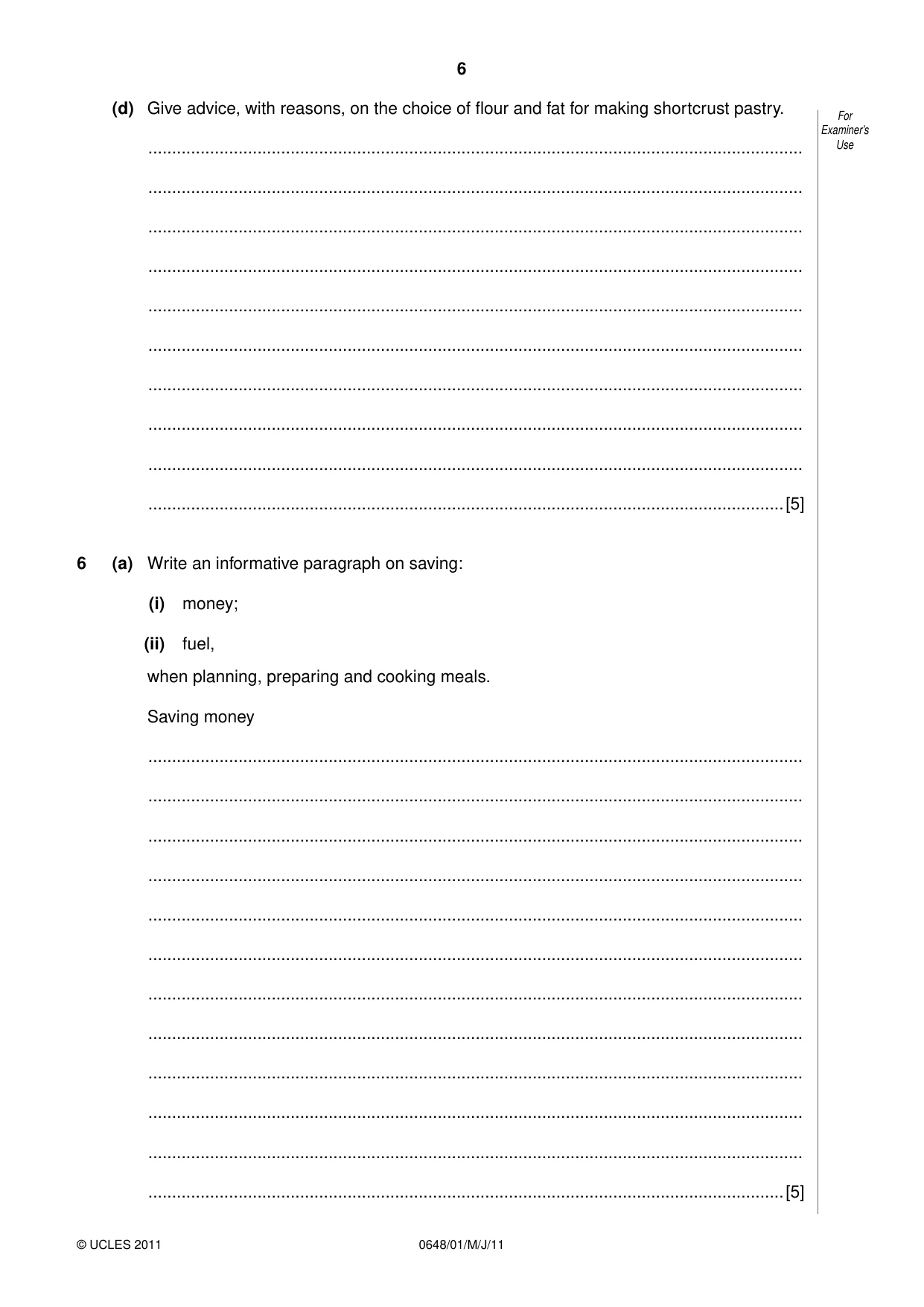
6 0648/01/M/J/11 © UCLES 2011 For Examiner’s Use (d) Give advice, with reasons, on the choice of flour and fat for making shortcrust pastry. … … … … … … … … … …[5] 6 (a) Write an informative paragraph on saving: (i) money; (ii) fuel, when planning, preparing and cooking meals. Saving money … … … … … … … … … … … …[5]
Question paper, page 7
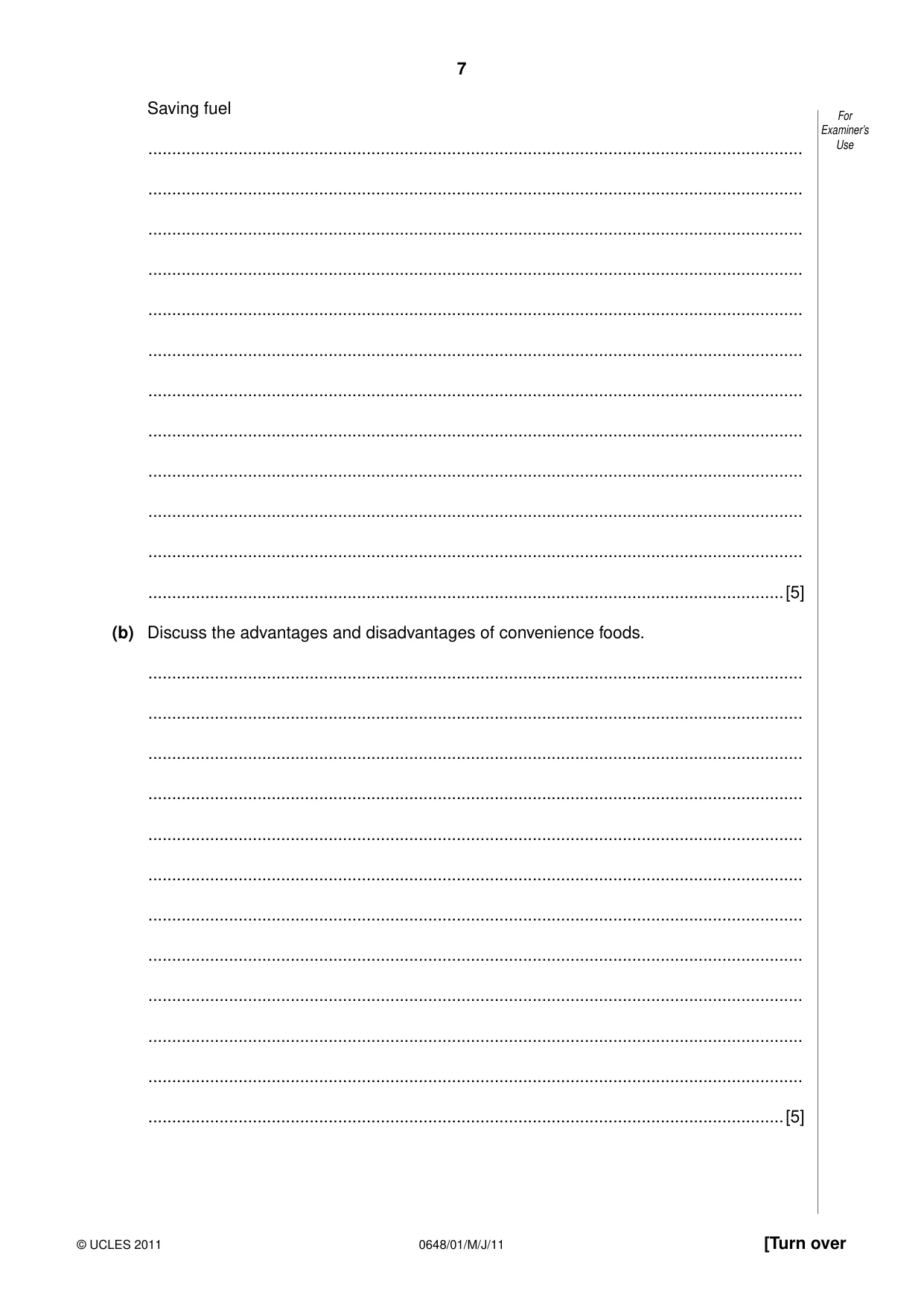
7 0648/01/M/J/11 © UCLES 2011 [Turn over For Examiner’s Use Saving fuel … … … … … … … … … … … …[5] (b) Discuss the advantages and disadvantages of convenience foods. … … … … … … … … … … … …[5]
Question paper, page 8
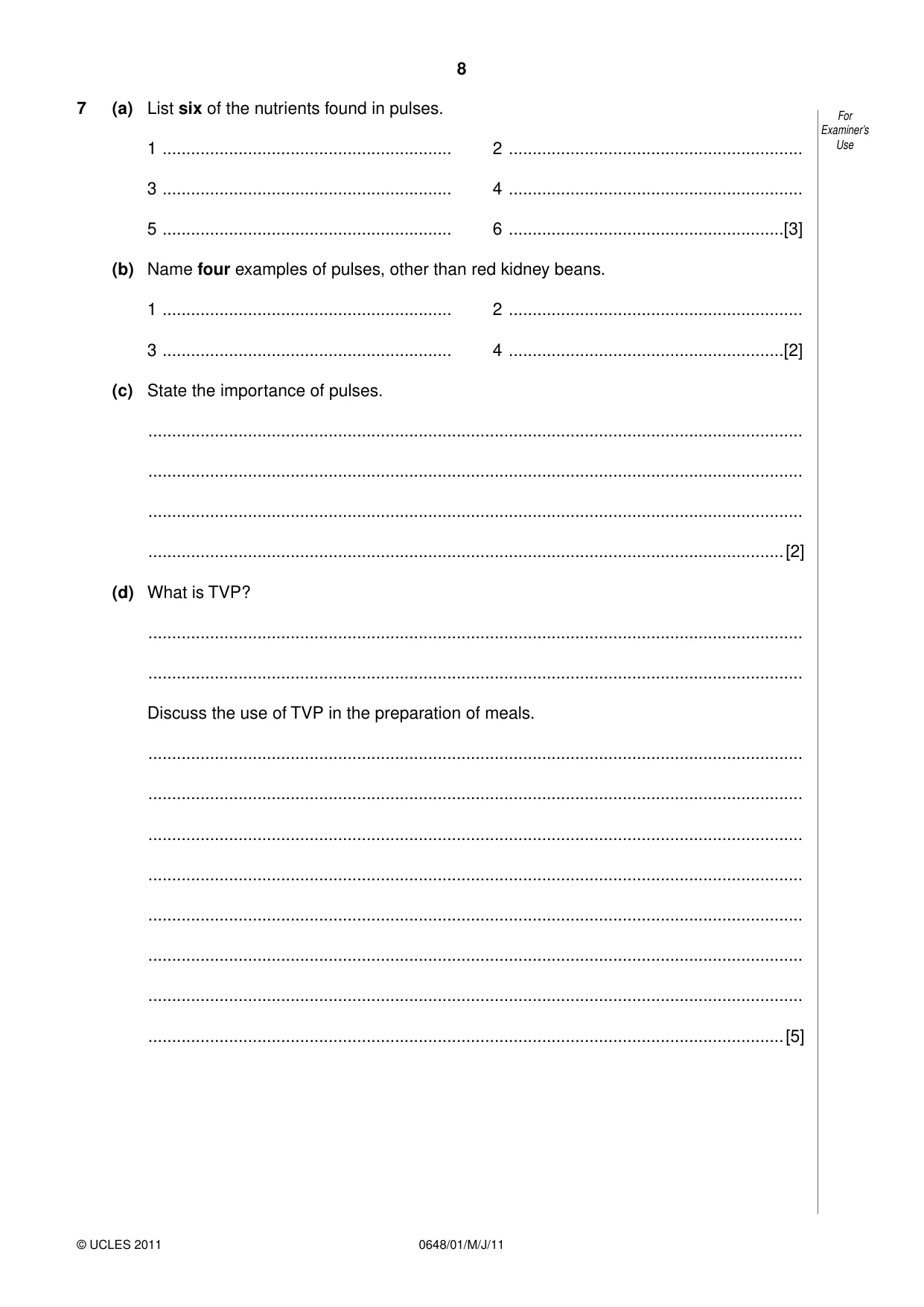
8 0648/01/M/J/11 © UCLES 2011 For Examiner’s Use 7 (a) List six of the nutrients found in pulses. 1 … 2 … 3 … 4 … 5 … 6 …[3] (b) Name four examples of pulses, other than red kidney beans. 1 … 2 … 3 … 4 …[2] (c) State the importance of pulses. … … … …[2] (d) What is TVP? … … Discuss the use of TVP in the preparation of meals. … … … … … … … …[5]
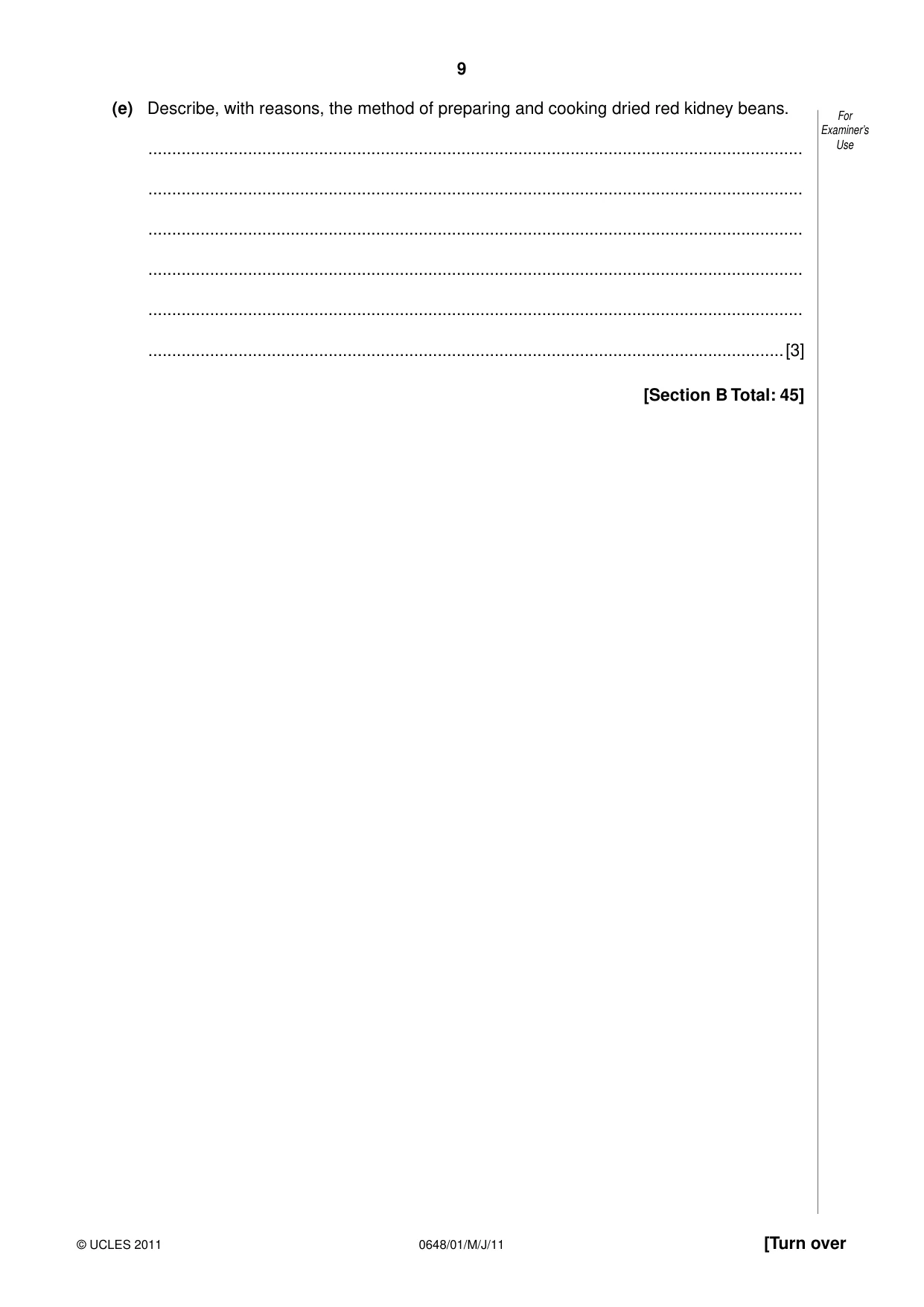
Question paper, page 9
9 0648/01/M/J/11 © UCLES 2011 [Turn over For Examiner’s Use (e) Describe, with reasons, the method of preparing and cooking dried red kidney beans. … … … … … …[3] [Section B Total: 45]
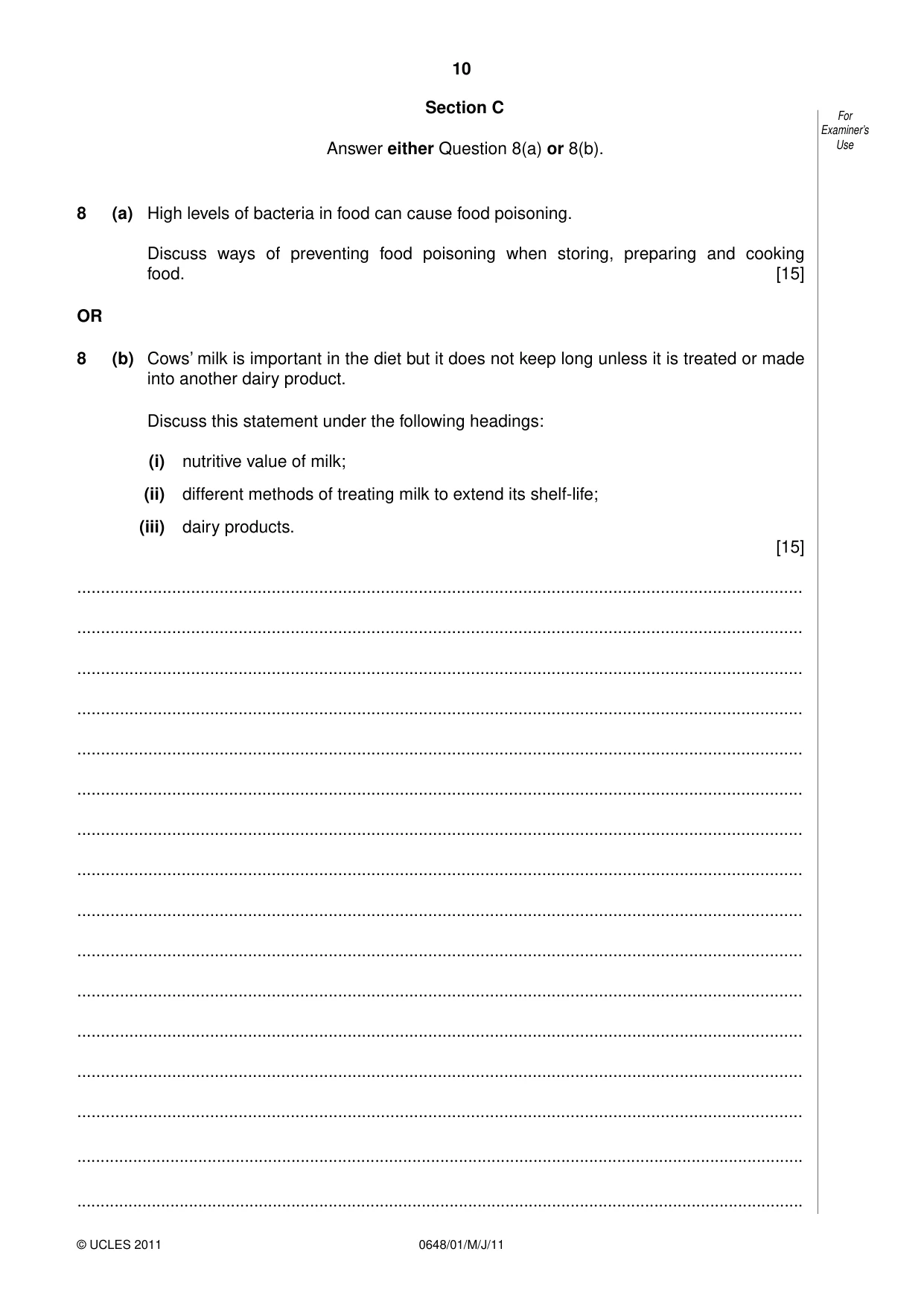
Question paper, page 10
10 0648/01/M/J/11 © UCLES 2011 For Examiner’s Use Section C Answer either Question 8(a) or 8(b). 8 (a) High levels of bacteria in food can cause food poisoning. Discuss ways of preventing food poisoning when storing, preparing and cooking food. [15] OR 8 (b) Cows’ milk is important in the diet but it does not keep long unless it is treated or made into another dairy product. Discuss this statement under the following headings: (i) nutritive value of milk; (ii) different methods of treating milk to extend its shelf-life; (iii) dairy products. [15] … … … … … … … … … … … … … … … …
Question paper, page 11
11 0648/01/M/J/11 © UCLES 2011 [Turn over For Examiner’s Use … … … … … … … … … … … … … … … … … … … … … … … … … … …
Question paper, page 12
12 0648/01/M/J/11 © UCLES 2011 For Examiner’s Use … … … … … … … … … … … … … … … … … … … … … … … [Section C Total: 15] [Total for Paper: 100] Permission to reproduce items where third-party owned material protected by copyright is included has been sought and cleared where possible. Every reasonable effort has been made by the publisher (UCLES) to trace copyright holders, but if any items requiring clearance have unwittingly been included, the publisher will be pleased to make amends at the earliest possible opportunity. University of Cambridge International Examinations is part of the Cambridge Assessment Group. Cambridge Assessment is the brand name of University of Cambridge Local Examinations Syndicate (UCLES), which is itself a department of the University of Cambridge.
Mark scheme, page 1
UNIVERSITY OF CAMBRIDGE INTERNATIONAL EXAMINATIONS International General Certificate of Secondary Education MARK SCHEME for the May/June 2011 question paper for the guidance of teachers 0648 FOOD AND NUTRITION 0648/01 Paper 1 (Theory), maximum raw mark 100 This mark scheme is published as an aid to teachers and candidates, to indicate the requirements of the examination. It shows the basis on which Examiners were instructed to award marks. It does not indicate the details of the discussions that took place at an Examiners’ meeting before marking began, which would have considered the acceptability of alternative answers. Mark schemes must be read in conjunction with the question papers and the report on the examination. • Cambridge will not enter into discussions or correspondence in connection with these mark schemes. Cambridge is publishing the mark schemes for the May/June 2011 question papers for most IGCSE, GCE Advanced Level and Advanced Subsidiary Level syllabuses and some Ordinary Level syllabuses. www.XtremePapers.com
Mark scheme, page 2
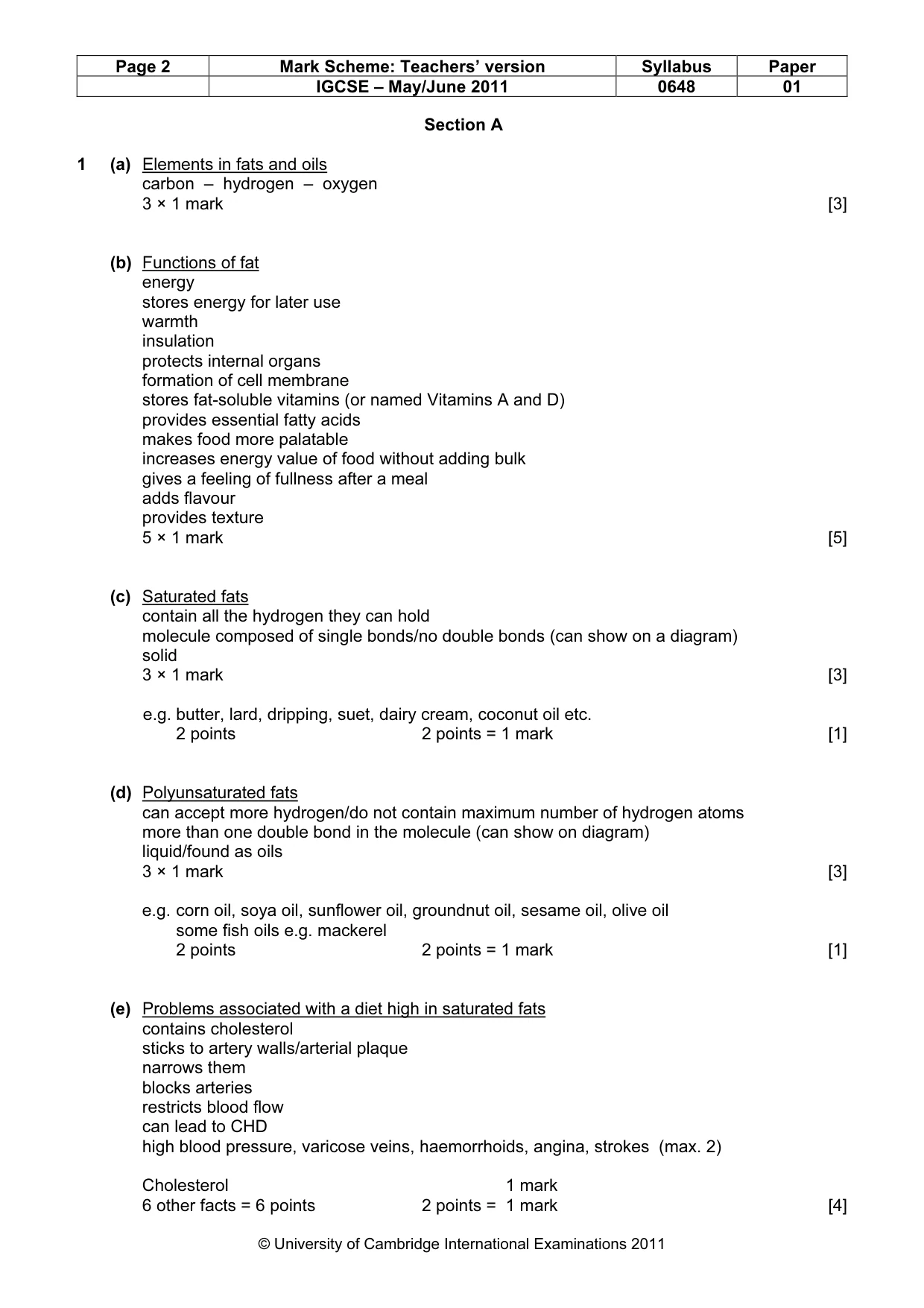
Page 2 Mark Scheme: Teachers’ version Syllabus Paper IGCSE – May/June 2011 0648 01 © University of Cambridge International Examinations 2011 Section A 1 (a) Elements in fats and oils carbon – hydrogen – oxygen 3 × 1 mark [3] (b) Functions of fat energy stores energy for later use warmth insulation protects internal organs formation of cell membrane stores fat-soluble vitamins (or named Vitamins A and D) provides essential fatty acids makes food more palatable increases energy value of food without adding bulk gives a feeling of fullness after a meal adds flavour provides texture 5 × 1 mark [5] (c) Saturated fats contain all the hydrogen they can hold molecule composed of single bonds/no double bonds (can show on a diagram) solid 3 × 1 mark [3] e.g. butter, lard, dripping, suet, dairy cream, coconut oil etc. 2 points 2 points = 1 mark [1] (d) Polyunsaturated fats can accept more hydrogen/do not contain maximum number of hydrogen atoms more than one double bond in the molecule (can show on diagram) liquid/found as oils 3 × 1 mark [3] e.g. corn oil, soya oil, sunflower oil, groundnut oil, sesame oil, olive oil some fish oils e.g. mackerel 2 points 2 points = 1 mark [1] (e) Problems associated with a diet high in saturated fats contains cholesterol sticks to artery walls/arterial plaque narrows them blocks arteries restricts blood flow can lead to CHD high blood pressure, varicose veins, haemorrhoids, angina, strokes (max. 2) Cholesterol 1 mark 6 other facts = 6 points 2 points = 1 mark [4]
Mark scheme, page 3
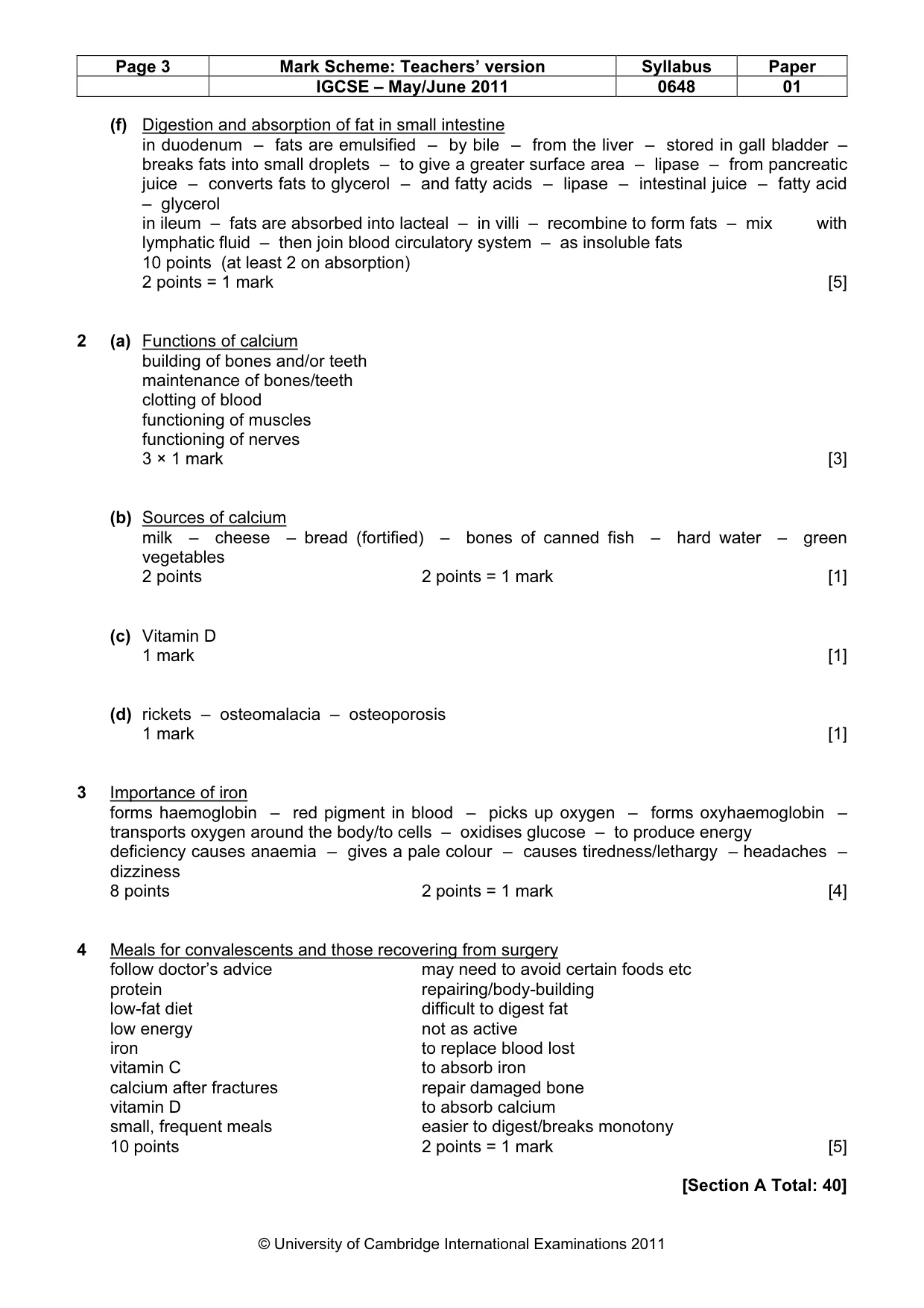
Page 3 Mark Scheme: Teachers’ version Syllabus Paper IGCSE – May/June 2011 0648 01 © University of Cambridge International Examinations 2011 (f) Digestion and absorption of fat in small intestine in duodenum – fats are emulsified – by bile – from the liver – stored in gall bladder – breaks fats into small droplets – to give a greater surface area – lipase – from pancreatic juice – converts fats to glycerol – and fatty acids – lipase – intestinal juice – fatty acid – glycerol in ileum – fats are absorbed into lacteal – in villi – recombine to form fats – mix with lymphatic fluid – then join blood circulatory system – as insoluble fats 10 points (at least 2 on absorption) 2 points = 1 mark [5] 2 (a) Functions of calcium building of bones and/or teeth maintenance of bones/teeth clotting of blood functioning of muscles functioning of nerves 3 × 1 mark [3] (b) Sources of calcium milk – cheese – bread (fortified) – bones of canned fish – hard water – green vegetables 2 points 2 points = 1 mark [1] (c) Vitamin D 1 mark [1] (d) rickets – osteomalacia – osteoporosis 1 mark [1] 3 Importance of iron forms haemoglobin – red pigment in blood – picks up oxygen – forms oxyhaemoglobin – transports oxygen around the body/to cells – oxidises glucose – to produce energy deficiency causes anaemia – gives a pale colour – causes tiredness/lethargy – headaches – dizziness 8 points 2 points = 1 mark [4] 4 Meals for convalescents and those recovering from surgery follow doctor’s advice may need to avoid certain foods etc protein repairing/body-building low-fat diet difficult to digest fat low energy not as active iron to replace blood lost vitamin C to absorb iron calcium after fractures repair damaged bone vitamin D to absorb calcium small, frequent meals easier to digest/breaks monotony 10 points 2 points = 1 mark [5] [Section A Total: 40]
Mark scheme, page 4
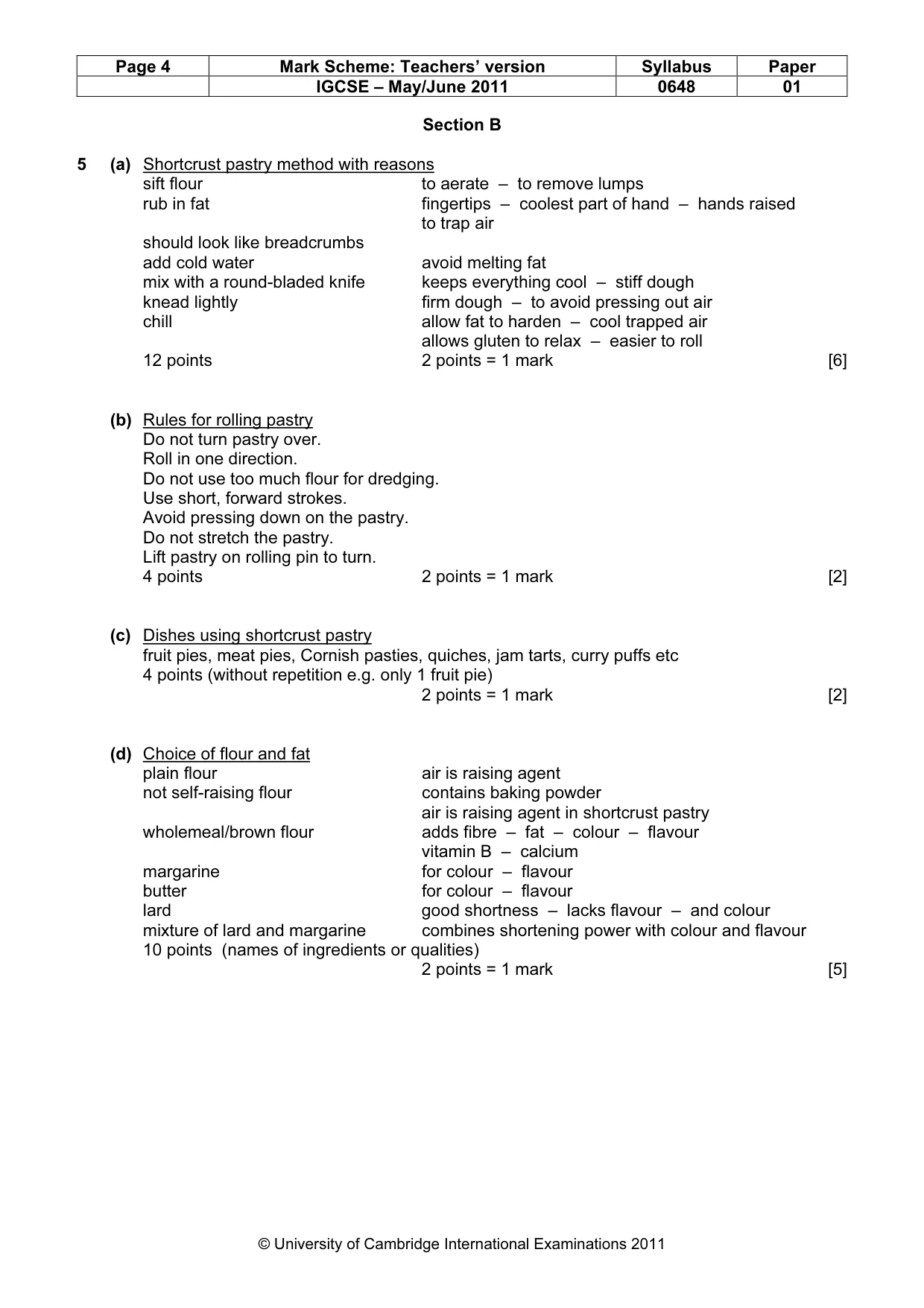
Page 4 Mark Scheme: Teachers’ version Syllabus Paper IGCSE – May/June 2011 0648 01 © University of Cambridge International Examinations 2011 Section B 5 (a) Shortcrust pastry method with reasons sift flour to aerate – to remove lumps rub in fat fingertips – coolest part of hand – hands raised to trap air should look like breadcrumbs add cold water avoid melting fat mix with a round-bladed knife keeps everything cool – stiff dough knead lightly firm dough – to avoid pressing out air chill allow fat to harden – cool trapped air allows gluten to relax – easier to roll 12 points 2 points = 1 mark [6] (b) Rules for rolling pastry Do not turn pastry over. Roll in one direction. Do not use too much flour for dredging. Use short, forward strokes. Avoid pressing down on the pastry. Do not stretch the pastry. Lift pastry on rolling pin to turn. 4 points 2 points = 1 mark [2] (c) Dishes using shortcrust pastry fruit pies, meat pies, Cornish pasties, quiches, jam tarts, curry puffs etc 4 points (without repetition e.g. only 1 fruit pie) 2 points = 1 mark [2] (d) Choice of flour and fat plain flour air is raising agent not self-raising flour contains baking powder air is raising agent in shortcrust pastry wholemeal/brown flour adds fibre – fat – colour – flavour vitamin B – calcium margarine for colour – flavour butter for colour – flavour lard good shortness – lacks flavour – and colour mixture of lard and margarine combines shortening power with colour and flavour 10 points (names of ingredients or qualities) 2 points = 1 mark [5]
Mark scheme, page 5
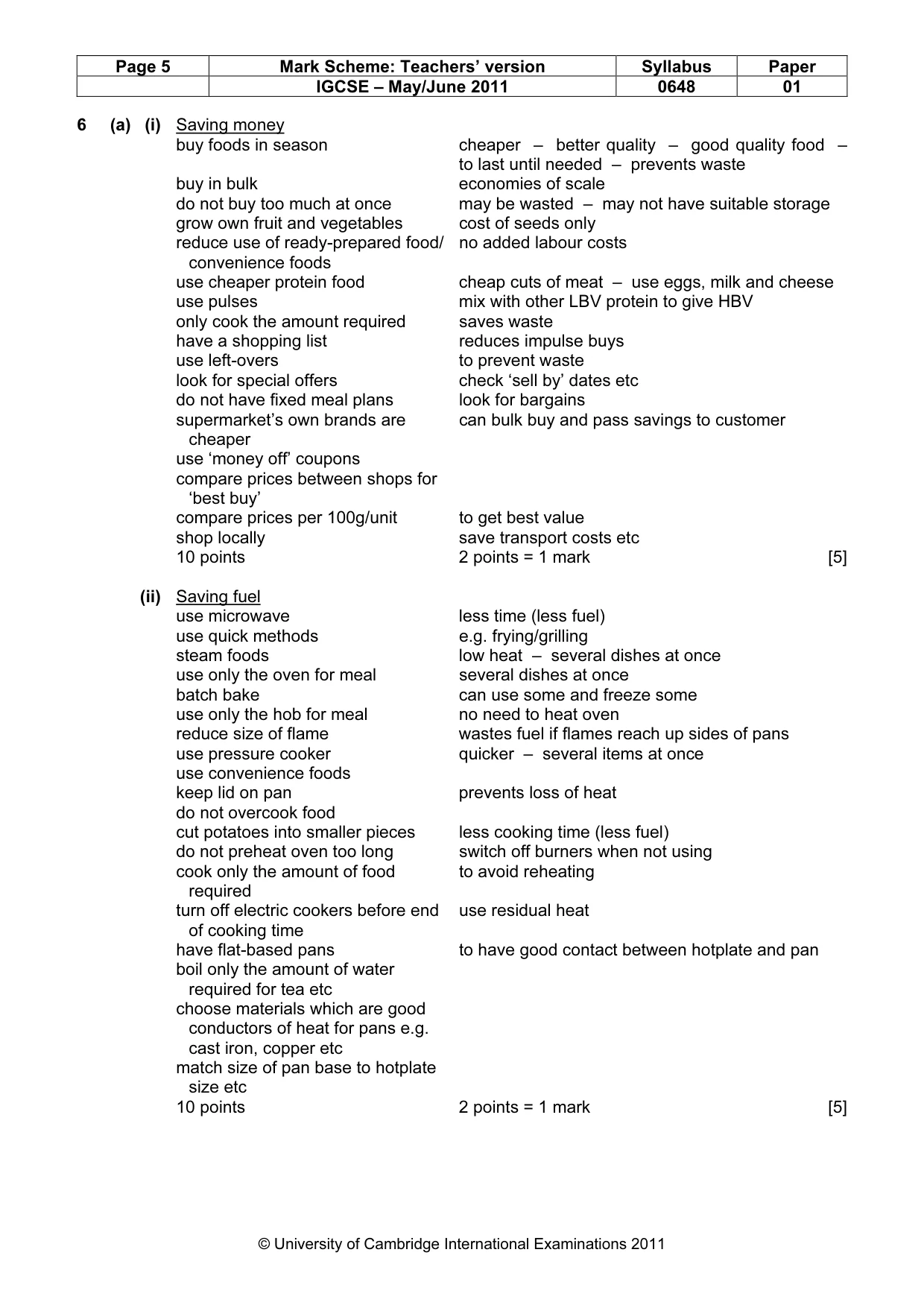
Page 5 Mark Scheme: Teachers’ version Syllabus Paper IGCSE – May/June 2011 0648 01 © University of Cambridge International Examinations 2011 6 (a) (i) Saving money buy foods in season cheaper – better quality – good quality food – to last until needed – prevents waste buy in bulk economies of scale do not buy too much at once may be wasted – may not have suitable storage grow own fruit and vegetables cost of seeds only reduce use of ready-prepared food/ no added labour costs convenience foods use cheaper protein food cheap cuts of meat – use eggs, milk and cheese use pulses mix with other LBV protein to give HBV only cook the amount required saves waste have a shopping list reduces impulse buys use left-overs to prevent waste look for special offers check ‘sell by’ dates etc do not have fixed meal plans look for bargains supermarket’s own brands are can bulk buy and pass savings to customer cheaper use ‘money off’ coupons compare prices between shops for ‘best buy’ compare prices per 100g/unit to get best value shop locally save transport costs etc 10 points 2 points = 1 mark [5] (ii) Saving fuel use microwave less time (less fuel) use quick methods e.g. frying/grilling steam foods low heat – several dishes at once use only the oven for meal several dishes at once batch bake can use some and freeze some use only the hob for meal no need to heat oven reduce size of flame wastes fuel if flames reach up sides of pans use pressure cooker quicker – several items at once use convenience foods keep lid on pan prevents loss of heat do not overcook food cut potatoes into smaller pieces less cooking time (less fuel) do not preheat oven too long switch off burners when not using cook only the amount of food to avoid reheating required turn off electric cookers before end use residual heat of cooking time have flat-based pans to have good contact between hotplate and pan boil only the amount of water required for tea etc choose materials which are good conductors of heat for pans e.g. cast iron, copper etc match size of pan base to hotplate size etc 10 points 2 points = 1 mark [5]
Mark scheme, page 6
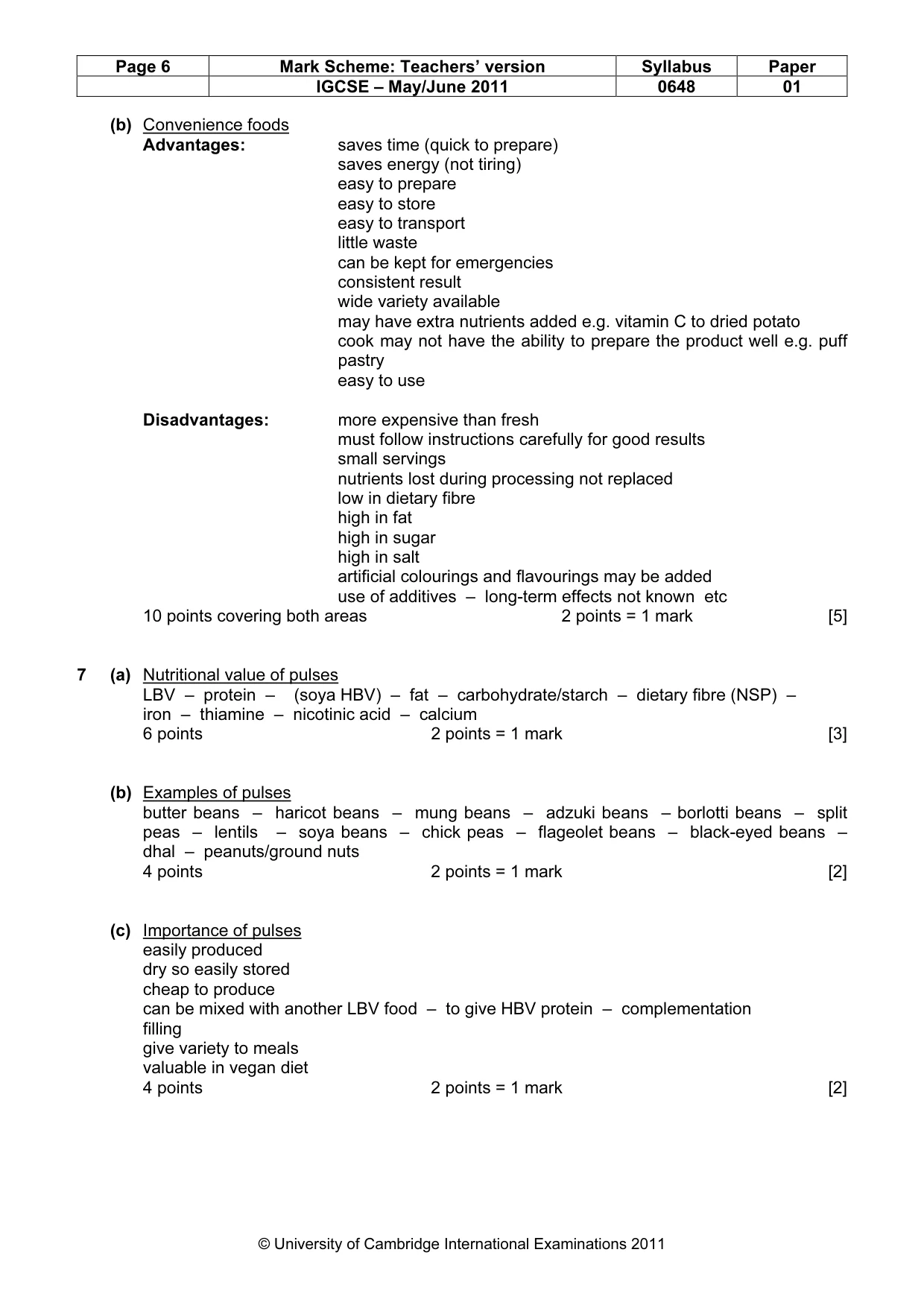
Page 6 Mark Scheme: Teachers’ version Syllabus Paper IGCSE – May/June 2011 0648 01 © University of Cambridge International Examinations 2011 (b) Convenience foods Advantages: saves time (quick to prepare) saves energy (not tiring) easy to prepare easy to store easy to transport little waste can be kept for emergencies consistent result wide variety available may have extra nutrients added e.g. vitamin C to dried potato cook may not have the ability to prepare the product well e.g. puff pastry easy to use Disadvantages: more expensive than fresh must follow instructions carefully for good results small servings nutrients lost during processing not replaced low in dietary fibre high in fat high in sugar high in salt artificial colourings and flavourings may be added use of additives – long-term effects not known etc 10 points covering both areas 2 points = 1 mark [5] 7 (a) Nutritional value of pulses LBV – protein – (soya HBV) – fat – carbohydrate/starch – dietary fibre (NSP) – iron – thiamine – nicotinic acid – calcium 6 points 2 points = 1 mark [3] (b) Examples of pulses butter beans – haricot beans – mung beans – adzuki beans – borlotti beans – split peas – lentils – soya beans – chick peas – flageolet beans – black-eyed beans – dhal – peanuts/ground nuts 4 points 2 points = 1 mark [2] (c) Importance of pulses easily produced dry so easily stored cheap to produce can be mixed with another LBV food – to give HBV protein – complementation filling give variety to meals valuable in vegan diet 4 points 2 points = 1 mark [2]
Mark scheme, page 7
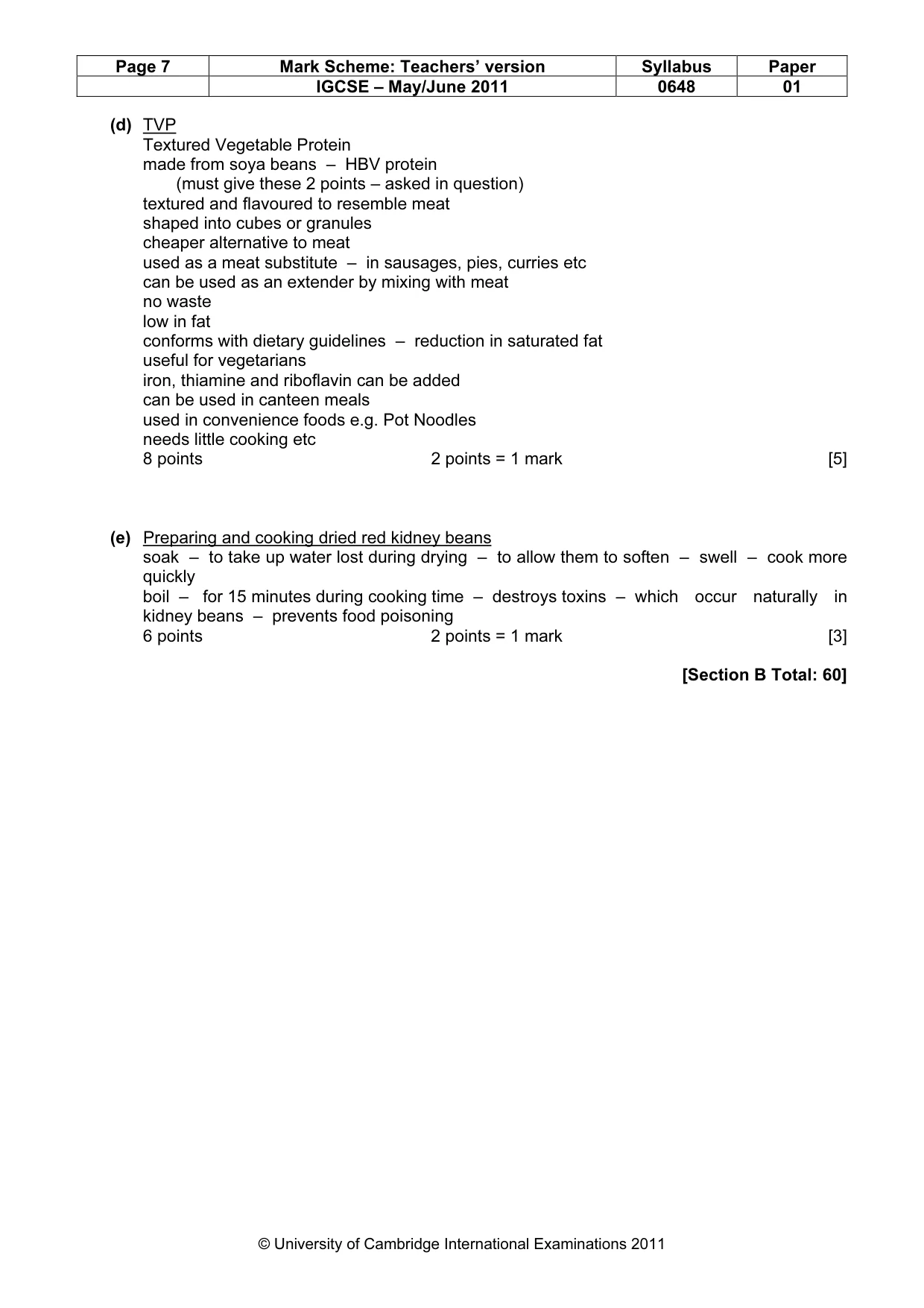
Page 7 Mark Scheme: Teachers’ version Syllabus Paper IGCSE – May/June 2011 0648 01 © University of Cambridge International Examinations 2011 (d) TVP Textured Vegetable Protein made from soya beans – HBV protein (must give these 2 points – asked in question) textured and flavoured to resemble meat shaped into cubes or granules cheaper alternative to meat used as a meat substitute – in sausages, pies, curries etc can be used as an extender by mixing with meat no waste low in fat conforms with dietary guidelines – reduction in saturated fat useful for vegetarians iron, thiamine and riboflavin can be added can be used in canteen meals used in convenience foods e.g. Pot Noodles needs little cooking etc 8 points 2 points = 1 mark [5] (e) Preparing and cooking dried red kidney beans soak – to take up water lost during drying – to allow them to soften – swell – cook more quickly boil – for 15 minutes during cooking time – destroys toxins – which occur naturally in kidney beans – prevents food poisoning 6 points 2 points = 1 mark [3] [Section B Total: 60]
Mark scheme, page 8
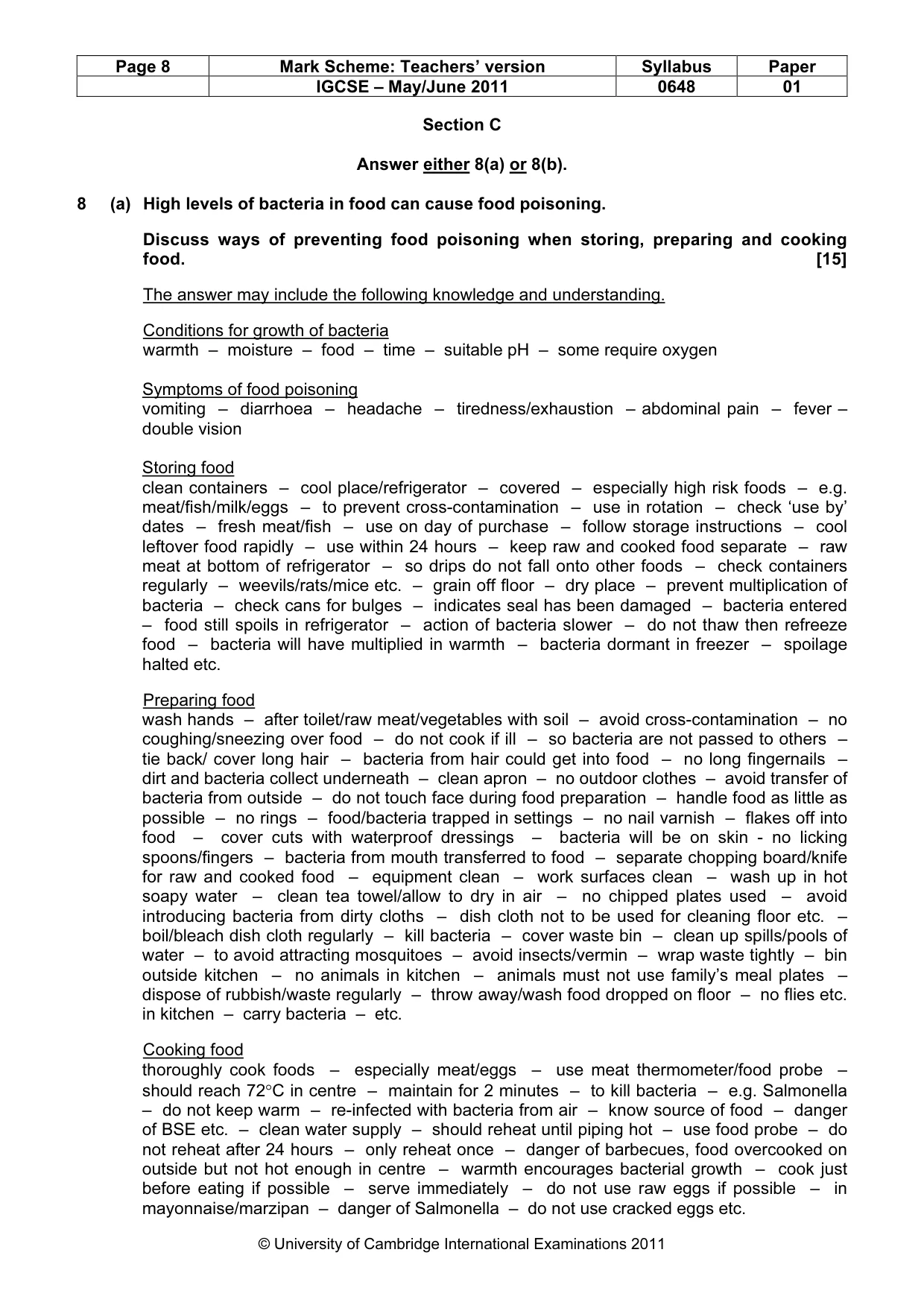
Page 8 Mark Scheme: Teachers’ version Syllabus Paper IGCSE – May/June 2011 0648 01 © University of Cambridge International Examinations 2011 Section C Answer either 8(a) or 8(b). 8 (a) High levels of bacteria in food can cause food poisoning. Discuss ways of preventing food poisoning when storing, preparing and cooking food. [15] The answer may include the following knowledge and understanding. Conditions for growth of bacteria warmth – moisture – food – time – suitable pH – some require oxygen Symptoms of food poisoning vomiting – diarrhoea – headache – tiredness/exhaustion – abdominal pain – fever – double vision Storing food clean containers – cool place/refrigerator – covered – especially high risk foods – e.g. meat/fish/milk/eggs – to prevent cross-contamination – use in rotation – check ‘use by’ dates – fresh meat/fish – use on day of purchase – follow storage instructions – cool leftover food rapidly – use within 24 hours – keep raw and cooked food separate – raw meat at bottom of refrigerator – so drips do not fall onto other foods – check containers regularly – weevils/rats/mice etc. – grain off floor – dry place – prevent multiplication of bacteria – check cans for bulges – indicates seal has been damaged – bacteria entered – food still spoils in refrigerator – action of bacteria slower – do not thaw then refreeze food – bacteria will have multiplied in warmth – bacteria dormant in freezer – spoilage halted etc. Preparing food wash hands – after toilet/raw meat/vegetables with soil – avoid cross-contamination – no coughing/sneezing over food – do not cook if ill – so bacteria are not passed to others – tie back/ cover long hair – bacteria from hair could get into food – no long fingernails – dirt and bacteria collect underneath – clean apron – no outdoor clothes – avoid transfer of bacteria from outside – do not touch face during food preparation – handle food as little as possible – no rings – food/bacteria trapped in settings – no nail varnish – flakes off into food – cover cuts with waterproof dressings – bacteria will be on skin - no licking spoons/fingers – bacteria from mouth transferred to food – separate chopping board/knife for raw and cooked food – equipment clean – work surfaces clean – wash up in hot soapy water – clean tea towel/allow to dry in air – no chipped plates used – avoid introducing bacteria from dirty cloths – dish cloth not to be used for cleaning floor etc. – boil/bleach dish cloth regularly – kill bacteria – cover waste bin – clean up spills/pools of water – to avoid attracting mosquitoes – avoid insects/vermin – wrap waste tightly – bin outside kitchen – no animals in kitchen – animals must not use family’s meal plates – dispose of rubbish/waste regularly – throw away/wash food dropped on floor – no flies etc. in kitchen – carry bacteria – etc. Cooking food thoroughly cook foods – especially meat/eggs – use meat thermometer/food probe – should reach 72°C in centre – maintain for 2 minutes – to kill bacteria – e.g. Salmonella – do not keep warm – re-infected with bacteria from air – know source of food – danger of BSE etc. – clean water supply – should reheat until piping hot – use food probe – do not reheat after 24 hours – only reheat once – danger of barbecues, food overcooked on outside but not hot enough in centre – warmth encourages bacterial growth – cook just before eating if possible – serve immediately – do not use raw eggs if possible – in mayonnaise/marzipan – danger of Salmonella – do not use cracked eggs etc.
Mark scheme, page 9
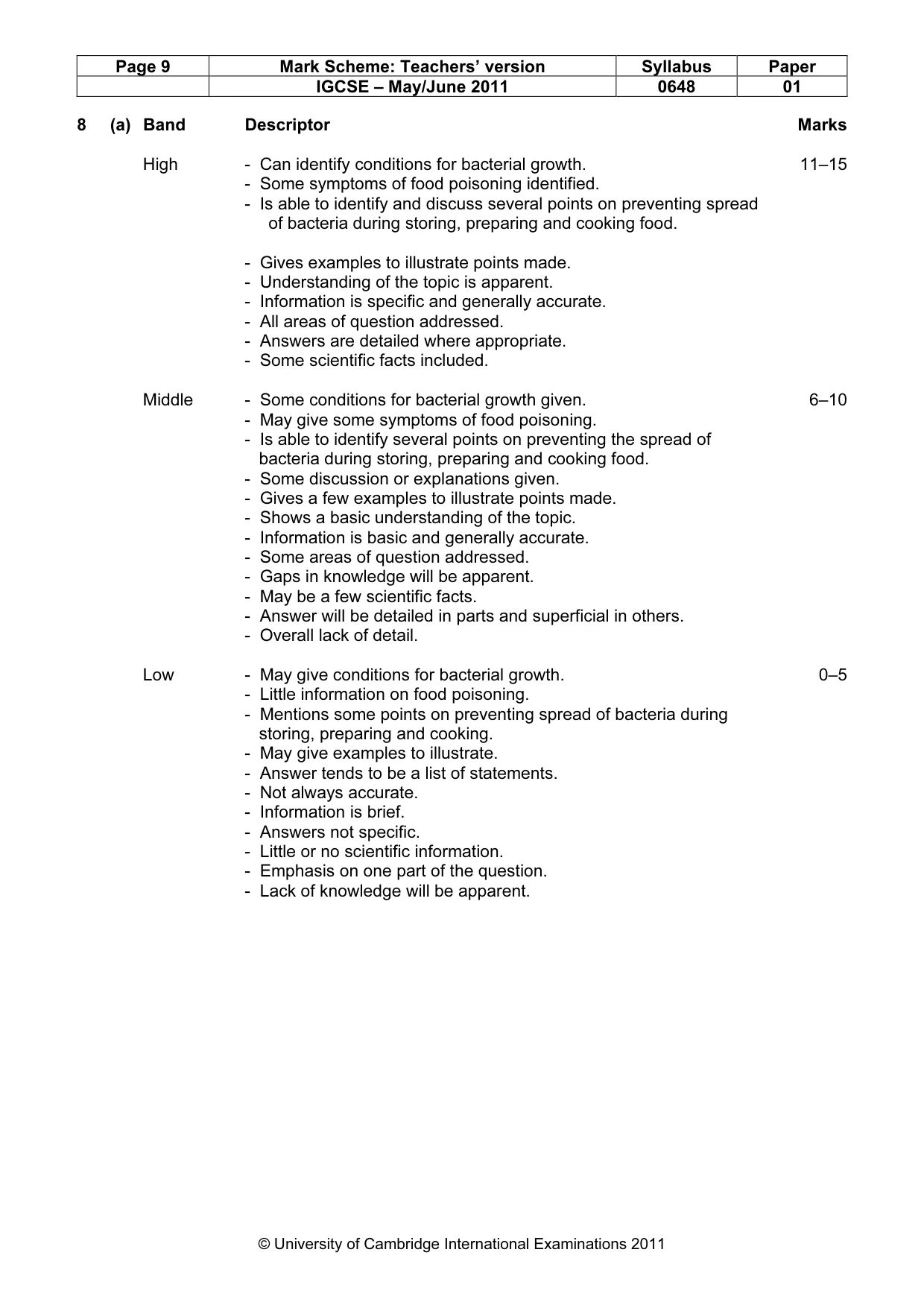
Page 9 Mark Scheme: Teachers’ version Syllabus Paper IGCSE – May/June 2011 0648 01 © University of Cambridge International Examinations 2011 8 (a) Band Descriptor Marks High - Can identify conditions for bacterial growth. 11–15 - Some symptoms of food poisoning identified. - Is able to identify and discuss several points on preventing spread of bacteria during storing, preparing and cooking food. - Gives examples to illustrate points made. - Understanding of the topic is apparent. - Information is specific and generally accurate. - All areas of question addressed. - Answers are detailed where appropriate. - Some scientific facts included. Middle - Some conditions for bacterial growth given. 6–10 - May give some symptoms of food poisoning. - Is able to identify several points on preventing the spread of bacteria during storing, preparing and cooking food. - Some discussion or explanations given. - Gives a few examples to illustrate points made. - Shows a basic understanding of the topic. - Information is basic and generally accurate. - Some areas of question addressed. - Gaps in knowledge will be apparent. - May be a few scientific facts. - Answer will be detailed in parts and superficial in others. - Overall lack of detail. Low - May give conditions for bacterial growth. 0–5 - Little information on food poisoning. - Mentions some points on preventing spread of bacteria during storing, preparing and cooking. - May give examples to illustrate. - Answer tends to be a list of statements. - Not always accurate. - Information is brief. - Answers not specific. - Little or no scientific information. - Emphasis on one part of the question. - Lack of knowledge will be apparent.
Mark scheme, page 10
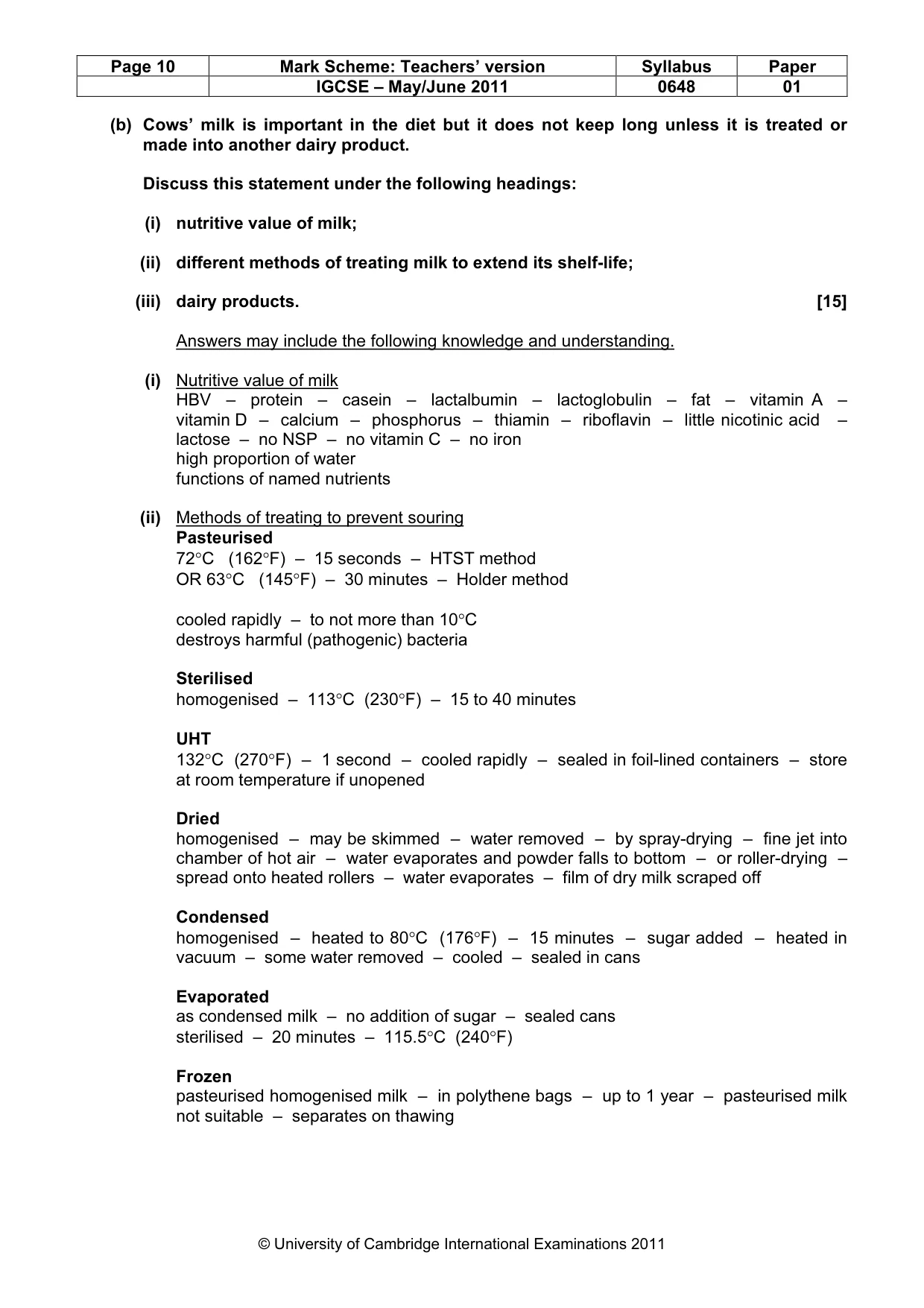
Page 10 Mark Scheme: Teachers’ version Syllabus Paper IGCSE – May/June 2011 0648 01 © University of Cambridge International Examinations 2011 (b) Cows’ milk is important in the diet but it does not keep long unless it is treated or made into another dairy product. Discuss this statement under the following headings: (i) nutritive value of milk; (ii) different methods of treating milk to extend its shelf-life; (iii) dairy products. [15] Answers may include the following knowledge and understanding. (i) Nutritive value of milk HBV – protein – casein – lactalbumin – lactoglobulin – fat – vitamin A – vitamin D – calcium – phosphorus – thiamin – riboflavin – little nicotinic acid – lactose – no NSP – no vitamin C – no iron high proportion of water functions of named nutrients (ii) Methods of treating to prevent souring Pasteurised 72°C (162°F) – 15 seconds – HTST method OR 63°C (145°F) – 30 minutes – Holder method cooled rapidly – to not more than 10°C destroys harmful (pathogenic) bacteria Sterilised homogenised – 113°C (230°F) – 15 to 40 minutes UHT 132°C (270°F) – 1 second – cooled rapidly – sealed in foil-lined containers – store at room temperature if unopened Dried homogenised – may be skimmed – water removed – by spray-drying – fine jet into chamber of hot air – water evaporates and powder falls to bottom – or roller-drying – spread onto heated rollers – water evaporates – film of dry milk scraped off Condensed homogenised – heated to 80°C (176°F) – 15 minutes – sugar added – heated in vacuum – some water removed – cooled – sealed in cans Evaporated as condensed milk – no addition of sugar – sealed cans sterilised – 20 minutes – 115.5°C (240°F) Frozen pasteurised homogenised milk – in polythene bags – up to 1 year – pasteurised milk not suitable – separates on thawing
Mark scheme, page 11
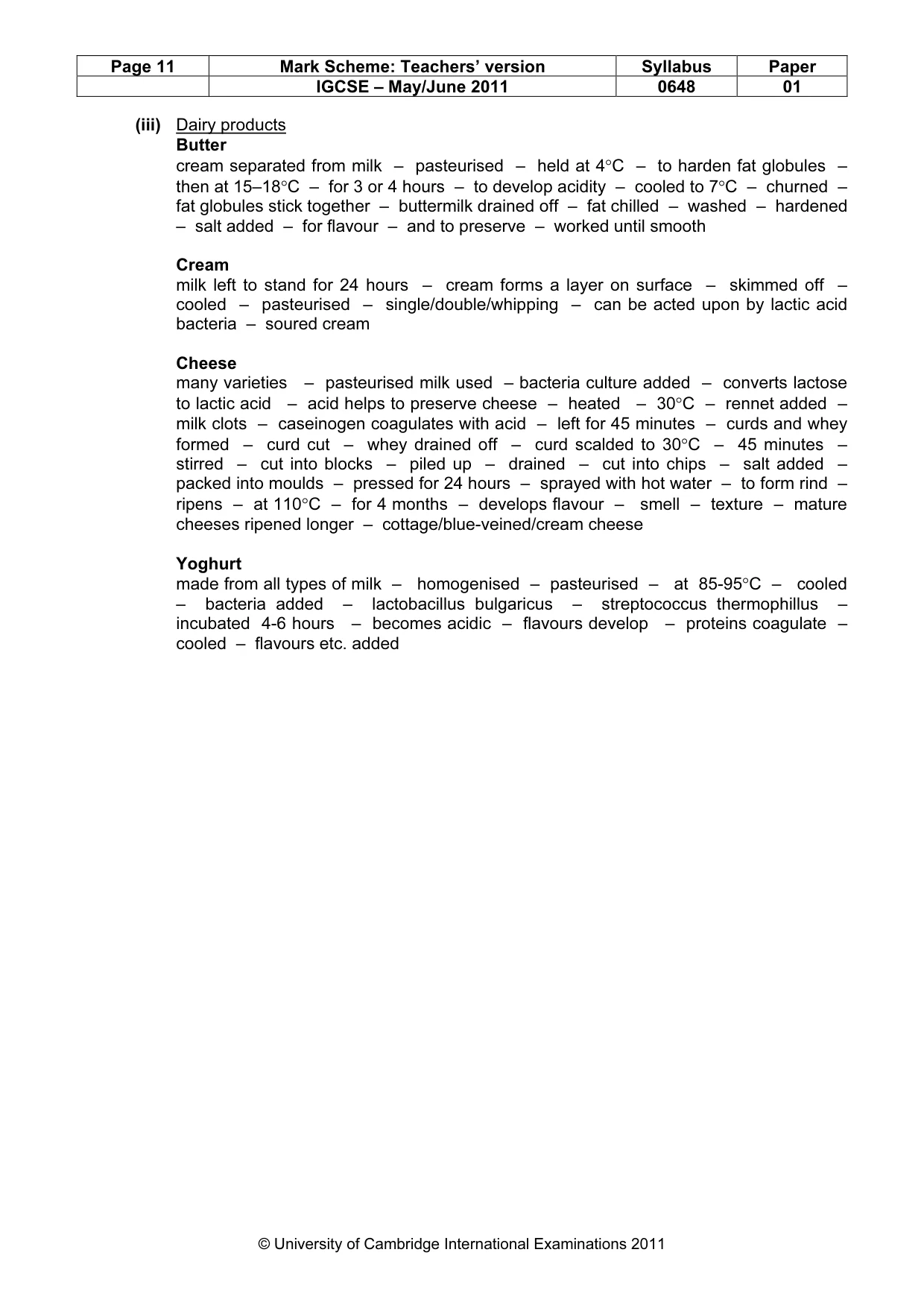
Page 11 Mark Scheme: Teachers’ version Syllabus Paper IGCSE – May/June 2011 0648 01 © University of Cambridge International Examinations 2011 (iii) Dairy products Butter cream separated from milk – pasteurised – held at 4°C – to harden fat globules – then at 15–18°C – for 3 or 4 hours – to develop acidity – cooled to 7°C – churned – fat globules stick together – buttermilk drained off – fat chilled – washed – hardened – salt added – for flavour – and to preserve – worked until smooth Cream milk left to stand for 24 hours – cream forms a layer on surface – skimmed off – cooled – pasteurised – single/double/whipping – can be acted upon by lactic acid bacteria – soured cream Cheese many varieties – pasteurised milk used – bacteria culture added – converts lactose to lactic acid – acid helps to preserve cheese – heated – 30°C – rennet added – milk clots – caseinogen coagulates with acid – left for 45 minutes – curds and whey formed – curd cut – whey drained off – curd scalded to 30°C – 45 minutes – stirred – cut into blocks – piled up – drained – cut into chips – salt added – packed into moulds – pressed for 24 hours – sprayed with hot water – to form rind – ripens – at 110°C – for 4 months – develops flavour – smell – texture – mature cheeses ripened longer – cottage/blue-veined/cream cheese Yoghurt made from all types of milk – homogenised – pasteurised – at 85-95°C – cooled – bacteria added – lactobacillus bulgaricus – streptococcus thermophillus – incubated 4-6 hours – becomes acidic – flavours develop – proteins coagulate – cooled – flavours etc. added
Mark scheme, page 12
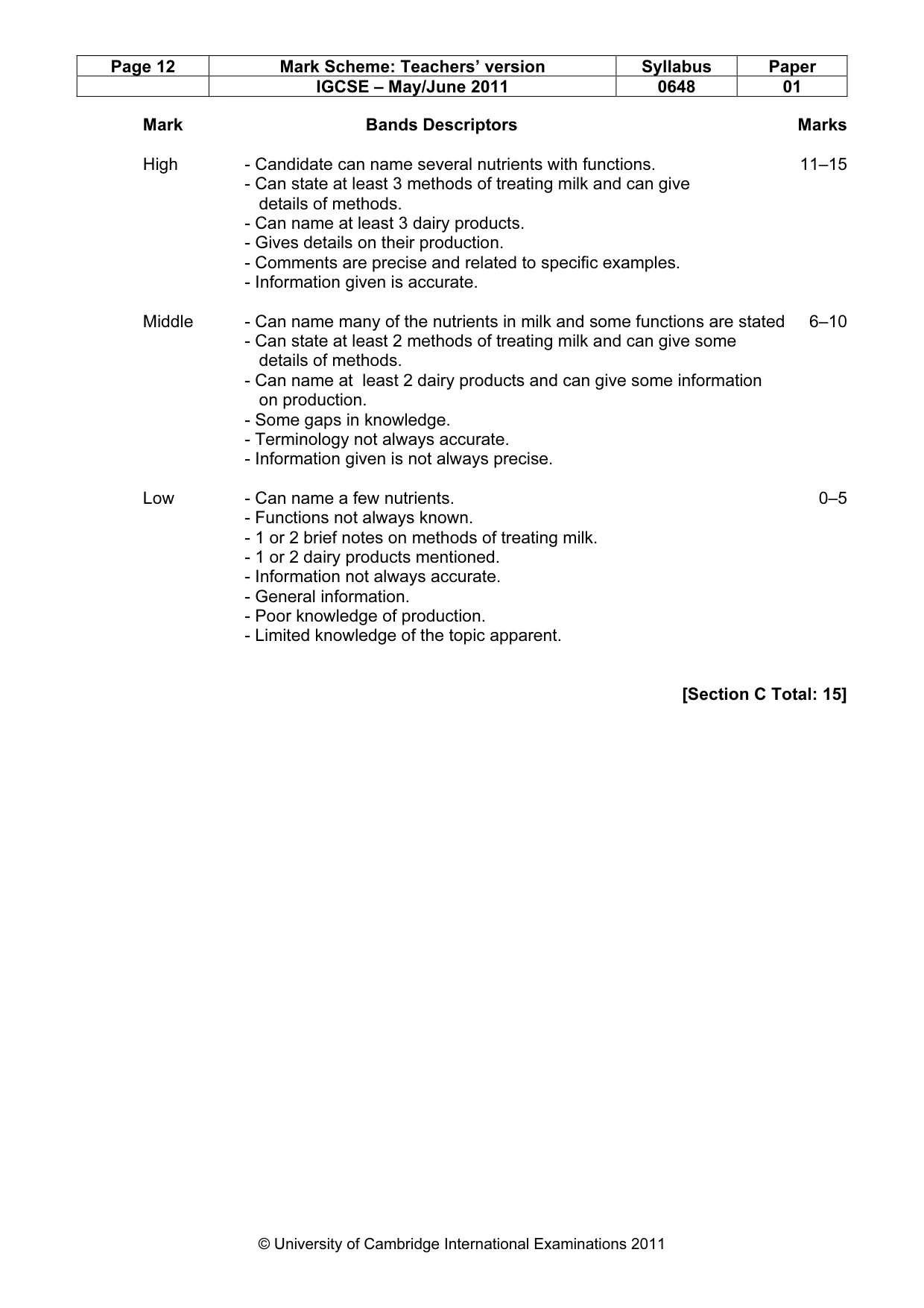
Page 12 Mark Scheme: Teachers’ version Syllabus Paper IGCSE – May/June 2011 0648 01 © University of Cambridge International Examinations 2011 Mark Bands Descriptors Marks High - Candidate can name several nutrients with functions. 11–15 - Can state at least 3 methods of treating milk and can give details of methods. - Can name at least 3 dairy products. - Gives details on their production. - Comments are precise and related to specific examples. - Information given is accurate. Middle - Can name many of the nutrients in milk and some functions are stated 6–10 - Can state at least 2 methods of treating milk and can give some details of methods. - Can name at least 2 dairy products and can give some information on production. - Some gaps in knowledge. - Terminology not always accurate. - Information given is not always precise. Low - Can name a few nutrients. 0–5 - Functions not always known. - 1 or 2 brief notes on methods of treating milk. - 1 or 2 dairy products mentioned. - Information not always accurate. - General information. - Poor knowledge of production. - Limited knowledge of the topic apparent. [Section C Total: 15]
What you needed in this session
Cambridge’s own grade thresholds for 2011 May/June, Paper 1 · Variant 1. A higher threshold means an easier paper — the bar moves with how the cohort did.