Cambridge IGCSE Food and Nutrition 0648 — 2010 Oct/Nov Paper 1 · Variant 1
0648/11/O/N/10 · 100 marks · ≈113 min
The question paper and its mark scheme, free to read here and free to download. This is Cambridge’s own paper, exactly as it was sat.
Question paper16 pages


Mark scheme11 pages
Answers below. Sit the paper first if you are practising.
Paper as text
Question paper, page 1
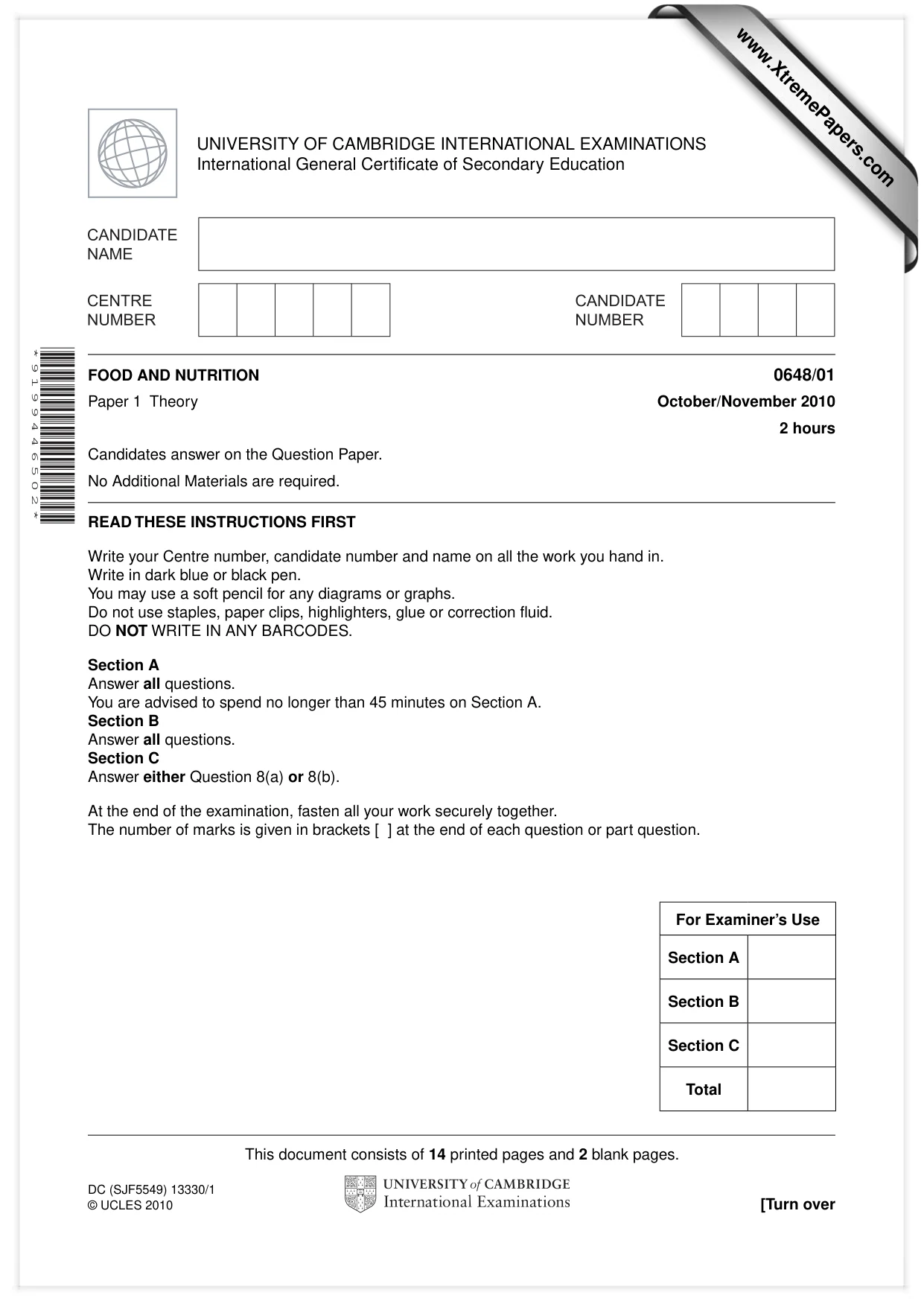
This document consists of 14 printed pages and 2 blank pages. DC (SJF5549) 13330/1 © UCLES 2010 [Turn over UNIVERSITY OF CAMBRIDGE INTERNATIONAL EXAMINATIONS International General Certificate of Secondary Education READ THESE INSTRUCTIONS FIRST Write your Centre number, candidate number and name on all the work you hand in. Write in dark blue or black pen. You may use a soft pencil for any diagrams or graphs. Do not use staples, paper clips, highlighters, glue or correction fluid. DO NOT WRITE IN ANY BARCODES. Section A Answer all questions. You are advised to spend no longer than 45 minutes on Section A. Section B Answer all questions. Section C Answer either Question 8(a) or 8(b). At the end of the examination, fasten all your work securely together. The number of marks is given in brackets [ ] at the end of each question or part question. * 9 1 9 9 4 4 6 5 0 2 * FOOD AND NUTRITION 0648/01 Paper 1 Theory October/November 2010 2 hours Candidates answer on the Question Paper. No Additional Materials are required. For Examiner’s Use Section A Section B Section C Total www.XtremePapers.com
Question paper, page 2
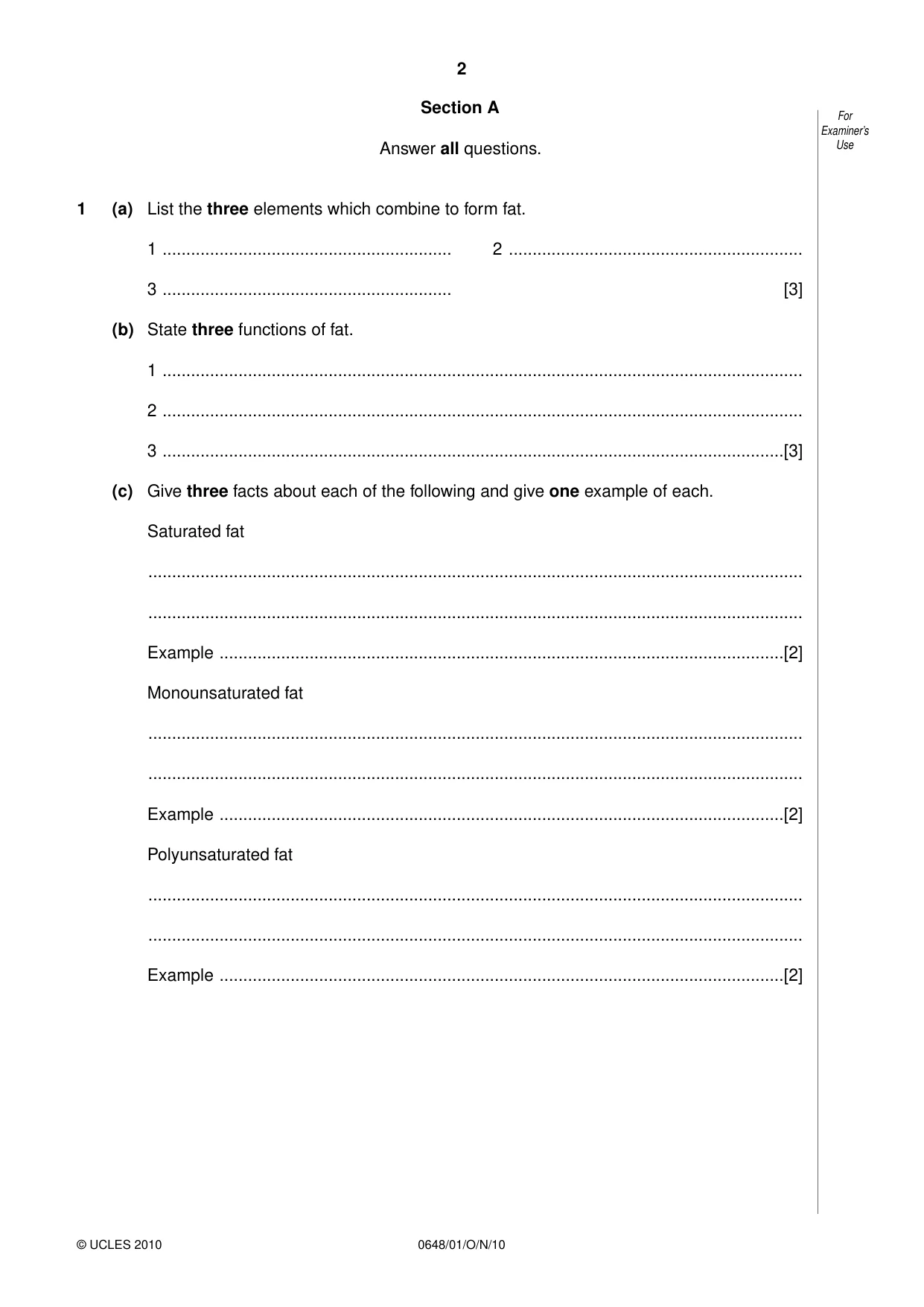
2 0648/01/O/N/10 © UCLES 2010 For Examiner’s Use Section A Answer all questions. 1 (a) List the three elements which combine to form fat. 1 … 2 … 3 … [3] (b) State three functions of fat. 1 … 2 … 3 …[3] (c) Give three facts about each of the following and give one example of each. Saturated fat … … Example …[2] Monounsaturated fat … … Example …[2] Polyunsaturated fat … … Example …[2]
Question paper, page 3
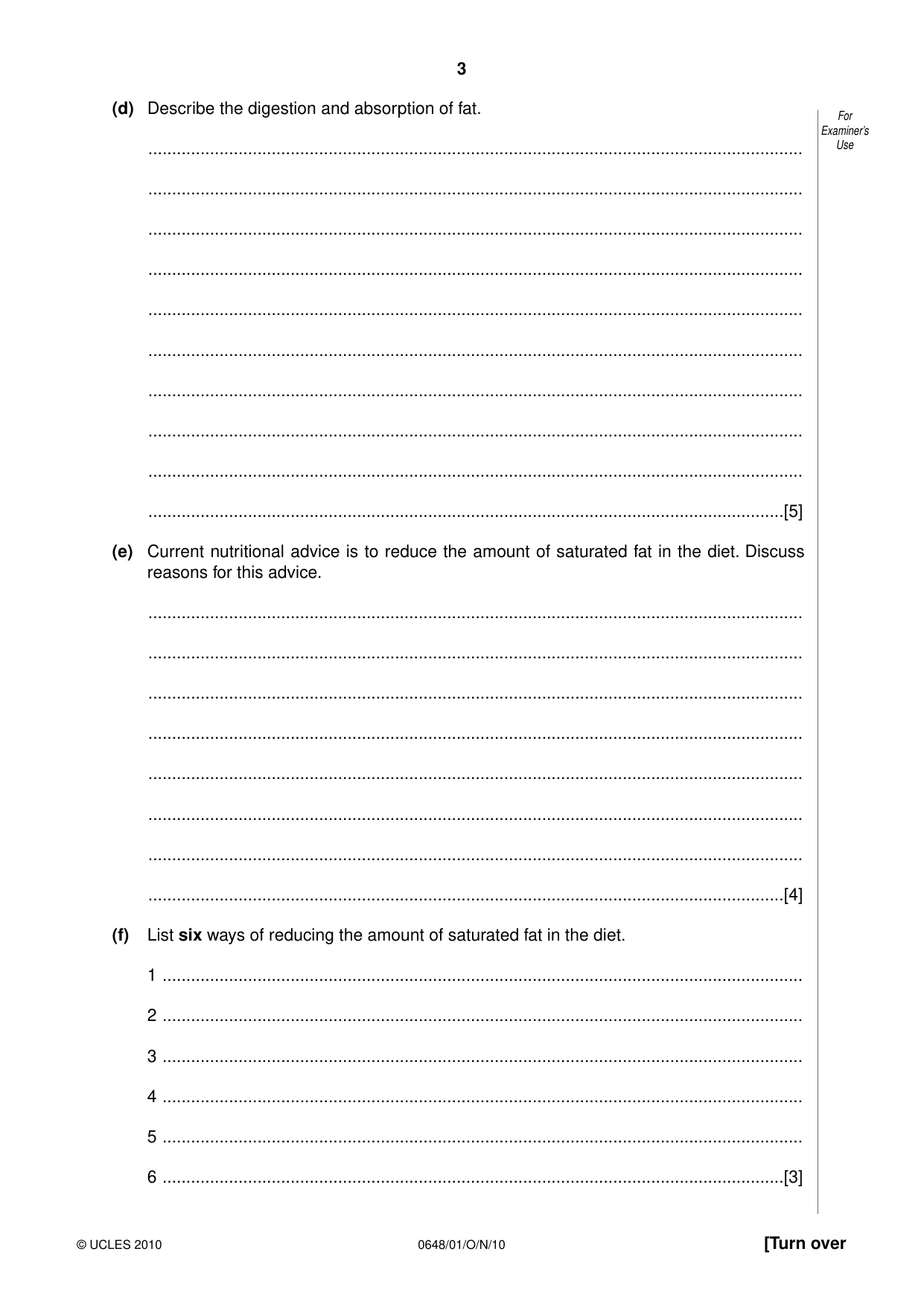
3 0648/01/O/N/10 © UCLES 2010 [Turn over For Examiner’s Use (d) Describe the digestion and absorption of fat. … … … … … … … … … …[5] (e) Current nutritional advice is to reduce the amount of saturated fat in the diet. Discuss reasons for this advice. … … … … … … … …[4] (f) List six ways of reducing the amount of saturated fat in the diet. 1 … 2 … 3 … 4 … 5 … 6 …[3]
Question paper, page 4
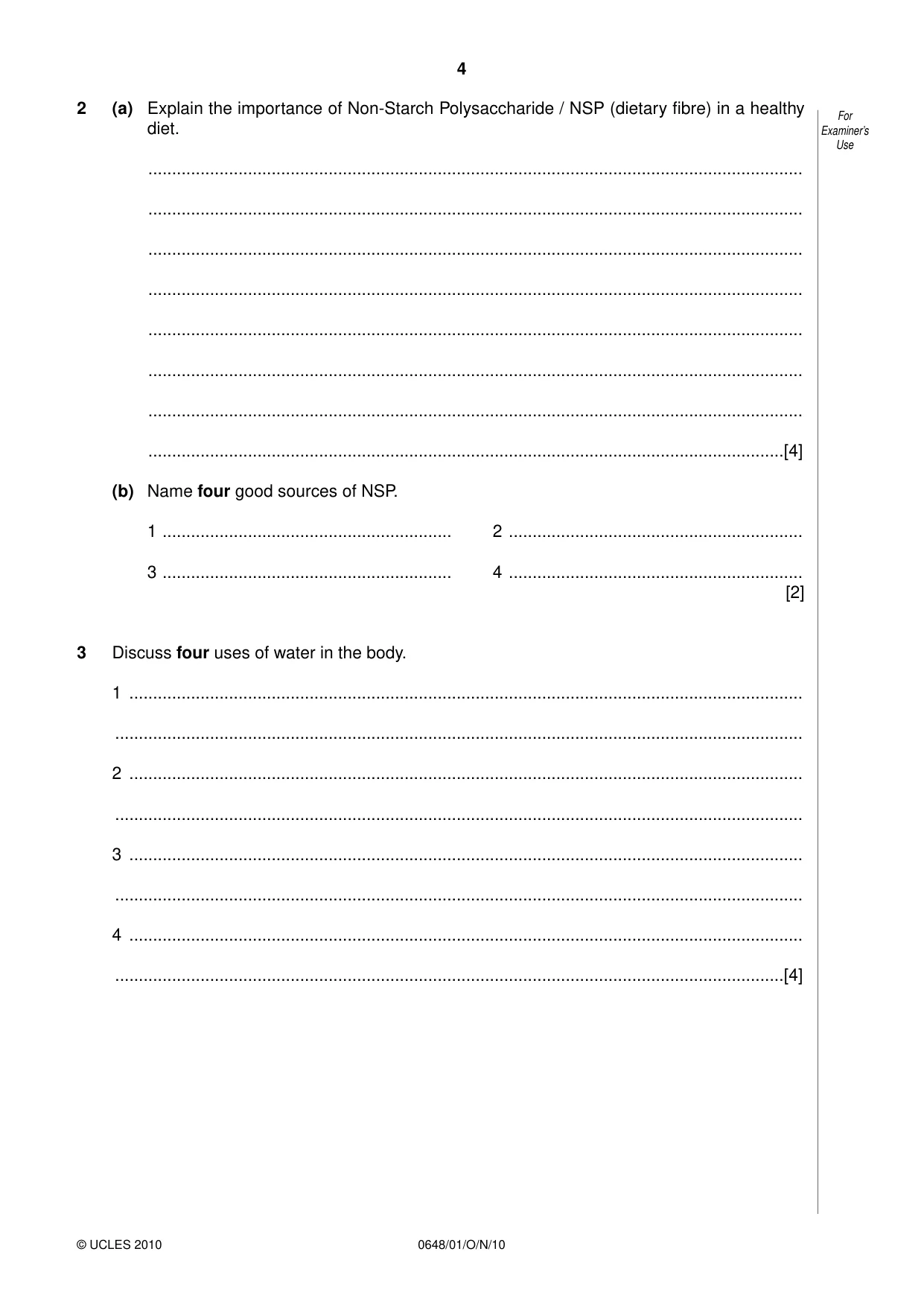
4 0648/01/O/N/10 © UCLES 2010 For Examiner’s Use 2 (a) Explain the importance of Non-Starch Polysaccharide / NSP (dietary fibre) in a healthy diet. … … … … … … … …[4] (b) Name four good sources of NSP. 1 … 2 … 3 … 4 … [2] 3 Discuss four uses of water in the body. 1 … … 2 … … 3 … … 4 … …[4]
Question paper, page 5
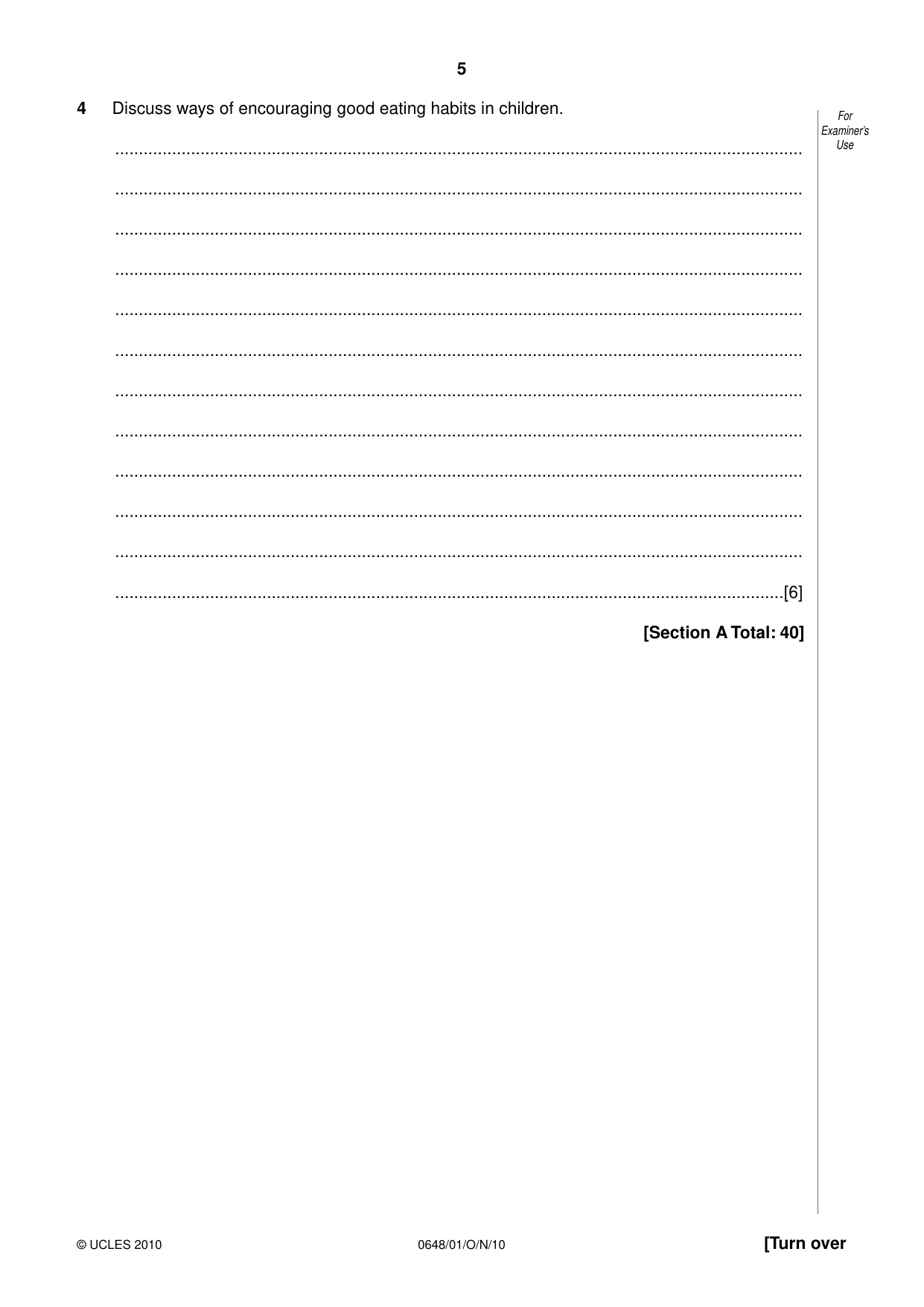
5 0648/01/O/N/10 © UCLES 2010 [Turn over For Examiner’s Use 4 Discuss ways of encouraging good eating habits in children. … … … … … … … … … … … …[6] [Section A Total: 40]
Question paper, page 6
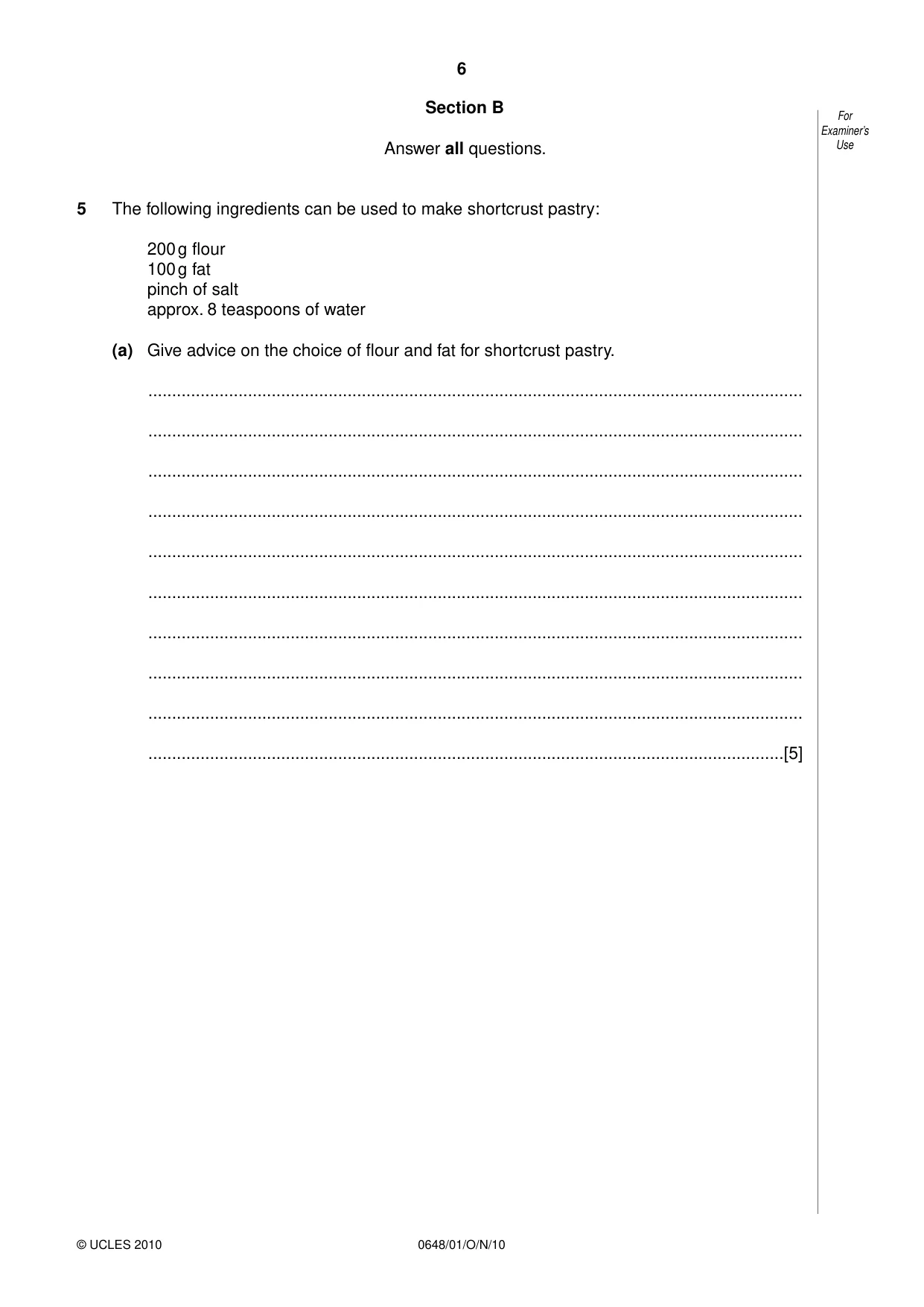
6 0648/01/O/N/10 © UCLES 2010 For Examiner’s Use Section B Answer all questions. 5 The following ingredients can be used to make shortcrust pastry: 200 g flour 100 g fat pinch of salt approx. 8 teaspoons of water (a) Give advice on the choice of flour and fat for shortcrust pastry. … … … … … … … … … …[5]
Question paper, page 7
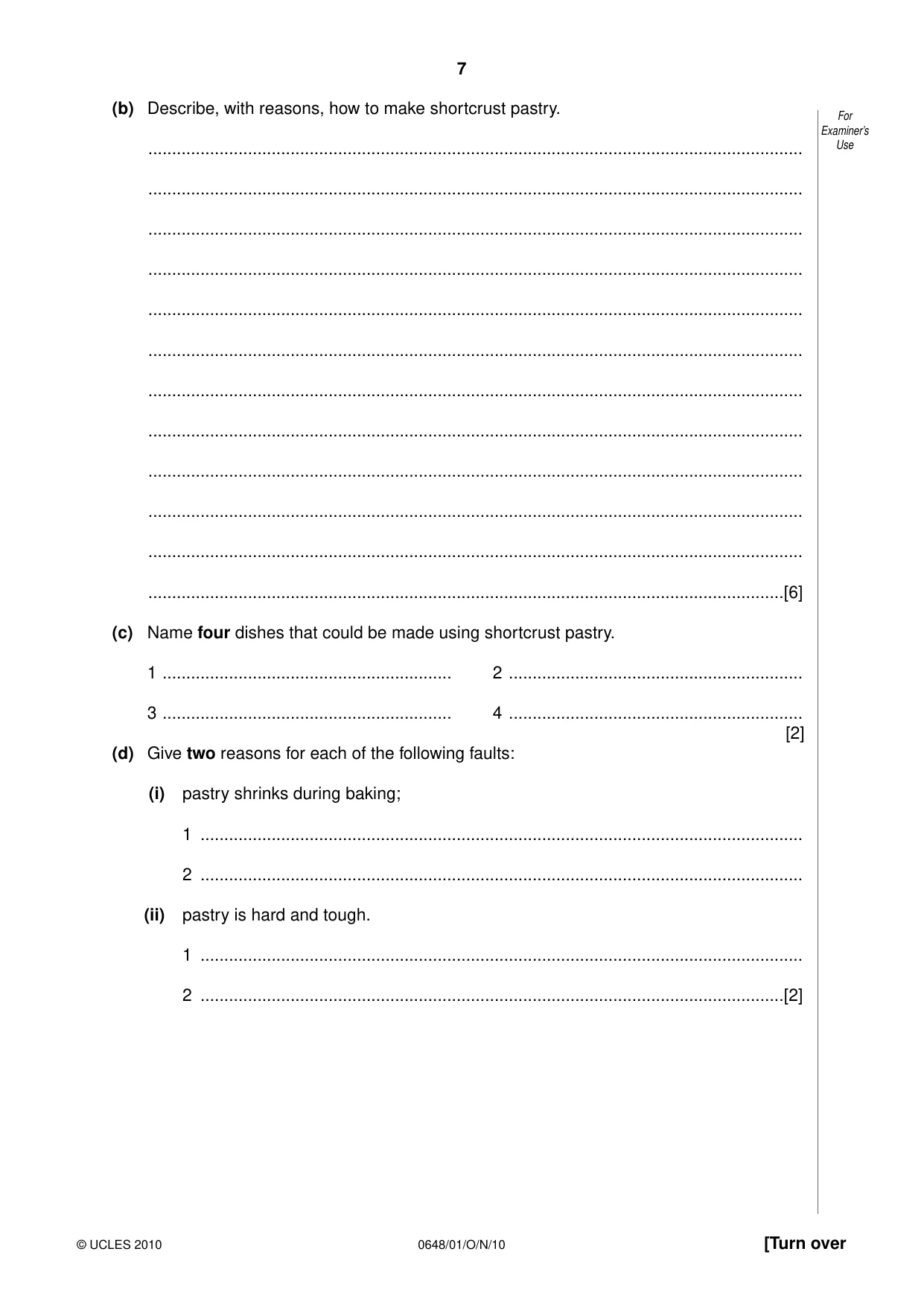
7 0648/01/O/N/10 © UCLES 2010 [Turn over For Examiner’s Use (b) Describe, with reasons, how to make shortcrust pastry. … … … … … … … … … … … …[6] (c) Name four dishes that could be made using shortcrust pastry. 1 … 2 … 3 … 4 … [2] (d) Give two reasons for each of the following faults: (i) pastry shrinks during baking; 1 … 2 … (ii) pastry is hard and tough. 1 … 2 …[2]
Question paper, page 8
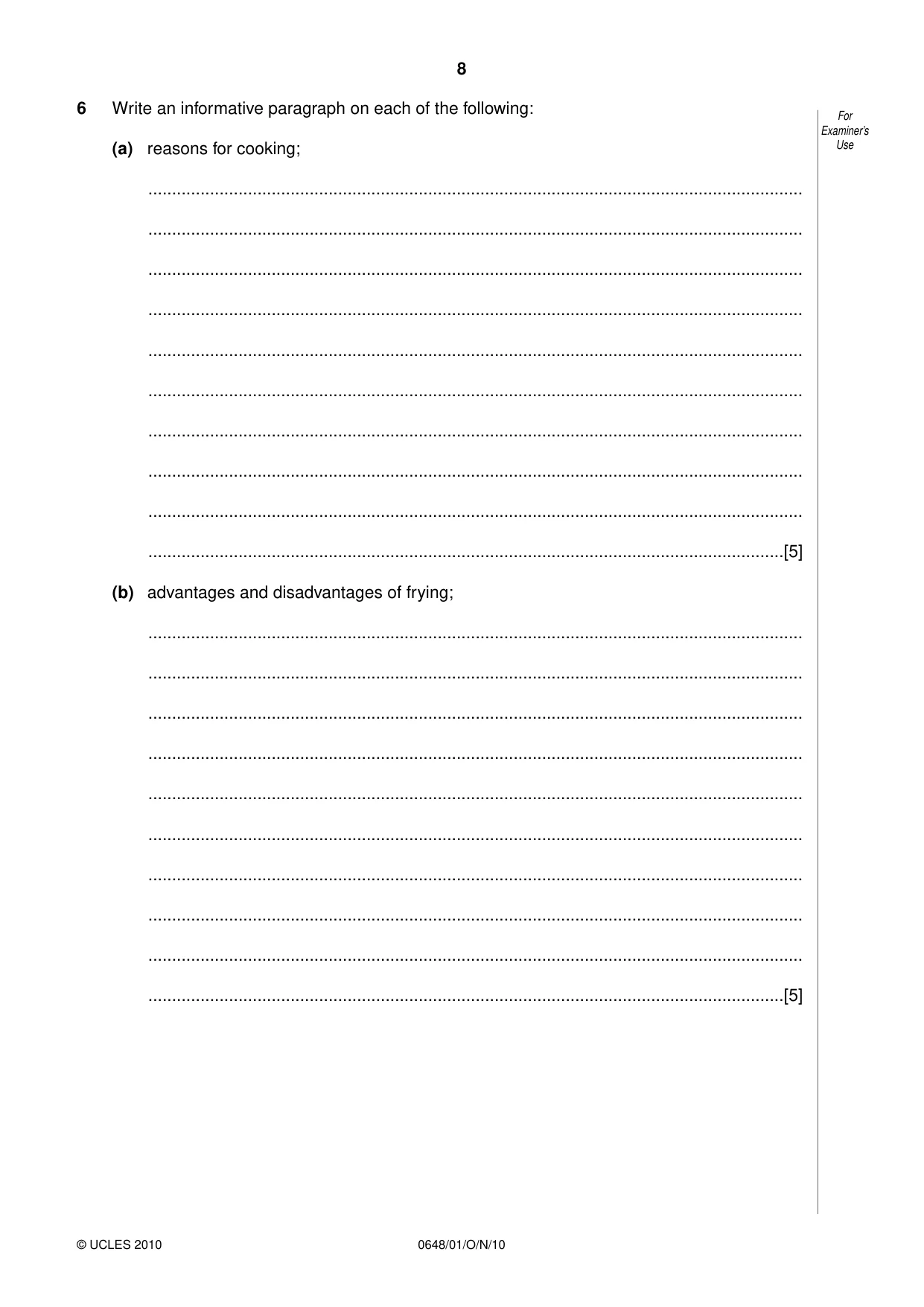
8 0648/01/O/N/10 © UCLES 2010 For Examiner’s Use 6 Write an informative paragraph on each of the following: (a) reasons for cooking; … … … … … … … … … …[5] (b) advantages and disadvantages of frying; … … … … … … … … … …[5]
Question paper, page 9
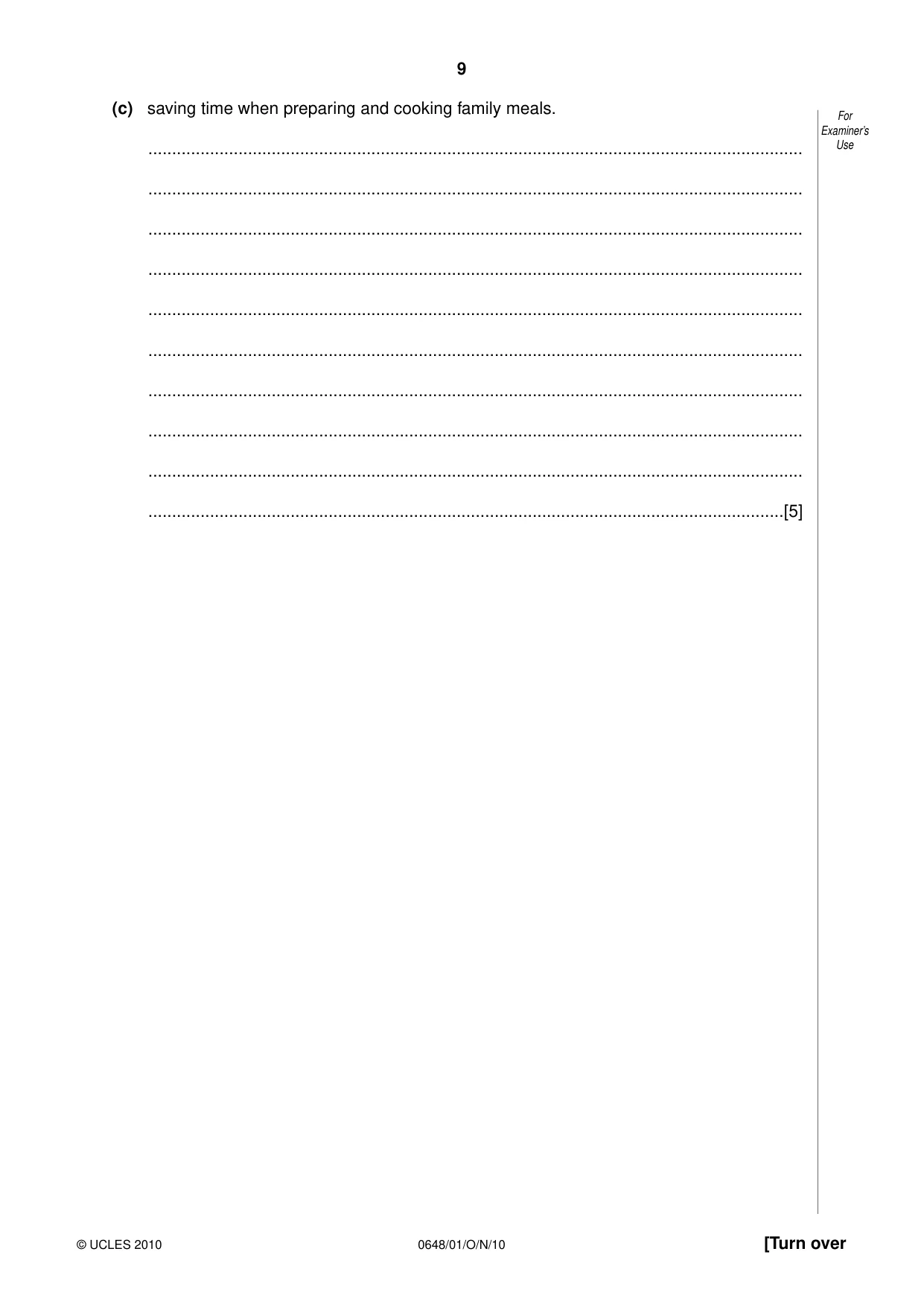
9 0648/01/O/N/10 © UCLES 2010 [Turn over For Examiner’s Use (c) saving time when preparing and cooking family meals. … … … … … … … … … …[5]
Question paper, page 10
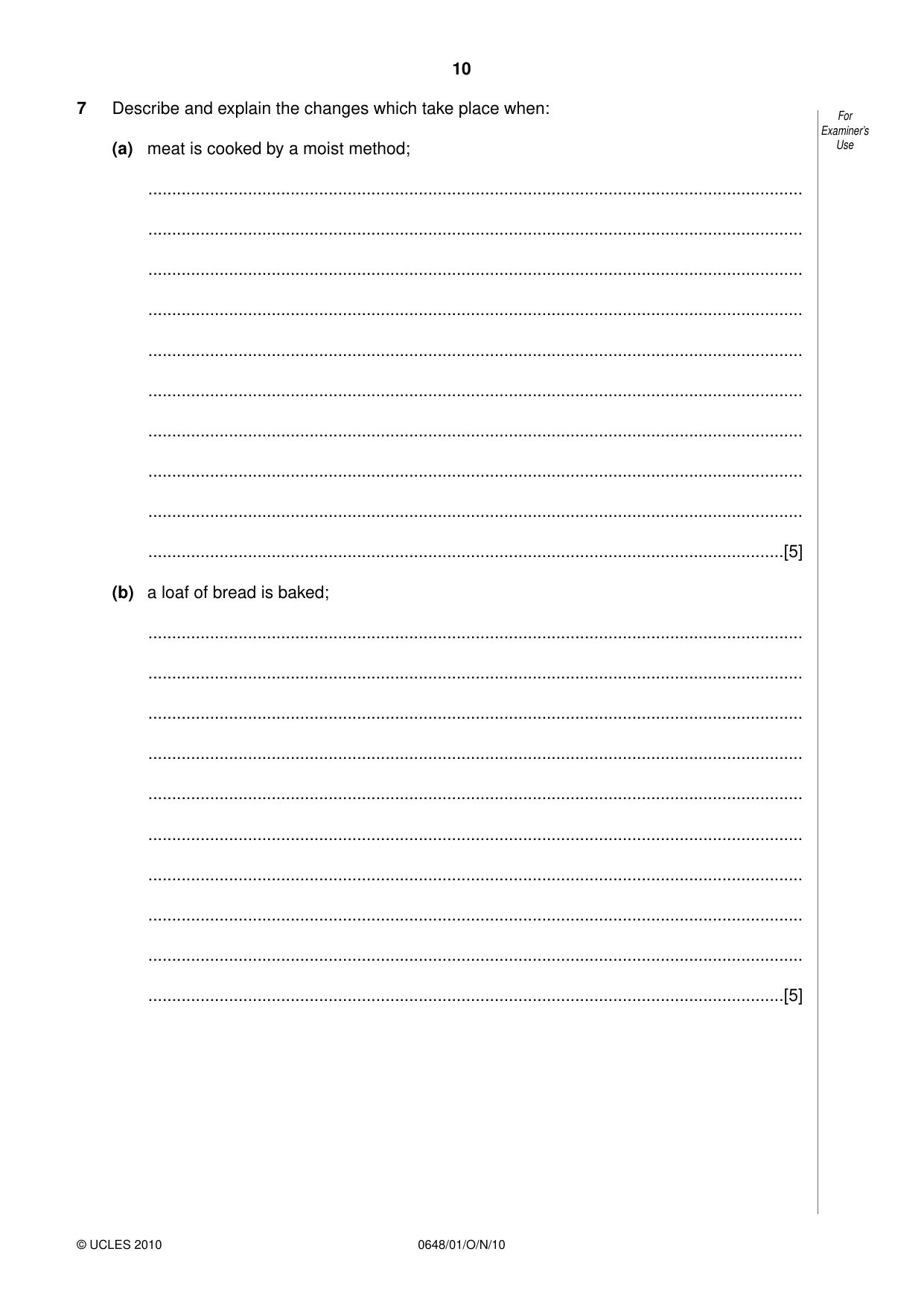
10 0648/01/O/N/10 © UCLES 2010 For Examiner’s Use 7 Describe and explain the changes which take place when: (a) meat is cooked by a moist method; … … … … … … … … … …[5] (b) a loaf of bread is baked; … … … … … … … … … …[5]
Question paper, page 11
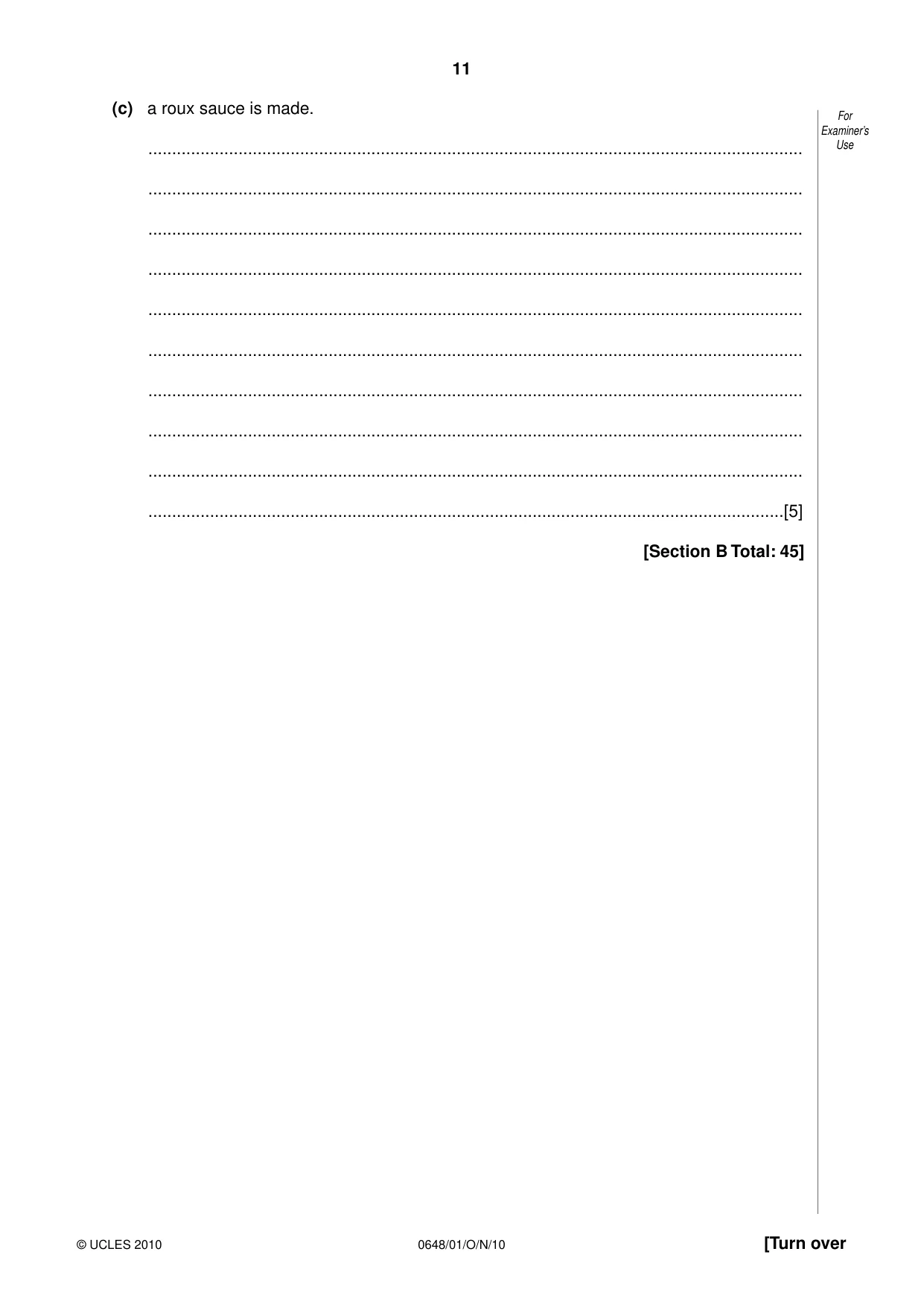
11 0648/01/O/N/10 © UCLES 2010 [Turn over For Examiner’s Use (c) a roux sauce is made. … … … … … … … … … …[5] [Section B Total: 45]
Question paper, page 12
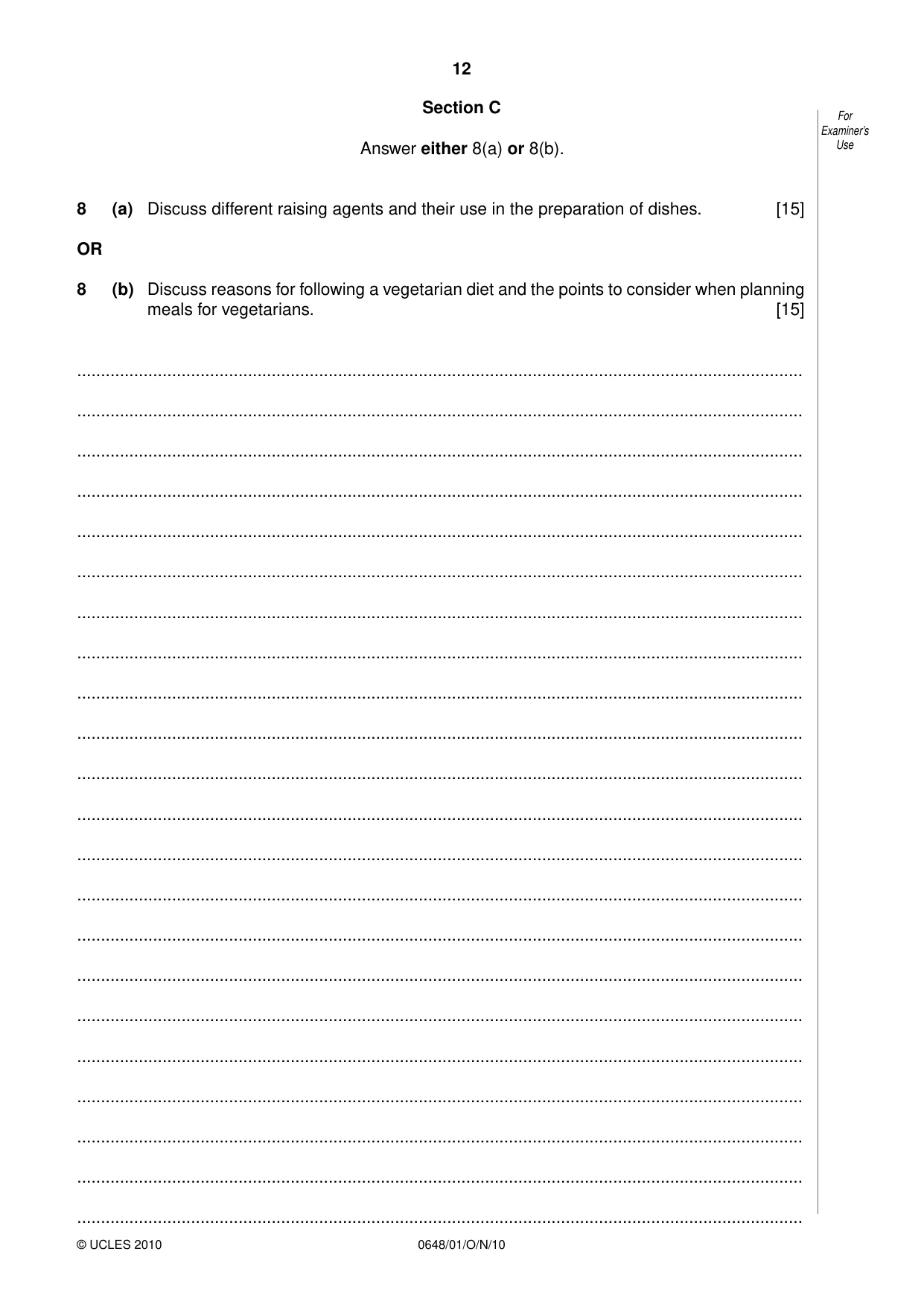
12 0648/01/O/N/10 © UCLES 2010 For Examiner’s Use Section C Answer either 8(a) or 8(b). 8 (a) Discuss different raising agents and their use in the preparation of dishes. [15] OR 8 (b) Discuss reasons for following a vegetarian diet and the points to consider when planning meals for vegetarians. [15] … … … … … … … … … … … … … … … … … … … … … …
Question paper, page 13
13 0648/01/O/N/10 © UCLES 2010 [Turn over For Examiner’s Use … … … … … … … … … … … … … … … … … … … … … … … … … … …
Question paper, page 14
14 0648/01/O/N/10 © UCLES 2010 For Examiner’s Use … … … … … … … … … … … … … … … … … … … … … … … … … … [Section C Total: 15] [Total for Paper: 100]
Question paper, page 15
15 0648/01/O/N/10 © UCLES 2010 BLANK PAGE
Question paper, page 16
16 0648/01/O/N/10 © UCLES 2010 BLANK PAGE Permission to reproduce items where third-party owned material protected by copyright is included has been sought and cleared where possible. Every reasonable effort has been made by the publisher (UCLES) to trace copyright holders, but if any items requiring clearance have unwittingly been included, the publisher will be pleased to make amends at the earliest possible opportunity. University of Cambridge International Examinations is part of the Cambridge Assessment Group. Cambridge Assessment is the brand name of University of Cambridge Local Examinations Syndicate (UCLES), which is itself a department of the University of Cambridge.
Mark scheme, page 1
UNIVERSITY OF CAMBRIDGE INTERNATIONAL EXAMINATIONS International General Certificate of Secondary Education MARK SCHEME for the October/November 2010 question paper for the guidance of teachers 0648 FOOD AND NUTRITION 0648/01 Paper 1 (Theory), maximum raw mark 100 This mark scheme is published as an aid to teachers and candidates, to indicate the requirements of the examination. It shows the basis on which Examiners were instructed to award marks. It does not indicate the details of the discussions that took place at an Examiners’ meeting before marking began, which would have considered the acceptability of alternative answers. Mark schemes must be read in conjunction with the question papers and the report on the examination. • CIE will not enter into discussions or correspondence in connection with these mark schemes. CIE is publishing the mark schemes for the October/November 2010 question papers for most IGCSE, GCE Advanced Level and Advanced Subsidiary Level syllabuses and some Ordinary Level syllabuses. www.XtremePapers.com
Mark scheme, page 2
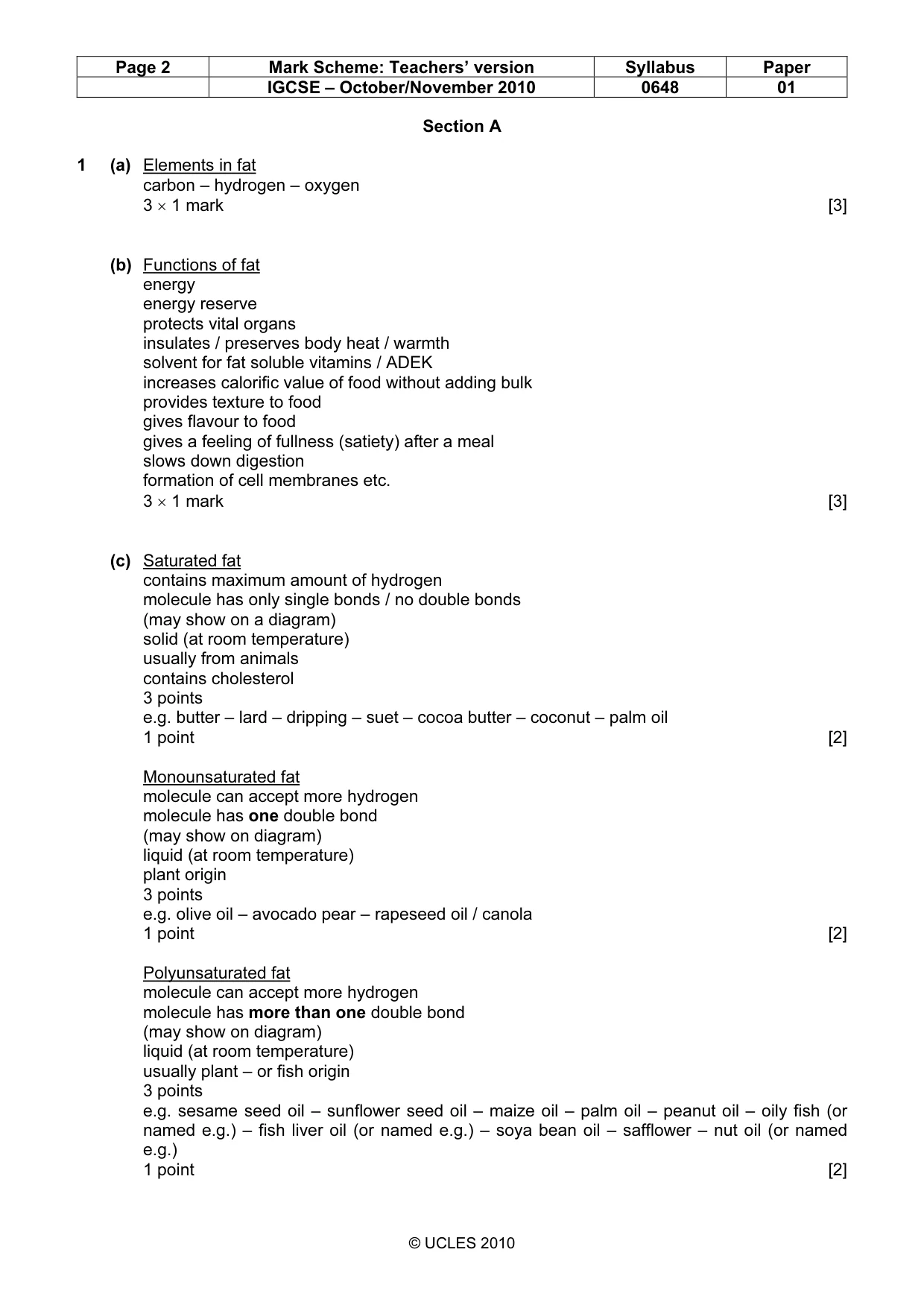
Page 2 Mark Scheme: Teachers’ version Syllabus Paper IGCSE – October/November 2010 0648 01 © UCLES 2010 Section A 1 (a) Elements in fat carbon – hydrogen – oxygen 3 × 1 mark [3] (b) Functions of fat energy energy reserve protects vital organs insulates / preserves body heat / warmth solvent for fat soluble vitamins / ADEK increases calorific value of food without adding bulk provides texture to food gives flavour to food gives a feeling of fullness (satiety) after a meal slows down digestion formation of cell membranes etc. 3 × 1 mark [3] (c) Saturated fat contains maximum amount of hydrogen molecule has only single bonds / no double bonds (may show on a diagram) solid (at room temperature) usually from animals contains cholesterol 3 points e.g. butter – lard – dripping – suet – cocoa butter – coconut – palm oil 1 point [2] Monounsaturated fat molecule can accept more hydrogen molecule has one double bond (may show on diagram) liquid (at room temperature) plant origin 3 points e.g. olive oil – avocado pear – rapeseed oil / canola 1 point [2] Polyunsaturated fat molecule can accept more hydrogen molecule has more than one double bond (may show on diagram) liquid (at room temperature) usually plant – or fish origin 3 points e.g. sesame seed oil – sunflower seed oil – maize oil – palm oil – peanut oil – oily fish (or named e.g.) – fish liver oil (or named e.g.) – soya bean oil – safflower – nut oil (or named e.g.) 1 point [2]
Mark scheme, page 3
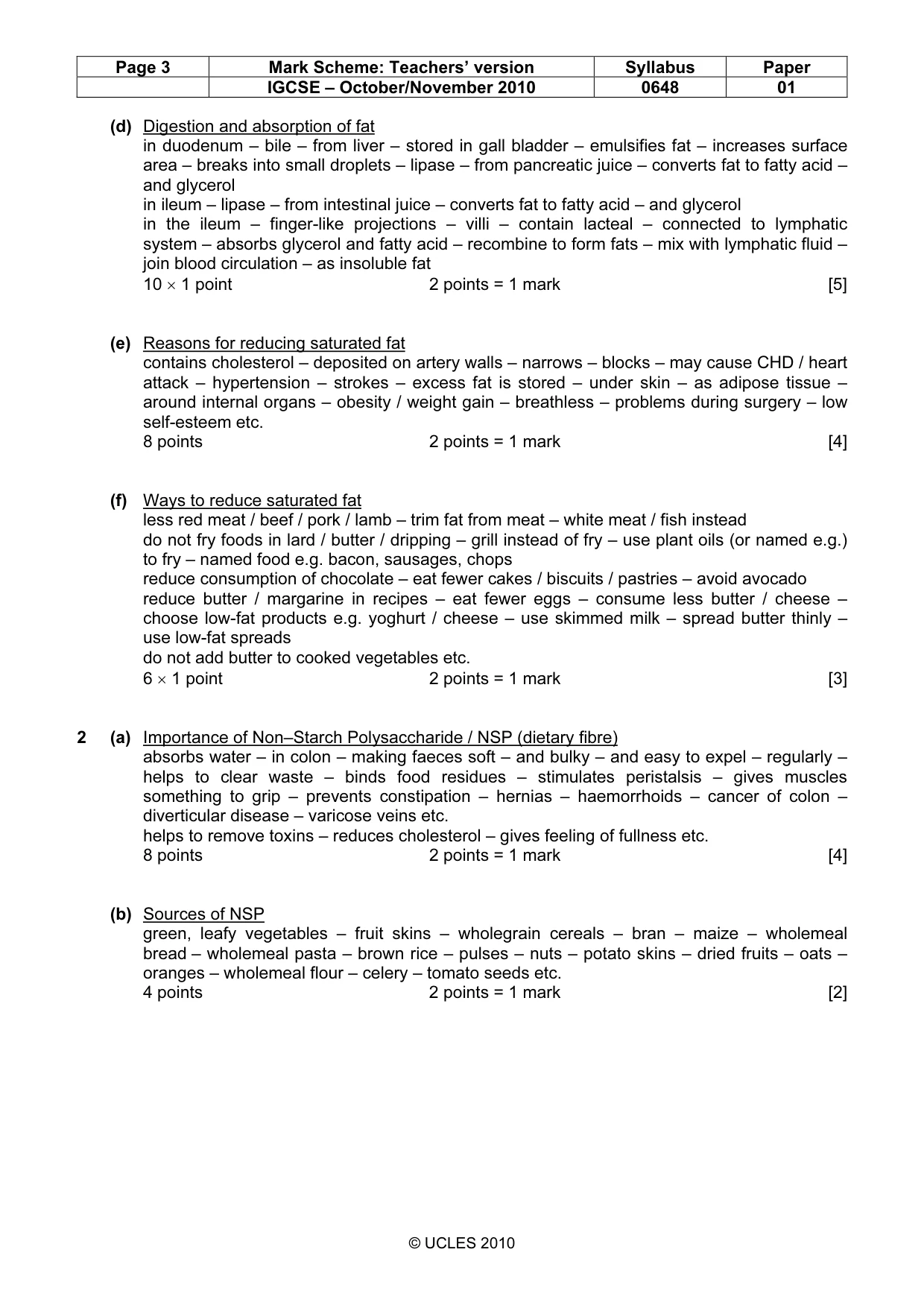
Page 3 Mark Scheme: Teachers’ version Syllabus Paper IGCSE – October/November 2010 0648 01 © UCLES 2010 (d) Digestion and absorption of fat in duodenum – bile – from liver – stored in gall bladder – emulsifies fat – increases surface area – breaks into small droplets – lipase – from pancreatic juice – converts fat to fatty acid – and glycerol in ileum – lipase – from intestinal juice – converts fat to fatty acid – and glycerol in the ileum – finger-like projections – villi – contain lacteal – connected to lymphatic system – absorbs glycerol and fatty acid – recombine to form fats – mix with lymphatic fluid – join blood circulation – as insoluble fat 10 × 1 point 2 points = 1 mark [5] (e) Reasons for reducing saturated fat contains cholesterol – deposited on artery walls – narrows – blocks – may cause CHD / heart attack – hypertension – strokes – excess fat is stored – under skin – as adipose tissue – around internal organs – obesity / weight gain – breathless – problems during surgery – low self-esteem etc. 8 points 2 points = 1 mark [4] (f) Ways to reduce saturated fat less red meat / beef / pork / lamb – trim fat from meat – white meat / fish instead do not fry foods in lard / butter / dripping – grill instead of fry – use plant oils (or named e.g.) to fry – named food e.g. bacon, sausages, chops reduce consumption of chocolate – eat fewer cakes / biscuits / pastries – avoid avocado reduce butter / margarine in recipes – eat fewer eggs – consume less butter / cheese – choose low-fat products e.g. yoghurt / cheese – use skimmed milk – spread butter thinly – use low-fat spreads do not add butter to cooked vegetables etc. 6 × 1 point 2 points = 1 mark [3] 2 (a) Importance of Non–Starch Polysaccharide / NSP (dietary fibre) absorbs water – in colon – making faeces soft – and bulky – and easy to expel – regularly – helps to clear waste – binds food residues – stimulates peristalsis – gives muscles something to grip – prevents constipation – hernias – haemorrhoids – cancer of colon – diverticular disease – varicose veins etc. helps to remove toxins – reduces cholesterol – gives feeling of fullness etc. 8 points 2 points = 1 mark [4] (b) Sources of NSP green, leafy vegetables – fruit skins – wholegrain cereals – bran – maize – wholemeal bread – wholemeal pasta – brown rice – pulses – nuts – potato skins – dried fruits – oats – oranges – wholemeal flour – celery – tomato seeds etc. 4 points 2 points = 1 mark [2]
Mark scheme, page 4
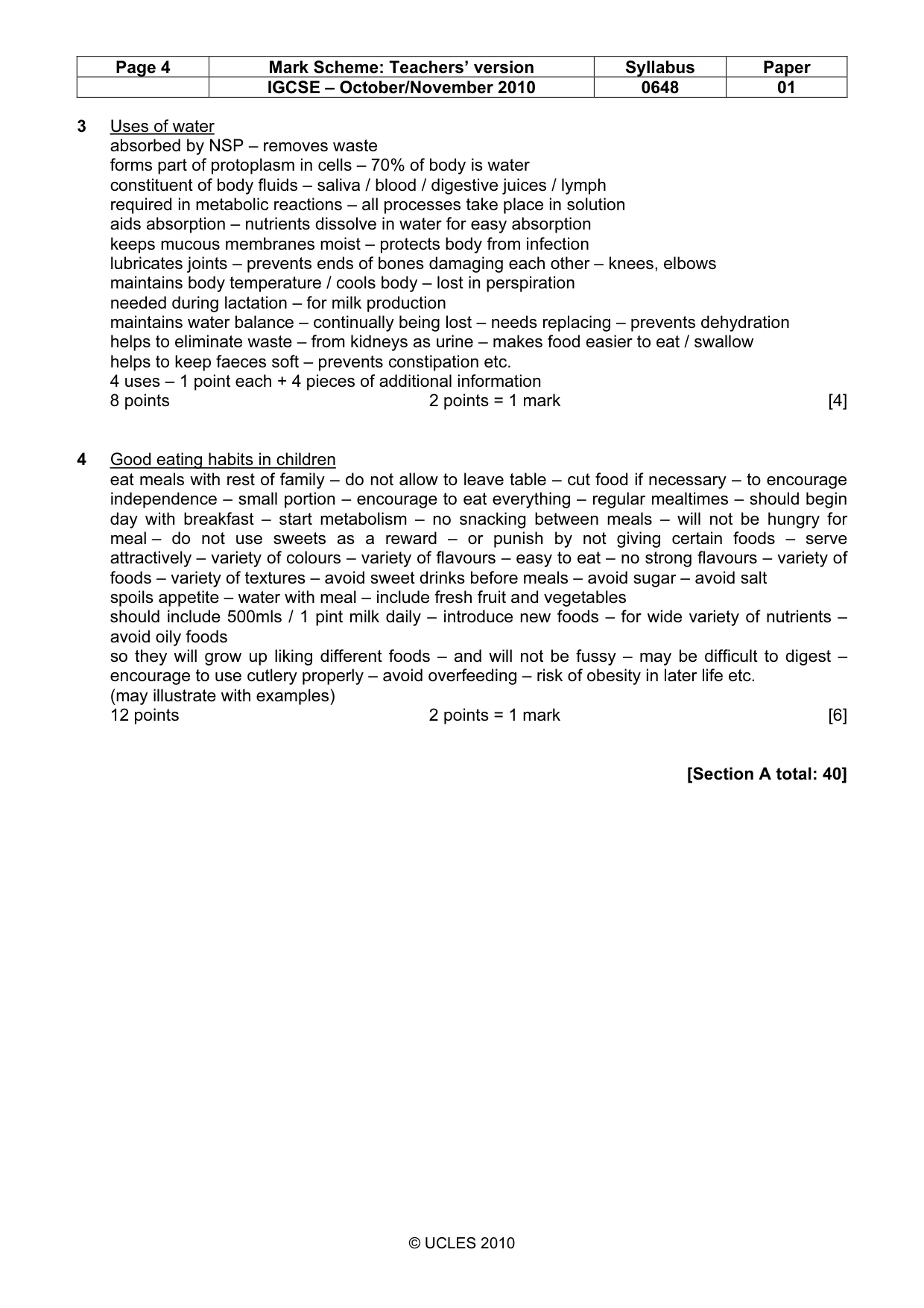
Page 4 Mark Scheme: Teachers’ version Syllabus Paper IGCSE – October/November 2010 0648 01 © UCLES 2010 3 Uses of water absorbed by NSP – removes waste forms part of protoplasm in cells – 70% of body is water constituent of body fluids – saliva / blood / digestive juices / lymph required in metabolic reactions – all processes take place in solution aids absorption – nutrients dissolve in water for easy absorption keeps mucous membranes moist – protects body from infection lubricates joints – prevents ends of bones damaging each other – knees, elbows maintains body temperature / cools body – lost in perspiration needed during lactation – for milk production maintains water balance – continually being lost – needs replacing – prevents dehydration helps to eliminate waste – from kidneys as urine – makes food easier to eat / swallow helps to keep faeces soft – prevents constipation etc. 4 uses – 1 point each + 4 pieces of additional information 8 points 2 points = 1 mark [4] 4 Good eating habits in children eat meals with rest of family – do not allow to leave table – cut food if necessary – to encourage independence – small portion – encourage to eat everything – regular mealtimes – should begin day with breakfast – start metabolism – no snacking between meals – will not be hungry for meal – do not use sweets as a reward – or punish by not giving certain foods – serve attractively – variety of colours – variety of flavours – easy to eat – no strong flavours – variety of foods – variety of textures – avoid sweet drinks before meals – avoid sugar – avoid salt spoils appetite – water with meal – include fresh fruit and vegetables should include 500mls / 1 pint milk daily – introduce new foods – for wide variety of nutrients – avoid oily foods so they will grow up liking different foods – and will not be fussy – may be difficult to digest – encourage to use cutlery properly – avoid overfeeding – risk of obesity in later life etc. (may illustrate with examples) 12 points 2 points = 1 mark [6] [Section A total: 40]
Mark scheme, page 5
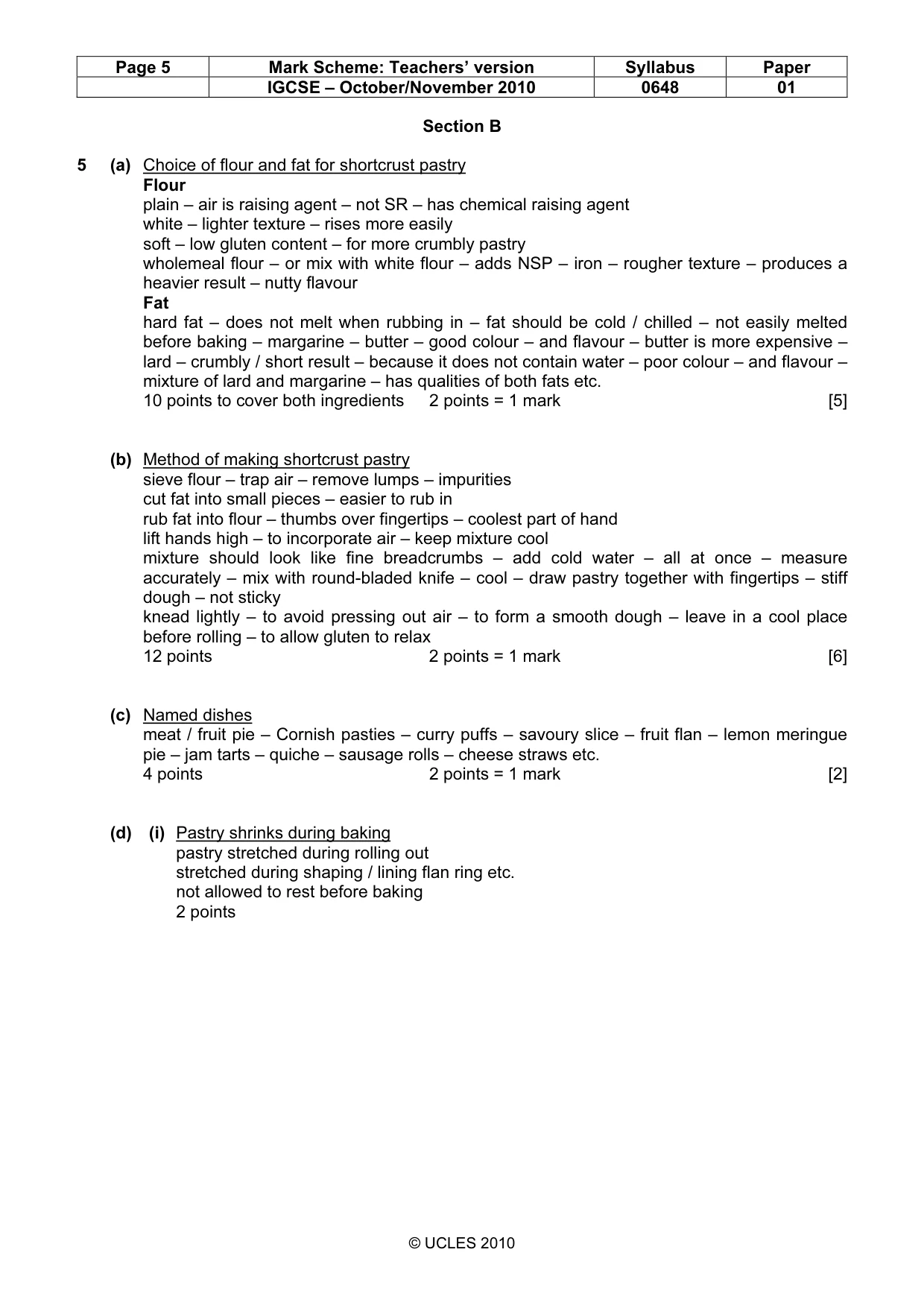
Page 5 Mark Scheme: Teachers’ version Syllabus Paper IGCSE – October/November 2010 0648 01 © UCLES 2010 Section B 5 (a) Choice of flour and fat for shortcrust pastry Flour plain – air is raising agent – not SR – has chemical raising agent white – lighter texture – rises more easily soft – low gluten content – for more crumbly pastry wholemeal flour – or mix with white flour – adds NSP – iron – rougher texture – produces a heavier result – nutty flavour Fat hard fat – does not melt when rubbing in – fat should be cold / chilled – not easily melted before baking – margarine – butter – good colour – and flavour – butter is more expensive – lard – crumbly / short result – because it does not contain water – poor colour – and flavour – mixture of lard and margarine – has qualities of both fats etc. 10 points to cover both ingredients 2 points = 1 mark [5] (b) Method of making shortcrust pastry sieve flour – trap air – remove lumps – impurities cut fat into small pieces – easier to rub in rub fat into flour – thumbs over fingertips – coolest part of hand lift hands high – to incorporate air – keep mixture cool mixture should look like fine breadcrumbs – add cold water – all at once – measure accurately – mix with round-bladed knife – cool – draw pastry together with fingertips – stiff dough – not sticky knead lightly – to avoid pressing out air – to form a smooth dough – leave in a cool place before rolling – to allow gluten to relax 12 points 2 points = 1 mark [6] (c) Named dishes meat / fruit pie – Cornish pasties – curry puffs – savoury slice – fruit flan – lemon meringue pie – jam tarts – quiche – sausage rolls – cheese straws etc. 4 points 2 points = 1 mark [2] (d) (i) Pastry shrinks during baking pastry stretched during rolling out stretched during shaping / lining flan ring etc. not allowed to rest before baking 2 points
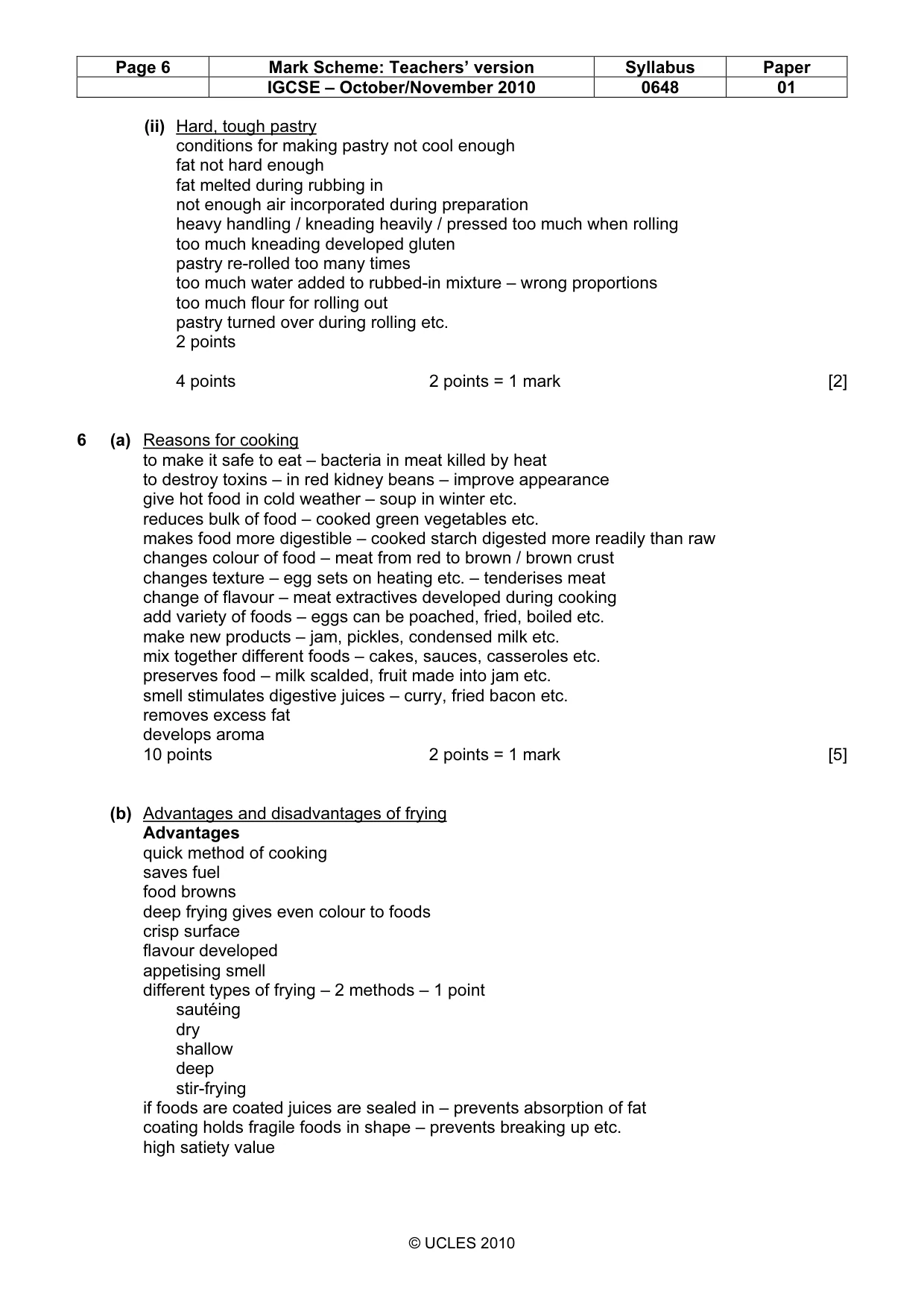
Mark scheme, page 6
Page 6 Mark Scheme: Teachers’ version Syllabus Paper IGCSE – October/November 2010 0648 01 © UCLES 2010 (ii) Hard, tough pastry conditions for making pastry not cool enough fat not hard enough fat melted during rubbing in not enough air incorporated during preparation heavy handling / kneading heavily / pressed too much when rolling too much kneading developed gluten pastry re-rolled too many times too much water added to rubbed-in mixture – wrong proportions too much flour for rolling out pastry turned over during rolling etc. 2 points 4 points 2 points = 1 mark [2] 6 (a) Reasons for cooking to make it safe to eat – bacteria in meat killed by heat to destroy toxins – in red kidney beans – improve appearance give hot food in cold weather – soup in winter etc. reduces bulk of food – cooked green vegetables etc. makes food more digestible – cooked starch digested more readily than raw changes colour of food – meat from red to brown / brown crust changes texture – egg sets on heating etc. – tenderises meat change of flavour – meat extractives developed during cooking add variety of foods – eggs can be poached, fried, boiled etc. make new products – jam, pickles, condensed milk etc. mix together different foods – cakes, sauces, casseroles etc. preserves food – milk scalded, fruit made into jam etc. smell stimulates digestive juices – curry, fried bacon etc. removes excess fat develops aroma 10 points 2 points = 1 mark [5] (b) Advantages and disadvantages of frying Advantages quick method of cooking saves fuel food browns deep frying gives even colour to foods crisp surface flavour developed appetising smell different types of frying – 2 methods – 1 point sautéing dry shallow deep stir-frying if foods are coated juices are sealed in – prevents absorption of fat coating holds fragile foods in shape – prevents breaking up etc. high satiety value
Mark scheme, page 7
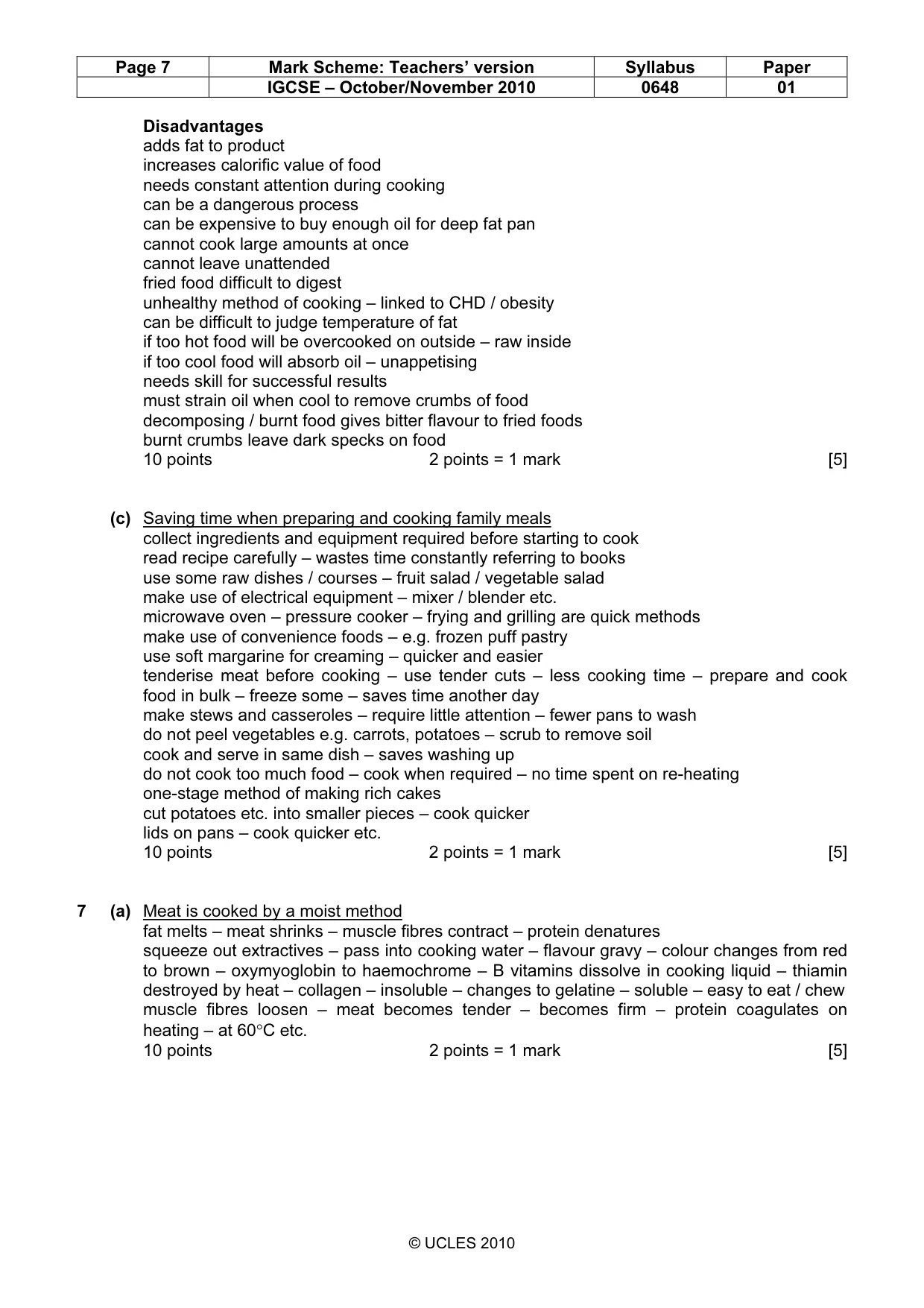
Page 7 Mark Scheme: Teachers’ version Syllabus Paper IGCSE – October/November 2010 0648 01 © UCLES 2010 Disadvantages adds fat to product increases calorific value of food needs constant attention during cooking can be a dangerous process can be expensive to buy enough oil for deep fat pan cannot cook large amounts at once cannot leave unattended fried food difficult to digest unhealthy method of cooking – linked to CHD / obesity can be difficult to judge temperature of fat if too hot food will be overcooked on outside – raw inside if too cool food will absorb oil – unappetising needs skill for successful results must strain oil when cool to remove crumbs of food decomposing / burnt food gives bitter flavour to fried foods burnt crumbs leave dark specks on food 10 points 2 points = 1 mark [5] (c) Saving time when preparing and cooking family meals collect ingredients and equipment required before starting to cook read recipe carefully – wastes time constantly referring to books use some raw dishes / courses – fruit salad / vegetable salad make use of electrical equipment – mixer / blender etc. microwave oven – pressure cooker – frying and grilling are quick methods make use of convenience foods – e.g. frozen puff pastry use soft margarine for creaming – quicker and easier tenderise meat before cooking – use tender cuts – less cooking time – prepare and cook food in bulk – freeze some – saves time another day make stews and casseroles – require little attention – fewer pans to wash do not peel vegetables e.g. carrots, potatoes – scrub to remove soil cook and serve in same dish – saves washing up do not cook too much food – cook when required – no time spent on re-heating one-stage method of making rich cakes cut potatoes etc. into smaller pieces – cook quicker lids on pans – cook quicker etc. 10 points 2 points = 1 mark [5] 7 (a) Meat is cooked by a moist method fat melts – meat shrinks – muscle fibres contract – protein denatures squeeze out extractives – pass into cooking water – flavour gravy – colour changes from red to brown – oxymyoglobin to haemochrome – B vitamins dissolve in cooking liquid – thiamin destroyed by heat – collagen – insoluble – changes to gelatine – soluble – easy to eat / chew muscle fibres loosen – meat becomes tender – becomes firm – protein coagulates on heating – at 60°C etc. 10 points 2 points = 1 mark [5]
Mark scheme, page 8
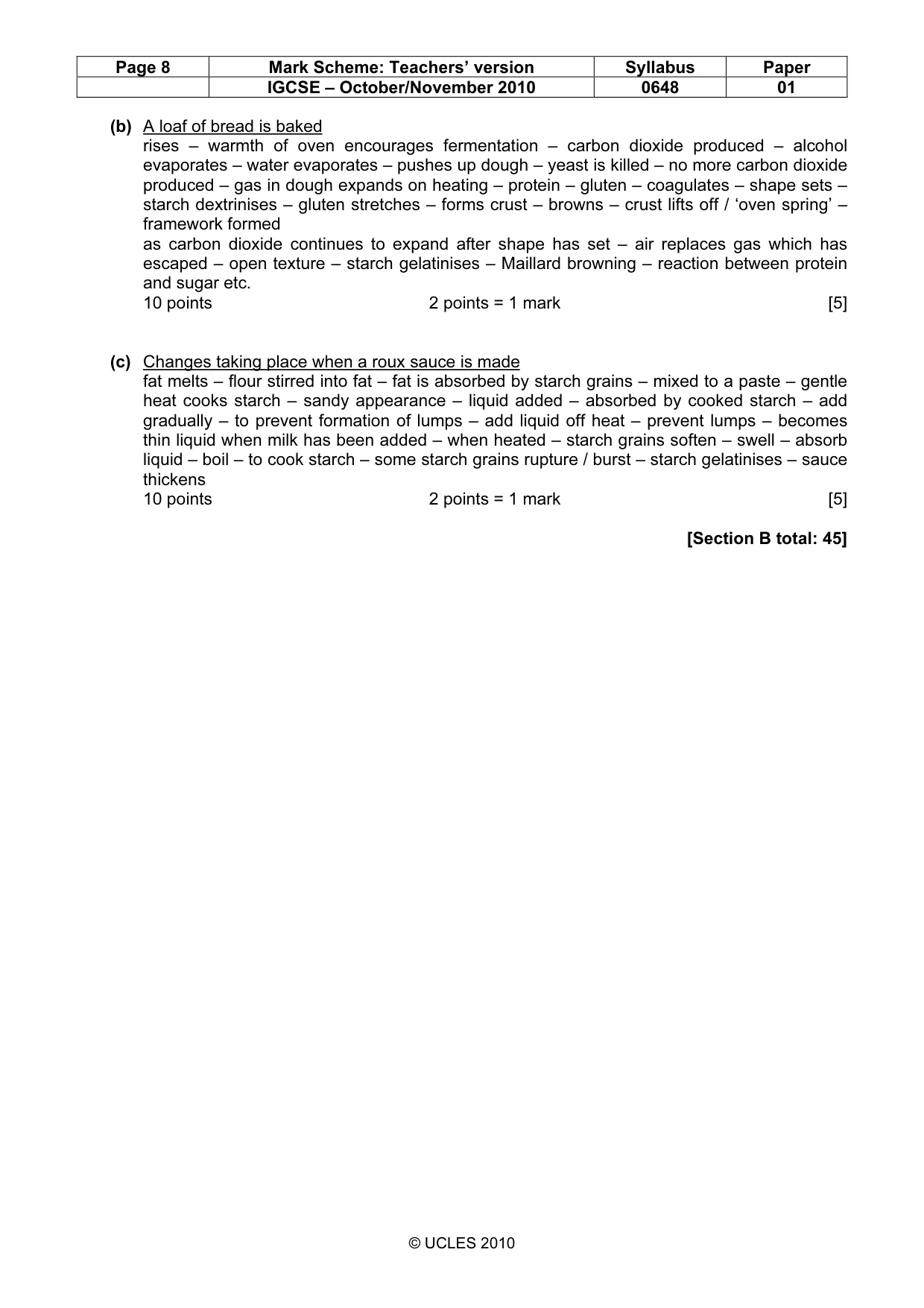
Page 8 Mark Scheme: Teachers’ version Syllabus Paper IGCSE – October/November 2010 0648 01 © UCLES 2010 (b) A loaf of bread is baked rises – warmth of oven encourages fermentation – carbon dioxide produced – alcohol evaporates – water evaporates – pushes up dough – yeast is killed – no more carbon dioxide produced – gas in dough expands on heating – protein – gluten – coagulates – shape sets – starch dextrinises – gluten stretches – forms crust – browns – crust lifts off / ‘oven spring’ – framework formed as carbon dioxide continues to expand after shape has set – air replaces gas which has escaped – open texture – starch gelatinises – Maillard browning – reaction between protein and sugar etc. 10 points 2 points = 1 mark [5] (c) Changes taking place when a roux sauce is made fat melts – flour stirred into fat – fat is absorbed by starch grains – mixed to a paste – gentle heat cooks starch – sandy appearance – liquid added – absorbed by cooked starch – add gradually – to prevent formation of lumps – add liquid off heat – prevent lumps – becomes thin liquid when milk has been added – when heated – starch grains soften – swell – absorb liquid – boil – to cook starch – some starch grains rupture / burst – starch gelatinises – sauce thickens 10 points 2 points = 1 mark [5] [Section B total: 45]
Mark scheme, page 9
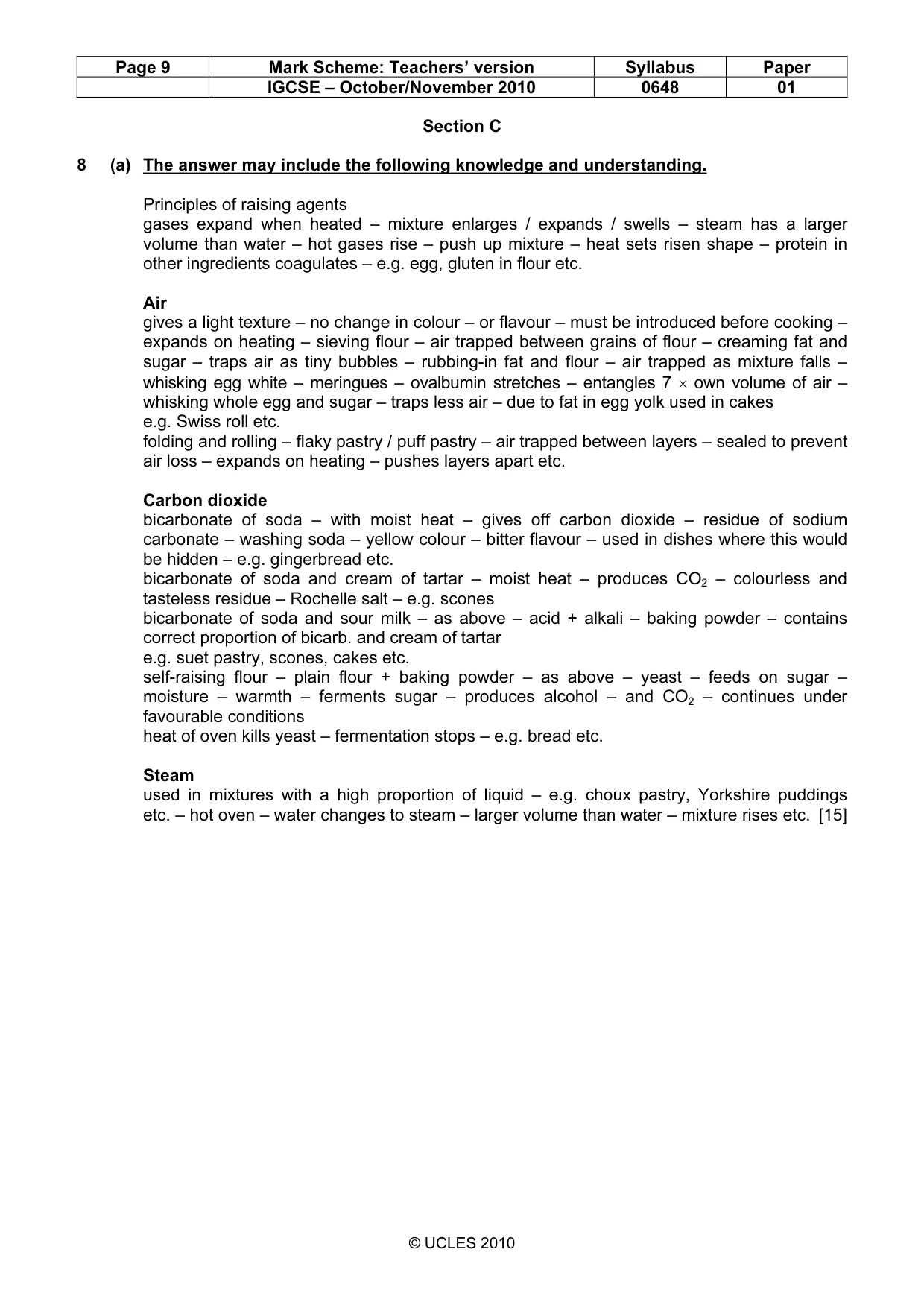
Page 9 Mark Scheme: Teachers’ version Syllabus Paper IGCSE – October/November 2010 0648 01 © UCLES 2010 Section C 8 (a) The answer may include the following knowledge and understanding. Principles of raising agents gases expand when heated – mixture enlarges / expands / swells – steam has a larger volume than water – hot gases rise – push up mixture – heat sets risen shape – protein in other ingredients coagulates – e.g. egg, gluten in flour etc. Air gives a light texture – no change in colour – or flavour – must be introduced before cooking – expands on heating – sieving flour – air trapped between grains of flour – creaming fat and sugar – traps air as tiny bubbles – rubbing-in fat and flour – air trapped as mixture falls – whisking egg white – meringues – ovalbumin stretches – entangles 7 × own volume of air – whisking whole egg and sugar – traps less air – due to fat in egg yolk used in cakes e.g. Swiss roll etc. folding and rolling – flaky pastry / puff pastry – air trapped between layers – sealed to prevent air loss – expands on heating – pushes layers apart etc. Carbon dioxide bicarbonate of soda – with moist heat – gives off carbon dioxide – residue of sodium carbonate – washing soda – yellow colour – bitter flavour – used in dishes where this would be hidden – e.g. gingerbread etc. bicarbonate of soda and cream of tartar – moist heat – produces CO2 – colourless and tasteless residue – Rochelle salt – e.g. scones bicarbonate of soda and sour milk – as above – acid + alkali – baking powder – contains correct proportion of bicarb. and cream of tartar e.g. suet pastry, scones, cakes etc. self-raising flour – plain flour + baking powder – as above – yeast – feeds on sugar – moisture – warmth – ferments sugar – produces alcohol – and CO2 – continues under favourable conditions heat of oven kills yeast – fermentation stops – e.g. bread etc. Steam used in mixtures with a high proportion of liquid – e.g. choux pastry, Yorkshire puddings etc. – hot oven – water changes to steam – larger volume than water – mixture rises etc. [15]
Mark scheme, page 10
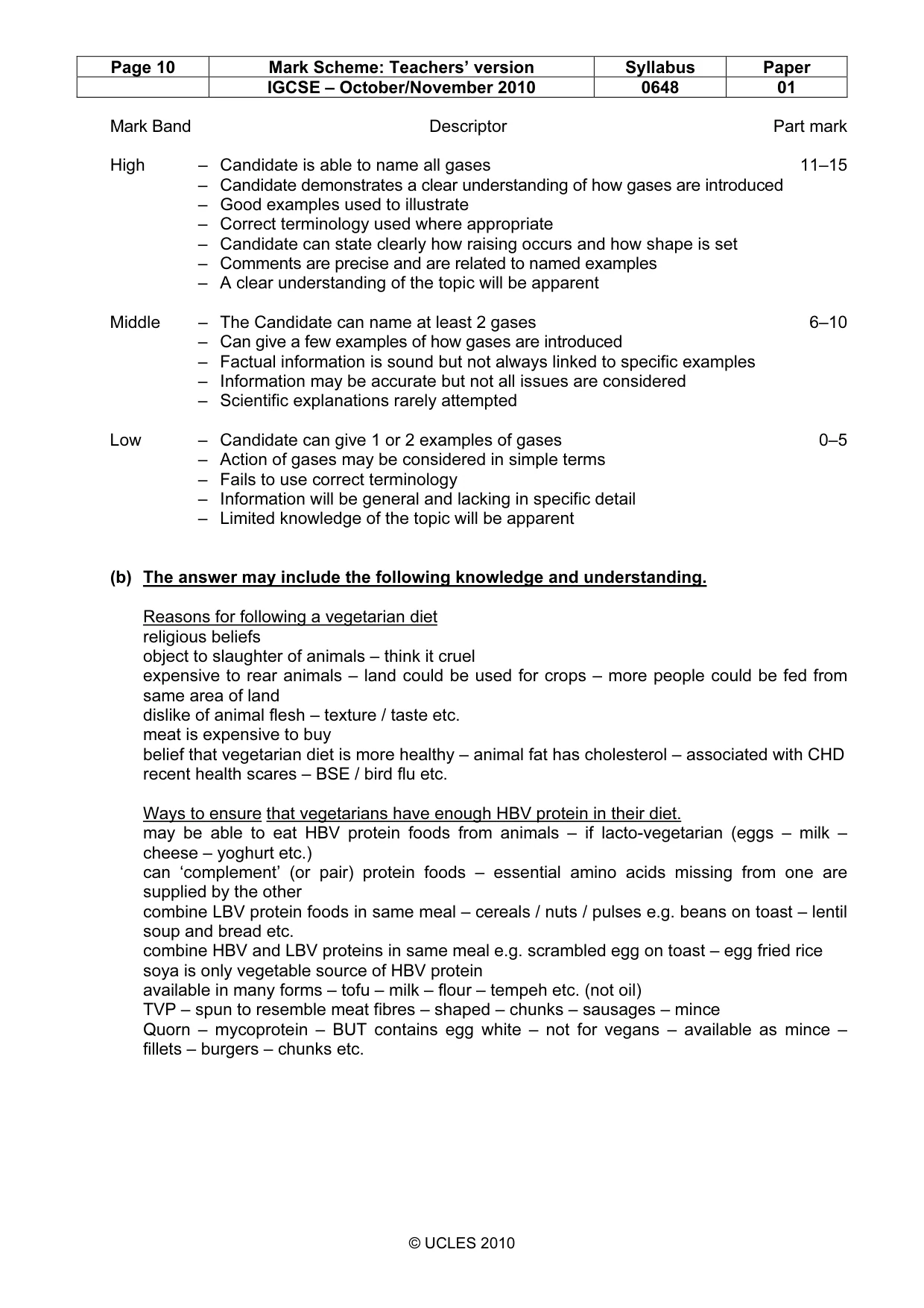
Page 10 Mark Scheme: Teachers’ version Syllabus Paper IGCSE – October/November 2010 0648 01 © UCLES 2010 Mark Band Descriptor Part mark High – Candidate is able to name all gases 11–15 – Candidate demonstrates a clear understanding of how gases are introduced – Good examples used to illustrate – Correct terminology used where appropriate – Candidate can state clearly how raising occurs and how shape is set – Comments are precise and are related to named examples – A clear understanding of the topic will be apparent Middle – The Candidate can name at least 2 gases 6–10 – Can give a few examples of how gases are introduced – Factual information is sound but not always linked to specific examples – Information may be accurate but not all issues are considered – Scientific explanations rarely attempted Low – Candidate can give 1 or 2 examples of gases 0–5 – Action of gases may be considered in simple terms – Fails to use correct terminology – Information will be general and lacking in specific detail – Limited knowledge of the topic will be apparent (b) The answer may include the following knowledge and understanding. Reasons for following a vegetarian diet religious beliefs object to slaughter of animals – think it cruel expensive to rear animals – land could be used for crops – more people could be fed from same area of land dislike of animal flesh – texture / taste etc. meat is expensive to buy belief that vegetarian diet is more healthy – animal fat has cholesterol – associated with CHD recent health scares – BSE / bird flu etc. Ways to ensure that vegetarians have enough HBV protein in their diet. may be able to eat HBV protein foods from animals – if lacto-vegetarian (eggs – milk – cheese – yoghurt etc.) can ‘complement’ (or pair) protein foods – essential amino acids missing from one are supplied by the other combine LBV protein foods in same meal – cereals / nuts / pulses e.g. beans on toast – lentil soup and bread etc. combine HBV and LBV proteins in same meal e.g. scrambled egg on toast – egg fried rice soya is only vegetable source of HBV protein available in many forms – tofu – milk – flour – tempeh etc. (not oil) TVP – spun to resemble meat fibres – shaped – chunks – sausages – mince Quorn – mycoprotein – BUT contains egg white – not for vegans – available as mince – fillets – burgers – chunks etc.
Mark scheme, page 11
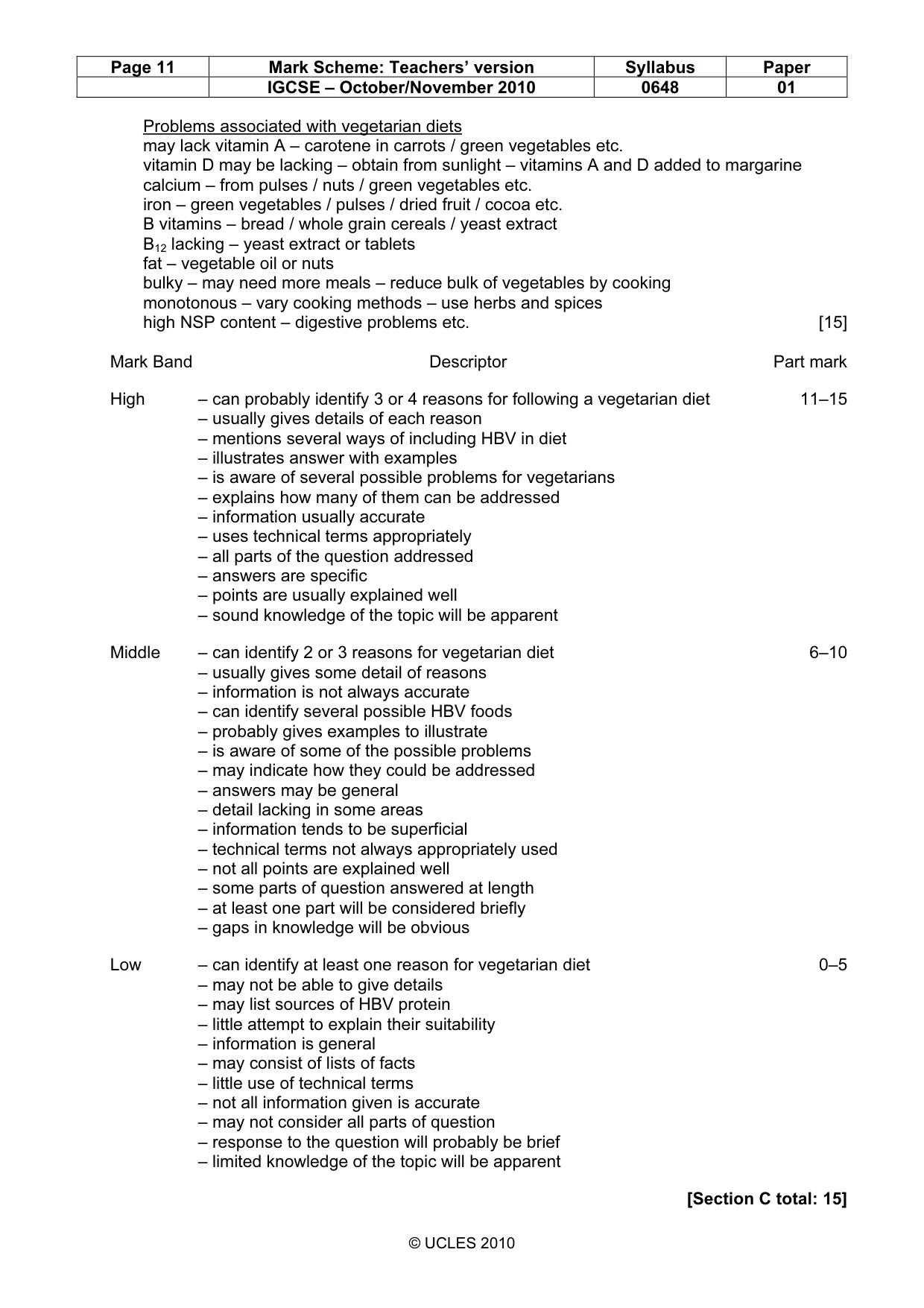
Page 11 Mark Scheme: Teachers’ version Syllabus Paper IGCSE – October/November 2010 0648 01 © UCLES 2010 Problems associated with vegetarian diets may lack vitamin A – carotene in carrots / green vegetables etc. vitamin D may be lacking – obtain from sunlight – vitamins A and D added to margarine calcium – from pulses / nuts / green vegetables etc. iron – green vegetables / pulses / dried fruit / cocoa etc. B vitamins – bread / whole grain cereals / yeast extract B12 lacking – yeast extract or tablets fat – vegetable oil or nuts bulky – may need more meals – reduce bulk of vegetables by cooking monotonous – vary cooking methods – use herbs and spices high NSP content – digestive problems etc. [15] Mark Band Descriptor Part mark High – can probably identify 3 or 4 reasons for following a vegetarian diet 11–15 – usually gives details of each reason – mentions several ways of including HBV in diet – illustrates answer with examples – is aware of several possible problems for vegetarians – explains how many of them can be addressed – information usually accurate – uses technical terms appropriately – all parts of the question addressed – answers are specific – points are usually explained well – sound knowledge of the topic will be apparent Middle – can identify 2 or 3 reasons for vegetarian diet 6–10 – usually gives some detail of reasons – information is not always accurate – can identify several possible HBV foods – probably gives examples to illustrate – is aware of some of the possible problems – may indicate how they could be addressed – answers may be general – detail lacking in some areas – information tends to be superficial – technical terms not always appropriately used – not all points are explained well – some parts of question answered at length – at least one part will be considered briefly – gaps in knowledge will be obvious Low – can identify at least one reason for vegetarian diet 0–5 – may not be able to give details – may list sources of HBV protein – little attempt to explain their suitability – information is general – may consist of lists of facts – little use of technical terms – not all information given is accurate – may not consider all parts of question – response to the question will probably be brief – limited knowledge of the topic will be apparent [Section C total: 15]
What you needed in this session
Cambridge’s own grade thresholds for 2010 Oct/Nov, Paper 1 · Variant 1. A higher threshold means an easier paper — the bar moves with how the cohort did.