Cambridge IGCSE Food and Nutrition 0648 — 2010 May/June Paper 1 · Variant 1
0648/11/M/J/10 · 100 marks · ≈113 min
The question paper and its mark scheme, free to read here and free to download. This is Cambridge’s own paper, exactly as it was sat.
Question paper16 pages

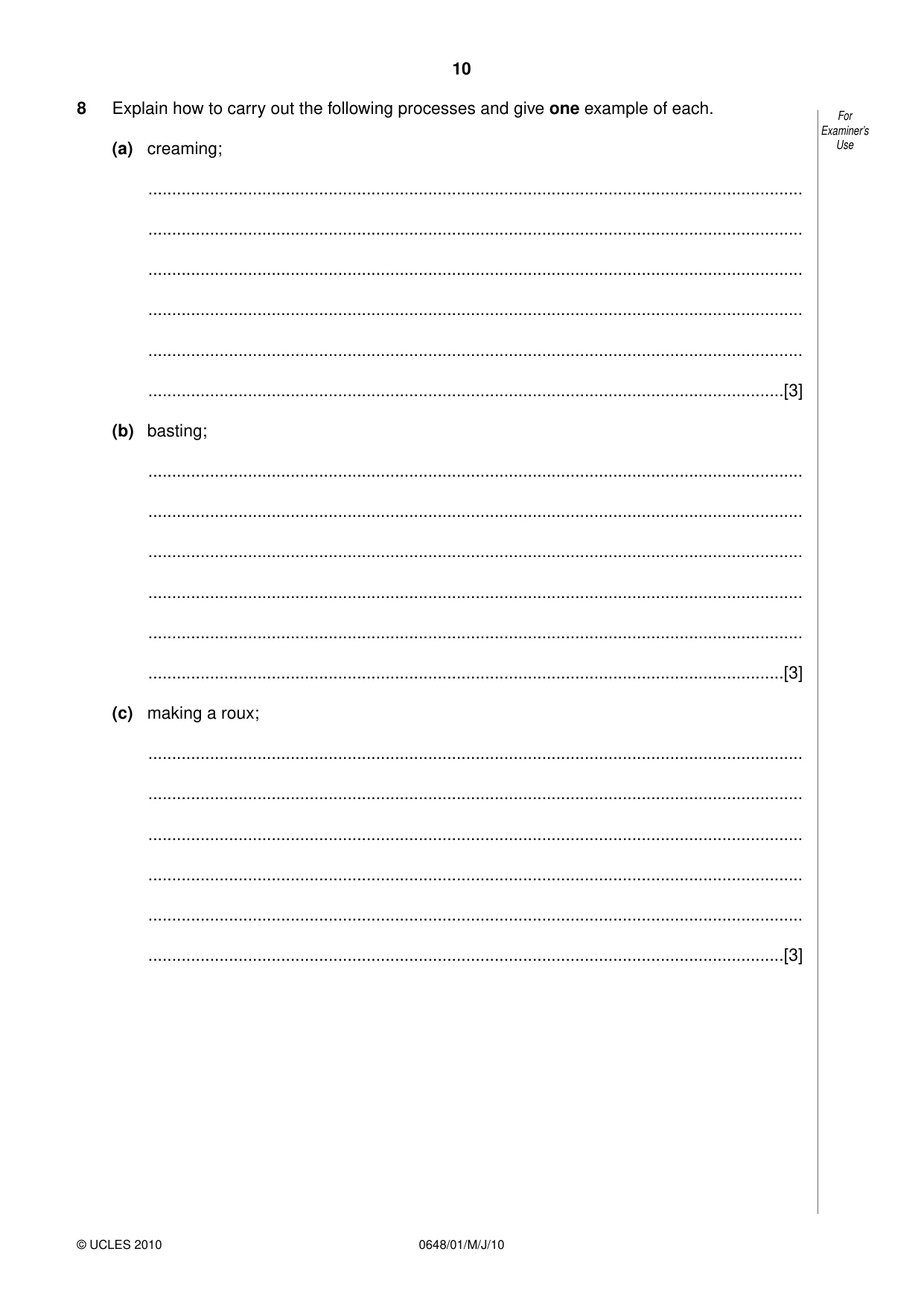
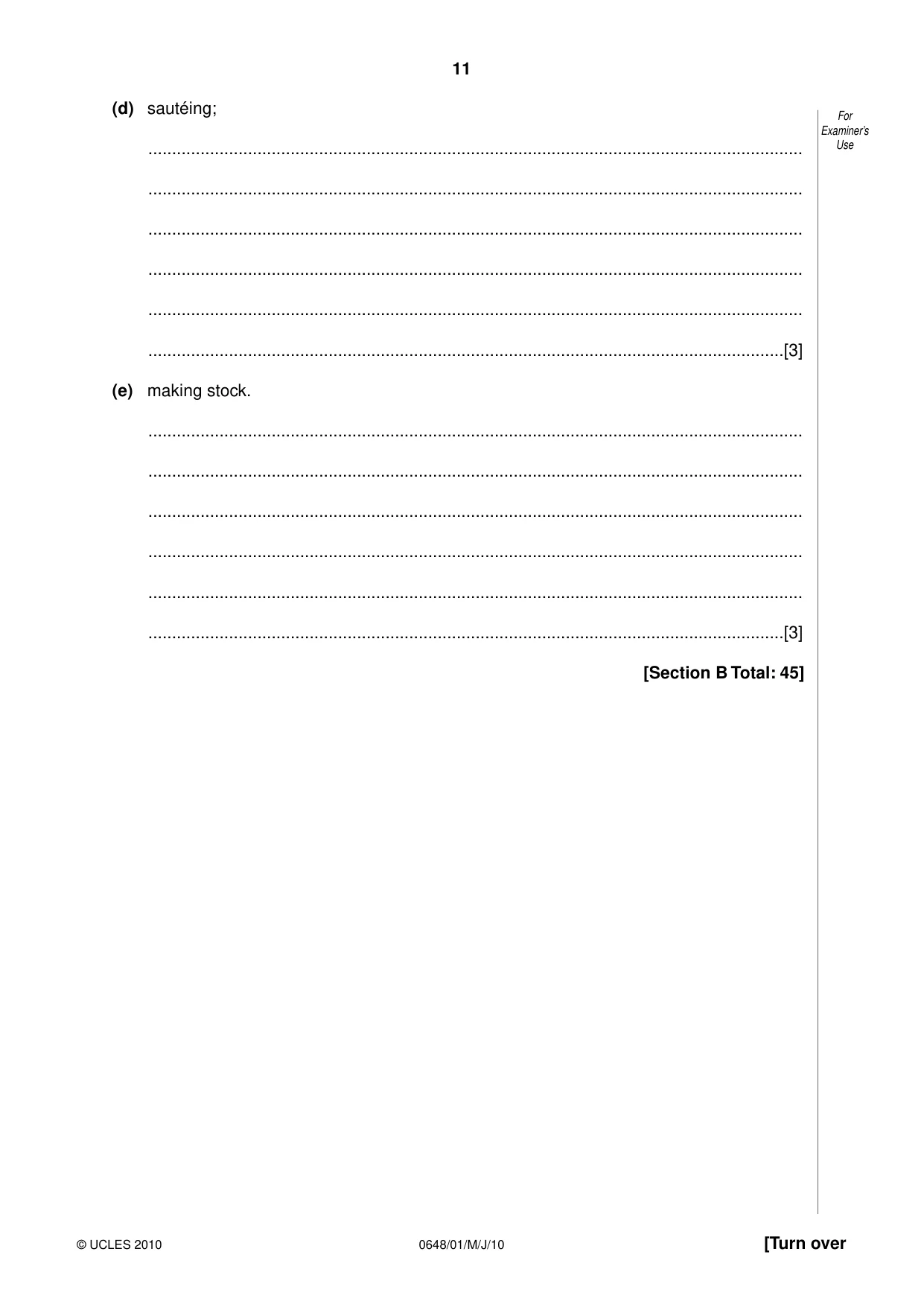
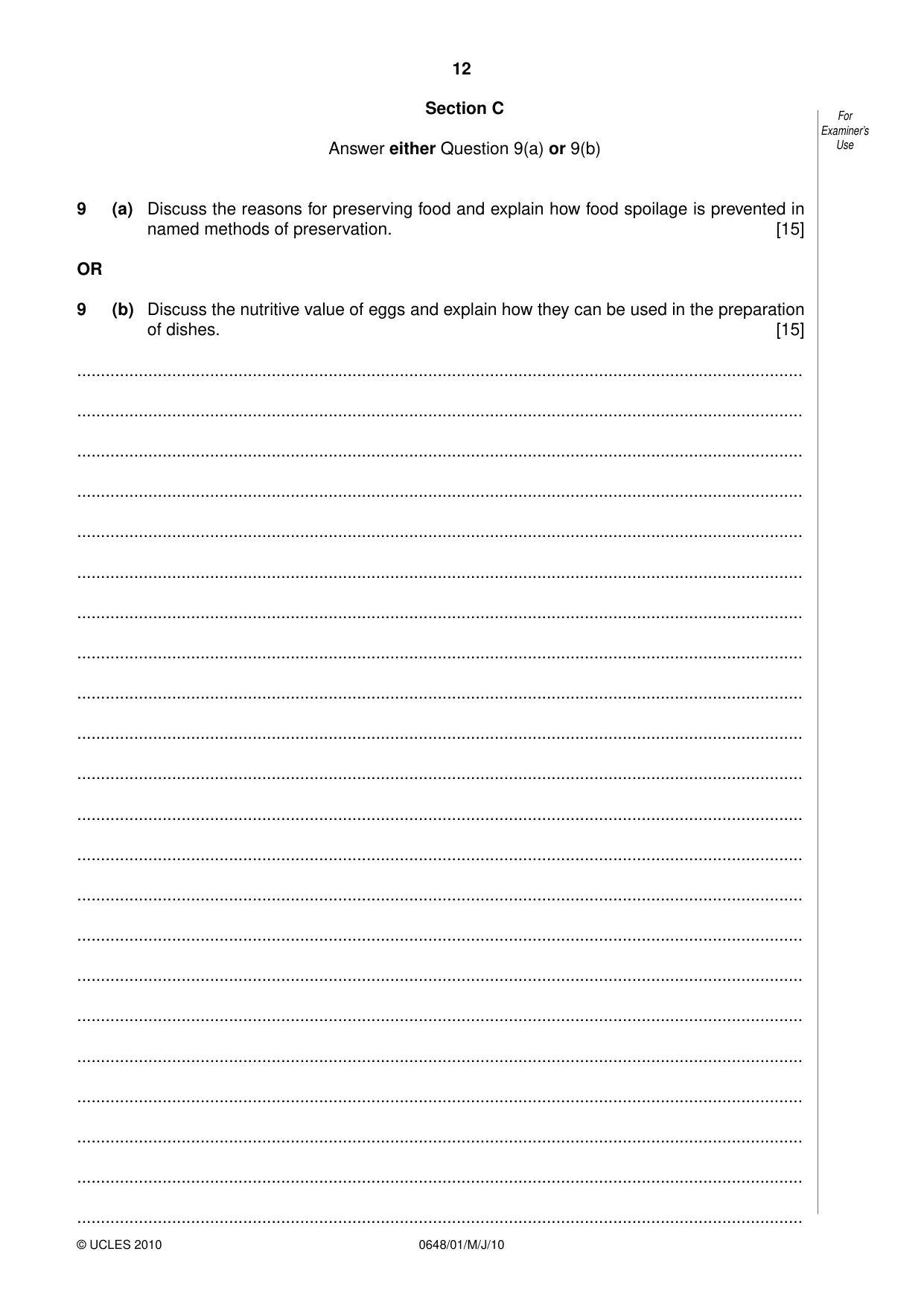




Mark scheme12 pages
Answers below. Sit the paper first if you are practising.
Paper as text
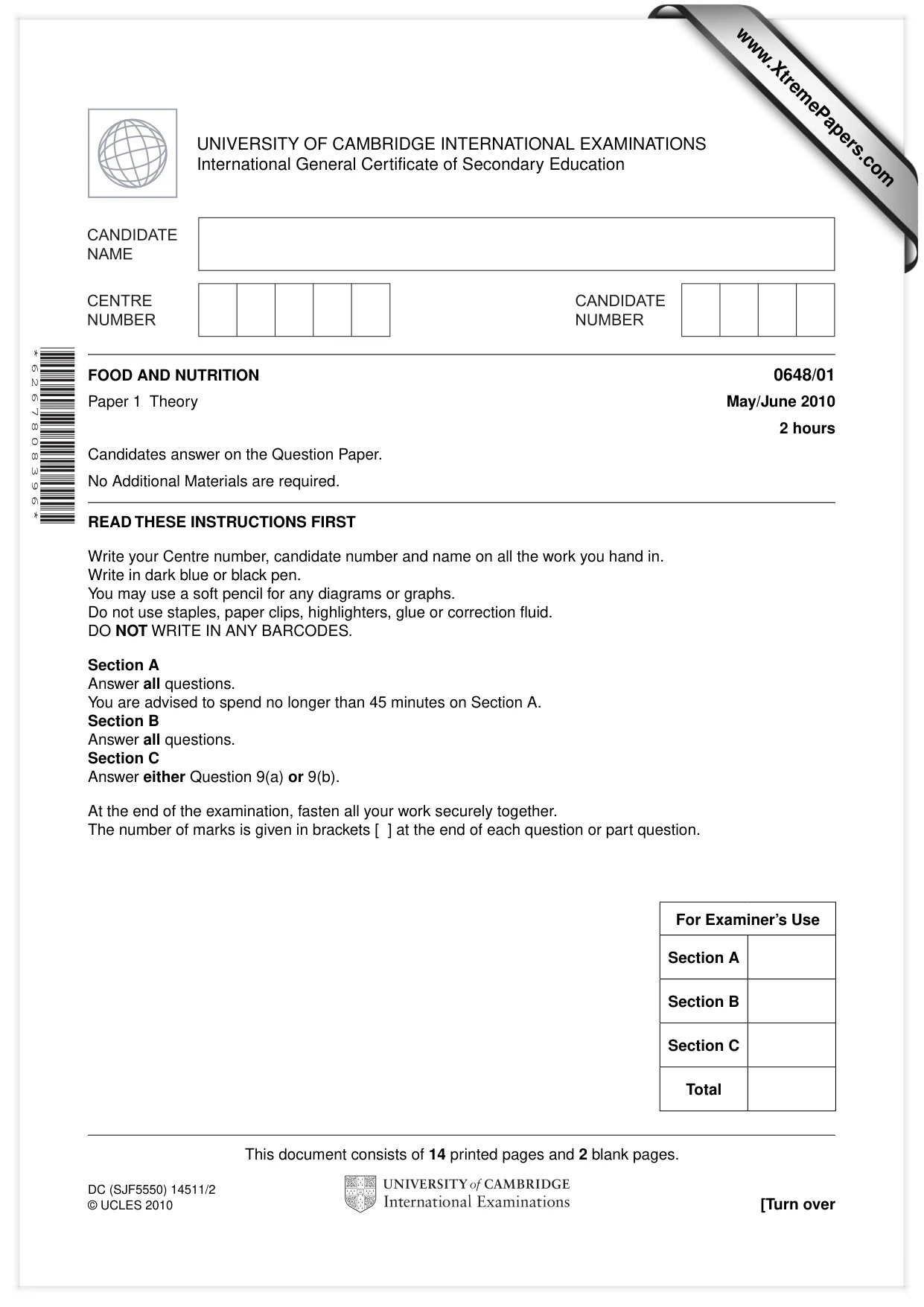
Question paper, page 1
This document consists of 14 printed pages and 2 blank pages. DC (SJF5550) 14511/2 © UCLES 2010 [Turn over UNIVERSITY OF CAMBRIDGE INTERNATIONAL EXAMINATIONS International General Certificate of Secondary Education READ THESE INSTRUCTIONS FIRST Write your Centre number, candidate number and name on all the work you hand in. Write in dark blue or black pen. You may use a soft pencil for any diagrams or graphs. Do not use staples, paper clips, highlighters, glue or correction fluid. DO NOT WRITE IN ANY BARCODES. Section A Answer all questions. You are advised to spend no longer than 45 minutes on Section A. Section B Answer all questions. Section C Answer either Question 9(a) or 9(b). At the end of the examination, fasten all your work securely together. The number of marks is given in brackets [ ] at the end of each question or part question. * 6 2 6 7 8 0 8 3 9 6 * FOOD AND NUTRITION 0648/01 Paper 1 Theory May/June 2010 2 hours Candidates answer on the Question Paper. No Additional Materials are required. For Examiner’s Use Section A Section B Section C Total www.XtremePapers.com
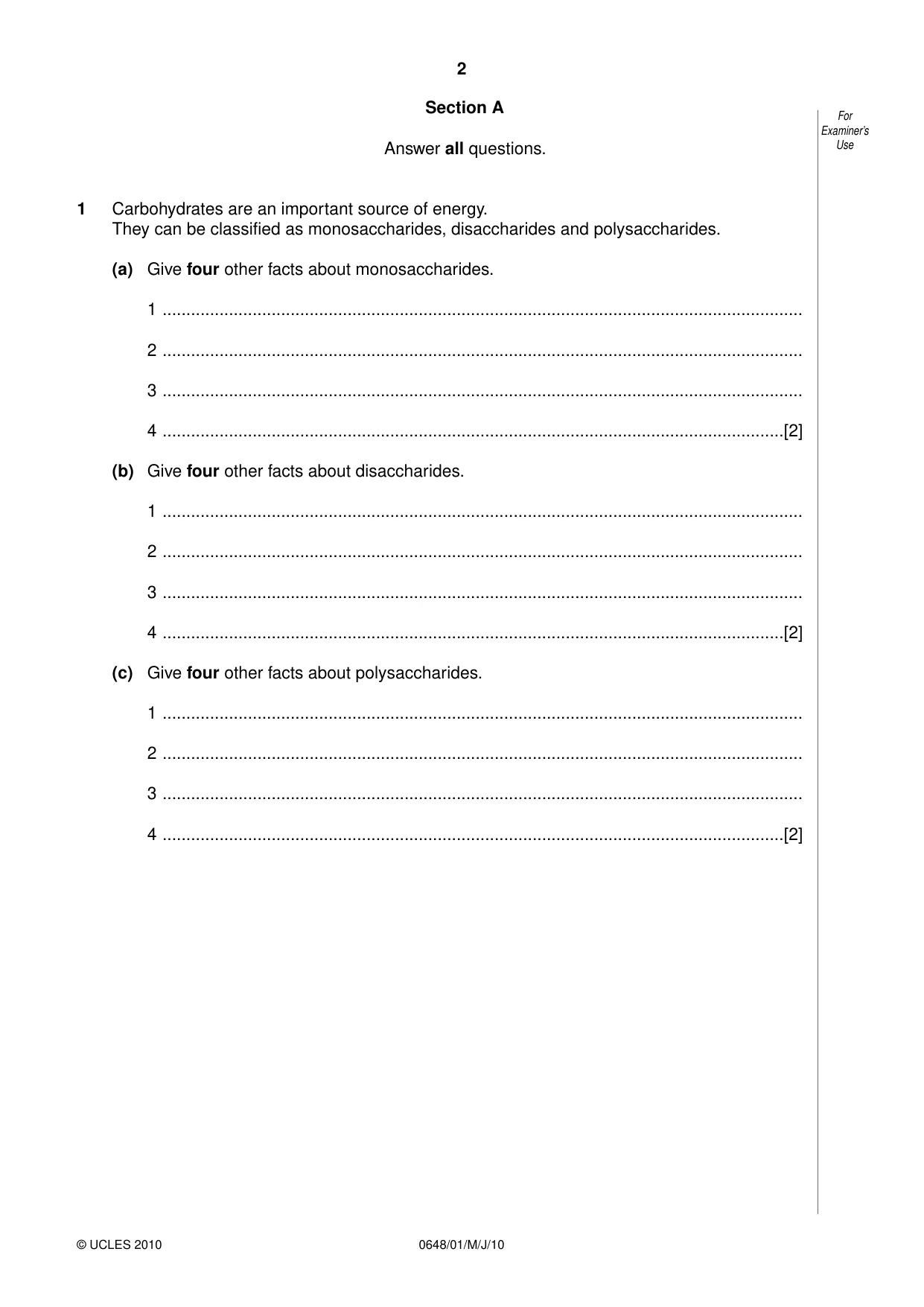
Question paper, page 2
2 0648/01/M/J/10 © UCLES 2010 For Examiner’s Use Section A Answer all questions. 1 Carbohydrates are an important source of energy. They can be classified as monosaccharides, disaccharides and polysaccharides. (a) Give four other facts about monosaccharides. 1 … 2 … 3 … 4 …[2] (b) Give four other facts about disaccharides. 1 … 2 … 3 … 4 …[2] (c) Give four other facts about polysaccharides. 1 … 2 … 3 … 4 …[2]
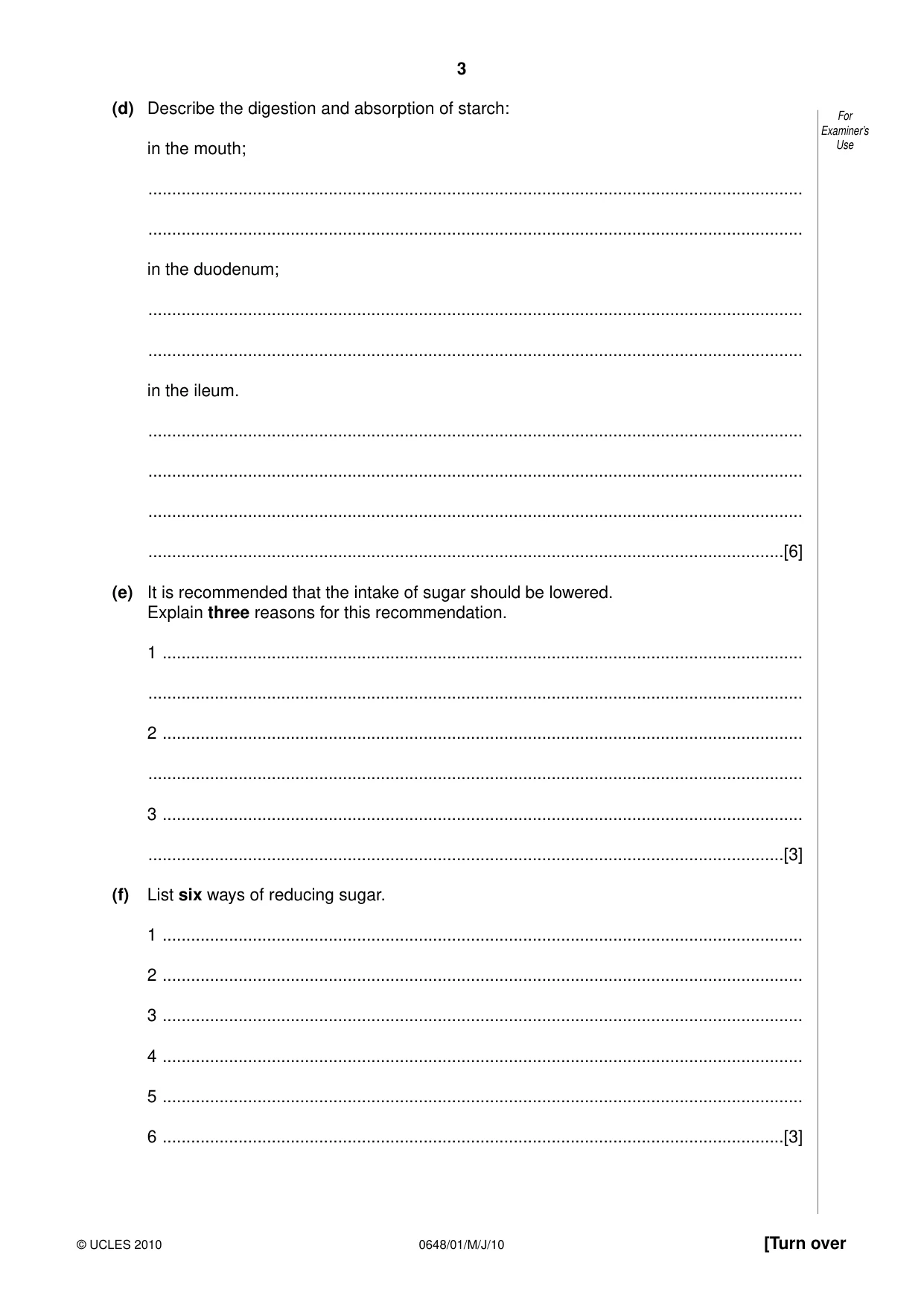
Question paper, page 3
3 0648/01/M/J/10 © UCLES 2010 [Turn over For Examiner’s Use (d) Describe the digestion and absorption of starch: in the mouth; … … in the duodenum; … … in the ileum. … … … …[6] (e) It is recommended that the intake of sugar should be lowered. Explain three reasons for this recommendation. 1 … … 2 … … 3 … …[3] (f) List six ways of reducing sugar. 1 … 2 … 3 … 4 … 5 … 6 …[3]
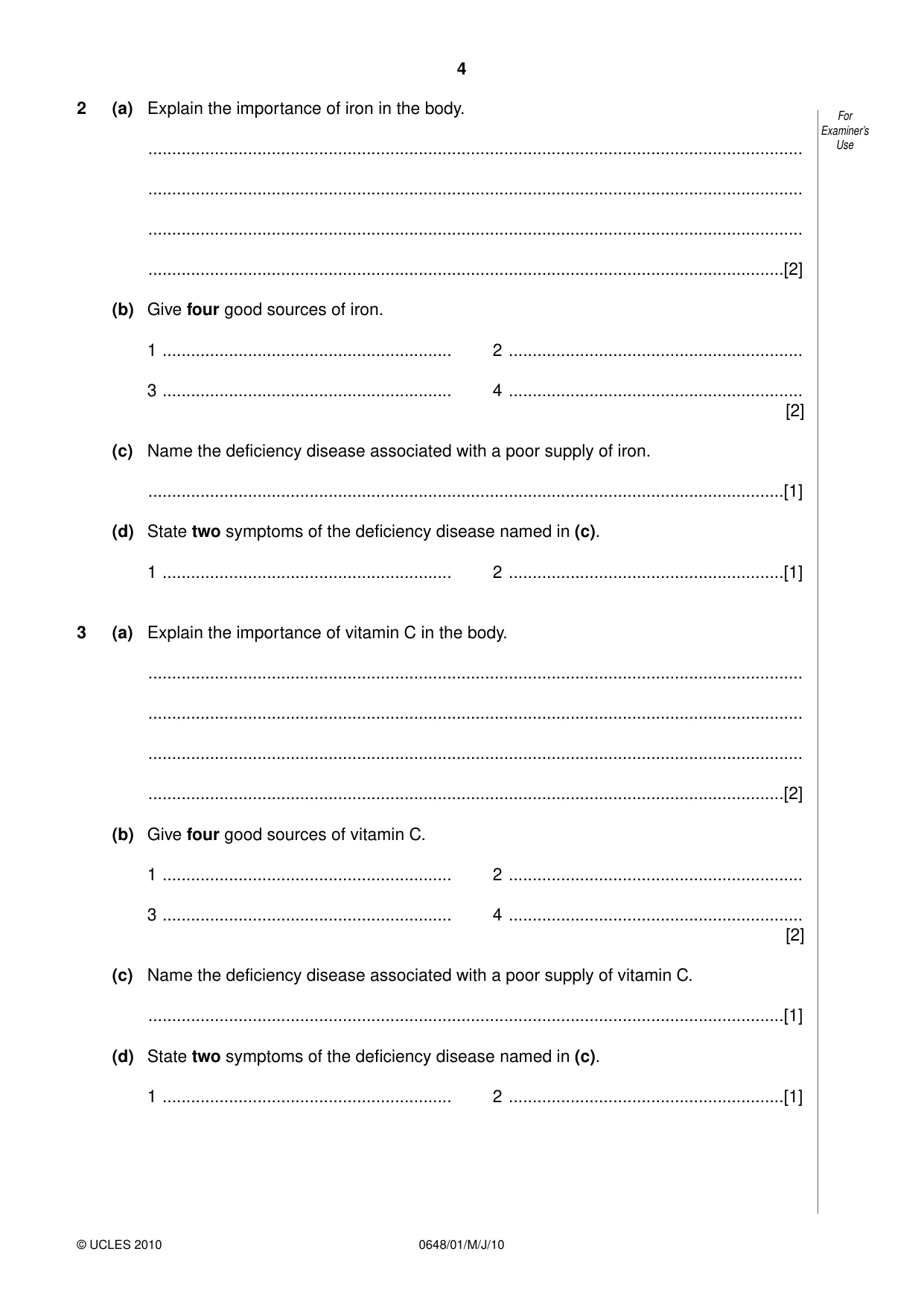
Question paper, page 4
4 0648/01/M/J/10 © UCLES 2010 For Examiner’s Use 2 (a) Explain the importance of iron in the body. … … … …[2] (b) Give four good sources of iron. 1 … 2 … 3 … 4 … [2] (c) Name the deficiency disease associated with a poor supply of iron. …[1] (d) State two symptoms of the deficiency disease named in (c). 1 … 2 …[1] 3 (a) Explain the importance of vitamin C in the body. … … … …[2] (b) Give four good sources of vitamin C. 1 … 2 … 3 … 4 … [2] (c) Name the deficiency disease associated with a poor supply of vitamin C. …[1] (d) State two symptoms of the deficiency disease named in (c). 1 … 2 …[1]
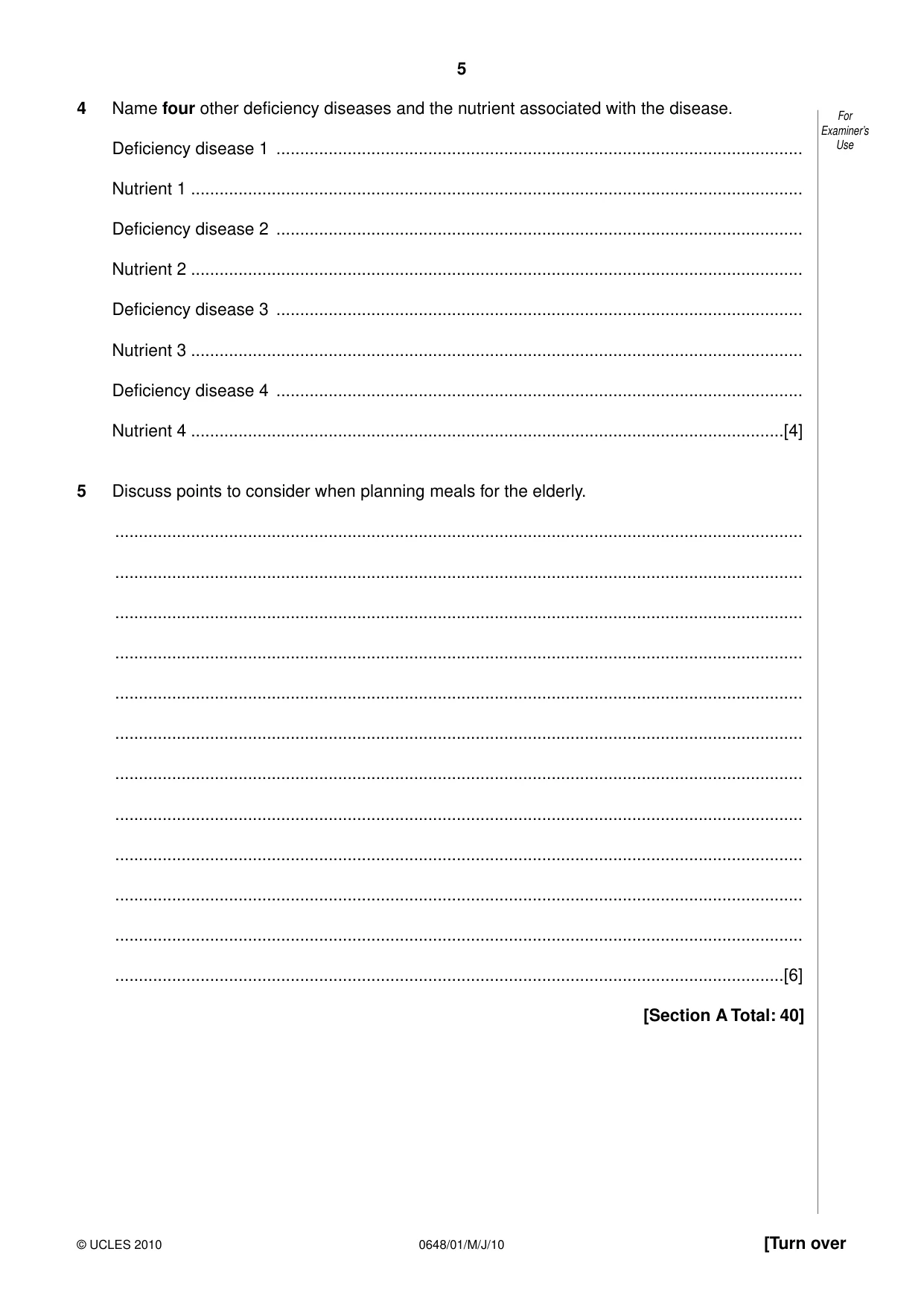
Question paper, page 5
5 0648/01/M/J/10 © UCLES 2010 [Turn over For Examiner’s Use 4 Name four other deficiency diseases and the nutrient associated with the disease. Deficiency disease 1 … Nutrient 1 … Deficiency disease 2 … Nutrient 2 … Deficiency disease 3 … Nutrient 3 … Deficiency disease 4 … Nutrient 4 …[4] 5 Discuss points to consider when planning meals for the elderly. … … … … … … … … … … … …[6] [Section A Total: 40]
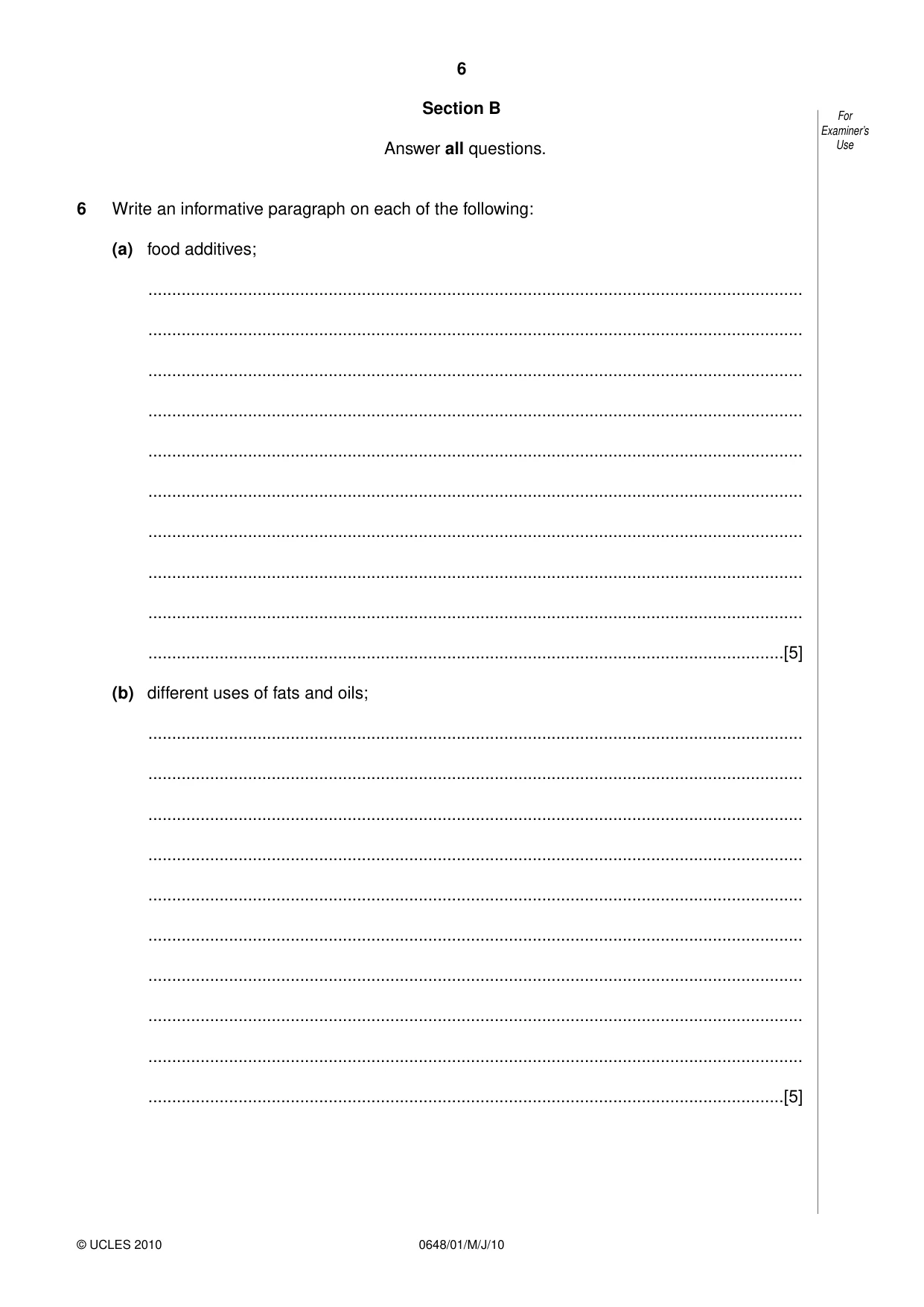
Question paper, page 6
6 0648/01/M/J/10 © UCLES 2010 For Examiner’s Use Section B Answer all questions. 6 Write an informative paragraph on each of the following: (a) food additives; … … … … … … … … … …[5] (b) different uses of fats and oils; … … … … … … … … … …[5]
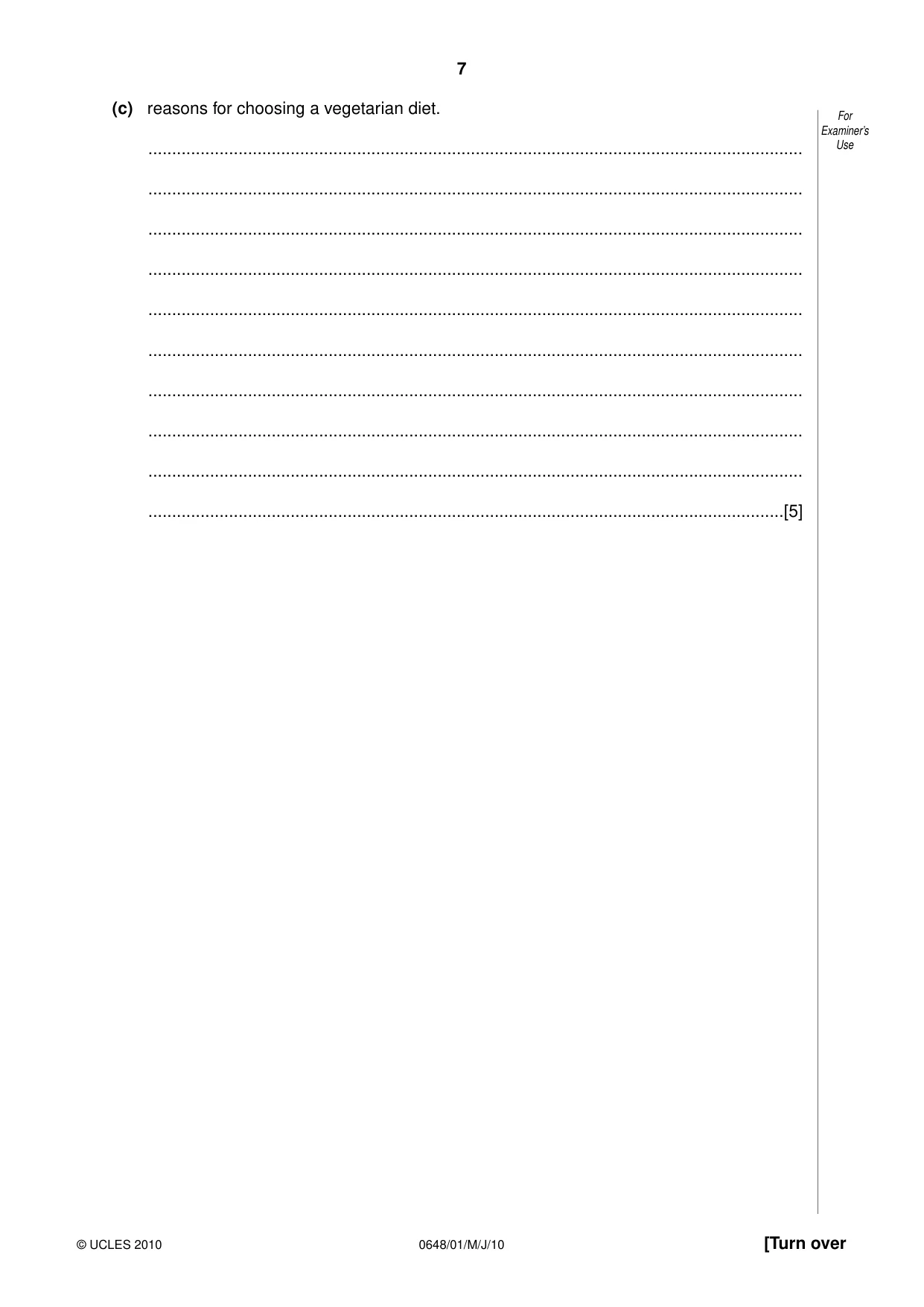
Question paper, page 7
7 0648/01/M/J/10 © UCLES 2010 [Turn over For Examiner’s Use (c) reasons for choosing a vegetarian diet. … … … … … … … … … …[5]
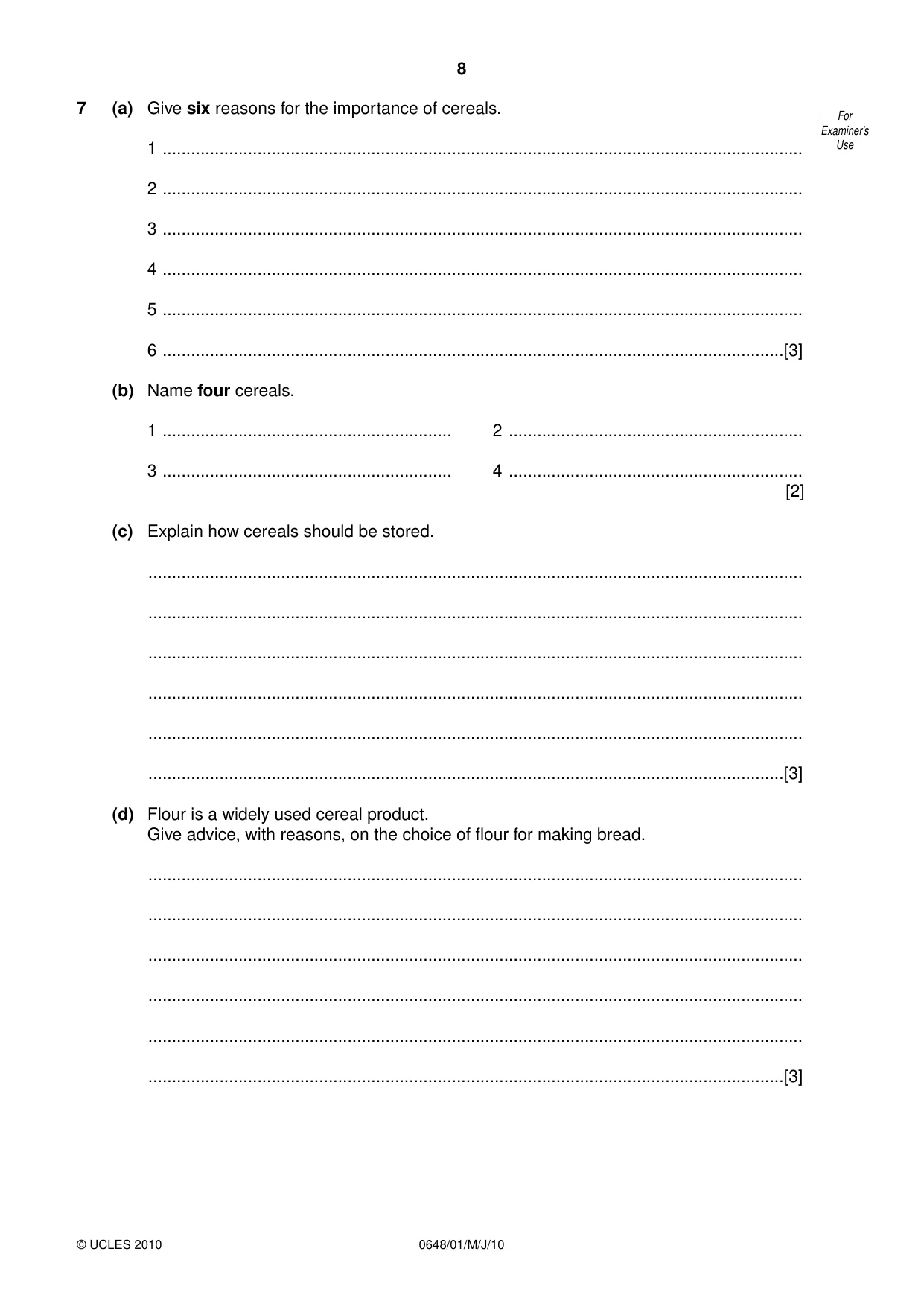
Question paper, page 8
8 0648/01/M/J/10 © UCLES 2010 For Examiner’s Use 7 (a) Give six reasons for the importance of cereals. 1 … 2 … 3 … 4 … 5 … 6 …[3] (b) Name four cereals. 1 … 2 … 3 … 4 … [2] (c) Explain how cereals should be stored. … … … … … …[3] (d) Flour is a widely used cereal product. Give advice, with reasons, on the choice of flour for making bread. … … … … … …[3]
Question paper, page 9
9 0648/01/M/J/10 © UCLES 2010 [Turn over For Examiner’s Use (e) Describe the changes which take place when a loaf of bread is baked. … … … … … … … …[4]
Question paper, page 10
10 0648/01/M/J/10 © UCLES 2010 For Examiner’s Use 8 Explain how to carry out the following processes and give one example of each. (a) creaming; … … … … … …[3] (b) basting; … … … … … …[3] (c) making a roux; … … … … … …[3]
Question paper, page 11
11 0648/01/M/J/10 © UCLES 2010 [Turn over For Examiner’s Use (d) sautéing; … … … … … …[3] (e) making stock. … … … … … …[3] [Section B Total: 45]
Question paper, page 12
12 0648/01/M/J/10 © UCLES 2010 For Examiner’s Use Section C Answer either Question 9(a) or 9(b) 9 (a) Discuss the reasons for preserving food and explain how food spoilage is prevented in named methods of preservation. [15] OR 9 (b) Discuss the nutritive value of eggs and explain how they can be used in the preparation of dishes. [15] … … … … … … … … … … … … … … … … … … … … … …
Question paper, page 13
13 0648/01/M/J/10 © UCLES 2010 [Turn over For Examiner’s Use … … … … … … … … … … … … … … … … … … … … … … … … … … …
Question paper, page 14
14 0648/01/M/J/10 © UCLES 2010 For Examiner’s Use … … … … … … … … … … … … … … … … … … … … … … … … … … [Section C Total: 15] [Total for Paper: 100]
Question paper, page 15
15 0648/01/M/J/10 © UCLES 2010 BLANK PAGE
Question paper, page 16
16 0648/01/M/J/10 © UCLES 2010 BLANK PAGE Permission to reproduce items where third-party owned material protected by copyright is included has been sought and cleared where possible. Every reasonable effort has been made by the publisher (UCLES) to trace copyright holders, but if any items requiring clearance have unwittingly been included, the publisher will be pleased to make amends at the earliest possible opportunity. University of Cambridge International Examinations is part of the Cambridge Assessment Group. Cambridge Assessment is the brand name of University of Cambridge Local Examinations Syndicate (UCLES), which is itself a department of the University of Cambridge.
Mark scheme, page 1
UNIVERSITY OF CAMBRIDGE INTERNATIONAL EXAMINATIONS International General Certificate of Secondary Education MARK SCHEME for the May/June 2010 question paper for the guidance of teachers 0648 FOOD AND NUTRITION 0648/01 Paper 1 (Theory), maximum raw mark 100 This mark scheme is published as an aid to teachers and candidates, to indicate the requirements of the examination. It shows the basis on which Examiners were instructed to award marks. It does not indicate the details of the discussions that took place at an Examiners’ meeting before marking began, which would have considered the acceptability of alternative answers. Mark schemes must be read in conjunction with the question papers and the report on the examination. • CIE will not enter into discussions or correspondence in connection with these mark schemes. CIE is publishing the mark schemes for the May/June 2010 question papers for most IGCSE, GCE Advanced Level and Advanced Subsidiary Level syllabuses and some Ordinary Level syllabuses. www.XtremePapers.com
Mark scheme, page 2
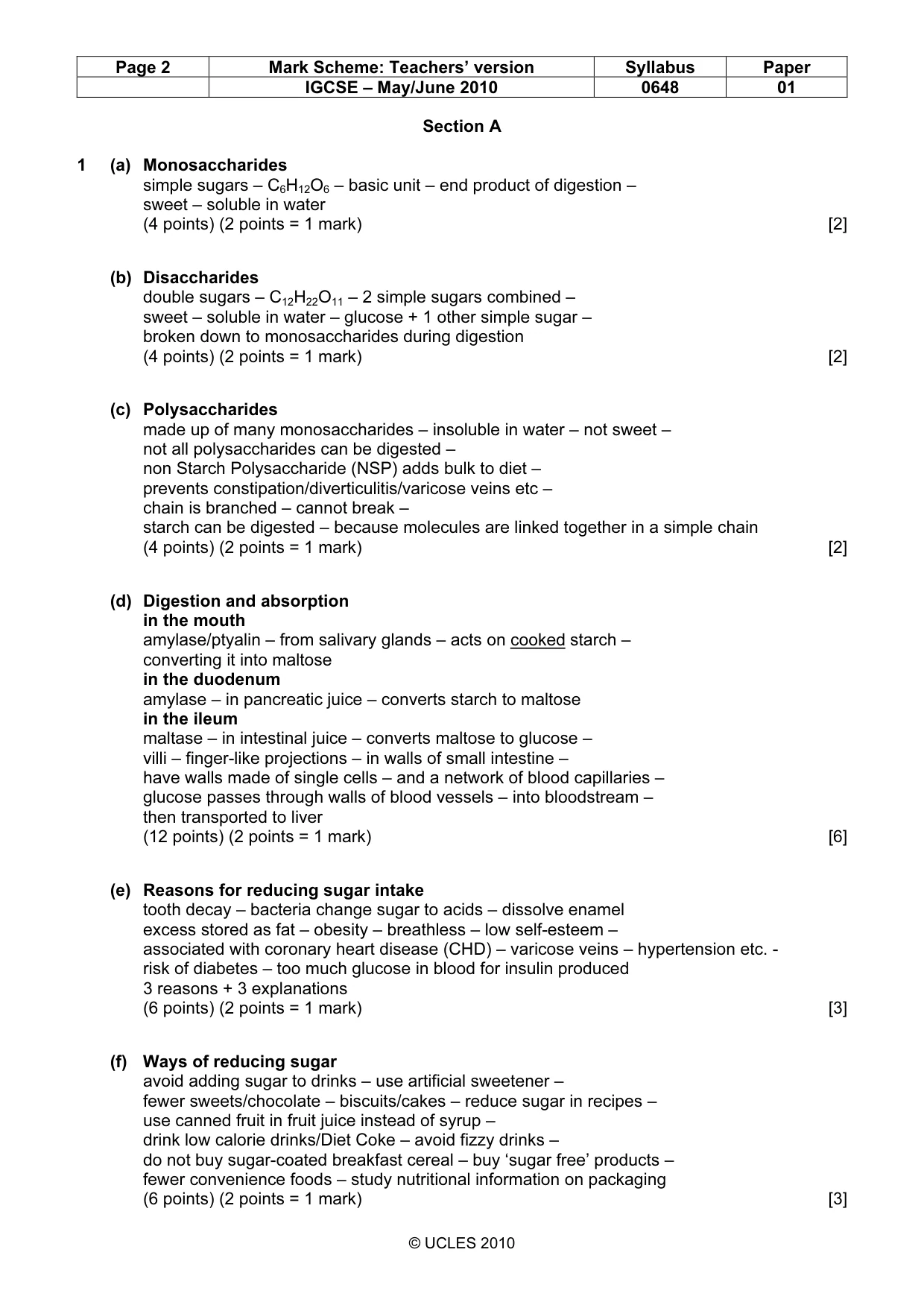
Page 2 Mark Scheme: Teachers’ version Syllabus Paper IGCSE – May/June 2010 0648 01 © UCLES 2010 Section A 1 (a) Monosaccharides simple sugars – C6H12O6 – basic unit – end product of digestion – sweet – soluble in water (4 points) (2 points = 1 mark) [2] (b) Disaccharides double sugars – C12H22O11 – 2 simple sugars combined – sweet – soluble in water – glucose + 1 other simple sugar – broken down to monosaccharides during digestion (4 points) (2 points = 1 mark) [2] (c) Polysaccharides made up of many monosaccharides – insoluble in water – not sweet – not all polysaccharides can be digested – non Starch Polysaccharide (NSP) adds bulk to diet – prevents constipation/diverticulitis/varicose veins etc – chain is branched – cannot break – starch can be digested – because molecules are linked together in a simple chain (4 points) (2 points = 1 mark) [2] (d) Digestion and absorption in the mouth amylase/ptyalin – from salivary glands – acts on cooked starch – converting it into maltose in the duodenum amylase – in pancreatic juice – converts starch to maltose in the ileum maltase – in intestinal juice – converts maltose to glucose – villi – finger-like projections – in walls of small intestine – have walls made of single cells – and a network of blood capillaries – glucose passes through walls of blood vessels – into bloodstream – then transported to liver (12 points) (2 points = 1 mark) [6] (e) Reasons for reducing sugar intake tooth decay – bacteria change sugar to acids – dissolve enamel excess stored as fat – obesity – breathless – low self-esteem – associated with coronary heart disease (CHD) – varicose veins – hypertension etc. - risk of diabetes – too much glucose in blood for insulin produced 3 reasons + 3 explanations (6 points) (2 points = 1 mark) [3] (f) Ways of reducing sugar avoid adding sugar to drinks – use artificial sweetener – fewer sweets/chocolate – biscuits/cakes – reduce sugar in recipes – use canned fruit in fruit juice instead of syrup – drink low calorie drinks/Diet Coke – avoid fizzy drinks – do not buy sugar-coated breakfast cereal – buy ‘sugar free’ products – fewer convenience foods – study nutritional information on packaging (6 points) (2 points = 1 mark) [3]
Mark scheme, page 3
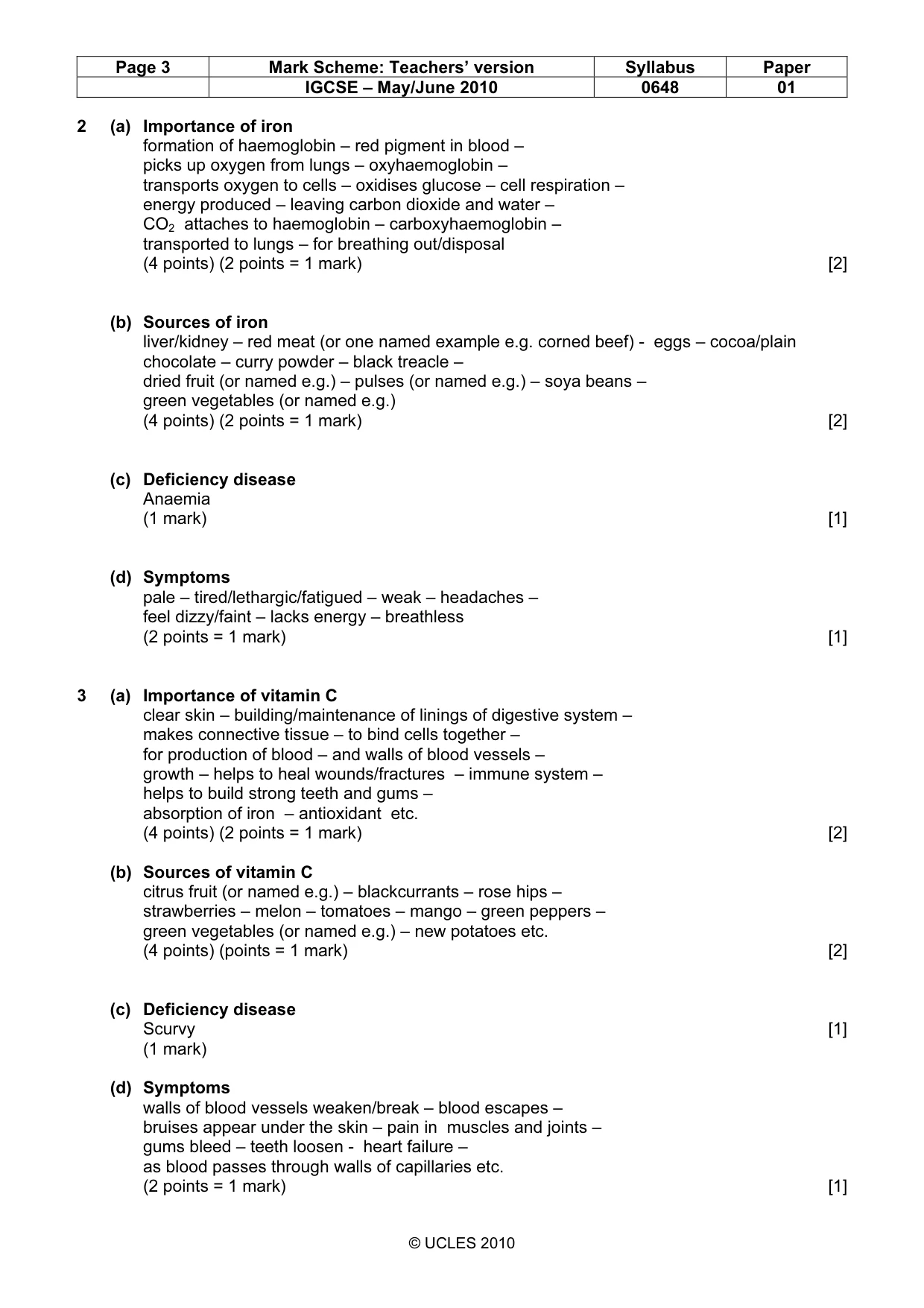
Page 3 Mark Scheme: Teachers’ version Syllabus Paper IGCSE – May/June 2010 0648 01 © UCLES 2010 2 (a) Importance of iron formation of haemoglobin – red pigment in blood – picks up oxygen from lungs – oxyhaemoglobin – transports oxygen to cells – oxidises glucose – cell respiration – energy produced – leaving carbon dioxide and water – CO2 attaches to haemoglobin – carboxyhaemoglobin – transported to lungs – for breathing out/disposal (4 points) (2 points = 1 mark) [2] (b) Sources of iron liver/kidney – red meat (or one named example e.g. corned beef) - eggs – cocoa/plain chocolate – curry powder – black treacle – dried fruit (or named e.g.) – pulses (or named e.g.) – soya beans – green vegetables (or named e.g.) (4 points) (2 points = 1 mark) [2] (c) Deficiency disease Anaemia (1 mark) [1] (d) Symptoms pale – tired/lethargic/fatigued – weak – headaches – feel dizzy/faint – lacks energy – breathless (2 points = 1 mark) [1] 3 (a) Importance of vitamin C clear skin – building/maintenance of linings of digestive system – makes connective tissue – to bind cells together – for production of blood – and walls of blood vessels – growth – helps to heal wounds/fractures – immune system – helps to build strong teeth and gums – absorption of iron – antioxidant etc. (4 points) (2 points = 1 mark) [2] (b) Sources of vitamin C citrus fruit (or named e.g.) – blackcurrants – rose hips – strawberries – melon – tomatoes – mango – green peppers – green vegetables (or named e.g.) – new potatoes etc. (4 points) (points = 1 mark) [2] (c) Deficiency disease Scurvy [1] (1 mark) (d) Symptoms walls of blood vessels weaken/break – blood escapes – bruises appear under the skin – pain in muscles and joints – gums bleed – teeth loosen - heart failure – as blood passes through walls of capillaries etc. (2 points = 1 mark) [1]
Mark scheme, page 4
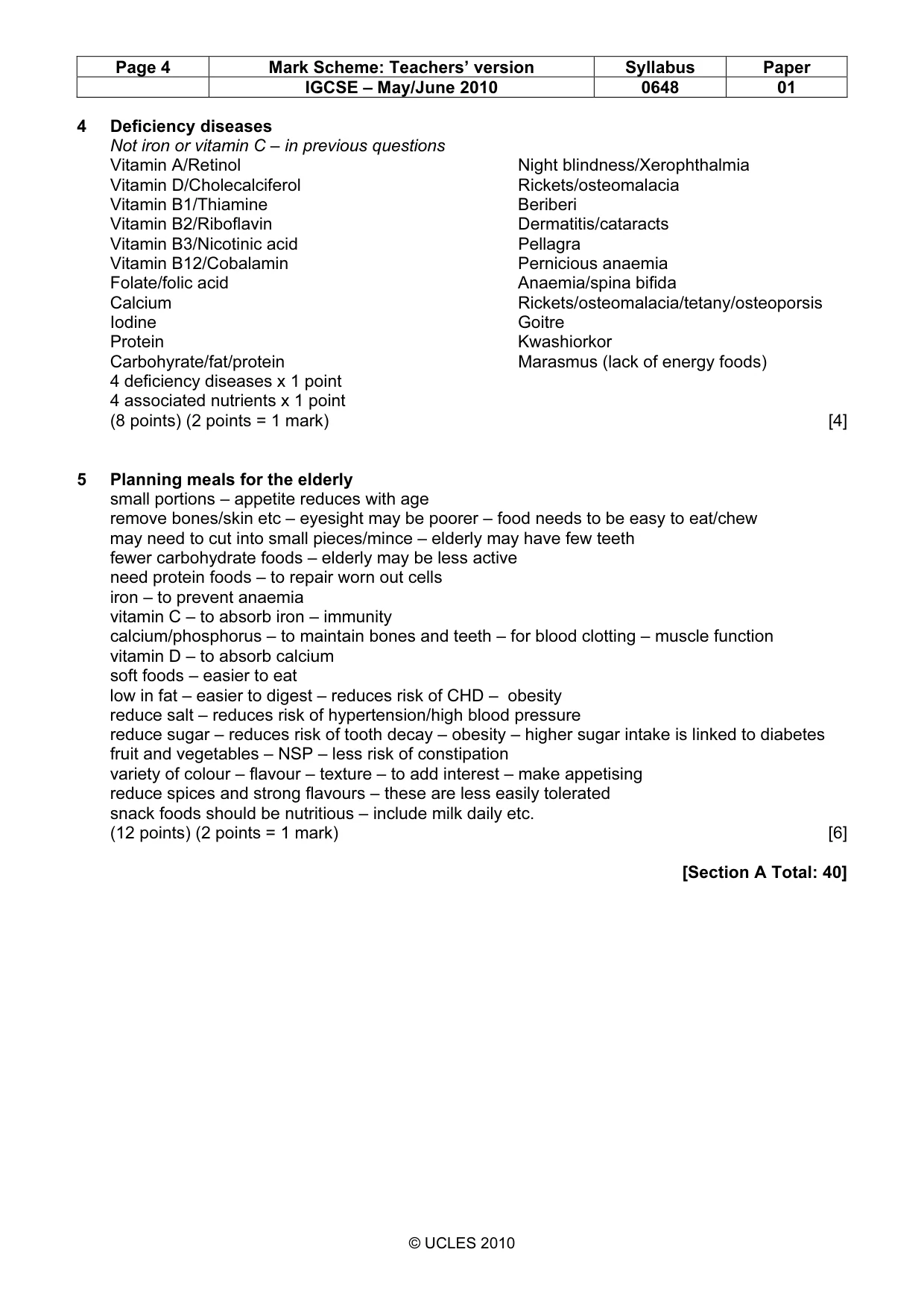
Page 4 Mark Scheme: Teachers’ version Syllabus Paper IGCSE – May/June 2010 0648 01 © UCLES 2010 4 Deficiency diseases Not iron or vitamin C – in previous questions Vitamin A/Retinol Night blindness/Xerophthalmia Vitamin D/Cholecalciferol Rickets/osteomalacia Vitamin B1/Thiamine Beriberi Vitamin B2/Riboflavin Dermatitis/cataracts Vitamin B3/Nicotinic acid Pellagra Vitamin B12/Cobalamin Pernicious anaemia Folate/folic acid Anaemia/spina bifida Calcium Rickets/osteomalacia/tetany/osteoporsis Iodine Goitre Protein Kwashiorkor Carbohyrate/fat/protein Marasmus (lack of energy foods) 4 deficiency diseases x 1 point 4 associated nutrients x 1 point (8 points) (2 points = 1 mark) [4] 5 Planning meals for the elderly small portions – appetite reduces with age remove bones/skin etc – eyesight may be poorer – food needs to be easy to eat/chew may need to cut into small pieces/mince – elderly may have few teeth fewer carbohydrate foods – elderly may be less active need protein foods – to repair worn out cells iron – to prevent anaemia vitamin C – to absorb iron – immunity calcium/phosphorus – to maintain bones and teeth – for blood clotting – muscle function vitamin D – to absorb calcium soft foods – easier to eat low in fat – easier to digest – reduces risk of CHD – obesity reduce salt – reduces risk of hypertension/high blood pressure reduce sugar – reduces risk of tooth decay – obesity – higher sugar intake is linked to diabetes fruit and vegetables – NSP – less risk of constipation variety of colour – flavour – texture – to add interest – make appetising reduce spices and strong flavours – these are less easily tolerated snack foods should be nutritious – include milk daily etc. (12 points) (2 points = 1 mark) [6] [Section A Total: 40]
Mark scheme, page 5
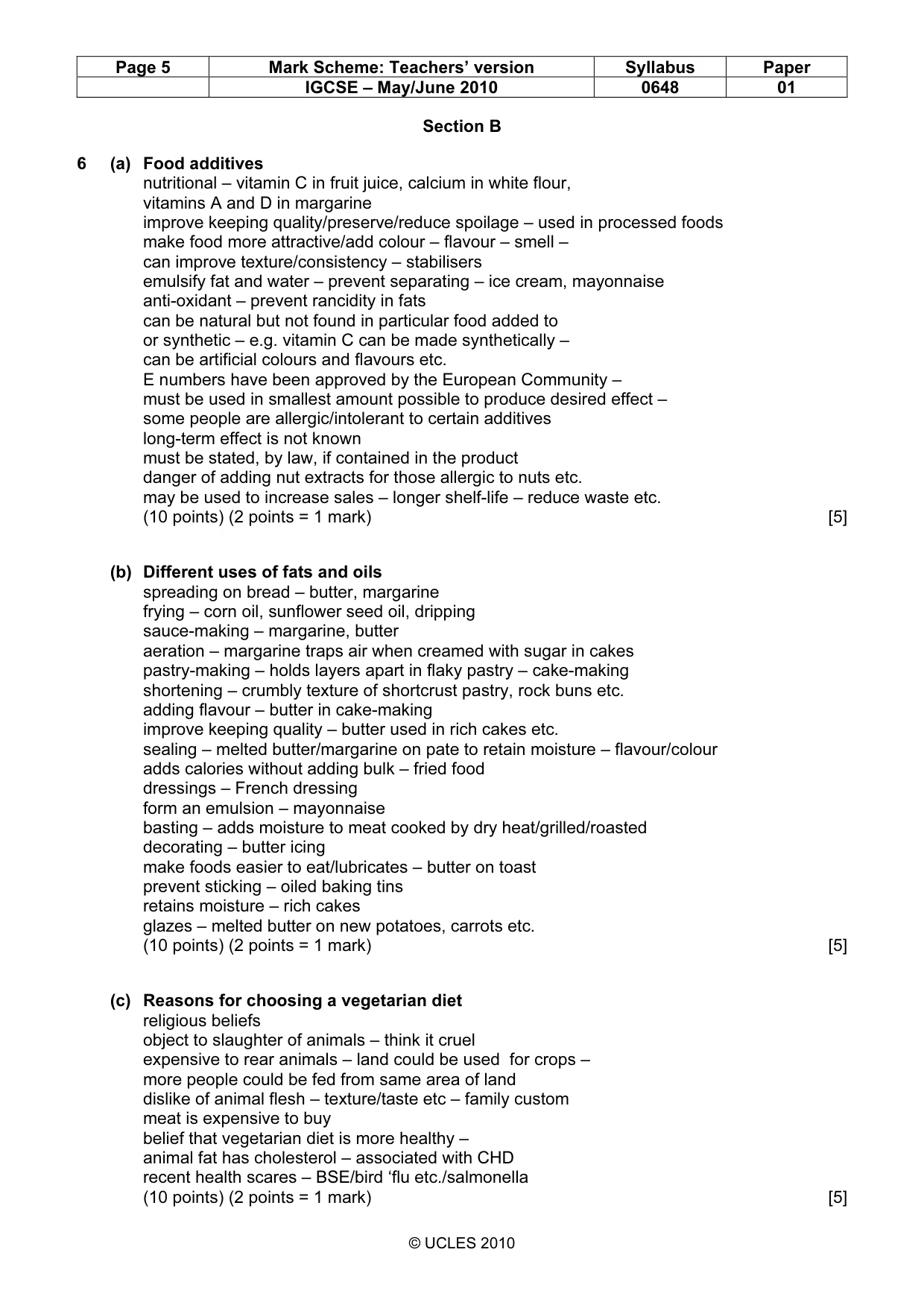
Page 5 Mark Scheme: Teachers’ version Syllabus Paper IGCSE – May/June 2010 0648 01 © UCLES 2010 Section B 6 (a) Food additives nutritional – vitamin C in fruit juice, calcium in white flour, vitamins A and D in margarine improve keeping quality/preserve/reduce spoilage – used in processed foods make food more attractive/add colour – flavour – smell – can improve texture/consistency – stabilisers emulsify fat and water – prevent separating – ice cream, mayonnaise anti-oxidant – prevent rancidity in fats can be natural but not found in particular food added to or synthetic – e.g. vitamin C can be made synthetically – can be artificial colours and flavours etc. E numbers have been approved by the European Community – must be used in smallest amount possible to produce desired effect – some people are allergic/intolerant to certain additives long-term effect is not known must be stated, by law, if contained in the product danger of adding nut extracts for those allergic to nuts etc. may be used to increase sales – longer shelf-life – reduce waste etc. (10 points) (2 points = 1 mark) [5] (b) Different uses of fats and oils spreading on bread – butter, margarine frying – corn oil, sunflower seed oil, dripping sauce-making – margarine, butter aeration – margarine traps air when creamed with sugar in cakes pastry-making – holds layers apart in flaky pastry – cake-making shortening – crumbly texture of shortcrust pastry, rock buns etc. adding flavour – butter in cake-making improve keeping quality – butter used in rich cakes etc. sealing – melted butter/margarine on pate to retain moisture – flavour/colour adds calories without adding bulk – fried food dressings – French dressing form an emulsion – mayonnaise basting – adds moisture to meat cooked by dry heat/grilled/roasted decorating – butter icing make foods easier to eat/lubricates – butter on toast prevent sticking – oiled baking tins retains moisture – rich cakes glazes – melted butter on new potatoes, carrots etc. (10 points) (2 points = 1 mark) [5] (c) Reasons for choosing a vegetarian diet religious beliefs object to slaughter of animals – think it cruel expensive to rear animals – land could be used for crops – more people could be fed from same area of land dislike of animal flesh – texture/taste etc – family custom meat is expensive to buy belief that vegetarian diet is more healthy – animal fat has cholesterol – associated with CHD recent health scares – BSE/bird ‘flu etc./salmonella (10 points) (2 points = 1 mark) [5]
Mark scheme, page 6
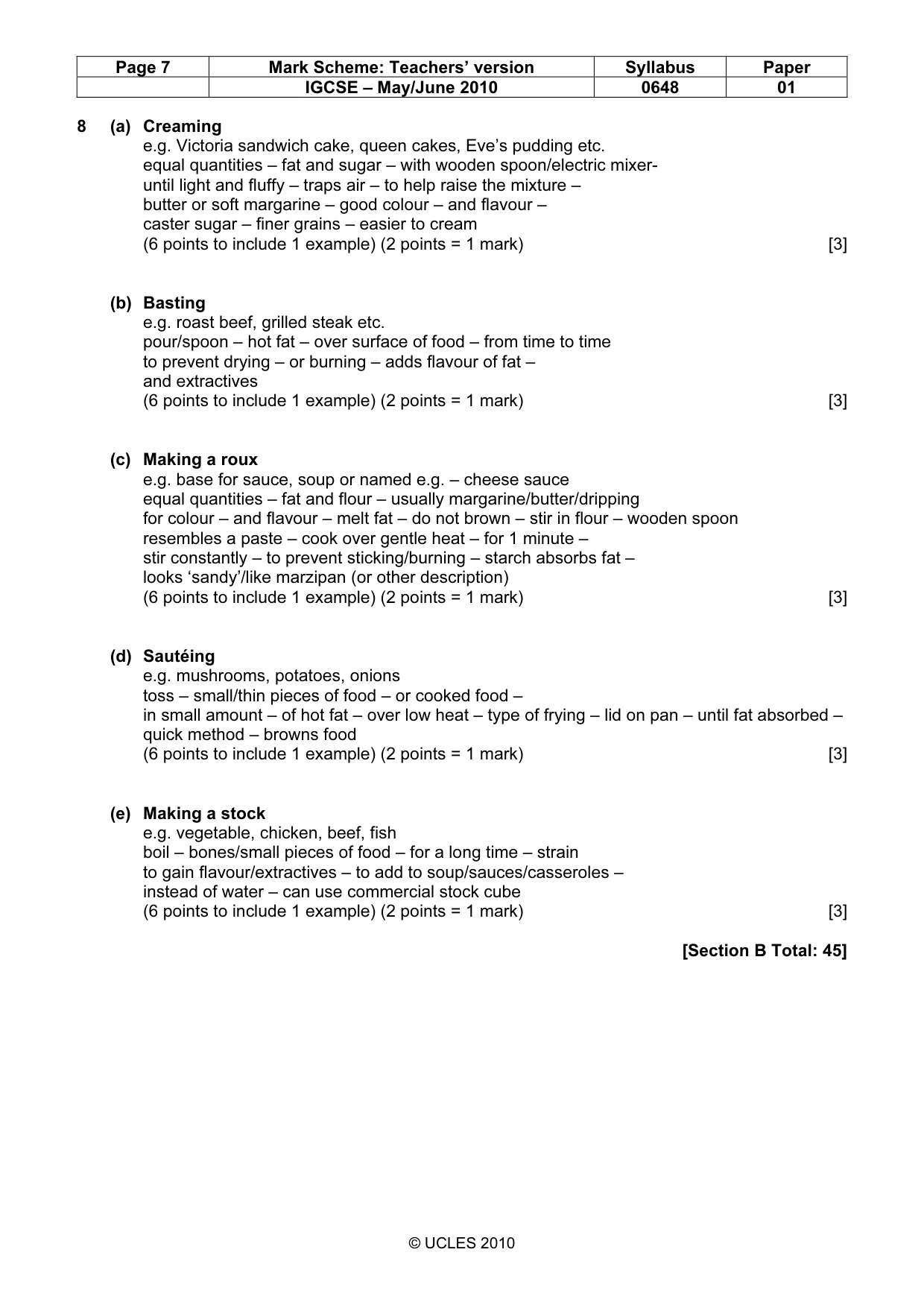
Page 6 Mark Scheme: Teachers’ version Syllabus Paper IGCSE – May/June 2010 0648 01 © UCLES 2010 7 (a) Reasons for the importance of cereals readily available – easy to transport – easy to grow – cheap – carbohydrate/starch – source of energy – staple food – filling – easy to store – source of (LBV) protein – NSP in wholegrains – versatile – can be used for sweet and savoury dishes – easy to prepare – easy to eat etc. (6 points) (2 points = 1 mark) [3] (b) Named cereals wheat – oats – barley – rye – corn/maize/mealie meal – millet – rice – sorghum (4 points) (2 points = 1 mark) [2] (c) Storage of cereals cool – dry – to prevent germination/growth – away from smells to prevent mould – and formation of lumps – check regularly – can be attacked by weevils – covered containers – to prevent entry of dust etc. – sealed – to keep out moisture etc. – keep bins off the ground – prevent attack by rats etc. – use in rotation – do not mix old and new supplies – inspect regularly decay could spread from old to new – wasteful - wholegrain cereals do not keep as long – fat becomes rancid etc. (6 points) (2 points = 1 mark) [3] (d) Choice of flour for making bread strong/hard flour – high gluten content – becomes stretchy/elastic with moisture – and kneading – stretches to hold gases – gives firm structure – white flour – lighter – so rises better – plain flour – no chemical raising agent required – wholemeal flour – contains NSP – follows dietary guidelines – not SR flour – contains baking powder – yeast is raising agent (6 points) (2 points = 1 mark) [3] (e) Changes taking place when a loaf of bread is baked rises/increases in size – warmth of oven encourages fermentation of yeast – carbon dioxide produced – gives open texture – alcohol evaporates – water evaporates – pushes up dough – fat melts – light texture yeast is killed by heat – no more carbon dioxide produced – gas in dough expands when heated – protein/gluten coagulates – shape sets – starch dextrinises – forms crust – browns – crust lifts off/‘oven spring’ – as carbon dioxide continues to expand after shape has set – air replaces escaped gas – flour gelatinises – Maillard browning – action of protein and sugar – etc. (8 points) (2 points = 1 mark) [4]
Mark scheme, page 7
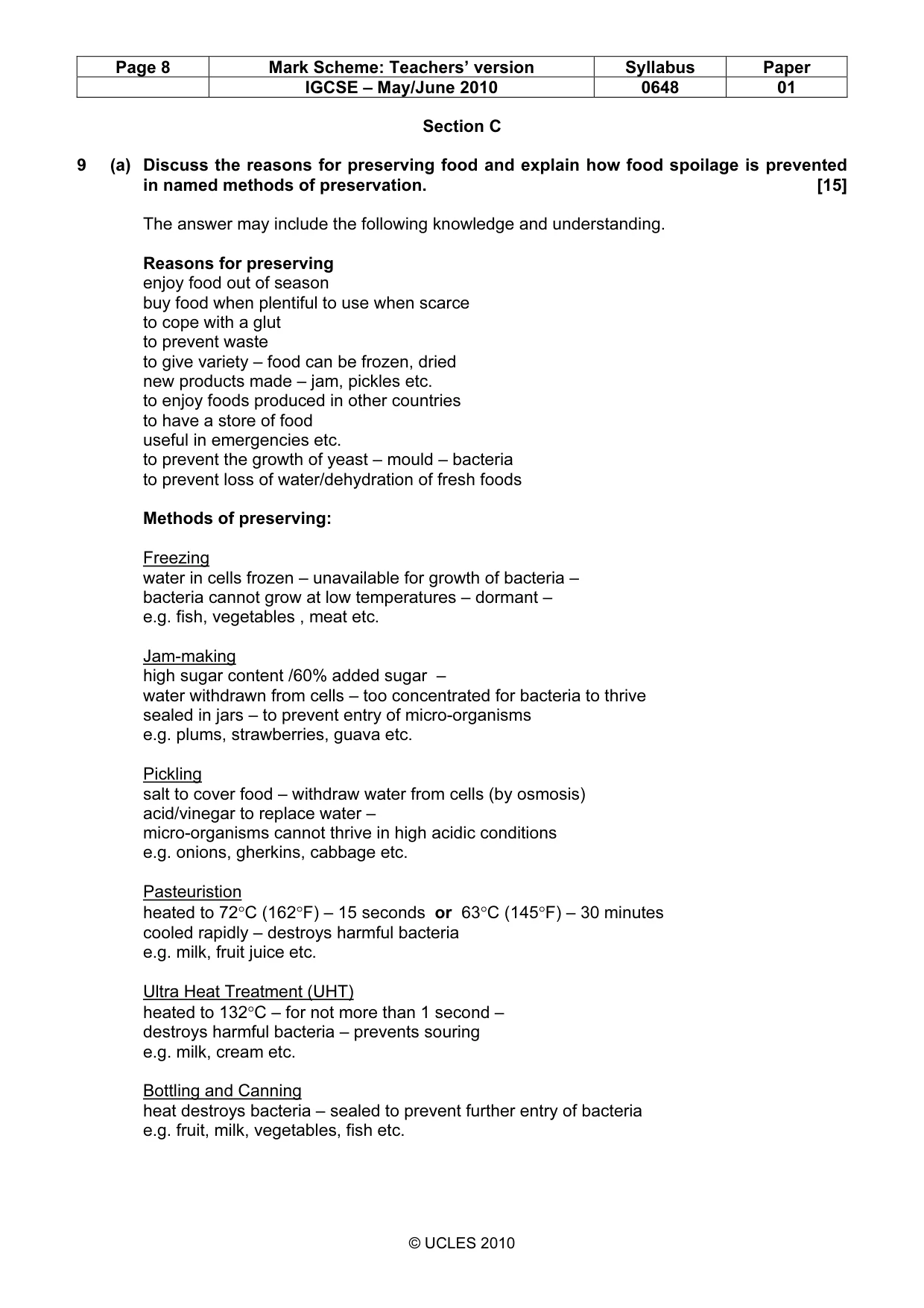
Page 7 Mark Scheme: Teachers’ version Syllabus Paper IGCSE – May/June 2010 0648 01 © UCLES 2010 8 (a) Creaming e.g. Victoria sandwich cake, queen cakes, Eve’s pudding etc. equal quantities – fat and sugar – with wooden spoon/electric mixer- until light and fluffy – traps air – to help raise the mixture – butter or soft margarine – good colour – and flavour – caster sugar – finer grains – easier to cream (6 points to include 1 example) (2 points = 1 mark) [3] (b) Basting e.g. roast beef, grilled steak etc. pour/spoon – hot fat – over surface of food – from time to time to prevent drying – or burning – adds flavour of fat – and extractives (6 points to include 1 example) (2 points = 1 mark) [3] (c) Making a roux e.g. base for sauce, soup or named e.g. – cheese sauce equal quantities – fat and flour – usually margarine/butter/dripping for colour – and flavour – melt fat – do not brown – stir in flour – wooden spoon resembles a paste – cook over gentle heat – for 1 minute – stir constantly – to prevent sticking/burning – starch absorbs fat – looks ‘sandy’/like marzipan (or other description) (6 points to include 1 example) (2 points = 1 mark) [3] (d) Sautéing e.g. mushrooms, potatoes, onions toss – small/thin pieces of food – or cooked food – in small amount – of hot fat – over low heat – type of frying – lid on pan – until fat absorbed – quick method – browns food (6 points to include 1 example) (2 points = 1 mark) [3] (e) Making a stock e.g. vegetable, chicken, beef, fish boil – bones/small pieces of food – for a long time – strain to gain flavour/extractives – to add to soup/sauces/casseroles – instead of water – can use commercial stock cube (6 points to include 1 example) (2 points = 1 mark) [3] [Section B Total: 45]
Mark scheme, page 8
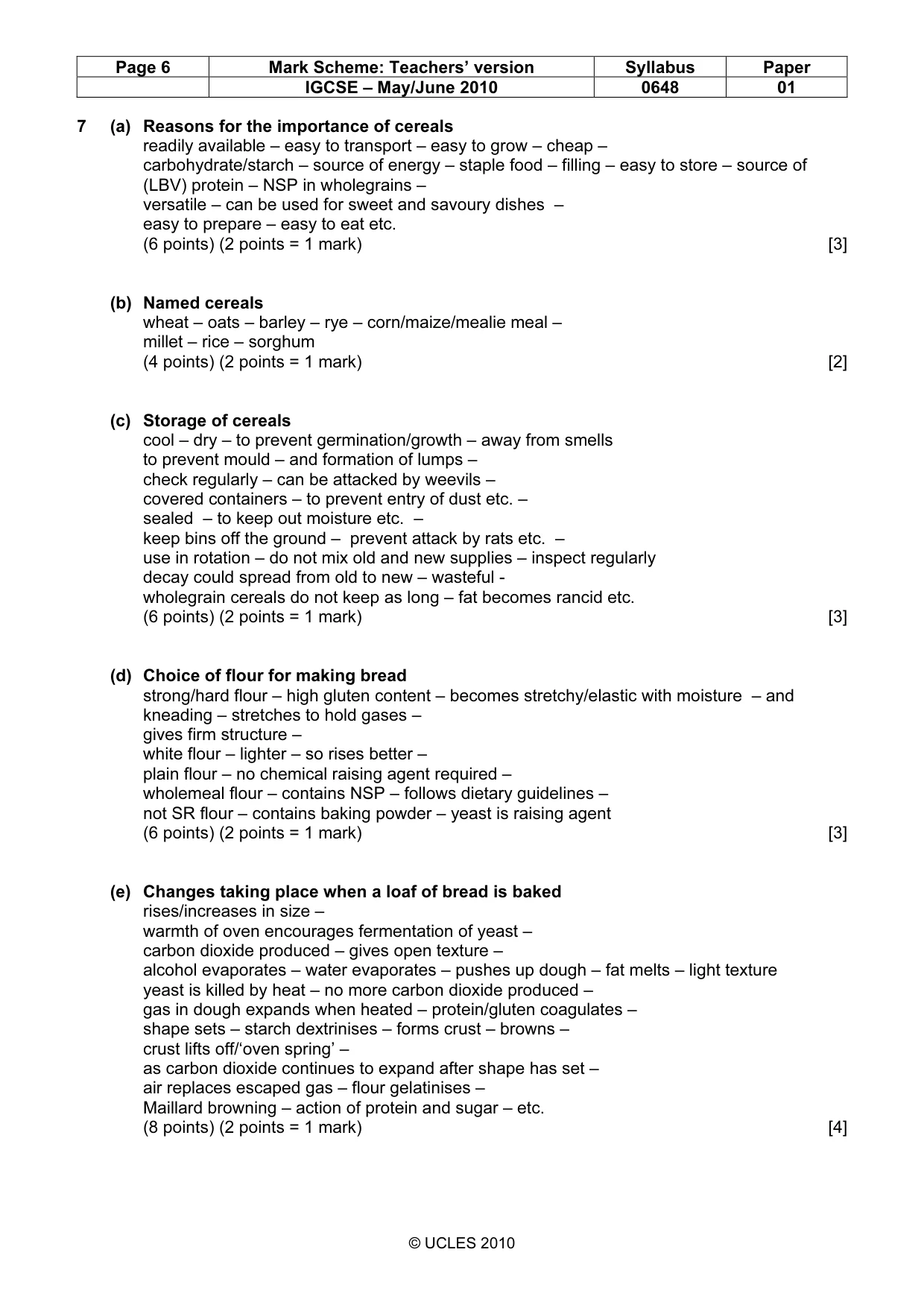
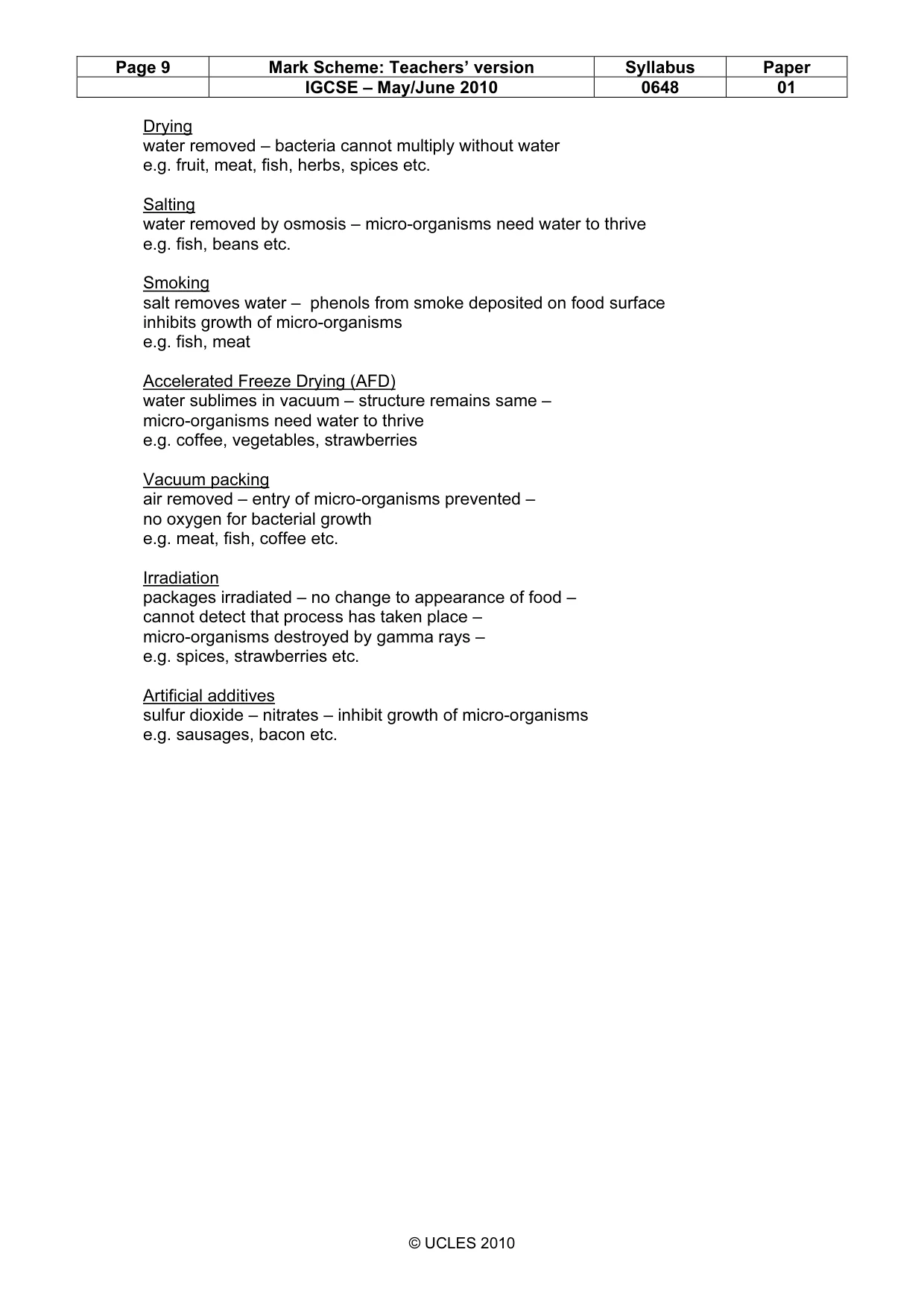
Page 8 Mark Scheme: Teachers’ version Syllabus Paper IGCSE – May/June 2010 0648 01 © UCLES 2010 Section C 9 (a) Discuss the reasons for preserving food and explain how food spoilage is prevented in named methods of preservation. [15] The answer may include the following knowledge and understanding. Reasons for preserving enjoy food out of season buy food when plentiful to use when scarce to cope with a glut to prevent waste to give variety – food can be frozen, dried new products made – jam, pickles etc. to enjoy foods produced in other countries to have a store of food useful in emergencies etc. to prevent the growth of yeast – mould – bacteria to prevent loss of water/dehydration of fresh foods Methods of preserving: Freezing water in cells frozen – unavailable for growth of bacteria – bacteria cannot grow at low temperatures – dormant – e.g. fish, vegetables , meat etc. Jam-making high sugar content /60% added sugar – water withdrawn from cells – too concentrated for bacteria to thrive sealed in jars – to prevent entry of micro-organisms e.g. plums, strawberries, guava etc. Pickling salt to cover food – withdraw water from cells (by osmosis) acid/vinegar to replace water – micro-organisms cannot thrive in high acidic conditions e.g. onions, gherkins, cabbage etc. Pasteuristion heated to 72°C (162°F) – 15 seconds or 63°C (145°F) – 30 minutes cooled rapidly – destroys harmful bacteria e.g. milk, fruit juice etc. Ultra Heat Treatment (UHT) heated to 132°C – for not more than 1 second – destroys harmful bacteria – prevents souring e.g. milk, cream etc. Bottling and Canning heat destroys bacteria – sealed to prevent further entry of bacteria e.g. fruit, milk, vegetables, fish etc.
Mark scheme, page 9
Page 9 Mark Scheme: Teachers’ version Syllabus Paper IGCSE – May/June 2010 0648 01 © UCLES 2010 Drying water removed – bacteria cannot multiply without water e.g. fruit, meat, fish, herbs, spices etc. Salting water removed by osmosis – micro-organisms need water to thrive e.g. fish, beans etc. Smoking salt removes water – phenols from smoke deposited on food surface inhibits growth of micro-organisms e.g. fish, meat Accelerated Freeze Drying (AFD) water sublimes in vacuum – structure remains same – micro-organisms need water to thrive e.g. coffee, vegetables, strawberries Vacuum packing air removed – entry of micro-organisms prevented – no oxygen for bacterial growth e.g. meat, fish, coffee etc. Irradiation packages irradiated – no change to appearance of food – cannot detect that process has taken place – micro-organisms destroyed by gamma rays – e.g. spices, strawberries etc. Artificial additives sulfur dioxide – nitrates – inhibit growth of micro-organisms e.g. sausages, bacon etc.
Mark scheme, page 10
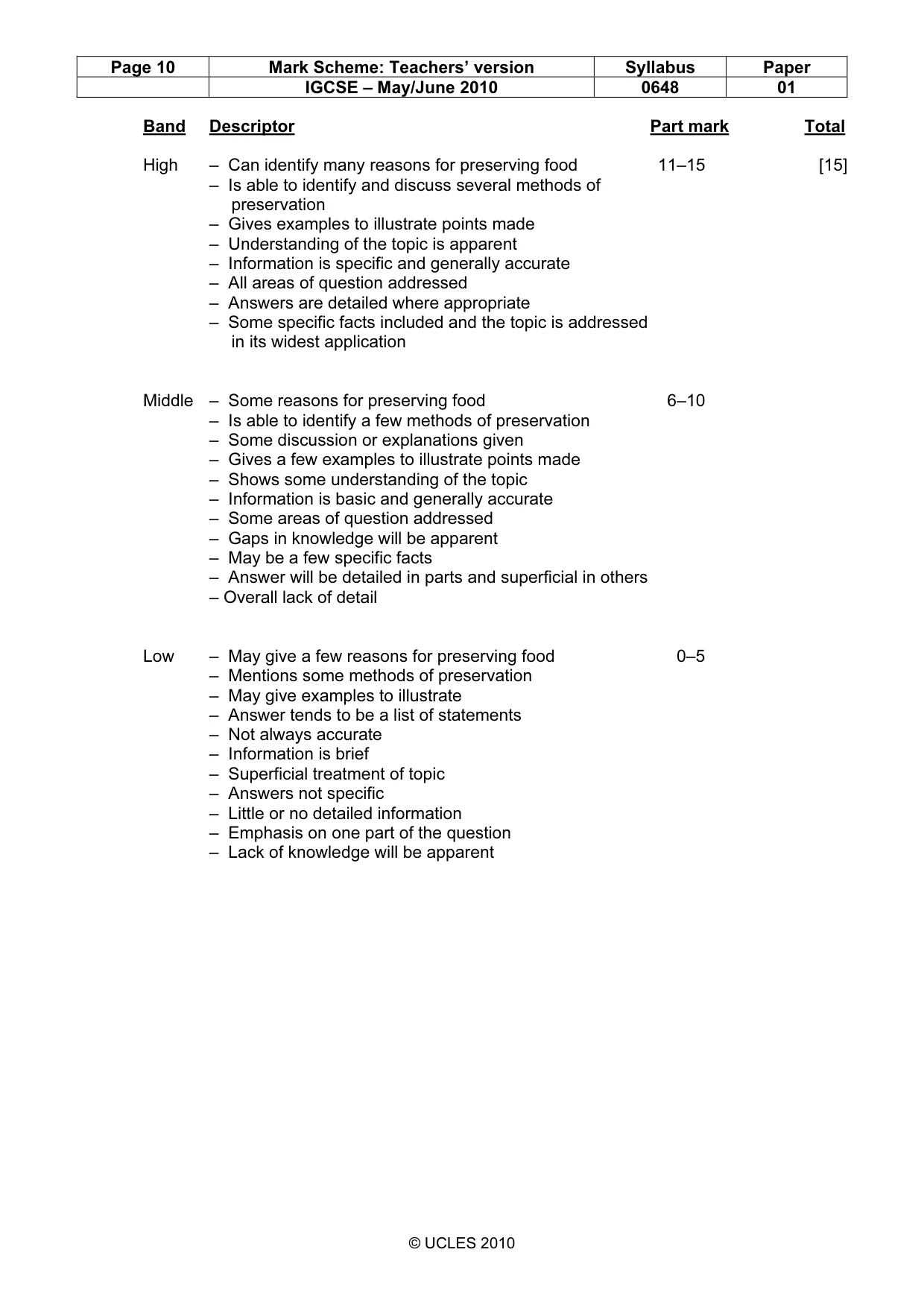
Page 10 Mark Scheme: Teachers’ version Syllabus Paper IGCSE – May/June 2010 0648 01 © UCLES 2010 Band Descriptor Part mark Total High – Can identify many reasons for preserving food 11–15 [15] – Is able to identify and discuss several methods of preservation – Gives examples to illustrate points made – Understanding of the topic is apparent – Information is specific and generally accurate – All areas of question addressed – Answers are detailed where appropriate – Some specific facts included and the topic is addressed in its widest application Middle – Some reasons for preserving food 6–10 – Is able to identify a few methods of preservation – Some discussion or explanations given – Gives a few examples to illustrate points made – Shows some understanding of the topic – Information is basic and generally accurate – Some areas of question addressed – Gaps in knowledge will be apparent – May be a few specific facts – Answer will be detailed in parts and superficial in others – Overall lack of detail Low – May give a few reasons for preserving food 0–5 – Mentions some methods of preservation – May give examples to illustrate – Answer tends to be a list of statements – Not always accurate – Information is brief – Superficial treatment of topic – Answers not specific – Little or no detailed information – Emphasis on one part of the question – Lack of knowledge will be apparent
Mark scheme, page 11
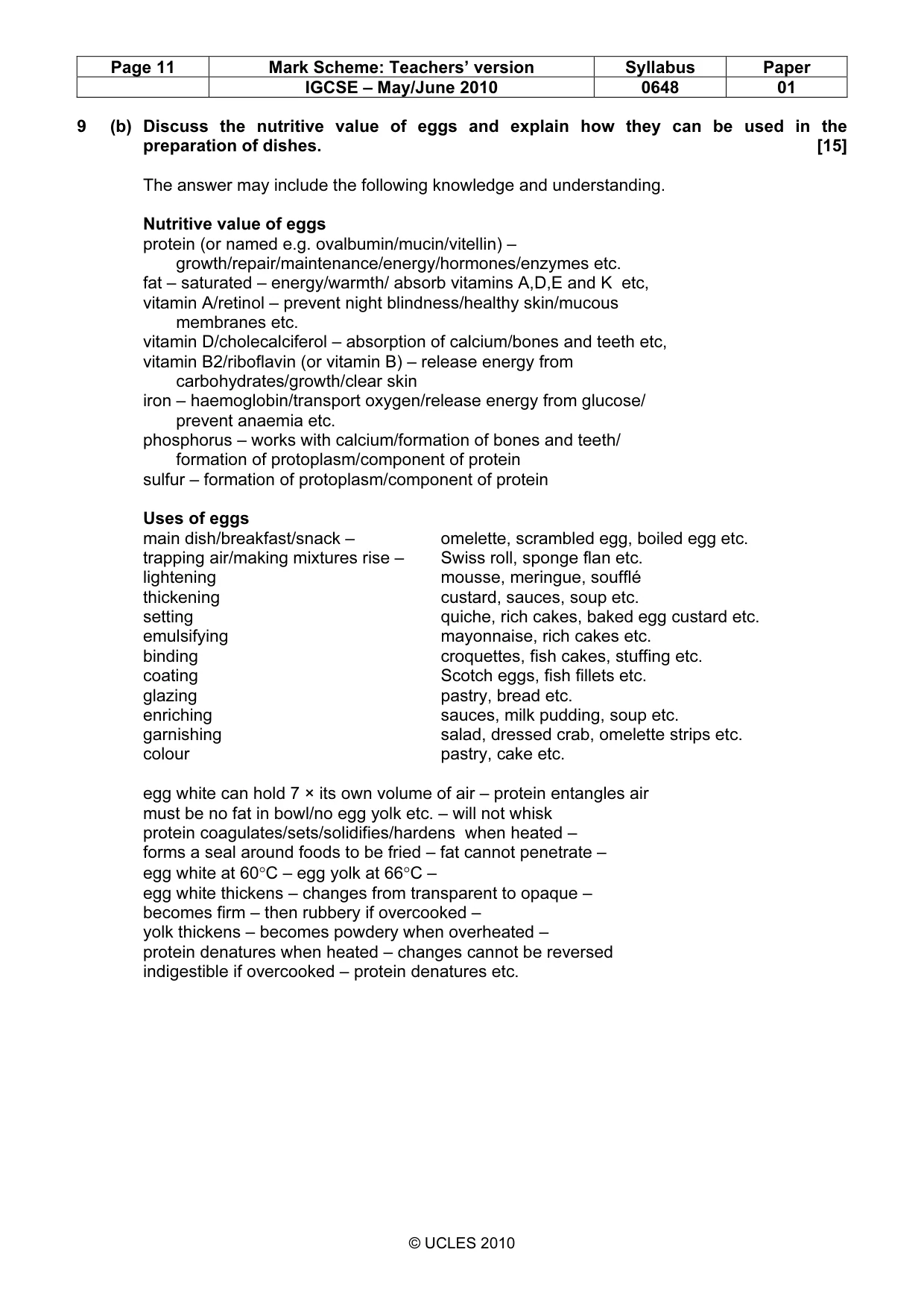
Page 11 Mark Scheme: Teachers’ version Syllabus Paper IGCSE – May/June 2010 0648 01 © UCLES 2010 9 (b) Discuss the nutritive value of eggs and explain how they can be used in the preparation of dishes. [15] The answer may include the following knowledge and understanding. Nutritive value of eggs protein (or named e.g. ovalbumin/mucin/vitellin) – growth/repair/maintenance/energy/hormones/enzymes etc. fat – saturated – energy/warmth/ absorb vitamins A,D,E and K etc, vitamin A/retinol – prevent night blindness/healthy skin/mucous membranes etc. vitamin D/cholecalciferol – absorption of calcium/bones and teeth etc, vitamin B2/riboflavin (or vitamin B) – release energy from carbohydrates/growth/clear skin iron – haemoglobin/transport oxygen/release energy from glucose/ prevent anaemia etc. phosphorus – works with calcium/formation of bones and teeth/ formation of protoplasm/component of protein sulfur – formation of protoplasm/component of protein Uses of eggs main dish/breakfast/snack – omelette, scrambled egg, boiled egg etc. trapping air/making mixtures rise – Swiss roll, sponge flan etc. lightening mousse, meringue, soufflé thickening custard, sauces, soup etc. setting quiche, rich cakes, baked egg custard etc. emulsifying mayonnaise, rich cakes etc. binding croquettes, fish cakes, stuffing etc. coating Scotch eggs, fish fillets etc. glazing pastry, bread etc. enriching sauces, milk pudding, soup etc. garnishing salad, dressed crab, omelette strips etc. colour pastry, cake etc. egg white can hold 7 × its own volume of air – protein entangles air must be no fat in bowl/no egg yolk etc. – will not whisk protein coagulates/sets/solidifies/hardens when heated – forms a seal around foods to be fried – fat cannot penetrate – egg white at 60°C – egg yolk at 66°C – egg white thickens – changes from transparent to opaque – becomes firm – then rubbery if overcooked – yolk thickens – becomes powdery when overheated – protein denatures when heated – changes cannot be reversed indigestible if overcooked – protein denatures etc.
Mark scheme, page 12
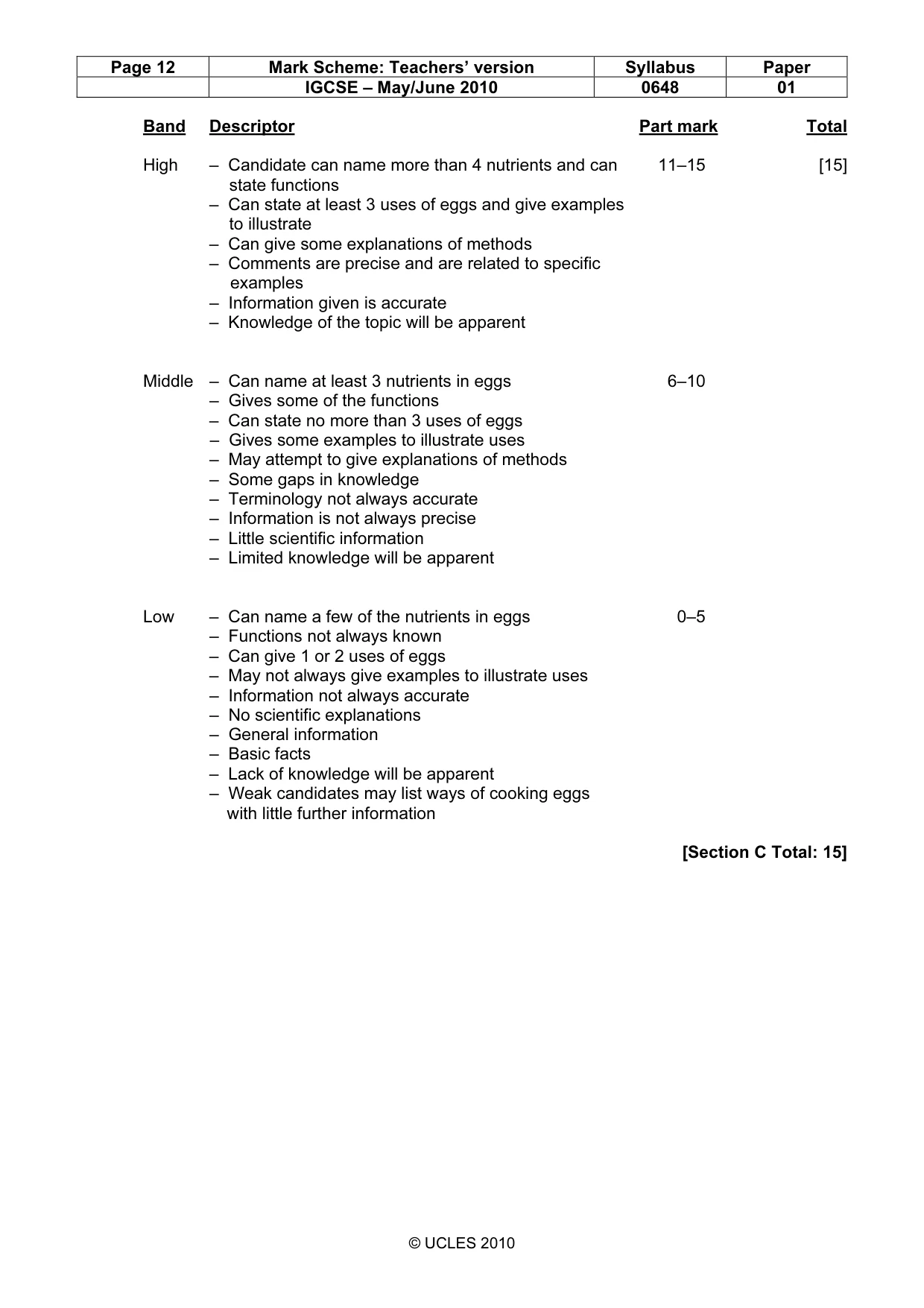
Page 12 Mark Scheme: Teachers’ version Syllabus Paper IGCSE – May/June 2010 0648 01 © UCLES 2010 Band Descriptor Part mark Total High – Candidate can name more than 4 nutrients and can 11–15 [15] state functions – Can state at least 3 uses of eggs and give examples to illustrate – Can give some explanations of methods – Comments are precise and are related to specific examples – Information given is accurate – Knowledge of the topic will be apparent Middle – Can name at least 3 nutrients in eggs 6–10 – Gives some of the functions – Can state no more than 3 uses of eggs – Gives some examples to illustrate uses – May attempt to give explanations of methods – Some gaps in knowledge – Terminology not always accurate – Information is not always precise – Little scientific information – Limited knowledge will be apparent Low – Can name a few of the nutrients in eggs 0–5 – Functions not always known – Can give 1 or 2 uses of eggs – May not always give examples to illustrate uses – Information not always accurate – No scientific explanations – General information – Basic facts – Lack of knowledge will be apparent – Weak candidates may list ways of cooking eggs with little further information [Section C Total: 15]
What you needed in this session
Cambridge’s own grade thresholds for 2010 May/June, Paper 1 · Variant 1. A higher threshold means an easier paper — the bar moves with how the cohort did.