Cambridge IGCSE Food and Nutrition 0648 — 2009 Oct/Nov Paper 1 · Variant 1
0648/11/O/N/09 · 100 marks · ≈113 min
The question paper and its mark scheme, free to read here and free to download. This is Cambridge’s own paper, exactly as it was sat.
Question paper16 pages





Mark scheme11 pages
Answers below. Sit the paper first if you are practising.
Paper as text
Question paper, page 1
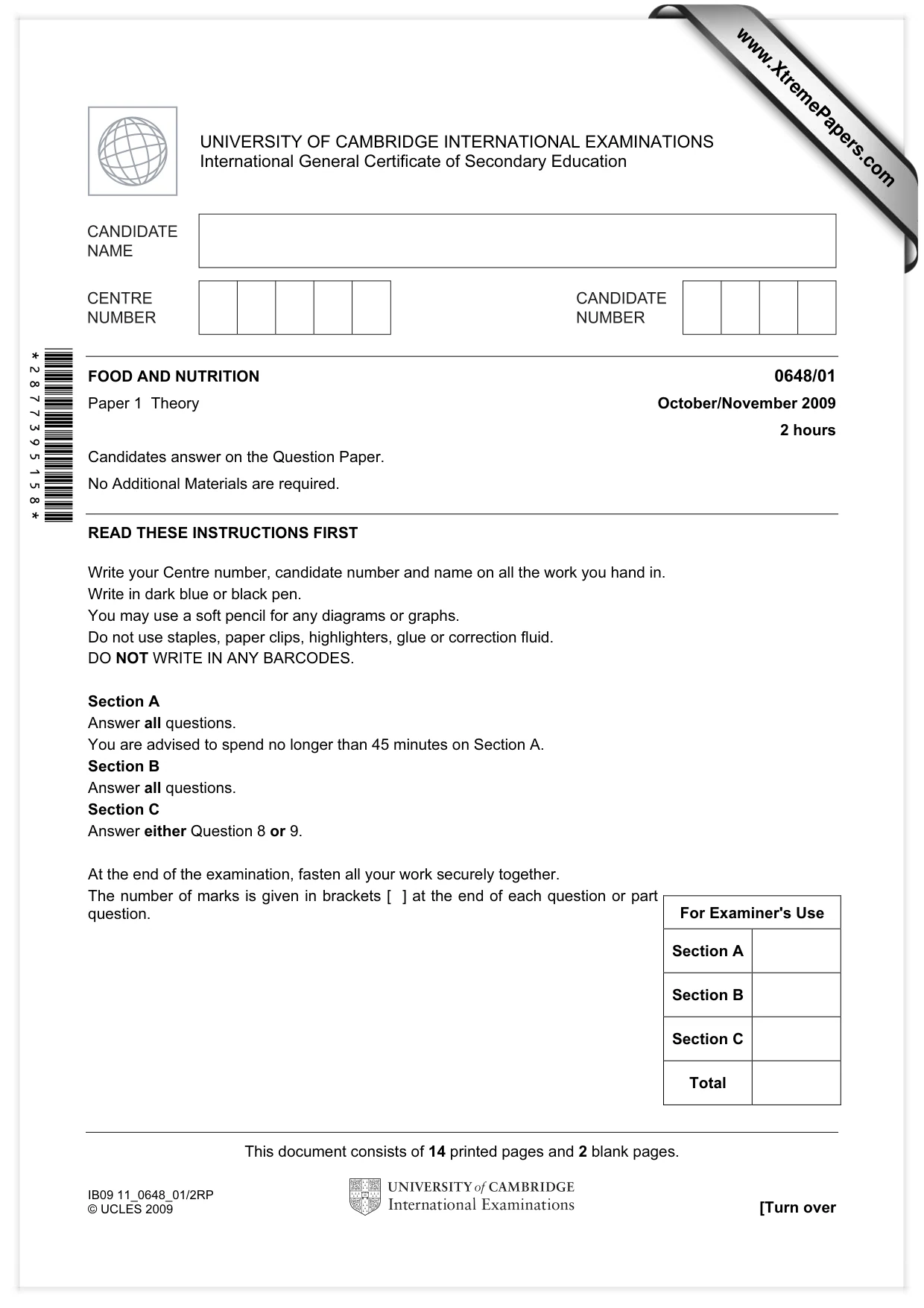
This document consists of 14 printed pages and 2 blank pages. IB09 11_0648_01/2RP © UCLES 2009 [Turn over *2877395158* For Examiner's Use Section A Section B Section C Total UNIVERSITY OF CAMBRIDGE INTERNATIONAL EXAMINATIONS International General Certificate of Secondary Education FOOD AND NUTRITION 0648/01 Paper 1 Theory October/November 2009 2 hours Candidates answer on the Question Paper. No Additional Materials are required. READ THESE INSTRUCTIONS FIRST Write your Centre number, candidate number and name on all the work you hand in. Write in dark blue or black pen. You may use a soft pencil for any diagrams or graphs. Do not use staples, paper clips, highlighters, glue or correction fluid. DO NOT WRITE IN ANY BARCODES. Section A Answer all questions. You are advised to spend no longer than 45 minutes on Section A. Section B Answer all questions. Section C Answer either Question 8 or 9. At the end of the examination, fasten all your work securely together. The number of marks is given in brackets [ ] at the end of each question or part question. www.XtremePapers.com
Question paper, page 2
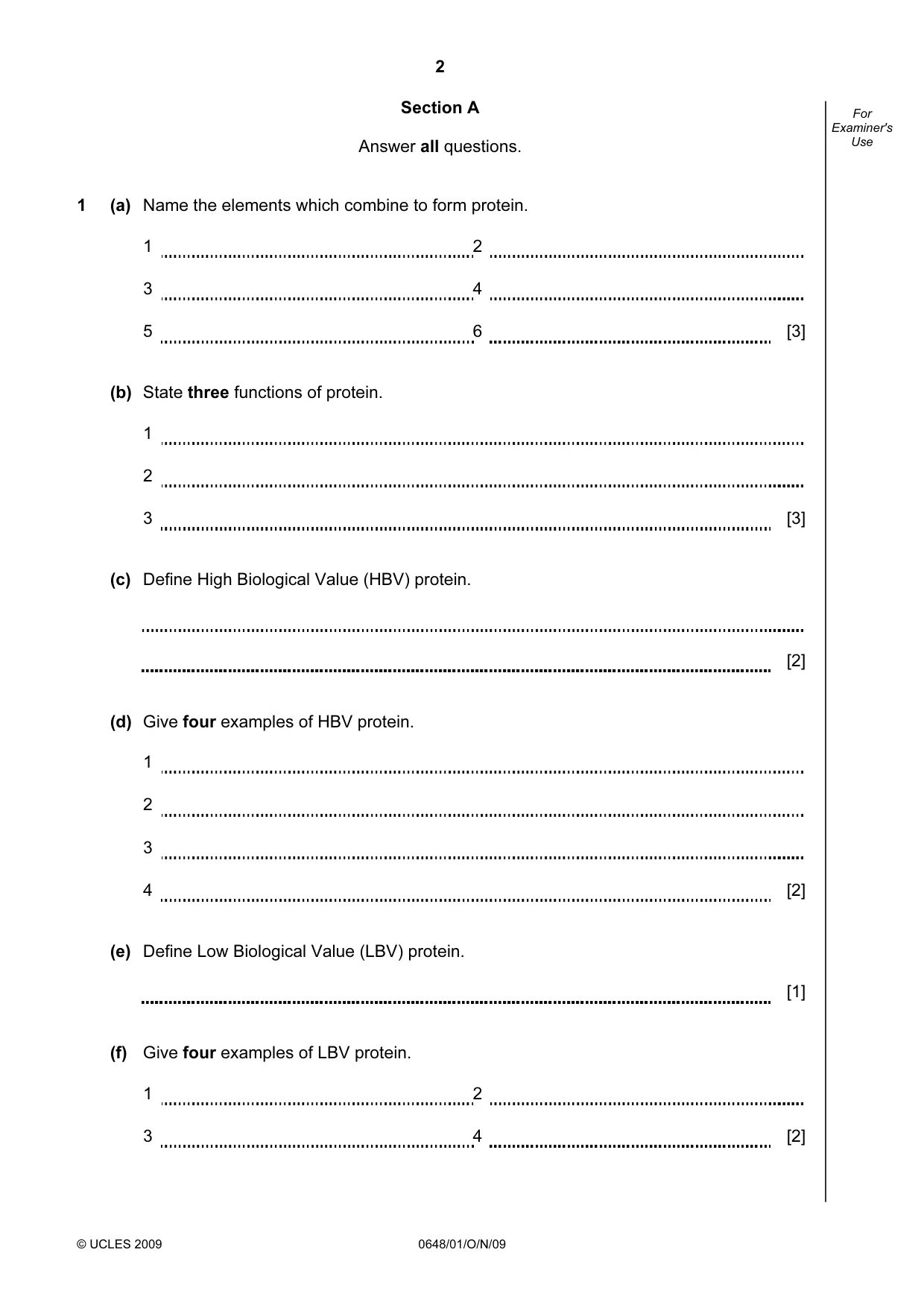
2 © UCLES 2009 0648/01/O/N/09 For Examiner's Use Section A Answer all questions. 1 (a) Name the elements which combine to form protein. 1 2 3 4 5 6 [3] (b) State three functions of protein. 1 2 3 [3] (c) Define High Biological Value (HBV) protein. [2] (d) Give four examples of HBV protein. 1 2 3 4 [2] (e) Define Low Biological Value (LBV) protein. [1] (f) Give four examples of LBV protein. 1 2 3 4 [2]
Question paper, page 3
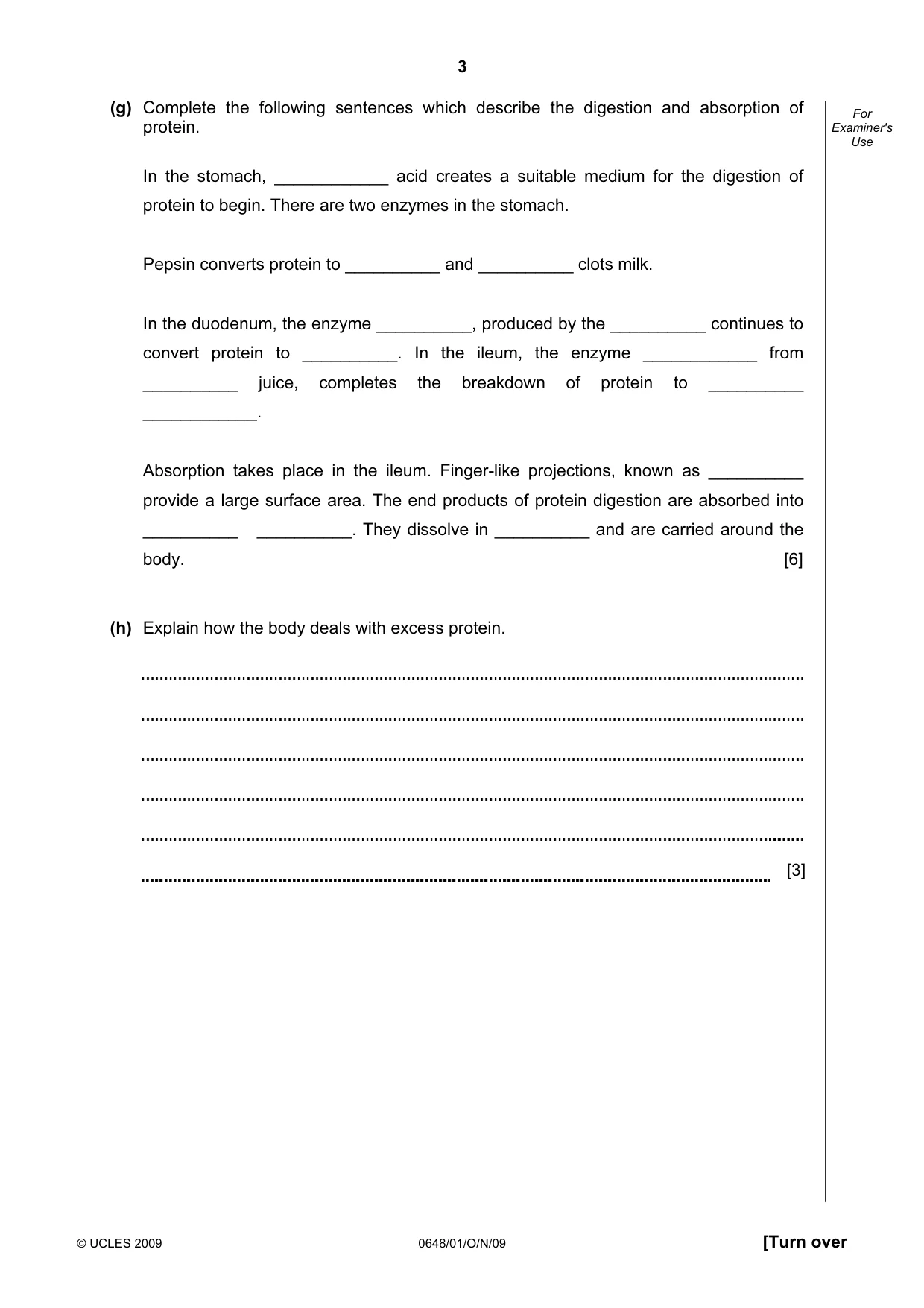
3 © UCLES 2009 0648/01/O/N/09 [Turn over For Examiner's Use (g) Complete the following sentences which describe the digestion and absorption of protein. In the stomach, ____________ acid creates a suitable medium for the digestion of protein to begin. There are two enzymes in the stomach. Pepsin converts protein to __________ and __________ clots milk. In the duodenum, the enzyme __________, produced by the __________ continues to convert protein to __________. In the ileum, the enzyme ____________ from __________ juice, completes the breakdown of protein to __________ ____________. Absorption takes place in the ileum. Finger-like projections, known as __________ provide a large surface area. The end products of protein digestion are absorbed into __________ __________. They dissolve in __________ and are carried around the body. [6] (h) Explain how the body deals with excess protein. [3]
Question paper, page 4
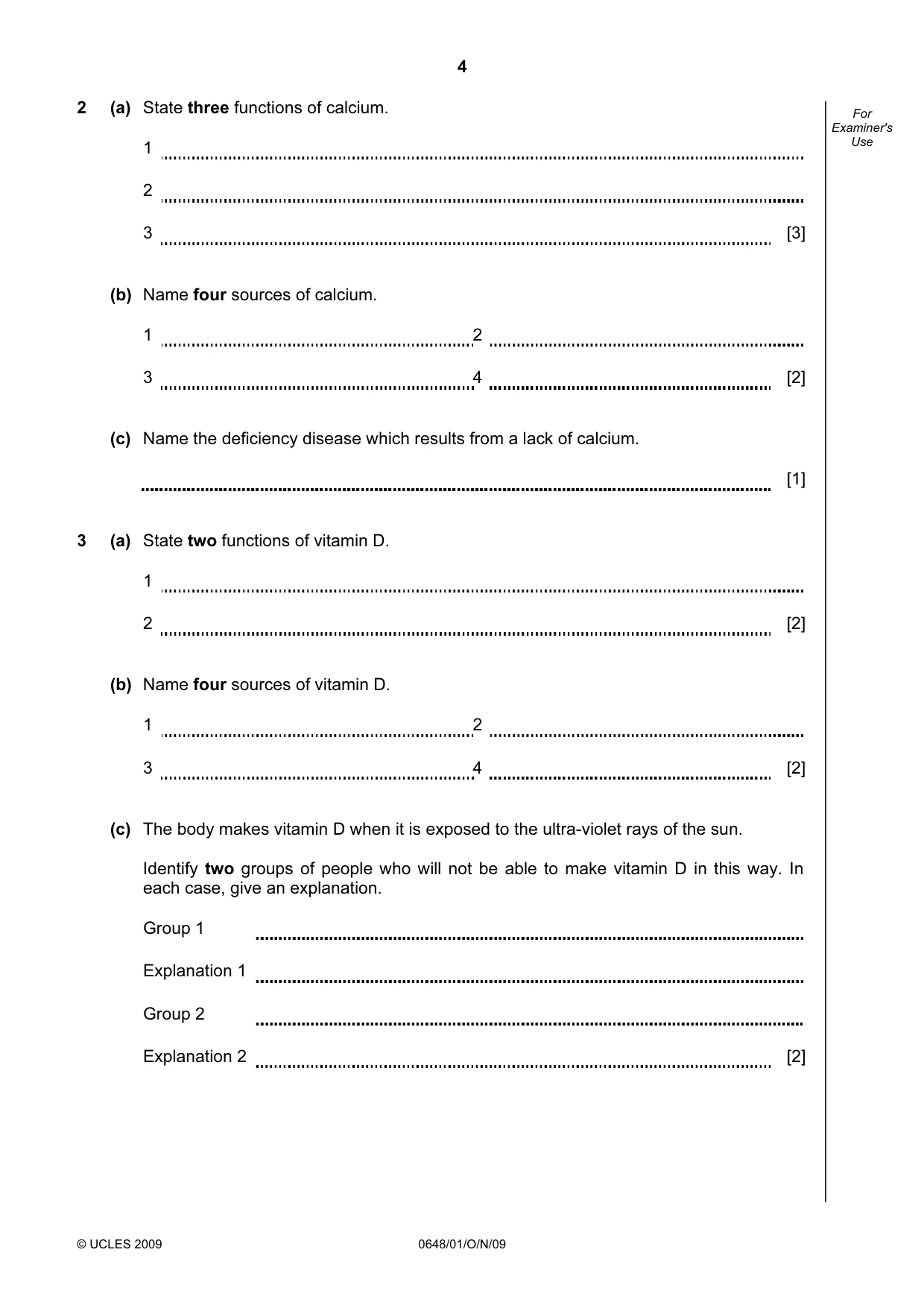
4 © UCLES 2009 0648/01/O/N/09 For Examiner's Use 2 (a) State three functions of calcium. 1 2 3 [3] (b) Name four sources of calcium. 1 2 3 4 [2] (c) Name the deficiency disease which results from a lack of calcium. [1] 3 (a) State two functions of vitamin D. 1 2 [2] (b) Name four sources of vitamin D. 1 2 3 4 [2] (c) The body makes vitamin D when it is exposed to the ultra-violet rays of the sun. Identify two groups of people who will not be able to make vitamin D in this way. In each case, give an explanation. Group 1 Explanation 1 Group 2 Explanation 2 [2]
Question paper, page 5
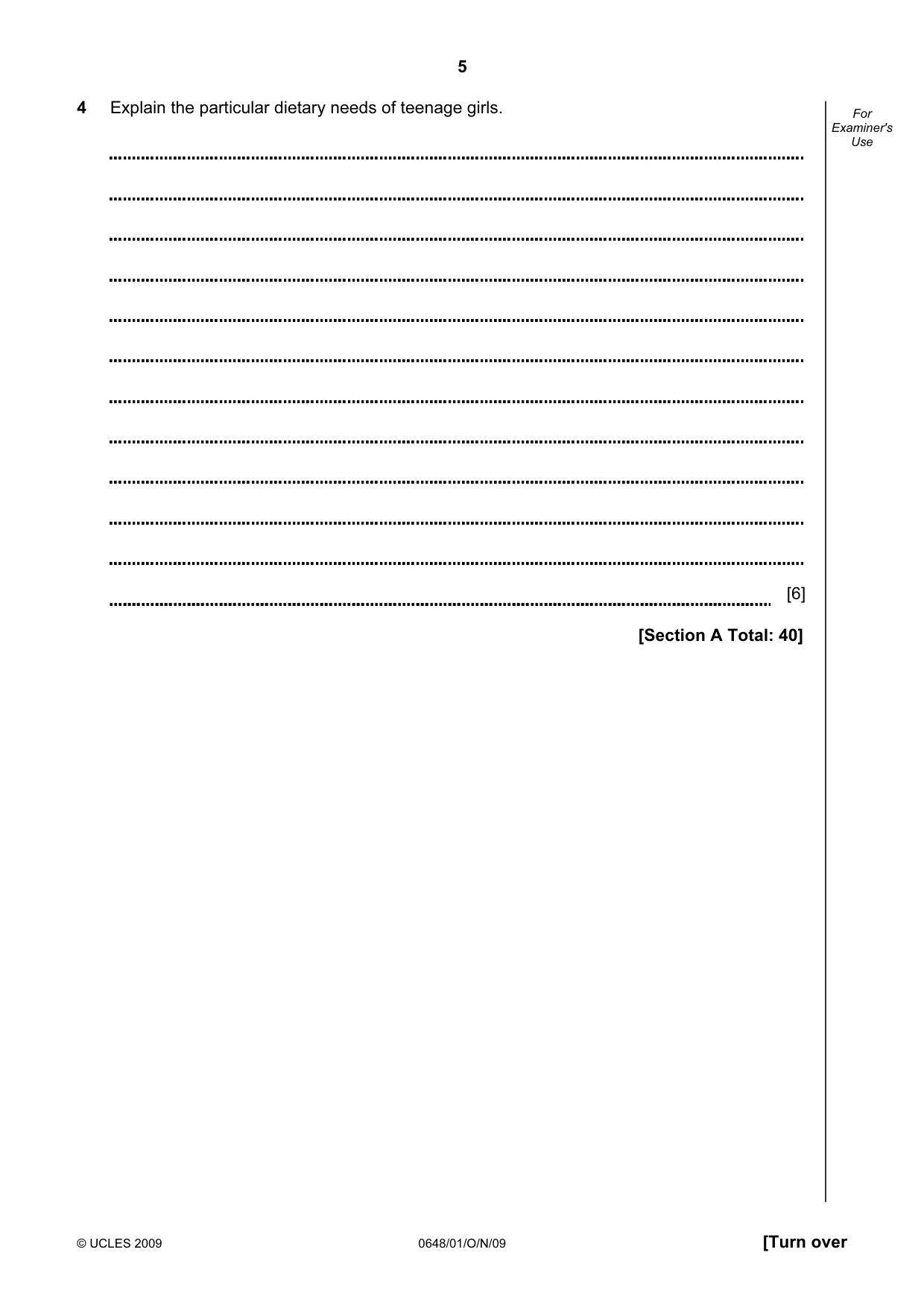
5 © UCLES 2009 0648/01/O/N/09 [Turn over For Examiner's Use 4 Explain the particular dietary needs of teenage girls. [6] [Section A Total: 40]
Question paper, page 6
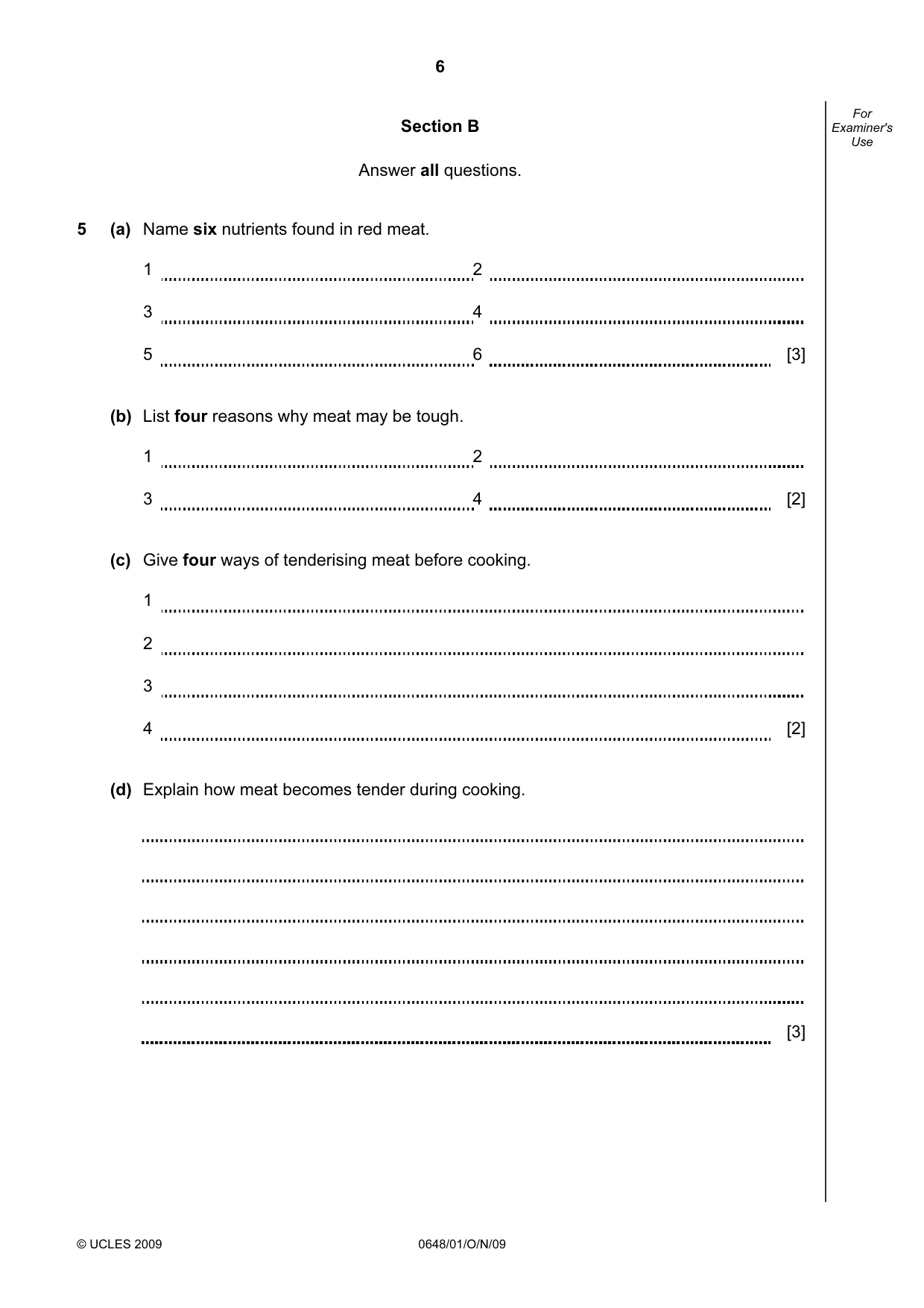
6 © UCLES 2009 0648/01/O/N/09 For Examiner's Use Section B Answer all questions. 5 (a) Name six nutrients found in red meat. 1 2 3 4 5 6 [3] (b) List four reasons why meat may be tough. 1 2 3 4 [2] (c) Give four ways of tenderising meat before cooking. 1 2 3 4 [2] (d) Explain how meat becomes tender during cooking. [3]
Question paper, page 7
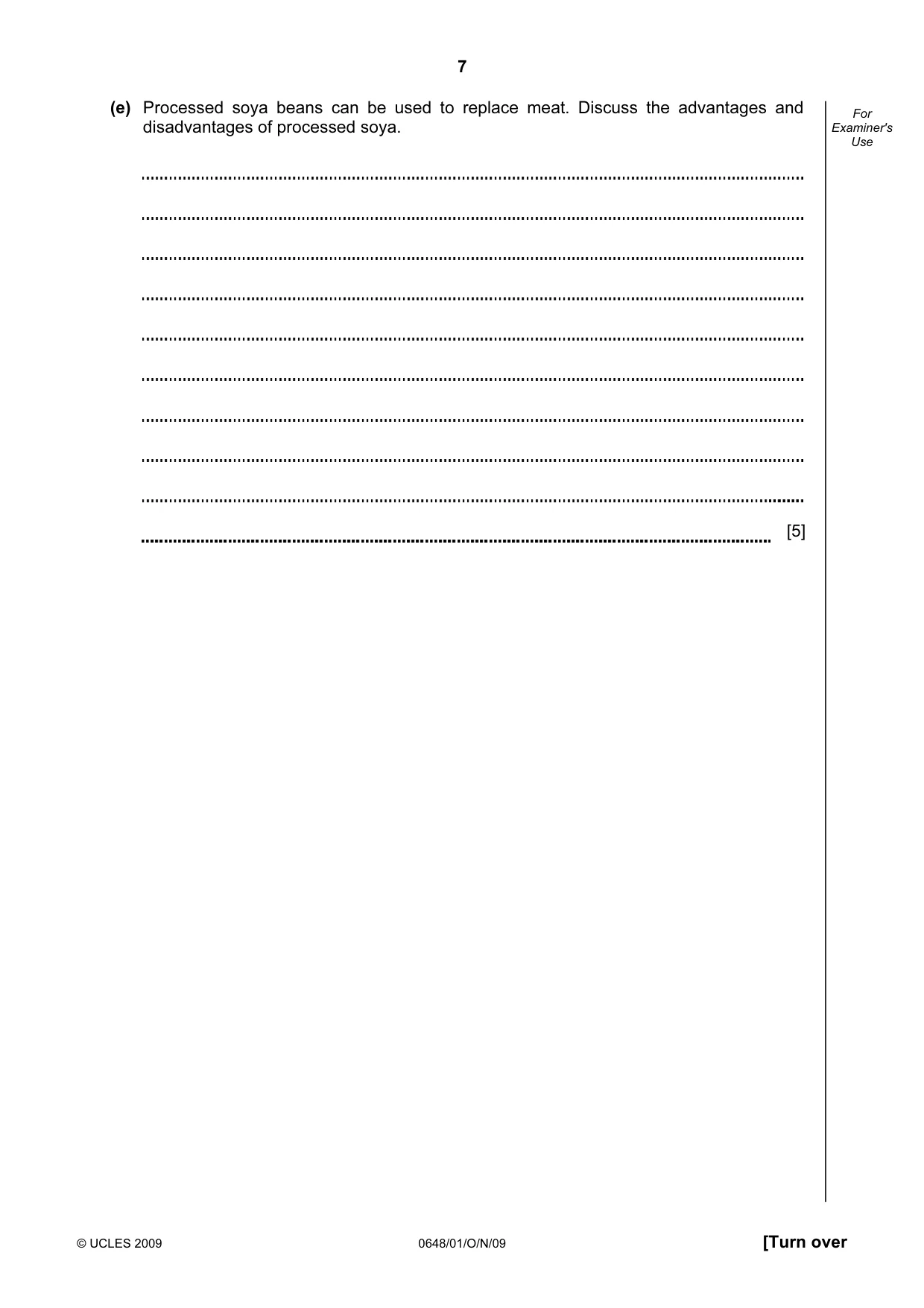
7 © UCLES 2009 0648/01/O/N/09 [Turn over For Examiner's Use (e) Processed soya beans can be used to replace meat. Discuss the advantages and disadvantages of processed soya. [5]
Question paper, page 8
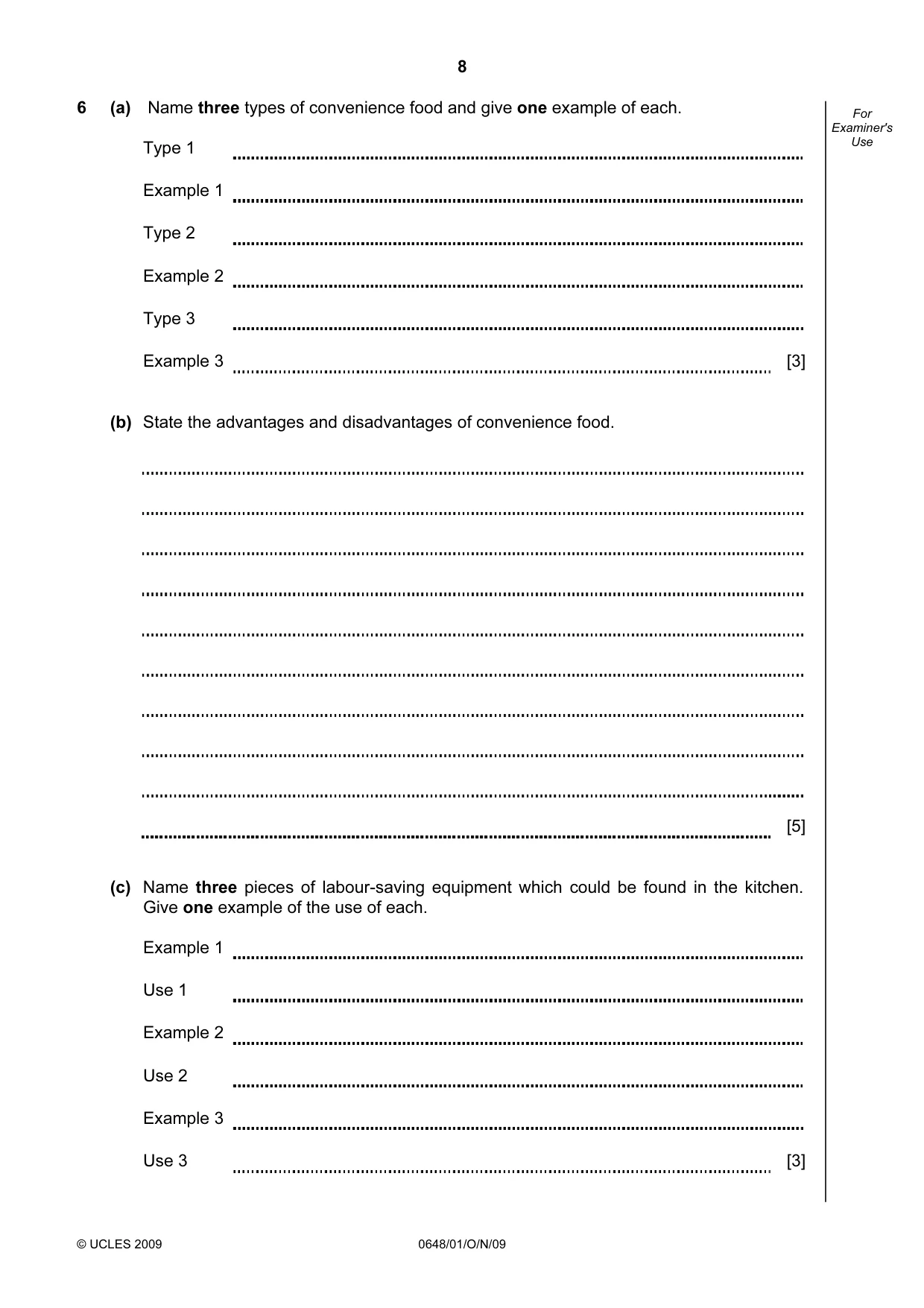
8 © UCLES 2009 0648/01/O/N/09 For Examiner's Use 6 (a) Name three types of convenience food and give one example of each. Type 1 Example 1 Type 2 Example 2 Type 3 Example 3 [3] (b) State the advantages and disadvantages of convenience food. [5] (c) Name three pieces of labour-saving equipment which could be found in the kitchen. Give one example of the use of each. Example 1 Use 1 Example 2 Use 2 Example 3 Use 3 [3]
Question paper, page 9
9 © UCLES 2009 0648/01/O/N/09 [Turn over For Examiner's Use (d) Give advice on the safe use of electrical equipment in the kitchen. [4]
Question paper, page 10
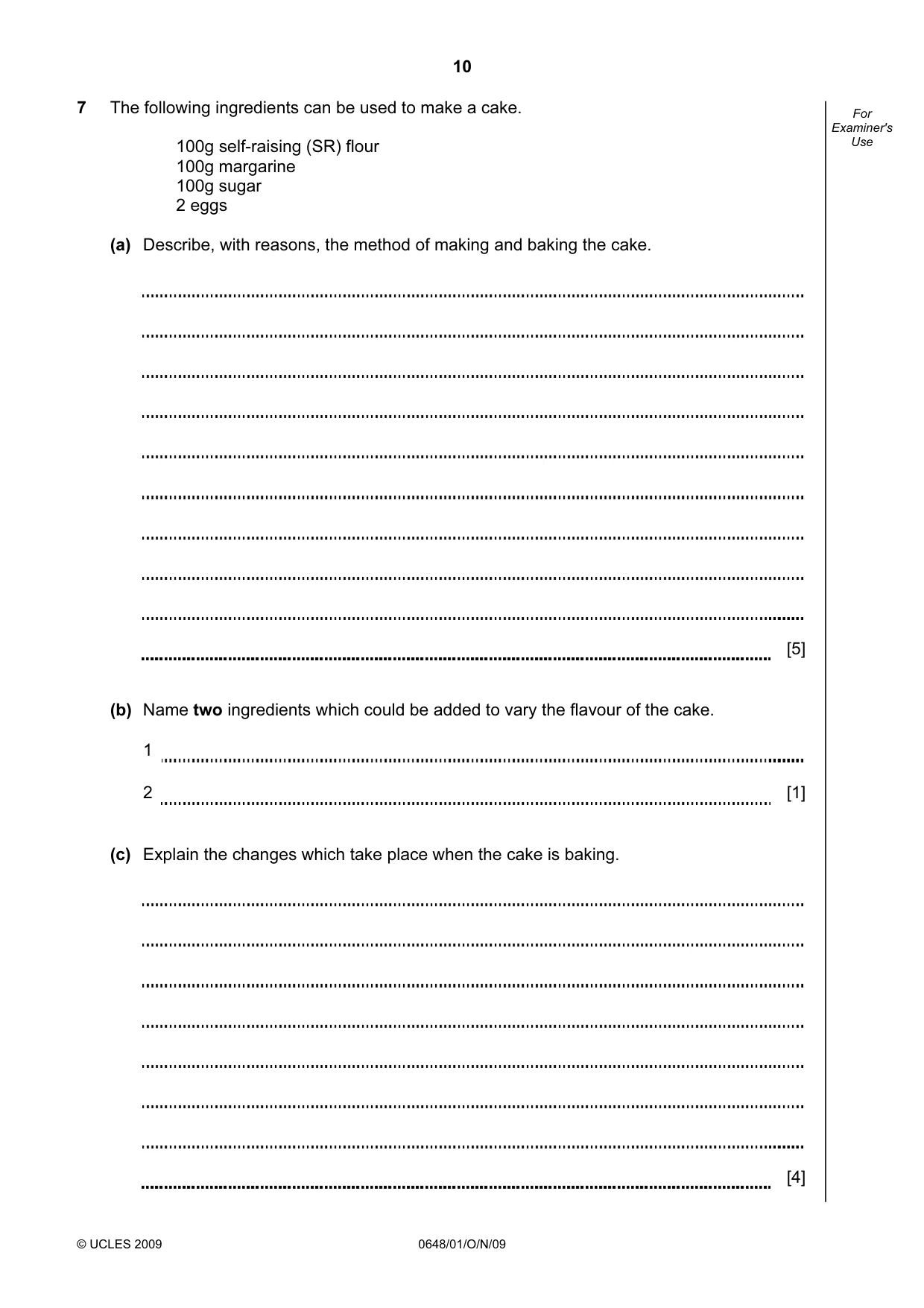
10 © UCLES 2009 0648/01/O/N/09 For Examiner's Use 7 The following ingredients can be used to make a cake. 100g self-raising (SR) flour 100g margarine 100g sugar 2 eggs (a) Describe, with reasons, the method of making and baking the cake. [5] (b) Name two ingredients which could be added to vary the flavour of the cake. 1 2 [1] (c) Explain the changes which take place when the cake is baking. [4]
Question paper, page 11
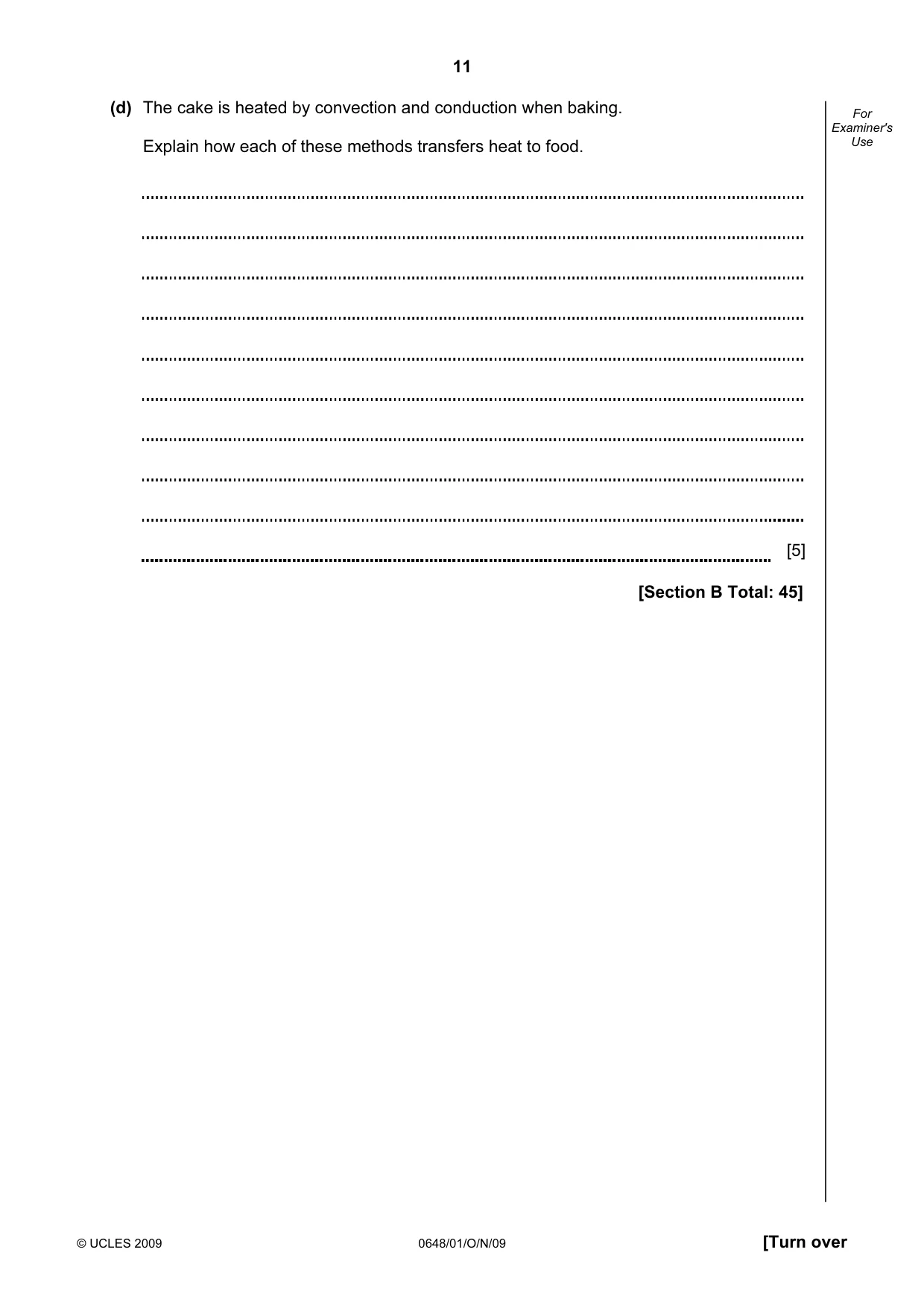
11 © UCLES 2009 0648/01/O/N/09 [Turn over For Examiner's Use (d) The cake is heated by convection and conduction when baking. Explain how each of these methods transfers heat to food. [5] [Section B Total: 45]
Question paper, page 12
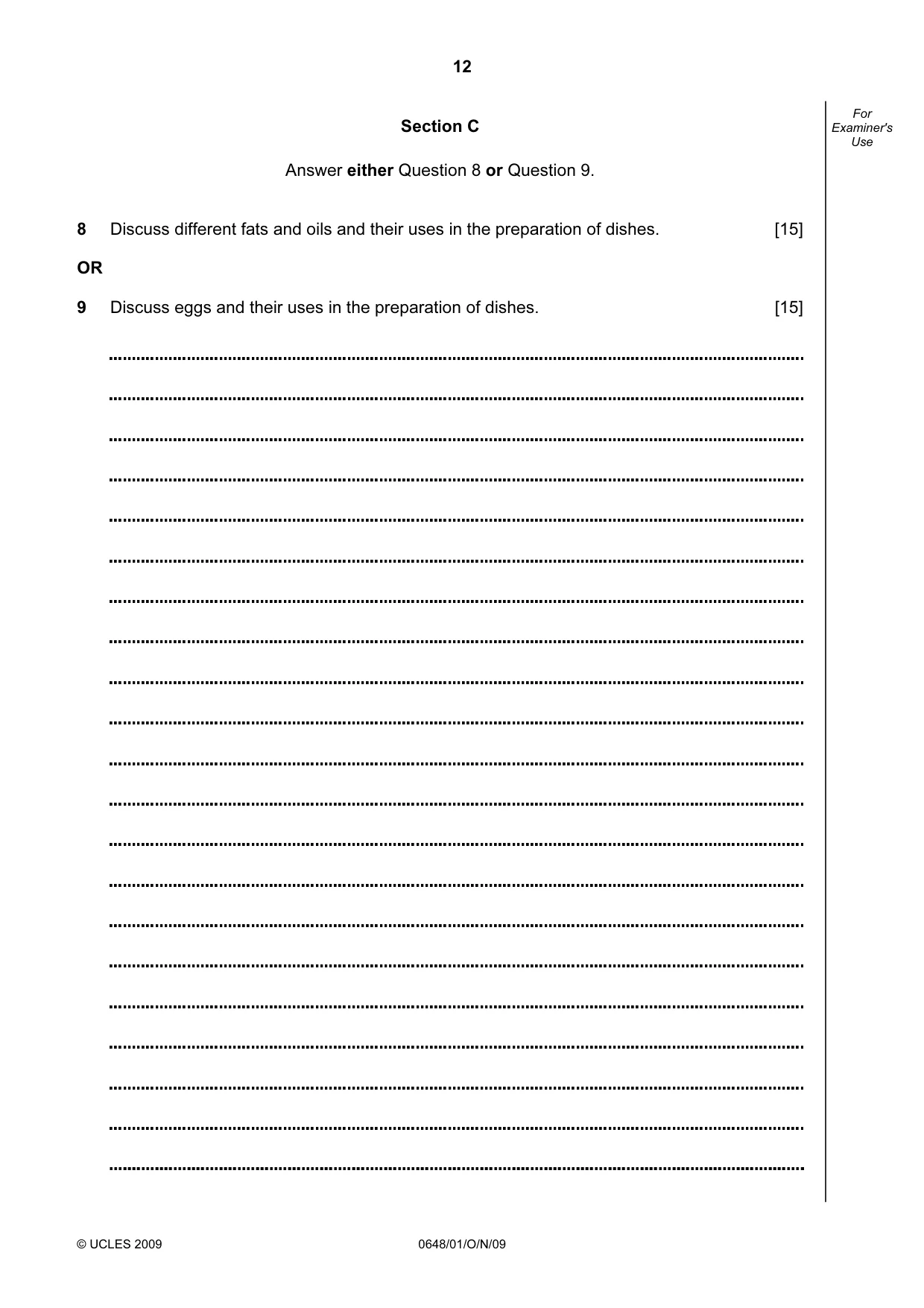
12 © UCLES 2009 0648/01/O/N/09 For Examiner's Use Section C Answer either Question 8 or Question 9. 8 Discuss different fats and oils and their uses in the preparation of dishes. [15] OR 9 Discuss eggs and their uses in the preparation of dishes. [15]
Question paper, page 13
13 © UCLES 2009 0648/01/O/N/09 [Turn over For Examiner's Use
Question paper, page 14
14 © UCLES 2009 0648/01/O/N/09 For Examiner's Use [Section C Total: 15] [Total for Paper: 100]
Question paper, page 16
16 BLANK PAGE Permission to reproduce items where third-party owned material protected by copyright is included has been sought and cleared where possible. Every reasonable effort has been made by the publisher (UCLES) to trace copyright holders, but if any items requiring clearance have unwittingly been included, the publisher will be pleased to make amends at the earliest possible opportunity. University of Cambridge International Examinations is part of the Cambridge Assessment Group. Cambridge Assessment is the brand name of University of Cambridge Local Examinations Syndicate (UCLES), which is itself a department of the University of Cambridge. 0648/01/O/N/09
Mark scheme, page 1
UNIVERSITY OF CAMBRIDGE INTERNATIONAL EXAMINATIONS International General Certificate of Secondary Education MARK SCHEME for the October/November 2009 question paper for the guidance of teachers 0648 FOOD AND NUTRITION 0648/01 Paper 1 (Theory), maximum raw mark 100 This mark scheme is published as an aid to teachers and candidates, to indicate the requirements of the examination. It shows the basis on which Examiners were instructed to award marks. It does not indicate the details of the discussions that took place at an Examiners’ meeting before marking began, which would have considered the acceptability of alternative answers. Mark schemes must be read in conjunction with the question papers and the report on the examination. • CIE will not enter into discussions or correspondence in connection with these mark schemes. CIE is publishing the mark schemes for the October/November 2009 question papers for most IGCSE, GCE Advanced Level and Advanced Subsidiary Level syllabuses and some Ordinary Level syllabuses. www.XtremePapers.com
Mark scheme, page 2
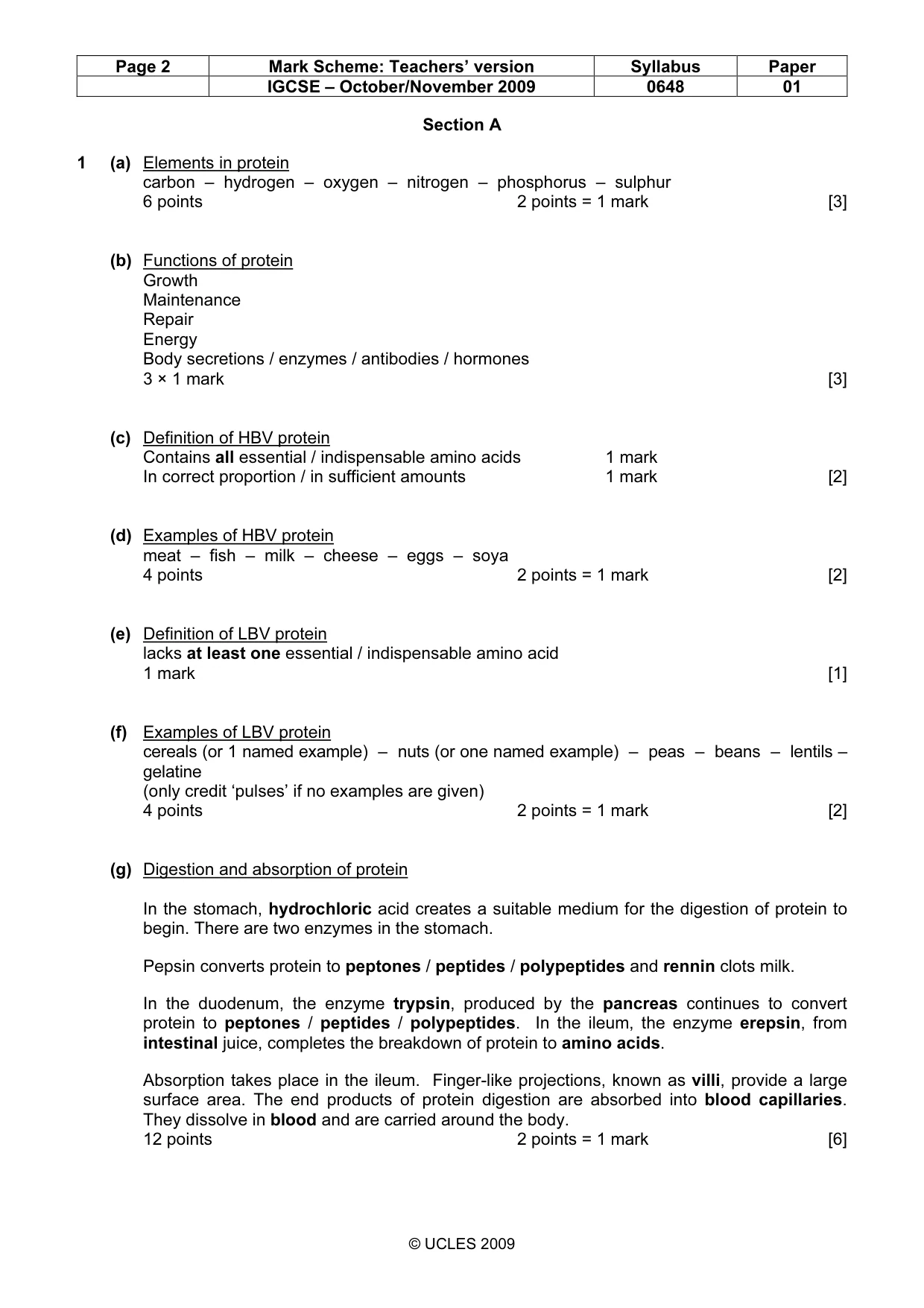
Page 2 Mark Scheme: Teachers’ version Syllabus Paper IGCSE – October/November 2009 0648 01 © UCLES 2009 Section A 1 (a) Elements in protein carbon – hydrogen – oxygen – nitrogen – phosphorus – sulphur 6 points 2 points = 1 mark [3] (b) Functions of protein Growth Maintenance Repair Energy Body secretions / enzymes / antibodies / hormones 3 × 1 mark [3] (c) Definition of HBV protein Contains all essential / indispensable amino acids 1 mark In correct proportion / in sufficient amounts 1 mark [2] (d) Examples of HBV protein meat – fish – milk – cheese – eggs – soya 4 points 2 points = 1 mark [2] (e) Definition of LBV protein lacks at least one essential / indispensable amino acid 1 mark [1] (f) Examples of LBV protein cereals (or 1 named example) – nuts (or one named example) – peas – beans – lentils – gelatine (only credit ‘pulses’ if no examples are given) 4 points 2 points = 1 mark [2] (g) Digestion and absorption of protein In the stomach, hydrochloric acid creates a suitable medium for the digestion of protein to begin. There are two enzymes in the stomach. Pepsin converts protein to peptones / peptides / polypeptides and rennin clots milk. In the duodenum, the enzyme trypsin, produced by the pancreas continues to convert protein to peptones / peptides / polypeptides. In the ileum, the enzyme erepsin, from intestinal juice, completes the breakdown of protein to amino acids. Absorption takes place in the ileum. Finger-like projections, known as villi, provide a large surface area. The end products of protein digestion are absorbed into blood capillaries. They dissolve in blood and are carried around the body. 12 points 2 points = 1 mark [6]
Mark scheme, page 3
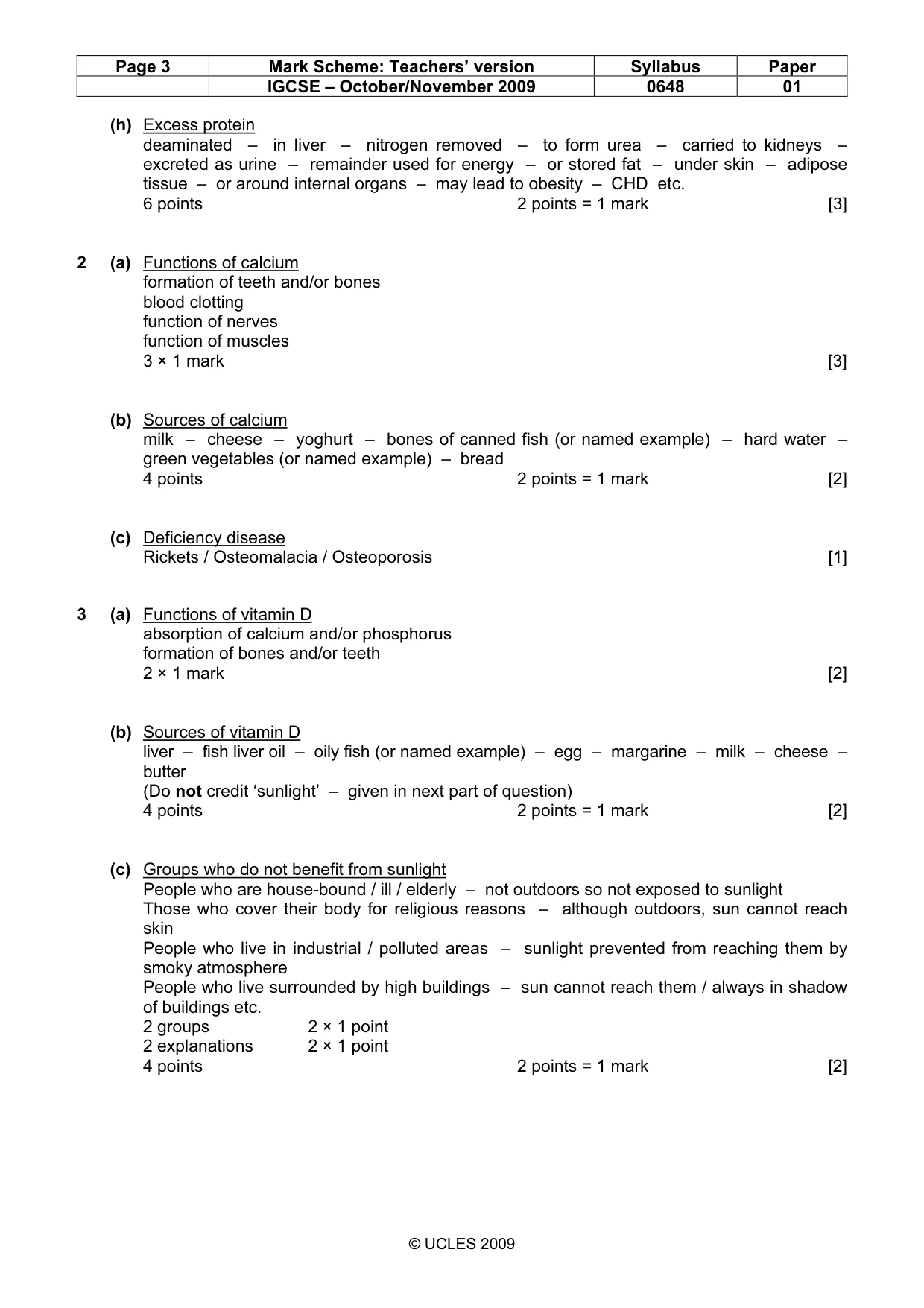
Page 3 Mark Scheme: Teachers’ version Syllabus Paper IGCSE – October/November 2009 0648 01 © UCLES 2009 (h) Excess protein deaminated – in liver – nitrogen removed – to form urea – carried to kidneys – excreted as urine – remainder used for energy – or stored fat – under skin – adipose tissue – or around internal organs – may lead to obesity – CHD etc. 6 points 2 points = 1 mark [3] 2 (a) Functions of calcium formation of teeth and/or bones blood clotting function of nerves function of muscles 3 × 1 mark [3] (b) Sources of calcium milk – cheese – yoghurt – bones of canned fish (or named example) – hard water – green vegetables (or named example) – bread 4 points 2 points = 1 mark [2] (c) Deficiency disease Rickets / Osteomalacia / Osteoporosis [1] 3 (a) Functions of vitamin D absorption of calcium and/or phosphorus formation of bones and/or teeth 2 × 1 mark [2] (b) Sources of vitamin D liver – fish liver oil – oily fish (or named example) – egg – margarine – milk – cheese – butter (Do not credit ‘sunlight’ – given in next part of question) 4 points 2 points = 1 mark [2] (c) Groups who do not benefit from sunlight People who are house-bound / ill / elderly – not outdoors so not exposed to sunlight Those who cover their body for religious reasons – although outdoors, sun cannot reach skin People who live in industrial / polluted areas – sunlight prevented from reaching them by smoky atmosphere People who live surrounded by high buildings – sun cannot reach them / always in shadow of buildings etc. 2 groups 2 × 1 point 2 explanations 2 × 1 point 4 points 2 points = 1 mark [2]
Mark scheme, page 4
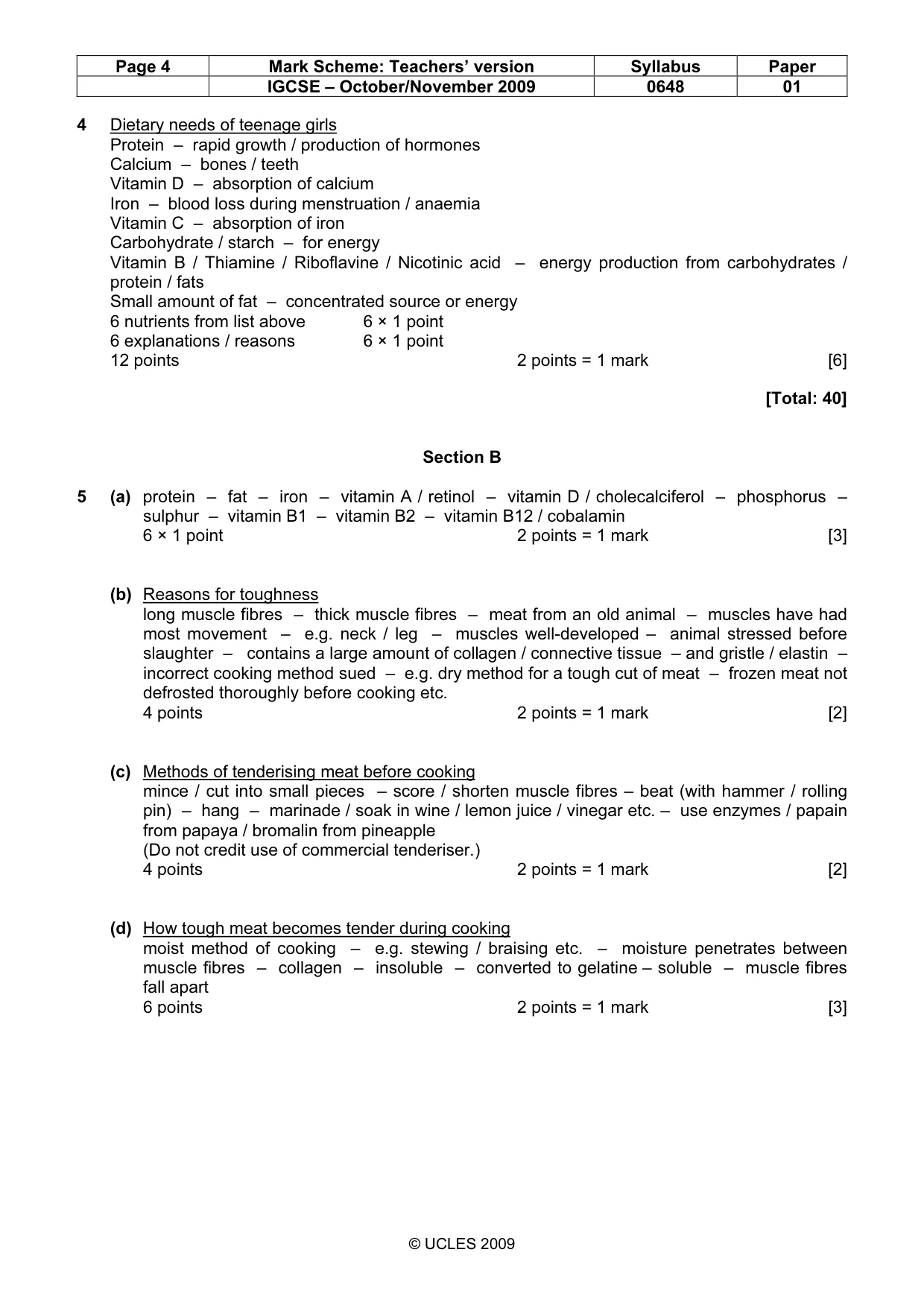
Page 4 Mark Scheme: Teachers’ version Syllabus Paper IGCSE – October/November 2009 0648 01 © UCLES 2009 4 Dietary needs of teenage girls Protein – rapid growth / production of hormones Calcium – bones / teeth Vitamin D – absorption of calcium Iron – blood loss during menstruation / anaemia Vitamin C – absorption of iron Carbohydrate / starch – for energy Vitamin B / Thiamine / Riboflavine / Nicotinic acid – energy production from carbohydrates / protein / fats Small amount of fat – concentrated source or energy 6 nutrients from list above 6 × 1 point 6 explanations / reasons 6 × 1 point 12 points 2 points = 1 mark [6] [Total: 40] Section B 5 (a) protein – fat – iron – vitamin A / retinol – vitamin D / cholecalciferol – phosphorus – sulphur – vitamin B1 – vitamin B2 – vitamin B12 / cobalamin 6 × 1 point 2 points = 1 mark [3] (b) Reasons for toughness long muscle fibres – thick muscle fibres – meat from an old animal – muscles have had most movement – e.g. neck / leg – muscles well-developed – animal stressed before slaughter – contains a large amount of collagen / connective tissue – and gristle / elastin – incorrect cooking method sued – e.g. dry method for a tough cut of meat – frozen meat not defrosted thoroughly before cooking etc. 4 points 2 points = 1 mark [2] (c) Methods of tenderising meat before cooking mince / cut into small pieces – score / shorten muscle fibres – beat (with hammer / rolling pin) – hang – marinade / soak in wine / lemon juice / vinegar etc. – use enzymes / papain from papaya / bromalin from pineapple (Do not credit use of commercial tenderiser.) 4 points 2 points = 1 mark [2] (d) How tough meat becomes tender during cooking moist method of cooking – e.g. stewing / braising etc. – moisture penetrates between muscle fibres – collagen – insoluble – converted to gelatine – soluble – muscle fibres fall apart 6 points 2 points = 1 mark [3]
Mark scheme, page 5
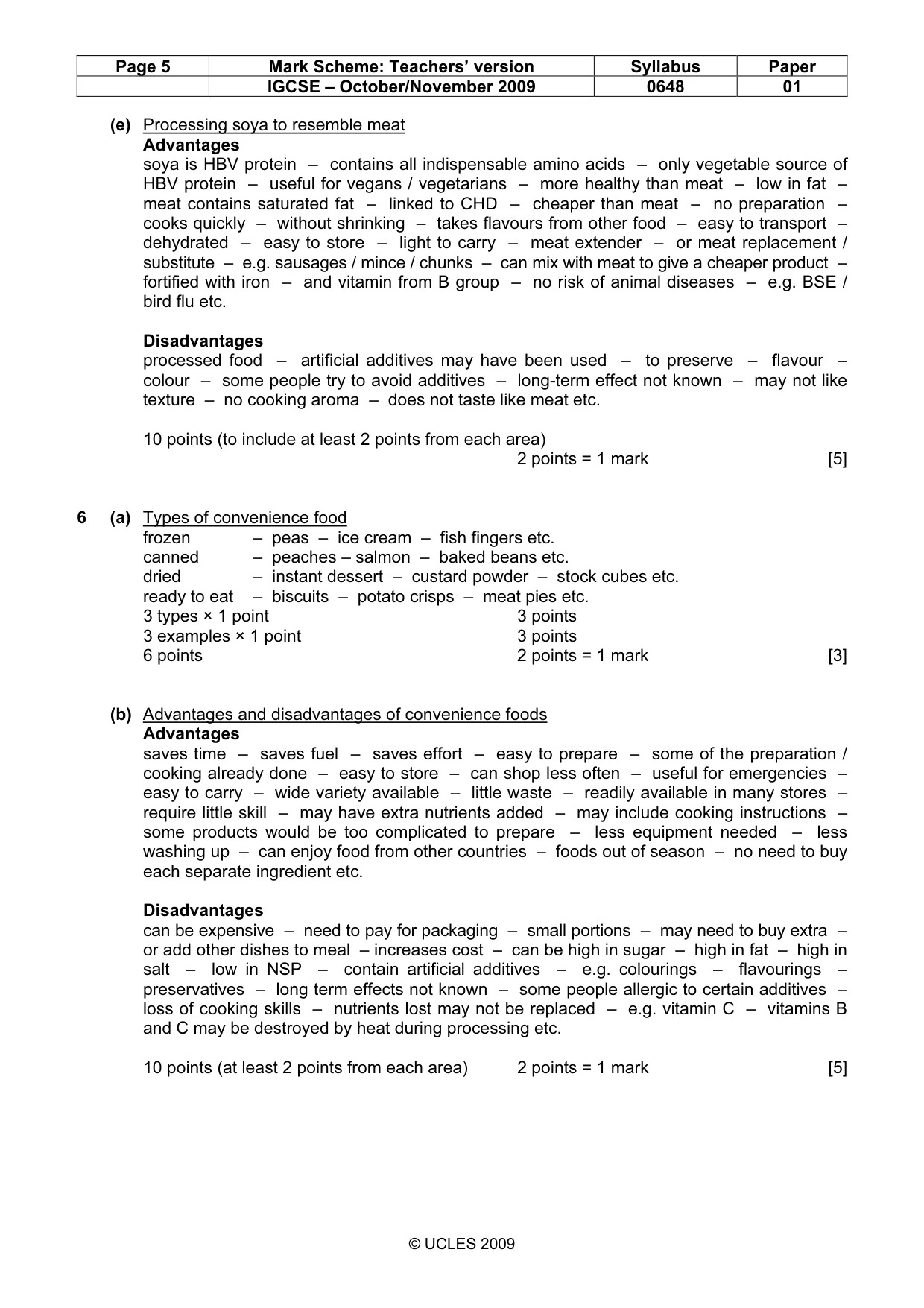
Page 5 Mark Scheme: Teachers’ version Syllabus Paper IGCSE – October/November 2009 0648 01 © UCLES 2009 (e) Processing soya to resemble meat Advantages soya is HBV protein – contains all indispensable amino acids – only vegetable source of HBV protein – useful for vegans / vegetarians – more healthy than meat – low in fat – meat contains saturated fat – linked to CHD – cheaper than meat – no preparation – cooks quickly – without shrinking – takes flavours from other food – easy to transport – dehydrated – easy to store – light to carry – meat extender – or meat replacement / substitute – e.g. sausages / mince / chunks – can mix with meat to give a cheaper product – fortified with iron – and vitamin from B group – no risk of animal diseases – e.g. BSE / bird flu etc. Disadvantages processed food – artificial additives may have been used – to preserve – flavour – colour – some people try to avoid additives – long-term effect not known – may not like texture – no cooking aroma – does not taste like meat etc. 10 points (to include at least 2 points from each area) 2 points = 1 mark [5] 6 (a) Types of convenience food frozen – peas – ice cream – fish fingers etc. canned – peaches – salmon – baked beans etc. dried – instant dessert – custard powder – stock cubes etc. ready to eat – biscuits – potato crisps – meat pies etc. 3 types × 1 point 3 points 3 examples × 1 point 3 points 6 points 2 points = 1 mark [3] (b) Advantages and disadvantages of convenience foods Advantages saves time – saves fuel – saves effort – easy to prepare – some of the preparation / cooking already done – easy to store – can shop less often – useful for emergencies – easy to carry – wide variety available – little waste – readily available in many stores – require little skill – may have extra nutrients added – may include cooking instructions – some products would be too complicated to prepare – less equipment needed – less washing up – can enjoy food from other countries – foods out of season – no need to buy each separate ingredient etc. Disadvantages can be expensive – need to pay for packaging – small portions – may need to buy extra – or add other dishes to meal – increases cost – can be high in sugar – high in fat – high in salt – low in NSP – contain artificial additives – e.g. colourings – flavourings – preservatives – long term effects not known – some people allergic to certain additives – loss of cooking skills – nutrients lost may not be replaced – e.g. vitamin C – vitamins B and C may be destroyed by heat during processing etc. 10 points (at least 2 points from each area) 2 points = 1 mark [5]
Mark scheme, page 6
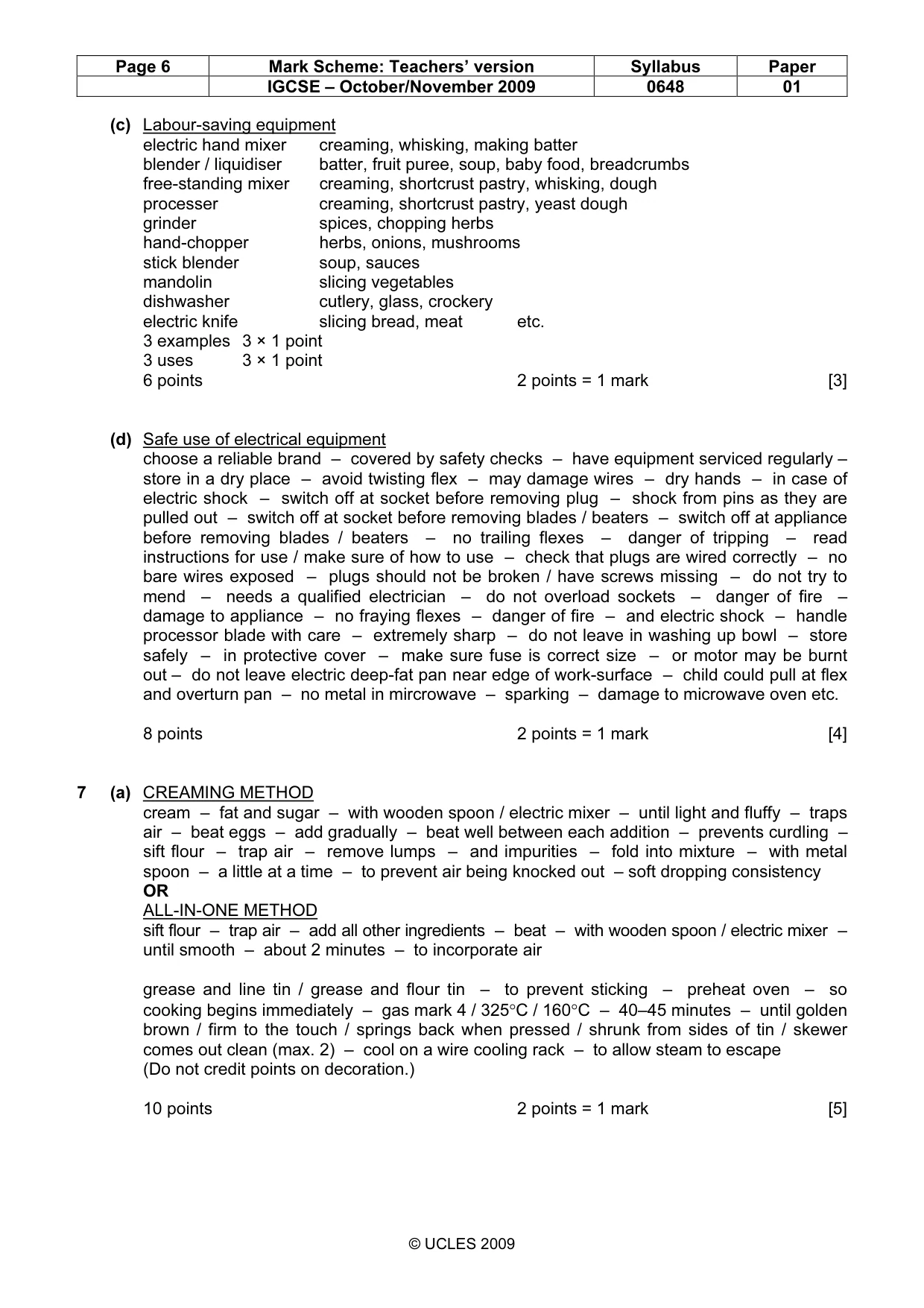
Page 6 Mark Scheme: Teachers’ version Syllabus Paper IGCSE – October/November 2009 0648 01 © UCLES 2009 (c) Labour-saving equipment electric hand mixer creaming, whisking, making batter blender / liquidiser batter, fruit puree, soup, baby food, breadcrumbs free-standing mixer creaming, shortcrust pastry, whisking, dough processer creaming, shortcrust pastry, yeast dough grinder spices, chopping herbs hand-chopper herbs, onions, mushrooms stick blender soup, sauces mandolin slicing vegetables dishwasher cutlery, glass, crockery electric knife slicing bread, meat etc. 3 examples 3 × 1 point 3 uses 3 × 1 point 6 points 2 points = 1 mark [3] (d) Safe use of electrical equipment choose a reliable brand – covered by safety checks – have equipment serviced regularly – store in a dry place – avoid twisting flex – may damage wires – dry hands – in case of electric shock – switch off at socket before removing plug – shock from pins as they are pulled out – switch off at socket before removing blades / beaters – switch off at appliance before removing blades / beaters – no trailing flexes – danger of tripping – read instructions for use / make sure of how to use – check that plugs are wired correctly – no bare wires exposed – plugs should not be broken / have screws missing – do not try to mend – needs a qualified electrician – do not overload sockets – danger of fire – damage to appliance – no fraying flexes – danger of fire – and electric shock – handle processor blade with care – extremely sharp – do not leave in washing up bowl – store safely – in protective cover – make sure fuse is correct size – or motor may be burnt out – do not leave electric deep-fat pan near edge of work-surface – child could pull at flex and overturn pan – no metal in mircrowave – sparking – damage to microwave oven etc. 8 points 2 points = 1 mark [4] 7 (a) CREAMING METHOD cream – fat and sugar – with wooden spoon / electric mixer – until light and fluffy – traps air – beat eggs – add gradually – beat well between each addition – prevents curdling – sift flour – trap air – remove lumps – and impurities – fold into mixture – with metal spoon – a little at a time – to prevent air being knocked out – soft dropping consistency OR ALL-IN-ONE METHOD sift flour – trap air – add all other ingredients – beat – with wooden spoon / electric mixer – until smooth – about 2 minutes – to incorporate air grease and line tin / grease and flour tin – to prevent sticking – preheat oven – so cooking begins immediately – gas mark 4 / 325°C / 160°C – 40–45 minutes – until golden brown / firm to the touch / springs back when pressed / shrunk from sides of tin / skewer comes out clean (max. 2) – cool on a wire cooling rack – to allow steam to escape (Do not credit points on decoration.) 10 points 2 points = 1 mark [5]
Mark scheme, page 7
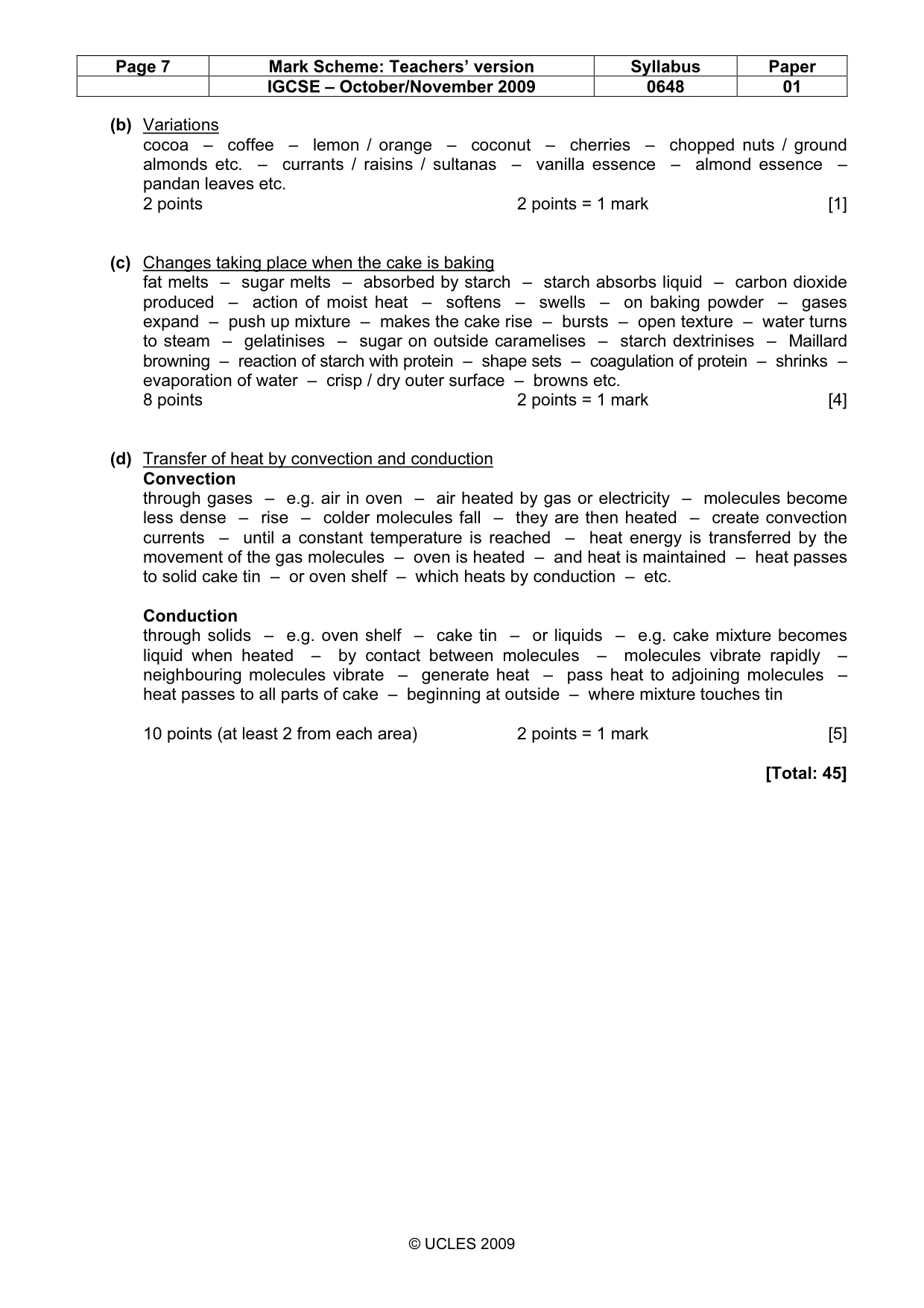
Page 7 Mark Scheme: Teachers’ version Syllabus Paper IGCSE – October/November 2009 0648 01 © UCLES 2009 (b) Variations cocoa – coffee – lemon / orange – coconut – cherries – chopped nuts / ground almonds etc. – currants / raisins / sultanas – vanilla essence – almond essence – pandan leaves etc. 2 points 2 points = 1 mark [1] (c) Changes taking place when the cake is baking fat melts – sugar melts – absorbed by starch – starch absorbs liquid – carbon dioxide produced – action of moist heat – softens – swells – on baking powder – gases expand – push up mixture – makes the cake rise – bursts – open texture – water turns to steam – gelatinises – sugar on outside caramelises – starch dextrinises – Maillard browning – reaction of starch with protein – shape sets – coagulation of protein – shrinks – evaporation of water – crisp / dry outer surface – browns etc. 8 points 2 points = 1 mark [4] (d) Transfer of heat by convection and conduction Convection through gases – e.g. air in oven – air heated by gas or electricity – molecules become less dense – rise – colder molecules fall – they are then heated – create convection currents – until a constant temperature is reached – heat energy is transferred by the movement of the gas molecules – oven is heated – and heat is maintained – heat passes to solid cake tin – or oven shelf – which heats by conduction – etc. Conduction through solids – e.g. oven shelf – cake tin – or liquids – e.g. cake mixture becomes liquid when heated – by contact between molecules – molecules vibrate rapidly – neighbouring molecules vibrate – generate heat – pass heat to adjoining molecules – heat passes to all parts of cake – beginning at outside – where mixture touches tin 10 points (at least 2 from each area) 2 points = 1 mark [5] [Total: 45]
Mark scheme, page 8
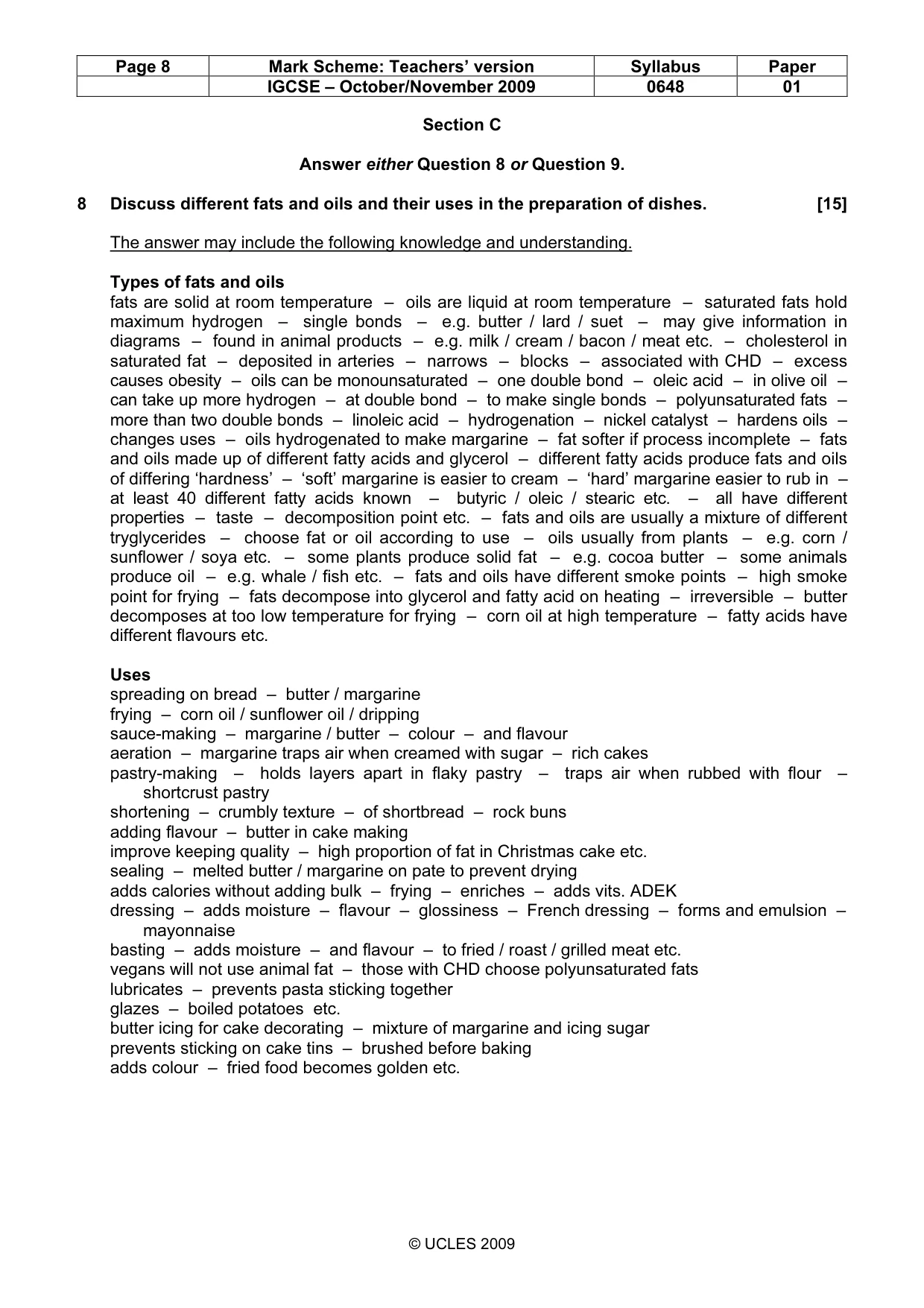
Page 8 Mark Scheme: Teachers’ version Syllabus Paper IGCSE – October/November 2009 0648 01 © UCLES 2009 Section C Answer either Question 8 or Question 9. 8 Discuss different fats and oils and their uses in the preparation of dishes. [15] The answer may include the following knowledge and understanding. Types of fats and oils fats are solid at room temperature – oils are liquid at room temperature – saturated fats hold maximum hydrogen – single bonds – e.g. butter / lard / suet – may give information in diagrams – found in animal products – e.g. milk / cream / bacon / meat etc. – cholesterol in saturated fat – deposited in arteries – narrows – blocks – associated with CHD – excess causes obesity – oils can be monounsaturated – one double bond – oleic acid – in olive oil – can take up more hydrogen – at double bond – to make single bonds – polyunsaturated fats – more than two double bonds – linoleic acid – hydrogenation – nickel catalyst – hardens oils – changes uses – oils hydrogenated to make margarine – fat softer if process incomplete – fats and oils made up of different fatty acids and glycerol – different fatty acids produce fats and oils of differing ‘hardness’ – ‘soft’ margarine is easier to cream – ‘hard’ margarine easier to rub in – at least 40 different fatty acids known – butyric / oleic / stearic etc. – all have different properties – taste – decomposition point etc. – fats and oils are usually a mixture of different tryglycerides – choose fat or oil according to use – oils usually from plants – e.g. corn / sunflower / soya etc. – some plants produce solid fat – e.g. cocoa butter – some animals produce oil – e.g. whale / fish etc. – fats and oils have different smoke points – high smoke point for frying – fats decompose into glycerol and fatty acid on heating – irreversible – butter decomposes at too low temperature for frying – corn oil at high temperature – fatty acids have different flavours etc. Uses spreading on bread – butter / margarine frying – corn oil / sunflower oil / dripping sauce-making – margarine / butter – colour – and flavour aeration – margarine traps air when creamed with sugar – rich cakes pastry-making – holds layers apart in flaky pastry – traps air when rubbed with flour – shortcrust pastry shortening – crumbly texture – of shortbread – rock buns adding flavour – butter in cake making improve keeping quality – high proportion of fat in Christmas cake etc. sealing – melted butter / margarine on pate to prevent drying adds calories without adding bulk – frying – enriches – adds vits. ADEK dressing – adds moisture – flavour – glossiness – French dressing – forms and emulsion – mayonnaise basting – adds moisture – and flavour – to fried / roast / grilled meat etc. vegans will not use animal fat – those with CHD choose polyunsaturated fats lubricates – prevents pasta sticking together glazes – boiled potatoes etc. butter icing for cake decorating – mixture of margarine and icing sugar prevents sticking on cake tins – brushed before baking adds colour – fried food becomes golden etc.
Mark scheme, page 9
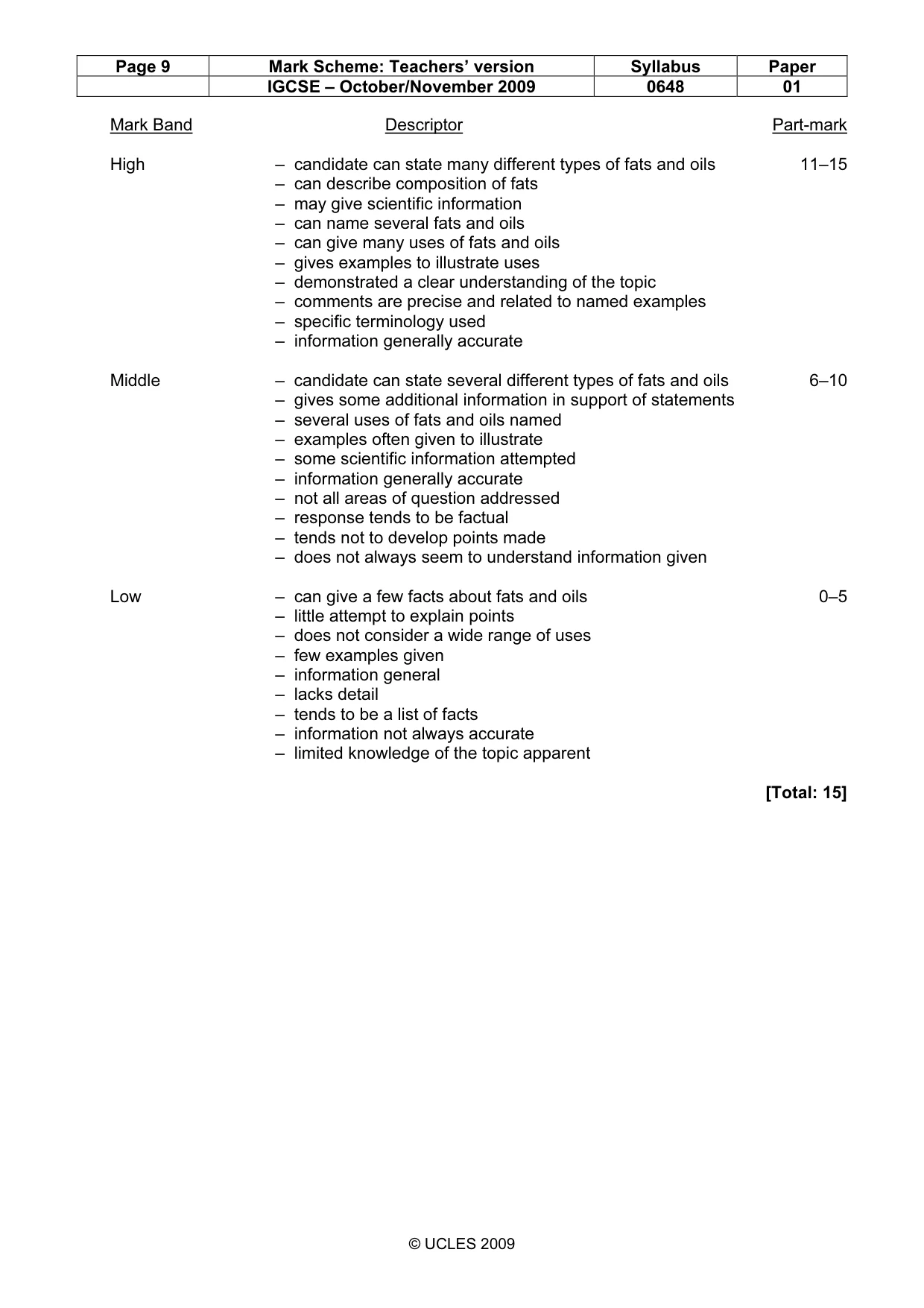
Page 9 Mark Scheme: Teachers’ version Syllabus Paper IGCSE – October/November 2009 0648 01 © UCLES 2009 Mark Band Descriptor Part-mark High – candidate can state many different types of fats and oils 11–15 – can describe composition of fats – may give scientific information – can name several fats and oils – can give many uses of fats and oils – gives examples to illustrate uses – demonstrated a clear understanding of the topic – comments are precise and related to named examples – specific terminology used – information generally accurate Middle – candidate can state several different types of fats and oils 6–10 – gives some additional information in support of statements – several uses of fats and oils named – examples often given to illustrate – some scientific information attempted – information generally accurate – not all areas of question addressed – response tends to be factual – tends not to develop points made – does not always seem to understand information given Low – can give a few facts about fats and oils 0–5 – little attempt to explain points – does not consider a wide range of uses – few examples given – information general – lacks detail – tends to be a list of facts – information not always accurate – limited knowledge of the topic apparent [Total: 15]
Mark scheme, page 10
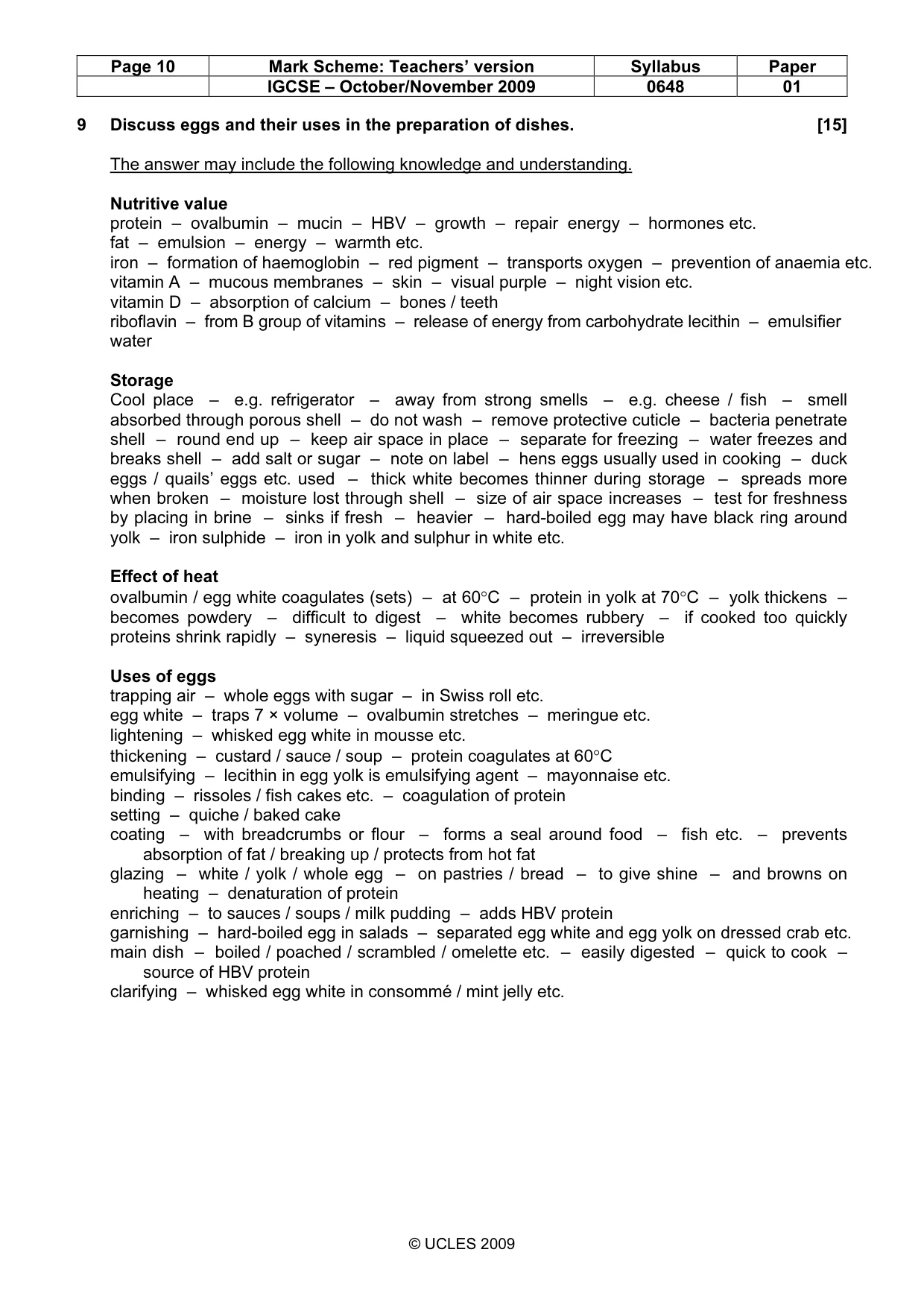
Page 10 Mark Scheme: Teachers’ version Syllabus Paper IGCSE – October/November 2009 0648 01 © UCLES 2009 9 Discuss eggs and their uses in the preparation of dishes. [15] The answer may include the following knowledge and understanding. Nutritive value protein – ovalbumin – mucin – HBV – growth – repair energy – hormones etc. fat – emulsion – energy – warmth etc. iron – formation of haemoglobin – red pigment – transports oxygen – prevention of anaemia etc. vitamin A – mucous membranes – skin – visual purple – night vision etc. vitamin D – absorption of calcium – bones / teeth riboflavin – from B group of vitamins – release of energy from carbohydrate lecithin – emulsifier water Storage Cool place – e.g. refrigerator – away from strong smells – e.g. cheese / fish – smell absorbed through porous shell – do not wash – remove protective cuticle – bacteria penetrate shell – round end up – keep air space in place – separate for freezing – water freezes and breaks shell – add salt or sugar – note on label – hens eggs usually used in cooking – duck eggs / quails’ eggs etc. used – thick white becomes thinner during storage – spreads more when broken – moisture lost through shell – size of air space increases – test for freshness by placing in brine – sinks if fresh – heavier – hard-boiled egg may have black ring around yolk – iron sulphide – iron in yolk and sulphur in white etc. Effect of heat ovalbumin / egg white coagulates (sets) – at 60°C – protein in yolk at 70°C – yolk thickens – becomes powdery – difficult to digest – white becomes rubbery – if cooked too quickly proteins shrink rapidly – syneresis – liquid squeezed out – irreversible Uses of eggs trapping air – whole eggs with sugar – in Swiss roll etc. egg white – traps 7 × volume – ovalbumin stretches – meringue etc. lightening – whisked egg white in mousse etc. thickening – custard / sauce / soup – protein coagulates at 60°C emulsifying – lecithin in egg yolk is emulsifying agent – mayonnaise etc. binding – rissoles / fish cakes etc. – coagulation of protein setting – quiche / baked cake coating – with breadcrumbs or flour – forms a seal around food – fish etc. – prevents absorption of fat / breaking up / protects from hot fat glazing – white / yolk / whole egg – on pastries / bread – to give shine – and browns on heating – denaturation of protein enriching – to sauces / soups / milk pudding – adds HBV protein garnishing – hard-boiled egg in salads – separated egg white and egg yolk on dressed crab etc. main dish – boiled / poached / scrambled / omelette etc. – easily digested – quick to cook – source of HBV protein clarifying – whisked egg white in consommé / mint jelly etc.
Mark scheme, page 11
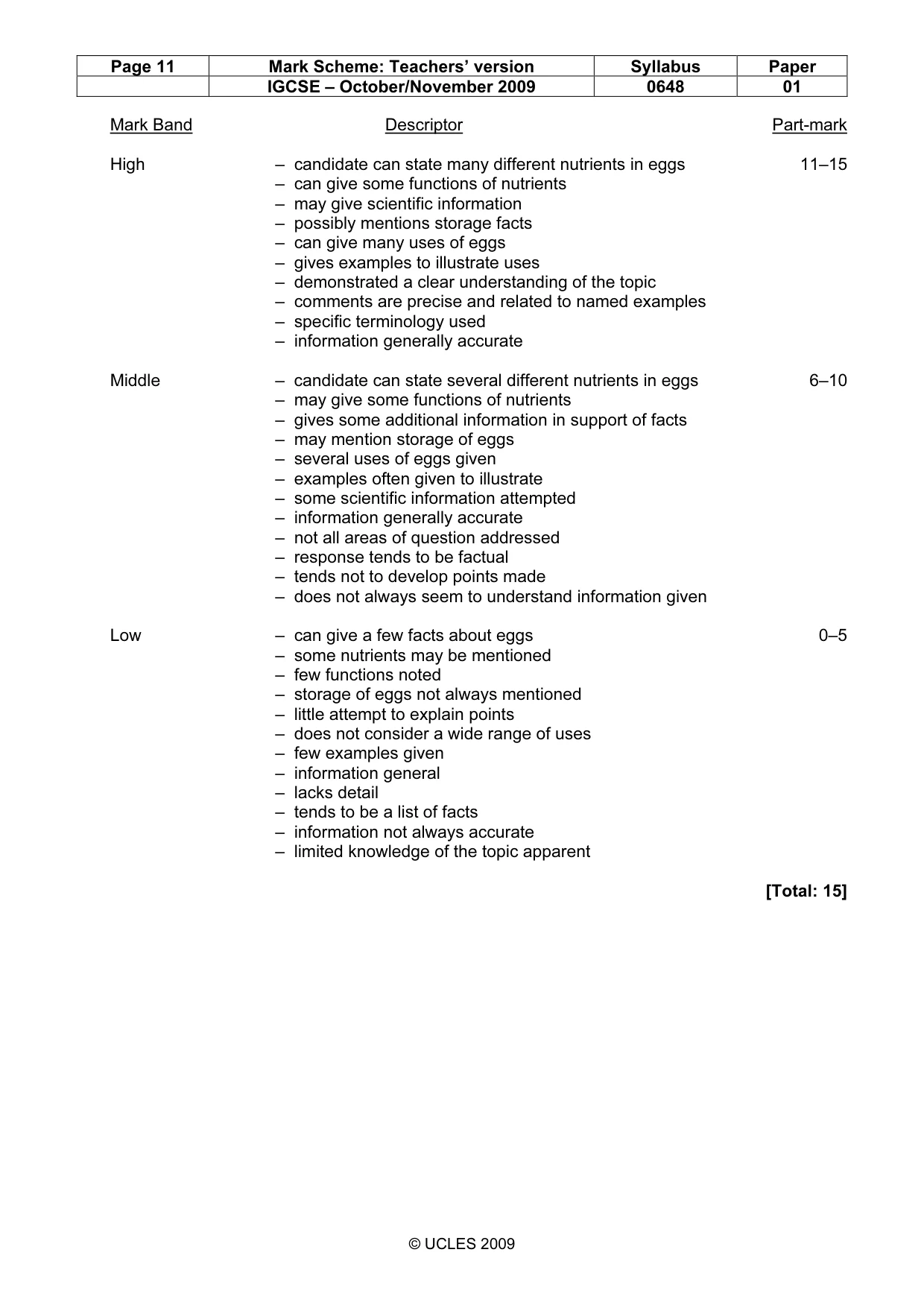
Page 11 Mark Scheme: Teachers’ version Syllabus Paper IGCSE – October/November 2009 0648 01 © UCLES 2009 Mark Band Descriptor Part-mark High – candidate can state many different nutrients in eggs 11–15 – can give some functions of nutrients – may give scientific information – possibly mentions storage facts – can give many uses of eggs – gives examples to illustrate uses – demonstrated a clear understanding of the topic – comments are precise and related to named examples – specific terminology used – information generally accurate Middle – candidate can state several different nutrients in eggs 6–10 – may give some functions of nutrients – gives some additional information in support of facts – may mention storage of eggs – several uses of eggs given – examples often given to illustrate – some scientific information attempted – information generally accurate – not all areas of question addressed – response tends to be factual – tends not to develop points made – does not always seem to understand information given Low – can give a few facts about eggs 0–5 – some nutrients may be mentioned – few functions noted – storage of eggs not always mentioned – little attempt to explain points – does not consider a wide range of uses – few examples given – information general – lacks detail – tends to be a list of facts – information not always accurate – limited knowledge of the topic apparent [Total: 15]
What you needed in this session
Cambridge’s own grade thresholds for 2009 Oct/Nov, Paper 1 · Variant 1. A higher threshold means an easier paper — the bar moves with how the cohort did.