Cambridge IGCSE Food and Nutrition 0648 — 2009 May/June Paper 1 · Variant 1
0648/11/M/J/09 · 100 marks · ≈113 min
The question paper and its mark scheme, free to read here and free to download. This is Cambridge’s own paper, exactly as it was sat.
Question paper16 pages


Mark scheme12 pages
Answers below. Sit the paper first if you are practising.
Paper as text
Question paper, page 1
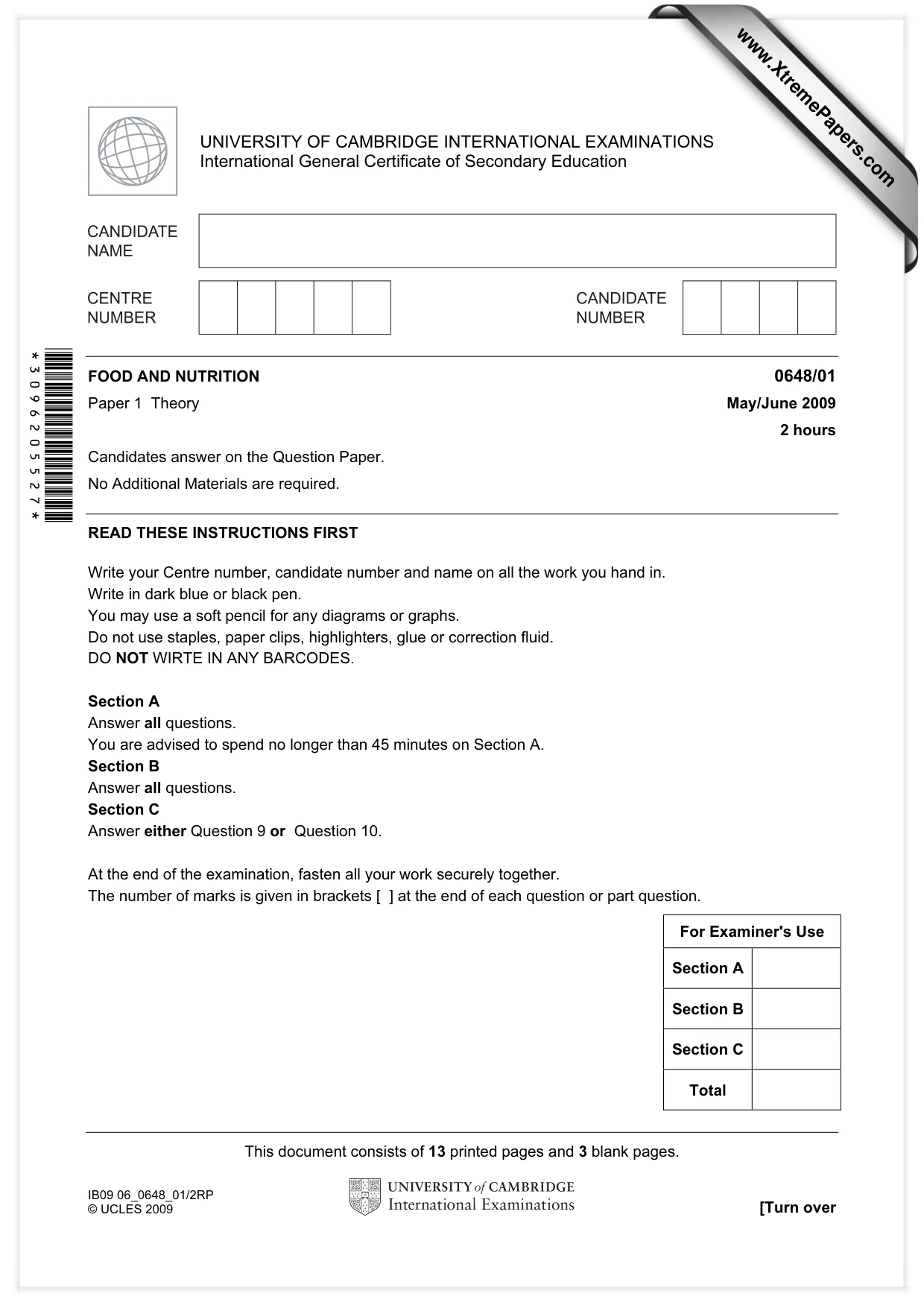
This document consists of 13 printed pages and 3 blank pages. IB09 06_0648_01/2RP © UCLES 2009 [Turn over *3096205527* For Examiner's Use Section A Section B Section C Total UNIVERSITY OF CAMBRIDGE INTERNATIONAL EXAMINATIONS International General Certificate of Secondary Education FOOD AND NUTRITION 0648/01 Paper 1 Theory May/June 2009 2 hours Candidates answer on the Question Paper. No Additional Materials are required. READ THESE INSTRUCTIONS FIRST Write your Centre number, candidate number and name on all the work you hand in. Write in dark blue or black pen. You may use a soft pencil for any diagrams or graphs. Do not use staples, paper clips, highlighters, glue or correction fluid. DO NOT WIRTE IN ANY BARCODES. Section A Answer all questions. You are advised to spend no longer than 45 minutes on Section A. Section B Answer all questions. Section C Answer either Question 9 or Question 10. At the end of the examination, fasten all your work securely together. The number of marks is given in brackets [ ] at the end of each question or part question. www.XtremePapers.com
Question paper, page 2
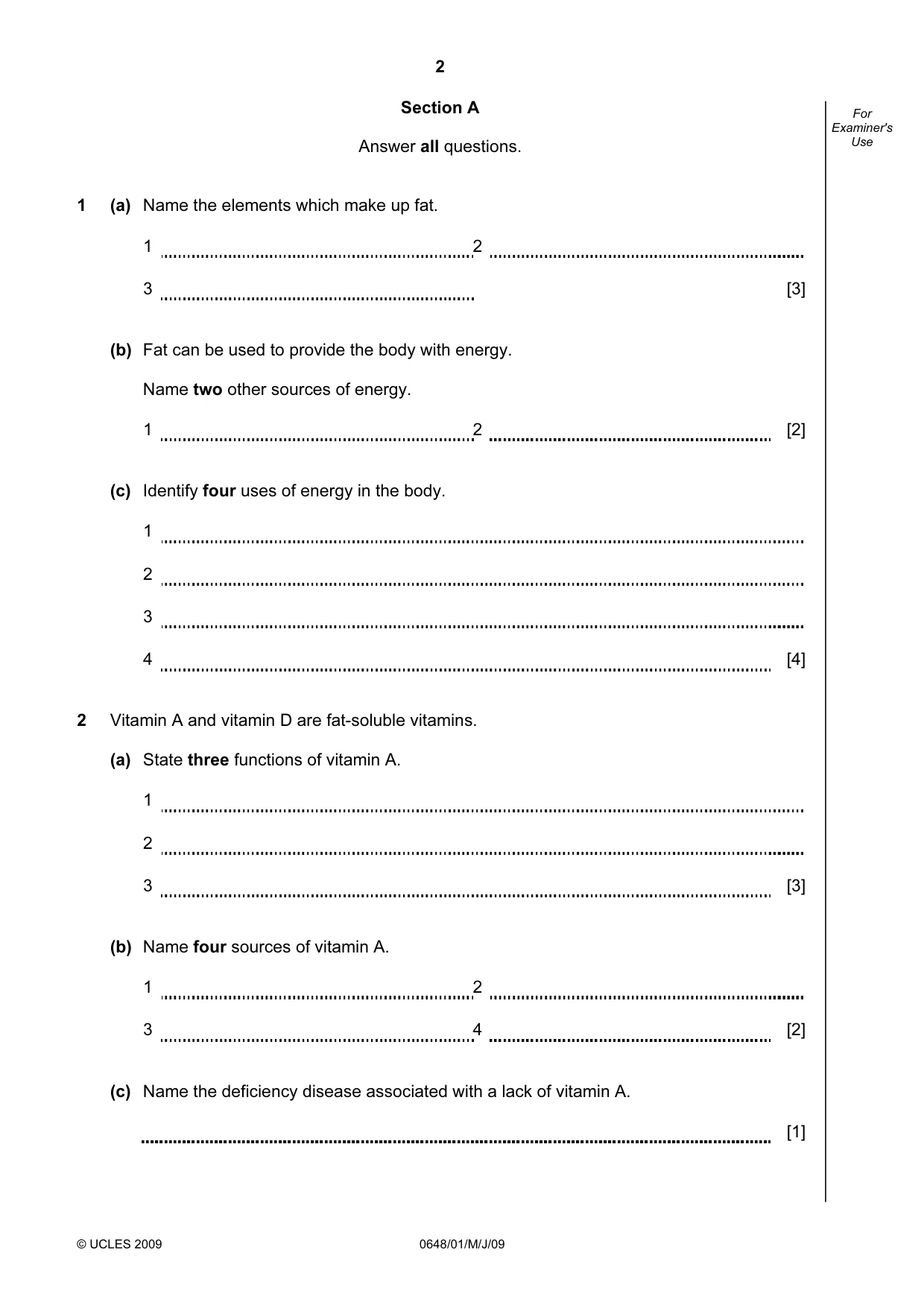
2 © UCLES 2009 0648/01/M/J/09 For Examiner's Use Section A Answer all questions. 1 (a) Name the elements which make up fat. 1 2 3 [3] (b) Fat can be used to provide the body with energy. Name two other sources of energy. 1 2 [2] (c) Identify four uses of energy in the body. 1 2 3 4 [4] 2 Vitamin A and vitamin D are fat-soluble vitamins. (a) State three functions of vitamin A. 1 2 3 [3] (b) Name four sources of vitamin A. 1 2 3 4 [2] (c) Name the deficiency disease associated with a lack of vitamin A. [1]
Question paper, page 3
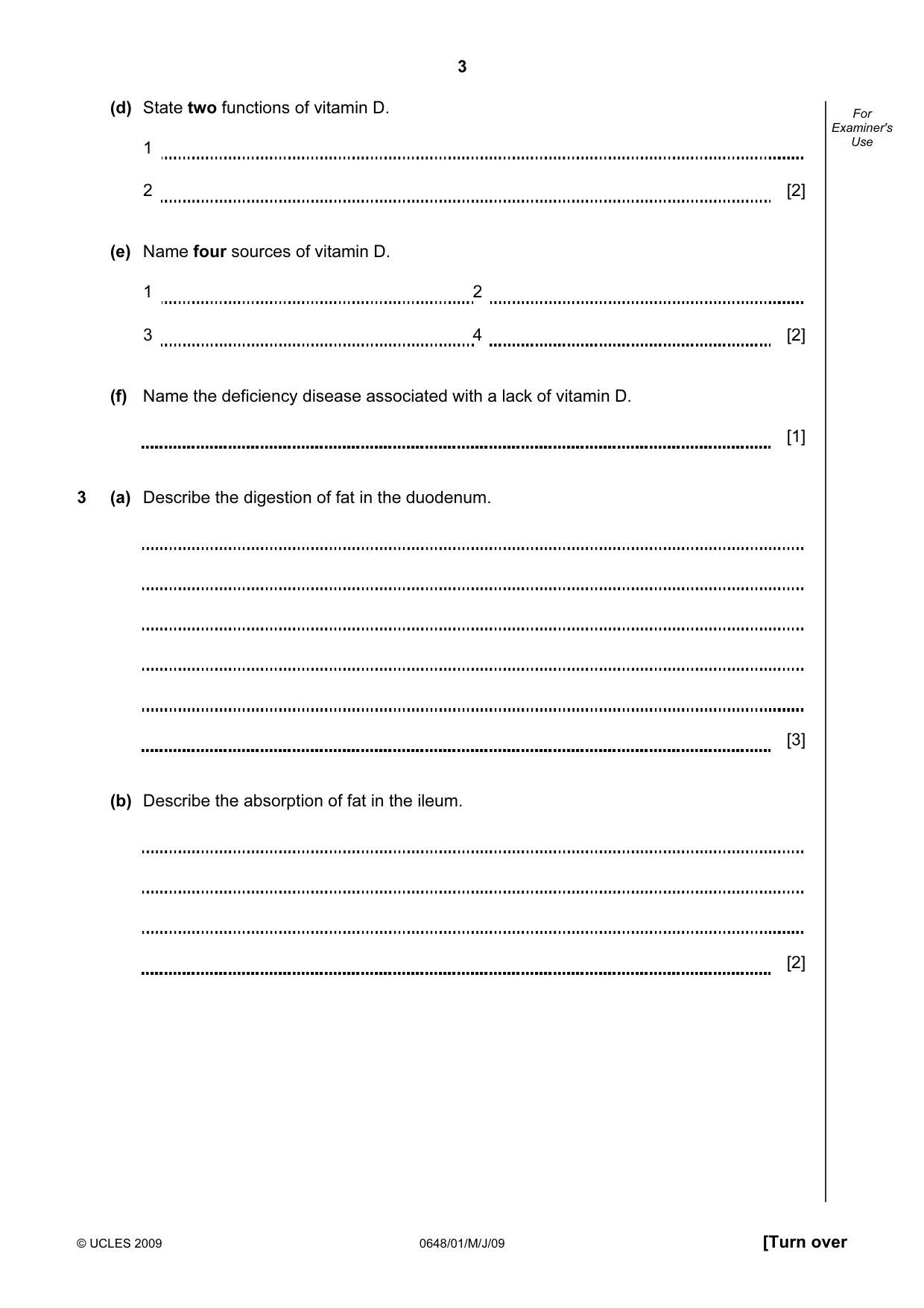
3 © UCLES 2009 0648/01/M/J/09 [Turn over For Examiner's Use (d) State two functions of vitamin D. 1 2 [2] (e) Name four sources of vitamin D. 1 2 3 4 [2] (f) Name the deficiency disease associated with a lack of vitamin D. [1] 3 (a) Describe the digestion of fat in the duodenum. [3] (b) Describe the absorption of fat in the ileum. [2]
Question paper, page 4
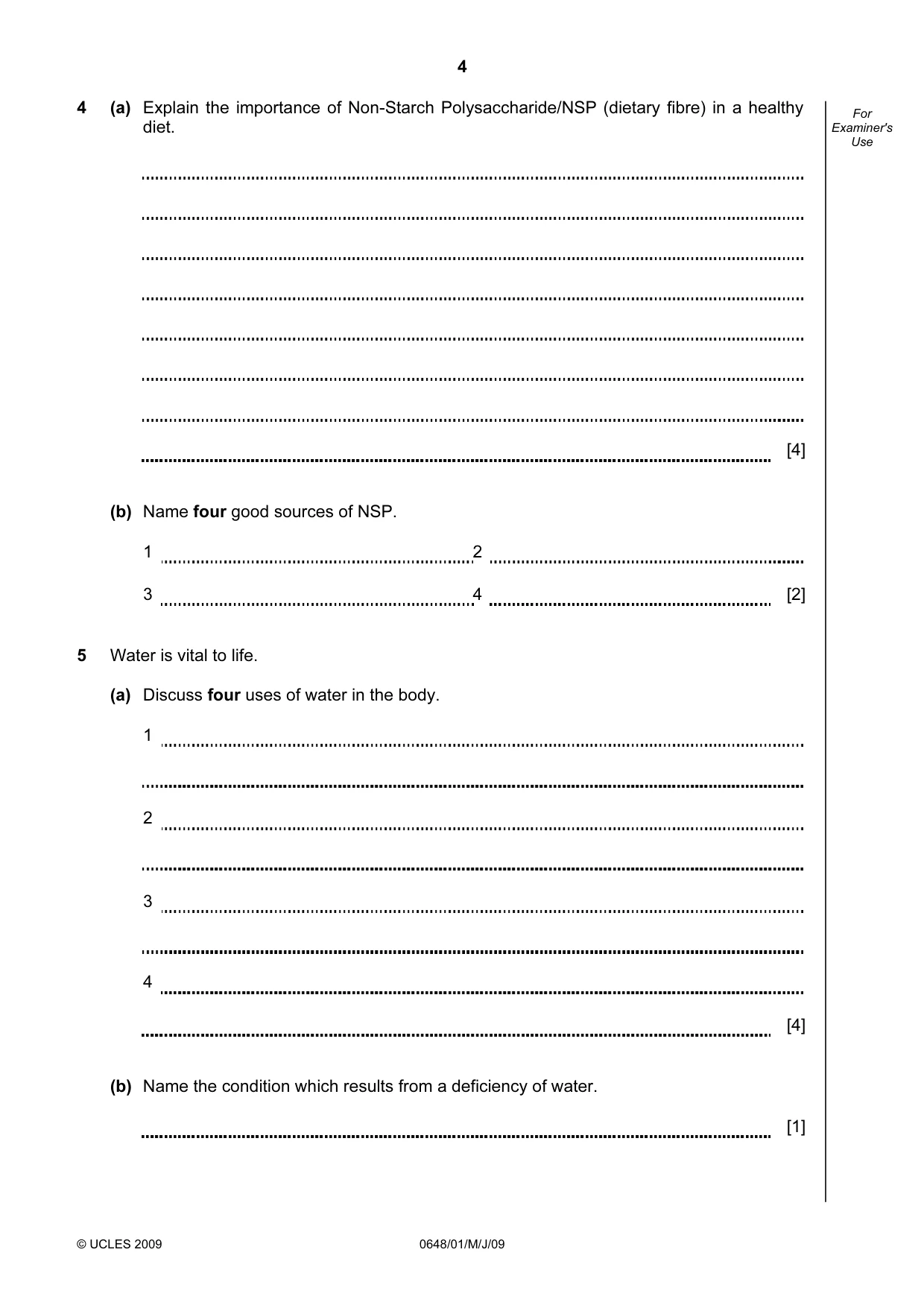
4 © UCLES 2009 0648/01/M/J/09 For Examiner's Use 4 (a) Explain the importance of Non-Starch Polysaccharide/NSP (dietary fibre) in a healthy diet. [4] (b) Name four good sources of NSP. 1 2 3 4 [2] 5 Water is vital to life. (a) Discuss four uses of water in the body. 1 2 3 4 [4] (b) Name the condition which results from a deficiency of water. [1]
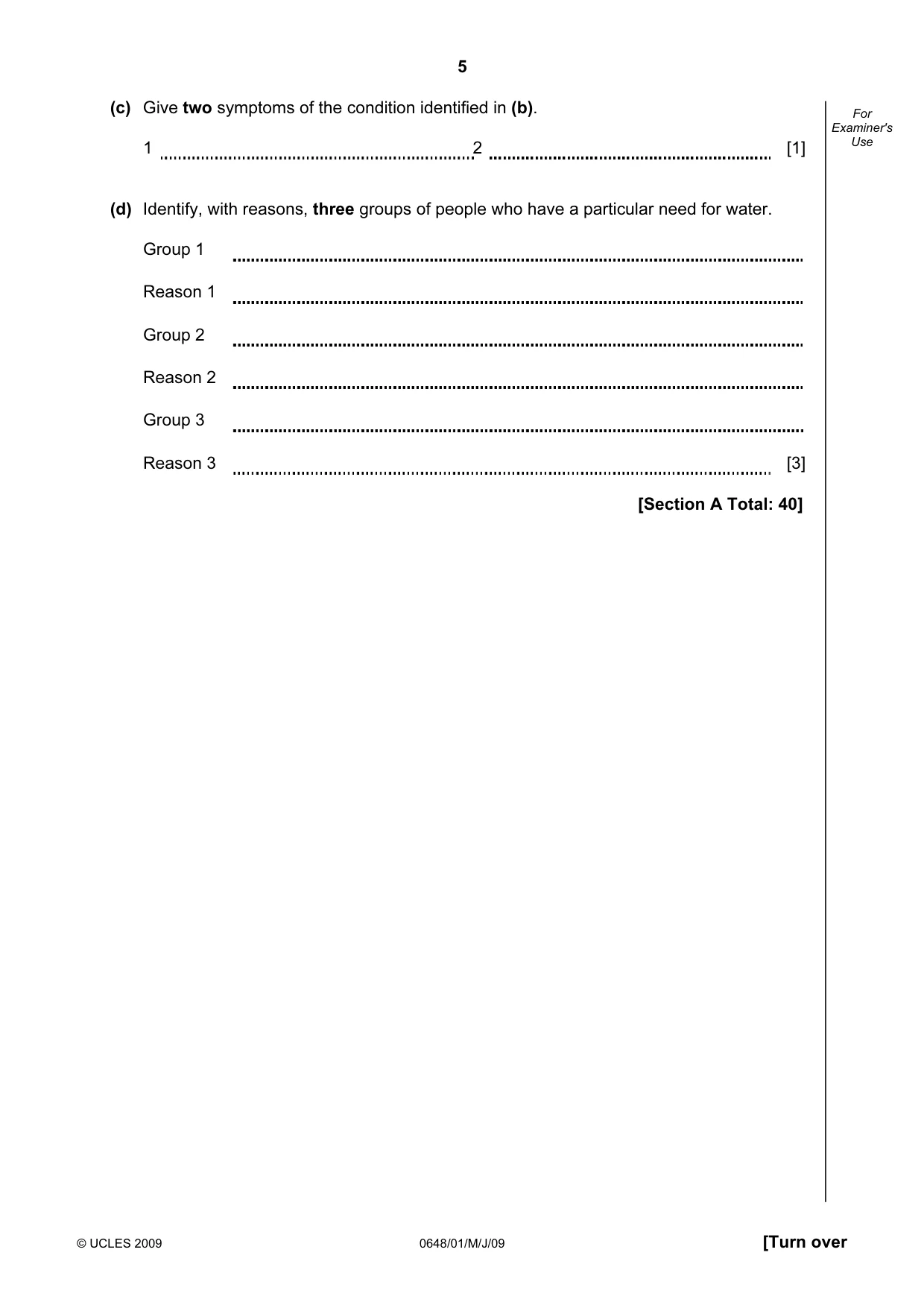
Question paper, page 5
5 © UCLES 2009 0648/01/M/J/09 [Turn over For Examiner's Use (c) Give two symptoms of the condition identified in (b). 1 2 [1] (d) Identify, with reasons, three groups of people who have a particular need for water. Group 1 Reason 1 Group 2 Reason 2 Group 3 Reason 3 [3] [Section A Total: 40]
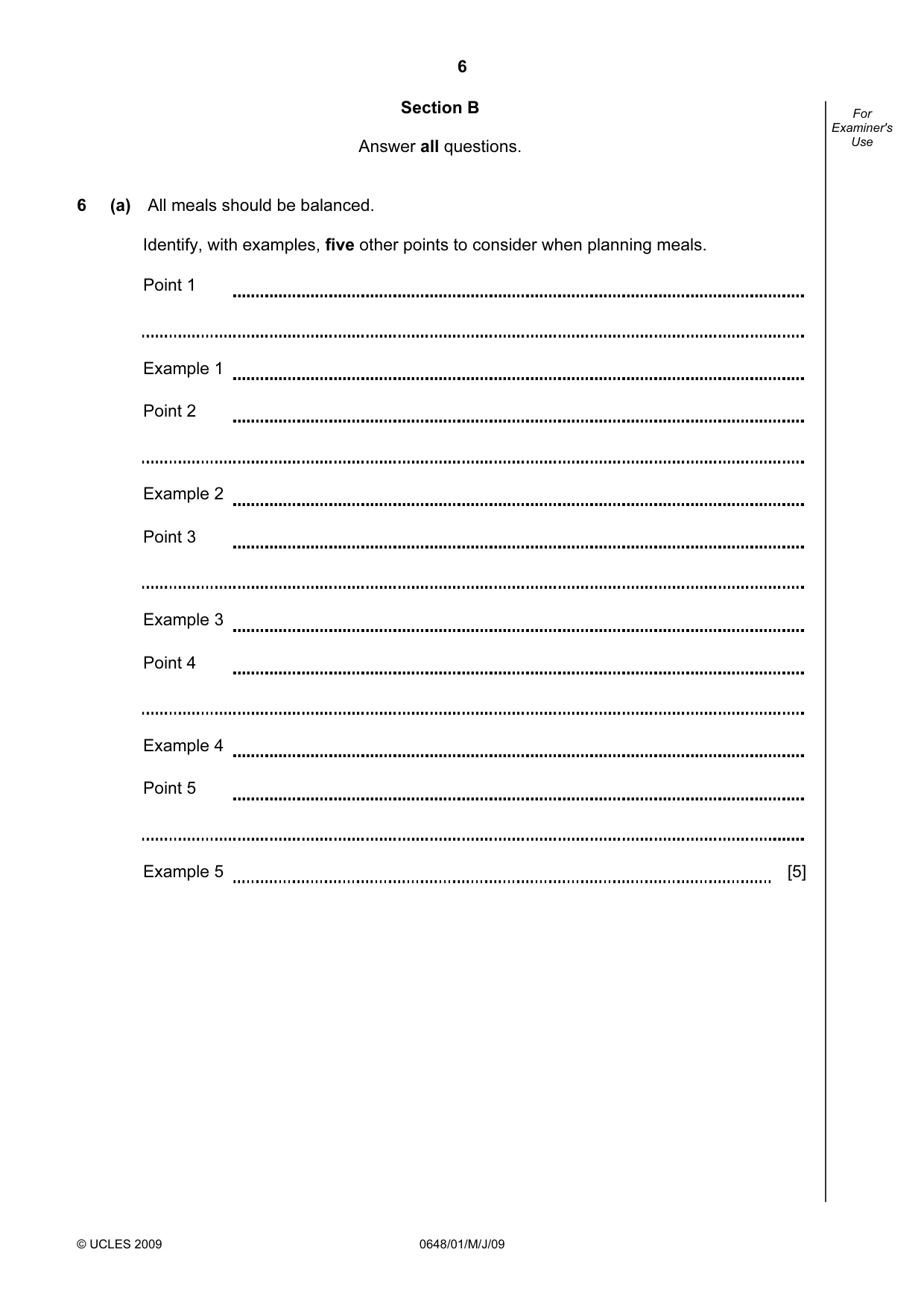
Question paper, page 6
6 © UCLES 2009 0648/01/M/J/09 For Examiner's Use Section B Answer all questions. 6 (a) All meals should be balanced. Identify, with examples, five other points to consider when planning meals. Point 1 Example 1 Point 2 Example 2 Point 3 Example 3 Point 4 Example 4 Point 5 Example 5 [5]
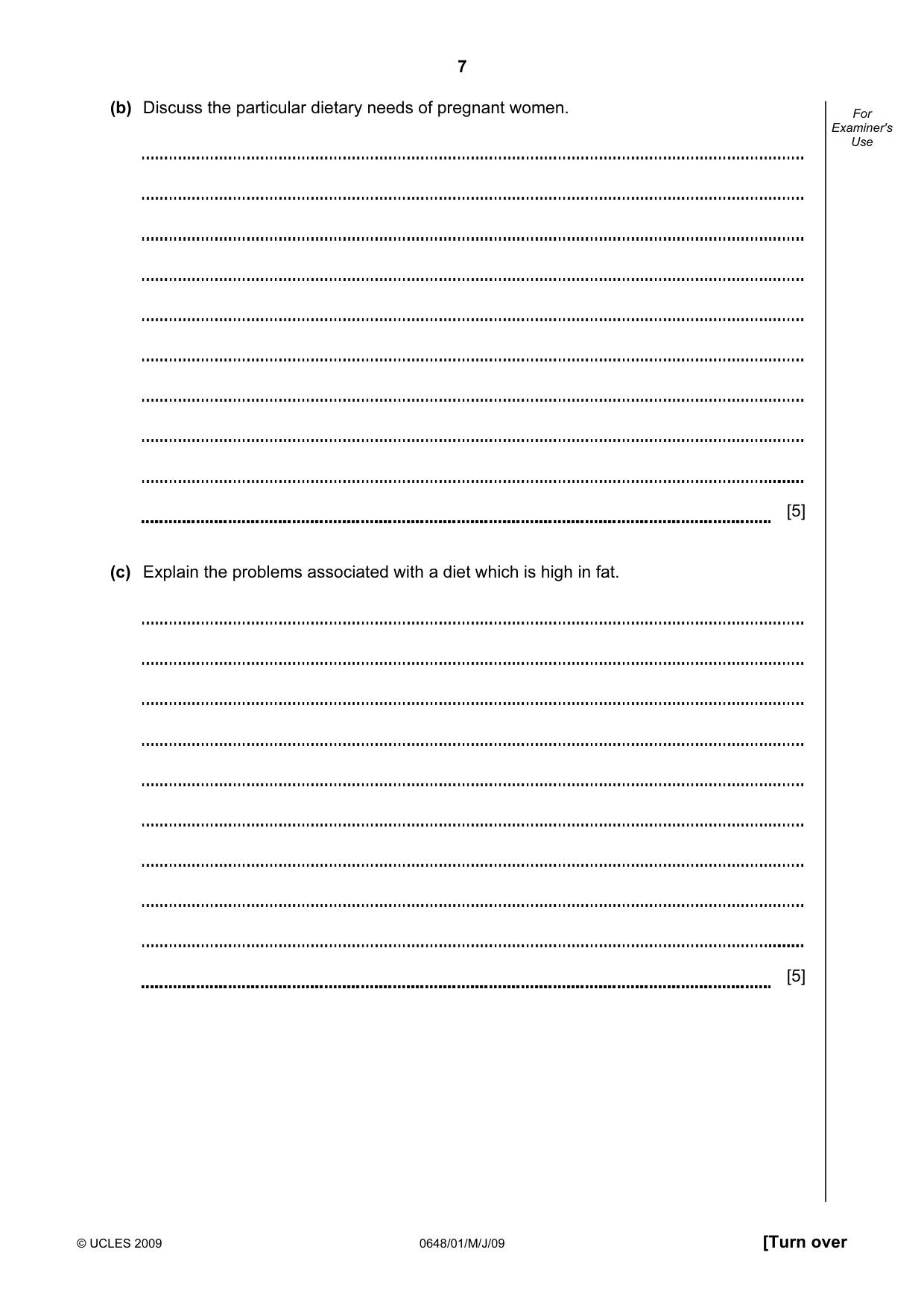
Question paper, page 7
7 © UCLES 2009 0648/01/M/J/09 [Turn over For Examiner's Use (b) Discuss the particular dietary needs of pregnant women. [5] (c) Explain the problems associated with a diet which is high in fat. [5]
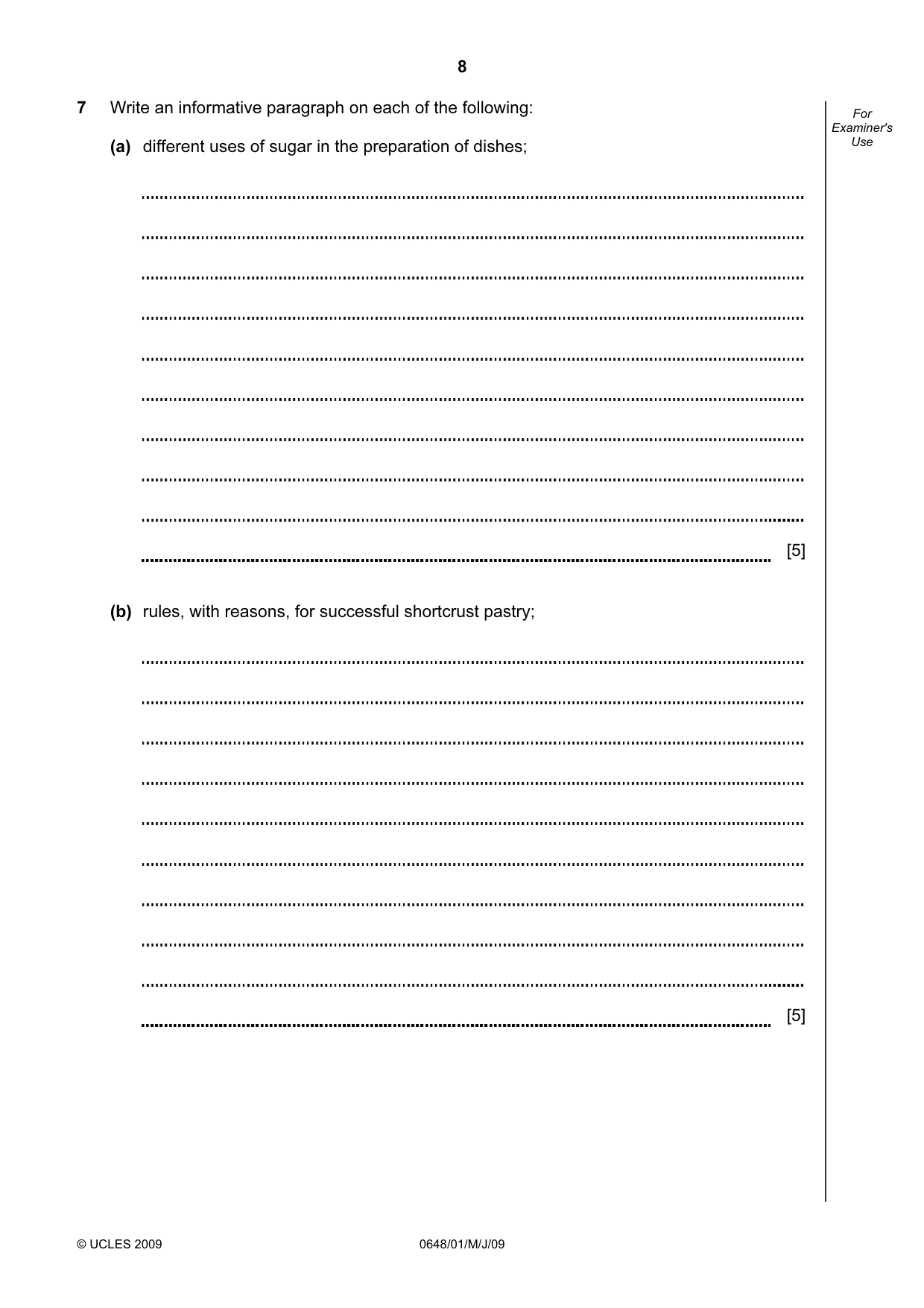
Question paper, page 8
8 © UCLES 2009 0648/01/M/J/09 For Examiner's Use 7 Write an informative paragraph on each of the following: (a) different uses of sugar in the preparation of dishes; [5] (b) rules, with reasons, for successful shortcrust pastry; [5]
Question paper, page 9
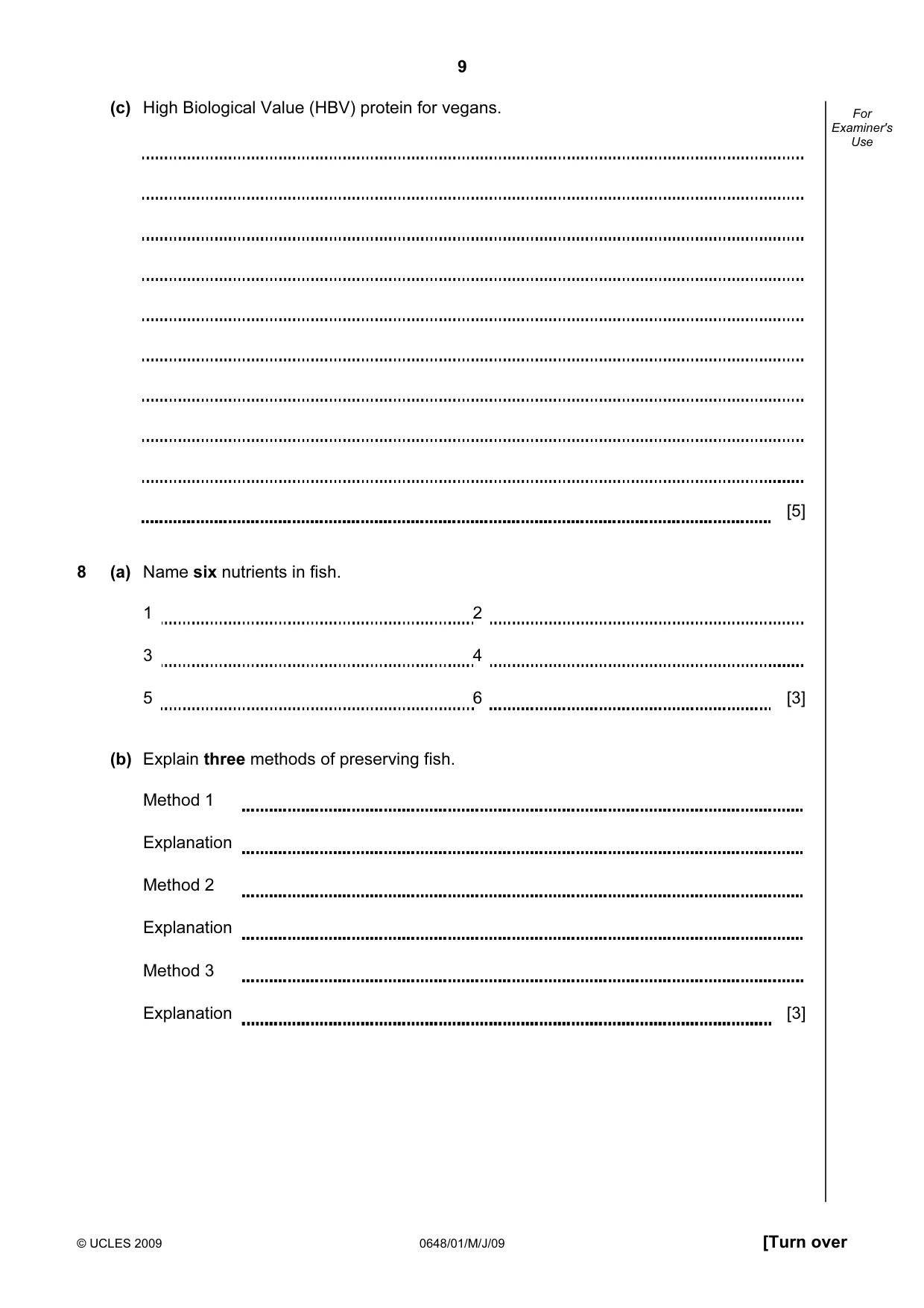
9 © UCLES 2009 0648/01/M/J/09 [Turn over For Examiner's Use (c) High Biological Value (HBV) protein for vegans. [5] 8 (a) Name six nutrients in fish. 1 2 3 4 5 6 [3] (b) Explain three methods of preserving fish. Method 1 Explanation Method 2 Explanation Method 3 Explanation [3]
Question paper, page 10
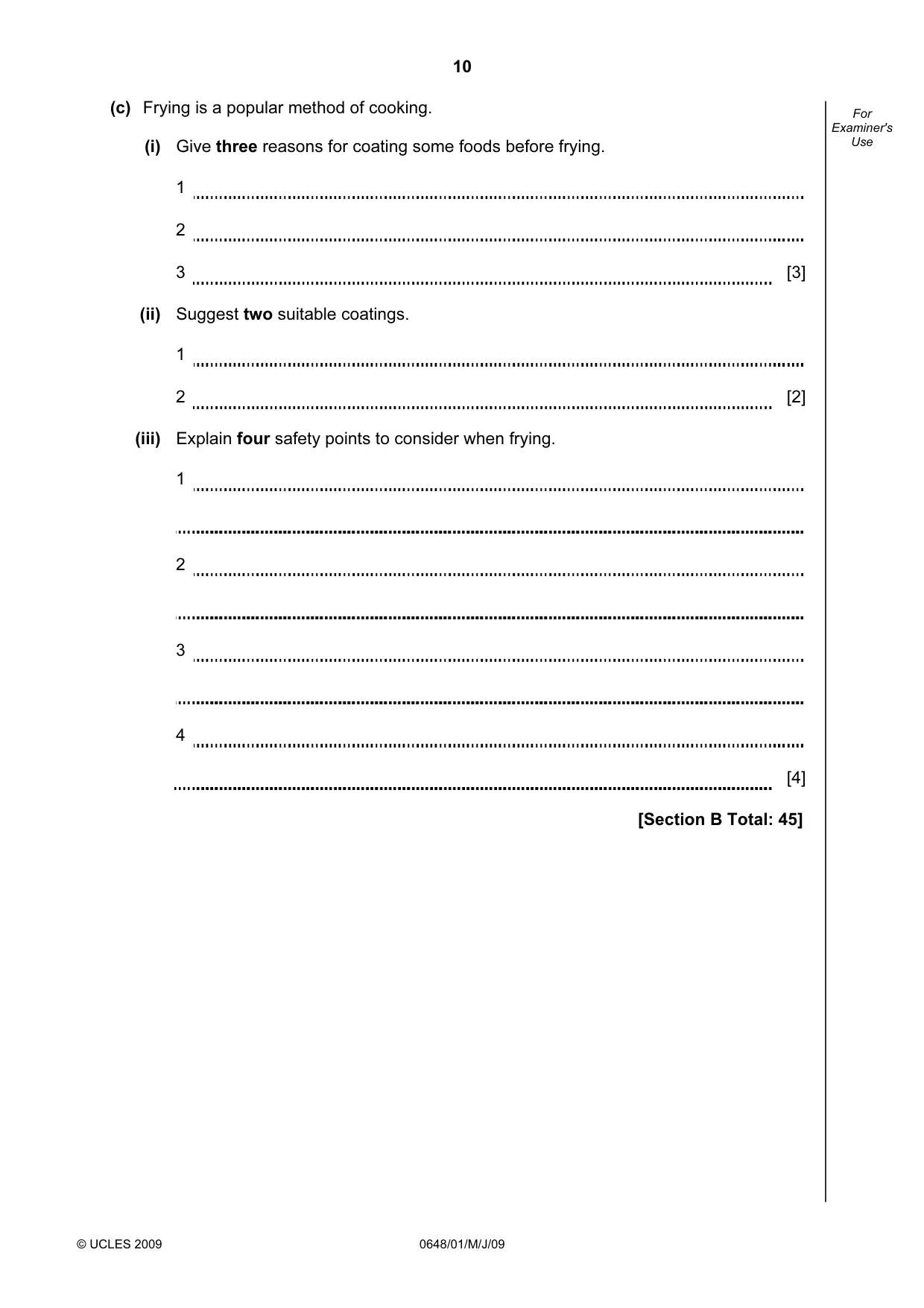
10 © UCLES 2009 0648/01/M/J/09 For Examiner's Use (c) Frying is a popular method of cooking. (i) Give three reasons for coating some foods before frying. 1 2 3 [3] (ii) Suggest two suitable coatings. 1 2 [2] (iii) Explain four safety points to consider when frying. 1 2 3 4 [4] [Section B Total: 45]
Question paper, page 12
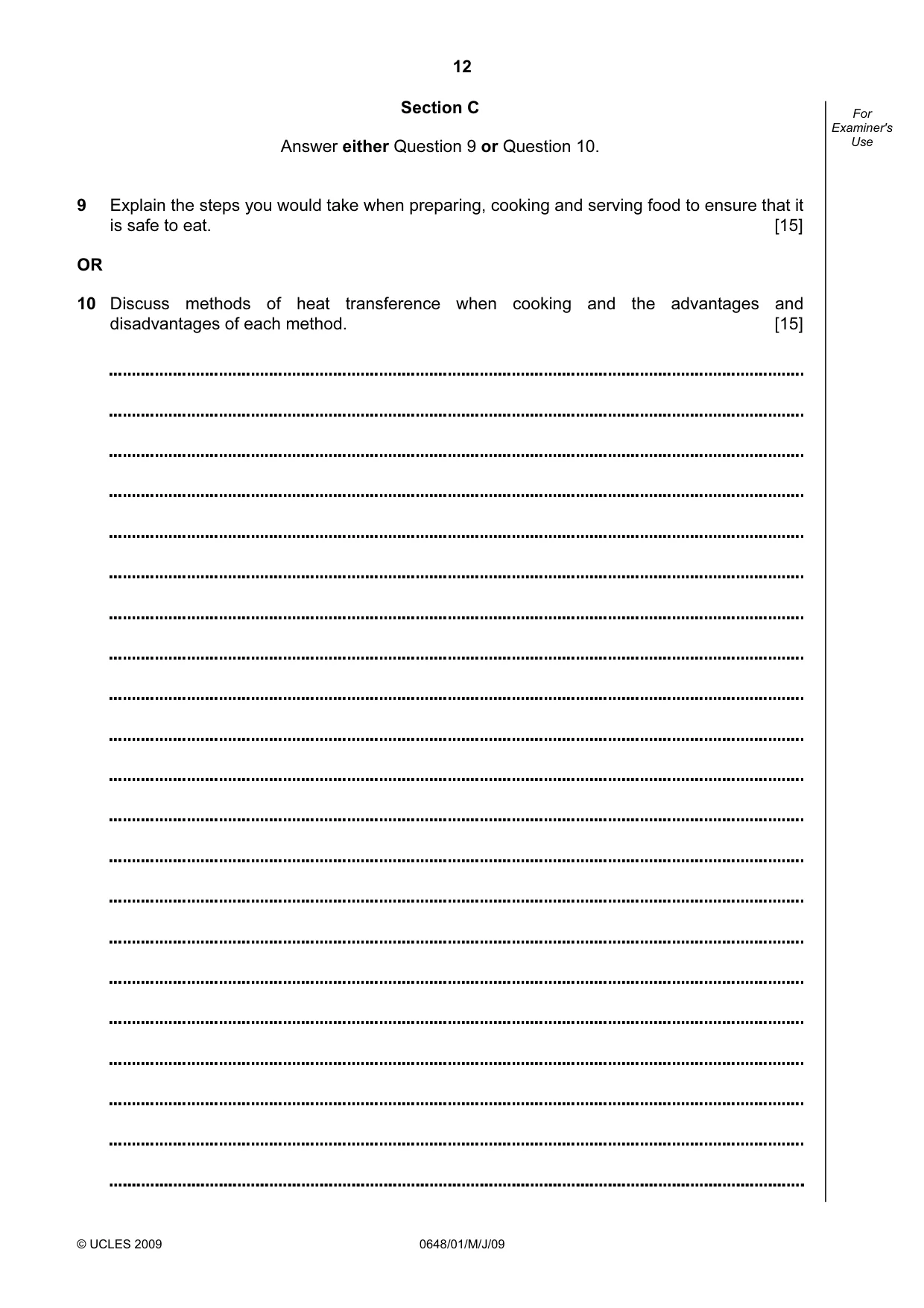
12 © UCLES 2009 0648/01/M/J/09 For Examiner's Use Section C Answer either Question 9 or Question 10. 9 Explain the steps you would take when preparing, cooking and serving food to ensure that it is safe to eat. [15] OR 10 Discuss methods of heat transference when cooking and the advantages and disadvantages of each method. [15]
Question paper, page 13
13 © UCLES 2009 0648/01/M/J/09 [Turn over For Examiner's Use
Question paper, page 14
14 © UCLES 2009 0648/01/M/J/09 For Examiner's Use [Section C Total: 15] [Total for Paper: 100]
Question paper, page 16
16 BLANK PAGE Permission to reproduce items where third-party owned material protected by copyright is included has been sought and cleared where possible. Every reasonable effort has been made by the publisher (UCLES) to trace copyright holders, but if any items requiring clearance have unwittingly been included, the publisher will be pleased to make amends at the earliest possible opportunity. University of Cambridge International Examinations is part of the Cambridge Assessment Group. Cambridge Assessment is the brand name of University of Cambridge Local Examinations Syndicate (UCLES), which is itself a department of the University of Cambridge. 0648/01/M/J/09
Mark scheme, page 1
UNIVERSITY OF CAMBRIDGE INTERNATIONAL EXAMINATIONS International General Certificate of Secondary Education MARK SCHEME for the May/June 2009 question paper for the guidance of teachers 0648 FOOD AND NUTRITION 0648/01 Paper 1 (Theory), maximum raw mark 100 This mark scheme is published as an aid to teachers and candidates, to indicate the requirements of the examination. It shows the basis on which Examiners were instructed to award marks. It does not indicate the details of the discussions that took place at an Examiners’ meeting before marking began, which would have considered the acceptability of alternative answers. Mark schemes must be read in conjunction with the question papers and the report on the examination. • CIE will not enter into discussions or correspondence in connection with these mark schemes. CIE is publishing the mark schemes for the May/June 2009 question papers for most IGCSE, GCE Advanced Level and Advanced Subsidiary Level syllabuses and some Ordinary Level syllabuses. www.XtremePapers.com
Mark scheme, page 2
Page 2 Mark Scheme: Teachers’ version Syllabus Paper IGCSE – May/June 2009 0648 01 © UCLES 2009 1 (a) Elements in fat carbon – hydrogen – oxygen (3 × 1 mark) [3] (b) Other sources of energy Carbohydrate/starch/sugar – protein (2 × 1 mark) [2] (c) Uses of energy Mechanical energy/movement/work etc. Chemical energy/for metabolic reactions/digestion etc. Heat/maintain body temperature/to keep warm etc. Electrical energy/transmission of nervous impulses etc. Basal metabolism/heartbeat/blood circulation/breathing etc. Growth (4 × 1 mark) [4] 2 (a) Functions of vitamin A production of visual purple helps vision in dim light healthy skin formation of mucous membranes helps to resist infection antioxidant (3 × 1 mark) [3] (b) Sources of vitamin A milk – cheese – butter – liver – eggs – fish liver oil (or named e.g.) – oily fish (or named e.g.) – green leafy vegetables (or named e.g.) – papaya – carrot – red meat – margarine etc. (4 × 1 point) (2 points = 1 mark) [2] (c) Deficiency of vitamin A night-blindness (1 mark) [1] (d) Functions of vitamin D promotes absorption of calcium/phosphorus formation of bones/teeth maintenance of bones/teeth (2 × 1 mark) [2] (e) Sources of vitamin D oily fish (or named e.g.) – fish liver oil (or named e.g.) – milk – cheese – margarine – eggs – sunshine – butter – red meat (4 × 1 point) (2 points = 1 mark) [2] (f) Deficiency of vitamin D rickets/osteoporosis/osteomalacia (1 mark) [1]
Mark scheme, page 3
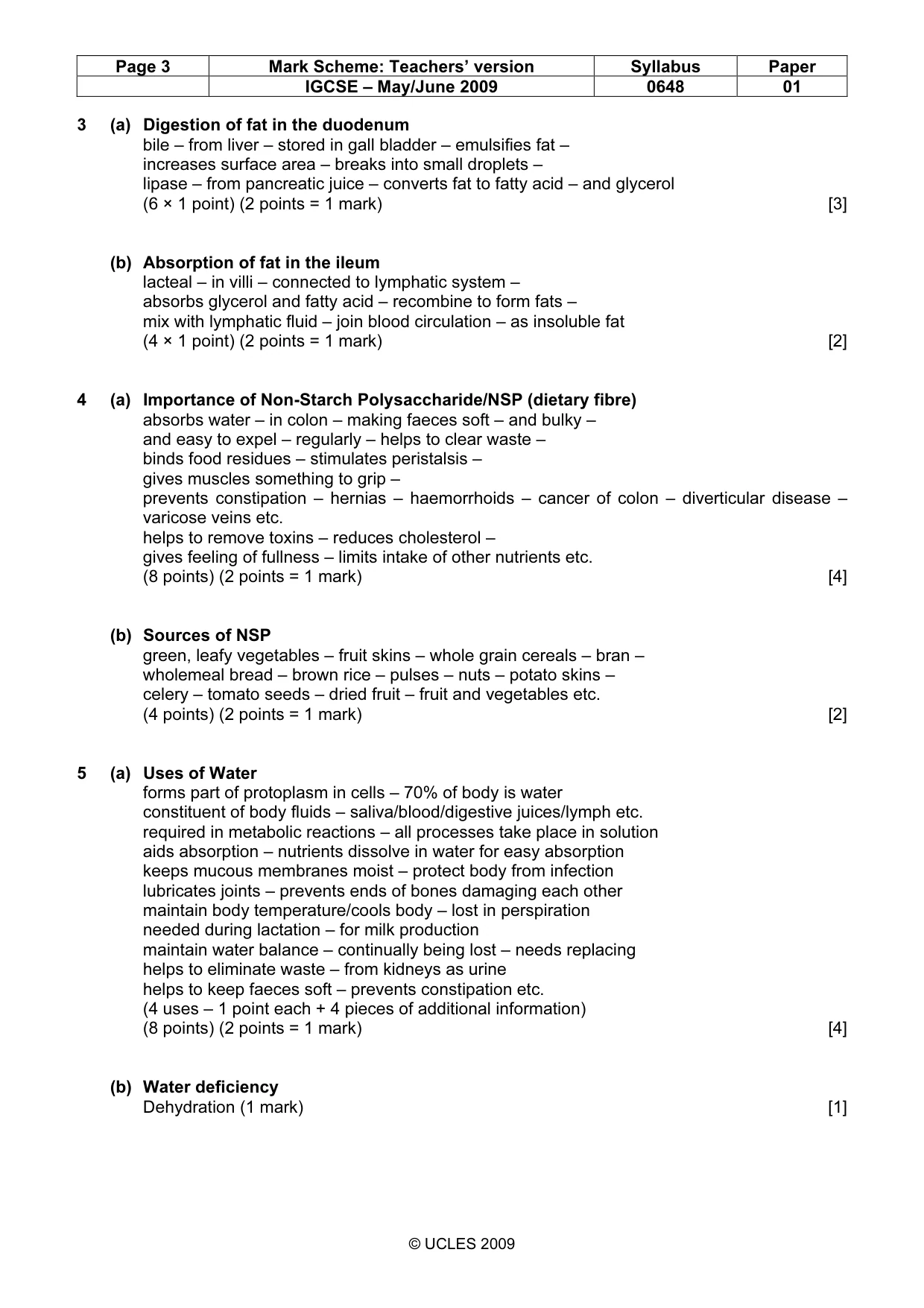
Page 3 Mark Scheme: Teachers’ version Syllabus Paper IGCSE – May/June 2009 0648 01 © UCLES 2009 3 (a) Digestion of fat in the duodenum bile – from liver – stored in gall bladder – emulsifies fat – increases surface area – breaks into small droplets – lipase – from pancreatic juice – converts fat to fatty acid – and glycerol (6 × 1 point) (2 points = 1 mark) [3] (b) Absorption of fat in the ileum lacteal – in villi – connected to lymphatic system – absorbs glycerol and fatty acid – recombine to form fats – mix with lymphatic fluid – join blood circulation – as insoluble fat (4 × 1 point) (2 points = 1 mark) [2] 4 (a) Importance of Non-Starch Polysaccharide/NSP (dietary fibre) absorbs water – in colon – making faeces soft – and bulky – and easy to expel – regularly – helps to clear waste – binds food residues – stimulates peristalsis – gives muscles something to grip – prevents constipation – hernias – haemorrhoids – cancer of colon – diverticular disease – varicose veins etc. helps to remove toxins – reduces cholesterol – gives feeling of fullness – limits intake of other nutrients etc. (8 points) (2 points = 1 mark) [4] (b) Sources of NSP green, leafy vegetables – fruit skins – whole grain cereals – bran – wholemeal bread – brown rice – pulses – nuts – potato skins – celery – tomato seeds – dried fruit – fruit and vegetables etc. (4 points) (2 points = 1 mark) [2] 5 (a) Uses of Water forms part of protoplasm in cells – 70% of body is water constituent of body fluids – saliva/blood/digestive juices/lymph etc. required in metabolic reactions – all processes take place in solution aids absorption – nutrients dissolve in water for easy absorption keeps mucous membranes moist – protect body from infection lubricates joints – prevents ends of bones damaging each other maintain body temperature/cools body – lost in perspiration needed during lactation – for milk production maintain water balance – continually being lost – needs replacing helps to eliminate waste – from kidneys as urine helps to keep faeces soft – prevents constipation etc. (4 uses – 1 point each + 4 pieces of additional information) (8 points) (2 points = 1 mark) [4] (b) Water deficiency Dehydration (1 mark) [1]
Mark scheme, page 4
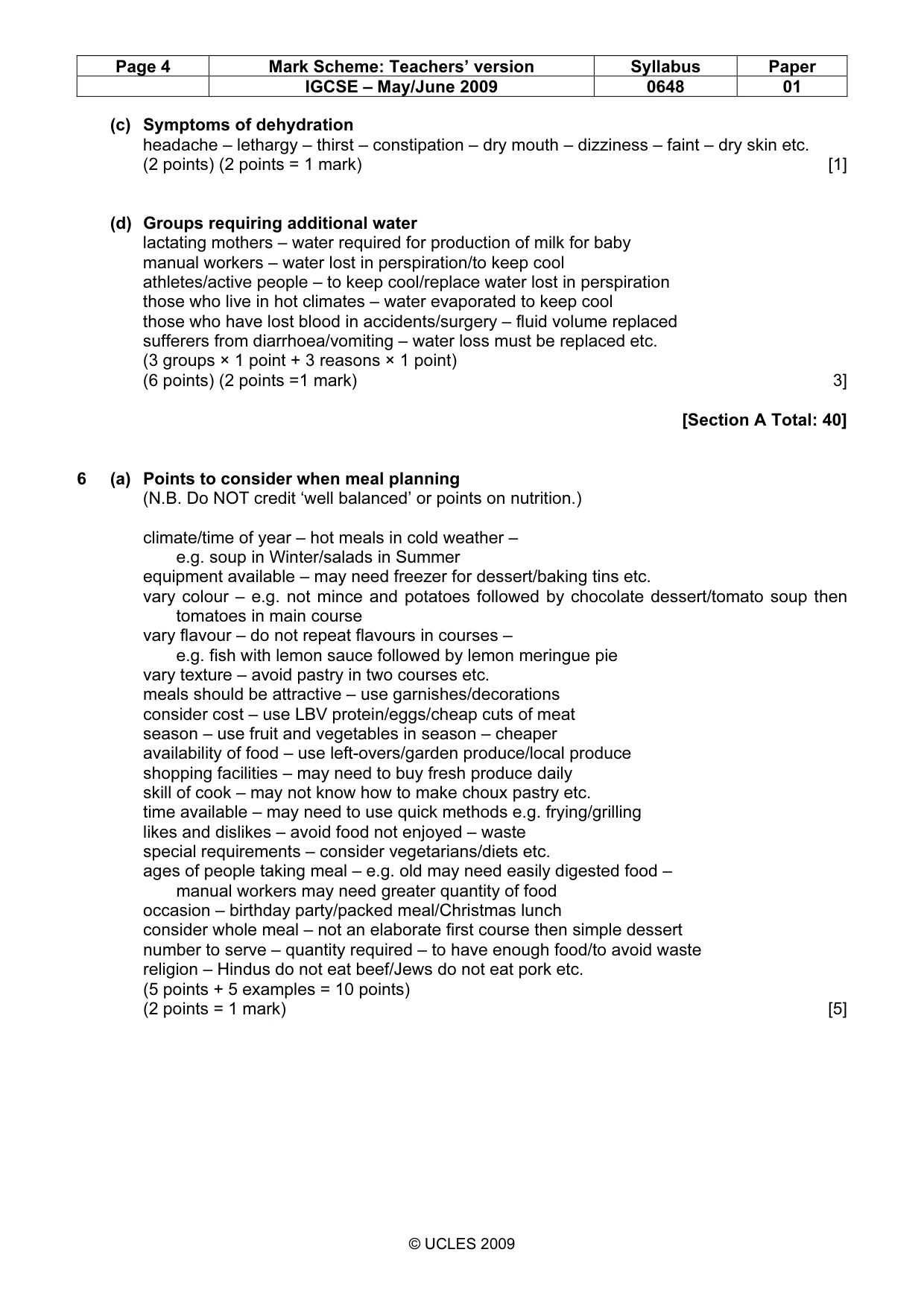
Page 4 Mark Scheme: Teachers’ version Syllabus Paper IGCSE – May/June 2009 0648 01 © UCLES 2009 (c) Symptoms of dehydration headache – lethargy – thirst – constipation – dry mouth – dizziness – faint – dry skin etc. (2 points) (2 points = 1 mark) [1] (d) Groups requiring additional water lactating mothers – water required for production of milk for baby manual workers – water lost in perspiration/to keep cool athletes/active people – to keep cool/replace water lost in perspiration those who live in hot climates – water evaporated to keep cool those who have lost blood in accidents/surgery – fluid volume replaced sufferers from diarrhoea/vomiting – water loss must be replaced etc. (3 groups × 1 point + 3 reasons × 1 point) (6 points) (2 points =1 mark) 3] [Section A Total: 40] 6 (a) Points to consider when meal planning (N.B. Do NOT credit ‘well balanced’ or points on nutrition.) climate/time of year – hot meals in cold weather – e.g. soup in Winter/salads in Summer equipment available – may need freezer for dessert/baking tins etc. vary colour – e.g. not mince and potatoes followed by chocolate dessert/tomato soup then tomatoes in main course vary flavour – do not repeat flavours in courses – e.g. fish with lemon sauce followed by lemon meringue pie vary texture – avoid pastry in two courses etc. meals should be attractive – use garnishes/decorations consider cost – use LBV protein/eggs/cheap cuts of meat season – use fruit and vegetables in season – cheaper availability of food – use left-overs/garden produce/local produce shopping facilities – may need to buy fresh produce daily skill of cook – may not know how to make choux pastry etc. time available – may need to use quick methods e.g. frying/grilling likes and dislikes – avoid food not enjoyed – waste special requirements – consider vegetarians/diets etc. ages of people taking meal – e.g. old may need easily digested food – manual workers may need greater quantity of food occasion – birthday party/packed meal/Christmas lunch consider whole meal – not an elaborate first course then simple dessert number to serve – quantity required – to have enough food/to avoid waste religion – Hindus do not eat beef/Jews do not eat pork etc. (5 points + 5 examples = 10 points) (2 points = 1 mark) [5]
Mark scheme, page 5
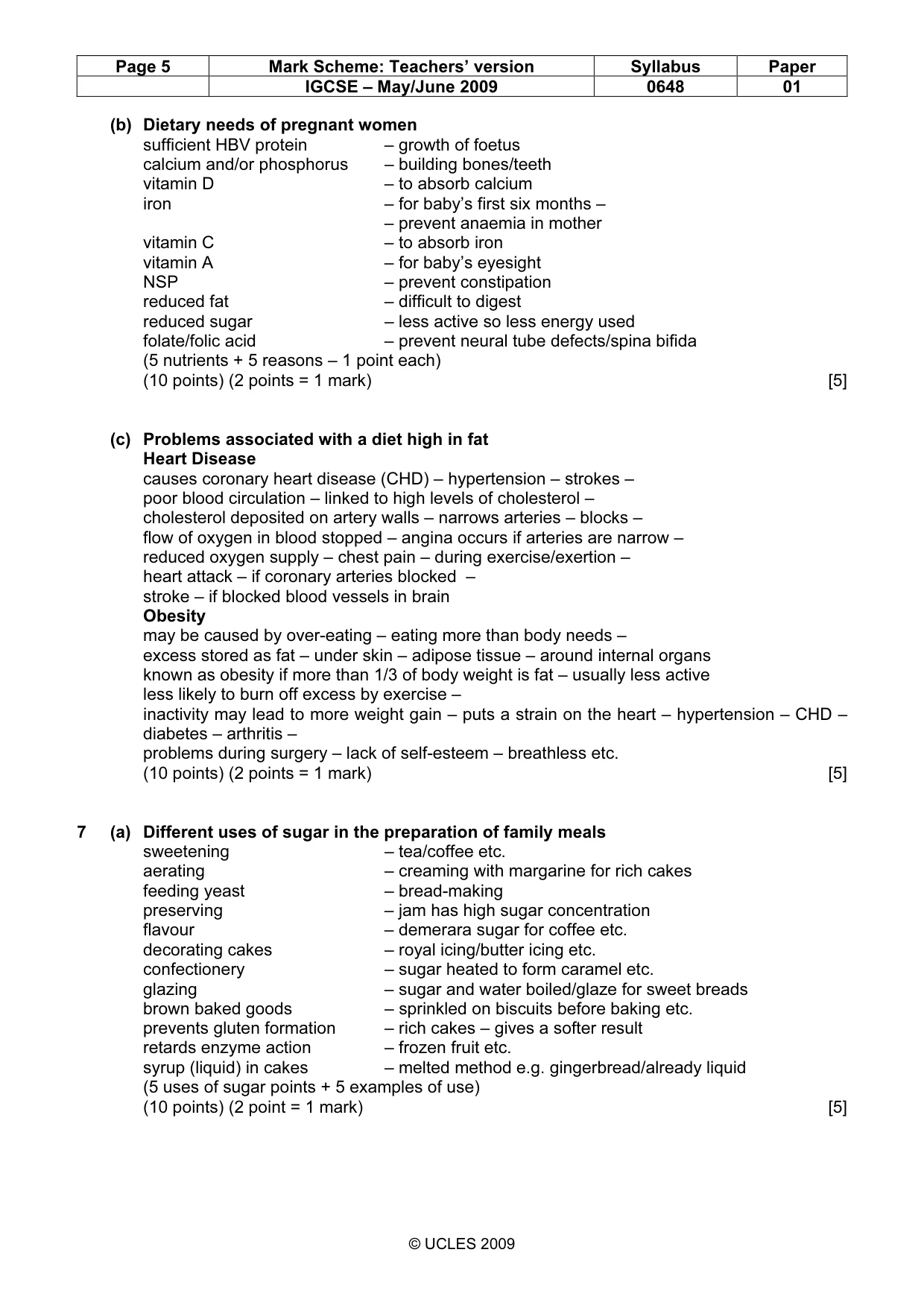
Page 5 Mark Scheme: Teachers’ version Syllabus Paper IGCSE – May/June 2009 0648 01 © UCLES 2009 (b) Dietary needs of pregnant women sufficient HBV protein – growth of foetus calcium and/or phosphorus – building bones/teeth vitamin D – to absorb calcium iron – for baby’s first six months – – prevent anaemia in mother vitamin C – to absorb iron vitamin A – for baby’s eyesight NSP – prevent constipation reduced fat – difficult to digest reduced sugar – less active so less energy used folate/folic acid – prevent neural tube defects/spina bifida (5 nutrients + 5 reasons – 1 point each) (10 points) (2 points = 1 mark) [5] (c) Problems associated with a diet high in fat Heart Disease causes coronary heart disease (CHD) – hypertension – strokes – poor blood circulation – linked to high levels of cholesterol – cholesterol deposited on artery walls – narrows arteries – blocks – flow of oxygen in blood stopped – angina occurs if arteries are narrow – reduced oxygen supply – chest pain – during exercise/exertion – heart attack – if coronary arteries blocked – stroke – if blocked blood vessels in brain Obesity may be caused by over-eating – eating more than body needs – excess stored as fat – under skin – adipose tissue – around internal organs known as obesity if more than 1/3 of body weight is fat – usually less active less likely to burn off excess by exercise – inactivity may lead to more weight gain – puts a strain on the heart – hypertension – CHD – diabetes – arthritis – problems during surgery – lack of self-esteem – breathless etc. (10 points) (2 points = 1 mark) [5] 7 (a) Different uses of sugar in the preparation of family meals sweetening – tea/coffee etc. aerating – creaming with margarine for rich cakes feeding yeast – bread-making preserving – jam has high sugar concentration flavour – demerara sugar for coffee etc. decorating cakes – royal icing/butter icing etc. confectionery – sugar heated to form caramel etc. glazing – sugar and water boiled/glaze for sweet breads brown baked goods – sprinkled on biscuits before baking etc. prevents gluten formation – rich cakes – gives a softer result retards enzyme action – frozen fruit etc. syrup (liquid) in cakes – melted method e.g. gingerbread/already liquid (5 uses of sugar points + 5 examples of use) (10 points) (2 point = 1 mark) [5]
Mark scheme, page 6
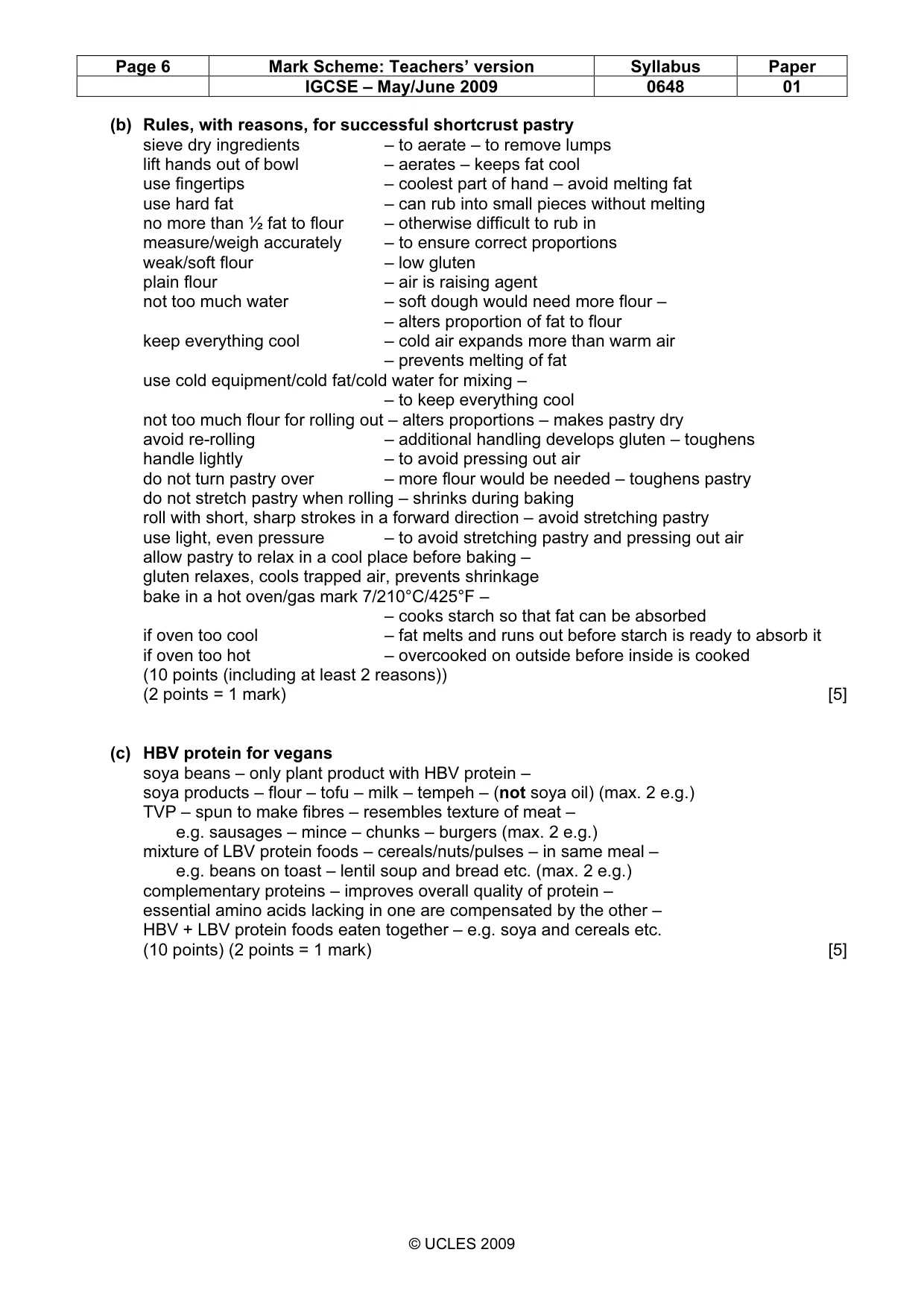
Page 6 Mark Scheme: Teachers’ version Syllabus Paper IGCSE – May/June 2009 0648 01 © UCLES 2009 (b) Rules, with reasons, for successful shortcrust pastry sieve dry ingredients – to aerate – to remove lumps lift hands out of bowl – aerates – keeps fat cool use fingertips – coolest part of hand – avoid melting fat use hard fat – can rub into small pieces without melting no more than ½ fat to flour – otherwise difficult to rub in measure/weigh accurately – to ensure correct proportions weak/soft flour – low gluten plain flour – air is raising agent not too much water – soft dough would need more flour – – alters proportion of fat to flour keep everything cool – cold air expands more than warm air – prevents melting of fat use cold equipment/cold fat/cold water for mixing – – to keep everything cool not too much flour for rolling out – alters proportions – makes pastry dry avoid re-rolling – additional handling develops gluten – toughens handle lightly – to avoid pressing out air do not turn pastry over – more flour would be needed – toughens pastry do not stretch pastry when rolling – shrinks during baking roll with short, sharp strokes in a forward direction – avoid stretching pastry use light, even pressure – to avoid stretching pastry and pressing out air allow pastry to relax in a cool place before baking – gluten relaxes, cools trapped air, prevents shrinkage bake in a hot oven/gas mark 7/210°C/425°F – – cooks starch so that fat can be absorbed if oven too cool – fat melts and runs out before starch is ready to absorb it if oven too hot – overcooked on outside before inside is cooked (10 points (including at least 2 reasons)) (2 points = 1 mark) [5] (c) HBV protein for vegans soya beans – only plant product with HBV protein – soya products – flour – tofu – milk – tempeh – (not soya oil) (max. 2 e.g.) TVP – spun to make fibres – resembles texture of meat – e.g. sausages – mince – chunks – burgers (max. 2 e.g.) mixture of LBV protein foods – cereals/nuts/pulses – in same meal – e.g. beans on toast – lentil soup and bread etc. (max. 2 e.g.) complementary proteins – improves overall quality of protein – essential amino acids lacking in one are compensated by the other – HBV + LBV protein foods eaten together – e.g. soya and cereals etc. (10 points) (2 points = 1 mark) [5]
Mark scheme, page 7
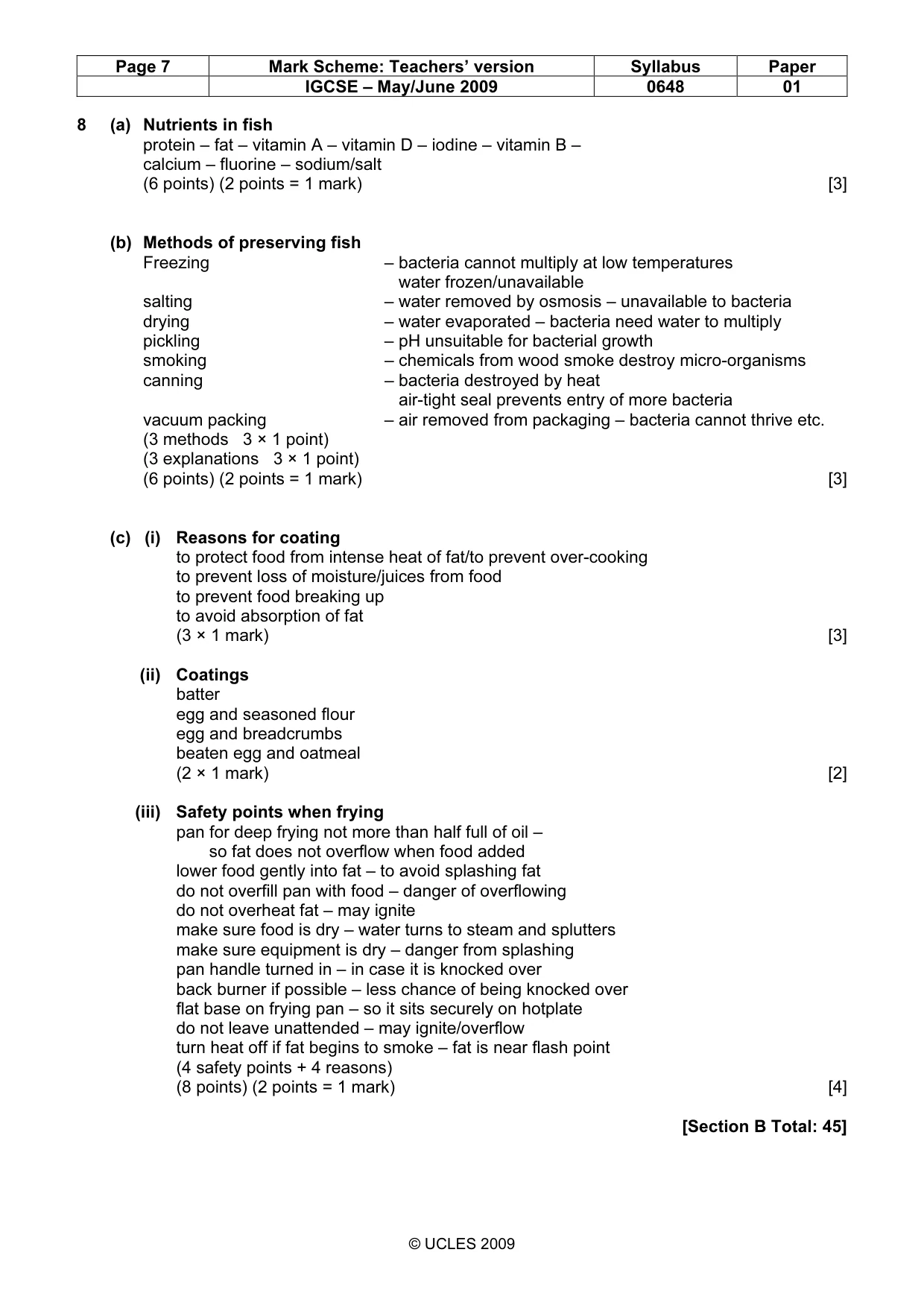
Page 7 Mark Scheme: Teachers’ version Syllabus Paper IGCSE – May/June 2009 0648 01 © UCLES 2009 8 (a) Nutrients in fish protein – fat – vitamin A – vitamin D – iodine – vitamin B – calcium – fluorine – sodium/salt (6 points) (2 points = 1 mark) [3] (b) Methods of preserving fish Freezing – bacteria cannot multiply at low temperatures water frozen/unavailable salting – water removed by osmosis – unavailable to bacteria drying – water evaporated – bacteria need water to multiply pickling – pH unsuitable for bacterial growth smoking – chemicals from wood smoke destroy micro-organisms canning – bacteria destroyed by heat air-tight seal prevents entry of more bacteria vacuum packing – air removed from packaging – bacteria cannot thrive etc. (3 methods 3 × 1 point) (3 explanations 3 × 1 point) (6 points) (2 points = 1 mark) [3] (c) (i) Reasons for coating to protect food from intense heat of fat/to prevent over-cooking to prevent loss of moisture/juices from food to prevent food breaking up to avoid absorption of fat (3 × 1 mark) [3] (ii) Coatings batter egg and seasoned flour egg and breadcrumbs beaten egg and oatmeal (2 × 1 mark) [2] (iii) Safety points when frying pan for deep frying not more than half full of oil – so fat does not overflow when food added lower food gently into fat – to avoid splashing fat do not overfill pan with food – danger of overflowing do not overheat fat – may ignite make sure food is dry – water turns to steam and splutters make sure equipment is dry – danger from splashing pan handle turned in – in case it is knocked over back burner if possible – less chance of being knocked over flat base on frying pan – so it sits securely on hotplate do not leave unattended – may ignite/overflow turn heat off if fat begins to smoke – fat is near flash point (4 safety points + 4 reasons) (8 points) (2 points = 1 mark) [4] [Section B Total: 45]
Mark scheme, page 8
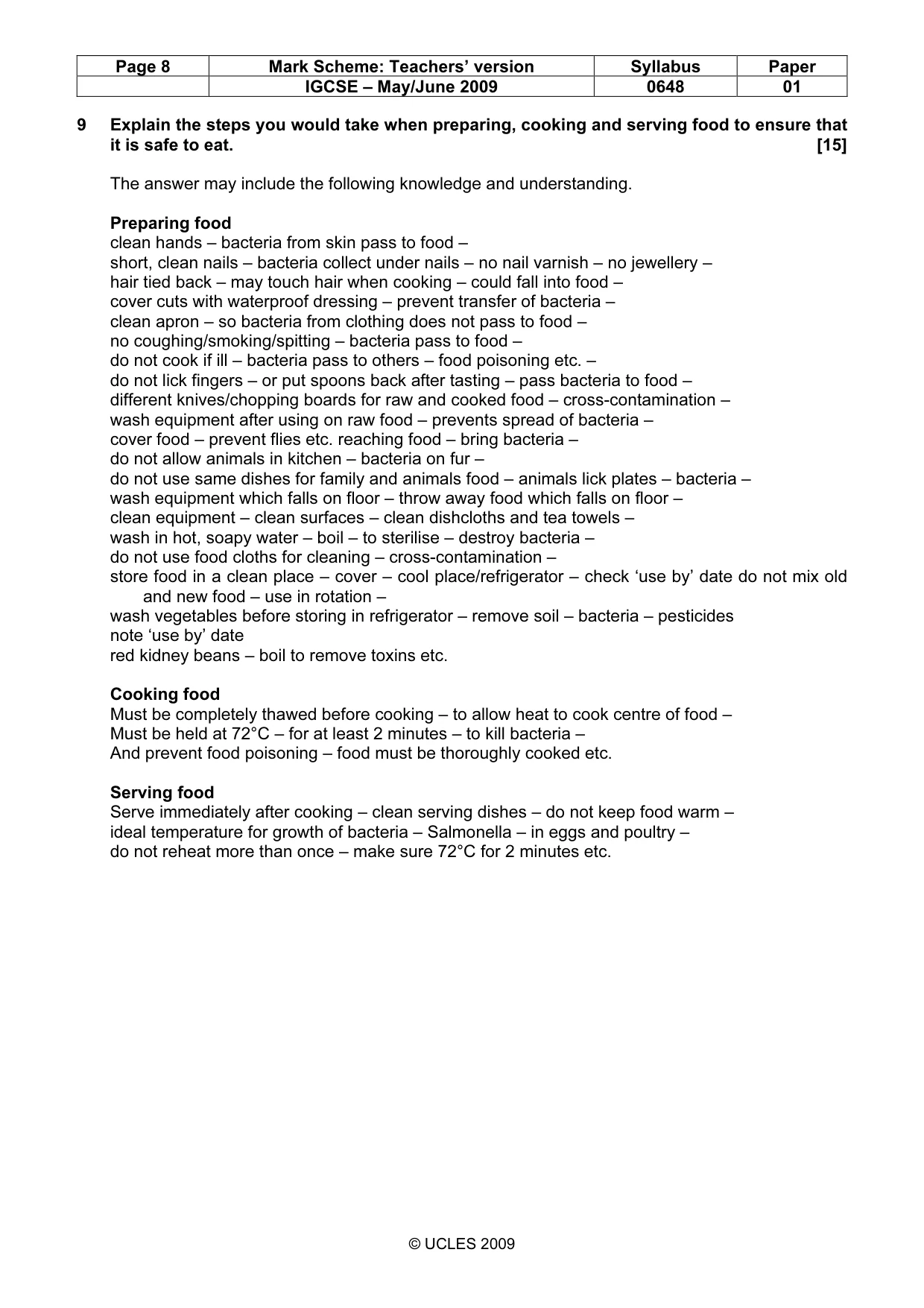
Page 8 Mark Scheme: Teachers’ version Syllabus Paper IGCSE – May/June 2009 0648 01 © UCLES 2009 9 Explain the steps you would take when preparing, cooking and serving food to ensure that it is safe to eat. [15] The answer may include the following knowledge and understanding. Preparing food clean hands – bacteria from skin pass to food – short, clean nails – bacteria collect under nails – no nail varnish – no jewellery – hair tied back – may touch hair when cooking – could fall into food – cover cuts with waterproof dressing – prevent transfer of bacteria – clean apron – so bacteria from clothing does not pass to food – no coughing/smoking/spitting – bacteria pass to food – do not cook if ill – bacteria pass to others – food poisoning etc. – do not lick fingers – or put spoons back after tasting – pass bacteria to food – different knives/chopping boards for raw and cooked food – cross-contamination – wash equipment after using on raw food – prevents spread of bacteria – cover food – prevent flies etc. reaching food – bring bacteria – do not allow animals in kitchen – bacteria on fur – do not use same dishes for family and animals food – animals lick plates – bacteria – wash equipment which falls on floor – throw away food which falls on floor – clean equipment – clean surfaces – clean dishcloths and tea towels – wash in hot, soapy water – boil – to sterilise – destroy bacteria – do not use food cloths for cleaning – cross-contamination – store food in a clean place – cover – cool place/refrigerator – check ‘use by’ date do not mix old and new food – use in rotation – wash vegetables before storing in refrigerator – remove soil – bacteria – pesticides note ‘use by’ date red kidney beans – boil to remove toxins etc. Cooking food Must be completely thawed before cooking – to allow heat to cook centre of food – Must be held at 72°C – for at least 2 minutes – to kill bacteria – And prevent food poisoning – food must be thoroughly cooked etc. Serving food Serve immediately after cooking – clean serving dishes – do not keep food warm – ideal temperature for growth of bacteria – Salmonella – in eggs and poultry – do not reheat more than once – make sure 72°C for 2 minutes etc.
Mark scheme, page 9
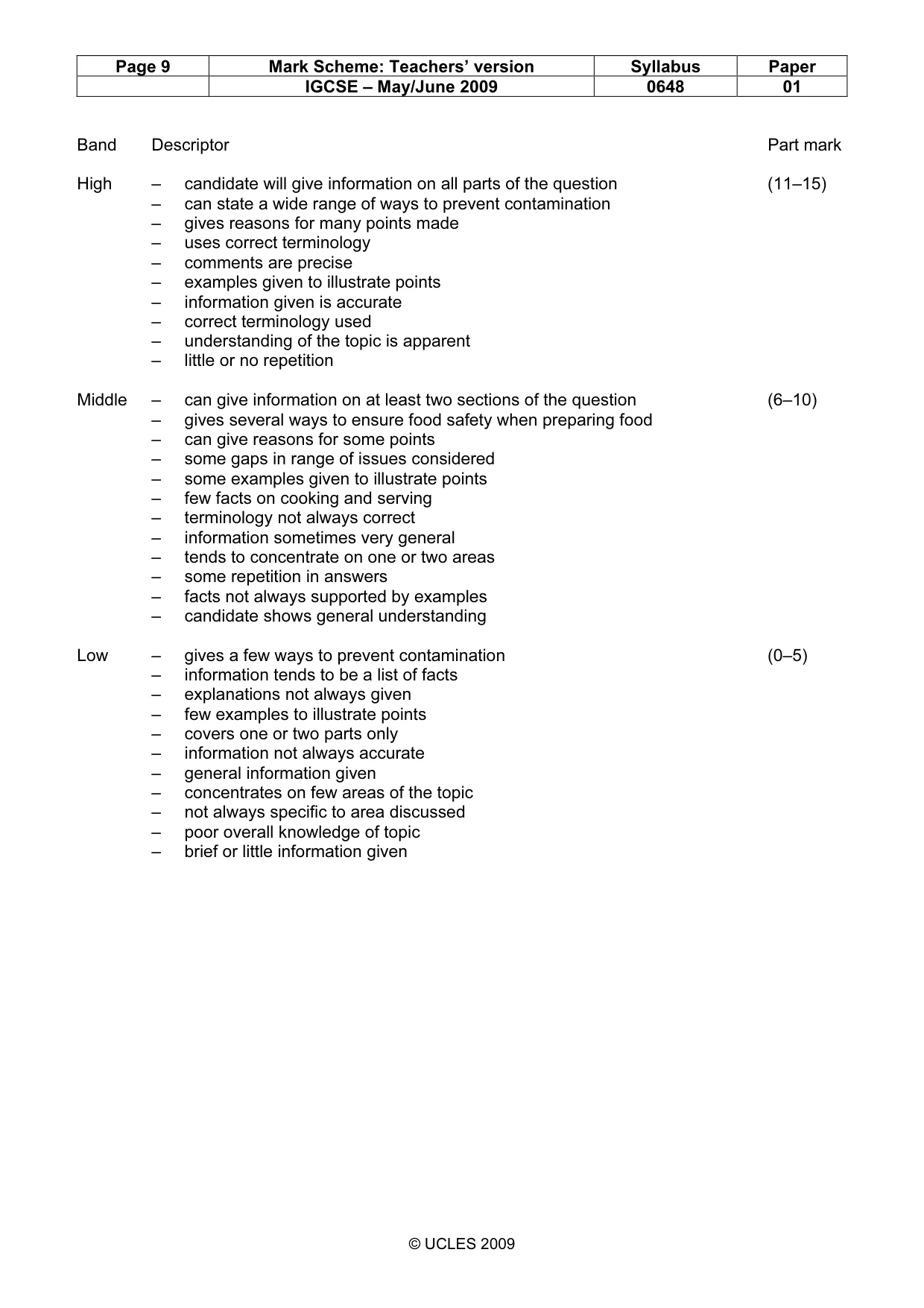
Page 9 Mark Scheme: Teachers’ version Syllabus Paper IGCSE – May/June 2009 0648 01 © UCLES 2009 Band Descriptor Part mark High – candidate will give information on all parts of the question – can state a wide range of ways to prevent contamination – gives reasons for many points made – uses correct terminology – comments are precise – examples given to illustrate points – information given is accurate – correct terminology used – understanding of the topic is apparent – little or no repetition (11–15) Middle – can give information on at least two sections of the question – gives several ways to ensure food safety when preparing food – can give reasons for some points – some gaps in range of issues considered – some examples given to illustrate points – few facts on cooking and serving – terminology not always correct – information sometimes very general – tends to concentrate on one or two areas – some repetition in answers – facts not always supported by examples – candidate shows general understanding (6–10) Low – gives a few ways to prevent contamination – information tends to be a list of facts – explanations not always given – few examples to illustrate points – covers one or two parts only – information not always accurate – general information given – concentrates on few areas of the topic – not always specific to area discussed – poor overall knowledge of topic – brief or little information given (0–5)
Mark scheme, page 10
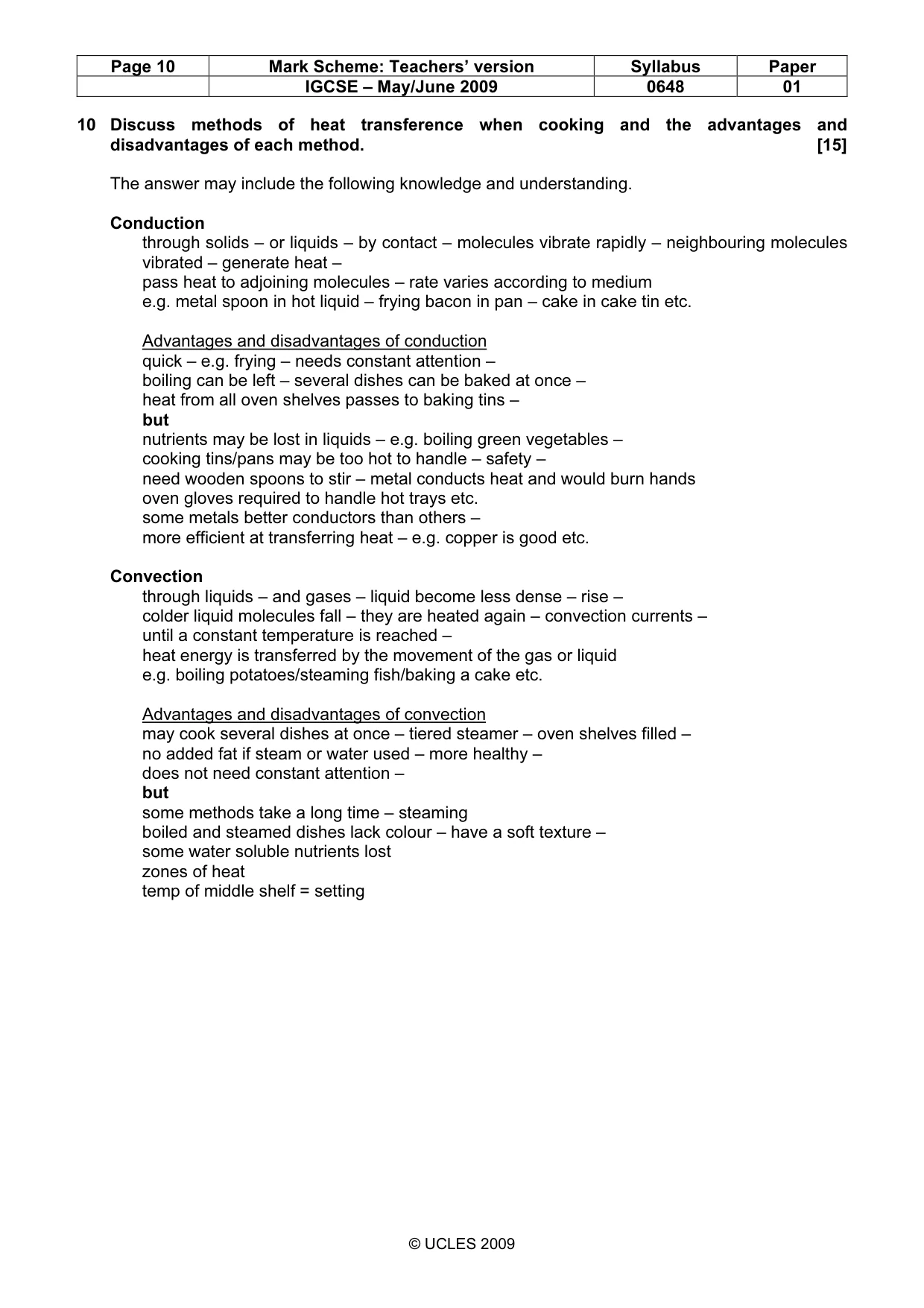
Page 10 Mark Scheme: Teachers’ version Syllabus Paper IGCSE – May/June 2009 0648 01 © UCLES 2009 10 Discuss methods of heat transference when cooking and the advantages and disadvantages of each method. [15] The answer may include the following knowledge and understanding. Conduction through solids – or liquids – by contact – molecules vibrate rapidly – neighbouring molecules vibrated – generate heat – pass heat to adjoining molecules – rate varies according to medium e.g. metal spoon in hot liquid – frying bacon in pan – cake in cake tin etc. Advantages and disadvantages of conduction quick – e.g. frying – needs constant attention – boiling can be left – several dishes can be baked at once – heat from all oven shelves passes to baking tins – but nutrients may be lost in liquids – e.g. boiling green vegetables – cooking tins/pans may be too hot to handle – safety – need wooden spoons to stir – metal conducts heat and would burn hands oven gloves required to handle hot trays etc. some metals better conductors than others – more efficient at transferring heat – e.g. copper is good etc. Convection through liquids – and gases – liquid become less dense – rise – colder liquid molecules fall – they are heated again – convection currents – until a constant temperature is reached – heat energy is transferred by the movement of the gas or liquid e.g. boiling potatoes/steaming fish/baking a cake etc. Advantages and disadvantages of convection may cook several dishes at once – tiered steamer – oven shelves filled – no added fat if steam or water used – more healthy – does not need constant attention – but some methods take a long time – steaming boiled and steamed dishes lack colour – have a soft texture – some water soluble nutrients lost zones of heat temp of middle shelf = setting
Mark scheme, page 11
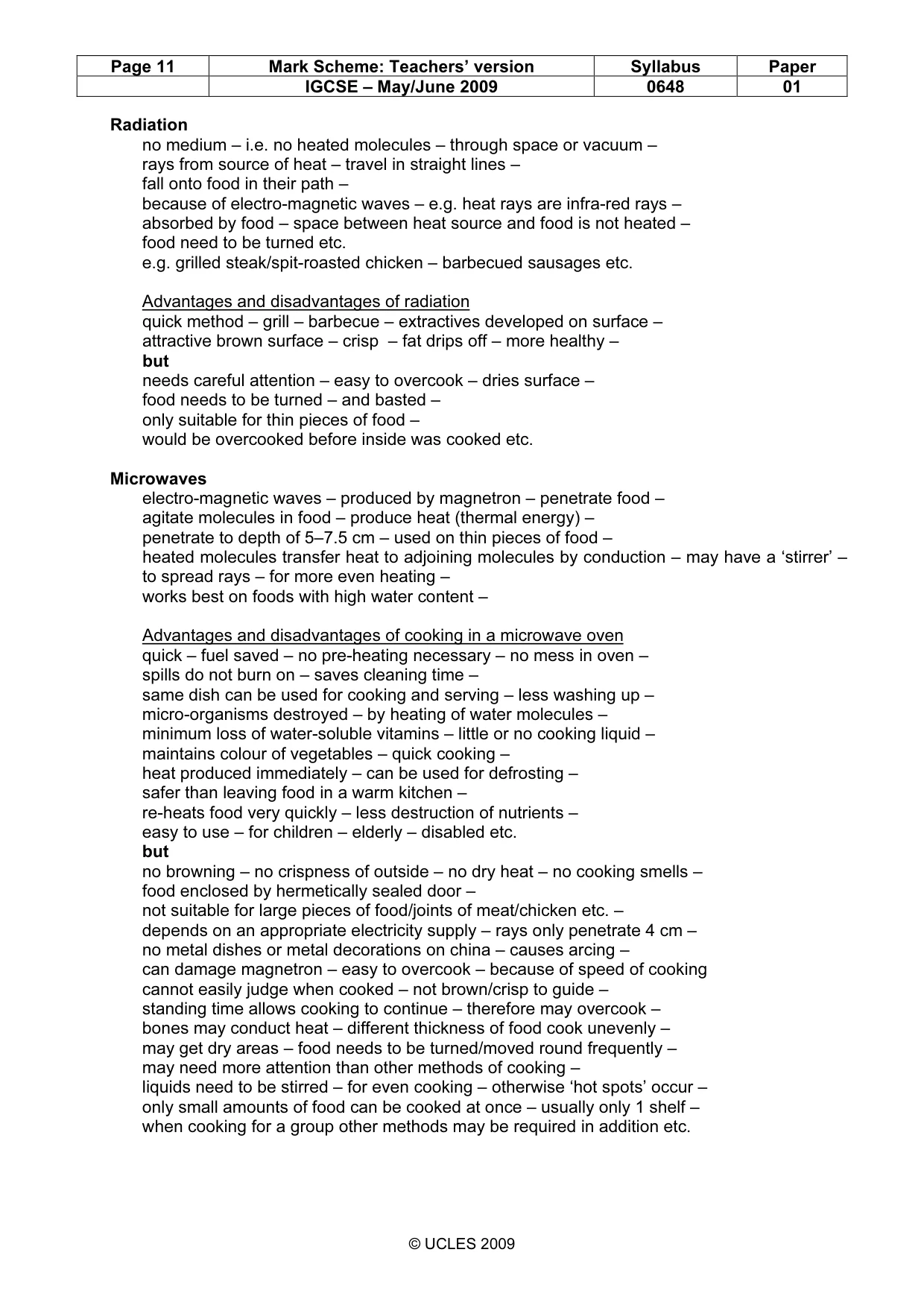
Page 11 Mark Scheme: Teachers’ version Syllabus Paper IGCSE – May/June 2009 0648 01 © UCLES 2009 Radiation no medium – i.e. no heated molecules – through space or vacuum – rays from source of heat – travel in straight lines – fall onto food in their path – because of electro-magnetic waves – e.g. heat rays are infra-red rays – absorbed by food – space between heat source and food is not heated – food need to be turned etc. e.g. grilled steak/spit-roasted chicken – barbecued sausages etc. Advantages and disadvantages of radiation quick method – grill – barbecue – extractives developed on surface – attractive brown surface – crisp – fat drips off – more healthy – but needs careful attention – easy to overcook – dries surface – food needs to be turned – and basted – only suitable for thin pieces of food – would be overcooked before inside was cooked etc. Microwaves electro-magnetic waves – produced by magnetron – penetrate food – agitate molecules in food – produce heat (thermal energy) – penetrate to depth of 5–7.5 cm – used on thin pieces of food – heated molecules transfer heat to adjoining molecules by conduction – may have a ‘stirrer’ – to spread rays – for more even heating – works best on foods with high water content – Advantages and disadvantages of cooking in a microwave oven quick – fuel saved – no pre-heating necessary – no mess in oven – spills do not burn on – saves cleaning time – same dish can be used for cooking and serving – less washing up – micro-organisms destroyed – by heating of water molecules – minimum loss of water-soluble vitamins – little or no cooking liquid – maintains colour of vegetables – quick cooking – heat produced immediately – can be used for defrosting – safer than leaving food in a warm kitchen – re-heats food very quickly – less destruction of nutrients – easy to use – for children – elderly – disabled etc. but no browning – no crispness of outside – no dry heat – no cooking smells – food enclosed by hermetically sealed door – not suitable for large pieces of food/joints of meat/chicken etc. – depends on an appropriate electricity supply – rays only penetrate 4 cm – no metal dishes or metal decorations on china – causes arcing – can damage magnetron – easy to overcook – because of speed of cooking cannot easily judge when cooked – not brown/crisp to guide – standing time allows cooking to continue – therefore may overcook – bones may conduct heat – different thickness of food cook unevenly – may get dry areas – food needs to be turned/moved round frequently – may need more attention than other methods of cooking – liquids need to be stirred – for even cooking – otherwise ‘hot spots’ occur – only small amounts of food can be cooked at once – usually only 1 shelf – when cooking for a group other methods may be required in addition etc.
Mark scheme, page 12
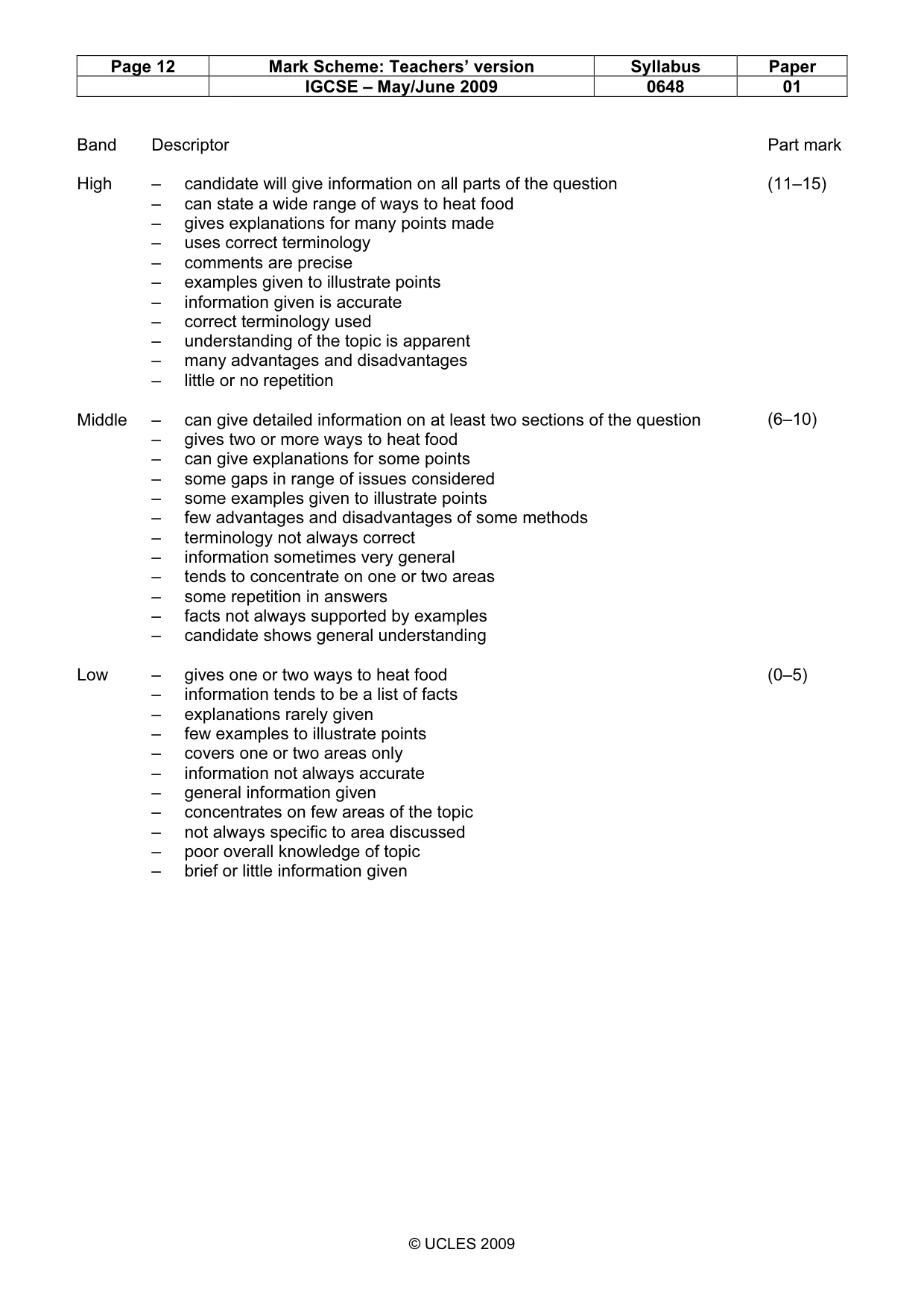
Page 12 Mark Scheme: Teachers’ version Syllabus Paper IGCSE – May/June 2009 0648 01 © UCLES 2009 Band Descriptor Part mark High – candidate will give information on all parts of the question – can state a wide range of ways to heat food – gives explanations for many points made – uses correct terminology – comments are precise – examples given to illustrate points – information given is accurate – correct terminology used – understanding of the topic is apparent – many advantages and disadvantages – little or no repetition (11–15) Middle – can give detailed information on at least two sections of the question – gives two or more ways to heat food – can give explanations for some points – some gaps in range of issues considered – some examples given to illustrate points – few advantages and disadvantages of some methods – terminology not always correct – information sometimes very general – tends to concentrate on one or two areas – some repetition in answers – facts not always supported by examples – candidate shows general understanding (6–10) Low – gives one or two ways to heat food – information tends to be a list of facts – explanations rarely given – few examples to illustrate points – covers one or two areas only – information not always accurate – general information given – concentrates on few areas of the topic – not always specific to area discussed – poor overall knowledge of topic – brief or little information given (0–5)
What you needed in this session
Cambridge’s own grade thresholds for 2009 May/June, Paper 1 · Variant 1. A higher threshold means an easier paper — the bar moves with how the cohort did.