Cambridge IGCSE Food and Nutrition 0648 — 2008 Oct/Nov Paper 1 · Variant 1
0648/11/O/N/08 · 100 marks · ≈113 min
The question paper and its mark scheme, free to read here and free to download. This is Cambridge’s own paper, exactly as it was sat.
Question paper16 pages


Mark scheme13 pages
Answers below. Sit the paper first if you are practising.
Paper as text
Question paper, page 1
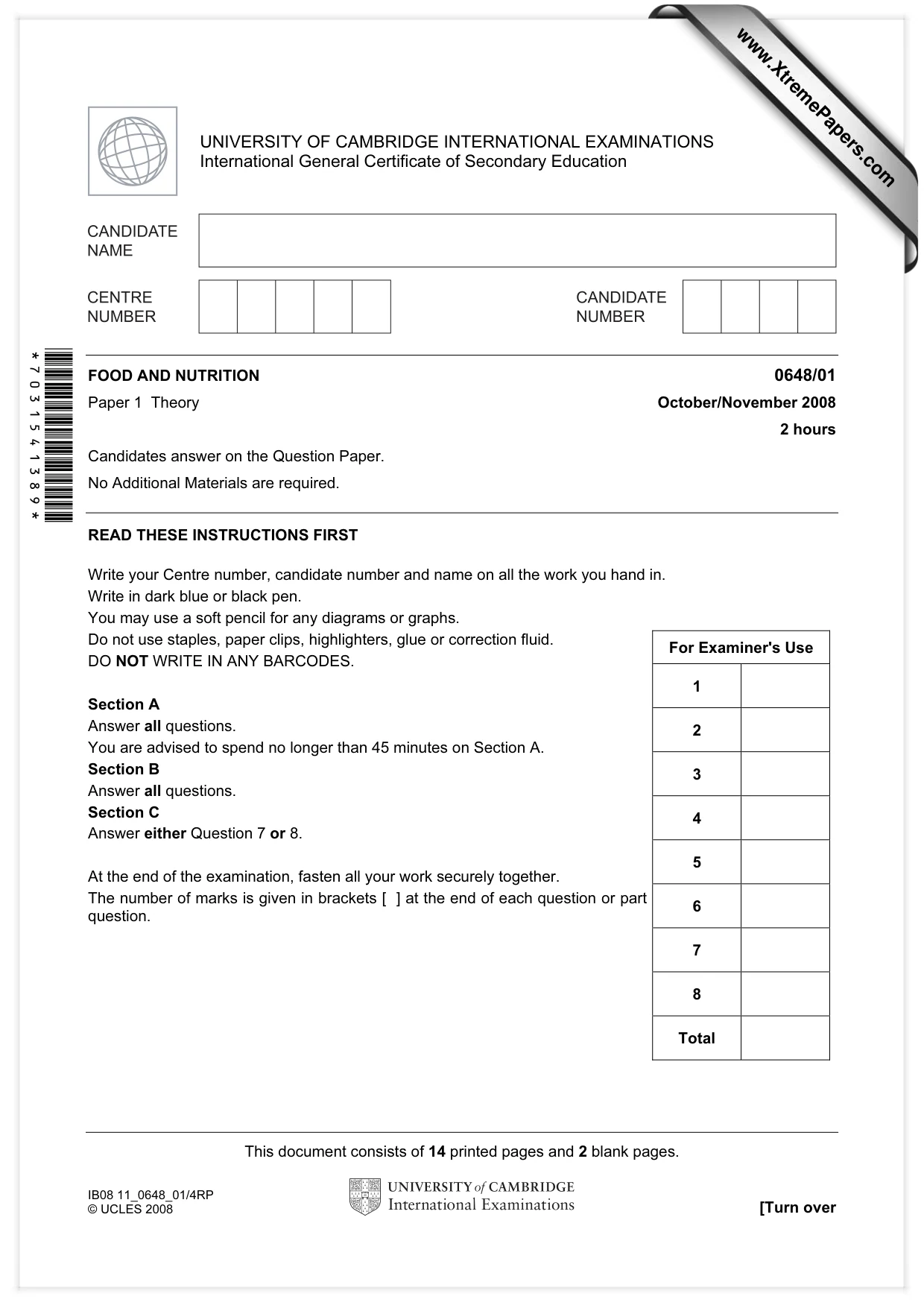
This document consists of 14 printed pages and 2 blank pages. IB08 11_0648_01/4RP © UCLES 2008 [Turn over *7031541389* For Examiner's Use 1 2 3 4 5 6 7 8 Total UNIVERSITY OF CAMBRIDGE INTERNATIONAL EXAMINATIONS International General Certificate of Secondary Education FOOD AND NUTRITION 0648/01 Paper 1 Theory October/November 2008 2 hours Candidates answer on the Question Paper. No Additional Materials are required. READ THESE INSTRUCTIONS FIRST Write your Centre number, candidate number and name on all the work you hand in. Write in dark blue or black pen. You may use a soft pencil for any diagrams or graphs. Do not use staples, paper clips, highlighters, glue or correction fluid. DO NOT WRITE IN ANY BARCODES. Section A Answer all questions. You are advised to spend no longer than 45 minutes on Section A. Section B Answer all questions. Section C Answer either Question 7 or 8. At the end of the examination, fasten all your work securely together. The number of marks is given in brackets [ ] at the end of each question or part question. www.XtremePapers.com
Question paper, page 2
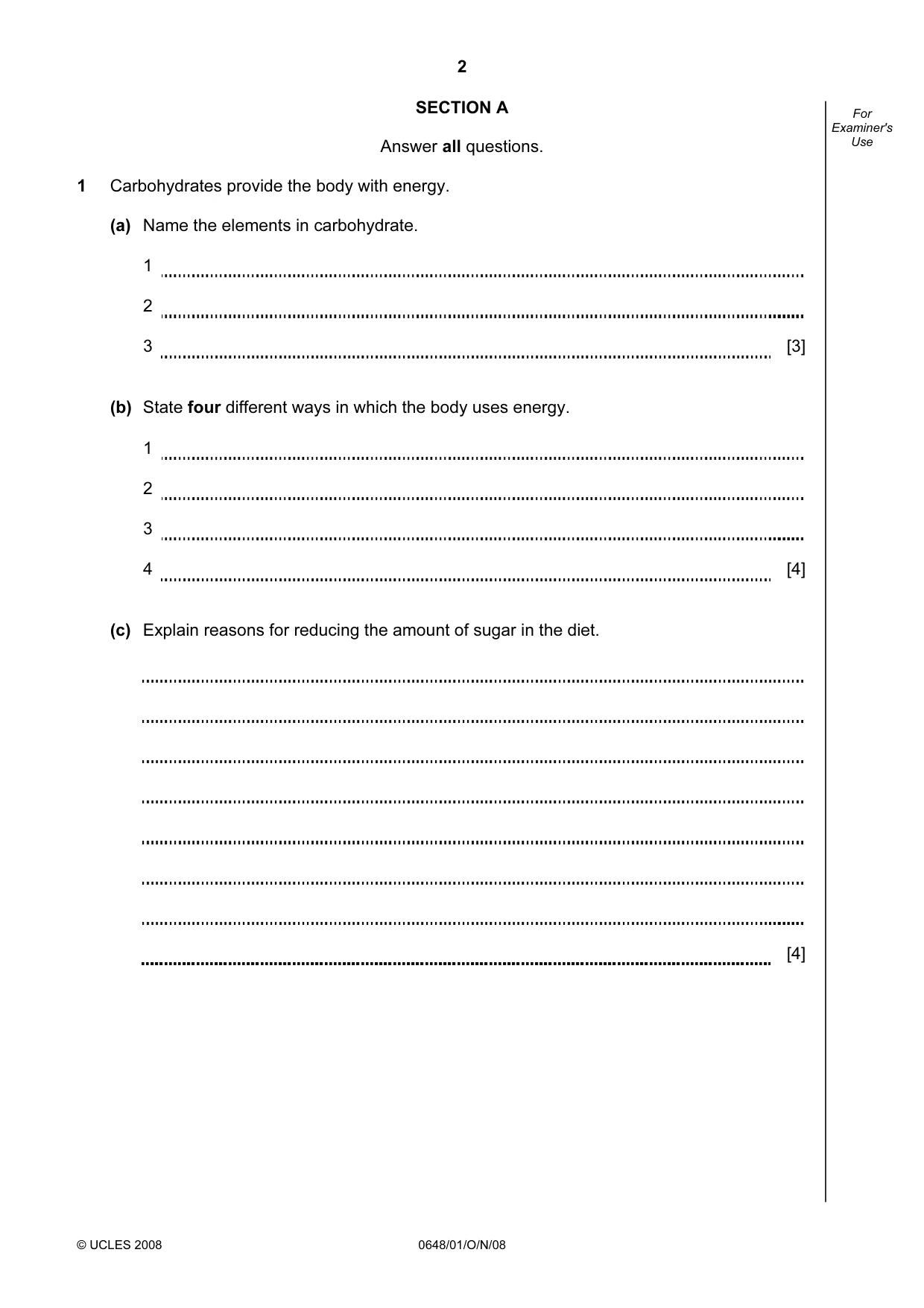
2 © UCLES 2008 0648/01/O/N/08 For Examiner's Use SECTION A Answer all questions. 1 Carbohydrates provide the body with energy. (a) Name the elements in carbohydrate. 1 2 3 [3] (b) State four different ways in which the body uses energy. 1 2 3 4 [4] (c) Explain reasons for reducing the amount of sugar in the diet. [4]
Question paper, page 3
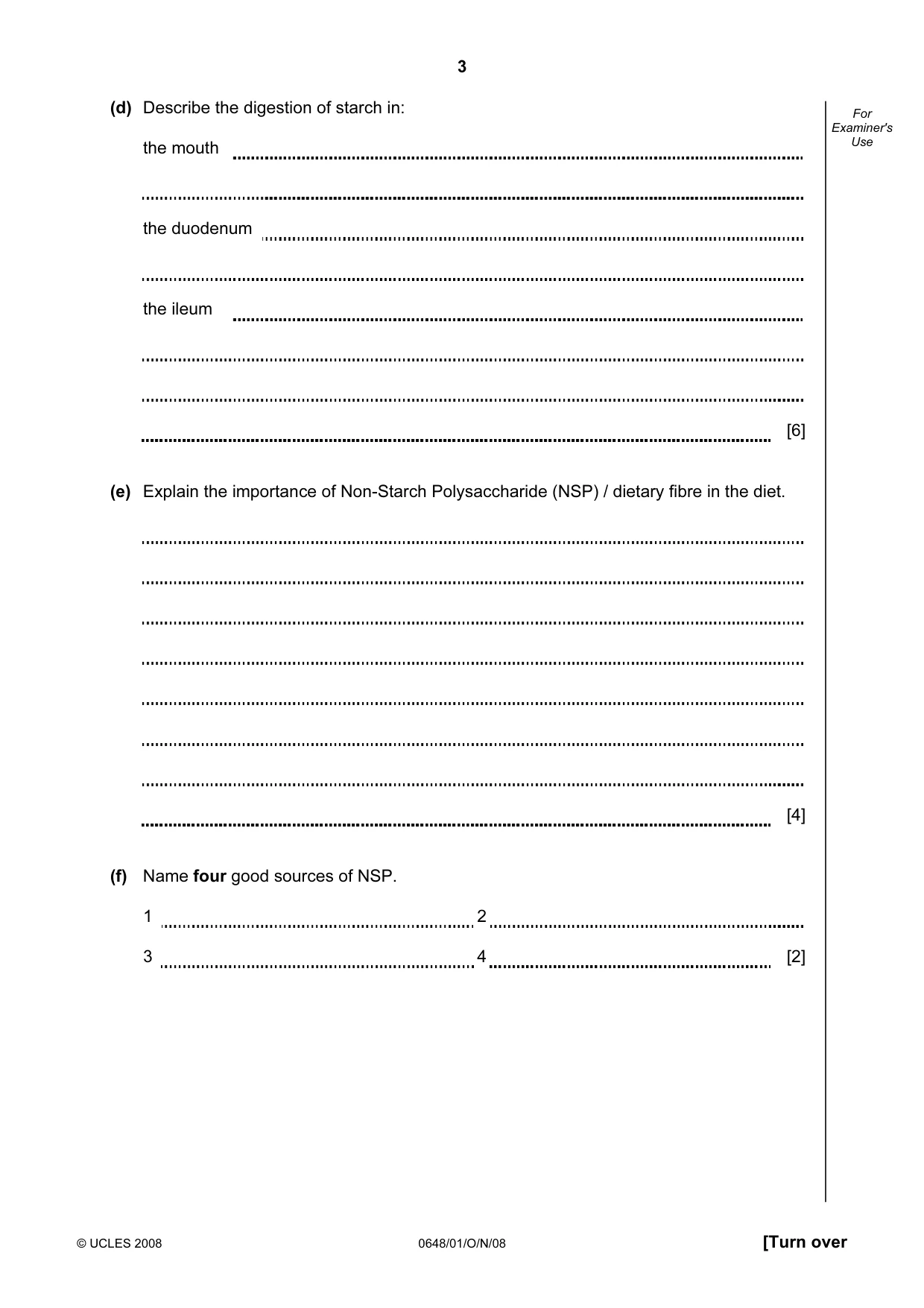
3 © UCLES 2008 0648/01/O/N/08 [Turn over For Examiner's Use (d) Describe the digestion of starch in: the mouth the duodenum the ileum [6] (e) Explain the importance of Non-Starch Polysaccharide (NSP) / dietary fibre in the diet. [4] (f) Name four good sources of NSP. 1 2 3 4 [2]
Question paper, page 4
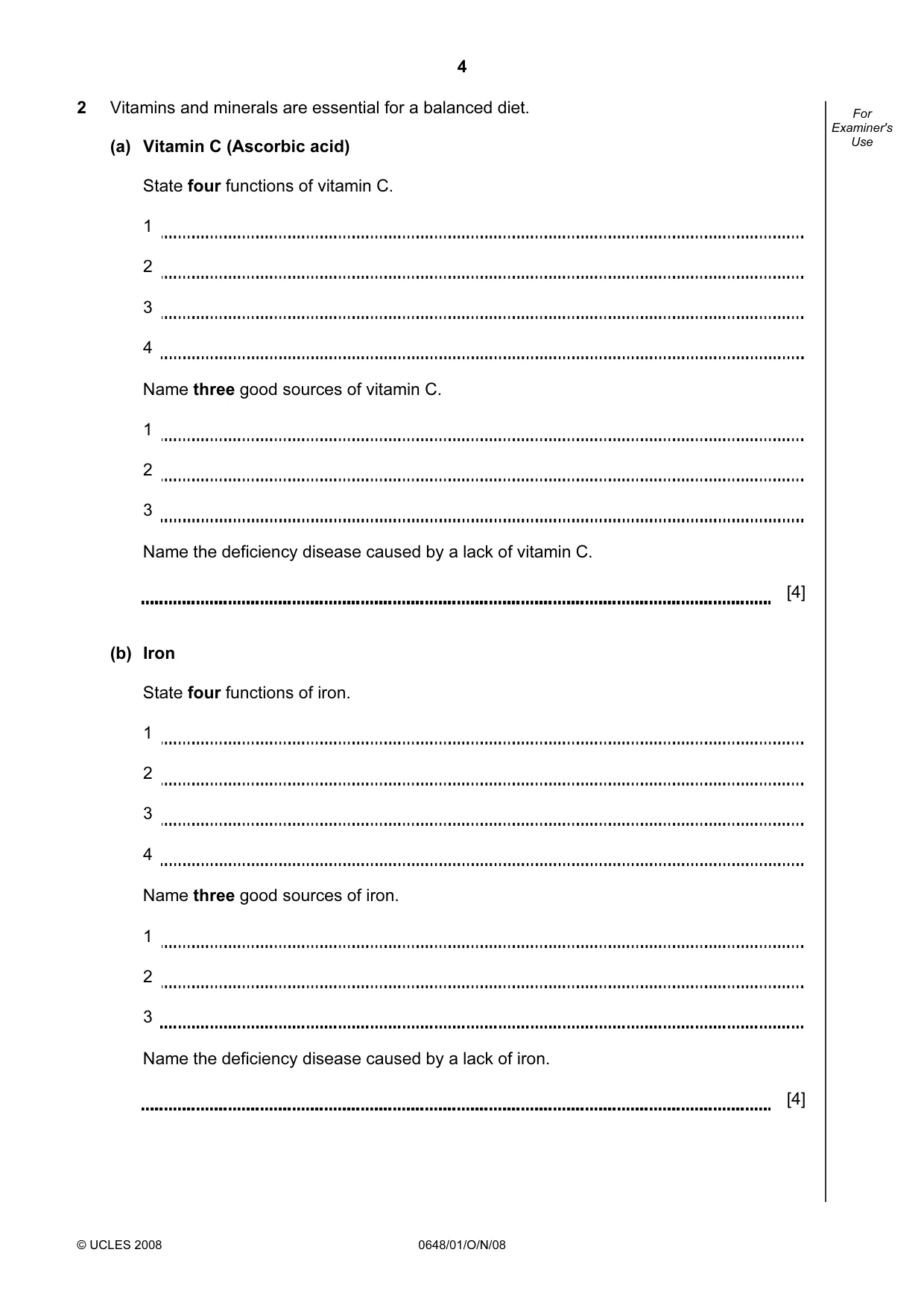
4 © UCLES 2008 0648/01/O/N/08 For Examiner's Use 2 Vitamins and minerals are essential for a balanced diet. (a) Vitamin C (Ascorbic acid) State four functions of vitamin C. 1 2 3 4 Name three good sources of vitamin C. 1 2 3 Name the deficiency disease caused by a lack of vitamin C. [4] (b) Iron State four functions of iron. 1 2 3 4 Name three good sources of iron. 1 2 3 Name the deficiency disease caused by a lack of iron. [4]
Question paper, page 5
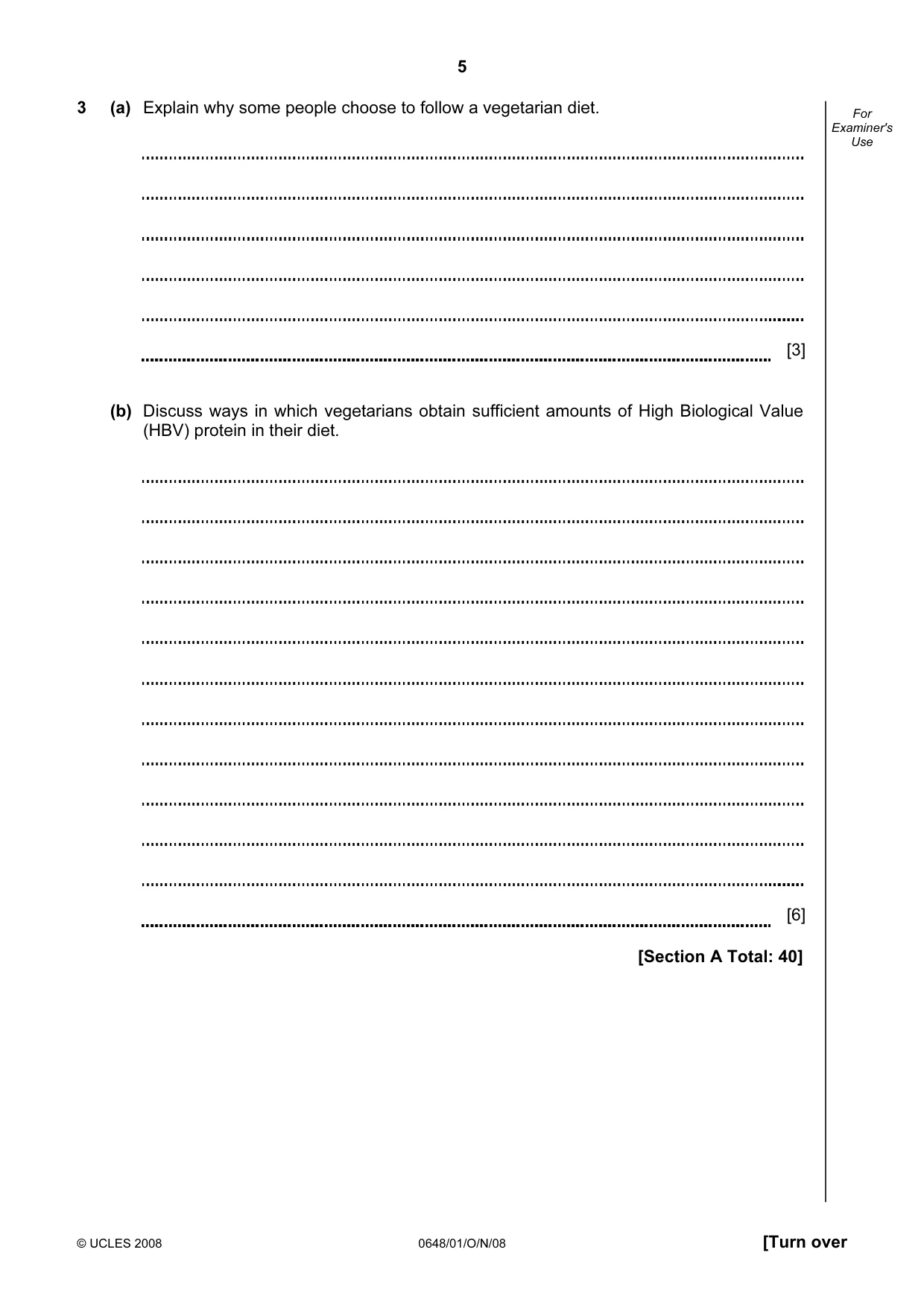
5 © UCLES 2008 0648/01/O/N/08 [Turn over For Examiner's Use 3 (a) Explain why some people choose to follow a vegetarian diet. [3] (b) Discuss ways in which vegetarians obtain sufficient amounts of High Biological Value (HBV) protein in their diet. [6] [Section A Total: 40]
Question paper, page 6
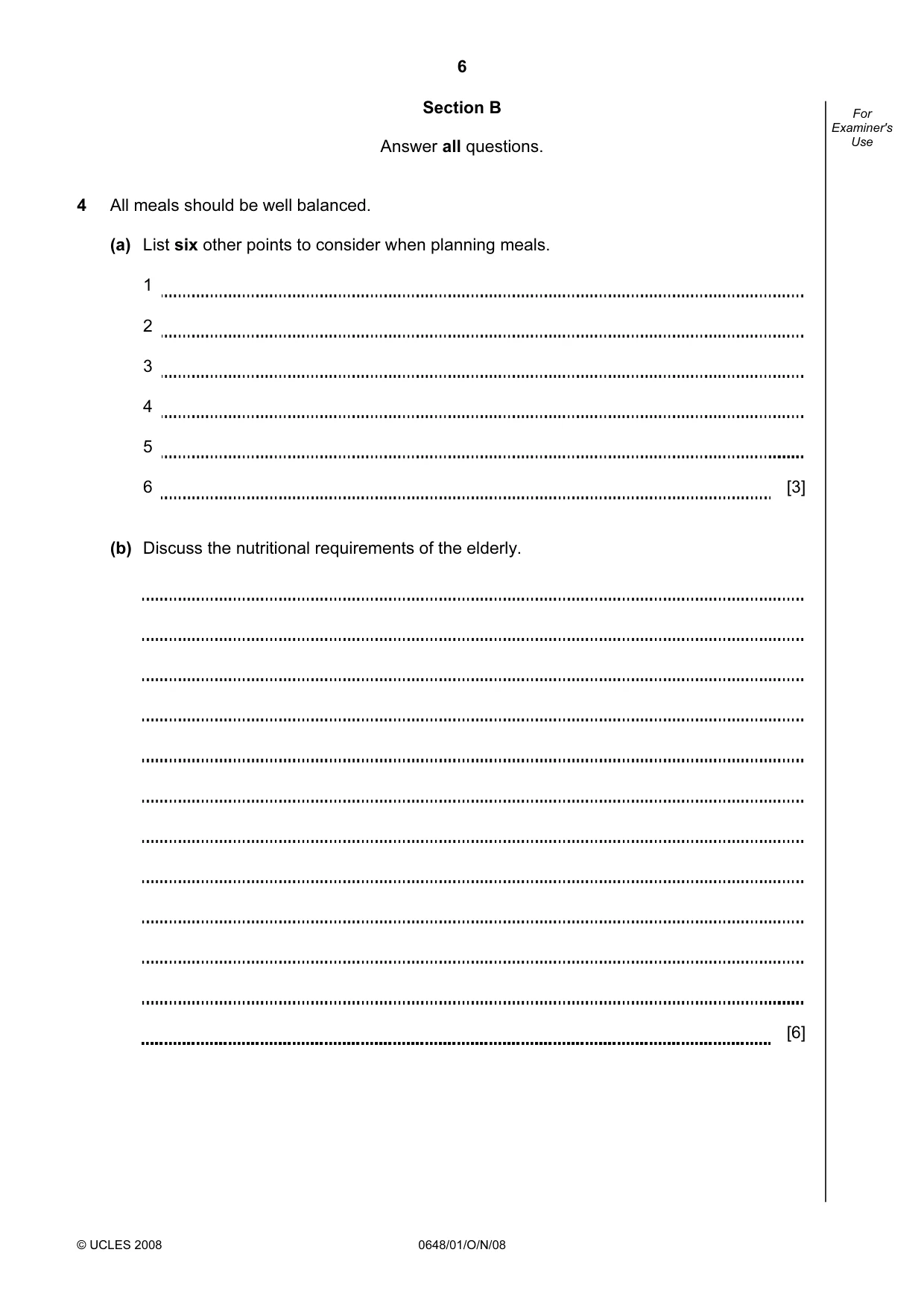
6 © UCLES 2008 0648/01/O/N/08 For Examiner's Use Section B Answer all questions. 4 All meals should be well balanced. (a) List six other points to consider when planning meals. 1 2 3 4 5 6 [3] (b) Discuss the nutritional requirements of the elderly. [6]
Question paper, page 7
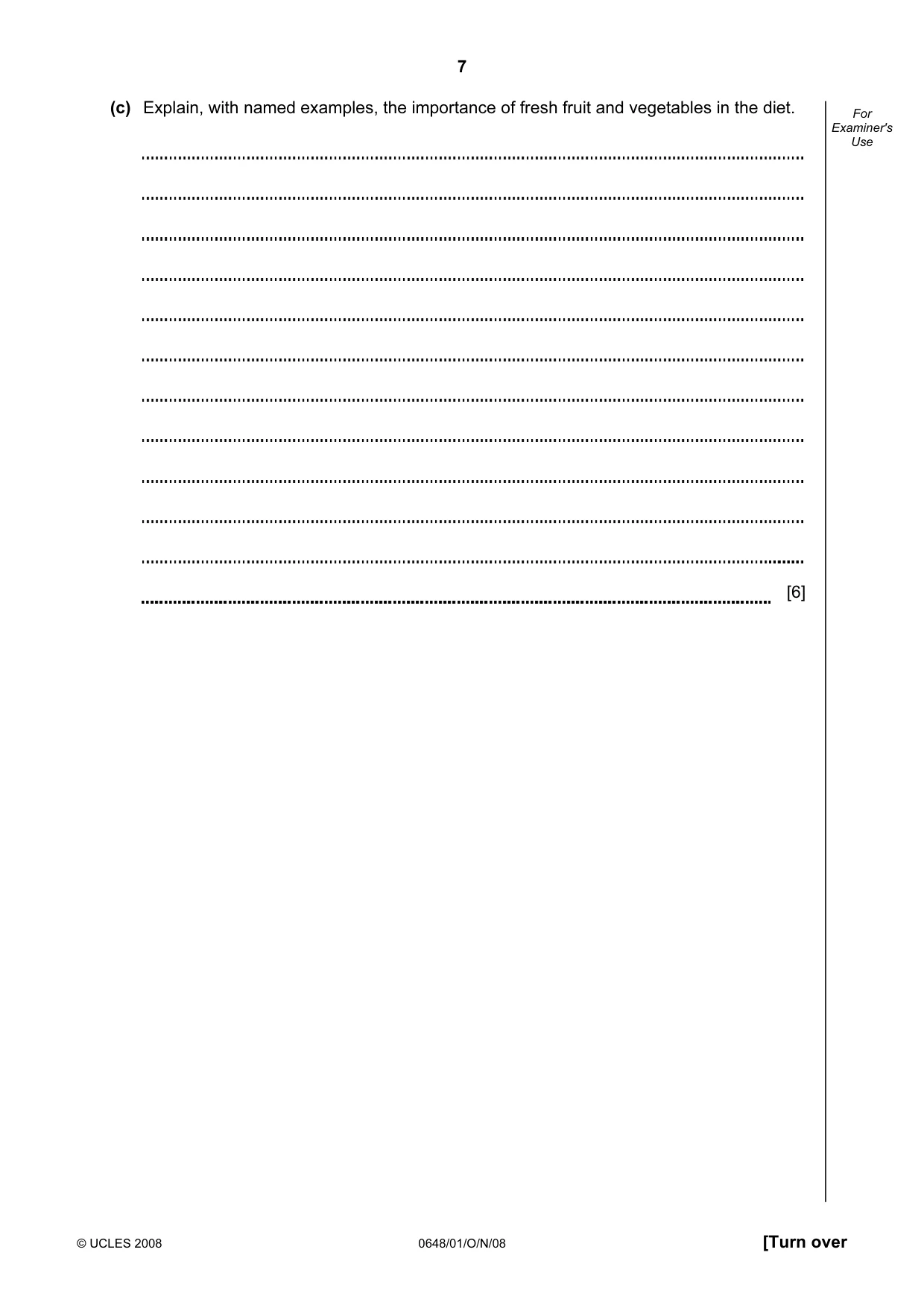
7 © UCLES 2008 0648/01/O/N/08 [Turn over For Examiner's Use (c) Explain, with named examples, the importance of fresh fruit and vegetables in the diet. [6]
Question paper, page 8
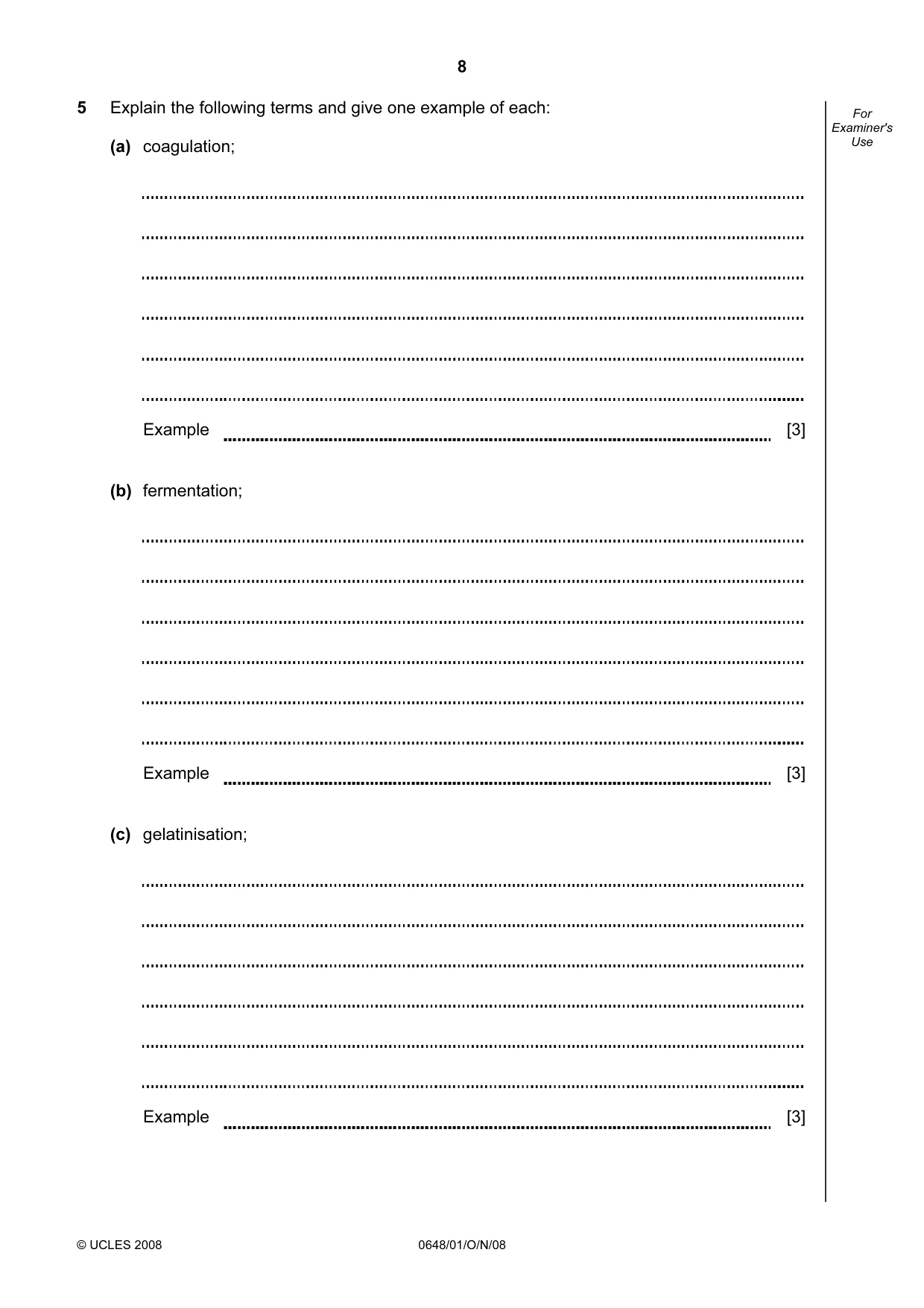
8 © UCLES 2008 0648/01/O/N/08 For Examiner's Use 5 Explain the following terms and give one example of each: (a) coagulation; Example [3] (b) fermentation; Example [3] (c) gelatinisation; Example [3]
Question paper, page 9
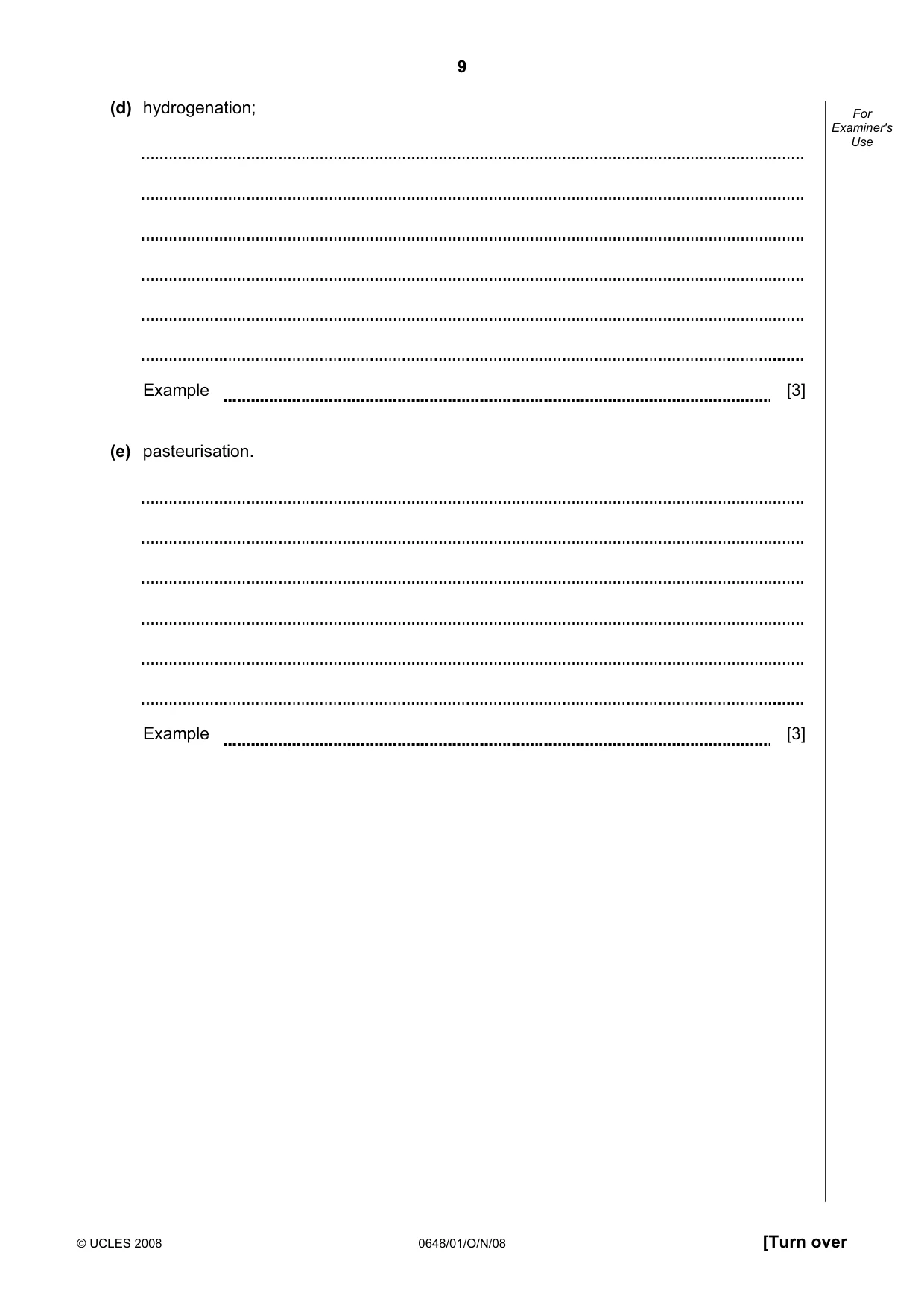
9 © UCLES 2008 0648/01/O/N/08 [Turn over For Examiner's Use (d) hydrogenation; Example [3] (e) pasteurisation. Example [3]
Question paper, page 10
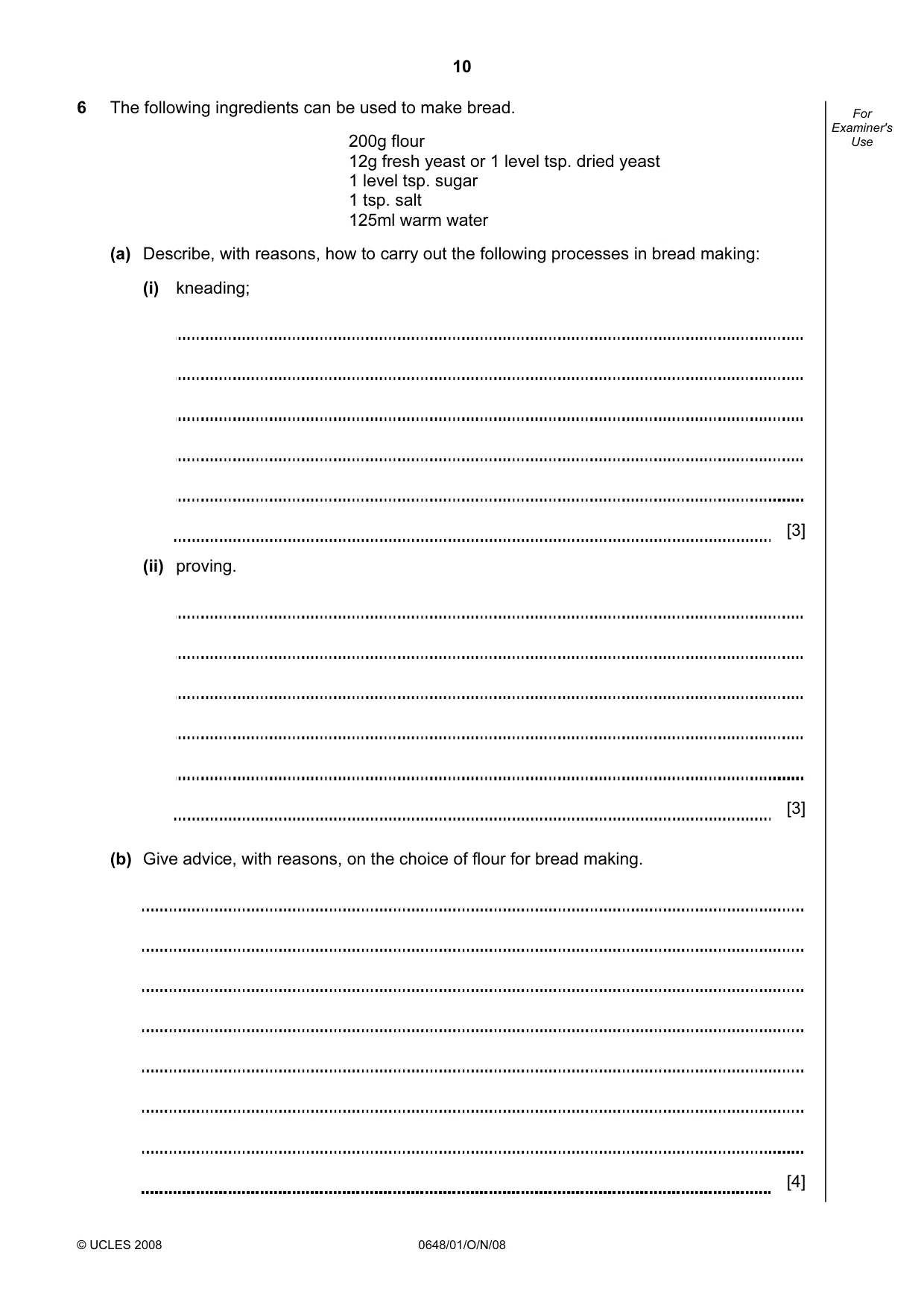
10 © UCLES 2008 0648/01/O/N/08 For Examiner's Use 6 The following ingredients can be used to make bread. 200g flour 12g fresh yeast or 1 level tsp. dried yeast 1 level tsp. sugar 1 tsp. salt 125ml warm water (a) Describe, with reasons, how to carry out the following processes in bread making: (i) kneading; [3] (ii) proving. [3] (b) Give advice, with reasons, on the choice of flour for bread making. [4]
Question paper, page 11
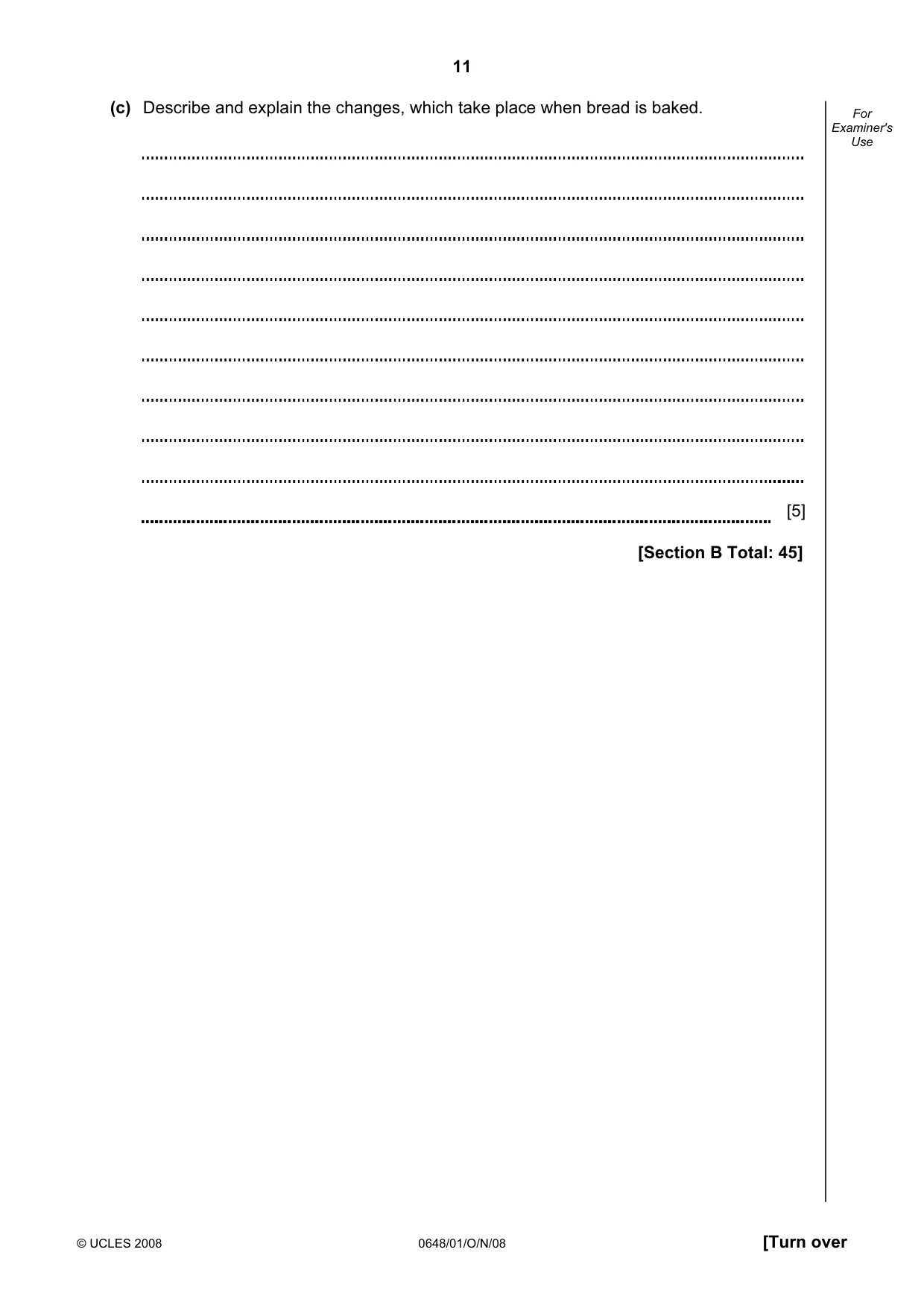
11 © UCLES 2008 0648/01/O/N/08 [Turn over For Examiner's Use (c) Describe and explain the changes, which take place when bread is baked. [5] [Section B Total: 45]
Question paper, page 12
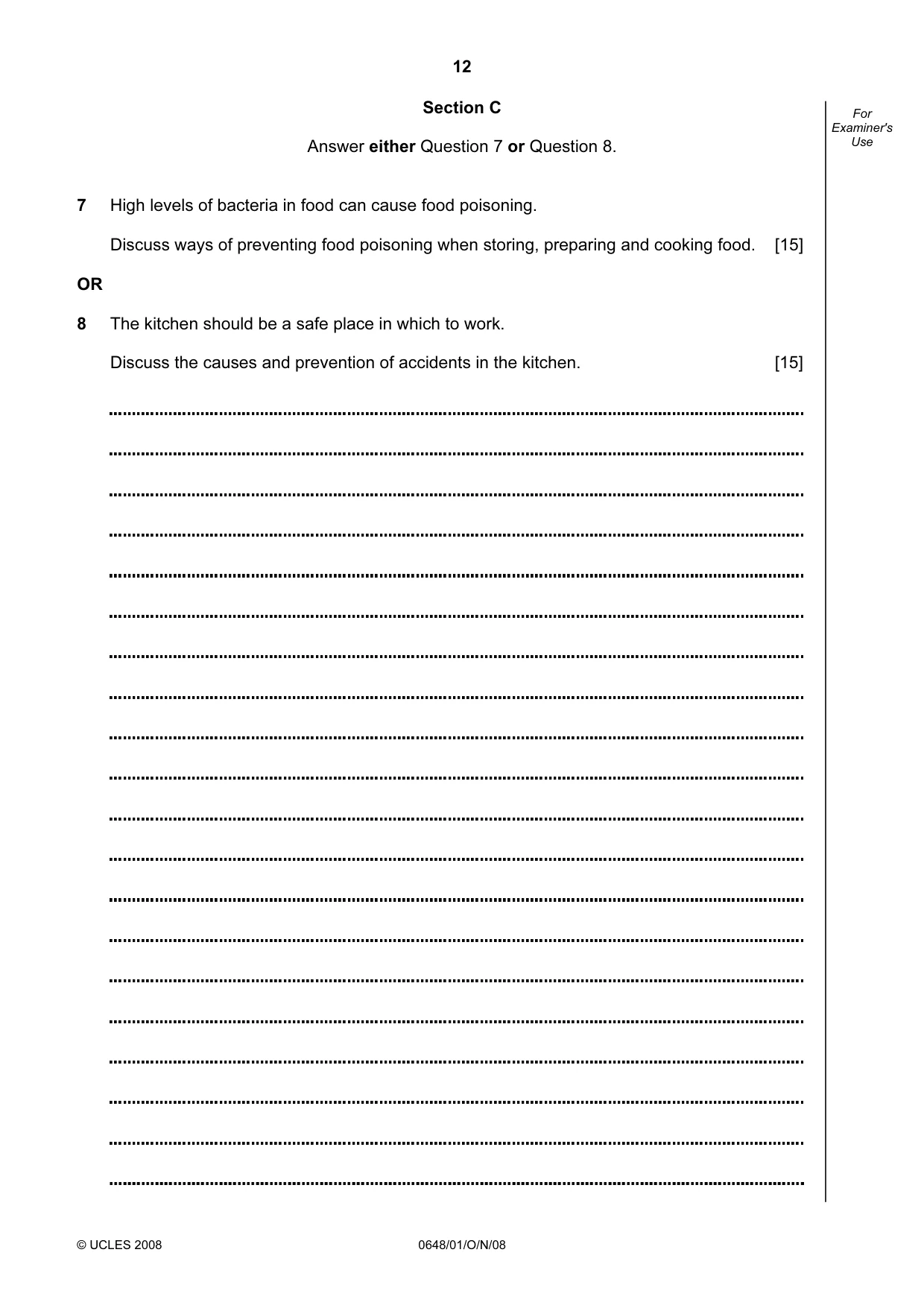
12 © UCLES 2008 0648/01/O/N/08 For Examiner's Use Section C Answer either Question 7 or Question 8. 7 High levels of bacteria in food can cause food poisoning. Discuss ways of preventing food poisoning when storing, preparing and cooking food. [15] OR 8 The kitchen should be a safe place in which to work. Discuss the causes and prevention of accidents in the kitchen. [15]
Question paper, page 13
13 © UCLES 2008 0648/01/O/N/08 [Turn over For Examiner's Use
Question paper, page 14
14 © UCLES 2008 0648/01/O/N/08 For Examiner's Use [Section C Total: 15] [Paper Total: 100]
Question paper, page 16
16 Permission to reproduce items where third-party owned material protected by copyright is included has been sought and cleared where possible. Every reasonable effort has been made by the publisher (UCLES) to trace copyright holders, but if any items requiring clearance have unwittingly been included, the publisher will be pleased to make amends at the earliest possible opportunity. University of Cambridge International Examinations is part of the Cambridge Assessment Group. Cambridge Assessment is the brand name of University of Cambridge Local Examinations Syndicate (UCLES), which is itself a department of the University of Cambridge. 0648/01/O/N/08 BLANK PAGE
Mark scheme, page 1
UNIVERSITY OF CAMBRIDGE INTERNATIONAL EXAMINATIONS International General Certificate of Secondary Education MARK SCHEME for the October/November 2008 question paper 0648 FOOD AND NUTRITION 0648/01 Paper 1 (Theory), maximum raw mark 100 This mark scheme is published as an aid to teachers and candidates, to indicate the requirements of the examination. It shows the basis on which Examiners were instructed to award marks. It does not indicate the details of the discussions that took place at an Examiners’ meeting before marking began. All Examiners are instructed that alternative correct answers and unexpected approaches in candidates’ scripts must be given marks that fairly reflect the relevant knowledge and skills demonstrated. Mark schemes must be read in conjunction with the question papers and the report on the examination. • CIE will not enter into discussions or correspondence in connection with these mark schemes. CIE is publishing the mark schemes for the October/November 2008 question papers for most IGCSE, GCE Advanced Level and Advanced Subsidiary Level syllabuses and some Ordinary Level syllabuses. www.XtremePapers.com
Mark scheme, page 2
Page 2 Mark Scheme Syllabus Paper IGCSE – October/November 2008 0648 1 © UCLES 2008 1 (a) Elements in carbohydrate carbon – hydrogen – oxygen 3 × 1 mark [3] (b) Uses of energy mechanical energy – movement / work (or examples) chemical energy – metabolism / digestion / absorption heat energy – maintain body temperature electrical energy – transmission of nervous impulses basal metabolism – heartbeat / blood circulation / breathing, etc. credit general use or one example 4 × 1 mark [4] (c) bacteria – act on sugar on teeth – forms plaque – sugar converted to acid – dissolves enamel – tooth decay – diabetes gum disease – bad breath excess sugar converted to fat – stored – under skin – adipose tissue – around internal organs – obesity – CHD – low self-esteem – breathlessness – lethargy (8 points) (2 points = 1 mark) [4] (d) Digestion in the mouth ptyalin / amylase – from salivary glands – acts on cooked starch – converts starch to maltose In the duodenum amylase – from pancreatic juice – converts starch to maltose In the ileum lactase – acts on lactose – converts it to glucose – and galactose maltase – acts on maltose – converts it to glucose invertase / sucrase – acts on sucrose – converts it to fructose – and glucose enzymes secreted by intestinal juice (12 points to cover all areas) (2 points = 1 mark) [6] (e) Importance of NSP absorbs water – swells – softens faeces – making it bulky – helps remove waste – easier to expel – stimulates peristalsis – absorbs toxins – regularly binds waste – lowers cholesterol – prevents constipation – reduces blood sugar hernia – cancer of colon – diverticular disease – haemorrhoids (max. 2 e.g. from line above) (8 points) (2 points = 1 mark) [4] (f) Sources of NSP green vegetables (or named e.g.) – fruit skins and seeds (or named e.g.) nuts – pulses (or named e.g.) – rhubarb – celery – potato skins – dried fruit – wholegrain breakfast cereal – brown rice – wholemeal pasta – fruit and vegetables – wholemeal bread (not brown bread) – wholemeal flour – oats – bran (4 examples (avoiding repetition)) (2 examples = 1 mark) [2]
Mark scheme, page 3
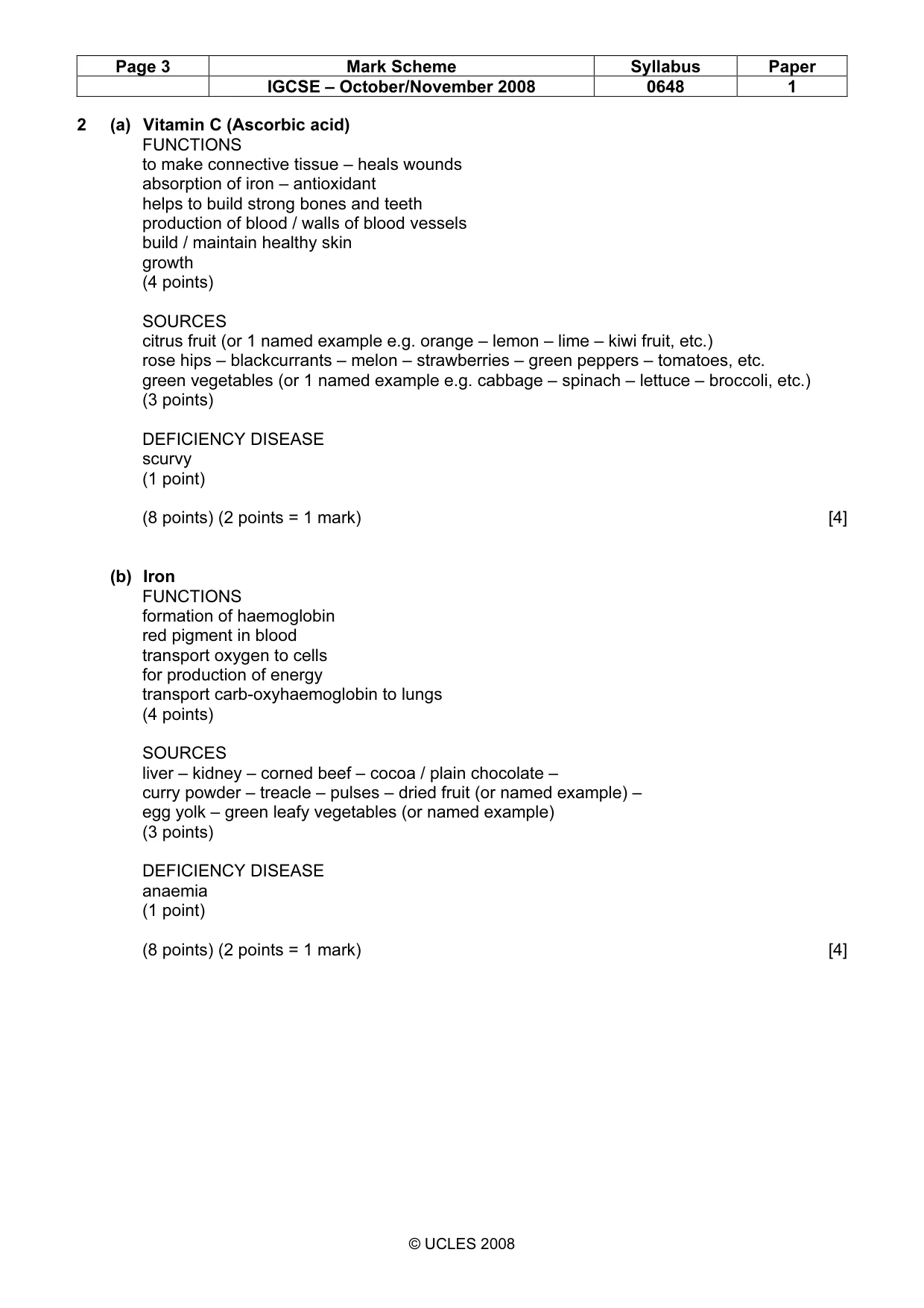
Page 3 Mark Scheme Syllabus Paper IGCSE – October/November 2008 0648 1 © UCLES 2008 2 (a) Vitamin C (Ascorbic acid) FUNCTIONS to make connective tissue – heals wounds absorption of iron – antioxidant helps to build strong bones and teeth production of blood / walls of blood vessels build / maintain healthy skin growth (4 points) SOURCES citrus fruit (or 1 named example e.g. orange – lemon – lime – kiwi fruit, etc.) rose hips – blackcurrants – melon – strawberries – green peppers – tomatoes, etc. green vegetables (or 1 named example e.g. cabbage – spinach – lettuce – broccoli, etc.) (3 points) DEFICIENCY DISEASE scurvy (1 point) (8 points) (2 points = 1 mark) [4] (b) Iron FUNCTIONS formation of haemoglobin red pigment in blood transport oxygen to cells for production of energy transport carb-oxyhaemoglobin to lungs (4 points) SOURCES liver – kidney – corned beef – cocoa / plain chocolate – curry powder – treacle – pulses – dried fruit (or named example) – egg yolk – green leafy vegetables (or named example) (3 points) DEFICIENCY DISEASE anaemia (1 point) (8 points) (2 points = 1 mark) [4]
Mark scheme, page 4
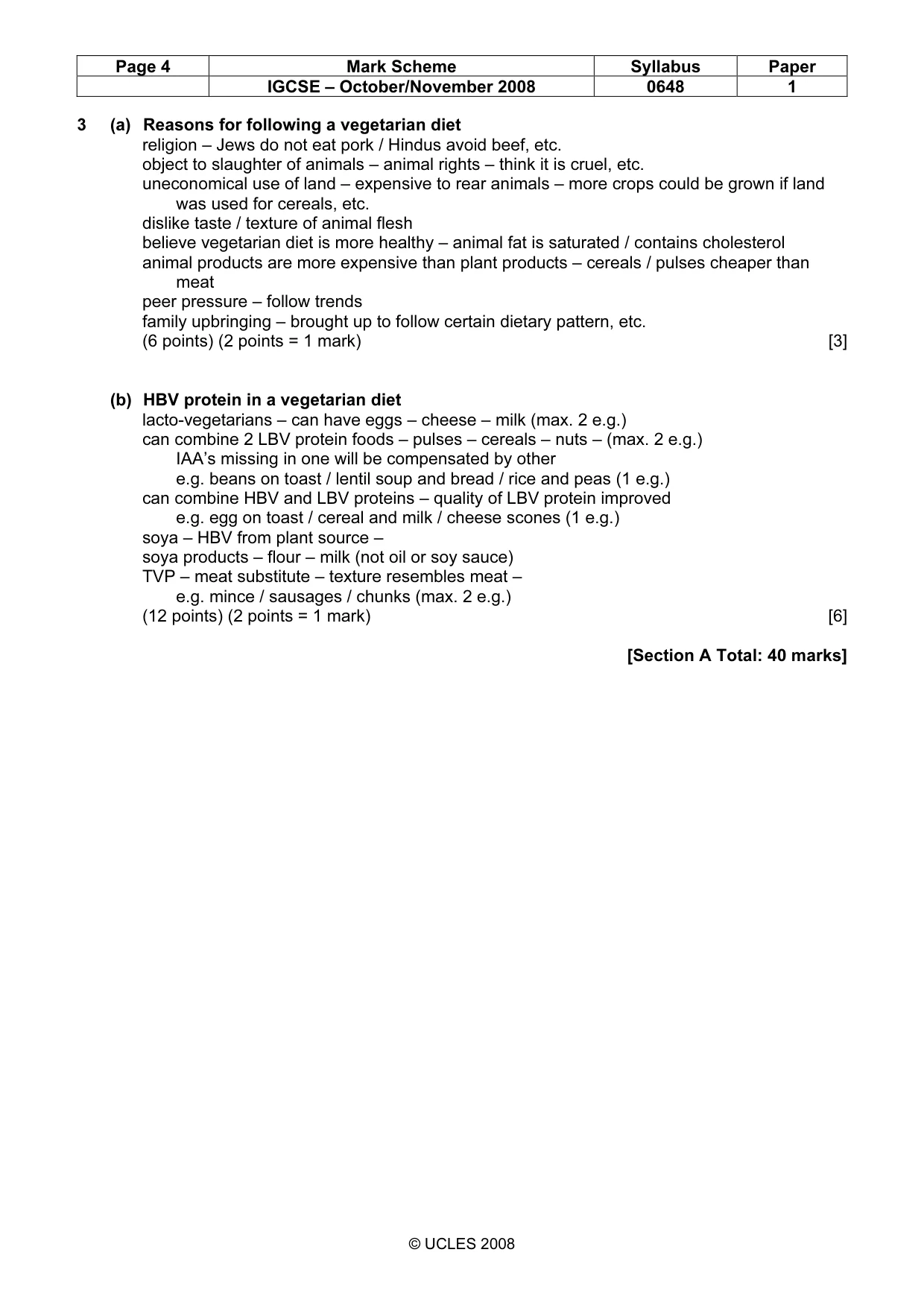
Page 4 Mark Scheme Syllabus Paper IGCSE – October/November 2008 0648 1 © UCLES 2008 3 (a) Reasons for following a vegetarian diet religion – Jews do not eat pork / Hindus avoid beef, etc. object to slaughter of animals – animal rights – think it is cruel, etc. uneconomical use of land – expensive to rear animals – more crops could be grown if land was used for cereals, etc. dislike taste / texture of animal flesh believe vegetarian diet is more healthy – animal fat is saturated / contains cholesterol animal products are more expensive than plant products – cereals / pulses cheaper than meat peer pressure – follow trends family upbringing – brought up to follow certain dietary pattern, etc. (6 points) (2 points = 1 mark) [3] (b) HBV protein in a vegetarian diet lacto-vegetarians – can have eggs – cheese – milk (max. 2 e.g.) can combine 2 LBV protein foods – pulses – cereals – nuts – (max. 2 e.g.) IAA’s missing in one will be compensated by other e.g. beans on toast / lentil soup and bread / rice and peas (1 e.g.) can combine HBV and LBV proteins – quality of LBV protein improved e.g. egg on toast / cereal and milk / cheese scones (1 e.g.) soya – HBV from plant source – soya products – flour – milk (not oil or soy sauce) TVP – meat substitute – texture resembles meat – e.g. mince / sausages / chunks (max. 2 e.g.) (12 points) (2 points = 1 mark) [6] [Section A Total: 40 marks]
Mark scheme, page 5
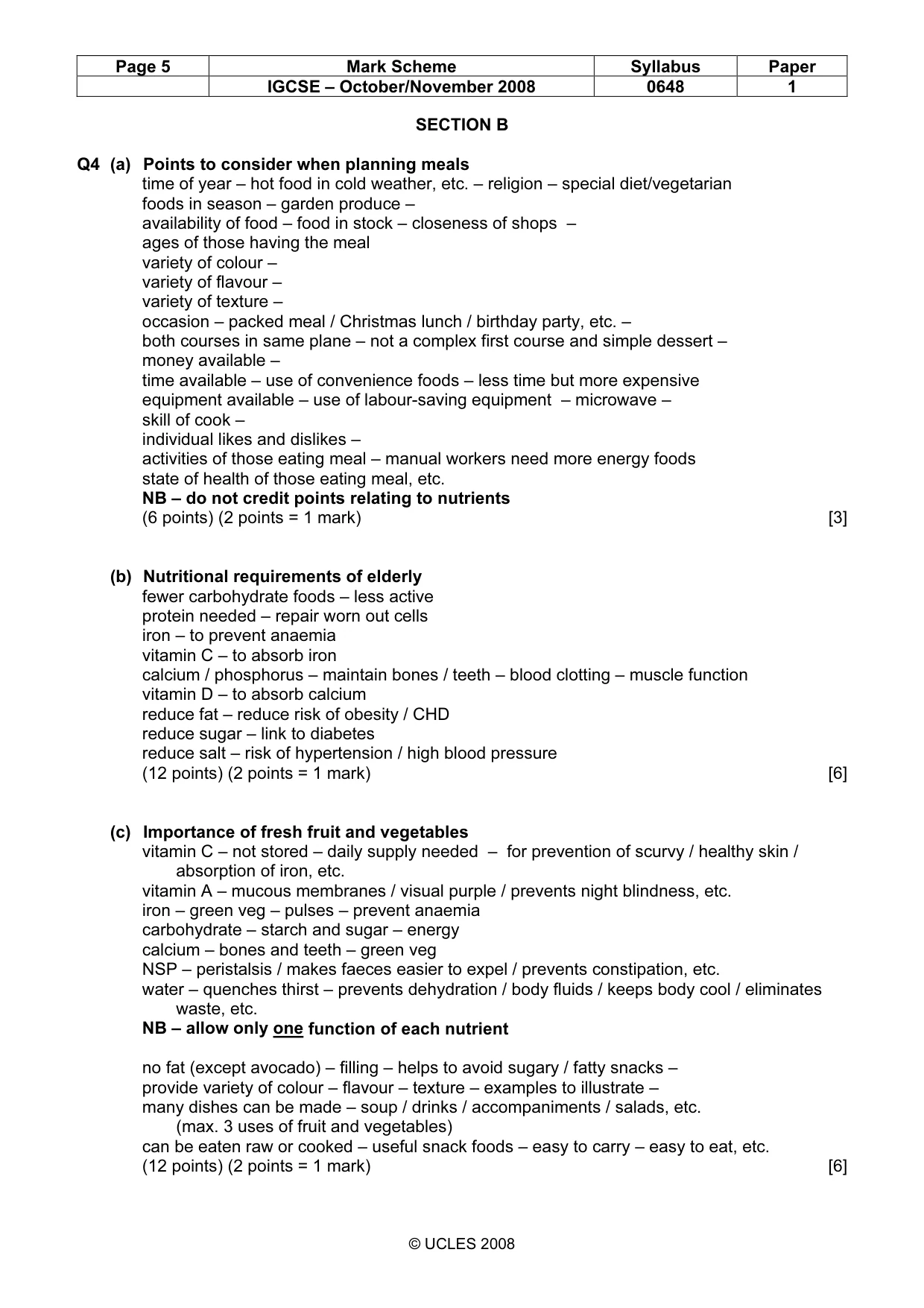
Page 5 Mark Scheme Syllabus Paper IGCSE – October/November 2008 0648 1 © UCLES 2008 SECTION B Q4 (a) Points to consider when planning meals time of year – hot food in cold weather, etc. – religion – special diet/vegetarian foods in season – garden produce – availability of food – food in stock – closeness of shops – ages of those having the meal variety of colour – variety of flavour – variety of texture – occasion – packed meal / Christmas lunch / birthday party, etc. – both courses in same plane – not a complex first course and simple dessert – money available – time available – use of convenience foods – less time but more expensive equipment available – use of labour-saving equipment – microwave – skill of cook – individual likes and dislikes – activities of those eating meal – manual workers need more energy foods state of health of those eating meal, etc. NB – do not credit points relating to nutrients (6 points) (2 points = 1 mark) [3] (b) Nutritional requirements of elderly fewer carbohydrate foods – less active protein needed – repair worn out cells iron – to prevent anaemia vitamin C – to absorb iron calcium / phosphorus – maintain bones / teeth – blood clotting – muscle function vitamin D – to absorb calcium reduce fat – reduce risk of obesity / CHD reduce sugar – link to diabetes reduce salt – risk of hypertension / high blood pressure (12 points) (2 points = 1 mark) [6] (c) Importance of fresh fruit and vegetables vitamin C – not stored – daily supply needed – for prevention of scurvy / healthy skin / absorption of iron, etc. vitamin A – mucous membranes / visual purple / prevents night blindness, etc. iron – green veg – pulses – prevent anaemia carbohydrate – starch and sugar – energy calcium – bones and teeth – green veg NSP – peristalsis / makes faeces easier to expel / prevents constipation, etc. water – quenches thirst – prevents dehydration / body fluids / keeps body cool / eliminates waste, etc. NB – allow only one function of each nutrient no fat (except avocado) – filling – helps to avoid sugary / fatty snacks – provide variety of colour – flavour – texture – examples to illustrate – many dishes can be made – soup / drinks / accompaniments / salads, etc. (max. 3 uses of fruit and vegetables) can be eaten raw or cooked – useful snack foods – easy to carry – easy to eat, etc. (12 points) (2 points = 1 mark) [6]
Mark scheme, page 6
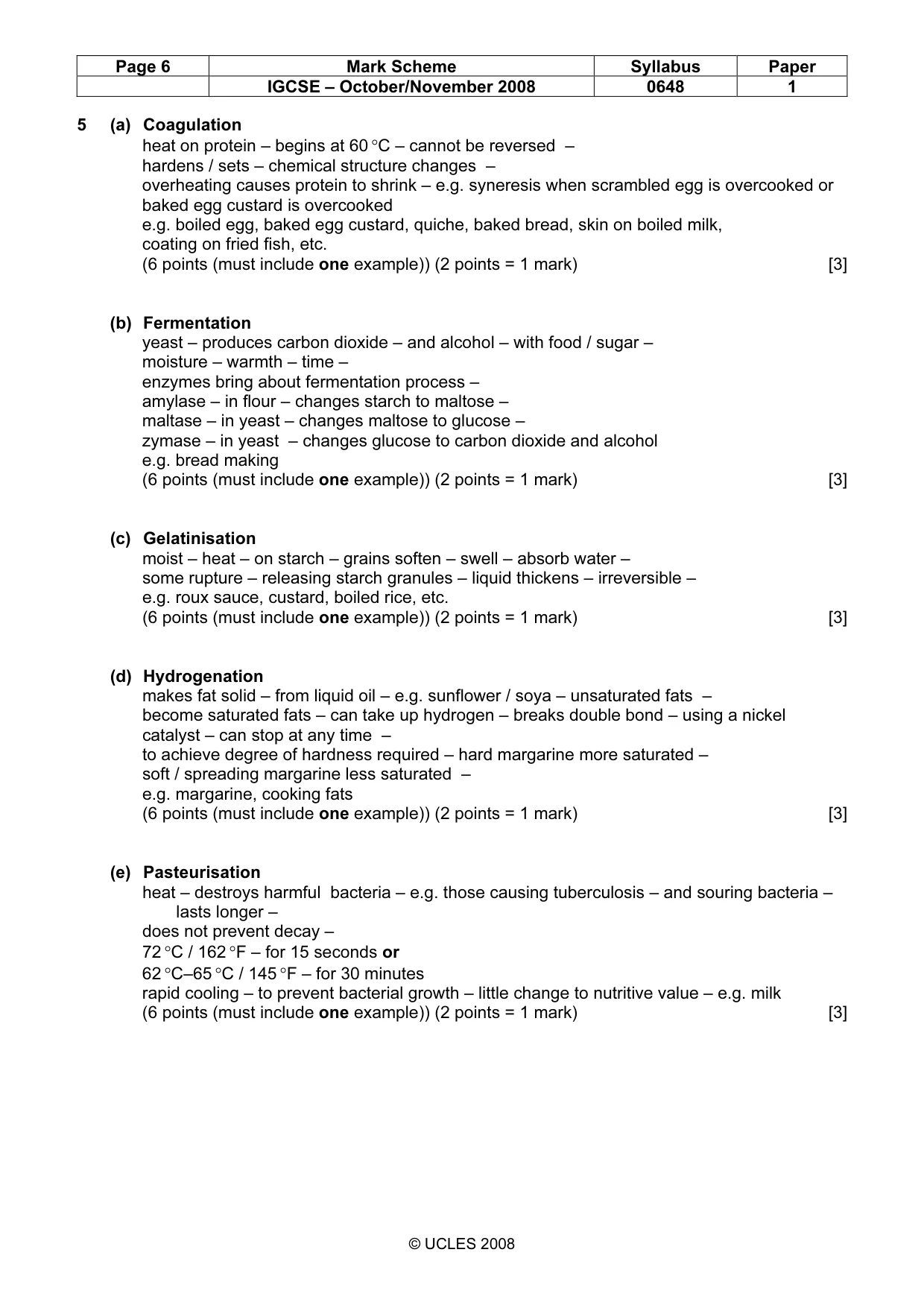
Page 6 Mark Scheme Syllabus Paper IGCSE – October/November 2008 0648 1 © UCLES 2008 5 (a) Coagulation heat on protein – begins at 60 °C – cannot be reversed – hardens / sets – chemical structure changes – overheating causes protein to shrink – e.g. syneresis when scrambled egg is overcooked or baked egg custard is overcooked e.g. boiled egg, baked egg custard, quiche, baked bread, skin on boiled milk, coating on fried fish, etc. (6 points (must include one example)) (2 points = 1 mark) [3] (b) Fermentation yeast – produces carbon dioxide – and alcohol – with food / sugar – moisture – warmth – time – enzymes bring about fermentation process – amylase – in flour – changes starch to maltose – maltase – in yeast – changes maltose to glucose – zymase – in yeast – changes glucose to carbon dioxide and alcohol e.g. bread making (6 points (must include one example)) (2 points = 1 mark) [3] (c) Gelatinisation moist – heat – on starch – grains soften – swell – absorb water – some rupture – releasing starch granules – liquid thickens – irreversible – e.g. roux sauce, custard, boiled rice, etc. (6 points (must include one example)) (2 points = 1 mark) [3] (d) Hydrogenation makes fat solid – from liquid oil – e.g. sunflower / soya – unsaturated fats – become saturated fats – can take up hydrogen – breaks double bond – using a nickel catalyst – can stop at any time – to achieve degree of hardness required – hard margarine more saturated – soft / spreading margarine less saturated – e.g. margarine, cooking fats (6 points (must include one example)) (2 points = 1 mark) [3] (e) Pasteurisation heat – destroys harmful bacteria – e.g. those causing tuberculosis – and souring bacteria – lasts longer – does not prevent decay – 72 °C / 162 °F – for 15 seconds or 62 °C–65 °C / 145 °F – for 30 minutes rapid cooling – to prevent bacterial growth – little change to nutritive value – e.g. milk (6 points (must include one example)) (2 points = 1 mark) [3]
Mark scheme, page 7
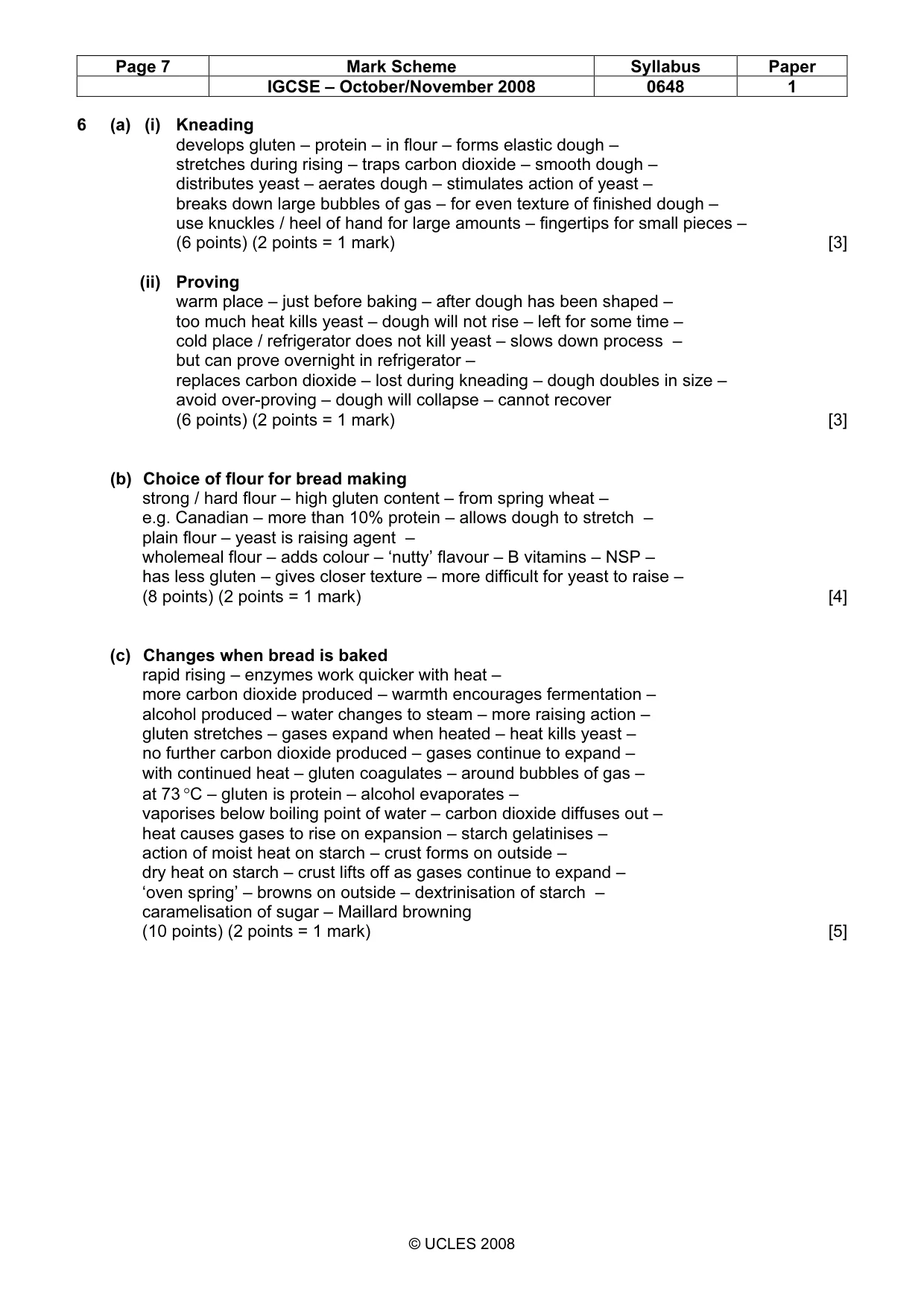
Page 7 Mark Scheme Syllabus Paper IGCSE – October/November 2008 0648 1 © UCLES 2008 6 (a) (i) Kneading develops gluten – protein – in flour – forms elastic dough – stretches during rising – traps carbon dioxide – smooth dough – distributes yeast – aerates dough – stimulates action of yeast – breaks down large bubbles of gas – for even texture of finished dough – use knuckles / heel of hand for large amounts – fingertips for small pieces – (6 points) (2 points = 1 mark) [3] (ii) Proving warm place – just before baking – after dough has been shaped – too much heat kills yeast – dough will not rise – left for some time – cold place / refrigerator does not kill yeast – slows down process – but can prove overnight in refrigerator – replaces carbon dioxide – lost during kneading – dough doubles in size – avoid over-proving – dough will collapse – cannot recover (6 points) (2 points = 1 mark) [3] (b) Choice of flour for bread making strong / hard flour – high gluten content – from spring wheat – e.g. Canadian – more than 10% protein – allows dough to stretch – plain flour – yeast is raising agent – wholemeal flour – adds colour – ‘nutty’ flavour – B vitamins – NSP – has less gluten – gives closer texture – more difficult for yeast to raise – (8 points) (2 points = 1 mark) [4] (c) Changes when bread is baked rapid rising – enzymes work quicker with heat – more carbon dioxide produced – warmth encourages fermentation – alcohol produced – water changes to steam – more raising action – gluten stretches – gases expand when heated – heat kills yeast – no further carbon dioxide produced – gases continue to expand – with continued heat – gluten coagulates – around bubbles of gas – at 73 °C – gluten is protein – alcohol evaporates – vaporises below boiling point of water – carbon dioxide diffuses out – heat causes gases to rise on expansion – starch gelatinises – action of moist heat on starch – crust forms on outside – dry heat on starch – crust lifts off as gases continue to expand – ‘oven spring’ – browns on outside – dextrinisation of starch – caramelisation of sugar – Maillard browning (10 points) (2 points = 1 mark) [5]
Mark scheme, page 8
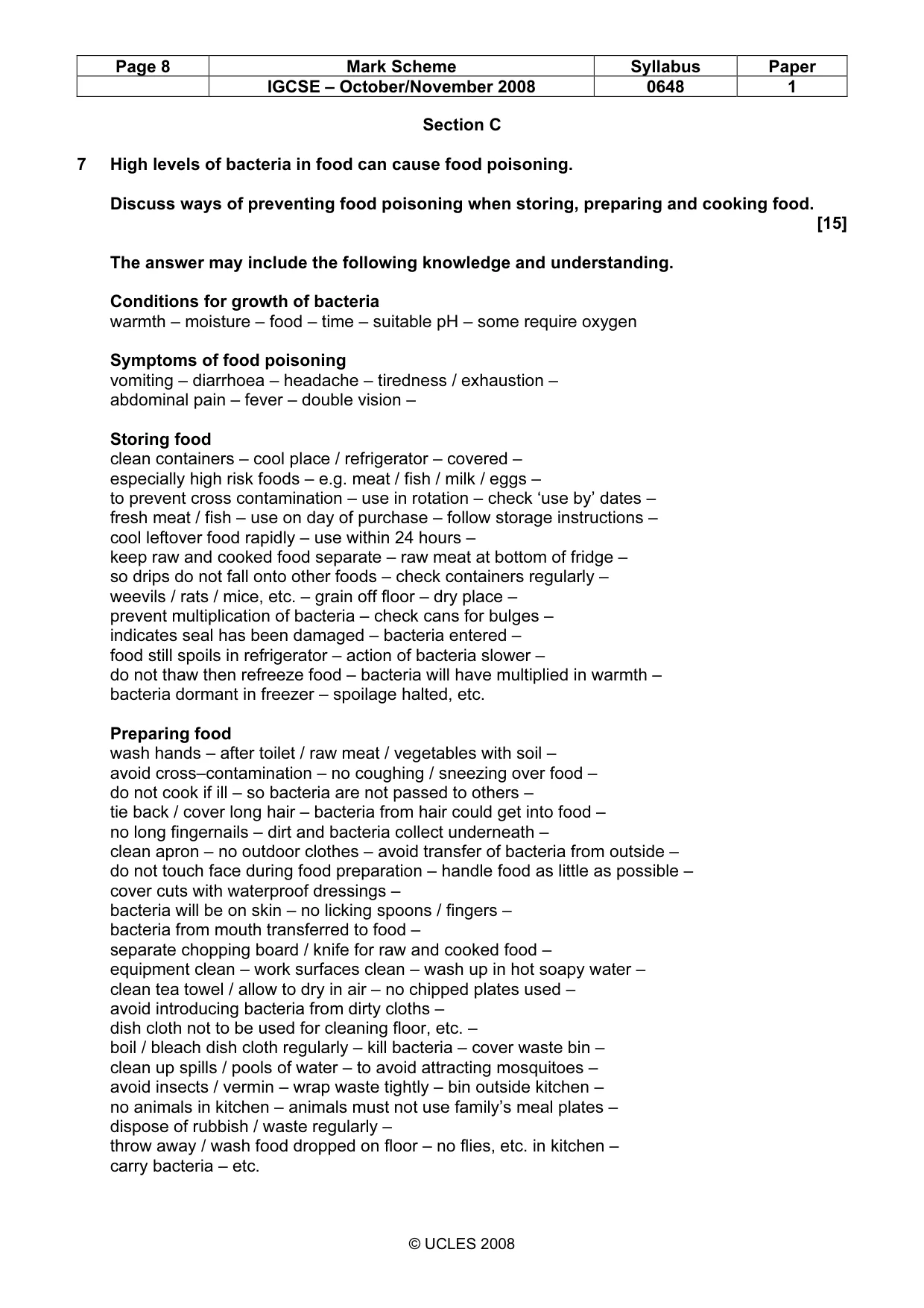
Page 8 Mark Scheme Syllabus Paper IGCSE – October/November 2008 0648 1 © UCLES 2008 Section C 7 High levels of bacteria in food can cause food poisoning. Discuss ways of preventing food poisoning when storing, preparing and cooking food. [15] The answer may include the following knowledge and understanding. Conditions for growth of bacteria warmth – moisture – food – time – suitable pH – some require oxygen Symptoms of food poisoning vomiting – diarrhoea – headache – tiredness / exhaustion – abdominal pain – fever – double vision – Storing food clean containers – cool place / refrigerator – covered – especially high risk foods – e.g. meat / fish / milk / eggs – to prevent cross contamination – use in rotation – check ‘use by’ dates – fresh meat / fish – use on day of purchase – follow storage instructions – cool leftover food rapidly – use within 24 hours – keep raw and cooked food separate – raw meat at bottom of fridge – so drips do not fall onto other foods – check containers regularly – weevils / rats / mice, etc. – grain off floor – dry place – prevent multiplication of bacteria – check cans for bulges – indicates seal has been damaged – bacteria entered – food still spoils in refrigerator – action of bacteria slower – do not thaw then refreeze food – bacteria will have multiplied in warmth – bacteria dormant in freezer – spoilage halted, etc. Preparing food wash hands – after toilet / raw meat / vegetables with soil – avoid cross–contamination – no coughing / sneezing over food – do not cook if ill – so bacteria are not passed to others – tie back / cover long hair – bacteria from hair could get into food – no long fingernails – dirt and bacteria collect underneath – clean apron – no outdoor clothes – avoid transfer of bacteria from outside – do not touch face during food preparation – handle food as little as possible – cover cuts with waterproof dressings – bacteria will be on skin – no licking spoons / fingers – bacteria from mouth transferred to food – separate chopping board / knife for raw and cooked food – equipment clean – work surfaces clean – wash up in hot soapy water – clean tea towel / allow to dry in air – no chipped plates used – avoid introducing bacteria from dirty cloths – dish cloth not to be used for cleaning floor, etc. – boil / bleach dish cloth regularly – kill bacteria – cover waste bin – clean up spills / pools of water – to avoid attracting mosquitoes – avoid insects / vermin – wrap waste tightly – bin outside kitchen – no animals in kitchen – animals must not use family’s meal plates – dispose of rubbish / waste regularly – throw away / wash food dropped on floor – no flies, etc. in kitchen – carry bacteria – etc.
Mark scheme, page 9
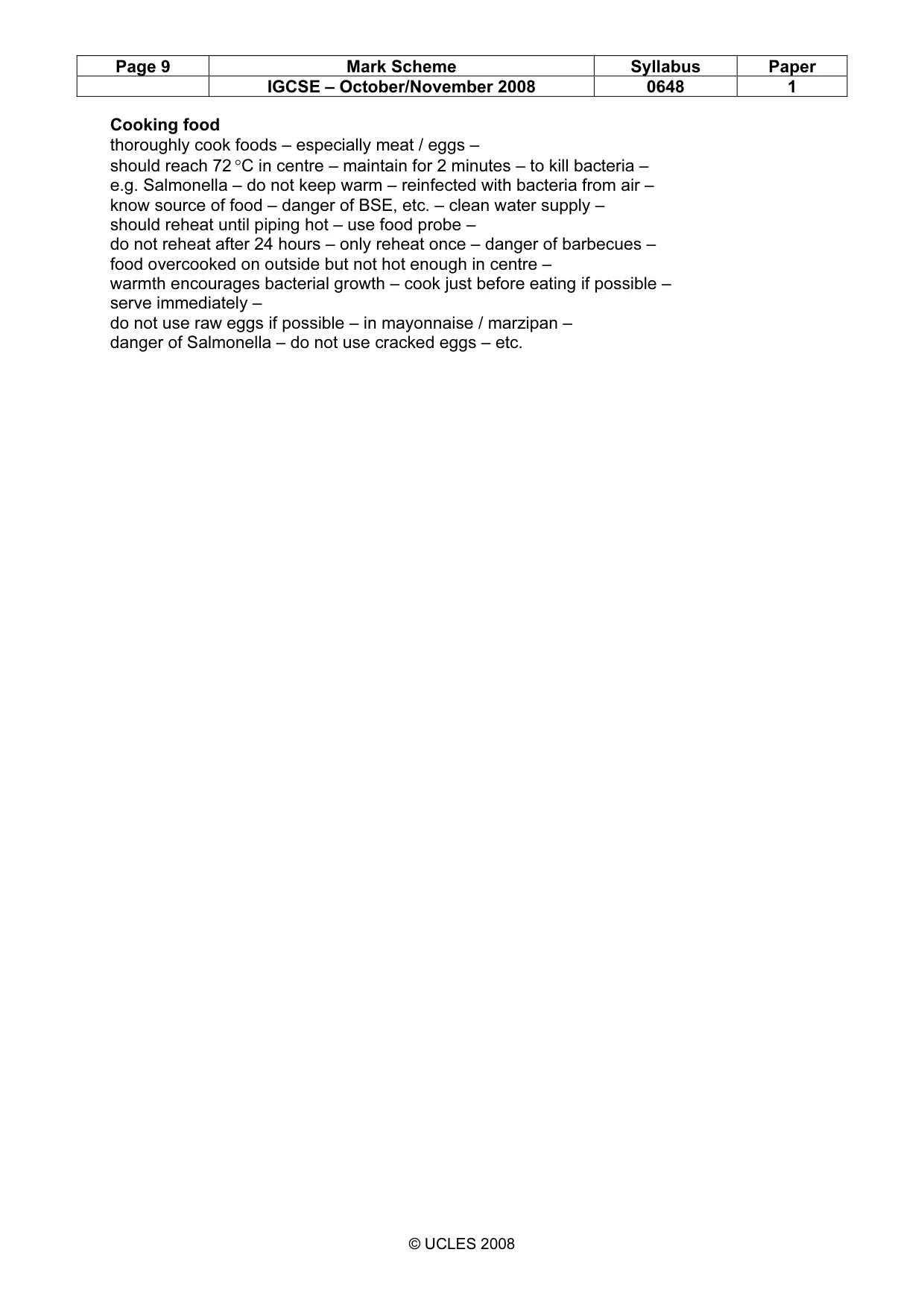
Page 9 Mark Scheme Syllabus Paper IGCSE – October/November 2008 0648 1 © UCLES 2008 Cooking food thoroughly cook foods – especially meat / eggs – should reach 72 °C in centre – maintain for 2 minutes – to kill bacteria – e.g. Salmonella – do not keep warm – reinfected with bacteria from air – know source of food – danger of BSE, etc. – clean water supply – should reheat until piping hot – use food probe – do not reheat after 24 hours – only reheat once – danger of barbecues – food overcooked on outside but not hot enough in centre – warmth encourages bacterial growth – cook just before eating if possible – serve immediately – do not use raw eggs if possible – in mayonnaise / marzipan – danger of Salmonella – do not use cracked eggs – etc.
Mark scheme, page 10
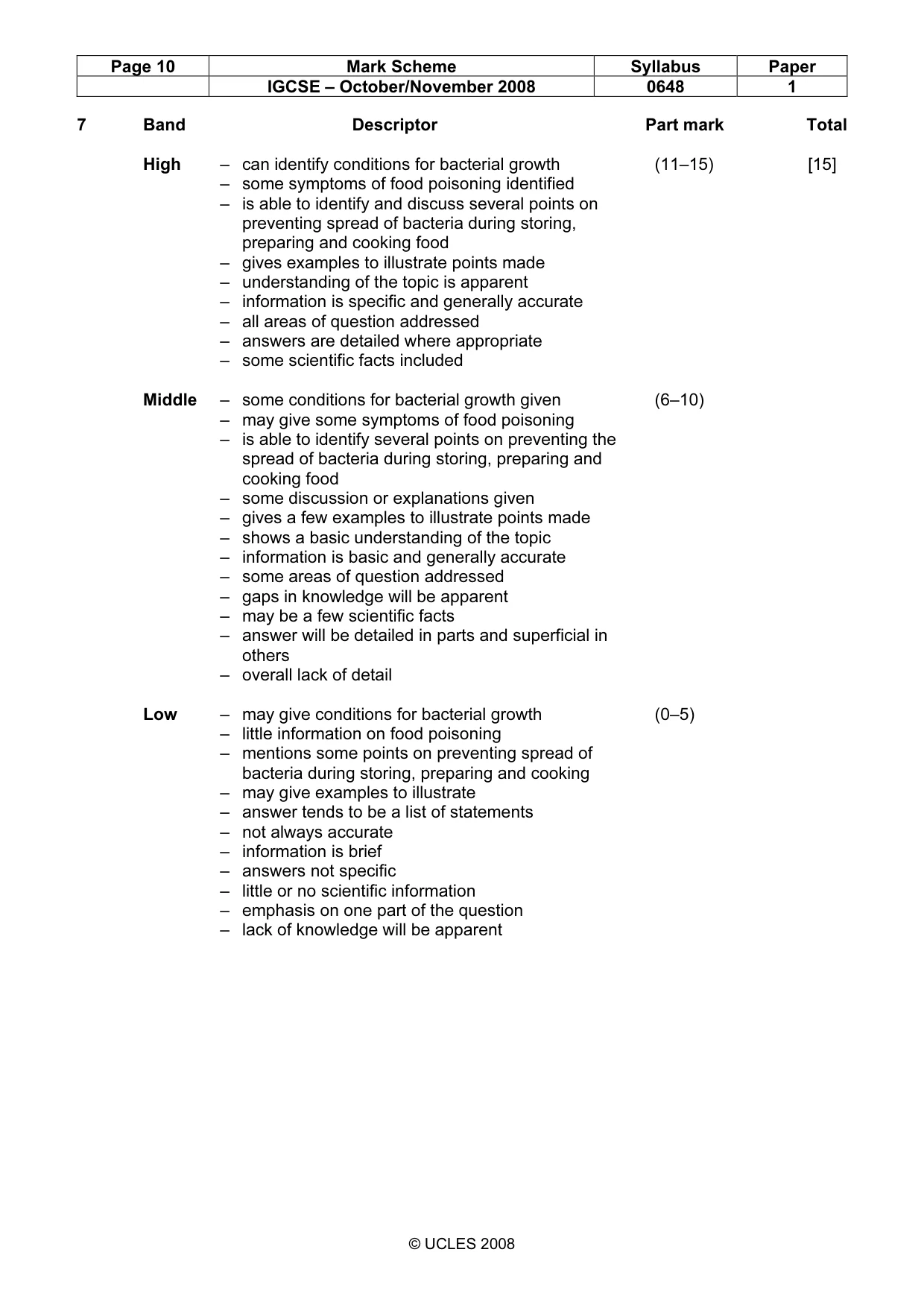
Page 10 Mark Scheme Syllabus Paper IGCSE – October/November 2008 0648 1 © UCLES 2008 7 Band Descriptor Part mark Total High – can identify conditions for bacterial growth (11–15) [15] – some symptoms of food poisoning identified – is able to identify and discuss several points on preventing spread of bacteria during storing, preparing and cooking food – gives examples to illustrate points made – understanding of the topic is apparent – information is specific and generally accurate – all areas of question addressed – answers are detailed where appropriate – some scientific facts included Middle – some conditions for bacterial growth given (6–10) – may give some symptoms of food poisoning – is able to identify several points on preventing the spread of bacteria during storing, preparing and cooking food – some discussion or explanations given – gives a few examples to illustrate points made – shows a basic understanding of the topic – information is basic and generally accurate – some areas of question addressed – gaps in knowledge will be apparent – may be a few scientific facts – answer will be detailed in parts and superficial in others – overall lack of detail Low – may give conditions for bacterial growth (0–5) – little information on food poisoning – mentions some points on preventing spread of bacteria during storing, preparing and cooking – may give examples to illustrate – answer tends to be a list of statements – not always accurate – information is brief – answers not specific – little or no scientific information – emphasis on one part of the question – lack of knowledge will be apparent
Mark scheme, page 11
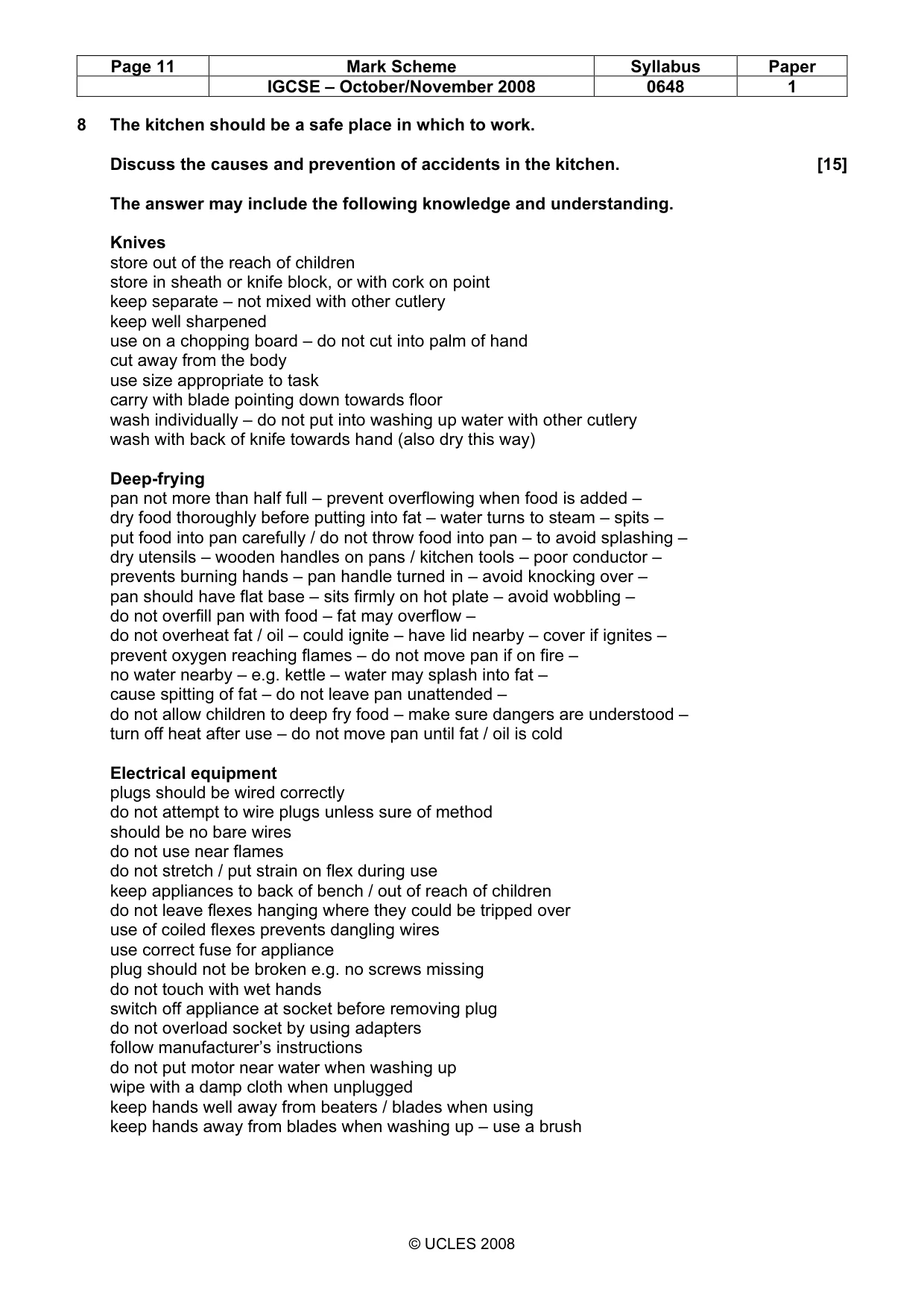
Page 11 Mark Scheme Syllabus Paper IGCSE – October/November 2008 0648 1 © UCLES 2008 8 The kitchen should be a safe place in which to work. Discuss the causes and prevention of accidents in the kitchen. [15] The answer may include the following knowledge and understanding. Knives store out of the reach of children store in sheath or knife block, or with cork on point keep separate – not mixed with other cutlery keep well sharpened use on a chopping board – do not cut into palm of hand cut away from the body use size appropriate to task carry with blade pointing down towards floor wash individually – do not put into washing up water with other cutlery wash with back of knife towards hand (also dry this way) Deep-frying pan not more than half full – prevent overflowing when food is added – dry food thoroughly before putting into fat – water turns to steam – spits – put food into pan carefully / do not throw food into pan – to avoid splashing – dry utensils – wooden handles on pans / kitchen tools – poor conductor – prevents burning hands – pan handle turned in – avoid knocking over – pan should have flat base – sits firmly on hot plate – avoid wobbling – do not overfill pan with food – fat may overflow – do not overheat fat / oil – could ignite – have lid nearby – cover if ignites – prevent oxygen reaching flames – do not move pan if on fire – no water nearby – e.g. kettle – water may splash into fat – cause spitting of fat – do not leave pan unattended – do not allow children to deep fry food – make sure dangers are understood – turn off heat after use – do not move pan until fat / oil is cold Electrical equipment plugs should be wired correctly do not attempt to wire plugs unless sure of method should be no bare wires do not use near flames do not stretch / put strain on flex during use keep appliances to back of bench / out of reach of children do not leave flexes hanging where they could be tripped over use of coiled flexes prevents dangling wires use correct fuse for appliance plug should not be broken e.g. no screws missing do not touch with wet hands switch off appliance at socket before removing plug do not overload socket by using adapters follow manufacturer’s instructions do not put motor near water when washing up wipe with a damp cloth when unplugged keep hands well away from beaters / blades when using keep hands away from blades when washing up – use a brush
Mark scheme, page 12
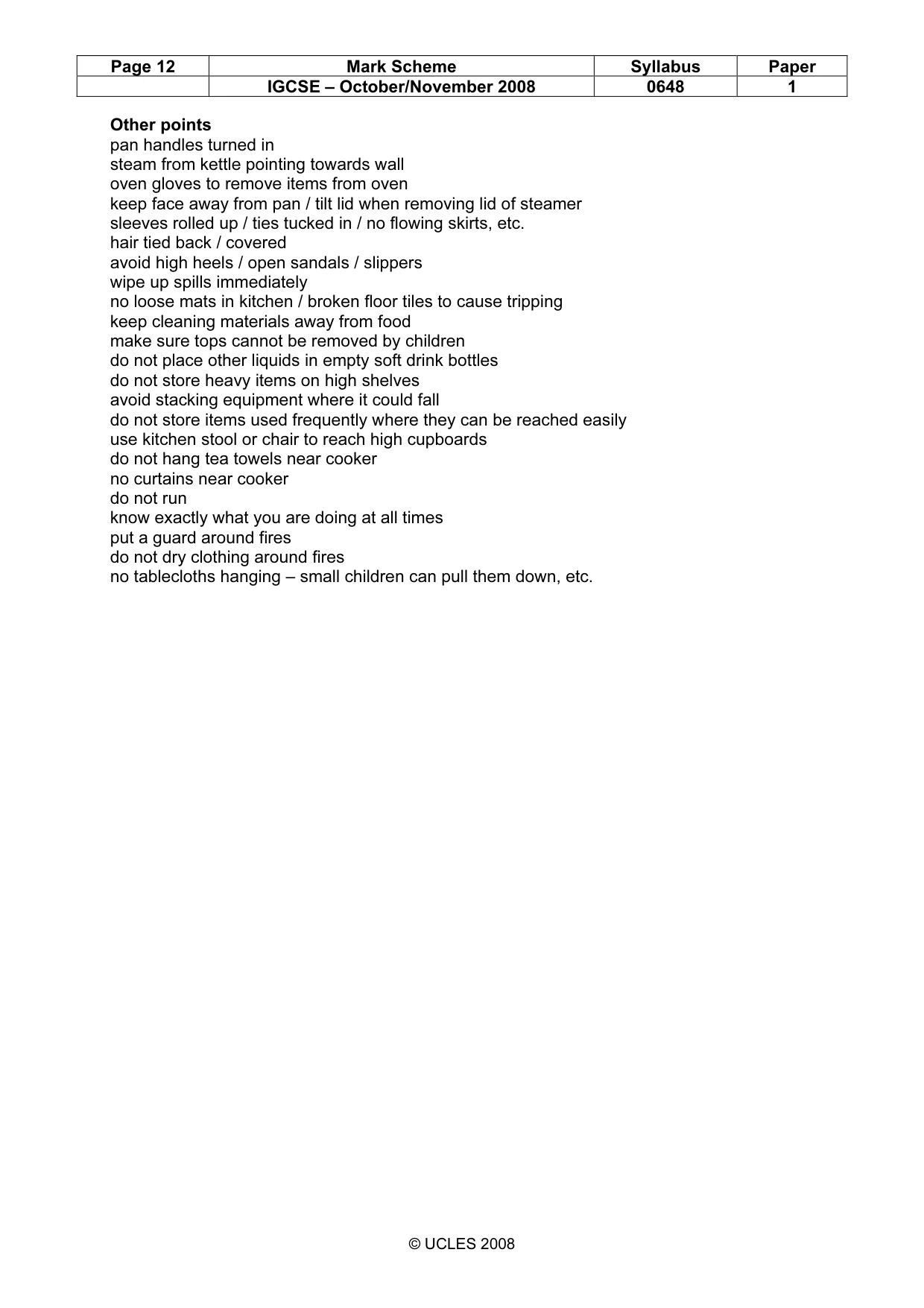
Page 12 Mark Scheme Syllabus Paper IGCSE – October/November 2008 0648 1 © UCLES 2008 Other points pan handles turned in steam from kettle pointing towards wall oven gloves to remove items from oven keep face away from pan / tilt lid when removing lid of steamer sleeves rolled up / ties tucked in / no flowing skirts, etc. hair tied back / covered avoid high heels / open sandals / slippers wipe up spills immediately no loose mats in kitchen / broken floor tiles to cause tripping keep cleaning materials away from food make sure tops cannot be removed by children do not place other liquids in empty soft drink bottles do not store heavy items on high shelves avoid stacking equipment where it could fall do not store items used frequently where they can be reached easily use kitchen stool or chair to reach high cupboards do not hang tea towels near cooker no curtains near cooker do not run know exactly what you are doing at all times put a guard around fires do not dry clothing around fires no tablecloths hanging – small children can pull them down, etc.
Mark scheme, page 13
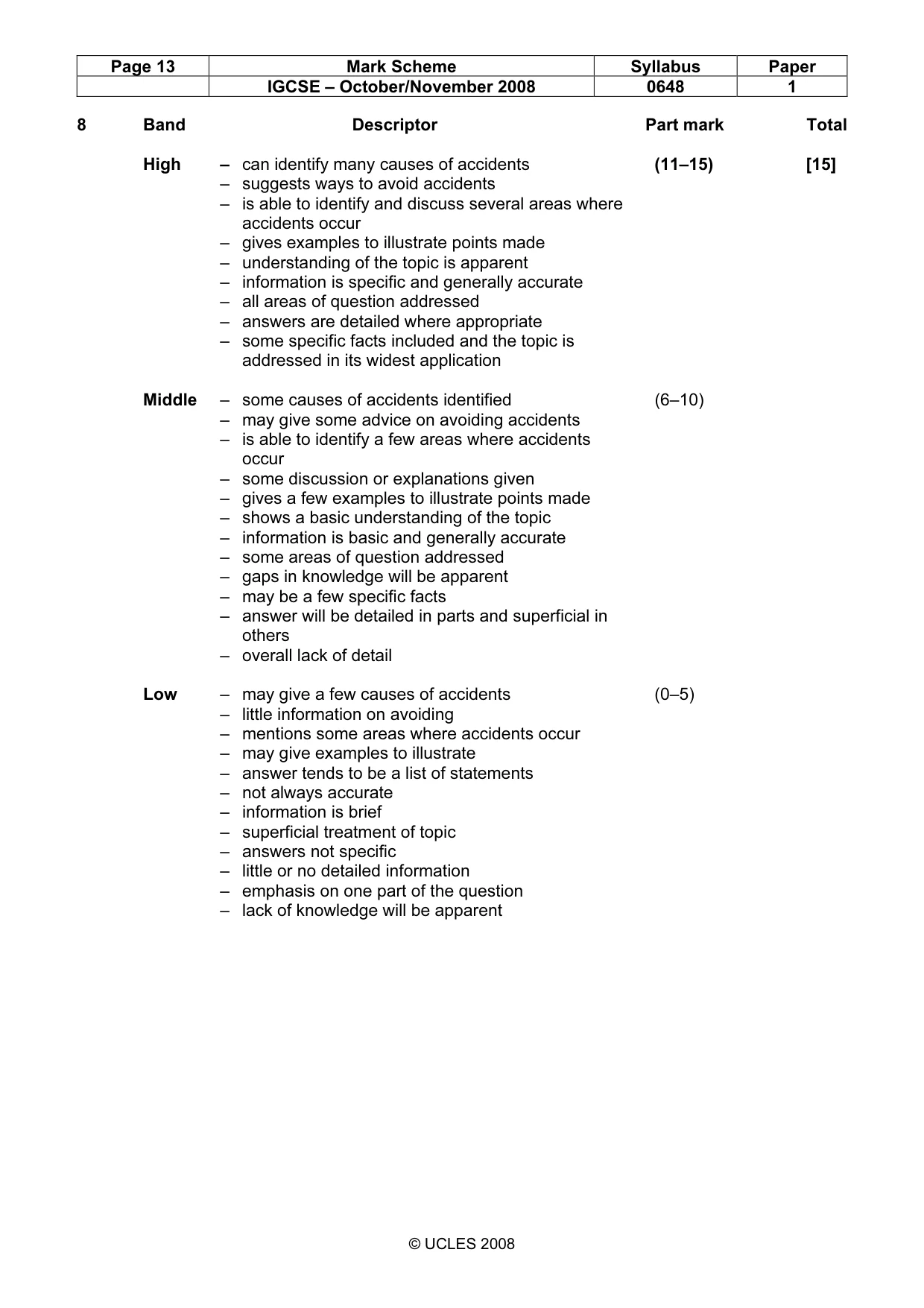
Page 13 Mark Scheme Syllabus Paper IGCSE – October/November 2008 0648 1 © UCLES 2008 8 Band Descriptor Part mark Total High – can identify many causes of accidents (11–15) [15] – suggests ways to avoid accidents – is able to identify and discuss several areas where accidents occur – gives examples to illustrate points made – understanding of the topic is apparent – information is specific and generally accurate – all areas of question addressed – answers are detailed where appropriate – some specific facts included and the topic is addressed in its widest application Middle – some causes of accidents identified (6–10) – may give some advice on avoiding accidents – is able to identify a few areas where accidents occur – some discussion or explanations given – gives a few examples to illustrate points made – shows a basic understanding of the topic – information is basic and generally accurate – some areas of question addressed – gaps in knowledge will be apparent – may be a few specific facts – answer will be detailed in parts and superficial in others – overall lack of detail Low – may give a few causes of accidents (0–5) – little information on avoiding – mentions some areas where accidents occur – may give examples to illustrate – answer tends to be a list of statements – not always accurate – information is brief – superficial treatment of topic – answers not specific – little or no detailed information – emphasis on one part of the question – lack of knowledge will be apparent
What you needed in this session
Cambridge’s own grade thresholds for 2008 Oct/Nov, Paper 1 · Variant 1. A higher threshold means an easier paper — the bar moves with how the cohort did.