Cambridge IGCSE Food and Nutrition 0648 — 2008 May/June Paper 1 · Variant 1
0648/11/M/J/08 · 100 marks · ≈113 min
The question paper and its mark scheme, free to read here and free to download. This is Cambridge’s own paper, exactly as it was sat.
Question paper16 pages


Mark scheme11 pages
Answers below. Sit the paper first if you are practising.
Paper as text
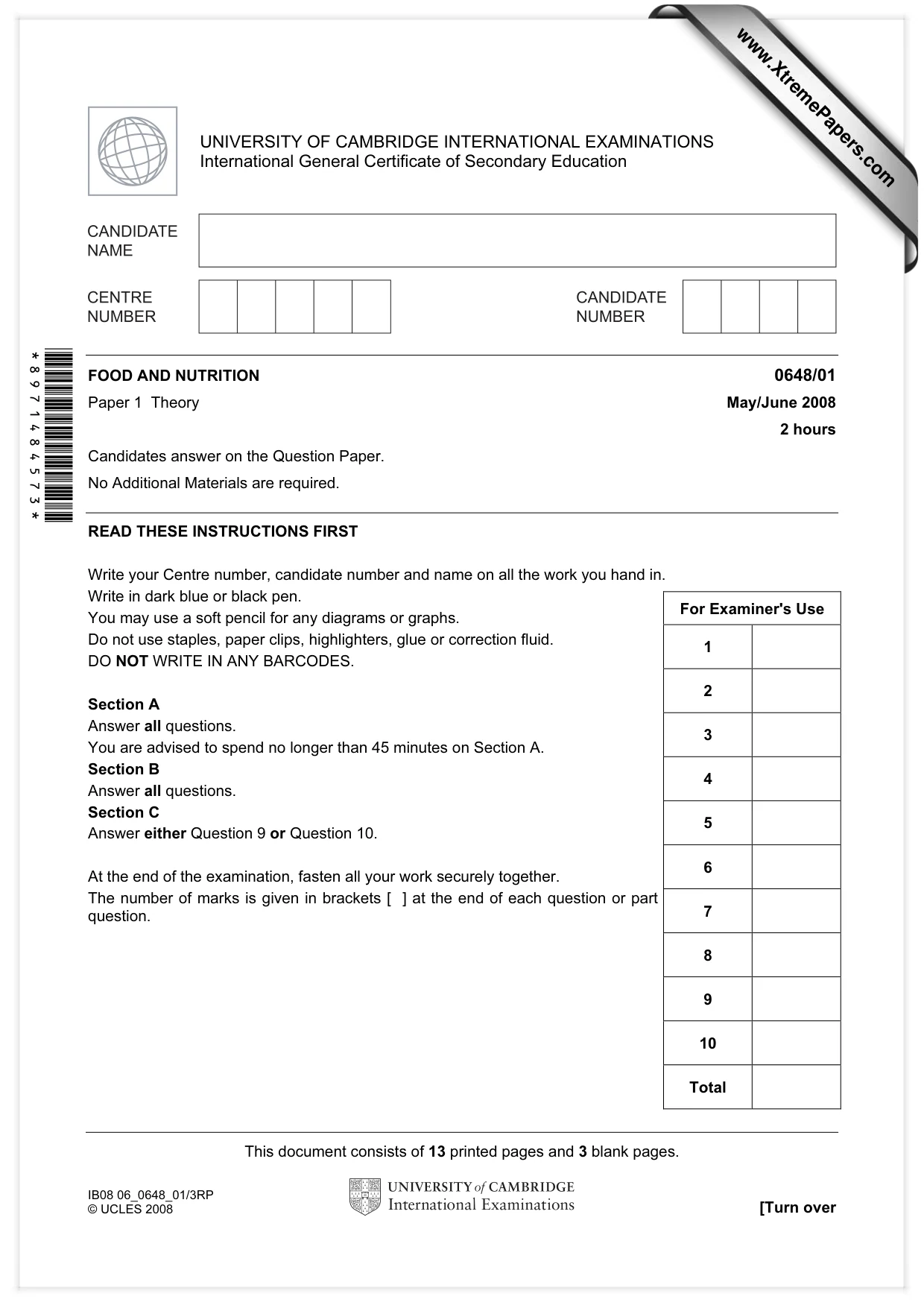
Question paper, page 1
This document consists of 13 printed pages and 3 blank pages. IB08 06_0648_01/3RP © UCLES 2008 [Turn over *2008* For Examiner's Use 1 2 3 4 5 6 7 8 9 10 Total *8971484573* UNIVERSITY OF CAMBRIDGE INTERNATIONAL EXAMINATIONS International General Certificate of Secondary Education FOOD AND NUTRITION 0648/01 Paper 1 Theory May/June 2008 2 hours Candidates answer on the Question Paper. No Additional Materials are required. READ THESE INSTRUCTIONS FIRST Write your Centre number, candidate number and name on all the work you hand in. Write in dark blue or black pen. You may use a soft pencil for any diagrams or graphs. Do not use staples, paper clips, highlighters, glue or correction fluid. DO NOT WRITE IN ANY BARCODES. Section A Answer all questions. You are advised to spend no longer than 45 minutes on Section A. Section B Answer all questions. Section C Answer either Question 9 or Question 10. At the end of the examination, fasten all your work securely together. The number of marks is given in brackets [ ] at the end of each question or part question. www.XtremePapers.com
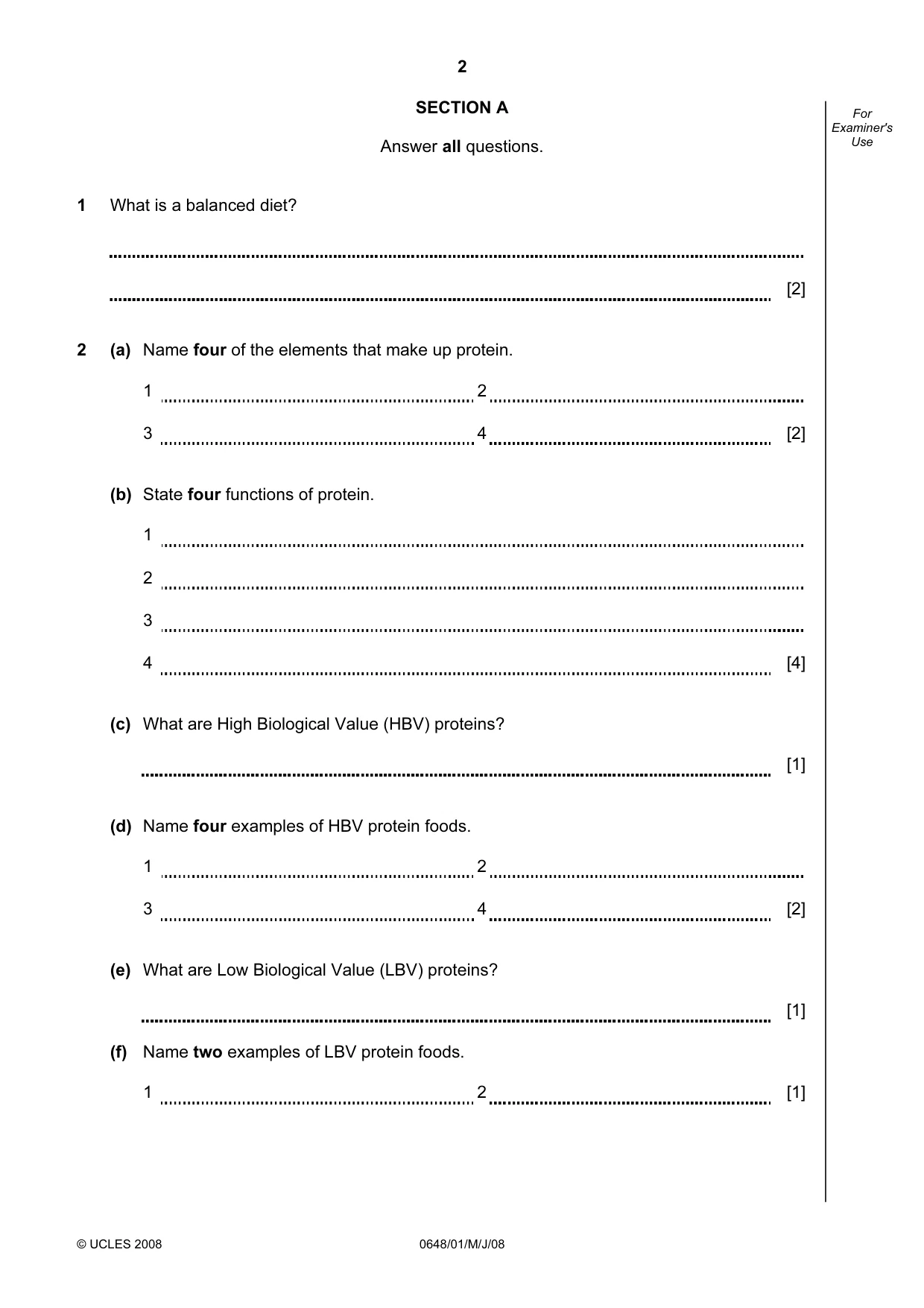
Question paper, page 2
2 © UCLES 2008 0648/01/M/J/08 For Examiner's Use SECTION A Answer all questions. 1 What is a balanced diet? [2] 2 (a) Name four of the elements that make up protein. 1 2 3 4 [2] (b) State four functions of protein. 1 2 3 4 [4] (c) What are High Biological Value (HBV) proteins? [1] (d) Name four examples of HBV protein foods. 1 2 3 4 [2] (e) What are Low Biological Value (LBV) proteins? [1] (f) Name two examples of LBV protein foods. 1 2 [1]
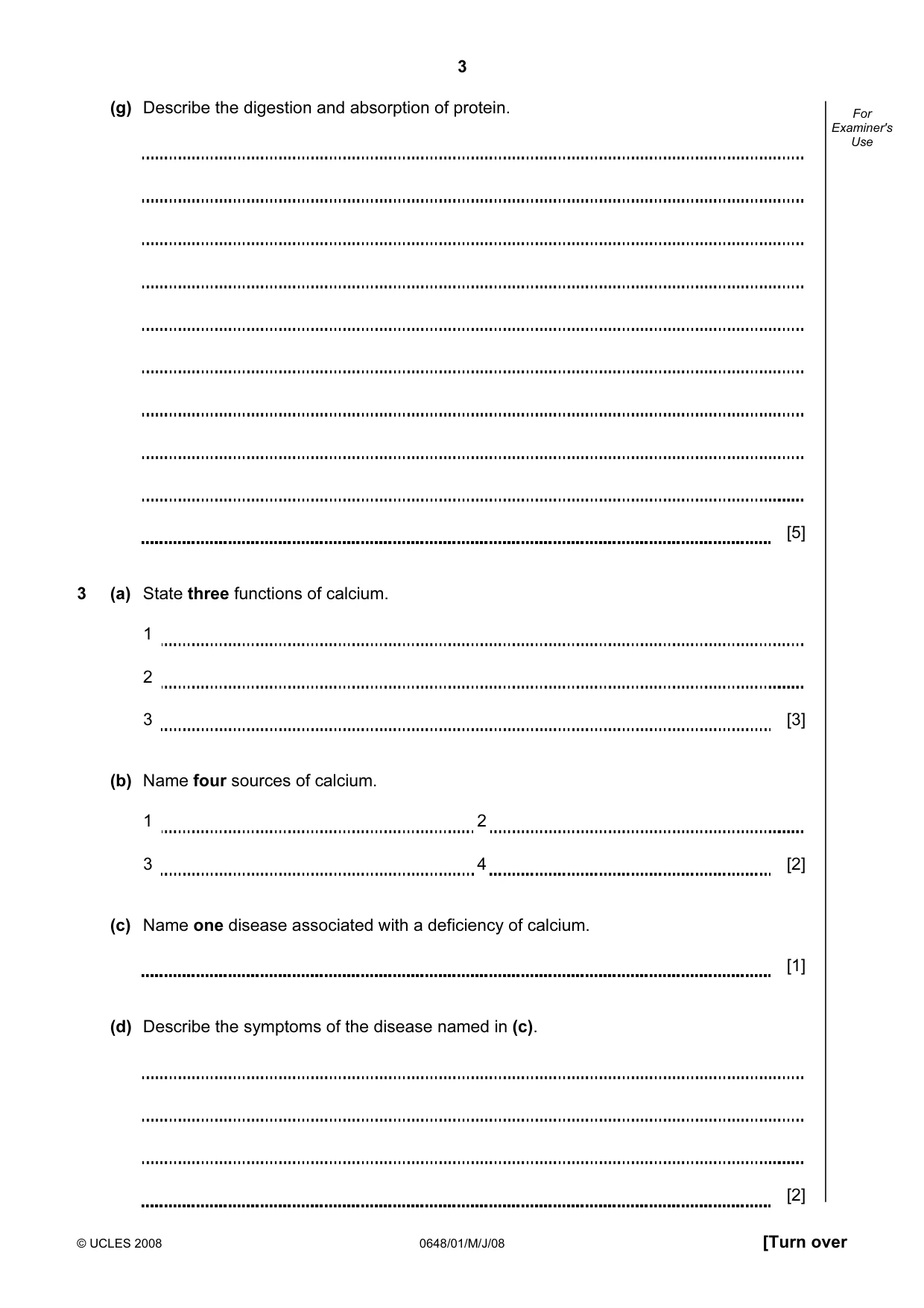
Question paper, page 3
3 © UCLES 2008 0648/01/M/J/08 [Turn over For Examiner's Use (g) Describe the digestion and absorption of protein. [5] 3 (a) State three functions of calcium. 1 2 3 [3] (b) Name four sources of calcium. 1 2 3 4 [2] (c) Name one disease associated with a deficiency of calcium. [1] (d) Describe the symptoms of the disease named in (c). [2]
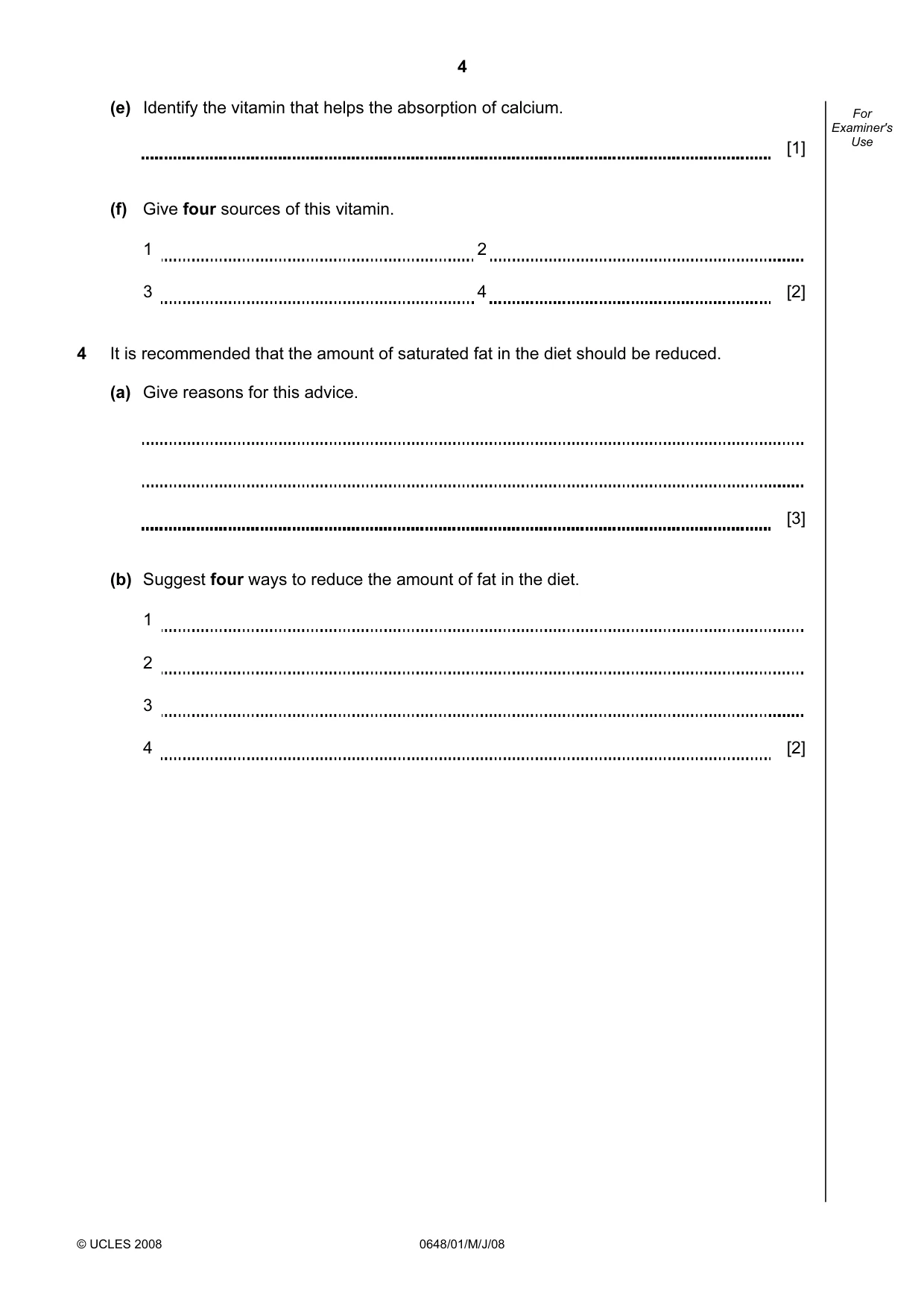
Question paper, page 4
4 © UCLES 2008 0648/01/M/J/08 For Examiner's Use (e) Identify the vitamin that helps the absorption of calcium. [1] (f) Give four sources of this vitamin. 1 2 3 4 [2] 4 It is recommended that the amount of saturated fat in the diet should be reduced. (a) Give reasons for this advice. [3] (b) Suggest four ways to reduce the amount of fat in the diet. 1 2 3 4 [2]
Question paper, page 5
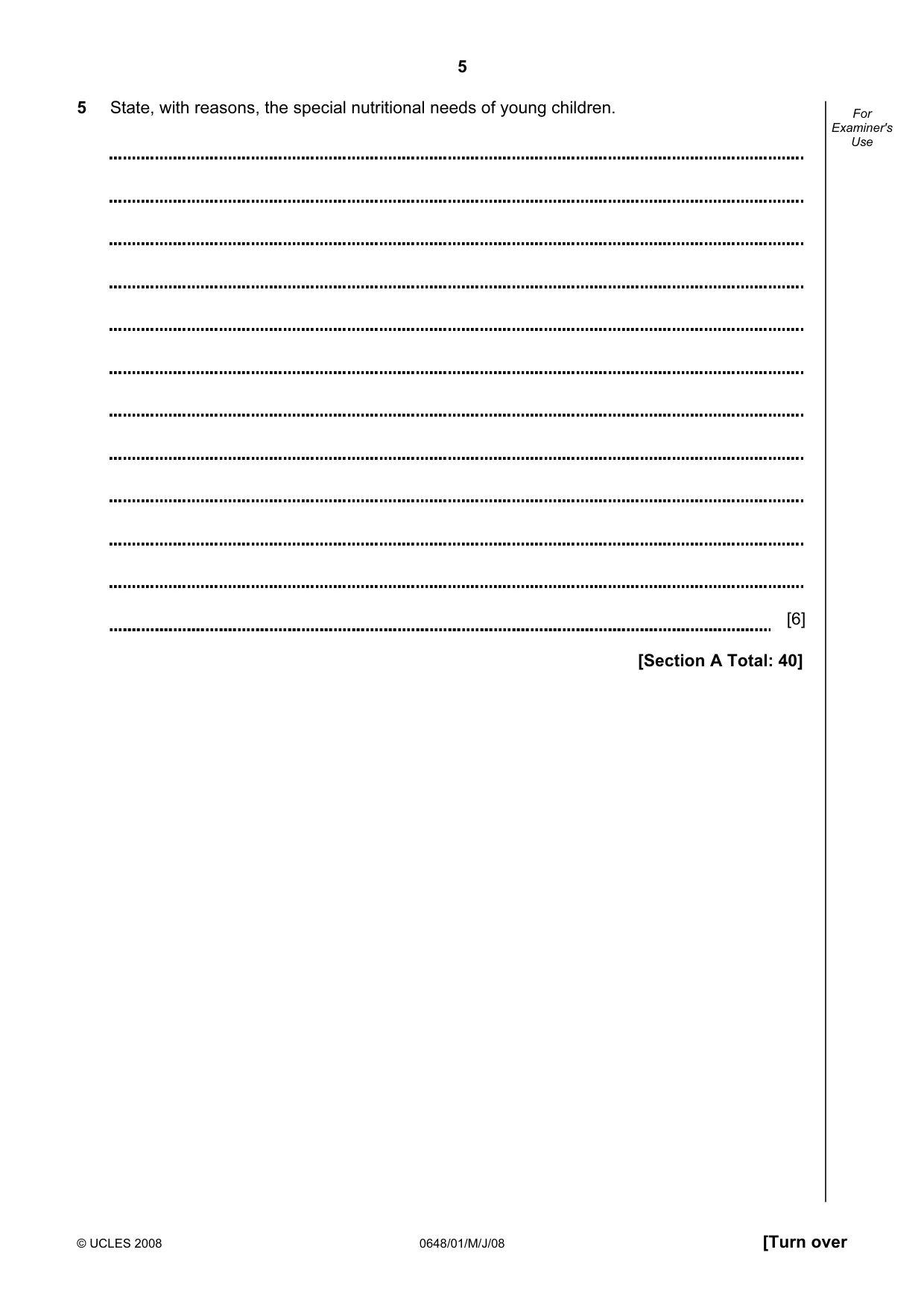
5 © UCLES 2008 0648/01/M/J/08 [Turn over For Examiner's Use 5 State, with reasons, the special nutritional needs of young children. [6] [Section A Total: 40]
Question paper, page 6
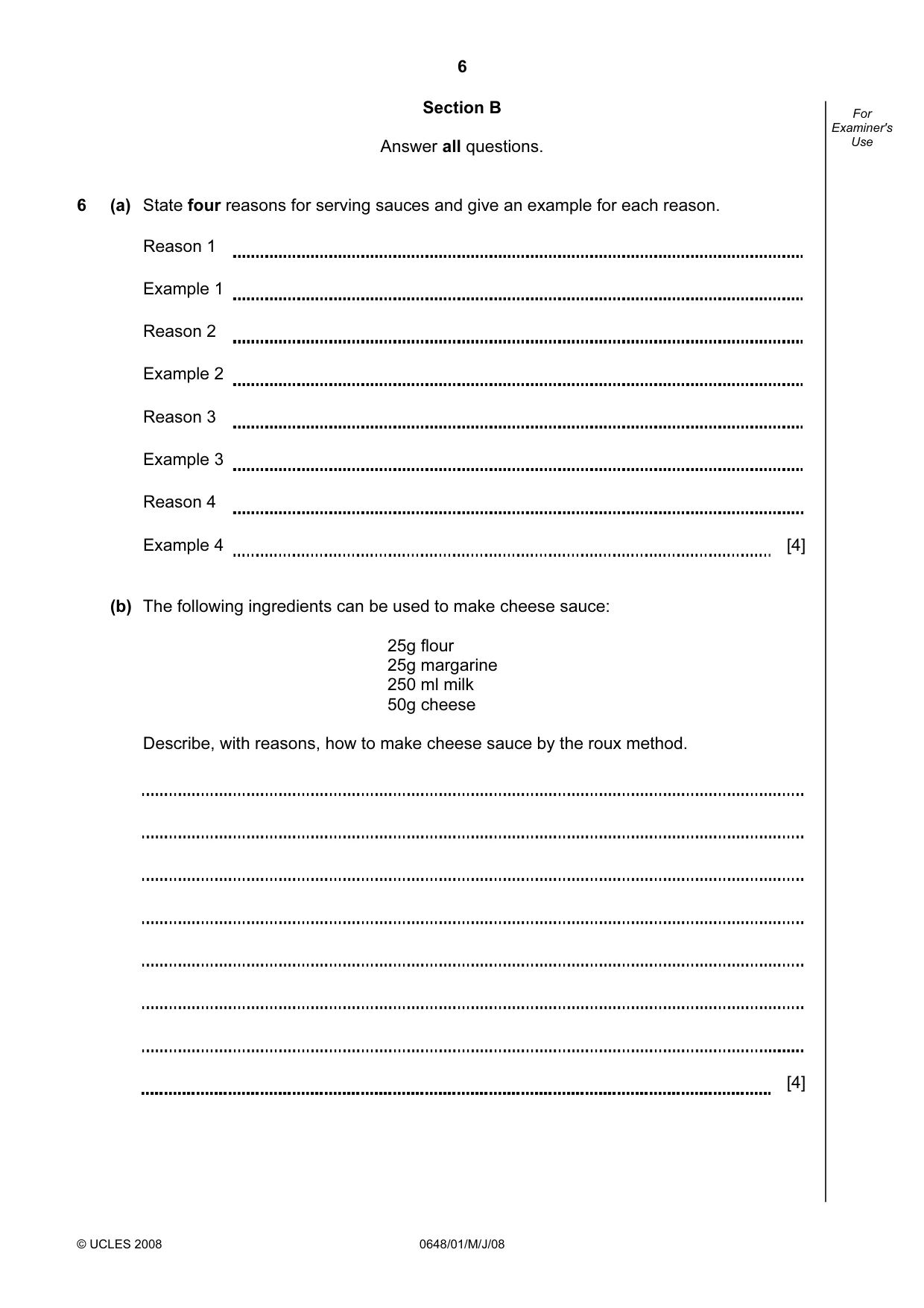
6 © UCLES 2008 0648/01/M/J/08 For Examiner's Use Section B Answer all questions. 6 (a) State four reasons for serving sauces and give an example for each reason. Reason 1 Example 1 Reason 2 Example 2 Reason 3 Example 3 Reason 4 Example 4 [4] (b) The following ingredients can be used to make cheese sauce: 25g flour 25g margarine 250 ml milk 50g cheese Describe, with reasons, how to make cheese sauce by the roux method. [4]
Question paper, page 7
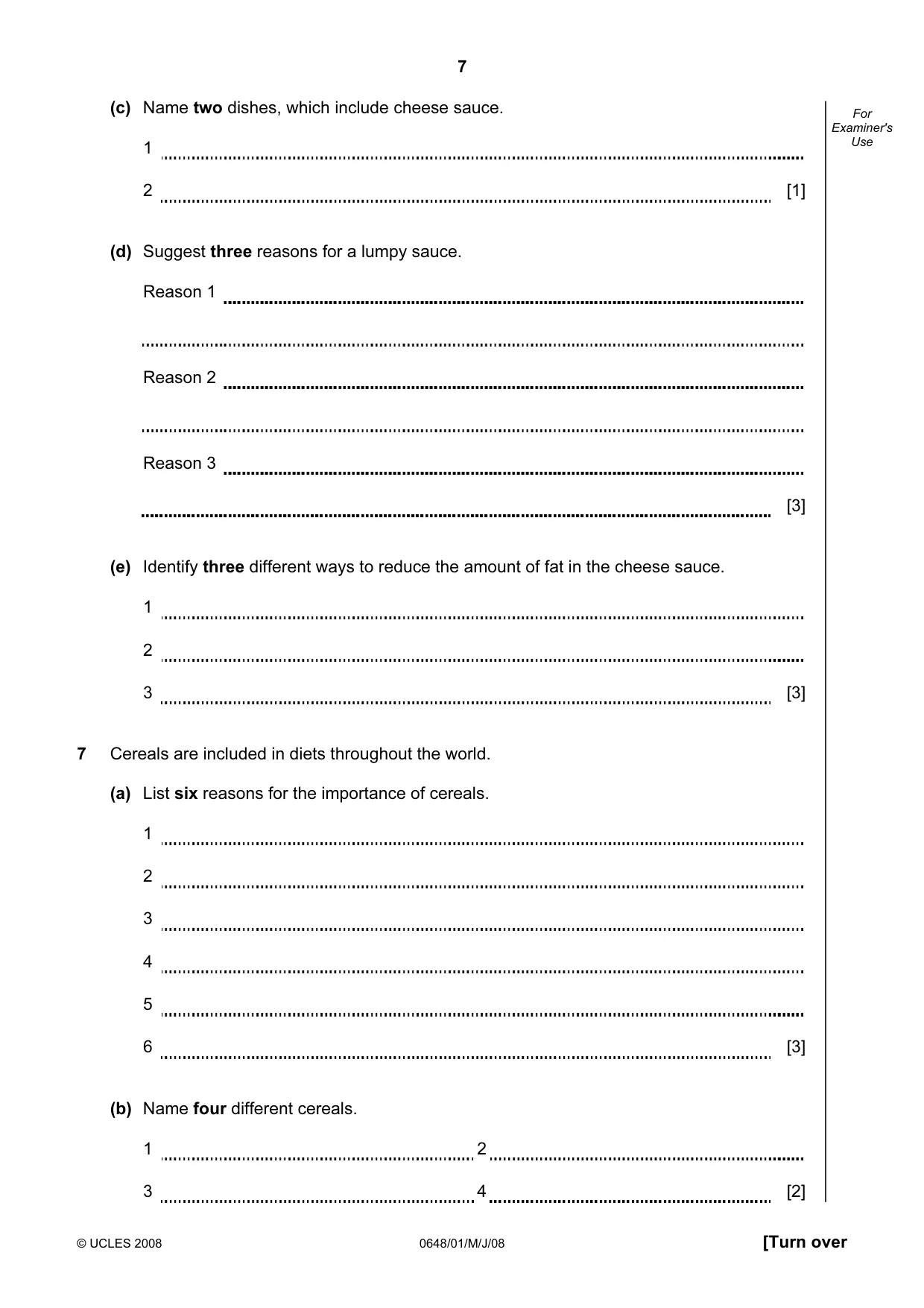
7 © UCLES 2008 0648/01/M/J/08 [Turn over For Examiner's Use (c) Name two dishes, which include cheese sauce. 1 2 [1] (d) Suggest three reasons for a lumpy sauce. Reason 1 Reason 2 Reason 3 [3] (e) Identify three different ways to reduce the amount of fat in the cheese sauce. 1 2 3 [3] 7 Cereals are included in diets throughout the world. (a) List six reasons for the importance of cereals. 1 2 3 4 5 6 [3] (b) Name four different cereals. 1 2 3 4 [2]
Question paper, page 8
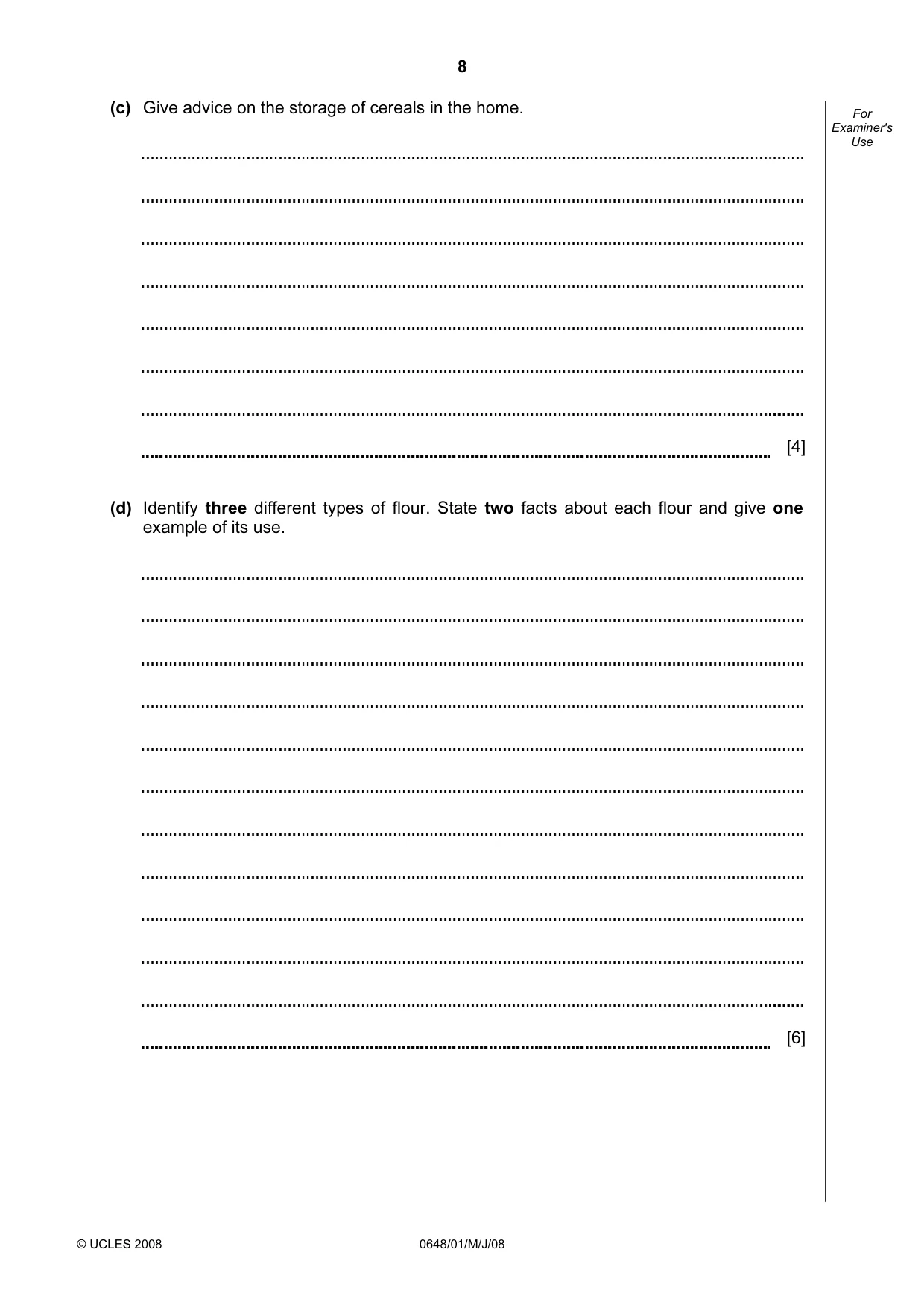
8 © UCLES 2008 0648/01/M/J/08 For Examiner's Use (c) Give advice on the storage of cereals in the home. [4] (d) Identify three different types of flour. State two facts about each flour and give one example of its use. [6]
Question paper, page 9
9 © UCLES 2008 0648/01/M/J/08 [Turn over For Examiner's Use 8 (a) State four reasons for preserving food. 1 2 3 4 [2] (b) Freezing is a popular method of preservation. (i) State and explain four rules to follow when freezing food at home. Rule 1 Rule 2 Rule 3 Rule 4 [4] (ii) State the temperature for storing food in a domestic freezer. [1] (iii) Explain why freezing delays food spoilage. [3]
Question paper, page 10
10 © UCLES 2008 0648/01/M/J/08 For Examiner's Use (iv) Identify the information which should be stated on a frozen food label. [2] (v) Discuss the types of packaging suitable for use in a freezer. [3] [Section B Total: 45]
Question paper, page 11
11 © UCLES 2008 0648/01/M/J/08 [Turn over For Examiner's Use Section C Answer either Question 9 or Question 10. 9 Discuss the ways in which money, time and fuel can be saved when planning, preparing and cooking food. [15] OR 10 Discuss the advantages and disadvantages of convenience foods and suggest ways of including them in family meals. [15]
Question paper, page 12
12 © UCLES 2008 0648/01/M/J/08 For Examiner's Use
Question paper, page 13
13 © UCLES 2008 0648/01/M/J/08 For Examiner's Use [Section C Total: 15] [Paper Total: 100]
Question paper, page 16
16 Permission to reproduce items where third-party owned material protected by copyright is included has been sought and cleared where possible. Every reasonable effort has been made by the publisher (UCLES) to trace copyright holders, but if any items requiring clearance have unwittingly been included, the publisher will be pleased to make amends at the earliest possible opportunity. University of Cambridge International Examinations is part of the Cambridge Assessment Group. Cambridge Assessment is the brand name of University of Cambridge Local Examinations Syndicate (UCLES), which is itself a department of the University of Cambridge. 0648/01/M/J/08 BLANK PAGE
Mark scheme, page 1
UNIVERSITY OF CAMBRIDGE INTERNATIONAL EXAMINATIONS International General Certificate of Secondary Education MARK SCHEME for the May/June 2008 question paper 0648 FOOD AND NUTRITION 0648/01 Paper 1 (Theory), maximum raw mark 100 This mark scheme is published as an aid to teachers and candidates, to indicate the requirements of the examination. It shows the basis on which Examiners were instructed to award marks. It does not indicate the details of the discussions that took place at an Examiners’ meeting before marking began. All Examiners are instructed that alternative correct answers and unexpected approaches in candidates’ scripts must be given marks that fairly reflect the relevant knowledge and skills demonstrated. Mark schemes must be read in conjunction with the question papers and the report on the examination. • CIE will not enter into discussions or correspondence in connection with these mark schemes. CIE is publishing the mark schemes for the May/June 2008 question papers for most IGCSE, GCE Advanced Level and Advanced Subsidiary Level syllabuses and some Ordinary Level syllabuses. www.XtremePapers.com
Mark scheme, page 2
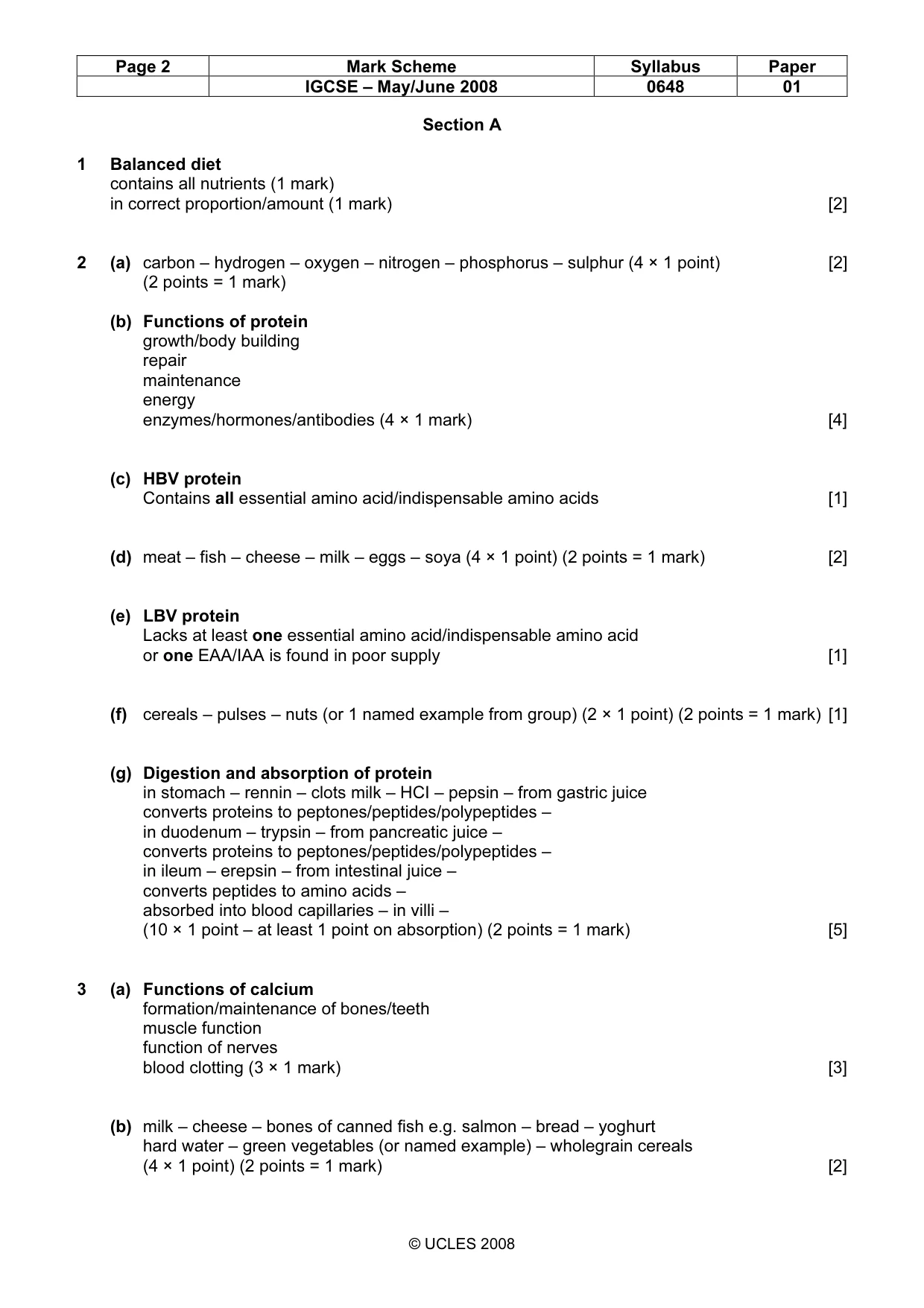
Page 2 Mark Scheme Syllabus Paper IGCSE – May/June 2008 0648 01 © UCLES 2008 Section A 1 Balanced diet contains all nutrients (1 mark) in correct proportion/amount (1 mark) [2] 2 (a) carbon – hydrogen – oxygen – nitrogen – phosphorus – sulphur (4 × 1 point) [2] (2 points = 1 mark) (b) Functions of protein growth/body building repair maintenance energy enzymes/hormones/antibodies (4 × 1 mark) [4] (c) HBV protein Contains all essential amino acid/indispensable amino acids [1] (d) meat – fish – cheese – milk – eggs – soya (4 × 1 point) (2 points = 1 mark) [2] (e) LBV protein Lacks at least one essential amino acid/indispensable amino acid or one EAA/IAA is found in poor supply [1] (f) cereals – pulses – nuts (or 1 named example from group) (2 × 1 point) (2 points = 1 mark) [1] (g) Digestion and absorption of protein in stomach – rennin – clots milk – HCI – pepsin – from gastric juice converts proteins to peptones/peptides/polypeptides – in duodenum – trypsin – from pancreatic juice – converts proteins to peptones/peptides/polypeptides – in ileum – erepsin – from intestinal juice – converts peptides to amino acids – absorbed into blood capillaries – in villi – (10 × 1 point – at least 1 point on absorption) (2 points = 1 mark) [5] 3 (a) Functions of calcium formation/maintenance of bones/teeth muscle function function of nerves blood clotting (3 × 1 mark) [3] (b) milk – cheese – bones of canned fish e.g. salmon – bread – yoghurt hard water – green vegetables (or named example) – wholegrain cereals (4 × 1 point) (2 points = 1 mark) [2]
Mark scheme, page 3
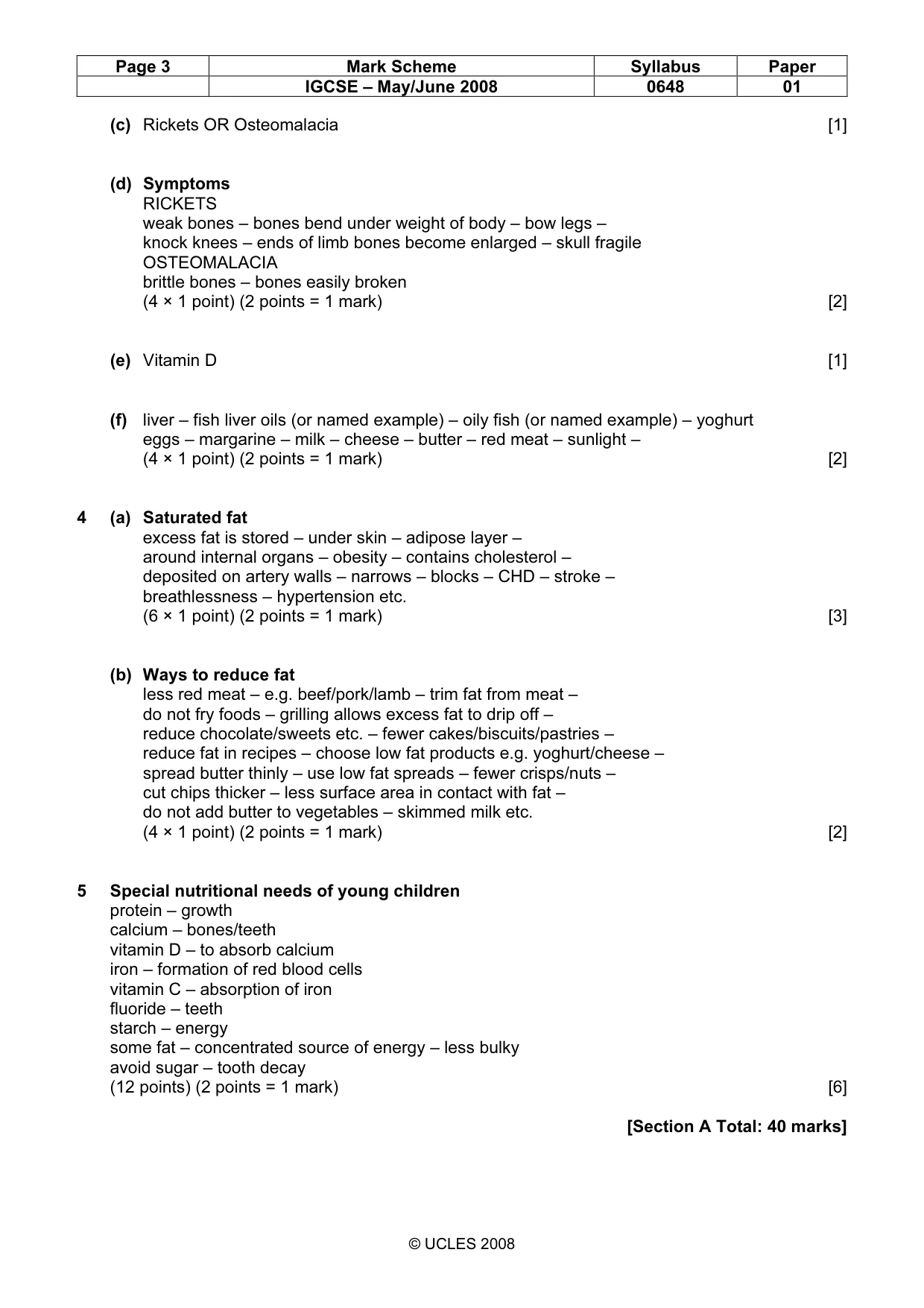
Page 3 Mark Scheme Syllabus Paper IGCSE – May/June 2008 0648 01 © UCLES 2008 (c) Rickets OR Osteomalacia [1] (d) Symptoms RICKETS weak bones – bones bend under weight of body – bow legs – knock knees – ends of limb bones become enlarged – skull fragile OSTEOMALACIA brittle bones – bones easily broken (4 × 1 point) (2 points = 1 mark) [2] (e) Vitamin D [1] (f) liver – fish liver oils (or named example) – oily fish (or named example) – yoghurt eggs – margarine – milk – cheese – butter – red meat – sunlight – (4 × 1 point) (2 points = 1 mark) [2] 4 (a) Saturated fat excess fat is stored – under skin – adipose layer – around internal organs – obesity – contains cholesterol – deposited on artery walls – narrows – blocks – CHD – stroke – breathlessness – hypertension etc. (6 × 1 point) (2 points = 1 mark) [3] (b) Ways to reduce fat less red meat – e.g. beef/pork/lamb – trim fat from meat – do not fry foods – grilling allows excess fat to drip off – reduce chocolate/sweets etc. – fewer cakes/biscuits/pastries – reduce fat in recipes – choose low fat products e.g. yoghurt/cheese – spread butter thinly – use low fat spreads – fewer crisps/nuts – cut chips thicker – less surface area in contact with fat – do not add butter to vegetables – skimmed milk etc. (4 × 1 point) (2 points = 1 mark) [2] 5 Special nutritional needs of young children protein – growth calcium – bones/teeth vitamin D – to absorb calcium iron – formation of red blood cells vitamin C – absorption of iron fluoride – teeth starch – energy some fat – concentrated source of energy – less bulky avoid sugar – tooth decay (12 points) (2 points = 1 mark) [6] [Section A Total: 40 marks]
Mark scheme, page 4
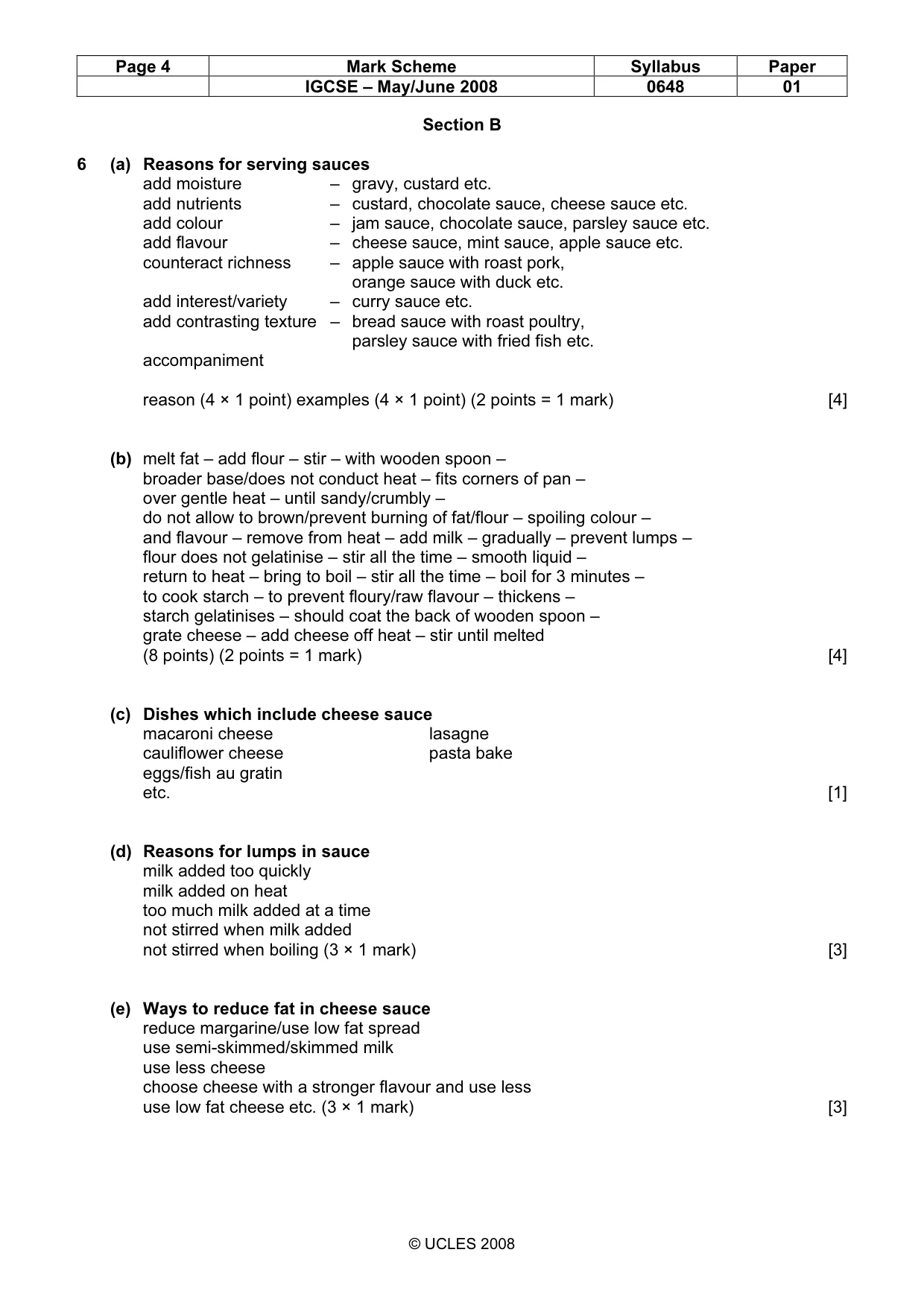
Page 4 Mark Scheme Syllabus Paper IGCSE – May/June 2008 0648 01 © UCLES 2008 Section B 6 (a) Reasons for serving sauces add moisture – gravy, custard etc. add nutrients – custard, chocolate sauce, cheese sauce etc. add colour – jam sauce, chocolate sauce, parsley sauce etc. add flavour – cheese sauce, mint sauce, apple sauce etc. counteract richness – apple sauce with roast pork, orange sauce with duck etc. add interest/variety – curry sauce etc. add contrasting texture – bread sauce with roast poultry, parsley sauce with fried fish etc. accompaniment reason (4 × 1 point) examples (4 × 1 point) (2 points = 1 mark) [4] (b) melt fat – add flour – stir – with wooden spoon – broader base/does not conduct heat – fits corners of pan – over gentle heat – until sandy/crumbly – do not allow to brown/prevent burning of fat/flour – spoiling colour – and flavour – remove from heat – add milk – gradually – prevent lumps – flour does not gelatinise – stir all the time – smooth liquid – return to heat – bring to boil – stir all the time – boil for 3 minutes – to cook starch – to prevent floury/raw flavour – thickens – starch gelatinises – should coat the back of wooden spoon – grate cheese – add cheese off heat – stir until melted (8 points) (2 points = 1 mark) [4] (c) Dishes which include cheese sauce macaroni cheese lasagne cauliflower cheese pasta bake eggs/fish au gratin etc. [1] (d) Reasons for lumps in sauce milk added too quickly milk added on heat too much milk added at a time not stirred when milk added not stirred when boiling (3 × 1 mark) [3] (e) Ways to reduce fat in cheese sauce reduce margarine/use low fat spread use semi-skimmed/skimmed milk use less cheese choose cheese with a stronger flavour and use less use low fat cheese etc. (3 × 1 mark) [3]
Mark scheme, page 5
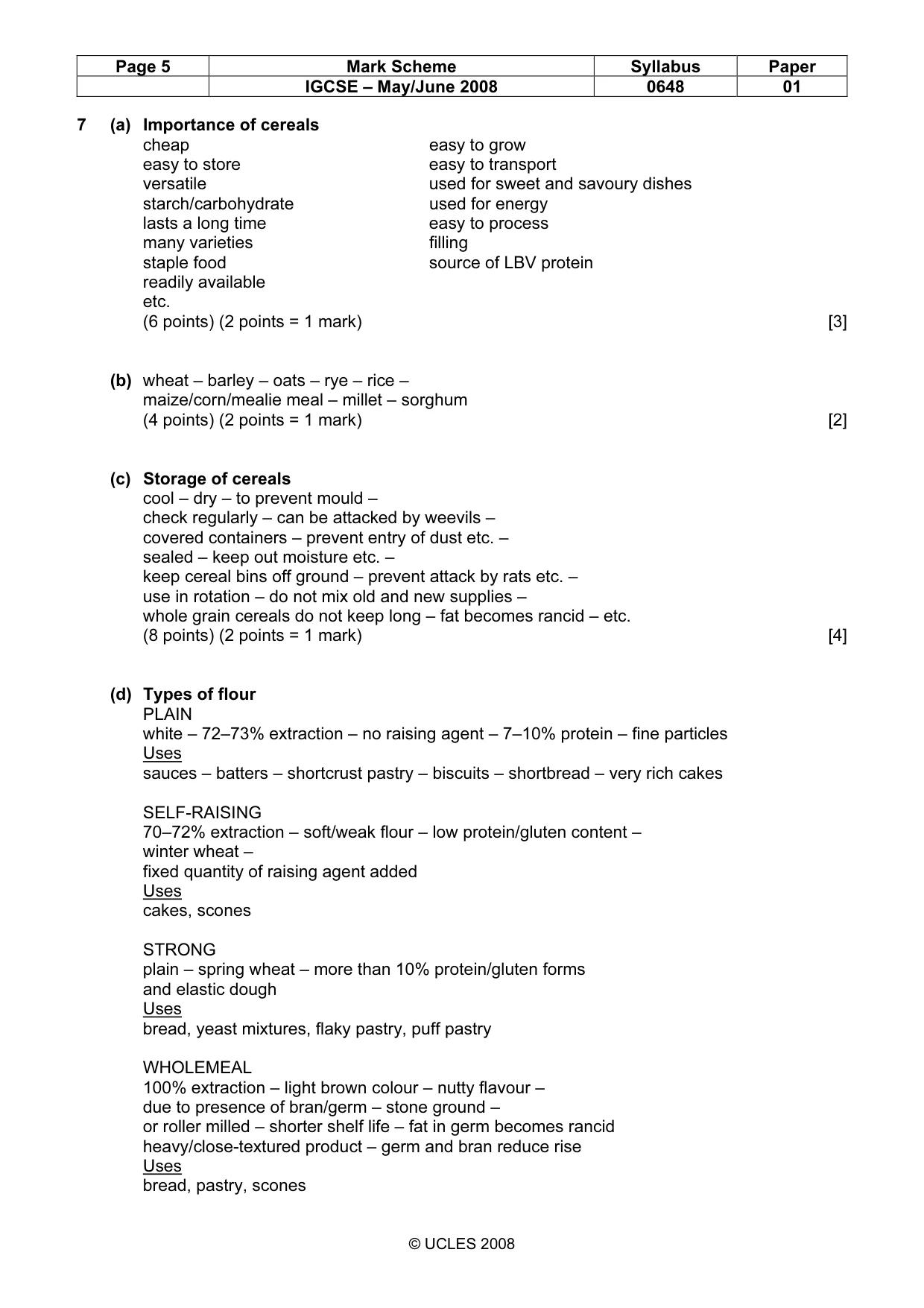
Page 5 Mark Scheme Syllabus Paper IGCSE – May/June 2008 0648 01 © UCLES 2008 7 (a) Importance of cereals cheap easy to grow easy to store easy to transport versatile used for sweet and savoury dishes starch/carbohydrate used for energy lasts a long time easy to process many varieties filling staple food source of LBV protein readily available etc. (6 points) (2 points = 1 mark) [3] (b) wheat – barley – oats – rye – rice – maize/corn/mealie meal – millet – sorghum (4 points) (2 points = 1 mark) [2] (c) Storage of cereals cool – dry – to prevent mould – check regularly – can be attacked by weevils – covered containers – prevent entry of dust etc. – sealed – keep out moisture etc. – keep cereal bins off ground – prevent attack by rats etc. – use in rotation – do not mix old and new supplies – whole grain cereals do not keep long – fat becomes rancid – etc. (8 points) (2 points = 1 mark) [4] (d) Types of flour PLAIN white – 72–73% extraction – no raising agent – 7–10% protein – fine particles Uses sauces – batters – shortcrust pastry – biscuits – shortbread – very rich cakes SELF-RAISING 70–72% extraction – soft/weak flour – low protein/gluten content – winter wheat – fixed quantity of raising agent added Uses cakes, scones STRONG plain – spring wheat – more than 10% protein/gluten forms and elastic dough Uses bread, yeast mixtures, flaky pastry, puff pastry WHOLEMEAL 100% extraction – light brown colour – nutty flavour – due to presence of bran/germ – stone ground – or roller milled – shorter shelf life – fat in germ becomes rancid heavy/close-textured product – germ and bran reduce rise Uses bread, pastry, scones
Mark scheme, page 6
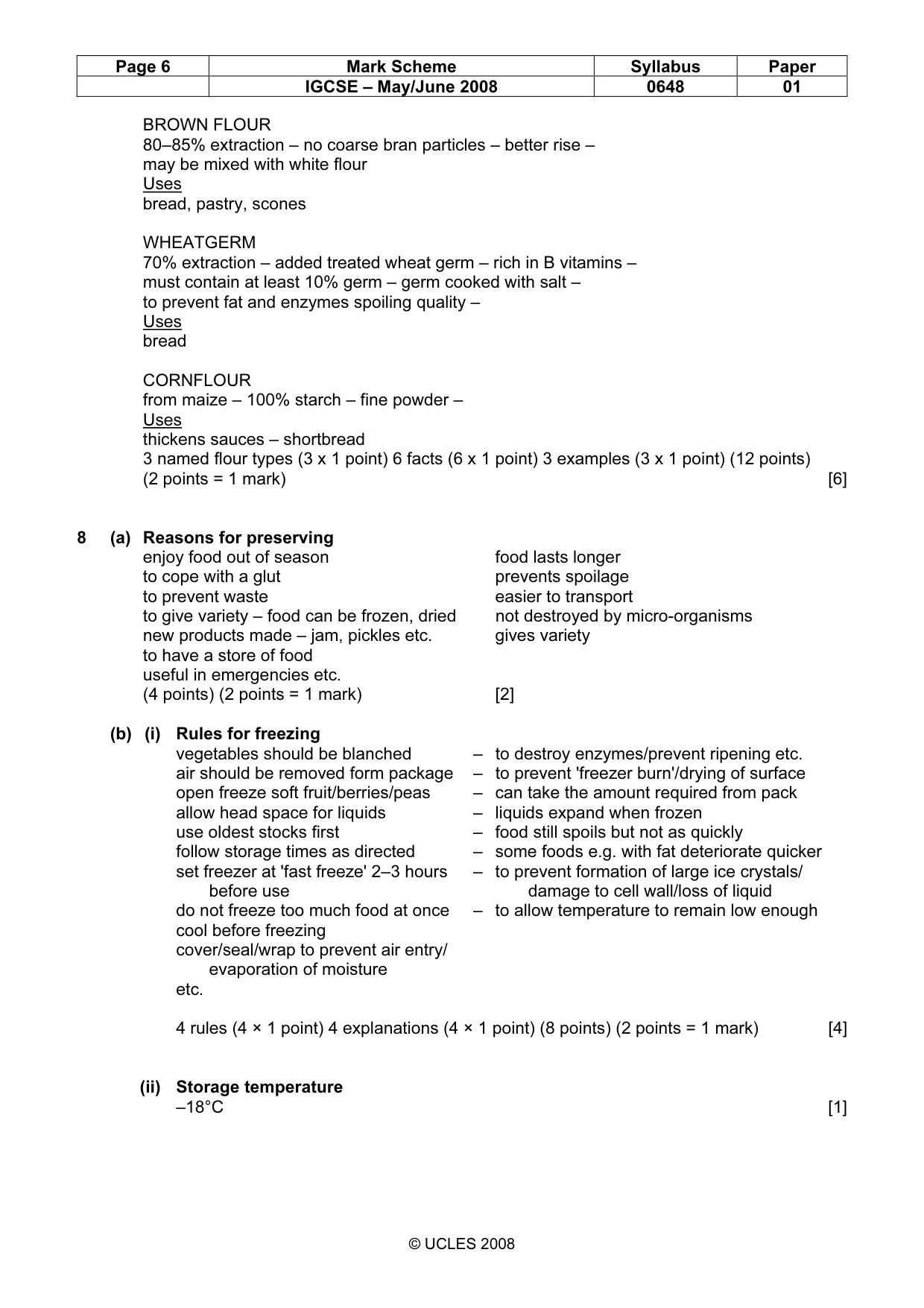
Page 6 Mark Scheme Syllabus Paper IGCSE – May/June 2008 0648 01 © UCLES 2008 BROWN FLOUR 80–85% extraction – no coarse bran particles – better rise – may be mixed with white flour Uses bread, pastry, scones WHEATGERM 70% extraction – added treated wheat germ – rich in B vitamins – must contain at least 10% germ – germ cooked with salt – to prevent fat and enzymes spoiling quality – Uses bread CORNFLOUR from maize – 100% starch – fine powder – Uses thickens sauces – shortbread 3 named flour types (3 x 1 point) 6 facts (6 x 1 point) 3 examples (3 x 1 point) (12 points) (2 points = 1 mark) [6] 8 (a) Reasons for preserving enjoy food out of season food lasts longer to cope with a glut prevents spoilage to prevent waste easier to transport to give variety – food can be frozen, dried not destroyed by micro-organisms new products made – jam, pickles etc. gives variety to have a store of food useful in emergencies etc. (4 points) (2 points = 1 mark) [2] (b) (i) Rules for freezing vegetables should be blanched – to destroy enzymes/prevent ripening etc. air should be removed form package – to prevent 'freezer burn'/drying of surface open freeze soft fruit/berries/peas – can take the amount required from pack allow head space for liquids – liquids expand when frozen use oldest stocks first – food still spoils but not as quickly follow storage times as directed – some foods e.g. with fat deteriorate quicker set freezer at 'fast freeze' 2–3 hours – to prevent formation of large ice crystals/ before use damage to cell wall/loss of liquid do not freeze too much food at once – to allow temperature to remain low enough cool before freezing cover/seal/wrap to prevent air entry/ evaporation of moisture etc. 4 rules (4 × 1 point) 4 explanations (4 × 1 point) (8 points) (2 points = 1 mark) [4] (ii) Storage temperature –18°C [1]
Mark scheme, page 7
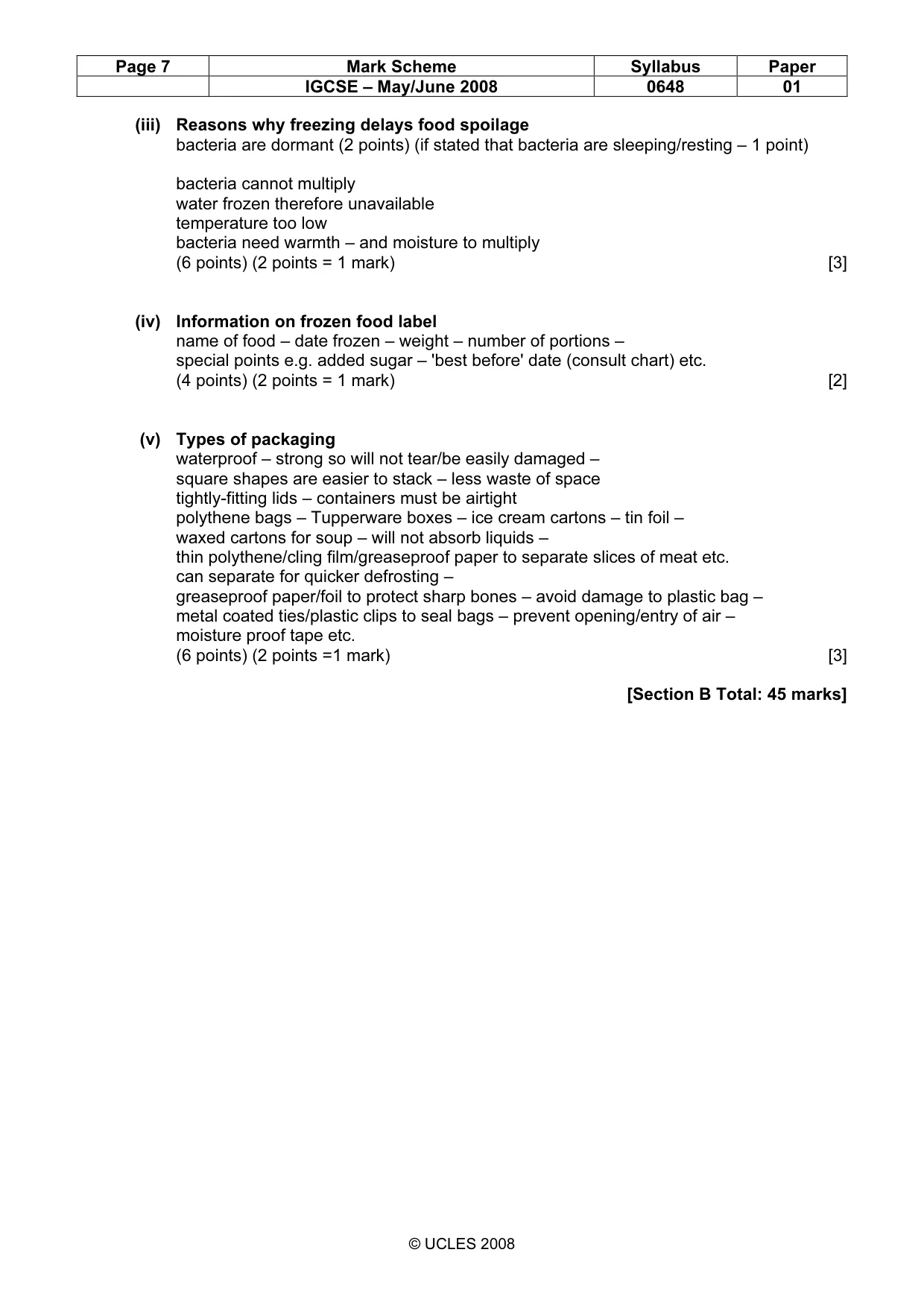
Page 7 Mark Scheme Syllabus Paper IGCSE – May/June 2008 0648 01 © UCLES 2008 (iii) Reasons why freezing delays food spoilage bacteria are dormant (2 points) (if stated that bacteria are sleeping/resting – 1 point) bacteria cannot multiply water frozen therefore unavailable temperature too low bacteria need warmth – and moisture to multiply (6 points) (2 points = 1 mark) [3] (iv) Information on frozen food label name of food – date frozen – weight – number of portions – special points e.g. added sugar – 'best before' date (consult chart) etc. (4 points) (2 points = 1 mark) [2] (v) Types of packaging waterproof – strong so will not tear/be easily damaged – square shapes are easier to stack – less waste of space tightly-fitting lids – containers must be airtight polythene bags – Tupperware boxes – ice cream cartons – tin foil – waxed cartons for soup – will not absorb liquids – thin polythene/cling film/greaseproof paper to separate slices of meat etc. can separate for quicker defrosting – greaseproof paper/foil to protect sharp bones – avoid damage to plastic bag – metal coated ties/plastic clips to seal bags – prevent opening/entry of air – moisture proof tape etc. (6 points) (2 points =1 mark) [3] [Section B Total: 45 marks]
Mark scheme, page 8
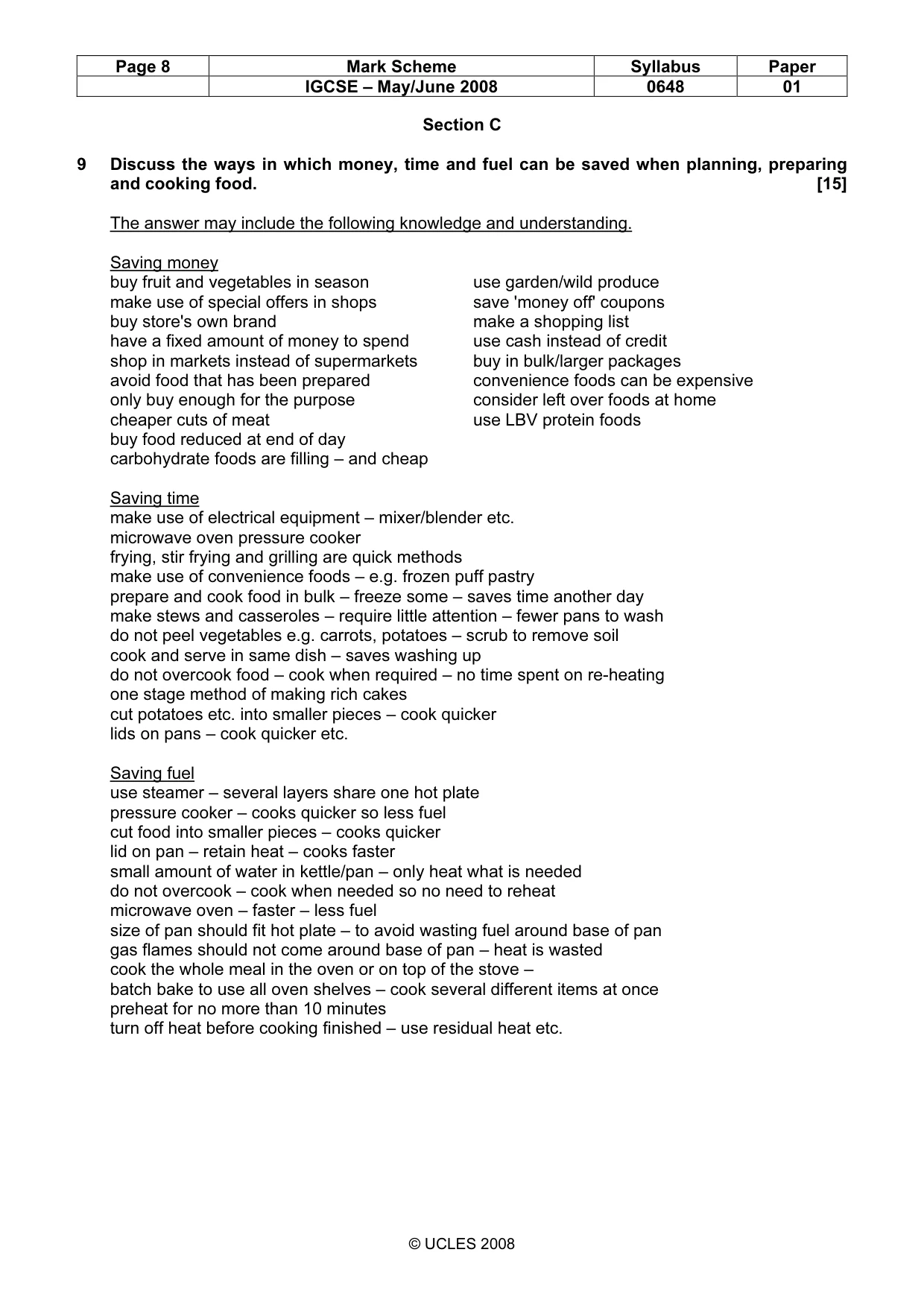
Page 8 Mark Scheme Syllabus Paper IGCSE – May/June 2008 0648 01 © UCLES 2008 Section C 9 Discuss the ways in which money, time and fuel can be saved when planning, preparing and cooking food. [15] The answer may include the following knowledge and understanding. Saving money buy fruit and vegetables in season use garden/wild produce make use of special offers in shops save 'money off' coupons buy store's own brand make a shopping list have a fixed amount of money to spend use cash instead of credit shop in markets instead of supermarkets buy in bulk/larger packages avoid food that has been prepared convenience foods can be expensive only buy enough for the purpose consider left over foods at home cheaper cuts of meat use LBV protein foods buy food reduced at end of day carbohydrate foods are filling – and cheap Saving time make use of electrical equipment – mixer/blender etc. microwave oven pressure cooker frying, stir frying and grilling are quick methods make use of convenience foods – e.g. frozen puff pastry prepare and cook food in bulk – freeze some – saves time another day make stews and casseroles – require little attention – fewer pans to wash do not peel vegetables e.g. carrots, potatoes – scrub to remove soil cook and serve in same dish – saves washing up do not overcook food – cook when required – no time spent on re-heating one stage method of making rich cakes cut potatoes etc. into smaller pieces – cook quicker lids on pans – cook quicker etc. Saving fuel use steamer – several layers share one hot plate pressure cooker – cooks quicker so less fuel cut food into smaller pieces – cooks quicker lid on pan – retain heat – cooks faster small amount of water in kettle/pan – only heat what is needed do not overcook – cook when needed so no need to reheat microwave oven – faster – less fuel size of pan should fit hot plate – to avoid wasting fuel around base of pan gas flames should not come around base of pan – heat is wasted cook the whole meal in the oven or on top of the stove – batch bake to use all oven shelves – cook several different items at once preheat for no more than 10 minutes turn off heat before cooking finished – use residual heat etc.
Mark scheme, page 9
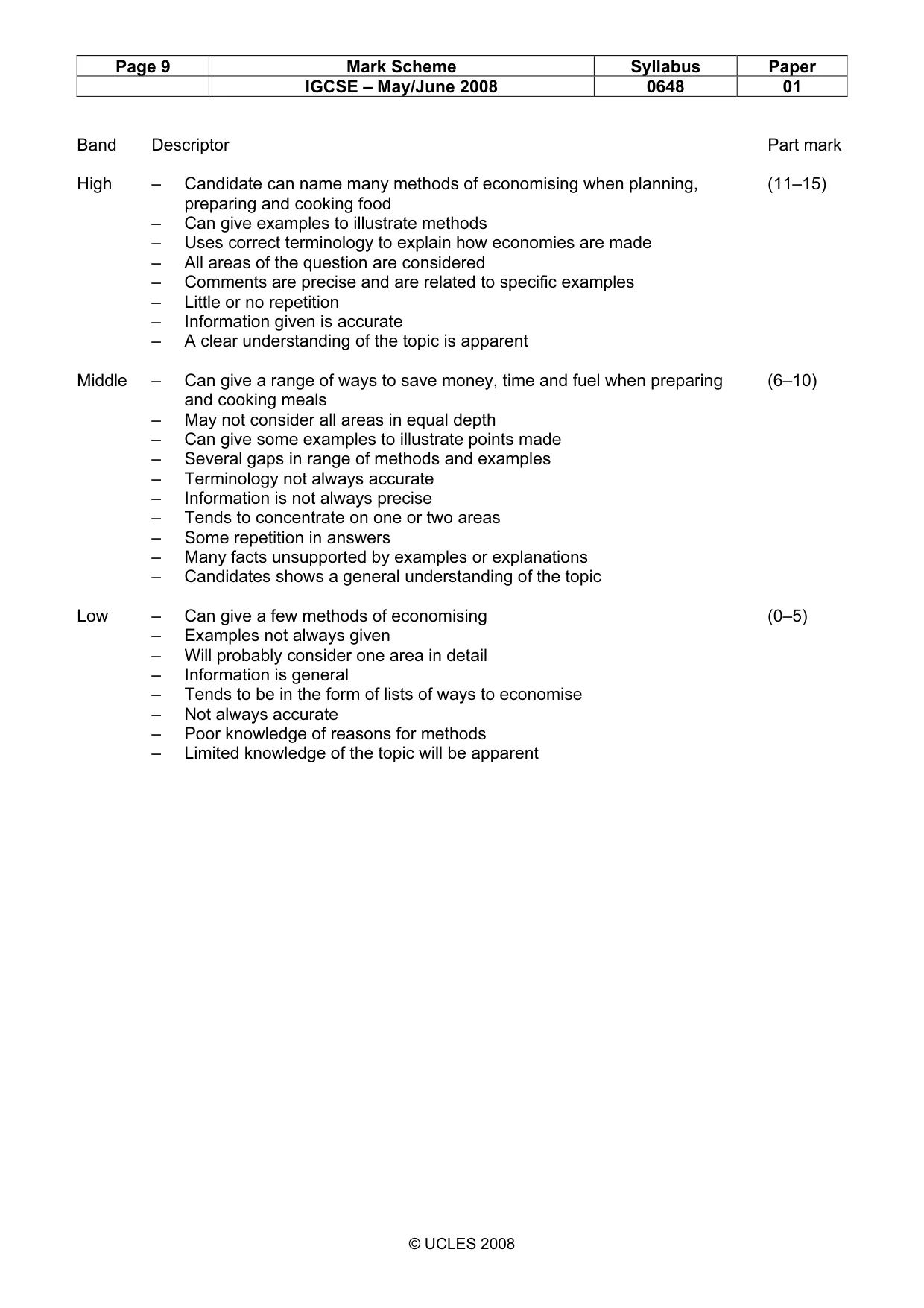
Page 9 Mark Scheme Syllabus Paper IGCSE – May/June 2008 0648 01 © UCLES 2008 Band Descriptor Part mark High – Candidate can name many methods of economising when planning, preparing and cooking food – Can give examples to illustrate methods – Uses correct terminology to explain how economies are made – All areas of the question are considered – Comments are precise and are related to specific examples – Little or no repetition – Information given is accurate – A clear understanding of the topic is apparent (11–15) Middle – Can give a range of ways to save money, time and fuel when preparing and cooking meals – May not consider all areas in equal depth – Can give some examples to illustrate points made – Several gaps in range of methods and examples – Terminology not always accurate – Information is not always precise – Tends to concentrate on one or two areas – Some repetition in answers – Many facts unsupported by examples or explanations – Candidates shows a general understanding of the topic (6–10) Low – Can give a few methods of economising – Examples not always given – Will probably consider one area in detail – Information is general – Tends to be in the form of lists of ways to economise – Not always accurate – Poor knowledge of reasons for methods – Limited knowledge of the topic will be apparent (0–5)
Mark scheme, page 10
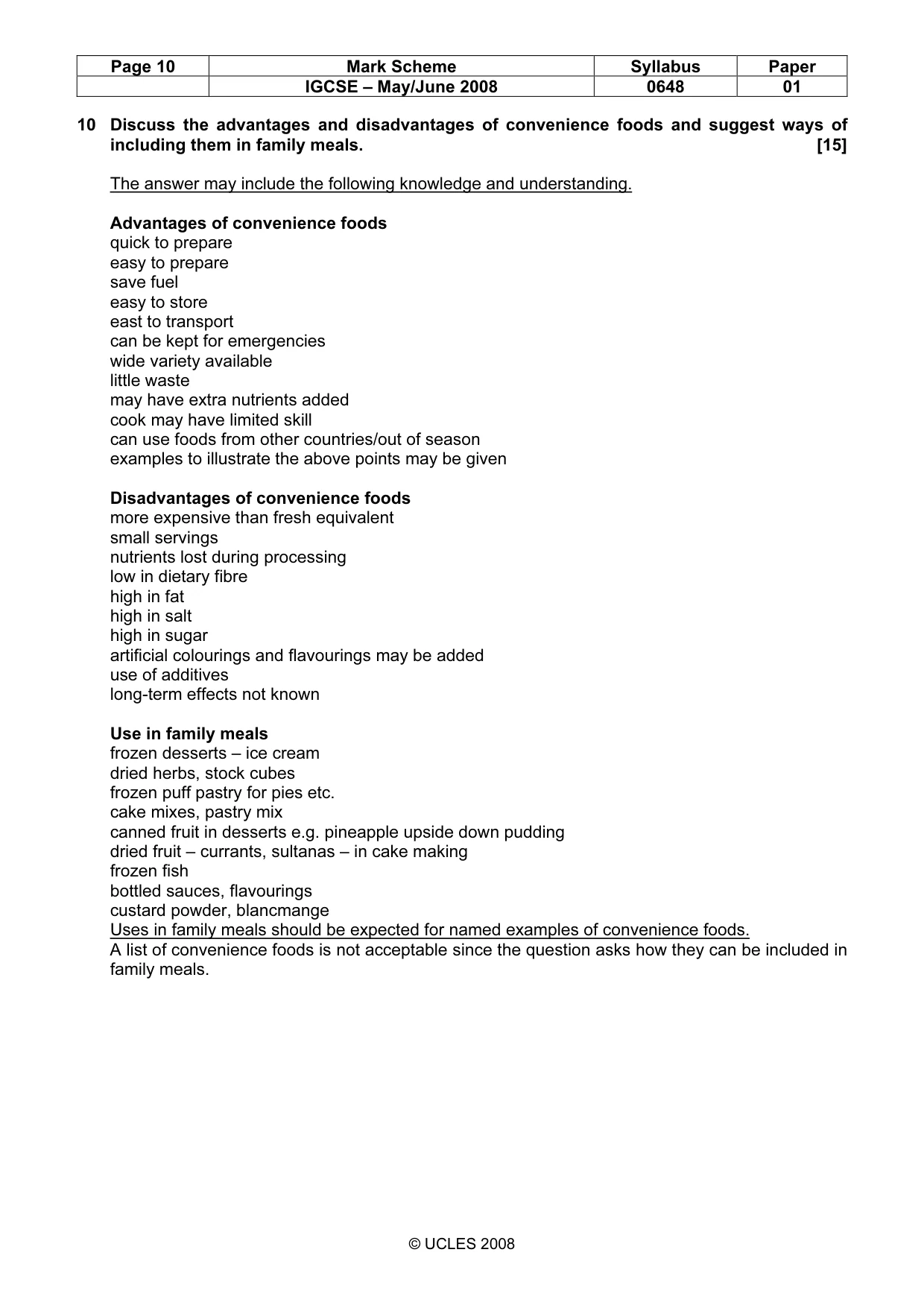
Page 10 Mark Scheme Syllabus Paper IGCSE – May/June 2008 0648 01 © UCLES 2008 10 Discuss the advantages and disadvantages of convenience foods and suggest ways of including them in family meals. [15] The answer may include the following knowledge and understanding. Advantages of convenience foods quick to prepare easy to prepare save fuel easy to store east to transport can be kept for emergencies wide variety available little waste may have extra nutrients added cook may have limited skill can use foods from other countries/out of season examples to illustrate the above points may be given Disadvantages of convenience foods more expensive than fresh equivalent small servings nutrients lost during processing low in dietary fibre high in fat high in salt high in sugar artificial colourings and flavourings may be added use of additives long-term effects not known Use in family meals frozen desserts – ice cream dried herbs, stock cubes frozen puff pastry for pies etc. cake mixes, pastry mix canned fruit in desserts e.g. pineapple upside down pudding dried fruit – currants, sultanas – in cake making frozen fish bottled sauces, flavourings custard powder, blancmange Uses in family meals should be expected for named examples of convenience foods. A list of convenience foods is not acceptable since the question asks how they can be included in family meals.
Mark scheme, page 11
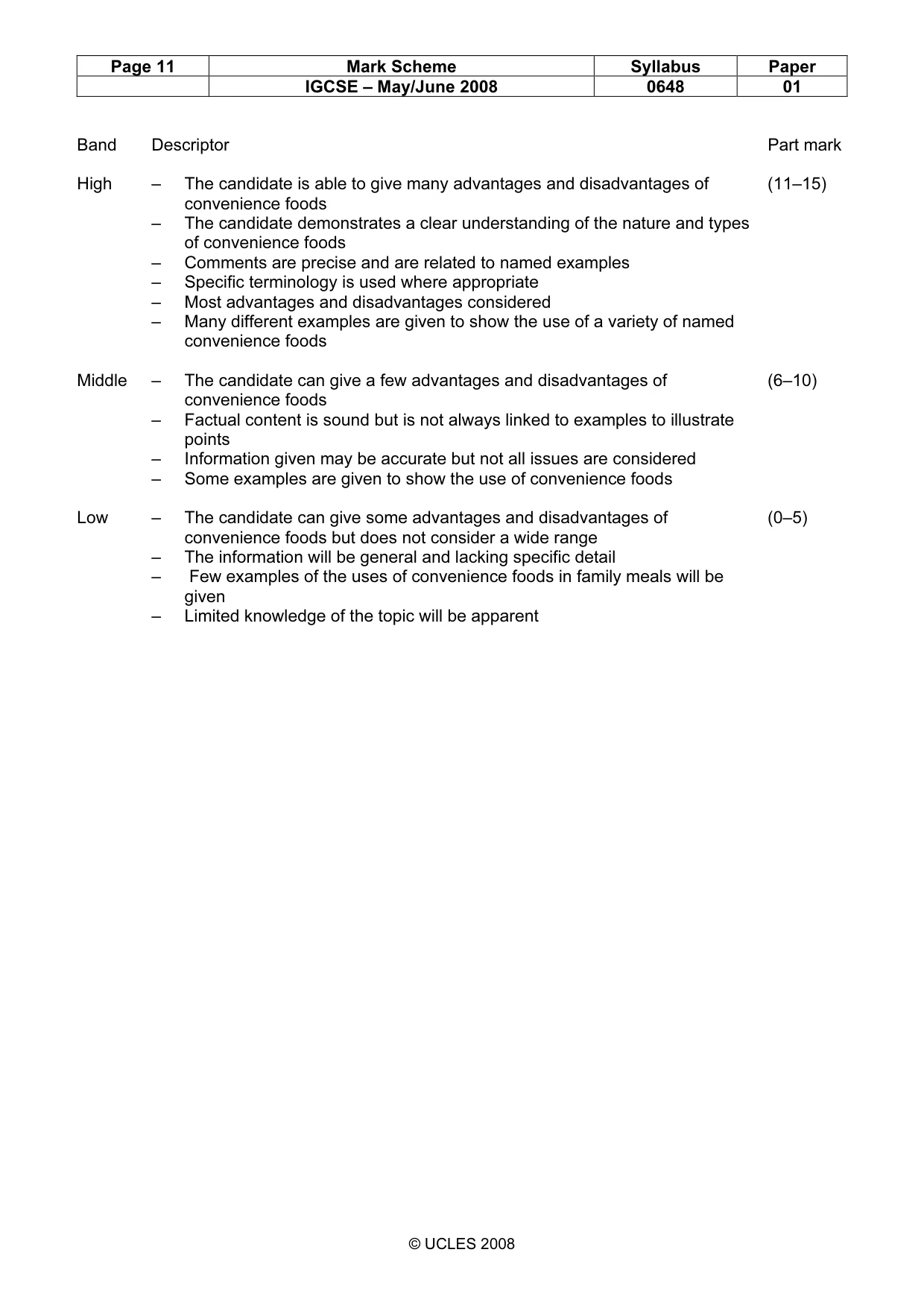
Page 11 Mark Scheme Syllabus Paper IGCSE – May/June 2008 0648 01 © UCLES 2008 Band Descriptor Part mark High – The candidate is able to give many advantages and disadvantages of convenience foods – The candidate demonstrates a clear understanding of the nature and types of convenience foods – Comments are precise and are related to named examples – Specific terminology is used where appropriate – Most advantages and disadvantages considered – Many different examples are given to show the use of a variety of named convenience foods (11–15) Middle – The candidate can give a few advantages and disadvantages of convenience foods – Factual content is sound but is not always linked to examples to illustrate points – Information given may be accurate but not all issues are considered – Some examples are given to show the use of convenience foods (6–10) Low – The candidate can give some advantages and disadvantages of convenience foods but does not consider a wide range – The information will be general and lacking specific detail – Few examples of the uses of convenience foods in family meals will be given – Limited knowledge of the topic will be apparent (0–5)
What you needed in this session
Cambridge’s own grade thresholds for 2008 May/June, Paper 1 · Variant 1. A higher threshold means an easier paper — the bar moves with how the cohort did.