Cambridge IGCSE Food and Nutrition 0648 — 2007 Oct/Nov Paper 1 · Variant 1
0648/11/O/N/07 · 100 marks · ≈113 min
The question paper and its mark scheme, free to read here and free to download. This is Cambridge’s own paper, exactly as it was sat.
Question paper16 pages

Mark scheme13 pages
Answers below. Sit the paper first if you are practising.
Paper as text
Question paper, page 1
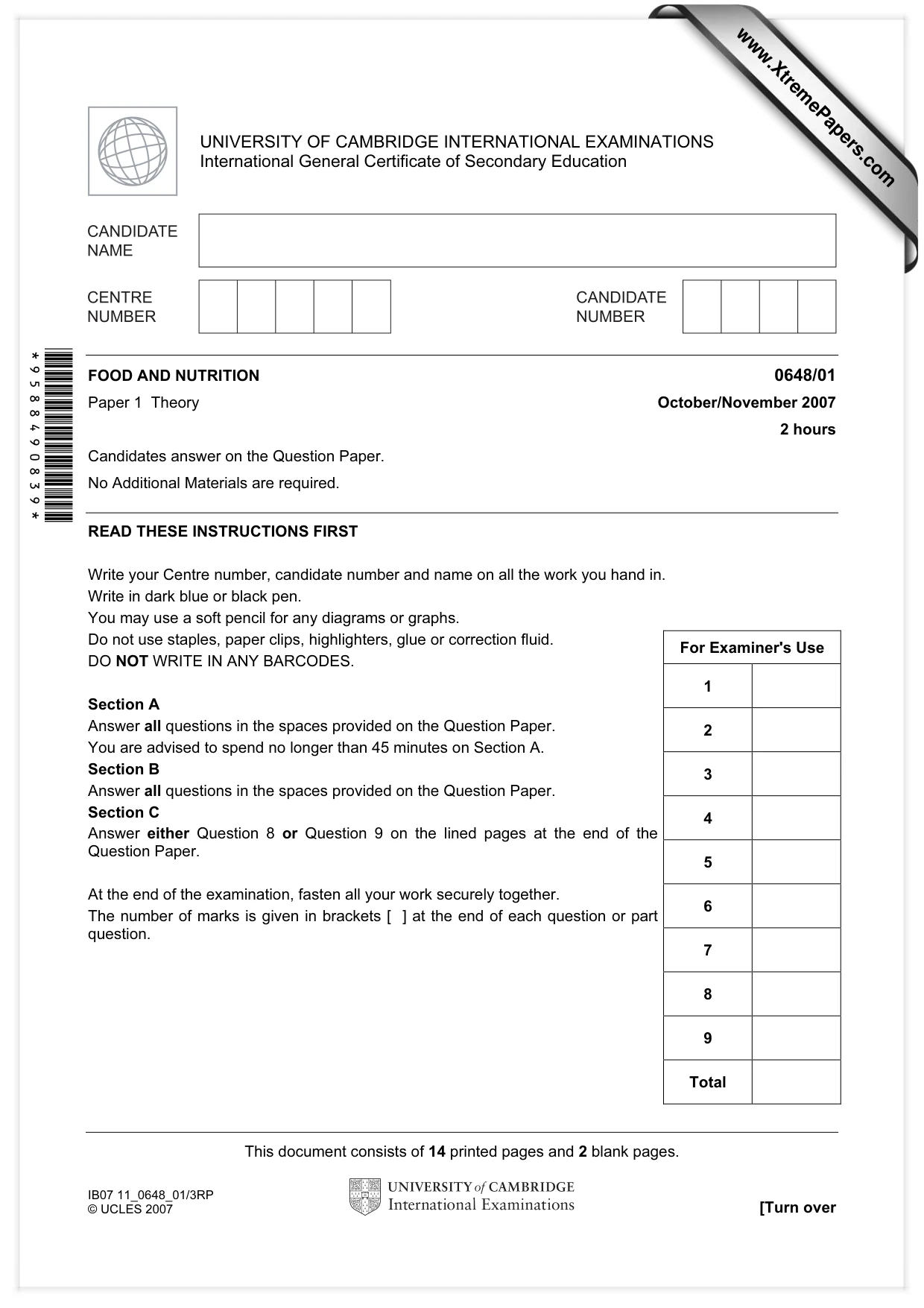
This document consists of 14 printed pages and 2 blank pages. IB07 11_0648_01/3RP © UCLES 2007 [Turn over *9588490839* For Examiner's Use 1 2 3 4 5 6 7 8 9 Total UNIVERSITY OF CAMBRIDGE INTERNATIONAL EXAMINATIONS International General Certificate of Secondary Education FOOD AND NUTRITION 0648/01 Paper 1 Theory October/November 2007 2 hours Candidates answer on the Question Paper. No Additional Materials are required. READ THESE INSTRUCTIONS FIRST Write your Centre number, candidate number and name on all the work you hand in. Write in dark blue or black pen. You may use a soft pencil for any diagrams or graphs. Do not use staples, paper clips, highlighters, glue or correction fluid. DO NOT WRITE IN ANY BARCODES. Section A Answer all questions in the spaces provided on the Question Paper. You are advised to spend no longer than 45 minutes on Section A. Section B Answer all questions in the spaces provided on the Question Paper. Section C Answer either Question 8 or Question 9 on the lined pages at the end of the Question Paper. At the end of the examination, fasten all your work securely together. The number of marks is given in brackets [ ] at the end of each question or part question. www.XtremePapers.com
Question paper, page 2
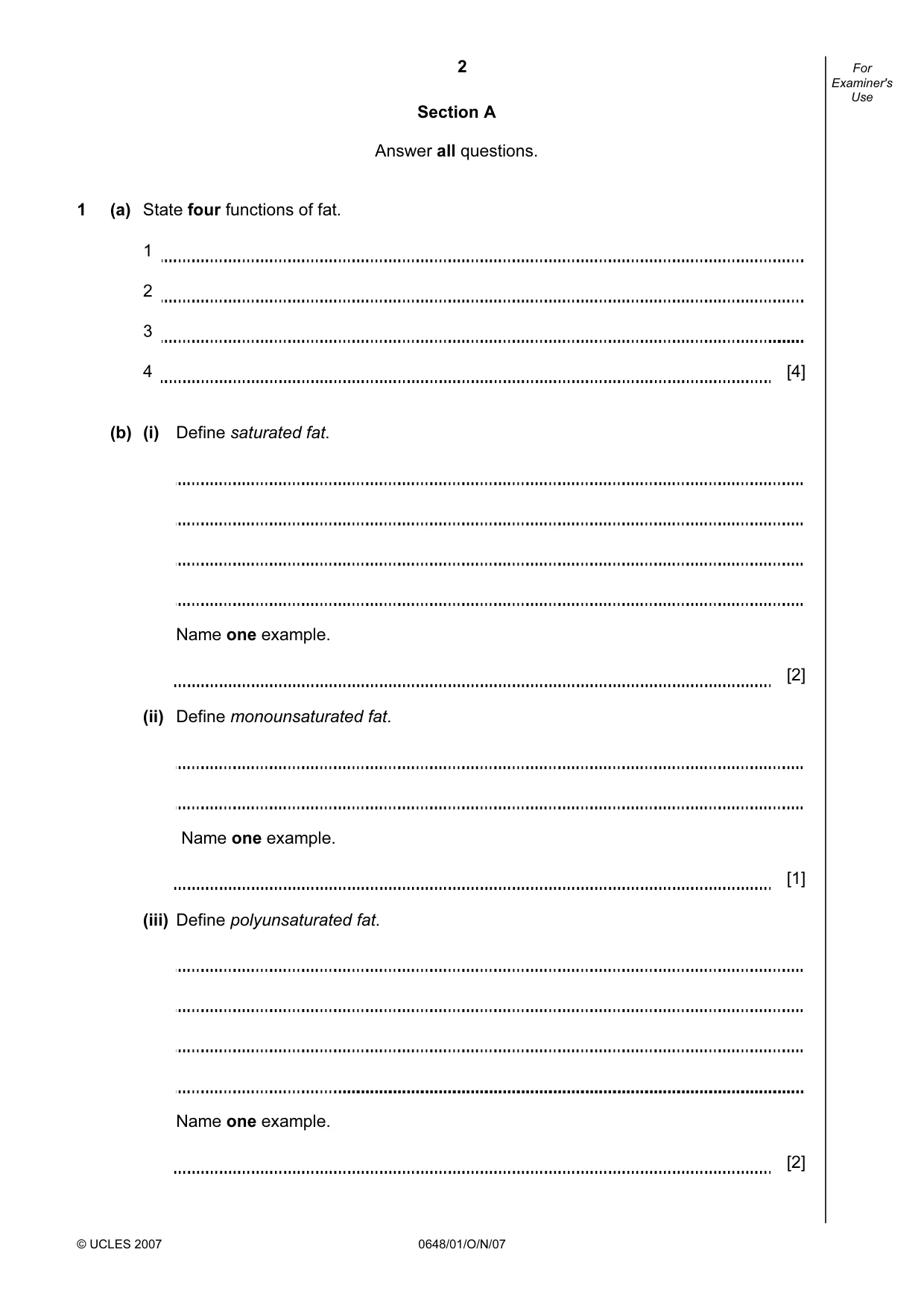
2 © UCLES 2007 0648/01/O/N/07 For Examiner's Use Section A Answer all questions. 1 (a) State four functions of fat. 1 2 3 4 [4] (b) (i) Define saturated fat. Name one example. [2] (ii) Define monounsaturated fat. Name one example. [1] (iii) Define polyunsaturated fat. Name one example. [2]
Question paper, page 3
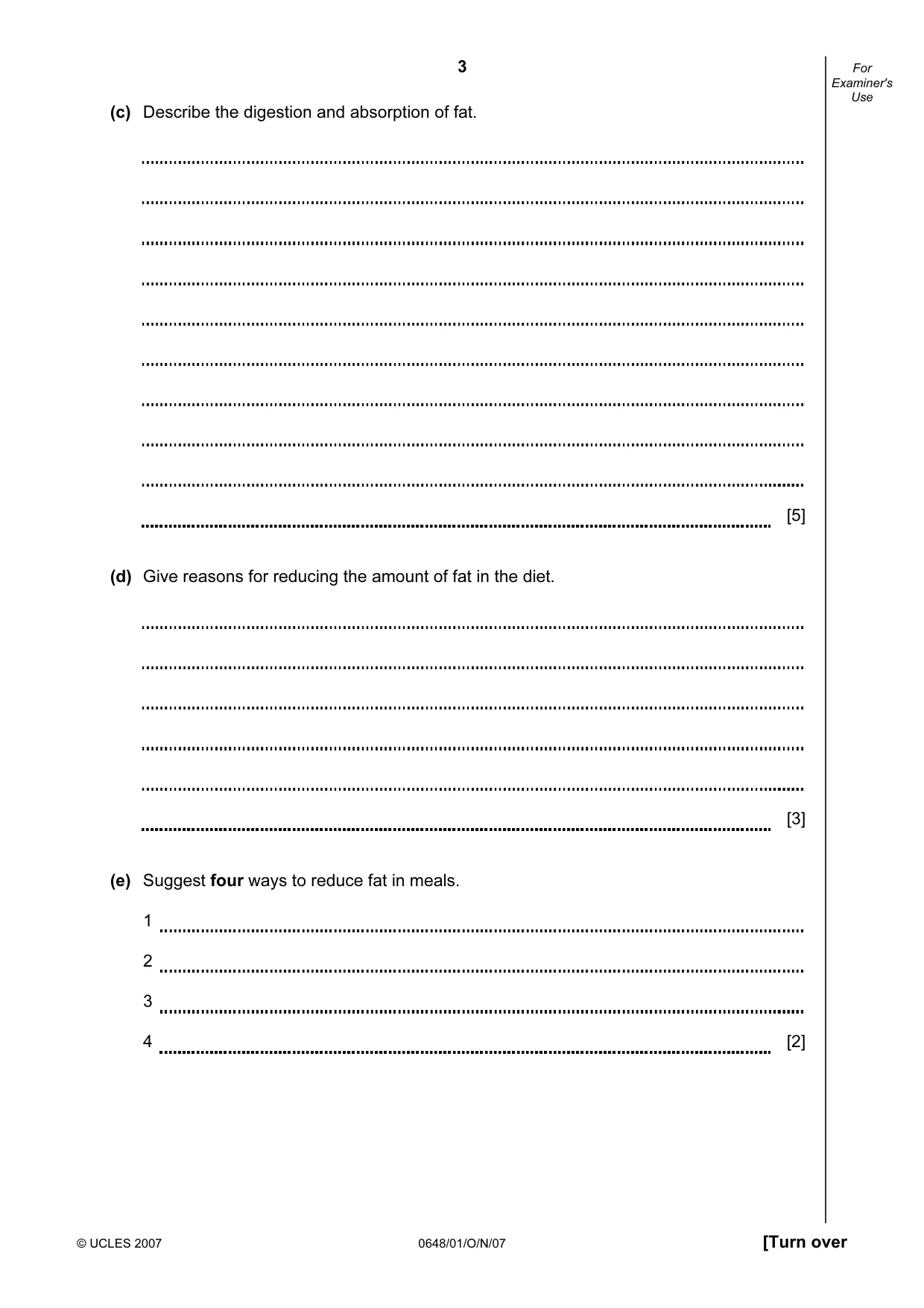
3 © UCLES 2007 0648/01/O/N/07 [Turn over For Examiner's Use (c) Describe the digestion and absorption of fat. [5] (d) Give reasons for reducing the amount of fat in the diet. [3] (e) Suggest four ways to reduce fat in meals. 1 2 3 4 [2]
Question paper, page 4
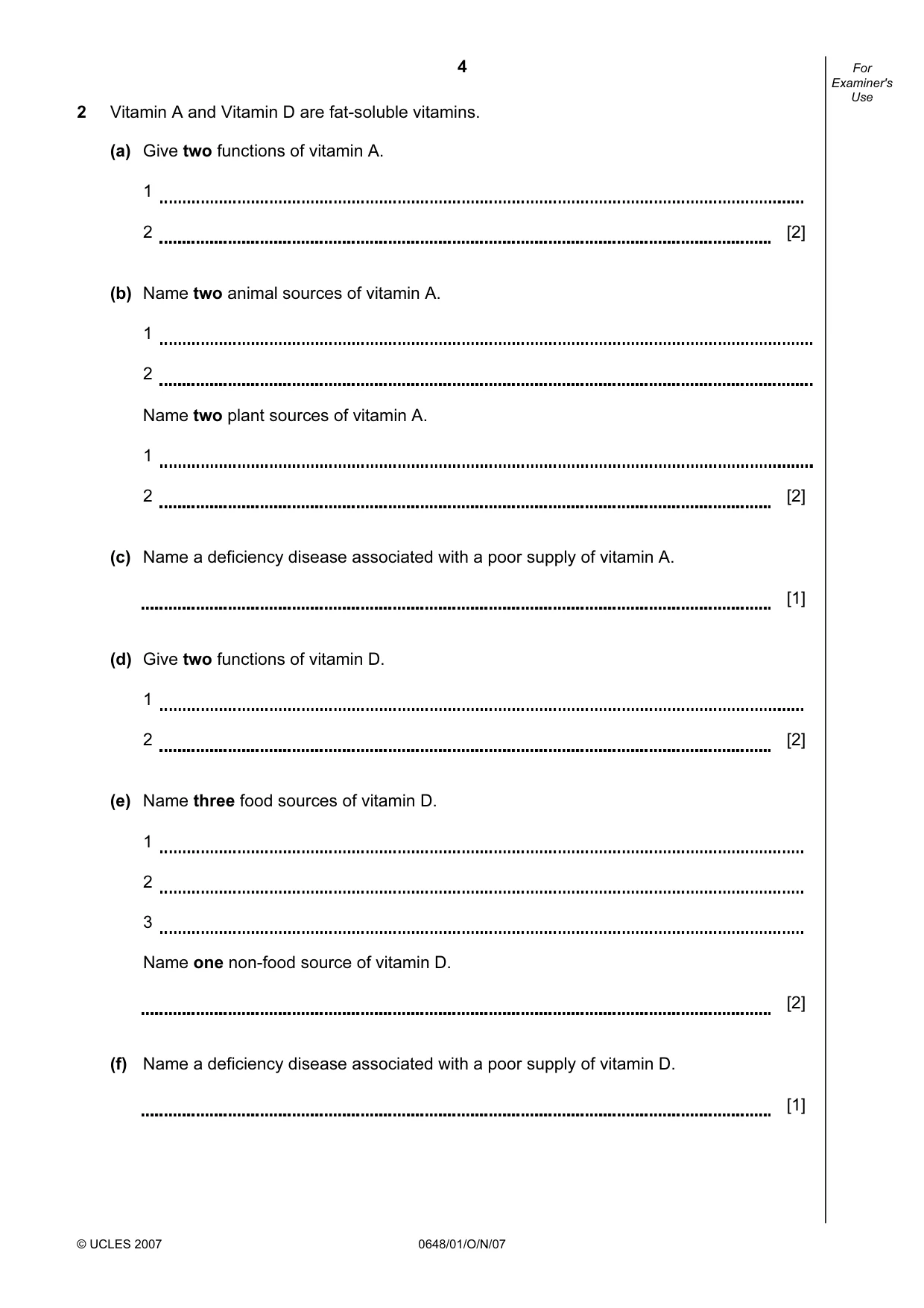
4 © UCLES 2007 0648/01/O/N/07 For Examiner's Use 2 Vitamin A and Vitamin D are fat-soluble vitamins. (a) Give two functions of vitamin A. 1 2 [2] (b) Name two animal sources of vitamin A. 1 2 Name two plant sources of vitamin A. 1 2 [2] (c) Name a deficiency disease associated with a poor supply of vitamin A. [1] (d) Give two functions of vitamin D. 1 2 [2] (e) Name three food sources of vitamin D. 1 2 3 Name one non-food source of vitamin D. [2] (f) Name a deficiency disease associated with a poor supply of vitamin D. [1]
Question paper, page 5
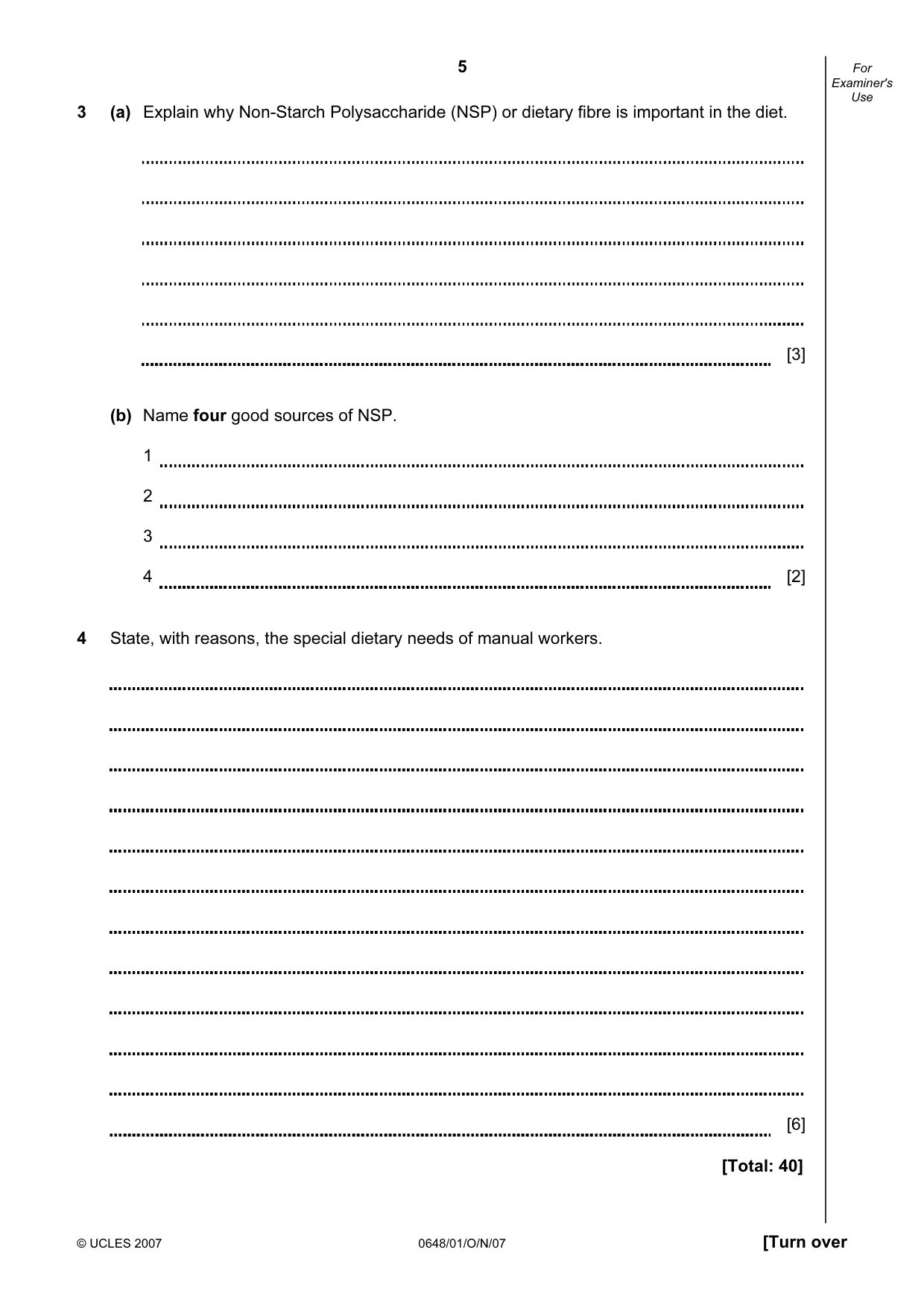
5 © UCLES 2007 0648/01/O/N/07 [Turn over For Examiner's Use 3 (a) Explain why Non-Starch Polysaccharide (NSP) or dietary fibre is important in the diet. [3] (b) Name four good sources of NSP. 1 2 3 4 [2] 4 State, with reasons, the special dietary needs of manual workers. [6] [Total: 40]
Question paper, page 6
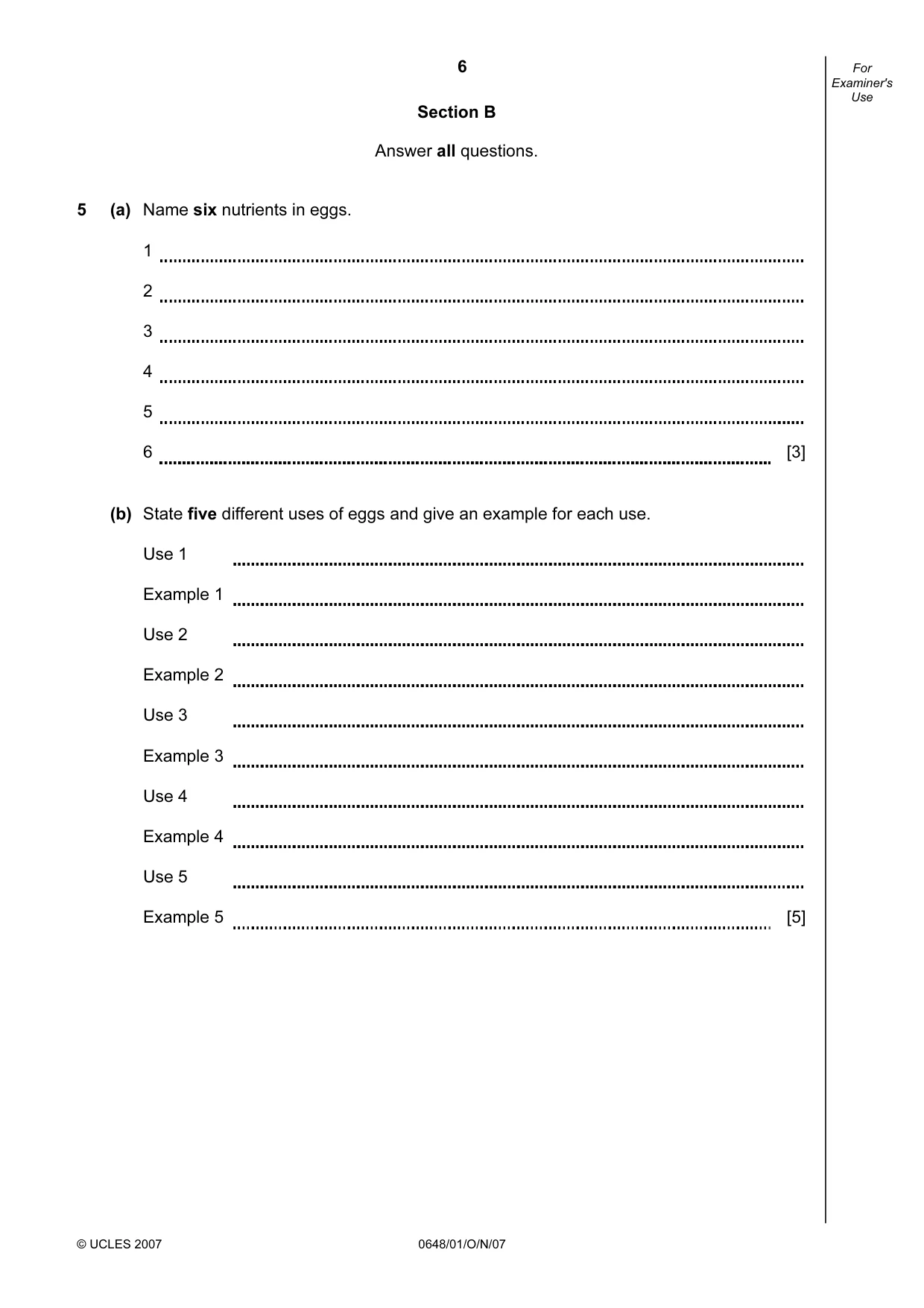
6 © UCLES 2007 0648/01/O/N/07 For Examiner's Use Section B Answer all questions. 5 (a) Name six nutrients in eggs. 1 2 3 4 5 6 [3] (b) State five different uses of eggs and give an example for each use. Use 1 Example 1 Use 2 Example 2 Use 3 Example 3 Use 4 Example 4 Use 5 Example 5 [5]
Question paper, page 7
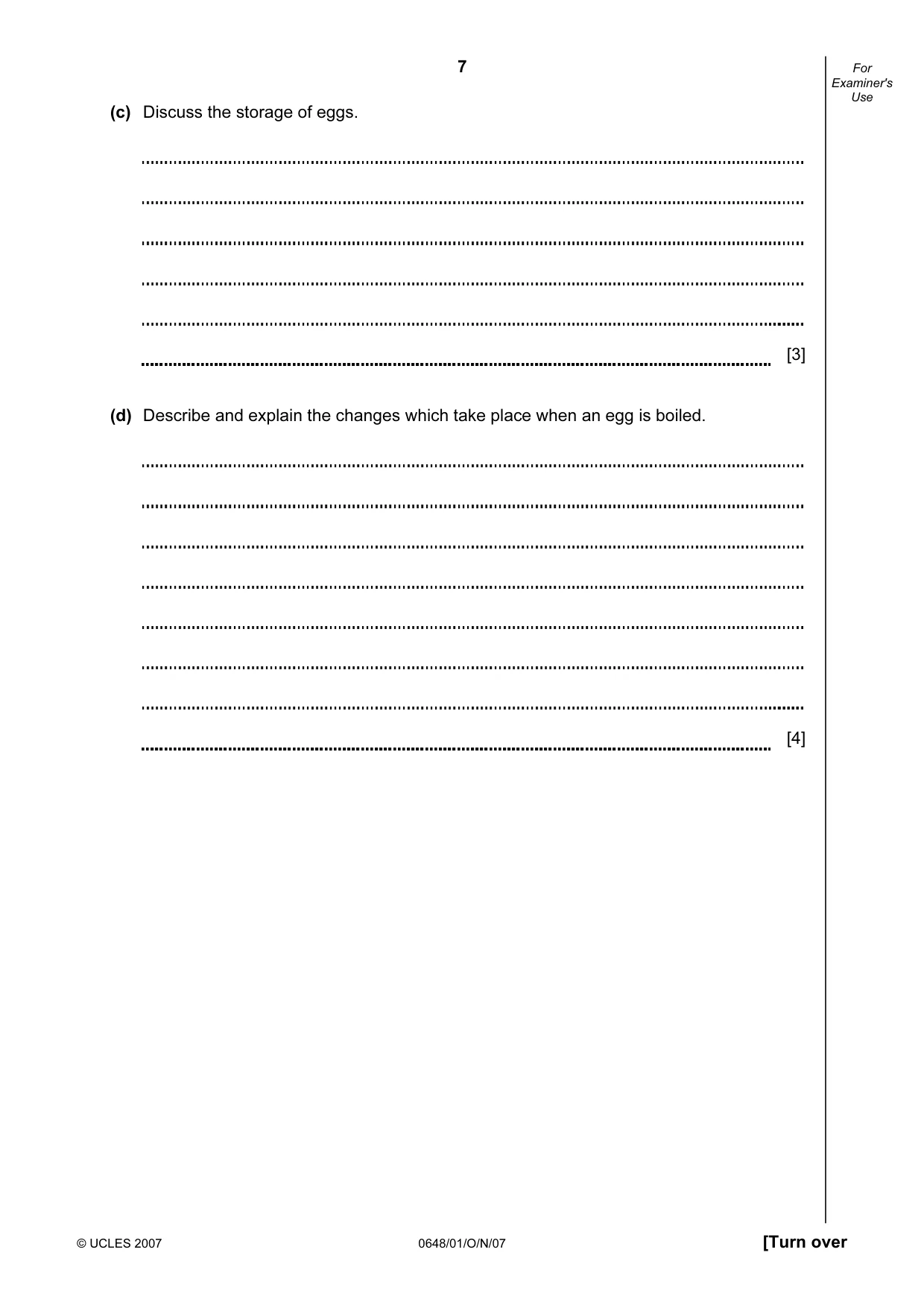
7 © UCLES 2007 0648/01/O/N/07 [Turn over For Examiner's Use (c) Discuss the storage of eggs. [3] (d) Describe and explain the changes which take place when an egg is boiled. [4]
Question paper, page 8
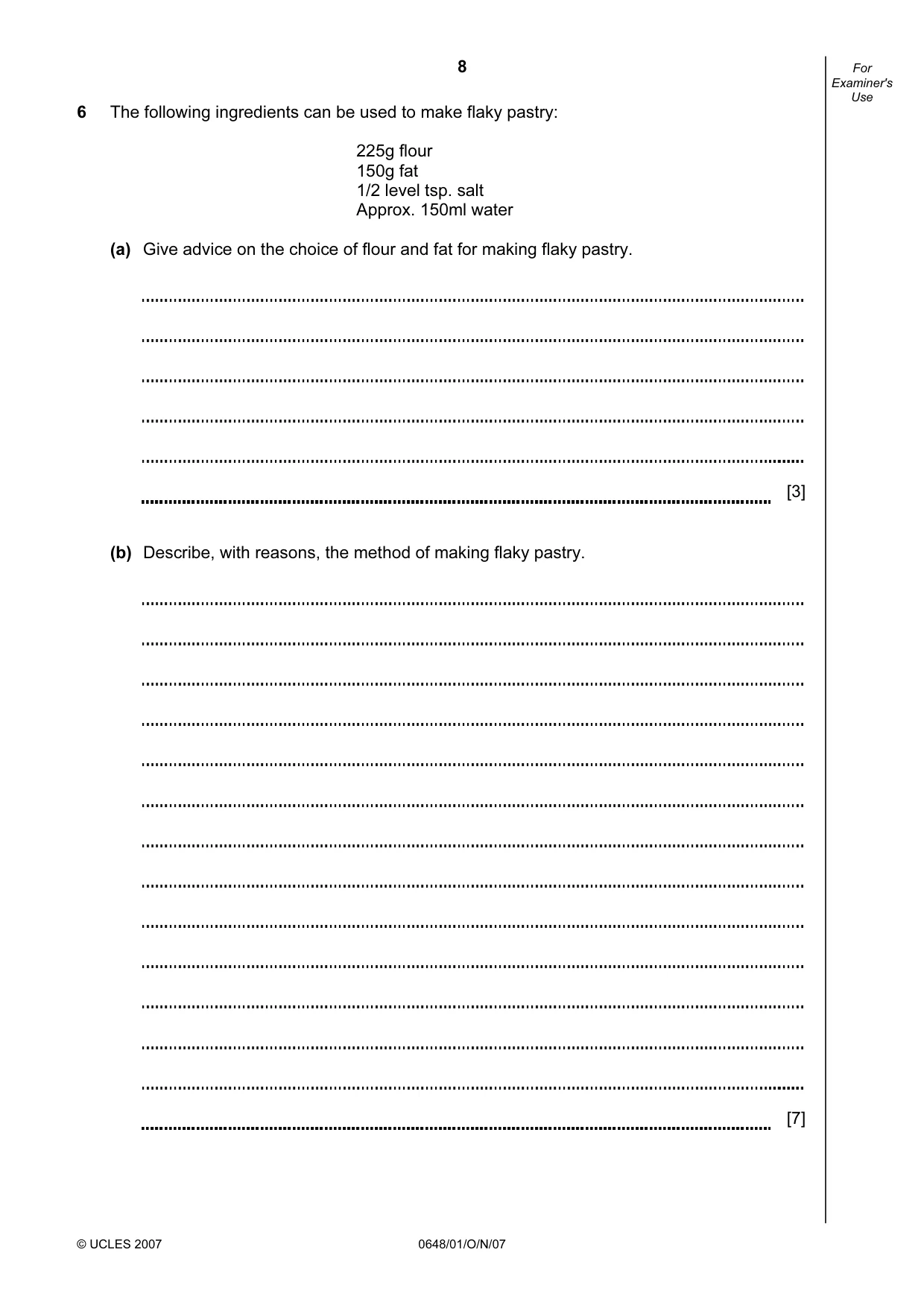
8 © UCLES 2007 0648/01/O/N/07 For Examiner's Use 6 The following ingredients can be used to make flaky pastry: 225g flour 150g fat 1/2 level tsp. salt Approx. 150ml water (a) Give advice on the choice of flour and fat for making flaky pastry. [3] (b) Describe, with reasons, the method of making flaky pastry. [7]
Question paper, page 9
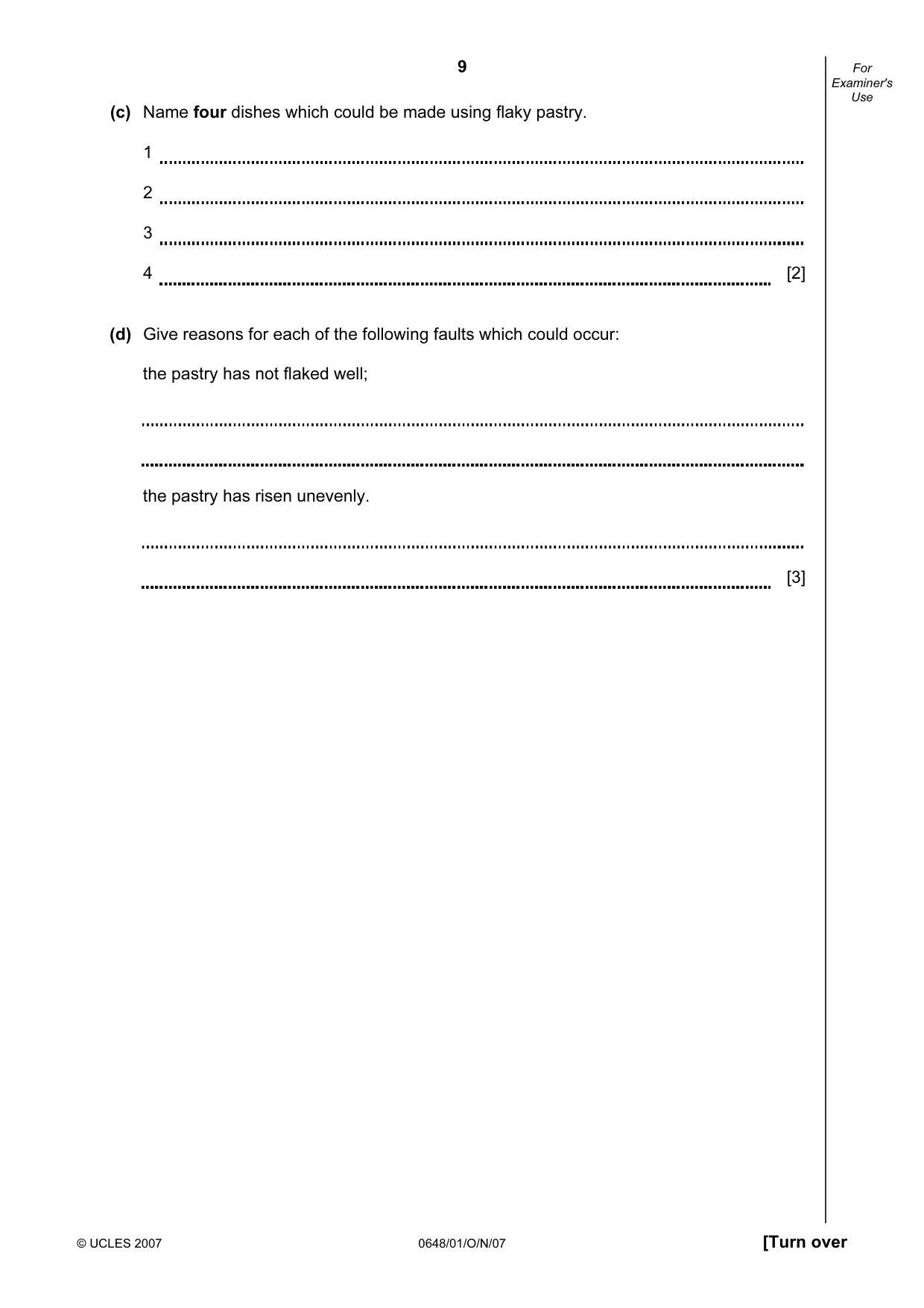
9 © UCLES 2007 0648/01/O/N/07 [Turn over For Examiner's Use (c) Name four dishes which could be made using flaky pastry. 1 2 3 4 [2] (d) Give reasons for each of the following faults which could occur: the pastry has not flaked well; the pastry has risen unevenly. [3]
Question paper, page 10
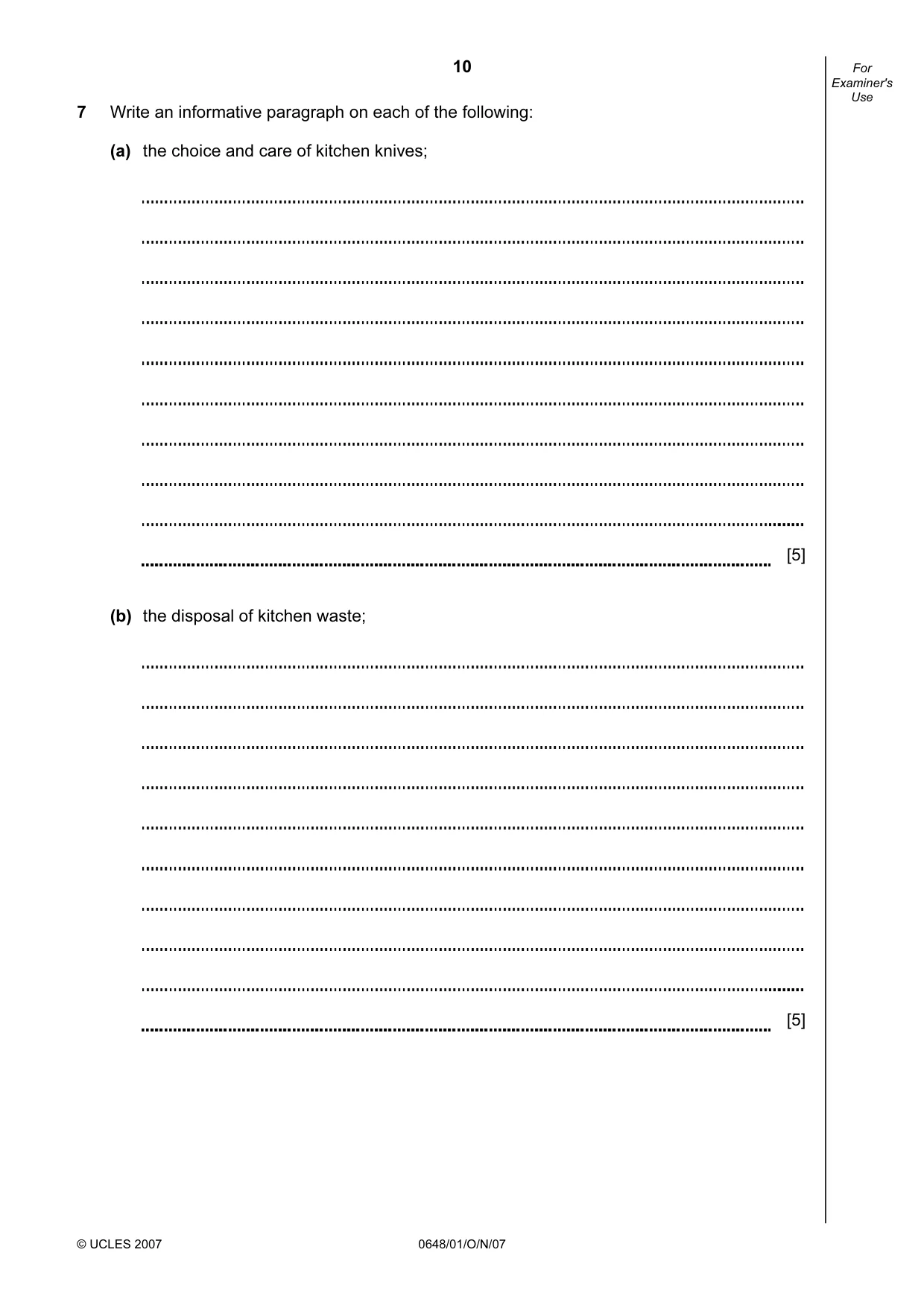
10 © UCLES 2007 0648/01/O/N/07 For Examiner's Use 7 Write an informative paragraph on each of the following: (a) the choice and care of kitchen knives; [5] (b) the disposal of kitchen waste; [5]
Question paper, page 11
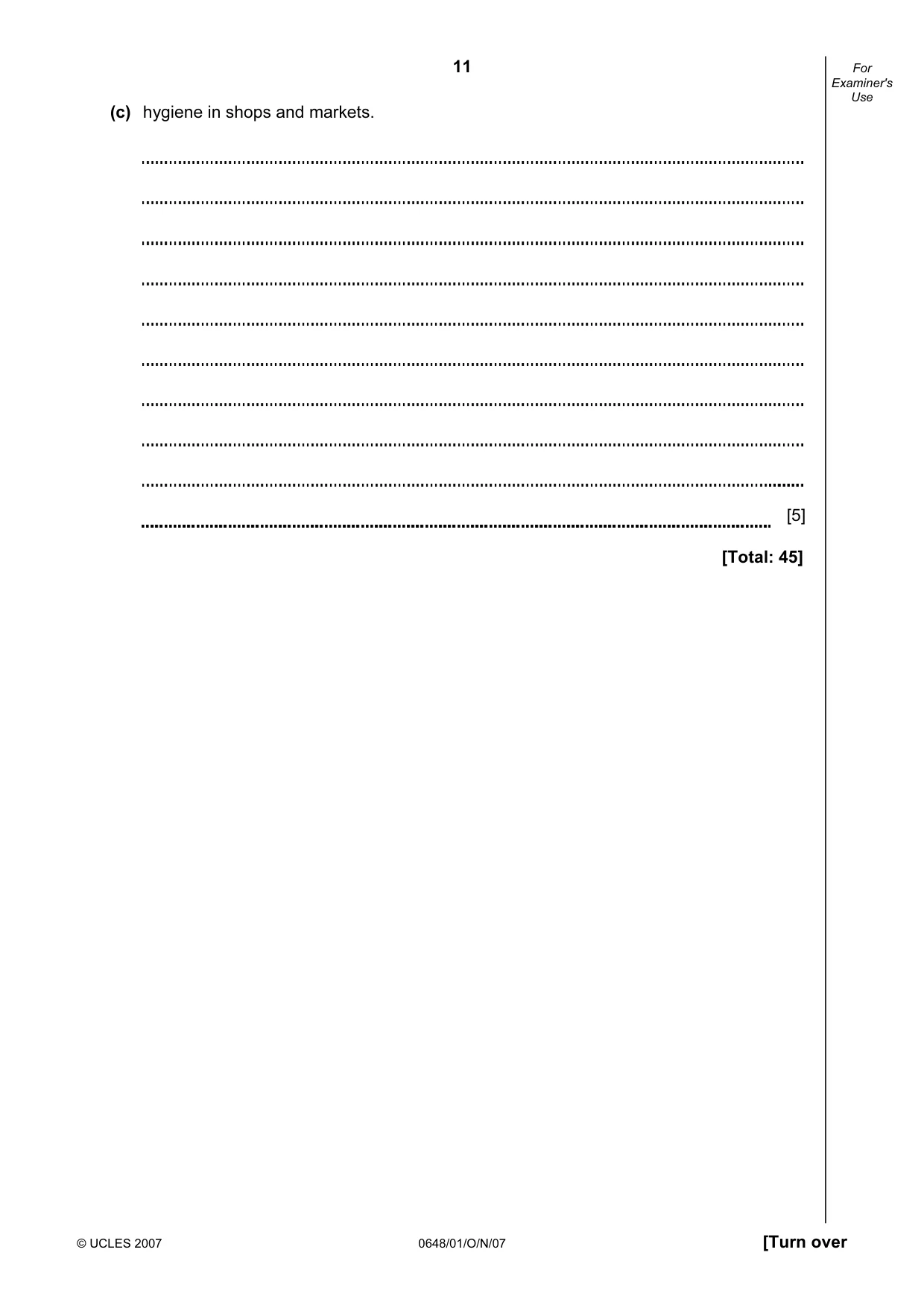
11 © UCLES 2007 0648/01/O/N/07 [Turn over For Examiner's Use (c) hygiene in shops and markets. [5] [Total: 45]
Question paper, page 12
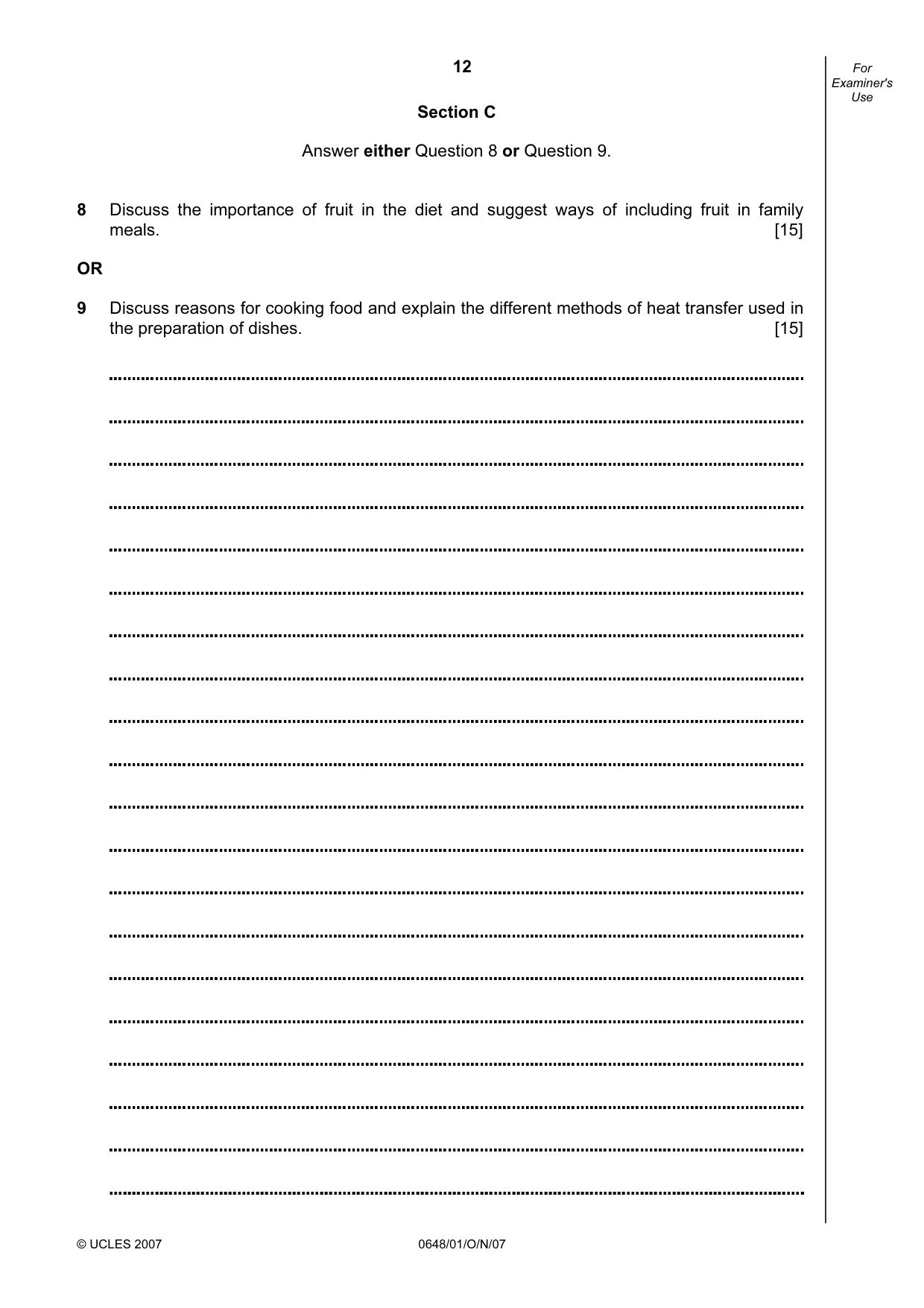
12 © UCLES 2007 0648/01/O/N/07 For Examiner's Use Section C Answer either Question 8 or Question 9. 8 Discuss the importance of fruit in the diet and suggest ways of including fruit in family meals. [15] OR 9 Discuss reasons for cooking food and explain the different methods of heat transfer used in the preparation of dishes. [15]
Question paper, page 14
14 © UCLES 2007 0648/01/O/N/07 For Examiner's Use [Total: 15] [Total for Paper: 100]
Question paper, page 16
16 Permission to reproduce items where third-party owned material protected by copyright is included has been sought and cleared where possible. Every reasonable effort has been made by the publisher (UCLES) to trace copyright holders, but if any items requiring clearance have unwittingly been included, the publisher will be pleased to make amends at the earliest possible opportunity. University of Cambridge International Examinations is part of the Cambridge Assessment Group. Cambridge Assessment is the brand name of University of Cambridge Local Examinations Syndicate (UCLES), which is itself a department of the University of Cambridge. 0648/01/O/N/07 BLANK PAGE
Mark scheme, page 1
UNIVERSITY OF CAMBRIDGE INTERNATIONAL EXAMINATIONS International General Certificate of Secondary Education MARK SCHEME for the October/November 2007 question paper 0648 FOOD AND NUTRITION 0648/01 Paper 1 (Theory), maximum raw mark 100 This mark scheme is published as an aid to teachers and candidates, to indicate the requirements of the examination. It shows the basis on which Examiners were instructed to award marks. It does not indicate the details of the discussions that took place at an Examiners’ meeting before marking began. All Examiners are instructed that alternative correct answers and unexpected approaches in candidates’ scripts must be given marks that fairly reflect the relevant knowledge and skills demonstrated. Mark schemes must be read in conjunction with the question papers and the report on the examination. • CIE will not enter into discussions or correspondence in connection with these mark schemes. CIE is publishing the mark schemes for the October/November 2007 question papers for most IGCSE, GCE Advanced Level and Advanced Subsidiary Level syllabuses and some Ordinary Level syllabuses. www.XtremePapers.com
Mark scheme, page 2
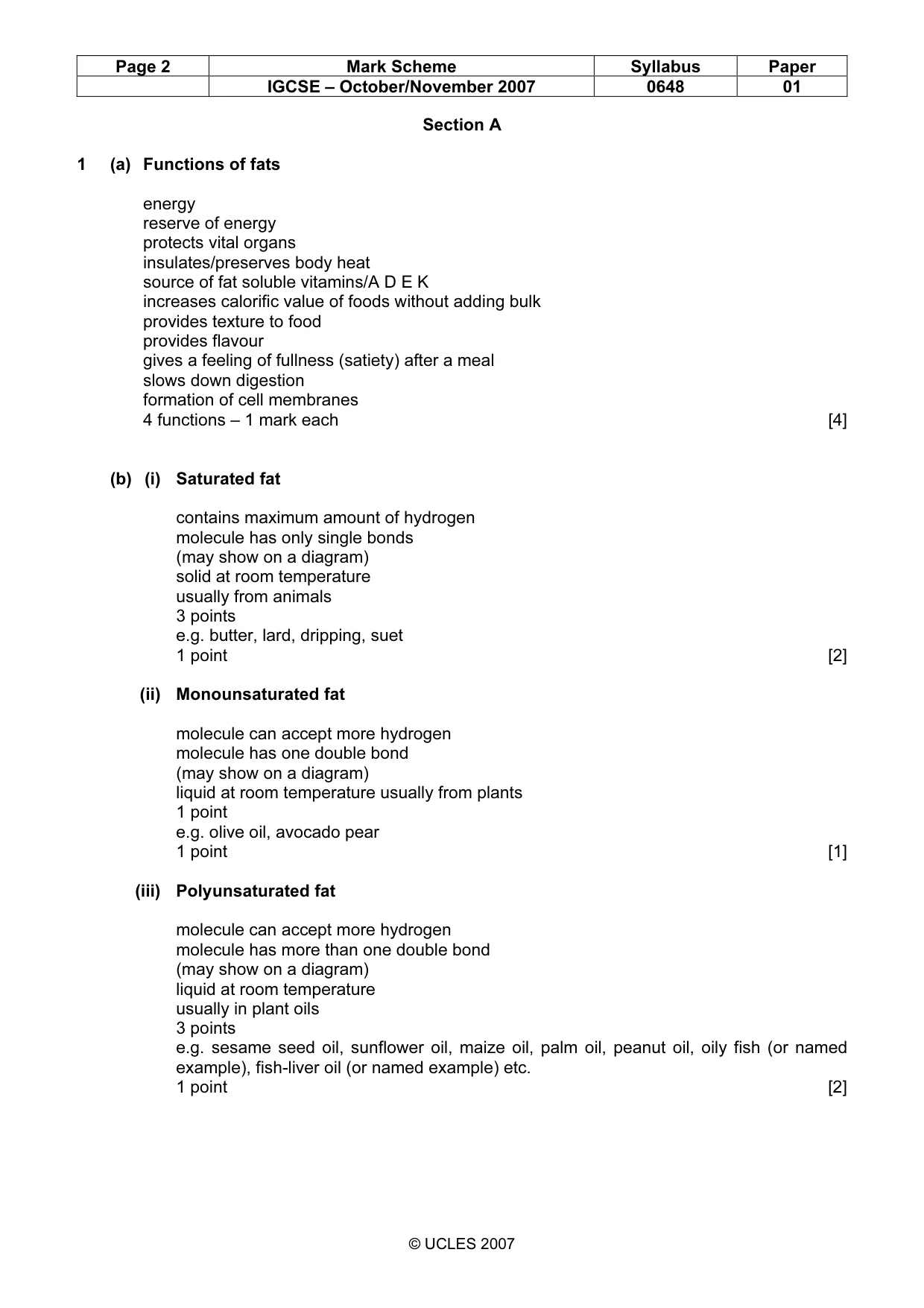
Page 2 Mark Scheme Syllabus Paper IGCSE – October/November 2007 0648 01 © UCLES 2007 Section A 1 (a) Functions of fats energy reserve of energy protects vital organs insulates/preserves body heat source of fat soluble vitamins/A D E K increases calorific value of foods without adding bulk provides texture to food provides flavour gives a feeling of fullness (satiety) after a meal slows down digestion formation of cell membranes 4 functions – 1 mark each [4] (b) (i) Saturated fat contains maximum amount of hydrogen molecule has only single bonds (may show on a diagram) solid at room temperature usually from animals 3 points e.g. butter, lard, dripping, suet 1 point [2] (ii) Monounsaturated fat molecule can accept more hydrogen molecule has one double bond (may show on a diagram) liquid at room temperature usually from plants 1 point e.g. olive oil, avocado pear 1 point [1] (iii) Polyunsaturated fat molecule can accept more hydrogen molecule has more than one double bond (may show on a diagram) liquid at room temperature usually in plant oils 3 points e.g. sesame seed oil, sunflower oil, maize oil, palm oil, peanut oil, oily fish (or named example), fish-liver oil (or named example) etc. 1 point [2]
Mark scheme, page 3
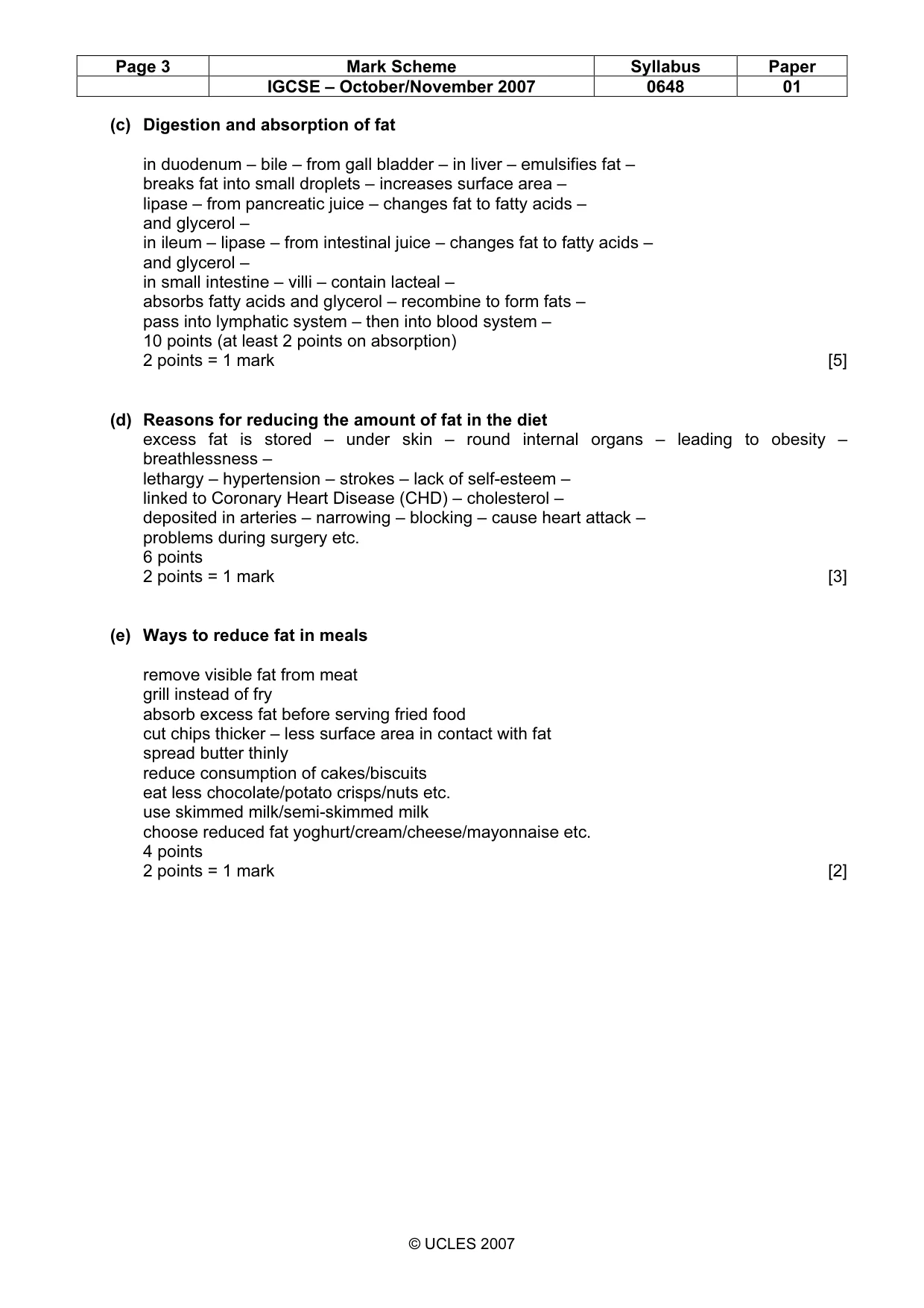
Page 3 Mark Scheme Syllabus Paper IGCSE – October/November 2007 0648 01 © UCLES 2007 (c) Digestion and absorption of fat in duodenum – bile – from gall bladder – in liver – emulsifies fat – breaks fat into small droplets – increases surface area – lipase – from pancreatic juice – changes fat to fatty acids – and glycerol – in ileum – lipase – from intestinal juice – changes fat to fatty acids – and glycerol – in small intestine – villi – contain lacteal – absorbs fatty acids and glycerol – recombine to form fats – pass into lymphatic system – then into blood system – 10 points (at least 2 points on absorption) 2 points = 1 mark [5] (d) Reasons for reducing the amount of fat in the diet excess fat is stored – under skin – round internal organs – leading to obesity – breathlessness – lethargy – hypertension – strokes – lack of self-esteem – linked to Coronary Heart Disease (CHD) – cholesterol – deposited in arteries – narrowing – blocking – cause heart attack – problems during surgery etc. 6 points 2 points = 1 mark [3] (e) Ways to reduce fat in meals remove visible fat from meat grill instead of fry absorb excess fat before serving fried food cut chips thicker – less surface area in contact with fat spread butter thinly reduce consumption of cakes/biscuits eat less chocolate/potato crisps/nuts etc. use skimmed milk/semi-skimmed milk choose reduced fat yoghurt/cream/cheese/mayonnaise etc. 4 points 2 points = 1 mark [2]
Mark scheme, page 4
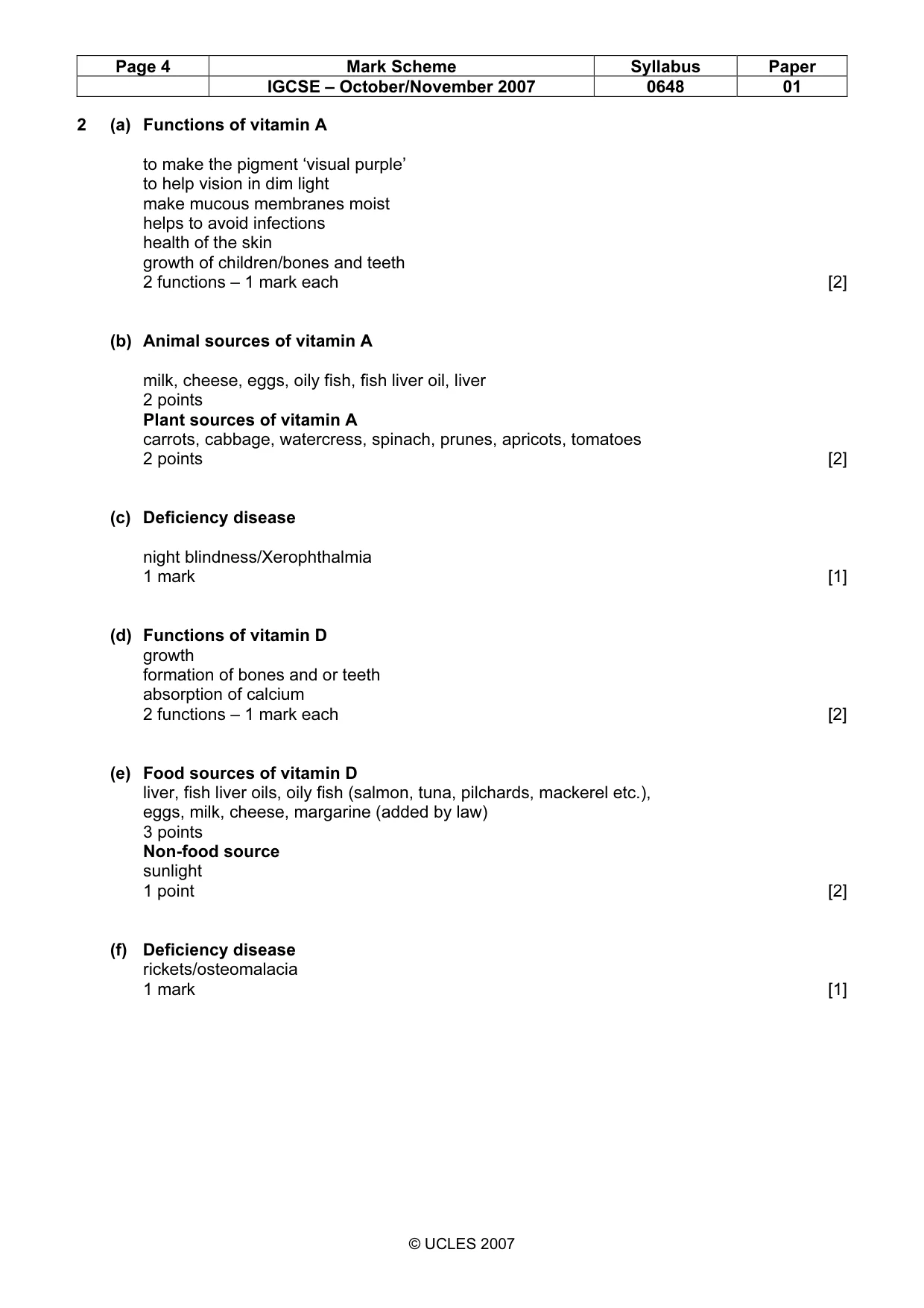
Page 4 Mark Scheme Syllabus Paper IGCSE – October/November 2007 0648 01 © UCLES 2007 2 (a) Functions of vitamin A to make the pigment ‘visual purple’ to help vision in dim light make mucous membranes moist helps to avoid infections health of the skin growth of children/bones and teeth 2 functions – 1 mark each [2] (b) Animal sources of vitamin A milk, cheese, eggs, oily fish, fish liver oil, liver 2 points Plant sources of vitamin A carrots, cabbage, watercress, spinach, prunes, apricots, tomatoes 2 points [2] (c) Deficiency disease night blindness/Xerophthalmia 1 mark [1] (d) Functions of vitamin D growth formation of bones and or teeth absorption of calcium 2 functions – 1 mark each [2] (e) Food sources of vitamin D liver, fish liver oils, oily fish (salmon, tuna, pilchards, mackerel etc.), eggs, milk, cheese, margarine (added by law) 3 points Non-food source sunlight 1 point [2] (f) Deficiency disease rickets/osteomalacia 1 mark [1]
Mark scheme, page 5
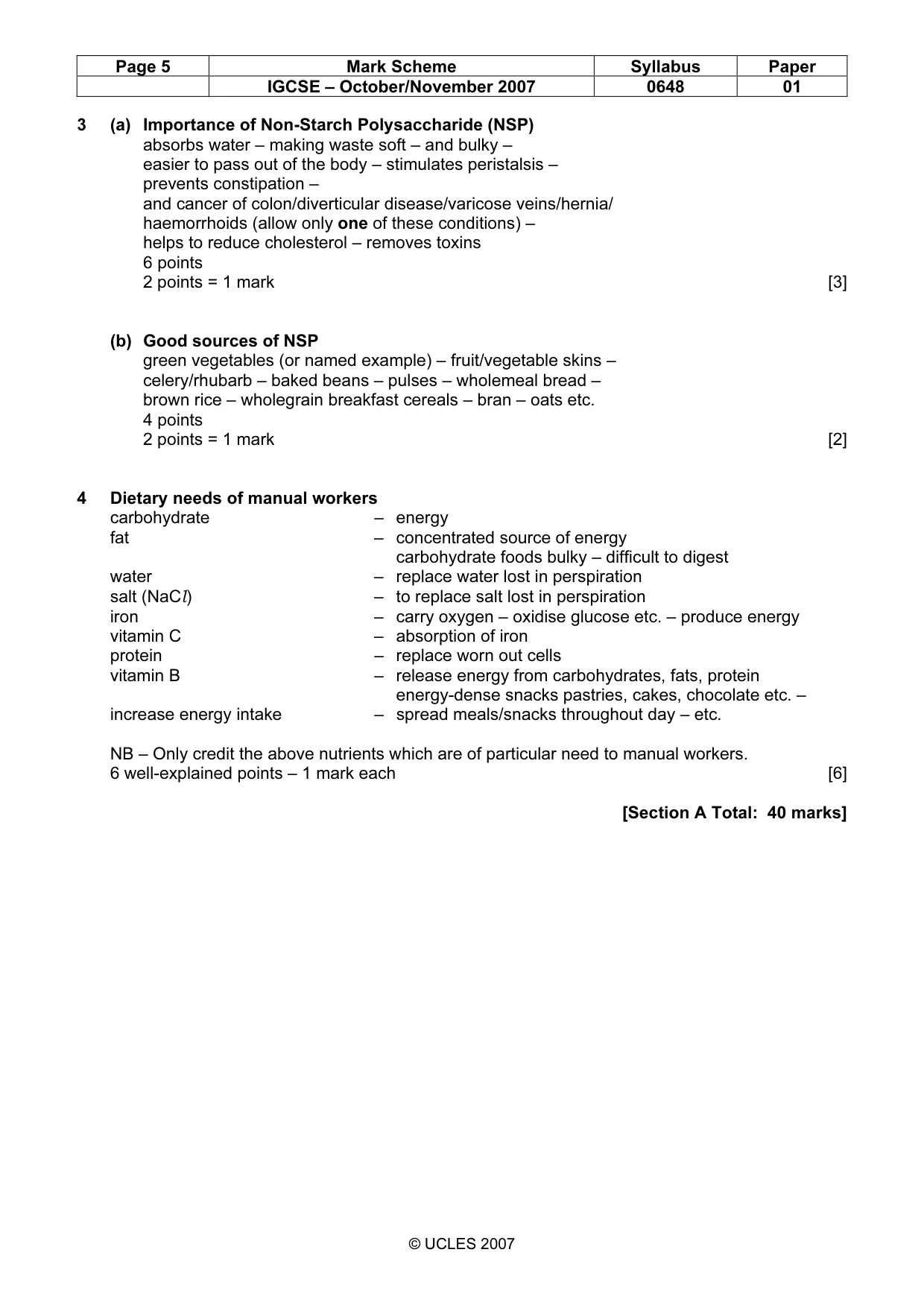
Page 5 Mark Scheme Syllabus Paper IGCSE – October/November 2007 0648 01 © UCLES 2007 3 (a) Importance of Non-Starch Polysaccharide (NSP) absorbs water – making waste soft – and bulky – easier to pass out of the body – stimulates peristalsis – prevents constipation – and cancer of colon/diverticular disease/varicose veins/hernia/ haemorrhoids (allow only one of these conditions) – helps to reduce cholesterol – removes toxins 6 points 2 points = 1 mark [3] (b) Good sources of NSP green vegetables (or named example) – fruit/vegetable skins – celery/rhubarb – baked beans – pulses – wholemeal bread – brown rice – wholegrain breakfast cereals – bran – oats etc. 4 points 2 points = 1 mark [2] 4 Dietary needs of manual workers carbohydrate – energy fat – concentrated source of energy carbohydrate foods bulky – difficult to digest water – replace water lost in perspiration salt (NaCl) – to replace salt lost in perspiration iron – carry oxygen – oxidise glucose etc. – produce energy vitamin C – absorption of iron protein – replace worn out cells vitamin B – release energy from carbohydrates, fats, protein energy-dense snacks pastries, cakes, chocolate etc. – increase energy intake – spread meals/snacks throughout day – etc. NB – Only credit the above nutrients which are of particular need to manual workers. 6 well-explained points – 1 mark each [6] [Section A Total: 40 marks]
Mark scheme, page 6
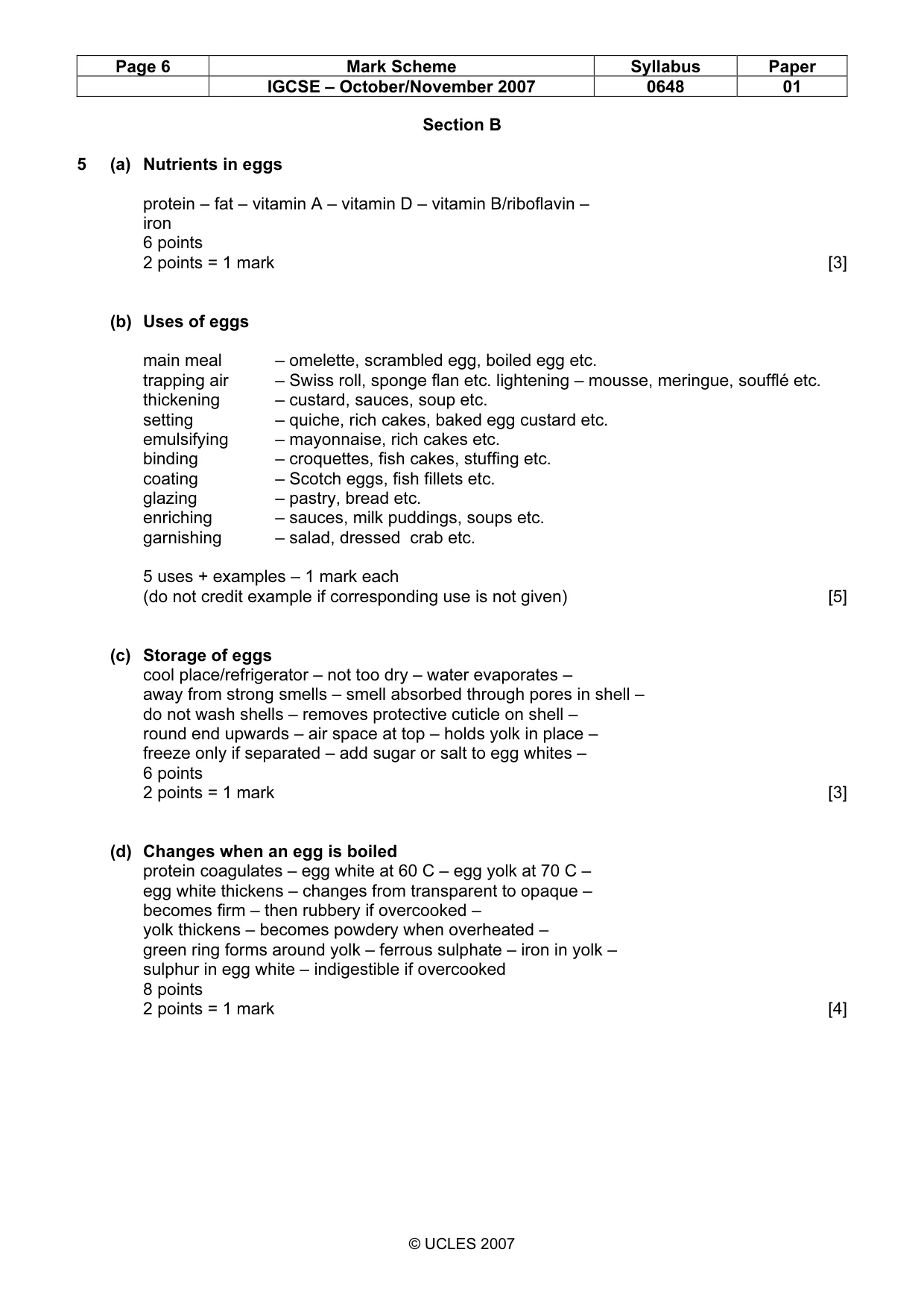
Page 6 Mark Scheme Syllabus Paper IGCSE – October/November 2007 0648 01 © UCLES 2007 Section B 5 (a) Nutrients in eggs protein – fat – vitamin A – vitamin D – vitamin B/riboflavin – iron 6 points 2 points = 1 mark [3] (b) Uses of eggs main meal – omelette, scrambled egg, boiled egg etc. trapping air – Swiss roll, sponge flan etc. lightening – mousse, meringue, soufflé etc. thickening – custard, sauces, soup etc. setting – quiche, rich cakes, baked egg custard etc. emulsifying – mayonnaise, rich cakes etc. binding – croquettes, fish cakes, stuffing etc. coating – Scotch eggs, fish fillets etc. glazing – pastry, bread etc. enriching – sauces, milk puddings, soups etc. garnishing – salad, dressed crab etc. 5 uses + examples – 1 mark each (do not credit example if corresponding use is not given) [5] (c) Storage of eggs cool place/refrigerator – not too dry – water evaporates – away from strong smells – smell absorbed through pores in shell – do not wash shells – removes protective cuticle on shell – round end upwards – air space at top – holds yolk in place – freeze only if separated – add sugar or salt to egg whites – 6 points 2 points = 1 mark [3] (d) Changes when an egg is boiled protein coagulates – egg white at 60 C – egg yolk at 70 C – egg white thickens – changes from transparent to opaque – becomes firm – then rubbery if overcooked – yolk thickens – becomes powdery when overheated – green ring forms around yolk – ferrous sulphate – iron in yolk – sulphur in egg white – indigestible if overcooked 8 points 2 points = 1 mark [4]
Mark scheme, page 7
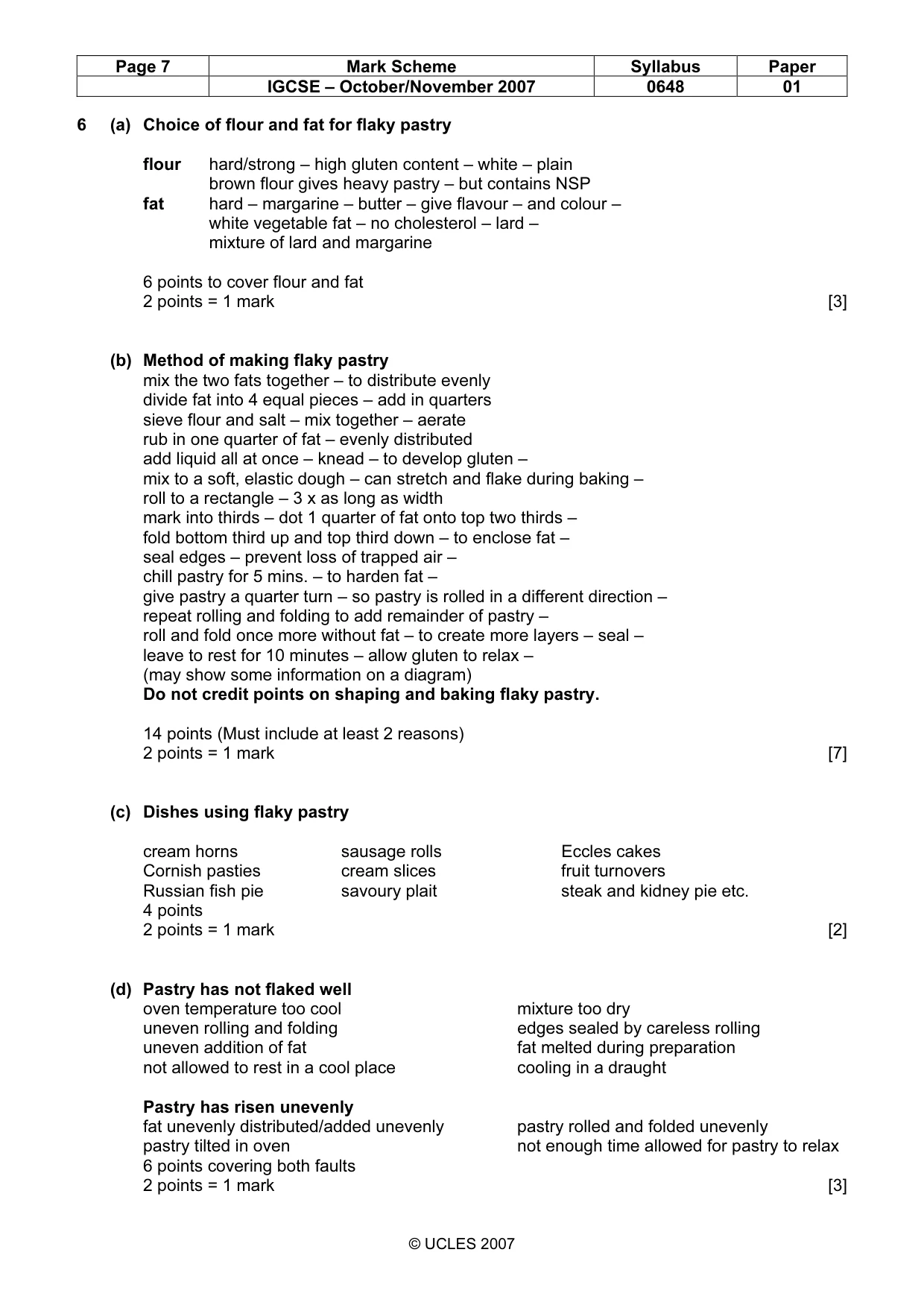
Page 7 Mark Scheme Syllabus Paper IGCSE – October/November 2007 0648 01 © UCLES 2007 6 (a) Choice of flour and fat for flaky pastry flour hard/strong – high gluten content – white – plain brown flour gives heavy pastry – but contains NSP fat hard – margarine – butter – give flavour – and colour – white vegetable fat – no cholesterol – lard – mixture of lard and margarine 6 points to cover flour and fat 2 points = 1 mark [3] (b) Method of making flaky pastry mix the two fats together – to distribute evenly divide fat into 4 equal pieces – add in quarters sieve flour and salt – mix together – aerate rub in one quarter of fat – evenly distributed add liquid all at once – knead – to develop gluten – mix to a soft, elastic dough – can stretch and flake during baking – roll to a rectangle – 3 x as long as width mark into thirds – dot 1 quarter of fat onto top two thirds – fold bottom third up and top third down – to enclose fat – seal edges – prevent loss of trapped air – chill pastry for 5 mins. – to harden fat – give pastry a quarter turn – so pastry is rolled in a different direction – repeat rolling and folding to add remainder of pastry – roll and fold once more without fat – to create more layers – seal – leave to rest for 10 minutes – allow gluten to relax – (may show some information on a diagram) Do not credit points on shaping and baking flaky pastry. 14 points (Must include at least 2 reasons) 2 points = 1 mark [7] (c) Dishes using flaky pastry cream horns sausage rolls Eccles cakes Cornish pasties cream slices fruit turnovers Russian fish pie savoury plait steak and kidney pie etc. 4 points 2 points = 1 mark [2] (d) Pastry has not flaked well oven temperature too cool mixture too dry uneven rolling and folding edges sealed by careless rolling uneven addition of fat fat melted during preparation not allowed to rest in a cool place cooling in a draught Pastry has risen unevenly fat unevenly distributed/added unevenly pastry rolled and folded unevenly pastry tilted in oven not enough time allowed for pastry to relax 6 points covering both faults 2 points = 1 mark [3]
Mark scheme, page 8
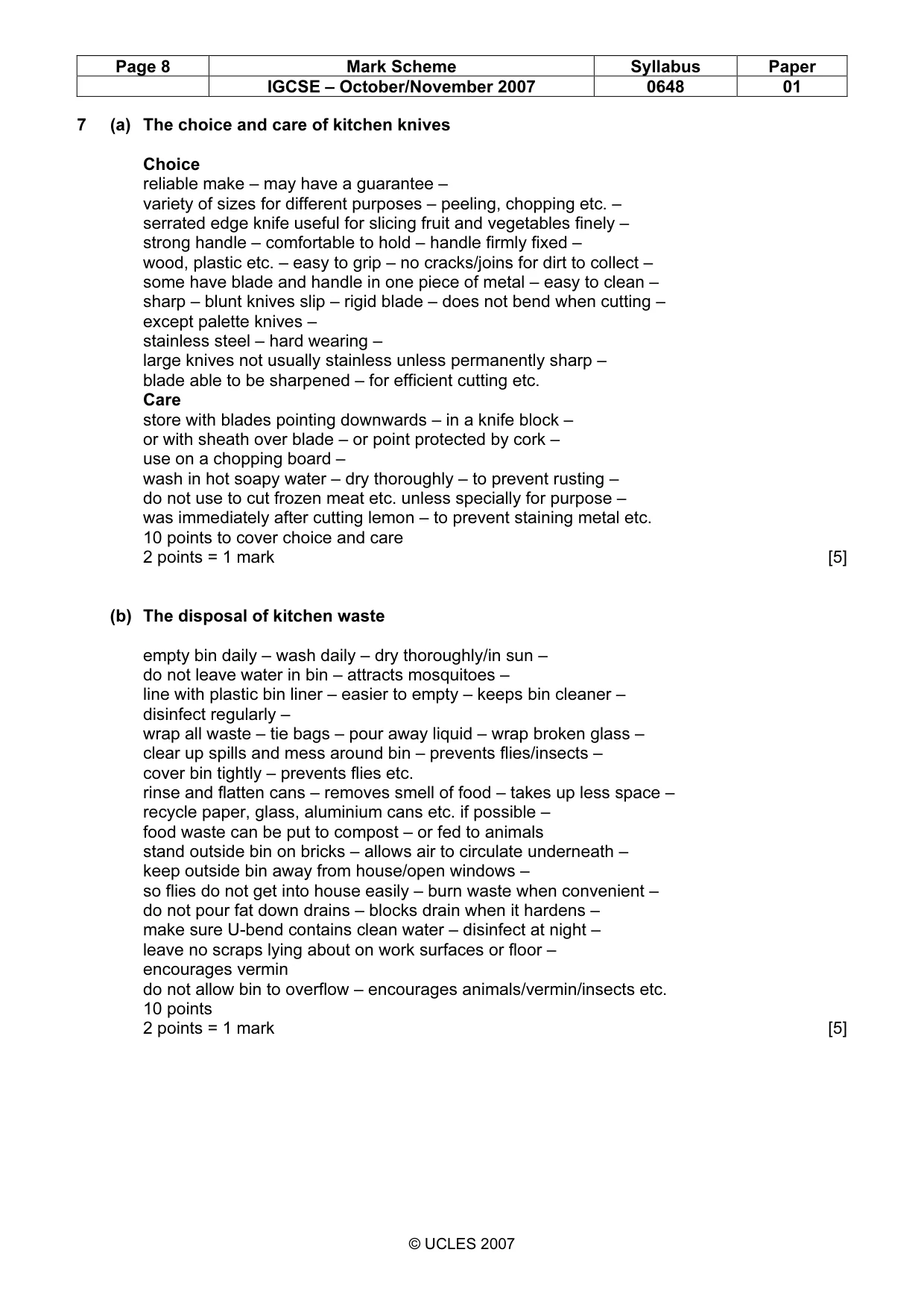
Page 8 Mark Scheme Syllabus Paper IGCSE – October/November 2007 0648 01 © UCLES 2007 7 (a) The choice and care of kitchen knives Choice reliable make – may have a guarantee – variety of sizes for different purposes – peeling, chopping etc. – serrated edge knife useful for slicing fruit and vegetables finely – strong handle – comfortable to hold – handle firmly fixed – wood, plastic etc. – easy to grip – no cracks/joins for dirt to collect – some have blade and handle in one piece of metal – easy to clean – sharp – blunt knives slip – rigid blade – does not bend when cutting – except palette knives – stainless steel – hard wearing – large knives not usually stainless unless permanently sharp – blade able to be sharpened – for efficient cutting etc. Care store with blades pointing downwards – in a knife block – or with sheath over blade – or point protected by cork – use on a chopping board – wash in hot soapy water – dry thoroughly – to prevent rusting – do not use to cut frozen meat etc. unless specially for purpose – was immediately after cutting lemon – to prevent staining metal etc. 10 points to cover choice and care 2 points = 1 mark [5] (b) The disposal of kitchen waste empty bin daily – wash daily – dry thoroughly/in sun – do not leave water in bin – attracts mosquitoes – line with plastic bin liner – easier to empty – keeps bin cleaner – disinfect regularly – wrap all waste – tie bags – pour away liquid – wrap broken glass – clear up spills and mess around bin – prevents flies/insects – cover bin tightly – prevents flies etc. rinse and flatten cans – removes smell of food – takes up less space – recycle paper, glass, aluminium cans etc. if possible – food waste can be put to compost – or fed to animals stand outside bin on bricks – allows air to circulate underneath – keep outside bin away from house/open windows – so flies do not get into house easily – burn waste when convenient – do not pour fat down drains – blocks drain when it hardens – make sure U-bend contains clean water – disinfect at night – leave no scraps lying about on work surfaces or floor – encourages vermin do not allow bin to overflow – encourages animals/vermin/insects etc. 10 points 2 points = 1 mark [5]
Mark scheme, page 9
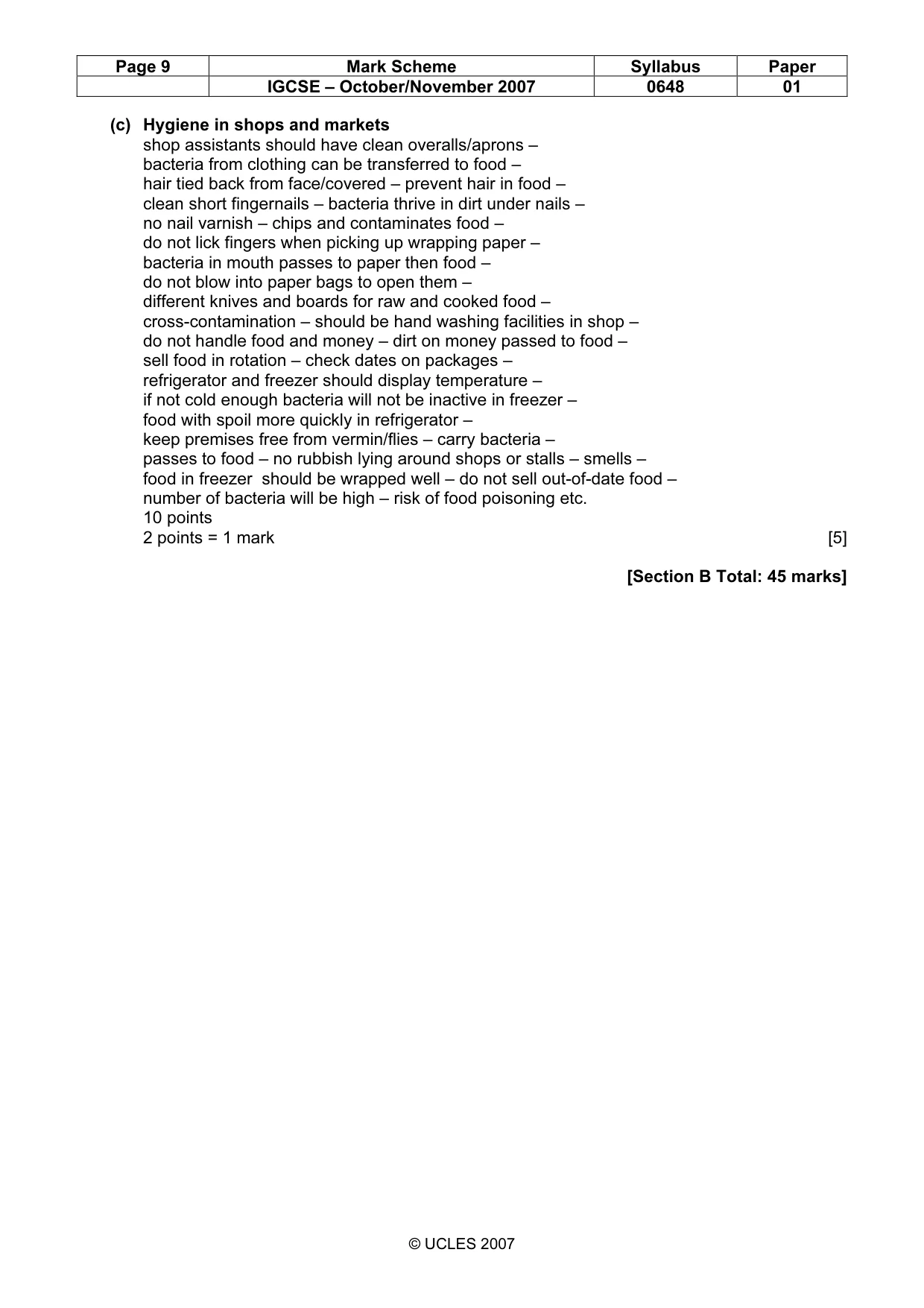
Page 9 Mark Scheme Syllabus Paper IGCSE – October/November 2007 0648 01 © UCLES 2007 (c) Hygiene in shops and markets shop assistants should have clean overalls/aprons – bacteria from clothing can be transferred to food – hair tied back from face/covered – prevent hair in food – clean short fingernails – bacteria thrive in dirt under nails – no nail varnish – chips and contaminates food – do not lick fingers when picking up wrapping paper – bacteria in mouth passes to paper then food – do not blow into paper bags to open them – different knives and boards for raw and cooked food – cross-contamination – should be hand washing facilities in shop – do not handle food and money – dirt on money passed to food – sell food in rotation – check dates on packages – refrigerator and freezer should display temperature – if not cold enough bacteria will not be inactive in freezer – food with spoil more quickly in refrigerator – keep premises free from vermin/flies – carry bacteria – passes to food – no rubbish lying around shops or stalls – smells – food in freezer should be wrapped well – do not sell out-of-date food – number of bacteria will be high – risk of food poisoning etc. 10 points 2 points = 1 mark [5] [Section B Total: 45 marks]
Mark scheme, page 10
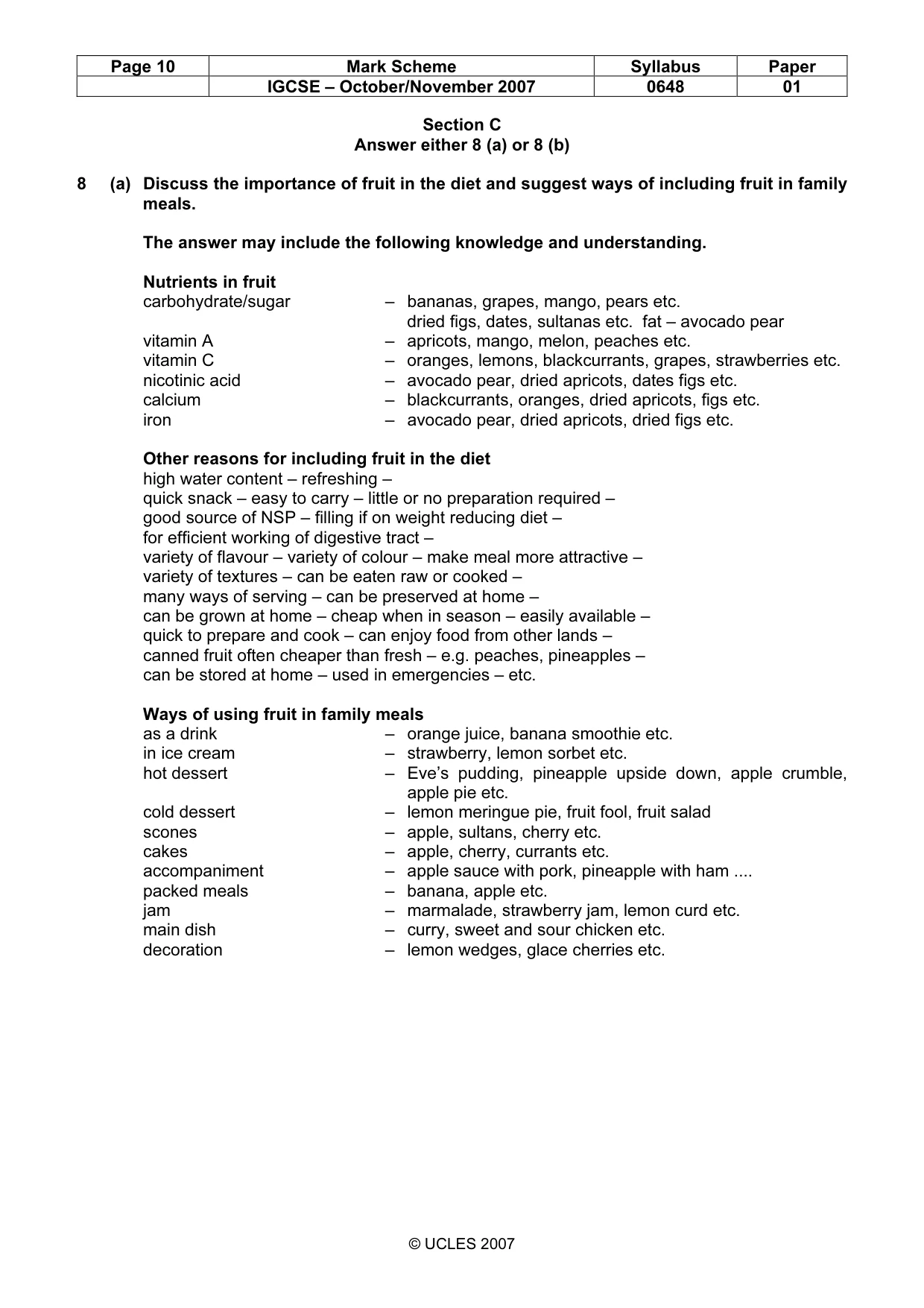
Page 10 Mark Scheme Syllabus Paper IGCSE – October/November 2007 0648 01 © UCLES 2007 Section C Answer either 8 (a) or 8 (b) 8 (a) Discuss the importance of fruit in the diet and suggest ways of including fruit in family meals. The answer may include the following knowledge and understanding. Nutrients in fruit carbohydrate/sugar – bananas, grapes, mango, pears etc. dried figs, dates, sultanas etc. fat – avocado pear vitamin A – apricots, mango, melon, peaches etc. vitamin C – oranges, lemons, blackcurrants, grapes, strawberries etc. nicotinic acid – avocado pear, dried apricots, dates figs etc. calcium – blackcurrants, oranges, dried apricots, figs etc. iron – avocado pear, dried apricots, dried figs etc. Other reasons for including fruit in the diet high water content – refreshing – quick snack – easy to carry – little or no preparation required – good source of NSP – filling if on weight reducing diet – for efficient working of digestive tract – variety of flavour – variety of colour – make meal more attractive – variety of textures – can be eaten raw or cooked – many ways of serving – can be preserved at home – can be grown at home – cheap when in season – easily available – quick to prepare and cook – can enjoy food from other lands – canned fruit often cheaper than fresh – e.g. peaches, pineapples – can be stored at home – used in emergencies – etc. Ways of using fruit in family meals as a drink – orange juice, banana smoothie etc. in ice cream – strawberry, lemon sorbet etc. hot dessert – Eve’s pudding, pineapple upside down, apple crumble, apple pie etc. cold dessert – lemon meringue pie, fruit fool, fruit salad scones – apple, sultans, cherry etc. cakes – apple, cherry, currants etc. accompaniment – apple sauce with pork, pineapple with ham … packed meals – banana, apple etc. jam – marmalade, strawberry jam, lemon curd etc. main dish – curry, sweet and sour chicken etc. decoration – lemon wedges, glace cherries etc.
Mark scheme, page 11
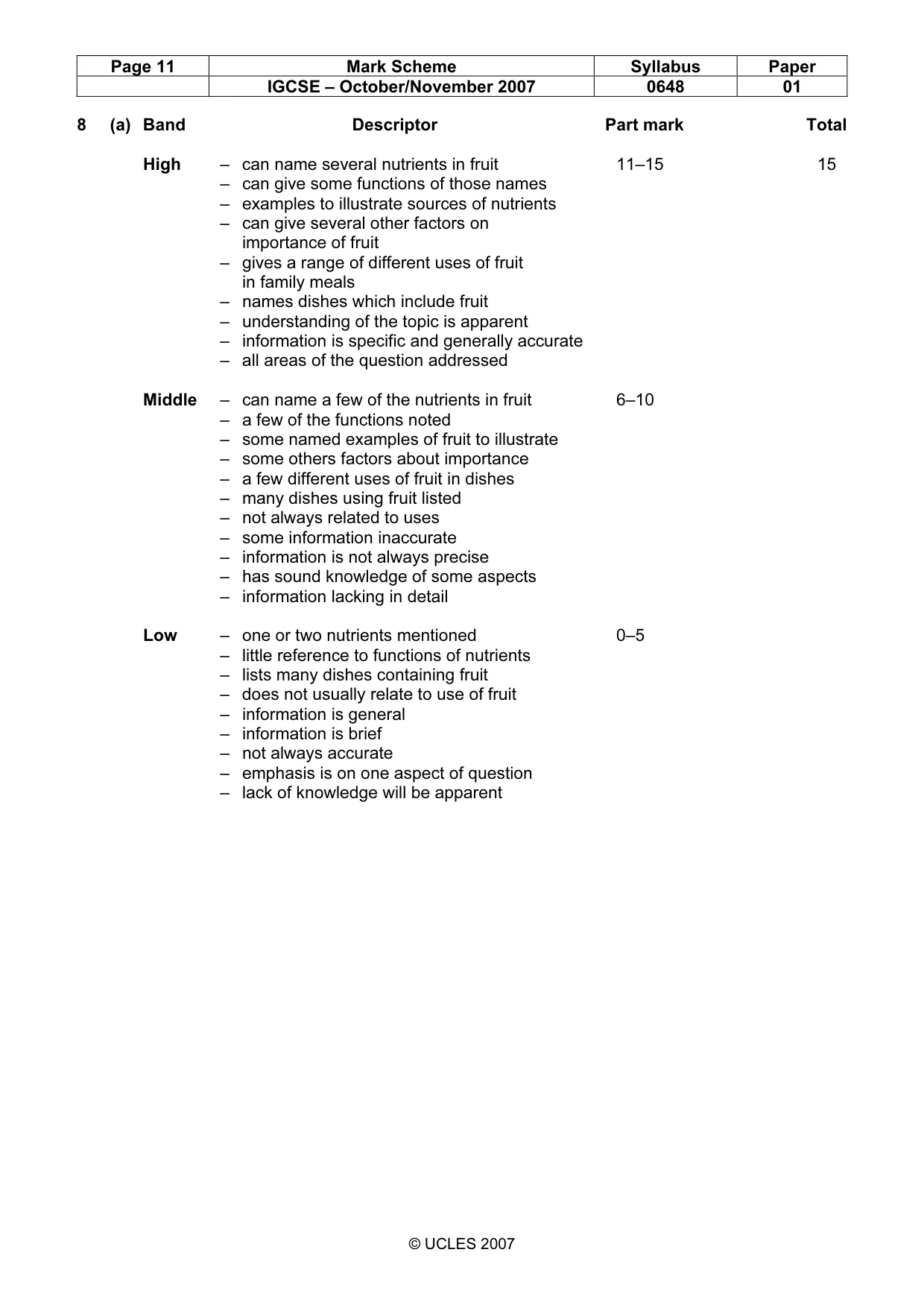
Page 11 Mark Scheme Syllabus Paper IGCSE – October/November 2007 0648 01 © UCLES 2007 8 (a) Band Descriptor Part mark Total High – can name several nutrients in fruit 11–15 15 – can give some functions of those names – examples to illustrate sources of nutrients – can give several other factors on importance of fruit – gives a range of different uses of fruit in family meals – names dishes which include fruit – understanding of the topic is apparent – information is specific and generally accurate – all areas of the question addressed Middle – can name a few of the nutrients in fruit 6–10 – a few of the functions noted – some named examples of fruit to illustrate – some others factors about importance – a few different uses of fruit in dishes – many dishes using fruit listed – not always related to uses – some information inaccurate – information is not always precise – has sound knowledge of some aspects – information lacking in detail Low – one or two nutrients mentioned 0–5 – little reference to functions of nutrients – lists many dishes containing fruit – does not usually relate to use of fruit – information is general – information is brief – not always accurate – emphasis is on one aspect of question – lack of knowledge will be apparent
Mark scheme, page 12
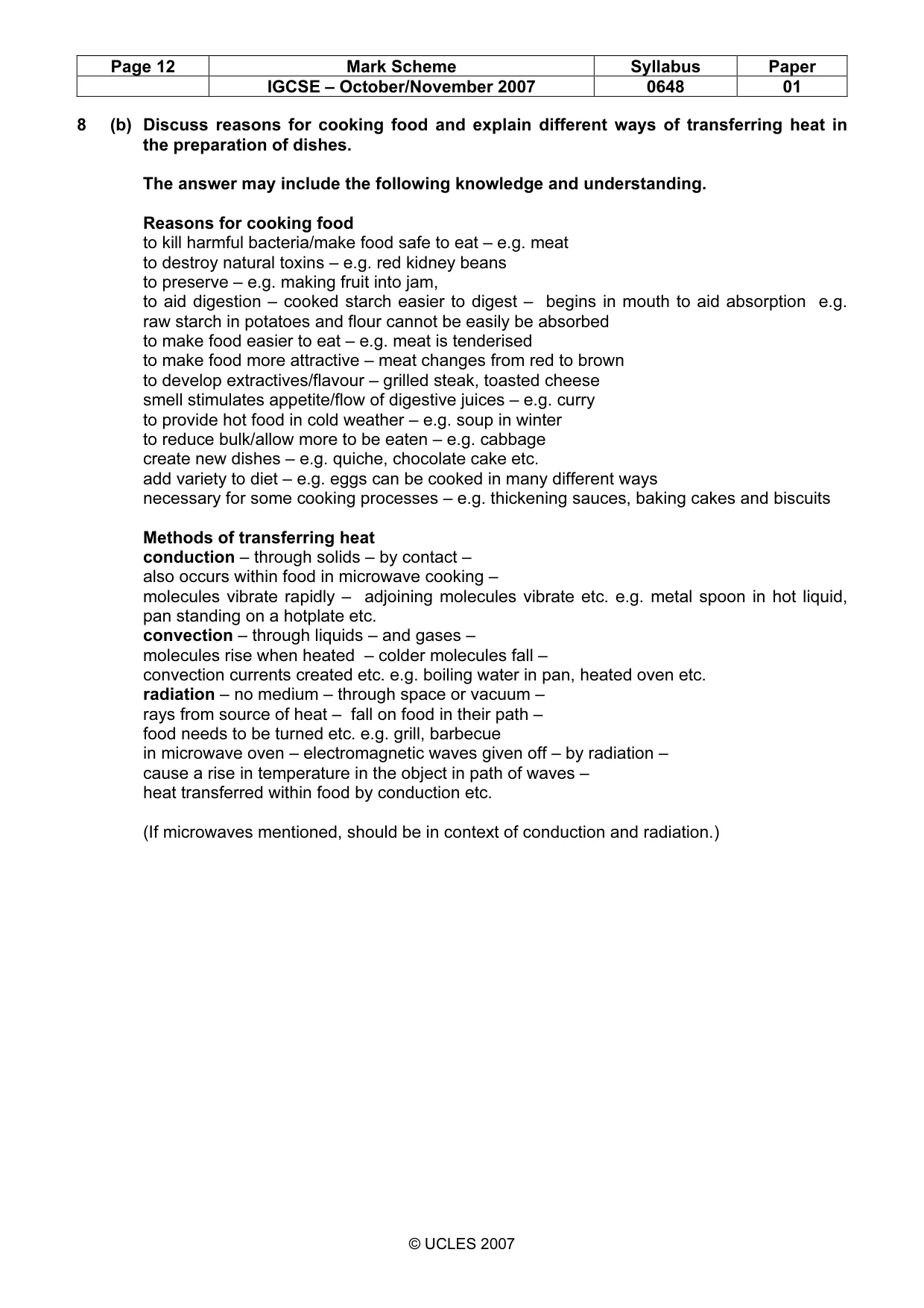
Page 12 Mark Scheme Syllabus Paper IGCSE – October/November 2007 0648 01 © UCLES 2007 8 (b) Discuss reasons for cooking food and explain different ways of transferring heat in the preparation of dishes. The answer may include the following knowledge and understanding. Reasons for cooking food to kill harmful bacteria/make food safe to eat – e.g. meat to destroy natural toxins – e.g. red kidney beans to preserve – e.g. making fruit into jam, to aid digestion – cooked starch easier to digest – begins in mouth to aid absorption e.g. raw starch in potatoes and flour cannot be easily be absorbed to make food easier to eat – e.g. meat is tenderised to make food more attractive – meat changes from red to brown to develop extractives/flavour – grilled steak, toasted cheese smell stimulates appetite/flow of digestive juices – e.g. curry to provide hot food in cold weather – e.g. soup in winter to reduce bulk/allow more to be eaten – e.g. cabbage create new dishes – e.g. quiche, chocolate cake etc. add variety to diet – e.g. eggs can be cooked in many different ways necessary for some cooking processes – e.g. thickening sauces, baking cakes and biscuits Methods of transferring heat conduction – through solids – by contact – also occurs within food in microwave cooking – molecules vibrate rapidly – adjoining molecules vibrate etc. e.g. metal spoon in hot liquid, pan standing on a hotplate etc. convection – through liquids – and gases – molecules rise when heated – colder molecules fall – convection currents created etc. e.g. boiling water in pan, heated oven etc. radiation – no medium – through space or vacuum – rays from source of heat – fall on food in their path – food needs to be turned etc. e.g. grill, barbecue in microwave oven – electromagnetic waves given off – by radiation – cause a rise in temperature in the object in path of waves – heat transferred within food by conduction etc. (If microwaves mentioned, should be in context of conduction and radiation.)
Mark scheme, page 13
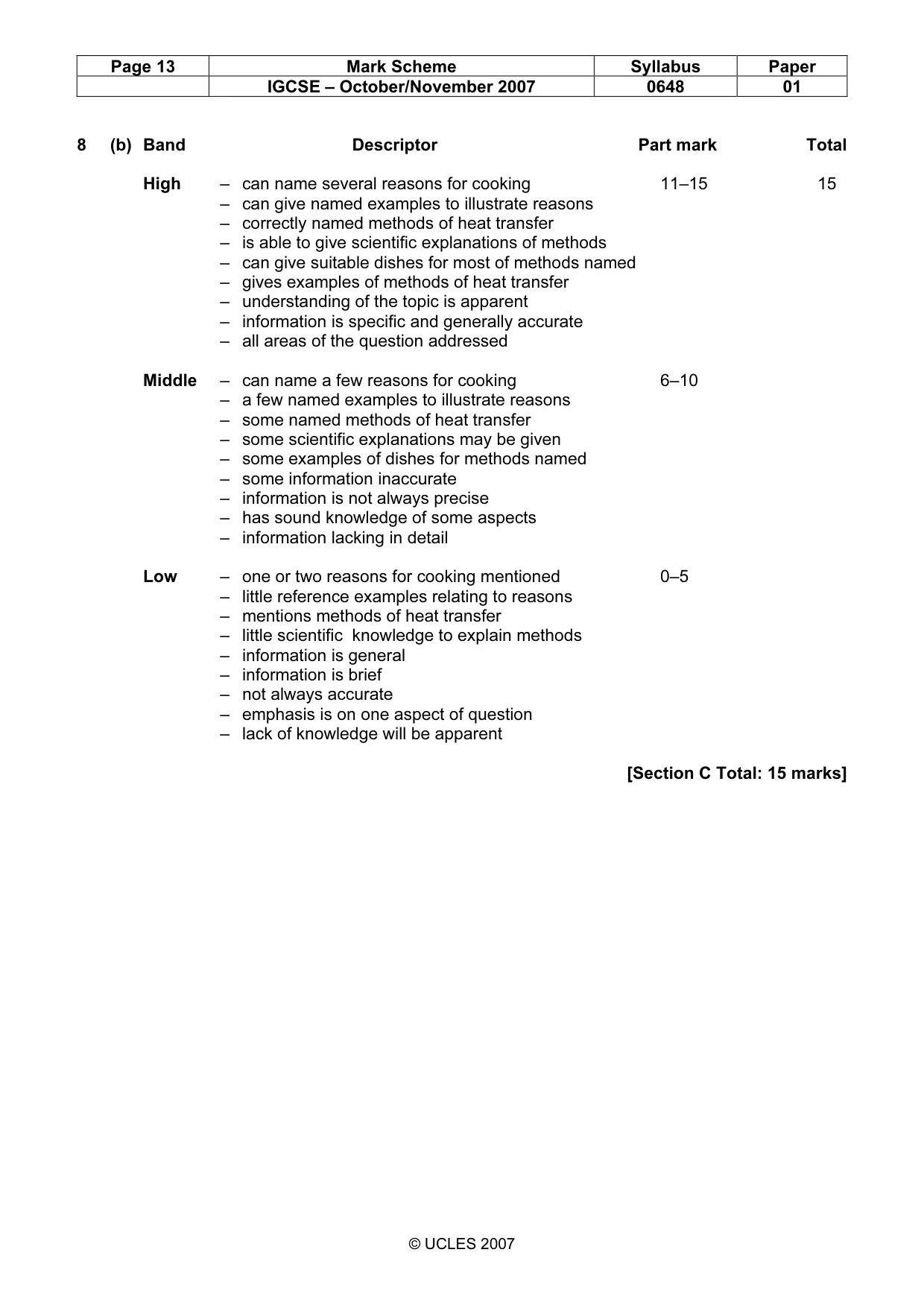
Page 13 Mark Scheme Syllabus Paper IGCSE – October/November 2007 0648 01 © UCLES 2007 8 (b) Band Descriptor Part mark Total High – can name several reasons for cooking 11–15 15 – can give named examples to illustrate reasons – correctly named methods of heat transfer – is able to give scientific explanations of methods – can give suitable dishes for most of methods named – gives examples of methods of heat transfer – understanding of the topic is apparent – information is specific and generally accurate – all areas of the question addressed Middle – can name a few reasons for cooking 6–10 – a few named examples to illustrate reasons – some named methods of heat transfer – some scientific explanations may be given – some examples of dishes for methods named – some information inaccurate – information is not always precise – has sound knowledge of some aspects – information lacking in detail Low – one or two reasons for cooking mentioned 0–5 – little reference examples relating to reasons – mentions methods of heat transfer – little scientific knowledge to explain methods – information is general – information is brief – not always accurate – emphasis is on one aspect of question – lack of knowledge will be apparent [Section C Total: 15 marks]
What you needed in this session
Cambridge’s own grade thresholds for 2007 Oct/Nov, Paper 1 · Variant 1. A higher threshold means an easier paper — the bar moves with how the cohort did.