Cambridge IGCSE Food and Nutrition 0648 — 2006 Oct/Nov Paper 1 · Variant 1
0648/11/O/N/06 · 100 marks · ≈113 min
The question paper and its mark scheme, free to read here and free to download. This is Cambridge’s own paper, exactly as it was sat.
Question paper16 pages

Mark scheme10 pages
Answers below. Sit the paper first if you are practising.
Paper as text
Question paper, page 1
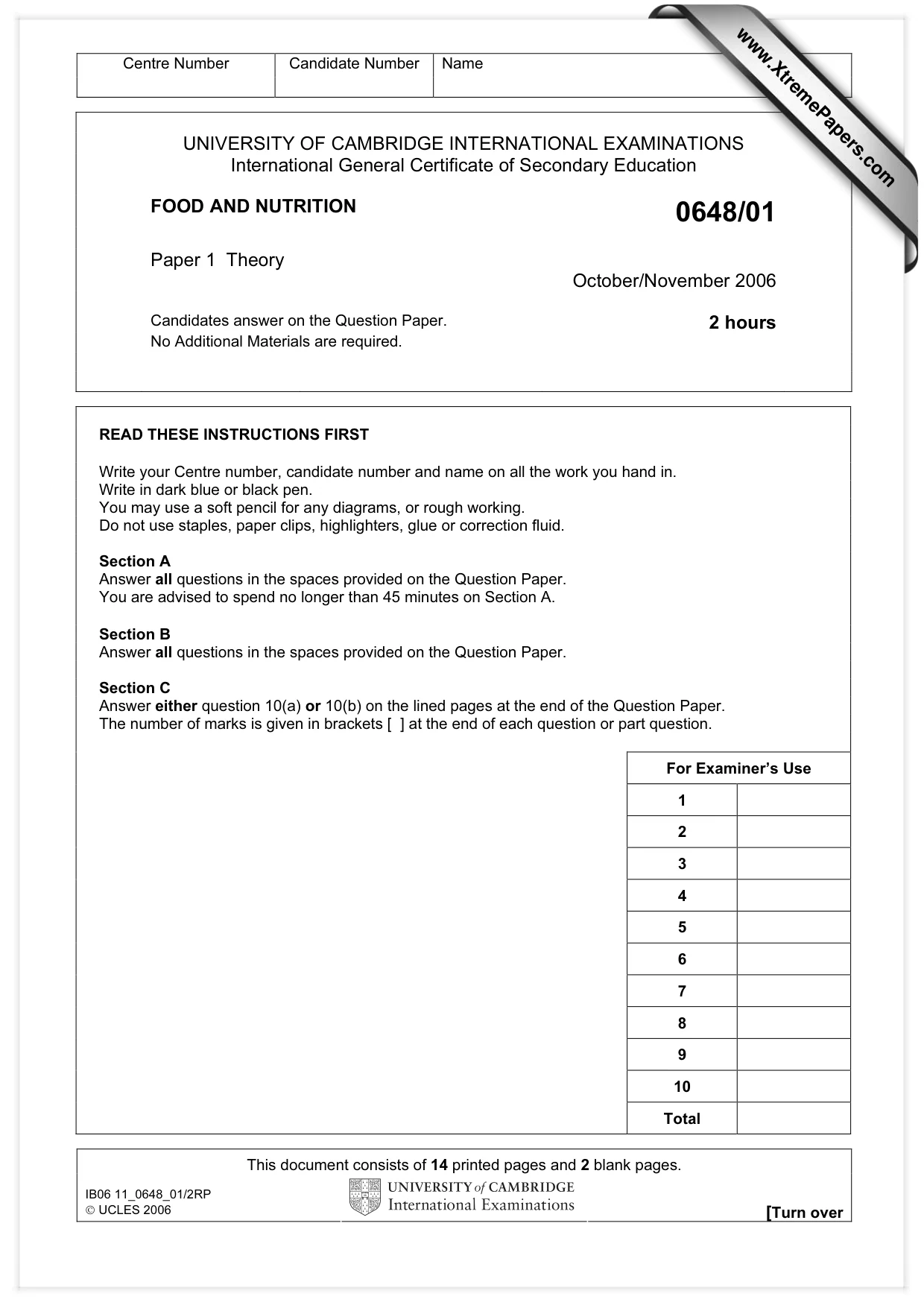
Centre Number Candidate Number Name UNIVERSITY OF CAMBRIDGE INTERNATIONAL EXAMINATIONS International General Certificate of Secondary Education FOOD AND NUTRITION 0648/01 Paper 1 Theory October/November 2006 Candidates answer on the Question Paper. 2 hours No Additional Materials are required. READ THESE INSTRUCTIONS FIRST Write your Centre number, candidate number and name on all the work you hand in. Write in dark blue or black pen. You may use a soft pencil for any diagrams, or rough working. Do not use staples, paper clips, highlighters, glue or correction fluid. Section A Answer all questions in the spaces provided on the Question Paper. You are advised to spend no longer than 45 minutes on Section A. Section B Answer all questions in the spaces provided on the Question Paper. Section C Answer either question 10(a) or 10(b) on the lined pages at the end of the Question Paper. The number of marks is given in brackets [ ] at the end of each question or part question. For Examiner’s Use 1 2 3 4 5 6 7 8 9 10 Total This document consists of 14 printed pages and 2 blank pages. IB06 11_0648_01/2RP UCLES 2006 [Turn over www.XtremePapers.com
Question paper, page 2
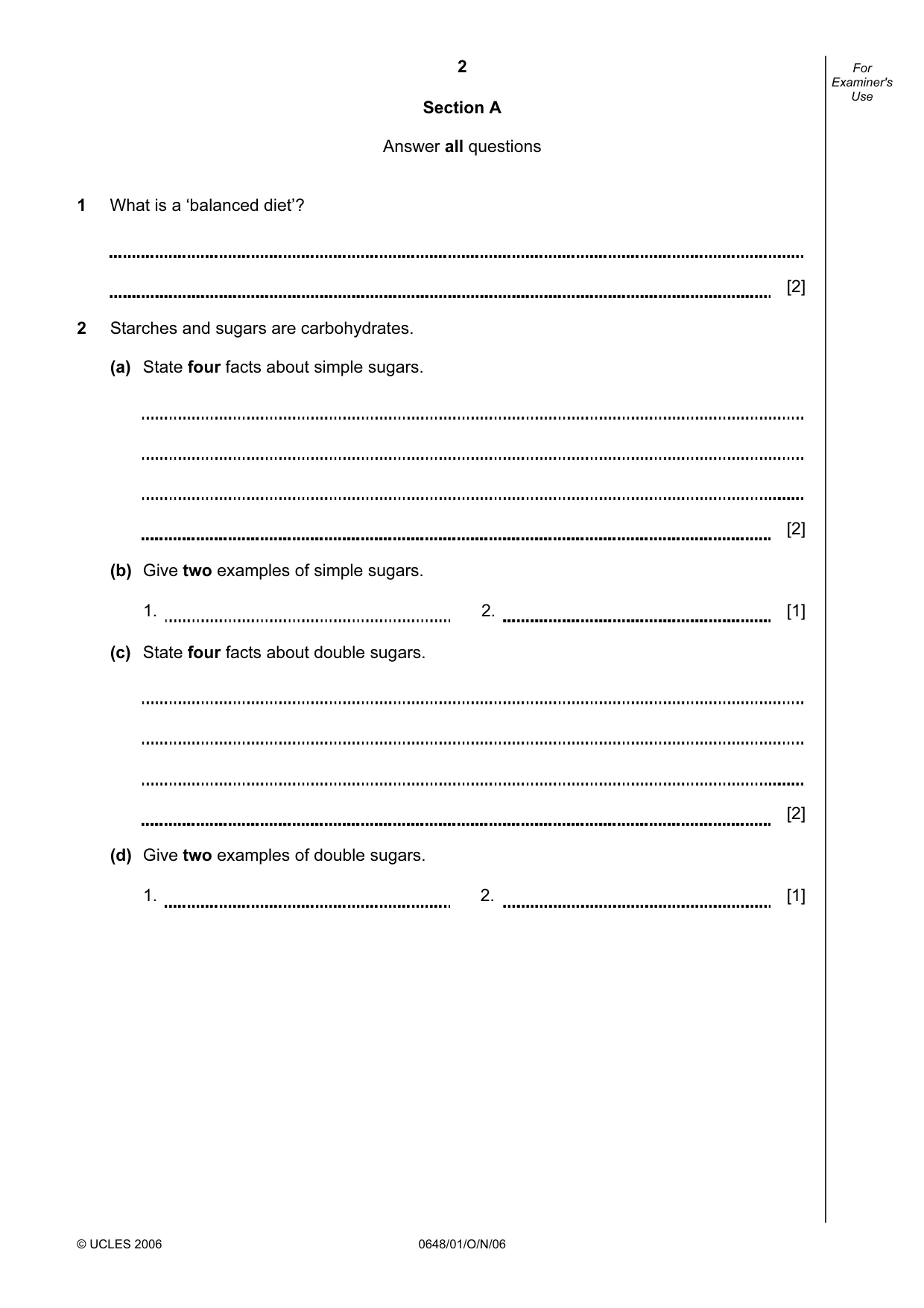
2 © UCLES 2006 0648/01/O/N/06 For Examiner's Use Section A Answer all questions 1 What is a ‘balanced diet’? [2] 2 Starches and sugars are carbohydrates. (a) State four facts about simple sugars. [2] (b) Give two examples of simple sugars. 1. 2. [1] (c) State four facts about double sugars. [2] (d) Give two examples of double sugars. 1. 2. [1]
Question paper, page 3
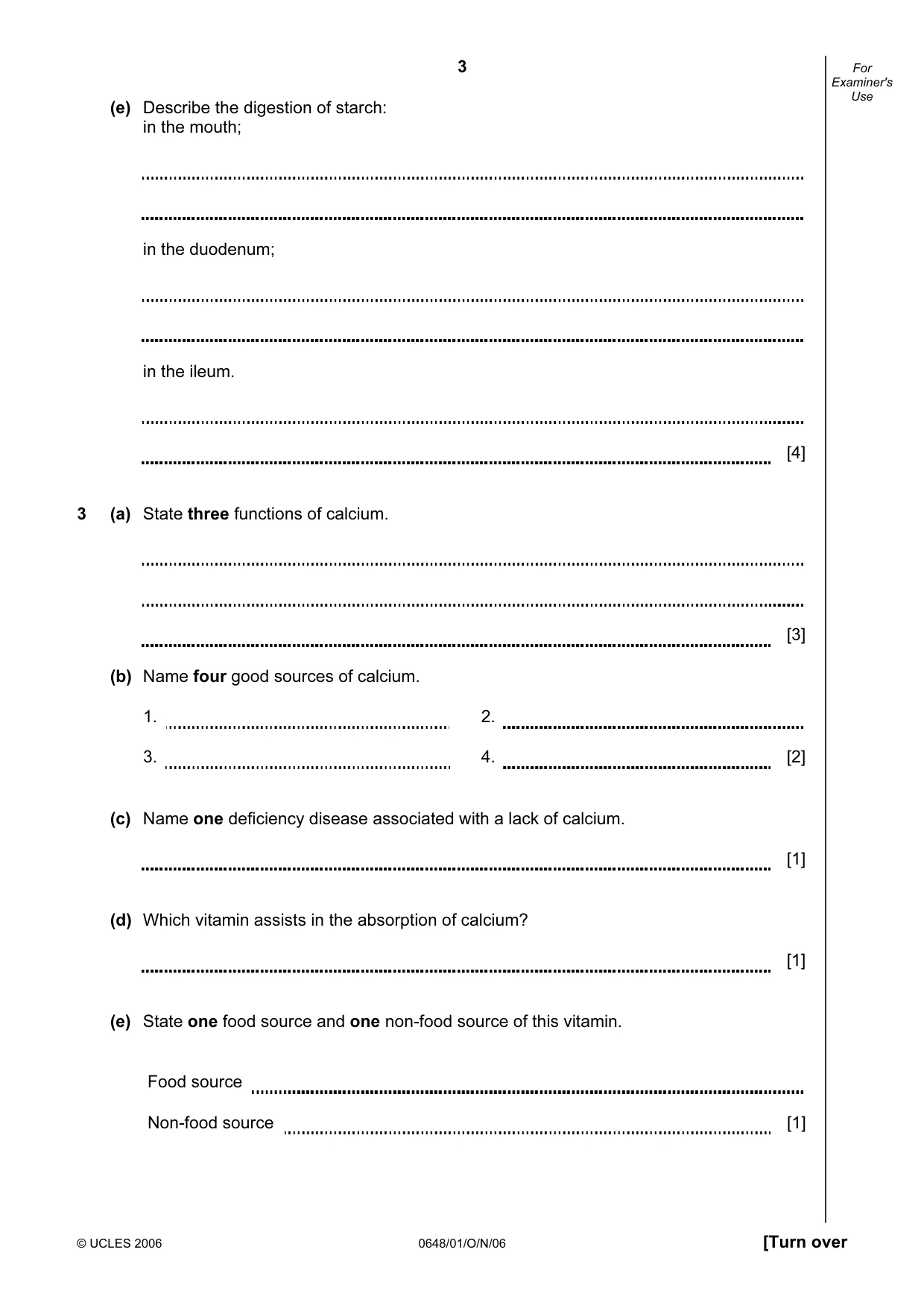
3 © UCLES 2006 0648/01/O/N/06 [Turn over For Examiner's Use (e) Describe the digestion of starch: in the mouth; in the duodenum; in the ileum. [4] 3 (a) State three functions of calcium. [3] (b) Name four good sources of calcium. 1. 2. 3. 4. [2] (c) Name one deficiency disease associated with a lack of calcium. [1] (d) Which vitamin assists in the absorption of calcium? [1] (e) State one food source and one non-food source of this vitamin. Food source Non-food source [1]
Question paper, page 4
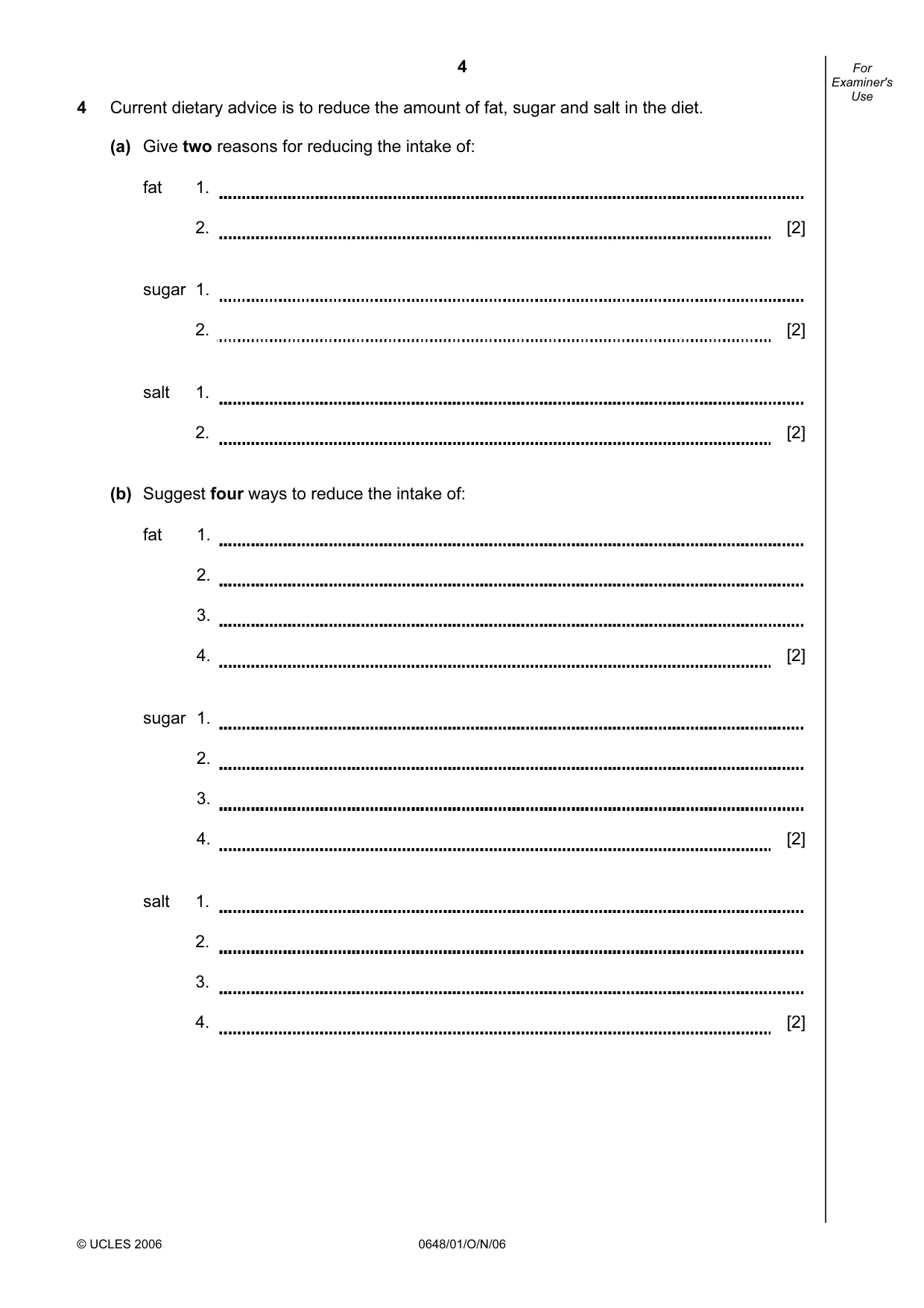
4 © UCLES 2006 0648/01/O/N/06 For Examiner's Use 4 Current dietary advice is to reduce the amount of fat, sugar and salt in the diet. (a) Give two reasons for reducing the intake of: fat 1. 2. [2] sugar 1. 2. [2] salt 1. 2. [2] (b) Suggest four ways to reduce the intake of: fat 1. 2. 3. 4. [2] sugar 1. 2. 3. 4. [2] salt 1. 2. 3. 4. [2]
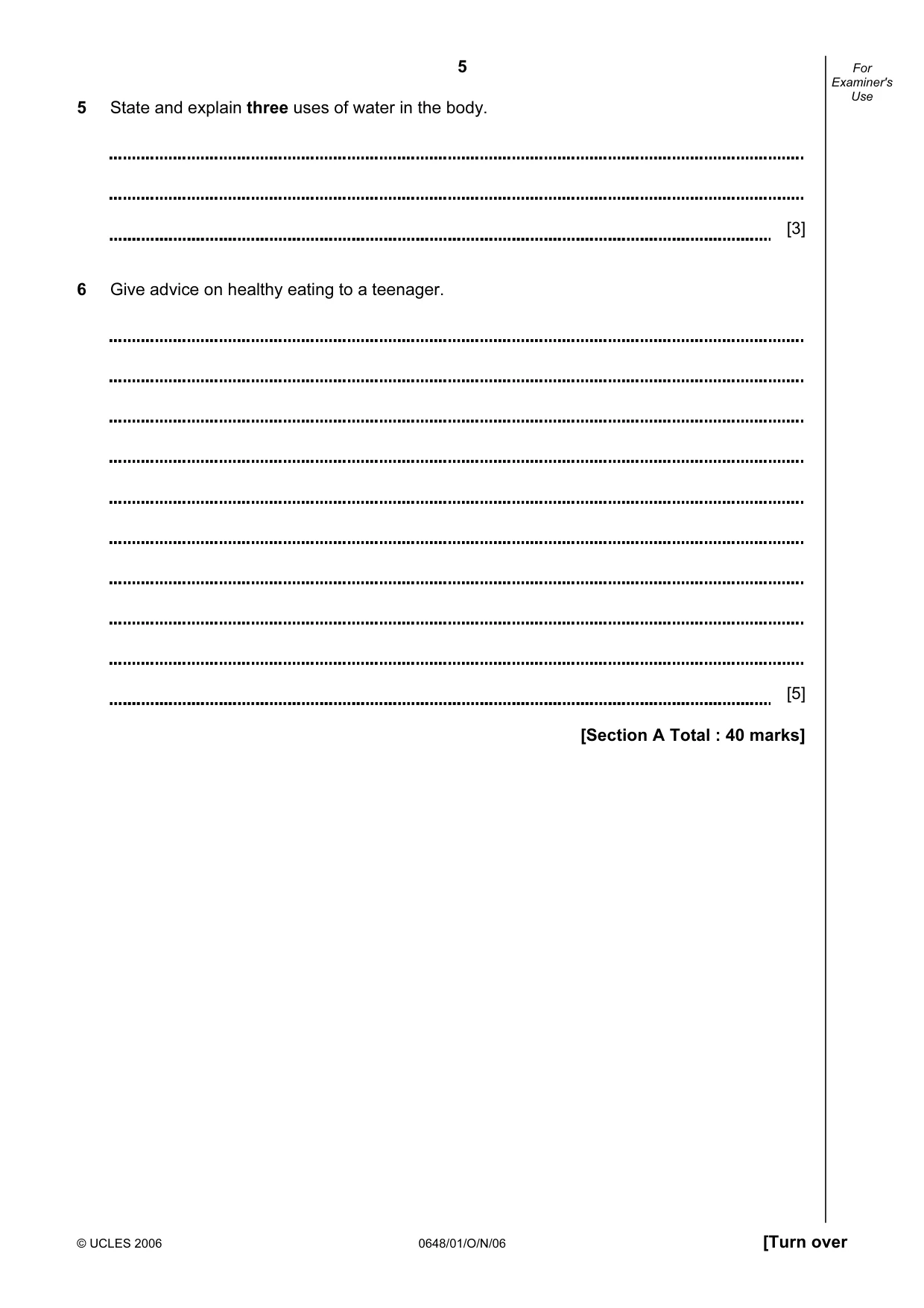
Question paper, page 5
5 © UCLES 2006 0648/01/O/N/06 [Turn over For Examiner's Use 5 State and explain three uses of water in the body. [3] 6 Give advice on healthy eating to a teenager. [5] [Section A Total : 40 marks]
Question paper, page 6
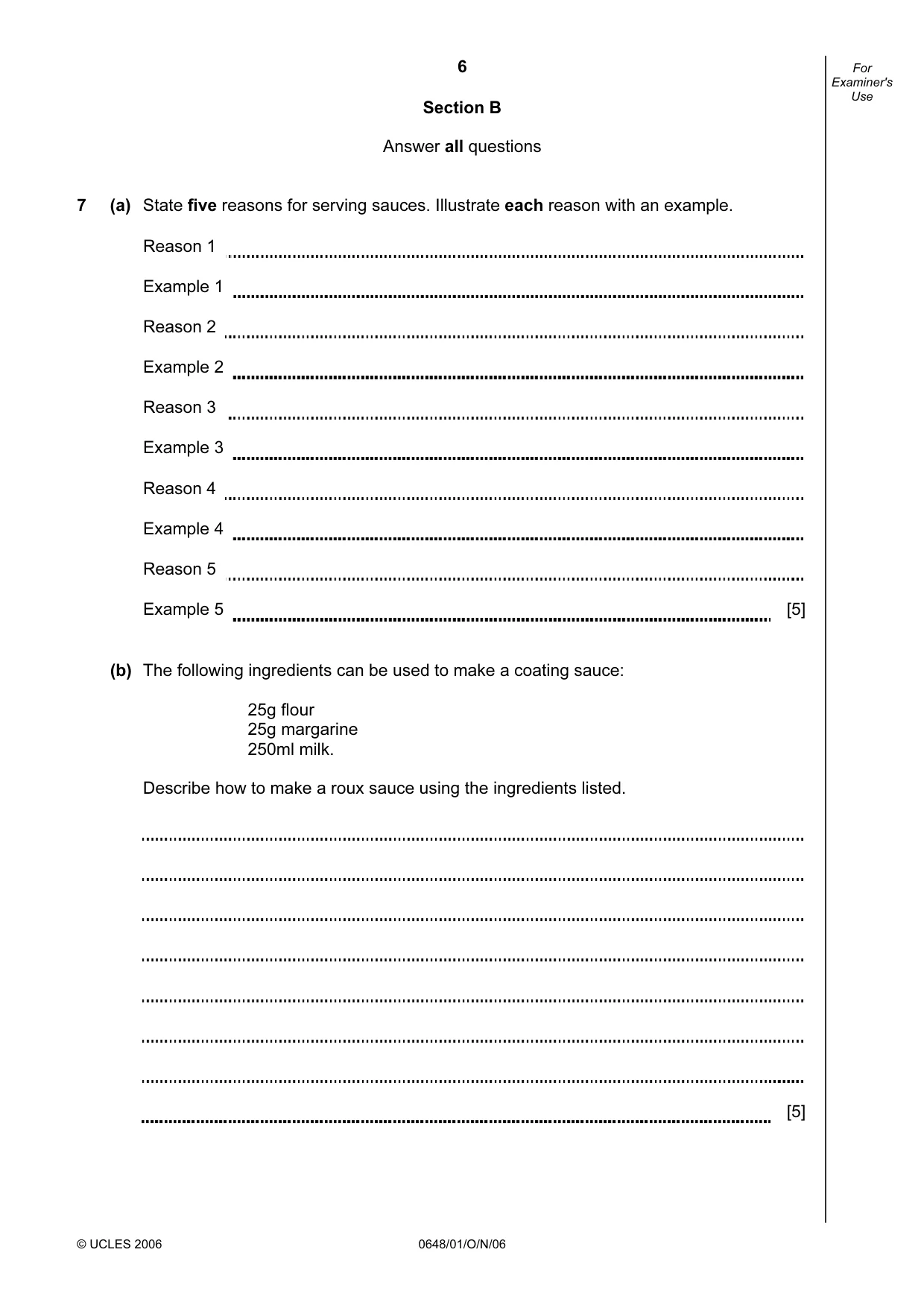
6 © UCLES 2006 0648/01/O/N/06 For Examiner's Use Section B Answer all questions 7 (a) State five reasons for serving sauces. Illustrate each reason with an example. Reason 1 Example 1 Reason 2 Example 2 Reason 3 Example 3 Reason 4 Example 4 Reason 5 Example 5 [5] (b) The following ingredients can be used to make a coating sauce: 25g flour 25g margarine 250ml milk. Describe how to make a roux sauce using the ingredients listed. [5]
Question paper, page 7
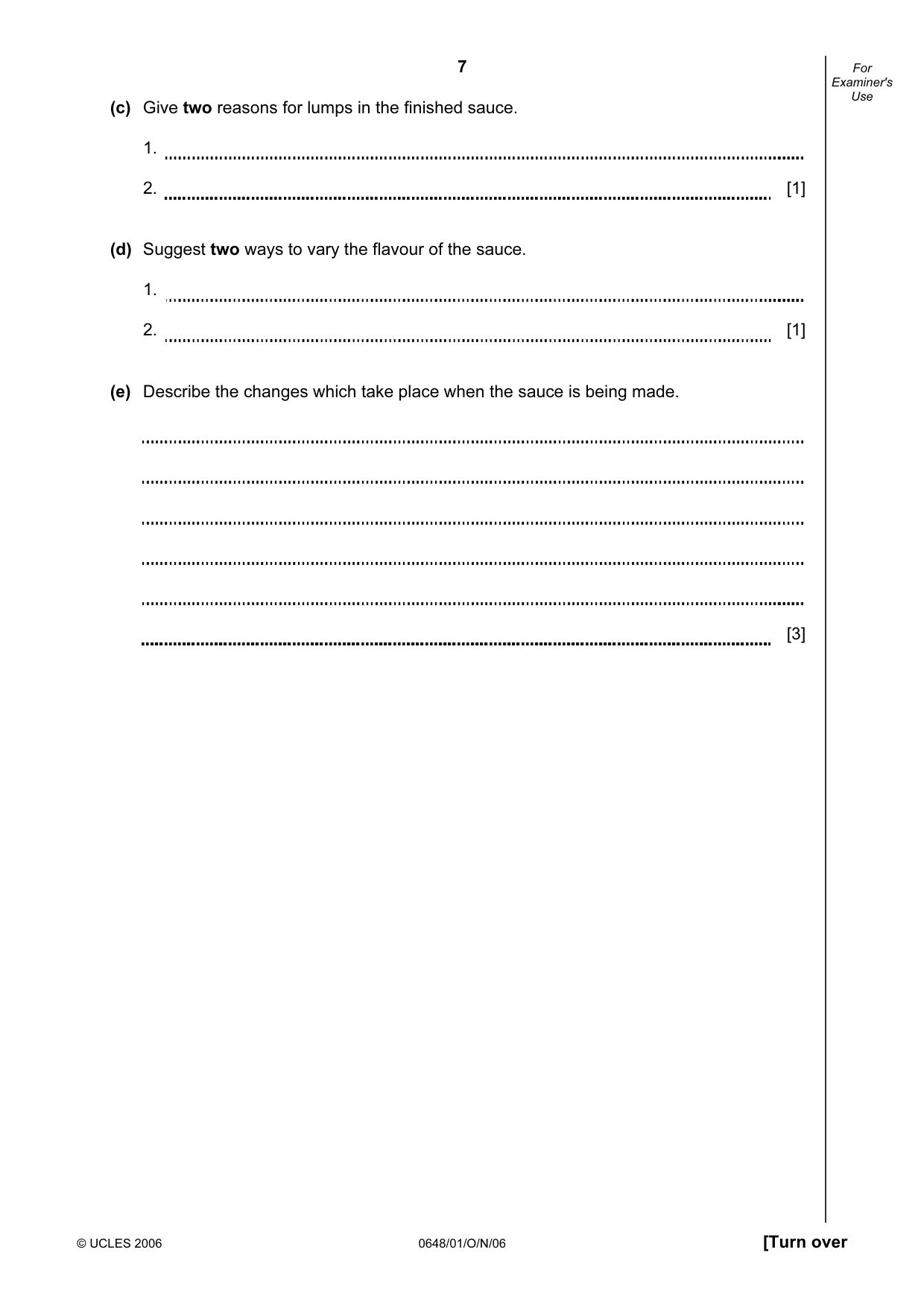
7 © UCLES 2006 0648/01/O/N/06 [Turn over For Examiner's Use (c) Give two reasons for lumps in the finished sauce. 1. 2. [1] (d) Suggest two ways to vary the flavour of the sauce. 1. 2. [1] (e) Describe the changes which take place when the sauce is being made. [3]
Question paper, page 8
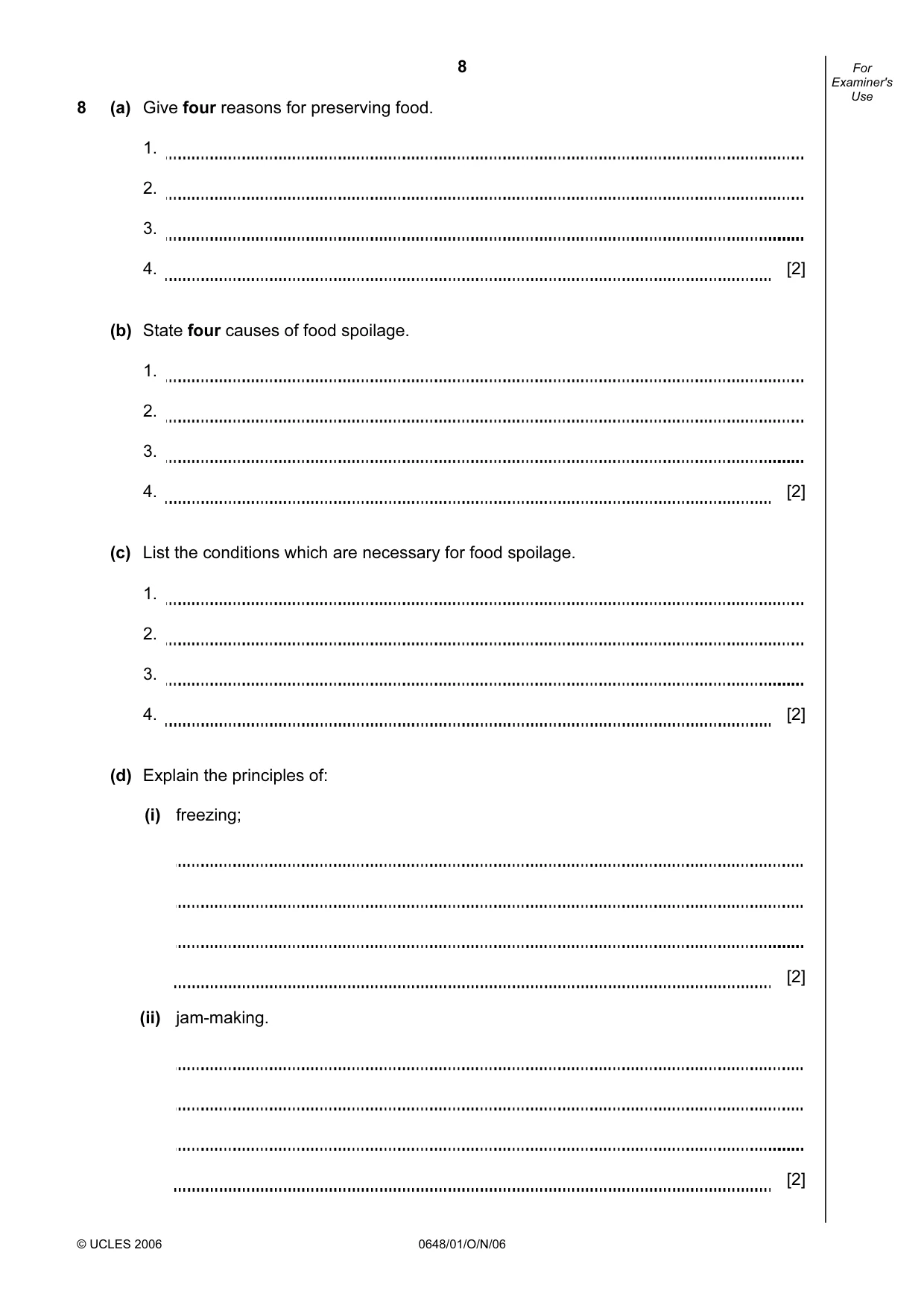
8 © UCLES 2006 0648/01/O/N/06 For Examiner's Use 8 (a) Give four reasons for preserving food. 1. 2. 3. 4. [2] (b) State four causes of food spoilage. 1. 2. 3. 4. [2] (c) List the conditions which are necessary for food spoilage. 1. 2. 3. 4. [2] (d) Explain the principles of: (i) freezing; [2] (ii) jam-making. [2]
Question paper, page 9
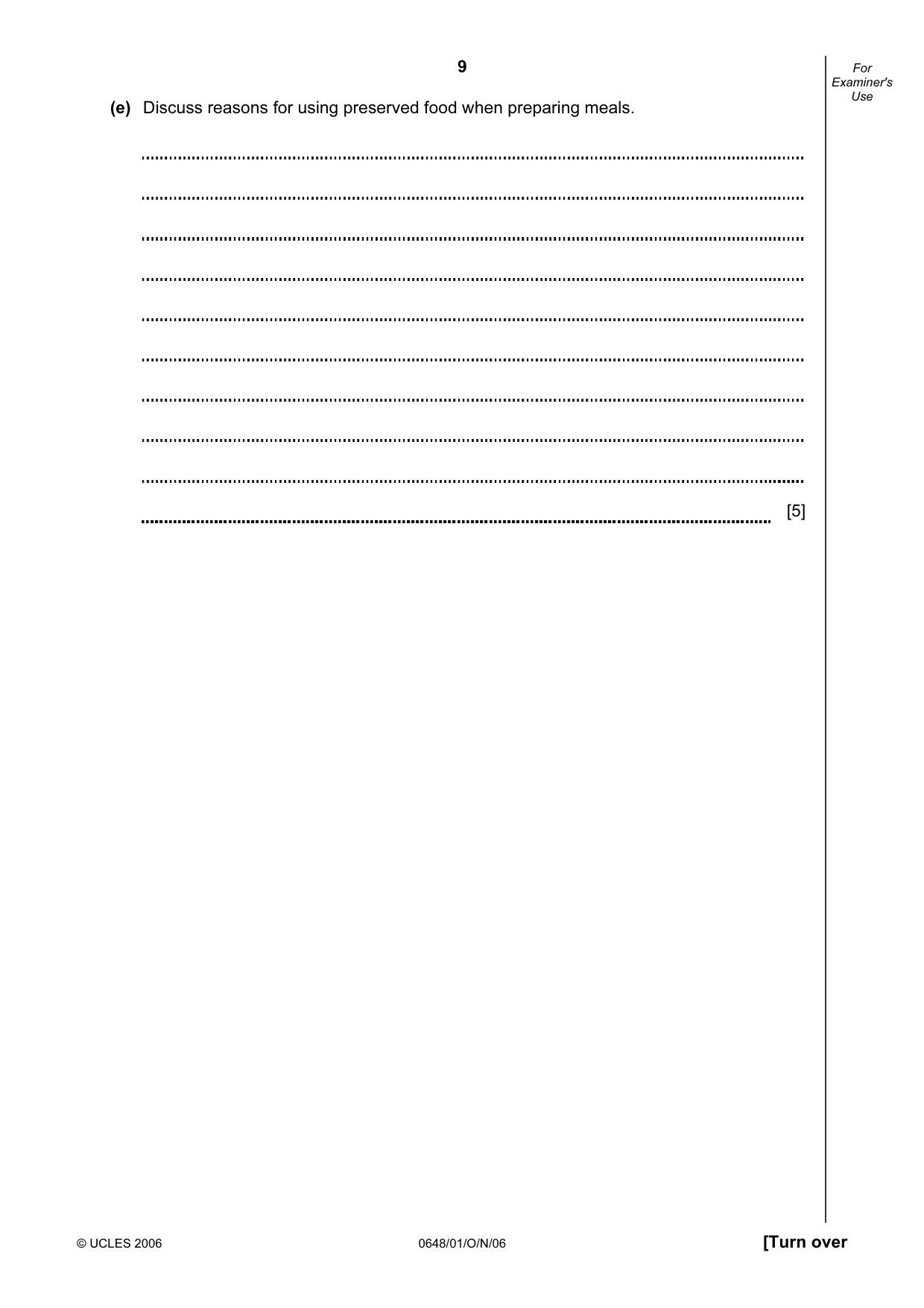
9 © UCLES 2006 0648/01/O/N/06 [Turn over For Examiner's Use (e) Discuss reasons for using preserved food when preparing meals. [5]
Question paper, page 10
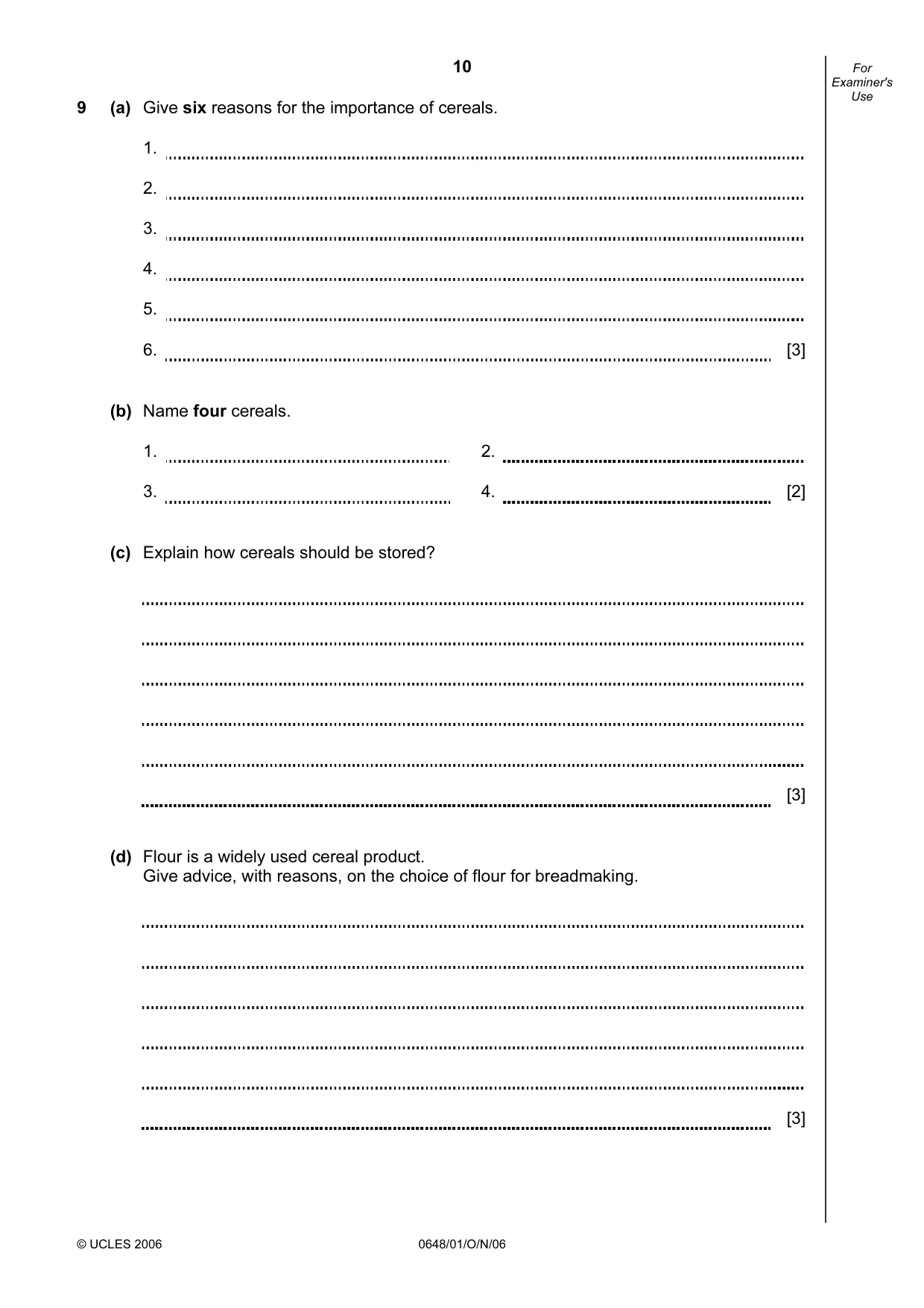
10 © UCLES 2006 0648/01/O/N/06 For Examiner's Use 9 (a) Give six reasons for the importance of cereals. 1. 2. 3. 4. 5. 6. [3] (b) Name four cereals. 1. 2. 3. 4. [2] (c) Explain how cereals should be stored? [3] (d) Flour is a widely used cereal product. Give advice, with reasons, on the choice of flour for breadmaking. [3]
Question paper, page 11
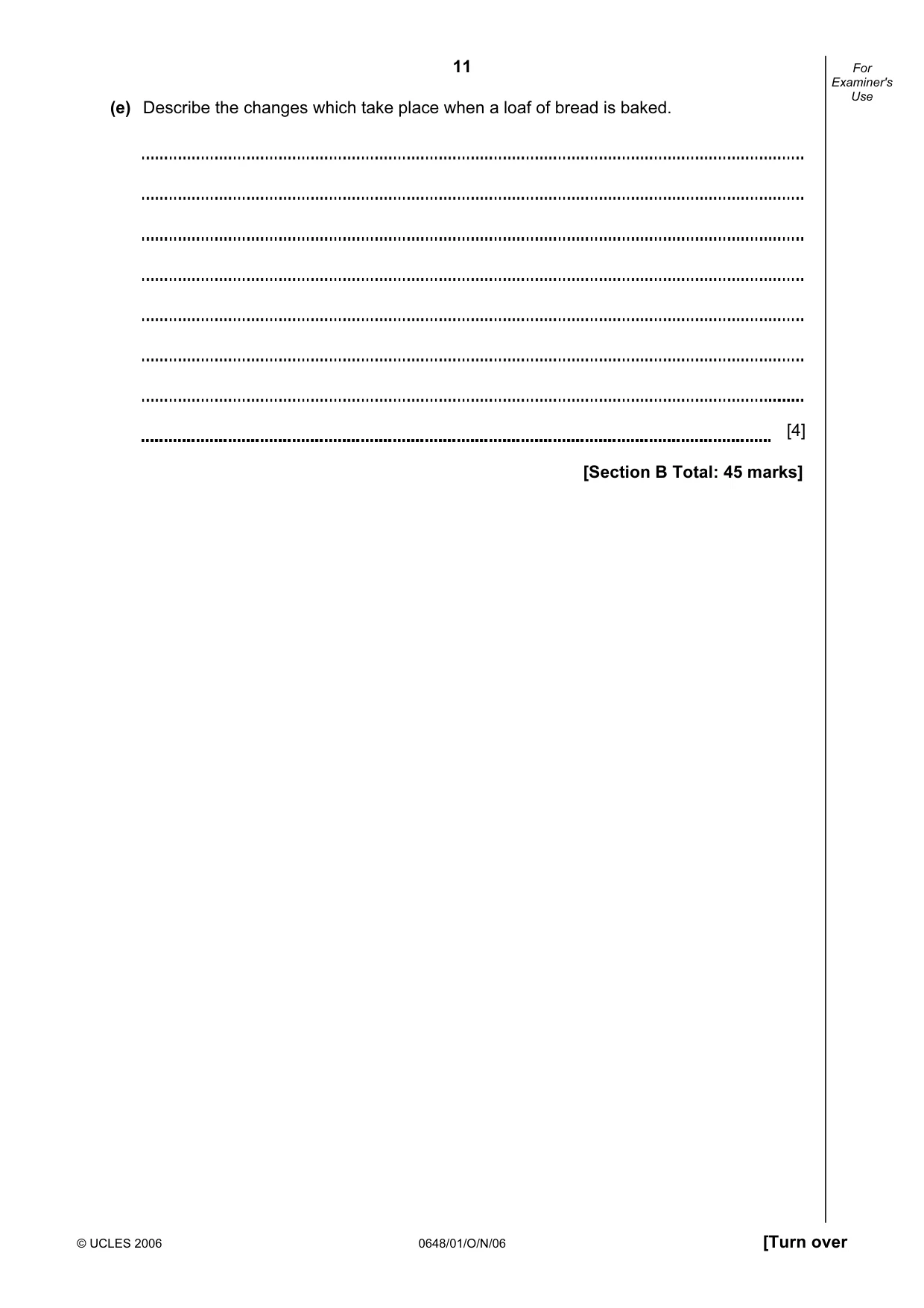
11 © UCLES 2006 0648/01/O/N/06 [Turn over For Examiner's Use (e) Describe the changes which take place when a loaf of bread is baked. [4] [Section B Total: 45 marks]
Question paper, page 12
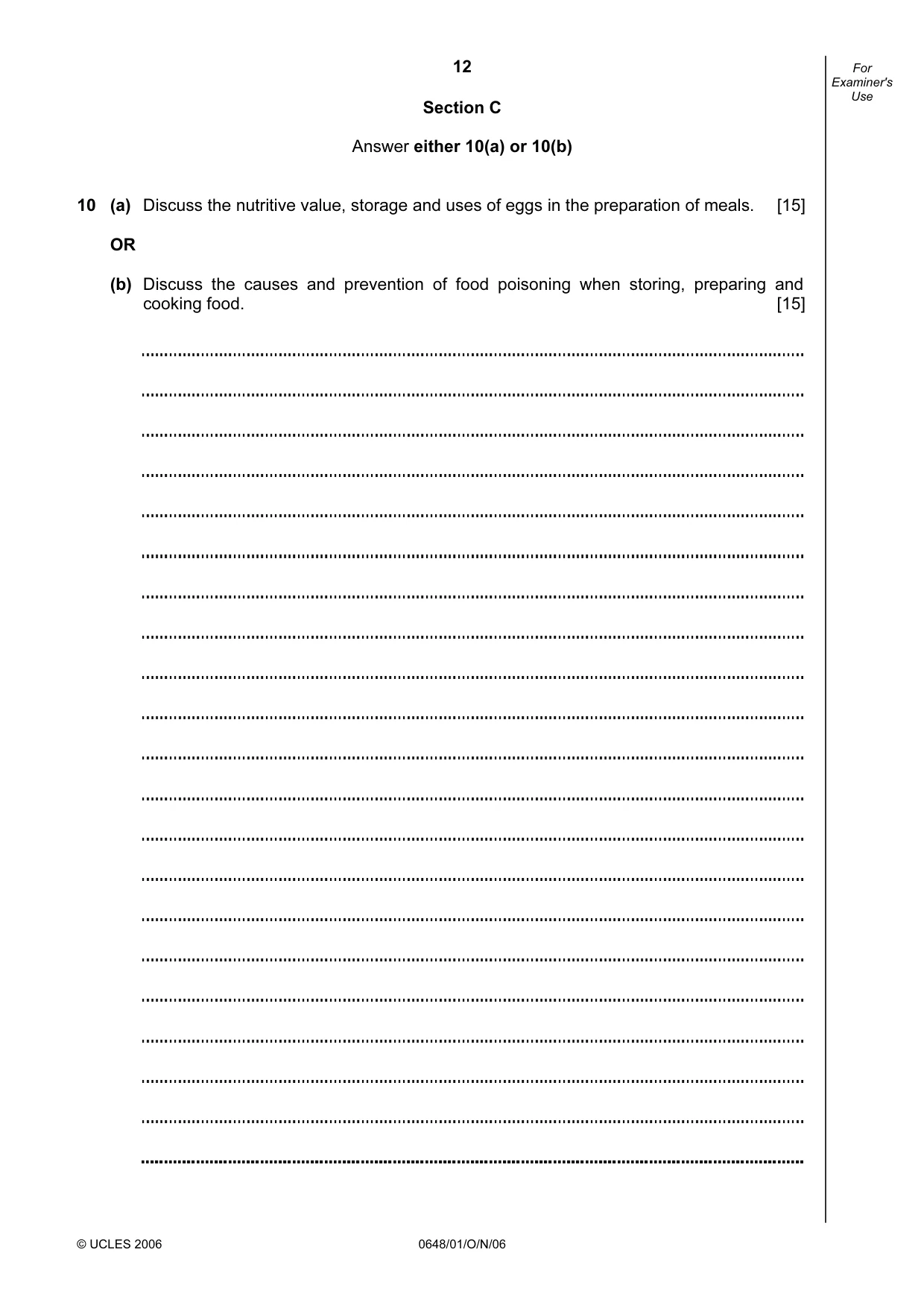
12 © UCLES 2006 0648/01/O/N/06 For Examiner's Use Section C Answer either 10(a) or 10(b) 10 (a) Discuss the nutritive value, storage and uses of eggs in the preparation of meals. [15] OR (b) Discuss the causes and prevention of food poisoning when storing, preparing and cooking food. [15]
Question paper, page 13
13 © UCLES 2006 0648/01/O/N/06 [Turn over For Examiner's Use
Question paper, page 14
14 © UCLES 2006 0648/01/O/N/06 For Examiner's Use [Section C Total : 15 marks] [Total for paper: 100]
Question paper, page 16
16 Permission to reproduce items where third-party owned material protected by copyright is included has been sought and cleared where possible. Every reasonable effort has been made by the publisher (UCLES) to trace copyright holders, but if any items requiring clearance have unwittingly been included, the publisher will be pleased to make amends at the earliest possible opportunity. University of Cambridge International Examinations is part of the University of Cambridge Local Examinations Syndicate (UCLES), which is itself a department of the University of Cambridge. 0648/01/O/N/06 BLANK PAGE
Mark scheme, page 1
UNIVERSITY OF CAMBRIDGE INTERNATIONAL EXAMINATIONS International General Certificate of Secondary Education MARK SCHEME for the October/November 2006 question paper 0648 FOOD AND NUTRITION 0648/01 Paper 1 (Theory), maximum raw mark 100 This mark scheme is published as an aid to teachers and students, to indicate the requirements of the examination. It shows the basis on which Examiners were instructed to award marks. It does not indicate the details of the discussions that took place at an Examiners’ meeting before marking began. All Examiners are instructed that alternative correct answers and unexpected approaches in candidates’ scripts must be given marks that fairly reflect the relevant knowledge and skills demonstrated. Mark schemes must be read in conjunction with the question papers and the report on the examination. The grade thresholds for various grades are published in the report on the examination for most IGCSE, GCE Advanced Level and Advanced Subsidiary Level syllabuses. • CIE will not enter into discussions or correspondence in connection with these mark schemes. CIE is publishing the mark schemes for the October/November 2006 question papers for most IGCSE, GCE Advanced Level and Advanced Subsidiary Level syllabuses and some Ordinary Level syllabuses. www.XtremePapers.com
Mark scheme, page 2
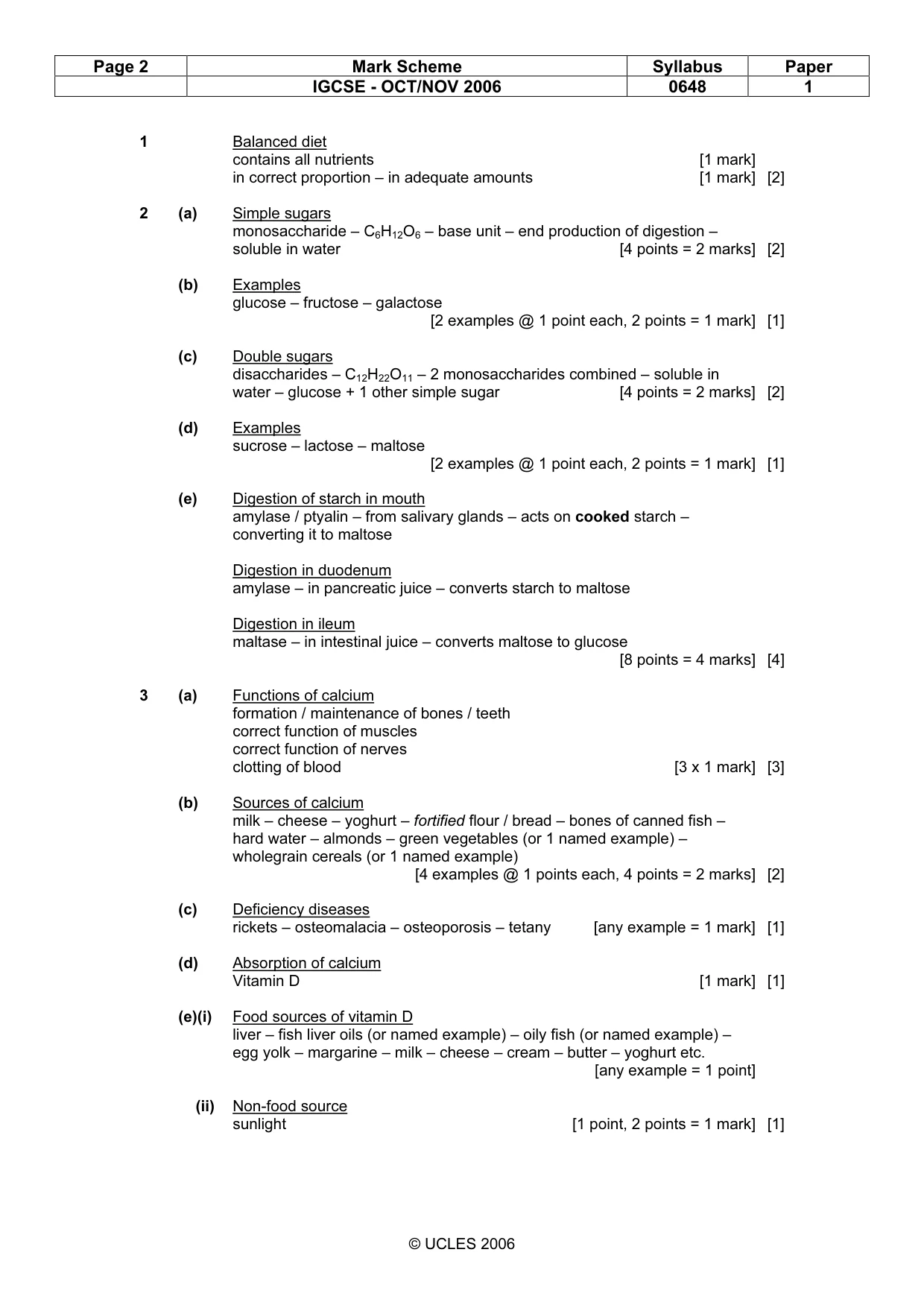
Page 2 Mark Scheme Syllabus Paper IGCSE - OCT/NOV 2006 0648 1 © UCLES 2006 1 Balanced diet contains all nutrients [1 mark] in correct proportion – in adequate amounts [1 mark] [2] 2 (a) Simple sugars monosaccharide – C6H12O6 – base unit – end production of digestion – soluble in water [4 points = 2 marks] [2] (b) Examples glucose – fructose – galactose [2 examples @ 1 point each, 2 points = 1 mark] [1] (c) Double sugars disaccharides – C12H22O11 – 2 monosaccharides combined – soluble in water – glucose + 1 other simple sugar [4 points = 2 marks] [2] (d) Examples sucrose – lactose – maltose [2 examples @ 1 point each, 2 points = 1 mark] [1] (e) Digestion of starch in mouth amylase / ptyalin – from salivary glands – acts on cooked starch – converting it to maltose Digestion in duodenum amylase – in pancreatic juice – converts starch to maltose Digestion in ileum maltase – in intestinal juice – converts maltose to glucose [8 points = 4 marks] [4] 3 (a) Functions of calcium formation / maintenance of bones / teeth correct function of muscles correct function of nerves clotting of blood [3 x 1 mark] [3] (b) Sources of calcium milk – cheese – yoghurt – fortified flour / bread – bones of canned fish – hard water – almonds – green vegetables (or 1 named example) – wholegrain cereals (or 1 named example) [4 examples @ 1 points each, 4 points = 2 marks] [2] (c) Deficiency diseases rickets – osteomalacia – osteoporosis – tetany [any example = 1 mark] [1] (d) Absorption of calcium Vitamin D [1 mark] [1] (e)(i) Food sources of vitamin D liver – fish liver oils (or named example) – oily fish (or named example) – egg yolk – margarine – milk – cheese – cream – butter – yoghurt etc. [any example = 1 point] (ii) Non-food source sunlight [1 point, 2 points = 1 mark] [1]
Mark scheme, page 3
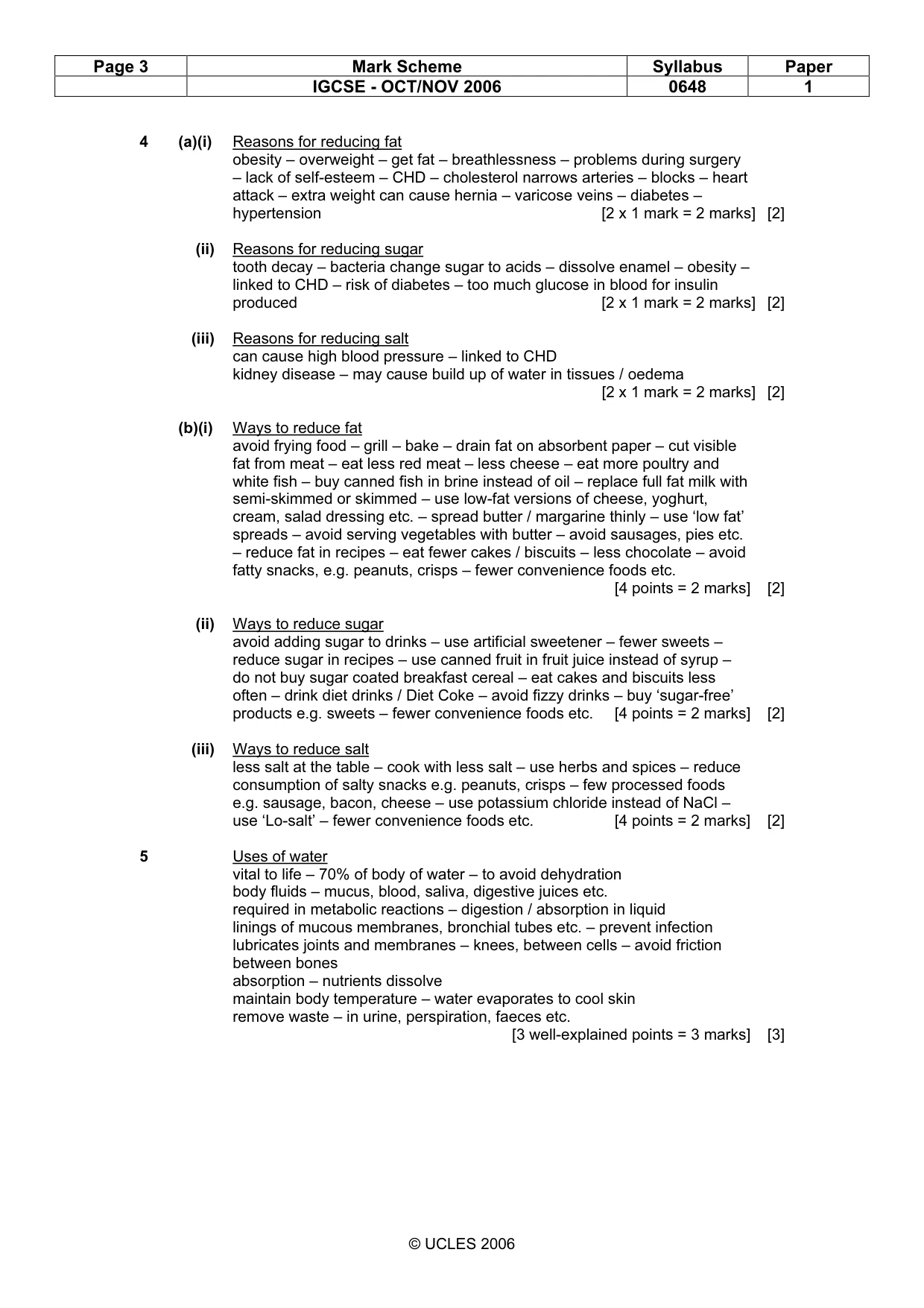
Page 3 Mark Scheme Syllabus Paper IGCSE - OCT/NOV 2006 0648 1 © UCLES 2006 4 (a)(i) Reasons for reducing fat obesity – overweight – get fat – breathlessness – problems during surgery – lack of self-esteem – CHD – cholesterol narrows arteries – blocks – heart attack – extra weight can cause hernia – varicose veins – diabetes – hypertension [2 x 1 mark = 2 marks] [2] (ii) Reasons for reducing sugar tooth decay – bacteria change sugar to acids – dissolve enamel – obesity – linked to CHD – risk of diabetes – too much glucose in blood for insulin produced [2 x 1 mark = 2 marks] [2] (iii) Reasons for reducing salt can cause high blood pressure – linked to CHD kidney disease – may cause build up of water in tissues / oedema [2 x 1 mark = 2 marks] [2] (b)(i) Ways to reduce fat avoid frying food – grill – bake – drain fat on absorbent paper – cut visible fat from meat – eat less red meat – less cheese – eat more poultry and white fish – buy canned fish in brine instead of oil – replace full fat milk with semi-skimmed or skimmed – use low-fat versions of cheese, yoghurt, cream, salad dressing etc. – spread butter / margarine thinly – use ‘low fat’ spreads – avoid serving vegetables with butter – avoid sausages, pies etc. – reduce fat in recipes – eat fewer cakes / biscuits – less chocolate – avoid fatty snacks, e.g. peanuts, crisps – fewer convenience foods etc. [4 points = 2 marks] [2] (ii) Ways to reduce sugar avoid adding sugar to drinks – use artificial sweetener – fewer sweets – reduce sugar in recipes – use canned fruit in fruit juice instead of syrup – do not buy sugar coated breakfast cereal – eat cakes and biscuits less often – drink diet drinks / Diet Coke – avoid fizzy drinks – buy ‘sugar-free’ products e.g. sweets – fewer convenience foods etc. [4 points = 2 marks] [2] (iii) Ways to reduce salt less salt at the table – cook with less salt – use herbs and spices – reduce consumption of salty snacks e.g. peanuts, crisps – few processed foods e.g. sausage, bacon, cheese – use potassium chloride instead of NaCl – use ‘Lo-salt’ – fewer convenience foods etc. [4 points = 2 marks] [2] 5 Uses of water vital to life – 70% of body of water – to avoid dehydration body fluids – mucus, blood, saliva, digestive juices etc. required in metabolic reactions – digestion / absorption in liquid linings of mucous membranes, bronchial tubes etc. – prevent infection lubricates joints and membranes – knees, between cells – avoid friction between bones absorption – nutrients dissolve maintain body temperature – water evaporates to cool skin remove waste – in urine, perspiration, faeces etc. [3 well-explained points = 3 marks] [3]
Mark scheme, page 4
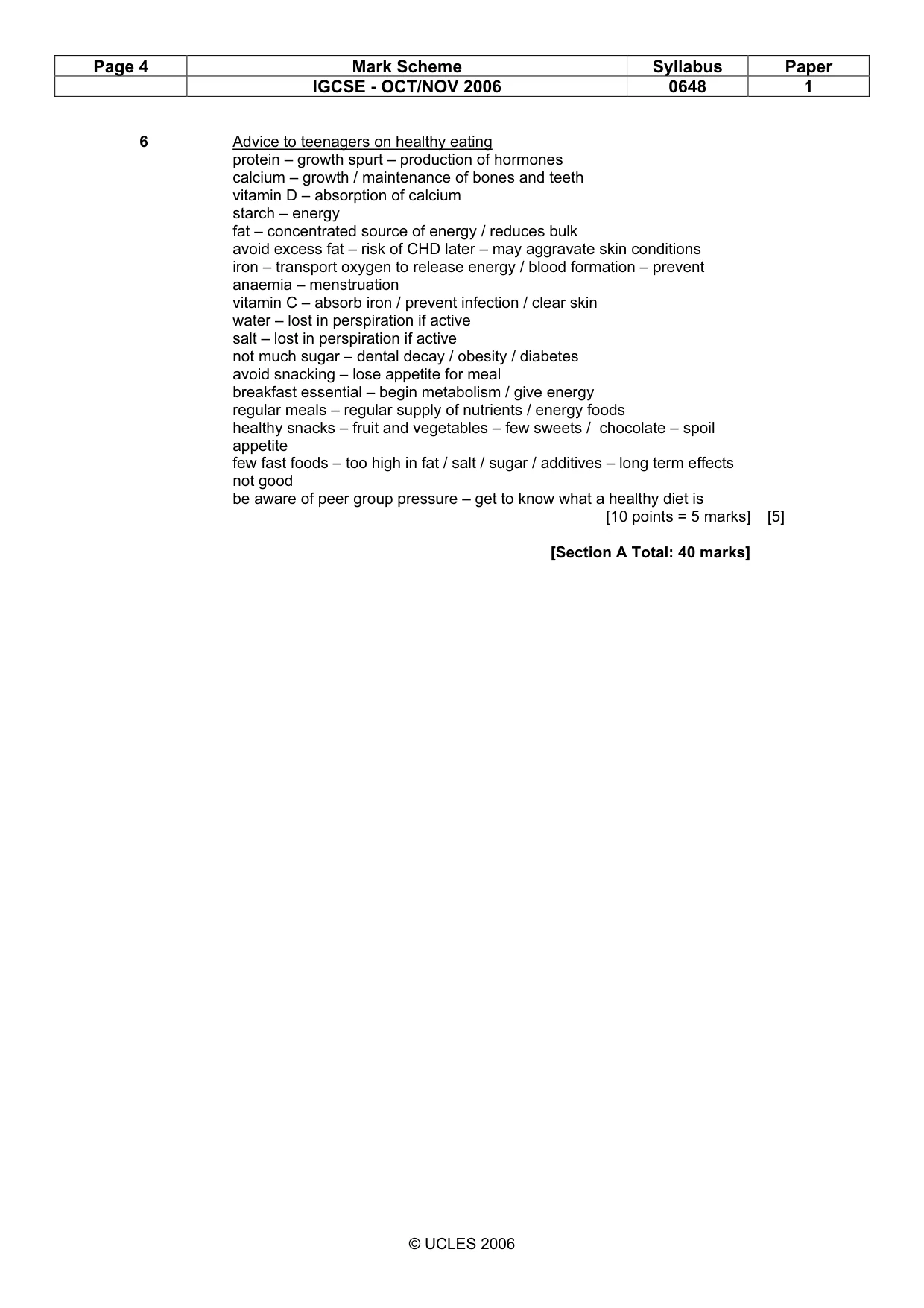
Page 4 Mark Scheme Syllabus Paper IGCSE - OCT/NOV 2006 0648 1 © UCLES 2006 6 Advice to teenagers on healthy eating protein – growth spurt – production of hormones calcium – growth / maintenance of bones and teeth vitamin D – absorption of calcium starch – energy fat – concentrated source of energy / reduces bulk avoid excess fat – risk of CHD later – may aggravate skin conditions iron – transport oxygen to release energy / blood formation – prevent anaemia – menstruation vitamin C – absorb iron / prevent infection / clear skin water – lost in perspiration if active salt – lost in perspiration if active not much sugar – dental decay / obesity / diabetes avoid snacking – lose appetite for meal breakfast essential – begin metabolism / give energy regular meals – regular supply of nutrients / energy foods healthy snacks – fruit and vegetables – few sweets / chocolate – spoil appetite few fast foods – too high in fat / salt / sugar / additives – long term effects not good be aware of peer group pressure – get to know what a healthy diet is [10 points = 5 marks] [5] [Section A Total: 40 marks]
Mark scheme, page 5
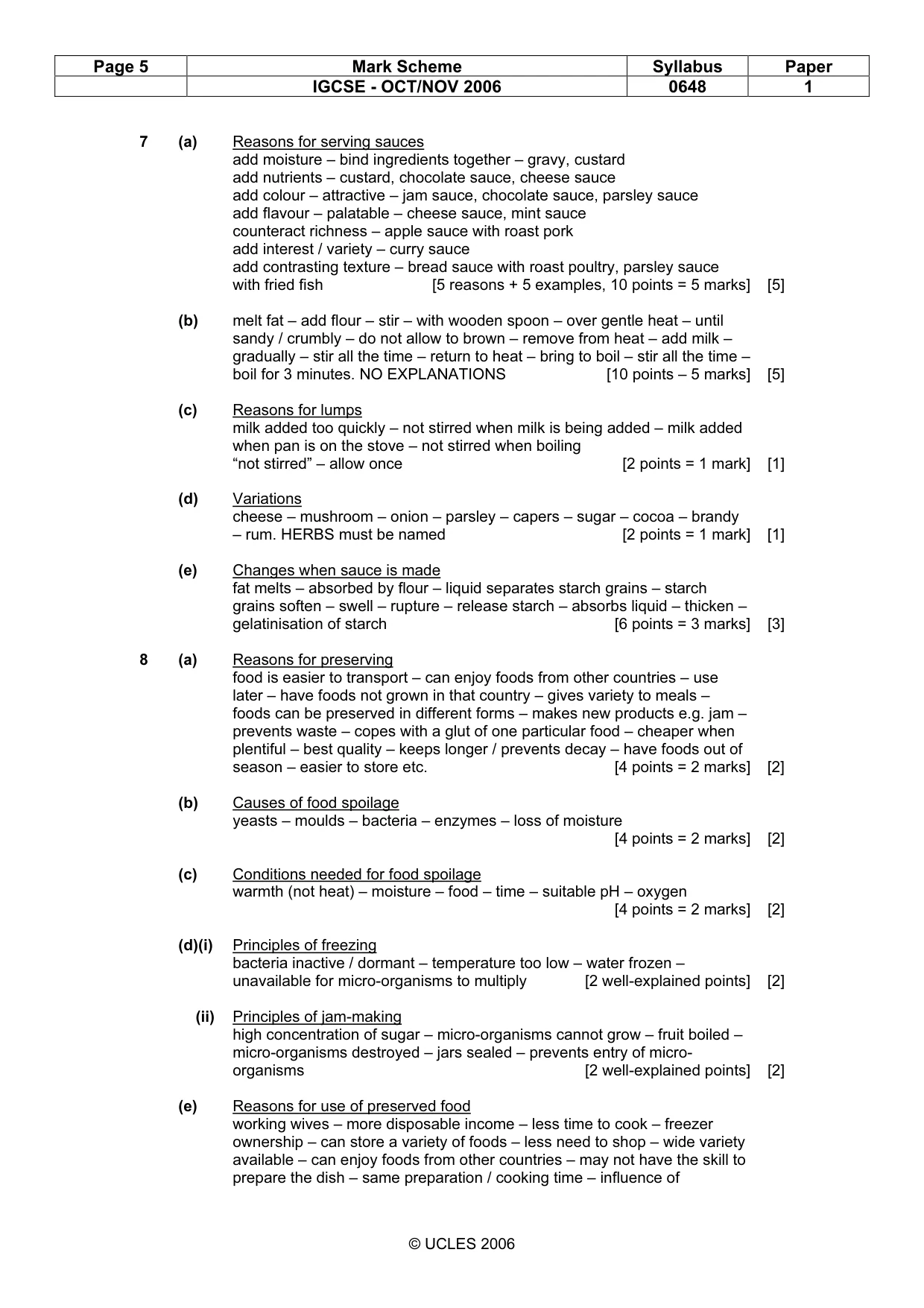
Page 5 Mark Scheme Syllabus Paper IGCSE - OCT/NOV 2006 0648 1 © UCLES 2006 7 (a) Reasons for serving sauces add moisture – bind ingredients together – gravy, custard add nutrients – custard, chocolate sauce, cheese sauce add colour – attractive – jam sauce, chocolate sauce, parsley sauce add flavour – palatable – cheese sauce, mint sauce counteract richness – apple sauce with roast pork add interest / variety – curry sauce add contrasting texture – bread sauce with roast poultry, parsley sauce with fried fish [5 reasons + 5 examples, 10 points = 5 marks] [5] (b) melt fat – add flour – stir – with wooden spoon – over gentle heat – until sandy / crumbly – do not allow to brown – remove from heat – add milk – gradually – stir all the time – return to heat – bring to boil – stir all the time – boil for 3 minutes. NO EXPLANATIONS [10 points – 5 marks] [5] (c) Reasons for lumps milk added too quickly – not stirred when milk is being added – milk added when pan is on the stove – not stirred when boiling “not stirred” – allow once [2 points = 1 mark] [1] (d) Variations cheese – mushroom – onion – parsley – capers – sugar – cocoa – brandy – rum. HERBS must be named [2 points = 1 mark] [1] (e) Changes when sauce is made fat melts – absorbed by flour – liquid separates starch grains – starch grains soften – swell – rupture – release starch – absorbs liquid – thicken – gelatinisation of starch [6 points = 3 marks] [3] 8 (a) Reasons for preserving food is easier to transport – can enjoy foods from other countries – use later – have foods not grown in that country – gives variety to meals – foods can be preserved in different forms – makes new products e.g. jam – prevents waste – copes with a glut of one particular food – cheaper when plentiful – best quality – keeps longer / prevents decay – have foods out of season – easier to store etc. [4 points = 2 marks] [2] (b) Causes of food spoilage yeasts – moulds – bacteria – enzymes – loss of moisture [4 points = 2 marks] [2] (c) Conditions needed for food spoilage warmth (not heat) – moisture – food – time – suitable pH – oxygen [4 points = 2 marks] [2] (d)(i) Principles of freezing bacteria inactive / dormant – temperature too low – water frozen – unavailable for micro-organisms to multiply [2 well-explained points] [2] (ii) Principles of jam-making high concentration of sugar – micro-organisms cannot grow – fruit boiled – micro-organisms destroyed – jars sealed – prevents entry of micro- organisms [2 well-explained points] [2] (e) Reasons for use of preserved food working wives – more disposable income – less time to cook – freezer ownership – can store a variety of foods – less need to shop – wide variety available – can enjoy foods from other countries – may not have the skill to prepare the dish – same preparation / cooking time – influence of
Mark scheme, page 6
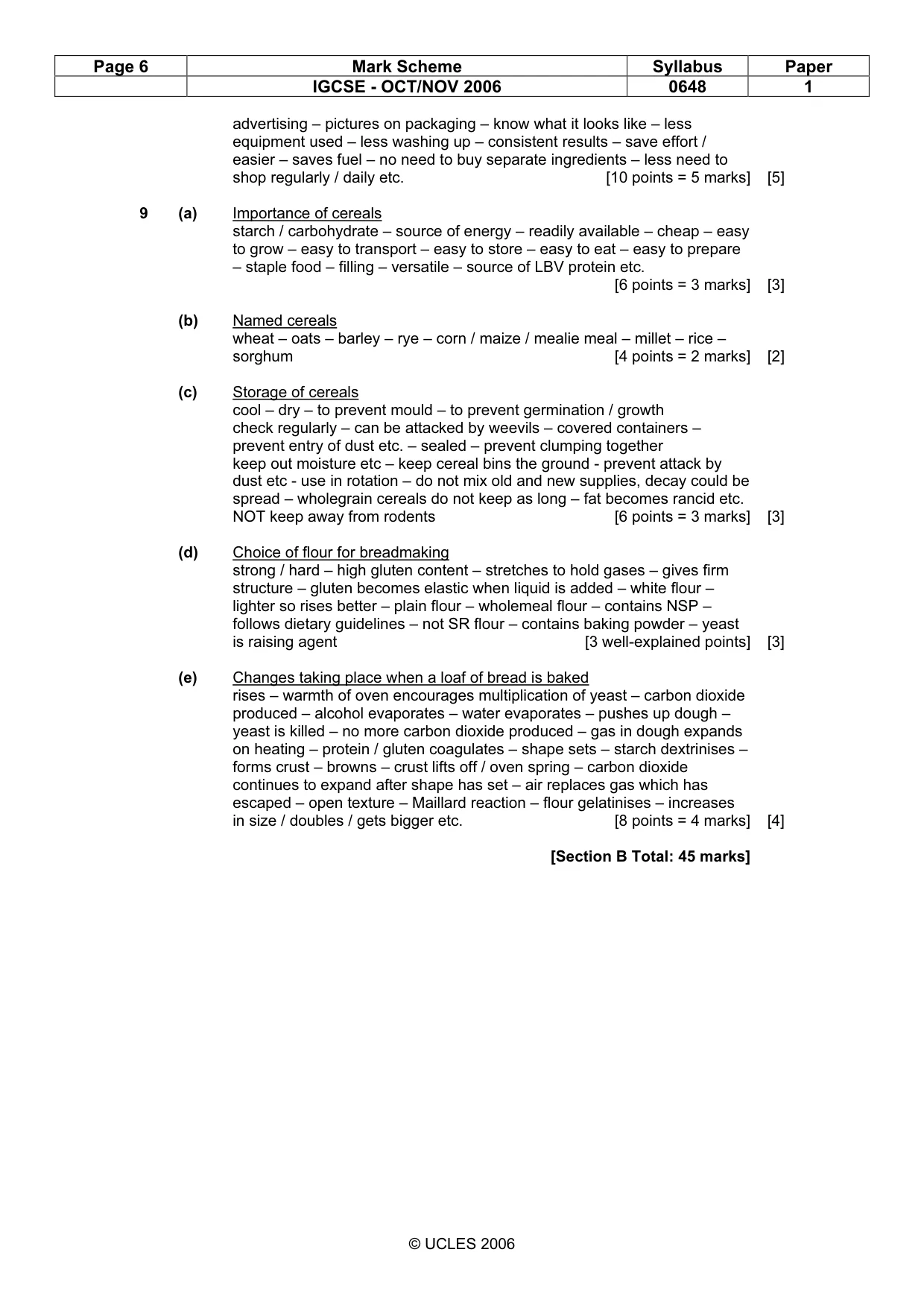
Page 6 Mark Scheme Syllabus Paper IGCSE - OCT/NOV 2006 0648 1 © UCLES 2006 advertising – pictures on packaging – know what it looks like – less equipment used – less washing up – consistent results – save effort / easier – saves fuel – no need to buy separate ingredients – less need to shop regularly / daily etc. [10 points = 5 marks] [5] 9 (a) Importance of cereals starch / carbohydrate – source of energy – readily available – cheap – easy to grow – easy to transport – easy to store – easy to eat – easy to prepare – staple food – filling – versatile – source of LBV protein etc. [6 points = 3 marks] [3] (b) Named cereals wheat – oats – barley – rye – corn / maize / mealie meal – millet – rice – sorghum [4 points = 2 marks] [2] (c) Storage of cereals cool – dry – to prevent mould – to prevent germination / growth check regularly – can be attacked by weevils – covered containers – prevent entry of dust etc. – sealed – prevent clumping together keep out moisture etc – keep cereal bins the ground - prevent attack by dust etc - use in rotation – do not mix old and new supplies, decay could be spread – wholegrain cereals do not keep as long – fat becomes rancid etc. NOT keep away from rodents [6 points = 3 marks] [3] (d) Choice of flour for breadmaking strong / hard – high gluten content – stretches to hold gases – gives firm structure – gluten becomes elastic when liquid is added – white flour – lighter so rises better – plain flour – wholemeal flour – contains NSP – follows dietary guidelines – not SR flour – contains baking powder – yeast is raising agent [3 well-explained points] [3] (e) Changes taking place when a loaf of bread is baked rises – warmth of oven encourages multiplication of yeast – carbon dioxide produced – alcohol evaporates – water evaporates – pushes up dough – yeast is killed – no more carbon dioxide produced – gas in dough expands on heating – protein / gluten coagulates – shape sets – starch dextrinises – forms crust – browns – crust lifts off / oven spring – carbon dioxide continues to expand after shape has set – air replaces gas which has escaped – open texture – Maillard reaction – flour gelatinises – increases in size / doubles / gets bigger etc. [8 points = 4 marks] [4] [Section B Total: 45 marks]
Mark scheme, page 7
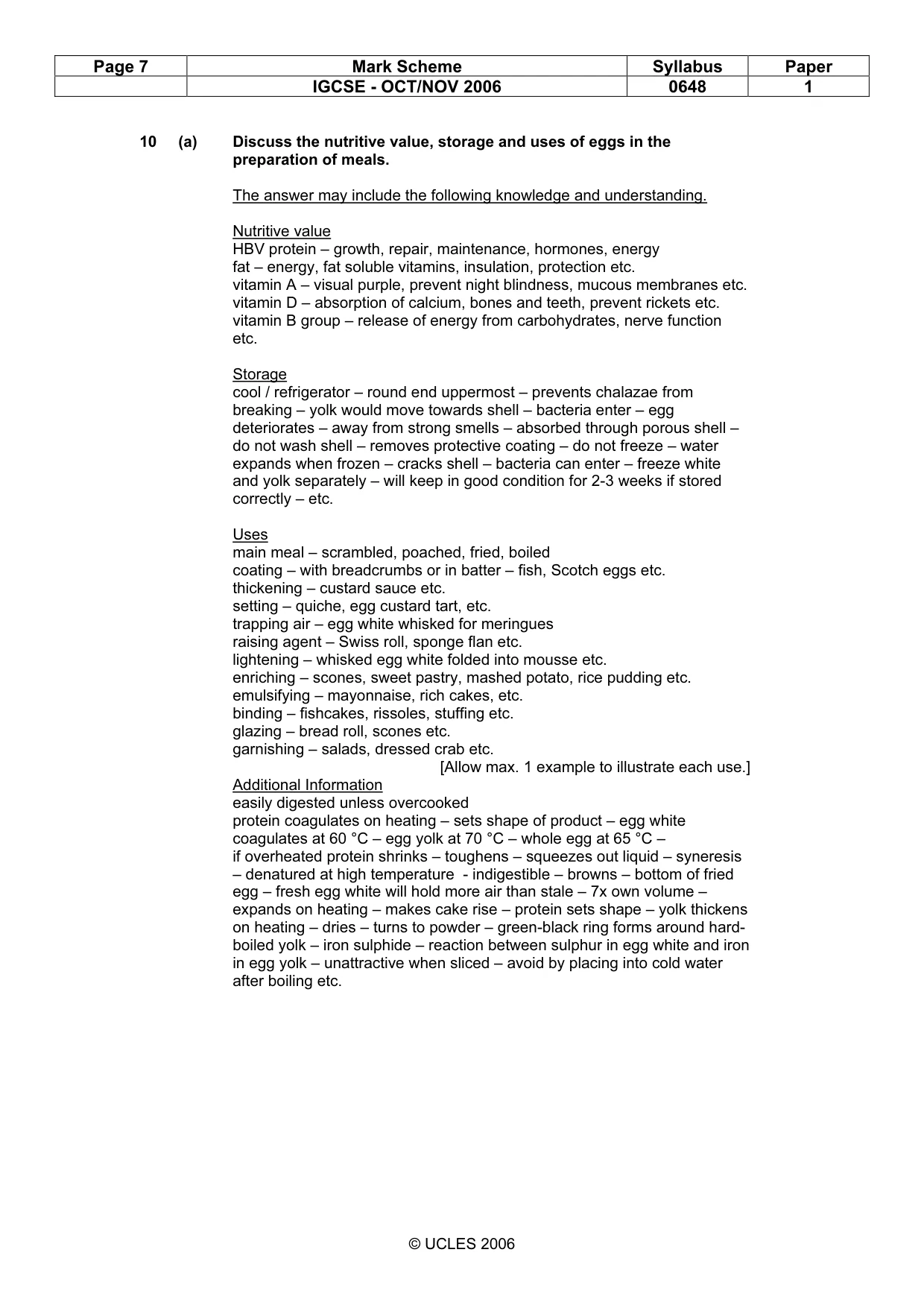
Page 7 Mark Scheme Syllabus Paper IGCSE - OCT/NOV 2006 0648 1 © UCLES 2006 10 (a) Discuss the nutritive value, storage and uses of eggs in the preparation of meals. The answer may include the following knowledge and understanding. Nutritive value HBV protein – growth, repair, maintenance, hormones, energy fat – energy, fat soluble vitamins, insulation, protection etc. vitamin A – visual purple, prevent night blindness, mucous membranes etc. vitamin D – absorption of calcium, bones and teeth, prevent rickets etc. vitamin B group – release of energy from carbohydrates, nerve function etc. Storage cool / refrigerator – round end uppermost – prevents chalazae from breaking – yolk would move towards shell – bacteria enter – egg deteriorates – away from strong smells – absorbed through porous shell – do not wash shell – removes protective coating – do not freeze – water expands when frozen – cracks shell – bacteria can enter – freeze white and yolk separately – will keep in good condition for 2-3 weeks if stored correctly – etc. Uses main meal – scrambled, poached, fried, boiled coating – with breadcrumbs or in batter – fish, Scotch eggs etc. thickening – custard sauce etc. setting – quiche, egg custard tart, etc. trapping air – egg white whisked for meringues raising agent – Swiss roll, sponge flan etc. lightening – whisked egg white folded into mousse etc. enriching – scones, sweet pastry, mashed potato, rice pudding etc. emulsifying – mayonnaise, rich cakes, etc. binding – fishcakes, rissoles, stuffing etc. glazing – bread roll, scones etc. garnishing – salads, dressed crab etc. [Allow max. 1 example to illustrate each use.] Additional Information easily digested unless overcooked protein coagulates on heating – sets shape of product – egg white coagulates at 60 °C – egg yolk at 70 °C – whole egg at 65 °C – if overheated protein shrinks – toughens – squeezes out liquid – syneresis – denatured at high temperature - indigestible – browns – bottom of fried egg – fresh egg white will hold more air than stale – 7x own volume – expands on heating – makes cake rise – protein sets shape – yolk thickens on heating – dries – turns to powder – green-black ring forms around hard- boiled yolk – iron sulphide – reaction between sulphur in egg white and iron in egg yolk – unattractive when sliced – avoid by placing into cold water after boiling etc.
Mark scheme, page 8
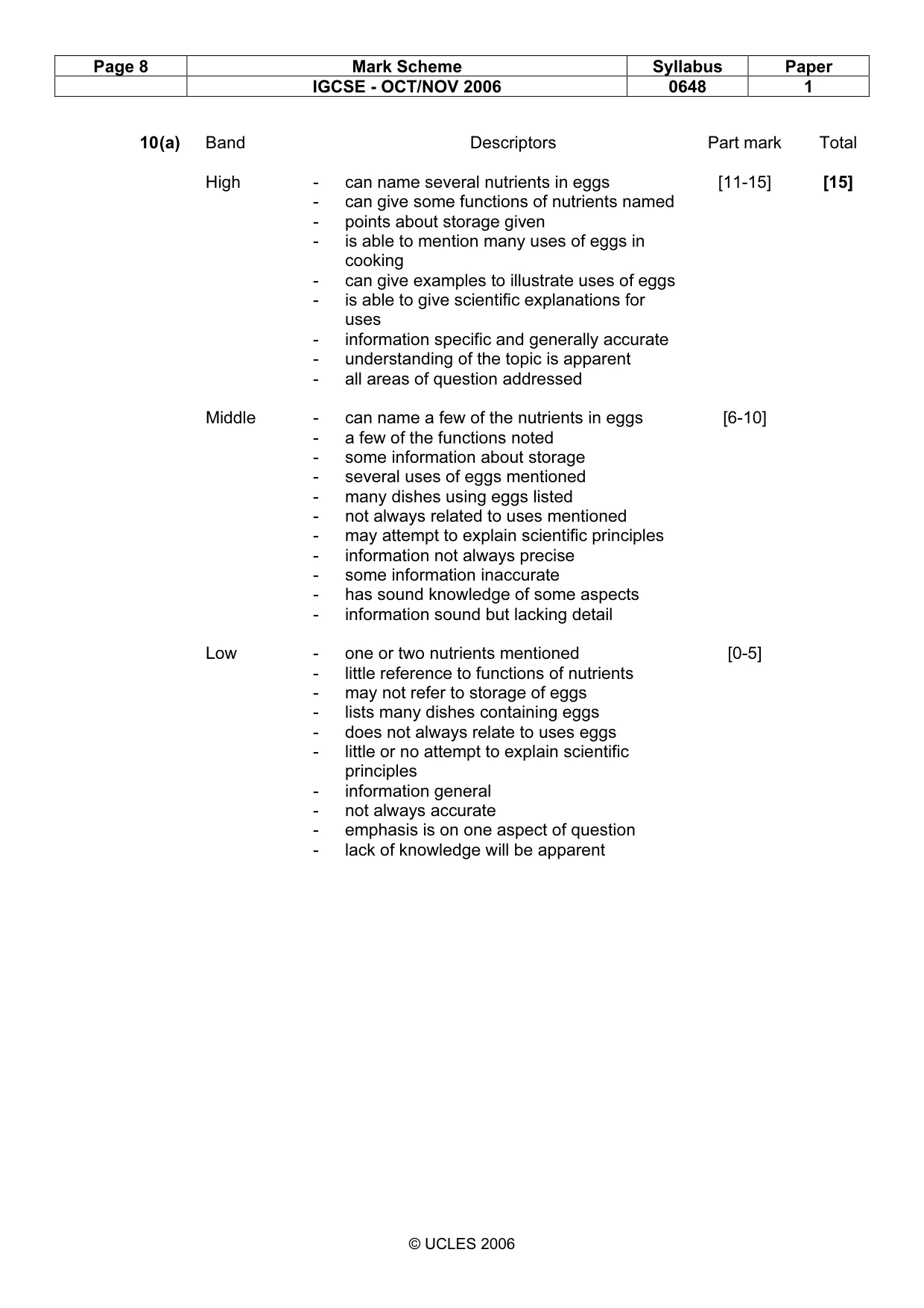
Page 8 Mark Scheme Syllabus Paper IGCSE - OCT/NOV 2006 0648 1 © UCLES 2006 10 (a) Band Descriptors Part mark Total High - can name several nutrients in eggs [11-15] [15] - can give some functions of nutrients named - points about storage given - is able to mention many uses of eggs in cooking - can give examples to illustrate uses of eggs - is able to give scientific explanations for uses - information specific and generally accurate - understanding of the topic is apparent - all areas of question addressed Middle - can name a few of the nutrients in eggs [6-10] - a few of the functions noted - some information about storage - several uses of eggs mentioned - many dishes using eggs listed - not always related to uses mentioned - may attempt to explain scientific principles - information not always precise - some information inaccurate - has sound knowledge of some aspects - information sound but lacking detail Low - one or two nutrients mentioned [0-5] - little reference to functions of nutrients - may not refer to storage of eggs - lists many dishes containing eggs - does not always relate to uses eggs - little or no attempt to explain scientific principles - information general - not always accurate - emphasis is on one aspect of question - lack of knowledge will be apparent
Mark scheme, page 9
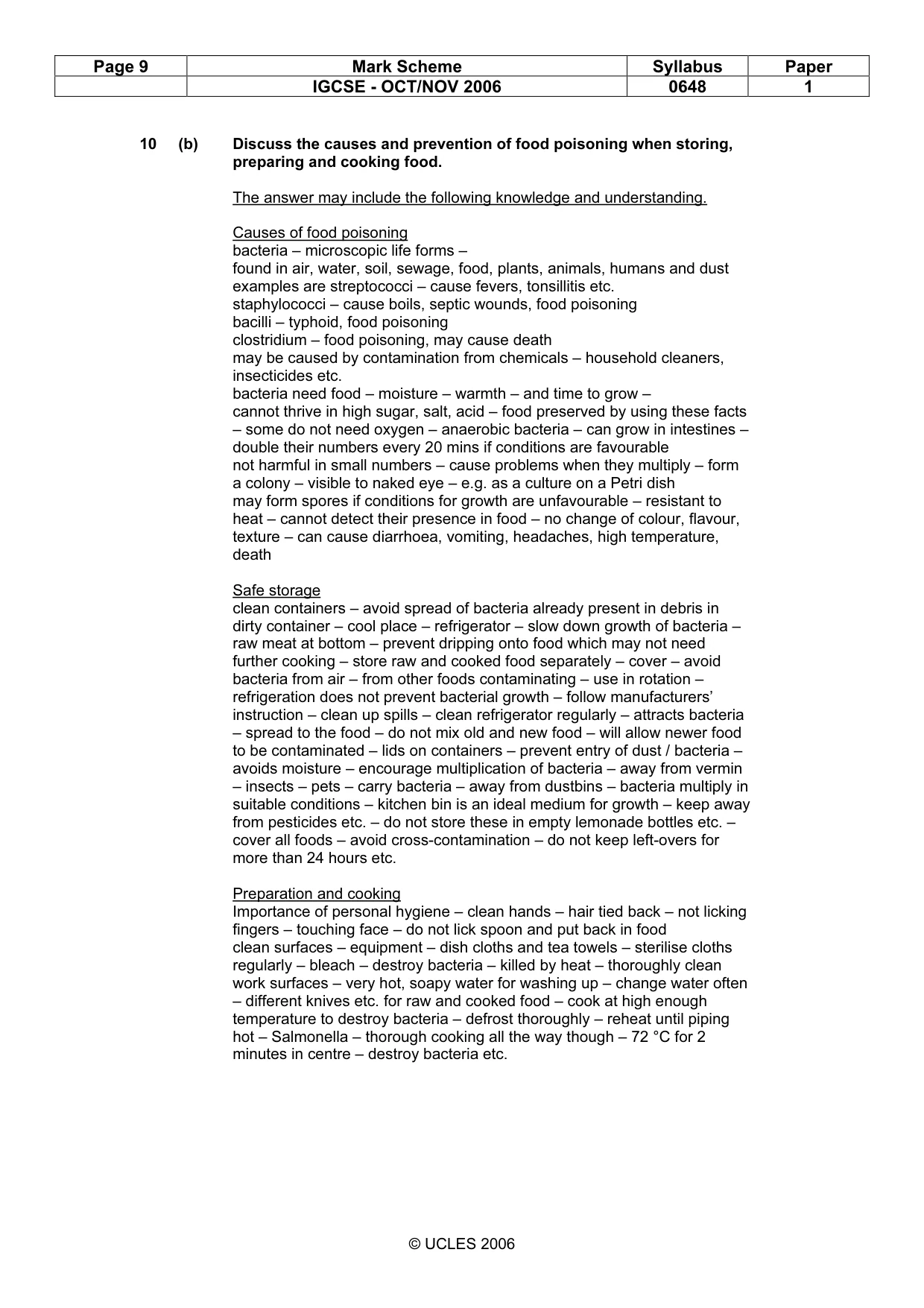
Page 9 Mark Scheme Syllabus Paper IGCSE - OCT/NOV 2006 0648 1 © UCLES 2006 10 (b) Discuss the causes and prevention of food poisoning when storing, preparing and cooking food. The answer may include the following knowledge and understanding. Causes of food poisoning bacteria – microscopic life forms – found in air, water, soil, sewage, food, plants, animals, humans and dust examples are streptococci – cause fevers, tonsillitis etc. staphylococci – cause boils, septic wounds, food poisoning bacilli – typhoid, food poisoning clostridium – food poisoning, may cause death may be caused by contamination from chemicals – household cleaners, insecticides etc. bacteria need food – moisture – warmth – and time to grow – cannot thrive in high sugar, salt, acid – food preserved by using these facts – some do not need oxygen – anaerobic bacteria – can grow in intestines – double their numbers every 20 mins if conditions are favourable not harmful in small numbers – cause problems when they multiply – form a colony – visible to naked eye – e.g. as a culture on a Petri dish may form spores if conditions for growth are unfavourable – resistant to heat – cannot detect their presence in food – no change of colour, flavour, texture – can cause diarrhoea, vomiting, headaches, high temperature, death Safe storage clean containers – avoid spread of bacteria already present in debris in dirty container – cool place – refrigerator – slow down growth of bacteria – raw meat at bottom – prevent dripping onto food which may not need further cooking – store raw and cooked food separately – cover – avoid bacteria from air – from other foods contaminating – use in rotation – refrigeration does not prevent bacterial growth – follow manufacturers’ instruction – clean up spills – clean refrigerator regularly – attracts bacteria – spread to the food – do not mix old and new food – will allow newer food to be contaminated – lids on containers – prevent entry of dust / bacteria – avoids moisture – encourage multiplication of bacteria – away from vermin – insects – pets – carry bacteria – away from dustbins – bacteria multiply in suitable conditions – kitchen bin is an ideal medium for growth – keep away from pesticides etc. – do not store these in empty lemonade bottles etc. – cover all foods – avoid cross-contamination – do not keep left-overs for more than 24 hours etc. Preparation and cooking Importance of personal hygiene – clean hands – hair tied back – not licking fingers – touching face – do not lick spoon and put back in food clean surfaces – equipment – dish cloths and tea towels – sterilise cloths regularly – bleach – destroy bacteria – killed by heat – thoroughly clean work surfaces – very hot, soapy water for washing up – change water often – different knives etc. for raw and cooked food – cook at high enough temperature to destroy bacteria – defrost thoroughly – reheat until piping hot – Salmonella – thorough cooking all the way though – 72 °C for 2 minutes in centre – destroy bacteria etc.
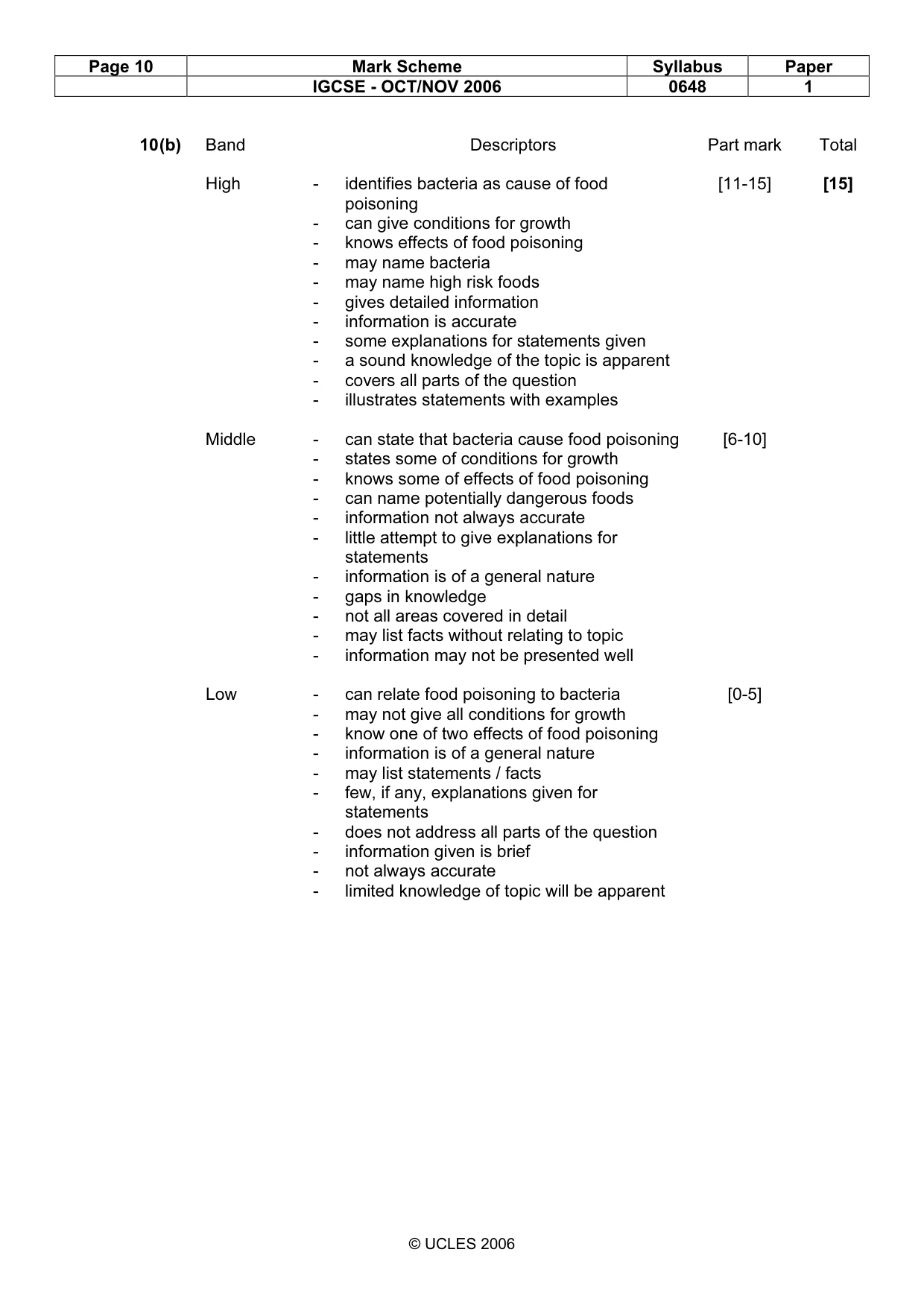
Mark scheme, page 10
Page 10 Mark Scheme Syllabus Paper IGCSE - OCT/NOV 2006 0648 1 © UCLES 2006 10 (b) Band Descriptors Part mark Total High - identifies bacteria as cause of food poisoning [11-15] [15] - can give conditions for growth - knows effects of food poisoning - may name bacteria - may name high risk foods - gives detailed information - information is accurate - some explanations for statements given - a sound knowledge of the topic is apparent - covers all parts of the question - illustrates statements with examples Middle - can state that bacteria cause food poisoning [6-10] - states some of conditions for growth - knows some of effects of food poisoning - can name potentially dangerous foods - information not always accurate - little attempt to give explanations for statements - information is of a general nature - gaps in knowledge - not all areas covered in detail - may list facts without relating to topic - information may not be presented well Low - can relate food poisoning to bacteria [0-5] - may not give all conditions for growth - know one of two effects of food poisoning - information is of a general nature - may list statements / facts - few, if any, explanations given for statements - does not address all parts of the question - information given is brief - not always accurate - limited knowledge of topic will be apparent
What you needed in this session
Cambridge’s own grade thresholds for 2006 Oct/Nov, Paper 1 · Variant 1. A higher threshold means an easier paper — the bar moves with how the cohort did.